MARK #3: HELP FROM ONE WHO KNOWS WHAT IT’S LIKE

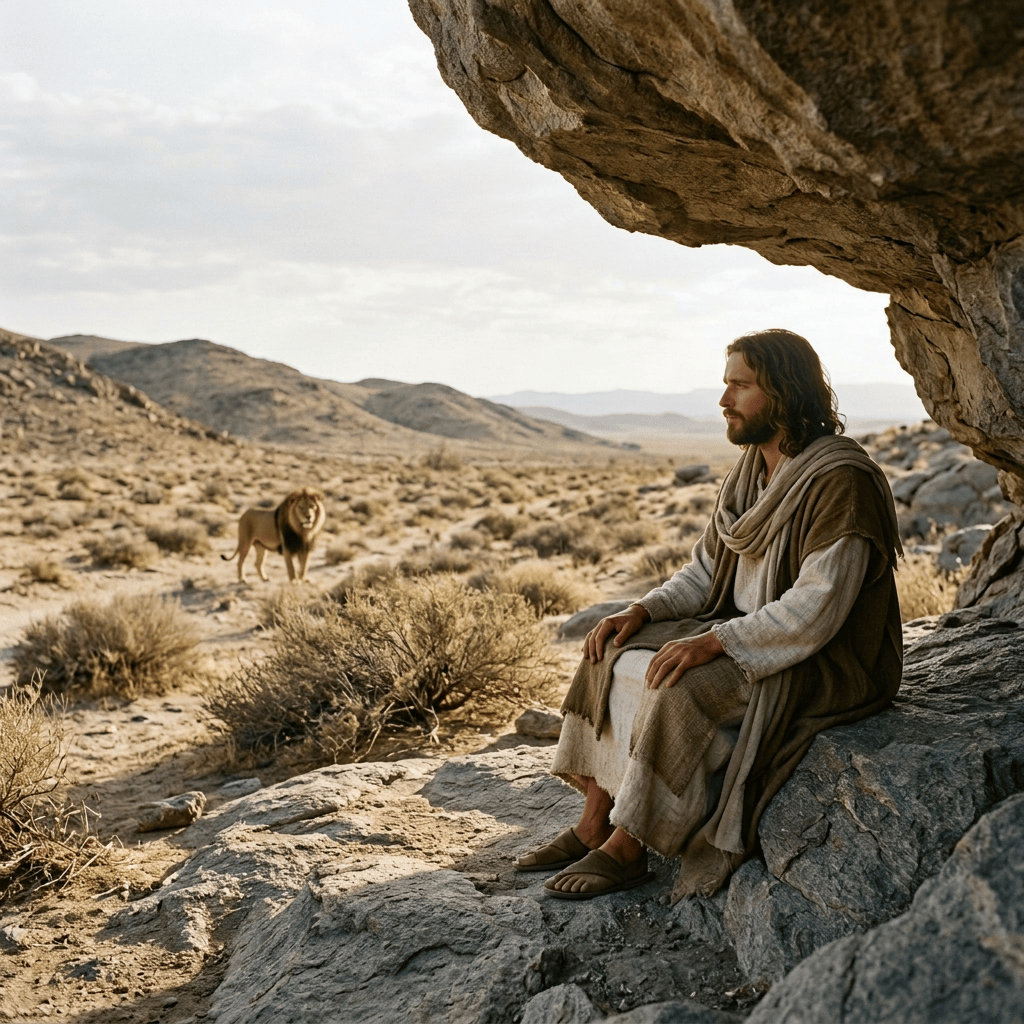
Bearded robed man seated beneath a rocky overhang with a lion nearby

The temptation of Jesus shows us that temptation is not the same thing as sin. We also learn that sometimes, God himself leads us into times of difficult testing. Our circumstances are not a reliable guide to how God feels about us. He loved Jesus. He was pleased with Jesus. And he led him into a wilderness with no food where he was in danger from the devil and wild animals.

To listen to the sermon, click the play button:

You can also find us on Spotify at https://open.spotify.com/show/6KKzSHPFT466aXfNT2r9OD (This will open to the latest sermon. You can search from there if you are looking for a previous one)

To download, right click on the link (or do whatever you do on a Mac) and save it to your computer: Download Mark Part 3

Mark #3. Mark 1:9-13

We considered the baptism of Jesus last time. Mark uses it as the last of a three (or four) part claim that Jesus is the Messiah, Yahweh, the Son of God. Matthew, Mark and Luke all record that right after Jesus was baptized by John, a voice from heaven declared “This is my beloved son, with him I am well pleased.”

Now, we need to remember Jesus’ situation. He was eternally God, but two thousand years ago, he joined his God-nature to human nature. We Christians believe that the joining will last forever. In other words, going forward from his birth near Bethlehem, he is both God and man, at the same time, forever. Now, during his time on earth, Jesus did not “use” his  God-nature. He lived as a human being, relying on God the Father for all things. All of the miracles were done by  God the Father as Jesus relied upon him. This is the same way God still sometimes does miracles through people. Jesus basically allowed himself no resources that other human beings wouldn’t have.

Here’s how the author of Hebrews puts it:

14 Now since the children have flesh and blood in common, Jesus also shared in these, so that through his death he might destroy the one holding the power of death ​— ​that is, the devil ​— ​ 15 and free those who were held in slavery all their lives by the fear of death. 16 For it is clear that he does not reach out to help angels, but to help Abraham’s offspring. 17 Therefore, he had to be like his brothers and sisters in every way, so that he could become a merciful and faithful high priest in matters pertaining to God, to make atonement for the sins of the people. 18 For since he himself has suffered when he was tempted, he is able to help those who are tempted. (Hebrews 2:14-18, CSB, bold formatting added for emphasis)

Therefore, when Jesus, restricting himself to human nature, heard the voice of the Father from heaven affirming and loving him, I have to believe that it was a wonderful, exhilarating moment for him. Jesus’ divine nature didn’t need that kind of affirmation. But as a human, Jesus wanted to know for certain that God loved him, the same as we all do. Because Jesus relied on the Father as a human being must do, his baptism would have been a big spiritual high.

I think this is important because of what comes next. Matthew Mark and Luke all agree that the next thing that happened, after this amazing spiritual high of God the Father telling Jesus that he was loved and accepted, was that the very same  God led Jesus into a desolate wilderness where he was attacked by Satan, and even physically threatened by hunger and wild animals.

As modern people, we might be prone to thinking of the wilderness, and wild animals, as wonderful, awe-inspiring things. These days, wilderness is rare and precious. Wild animals are often endangered, and they present very little danger to human beings with firearms. Most dangerous wild animals today live nowhere near humans, and when they do, they are terrified of humans.

About ten years ago, I spent eight days alone in a hunting cabin in Colorado. One day when I was out fishing, I came across a large, fresh, mountain lion track in the mud next to the stream I was exploring. I had a brief moment of wondering if I was being stupid for not getting out of there, but overall, my feeling was one of awe, wonder and joy.

But two thousand years ago, the situation was very different. Much of the world was still unsettled wilderness, and wild animals were more plentiful, and more aggressive toward people. In the wilderness near ancient Judea there were lions and bears, and perhaps hyenas. There were also venomous snakes and scorpions, and no one had yet invented antivenin, or any other way of treating venomous bites or stings. Humans had not yet developed effective ways of dealing with dangerous creatures, and those creatures had less fear of people.

So when Mark says that the Holy Spirit drove Jesus into the wilderness, and he was with the wild beasts, his first readers understood that Jesus was taking a big risk; that he might lose his physical life. Even fifteen hundred years later, the world was still much the same, so commentator Matthew Henry, writing in the late sixteenth century, intuitively understood that the “wild beasts” were not a positive at all. He wrote:

Mark observes this circumstance of his being in the wilderness – that he was with the wild beasts. It was an instance of his Father’s care of him, that he was preserved from being torn in pieces by the wild beasts, which encouraged him the more that his Father would provide for him when he was hungry. Special protections are earnests of seasonable supplies. It was likewise an intimation to him of the inhumanity of the men of that generation, whom he was to live among – no better than wild beasts in the wilderness, nay abundantly worse. (Matthew Henry’s Commentary on the Whole Bible)

One thing that occurs to me here is that this shows me something about Jesus that I don’t normally think about. I love the wilderness, and before the pain came into my life, I used to hike, and canoe, and fish. I regularly went to wilderness areas. These days, the closest I get is watching a TV show called “Alone,” in which people go out into the wilderness to see how long they can survive. Participants are allowed to take a certain amount of equipment with them. But knowing what I do about the wilderness, I have a great deal of admiration for anyone who survives alone for as much as three weeks. But Jesus went alone into the wilderness with no modern equipment at all, and survived for forty days. I’ve never quite thought of it like this, but Jesus was a genuine wilderness survivor, a true “mountain man,” in my way of thinking.

So, the Holy Spirit led Jesus from a wonderful, amazing, spiritual high experience into a profoundly difficult and dangerous one. Jesus had to contend with the devil. Remember, he did not tap into the pure power he could have used as God. Instead, he confined himself to human resources, relying on the Father to help him. In addition to the devil, Jesus had to watch out for literal wild animals that were dangerous to human beings. So he was both spiritually and physically in danger, in addition to being without food.

The Father was pleased with Jesus. The Spirit was with him, leading him. And he was brought into a desert wasteland where he had no food and had to fight with the devil, and watch out for wild predators.

You don’t have to go very far in America to hear a Christian say something like this: “If you just follow God, he’ll take care of you. Your life will go better.” The Father was pleased with Jesus. The Spirit was leading him. However, his life did not get better, but harder. Following God is not a guarantee that everything will go well for you. That’s hard, but it’s the truth. When we follow God, his goal is to lead us to the place where we understand that this life on earth is not the main focus. His goal is for us to get in line with his purposes in the world, to be part of his showing his glory to the world. That doesn’t always involve making us more comfortable, or well off. God is telling a story about himself through our lives. Most really good stories involve danger, struggle and conflict. So we should not be surprised when our lives have elements of that as well.

There is something else that many people may need to hear today: Our circumstances do not necessarily reflect how God feels about us. Jesus had nothing to eat. He was assailed by the devil, and living in a desert wasteland, in danger from predators. And the Father was so pleased with him; the Spirit was with him. The Father had his reasons for allowing Jesus to go through that. But his reasons had nothing to do with  his delight in Jesus.

Sometimes, when I’m going through tough times, I think maybe God is mad at me, or perhaps I’ve done something that has caused him to teach me a lesson. Another thought I have sometimes is that I’m going through hard times because I’ve made the wrong choice, and not listened to the Holy Spirit. But that could not have been the case with Jesus. The Father was pleased with him. The Spirit was leading him. Even so, as I just said, he was in constant danger, and assailed by profound attacks from the devil.

I think this passage calls us to dare to look at our circumstances differently. Through Jesus, the Father is pleased with us, too. What we are going through is not necessarily a sign of how God feels about us. It’s true that, unlike Jesus, we sin. Sometimes we go astray and hard circumstances are a result of our bad choices. But Jesus shows us that you can follow the Spirit and still end up in a wasteland with no food and the devil attacking you constantly. Just because you are in a hard time does not mean that God is displeased with you. Trust his love and grace to you!

There’s something else for us here, as well. The author of Hebrews refers to it in the end of the quote above:

18 For since he himself has suffered when he was tempted, he is able to help those who are tempted. (Hebrews 2:18, CSB)

One of the reasons we have this passage is to encourage us when we face trials and temptations. Jesus was also tempted. Jesus also went through suffering and difficult times. He understands the difficulties, he knows what it is like.

This should encourage us in two ways. First this: temptation is not sin. Just because we are tempted to do or think something doesn’t mean that we are sinning. Temptation comes from the devil, the world and our sinful flesh, but it doesn’t come from within us, who are redeemed by God through Jesus Christ. These forces come to us and whisper to our minds: “You want to lust, don’t you?” Or, “You want to put that person in her place, don’t you? You want to say that mean thing, you want to cheat, just this once, you want to rage at your spouse, you want to prove you are better…” You get the idea. These thoughts are temptations, not sins. We think it is only ourselves thinking these thoughts, and so we think we have already sinned. But temptation cannot be sin, because Jesus himself was tempted, but never sinned.

15 For we do not have a high priest who is unable to sympathize with our weaknesses, but one who has been tempted in every way as we are, yet without sin. 16 Therefore, let us approach the throne of grace with boldness, so that we may receive mercy and find grace to help us in time of need. (Hebrews 4:15-16, CSB)

So, the first thing is to remember that temptation is not sin. You have done nothing wrong by being tempted. Don’t let the devil trick you into going ahead and following through, in acting on the temptation because you think you have already failed. You haven’t.

The second thing is also found in the verses I just quoted. I’ll quote it again, because it is very important:

16 Therefore, let us approach the throne of grace with boldness, so that we may receive mercy and find grace to help us in time of need. (Hebrews 4:15-16, CSB)

That’s another reason Jesus went through temptation: to teach us to run to him in temptation, and even also to run to him if we have failed and sinned. Matthew Henry puts it like this:

Christ himself was tempted, not only to teach us, that it is no sin to be tempted, but to direct us whither to go for succour when we are tempted, even to him that suffered, being tempted; that he might experimentally sympathize with us when we are tempted. (Matthew Henry’s Commentary on the Whole Bible)

We can boldly come to Jesus when we are tempted, and find grace to help us in time of need. And if we have failed, we find that same grace forgiving us in time of need. Jesus is not sitting there with his arms folded across his chest, shaking his head at us. No. He knows what it is like to be a human being facing the devil. That is why he came—to defeat sin and the devil, and to offer us grace instead of condemnation. That grace leads us away from sin, but it is still there, even when we fail and fall into sin.

What is the Holy Spirit saying to you through this text today? Do you need to be reminded that sometimes following Jesus means going through hard things so that God can tell a glorious story through you? Do you need to know that difficult circumstances do not mean that God has abandoned you, or that you have done something wrong, but rather, it could be that you are facing difficulty, as Jesus did, because God is pleased with you?

Maybe you need to hear today that temptation is not sin. You’ve been tempted, and you’ve thought, “I’ve already failed! I hardly had time to realize it before I failed.” But maybe not. Maybe, you are facing temptation, which even Jesus did! Do not let the devil condemn you, when all that’s happened is that the devil himself is whispering to you. Rebuke him in the name of Jesus and send him away.

Of course, maybe you really did sin. Maybe you listened to the voices of the devil, the world, or your own flesh, and gave in and actually did the wrong thing. If so, repent! Turn away from sin, and turn to Jesus. You can be confident that you will find grace and mercy in Jesus when you need it.

MARK #1. SECOND CHANCES MAKE GREAT CHRISTIANS.

Traveler walking toward a mountain village on a winding path at sunset

Mark and his cousin Barnabas are outstanding example for us of what it looks like to faithfully follow Jesus and encourage others to do the same.

To listen to the sermon, click the play button

:

You can also find us on Spotify at https://open.spotify.com/show/6KKzSHPFT466aXfNT2r9OD (This will open to the latest sermon. You can search from there if you are looking for a previous one)

To download, right click on the link (or do whatever you do on a Mac) and save it to your computer: Download Mark Part 1

Mark #1. Acts 12:12-17; 2 Timothy 4:11

Today we will begin a new sermon series on the Gospel of Mark. This message will largely be setting up the background.

Mark is my least favourite gospel. Now, that’s not as big of a deal as you might think. One of the four has to be my least favourite. So, it doesn’t mean I don’t like the book of Mark. But I do like the other three gospels better. For that reason, I’m excited about preaching through Mark, because I believe the Holy Spirit can, and will, help me to appreciate it more.

We know a certain amount about Mark, the writer. He is first mentioned in Acts chapter 12. The apostle Peter was put in prison by Herod, but an angel miraculously delivered Peter. Initially, Peter thought his deliverance was a dream. The first place Peter went when he realized he was actually free was a house belonging to a woman named Mary (almost certainly a widow at this point).

12 When Peter realized this, he went to the house of Mary, the mother of John whose other name was Mark, where many were gathered together and were praying. 13 And when he knocked at the door of the gateway, a servant girl named Rhoda came to answer. 14 Recognizing Peter’s voice, in her joy she did not open the gate but ran in and reported that Peter was standing at the gate. 15 They said to her, “You are out of your mind.” But she kept insisting that it was so, and they kept saying, “It is his angel!” 16 But Peter continued knocking, and when they opened, they saw him and were amazed. 17 But motioning to them with his hand to be silent, he described to them how the Lord had brought him out of the prison. And he said, “Tell these things to James and to the brothers.” Then he departed and went to another place. Acts 12:12-17

This passage tells us several things. Peter went to Mary’s house (there were a lot of women named Mary at that time and place). Mary was the mother of Mark. It shows that Mark (or John-Mark, as he was known when he was younger) and his mother were wealthy. They had at least one servant (the woman named Rhoda) and their house was large enough to host a number of people. They also had not just a door, but a gate, suggesting a large house or compound with a courtyard. Most importantly, this reads to me as if the group at Mary’s house is Peter’s regular house-church. Peter obviously had a ministry much larger than one house church, but all Christians, in addition to sometimes meeting in large groups in the temple courts, also belonged to smaller house churches. It makes sense to me that Peter would go first to his own community of believers. That means that Mark grew up learning from Peter in his house church. Peter was someone who knew Mark well, and vice versa.

We also know that Mark had an uncle, or possibly older cousin, who was also a leader in the early church in Jerusalem: Barnabas. After the apostle Paul was converted, it was Barnabas who vouched for him, and introduced him to the apostles in Jerusalem. Later he traveled to Paul’s hometown to bring him back and get him involved in ministry in the city of Antioch. After a return trip to Jerusalem, Barnabas also brought John-Mark back to Antioch with him.

A little bit later on, the Holy Spirit spoke to the elders at the church in Antioch, calling Barnabas and Paul to make a missionary journey to bring the gospel to the Gentiles. They brought John Mark along with them, to assist them. He remained with them during the first stage of their journey, on the Island of Cyprus. Some pretty cool things happened there (read Acts 13). After that, they sailed on to the coast of the province of Asia (which is modern day Turkey). But for some reason that is not given, John Mark did not go with them any further. He returned not to Antioch, but to his home in Jerusalem.

Paul and Barnabas completed their missionary journeys and returned to Antioch. Then, they participated in a regional church gathering in Jerusalem to talk about whether Gentiles could be disciples of Jesus without being fully Jewish. After that was settled, some time later, Paul and Barnabas decided to go back and revisit the churches they had helped to start. Barnabas wanted, once again, to take his relative, John-Mark, along. However, Paul vehemently opposed such a thing. He considered John Mark to be unreliable.

They couldn’t reconcile their disagreement about taking John-Mark, so Paul went to Asia minor, accompanied by a church leader named Silas, while Barnabas took Mark and revisited Cyprus. This is the last time Mark is mentioned in Acts, but something interesting seems to have happened. Up until this point, he was called “John, who was called Mark,” or John-Mark, or even just John. But in Acts 15:39, the last time he is mentioned, he is called only “Mark.” The “John” part of his name has been dropped. It might have been that as he grew into leadership in the church, it was confusing for him to go by the name “John,” because of the apostle John. To avoid confusion, then, perhaps people started to call him exclusively Mark. There is no way to no for sure what cause the change.

Paul himself mentions Mark—in a positive light—at the end of three different letters (Colossians, 2 Timothy and Philemon). By that point in time, Paul has changed his attitude. He says to Timothy:

11 Luke alone is with me. Get Mark and bring him with you, for he is very useful to me for ministry. (2 Timothy 4:11, ESV)

So, obviously, Paul and Mark reconciled, and Paul came to see him as a valuable minister in God’s kingdom. I wonder if Mark had some sort of change of heart that also led him to drop the “John,” like Paul had dropped “Saul.” In any case, at this later time Paul clearly appreciated and respected Mark.

And then finally, the apostle Peter indicates that Mark was with him when he wrote 1 Peter from Rome. Peter calls him, “Mark, my son” (1 Peter 5;13). This would have been not long before Peter was captured and murdered by the soldiers of emperor Nero. It would be natural for Peter to feel like a father to Mark, whose actual father probably died when Mark was young. Peter was there in Mark’s life when he was growing up in their house church in Jerusalem.

We also have early church writings that mention Mark the person, as well as Mark the gospel. According to these sources, Mark was assisting Peter in his ministry in Rome (which seems to be confirmed by 1 Peter 5:13, above). Peter would tell stories about Jesus, and also many of Jesus’ teachings. Mark urged Peter to put it all into an orderly account, and write it down for future generations. Peter replied, saying that he wouldn’t do that, but Mark was welcome to write down the things he, Peter, said, if he wanted to. This sounds like Peter, doesn’t it? All four gospels, and the book of Acts portray Peter as a man who is quick to speak and act. He was obviously more man of action than a book-writer. Even his first letter was dictated to Silvanus, who wrote it down for him.

So, at some point, Mark did indeed do what Peter suggested. But he had a great reverence for Peter and the other apostles, so Mark only wrote what he heard Peter say about Jesus. No doubt, growing up in the church, Mark heard many different things about Jesus. But, in writing his gospel, he felt that it was his duty to only pass on what Peter said about Jesus, and not add anything he, Mark, had learned anywhere else.

You can get a sense of this when you read the gospel of Mark. It sometimes seems very abrupt, with a kind of staccato feel to the story. This is one of the reasons it isn’t my favourite gospel. But now we know that this is because Mark did not add anything to what Peter said. Luke researched his own gospel extensively, and he felt free to add explanations, and offer transitions between scenes. But Mark didn’t do that, and it shows.

From the very earliest writings of Christians, dating to just after 100 A.D. it is clear that there were four gospels (and only four): Matthew, Mark, Luke and John. Writers did not typically add their own names to the beginning of ancient documents, so early Christians must have added the names to identify them. There is no record of any other name being attached to the gospel of Mark (nor variations in any of the other gospel authors).

I say this because it should increase our confidence in the truth and reliability of the Bible. You see, if you wanted to make up a gospel and pass it off as genuine, you surely wouldn’t try to pretend that the author was such a minor person as Mark. You would pick someone more famous and influential.

In fact, about two hundred years after Jesus, people actually did write fake gospels, trying to pass them off as genuine. It’s not hard to spot the difference between the real ones and the fake ones, and the vast majority of Christians never did accept the fakes as genuine. But for my purposes here, the point is that all of the fakers tried to pass their forgeries off as the writings of the central figures around Jesus. So you have the fake gospels of Peter, Judas, Thomas and Mary. No one, in faking it, used the name of someone as obscure as Mark. You wouldn’t do that if you were making it up.

Many scholars are convinced that Mark was the first gospel to be written. They base this on the fact that it shares a lot of the exact same material with Matthew and Luke, but Mark is the shortest. I think they may be mistaken, for a number of reasons that would probably bore you. My own idea is that Matthew was the first, then Mark, then Luke and John. In fact, I think the early church preserved that order because that is the order in which they received them. I think Mark is the shortest because he restricted himself to Peter’s words. Although mine is a minority position, I’m not the only one who thinks that.

Let’s talk for a minute about Peter’s words, which are the substance of this gospel. From Jewish writings about a hundred years later, it is clear that when rabbis gathered disciples, those disciples were expected to either write down, or memorize, things that the rabbi did and said. Probably, there was a combination of writing and memorization among the disciples of Jesus. Mark’s gospel is the record of Peter’s memorization and writing. Luke and Matthew contain some stories and teachings that are worded more or less exactly the same as some of Mark. Most likely, that is because all of the apostles memorized certain core things word for word. Most of Mark is made up of these kinds of things, while Matthew and John also included more of their own memories, and Luke included the results of his research. But in many ways, we might say that Mark is “Peter’s gospel.”

We aren’t dealing with one specific scripture passage today, so I want to pause and consider the lives of Mark, and of his cousin, Barnabas. Without the encouragement and support of Barnabas, the apostle Paul might never have become the conduit for Jesus that he was. It was Barnabas who brought Paul to meet the apostles in Jerusalem. It was Barnabas who later, once more, found Paul, and brought him to Antioch. It was Barnabas who brought his cousin Mark to Antioch as well, and got him involved in full time service to Jesus. It was Barnabas who stood by Mark even after Mark had messed up, and the apostle Paul rejected him. It was Barnabas who turned out to be right about Mark, something which Paul eventually agreed with.

How many of you have given as much as a few minutes of thought to Barnabas? Yet without him, there might be no letters from the wise apostle Paul, and no gospel of Mark. By encouraging and supporting and being patient with Christians who were younger in the faith than he was, Barnabas had a tremendous impact on the development of Christianity. His ministry was very much behind the scenes, and yet the ministry of several, more famous, other people were built upon the foundation that Barnabas laid.

I’m not always a fan of medieval church festivals, but just for your information, the Roman Catholic church celebrates the life of Barnabas on June 11 each year. I might try and remember that next year. In the meantime, I thank the Lord for him, and for faithful Jesus followers like him. I wish I was more like Barnabas. I know a couple people like him, and I want to encourage them and thank them for being that way, as well.

And then there is Mark. He was one of the first generation of young people to be raised in a Christian home and Christian church. He had a deep personal relationship with the apostle Peter, for many years the leader of the entire Christian movement. He got to be around Barnabas and Paul for a few years too. He was primed to become a force among the next generation of Christian leaders. And then, on his first big endeavour, the first missionary journey of Barnabas and Paul, Mark crashed and burned.

What an embarrassment. He had every possible spiritual advantage (as well as the advantage of being in a wealthy family), and yet he failed. That could have been the end of Mark’s usefulness to Jesus. And yet Barnabas stood by him, and encouraged him, and in a couple years he was ready to try again. But Paul wouldn’t have him—another roadblock. But he and cousin Barnabas went to Cyprus anyway, and as far as we know, Mark didn’t turn back this time. Over time, Paul recognized that Mark had matured, and eventually, Paul was literally asking for his help. Mark helped Peter, too, and then finally wrote this precious gospel which we have.

Mark’s life is a reminder to me that with Jesus, we always get another chance. If Mark had given up after he failed the first time, the ministries of Paul and Peter and Barnabas would have been poorer for it. And the whole world would have been poorer for the lack of his gospel. Mark’s life can remind us that the Lord offers us more chances than we deserve, and there is always time to make a difference.

Let the Holy Spirit speak to you today, and prepare us all to study the gospel of Mark.