
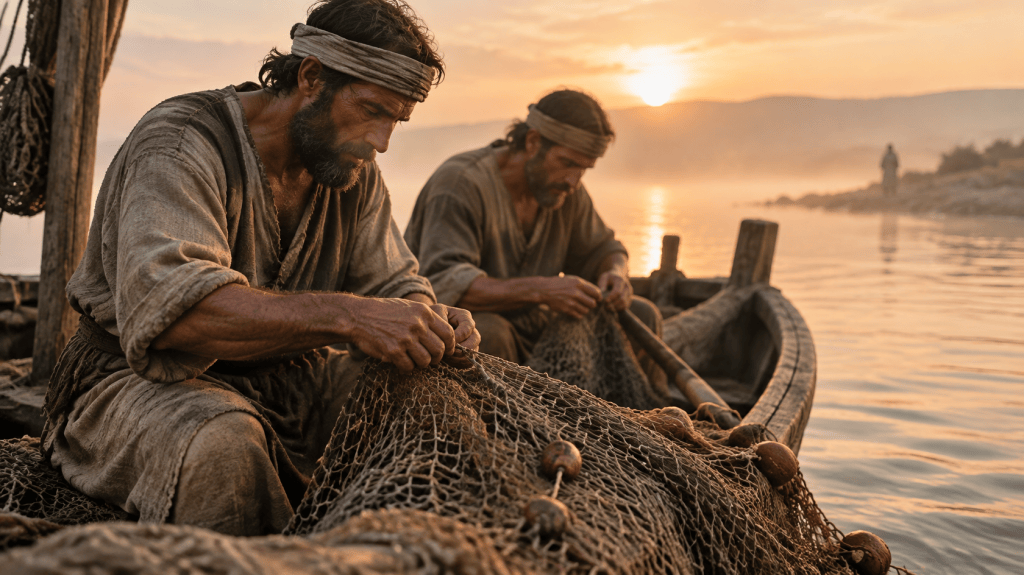
Peter told the story of his call in just a few words, but there was so much more behind it: a miraculous catch of fish, a sinking boat, and earlier meetings with Jesus. Why did Peter keep it so short? And why did Jesus choose ordinary, fishy-smelling peasants to change the world? He still calls ordinary people today.
To listen to the sermon, click the play button:You can also find us on Spotify at https://open.spotify.com/show/6KKzSHPFT466aXfNT2r9OD (This will open to the latest sermon. You can search from there if you are looking for a previous one)
To download, right click on the link (or do whatever you do on a Mac) and save it to your computer: Download Mark Part 5
Mark #5. Mark 1:16-20
16 As he passed alongside the Sea of Galilee, he saw Simon and Andrew, Simon’s brother, casting a net into the sea — for they were fishermen. 17 “Follow me,” Jesus told them, “and I will make you fish for people.” 18 Immediately they left their nets and followed him. 19 Going on a little farther, he saw James the son of Zebedee and his brother John in a boat putting their nets in order. 20 Immediately he called them, and they left their father Zebedee in the boat with the hired men and followed him. Mark 1:16-20, CSB
There is a story about a man and wife who are sitting together, reading, in their living room one night when the husband gets a phone call. He listens, and periodically says, “Yeah…uh-huh, sure,” and so on, for forty-five minutes. Finally, he says goodbye and hangs up.
“Who was that?” asks his wife.
“Herman Long,” he says.
Herman Long used to be his best friend, but no one has heard from him in five years. The husband picks his book up and starts reading again.
The wife, exasperated, says: “Well, what did Herman say? Where has he been all this time? How is he?”
“He’s fine,” says the husband, and reads again.
Of course, the wife won’t leave it at that. She bugs her husband to find out what Herman Long was saying during those forty-five minutes. Little by little, the story comes out. Herman’s wife had left him to join a cult of mimes, after which Herman joined the circus as a human cannonball. After assassinating a Russian oligarch for the CIA, he spent some time in a Russian prison, and then, after he escaped, he rejoined the circus until he was in an accident involving an elephant, two clowns and a unicycle. At the point when he called the husband, he was almost able to see out of one eye again, and his prosthetic leg was working pretty well, his new relationship with the French-assassin girlfriend was pretty good, and so, everything was fine, which was exactly what the husband told the wife in the first place.
In our text today, which comes from the apostle Peter, as recorded by Mark, I get the impression that Peter would have been a bit like the husband in the story. Peter says that Jesus found him and his brother Andrew fishing, and he called them to follow, and they did. A little further down the shore, he did the same thing with James and his brother John. End of story.
But actually, there was a lot more to it. Luke and John, between them, give us the rest of the story. It is likely that Luke interviewed the apostle Peter, and Peter, in conversations with Luke, was a little more forthcoming about himself than he was when he taught publicly. So, here’s the whole story (combining Luke and John): Andrew (Simon Peter’s brother), and probably John, were disciples of John the Baptizer. One day, John the Baptizer pointed out Jesus and told them that he was the “lamb of God,” the one that they had all been waiting for. So, Andrew and the other disciple (again, probably the apostle John) spent the rest of that day with Jesus. The following day, Andrew brought his brother Simon Peter to meet Jesus.
Jesus spent some time preaching and doing miracles in the vicinity of their hometown, Capernaum. Probably, Andrew, Peter, James and John all spent time with Jesus, listening, and getting to know him a bit. One day as Jesus was teaching by the lake, crowds gathered. Jesus asked Peter (at this point he was still called Simon) if he could use his boat to get back from the crowds a bit. Also the water would have helped to amplify his voice. So they put out from the shore a little way so Jesus could speak to the big crowd. When he was done teaching, Jesus told Simon and Andrew to let down their nets for a catch. It was the wrong time of day, and the water there was probably too shallow. But Simon agreed anyway, because he respected Jesus too much to call him a fool. However, the joke was on Simon: their nets filled with so many fish that the boat was in danger of sinking. They signaled James and John, who were their partners in the fishing business, and they all got the fish to shore, shocked at what had happened.
Simon Peter realized it was a miracle, and responded accordingly. At that point, Jesus said, “follow me, and I’ll have you fish for people.” He called Andrew, James and John as well, who were all there, and had witnessed the miracle.
The natural question is: Why didn’t Peter tell that story in his public teaching and preaching? If he had, Mark would have included it, because he was committed to writing only what he had heard Peter teach publicly. But obviously, Mark didn’t include those details, so Peter must not have told that story very often in public, if at all. But again, why not?
I think there may be three reasons. First, we see from the gospels and the book of Acts that Peter was someone oriented toward quick action. He probably didn’t want to waste a lot of time on details. Jesus called him, that was the important thing. Who cares about the details? He was like the husband in the story at the beginning.
Second, I think it might also be because Peter, after the death and resurrection of Jesus, became a legitimately humble man, and he didn’t want to tell a story that was, in many ways, mostly about him. In his first letter, Peter writes:
1 So I exhort the elders among you, as a fellow elder and a witness of the sufferings of Christ, as well as a partaker in the glory that is going to be revealed: 2 shepherd the flock of God that is among you, exercising oversight, not under compulsion, but willingly, as God would have you; not for shameful gain, but eagerly; 3 not domineering over those in your charge, but being examples to the flock. 4 And when the chief Shepherd appears, you will receive the unfading crown of glory. 5 Likewise, you who are younger, be subject to the elders. Clothe yourselves, all of you, with humility toward one another, for “God opposes the proud but gives grace to the humble.”
6 Humble yourselves, therefore, under the mighty hand of God so that at the proper time he may exalt you (1 Peter 5:1-6, ESV).
Let’s remember some things about Peter, who wrote that letter after the gospels about Jesus had been circulating for some time. It is Peter whom all the gospels portray as the leader among the twelve apostles. He knew Jesus personally. He was one of only three who were chosen to see Jesus revealed in glory at the transfiguration. He was the only person, besides Jesus Christ himself, who ever walked on water. After the day of Pentecost, it was Peter who preached the sermon that led to three-thousand people being saved. Several times he stood before the leaders of the nation of Israel, and proclaimed the truth of Jesus. He was imprisoned, beaten and persecuted for his trust in Jesus. Once, he was miraculously delivered from execution. God used him to heal many people; so much so that, at one period in Jerusalem, sick people would lay in the street in the hopes that Peter’s shadow would fall on them as he walked past.
It is this Peter who, in his letter, wanted to speak a word to church elders – that is, the leaders of local house churches. He could have said: “I command you, as the one God used to heal dozens of people.” He could have written: “As the only person besides Jesus to walk on water, I say…” There are many ways he could have reminded these leaders that they should listen to him. Instead, he writes: “As a fellow elder.” This section ends with Peter urging everyone to be humble, and he certainly put humility into practice here. Though he could have commanded them as an acknowledged leader, instead, he appeals to them as an equal.
So, I think that probably, in his preaching, Peter was not always comfortable spending a lot of time on himself. Instead, he tells the short version: “Jesus called us from our normal occupation to serve him full time.”
There is a third reason that Peter might not have told the long version of his call to follow Jesus. It was a unique miracle. But he may have worried that other people would expect something similar if they were supposed to follow Jesus. The main point is that Jesus called, and he, Andrew, James and John responded. When other people are called by Jesus, the details will certainly vary from person to person. Peter was probably thinking, “Don’t get hung up on the miracle. Jesus doesn’t always do a miracle when he calls us. Instead, hear the call of Jesus come directly to you, in the middle of your ordinary life.”
That ordinary life is another thing worth noting. Mark wrote his gospel to inform Christians about Jesus Christ. But he was also informing them about the origins of Christianity, and he probably guessed that people who were not Christian would eventually read it. These short verses tell us something remarkable: the early leaders chosen by Jesus to spread his message were ordinary peasants.
We have to remember that in ancient times, people felt there was a real difference between noblemen and everybody else. They felt that certain people were born special, because of their families. It would have been natural for Jesus to have gone to Jerusalem, and selected for his disciples people of power and influence. Remember, Mark has already included three claims that Jesus is God, who came in human flesh. Therefore, Jesus had the right to ask anyone, even Caesar, to follow him. But the people he asked first were peasant fisherman. This fact would have been very surprising, even shocking to Mark’s readers who hadn’t yet heard the story.
The text mentions that Zebedee, father of James and John, had some employees (hired men). So they might have had a bit more financial security than many others. Even so, they were not wealthy or influential by any means. If we envision the scene when Jesus calls them, we will realize that these guys smelled like fish all the time, much like a farmer always smells like his animals, or a mechanic’s hands are stained with the residue of black oil and grease. These are guys who did hard physical labour to make a living, every day except the Sabbath.
An early Christian writer named Origen (who lived from about 185-254 AD) wrote that humble fishermen were chosen in order to put the focus on the power of God. He notes that the gospel was spreading throughout the world, in spite of severe persecution against it (Origen’s own father was killed for being a Christian). He adds:
And this is particularly remarkable since the teachers themselves were neither very skillful nor very numerous. For in spite of all, this word is being “preached in all the world,” so that Greeks and barbarians, wise and foolish now are adopting the Christian religion. Hence there can be no doubt that it is not by human strength or resources that the word of Christ comes to prevail with all authority and convincing power in the minds and hearts of all humanity.
Origen, On First Principles 4.1.2.1–9; OFP 259. (written in the early 200s)
His point is that by using simple peasants, Jesus made sure we could see that the gospel did not spread through the influence of powerful or especially talented people, but rather, because God himself is behind it. And obviously, it did spread throughout the entire world.
I think this last point dovetails with Peter’s possible third reason for not telling about the miraculous catch of fish. Jesus calls all of us in and through ordinary circumstances. Even though, in the case of Simon Peter, there was a miracle, it came about when Peter was literally just doing his job: fishing. So too, Jesus calls ordinary people, people with no special qualifications, to be part of his kingdom, and to reach others with his Word.
Peter, Andrew, James and John have become legendary all over the world. We probably usually think of them as some of the most extraordinary people who ever lived. But that’s not exactly how I would look at it. Instead, I would say that they were ordinary people who had extraordinary lives because, and only because, they surrendered those lives to Jesus. They were not always destined for greatness. We think of them as great because Jesus called them to found his church. But it was Jesus, not anything within them, that made them great.
So where does this leave us?
First, I think it’s useful to know that the story was a little more extensive. If we think of Jesus walking up to a stranger and saying, “follow me,” it’s hard to relate to that. But Peter and the others did have some kind of relationship with him initially.
Second, I think Peter’s humility is worth imitating. Remember, the book of Mark is a record of the teaching and storytelling of Peter. By the time Peter was telling these stories, he was arguably the chief apostle, one of the most important Christians alive, at least in worldly terms. And yet, he does not focus on himself, and he doesn’t hide the fact that before Jesus called him he was just a simple, smelly, peasant fisherman. Peter knows that whatever has been done in his life, it is Jesus who did it through him. Peter himself doesn’t take credit for it.
Third, we should remember that Jesus calls ordinary people in ordinary situations, and he can use anyone he chooses. God does not depend on particularly talented or connected people. When he works, it is his own power that accomplishes anything. You don’t have to worry about whether or not you are qualified to bless others with God’s truth and love. He himself will qualify you.
Meditate on the grace of Jesus Christ, who calls ordinary people to his own love, truth and grace, and who uses all of us to bless others.

