Revelation #18 JUDGMENT: GOOD, OR EVIL?

Judgment

The judgment of God is problematic for many people in today’s culture. Read on for some thoughts about how to understand and talk about justice, and God’s judgment of the world.

To listen to the sermon, click the play button:

To download, right click on the link (or do whatever you do on a Mac) and save it to your computer:
Download Revelation Part 18

Revelation #18. The Problem of Judgment & Punishment

This next message is not directly about the text of Revelation, but rather about issues raised by the text. I think it is important that we deal openly and clearly with the messages of judgment, justice and vengeance. All over the Book of Revelation we find God judging the wicked, and, in many cases, causing them to suffer. For instance:

3 Then from the smoke came locusts on the earth, and they were given power like the power of scorpions of the earth. 4 They were told not to harm the grass of the earth or any green plant or any tree, but only those people who do not have the seal of God on their foreheads. 5 They were allowed to torment them for five months, but not to kill them, and their torment was like the torment of a scorpion when it stings someone. 6 And in those days people will seek death and will not find it. They will long to die, but death will flee from them. (Revelation 9:3-6, HCSB).

Even the good saints who have already been martyred, seem almost bloodthirsty. When the fifth seal is opened, the Martyrs cry out:

10They cried out with a loud voice: “Lord, the One who is holy and true, how long until You judge and avenge our blood from those who live on the earth? ” (Rev 6:10, HCSB)

The idea that the wicked will be punished for their sins is problematic for our culture. For one thing, the dominant view in Western culture is that no one is truly wicked (with the exception of one or two people like Hitler). On the other hand, they also believe that no one is truly good, either: they think, in general, that all people of faith are hypocrites who don’t actually practice what they preach.

Non-Christians and pseudo-Christians in Western society do have a sense of morality, a curious mix that is partially derived from the Bible, and partially from secular humanism. Very high on the moral list of secular culture is that we should not judge anyone. I think this has rubbed off on most Christians also. So, how do we handle the judgments in Revelation? How do we handle the destruction and death that is released by God’s command? What do we do with this almost black and white view of the righteous and the wicked? I think there are several points that might help us understand and accept these concepts in Revelation.

1. God is infinite, and we are not. If you’ve been following this blog in real time, you know that last time we talked extensively about how God is so much greater than we are. Trying to understand God is like trying to use a tablespoon to contain the contents of a running garden hose. The tablespoon is filled up immediately, but there is no end to the water that comes out of the hose. This is what it is like when we try to understand God. What this means is that there could be a very convincing and satisfying explanation for all of the things that trouble us, and yet we will never be able to understand it. In fact because God is infinite, and we are not, it is very likely that we won’t be able to understand much about God at all, including the way he judges the earth. In plain language, we need to accept that God has very good reasons for what he does, and that we cannot understand very many of those reasons.

2. God is God, and we are not. In other words he can do whatever he wants to do. He made this world and he can do what he likes with it. Even if we could understand the reasons for what he does, we have no right to judge him. Another very important aspect of this point is that we human beings are not the ones who do the judging. It is absolutely wrong for us to take judgment into our own hands.

If we say something different from what the Bible says, even if we think we are being more lenient, then we are putting ourselves in the place of God, and judging others.

When we tell other people what the Bible says, we are not judging others – we are simply repeating what God has already said. Even so, we must remember that final judgment belongs to God, and it is not up to us to put God’s judgment into action.

The martyrs under the altar were asking God to act, because they understood that it was not their own place. Violence is never an appropriate expression for any part of the life of a Christian. We may, in extreme situations use violence to defend ourselves from physical danger. But we may never consider ourselves the instrument of God’s judgment, and it is not our place to deliberately harm any other human being. When David had the opportunity to kill King Saul, even when Saul was pursuing him in order to kill him, David refused. He said:

12“May the LORD judge between you and me, and may the LORD take vengeance on you for me, but my hand will never be against you. 13As the old proverb says, ‘Wickedness comes from wicked people.’ My hand will never be against you. (1Sam 24:12-13, HCSB)

This should be our attitude towards those who oppose us also. Paul wrote to the Romans:

17Do not repay anyone evil for evil. Try to do what is honorable in everyone’s eyes. 18If possible, on your part, live at peace with everyone. 19Friends, do not avenge yourselves; instead, leave room for His wrath. For it is written: Vengeance belongs to Me; I will repay, says the Lord. (Rom 12:17-19, HCSB)

We Christians interpret the whole  Bible in relationship to Jesus. Therefore, even though there are texts in the Old Testament instructing the Israelites to wage “Holy War,” those texts cannot be taken literally by those who follow Jesus. Jesus himself made this very clear:

38 “You have heard that it was said, ‘An eye for an eye and a tooth for a tooth.’ 39But I say to you, Do not resist the one who is evil. But if anyone slaps you on the right cheek, turn to him the other also. 40And if anyone would sue you and take your tunic, let him have your cloak as well. 41And if anyone forces you to go one mile, go with him two miles. 42 Give to the one who begs from you, and do not refuse the one who would borrow from you.

 43 “You have heard that it was said, ‘You shall love your neighbor and hate your enemy.’ 44But I say to you, Love your enemies and pray for those who persecute you, 45 so that you may be sons of your Father who is in heaven. (Matt 5:38-45, ESV2011)

Clear enough? God will take care of these things. It isn’t our place to harm anyone.

3. These violent and overwhelming judgments tell us that sin is serious.

Imagine that a terrible sickness was discovered. It is a virus that inflames the lining of the brain. Those who get it eventually go mad, and if not restrained, many of them, in their insanity, commit cruel and horrible crimes. Driven by the disease, they rape, humiliate, torture and murder others. Eventually, everyone who gets the virus dies; the mortality rate is 100%. It is extremely contagious, and there is no cure.

Now, some of the people who get this virus manage to control it to some extent. They are able to refrain from the worst cruelties. However, that same virus that makes some people do unspeakable horrors lives inside everyone who has it. You never know when the sickness might suddenly progress and cause someone to commit a horrific crime. The potential for the most awful cruelty will always be there, in every single person who has the disease.

In addition, everyone who has it is a carrier. Everyone who has it will infect others. So even if someone has mild symptoms, that person will pass the disease on to others; and those others may end up with the very worst symptoms.

You can see that this is a terrible, horrific virus. To control it, you would have to implement a zero tolerance quarantine, and enforce it 100%. The only thing to do, is to wait for those who have it to die.

My little analogy is actually quite true. The disease exists: it is called sin. In some people, sin exhibits mild symptoms. But the same thing that makes me snap at a dear friend in selfish anger is what makes someone else commit the most horrific crimes: rape, torture, murder. The root cause is the same.

Yehiel Dinur was a Jew. During the 1930s he experienced the increasing bigotry and persecution of the Jews, fostered by Hitler. During WWII, he ended up in a concentration camp, and after unspeakable horrors, survived. Many years afterward, he was summoned to Nuremberg Germany, to testify at the War Crimes Tribunal. He was called upon to testify against Adolf Eichmann, one of the architects of the holocaust, who had been one of Dinur’s torturers. When he stepped into the courtroom and saw Eichmann sitting on trial, he broke down in uncontrollable sobs, and had to be escorted out of the room until he could compose himself. When he was later interviewed, the news reporter assumed that Dinur’s breakdown was due to hatred, fear, or terrible memories. Or perhaps it was just the overwhelming emotion that came as a result of knowing that this terrible man was finally brought to justice.

Dinur denied all of these. He gave this as the reason for his uncontrollable emotion: “I was afraid about myself. I am — exactly like he is.”

Dinur knew that the same horror that caused the Nazi to commit such atrocities lived also inside of him. According to the Bible, he was absolutely correct. That horror lives inside each one of us, even if some of us suppress it better than others. The sin that lives in me is just as evil as the sin that lived inside of Nazi torturers. It is that serious.

All this is to say that we cannot criticize God for taking severe measures to stop the horrible disease of sin, even when its outward symptoms are mild among some people.

4. Although judgment is coming, Jesus has provided a way out for all people. That is why the gospel must be preached before the end can come (Revelation 6:1-2): so that all those who want to can escape the final judgment. The full judgment for sin fell upon Jesus. Jesus died, and if we trust him, our sinful nature was killed along with him. As Paul writes, we were united with him in his death, which means that the terminal illness of sin has been purged from our souls and spirits.

3Or are you unaware that all of us who were baptized into Christ Jesus were baptized into His death? 4Therefore we were buried with Him by baptism into death, in order that, just as Christ was raised from the dead by the glory of the Father, so we too may walk in a new way of life. 5For if we have been joined with Him in the likeness of His death, we will certainly also be in the likeness of His resurrection. 6For we know that our old self was crucified with Him in order that sin’s dominion over the body may be abolished, so that we may no longer be enslaved to sin, 7since a person who has died is freed from sin’s claims. (Rom 6:3-7, HCSB)

Anyone who trusts Jesus is counted as having already died; we were included in the punishment and death that was given to Jesus on our behalf. In addition, he creates within us a new life, a spirit that wants to do good, and not evil:

“If anyone is in Christ, he is a new creation. The old has passed away, behold the new has come” (Second Corinthians 5:17)

What about those who never got a chance to hear the gospel before they died? Only God knows. But we know that he is merciful and gracious. Again, it is not our place to determine what happens to such people – thank the Lord!

5. The terrible judgments are also paid out against the spiritual forces of evil. In other words, if it makes you uncomfortable to think of God judging human beings, remember that some of this judgment is also given out against evil, demonic forces. If you feel like it is hard to give your hearty agreement to the judgment of the world, even after all these things we’ve been saying, we can certainly agree with these sorts of judgments against the devil, and his evil spirits.

6. Human beings are hardwired for justice. Think about this: every day, all over the world, 12 and 13-year-old girls are being kidnapped. They are raped repeatedly until the abuse brain-washes them into submission, and then they are sold as sex slaves. How can we possibly say that this is okay? How could we possibly suggest that God gives those evil and twisted abusers a pass, because “he’s a God of love?” He wouldn’t be a loving God if he allowed that to go on without consequence. I don’t believe that anyone reading this thinks God should give these rapists/slave traders a pass. Our natural response to hearing this is to demand justice. Revelation tells us that God will put all things right, including this evil. He will finally destroy the awful disease that makes people do this. He will fully punish everyone who refuses to repent. When we open our eyes to the true evil that lives in this world, how can we wish for anything less?

When we think about judgment, there is a very useful acronym to sum all of this up. The acronym is LOVE.

Look beyond the human instrumentation to the real enemy of our souls (Eph. 6:12).

On the cross, Jesus himself bore every curse (Gal. 3:13).

Vengeance belongs only to God (Rom. 12:19).

Eventually, God will set all things right (Rev. 11:15).

(This acronym is not original with me. I found it at: (http://psalms.seedbed.com/frequently-asked-questions-about-psalms/  accessed 2/6/18)

Let the Spirit speak to you today!
Revelation #17 WAR, FAMINE, DISEASE & DEATH: IN ALL THINGS, GOD IS IN CONTROL

4 H-Men

You need not fear the terror of night, or the arrows of war, or the plagues. God is in control of history. He is using the sinful and horrible works of humankind to bring about his purposes. In the simplest possible terms, God is putting things right. Even the sorts of things that make us think God is not paying attention are, in fact, being used to prepare the world for the end of the old, broken, sinful order and the beginning of the new, joyful, perfect order.

To listen to the sermon, click the play button:

To download, right click on the link (or do whatever you do on a Mac) and save it to your computer:
Download Revelation Part 17

Revelation #17.  Revelation 6:3-17

I want to clarify a few things. My best guess about the seven seals (or, rather, the first six) is that they do not represent God’s final plan to bring history to its fulfillment, but rather, they show us what it will be like in the era before the true “end times.” Some people might even say that we are already living in the days of the first five seals, and have been since the time that Revelation was written. I think that idea might be the correct one.

To recap what we covered last time: The seals begin (I think) with the gospel being carried into all the world, to every distinct linguistic/cultural group. I think this shows us that God is merciful. The terrible judgments which are coming will arrive only after every “tribe of people” has had a chance to repent and receive Jesus. This reminds me of what Peter wrote about the coming of the end of the world:

6Through these waters the world of that time perished when it was flooded. 7But by the same word, the present heavens and earth are stored up for fire, being kept until the day of judgment and destruction of ungodly men.

 8Dear friends, don’t let this one thing escape you: With the Lord one day is like a thousand years, and a thousand years like one day. 9The Lord does not delay His promise, as some understand delay, but is patient with you, not wanting any to perish but all to come to repentance.

 10But the Day of the Lord will come like a thief; on that day the heavens will pass away with a loud noise, the elements will burn and be dissolved, and the earth and the works on it will be disclosed.

 11Since all these things are to be destroyed in this way, it is clear what sort of people you should be in holy conduct and godliness 12as you wait for and earnestly desire the coming of the day of God. The heavens will be on fire and be dissolved because of it, and the elements will melt with the heat. 13But based on His promise, we wait for the new heavens and a new earth, where righteousness will dwell. (2Pet 3:6-13, HCSB)

Peter is describing what John sees in Revelation. God is patient. The White Horse of the gospel must go into the entire world, because God does not want anyone to perish. He withholds judgment, in order that more people might be saved. But once all peoples have had an opportunity to repent, judgment begins. Even that judgment, however, culminates in the promise of a New Heavens and New Earth.

We must remember that all of what follows in Revelation is enacted as part of God’s plan. This can be a challenging idea, because the plan enacted by God involves disaster, war, injustice, bloodshed and death. How can these terrible things be part of God’s plan? How could a good, loving God inflict this upon the world he claims to love?

I think the best answer is found in the cross of Jesus Christ. Surely, God did not actually want Jesus to feel pain. Surely, he wasn’t happy that Jesus suffered. The Jewish leaders and the Romans committed many sins when they put Jesus on the cross: lying, selfishness, lust for power, and murder. Based upon the rest of the Bible, we know for certain that God did not want them to sin this way. And yet, it was God’s will to save those who put their trust in Jesus. It was his will to use the suffering and death of Jesus as the way to save us.

So you see you have two varieties of God’s will. There is God’s perfect, or ideal will. He doesn’t want anyone to suffer. He doesn’t want anyone to sin. But there is also God’s practical will. Practically speaking, God allows things that are conflict with his ideal will, but only in order to ultimately accomplish that ideal will. So, although the suffering of Jesus was not his ideal will, he allowed it, practically speaking, in order that his ideal will could be accomplished, and all people could be saved through Jesus. Now, this does not mean that he endorses sin, or that he is happy to see people suffering. It simply means that he is in total control of the universe, and even when it seems that He is being thwarted, He is actually working to accomplish His purposes. John Piper puts it like this:

For example, the death of Christ was the will and work of God the Father. Isaiah writes, “We esteemed him stricken, smitten by God.… It was the will of the LORD to crush him; he has put him to grief” (53:4, 10). Yet surely, as God the Father saw the agony of His beloved Son and the wickedness that brought Him to the cross, He did not delight in those things in themselves (viewed through the narrow lens). Sin in itself, and the suffering of the innocent, is abhorrent to God.

Nevertheless, according to Hebrews 2:10, God the Father thought it was fitting to perfect the Pioneer of our salvation through suffering. God willed what He abhorred. He abhorred it in the narrow-lens view, but not in the wide-angle view of eternity. When the universality of things was considered, the death of the Son of God was seen by the Father as a magnificent way to demonstrate His righteousness (Romans 3:25–26) and bring His people to glory (Hebrews 2:10) and keep the angels praising Him forever and ever (Revelation 5:9–13).

Therefore, when I say that the sovereignty of God is the foundation of His happiness, I do not ignore or minimize the anger and grief God can express against evil. But neither do I infer from this wrath and sorrow that God is a frustrated God who cannot keep His creation under control. He has designed from all eternity, and is infallibly forming with every event, a magnificent mosaic of redemptive history. The contemplation of this mosaic (with both its dark and bright tiles) fills His heart with joy.

Therefore we should keep in mind that these things unleashed by the seals are under the control of the Father, Son and Holy Spirit. Much of this looks like chaos; the results of most of these seals look like bad things. However, God is in control. He himself initiates the breaking of the seals. The things that are unleashed upon the world have only as much power as God permits them to have.

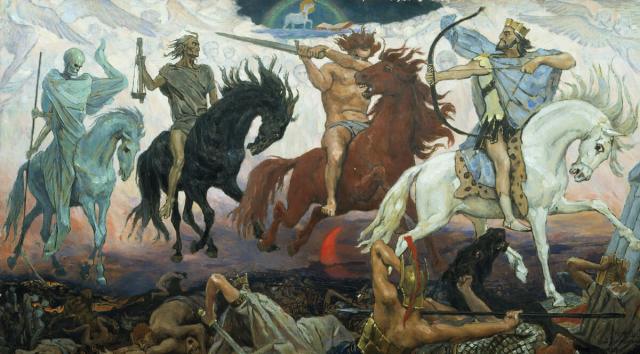
So, in our text, next, comes the red horse of War. For most of human history, war has existed on the earth. However, I think the red horse tells us that God will make use of war to bring people to repentance and faith in Jesus. We have a present-day example of this, happening right now.

In the middle-east, the group ISIS has created terror, war, and civil war. This has led hundreds of thousands of people to flee toward Europe. Those who have entered Europe are disillusioned with Islam, and interested in a different way to have a civil society. They have begun to flock to European Christian churches, asking about Christianity. Thousands of Muslims have become Christians as a result.

Surely, it is not God’s will that ISIS kills and persecutes people, or that Syrians fight each other in civil war. Yet, God knew that they would do so, and he has made use of the situation to bring thousands of Muslims to faith in Jesus Christ.

I believe the red horse is talking about exactly these sorts of things. War is the result of human sin. But God will allow some of it in order to fulfill his ultimate plan, a plan that includes the abolishment of war. As I said earlier, it may be that we are in the time of the first five seals right now. The wars of the twentieth century were certainly unprecedented in human history in terms of destruction and death. War will mark human history until the end.

The third horse, the black one, might be a bit confusing at first:

The horseman on it had a set of scales in his hand. 6 Then I heard something like a voice among the four living creatures say, “A quart of wheat for a denarius, and three quarts of barley for a denarius — but do not harm the olive oil and the wine.”

The horseman is calling out prices for food. A “quart of wheat” was about the amount needed to feed a person for one day. A denarius is the amount of money a common laborer would make in one day. These sorts of prices would mean that it takes everything a person could earn just to buy enough of the cheapest food to feed a family. Therefore, the black horse indicates a time of great economic hardship and/or famine. Oil and wine were also considered basic necessities, but these were not to be touched. Therefore, the hardship that is described here though severe, is not entirely catastrophic. People would survive, though not comfortably.

Once more, we have seen famines and food shortages all over the world throughout history. This could mean that we are in “the time of the seals,” already, or it could be that as the end approaches, the economic hardship becomes more severe and widespread throughout the world. I tend toward the first interpretation, again, trusting that God is using these things to get people to repent and listen to him.

The fourth horseman is “pale,” or sometimes “green.” I think what John is trying to describe is the color of a corpse. The name of the horseman is “Death,” but it is not death in general. The text specifies that this seal has authority to kill one quarter of the earth by means of violence (the sword); famine, plague and wild animals. Death, naturally, goes along with war and famine.

The fifth seal reveals the souls of the martyrs: those who have been killed because they trusted in Jesus, and would not deny him or give up their faith. By the way, some translations have it “the people who had been killed…” I think the best way to translate it would be “the souls who had been slaughtered…” This is one reason that I believe Christians have a kind of consciousness after death, even before the final resurrection. This is one of several places in the Bible that seems to indicate that Christians, after they die, are with the Lord spiritually, but are still waiting for their resurrected bodies.

The cry of these martyrs affirms what I’ve been saying about the seals. They want God to execute his plan for the final judgment. That means that these seals are a good thing. They are told to wait until the full number of Christians who will die for Jesus is completed. That implies that the gospel must first go out into all the world, particularly into places where it is not welcome.

The sixth seal is problematic if we are trying to impose a strict and specific time-line on Revelation, because it looks like nothing less than the end of the world. Many of the Old Testament prophets use the sort of language found here in Revelation 6:12-17 to describe “the day of Lord” which is typically seen as the end of the world (Joel 2:31, 3:15; Isaiah 13:9-10; Jeremiah 4:23-28).

Obviously, the language is very figurative. Clearly, if the sun “blacked out” for even a little while, all life on earth would cease. If the sky was “rolled up as a scroll” presumably the atmosphere would be gone, and consequently so would all terrestrial life. If every mountain was moved from its place, how is it that the people go hide in the mountains?

I want to point out also that the people are terrified by the wrath of “the one seated on the throne, and of the lamb.” In other words, it isn’t the world falling apart that scares them, it is that they are confronted with a holy and righteous God. They are confronted with God’s righteous judgment, and it terrifies them. This indicates that the people affected by this are not the people of God.

It appears then, that the sixth seal introduces the end of the world in general terms. The real point is, of course, that God is following through on his promise to the martyrs – he is judging the world and bringing things to an end. The time frame in relation to other events in Revelation is not explicitly spelled out.

So where does this leave us? First, I think we should recognize that even when it is difficult to understand what God is doing, he is actively working for His people. There will be justice. He will put things right. As I said a few weeks ago, he works all things to the good for his purposes and his people (Romans 8:28). As I read this part of Revelation, I am also reminded of Psalm 91:

1 The one who lives under the protection of the * Most High

dwells in the shadow of the * Almighty.

 2 I will say1  to the LORD, “My refuge and my fortress,

my God, in whom I trust.”

 3 He Himself will deliver you from the hunter’s net,

from the destructive plague.

 4 He will cover you with His feathers;

you will take refuge under His wings.

His faithfulness will be a protective shield.

 5 You will not fear the terror of the night,

the arrow that flies by day,

 6 the plague that stalks in darkness,

or the pestilence that ravages at noon.

 7 Though a thousand fall at your side

and ten thousand at your right hand,

the pestilence will not reach you.

 8 You will only see it with your eyes

and witness the punishment of the wicked.

You need not fear the terror of night, or the arrows of war, or the plagues. God is in control of history. He is using the sinful and horrible works of humankind to bring about his purposes. In the simplest possible terms, God is putting things right. Even the sorts of things that make us think God is not paying attention are, in fact, being used to prepare the world for the end of the old, broken, sinful order and the beginning of the new, joyful, perfect order.

Revelation #14 THE THRONE AT THE CENTER OF THE UNIVERSE

glowing Jesus

To listen to the sermon, click the play button:

To download, right click on the link (or do whatever you do on a Mac) and save it to your computer:
Download Revelation Part 14

Revelation #14. Revelation 4:1-11

We have come to the end of the first section of Revelation. Each of the seven major sections of the book begins with a view from the perspective of Heaven. Section one began with a vision of Jesus, and his words about being the first and last, about having control of all things. After that initial vision, which established the perspective of Heaven, there were seven letters, addressing the concerns among churches here on earth. Now that the entire first section is done, we return once more to the perspective of heaven.

To understand Revelation chapter four, it is useful to think of an analogy. In our world, a thing can move in three different ways: forward-backward; side-to-side; and downward-upward. Every direction is either one of these, or a compromise between them. We call these the three dimensions. If you are using only one dimension, you could draw a straight line, like this:Slide1

If you are using two dimensions you could draw a figure, say a square. The figure is made up of straight lines in combination, like this:

Slide2

If you have three dimensions you could build a solid body, like a cube. Now imagine a world which was only two-dimensional; populated, I suppose, by stick-people. How could we communicate to those two-dimensional people what our three-dimensional world is like? If we simply tried to show them something three dimensional, they couldn’t comprehend it. For instance if we stuck cube in the middle of their world, they would only see a square, where the cube intersected with their two-dimensional plane. A better way might be to draw a cube. It would thus represented in a two dimensional way. Unfortunately, it could easily be misunderstood as simply six squares that are connected, like this:

Slide4

I’m sure you are all thrilled by my grasp of spatial relations, but the point is this: When God tries to communicate with us about heaven and what eternity is like, it can be difficult for us to understand. He tries to use language that we are familiar with, and “word pictures” that help, but ultimately we cannot understand completely until he takes us there. It is sort of like we are living in a different dimension from him. That is why we find some of the language in Revelation so difficult – John is trying to use human words to describe something that human existence cannot fully comprehend. So he says things like: “he was like a jasper; or “the rainbow was like an emerald;” and so on. It’s OK if this is a bit confusing, because it is a bit beyond us. So what we will do as we continue to study Revelation is to seek out the main points that John is making, without getting lost in the sometimes-confusing details. I continue to believe that the major points of most Biblical passages – even in Revelation – are clear.

And so we come to Chapter 4. Remember what chapter one was all about? It was about God in control. Chapter four is a repetition of the same theme – God is in control – using different images to convey the same message. In chapter one God told us he was in control. He said things like “I am the Alpha and Omega, who is, who was and who is to come (1:8),” and “Do not be afraid; I am the first and the last, and the living one; and I was dead and behold I am alive forevermore, and I have the keys of death and Hades (1:17-18).” Now, in chapter four through what John saw, he shows us that he is in control. He shows us this by means of “pictures” that John records.

For example, John sees a throne standing in heaven, and the throne is not empty! There is One sitting on the throne (4:2). The secular people in the 90’s AD were inclined to believe that the Roman Emperor was in charge of the world. Secular people today, though they don’t admit it, are inclined to believe that the throne should be occupied by self. They believe that we are supposed to pursue fulfilment by focusing on our own needs and desires. Others believe that the “throne of the universe” is entirely empty, and we are simply meaningless by-products of a random process.

Revelation chapter four contradicts these world-views. The control of the universe is not up for grabs. The direction of history is not controlled by a worldly ruler. Neither are we in charge of our own destiny. Nor does the universe roll on by mere chance – someone is sitting on the throne of heaven, ruling and directing – Someone is in charge.

When we get to the description of that Someone, we come to one of those places where a five, or ten, dimensional world is trying to communicate with our paltry three-dimensional senses. John says the one on the throne (in case you haven’t figured it out, it’s God) is like jasper and sardius in appearance. The truth is, we don’t know for sure which particular stones John’s language is referring to – the names of precious stones have often changed over the years. I personally resort to the idea that God simply looked amazing, but mostly indescribable to human senses. I place the emerald rainbow in the same category, though the reference to the rainbow could be a reminder that God has never forgotten his promises (Genesis 9:12-17). In any case, it is God’s position (on the throne) and not his appearance, that matters most.

John goes on to describe the rest of what he sees – what I call “heaven’s throne room.” Near the throne are twenty-four other thrones, with twenty-four elders on them (v. 4). There is quite a bit of speculation about who these elders are. They are often said to represent God’s people throughout history: twelve elders for the twelve tribes of Israel (representing the faithful before the coming of Christ) and twelve for the twelve apostles (representing the Christian church throughout history). There are a few clues, however, that suggest that instead these twenty-four elders are not human, but rather are angelic beings. I will not go into all the details here, but suffice it to say that elders “act” more like angels than like redeemed human beings. They appear expedite the prayers of the saints (5:8); they communicate God’s truth to men (7:13-14) and when they praise God they do not sing the song of the redeemed – instead they sing about the redeemed (5:9-10). They also cannot learn the song of those purchased by the lamb (14:3). So they appear to be some sort of heavenly council of elders, perhaps angelic beings who represent the interests of God’s people in the throne room of heaven.

The spirit of God is present in its fullness in heaven’s throne room (as represented by the seven lamps), and the presence of God is forcefully felt by thunder and lightning. God is not just a benign old man – sort of a white-robed Santa Claus – instead, he is an awesome and powerful being. His presence cannot be ignored. The ruler of the universe is not an ineffectual, weak king – he is firmly in control, and has the power to effect his will.

The living creatures are fascinating. They appear elsewhere (in similar form) in Ezekiel 1:4-28 (in a vision which is quite similar to John’s). Once again we are talking about a dimension we know very little about, but my best guess about the creatures is as follows: They represent the fullness of God’s creation, and possibly also they symbolize that his will is done all over the world, and that he knows and sees everything that happens in this world. The lion’s face represents God’s presence in, knowledge of, and provision for, the wild places of the earth. The ox-face likewise tells us that God does his will in, and provides for, the rural areas. The man-face indicates God’s activity in civilizations and cities, and the eagle represents the air. Probably there is no representation of the oceans and waters of the world because in Revelation John usually uses the sea as a picture of all that is evil. The fact that each creature has eyes everywhere indicates that God sees everything. The fact that the creatures are engaged in praising him indicates that all creation is under the authority of God, and gives him glory.

As we continue through Revelation we will be periodically brought back into the heavenly throne room, to be reminded that no matter what is going on here on earth, God is in control. He is awesome, powerful, and nothing escapes his attention. He knows exactly what is going on. When we look at the book of Revelation through this lens (as we should) it becomes a source of great joy and comfort.

Let’s try and make this practical. Is there some area of your life that is bothering you right now? Is there something that you are trying to control, or some outcome you are trying to achieve? Put God on the throne. Let Him be the one in charge. Picture Him dealing with the problem, and leave it with him.

Perhaps there is some area of your life where you feel like God doesn’t even know or care. Rest assured, he is paying attention. He knows exactly what is going on with you. We are called to hold on, even when it is long, and hard, even when it is boring and soul-numbing, because God is indeed at work, even when we don’t see it. As we go through Revelation, we will see that he has a grand plan that will culminate with God himself wiping the tears from your eyes. I’m not exaggerating, listen to the end:

3Then I heard a loud voice from the throne: Look! God’s dwelling is with humanity, and He will live with them. They will be His people, and God Himself will be with them and be their God. 4He will wipe away every tear from their eyes. Death will no longer exist; grief, crying, and pain will exist no longer, because the previous things have passed away. (Rev 21:3-4, HCSB)

Listen to what the Spirit is saying to you today!

Revelation #12 The little, no-account Church

opendoor 2

This is a gracious word to the humble, faithful believer who feels small; perhaps even illegitimate or worthless. Jesus sees your faithfulness to his word. He sees your endurance. You are honored, legitimate and precious in His eyes. Nothing can prevent you from walking through the door He opens for you.

To listen to the sermon, click the play button:

To download, right click on the link (or do whatever you do on a Mac) and save it to your computer:
Download Revelation Part 12

Revelation #12. Revelation 3:7-13

The church at Philadelphia was in a situation quite similar to that at Smyrna. It was apparently a small congregation, which had “little strength;” a literal translation is something like “micro-power.” As in Smyrna, the believers in Philadelphia were faithful, and Jesus has no rebuke for them – only praise and approval. Also, like the Smyrnan congregation, the Philadelphian believers were persecuted by the Jewish community, who accused them to the Roman authorities and took great pains to distinguish between the Christians and “real Jews.” In fact, Smyrna and Philadelphia are so similar that I began to ask myself why Jesus would include messages to both of the churches. Surely the message to one is sufficient for the other one too. The answer is, of course, obvious. He spoke the Christians in Philadelphia because he cares about them too. This re-affirms the idea that the Bible is not only a book from which we derive principles (although it does offer us wonderful principles). The Bible is also God’s personal message to individual Christians. Rather than lumping them in with a bigger church, Jesus speaks directly to the believers in Philadelphia, assuring them that he remembers, he sees and he cares. God is not simply a “mass communicator” – he created our individuality, and he cares about us as individuals.

To fully appreciate the promises given to the Christians at Philadelphia, we have to remember their situation. They were a small congregation, and perhaps “I know you have little strength,” (v.8) refers to the fact that they were not influential or well regarded in their city. Christianity was not in any sense a “major religion” in the eyes of the world in A.D. 90. In fact, it was not recognized as a religion at all. The Jews, who were following one of the “recognized religions,” were telling them that they were illegitimate, deriding them as a cult and insisting that they would be cut off by the Holy God of Israel.

From other New Testament passages, we can guess that the Jews in Philadelphia despised the Christian Church for including Gentiles (non-Jews). During New Testament times Jews insisted that Gentiles could not be holy, and even Jews who didn’t follow ceremonial laws would be considered unclean. In present times of course, Christians can simply and confidently disagree, and get on with their lives. But in those days it was a precarious and uncertain step to become a Christian. It had no external legitimacy (except perhaps for the miracles that were performed by the power of the Holy Spirit). No one would say to a Christian, “sure, your religion is valid.” In the eyes of the world, Christianity was a cult.

Jesus therefore begins his message to the church in Philadelphia with a re-affirmation of his (and therefore their) legitimacy: “The words of him who is holy and true, who hold the key of David. (v.7).” Just that sentence alone would have provided a world of comfort to those in Philadelphia. Jesus is trustworthy. The legitimacy of the Christian faith is based in reality – in truth. He is also holy and he imparts that holiness to his followers. They don’t need the false holiness of the Jews, who called them unholy. They are not a cult, and they will not be cut off from the Holy God of Israel. “The key of David” refers to God’s promise to King David that he would make one of David’s descendants a king forever. The Jews were probably posturing that they alone had the key to salvation (following the law in the Jewish tradition) whereas Jesus reminds his followers that He is the key to salvation. He is in fact, the one who was promised – he is the descendant of David whose kingdom shall never end. In essence, Jesus is saying to the Christian in Philadelphia: “you aren’t the ones who have missed out – they are the ones who missed it. You have the true descendant of David.”

Once again (as in Smyrna), Jesus says that the tormentors of the Christians who claim to be real Jews are not. This is a reference to the concept given in Romans 2:29

28For a person is not a Jew who is one outwardly, and true circumcision is not something visible in the flesh. 29On the contrary, a person is a Jew who is one inwardly, and circumcision is of the heart — by the Spirit, not the letter. That man’s praise is not from men but from God. (Rom 2:28-29, HCSB)

Jews classified themselves as “Abraham’s seed” (that is, descendants of Abraham). Paul writes:

“If you belong to Christ, then you are Abraham’s seed, and heirs according to the promise.” (Galatians 3:29)

So Jesus is affirming here to the Christians in Philadelphia that they are legitimately the people of God, “real Jews,” if you will, because of their faith in him. The others who do not put their trust in Jesus are not actually true Jews, in the spiritual sense.

Jesus also says he is the one who opens, and no one can shut; he is the one who shuts, and no one can open. I think this probably refers, first and foremost, to salvation. But I think it includes all of the benefits of salvation, also: love, peace, joy, grace, honor. He is saying that no one can keep these faithful believers out of his kingdom. No one can prevent them from receiving what gives. No one can take away their opportunity to receive from Him.

In verse 8, he says specifically: “See I have placed before you an open door that no one can shut (v. 8).” Again, I think he is saying, “Don’t let anyone take away your peace. No one can keep you out. No one can prevent you from receiving from me. No one can call you illegitimate.”

Jesus says he knows that they have “kept” his word. This is what makes them one of only two churches that he does not criticize. They haven’t had the strength to do much else. They are small, no-account. But they’ve kept his word. And so he is keeping a door open for them. This is one reason I am so passionate about learning the Bible, and teaching others to learn it for themselves. The word “kept” means to guard, and to watch over. They have been faithful to keep it by obeying it, and faithful also to guard the word, and keep it from being distorted and misused. Their faithfulness has not resulted in a large powerful church, but they have done what Jesus wanted them to do.

The church at Philadelphia has also kept Jesus’ command to endure. Endurance is one of the major themes of Revelation, and in fact of the entire New Testament. We need to stick with Jesus, stick with His word even when we suffer. We need to hang in there when it is boring, hard, painful, discouraging, or tough in any way. We need to be willing to make difficult choices in favor of Jesus, and His Word. We need to be in it for the long haul. The church at Philadelphia endured in this way, and Jesus praises them for it.

Jesus promises the faithful in Philly that he “will keep you from the hour of trial that is going to come upon the whole world to test those who live on the earth (v.19).” This is the same word, “keep,” that means to guard, or to watch over. Unfortunately, the word “from” is a bit tricky in Greek. It could mean that Jesus will keep them “right through” the trial (in the midst of it) or that he will keep them from undergoing the trial at all. Also, the word “trial,” in my version is the same Greek word used for testing and temptation. It might be that Jesus is saying, “I don’t need to test your faith any further. I don’t need to keep trying to see if it is genuine. I know you have the real thing.

This might be a good place to point out that there is very little, if any, support in the book of Revelation for the idea that Christians will be “raptured” out the world before anything seriously bad happens during the end times. In fact, this very verse (3:10) with its tricky Greek words is about as close as Revelation comes to suggesting such a thing, and it is a promise only to small number of believers, not to all of the Christians to whom Revelation was written. There is much more support, both from this verse and others, for the idea that Jesus will take care of his own who are living on earth during the tumultuous times preceding his return. The sealing of the 144,000 in Revelation 7 seems to be an expression of this idea. In any case, it is clear that while God’s judgment may not touch Christians, ungodly rulers and authorities will continue to persecute and kill them. If this were not so we would have great difficulty explaining the circumstances of Christians who have suffered unspeakably from the time of Jesus until now. The most Biblical theme about suffering is not that God removes it, but rather that he walks through it with us (see Isaiah 43:1-5; Romans 5:3-5; James 1:2-4; John 15:18-21; John 16:33).

Jesus is recklessly generous with his promises to the church in Philadelphia. “I am coming soon. Hold on to what you have so that no one will take your crown.” Jesus’ promise to come soon is of course, immensely comforting, and I want us to note that he takes it for granted that these believers already have a “crown.” He tells them to hold on to it, to seize it with both hands. Don’t let anything interfere with it.

He also promises to the over-comer that he/she will be a “pillar in the temple of my God.” Since Revelation actually tells us that there will be no need for a temple in heaven (Revelation 21:22) this has to be figurative language. The “temple” stands for God’s presence with his people. The one who overcomes in this life will never leave the presence of God. God’s name will be written on him/her and also the name of Jesus and of the New Jerusalem. They will belong fully to God.

This is a kind and gracious word to the faithful and humble. You don’t have to be big, you don’t need to be accomplishing great things. The Lord sees your situation. You have limited strength, but you’ve kept His word. No one can keep you out of His kingdom. No one can shut the door he opens for you. He will make those who scorn you right now be humbled before you later.

For application, I want to simply share how all this strikes me. Perhaps that will help you hear what the Spirit is saying to you also.

At this point in my life, I take a great deal of comfort from these verses. In fact, I feel a little bit like the church at Philadelphia. All of our house churches are small, and our ministry organization is small. We have little power. Sometimes, we even look illegitimate. Lately, my health struggles have made my world even smaller. Sometimes, I feel weak. But we have kept God’s word. We have been faithful to it as best as we are able. That has not resulted in growth or increasing power. Here’s a paraphrase of what I hear the Lord saying to me, and to our little churches:

“I know your situation. I know are considered small, weak and of no account. But you have done what is most important: you’ve held on to my Word, and not compromised it. You’ve guarded it from being undermined. You have also kept my command to endure, and I’m proud of you. The world doesn’t regard you, but I do. The world doesn’t know if you are legitimate, but in my eyes, you are. I call you legitimate. Your faith is the real thing. You may be weak, but I have opened a door for you – you don’t have to open it, or hold it open, yourself. Nothing, and no one, can prevent you from receiving what I give you. No one keep you out of my kingdom, out of my grace and love. You will be a pillar that supports my kingdom. I call you mine. I will always be with you.”

Revelation #5 NO ROOM FOR FEAR

Old keys on a old book, antique wood background

Following Jesus often involves some sort of trouble or hardship, in the middle of which we are called to remain faithful and obedient to the Father, even when we don’t understand. Jesus words to each of us today are: “Do not be afraid. I have the keys to death and hades. I have this. I have you. I am the first and the last – I have your trouble surrounded.

To listen to the sermon, click the play button:

To download, right click on the link (or do whatever you do on a Mac) and save it to your computer:
Download Revelation Part 5

Revelation #5. Revelation 1:9-20

John continues his letter with a reminder, and then, his first vision of the heavenly realm.

I, John, your brother and partner in the tribulation and the kingdom and the patient endurance that are in Jesus, was on the island called Patmos on account of the word of God and the testimony of Jesus.

John says he is a brother and partner in three things that “are in Jesus.” I think these things are very important for Christians in our time to remember, or perhaps to realize for the first time. Being “in Jesus” involves each of these things.

First, John writes he is a brother in the tribulation that is in Jesus Christ. The Greek word here (thlipsis) implies pressure, or “being squeezed.” It can be translated, as tribulation, affliction, distress, or pressure. In his gospel, John records that Jesus said that tribulation or affliction will be a normal part of following him. In the passage below, it is this same Greek word that Jesus uses:

33I have told you these things so that in Me you may have peace. You will have suffering in this world. Be courageous! I have conquered the world.” (John 16:33, HCSB)

You will have suffering/trouble/affliction/distress in this world if you follow Jesus. Peter affirms this idea:

12Dear friends, don’t be surprised when the fiery ordeal comes among you to test you as if something unusual were happening to you. 13Instead, rejoice as you share in the sufferings of the Messiah, so that you may also rejoice with great joy at the revelation of His glory. (1Pet 4:12-13, HCSB)

We Christians in 21st Western Civilization need to understand this, for two reasons. First, we need to recognize that suffering and tribulation are the present reality for millions of Christians in various places around the world. Like John, we need to act as siblings and partners in tribulation with those Christians who are suffering for their faith more than we. In China, Indonesia, all over the Middle-East and North Africa, our brothers and sisters in Jesus Christ are in trouble for believing what we believe and trying to live it in their everyday lives. We need to stand with them in prayer. We need to support those who support them. We need to communicate our love and encouragement to them.

Second, we need to recognize that, as we remain obedient to Jesus, we encounter various types of suffering – not all of them persecution. John Piper writes, in Desiring God:

The suffering that comes is a part of the price of living where you are in obedience to the call of God. In choosing to follow Christ in the way he directs, we choose all that this path includes under his sovereign providence. Thus, all suffering that comes in the path of obedience is suffering with Christ and for Christ – whether it is cancer or conflict.

Following Jesus often involves some sort of trouble or hardship, in the middle of which we are called to remain faithful and obedient to the Father, even when we don’t understand.

Those of you who know me well will realize that I know what I am talking about. More importantly, John knew what he was talking about.

The second thing that is “in Jesus” is “the kingdom.” We examined this in greater depth last week. When we follow Jesus, we belong to His heavenly kingdom. Our primary “citizenship” is in heaven, not in any earthly country. Our primary “fellow-citizens” are those who follow Jesus, whatever country they come from, whatever ethnicity or culture they wear on the outside. There is one other thing about “the kingdom that is in Jesus” and it is this: it means we must obey the King.

The third thing that John says is part of being in Jesus is “patient endurance.” This goes along with suffering/pressure/trouble.  Paul puts it together in his letter to the Romans:

3And not only that, but we also rejoice in our afflictions, because we know that affliction produces endurance, 4endurance produces proven character, and proven character produces hope. 5This hope will not disappoint us, because God’s love has been poured out in our hearts through the Holy Spirit who was given to us. (Rom 5:3-5, HCSB)

In case you were wondering, Paul’s word for “afflictions” is the Greek word thlipsis – the same that John uses, the one we discussed above. We aren’t called merely to suffer, we are called endure it patiently, to stick to Jesus, to have “grit.” This would have been very important for John’s first readers, since, as we shall see, they were facing all sorts of pressures and troubles. John is saying, “You aren’t alone in your struggles. This is part of the deal, this is part of what it means to be ‘in Jesus.’ You aren’t off track and you aren’t doing something wrong. We are all in this together.”

Next, John goes on to share one reason why we should be encouraged as we suffer and endure patiently in Jesus. He records that Jesus gave him a message for seven specific churches, but also to all Christians at all times. And Jesus not only gave him the message, he also gave him a picture of the heavenly reality that should encourage us; a reality that exists even when our lives are in the midst of pressure and struggle.

John says that he was “beginning-to-be in spirit on the Lord’s day,” (my rough literal translation) when he heard a loud voice behind him. I’ll tell you frankly, that I don’t have a clear idea of what that means. I suspect it means that John was meditating, deeply. But here’s something interesting. Even though John was “in the spirit,” the voice he heard came from behind him. It’s not much, but perhaps this is a reminder that even when we do all that we can, we still God to reveal Himself to us. For all his meditation, the voice of God came from a direction he did not expect. The revelation had to be given to him – he couldn’t get it simply by meditating.

John looked and saw a scene with seven golden lampstands, and Jesus standing among them. By the way, my own way of looking at Revelation divides the book into seven “heavenly encounters.” A “heavenly encounter,” for my purposes, is a vision of things as they are in heaven, or from heaven’s perspective. After each heavenly encounter in Revelation follows some content divided up into sets of seven. This vision of Jesus among the lampstands is the first Heavenly Encounter.

Thankfully, verse 20 explains what is going on. The seven golden lampstands are the seven churches to whom the letter is written. I think there is every reason to believe that the seven churches (named in chapters 2-3) were seven actual Christian communities that existed at the time John saw his vision. At the same time, I believe that the Lord chose seven particular churches in order to communicate that this amazing vision is for all Christian churches at all times in history. Remember, the number seven represents God’s complete work. So, I think he picked seven churches (there were certainly more than seven in existence at the time) to show he meant this to be for all of us.

In the midst of the seven lampstands John sees “one like a son of man.” He means Jesus, who consistently called himself “the son of man.” John’s vision of the Heavenly Jesus sounds similar to visions that were seen by Daniel and Ezekiel, down to details like the hair, feet, eyes and the sound of his voice; especially, however, the sense of bright light emanating from him (Daniel 7:9 and 10:5-6; Ezekiel 1:26-27).

Jesus holds seven stars in his hand. Again, we are given an explanation in verse 20. The stars are the seven angels of the churches. I don’t know about you, but this surprises me. I don’t normally think of an individual congregation as having an angel watching out for it.

While we are here, we might as well briefly talk about angels, since there is a boatload of them in Revelation. Though we don’t talk about angels very often, there are 182 verses in the New Testament that mention them directly, and a few others that speak of them indirectly. Sixty-five of the direct verses are in Revelation. Angels are usually portrayed as spiritual beings who do God’s work, often serving God as messengers. Hebrews 1:14 (one of the indirect mentions of them) gives us the clearest description of what angels are:

14Are they not all ministering spirits sent out to serve for the sake of those who are to inherit salvation? (Heb 1:14, ESV2011)

So, angels do God’s work, and part of what they do for Him is to minister to us who are inheriting salvation through Jesus Christ. Apparently, also, some of them are responsible for individual churches. To put this theologically: That’s awesome. It might also give us a different view of church. There is an angel assigned to your church. Just think on that.

In verse 16, we get our first taste of the weirdness of Revelation: there is a sword coming out of the mouth of Jesus. This is meant to be symbolic. The Apostle Paul pictures a sword as a spiritual weapon:

17Take the helmet of salvation, and the sword of the Spirit, which is God’s word. (Eph 6:17, HCSB)

The sword coming out of Jesus’ mouth is The Word. For us who follow Jesus, that “word,” that sword, is the Bible. His words are powerful and strong. His words created the universe:

1In the beginning was the Word, and the Word was with God, and the Word was God. 2He was with God in the beginning. 3All things were created through Him, and apart from Him not one thing was created that has been created. (John 1:1-3, HCSB)

 3By faith we understand that the universe was created by God’s command, so that what is seen has been made from things that are not visible. (Heb 11:3, HCSB)

So Jesus stands among the churches, with the power of his Word evident. Now, listen once more to His words:

17When I saw Him, I fell at His feet like a dead man. He laid His right hand on me and said, “Don’t be afraid! I am the First and the Last, 18and the Living One. I was dead, but look — I am alive forever and ever, and I hold the keys of death and Hades. 19Therefore write what you have seen, what is, and what will take place after this. 20The secret of the seven stars you saw in My right hand and of the seven gold lampstands is this: The seven stars are the angels of the seven churches, and the seven lampstands are the seven churches. (Rev 1:17-20, HCSB)

“He laid his right hand on me and said, ‘Don’t be afraid!’” How deeply we need this sometimes! We are afraid of so many things: the future, or the future of those we love. We are afraid of financial ruin, or social ruin. We fear pain, and sorrow and difficulty and loss. Most of all, we fear death, and the death of those we love. I invite you to gather your fears up right now. It’s OK. Admit to them, let them show themselves. Now, feel the strong hand of Jesus on your shoulder. Listen to him say: “Do not be afraid!”

And why should we not? Because Jesus is the First and the Last. He has us, and our lives, and everything surrounded. We fear death, but look – he has overcome death, and he holds the keys. Not only that, but he is with his church – he stands among the lampstands. He holds our angels in his right hand.

Jesus is with us. He hasn’t forgotten or abandoned us. He touches us and says “do not fear!”

Will you listen to Him today?


Revelation #4 GOD’S WORD OVER OUR CIRCUMSTANCES

Hands cupping sun

God has made it so that our identity is that we are truly loved children of God. He has changed our nature from true sinners into truly forgiven and made truly righteous. Our citizenship is in heaven, and our work is as priests of God in everyday life.

To listen to the sermon, click the play button:

To download, right click on the link (or do whatever you do on a Mac) and save it to your computer:
Download Revelation Part

Revelation #4.  Revelation 1:5-8

This is one of those passages that is almost a sermon in itself. I urge you to read verses 5b – 8 out loud, and just listen to the words, and let them sink in. Do that, before you read on.

Now let’s look at verses 5b-6, phrase by phrase:

He who loves us

The Father, who is past present and future; the Son who was martyred for us, was raised from the dead so we could follow, who is ruler over all the earth; The Spirit who is at work in every corner of the world – This majestic, awe-inspiring, all powerful being loves us. We have His attention, his concern. He has chosen to place value on us, in fact, He decided that we are worth dying for. As I undergo uncertainty and struggle and suffering, this word says to me “Don’t ever doubt that I love you. You are precious to me. I have decided it that it is so, and it will not change, no matter what your circumstances look like.”

This is the rallying cry of the entire of Bible.  GOD    LOVES    US.  This is the most important thing we can ever learn. Elsewhere, Paul puts it like this:

31What then are we to say about these things? If God is for us, who is against us? 32He did not even spare His own Son but offered Him up for us all; how will He not also with Him grant us everything? 33Who can bring an accusation against God’s elect? God is the One who justifies. 34Who is the one who condemns?

Christ Jesus is the One who died, but even more, has been raised; He also is at the right hand of God and intercedes for us.

 35Who can separate us from the love of Christ? Can affliction or anguish or persecution or famine or nakedness or danger or sword? 36As it is written: Because of You we are being put to death all day long; we are counted as sheep to be slaughtered. 37No, in all these things we are more than victorious through Him who loved us.

 38For I am persuaded that not even death or life, angels or rulers, things present or things to come, hostile powers, 39height or depth, or any other created thing will have the power to separate us from the love of God that is in Christ Jesus our Lord! (Rom 8:31-39, HCSB)

He has set us free from our sins by His blood.

This is the part that our culture has lost. People all around us are willing to say that God loves us. They also mean (though they don’t say it directly) that God ought to love us, that there is no reason that He should not. It’s almost as if our culture thinks that is what He owes us. This, of course, takes almost all of the power out of God’s love. If He automatically “has to” love everyone, then His love is no more remarkable than the rising of the sun, or the falling of rain. We aren’t particularly special to God if this is true – it’s just a general, impersonal truth.

But that is not the case at all. The Bible teaches that all have sinned, and caused a rift between us and God (Romans 3:23, 1 John 1:8 & 10). That sin is not just a mistake or a weakness – it is a moral evil.

14Rehoboam did what was evil, because he did not determine in his heart to seek the LORD. (2Chr 12:14, HCSB)

Rehoboam, son of Solomon did not determine in his hear to seek the Lord. Therefore, what he did was evil. This is the consistent description of sin in the Bible. It isn’t some little mess up. It isn’t just human failing. It is most definitely not morally neutral. Sin is a moral evil. The root of sin is to turn away from God. Since God is the purest and highest good, anything that turns away from Him is evil. Every single book of the Bible affirms this in many ways.

We have all turned away from God, committed moral evil against Him. Yet his love is so great, that

He sacrificed himself, shed his own blood to atone for the moral evil that we have all done. He chose to love us. Romans 5:6-11 puts it like this:

6For while we were still helpless, at the appointed moment, Christ died for the ungodly. 7For rarely will someone die for a just person — though for a good person perhaps someone might even dare to die. 8But God proves His own love for us in that while we were still sinners, Christ died for us! 9Much more then, since we have now been declared righteous by His blood, we will be saved through Him from wrath. 10For if, while we were enemies, we were reconciled to God through the death of His Son, then how much more, having been reconciled, will we be saved by His life! 11And not only that, but we also rejoice in God through our Lord Jesus Christ. We have now received this reconciliation through Him. (Rom 5:6-11, HCSB)

This reconciliation is offered to all, but not everyone chooses to receive it. It isn’t universal, since many people reject the idea that we are sinners, that we need forgiveness, and that Jesus has provided it for us.

18For I have often told you, and now say again with tears, that many live as enemies of the cross of Christ. 19Their end is destruction; their god is their stomach; their glory is in their shame. They are focused on earthly things. (Philippians 3:18-19)

We must believe that we need forgiveness for sin, and receive it in faith. When we do, He sets us free from those sins. They don’t have to have any more power in our lives.

And made us a kingdom

This part would be easy to skip over, but it is very important. We, who have received God’s forgiveness and love through faith in the death and resurrection of Jesus are a kingdom. This is one of the major themes of the book of Revelation. What it means is that we are first and foremost citizens of God’s kingdom. My allegiance to the Kingdom of God is greater than my allegiance to any earthly country, society or group. This has always been true of God’s people. The author of Hebrews writes about early heroes of the faith:

13These all died in faith without having received the promises, but they saw them from a distance, greeted them, and confessed that they were foreigners and temporary residents on the earth. 14Now those who say such things make it clear that they are seeking a homeland. 15If they were thinking about where they came from, they would have had an opportunity to return. 16But they now desire a better place — a heavenly one. Therefore God is not ashamed to be called their God, for He has prepared a city for them. (Heb 11:13-16, HCSB)

I shared Philippians 3:18-19 above. But the next part is for those who do receive the work of Jesu through faith:

18For I have often told you, and now say again with tears, that many live as enemies of the cross of Christ. 19Their end is destruction; their god is their stomach; their glory is in their shame. They are focused on earthly things, 20but our citizenship is in heaven, from which we also eagerly wait for a Savior, the Lord Jesus Christ. 21He will transform the body of our humble condition into the likeness of His glorious body, by the power that enables Him to subject everything to Himself. (Phil 3:18-21, HCSB)

This also means that my fellow-citizens of heaven are my co-patriots, even before my fellow-citizens of any earthly country:

19So then you are no longer foreigners and strangers, but fellow citizens with the saints, and members of God’s household, (Eph 2:19, HCSB)

In my travels overseas, I have seen this again and again. It is a powerful experience to worship in a foreign land with people from dozens of other countries. It demonstrates the reality of the fact that we who believe are first and foremost citizens of Heaven.

– Priests to His God and Father

We are a kingdom, and not only that, we are a kingdom of priests. I know that sounds boring to most people. However, at the time this was written, the concept of a priesthood was very different from today. Priests at that point in time could marry and raise families (in fact they were expected to). There are several important things about the priesthood that I think John wanted us to understand, and they may not be the things we expect.

First, is that it was priests – and only priests – who were allowed to go into the sanctuary where they believed God’s presence lived. Since Jesus, however, we are all priests in the sense that we can all enter into the presence of God. You don’t need a pastor to mediate between you and God anymore. He has made you a priest in the sense that you can be in God’s presence without someone else making a sacrifice on your behalf.

Next, it was priests who were set aside to serve God. But now, we are all called to serve God, even if we don’t do it officially by vocation. Peter writes about this, in his first letter:

5You yourselves like living stones are being built up as a spiritual house, to be a holy priesthood, to offer spiritual sacrifices acceptable to God through Jesus Christ. (1Pet 2:5, ESV2011)

9But you are a chosen race, a royal priesthood, a holy nation, a people for his own possession, that you may proclaim the excellencies of him who called you out of darkness into his marvelous light. 10Once you were not a people, but now you are God’s people; once you had not received mercy, but now you have received mercy. (1Pet 2:9-10, ESV2011)

You are no longer ordinary. Through Jesus, God has made you holy and set you apart, like a priest. True, He calls relatively few people to serve Him with their full-time jobs, but He calls each one of us to serve Him with our full-time lives. I’ve been to parties – especially here in Nashville among music-industry people – where someone says to me, “You’re the first pastor I’ve ever spoken to.” That makes me sad, and not just because of the bad grammar. However, those people have probably spoken to other Christians with whom they work. Many, many people will never talk to a pastor like me, but they work alongside people like you. You are all servants of God. By your actions, prayers and by what you say, you serve God among people in ways that full-time ministers often do not. You are a priest where you work, and in your family, and in your neighborhood.

Some other things about priests. You no longer need someone else to mediate your relationship with God. You can (and should) pray to him directly – you don’t need to have a pastor to pray for you, though most of us are happy to agree with you in prayer. You can (and should) read the Bible yourself. Though it is important to check your interpretations against trained Bible teachers, most of the Bible is easy to understand, at least in the most important points. You will nourish your soul by reading it for yourself.

I will leave you to meditate on verses 7-8 yourself. They reiterate the certainty that Jesus will return in power and that God is in control of all history, past, present, and future.

What is the Lord saying to you today? Which of these phrases will stick with you through the coming week? Ask the Holy Spirit to keep applying His Word to your life now.

Revelation #3 LORD OF PAST, PRESENT AND FUTURE

Jesus with us

The first five verses of Revelation bring us incredible grace and comfort, by reminding who God is.

To listen to the sermon, click the play button:

To download, right click on the link (or do whatever you do on a Mac) and save it to your computer:
Download Revelation Part 3

Revelation #3. 1:1-5

 We have spent two messages on introductory material. There is much more to learn about the background and writing of Revelation, but my plan is to teach about those things as we go along. That way, you’ll get the information when you need it to understand the text.

I want to clean up just a few details from the first three verses. John says in verse 1 that what he is sharing what “will quickly take place.” This is the best way to phrase it in English because it shows the ambiguity of the phrase. It could mean “it will all take place soon,” or, “it will happen, whenever it happens, suddenly.” Also, at the end of verse 3, “the time is near,” speaks, in Greek, of physical nearness, more than chronological nearness. Make of that what you will, but I keep thinking of Peter, who wrote:

8Dear friends, don’t let this one thing escape you: With the Lord one day is like a thousand years, and a thousand years like one day. 9The Lord does not delay His promise, as some understand delay, but is patient with you, not wanting any to perish but all to come to repentance. (2Pet 3:8-9, HCSB)

This is very important to keep in mind as we read Revelation.

It is almost as if in verses 1-3 John is preparing his readers. He knows that the contents of his letter (the book of Revelation) are strange and weird. He is preparing us for that. Next, in verse 4, John writes a somewhat more traditional introduction:

4John: To the seven churches in Asia. Grace and peace to you from the One who is, who was, and who is coming; from the seven spirits before His throne; 5and from Jesus Christ, the faithful witness, the firstborn from the dead and the ruler of the kings of the earth.

John identifies himself simply by his name. Though some Christians believe there was another John, “the elder of Ephesus,” there really isn’t any hard evidence for that. This is almost certainly John the Apostle. The Greek of Revelation is very different from that of John’s gospel and his three letters, but I think that is easily explained. It is likely that John wrote his other works with the aid of an amanuensis, which was, basically, a secretary, or scribe in the ancient world. So, the secretary-person probably helped John with the Greek phrases of his other work (Remember, Greek was not John’s native language). For Revelation, (also sometimes called “John’s Apocalypse”) however, John was a prisoner, on an island that was used as a prison camp. It would have been very surprising if John had the use of a secretary. In verses 1&2, he identifies himself by name, and as the one “who testified to God’s word and to the testimony  about Jesus Christ, in all he saw.” This sounds exactly like the Apostle John in his gospel:

He who saw this has testified so that you also may believe. His testimony is true, and he knows he is telling the truth. (John 19:35, HCSB)

This is the disciple who testifies to these things and who wrote them down. We know that his testimony is true. (John 21:24, HCSB)

It also sounds like John in his first letter:

2that life was revealed, and we have seen it and we testify and declare to you the eternal life that was with the Father and was revealed to us — 3what we have seen and heard we also declare to you, so that you may have fellowship along with us (1John 1:2-4, HCSB)

 14And we have seen and we testify that the Father has sent His Son as the world’s Savior. (1John 4:14, HCSB)

 This is also in John’s third letter:

12Demetrius has a good testimony from everyone, and from the truth itself. And we also testify for him, and you know that our testimony is true. (3John 1: 12, HCSB)

 I think we should certainly accept that this is John the Apostle. If for some reason, you still don’t want to think it was written by John the Apostle, that’s fine. Let’s understand, however, that Revelation is still the Word of God.

There is no reason to believe that the seven churches of Asia are symbolic, and every reason to believe that they were real, historical congregations of house churches in each of the named cities. When John writes, “Grace and peace to you,” that much is normal for most of the letters of the New Testament. His next phrases, however, are a bit different:

from the One who is, who was, and who is coming; from the seven spirits before His throne; 5and from Jesus Christ, the faithful witness, the firstborn from the dead and the ruler of the kings of the earth.

This description of God as the one who is, was, and is to come provides us with a clue for the whole of Revelation. Some of what we read in this book is past, some present, some future. God himself is Lord over all three “at the same time,” so to speak. Understanding this will help us to make sense of the some of the crazy things in this book.

When we read “from the seven spirits before his throne,” it sounds a bit strange. Most commentators believe that this is how John is representing the Holy Spirit. That makes sense. The first part (who is, was and is to come) is the Father. Jesus Christ, the Son, is named in verse 5. The seven spirits, then, represent the fullness of the Holy Spirit at work in the world. Later on, in Revelation 3:1 and 4:5, John explicitly calls them “the seven spirits of God.” In other words, together, they represent the work of the Holy Spirit.

This interpretation is bolstered by other parts of the Bible. The prophet Zechariah once had a vision. In the vision, he saw a golden oil lampstand with seven connected lamps, and oil channels running to each of the seven. Zechariah asked an angel what it meant, and this is what the angel said:

6So he answered me, “This is the word of the LORD to Zerubbabel: ‘Not by strength or by might, but by My Spirit,’ says the LORD of Hosts. (Zech 4:6, HCSB)

In other words, the seven oil lamps symbolized the Holy Spirit. Remember, like Zechariah, John is writing in apocalyptic language. It is reasonable to assume the same meaning: the seven spirits of God are the many-branches of the work of the Holy Spirit.

The Number 7 in Revelation

We might as well pause here and deal with the number seven. For Jewish people, the number seven meant completeness, finality, and perfection.

For John, I believe it especially means the completion of God’s full and perfect work in the world. John, and all Christians after him, believed in a Triune God: one being, made up of three distinct persons, The Father, Son, and Holy Spirit. This means that three is the number of God.

John, and all Jews before him, thought of the number of four as indicating all of creation. We will see this when we get to chapter four in Revelation. Jews as far back as Ezekiel (590 BC, or so) imagined the world as divided into four parts: 1. The Wilderness 2. The Rural Areas 3. The Cities, and Cultures of Humankind 4. The Air.

So seven equals three (the number of God) plus four (the entirety of creation). It signifies God’s perfect work, plan, and will, expressed in the world.

Returning to our text, we don’t worship seven separate Holy Spirits. Instead, John describes him as “the sevenfold spirit of God” or “seven spirits of God” to express the work and will of the Holy Spirit in God’s creation. We are meant to know from this that the Holy Spirit is at work in the world.

Next, John brings Greeting from “Jesus Christ, the faithful witness.” It seems like a somewhat strange title. Aren’t the followers of Jesus witnesses for Christ? Why is He a witness? It might help to  know that in Greek, the word for “witness” is the same as the word for “martyr.” In John’s time, many Christians were being imprisoned, and some were even killed, for holding to their testimony that Jesus Christ is the God-man, savior of the world. I think John means to remind everyone that they are following in the footsteps of the original martyr: Jesus himself. Those who have died for their faith are in the best possible company: Jesus, the faithful martyr. Finally, Jesus is called, Ruler of the kings of earth.

I think, for now, we have enough to apply to our lives. Let’s begin with remembering that our Father is, was, and is to come. Nothing has ever happened to you that God cannot redeem for good (Romans 8:28). Even if you did not know him until later in life, He is the God of your past. If you let him, he can go back even to the muck of terrible things that you did, even to terrible things that were done to you, and redeem them through Jesus Christ. If you struggle with your past, I strongly urge you to pray about it. Invite the Lord of the past into your past. Give him permission to forgive, heal and redeem.

Our Father is also present. Nothing going on in your life right now is out of God’s control. He isn’t wringing his hands, saying, “Oh my! I never thought my people would ever get into this situation! What shall I do?” His plans are sometimes difficult – or even impossible – to understand (we only have to read on in Revelation to realize that). As I write this, I am fighting chronic pain in my left kidney that has been present for more than two years. I also have a new, arthritis-type pain all over my body, and I feel nauseous, two days out of three. But my greatest hope is to know my Father better in this present moment. Of course, I want pain relief and healing. It’s just that I want more to experience Him. And the wonderful thing is, that is what He promises I can have, here and now. He is my God, not just in the past or future, but now.

Our Heavenly Father is also our future. Nothing that comes to us in the future will be without God. When we worry about the future, the primary reason is that we are leaving God out of our calculations. He has already been to the future. He is there, and if we trust him, we can have peace about what is to come. Also, in the ultimate future, we will have more than just peace of mind. This book we are studying tells me that I will have pain relief and healing – if not now, then for certain, one day in the future. Paul wrote:

19If we have put our hope in Christ for this life only, we should be pitied more than anyone. (1Cor 15:19, HCSB)

We have an unimaginably glorious, thrilling, joyful, meaningful, PERFECT future waiting for us if we persist in our faith. John will describe it in detail at the end of this book.

Perhaps we need to remember that the Holy Spirit, in all its fullness, is at work in the world, and in our hearts. If we are followers of Jesus, the Spirit of God is in us. Revelation will go on to show us that the Spirit is work all around us in the world, though we usually don’t notice it.

John describes Jesus Christ as the faithful martyr. Sometimes we feel alone in our suffering. Perhaps a divorced woman, suffering the results of the unfaithfulness of her husband, feels all alone in her emotional pain. Maybe a man who lost his wife to cancer feels the death of all his dreams about their future together. Jesus has gone ahead of you. He too died – not just in part, but in every way. And somehow, he took upon himself all of the struggles of humanity. He has experienced all of the same struggles we have:

14Therefore, since we have a great high priest who has passed through the heavens — Jesus the Son of God — let us hold fast to the confession. 15For we do not have a high priest who is unable to sympathize with our weaknesses, but One who has been tested in every way as we are, yet without sin. 16Therefore let us approach the throne of grace with boldness, so that we may receive mercy and find grace to help us at the proper time. (Heb 4:14-16, HCSB)

Sometimes, ridiculous as it is, I feel like a martyr. No one else I know seems to struggle like I do. I suspect, however, that my feelings are quite common among all people. Jesus Christ was the faithful martyr who suffered unjustly, yet remained faithful. I am in good company when I suffer in any way. Not only that, but he is with me in my suffering. He is here to give me grace and mercy as I struggle. His presence is right here in the middle of struggles, suffering, and loneliness.

Jesus is also the firstborn of the dead, which is another title of hope. My future is tied to his. His resurrection ensures my own. I won’t always suffer or struggle. There are wonderful things ahead. Paul, thinking of this wrote:

18For I consider that the sufferings of this present time are not worth comparing with the glory that is going to be revealed to us. (Rom 8:18, HCSB)

Lastly, John writes that Jesus is also the ruler of the kings of the earth. That seems like a strange title, doesn’t it? When John wrote, there would have been almost no Christians in government, and very little hope (apparently) of there ever being Christians with influence in a worldly government. The most powerful man in the world insisted that others worship him as a god. He and his government were brutal, cruel, immoral and greedy. But John has just seen a vision of the world as God sees it, and he knows that no matter what it looks like, ultimate authority belongs to Jesus. Regardless of how it appears, Jesus Christ is over every king and ruler, and there is no power on earth greater than Him.

When John wrote, the Roman emperor, and everyone around him, believed he was the most powerful man on earth. No doubt, in our time, the current president of the United States believes he is the most powerful man in the world. They are all wrong. Jesus is the ultimate power. Though for a little while, Jesus gives rulers and kings a limited ability to do what they want, the buck stops not with the president, but with Jesus. He is in control. This calls for faith, because it sure doesn’t look like Jesus is in control. Yet, that is why John writes, and shares his vision: to encourage our faith. This is a call to believe these things that John has written. One way to “take hold” of these things in faith is by thanking God for them. I encourage you to take some time right now to thank God for being there in your past, here in your present, and in control of your future. Thank Jesus for his faithful death on our behalf, and that he allows us to be part of his company of witnesses. Even thank him for the “little deaths” that you might have to die here and now, knowing, like Jesus, that our reward is certain. Thank him for his many-splendoured work in the world, and in your heart, through the Holy Spirit. Thank him for being in control of the world, even in control of those who have worldly authority over us.

Let the Holy Spirit continue to apply these verses to your life right now.

REVELATION #2: THE BOOK OF SEVENS

Cross Tree

These 22 chapters help us keep believing in Jesus when the evidence makes it difficult. Even John the Baptist once wondered if he ought to look for another Messiah to follow. There are times, sometimes long seasons, when life simply doesn’t work very well, and no matter how hard we search, Jesus seems to have disappeared. Maybe he was never there.

“He is here,” John declares, “and He has not disappeared. God has let me see all that’s happening from heaven’s point of view. It’s breathtaking. The lamb is roaring His way through history to complete the Immanuel Agenda.”

–Larry Crabb.


To listen to the sermon, click the play button:

To download, right click on the link (or do whatever you do on a Mac) and save it to your computer:
Download Revelation Part 2

SERMON NOTES

Revelation 2: Introduction, Part 2.

Please bear with me as we spend another message almost entirely on introductory material. Revelation is unique in its complexity and obscurity, and if we truly want to hear what God is saying through this book, we need to put the time in to understand: how it was written, why it was written, and to whom it was written.

I want to make sure that everyone who reads this understands something: I approach this book with extreme humility. I am confident that God created me, at least in part, to bless others with a better understanding of the Bible, and I trust that He fulfills that purpose fairly often. I promise you that I am using my God-given gifts and resources to understand Revelation as best as I can, and to communicate what I am learning, as best as I can. However, I do not claim to be the final authority on Revelation; not even close. But, I know my Father in Heaven, and I know He is able to speak to us through this book, and for that reason alone, I think it is worth your time to follow along as we go through this series. I just don’t want you to get the impression that I think I have Revelation all figured out.

That brings me to another point: We must be prepared to not figure everything out. I guarantee that when we are done with this book, we will all still have quite a few questions, myself included. We are studying Revelation because it is part of God’s inerrant Word, and it is an oft-neglected part. Not only that, but time and time again I have experienced how God can make clear by His Holy Spirit scriptures which were previously puzzling to me. However, in the end, we need to live with some uncertainty in the details. We can do this because we are certain about the One who controls the details – our Triune God: Father, Son and Holy Spirit.

Some of what I say may be new to you, or different from what you had previously heard about particular passages. While I do not claim to have it all figured out (who could?) I trust that the Holy Spirit will be guiding my own study and teaching, as well as your studies and thinking.

My final encouragement is to throw away any “road map” you might want to make from this book, and instead concentrate on listening to what the Holy Spirit wants to say specifically to you through this wonderful book.

A Seven-Part Structure?

One of the fascinating things about this book is that it appears to be structured in sets of sevens. There are seven letters; seven seals; seven trumpets. Then it isn’t so clear for a while, until we get to a fourth set: seven bowls. Most commentators, myself included, think that John probably intended three more sets of sevens, in order to make the book into seven parts, each with seven subparts.

The seven part structure is important, because it represents a special way of writing used in ancient times. These days, Most writers try to organize their writing in certain accepted ways. Speakers do the same thing. Most writers and speakers basically use the following type of outline:

I. Introduction

II. Point A

III. Point B – builds on point A, and adds some new information.

IV. Point C – builds on point A & B, and adds some new information.

V. Summary & Conclusion

Sometimes there are more than three points in the center, but you get the general idea.

Back in ancient times, there was also a common way to write and speak, but it was different from what we do now. Scholars call it “chiastic structure” (pronounced “kai-ass-tik”). Sometimes it was used to write a whole book. Other times it was just used to tell stories or make individual points. Chiastic structure looks like this:

A. First point.

B. Second Point.

C. Third Point.

CENTRAL POINT

C1. Connects back to the third point (C) in some way,, or creates a contrasting parallel to it.

B1. Connects back to the second point (B) in some way,, or creates a contrasting parallel to it.

A1. Connects back to the first point (A) in some way,, or creates a contrasting parallel to it.

One of the things this does is to highlight the central point and make it stand out. It also helps readers to remember how we reached the central point, because of the parallelism or repetition leading back to the end point. Obviously, chiastic structure must be made up of an odd number of points, with a minimum number of five. Seven is a number well suited to these structures, which are also called “chiasms.” They were often used in ancient times to help people memorize oral history. There are many chiasms in Genesis, and also in Homer’s Odyssey, for example. It could be that John made use of chiasms to help him remember what he heard and saw in his vision.

So, all the sevens in Revelation appear to be chaisms. From literary structure point of view, it’s almost like one of those wooden Russian nesting dolls (sometimes called Matryoshka), with chiasms nested in other chiasms.

But the whole seven business in Revelation can be frustrating as well. The four sets of seven I mentioned are quite clear. Most commentators (though not all) agree that Chapters 12 through 14 appear to clearly be another set of “seven significant signs,” which now gives us five total sets of seven:

Part 1: 7 Seven Letters;

Part 2: Seven Seals;

Part 3: Seven Trumpets;

Part 4: Seven Signs; Part

5: Seven Bowls.


The remaining two sets – if, in fact, there are two more sets of seven – are rather more controversial. Out of six commentators – seven, if you include me – there is not one that agrees with another about how to organize the other two sets of seven. I think every way of doing it – including my own – seems a bit forced and artificial, compared to the five clear sets of seven.

In spite of the frustration identifying sections 6 and 7, however, almost all scholars are clear that chapters 12-14 make up the heart of this book (the fourth set of sevens), and that is very useful, as we shall see once we get into the text a bit more.

 The First Readers

As with all books of the Bible, the best approach is to try to understand what Revelation would have meant to those who first heard it.  Once we know what it meant to the first readers, and only then, we can begin to apply it to our own lives.

In order to do that, we need to know a bit about the Christians who would have been the first readers of John’s Revelation.

John wrote between 90-95 AD. Jesus had ascended into heaven some sixty years or so earlier, promising to return. And yet he had not returned. Some of the things that Jesus had predicted had apparently come true: the temple in Jerusalem was destroyed in 70 AD. But even that event was now 25 years in the past, and still he had not returned. Christians were still a very small minority in the Roman Empire. Some cities had several house churches in them. Others had only one; and of course, there were some cities that had no Christians at  all. Even in the cities where the church was strong (like Ephesus) Christians held no power or influence, and were more or less helpless to defend themselves against discrimination or persecution.

And persecution was becoming more and more of a problem. Revelation was written during the reign of Emperor Domitian. Though several emperors before him claimed to be Divine, Domitian was the first Roman emperor to insist that his subjects worship him as a god. He required everyone in the Roman empire to offer a pinch of incense at shrines that were set up in his honor.

Jews, however, did not have to worship the Emperor. Fifty or sixty years before Jesus was born, A military leader from Palestine, near Israel, supported Julius Caesar in a war against his rival, Pompey. This was Antipater, father of King Herod the Great. Caesar rewarded Antipater by making him Governor of Judea. Caesar, believing (wrongly) that Antipater was a Jew, awarded special privileges to Jews in the Roman empire. One of the most important of those privileges is that they were left alone in the matter of religion and worship. So, when Emperor Domitian required his subjects to worship him, the Jews were exempt.

Christians were initially exempt as well, since the Romans believed that Christians were simply a special type of Jew. However, Jewish people all over the empire felt that Christians were polluting and destroying Judaism. Therefore, when emperor worship became required, many Jews took the opportunity to tell the Roman authorities that Christians were not part of their religion, and therefore were disobeying the law by not offering worship to the Emperor. They often “outed” specific Christians to the authorities, causing them to be whipped, thrown into prison, and sometimes even executed.

Meanwhile, the world continued on its wicked way. Evil people prospered. Idol worship, immorality, oppression, injustice and greed all continued, apparently unchecked by God’s power.

It would have been very easy for Christians at that time to start doubting Jesus. Would he really come back? Was the whole thing even real? Where is he now? Does he even care about us, about our struggles? Doesn’t he see the terrible things being done to his people? Doesn’t he know the monstrous evil in the Roman empire?

Bible commentator Leon Morris puts it like this:

We must not think of [Revelation] as a kind of intellectual puzzle (spot the meaning of this symbol!) sent to a relaxed church with time on its hands and an inclination for solving mysteries. It was sent to a little, persecuted, frustrated church, one which did not know what to make of the situation in which it found itself. (Leon Morris. Tyndale New Testament Commentaries, Revelation.)

Whenever we deal with a text in Revelation, we need to remind ourselves of these concerns that were very big for the Christians who first read it. We need to consider what the message of Revelation meant to them, in those circumstances, and only then can we begin to apply it to our own time and situation.

Author Larry Crabb gives us a helpful way to look at Revelation:

These 22 chapters help us keep believing in Jesus when the evidence makes it difficult. Even John the Baptist once wondered if he ought to look for another Messiah to follow. There are times, sometimes long seasons, when life simply doesn’t work very well, and no matter how hard we search, Jesus seems to have disappeared. Maybe he was never there.

“He is here,” John declares, “and He has not disappeared. God has let me see all that’s happening from heaven’s point of view. It’s breathtaking. The lamb is roaring His way through history to complete the Immanuel Agenda.”

Because of this, I think we should not get too distracted in the business of unraveling all of it. We should keep our eyes on the big picture. Certainly, at times, we may be able find the meaning of one thing or another. But remember, this isn’t some kind of 1st Century spiritual Sudoku puzzle. It isn’t about solving puzzles. The best way, then, is to focus on the big picture, and the meanings that would be obvious to Christians at the time when John wrote.

So let’s consider the first three verses once more:

1The revelation of Jesus Christ that God gave Him to show His slaves what must quickly take place. He sent it and signified it through His angel to His slave John, 2who testified to God’s word and to the testimony about Jesus Christ, in all he saw. 3The one who reads this is blessed, and those who hear the words of this prophecy and keep what is written in it are blessed, because the time is near! (Rev 1:1-3, HCSB)

Dear brother or sister in Christ, our Lord has not forgotten you. He has not abandoned you. He has a plan, and He is in control of history, empires, cultures and even your life. He is nearer to you than you realize. Do not lose heart!

LOVE AND LIES

Love is easy. This is one of the big lies that destroys marriages, but it also destroys churches and personal friendships. When love gets hard, too many people “bail out” on marriages, churches and friendships. Real love does involve warm feelings. But real love also involves hard work. Forgiving others is hard, sometimes, but it is indispensable to lasting love. Being humble, saying sorry, and admitting that you are wrong are all very difficult, but all vital to real love. Withholding angry retaliation, being patient, listening, serving someone when you are tired and crabby – these are all important parts of true love, and they all take significant emotional energy and self-discipline. There are payoffs, of course. Many times, real love fills us with joy, happiness and wonderful feelings. But we need to know, and to remember, that true, lasting love is sometimes hard work.

To listen to the sermon, click the play button:

To download, right click on the link (or do whatever you do on a Mac) and save it to your computer:
Download Overlooked Letters Part 4

Overlooked Letters # 4. Love, and Third John.

 I ran out of time/space in my last message about Christian love. I’d like to finish the topic of Christian love. Since John’s concern is for both Love and Truth, let’s consider some lies about love, and how we can live and love in the truth.

My focus last time was to show you how the Bible teaches that it is of utmost importance that we Christians love our fellow Christians. According to the New Testament, after God’s love for us, this is the most important kind of love. For many of us, that message should convict us that we have to change our lifestyle. If the way we live does not allow time and energy to put into relationships with other Christians, then we will find ourselves disobeying the command of Jesus (2 John 5). If we do not make room in our lives to love our Christian brothers and sisters, we cannot truly claim to be following Jesus.

20If anyone says, “I love God,” yet hates his brother, he is a liar. For the person who does not love his brother he has seen cannot love the God he has not seen. 21And we have this command from Him: The one who loves God must also love his brother. (1John 4:20-21, HCSB)

Now, unfortunately, our culture has, in large part, separated love from truth. Remember, John is deeply concerned about both. We need to be aware of cultural lies about love.

One of the biggest lies about love is that it means unconditional acceptance. In other words, if you love me, you will accept, without reservation, anything I do, or don’t do. In fact, our culture is rapidly becoming even more extreme about this, and now many people believe that if you love someone, it means you must agree with, and endorse, all of their choices. Author Rick Warren puts it succinctly:

“Our culture has accepted two huge lies. The first is that if you disagree with someone’s lifestyle, you must fear or hate them. The second is that to love someone means you agree with everything they believe or do. Both are nonsense. You don’t have to compromise convictions to be compassionate.”

So, contrary to popular opinion, loving our fellow-Christians does not mean that we must agree with them on everything, and endorse everything they do (or don’t). Sometimes, the truly loving thing is to tell someone that they are wrong, or are headed in the wrong direction. The other side of that coin is that just because someone confronts you about something does not mean that they hate you, or are acting in an unloving way. We Christians need desperately to remember this, and to model it to the culture around us. I’ve said it before, and I’ll probably say it again: If I believe you are going to hell (even if I’m wrong in my belief) and I say something to you about it, my motivation is loving – I don’t want you to go to hell. On the other hand, if I truly believe you are going to hell (rightly or wrongly) and I say nothing, I must hate you a great deal, because I’m content for you to go to hell, without warning you. So, many times, the hateful thing is to remain silent, while the truly loving thing is to share your belief.

In Christian relationships, it often isn’t about going to hell; it’s usually more nuanced. But often, we keep silent about things because we don’t want to put the time and effort into having real and genuine relationships with each other. Subconsciously, we know that if we speak, it might cause conflict, and deep down, we aren’t sure we love the other person enough to spend the time and energy to work through that conflict.

Here’s another lie about love that is very destructive, especially in Christian relationships: Love means never having to say “I’m sorry.” It’s a nice idea, I get it. The thought is, if someone really loves you, they will accept and forgive everything you do, and so you don’t have to apologize about anything. In reality, if you really love someone, one of the greatest gifts you can give them is to say: “I’m sorry. I was wrong. Please forgive me.” If you believe you are never wrong in relationship to someone else, or that you need never apologize, you are not living in the truth, and without truth, real love cannot thrive. Humility, apology, confession and forgiveness are powerful tools that make love grow. Our culture would like to minimize them. Don’t let it happen in the church. Love each other in truth, and that means being humble and saying sorry.

6But he gives more grace. Therefore it says, “God opposes the proud, but gives grace to the humble.” 7Submit yourselves therefore to God. Resist the devil, and he will flee from you. (Jas 4:6-7, ESV2011)

5Likewise, you who are younger, be subject to the elders. Clothe yourselves, all of you, with humility toward one another, for “God opposes the proud but gives grace to the humble.” 6Humble yourselves, therefore, under the mighty hand of God so that at the proper time he may exalt you, 7casting all your anxieties on him, because he cares for you. (1Pet 5:5-7, ESV2011)

31Let all bitterness and wrath and anger and clamor and slander be put away from you, along with all malice. 32Be kind to one another, tenderhearted, forgiving one another, as God in Christ forgave you. (Eph 4:31-32, ESV2011)

Here’s another cultural lie about love: Physical attraction means love. The vast majority of our movies, television, music, and other popular art promote the idea that the highest expression of love is sexual intercourse. This is one reason the culture is so sensitive about sexual issues – any sort of sexual moral standard is viewed as interfering with “love.” This means the church is in trouble, because a) Churches who are “in truth” teach that sex is only for married couples. So the culture thinks we are somehow restricting true love. b) If sex is the highest expression of love, that means people in the church will never share the highest form of love with each other (unless it’s a weird, perverted cult, which, of course, would not be a true church). So Christian fellowship becomes kind of a “second class” love.

However, the Bible teaches us that highest form of love is self-sacrifice. In New Testament Greek, there are several words for love, including: romantic love (eros), brotherly/friendship love (phileo) and self-sacrificing love (agape). The love of Jesus, and of God, is described as agape. The famous “love chapter” that is often read at weddings – 1 Corinthians 13 – describes agape. All throughout the New Testament, it is agape – self-sacrificing love – that is the highest form of love. That kind of love, we can have in the church among everyone, and it transforms lives. There is indeed no Biblical restriction on this highest kind of love.

Another one: Love is easy. This is one of the big lies that destroys marriages, but it also destroys churches and personal friendships. When love gets hard, too many people “bail out” on marriages, churches and friendships. Real love does involve warm feelings. But real love also involves hard work. Forgiving others is hard, sometimes, but it is indispensable to lasting love. Being humble, saying sorry, and admitting that you are wrong are all very difficult, but all vital to real love. Withholding angry retaliation, being patient, listening, serving someone when you are tired and crabby – these are all important parts of true love, and they all take significant emotional energy and self-discipline. There are payoffs, of course. Many times, real love fills us with joy, happiness and wonderful feelings. But we need to know, and to remember, that true, lasting love is sometimes hard work.

Let me close the topic of Christian love by simply sharing a brief sermon given by the Apostle Paul on this matter. 1 Corinthians 13, “the love chapter” is one of the most-read passages in the Bible, and many people are quite familiar with it. Go ahead and read it on your own. But I want to share a different one, here. This passage below describes many practical ways in which Christians can and should love each other. This is how we should love one-another, Christian to Christian.

1I appeal to you therefore, brothers, by the mercies of God, to present your bodies as a living sacrifice, holy and acceptable to God, which is your spiritual worship.

My comment: We can only love by surrendering to God, and presenting ourselves to Him. Then, he can use us. It will be his love, passing through us, to love others.

2Do not be conformed to this world, but be transformed by the renewal of your mind, that by testing you may discern what is the will of God, what is good and acceptable and perfect.

My comment: this is about rejecting the lies of our culture (as I’ve described) and instead, being conformed to the truth about love, as given to us in the Bible.

3For by the grace given to me, I tell everyone among you not to think of himself more highly than he should think. Instead, think sensibly, as God has distributed a measure of faith to each one.

My comment: This is talking about humility again.

4Now as we have many parts in one body, and all the parts do not have the same function, 5in the same way we who are many are one body in Christ and individually members of one another.

My Comment: We belong to each other. When we come to Jesus, we join a body. Every part (including you) is indispensable.

 6According to the grace given to us, we have different gifts: If prophecy, use it according to the standard of one’s faith; 7if service, in service; if teaching, in teaching; 8if exhorting, in exhortation; giving, with generosity; leading, with diligence; showing mercy, with cheerfulness.

 9Love must be without hypocrisy. My Comment: there we are: truth again.  Detest evil; cling to what is good. 10Show family affection to one another with brotherly love. Outdo one another in showing honor. 11Do not lack diligence; be fervent in spirit; serve the Lord. 12Rejoice in hope; be patient in affliction; be persistent in prayer. 13Share with the saints in their needs; pursue hospitality. 14Bless those who persecute you; bless and do not curse. 15Rejoice with those who rejoice; weep with those who weep. 16Be in agreement with one another. Do not be proud; instead, associate with the humble. Do not be wise in your own estimation. 17Do not repay anyone evil for evil. Try to do what is honorable in everyone’s eyes.

18If possible, on your part, live at peace with everyone. 19Friends, do not avenge yourselves; instead, leave room for His wrath. For it is written: Vengeance belongs to Me; I will repay, says the Lord. 20But If your enemy is hungry, feed him. If he is thirsty, give him something to drink. For in so doing you will be heaping fiery coals on his head.

 21Do not be conquered by evil, but conquer evil with good. (Rom 12:1-21, HCSB)

DO YOU LOVE YOUR FELLOW CHRISTIANS?

This post is so important, that I’m reposting. For those in our fellowships, we will discuss this on the week beginning June 18.

I love mankind its people I can't stand full

Loving other Christians is part of what you sign up for when become a follower of Jesus. The idea of becoming a Christian, but not being a part of a Christian fellowship is absolute nonsense, and it is not supported anywhere in scripture. As John says elsewhere: “If anyone says, ‘I love God,’ yet hates his brother, he is a liar.” In this context “brother” means “fellow Christian.” We are supposed to show the love of God to the world by how we relate to each other, and that love needs to be demonstrated in genuine, life-changing ways. 

To listen to the sermon, click the play button:

To download, right click on the link (or do whatever you do on a Mac) and save it to your computer:
Download Overlooked Letters Part 3

2 John #3: Loving Fellow Christians

We’ve been talking about John’s concern for the truth. He is also, obviously, very concerned about love:

4I was very glad to find some of your children walking in the truth, in keeping with a command we have received from the Father. 5So now I urge you, dear lady — not as if I were writing you a new command, but one we have had from the beginning — that we love one another. 6And this is love: that we walk according to His commands. This is the command as you have heard it from the beginning: you must walk in love. (2John 1:4-6, HCSB)

Unfortunately, Christian love has often been greatly misunderstood, and not really practiced.

Throughout the New Testament the command to “love one another” is given to Christians, for Christians. It is not a general call to “love the world,” but a command that Christians are to live and act in love specifically toward each other.

I can already hear the indignation coming back at me. After all, aren’t the two great commandments to love God, and love our neighbor? Didn’t Jesus tell the story of the Good Samaritan, to show us that all people are our neighbors? I understand the objections, but I want you to hear me out.

Of course the command: “Love your neighbor as yourself,” applies to all people. Specifically, it is a summary of six of the ten commandments (or seven, if you are Lutheran). We should try to live a “love our neighbors” lifestyle toward the whole world. If we personally encounter someone who needs our help, of course we should help them, regardless of their religious faith, or lack thereof.

But even so, Christians are called to have a special kind of love for fellow Christians. Listen to what Jesus says:

34“I give you a new command: Love one another. Just as I have loved you, you must also love one another. 35By this all people will know that you are My disciples, if you have love for one another.” (John 13:34-35, HCSB)

Jesus told his disciples to love one another. Jesus says that “all people” will know that we follow Him when they see the love that we have for one another. It is this special love – among Christians – that will show everyone else that we follow Jesus. It isn’t that we are supposed to hate everyone else, but there should be a commitment to love fellow Christians at a deeper level than “loving all mankind.”

There is no escaping the fact that dozens and dozens of verses in the New Testament tell us to love fellow Christians specifically, and how to go about doing that. Jesus repeats himself in John 15:11-12

11“I have spoken these things to you so that My joy may be in you and your joy may be complete. 12This is My command: Love one another as I have loved you

Jesus is talking to his disciples here, not the world in general. Shortly after, he tells them the world will hate them, but they are to love each other. The rest of the New Testament was written specifically to Christians. Paul often writes about how Christians should treat each other:

12Therefore, God’s chosen ones, holy and loved, put on heartfelt compassion, kindness, humility, gentleness, and patience, 13accepting one another and forgiving one another if anyone has a complaint against another. Just as the Lord has forgiven you, so you must also forgive. 14Above all, put on love — the perfect bond of unity. 15And let the peace of the Messiah, to which you were also called in one body, control your hearts. Be thankful. 16Let the message about the Messiah dwell richly among you, teaching and admonishing one another in all wisdom, and singing psalms, hymns, and spiritual songs, with gratitude in your hearts to God. (Col 3:12-16, HCSB)

“Therefore, as God’s chosen ones…” In other words: “Since you are followers of Jesus, this is how you are treat each other.” He adds that they are “one body,” which is a metaphor for the church. These verses are similar to dozens of other places in the New Testament. After God’s love for us, the strongest emphasis about love in the New Testament is on love among fellow-believers.

Let’s consider why it is so important for us to love fellow Christians in a special way.

First, because it shows Jesus to the world in a special way. When the world sees real Christian community in action, they will notice it. They will see that there is something different about how we deal with one another. This was the reason Jesus himself gave for his command that Christians love other Christians (see John 13:34-35, above). One of the most attractive things about real Christianity is the genuine, loving relationships between Christians. When those aren’t present, churches become very un-attractive.

Second, Christians are supposed to love each other because love is supposed to be a commitment that has real-life consequences. We are to show the love of God to the world by how we relate to each other (see #1, above) and that love needs to be demonstrated in genuine, life-changing ways. The New Testament is full of exhortations to put love into practice. Here are just a few examples:

14And we exhort you, brothers: warn those who are irresponsible, comfort the discouraged, help the weak, be patient with everyone. 15See to it that no one repays evil for evil to anyone, but always pursue what is good for one another and for all. (1Thess 5:14-15, HCSB)

24And let us be concerned about one another in order to promote love and good works, 25not staying away from our worship meetings, as some habitually do, but encouraging each other, and all the more as you see the day drawing near. (Heb 10:24-25, HCSB)

 31All bitterness, anger and wrath, shouting and slander must be removed from you, along with all malice. 32And be kind and compassionate to one another, forgiving one another, just as God also forgave you in Christ. (Eph 4:31-32, HCSB)

8But now you must also put away all the following: anger, wrath, malice, slander, and filthy language from your mouth. 9Do not lie to one another, since you have put off the old self with its practices 10and have put on the new self. You are being renewed in knowledge according to the image of your Creator. 11In Christ there is not Greek and Jew, circumcision and uncircumcision, barbarian, Scythian, slave and free; but Christ is all and in all. (Col 3:8-11, HCSB)

1Therefore I, the prisoner for the Lord, urge you to walk worthy of the calling you have received, 2with all humility and gentleness, with patience, accepting one another in love, 3diligently keeping the unity of the Spirit with the peace that binds us. 4There is one body and one Spirit — just as you were called to one hope at your calling — 5one Lord, one faith, one baptism, 6one God and Father of all, who is above all and through all and in all. (Eph 4:1-6, HCSB)

You can’t love “the whole world” like this. This sort of love only develops when there is real community, when people actually know each other, and “do life” together. This is one reason it is so important for every Christian to be a part of a small Christian community – a group of 5-20 other Christians with whom you meet regularly, and with whom you also socialize and spend time with. That is the context of the New Testament church, and so that is the context for true Christian love.

You cannot truly love 1,000 people at once, not in a way that matters. You may genuinely care for that many people, and be concerned about what happens to them, but when you are dealing with that many people, love is mostly an abstraction – something that takes place primarily in your head and emotions; but it doesn’t make much of an actual difference to how you live, or to those you claim to love. It reminds of the old Peanuts cartoon at the top of the post.

Real love, love that makes a difference, can only grow out of genuine relationships in relatively small communities; in other words: in a New Testament type of church.

The idea of loving “the whole world” is a way to shirk the responsibility of loving that dear Christian brother who has an annoying habit of interrupting everyone, and talking too much. If you “love the homeless” you can go serve in a soup kitchen once a month (or less!), spending a couple hours with people that you will never truly share your life with. Then you can go back to church, secure in your “love credentials” and ignore the lonely, social awkward bachelor there who makes you cringe.

Loving each other in the church forces us to actually have relationships with each other. It forces us to confront our own issues and conflicts, and work through them under the guidance of the Holy Spirit.

Third, we can’t love from the outside in. Love starts within, and grows. Loving fellow Christians provides us with a solid base from which to spread the love. Genuine love-in-action normally spreads – the nature of love is a desire to include others in the joy we have.. But if we don’t have real love going on in our local body of Christ, it will be very hard for us as a group to love anyone else either. In other words, if you want to love “the world” it has to start with loving your fellow believers. If you can’t love them, you won’t be able to truly love the world either, not in any meaningful or helpful way.

So, what do we do with this message? First, we need to accept that when we become followers of Jesus, we join a family of other Jesus followers.

48But He replied to the one who told Him, “Who is My mother and who are My brothers? ” 49And stretching out His hand toward His disciples, He said, “Here are My mother and My brothers! 50For whoever does the will of My Father in heaven, that person is My brother and sister and mother.” (Matt 12:48-50, HCSB)

Like a biological family, you don’t get to pick everyone who becomes part of your Christian fellowship. Even so, as in a biological family, we have an obligation to love each other.

8Do not owe anyone anything, except to love one another, for the one who loves another has fulfilled the law (Romans 13:8)

Loving other Christians is part of what you sign up for when become a follower of Jesus. The idea of becoming a Christian, but not being a part of a Christian fellowship is absolute nonsense, and it is not supported anywhere in scripture. As John says elsewhere:

20If anyone says, “I love God,” yet hates his brother, he is a liar. For the person who does not love his brother he has seen cannot love the God he has not seen. 21And we have this command from Him: The one who loves God must also love his brother. (1John 4:20-21, HCSB)

In this context, as in most of the New Testament, “brother” means “fellow Christian.” You can’t be much more clear than that. We need to accept that loving our Christian brothers and sisters, and having meaningful relationships with them, is a normal and vital part of following Jesus.

Second, many of us need to get serious about plugging in to real Christian community. It’s hard to develop real community – that is, real brotherly/sisterly love – without spending significant time and energy with other Christians. We need to find a small group of like-minded Christians, and commit to loving them. We need to make it a priority to spend time with them, do things together, worship together, hang out together. Again, this is a normal part of being a Christian.

Third, within our Christian community, we need to put love into action. We’ll discuss more about that next time. Let me just say this: when I first was confronted with the necessity of loving my Christian brothers and sisters, and opening my life to them, I was very uncomfortable. I’m an introvert. I like my nice little, quiet, orderly life. But when I did open my heart and life to include genuine Christian community, I found that in addition to the hassles, I received a real and lasting joy, and also the priceless gift of true, loving friendships in my Christian family. I have never wanted to go back to my compartmentalized Christianity.

I pray that you will  surrender to Jesus in this matter, and experience the joy and love that I have!