PREPARING FOR CHRISTMAS

red lighted candle
Photo by Nubia Navarro (nubikini) on Pexels.com

Advent is a time to prepare for the Lord, who has promised to come to you. He is coming, whether you prepare or not, so wouldn’t it be better to ready to let him in?

To listen to the sermon, click the play button:

To download, right click on the link (or do whatever you do on a Mac) and save it to your computer:
Download 2018 Advent Week 2

2018 Advent Week 2: Preparing for the Lord

A voice of one crying out:
Prepare the way of the LORD in the wilderness;
make a straight highway for our God in the desert.
Every valley will be lifted up,
and every mountain and hill will be leveled;
the uneven ground will become smooth
and the rough places, a plain.
And the glory of the LORD will appear,
and all humanity together will see it,
for the mouth of the LORD has spoken. (Isa 40:3-5, HCSB)

One of my favorite places to go is the Smoky Mountains in East Tennessee. There’s nothing like that first glimpse of the Smokies when you’re driving East toward Knoxville or Maryville and you see those high ridges silhouetted against the sky. From a distance it looks like one long continuous line of mountains all across the horizon. But when you get closer, and actually start to drive into the Smokies, you realize that they are not actually just one unbroken ridge. We go to Townsend a lot, and there’s a road that weaves its way through and in between high ridges and mountains. When you get right to it, some of the ridges are actually closer and some far away. It is only the distance that makes the mountains look like they all start together and are all part of the same ridgeline.
I think this picture describes quite well how Biblical prophecy often works. Most of the prophets were given a vision by God, and that vision was much like a view of the mountains from the distance. They describe what is actually coming, but their perspective is affected by the distance of time. The prophets view the future like we view the Smokies from a distance – all the events were “out there” and they all seemed to be about the same distance away. When we get into the actual events however, we realize that actually quite a bit of distance separates each one from the other.
Very often, in addition to holding predictive prophecies, the writings of those whom we call the prophets – Isaiah, Jeremiah, Ezekiel, Joel etc. – also contain messages that are relevant to the people who first heard them. These immediately relevant meanings are meant for us as well.
Let’s look at Isaiah 40:3-5. Isaiah prophesied to the nation primarily during the reign of Hezekiah, King of Judah, from about 750 to 690 or so, BC. One of the many things he prophesied, was that the nation of Judah would be conquered by the Babylonians, and that many of the people would be taken away to Babylon as exiles (this happened, by the way, in 587 BC, almost 200 years after Isaiah’s time). Looking even further ahead, after his prophecies about the future exile, Isaiah goes on to prophesy about the return of the Jews from Babylon (this also happened, staring in the 520s BC). Isaiah 40 is basically the beginning of the section about the future return from future exile. And yet, at the same time, parts of this passage (and others in this section) are about the future coming of Jesus Christ to earth, which he did, as we know, roughly 2000 years ago, or, about 700 years after Isaiah prophesied. And finally, elements of these prophecies also refer to the time when Jesus Christ will come back again, at the end of time.
Whew! If you wonder how one passage can contain all those elements, just don’t forget how those distant mountains look.
The essential message for those in the days of Isaiah, and later for those exiles who returned from Babylon, was this: God is bringing his glory back to his people. Even in the days of Isaiah, the nation of Israel had clearly become a second rate power. The magnificent days of David and Solomon were history. The one nation ruled by King David had long since been split into a Northern Kingdom (called “Israel”) and a southern Kingdom (called “Judah”). These two nations often fought each other. They were dominated by the powers around them – Syria, Assyria and Egypt (and later, Babylon). In fact, while Isaiah was still alive, the Northern Kingdom (Israel) was utterly destroyed by Assyria, and ceased to exist. The glory days were over. But Isaiah 40:5 says

“And the glory of the Lord will be revealed, and all mankind together will see it. For the mouth of the LORD has spoken.”

Something that was lost is going to be restored. Now, “Glory” in the Bible, isn’t just about victory and success and triumph. In fact, the key element to Biblical “glory” is the presence of God. Maybe another way to say Isaiah 40:5 would be this:

“God’s presence will once more be manifest among you. He will be with you in such a way that it is obvious to all people. God has promised it.”

Along with this idea of the return of God’s presence, is the theme of deliverance. When we look at the context of the passage, clearly God is returning, and when he returns, he will bring deliverance. Salvation, would be another word for it.
It is significant that the voice calls in the desert, and the rest of the passage refers to making a way in the wilderness. When we consider the context of exile in Babylon, it may help to know that caravans and armies from Babylon to Israel always traveled North, around the desert, west toward the Mediterranean Sea, and then South into Palestine. When Babylon invaded, it did so from the North. And yet God is coming straight across the desert. The idea here is that there is no delay in his coming and that obstacles will be removed. God will come by the direct route. His isn’t bound by the caravans routes and traditional paths of men.
This passage from Isaiah is used in all four gospels. Each of the gospel writers identifies John the Baptist as the one who is calling in the desert, “prepare the way for the Lord…” It is probably no coincidence that John did most of his preaching out in the desert, directly east of most of Israel. John’s ministry took things one step beyond a return from exile. Once again, as a fulfillment of this passage, John was declaring that the presence of God would be manifest among his people. Certainly that promise was fulfilled in the person of Jesus Christ. God was present now in a way that went far beyond what the exiles could imagine.
Each time, along with this promise of God’s manifest presence and his deliverance (in short, his glory), comes an admonition that we should “prepare the way.” I think this bears some looking at, and perhaps has some application for our own lives. One of the primary places where this passage can really be played out is in the human heart. God will come, someday, in the flesh once more and end this world. But he wants to come to you right now in your heart. And the best way for you to prepare for that “someday” is to let him in your heart today.
First, we need to be clear – we don’t “prepare” in order to get God to come be with us. He has already promised to come. His coming is not dependent on our preparation. He’s said, essentially, “I’m coming, whether you get ready or not – so get ready!” We can prepare by learning his word, by telling others about him, by discovering our gifts and using them for his Kingdom. But even more profound than that, this passage gives us a clue as to how to prepare. Isaiah says:

“Make straight in the wilderness a highway for our God.”

What he is getting at is this: we need to give God access. The image here is to let God come straight at your heart. Take out the twists and curves we put in to deceive others, ourselves, and even God. Let him get straight to the heart of the matter. I think the way to do this is to be honest with ourselves and with God about who we really are. Sometimes we might not be completely ready to be honest with other people as well. I’m convinced, however that once we make the way straight for God, once we give him unlimited access, we will experience His grace and love to such a degree that eventually we’ll be able to “be straight” with certain other people as well. Giving God clear access to your heart and life is simply a matter of saying “yes” to him. Doing that is the best way I know to receive him now into your life, and also to be prepared for when he comes back to put an end to this world.
Look at what else this passage has to say. God is coming. Give him access. And, “every valley shall be raised up.” Do you have any “valleys” in your life? Are there “low spots” – places where you are lacking or empty? I guess that’s a stupid question – of course there are. God says this. “I’m coming, give me access. And those low and empty spots, those places of weakness and hurt will be filled in. My presence is coming, and it will fill in all of your failings and inadequacies.”
Now for the final thought, which is perhaps not quite as comfortable:

“every mountain and hill made low;
the rough ground shall become level, the rugged places a plain…”

Are there any places in your life that “need to be leveled?” Any sins that stick out? Bad habits, pride, ambitions that have nothing to do with God? Get ready, because God’s got a big bulldozer. This isn’t entirely a negative thought. No doctor that I have ever heard of can remove a tumor from his or her own body. Sometimes we badly need and even want someone to bulldoze all the junk out of our lives that we can’t quite seem to handle ourselves.
This idea of the valleys being filled and the hills being leveled is really a sort of promise. The passage tells us to “prepare” by making the way straight. But then, when it talks about the valleys and hills, it says “they shall be…” in other words, it is something God will do for us.
Let me give you a concrete example. Most of you know that I struggle with chronic pain. In this struggle, I have often been aware of an opportunity. Actually, let me back up. I have been through hard times in the past, and afterwards, realized that I blew an opportunity to let the character of Jesus Christ be more fully formed in my life, because I spent the time whining and complaining. This time, not perfectly, but more often than in the past, I am aware of the choice I have, and instead of fussing, I am saying “yes,” to God. As I do that, God has been giving me something so precious – a deep knowledge of his love, and a sense of being so very close to Him. I don’t know how else I could have received it, other than saying, “In the middle of this pain, I say “yes,” to you, God. Instead of griping at you, I say, “do your work in me.” I know I’m not doing this perfectly, but even so, I can sense mountains and hills being torn down, and valleys being filled up inside me. I sense the presence of Jesus with me, more and more.
All of this, is essentially the promise of Christmas. Christmas is an old word meaning: Christ-Mass. It was the communion celebration of Jesus Christ. We are in the Christmas season right now. Use this Christmas season. These next two weeks, as we get excited, use the fun of Christmas to welcome Jesus, to give him access, and to watch in wonder as he works in your life to bring you closer to him. All you have to do is believe it, and don’t shut down the work that he is doing in your life.
Let’s celebrate the fact that Jesus is coming straight at our hearts. If we allow him, he will raise up the valleys, and fill in the rough places, and – this is the big one – he will live within us. The glory of God will actually dwell inside of us by the Holy Spirit – just as it did with Mary, 2000 years ago.

REVELATION #37. THE DIVINE MARRIAGE.

rings wedding
Photo by Deesha Chandra on Pexels.com

Every human being longs for true, deep, honest intimacy. We want to be able to be fully ourselves, and totally known by Another Person. We long to be able to be completely “naked” – not pretending or hiding; body, soul and spirit, and in that state, be fully loved and accepted with no blemish or shadow to mar that experience. This is exactly what is being promised to us.

To listen to the sermon, click the play button:

To download, right click on the link (or do whatever you do on a Mac) and save it to your computer:
Download Revelation Part 37

We’ve come to Revelation chapter 19. It seems clear that the praise recorded in verses one through four is all about the fall of Babylon. So, in a sense, these verses wrap up the end of the section on Babylon. We have learned that “Babylon” represents ungodly cultures and world governmental powers that stand against the worship of the one true God, and that tend to either seduce Christians away from God, or persecute them if they won’t join the ungodly culture. Therefore, before Jesus can return, before God can culminate his plan in history, he must remove “Babylon.” This, he has done. Therefore verses one through four are praising God for accomplishing this milestone. Babylon’s fall means that God’s plan can move forward.

Before we move on from Babylon I want to note that one of the big issues associated with it is sexual immorality. Now, I think that sexual immorality includes the idea of worshiping false gods. The Bible uses that imagery over and over again, as I have mentioned in previous messages. At the same time, however, “sexual immorality” is also intended to be literal – it isn’t just about idolatry, it is about sex outside of marriage. One reason that Revelation focuses on this particular category of sin is that it is an incredibly powerful way of tempting people away from God. The human drive to reproduce is extremely strong, and one of the devil’s favorite tricks is to misdirect that drive toward inappropriate places. This is one reason why John records over and over again that not only is sexual immorality sinful, but it will be severely judged at the end of all things. I bring this up because the church in the 21st century in the Western world has almost completely stopped talking about it.

But it is a big concern throughout the New Testament. It is a sin that the Bible tells us to have nothing to do with it. The following verses are just a few of many like them:

Now the works of the flesh are obvious: sexual immorality, moral impurity, promiscuity, idolatry, sorcery, hatreds, strife, jealousy, outbursts of anger, selfish ambitions, dissensions, factions, envy, drunkenness, carousing, and anything similar. I tell you about these things in advance — as I told you before — that those who practice such things will not inherit the kingdom of God.  (Gal 5:19-21, HCSB)

Therefore, put to death what belongs to your worldly nature: sexual immorality, impurity, lust, evil desire, and greed, which is idolatry. Because of these, God’s wrath comes on the disobedient, and you once walked in these things when you were living in them.  (Col 3:5-7, HCSB)

For this is God’s will, your sanctification: that you abstain from sexual immorality, so that each of you knows how to control his own body in sanctification and honor, not with lustful desires, like the Gentiles who don’t know God. This means one must not transgress against and defraud his brother in this matter, because the Lord is an avenger of all these offenses, as we also previously told and warned you. For God has not called us to impurity but to sanctification. Therefore, the person who rejects this does not reject man, but God, who also gives you His Holy Spirit.  (1Thess 4:3-8, HCSB)

Now in response to the matters you wrote about: “It is good for a man not to have relations with a woman.” But because sexual immorality is so common, each man should have his own wife, and each woman should have her own husband.  (1Cor 7:1-2, HCSB)

By the way, I included the last verse to show that sexual intimacy in marriage is not sinful, but it is good, and righteous. So it isn’t that sex is bad in and of itself, but it is sinful outside of marriage.

Many people believe that historically Christian sexual ethics were used to control women. This does not fit with the facts of history, nor with the teaching of the Bible. The Bible’s teaching applies to both men and women. It is just as sinful for a man to have sex outside of marriage as it is for a woman. Men must submit to this teaching, and in so doing, are made equal to women. That is crystal clear in the Bible.

Secondly, Christian sexual ethics had the actual effect of protecting women from abuse and exploitation. In ancient cultures that did not have the Bible, women were used as objects and then cast aside. Jews and Christians were not permitted to do that. Christian and Jewish women were far better off, historically, than women of other religions. This is still true today, worldwide. The women’s equality movement would have been impossible without a Christian understanding of sexual ethics and the fundamental equality of genders.

Also, historically, Christian sexual ethics were at odds with the culture around them (which is part of the main point I’ve been making).

Now, if you’re reading this and you have sinned in the matter of sexual immorality, you do not need to despair. The reason Jesus came to earth is to forgive our sins. This is not the unforgivable sin. As a teacher of the Bible, however, I don’t want to gloss over what the scripture actually says about the subject. I also want to make sure that you hear very clearly: if you put your trust in Jesus, he forgives you, and cleanses you from all unrighteousness (1 John 1:7-9). Let the past be past, and let Jesus live his life in you from now on.

The other reason I bring this up, is because of the next part of our text today. Babylon engages in sexual immorality both spiritually and literally. But verses 5-10 now show us the alternative: the Marriage of the Lamb, and His bride. Verse six begins the sixth heavenly throne room scene in the book of Revelation. This means that we have come to the beginning of the sixth (and second to last) section of the book. As we enter the heavenly throne room, as always, the air is filled with praise to God. If you have shared the Passover Seder with us, you know that the word “hallel” means “praise in ancient Hebrew. “Jah” is short for “Yahweh.” Therefore “hallelujah” simply means “praise Yahweh,” or, “praise the Lord.”

Verses seven through nine are focused on praising God, particularly, because the marriage of the Lamb has come. Unlike Babylon, the bride of the Lamb is pure. She has remained faithful to Jesus.

When the New Testament talks about “sons,” and “brothers,” that includes not only men, but women also. When the New Testament talks about “the bride of Christ,” it includes not only women, but men also. For those who belong to Jesus, all women are sons and brothers (as are the men), and all men are brides (as are the women). These metaphors in the New Testament are pictures for us.

God’s people – that is, the people who belong to Jesus – are the bride of Christ. Why do we have this picture of the people of God as a bride?

In the first place, in first century culture, particularly among poor people, the biggest, most wonderful celebrations that they ever managed to take part in were wedding feasts. If you were a Christian, it was not an option for you to participate in the various feasts and celebrations dedicated to false gods. So the only place where you might truly get a wonderful meal and be part of a joyous, happy celebration, would be at a wedding. A wedding brought to mind imagery of joy. At weddings you were free from work and toil, you were surrounded by friends, family and loved ones. For poor people especially, weddings might be the only time they ever experienced having an abundance of good food.

There are two people who stand together at the center of any wedding: the Bride and the Groom. This is their day. More particularly, it is a celebration of their love, and their union. God has promised that a day will come that will be our day: ours, and his, together. That day will celebrate the love God has for us, and the love we have for him. It will also be the day when we enter perfect union by God, unspoiled by our sin or lack of faith. Ephesians chapter 5 talks about this a little bit:

22 Wives, submit to your own husbands as to the Lord, 23 for the husband is the head of the wife as Christ is the head of the church. He is the Savior of the body. 24 Now as the church submits to Christ, so wives are to submit to their husbands in everything. 25 Husbands, love your wives, just as Christ loved the church and gave Himself for her 26 to make her holy, cleansing her with the washing of water by the word. 27 He did this to present the church to Himself in splendor, without spot or wrinkle or anything like that, but holy and blameless. 28 In the same way, husbands are to love their wives as their own bodies. He who loves his wife loves himself. 29 For no one ever hates his own flesh but provides and cares for it, just as Christ does for the church, 30 since we are members of His body.
31 For this reason a man will leave
his father and mother
and be joined to his wife,
and the two will become one flesh.
32 This mystery is profound, but I am talking about Christ and the church. 33 To sum up, each one of you is to love his wife as himself, and the wife is to respect her husband. Ephesians 5:22-33

Earthly marriage is a just a shadow of a tremendous heavenly reality. As husbands and wives love each other sacrificially, it is a reflection of how Jesus loves us, and we love him. Our job, as the Bride of Christ, is to submit to Jesus. That means we obey what Jesus commands through the Bible. It means we make him the center of our lives. John also writes about this:

1 My little children, I am writing you these things so that you may not sin. But if anyone does sin, we have an advocate with the Father — Jesus Christ the Righteous One. 2 He Himself is the propitiation for our sins, and not only for ours, but also for those of the whole world.
3 This is how we are sure that we have come to know Him: by keeping His commands. 4 The one who says, “I have come to know Him,” yet doesn’t keep His commands, is a liar, and the truth is not in him. 5 But whoever keeps His word, truly in him the love of God is perfected. This is how we know we are in Him: 6 The one who says he remains in Him should walk just as He walked. 1 John 2:1-6

At the same time, Jesus is the one who makes sure that we pure, spotless and blameless. He clothes us with his own righteousness so that we can take our place in union with him, and nothing stand between us. Verse 8 says

8 it was granted her to clothe herself with fine linen, bright and pure”—for the fine linen is the righteous deeds of the saints. Revelation 19:8

These words capture the perfect balance of our salvation. “It was granted to her.” This means that we did not get the fine linen for ourselves. It was given to us, bright and pure. The linen is “the righteous deed of the saints.” Actually, the Greek of that last phrase is not quite so cut and dried. It says literally that the fine linen is “the “righteous-nesses” of the saints. In other words, it not necessarily that we got the righteous-nesses for ourselves. So, all that makes us worthy to be perfect union was given to us by God. And yet, at the same time we also, put on what is given us. We prepare ourselves (verse 7).

All of this, again, stand in contrast to Babylon, who wore the clothes of a prostitute, and acted like one.

So, where do we go with this? Let’s put it in terms that make sense for us. Every human being longs for true, deep, honest intimacy. We want to be able to be fully ourselves, and totally known by Another Person. We long to be able to be completely “naked” – not pretending or hiding; body, soul and spirit, and in that state, be fully loved and accepted with no blemish or shadow to mar that experience. This is exactly what is being promised to us.

Ultimately, that longing for intimacy is a longing for the Bridegroom, Jesus Christ. Our real, actual longing to be fully known and, at the same time, fully loved will be totally fulfilled in our union with Jesus at the end of this present world.

If this sounds vaguely sensual or sexual to you, try not to get uncomfortable. The Bible offers sex and marriage as a way to help us understand how truly amazing it is going to be when stand before Jesus on the last (or, more accurately, the first) day. The highest human experience of intimacy in marriage is supposed to give us a glimpse – just a tiny glimpse – of how we will feel on that day with Jesus.

It is time to start getting excited about this now. So many things get in the way. This, however, is the core desire of our hearts. We need to remember that, and focus on the reality of what is to come, instead of goofing around with temporary, silly pleasures here and now. C.S. Lewis writes:

We are halfhearted creatures, fooling about with drink and sex and ambition when infinite joy is offered us, like an ignorant child who wants to go on making mud pies in a slum because he cannot imagine what is meant by the offer of a holiday at the sea. We are far too easily pleased.

Now, if we are made for heaven, the desire for our proper place will be already in us, but not yet attached to the true object, and will even appear as the rival of that object. (C.S. Lewis, The Weight of Glory)

In other words, we do have the right desire, but we don’t always recognize it. If we would only open our eyes, so many things would remind of us our true desire for heaven. For instance, our reaction when we hear a beautiful piece of music, see a beautiful landscape, or picture, or even a beautiful person. Once again C.S. Lewis offers wisdom:

We do not want merely to see beauty, though, God knows, even that is bounty enough. We want something else which can hardly be put into words – to be united with the beauty we see, to pass into it, to receive it into ourselves, to bathe and it, to become part of it.

This passage today tells that that is exactly what is coming. We will be united to beauty, to pass into it, to receive into ourselves, to bathe in it and become part of it. Now, we can sing, with the angels:

“Hallelujah!
For the Lord our God
the Almighty reigns.
7 Let us rejoice and exult
and give him the glory,
for the marriage of the Lamb has come,
and his Bride has made herself ready; Revelation 19:6-7

REVELATION #36. COMING OUT OF BABYLON.

adult alcohol alcoholic beauty

Photo by Pixabay on Pexels.com

We Christians are called to live in this world, and love our fellow Christians, and also those outside the family of faith. But we are also called to be spiritually, morally and ethically different from the world around us. We are not supposed to be absorbed into the culture, but rather, we are to be “salt” and “light” for culture around us. That means we must be radically different from it. It means we cannot be full participants in any worldly culture.

To listen to the sermon, click the play button:

To download, right click on the link (or do whatever you do on a Mac) and save it to your computer:
Download Revelation Part 36

The whole of Revelation chapter 18 is about the fall of “Babylon.” Remember from last time that “Babylon” is a kind of code word for all world empires, governments, and powers that seduce people away from God, and persecute God’s people.

Verses 1-8 give us an overview of what is going on, and why. Verses 9-10 look at the judgment of Babylon from the perspective of world rulers: the wealthy and elite of ungodly culture. Verses 11-17 give us the perspective of the “business sector,” and verses 18-19 tell us about the working class (those who are not Christians). Verse 20 tells us what God’s people think. Verses 21-24 pronounce the final doom of Babylon.

I want to focus on verses 1-8, because that gives us the entire overview, plus, we get to see some more chiastic structure!

When I was in seminary, my friends and I took several classes from one professor whom we loved dearly, and deeply respected. As a sign of our love and respect, we occasionally gently mocked him by imitation. He was the one who introduced us to the concept of chiastic structure, and it seemed like he was always saying, “Consider this text, you see. The chiastic structure is evident in verses…”

I realize I have become that guy. Once again, I want to point out to you some chiastic structure in the book of Revelation. I fear I deserve any mocking I might get. But in all seriousness, I think that when we look at the structure of chapter 18, verses 1-8, we will be able to understand it much better. Hang with me, because I believe that the Holy Spirit really will speak to you through this text, if you only give Him the chance.

Remember chiastic structure always uses an odd number of points: sometimes three, or five; but in the book of Revelation, it is always found in sevens. Remember, in the introduction to this series, I explained that Revelation is a book of sevens; indeed, it has sevens within sevens. This isn’t some secret code: it is just a way of thinking that was common to the ancient Middle East, particularly, ancient Jews.

Chiastic structure looks like a “V” laid on its side, like this >. The first point is connected to the last. The second is connected to the second-to-last, and so on. The middle point is usually the most important point.

Before we examine these points, let’s remember our context. The first readers of Revelation were either persecuted by their culture, or they were in danger of being seduced by it. Either way, that culture was pagan, they worshiped many gods, and they were offended by the idea of only one true God. Christians were perceived as people who wouldn’t go along with culture, troublemakers. Those first Christians would have rejoiced to hear about the downfall of Babylon. This was very, good news. It meant that God was finally vindicating them, and holding accountable the people who had done evil to them. It was also a warning to those who were in danger of becoming just like the culture around them. The future of that pagan, pluralistic culture is destruction.

Now, let’s see what the text has to say.

  • The first and seventh points (verses 1, and 8, respectively) are about the fall of Babylon. The first part declares that she will indeed be destroyed; the seventh point shows us that she will be destroyed quickly, and that God’s judgment cannot be escaped.
  • As you can see, the second point (verse2) talks about what happens after the judgment: Babylon has become a ghost town, haunted by shades of evil. The fifth point contrasts that with how Babylon was before: she glorified herself and lived in luxury.
  • The third and fifth point (verses 3, and 5-6) talk about the sins of Babylon. The third point describes them, and fifth point shows that she will be held accountable for them.
  • The fourth point is placed in the middle because we are supposed to pay attention to it. That is the point where I want to spend the majority of our time today.

This “main point” is verse four:

4Then I heard another voice from heaven: Come out of her, My people, so that you will not share in her sins or receive any of her plagues. (Rev 18:4, HCSB)

It is only logical to assume that every culture that ever exists will be ungodly, at least in some respects, because it is formed by fallen human beings. But some are worse than others. In the culture of Western Civilization (Europe, America, New Zealand & Australia) we are moving farther and farther away from Biblical principles. (This is not true, by the way in Africa, and certain parts of Asia). At one time, it was possible to be a meaningful participant in mainstream Western culture, and also to be a true Christian, holding on to Biblical principles and values.

I believe that is no longer true.

Now, I don’t want to overstate the case, or sound alarmist. Mainstream America, for instance, still honors some values of the Bible, like racial equality, and care for the poor. By the way, those are principles that come originally from the Bible. Some secular people may be surprised to hear that. Christians need to remember that, also.

However, more and more of mainstream culture is contradicting other Biblical truths. Sexual immorality is not only commonplace and accepted, it is truly celebrated. The very idea of absolute moral truth is now mocked. If you believe that some things are always right and some always wrong, many people will think you are narrow-minded and mean-spirited. The same goes if you believe that there is one true God. If you simply state what the Bible says about certain behaviors, mainstream culture calls you a bigot and a hate-monger. In fact, many, many Christian beliefs are now labeled as hate.

The pressure to go along with culture is enormous. Christians are not hate-filled people, any more than the general population, so it hurts to have others think of us that way. Sometimes, it would be easier to pretend that the Bible doesn’t say what it actually says, or to pretend we don’t believe it. From there, it is a very small step to actually not believing the Bible.

The currency of our culture has become media, especially entertainment: Television, Music, Movies, Social media, News outlets, and (though, unfortunately, last and least) books. The vast majority of these kinds of media are pumping out messages that are odds with the truth of the Bible. They celebrate sexual immorality. But our text today tells us that will bring on God’s wrath:

For all the nations have drunk the wine of her sexual immorality, which brings wrath. (Revelation 18:3)

Media, more and more, celebrate violence, especially violence against women. They celebrate heroes who get things done, but whom are people of bad character. The celebrate the pursuit of the self-centered life. We are encouraged to satisfy ourselves, even that hurts others.

The business world has also changed. Greed is considered good in our culture, but that too, is judged as one of Babylon’s sins. The profit motive, which motivates capitalism, is a positive thing. But greed is something else. Greed is never satisfied, nothing is enough. Greed makes a person pursue more, and more, as the all-consuming goal and passion of life. Greed often leads people to cut corners, and to deceive others. I spent three years in the business world. I saw it time and time again: Bosses asking me to deceive clients so we could charge them more; the temptation for myself to allow someone to misunderstand a situation, so that I could personally make more money. The Bible, however, warns many times about greed, and the pursuit of wealth.

9 But those who want to be rich fall into temptation, a trap, and many foolish and harmful desires, which plunge people into ruin and destruction. 10 For the love of money is a root of all kinds of evil, and by craving it, some have wandered away from the faith and pierced themselves with many pains. (1 Timothy 6:9-10)

17 Instruct those who are rich in the present age not to be arrogant or to set their hope on the uncertainty of wealth, but on God, who richly provides us with all things to enjoy. 18 Instruct them to do what is good, to be rich in good works, to be generous, willing to share, 19 storing up for themselves a good reserve for the age to come, so that they may take hold of life that is real. (1 Timothy 6:17-19)

There used to be a myth about putting a frog in a kettle. If you dropped a frog into boiling water, it would jump out immediately. But if you put it in a pot of cool water, and then very, very, slowly increased the temperature it would sit in the pot until it was boiled to death. It turns out that with regard to actual frogs, that isn’t true. But it is a great analogy for Christians. Imagine you were watching television in 1990. Suddenly, due to a weird flux in the space-time continuum, your TV set is now receiving programs from 2018. I am convinced that if that happened, there would outrage, across American culture. People would decry the violence, the immorality, the main characters who are so flawed that they would the bad guys, not the heroes, in 1990.

But the same people who would have been outraged in 1990 are alive today, and they are not outraged. That is because as they culture has changed, so have they. This includes many, many Christians. If we continue to consume media without thinking critically about it, it will change our views. If we let our non-Christian friends and family influence the way we think and live, we will become more like them, and less like Jesus. If we continue to participate in the kinds of things that are culture thinks are normal, we will simply be absorbed into the culture.

That is why our text today says “Come out! So that you will not share in her sins, or receive the judgment that is coming again her.”

So, how do we come out of the culture?

I don’t think there is one easy answer. But there are two basic principles that I believe we desperately need to follow.

The first principle is to make the Bible – God’s Word – a greater influence on our life than any other media. Rather than imitating the “hero” of Breaking Bad, we need to imitate Jesus. Many Christians typically spend hours and hours consuming secular media, and rarely, if ever, read a book by Christian, or listen to Christian music, or watch a show that is compatible with Biblical values. Above all, we need to devote ourselves to taking the truth of the Bible into our hearts. This means making some hard, self-disciplined decisions about what else we read or watch. If, after watching a show, you find yourself in sympathy with a drug dealer, there is a real issue. Can we agree on that? Or have we come too far already to see that this is a problem?

I don’t want to be a legalist, and start making lists about what you can, and cannot watch or read. But can we use some common sense? And can we at least acknowledge that the biggest influence in our lives should be God’s truth, not a television show? If you are going to watch certain shows, can you pause, and make observations about what is in conflict with God’s Word, so that you are aware of it, and can limit how it influences you?

The second principle is to find true Christian community with a small group of people. Your primary place of community should be with people who also value the Word of God, people with whom you can share your life, and with whom you can be strengthened and encouraged in faith.

Neither of these principles is easy. But they are a matter of spiritual life and death. We simply cannot drift along with mainstream culture. It will destroy our faith. Therefore, we need to pursue both these two things – God’s Word, and Christian community – as if our lives depended on it, because they do. Jesus warned about this:

13 “You are the salt of the earth. But if the salt should lose its taste, how can it be made salty again? It’s no longer good for anything but to be thrown out and trampled on by men. (Matthew 5:13)

If we drift along with culture, we will lose our saltiness, and not only will we be in danger of losing salvation, but we also will fail to help anyone else to find God’s love and grace.

Let me be clear, I’m not talking about moving to monasteries and withdrawing entirely from the world. We Christians are called to live in this world, and love our fellow Christians, and also those outside the family of faith. But we are also called to be spiritually, morally and ethically different from the world around us. We are not supposed to be absorbed into the culture, but rather, we are to be “salt” and “light” for culture around us. That means we must be radically different from it. It means we cannot be full participants in any worldly culture.

Our primary influences need to be God’s Word, and God’s people. If we can live that way, then we will remain in the love of God, and have a chance of influencing others toward Jesus Christ.

GIVING THANKS LEADS TO MORE PEACE

Photo 42774317 / Thank You © Tanialerro | Dreamstime.com

We need to accept that God is truly good, he truly loves us, and he really does have our eternal best interests in mind. Giving thanks to God accomplishes that in a powerful way. Thanksgiving moves the promises of God from our heads into our hearts.

To listen to the sermon, click the play button:

To download, right click on the link (or do whatever you do on a Mac) and save it to your computer:

Download Thanksgiving 2018

GIVING THANKS – 2018

Rejoice always! Pray constantly. Give thanks in everything, for this is God’s will for you in Christ Jesus.  (1Thess 5:16-18, HCSB)

And let the peace of the Messiah, to which you were also called in one body, control your hearts. Be thankful. Let the message about the Messiah dwell richly among you, teaching and admonishing one another in all wisdom, and singing psalms, hymns, and spiritual songs, with gratitude in your hearts to God. And whatever you do, in word or in deed, do everything in the name of the Lord Jesus, giving thanks to God the Father through Him.  (Col 3:15-17, HCSB)

Devote yourselves to prayer; stay alert in it with thanksgiving.  (Col 4:2, HCSB)

4 Rejoice in the Lord always. I will say it again: Rejoice! 5 Let your graciousness be known to everyone. The Lord is near. 6 Don’t worry about anything, but in everything, through prayer and petition with thanksgiving, let your requests be made known to God. 7 And the peace of God, which surpasses every thought, will guard your hearts and minds in Christ Jesus.
8 Finally brothers, whatever is true, whatever is honorable, whatever is just, whatever is pure, whatever is lovely, whatever is commendable — if there is any moral excellence and if there is any praise — dwell on these things. (Philippians 4:4-8 HSCB)

6 So then, just as you received Christ Jesus as Lord, continue to live your lives in him, 7 rooted and built up in him, strengthened in the faith as you were taught, and overflowing with thankfulness. (Colossians 2:6-7 NIV)

Literally hundreds of times, the Bible exhorts Christians to be thankful. As we look at the small sample of such verses above, it is clear that Christians are supposed to be people who live with an attitude of continual thankfulness toward God. I want to talk about why it is so important, what it means be give thanks continually, and how to implement it.

WHY IT IS SO IMPORTANT

The older I get, the more I am inclined to believe that thankfulness is a key part in receiving the grace and love and joy that are offered to us through Jesus Christ. When we thank God, we are, in a way, reaching out and receiving what we thank him for. We are agreeing with what the Bible says about his graciousness and love toward us; we affirming something true about the nature of God. We are saying, “Yes, I have received your love and grace,” and as we declare that to be true, it somehow becomes more real to us.

In order to find Joy in God, we need to see Him as an ally, not an adversary. If we see him as something or someone that stands in our way, we cannot receive grace from him.

We need to accept that God is truly good, he truly loves us, and he really does have our eternal best interests in mind. Giving thanks to God accomplishes that in a powerful way.

When we thank him, we acknowledge that He knows more than we do about what is best for us. Thanksgiving opens the door to trusting God, even when we don’t understand. When we thank him, we begin to pay attention to the multitude of good things he has already given. When we thank him, our soul slowly begins to align with God’s purposes and plans.

Thanksgiving moves the promises of God from our heads into our hearts.

 WHAT IT MEANS TO GIVE THANKS

Many people feel that it is hard to be thankful unless you have a lot to be thankful for. I believe that is a very misleading idea. The American holiday and tradition of Thanksgiving originates from Christian spiritual roots. In addition, that tradition was born in the middle of deep hardship.

The “original thanksgiving” took place in the New England settlement of Pilgrims during the sixteen-hundreds. It is true that at the time they celebrated, they had a good harvest. But they had just gone through an incredibly difficult year in which large numbers of the Pilgrims had perished from disease and malnutrition. From a simple cataloging of bad events versus good, they had much more to be upset about than to be thankful for. Yet they held a three day feast, thanking God for his blessings.

The first national day of thanksgiving was proclaimed by the brand-new American government in 1777. It is true, at the time many people were elated by the American victory over the British at Saratoga. But also at the time of the proclamation, the British still occupied the capital city of the new country (which was Philadelphia at that point) and also held New York City and several significant southern cities. The war was far from over, and times were still quite desperate, and yet they called for a national day of prayer, thankfulness, and repentance toward God.

Considering this history, perhaps it is appropriate that Thanksgiving became an official national holiday during the middle of the Civil War. Once again, the war was far from over, and many desperate times and terrible battles were both behind and ahead. Yet President Lincoln wrote of the many blessings that persisted in spite of war, and said:

It has seemed to me fit and proper that they should be solemnly, reverently and gratefully acknowledged as with one heart and voice by the whole American people. I do therefore invite my fellow citizens in every part of the United States, and also those who are at sea and those who are sojourning in foreign lands, to set apart and observe the last Thursday of November next, as a day of Thanksgiving and Praise to our beneficent Father who dwelleth in the Heavens. And I recommend to them that while offering up the ascriptions justly due to Him for such singular deliverances and blessings, they do also, with humble penitence for our national perverseness and disobedience, commend to his tender care all those who have become widows, orphans, mourners or sufferers in the lamentable civil strife in which we are unavoidably engaged, and fervently implore the interposition of the Almighty Hand to heal the wounds of the nation and to restore it as soon as may be consistent with the Divine purposes to the full enjoyment of peace, harmony, tranquility and Union.

It isn’t my intention to give a history lesson. But I want to point out explicitly that the early Americans seemed eager and able to thank God, even in the middle of significant hardship. In fact, the American Thanksgiving tradition arose more from hardship and war than from peace and prosperity. Even more, I want to point out that this idea of thanking God at all times, even in difficult circumstances, is a biblical practice. Job chapter one records a series of calamities that befall Job, a righteous man. At the end of it all, this is what he did:

20 At this, Job got up and tore his robe and shaved his head. Then he fell to the ground in worship 21 and said:

“Naked I came from my mother’s womb,

and naked I will depart.

The LORD gave and the LORD has taken away;

may the name of the LORD be praised.”

Psalm 69 was written by someone who felt he was “poor and in pain.” His appropriate response was to thank the Lord:

But as for me — poor and in pain — let Your salvation protect me, God. I will praise God’s name with song and exalt Him with thanksgiving.  (Ps 69:29-30, HCSB)

Paul says, “Good, bad, normal, it doesn’t matter. Give thanks all the time.”

Rejoice always! Pray constantly. Give thanks in everything, for this is God’s will for you in Christ Jesus.  (1Thess 5:16-18, HCSB)

And let the peace of the Messiah, to which you were also called in one body, control your hearts. Be thankful. Let the message about the Messiah dwell richly among you, teaching and admonishing one another in all wisdom, and singing psalms, hymns, and spiritual songs, with gratitude in your hearts to God. And whatever you do, in word or in deed, do everything in the name of the Lord Jesus, giving thanks to God the Father through Him.  (Col 3:15-17, HCSB)

Devote yourselves to prayer; stay alert in it with thanksgiving.  (Col 4:2, HCSB)

When we give thanks in all things – especially in hard things – the love of God begins to take root deeply in our hearts.

Thankfulness also leads to peace and contentment. Philippians 4:5-7 teaches that thankful prayer is an antidote to worry:

Let your graciousness be known to everyone. The Lord is near. Don’t worry about anything, but in everything, through prayer and petition with thanksgiving, let your requests be made known to God. And the peace of God, which surpasses every thought, will guard your hearts and minds in Christ Jesus.  (Phil 4:5-7, HCSB)

Yes, it is good and proper to ask God for what we need, and to share our burdens with him. It is also important to thank him as we offer up those prayers. Through turning our burdens over with thankfulness, we experience the peace of God, which is beyond understanding. The fact that it is beyond understanding means that sometimes we will experience peace when our circumstances suggest that we shouldn’t be able to do so. It is thankfulness, at least in part, which leads to this sort of peace in all circumstances.

Many of you know of my own struggle with chronic pain. I hate the pain. I hate what it is doing to my body. But I have learned to be truly, genuinely thankful to God in the midst of it – not ignoring it. I feel closer to God today than ever before.

So giving thanks does not mean that everything is just the way we want it. Giving thanks is an expression of trust in a God who is beyond human understanding.

HOW TO LIVE A LIFE OF THANKFULNESS

I want to hasten to say that I am no expert on thankfulness. Many of you are probably better at it than I. What follows are merely suggestions from one who is still learning to live in thankfulness. I have found that thankfulness (and the benefits of peace, grace and faith which come with it) can be encouraged by some self-discipline. Sometimes, it is helpful to just make myself start thanking God. I don’t like mornings, and I’m not usually very happy until after mid-morning. But, stepping into the shower grumpy and irritated, I can begin by thanking the Lord for running hot water, and then soap, and then a towel. I can thank him that I have my own bathroom. That reminds me that I have my own house to live in, and it is plenty for my whole family. I can go on, and thank the Lord for warm, clean socks, and the existence of coffee, and then for my wife and children. You see how it goes: once we get started, there are an endless stream of things to thank the Lord for. I think one thing that is Biblically appropriate is to frequently thank Jesus for his sacrifice for us, and for his promise of eternal life to us.

When you read the Bible, or a devotional, stop and thank the Lord for what you are reading. Pay attention to anything that jumps out at you, and thank him. Even if the Bible passage is describing something difficult, you could pray something like: “Lord thank you that you are with me in all the difficulties and hardships that I face. Thank you that this passage shows me that it is normal for us to face hard times, even when we follow you.”

Thank the Lord today, and this week, and every day. Let him encourage thankfulness in your heart!


REVELATION #35: THE CULTURE CLASH

bright color eyes face
Photo by Bess Hamiti on Pexels.com

We have now come to the point when Western Culture is, in fact, incompatible with  Biblical Christianity. By using the image of the prostitute, John tells us that there is a certain kind of attraction toward ungodly culture. We are prone to be drawn into it. To remain Christian, and to pass on the Christian faith to future generations, we are going to have to live lives that are radically different in the eyes of our culture. We are going to have to be the church, no matter what it costs. John saw this inevitable clash of cultures in his time, and explains, for all time, the reasons behind it. 

To listen to the sermon, click the play button:

To download, right click on the link (or do whatever you do on a Mac) and save it to your computer:
Download Revelation Part 35

Revelation #35. Revelation #17.

We have come to another one of those places in the book of Revelation that is just plain weird. However, I believe that we can make at least some kind of sense of this. In the first place, remember that we can use the chiastic structure of Revelation to help us. At the end of the third major section of Revelation (the trumpets), there was an interlude. The interlude at the end of section 3 was about the struggle for God’s Word to go forth. You might say it was from the perspective of the good guys, who had to suffer and even die; although, ultimately, they were vindicated.

We are now at the end of section 5 of Revelation (the bowls of wrath). This section is related to section 3 (the trumpets), and so, here too, we have an interlude. This interlude (chapters 17-18), coming after section 5, is from the perspective of the bad guys. Evil, corruption, and depravity appear to be winning. And yet, ultimately, they will be thoroughly judged and defeated.

The thought in the first interlude was that the witnesses to God’s truth would complete their mission. However, we did not see the final result back there in chapter eleven. The thought here, in the second interlude, completes the first: the judging of the evil powers of this world. God is wrapping things up, leaving nothing unfinished in his task of putting everything right.

There are many specifics in chapters 17 and 18. Whenever we feel that we are getting bogged down in the details of those things, we should return to the big picture; the ideas I have just expressed here.

Chapter 17 introduces us to the woman and the beast, and then “explains” them (if you can really call it an explanation). Like the first interlude, it is one of the more confusing passages in the most confusing book of the Bible. Let’s take this piece by piece:

1 Then one of the seven angels who had the seven bowls came and spoke with me: “Come, I will show you the judgment of the notorious prostitute who sits on many waters. 2 The kings of the earth committed sexual immorality with her, and those who live on the earth became drunk on the wine of her sexual immorality.” 3 So he carried me away in the Spirit to a desert. I saw a woman sitting on a scarlet beast that was covered with blasphemous names and had seven heads and 10 horns. 4 The woman was dressed in purple and scarlet, adorned with gold, precious stones, and pearls. She had a gold cup in her hand filled with everything vile and with the impurities of her prostitution. 5 On her forehead a cryptic name was written: BABYLON THE GREAT THE MOTHER OF PROSTITUTES AND OF THE VILE THINGS OF THE EARTH. 6 Then I saw that the woman was drunk on the blood of the saints and on the blood of the witnesses to Jesus. When I saw her, I was greatly astonished. (Revelation 17:1-6 HCSB)

This prostitute is not a literal person. She is a representation of all world empires, governments, and powers that seduce people away from God, and that persecute God’s people. Throughout the Bible, the practice of idolatry is often called a kind of spiritual adultery, or prostitution. So it is here. I believe she represents both the ongoing ungodly world powers, and also a particular empire or civilization that will be present at the very end of world history. The description of her shows that the civilizations she represents are wealthy and corrupt. She is named “Babylon” but again, I believe that is a “code word” for any civilization or empire that leads people away from the worship of the one true God, and which persecutes God’s people. The reason it is in a kind of “code” is because, unquestionably, at the time of John, it meant the Roman Empire: verse 18 says:

And the woman you saw is the great city that has an empire over the kings of the earth.

Also, by using a symbolic name, the Holy Spirit allows this to be applicable throughout world history, although, as I said, I think there will also be a particularly, “ultimate” version of Babylon during the last days before Jesus returns.

I want to point out something else that I believe is important. God’s people were represented by the picture of a woman, a mother, in chapter 12. Here, we have the devil’s counterpart: an adulterous, evil woman, a prostitute. The devil can only imitate and corrupt God’s creation. He has nothing new of his own. In God’s Kingdom, we have the bride of Christ, the mother of the Messiah. The devil’s imitation is a prostitute, a woman full of wickedness and evil.

The same is true of the beast. Jesus is “the one who is, who was and is to come.” In verse 8, the beast attempts to imitate Jesus, but fails. He is the one: “who was, is not, and will come again, only to be destroyed forever.”

Verses 7-17 attempt to explain the “secret meaning” of the woman and the beast. If you are like me, the explanation is worse the puzzle. Verses 9-14 speak of 18 different kings. Or maybe, it is only 12 kings, or possibly 11. Or, perhaps, it is speaking not of kings, but of kingdoms and empires. John says five kings have “fallen,” another one is, and another is yet to come. Many, many people get bogged down trying to figure out which rulers or empires John is prophesying about. Some say these are Roman emperors. Others connect them to various world powers from ancient Egypt all the way to the present. The problem is, neither one of those theories fits the actual facts of world history. I caution you not to get sucked into that sort of thinking. As I have said before, that sort of thinking creates a situation where the book of Revelation is only relevant to a few specific people at a few particular points in time. Instead of letting the text speak into our lives about how we live right now, we spend time trying to “solve the riddle,” as if the Bible is just an interesting puzzle.

So, if we aren’t meant to figure out who or what these rulers represent in history, what are we supposed to do with this text? I think we are meant to understand, in general, that throughout history there is a connection between evil, ungodly world empires (the Great Prostitute), and the underlying work of the devil (the heads and horns of the beast). That doesn’t seem like such a stretch when you think about the reigns of people like Hitler, Stalin, Mao, Idi Amin, and Pol-Pot, along with ancients like Genghis Khan and Attila the Hun.

When it appears as if evil and ungodliness is running unchecked throughout the world, this text tells us that God knew these things would happen. He has a plan to deal with it. He isn’t shocked, surprised and wringing his hands. He will make everything right.

I think we are also meant to understand that the end of human history will be characterized by a particularly corrupt, wealthy, idolatrous empire.

Finally, we are to be encouraged by the fact that evil devours itself. Ultimately, the dark spiritual power of the beast will turn upon the corrupt, idolatrous world empire. Evil itself will be made to serve God’s purposes:

16 The 10 horns you saw, and the beast, will hate the prostitute. They will make her desolate and naked, devour her flesh, and burn her up with fire. 17 For God has put it into their hearts to carry out His plan by having one purpose and to give their kingdom to the beast until God’s words are accomplished.

Once more, the question is, where does this leave us? I believe that in the past 15 years, our culture has become far more anti-Christian than we realize. I am not talking about persecution. But the worldview that now dominates Western Culture is not only not Christian, but it is in true opposition to the Christian world view. I saw a TV episode the other night, in which the main plot had to do with sexual identity. I realized that it wasn’t just disagreeing with some of the particulars of  the Bible – it was an entirely different way of looking at what it means to be a human being, a way that flatly contradicts the Christian vision of humanity. I think that TV episode (which was 6 years old) is a reflection of what most of our culture already believes. According to it (and, I believe, our culture at large), your very identity is defined by whom you desire sexually. The greatest evil possible is to deny someone the opportunity to behave however they see fit, especially when it comes to sex. Self-denial, in the current world view, is not just difficult, it is tragically wrong; there is no place for it, not even as a way of loving another person self-sacrificially (that was one of the plot points of the episode). There is no greater authority than the desire of each individual to be whomever they want to be. That means, that no one, not even God, has the right to tell someone that anything they want is morally wrong, or even unhealthy. But Jesus calls us to surrender to his authority, and to deny ourselves, so that we can find true life:

24 Then Jesus said to His disciples, “If anyone wants to come with Me, he must deny himself, take up his cross, and follow Me. 25 For whoever wants to save his life will lose it, but whoever loses his life because of Me will find it (Matthew 16:24-25).

37 The person who loves father or mother more than Me is not worthy of Me; the person who loves son or daughter more than Me is not worthy of Me. 38 And whoever doesn’t take up his cross and follow Me is not worthy of Me. 39 Anyone finding his life will lose it, and anyone losing his life because of Me will find it. (Matthew 10:37-39)

Suddenly, John’s picture of a great prostitute manipulating cultures seems uncomfortably close to home. John is saying that our culture is under the influence of evil, depraved spiritual power; he is using very lurid, picturesque imagery to do so. The cultures of the world are not neutral. They are influenced by the beast, which is to say, they are influenced by the devil and his demonic forces. The cultures of the world are captive to spiritual prostitution.

By using the image of the prostitute, John tells us that there is a certain kind of attraction toward ungodly culture. We are prone to be drawn into it.

John, in his vision, was shocked and astonished by this (v 7). I think most of us are, also. I believe the time has come for Christians to pay attention, and to see that our culture is neither good, nor morally neutral, but completely opposite to a Christian vision of humanity and God. Again, I do not meant that we are being persecuted. But I do mean that the world view of Western culture is antithetical to the Christian world view, and seeks to replace it. Practically speaking, we may have to change how we live in order to avoid getting sucked in. Author Rod Dreher, in The Benedict Option urges us to consider carefully how we live:

The time was coming… when men and women of virtue would understand that continued full participation in mainstream society was not possible for those who wanted to live a life of traditional virtue.

We would have to choose to make a decisive leap into a truly countercultural way of living Christianity, or we would doom our children and our children’s children to assimilation.

He points out not only cultural developments, but also legal decisions that have changed how the laws views Christian beliefs. Speaking of the Obergefell decision of the Supreme Court, he says:

Post-Obergefell, Christians who hold to the biblical teaching about sex and marriage have the same status in culture, and increasingly in law, as racists.

He continues:

We are going to have to change our lives, and our approach to life, in radical ways. In short, we are going to have to be the church, without compromise, no matter what it costs.

I agree, wholeheartedly. From now on, it is going to cost us to be Christian. I think we need to carefully examine the TV shows, movies and music that we consume. If we continue to absorb this anti-Christian worldview without thinking critically about what we watch and listen to, our beliefs will eventually conform to the culture, and be truly anti-Christian. We may have to limit the kind of things we watch, and the media we consume.

Some careers may no longer be appropriate for Christians. A year or two ago, a county clerk in Kentucky was jailed for not issuing a marriage license to a gay couple. In the eyes of the law, she was wrong. I think she was wrong to continue to be a county clerk with the beliefs that she holds, though I completely understand her position. I’m very sad that our culture has come to this, but I believe it has. I think that many Christians in various positions in government may need to consider resigning in order to remain true to their faith. Christians also may not be able to have other certain careers, because to do so would cause us to violate Christian ethics. The list of careers that violate our ethics is likely to grow in the coming years.

If we are to remain Christian, we are going to look radical to a culture that has radically changed in the past twenty years. John tells us that there is a spiritual reason for this, and also that God will eventually take steps to hold accountable the powers that are responsible.

Let the Spirit speak to you today.

Revelation #34. The Dangerous, Good God.

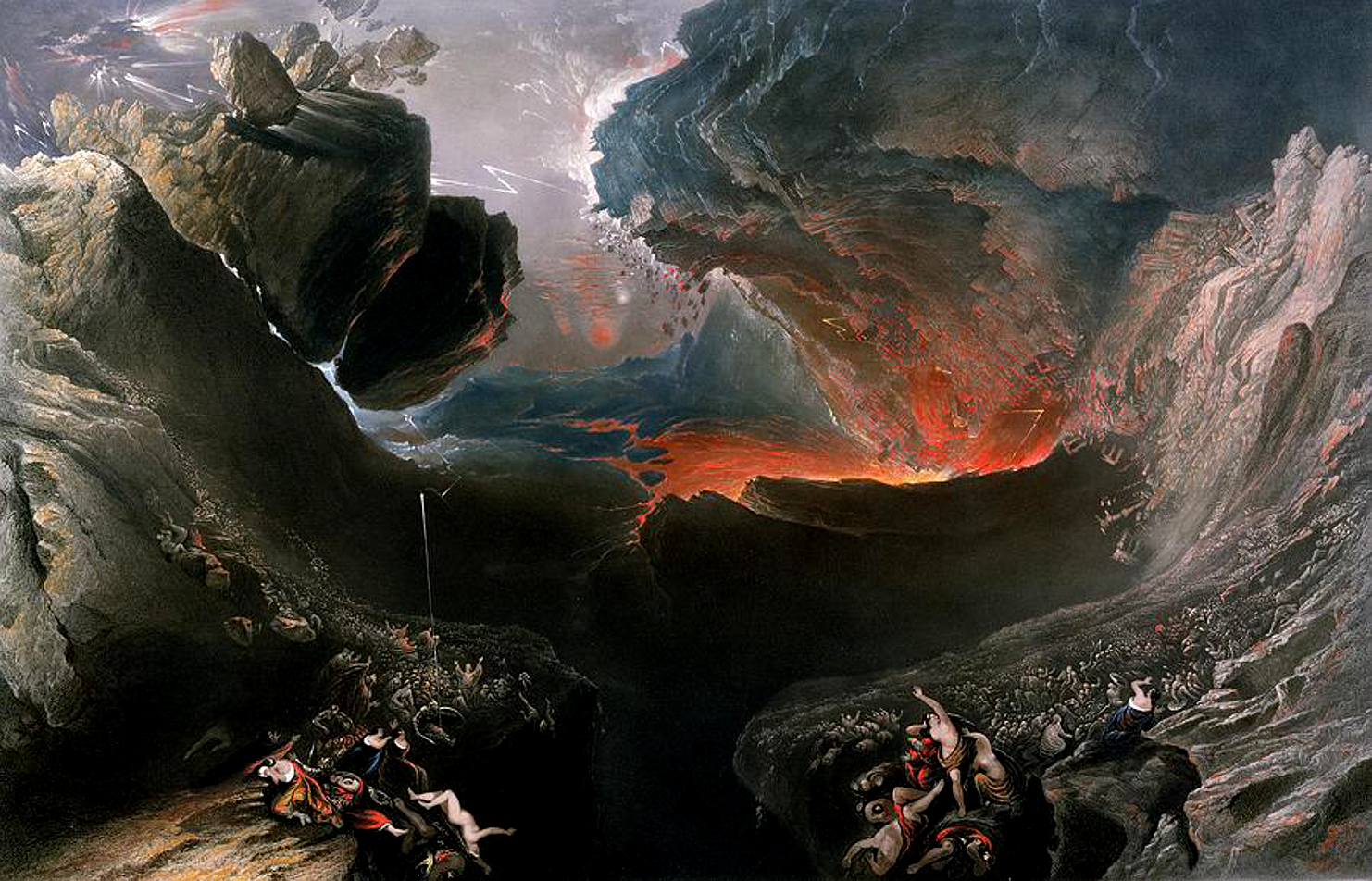
MARTIN_John_Great_Day_of_His_Wrath

The first readers of Revelation would have seen this judgment as a good thing, precisely because it is a God thing. I’m reminded of a concept from the beloved books, The Chronicles of Narnia. The children discover that the King of the World is a lion. They are shocked. “But is he safe?” they ask.

“Of course he isn’t safe,” reply the citizens of Narnia. “He’s the King. But he is good.”

Our passage today shows us that God is not safe, and that God is good.

To listen to the sermon, click the play button:

To download, right click on the link (or do whatever you do on a Mac) and save it to your computer:
Download Revelation Part 34

Revelation #34. Revelation 16:1-21

There is a strong parallelism between the third section of Revelation (the trumpets) and where we are this time, the fifth section: the bowls of wrath. Let me draw it out for you:

  • Trumpet 1: Hail fire and blood fall on the earth. One third of the earth is burned.
  • Bowl 1: It is poured on the earth. Painful sores break out on those who followed the beast.
  • Trumpet 2: A third of the sea-life is killed.
  • Bowl 2: Poured on the sea. It turns to blood and everything in it is killed.
  • Trumpet 3: A great star falls on the fresh water. One third of it is spoiled.
  • Bowl 3: The bowl is poured on the fresh water, turning all of into blood.
  • Trumpet 4: A third of the sun, moon and stars is struck.
  • Bowl 4: Poured onto the sun. Its power burns those who worship the beast. They refuse to repent, however.
  • Trumpet 5: The bottomless pit is opened. The destroyer is released. The smoke of the abyss darkens the sun, and demonic creatures are given authority to inflict pain on those who reject Jesus.
  • Bowl 5: Poured onto the throne of the beast, plunging his kingdom into darkness and pain. But people continue to reject Jesus.
  • Trumpet 6: The four demons bound at the “great river Euphrates” are released. Their armies kill one third of the earth. The people refuse to repent.
  • Bowl 6: Is poured on “the great river Euphrates” It is dried up, in preparation for a coming invasion. The great battle, Armageddon, is set up by demonic deception.
  • Part 7 of the trumpets (but not a trumpet itself)*: the seven thunders, and God’s promise that there will be no delay.
  • Bowl 7: Great destruction through storms, earthquakes and 100-pound hailstones. The people still blaspheme God.

*(The seventh trumpet is actually the revelation of the seven bowls of wrath).

Now, the natural question is “What does this mean? Why is there such parallelism?” I have spoken before about a way of writing and thinking called “chiastic structure.” What I have just showed you is a clear example of it. In the overall, big-picture of Revelation, part 3 (the trumpets) is connected to part 5 (the bowls). Each individual subsection of part 3 has a matching subsection in part five.

Many, many commentators believe that Revelation is written with chiastic structure in mind, yet so many disagree with each other on the details of which parts are parallel to each other. The reason I favor my own outline of Revelation is precisely because the bowls and the trumpets are clearly related to each other as chiasms. From there, we can build out to understand the whole picture. If you don’t remember about chiastic structure, I strongly encourage you to go skim Revelation Part 2, for a refresher.

The meaning of Chiastic structure is difficult for us to grasp, because it really is a different way of presenting ideas; we aren’t used to it. You might even say, it is a different way of thinking, or of organizing thoughts. I will freely confess to you, that specifically in Revelation, my own understanding  of how John uses chiastic structure is limited. However, it is clear that he is doing so.

It is tempting to think that John is simply repeating the same information in a different way, but that is not how chiastic structure usually works. In part chiastic is used to repeat ideas, but at the same time, it is used to add new information to ideas already presented. What I mean is, we should not think that the trumpets and the bowls are the same; only, that they are related to each other.

In fact, I believe that the bowls are a completion of what was started with the trumpets. Judgment began with the seals, and only one quarter of the earth was affected. Then came the trumpets, and one third of the world was affected. In the bowls of wrath (sometimes called “the plagues”) the entire earth is affected.

With the trumpets, God allowed, for a limited time, and in limited ways, demonic powers to have authority to affect things. Now, with the bowls, he brings judgment down on those demonic powers, and on those who welcome them.

There is one important theme repeated in both sections. It is that some people, in spite of everything, refuse to repent. Their response to God’s glory and wrath is not repentance, but defiant rebellion. In our chapter today, three times, the people explicitly reject God (verses 9, 11 & 20).

So they blasphemed the name of God, who had the power over these plagues, and they did not repent and give Him glory.
10 The fifth poured out his bowl on the throne of the beast, and his kingdom was plunged into darkness. People gnawed their tongues because of their pain 11 and blasphemed the God of heaven because of their pains and their sores, yet they did not repent of their actions. (Revelation 16:9-11, HCSB)

God is showing everyone that his judgments are right and reflect true justice. In fact, verses 5-7 explicitly tell us that this is part of what is going on:

5 I heard the angel of the waters say:
You are righteous,
who is and who was, the Holy One,
for You have decided these things.
6 Because they poured out
the blood of the saints and the prophets,
You also gave them blood to drink;
they deserve it!
7 Then I heard someone from the altar say:
Yes, Lord God, the Almighty,
true and righteous are Your judgments. (Revelation 16:5-7 HCSB)

Many years before, one who did repent of his sins, King David, said something similar:

4 Against you, you only, have I sinned
and done what is evil in your sight;
so you are right in your verdict
and justified when you judge. (Psalms 51:4, NIV)

Paul writes in Romans:

Now we know that whatever the law says speaks to those who are subject to the law, so that every mouth may be shut and the whole world may become subject to God’s judgment. (Rom 3:19, HCSB)

This is one of the big themes for the book of Revelation: that God is justified in the way he will judge the world. He will make everything right. Child-molesters will get what is coming to them. Hitler, Stalin, Mao – any such monstrous people, will receive their due. Now, at the same time, anyone who repents and throws themselves on God’s mercy will be saved. But those who reject God, and reject the free, loving gracious salvation he offers, will find themselves crushed by his unchanging holiness. God has given them every opportunity to repent and be saved. Again and again, he delays. He starts by offering kindness to all people. When that time is over, he still does not give up, but tries to bring people to Himself through hardship. Even in this section of  Revelation, where the judgment of God is being executed, he is looking for repentance, though he doesn’t find it.

So, what do we do with all of this? Because of the chiastic structure of Revelation, we often revisit the major themes. I think one thing the Lord may be saying to his people today is to remember his holiness and righteousness. We live in a culture where the ultimate sin is to “judge” someone else. It is absolutely true and right that we humans do not have the right to condemn anyone. But God does have the right, both to judge that someone is wrong, and also to either save or condemn them. We don’t have to decide whom is going to heaven, and whom to hell. However, we should recognize that God does decide that. Though God is love, he is also holiness. Though he forgives, he also judges those who reject his forgiveness. There are some things that are right, and some that are wrong. We are playing with a toxic poison when act as if sin is no big deal, as if God is just a big, warm teddy bear.

The first readers of Revelation would have seen this judgment as a good thing, precisely because it is a God thing. May we do the same. I’m reminded of a concept from the beloved books, The Chronicles of Narnia. The children discover that the King of the World is a lion. They are shocked. “But is he safe?” they ask.

“Of course he isn’t safe,” reply the citizens of Narnia. “He’s the King. But he is good.”

Our passage today shows us that God is not safe, and that God is good. We are meant to read this and realize that we have no hope except to repent of our self-centeredness and sin, and throw ourselves upon His mercy and goodness.

Some of you have already done that, in the sense of becoming followers of Jesus. However, maybe there are ways in which we need to continue doing it. We need to remember that sin is a serious, toxic substance, and the future of those who blaspheme God is judgement. We don’t need to live in fear. Also, God often acts in ways that are hard to understand. In those times we need to remember his forgiveness and mercy are truly ours through Jesus, and that he has shown us the depth of his love for us through the Cross. We can know that even when it doesn’t feel safe, God is good.

REVELATION #33: FEAST YOUR SOUL ON GOD

alcoholic beverages close up cuisine cutlery

Photo by Flo Dahm on Pexels.com

At some time in the future, our eternal joy will be found in feasting our souls on God. Therefore, now in the present, it is important for us to learn how to enjoy God; to feast our souls on his presence. Ultimately, we are dependent upon Him to make it happen, but we can put ourselves in a position to make it easier. We can learn to delight in God as we delight in a delicious feast.

To listen to the sermon, click the play button:

To download, right click on the link (or do whatever you do on a Mac) and save it to your computer:
Download Revelation Part 33

Revelation #33. Revelation 15:1-8

We have come to part five of the book of Revelation. We had the seven letters to the seven churches. The second part was the seven seals. The third was made up of the seven trumpets, along with an interlude about the two witnesses. The fourth was the seven significant signs, and now we come to the seven bowls of wrath, along with an interlude about “Babylon the great.”

Each section begins with a vision of heaven. So chapter 15 is the heavenly vision for part five. Part four contained some heavy imagery: the devil and his beasts making war on God’s people, and even conquering them physically. Therefore, the heavenly vision that comes next shows the people of God on “the sea of glass.” In chapter 4:6, we saw that God’s throne was surrounded by this sea of glass. So the picture we have now is that the people who were threatened and oppressed and even killed in the spiritual war are now standing in victory in the very presence of God. On earth, it looks like the devil and his minions were winning. But we now see the end result, and that is that the worst the devil can do is to kill someone, and in so doing, he only sends God’s people directly into God’s presence. By doing his worst, the devil only reconciles God’s followers with God himself.

This is a powerful message to the first readers of the book of Revelation. In the very worst moments of history, when all appears to be lost, the martyrs are standing in the very presence of God praising him for his mighty deeds, recognizing him, in spite of circumstances, as King of all nations, Lord God Almighty. In spite of everything, they praise God’s decisions and actions as righteous.

Verses five through eight describe the final preparations for the bowls of wrath. The angels who are there to carry out God’s judgment are coming from the very presence of God: that is the meaning of them coming out of the sanctuary. The smoke from God’s glory and power are meant to remind us that he is indeed God, and nothing, and no one else, is.

It is interesting in verse three that the martyrs sing the song of Moses and the song of the Lamb. Seven bowls of wrath are about to be poured out onto all the earth. I think in his vision, John was reminded of how 10 plagues of wrath were poured out on the Egyptians, and then God’s people were finally delivered. That, I believe, is why they sing, “the song of Moses.” It is also “the song of the Lamb,” because, once again, God’s people are about to be finally, and completely delivered. The Egyptians, in the time of the Exodus, represented the ungodly political power of the world that was oppressing God’s people. So too, we are reminded that God has a plan to deliver his people spiritually in every age, but finally and completely at the end of all ages.

I want to point out a few things by way of application. This is one of many, many places in the Bible that looks forward to a day when God will reign completely, surrounded by those who find their joy in worshiping him and basking in his love. I want us to think a little bit more deeply about what that means. If we are God’s people, our future will be delighting ourselves in the fullness of God’s love, grace, joy, holiness, goodness, majesty, creativity… the list goes on forever.

Consider the song sung by God’s people in this vision. The words are entirely focused on God himself: his Majesty, his glory, his righteousness and holiness. They are entirely occupied with God himself.

The point I am making, is that at some time in the future, our eternal joy will be found in feasting our souls on God. Therefore, now in the present, it is important for us to learn how to enjoy God; to feast our souls on his presence. If we think, “That’s fine for the future, but at the moment I’m much more interested in feasting my soul on success (or, relationships, achievements, my house, pleasure, etc.),” then, we are in serious trouble. Now is the time to develop a taste for the eternal goodness and joy of God. If we can’t learn to enjoy it even a little bit right now, what makes us think that we will want it later on?

Obviously, at this point, our own sinful flesh gets in the way of true worship, and true enjoyment of God. Even so, we can orient our lives in ways that tend to distract us from God, or in ways that give us room to learn to enjoy him. If we can learn to feast our souls on God, that can make all the difference when we experience difficult times. This is one of the repeated themes in the book of Revelation: that even when times are desperately evil, we can rejoice in the hope of the glory of God.

Here are a few ways that we might begin to learn to feast our souls on God:

  1. Repentance. We need to recognize that we often are interested in so many other things more than we are interested in God. We cannot change without God’s help, but we must start by admitting where we really are with him, and turning away from other things toward him.
  2. Forgiveness. Once we have repented, we need to also accept that He will make it all right. You don’t have crawl into His presence in fear. Through Jesus, he has cleaned you up, and he will prepare you to enjoy God.
  3. Look “through” God’s wonderful gifts to God himself. Do you have a wonderful family? Recognize that all of the goodness in joy that you feel through your family are echoes of the goodness in joy in God’s presence. He is the one who gave you that family, and the point is not for you to make that family more important than him. Instead, he gave you that gift so that you could focus not on the gift, but on the nature of the Giver.

So for, example, I love the beauty of this world we live in. It would be silly for me to start worshiping nature. Instead, the joy I get from the beauty of creation is pointing me to the eternal joy available in the presence of God. So, I can fully enjoy the great outdoors, but even as I do I recognize that what I am truly enjoying is God himself; and even when I can’t be outdoors, I can still find that sort of joy with Him.

Other gifts that might lead you to enjoy God include (but are not limited to): art, music, dance, physical exercise, good food (but not gluttony), fun.

  1. Read the Bible. The Bible is the only written revelation of God. It is meant to point us to Jesus, and to teach us to feast our souls on Him. It takes self-discipline, but if we want to know God better, we cannot ignore the Bible.
  2. Worship & Fellowship with like-minded followers of Jesus. Not all who call themselves Christians are interested in feasting their souls on God. But many, many are. It is good to spend time with those who “get it,” and encourage one another, and worship together.
  3. Conversational Prayer. I think having an ongoing conversation with God helps us recognize that He is always with us.

What is the Spirit saying to you today through the Word? Do you need to remember that even in darkest times, God is in control? Do you need to repent, and learn to feast on God? Listen and respond to what the Spirit says to you today.

Revelation #32. The Harvest of Grace & the Harvest of Wrath

agriculture asia autumn barley
Photo by icon0.com on Pexels.com

The wilderness is beautiful and awe-inspiring. But if you cross it, it will kill you in a heartbeat. The wilderness doesn’t kill you because it is mean. It kills you if try to do something that is contrary to its nature, because its nature is unyielding. It is what it is. In the same way, God isn’t mean or vindictive. But he is Absolute. His nature is the foundation of everything that exists. It doesn’t change. And that means those who rebel against his Holiness & Righteousness, or even ignore it, will break themselves to pieces on God.

To listen to the sermon, click the play button:

To download, right click on the link (or do whatever you do on a Mac) and save it to your computer:
Download Revelation Part 32

Revelation #32. Revelation 14:14-20.

This is the last of part four, the seven visions. Like the Seven Seals and the Seven trumpets, the Seven visions give us a certain way of looking at human history. They show us history as part of the ongoing spiritual battle between the devil and God’s people. The seventh vision shows what the conclusion of history will involve: First, the righteous will be gathered in: that is the meaning of the first harvest (verses 13-16). Second, those who side with the devil and the two beasts will, along with them receive the full experience of God’s wrath. Once again this only occurs after extensive appeals from Heaven to the people on earth, calling them to repent and receive the grace offered in Jesus Christ, the Lamb of God.

Both the Old and New Testaments teach clearly that God is not yet punishing sin. This is something that I think some Christians don’t understand. The punishment for sin is eternal torment, entirely separated from God. It won’t happen to anyone until the end of time. So, whatever hardship you are going through, it is not God punishing you for sin. Sometimes God uses the circumstances of your life to try and get your attention, or to try to teach you something. But He has not yet punished anyone for sin. He is withholding his wrath, trying to bring as many as possible into His kingdom through faith in the grace of Jesus Christ.

8 But do not overlook this one fact, beloved, that with the Lord one day is as a thousand years, and a thousand years as one day. 9 The Lord is not slow to fulfill his promise as some count slowness, but is patient toward you, not wishing that any should perish, but that all should reach repentance. (ESV) 2 Peter 3:8-9

Even so, the Bible teaches that one day, God will wrap up this world. That is what our verses today are about. On that day, God’s wrath against sin will be let loose against those who refused to accept the salvation offered in Jesus Christ. I’ve italicized parts of the verses below, to highlight what I mean.

4 Or do you presume on the riches of his kindness and forbearance and patience, not knowing that God’s kindness is meant to lead you to repentance? 5 But because of your hard and impenitent heart you are storing up wrath for yourself on the day of wrath when God’s righteous judgment will be revealed. (ESV) Romans 2:4-5

7 But when he saw many of the Pharisees and Sadducees coming to his baptism, he said to them, “You brood of vipers! Who warned you to flee from the wrath to come? 8 Bear fruit in keeping with repentance. (ESV) Matthew 3:7-8

5 Put to death therefore what is earthly in you: sexual immorality, impurity, passion, evil desire, and covetousness, which is idolatry. 6 On account of these the wrath of God is coming. (ESV) Colossians 3:5-6

There are many, many more verses that say the same sorts of thing. However, if we acknowledge God’s righteous claims, repent, trust in Jesus, surrender our lives to Him, then wrath is not our future.

9 For God has not destined us for wrath, but to obtain salvation through our Lord Jesus Christ, 10 who died for us so that whether we are awake or asleep we might live with him. 11 Therefore encourage one another and build one another up, just as you are doing. (ESV) 1 Thessalonians 5:9-11

The consistent appeal of the Bible, and of all true Christians since that time, is to receive that salvation now, before it is too late. We live in the period of grace. Remember, we have encountered this Revelation before. Until the end comes, there is still the possibility of repentance. But once God treads out the “grapes of wrath,” that time will end. Paul urges everyone to seek God while he may be found:

We also appeal to you: Don’t receive God’s grace in vain. 2 For He says: “I heard you in an acceptable time, and I helped you in the day of salvation.”
Look, now is the acceptable time; now is the day of salvation. (HCSB Free) 2 Corinthians 6:1-2

So, these verses describe two things that were very important for John’s first readers to hear. Remember, they are suffering persecution and incredible injustice. People are hurting them, confiscating their property and even killing them, with no justification, and getting away with it. Verses 14-17 tell them this: there will be an end to the injustice and suffering. In God’s perfect time, they will be brought to him. The image harvesting grain conveys the idea that there is a perfect time, and that God wants every possible person to be saved. When that time is complete, God’s people will be taken to him, safely. They will be removed, and kept safe from the coming wrath.

The second piece is the final release of God’s wrath. The day of wrath is indeed coming, as it says all throughout the scripture. Everyone who refuses God’s grace in Jesus will have to answer for the evil in their hearts. Every wrong will be made right. God will no longer hold back.

If all this sounds familiar, then you are starting to understand: Revelation repeats the same things in several different ways. Sometimes we get new information, but mostly, we are getting a strong affirmation from God that he has a plan to save his people, give everyone a fair chance to repent, and then come, and punish evil, and make all things right.

So, what does this do for us, today? One of the reasons I think the message of Revelation is important in the 21st Century is because our culture, and even the church, has lost our understanding of God as holy and righteous. We may see Him as mean and uncaring. But that isn’t the same thing.

More frequently, the message is that God is laid back and mellow, and just wants to help you fulfill your dreams, no matter what those dreams are. We’ve lost sight of God’s awe-inspiring, unfathomable holiness.

God isn’t mean. But he is Absolute. His nature is the foundation of everything that exists. It doesn’t change. And that means those who rebel against his Holiness & Righteousness, or even ignore it, will break themselves to pieces on God.

I’ve spent a fair amount of time in the great outdoors, including some time in very rough and remote places. The wilderness is beautiful and awe-inspiring. And if you cross it, it will kill you in a heartbeat. The wilderness doesn’t kill you because it is mean. It kills you if try to do something that is contrary to its nature, because its nature is unyielding. It is what it is.

If you stand on the edge of a cliff, you will have beautiful views. But if you do not respect the cliff, and you are not careful, you may fall off, and break many bones, or even die. It is no use saying to the cliff “Why are you so mean? Why would you hurt me?” If you don’t live according to nature of the cliff, it hurts or kills you, simply because a cliff is what it is. The problem is with you, not the cliff. So it is with God. His nature is what it is. Those who reject it will suffer the consequences, not because He is mean, but because he is God.

God isn’t just mellow. He cannot change his Holy & Righteous nature, and so he made the awful sacrifice of the Cross so that we, who cannot be remotely holy enough, could be enfolded into his love. It’s like he threw himself down the cliff and broke all of his bones, so that no one else would have to; only it is far, far more than that. Please listen to Revelation #31 about Hell to get the full picture of the incredible sacrifice God made for us. That sacrifice is not an endorsement of our lives; it is redemption, it is salvation. If we receive it, our eternal future is joy, grace & love.

If we refuse it, His Holiness will crush us. Our culture needs to hear this once again.

But there is the other side, too. If we receive what he offers us, the incredible grace of God in Jesus, then we can be part of the first harvest. We gathered with him to be with those of every tongue, tribe and nation who are caught up into the joy, love, peace and grace of God.

Revelation #31. Hell, and the Love of God

ash background beautiful blaze
Photo by icon0.com on Pexels.com

If God is infinitely good, infinitely glorious, then to sin against him is infinitely evil. And to say that a loving God would never send anyone to eternal punishment is to say that God himself is not eternally valuable. But even more than that, the Christian doctrine of hell shows us the extravagant extent of God’s love for us: Jesus suffered unimaginably in hell, for our sake.

 Hell itself cannot help but show the preciousness of God and depths of his love.

To listen to the sermon, click the play button:

To download, right click on the link (or do whatever you do on a Mac) and save it to your computer:
Download Revelation Part 31

Revelation #31.  Revelation 14:6-13

I strongly encourage you to listen to the audio version of this sermon. It is a bit long – 40 minutes, so please plan accordingly. This is an important message, and I believe it is well worth your time.

Please read Revelation 14:6-13

We are in the fourth major section of Revelation. We had the seven letters, the seven seals and the seven trumpets. This section is what I call “the seven significant signs.” These “signs” or visions, tell us that there is a spiritual reality that underlies and surrounds our physical existence. The signs explain what is happening in our lives, and what will happen in the future, from the perspective of this spiritual realm. So the sign of the Woman and the Child tell the story of the church and of the Messiah. Then, enters the Dragon, and we learn that there is a spiritual war going on between the Dragon and the Church. The two beasts show us how the Dragon attacks – through physical persecution and oppression; and also, through deception, lies and cultural pressure. The sign of the 144,000 and the Lamb shows us that not only does God have victory over the Dragon, but those who trust Jesus will also partake of that victory. And so we come to our text today, the sixth sign, which is the three angel messengers.

The three angel messengers go together – they are all part of one “sign,” one aspect of the spiritual reality that surrounds our physical existence. The previous sign showed that those who die are victorious, and are already with the Lamb in glorious light, joy and worship. But the three angel messengers are sent to those who are still on earth. There is a definite progression in the spiritual realm for those who are still alive:

  1. The Gospel is proclaimed. God comes first in peace to all the inhabitants of the earth, inviting everyone into his grace. Notice that the gospel contains both an invitation: “fear God, and give him glory;” and also a warning: “because the hour of his judgment has come.” As we have seen elsewhere in Revelation, God goes to great extremes to allow people to repent and be saved before the end. Once more, he delays judgment, giving yet one more chance.
  2. The judgment upon the empires of the beasts is announced. Babylon was the great enemy of God’s people at one time in Israel’s history. Here in Revelation, “Babylon” represents human society that is organized culturally, economically, and politically against God’s people. It is human culture manipulated by the two beasts. It will come up again soon in Revelation.
  3. The pronouncement of eternal punishment on those who finally refuse to repent and receive God’s grace offered in Jesus Christ. I want to spend the remainder of our time on this subject, since it is controversial in this day and age.

Please bear with me here, because we are going to go into deep and thoughtful territory. One of the great advantages of Christianity – in fact one of the reasons that the nations which were formerly Christian developed faster than many other areas of the world – is that Christianity is deeply thoughtful and intellectual. True Christian faith helps people think well.  Thinking well takes work, but it is important work. I want to entreat you to think on what I say carefully, and thoughtfully. Give some attention to it.

Hell, and the modern world.

The traditional, orthodox Christian view of hell is that it is a place of eternal torment, reserved for those who reject the offer of grace through faith in Jesus Christ. There were a few Christians with different opinions at various times, but the main Christian view was basically settled for all of Christian history. However, that view has come into dispute during the past fifty years or so.

According to Pew Research, only 70% of those who call themselves Christians believe in hell. That means 30% don’t. Fewer women believe in hell than men. 36% of the “Baby Boomer” generation does not believe in hell. Those Baby Boomers include several people who have influence on Christianity in America.

Among those who do believe in hell, there are other areas of dispute. Some Christians, including many influential thinkers, believe that hell is not eternal. Instead, they believe in “annihilation.” That is, they think that those who reject God, after the judgment day, are simply destroyed entirely, ceasing to exist. They reject the idea of eternal suffering.

Mostly the reason Christians  these days reject what the Bible says about hell is because it seems entirely out of step with modern culture. We have come to emphasize the love of God so much that we have lost sight of the holiness and righteousness of God. In fact many people write and speak as if God’s love far outweighs his holiness, purity and righteousness. That is not true. God’s love, and his holiness are in perfect, eternal balance. If they are not, then Jesus had no reason to die for our sins, and God’s forgiveness is no big deal. In fact, without the proper Biblical doctrine of hell, God would be far less loving, not more. You see, you don’t know how much Jesus loves you until you know how much he suffered. If God’s forgiveness is equivalent to paying for a speeding a ticket, that’s nice, and we should be grateful, but in the end, it’s not really a big deal.  But if the debt that he paid for you was eternal suffering, it is a stunning, overwhelming, unbelievable kind of love.

Hell and the Bible.

The Bible’s teaching on hell is really quite straightforward. Much of Revelation is figurative, not literal, and I think we can take it for granted that some elements of verses 9-11 are describing spiritual realities in a picturesque  way (that is, not exactly literal). For instance, the idea of the smoke going up “in the sight of the  holy angels and the lamb.” I don’t know if this is to be taken literally, but the ideas behind it are justice and vindication. Here on earth, the Lamb is blasphemed, and his followers persecuted while people either approve, or do nothing. In Revelation 14:9-11, that situation is reversed. The point of it is to show us that at the end, the name of Jesus will be vindicated, and his followers will  be proven right.

However, we need to know that what these verses say in general about hell are perfectly consistent with what the rest of the Bible clearly teaches about hell. So, what does the Bible say about hell?

It is interesting to note that there is one person in the Bible who talks about hell more than all of the other Biblical writers put together. That person is Jesus Christ. Jesus spent a surprisingly large amount of time talking about hell. Here’s a summary of what he (and the rest of the Bible) says:

  1. Hell is a place of real torment. The most common metaphors for the suffering of hell are those of fire, weeping, gnashing of teeth, and darkness:

43 And if your hand causes you to sin, cut it off. It is better for you to enter life crippled than with two hands to go to hell, to the unquenchable fire. 45 And if your foot causes you to sin, cut it off. It is better for you to enter life lame than with two feet to be thrown into hell. 47 And if your eye causes you to sin, tear it out. It is better for you to enter the kingdom of God with one eye than with two eyes to be thrown into hell, 48 ‘where their worm does not die and the fire is not quenched.’ (ESV) Mark 9:43-48

41The Son of Man will send out His angels, and they will gather from His kingdom everything that causes sin and those guilty of lawlessness. 42They will throw them into the blazing furnace where there will be weeping and gnashing of teeth. (Matt 13:41-42, HCSB)

10Hearing this, Jesus was amazed and said to those following Him, “I assure you: I have not found anyone in Israel with so great a faith! 11I tell you that many will come from east and west, and recline at the table with Abraham, Isaac, and Jacob in the kingdom of heaven. 12But the sons of the kingdom will be thrown into the outer darkness. In that place there will be weeping and gnashing of teeth.” (Matt 8:10-12, HCSB)

The fire and darkness and gnashing of teeth may or may not be literal. But the point is clear: Hell is a place of torment. There are dozens and dozens of other verses that describe hell as a place of torment, including our passage for today.

  1. Hell is forever.

41Then He will also say to those on the left, ‘Depart from Me, you who are cursed, into the eternal fire prepared for the Devil and his angels! (Matt 25:41, HCSB)

43 And if your hand causes you to sin, cut it off. It is better for you to enter life crippled than with two hands to go to hell, to the unquenchable fire. 45 And if your foot causes you to sin, cut it off. It is better for you to enter life lame than with two feet to be thrown into hell. 47 And if your eye causes you to sin, tear it out. It is better for you to enter the kingdom of God with one eye than with two eyes to be thrown into hell, 48 ‘where their worm does not die and the fire is not quenched.’ (ESV) Mark 9:43-48

These are the ones who are like dangerous reefs at your love feasts. They feast with you, nurturing only themselves without fear. They are waterless clouds carried along by winds; trees in late autumn — fruitless, twice dead, pulled out by the roots; wild waves of the sea, foaming up their shameful deeds; wandering stars for whom the blackness of darkness is reserved forever!  (Jude 1:12-13, HCSB)

Once again, this is just a small sample of verses that describe hell as eternal. In addition to the explicit verses, we have logic. We believe that God and Heaven exist outside of time. When we leave this life, we will step outside of time, and be “in eternity” so to speak. It isn’t just a long, long time. It is a whole different plane of existence. Hell also appears to exist outside of time. It is logical that it belongs to the same kind of eternity. Hold on to that thought, because the implication is mind blowing in regard to what Jesus Christ suffered on our behalf.

Some people object to hell in this way: “How,” they say, “can even lifetime of sinning – 70-80 years – merit an eternity of punishment?”  This is a very helpful question, and it helps us to understand exactly why hell is what it is. To get a handle on it, let’s think about crimes in the physical realm. A murder using a gun takes only one second to commit. Should the person who does so only go to jail for a second? Of course not. What about kidnapping? Suppose a kidnapper takes someone for just two days. Should he only serve two days in prison? Of course not.

We recognize that the time it takes to commit a crime is not a measure of its evil. But what is the measure of a crime? On what basis do we decide how to punish criminals? Let’s answer that with a though experiment. Suppose there was a society which said, “A murderer need not stay in prison so long. One or two days is enough.” What would we think? What conclusions could we draw about that culture? The obvious conclusion is that a culture which says that murder does not deserve severe punishment is a culture that does not value human life.

Do you see now? The punishment for a crime is a measure of how precious the thing was that was violated by the crime. This is true even when the crime was only attempted. If someone attempts to commit a crime of graffiti, but fails, there is no punishment. But what if someone attempts murder, but fails? They still go to prison for many years. Even attempted murder is striking at the heart of something precious: human life.

Now what if there was something even more precious than human life, something infinitely valuable, infinitely precious and good? If someone commits a crime against this infinite good, the most precious thing in all the universe – shouldn’t the punishment show how precious this good thing is? Shouldn’t  a crime against infinite good be punished with infinite punishment? If your answer is “no,” then you do not really believe in something that is infinitely good.

Let’s consider the nature of God. God is the ultimate good, the ultimate beauty, the ultimate wonder, joy and perfection in the universe. When God makes a judgment, or decision, there is nothing higher than Himself to which he can appeal. He is the Law. He is the ultimate authority. We say God is good, that he is righteous. What that means is that he is unwaveringly committed to uphold the value of what is infinitely valuable. What is infinitely valuable? His own glory. There is nothing better than him, nothing more valuable than him. As popular author John Piper puts it:

“God has no constitution or legal code outside himself by which to measure what is right and good in his own thinking and feeling and doing. It must be measured by himself. What then is righteousness in God? God’s righteousness is his devotion to, his allegiance to, his absolute unwavering commitment to stand for, and uphold, and vindicate, that which is infinitely valuable: Himself. If he for one millisecond diverted from his passionate, infinitely zealous cause of holding up his glory, he would be unrighteous, and unworthy of our worship.”

–John Piper The Echo and The Insufficiency of Hell (July 13, 2017).

So, if something strikes against the heart of God – who is infinitely good, infinitely precious – shouldn’t the punishment reflect the crime? That is exactly what is happening with hell. The crime is against the infinite good that is God himself. God’s character is infinitely precious. By our sins, we are attacking his character, violating the heart of this precious thing, as if to destroy it (if we could).

If God is infinitely good, infinitely glorious, then to sin against him is infinitely evil. And to say that a loving God would never send anyone to eternal punishment is to say that God himself is not eternally valuable.

We do not stop there. Now we come to stunning, unimaginable love of God. At the moment of Jesus Christ’s death, the whole land was cast into darkness, and he cried out: “My God, my God, why have you forsaken me?”

These things reveal what was happening to Jesus on the cross. Throughout his whole ordeal, Jesus never cried out about being whipped, or being deserted by his friends. This cry was not about physical or psychological pain. This is about hell. When Jesus took upon himself the punishment for our sins, he was “cast out into outer darkness.” He spent not 36 hours in hell, but an eternity. Hell isn’t bound by time, so when Jesus “went to hell” he experienced the eternal rejection of God the Father. He experienced an eternity of suffering. If that is what our sins deserve, and Jesus paid for our sins, then that was the price he paid. Not only that, but Jesus experienced an eternity of suffering for each person who ever lived!  There is more here than we can fully understand, but this is one reason it had to be Jesus who paid for our sins. Since he is eternal and infinite himself, he was able to suffer more than any created creature possibly can.

You see what I mean now, that hell shows us how shockingly extravagant is God’s love for us?

So, if you deny the Biblical doctrine of hell, not only do you say that God is not infinitely precious, you also say that Jesus is not infinitely loving.

Without hell, Jesus suffered 33 years of human burdens that he didn’t need to have. Then he suffered about 18 hours of intense physical pain, followed by 36 hours “just dead.” Sure, that’s pretty amazing too, but it is hardly infinitely loving.

So, our text today is not only describing what happens to those who reject the infinite preciousness of God, it also shows the magnificent extremes of his love for us. Not only that, but no one must go to hell – that was the point of Jesus’ incredible and ultimate suffering. So, when someone rejects this extravagant love, it is a spiteful evil of unbelievable proportion. The punishment of hell for someone who  rejects such precious love is one that fits the crime.

Hell itself cannot help but show the preciousness of God and depths of his love.

I want to add one final thought. In all that I have shared, what I want you to focus on is not the horror of eternal suffering, but rather, the infinite preciousness of God, and the magnificent extravagance of his love for you. Hell might scare you away from the wrong direction, but it cannot lead you to heaven. For that, you need the love of God. I hope this message has given you a deeper appreciation for it. Spend some time meditating on it right now.

REVELATION #30: The Reality of Spiritual Victory. Rev 14:1-5

Rev_30This whole section of Revelation is about the underlying spiritual reality that is affecting the events of our physical lives. It is here to remind the first readers, and us, that the things that we experience every day are also part of an underlying spiritual reality that we cannot see, but is nonetheless very real. In that Spiritual Reality, we are already holy and blameless (Ephesians 1:6); already seated with Christ in the heavenly places (Ephesians 2:6); we have already been raised to life with Christ, and our lives are hidden with him (Colossian 3:1-2). We are already singing the song of the redeemed, already walking with the Lamb wherever he goes (our text for today).

To listen to the sermon, click the play button:

To download, right click on the link (or do whatever you do on a Mac) and save it to your computer:
Download Revelation Part 30

Revelation #30.  Revelation 14:1-5

It is so easy, when reading Revelation to fall into the trap of interpreting things literally. In this passage, one of the things we fixate on is this weird idea:

These are the ones not defiled with women, for they have kept their virginity.  (verse 4)

But let’s back up. We don’t think the beast is literally an animal, but rather its description is figurative. We don’t think that 144,000 is a literal number. Instead, the number symbolizes all of God’s redeemed people – whatever the actual number will be. So, before we go crazy on verse four, let’s consider what it might mean if this, too, is a symbolic idea.

There are two very important principles of Bible interpretation that we should apply here. One is the principle that we interpret the Bible in such a way that it does not contradict itself. In other words, if there is a way to harmonize apparently contradictory passages, we choose that over an interpretation that creates a contradiction. That is how we read every other book – we don’t assume the author has contradicted himself if we don’t have to. Also, we interpret obscure passages in the light of what is clear elsewhere. So, what we have today is an obscure passage. Are there clear passages that would help us understand it? Yes, indeed. Let’s look at them.

The Bible has a very well-defined standard for human sexuality. According to the Bible, sex was made by God, and part of the creation that he called “good.” Sex was made for marriage, and for marriage only. Any sexual activity outside of marriage is called “sexual immorality,” and is considered sinful. But sex within marriage is good, and intended by God. It is a wonderful, powerful tool to help married couples build and maintain intimacy. In fact, the Bible even teaches that married couples should have sex regularly, and should not stop doing so except for mutually agreed upon breaks for prayer and fasting:

1 Now in response to the matters you wrote about: “It is good for a man not to have relations with a woman.” 2 But because sexual immorality is so common, each man should have his own wife, and each woman should have her own husband. 3 A husband should fulfill his marital responsibility to his wife, and likewise a wife to her husband. 4 A wife does not have the right over her own body, but her husband does. In the same way, a husband does not have the right over his own body, but his wife does. 5 Do not deprive one another sexually — except when you agree for a time, to devote yourselves to prayer. Then come together again; otherwise, Satan may tempt you because of your lack of self-control. 6 I say the following as a concession, not as a command. 7 I wish that all people were just like me. But each has his own gift from God, one person in this way and another in that way. (HCSB 1 Corinthians 7:1-7)

When Paul says “I say this as a concession, not a command,” he is talking about singleness, not sex within marriage. His own gift – the thing that he wishes everyone was like him in – was the gift of being single and celibate. But the teaching is, if you can’t be single and celibate, you should get married, and once you are married, you should not deprive each other without mutual agreement. Sex is complicated, and it requires a lot of clear, honest communicating with each other about. I’m not saying that no partner should ever have the right to say “no.” But the plain sense of this passage is that sex is supposed to be a good and important part of marriage.

Therefore (and the passage above isn’t the only place where this is taught) we cannot take Revelation chapter 14 to mean that all sex defiles a person; intimacy between married people is, in a way, holy. It is certainly not defiling. Early Christian writers like Augustine (and many others) believed that when spouses remained monogamous they were, in a spiritual sense, still “virgins.”

Also, the phrasing “defiled themselves with women,” if we take it literally, means that the 144,000 includes only men. But even the earliest Christians rejected this notion, and taught that both men and women were intended in this passage, and in fact, in all passages of scripture:

And indeed not to men only does the Lord promise the grace of continence, disregarding women; but since woman is a part of man and was taken and formed from him, almost universally in the Scriptures God addresses the first formed because they are two in one flesh, and in the man is signified likewise the woman. (early church father Cyprian, circa 248 AD. ACCS).

Even though some ancient Christians believed that this passage was teaching about a special place in God’s kingdom for literal virgins, I think the language of “defiling” shows that it is unlikely that we are to understand this literally. Instead, it is a figure of speech. If so, however, what does it mean?

I think the best understanding of this is that it refers to “virginity” in spiritual matters. All throughout the Bible, when the Lord talks about idolatry, he uses the metaphor of sexual unfaithfulness to describe the spiritual unfaithfulness inherent in worshipping other things.

10They will eat but not be satisfied; they will be promiscuous but not multiply. For they have abandoned their devotion to the LORD.// 11Promiscuity, wine, and new wine take away one’s understanding.// 12My people consult their wooden idols, and their divining rods inform them.// For a spirit of promiscuity leads them astray; they act promiscuously in disobedience to their God.// 13They sacrifice on the mountaintops, and they burn offerings on the hills, and under oaks, poplars, and terebinths, because their shade is pleasant.// And so your daughters act promiscuously and your daughters-in-law commit adultery. (Hos 4:10-13, HCSB)

This is not literal promiscuity – it is describing idol worship. Here are a few more:

7All her carved images will be smashed to pieces; all her wages will be burned in the fire, and I will destroy all her idols. Since she collected the wages of a prostitute, they will be used again for a prostitute. (Mic 1:7, HCSB)

 6In the days of King Josiah the LORD asked me, “Have you seen what unfaithful Israel has done? She has ascended every high hill and gone under every green tree to prostitute herself there. 7I thought: After she has done all these things, she will return to Me. But she didn’t return, and her treacherous sister Judah saw it. 8I observed that it was because unfaithful Israel had committed adultery that I had sent her away and had given her a certificate of divorce. Nevertheless, her treacherous sister Judah was not afraid but also went and prostituted herself. 9Indifferent to her prostitution, she defiled the land and committed adultery with stones and trees. 10Yet in spite of all this, her treacherous sister Judah didn’t return to Me with all her heart — only in pretense.” This is the LORD’s declaration. (Jer 3:6-10, HCSB)

Once again these verses are talking about the fact that Israel and Judah worshipped other gods, and did not seek the Lord. Therefore, I think in our passage on Revelation, verse 4 is all about remaining spiritually pure. The 144,000 are those who have not worshipped other gods, who have not defiled themselves by allowing anything to displace God as God in their lives. One ancient Christian commentator put it like this:

In this passage we do not understand the “virgins” to be only those who are chaste in the body. Rather, we have especially in mind the whole church that holds to the pure faith, as the apostle says, “I betrothed you to one husband, to present you as a pure virgin to Christ.” For she is not corrupted by any adulterous commixture of the heretics, nor to the end of its life is it hindered by the alluring yet deadly desires of this world.

….Truly, dearest brothers, of what profit is it for a man or woman, whether cleric or monk or religious, if bodily virginity is preserved, as long as purity of the heart is violated by evil desires? (Caesarius of Arles , 470-543. ACCS )

The point then, is that the 144,000 are those who put God first in their lives and let nothing take His place. They remain steadfastly faithful to God’s revealed word, which is the Bible.

Now, let’s back up and put this all in context. This is the fifth part of the section I call “The Seven significant signs.” The whole section is about the underlying spiritual reality that is affecting the events of our physical lives. It is here to remind the first readers, and us, that the things that we experience every day are also part of an underlying spiritual reality that we cannot see, but is nonetheless very real.

Up until now, we have seen the negative side of that spiritual reality: we learned that there is spiritual war going on. The devil has already lost to God, and is now, out of spite, trying to destroy those who follow Jesus. But there is more to that spiritual reality than just the negative. Our passage today is showing us that there is also a positive spiritual reality that should impact our lives here and now. And so, we have the picture of the 144,000 worshiping God and being with the lamb wherever he goes. Revelation has given us this message before, but it must be important, since this text reiterates it: the victory is already won.

The text says that these are the “firstfruits for God and the Lamb.” I think John’s first readers would have thought immediately of those who had been put to death for their defiance of the culture in following Jesus. We’ve just come from a very dark section, where it says:

10 If anyone is destined for captivity, into captivity he goes. If anyone is to be killed with a sword, with a sword he will be killed. This demands the perseverance and faith of the saints. (HCSB. Revelation 13:10)

But now we have a picture of what comes after that: after “the sword” you join the firstfruits for God and the Lamb. Their battle is over, they have been delivered. Even as the devil thrashes around here on earth, the great victory celebration has already begun in heaven. This text is here to remind us that the eternal reward for remaining faithful to Jesus is far greater than the cost of discomfort and persecution here on earth. The writer of Hebrews had a similar idea when he wrote:

1Therefore, since we also have such a large cloud of witnesses surrounding us, let us lay aside every weight and the sin that so easily ensnares us. Let us run with endurance the race that lies before us, 2keeping our eyes on Jesus, the source and perfecter of our faith, who for the joy that lay before Him endured a cross and despised the shame and has sat down at the right hand of God’s throne. 3For consider Him who endured such hostility from sinners against Himself, so that you won’t grow weary and lose heart. (Heb 12:1-3, HCSB)

In fact, I would say that this part of John’s vision is a colorful, graphic way of saying the same thing.

So what do we do with all this? First, the faithfulness metaphor. I know for myself that it is easy to lose sight of what is at stake in being faithful to God, and to his Word. The culture to which John wrote was not asking Christians to completely deny Jesus; they simply wanted Christians to agree with the rest of the culture about certain things, and to show their allegiance to the culture by just a small act of worship. It would have been easy for those first Christians to think, “Is it really such a big deal?” But the picture here shows that that is like asking, “Is it really such a big deal if I’m unfaithful to my spouse?”

Now I want to make sure and cover all the bases. Maybe, at some point you have compromised, and you haven’t been faithful to God. Maybe you have allowed other things to come in between you and him. Jesus died to make it right between you and God. But you do have to receive that in faith, and if you receive that in faith, it will change you. If trusting in Jesus doesn’t change your behavior, then you aren’t really trusting in him. But when you do truly trust in him, your sins are entirely removed and forgiven, and, in Jesus, it is as if you had never failed. You can remain spiritually pure, because of Jesus. Also, as we follow him, we learn to want to be pure. The Holy Spirit grows that desire in our hearts.

Second, the victory metaphor. I’m going to speculate a little bit here; please don’t take this next piece as if it is written in stone. But sometimes, I like to picture time as a book. Inside the book, the characters move from one page to the next. They can’t turn the pages back; they move through time in a linear fashion. Now imagine, that when the book has been completely read, the characters get to come out of the book and stand outside, where a reader of the book would be. Now, all of the book – past, present, future – is in the book, and the characters are outside of that place. Their lives are in the book, proceeding in a linear fashion from one page to the next. And yet now they also are outside of the book and what is happening to them outside of the book is going on “at the same time,” so to speak, as they go through the book from page to page. So while they are in the book facing trials and struggles, they are, also, “at the same time,” outside of the book celebrating with friends and family.

I wonder sometimes if that is a little bit like the spiritual reality. We live inside time; “inside the book.” But spiritual reality is outside the book. In that spiritual reality we are there, already entirely saved. We are already holy and blameless (Ephesians 1:6); already seated with Christ in the heavenly places (Ephesians 2:6); we have already been raised to life with Christ, and our lives are hidden with him (Colossian 3:1-2). We are already singing the song of the redeemed, already walking with the Lamb wherever he goes (our text for today).

When we truly believe this, it changes everything. Yes, we still have to finish the book, page by page. And yet, the end is already written. This why the Apostle Paul could say:

16 Therefore we do not give up. Even though our outer person is being destroyed, our inner person is being renewed day by day. 17 For our momentary light affliction is producing for us an absolutely incomparable eternal weight of glory. 18 So we do not focus on what is seen, but on what is unseen. For what is seen is temporary, but what is unseen is eternal. (HCSB, 2 Corinthians 4:16-18)

I want us to learn to say the same thing. Let the Spirit speak to you today!