
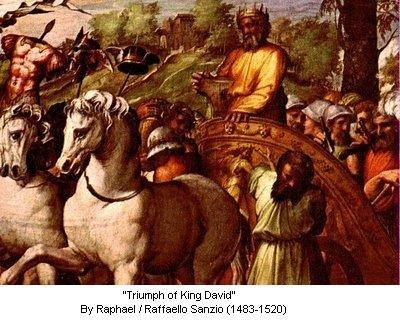
God keeps his promises, but not always on our timetable. David illustrates physically in the land of Israel what Jesus wants to do spiritually in our hearts and minds.
2 Samuel #9 . 2 Samuel Chapter 8
To listen to the sermon, click the play button:
To download, right click on the link (or do whatever you do on a Mac) and save it to your computer: Download 2 Samuel Part 9
Chapter eight chronicles many of the conquests of David after he became king. These did not all necessarily take place at one point in his life; rather this is a record of what David did over a lifetime of military leadership.
In verse one, the writer tells us that “Metheg-ammah” is taken from the Philistines. This is an Hebrew expression that gives translators trouble. Some think it refers to the city of Gath. Literally it says that David took “the bridle out of the mother” of the Philistines. It may be a kind of slang meaning he took control (the bridle) of the chief Philistine city (which would be Gath). The main point is clear – the Philistines have lost any kind of control or initiative that they once had against the Israelites, and they are, for all intents and purposes, subdued. The Philistines had been a problem for Israel for several hundred years, now, through David, the Lord ends the problem.
The second verse describes how David defeated the Moabites. This is a bit troubling, because David was quite severe with them, apparently executing two thirds of the men who fought against him. This is made even more perplexing when we remember that David’s great-grandmother was a Moabite, and David had left his elderly parents in the care of the king of Moab when he was running from Saul. Some Jewish scholars believe that the Moabites killed David’s parents. There is no record of them after David left them in Moab. In addition, the Lord told David not to remain there (1 Samuel 22:5). So it is possible that the Moabites planned all along to betray him, and that the Lord told David to leave there to protect him from their betrayal. His parents, however were still there when the Moabites turned on him. This seems plausible to me.
There is more as well. In Numbers chapters 22-25, the Israelites had left Egypt and were wandering in the wilderness. This was more than four hundred years before the time of David. The Israelites camped near the country of Moab, and the Moabites were afraid of them. They didn’t want to fight the Israelites, so the king of Moab hired a prophet of God to curse the Israelites. Only, the prophet was a true prophet, and he couldn’t curse Israel in God’s name. Instead, he blessed them. The Moabites tried to trick the Israelites into becoming one people with them, and worshipping their false gods. But the prophet prophesied about the future of the two nations. He said:
I see him, but not now; I perceive him, but not near. A star will come from Jacob, and a scepter will arise from Israel. He will smash the forehead of Moab and strike down all the Shethites. (Num 24:17, HCSB)
David fulfilled this prophecy in 2 Samuel chapter 8. Now, I don’t think was consciously trying to fulfill the prophecy. I think he was punishing them for killing his parents. But as it happened that also fulfilled the prophecy given more than four hundred years before.
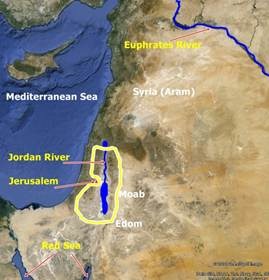 In fact, at one level, this whole passage is about the fulfillment of ancient promises and prophecies. Eight hundred years before David, God promised Abraham that his descendants would inherit the land of Canaan. In Genesis 15:18-21, that land was described as extending from the Red Sea in the South to the Euphrates river in the north where it runs southeast through modern-day Syria. Other promises in Deuteronomy 1:7, 11:24 and Joshua 1:4 describe those same borders, and lay out an eastern border that included almost all of modern day Jordan and Syria. However, in all the time that the descendants of Abraham lived in the promised land, they had not possessed nearly that much territory. For four hundred years, they had lived on far less than God had promised. The map at left shows the region. The area outlined in yellow is the area that the Israelites controlled during the time of the Judges and during Saul’s reign.
They were living in far less than God had promised.
However, as a result of the conquest made by David, as described in 2 Samuel chapter 8, the borders of Israel were extended to almost the exact boundaries described in God’s promises to Abraham and to the people through Moses. This next picture shows the approximate area of David’s 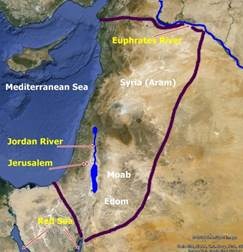 kingdom, outlined in purple. As you can see, Israel now had influence from the Euphrates river to the Red Sea. This is not to say that all of this area was considered “Israelite” however David’s court in Jerusalem controlled and influenced all of it. If you are still having trouble picturing it, look at a world map. This area includes modern Israel, Jordan, Lebanon and most of Syria.
So what does all this mean for us today? I think it always helps to ask, “where is Jesus in this passage?” I see him here in two places: he is fulfilling promises, and defeating enemies. First let’s talk about the promises. On one hand, this seems to show us that God’s promises don’t always get fulfilled in what we consider a timely fashion. It was more than eight hundred years between God’s promise to Abraham about the size of the land, and the complete fulfillment of that promise. That’s a long time, and many generations didn’t live in the full reality of what God had promised. On the other hand, God doesn’t forget his promises, and he does truly bring them to pass. If you wanted to take the time, you could go through the bible, and find dozens of examples of promises that He made and then kept. Many times in the past I have explained where the bible came from, and how it has been verified time and again as a historically valid document. Here, I want to emphasize that it is also a spiritually valid document. We have a historical record of a promise from God and a historical record from a different period showing its fulfillment.
A natural question is “Why did it take so long for God to fulfill this?” The only completely honest answer is “I don’t know.” I do have some thoughts, however. God told Abraham when he made the promise that it wouldn’t happen for at least four-hundred years. He was giving the residents of the land a chance to repent. But when the Israelites came out of Egypt four hundred years later, the Lord told them through Moses to go into the land, drive out the other nations and possess it. They simply didn’t do it. The reason they didn’t do it is because they lacked faith in God’s promise to be with them. In Numbers 13, Moses sent twelve spies into the land prior to invading it. Ten of the spies came back and said it would be impossible to drive out the nations who lived there. But two said it could be done. Their names were Joshua and Caleb. They said:
The land we passed through and explored is an extremely good land. If the LORD is pleased with us, He will bring us into this land, a land flowing with milk and honey, and give it to us. Only don’t rebel against the LORD, and don’t be afraid of the people of the land, for we will devour them. Their protection has been removed from them, and the LORD is with us. Don’t be afraid of them! (Num 14:7-9, HCSB)
But the people didn’t listen to them. Instead they gave into fear and blaming. The result was forty years more of wandering for that generation, and then four-hundred years more of living in only part of what God promised.
I don’t think the lesson here is “do more.” I think it is “trust more.” As I have said many times, believing comes before doing. If the people were living in trust, they would have done what they were supposed to do. If they had attempted to do it without trust (as indeed they often did in the next four hundred years) their results would also have fallen short. The key is believing what God has promised, and trusting Him. We have seen that the one thing that makes David a hero is that he trusts God. David isn’t perfect. But he lives out of the understanding that his life belongs to God; that through him, God can and should do whatever he wants. So when David came along, the Lord finally had someone he could use, someone who trusted Him enough so that God could fully give everything that was promised.
We can’t always understand why God doesn’t completely fulfill his promises in our own lives. It isn’t always about our faith – sometimes it is about God’s bigger purposes in the world. For many years, David did not live in the fullness of God’s promises to him. That wasn’t his fault – God was arranging other things, because it wasn’t just about David – it was about God’s purposes. So don’t feel badly if you truly trust God, and yet you don’t see the complete reality of his promises in your life. It isn’t just about you. But at least, we can try to eliminate lack of faith as a reason that we don’t experience the fullness of God’s promises to us. David trusted him fully, and eventually, the Lord used that trust in a huge and positive way for both David and the entire people of God.
Now let’s talk about Jesus defeating enemies. is there “unconquered territory” in your life? I mean, are there certain areas of your life that are outside the control of Jesus? Hebrews 2:8 says this:
You put all things under his control.” For when he put all things under his control, he left nothing outside of his control. At present we do not yet see all things under his control, (Heb 2:8, NET)
Like with God’s promises, we often see a partial fulfillment of the Lord ruling in our lives. I’ll be honest and say, usually this is for the same reason – our own lack of trust. But it has the same solution. If we trust Jesus, and let him have us more fully, he will supply the power to defeat the failures, temptations and self-will that we struggle with. Paul writes about the struggle this way:
For though we live as human beings, we do not wage war according to human standards, for the weapons of our warfare are not human weapons, but are made powerful by God for tearing down strongholds. We tear down arguments and every arrogant obstacle that is raised up against the knowledge of God, and we take every thought captive to make it obey Christ. (2Cor 10:3-5, NET)
Like David, we are called to wage war while trusting in God’s promises. But our war isn’t physical – it is the war of a mind, to let the Lord conquer all that he has promised for us. Now I could do an entire sermon series on the battle for the mind – maybe I will soon. But for now, I think we should understand this from our text: the key is to trust our Lord, and to be willing to do whatever that trust leads us to do. Sometimes that means opposing whatever opposes the truth of the Word of God in our thoughts. David illustrates physically in the land of Israel what Jesus wants to do spiritually in our hearts and minds.

 Clear Bible