
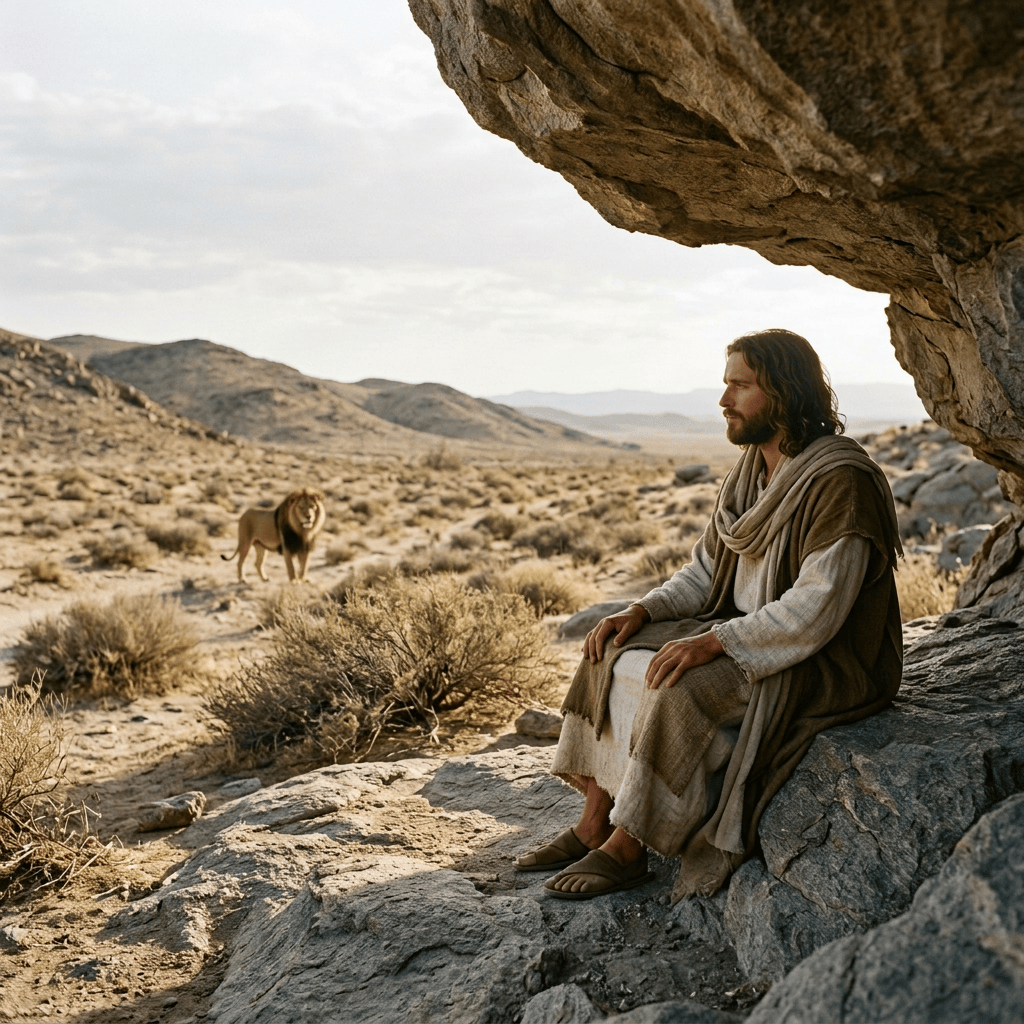
The temptation of Jesus shows us that temptation is not the same thing as sin. We also learn that sometimes, God himself leads us into times of difficult testing. Our circumstances are not a reliable guide to how God feels about us. He loved Jesus. He was pleased with Jesus. And he led him into a wilderness with no food where he was in danger from the devil and wild animals.
To listen to the sermon, click the play button:You can also find us on Spotify at https://open.spotify.com/show/6KKzSHPFT466aXfNT2r9OD (This will open to the latest sermon. You can search from there if you are looking for a previous one)
To download, right click on the link (or do whatever you do on a Mac) and save it to your computer: Download Mark Part 3
Mark #3. Mark 1:9-13
We considered the baptism of Jesus last time. Mark uses it as the last of a three (or four) part claim that Jesus is the Messiah, Yahweh, the Son of God. Matthew, Mark and Luke all record that right after Jesus was baptized by John, a voice from heaven declared “This is my beloved son, with him I am well pleased.”
Now, we need to remember Jesus’ situation. He was eternally God, but two thousand years ago, he joined his God-nature to human nature. We Christians believe that the joining will last forever. In other words, going forward from his birth near Bethlehem, he is both God and man, at the same time, forever. Now, during his time on earth, Jesus did not “use” his God-nature. He lived as a human being, relying on God the Father for all things. All of the miracles were done by God the Father as Jesus relied upon him. This is the same way God still sometimes does miracles through people. Jesus basically allowed himself no resources that other human beings wouldn’t have.
Here’s how the author of Hebrews puts it:
14 Now since the children have flesh and blood in common, Jesus also shared in these, so that through his death he might destroy the one holding the power of death — that is, the devil — 15 and free those who were held in slavery all their lives by the fear of death. 16 For it is clear that he does not reach out to help angels, but to help Abraham’s offspring. 17 Therefore, he had to be like his brothers and sisters in every way, so that he could become a merciful and faithful high priest in matters pertaining to God, to make atonement for the sins of the people. 18 For since he himself has suffered when he was tempted, he is able to help those who are tempted. (Hebrews 2:14-18, CSB, bold formatting added for emphasis)
Therefore, when Jesus, restricting himself to human nature, heard the voice of the Father from heaven affirming and loving him, I have to believe that it was a wonderful, exhilarating moment for him. Jesus’ divine nature didn’t need that kind of affirmation. But as a human, Jesus wanted to know for certain that God loved him, the same as we all do. Because Jesus relied on the Father as a human being must do, his baptism would have been a big spiritual high.
I think this is important because of what comes next. Matthew Mark and Luke all agree that the next thing that happened, after this amazing spiritual high of God the Father telling Jesus that he was loved and accepted, was that the very same God led Jesus into a desolate wilderness where he was attacked by Satan, and even physically threatened by hunger and wild animals.
As modern people, we might be prone to thinking of the wilderness, and wild animals, as wonderful, awe-inspiring things. These days, wilderness is rare and precious. Wild animals are often endangered, and they present very little danger to human beings with firearms. Most dangerous wild animals today live nowhere near humans, and when they do, they are terrified of humans.
About ten years ago, I spent eight days alone in a hunting cabin in Colorado. One day when I was out fishing, I came across a large, fresh, mountain lion track in the mud next to the stream I was exploring. I had a brief moment of wondering if I was being stupid for not getting out of there, but overall, my feeling was one of awe, wonder and joy.
But two thousand years ago, the situation was very different. Much of the world was still unsettled wilderness, and wild animals were more plentiful, and more aggressive toward people. In the wilderness near ancient Judea there were lions and bears, and perhaps hyenas. There were also venomous snakes and scorpions, and no one had yet invented antivenin, or any other way of treating venomous bites or stings. Humans had not yet developed effective ways of dealing with dangerous creatures, and those creatures had less fear of people.
So when Mark says that the Holy Spirit drove Jesus into the wilderness, and he was with the wild beasts, his first readers understood that Jesus was taking a big risk; that he might lose his physical life. Even fifteen hundred years later, the world was still much the same, so commentator Matthew Henry, writing in the late sixteenth century, intuitively understood that the “wild beasts” were not a positive at all. He wrote:
Mark observes this circumstance of his being in the wilderness – that he was with the wild beasts. It was an instance of his Father’s care of him, that he was preserved from being torn in pieces by the wild beasts, which encouraged him the more that his Father would provide for him when he was hungry. Special protections are earnests of seasonable supplies. It was likewise an intimation to him of the inhumanity of the men of that generation, whom he was to live among – no better than wild beasts in the wilderness, nay abundantly worse. (Matthew Henry’s Commentary on the Whole Bible)
One thing that occurs to me here is that this shows me something about Jesus that I don’t normally think about. I love the wilderness, and before the pain came into my life, I used to hike, and canoe, and fish. I regularly went to wilderness areas. These days, the closest I get is watching a TV show called “Alone,” in which people go out into the wilderness to see how long they can survive. Participants are allowed to take a certain amount of equipment with them. But knowing what I do about the wilderness, I have a great deal of admiration for anyone who survives alone for as much as three weeks. But Jesus went alone into the wilderness with no modern equipment at all, and survived for forty days. I’ve never quite thought of it like this, but Jesus was a genuine wilderness survivor, a true “mountain man,” in my way of thinking.
So, the Holy Spirit led Jesus from a wonderful, amazing, spiritual high experience into a profoundly difficult and dangerous one. Jesus had to contend with the devil. Remember, he did not tap into the pure power he could have used as God. Instead, he confined himself to human resources, relying on the Father to help him. In addition to the devil, Jesus had to watch out for literal wild animals that were dangerous to human beings. So he was both spiritually and physically in danger, in addition to being without food.
The Father was pleased with Jesus. The Spirit was with him, leading him. And he was brought into a desert wasteland where he had no food and had to fight with the devil, and watch out for wild predators.
You don’t have to go very far in America to hear a Christian say something like this: “If you just follow God, he’ll take care of you. Your life will go better.” The Father was pleased with Jesus. The Spirit was leading him. However, his life did not get better, but harder. Following God is not a guarantee that everything will go well for you. That’s hard, but it’s the truth. When we follow God, his goal is to lead us to the place where we understand that this life on earth is not the main focus. His goal is for us to get in line with his purposes in the world, to be part of his showing his glory to the world. That doesn’t always involve making us more comfortable, or well off. God is telling a story about himself through our lives. Most really good stories involve danger, struggle and conflict. So we should not be surprised when our lives have elements of that as well.
There is something else that many people may need to hear today: Our circumstances do not necessarily reflect how God feels about us. Jesus had nothing to eat. He was assailed by the devil, and living in a desert wasteland, in danger from predators. And the Father was so pleased with him; the Spirit was with him. The Father had his reasons for allowing Jesus to go through that. But his reasons had nothing to do with his delight in Jesus.
Sometimes, when I’m going through tough times, I think maybe God is mad at me, or perhaps I’ve done something that has caused him to teach me a lesson. Another thought I have sometimes is that I’m going through hard times because I’ve made the wrong choice, and not listened to the Holy Spirit. But that could not have been the case with Jesus. The Father was pleased with him. The Spirit was leading him. Even so, as I just said, he was in constant danger, and assailed by profound attacks from the devil.
I think this passage calls us to dare to look at our circumstances differently. Through Jesus, the Father is pleased with us, too. What we are going through is not necessarily a sign of how God feels about us. It’s true that, unlike Jesus, we sin. Sometimes we go astray and hard circumstances are a result of our bad choices. But Jesus shows us that you can follow the Spirit and still end up in a wasteland with no food and the devil attacking you constantly. Just because you are in a hard time does not mean that God is displeased with you. Trust his love and grace to you!
There’s something else for us here, as well. The author of Hebrews refers to it in the end of the quote above:
18 For since he himself has suffered when he was tempted, he is able to help those who are tempted. (Hebrews 2:18, CSB)
One of the reasons we have this passage is to encourage us when we face trials and temptations. Jesus was also tempted. Jesus also went through suffering and difficult times. He understands the difficulties, he knows what it is like.
This should encourage us in two ways. First this: temptation is not sin. Just because we are tempted to do or think something doesn’t mean that we are sinning. Temptation comes from the devil, the world and our sinful flesh, but it doesn’t come from within us, who are redeemed by God through Jesus Christ. These forces come to us and whisper to our minds: “You want to lust, don’t you?” Or, “You want to put that person in her place, don’t you? You want to say that mean thing, you want to cheat, just this once, you want to rage at your spouse, you want to prove you are better…” You get the idea. These thoughts are temptations, not sins. We think it is only ourselves thinking these thoughts, and so we think we have already sinned. But temptation cannot be sin, because Jesus himself was tempted, but never sinned.
15 For we do not have a high priest who is unable to sympathize with our weaknesses, but one who has been tempted in every way as we are, yet without sin. 16 Therefore, let us approach the throne of grace with boldness, so that we may receive mercy and find grace to help us in time of need. (Hebrews 4:15-16, CSB)
So, the first thing is to remember that temptation is not sin. You have done nothing wrong by being tempted. Don’t let the devil trick you into going ahead and following through, in acting on the temptation because you think you have already failed. You haven’t.
The second thing is also found in the verses I just quoted. I’ll quote it again, because it is very important:
16 Therefore, let us approach the throne of grace with boldness, so that we may receive mercy and find grace to help us in time of need. (Hebrews 4:15-16, CSB)
That’s another reason Jesus went through temptation: to teach us to run to him in temptation, and even also to run to him if we have failed and sinned. Matthew Henry puts it like this:
Christ himself was tempted, not only to teach us, that it is no sin to be tempted, but to direct us whither to go for succour when we are tempted, even to him that suffered, being tempted; that he might experimentally sympathize with us when we are tempted. (Matthew Henry’s Commentary on the Whole Bible)
We can boldly come to Jesus when we are tempted, and find grace to help us in time of need. And if we have failed, we find that same grace forgiving us in time of need. Jesus is not sitting there with his arms folded across his chest, shaking his head at us. No. He knows what it is like to be a human being facing the devil. That is why he came—to defeat sin and the devil, and to offer us grace instead of condemnation. That grace leads us away from sin, but it is still there, even when we fail and fall into sin.
What is the Holy Spirit saying to you through this text today? Do you need to be reminded that sometimes following Jesus means going through hard things so that God can tell a glorious story through you? Do you need to know that difficult circumstances do not mean that God has abandoned you, or that you have done something wrong, but rather, it could be that you are facing difficulty, as Jesus did, because God is pleased with you?
Maybe you need to hear today that temptation is not sin. You’ve been tempted, and you’ve thought, “I’ve already failed! I hardly had time to realize it before I failed.” But maybe not. Maybe, you are facing temptation, which even Jesus did! Do not let the devil condemn you, when all that’s happened is that the devil himself is whispering to you. Rebuke him in the name of Jesus and send him away.
Of course, maybe you really did sin. Maybe you listened to the voices of the devil, the world, or your own flesh, and gave in and actually did the wrong thing. If so, repent! Turn away from sin, and turn to Jesus. You can be confident that you will find grace and mercy in Jesus when you need it.
 Clear Bible