DOES JESUS FORGIVE RACISTS?


Sterling Racist

(picture from cnn.com)


By rushing to agree with everyone else and pile on with the condemnations, Christians often lose a chance to show the character of Jesus to the world.


To listen to the sermon, click the play button:

To download, right click on the link (or do whatever you do on a Mac) and save it to your computer: Download Matthew Part 12


Matthew #12 . Chapter 5:1-12

It seems to me that we could spend one week on each beatitude, however that would probably mean we’d never get to the rest of the Sermon on the Mount, let alone the rest of Matthew. So we are going to try to briefly examine the last five Christian character traits today.

First, a quick review. Jesus-followers should be spiritually poor, acknowledging our true position before God and our need of Jesus. Next, we should mourn our spiritual poverty (among other things) and bewail the sin that brought us to this place. We should face loss and brokenness with courage and determination to walk through it as we look to Jesus as the source of all comfort. In addition, we should wait quietly and meekly for God’s deliverance, not trusting in our own strength or resources to save us.

I want to make sure we understand that most of these things are very counter-cultural. Our culture blesses people who have it together, not the spiritually destitute. Our culture teaches us to avoid almost all mourning, in any way possible. Certainly, we do not learn from society to mourn sin and brokenness. Our culture teaches assertiveness and “going for it;” not humbly waiting on God to give “it” to you.

With that we come to the fourth character trait and its accompanying blessing: “blessed are those who hunger and thirst for righteousness, for they will be filled” (matt 5:6). This is the natural continuation of the spiritual condition that is poor, mourning and meek. Once more, let me remind you that this character trait is not natural to our culture. What does our culture teach us to hunger and thirst for? Pleasure, comfort, wealth and recognition. It has been a very long time indeed since society at large has held up moral righteousness as goal to strive for, something to hunger after.

What does this character trait really mean? What does it look like in a 21st century disciple?

I see a several aspects of righteousness that seem to apply here. The first is that the true disciple does more than just acknowledge his position before God, mourn his sin, and wait quietly. The true disciple yearns to be truly right with God. The righteousness that is so eagerly desired here is the very thing that is given to us by Jesus because of his death on the cross and resurrection to eternal life. It is the righteousness that is ours by faith. As an old praise song says:

I am covered over with the robe of righteousness that Jesus gives to me.

I am covered over with the precious blood of Jesus and He lives in me.

Oh, what a joy it is to know my Heavenly Father loves me so, He gives to me my Jesus.

And when He looks at me, He sees not what I used to be, but He sees Jesus.

The person who is truly spiritually poor, who truly mourns for her sins, who meekly waits for God, also desperately wants her condition changed. Such a person wants his old deeds to be wiped away as if they had never happened. He wants to stand tall without shame. Such a person hungers for the righteousness of Christ.

A second aspect of righteousness is that of continuing to do right. The disciple of Jesus, the person who follows him, has already been given the righteousness of faith. But the disciple doesn’t only want past sins covered by Jesus’ righteousness – those who trust in Jesus have the Holy Spirit, and the Spirit creates a yearning within us to live uprightly. Thus, I believe the Good News Bible is right in translating this verse:

“Happy are those whose greatest desire is to do what God requires; God will satisfy them fully!”

God’s satisfaction of this desire to live righteously is vitally important. We can’t live in a righteous way apart from God any more than we can attain our salvation apart from him. But when we hunger and thirst for righteousness, he releases his power through the Holy Spirit to enable us live rightly. We shall be satisfied!

“Blessed are the merciful, for they will be shown mercy” (Matt 5:7).

At first glance, this one does not seem so counter-cultural. The truth is, however, our culture isn’t merciful – it just has different standards than the bible. For example, modern society is not merciful to people who commit sexual sin. It’s just that the dominant idea is that there are no real sexual sins anymore. In other words it isn’t mercy that causes our culture to refrain from condemning people for sexual sin. It is simply that they agree in with what people are doing. Read carefully here, and learn what this means: You can’t give mercy to someone unless you think they deserve condemnation in the first place. Mercy is forgiving people who have truly done wrong.

We can test this idea when see how society reacts to people who do something that is actually considered a sin by the culture. For example, just this week (as I write this) the owner of the LA Clippers (an NBA Basketball team) was caught on tape making racist comments. There has been no mercy for him from anybody. Sadly, even Christians have joined in with the condemnation.

Some of you may say, “But wait a minute. Christians don’t support racism.” Of course we don’t. But the whole point of mercy is that it is given to someone who doesn’t deserve it, someone who has done wrong. You can’t give mercy to a person unless you think they deserve condemnation in the first place. The truth is, if Christians were going to condemn this man, we should have been doing so long before his racism came to light. He openly sinned (according to the Bible’s definition of sin) in many other ways before his racism was publicly known. The fact that Christians are now joining in the universal condemnation is a sign that we have drifted far from Biblical faith, and we are more concerned about being called racists than we are about manifesting the love of Jesus to sinners.

I affirm that racism is sinful and evil. As a Jesus follower, I also affirm that I must be ready to show mercy to anyone who will receive it. It may be offensive to say this, but I truly believe that Jesus would be merciful to a racist, if the racist gave him a chance by repenting. Now, I don’t have any evidence that this man has repented of racism, or of any of his other sins, either. That’s a whole different story. But I bring this all up to point out that our culture is not merciful at all; and if we intend to be merciful to people who don’t deserve it, it will offend people.

Jesus makes forgiving others central to the gospel message:

“For if you forgive men when they sin against you, your heavenly father will also forgive you. But if you do not forgive men their sins, your father will not forgive your sins.” (Matthew 6:14-15)

Forgiving others is not an option for the Christian. If we refuse to forgive, than we cannot receive forgiveness ourselves. I will deal with this subject in detail when we reach Matthew 6.


“Blessed are the pure in heart, for they will see God” (Matt 5:8). Jesus was speaking to a crowd of Jewish people who were very concerned with external purity. He announces his counter-cultural aims by speaking of a purity of the heart. Even though the Old Testament speaks quite a bit about purity of heart, the Jewish religion by the time of Jesus had already begun to move beyond the Old Testament alone, and had started to rely on non-scriptural rabbinical proclamations and commentary. In other words, though Jesus’ focus on internal purity was a not a new teaching, it was a teaching largely ignored by Jews in Jesus day, and to some extent, since that time as well. If a person washed according to the proper ceremony, and ate kosher food and avoided dead bodies and so on, then he was pure. But Jesus, throughout the gospels, contests this idea, insisting that God is a God of relationship, not just ceremony, and what matters is what is in the heart.

I believe that in context, this purity of heart also refers to how Christians should deal with each other, and other people. What this means is that a follower of Jesus should be completely honest, sincere and well-intentioned in all dealings with others. We should not be hypocritical, or pretend to be a sort of person we are not.

“Blessed are the peacemakers, for they will be called sons of God” (Matthew 5:9). As always, there are two points to make. First, I believe that Jesus is talking here about evangelism. Peace with God was a promise foretold by the ancient prophets, (see Ezekiel 37:26 for example) and fulfilled in Jesus Christ. Romans 5:1 says,

“Therefore since we have been justified through faith, we have peace with God through our Lord Jesus Christ.”

A peacemaker is therefore one who helps to spread this peace-with-God – a person who assists in the reconciliation (peacemaking) between God and human beings. This is to be characteristic of all Christians. I can think of no other good reason why the peacemaker should be called a ‘son of God.’

Second, a peacemaker is someone who helps reconcile people to other people. Now, there are many caveats (“buts”) to this sort of peacemaking. It does not mean compromising the truth. It does not mean appeasing rage-filled unrepentant sinners. Peacemaking does not forbid us from ever taking a stand, or standing our ground. It is not “peace at all costs.” And many times, it involves a painful process. As John Stott says:

“When we are ourselves involved in a quarrel there will be either the pain of apologizing to the person we have injured or the pain of rebuking the person who has injured us.”

We are, however called to try to end discord, rather than to create and perpetuate it by gossip, slander or even silence.

“Blessed are those who are persecuted because of righteousness, for theirs is the kingdom of heaven” (Matt 5:10). Jesus qualifies his statement here by saying “because of righteousness” because there is no special blessing in being persecuted when we deserve it – the blessing comes when we don’t. As Peter writes:

“For it is commendable if a man bears up under the pain of unjust suffering because he is conscious of God. But how is it to your credit if you receive a beating for doing wrong and endure it? But if you suffer for doing good and endure it, this is commendable before God. To this you were called, because Christ suffered for you, leaving you an example that you should follow in his steps.” (1 Peter 2:19-21).

This is becoming more and more relevant to our times. Christians, even in the Western World, are increasingly insulted and falsely accused. More and more people are willing to say “every kind of evil” against us when we take a stand for what the Bible actually says. I want to say that this is unfortunate; however Jesus says there is actually blessing in it.

Although many of us have experienced the pain of having our beliefs publicly distorted and derided, none of us in the Western world (as far as I know) have yet suffered physical persecution for following Jesus. Other brothers and sisters elsewhere in the world have, however. Throughout both communist and Muslim countries, Christians are censured, deprived of rights, imprisoned and sometimes even killed for their faith. The testimony of Richard Wurmbrand, a Lutheran pastor who was tortured by the communists in Romania, is that the presence of Jesus came in an incredibly tangible, special way when he was being tormented. He did indeed, testify that this special sense of God’s presence was a blessing that accompanied his persecution. I can only believe him and trust Jesus’ words. In the book of Revelation we also see a special honor reserved for martyrs of the faith. Persecution is something I tend to fear, but Jesus actually wants his followers to look upon it in a positive light as condition that is marked by his special blessing.

Now, I think Jesus provides us with an excellent summary to all this in the next few verses: we’ll look at that next time. But for now I want to reiterate something else: We can’t do this. There is no way we can really hunger for the righteousness we need, show the mercy we should show, be pure in heart, be a true peacemaker, or endure persecution as blessing. There is no way that we can form that sort of character inside of us just by trying harder.

This is the character that Jesus wants to form inside of us through the power of the Holy Spirit. Trying won’t get us there. What will get us there is surrendering to Jesus, saying to him: “Yes, I agree that this is the sort of person you want me to be. I agree that I want to be this sort of person. I can’t do it, but I ask you to do it, and I say ‘yes’ to you when you want to change me.”

Why don’t you take a minute and ask him to do that right now?

DYSFUNCTIONAL FAMILY TREE

geneaology

Jesus looked at this family of cheats, liars, adulterers; broken by sin, riddled with failures, and said “these are my people.”


To listen to the sermon, click the play button:


To download, right click on the link (or do whatever you do on a Mac) and save it to your computer: Download Matthew Part 1


Matthew #1 . Introduction, and Chapter 1:1

We are going to begin a study of Matthew, the first book of the New Testament. In order to understand it better, I want us to begin with some historical and cultural background.

There are roughly four-hundred years between the last historical events recorded in the Old Testament, and the time of Jesus’ birth. A lot happened during that time. I can’t go over it all in detail, but I’ll try to sketch out a rough outline of it, highlighting the things that are important for us to keep in mind as we read the New Testament, and the book of Matthew in particular. This background will come up several different times as we go through Matthew, so keep a copy of this handy, or bookmark this page on the internet.

The last thing recorded in the Old Testament is the return of the exiled Jews from Babylon/Persia. Ezra, Nehemiah and a few of the prophets speak about this time, when the Jews were granted special privileges in the Persian empire, and allowed to rebuild Jerusalem and the temple, which had been destroyed by the Babylonians. During the time of the exile, and afterwards, Jews began building and using synagogues. even after a new temple was built, there were now Jews living all over the world. So they used synagogues – kind of like a “local church” as a place to gather and worship and teach about God.

The Jews living in their homeland were not independent, exactly. They were under the authority of Persian governors. But communication was slow, and the vast Persian empire was fairly inefficient, so they had a measure of autonomy. The language used through the Persian empire was Aramaic. That was the language used in government communications and business transactions. All around the Jews were communities of other groups of people, also under the Persian empire. They had to use Aramaic to communicate with these people. As generations passed, Aramaic became the main language spoken by the Jews. Hebrew was still used in the synagogues for the most part, and some people still spoke it. It wasn’t a dead language, exactly, but Aramaic was usually the primary language spoken by the Jews. However, by 200 years before Jesus, so few of the Jews who lived in Egypt spoke Hebrew that they translated the Hebrew scriptures (the Old Testament) into Greek.

Even before Alexander the Great, the Persian empire had begun to crumble, as Greek civilization flourished and grew in strength. Eventually, the Jewish homeland came under the control of Greek rulers. The Greeks deliberately tried to spread their values, language and way of life to the areas they had conquered. This practice of spreading Greek culture is called “Hellenization.” Certainly by the time of Jesus, the language that everyone used for business and government was Greek.

About 160 years before Jesus, one of the Greek rulers of the Jewish homeland became very aggressive in Hellenizing the Jews. He got personally involved in appointing the Jewish high priest. Some Jews embraced the Greek way of life, and were willing to compromise their faith in accepting it. Others remained staunchly committed to the true faith. Eventually the Greek ruler, sick of all the unrest, decided to stamp out the entire Jewish religion. He entered the temple and desecrated it, offering a blasphemous sacrifice on the altar. But he had gone too far. The whole country revolted, led by a Jewish priest named Judas Maccabaeus. The Greek ruler eventually relented, and on December 25, 165 BC, the temple was cleansed and rededicated. Even today, the Jewish people – including non-religious ones – celebrate this event. It is called Hanukkah.

Judas Maccabaeus, however wanted more than just religious freedom. He continued to lead the rebellion to get political freedom also. He died before that goal was achieved, but the fight was carried on by his family, who are called Hasmoneans. One of his brothers eventually won independence for the Jews. The Hasmoneans were a priestly family, descended from Aaron. The office of priest was supposed to be hereditary, from the tribe of Levi. The High Priest was supposed to be descended from Aaron, brother of Moses. Therefore the first Hasmonean ruler, and all those after him, functioned as both King, and High Priest.

The Jews had independence for about seventy years. They even expanded their kingdom somewhat, dominating the territory formerly known as Edom, now Idumea. The Idumeans were historic rivals of the Jews, dating back the time they descended from Jacob’s brother, Esau.

Outside of their homeland, the Greek empires fell to the power of Rome, although the Romans embraced Greek culture, and approved of Hellenization, continuing to spread it in their conquests. Meanwhile, the Hasmoneans began fighting each other for power. In this power struggle, one of the Hasmonean contenders fled to Idumea, and sought help from the governor there, Antipater.

Seeing the turmoil in the area, the Roman General Pompey led an army into the Jewish homeland, put an end to all the fighting, and himself entered the temple, and stood personally in the Holy of Holies, to show his dominance. This was another desecration, though not as bad as the last. It embittered the Jews against the Romans, however.

The Roman empire went through some internal struggles (between Pompey and Julius Caesar). The Idumean governor, Antipater, threw his support behind Caesar. Caesar was victorious. It is unlikely that Caesar knew much about the Jewish religion. He probably viewed Antipater as a Jew. He rewarded Antipater by granting Jews everywhere special privileges, and making him governor of Judea. The Jews, however, saw Antipater as a pretender, and indeed, the new governor was not a Jew either by birth (he was an Idumean/Edomite) or by practice of religion. They poisoned him.

More fighting and rebellion broke out. One of Antipater’s sons, Herod, escaped the turmoil and made his way to Rome, where he had an audience with Caesar’s successor, Antony. Antony appointed Herod King of Judea in 40 BC. Three years later, with the help of the Romans, Herod conquered the kingdom that had been given to him. This is the Herod who was king (by the support, and under the authority, of Rome) when Jesus was born. He is known as “Herod the Great.”

Herod tried to please his Jewish subjects by building them a new and magnificent temple. But remembering that the Hasmoneans had been both priests and kings, he was afraid to let them continue as high priests. Instead of allowing the Jewish practice of the High Priesthood being passed along through family, Herod took upon himself the authority of appointing the Jewish high priests. Thus, he exerted control over the Jewish religion, though he himself was not a Jew and did not practice it. Not surprisingly, the Jews hated him.

Herod taxed the people in order to administer his kingdom, and frankly, to increase his own wealth. The Romans taxed the province to cover their own expenses also. The tax collectors at every level took extra for themselves. So the people were oppressed by foreign powers, and kept in crushing poverty by unjust, overwhelming taxation. Not so long ago, their ancestors had been free. It is no wonder that they were looking for a Messiah to deliver them.

As I mentioned, the Greeks succeeded in making Greek the language used in business, government, and interactions between people with different primary languages. Therefore, Matthew, and all of the New Testament writers, wrote in Greek.

Matthew begins the book like this: The book of the genealogy of Jesus Christ, son of Abraham, son of David. Considering that a genealogy follows this verse, that’s probably right. But there is a nuance here. The Greek word for genealogy is “genesis.” At its basic level, it means, beginning, or origin. The word that Matthew uses is also the title of the first book of the Old Testament in Greek – the book of Genesis. It is possible that Matthew used this word to imply that in Jesus Christ, there is a new beginning. We’ve had the genesis of the creation of the world, and now, Matthew is bringing us the genesis of the redemption of the world.

As we go through the book of Matthew, we’ll find that he often points out things that are of particular concern to Jewish people (as opposed to Gentiles). No place is more true of that than this genealogy. He begins by pointing out that Jesus is a son of Abraham – that is a true Jew, unlike king Herod. He then calls Jesus the son of David – that is, he has the true lineage of a king, unlike Judas Maccabaeus and the Hasmoneans, who were descended from the wrong tribe to be kings.

Matthew list three “sets” of fourteen generations. These should not be taken as only father-to-son generations. In one place, we know from the books of Kings and Chronicles that Matthew skips from one man to his great-great grandson. So when it says “Uzziah, the father of Jotham” it would more accurate to say, “Uzziah, the ancestor of Jotham.” Most likely, Most likely simply wants to highlight the main people in the line of Jesus. In the Jewish thinking of that day, it is entirely legitimate to skip a few generations when listing a family history. Doing that allows Matthew to make his point, without being overly technical.

Now, some of you may say, “This is Joseph’s family. Jesus was not blood-related to Joseph.” That’s true, of course. But Jesus was adopted by Joseph. The adopted child is just as much an heir as the child by blood. Through adoption, these are the legitimate ancestors of Jesus Christ; just as, through spiritual adoption, we are the legitimate heirs of God’s kingdom through Jesus.

Jesus Christ was born into a human family. His human ancestors included kings. You may wonder how it was that a descendant of the ancient kings was unknown, and unrecognized as royal. Let me give you an illustration of how this could be: I am the king of Serbia. Really. Well, actually, I would be the king of Serbia, if Serbia was still a monarchy, and if several thousand people who are ahead of me in the line of succession were to die, including my own mother and sister and nephew. So, although my ancestry can be traced back (on one side of the family) to a Serbian king, it doesn’t really matter because Serbia doesn’t have kings any more, and even if they did, there are other people more directly in the line of descent.

So, with Jesus, his ancestors can be traced back to King David and beyond, but that doesn’t mean he was in the direct line of inheritance for the throne, and anyway, the Jewish people had not had a king for 500 years before Jesus came into the world.

This list of Jesus’ human ancestors includes some shocking people, and some seemingly insignificant ones too. Matthew starts the list with Abraham. Abraham was a man of faith. But he had his failures. He slept with his slave Hagar; in fear, he lied to kings about his wife Sarah, telling them she was his sister. Isaac, Abraham’s son, was a pretty solid guy. But Jacob, the next in line was a trickster, a con man. He had two wives, and also slept with two different slave girls.

Judah was the next ancestor of Jesus. He was one of the ten brothers who sold their own sibling Joseph as a slave. Matthew records that the line is traced through Judah’s son Perez, who was born to him by Tamar. Tamar was actually Judah’s daughter in law. After her first two husbands died, Judah would not allow her to marry his last son (which, by law, he was supposed to do). So she disguised herself as a prostitute, and Judah, not recognizing her, slept with her, and so the next ancestor of Jesus – Perez – was conceived.

A few generations later came Salmon. Salmon married a prostitute named Rahab (and she wasn’t even an Israelite either) and they had Boaz. Boaz married a foreigner who had been married before, and they had the next ancestor of Jesus.

A while later came King David. David was perhaps the most noble ancestor Jesus had. Yet he had major moral failures also. He committed adultery and murdered the husband of the woman he had sinned with. Then he married that woman, and she became the mother of the next ancestor of Jesus Christ. That’s right, at least one set of Jesus’ ancestors were adulterers. Matthew even remembers her, not as the Queen, nor as David’s wife, but rather “the wife of Uriah” (Uriah was her first husband, the one David had killed).

In fact, in this entire list, Matthew mentions only four mothers: Tamar, Rahab, Ruth, and the wife of Uriah (who was called Bathsheba). Aside from Ruth, the most significant thing about these women is that they were involved in major sins committed by both the mothers and fathers mentioned here. And even Ruth was a foreigner, an outsider to the people of Israel. In other words, it almost seems like Matthew is trying to draw attention to the checkered past of Jesus’ family.

In 1:7-11, Matthew continues with a recitation of the royal ancestors of Jesus proceeding from David until the time of Exile. There are a couple of great kings in this list. Hezekiah was a good ruler and man of faith. Josiah was too. But both of them failed to raise their children in faith. And most of this list is a remembrance of bad kings. Here are a couple of the individuals mentioned:

Manasseh did evil in the eyes of the Lord (2 Kings 21:2)

Ahaz was twenty years old when he began to reign, and he reigned sixteen years in Jerusalem. And he did not do what was right in the eyes of the LORD his God, as his father David had done, but he walked in the way of the kings of Israel. He even burned his son as an offering, according to the despicable practices of the nations whom the LORD drove out before the people of Israel. (2 Kings 16:2-3)

And he [Joram] walked in the way of the kings of Israel, as the house of Ahab had done, for the daughter of Ahab was his wife. And he did what was evil in the sight of the LORD. (2 Kings 8:18)

And he [Amon] did what was evil in the sight of the LORD, as Manasseh his father had done.He walked in all the way in which his father walked and served the idols that his father served and worshiped them. (2 Kings 20:20-21).

You get the picture. Let’s put it plainly. The human ancestors of Jesus the Messiah were a bunch of lecherous, fornicating, murdering, idol-worshiping, faithless thugs. This is the heritage that Jesus was born into. You see it’s not just that Jesus was born into poverty and humility in human terms. He was also born into a heritage of spiritual poverty and spiritual shame. This is the heritage that we all share as human beings. This is what Jesus took upon himself.

When I consider all these, three things occur to me. The first is that Jesus’ humanity extended to having a dysfunctional family, and relatives that did shameful things. Although he himself committed no sins, the sin that corrupted the entire human race was a part of his human heritage. For our sake, he took that heritage upon himself.

God made him who had no sin, to be sin for us, that we might become the righteousness of God. (2 Cor 5:21)

That began at the moment of Jesus’ conception. That sin-heritage was completely and inextricably bound with the humanity that Jesus inherited from Mary, and even from his adopted family in Joseph.

Second, it seems clear that the Holy Spirit inspired Matthew to deliberately include these particular people in the recounting of Jesus’ human heritage. The Lord seems to be pointing out that he can and does use even deeply flawed people. Some of these ancestors of Jesus never repented, and everything I know about the bible suggests that many of them will be in Hell, not heaven. But even so, God used them, willing or unwilling.

Third, even these deeply flawed people can be redeemed. As I just mentioned, some of them rejected God’s grace. But others – like Judah and David and Josiah – repented and received redemption. In fact, that is why Jesus came – to bring the redemption that had to come both from humanity and from God. Jesus, eternally God, but born human on a particular day in history, is the only way for that redemption to be total and effective. He bore in his nature the weakness of humanity and the strength of divinity.

I want you to think about it like this: alone, out of every human that has ever been born, Jesus got to choose his own birth family. And this is the one he chose. These are his people. These liars, cheats, and thugs, these rejected outsiders and failures are his people – by choice!

You and I are his people. One of the greatest tragedies that I ever see is people thinking that they are not “good enough” for Jesus. If you are a cheat, an adulterer, a murderer, an outsider, come join the family. You’ll fit right in with Jesus’ family. I know the church sometimes makes it hard, because we do try to behave better than that, and we know the standard is better than that. But the starting place for everyone in relationship to Jesus is right where you are, at this very moment. Jesus didn’t wait for his family to get cleaned up before he joined them. Instead, he joined them; then he cleaned them up himself.

Maybe you know someone who feels like they already have too many disadvantages to ever become a redeemed, holy follower of Jesus. Maybe you feel like that. Maybe you feel like you could never have anything to do with a Holy God. Well, just look at where this Holy Messiah came from. He didn’t have a better family than you. He wasn’t born in a nicer place. He took on all the disadvantages that humanity has to offer, so that HE could offer YOU every advantage of heaven. all you need to do is have the faith to believe the gift is truly given to you, and to reach out and receive it.


~

I want to briefly make you aware of our situation. This ministry (Clear Bible) until recently was supported by our local church. However, we have had some changes there, and we are now a house church. Today, we have about 8 families. Our church cannot fully support me financially any longer.


In contrast, about 430 people subscribe to this blog, and an additional 300 or so each week come and visit the site. In other words, by far, most of the people who benefit from this ministry are not part of our little church.


I’m asking you internet readers/listeners to pray for us. Seriously, before you give any financial support, please give us some prayer support. I value that more than anything else. Pray for this ministry to touch lives. Pray also for financial provision for my family and me.

But then, as you pray, do ask the Lord if he wants you to give financially as well. Be assured, after a small fee to Paypal, 100% of your donations will go to help support my family and me in ministry. In turn, supporting this blog means that you are helping to bless more than 15,000 people each year who visit this blog.


Some of you may have noticed that I am also a novelist. Often, people have misconceptions about authors. Most of us, including me, make a part-time income through writing, and no more. In other words, we aren’t “raking it in” somewhere else. Now, we trust the Lord to provide, and I don’t want you to give out of guilt or fear. I just don’t want you to get the idea that your donations will only be an “extra” for us somehow.


If most of our subscribers gave just five or ten dollars each month, (or even less, if everyone pitched in) we would be in good shape. It’s easy to set up a recurring donation when you click the Paypal donate button that is located on the right hand side of this page, down just a little ways.


You could also send a check to:

New Joy Fellowship

625 Spring Creek Road

Lebanon, TN 37087


Your check will be tax-deductible. Unfortunately, we cannot do the tax deductible option with the paypal donate button, however the money does go directly to support my family and me.


Thank for your prayers, and your support!

THE WORKS OF THE FLESH

rock underwater

How do we know we are living by the Spirit, and not the flesh? Well, there is a contrast. The flesh does certain things. The Spirit results in different things. This isn’t about law. It is about knowing the difference between flesh and Spirit.

To listen to the sermon, click the play button:

To download, right click on the link (or do whatever you do on a Mac) and save it to your computer: Download Galatians Part 19

Galatians #19 . Chapter 5:19-21

Now the works of the flesh are obvious: sexual immorality, moral impurity, promiscuity, idolatry, sorcery, hatreds, strife, jealousy, outbursts of anger, selfish ambitions, dissensions, factions, envy, drunkenness, carousing, and anything similar. I tell you about these things in advance — as I told you before — that those who practice such things will not inherit the kingdom of God. (Gal 5:19-21, HCSB)

There are many tensions in the Christian life. One of those tensions has to do with forgiveness and grace on the one hand, and sin and the flesh on the other. This is one of the passages that shows us the tension. Paul has spent almost five chapters explaining that we cannot earn God’s approval. We can only trust Jesus, and that through Jesus we have it. Our sins cannot keep us separated from God any longer, because through Jesus, sin has been dealt with, once and for all. And yet, that is not an excuse to sin. Paul explains that if we continue on practicing works of the flesh, we won’t be a part of God’s kingdom at all. How do we reconcile these things?

Paul gives us these descriptions as a guide. He has told us to not indulge the flesh, but rather, live by the Spirit. How do we know we are living by the Spirit? Well, there is a contrast. The flesh does certain things. The Spirit results in different things. If you find you are practicing the things of the flesh, it is time for a course correction.

Paul names several different things as works of the flesh. After that list, he says, “and anything similar.” So this is not a complete or exhaustive list. He isn’t making a catalogue of every sin of the flesh, he’s just painting an overall picture. I’m not going to go into each of these in detail, because the main point is the overall picture. These are just a few examples of what “the flesh” can look like. However, I do want to mention just a couple of the works of the flesh he uses as examples, because some of them are not recognized as wrong anymore. My point is not to just generally condemn people. We are all sinners; we are all saved by Jesus. But living according to the flesh, as we’re about to find out, is spiritually dangerous, and often destructive to our personal lives. So we ought to be clear about some of what society calls “normal” but the bible calls “the flesh.” PLEASE do not take this as condemnation. Take it as motivation to let Jesus lead your life, instead of living to please yourself or other human beings. Even if what follows is hard to listen to, stay with me. I think you’ll find some grace if you read on through the hard stuff and hear what else the Lord has to say to you today.

One of the works of the flesh is “sexual immorality.” This is a very broad term, and it means, “any sexual activity that takes place outside of marriage.” So it includes sex before marriage, adultery, homosexual sex, pornography and, well, anything that isn’t between a married couple.

I think the culture at large has stopped believing that sexual immorality is wrong. But truth is truth, regardless of how many people believe it. According to the bible – this very passage, in fact – it is wrong. People have changed their behavior, and they’ve changed their views to match their behavior. But the truth hasn’t changed.

I have some advice for young people who find themselves in a pattern of having sex without getting married: Just get married already. If you don’t love the other person enough to marry her, then you are just using her for sex, and isn’t that just a little despicable? But if you do love her enough to marry her, what’s the problem? Go on and tie the knot already. This is basically what Paul says in 1 Corinthians 7. You can send me a thank-you card on your twentieth anniversary.

Another one we don’t think about much, is idolatry. When I was a little kid in Hong Kong, I saw actual idols all over the place. There was a giant statue of some Buddhist god right next to the beach we went to every week, and we saw smaller ones scattered in all sorts of locations. But in the Western world that kind of idol is pretty uncommon. However the basic principle behind idolatry is alive and well, all over the world. An idol is a false god. It is something that we treat as God, even though it is not.

In the Western world, we don’t treat statues as gods. But many people treat money as a god. People seek comfort in money. They put it first in their lives. They dedicate their lives to its service. That’s idolatry. We can make other people into idols as well – seeking comfort in them, dedicating our lives to them, rather the Lord of all Creation. In this way, mothers can even treat their children as idols, or husbands, their wives. We might turn anything into an idol: success; food; being healthy and fit. Here in Music City, USA, I’ve met a lot of people who treat music as an idol. If you seek your main comfort in it, if it has a higher priority in your life than the one true God – even if it is religious activity, but not God himself – it is an idol.

Another thing Paul mentions is drunkenness. This is another thing that our culture accepts, as long as it doesn’t hurt anyone much. But the bible calls it a work of the flesh, a sin. Now, some folks might ask, “How drunk do you have to be before you’re ‘Bible-drunk?’” (Did I just invent a new phrase?) If you are really asking that question, I think you are probably already in danger from the flesh. You want to know how far you can “legally” go in indulging your flesh. I’ll talk about that in a minute.

Paul describes the works of the flesh and then writes, those who prassontes such things will not inherit eternal life. The Greek could be transliterated as “prassontes.” The root form of the word is “prasso.” Prasso means “to practice; to do something repetitively.” Here are a few places where the word is used in a similar way:

“This, then, is the judgment: The light has come into the world, and people loved darkness rather than the light because their deeds were evil. For everyone who practices (prasso) wicked things hates the light and avoids it, so that his deeds may not be exposed. But anyone who lives by the truth comes to the light, so that his works may be shown to be accomplished by God.” (John 3:19-21, HCSB)

Although they know full well God’s just sentence — that those who practice (prasso) such things deserve to die — they not only do them, but even applaud others who practice (prasso) them. (Rom 1:32, HCSB)

Prasso is used frequently in the New Testament. In Galatians 5:21, the form of the word is both present tense, and active. What is important about all that, is that Paul is not referring to occasional failures. He means a deliberately chosen, ongoing pattern of life – repeated practicing – of these works of the flesh. In Romans 2:25, Paul uses the word for people who “observe” the law. In that context it is clear. Those who observe the law do not simply do one part of the law once in a while. It is the pattern of their lives. So, here, with regard to works of the flesh, Paul is talking about a present, active, ongoing pattern of life. He says, those who live this way, who make it their practice to behave in this way – those people will not inherit the kingdom of God.

So, we need to be clear. We don’t mean that an alcoholic who falls off the wagon will be automatically excluded from God’s kingdom. On the other hand, someone who continues a pattern of drunkenness, is walking by the flesh, and walking further and further away from God. Let me say too, I’ve known many functional alcoholics who lie to themselves about whether or not they are really drunk. They might say, “I’m not drunk, I’m just a little buzzed is all.” If you have a pattern of being “a little buzzed” fairly often, you are in danger.

We aren’t talking about sometimes giving in to temptation. I’m not saying that to do that is right. But I am saying that the great spiritual danger comes when giving in to temptation becomes a way of life. If you want to know how many times a week it is OK to give into temptation, my response is, “Walk by the Spirit and you will not gratify the desires of the flesh.” If you want to know how much you can get away with, you are moving in the direction of flesh, not Spirit.

My struggle in preaching about this, is that I know there are some folks out there who live in an agony of guilty feelings. They worry that every little thing they do wrong is going to destroy them spiritually. To them, I want to say, “God is much bigger than that. The work of Jesus is much more powerful. Of course you should confess and repent, but don’t waste time with guilt and shame. Jesus came to remove those things. They are not part of you anymore.”

On the other hand, a new survey just this week shows that 62% of Americans think they are going to heaven when they die, and only 1.5% think they will go to hell. Other polls show that among people who believe in heaven (which is about 89% of the population), 85% think they are going there. The bottom line is, a lot of people who really have nothing at all to do with God, think they are going to be part of his kingdom after they die. And even some church-goers and people who call themselves Christians, are living completely according to the flesh.

I had a friend who was a Christian. He struggled with alcohol, and with sexual immorality (the two often go together). He was married, but at one point, he invited his mistress to live with him and his wife. As things got worse and worse, I spoke with him. I said something like this:

Imagine you are in a boat in the middle of an ocean, in water that is one thousand feet deep. You pick up a big, heavy rock, take a deep breath, and jump off the boat. You want to go down deep, and the rock will take you there fast. If you let go of the rock soon enough, you will be able to swim back to the surface. But the longer you hold onto the rock, the deeper it takes you and the more dangerous it becomes. Long before you get to the bottom, you will pass a point of no return, where you won’t have enough breath to make it back up to the surface before you drown, even if you let go of the rock.

This is you, my friend. Let go of the rock, before it is too late.

My friend did not let go of the rock. He destroyed his family, hurt many people, and died before he was 45 years old. Now, most people don’t die young just because they are living according to the flesh. My main point is that he never turned back. Once a strong Christian, he basically renounced his faith, rather than renounce his lifestyle of the flesh. And that is the point. Somewhere down the road, the choice between flesh and spirit becomes solidified. At a certain point, which is probably different for each person, at least some people become hardened and never do turn back to life with Jesus. Now, I don’t want to start a theological argument about whether or not you can lose your salvation. I am merely repeating what Paul himself wrote:

I tell you about these things in advance — as I told you before — that those who practice such things will not inherit the kingdom of God.

The apostle John wrote something interesting that may have bearing on this. He said:

If anyone sees his brother committing a sin that does not bring death, he should ask, and God will give life to him — to those who commit sin that doesn’t bring death. There is sin that brings death. I am not saying he should pray about that. All unrighteousness is sin, and there is sin that does not bring death. (1John 5:16-17, HCSB)

Sometimes, a sin is the result of a moment of weakness. It’s still a sin. It’s still something we ought to avoid. We should still repent (that is, reject it as a way of life) and confess (own up to it). But it is not something on which to waste a lot of time and energy. What I mean is, we turn away from the sin, we apply the work of the Jesus on the cross to it, we cling to Jesus as our holiness and move on with life.

But sometimes a sin is part of a long-term pattern of living by the desires of the flesh. We are holding on to the rock. We are going down; it is leading us to death, to separation from the kingdom of God.

Some people may want to know, “Just how far down can I go, and still let go of the rock and get back safely?” In other words, “just how much sin, how much indulging my flesh can I get away with before it is a problem?”

I think that type question is asked by two completely different groups of people. Some people may ask that, because they are worried that they have passed the point of no return. They know they have given in to the flesh many times, and when they hear bible passages like this, they think, “Oh my gosh, have I screwed it all up? Have I lost my salvation?” They want to know the answer to that question because they are worried that their sins have disqualified them.

To that first group of people, I want to repeat Paul’s first words to the Galatians:

Grace to you and peace from God the Father and our Lord Jesus Christ, who gave Himself for our sins to rescue us from this present evil age, according to the will of our God and Father. (Gal 1:3-4, HCSB)

Do not fear, the work of Jesus is stronger than the work of your flesh. Martin Luther says it like this:

“Those who sin because of weakness, even if they do it often, will not be denied forgiveness, provided that they rise again and do not persist in their sin.”

If you are worried about your flesh because you don’t want to be drawn away from Jesus, you are probably in a good place. You don’t have to worry. Just fix your eyes on Jesus. Remember that in him, you are already holy. Claim that as your identity, and live accordingly.

There are people, however, who simply want to know how much they can get away with. They ask the question because they want to indulge their flesh some more, if they can, and still go to heaven. These are the folks I worry about. Imagine a husband who comes to his wife and says this:

“Honey, how close can I get to having affair before it is a problem for you? Can I look at other women? Can I fantasize about them? What about flirting – can I do a little harmless flirting? What about kissing another woman? That’s not technically cheating, is it?”

I think it would be obvious that there is a problem in that marriage. If the husband wants to know what he can get away with, he is clearly not very interested in his wife, or loving toward her. These types of questions show that the relationship is in serious trouble.

It’s the same with Jesus. If someone wants to know how far they can indulge the flesh before it’s a problem, I’d have to say, “It’s obviously a problem right now.” Think about my illustration of the rock that is pulling you under water. When should you let go of the rock? Right now! However deep you are, let go of it immediately. If you are contemplating holding on to it a little longer, you already in the danger zone! If you want to know how much you can indulge the flesh (so that you can get the maximum amount of flesh-indulgence possible without losing salvation) you are already oriented toward the flesh, and not the Spirit.

But if you are walking according to the flesh – if you are in a pattern of indulging the flesh – it is time to let go of the rock. Luther puts it this way:

Persistence in sin is the worst of all. If they do not return to their sense but stubbornly go on gratifying the desires of their flesh, this is the surest possible sign of dishonesty in their spirit.

We aren’t saved by refraining from sin, or by doing good works. But the orientation of our soul does matter. Sometimes we fail. I get that. PLEASE don’t let that discourage you or hang you up. Just don’t fall into the trap of indulging the flesh as a pattern or lifestyle.

SELF-JUSTIFICATION, OR JESUS-JUSTIFICATION?

what-is-justification-by-faith-part-5-21502697

Only Jesus can satisfy the demands of the law. Only Jesus can make you holy. Only he can make you good. You don’t have to try any more.

To listen to the sermon, click the play button:

To download, right click on the link (or do whatever you do on a Mac) and save it to your computer: Download Galatians Part 15

GALATIANS #15

Galatians Chapter 5:2-6

Look: I, Paul, say to you that if you accept circumcision, Christ will be of no advantage to you. I testify again to every man who accepts circumcision that he is obligated to keep the whole law. You are severed from Christ, you who would be justified by the law; you have fallen away from grace. (Gal 5:2-4, ESV2011)

Before all you ladies quit reading, I want to make it clear that these verses have to do with some timeless and important principles. It isn’t really about the male anatomy at all. Remember, the situation in Galatia is that some false teachers have come in and are saying that although Jesus is the Messiah, in order to be right with God and be truly saved, you must follow Jewish law. For men, that meant that they must be circumcised. Some of these folks were in Jerusalem with Paul at one time:

But some of the believers from the party of the Pharisees stood up and said, “It is necessary to circumcise them and to command them to keep the law of Moses! ” (Acts 15:5, HCSB)

Now, let’s be clear. Paul himself was circumcised. At one point, he had his helper, Timothy, circumcised, so that he could stay the houses of non-Christian Jews (Acts 16:3). So clearly, Paul did not view circumcision itself as evil or always wrong. The problem was, the Galatians were starting to believe that circumcision was necessary (for men) to get right with God. For both men and women, they felt it was necessary to follow Jewish law.

Paul is saying this: “We are saved by Jesus plus nothing. If you want to count circumcision or the Jewish Law toward your salvation, then you can’t count Jesus. If you want to follow the law, you have to follow the whole thing perfectly, your entire life.” Jesus presents us with an either/or proposition. Either we receive him, and him alone as our only hope, or we try and get right with God through our own efforts. But we can’t do both.

If you think anything other than the death and resurrection of Jesus will get you right with God, then you are on your own. If you say, “well, God needs to let my aunt into heaven because she was so kind and generous,” you are really claiming that one way to get right with God is kindness and generosity. Paul, Jesus and entire New Testament disagree.

You can come to God through Jesus, have no other claim or hope; or, you can come to God with anything else you want, but not Jesus. Jesus is exclusive. Martin Luther, writing about these verses, put it this way:

“This teaching is the touchstone by which we can judge most surely and freely about all doctrines, works, forms of worship, and ceremonies of men. Whoever (whether he be a papist, a Jew, a Turk, or a sectarian) teaches that anything beyond the Gospel of Christ is to necessary to attain salvation; whoever establishes any work or form of worship; whoever observes any rule, tradition or ceremony with the opinion that thereby he will obtain the forgiveness of sins, righteousness and eternal life – will hear the judgment of the Holy Spirit pronounced against him here by the apostle: that Christ is of no advantage to him at all.” (Martin Luther).

People these days do not like the idea that there is only one way to God, and therefore only one way to heaven. According to the Bible, there is only one way to God, and that is through Jesus Christ. Jesus said it himself:

“I am the way, the truth and the life. No one comes to the Father except by me” (John 14:6).

“Enter through the narrow gate. For the gate is wide and the road is broad that leads to destruction, and there are many who go through it. How narrow is the gate and difficult the road that leads to life, and few find it. (Matt 7:13-14, HCSB)

The apostles all reiterated this teaching of Jesus. John wrote:

And this is the testimony: God has given us eternal life, and this life is in His Son. The one who has the Son has life. The one who doesn’t have the Son of God does not have life. (1John 5:11-12, HCSB)

The reason Jesus is the only way, is because it is only through his life, death and resurrection that God’s holy standard is satisfied. God is holy. Holiness destroys sin. If we come into God’s presence with sin in us, we will be destroyed. Jesus embodied both the holiness of God the flesh of sinful humanity. Because of who he was, his life, death and resurrection satisfied the holy standards of God’s nature. He was the only one who could do that. As we trust him, he includes us in what he has done. But if we try and justify ourselves in any way, Jesus is useless to us. The Galatians were trying to do it through Jewish law. Let me share a few ways I’ve heard people these days try to justify themselves apart from Jesus:

“Well, I’m basically a good person.”

“I’m no saint, but I’m no worse than anyone else.”

“I’m no saint, but at least I’m not a hypocrite.”

“I’ve gone to church all my life.”

“I take care of the people around me. The bible says to love your neighbor, and I do that, probably better than a lot of church people.”

Folks, this is all self-justification. These statements are all about getting into heaven by your own merit, or at least your own merit compared to other people (but not compared to God’s Holy Standard). This is living by law. In terms of relating to God, it is no different from insisting upon following Jewish law. It is up to you to be good enough, or to be at least no worse than others, or to behave religiously. Paul says that if you rely on such things, Jesus Christ is of no value to you.

Some people look for justification in other religions. They may say that all religions lead to the same goal. I always find that idea kind of humorous, because the one thing all religions seem to agree upon is that the other ones are wrong. Islam claims to be the one right way. Jesus himself excluded any other way but himself. That means you can follow other religions if you want, but you won’t have anything to do with Jesus. Even Hinduism and Buddhism, which many people think are so inclusive, are not really that way. They might be willing to includes Jesus as another one of their thousands of Deities, but they absolutely refuse to let him claim the exclusivity that he claims. In other words, they are inclusive only if you accept their way of looking at things, which of course, means they aren’t that inclusive.

There is one more thing people do to justify themselves. They simply change the standard. Listen carefully here, because it doesn’t sound like living by law, but it is. The ten commandments command us to put God first, to not make or worship idols, to not take the name of the Lord in vain and to observe a day set aside for rest and worship. They tell us we should honor our parents. They say we should not murder, commit adultery, steal, lie or covet. Jesus said they were all summed up by these two ideas: Love God, and Love your Neighbor.

So our current culture says “It’s all about love. As long as you act ‘loving,’ you are a good person.” So, you can cheat and steal and lie as long as you do it to the government or a large corporation, where no one (that you know about) gets personally hurt. You’ll still be a good person. You can have sex with someone you aren’t married to, as long as it is loving. You can have greed and envy and hatred in your heart, as long you don’t hurt anyone. You can gossip, or get drunk, or lie to your boss about why you weren’t there. Our culture has reduced holiness to innocuousness.

Now, all this is still self-justification. We aren’t putting our hope in Jesus to forgive us and make us good from the inside out. We are changing the standard of goodness and holiness so that it describes the way we prefer to behave. We are trying to make ourselves righteous by changing what righteousness is. This isn’t putting our hope in Christ – it is putting our hope in the fact that we can, through our own efforts, meet the reduced standards. If this is our approach to God, we are trying to be right with him so other way than Jesus. Paul says, if that is so, we are cut off from Christ.

Now, again, circumcision in itself is not the problem. Paul writes:

For in Christ Jesus neither circumcision nor uncircumcision accomplishes anything; what matters is faith working through love. (Gal 5:6, HCSB)

The issue is self-justification. Circumcision might be a good thing for hygiene or even something that helps some people remember they belong to God. But it can’t be a law, or a means to get right with God.

There are many things like circumcision. Fasting can be helpful to focus our hearts and minds upon the Lord. Certain forms of worship and spiritual disciplines can really help us grow closer to the Lord. But if you ever find yourself thinking “If I just do this, I’ll be OK with God,” watch out! The devil is lying to you. If you think, “Only people who do this activity, or observe this ceremony, are real Christians,” you are in deep spiritual danger!

Let me be even more clear. Not even keeping the ten commandments will get you right with God. First, if you are old enough to read these words, you have already failed to keep the ten commandments. It’s already over – you haven’t kept the whole law perfectly for your whole life. You aren’t holy enough to come into the presence of God. You never will be. It’s good to follow the ten commandments – the Holy Spirit, living inside Christians, wants to do them. But if you are trying to follow the ten commandments in order to keep God from smiting you, you are out of luck. The smiting is coming, unless you are in Jesus.

Only Jesus can satisfy the demands of the law. Only Jesus can make you holy. Only he can make you good.

When you are in Jesus, as you submit to the prompting of the Holy Spirit, you will start to look a little more holy, because he wants to live his holy life through you. But it won’t be you trying to be good in order to please God or get to heaven. It will be Jesus in you, being good, as you. And you won’t trust your own goodness or worry if your own goodness is enough – because the goodness of Jesus is enough for you.

I know you screw up, because I know I screw up. I know that even though Jesus has made me good, I don’t always act like it. Paul knew this about himself too. And that is why he wrote verse 5:

For through the Spirit, by faith, we eagerly wait for the hope of righteousness. (Gal 5:5, HCSB)

The Greek word there for “eagerly wait,” frequently refers to waiting for the fulfillment of something that has been promised, but hasn’t happened yet. We have this righteousness through Jesus, and yet it isn’t fully complete at this time. So we anticipate it eagerly. Paul wrote about this in 1 Corinthians 1:7; Philippians 3:20 and Hebrews 9:28. He wrote this to the Christians in Rome:

For the creation eagerly waits with anticipation for God’s sons to be revealed. For the creation was subjected to futility — not willingly, but because of Him who subjected it — in the hope that the creation itself will also be set free from the bondage of corruption into the glorious freedom of God’s children. For we know that the whole creation has been groaning together with labor pains until now. And not only that, but we ourselves who have the Spirit as the firstfruits — we also groan within ourselves, eagerly waiting for adoption, the redemption of our bodies. Now in this hope we were saved, yet hope that is seen is not hope, because who hopes for what he sees? But if we hope for what we do not see, we eagerly wait for it with patience. (Rom 8:19-25, HCSB)

So what does all this mean for us now? Paul talked about freedom in verse 1. What freedom it is to be done with justifying yourself! You aren’t letting yourself off the hook – you are admitting that you can’t get off the hook and you need Jesus to save you. You are admitting you cannot do it. There is great freedom in that.

There is a warning here, too. If you think you can add to what Jesus had done for you, or if you think you have a part to play in saving yourself, you are in grave spiritual danger. And there is a warning also, to not make good things into necessary things.

Finally, there is this business of eagerly waiting. I see a lot of people who call themselves Christians who do not seem interested, let alone eager, in Jesus bringing his righteousness into their lives. It makes me wonder how much room he really has in their hearts. We don’t need to be perfect. We don’t need to strive to make ourselves good. But we should eagerly anticipate the work of the Holy Spirit in our hearts to do those things. We can be looking for it, praying for it, ready to respond right away as the Spirit prompts us to do something, or refrain from doing something else. We are not supposed to wander off and say, “Well, let Jesus make me righteous if he can, I’m off to do my own thing. Good luck to him.” No, Paul says that we who are in Jesus should be anticipating his work in us, eager to see it come about.

What is the Spirit saying to you today?

GRACE IN JUDGMENT

census-workers1

Judgment always has this purpose: to turn people back to God, where they can find joy and grace.

To listen to the sermon, click the play button:

To download, right click on the link (or do whatever you do on a Mac) and save it to your computer: Download 2 Samuel Part 22

2 Samuel #22 . 2 Samuel Chapter 24

This is yet one more of those difficult passages in Samuel. Thankfully, it is the very last chapter of the book J. Even so, as with the other difficult parts, there are rich and grace-filled lessons to be learned here.

This same incident is also recorded in 1 Chronicles 21. I’ll be using both passages to help us understand. It says here that the Lord was angry at Israel, and stirred up David to take a census. In Chronicles, it says that Satan, plotting against Israel, incited David to sin by taking a census. Either way, we can see that the consequence of David’s sin was that all Israel suffered. I think one of the first questions should be, “Was it God or was it Satan?” As I have mentioned in previous messages, there are several other places in the Old Testament where the Lord used evil spirits to accomplish his purposes: Judges 9:23-24, 1 Kings 22:18-23 1 Samuel 16:14, and Job 1:6-12. In each case the picture we get is the Lord allowing an evil spirit to affect a particular person or group. In each case, the evil spirit wants to do the evil, but must get permission from God first. God’s permission seems to be limited to what will accomplish his purpose. In most of these cases, the purpose is to bring judgment, and if possible, repentance. [For a longer discussion of this issue please go to one of my previous sermons: Does God Send Evil Spirits?]

So it is entirely consistent to see God allowing a limited evil influence upon David in order to accomplish his purposes. It was Satan who tempted David, but it was ultimately God who allowed it. The answer to our first question then is: both. It was both God and the devil.

The next natural question is, “Why did God let this happen?” My most honest answer is, “I don’t know for sure.” I do have some ideas, however.

Clearly, the Lord felt that there was something not right in David’s heart – and also not right in the hearts of the people. Let’s start with an clear biblical understanding of sin and punishment and judgment. There is only one satisfactory and just punishment for sin. According to the Bible that one appropriate punishment is eternal separation from God. Since God is the source of all Life and all Good, that separation means death and unimaginable suffering. So if David and the people of Israel were not killed and sent away from God’s presence forever (that is, hell) then they were not being punished for doing wrong. They were being judged. There is a difference. In fact, it was God’s punishment for our sins that Jesus took upon himself.

In the Bible, God’s judgment establishes that his actions are right and good, and that ours are wrong and sinful. God uses judgment to try and get people to repent and turn to Him and receive life, hope and forgiveness in Jesus. Judgment always has this purpose: to turn people back to God. It isn’t vindictiveness or anger or even righteous punishment. It is an extreme measure of love. It is like amputating a limb to keep the deadly cancer from spreading, or taking the cars keys away from someone who drinks too much. It seems harsh, but it is intended for good, for love.

So God allowed the sin in the hearts of David and his people to be revealed through temptation, and then he brought judgment to turn them back to Himself.

When I was fifteen I tore open the back of my heel in accident, and had to have stitches. The wound became infected. It sealed up on the outside, but underneath, it was filled pus and infection. Left alone, it would have looked all right, but eventually it would have developed gangrene and rotted my foot and leg, finally killing me. My dad realized what was happening. He made me lie down, while he clamped my leg to hold it still. He squeezed around the wound and it was incredibly painful. The wound burst open and what came out was truly disgusting. For almost a week afterward I had a gaping hole in my heel. I still have a scar. But it was absolutely necessary that the infection be exposed and cleaned out.

So, the Lord exposed what was hidden in the hearts of David and of the people, and then cleaned the infection, though it was a painful, awful-seeming process. My dad inflicted pain upon me in order to bring about my healing. He didn’t cause the infection, but he did cause me pain in order to first expose it, and then eliminate it. So God did not cause the problem in the hearts of his people, but he loved them enough to engage in the painful process of exposing it and judging it, to bring them back to himself.

Now, another question that I have is, what was so bad about taking a census? Moses did it twice – because God told him to. So why shouldn’t David do it? How did the census expose the sin of David and of Israel? I think this is an important question to ask.

I want to admit, this part is speculative. Here are some possible reasons. Perhaps it was pride. Maybe David wanted to know how great his kingdom was. Or maybe he was contemplating a new conquest that was not sanctioned by the Lord, and he wanted to know if his army was big enough to do it. Another possibility is that he was afraid of another rebellion, and was using the census to ferret out any potential enemies. The men of Judah and those of the other tribes were recorded separately. So maybe David was afraid, and was trying to see if the men of Judah had enough soldiers to defeat the other tribes if it came to civil war again.

In any case, it did not arise from faith. Romans 14:23 says: “For whatever does not proceed from faith is sin.” We want a book of rules, so we can just take care of things on our own, and not make the effort of staying close to the Lord. Rule 447, paragraph 8, section c: “Do not ever take a census.” But living that way actually separates us from God, because it allows us to function “righteously” without really interacting with him. Even if we do the right thing, it needs to be because we are living in right relationship. Taking a census is not always wrong. But David was not walking in faith.

Here is one other possibility with this census. It could be that David ordered it to be conducted in a way that violated something the Lord said in Exodus 30:11-16.

The LORD spoke to Moses: “When you take a census of the Israelites to register them, each of the men must pay a ransom for himself to the LORD as they are registered. Then no plague will come on them as they are registered. Everyone who is registered must pay half a shekel according to the sanctuary shekel. This half shekel is a contribution to the LORD. Each man who is registered, 20 years old or more, must give this contribution to the LORD. The wealthy may not give more and the poor may not give less than half a shekel when giving the contribution to the LORD to atone for your lives. Take the atonement money from the Israelites and use it for the service of the tent of meeting. It will serve as a reminder for the Israelites before the LORD to atone for your lives.” (Exod 30:11-16, HCSB)

The point of this was to recognize that the Lord owns all of the people. They don’t own themselves – they owe their lives to the Lord. In the same way, no leader owns the people – they all belong to God. It may be that the people did not want to pay the census fee, nor did David want to require it of them. This exposed that in their hearts they were not serious about belonging to God as a people. This may be the sin in the hearts of the poeple that God was exposing.

With the sin exposed, God acted in judgment, to bring the people back to himself. Because David repented so quickly, the Lord gave David a choice about the form of judgment: three months more of rebellion and battle, or three years of famine, or three days of a plague. David chose the last one, as I would have. He trusted God’s mercy (in the form of the plague) more than the “mercy” of a human enemy.

As the plague was coming to Jerusalem, David apparently had a vision of God’s angel striking the people. He cried out for mercy for them, pleading with God to limit the judgment to himself, to strike him and save the people. God did not do that, but he did end the plague at that point. The angel in the vision stopped. David’s plea to be punished instead of the people echoes the heart of the ultimate chosen one, Jesus, whom God did strike in place of all sinful people.

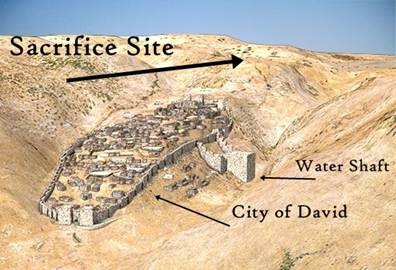
What follows is very interesting. The Lord sent the prophet Gad, who told David to make sacrifices and offerings on the spot where he saw the angel stop. If you remember, Jerusalem in David’s time was fairly small, maybe ten or fifteen acres. It was on the tip of a ridge, with deep ravines to the east and west and south. Behind David’s city to the north, the ridge rose to the top of the mountain. It was there, at the top of that ridge or mountain, where David went to offer his sacrifices. This was about 1/3 of a mile from the south wall. The picture below gives you a rough sense of the geography, though it is not 100% accurate.

clip_image002

He found the land was owned by a Jebusite, not an Israelite. Refusing to take it as a gift, David purchased the land, and made offerings and sacrifices there. This ridge-top was the very place where Abraham had taken his son Isaac, when he obeyed God’s call to sacrifice him. On that mountaintop, Isaac, not knowing what was to come, asked what they were going to use for a sacrifice. Abraham answered prophetically, saying, “God Himself will provide the lamb for the burnt offering, my son.” (Gen 22:8, HCSB). God stopped Abraham when he saw that he was willing to give up even his son. Instead, God planned to give his own son. And so on this same spot, almost eight hundred years later, the plague was stopped. On this same spot, David offered his life in exchange for his people, but again, the Lord refused that sacrifice, looking ahead to the time he would offer his own son. And this same spot, purchased by David, Solomon built the temple of the Lord, where for years they offered sacrifices that were all a shadow, pointing toward the ultimate sacrifice of Jesus to save people from their sins.

So David ended his reign, still being used by the Lord to point toward the ultimate messiah. 2 Samuel 23 records the last psalm he wrote:

These are the last words of David: The declaration of David son of Jesse, the declaration of the man raised on high, the one anointed by the God of Jacob, the favorite singer of Israel:

The Spirit of the LORD spoke through me, His word was on my tongue.

The God of Israel spoke; the Rock of Israel said to me, “The one who rules the people with justice, who rules in the fear of God, is like the morning light when the sun rises on a cloudless morning, the glisten of rain on sprouting grass.

Is it not true my house is with God? For He has established an everlasting covenant with me, ordered and secured in every detail.

Will He not bring about my whole salvation and my every desire? (2Sam 23:1-5, HCSB)

BAD KARMA

badkarma-big

Does this passage disturb you at all? I hope so. In such passages, we are meant to be shocked, horrified and put off. This is how bad sin is. This is how completely unattainable holiness is. This is how much we need Jesus.

To listen to the sermon, click the play button:

To download, right click on the link (or do whatever you do on a Mac) and save it to your computer: Download 2 Samuel Part 21

2 Samuel #21 . 2 Samuel Chapter 21

I’m very glad we’ve done this extended series on the Old Testament, because we have encountered many of the things that cause trouble for people when they think about the bible. The first part of 2 Samuel Chapter 21 is another one of those troublesome parts for me. Hopefully, however, as we have gone through these difficult passages, you have begun to learn (as I have) how to hear what the Holy Spirit is saying through them.

The New Testament tells us that everything in the Old Testament was written for our instruction; it is useful and helpful for Christians today. Another thing the New Testament teaches is that the Old Testament is about Jesus. So, first and foremost, we should ask, “What does this have to do with Jesus? How does it teach me about him?” Next, we can ask, “What does this have to do with my present day relationship with the Lord? What does it teach me about myself?”

Some Old Testament passages paint a picture, a foreshadowing of what Jesus was going to be like. People like David and Samuel and Uriah show us, through very limited parts of their lives, something of the attitude, life or teaching of Jesus. Theologians call these “types of Christ.”

There are other passages that are primarily about how people relate to Jesus – how they respond to him. We’ve had quite a bit of that lately, seeing how people responded to David when he forgave his enemies. There are lessons there for us in how we respond to Jesus.

Some of the most difficult passages, however, are there to show us how much we need Jesus. They show us the depths of our sin, the heights of God’s holiness, and the huge gap in between. They show us how it was between God and people before Jesus made it right. They show us what our situation would be without Jesus. I think this is one such passage.

It started with a famine. This is equivalent to a modern-day economic recession or depression. Times were tough, families were struggling. After three years of this, David began to wonder if there was a spiritual reason for the hardship. When he worshipped and inquired of the Lord (probably through the prophet Gad, and through the urim and thummim, the “holy dice”) he learned that the famine was because of something king Saul had done.

There was a group of people known as the Gibeonites. They were not Israelites, but when Israel invaded in the time of Joshua, the Gibeonites had tricked the leaders of Israel into swearing an oath that they would not destroy the Gibeonites. So they had lived for more than four hundred years in Israel’s territory. According to the old agreement, they were essentially a tribe of servant-class people for the Israelites. They kept their part of the agreement, working as laborers for the Israelites, and remaining peaceful. But at some point not recorded in the bible, Saul had tried to wipe them out. Essentially, he tried to commit genocide, similar to what Adolf Hitler did to the Jews in the 1930s and ‘40s. Apparently he slaughtered a great many of them, but obviously not all.

Stop for a moment here. The famine came along years later. Saul was dead. The whole nation had repudiated Saul’s family, and chosen David. David had never done anything like Saul’s slaughter. He had never hurt the Gibeonites. But the entire nation was still punished, years later, for what Saul did.

My first response to this is to think that it was not fair. Why should David’s kingdom pay for something David did not do? Why should the people suffer for a crime they had no part in?

But there is another question here also. Why should the Gibeonites suffer? Why should they be denied justice? Would it be right to ignore the crimes that were done to them?

When David heard what the problem was, he spoke to the Gibeonites directly.

He asked the Gibeonites, “What should I do for you? How can I make atonement so that you will bring a blessing on the LORD’s inheritance? ” (2Sam 21:3, HCSB)

There is a key concept here: atonement. The idea is that harm done must be made right; justice must be appeased. When you break a window, you atone for it pay paying for a new window. But how do you atone for something like genocide? It would appalling and offensive to simply suggest we should “just forget about it.”

The Gibeonites told David that they would like to execute seven of Saul’s descendants. David made sure to protect Mephibosheth, son of Jonathan. The seven who were executed were Armoni and Mephibosheth (a different one) – sons of Saul by his concubine Rizpah. The other five were sons of Merab, Saul’s oldest daughter, who was originally supposed to be David’s wife (thus they were Saul’s grandchildren). They were hanged, and their bodies were left exposed.

Does this disturb you at all? I hope so. In such passages, we are meant to be shocked, horrified and put off. This is how bad sin is. This is how completely unattainable holiness is.

In many areas of our lives, we accept that things must be made right. When we make our bank statement right, we call it, reconciling. The balance MUST equal deposits minus expenditures. That is the nature of a bank balance. If we refuse to accept that, our finances will be in a mess. All of our hurt will not change the basic facts of mathematics. Our ignorance will not make any difference either. 2+2 MUST equal 4. If you have a two, and then you have another two, what you have is four. It HAS to be four – that is simply how the universe works.

Too look at it another way, we sometimes say, “there is no such thing as a free lunch.” Someone pays for it, even if it isn’t you. The food had to come from somewhere. Someone had to work to harvest it and cook it.

But for some reason, we seem to think that in terms of moral actions, nothing must be paid for, and nothing has to add up. This passage shows us how horribly wrong that is. Sin MUST be accounted for. The balance must be reconciled. Deep down, we know this. It would be a permanent obscenity upon the human race if no one had tried to bring justice upon the perpetrators of Jewish holocaust. We know that. If the man who killed all those young children in Connecticut were still alive, it would be an insult to all humanity if we simply let him go free.

If sin isn’t atoned for, it lasts. There is no statute of limitation. In the case of the Gibeonites, the atonement required was gruesome and was itself full of tragedy.

This passage shows us the futility of what some religions call “karma.” If it is true that “what goes around, comes around,” then we are doomed. If we need to make up for all of our sins not only in this life, but also for past lives, we will never find rest for our souls. If the sins of previous generations are on our heads, there is no hope. If even just our own sins are accounted to us, there is no hope.

Now, if you read this passage, and you think about what I’m saying, there are two possible responses. One response is to say, “Wow! I really need to straighten out my act and get serious.” If that’s your response, you still don’t get it. If this makes you think you need to get it together, you still don’t understand how bad this is.

The only appropriate response to this passage is: “If this is the way things are, I’m screwed.”

We are screwed.

Saul’s sons and grandsons were screwed. There wasn’t anything they could do to avoid a shameful death. According to moral law – according to God, if we understand this passage correctly – they deserved it. Nothing would be right until they got what was coming to them.

This how it stands in the universe. The moral equation must add up. The only way to make it add up is for you to suffer and die. Too many Christians don’t take it seriously enough. When someone tries to straighten out her life and live morally, to be a good person for God, she isn’t taking this seriously.

Imagine a homeless bum who is stupid-drunk. In his intoxication, he kills a woman – someone else’s wife and mother. Now imagine he sobers up, and realizes he’s done something bad. In response, to try and make up for it, he offers the family all the money he has, which amounts to $3.35.

“I’ve given them everything I have,” he says. “It’ll just have to be enough.”

It’s an insult. It is offensive that he would even offer it, let alone that he would try to pretend that it would make up for what he did. That is just how ridiculous and offensive it is to suppose that we can be good enough to make up for the times when we sin. We are screwed.

That is what this passage is all about. You have no hope. You have no options. You deserve to die and your attempt to make up for things is so pathetic that it is offensive.

Thankfully, these are not the only verses in the bible. Thankfully, the Lord loves us too much to leave us without hope. But get this straight: there is no hope in your behavior. There is no hope in you straightening out and doing better next time. You can’t dig yourself out of this pit – the walls will come crashing in and bury you.

Too many churches give the impression that Christianity is about getting your act together. It isn’t. That’s entirely false. If you think you can get your act together enough to make a difference to God, you aren’t a Christian. Sometimes I think Christians don’t get excited about the “Good News” because they haven’t taken the bad news seriously enough.

The accounts of morality must be balanced. But we can’t do it. And that is why Jesus came to earth. Soon, we will be celebrating his birth. We often do that with a lot of vague feelings of peace and goodwill. But the most appropriate response should be profound gratefulness.

Jesus took our sins upon himself. The balance was paid out through his torturous death. Through faith in him, we were punished by his death. That is what we call atonement. There is no other hope of settling the score.

But in Jesus, that hope is real and true. There isn’t anything you can do. And so he did it all. Our part is merely to believe that, and accept it with gratitude. When we truly believe both the bad news and the good news, Jesus changes us from the inside out. When we know we truly don’t have to measure up, there is a tremendous freedom and joy that brings us even closer to God.

Pause now, and let the Holy Spirit speak to you today.

OFFENSIVE FORGIVENESS

shimei-curses-david

Sometimes the love and grace of God is given to people who are so undeserving that it seems offensive. But Jesus’ love and forgiveness is given time and again to those who don’t deserve it – because no one deserves it. So, if you think you are unworthy, you are correct. But that doesn’t stop Jesus from giving you grace and forgiveness anyway. On the other hand, if his grace offends you, maybe you don’t yet know how much you yourself need it.

To listen to the sermon, click the play button:

To download, right click on the link (or do whatever you do on a Mac) and save it to your computer:
Download 2 Samuel Part 19

The second half of chapter 19 appears to be mostly a detailed record of the political history of that time. This was valuable and significant to the ancient Israelites who lived not long after David’s time. It is still interesting today to historians, and bible-geeks like me. But what is the point of it really?

I know I’ve mentioned this before, but I think it is important to revisit it periodically. We all tend to forget. The Holy Spirit made sure first that this history was written; second, that it was preserved through the years; and third, that it was included in the bible. So there must be some reason for this. There must be some way the Lord wants to speak through it to Christians living today.

Sometimes, in order to hear what the Lord wants to say today, we first need to understand it better. So please bear with me. I think we’ll find some fruitful bible application here if we pay attention to details that might otherwise seem tedious.

Here’s the situation. David’s army has defeated and killed Absalom, who had rebelled against him and set himself up as king in David’s place. There were no computers or telephones or newspapers in those days, so it took a while for the news of David’s victory to spread. Meanwhile, David seems to have waited. This might seem a little bit strange. But remember who David is. He has many faults, to be sure, but he has never grasped at power. Instead, he always waited for the Lord, even refusing to take opportunities to gain the kingdom. So here, he once more waits until he is sure that Lord still wants him as king. He doesn’t want the civil war to continue, so he waits until he is sure he can return in peace. This David once more at his best, trusting the Lord.

The writer of Samuel often makes a distinction between the tribe of Judah and the other eleven tribes of Israel. Often when he writes “Israel” he appears to mean the tribes as distinct from the tribe of Judah. This shows us that there was some tension between those two factions even in the time of David. In the time of David’s grandson, the nation was split. Judah absorbed most of the tribe of Benjamin and became a separate nation named “Judah” (from which we get the word, “Jew”). The other ten tribes formed a kingdom to the north of Judah, which was called “Israel.”

After Absalom’s rebellion, people from the other tribes began talking about inviting David back officially, and officially receiving him once more as king.

Now Israel had fled every man to his own home.  9 And all the people were arguing throughout all the tribes of Israel, saying, “The king delivered us from the hand of our enemies and saved us from the hand of the Philistines, and now he has fled out of the land from Absalom.  10 But Absalom, whom we anointed over us, is dead in battle. Now therefore why do you say nothing about bringing the king back?”

Apparently, the people really had committed to Absalom. They said he was the one they had anointed to be king over them. This wasn’t as strange as it might seem. After all, he was the king’s son and heir. I’m sure many people assumed that sooner or later, Absalom would be king anyway, and why not have him in the full vigor of his youth? But now, he was gone. I would have thought that at this point it was a clear choice to go back to David, but the people still seemed at a loss. Even so, from most of the tribes, sentiment turned back toward David.

But the tribe of Judah did not seem to know what to do. At first, this seems strange, since David was from the tribe of Judah. But then, so was Absalom. Absalom’s rebellion was conceived and carried out in Hebron, the chief city of Judah. His military commander, Amasa, was a relative of his (and David’s) from the tribe. In fact, most of his inner circle were probably from Judah. In other words, although they were David’s people, they were also Absalom’s people, and they were probably chiefly responsible for the rebellion.

David reached out them. He sent a message to the leaders of the tribe of Judah, saying,

‘Why should you be the last to restore the king to his palace? The talk of all Israel has reached the king at his house. 12 You are my brothers, my flesh and blood. So why should you be the last to restore the king? ’ 13 And tell Amasa, ‘Aren’t you my flesh and blood? May God punish me and do so severely if you don’t become commander of the army from now on instead of Joab! ’ ” 14 So he won over all the men of Judah, and they sent word to the king: “Come back, you and all your servants.” (2Sam 19:11-14, HCSB)

As David makes his way back, he is met at the Jordan river by a host of people who want the honor of escorting him to Jerusalem. What follows is a slightly sickening display of sycophancy. People end up arguing amongst themselves about who gets to show David honor, and who is honoring him more (19:40-43).

Along with the leaders of the tribe of Judah, one of the first people to come meet him is Shimei. You may remember him from 2 Samuel 16:5-13. This was the man who cursed David and pelted him with rocks and dust as he fled from Absalom. When David was down, he piled on with insults and taunting. Shimei did not just screw up and make a mistake – what he did was clear and deliberate. Now that David is king again, he comes fawning to him like a disobedient dog, and begs forgiveness. I don’t know about you, but I think that Shimei was pond-scum. His behavior and attitude are despicable, detestable, the lowest and ugliest forms of hypocrisy and cowardice. He is a jerk, plain a simple, the kind of person I want nothing to do with.

And David forgives him.

Stop for a second, and think on that. Let it sink in.

Let’s be honest. David’s forgiveness and compassion are offensive. Abishai, brother of Joab suggests, as he did before, that Shimei would be a more attractive person if his head was removed. I tend to agree with Abishai. But David did not.

Does this remind you of anything? The love and compassion of Jesus were also offensive. The Pharisees were offended that he would eat with tax collectors and known sinners. He allowed a prostitute to kiss his feet in public, and wash them. It offended them.

I think once more, this text is a far-off picture of Jesus, the ultimate anointed savior of God’s people. It isn’t really about David, it is about Jesus, his wisdom and love, and how people respond to him. So let’s consider the rest of this text in that light.

We’ve been talking about Shimei. His sin was obvious and deliberate. There was no excuse for it. It wasn’t a momentary slip. It revealed an ugly character. Even so, David offers him forgiveness and redemption. Jesus does the same. That’s right, Jesus came to redeem and forgive class-A jerks, cowards and crawling hypocrites. It is offensive sometimes, to think Jesus would forgive someone that I want to hate so much. But he does.

Abishai was like me. Shimei’s character was clear to him. He was offended by David’s compassion and mercy. But David rebuked him. Sometimes we really are offended by the idea that Jesus would forgive certain people. Would he forgive a child-molester? Based on what I know of the bible, the answer is “yes.” Jesus is king, and he can forgive who he pleases. He does not answer to us.

But as an illustration, I do want to finish the story of Shimei, though it does not end for many years. When David was dying, he told Solomon to watch out for Shimei. So, even though David forgave him, he certainly saw the truth about what kind of person he was. Solomon made a just and fair ruling for Shimei, allowing him to live in peace if he would show his obedience and faithfulness by never leaving Jerusalem. Shimei ignored that when it became inconvenient, and Solomon had him executed. So in the end, forgiveness did Shimei no good, because he did not allow it to touch his heart and change the kind of person he was.

In the same way, the forgiveness of Jesus does not help those who don’t truly repent, who don’t allow him to work in their lives. Jesus sees all, let ultimate judgment rest with him.

Back to David, the next person to arrive was Ziba. At this point, Ziba was revealed as a trickster and manipulator, because right behind him was Mephibosheth, whom Ziba was supposed to serve. Mephibosheth revealed how Ziba took advantage of his disability, and took the donkey that was supposed to be for him, and told David that Mephibosheth rejoiced over David’s trouble. David does not seem to know who to believe, but he reverses his earlier decision that gave all of Mephibosheth’s land to Ziba. Now, instead, he tells Mephibosheth to divide the land between them. Even so, this amounts to forgiveness for the trickster and manipulator, Ziba. There it is again, that offensive forgiveness.

Mephibosheth’s response shows that his loyalty was always true. He doesn’t care about the land, as long as David is safe, and king again. I mentioned before that Mephibosheth is a great picture of God’s grace. Unlike Shimei, the grace he received through David changed him permanently. He doesn’t just want what David can give him. He wants the best for the king that saved him, and he wants fellowship with him, whether he has blessings from him or not. Mephibosheth rejoiced that David was back and safe, far more than he rejoiced about being vindicated in the dispute with Ziba.

This is an encouragement to me to have a similar attitude. It isn’t about what Jesus can do for me in this life. It isn’t about me getting what I think I deserve, or being proved right. It is about loving Jesus and being in relationship with him. You can’t manufacture that. It only comes when you love Jesus for who he is. If you feel like you lack that kind of love (as I often do), ask the Holy Spirit to give it to you.

One of the people who helped David in his exile was an old man named Barzillai. David blessed him and rewarded him, though again, Barzillai wanted no other reward than the safety of the king, and in fact, was too old to enjoy any of the blessings David wants to bestow. So too, I find it helpful to remember that even though Jesus sometimes offends me by his radical forgiveness of people whom I think are undeserving, he does also love his faithful servants. He does not forget them, or offer them less than anyone else. Maybe, like Barzillai, we don’t enjoy the blessings in the this life. Even so, Jesus offers us blessing and joy that can never spoil or fade.

Another group to consider is the leaders of the tribe of Judah. They made a deliberate choice to follow Absalom instead of David. But before they even repented, David was reaching out to them, forgiving them, restoring them to a relationship with him. So Paul writes about Jesus in Romans 5:

For while we were still helpless, at the appointed moment, Christ died for the ungodly. For rarely will someone die for a just person — though for a good person perhaps someone might even dare to die. But God proves His own love for us in that while we were still sinners, Christ died for us! (Rom 5:6-8, HCSB)

Jesus’ love and forgiveness is given time and again to those who don’t deserve it – because no one deserves it. So, if you think you are unworthy, you are correct. But that doesn’t stop Jesus from giving you grace and forgiveness anyway.

Abishai was not the only one who took offense at the mercy of God that David showed to all who would see. The ten other tribes of Israel were also offended that even though they were the ones who first talked of bringing David back, it was the tribes of Judah and Benjamin who got the honor of doing so.

In Jesus’ time, the Pharisees were also offended at Jesus’ grace. That was because they did not believe they had need of it themselves. I think that may be a key. If the forgiveness and mercy of God to others offends you, is it possible that perhaps you do not realize how much you yourself need that same grace?

Let the Spirit speak to you today.

On the Road Again

Absalom's_rebellion_1334


When we expect all our hopes to be fulfilled within this life alone, we set ourselves up for disappointment, stress and fear. David’s hope went beyond this life, and he shows us how to have grace under pressure.


To listen to the sermon, click the play button:

To download, right click on the link (or do whatever you do on a Mac) and save it to your computer: Download 2 Samuel Part 16


2 Samuel #16 . 2 Samuel Chapters 15 & 16

Some weeks we get into details about a text. This week, we’re going to fly through two chapters. Even so, we’re only going to cover one part of a much larger story concerning David’s son Absalom. There is kind of smorgasbord of spiritual truths here. Feast on whatever the Lord has to say to you through this today.

After David restored Absalom to his official position as prince, Absalom began laying the groundwork for a coup. He starts by running a popularity contest with David – a contest David didn’t even know was going on.

Absalom was good looking. Once he was “official” again, he began to charming also. He spent time with the people. He appeared to sympathize with their problems. Very subtly, he planted doubts in their minds about David. When they tried to honor him as their prince, he forestalled them, and treated them as equals and good friends. By doing this, Absalom won the hearts of a great many people.

David was a worshipper of God and a warrior. Though he failed at times, he rarely compromised his principles. Almost always, David cared much more about what God thought of him, than what the people thought. It wasn’t that he didn’t care about his people – it’s just that his way of caring and leading was oriented toward seeking the Lord, and leading the nation based upon what God wanted. For David, it wasn’t about being popular or satisfying the desires of the people. He felt, rightly, that if he was right with the Lord, then the Lord could use him to do his will for the nation of Israel.

However, the people were not as concerned with God as they were with themselves. So they were susceptible to someone like Absalom, who also appeared to be concerned with their desires. Absalom made sure he looked good. He always appeared sympathetic and engaging.

David was old school. He wasn’t a friend to the people – he was a leader. He stuck to his guns, because he believed right was right.

The people loved Absalom because they loved themselves more than God. If it was a choice between someone who followed God or someone who made them feel good, they wanted the one who made them feel good. We’ve already seen some things about Absalom’s character. He is ambitious for himself. He is arrogant. He wants his own way, and works to get it, regardless of the cost to others. But the people saw only the engaging, personable, friendly guy. They were too concerned with outward appearances.

There is no record of Absalom ever consulting the Lord about anything. And ultimately, he was not the Lord’s choice for king. But the people didn’t think about such things. They were already ready to repeat the mistake they made with Saul.

There is a classic scene in J.R.R. Tolkein’s Lord of the Rings. The four hobbits have met a tall, stern, grim looking man. He tells them that he was sent by their friend, the wizard Gandalf to help them. They discuss whether or not they can trust him. Finally, Frodo, leader of the hobbits says something like this:

“I think one of the enemy’s spies would – well, seem fairer and feel fouler, if you understand.”

In other words appearances are often deceiving. So it was with Absalom. He seemed fairer and better than David. But on the inside he was already rotten. He looked and seemed like the better leader. But it was the grim, steadfast old David who was the best king the people could have had, in fact, as history showed, one of the best kings Israel ever had.

I spend time on all this because I think we are often like the people who were duped by Absalom. It’s so easy to judge by external things like looks and charm. It’s so easy to fall for a leader or lover who looks good and makes you feel good about yourself and himself – at least superficially. The Indigo Girls have an old song with line that goes like this:

Darkness has a hunger that’s insatiable; And lightness has a call that’s hard to hear.

I want to encourage the people of God to not judge by shallow things like appearance or personal charm, or even by feelings. Sometimes it takes some hard work to realize that goodness doesn’t always immediately feel good.

In any case, Absalom was able to win over enough people to attempt a coup to dethrone David (and probably kill him). It is interesting to see David’s attitude toward his son. He had no illusions about Absalom. As soon as he heard the news, he knew that his son would kill him if he could. Even so, that never changed David’s love for him. Later we’ll see that when it came to battle, David tried to protect Absalom, and he was deeply grieved when his son was killed. David did what he had to, to protect himself and take care of the kingdom God has given him – but he never wavered in his love for his son.

That is sometimes how it is with us and the Lord. The Lord has no illusions about us. He knows who we truly are – the good, and also the bad. And yet, God loves us with an unwavering love anyway. He’s always hoping we can be saved from destroying ourselves. He’s always hoping we will reconcile with him rather than be killed.

In the meantime, David has to run for his life. This had to be tough for him. When David was a young man, for more than a decade he had lived on the run in the wilderness. Life was physically difficult in those days. He was not respected or honored for who God made him to be. He was not recognized for his gifts. God’s promises did not seem to be fulfilled. Finally, he came through all of that and became king. A few years later, he ended up back in one of his old hide-outs, eluding the Philistine invaders. He came through that. And now, well into middle age – perhaps almost sixty years old, he’s back again, running for his life, not respected, not living out what God had promised him. In some ways, this might have been even harder. He isn’t on his own any more. When he was young, he didn’t know exactly how it would feel to be king. But now, he has tasted what he has lost. And now too, he has a family to take care of. He brought his wives with him. Solomon might have been a little boy at this point. There were other children also.

But David did not turn away from the Lord. This would have been a time when it would be very easy to be bitter. David followed God faithfully for most of his life. True, he had failed at times, but he certainly had more than his share of trouble. Following God did not spare him from trouble and hardship. But he had a better hope than just a comfortable life on earth. And so as he goes, you can see the grace oozing out of him. When people insult him, he is not angry. He doesn’t demand help from anyone. He goes out in humility and trust.

The people seemed to have had three basic reactions to David during this period of his life. The first is shown to us in the person of Ziba. If you remember, Ziba was the man who was to be the manager of the estate of Mephibosheth, son of Saul, whom David had treated so kindly. Ziba gathered some much needed supplies and brought them to David. This was a welcome thing, and a great help to David. But it turns out that Ziba did this deceptively, for his own gain. He claimed that Mephibosheth was overjoyed that David has to flee, and that he, Ziba, has taken it upon himself to help David. But we learn in chapter 19 that in fact, Mephibosheth went into mourning the day David left. The whole time David was in jeopardy, he had not taken care of his feet, his hair and beard, or his clothes. You might make a false claim about your sorrow, but you can’t fake a long beard or toenails. This proves that Ziba lied about Mephibosheth, hoping that if David triumphed over Abasalom, he would be rewarded with Mephibosheth’s estate. Mephibosheth, if you remember, was lame, and Ziba took advantage of that to come see David, not allowing his master to come. So Ziba supports David, but with the purpose of gaining something in the end. On the other hand he likely has very little to lose by doing what he did, if David never comes back. There were others who doubtless supported David by way of hedging their bets, hoping to gain his favor if he triumphed, and having little to lose if he didn’t.

There was second common reaction to David in all of this. Shimei was a relative of Saul’s, and he cursed David, throwing dust and stones at him as he left Jerusalem. David’s response reveals that he is once more a man whose heart belongs entirely to God. David’s nephew Abishai, one his great warriors, offers to go relieve Shimei of his head. But David restrains him. Nathan had told David (2 Samuel 12:10-12) that one of the consequences of his sin would be rebellion from within his own family. David is back to his good place in his relationship with God. His circumstances are a mess, but once more, his heart is fixed entirely on the Lord. So when Shimei curses him, David humbly accepts whatever the Lord is doing. He trusts the Lord to straighten things out, if Shimei is wrong. There were others, obviously, who sided with Absalom and rebelled against David. David’s personal advisor, Ahithophel was one prominent one. It may be that David wrote Psalm 55 at this point. The close friend that David refers to in that Psalm was very likely Ahithophel.

Finally, a third group of people remained steadfastly with David, come what may. Ittai was a Philistine warrior who had left his home; he led a battalion of six hundred Philistines who had pledged allegiance to David. David released them from their pledge and urged them to return to their homeland, but they refused. For them it was not about being blessed or having good times. They were in it for forever, for good or for bad, no matter what. The two priests, Zadok and Abiathar, were like that, as was one of David’s advisors, Hushai. David sent them back to Jerusalem as spies, and they remained loyal to him.

Remember how David is a “type of Christ?” It shows up again here. Jesus did not return the curses and insults of those who reviled him. I think it is helpful for us to look at how people responded to David, and see ourselves, in how we respond to Jesus.

There are some people who follow Jesus, or at least, who are sympathetic to him, because even though they aren’t sure about him, they want to keep their options open. Maybe they want something from him. So they hedge their bets. They come to church. The try to manipulate him into blessing them, in case he is in a position to do so. But they aren’t following him because he is the chosen one of God. They are doing it in hope for their own gain.

Others simply reject Jesus, particularly when it seems like he’s not a winner. These folks may seem to go along with the Lord for a while. But when something comes along that seems more attractive, or that makes them feel better about themselves, they desert the Lord and go along with the new thing. Sometimes they may reject Jesus because they mistakenly thought that the main thing he was supposed to do was make their lives on earth better, and when trouble came, they weren’t spiritually prepared.

And finally, there are those who remain faithful through everything. Sometimes their faithfulness costs them a great deal of suffering and hardship. Sometimes it brings peace or joy. But they follow in the certain hope that this life could never hold everything they want or desire. They are seeking their heavenly home. The book of Hebrews talks about them, and people like those loyal to David:

These all died in faith without having received the promises, but they saw them from a distance, greeted them, and confessed that they were foreigners and temporary residents on the earth. Now those who say such things make it clear that they are seeking a homeland. If they were thinking about where they came from, they would have had an opportunity to return. But they now desire a better place — a heavenly one. Therefore God is not ashamed to be called their God, for He has prepared a city for them. (Heb 11:13-16, HCSB)

Let the Holy Spirit speak to you today. Maybe you need correction because your focus is on external things. Perhaps you are swayed but what looks good or what makes you feel good. Or maybe you need to be reminded that the life of faith always has ups and downs; that real saints throughout the ages have had many struggles in their lives. The trick is not to avoid struggles, but to let God’s grace come out when you are in them. Or perhaps you are being challenged about the way you follow Jesus. Maybe you have been focusing more on your own personal gain. Perhaps you are susceptible, because of pain or struggle, to rejecting Jesus all together. Hear God’s gracious invitation to faith today.

FORGIVENESS WITHOUT REPENTANCE

absalom2

If God is so loving, why can’t He just forgive us, no matter what? Why do we have to repent? Why does he require us to believe and to trust him? Absalom shows us the answer to that question.

To listen to the sermon, click the play button:

To download, right click on the link (or do whatever you do on a Mac) and save it to your computer: Download 2 Samuel Part 15

2 SAMUEL #15. CHAPTER 14.

The next five chapters of 2 Samuel all relate to David’s son, Absalom. In some ways, even the last chapter (13) was the beginning of his story. If you remember, Absalom’s half-brother, Amnon raped Tamar, who was Absalom’s full sister. Absalom waited, and plotted, and then had Amnon killed – thus taking revenge, and at the same time, becoming the next heir to the throne. However, when it was done, Absalom fled in fear to Geshur, the kingdom of his grandfather Talmai (his mother’s father).

After three years, David finally came to terms with the death of his firstborn son, Amnon. Then he began to realize that he had also lost his next son, Absalom, because of his crime. The scripture says that his heart went out to his son Absalom. Chapter fourteen tells the story of how Absalom was restored to David. But it also shows us that the restoration was not complete on Absalom’s part.

The commander of David’s army’s was Joab. He was also David’s nephew, and companion through most of David’s life. The text says that he observed how David’s heart went out to Absalom. Joab resolved to do something about this. Joab is a complex character, and it is hard to say what his true motivation might have been. He might have been trying get back into David’s good graces. If you remember, since Joab murdered Saul’s old general, Abner, David had distanced himself from him. On the other hand, maybe Joab thought, “David is getting old, and it would be a good idea if the next king felt indebted to me.” Finally, Joab probably had known Absalom since he was a baby, and perhaps the old warrior had a soft spot for the charismatic young prince. Joab had a history of deceptive, manipulative behavior, and perhaps he was even proud of Absalom for murdering his brother Amnon like he did. Finally, it is possible that somehow Absalom contacted Joab in secret and asked for his assistance. In any case, Joab decided to help Absalom.

Notice right away that Joab did not approach David directly. This suggests that the relationship between he and David was indeed under strain. So Joab found a woman who was clever and a good actress, and they set up a scenario. Their approach is actually very similar to that of Nathan the prophet. The woman told David a story about how one of her sons killed the other. Now, everyone wanted to put the living son to death, which would leave her twice bereaved. David, unsuspecting, pronounced judgment, declaring that the surviving son should be protected. The woman even got him to swear by the Lord that he would stand by his judgment. Immediately afterwards, prompted by Joab, she asks David why then, he has not dealt with his own son in the same way. Here, she says something very perceptive.

We will certainly die and be like water poured out on the ground, which can’t be recovered. But God would not take away a life; He would devise plans so that the one banished from Him does not remain banished. (2Sam 14:14, HCSB)

This is actually a kind of prophecy. The woman is right about the heart of God. God did indeed devise a plan to bring back the ones banished from him. As I said last time, this all helps us to understand why Jesus came and died. So, once more, this text is showing us Jesus. I won’t preach the same sermon again, but it is strongly represented again here in this text. Our own sin has cut us off from God. We are banished from his presence. Yet he deeply loves us. So he devised a way to be reconciled to us again. That Way, is Jesus Christ.

Unfortunately for him, the account of Absalom is all about what happens when someone ultimately rejects that reconciliation. David brought him back to Jerusalem. But David is not God. His heart goes out to his son, but he doesn’t know what to do with the sin in his son. So Absalom is allowed to live in Jerusalem, but he is not allowed into the royal presence.

Now, we start to see a little bit of the character of Absalom. There is no record of him ever repenting of his sin of murder. There is no record of him even acknowledging that it was wrong or even a mistake. He certainly did not plead his case with David, or anyone else. Instead the text reveals him as a man who was determined to get what he wanted out of life, and to achieve his own ambitions.

Being allowed to return home was not enough for Absalom. He wanted to be back in David’s favor. Clearly, as we read on in the text, we see that his goal is not to be reconciled to his father, but rather to become the next heir to the throne. He wants to have David’s official approval, so that he can be king after him.

Absalom sends for Joab, to have him intercede on his behalf once more. But Joab stays away. There are several possibilities for Joab’s reaction. Absalom, being who he was, had probably never even thanked Joab for bringing him back from exile. Joab may be upset with him for that. Also, since David had distanced himself from Absalom, perhaps Joab thought it best if he stayed away too, considering the tension that already existed between himself and the king.

The prince (Absalom) had a few alternatives when Joab did not respond to his summons. He could have sent thanks and apologies to him. He could have sent him gifts. He could have at least humbly acknowledged his indebtedness and his ongoing need of Joab. Instead, he set fire to one of Joab’s fields. That tells you something about the character of Absalom. He is too proud to humble himself. He doesn’t care very much about the struggle and suffering of others. He is quick to action, perhaps even arrogant. He never even apologizes to Joab – in fact, he blames him, implying that is was Joab’s own failure to respond that got his barely field burned.

All he cares about is getting what he wants. He wanted Joab’s attention, so he got it – at Joab’s expense. Joab accedes to Absalom’s request, and gets him an audience with the king. David officially forgives his son and restores him to his princely position.

The text tells us something else about Absalom. We know from chapter 13 that his sister was exceptionally beautiful. Now we learn that he names his daughter after her, and she is also very beautiful. And Absalom himself is a flawless physical specimen. In other words, he is just like me. (For those of you who don’t know me well, that was a hilarious joke). Absalom is a beautiful person, from a family of beautiful people. He is rich and famous. The closest I could come with a modern-day analogy would be a member of the Kennedy family.

But like Saul before him, Absalom’s appearance is not a reflection of his inner character. As the subsequent chapters show, Absalom was all about Absalom. Being a “beautiful person” on the outside only hid the ugliness on the inside. For just a small insight into what he was really like, think about this. The text says he shaved his head every year. A year’s growth of his hair weighed five pounds, based on the royal standard (v.26). How did the writer know what it weighed? Because Absalom weighed it himself (same verse). This guy was full of himself.

Now, Absalom’s life was not over at this point. But, just as with Saul, there are some warning signs that he going the wrong direction. Think about it this way. He was not interested in a close relationship with his father. Instead, his main interest was what his father would do for him, and how he could use his father to get the life he wanted.

Sadly, this is how many people relate to God. We want him to forgive our sins so we can go to heaven, not hell. We want him to do certain things for us so that our lives go the way we want them to. We want to use him as a tool, an assistant to help us accomplish our goals. The goal of being close to God is way down the list, if it is even on the list. And we often assume that the best way for us to feel close to him, is for him to bless us.

Absalom could have made the case that what he wanted was good and right. After all, surely his brother Amnon – a rapist – should not have been allowed to become king. And regardless, now that Amnon is dead, it is Absalom’s right and privilege to become David’s heir, and the next king. But he did not trust his father to do what is right – he decided he knew better than the king. He chose to take care of things himself, to put himself in a position to be the crown-prince again, not to humbly wait and receive it as a gift. He was arranging his own life the way he wanted. In this, he was completely the opposite of David, who always waited patiently for God to use him however God wanted.

Sometimes we can be like Absalom. Maybe we feel that what we want for ourselves is good and righteous. Maybe, it even is! Even so, do we try to arrange for it ourselves, or do we put our trust the Lord to do in and through us what he wants to accomplish? Certainly, there is a time for action. But I think if we look inside ourselves, we can tell the difference between when we are responding to the prompting of the Holy Spirit, and when we are stressing and scheming and arranging things so that we get what we want.

There is something else here that is important for us to notice. Absalom’s father, the true king, forgave him for his horrible sin. He restored him to a place of honor. But pay attention – Absalom never did repent. When David was confronted with his sin, he confessed that what he did was wrong. He took responsibility for it. His heart was deeply moved with sorrow for what he had done. He humbly threw himself on the mercy of God and sought forgiveness. Absalom did none of these things.

I’ve often heard people ask something like this: “If God is so loving, why can’t He just forgive us, no matter what? Why do we have to repent? Why does he require us to believe and to trust him?” Absalom shows us the answer to that question. David forgave him, without requiring him to turn away from his sin. He forgave him without making Absalom return to a positive relationship with himself. Ultimately, it did Absalom no good, and in fact, it allowed him to hurt many others until he finally destroyed himself.

Absalom is a living illustration of the fact that when a person receives forgiveness without repenting and trusting, that forgiveness ultimately cannot help him. David’s forgiveness did not require Absalom to change. Certainly, David must have hoped that he would change, but he didn’t require it. As we will see when we read on, because Absalom did not repent and did not change, his relationship with his father remained broken. The forgiveness that David offered him could not save him from the brutal death that he deserved, and in fact, received.

It is the same with the Lord. As the wise woman prophesied, God has made a way to bring back his banished ones. In the person of Jesus, by his torturous death on the cross, God has reconciled both justice and love. Now, through Jesus, he offers that forgiveness to every human being. However, the forgiveness does not help those who refuse to repent. It won’t save those who refuse to admit their real need for forgiveness, who are unwilling to let God restore the broken relationship between them. When we insist upon our own way, as Absalom did, the father sadly allows us to have it, but it brings only destruction upon ourselves and those around us.

Let the Holy Spirit speak to you today.

TRUTH AND CONSEQUENCES

Nathan_confronts_David

Do not let the consequences of your sins make you doubt God’s forgiveness. Sometimes, when we experience the difficult consequences of what we’ve done, or failed to do, it feels like God is still mad us, like maybe we are not forgiven. That’s a trap of the devil. If you have repented in faith, you are forgiven. But sometimes, those consequences remain. The Lord will give you extra grace to face those things also, if you seek him.

To listen to the sermon, click the play button:

To download, right click on the link (or do whatever you do on a Mac) and save it to your computer: Download 2 Samuel Part 13

2 SAMUEL #13. 2 SAMUEL CHAPTER 12

If you are reading this, please pause, and read 2 Samuel chapter 12 first. The message in the text is pretty plain, and I am not going to go over the whole story in detail. So read the chapter, then come back and read the rest of this.

The story at the very beginning of 2 Samuel 12 is a wonderful portion of scripture in many ways. The prophet Nathan tells the story to David. It’s an allegory, or a parable. The beauty of it, is that David hears the story and engages fully with it. He absorbs what happened, and feels very strongly about it. And then, Nathan turns it around and says, “You are the man! The story is about you.”

Besides being a very powerful part of this chapter, I think Nathan’s approach tells us something about the bible. I have said before, and I stand by it, that the whole bible, including the Old Testament, is about Jesus. The first and most important purpose of the bible is to introduce us to Jesus, and to help us get to know him better. So whenever we read any part of the bible, we should ask the Holy Spirit: “Where is Jesus here? Show me Jesus.” But part of getting to know Jesus is also about getting to know the things in our own lives that either help or hurt our relationship with him. So the famous Danish theologian and philosopher, Soren Kierkegaard, told people that when they read the bible, they should say, “this is about me.” And I agree with that, at least in the way that he meant. It is about Jesus first, but in a secondary way, related to that, the bible exposes our own attitudes, thoughts and ways of approaching life. In a way, the bible is to us, what Nathan’s story is to David. We are supposed to read and engage. We should ask “where is Jesus?” But we should also ask, “where I am, here? What does this bible passage tell me about myself, in relationship to Jesus?”

Nathan goes on and catalogues the outrageous sins of David. But I don’t think he needed to. Almost all people have a deeply seated sense of justice. Nathan appealed to that in David through the story, and I think David was convicted as soon as Nathan said, “you are the man.”

13 David responded to Nathan, “I have sinned against the LORD.”

Then Nathan replied to David, “The LORD has taken away your sin; you will not die. 14 However, because you treated the LORD with such contempt in this matter, the son born to you will die.”

Now, the statement “I have sinned against the Lord,” seems a little inadequate, considering what David had done. I would have wanted more. But God knew what was in David’s heart. And we know what was in his heart at this point in time, because immediately after this, David wrote it down. You can find in the bible in Psalm 51. This psalm was written right after Nathan confronted him about Bathsheba. The whole psalm is still today one of the most powerful expressions of repentance every written. Here is just part of it:

1 Be gracious to me, God,

according to Your faithful love;

according to Your abundant compassion,

blot out my rebellion.

2 Wash away my guilt

and cleanse me from my sin.

3 For I am conscious of my rebellion,

and my sin is always before me.

4 Against You — You alone — I have sinned

and done this evil in Your sight.

So You are right when You pass sentence;

You are blameless when You judge.

God knew that David had repented truly in his heart, and so David was forgiven. I want to remind you how huge this forgiveness is, how amazing God’s grace is. Remember that God didn’t send Nathan to confront David about Bathsheba and Uriah until after the child was born. I suspect that prior to committing adultery, David had been drifting away from the Lord. Probably nothing dramatic, but I would guess that as life got easier and more full for him, he focused less and less on God. In time, he drifted far enough to commit the dramatic sins he did: adultery, lying, conspiracy to murder, deceiving others into conspiracy to murder. Then nine more months passed, without him returning to the Lord or repenting on his own. All told, I would guess that it was a least a year – perhaps several – that David was really not at all on track with God.

I think this is important, because the depth and depravity of David’s sin show us the vastness of God’s forgiveness and grace. This wasn’t just a little slip. This was an attitude of lust, murder, lying and self-reliance that continued for some time. God did not forgive David because it was just a little slip up. He forgave him, because you can’t out-sin God’s grace.

If God can forgive David – who spent at least a year turning his back on God, and did such horrible things – he will certainly also forgive us when we repent. Don’t believe the lie that you have fallen too far, or been away from God for too long. His grace is bigger than that.

Now, David was truly forgiven. But his sin resulted in some bad things. When we read this, it sounds like God said, “I forgive you, but I’m still going to punish you.” Here’s where we must interpret the Old Testament in the light of the New Testament. I don’t think it is so much God actively punishing David, as David reaping what he has sowed.

Think of it this way: If you throw a rock and break a window, the owner of the window may forgive you. But the window will still be broken. Because of the window-owner’s forgiveness, you won’t be prosecuted for vandalism. Because of that forgiveness, you won’t have to pay for the window. But forgiveness does not un-break the glass. There will still be a mess to clean up and a gaping hole in the house.

Or suppose I tell my young child not to touch a hot stove. The child does so. Now, she has disobeyed me. She has also burned her hand. Did I burn her hand as a punishment for disobedience? Of course not. The burn was a natural and unavoidable consequence when she chose not to obey me. In fact, the very reason form my commandment “do not touch the stove” was to keep her from suffering any burn. I will certainly forgive her for disobeying me. But that won’t change the fact that she burned her hand.

Remember, David’s greatest failure prior to this was also due to his sin concerning his relationships with women. He had married six wives prior to this (2 Samuel 3:2-5), and in addition, had several concubines, who were, in effect, legalized mistresses. All this was in clear violation of what the Lord had said through Moses (Deuteronomy 17:14-17). I think when Nathan tells David what is going to happen in his family, it is not just about Bathsheba – it is about his whole problem of lust and ignoring God’s word about marriage. When David committed adultery with Bathsheba, it was only another manifestation of what he had been doing already by marrying more than one wife. And so I think the “punishment” here is simply a natural result of what David has done wrong for many years.

There are reasons for what the Lord tells us to do, and to avoid. Very often, he is trying to help us avoid painful consequences.

Now, what about the child dying? How is that a mere consequence of David’s sin? Honestly, I don’t have the answers, I just know Jesus, who does. He doesn’t always share them with us. But I have two thoughts.

First, infant mortality was fairly high in those days. It may be that the child was going to die anyway, and the Lord was simply predicting it, and telling David ahead of time that he wouldn’t change his mind.

Second, in those days it was a very shameful thing to be born as a result of adultery. This is what we call an “illegitimate child.” The other word for such a child is “bastard.” I’m not being crude – that’s what the word means. The fact that even today, that word is a very derogatory and demeaning insult, shows how shameful it was in times past. I’m not saying it makes sense – it is never the child’s fault, of course. But an illegitimate child in those days would have suffered for the sins of his parents all his life. If that child went on to be with Jesus, it was a mercy that he didn’t live long enough to be reviled and cursed and shamed all his life.

Now, I said you can’t out-sin God’s grace. That’s true. I want you to hear that and believe it. You cannot do something that Jesus’ death on the cross did not pay for. But there are two important things to bear in mind, things that are taught by this passage.

First, David was able to receive God’s grace because he admitted he was wrong, admitted his need for forgiveness, and turned away from sin. In short, he repented. You can’t out-sin God’s grace, but God’s grace does you no good if you pretend that you don’t need it. It does you no good if you do not accept God’s judgment upon the evil of your sin, and repent of it. Grace is there and there is plenty of it, but we can only receive it through repentance and faith. I’m not putting it all back on you to repent correctly. But I’m just trying to make sure everyone understands – this isn’t universalism. God offers grace to everyone, but not everyone believes they need it, and not everyone believes he offers it, or that it is sufficient. If someone writes me a check for a million dollars, it doesn’t do me any good unless I

a. Want the money in the first place. This starts with me believing I have a need for it.

b. Believe that the check is valid

c. Put a and b to work by going to the bank and depositing the check.

There is a second thing here. David, when he was confronted with sin, repented. He believed he needed forgiveness. He sought that forgiveness from God, and he received it. He was forgiven. Most of the evidence seems to indicate that after this, he went back to trusting the Lord with all of his heart. Psalm 51 certainly seems to show us that. In addition, when David faces the consequences that Nathan predicts, he remains steadfast in faith, responding like the David of old to trouble and adversity.

So what does all this say to you?

First, read the bible. The bible serves us like Nathan the prophet served David. It shows us God’s perspective on things, it helps us to see things in a new light.

Second, this passage shows us the importance of repentance. Through Jesus, God has done everything needed to restore our relationship with him, and forgive us. But we need to believe we need and to believe he offers it. We need to turn away from our own selfish life, and let our life belong fully to the Lord.

Third, do not let the consequences of your sins make you doubt God’s forgiveness. Sometimes, when we experience the difficult consequences of what we’ve done, or failed to do, it feels like God is still mad us, like maybe we are not forgiven. That’s a trap of the devil. If you have repented in faith, you are forgiven. But sometimes, those consequences remain. The Lord will give you extra grace to face those things also, if you seek him.

Pause right now, and ask the Holy Spirit to speak to you.