RELIGIOUS RULES ARE USELESS

Religious-Circumcision

Following rules and regulations cannot make us close to God. Only Jesus can do that.

To listen to the sermon, click the play button:


To download, right click on the link (or do whatever you do on a Mac) and save it to your computer: Download Galatians Part 4


Galatians #4 . Chapter 2:1-5


Last time we considered Paul’s claim that he received the gospel from Jesus alone, not from any human being.

He makes three basic points. 1. If he got it from a human source, it hasn’t resulted in him pleasing other human beings (1:10). 2. The message that he preaches was revealed to him directly by Jesus, in his experience on the way to Damascus. He began preaching immediately after that, before receiving any instruction from humans. 3. He didn’t consult with anyone right away. Three years after his conversion, and after he began preaching, he did meet with the apostle Peter privately. But he remained unknown by and unconnected to the other apostles and the Jewish churches in Judea.

Chapter two continues Paul’s thoughts about these matters. He explains that fourteen years after his visit with Peter, (seventeen years altogether after his conversion) he went back to Jerusalem and met with the apostles.

I went up according to a revelation and presented to them the gospel I preach among the Gentiles — but privately to those recognized as leaders — so that I might not be running, or have run the race, in vain. (Gal 2:2, HCSB)

He says he did this because he had a revelation, or vision. He does not explain if he had a new revelation about the gospel, or if the Lord told him in a vision to go to Jerusalem. But in any case, at this point, seventeen years after he was converted and began preaching the gospel, he takes the opportunity to compare notes, to make sure that what he was preaching was in fact the true gospel. The apostles affirmed that Paul was called by God to the Gentiles, and that he was preaching the true gospel (2:6-10).

While Paul was in Jerusalem, the very issue that concerns the Galatians was brought up. Paul explains:

But not even Titus who was with me, though he was a Greek, was compelled to be circumcised. This issue arose because of false brothers smuggled in, who came in secretly to spy on the freedom that we have in Christ Jesus, in order to enslave us. But we did not give up and submit to these people for even an hour, so that the truth of the gospel would be preserved for you. (Gal 2:3-5, HCSB)

Since Paul talks about circumcision quite a bit, let’s clarify what it was all about. Circumcision was part of the Jewish law. It involves removing a little bit of extra skin from a body part that only males have. According to Jewish law, all men and boys had to be circumcised, or they could not be part of God’s people. Even if man ate according to kosher regulations, and followed all the Jewish rules, he would not considered Jewish, or capable of pleasing God, unless he was circumcised first.

Think of it like this. When I lived in Minnesota, there were a few times when I happened to go fishing the same day that a professional fishing tournament was held. Once, the next day, I picked up the newspaper and found out that I caught more and bigger fish than anyone in the tournament. But I didn’t get any prize money, because I was not officially part of the tournament. I had never registered. It didn’t matter how many fish I caught, or how big they were. It didn’t count, because I wasn’t part of the tournament in the first place. In this analogy, circumcision would be like registering for the tournament. Fishing afterwards would be like keeping the other Jewish regulations. You have to do the first thing before you can do the second. If you choose to fish without being part of the tournament, that’s fine – but in that case your fishing has no relationship to the contest. If you choose to be kosher, that’s fine. But if you aren’t circumcised, that has nothing to do with Jewish law.

The reason Paul uses circumcision to make his argument is because it is the most basic requirement of Jewish law (at least for men). So he says, “Look, not only did Titus not have to be kosher, he didn’t even have to be circumcised. The very first and most basic requirement of the law did not apply to him.” There was pressure by “false brothers” to make Titus get circumcised. But Paul did not bend to it, and neither did the other apostles in Jerusalem.

Undoubtedly, one of you bright readers will come across Acts 16:1-2, and find out that later on, Paul mentored a young man named from Galatia named Timothy, and he encouraged Timothy to get circumcised. So what does that mean? Did Paul change his mind after he wrote this letter to the Galatians?

In the case of Timothy, I believe that both Paul and Timothy felt that it would be helpful for his ministry if he was circumcised. They were sometimes staying with Jewish people who weren’t Christians. Good Jews could not allow a Gentile to spend the night in their home, or even eat with him. Circumcision gave Timothy greater flexibility in reaching out to those Jews who did not yet trust Jesus. So he was circumcised – not in order to be saved, nor to keep the law, but because the Holy Spirit led him to do it in order to be more effective in reaching people for Jesus.

Our family has celebrated Passover every year for the past seventeen years. We do it because we enjoy it and it encourages us a Christians. But we don’t think it is required. If we didn’t do it this year, we would miss it, but no one in our family would think that we’d be in trouble with God if we failed to do it.The point is this: You do not have to keep any part of the Jewish law in order be saved through faith in Jesus Christ. In fact, keeping the law won’t help you in the least. But you are allowed to follow some or all of Jewish law – if you want to, and if you do it for some other reason than because you think it is required in order to be saved.

We no longer have a law that says you must be circumcised. But neither do we have a law that says you cannot be circumcised. The important point here is that following rules and regulations cannot make us close to God. Only Jesus can do that. So when it was all about salvation and the true gospel, as it was in the case of Titus, Paul refused to budge. But when the Holy Spirit led Timothy to get circumcised in order to be more effective at reaching people for Jesus, Paul encouraged him to do it. You see, certain things are useful in our lives, to keep us close to Jesus. But only one thing is necessary: to trust Jesus. There is not law you can keep, no good deed you can do that will help you receive salvation. You can only trust Jesus, and trust that he did it all for you.

When we really understand this, I think there are two very common responses. The first is say, “OK, got it. I trust Jesus. I’m saved. Now I am going to go off live however I please, because I don’t get to heaven by being good anyway.”

A huge number of people who call themselves Christians seem to have that response. I have used the analogy before, but I’ll use it again because it is both helpful and biblical. That approach is like saying: “OK, I’m married now. Now, I’m going to go live my own life. I’m not really interested in spending time with my wife or being faithful to her and all that. She said ‘I do,’ and so we’re good. When it’s time to retire, she’ll be there for me to nurse me in my failing years. If I get into a crisis before then, I’ll call. But until I hit retirement or a crisis, I’ve got better things to do than hang around with this woman.”

The natural questions are: Do you really truly your wife? Do you really have a relationship with her? Can you honestly call that relationship “marriage” when you have no intention of making a life together?

In the same way, “Christians” who have nothing to do with Jesus probably don’t really trust him in the first place. I doubt very much if their faith is genuine when they treat him like that. This group of people is not focused on Jesus, but on their own selfish behavior. They are fixated on the things they want to do.

But there is another response that some Christians have. They look at the first group of people and say, correctly, “That’s wrong. I don’t want to be like that.” Their solution, however, is to create a list of things to do that ensure you don’t become one of the first group. Like circumcision was for Timothy, some of these things can be genuinely helpful in your relationship with Jesus. Others are actually a natural part of a real relationship of faith – like praying, and listening to God through the bible, and living in community with other Christians.

But we cannot make them into laws. This second group can also end up focused on behavior – in their case, it is good behavior. But it is not Jesus himself.

This is where trust comes in. We have to trust that as we fix our eyes on Jesus, rather than our own behavior, He will make things right. We trusted him to make things right for our past sins. We need to do the same for our present behavior as well. It is only common sense to do things that are helpful, like praying, and reading the bible and fellowshipping with other believers. But we can’t trust in those things to keep us in Jesus. We trust Jesus himself, not any part of our own behavior.

If you are truly focused on Jesus, not on how you want to behave, you will begin to sin less. Jesus will work from the inside out and your goals will come from him, not your selfish desires. If you are truly focused on Jesus, not your behavior, you will begin to find more joy and freedom. You won’t worry so much about how you’re doing, because you are full of Jesus, not your own performance.

I play tennis. There are certain stances and racquet positions that are important in that game. Good footwork is helpful. But if you keep looking at your feet and hands and racquet, you will absolutely fail at tennis. Once you learn the basics, you need to watch the ball, always. If you watch the ball, the other stuff kind of takes care of itself. That’s a simplification of the sport of course, but it holds an important true lesson. When we are fixed on Jesus, not our behavior, he takes care of the behavior.

Martin Luther describes a similar situation in his own lifetime:

“In the same way we today do not reject fasting and other pious practices as something damnable, but we do teach that by these practices we do not obtain the forgiveness of sins.”

Luther says, basically: Look fasting and prayer and so on can be very helpful for living in relationship with Jesus. But they do not get you that relationship; they do not help Jesus to forgive you. They don’t contribute to your salvation.

Remember the illustration I gave a few weeks ago. Jesus has come all the way; he has closed the entire gap between us and God. We can’t do any of it for ourselves, whether by fasting or by circumcision or by any other good work.

Paul’s hard-line approach is not about being confident in himself or sick of opposition. It is his confidence in Jesus, and the importance of this issue that lead him to come across this way.

But we did not give up and submit to these people for even an hour, so that the truth of the gospel would be preserved for you. (Gal 2:5, HCSB) emphasis added

Let’s understand the issue. It is that Jesus alone has done everything that is necessary to bring us into relationship with God. Our only “work” according to Jesus, (and to Paul) is to trust him (John 6:29). This isn’t about “being free” or “standing up for my rights.” It is nothing less than defending the truth of the Gospel.
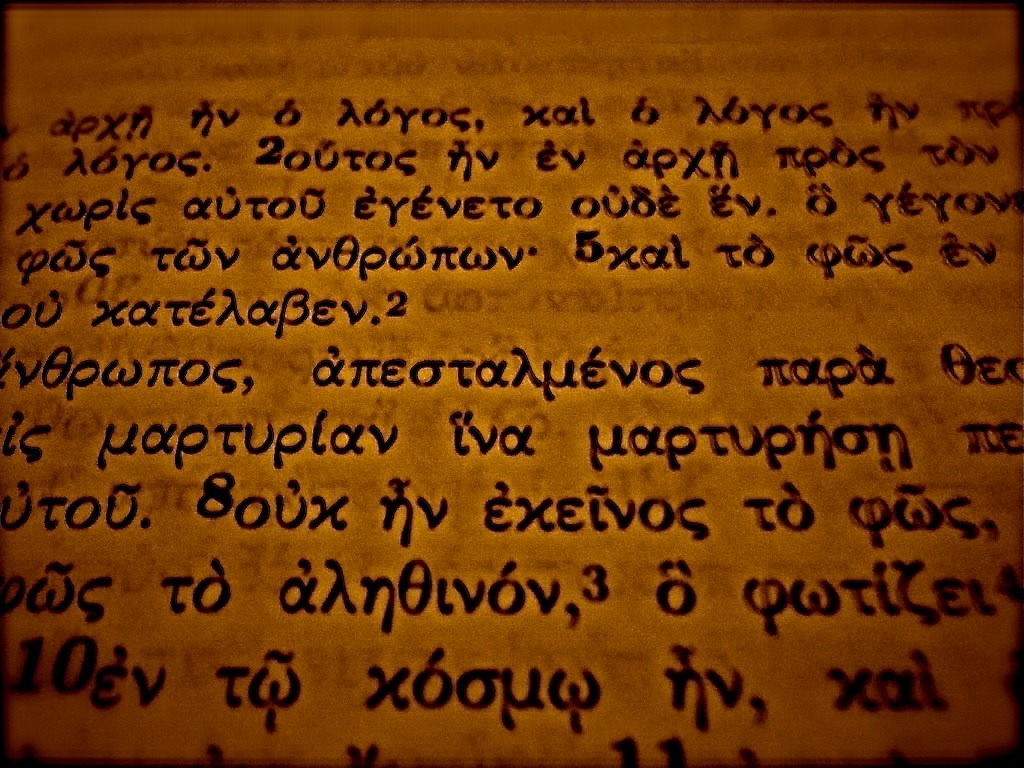
HOW DO WE KNOW THE BIBLE IS TRUE?

GreekNT6

If you are a Christian for any length of time, sooner or later you’ll probably have a thought like this: “What if this is all made up? What if none of it is real?”

To listen to the sermon, click the play button:

To download, right click on the link (or do whatever you do on a Mac) and save it to your computer: Download Galatians Part 3

Galatians #3 . Chapter 1:11-12

Now I want you to know, brothers, that the gospel preached by me is not based on human thought. For I did not receive it from a human source and I was not taught it, but it came by a revelation from Jesus Christ. (Gal 1:11-12, HCSB)

Apparently, the people who were misleading the Galatians said something like this: “Look, Paul is just a human being. We are teaching you based upon the authority of many wise rabbis who have gone before us. But here he is, coming along making up new stuff. He got what he learned from the apostles in Jerusalem, and put his own spin on it. He isn’t even a real apostle.”

But Paul responds here. Remember last time, we talked about the different “false gospels” that we encounter from time to time. Now, Paul talks about the source of the true gospel.

The first apostles were considered reliable teachers of the true gospel, because they had known Jesus personally, and he had personally chosen them. Paul was a little different. He had not known Jesus when Jesus was alive. In fact, Paul was a Pharisee, considered by those in Jerusalem to be one of the rising young bright stars of Judaism. He saw the followers of Jesus as a threat to Judaism, and he persecuted the Christians, causing them to be arrested, and many times, causing them to be executed. But on a trip he was taking to arrest and kill more Christians, Jesus appeared to Paul in a vision. We have a partial record of this in Acts 9:1-18. We don’t know everything that Jesus said to Paul in that appearance, but apparently the Holy Spirit revealed the true gospel to him. Just a few days after encountering Jesus this way, this is what Paul did:

Immediately he began proclaiming Jesus in the synagogues: “He is the Son of God.” But all who heard him were astounded and said, “Isn’t this the man who, in Jerusalem, was destroying those who called on this name and then came here for the purpose of taking them as prisoners to the chief priests? ” But Saul grew more capable and kept confounding the Jews who lived in Damascus by proving that this One is the Messiah. (Acts 9:20-22, HCSB)

Paul had been an anti-Christian. Just a few days after his conversion he was preaching so powerfully that the Jews in Damascus could not dispute him. Where did he learn the message of the gospel that he preached? He had only been a Christian for a few days. Paul tells us, right here in Galatians: it was revealed to him by Jesus himself. Paul, talking about the message of gospel, given by Jesus, tells the Corinthians:

Last of all, as to one abnormally born, [Jesus] also appeared to me. For I am the least of the apostles, unworthy to be called an apostle, because I persecuted the church of God. But by God’s grace I am what I am, and His grace toward me was not ineffective. However, I worked more than any of them, yet not I, but God’s grace that was with me. Therefore, whether it is I or they, so we proclaim and so you have believed. (1Cor 15:8-11, HCSB)

The point is, Paul got the message from the same place that the other apostles got it: from Jesus Christ himself. Paul then passed it along to the churches. The source for our gospel is the same as the source for the early Christians: the teaching of the apostles who knew Jesus Christ (including Paul). Today, we call that teaching “The New Testament.”

I have friends who think the New Testament was made up by people who wanted to gain power through religion. Now, I’ve covered this in the past, but I suppose it’s possible that some of you have forgotten, and also that others never did hear this. Paul felt that it was important for the Galatians to understand that the message about Jesus came from God, not from human beings. I think it is important for us to understand the same thing.

So, the gospel we believe comes from the New Testament. Where did that come from?

Historians can determine the date of ancient documents through a variety of methods. They can look at the writing materials that were used, and compare them to materials used at known dates and places. They can study the language, and compare it to various time periods to see if it is similar (or not) to other writings in various eras. They can check some historical references with other documents, and against the discoveries of archaeology.

When more than one copy of an ancient document is discovered, scholars compare the various copies. If all the copies say the same thing, scholars conclude that they have accurately preserved what was originally written. Where copies vary, scholars consider which copies are older, and how many copies say the same thing, and how many contain the variant. This way, they can reasonable determine what the original said, even when they don’t have the original to study.

A book called Gallic Wars was supposed to have been written sometime around 50 B.C., dictated by Julius Caesar to a scribe. Historians believe that this book is what it claims to be, and was written in the time of Caesar. Even so, the oldest actual manuscript they have of this book is a copy of a copy (and so on) that was actually made 1,000 years after Caesar. The idea is, the book was made, and then as it fell into disrepair, new copies were made, and as those copies got older, new copies were made of the first copies, and so on. They have discovered ten ancient copies of Gallic Wars, with the oldest one, as I said, 1,000 years later than the original. This is considered an excellent historical document for that period in history (which is very close to the New Testament).

Another ancient book is Annals by Tacitus. This too, is considered an excellent source, written around 100 AD (or CE, if you prefer). Today, twenty ancient texts of Tacitus’ writing exist. The oldest is a copy that was made in 1100 AD – 1000 years after Tacitus wrote the original. With regard to Annals, no historian seriously disputes that they were indeed written by Tacitus. Most also accept that what Tacitus wrote has been accurately preserved.

How do these excellent sources compare to the New Testament?

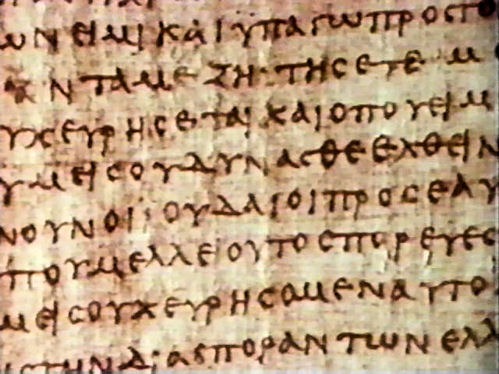
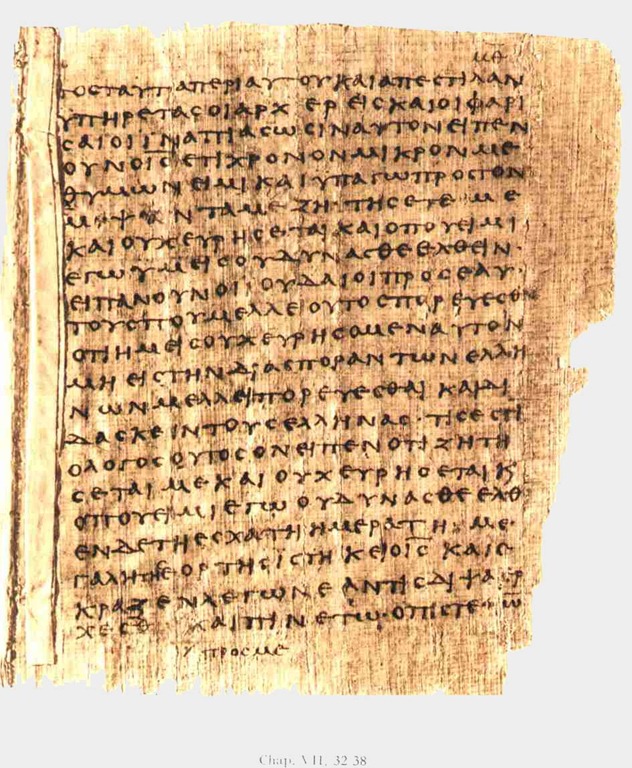
GreekNT3A fragment of parchment containing part of the book of John has been discovered. This piece is believed to be either part of the original written by the apostle himself, or a copy that was made within forty years. A fragment of Matthew has been discovered that most scholars believe was part of the very parchment written by Matthew himself. Other fragments, and even whole books of New Testament, date from within a hundred years of the time of the apostles. The oldest complete copy of the New Testament is about 150 years removed from the time of the apostles. This is far, far better than any other ancient document that exists.

Compared to twenty ancient copies of Tacitus, or ten of Julius Caesar, scholars have discovered roughly 5,500 very ancient copies of the New Testament in Greek (the original language), and an additional 19,000 ancient copies in other languages like Syrian, Latin and Coptic. For hundreds of years, scholars have been comparing these manuscripts to one another. If all or most of the texts show that John wrote “Jesus wept,” than we can be pretty darn sure that John did in fact write, “Jesus wept.” In addition to all these actual copies of the New Testament, we have extensive quotations of the books of the New Testament contained in letters and writings from early Christians, dating from the time of the apostles and on.

With the overwhelming number of copies and the various languages, scholars have found some variations in part of the New Testament. These variations are all very small, and none of them change the essential meaning of any New Testament passage. By the way if you have an NIV version of the bible, it will make a footnote of every major textual variation. Here’s an example of a major variation:

In Luke 23:42, Luke writes that the thief on the cross said, “Jesus remember me when you come into your kingdom.” The NIV version of the bible makes a footnote there is enough evidence to note a variant manuscript reading. The variant would read like this: “Jesus remember me when you come with your kingly power.” You may say: “What’s the big deal with that? What does it change? Doesn’t it mean the same thing?” That, of course, is the point. It changes nothing significant. Nor do any of the “significant” variants. If you have an NIV Bible you can scan the bottom of the text as you flip through the pages and see all the significant variants.

Because of the great number of copies which all record the same words, and because they are so ancient, we can be quite sure that the New Testament we read today is the truly and accurately preserved teaching of the apostles of Jesus Christ.

Every year around Easter, the National Geographic society trots out a documentary or story about the “lost gospels” or the “books that should have been included in the bible.” It’s true that there are a few ancient documents about Jesus that are not included in the New Testament. But there are huge differences between them and the New Testament.

GNT2

We know historically that by around 250 AD at the latest, virtually all Christians were using the twenty-seven books that make up our present day New Testament. The New Testament was not officially defined by a conference of Churches until sometime in the mid 300’s AD, but for all intents and purposes it was well established even earlier than that.

There were several things that caused a book to be included in the New Testament.

  1. The New Testament book had to be connected to an apostle (either written by an apostle, as in the case of Paul’s letters, or written by someone who associated closely with one or more apostles, as in the case of Luke and Mark). So the ancient book, The Apocalypse of Peter, though it names an apostle in the title, was never recognized in any early writing, or by any other evidence, as having anything to do with the real historical Peter. Needless to say, it isn’t in the bible.
  2. The New Testament book had to enjoy widespread early use among churches. For example, the Gospel of John was used and recognized in churches all over the known world by a very early date; whereas the “Gospel of Judas” was never really recognized outside of Alexandria, Egypt and that at a fairly late date, by people who weren’t even Christians. Again, by at least 250 AD, virtually all churches were using a common set of apostolic writings – this set of books was later called “The New Testament.”
  3. The New Testament writings had to agree with generally accepted Christian doctrine. In the 140s AD, a man named Marcion came up with his own very twisted version of Christianity and listed various writings which he thought should be considered sacred. He and his “New Testament” were rejected by almost all churches, because they were contrary to the teachings that the churches had held since the time of the apostles.

I guess what I am saying to you today, is the same thing that Paul was trying to say to the Galatians. I want you to know brothers and sisters, that this gospel that we received and have believed does not come from human beings. It was preserved by human beings, and we can see that it was preserved accurately. But it came from Jesus Christ. But there is even more. John recorded that Jesus said this:

“I have spoken these things to you while I remain with you. But the Counselor, the Holy Spirit — the Father will send Him in My name — will teach you all things and remind you of everything I have told you. “Peace I leave with you. My peace I give to you. I do not give to you as the world gives. Your heart must not be troubled or fearful. (John 14:25-27, HCSB)

And a little later, he said this:

When the Spirit of truth comes, He will guide you into all the truth. For He will not speak on His own, but He will speak whatever He hears. He will also declare to you what is to come. He will glorify Me, because He will take from what is Mine and declare it to you. (John 16:13-14, HCSB)

The Holy Spirit inspired and guided those who wrote down the gospel. And the Spirit guided the process by which these writings were either preserved, or not preserved. We know that there was a third letter which Paul wrote to the Corinthians, which is lost to history. The Holy Spirit caused that happen – that letter was not part of what the Spirit wanted preserved.

All Scripture is inspired by God and is profitable for teaching, for rebuking, for correcting, for training in righteousness, so that the man of God may be complete, equipped for every good work. (2Tim 3:16-17, HCSB)

We have the written words of the true gospel in the form of the New Testament. And we also have the Holy Spirit, given to us through Jesus, who continues to remind us what Jesus said, and guides us to receive and understand the truth of God’s Word. It doesn’t come from human beings who made it up for their own purposes.

If you are a Christian for any length of time, sooner or later you’ll probably have a thought like this: “What if this is all made up? What if none of it is real?” Don’t feel bad about having those thoughts. Instead, remember this: It is entirely reasonable to believe that the New Testament is the unaltered teaching of those who knew Jesus, whom Jesus chose as his apostles. All the evidence says so. It is reasonable to believe that that they believed what they wrote, since most of them gave their lives for that belief (incidentally, they didn’t get power or wealth out of it). But it does require faith to believe that their writings are true, and inspired by the Holy Spirit. It requires faith to believe that Spirit continues to speak through the New Testament today. That faith means we risk being foolish. It means we risk believing something that isn’t true – that risk is the nature of faith. But when we embrace that faith, the Holy Spirit makes these words real and relevant in our lives today.

For the word of God is living and effective and sharper than any double-edged sword, penetrating as far as the separation of soul and spirit, joints and marrow. It is able to judge the ideas and thoughts of the heart. (Heb 4:12, HCSB)

The true gospel, not made by human beings, can speak directly to your heart and to your attitudes. It can convict you of sin, comfort you with grace and lead you closer to the true and living God. It can and will change your life eternally.

NOW THAT’S GOOD NEWS!

good-news

There is no gap for you to make up. There is no fruitless striving for you to do. There are no blessings that you could ever deserve or earn. The good news is, there is nothing we can do, and so Jesus has already done it all for us.

To listen to the sermon, click the play button:

 
To download, right click on the link (or do whatever you do on a Mac) and save it to your computer:
Download Galatians Part 2
 

GALATIANS #2; GALATIANS 1:3-11

This is as good a time as any to talk about the word “gospel.” When Paul writes “gospel,” he is not really talking about the books written by Matthew, Mark, Luke or John (John’s gospel was probably written after Paul died). The Greek meaning is basically, “message of good news.” As we see it used in the New Testament, it is not just any good news about anything, but rather a specific, established, consistent message: that is, the message about Jesus Christ, who he is and what he has done.

Jews in the time of Paul used to talk about “the Law.” “The Law” was a specific, established message given by God through Moses, who wrote and spoke under the inspiration of the Holy Spirit. Technically, what Jews call “the Law” (the Torah) is made up of the first five books of the bible (Genesis, Exodus, Leviticus, Numbers and Deuteronomy). We will talk more later about different ways that the word “law” is used, but for now, it’s helpful to know this.

All of the other books of the Old Testament – those that come after the first five – are called by Jews “the Prophets.” First and Second Samuel, which we have just finished studying, are part of “the prophets.” They too represent a specific, established message given by God through people who wrote and spoke by the inspiration of the Holy Spirit.

By the time of Jesus, no one would think of changing the Law or the Prophets. The message was already established. Paul sees “The Gospel” as the third and final piece of God’s special revelation to human beings. It is the fulfillment of “the Law,” and “the Prophets.” It is the specific, established message given by God through people who wrote and spoke under the inspiration of the Holy Spirit. In the case of the gospel, the message completes the law and prophets, and is very good news for human beings.

The point is, in the eyes of the New Testament writers, you cannot change the Gospel. It is as established as the Law and the Prophets. It goes with the Law and the Prophets. If a Jew would be shocked if someone changed the message of Moses, so a Christian should be equally shocked at someone trying to change the message of Jesus Christ.

Paul gives the Galatians the gospel message in a nutshell in his greeting:

3 Grace to you and peace from God the Father and our Lord2 Jesus Christ, 4 who gave Himself for our sins to rescue us from this present evil age, according to the will of our God and Father.

That’s it: grace and peace are available to us only in Jesus, because he gave himself as a sacrifice for our sins, attaining forgiveness for us, and a restored relationship with God, rescuing us from the devil. We have some additional clues to the kinds of things that Paul preached to the Galatian Christians. In Pisidian Antioch, he said this:

Therefore, let it be known to you, brothers, that through this man forgiveness of sins is being proclaimed to you, and everyone who believes in Him is justified from everything that you could not be justified from through the law of Moses. (Acts 13:38-39, HCSB)

In Iconium, this is what happened:

So they stayed there for some time and spoke boldly in reliance on the Lord, who testified to the message of His grace by granting that signs and wonders be performed through them. (Acts 14:2-3, HCSB)

The gospel is a message of grace. It is good news. Jesus has done for us what we cannot do. Jesus lived a perfect life on our behalf; and Jesus accepted the punishment for sin, on our behalf. Whatever was required from us has been provided by Jesus.

In Lystra the Lord did a miracle through Paul, and healed a lame man. The crowds wanted to make sacrifices to Paul and Barnabas, thinking they were pagan gods. Paul said this:

“Men! Why are you doing these things? We are men also, with the same nature as you, and we are proclaiming good news to you, that you should turn from these worthless things to the living God, who made the heaven, the earth, the sea, and everything in them. In past generations He allowed all the nations to go their own way, although He did not leave Himself without a witness, since He did what is good by giving you rain from heaven and fruitful seasons and satisfying your hearts with food and happiness.” (Acts 14:15-17, HCSB)

His message: turn from these worthless things to the living God. What worthless things? Certainly, their pagan gods. But also this: the idea of offering sacrifices, as if you could actually please God. Paul is saying, “turn from trying to do what has already been done for you. Turn away from the worthless activity of trying to earn something from God. Jesus has already earned everything for you.”

Paul goes on to explain that God gives good things – even to pagans – to show them that he was both real and full of love and grace. You don’t get good things by being good. Instead, you get good things when God chooses to be gracious to you. You cannot earn grace. If you could, it would not be grace. It is God’s free gift, given by His choice, not in response to something you do or don’t do.

So, when Paul writes to these Christians, he is deeply distressed, because he is heard that they are already turning away from this message of grace. Apparently, certain Jewish leaders in the churches were saying something like this: “Yes, Jesus is the messiah. We need to believe that. But of course, we still need to keep the Jewish law. You can’t expect to please God if you don’t follow Jewish rules like circumcision and kosher eating. You can’t have God’s favor unless you are one of God’s chosen people – that is a Jew.”

We don’t have any writings from the Galatians themselves, so we don’t know exactly what they were saying. But it seems that the basic message was what I just shared. Now, as I mentioned before, today, you don’t hear many Christians saying that. But we do have many churches and individuals who seem to preach “a different gospel.”

What are those “different gospels” that we might hear today?

Here’s one: Jesus has done what you cannot do. But he won’t do what you can do. Suppose God is a thousand yards away from you. You, flawed human being that you are, can only move one yard in his direction. So Jesus comes 999 yards to meet you. But if you don’t move that one yard in his direction, you’re screwed, because Jesus won’t do that extra three feet when you are capable of doing that yourself. A lot of churches teach this, without putting it so obviously. I have many friends who were raised Roman Catholic, and many of them experienced something like this. The problem is this: we are always left wondering, “Did I move my full three feet? What if I’m a few inches short?” Practically speaking, you are left still trying to work your way to God. There is still a separation between you and God – and you are responsible to close that gap yourself. You always feel a little guilty, a little unsettled, because maybe you haven’t done quite enough. It doesn’t really matter if the gap is one mile or one yard – if it is up to you to close it, this isn’t good news.

Brothers and sisters, this is not the message of the gospel. Jesus came all the way to get you. You can’t move an inch to meet him, and you don’t have to. There is no part of the gap between you and God that you are expected to close. Jesus has done it ALL. Do not listen to a false gospel. The good news is truly and completely good.

Here’s another false one. Jesus has done it all. Now you are set free to try and live a good life. You’ll fail, of course, but God forgives you because of Jesus, and so you have an infinite number of opportunities to keep trying to get it right.

I read something on Facebook just the other day that captures this idea. Someone mentioned Ephesians 4:17-32 and said:

While it is impossible for us to do we are to work at it daily. When we fail we shouldn’t beat ourselves up nor should we make excuses, just pick ourselves up again and keep trying.

Does that sound like good news to you? It sounds sadistic to me – to have to keep trying to do what both God and I know I will never be able to do. To try and fail infinitely: that sounds discouraging, exhausting and frankly, pointless. It almost sounds like punishment, not forgiveness.

Thankfully, that is not the real gospel either. The real gospel tells me I can’t do a single thing to measure up. Jesus has done all the measuring up for me. I can’t add to what he’s done. I am free from pointless striving. In Jesus I have never sinned. In Jesus I have already done every good, and never failed to do what I should.

Now, in our small-group last week, the question came up: If that’s so, then why are there so many passages in the New Testament that tell to do certain things (like use our money and talents for God) and to not do other things (like getting drunk or committing adultery)?

We will get into that more deeply as we go through the book of Galatians. The short answer is this: if we truly believe the good news and trust Jesus, he lives in us, and our lives will naturally begin to look more and more like Jesus as time goes on. It won’t be us striving – it will be the life of Jesus increasing in power in our lives as we surrender to him and trust him more. If that doesn’t happen, if we never show any improvement, the appropriate response is not to try harder to do the right thing, but to examine whether we really trust Jesus. Those commands in the New Testament are there to help us see if we are really trusting Jesus or not. For instance, in Ephesians 4:17-32, which led to the quote above, people always miss the first part

But that is not how you learned about the Messiah, assuming you heard about Him and were taught by Him, because the truth is in Jesus. You took off your former way of life, the old self that is corrupted by deceitful desires; you are being renewed in the spirit of your minds; you put on the new self, the one created according to God’s likeness in righteousness and purity of the truth. (Eph 4:20-24, HCSB)

You don’t keep trying to do what you can’t. Instead, through faith, you “put on Jesus.” As you trust him, your spirit and your mind are renewed, and as a result, your behavior begins to change. You don’t change your behavior – the Holy Spirit changes it as you trust Jesus and daily.

There’s a final “other gospel” that I want to point out, one that is becoming more and more common in America. That false gospel is something like this: Jesus has forgiven our sins. Because of that, now if we do good works, God will give us blessings in this life. This particular false gospel has two errors. The first is that it puts the focus of our faith on getting blessings in this life. I know far too many people who have been sucked into this. They are focused on getting good finances, good health and good relationships through God. God is just a means to their goal, and their goal is a good life here and now. Paul says this about such people:

If we have put our hope in Christ for this life only, we should be pitied more than anyone. (1 Corinthians 15:19)

These folks usually do believe in heaven and are happy enough to think they’ll go there someday. But for now, what they’re really after is good stuff here and now. Faith isn’t about being reunited with God. Instead, it treats God like Santa Claus. If the boys and girls are only good, they’ll get lots of presents. By the way, I think these folks do more to turn other people off Christianity than all the atheist clubs in the world.

The second error is that those blessings are based upon what we do. We earn them. They are not given by God’s grace. This false gospel says if you just believe right, behave right, and speak “in faith,” that means that God has to do what you want him to do. God is a vending machine: you put in good works, and get blessings in return. If you want to gain a lot of followers, that is what you should preach. A lot people do. But Paul says he is not preaching to please people. That isn’t the gospel. The gospel is about our eternal relationship with God. Sometimes he blesses us here and now – certainly more than we deserve. Sometimes he doesn’t.

The real gospel is the message that we are completely and totally dependent on God’s grace, and he has given us that grace fully through Jesus Christ. There is no gap for you to make up. There is no fruitless striving for you to do. There are no blessings that you could ever deserve or earn. As we trust him, he changes us (we don’t change ourselves). And the hope of eternity outshines and dominates the struggles and disappointments we encounter in this life.

I encourage you to receive this message more and more fully each day. And let no one lead you astray to any “false gospel.”

WHAT ARE YOUR CREDENTIALS?

credentials_reduced

To listen to the sermon, click the play button:

To download, right click on the link (or do whatever you do on a Mac) and save it to your computer: Download Galatians Part 1

Galatians #1 . Chapter 1:1-2

This week we are beginning a new series on the book of Galatians. It is a relatively short book – six chapters. As with all of the bible, we believe that the Holy Spirit inspired the writer to write this, and for it to be preserved and chosen as part of the New Testament. Even so, it is helpful to understand some things about how it first was written and why.

Like much of the New Testament, Galatians is actually a letter written to several Christian churches. It was written by the Apostle Paul. Paul and his colleague Barnabas (and a few others) took a mission trip from their home church in Antioch (in modern day Syria) in the 40’s AD. They went to Cyprus, and then to what is now South Central Turkey. Acts 13-14 describes this journey. They returned home to Syria.

Shortly after this, word came to Paul (we don’t know exactly how) of a controversy that was arising among many of the churches they had just visited. In response, Paul wrote this letter. It was probably the first letter that he wrote to any church, and it is certainly the first letter of his that we have preserved. He may have written it sometime in the year 49.

When I was seminary, the exciting controversy about this book was this: did “Galatians” refer to “North Galatia,” or “South Galatia?” Properly, the province of Galatia was north-central Turkey, but we don’t really know if Paul ever went there. There was a point in history when south-Central Turkey also was called Galatia, but that was before Paul’s time a little bit. So did Paul go somewhere we never heard about? Or are scholars wrong about when Galatia included the southern area? This was considered a major and probably unsolvable conundrum. Theologians don’t get out much.

I’m telling you now, Paul was writing to churches in south-central Turkey, in the cities recorded in Acts 13 and 14: Towns like Pisidian Antioch, Iconium, Lystra and Derbe. There, I’ve solved it. Part of the reason I favor this view, is because the things that happened in these cities when Paul was there seem to be reflected in the letter.

Pisidian Antioch was the first city in the region where Paul and Barnabas really made an effort to talk to people about Jesus. They went to a local synagogue and shared the good news. It was well received at first, but after just a week some of the Jewish community began to oppose him:

But when the Jews saw the crowds, they were filled with jealousy and began to oppose what Paul was saying by insulting him. (Acts 13:45)

Again,

So the message of the Lord spread through the whole region. But the Jews incited the prominent women, who worshiped God, and the leading men of the city. They stirred up persecution against Paul and Barnabas and expelled them from their district. (Acts 13:49-50, HCSB)

And yet again,

The same thing happened in Iconium; they entered the Jewish synagogue and spoke in such a way that a great number of both Jews and Greeks believed. But the Jews who refused to believe stirred up and poisoned the minds of the Gentiles against the brothers. (Acts 14:1-2, HCSB)

The same sorts of things happened in the nearby towns of Lystra and Derbe. So when these churches were just starting, there was a great deal of controversy with some Jewish people. We have to remember that in the beginning, the first believers thought of Christianity as merely the completion of the Jewish religion. In fact, I still kind of think that way. In any case, the Jews who did not like the teaching of the Christians took it personally, because it seemed to them, not a separate religion, but a pollution of pure Judaism and a threat to it. To make matters even more complicated, many of the first Christians in these towns were Jewish themselves, although some were not.

Apparently after Paul and Barnabas left the area, the Jews did not leave things alone, and many of the Jewish Christians in the churches began to listen to their non-Christian Jewish brothers. Within the churches, Jewish Christians began to teach that the “good news” was not salvation through Jesus Christ alone, but salvation through Jesus AND through following Jewish law. In other words, only the Jewish Christians were truly saved, and if the Gentiles wanted to be saved through Jesus, they had to become Jews first, and faithfully observe Jewish religious laws.

Paul wrote Galatians when he learned of all this. Now, as we jump in here, I have a few thoughts. Every once in a while, I run across a group of Christians who teach that you need to follow Jewish law in order to be truly saved. Really – I do meet these people. I can scarcely believe it, since this book of Galatians so clearly refutes that. But they’re out there. So, if you ever run into them, this study of Galatians will help.

Let’s be honest though – most of us don’t have regular contact with folks like that. It isn’t exactly a front-burner issue in most Christian churches these days. So what’s the good for us today?

I think we find the answer when we look a little deeper at the issue of following the law or living by grace. Strange as it seems, the truth is, it is easier to live by a set of rules than by grace. It’s all laid out for you. You just consult the rule book, and if you do the right thing – even if your heart wants nothing to do with God – God has to deliver on his promises. You are in control of things – it is up to you. You live right, and God will give you a good life.

But grace is messy. We can’t control it. And it is all about the heart – we can’t get grace with hearts that are not interested in God. We can’t get grace when our hearts are too proud to admit we really have no claim on God, and nothing we do could ever change that. Grace is hard to evaluate. No checklist will tell you if you have it or not. Grace can’t be controlled. We can’t make God respond to us by behaving rightly. We just have to trust him.

Galatians is all about Law and Grace. And truthfully, most Christians still struggle with how those two things relate. Our natural tendency is to try fix things ourselves – and that is law. We want to believe that if we do certain things – like pray and live right – then God will be obligated to do certain things in response – like answer our prayers or keep us from hardship. But that is law, not grace. This letter is very relevant indeed to people who struggle with these things.

So, with all that in mind, let’s begin.

Paul, an apostle — not from men or by man, but by Jesus Christ and God the Father who raised Him from the dead — and all the brothers who are with me: To the churches of Galatia.

Grace to you and peace from God the Father and our Lord Jesus Christ, who gave Himself for our sins to rescue us from this present evil age, according to the will of our God and Father. To whom be the glory forever and ever. Amen. (Gal 1:1-5, HCSB)

This is Paul’s first letter, and it is possible that those around him encouraged him to be more tactful in the future. But the truth is, he is hopping mad, and he doesn’t waste time on saying nice things to no purpose. He begins immediately by reminding the Galatians that he writes with a spiritual authority that comes from God.

There are two reasons for this, I think. Clearly, the Galatian churches were being influenced by people who considered themselves leaders. Paul is reminding them that his leadership comes from a call he received from Jesus Christ himself on the Damascus road. It’s as if he’s beginning by saying: “who are these people to say that I’m wrong? I’m a messenger from Jesus Christ and God Father Himself.”

Secondly, since Paul’s opposition is mostly Jewish, he is creating a big contrast from the way Jewish rabbis teach, and his own approach. Jewish rabbis in that day typically taught by quoting other authorities, sometimes going back several ‘generations.’ They might say something like this:

“We have just read from the Torah how Moses led the people across the Red Sea. Rabbi Hillel quotes rabbi Judah ben Tabbai as saying that it was the obedience of Moses in stretching out his staff that we must notice here.”

By the way, I made that example up. The point is, the style of Jewish teaching was to quote authorities, who often quoted other authorities. In contrast, Paul says, “I’m speaking for Jesus. He himself sent me. I don’t need to quote authorities.” Paul himself had been a Jewish rabbi before he became a Christian. He could have established his Jewish credentials to impress the Galatians. Instead, he believed his only worthwhile credential was the fact that Jesus saved him and called him.

This is key to the entire message of Galatians. Paul’s only credential is Jesus Christ, and he considers it far greater than any possible contenders. Ultimately, he is going to tell the Galatians that Jesus is their only credential as well. From the very first sentence he is asserting the fact that everything is Jesus, and whatever is not in Jesus is useless.

So maybe the place to begin application is to ask this: What are your credentials? Are you a generation or two removed, or do you know Jesus for yourself? Is the basis for your faith what someone else said, or is it your own trust in Jesus? Are you willing to say, “Jesus is my all I have; Jesus is my only claim?”

Let the Holy Spirit speak to you right now.

GRACE IN JUDGMENT

census-workers1

Judgment always has this purpose: to turn people back to God, where they can find joy and grace.

To listen to the sermon, click the play button:

To download, right click on the link (or do whatever you do on a Mac) and save it to your computer: Download 2 Samuel Part 22

2 Samuel #22 . 2 Samuel Chapter 24

This is yet one more of those difficult passages in Samuel. Thankfully, it is the very last chapter of the book J. Even so, as with the other difficult parts, there are rich and grace-filled lessons to be learned here.

This same incident is also recorded in 1 Chronicles 21. I’ll be using both passages to help us understand. It says here that the Lord was angry at Israel, and stirred up David to take a census. In Chronicles, it says that Satan, plotting against Israel, incited David to sin by taking a census. Either way, we can see that the consequence of David’s sin was that all Israel suffered. I think one of the first questions should be, “Was it God or was it Satan?” As I have mentioned in previous messages, there are several other places in the Old Testament where the Lord used evil spirits to accomplish his purposes: Judges 9:23-24, 1 Kings 22:18-23 1 Samuel 16:14, and Job 1:6-12. In each case the picture we get is the Lord allowing an evil spirit to affect a particular person or group. In each case, the evil spirit wants to do the evil, but must get permission from God first. God’s permission seems to be limited to what will accomplish his purpose. In most of these cases, the purpose is to bring judgment, and if possible, repentance. [For a longer discussion of this issue please go to one of my previous sermons: Does God Send Evil Spirits?]

So it is entirely consistent to see God allowing a limited evil influence upon David in order to accomplish his purposes. It was Satan who tempted David, but it was ultimately God who allowed it. The answer to our first question then is: both. It was both God and the devil.

The next natural question is, “Why did God let this happen?” My most honest answer is, “I don’t know for sure.” I do have some ideas, however.

Clearly, the Lord felt that there was something not right in David’s heart – and also not right in the hearts of the people. Let’s start with an clear biblical understanding of sin and punishment and judgment. There is only one satisfactory and just punishment for sin. According to the Bible that one appropriate punishment is eternal separation from God. Since God is the source of all Life and all Good, that separation means death and unimaginable suffering. So if David and the people of Israel were not killed and sent away from God’s presence forever (that is, hell) then they were not being punished for doing wrong. They were being judged. There is a difference. In fact, it was God’s punishment for our sins that Jesus took upon himself.

In the Bible, God’s judgment establishes that his actions are right and good, and that ours are wrong and sinful. God uses judgment to try and get people to repent and turn to Him and receive life, hope and forgiveness in Jesus. Judgment always has this purpose: to turn people back to God. It isn’t vindictiveness or anger or even righteous punishment. It is an extreme measure of love. It is like amputating a limb to keep the deadly cancer from spreading, or taking the cars keys away from someone who drinks too much. It seems harsh, but it is intended for good, for love.

So God allowed the sin in the hearts of David and his people to be revealed through temptation, and then he brought judgment to turn them back to Himself.

When I was fifteen I tore open the back of my heel in accident, and had to have stitches. The wound became infected. It sealed up on the outside, but underneath, it was filled pus and infection. Left alone, it would have looked all right, but eventually it would have developed gangrene and rotted my foot and leg, finally killing me. My dad realized what was happening. He made me lie down, while he clamped my leg to hold it still. He squeezed around the wound and it was incredibly painful. The wound burst open and what came out was truly disgusting. For almost a week afterward I had a gaping hole in my heel. I still have a scar. But it was absolutely necessary that the infection be exposed and cleaned out.

So, the Lord exposed what was hidden in the hearts of David and of the people, and then cleaned the infection, though it was a painful, awful-seeming process. My dad inflicted pain upon me in order to bring about my healing. He didn’t cause the infection, but he did cause me pain in order to first expose it, and then eliminate it. So God did not cause the problem in the hearts of his people, but he loved them enough to engage in the painful process of exposing it and judging it, to bring them back to himself.

Now, another question that I have is, what was so bad about taking a census? Moses did it twice – because God told him to. So why shouldn’t David do it? How did the census expose the sin of David and of Israel? I think this is an important question to ask.

I want to admit, this part is speculative. Here are some possible reasons. Perhaps it was pride. Maybe David wanted to know how great his kingdom was. Or maybe he was contemplating a new conquest that was not sanctioned by the Lord, and he wanted to know if his army was big enough to do it. Another possibility is that he was afraid of another rebellion, and was using the census to ferret out any potential enemies. The men of Judah and those of the other tribes were recorded separately. So maybe David was afraid, and was trying to see if the men of Judah had enough soldiers to defeat the other tribes if it came to civil war again.

In any case, it did not arise from faith. Romans 14:23 says: “For whatever does not proceed from faith is sin.” We want a book of rules, so we can just take care of things on our own, and not make the effort of staying close to the Lord. Rule 447, paragraph 8, section c: “Do not ever take a census.” But living that way actually separates us from God, because it allows us to function “righteously” without really interacting with him. Even if we do the right thing, it needs to be because we are living in right relationship. Taking a census is not always wrong. But David was not walking in faith.

Here is one other possibility with this census. It could be that David ordered it to be conducted in a way that violated something the Lord said in Exodus 30:11-16.

The LORD spoke to Moses: “When you take a census of the Israelites to register them, each of the men must pay a ransom for himself to the LORD as they are registered. Then no plague will come on them as they are registered. Everyone who is registered must pay half a shekel according to the sanctuary shekel. This half shekel is a contribution to the LORD. Each man who is registered, 20 years old or more, must give this contribution to the LORD. The wealthy may not give more and the poor may not give less than half a shekel when giving the contribution to the LORD to atone for your lives. Take the atonement money from the Israelites and use it for the service of the tent of meeting. It will serve as a reminder for the Israelites before the LORD to atone for your lives.” (Exod 30:11-16, HCSB)

The point of this was to recognize that the Lord owns all of the people. They don’t own themselves – they owe their lives to the Lord. In the same way, no leader owns the people – they all belong to God. It may be that the people did not want to pay the census fee, nor did David want to require it of them. This exposed that in their hearts they were not serious about belonging to God as a people. This may be the sin in the hearts of the poeple that God was exposing.

With the sin exposed, God acted in judgment, to bring the people back to himself. Because David repented so quickly, the Lord gave David a choice about the form of judgment: three months more of rebellion and battle, or three years of famine, or three days of a plague. David chose the last one, as I would have. He trusted God’s mercy (in the form of the plague) more than the “mercy” of a human enemy.

As the plague was coming to Jerusalem, David apparently had a vision of God’s angel striking the people. He cried out for mercy for them, pleading with God to limit the judgment to himself, to strike him and save the people. God did not do that, but he did end the plague at that point. The angel in the vision stopped. David’s plea to be punished instead of the people echoes the heart of the ultimate chosen one, Jesus, whom God did strike in place of all sinful people.

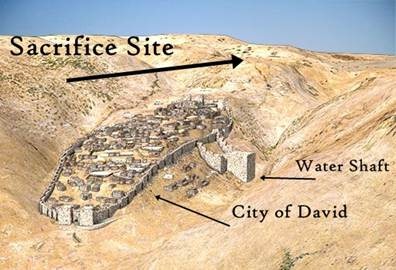
What follows is very interesting. The Lord sent the prophet Gad, who told David to make sacrifices and offerings on the spot where he saw the angel stop. If you remember, Jerusalem in David’s time was fairly small, maybe ten or fifteen acres. It was on the tip of a ridge, with deep ravines to the east and west and south. Behind David’s city to the north, the ridge rose to the top of the mountain. It was there, at the top of that ridge or mountain, where David went to offer his sacrifices. This was about 1/3 of a mile from the south wall. The picture below gives you a rough sense of the geography, though it is not 100% accurate.

clip_image002

He found the land was owned by a Jebusite, not an Israelite. Refusing to take it as a gift, David purchased the land, and made offerings and sacrifices there. This ridge-top was the very place where Abraham had taken his son Isaac, when he obeyed God’s call to sacrifice him. On that mountaintop, Isaac, not knowing what was to come, asked what they were going to use for a sacrifice. Abraham answered prophetically, saying, “God Himself will provide the lamb for the burnt offering, my son.” (Gen 22:8, HCSB). God stopped Abraham when he saw that he was willing to give up even his son. Instead, God planned to give his own son. And so on this same spot, almost eight hundred years later, the plague was stopped. On this same spot, David offered his life in exchange for his people, but again, the Lord refused that sacrifice, looking ahead to the time he would offer his own son. And this same spot, purchased by David, Solomon built the temple of the Lord, where for years they offered sacrifices that were all a shadow, pointing toward the ultimate sacrifice of Jesus to save people from their sins.

So David ended his reign, still being used by the Lord to point toward the ultimate messiah. 2 Samuel 23 records the last psalm he wrote:

These are the last words of David: The declaration of David son of Jesse, the declaration of the man raised on high, the one anointed by the God of Jacob, the favorite singer of Israel:

The Spirit of the LORD spoke through me, His word was on my tongue.

The God of Israel spoke; the Rock of Israel said to me, “The one who rules the people with justice, who rules in the fear of God, is like the morning light when the sun rises on a cloudless morning, the glisten of rain on sprouting grass.

Is it not true my house is with God? For He has established an everlasting covenant with me, ordered and secured in every detail.

Will He not bring about my whole salvation and my every desire? (2Sam 23:1-5, HCSB)

CHRISTMAS 2012


Nativity-Scene


The gift of Christmas is a person. It is not the blessings and things we think we want. It is not “presents” but rather, presence. Like children, we are so easily distracted by the things we want. We don’t dream that we could be satisfied by a relationship with a person. But what the Bible says is the greatest Christmas present of all time, is a person


To listen to the sermon, click the play button:

To download, right click on the link (or do whatever you do on a Mac) and save it to your computer: Download Christmas Eve 2012


CHRISTMAS EVE 2012

Imagine a woman from a poor family who gets married to a wealthy and talented doctor. She loves the status that her marriage brings. She loves the privilege of belonging to exclusive country clubs, and being treated deferentially by restaurant managers at expensive places. She likes being seen at society events. She enjoys driving newer models of luxury cars. Shopping is a joy and a delight, and she loves the fact that she hardly ever has to worry about how much something costs. She is constantly adding shoes to her closet and jewelry to her case.

Now, she isn’t entirely shallow. Coming from poverty, she knows what it is like. So she likes to give money away too, as long as it doesn’t affect her lifestyle too much. She even gets involved in charitable causes, and those charitable organizations are grateful for the social standing and monetary support that she represents.

But none of these things that she spends so much time and energy in, none of what she values so much, is her relationship with her husband. It comes with the husband, but it isn’t him. When they talk, she likes to talk about new purchases or ways to increase their social status and fame. She talks with him about the possibility of joining new clubs, or maybe trading in that two-year old Mercedes for a brand new Lexus.

This woman rarely listens to her husband when he has something say. Occasionally, she is brought up short when he refuses to spend the money for a trip to Vienna or something like that. Usually, that gets her attention, but mostly, she just complains and asks why. Her relationship with her husband is all about what his wealth and status can do for her. It isn’t about living life with her soul mate. It isn’t about loving him for better or worse. When things are “worse,” she wants to know why, and she wants it to change right away. Although she seldom really expresses love for him personally, she’ll probably never leave him, because she thinks he is the best chance she has to get what she wants in life.

If we are honest with ourselves, I think most of us would look down on somebody like this. Such a person, is clearly using her spouse to get what she wants out of life. Her life is not partnered with his. Her goals and desires are her own; he is a part of them only to the extent that he can grant her wishes. She has not taken the time to really know him. She has not learned to appreciate him, admire him and love him at anything more than a superficial level.

Suppose one day, the doctor comes home to his wife and shares his burning desire to be a medical missionary in central Asia. He wants her to be a part of his mission, heart and soul. It means that they will have sell everything they own, and move to a place where no one knows them, or cares who they are. They will be living in conditions akin to poverty. He invites her to join with him in his work, to be his partner and co-laborer. But this is not what she wants. She married him in order to get all of the things that he now wants to leave behind. She files for divorce.

Brothers and sisters, do we treat God this way?

Christmas is a terrific time to evaluate this, because it involves both an eternal relationship, and bunch of blessings. Which do we focus on more? Would Christmas feel just as joyous to you if you received no presents? Would you be equally as excited about simply receiving Jesus and getting closer to him?

Too often, I think I treat God mostly as a source of blessings, rather than the abiding passion of my life. I want his help more than I want him for his own sake. I like what I think he will give me. But do I like him? Author Larry Crabb said this:

“Offer a young child the choice of having Daddy present Christmas morning with no gifts, or having Daddy absent and a stack of gifts pile high beneath the tree, and the child might choose the gifts. Only the mature value the blessing of presence over the blessing of presents.”

Crabb rightly says it is about maturity. As we get older, presents become less important. But unfortunately for many of us, the same isn’t necessarily true about God’s blessings. Imagine you were given a choice: You could have a life where you had the blessings of getting paid to do what you love, and harmonious relationships, and no financial struggle; OR, you could struggle financially and in relationships and in your work, but the presence and love of God would be incredibly real and dominant in your life. The choice is between a better life, or a closer relationship with God. Which would you take? Would you sell all you own and live in a mud hut to be with the one you love? Or would you find that you don’t love him that much?

We all want both, of course. But we can’t have both unless we want God more than his blessings; and for that we have to be willing to do without his blessings. If we insist upon having God’s blessings along with God, then we aren’t willing to have him without them. We would be like the woman in the analogy above. Once her husband stopped providing what she wanted out of life, she left him.

People do this to God all the time. They don’t get the promotion they want. Sometimes it is much more serious than that – maybe their loved one dies of cancer, in spite of all their prayers. So they walk away from God. He didn’t do for them what they wanted him to, and so they abandon him. This is demand that God give us blessings. It is a refusal to follow Him unless he blesses us. What makes a such a person any different from the shallow woman in our analogy?

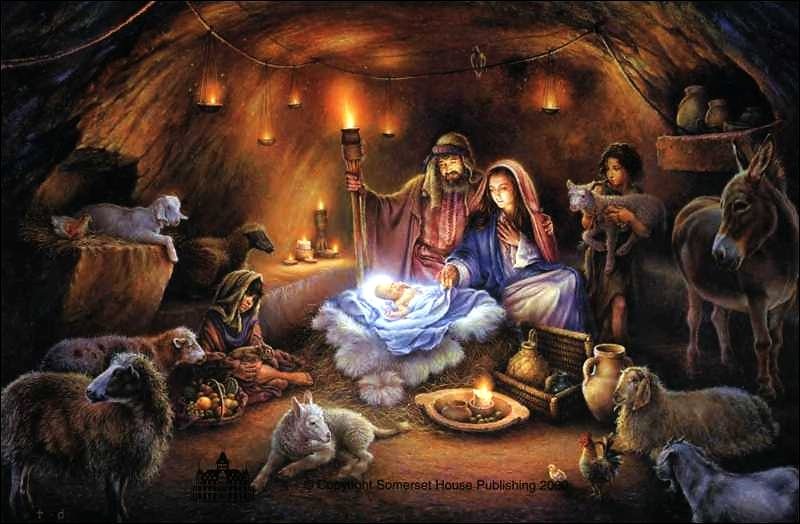
The gift of Christmas is a person. It is not the blessings and things we think we want. It is not “presents” but rather, presence. Like children, we are so easily distracted by the things we want. We don’t dream that we could be satisfied by a relationship with a person. But what the Bible says is the greatest Christmas present of all time, is a person. Listen to Isaiah:

For a child will be born for us, a son will be given to us, and the government will be on His shoulders. He will be named Wonderful Counselor, Mighty God, Eternal Father, Prince of Peace. (Isa 9:6, HCSB)

Or to John:

And this is the testimony: God has given us eternal life, and this life is in His Son. The one who has the Son has life. The one who doesn’t have the Son of God does not have life. (1John 5:11-12, HCSB)

Or to Jesus himself:

Jesus told him, “I am the way, the truth, and the life. No one comes to the Father except through Me. “If you know Me, you will also know My Father. From now on you do know Him and have seen Him.” (John 14:6-7, HCSB)

The gift is a person. It is a relationship. He came to be the love of your life. It isn’t about how he can improve your life or fulfill your dreams. It is about HIM. Sometimes, he blesses our lives with good things. Sometimes he does not. Often it is hard to tell why he does or does not. But the point is never supposed to be about the blessings or their lack. It is supposed to be about closeness with Jesus.

The truth is that a life of blessings without God as our prime desire, is an empty one. For proof, look in any celebrity-oriented magazine, any day of the year. You’ll see beautiful, incredibly wealthy people, married to other beautiful people, adored by millions, completely free from any financial burdens, who are desperately unhappy. They have access to the best healthcare. Anyone in the world would jump at a chance to have a friendship with them. Their spouses are attractive beyond belief. They have the money to pursue any path they choose. But droves of them are addicted to drugs and alcohol; they have eating disorders; many of them secretly feel they are ugly; they get divorced in record numbers.

There is no meaningful life in blessings alone. Listen carefully. If our relationship with God is mostly about the blessings he can give us in life, then we are still just living for the blessings. God is just a means to get them, just as movie-acting is just means to fame and fortune. We are no different from those celebrities.

So this year, I plead with you to struggle, as I do, to connect with the truth that the only true and lasting blessing, the only one I need, is Jesus himself. Not what he does for me, but him.

Jesus does promise us a life full of blessing, of freedom from worry, pain and fear. But that is not this life. That is the eternal life we will receive if we choose Him, here and now.

My prayer is that you do that.

Imagine an alternative ending to my little parable. Suppose the woman takes a risk. Realizing what a good man her husband is, she changes her mind. Full of fear, she agrees to go to central Asia with him. There, in service and near-poverty, she learns to love her husband more than she ever thought possible. She finds un-dreamed of joy serving with him, even in spite of the rough conditions. Now the blessings she tried so hard to hold on to mean very little to her. Instead what means the most is being with the one she loves.

May this be your story! Merry Christmas!

PREPARE THE WAY–THE WAY TO PREPARE

Mayan-Calendar

This is a good time of year to consider our lives, and where we need to be “raised up” or “leveled out.” Isaiah’s words, spoken 2600 years ago, are far more relevant than the recently expired Mayan calendar.

To listen to the sermon, click the play button:


To download, right click on the link (or do whatever you do on a Mac) and save it to your computer:
Download Sermon for Dec 23, 2012
DECEMBER 23, 2012

“Comfort, comfort My people,” says your God. “Speak tenderly to Jerusalem, and announce to her that her time of forced labor is over, her iniquity has been pardoned, and she has received from the LORD’s hand double for all her sins.” A voice of one crying out: Prepare the way of the LORD in the wilderness; make a straight highway for our God in the desert. Every valley will be lifted up, and every mountain and hill will be leveled; the uneven ground will become smooth and the rough places, a plain. And the glory of the LORD will appear, and all humanity together will see it, for the mouth of the LORD has spoken. (Isa 40:1-5, HCSB)

Well, the Mayans were wrong and the world didn’t end on Friday, which is a pretty big disappointment for those us who go to work and pay taxes. It was also probably surprising and discouraging for the folks who got blind drunk Friday night and woke up alive on Saturday. Now the president and congress still have to save us from the fiscal cliff and everyone is still on the hook for Christmas credit-card bills. In a bible passage that is often read near Christmas time, the prophet Isaiah also made a prophecy about something momentous that was going to happen. He wasn’t a Mayan, by the way, and some of his prophecy has already come true.

I have talked before about how biblical prophecy is multi-layered. It’s like looking at a mountain range on a clear day, from a distance. All of the mountains and ridges look like they are next to each other. However, as you get closer, it becomes obvious that some of the heights are closer to you, while others are actually many miles behind the first line of ridges and peaks. So a prophet speaks what the Lord has shown him. In biblical prophecy, particularly in the Old Testament, you often find prophecies that were fulfilled before Jesus right next to prophecies that Jesus himself fulfilled, and also next to prophecies about the end of the world. From a distance, they were all “sometime in the future.” But some have already come to pass, while others are still some way off. In addition, most biblical prophecy also contains some sort of message that was relevant even before the fulfillment of the prophetically predicted event.

With all that in mind, let’s look at Isaiah 40:1-5. Isaiah prophesied to the nation primarily during the reign of Hezekiah, King of Judah, from about 750 to 690 or so, BC. One of the many things he prophesied, was that the nation of Judah would be conquered by the Babylonians, and that many of the people would be taken away to Babylon as exiles. This was fulfilled in 587 BC, about 200 years after Isaiah’s time. Looking even further ahead, after his prophecies about the future exile, Isaiah goes on to prophesy about the return of the Jews from Babylon. This also happened, starting in the 520s BC. Isaiah 40 is basically the beginning of the section about that future return from future exile. And yet, at the same time, parts of this passage (and others in this section) are about the future coming of Jesus Christ to earth, which he did, as we know, roughly 2000 years ago, or, about 700 years after Isaiah prophesied. And finally, elements of these prophecies also refer to the time when Jesus Christ will come back again, at the end of time.

Whew! If you wonder how one passage can contain all those elements, just don’t forget how those distant mountains look.

The essential message for those in the days of Isaiah, and later for those exiles who returned from Babylon, was this: God is bringing his glory back to his people. Even in the days of Isaiah, the nation of Israel had clearly become a second rate power. The magnificent days of David and Solomon were history. The one nation ruled by King David had long since been split into a Northern Kingdom (called “Israel”) and a southern Kingdom (called “Judah”). These two nations often fought each other. They were dominated by the powers around them – Syria, Assyria and Egypt (and later, Babylon). In fact, while Isaiah was still alive, the Northern Kingdom (Israel) was utterly destroyed by Assyria, and ceased to exist. The glory days were over. But Isaiah 40:5 says

“And the glory of the Lord will be revealed, and all mankind together will see it. For the mouth of the LORD has spoken.”

Something that was lost is going to be restored. Now, “Glory” in the Bible, isn’t just about victory and success and triumph. In fact, the key element to Biblical “glory” is the presence of God. Maybe another way to say Isaiah 40:5 would be this:

“God’s presence will once more be manifest among you. He will be with you in such a way that it is obvious to all people. God has promised it.”

Along with this idea of the return of God’s presence, is the theme of deliverance. When we look at the context of the passage, clearly God is returning, and when he returns, he will bring deliverance. Salvation would be another word for it.

It is significant that the voice calls in the desert, and the rest of the passage refers to making a way in the wilderness. When we consider the context of exile in Babylon, it may help to know that caravans and armies from Babylon to Israel always traveled North, around the desert, west toward the Mediterranean Sea, and then South into Palestine. When Babylon invaded, it did so from the North. And yet God is coming straight across the desert. The idea here is that there is no delay in his coming and that obstacles will be removed. God will come by the direct route. His isn’t bound by the caravans routes and traditional paths of men.

This passage from Isaiah is used in all four gospels. Each of the gospel writers identifies John the Baptist as the one who is calling in the desert, “prepare the way for the Lord…” It is probably no coincidence that John did most of his preaching out in the desert, directly east of most of Israel. John’s ministry took things one step beyond a return from exile. Once again, as a fulfillment of this passage, John was declaring that the presence of God would be manifest among his people. Certainly that promise was fulfilled in the person of Jesus Christ. God was present now in a way that went far beyond what the exiles could imagine.

Each time, along with this promise of God’s manifest presence and his deliverance (in short, his glory), comes an admonition that we should “prepare the way.” I think this bears some looking at, and perhaps has some application for our own lives. One of the primary places where this passage can really be played out, is in the human heart. God will come, someday, in the flesh once more and end this world. But he wants to come to you right now in your heart. And the best way for you to prepare for that “someday” is to let him in your heart today.

First, we need to be clear – we don’t “prepare” in order to get God to come be with us. He has already promised to come. His coming is not dependent on our preparation. He’s said, essentially, “I’m coming, whether you get ready or not – so get ready!” We can prepare by learning his word, by telling others about him, by discovering our gifts and using them for his Kingdom. But even more profound than that, this passage gives us a clue as to how to prepare. Isaiah says: “Make straight in the wilderness a highway for our God.”

What he is getting at is this: we need to give God access. The image here is to let God come straight at your heart. Take out the twists and curves we put in to deceive others, ourselves, and even God. Let him get straight to the heart of the matter. I think the way to do this is to be honest with ourselves and with God about who we really are. Sometimes we might not be completely ready to be honest with other people as well. I’m convinced, however that once we make the way straight for God, once we give him unlimited access, we will experience His grace and love to such a degree that eventually we’ll be able to “be straight” with certain other people as well. Giving God clear access to your heart and life is simply a matter of saying “yes” to him. Doing that is the best way I know to receive him now into your life, and also to be prepared for when he comes back to put an end to this world.

Look at what else this passage has to say. God is coming. Give him access. And, “every valley shall be raised up.” Do you have any “valleys” in your life? Are there “low spots” – places where you are lacking or empty? I guess that’s a stupid question – of course there are. God says this. “I’m coming, give me access. And those low and empty spots, those places of weakness and hurt will be filled in. My presence is coming, and it will fill in all of your failings and inadequacies.”

Now for the final thought, which is perhaps not quite as comfortable: “every mountain and hill made low;

the rough ground shall become level, the rugged places a plain…” Are there any places in your life that “need to be leveled?” Any sins that stick out? Bad habits, pride, ambitions that have nothing to do with God? Get ready, because God’s got a big bulldozer. This isn’t entirely a negative thought. No doctor that I have ever heard of can remove a tumor from his or her own body. Sometimes we badly need and even want someone to bulldoze all the junk out of our lives that we can’t quite seem to handle ourselves.

This idea of the valleys being filled and the hills being leveled is really a sort of promise. The passage tells us to “prepare” by making the way straight. But then, when it talks about the valleys and hills, it says “they shall be…” in other words, it is something God will do for us.

God has promised to bring his manifest presence to his people – that includes us! Let’s give him access, and watch in wonder as he makes us more and more shaped to receive and reflect His glory.

BAD KARMA

badkarma-big

Does this passage disturb you at all? I hope so. In such passages, we are meant to be shocked, horrified and put off. This is how bad sin is. This is how completely unattainable holiness is. This is how much we need Jesus.

To listen to the sermon, click the play button:

To download, right click on the link (or do whatever you do on a Mac) and save it to your computer: Download 2 Samuel Part 21

2 Samuel #21 . 2 Samuel Chapter 21

I’m very glad we’ve done this extended series on the Old Testament, because we have encountered many of the things that cause trouble for people when they think about the bible. The first part of 2 Samuel Chapter 21 is another one of those troublesome parts for me. Hopefully, however, as we have gone through these difficult passages, you have begun to learn (as I have) how to hear what the Holy Spirit is saying through them.

The New Testament tells us that everything in the Old Testament was written for our instruction; it is useful and helpful for Christians today. Another thing the New Testament teaches is that the Old Testament is about Jesus. So, first and foremost, we should ask, “What does this have to do with Jesus? How does it teach me about him?” Next, we can ask, “What does this have to do with my present day relationship with the Lord? What does it teach me about myself?”

Some Old Testament passages paint a picture, a foreshadowing of what Jesus was going to be like. People like David and Samuel and Uriah show us, through very limited parts of their lives, something of the attitude, life or teaching of Jesus. Theologians call these “types of Christ.”

There are other passages that are primarily about how people relate to Jesus – how they respond to him. We’ve had quite a bit of that lately, seeing how people responded to David when he forgave his enemies. There are lessons there for us in how we respond to Jesus.

Some of the most difficult passages, however, are there to show us how much we need Jesus. They show us the depths of our sin, the heights of God’s holiness, and the huge gap in between. They show us how it was between God and people before Jesus made it right. They show us what our situation would be without Jesus. I think this is one such passage.

It started with a famine. This is equivalent to a modern-day economic recession or depression. Times were tough, families were struggling. After three years of this, David began to wonder if there was a spiritual reason for the hardship. When he worshipped and inquired of the Lord (probably through the prophet Gad, and through the urim and thummim, the “holy dice”) he learned that the famine was because of something king Saul had done.

There was a group of people known as the Gibeonites. They were not Israelites, but when Israel invaded in the time of Joshua, the Gibeonites had tricked the leaders of Israel into swearing an oath that they would not destroy the Gibeonites. So they had lived for more than four hundred years in Israel’s territory. According to the old agreement, they were essentially a tribe of servant-class people for the Israelites. They kept their part of the agreement, working as laborers for the Israelites, and remaining peaceful. But at some point not recorded in the bible, Saul had tried to wipe them out. Essentially, he tried to commit genocide, similar to what Adolf Hitler did to the Jews in the 1930s and ‘40s. Apparently he slaughtered a great many of them, but obviously not all.

Stop for a moment here. The famine came along years later. Saul was dead. The whole nation had repudiated Saul’s family, and chosen David. David had never done anything like Saul’s slaughter. He had never hurt the Gibeonites. But the entire nation was still punished, years later, for what Saul did.

My first response to this is to think that it was not fair. Why should David’s kingdom pay for something David did not do? Why should the people suffer for a crime they had no part in?

But there is another question here also. Why should the Gibeonites suffer? Why should they be denied justice? Would it be right to ignore the crimes that were done to them?

When David heard what the problem was, he spoke to the Gibeonites directly.

He asked the Gibeonites, “What should I do for you? How can I make atonement so that you will bring a blessing on the LORD’s inheritance? ” (2Sam 21:3, HCSB)

There is a key concept here: atonement. The idea is that harm done must be made right; justice must be appeased. When you break a window, you atone for it pay paying for a new window. But how do you atone for something like genocide? It would appalling and offensive to simply suggest we should “just forget about it.”

The Gibeonites told David that they would like to execute seven of Saul’s descendants. David made sure to protect Mephibosheth, son of Jonathan. The seven who were executed were Armoni and Mephibosheth (a different one) – sons of Saul by his concubine Rizpah. The other five were sons of Merab, Saul’s oldest daughter, who was originally supposed to be David’s wife (thus they were Saul’s grandchildren). They were hanged, and their bodies were left exposed.

Does this disturb you at all? I hope so. In such passages, we are meant to be shocked, horrified and put off. This is how bad sin is. This is how completely unattainable holiness is.

In many areas of our lives, we accept that things must be made right. When we make our bank statement right, we call it, reconciling. The balance MUST equal deposits minus expenditures. That is the nature of a bank balance. If we refuse to accept that, our finances will be in a mess. All of our hurt will not change the basic facts of mathematics. Our ignorance will not make any difference either. 2+2 MUST equal 4. If you have a two, and then you have another two, what you have is four. It HAS to be four – that is simply how the universe works.

Too look at it another way, we sometimes say, “there is no such thing as a free lunch.” Someone pays for it, even if it isn’t you. The food had to come from somewhere. Someone had to work to harvest it and cook it.

But for some reason, we seem to think that in terms of moral actions, nothing must be paid for, and nothing has to add up. This passage shows us how horribly wrong that is. Sin MUST be accounted for. The balance must be reconciled. Deep down, we know this. It would be a permanent obscenity upon the human race if no one had tried to bring justice upon the perpetrators of Jewish holocaust. We know that. If the man who killed all those young children in Connecticut were still alive, it would be an insult to all humanity if we simply let him go free.

If sin isn’t atoned for, it lasts. There is no statute of limitation. In the case of the Gibeonites, the atonement required was gruesome and was itself full of tragedy.

This passage shows us the futility of what some religions call “karma.” If it is true that “what goes around, comes around,” then we are doomed. If we need to make up for all of our sins not only in this life, but also for past lives, we will never find rest for our souls. If the sins of previous generations are on our heads, there is no hope. If even just our own sins are accounted to us, there is no hope.

Now, if you read this passage, and you think about what I’m saying, there are two possible responses. One response is to say, “Wow! I really need to straighten out my act and get serious.” If that’s your response, you still don’t get it. If this makes you think you need to get it together, you still don’t understand how bad this is.

The only appropriate response to this passage is: “If this is the way things are, I’m screwed.”

We are screwed.

Saul’s sons and grandsons were screwed. There wasn’t anything they could do to avoid a shameful death. According to moral law – according to God, if we understand this passage correctly – they deserved it. Nothing would be right until they got what was coming to them.

This how it stands in the universe. The moral equation must add up. The only way to make it add up is for you to suffer and die. Too many Christians don’t take it seriously enough. When someone tries to straighten out her life and live morally, to be a good person for God, she isn’t taking this seriously.

Imagine a homeless bum who is stupid-drunk. In his intoxication, he kills a woman – someone else’s wife and mother. Now imagine he sobers up, and realizes he’s done something bad. In response, to try and make up for it, he offers the family all the money he has, which amounts to $3.35.

“I’ve given them everything I have,” he says. “It’ll just have to be enough.”

It’s an insult. It is offensive that he would even offer it, let alone that he would try to pretend that it would make up for what he did. That is just how ridiculous and offensive it is to suppose that we can be good enough to make up for the times when we sin. We are screwed.

That is what this passage is all about. You have no hope. You have no options. You deserve to die and your attempt to make up for things is so pathetic that it is offensive.

Thankfully, these are not the only verses in the bible. Thankfully, the Lord loves us too much to leave us without hope. But get this straight: there is no hope in your behavior. There is no hope in you straightening out and doing better next time. You can’t dig yourself out of this pit – the walls will come crashing in and bury you.

Too many churches give the impression that Christianity is about getting your act together. It isn’t. That’s entirely false. If you think you can get your act together enough to make a difference to God, you aren’t a Christian. Sometimes I think Christians don’t get excited about the “Good News” because they haven’t taken the bad news seriously enough.

The accounts of morality must be balanced. But we can’t do it. And that is why Jesus came to earth. Soon, we will be celebrating his birth. We often do that with a lot of vague feelings of peace and goodwill. But the most appropriate response should be profound gratefulness.

Jesus took our sins upon himself. The balance was paid out through his torturous death. Through faith in him, we were punished by his death. That is what we call atonement. There is no other hope of settling the score.

But in Jesus, that hope is real and true. There isn’t anything you can do. And so he did it all. Our part is merely to believe that, and accept it with gratitude. When we truly believe both the bad news and the good news, Jesus changes us from the inside out. When we know we truly don’t have to measure up, there is a tremendous freedom and joy that brings us even closer to God.

Pause now, and let the Holy Spirit speak to you today.

Does God Hate Anyone?

absalom-death-granger


There are people who have turned their backs on God. God doesn’t hate them. There are people who mock God and rejoice at insulting and offending and even persecuting those who follow Him. God doesn’t hate them. People may set themselves up as enemies of God, but God does not see it that way. He does see the reality – that some people hate him and have rebelled against him, even as Absalom did to David. But he also looks at each one of them and sees a unique human being whom he loves deeply.


To listen to the sermon, click the play button:


To download, right click on the link (or do whatever you do on a Mac) and save it to your computer: Download 2 Samuel Part 18


2 Samuel #18 . 2 Samuel Chapter 18

Second Samuel chapter eighteen records the end of Absalom’s rebellion, and of Absalom himself. If you remember, David fled for his life across the Jordan river and to the city of Mahanaim. This was about ten miles east of the Jordan river, up in the mountains, about halfway between the Dead Sea and the Sea of Galilee. It was within the nation Israel at the time (now it is part of Jordan) but a fair distance over rough country from Jerusalem, if you were traveling on foot.


Mahanaim1

There, David gathered an army of those who were still loyal to him. Six-hundred to one-thousand soldiers had fled with David. The bible doesn’t tell us how many more he found, but the Jewish historian Josephus says that he had four thousand men when he went to fight the army of his son Absalom (I don’t know where Josephus got his information). The bible doesn’t tell us how many men Absalom had either. David ordered his men, devised a battle plan, and prepared to go out. But his men convinced him to stay in the city while they fought on his behalf. This made sense. Absalom had to kill only one man – David – in order to win. David had the humility and wisdom to recognize this, and so he listened to his men and stayed behind. But he gave his three chief commanders clear orders to “deal gently, for my sake, with the young man, Absalom” (2 Samuel 18:5).


Many of those who fought for David were probably veterans of his earlier campaigns. They remain today some of the most famous warriors in history. Certainly David had most of the best military commanders of the nation on his side, even though he was at a disadvantage in numbers. Their strategy had been devised with the help of David himself. It is quite likely that David chose to go to the city of Mahanaim precisely because it was in the Forest of Ephraim. The area is not forested today, but it remains rugged and mountainous, as it was in those times also. In the rough terrain and the forest, the advantage of greater numbers that Absalom had might have been largely neutralized. David’s smaller, more experienced force had a better chance there than in a pitched battle in an open area.

Absalom’s army was out-maneuvered, out-led and out-fought. They were defeated. The scripture records that many men perished in the rough terrain. The text records that 20,000 men perished, more killed by forest than by the battle. In previous teachings I have explained the difficulties of numbers in Hebrew. If you think it would be more realistic if the number was 2,000 men, by all means, go with that. The Hebrew could read either way.

This rough terrain was forested in David’s time

In the defeat, Absalom fled on his mule. He went under the twisted, low-hanging branches of an oak tree, and his head was caught in the branches. The mule kept going, and left him hanging there, unable to touch the ground, and apparently unable to extricate himself from the tree. The text simply says that Absalom was caught by his head. It is the Jewish historian Josephus who claims it was, in particular, Absalom’s beautiful thick hair, about which he was so conceited, that trapped him.

Remember, David wanted his men to deal gently with Absalom. In a pitched battle, that could have been very difficult. If he was well and wielding weapons, and defended by others, it might have been impossible to take him prisoner without severely wounding him or even killing him. But here was the perfect opportunity to bring him back to David whole and unharmed. He was helpless and disarmed, a threat to no one. The first Israelite to discover this, found Joab, David’s chief general, and told him. But Joab, instead of seeing this a stroke of extreme good fortune to capture Absalom without anyone getting hurt, took advantage of his helplessness and attacked him as he hung there. No doubt not wanting to be the only guilty party, he recruited ten young soldiers to assist him, so that the blame was shared. Absalom was struck dead. Now I want to point out that there was probably some bad blood between Absalom and Joab. Joab had apparently had a soft spot for him. He helped Absalom get permission to return to Israel after he had murdered his brother. Joab helped David and Absalom reunite. But Absalom had been arrogant and high-handed with Joab, and it was doubtful he had ever thanked him. So I think it is quite likely that Joab bore special grudge against him, and that he killed him as much for his own sake as for David’s.

David first heard the news that the battle was won, and he was glad. But shortly after that, he heard that his son had been killed. He was overcome by grief and he lamented loudly. As a result, the victorious army marched into the city without the celebration and joy that were normal when the battle was won.

Joab, never deterred, rebuked David. He pointed out, probably correctly, that it was almost an insult to his men. Then Joab expresses what is really on his heart:

6 You love your enemies and hate those who love you! Today you have made it clear that the commanders and soldiers mean nothing to you. In fact, today I know that if Absalom were alive and all of us were dead, it would be fine with you!

Joab never understood David’s kindness and love toward those who tried to destroy him: Saul, Abner and Ish-bosheth, to name a few. The world was black and white to Joab – those with us, and those against us. But David was God’s chosen instrument because he had a heart that God could use to show the world what the coming savior was really like. David, expressing God’s heart, saw very few people that he truly hated or called enemies. Even so, David was not a blind idealist. He did what had to be done. So he fought when it was necessary. But he always wished for reconciliation, and the death of those who called themselves his enemies grieved him. In this case, although he still grieved for his son, he was humble enough to recognize that Joab was right, and he was shaming the men who had risked their lives for him. So he went out to them and congratulated them.

I really want us to hear the heart of God through this part of David’s life. There are people who have turned their backs on God. God doesn’t hate them. There are people who mock God and rejoice at insulting and offending and even persecuting those who follow Him. God doesn’t hate them. There are people who have twisted the truth about God into manipulative and evil false religions that oppress millions of people. God doesn’t hate them. People may set themselves up as enemies of God, but God does not see it that way. He does see the reality – that some people hate him and have rebelled against him, even as Absalom did to David. But he also looks at each one of them and sees a unique human being whom he loves deeply.

10 For if, while we were enemies, we were reconciled to God through the death of His Son, then how much more, having been reconciled, will we be saved by His life! (Rom 5:10, HCSB)

The bible is clear that some human beings can and do choose their own destruction rather than admit their need for God. God allows them to do that, or else love for God could never be real. But like David, he grieves deeply when people choose their own destruction. It happens, but he is never happy about it.

11 Tell them: As I live” — the declaration of the Lord GOD — “I take no pleasure in the death of the wicked, but rather that the wicked person should turn from his way and live. Repent, repent of your evil ways! Why will you die, house of Israel? (Ezek 33:11, HCSB)

Sometimes when we’ve been wandering away from God, we stay away because we think that God feels about us the way we deserve. Sometimes we think he feels about us the way we have felt against him. The prodigal son went home with a prepared speech, hoping he might be given a place among his father’s servants. But his father saw him from a distance and ran toward him, arms thrown open to welcome him back and to restore him to the family. That is how he is with us.

But while the son was still a long way off, his father saw him and was filled with compassion. He ran, threw his arms around his neck, and kissed him. (Luke 15:20, HCSB)

While Jesus was being tortured to death, he prayed for the people who were killing him, saying, “Father, forgive them!” (Luke 24:34).

Peter betrayed Jesus in his darkest hour. Jesus forgave him and restored him. He welcomed him back into a relationship of trust, even after what Peter did. Paul persecuted those who trusted Jesus. He had them arrested and even executed. But Jesus welcomed him and forgave him when Paul repented. Jesus himself said:

7 I tell you, in the same way, there will be more joy in heaven over one sinner who repents than over 99 righteous people who don’t need repentance. (Luke 15:7, HCSB)

The plan, of course, is that the 99 righteous people, already living in God’s grace, rejoice along with Jesus and the angels of heaven.

David knew that he had been forgiven much. He had sinned horribly and yet, repented and received forgiveness. He hoped for the same thing for Absalom. This is a reflection of Jesus’ hope for us. Jesus sees us as we are, but he loves us anyway. He doesn’t hate you, and he never will. He wants the best for you, and he knows that comes only when you trust him. If you have already returned to him, why don’t you share the good news with others who also may not know

WHERE IS YOUR HOPE?

David, fleeing from Jerusalem, is cursed by Shimei.  William Hole, Old Testament History (Eyre and Spottiswoode, c 1925 )

Leaders and governments come and go. So do countries and nations. Israel’s hope was not in David’s leadership, but in God’s faithfulness and sovereignty. Our hope is the same. If we are shaken by an election, for good or for bad, then to that extent, our faith is not truly grounded in an eternal God who promises us an eternal hope. This isn’t just about elections. This is about anything in life that threatens to shake us.

To listen to the sermon, click the play button:

To download, right click on the link (or do whatever you do on a Mac) and save it to your computer: Download 2 Samuel Part 17

2 Samuel #17 . 2 Samuel Chapter 17

This is not a political sermon, so just bear with me through the first few paragraphs, and you’ll see that there is some rich spiritual application.

I think it is safe to say that the election in the United States this past week reveals that we often deeply divided as a nation. Although the electoral college victory for Barak Obama was clear and decisive, the margin int he popular vote was less than 3%. These division may cause us dismay. Sometimes it may seem that the atmosphere is far to bitter and partisan. Many people are dismayed by politicians themselves — so many of them seem willing to push the envelope of ethical behavior extremely far.

The scripture that we are looking at today is especially relevant in these times. David was good king; in fact, he was God’s choice for king. But Absalom sounded good, looked good and deceived enough good people, and recruited enough schemers, to take power and send his dad David running for his life. Politically, things looked bad for Israel. How could the country be so ignorant as to let this smooth-talking, charming megalomaniac come to power? Obviously, there were still many who supported David, and who felt that Absalom was a very bad choice for king. But they were defeated and silenced. God’s choice no longer mattered. Righteousness and right didn’t matter. Instead, power went to the one who was most ruthless and clever. Those who were wise and aware in Israel, who trusted the Lord, must have been deeply dismayed.

At the end of 2 Samuel chapter 15, we learn that when David fled from his son Absalom, he left behind a kind of spy network. Two priests who were loyal to David stayed in the city – Zadok and Abiathar. Their two sons – Ahimaaz and Jonathan stayed outside the city, ready to relay messages to David. David also had a friend and advisor named Hushai. Hushai stayed behind and pretended to betray David, and so became an false advisor to Absalom, a kind of double agent.

David had another close friend who was an advisor. This man was named Ahithophel. 2 Samuel 16:23 says this:

Now the advice Ahithophel gave in those days was like someone asking about a word from God — such was the regard that both David and Absalom had for Ahithophel’s advice. (2Sam 16:23, HCSB)

This man truly did betray David. He supported Absalom and threw his lot in entirely with him. It is quite likely that when David wrote psalm 55, it was primarily Ahithophel whom he had in mind. He said these things:

Now it is not an enemy who insults me — otherwise I could bear it; it is not a foe who rises up against me — otherwise I could hide from him. But it is you, a man who is my peer, my companion and good friend! We used to have close fellowship; we walked with the crowd into the house of God. (Ps 55:12-14, HCSB)

…My friend acts violently against those at peace with him; he violates his covenant. His buttery words are smooth, but war is in his heart. His words are softer than oil, but they are drawn swords. (Psalm 55:20-21)

When David first heard that Ahithophel had betrayed him, he prayed for the Lord to confound his advice and to defeat him. He says similar things in Psalm 55. There is something here that intrigues me. If you read the Psalms especially, David is never shy about praying for destruction to come upon evil and evil-doers. Whenever I read such things, I cringe a little bit. I think most modern Christians do. It sounds so simplistic to our sophisticated ears. These types of prayers seem to assume that we are good, not bad, and we have the ability to discern who the bad ones are. I don’t think I’ve ever heard modern Christians pray that way. Now, Jesus did say to love our enemies and to pray for those who persecute us. So I think we ought to do that. But have we ever considered that part of our prayers could be asking God to frustrate and confound the schemes of unrighteous and wicked people? Here’s another sample from David:

Let those who seek to take my life be disgraced and confounded. Let those who wish me harm be driven back and humiliated. Let those who say to me, “Aha, aha! ” be horrified because of their shame. (Ps 40:14-15, HCSB)

If we pray in faith, trusting that God knows who truly needs to be confounded frustrated, and who doesn’t I think it is appropriate at times to pray against the success of those who appear to be against God. I’m not saying that we get to judge who those people are – I’m just saying that we can appeal to God to restrain and defeat wickedness, trusting him to judge who is wicked and who is not.

Ahithophel certainly appeared to become a wicked person. His first advice to Absalom was that he publicly violate the women of David’s harem, who had been left behind when David fled. This was a symbolic cultural gesture, expressing contempt for David, and showing the people that he had completely cowed and defeated him. The possession of the King’s wives was a way of solidifying his own claim to be the new king.

Absalom took that advice, fulfilling Nathan’s prophecy that David’s wives would be treated publicly as David treated Uriah’s wife privately. The Hebrew leaves a little bit of room for interpretation. Absalom’s men pitched tents in public view – on the roof of the palace. The text says that Absalom “went in” to the women. It could mean that he raped them. But in the customs of those days, when a married woman was alone with a man who was not her husband, it was a disgrace. Whether or not anything happened, it was assumed that something had. So, whatever happened, from that time forth, those women were treated as if they had been raped. In those days, the custom (not biblical, just cultural) was that no other man would ever again be with them. They would have no place with their previous husband, nor any chance of a new one. However, after the rebellion was all over, David made sure that they were well cared for for the rest of their lives.

Ahithophel’s next advice was cunning and probably would have been effective. He told Absalom to pursue David quickly, to strike and kill him while he was still on the run, and end any doubt about who was king. But Absalom chose to also ask Hushai, David’s secret agent in the palace. Hushai gave advice that sounded excellent. He reminded Absalom that David was a cunning, fearsome old warrior, and that some of the Thirty were also with him. It would be no small thing to take such heroes on without enough preparation or force. David and Abishai (who was with him) had once killed six hundred men in a single battle, just between the two of them. Hushai suggested that Absalom could not risk bad news like a battle gone wrong, so early in his bid for power. The Lord heard David’s prayer, and Ahithophel’s scheme was frustrated.

Ahithophel’s reaction seems completely out of proportion. He goes and hangs himself. The text doesn’t really tell us why. I have a few theories, but they are only guesses. One thought is that Ahithophel reacted a little bit like Judas did one thousand years later, when he betrayed Jesus. Ahithophel may have realized that what he had done was wrong, and failed to believe that he could be forgiven and restored. So rather than repent and trust the mercy of God, he listened to lies of the devil that there was no forgiveness or hope, and destroyed himself.

The text does give us one clue. It says that Ahithophel did killed himself after he realized that his advice had not been followed. It could be that in his wisdom, he realized even at that early stage that if they didn’t kill David quickly, then they would inevitably lose. He may have seen right then that Absalom’s rebellion was doomed to failure. Rather than wait through all the turmoil and then be executed by David, he decided to put his affairs in order and deprive David the satisfaction of doing justice upon his body.

In any case, David’s prayer against evil was answered quite clearly.

Chapter 17 verses 17-29 read like an adventure novel. Hushai didn’t know at this point if Absalom would follow his advice or Ahithophel’s, and so he activated the spy network, warning David to flee across the Jordan river that very night. A servant girl went out from the palace bearing a message to the sons of the two priests. But the activity was noticed, and the two young men were pursued as they carried the message to the fleeing king. They took refuge in the courtyard of a friend, hiding in the well. The woman of the house spread canvas out over the well, and covered it with grain, so that no one even knew it was there. The soldiers of Absalom searched, but failed to discover the hidden well. Afterward, the young men continued on and successfully delivered their message, with the result that David and his household fled further on to safety.

So what do we do with all this? Let me be clear as I offer the first application. I am not saying that president Barak Obama is evil or unrighteous or that he is not God’s choice for president. I am not saying either that he is God’s first choice to be our president. But I know that whether or not he is God’s choice for president, many informed faithful Christians are very concerned that he has been reelected.

I want to point out that people have been following the Lord for thousands of years, and really only in the last three hundred years have human beings had consistent opportunities to choose their own government. Christian faith thrives in freedom. Christian faith thrives in oppression. God is not hindered by unrighteous rulers – if he were, Christianity would never have survived. So if you are thrilled that president Obama has been reelected, good. Just remember your hope should be in the Lord, not in a ruler. If you are dismayed, remember the same thing.

Leaders and governments come and go. So do countries and nations. Israel’s hope was not in David’s leadership, but in God’s faithfulness and sovereignty. Our hope is the same. If we are shaken by an election, for good or for bad, then to that extent, our faith is not truly grounded in an eternal God who promises us an eternal hope. David, as he fled from his murderous son, wrote this:

Cast your burden on the LORD, and He will sustain you; He will never allow the righteous to be shaken. (Psalm 55:22)

This isn’t just about elections. This is about anything in life that threatens to shake us. What does it mean, “he will never allow the righteous to be shaken?” When David wrote that, he had lost all that he had worked so hard for decades to attain. He was in danger of losing his life. His own son was trying to kill him. But he says, “the Lord will never allow the righteous to be shaken.” Obviously, he did not mean that things would never be hard. Obviously, he did not meant that the future on earth would never look bleak. What he meant is that our faith in the Lord looks beyond the here and now. You may wonder, “am I one of ‘the righteous’?” You are, if you trust Jesus. The promise of scripture is that Jesus imparts his own righteousness to us. This is not based upon what we have done, but rather on our faith in what he has done for us.

I think it is helpful to see David’s heart of faith in his extremely difficult and discouraging circumstance. Paul writes to the Philippians. He mentions people who are focused mainly on what is happening here and now:

They are focused on earthly things,but our citizenship is in heaven, from which we also eagerly wait for a Savior, the Lord Jesus Christ. (Philippians 3:20)

We are citizens of heaven. We have the same eternal king today that we had two weeks ago, the same leader that our predecessors in faith had two thousand years ago. Our best future is ahead of us, and nothing can take it away. It is difficult when life is unpleasant, or hard, or full of sorrow. But circumstances did not fundamentally shake David. They don’t have to shake your either. Set your hope fully in your eternal future with Jesus.