BAD KARMA

badkarma-big

Does this passage disturb you at all? I hope so. In such passages, we are meant to be shocked, horrified and put off. This is how bad sin is. This is how completely unattainable holiness is. This is how much we need Jesus.

To listen to the sermon, click the play button:

To download, right click on the link (or do whatever you do on a Mac) and save it to your computer: Download 2 Samuel Part 21

2 Samuel #21 . 2 Samuel Chapter 21

I’m very glad we’ve done this extended series on the Old Testament, because we have encountered many of the things that cause trouble for people when they think about the bible. The first part of 2 Samuel Chapter 21 is another one of those troublesome parts for me. Hopefully, however, as we have gone through these difficult passages, you have begun to learn (as I have) how to hear what the Holy Spirit is saying through them.

The New Testament tells us that everything in the Old Testament was written for our instruction; it is useful and helpful for Christians today. Another thing the New Testament teaches is that the Old Testament is about Jesus. So, first and foremost, we should ask, “What does this have to do with Jesus? How does it teach me about him?” Next, we can ask, “What does this have to do with my present day relationship with the Lord? What does it teach me about myself?”

Some Old Testament passages paint a picture, a foreshadowing of what Jesus was going to be like. People like David and Samuel and Uriah show us, through very limited parts of their lives, something of the attitude, life or teaching of Jesus. Theologians call these “types of Christ.”

There are other passages that are primarily about how people relate to Jesus – how they respond to him. We’ve had quite a bit of that lately, seeing how people responded to David when he forgave his enemies. There are lessons there for us in how we respond to Jesus.

Some of the most difficult passages, however, are there to show us how much we need Jesus. They show us the depths of our sin, the heights of God’s holiness, and the huge gap in between. They show us how it was between God and people before Jesus made it right. They show us what our situation would be without Jesus. I think this is one such passage.

It started with a famine. This is equivalent to a modern-day economic recession or depression. Times were tough, families were struggling. After three years of this, David began to wonder if there was a spiritual reason for the hardship. When he worshipped and inquired of the Lord (probably through the prophet Gad, and through the urim and thummim, the “holy dice”) he learned that the famine was because of something king Saul had done.

There was a group of people known as the Gibeonites. They were not Israelites, but when Israel invaded in the time of Joshua, the Gibeonites had tricked the leaders of Israel into swearing an oath that they would not destroy the Gibeonites. So they had lived for more than four hundred years in Israel’s territory. According to the old agreement, they were essentially a tribe of servant-class people for the Israelites. They kept their part of the agreement, working as laborers for the Israelites, and remaining peaceful. But at some point not recorded in the bible, Saul had tried to wipe them out. Essentially, he tried to commit genocide, similar to what Adolf Hitler did to the Jews in the 1930s and ‘40s. Apparently he slaughtered a great many of them, but obviously not all.

Stop for a moment here. The famine came along years later. Saul was dead. The whole nation had repudiated Saul’s family, and chosen David. David had never done anything like Saul’s slaughter. He had never hurt the Gibeonites. But the entire nation was still punished, years later, for what Saul did.

My first response to this is to think that it was not fair. Why should David’s kingdom pay for something David did not do? Why should the people suffer for a crime they had no part in?

But there is another question here also. Why should the Gibeonites suffer? Why should they be denied justice? Would it be right to ignore the crimes that were done to them?

When David heard what the problem was, he spoke to the Gibeonites directly.

He asked the Gibeonites, “What should I do for you? How can I make atonement so that you will bring a blessing on the LORD’s inheritance? ” (2Sam 21:3, HCSB)

There is a key concept here: atonement. The idea is that harm done must be made right; justice must be appeased. When you break a window, you atone for it pay paying for a new window. But how do you atone for something like genocide? It would appalling and offensive to simply suggest we should “just forget about it.”

The Gibeonites told David that they would like to execute seven of Saul’s descendants. David made sure to protect Mephibosheth, son of Jonathan. The seven who were executed were Armoni and Mephibosheth (a different one) – sons of Saul by his concubine Rizpah. The other five were sons of Merab, Saul’s oldest daughter, who was originally supposed to be David’s wife (thus they were Saul’s grandchildren). They were hanged, and their bodies were left exposed.

Does this disturb you at all? I hope so. In such passages, we are meant to be shocked, horrified and put off. This is how bad sin is. This is how completely unattainable holiness is.

In many areas of our lives, we accept that things must be made right. When we make our bank statement right, we call it, reconciling. The balance MUST equal deposits minus expenditures. That is the nature of a bank balance. If we refuse to accept that, our finances will be in a mess. All of our hurt will not change the basic facts of mathematics. Our ignorance will not make any difference either. 2+2 MUST equal 4. If you have a two, and then you have another two, what you have is four. It HAS to be four – that is simply how the universe works.

Too look at it another way, we sometimes say, “there is no such thing as a free lunch.” Someone pays for it, even if it isn’t you. The food had to come from somewhere. Someone had to work to harvest it and cook it.

But for some reason, we seem to think that in terms of moral actions, nothing must be paid for, and nothing has to add up. This passage shows us how horribly wrong that is. Sin MUST be accounted for. The balance must be reconciled. Deep down, we know this. It would be a permanent obscenity upon the human race if no one had tried to bring justice upon the perpetrators of Jewish holocaust. We know that. If the man who killed all those young children in Connecticut were still alive, it would be an insult to all humanity if we simply let him go free.

If sin isn’t atoned for, it lasts. There is no statute of limitation. In the case of the Gibeonites, the atonement required was gruesome and was itself full of tragedy.

This passage shows us the futility of what some religions call “karma.” If it is true that “what goes around, comes around,” then we are doomed. If we need to make up for all of our sins not only in this life, but also for past lives, we will never find rest for our souls. If the sins of previous generations are on our heads, there is no hope. If even just our own sins are accounted to us, there is no hope.

Now, if you read this passage, and you think about what I’m saying, there are two possible responses. One response is to say, “Wow! I really need to straighten out my act and get serious.” If that’s your response, you still don’t get it. If this makes you think you need to get it together, you still don’t understand how bad this is.

The only appropriate response to this passage is: “If this is the way things are, I’m screwed.”

We are screwed.

Saul’s sons and grandsons were screwed. There wasn’t anything they could do to avoid a shameful death. According to moral law – according to God, if we understand this passage correctly – they deserved it. Nothing would be right until they got what was coming to them.

This how it stands in the universe. The moral equation must add up. The only way to make it add up is for you to suffer and die. Too many Christians don’t take it seriously enough. When someone tries to straighten out her life and live morally, to be a good person for God, she isn’t taking this seriously.

Imagine a homeless bum who is stupid-drunk. In his intoxication, he kills a woman – someone else’s wife and mother. Now imagine he sobers up, and realizes he’s done something bad. In response, to try and make up for it, he offers the family all the money he has, which amounts to $3.35.

“I’ve given them everything I have,” he says. “It’ll just have to be enough.”

It’s an insult. It is offensive that he would even offer it, let alone that he would try to pretend that it would make up for what he did. That is just how ridiculous and offensive it is to suppose that we can be good enough to make up for the times when we sin. We are screwed.

That is what this passage is all about. You have no hope. You have no options. You deserve to die and your attempt to make up for things is so pathetic that it is offensive.

Thankfully, these are not the only verses in the bible. Thankfully, the Lord loves us too much to leave us without hope. But get this straight: there is no hope in your behavior. There is no hope in you straightening out and doing better next time. You can’t dig yourself out of this pit – the walls will come crashing in and bury you.

Too many churches give the impression that Christianity is about getting your act together. It isn’t. That’s entirely false. If you think you can get your act together enough to make a difference to God, you aren’t a Christian. Sometimes I think Christians don’t get excited about the “Good News” because they haven’t taken the bad news seriously enough.

The accounts of morality must be balanced. But we can’t do it. And that is why Jesus came to earth. Soon, we will be celebrating his birth. We often do that with a lot of vague feelings of peace and goodwill. But the most appropriate response should be profound gratefulness.

Jesus took our sins upon himself. The balance was paid out through his torturous death. Through faith in him, we were punished by his death. That is what we call atonement. There is no other hope of settling the score.

But in Jesus, that hope is real and true. There isn’t anything you can do. And so he did it all. Our part is merely to believe that, and accept it with gratitude. When we truly believe both the bad news and the good news, Jesus changes us from the inside out. When we know we truly don’t have to measure up, there is a tremendous freedom and joy that brings us even closer to God.

Pause now, and let the Holy Spirit speak to you today.
LOYALTY IS TESTED ONLY IN TIMES OF DISAGREEMENT OR TROUBLE

I understand the hurt feelings we can have sometimes when God doesn’t come through the way we think he ought to. I’ve had them myself, frequently. But he is the king. He can do what he wants to. He is wiser than us, and he sees things we don’t. It’s better to trust him and stay engaged.

sheba-rebellion

To listen to the sermon, click the play button:

To download, right click on the link (or do whatever you do on a Mac) and save it to your computer: Download 2 Samuel Part 20

2 Samuel #20 . 2 Samuel Chapter 20

Last week we spoke of the political situation at this point in time in Ancient Israel. There are more politics here, but be patient, I think we’ll find some good stuff. After David returned, having reached out the leaders of the tribe of Judah, who were in shame, the leaders of the other tribes were offended. They had not provided the key support of Absalom’s rebellion, like Judah had; they had talked of bringing David back before Judah had. So they were offended that David reached out to Judah and gave them the honor of escorting him back to Jerusalem.

Apparently while David was returning to Jerusalem and all this was being discussed, a man named Sheba, from the tribe of Benjamin (Saul’s tribe), stepped up and said, essentially, “Fine then. If that’s how David wants it, let’s leave.”

He left, and most of the people of the other ten tribes followed him. Now, at this point, as I read this text, they were simply choosing not to escort David to Jerusalem. Most of the leaders of the tribes were willing to express their displeasure with Judah and with David’s forgiveness in this way. So they all went home and left the leaders of Judah to escort David.

But Sheba, the man who instigated the walk-out, wanted to take it one step further. He wanted to immediately start another rebellion. For David, this was one thing after another. However, Sheba was not like Absalom. This was not a carefully laid plot with long preparation. He was only able to get the Berites to join him. The “Berites” were probably citizens of the town of Beeroth in Benjamin; it was almost certainly Sheba’s hometown. So his influence was quite limited.

Even so, David thought it best to stamp out the small rebellion quickly. He didn’t want to give it a chance to spread. So he ordered his new military commander, Amasa, to gather the troops.

When Absalom rebelled, he had chosen Amasa to be his general. After the rebellion failed, one of the ways that David reached out to the tribe of Judah was by promising Amasa that he was forgiven, and that he would command the army in place of Joab. Joab had murdered Abner years before this, and at that point he had David’s tolerance, but never again did David approve of him. More recently, Joab murdered David’s own son, Absalom. Now, I know it was when they were at war with Absalom, but when Joab came upon him, the battle had already been won, and Absalom was alone, unarmed and helpless. Moreover, David had commanded Joab to capture and spare Absalom if he could. Instead, Joab killed him while he hung helpless and trapped in a tree. So Joab was in disgrace, and David wanted no more part of him.

Another reason David made Amasa the new general, was to try and mend the relationships he had with the leaders of the tribe of Judah. It was a peace offering to them, showing them he had forgiven them, restoring them to normal relations. In addition, Amasa, like Joab, was one of David’s nephews. In fact, he was Joab’s cousin.

Amasa took too long to gather the army, so in the meantime, David sent Abishai, Joab’s brother, after the rebel, with David’s personal force of elite warriors. Joab went along. Eventually, Amasa and the army he had raised, met up with David’s forces under Abishai. Joab went up to Amasa. He deliberately allowed his sword to fall out of its sheath as he approached his cousin. He bent down and picked it up, and then, still holding the sword, reached out as if to greet Amasa. Instead, he stabbed him, killing him. This was very similar to what he had done to Abner. Immediately, he took control of the whole army again. He had one his loyal followers cry out

“Whoever favors Joab and whoever is for David, follow Joab! ” (2Sam 20:11, HCSB)

The implication is that if you didn’t follow Joab you were against David and for the rebel that they were pursuing. Eventually, Joab’s flunky hid the body of Amasa, so it wouldn’t distract the soldiers as they marched by.

They pursued Sheba and his followers to the northern borders of Israel, where he took refuge in a walled city. There Joab negotiated with a woman with a reputation for wisdom. She begged Joab not to destroy the city. Joab made it clear that their war was against the rebel, not the city. So the citizens executed Sheba, and thus ended the rebellion, and saved their city from destruction.

Now, what do we make of this? It’s a petty, bloody and gruesome chapter in the history of Israel. What would the Lord say to us through it? Well, let’s remember that the whole bible is about Jesus. This chapter is here to show us something about Jesus, or something about ourselves and how we relate to him.

Let’s start with the people from the ten tribes. They began by insisting how much they wanted to honor David, but ended up snubbing him deliberately because they were offended and hurt by the way he forgave his enemies.

Sometimes we might be tempted to behave this way with Jesus. It’s easy to get disappointed with him when he behaves in ways we don’t expect. Sometimes it’s hard to accept that he loves our enemies as much as he loves us. Sometimes what he does or doesn’t do, or the things he allows to happen in our lives, are difficult to understand. Often we respond by withdrawing from him. Maybe we aren’t overtly rejecting him or rebelling, but we just “go home.” We back off. I understand the hurt feelings we can have sometimes when God doesn’t come through the way we think he ought to. I’ve had them myself, frequently. But he is the king. He can do what he wants to. He is wiser than us, and he sees things we don’t. It’s better to trust him and stay engaged.

Maybe it’s not even Jesus himself, but something he’s doing that he wanted us to be involved in. For example, suppose you feel called to help out with a ministry to the poor. You do, and you truly make a significant difference, but no one recognizes your efforts. In the meantime, they honor people who seem to deserve it less than you. So you back off. I understand backing off a situation like that. But the question is: did the Lord call you to back off, or are you just withdrawing because your feelings were hurt? That can be tough, but the way of maturity in Jesus is to listen to him more than your emotions.

What about Joab? Joab comes across as someone who was always loyal to David, even though David did things he didn’t like. But was it really loyalty? He was loyal when he agreed with David. But we see now, for at least the third time, that when Joab had different ideas, he chose his own way. He did what he wanted, no matter what the king commanded. Loyalty and submission to leadership are only really revealed in hardship and especially in disagreement. But whenever there was disagreement, Joab chose himself over David.

By and large, Joab looked like a loyal and faithful servant. And, throughout his life, he did a lot for David. But ultimately, he did not buy into who David was and what he was all about. He was offended by David’s compassion and forgiveness. He liked the part where they got to kill their enemies together. He didn’t like the forgiveness part, so he didn’t do that, and he did not let David’s will thwart his own designs. Joab was aligned with the right side. But his heart was all about Joab and what he felt and what he wanted. He did not actually accept David’s wisdom and judgment if it was different from his own.

Sometimes Christians can be that way with Jesus. Usually, these days, it is the reverse of Joab. We like the love and forgiveness stuff. But when it comes to giving up our favorite sins, we choose our own way. Or maybe we’re fine to go to church and sing songs. But when it comes to forgiving someone who has hurt us badly, we hold on to the right to nurse our grudges. We like to be perceived by others as believers, but we won’t listen to the Spirit’s call to be intimately involved in the lives of other believers, or to study the bible. Jesus said something very scary in Matthew chapter seven:

“Not everyone who says to Me, ‘Lord, Lord! ’ will enter the kingdom of heaven, but only the one who does the will of My Father in heaven. On that day many will say to Me, ‘Lord, Lord, didn’t we prophesy in Your name, drive out demons in Your name, and do many miracles in Your name? ’ Then I will announce to them, ‘I never knew you! Depart from Me, you lawbreakers!’” (Matt 7:21-23, HCSB)

You can look like a Christian, act like a Christian and talk like one, but not really allow Jesus to change your life. You can even do things for Jesus, but those things won’t count if you don’t really receive him as your savior and king. Joab looked like a friend, but his actions revealed him here as someone completely separated from David and his values. We see how terrible and ugly that was in Joab. We see that the fruit of it was pure evil. The same is true for us: the fruit of our own self-will when it is asserted as better than the will of Jesus, is never good.

Finally, consider the wise woman in the town of Abel. At first, they probably received Sheba into their town willingly. But when the realized the destruction he would bring and that there was no righteousness to his cause, they were willing to get rid of him in a very final way.

This also reminds me of something Jesus said:

If your right eye causes you to sin, gouge it out and throw it away. For it is better that you lose one of the parts of your body than for your whole body to be thrown into hell. And if your right hand causes you to sin, cut it off and throw it away. For it is better that you lose one of the parts of your body than for your whole body to go into hell! (Matt 5:29-30, HCSB)

The people of Abel realized that they had something in their midst that would lead to their downfall. They got rid of it with awful finality. Sometimes maybe we need to something similar. Maybe you have a habit of going out after work and having a few drinks before you head home. Maybe you fudge the numbers a little bit at work. Perhaps you have some activity or habit that seems OK at first, and you like it, but Jesus has made you aware that this is a problem in your life. The time to get rid of it is right now, with finality. The people of Abel were considered wise for choosing to get rid of the rebel rather than having their town destroyed. We too, sometimes need to make a wise choice that is hard, even drastic.

Let the Spirit speak to you through the text today.

OFFENSIVE FORGIVENESS

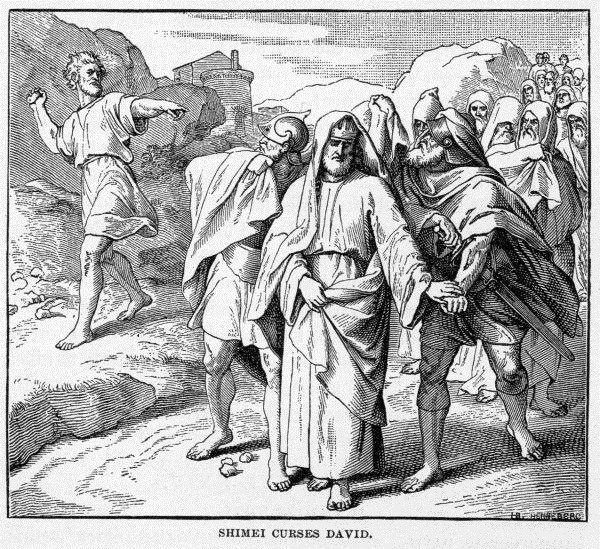
shimei-curses-david

Sometimes the love and grace of God is given to people who are so undeserving that it seems offensive. But Jesus’ love and forgiveness is given time and again to those who don’t deserve it – because no one deserves it. So, if you think you are unworthy, you are correct. But that doesn’t stop Jesus from giving you grace and forgiveness anyway. On the other hand, if his grace offends you, maybe you don’t yet know how much you yourself need it.

To listen to the sermon, click the play button:

To download, right click on the link (or do whatever you do on a Mac) and save it to your computer:
Download 2 Samuel Part 19

The second half of chapter 19 appears to be mostly a detailed record of the political history of that time. This was valuable and significant to the ancient Israelites who lived not long after David’s time. It is still interesting today to historians, and bible-geeks like me. But what is the point of it really?

I know I’ve mentioned this before, but I think it is important to revisit it periodically. We all tend to forget. The Holy Spirit made sure first that this history was written; second, that it was preserved through the years; and third, that it was included in the bible. So there must be some reason for this. There must be some way the Lord wants to speak through it to Christians living today.

Sometimes, in order to hear what the Lord wants to say today, we first need to understand it better. So please bear with me. I think we’ll find some fruitful bible application here if we pay attention to details that might otherwise seem tedious.

Here’s the situation. David’s army has defeated and killed Absalom, who had rebelled against him and set himself up as king in David’s place. There were no computers or telephones or newspapers in those days, so it took a while for the news of David’s victory to spread. Meanwhile, David seems to have waited. This might seem a little bit strange. But remember who David is. He has many faults, to be sure, but he has never grasped at power. Instead, he always waited for the Lord, even refusing to take opportunities to gain the kingdom. So here, he once more waits until he is sure that Lord still wants him as king. He doesn’t want the civil war to continue, so he waits until he is sure he can return in peace. This David once more at his best, trusting the Lord.

The writer of Samuel often makes a distinction between the tribe of Judah and the other eleven tribes of Israel. Often when he writes “Israel” he appears to mean the tribes as distinct from the tribe of Judah. This shows us that there was some tension between those two factions even in the time of David. In the time of David’s grandson, the nation was split. Judah absorbed most of the tribe of Benjamin and became a separate nation named “Judah” (from which we get the word, “Jew”). The other ten tribes formed a kingdom to the north of Judah, which was called “Israel.”

After Absalom’s rebellion, people from the other tribes began talking about inviting David back officially, and officially receiving him once more as king.

Now Israel had fled every man to his own home.  9 And all the people were arguing throughout all the tribes of Israel, saying, “The king delivered us from the hand of our enemies and saved us from the hand of the Philistines, and now he has fled out of the land from Absalom.  10 But Absalom, whom we anointed over us, is dead in battle. Now therefore why do you say nothing about bringing the king back?”

Apparently, the people really had committed to Absalom. They said he was the one they had anointed to be king over them. This wasn’t as strange as it might seem. After all, he was the king’s son and heir. I’m sure many people assumed that sooner or later, Absalom would be king anyway, and why not have him in the full vigor of his youth? But now, he was gone. I would have thought that at this point it was a clear choice to go back to David, but the people still seemed at a loss. Even so, from most of the tribes, sentiment turned back toward David.

But the tribe of Judah did not seem to know what to do. At first, this seems strange, since David was from the tribe of Judah. But then, so was Absalom. Absalom’s rebellion was conceived and carried out in Hebron, the chief city of Judah. His military commander, Amasa, was a relative of his (and David’s) from the tribe. In fact, most of his inner circle were probably from Judah. In other words, although they were David’s people, they were also Absalom’s people, and they were probably chiefly responsible for the rebellion.

David reached out them. He sent a message to the leaders of the tribe of Judah, saying,

‘Why should you be the last to restore the king to his palace? The talk of all Israel has reached the king at his house. 12 You are my brothers, my flesh and blood. So why should you be the last to restore the king? ’ 13 And tell Amasa, ‘Aren’t you my flesh and blood? May God punish me and do so severely if you don’t become commander of the army from now on instead of Joab! ’ ” 14 So he won over all the men of Judah, and they sent word to the king: “Come back, you and all your servants.” (2Sam 19:11-14, HCSB)

As David makes his way back, he is met at the Jordan river by a host of people who want the honor of escorting him to Jerusalem. What follows is a slightly sickening display of sycophancy. People end up arguing amongst themselves about who gets to show David honor, and who is honoring him more (19:40-43).

Along with the leaders of the tribe of Judah, one of the first people to come meet him is Shimei. You may remember him from 2 Samuel 16:5-13. This was the man who cursed David and pelted him with rocks and dust as he fled from Absalom. When David was down, he piled on with insults and taunting. Shimei did not just screw up and make a mistake – what he did was clear and deliberate. Now that David is king again, he comes fawning to him like a disobedient dog, and begs forgiveness. I don’t know about you, but I think that Shimei was pond-scum. His behavior and attitude are despicable, detestable, the lowest and ugliest forms of hypocrisy and cowardice. He is a jerk, plain a simple, the kind of person I want nothing to do with.

And David forgives him.

Stop for a second, and think on that. Let it sink in.

Let’s be honest. David’s forgiveness and compassion are offensive. Abishai, brother of Joab suggests, as he did before, that Shimei would be a more attractive person if his head was removed. I tend to agree with Abishai. But David did not.

Does this remind you of anything? The love and compassion of Jesus were also offensive. The Pharisees were offended that he would eat with tax collectors and known sinners. He allowed a prostitute to kiss his feet in public, and wash them. It offended them.

I think once more, this text is a far-off picture of Jesus, the ultimate anointed savior of God’s people. It isn’t really about David, it is about Jesus, his wisdom and love, and how people respond to him. So let’s consider the rest of this text in that light.

We’ve been talking about Shimei. His sin was obvious and deliberate. There was no excuse for it. It wasn’t a momentary slip. It revealed an ugly character. Even so, David offers him forgiveness and redemption. Jesus does the same. That’s right, Jesus came to redeem and forgive class-A jerks, cowards and crawling hypocrites. It is offensive sometimes, to think Jesus would forgive someone that I want to hate so much. But he does.

Abishai was like me. Shimei’s character was clear to him. He was offended by David’s compassion and mercy. But David rebuked him. Sometimes we really are offended by the idea that Jesus would forgive certain people. Would he forgive a child-molester? Based on what I know of the bible, the answer is “yes.” Jesus is king, and he can forgive who he pleases. He does not answer to us.

But as an illustration, I do want to finish the story of Shimei, though it does not end for many years. When David was dying, he told Solomon to watch out for Shimei. So, even though David forgave him, he certainly saw the truth about what kind of person he was. Solomon made a just and fair ruling for Shimei, allowing him to live in peace if he would show his obedience and faithfulness by never leaving Jerusalem. Shimei ignored that when it became inconvenient, and Solomon had him executed. So in the end, forgiveness did Shimei no good, because he did not allow it to touch his heart and change the kind of person he was.

In the same way, the forgiveness of Jesus does not help those who don’t truly repent, who don’t allow him to work in their lives. Jesus sees all, let ultimate judgment rest with him.

Back to David, the next person to arrive was Ziba. At this point, Ziba was revealed as a trickster and manipulator, because right behind him was Mephibosheth, whom Ziba was supposed to serve. Mephibosheth revealed how Ziba took advantage of his disability, and took the donkey that was supposed to be for him, and told David that Mephibosheth rejoiced over David’s trouble. David does not seem to know who to believe, but he reverses his earlier decision that gave all of Mephibosheth’s land to Ziba. Now, instead, he tells Mephibosheth to divide the land between them. Even so, this amounts to forgiveness for the trickster and manipulator, Ziba. There it is again, that offensive forgiveness.

Mephibosheth’s response shows that his loyalty was always true. He doesn’t care about the land, as long as David is safe, and king again. I mentioned before that Mephibosheth is a great picture of God’s grace. Unlike Shimei, the grace he received through David changed him permanently. He doesn’t just want what David can give him. He wants the best for the king that saved him, and he wants fellowship with him, whether he has blessings from him or not. Mephibosheth rejoiced that David was back and safe, far more than he rejoiced about being vindicated in the dispute with Ziba.

This is an encouragement to me to have a similar attitude. It isn’t about what Jesus can do for me in this life. It isn’t about me getting what I think I deserve, or being proved right. It is about loving Jesus and being in relationship with him. You can’t manufacture that. It only comes when you love Jesus for who he is. If you feel like you lack that kind of love (as I often do), ask the Holy Spirit to give it to you.

One of the people who helped David in his exile was an old man named Barzillai. David blessed him and rewarded him, though again, Barzillai wanted no other reward than the safety of the king, and in fact, was too old to enjoy any of the blessings David wants to bestow. So too, I find it helpful to remember that even though Jesus sometimes offends me by his radical forgiveness of people whom I think are undeserving, he does also love his faithful servants. He does not forget them, or offer them less than anyone else. Maybe, like Barzillai, we don’t enjoy the blessings in the this life. Even so, Jesus offers us blessing and joy that can never spoil or fade.

Another group to consider is the leaders of the tribe of Judah. They made a deliberate choice to follow Absalom instead of David. But before they even repented, David was reaching out to them, forgiving them, restoring them to a relationship with him. So Paul writes about Jesus in Romans 5:

For while we were still helpless, at the appointed moment, Christ died for the ungodly. For rarely will someone die for a just person — though for a good person perhaps someone might even dare to die. But God proves His own love for us in that while we were still sinners, Christ died for us! (Rom 5:6-8, HCSB)

Jesus’ love and forgiveness is given time and again to those who don’t deserve it – because no one deserves it. So, if you think you are unworthy, you are correct. But that doesn’t stop Jesus from giving you grace and forgiveness anyway.

Abishai was not the only one who took offense at the mercy of God that David showed to all who would see. The ten other tribes of Israel were also offended that even though they were the ones who first talked of bringing David back, it was the tribes of Judah and Benjamin who got the honor of doing so.

In Jesus’ time, the Pharisees were also offended at Jesus’ grace. That was because they did not believe they had need of it themselves. I think that may be a key. If the forgiveness and mercy of God to others offends you, is it possible that perhaps you do not realize how much you yourself need that same grace?

Let the Spirit speak to you today.

BUT WAIT…THERE’S MORE!

scroll

At times, we don’t experience the gracious heart of God in daily life, because we insist that God must be gracious in the particular way we want him to

To listen to the sermon, click the play button:


To download, right click on the link (or do whatever you do on a Mac) and save it to your computer:
Download 2 Samuel Part 8
I promised I wouldn’t preach the same sermon yet again, and I won’t. However, I do want to preach this time from the same text as the last sermon. Last time we looked at what this text meant for who we are as Christians, and how we should function as a church. But there is a lot more here to consider as well.

The first thing that struck me when I read this was the safety and freedom there is in living in daily relationship with God. God doesn’t allow our misguided good intentions to go unchecked. Both Nathan and David had their hearts in the right place. They were sincere. Both of them, however, were sincerely wrong. Even so, because they were keeping in step with the Lord, they were able to hear when the Lord corrected them. And the Lord did correct them. He didn’t say, “shoot, they got it wrong again. Oh well.” No, when they didn’t get it right away, he spoke to them again. So we can trust God’s leadership. Picture someone walking with a friend who is blind and using a cane. They come the corner of a street where there is traffic. The friend says quietly, “stop here.” The blind person doesn’t hear it, and keeps walking. Of course the guide is going to repeat himself, more loudly, and maybe even grab onto his blind friend, to prevent him from being hurt. Do we expect any less from God?

Now, one important thing here is that Nathan and David really did want to do whatever God wanted in this situation. They weren’t insisting on their own way. So when they made the wrong choice, they were able to hear the Lord when he spoke to them about it. Unfortunately, sometimes we are like a blind person who says to our guide, “I don’t trust you, so I won’t go where you are taking me.” We ignore Him when he says “turn here,” or “stop there.” Then, sad to say, often we blame God the bad things that result from our unwillingness to listen to him. But when Nathan and David were open, the Lord kept them moving in the right direction, and they were able to hear it.

This is tremendously comforting to me. Sometimes, we get so caught up in wanting to do the right thing that we become almost paralyzed with fear that we will make the wrong choice. We think, “If I screw this up, it will be disaster. I could destroy God’s plan for my life. I could destroy my chance at happiness.” Maybe we’re looking at a job or career move. Maybe we’re buying a house, or choosing a college or deciding what we want to be when we grow up. Maybe we’re trying to decide if we should marry someone or not. Brothers and sisters in Jesus, we can have tremendous freedom, hope and joy in these choices. If we truly want God to do what he wants in and through our lives, then step forward boldly and make your best choice. If you are wrong, the Lord will correct you. We don’t have to be experts at hearing from God. But we have to be open to letting him do whatever he wants. If we maintain that openness, we’ll be able to hear it if we start down a path where he doesn’t want us to go.

The fact that we really can trust the Lord to guide us is wonderfully comforting. It is part of God’s grace. But wait, there’s even more. David, good-hearted man that he was, was thinking like this: “God chose me. He delivered me from Saul. He gave me victory over the Philistines. I have a secure place and even my own palace. God’s done so much for me. Now, I want to do something for God.” So he said, “I will build you a house, God.”

But God said this: “No. I know you want to do something for me. But I want to do more for you. You want to build me a house. Instead, I am going to build you a house.” The word used for “house” is the same all the way through. It is the Hebrew word pronounced “va’yit.” This is a pretty flexible word. It is used for David’s palace, for describing a dwelling and also for family, line of descendants and so on. I think the Lord deliberately inspired the writer to use the same word, in order to emphasize what he was doing. He was piling on the grace.

What God promises is that David will have a descendant who will rule forever. David’s descendant will preside over the kingdom of God. This is a prophecy. Now, I have said before that prophecy is kind of like viewing a mountain range from a long way away. It looks like all the mountains are next to each other in a line across the horizon. But when you actually get into the mountains, you often find a great gap between peaks that looked like they were right next to each other when viewed from a distance. In the same way, it looks like all parts of the prophecy are supposed to take place at the same time; yet when it comes you find that parts of prophecy were fulfilled a few years after, and others hundreds of years later. Here, the prophecy is not a perfect revelation. But it shows that there will be a descendant of David who reigns forever. This descendant will be chastised and punished – just as Jesus was punished for our sins. God will do something eternal through this person. There are a few things here that may refer to Solomon, but clearly, the prophecy is talking mainly about Jesus.

God didn’t just say that David was his favorite choice for king. He didn’t just give him victory over a giant. He didn’t just take care of him in those years of hardship and trouble. He didn’t just protect David during battle and make him victorious – often against overwhelming odds. He didn’t just actually make David king. He didn’t just deliver David from his enemies and give him a secure place to live and rule. He also promised (and delivered generations later) that David’s name and family line would be honored forever. He promised that the messiah would be descended from David. He is showering grace after grace upon David. You can’t out-give God.

David, understandably, was overwhelmed. He went and “sat before Lord.” And then he prayed. David says something very important in verse nineteen that seems to be lost in translation in many English versions of the bible. He says,

What You have done so far was a little thing to You, Lord GOD, for You have also spoken about Your servant’s house in the distant future. And this is a revelation for mankind, Lord GOD. (2Sam 7:19, HCSB)

In the NIV this reads: “Is this your usual way of dealing with man?” In the NAS it says “And this is the custom of man.” But the literal Hebrew says this: “And this the torah mankind, Lord God.”

The Hebrew word “torah” has various related meanings, as many words do. It can mean custom or rule. But the most common meaning is “law of God.” In fact, during the time of Jesus, torah is one of two terms that describe God’s revelation in the Bible. When a Jew said “the torah (law) and the prophets” he meant “the word of God as revealed in the bible.”

So what David is really saying here is also a kind of prophecy. He is saying that this promise of the descendant who will come – this promise of a messiah who will reign forever – is God’s very word for mankind. It is a law and a promise for all humanity. The gospel of John describes the Messiah (Jesus) like this:

In the beginning was the Word, and the Word was with God, and the Word was God. (John 1:1)

And the Word became flesh and dwelt among us (John 1:14)

One thousand years before John, in this text, David said, “this promise of a Messiah is the Word of God.”

In verse 21 David says this:

Because of your promise, and according to your own heart, you have brought about all this greatness, to make your servant know it.

This shows us that the promise is according to God’s own heart. Some translations have “will” but “heart” is more literal. This promise reveals the generous, gracious, loving, wise heart of God.

So let’s make this personal right now. Do you believe that this extreme graciousness is according to the heart of God? Even more personal – do you believe that this great grace is the way that God deals with you?

Let me remind you about David. He lied in a moment of pressure. He blew his top when he was insulted. He ignored what God said about marriage. He was not perfect. God was not gracious to David because David deserved it. David did not deserve it. God was gracious because that is the heart of God.

So set aside any thought of “well, I don’t deserve God to treat me that way.” Of course you don’t. Neither do I. Neither did David. Do you understand and believe that if you let him, God will deal with you in the same way he dealt with David?

I would guess that a lot of us don’t experience God in this way, and sometimes we believe that we cannot. There are reasons for this.

At times, I think we don’t experience the gracious heart of God in day to day life, because we insist that God must be gracious in the particular way we want him to. We want a better income, and so if he doesn’t do that, even though he is offering us tremendous joy through relationships with dear friends, we don’t really receive that grace. We want healing, and so we spurn the grace he offers us to grow and have joy even in pain. We want our spouse to change, and so we don’t want to receive the grace the Lord offers us through that person – just as he is. When we have an attitude of entitlement – “God must provide grace in exactly the way I want it” – it is difficult to really receive.

Jesus was full of sorrow at the way so many people refused the grace he has to offer:

37 “Jerusalem, Jerusalem! She who kills the prophets and stones those who are sent to her. How often I wanted to gather your children together, as a hen gathers her chicks under her wings, yet you were not willing! (Matt 23:37, HCSB)

At other times, we don’t recognize the gracious heart of God because we have allowed lies about God into our lives, especially through difficult events. A child dies. A spouse leaves. And we interpret those events in such a way that we begin to distrust the heart of God. The first problem creeps in when we insist on understanding everything. Why did the child have to die? I’m not saying we can’t ever honestly struggle with our pain, but I do believe that sometimes the answers to those questions are simply bigger than we can understand. When we demand that everything must make sense in a way that we can understand, it is easy to start to believe that God isn’t the good Person that the Bible tells us he is. Don’t get me wrong. If you follow this blog, you know I am an intellectual, and I’m all for using your mind. But the human mind is finite. Trying to understand an infinite God is not logical. At times, faith calls us to trust even beyond our understanding. When we can’t understand, we are faced with a choice – will we trust that God’s heart is good and gracious towards us in ways we can’t comprehend, or will we demand that the universe function according our own personal sense of justice and goodness? This text calls us to trust is that the heart of God is good and full of gracious intentions for us.

Professional Level Prayer?

prayer

Too many Christians pray out loud in ways that are downright silly. We use fancy words. We repeat ourselves like idiots. Jesus told us not to do that. He taught us to pray simply and directly.

Next week, I’ll preach a real sermon again. This week we did some work-shopping in church about sermon from last time. So for the blog, I’ll post some thoughts I’ve been chewing on lately.

I’ve spent a fair amount of time lately, thinking about how people pray publicly. It’s a bad habit I have. What strikes is me is how common it is for Christians to ignore what Jesus said about public prayer. And the worst offenders are usually the “very holy and mature” believers. This often makes other Christians feel unworthy and second class, because they can’t pray like these believers who really know how to “pray up a storm.”

I recently took a Sunday off and attended a different church. They had a guest speaker who was very inspiring and entertaining. Afterwards, he invited people up for prayer and ministry. He had them stand in a group, and he prayed over them through the microphone. He probably prayed for five or ten minutes. His prayer was powerful – at least externally. His prayer was full of emotion. His prayer was full of words. His prayer wore me out, and I wasn’t even one of the people who went up for ministry.

I am continually struck by the widespread ignorance among “mature” Christians concerning Jesus’ own words about prayer, and about Jesus’ own actions when it came to bringing healing and deliverance.

Here’s what Jesus said:

1 “Beware of practicing your righteousness before other people in order to be seen by them, for then you will have no reward from your Father who is in heaven. (Matthew 6:1)

5 “And when you pray, you must not be like the hypocrites. For they love to stand and pray in the synagogues and at the street corners, that they may be seen by others. Truly, I say to you, they have received their reward. 6 But when you pray, go into your room and shut the door and pray to your Father who is in secret. And your Father who sees in secret will reward you.

7 “And when you pray, do not heap up empty phrases as the Gentiles do, for they think that they will be heard for their many words. 8 Do not be like them, for your Father knows what you need before you ask him. (Matthew 6:5-8. Followed by the Lord’s Prayer)

Let me tell you, I’ve heard a lot of people pray in a way that seems aimed at showing others that they are good at it. I’ve heard an awful lot of empty phrases and extra words heaped up over the years. I have several thoughts about this.

First, I wonder this: do these people even know that Jesus said these things? These words of Jesus come from one of the best known portions of scripture: The Sermon on the Mount. Specifically, Jesus spoke them right before “the Lord’s prayer” in Matthew chapter six. So these people who pray such impressive sounding prayers may actually be very young in the faith and even ignorant of the bible. If you hear someone praying in a way that seems designed to impress others, you should understand, that is not the prayer of a mature believer. If you hear someone heaping up words and fine-sounding phrases, that person still has a lot of growing to do. Don’t be intimidated by them. PLEASE, don’t feel like you have to copy them.

Now, I have no doubt that some of these professional-level creators of empty phrases know what Jesus said. If so, then they are being disobedient. They are like Moses, who didn’t believe it was enough to simply speak to the rock, but also had to put on a show, striking the rock twice and acting out in front of the Israelites (Numbers 20:1-12). Jesus said, do not be like them. Do not be like the people who think they will be heard because of their many words. Do not be like the people who heap up empty phrases when they pray. And yet so many Christians – even leaders of churches and ministries – are exactly like this when they pray.

Another question is raised in my mind. What kind of relationship do these folks have with Jesus that they talk to him in this way? Jesus invites us into an intimate, real, loving daily relationship with himself. He came explicitly to remove the barriers between us and God. Yet when people heap up these empty phrases and pray impressively in front of others, it doesn’t sound like they are particularly close to him. I have never, not even when I was very young, gone to my human father and spoken like this:

“Father, Oh Father who gave birth to me; Father you have provided for me, father; Father, I just want you, father, to reach out, father, and touch me father, and just give me a peanut butter sandwich. Because, father, you are the king of peanut butter sandwiches. As far as I know, you invented peanut butter. As far as I know, you invented bread. You are the one who feeds me, you are the one who makes the money, and then you take the money and deposit it in the bank, O father, because you are wise. And then father, you take your debit card, and you are the one who goes to the store, you are the one who buys the bread and the peanut butter. You might buy Jiffy, or Peter Pan or even the generic store brand father, but you are the one who does it. And then you take it home in our 2005 Buick, father, because in your wisdom, that is the car you chose to purchase. And then father, you are the one who takes the bread, and the knife and the peanut butter and creates the sandwich, all for me. Even though I don’t deserve it father, because I failed to clean my room this morning. From my birth you have been giving me these delicious sandwiches, father, and I want you now father, to give me another one. Peanut Butter. Oh I ask you for peanut butter. I yearn for peanut butter, father. Peanut butter; peanut butter; peanut butter.”

If I did speak to my earthly father in this way, what would it say about the kind of relationship I have with him? Unless I was joking around with him, it would reveal that our relationship is strange and twisted; almost certainly unhealthy. This kind of talk shows that I

don’t interact at a very intimate level with my father. In fact, it strongly suggests that I am very uncomfortable relating to him. I am speaking to him in a way that I would never use to speak to a close friend. It unveils a belief that I think I must use a lot of words and a lot of inane flattery to get him to do what almost any other father would do if his child simply said, “Dad, could you make me a peanut butter sandwich?” Jesus said much the same thing:


11 What father among you, if his son asks for a fish, will give him a snake instead of a fish? 12 Or if he asks for an egg, will give him a scorpion? (Luke 11:11-12).

These long, repetitive, wordy prayers are either mere show for others, or they reveal a distant, impoverished relationship with God that is completely unlike the one that Jesus came to give us.

Now, I have had conversations with people who make the point that sometimes we are praying not just to God for ourselves, but to God on behalf of others and in front of others. Therefore, the way we pray out loud can be used to encourage those around us. I agree with this entirely. Jesus prayed out loud to encourage his followers in their faith. Here is one example:

“Father, I thank You that You heard Me. 42 I know that You always hear Me, but because of the crowd standing here I said this, so they may believe You sent Me.” 43 After He said this, He shouted with a loud voice, “Lazarus, come out! ”

This doesn’t sound much like most of the public prayers I hear in churches and prayer meetings. It’s simple. “Father, I am praying this out loud so others can hear and believe that you are working through my prayer.” Then the ministry time, the altar call for all who need a resurrection in their life. It consists of three words. Three.

You see, if we are praying out loud to encourage others to put their trust in Jesus and to get closer to him, we should consider if our words actually do that or not. A long prayer with a lot of empty and fine sounding phrases – what does that communicate to those who listen? I think it gives listeners these kinds of ideas:

Prayer is a skill. It takes a lot of work. It takes a lot of repetition. We can’t just ask for what we need – we must set it in a context, we must use holy words and phrases, we must prove our earnestness by making it long. We need to keep talking to make God show up and do something.

In fact, Jesus didn’t pray that way, and he didn’t teach us to pray that way either. To repeat:

Do not be like them, for your Father knows what you need before you ask him.

So if you are praying out loud to benefit others (which I agree is a good thing) remember – it does NOT benefit others if you are praying like a pagan with a lot of fancy words and fine phrases. It doesn’t benefit others to make prayer sound like a professional-level skill.

We often make the same mistakes in prayer and altar ministry. I am continually struck by the fact that when I offer to pray for others, either God will show up, or he won’t. For example, I’ve prayed for many people to receive the gift of tongues. Many times, the Lord has given the person I’m praying for that gift. Sometimes, he has not given it. Whether it happens or not, I always pray basically the same prayer: “Lord, please give (name) the gift of tongues right now. Amen.” Our Father knows if the person needs the gift or not. I don’t have to stand there thinking up words to say while God makes up his mind. If he wants to do it, he does. If he doesn’t, my long winded prayers won’t change his mind.

Look at the way Jesus did ministry:

“Lazarus, come out.” (resurrection ministry)

“Get up and walk” (healing ministry)

“Little girl, get up” (resurrection ministry)

“Thank you father for the food. Please bless it” (providence ministry for five thousand)

“Come out of him,” (deliverance ministry)

“Receive the Holy Spirit (baptism in the Holy Spirit)

In these examples, Jesus uses an average of eight words. I have to admit, I made up the prayer about the feeding of the five thousand – it could have been a lot longer. Or a lot shorter. But the others are verbatim quotes from the gospels. Jesus is simple and direct.

You see, I think we, like Moses, are afraid to leave it that simple. If we keep talking, maybe God will show up just to make us quit. Or, if we keep talking, maybe we can cover up the fact that no one is getting healed tonight.

Thus, our ministry times often reflect a confusing contradictory message. The overall gist of it goes like this: “God has a gift he wants to give you now. He wants to give it to you, so come up to receive it. Now, once you come up to receive it you can’t just receive it. We have to work hard and pray long so that you can get it.”

Jesus never did ministry that way. The disciples after Pentecost never did ministry that way. And the fact that so many churches do engage in ministry that way sends the wrong message to people about prayer and about Jesus himself.

I think two of the biggest causes for this kind of praying and ministry are fear and self-reliance. If we keep it short and simple, will God really do it? Maybe if we pray long and hard, we can kind of motivate God to do what we ask. We are afraid to simply say, “Jesus come and do this please,” because what if he doesn’t? The reason that scares us is because we have forgotten that this is all about him, not us. We will end up looking silly if we speak less than fifteen words during our ministry time and nothing happens. But it isn’t supposed to be about how we look. It is supposed to be about what Jesus wants to do.

And so we buy into the idea that a longer, better-sounding prayer is in fact a better prayer. Because that gives us a measure of control. We start to believe we can make it happen if only we pray correctly. We want to believe that we can do something to make God show up. Because doing something is easier than waiting quietly in faith.

Most of the people I know who pray and do ministry with heaps of empty words are good-hearted people. I believe that many of them have a much closer relationship with Jesus than their prayers would lead you to suspect. But I think they are sincerely misled in this matter. Maybe you have been too. It isn’t complicated. Jesus made it quite clear in his teachings and in his examples: Keep it short and simple and trust God to do what you are asking.

The church is STILL not a building!

For the first time ever, I actually preached the same sermon twice in a row. This is because I believe in this so strongly. If you want to hear the second sermon rather than the first, here it is

(the written version is the same, and can be found at https://revth.wordpress.com/2012/07/21/the-church-is-not-a-building/)


To listen to the sermon (the second time through), click the play button:

To download, right click on the link (or do whatever you do on a Mac) and save it to your computer: Download 2 Samuel Part

Is Jesus Really King?

Mt Zion

Christianity isn’t about gritting our teeth and trying to be good. It is about surrendering to Jesus as the king of our lives.

To listen to the sermon, click the play button:

To download, right click on the link (or do whatever you do on a Mac) and save it to your computer: Download 2 Samuel Part 4

2 Samuel #4 . 2 Samuel Chapter 5.

After Abner died, his coalition fell apart, and the leaders of Israel came to David to ask him to become their king. 1 Chronicles 12:23-40 describes this incident in more detail than 2 Samuel 5. (By the way, it appears that the books of Samuel are more chronologically-oriented than 1 Chronicles. Also, the writer of Samuel is far more critical of David than the writer of Chronicles.) In Chronicles, specific leaders and groups of leaders are named, showing that a large number of influential people from all twelve tribes came to make David king. Chronicles records that they feasted and celebrated joyfully.

Back to the text in 2 Samuel. These leaders gave three reasons why they wanted to finally receive David as their king. First, they said, “you are our flesh and blood.” They were saying, “you aren’t a foreigner, that we should fight you – we are all Israelites after all. Judah is part of Israel.” They were recognizing that Saul’s attitude was wrong.

Second, the leaders said to David, “you were the one who used to lead us out to battle, and bring us back safely.” They are remembering his faithful service to Saul, which perhaps David thought had gone forgotten and unrewarded. David had already been their leader in the past, though that service was not officially acknowledged up until now. As a leader, he had accomplished great victories, and brought the troops back more safely that he would have in defeat.

Finally, they were acknowledging that God himself had chosen David to be their king. They were at last submitting to God’s plan for his people. They said: The LORD also said to you, ‘You will shepherd My people Israel and be ruler over Israel.’ ” They are acknowledging at last that God had a call on David’s life, and it was God’s will for him to be their king.

As always, I think it is helpful when we read to the Old Testament, to ask “where is Jesus here? How does this reveal Jesus to me?” Well, Jesus, is the rightful king of every Christian. That is God’s desire for us. He should be the ruler over everything in our lives. But even though David was chosen by God to be the king, he waited patiently until the people accepted that and submitted their lives to him joyfully. Even though the Lordship of Jesus is God’s will for us, we have not all submitted to that. Jesus is waiting patiently for us to submit all areas of our lives joyfully to him. Does Jesus determine how you spend your money? Does he determine how you spend your time or energy? Is it the words of Jesus that you speak to you family and friends and co-workers?

Jesus should be king over our lives for some of the same reasons that Israelites gave for submitting to David. Jesus is fully God, yes, but it is also our flesh and blood – he is fully human, just like us Hebrews 2:14-18 says:

14 Now since the children have flesh and blood in common, Jesus also shared in these, so that through His death He might destroy the one holding the power of death — that is, the Devil — 15 and free those who were held in slavery all their lives by the fear of death. 16 For it is clear that He does not reach out to help angels, but to help Abraham’s offspring. 17 Therefore, He had to be like His brothers in every way, so that He could become a merciful and faithful high priest in service to God, to make propitiation for the sins of the people. 18 For since He Himself was tested and has suffered, He is able to help those who are tested. (Heb 2:14-18, HCSB)

Jesus is our flesh and blood. He belongs to us and we to him. In Jesus, God became more accessible, more understandable, by taking on, forever, human nature. He has a right to be king of humans, because he is a human. He can sympathize with us and understand our struggles.

Second, Jesus is originator and creator of everything. He is our protector and sustainer. He has already helped us, already served us, already kept us safe. He has already suffered and died on our behalf. By virtue of how he has already served us, he deserves to be our Lord.

Finally, it God’s desire that we surrender entirely to Jesus (Philippians 2:9-11). He is the rightful and chosen king of our lives. This is God’s desire – that we allow Jesus to live his life through us, as the owner of our lives. If you feel a little frustrated for David that it took the Israelites so long to accept what God was doing, consider accepting what God wants for your own life!

Verses 6-12 of 2 Samuel 5 tells us about Jerusalem. Up until that time, Jerusalem was controlled by a pagan tribe of people known as the Jebusites. They were a sub-tribe of Amorites – one of the non-Israelites tribes that the Israelites were supposed to conquer and drive out. However, there were steep ravines to the south, west and east of Jerusalem, and at the top of the slope, the walls began.

Jebusite Jerusalem Diagram

It was a formidable fortress. The Israelites had defeated several kings of Jerusalem and had burned the city itself once (perhaps before it had walls), but they had never managed to capture it and hold it. Now, with walls, the Jebusites are confident that no one could take it. We should understand that it was much smaller in those days. The Jebusite City of Jerusalem covered only about 12 acres on the very top of the end of the ridge. This area is known as Mount Zion. In the following years, the city spread out greatly, and in modern times, Mt Zion is just one hill in the very large metropolis that is Jerusalem.

In spite of its reputation and history of being impossible to conquer, one of David’s first acts as king of all Israel was to attempt it. David shows here that he is smart and cunning, as well as courageous and strong. Water for the city was collected from the spring of Gihon, which was near the bottom of the Kidron valley, on the east side of the city.

waterway diagram jerusalem

There was a shaft or tunnel that went through the hill down to the spring, so that the Jebusites could get water without going outside the city walls. David learned of this. It is quite possible that he observed Jebusites drawing water there back when he was worshipping God at the tabernacle, when it was kept across the Kidron valley, at Nob (now known as the Mount of Olives). In any case, he determined that the way to take the city was to infiltrate men up the water tunnel. It was a very narrow space, and the men would certainly have had to go one by one, gathering at the top before the assault. That is what David did, with his nephew Joab leading the way and killing the first enemy. By doing that, Joab cemented his position as commander of David’s armies. The city fell without any destruction to the walls, and David made it the new capital of Israel.

These are the actions of a brilliant leader. First, it was terrific military strategy to make use of the water shaft, and attack the Jebusites from within the city. Second, Jerusalem was still an impregnable fortress, an excellent choice for the seat of government in troubled times. Afterward, David built towers covering the entrance to the water shaft, so no one would take the city the same way he had.

Third, it was an extraordinary diplomatic move. David was from the tribe of Judah and up until this time, his capital was a city of Judah. Saul had been from Benjamin, and had made his home town into the center of power. But Jerusalem did not belong to any of the tribes – it was held by the Jebusites. So when David captured it, it became truly an Israelite city. No tribe could claim it, and no tribe would be offended that it was the capital city. It belonged no one, and yet at the same time, to everyone. It was not quite centrally located, but it was close.

By the way, some secular archaeologists dispute the existence of David (they choose to ignore the incredible documentary reliability of the Old Testament). However, a water shaft from the spring of Gihon leading up to Mount Zion was discovered in the 1860s. It doesn’t have David’s name on it, of course, but once more, the Bible told us of it before archeologists discovered it. joab_water_shaft

In the 1980’s archaeologists were convinced that this shaft was dug after the time of David. But more recent work suggests that the water tunnel originally occurred naturally, long before David’s time. It also now appears that it being used by humans before the time David came along.

The point is, the book of Samuel describes things that are actually still there. In a sense you might say that if the bible is right, there should be evidence of a water shaft in that location, and sure enough, there is not only evidence, but the actual tunnel itself.

Now, once more, let’s ask the question: How does this part of the text reveal Jesus to us? What does it say about him, or our relationship with him?

Sometimes we really want Jesus to be king over all our lives, but there are parts our lives that seem like they will never be changed. Maybe you think you will never be able to stop drinking. Some folks struggle with other particular sins that they feel they can never conquer. Perhaps you think, “I am a person who easily gets depressed. That’s just who I am. Nothing is going to change that.” Or, “I’m angry. That’s just my nature, and it’s never going to change.” We might feel like there are parts of our lives that Jesus simply won’t be able to conquer, places where we just can’t let him be king. Maybe you feel like that about some loved one in your life. You think “Jesus can never get into his life.”

The Jebusites thought they were invulnerable. They had an impressive fortress. But one crack, big enough to fit one man at a time, led to their downfall, and then the city belonged to the king. Jesus is a warrior like David. He is wise and cunning like David. If there is just one little crack, one place where you can say “yes” to Jesus, he can exploit it, and use it to conquer the evil in your life. He can get to people that you think are invulnerable to him.

So if you are concerned about someone else in your life, I say trust him. Ask him to do his work on your loved one. And if the problem is in your own life, I say, simply give him a “yes.” Find some way to say “yes, Jesus. I don’t think I can ever give up drinking [or whatever], but I give you permission to try and take over that part of my life.” Watch what he can do if you just give him the tiny crack of your willingness.

So, where you can, welcome Jesus as your king. Surrender your life to him, submit to him. Let it be his life from now on. And where you can’t do that, where there is a fortress around your heart, just give him a tiny crack. Just be willing for him to make the attempt.

How is the Holy Spirit speaking to you today?

RELIGION WITHOUT RELATIONSHIP IS DEADLY

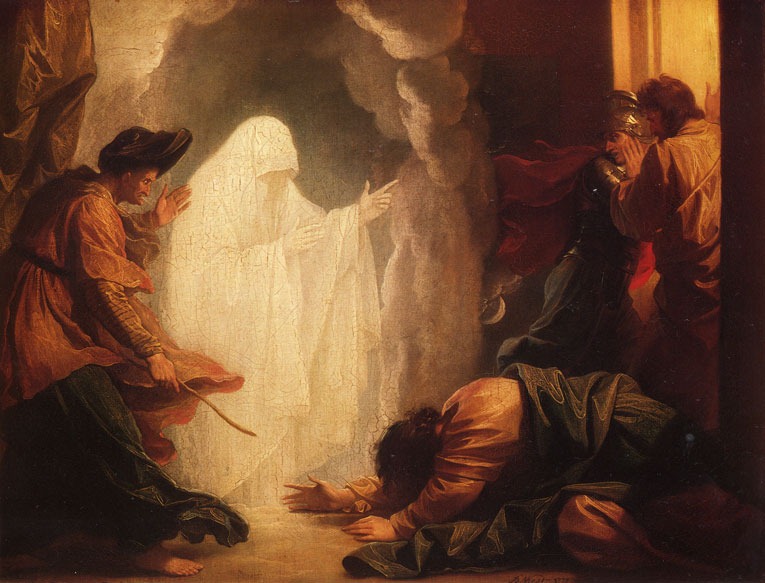
witchofendor2

Saul begins to reap the deadly benefits of religion without relationship.

To listen to the sermon, click the play button:

To download, right click on the link (or do whatever you do on a Mac) and save it to your computer: Download 1 Samuel Part 27

1 SAMUEL PART#27. Chapter 28

Remember all that we have learned about king Saul. One of the most important things we discovered is that he was a religious man, but not a man of faith. Time after time, when he felt he could somehow use or exploit God, he did so. But when he was confident in himself, or when he felt that God had nothing to offer him, he ignored God. He had the trappings of religion and he used them to control others and manipulate God. But he did not live in a day to day walk of faith, trusting God in all things, relating to him, loving him. The depths of Saul’s spiritual poverty are revealed in 1 Samuel chapter 28.

Saul, having no real trust in God, was terrified when he saw the Philistines. Now consider something. Every time Saul was involved in a battle with the Philistines up to this point, God saved the Israelites. The Lord used Jonathan in chapter 13, and David in chapter 17, and several other times. But none of that seemed to make any difference to Saul. He was just as scared and faithless as he had always been.

I want to pause and say something about that here. Sometimes we think that if God just did a miracle for us, then we would really trust him. If we saw the Lord do something really great, then we wouldn’t doubt, then we wouldn’t disobey or draw back in fear. But that wasn’t the case with Saul. God’s previous miracles didn’t matter. The same was true with the first Israelites who came out of Egypt. They saw many miracles. Their food and water were daily miracles. And yet it did not help them to have faith and surrender to the Lord.

Jesus addressed this issue in his own ministry. Though he did many miracles, often people came and demanded miracles on the spot – basically asking him to prove himself to them. Jesus addressed this Luke 11:27-29:

27 As He was saying these things, a woman from the crowd raised her voice and said to Him, “The womb that bore You and the one who nursed You are blessed! ” 28 He said, “Even more, those who hear the word of God and keep it are blessed! ” 29 As the crowds were increasing, He began saying: “This generation is an evil generation. It demands a sign, but no sign will be given to it except the sign of Jonah. (Luke 11:27-29, HCSB)

John records that many miracles (‘signs’) still did not convince people who did not want to be convinced:

37 Even though He had performed so many signs in their presence, they did not believe in Him. (John 12:37, HCSB)

In another place, Jesus told a story about a poor man named Lazarus, and a rich man. At the end of the story, the rich man found himself in hell. He begged that someone be sent from heaven to tell his family the truth about the afterlife. Jesus concludes the story like this:

31 “But he told him, ‘If they don’t listen to Moses and the prophets, they will not be persuaded if someone rises from the dead.’ ” (Luke 16:31, HCSB)

When people in the New Testament say “Moses and the Prophets” they mean “the bible” since that was as much Bible as they had at that time. What Jesus is saying is this: if you don’t trust God’s word and the promises in scripture, no amount of miracles will cause you to trust.” The problem can’t be fixed by a miracle. That is both hard and good for us to remember. Seeing is not believing. With God, believing is seeing.

So Saul, in spite of all that he has seen God do, is a religious pretender, not a man of real faith. Therefore, now, facing the Philistines, he is quaking in fear. It says that he inquired of the Lord. As before, Saul doesn’t go to the Lord unless he thinks God can do something for him. So now, he inquires of the Lord only out of fear and a desire to manipulate God. It doesn’t tell us what Saul was asking God. I think it is most likely that he made an animal sacrifice to the Lord, and was hoping for some prophecy that God was pleased with the sacrifice, and would give Saul the victory. But he didn’t hear anything by way of the “sacred dice” (the urim and thummin) or through prophets, or in dreams. Basically, Saul is demanding another sign here, before he will really trust God. He has had God’s help all his life, but he still won’t trust the Lord without some kind of additional sign.

God has been working on Saul all of his life. Remember how he called him to be king? Remember how he gave him the victory at Jabesh Gilead? Remember how even after Saul proved to be useless to God, God kept pursuing Saul’s heart, sending him a troubling spirit to get him to turn to the Holy Spirit for relief? Saul has had decades to surrender his heart to the Lord. The Lord has never quit trying to win him over. I think this lack of a sign is one more chance for Saul to surrender his heart. The Lord has put him in a crisis where he has the same two choices he has always had: 1. Trust God, or 2. Manipulate God and other people to control his own destiny, and get the outcome he wants. Before this, Saul has always chosen #2. He doesn’t know it, but this will be his last chance to give his heart to the Lord.

Tragically, Saul once again chooses to try to control his own life and outcomes, rather than trusting God. When he doesn’t hear from the Lord, trust is not even an option. Saul simply must find some way to manipulate God into saying what he wants to hear, or doing what he wants God to do. So he seeks out a medium, or witch, or spiritist, or whatever you want to call it.

Deuteronomy 18:9-14 says this:

10 There shall not be found among you anyone who burns his son or his daughter as an offering, anyone who practices divination or tells fortunes or interprets omens, or a sorcerer 11 or a charmer or a medium or a necromancer or one who inquires of the dead, 12 for whoever does these things is an abomination to the LORD. And because of these abominations the LORD your God is driving them out before you. 13 You shall be blameless before the LORD your God, 14 for these nations, which you are about to dispossess, listen to fortune-tellers and to diviners. But as for you, the LORD your God has not allowed you to do this.

These practices were part of the reason for Holy War, which Saul failed to carry out as king. Not only were the people of God not supposed to do these things, they were supposed to wipe out those who did. Such things separate people from God and put them under the influence of hell. Saul did make some attempt to stamp out the practice of the occult, but obviously he wasn’t entirely successful. And now he is willing to deliberately abandon faith in God, abandon his previous laws against these things, and seek help from the dead.

Here is the final proof of Saul’s internal condition. Religion is just something to be used and manipulated, and if one approach doesn’t work to accomplish his aim, he’ll try another. So he and a few of his men disguise themselves and go to the witch. The disguise is actually pretty pathetic. The woman lives not far from the battlefield. Her visitor is the tallest man she’s ever seen, and he wants to talk to the ghost of the prophet Samuel. It doesn’t take a genius to figure out it is Saul. So at first she thinks it is a trap. Then when she is convinced, she pretends that the ghost of Samuel told her who Saul was.

Now it is natural to wonder, what really happened here? Was the woman a charlatan who made it all up? Was there really a spiritual presence there? And if so, was it really Samuel?

To answer that, we need to consider what the Bible says about life after death. Certainly, the entire New Testament teaches that at the end of time, there will be a judgment day. Those who rejected Jesus will be thrown into a lake of fire with the devil and his demons. Those who receive him will be physically resurrected to an eternal, joyful existence.

But there is that period of time in between. Samuel was in the period, as is every person who has died up until today (except for Jesus). Some people believe that in that “between-time,” you are unaware of existence until judgment day, at the end of time. Others believe, as I do, that there is a period of time when dead souls are either with Jesus in joy and freedom, or in hell. The presence of Moses and Elijah with Jesus in Matthew 17, suggests this very strongly. Jesus painted this picture of life after death in his story of Lazarus and the rich man. Revelation 6:9-11 shows people who have died, yet are aware and are waiting for the final judgment day and the resurrection. Actually several passages in Revelation suggest that there is life with Jesus between death and the physical resurrection that will occur at the end of time.

Therefore in order to believe that it really was the spirit of Samuel, we have to believe that some people on earth – mediums, fortune tellers etc. – have the power to pull people out of the presence of God and back to earth so we can talk to them. I don’t buy it for second.

There is another reason to believe that this was not really Samuel. God chose not to answer Saul when Saul wanted some reassurance. He did not answer through the urim, or through the prophets or in dreams. If God would chose not to speak to Saul through these holy and righteous means, why would he then work through the unrighteous means of a medium – basically rewarding Saul’s wicked behavior?

Even beyond these most significant facts, there are other things in the text which suggest that this was not Samuel. Saul himself could not see the spirit – he had to ask the medium what he looked like. Her reply was very vague: “An old man wearing robes.” That’s pretty much how I picture Samuel myself. Saul accepted this description as true, but there is nothing in it that actually identifies Samuel personally.

Finally, there is the message that Saul got from this apparition. Once again we need to question why God would speak through this illegitimate means after not answering by any legitimate route. But secondly, listen to the tone of the message. It is angry, bitter and hopeless. There is no encouragement. There is not even any opportunity for repentance. Not too long after this, Saul becomes wounded and commits suicide, rather than fight on with courage. I personally believe that his encounter with this evil spirit contributed to that act.

I do believe that there was something spiritual going on here – something creepy and utterly evil. Remember the other Saul, in the New Testament, the one who repented and came to Jesus, and later was known as Paul? He encountered a girl who could tell the future. But it was an evil spirit that gave her the power of limited fortune telling (Acts 16:16-19). I met someone once, who used to be involved in fortune telling, and spirit communication for money. She became a Christian and rejected all that. We asked her what was involved in it. She said that sometimes, she was just tricking people by being observant, and making vague statements combined with educated guesses. But she also told us that sometimes, she was aware of a spiritual presence which gave her information – which she now realizes was a demon.

I personally believe that Saul unknowingly sought (and received) an audience with a demon, masquerading as Samuel. Saul was rewarded with the kind of the thing you would expect from a demon: condemnation and hopelessness. By turning to witchcraft and séance to try and control his life, he was turning his back utterly on God and seeking help from hell. And he got exactly what you might expect from hell.

So where to do we go with this text?

First, if this isn’t too obvious, don’t play around with séances, spirit-guides, mediums, psychics and so on. That stuff comes straight out of the pit of hell, and you are inviting the depths of hell into your life if you fool with it. Saul’s results were dramatic and self-destructive.

I find some reminders here about religion. There are many people like Saul who go to church and talk the religious talk as a way to manipulate God or influence others. It became a way of life for Saul, and ultimately it destroyed him. God never gave up on him, but by his empty religious spirit, Saul took himself out of God’s jurisdiction. I hate religion. I love Jesus, but I hate religion. I think maybe God hates it too. Religion is about appearance and manipulation. Real faith is about surrendering your heart to the One who created you, and cares about you more than anyone else in the universe. Saul had plenty of religion. David had faith.

There is also a caution here about how you view miracles. I’ve seen miracles. I love it when God does them. But my faith does not depend on them, and I know I cannot demand them from God, on my cue. We sometimes think (like Mike and the Mechanics) that all we need is a miracle. Not so. All we need is the Lord, and to get him all we need is faith to believe he is there and to trust him. Miracles are real, and great, but if we make them necessary to trusting God, we are in trouble. Jesus himself warned against that attitude.

I think there are many times when we get ourselves into situations like Saul’s. We come face to face with a problem. We can try to manage and control life ourselves; or we can trust the Lord and surrender to him. I pray that we make the second choice, not the first.

I guess the main message is the same message we hear over and over through scripture: Trust the Lord. Base that trust on his word and his promises, not on anything else.

RESURRECTION LIFE: ARE YOUR DREAMS SHATTERED?

How do you react to broken dreams? Do you seek life in things and people apart from Jesus, or do you recognize that True Life is only in him. We have movie clips this, so enjoy the message!

To listen to the sermon, click the play button:

 
To download, right click on the link (or do whatever you do on a Mac) and save it to your computer:
Download the Easter Message


It’s always a challenge for me to preach about the Resurrection of Jesus. It is the central truth of our faith. Jesus physically rose from death; you either believe it or you don’t. In the past I have offered many facts and logical arguments that tell us it is reasonable to believe it. But this year I want to look at the difference it makes in our lives. It makes a huge difference in eternity, of course – the difference between heaven and hell. But it starts to make a difference right now, in the choices we make, and in how we deal with disappoint and grief here in this life.

One of my favorite movies of all time is Cast Away starring Tom Hanks. Hanks’ character, named “Chuck,” is on the verge of proposing to his girlfriend Kelly, the love of his life. But he has to take a business trip first. Over the Pacific Ocean, his plane goes down. He survives the next four years completely alone on a deserted island. Finally, he is rescued. But four years with no word is a long time. When he returns, he finds that everyone had given up on him, and considered him dead. Even his true love Kelly, had mourned him, and then moved on. She is now married, with a toddler.

Naturally, when Chuck returns – from the dead, so to speak – it is traumatic to both of them. Chuck drives to see Kelly at her house in the middle of the night, as the rain pours down. They both say goodbye in a heartbreaking scene, where much is left unsaid. Then, as Chuck pulls down the driveway, Kelly comes running out in the rain, calling his name. They stand in the rain, hugging and kissing. Then Kelly says:

“I always knew you were alive, I knew it. But everybody said I had to stop saying that, that I had to let you go.” Kelly pauses while they stare at each other. “I love you. You’re the love of my life.”

After another long pause while they look at each other, Chuck says, “I love you too Kelly, more than you’ll ever know.”

They get into Chuck’s car and sit in silence. But they both know that Kelly has to go back home, that it is too late for them to ever be together like that again. And so he drives her back up the driveway, and leaves her there.

There is a lot of tragedy in this scene that is simply the result of circumstances that neither one of them could control. But there is also the tragedy that Kelly gave up on Chuck, even when deep in her heart, she knew that she shouldn’t stop hoping. So she settled for life as best as she could get it. She quit working on her dream to be a professor. She married a decent man and had a child. And so when Chuck came back, it was too late. She had already made another life for herself, and there was no place for Chuck in it anymore.

This is heartbreaking, but it is, after all, just a movie. Even so, I think this part of the movie taps into a spiritual truth. It reveals the struggle of faith that we have sometimes as Christians. Our Lover – Jesus – has been gone for a long time now. All around us, voices tell us to give up, to move on, to settle for life as best as we can get it. But if we do that, we find, like Kelly, that when Jesus returns, we have no room for him in our lives anymore.

Jesus’ very first disciples struggled with this. They traveled with Jesus, watched his miracles and heard him preach. They came to believe that he was God’s chosen Messiah – true God in the flesh, their only true hope for salvation and real life. And then he was killed. Now they didn’t know what to do with all their hopes and dreams. It was all over. On the third day after his death, some of these disciples went on a short journey. A stranger joined them as they walked and asked them why they seemed so sad. They told the stranger about Jesus and all he had done and said, and then they told him how Jesus had been handed over and killed. They end with a brief and poignant expression of their loss and confusion:

“But we were hoping that he was the one who was about to redeem Israel.”

You can almost hear the pain in their words. Things didn’t turn out the way they planned. They were sure they were following God. They were sure they had it right, and that their future was bright with their savior. They are hurt and lost. They had put their hope in Jesus, and now Jesus wasn’t there anymore.

Only he was.

He was right next to them. He was the very stranger that they were talking to. This is extremely important. In our everyday life experience, we may feel far removed from the resurrection of Jesus. We may feel like it has nothing to do with us, like from now on we just have to get on with life as best we can. But Jesus is walking right next to us. Feeling or no feeling, whether we can perceive it somehow or not, the Resurrection of Jesus was real, and the resurrection life that he offers us is just as real.

The disciples’ lack of faith is surprising. Jesus told them exactly what was going to happen. He said several times that he would be taken captive by the authorities and executed, and then that he would rise from death on the third day. They didn’t want to believe the part about him dying, until they had no choice. They wouldn’t accept what he was saying. Peter told him not to have such a negative outlook. The others heard too, but it bounced off their skulls like water off a duck. They simply didn’t get it. And then when he did die, they still didn’t believe the part where he told them he would rise again physically. So the death of Jesus destroyed them mentally and emotionally. They were completely lost.

Sometimes, we are like those disciples. Jesus told us exactly what is going to happen. He said we would have trouble in this world (John 16:33), but he also told us not to let our hearts be troubled (John 14:1). Living in a world of sin, we will experience sorrow and grief. But living in faith in Jesus Christ, those sorrows and griefs are not the final word. They are not as real as the great reality that is coming for those who trust Jesus. The pain and severe disappointment experienced by those disciples walking along the road was real. But the man walking beside them was real too, and he had already overcome their grief, even before they were aware of it. The reality of his resurrection was greater than the reality of their sorrow, whether they knew it or not.

I think the danger we face as believers in the risen Messiah is that, like those other disciples, we forget the promises of Jesus, or we think he is not close, not next to us. And so, in the meantime, we try to just go on and get some kind of life and hope for ourselves.

There is another poignant scene in the film Cast Away. For four years alone on the island, Chuck had no companion. So he began to talk to a volleyball that had a face-shaped bloodstain on it. He called it Wilson. In a strange way, he grew to care for the volleyball and became deeply attached to it. When he is sailing to try and find help, the volleyball comes loose from where it is tied. Chuck tries to swim after it but he is held back by a rope that attaches him to the raft. He finally needs to make a choice whether to hold on to raft, which is his only chance at living and seeing Kelly again – or swimming after the volleyball, and drowning with it in his arms.

He reluctantly chooses life, but he cries his heart out at the loss of Wilson. It may be just a stupid volleyball, but it is all he has had for four long years. It is hard to blame Chuck for being so broken up after he lets Wilson go. We can understand it and even feel some of his pain. In the context of the whole movie, it is actually a very moving scene. And yet even though it is perfectly understandable, we know (and even the character Chuck knows) that ultimately, it is just a volleyball. It isn’t a real person. It isn’t worth giving your life for.

Sometimes I think we spend half our lives like Chuck in that scene, tugging on the end of the rope, not quite sure whether we are going to give up the raft, or give up the volleyball. Chuck’s problem was that after four years alone, part of him actually believed that Wilson was a real person. He wasn’t sure of the truth. He may not have been fully convinced that the raft would really bring him back to civilization and real people. Because of his experience, Wilson seemed more real, more important than the raft.

We are like that sometimes. This life sometimes seems so much more real than the Resurrection Life that Jesus told us about. The things we can have here tempt us to believe the lie that they are more real and more important than our eternal future. This is understandable. It is understandable also to have a hard time giving them up, just like Chuck had difficulty letting go of Wilson. But even though we understand, and it is hard, the choice is perfectly and completely clear. There is nothing in this life that is worth holding on to if it keep us from the real Life that Jesus offers us.

Will we hold onto something that is ultimately worthless, or will we give it up for real life? To give it up requires faith. It requires us to trust that there is a real resurrection, that real life is still waiting for us. We can see and touch the fake things, like Chuck could touch and see the volleyball Wilson. But those things are not as real and true as what awaits us when we trust in Jesus. Jesus said:

1 “Your heart must not be troubled. Trust in God; trust also in Me. 2 In My Father’s house are many dwelling places; if not, I would have told you. I am going away to prepare a place for you. 3 If I go away and prepare a place for you, I will come back and receive you to Myself, so that where I am you may be also. 4 You know the way to where I am going.”

5 “Lord,” Thomas said, “we don’t know where You’re going. How can we know the way? ” 6 Jesus told him, “I am the way, the truth, and the life. No one comes to the Father except through Me. 7 “If you know Me, you will also know My Father. From now on you do know Him and have seen Him.” (John 14:1-7)

The fact of the resurrection tells us that there is real life waiting for us. There is still true love possible. Our dreams have not been shattered and lost. We just need to recognize that the time is not yet. We are in the dress rehearsal, the practice before the real game begins. We are camping in a tent, not living in our home. We are practicing to love, practicing to be great.

One of the things that helped Chuck through, was his hope of the life that existed away from his island. So I want us to dwell for a little bit on the resurrection life that waits for us, away from this little island that we mistakenly call life.

I think a lot Christians have the feeling that the resurrection life will be a never ending worship service. Let me be honest with you. I am a pastor, and that thought does not excite me. Don’t get me wrong, I love to worship the Lord with other believers. But I also love to fish, to hike and come around the corner of ridge to a new vista I’ve never seen before. I love to just hang out and laugh with my family and close friends. I like to write, and read and experience moving stories. I believe amazing worship will be part of our experience of resurrection life. But I think there will also be so much more.

John Eldredge writes that you cannot hope for something you do not desire. The overwhelmingly good news is that resurrection life is where our deepest, strongest, purest desires are fulfilled. The desire for intimacy that sometimes we get confused with a desire for only sex – that intimacy will be fulfilled in resurrection life. The desire to be deeply connected to beauty – the thing that causes us to ache when see a beautiful person, or an awe-inspiring view, or hear uplifting music – that will be fulfilled. The desire to be significant, to be recognized for who you are and for the God-given gifts you have – that will be fulfilled in resurrection life. That thing in your that loves to rise to the occasion and meet challenges – that will find its ultimate expression in resurrection life.

We won’t be ghosts or angels, floating around somewhere. Jesus was not resurrected as a spirit – he had a physical body. On several occasions after he was raised, he sat down and ate with the disciples. He promises us resurrection bodies also (1 Corinthians 15). He promises us a new heavens and new earth (Revelation 21 & 22) where will live and love and do the things we love to do, and be connected to God and to each other without the destruction and cruelty of sin and sorrow.

I will never get the love I am seeking from human beings. I may never be recognized for who I am I this life. My talents might go unappreciated. I might have to toil and spend a lot of time doing things I don’t really want to do. If this life is all there is, that would be tragic. But if all that is fulfilled in the next life, in my resurrection, which Jesus made possible – then what I face here and now is bearable. It isn’t the final word. I’m not getting too old – I’m actually getting closer to the fulfillment of all I want as I age.

I’ve heard an expression: “Some people are so heavenly-minded, they are no earthly good.” I detest that expression. It is entirely false. I have never met anyone who is too heavenly-minded. And the most resurrection-oriented people I know are the ones who have done the most for the Lord and for their fellow human beings here and now. It is only when we lost sight of resurrection that we become focused on making ourselves happy here and now, whatever the cost.

Think back to Kelly, from Cast Away. Deep in her heart, she knew Chuck was alive. But she lost faith. She gave up that hope and settled for what she could get at the moment. Because of that, she missed out forever on the life she might have had with Chuck if she had only held on.

We who are Christians know that Jesus is alive. We know it through faith. We know there is more life, better life waiting for us with him. We know it. But everyone keeps saying we have to move on. Everyone tells us we shouldn’t spend so much time thinking about it. Sometimes it feels like God hasn’t come through. But we know better. Don’t let go of that knowledge. Don’t give up that hope. Don’t fill your life with other things, don’t make yourself a life apart from the one who truly loves you and is coming back for you, no matter how long it seems.

He is Risen!

WHOSE AGENDA?

before_palm_sunday

Sometimes the big crowd is all excited about Jesus, but for the wrong reasons. We aren’t aware of, or we don’t accept Jesus’ real agenda.

To listen to the sermon, click the play button:


To download, right click on the link (or do whatever you do on a Mac) and save it to your computer:
Download Palm Sunday 2012

Palm Sunday, 2012 (Luke 19:28-44)

Most of us are familiar with the story of Palm Sunday: Jesus sends his disciples to get a mysteriously available young donkey. He gets on the donkey and rides to Jerusalem. As he does so, people start throwing down cloaks and branches to create a kind of “red carpet” as he goes along, and they all start cheering and praising him.

But have you ever wondered, why? What was the point of it all? Why is this story preserved for us in the Bible? First of all, we haven’t named it well. It isn’t “palm” Sunday at all – palm trees don’t even grow near Jerusalem, so the branches they cut were from other kinds of plants. But most importantly – why did Jesus do it? What was it all about?

One startling thought was that maybe Jesus wanted to ride the donkey because he was tired. Jesus and the disciples walked everywhere they went (except when they were in Galilee, where they occasionally rode in boats). Maybe he wanted to sit down and experience the entry into Jerusalem without thinking how much his feet hurt. This isn’t as flippant as it sounds. Jesus was God in human flesh, true. But he did have a human body too – just like yours and mine until his resurrection. Sometimes we forget that, but I guarantee you, he didn’t.

I think it goes beyond that, however. Jesus must have been familiar with the prophecy of Zechariah 9:9 which says:

Rejoice greatly, O Daughter of Zion! Shout, Daughter of Jerusalem! See, your king comes to you,

righteous and having salvation, gentle and riding on a donkey, on a colt, the foal of a donkey.

I don’t know if he was going out of his way to fulfill this prophecy or not. He certainly had no control over whether the crowd shouted, or what they said. But in any case, this procession into Jerusalem fulfilled a prediction about the messiah.

The symbolism of the donkey is somewhat important too. In that culture, when a leader entered a city as a conqueror or military hero, he rode a horse or in a chariot. When a leader came on a donkey it was an indication of peace and mercy for the people. Riding a donkey conveyed a promise of graciousness and mercy from a ruler. It was not a challenge or a military assertion.

So, he was tired. He was fulfilling prophecy. He was also conveying his intention to offer people grace and mercy. But I think there is also one more thing going on here. If you are familiar with other parts of Matthew, Mark, Luke and John, you may remember that often times, when Jesus did miracles, he told people to keep it quiet (for example, the leper in Mark 1:44). He was reluctant to turn water into wine (John 3). When Peter said that Jesus was the messiah, the Son of God, Jesus told them all not to tell anyone else (Matt 16:20). When he fed the 5,000, the people wanted to make him king, but he slipped away. He always seems so modest and humble, like he wants to keep his power and his identity a secret. But now suddenly, he is perfectly willing to be the cause of a big uproar at the beginning of the most crowed week of the year in Jerusalem, the capital of the region. It seems almost out of character. He spends three years, mostly away from Jerusalem, almost like he is hiding, and now in one day he blows his cover.

I believe Jesus allowed the crowd to go wild, in order to create the pressure on the Jewish leaders that would ultimately lead to his crucifixion. What I mean is this: Before, the time was not right. He was still training his disciples, and it wasn’t yet time for him to die. But now, this week, this “palm” Sunday, he is coming to Jerusalem in order to die. In fact, his mission on earth would fail if he does not die. So he allows the Jewish and Roman leaders to be confronted with who he really is – knowing full well that they will do what they can to eliminate him as a threat to their power. In other words, by riding in a royal procession, surrounded by a cheering crowd, he is deliberately provoking the leadership of Jerusalem into having him executed.

Luke gives us a few verses that shed a little bit of light on Jesus’ attitude toward this triumphant procession.

39 Some of the Pharisees in the crowd said to Jesus, “Teacher, rebuke your disciples!”

40 “I tell you,” he replied, “if they keep quiet, the stones will cry out.”

41 As he approached Jerusalem and saw the city, he wept over it 42 and said, “If you, even you, had only known on this day what would bring you peace—but now it is hidden from your eyes. 43 The days will come upon you when your enemies will build an embankment against you and encircle you and hem you in on every side. 44 They will dash you to the ground, you and the children within your walls. They will not leave one stone on another, because you did not recognize the time of God’s coming to you.” (Luke 19:39-44)

I think we can learn two things about Jesus’ attitude from this. First, he fully accepts that it is good and right for the people to praise him the way they were doing. You see if Jesus really was God (as Christians believe he was and is) then it was not wrong or blasphemous for people to praise him and worship him. He didn’t stop them. He never stopped anyone from worshiping him before either, but on previous occasions he tried to keep his identity quiet. So at this time, he feels that the cheering crowd is entirely appropriate. In fact, he implies that as Lord of creation, even the rocks owe him their worship.

Second, even while the crowd is doing the right thing (praising Jesus), Jesus can see that they are doing it for the wrong reasons. What he says indicates that they do not understand what is going on, or what he is all about. He says Jerusalem will be destroyed “because you did not recognize the time of God’s coming to you.” So even though they are praising him and that is good and proper, they do not understand his mission, or why he is there, or what it means. And they don’t accept it.

So at the one level, his triumphant entry is good and right – he is the messiah, after all, God in human flesh – and he deserves the adulation of the crowd. But at another level, the cheering crowd really doesn’t connect with why Jesus is there. They don’t accept that he has come to defeat sin and the devil – they are more concerned about food in their bellies and freedom from Rome. They want victory and excitement, but they know nothing about the coming crucifixion, and would be repulsed by it if they had known it. They certainly didn’t hang around the cross when Friday came.

What does all this mean for us, two-thousand years later? Well, maybe we just need to be reminded that Jesus experienced the same things we experience as human beings. It might be a comfort to know that he got tired and had sore feet sometimes. Or perhaps you needed to hear how Jesus fulfilled a four-hundred year old prophecy when he rode down the path on that donkey with people shouting and singing all around him.

For me, one of the big applications is how the crowd was doing the right thing, praising God for Jesus, and yet they totally missed the priorities and goals that Jesus had. By coming on a donkey, he was implying that he came in peace – but they ignored that, and still wanted him to militarily overthrow the Romans. Even more telling, they were caught up in excitement and busyness and noise, and because of that, they missed out on how God was really working. The whole, time, what Jesus was really doing was coming to die. They missed that in all the activity.

I think we can miss the point of Jesus sometimes also. Jesus does want to fulfill us, because he made us to be vessels of his grace and glory, and when are fulfilled in him, it brings glory to him. And maybe we get excited and praise God for the things he can do for us, to make our lives more comfortable right now. But he also wants to crucify our flesh. We often forget that. The real reason to praise God is because he has delivered us from ourselves, from sin, our fallen flesh and the devil. And sometimes, he is riding in to town so that the parts of us that are still in rebellion to God can be crucified. Let’s not miss that point, like most of the crowd did that day. We need to be in tune with His mission, not our own goals or comforts.

There’s another temptation for churches and Christians in America today. If we can create lots of busyness and excitement and action, it appears that we are really participating in the kingdom of God. But I think when we gravitate to action and excitement, for the sake of those things in themselves, we often miss out on what God is really doing. I think sometimes he works more through the quiet, unrecognized ways than through the really splashy programs. He’s often at work when a few friends get together for breakfast or coffee to pray and read the Bible. He’s at work when we talk to our kids, and the friends of our kids, about Jesus. He’s at work when take time to make a phone call and see how we can encourage someone else in faith, or when we spend a minute or two praying for someone else. He works in our small groups.

So, it’s good and right to praise Jesus. It’s even better to praise him for the right reasons, and accept that his mission is far greater than our temporary comfort on earth. I’m not saying he won’t do anything for you in the here and now. But when Good Friday and the cross came, this crowd didn’t understand, and for the most part, gave up their hope in Jesus. But for Jesus, the cross was the whole point of the thing in the first place. So let’s remember that, and praise God while accepting His mission in our life is to crucify our flesh, use us to glorify Himself and bring us to eternal, joyful life in the coming new creation.