BLOOD OATH

blood-drop

Jesus is taking the meaning of the Passover covenant and saying that it is fulfilled in his own life and death. We are saved and delivered from bondage to sin by His death, not the death of a lamb. We have fellowship and a good relationship with God through Him. By our own failings, the covenant was broken, but He made up for that in His own blood. Just as the people of Israel were saved from death and delivered from slavery by the first Passover, so we are saved from eternal death and delivered from slavery to sin by Jesus Christ. Their entry point into relationship with God was the Passover; so our entry point into relationship with God is the “second Passover” – the crucifixion.

To listen to the sermon, click the play button:

To download, right click on the link (or do whatever you do on a Mac) and save it to your computer:
Download Matthew Part 92

Matthew #92. Matthew 26:20-30

26As they were eating, Jesus took bread, blessed and broke it, gave it to the disciples, and said, “Take and eat it; this is My body.” 27Then He took a cup, and after giving thanks, He gave it to them and said, “Drink from it, all of you. 28For this is My blood that establishes the covenant; it is shed for many for the forgiveness of sins. 29But I tell you, from this moment I will not drink of this fruit of the vine until that day when I drink it in a new way in My Father’s kingdom with you.” 30After singing psalms, they went out to the Mount of Olives. (Matt 26:26-30, HCSB)

Our text for this week is Matthew’s remembrance of how Jesus celebrated the Passover with the disciples the night before he was crucified. I want to focus on the meaning of what Jesus said and did at that meal. In order to do so, I think it is important for us to understand the cultural and historical background of the Passover.

Let’s start with the history. Sometime around 1800 BC, the family of the patriarch Jacob moved from Palestine to Egypt to escape a great famine. Jacob’s family was well received by the Egyptians, because one of his sons (Joseph) had risen to become the highest official in Egypt apart from the king. Jacob’s family (there were about 70 of them when they came to Egypt) maintained a distinct ethnic and religious identity in Egypt. This was most probably because they were committed to the worship of the one true God, and so avoided the ways of the Egyptians, who worshipped a pantheon of false gods and idols. Over the years, the family of Jacob became a numerous race and they were known as Hebrews. Sometimes they were also called the Israelites, or the “children of Israel” because Jacob had been known as “Israel” during his lifetime.

During the next four hundred years, the Egyptian attitude of tolerance for the Israelites turned to fear. They began to oppress them and made them into a slave-race in order to build great monuments in Egypt. The Israelites cried out to God, and God called Moses, whom he used to deliver the people of Israel from slavery and bondage in Egypt.

The deliverance, however, was something of a process. Pharaoh (all Egyptian kings were called Pharaoh) would not willingly release such a vast resource of cheap labor, and so he repeatedly refused the request of Moses for freedom for the Israelites. Each time Pharaoh refused, God struck the Egyptians with a plague. This happened ten times.

What is not well known about the ten plagues is that each plague struck at a specific “god” that the Egyptians worshipped. For instance, the plague of darkness made a mockery of Ra, the Egyptian “sun-god.” The fact that the God of Israel could make darkness come over Egypt at His whim, showed that Ra had no power, and was in fact, a false god. Likewise, the plague of frogs struck at the god and goddess of fertility (Hapi and Heqt respectively) who were symbolized in Egyptian worship by frogs. Each plague struck similarly at the false religion of the Egyptians, showing the powerlessness of their so-called gods.

After God thoroughly judged the false gods and false religion of the Egyptians, Pharaoh still refused to let the Israelites leave. It was this stubborn refusal that brought about the tragedy and triumph that was the Passover. The Passover was, in fact, the tenth plague. This plague brought about the death of every firstborn male in Egypt. In order to protect the Israelites from the death of their own firstborn males, God gave the people special instructions through Moses.

The people were told to kill a young lamb, which was to be the substitute for the death of the first son. The lamb in question was supposed to be an animal without disease or blemish, one that ordinarily would not have been eaten. The blood of the lamb was daubed on the top, and each side, of the doorposts (interestingly, though they didn’t know it, the Israelites were tracing the sign of the cross in the air as they painted the blood). The blood of the lamb was the seal on their households that protected them from death. Death “passed over” the houses that were protected by the blood of the lamb. After slaughtering the lamb, they roasted it and ate it. Along with the lamb they had vegetables, and a flat bread that was baked without yeast. The reason the bread was without yeast was that God told them to be ready to leave in a hurry – they didn’t have time to wait for bread to rise.

That very night, God delivered the Israelites from slavery in Egypt. Pharaoh, in sorrow at the death of his firstborn son, called Moses in the middle of the night and told him to take the Israelites and get out. Not only that, but the Egyptians showered their wealth on the Israelites as they left, hoping to appease the wrath that had killed their firstborn sons. And so they left as free men and women.  Not only that, but they entered freedom with great riches at their disposal.

Later, God told the Israelites to remember the Passover each year with a special meal commemorating their deliverance. To this day, Jews celebrate the Passover with that in mind.

It is helpful also to understand the cultural background of animal sacrifice, because some of the words of Jesus make use of this. In the very ancient middle east, during the time of the first Passover, when two people, or two entities (like, for instance, two nations) made a solemn agreement, they usually sealed the agreement through the sacrifice of one or more animals. The idea behind it was something like this: “This agreement is so important to me, that it requires the shedding of blood. In fact, if the agreement is broken, more blood will be shed – either mine or yours.” So the killing of animals solemnized and formalized ancient agreements. We might call these sorts of agreements “covenants.”

If the two parties to the agreement were equals, the expectation was that whoever broke the agreement would deserve to shed his own blood to “pay” for the broken agreement. The death of the animals symbolized this. If the covenant was between a greater and lesser party (say, a king, and a nobleman who owed him allegiance), then the lesser party would be expected to shed his own blood if the covenant was broken – no matter which party broke it. Again, this was symbolized by the killing of the animals to formalize the covenant.

There was often another piece involved as well. In addition to the shedding of blood as a declaration of the seriousness of the agreement, usually the two parties would then eat together. Most often, what they ate was the animal (or animals) that had been killed as part of the covenant. This eating together indicated that the two parties now had fellowship with one another. There was now a positive relationship present. The meal was a celebration of that good relationship. So solemn agreements – covenants – were formalized by the killing and eating of animals.

With this understanding, now we can see this: the Passover was the formalizing of God’s covenant with his people. God was saying to his people: “I will stand by this covenant that I am making with you. If necessary, blood will be shed in order to satisfy this agreement.” So the people killed the lambs, and celebrated the agreement with the Passover meal. In addition, as I have already mentioned, the death of the lamb protected the people of Israel, and delivered them from slavery in Egypt. I also want to point out, that this covenant-agreement between God and his people came before the laws which were given at Mount Sinai (the 10 Commandments etc.). God made a similar covenant with Abraham (Genesis 15), and the Passover was, in a sense, a reiteration of that covenant; only this time it was made with all of God’s people as a whole. My point is, this covenant was established before the people had done anything to please God or follow his laws. It is a covenant of God’s promise to save and deliver his people; a covenant of Grace. It was the entry point into their relationship with God.

Each time the people of Israel celebrated the Passover, it was, in a sense, a renewal of the covenant that God had made with them. The shedding of the blood of the lamb reminded them of the seriousness of the agreement. The eating was a celebration of their fellowship with God, and with each other.

Now we have a better basis on which to evaluate the words of Jesus. There are two moments within the Passover meal when bread is formally broken and shared by all those present. The first is towards the beginning. Part of the broken bread is taken and hidden away, and is afterwards called the “afikomen,” or “bread of life.” Later, that piece is taken out and shared among all of those present. It is probably this piece – the bread of life – about which Jesus said: “Take and eat it; this is my body.” What Jesus is doing is putting himself into the middle of God’s covenant with his people. He is saying: “This meal, this covenant-agreement, is about me.”

His next action makes it even more clear. He takes the cup, and says: “Drink from it, all of you. For this is My blood that establishes the covenant; it is shed for many for the forgiveness of sins.”

Jesus is clearly saying that the original Passover-covenant between God and his people is established not by the sacrifice of lambs, but by his own sacrificial death. He is taking the meaning of the Passover covenant and saying that it is fulfilled in his own life and death. We are saved and delivered from bondage to sin by His death, not the death of a lamb. We have fellowship and a good relationship with God through Him. By our own failings, the covenant was broken, but He made up for that in His own blood. Just as the people of Israel were saved from death and delivered from slavery by the first Passover, so we are saved from eternal death, and delivered from slavery to sin, by Jesus Christ. Their entry point into relationship with God was the Passover; so our entry point into relationship with God is the “second Passover” – the crucifixion.

Just as the first Israelites celebrated their fellowship with God by eating the Passover lamb, so, in Communion (also called “The Lord’s Supper” or “the Eucharist”), we celebrate our fellowship with God that is made possible by the death of Jesus.

Just as the Passover was a renewal and reminder for the Israelites of God’s covenant with his people, so our own celebration of the Lord’s Supper is a renewal, reminder and acceptance of God’s covenant with us through the blood of Jesus Christ.

This is the meaning of Communion. This is why Paul says:

For as often as you eat this bread and drink the cup, you proclaim the Lord’s death until he comes. (1Cor 11:26, ESV2011)

Now, one more thing. Some people get caught up in arguments about what, exactly, happens, when we take the bread and wine. The Roman Catholic view is that the bread and the wine essentially turn into the physical presence of Jesus (i.e. the bread and wine turn into the body and blood). After all, Jesus said “This is my body…this is my blood.” In our Matthew text for today (and also the parallel text in Mark), he does not add “do this in remembrance of me.” The Reformed view (most Baptists, Evangelical Free etc.) is that the bread and the wine simply remind us of the presence of Jesus: all it is, is a remembrance. The Lutheran view (which I subscribe to) is that the bread and the wine are somehow used as a means to bring us the presence of Jesus.

A helpful way of understanding this is to picture a radio. When you turn it on, what happens? In the Catholic view, when you turn it on, the radio becomes music. In the reformed view, when you turn it on, the radio reminds us of music. In the Lutheran view, when you turn it on, the radio becomes the vehicle which brings us music.  Thus, in the Lord’s Supper, we don’t believe that the bread and the wine actually change into flesh and blood. Neither do we believe that it is only a symbol – a reminder of Jesus’ sacrifice. Instead, we believe that through eating the bread and drinking the wine in faith, Jesus comes to us. The bread and the wine are vehicles of God’s gracious presence. He uses them to come to us in a special, tangible way. We don’t pretend to know how, but he has promised his presence with the bread and the wine. All we need to do is to receive it in faith. And so, though we don’t explain it perfectly, we believe that when you get the bread and the wine, you are getting Jesus too. You are renewing the covenant which he made with you, a covenant established by his death and resurrection. You are celebrating the fellowship you have with God, and with one another.

An additional thought. Jesus taught his disciples to do this. After his resurrection, they did that, and taught the next generation to do the same. That generation carried it on to the next, and so on. What this means is that in every celebration of the Lord’s Supper, we could trace it back, hand to hand, person to person, generation to generation, to the very supper that Jesus had with Peter, James, John, Matthew and the others. There is a real-life historical connection to Jesus every time we take Communion. It connects us to all of Christianity throughout the ages, and to the physical life on earth of Jesus Christ himself.

What a gift! This is one reason the early Christian church made Communion (“the breaking of the bread”) central to their life and worship (Acts 2:42). Perhaps we should do the same.

The accidental betrayal?

betrayal

When Jesus predicts his betrayal, his disciples don’t doubt his words. But each one doubts himself. Each one thinks: “I know I love him. How could I ever do that to him? And yet, I know, I really do know, what is inside me. I know I’m capable of it. But please don’t let it be me.”

They were making a mistake. What they were actually afraid of was failing. But what Jesus was talking about was not failing. They were not going to accidentally betray him. The betrayer knew what he was doing when he did it. It was deliberate, and pre-meditated; a clear choice to make a break with Jesus.

To listen to the sermon, click the play button:

To download, right click on the link (or do whatever you do on a Mac) and save it to your computer:
Download Matthew Part

Matthew #91.  Matthew 26:14-25; 31-35

In chapter 26, Matthew begins to tell of the events that led up to the death of Jesus. The story of Judas is told in bits and pieces, because it was happening behind the scenes, at the same time as other events.

The chief priests and the Jewish religious ruling council (also called the Sanhedrin) decided to eliminate the Jesus problem. They were probably provoked by Jesus’ triumphal entrance to Jerusalem. Remember, though Matthew (and we) take a long time to get through the events of Jesus’ last days, we are talking about less than a week. Jesus rode into town on Sunday. During the next few days, he cleared the merchants out of the temple, and taught several parables that directly confronted the ways of the religious leaders. It was on Wednesday that the religious rulers gathered and decided to get rid of him:

3Then the chief priests and the elders of the people assembled in the palace of the high priest, who was called Caiaphas, 4and they conspired to arrest Jesus in a treacherous way and kill Him. 5“Not during the festival,” they said, “so there won’t be rioting among the people.” (Matt 26:3-5, HCSB)

They had two major problems. The first was that Jesus was extremely popular with the crowds: the Sunday afternoon entrance to Jerusalem had proved that. It was easy enough to find him when he was teaching people, but if they arrested him in public, in front of the people, it would provoke a riot, and get the religious leaders into trouble with the Romans, who had the ultimate political authority in Jerusalem. The Romans did not tolerate public uprisings. So they needed a way to lay hands on Jesus in some quiet, out-of-the-way location.

The second problem is that they did not technically have the authority to put Jesus to death. Matthew’s narrative explains how they overcame that issue, later on.

In stepped Judas, who declared himself willing to solve the first problem for them. He said he would take them to Jesus when the Lord was in some quiet, unpopulated location. For his service, he agreed to take thirty pieces of silver. This is equivalent to about $15,000 in 2016 America. The amount seems to be prophetic, but we won’t get the full understanding of just how until chapter 27:

12Then I said to them, “If it seems right to you, give me my wages; but if not, keep them.” So they weighed my wages, 30 pieces of silver. 13“Throw it to the potter,” the LORD said to me — this magnificent price I was valued by them. So I took the 30 pieces of silver and threw it into the house of the LORD, to the potter. (Zech 11:12-13, HCSB)

There has been a lot of discussion through the centuries about the motives of Judas. When we get to chapter 27, we will see that he felt a certain amount of remorse about what he did. I intend to preach an entire message on that, so I won’t go into it here. I will say, however, that John records that Judas was a thief, who helped himself privately from the common funds used to support Jesus and the disciples in their ministry (John 12:4-6). In addition, all of the apostles attribute bad motives to him. Luke records that he was influenced by Satan (Luke 22:3) and John agrees with this (John 13:2, also verse 27).

In the meantime, the Passover meal is prepared. Jesus and his disciples go to celebrate it. The Passover is most definitely supposed to be a happy time – a time when God’s people remember and celebrate what God has done for them. But Jesus, at some point during the meal, makes his statement that one of the twelve would betray him.

As the questions come up, he says: “The one who dipped his hand with me in the bowl – he will betray me.” Matthew is giving us his own perspective of that night. John remembers it slightly differently. Speaking of himself, he writes:

25So he leaned back against Jesus and asked Him, “Lord, who is it? ” 26Jesus replied, “He’s the one I give the piece of bread to after I have dipped it.” When He had dipped the bread, He gave it to Judas, Simon Iscariot’s son. 27After Judas ate the piece of bread, Satan entered him. Therefore Jesus told him, “What you’re doing, do quickly.” (John 13:25-27, HCSB)

Obviously, the others didn’t quite catch the whole exchange. In fact, the way meals were eaten in those days, pretty much everyone would have been breaking off pieces of unleavened bread and dipping them into common bowls of charoset (an apple mixture), or meat broth, or spices. So it wasn’t like Judas was the only one to have done it during the meal. This, however fulfilled another prophecy from the Old Testament:

9Even my friend in whom I trusted, one who ate my bread, has raised his heel against me. (Ps 41:9, HCSB)

Just pause for a moment here, and picture the scene. These men have been with Jesus for three years. They have absolutely uprooted their lives for him. They’ve left businesses and families and lives back home, just to be with him. There have been compensations. Something about Jesus makes them feel that they are in the presence of true goodness. Something about him is just right, and it is very powerful. They know how much he loves them. They’ve seen miracles and heard the very words of God. They don’t always understand him, but they do love Him. And now, this man that they love like a Father – maybe even like a Master – is telling them that one of them will betray Him.

This is hard news. They still can’t quite accept that he is going to die. They are still holding on to the idea that all his predictions about his upcoming death were figurative, not literal. But this betrayal thing is serious.

The reaction of the eleven innocent apostles is beautiful and touching. Each one says in turn to Jesus, “Is it I, Lord?”

Notice that they don’t doubt his words. But each one doubts himself. Each one thinks: “I know I love him. How could I ever do that to him? And yet, I know, I really do know, what is inside me. I know I’m capable of it. But please don’t let it be me.”

They were making a mistake. What they were actually afraid of was failing. But what Jesus was talking about was not failing. They were not going to accidentally betray him. The betrayer knew what he was doing when he did it. It was deliberate, and pre-meditated; a clear choice to make a break with Jesus.

And that brings us to one of the reasons Jesus brought up the subject, and Matthew recorded it for us. Judas, like the others, asked “Is it I?” Of course, he was only trying to keep up appearances. He had already taken the money to do the deed. He knew it was himself. But Jesus shows Judas that he also knows. Jesus’ response is two Greek words: “You say.” It could be translated as either “So you say,” or “You said it.” John records that after this, Jesus told Judas:

Jesus said to him, “What you are going to do, do quickly.” Now no one at the table knew why he said this to him. Some thought that, because Judas had the moneybag, Jesus was telling him, “Buy what we need for the feast,” or that he should give something to the poor. (John 13:27-29, ESV2011)

So Jesus clearly let Judas know that he knew. I believe that in this moment, Jesus was giving Judas one last chance to repent. He was giving Judas every opportunity to turn away from his betrayal – even just a few hours before Judas did his deed.

Let’s make all of this practical in our lives now. I have met many, many, Christians who are afraid that they will betray Jesus; in short, they are afraid that they will utterly reject him, and lose their salvation.

Now, of course, there are two schools of thought about this. One is that once you are saved, you can’t lose your salvation. Without debating the various verses, let me say that sometimes this results in people who think that they have a guaranteed ticket to heaven, even though they do not actually trust Jesus in their everyday lives. At one particular moment in their lives, they felt some emotion, and walked down the aisle, and “got saved;” maybe even baptized, too. However, it has been a long time since they have had much to do with Jesus. They live as they please; their lives are about their own ambitions and desires. God doesn’t really figure into their lives, not in a real way. They ignore the sin in their lives; in fact, sin doesn’t really bother them. The fact that their lives are distant from Jesus doesn’t really bother them.

Some folks might say these are Christians who have fallen away. Others might say that those folks probably weren’t ever true believers in the first place. I don’t think we have to quantify that. What may have happened in the past is needless speculation. All I know is this: If people can live in an ongoing pattern of sin without their consciences troubling them, then it is very doubtful that Jesus lives within them presently, and doubtful that they are saved at this point in time.

Now, I do think there are some genuine Jesus-followers who try to live in sin for a while, but it tears them apart inside, at least in the beginning, because they know they are sinning, and the Holy Spirit inside them keeps asking them to stop. If, however, a person is content to live in an ongoing pattern of sin, and it does not bother that person’s conscience, such an individual is probably not someone who genuinely trusts Jesus; at least not any more.

But I want to speak to the other group: these are people who have indeed trusted Jesus, and surrendered their lives to him. However, at times they are weak, and they fail. They worry that in their failure, they will utterly reject Jesus. I think this is something like what the disciples were feeling when each of them asked, “Is it I, Lord?”

But look at this from the outside. There was no way they could accidentally do what Jesus was talking about. What Judas did was pre-meditated and deliberate. In the same way, I do not believe that a genuine Christian can “accidentally” reject Jesus and turn away. Unfortunately we can (and do!) fail; sometimes frequently. But that is a different matter. Jesus addressed this at the end of the supper, when he told them that Peter would deny him, and the others would all desert him:

31 Then Jesus said to them, “Tonight all of you will run away because of Me, for it is written: I will strike the shepherd, and the sheep of the flock will be scattered. 32 But after I have been resurrected, I will go ahead of you to Galilee.”

 33 Peter told Him, “Even if everyone runs away because of You, I will never run away! ”

 34 “I assure you,” Jesus said to him, “tonight, before the rooster crows, you will deny Me three times! ”

 35 “Even if I have to die with You,” Peter told Him, “I will never deny You! ” And all the disciples said the same thing.

Jesus knew they would fail. They didn’t reject Him, but in their moments of weakness, they did not stand by Him. It was a failure; a big one. It did need to be forgiven, and it was ultimately forgiven. Jesus instructs them to meet up with Him again in Galilee, after it is all over: in other words, “I know you are going to mess up, but come back to me. Don’t stay away from me. Come on back and meet me, and receive my grace again.”

It is good and right to try not to sin. But I do not believe that those of us who trust Jesus need to live in constant fear that we will somehow reject Jesus altogether. No matter what your theology tells about whether or not that happens at all, I think we can all agree that that sort of thing can’t happen by accident.

If you are still worried about these things, the only antidote I know is to actually trust the words of the Bible. Even if you don’t worry about this often, it is a wonderful thing to pause and meditate upon the many wonderful promises of God’s love and forgiveness:

1My little children, I am writing you these things so that you may not sin. But if anyone does sin, we have an advocate with the Father — Jesus Christ the Righteous One. 2 He Himself is the propitiation for our sins .(1John 2:1, HCSB)

 13And when you were dead in trespasses and in the uncircumcision of your flesh, He made you alive with Him and forgave us all our trespasses. 14He erased the certificate of debt, with its obligations, that was against us and opposed to us, and has taken it out of the way by nailing it to the cross. 15He disarmed the rulers and authorities and disgraced them publicly; He triumphed over them by Him. (Col 2:13-15, HCSB)

31What then are we to say about these things? If God is for us, who is against us? 32He did not even spare His own Son but offered Him up for us all; how will He not also with Him grant us everything? 33Who can bring an accusation against God’s elect? God is the One who justifies. 34Who is the one who condemns? Christ Jesus is the One who died, but even more, has been raised; He also is at the right hand of God and intercedes for us. 35Who can separate us from the love of Christ? Can affliction or anguish or persecution or famine or nakedness or danger or sword? 36As it is written: Because of You we are being put to death all day long; we are counted as sheep to be slaughtered. 37No, in all these things we are more than victorious through Him who loved us. 38For I am persuaded that not even death or life, angels or rulers, things present or things to come, hostile powers, 39height or depth, or any other created thing will have the power to separate us from the love of God that is in Christ Jesus our Lord! (Rom 8:31-39, HCSB)


WHY WOULD A LOVING GOD SEND ANYONE TO HELL?

hell

OK, the part about hell is a little ways into the message. But here’s a teaser: The essence of love is choice. For love to be real there must be an alternative to it, some other choice that could be made. It is that choice, choosing a person when you don’t have to, that is the essence of love.So what is the alternative to loving God?  What would it be like to be completely separate from the loving Creator of the universe, to be apart from every good, loving, holy thing that exists in the universe? That alternative is what we call “hell.” Hell exists precisely because God is truly loving. If there was no hell, there would be no true love.  

To listen to the sermon, click the play button:

To download, right click on the link (or do whatever you do on a Mac) and save it to your computer:
Download Matthew Part 89

Matthew #89  Matthew 25:31-46

We considered the parable of the sheep and the goats last time. There are still a few things about the text that I would like to talk about. I realize that when we read this parable, it will naturally raise a number of questions about things that are really outside the scope of the text alone. The two that stand out to me are these: “Do good works get us into heaven?” And, “Is hell real?” Since those related questions are pretty important to the Christian faith, I want to look at them before we move on from this text.

At first reading, the passage makes it sound like people will get into heaven based entirely upon how they treat the poor and needy. As we learned last time, we need to refine that to “poor and needy fellow Christians.” Even so, that still leaves us with the problem that it looks like we get into heaven based upon our own good works. Is it true? Did Jesus really teach that we enter heaven based upon what we do?

Now, I did refer to the answer to this question when we talked about the parable of the talents. But even if you already know the answer, I think it is helpful to go through the process, so that as you do, you “practice” interpreting the Bible.

First, let’s look at a possible answer from the text itself. Consider verse 34:

34Then the King will say to those on his right, ‘Come, you who are blessed by my Father, inherit the kingdom prepared for you from the foundation of the world. (Matt 25:34, ESV2011)

We tend to read over such things quickly, but there is something startling here. The sheep are invited to enter “the kingdom prepared for you from the foundation of the world.” This makes it sound like these people were chosen for the kingdom long before they did any good works; in fact, before they were born.

When we study difficult things in scripture, it is helpful to look at other verses that address the same subject. With that in mind, let’s consider what Paul writes in Ephesians (I’ll italicize parts, for emphasis):

4For He chose us in Him, before the foundation of the world, to be holy and blameless in His sight. In love 5He predestined us to be adopted through Jesus Christ for Himself, according to His favor and will, 6to the praise of His glorious grace that He favored us with in the Beloved. (Ephesians 1:4-6 HCSB)

Now, this brings up another difficult subject, that of predestination. I don’t intend to get into that just now, but my point is, Jesus said that the kingdom was prepared for his own people (the sheep) from the foundation of the world. Paul, inspired by the Holy Spirit, and passing on to us and explaining the teaching of Jesus, says the same thing. So the sheep could not be chosen, or saved, by anything they did. Their salvation was given to them first, long before they did anything. Their actions simply reflected the fact that they belonged to that kingdom.

So the kingdom was given to them by grace, not by any works they had done. But they did their good works because they already belonged to the kingdom. This reminds me of another verse from Ephesians:

8For you are saved by grace through faith, and this is not from yourselves; it is God’s gift — 9not from works, so that no one can boast. 10For we are His creation, created in Christ Jesus for good works, which God prepared ahead of time so that we should walk in them. (Eph 2:8-10, HCSB)

The good works that the sheep did were prepared ahead of time for them by God, just like the Kingdom they were invited to enter.

Let’s make sure we have all of this very clear. The New Testament teaches that we cannot earn our salvation. We are forgiven for our sins, restored to a healthy, joyous relationship with God, and given eternal life, only because of the work Jesus has already done for us. We receive those gifts only by God’s grace, through trusting Jesus Christ, not through any works that we do. Here are some of the verses which teach this clearly. I’ve italicized parts of them, for emphasis:

We too all previously lived among them in our fleshly desires, carrying out the inclinations of our flesh and thoughts, and we were by nature children under wrath as the others were also. But God, who is rich in mercy, because of His great love that He had for us, made us alive with the Messiah even though we were dead in trespasses. You are saved by grace! Together with Christ Jesus He also raised us up and seated us in the heavens, so that in the coming ages He might display the immeasurable riches of His grace through His kindness to us in Christ Jesus. For you are saved by grace through faith, and this is not from yourselves; it is God’s gift — not from works, so that no one can boast. (Eph 2:3-9, HCSB)

Where then is boasting? It is excluded. By what kind of law? By one of works? No, on the contrary, by a law of faith. For we conclude that a man is justified by faith apart from the works of the law. (Rom 3:27-28, HCSB)

He has saved us and called us with a holy calling, not according to our works, but according to His own purpose and grace, which was given to us in Christ Jesus before time began. This has now been made evident through the appearing of our Savior Christ Jesus, who has abolished death and has brought life and immortality to light through the gospel. (2Tim 1:9-10, HCSB)

He saved us — not by works of righteousness that we had done, but according to His mercy, through the washing of regeneration and renewal by the Holy Spirit. He poured out this Spirit on us abundantly through Jesus Christ our Savior, so that having been justified by His grace, we may become heirs with the hope of eternal life. (Titus 3:5-7, HCSB)

Yet we know that no one is justified by the works of the law but by faith in Jesus Christ. And we have believed in Christ Jesus, so that we might be justified by faith in Christ and not by the works of the law, because by the works of the law no human being will be justified. (Gal 2:16-17, ESV)

So we have these many, clear verses telling us that salvation is a gracious gift, not a reward for good works. But then we have this passage here in Matthew, and several other passages in the New Testament, that seem very concerned with how we behave:

I say then, walk by the Spirit and you will not carry out the desire of the flesh. For the flesh desires what is against the Spirit, and the Spirit desires what is against the flesh; these are opposed to each other, so that you don’t do what you want. But if you are led by the Spirit, you are not under the law.

Now the works of the flesh are obvious: sexual immorality, moral impurity, promiscuity, idolatry, sorcery, hatreds, strife, jealousy, outbursts of anger, selfish ambitions, dissensions, factions, envy, drunkenness, carousing, and anything similar. I tell you about these things in advance — as I told you before — that those who practice such things will not inherit the kingdom of God.

But the fruit of the Spirit is love, joy, peace, patience, kindness, goodness, faith, gentleness, self-control. Against such things there is no law. Now those who belong to Christ Jesus have crucified the flesh with its passions and desires. Since we live by the Spirit, we must also follow the Spirit. We must not become conceited, provoking one another, envying one another. (Gal 5:16-26, HCSB)

20If anyone says, “I love God,” yet hates his brother, he is a liar. For the person who does not love his brother he has seen cannot love the God he has not seen. 21And we have this command from Him: The one who loves God must also love his brother. (1John 4:20-21, HCSB)

14What good is it, my brothers, if someone says he has faith but does not have works? Can his faith save him?

15If a brother or sister is without clothes and lacks daily food 16and one of you says to them, “Go in peace, keep warm, and eat well,” but you don’t give them what the body needs, what good is it?

17In the same way faith, if it doesn’t have works, is dead by itself. 18But someone will say, “You have faith, and I have works.” Show me your faith without works, and I will show you faith from my works. 19You believe that God is one; you do well. The demons also believe — and they shudder.

20Foolish man! Are you willing to learn that faith without works is useless? 21Wasn’t Abraham our father justified by works when he offered Isaac his son on the altar?

22You see that faith was active together with his works, and by works, faith was perfected. (Jas 2:14-22, HCSB)

Forgiveness and salvation are offered to us as God’s free gift in Jesus Christ. We don’t earn it in any way. But we also need to understand this: a true, living faith will result in good works. A true living faith will express itself in love for fellow-Christians. A true and living faith will fight against sin in your life.

If you continue to live in an ongoing pattern of sin, or if you do not love your fellow Jesus-followers, it may be because you do not have true faith in Jesus Christ. As James says: What good is it, my brothers, if someone says he has faith but does not have works? Faith without works is not real faith.

Now, I don’t mean to imply that when you are a Christian, you just can’t help yourself from doing good works, and you should sit on your hands until the impulse to do good overtakes you. Good works often require self-discipline. They aren’t always enjoyable. Sometimes you must make yourself do them even when you don’t feel like it. But the point is, you do them because you love and trust Jesus, not because you think they will earn you special points with God. You do them because it is in you to do them (even if that “in you” looks like self-discipline). And it is in you to do them because your faith is real. Again, particularly in this passage of Matthew, the good works we are talking about is to love, and do good to other Christians.

Now, there is an important contrast between the fate of the sheep and that of the goats. The place of the sheep was prepared for them from the foundation of the world. But the place to which the goats were sent was not originally intended for them. Listen to what Jesus says:

41“Then he will say to those on his left, ‘Depart from me, you cursed, into the eternal fire prepared for the devil and his angels. (Matt 25:41, ESV2011)

There is the contrast. The kingdom of God’s people has been prepared “for you” from the foundation of the world. The eternal fire was prepared “for the devil and his angels.” In other words, though people will be sent there, God intended it originally for the devil and demons, not for human beings. I want to tread lightly here, since we are touching on some very profound subjects. But I think we should understand this: God’s desire is for all people to be saved.

3This is good, and it is pleasing in the sight of God our Savior, 4who desires all people to be saved and to come to the knowledge of the truth. 5For there is one God, and there is one mediator between God and men, the man Christ Jesus, 6who gave himself as a ransom for all, which is the testimony given at the proper time. 7For this I was appointed a preacher and an apostle ( I am telling the truth, I am not lying), a teacher of the Gentiles in faith and truth. (1Tim 2:3-7, ESV2011)

Although this is God’s desire, many, many people thwart God’s desire, and he allows them to do so. Clearly, in this parable, as well as many other points throughout the gospels, Jesus thinks of hell as a real place into which some human beings will go. Just in case you aren’t sure, consider these other verses, just from the book of Matthew alone (there are more in the other gospels, also):

13 “Enter by the narrow gate. For the gate is wide and the way is easy that leads to destruction, and those who enter by it are many. 14For the gate is narrow and the way is hard that leads to life, and those who find it are few. (Matt 7:13-14, ESV2011)

If your right eye causes you to sin, gouge it out and throw it away. For it is better that you lose one of the parts of your body than for your whole body to be thrown into hell. And if your right hand causes you to sin, cut it off and throw it away. For it is better that you lose one of the parts of your body than for your whole body to go into hell!  (Matt 5:29-30, HCSB)

Don’t fear those who kill the body but are not able to kill the soul; rather, fear Him who is able to destroy both soul and body in hell.  (Matt 10:28, HCSB)

The rest of the New Testament also affirms the teachings of Jesus about hell. Even so, recently it has become unfashionable to believe in hell. The endlessly repeated question is this: “If God is so loving, why does he send some people to hell?”

That question reveals our huge cultural misunderstanding of love. Love is not something you “fall into.” Love is not something you “can’t help.” The essence of love is choice. If you know someone has no choice but to “love” you, you do not feel loved at all. You feel loved when you know the other person has the alternative not to love you, but does anyway. Think about it: Forcing someone to love you is technically impossible. The very idea of forcing is antithetical to love. For love to be real there must be an alternative to it, some other choice that could be made. It is that choice, choosing a person when you don’t have to, that is the essence of love.

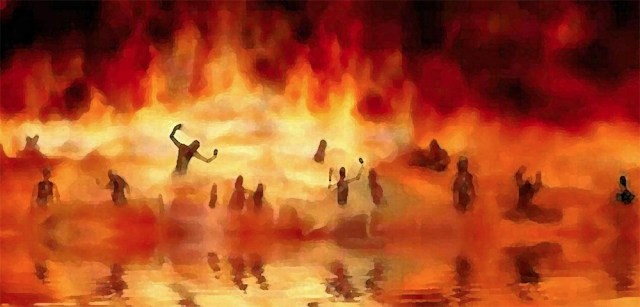
So, God doesn’t have to love us. We don’t have to love God. But what is the alternative choice to God’s love, and loving him back? What does rejecting God mean? What would it be like to be completely separate from the loving Creator of the universe, to be apart from every good, loving, holy thing that exists in the universe? That alternative is what we call “hell.”

Hell exists precisely because God is truly loving.

If there was no hell, there would be no true love.

And now we are back to the parable of the sheep and the goats. The exact difference between them is that the sheep exhibited the love of God in action to fellow Jesus-followers, and the goats did not do so. Their actions revealed their inner choices about God’s love.

Let’s make sure we have this all straight:

  • Salvation is a free, unearned gift of God, offered in the context of love.
  • Those who reject that gift, who choose not to love God, will go to hell, which the New Testament teaches is a real place, or state of being, that is utterly separated from God and all goodness.
  • Those who receive God’s salvation in faith will express it by loving their fellow Christians.
  • Those who do not love their fellow-Christians are shown, by that lack of love, to not have true faith.


I think we have plenty to chew on for this time!


LOVE IN ACTION

love-in-action

What Jesus and the apostles consistently taught is that love-in-action should be expressed first toward our fellow-Christians. It can (and should) overflow to our world-at-large, but it will only truly do so if we actually love one another. I realize that this is almost counter-cultural, at least to American Christians these days. But it is unquestionably what the New Testament teaches.

To listen to the sermon, click the play button:

To download, right click on the link (or do whatever you do on a Mac) and save it to your computer:
Download Matthew Part 88

Matthew #88. Matthew 25:31-46

PLEASE BEGIN BY READING MATTHEW 25:31-46

Our passage for this time is a parable, and parables are usually intended only to make one or two main points. When we get down to it, the points Jesus is making are pretty broad and straightforward.

I do realize that other issues are raised by this story, but I want to start by taking the text for what it is. If we need to, I’ll address the other issues in the next sermon.

First, let’s remember our context. Jesus has been talking about the end of the world, and the fact that his followers need to be prepared for it. In verses 14-30, he tells a parable to illustrate what he means about being prepared: we should use our lives, and everything we have been given as managers. We don’t own what we call our “stuff,” and we don’t even own our lives; therefore we should invest what we have been given in the interests of the Master.

In the next parable – our text for this time – he is now giving us a specific example of what it means to invest ourselves in God’s kingdom. The example he gives is this: we should care for our fellow Jesus-followers.

I think many of us, when we read the passage today, have a certain picture of what this looks like. We think we are supposed to go out on the streets and find people who are hungry, or inadequately clothed, and give them food and clothing. We think we should go visit random people in jail or hospital. If we examine our thoughts carefully, we would find a disconnect between doing those things, and how we live our daily lives. Even at best, most of us probably picture dashing out and doing “homeless ministry” once a week, and then coming back to our “normal life.”

Those sorts of thoughts would have been strange to most Christians in New Testament times, but not for the reasons you might imagine.  Some of you may be a little unfocused, and perhaps you didn’t notice something important about Jesus’ words. Let me say it again with emphasis: this parable teaches us that we should care for our fellow Christians.

Let’s look at the text:

40“And the King will answer them, ‘I assure you: Whatever you did for one of the least of these brothers of Mine, you did for Me.’ (Matt 25:40, HCSB)

In the New Testament, the Greek word adelphon (“brothers”) can mean, obviously, “male siblings.” Far more often, throughout the New Testament, the word is used to mean, in general, “followers of Jesus, whether male or female.” Now, unless Jesus is talking specifically about James, and Jude (his half-brothers, each of whom wrote a book of the New Testament), he means “my followers.” The context shows us that he was obviously not talking about James and Jude. The “sheep” in this parable are commended for feeding, clothing, welcoming and visiting followers of Jesus, specifically.

One of the great tragedies of modern Christianity is that we have lost this understanding. We think we should do good “for the poor and needy.” Then, we fervently hope that the “poor and needy” are some remote group out there that we can keep separate from our own lives. We have no actual relationship with the poor and needy, and we typically skip over helping people with whom we do have relationships. Far too often people in churches throw money at a problem, or rush out and spend an evening serving food to the homeless, or spend two weeks on a mission trip, but we always go back to a kind of status quo of not really living in meaningful community with one another. We’ll serve food to the homeless, but ignore the lonely single person in our church who would enjoy coming over for dinner once in a while. We pay a pastor to go visit the sick and those in prison, and we thank the Lord that we, personally don’t have to do such things, because we just don’t have the time. We will give money to a homeless shelter, but balk at opening our home to a visiting missionary.

Don’t misunderstand me, I think it is good to give money to organizations that genuinely help to relieve poverty in the world (like Compassion International). I think it is worthwhile to go serve supper to strangers at a homeless shelter. Short term mission trips don’t usually give much real, long-term help to the people in the countries that are visited, but they do have some value in opening the eyes of Americans to different cultures and conditions around the world.

So those are OK. But did you know that virtually every example of charitable giving in the New Testament, and almost every single instruction about such giving, refers to either providing financial support to those who teach the Bible, or to helping other Christians?

What Jesus and the apostles consistently taught is that love-in-action should be expressed first toward our fellow-Christians. It can (and should) overflow to our world-at-large, but it will only truly do so if we actually love one another. I realize that this is almost counter-cultural, at least to American Christians these days. But it is unquestionably what the New Testament teaches. It is certainly what Jesus is teaching in this parable, as I have already pointed out, by saying “to the least of these, my brothers.”

Consider these other verses, which are only a few of many. Bear in mind that “brothers” in each of these verses means “fellow Christians.” I have italicized certain parts to make my point clear. The first is another one from Jesus, found earlier in the book of Matthew:

40 “The one who welcomes you welcomes Me, and the one who welcomes Me welcomes Him who sent Me. 41 Anyone who welcomes a prophet because he is a prophet  will receive a prophet’s reward. And anyone who welcomes a righteous person because he’s righteous will receive a righteous person’s reward. 42 And whoever gives just a cup of cold water to one of these little ones because he is a disciple — I assure you: He will never lose his reward! ”

Again, Jesus is teaching the value of love-in-action toward other people who follow Him. Next, John records these words of Jesus:

34“I give you a new command: Love one another. Just as I have loved you, you must also love one another. 35By this all people will know that you are My disciples, if you have love for one another.” (John 13:34-35, HCSB)

This verse is frequently ignored. The world does not know we are His disciples because we do good deeds for the world, or show the world how much we love them. Instead, the world will see Christians loving and caring for each other, and the beauty of that testimony will show outsiders that we follow Jesus. Trust me, when the world sees Christians fighting, and gossiping and hurting one another, they are not seeing Jesus there. Who would want to become a Jesus follower, if it means joining a group that barely tolerates its members, but tries to show love only toward outsiders? Or who would want to join a “community” where you will hardly get to know each other? The first Christian church grew, in part, because people were attracted by the warm, loving, family-style relationships they found there.

Here are a few more passages:

6 The one who is taught the message must share all his good things with the teacher. 7Don’t be deceived: God is not mocked. For whatever a man sows he will also reap, 8because the one who sows to his flesh will reap corruption from the flesh, but the one who sows to the Spirit will reap eternal life from the Spirit. 9So we must not get tired of doing good, for we will reap at the proper time if we don’t give up. 10Therefore, as we have opportunity, we must work for the good of all, especially for those who belong to the household of faith. (Gal 6:6-10, HCSB)

10Love consists in this: not that we loved God, but that He loved us and sent His Son to be the propitiation for our sins. 11Dear friends, if God loved us in this way, we also must love one another. 12No one has ever seen God. If we love one another, God remains in us and His love is perfected in us. (1John 4:10-12, HCSB)

20If anyone says, “I love God,” yet hates his brother, he is a liar. For the person who does not love his brother he has seen cannot love the God he has not seen. 21And we have this command from Him: The one who loves God must also love his brother. (1John 4:20-21, HCSB)

14What good is it, my brothers, if someone says he has faith but does not have works? Can his faith save him? 15If a brother or sister is without clothes and lacks daily food 16and one of you says to them, “Go in peace, keep warm, and eat well,” but you don’t give them what the body needs, what good is it? 17In the same way faith, if it doesn’t have works, is dead by itself. (James 2:14-15)

Am I wrong about all this? Aren’t these all commands for Christians to love each other? Don’t you dare say, “Yes, sure, but we must also love the world.”  Don’t you dismiss this lightly! You need to start where Jesus and the apostles start, which is this: love your fellow Christians. You cannot properly love those outside the faith if you don’t love your fellow-Christians.

In fact, the whole point of our text today is that if you don’t love your fellow Christians, there is probably something wrong with your faith, and with the relationship you have with God. Lack of love for fellow Christians may be a symptom of the fact that you are a goat, not a sheep.

The church in New Testament times became like a family for those who followed Jesus. Sometimes you fight and wrangle with those in your family. But in the end, you are committed to one another, and you take care of each other.

One reason we have such trouble loving each other is because, by and large, we don’t have these close, family-style relationships with other Christians. The way we engage in church is often a major obstacle to this. Worshipping together is one part of loving fellow believers. But it is only one small part. The first Christians understood this, and they not only worshipped together, but they shared their lives with each other.

8We cared so much for you that we were pleased to share with you not only the gospel of God but also our own lives, because you had become dear to us. (1Thess 2:8, HCSB)

 42And they devoted themselves to the apostles’ teaching, to the fellowship, to the breaking of bread, and to the prayers. 43Then fear came over everyone, and many wonders and signs were being performed through the apostles. 44Now all the believers were together and held all things in common. 45They sold their possessions and property and distributed the proceeds to all, as anyone had a need. 46Every day they devoted themselves to meeting together in the temple complex, and broke bread from house to house. They ate their food with a joyful and humble attitude, 47praising God and having favor with all the people. And every day the Lord added to them those who were being saved. (Acts 2:42-47, HCSB)

Even Christians who were strangers to each other recognized that they were bound together in love and common faith. On one of their journeys, Paul and his companions arrived in a strange city, and sought out the Christians in that place. There they fellowshipped, and stayed with these strangers for a week. Luke describes it:

2Finding a ship crossing over to Phoenicia, we boarded and set sail. 3After we sighted Cyprus, leaving it on the left, we sailed on to Syria and arrived at Tyre, because the ship was to unload its cargo there. 4So we found some disciples and stayed there seven days. Through the Spirit they told Paul not to go to Jerusalem. 5When our days there were over, we left to continue our journey, while all of them, with their wives and children, escorted us out of the city. After kneeling down on the beach to pray, 6we said good-bye to one another. Then we boarded the ship, and they returned home. (Acts 21:2-6, HCSB)

These days, most of us just go to church on Sunday, and then go home. That is not Christian fellowship, and real Christian love doesn’t develop well in those circumstances. In contrast, the Christians of the New Testament walked through life together. They spent time in each other’s homes, they ate together, they laughed together, they fought with each other at times, they forgave each other, they grieved together and celebrated together. If one of them was in need, they helped each other. They lived in real Christian community, and developed real love for each other.

Notice that in the parable of Jesus, the sheep are surprised. “When did I do that?” they ask. This is because when you are in real, loving community with others, good works come naturally. Visiting sick people that you love comes naturally. Visiting prisoners that you love is easy. When someone you love is in need, the normal, natural thing to do is to help them.

Some folks might say, “OK, but in my circle of Christian community, everyone has enough food, clothing and a place to live. So how can I really practice this?”

That’s an excellent question, and I’m so glad you asked it. There are two answers that might be helpful. First, perhaps your Christian community needs to be open to welcoming some Christian brothers and sisters who don’t have it all together yet. In other words, maybe, as a group, you need to include some Christian people who aren’t like you.

Second, I believe that the needs listed in Jesus’ parable can also be understood spiritually. Perhaps there is a person in your group who is not literally a stranger, but who feels lonely. You can minister to them as “the stranger,” in this parable, and invite them to be more a part of your lives. Maybe there is someone else who is not literally in prison, but who suffers from the “imprisonment” of depression. You could make room in your schedule to spend more time with that person. There are all sorts of spiritual and emotional needs that we could minister to, even among those who are physically OK.

If we are to really live as this ministering Christian community, however, several things must happen. First, we must find a relatively small group of Christians with whom to be in community. You can’t have real community and fellowship with a hundred people at once. Second, within that community, we must commit to being vulnerable and open about our struggles. This is an emotional and psychological risk, but we can’t minister to one another if we don’t know what each person needs. Third, all of this takes time. Most people in America probably need to cut something else out of their schedule in order to have real Christian community, and thus to minister in the ways Jesus is talking about. We need to be available to each other outside of Sunday morning.

Now, you might consider all this and say: “Wow. I’m in trouble. I don’t much care for my fellow Christians, and I’m not really in true fellowship or community with other believers.” So what do you do about it?

Here’s my advice, for what it’s worth. First, do not try and fake it. I mean seriously, do you think God won’t know whether or not your love for your fellow Christians is genuine? If your good works do not come from genuine trust in Jesus, and real love for fellow-believers, you aren’t going to fool God.

Second, admit that you have a problem. Confess it to God, and, if it seems appropriate, to others.

Third, ask God for help. Part of this means giving God permission to change your lifestyle. I remember a time when I realized I didn’t really love my Christian brothers and sisters. I also realized that if I was really going to learn to do it, I would have to change my lifestyle, so that I could be in real Christian community with others. I’m an introvert, and that thought was extremely scary. But I confessed my sin, I asked God for help, and I gave him permission to work in my life as He pleased. God responded to those prayers. My comfortable, introverted little life was changed, and to my great surprise, I have been consistently grateful that it did. I feel tremendously blessed by all the people I have come to know so well, and I can honestly say that I love them. I’ve never wanted to go back to the “faith in isolation” that I used to have.

Let the Lord speak to you about this right now.

PREPARE FOR THE END OF THE WORLD!

end-of-the-world

Jesus tells us how to prepare for the end of the world. It may not be what you think. 

To listen to the sermon, click the play button:

To download, right click on the link (or do whatever you do on a Mac) and save it to your computer:
Download Matthew Part 86

Matthew #86.  Matthew 24:36-51

 Among followers of Jesus, these may be some of his most-ignored words. You can hardly swing a stick in an Evangelical church without hitting two or three people (at least) who are “into the end times.” Some remarkable things have happened during the past fifty years or so, and many people try and fit those events into some sort of timeline for the end of the world. They pore over passages from Daniel and Revelation, and also study some of the things that Jesus says, here at the end of Matthew. From these obscure, and difficult-to-understand passages, they build a scenario that will indicate to them when the world will end.

It’s a tempting hobby. In fact, it is often fascinating and exciting. I think the best of it is that it gives people hope, and helps them to see that God is still active in human history. But there is a downside too. Some people may become disillusioned, and perhaps even lose faith, when the world doesn’t end on their timetable. Their main faith is not in Jesus Christ, the Person, but rather in their theoretical constructions of the end times. And even more common, I think, is that “studying the end times” becomes a way to avoid really living as a Jesus-follower in everyday life. It gratifies a sense of religious duty (“I’m studying the Bible!”) without challenging anyone to actual obedience to Jesus at any specific point. Years ago, someone left our church because I (as the pastor) did not have the same specific view of end-times as he did. I think he was a good guy, but that is no reason to break fellowship. I wonder sometimes if he would leave a church that agreed with him on end times, but taught that sex outside of marriage is not sinful.

My point is, “end times” theology is very sketchy, and neither Jesus nor the apostles define it as closely as many people do today. How can I say that? Because Jesus said it! Just in case you didn’t open your Bible for this one, here it is:

36“Now concerning that day and hour no one knows — neither the angels in heaven, nor the Son — except the Father only. (Matt 24:36, HCSB)

Unless you are God the Father (and trust me, you’re not), you don’t have a clue when the end of the world will be. The entire section of verses 36-44 is Jesus belaboring that exact point. He says it will be like the days of Noah. God told Noah the flood was coming. Jesus has told us that He will return. Noah prepared for the flood, following God’s instructions, but he did not know when it would be, until the very moment when God told him to get on the ark. The other people had no awareness of the coming of the flood until it happened. Jesus says “so this is the way the coming of the Son of Man will be (verse 39).” He describes people going about their everyday lives until the very moment he returns. In verse 42 he says: “Therefore, be alert, since you don’t know what day your Lord is coming.” In case we somehow missed the point, Jesus says it again in verse 44: “This is why you also must be ready, because the Son of Man is coming at an hour you do not expect.”

Some people may try to find wiggle-room. They might say, “Jesus says we won’t know the exact day, or the exact hour of the day. But we could still find out the year, or possibly even the month.” I say: Nonsense! In the first place, just back up and read the passage for what it is. His main point is quite obvious: You are not going to be able to figure out, when he will return. If you were to say, “We can’t figure out the exact day, but we can know the year, (or even the decade),” it overturns the entire point that Jesus is making here.

Let’s put this to bed once and for all. The Greek word used for “day” is hemera. It can mean a literal 24 hour day, of course. But it is also used figuratively to mean “time period.” In Romans 3:13, Paul instructs us to “walk in the day.” Obviously he doesn’t mean a specific, literal day. The New Testament uses the word for the “Day of the Lord” and for the “day of God’s wrath,” which are obviously time periods, not literal 24 hour days. Zechariah says Elizabeth is far along in “days” (meaning years; Luke 1:18). Jesus, in Luke 17:28, refers to the “days of Lot.” Hebrews 5:7 uses the word to talk about the whole earthly life of Jesus. So when Jesus says we won’t know the day, He is using the word figuratively. He is saying, you won’t know when it will be.

The Greek for “hour” is similar – it can be either literal or figurative. In Matthew 10:19, Jesus tells us that when we are persecuted, we don’t have to worry about what we will say “in that hour.” He doesn’t mean that his followers will only suffer sixty minutes of persecution. He means “when the time comes.” In Mark 14:35, in the garden of Gethsemane, Jesus prayed that the “hour” of his suffering might pass from him.  He didn’t mean he would only suffer for sixty minutes – in fact the suffering of his crucifixion, and the beatings that went before it, was much longer than that.

Folks, I don’t know how to be more clear than Jesus. You cannot know when he will return. He says so, three times in eight verses. It is a waste of time, and a diversion of your spiritual energy, to try and build a timeline for the end of the world, or to try and figure out which current events are represented in apocalyptic prophecy. It takes you away from the important, everyday challenges of following Jesus in real life.

Even so, there is something you should do about the end times. The fact that Jesus is returning, and the fact that we don’t know when, should lead us to live a certain way.

Two times in the verses, Jesus tells us to be ready.

Therefore be alert, since you don’t know what day your Lord is coming (Matt 24:42 HCSB).

 This is why you also must be ready, because the Son of Man is coming at an hour you do not expect. (Matt 24:44, HCSB)

In verses 45-51, Jesus tells us what it means to be alert, and to be ready. He uses an analogy that would have been familiar to his disciples, but maybe not so much for us: a slave entrusted with great responsibility by his master. Slavery at the time of Jesus was not exactly like the slavery of the 19th century in America, or European slavery of the 18th century, or earlier. In the ancient Roman world, it is true, there were some type of slaves who were severely oppressed, and given no hope. Those were usually either criminals who were enslaved as punishment, or enemies captured in war and enslaved (armies in those days generally either killed their enemies, or enslaved them. There were no “prisoners of war”).

However, unlike 19th century America, there was no major industry (like producing sugar, or cotton) that depended heavily upon the work of slaves. Instead the majority of slaves in Jesus’ time were people who served their masters with a great deal of personal freedom. Many of them, in fact, had sold themselves into slavery for a period of time in order to pay debts, and had hope of obtaining freedom. Rather than what we normally think of when we hear the word “slavery,” it was more like indentured servitude. Now, I am not saying slavery was wonderful back then, but it probably wasn’t as bad for most slaves in Biblical times, as it was for those who worked on American cotton plantations in the 1800s.

Often times, a wealthy man had a slave who served as “director of operations” for his business and household. That slave could arrange his day as best as he saw fit, as long as he was diligent about his master’s business. He could conduct business transactions in the name of his master, and generally look after his master’s affairs. Such a slave was often in charge of other slaves (such as those who cleaned the master’s house, or transported his goods and so on). He had a respectable position of responsibility, and was often well rewarded for it.

If such a slave abused his position, however, he did not have the rights of a free citizen. His master would be fully justified in selling him as a galley-slave, or to the salt mines, where existence was miserable, and life was short.

Maybe another way to summarize Jesus’ words are this: “You never know when I will return. So live each day as if it will be today. Live in such a way that you will not be ashamed or afraid if I should return at this very moment.”

What does that mean, practically? Well, like the “operations manager,” Jesus has given all of us certain responsibilities. Some of those responsibilities are the same for all Jesus-followers. It starts with receiving His grace through repentance and trust, not as a result of anything we ourselves have done, or could do. Then, we are to keep on learning more of what he has said through the Bible, and learn to obey him. We are supposed to have close fellowship with other believers, and live out our faith in the context of Christian community and service.  We are also supposed to share God’s truth and His love with those that God has put into our lives. All of these are things that should become lifetime practices for everyone who calls themselves Christians. That’s how you prepare for the end of the world.

It might be easy to get caught up into thinking, “But should I take this job, or that one? Should I go on the mission field, or serve by staying here, and supporting missionaries through prayer and giving? Should I go to college? If so, which one?” Sometimes, those specific questions can be unnecessarily distracting. I think if we focus on what I just said: Trust, Obedience, Learning, Christian community and Christian service; all the other things will fall into place. I think that is the point Jesus is making. Don’t get distracted. Keep to the main things, remain faithful.

What if we do all these things, and yet we die before Jesus returns? Practically speaking, for us, the day of our death is essentially the same as the day of Jesus’ returning. I don’t mean Jesus won’t come back one day, and bring about the end of the world as we know it. I just mean that my own death brings about basically the same result, for me, as the day of His return. For my lifetime, and at that moment (either my death, or his return) have I been faithfully going about his business? That’s the question for all of us. That’s how we determine if we are ready for the end of the world.


WAR AND HOPE

Temple _Destruction

The words of Jesus in this passage are intended to help us stand steadfast in trouble, they are intended to give us hope. Even in the middle of great tribulation we can have hope, knowing that God is in charge, that he cares about us, and has not forgotten us. Above all, Jesus’ promise to return again and make all things right, is something to give us hope and peace. The fact that he is already been right about some of the things he prophesied should encourage us.

To listen to the sermon, click the play button:

To download, right click on the link (or do whatever you do on a Mac) and save it to your computer:
Download Matthew Part 85

Matthew #85. Matthew 24:15-34

In the very first part of this chapter, Jesus told his disciples that the temple was going to be destroyed, while some of “this present generation” were still alive. Certainly, the apostle John lived to see it happen, and survived even twenty years longer, after the event.

I also mentioned the fact that in this section of Scripture Jesus appears to be jumbling together both the destruction of Jerusalem, and what we call “the end of the world.” When we get to our text for next time, it will become clear that Jesus, remaining in complete dependence upon the Father, was not told by the Father when the end of the world would come (24:36). However, it is also clear (from verse 34) that Jesus himself did know that the destruction of Jerusalem in 70 A.D. was not going to be at the same time as the end of the world. Though he talks about the details of the two things together, when we examine the text closely, it is obvious that he knows that they are two different sets of events.

In our passage today, it is very helpful to understand some in-depth background. Stick with me through that, and I think you’ll find greater understanding and encouragement from these scriptures.

Much of what we know of the Jewish-Roman war of 66-73 A.D. comes from the Jewish-Born man, Titus Flavius Josephus. Josephus was a Jewish General in Galilee, who fought against the Romans in the war of 66-73 A.D.. He was captured in 67 by the Romans, after a six-week siege of the town of Jotopata, where he led the resistance. He then ingratiated himself with the Romans by claiming that it was prophesied that Vespasian, the Roman general who was leading the war in Palestine, would become Emperor. He was made the slave of Vespasian, and later Vespasian’s son Titus, and served as a translator for the remainder of the war. Vespasian did, in fact, become Emperor as Josephus predicted, in the year 69, and he granted Josephus his freedom. Josephus continued to serve the Romans, taking on Vespasian’s family name, Flavius. He became a historian, writing a very large volume about the Jewish wars, and also another volume of ancient Jewish history. I will share more from Josephus’ writings in a little while.

For now, let’s turn to our text. All throughout this passage, Jesus is using ideas and images that come from the book of Daniel, chapters 9, 11, and 12. Daniel, living in the Persian Empire, prophesied about the future tribulations of the Jewish people. Daniel 12:1 says:

1At that time Michael the great prince who stands watch over your people will rise up. There will be a time of distress such as never has occurred since nations came into being until that time. But at that time all your people who are found written in the book will escape. (Dan 12:1, HCSB)

This sounds a lot like what Jesus is saying in our passage today:

21For at that time there will be great tribulation, the kind that hasn’t taken place from the beginning of the world until now and never will again! 22Unless those days were limited, no one would survive. But those days will be limited because of the elect. (Matt 24:21-22, HCSB)

In verse 15, Jesus says:

15“So when you see the abomination that causes desolation, spoken of by the prophet Daniel, standing in the holy place” (let the reader understand), 16“then those in Judea must flee to the mountains! (Matt 24:15-16, HCSB)

The first time I read this, I was about thirteen years old, and I did not understand, and that bothered me. I think I comprehend a bit more today, so let me help you. Here’s what Daniel says in the prophecies to which Jesus is referring:

31His forces will rise up and desecrate the temple fortress. They will abolish the daily sacrifice and set up the abomination of desolation. (Dan 11:31, HCSB)

 27He will make a firm covenant with many for one week, but in the middle of the week he will put a stop to sacrifice and offering. And the abomination of desolation will be on a wing of the temple until the decreed destruction is poured out on the desolator.” (Dan 9:27, HCSB)

The Jewish people at the time of Jesus generally felt that Daniel’s prophecies had already been fulfilled. About 200 years prior, when the Jews were under Greek/Seleucid rule, the Greek leader Antiochus Epiphanes entered the temple and built a statue there. This desecrated the temple, making it unclean, and it was an abomination to all the Jewish people. It was the year 167 B.C. This led to the Maccabean rebellion, which led to a brief period of Jewish independence (See my first message on the book of Matthew for more background).

Jesus did not say, “Let the reader understand.” That was Matthew’s insertion. He wanted his readers to realize that Jesus was saying that Daniel’s prophecy had not yet been fulfilled.

The desecration of the temple in 167 B.C. may have been a partial fulfillment, but Matthew wants his readers to understand that something like those events was going to happen again. In fact, the Jewish war with the Romans of 66-73 A.D. looked a lot more like a fulfillment of Daniel than the events of 167 B.C., when Antiochus desecrated the temple.

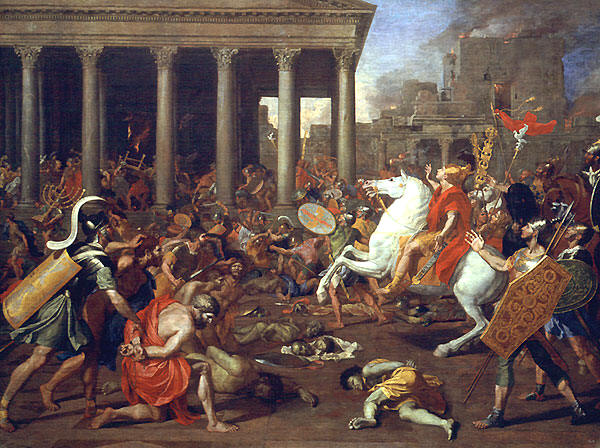
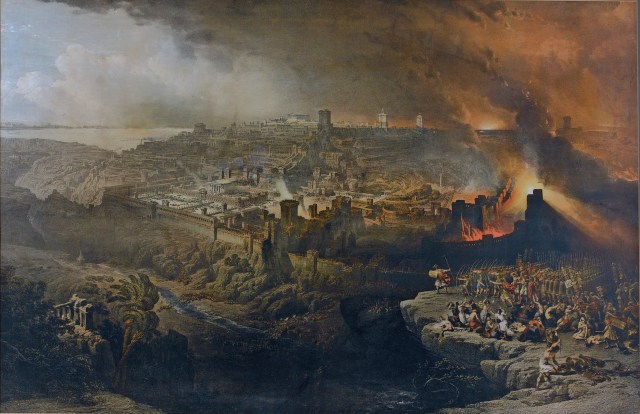
In July of A.D. 70, the Roman general Titus set fire to the temple, slaughtered those within it, and had the Roman standards brought into the Most Holy Place. The Roman standards were poles with various decorations on them. The kind most likely brought into the temple sanctuary would have had a square flag, hanging from a crossbar near the top of the pole. Stitched on the flag would be the name of the unit and probably an image of a god, or perhaps even the Emperor (who was considered a god). It might also have had a carved image of the Roman Eagle at the top of the pole. These sorts of Roman standards were considered to be idolatrous by the Jews, and by bringing them into the Most Holy Place, Titus desecrated the temple, much as Antiochus Epiphanes did 237 years before him.

Therefore, to unwind these words of Jesus, and the parenthetical comment of Matthew, it is something like this: “When you see the Roman legions marching, carrying the standards of the Emperor, flee!” I think that the Jewish people at the time would have understood these things much more easily than us.

Later, Jesus says:

19Woe to pregnant women and nursing mothers in those days! 20Pray that your escape may not be in winter or on a Sabbath. 21For at that time there will be great tribulation, the kind that hasn’t taken place from the beginning of the world until now and never will again! 22Unless those days were limited, no one would survive. But those days will be limited because of the elect. (Matt 24:19-22, HCSB)

You might think that Jesus has begun talking about the end of the world again, but I don’t think so. First, he encouraged his followers to pray that it wouldn’t happen in winter. That doesn’t make sense for the end of the world: the weather really won’t matter. But in 1st Century Israel, winter rains made most roads impassible with mud, and cold could kill those forced to camp outside with no shelter. Perhaps many people did pray, because, in fact, the worst part of the war was in spring, and the temple was not desecrated until July, and not fully destroyed until after that.

Historian Josephus, although somewhat familiar with the life of Jesus of Nazareth, was not a Christian; Christianity remained illegal in the Roman empire during his lifetime. Even so, the way he describes the war sounds very much like what Jesus predicted. Jesus said, “Woe to pregnant women and nursing mothers!”

In a section about the siege engines used by the Romans against him in Jotopata, Josephus writes (warning: these words contain matter-of-fact graphic violence):

And any one may learn the force of the engines by what happened this very night; for as one of those that stood round about Josephus was near the wall, his head was carried away by such a stone, and his skull was flung as far as three furlongs. In the day time also, a woman with child had her belly so violently struck, as she was just come out of her house, that the infant was carried to the distance of half a furlong, so great was the force of that engine. (Josephus, The Wars of the Jews. Book 3, chapter 7, paragraph 23).

Josephus describes many such terrible and heart-wrenching events. It was a brutal, horrific conflict. When Jerusalem was besieged, people became lawless, and many took food and other things from mothers and babies, and did violence to them. In fact, some historians have described the Jewish-Roman War as the worst massacre of ancient times. Jesus is not wrong to call it a “great tribulation.”

Josephus also describes the kinds of natural disturbances that Jesus mentions:

There broke out a prodigious storm in the night, with the utmost violence, and very strong winds, with the largest showers of rain, with continued lightnings, terrible thunderings, and amazing concussions and bellowings of the earth, that was in an earthquake. These things were a manifest indication that some destruction was coming upon men, when the system of the world was put into this disorder; and any one would guess that these wonders foreshowed some grand calamities that were coming. (Josephus, The Wars of the Jews, Book 4, chapter 4, paragraph five)

Some of the language that Jesus uses in our passage today is probably exaggerated imagery (in other words, he did not mean everything literally), but given the writings of Josephus, I think it is worth noting that Jesus predicted a horrific, unbelievable tribulation, and that is exactly what happened.

In verses 23-30 it seems clear that Jesus turns to talking about the end of the world. In fact, he is warning his disciples not to confuse the coming turmoil in Israel with his own return at the end of the world. This is the second time in the same discussion that Jesus has warned us not to be taken in by false prophets and deceivers who claim that the end of the world has come, or who claim to be Jesus himself, returned for his people. He makes it clear that when he comes back again, no one can miss it:

27For as the lightning comes from the east and flashes as far as the west, so will be the coming of the Son of Man. (Matt 24:27, HCSB)

In verse 32, he may be returning to the discussion about the coming destruction of the nation of Israel. The fig tree is a useful analogy: just as we can tell the season from looking at the trees, those who hear him should be able to recognize the signs that these things are about to take place. For my part, I would think that as soon as I heard of the Jewish rebellion that led to the war, it would seem to me a sign that Jerusalem would soon be destroyed.

Verse 34 clearly refers back to the first part of the discussion, about the coming tribulation to the Jewish nation. This is clear both from what Jesus said about his own return (it will be unmistakable) and also what he says later on in verse 36 when he insists that the Father has not revealed the day or the hour to him. If the Father hasn’t told him when the end of the world is, Jesus certainly can’t claim to know it will happen before the present generation passes away. Therefore that comment must refer to the events of verses 15-22.  The short discussion from verse 32-33 is a warning not to be mistaken about the coming of Jesus.

Even though much of our passage today is concerned with events that have already occurred, I think we can learn a great deal from it, and be encouraged by it.

First, as I said last time, this is very good evidence that Jesus is reliable when he speaks prophetically. Since he also prophesied that he would return, and that we would recognize his return, I think we can bank on that, and look forward to it. Though there may be difficult times we have to endure, we can trust his promise to deliver us, and to bring us into his eternal kingdom.

A second thing gets my attention from this text. Jesus told his followers to pray that these events did not happen in winter. As it turns out, they did not happen in winter. I can’t help wondering if many Jesus-followers did, in fact pray, and so influenced the events to happen in summer. It encourages me to believe in the power of prayer.

Another thing I get from the text is this: If we find ourselves in the middle of trouble and tribulation, it isn’t wrong to try and get out of it. We may not be able to escape it; it may not be God’s will for us to escape it. Even so, it isn’t wrong to try (as long as it does not involve sinning).

The analogy of the fig tree is also helpful for me. As we will see next time, it is absolutely pointless to try and build a timeline for the end of the world. Even so, verses 32 and 33 show us that it is possible to recognize the “signs of the times.” In other words, we can look at history, and culture, and current events, and evaluate them with wisdom.

Overall, the words of Jesus here are not intended to scare us. They are intended to help us stand steadfast in trouble, they are intended to give us hope. Certainly, many Jesus-followers left Jerusalem before all this took place. They escaped this terrible tribulation. And even in the middle of great tribulation we can have hope, knowing that God is in charge, that he cares about us, and has not forgotten us. Above all, Jesus’ promise to return again and make all things right, is something to give us hope and peace. The fact that he is already been right about some of the things he prophesied should encourage us.

Allow the Holy Spirit to speak to you about all of this right now.


THE ONCE AND FUTURE PROPHECY

destruction of Jerusalem

Our passage today contains a remarkable feature: a specific prophecy which we know was fulfilled as Jesus predicted. Read on to learn how we know, and what it means for us today.

To listen to the sermon, click the play button:

To download, right click on the link (or do whatever you do on a Mac) and save it to your computer:
Download Matthew Part 84
Matthew #84  Matthew 24:1-14

Our passage today contains a remarkable feature: a specific prophecy which we know was fulfilled as Jesus predicted. Jesus tells his disciples that the temple will be destroyed, even while some of those alive at the time (“this generation”) are still living. In fact, between 35 and 40 years after Jesus spoke these words, the Jewish nation rebelled, and the Romans responded brutally, utterly destroying the temple in 70 A.D., slaughtering thousands, and sending a large number of the remaining Jewish people into exile in other countries. Some of you have heard about the Jewish Battle of Masada: that took place shortly after 70 A.D., and was part of the same brutal Roman response to the Jewish rebellion.

So Jesus predicts a specific event within a specific timeframe, and we know that that event did indeed occur within that timeframe. This is just one of hundreds of reasons we can trust that the Bible is reliable, and that the words of Jesus are true.

Perhaps you know someone who is skeptical about this. I would like to spend a little time responding to such skepticism, because it speaks to the reliability of the Bible and therefore, the assurance of our faith. A skeptic might say: “Someone just went back and put in this prophecy after the temple had already been destroyed. Or perhaps, Matthew didn’t even write this until after the temple was destroyed.”

First, let me say that the skeptic starts with absolutely no evidence in support of either idea. The only reason to hold the opinion that the book of Matthew was either changed, or written after the destruction of the Temple, is because the skeptic has already decided she doesn’t believe in miracles like predictive prophecy. In other words, with regards to this subject, skepticism is a matter of belief, not evidence.

Let me explain further, starting with the first objection: the idea that the book of Matthew was edited later on. We have many hundreds of ancient copies, and partial copies, of the book of Matthew. They are all virtually exactly the same. In other words, there is no evidence whatsoever that someone went back and “edited” Matthew’s gospel, or indeed, any part of the New Testament. No “early copy” of Matthew exists; all of the copies are the same. Thus, there is absolutely no evidence that what Matthew wrote was changed in any way, at any point in history.

Now, let’s consider the second idea: Was the book of Matthew written after the destruction of the temple? New Testament authors did not provide dates on their manuscripts; I often wish they had. In the absence of exact dates, we have to take what we know of history, and compare it to what is written, and then speculate about whether it was written before or after a particular historical event. In the case of Matthew, we find that in many, many places, he writes about issues that would have been either unimportant, or would require more explanation, after the destruction of the Temple. Here are just a few:

23So if you are offering your gift on the altar, and there you remember that your brother has something against you, 24leave your gift there in front of the altar. First go and be reconciled with your brother, and then come and offer your gift. (Matt 5:23-24, HCSB)

The “altar” in this case, is the altar in the temple. If the temple was already destroyed, it would have been strange for Matthew to include these words of Jesus; certainly he should have offered some explanation. After 70 A.D. it would not be safe for him to assume that his readers knew what he was talking about.

Here is another, one which we considered quite recently:

16“Woe to you, blind guides, who say, ‘Whoever takes an oath by the sanctuary, it means nothing. But whoever takes an oath by the gold of the sanctuary is bound by his oath.’ 17Blind fools! For which is greater, the gold or the sanctuary that sanctified the gold? 18Also, ‘Whoever takes an oath by the altar, it means nothing. But whoever takes an oath by the gift that is on it is bound by his oath.’ 19Blind people! For which is greater, the gift or the altar that sanctifies the gift? 20Therefore, the one who takes an oath by the altar takes an oath by it and by everything on it. 21The one who takes an oath by the sanctuary takes an oath by it and by Him who dwells in it. 22And the one who takes an oath by heaven takes an oath by God’s throne and by Him who sits on it. (Matt 23:16-22, HCSB)

Again, if the temple had already been destroyed, it is surprising that Matthew would have included these words without explaining them. There are, of course, principles here that apply to all generations. Even so, if the temple had been destroyed before he wrote this, it is strange that Matthew neither mentioned it, nor explained the practice in order to make the principle more clear. Now consider this one:

4For God said: Honor your father and your mother; and, The one who speaks evil of father or mother must be put to death. 5But you say, ‘Whoever tells his father or mother, “Whatever benefit you might have received from me is a gift committed to the temple” — 6he does not have to honor his father.’ In this way, you have revoked God’s word because of your tradition. (Matt 15:3-6, HCSB)

Again, no comment about the status of the temple, and no explanation of the practice in question. If Matthew wrote after 70 A.D., he would have been writing primarily for Gentiles who would not have understood these sorts of things. As it is, the entire book of Matthew reads as if it was written for Jews, or at the very least, people very familiar with Jewish culture and practices, including those that involved the temple in Jerusalem.

There are several others, however, I will include just this one more:

24When they came to Capernaum, those who collected the double-drachma tax approached Peter and said, “Doesn’t your Teacher pay the double-drachma tax? ” 25“Yes,” he said. When he went into the house, Jesus spoke to him first, “What do you think, Simon? Who do earthly kings collect tariffs or taxes from? From their sons or from strangers? ” 26“From strangers,” he said. “Then the sons are free,” Jesus told him. 27“But, so we won’t offend them, go to the sea, cast in a fishhook, and take the first fish that you catch. When you open its mouth you’ll find a coin. Take it and give it to them for Me and you.” (Matt 17:24-27, HCSB)

After 70 A.D. (when the temple was destroyed), the Romans taxed their subjects to maintain the temple of Jupiter, in Rome. If that was happening at the time Matthew wrote, he surely would have made some sort of comment, or explained the situation further.

We know that the book of John was written about 20 years after the destruction of the Temple in Jerusalem. John explains many things to his readers about Jewish customs; Matthew offers no such explanations. All of this is powerful evidence that Matthew wrote before the destruction of the Temple in 70 A.D.. The evidence against that conclusion is merely the baseless belief of someone who does not want to accept the supernatural. In other words, nothing credible suggests that Matthew wrote his book after this prophecy of Jesus was fulfilled.

There’s another important thought. Jesus seems to be talking both about the destruction of the temple, and of the nation of Israel, in 70 A.D., and also the end of time. If Matthew wrote all this after the destruction of the Temple, he would have known that the other things mentioned by Jesus were not fulfilled at the same time, and, if he was writing after the fact, trying to make it look like Jesus prophesied accurately, he surely would have left out these other words of Jesus which did not necessarily happen until later on, or have not even happened yet.

Let’s look more carefully at the text. I have spoken before about the “telescoping” nature of prophecy. In other words, a prophet may jumble together predictions of the near future, predictions of the far-off future, and predictions of the end of the world. From a distance (that is, from the prophet’s perspective) it may look like all these things will happen at the same time; it is like looking at a distant range of mountains, where all the peaks and ridges look almost like cardboard cutouts standing next to each other. Now, some people may object that in this passage we are not dealing with an ordinary prophet: this is Jesus. How could Jesus be confused about which things will happen sooner, and which things will happen at the end of the world? The answer comes in Matthew 24:36.

“Now concerning that day and hour no one knows — neither the angels in heaven, nor the Son — except the Father only. (Matt 24:36, HCSB)

Part of the deal with Jesus coming to earth, is that he laid aside his own power, and chose to live like any other human being: completely dependent upon the Father. In this case, the Father chose not to reveal the date of the end of time to Jesus while he was still on earth. So, through the Father, Jesus understands that some of these things will come upon the generation of those who are alive while he is speaking. He understands that some of them will come at the end of time. But, because he limited himself to only what the Father showed him, and because the Father did not show him the exact date of the end of time, even Jesus cannot tell for sure when each of these things will be.

So Jesus prophesies the destruction of the temple, and also events that presumably have not even occurred yet by 2016. I think he shares these things together because they have a common theme. The things that will come on the generation to whom he speaks, and the things that will come at the end of the world, are connected theologically. We are not meant to assume that they are connected chronologically.

This is the theological connection: the judgment of God upon those who reject him. First, judgment on the people who were alive when Jesus still walked the earth (whom he calls “this generation”), and second, the judgement at the end of the world upon all those who reject God. Jesus lumps them together because they are both about God’s judgment upon those who reject him.

Let me say a quick word about that judgment: It – is – optional. The whole Bible is very clear that if we repent, and turn to Jesus in trust and humility, he will forgive us and reconcile us to God, and give us eternal life. You don’t have to experience his judgement, or the punishment of hell. If we repent and trust, he graciously forgives us, comforts us and brings us into His kingdom.

I think there are several very important things that we need to hear from this passage. First, Jesus says this:

“Watch out that no one deceives you. 5For many will come in My name, saying, ‘I am the Messiah,’ and they will deceive many. 6You are going to hear of wars and rumors of wars. See that you are not alarmed, because these things must take place, but the end is not yet. (Matt 24:4-6, HCSB)

There is always a certain element of Christianity that seems ready to declare that the end of the world has come. Jesus tells us here not to jump to such conclusions. In fact, as I have already pointed out, in verse 36 Jesus says that no one knows the day or the hour. So one thing we should get from this passage is to not be alarmed, and to understand that we cannot build a timeline for the end of the world.

A second thing that we should pay attention to is that Jesus describes the kinds of things that will happen before the end of the world. The types of events he describes indicate that we are getting near to the very beginning of the end, not that we are at the end. He says there will be:

  • wars
  • famines
  • earthquakes
  • persecution
  • hatred towards his followers
  • betrayal, hatred and strife
  • false prophets
  • lawlessness
  • many people who fall away from him

When we experience these things we should not be surprised, and we should not feel that God has abandoned us – he told us these things were going to happen. It should be a comfort to know that even when these terrible things happen, God is in control, he is not forgotten us, and he will work all of this to the good of his own plans, and to our own good (Romans 8:28). He tells us that there will be deliverance and salvation for those who endure to the end (v. 13).

Finally, he says that the good news of the kingdom will be proclaimed in all the world as a testimony to all nations and then the end will come. Have you ever thought of it like this? If you want the bad things in the world to come to an end, if you want Jesus to come back soon and take us all to be with him in the new heavens and new earth, the only way we can help that happen more quickly is to proclaim the good news of the kingdom in all the world.

We’ve covered a lot of ground, but just to summarize: 1. This shows us that Jesus and the Bible are reliable. 2. Don’t be deceived into thinking the end of the world is here just because others say so. 3. Don’t be alarmed by the events which Jesus mentions. They are part of the plan. Our part is to endure to the end, to hold on to Jesus through it all. 4. If we would like these difficult events to be shorter, we should assist those who are proclaiming the good news of the Kingdom.

As you take time to pray about these things, please also take time to pray for this ministry. Pray for wisdom and encouragement. Pray for financial provision. Pray that the Lord uses these messages to their full potential in the lives of those who need them. If, as you pray, you feel led to help us financially, you can click on the word “donate” at the top of the page, and it will explain how you can do that. But before giving financially, please pray for our needs, and whether or not He wants you to give. God loves a cheerful giver, and so do we!

Thank You!

WOE, IS ME!

woe

The Pharisees and religious leaders. They are bad and wrong, and by pointing out exactly how so, Jesus is warning us about other leaders like them. He is also warning us about becoming like them ourselves. In other words, Jesus, as God-the-Son, is expressing his very real, and thoroughly righteous anger against sin. Let’s consider how the Holy Spirit might want to speak to us through these ‘woes.’
To listen to the sermon, click the play button:

To download, right click on the link (or do whatever you do on a Mac) and save it to your computer:
Download Matthew Part 82

Matthew #82.  Matthew 23:13-36

We are in the middle of a long rant that Jesus makes against the religious leaders of his time. Frankly, when I just read through quickly, I don’t get a lot out of this portion of Matthew. The Pharisees are bad, Jesus is mad, end of story, right?

Whenever I encounter a piece of scripture that leaves me cold, like this, I often find it useful to pause and ask some questions. Why exactly does Jesus rant and rave like this? Is he just angry? Is he just venting? What is the purpose of this section of scripture – why did the Holy Spirit preserve these words of Jesus for Christians throughout the ages?

As I do that with this particular passage, I think the Spirit can show us several things.

First, there is the straightforward issue of the behavior of the Pharisees and religious leaders. They are bad and wrong, and by pointing out exactly how so, Jesus is warning us about other leaders like them. He is also warning us about becoming like them ourselves. In other words, Jesus, as God-the-Son, is expressing his very real, and thoroughly righteous anger against sin. Let’s consider how these woes might affect us as well.

Jesus points out seven or eight areas where the religious leaders are in deep trouble. He begins each one with the phrase: “Woe to you, Scribes and Pharisees, hypocrites!”

First, let’s talk about the word “woe.” It can mean: “trouble, sorrow and distress.” There is often an element of sorrow associated with this word, both in Greek and in English; it can be a lament, like “Alas!” So, in Matthew 24:19, Jesus says:

“Woe to pregnant women and nursing mothers in those days! Pray that your escape may not be in winter or on a Sabbath.”

But I think here, in this passage, Jesus is adding a sense of warning and judgment with it. The “woe” upon the pregnant women and nursing mothers was not because of anything they did. But here, Jesus clearly connects each woe to the behavior of the religious leaders. I still think he speaks with sorrow; I don’t think he is happy about it. Even so, clearly, he is enumerating their sins, and pronouncing that they will experience trouble and sorrow as judgement for them.

The first woe and sorrow (in verse 13) is because they refuse to enter the kingdom of heaven, and stop others from entering in. This is Jesus’ core issue with the Pharisees. They warned people against the only way of salvation, which is Jesus himself. Instead, they believed that they did not need him. Specifically, they taught (and obviously believed) that they could earn their salvation by behaving well. In a more general sense, this woe applies to anyone who leads others to believe that they can be saved by any other path than repentance from sin, and trust in Jesus. So Paul reiterates this woe in the first chapter of Galatians:

6I am amazed that you are so quickly turning away from Him who called you by the grace of Christ and are turning to a different gospel — 7not that there is another gospel, but there are some who are troubling you and want to change the good news about the Messiah. 8But even if we or an angel from heaven should preach to you a gospel other than what we have preached to you, a curse be on him! 9As we have said before, I now say again: If anyone preaches to you a gospel contrary to what you received, a curse be on him! (Gal 1:6-9, HCSB)

Make no mistake. Christianity has always insisted that Jesus Christ is the only way to forgiveness, reconciliation with God, and eternal life:

5“Lord,” Thomas said, “we don’t know where You’re going. How can we know the way? ” 6Jesus told him, “I am the way, the truth, and the life. No one comes to the Father except through Me. 7“If you know Me, you will also know My Father. From now on you do know Him and have seen Him.” (John 14:5-7, HCSB)

 11And this is the testimony: God has given us eternal life, and this life is in His Son. 12The one who has the Son has life. The one who doesn’t have the Son of God does not have life. 13I have written these things to you who believe in the name of the Son of God, so that you may know that you have eternal life. (1John 5:11-13, HCSB)

11This Jesus is the stone rejected by you builders, which has become the cornerstone. 12There is salvation in no one else, for there is no other name under heaven given to people, and we must be saved by it.” (Acts 4:11-12, HCSB)

The Pharisees and Scribes rejected Jesus, and therefore rejected salvation, and led others to do so as well. Today, Christians must remember that our core belief is grace, forgiveness and salvation through Jesus Christ alone. We don’t have forgiveness or life because “God is love, and just wouldn’t send anyone to hell.” That lie is just as bad as anything the Pharisees taught: Woe to anyone who tells it! We are not saved because we “have lived a good life, and tried to do the right thing.” We are not forgiven because we “aren’t worse than anyone else.” Sin is much more serious than that. We aren’t forgiven because we make sacrifices, or take mission trips, or because we “speak the words of truth.” We are saved through Jesus Christ alone, and we receive that salvation by grace when we repent and trust him. Woe to anyone else who teaches otherwise!

The second woe is found in verse 15. Some of you may not have verse 14 in your Bibles: it will skip from 13 to 15. Verse 14 is actually one of those places where there is a dispute about the original manuscript of the New Testament. The oldest and best manuscripts do not contain it. The textus receptus (which is the source for the King James version of the Bible), does contain it, as do some other later manuscripts. I think the best evidence suggests that this was not originally part of the book of Matthew. This is one example of why I am not a fan of the King James version. Even so, I’d like to point out that whether you leave verse 15 in, or take it out, it does not change very much at all; certainly it changes no Christian doctrine. This is considered a major variant, and once again we see that even major variants are actually extremely minor. We can have great confidence that the New Testament we read today is, in fact, what was written by the apostles.

In any case, I will move on to verse 15, where Jesus pronounces judgment upon the religious leaders for converting even non-Jews to the belief that they can earn their way into God’s favor, and eternal life. This is very much like the first woe, the main difference being who gets led astray: Jews, or non-Jews. For our purposes, it is a warning that if we get people to join our church, but do not teach them that forgiveness, life and salvation are found only in Jesus, given to us by grace through faith, we would be better off not bringing the new people in the first place.

The third woe is described in verses 16 through 22. Basically, Jesus is giving an example of how the teachers of the law, and Pharisees twist and undermine God’s word. Many times I have given you the example of the Sabbath, and how they added their own laws on top of the commands of God. Here, Jesus is referring to the way that they do mental gymnastics in order to benefit themselves in the matter of taking oaths. They argued that certain kinds of vows were not binding, and made fine distinctions that sounded intellectual, but were completely against all common sense.

These days, we don’t often make vows, particularly not religious vows. I made vows when I was married, and when I was ordained as a pastor. However, even in those cases, I did not swear by or on anything; I simply said: “I will, and I ask God to help me.” So the practice of swearing by (or on) something is no longer a big issue, at least not in Western culture. True, some folks might say something like: “I swear by my mother’s grave.” I don’t think anyone takes them seriously. Even so, I think we can learn something from this particular woe. The underlying issue is that the teachers of the law and the Pharisees were playing games with the truth. As Jesus points out, clearly, if you swear by the altar in the temple, really, you are swearing by God. But the religious leaders came up with all sorts of obscure reasoning to avoid that obvious, common-sense conclusion.

I think that today this woe could refer to the way some people treat the Bible. Unfortunately, I have many times read Bible commentaries that tried to say that certain verses mean the exact opposite of what they clearly say. Now, you know that I’m all for thoughtful, scholarly Bible interpretation. Not all Bible verses are obvious in meaning. Even so, there are many people today, whom I can only call false teachers, who twist the words of the Bible, play games with the truth, and do mental gymnastics in order to eliminate the plain, common sense meaning of God’s Word. What they are doing is not careful interpretation, but rather, twisting the obvious truth. I think Jesus would say to them: “Woe to you!”

The fourth woe is essentially captured by Jesus’ words in verse 24:

24Blind guides! You strain out a gnat, yet gulp down a camel! (Matt 23:24, HCSB)

The religious leaders spent a great deal of energy on relatively trivial matters, while ignoring the more important things. Notice that Jesus says that the trivial things are, in fact, good to do; but the important things should have first priority. I want to try and finish the woes in this sermon, so I won’t go into this one in great depth, but there are many, obvious applications for it. Woe to the church that is more concerned about the color of their carpet than about the homeless population all around it. Woe to the leaders who police the kinds of clothes people wear, and ignore the lust in their own hearts. I could spend all day on this one, but I believe you will be able to think of your own examples without too much effort. I do want to point out that this particular woe contains much of what really turns people off about churches and Christians. I think it’s good to know that Jesus hates it when people focus on minor things, while neglecting the things that are most important to true faith.

The fifth woe, found in verses 25-26, is much like the one before it. The religious leaders are concerned about looking good. They are focused on outward appearances, while they ignore the filth inside of their own hearts. Probably, Jesus is referring to the Jewish tradition of ceremonially washing cups. Mark records a different instance, where Jesus spoke about this at greater length. After discussion about ceremonial washing with the religious leaders, Jesus said this to his disciples:

18And He said to them, “Are you also as lacking in understanding? Don’t you realize that nothing going into a man from the outside can defile him? 19For it doesn’t go into his heart but into the stomach and is eliminated.” (As a result, He made all foods clean.) 20Then He said, “What comes out of a person — that defiles him. 21For from within, out of people’s hearts, come evil thoughts, sexual immoralities, thefts, murders, 22adulteries, greed, evil actions, deceit, promiscuity, stinginess, blasphemy, pride, and foolishness. 23All these evil things come from within and defile a person.” (Mark 7:18-23, HCSB)

The sixth woe, is also similar. This time, Jesus describes them as whitewashed tombs, which look good on the outside, but inside are filled with rotten flesh and bone. I’m going to get personal for a moment. I don’t want to be offensive, but I do want us to get the full impact of the words of Jesus here. Here in the Southeastern USA, we have a somewhat religious culture. Even in areas where the culture at large is not particularly Christian, some churches can have a religious culture within their community. I personally know many people who are like these whitewashed tombs. They go to church and they talk a good talk. As far as the people that they go to church with know, these are wonderful Christian folks. But during the week they have affairs, they do drugs, they get drunk, they run businesses that are dishonest, they cheat people, and they are stingy and miserly. Of course, everyone struggles with sin. I’m not talking about Christians who have surrendered their lives to Jesus, but who sometimes fail and fall. I’m talking about people who pretend; people who talk the talk, but do not let Jesus have any real influence in their lives. Jesus says to such people: “Woe to you!”

Finally, Jesus says: “Woe to you who reject God’s messengers!” (verses 29-34). That is what this seventh woe is all about: rejecting those whom God has sent, and rejecting his message through them. In the Western world, thankfully, people do not kill, crucify, or whip Christian teachers and preachers. However, I think it is important for us to remember that this still happens regularly in other places in the world. And even in the Western world, often times those who seek to be vocal about their faith in Jesus are treated with contempt and derision. As one small, and relatively insignificant example, I offer Tim Tebow, former NFL quarterback. Tebow had a year or two as a starting quarterback in the NFL. It was his habit to kneel down as a sign of humility, and praise to the Lord, whenever his team scored. That may or may not be a silly thing; but it was relatively harmless. However, Tebow received a huge amount of criticism for this, and for his outspoken faith. In fact, he received more negative media coverage than many NFL stars at the time who were accused of things like drunk driving, drug possession, assault and rape. Woe to a culture that is more concerned about a public expression of Christian faith than about crimes that deeply hurt others!

Let me say another thing about mistreating God’s messengers. I will admit that this one feels a little personal with me, but that does not make it untrue. I also want to say that I am not complaining, and for the most part I have been very blessed to not experience too much of what I’m about to share with you. Even so, it is shameful – I can think of no better word – the way that many Christians and churches treat their pastors and teachers. Of course there are some bad pastors, and bad leaders, just as there are bad bartenders, truck drivers and school teachers. Even so, many of the pastors who are mistreated by their congregations have good hearts, pure motives, and have done no wrong. Sometimes people direct hateful and hurtful words towards them for doing and saying what they believe God wants them to do and say. Sometimes people slander them. Sometimes people try to run them out of a job, for no reason other than that the pastor has threatened their sense of personal power within the congregation. Sometimes pastors are threatened after teaching something unpopular that the word of God says. Quite often, pastors are underpaid, and it is unusual to find anyone who cares, in most churches, whether or not a pastor is being appropriately compensated. Almost all the time at least some people are critical of their pastor, without doing the least thing to help him.

When I look at these seven woes spoken by Jesus, I think of it as an extreme measure he is taking in order to bring the religious leaders to repentance.

Let me try and illustrate what I mean. About a year ago, I began to have constant pain in one of my kidneys, like I was having a kidney stone. After a long and difficult time, doctors finally determined that some of my nerves have been damaged by frequent kidney stones. I sat down with a pain specialist, and he outlined a number of steps to help me deal with the pain that I still have.

First, we will try a very safe, well-tested, inexpensive medication that has very few side effects. If that works, great! If not the next step is to try a second medication. The second drug is more expensive, and has not been tested for as long as the first. It has more side effects and risk factors. If the second drug works, great! However, if not, there is another step, involving directly stimulating the nerve. This is a more invasive procedure, with greater risks. There is another step after that, and another. Each new step is more drastic, increasingly invasive, and carries greater and greater risk. The final step involves “killing” the nerve that serves my kidney.

When Jesus confronts the religious leaders during these last few days of his life, he is taking the final and most drastic step in trying to bring them to repentance, faith, and salvation. He lived among them, letting his life be a testimony, but that was not enough. He gave them his preaching and his teaching, but they did not respond. He showed them miracles, and the power of God, but they turned away. And so now, he is directly confronting them with their sin. It is their last chance, and he says that if they do not take it, judgment will come upon them. He will “kill” the problem, if it can’t be fixed any other way.

In fact, he says: “I assure you, all these things will come on this generation.” I want to point out two things about this. First, it was literally fulfilled among those who heard Jesus say these words. Jesus was crucified sometime around 30-35 AD. In 70 AD, while that generation still lived, the Romans utterly crushed the Jewish people, slaughtering huge numbers, destroying the temple, and sending the Jews that survived into an exile that lasted almost 2000 years. That generation of unbelieving Jews was indeed judged.

Second, because of how Jesus said it, these words are also for us. Whether or not we are judged as a group, when it comes to the end of our life, when our “generation” passes, we will stand before the judgment seat of God. This is true of every generation that reads Jesus’ words. Let his words sink in. They are drastic, yes. But they are spoken in order to ultimately lead is into the grace of God by driving us to Jesus as our hope, life and salvation.


THERE’S A NEW MESSIAH IN TOWN…

messiah

Jesus consistently claimed that he should have the first place, and primary authority, in our lives. He did not say, “God loves you, now go do whatever you want, as long as it is loving and kind.” He said, “God loves you. Now, let me own your life in such a way that you are living for my purposes, under my authority.” Like it or not, that is what the statement about the Messiah being the Lord means. Later on, he calls himself “the master” (23:10). Is he your master? Is he not only your savior, but your Lord, your commander in chief? If not I encourage you to repent, and let him be.

To listen to the sermon, click the play button:

To download, right click on the link (or do whatever you do on a Mac) and save it to your computer:
Download Matthew Part 81

Matthew #81.  Matthew 22:41-6; 23:1-12

Starting in the middle of chapter 21, the conflict between Jesus and the religious leaders begins to heat up. We have seen that most of chapter 23 covers a series of ways in which the religious leaders tried to trick Jesus into saying something that would either make him unpopular, or force the authorities to arrest him. They were trying to put Jesus on the defensive.

At the end of the chapter, after answering their malicious questions, Jesus begins firing back.

He starts with a question about the Messiah. His quote is from Psalm 110. The Jews in the time of Jesus most definitely considered this psalm to be a prophecy about the Messiah. In this instance, Jesus has the leaders caught both coming and going.

In the first place, one of the reasons the Pharisees were upset with Jesus is because, starting just a day or two before this, the crowds were calling him “the Son of David,” which was basically the same thing as calling him “Messiah.”

9Then the crowds who went ahead of Him and those who followed kept shouting: Hosanna to the Son of David! He who comes in the name of the Lord is the blessed One! Hosanna in the highest heaven! (Matt 21:9, HCSB)

15When the chief priests and the scribes saw the wonders that He did and the children shouting in the temple complex, “Hosanna to the Son of David! ” they were indignant 16and said to Him, “Do You hear what these children are saying? ” (Matt 21:15-16, HCSB)

(By the way “son,” in this case, is just a metaphorical way of saying “direct descendant.”) By bringing up the question, “Whose son is the Messiah,” Jesus was be reminding the religious leaders of who the people thought he was. But they could not deny what everyone knew about Messianic prophecy, so they reluctantly admit that the Messiah will be called a “Son of David.”

But now, Jesus does something surprising. The crowds have been calling him “Son of David.” He has forced the Pharisees to admit that the Messiah is supposed to be “a Son of David.” Already, Jesus has made his point: He is claiming to be the Messiah. But he doesn’t stop there. He adds something that none of his listeners expect. Using this well-known Messianic Psalm (Psalm 110), he shows that David calls the Messiah “Lord.” In other words, the Messiah is not only the son of David, but also, the Son of God. Jesus is claiming even greater authority than most people at that time would attribute to the Messiah. Even so, the Pharisees cannot dispute what the Psalm says, nor how Jesus interprets it. For the people who heard this dialogue, most of them knowledgeable concerning the Bible, Jesus was saying, clear as could be:

  1. I am the Messiah.
  2. As Messiah, I am the same in nature as God himself.

The thing that drove the religious leaders crazy is that they couldn’t actually dispute his logic. They didn’t believe he was the Son of David, of course, but they didn’t really have any way to argue with him.

Jesus doesn’t stop there. Having established that he is the Messiah and that he has the authority of God, he starts to attack the illegitimate authority of the religious leaders. Even so, he begins by acknowledging that they do have a certain, limited authority. He says they are “seated in the chair of Moses.”

2“The scribes and the Pharisees are seated in the chair of Moses. 3Therefore do whatever they tell you, and observe it. But don’t do what they do, because they don’t practice what they teach. (Matt 23:2-3, HCSB)

I think “the chair of Moses” meant probably one of two things (or possibly, both). First, it appears that in synagogues in those days, there was actually a special chair in which teachers would sit while they taught the scriptures. The word “scribes” in this text is sometimes translated “teachers of the law,” which is basically accurate. So Jesus might be saying, “When they are teaching the scriptures, you should listen to them.” The fact is, for the most part, Jesus agreed with the theology of the Pharisees and scribes. When they taught the scriptures, they were worth listening to, although, obviously, he did not approve of it when they went beyond what the Bible says, and began teaching man-made regulations.

Second, I think that Jesus may have had in mind the following passage from the book of Deuteronomy:

8“If a case is too difficult for you — concerning bloodshed, lawsuits, or assaults — cases disputed at your gates, you must go up to the place the LORD your God chooses. 9You are to go to the Levitical priests and to the judge who presides at that time. Ask, and they will give you a verdict in the case. 10You must abide by the verdict they give you at the place the LORD chooses. Be careful to do exactly as they instruct you. 11You must abide by the instruction they give you and the verdict they announce to you. Do not turn to the right or the left from the decision they declare to you. 12The person who acts arrogantly, refusing to listen either to the priest who stands there serving the LORD your God or to the judge, must die. You must purge the evil from Israel. 13Then all the people will hear about it, be afraid, and no longer behave arrogantly. (Deut 17:8-13, HCSB)

So, Jesus might also be saying that people should abide by the “legal” decisions that were given by the religious leaders, because that was good and proper to do, and was helpful in keeping the peace.

It may be that he meant one or the other of these two things, or possibly, both. If I had to decide, I would guess that Jesus was talking mainly about their religious authority to settle disputes.

Even so, after pointing out that the religious leaders have a certain, limited, legitimate authority, he goes on to show the many ways in which their practice and teaching is not legitimate.

First, he says, they don’t practice what they themselves teach. He will expound on this later in chapter 23. Second, he says they put burdens on people, but won’t help them. This is in stark contrast to Jesus’ own words from Matthew 11:28-30

28“Come to Me, all of you who are weary and burdened, and I will give you rest. 29All of you, take up My yoke and learn from Me, because I am gentle and humble in heart, and you will find rest for yourselves. 30For My yoke is easy and My burden is light.” (Matt 11:28-30, HCSB)

The Pharisees and scribes made following God all about rules and regulations. As if there were not enough difficult things to follow already, they added things. They “explained” the laws of the Old Testament by adding their own rules about what it meant to follow those laws. So, in the example I have used before, “Remember the Sabbath and keep it holy” became a very long list of things you had to do, and refrain from doing. The things on that list were not originally commanded by God; rather they were added by the religious leaders.

In addition to adding their own rules and pretending that they were God’s commands, the religious leaders were all about their own power and position. Jesus says they love to be observed by others.  Verse 5 says they “enlarge their phylacteries.” A phylactery was a little leather box containing portions of scripture. It was a misguided, very literal, fulfillment of Deuteronomy 6:4-9:

4“Listen, Israel: The LORD our God, the LORD is One. 5Love the LORD your God with all your heart, with all your soul, and with all your strength. 6These words that I am giving you today are to be in your heart. 7Repeat them to your children. Talk about them when you sit in your house and when you walk along the road, when you lie down and when you get up. 8Bind them as a sign on your hand and let them be a symbol on your forehead. 9Write them on the doorposts of your house and on your gates. (Deut 6:4-9, HCSB)

So the religious leaders literally created little boxes, put portions of the scripture in them (often verses 4-5, above) and tied them on their heads and arms, and put them on doorposts and gates. In the time of Jesus, some of the leaders were making these boxes (phylacteries) very big and noticeable. Jesus, is probably slyly pointing out that though they make their phylacteries ostentatious, they are not taking seriously the command to let God’s words be in their hearts. The leaders are doing it simply in order to be noticed and praised by people.

The tassels were a similar phenomenon, made to remind the people of Israel of God’s commands. Again, the leaders in Jesus’ time were making very large noticeable tassels to make sure everyone knew that they were really religious.

Jesus also points out how the leaders love the places of honor at banquets, in synagogues, and to be recognized in the marketplace as particularly religious people. He then instructs his own followers to be different. I want us to pay special attention to verses 8-12:

8“But as for you, do not be called ‘Rabbi,’ because you have one Teacher, and you are all brothers. 9Do not call anyone on earth your father, because you have one Father, who is in heaven. 10And do not be called masters either, because you have one Master, the Messiah. 11The greatest among you will be your servant. 12Whoever exalts himself will be humbled, and whoever humbles himself will be exalted. (Matt 23:8-12, HCSB)

In some ways, this statement represents God as a Trinity. The Father, is obviously God the Father, and “Master,” says Jesus, is himself, the Messiah. But the “Teacher” is the Holy Spirit. Consider these words of Jesus, recorded by John:

12“I still have many things to tell you, but you can’t bear them now. 13When the Spirit of truth comes, He will guide you into all the truth. For He will not speak on His own, but He will speak whatever He hears. He will also declare to you what is to come. 14He will glorify Me, because He will take from what is Mine and declare it to you. (John 16:12-14, HCSB)

So Jesus says, you have one teacher, God the Holy Spirit, one Father, God the Father, and one Master, Jesus Messiah, God the Son. Although the Christian doctrine of God as a Trinity is not explicitly spelled out here, clearly, Jesus has it in mind. In addition, his message is plain: leaders do not stand in the place of God.

I want to point something out, before we get to applications. There are many people who believe that the Bible was either written, or at least heavily edited, by church leaders, in order to give themselves power. If that were so, they surely should have removed this passage, because it says that we all should humble ourselves before God, and even that leaders should not take special titles. In particular, since Jesus says no one should be called “father,” you would think that the Roman Catholics, who call their priests “father,” would have removed this verse. This is one of the many, many places where it is obvious that the Bible was not shaped by religious leaders for their own power or benefit.

Now, let’s look at applications. First, I think we need to see that Jesus consistently claimed that he should have the first place, and primary authority, in our lives. He did not say, “God loves you, now go do whatever you want, as long as it is loving and kind.” He said, “God loves you. Now, let me own your life in such a way that you are living for my purposes, under my authority.” That is what the statement about the Messiah being the Lord means. Later on, he calls himself “the master” (23:10). Is he your master? Is he not only your savior, but your Lord, your commander in chief? If not I encourage you to repent, and let him be.

Second, when I see Jesus’ criticisms of the religious leaders, I notice that he does not throw out the baby with the bathwater. In other words, he says, “They do say some things that are good and right. They do have a measure of proper authority.” Too often, I think we tend to judge people and their words and actions with an “all or nothing approach.” Either we accept all of what they say and do, or we reject all of it. Jesus did not do that, even with these leaders for whom he has many harsh words. When the leaders appropriately express the Word of God, Jesus says that his followers should listen. When people exercise authority that is properly given to them, we should obey. Obviously, when people go beyond their proper authority, or teachers go beyond the Word of God, we no longer have to listen and obey. But we should keep in mind that God can use anyone, and just because someone is rude, or mean, or angry, that doesn’t mean that everything he says is completely wrong.

Third, when Jesus refers to the burden that the leaders put on the people, I cannot help but remember his own invitation, which I mentioned earlier, to come to Him and find rest for our souls. In contrast to the religious leaders, He invites us not to do more, but rather to trust more. Is there some area of your life where he is inviting you to trust him, and rest from doing it for yourself?

Finally, in the last few verses, he makes it very clear that God holds all authority, and human beings do not. He invites us all to become humble, and to serve. Is there some place where you have been tempted to “exalt yourself?” Or, perhaps, is Jesus using the text today to encourage and bless you for being humble?

Let the Holy Spirit continue to speak to you about these things.

LOVE IS THE ANSWER. BUT WHAT WAS THE QUESTION?

Love concept

We are to love God with all of our being. According to Jesus, nothing is more important than this. If we love God with our entire being and put him first in our lives, everything else will flow out of that in a way that fulfills what God wants. If we don’t love him, we are just a clanging gong; nothing. We are not to act religious for the sake of being religious. It is meaningless to follow Christian morality unless we do it out of love for God.

If you truly love God, and also your neighbor, you will fulfill, not ignore, the moral teachings of the Bible. 

To listen to the sermon, click the play button:

To download, right click on the link (or do whatever you do on a Mac) and save it to your computer:
Download Matthew Part 80

Matthew #80  Matthew 22:34-45

The third question with which the religious leaders tried to trap Jesus was about the law. Among Jews in those days, it was legitimate to discuss which commands were harder to keep than others, or which ones were more “weighty,” but most Jews felt that all of the commands of the Old Testament were equally valid. Jesus had to watch his answer carefully. If he suggested that one command was more important than another, he might be accused of heresy.

37He said to him, “Love the Lord your God with all your heart, with all your soul, and with all your mind. 38This is the greatest and most important command. 39The second is like it: Love your neighbor as yourself. 40All the Law and the Prophets depend on these two commands.” (Matt 22:37-40, HCSB)

We need to understand what Jesus did here. He says, “There is a command that is most important, and a second one also. But the reason they are more important is because all of the other commands are contained in these two.” In other words, he answered their trick question in a way that they cannot criticize; but in so doing he also teaches us something very important.

Loving God and loving your neighbor: all of the commands are summed up in love. The Holy Spirit inspired Paul to write this:

1If I speak human or angelic languages but do not have love, I am a sounding gong or a clanging cymbal. 2If I have the gift of prophecy and understand all mysteries and all knowledge, and if I have all faith so that I can move mountains but do not have love, I am nothing. 3And if I donate all my goods to feed the poor, and if I give my body in order to boast but do not have love, I gain nothing. 4Love is patient, love is kind. Love does not envy, is not boastful, is not conceited, 5does not act improperly, is not selfish, is not provoked, and does not keep a record of wrongs. 6Love finds no joy in unrighteousness but rejoices in the truth. (1Cor 13:1-7, HCSB)

The attitude and choices of our hearts toward God and toward our neighbor are very important. We can do the right things with the wrong motives. The goal of all that God asks of us is love. We don’t try to live good, moral lives so that we can boast about it. The reason to live as the Bible tells us to is because that is the best way to love God, and to love those around us.

Even so, I think a large number of people in Western culture are very confused about what Jesus taught about love. I think that over the past several decades, the message of the Bible about love has been misunderstood and distorted.

First, I think we must remember that the most important command – as Jesus himself said – is to love the Lord with all your heart and all your soul and with all your mind. A lot of people these days sort of skip that part, and jump right into loving our neighbor. But Jesus said we need to love God with our entire being, and put him above all things in our lives. We are to love him emotionally, intellectually and spiritually. The word for “soul” is the Greek “psuche,” which has developed into the modern English word “psyche.” It means all of what makes you, you. This means we are to love God with all of our being. According to Jesus, nothing is more important than this. If we love God with our entire being and put him first in our lives, everything else will flow out of that in a way that fulfills what God wants. If we don’t love him, we are just a clanging gong; nothing. We are not to act religious for the sake of being religious. It is meaningless to follow Christian morality unless we do it out of love for God.

Look at it this way. My motivation to be a good husband to Kari is not out of fear that she will punish me. It isn’t just because it is a good moral way to behave, in the abstract. Most of my positive behavior as a husband is because I love my wife. No doubt, there are times when I don’t feel particularly loving, but even in those times I motivated by the fact that my love is more than just feelings; it is also a lifetime commitment to honor and value her. So, even when I don’t feel like it, my loving behavior proceeds from true love. When I am a bad husband, it is usually because I am not behaving in a loving way. The key to my behavior is love. In the same way, the key to my behavior as a follower of Jesus is love for the Lord.

When it comes to the second most important command, love for our neighbor, I think we have become confused about what love means. For many people influenced by popular culture, love means unconditional affirmation. In other words, a lot of folks think that if you love someone, it means that you must endorse everything they do, no matter what. I cannot tell you the number of times I have heard that it is not loving, or even that it is hateful, to tell someone that I cannot endorse all of their lifestyle choices as good and righteous.

But both common sense and the scriptures tell us very clearly that real love for neighbor is not the same thing as unconditional affirmation. The verses above state that love finds no joy in unrighteousness, but that it rejoices in truth. That means that true love cannot approve falsehood, and it cannot approve that which it believes to be unrighteous. It would not be real love if it did approve those things.

Consider this example: I have four children, all of whom I deeply love. Suppose one of my kids becomes a drug addict. Would it be loving for me to affirm her lifestyle as a drug addict? Of course not. The loving thing to do would be to help her confront her addiction and get free from it. The hateful thing to do would be to affirm her choices, and encourage her to continue on a path that I believe will ultimately destroy her. It would be hateful to affirm the lies in her life that tell her that addiction is not a problem. Affirmation and encouragement are not always loving. Love is not always affirming or endorsing.

As author Rick Warren says:

“Our culture has accepted two huge lies. The first is that if you disagree with someone’s lifestyle, you must fear or hate them. The second is that to love someone means you agree with everything they believe or do. Both are nonsense”

In addition, when I really love someone or something, it often means that I want them to change. When I don’t mind if someone changes or not, it often means that I don’t care about them. To illustrate this, Let me offer another analogy. I know this is somewhat frivolous, but please bear with me and I think you’ll understand my main point.

Somehow, years ago, I became a fan of the Minnesota Vikings NFL team. You might say I love the Vikings (I know this is silly, but stay with me). I don’t love them because they are so great. No one would love them for that, because, frankly, they aren’t. But I care about the Vikings, and because I do, I want them to be better than they are. I don’t require them to change before I will love them, but rather, because I already love them, I want them to improve.

The Cleveland Browns is another NFL team that hasn’t won very often over the years. However, I don’t mind if the Browns never change. Is that because I love the Browns unconditionally, in a way that I don’t love the Vikings? No, it is exactly the opposite. It is because I don’t care about the Browns that I don’t mind if they never change (apologies to my many readers in NE Ohio, it’s nothing personal). I don’t necessarily want the best for the Browns, and so I can affirm how they are, with no desire to see them become different.

You see, love often seeks change, precisely because love seeks the best for the beloved. So I repeat: loving your neighbor does not always mean affirmation and endorsement; these are not always loving.

I feel the need to explain a little bit more. I am not giving you a license to nag your loved ones, or to be cruel to anyone who lives in such a way that you disapprove. Some people are harsh and judgmental, and even if their words contain truth, they do not speak them out of love, but rather out of fear or anger. Do not use what I say here as an excuse to be that way. Love genuinely wants change, because love genuinely wants the best for the beloved. But love is also patient, gentle, and kind (see the verses quoted from 1 Corinthians 13, above).

So our culture when it hears “Love your neighbor,” often misunderstands this to mean “affirm and endorse whatever your neighbor chooses to do.” However, this is not what it means.

There is another way in which our culture misunderstands what Jesus said here. Many people think that when Jesus says “The law is summed up by ‘love God and love your neighbor,’” it means that this cancels out the specific moral guidelines of the Bible. In other words, people think Jesus was saying, “Forget all that stuff about traditional morality. Just love.”

If this was the case, we wouldn’t have to worry about it when the Bible says, “don’t bear false witness,” as long as we tell lies only for reasons that are loving. Or, it wouldn’t matter whom we have sex with, or even whether or not they are married to us (or another person) as long as we simply love them. Or, we wouldn’t have to worry about foul language coming from us, as long as we love God. Or, it wouldn’t matter if we stole something, as long as we did it with a loving heart.

But this is not what Jesus meant at all. He said all of the law “hangs” on these two commands. It is not that love replaces the other commandments, it is that if you truly love God and your neighbor, you will fulfill those commandments. For instance, if you love your neighbor and God, you won’t steal from your neighbor. Or, if you truly love God, you will put him first, above all things in your life.

These days, the cry of the new sexual ethics is “It’s all about love.” But Jesus is saying here that if you love God and your neighbor, you will lovingly, voluntarily, keep your sexual activity within marriage. “Love” does not mean “sleep with anyone with whom you fall in love.” What Jesus is saying is that real love for God and neighbor will result in keeping the command: “do not commit adultery.” Love for God and neighbor will result in keeping the commands: “Do not covet,” and “remember the Sabbath and keep it holy.”

If you truly love God, and also your neighbor, you will fulfill, not ignore, the moral teachings of the Bible. Paul explains this more fully in his letter to the Romans:

8Do not owe anyone anything, except to love one another, for the one who loves another has fulfilled the law. 9The commandments: Do not commit adultery; do not murder; do not steal; do not covet; and whatever other commandment — all are summed up by this: Love your neighbor as yourself. 10Love does no wrong to a neighbor. Love, therefore, is the fulfillment of the law. (Rom 13:8-10, HCSB)

This helps me, because I realize that when I sin, one of the underlying things going on with me is that I am not loving God, or my neighbor, or sometimes, either one. It isn’t just that I need to behave better externally (though that is true) – it is also that I need to love God and my neighbor more. Over the course of my life, I have learned to see this problem, and to ask God not only to help me not to sin, but also to increase the love I have for Him and for my neighbor. I am convinced that is a prayer he is happy to answer.

Our love comes from the Lord in the first place, and so, if we ask him, we can trust him to give us the love that we need; for Him, and for our neighbor, to live as he wants us to.