OBEDIENCE, OR TRUST (OR BOTH)?

What does it mean to obey God? Do we have to?

1 Samuel #13. The Obedience of Faith


defusebomb2

(and what the heck does this picture have to do with it?)

To listen to the sermon, click the play button:

To download, right click on the link (or do whatever you do on a Mac) and save it to your computer: Download 1 Samuel Part 13


The Old Testament has a lot of value for us in many ways. We can learn from examples, both positive and negative. We can see how God deals with people who live by faith, and with those who don’t. We can receive comfort in God’s promises to his people (and if we trust Jesus, we are his people, those promises are for us). We can learn about God’s standard for holiness.

But we must never forget that the Old Testament is first and foremost about Jesus. The Life, death and resurrection of Jesus are the central concern not only of the New Testament, but also of the Old Testament. Luke describes how Jesus helped his disciples to understand this.

25 He said to them, “How unwise and slow you are to believe in your hearts all that the prophets have spoken! 26 Didn’t the Messiah have to suffer these things and enter into His glory? ” 27 Then beginning with Moses and all the Prophets, He interpreted for them the things concerning Himself in all the Scriptures. Luke 24:44-45 (ESV)

44 Then he said to them, “These are my words that I spoke to you while I was still with you, that everything written about me in the Law of Moses and the Prophets and the Psalms must be fulfilled.” 45 Then he opened their minds to understand the Scriptures

The Jews divided the Old Testament into two parts: “the Law” or “the book of Moses” which are the first five books of Bible. The second part was called “the Prophets” and it included not only the books which we call “prophetic” but in fact, all of the other books of the Old Testament. So when the New Testament says “the Law and the Prophets” or “Moses and the Prophets” it means “the entire Old Testament.”

The purpose of the entire Bible is to help us to know Jesus better and walk with him in faith. So even as we read these Old Testament scriptures, we should be asking, “Lord, show us Jesus in this part of scripture.”

I think this is particularly important when we come to a section like 1 Samuel 15. We talked about the concerns of Holy War last time, but now we get to a part that is very easy to apply wrongly.

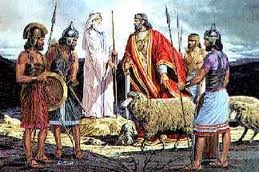
Saul disregarded the Lord’s command to utterly destroy the Amalekites. He spared the life of the Amalekite king. Quite possibly he did this because, out of fear for his own head, he wanted his followers as well as foreign armies, to differentiate between royalty and ordinary people. In any case, he disobeyed God’s command in this respect. He also allowed his followers to keep the best livestock alive. Once again, this may have been from insecurity. His warriors may have been grumbling about pointlessly killing good animals. Even if they weren’t, he may have wanted to appear gracious and become popular by rewarding those who fought with him. There may not be anything wrong with that, except that the Lord clearly commanded otherwise.

When Samuel confronts Saul about what he has done (or, failed to do) Saul claims that he has saved all the animals for sacrificing to the Lord. Frankly, I think he was lying. I think he got caught, and he decided in that moment to make up for his failure to obey by making a sacrifice with the captured animals.

Samuel says something very significant:

Then Samuel said: Does the LORD take pleasure in burnt offerings and sacrifices as much as in obeying the LORD? Look: to obey is better than sacrifice, to pay attention is better than the fat of rams. (1Sam 15:22)

This is theme repeated throughout both the Old and New Testaments. The Psalms reference this exact concept several times. So does Isaiah, and Hosea. Jesus mentioned the idea a few times in the New Testament. Even so, we need to be careful as we apply this to our own lives. It is very easy to say, “That’s right. I just need to obey God. We just need to do the right thing. What’s the point of saying we follow God if we don’t obey him?” I understand this attitude, but I think it tends to lead us away from the true meaning of this passage.

First, I think it comes back again to the fact that Saul was religious, but had no relationship with God. What he did seemed good. Saving the animals to sacrifice later was a religious thing. After all, sacrifices were part of Jewish religion. But Saul used his religion to keep from actually interacting with God, actually listening to him and responding in faith to what God said. Jesus said the Pharisees were religious like Saul too, and he hated it. Instead of listening to what the Lord actually said, they practiced religion. So this is a warning to us, to not let religion get in the way of faith. Religion keeps track of rules and regulations to follow, instead of living in a real, faith-relationship. In all sincerity, I try not to be religious. But living in faith is very important to me. Sometimes “sacrifice” is obedience. But we don’t live by rules, rather by relationship.

Second, we must understand that Jesus fulfilled this passage on our behalf. The writer of Hebrews quotes Psalm 40, and says that it is fulfilled in Jesus:

6 ​​​​​​​​In sacrifice and offering you have not delighted, ​​​​​​​but you have given me an open ear. ​​​​​​​Burnt offering and sin offering ​​​​​​​you have not required. ​​​ 7 ​​​​​​​​Then I said, “Behold, I have come; ​​​​​​​in the scroll of the book it is written of me: ​​​ 8 ​​​​​​​​I delight to do your will, O my God; ​​​​​​​your law is within my heart.” ​​​ Ps 40:6-8 (ESV)

Jesus delighted in God’s will. He didn’t live according to religious rules – the law of God was within his heart and during his time on earth he lived out that law through dependence upon the Father. He obeyed God perfectly. We cannot obey perfectly. So Jesus did it on our behalf. The obedience we owe God is complete and perfect in Jesus Christ, and only in Him. So when you think, “Oh, I have to obey God, because to obey is better than sacrifice” actually what you should hear is “I need to trust Jesus even more. Trusting him is my obedience, because has already done the obedience for me. Rather than act more religious, I need to trust more.” This is living by faith.

One reason we sometimes get confused is because obedience and trust can sometimes look the same. When you live by faith, it does result in certain actions. It does eliminate other actions. The bible does use the term “obedience.” But we must remember, it is the obedience of faith – not the self-effort of religion. Let me give you a little analogy to help us understand this.

I love spy/suspense shows like the Bourne Identity. Not everything in these shows is entirely righteous, but living in faith, we can find good things in them. Sometimes in shows like this, one of the characters may encounter a time-bomb. Picture a scene like this, where a lady has just a few seconds to defuse a bomb. She doesn’t know how to do it. But she gets on the phone with her friend who does. He tells her, “cut the blue wire, but be sure not to cut the red one.” So she carefully cuts the blue wire, but not the red one.

Now what is going on here? Is she obeying her friend, or trusting him?

Well, both, of course. But you see, her actions of obedience proceed from her trust of her friend. She trusts that he knows how to save her. She trusts that if she does what he says, she will be safe. And so, because of that trust, she acts according to what he says. She isn’t just doing what her bomb-expert friend says because it is the right thing to do. She isn’t doing it from a sense of moral obligation. She is “obeying” him because she trusts that he wants to save her life, and has the power (in this case knowledge) to do so.

You could call it obedience. But I would call it primarily trust. The obedience is a result of the trust.

I want to pursue this analogy a little bit further. In order to get this kind of trust-obedience, you need several factors. First, you have to believe that your life is really in danger. If the lady didn’t believe the bomb was real, chances are, she wouldn’t have called her friend anyway. She would not have been seeking the help she needed, because she wouldn’t have believed she needed it. Second, she had to believe that her friend had the knowledge that could save her. Third, she had to believe that her friend wanted to save her.

Peter expressed this attitude of faith. A lot of people had turned away from following God and Jesus was left with just the twelve apostles.

66 f After this many of his disciples turned back and no longer walked with him. 67 So Jesus said to g the Twelve, “Do you want to go away as well?” 68 Simon Peter answered him, “Lord, to whom shall we go? You have h the words of eternal life, 69 and i we have believed, and have come to know, that j you are k the Holy One of God.” (John 6:66)

When we encounter problems with obeying God in our own lives, I think it is usually a combination of these factors at play. Maybe we believe that the situation isn’t really very serious. Although we think obeying God is the right thing, when it comes down to it, we think we’ll be OK even if we don’t. We don’t see his words as life and salvation. So we don’t obey because we don’t believe our problem is that big.

Second, maybe we doubt whether God really has the answers we need. Perhaps we don’t obey him because we aren’t sure that what he is saying to us is relevant and helpful to us in our own situation. I think this was one of Saul’s major issues. He seemed to feel that God was fine for religious things, but in everyday life, you had to take care of yourself and use your common sense. Saul didn’t seem to think the command for Holy War was really right or had any value in his situation.

Third, we sometimes don’t obey because we aren’t sure we can trust God. Maybe we aren’t sure if he really has our best interests at heart.

Do you see the solution to the obedience problem – no matter what causes it? Faith. In each case, we need to change what we believe. We need to make a leap of trust. We need to trust that our situation is in fact serious, and we really do need the Lord to make it through life. We need to trust that the Lord really does have what it takes to save us, that his words are life; we need to trust that He is relevant in every moment of our lives. And we need to trust that he really has our best interests in his heart.

The devil likes to trick us into religion. Do the right thing because it is the right thing. And something in us responds to that. After all, it is the right thing. But is the wrong path, the wrong way to go about it. We can do the right thing with our own effort – for a while. But we fail eventually because it based upon our efforts, not the obedience that Jesus has already done on our behalf.

Then the devil likes to beat us up: You just aren’t obedient enough. You just don’t try hard enough. But the problem isn’t effort. The real solution lies in trusting more. Jesus has obeyed perfectly. His righteous obedience has become ours (2 Corinthians 5:21). Our part is to trust. If we do truly trust, then our lives will reflect the kind of actions the Lord desires. But it doesn’t start with our action, it starts with our trust.

So let me put it to you today. Do you trust that your situation is serious? Do you remember that no one gets out of this world without dying? Do you recognize that you are in a desperate place, the bomb is about to go off and you can only get help from one place?

Do you trust that the Lord has the right, relevant Word for you? Do you accept that he knows better than you, that he will save you if you trust him to?

And do you know that he wants to save you? Do you trust his goodness?

Take a moment right now to let the Lord into your thoughts and prayers as you consider these things.
What Comes Out When you are Squeezed?

The tough times that Saul faced revealed what was inside him. What do tough times reveal about you?

1 SAMUEL PART 9. 1 SAMUEL CHAPTER 13

————


To listen to the sermon, click the play button:

To download, right click on the link (or do whatever you do on a Mac) and save it to your computer: Download 1 Samuel Part 9

———————

During his first battle as leader of Israel, Saul defeated an enemy that dominated the Eastern tribes of Israel, as well as the Jordan valley. After that victory, the people finally accepted him officially as king. Saul conscripted 3,000 professional warriors and sent everyone else home. He let his son Jonathan command 1,000 of the soldiers.

saul-sacrifice

Everything we read about Jonathan suggests he was an outstanding young man in every way. He took his 1,000 men and promptly handed the Philistines a stinging defeat. This was good, as far as it went, but basically it had the same effect has kicking a hornet’s nest, or shooting a grizzly bear with a BB gun. Jonathan inflicted damage, but he didn’t impair the power of the Philistines to make war. In addition, after almost a generation of peace with Philistines (under the leadership of Samuel), the war was beginning again. We will see as we go on that Jonathan had a warrior’s heart, and a trust in the Lord, and he wasn’t worried about stirring up Israel’s old enemy. The problem was, the rest of Israel – including his father – was worried. The news of victory was carried throughout the land, but this is how it went:

“Saul has attacked the Philistine garrison, and Israel is now repulsive to the Philistines.” (1 Samuel 13:4)

At this point, we need some historical and geographical background. Chapter 13:19-23 describes something very significant. It tells us that these events took place at the end of the Bronze Age, and the beginning of the Iron Age. Quite simply, at this point the Philistines had Iron-Age technology, and the Israelites did not. This is one clue to why the Philistines were so feared by the Israelites, and why they were such a persistent military problem. They had iron weapons, and the Israelites did not. When we keep this mind, this makes any Israelite victory over the Philistines something of a miracle.

I want to chase a side trail for just a moment. 13:5 records the number of Philistine warriors. Some translations will say 30,000 chariots and 6,000 horsemen. Other bible passages record battles involving tens and sometimes hundreds of thousands of people. This seems surprising to me; in fact unlikely. For most of history, battles did not involve hundreds of thousands of people, and rarely involved even tens of thousands. It used to trouble me as a potential issue with the reliability of the bible. However, I think the answer may lie in ancient Hebrew. Ancient Hebrew did not include any vowels. The vowel was implied by the context. Even today, Hebrew vowels are expressed as little punctuation type marks, not by actual letters. Anyway, the point is, that the word for thousand “eleph”(“lp” in Hebrew) looks exactly the same as the word for professional solider — “alluph” (also “lp” in Hebrew). Thus, 100 lp could be 100,000 people, or simply 100 professional soldiers. In addition, “eleph” (thousand) can mean a few other things as well, just as many words in English have more than one meaning (For example: Present can mean “here” or “gift” or “the current moment in time” or “to show or display.”) Remember of course, professional soldiers were usually accompanied by peasant-militia troops as well.

In addition, we have examples of parallel passages where extra zeroes have been added or dropped. 2 Samuel 10:18 records the defeat of 700 chariots; 1 Chronicles 19:18, speaking of exactly the same incident, writes 7,000. Generally, I would suspect the lower number to be correct. So if you ever read these numbers and think, “Gee, that sounds like a much bigger number than seems likely,” you can knock off a zero – and in some cases, three zeros – and still agree that the bible is faithful and reliable. The problem is simply in the translation.

In any case, we ought to understand that whatever the actual number – 3,600 or 36,000 – for the times, it was a formidable professional fighting force that the Philistines sent into Israelite territory, along with a large number of peasant-militia troops. It was a big threat in two additional ways. First, up until this point, the Philistines had stayed mostly on the coastal plain. Technically, that was Israelite territory also, given to them by the Lord when they entered the promised land, however, Israelites had never really lived there. But in the incident recorded in 1 Samuel 13, the Philistines were pushing inland, up into the mountains that had been occupied by Israelites for hundreds of years.

Secondly, the Philistine invasion recorded here nearly cut the nation of Israel in half. They pushed all the way to Micmash, which was just a few miles short of the Jordan River valley. If they moved all the way down to the Jordan, the largest tribe in Israel (Judah) would be cut off, along with the tribes of Benjamin and Dan, and roughly half of the territory of Israel would be isolated from the other tribes. In clip_image002other words, the Philistines were about to take a gigantic, and possibly fatal bite out of Israel. See the picture at left. The brown line shows the territory occupied by Israelite tribes, and the yellow is the Philistines (this is a rough approximation, just to give you an idea of the danger they were in). Micmash is the yellow dot. The red dot next to the river is Gilgal, and the red dot closer to the Philistines is Gibeah.

Israel was just a few miles and one lost battle away from a huge national catastrophe.

It is interesting to note that Saul had originally held the position at Micmash, but retreated from the Philistines down into the Jordan valley. He gathered his army at Gilgal, a town in the Jordan river valley not far from the Philistines as the crow flies, but a fairly rough walk up or down the mountains by foot. The text doesn’t explain things clearly but apparently Samuel had sent a message to Saul, telling him to wait until he came, and then they would worship the Lord and make sacrifices before commencing the battle. In other words, they wanted God’s favor and help when they went out to fight.

Now it is quite likely that Samuel’s home town was affected by this invasion. The Philistine forces may have also forced Samuel to travel a considerable distance out of his way to get to Saul – remember, they had almost cut the nation in half. In any case, days passed, and Samuel did not show up. Saul’s army got restless and afraid. No doubt, many men were thinking of their families, wanting to prepare them for the disaster, or wondering if their homes had already been overrun by the enemy. They began to desert.

So Saul took action. He decided to go ahead and lead the worship and offer the sacrifices himself. He made the burnt offering. This was animal that was killed and completely burned up. No part of it was eaten – it was all “given” to the Lord through fire. It was used to seek God’s favor, to bring God’s forgiveness or to avert judgment. Just when Saul finished, Samuel finally made it to the camp.

Now, here is what troubles me. I think many Americans, if they didn’t read any further, would approve of what Saul did. People might say, “he’s a go-getter, a self-motivated leader.” They might think, “There’s a real leader – he’s losing men so he takes bold decisive action, he makes something happen.”

But Samuel didn’t see it that way, and apparently, neither did God.

13 And Samuel said to Saul, “You have done foolishly. You have not kept the command of the LORD your God, with which he commanded you. For then the LORD would have established your kingdom over Israel forever. 14 But now your kingdom shall not continue. The LORD has sought out a man after his own heart, and the LORD has commanded him to be prince over his people, because you have not kept what the LORD commanded you.” 15 And Samuel arose and went up from Gilgal. (1Sam 13:13-15, ESV)

The prophet immediately identified that the problem was Saul’s heart. It wasn’t fixed on God. Instead we see now that Saul was not humble, but rather insecure. He was worried about the future of Israel, of course. He was worried about his own ability to keep the men with him and maintain an effective fighting force. He did not trust the Lord with these concerns. Instead, he trusted in his own action. He trusted in the offering ceremony. Clearly, Saul viewed the offerings as a tool. It was a way to keep his army together and energized; perhaps also a way to manipulate God into helping him. Saul did not offer the sacrifices to please the Lord, or because was personally repentant or worshipful. If either of those had been the case, he would have waited for Samuel, who was the one who was supposed to do such things.

Saul was in a tight spot, there’s no doubt about it. But the tense situation did not create the problem in his heart. It only revealed it. When you squeeze an orange, what comes out? Whatever is inside the orange of course, which is orange juice. Now, when you are squeezed, what comes out? Whatever is inside you, of course. If you curse and rage when you are in a tough spot, that is because cursing and rage are inside you. Jesus said:

20“What comes out of a person — that defiles him. 21 For from within, out of people’s hearts, come evil thoughts, sexual immoralities, thefts, murders, 22 adulteries, greed, evil actions, deceit, promiscuity, stinginess, blasphemy, pride, and foolishness. 23 All these evil things come from within and defile a person.” (Mark 7:7-23)

45 The good person out of the good treasure of his heart produces good, and the evil person out of his evil treasure produces evil, for out of the abundance of the heart his mouth speaks. (Luke 6:45)

When Saul was squeezed by his circumstances, he did not put his faith steadfastly in the Lord. He refused to wait on God or on other people. He let his insecurity rule him, and he chose to act, rather than depend on the Lord. When Saul was squeezed, it was fear that came out. He put his trust in the number of men he had, rather than the Lord. It was more important to him to keep as many men as possible, than it was to seek God and his favor. His situation was not easy. But it didn’t cause his heart-problem – it just revealed it.

This is all about trusting God when things don’t look good – maybe things look disastrous. If you get squeezed, what do you think will come out? What is in the treasure-store of your heart?

What if it isn’t good? What if, like Saul, you have insecurity hiding there? What if there is rage or hatred or jealousy or selfishness? I think Saul had the opportunity to repent. When he was tempted, he could have turned to the Lord, confessed his weakness, and put his trust in the Lord. I think that is what we need to do when we are squeezed, and we see there is a problem in our hearts.

There may be an application here for you if you are faced with a difficult situation. Perhaps you feel a lot of pressure just to act, to do something, to make something happen. Sometimes the Lord does lead us to do that. We’ll see that with Jonathan next time. But if the Lord is calling you to wait, or if your action would be from fear or insecurity, maybe you need to sit still and wait for God to show up. Take a moment to the Lord speak to you no

ARE YOU TRULY FREE?

1 Samuel # 5. Kingship, Freedom and Responsibility

aslannew

GOD IS KING OF HIS PEOPLE

To listen to the sermon, click the play button:

To download, right click on the link (or do whatever you do on a Mac) and save it to your computer: Download 1 Samuel Part 5

Please read 1 Samuel 8:1-22

The battle recorded in 1 Samuel chapter seven ended when Samuel when was in his twenties. Verses 13-17 summarize most of the rest of his life. He led Israel, listening to the Lord, and telling them what the Lord had to say, helping them to understand what it means to follow him, and encouraging them to actually do it. And the people seemed to respond to his leadership. After those first tumultuous twenty years or so, things went well for that generation. The Philistine threat was greatly reduced. There was peace and people seemed listen to the Lord. What began with a simple woman wanting to become a mother, had brought peace, joy and goodness to thousands and thousands of people.

As he aged, Samuel tried to groom his two sons to lead Israel as he had. But it looked like they were headed down the same path as Hophni and Phinehas, the wicked sons of Eli, who had been in charge when Samuel was very young. History seemed poised to repeat itself. Samuel’s sons were dishonest – they took bribes to settle disputes, instead of judging fairly.

People Samuel’s age and older probably remembered what it was like back in the days of Eli, and were afraid of going back to those dark times. So the people gathered and told Samuel they wanted him to find them a king. I love Samuel’s response. The same little boy that was ready to hear God, still wanted to hear him as an old man.

One bible version says, “the request displeased Samuel.” The Hebrew word for “displeased” actually means to “ruin or spoil.” So it could mean that Samuel was upset about it – it ruined his heart. Or maybe he thought that the Israelites were going to spoil a very good thing. I think that is the best way to translate it, considering what followed.

So the first part of Samuel’s response is that he thinks it is a bad idea. He has good reasons for thinking that, and history basically proved him right. But, while that is what he thinks, he doesn’t just come right back with that. Instead, the second part of his response is to pray about what the people have said. In other words, Samuel was a humble God-follower. He was old and wise. He was a proven and popular leader. But he did not assume that his own opinion was right. Instead, he asked God about it.

Samuel’s attitude is definitely one worth learning from. When we have to make decisions about something, or deal with others, too often I know I’m right, and when I know I’m right, I think I don’t have to ask the Lord about it. Now, I’m not talking about things that the bible is very clear about – like who Jesus is, or whether it is wrong to lie. But there are many situations where God hasn’t given us a set of rules or a manual, and instead, we are supposed to rely on him to reveal his will in various situations. Should you take the new job or not? Does the Lord think it’s a good idea for you to go that party? Should your let your kids go on the overnight trip? Does the Lord want you to talk to your co-worker about what the bible says in this situation?

What God said to Samuel is surprising, puzzling and (I think) extremely interesting. He said,

The LORD said to Samuel, “Do everything the people request of you. For it is not you that they have rejected, but it is me that they have rejected as their king. (1 Sam 8:7)

So, let’s get this straight. He is saying, “Samuel, you have it right. When they ask for a king, they are rejecting me as king. This is a bad idea. So go ahead and help them get a king.”

Say what?

I think there are several things going on here. First, Samuel may have felt that he had personally failed as a leader. After he led them for a lifetime as a prophet, the people of Israel said, “we don’t want a prophet anymore. We want a king.” So Samuel may have felt that he somehow failed to teach them or encourage them in their relationship with God. He may also have felt bad about the choices his sons had made. The Lord was saying first of all “No Samuel, it isn’t you. You haven’t failed. They aren’t rejecting you, they are rejecting me.”

Sometimes this is a word we need to hear from the Lord. Maybe you have a family member you’ve been praying with or for. Maybe there’s a friend who has sought your advice. And yet the relative or the friend has ultimately decided to ignore what you have shared with them. Your prayers don’t seem effective. That person is going her own way, and that way is to move farther away from the Lord. Perhaps the Lord wants to say to you right now, “My beloved child, that person has not rejected you. She is rejecting my will for her life. Don’t take it personally. Don’t feel that you are a failure. This is about Me, not you.”

I want to talk for a minute about what the Lord meant when he said the Israelites were rejecting Him as their king. Since the time of Abraham, the people of Israel were not ruled by kings. For four hundred years in Egypt, and another four-hundred after they came to the promised land, the people were supposed to live free, with God as their only king. They were supposed to answer to Him – above any earthly authority.

The problem is, it didn’t work very well. Most people didn’t want to live that way. I am fascinated by how similar this is to the basic political philosophy of the Founding Fathers of the United States of America. Laura Ingalls Wilder wrote about her life growing up on the American Frontier during the late 1800s. In Little Town on the Prairie she makes some observations that are surprisingly relevant to our text today. One year, the new town she was living in celebrated the fourth of July. As part of the celebration, they read aloud the Declaration of Independence. After that, the crowd sang “My Country ‘Tis of Thee” ending with this verse:

Long may our land be bright; With Freedom’s holy light. Protect us by Thy might; Great God our King.

The crowd was scattering away then, but Laura stood stock still. Suddenly she had a completely new thought. The Declaration and the song came together in her mind, and she thought: God is America’s king.

She thought: Americans won’t obey any king on earth. Americans are free. That means they have to obey their own consciences. No king bosses Pa; he has to boss himself. Why (she thought) when I am a little older, Pa and Ma will stop telling me what to do, and there isn’t anyone else who has a right to give me orders. I will have to make myself be good.

Her whole mind seemed to be lighted up by that thought. This is what it means to be free. It means, you have to be good. “Our father’s God’s, author of Liberty — ” The Laws of Nature and of Nature’s God endow you with a right to life and liberty. Then you have to keep the laws of God, for God’s law is the only thing that gives you the right to be free. (Little Town on the Prairie, page 76)

This is what God meant when he said to Samuel that the Israelites were not rejecting Samuel, but God himself. They were saying, “It is too hard to have to listen to what God says for ourselves. It is too much responsibility for us to do what is right. Give us a king to lead us. He can tell us what to do. He can listen to God and be responsible for what happens.”

There is a deeper truth here. Whenever we reject the Lord, we are actually rejecting freedom. We tend to think of it the other way around. We think God gives us rules to follow and that is the opposite of being free. I want the teenagers reading this to pay careful attention, because you are at an age where you crave freedom. True freedom only exists with true responsibility. What that means is, you can’t really be free unless you are also really responsible.

Think about it like this. Suppose you are sixteen years old, and you want the freedom to go wherever you want, whenever you want to. In other words, you want the freedom to drive your own car. In order to get that freedom, you must take on the responsibility of learning how to drive, and you must take on the responsibility of learning the traffic laws, and abiding by them, and maintaining your license, and maintaining your car and paying for gas. You get the idea? You can be free, but in order to be free, you must also be responsible. If you don’t want to be responsible enough to do these things, you won’t be free to drive either.

Ever since Adam and Eve sinned, we human beings want to be free without being responsible. It never works. The two things simply go together. What the Israelites finally admitted is that they would rather not be free, if it meant they actually had to be responsible for their own relationships with God. They were saying, “we don’t want to grow up spiritually. It’s too hard. We would rather give up our freedom, so that we don’t have to be responsible for ourselves.”

In verses 9-18, the Lord through Samuel, told the people that this was exactly the choice they were making. But they said that they still wanted a king.

I think we do the same thing when we rely too much on Christian leaders or religious rules that aren’t really in the Bible. I don’t want anyone to feel bad, but sometimes people in my church come to me and say, “pastor what should I do in this situation?”

My answer is usually something like this: “Get to know the Lord through reading the bible, prayer, sermons, worship and fellowship. Learn to hear for yourself what he has to say to you. Talk to him about it yourself.” That’s not to say that I never have any God-given insight for anyone. Hearing God through other believers is a valuable thing, a gift that the Lord sometimes gives us. But the truth is, we are all supposed to connect with the Lord on our own also.

These things require effort and personal responsibility. It’s easier just to have someone tell you what to do. Some people find it easier to have an extensive list of rules that can apply to every situation. That way you don’t have to actually deepen your relationship with God, to learn to hear him, to put in the time required to get close to him.

God’s response to the people is fascinating. What they want is a bad idea. They will ruin his plan for them to be free as they follow him. And yet, he says to Samuel, “Let them go ahead with it. In fact, help them pick a king.” Basically he said, “I’ll give you what you want, but it will frustrate you in the end. In the end it will just bring you back to the same place.”

This is one of those places in the Bible where we see clearly two things that seem contradictory, and yet they are both true. God gives everyone free will. He let the Israelites choose something that was not what he wanted for them. They truly had a choice, and they used it to choose against God’s plan. But then, once they made their free choice, God began to work his will in and through the circumstances that their choice created. They got to have their free choice. And yet God’s will was not ultimately thwarted, and he began to work. It is a reflection of Romans 8:28

We know that all things work together for the good of those who love God: those who are called according to His purpose.

All things – even our own bad choices. God let the Israelites ruin his plan for a nation that lived free from tyranny and served only God. In fact, before he ever made the universe, he knew this would happen. He didn’t stop them. But he didn’t give up on them either. He continued to work with them.

Sometimes we are like the Israelites. We want what we want, even when someone (perhaps even the Lord) has warned us it is a bad idea. The Israelites experienced a lot of pain and heartache from their bad choices, but it did not separate them from the love of God. We may experience pain and heartache. But if we continue in faith, if we continue on in Jesus, God will work it out some way to our good.

Is God on Your side?

ARE YOU ON HIS?

1 SAMUEL PART 3. CHAPTERS 4-6


ark-of-the-covenant


To listen to the sermon, click the play button:


To download, right click on the link (or do whatever you do on a Mac) and save it to your computer: Download 1 Samuel Part 3


When I was a kid, I was a little bit scared of lightning. But somewhere I had heard that rubber or plastic could protect you from electricity. Now there is a kernel of truth in that. If the rubber is between you and the electric current, the electricity can’t hurt you. But as a child, I didn’t have the complete picture. I thought that simply holding something made out of plastic or rubber would protect me from electricity.

I had a toy tomahawk that was made out of rubber. It said so, right next to “made in Hong Kong” (which is where I got it). I believed without question that if I held this tomahawk, I was safe from electricity. In New Guinea it rained a lot, and puddles formed on the top of the ground very quickly. It wasn’t uncommon for a large area in a flat field to be covered by a foot of water or more, at least for a few hours. The rain was warm enough, and it was fun to swim and splash in the low areas and the ditches. Sometimes the rain would be accompanied by lightning and thunder. In those circumstances, I took my tomahawk with me. I would frequently stand up to my knees in water in the middle of a thunderstorm, secure in the knowledge that I wouldn’t be hit by lightning because I was holding my toy rubber tomahawk.

Now, I had a piece of the truth here. It is true that rubber won’t conduct electricity. I was close to something real. But even though there was something true about rubber protecting me from electricity, I had twisted that truth into a practical application that was nothing more than superstition. It is only by God’s grace that I was never struck by lightning.

1 Samuel chapters 4-6 describe a series of events where the people of Israel were close to something real and true about God, and yet they twisted it into mere superstition. Unlike me, they paid a difficult price for it.

As we go through 1 Samuel I want to occasionally point out some important thoughts for bible study and reading. The Jews in Jesus’ time divided the Old Testament into two parts: The Law (which was the first five books of the Bible) and The Prophets (everything else). That means that even though 1 Samuel is basically a history book, it was considered by the Jews to be “prophetic” in the sense that the history recorded here teaches us many things about God. I myself might call it, “prophetic history.”

We need to read prophetic history with a different approach than we might read most of the New Testament. The truths about God are contained in the telling of historical stories, rather than in a straightforward letter or in teachings given by Jesus. So when we we are looking at the New Testament, you may have noticed that we often spent a great deal of time on just a few verses. Now, as we study prophetic history, I think that generally we need to look at whole stories, rather than merely the individual verses within those stories. I think when we read this part of the Bible, we will miss the main meanings unless we consider things in the context of the historical story that is being told.

This week, the story happens to span three chapters – four, five and six – of first Samuel. You may remember that as a very young boy Samuel started hearing God speak. One of the first things God told him was that Eli and his sons were going to be judged for being such bad leaders. This is how that happened, and more.

I mentioned before that one of the problems that the people of Israel had at this point in history, is that they had not obeyed God and driven out all the pagan people who lived in the land. As a result, they were surrounded by people who worshiped false gods and demons. When the Israelites made friends with these people, they were led away from God into the worship of these pagan gods. When they refused to worship with their pagan neighbors, those people became enemies of the Israelites, and made war on them.

One of these pagan people groups were called the Philistines. They lived in an area along the Mediterranean coast of Israel, where they had five main cities, with five main Chieftains for each one. They worshiped two main deities: Dagon and Ashtaroth. During the time of Samuel and the history recorded here, the Philistines were the biggest threat to the people of Israel.

War broke out between the Philistines and Israelites, as it often did. The Israelites were defeated in battle. They asked an interesting question:

And when the troops came to the camp, the elders of Israel said, “Why has the LORD defeated us today before the Philistines? (1 Samuel 4:3)

Another translation says, “why did the Lord let us be defeated today?” They blamed God for their defeat. They didn’t come back and say, “we stink as warriors,” or “the Philistines are really good.” They said, “it’s God’s fault.

In a sense, I understand this. God could have given them the victory, but he did not. Since it was in his power, and he didn’t do it, they blamed him. But it isn’t exactly that God made them fail. He simply did not intervene to make them succeed.

They had forgotten something that happened centuries before, when the Israelites first came into the land. At that time, their leader Joshua experienced an interesting incident:

When Joshua was near Jericho, he looked up and saw a man standing in front of him with a drawn sword in His hand. Joshua approached Him and asked, “Are You for us or for our enemies? ”

“Neither,” He replied. “I have now come as commander of the LORD’s army.” Then Joshua bowed with his face to the ground in worship and asked Him, “What does my Lord want to say to His servant? ” (Josh 5:13-14, HCSB)

You see the proper perspective is not “is God on my side or not?” but rather, “am I on God’s side or not?” In the battle with the Philistines, the Israelites blamed God for not being on their side. But they never confronted the idea that they were not necessarily on God’s side.

Isn’t this what people still do in so many situations these days? We moan and gripe: “Why didn’t God let me see the policeman before I ran the red light?” That one may seem a bit obvious – because you should not have run the red light!

But maybe our situation is more serious and complex: “Why didn’t God heal my mother?” I understand that those types of questions can be real and difficult. In some ways, they are natural. And yet, I think we have the wrong perspective if we think that God is obligated to help us and do what we want him to, rather than the other way around. The question is never “Is God on our side?” If you insist on thinking in that direction, the only appropriate question is, “Am I on His side?” Personally, I think the whole question of “sides” is counterproductive. We don’t want God to control us and make us do only the things he wants us to do. And God does not do that to us. So why do we think we should get to control him, and make him do only what we want him to?

Instead of confronting this, the Israelites did something to avoid it. They decided to ignore the problem in their relationship with God, and put their trust, not in God himself, but rather in a shadow of a him, a symbol: the ark of the covenant.

The ark of the covenant was a carved wooden box, overlaid with gold. Inside the box were the tablets on which Moses had carved the ten commandments. It was a symbol of God’s presence with his people, a symbol of the agreement that he made with them at Mount Sinai. The leaders of Israel decided to bring this box into battle with them. Many of the Israelites, no doubt, felt that if the Ark was there, God was there with them. They didn’t have to face the fact that they had turned away from him. They didn’t have to deal with all those uncomfortable ideas like repentance, and surrender to God’s purposes for their lives. All they had to do was bring a box into battle, and God would automatically fight for them.

Some of the other leaders, perhaps some of the priests, probably thought that by bringing the Ark into battle, they could manipulate God into fighting on their side. After all, if God didn’t fight and protect the Ark, it would send a message to the Philistines that God either wasn’t real or wasn’t very strong. So even if the Israelites didn’t repent and seek out a true faith-relationship with the Lord, he would still have to fight for them, to protect his own honor, to make sure the truth about him was known.

So they sent the Ark into battle. Along with it, went Hophni and Phinehas, priests, the sinful, unrepentant sons of Eli, the chief priest. Obviously, they did not take relationship with God seriously.

Here’s one lesson from this incident: never try to manipulate God.

The Israelites lost the battle. In fact, the writer records “a very great slaughter.” Among those killed were the evil priests, Hophni and Phinehas. When the news was carried to their father Eli, he fell and died. His daughter-in-law, the wife of Phinehas, went into premature labor, and she died. As she died she said, “The glory of the Lord has departed Israel.” This reveals what she and most of the people around her believed – that God lived in that box called the Ark. The deaths of this priestly family fulfilled those first words that Samuel had heard from God.

Now, God did indeed want to show the Philistines that he was real, and all powerful. But he could not do that through the Israelites, because they had rejected a true faith relationship with Him. He could not reward the Israelites for putting their faith in a gold-covered wooden box. He needed to reveal the poverty of their faith. So they lost the battle and the ark was captured.

Even so, once the Philistines had the ark, God began to confront them with their own false worship. They took it first to the temple of their idol, Dagon. The next morning, the statue of Dagon had fallen over, face down in front of the Ark. The Philistines put it back. But the morning after that Dagon had fallen again and broken into pieces. In addition to the problem with their idol, the Philistines began to get sick. Somewhat skeptical, they sent the Ark to a different Philistine city, but got the same results. Finally, they decided to see if God wanted the Ark back in Israel. They put it on a cart with some offerings of gold. They hitched the cart up to two cows that had never pulled anything. They took the calves of those cows, and penned them up at home.

We have a cow with a calf on our little farm right now. I can tell you, cows do not normally leave their calves behind. That’s why the Philistines did this. They really wanted make it hard for the Ark to go back to Israel by accident. But these cows walked away from their home pastures and their calves and went straight to an Israelite town on the border, a town that was originally set aside for the priests.

So God made it clear that he was real. He made it clear that there was significance to the agreement he had made with Israel, the agreement which the Ark represented. But at the same time, he did not affirm or reward the superstition and manipulation of the Israelites.

You see the Israelites were close to something real and true. God had made promises to be in a special relationship with them. That was true. God often intervenes to help his people. That was also true. But there were some other truths that they ignored – that the special relationship with God involves faith and surrender on the part of God’s people. By surrender, I mean that God’s people are supposed to make their lives available for God to use and work through. The old time language for this is “obedience;” sometimes that gives us the idea that we have to obey God in order to be holy, but that isn’t it. Through Jesus we have already been made holy. Our obedience is so that God can live his life through us.

These days, we are often as superstitious and manipulative as those Israelites. If you come from Lutheran, Presbyterian or Episcopal traditions, you might feel that if you just get baptized as a baby, confirmed as a teen and take communion sometimes, you will be saved. Baptism and communion and confirmation are all useful things, and they are engaged in true spiritual reality. But they are useless without faith. By themselves they won’t help you at all. If you use them and receive them in a way that strengthens your relationship of faith and obedience/surrender, then they will indeed be helpful. But if you do them for their own sake, without faith, you might as well forget it.

Those from the Baptist/Methodist/Church of Christ type traditions do the same thing, usually with an event called “getting saved.” I’ve met many people who “got saved” when they were twelve or fifteen years old. Since then, they’ve had nothing to do with God, but they are putting their trust in the fact that one day in their distant past, they walked down the aisle and “got saved.” I’m afraid this nothing more than empty superstition. There’s something real and true that can happen when a person is saved, but it must involve true faith and surrender to the living God.

Others do it with going to church. I think there are many positive reasons to come to church on a regular basis, but if you are doing it to try and get God on your side, or for him to do you a favor, I’m afraid you are in for disappointment.

All these things are like expecting a rubber tomahawk to protect you from lightning. There is something true about rubber and electricity, but it doesn’t work like a magic wand. The rubber and the electricity need to be in the right relationship to each other for the insulating power of rubber to work. There is something real and true about getting saved, baptism and the Lord’s Supper and coming to church, but it all has to come in the context of faith and surrender in relationship to Jesus Christ.

So what is the Lord saying to you right now? Have you been upset with Him because he’s not acting like he’s on your side?Have you been putting your faith in religious activity or a religious symbol instead of in Him alone? Take a moment right now to surrender your life to him in faith.

The Boy Who Listened

1 SAMUEL #2. 1 SAMUEL CHAPTERS 2 &3

samuelHEARS

To listen to the sermon, click the play button:

To download, right click on the link (or do whatever you do on a Mac) and save it to your computer: Download 1 Samuel Part 2


1 The boy Samuel served the LORD in Eli’s presence. In those days the word of the LORD was rare and prophetic visions were not widespread.

Times were bad in Israel. There was an old man who was supposed to teach everyone about God, kind of like a pastor, except he was the pastor for the whole country. His name was Eli. Eli had two sons, named Hophni and Phineas. These two sons were grown men, and they were supposed to help their father Eli with the work of teaching people about God and leading them in worship. Instead, they made everyone do what they wanted them to. They took food from people who had saved money all year so they could bring the food to the place of worship and celebrate with God. When people complained, Hophni and Phineas told them that they were working for God, and so the people had to do what they said. They did even worse things than taking food.

Their father Eli did not stop them. He told them that what they did was wrong, but they didn’t stop doing it, and Eli didn’t do anything more about it. As we look at 1 Samuel chapters 1-3, it seems like Eli is not a bad man, but he was weak-willed and he did not do a good job raising his own children.

This wasn’t the only reason times were bad. The text says, “In those days the word of the Lord was rare and prophetic visions were not widespread.” In other words, no one was paying attention to God, and so no one knew what he wanted to say or do. Jeremiah 29:13-14 says this:

You will seek me and find me, when you seek me with all your heart. I will be found by you, declares the LORD (Jer 29:13-14, ESV)

Jesus put it this way:

And I tell you, ask, and it will be given to you; seek, and you will find; knock, and it will be opened to you. For everyone who asks receives, and the one who seeks finds, and to the one who knocks it will be opened. (Luke 11:9-10, ESV)

So God says, if you look for him, you’ll find him, if you are looking with all your heart. If you want to hear what says, you will, if you really truly want to, and you listen to what he says in the Bible, and when he speaks in your heart. But in those days, no one was doing that.So it wasn’t because God was ignoring his people. People didn’t hear from God because they weren’t listening. They did not really truly want to know God better; they didn’t really want to know what he had to say to them.

But one person started to listen. It wasn’t Hophni and Phineas, the bad priests who were abusing their power and position. It wasn’t Eli, the old man who was supposed to lead the country in following God. It wasn’t a mighty warrior or a great scholar.

The one person who started to listen was a young boy. His name was Samuel. Last week we learned how his mother held on to her desire to have a son, abut also surrendered that desire to God. Because of that, after Samuel was born, when he was about three years old, she let God adopt him. Of course it was Eli, the old chief priest who took care of him and taught him at the house of God, but it was really as if Samuel was adopted by God. When Samuel started to listen to God, he was still only a young boy. Both the Hebrew Text and the Greek Old Testament (called the Septuagint) agree on this point. The Greek uses a word that means “young child.” The Hebrew uses a word that can mean any child younger than thirteen years old. But he is definitely not a grown up; not even a teenager. It isn’t any more specific than that. He could have been twelve years old, or he could have been six. But we know he was only a kid.

Many of us know the story. It is right there in 1 Samuel chapter 3. One night Samuel was sleeping and he heard a voice call him. He thought it was Eli, the old priest. Now Eli took care of Samuel, and made sure he was fed and washed, taken care of educated. But Samuel also took care of Eli, because Eli could not see very well. So Samuel thought it was Eli who called him. Maybe Eli need some help finding something or walking somewhere in the dark. Probably there were times when Eli did call him to come help for things like that.

So Samuel got up to see what Eli needed. Only Eli had not called him. He sent Samuel back to bed. A little while later, Samuel heard a voice calling his name again. He got up and ran to Eli once more. Once more Eli sent him back to bed.

Then it happened again. Eli had his problems, but he wasn’t an entirely bad person, and it seemed like when he was caring for Samuel, he avoided the mistakes he must have made with his own sons. Eli realized that it must be God speaking to Samuel. So he sent Samuel back again, but this time, he told Samuel to ask God to keep speaking, and to listen to what God says.

Now there is something interesting about this story. I think a lot of people feel that if God speaks to them, it is going to be easy to hear him and easy to know that it IS God who is giving them the message. But that wasn’t the case with Samuel. It really was God. He was even speaking in a voice that Samuel heard audibly. Even so, it took both Samuel and Eli several tries until they realized that God was at work.

Many times, I think we don’t hear God because we think it should be easy. We think, “if God wants to say something to me, well, he can.” But that isn’t really seeking God, like Jeremiah and Jesus talked about. And even with Samuel, it took some time and energy to discern that God was speaking. It is good to not assume that everything that comes into our heads came from God. But at the same time, it is good to take a little time and energy to evaluate unusual thoughts or experiences, in case the Lord does want to speak to us through them. We evaluate it first of all through comparing what we think we heard, with the Bible. If it came from God, it won’t contradict the bible. Of course there are some things that aren’t in the bible, like what job we should take or where we should go to school. We should pray about those things too, and ask for God to speak to us, and then listen. When we think we hear something, we should talk with other Christians about it, and pray about what we heard, asking God to confirm it or not.

In Samuel’s case, what he heard was very much like something that another man of God had heard a few years before: Eli and his sons were going to be judged. The sons would be judged for the evil they were doing. Eli would be judged for allowing that evil to continue. This wasn’t actually a very nice or comforting thing to hear from God.

This is where Eli did teach Samuel an important lesson. The next morning, Samuel didn’t want to tell Eli what God said, because it was all about Eli and his family, and it was bad news for them. But Eli told Samuel that when God speaks, it is important to tell others what he said – even if it may be hard for some of them to hear. This is still true today.

And even though it was hard for Eli and his grown sons to hear, it was actually a very encouraging message for the rest of the people. Eli’s sons were bad men, and no one was stopping them. It was a good thing for the people to hear that God himself was bringing their evil ways to an end. It meant that God cared about his people, and would not let someone treat them unjustly.

So what can we learn from all this? Are you like the people of Israel in those times? Could it be that you don’t hear from God and you don’t see him at work in your life because you really haven’t devoted much time or energy to seeking him? I don’t mean this to sound judgmental or condemning. I just mean that this passage shows us a connection between hearing God and seeking God. It shows that even when God is speaking to us, it takes some effort and focus to realize that, and to hear what he is saying. It isn’t like a lightning bolt spelling something out in letters in the sky. We need to devote our attention to it.

Here’s another thing. It doesn’t matter who you are, or how old you are – God can speak to you. Samuel was a young boy. He was not and adult. He did not have the respect of a grown up or experience to convince people that they ought to listen to him. But God spoke to him. He chose him, out of all the people in Israel, to listen to God and to tell others what God was saying. You may think, “I’m just a kid,” or “I’m not a preacher” or “I don’t know much about the bible.” But all those were true of Samuel also. God can use any of us. In fact, he wants to use each one of us, in different ways.

I mentioned last time that these were some of the darkest days in the history of Israel. But because of one young boy, all that was about to change. People were going to begin to hear God again. I pray that we can all be like the young boy Samuel.

THE WHOLE PIE

LIVING IN REVERSE, PART 8

To listen to the sermon, click the play button:


To download, right click on the link (or do whatever you do on a Mac) and save it to your computer: Download Living in Reverse Part 8


If Jesus is really going to live his life through us, it can’t be only on Sunday mornings. It can’t be just when you have your quiet time with God each day. It can’t be only Sunday mornings, quiet times and small group meetings. It can’t be only after work. It can’t be only on weekends or mission trips.

You see, in America especially, we tend to have our own goals and ambitions, and we try to wedge God into our life as one piece of a very full pie. We’d be quite happy to let Jesus have more of us, but we just don’t have the time. Our plates our full. Our time and energy is used up.

I want to challenge you to be honest with yourself for just a moment. What is it all for? What is your time used for? What do you spend your energy on? What is your busyness accomplishing? Jesus said:

“My kingdom is not of this world,” said Jesus. “If My kingdom were of this world, My servants would fight, so that I wouldn’t be handed over to the Jews. As it is, My kingdom does not have its origin here.” (John 18:36, HCSB)

Yet, we seem to be fighting and struggling to make ourselves and our loved ones a comfortable place in this world. We can’t have both our own agenda, and the agenda of Jesus.

When I graduated from High School, the senior class had an official all night party. To make things more fun (as the organizers said) we were given fake money. We could beg for more, play games for more, or make trades. At the end of the night we could use the fake money to bid in an auction for real things, like a $100 gasoline card or even a motor scooter.

A friend of mine set his heart on the motor scooter. He spent all night working like crazy to get more fake money, so he could bid on the scooter. He hardly saw his friends. He hated card games, but he played endlessly to get more fake money.

At the end of the night he had a nice little pile of fake money. Even so, a few other people pooled their fake money, and outbid everyone else, including my friend. When it was all over, he threw his fake money in the garbage, and walked away with nothing but the memory of a wasted night.

There are several key differences between my senior class party and life as we know it. One of them is that, at the end of it all, you cannot use this world’s money, goods or accomplishments to bid on anything real that lasts for eternity. What we “gain” on earth is worth even less than the fake money at that party was worth. Remember what we learned through this series on living in reverse: “Don’t work for food that perishes!” (John 6:27)

Many of us who are grown ups, and particularly Christians, have started living for our kids. We aren’t living selfishly, we are truly not. We are sacrificing our time and energy and possessions for our children. That can’t be a bad thing, can it?

I want to be compassionate and flexible here, but also bold and honest. Sometime we say we are sacrificing for our children, but we are simply using them as an excuse for why we need to work longer hours or make more money. A lot of kids would be happier with less stuff, fewer opportunities and activities and more time with their parents. Some kids know this consciously. Others don’t know they would be happier that way, because everyone else runs around busy too, and they’ve never known anything different.

Some of what we say we are doing for the sake of our children doesn’t make that much sense in the long run. When my son was nine years old, we got him involved in a local community baseball team. They practiced for two hours every Saturday. They played two evening games a week, each one usually lasting about 90 minutes. By the time we drove back and forth everywhere, we were spending about eight hours a week for a nine year old child to play a game that was he somewhat indifferent about. If we had done that for every child in our household at the same time, we would have spent almost the same amount of time as a full time job, just keeping our children in sports.

99.8% of people will never be professional sport players. The skills we encourage our kids spend countless hours developing are for playing games. I know sports teach things like hard work and teamwork and integrity. But do you honestly think that kids can’t learn those things from you, in your family at home? I guarantee you that as a child, Abraham Lincoln did not play on a school team, nor a traveling team for any sport. I am certain that the apostle Paul didn’t either, nor Jesus himself, nor Martin Luther or Florence Nightingale or any of the people who truly shaped the world in which we live today.

Sometimes sports may be a way to college scholarships, I understand that. I can’t say too much about that, since I have no idea how my kids will pay for college. But I do know this: If Jesus, living his life through them, wants to go to college, he’ll go. He’ll make a way for them. But if I haven’t taken the time to teach them about Jesus, to let them develop an life that comes from within, from His Spirit, then even if they get a fully paid scholarship to Yale, I’ve failed.

I want to say one more thing. It isn’t uncommon for a family to spend ten, twenty or even more hours per week on activities and sports. If that is you, let me ask you, what are teaching your kids, by focusing so much on external activities? Do you spend an equal amount of time teaching them to read the bible and pray and listen to the Lord? Do you teach them how to be content and to draw life from the Lord when there is nothing going on externally?

Sometimes the reason we are so busy is because we are trying to get life out of external things. David Wilcox has a great line in the song Hurricane. He writes: “When hope is gone, she confessed, that when you lay your dream to rest, you can get what’s second best, but it’s hard to get enough.”

When we try to get life externally, we need a lot of external activity, a lot of external things going on. It’s hard to get enough, because it isn’t real life. Our busyness is often a cover up, a way to avoid dealing with the fact that we are missing the internal life. And by our busyness, we often are teaching our children to seek life externally also.

CLICK TO FINISH READING THE MESSAGE:

Continue reading “THE WHOLE PIE”

JESUS WANTS TO LIVE YOUR LIFE

christinme

To listen to the sermon, click the play button:


To download, right click on the link (or do whatever you do on a Mac) and save it to your computer: Download Living in Reverse Part 7


LIVING IN REVERSE PART 7. JESUS LIVES YOUR LIFE

We’ve been moving through this series about Living in Reverse. We’ve learned to put what God says after the “but…” – to agree with Him, and to let our dominant reality be determined by God’s Word and God’s actions. We’ve learned to draw life from the Spirit, not from our outward circumstances – not even the good ones. We’ve learned that when we are in Christ, our old self has been crucified, and we are dead to sin to the law. We’ve begun to learn how to fight the ongoing temptations that would try remove us from all these truths we’ve been talking about. We have begun to explore our new life as citizens of heaven, and all the resources we now have in Christ. We’ve been learning our new identity.

All this is leading toward an ultimate purpose: so that Jesus Christ can express His Life through you. Let me put a different way: The purpose of it here on earth is so that Jesus Christ can live your life. Paul puts it like this:

I have been crucified with Christ. It is no longer I who live, but Christ who lives in me. And the life I now live in the flesh I live by faith in the Son of God, who loved me and gave himself for me. (Gal 2:20, ESV)

Now, as I have preached these messages, I have noticed that some people have a certain amount of fear. I have had some fear of my own. That fear is that if we believe that sin is truly taken care of we (or maybe other Christians) will sort of go crazy and completely indulge ourselves in a lifestyle of sin. Now, I’ve addressed that in other messages, by trying to explain the relational connection we now have with God. But I want to point that there are two probable roots to this kind of fear.

The first root is control. Believe it or not, a lot people feel more comfortable with the idea that spiritual things are up to them. If I have to somehow measure up, then I have some control – I can work to make sure that I do in fact measure up. Some folks are very uncomfortable with the idea that they can’t do anything about their spiritual condition – not even after they are Christians. Some people would rather check spiritual items off a list than actually interact with the living God in a daily, personal way.

The second reason we often fear grace, is that we don’t really trust that Jesus will live his life through us and other Christians. I had neighbors once who weren’t Christians. The woman was pretty much a pagan feminist. We prayed for her and her husband for years. Eventually she started coming to our church. One night in our small group she confessed to us, and to the Lord that she was a Wiccan – a witch. She asked for God’s forgiveness. The next day she renounced Wicca and burned her Wiccan books. Not long after that, she completely gave her life to Jesus.

Shortly after she became a Christian we had a conversation, and I realized that she still held a lot of pagan and feminist views. She believed that there was nothing wrong homosexual behavior or abortion. I thought, “Oh my goodness, she’s a Christian now, but she still has all these pagan attitudes.” I had no idea where to start with her.

You see this really works. When we are truly surrendered to Jesus, he really will live his life through us.

I didn’t have to. Over the next year or so the Lord worked within her to change her attitudes. I don’t know exactly when or how it happened, but Jesus living within her made sure that she did not continue in unbiblical beliefs or practices.

I didn’t even know she was a Wiccan, before she told us, but the Lord did. He worked within her to change that. The Lord knew before I did the thoughts and attitudes she held that were wrong. He worked within her to change that. She had been a feminist, but before any of us more mature believers talked to her about that, she felt the Lord leading her to change her feminist attitudes and actions toward her husband. That change led him to become a Christian a few months later.

You see this really works. When we are truly surrendered to Jesus, he really will live his life through us. I didn’t have to lay out religious rules for my neighbor to follow – I just had to introduce her to Jesus, and once she surrendered to Him, He began to live his life through her.

We had another lady who started coming to a cell group in that church. She had been raised in a Christian home, but as far as we could tell, she didn’t have a living faith. She lived with her boyfriend and thought nothing was wrong with that. One night she wanted prayer to receive the Holy Spirit. I thought that was jumping the gun a little bit, since she didn’t really know Jesus. But we prayed. When we were done she said, “when you prayed for me, I really did get the Holy Spirit.” I didn’t think so, but I didn’t want to burst her bubble, so I didn’t say anything.

The next day she called me. “I just told my boyfriend he had to move out,” she said. “I have the Holy Spirit now, and the Holy Spirit doesn’t want to live like that.” She told me some other changes she was making in her life. I was floored. She really did have the Spirit!

Once she was surrendered to Jesus, once he lived in her through the Spirit, I did not have to tell her it was wrong to live with her boyfriend. The Spirit showed her.

Now I am not saying there is no use in knowing what the Bible says. The Spirit works through the Word to guide, correct and teach us. Both of these women got extensive Bible teaching and mentoring. But the changes in their lives were brought about not by other Christians giving them rules to follow, nor by them making a tremendous effort, but rather Jesus living his life through them. Their main work was simply to trust Jesus and respond to him as he led them.

I could tell you more true stories but my hope is that if you are a believer, you will see for yourself that Jesus will live his life through you if you let him. And this is why we don’t need to focus on whether or not we are sinning. If we are focused on Jesus and if we respond to him as he teaches us and leads us, we are not going to sin very often. You see, if Jesus is the one living your life, Jesus isn’t going to sin. It’s only when we stop believing it, and stop responding in faith to Jesus that we get into trouble. We get into trouble when WE try to live our OWN lives. Even when we are trying live our lives in a holy way, if we are doing it on our own, we tend to get into trouble.

READ ON TO FINISH THE MESSAGE….

Continue reading “JESUS WANTS TO LIVE YOUR LIFE”

YOUR IDENTITY IS DETERMINED BY YOUR BIRTH

new birth

Living in Reverse Part 6: Born Again.

To listen to the sermon, click the play button:


Right click and save the link below to download the audio:

Download Living in Reverse Part 6


We’ve been moving through this series about Living in Reverse. We’ve learned to put what God says after the “but…” – to agree with Him, and to let our dominant reality be determined by God’s Word and God’s actions. We’ve learned to draw life from the Spirit, not from our outward circumstances – not even the good ones. We’ve learned that when we are in Christ, our old self has been crucified, and we are dead to sin to the law. We’ve begun to learn how to fight the ongoing temptations that would try remove us from all these truths we’ve been talking about.

Some of you may have been trying to put some of this into practice recently. Maybe you’ve been facing temptation and saying, “I’m dead to sin, I don’t want to do that anymore,” but it hasn’t always worked for you. Maybe you’ve been trying to believe desperately, who you really are in Christ, but you still have doubts. And because you don’t fully believe, your actions still don’t look like someone who is dead to sin. If sin is still a struggle, I want to preach the good news to you again today. We’ve discussed why and how it can be problem. We’ve talked about how to fight it. But remember, we are dead to it. I want to start now, talking about our new life. We died to sin, but what are we alive to?

. Maybe you don’t need this today. If not, save this sermon for some time in the future when you do need it.

There is one other thing I think we ought to consider before we jump into the scriptures I want to share. And that is, spiritually speaking, we are often terribly confused about the place of our actions. We understand that our actions are of no value in getting salvation for ourselves. Salvation is a free a gift of God, and it cannot be earned through good deeds (Ephesians 2:8-9). It is appropriated through faith. In other words, we get it when we believe that we need it, and that God has really done this for us.

But now, after we are in Christ, we think our actions determine everything. We think our actions determine who we are. If we act sinful, we think we are fundamentally sinners. If we act righteous, we feel good about ourselves and think we are, by our own efforts, incorporating the righteousness of Christ into our lives. It is to people acting like this that Paul writes:

I only want to learn this from you: Did you receive the Spirit by the works of the law or by hearing with faith? Are you so foolish? After beginning with the Spirit, are you now going to be made complete by the flesh? Did you suffer so much for nothing — if in fact it was for nothing? So then, does God supply you with the Spirit and work miracles among you by the works of the law or by hearing with faith? (Gal 3:2-5, HCSB)

You see, your actions do not determine who you are. Instead, your identity is determined by your birth. I was born in the United States of America. But when I was very young, my family went overseas to be missionaries. The majority of my childhood was spent in other countries.

By the time I was sixteen I did not sound like an American – I actually had an Australian accent. I didn’t really know American culture. My first few years in the US, I didn’t get most of the jokes and wise-cracks, because humor is one of the most culture-specific things there is. I didn’t dress in American fashion.

My memories were not of America. In fact my memories and experiences were in a place that was radically different in very fundamental ways from the United States. In short, America had very limited role in shaping my thoughts, actions, personality, memory or experience. I did not feel like an American at all.

For that reason, did I cease to be an American? Not at all. My citizenship was determined by the country I was born into – not by my feelings, not even by actions. The key was my birth.

Even though I didn’t feel American, I recognized that America offered me more opportunity than anywhere else in the world. I saw my citizenship here as a gift that I could use. I believed what my parents told me, that I was an American citizen. I believed my American passport was valid. So I came to America, in faith that my birth certificate and passport were valid. And now, because I believed that my birth determined my citizenship, I have received many benefits from being American.

Spiritually speaking we need to recognize that it our birth, not our actions, which determines our identity.

Remember, action follows belief. And Romans chapter ten tells us that the kind of belief we need for this comes from hearing the word of God. So I am going to dwell on some more truth from God’s Word today. If we have trusted in Jesus, the bible is very clear about our birth:

Jesus answered him, “Truly, truly, I say to you, unless one is born again he cannot see the kingdom of God.” Nicodemus said to him, “How can a man be born when he is old? Can he enter a second time into his mother’s womb and be born?” Jesus answered, “Truly, truly, I say to you, unless one is born of water and the Spirit, he cannot enter the kingdom of God. That which is born of the flesh is flesh, and that which is born of the Spirit is spirit. (John 3:3-6)

Blessed be the God and Father of our Lord Jesus Christ! According to his great mercy, he has caused us to be born again to a living hope through the resurrection of Jesus Christ from the dead, (1Pet 1:3, ESV)

Since you have been born again — not of perishable seed but of imperishable — through the living and enduring word of God. (1Pet 1:23, HCSB)

Everyone who believes that Jesus is the Messiah has been born of God, and everyone who loves the Father also loves the one born of Him. (1John 5:1, HCSB)

For through him we both have access in one Spirit to the Father. So then you are no longer strangers and aliens, but you are fellow citizens with the saints and members of the household of God, (Eph 2:18-19, ESV)

But our citizenship is in heaven, and from it we await a Savior, the Lord Jesus Christ, (Phil 3:20, ESV)

We have been crucified with Christ. The old has gone. The new you has been born into a new life. We have born citizens of heaven, members of God’s household. Regardless of what we know about heaven, regardless of how we sometimes act like we are from someplace else, Heaven is the place of our citizenship. Our birth certificate proclaims it, our passport affirms it. All of the resources of heaven are ours.

Now, one of the problems, is that sometimes we don’t know our own birth rights. We are like princes and princess who have born to inherit a kingdom. But we were kidnapped as babies, and raised in poverty. Now, our Father, the king has found us and brought us back to the palace. But we don’t even know the rights and privileges and tasks that are ours as royal children. We don’t know the vast resources we have now to fulfill those things. In the same way, so often Christians don’t even know everything that is ours, in Christ Jesus. So Paul writes to the Ephesians:

I pray that the God of our Lord Jesus Christ, the glorious Father, would give you a spirit of wisdom and revelation in the knowledge of Him. I pray that the perception of your mind may be enlightened so you may know what is the hope of His calling, what are the glorious riches of His inheritance among the saints, and what is the immeasurable greatness of His power to us who believe, according to the working of His vast strength. (Eph 1:17-19, HCSB)

His prayer is that they (and all followers of Jesus) can know these things. He wants us to know our birthrights, now that we have been born again. So I am going to share with you, some of the riches that are yours and mine when we are in Christ. This is what it means to be born again as a citizen of heaven:

In Christ, we are holy, blameless, righteous and above reproach (Eph 5:4; 2 Cor 5:21; Col 3:12; 1 Cor 6;19).

He has now reconciled in his body of flesh by his death, in order to present you holy and blameless and above reproach before him, if indeed you continue in the faith, stable and steadfast, not shifting from the hope of the gospel that you heard, which has been proclaimed in all creation under heaven, and of which I, Paul, became a minister. (Col 1:22-23)

The “if you continue” is clearly about continuing in faith and hope. It is not continue to “act righteous” but continue to hold fast to the faith that this is true, that Christ has done this for you. A wise pastor named Dan Stone wrote: “It is not your striving that releases Christ’s life through you. It is your trusting.” We are in Christ when we continue to trust Him and rest in Him day by day. And in Christ, we are holy and blameless.

In Christ, we are safe and free. I am free from condemnation. I am free from sin and death. I cannot be separated from the love of God (Romans 8:1-2; also 8:31-39). God works for my good in all circumstances (Romans 8:28). I have been established, anointed and sealed by God. (2 Corinthians 1:21-22). I can approach God with freedom, confidence and boldness (Eph 3;12; Hebrews 4:16). My real life is already hidden away with Christ in God (Colossians 3:1-4). I am born of God and the evil one cannot touch me. (1 John 5:18).

In Christ, we are significant and important. I am a branch of Jesus Christ, the true vine, and a channel of His life (John 15:5). I have been chosen and appointed to bear fruit (John 15:16). I am God’s temple (1 Corinthians 3:16). I am a minister of reconciliation for God (2 Corinthians 5:17-21). I am seated with Jesus Christ in the heavenly realm (Ephesians 2:6). I am God’s workmanship; created by Him to do good works, which he has already prepared for me to do (Ephesians 2:10).

These are just a few of many verses and concepts that describe who we are when we are born into Christ and into citizenship in Heaven. This is the real you, the you that is more real more powerful than what you see in the flesh or feel in the soul. If you continue in faith (that is, if you continue to believe, to trust Jesus and trust that this is all true in Him) then this you will last forever, and ultimately will be expressed through a transformed soul and a new, eternal body.

You may still act or think like a foreigner, from time to time. But if you trust Jesus, you have born again as a citizen of heaven. All this is truly yours, even though your actions may not yet reflect it perfectly.

All this is leading toward an ultimate purpose: so that Jesus Christ can express His Life through you. Let me put a different way: The purpose of it here on earth is so that Jesus Christ can live your life. That is what we will explore next week.

WHY DO WE SIN? HOW CAN WE FIGHT IT?

LIVING IN REVERSE PART 5.

To listen to the sermon, click the play button:

Right click the link to download: Download Living in Reverse Part 5

Now, there is another question we need to address. If we are already holy, and already free from sin, why do we sin anymore at all? And how do we deal with it?

I’m so glad you ask, because the answer is found in a passage of scripture that is frequently misunderstood: Romans chapter 7:15-20.

For I do not understand my own actions. For I do not do what I want, but I do the very thing I hate.

Now if I do what I do not want, I agree with the law, that it is good. So now it is no longer I who do it, but sin that dwells within me. For I know that nothing good dwells in me, that is, in my flesh. For I have the desire to do what is right, but not the ability to carry it out. For I do not do the good I want, but the evil I do not want is what I keep on doing. Now if I do what I do not want, it is no longer I who do it, but sin that dwells within me. (Rom 7:15-20, ESV)

We read this and we say, “Yeah, I understand that, that’s me.” And we hear Paul say “sin is living me” and “nothing good lives in me” we think: “See? Isn’t that a sinful nature?”

But this passage is frequently misinterpreted. First, in verses 7-14, Paul is talking about the past, about how life was before Jesus. In verse 15, he begins to speak in the present tense, but it isn’t clear if he has switched to his present circumstances, even after salvation, or if he is still explaining the past. Just to move the discussion along, let’s say that in verse 15, Paul is talking about sins he commits as a Christian.

We always need to interpret scripture in context. The entire context of chapter seven is actually chapters six, seven and the first part of chapter eight. The chapters and verse marks were not inspired by God. They were put in by monks 1000 years after the New Testament was written, to help us in navigating around the bible. So pretend they aren’t there, and you can clearly see that the first several paragraphs of chapter 8 are still on the same subject as chapters six and seven.

So with that in mind, what is the general topic that Paul keeps coming around to? You are dead to sin, dead to the law, and alive to Jesus. Therefore, when Paul describes his struggle with sin here, he is not contradicting himself. It is the in the same letter, in the same section, talking about the same subject as when he said: “Likewise, you also have died to the law.”

Therefore, clearly Paul is not turning around and saying “You have not died to the law. You are not free from sin. Your old self is alive and well.” That would be ridiculous and unsustainable biblical interpretation.

I used to believe I had a sinful nature that was alive and well. So when I read this, I was focused on Paul saying “I do bad things…even though I don’t want to.” Actually, Paul’s emphasis is not that he is sinning, but rather that he doesn’t want to commit these sins. What Paul is saying is, “In the deepest part of me, I don’t want to sin. This shows that this part of me is holy and agrees with God. In my deepest nature, I am not a sinner.” He says, in verse 22: “For I delight in the law of God in my inner being.”

And so he says in 8:1-3

There is therefore now no condemnation for those who are in Christ Jesus. For the law of the Spirit of life has set you free in Christ Jesus from the law of sin and death. For God has done what the law, weakened by the flesh, could not do. By sending his own Son in the likeness of sinful flesh and for sin, he condemned sin in the flesh, (Rom 8:1-3, ESV)

I had friend once who was not a Christian. After a lot of time and people praying for him, and some long conversations, he gave his heart to Jesus. Afterward, we started to meet together to pray and talk about the Bible and generally encourage each other in faith. One time the subject of lust came up. He said, “You know, before I became a Christian, I did not struggle with lust. Now I struggle with it all the time.”

I was shocked. What had we done wrong? I asked him to explain.

“Well, before I was Christian,” he said, “there wasn’t any struggle. I lusted, and it didn’t bother me. But since I came to Jesus, it bothers me when I lust because I don’t want to do that now.”

You see the fact that he didn’t want to sin any more was proof that he had died to sin. In his deepest heart, he knew that he didn’t desire sin. In his inner being, he delighted in God’s perfect standard and holiness.

Continue reading “WHY DO WE SIN? HOW CAN WE FIGHT IT?”

YOU’RE DEAD MEAT!!

To listen to the sermon, click the play button:

Download “Living in Reverse Part 3

LIVING IN REVERSE PART 3.

This is actually the third part in a series called Living in Reverse, but due to a speaking engagement, a vacation and then an illness, it has been almost a month since the second part was posted. So I want to remind us of where we are. We began the series by looking at the life of Leah, and how she learned to make God’s love and God’s view of her more important than her life circumstances. We call this “Living after the But.” We need to understand that the final and most important factor in any situation, feeling, thought or circumstance, is what God says and does. Second, we looked at the life of Elijah, and how God showed him that true Life is not in our external circumstances – not even in how God may or may be changing them. True Life is found in the Spirit, and God designed it to flow through our spirits into our souls and then our behavior.

With all that in mind, we will move on. I want us to begin this time by considering how much our actions are affected by what we believe.

In the 1850s, people began to keep track of how fast a man could run one mile. The time-pieces back then were fully accurate enough to make across the board comparisons to modern times. For almost a hundred years, no one was able to run a mile faster than four minutes and several seconds. There was a general consensus that no human being could run a mile in less time than four minutes.

One of the fastest mile-runners in the world in the 1950s was Roger Bannister. On 2 May 1953, he made an attempt on the British record at Oxford. Bannister ran 4:03.6, shattering a previous record set in 1945. "This race made me realize that the four-minute mile was not out of reach," said Bannister. What I want to point out is that it was at this point that Bannister began to believe that he could run a mile in less than four minutes.

A year later, on May 6, 1954, Roger Bannister broke the four minute mile barrier, completing it in 3:59.4. I contend that he was able to do this simply because he believed he could. For a hundred years, no had run a mile in less than four minutes. Most people believed it couldn’t be done. Bannister believed, and a year later it became reality. Now, once Bannister proved a man could run a mile in less than four minutes, what do you think happened? Now everyone believed it could be done. Bannister’s record was broken less than two months after he set it. His record and subsequent faster records were broken five more times during the next decade. In a hundred years, no one had run a four minute mile. But once one man did it, and others believed it could be done, dozens began to do it. During the past sixty years, it is estimated that more than 850 people have run a sub four minute mile. Let me state it clearly: In the first hundred years, not a single person ran a sub-four minute mile. In the past sixty years since that record was first broken, almost nine-hundred people have done it.

Now you could probably make a case for nutrition and a more sports-oriented culture to explain some of this. But I personally believe that the biggest difference between the first hundred years of records, and the last sixty, is that now people believe it can be done.

Your belief affects how you act, what you attempt, and what you achieve. If you want to change the results you are getting, you must start by changing your belief. At the family camp where I recently spoke, another speaker observed that preachers have two basic options: to ask you to do something, or to ask you to believe something. I would add that we can also impart information and inspiration. This week, I will give you some information, but my main purpose is to encourage you to believe something that God says in the Bible. When you believe it, it may change your life. You may find that you are living with a perspective that you used to think was impossible.

This what I am asking you to believe: When you trust Jesus, you are dead to sin.

Many of us come out of a Lutheran background. The writers of the old “Green Hymnal” did not do us any favors when they had us say, week after week, for decades: “I am in bondage to sin.” Many us, Lutheran or not, have used the NIV bible translation for years. The NIV is generally a great translation, but they didn’t do us any favors when they translated the Greek word “sarx” as “sinful nature” when really what it means is “flesh.”

There is another problem. Our experience tells us that we are capable of sinning a lot, and sinning horribly. We get angry. We lie. We cheat. We are dishonest. We lust. We get drunk. When we combine the reality that we still sin, with the concept of bondage to sin and sinful nature, we have an entire generation – maybe two – of Christians who have grown up believing that even after we have come to Jesus, we are fundamentally sinful beings.

We recognize that the Bible actually says something that sounds different than this. And so we reconcile it by saying this: “I know I am redeemed by Jesus. But I also have this sinful nature living in me that I will have to fight with until I die.” But brothers and sisters, the story is different than that. Read carefully:

  • By no means! How can we who died to sin still live in it? Do you not know that all of us who have been baptized into Christ Jesus were baptized into his death? We were buried therefore with him by baptism into death.. (Rom 6:2-4 ESV)

  • We know that our old self was crucified with him in order that the body of sin might be brought to nothing, so that we would no longer be enslaved to sin. For one who has died has been set free from sin (Romans 6:6-7)

  • So you also must consider yourselves dead to sin and alive to God in Christ Jesus (Romans 6:11)

  • Likewise, my brothers, you also have died to the law through the body of Christ, so that you may belong to another, to him who has been raised from the dead, in order that we may bear fruit for God (Romans 7:4)

  • But now we are released from the law, having died to that which held us captive, so that we serve in the new way of the Spirit and not in the old way of the written code (Romans 7:6)

  • Set your minds on things that are above, not on things that are on earth. For you have died, and your life is hidden with Christ in God. (Colossians 3:3)

  • For through the law I died to the law, so that I might live to God. I have been crucified with Christ. (Gal 2:19-20, ESV)

  • If with Christ you died to the elemental spirits of the world, why, as if you were still alive in the world, do you submit to regulations (Col 2:20, ESV)

  • The saying is trustworthy, for: ​​​​​​​​​​​​​​​​​​​​​​​​​If we have died with him, we will also live with him; ​​​ (2 Tim 2:11, ESV)

  • He Himself bore our sins in His body on the tree, so that, having died to sins, we might live for righteousness (1 Pet 2:24, HCSB)

  • For the love of Christ controls us, because we have concluded this: that one has died for all, therefore all have died; and he died for all, that those who live might no longer live for themselves but for him who for their sake died and was raised. From now on, therefore, we regard no one according to the flesh. Even though we once regarded Christ according to the flesh, we regard him thus no longer. Therefore, if anyone is in Christ, he is a new creation. The old has passed away; behold, the new has come. (2 Cor 5:14-17, ESV)

Just a quick note. I have run into some folks who want to debate what part of us, exactly, was crucified with Christ. What died? I think this is a little bit beside the point. Paul says variously, “our old self” or “I” or “you.” He is not terribly specific or theological about it. I have my professional theological opinion, but let’s not get side tracked.

The point is, in Jesus Christ, you have died in such a way that the connection between you and sin is broken. Paul says we are dead to the law. Think about it. There are no laws for dead people. A dead person is beyond the law. Imagine you committed a horrible crime, and you were sentenced to life in prison without the possibility of parole. Once you are dead, your sentence is over. They bury you in the prison graveyard, and you are done. Once you are dead, the law can require nothing more from you. Paul says “You are released from the law. You died to what held you captive.”

And we are dead to sin: “So you also must consider yourselves dead to sin and alive to God in Christ Jesus.” He says this in several places. Peter also says it.

The point then, is not really what part of us died. The point is that we need go forward, from this point, believing that in Jesus Christ, we have died to sin and to the law that keeps us on the hook for sins we commit. The connection between us and sin, us and the law is so thoroughly broken, it is like trying to get a dead person to keep serving a prison sentence. It’s over. There is no more connection.

You see, I spent years trying to make myself behave better. I thought my old self was still alive. I thought I still had some deep internal connection to sin. And so I kept trying to reform myself, and always failing Finally, I saw that God doesn’t try to reform the Tom. Instead, he killed him. In Jesus, the new Tom – at least the spirit of the new Tom – has already been raised. And there is no connection between that new Tom and sin. When I began to really believe that – that I am truly dead to sin – I began to sin less.

Do you believe that your old self is dead and buried with Christ through his death? Do you believe that you are dead to sin? Do believe that you are no longer enslaved to sin? Do you believe that the old has passed away and the new has come? Do you count yourself dead to sin but alive to Jesus?

I find that the biggest objection this idea is that it is not usually our daily experience. We feel like the old us is still there. We don’t feel like we are free from sin. We feel like the law still applies to us and holds us captive. We don’t feel new, and like we are living according the Spirit and not flesh.

Now is the time we must remember the first two messages in this series. If you never heard them or read them, stop reading this, and go back and get those first two messages. You see? Our experience is telling us one thing and God is telling us another. What should we put after the but? Our experience, or God’s word? God’s word, of course. We should say it something like this. “I know that in my flesh, there is still a struggle with sin – BUT God says I am dead to sin. I know I feel like I have sinful nature – BUT God says my old self was crucified with Christ.”

Then, remember Elijah. Where does real life come from – the flesh and the soul, or the spirit? The spirit, of course. What is eternal, and more powerful? The spirit. And where is is that the old self is dead and the new is come? The spirit. The spirit trumps flesh and soul.

Now, this is a deep concept. I will take next week to talk about the struggles with have with sin, and how that fits into it all.

But for now, I am calling you to believe what God says, and give it more power than your feelings and your experiences. I am calling you to draw life not from what is happening in soul and flesh, but in what God has done and is doing in your spirit.

You see, if you believe that you have a sinful nature, how are you going to act? You are going to sin, of course, because that is what someone with a sinful nature does. As I said at the beginning, what you believe ultimately determines how you will act. You cannot consistently or for very long, act in opposition to what you truly believe.

If you trust Jesus, at the most important place, in the heart of your being, you are not a sinner. I am not saying you never commit sins. But you are not a sinful nature. And the part of you that is holy and blameless and perfect will outlast the part of you that still struggles. The place in which you are dead to sin is more powerful, more enduring and more important than the place where you struggle. Life comes from the Lord, through place where you are already dead to sin.

We need to believe that when God says we died with Christ, we really did die.

I killed a snake one time. I blew it half with a shotgun. The snake was dead, there was absolutely no question about that. There was a the head, with a little piece of neck, and there was the body, completely separate. But the mouth kept opening and closing like it was trying to bite something. The body twisted and coiled and uncoiled for ten or fifteen minutes afterward.

All that twisting and coiling and movement looked like life – but it wasn’t life. It was merely the death throes. If I was a really dumb veterinarian, I could have wasted time and energy treating the dead snake that acted like it was alive. But there was no life there.

Our old person can sometimes act as if it is still alive. We still get the impulses and signals that seem to show that our old self is alive and well. But this is nothing but death throes. There is no life there. If we work to try and kill it again, or try and reform it, we are wasting time and energy in a futile exercise.

Paul says, “don’t gratify the flesh.” Our old body is rotting in the prison graveyard. We don’t have to follow the prison rules any more. We don’t have to try and make up for the laws we broke before. Satan is the one who comes to you and says: see all the twisting and turning and activity – you have a sinful nature and it is alive and well. But the Bible never says anywhere that our old self got un-crucified. It never suggests that the old nature got resurrected. It is is a lie of the devil. He’s trying to get you to live as if you are still alive, back in the prison of your sinful self.

Here’s the thing: he can’t put you back in prison. But if you don’t believe what God says – if you don’t put God’s word after the but – the devil and your flesh can trick you into living as if you were still in prison.

Now, I will talk next week more about this struggle with the devil and the flesh, and how it all fits together. But for this week I am calling you to faith. I am asking to believe that what God says is really true:

In Christ, you have already died. In Christ you are not sinful. You are not divided into good and evil. You are holy and blameless and without reproach.

Yes sin in your flesh is still writhing around in its death throes. But it is already dead. Pay it no mind. Instead fix your eyes on Jesus, put your focus on the unseen and eternal truth – you old self is dead and your true self is alive in perfection with Jesus.