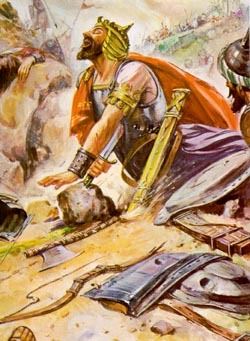
2 SAMUEL #15: GRACE AND CONSEQUENCES

Sometimes it can feel like God is punishing us for our sins and failures. Thankfully, the Bible tells us that only Jesus received the righteous punishment for our sins. However, often, our sins do have natural consequences, which is one reason God wants us to stay away from sinning. At times, even though we are truly forgiven, we have to face those consequences. David, a man with a heart for God, shows us the way, and highlights the incredible grace of God’s forgiveness and ongoing presence with us.

To listen to the sermon, click the play button:

For some people, the player above may not work. If that happens to you, use the link below to either download, or open a player in a new page to listen.

To download, right click on the link (or do whatever you do on a Mac) and save it to your computer: Download 2 Samuel Part 15

I felt it was important to spend an entire message talking about repentance, and David’s beautiful psalm when he finally turned back to the Lord after the affair with Bathsheba. But we sort of skipped over another part of what Nathan said to David, and it is also significant:

10 Now therefore the sword shall never depart from your house, because you have despised me and have taken the wife of Uriah the Hittite to be your wife.’ 11 Thus says the LORD, ‘Behold, I will raise up evil against you out of your own house. And I will take your wives before your eyes and give them to your neighbor, and he shall lie with your wives in the sight of this sun. 12 For you did it secretly, but I will do this thing before all Israel and before the sun.’”

13 David said to Nathan, “I have sinned against the LORD.”

And Nathan said to David, “The LORD also has put away your sin; you shall not die. 14 Nevertheless, because by this deed you have utterly scorned the LORD, the child who is born to you shall die.” 15 Then Nathan went to his house. (2 Samuel 12:10-15, ESV)

David was truly forgiven. But Nathan declared that even so, David’s sin would result in some terrible things. He says first that “the sword shall never depart from your house.” What he means is that David’s family, and even his descendants, will be constantly engaging in violence, war and strife.

Next he says that evil, or disaster, will rise against David from within his own house (again “house” here means family).

Nathan goes on to say that just as David secretly had an affair with someone else’s wife, a person close to David will sin sexually in public. In fact, as it turned out, two of his sons sinned in this way, as we will see.

Finally, Nathan declares that though David is forgiven, and will not be killed for his sin, the child conceived in adultery will die.

When we read all this, it sounds like God said, “I forgive you, but I’m still going to punish you.” Here’s where we must interpret the Old Testament in the light of the New Testament.

We know that the punishment for sins fell upon Jesus Christ, not on sinners. This was true even for people like David, who lived before the time of Jesus:

23 For everyone has sinned; we all fall short of God’s glorious standard. 24 Yet God, in his grace, freely makes us right in his sight. He did this through Christ Jesus when he freed us from the penalty for our sins. 25 For God presented Jesus as the sacrifice for sin. People are made right with God when they believe that Jesus sacrificed his life, shedding his blood. This sacrifice shows that God was being fair when he held back and did not punish those who sinned in times past, 26 for he was looking ahead and including them in what he would do in this present time. God did this to demonstrate his righteousness, for he himself is fair and just, and he makes sinners right in his sight when they believe in Jesus.
27 Can we boast, then, that we have done anything to be accepted by God? No, because our acquittal is not based on obeying the law. It is based on faith. 28 So we are made right with God through faith and not by obeying the law. (Romans 3:23-28, NLT, italic formatting added by me for emphasis)

This text clearly says that God held back and did not punish those who sinned in times past, because he was looking ahead and including them in “what he would do in this present time;” in other words, in Jesus Christ. Therefore, we cannot say that God was punishing David for his sin. But if God isn’t punishing David, what is going on here, then?

I think Nathan is revealing to David not a punishment for sin, but rather the consequences of it.

Think of it this way: If you throw a rock and break a window, the owner of the window may forgive you. But the window will still be broken. Because of the window-owner’s forgiveness, you won’t be prosecuted for vandalism. Because of that forgiveness, you won’t have to pay for the window. But forgiveness does not un-break the glass. There will still be a mess to clean up and a gaping hole in the house. Rain might come into that hole before it is fixed, and cause even greater damage to the surrounding wall. Burglars or vandals might use the broken window to enter the house and cause more problems. The forgiveness does not automatically eliminate those consequences. A burglar doesn’t say, “Look, an open window that I can use to sneak into the house! What’s that you say? The guy who broke that has been forgiven? Rats! Foiled again.” No, the burglar just goes on into the house. The fact that the window-breaker is forgiven is irrelevant to him, as it is to rain, and all sorts of other possible damage.

Or suppose I tell my young child not to touch a hot stove. The child does so. Now, she has disobeyed me. She has also burned her hand. Did I burn her hand as a punishment for disobedience? Of course not. The burn was a natural and unavoidable consequence when she chose not to obey me. In fact, the very reason for my commandment “do not touch the stove” was to keep her from suffering any burn. I will certainly forgive her for disobeying me. But that won’t change the fact that she burned her hand. Depending on how bad it is, she may carry the scar of that burn for the rest of her life.

Remember, David’s greatest failure prior to this was also due to his sin concerning his relationships with women. He had married six wives before this (2 Samuel 3:2-5), and in addition, had many concubines, who were, in effect, mistresses with official, legal standing. All this was in clear violation of what the Lord had said through Moses (Deuteronomy 17:14-17), or, to put it clearly, it was against God’s revealed word. In other words, he sinned by marrying more than one woman and by having mistresses. I think when Nathan tells David what is going to happen in his family, it is not just about Bathsheba – it is about his whole problem of lust and ignoring God’s word about marriage. You might say that the Bathsheba incident represented the tip of the iceberg of David’s sin. And so I think the “punishment” here that Nathan pronounces is simply a natural result of the way David had been sinning for many years.

David’s many sexual sins also created a severely messed up and dysfunctional family. His children did not grow up in the family structure that God intended from the first to be a blessing to human beings. As a result, David’s own children were emotionally and spiritually unhealthy, and much strife came about from that. In fact, most of the consequences that Nathan prophesied were brought about by David’s sons. Thanks to David, his own sons grew up with a twisted view of marriage and sex, which led to rape and ultimately rebellion.

You see, there are reasons for what the Lord tells us to do, and to not do. Not only does our sin trample on God’s holy character, but it also hurts us when we commit it. Very often, if we disobey God, we suffer painful consequences. So, because David ignored God’s commands about sex and marriage for years, he generated enormously negative consequences for himself and for others.

Now, what about the child dying? How is that a mere consequence of David’s sin? Honestly, I don’t have the answers, I just know Jesus, who does. He doesn’t always share them with us. But I have two thoughts.

First, infant mortality was fairly high in those days. It may be that the child was going to die anyway, and the Lord was simply predicting it, and telling David ahead of time that he wouldn’t change his mind.

Another possibility is as follows. In those days it was a very shameful thing to be born as a result of adultery. This is what we call an “illegitimate child.” The other word for such a child is “bastard.” I’m not being crude – that’s what the word means. The fact that even today that word is a very derogatory and demeaning insult shows how shameful it was in times past. I’m not saying it makes sense – it is never the child’s fault, of course. But an illegitimate child in those days would have suffered for the sins of his parents all his life. If instead that child went on to be with Jesus, it was a mercy that he didn’t live long enough to be reviled and cursed and shamed all his life.

Now, I said you can’t out-sin God’s grace. That’s true. I want you to hear that and believe it. You cannot do something that Jesus’ death on the cross did not pay for. But there are two important things to bear in mind, things that are taught by this passage.

First, David was able to receive God’s grace because he admitted he was wrong, admitted his need for forgiveness, and turned away from sin. In short, he repented. You can’t out-sin God’s grace, but God’s grace does you no good if you pretend that you don’t need it. It does you no good if you do not accept God’s judgment upon the evil of your sin, and repent of it. Grace is there and there is plenty of it, but we can only receive it through repentance and faith.

Let me be clear about repentance, as well. Repentance means you turn away from the sinful things you have been doing, and go the opposite direction, toward the Lord. While you are turned toward the Lord, you may fail and sin again, but repentance means you earnestly intend to do differently in the future, even if you can’t quite always make good on that intention. To put it another way, repentance is not merely asking for forgiveness. It is a deep commitment to stop sinning. You may still sin, but in your heart you do not want to sin, and you do not intend to keep on sinning deliberately.

Some people, who do not understand repentance, use God’s grace as an excuse to keep on sinning. They want what sin offers, and think something like this: “Well, it doesn’t matter, because God forgives me anyway. I know it’s wrong, but I want to keep on doing it, and since God forgives me anyway, I might as well keep sinning.”

Brothers and sisters, that is not repentance. That is an attitude that will eventually separate you from God’s grace. You have to choose between your sin and God’s grace. You can’t deliberately continue in both at the same time.

The apostle Paul recognized that some people might take the attitude that they can keep sinning without repentance, but he makes it very clear that this attitude shows that you have not really repented:

1 Well then, should we keep on sinning so that God can show us more and more of his wonderful grace? 2 Of course not! Since we have died to sin, how can we continue to live in it? (Romans 6:1-2, NLT)

7 “But,” someone might still argue, “how can God condemn me as a sinner if my dishonesty highlights his truthfulness and brings him more glory?” 8 And some people even slander us by claiming that we say, “The more we sin, the better it is!” Those who say such things deserve to be condemned. (Romans 3:7-8, NLT)

Again, I’m not saying that if you repent you will never sin that way again. But I am saying that when you repent, it is your genuine intention to never sin that way again. You may not achieve that intention, but even if you fail again, you continue on the path toward God and away from sin.

I’m not putting it all back on you to repent correctly. But I’m just trying to make sure everyone understands – this isn’t universalism. God offers grace to everyone, but not everyone believes they need it, and not everyone believes he offers it, or that it is sufficient. And if you believe you can have God’s grace without turning away from yourself and your sinful desires and habits, you do not know the Bible:

17 From that time Jesus began to preach, saying, “Repent, for the kingdom of heaven is at hand.” (Matthew 4:17, ESV)

14 Jesus came into Galilee, proclaiming the gospel of God, 15 and saying, “The time is fulfilled, and the kingdom of God is at hand; repent and believe in the gospel.” (Mark 1:14-15, ESV)

45 Then he opened their minds to understand the Scriptures, 46 and said to them, “Thus it is written, that the Christ should suffer and on the third day rise from the dead, 47 and that repentance for the forgiveness of sins should be proclaimed in his name to all nations, beginning from Jerusalem. (Luke 24:45-47, ESV)

30 The God of our fathers raised Jesus, whom you killed by hanging him on a tree. 31 God exalted him at his right hand as Leader and Savior, to give repentance to Israel and forgiveness of sins. (Acts 5:30-31, ESV)

20 I did not shrink from declaring to you anything that was profitable, and teaching you in public and from house to house, 21 testifying both to Jews and to Greeks of repentance toward God and of faith in our Lord Jesus Christ. (Acts 20:20-21, ESV)

In the verses above, I have italicized the word repentance so you see my point more quickly. You do see it, right? Repentance is an essential part of the gospel. It is the beginning, and it is necessary if we are to receive God’s grace.

David, when he was confronted with sin, repented. He believed he needed forgiveness. He sought that forgiveness from God, and he received it. He was forgiven. Most of the evidence seems to indicate that after this, he went back to trusting the Lord with all of his heart. Psalm 51 certainly seems to show us that. In addition, we’ll see that when David faced the real-life consequences that Nathan predicted, he remained steadfast in faith, responding like the David of old to trouble and adversity.

So what does all this say to you?

First, read the bible. The bible serves us like Nathan the prophet served David. It shows us God’s perspective on things, it helps us to see things in a new light.

Second, this passage shows us the importance of repentance. Through Jesus, God has done everything needed to restore our relationship with him, and forgive us. But we have to believe we need it, and believe he offers it. We need to turn away from our own self-oriented life, and let our life belong fully to the Lord. Again, repentance doesn’t mean perfection. But it means your heart is turned away from sin and sinful desires, and toward God. Sins become an aberration, not simply a matter of course.

Third, do not let the consequences of your sins make you doubt God’s forgiveness. Sometimes, when we experience the difficult consequences of what we’ve done, or failed to do, it feels like God is still angry at us, like maybe we are not forgiven. That’s a trap of the devil. If you have repented in faith, you are forgiven. But sometimes, those consequences remain. The Lord will give you extra grace to face those things also, if you seek him. In fact, the next several chapters in 2 Samuel are all about the consequences of David’s sin, and how David faced them. We’ll see that it seems like David returned to being the man who leaned wholly on God in trouble and sorrow. So, if we face consequences for our sins, we too can be close to God and lean entirely on him, even if what we face is our own fault. God has indeed forgiven you. Trust him, trust his forgiveness and love, and lean on him in every situation you face in life.

Pause right now, and ask the Holy Spirit to speak to you.

2 SAMUEL #8: GOD’S GRACIOUS HEART TOWARD YOU

The text today highlights David’s sincere yet misguided intentions to build a permanent place of worship for God, and how God’s corrective guidance reveals His gracious heart. Through David’s story, we learn about the immense freedom and comfort in trusting God’s leadership, the boundless nature of His grace, and the ultimate promise of a Messiah who will save all people and reign forever. It invites us to reflect upon our own relationship with God and embrace the abundant grace He offers, even in the face of life’s uncertainties and challenges

To listen to the sermon, click the play button:

For some people, the player above may not work. If that happens to you, use the link below to either download, or open a player in a new page to listen.

To download, right click on the link (or do whatever you do on a Mac) and save it to your computer: Download 2 Samuel Part

We’ve been considering what we learned about God’s holiness and worship from the time that the ark of the covenant was brought to Jerusalem. 2 Samuel describes the event with one chapter, chapter six. However, 1 Chronicles takes two long chapters to recount the same thing (1 Chronicles 15 & 16). Mainly what we learn from 1 Chronicles is that David set up various ministries for the priests and Levites: not just the priests who offer sacrifices, but also professional worship musicians and song-writers, full time door-keepers, administrators and so on. There were probably more than 100 full time ministers taking care of the ark and of the tabernacle.

But after all, when it was all said and done, the place for all this amazing ministry was just a very old tent. The tent was put together in the days of Moses, more than four-hundred years before. Israel has a dry climate, but I have to imagine that sometime during four-hundred years, there had been mold. I’m sure there were rips and scuffs, and it is a good guess that there were a lot of patches by this point in time.

David talked to Nathan about it. He said, “Look, here I am in a palace – and God lives in a tent.” The implication, not spoken explicitly, is that it is time to build a permanent place of worship. Nathan the prophet said, “Go and do all that is on your heart, for the LORD is with you.”

But right afterwards, the Lord spoke to Nathan, and said, “No, I have a different plan.”

The first thing that struck me when I read this was the safety  and freedom there is in living in daily relationship with God. God doesn’t allow our misguided good intentions to go unchecked. Both Nathan and David had their hearts in the right place. They were sincere. Both of them, however, were sincerely wrong. Even so, because they were keeping in step with the Lord, they were able to hear it when the Lord corrected them. And the Lord did correct them. He didn’t say, “Well, shucks, they got it wrong again. Oh well.” No, when they didn’t get it right away, he spoke to them again. So we can trust God’s leadership. Picture someone walking with a friend who is blind and using a cane. They come to the corner of a street where there is traffic. The friend says quietly, “stop here.” The blind person doesn’t hear it, and keeps walking. Of course the guide is going to repeat himself, more loudly, and maybe even grab onto his blind friend, to prevent him from being hurt. Do we expect any less from God?

Now, one important thing here is that Nathan and David really did want to do whatever God wanted in this situation. They weren’t insisting on their own way. So when they made the wrong choice, they were able to hear the Lord when he spoke to them about it.

Unfortunately, sometimes we are like a blind person who says to our guide, “I don’t trust you, so I won’t go where you are taking me.” We ignore Him when he says “turn here,” or “stop there.” Then, sad to say, often we blame God for the bad things that result from our unwillingness to listen to him. But when Nathan and David were open, the Lord kept them moving in the right direction, and they were able to hear it.

This is tremendously comforting to me. Sometimes, we get so caught up in wanting to do the right thing that we become almost paralyzed with fear, thinking we will make the wrong choice. We think, “If I mess this up, it will be disaster. I could destroy God’s plan for my life. I could destroy my chance at happiness.” Maybe we’re looking at a job or a career move. Maybe we’re buying a house, or choosing a college or deciding what we want to be when we grow up. Maybe we’re trying to decide if we should marry someone or not. Brothers and sisters in Jesus, we can have tremendous freedom, hope and joy in these choices. If we truly want God to do what he wants in and through our lives, then ask the Lord for guidance. If you aren’t sure which way he is leading, step forward boldly and make your best choice. If you are wrong, the Lord will correct you. We don’t have to be experts at hearing from God. But we have to be open to letting him do whatever he wants. If we maintain that openness, we’ll be able to hear it if we start down a path where he doesn’t want us to go.

The fact that we really can trust the Lord to guide us is wonderfully comforting. It is part of God’s grace. But wait, there’s more!

David, good-hearted man that he was, was thinking something like this: “God chose me, the youngest son of an unremarkable family, to be king over his people. He was with me, protected me, sustained me, and finally established me as king. After that, he helped me defeat the surrounding enemies, like the Philistines. Isn’t it about time I start paying back what I owe the Lord? Isn’t it time for me to do something for him?”

And God said: “No, my grace doesn’t work like that. Not only do you not pay me back, but I will pile on with the grace and blessing. You want to build me a house? How about this: I will build you a ‘house,’ a dynasty that will last forever, and it will be used to bring immeasurable blessing to the entire human race.”

The word used for “house” is the same all the way through. It is the Hebrew word pronounced “va’yit.” This is a pretty flexible word. It is used for David’s palace, for describing a dwelling and also for a family, a line of descendants and so on. I think the Lord deliberately inspired the writer to use the same word, in order to emphasize what he was doing. He was piling on the grace.

What God promises is that David will have a descendant who will rule forever. David’s descendant will preside over the kingdom of God. This is a prophecy. Now, I have said before that prophecy is kind of like viewing a mountain range from a long way away. It looks like all the mountains are next to each other in a line across the horizon. But when you actually get into the mountains, you often find a great gap between peaks that looked like they were right next to each other when viewed from a distance. In the same way, when you read a text like this one it looks like all parts of the prophecy are supposed to take place at the same time; yet we find that parts of prophecy were fulfilled a few years after, and others hundreds of years later. Here, the prophecy is not a complete revelation of every detail. But it shows that there will be a descendant of David who reigns forever. This descendant will be chastised and punished – just as Jesus was punished for our sins. God will do something eternal through this person. There are a few things here that may refer to Solomon, and some that may refer to other kings descended from David, but clearly, the prophecy is talking mainly about Jesus.

God didn’t just say that David was his favorite choice for king. He didn’t just give him victory over a giant. He didn’t just take care of him in those years of hardship and trouble. He didn’t just protect David during battle and make him victorious – often against overwhelming odds. He didn’t just actually make David king. He didn’t just deliver David from his enemies and give him a secure place to live and rule. He also promised (and delivered generations later) that David’s name and family line would be honored forever. He promised that the messiah would be descended from David. He is showering grace after grace upon David. You can’t out-give God.

David, understandably, was overwhelmed. He went and “sat before the Lord.” And then he prayed. David says something very important in verse nineteen that seems to be lost in translation in many English versions of the bible:

“Who am I, O Sovereign LORD, and what is my family, that you have brought me this far? 19 And now, Sovereign LORD, in addition to everything else, you speak of giving your servant a lasting dynasty! Do you deal with everyone this way, O Sovereign LORD? (2 Samuel 7:18-19, NLT)

Though I like the NLT in general, I think they could have done a better job with the final phrase. A few other versions do something similar. But in Hebrew it says, literally: “and this is torah for all mankind.”

The Hebrew word “torah” has various related meanings, as many words do. It can mean custom or rule. But the most common meaning is “instruction from God.” It is often translated “law.” During the time of Jesus, torah was one of two terms that described God’s revelation in the Bible. When a Jew said “the torah (law) and the prophets” he meant “the word of God as revealed in the bible.” So, I think the best translation is probably the HCSB, which says: “And this is a revelation for mankind, Lord GOD.

I think David is speaking prophetically. He is saying that this promise of the descendant who will come–a messiah who will reign forever–is God’s very word for humankind. It is a law and a promise for all humanity. In fact, this promise to David was remembered, and repeated, throughout the centuries that followed, and it was always understood as a promise for a messiah who would bring God’s blessing to all human beings.

In verse 21 David says this:

21 Because of your promise, and according to your own heart, you have brought about all this greatness, to make your servant know it.

This shows us that the promise is according to God’s own heart. Some translations have “will” but “heart” is more literal. This promise reveals the generous, gracious, loving, wise heart of God.

So let’s make this personal right now. Do you believe that this extreme graciousness is according to the heart of God? Even more personal – do you believe that this great grace is the way that God deals with you?

Let me remind you about David. He lied in a moment of pressure. He blew his top when he was insulted. He ignored what God said about marriage. He was not perfect. God was not gracious to David because David deserved it. David did not deserve it. God was gracious because that is the heart of God.

So set aside any thought of “well, I don’t deserve God to treat me that way.” Of course you don’t. Neither do I. Neither did David. Do you understand and believe that if you let him, God will deal with you in the same way he dealt with David?

I would guess that a lot of us don’t experience God in this way, and sometimes we believe that we cannot. There are reasons for this.

At times, I think we don’t experience the gracious heart of God in day to day life, because we insist that God must be gracious in the particular way we want him to. We want a better income, and so if he doesn’t do that, even though he is offering us tremendous joy through relationships with dear friends, we don’t really receive that grace. We want healing, and so we spurn the grace he offers us to grow and have joy even in pain. We want our spouse to change, and so we don’t want to receive the grace the Lord offers us through that person – just as he is. When we have an attitude of entitlement: “God must provide grace in exactly the way I want it”—it is difficult to really receive.

Please understand me. I don’t think it is wrong to ask God for healing, or for an income that meets your needs, or for a good marriage. Those are all good gifts that God often wants to give. The problem comes in when the only way we will see God as gracious is if he gives us specifically what we are asking for. If he doesn’t give us the particular gifts we want, we become hurt, and we fail to see how gracious he is to us in other ways. In this issue, it doesn’t help when we compare ourselves with others. Especially in these days of social media, I think we usually believe that other people are doing better than we are. When we practice thanking God for the many good things he has given us, it becomes easier to see how gracious he really is.

At other times, we don’t recognize the gracious heart of God because we have allowed lies about God into our lives, especially through difficult events. A child dies. A spouse leaves. And we interpret those events in such a way that we begin to distrust the heart of God. The first problem creeps in when we insist on understanding everything. Why did the child have to die? I’m not saying we can’t ever honestly struggle with our pain, but I do believe that sometimes the answers to those questions are simply bigger than we can understand. When we demand that everything must make sense in a way that we can understand, it is easy to start to believe that God isn’t the good Person that the Bible tells us he is. Don’t get me wrong. If you follow this blog, you know I am an intellectual, and I’m all for using your mind. But the human mind is finite. Trying to understand an infinite God is not logical. At times, faith calls us to trust even beyond our understanding. When we can’t understand, we are faced with a choice – will we trust that God’s heart is good and gracious towards us in ways we can’t comprehend, or will we demand that the universe function according to our own personal sense of justice and goodness? This text calls us to trust that the heart of God is good and full of gracious intentions for us.

Finally, we can trust God’s goodness because of the promise he made to David. It was the promise that God himself would come to earth, and take it upon himself to heal the distance between us and God. This promise to David was not for David alone. It was a word of God, for all humankind.

Therefore, when we doubt the goodness of God, we turn to the cross. There, we can see how much he loves us. He suffered unimaginably so that our suffering could be limited to this short life on earth. If you doubt he loves you, remember this: He died for you.

Take some time to contemplate the goodness of God today.

1 SAMUEL #28: TRUSTING GOD AMIDST FAILURES

Photo by Everton Nobrega on Pexels.com

David was weary and discouraged, and he made a major decision without consulting the Lord. But the greatness of David was not about him doing everything right. It was about the fact that he repented when he failed, and almost always relied upon the Lord in everything. In spite of his failure, the Lord graciously allowed David and his men to have a season of safety and stability for their families, and gave the warriors an opportunity to still serve the Lord. When God blesses us, it is not necessarily an endorsement of everything we’ve done. It is a sign of his gracious nature. He does not treat us as our sins deserve.

To listen to the sermon, click the play button:

For some people, the player above may not work. If that happens to you, use the link below to either download, or open a player in a new page to listen.

To download, right click on the link (or do whatever you do on a Mac) and save it to your computer: Download 1 Samuel Part 28

1 SAMUEL #28. CHAPTER 27:1-12

Many people have the misunderstanding that David only failed spiritually once in his life, in the matter with Bathsheba. If you have been following this sermon series, however, you will have noticed that in fact, even before he became a king, David failed a number of times in his life, both spiritually and in terms of achieving his goals. The picture we have of David is not a man who was almost perfect. Instead, he is a very flawed human being. But he was a person who was always willing to admit his mistakes, and he continually looked to the Lord (not to himself or to others) for forgiveness, help and encouragement. That is what makes him a hero of the faith.

Chapter twenty-seven seems to record yet another time when David failed spiritually. The last time the Lord spoke to David about where he should be making his base, he said, through the prophet Gad, that David should stay in the land of Israel, in the territory of the Tribe of Judah (1 Samuel 22:5).

David did that for several years, but it was brutal. He and his men couldn’t live in a town for fear that Saul would catch them. If they stayed in a town, but escaped before Saul got to them, it was likely that Saul would punish the citizens of that place. So David and his men lived in caves and outdoors. They couldn’t farm to support themselves. There were six-hundred of them, so they couldn’t hunt or gather enough food either. They relied on friends and strangers to help them through their tough times. But often, the people alerted Saul to their location, and they found themselves running for their lives. They continued to barely survive, but it didn’t look (at least on the outside) like they were doing anything constructive.

At one point, it looked like David had convinced Saul to leave him alone, by sparing Saul’s life in the cave. But Saul eventually came back, and David was so surprised, he had to go see for himself. Last time we saw how David once again dramatically showed Saul that he meant him no harm. This caused Saul to leave again, but you can almost see the wheels turning in David’s head, as he realizes that Saul will never leave him alone for good. If sparing his life the first time would not convince Saul that David was a loyal subject, nothing could.

There is something else that the text mentions that we haven’t talked about yet. These men were young, but many of them, including David, had families (v.2-3). Living like they were, it must have been hard on their wives and children.

I’m sure you noticed that David now had two wives, not including Michal, daughter of Saul, who married someone else after David had been gone for a few years. Remember, this is historical narrative, which tells us things that actually happened, not what should have happened. Every time the Bible draws particular attention to polygamy, it paints it in a negative light, showing the jealousy, bitterness and other sins that result from it. Not only that, but even in the Old Testament, there are clear teachings that show that polygamy is wrong. The second chapter of Genesis portrays marriage as created to be between one man and one woman, and Jesus, in the New Testament, makes that very clear. But even elsewhere in the Torah (the first five books of the Bible) it teaches that polygamy is wrong:

14 “When you enter the land the LORD your God is giving you, take possession of it, live in it, and say, ‘I will set a king over me like all the nations around me,’ 15 you are to appoint over you the king the LORD your God chooses…  …17 He must not acquire many wives for himself so that his heart won’t go astray. He must not acquire very large amounts of silver and gold for himself. (Deut 17:14 & 17, HCSB)

Now, it is likely that David had never heard this verse. Nobody had a personal copy of the Torah at home. To know what was in it, you had to go to the worship services and hear it read. It seems unlikely that David was there on any of the few days on which that particular passage was read. But obviously, the priests at the time did not make sure that this was known throughout Israel. It seems that David unthinkingly adopted the values of his culture on this issue. Powerful men in the ancient Middle East had multiple wives. So, David got himself multiple wives. I think this serves as a useful warning to us. Is there anything in our own culture that we adopt without thinking about it? Could it be that some of what we think of as “normal” is actually wrong in God’s eyes?

Anyway, to get back to the narrative, David and his men were living in a hard place, and so were their families. So David did something uncharacteristic – he made a unilateral decision without consulting the Lord. The last thing he heard on the subject was that he should stay in the territory of Judah. Without asking God again, he took his men and their families and went to the territory of the Philistines. The Hebrew shows David’s thoughts to be something like this: “There is nothing good left for me. So I’ll go to the Philistines.”

Now, we should be careful stating absolutely that David was sinning by doing that. The scripture doesn’t say one way or the other. But I think we can say that to do this without asking God was unusual for David, and it did not seem to reflect the relationship of trust in the Lord that he normally had. In fact, it seems more like something that Saul would do, not David. At the very least, it looks like David made a decision that was based more on fear, hopelessness and weariness than on faith. We can also see that as a result, he put himself in a position where he had to be deceptive.

He went back to Achish, king of the Philistine city of Gath – the same place he went when he first fled from Saul (chapter 21). No doubt Achish had heard what David had been doing since he left last time, and he knows now that David is not insane. However, it was probably a decade or so since David killed Goliath, and many years since he fought against the Philistines. All of that time, Saul had considered David his enemy. You’ve heard the saying: the enemy of my enemy is my friend. That’s probably what king Achish was thinking. David might be a powerful ally. He was bringing six-hundred men who were hardened by the wilderness and by some battles. He was technically the enemy of Saul, king of Israel. So Achish once again allowed David to take refuge in his territory. He saw the potential in an alliance, and also the potential danger in picking a fight with David and his six-hundred hard men.

This time, however, David was a little wiser, and sought to keep physical distance between himself and the king. He asked if he and his men could stay in some town out in the country, away from the capital, Gath. So Achish gave David the town of Ziklag to live in.

Four hundred years before, when Joshua led the people of Israel across the Jordan river, the entire land was given to the Israelites by God. They still had to enter in and take possession of the land by driving out the pagan Canaanite tribes – but the Lord promised to be with them and help them do that. However, no Israelite tribe truly trusted God enough to fully possess what he had promised. So the town of Ziklag was supposed to belong to the tribe of Judah – but they had never actually taken possession of it, being too afraid to challenge the Philistines. Now, David – a man from the tribe of Judah – received this little town as a gift, without any fight at all. 

We could look at this and say, “Oh, I guess David did the right thing after all, because things began to work out for him.” But I  think it’s a lot more complicated than that. Just a little more than a year after David went to the Philistines, David’s problem with Saul was solved, and he was free to live in any city in Israel. This would have happened whether or not he had gone to live in Philistine territory. So I don’t think the gift of Ziklag was God’s endorsement of David’s actions. Instead, I think it shows us how gracious God is. Even when David was afraid and more or less ran away, the Lord blessed him, and through him, blessed his people. The Lord did not allow David’s fear and lack of faith to hinder what He (God) wanted to do. Though David didn’t deserve it, God used him anyway. Though David didn’t deserve it, God allowed he and his men to have a time of relative rest and stability. God continues to work, no matter what happens. Our own failure will never stop him from being at work.

There is something else that strikes me. Right or wrong, now that David had done this, the Lord moved forward from that point, and he led David to do the same. Remember in chapter 15, earlier in Saul’s reign, the Lord told Saul to wipe out the Canaanite tribe called the Amalekites? Saul only partly obeyed. He didn’t carry out the war the way the Lord asked. But now David began a campaign of raids against the Amalekite clans. In each raid, he completely wiped out everyone he found. This was something that God wanted to happen. We don’t have time and space to re-hash all the discussion about Holy War, where we considered why God might want to do this. If you need to, go back to 1 Samuel parts 13 and 14 to review this subject. The point here, is that David, even after he messed up, is back on track. He is letting the Lord accomplish his purposes through his (David’s) life. David and his men were warriors, with the hearts and desires that go along with that. So the Lord used them just as he made them. Even so, there is an obedience here. They weren’t fighting just anyone they could find. They were letting the Lord fight His battles through them, making war only when and where the Lord led them to.

Unfortunately, David had to engage in some deliberate deception at this point. King Achish wanted to know what he was up to. So David replied accurately, but deceptively. He said he was raiding in the southern territories of Judah and Israel. Technically, that was true. All that land was supposed to belong to Israel, including the places where David fought the Amalekites. But he was certainly not fighting other Israelites. Even so, he let Achish believe that he was making war on his own countrymen.

Now, we might say that David’s deception was part of the war between Israel and the Philistines, and therefore it was justified. After all, Achish was actually David’s enemy, though they were in a temporary truce. So it is almost like a spy lying to the enemy – it is an act of war, not a sin. I won’t say that interpretation is definitely wrong. And in the short term, David’s deception allowed him and his men to be at peace, and to advance God’s agenda.

Even so, David’s deception led to problems in the future – even as it had in the past. It put him in a very awkward position not too long after this. He had to be saved from that position by people and circumstances beyond his control. In fact, I suspect it was the Lord who saved him from the consequences of his own lies.

In the long run, true honesty is always the best policy. One reason I suspect that it wasn’t in the Lord’s original plan for David to be among the Philistines is because it put David in this position where he basically had to lie. And, as far as the fact that he was attacking the Amalekites as the Lord wanted, it seems to me that he could have done that while he and his men were still in the wilderness of Judah. They could have gained much needed supplies and food that way.

Let’s turn to application. Here are some things that I personally take away from this passage:

First, when I think about David marrying multiple wives, it makes me think that I need to learn to look at my own culture with a skeptical eye. Perhaps there are things that we think are normal, and “OK,” but are actually wrong in God’s eyes. For instance, wealthy men in David’s time had many wives; while wealthy people in our time have many homes. I wonder if it is really OK for Christians in America to own a vacation home while Christians elsewhere in the world are starving. That’s just one example; I’m sure we could come up with more.

A different thing that strikes me about this passage is how the Lord moves forward with us and with his plan, even when we take a wrong turn. We don’t go back to where we messed up and do it over. Instead, the Lord mercifully picks us up where we are, gets us back on track. When David went to the Philistines, the Lord didn’t make David go back to Judah and start over. Instead he adapted his plan, accounting for David’s mistake.

As we have seen before, the main goal in the life of faith is to trust God. If we do that, our behavior will naturally be pleasing to  God. And even when we fail, if we return to a place of faith and trust, God is overwhelmingly gracious. Despite David’s failure, God gave him stability and rest, and through him, restored to Israel one of the towns that had been given them. Despite David’s failure, he continued to use him and bless him. I can trust that the Lord will deal with me in the same way . I know I am not perfect – not in behavior, not even in how well I trust God. Because of Jesus, my failure is not the final word, not the most important factor. God’s grace is always a bigger factor than my failure. God has a way of turning failure into gracious victory and blessing. That takes a lot of pressure off me.

What is the Holy Spirit saying to you?

COLOSSIANS #18: THE KEY TO NEW LIFE

woman carrying baby at beach during sunset
Photo by Pixabay on Pexels.com

To listen to the sermon, click the play button:

To download, right click on the link (or do whatever you do on a Mac) and save it to your computer:
Download Colossians Part 18

Colossians #18.  Colossians 2:11-12

This passage talks about circumcision, so we might as well have a quick refresher course in what that is about. (Warning for parents: I will be using [just once] the name of a uniquely male body part. You may get questions from young kids.) The physical act of circumcision is when a small piece of skin on the penis (called the foreskin) is cut away. Usually, Jews did this to their infant males when they were exactly eight days old. If you were a grown man who wanted to convert to Judaism, you have to have this done to you when you decided to become a full Jew. In Biblical times, this was done without the benefit of anesthetics or pain killers.

There was a spiritual significance to circumcision. When God made his covenant (solemn agreement) with Abraham, he commanded that Abraham and all his male family members be circumcised. Every male descendant of Abraham was also supposed be circumcised. At that time, and for many centuries after, no one but the Jews practiced circumcision. The idea was this: you belonged to God, entirely. The sign that you belonged to him was right there on your body. It was deeply personal. You gave up a part of your very person as a sign of your belonging to him. The point of this was that it was a reminder of God’s grace. He chose the people of Israel, and it was not of their own doing. No one circumcises himself – it is done to you, for you. So, circumcision was a reminder that they were chosen by God. It was supposed to remind them of the covenant that God had made with them.

Though this was supposed to be a positive thing, reminding people of God’s grace in choosing them, eventually, the Jews began to use it as a sign of being better than everyone else. If you were circumcised, you were “in.” That is, you were in the covenant, you were one of God’s people. If you weren’t circumcised, you were out. That wasn’t how God intended them to take it, but it is how the Jews themselves eventually began to think. If you read some of the historical books of the Bible (Judges, 1-2 Samuel, etc.), you will realized that as far back as 1200 BC, or maybe even earlier, the Hebrews would insult their enemies by calling them “uncircumcised fellows.”

When Paul and others went around planting churches, they started out by talking to Jewish people in the local synagogues. Though a few Jews came to Jesus, most did not. Many of the first believers were non-Jews who were seeking God by hanging around the synagogues. They were interested in the Jewish religion, but hadn’t decided yet, and when they heard the good news about Jesus, they realized it was the truth they had been looking for.

However, once Christian churches had been established, some people began to dispute about how much of the Jewish religion was necessary for following Jesus. Those who had been full Jews were used to thinking of circumcision as the sign of the covenant, the sign that they were God’s chosen people. Even many of the non-Jews (called Gentiles), had spent a lot of time in Jewish synagogues, and they were confused by the Jewish arguments. They started to wonder if they needed to be circumcised – which probably also meant becoming fully Jews – in order to follow Jesus.

Paul was very clear: the answer is no. We already have all of God given to us in Jesus Christ, who lives within us by his Spirit. Paul says that in Christ we have a true spiritual circumcision. In the Greek, one way of translating part of verse 11 is, “You were circumcised with a circumcision, not an artificial one.” Paul is saying that in Jesus, we don’t just have a little piece of skin cut off – the whole body of sinful flesh has been removed from us. That is the real circumcision, circumcision of the heart – allowing the Lord to cut off your sin, and make you holy to himself.

As far back as the time of Moses, the Bible teaches us that the outward circumcision was, at best, just a sign of something that the Lord was doing in the hearts of his people:

16 Therefore circumcise the foreskin of your heart, and be stiff-necked no longer. (Deuteronomy 10:16, NKJV)

6 And the LORD your God will circumcise your heart and the heart of your offspring, so that you will love the LORD your God with all your heart and with all your soul, that you may live. (Deuteronomy 30:6, ESV)

Paul also makes it very clear in Romans:

29 But a Jew is one inwardly, and circumcision is a matter of the heart, by the Spirit, not by the letter of the law. (Romans 2:29, ESV)

So actual outward circumcision was never any more than just a sign of God’s work in the hearts of his people. But now, says Paul, there is a new sign of the covenant, and it is even more than just a sign. Through this new piece of the new covenant, God actually does for our hearts what circumcision was supposed to represent. He says we were buried with Christ in baptism, and also raised with him. This is all through faith in the powerful work of God who raised Jesus from the dead.

He says something similar in Romans:

3 Do you not know that all of us who have been baptized into Christ Jesus were baptized into his death? 4 We were buried therefore with him by baptism into death, in order that, just as Christ was raised from the dead by the glory of the Father, we too might walk in newness of life. (Romans 6:3-4, ESV)

In baptism, God killed our old sinful flesh with Christ on the cross. In baptism, we are raised with Christ to new spiritual life. Now, let’s be clear: baptism alone does not accomplish this. It says it right here in Colossians: it is baptism, combined with faith. Let’s hear it again:

“You were buried together with Him through baptism, and also raised to life together with him through faith by the mighty working of God which raised Christ from the dead.”

I want to make sure we get the picture. Romans 6:23 says that the wages of sin is death. Imagine you committed a terrible murder. You really did it. You get caught, and then you are sentenced to life in prison without parole. The only way you are getting out of that prison is to die. You could be free, if you died, but of course, you would also be dead. God, through Jesus, made a way for us to die so that we could be free of sin, and yet also become alive again so that we can enjoy that freedom. That is what it means that we were buried together with Christ, through baptism, and also raised to life again. Our life sentence has been served. Justice has been done. Now we can live in freedom from sin.

Like circumcision, baptism is something that is done to us, and for us. No one baptizes herself. In baptism, unlike circumcision, God actually does things in us and for us: here it shows that our sinful flesh was killed and buried, and we were raised to new life. In Acts 2:38-39, it says that baptism initiates the forgiveness of sins, and gives us the Holy Spirit.  However, it is clear here, and elsewhere, that baptism alone does not do these things: it is baptism combined with faith.

By the way, all indications in scripture show that people are generally baptized just once. If you were baptized as a baby, don’t be concerned about whether or not you had faith in that moment. If we go down that road, we might end up being baptized again and again, because we weren’t quite sure if we truly believed it enough last time. No. If you have been baptized, you receive by faith all that is given in that baptism, no matter when it happened. To get baptized again because you weren’t sure you believed is to say that what matters is how well you believe. This is not true. What really matters is God’s grace. A tiny bit of faith – faith the size of a mustard seed – is all it takes to receive that grace. We don’t have faith in our own ability to have faith. We have faith in God’s grace given to us through Jesus, and baptism in one way in which he gives us that grace.

This is a lot like communion. What makes communion truly the Lord’s Supper is that when we receive it, we believe that we are receiving what Jesus promised: his new covenant, his forgiveness through his body and blood. If we don’t believe it, we are merely eating bread and drinking wine (or juice).

Let’s be sure we understand something else here. In the Greek, all of these verbs are past tense. We have been spiritually circumcised. If we trust in Jesus, this has already happened. We have already been brought into the New Covenant. We already belong. It’s a done deal. Through faith in Jesus, through baptism, our flesh has been killed and buried with Jesus. It’s a done deal.  Through faith in Jesus, the resurrection of the spirit has already happened, and the future resurrection of our new bodies is a certainty. These things have been done to us and for us in baptism, through faith. They are not still in process. They are done.

I really want to make sure we get this straight. About halfway through chapter 3, Paul starts telling us how Christians behave. I don’t want us to get the wrong idea. We don’t behave like this in order to go to heaven. We behave like followers of Jesus because Jesus has already saved us, done away with the sinful flesh, forgiven us, and given us his Spirit.

One of my daughters recently married her teenage sweetheart. I had the honor of performing the ceremony. Once we were done with the ceremony, in God’s eyes, they were married. I announced them to the audience as “Mr. & Mrs.” However, as far as the State of Tennessee goes, there was more to be done. I had to get one of the witnesses to sign the marriage license form. Then I had to fill it out myself, and sign a couple forms for them. Then I had to mail it to Davidson county, and then someone at Davidson county had to open the envelope, send to the right department, and then notarize it, and then file it, and then make copies.

When my daughter gets back from the honeymoon, she’ll have to go to the county clerk’s office, and get a copy of the marriage license. Then she’ll have to take that to the DMV, and get her driver’s license changed. Then she’ll have to file a name change with the social security administration and possibly a few other places.

Even so, as soon as we were done with the wedding ceremony, we counted them as married. They drove away later in the day, and began living together as a married couple. It was a done deal. It wasn’t quite done, as far as the government goes. It still isn’t, because she hasn’t gone yet to do all the name change stuff. But they can begin living like it is done, even now. And when the paperwork is finally done, it will show that they were married on the I put on the form. The marriage begins not when the state says it does, but when God says it.

So it is with Jesus. The wedding vows have been spoken. Our old sinful flesh has been killed. We have already started our new life. There are still some things going on behind the scenes that will finalize everything, but when we get to the New Creation and stand before Jesus, I am sure that we will discover we began our new lives him now, even before the paperwork is finalized. So, even now, we can begin to live like it is all done. The way to do so is to believe it, and act like we believe it.

Revelation #12 The little, no-account Church

opendoor 2

This is a gracious word to the humble, faithful believer who feels small; perhaps even illegitimate or worthless. Jesus sees your faithfulness to his word. He sees your endurance. You are honored, legitimate and precious in His eyes. Nothing can prevent you from walking through the door He opens for you.

To listen to the sermon, click the play button:

To download, right click on the link (or do whatever you do on a Mac) and save it to your computer:
Download Revelation Part 12

Revelation #12. Revelation 3:7-13

The church at Philadelphia was in a situation quite similar to that at Smyrna. It was apparently a small congregation, which had “little strength;” a literal translation is something like “micro-power.” As in Smyrna, the believers in Philadelphia were faithful, and Jesus has no rebuke for them – only praise and approval. Also, like the Smyrnan congregation, the Philadelphian believers were persecuted by the Jewish community, who accused them to the Roman authorities and took great pains to distinguish between the Christians and “real Jews.” In fact, Smyrna and Philadelphia are so similar that I began to ask myself why Jesus would include messages to both of the churches. Surely the message to one is sufficient for the other one too. The answer is, of course, obvious. He spoke the Christians in Philadelphia because he cares about them too. This re-affirms the idea that the Bible is not only a book from which we derive principles (although it does offer us wonderful principles). The Bible is also God’s personal message to individual Christians. Rather than lumping them in with a bigger church, Jesus speaks directly to the believers in Philadelphia, assuring them that he remembers, he sees and he cares. God is not simply a “mass communicator” – he created our individuality, and he cares about us as individuals.

To fully appreciate the promises given to the Christians at Philadelphia, we have to remember their situation. They were a small congregation, and perhaps “I know you have little strength,” (v.8) refers to the fact that they were not influential or well regarded in their city. Christianity was not in any sense a “major religion” in the eyes of the world in A.D. 90. In fact, it was not recognized as a religion at all. The Jews, who were following one of the “recognized religions,” were telling them that they were illegitimate, deriding them as a cult and insisting that they would be cut off by the Holy God of Israel.

From other New Testament passages, we can guess that the Jews in Philadelphia despised the Christian Church for including Gentiles (non-Jews). During New Testament times Jews insisted that Gentiles could not be holy, and even Jews who didn’t follow ceremonial laws would be considered unclean. In present times of course, Christians can simply and confidently disagree, and get on with their lives. But in those days it was a precarious and uncertain step to become a Christian. It had no external legitimacy (except perhaps for the miracles that were performed by the power of the Holy Spirit). No one would say to a Christian, “sure, your religion is valid.” In the eyes of the world, Christianity was a cult.

Jesus therefore begins his message to the church in Philadelphia with a re-affirmation of his (and therefore their) legitimacy: “The words of him who is holy and true, who hold the key of David. (v.7).” Just that sentence alone would have provided a world of comfort to those in Philadelphia. Jesus is trustworthy. The legitimacy of the Christian faith is based in reality – in truth. He is also holy and he imparts that holiness to his followers. They don’t need the false holiness of the Jews, who called them unholy. They are not a cult, and they will not be cut off from the Holy God of Israel. “The key of David” refers to God’s promise to King David that he would make one of David’s descendants a king forever. The Jews were probably posturing that they alone had the key to salvation (following the law in the Jewish tradition) whereas Jesus reminds his followers that He is the key to salvation. He is in fact, the one who was promised – he is the descendant of David whose kingdom shall never end. In essence, Jesus is saying to the Christian in Philadelphia: “you aren’t the ones who have missed out – they are the ones who missed it. You have the true descendant of David.”

Once again (as in Smyrna), Jesus says that the tormentors of the Christians who claim to be real Jews are not. This is a reference to the concept given in Romans 2:29

28For a person is not a Jew who is one outwardly, and true circumcision is not something visible in the flesh. 29On the contrary, a person is a Jew who is one inwardly, and circumcision is of the heart — by the Spirit, not the letter. That man’s praise is not from men but from God. (Rom 2:28-29, HCSB)

Jews classified themselves as “Abraham’s seed” (that is, descendants of Abraham). Paul writes:

“If you belong to Christ, then you are Abraham’s seed, and heirs according to the promise.” (Galatians 3:29)

So Jesus is affirming here to the Christians in Philadelphia that they are legitimately the people of God, “real Jews,” if you will, because of their faith in him. The others who do not put their trust in Jesus are not actually true Jews, in the spiritual sense.

Jesus also says he is the one who opens, and no one can shut; he is the one who shuts, and no one can open. I think this probably refers, first and foremost, to salvation. But I think it includes all of the benefits of salvation, also: love, peace, joy, grace, honor. He is saying that no one can keep these faithful believers out of his kingdom. No one can prevent them from receiving what gives. No one can take away their opportunity to receive from Him.

In verse 8, he says specifically: “See I have placed before you an open door that no one can shut (v. 8).” Again, I think he is saying, “Don’t let anyone take away your peace. No one can keep you out. No one can prevent you from receiving from me. No one can call you illegitimate.”

Jesus says he knows that they have “kept” his word. This is what makes them one of only two churches that he does not criticize. They haven’t had the strength to do much else. They are small, no-account. But they’ve kept his word. And so he is keeping a door open for them. This is one reason I am so passionate about learning the Bible, and teaching others to learn it for themselves. The word “kept” means to guard, and to watch over. They have been faithful to keep it by obeying it, and faithful also to guard the word, and keep it from being distorted and misused. Their faithfulness has not resulted in a large powerful church, but they have done what Jesus wanted them to do.

The church at Philadelphia has also kept Jesus’ command to endure. Endurance is one of the major themes of Revelation, and in fact of the entire New Testament. We need to stick with Jesus, stick with His word even when we suffer. We need to hang in there when it is boring, hard, painful, discouraging, or tough in any way. We need to be willing to make difficult choices in favor of Jesus, and His Word. We need to be in it for the long haul. The church at Philadelphia endured in this way, and Jesus praises them for it.

Jesus promises the faithful in Philly that he “will keep you from the hour of trial that is going to come upon the whole world to test those who live on the earth (v.19).” This is the same word, “keep,” that means to guard, or to watch over. Unfortunately, the word “from” is a bit tricky in Greek. It could mean that Jesus will keep them “right through” the trial (in the midst of it) or that he will keep them from undergoing the trial at all. Also, the word “trial,” in my version is the same Greek word used for testing and temptation. It might be that Jesus is saying, “I don’t need to test your faith any further. I don’t need to keep trying to see if it is genuine. I know you have the real thing.

This might be a good place to point out that there is very little, if any, support in the book of Revelation for the idea that Christians will be “raptured” out the world before anything seriously bad happens during the end times. In fact, this very verse (3:10) with its tricky Greek words is about as close as Revelation comes to suggesting such a thing, and it is a promise only to small number of believers, not to all of the Christians to whom Revelation was written. There is much more support, both from this verse and others, for the idea that Jesus will take care of his own who are living on earth during the tumultuous times preceding his return. The sealing of the 144,000 in Revelation 7 seems to be an expression of this idea. In any case, it is clear that while God’s judgment may not touch Christians, ungodly rulers and authorities will continue to persecute and kill them. If this were not so we would have great difficulty explaining the circumstances of Christians who have suffered unspeakably from the time of Jesus until now. The most Biblical theme about suffering is not that God removes it, but rather that he walks through it with us (see Isaiah 43:1-5; Romans 5:3-5; James 1:2-4; John 15:18-21; John 16:33).

Jesus is recklessly generous with his promises to the church in Philadelphia. “I am coming soon. Hold on to what you have so that no one will take your crown.” Jesus’ promise to come soon is of course, immensely comforting, and I want us to note that he takes it for granted that these believers already have a “crown.” He tells them to hold on to it, to seize it with both hands. Don’t let anything interfere with it.

He also promises to the over-comer that he/she will be a “pillar in the temple of my God.” Since Revelation actually tells us that there will be no need for a temple in heaven (Revelation 21:22) this has to be figurative language. The “temple” stands for God’s presence with his people. The one who overcomes in this life will never leave the presence of God. God’s name will be written on him/her and also the name of Jesus and of the New Jerusalem. They will belong fully to God.

This is a kind and gracious word to the faithful and humble. You don’t have to be big, you don’t need to be accomplishing great things. The Lord sees your situation. You have limited strength, but you’ve kept His word. No one can keep you out of His kingdom. No one can shut the door he opens for you. He will make those who scorn you right now be humbled before you later.

For application, I want to simply share how all this strikes me. Perhaps that will help you hear what the Spirit is saying to you also.

At this point in my life, I take a great deal of comfort from these verses. In fact, I feel a little bit like the church at Philadelphia. All of our house churches are small, and our ministry organization is small. We have little power. Sometimes, we even look illegitimate. Lately, my health struggles have made my world even smaller. Sometimes, I feel weak. But we have kept God’s word. We have been faithful to it as best as we are able. That has not resulted in growth or increasing power. Here’s a paraphrase of what I hear the Lord saying to me, and to our little churches:

“I know your situation. I know are considered small, weak and of no account. But you have done what is most important: you’ve held on to my Word, and not compromised it. You’ve guarded it from being undermined. You have also kept my command to endure, and I’m proud of you. The world doesn’t regard you, but I do. The world doesn’t know if you are legitimate, but in my eyes, you are. I call you legitimate. Your faith is the real thing. You may be weak, but I have opened a door for you – you don’t have to open it, or hold it open, yourself. Nothing, and no one, can prevent you from receiving what I give you. No one keep you out of my kingdom, out of my grace and love. You will be a pillar that supports my kingdom. I call you mine. I will always be with you.”

BUT WAIT…THERE’S MORE!

scroll

At times, we don’t experience the gracious heart of God in daily life, because we insist that God must be gracious in the particular way we want him to

To listen to the sermon, click the play button:


To download, right click on the link (or do whatever you do on a Mac) and save it to your computer:
Download 2 Samuel Part 8
I promised I wouldn’t preach the same sermon yet again, and I won’t. However, I do want to preach this time from the same text as the last sermon. Last time we looked at what this text meant for who we are as Christians, and how we should function as a church. But there is a lot more here to consider as well.

The first thing that struck me when I read this was the safety and freedom there is in living in daily relationship with God. God doesn’t allow our misguided good intentions to go unchecked. Both Nathan and David had their hearts in the right place. They were sincere. Both of them, however, were sincerely wrong. Even so, because they were keeping in step with the Lord, they were able to hear when the Lord corrected them. And the Lord did correct them. He didn’t say, “shoot, they got it wrong again. Oh well.” No, when they didn’t get it right away, he spoke to them again. So we can trust God’s leadership. Picture someone walking with a friend who is blind and using a cane. They come the corner of a street where there is traffic. The friend says quietly, “stop here.” The blind person doesn’t hear it, and keeps walking. Of course the guide is going to repeat himself, more loudly, and maybe even grab onto his blind friend, to prevent him from being hurt. Do we expect any less from God?

Now, one important thing here is that Nathan and David really did want to do whatever God wanted in this situation. They weren’t insisting on their own way. So when they made the wrong choice, they were able to hear the Lord when he spoke to them about it. Unfortunately, sometimes we are like a blind person who says to our guide, “I don’t trust you, so I won’t go where you are taking me.” We ignore Him when he says “turn here,” or “stop there.” Then, sad to say, often we blame God the bad things that result from our unwillingness to listen to him. But when Nathan and David were open, the Lord kept them moving in the right direction, and they were able to hear it.

This is tremendously comforting to me. Sometimes, we get so caught up in wanting to do the right thing that we become almost paralyzed with fear that we will make the wrong choice. We think, “If I screw this up, it will be disaster. I could destroy God’s plan for my life. I could destroy my chance at happiness.” Maybe we’re looking at a job or career move. Maybe we’re buying a house, or choosing a college or deciding what we want to be when we grow up. Maybe we’re trying to decide if we should marry someone or not. Brothers and sisters in Jesus, we can have tremendous freedom, hope and joy in these choices. If we truly want God to do what he wants in and through our lives, then step forward boldly and make your best choice. If you are wrong, the Lord will correct you. We don’t have to be experts at hearing from God. But we have to be open to letting him do whatever he wants. If we maintain that openness, we’ll be able to hear it if we start down a path where he doesn’t want us to go.

The fact that we really can trust the Lord to guide us is wonderfully comforting. It is part of God’s grace. But wait, there’s even more. David, good-hearted man that he was, was thinking like this: “God chose me. He delivered me from Saul. He gave me victory over the Philistines. I have a secure place and even my own palace. God’s done so much for me. Now, I want to do something for God.” So he said, “I will build you a house, God.”

But God said this: “No. I know you want to do something for me. But I want to do more for you. You want to build me a house. Instead, I am going to build you a house.” The word used for “house” is the same all the way through. It is the Hebrew word pronounced “va’yit.” This is a pretty flexible word. It is used for David’s palace, for describing a dwelling and also for family, line of descendants and so on. I think the Lord deliberately inspired the writer to use the same word, in order to emphasize what he was doing. He was piling on the grace.

What God promises is that David will have a descendant who will rule forever. David’s descendant will preside over the kingdom of God. This is a prophecy. Now, I have said before that prophecy is kind of like viewing a mountain range from a long way away. It looks like all the mountains are next to each other in a line across the horizon. But when you actually get into the mountains, you often find a great gap between peaks that looked like they were right next to each other when viewed from a distance. In the same way, it looks like all parts of the prophecy are supposed to take place at the same time; yet when it comes you find that parts of prophecy were fulfilled a few years after, and others hundreds of years later. Here, the prophecy is not a perfect revelation. But it shows that there will be a descendant of David who reigns forever. This descendant will be chastised and punished – just as Jesus was punished for our sins. God will do something eternal through this person. There are a few things here that may refer to Solomon, but clearly, the prophecy is talking mainly about Jesus.

God didn’t just say that David was his favorite choice for king. He didn’t just give him victory over a giant. He didn’t just take care of him in those years of hardship and trouble. He didn’t just protect David during battle and make him victorious – often against overwhelming odds. He didn’t just actually make David king. He didn’t just deliver David from his enemies and give him a secure place to live and rule. He also promised (and delivered generations later) that David’s name and family line would be honored forever. He promised that the messiah would be descended from David. He is showering grace after grace upon David. You can’t out-give God.

David, understandably, was overwhelmed. He went and “sat before Lord.” And then he prayed. David says something very important in verse nineteen that seems to be lost in translation in many English versions of the bible. He says,

What You have done so far was a little thing to You, Lord GOD, for You have also spoken about Your servant’s house in the distant future. And this is a revelation for mankind, Lord GOD. (2Sam 7:19, HCSB)

In the NIV this reads: “Is this your usual way of dealing with man?” In the NAS it says “And this is the custom of man.” But the literal Hebrew says this: “And this the torah mankind, Lord God.”

The Hebrew word “torah” has various related meanings, as many words do. It can mean custom or rule. But the most common meaning is “law of God.” In fact, during the time of Jesus, torah is one of two terms that describe God’s revelation in the Bible. When a Jew said “the torah (law) and the prophets” he meant “the word of God as revealed in the bible.”

So what David is really saying here is also a kind of prophecy. He is saying that this promise of the descendant who will come – this promise of a messiah who will reign forever – is God’s very word for mankind. It is a law and a promise for all humanity. The gospel of John describes the Messiah (Jesus) like this:

In the beginning was the Word, and the Word was with God, and the Word was God. (John 1:1)

And the Word became flesh and dwelt among us (John 1:14)

One thousand years before John, in this text, David said, “this promise of a Messiah is the Word of God.”

In verse 21 David says this:

Because of your promise, and according to your own heart, you have brought about all this greatness, to make your servant know it.

This shows us that the promise is according to God’s own heart. Some translations have “will” but “heart” is more literal. This promise reveals the generous, gracious, loving, wise heart of God.

So let’s make this personal right now. Do you believe that this extreme graciousness is according to the heart of God? Even more personal – do you believe that this great grace is the way that God deals with you?

Let me remind you about David. He lied in a moment of pressure. He blew his top when he was insulted. He ignored what God said about marriage. He was not perfect. God was not gracious to David because David deserved it. David did not deserve it. God was gracious because that is the heart of God.

So set aside any thought of “well, I don’t deserve God to treat me that way.” Of course you don’t. Neither do I. Neither did David. Do you understand and believe that if you let him, God will deal with you in the same way he dealt with David?

I would guess that a lot of us don’t experience God in this way, and sometimes we believe that we cannot. There are reasons for this.

At times, I think we don’t experience the gracious heart of God in day to day life, because we insist that God must be gracious in the particular way we want him to. We want a better income, and so if he doesn’t do that, even though he is offering us tremendous joy through relationships with dear friends, we don’t really receive that grace. We want healing, and so we spurn the grace he offers us to grow and have joy even in pain. We want our spouse to change, and so we don’t want to receive the grace the Lord offers us through that person – just as he is. When we have an attitude of entitlement – “God must provide grace in exactly the way I want it” – it is difficult to really receive.

Jesus was full of sorrow at the way so many people refused the grace he has to offer:

37 “Jerusalem, Jerusalem! She who kills the prophets and stones those who are sent to her. How often I wanted to gather your children together, as a hen gathers her chicks under her wings, yet you were not willing! (Matt 23:37, HCSB)

At other times, we don’t recognize the gracious heart of God because we have allowed lies about God into our lives, especially through difficult events. A child dies. A spouse leaves. And we interpret those events in such a way that we begin to distrust the heart of God. The first problem creeps in when we insist on understanding everything. Why did the child have to die? I’m not saying we can’t ever honestly struggle with our pain, but I do believe that sometimes the answers to those questions are simply bigger than we can understand. When we demand that everything must make sense in a way that we can understand, it is easy to start to believe that God isn’t the good Person that the Bible tells us he is. Don’t get me wrong. If you follow this blog, you know I am an intellectual, and I’m all for using your mind. But the human mind is finite. Trying to understand an infinite God is not logical. At times, faith calls us to trust even beyond our understanding. When we can’t understand, we are faced with a choice – will we trust that God’s heart is good and gracious towards us in ways we can’t comprehend, or will we demand that the universe function according our own personal sense of justice and goodness? This text calls us to trust is that the heart of God is good and full of gracious intentions for us.

SAUL’S FINAL CHOICE

saul's death

The Lord is constantly there, always waiting for an opportunity to forgive us, be gracious to us and receive us into His Life and Joy. The tragedy of  Saul’s life is that to the bitter end he chose to go his own way instead. The Lord did not rejoice at the death of the self-absorbed, manipulative man. Instead, He grieved.

To listen to the sermon, click the play button:

To download, right click on the link (or do whatever you do on a Mac) and save it to your computer: Download 1 Samuel Part 30

1 Samuel #30. The Death of Saul

1 Samuel ends with the death of king Saul, recorded in chapter 31. While David was returning home, and then pursuing the Amalekites who had destroyed his town and taken his family, the Philistines and the Israelites began a great battle.

As I mentioned before, the Philistines were in the valley of Jezreel, which was the only relatively easy way to get from the Mediterranean coast into the Jordan Valley of Israel. Saul’s forces were on a mountain ridge to the south of the valley, a place called Mount Gilboa. When the Philistines began to move east toward the Jordan, Saul moved to attack them and block them.

The picture below is of the actual area (with present day roads, reservoirs and buildings that would not have been there at the time, of course). The Philistines were invading through the valley in the left of the picture, starting in the foreground and pushing toward the Jordan valley in the distance. The Israelites were positioned on the ridges to the right. The little hill labeled “Tell Jezreel” was probably not there.

clip_image002

The massive Philistine army turned to destroy the Israelites. This was a good strategic move, because if they left them alone on the mountain, the Philistines couldn’t be secure in the valley. It was a rout. Israel’s army fell apart. Jonathan and his brothers were killed. I want us to consider some things in the following verses:

3 When the battle intensified against Saul, the archers caught up with him and severely wounded him. 4 Then Saul said to his armor-bearer, “Draw your sword and run me through with it, or these uncircumcised men will come and run me through and torture me.” But his armor-bearer would not do it because he was terrified. Then Saul took his sword and fell on it. 5 When his armor-bearer saw that Saul was dead, he also fell on his own sword and died with him. 6 So on that day, Saul died together with his three sons, his armor-bearer, and all his men. (1Sam 31:3-6, HCSB)

Verse 3 contains some ambiguous Hebrew expressions. Most English translations make it seem like Saul was severely wounded before he committed suicide. That is certainly one possible way of translating it, and probably a good one. But even so, it is quite possible that Saul was not wounded at all, but only in despair. An almost literal translation would be this:

“The battle became a great burden upon Saul. When the archers came within range of him, he was deeply traumatized.”

The “burden” of battle could be intense physical combat. However, that doesn’t make sense when we learn that the enemy archers have only just come into range. If he was fighting hand to hand, archers would be irrelevant. They would not shoot, for fear of hitting their own men. So Saul was not even involved in actual combat. Therefore the “intensity” of the battle, was purely psychological for Saul.

It says that Saul was deeply traumatized. We already know that the intensity of the battle is psychological for Saul, not physical. “Traumatized” can mean physically wounded of course, and it isn’t wrong to translate it that way. Even so, knowing that what is happening with Saul is already psychological, it is not wrong either to interpret the trauma as emotional distress, rather than a physical wound.

I believe that this is reinforced by his armor-bearer’s response, when Saul asked him to kill him. The armor-bearer would not kill Saul, “because he was terrified,” (verse 4). What was he afraid of? If Saul was mortally wounded, why would the armor bearer be afraid to finish what was inevitable anyway? No, I think Saul’s mood and his words are what scared the armor-bearer.

The night before the battle is when Saul went to the witch of Endor, and consulted with a demonic spirit who masqueraded as Samuel. If you remember, that spirit had spoken only words of condemnation and despair to Saul. Saul accepted this message and believed it as if it was truly Samuel speaking. So, here’s how I think it went down: You have a man who has his entire life been insecure, erratic and manipulative. He is a control freak in a situation where he does not have control. He has recently accepted and believed the words of a demon. He is deeply emotionally troubled by the battle long before it even comes near him. When he sees that the archers are finally in range, he suffers deep psychological trauma – and then takes his own life. In other words, he gave up even before all was truly lost. The words of the demon were a self-fulfilling prophecy, in large part because Saul believed them and acted accordingly.

Now, I want to write about something that most Christians don’t talk much about: Suicide. It’s right there in the text, so I think the Holy Spirit wants to deal with the subject. But before we get into it, let’s get one thing clear. You may have known someone who committed suicide. Sadly, I’ve known several. It doesn’t do anyone any good to wonder whether that person died in faith, or if he went to hell. That’s not the point of what we are about to consider. What’s done is done. I cling to the biblical truth that God is far more gracious and merciful than I can comprehend.

But right now, I want to talk to and about the living. If you are reading this, you are alive, and these words are for you, not for someone who has already died. Don’t waste your wondering how to apply these words to someone else – these are for you, for me, for the living.

Saul’s suicide was clearly an evil, demonically influenced act. It was his lack of faith that prompted him to take his own life. It was his lack of trust in the Lord, combined with the fact that he believed and agreed with demonic words. He acted as he believed. If you are ever tempted to suicide, please understand – you are being tempted by a demonic power. Do not listen to demons. Do not agree with them.

In the 1990’s Dr. Jack Kevorkian became famous for helping 120 people patients commit suicide. It opened up a national debate about a person’s “right” to deliberately take her own life. But G.K. Chesterton has some insightful thoughts about killing oneself. He says:

The man who kills a man, kills a man. The man who kills himself, kills all men; as far as he is concerned, he wipes out the whole world.

His point is clear, but we don’t often think about it. The person who commits suicide does not merely kill herself. From her point of view, she is killing the whole world. Her intentions are as demonic as Hitler’s (who also committed suicide, by the way). Suicide looks at the world and says, “As far as I am concerned, there is nothing worthwhile in the entire universe. I would be just as well off if the whole world is destroyed.” If that doesn’t sound like Satan, I don’t know what does.

It is not a private decision that affects only yourself. It is a cruel and arrogant judgment against the entire world. Sometimes the suicidal person knows this. They are angry at loved ones, and they want to hurt those people as well as themselves. Suicide is not just self-destruction – it destroys everyone who knows you. If that doesn’t sound demonic, I don’t know what does.

Some Christians may say: “Well, I want to get to heaven. I’m tired of the struggles of this world – I want to be in the peace and rest of eternity with Jesus.” But that is so much like Saul’s attitude. Saul always insisted upon his own way. He manipulated, fumed and got depressed and sought help from demons – all to get his own way. Like the ultimate spoiled brat, when he realized that this time there is simply no way it is going to happen, he would rather die. We Christians are supposed to live in trust – not in control. We don’t get to determine how and when we die. To do that is to put yourself the place of God.

Now, Jonathan and his brothers died too. Their result was the same as Saul’s. And yet it was entirely different. They died fighting for their country and for each other. Chesterton writes about such people:

A martyr is a man who cares so much for something outside of him, that he forgets his own personal life. A suicide is a man who cares so little for anything outside him, that he wants to see the last of everything.

He even mentions the battlefield. This is how Jonathan acted, and how Saul should have acted.

A solider surrounded by enemies, if he is to cut his way out, needs to combine a strong desire for living with a strange careless about dying. He must not merely cling to life, for then he will be a coward and will not escape. He must not merely wait for death, for then he will be a suicide and will not escape. He must seek his life in a spirit of furious indifference to it; he must desire life like water and yet drink death like wine.

Jonathan showed courage. Saul showed demonic self-centeredness. I don’t think Saul’s death was the result of God’s judgment. It was the result of a lifetime of Saul’s self-absorbed choices, culminating in the final ultimate act of selfishness. About Saul, you can say for certain, “he chose his own fate.”

Even so, Saul’s story ends with people who loved God mourning for him. I think this is because they were led by the Holy Spirit. God always wanted Saul to turn to Him and trust him. And so after he dies, the Spirit of God moved two groups of people to honor Saul in a special way.

After the battle, the Israelites in the nearby parts of Jordan valley fled. The Philistines took over their towns, among them a town named Beth-Shan, which has been the site of an archeological dig for many years in modern times. They found Saul’s body, cut off his head, and hung the corpse on the wall of Beth-Shan. There is a reason that we call brutal, ignorant cruel people “Philistines,” even today. They did the same with Saul’s sons.

The residents of town further south in the hills on the other side of the Jordan heard about this. That town was Jabesh-Gilead – the place of Saul’s very first battle, the town that had been shamed for centuries, but which Saul had rescued. They remembered how Saul had saved them and finally removed their shame. So they sent a commando-type unit through the night to Beth-Shan. They stole Saul’s body, and those of his sons, from the Philistines, and brought them back to Jabesh-Gilead. They burned the bodies and then buried the bones with honor. It was a bittersweet end to the reign of Saul, coming full circle to the beginning when he was younger, and did trust God. I think their actions were a reflection of the Lord’s sorrow at Saul’s choices. Saul chose his own way, and he suffered the consequences. But I do not believe that was God wanted. He gave the Saul the freedom to choose, and I believe he was sorrowful for what the king chose. The Lord reveals this same attitude in Ezekiel 33:11

11 Tell them: As I live” — the declaration of the Lord GOD — “I take no pleasure in the death of the wicked, but rather that the wicked person should turn from his way and live. Repent, repent of your evil ways! Why will you die, house of Israel? (Ezek 33:11, HCSB)

A second person who reveals this attitude toward Saul is David. Remember, David had the Spirit of God in a way that was special in those days. Often, he is a type of Christ – he reveals the kinds of actions and attitudes that the true Messiah has. And so when he heard of Saul’s death, he wept in sorrow. Because he was human, I’m sure he was more upset about the loss of his friend Jonathan than the death of Saul. But he reveals the heart of God. The Lord was never against Saul. He always wanted him to turn back, repent and receive grace. Inspired by God, David wrote a beautiful lament, recorded in 2 Samuel 1:19-27

19 The splendor of Israel lies slain on your heights.

How the mighty have fallen!

20 Do not tell it in Gath,

don’t announce it in the marketplaces of Ashkelon,

or the daughters of the Philistines will rejoice,

and the daughters of the uncircumcised will gloat.

21 Mountains of Gilboa,

let no dew or rain be on you,

or fields of offerings,

for there the shield of the mighty was defiled —

the shield of Saul, no longer anointed with oil.

22 Jonathan’s bow never retreated,

Saul’s sword never returned unstained,

from the blood of the slain,

from the bodies of the mighty.

23 Saul and Jonathan,

loved and delightful,

they were not parted in life or in death.

They were swifter than eagles, stronger than lions.

24 Daughters of Israel, weep for Saul,

who clothed you in scarlet, with luxurious things,

who decked your garments with gold ornaments.

25 How the mighty have fallen in the thick of battle!

Jonathan lies slain on your heights.

26 I grieve for you, Jonathan, my brother.

You were such a friend to me.

Your love for me was more wonderful

than the love of women.

27 How the mighty have fallen

and the weapons of war have perished!

The greatest tragedy of Saul’s life is that the Lord always loved him, continually reached out to him, never stopped offering his grace – and yet Saul refused it, preferring to try and control things himself. He did not surrender his own will to God. But God’s love and grace and forgiveness were never more than heartbeat away, if only he had turned to receive them. And so when Saul died, the heart of God was to lament his loss.