For some people, the player above may not work. If that happens to you, use the link below to either download, or open a player in a new page to listen.
To download, right click on the link (or do whatever you do on a Mac) and save it to your computer: Download Serenity Prayer Part 12
This week I just want to do a brief summary of the lessons on the Serenity Prayer. We’ve talked about a lot of things, and while I don’t expect everyone to connect with everything, I also trust that at least some things have been helpful in your journey with God. As I quickly go through the lines of the prayer, I’d like to ask you to consider these questions:
What is one new or refreshed way of thinking about my life in Christ that I have seen through this study?
What is one practice, habit, or discipline in my life in Christ that I have begun to practice or would like to begin practicing after this study?
What is one area we talked about that I’d like to know more about, whether in this group, or in my own personal times of studying God’s Word?
Ok, let’s walk through the lines as we did week by week. And if your most important takeaways were different from what I summarize here, I think that may well be a good thing. We serve a God who speaks to us both as a community and as individual children.
God, grant: The character of the God we pray to shapes the way we pray and how we expect Him to answer. And we recognize our dependence on God, not just for our salvation, but for our day-to-day sanctification.
The serenity to accept the things we cannot change: Life is outside our control, and that’s not only ok, it’s actually good. We can turn to the God who is in control and trust Him as we learn to accept life on life’s terms. We also recognize the truth that we are limited beings, not gods ourselves.
The courage to change the things we can: Living faithfully means doing hard things and costly things at times. We operate in trust that God is at work, and that He will give us what we need to make the changes in ourselves that He is asking us to make. We set aside fear-based decision making and the need to blame others and bravely face what we can do something about.
The wisdom to know the difference: We look for wisdom from God, not from ourselves. That wisdom will come through His Word, through Christian community, and through our time in prayer. It will generally be found in humility and peace.
Living one day at a time, enjoying one moment at a time: We don’t stay trapped in the past, or live in anxiety about the future. We try to pay attention to what God is doing in our lives right now and respond to Him in the present. We enjoy what He has given us today for our daily bread more than we focus on what we had in the past or hope to have in the future.
Accepting hardships as a pathway to peace: Hardship and suffering are part of the normal Christian life. We can fight against that reality, or we can look for ways to accept what we have and find contentment in the presence of God with us in the middle of the pain.
Taking, as Jesus did, this sinful world as it is, not as we would have it to be: Jesus was able to live a holy and righteous life of perfect submission to the Father in the middle of a very broken and sinful world. If we want to navigate this world well, as He did, we need to adopt the same tools of prayer and acceptance.
Trusting that He will make all things right: Trust does not just mean agreeing with an idea, it means taking actions that show that idea. And God gets to determine what “right” looks like. If that doesn’t match our definitions, we choose to trust Him and revise our definitions.
If we surrender to His will: Choosing to follow Jesus means I die to my self and give control of my life to Him. I don’t have to like His will. I don’t have to understand His will. I choose to give up my rights to Him and obey His will.
That we may be reasonably happy in this life: There are things about living God’s way that work even in this life. They won’t give us perfect happiness, but happiness is not really our goal anyway; it is a by-product of having good and God-centered goals for our lives.
And supremely happy with Him forever: Following Jesus is ultimately not about this life anyway. It is about life in a kingdom that is coming and will last forever. We live in all these ways (because God makes it possible for us to do that) because we believe that our lives after the resurrection are going to be incredible in union with Christ. We are learning to live now in ways that will make sense then.
Before we pray the Serenity Prayer together one last time (at least in this study), let me share again the questions I asked at the beginning.
What is one new or refreshed way of thinking about my life in Christ that I have seen through this study?
What is one practice, habit, or discipline in my life in Christ that I have begun to practice or would like to begin practicing after this study?
What is one area we talked about that I’d like to know more about, whether in this group, or in my own personal times of studying God’s Word?
And now let’s pray.
God, grant us the serenity to accept the things we cannot change, the courage to change the things we can, and the wisdom to know the difference.
Living one day at a time, enjoying one moment at a time, accepting hardships as a pathway to peace.
Taking, as Jesus did, this sinful world as it is, not as we would have it to be.
Trusting that He will make all things right if we surrender to His will – that we may be reasonably happy in this life and supremely happy with Him forever.
What kind of happiness should Christians desire? How does that come into our life as we follow Jesus? What does the bible say about the happiness of those who follow Jesus?
To listen to the sermon, click the play button:
For some people, the player above may not work. If that happens to you, use the link below to either download, or open a player in a new page to listen.
To download, right click on the link (or do whatever you do on a Mac) and save it to your computer: Download Serenity Prayer Part 10
Matthew 5:1-12; 1 Thessalonians 4:13-14
Imagine with me for a moment that you are talking to a friend or relative you haven’t seen in several years. It may be at a family get-together, or a friend’s wedding, or a high school class reunion. You talk for a few minutes about life, catching up on the events of the last few years, and then the other person asks you a question: “Are you happy?” How would you respond? What does it mean to be happy – even reasonably happy? This week, as we continue to meditate on the Serenity Prayer, we will take a look at that question. But first, let’s pray.
Over the last several weeks, we have been asking God for several things: serenity, courage, wisdom, the ability to be present and enjoy this moment, acceptance, trust, surrender. And now we finally get to the end result. What is it that we are hoping all these things produce in our lives? There are probably several right answers to that question, but the Serenity Prayer provides an answer connected to happiness – reasonable happiness in this life, and supreme happiness in the life to come. Next week we will talk about our happiness in the life to come, but this week we are focused on the here and now – what does it mean to live a life that is reasonably happy?
One of the first things we need to confront is one of our culture’s idols. Our culture has idolized happiness. It has become a critical – maybe the critical – way to evaluate any decision. If you do X, will it make you happy? I’m not suggesting that we shouldn’t consider happiness at all, but it needs to be way down the list. Too many people have walked away from callings, responsibilities, marriages, and even God Himself because they didn’t feel like they were happy where they were. I’m not saying this to heap coals of guilt on anyone who has made those decisions in the past – I’ve made some of them myself. If that’s a part of your story, grace upon grace to you – God is faithful to forgive. But if we want to live the life that God is giving us through Jesus Christ, if we want to walk out what He has been offering us as we pray this prayer, we need to make decisions moving forward that are not primarily directed toward our happiness.
You see, happiness is actually not an aiming point. It’s not a goal. It is, instead, a byproduct of pursuing the right aims, of moving toward the right goals. If we set out to find happiness, it will almost certainly elude us. But if we set out to find the things that God is calling us to, if we set out to live the life He is offering us, then at least at times, we are going to encounter happiness along the way. Not always – as the prayer says, we are “reasonably” happy in this life. Something more and better is ahead of us, and we will talk about that next week. But in the meanwhile, we can expect to have some measure of happiness in this life – particularly if we are looking for something else.
What should we look for? Well, I am going to point us to the Beatitudes: Jesus’ first public teaching in the gospel of Matthew. Jesus’ disciples gather to listen to Him in what we have come to call the Sermon on the Mount, and Jesus begins by telling them what the good life looks like. In most translations, these beatitudes begin with the word “blessed.” And frankly, I generally like that, because of what I’ve already said about how misplaced our pursuit of happiness can become. But the handful of translations that choose the word “happy” to begin these statements aren’t doing a bad job either. I’m not a Greek scholar, but I’m fairly well-trained in the language, and it’s a valid choice for the Greek word makarios. But what does it mean to say that Jesus begins by speaking the blessing of happiness over His listeners?
Let me detour for just a minute here. I’ve spent this year reading through the Bible with three close friends, and one part of my intention in doing that is to listen to the whole story with fresh ears. In doing that, there are some words that I’ve recognized that I may have a more partial understanding of than I’ve thought. It is ridiculously easy for us to bring our own meanings to the text of the Bible, and so I’ve been asking the Holy Spirit to clarify the meanings of some key words based on how God is using them in telling His story. And I’d like to do that with “happy” in the Beatitudes. If we start with our definition of happiness and try to make what Jesus says fit into it, we are probably going to miss at least some of what He is saying. But what if we start by saying, “Jesus is about to teach us what really brings happiness,” and then let that shape how we understand what happiness is and means, and how it functions in our lives? I think if we do that, we may come closer to realizing that reasonable happiness in this life. Let’s read this text. (Matthew 5:1-12) As I read, I’m going to intentionally use the word “happy” in place of the familiar “blessed,” (as the Good News Translation does).
“1Now when Jesus saw the crowds, He went up on the mountain; and after He sat down, His disciples came to Him. 2 And He opened His mouth and began to teach them, saying, 3 “Happy are the poor in spirit, for theirs is the kingdom of heaven. 4 “Happy are those who mourn, for they will be comforted. 5 “Happy are the gentle, for they will inherit the earth. 6 “Happy are those who hunger and thirst for righteousness, for they will be satisfied. 7 “Happy are the merciful, for they will receive mercy. 8 “Happy are the pure in heart, for they will see God. 9 “Happy are the peacemakers, for they will be called sons of God. 10 “Happy are those who have been persecuted for the sake of righteousness, for theirs is the kingdom of heaven.
11 “Happy are you when people insult you and persecute you, and falsely say all kinds of evil against you because of Me. 12 Rejoice and be glad, for your reward in heaven is great; for in this same way they persecuted the prophets who were before you.”
Obviously, we could do an entire series on the teaching of Jesus in these verses. But for our purposes, I want to focus on just two of them, and help us see how understanding what Jesus is saying about happiness in those two verses can help us understand what it will mean for us to be reasonably happy in this life, and how it may challenge our internal definitions and desires for happiness. And I believe what we discover in those two examples can probably be applied to the others as well with time, meditation on God’s Word, and prayer.
Of all the statements Jesus makes here, the one that seems most counter-intuitive if we think in terms of happiness is verse four, “Happy are those who mourn, for they will be comforted.” As I tend to define it, happiness and mourning are almost polar opposites. If I am mourning, then I have lost something – or more likely, someone – that I did not want to lose. I am grieving that loss. And this is where I believe we need to begin to redefine our picture of happiness. Is Jesus calling us to be happy because we have experienced loss? No. Why does He say we can be happy? Because we will be comforted. Paul talks about this in 1 Thessalonians 4:13-14,
13 Brothers and sisters, we do not want you to be uninformed about those who sleep in death, so that you do not grieve like the rest of mankind, who have no hope. 14 For we believe that Jesus died and rose again, and so we believe that God will bring with Jesus those who have fallen asleep in him.
Neither Paul nor Jesus is telling us that we should not be sad (although that false message has crept into some aspects of American Christianity). What they are both telling us is that our sadness is different, and even includes a dimension of happiness, because we believe that our mourning isn’t the final answer.
There is a strong connection here to what we have talked about in the last two weeks, “Trusting that God will make all things right if we surrender to His will.” Why can our mourning bring us to happiness? Because we believe that God is able to make things right. That doesn’t mean we sit back in our loss and do nothing. Think about the three parables of loss in Luke 15. A sheep is lost, a coin is lost, a son is lost. The shepherd who lost his sheep goes looking for it in the countryside until he finds it. The woman who lost her coin turns the house upside down until she finds it. And what about the father who lost his son? Well, he doesn’t go looking. Finding people and restoring relationships with them is more complicated than chasing down a sheep or a coin. But the father was watching as he waited. Even watching and waiting can be active in the kingdom of God. And what happens in each of these parables when what has been lost is now found? They have a party! The anxiety, fear, and frustration of the search has been replaced by joy that spreads through the whole neighborhood! A part of what Jesus calls us to in this Beatitude is to believe, even as we mourn, that a party is coming. And to let that belief bring us some modicum of happiness, even as we mourn.
That blend of happiness and pain is obvious in another of the Beatitudes: “
11 Happy are you when people insult you and persecute you, and falsely say all kinds of evil against you because of Me.”
Let this sentence challenge how you (and I) have been defining happiness. If happiness is primarily a product of my circumstances, then this sentence makes no sense. I don’t enjoy being insulted, excluded, lied about, and left out – not to mention the more physical persecutions and punishments that were waiting for many of Jesus’ listeners that day. If happiness means feeling good about what is happening in my life because I’m getting what I want, then I couldn’t possibly be happy in the middle of this kind of response from people around me. But what if I have been learning to accept hardships as a pathway to peace? What if God has been teaching me how to accept with serenity the things I cannot change? Because my ability to change what someone thinks of me or how they treat me is pretty limited. If I make it my goal in life to ensure that no one says anything evil about me, then I’d be better off going down to the beach and yelling at the tide to keep it from coming in. But what if I learn to accept life on life’s terms? To surrender to God’s will that allows me to suffer in these ways, and trust that He will make it right…eventually?
And that’s what Jesus goes on to say in the next verse: “12 Rejoice and be glad, for your reward in heaven is great; for in this same way they persecuted the prophets who were before you.” How do we find happiness in the middle of persecution? One, we recognize that a day is coming when God will make this right. We are confidently hoping to enjoy the Presence of God forever (what reward could be greater?) And two, we see that we are finding our place among the people of God. This is what has always happened for people who are devoted to God and committed to Him above everything else. Whether we are going around making prophetic proclamations or not, when we live as citizens of the coming kingdom, we are setting ourselves up to be mocked, scorned, and ridiculed. And the good news is, we are in good company! The painful opposition we face is the same painful opposition the faithful people of God have almost always faced.
I believe if we took the time, we would see the same theme running through each of the Beatitudes: that we can be reasonably happy in this life because we trust that living as citizens of the heavenly kingdom is a part of our learning to live the eternal lives that God is preparing for us and preparing us for. Now, it won’t “work” in this world. We will see other people accumulate more wealth, get more honor and recognition, satisfy desires that are not kingdom-oriented, benefit from stirring up conflict, and get what they want in the short term. And at times, that will be painful for us. But we can find reasonable happiness in knowing that God is the one who will ultimately be responsible for our well-being, and we are preparing ourselves for eternal life with Him by living now in ways that really don’t work in the kingdom of this world, but will work admirably in the kingdom of heaven that has begun to break into this world, and will eventually, when Christ returns, overwhelm it.
Now, that is only going to produce reasonable happiness. We aren’t going to be ecstatic and bubbly all the time – honestly, I wonder about the well-being of people who come across that way. But we also aren’t dragging around with our faces cast to the ground, morosely hanging on until Jesus comes back. And our ability to be reasonably happy is connected to our willingness to surrender, as we talked about last week from Philippians 4. Paul was able to be reasonably happy because he had learned to accept life on life’s terms – to experience contentment in whatever circumstances God had given him as he lived out his calling in a broken, sinful world. Paul could see Jesus at work in the circumstances of his life, whether they were good or bad, and because Jesus was at work, Paul could engage his life as a child of God. The abundant life that Jesus promises us in John 10 isn’t just coming one day in the resurrection. It has already begun. And since it has already begun, we get to experience, at least in part, the joy that will one day be ours forever.
It’s probably been obvious as we go through the message today that we can’t really talk about our reasonable happiness in this life without talking about our supreme happiness in the next. They are inextricably connected – our happiness here is rooted in the happiness that is to come. And we’ll talk about that more next week.
With that said, let’s close again this week with the Serenity Prayer. I hope you’ll join with me as we pray. As I mentioned earlier, I have changed the wording to make it a communal prayer.
God, grant us the serenity to accept the things we cannot change, the courage to change the things we can, and the wisdom to know the difference.
Living one day at a time, enjoying one moment at a time, accepting hardships as a pathway to peace.
Taking, as Jesus did, this sinful world as it is, not as we would have it to be.
Trusting that He will make all things right if we surrender to His will – that we may be reasonably happy in this life and supremely happy with Him forever.
May God teach us to experience reasonable happiness this week as we wait for Him. In the name of Jesus, Amen.
For some people, the player above may not work. If that happens to you, use the link below to either download, or open a player in a new page to listen.
To download, right click on the link (or do whatever you do on a Mac) and save it to your computer: Download Serenity Prayer Part 4
James 3:13-18
Brothers and sisters in Christ, welcome back for another look at the Serenity Prayer and how God can use it in our lives as part of His work in transforming us into the image of Christ. Two weeks ago, we talked about serenity – the ability to accept with peace and confidence the reality that life is sometimes difficult and painful. Last week, we talked about courage and the need at times to take action in response to those circumstances. This pretty naturally leads to the question, “How do I know when to serenely accept something and when to courageously take action to change it?” And this week, we will look at at least a partial answer to that question. We are going to talk about asking God for the wisdom to know the difference.
What does it mean to have wisdom? We will look to the Biblical text in just a minute, but before we do that I want to distinguish between wisdom and knowledge. Knowledge is information, facts, data. These days, you can learn in five minutes on your phone what would once have taken hours at the library to look up. Is that good or bad? Probably some of both. But my point here is that some knowledge is pretty easy to obtain. How much did it rain in London yesterday? Who holds the world record for the 100m dash? When was Louis the 14th King of France? How can I get to this address? But having information and knowing how to use that information – those are two different things. Wisdom is more concerned with the second.
For instance, knowledge can tell you where you can purchase a certain piece of equipment for your home or business, how much it will cost, even how long the warranty will last. But it takes wisdom to know if now is the right time to make that purchase. And particularly when it comes to human relationships, knowledge may be important, but wisdom is far more helpful in navigating those relationships. So, one way to look at wisdom is by saying, “How do I use the information and tools that I have?” And as Christians, we are asking, “God, how do You want me to use the information and tools that You have given me in order to bring You glory?” This includes the tools of serenity and courage – things that He has been giving us in response to our prayers.
Wisdom is something that appears to be pretty high on God’s radar for us. The Bible is full of references to wisdom and descriptions of wisdom, including entire books of the Old Testament like Job, Proverbs and Ecclesiastes. Several of the psalms also connect with that theme of wisdom. But I want to start with a New Testament reference to wisdom. The book of James, traditionally assigned to James the brother of Jesus, is clearly influenced by his knowledge of the Jewish wisdom tradition. As with most of the New Testament, the Jewish background that prepared the way for the Messiah takes on new depths once Jesus has come and paved the way for the indwelling of the Holy Spirit. So, while the language that James uses would have been very familiar to his readers, who were primarily early Jewish Christians, he is adding depth to their understanding now that the Messiah has been revealed. In some ways, this is similar to what Jesus was doing with the law when He preached the Sermon on the Mount – building on a foundation that God has laid in Israel and taking it farther than Israel had dreamed it could go.
Let’s look at one of the passages in James that describes wisdom. We’re going to read from James 3:13-18.
“13 Who is wise and understanding among you? Let them show it by their good life, by deeds done in the humility that comes from wisdom. 14 But if you harbor bitter envy and selfish ambition in your hearts, do not boast about it or deny the truth. 15 Such “wisdom” does not come down from heaven but is earthly, unspiritual, demonic. 16 For where you have envy and selfish ambition, there you find disorder and every evil practice. 17 But the wisdom that comes from heaven is first of all pure; then peace-loving, considerate, submissive, full of mercy and good fruit, impartial and sincere. 18 Peacemakers who sow in peace reap a harvest of righteousness.”
There’s a lot packed into these six verses. If God gives us wisdom, what is it going to look like? One of the first attributes James mentions is humility. There’s one place where the difference between knowledge and wisdom comes sharply into focus. I love the way C.S. Lewis describes humility in Mere Christianity at the end of the chapter The Great Sin, which is about pride:
Do not imagine that if you meet a really humble man he will be what most people call ‘humble’ nowadays: he will not be a sort of greasy, smarmy person, who is always telling you that, of course, he is nobody. Probably all you will think about him is that he seemed a cheerful, intelligent chap who took a real interest in what you said to him. If you do dislike him it will be because you feel a little envious of anyone who seems to enjoy life so easily. He will not be thinking about humility: he will not be thinking about himself at all.
If anyone would like to acquire humility, I can, I think, tell him the first step. The first step is to realize that one is proud. And a biggish step, too. At least, nothing whatever can be done before it. If you think you are not conceited, it means you are very conceited indeed.
Honestly, I’m tired of hearing Christians – myself included – go on and one about how smart we are, how we have the right answers to everything, and how everyone ought to just stop and listen to us. We may have the right knowledge – but in that case we are still lacking in wisdom. And that can be hard when I do, in fact, have some right answers. But James is right to point us to humility as a key component of wisdom. If my response to a situation is built on how good it is going to make me look, or boosting my ego, that solution is not based in wisdom (at least, not in Godly wisdom). One of the most brilliant Bible professors I ever knew, a man who was fluent in multiple ancient languages, the contexts in which the passages were written, and the history of their interpretation, would often begin his answers to a difficult theological question by saying, “I might be wrong, but it seems to me…” His humility was profound.
James goes on to talk about the dangers of envy and selfish ambition. Paul says almost the same thing in Philippians 2:3. He is calling the church in Philippi to imitate Christ in unity, and he also makes the connection between humility and selfish ambition:
“3 Do nothing out of selfish ambition or vain conceit. Rather, in humility value others above yourselves.”
Am I seeking to get my own way in a situation? Am I trying to make sure I come out ok? Then I am probably not operating in wisdom. James associates that kind of wisdom with disorder, wickedness, and even the demonic. So, what is Godly wisdom like? We’ve already talked about humility, and the important role that it plays. Let’s look at a few more of the characteristics James mentions
Full of mercy and good fruit. Mercy is so central to God’s character. And wisdom will often call on us to show mercy to others rather than demand what we may deserve in a situation. Our responses are to be full of the attitude that God has toward us – rich in mercy, slow to anger, and desiring repentance where there has been wrong. Wisdom, like love in 1 Corinthians 13, is not self-seeking and does not keep a record of wrongs. And I think James is intentionally connecting this to good fruit. Merciful actions toward others will often result in good fruit – and especially when we are engaging other believers. Of course, sometimes we don’t see that fruit until years later, if ever. But wise choices on our part should be ones that open doors to good outcomes in the lives of the people we are engaging.
Impartial. Wisdom doesn’t play favorites. If we use the information or influence we have to steer the outcome of a situation toward what we want (instead of seeking what God wants), we are operating in that realm of competition to get what I want – we are engaging like the world does. James goes on in the next verses (which start chapter 4) to talk about how the world fights for what it wants, but that is not God’s way for us. And it can be so easy for me to convince myself that what I want is really what is best anyway. That’s why I need God’s wisdom – and in just a few minutes we will talk about some ways to help us sort through our own agendas, needs, and preferences to hear the wisdom of God more clearly.
Sincere. Wisdom is honest in its dealings with others. Wisdom does not play the game of pretending to believe one thing so that we can manipulate a situation to get what we want out of it. God’s wisdom doesn’t need to be sneaky and deceptive in its dealings. When we are behaving wisely, we mean what we say, and we follow through on it as best we can. No promising one thing while intending to deliver another.
And finally, peace. Wisdom leads to peace. Now, what is James, as a Godly Jew, thinking of when he uses his word for peace? The Hebrew word for peace is “shalom.” We often use “peace” to describe a situation where there is an absence of conflict. We sent the kids to their separate rooms so that we could have a little peace. But shalom is deeper. Shalom is not just an absence of conflict – getting everyone to put down their weapons. Shalom describes a situation where the conflict has gone away because the causes of the conflict have been appropriately and healthily dealt with. In other words, the peace that is a part of Godly wisdom is not just accepting whatever happens, no matter if it is right or wrong (that is not the serenity that we have been asking God to give us). But this peace is the peace that comes when things are well-settled. And that may actually require some healthy conflict in order to get to a place of real peace. Wisdom will move in the direction of peace – eventually. But wisdom does not always mean just doing what it takes to “keep the peace.” With God, things often are more difficult in the short-term, but He is looking toward a very long end – eternal even – and He is willing to have conflict now to bring true and lasting peace.
My wife and I have had our struggles over the years with doing this well. I’ll give you one example that may seem small, but it points to a bigger problem. When we first started dating, I really wasn’t good at remembering flowers for special occasions. Well, one time I brought her some chrysanthemums. And she was so glad that I bought her some flowers that she made a big deal over them, and I decided that must be her favorite flower. For the next ten years or so, any time I got her flowers, I bought chrysanthemums. It turns out, those weren’t particularly her favorite. But she didn’t want to upset me or discourage my flower-buying, so she didn’t say anything. And I thought all was well until she eventually told me the rest of the story. Now I sometimes buy her chrysanthemums, but I also buy roses, or lilies, or whatever I see that makes me think of her. And in that small area of our lives, we are closer to shalom. But we only got there when she took the risk – found the courage – to bring up an area that could have caused conflict. By the way, there are much more significant examples of conflict in our marriage over the years – I just decided to tell a simple one.
Okay, there’s several of the attributes of wisdom. But, in addition to praying, what else can we practically do to help us make wise decisions? Here are three things that I have found helpful in making wise decisions.
First, slow down. Yes, some decisions have to be made in the moment, but even then, there is rarely a time where I am faced with a significant decision, and I can’t take a moment to breathe and ask God for help, rather than simply react. This is especially true for me when I’m feeling strong emotions about whatever is going on where I need wisdom. Alcoholics Anonymous has a great line for me to remember: “We pause when agitated or doubtful and ask for the right thought or action.” If I want wisdom, I generally need to stop, take a breath, remember that God is running the universe, not Wade, and see what He has to say.
And most of the time, I don’t have to make a decision on the most important things in that moment. I usually have time to stop, to think, to pray. And what has become really important for me is having trusted friends that I can ask for input. When I am facing a difficult decision, it is easy for me to be blind to my pride, selfishness, hidden agendas, and mixed motives. And taking my own advice about what is wise has led me to some of the stupidest decisions of my life. When I talk to my wife, my fellow pastors, my most mature friends, and others, I can gain a perspective on the situation that is not skewed by what I know I want. And I am much more likely to receive the wisdom that God has for me.
About two years ago, Jayme and I were trying to make a difficult decision about how to handle a situation with our children. We both stopped and prayed. We took time to think about it. And after months of doing that, we were still in different places about what God wanted us to do. So, we came together to Tom and Kari and laid out our perspectives as best we could. Jayme (my wife) and I agreed ahead of time that we would trust Tom and Kari and take their advice. I didn’t like their answer. They agreed more with Jayme. And we have followed their input since then. I still don’t know that I like it – but I agree that it was wise to listen to them. Involving other people takes courage, because I am surrendering my right to be in charge and trusting that God will use His people to help me.
Here’s a different example, also family-related, where getting input from the Holy Spirit through other believers has led me towards the serenity to accept something I can’t change instead of the courage to change something. I run into this with my kids regularly. They have a problem. I have an answer. And my answer is probably right. But one of the wisest pieces of advice I’ve ever been given – and this applies to more than just my children – is, “Wade, stop answering questions that people aren’t asking you.” Wow! That requires a lot of the humility James talked about. I have to stop thinking of myself as the fount of information and answers and trust that God is at work in the situation, and sometimes the wisest thing for me to do is Shut Up! I don’t like that. And it may not always be the perfect answer – but it is often a good one.
And that’s suggestion number three. Some of us, including me, can get hyper-focused on making sure we have the wisest answer, and then we get bogged down and don’t do anything because we are not completely sure which way to go. I am convinced that God is more interested in the long process of developing relationship with Him than He is whether we get a specific decision exactly right. So sometimes, we pause, we take input, and then we make the best decision we can, trusting that even if we got it wrong, God is able to work with us and in us and around us to bring things back on course. He certainly did that with the history of Israel. And He has certainly done that with me.
So, when do we accept a thing we cannot change, and when do we courageously act to bring change? We ask God for wisdom. We look for answers that lead to humility, mercy, and true peace. We take a breath, ask others for help, and take action trusting that God can work in our imperfect decisions.
I’ll close again this week by praying the Serenity Prayer, and if God leads you, please feel free to join me in learning and praying this prayer.
God, grant me the serenity to accept the things I cannot change, the courage to change the things I can, and the wisdom to know the difference.
Living one day at a time, enjoying one moment at a time, accepting hardships as a pathway to peace.
Taking, as Jesus did, this sinful world as it is, not as I would have it to be.
Trusting that He will make all things right if I surrender to His will – that I may be reasonably happy in this life and supremely happy with Him forever.
Well, now we have gotten through the more familiar part of the Serenity Prayer. Next week we will start into the less-known part. May God bless you with serenity, courage, and wisdom until we talk again next week.
To the very end, Saul chose to act as if he couldn’t trust the Lord, as if everything depended upon his own ability to stay in control. When his own schemes and capacities failed, he despaired, and determined to be in control of his own fate to the very last, he took his own life. The great tragedy is that the Lord was always there for him, and was constantly trying to get through to Saul. When Saul killed himself, the Lord lamented his loss.
Let’s use Saul’s story to remind us that even when we feel like God isn’t there, he has never abandoned us. Let us give up on control, and instead, like David, trust the Lord in all circumstances.
To listen to the sermon, click the play button:
For some people, the player above may not work. If that happens to you, use the link below to either download, or open a player in a new page to listen.
To download, right click on the link (or do whatever you do on a Mac) and save it to your computer: Download 1 Samuel Part 32
1 Samuel ends with the death of king Saul, recorded in chapter 31. While David was returning home, and then pursuing the Amalekites who had destroyed his town and taken his family, the Philistines and the Israelites began a great battle.
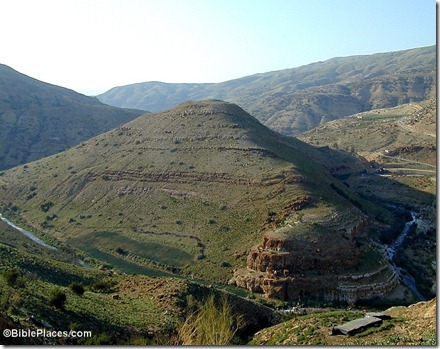
As I mentioned before, the Philistines invaded the valley of Jezreel, which was the only relatively easy way to get from the Mediterranean coast into the Jordan Valley of Israel. Saul’s forces were on a mountain ridge to the south of the valley, a place called Mount Gilboa. When the Philistines began to move east toward the Jordan, Saul moved to attack them and block them.
The picture below is of the actual area (with present day roads, reservoirs and buildings that would not have been there at the time, of course). The Philistines were invading through the valley in the left of the picture, starting in the foreground and pushing toward the Jordan valley in the distance. The Israelites were positioned on the ridges to the right. The little hill labeled “Tell Jezreel” was probably not there.
The massive Philistine army turned to destroy the Israelites. This was a good strategic move, because if they left them alone on the mountain, the Philistines couldn’t be secure in the valley. The battle became a rout. Israel’s army fell apart. Jonathan and his brothers were killed. I want us to consider some things in the following verses:
3 The battle pressed hard against Saul, and the archers found him, and he was badly wounded by the archers. 4 Then Saul said to his armor-bearer, “Draw your sword, and thrust me through with it, lest these uncircumcised come and thrust me through, and mistreat me.” But his armor-bearer would not, for he feared greatly. Therefore Saul took his own sword and fell upon it. (1 Samuel 31:3-4, ESV).
Verse 3 contains some ambiguous Hebrew expressions. Most English translations make it seem like Saul was severely wounded before he committed suicide. That is certainly one possible way of translating it, and probably a good one. But even so, it is quite possible that Saul was not wounded at all, but only in despair. An almost literal translation of verse 3 would be this:
“The battle became a great burden upon Saul. When the archers came within range of him, he was deeplytraumatized.”
The “burden” of battle could be intense physical combat. However, that doesn’t make sense when we learn that the enemy archers have only just come into range. If he was fighting hand to hand, archers would be irrelevant. They would not shoot, for fear of hitting their own men. From this, it seems likely that Saul was not even involved in actual combat. Therefore it seems probable that the “intensity” or “burden” of the battle was purely psychological for Saul.
The literal translation of Saul being “wounded” is “deeply traumatized,” or “anguished.” We have just learned that the intensity of the battle is most likely only psychological for Saul, and probably not physical (see previous paragraph). “Traumatized” can mean physically wounded of course, and it isn’t wrong to translate it that way. Even so, knowing that what is happening with Saul is already psychological, it would not be wrong either to interpret the trauma as emotional distress, rather than a physical wound.
I believe that this view is reinforced by two things. First, Saul is clearly afraid of being captured and “mistreated.” He says so in verse 4. Several commentators speculate that Saul was thinking about what happened to Samson, the Israelite judge, who was captured by the Philistines. They blinded him, chained him like an animal, and paraded him around to be cursed and spit upon for their entertainment (Judges 16:21-25). Saul was clearly afraid of this sort of thing. That certainly makes it unlikely that Saul had any severe physical wound, because if he was badly wounded, the chances were much greater that he would simply die before the Philistines could do much else to him. Remember, in those days, there were no painkillers, no antibiotics, no modern medicine. Wounded people died at a much higher rate. Severely wounded people frequently died within a few minutes or hours. If Saul had been severely wounded, he would not have feared what else the Philistines might do to him, because he would have soon been dead.
Second, notice his armor-bearer’s response when Saul ordered the armor-bearer to kill him. The armor-bearer would not kill Saul, “because he was terrified,” (also verse 4). What was he afraid of? If Saul was mortally wounded, why would the armor bearer be afraid to finish what was inevitable anyway? No, I think Saul’s mood and his words are what scared the armor-bearer. He didn’t want to kill Saul because Saul was not physically anywhere near death.
The night before the battle was when Saul went to the witch of Endor, and consulted with a demonic spirit who masqueraded as Samuel. If you remember, that spirit had spoken only words of condemnation and despair to Saul. Saul accepted this message and believed it as if it was truly Samuel speaking. So, here’s how I think it went down: You have a man who has his entire life been insecure, erratic and manipulative. He is a control freak, now in a situation where he does not have control. He has recently accepted and believed the words of a demon. He is deeply emotionally troubled by the battle long before it even comes near him, in fact, he was troubled even before it began (because of his encounter with the witch the night before). When he sees that the archers are finally in range, he suffers deep psychological trauma. He is horrified at the idea that he might be taken prisoner, and made a spectacle in front of his enemies. So he orders his companion to kill him, and when that person refuses, he takes his own life. In other words, he gave up even before all was truly lost. The words of the demon were a self-fulfilling prophecy, in large part because Saul believed them and acted accordingly.
Now, I want to write about something that most Christians don’t talk much about: Suicide. It’s right there in the text, so I think the Holy Spirit wants to deal with the subject. But before we get into it, let’s get one thing clear. You may have known someone who committed suicide. Sadly, I’ve known several. I am convinced that some of the suicides I have known died still clinging to Jesus. There are others about whom I really don’t know. If there is any question, it doesn’t do anyone any good to wonder whether that person died in faith, or if he went to hell. That’s not the point of what we are about to consider. What’s done is done. I cling to the biblical truth that God is far more gracious and merciful than I can comprehend. We leave our loved ones in God’s hands. I certainly don’t believe that suicide in general is some kind of unforgiveable sin.
But right now, I want to talk to and about the living. If you are reading this, you are alive, and these words are for you, not for someone who has already died. Don’t waste your time wondering how to apply these words to someone else – these are for you, for me, for the living.
Saul’s suicide was clearly an evil, demonically influenced act. It was his lack of faith that prompted him to take his own life. It was his lack of trust in the Lord, combined with the fact that he believed and agreed with demonic words. He behaved as he believed. If you are ever tempted to suicide, please understand – you are being tempted by a demonic power. Do not listen to demons. Do not agree with them.
G.K. Chesterton has some insightful thoughts about killing oneself. He says:
The man who kills a man, kills a man. The man who kills himself, kills all men; as far as he is concerned, he wipes out the whole world.
His point is clear, but we don’t often think about it. The person who commits suicide does not merely kill herself. From her point of view, she is killing the whole world. Suicide looks at the world and says, “As far as I am concerned, there is nothing worthwhile in the entire universe. I would be just as well off if the whole world is destroyed.” Now, many times, this is because of despair and hopelessness that things will ever get better. I have compassion for people in that much despair. But that level of despair sure sounds demonic to me.
And of course, suicide is not a private decision that affects only yourself. It is a terrible thing for those left behind to know that you preferred death to living on with them. Sometimes the suicidal person knows this. They are angry at loved ones, and they want to hurt those people as well as themselves. Suicide is not just self-destruction – it destroys everyone who knows you. Once again, if that doesn’t sound demonic, I don’t know what does. Sometimes, of course, the suicidal person just can’t see beyond their own struggle. They just aren’t thinking about how their action might affect others, or maybe they even think that everyone will be better off without them. My heart breaks for such people, but suicide is not the answer.
Some Christians may say: “Well, I want to get to heaven. I’m tired of the struggles of this world – I want to be in the peace and rest of eternity with Jesus. Wouldn’t suicide get me to heaven faster?” But that is so much like Saul’s attitude. Saul always insisted upon his own way. He manipulated, fumed and got depressed and sought help from demons – all to get his own way. Like the ultimate spoiled brat, when he realized that this time there is simply no way it was going to happen, he would rather die. We Christians are supposed to live in trust – not in control. We don’t get to determine how and when we die. To do that is to put yourself in the place of God.
I’ll be honest. Several times a year the pain I live with gets so bad that I want to die. I have actually prayed for the Lord to take my life not once, but several times. But I will not take matters into my own hands, because my life is a gift from God. It isn’t mine—it belongs to Jesus. Only the Lord gets to say when and how it ends.No matter how bad things feel, suicide is not God’s answer for me, or anyone reading this.
Remember, Jonathan and his brothers died too. Their result was the same as Saul’s. And yet it was entirely different. They died fighting for their country and for each other.
Jonathan showed courage. Saul showed demonic self-centeredness. I don’t think Saul’s death was the result of God’s judgment. It was the result of a lifetime of Saul’s self-absorbed choices, culminating in the final ultimate act of selfishness. About Saul, you can say for certain, “he chose his own fate.”
Even so, Saul’s story ends with people who loved God mourning for him. I think this is because they were led by the Holy Spirit. God always wanted Saul to turn to Him and trust him. And so after he died, the Spirit of God moved two groups of people to honor Saul in a special way.
After the battle, the Israelites in the nearby parts of the Jordan valley fled. The Philistines took over their towns, among them a town named Beth-Shan, which has been the site of an archeological dig for many years in modern times. The Philistines found Saul’s body, cut off his head, and hung the corpse on the wall of Beth-Shan. They did the same with the bodies of Jonathan and his two brothers. There is a reason that we call brutal, ignorant cruel people “Philistines,” even today.
The residents of an Israelite town further south in the hills on the other side of the Jordan heard about this. That town was Jabesh-Gilead – the place of Saul’s very first battle, the town that had been shamed for centuries, but which Saul had rescued. They remembered how Saul had saved them and finally removed their shame. So they sent a commando-type unit through the night to Beth-Shan. They stole Saul’s body, and those of his sons, from the Philistines, and brought them back to Jabesh-Gilead. They burned the bodies and then buried the bones with honor. It was a bittersweet end to the reign of Saul, coming full circle to the beginning when he was younger, and did trust God. I think their actions were a reflection of the Lord’s sorrow at Saul’s choices. Saul chose his own way, and he suffered the consequences. But I do not believe that was what God wanted. He gave Saul the freedom to choose, and I believe he was sorrowful for what the king chose. The Lord reveals this same attitude in Ezekiel 33:11
Tell them: As I live” — the declaration of the Lord GOD — “I take no pleasure in the death of the wicked, but rather that the wicked person should turn from his way and live. Repent, repent of your evil ways! Why will you die, house of Israel? (Ezek 33:11, HCSB)
A second person who reveals this attitude toward Saul is David. Remember, David had the Spirit of God in a way that was special in those days. Often, he is a type of Christ – he reveals the kinds of actions and attitudes that the true Messiah has. And so when he heard of Saul’s death, he wept in sorrow. Because he was human, I’m sure he was more upset about the loss of his friend Jonathan than the death of Saul. But he reveals the heart of God. The Lord was never against Saul. He always wanted him to turn back, repent and receive grace. Inspired by God, David wrote a beautiful lament, recorded in 2 Samuel 1:19-27
19 The splendor of Israel lies slain on your heights.
How the mighty have fallen!
20 Do not tell it in Gath,
don’t announce it in the marketplaces of Ashkelon,
or the daughters of the Philistines will rejoice,
and the daughters of the uncircumcised will gloat.
21 Mountains of Gilboa,
let no dew or rain be on you,
or fields of offerings,
for there the shield of the mighty was defiled —
the shield of Saul, no longer anointed with oil.
22 Jonathan’s bow never retreated,
Saul’s sword never returned unstained,
from the blood of the slain,
from the bodies of the mighty.
23 Saul and Jonathan,
loved and delightful,
they were not parted in life or in death.
They were swifter than eagles, stronger than lions.
24 Daughters of Israel, weep for Saul,
who clothed you in scarlet, with luxurious things,
who decked your garments with gold ornaments.
25 How the mighty have fallen in the thick of battle!
Jonathan lies slain on your heights.
26 I grieve for you, Jonathan, my brother.
You were such a friend to me.
Your love for me was more wonderful
than the love of women.
27 How the mighty have fallen
and the weapons of war have perished!
The greatest tragedy of Saul’s life is that the Lord always loved him, continually reached out to him, never stopped offering his grace, and yet Saul acted as if God wasn’t there for him. Saul was never in as much danger as David, and he didn’t have any real reasons to be afraid and insecure. Yet he let his fears and insecurities rule him. David’s life was often in danger and insecure, and yet he lived in deep security, because he trusted the Lord. But Saul rejected that path. He preferred to try to control things himself. He did not surrender his own will to God. But God’s love and grace and forgiveness were never more than a heartbeat away, if only he had turned to receive them. And so when Saul died, the heart of God was to lament his loss.
David was weary and discouraged, and he made a major decision without consulting the Lord. But the greatness of David was not about him doing everything right. It was about the fact that he repented when he failed, and almost always relied upon the Lord in everything. In spite of his failure, the Lord graciously allowed David and his men to have a season of safety and stability for their families, and gave the warriors an opportunity to still serve the Lord. When God blesses us, it is not necessarily an endorsement of everything we’ve done. It is a sign of his gracious nature. He does not treat us as our sins deserve.
To listen to the sermon, click the play button:
For some people, the player above may not work. If that happens to you, use the link below to either download, or open a player in a new page to listen.
To download, right click on the link (or do whatever you do on a Mac) and save it to your computer: Download 1 Samuel Part 28
1 SAMUEL #28. CHAPTER 27:1-12
Many people have the misunderstanding that David only failed spiritually once in his life, in the matter with Bathsheba. If you have been following this sermon series, however, you will have noticed that in fact, even before he became a king, David failed a number of times in his life, both spiritually and in terms of achieving his goals. The picture we have of David is not a man who was almost perfect. Instead, he is a very flawed human being. But he was a person who was always willing to admit his mistakes, and he continually looked to the Lord (not to himself or to others) for forgiveness, help and encouragement. That is what makes him a hero of the faith.
Chapter twenty-seven seems to record yet another time when David failed spiritually. The last time the Lord spoke to David about where he should be making his base, he said, through the prophet Gad, that David should stay in the land of Israel, in the territory of the Tribe of Judah (1 Samuel 22:5).
David did that for several years, but it was brutal. He and his men couldn’t live in a town for fear that Saul would catch them. If they stayed in a town, but escaped before Saul got to them, it was likely that Saul would punish the citizens of that place. So David and his men lived in caves and outdoors. They couldn’t farm to support themselves. There were six-hundred of them, so they couldn’t hunt or gather enough food either. They relied on friends and strangers to help them through their tough times. But often, the people alerted Saul to their location, and they found themselves running for their lives. They continued to barely survive, but it didn’t look (at least on the outside) like they were doing anything constructive.
At one point, it looked like David had convinced Saul to leave him alone, by sparing Saul’s life in the cave. But Saul eventually came back, and David was so surprised, he had to go see for himself. Last time we saw how David once again dramatically showed Saul that he meant him no harm. This caused Saul to leave again, but you can almost see the wheels turning in David’s head, as he realizes that Saul will never leave him alone for good. If sparing his life the first time would not convince Saul that David was a loyal subject, nothing could.
There is something else that the text mentions that we haven’t talked about yet. These men were young, but many of them, including David, had families (v.2-3). Living like they were, it must have been hard on their wives and children.
I’m sure you noticed that David now had two wives, not including Michal, daughter of Saul, who married someone else after David had been gone for a few years. Remember, this is historical narrative, which tells us things that actually happened, not what should have happened. Every time the Bible draws particular attention to polygamy, it paints it in a negative light, showing the jealousy, bitterness and other sins that result from it. Not only that, but even in the Old Testament, there are clear teachings that show that polygamy is wrong. The second chapter of Genesis portrays marriage as created to be between one man and one woman, and Jesus, in the New Testament, makes that very clear. But even elsewhere in the Torah (the first five books of the Bible) it teaches that polygamy is wrong:
14 “When you enter the land the LORD your God is giving you, take possession of it, live in it, and say, ‘I will set a king over me like all the nations around me,’ 15 you are to appoint over you the king the LORD your God chooses… …17 He must not acquire many wives for himself so that his heart won’t go astray. He must not acquire very large amounts of silver and gold for himself. (Deut 17:14 & 17, HCSB)
Now, it is likely that David had never heard this verse. Nobody had a personal copy of the Torah at home. To know what was in it, you had to go to the worship services and hear it read. It seems unlikely that David was there on any of the few days on which that particular passage was read. But obviously, the priests at the time did not make sure that this was known throughout Israel. It seems that David unthinkingly adopted the values of his culture on this issue. Powerful men in the ancient Middle East had multiple wives. So, David got himself multiple wives. I think this serves as a useful warning to us. Is there anything in our own culture that we adopt without thinking about it? Could it be that some of what we think of as “normal” is actually wrong in God’s eyes?
Anyway, to get back to the narrative, David and his men were living in a hard place, and so were their families. So David did something uncharacteristic – he made a unilateral decision without consulting the Lord. The last thing he heard on the subject was that he should stay in the territory of Judah. Without asking God again, he took his men and their families and went to the territory of the Philistines. The Hebrew shows David’s thoughts to be something like this: “There is nothing good left for me. So I’ll go to the Philistines.”
Now, we should be careful stating absolutely that David was sinning by doing that. The scripture doesn’t say one way or the other. But I think we can say that to do this without asking God was unusual for David, and it did not seem to reflect the relationship of trust in the Lord that he normally had. In fact, it seems more like something that Saul would do, not David. At the very least, it looks like David made a decision that was based more on fear, hopelessness and weariness than on faith. We can also see that as a result, he put himself in a position where he had to be deceptive.
He went back to Achish, king of the Philistine city of Gath – the same place he went when he first fled from Saul (chapter 21). No doubt Achish had heard what David had been doing since he left last time, and he knows now that David is not insane. However, it was probably a decade or so since David killed Goliath, and many years since he fought against the Philistines. All of that time, Saul had considered David his enemy. You’ve heard the saying: the enemy of my enemy is my friend. That’s probably what king Achish was thinking. David might be a powerful ally. He was bringing six-hundred men who were hardened by the wilderness and by some battles. He was technically the enemy of Saul, king of Israel. So Achish once again allowed David to take refuge in his territory. He saw the potential in an alliance, and also the potential danger in picking a fight with David and his six-hundred hard men.
This time, however, David was a little wiser, and sought to keep physical distance between himself and the king. He asked if he and his men could stay in some town out in the country, away from the capital, Gath. So Achish gave David the town of Ziklag to live in.
Four hundred years before, when Joshua led the people of Israel across the Jordan river, the entire land was given to the Israelites by God. They still had to enter in and take possession of the land by driving out the pagan Canaanite tribes – but the Lord promised to be with them and help them do that. However, no Israelite tribe truly trusted God enough to fully possess what he had promised. So the town of Ziklag was supposed to belong to the tribe of Judah – but they had never actually taken possession of it, being too afraid to challenge the Philistines. Now, David – a man from the tribe of Judah – received this little town as a gift, without any fight at all.
We could look at this and say, “Oh, I guess David did the right thing after all, because things began to work out for him.” But I think it’s a lot more complicated than that. Just a little more than a year after David went to the Philistines, David’s problem with Saul was solved, and he was free to live in any city in Israel. This would have happened whether or not he had gone to live in Philistine territory. So I don’t think the gift of Ziklag was God’s endorsement of David’s actions. Instead, I think it shows us how gracious God is. Even when David was afraid and more or less ran away, the Lord blessed him, and through him, blessed his people. The Lord did not allow David’s fear and lack of faith to hinder what He (God) wanted to do. Though David didn’t deserve it, God used him anyway. Though David didn’t deserve it, God allowed he and his men to have a time of relative rest and stability. God continues to work, no matter what happens. Our own failure will never stop him from being at work.
There is something else that strikes me. Right or wrong, now that David had done this, the Lord moved forward from that point, and he led David to do the same. Remember in chapter 15, earlier in Saul’s reign, the Lord told Saul to wipe out the Canaanite tribe called the Amalekites? Saul only partly obeyed. He didn’t carry out the war the way the Lord asked. But now David began a campaign of raids against the Amalekite clans. In each raid, he completely wiped out everyone he found. This was something that God wanted to happen. We don’t have time and space to re-hash all the discussion about Holy War, where we considered why God might want to do this. If you need to, go back to 1 Samuel parts 13 and 14 to review this subject. The point here, is that David, even after he messed up, is back on track. He is letting the Lord accomplish his purposes through his (David’s) life. David and his men were warriors, with the hearts and desires that go along with that. So the Lord used them just as he made them. Even so, there is an obedience here. They weren’t fighting just anyone they could find. They were letting the Lord fight His battles through them, making war only when and where the Lord led them to.
Unfortunately, David had to engage in some deliberate deception at this point. King Achish wanted to know what he was up to. So David replied accurately, but deceptively. He said he was raiding in the southern territories of Judah and Israel. Technically, that was true. All that land was supposed to belong to Israel, including the places where David fought the Amalekites. But he was certainly not fighting other Israelites. Even so, he let Achish believe that he was making war on his own countrymen.
Now, we might say that David’s deception was part of the war between Israel and the Philistines, and therefore it was justified. After all, Achish was actually David’s enemy, though they were in a temporary truce. So it is almost like a spy lying to the enemy – it is an act of war, not a sin. I won’t say that interpretation is definitely wrong. And in the short term, David’s deception allowed him and his men to be at peace, and to advance God’s agenda.
Even so, David’s deception led to problems in the future – even as it had in the past. It put him in a very awkward position not too long after this. He had to be saved from that position by people and circumstances beyond his control. In fact, I suspect it was the Lord who saved him from the consequences of his own lies.
In the long run, true honesty is always the best policy. One reason I suspect that it wasn’t in the Lord’s original plan for David to be among the Philistines is because it put David in this position where he basically had to lie. And, as far as the fact that he was attacking the Amalekites as the Lord wanted, it seems to me that he could have done that while he and his men were still in the wilderness of Judah. They could have gained much needed supplies and food that way.
Let’s turn to application. Here are some things that I personally take away from this passage:
First, when I think about David marrying multiple wives, it makes me think that I need to learn to look at my own culture with a skeptical eye. Perhaps there are things that we think are normal, and “OK,” but are actually wrong in God’s eyes. For instance, wealthy men in David’s time had many wives; while wealthy people in our time have many homes. I wonder if it is really OK for Christians in America to own a vacation home while Christians elsewhere in the world are starving. That’s just one example; I’m sure we could come up with more.
A different thing that strikes me about this passage is how the Lord moves forward with us and with his plan, even when we take a wrong turn. We don’t go back to where we messed up and do it over. Instead, the Lord mercifully picks us up where we are, gets us back on track. When David went to the Philistines, the Lord didn’t make David go back to Judah and start over. Instead he adapted his plan, accounting for David’s mistake.
As we have seen before, the main goal in the life of faith is to trust God. If we do that, our behavior will naturally be pleasing to God. And even when we fail, if we return to a place of faith and trust, God is overwhelmingly gracious. Despite David’s failure, God gave him stability and rest, and through him, restored to Israel one of the towns that had been given them. Despite David’s failure, he continued to use him and bless him. I can trust that the Lord will deal with me in the same way . I know I am not perfect – not in behavior, not even in how well I trust God. Because of Jesus, my failure is not the final word, not the most important factor. God’s grace is always a bigger factor than my failure. God has a way of turning failure into gracious victory and blessing. That takes a lot of pressure off me.
Saul had abused his power and mistreated David in several despicable ways. But David’s main complaint was that Saul was cutting him off from worshipping in God’s sanctuary, and from God’s people. Even so, once again David refrained from harming Saul when he had the chance. In this incident David reminds us that we need fellowship with God’s people. He also shows again what Jesus is like: he does not treat us as our sins deserve, but instead showers grace on us unconditionally.
To listen to the sermon, click the play button:
For some people, the player above may not work. If that happens to you, use the link below to either download, or open a player in a new page to listen.
To download, right click on the link (or do whatever you do on a Mac) and save it to your computer: Download 1 Samuel Part 27
1 SAMUEL #27. 1 SAMUEL CHAPTER 26;1-25
Often when I teach through the Bible, I am looking for tightly focused themes and messages in each passage. That works pretty well when we encounter the teaching genre in scripture. But often, when we get to narrative history, I feel like each passage is a box of chocolates: a lot of variety, a few surprises, but all of it is sweet.
I want to point out again David’s precarious situation. He was trying to lead and support 600 men who couldn’t stay in one place. In fact, they couldn’t stay in any civilized place, because the king had declared David an outlaw, under a death sentence. He was dependent upon gifts from friends and strangers. He was also vulnerable to those same people if they chose to betray David and his men. We don’t know for sure how long David lived this way, but it was certainly years – maybe even as long as a decade.
One of the reasons I like to point this out is because many churches and popular preachers seem to suggest that if you have faith in God, everything will always go well for you. By implication, if things do not go well with you, it must be because you don’t have enough faith, or you are not righteous enough. David was an imperfect human being, but he did live in faith. In fact he had a great deal of trust in the Lord, and always repented from his sins, and was willing to humbly learn to do better.
Even so, for many years, it did NOT go well with David. I just want to make sure that no one reading this ever falls prey to the teaching that if life is tough on you, it is automatically because you don’t have enough faith, or you are a bad Christian or something like that. Sometimes, by our own choices, we do make life harder than it needs to be. But sometimes, life is just hard, for no reason that we can understand. Certainly David had a heart for God and a great deal of integrity, and those did not save him from trouble and hardship.
Also, I want to make sure you don’t believe that you can earn favors from God by being righteous, or saying the right words or having the right kind of faith. We live by God’s grace. If we had to earn God’s favor, no one would ever earn anything good. You don’t understand the gospel if you think you can earn blessings by being righteous, or saying the right things, or having the right kind of faith. David was not the only person in the Bible who had great faith, but a difficult life.
I do want to say, however, that David became the great man he was because of his faith. Sometimes things went very well for him and sometimes they didn’t. But how it was going on the outside was not as important to David as the quality of his relationship with the Lord. And because that relationship was more important to David than anything else, God was able to use him in amazing ways, and also to bless David without David thinking he had earned it.
Wouldn’t it be wonderful to receive all of life as blessing, whether or not it looks that way outwardly? If we could do that, it wouldn’t matter much to us whether circumstances were good or bad. We would always be experiencing life as blessing. David was getting there.
In chapter 26, David was still in a time of outward difficulty. But we will quickly see that things were very good with his heart. Once more, the Ziphites betrayed David – the same people who almost got him killed in chapter 23:19. They knew where David was, and they told Saul to come and get him. As far as we know, Saul had left David alone since the incident when David spared his life in the cave. But the Ziphites basically tempted Saul to sin. Having betrayed David once, this group of people probably thought that if David were not killed, he would take retribution on them if he had the chance, so they may have been quite urgent and persuasive in trying to get Saul to start hunting David again.
Apparently, David could hardly believe it, so he took a few men on a reconnaissance mission to see if Saul had really started hunting him again. One of the men he brought with him was Abishai. Abishai was one of the sons of David’s sister Zeruiah, which made him David’s nephew. Abishai’s brother Joab became the commander of David’s armies later on. If you remember, among David’s men eventually there were “the Three” who became outstanding warriors, and then “the Thirty” who were also an elite force of great fighters among David’s other men. Here is what it says about Abishai elsewhere:
18 Abishai, Joab’s brother and son of Zeruiah, was leader of the Three. He raised his spear against 300 men and killed them, gaining a reputation among the Three. 19 Was he not more honored than the Three? He became their commander even though he did not become one of the Three. (2 Samuel 23:18-19, HCSB)
Now, for those of you who are Bible geeks, like me, you might find a translation that says Abishai was commander of the thirty, rather than the three. In fact, the translators of the ESV couldn’t make up their minds about this, and older editions read like the HCSB (above) and newer editions have Abishai as commander of the thirty, rather than the three. The problem is that while most ancient texts read like the HCSB (quoted above) two well regarded ancient texts have it the other way, and it seems to make a bit more sense the other way – how could he be chief of the three, if he wasn’t one of the three? This is one of those “major issues” in Bible translation, but of course, it isn’t really that important. What is clear, no matter which way is correct, is that Abishai is one of the greatest warriors alive during David’s lifetime.
Since David was the youngest of ten, it is possible that even though he was technically Abishai’s uncle the two of them might have been basically the same age. It is even possible that Abishai was a little older. They might have spent a lot of time together as boys. At this point, they were both probably in their early or mid-twenties, in the prime of physical power and maybe a little inclined to try something crazy.
The two of them decided to sneak into the heart of Saul’s encampment at night. This was the desert, so the soldiers probably did not have tents. The picture seems to be that Saul chose his sleeping spot, and then the whole army arranged themselves around him, with his bodyguard closest to him and the rest spread around them generally. David and Abishai crept through the entire group of three thousand sleeping men and came to Saul sleeping soundly, along with Abner, the chief of Saul’s bodyguard.
This incident appears somewhat similar to the one in chapter 24. Certainly, the result, and the main point (David sparing Saul) is virtually the same. However, other than that, almost every detail is different. Saul didn’t come alone into a cave where David and his men were waiting. Instead David crept with only one companion into the middle of Saul’s camp. This time it wasn’t Saul almost finding David where he was hiding, it was David finding Saul where he was camped openly. Before, David was passive. This time he initiated the action.
I think that it is no coincidence that this second opportunity to harm Saul was given to David after his interactions with Nabal and Abigail. In chapter 24, we have the record of how David was tested in the cave with Saul, and he passed that test. But with Nabal, he failed. He fully intended to take matters into his own hands regarding Nabal, and was saved from sin only by the wisdom of Abigail. Now, once more, he gets the chance to either take matters into his own hands, or trust the Lord.
It is almost as if the Lord was giving David a chance to see if he really had learned his lesson from the incident with Nabal. It isn’t just a test – obviously, God already knew what was in David’s heart. But David may not have been sure of himself. He may have had times where he thought about the incident with Nabal, and condemned himself, and wished he had behaved differently. The Lord was giving him a second chance, a “do-over.” In the Torah, it says all legal issues must be established by at least two witnesses. Now there were two occasions that “witnessed” David’s commitment to not harm Saul, and to not take matters into his own hands. Those incidents were witnessed by both Saul’s men, and David’s followers also.
Abishai however, did not yet have David’s wisdom. He asked permission to kill Saul with Saul’s own spear. By the way, in one of Abishai’s exploits (recorded elsewhere) he killed three hundred men with a spear in one battle, so he knew how to use that weapon. He’s not just boasting when he says one thrust would do it. It would be all over. The good times could begin. The days of wandering homeless, despised by people around them, in danger all the time, could all be ended by one swift spear thrust. As before, it was a powerful temptation. Who could blame David? In Saul’s mind, anyway, they were enemies. It would be an act of war. It wouldn’t even be David who struck the blow.
But David had learned his lesson thoroughly. He said:
10“As the LORD lives, the LORD will certainly strike him down: either his day will come and he will die, or he will go into battle and perish. 11 However, because of the LORD, I will never lift my hand against the LORD’s anointed. Instead, take the spear and the water jug by his head, and let’s go.” (1Sam 26:10-11, HCSB)
He saw the battle with Goliath as the Lord’s fight. So now he sees the struggle with Saul. It isn’t his own fight at all, really – it is God’s business, and David trusted God to take care of it in His own time and in His own way.
As morning broke, from a safe distance, David called and awakened the camp. He showed them the spear and the water jug he had taken from Saul’s side. David was young and strong, and he had accomplished an amazing, bloodless feat of arms. So he teased Abner, Saul’s commander for a moment. I get the feeling he was rejoicing in what he and Abishai just did. Maybe he was “crowing” just a little bit. But then, once again he respectfully confronted Saul with his wrongdoing. Like Abigail did with David, so David now did with his king, Saul. He showed Saul he was wrong; he reminded him of true righteousness in God’s eyes – but he did it all with respect. You might say that similar to Abigail’s attitude toward David, David was submissive to the authority of Saul, but he was not subservient or a doormat.
Review the history of abuse Saul has heaped on David: He refused to honor his promises to the conqueror of Goliath. He didn’t reward him with money for killing Goliath, like he had promised to do. He initially didn’t allow David to marry his daughter (as he had promised). Then he made David pay a bride price for the privilege, even though he had promised that killing Goliath satisfied the bride price. He sent David on the most dangerous missions against the Philistines. He threw a spear at him, twice. He tried to have him killed. Then after David fled, several times Saul pursued him with thousands of warriors, to try and kill him. Even after David spared his life in the cave, here is Saul again, trying to kill him.
But listen to what David’s biggest complaint about Saul is:
For they have driven me from my home, so I can no longer live among the LORD’s people, and they have said, ‘Go, worship pagan gods.’ 20 Must I die on foreign soil, far from the presence of the LORD? (1 Samuel 26:19-20, NLT)
Saul’s worst offense, in David’s eyes, is that he is cutting him off from the people of God. David can’t go and worship at the sanctuary any more. Remember, things were different before Jesus came. God’s presence was in the sanctuary in a special way, and David was denied access to that. This is his biggest concern.
At the end of the discussion, David showed where his trust is:
23 May the LORD repay every man for his righteousness and his loyalty. I wasn’t willing to lift my hand against the LORD’s anointed, even though the LORD handed you over to me today. 24 Just as I considered your life valuable today, so may the LORD consider my life valuable and rescue me from all trouble.” (1Sam 26:23-24, HCSB)
He didn’t ask Saul to treat him the way he treated Saul. Instead, he declared that he trusted the Lord to treat him with righteousness and love.
Throughout this, Saul seemed to be full of remorse. But he was remorseful last time too, after David spared his life in the cave. David has learned something important from Saul: Remorse is not the same as repentance. Saul let his emotions rage through him uncontrolled. Sometimes he was full of murderous fury; sometimes he was full of regret and sorrow. But the regret and sorrow did not lead to true repentance for Saul – they were just feelings he had sometimes. So, even though Saul invited David to come back with him, David did not do it. Saul was in God’s hands, but David was wise enough not to trust him.
It’s another great story, and I love it just for the daring deeds and passion and trust in God. But what does it mean for us now? What does the Lord want to say to us through this passage today?
When I read this at first, I am tempted to see it as a reason to admire David and Abishai. Here are two deadly warriors who, between just the two of them, can overcome hundreds of enemies at a time. And now, they seem to be showing us that in addition to a capacity for incredible violence on the battlefield, they can move as silently as stalking cats. But verse twelve paints us a different picture. It says that it was the Lord who made this whole incident possible. It was theLord who made a deep sleep fall on the entire army. It wasn’t the skill of David and Abishai. This was an opportunity given by the Lord.
David shows that withholding violence takes more courage than doing something violent. With one violent act, his troubles could have been over. It was much harder – it was a much greater deed – to leave Saul unharmed. I think we can all learn from that. Jesus told us to turn the other cheek. It takes a lot more courage to do that than to take matters into our hands, and protect ourselves. It takes courage not to reply with harsh words or gossip when someone hurts us. It takes courage to not repay hurt with hurt.
As we read the Old Testament especially, I think it is helpful to ask: “Where is Jesus in this text?” Remember, David is sometimes a “type of Christ.” What this means is that God used David at times to show the world what the real Messiah (Jesus) is like – to people who would never get the chance to know Jesus in their earthly life.
This passage does show us a little bit of what Jesus is like. Like David, Jesus is a mighty warrior, forever in the prime of life, full of bravery and wisdom; ultimately and absolutely victorious over his enemies.
David held back from harming Saul, who, without a doubt, deserved to be harmed by David. In the same way Jesus holds back the punishment that we all richly deserve. Jesus told us to love our enemies, to pay back evil with good. David did that very thing. Jesus forgave the people who were crucifying him, even as they did the deed.
Here’s something else that I think is very significant. David did not know at the time that the Lord was using him to show the world what Jesus was like. He didn’t realize how significant his actions were. But because he lived in trust and obedience, many people in his generation, and for a thousand years after, had some idea of what the Messiah was like.
We don’t always know when someone has a chance to see Jesus through us. We can’t always tell when the Lord is doing that. Very often the opportunity comes when we least feel like it. There was a huge temptation for David to act precisely opposite of how Jesus is. So in the same way, it may be in our toughest moments that God uses us to show Jesus to the world.
The other thing that speaks to me here is David’s strong desire to worship God with other believers, his desire to be counted among all God’s people. I think today in the Western world, we sometimes forget how important this is. Through Jesus, the Holy Spirit lives inside of us, so it’s easy to begin to think we don’t need any other Christians to help us. But David had the Holy Spirit, also, and the Spirit caused him to yearn to be in fellowship with God’s people, and to worship with them. Sometimes the way we do church in the Western world is a bit messed up, and it doesn’t really reflect God’s design for church. I have a friend who has several valid criticisms of Evangelicals in America. But my friend takes it too far. He says that he is “in church” whenever he has coffee with fellow Christians, or goes to a barbeque with them, so he doesn’t need to be part of a local church. That is not what scripture says. It is vitally important for believers to be in real community with other believers, and especially to learn the Bible together, worship and pray together, and together renew Jesus’ covenant with us through the Lord’s Supper (Acts 2:42). David understood how important it was to worship with, and be connected to, God’s people.
Faced with a similar situation to the time Saul was in his cave, this time David almost failed, and took things into his own hands. Thankfully, the Lord sent a gracious, wise woman to remind him of right and wrong, and of the Lord’s promises. What about you and me? How do we respond when we are angry, or when we want to control things? Just as David was an example for us last time, Abigail is the one to imitate this time: to graciously speak the truth, and entrust ourselves to the Lord with the results.
To listen to the sermon, click the play button:
For some people, the player above may not work. If that happens to you, use the link below to either download, or open a player in a new page to listen.
To download, right click on the link (or do whatever you do on a Mac) and save it to your computer: Download 1 Samuel Part 26
1 SAMUEL #26. 1 SAMUEL 25:1-38
As always, I strongly encourage you to read all of the text for this time, which is 1 Samuel chapter 25:1-38. It’s a little long to include as part of the text of the message here. Depending on what version you use, some things might be a little bit unclear, so let me set the stage. After the incident when David spared Saul’s life, Saul left David alone for a while, but apparently their issues were not really resolved. He didn’t invite David back to rejoin him in peace, and David didn’t push his luck. Instead, David and his men retreated further into the wilderness at the southern edge of Israel, the wilderness of Paran. This is desolate country, and it goes almost all the way down to the northeast corner of the Red Sea. It included some of the region where the Israelites wandered for forty years with Moses. In David’s time, it might have been a bit more green than now, however, it was still at least semi-arid, and people who kept large herds of sheep had to wander far into this wilderness in pursuit of water and food for the animals. There were no permanent towns or settlements there; it was kind of a no man’s land.
There was a man named Nabal who lived at the northern edge of this wilderness. He was very wealthy, and had large flocks of sheep and goats. Apparently, he regularly sent hired shepherds out into the wilderness of Paran with his flocks. They generally spent months at a time out with the flocks in this area. It was lonely and dangerous work for the shepherds. From time to time lions, bears and other animals attacked the sheep. At times lawless bandits would swoop down out of nowhere and steal some of the animals. In the spring time, the shepherds would return north with the sheep, bringing them back to the town of Carmel, where Nabal, the owner, would have them sheared, sell the wool, and butcher some of them also, and feast on the bounty of the harvest.
While Nabal’s shepherds and flocks were out in the wilderness, they encountered David and his men. At this point, David’s band numbered about six hundred. There was no way they could hunt and gather enough food to supply so many, therefore, it is certain that David and his men relied upon the kindness and generosity of others who lived at the edge of the wilderness. In spite of their need, they did not take any of Nabal’s sheep or goats when they encountered them. They certainly could have simply taken as many of the animals as they wanted – no small band of shepherds could have prevented them. Instead, they helped guard Nabal’s flocks against bandits and wild animals. In the springtime, when the herds were brought back from the wilderness, no doubt there were more than usual, since David’s men had helped protect them from the normal losses due to wild animals and bandits.
The owner of these animals, Nabal, was now cashing in on the bounty that David had helped to secure. So David sent word to Nabal respectfully asking for help for his men. He probably felt that one good turn deserved another. He could have demanded a certain percentage. He could have held all of the flocks of sheep for ransom in the wilderness until Nabal agreed to help him. Or, he could have simply taken them all. Instead, he basically said, “I have freely given protection to your people and animals. Ask your shepherds, and they will tell you. Now, would you please give us whatever you think is appropriate.”
Nabal responded with contempt and derision. He not only refused to help, but he deliberately insulted David.
Remember the previous chapter? Saul was trying to find and kill David. Though David had never done him wrong, and in fact, had risked his life time and again in Saul’s service, Saul was hell-bent on destroying David. (I am not swearing when I say “hell-bent,” I mean it literally. Saul’s rejection of God left him with a soul that was twisted to the purposes of hell). Even so, when David had the chance to fight back and destroy Saul, he did not do it. Instead, he said, “Let the Lord judge between me and you. Let the Lord bring about vengeance, if that is what he wants to do, but my hand will never be against you.” He rested in the Lord’s purposes, and refused to take matters into his own hands.
Well, here we are in a similar situation. Another powerful man had treated David unfairly. David had the ability to do something about it. But this time, David lost his cool. Rather than trusting the Lord to judge Nabal, he got into a towering rage, and started north with four-hundred of his men to destroy Nabal and his little empire.
And then comes the real heroine of the story, Abigail. She was Nabal’s wife. Some of Nabal’s men came to her, and explained what had happened. She made some immediate emergency decisions, and went out to meet David with plenty of food and supplies for his men.
Some of you have heard me preach through New Testament passages that teach us about biblical roles for women and for men. I think of Abigail as an amazing example of a woman who was used by God as a woman – not as a man. This is how it might look sometimes as we engage in the gender dance the Lord has designed for us. Abigail was wiser than everyone around her at this point in time. For a while, she was the only one who was truly committed to doing what was righteous, and she had to deal with two men in leadership who both wanted to do wrong (that is David, and Nabal). But she approached the situation with an amazing womanly grace and uniquely feminine strength.
She offered David gifts for himself and his men, which was the right thing to do. She also apologized for her husband. There is a play on words here. His name, Nabal, would have been pronounced “nu-bawl.” A Hebrew word for foolish or worthless is pronounced “nu-bawl-uh.” It’s a little like saying “Stu is acting just like his name: stupid.” (Deepest apologies to anyone named Stu who might be reading this).
Throughout the narrative it is clear that Abigail placed herself in David’s hands, and under his authority. However, while she was clearly submissive, she was not subservient. She did not hold back from exhorting David to do what was right. She reminded him of God’s promises to him. In particular, she gently reminded him that up until this point, he had fought only the Lord’s battles, and this battle he was going toward at that moment was not the Lord’s fight.
28 Please forgive my offense. The LORD will certainly give you, sir, a lasting dynasty, because you are fighting the LORD’s battles. May evil never be found in you as long as you live. 29 Even though someone pursued you and sought your life, your life is wrapped in the bundle of life which comes from the LORD your God. But he will dispose of the lives of your enemies like stones thrown from a sling. 30 When the LORD does all the good he promised and makes you ruler of Israel, 31 you shouldn’t have a troubled conscience because you spilled blood for no good reason and claimed your own victory. (1 Samuel 25:28-31, God’s Word)
You can see that she reminded him of the incident with Saul that we read about in the previous chapter. That might have been months, or even years, ago by this time. She pointed out that David was once again in the same kind of situation. She encouraged David to trust the Lord, not his own strength, and to trust the Lord’s promises to him. She pointed out gently that destroying Nabal would be something he would regret later, and it would be a shameful blemish on his record of trusting the Lord. She did it all with womanly grace and attractiveness.
There is no doubt that Abigail was in the right, while both David and her husband were wrong. Even so, there is no sense in this narrative that Abigail has somehow taken on the role of a man, or that she was imposing some sort of authority or leadership over either one of them. This is one example of what biblical submission can look like. You can see it is not subservience, or rolling over and accepting whatever men want to say or do. In her submission, her grace and wisdom were powerful and attractive. Abigail is a beautiful example of a woman who plays a significant role in God’s kingdom without violating what the Holy Spirit says elsewhere in scripture about gender roles.
And here is something important: she really got David’s attention. I suspect that David, being in the foul mood he was in, would have reacted angrily to a man who came and told him he was being stupid and making a mistake. But Abigail, with her womanly grace, completely disarmed him. He repented, and freely confessed that she was right and he was wrong.
They parted, but obviously, David never forgot the exchange. Abigail went home. She was still in a tough place, because now that she had dealt with one angry man, she had to deal with another, her husband. We have to read between the lines, but everything I see here suggests that Abigail was trusting the Lord to work out that conversation also. The next morning she told her husband, straight out, what she had done. Apparently very soon after, he had a seizure from which he never recovered. The Lord took care of it for her. I think the last time I preached about male and female roles it was from 1 Peter chapter 3. One thing I said there is that women are not being asked to trust their husbands, rather, they are asked to trust theLord. Abigail did exactly that.
So, a couple thoughts for application. I like knowing that David needed help. Here was the man who would become the greatest king known to Israel, and not only is he in hiding, but he is barely holding on, dependent upon donations from kind friends and strangers. David wasn’t just a lucky guy who had everything fall into place for him. He spent a significant portion of time in real need, and he never would have made it without help. This is humbling, but the fact that David lived this way encourages me when I feel humbled by my own needs.
When I was preparing this sermon, I wrote the paragraph after this one, and then took a break. During the break I found out that the person who repaired my wife’s computer not only failed to fix it, but also told us that her hard drive was dead (it was working just fine when we turned it in). In addition, without mentioning it, he removed her original hard drive, which was 256GB, and replaced it with one that was half the size. For the privilege of secretly taking our hard drive in exchange for a smaller one, and not fixing the computer, they charged us almost $200. Did they think we wouldn’t notice that it was a different hard drive? Were they treating us like idiots? I was caught up in thinking about all the things I would like to say to them, and the review I would write, and maybe a phone call to the appropriate authorities. In that frame of mind, I returned to work on this sermon, and read the following paragraph, which I had written just before the break:
I think the more important message, the main one, is about trusting the Lord, and not taking matters into our own hands. David made a great choice with regard to that in the incident with Saul. But this time, David let the situation get to him. Abigail had to remind him to leave it with the Lord, or he surely would have done something that he later regretted.
Sometimes, it’s hard to be a preacher. Seriously, this sort of situation really gets under my skin, and in the past I have sometimes said things (or said them in a particular tone) that would make me embarrassed to later tell the person I am in conflict with that I am a Christian and a pastor. I have never sworn at anyone, but I have certainly been angry, and said things that were unkind and unchristian.
I let things sit for a day or two, and then all the way to the shop I prayed that I would not be a poor representative of Jesus to the repair guy. The situation is still ongoing as I write this, but I can report that I didn’t say or do anything I regret, and even after our encounter, I wouldn’t be ashamed to tell the guy that I am a pastor.
As it turns out the message from this chapter of scripture is one that is repeated in many places throughout the Bible:
35 Vengeance and retribution belong to me [says the Lord]. (Deuteronomy 32:35, ESV)
22 Do not say, “I will repay evil”; wait for the LORD, and he will deliver you. (Proverbs 20:22, ESV)
29 Do not say, “I’ll do to them as they have done to me; I’ll pay them back for what they did.” (Proverbs 24:29, ESV)
17 Repay no one evil for evil, but give thought to do what is honorable in the sight of all. 18 If possible, so far as it depends on you, live peaceably with all. 19 Beloved, never avenge yourselves, but leave it to the wrath of God, for it is written, “Vengeance is mine, I will repay, says the Lord.” (Romans 12:17-19, ESV)
19 Remember this, my dear friends! Everyone must be quick to listen, but slow to speak and slow to become angry. 20 Human anger does not achieve God’s righteous purpose. (James 1:19-20, GNT)
Maybe you don’t tend to lose your cool, like I do. Many people who remain calm still struggle with the impulse to control everything. You might feel uncomfortable waiting for God to do his thing, maybe you wonder if he is ever even going to act, and so you take matters into your own hands, in order to make sure that it does get done, and gets done the way you want it to be. I think this passage is for you folks, as well. Part of David’s problem was uncontrolled anger. But the text clearly shows that part of the danger for him was the temptation to take matters into his own hands. I have observed that many people struggle with that same temptation.
Of course, there is a balance. We aren’t supposed to sit on our hands and never do anything. At times, following Jesus means we ought to do something in various situations. But even when we act, we need to do it with a sense that Jesus is acting through us. If you struggle to tell the difference between controlling things for yourself, or acting in response to faith in Jesus, ask yourself this question: Are you OK if things turn out differently than you intended them to? If you aren’t, you might be trying to control things. On the other hand, if you are OK no matter how things turn out, then you are probably acting from a place of faith.
One of the encouraging things here is that David blew it here, but someone else came along to graciously steer him away from doing the wrong thing. The Lord knows we are not perfect, and he has never expected his people to follow him without help. He gives us the help of the Holy Spirit inside us, and also, as demonstrated in this text, he gives the help of other people who are also trying to follow him.
David demonstrates the best attitude for us: to recognize that we are here to do as the Lord pleases. God is not our servant, but rather, the other way round. At the same time, David shows us the Lord’s heart to rescue us. The Lord has not forgotten you, and was willing to go to extreme lengths to save you. Once we know this, we can trust him as he calls us to do things that stretch us beyond our comfort zone.
To listen to the sermon, click the play button:
For some people, the player above may not work. If that happens to you, use the link below to either download, or open a player in a new page to listen.
To download, right click on the link (or do whatever you do on a Mac) and save it to your computer: Download 1 Samuel Part 24
1 Samuel #24. The Lord’s Heart for Rescue. 1 Samuel 23:1-14
We are reading a book of the Bible that is primarily a record of history. Theologians call this kind of Biblical writing, “narrative.” In Sunday school, we all called them “bible stories.” The gospels – the bible stories about Jesus – are narrative. So is the book of Acts. So also, is much of the Old Testament. Whenever we read narrative we should keep in mind that there are three basic layers to it.
First, narrative parts of the Bible are descriptions of actual historical events. Archaeology has consistently confirmed and correlated the bible stories we read. Skeptics used to claim that it was all made up – but in trying to prove that, they instead proved how historically reliable the Bible is.
Even so, we need to realize the second layer: that this history was written with a purpose in mind. In other words, it wasn’t just recording history for the sake of history. In the case of Biblical narrative, it is history for the sake of learning about who God is, and how he deals with his people. By the way, all history is told with some kind of purpose like this, told with the purpose of advancing a particular kind of perspective. As a for instance, a few years ago, my friend, historian Dr Mark Cheathem published a book about Andrew Jackson: Andrew Jackson, Southerner. It informed readers about actual facts surrounding Andrew Jackson and his life, to be sure. But Mark also told the events of Jackson’s life from a definite perspective, and built a case that it is a valid perspective. His main thesis is that Jackson’s life was shaped by his own perception of himself as part of the Southern gentry class. (If you are interested in Mark’s book, you can find it here: https://www.amazon.com/Andrew-Jackson-Southerner-Southern-Biography/dp/0807162310)
In a similar way, the Bible tells us real history, with a certain particular perspective about God and his people. The perspective used in the Bible is that God was at work in these events, and the writers, inspired by God, document how God was interacting with humans through the incidents that are recorded. So we not only look at the historical events, but, trusting that God inspired the writers, we look at how God was at work in them.
Finally (the third layer), we recognize that God is still telling the story, and he uses the Bible to communicate with us today, to tell us how he is at work in us and around us today. The bible is there to help us know God better through Jesus Christ. So as we read, we look for how he wants to communicate with us in this very moment, and how it helps us to know Jesus better, and walk in relationship with him.
In 1 Samuel 23:1-13, David heard that the town of Keilah, near both the cave of Adullam and the forest of Hereth, was under attack by the Philistines. As soon as David heard of it, he had two immediate reactions. First, he wanted to go rescue them. Second, he chose to ask the Lord if he should do that. Remember, both a prophet and priest were with David at this point, and I am sure that together, the three of them asked God about it. As it turned out, the prophet and priest discerned that David’s first reaction was exactly what God wanted. God’s heart, and David’s heart, was to deliver his people.
However, David’s men had a different reaction:
But David’s men said to him, “Look, we’re afraid here in Judah; how much more if we go to Keilah against the Philistine forces! ” (1Sam 23:3, HCSB)
Remember David now had about six hundred men with him. The way war was waged in those days, it is possible that some of them had previously been sent to help Saul for a short time in some of his earlier battles. These citizen-soldiers usually just stayed for one battle or one short campaign, and they were not as important to battles as the professional warriors. Generally, they just hung around, and if the battle went well, they provided manpower for pursuing enemies; if the battle went badly, they would have been the first to flee. Because these men were so low in society, however, it is even possible that some of them had no experience in warfare at all. Certainly, aside from David, none of them were professional warriors – yet. Quite simply, they were afraid.
Consider the contrast between David and Saul in this kind of situation. When Saul’s men didn’t want to obey his orders, Saul sometimes tried to manipulate them through false religion, as he did by offering the sacrifice himself, before Samuel arrived, in chapter 13, or through his rash oaths in the second half of chapter 14. Or, he assumed that he didn’t need to ask for God’s guidance, as in the early part of chapter 14. Or, he caved in to whatever his men wanted, even if that conflicted with God’s desires, as in chapter 15. In chapter 22, Saul tried to goad his men into killing the priests by speaking insultingly and sarcastically.
Now, it was David’s men who are baulking at obeying him. His approach was very different from Saul. He had already asked the Lord if he should attack the Philistines, and received an affirmative response. When his men were afraid, he asked the Lord a second time. This is so good at several different levels. In the first place, it shows that David was humble. He thought he had heard correctly from God, but he was willing to entertain the possibility that he was wrong. He wasn’t too proud to admit that. Second, it showed he had compassion on his men. David wanted to fight. But he could see that his men were afraid, so the second time asking God was for their sake, not his. However, once he did hear a second time that this was what God wanted, David didn’t tolerate any more discussion. His men could either follow him, or not, but he was going to follow the Lord. He did not seem nearly as insecure as Saul. So, he led them into battle, and they won a resounding victory, saving the town of Keilah.
But all was not well. No doubt David and his men were tired of living in the forest and the cave. So they weren’t in a hurry to leave Keilah – a real town with houses and even a wall. They were glad to hang out in civilization for a while. Saul heard that they were there, and declared: “God has handed him over to me, for he has trapped himself by entering a town with barred gates.”
I want to pause and point out two things. The first is a small difference. In all David’s interactions with God in this passage, he calls him “the Lord.” Saul calls him “God.” “The Lord,” is the way most English translations express the Hebrew personal name for God (we might pronounce it: “Yahweh.”) So, in fact, it is a more casual and intimate way to talk to God. To picture it another way, say you were talking about a man named John Smith. David is calling him “John” and Saul is calling him “Mr. Smith.” I think this is a reflection of their different relationships with God. To Saul, God was a distant Supreme Being, one that might possibly be manipulated into helping him (Saul). To David, he was a close personal relation, a friend in all things.
The second thing I want to highlight is their different approach to God’s guidance. David paused and talked to the Lord multiple times on many occasions. He asked what God wanted to do in every situation. Four times in these thirteen verses, we see David seeking God’s guidance. On the other hand, Saul simply assumed that God existed to assist him to fulfill his (Saul’s) own ambitions. In these verses, he did not once seek to know what God wanted him to do.
Let me state this even more clearly. In Saul’s mind, the whole point of God’s existence is to help Saul have the kind of life he wants. God is his assistant. But in David’s mind and heart, he (David) exists to serve God and carry out his will on earth. He is God’s servant, and even calls himself that exact thing in verse ten. I think that these two attitudes compete for dominance in everyone who believes in the existence of God. Is God there to help us live our lives – or are we here to express His Life and fulfill His Purpose here on earth? In other words, is my life about me (with God as a help and support to me), or is my life about God (with me as his valued tool and helper)? I think we all know the correct answer to that question. But practically speaking, many Christians live as if God is their servant, not the other way round. It is so easy to start thinking that the main point of God is to do good things for me. The truth is, the main point of my life is to let God work through me.
The citizens of Keilah were apparently not very grateful to David for his help. There is no record of any expression of thanks. Instead, when David asked the Lord if it was safe to stay there, the Lord told him that the people of Keilah would hand David and his men over to Saul, if he stayed. Saul’s intention was to surround the city and destroy it, with David and his men inside. It does not say so overtly, but it seems likely that it was a citizen of the town who went to Saul with the information that David was there.
This is ironic. The people of Keilah rejected their rescuer, David. Instead, they sent for Saul to come and capture David. In rejecting God’s anointed one, the citizens of Keilah were inviting their own destruction. In their rejection of David, they were destroying themselves.
Thankfully for everyone, David sought God’s guidance, as he did so frequently, and he led his men back into the wilderness, saving both himself and the town of Keilah, yet once again.
Now, we have heard the history of what happened. We have noticed how God was involved back then. But what does this mean for you today? How is the Lord using this to speak to you, to help you know Jesus better and walk with him?
Remember that David is a type of Christ. God used his life to show us what the ultimate “anointed one” is like. One of the things I think the Lord shows us here is that the heart of God is to rescue us. David, anointed with God’s spirit, heard of people who were in trouble and oppressed, and his first response was, “Can I go save them? Please?”
So, too, the heart of Jesus is for our redemption. He saw the people of earth being oppressed and destroyed by sin, and he said to his Father: “Let me rescue them!” And the Father said: “Yes!” He sees youand me, and says to his Father: “Let me rescue them!” And the Father says “Yes!”
God’s heart is for redemption. I know there are many things that happen in this life which we don’t understand. Believe me, I am a living illustration of difficult things that are hard to comprehend. I don’t know why God has not delivered me from my unrelenting pain, pain that afflicts me even right now as I write this.
But we can’t doubt that God loves us and wants to save us. He came in the flesh, he gave up his body in tortuous suffering to rescue us. More than that, he suffered unimaginable torment of soul for us. So, we know, His heart is for our redemption. Whatever you face, you are not forgotten. There is One who sees you as precious and valuable. His heart is for your ultimate salvation, for your best good.
David rescued the people of Keilah. Today, three thousand years later, it makes no difference to those people because they are dead. But the redemption we get through God’s Ultimate anointed one is eternal. It is the redemption of our spirits, souls and eventually the re-making and resurrection of our bodies. Three thousand years from now, the redemption of Jesus will still make all the difference in the universe.
Sometimes, like the people of Keilah, we don’t welcome the one who delivers us. Their rejection of David is pretty poor behavior. Here, he has just saved them, but now they turn around and try to have him killed. But if they had succeeded, they would have brought about the destruction of their own town as well. When we reject Jesus, it is just as offensive and ugly. He gave his life for us. He gave up his soul to be tormented on our behalf. Some people would like the benefits of his salvation, but want nothing to do with him – they don’t want a daily relationship with him. They feel that following Jesus, that surrendering our lives to him, will make us uncomfortable in various ways. Perhaps he interferes with our lives in ways we don’t like. Just as the town of Keilah, When we reject God’s anointed redeemer, we are inviting not freedom, but destruction into our lives. Let their behavior caution us to receive what God wants to do in our lives.
Maybe you identify with David’s men. You aren’t a professional, like he is. Perhaps God, through Jesus, is inviting you into something new and scary that you aren’t sure you are ready for. When God’s anointed (Jesus) invites you into his mission, don’t shrink back. David’s rough group of beggars and rabble weren’t fighters at this point. They were afraid, too. But out of that same group came the greatest warriors in the history of Israel.
Maybe you think you don’t have the background to pray for others, or to share your faith with your neighbor, or make a stand for God. You might be right. You probably don’t have the right background. But neither did David’s men. All they really needed was enough trust to follow where God’s anointed one led them. That’s all we need. We small, no-account group of Jesus-followers might be exactly the tools God chooses to use.
There was a tragic contradiction between the integrity of David, and the insecurity of Saul. While David was not perfect, he had a heart for God and took responsibility for his failures with a repentant heart, which was very unlike Saul. He also made sure to take care of his family. Though we sometimes think that David’s life unfolded exactly the way it should have, from David’s perspective, everything was uncertain. He didn’t know how it would all turn out. He simply did the best he could, repenting when he failed, and put all of his hope and trust in the Lord alone.
To listen to the sermon, click the play button:
For some people, the player above may not work. If that happens to you, use the link below to either download, or open a player in a new page to listen.
To download, right click on the link (or do whatever you do on a Mac) and save it to your computer: Download 1 Samuel Part 23
1 SAMUEL #23. 1 Samuel 22:3-23
The Bible calls David a man after God’s own heart. We have already seen why on several occasions. He trusted the Lord to do battle with Goliath. Later he gave Goliath’s sword to the priests, because he saw it as God’s victory, not his own. He held on to his integrity even when Saul went back on his word to him. David ran not to his family, but to the Lord when he was in trouble. His orientation was toward God, and all his hope and trust were in the Lord.
But this does not mean that David was perfect. Most of us probably know about his major sins in connection with Bathsheba and her husband. But that wasn’t the only time he messed up, and it certainly wasn’t the first. Two weeks ago we looked at 1 Samuel chapter 21, and saw that even though David ran to the Lord when he was in trouble, he gave in to fear and lied to the priest Ahimelech. Now in chapter 22, we see the horrible results of that lie.
Before we get to that, however, I want to point out some unrelated positive things. At this point, David was in the cave with some of his relatives, and a number of other desperate men. It is unclear whether his parents had also joined him there or not. In any case, he knew his parents were likely to be in danger from Saul, and he could not expose them to the kind of harsh conditions that he would have to bear for the foreseeable future. So he took his parents to the kingdom of Moab.
There are two special things about this action. First, is the relationship David’s family had with the Kingdom of Moab. The book of Ruth is a short history (four chapters) of David’s great-grandmother Ruth. She was the grandmother of David’s father, Jesse. It is a sweet story about a family that went through hard times, but still trusted in the Lord. It shows us that David came from a family of people who had a heart for God. But the important thing for this particular passage is that Ruth was originally from Moab. Jesse may have grown up hearing stories about Moab from his Nana. So David did not just randomly dump his parents on the first foreign dignitary he could find. He took them to people who were actually relatives, albeit distant ones.
Second, this highlights something we don’t talk about much in modern western society. Both Old and New Testaments are clear that we have a responsibility to take care of our families, and even particularly, the elderly members.
But if a widow has children or grandchildren, they should first learn to fulfill their duty toward their own household and so repay their parents what is owed them. For this is what pleases God. (1Tim 5:4, NET)
If any believing woman has widows in her family, she should help them, and the church should not be burdened, so that it can help those who are genuinely widows. (1Tim 5:16, HCSB)
But if anyone does not provide for his relatives, and especially for members of his household, he has denied the faith and is worse than an unbeliever. (1Tim 5:8, ESV)
David took his responsibility to his family seriously. He could have said, “Look Ma and Pa, I’m just really busy these days. I’m trying not to get killed, I have this band of men to lead, I am God’s chosen instrument in this generation, and oh, by the way, I have a kingdom to win.” Those things might have easily been more pressing than taking care of his parents. But he didn’t feel right doing anything else until he knew that they were safe and well cared for. We sometimes forget that both retirement and social security are relatively new developments. In all of history until about 50 years ago, elderly people did not have these. Instead, they had children. Where I grew up in Papua New Guinea, it is still that way. When someone gets too old or infirm to provide for themselves, their family takes care of them. It may have to be that way again in America before too long. That isn’t the end of the world. It worked pretty well for most of human history. And David managed it, even in his precarious situation. (I really hope my kids are reading this.) By the way, this didn’t mean, in David’s case, that he was always there. He was for a while, and then when he left, he made sure they were going to be OK even while he had to do other things.
When David left his parents there, his words to the king of Moab were very humble: “Please let my father and my mother stay with you, until I know what God will do with me.” He was not arrogant. Even though he knew Samuel had anointed him as God’s chosen instrument, and to be the next king, David did not presume upon God. He humbly admitted that he was in a pretty uncertain situation. I think this is also important because sometimes we read the Bible and we think faith was easy for the people that we read about. But this shows that David felt he had no guarantee of how his life would turn out, or even if he would survive the next few weeks. It is easy in hindsight to see how powerfully God worked in his life. It seems inevitable to us, reading it three thousand years later. We might feel that this was exactly how things were meant to go. But when David lived it, he had no more reason to trust God than you and I do today. He had no special guarantee. He didn’t know what was going to happen. This should help us to have confidence that God is still working in our lives, even when we, like David, can’t be sure how things will turn out.
Now, it appears that David stayed there in Moab for a time. In fact, it says that David himself took care of his parents (they lived with him) while he was “in the stronghold.” Then the prophet Gad (this is the first time we’ve heard of him since the very first chapter) says, “Don’t stay in the stronghold, but return to Judah.” “Judah,” of course, means the area belonging to the tribe of Judah in southern Israel. It can be confusing, but obviously then, the “stronghold” doesn’t mean the cave (because that was in Judah), but rather, the stronghold of the king of Moab.
The presence of the prophet Gad is interesting. If you remember from the first message on 1 Samuel, Gad was one of the three sources for the books of 1 and 2 Samuel. Remember that Samuel the prophet was Saul’s advisor for a time, but Saul never really listened to him. Finally, they parted ways forever. By the time of the events narrated in chapter twenty-two, Samuel was very elderly indeed, and would have been unable to live the hard life David was living. So the Lord sent David another prophet – this man named Gad. Fittingly enough, Gad appears to have been one of those original desperate, in-debt malcontented men that joined David. But the Lord gifted him to speak prophetically into David’s life. And unlike Saul, David listened and immediately responded to the Lord. This wasn’t necessarily an easy choice to make. The Lord was telling David to go back to a place where he would be in jeopardy from Saul. David did not want to fight Saul or any Israelites, yet he was supposed to go there where they wanted to kill him. Frankly, it didn’t make a lot of sense to go back there – what was the purpose of putting himself and his men in such a precarious situation? It doesn’t seem reasonable. Even so, David didn’t hesitate. Here again, we see David’s sensitive heart toward God.
Meanwhile, the text gives us a glimpse into what was happening with Saul around that time. It looks like Saul had, by this time, completely given himself over to hatred and jealousy of David. He verbally abused his own son Jonathan, as well as his men, accusing them of conspiring against him. He thought David had bribed them with promises of land and military commands. This was pure fantasy – how would David even speak to them? So we can see that Saul had moved from insecurity to almost full blown paranoia.
It is at this time, through Saul, that David’s lie to the priest brought forth its terrible fruit. Doeg, the man from the kingdom of Edom (not an Israelite) spoke up. He told Saul what he saw and heard when David came to the sanctuary at Nob. He mentioned that not only did David get bread, and the sword of Goliath, but Ahimelech the priest “inquired of the Lord” for David. “Inquiring of the Lord” at the very least meant a brief worship service and then use of the Urim and Thummim (– the “holy dice,” so to speak). It may have included a more thorough time of worship, and a sacrifice. So here is our proof that David went there not mainly for physical help, but to hear from God and worship in his presence.
Saul summoned Ahimelech (the high priest) and all the priests of Nob. He confronted Ahimelech, who tried to remind Saul that David was his good and loyal son-in-law, a faithful captain in his armies. Of course, Ahimelech knew nothing of the rift between David and Saul, because David had lied to him. It may well be that he would have helped David anyway, but David never gave him the chance to do so honestly. So, Ahimelech freely admitted that he had helped David. However, by insisting to Saul that David was a good and faithful servant, he only provoked Saul’s irrational paranoia and rage.
Saul erupted with wrath, and ordered his bodyguards to kill Ahimelech and all the priests. They balked. To kill the priests was an abomination. Even Saul’s faithful followers knew that he was ordering a horrible crime. Saul’s Israelite followers would not go through with it. I picture Saul screaming and raging, and then Doeg, who was not an Israelite, but who was cunning, unscrupulous and ambitious, did the deed. He murdered 85 priests that day. He continued on afterwards, and directed the murder of all of their families and the destruction of the village at Nob. With eighty-five men, plus their wives and children Saul, through Doeg and Doeg’s men, murdered two-hundred people or more. Not only that, but the text says they slaughtered all the livestock as well.
Does this remind you of anything? When the Lord called Saul to destroy the Amalekites, among other things, he was supposed to kill all of their livestock also, but Saul would not do it. He kept it for himself and his men, because livestock represented wealth in those days. Now, however, when the Lord definitely did not command Saul to do this, Saul tried to ensure the killing of every last person, including women and babies, and he also ensured that all of their livestock was also killed. What a horrible contrast! He will not engage in holy war for the Lord, but he will do so on his own behalf, for mere revenge.
However, they missed a priest. Actually it’s possible they missed two. Much later we will learn that Zadok, son of Ahitub, was a priest during David’s reign. Ahitub was the name of Ahimelech’s father, so Zadok might have been his brother. Of course, however, it could be a different Ahitub. However, we do know clearly that Abiathar, son of Ahimelech, escaped, and he took his priestly garment, called an “ephod” with him. The important thing about this is that the ephod was where a priest kept the Urim and Thummim. These were the “lots,” or “holy dice” used to determine God’s will. Abiathar fled to David and told him what happened.
22 Then David said to Abiathar, “I knew that Doeg the Edomite was there that day and that he was sure to report to Saul. I myself am responsible for the lives of everyone in your father’s family. (1Sam 22:22, HCSB)
David’s response was remarkable. Saul was the one who ordered the murder of the priests. Doeg was the one who carried it out and did the actual killing, probably assisted by some underlings. But David said, “this was my fault. I am responsible for the loss of those lives.”
You see David had a heart that God loved. It wasn’t because David was perfect. He lied to Ahimelech. But he was open, willing, humble and, when confronted with his sins, truly repentant. When Samuel confronted Saul about the sins he committed, Saul’s response was always something like: “Well I had to do it,” or, “Circumstances demanded it,” or, “My men made me do it.” David could easily have said, “I had to lie to save my life.” He might have said, “It was an extreme situation, calling for extreme measures. Besides, I’m not even the one who killed them.” But instead, his response was: “I was responsible for this great tragedy.” He willingly accepted the blame, and repented.
This is not to say that David was blind to the evil of Saul and Doeg. After hearing of this horrible crime from Abiathar, he wrote Psalm 52, in which he castigates the evil of Doeg, and by implication, Saul. In David’s eyes, their biggest sin is this:
Here is the man who would not make God his refuge, but trusted in the abundance of his riches, taking refuge in his destructive behavior. (Psalm 52:7)
Even more amazing is what David wrote next. Remember he was still hiding in fear of his life. Remember, he had no more reason to trust the Lord than you and I do.
But I am like a flourishing olive tree in the house of God; I trust God’s faithful love forever.
I will praise you forever for what you have done. In the presence of your faithful people, I will put my hope in your name, for it is good. (Psalm 52:8)
David did not say that because he was now out of danger, and in a secure situation. Instead, David was seeing with the eyes of faith. He trusted that God’s goodness and his faithful love meant that he was indeed secure, no matter what else was happening.
As always, the Lord brought some good out of every terrible situation. David was his chosen servant. Now David had both a prophet (Gad) and a priest (Abiathar, son of Ahimelech) to worship with him, and give him godly counsel. And unlike Saul, David humbly and willingly received what God said through them.
Now what does all this mean for us today?
Maybe you need to hear the specific practical advice that you should take care of your family, and even your parents when they are unable to take care of themselves.
Perhaps you face the temptation that Saul had, the temptation to give in to insecurity. Do your fears drive away the people you love, or cause them harm? I doubt anyone reading this has committed murder on the scale that Saul perpetrated that day. Even so, the difference between faith and doubt is huge, and it matters a great deal. Without trust in the Lord, if we trust only in ourselves, like Saul, we are doomed to hurt those around us. See how much better it is to be like David and put your trust in the Lord alone.
Like David with Gad and Abiathar, do you have godly spiritual advisors who listen to the Lord and have permission to speak honestly into your life? If not, ask the Lord to send you a few.
For me, and possibly some of you, it might be that we need to learn to see with the eyes of faith, to recognize that whatever might be going on in our lives, we can trust the faithful love of God, and feel secure in Him.
There is one last thing. Last time we talked about the concept that in the Old Testament we find people or events that remind us of Jesus, or show us what Jesus is like, or what following him is like. There is another one this week. More than two hundred people lost their lives for helping David. So today and throughout all history, people around the world have been persecuted and killed for following Jesus. It is a reminder that we should pray for those who are persecuted today, and also that we should be ready to make a choice between our own life and our obedience to Jesus.
Let the Holy Spirit speak to you about all this right now.
Our text today tells a story; an exciting, true story of danger, adventure, love and friendship. But it is not David’s story, not really. It is a part of God’s ongoing story that reveals what he is like, and blesses those who trust him. We are part of the same story. Sometimes we don’t believe that. Sometimes we think the story is all about us, and at other times we don’t believe we belong in the story at all. But when we trust Him, God weaves our lives into his wonderful, grand story, and promises that we will be a part of the happiest ending of all time.
To listen to the sermon, click the play button:
For some people, the player above may not work. If that happens to you, use the link below to either download, or open a player in a new page to listen.
To download, right click on the link (or do whatever you do on a Mac) and save it to your computer: Download 1 Samuel Part 20
1 SAMUEL #20. 1 SAMUEL CHAPTERS 19 & 20.
Last time we saw that Saul, having closed the door to God’s Holy Spirit, was overwhelmed by an evil spirit and he threw a spear at David, God’s chosen instrument. Now you would think this would be the signal for David to quit, and find other employment. But apparently David assumed that this was just a temporary fit of insanity. The manifestation of the demon that afflicted Saul seems to have looked a lot like paranoid-schizophrenia. So David apparently took it somewhat in stride, and put it down to “one of those fits the king has.” But even when the evil spirit had somewhat abated, Saul, unknown to David, made a decision that he wanted him dead.
Saul told his advisors, including his son Jonathan, to kill David. Before anyone could take action, Jonathan spirited David away, and then talked some sense into his father, and Saul relented. David came back to the king’s court, apparently welcome there. Even so, Saul’s heart had not fundamentally changed. There was another battle with the Philistines, and David, relying on God and the talents God gave him, won another great victory. This aroused Saul’s jealousy again, and again, overwhelmed by an evil spirit, he tried to kill David himself.
Fool me once, shame on you, fool me twice, shame on me, as the saying goes. That time David got the message. So did his wife, Saul’s daughter, Michal. She urged him to run away that very night. You can imagine the tearful passionate goodbyes, and the cool night air as David climbed out the window, and she pulled in the rope that he used. She made up an image of David, complete with a hairy head, to fool his pursuers, and put it in their bed.
In the morning Saul’s men came for David, and Michal reported that he was sick, buying more precious time for David to get away. The men went back to Saul, then returned with orders to bring David on his sick bed for Saul to kill him. When they did this, the deception was discovered, but Michal blamed David, saying that he had threatened her. Most likely, David had told her to take this approach, so that she would not be punished.
David fled to Samuel, where the Lord protected him from Saul’s men, and even Saul himself. Every time Saul’s men came to capture David at Samuel’s place, they were overwhelmed with the Holy Spirit, and instead of completing their mission, they were overcome with religious ecstasy and began to praise the Lord and speak his word. Saul himself came, and the same thing happened to him. You might remember that when Saul was first anointed, he had an experience of God’s Spirit coming upon him, and he prophesied (chapter 10:1-9). At that time it was an empowering confirmation of God’s call on his life. It was a positive experience, and he stayed in control of himself. This time, because his intentions were evil, he lost control of himself, and ended up lying naked for a day. The Hebrew there could mean “stark naked,” or it could mean, basically, “in his underwear.” Either way, in contrast to the beginning of his reign, we see that Saul is now out of step with God’s spirit, and instead of being empowered by the Spirit, he was thwarted from his evil purpose.
The Lord was giving Saul yet another chance to repent. He was not harming Saul, but reminding Saul that he was God, and giving him the opportunity to reconsider the course of his life.
Apparently, David wondered if Saul’s encounter with the Holy Spirit in this way caused him to change his mind. So, David secretly returned and sought out Jonathan, who agreed to help him. They set up a test to find out if Saul was still serious about killing David, and a secret rendezvous point, and even a code.
Their test proved that Saul was indeed intent on killing David. Though the Lord had given him yet another chance to repent, Saul had refused it. Jonathan gave the secret signal telling David he was in deadly danger. After sending his young helper back to the town with his weapons, Jonathan and David met for the last time. They re-affirmed their friendship, and then David departed, never to see his best friend alive again.
As I considered this section of scripture for this message, I was looking for some hidden gem of a verse, or some principles to apply to our lives. But what really captured me was the story. It is a true story of adventure, romance, danger, intrigue, spiritual power, battle and conspiracy. There are many novels that do not have plots this exciting. And what I want to suggest to you today, is that the story IS the message.
The events of David’s life call to us. There is a mission for the hero to be part of something greater than himself – to be God’s chosen instrument. There is love and romance in the midst of the adventure. There are friends like brothers. There is a deadly enemy who seeks the life of the hero. There are setbacks, plot twists, codes and conspiracies. And yet, through exciting twists and turns, with the help of his lover and his friends, the hero escapes and lives to fight another day. I don’t know about you, but in my unguarded moments, I realize that I want some of this in my own life. I want adventure, romance, joy. I want a mission in something that matters, something that is greater than myself.
Now, David was a good-hearted man of faith. Even so, you have to imagine that not all this was easy for him. He had experienced God’s call on his life. He had felt the beauty of God’s creation, the heart-swelling form of music, the joy of friendship, the ecstasy of love, the fierce rush of battle. All these things spoke to his heart and told him that God was good, and that God had given him a part in a great adventure.
But that wasn’t the only message that David got. Before he killed Goliath, his brothers told him he was arrogant, callow and irresponsible. Saul’s actions told him he was in grave danger, and his life was worthless. He was driven from his wife and friends; he lost his career, and it was too dangerous to return to his family. I have no doubt that the devil used these things to tell David that it was a cold cruel world, that God wasn’t really there for him, that in fact, his life had no meaning. The devil probably also used these events to make David question whether he really was chosen by God to be the instrument of the Holy Spirit. What David said to Jonathan shows how he was feeling:
I swear to you by the living LORD that I am only a step away from death!” (1 Samuel 20:3, GNT)
When we look at the life of David from start to finish it is obvious to us that God was calling to him and working in his life. We can see that David was involved in a purpose greater than himself. We might even envy the adventures he had, especially since we know that things turned out OK for him. But I am not sure that these things were always so obvious to David. He wrote many songs and poems (which we now call Psalms) when he was in trouble. He was often worried and distressed. He was harried and hard-pressed. He expressed his fear and doubt at times. This was certainly one of those times. Psalm 3 gives us a picture of how David was probably feeling:
1 I have so many enemies, LORD, so many who turn against me! 2 They talk about me and say, “God will not help him.” (Psalms 3:1-2, GNT)
Or, for another example, the first part of Psalm Six:
1 LORD, don’t be angry and rebuke me! Don’t punish me in your anger! 2 I am worn out, O LORD; have pity on me! Give me strength; I am completely exhausted 3 and my whole being is deeply troubled. How long, O LORD, will you wait to help me? Psalms 6:1-3
You see the Story is not always obvious when you are inside it. So David had those two competing ideas: First that God cared about him, and that he was part of an amazing story being told by God; and second, that his life was pointless and worthless, and God did not care about him.
I want to suggest that we are in the middle of a story ourselves, and we are faced with the same dilemma as David; we hear the same two messages. We hear something that tugs at our heart in beautiful music; we sense something eternal when we are very close to the ones we love; we feel God when we look on the glory of his creation. Scattered throughout our lives are the echoes of God’s voice, calling to our hearts, telling us that there is something greater, good and wonderful. It tells us that we are truly loved and accepted, and are called to be part of a greater purpose. Our hearts were made for a great intimacy. Even the fact that we want these things to be true is a sign for us.
But there is a deadly enemy after us, no less than he was after David. And so things happen to us that make it seem like life is meaningless. We get hurt in ways that suggest we should shut up our hearts, and not listen to the echoes of God’s voice. We get the message that we can’t ever really get the real life we yearn for, so we should settle for drugs, or alcohol, or work or money or shallow relationships, or mindless entertainment.
This perspective is hard to see, because we are inside the story of our lives. In Lord of the Rings, JRR Tolkien records a moment when Sam and Frodo muse about the bigger picture, the story of their lives.
“Take any [story] that you’re fond of. You may know, or guess what kind of a tale it is, happy-ending or sad-ending, but the people in it don’t know. And you don’t want them to.”
“…Why to think of it, we’re in the same tale [as the ancient stories] still! Don’t the great tales never end?”
“No, they never end as tales,” said Frodo. “But the people in them come and go when their part’s ended. Our part will end later – or sooner.”
The Two Towers by JRR Tolkien
Looking at David’s life story, if we could, we might say to him, “Hang in there! Don’t give up hope. God will make your life into a beautiful, exciting, inspiring story.” But David did not know that. He was faced with a choice. He could believe the echoes of God in his life, or he could believe the message that the devil tried to give him through the bad things that happened to him. David made the choice of faith, and the world is better for it.
You may not see it, but you are inside the very old, ongoing story. You are in the same story as David was. If you trust in Jesus, you are one of the chosen instruments of the Holy Spirit in your lifetime. You will have plenty of opportunities to turn back. You have an enemy that can only win if you do turn back, and he is doing all in his power to make you believe that there is no story, and you are not part of anything greater. Don’t believe him. Trust instead in the goodness, greatness, love and joy of God. As the writer of Hebrews says:
35 So don’t throw away your confidence, which has a great reward. 36 For you need endurance, so that after you have done God’s will, you may receive what was promised. 37 For yet in a very little while,the Coming One will come and not delay. 38 But My righteous onewill live by faith;and if he draws back,I have no pleasure in him. 39 But we are not those who draw back and are destroyed, but those who have faith and obtain life. (Heb 10:35-39, HCSB)
Just like David, we don’t know how the story will turn out. We don’t know how God will weave us into his story. Because we often don’t see it, we often make four types of errors:
First, sometimes, we don’t believe the story exists at all. We see no plan, no purpose, no evidence of anything but random chance. But honestly, the entire universe, from the properties of light and matter, to the details of DNA shout deafeningly of Design. The objective truth is that it is far more likely that tomorrow a stranger will put a winning 10 million dollar lottery ticket into your mailbox than that the physical universe is the product of random chance. And if the universe is not an accident, neither is your life.
Second, perhaps we do believe there is a Divine story, but we think that we cannot really be part of it. We are too insignificant. Our lives are too ordinary to be part of the story God is telling. We might believe that if God actually was using our lives to tell a story, then our part might easily be skipped because it is too boring. But to believe that is to disbelieve God’s promises in scripture.
Third, we often think the story is our story, that it should be all about us. If we think that way, it becomes difficult at times to see the story at all, or to see how it can be good. However, even David’s story was not about David, it was about what God was doing for his people. In the Story God is telling, the main character is God. It is not all about us. However, God includes us in His story in ways that bless us and bring us lasting joy, even when at times we experience suffering. He has planned a beautiful ending for all who will trust him, for all who join His story.
Fourth, sometimes we reject the idea that God is working purposefully in our lives because we cannot see how it all fits together. We think that if we cannot understand how a certain event could fit into God’s story, then that means it doesn’t fit. I was caught in this for awhile because of my chronic pain. I didn’t see how my intense ongoing pain could fit into any story that God is telling. But I finally realized that I was being overwhelmingly arrogant. I was assuming that I should be able to understand everything that an infinite Being was doing. If God is indeed infinite, than it is certain that we will not be able to understand a great deal of what he is doing, or how it all works together for His glory and my good. To insist that I won’t believe because I cannot understand is not only arrogant, but also foolish.
In 2022 I watched a football game between my alma mater, Oregon State University (OSU), and the University of Oregon (called “Oregon” for short). Oregon was ranked #9 in the nation at that point, and OSU wasn’t even in the top 20. OSU started out okay, leading 10-7 at the end of the first quarter. Then the University of Oregon exploded, scoring three touchdowns and a field goal, while Oregon State made mistake after mistake on both offense and defense. With three minutes to go in the third quarter the score was Oregon 31, and OSU, 10, and OSU looked like they were just waiting for the game to be over and the humiliation to end. That’s how things stood, with the game three-quarters finished. It was all but over. All that remained was to see how badly they would lose.
Imagine you spoke to the players of OSU at this point. Imagine saying: “You are in the middle of a historic game of football, one of the most amazing wins ever for OSU. Your names will be spoken by sportscasters nationwide, and people will talk about what you did today for years to come. Someone will even use this moment as a sermon illustration in years to come.”
I suspect that most of the OSU players would not believe you. Many of their fans had already left the stadium, and they probably wanted to go as well. But, as you have probably guessed, OSU did indeed go on to win the game, scoring 28 points in the final quarter of the game. It was one of the most amazing comebacks in the school’s history.
Now, I want to make sure you understand something here. I am not asking you to trust the story, or even to trust your part in the story. No. I am saying: Trust the Teller of the story. Trust the Author, the one who is weaving all of our lives into his amazing good story. We can be sure that he is good and that he is at work in our lives, even when we cannot see it. We can be sure of his good intentions, and good character because He actually entered the story Himself, and died for you and me, to make sure that we can participate in the happiest ending of all time.
We are in the middle of the story. We don’t know what is to come. And we often think the story ends with our death, but it doesn’t. It ends with our resurrection. Let’s wake up, and see that we are part of an amazing story with a beautiful ending.
Hear the wisdom of Larry Crabb.
“This world is fallen. Things happen that make no visible sense. But somehow through it all, God is telling a good story. Without the ending, the story is not good. But nothing happens, nothing can happen, nothing ever will happen that God cannot redeem to move the story along to its glorious climax.”
Let the Holy Spirit open your eyes to His good story, and let him speak to you now.