GRACE FROM A STUPID LAW

silly-string-illegal-law-parade

Even the dumbest-seeming parts of the bible can turn out to have a profound message of grace. Instead of dismissing them, we should pray for help in understanding them, and then apply what we know about how to understand the bible.

To listen to the sermon, click the play button:

To download, right click on the link (or do whatever you do on a Mac) and save it to your computer: Download Understanding the Bible Part 8


Understanding the Bible #8

We recently looked at how to interpret the laws we find in the bible. To help us solidify our understanding of that, let’s put together what we have learned, and look at some Old Testament laws.

In the very first part of this series, I mentioned a verse that at first seems offensive and barbaric. Deuteronomy 22:28-29 requires that when a virgin (who is not betrothed to anyone) is raped, her rapist should pay her family 50 shekels.

Not long ago I read a blog that used this verse as an excuse to avoid the moral laws contained in the bible. The Blogger’s basic point was this: “If we don’t want to obey the bible and deal with rapists in this way, what right do we have to insist that people should obey the bible about things like sexual purity, or honesty, or loving our neighbor?”

It’s kind of a cheap shot, an easy way to call any Christian a hypocrite, because nobody literally follows all those old laws anymore. So, if insist that the bible teaches that you should love your neighbor, you’re a hypocrite unless you try to deal with rapists by having them pay their victim’s family 50 shekels. On the surface, it is a nifty argument, but it is also ignorant and dishonest.

If you haven’t read the rest of this series, I strongly encourage you to go back and read them all. That will help you tremendously in understanding how we approach such things. For those who have read, you know that there are three kinds of laws. This law about rapists was clearly about crime and punishment in the ancient nation of Israel – what we call a civil law. So right away, we should be aware that we cannot apply it directly and literally. In fact, to do so, might violate the laws of the country in which you live. This law was meant to be directly applied to ancient Israel. In addition, we know that this law (like all of the Old Testament laws) was fulfilled spiritually in Jesus.

But there is more. The New Testament tells us that everything that was written in the bible – even the Old Testament laws – was written for our instruction. We don’t obey it as we would obey the civil laws of the country in which we live. We trust that Jesus has fulfilled the spiritual purpose for that law. But we also believe and understand that this law contains some underlying principle or teaching that will instruct, inform or encourage us as we seek to follow Jesus. In other words, we don’t simply throw it out. We still see this law as valid – in the sense that it must teach us something true and worthwhile, even now.

At first glance, everything about Deuteronomy 22:28-29 seems repulsive to 21st Century Western culture. Unless we start off with the belief that the Holy Spirit can teach us something worthwhile here, we will simply ignore it, or wish it wasn’t in the bible. But if we go forward believing that we can learn something, we will be surprised and rewarded.

Let’s apply what we have learned. First, we must read it in context. The blogger I mentioned only said that the rapist must pay the parents of the victim fifty shekels. He did not consider the whole context. Deuteronomy chapters 21 and 22 contain many civil laws for ancient Israel. Many of the laws in this section of the bible are concerned with situations where there are no witnesses to establish exactly what happened. Deuteronomy 21:1-9 is about unsolved murders. 22:13-21 is about a he-said/she-said situation, where a husband claims his betrothed bride was unfaithful to him. 22:23-27 is about rape. If a woman claims it was rape, and yet it occurred with people around and she didn’t cry for help, then it may have been consensual. On other hand, when a woman claims she was raped where there were no people to hear her cry for help, she is to be believed. That leads us to the verses we are looking at:

“If a man meets a virgin who is not betrothed, and seizes her and lies with her, and they are found, then the man who lay with her shall give to the father of the young woman fifty shekels of silver, and she shall be his wife, because he has violated her. He may not divorce her all his days. (Deut 22:28-29, ESV2011)

First, we see that the situation is ambiguous. The “meeting” may refer to meeting in open country, where there are no witnesses to verify what happened. In other words, this may or not be consensual. There’s something else important here. The woman who is raped is in specific circumstance – she is a virgin, and she is not yet betrothed to anyone. This is important, as we move on. Notice this also: the punishment is not merely that the rapist pay a fine – he must also marry the young woman, and he may never divorce her.

Now, again, at first blush, this addition of marriage does not seem to help. In fact, it seems like it makes it even worse. However, as we have learned, let’s consider the historical and cultural context of this law.

Women in the ancient Middle East generally lived in situations that we consider terrible today. Since most men are physically stronger than most women, men generally did what they wanted with and to women. To save her from abuse and poverty, in those days, a woman needed a man who would protect her from other men, and provide her with food and shelter. Without such a protector-provider, her future would be very bleak indeed.

Women were expected to be virgins when they were married (which was usually between ages 13-18). No self-respecting man would marry a previously unmarried girl unless she was a virgin. Therefore, a young woman who had been raped would be considered unmarriageable – no one would ever be interested in her. A betrothed woman who was raped, was considered as if she was already married. The rape would not end the betrothal, or stop the marriage. But a young woman who was raped, and not betrothed, would probably never find a husband willing to marry her. As a result she would never have the protection and provision that a husband offered. She would become an object of abuse and scorn for any man who wanted to mistreat her. Her future would most likely be in prostitution and begging.

We need to remember also that virtually all marriages were arranged. Many people found that love could grow and blossom in an arranged marriage, but almost no one expected to start out by loving the person they would marry. First came marriage, then came love.

So what it all amounts to is this: A young woman who was raped before betrothal had an incredibly bleak future. She would be an outcast, abused and forgotten for the rest of her days. Instead of allowing this to happen, God, through Moses commanded that such a young woman must be protected and provided for – for the rest of her life. That is what marriage did for women in those days. By marrying her, without the possibility of divorcing her, her rapist became committed to providing for her and protecting for her entire life. He was on the hook for her bills and her reputation until he died. His payment was not just fifty-shekels – it was a lifetime of providing for his victim’s needs.

Now, I know, it sounds horrible that she would have to live with her rapist. But remember there is ambiguity here – the rape may not have actually been a rape. In other words, she might have been a willing lover, in which case she would probably be happy to be with the man in question. The law prevented the man from using her, and then casting her aside. And even if it was rape, the young woman would not have expected to love her husband anyway – certainly not at first. Rape is a tragedy, and this certainly was not a perfect solution. But it was a solution that provided extensive ongoing care and protection for the rape victim. It kept her from the almost certain fate of being abused by other men. It made the rapist responsible for the life he would have ruined, and there was no way he could get out of it by divorcing her.

Before we dismiss this as barbaric, compare it to our own laws about rape.

Today, when a man rapes a woman and is convicted, he goes to prison. The average sentence served by a convicted rapist is about five years. While he is in prison all of his physical needs are provided for – food, shelter, clothing and medical care. And yet there is no law in our current system that requires the rapist to provide any of these things to the victim. We focus exclusively on locking up the perpetrator. The victim is on her own. Now of course, there are programs and groups for rape victims, but they are not part of the legal system, and they are optional, and they are not paid for by the people who commit the crime.

Who are the barbarians now?

This crazy Old Testament law about rape, the one we think is so terrible, actually contains a powerful message: look after those who have been hurt; provide for the one who has been deprived of a future. Care for the victim, and make the criminal undertake all of the costs.

Shouldn’t we be more concerned about helping victims than we are? Shouldn’t we make sure that we take care of the most vulnerable people in our society and protect them from abuse?

You see, when we understand this law, we see that it reveals God’s concern for the vulnerable, his desire to provide for those who need provision, and protect those who have no protection. Those are not messages that we should scorn, or ignore, or throw out.

So, to answer the blogger, we still see this law as valid. Don’t you think it is still appropriate for Christians to protect and provide for those who, through no fault of their own, are needy and vulnerable? We aren’t hypocrites. We still value this, and every law. We value and seek to apply the principle, the reason behind the law. When we find that reason, we still seek to apply it appropriately to our present times.

I hope you care coming to see the incredible value of the bible as we go through this series. Even a “stupid law,” such as the one from Deuteronomy 22:28-29, turns out to be an expression of God’s grace and care.

WHAT DO CHRISTIANS DO WITH SILLY OLD TESTAMENT LAWS?

law-books-and-gavel

Jesus did not set aside the laws of the Old Testament. He fulfilled them. This is very important, as we seek to understand the law-genre we find in the bible. When we really understand how to interpret those ancient laws, there is tremendous blessing and grace there for us.


To listen to the sermon, click the play button:


To download, right click on the link (or do whatever you do on a Mac) and save it to your computer: Download Understanding the Bible Part 7


Understanding the Bible #7 .

One of the most misunderstood and misused genres in the bible are the laws, particularly the laws contained in the Old Testament.

Here’s an example. I have heard it said, many times: “In the same section of the bible where it says homosexual sex is wrong, it also says eating shellfish is wrong. It also says it is wrong to wear clothes with more than one kind of fiber. Therefore, unless you want to stop eating shrimp and wearing anything that isn’t 100% cotton, you can’t say that homosexual behavior is a sin.”

Let me say that I do understand the confusion. However, let me also say that if you say some such thing, it reveals that a) You haven’t read the bible in context and b) You don’t understand how to read laws in the bible.

First, let me remind you about context. The verse in question is Leviticus 18:22. The immediate context includes more laws regarding sexual behavior. The verses just before 18:22 prohibit incest, including child sexual abuse. The verses just after it prohibit sex with animals, and also the practice of burning babies alive. So, if you throw out Leviticus 18:22 because of context, congratulations! You’ve now endorsed incest, bestiality and the brutal murder of live infants. You don’t get to the part about two kinds of cloth for another 28 verses, and before you get there, you find laws protecting the poor and prohibiting oppression and hatred. By the reasoning I shared above, you ought to throw those things out also! (By the way, the verse about shellfish isn’t anywhere near Leviticus 18:22 – it’s in chapter 11).

However, there is a legitimate core question here. Let’s move the question over to Leviticus 19:17-19, to make it more clear:

“You must not harbor hatred against your brother. Rebuke your neighbor directly, and you will not incur guilt because of him. Do not take revenge or bear a grudge against members of your community, but love your neighbor as yourself; I am Yahweh.

“You are to keep My statutes. You must not crossbreed two different kinds of your livestock, sow your fields with two kinds of seed, or put on a garment made of two kinds of material. (Lev 19:17-19, HCSB)

Here we have a law that says you should not hate or hold grudges. It says we should love our neighbor as ourselves. Immediately after, we have a law against cross-breeding and also the one against wearing clothing made up of mixed fibers. Why do we agree that we shouldn’t hate, but yet we have no problem wearing something that is 75% cotton and 25% polyester? That’s a legitimate question.

There are three types of laws given in the bible: Laws for Ancient Israel; Ceremonial Laws for Worship; and Moral Laws. One of the difficulties is that the bible doesn’t always make it clear which ones are which kind; even worse, sometimes you find all three different types of laws mixed together. Sometimes you might have a moral law (“do not commit adultery”) combined with a law that applies only to ancient Israel (“adulterers must be put to death”) as in Leviticus 20:10. Since we feel free to not execute adulterers any more, does that mean we should also feel free to commit adultery?

The laws for ancient Israel are exactly that: laws that applied literally and directly to the nation of Israel from about 1400 BC until Jerusalem was destroyed in 587 BC. No one lives in ancient Israel any more – that nation has not existed for more than 2,000 years. There is a modern nation of Israel, but they are set up with a constitution and a set of laws that are different from those given by Moses. So when we read a law that applies to citizenship in ancient Israel, we know right away that we should not apply it literally without further investigation.

Some Jewish leaders once tried to trick Jesus with one of these ancient laws. They caught a woman in adultery, and brought her to him, and said “According the Law, we should stone her.” The truth was, they weren’t serious. At the time of Jesus, the Jews lived under Roman law, which forbade such things. It was illegal for them to stone her. If Jesus affirmed the Old Testament law, they could bring him before the Romans for attempted murder. If Jesus rejected the law, they could claim to his followers that he did not follow the teaching of Moses. It’s the same thing I’ve seen countless times on blogs and facebook posts: “You claim to follow the bible, but the bible says this. Are you going to do that, or not?”

Jesus knew it was a trap. He couldn’t explain about ancient laws without being misquoted. So he said

“The one without sin among you should be the first to throw a stone at her.” (John 8:7, HCSB)

Caught in their own trap, they left. When they were gone, he told the woman that he did not condemn her (meaning, condemn her to death) but he also said: “Go, and from now on, do not sin any more.” (John 8:11). The whole story is in John 8:1-11. It shows us Jesus’ attitude toward two kinds of laws. The laws of the ancient nation of Israel no longer apply in the literal sense. Jesus himself changed all that (more on that in the next paragraph). But the moral law – “do not commit adultery” – still applies. Jesus called it a sin, and told the woman to stop it.

There is something else. The law of death for adulterers was fulfilled. There was death for the woman who committed adultery, the one they brought to Jesus. Only, it wasn’t her death. Jesus died in her place. He did not set aside the law – he fulfilled it. Death came as a result of her sin. This is why she did not have to be condemned – he chose to fulfill the law on her behalf. He also chose to fulfill the law on our behalf. Do you see, how (as Jesus said) all the law and the prophets are fulfilled in Jesus? When we understand that, so much more of the bible opens up for us.

I want to pause here and reiterate something I said earlier in the series. Even though the ancient laws of the Israelite nation no longer apply in a direct, literal sense, they do still apply in the sense that they teach us important eternal principles. We no longer directly apply the law “death to adulterers.” But it still means something for us. It means that adultery is a very serious thing in God’s eyes. It is a graphic illustration, even today, that sin leads to death. It shows us again our need for Jesus, and how amazing is his love and grace to us.

By showing us Jesus’ attitude toward Old Testament law, I just did something that demonstrates the final common sense principle of bible reading. I used one part of the bible to help us understand another, more difficult, part. We call this rule Scripture Interprets Scripture. The idea includes several things.

First, we let the clear parts of the bible shed light on the obscure parts. Remember our book on penguins? The author said “Penguins are large, flightless birds.” Later she said she rejoiced as she observed them “soaring and diving through the open blue.” The first statement is very clear – it tells us that penguins are birds that cannot fly. Therefore, when we look at the second statement, we already know that it must not mean flying. We should use the bible in the same way. Much of it is very clear. We should use the clear parts to help us understand the more difficult things.

There’s another thing with the bible, however. The New Testament quotes and explains the Old Testament on numerous occasions. We use the explanations of the New Testament to help us understand the Old. The bible explains itself in many places, if we pay attention.

Scripture Interprets Scripture is a very helpful principle when it comes to understanding the laws of the Old Testament. What I mean is, the New Testament helps us a great deal in understanding those laws. Let’s look at how:

1. Laws of Ancient Israel. We’ve already looked at how Jesus viewed these. He fulfilled them in his life, death and resurrection. What remains are not things for us to do, but principles that we can learn. Paul demonstrated this when he referred to law about not muzzling oxen (1 Corinthians 9). That is no longer a law for anyone to obey literally. But that ancient law does contain an eternal principle that we should try to apply to our own lives as Jesus-followers. The same is true of all of those ancient-Israel laws. Sometimes it takes work to uncover the principle. We have to read in context, and learn the cultural and historical setting of those laws. We are guided by the New Testament. We don’t apply these thing literally. But there is good stuff for us there.

2. Laws regarding worship ceremonies. There are hundreds of laws in the Old Testament about how the people of Israel were to worship God. Among these are laws about what makes a person ceremonially “clean” or “unclean” – including what we call “kosher” laws about food. Thankfully, the New Testament is very clear about all of this. Jesus himself said this:

“Are you also as lacking in understanding? Don’t you realize that nothing going into a man from the outside can defile him? For it doesn’t go into his heart but into the stomach and is eliminated.” (As a result, He made all foods clean.) Then He said, “What comes out of a person — that defiles him. For from within, out of people’s hearts, come evil thoughts, sexual immoralities, thefts, murders, adulteries, greed, evil actions, deceit, promiscuity, stinginess, blasphemy, pride, and foolishness. All these evil things come from within and defile a person.” (Mark 7:18-23, HCSB)

Mark comments “As a result, He made all foods clean.” He is clear that Jesus eliminated the kosher laws, while, at the same time, affirming the moral laws.

Peter had a vision that confirmed the fact that kosher laws are not necessary for those who are in Jesus (Acts 10:9-16). The first apostles wrestled with what the law meant after Jesus’ life, death and resurrection. Acts 15:28-29 records their conclusions:

For it has seemed good to the Holy Spirit and to us to lay on you no greater burden than these requirements: that you abstain from idol-offerings, and from blood, from smothering [abortion], and from sexual immorality. If you keep yourselves from these, you will do well. Farewell.”

(Acts 15:28-29 My rendering from Greek. The word variously translated “what is strangled” or “smothered” was a colloquial expression referring to the practice of smothering unwanted newborn infants)

In other words, the New Testament permits you to eat all the shellfish you want, and wear what you choose.

In addition, the book of Hebrews deals extensively with the laws regarding worship. The short version is this: All of the Old Testament worship ceremonies and practices were designed to do two things: 1. Show us our need for a Messiah, a savior and 2. Help us to understand what he would do for us.

Therefore, Jesus fulfilled all of these laws. It is not necessary for us to practice them any more.

These serve as a copy and shadow of the heavenly things, as Moses was warned when he was about to complete the tabernacle. For God said, Be careful that you make everything according to the pattern that was shown to you on the mountain. But Jesus has now obtained a superior ministry, and to that degree He is the mediator of a better covenant, which has been legally enacted on better promises. (Heb 8:5-6, HCSB)

Since the law has only a shadow of the good things to come, and not the actual form of those realities, it can never perfect the worshipers by the same sacrifices they continually offer year after year. (Heb 10:1, HCSB)

So we do not need to sacrifice animals in worship, or wear special clothes, or burn incense, or live “kosher” or follow any of those Old Testament regulations for worship or festivals and feasts. However, learning about those things can still greatly enrich our appreciation and understanding of Jesus and what he has done for us. For example, our family has celebrated the Passover Feast for the past 20 years. We don’t believe it is necessary. But it is a helpful tradition that points us toward Jesus and reminds us of all the promises God fulfilled in Him. We can learn similar things by studying these other Old Testament worship laws. But we do not have to literally follow them as written.

3. Moral Laws. The moral laws in the bible are a reflection of God’s Holy nature. They do not change. The ten commandments are moral laws. Laws about not hating and sexual purity and loving others are all moral laws. The New Testament teaches that Jesus fulfilled the entire moral law for us, so we do not have to do the impossible task of keeping the moral law perfectly. However, Jesus, living inside us, wants to continue to keep the moral law. He doesn’t want to hate, or murder, or commit sexual sin or lie or cheat. Therefore the moral law remains a standard for Christians. Jesus himself affirmed the ten commandments. He affirmed that sexual purity is found in abstinence before marriage, and faithfulness in marriage. He affirmed that we should love others, and not hate. He taught that lies and oppression were sinful. The apostles of Jesus also affirmed the moral law in every book of the New Testament.

We can’t keep it perfectly, but when we break the moral law, it is sign that there is something wrong in our relationship with Jesus. We are not meant to engage in a lifestyle in which we regularly break the moral law that is a reflection of the Holy nature of God. When we do as we please, and consistently, deliberately live in a pattern of breaking the moral law, we reveal that either we don’t have real faith in Jesus, or that we are in danger of rejecting Jesus.

Thanks to Jesus, the moral law is no longer a standard we must reach in order to be reconciled to God. Jesus has already done that for us. Even so, it’s a good thing to want to please God by doing the right thing. I’m pleased when I see my kids following the moral law – being kind, being responsible, staying away from drugs and so on.  But it doesn’t cause me to love them more nor does it have any bearing upon their identity as my kids.

In addition to showing us how God would like us to live, the moral law remains like a warning sign. The moral law tells us when we are danger of messing up our lives. It tells us when we are in danger of moving away from Jesus, and heading toward rejecting who He is, and what he has done for us. It is a message that shouts “Danger! Wrong Way! Turn Back! Death Ahead!” We ignore the moral law to our own peril and destruction.

I encourage you to take some time with these sermon notes. This is an important subject that too few Christians genuinely understand. As you do, I encourage you to listen to the Holy Spirit. As we Christians, we do not need to be afraid of the law any more. In Jesus, the law is no longer dangerous and condemning – it is a blessing. The ancient laws show us God’s grace and compassion. The ceremonial laws show us God’s holiness, and how much we need Jesus. And the moral laws protect us, by keeping us away from danger, and close to God.

Let the Holy Spirit speak to you today.

DID JESUS REALLY COME TO BRING PEACE ON EARTH?

mary_2

This little baby presents each one of us with a difficult choice. Even Mary, his mother, was faced with the same choice.

To listen to the sermon, click the play button:


To download, right click on the link (or do whatever you do on a Mac) and save it to your computer: Download Christmas 2013


Christmas Eve 2013

Luke 1:26-38. Mary

Tonight, I’d like to focus a little on Mary, the mother of Jesus. We think of her as holy and exalted. She carried the divine nature of God, joined to her egg, within her very body. She shared her own blood with Jesus. Think of it – the blood that he shed for the salvation of the world came originally from her. After he was born, she nursed him, feeding him still from her own body. She wiped his bottom when he did what all babies do. And yet, he was ultimately her Lord, her creator, her savior. In some ways, Mary must have had the most unique relationship with Jesus that any human being has ever had.

Even so, I think we can learn from Mary. In many other ways, her experiences were exactly like our own. One of the messages of Christmas, of Jesus coming to earth, is that we are faced with a choice. He isn’t just a sweet little baby. He himself said:

“Do not think that I have come to bring peace to the earth. I have not come to bring peace, but a sword. For I have come to set a man against his father, and a daughter against her mother, and a daughter-in-law against her mother-in-law. And a person’s enemies will be those of his own household. Whoever loves father or mother more than me is not worthy of me, and whoever loves son or daughter more than me is not worthy of me. And whoever does not take his cross and follow me is not worthy of me. Whoever finds his life will lose it, and whoever loses his life for my sake will find it. (Matt 10:34-39, ESV2011)

And yet, we think of Christmas as a time for “peace on earth.” The truth is, Jesus is divisive, because he calls us to respond to him. Even Mary, who, for more than anyone, had a real relationship with a sweet little baby, found that even Jesus as a baby, as an unborn baby, presented her with a difficult choice.

Let’s back up to a young woman entering adulthood. We make much of the fact that Mary was only a teenager, but in her culture, she was considered an adult. She was betrothed to Joseph, a carpenter. In that culture, her betrothal meant several things. First, it meant that the marriage was a done deal. Solemn promises and vows had already been exchanged. The only thing different between betrothal and marriage was that the couple did not yet live together, and had not consummated the marriage. Breaking a betrothal was like getting a divorce.

Generally, the betrothal period lasted about a year. I’m not sure why. It’s likely that it might take that much time for bridegroom to raise the necessary money for the bride-price and for the wedding festivities. It would probably also take several months to spread the word and gather any relatives who lived far away.

Wedding festivities lasted for week. The actual “wedding” began with an extensive parade through the town. The bridegroom paraded to the house of his wife, with friends and family accompanying him and celebrating along the way. It was obviously a very public occasion; in a small town, a wedding would be almost like a holiday.

On this occasion, the bride would be wearing the beautiful clothing that she could possibly obtain. Her hair would be elaborately styled, and all in all, she would feel as beautiful as she ever would in this life. For this one day, all eyes would see her as beautiful.

After meeting at her family’s house, the bride and groom would parade back through the town, again with singing and celebrating, to the home of the groom. Again, they would be surrounded with the joyful faces of friends and families, singing, shouting and joking.

Back at the groom’s home, they would eat one of the most lavish and delicious meals of their lives. A wedding in those difficult times was one of the few places you could count on to eat more than enough of your favorite foods. Guests would look forward to the food alone for months ahead of time. Surrounded by loving family and friends, the bride and groom would be blessed, prayed for and toasted. They wore crowns, and were treated like royalty on this day. After that, after the guests departed, the couple would consummate the marriage, and they would be officially husband and wife.

The angel came to Mary sometime during the year of betrothal. Aside from whatever daily chores she had to do, her life would have been consumed with the details of the coming wedding. In dirt-poor Nazareth, her wedding was one of the only major life-events that Mary had to really look forward to. No one took vacations or pleasure trips, or had the resources for such things. For a young woman like Mary, her wedding was going to be the highlight of her entire life.

Now, enter the angel. He told her that she would become pregnant. It was obvious that he meant right now, not after she was officially married, but now, before she had ever been with a man. We know from Matthew’s account that Joseph found out Mary was pregnant some time before the wedding celebration, so this may have happened fairly early during the year of betrothal.

And just like that, there went the one thing in all her life that Mary had to look forward to. She didn’t know Joseph very well – engaged couples were seldom in love, or even close to each other, before the marriage. The safe assumption was that Joseph would divorce her before the wedding day.

We know that a quiet divorce was, in fact, Joseph’s plan. God intervened and angel appeared to him also. Trusting God, Joseph did not divorce her. Matthew records that he took her as his wife, but that they did not consummate the marriage until after Jesus was born (Matthew 1:24-25). He doesn’t give any great detail about the timeline – in other words we don’t actually when they were married. Luke, with a little more detail, suggests that they were still only engaged when Jesus was born (Luke 2:1-7).

I think it is quite probable that Mary never got her “event-of-a-lifetime” wedding. In fact, I doubt they had any wedding celebration at all. It was highly unlikely that they would do so, because it would only highlight the shameful and disgraceful fact of her pregnancy. If they had the celebration after Jesus was born, it would have been just as bad. Of course, Joseph and Mary knew that there was nothing shameful or wrong going on, but no one else was likely to believe them. If they had a wedding celebration, many guests might have refused to come.

I think this is one reason why both Joseph and Mary went to Bethlehem for the census. It was probably sufficient for Joseph to go alone, but they were probably both eager to get out of Nazareth and the shame and disgrace they were under. There are indications that they lived in Bethlehem for almost two years after Jesus was born. The census certainly did not require them to move there. I think they weren’t excited to get back to Nazareth.

Now, understanding the background, I want to say this a different way. When Mary received Jesus into her body and her life, it meant she lost the one cherished event in her whole life that she was really looking forward to. It meant she was exposing herself to disgrace and ridicule, and accepting a very uncertain future. It wasn’t as easy as saying “I get to be the Messiah’s mother? Cool! Bring it on!” By agreeing, Mary was inviting, divorce (without ever getting the fun of the wedding), ridicule and shame. She was relinquishing her only chance to have just one beautiful shining week in a life that was otherwise filled with crushing poverty.

I’ve thought before, the angel said that Mary had God’s favor. God has a funny way of showing his favor. It probably wasn’t what Mary would have chosen for herself.

With all that in mind, listen to her reply:

And Mary said, “Behold, I am the servant of the Lord; let it be to me according to your word.” (Luke 1:38, ESV2011)

Mary’s sacrifice is something we often overlook in the warm-fuzzies of Christmas. We are happy enough to contemplate the little baby Jesus, all clean and quiet. We could hold that little child and feel all peaceful and happy. Mary did. But she also gave up her own dreams to do so, and received much hardship and disgrace in their place. It really cost her something to receive Jesus.

Are we ready to recognize that receiving Jesus costs us our own agenda, or own control over our lives? Mary took Jesus on God’s terms, not her own. It meant giving up something she really wanted, but she was willing to do so. Are you ready to do the same? Can you receive Jesus on God’s terms, and give up your requirements?

The good news, is that when Mary did that, she found incredible grace and joy. A few months later, talking to her relative, Elizabeth, she said:

And Mary said, “My soul magnifies the Lord, ​and my spirit rejoices in God my Savior,

for he has looked on the humble estate of his servant.

For behold, from now on all generations will call me blessed;

for he who is mighty has done great things for me, and holy is his name. (Luke 1:46-49, ESV2011)

When we give up our agenda, and humbly say, “I’m your servant, Lord. I’ll receive you on your terms,” we may lose some cherished dream, or control over life the way we want it. But in turn, we do receive the Savior, the healer of our souls, the unending source of grace and unquenchable joy. Mary could have had a week of joy during her wedding feast. She gave that up for an eternity of joy in presence of God. Losing her wedding, being subject to disgrace, she actually felt blessed, because what she received was greater than what she gave up.

My prayer for all of us this Christmas is that we make the same choice as Mary, and unconditionally receive into our lives the Savior of the world, the Lord of our lives, Jesus Christ.

Taking the Bible Literally

inkpenhand

We need to understand not only the context of the verses, and the history and the culture; we must also understand that not everything in the bible was meant to be taken directly. We need to pay attention to the genre of each part of the bible.


To listen to the sermon, click the play button:

To download, right click on the link (or do whatever you do on a Mac) and save it to your computer: Download Understanding the Bible Part 6

Understanding the Bible #6

We’ve considered the origins of the bible. We’ve established it’s historicity and reliability. Last time we began to learn a few simple rules for reading the bible and understanding it properly. The first rule was to read the bible in context. It is rarely helpful to read a verse or two, without understanding what came before it. What comes after all increases our understanding. We also need to read the bible in its historical and cultural context. In other words, we ought to understand what it really meant to the people who first heard it or read it, in their culture, before we will be able to properly apply it to our own lives.

Today, I want to look at another important principle of reading the bible: Pay attention to Genre. Another way to look at this rule is this: What kind of writing are you reading? There are many different kinds of literature (writing) in the bible. We need to be aware of them, and consider the writing style before we try to apply the bible directly to our lives. We have already learned that the bible is actually sixty-six different books, written by dozens of different people from dozens of different walks of life. Some parts of the bible are laws. Others are records of family history. There is also great deal of official “court” or government history. There are genealogies – lists and records of family names. Some of the bible is prophecy, and there are at least two different kinds of prophecy. There is a great deal of poetry and song in the bible. The book of Proverbs is mostly made up of, well, proverbs – wise sayings. There are four accounts of the ministry and teachings of Jesus (we call them “gospels.”) Within Jesus’ teachings are a unique kind of literature called parables. There are a number of letters written by Jesus’ apostles to anyone who wants to follow Him.

I have just listed ten major genres, or types of writing, found in the bible. We need to pay attention to these when we read the bible. We will need to read poetry with a very different approach than we use when we read one of Paul’s letters to Jesus-followers. When we read a historical section, we ought to treat it differently than we treat a prophecy.

I will deal with laws in a sermon all by itself. Today, let’s consider briefly how we might approach the other different genres in the bible.

History: This includes both family history and court/government history. Historical narrative is the record or “story” of real people and real events. As we learned previously, there is no reason to doubt the bible when it gives us historical narrative, and plenty of reasons to believe it. So we read it as a record of something that actually happened. We can get spiritual lessons from historical sections of the bible, but we ought to keep in mind that history isn’t primarily a parable, or an allegory – it is a record of what happened. Because of that, history isn’t always ideal. David committed adultery and murder. The record of those sinful actions is not a teaching telling us that it is okay for leaders to do such things. It is simply telling us what David actually did, not what we ought to do, or even what he ought to have done. In the historical situations, we look at how God dealt with people and nations in the events of their lives, and learn how God may deal with us at times. We look at mistakes and failures, and learn lessons concerning what we ought to avoid. We look at victories, and learn how to trust God to work through us. We see God’s faithful love at work in the past, and take encouragement from it.

Genealogies. I admit, this is the hardest genre for me. Lists of families and names just don’t seem to bring me a lot of spiritual benefit. But every so often, God blesses me through one of the genealogical lists in the bible. For instance, when we start to look at the genealogy of Jesus, listed in Matthew 1:1-17, and investigate what the bible says about some of the ancestors of Jesus, it is a blessing. Many of the physical ancestors of Joseph (in other words, Jesus’ earthly family) and even of Mary (she was related to Joseph) were scoundrels. Two of the women were prostitutes! Yet we see that God gave them grace, and used them anyway. He removed their shame and through them, brought the Messiah into the world. I have found similar lessons in other genealogies. The trick is to look up the people listed, and see what you can learn about them.

Prophecy: I’ve mentioned before that reading biblical prophecy is like looking at a range of distant mountains. From a distance, the mountains look like they are all right next to each other, but when you get closer, you find they are a series of ridges and peaks that go on for some time. The mountains aren’t all lined up side by side, as it looks from a long ways away. From the prophet’s perspective (which is how it is written down in the bible) it looks like all of the future will happen at one time. In reality, as you get closer, some things are fulfilled centuries before other things. So Isaiah talks about the destruction of Jerusalem (which happened 200 years after he prophesied), the return of the exiles from Babylon (which happened 70 years after the destruction of Jerusalem) the coming of the Messiah (which happened about 700 years after he prophesied) and the end of the world (which, as far as I know, hasn’t happened yet). These prophesies about various times are jumbled in amongst each other.

Prophecy also has a message to us in the present, regardless of the predictive element of it. Most of the prophets spoke to people about how to relate to God, and how God loves us, and longs to forgive and care for us. These words are still relevant today. So the comfort spoken to the exiles who would return to Jerusalem is also spoken to us, who seek peace and comfort in the Lord today.

Prophecies are not direct teachings however. We need to understand them in their historical context (as we spoke about last time) and be careful with directly and literally importing everything a prophet says to our own time.

Apocalyptic Prophecy: Parts of Ezekiel, Daniel, Zechariah, and Revelation contain a specialized form of prophecy called “Apocalyptic Prophecy.” This genre features vivid imagery, key numbers and tends to be extremely confusing. Apocalyptic often reads like someone’s strange dream. Almost nothing in apocalyptic prophecy should be taken at face value. The images and numbers are usually symbolic. For instance in Revelation, the number twelve is very significant. There were twelve tribes in ancient Israel. There were twelve apostles. Therefore, the number twelve is a symbol for “the people of God.” It’s like a code. In Revelation chapter 7, it talks about 144,000 people who were sealed. This just means “the entire amount of God’s people from both Israel and the Church.” 12 tribes of Israel (representing God’s people before the time of Jesus) times 12 Apostles (representing the church, God’s people since the time of Jesus). 12 x 12 = 144. Get it? You will need help to understand what the images and numbers in apocalyptic prophecy mean. And to be honest, there are still things in apocalyptic literature that no one really understands for sure. A study bible will help, but more than anything, let the clear portions of the bible lead you in understanding what is not clear.

Gospels. There are four books that give us historical records of the life and teachings of Jesus Christ. We read these as we would read history, with two exceptions:

1. When the gospels record the teaching of Jesus, we understand it as teaching. In other words, it isn’t just history. It is also the teaching which Jesus Christ intends us to learn, understand and follow. We must learn it context, like everything else. But it isn’t just a historical curiosity. We are meant to learn it and follow it.

2. Jesus used parables extensively. Almost always, a parable is a story that is not supposed to be taken literally, and it makes just one (at most two) main points. Don’t follow rabbit trails when you deal with a parable. Stick to the main one or two points. So, consider the parable of the good Samaritan. The main point of the story is that the Lord wants us to look after anyone in need – even our natural enemies. He wants us to treat all the people we encounter as “neighbors.” The parable is not there to teach us that priests are all naturally bad people, or that we should regularly travel from Jerusalem to Jericho, or that we should pay for homeless people to stay in hotels. Stick to the main point.

Letters. Much of the New Testament is made up of letters written by the apostles to Christians. These letters generally contain teaching, exhortation and encouragement. We are meant to receive them as teaching and instruction. Generally, once we understand the historical and textual context, we take these things basically literally.

Poetry and Song. Poetic language is often not supposed to be taken literally. For our scripture this week, let’s look at Psalm 19.

1 The heavens declare the glory of God,

and the sky1 proclaims the work of His hands.

2 Day after day they pour out speech;

night after night they communicate knowledge.2

3 There is no speech; there are no words;

their voice is not heard.

4 Their message3 has gone out to all the earth,

and their words to the ends of the world.

In the heavens4 He has pitched a tent for the sun.

5 It is like a groom coming from the5 bridal chamber;

it rejoices like an athlete running a course.

6 It rises from one end of the heavens

and circles6 to their other end;

nothing is hidden from its heat.

First, notice that this is laid out like a poem or song. In fact, in the heading of Psalm 19, there is the note: “For the Choir Director.” Most modern bible translations will lay out poetic language in this way, even though we have no music for it, and it does not rhyme in English. This layout is the translators’ way of showing us it is a song, poem or poetic prophesy. Much of Isaiah and Jeremiah and Job is laid out in this way. This lay-out is our first cue for how we should interpret the passage.

Now, in the case of Psalm 19, the writer (David) even tells us the language is poetic. In verse one, he says the heavens declare God’s glory, and pour forth speech. In verse two, he clarifies that we aren’t supposed to take that literally – it’s a word-picture, a metaphor. The sky doesn’t actually talk.

In verses 3-6 David describes the sun. Now, think for a moment. Does this mean that the Bible teaches us that the sky is an actual covering like a tent? Do these verses teach us that the sun actually rejoices? Does it mean that no place on earth can be cold when the sun is out?

The answer to all of those questions, is, of course, no. The language is poetic. We aren’t supposed to take it literally. The point is that God created the sky and all we observe in it, and by the things he set in motion in the sky, we can learn about God. This isn’t a straightforward teaching. It is a song, with metaphors and similes and creative ways of expressing things. We can learn things from it (that God sends messages to us through his creation) but we get that message differently than we do when Paul says the same thing in Acts 14:15-17 and Romans 1:19-20

What can be known about God is evident among them, because God has shown it to them. For His invisible attributes, that is, His eternal power and divine nature, have been clearly seen since the creation of the world, being understood through what He has made. As a result, people are without excuse. (Rom 1:19-20, HCSB)

This verse from Romans says basically the same thing as Psalm 19, but in a very different style. That is why genre is important for understanding. Many people make grave mistakes about the bible when they don’t consider the genre. We don’t have to. It is mostly common sense, but we simply have to remember to pay attention.

HOW CAN WE UNDERSTAND THE BIBLE?

do-not-judge.001

The bible has been proved historically reliable many times, but it does get misused an awful lot. Sometimes, people don’t want to believe it because they don’t really understand it. Too many people read the bible to use it in arguments, instead of reading it to get to know Jesus better.

To listen to the sermon, click the play button:


To download, right click on the link (or do whatever you do on a Mac) and save it to your computer:
Download Understanding the Bible Part
Understanding the Bible #5

We’ve learned where the Old and New Testaments came from. We know by objective, scientific criteria that the documents we have today are accurately preserved copies of what was first written or spoken. We understand from archaeology that both the Old and New Testaments are historically reliable. These things are facts, not religious opinion. Most of these facts were discovered by people who were trying to prove the opposite.

Though the bible is completely reliable in the history that it records, it isn’t simply a book of history. It tells us other things that we cannot verify with science; things about God, human nature, human relationships and human-God interactions. It even talks about things that we rarely see (if at all) in our lifetimes: the parting of the Red Sea, the feeding of the five thousand, healings and exorcisms. I think this is one of the main reasons people ignore the bible. These aren’t every day events. It’s hard to believe that stuff like that ever happened. Maybe you have struggled with the same thing.

Let me address that briefly. Consider a person whom you think is entirely reliable. If she tells you that chicken is only $0.99/pound at Kroger on Wednesday, you know that you can go to Kroger and find chicken for exactly that price. If she tells you that she once met the mayor of New York City, it does not surprise you at all when she produces a picture of her with the Mayor, and a signed note from him to her. If you ask her to give you the square root of 361, you can bet your next paycheck that she’ll say 19.

Now, suppose, one day, your friend tells you that she just found out she has cancer. You know she wouldn’t lie to you. You know she wouldn’t be mistaken. You absolutely believe she has cancer. A few weeks later, she tells you that she went to a prayer meeting, and people prayed for her healing. A few days after that, she went to the doctor, and found out she is now entirely cancer-free. She claims she has been miraculously healed. Would you believe her?

You would believe your friend about the price of chicken, the mayor of New York and square root of 361. You would believe her when she told you she had cancer. So why wouldn’t you believe her when she says she was miraculously healed?

If you would not believe in the miracle, I suggest to you that there is only one reason: you have a pre-existing bias against miracles. Your friend has proven many times to be reliable about things you believe in. The only reason to disbelieve her now is because she is saying something that you have already decided you will not believe.

Your friend is just like the bible. The bible has proven many times to be entirely reliable about things like the culture of the ancient middle east, the existence of specific cities and specific people. It has shown again and again to be a reliable record of battles, and kings and wars. We know it records the truth of those kinds of things. The only reason to doubt what it says about God, human nature and miracles is because we have already decided that we do not want to believe those things. This is a silly, irrational, illogical position to take.

I mean it: logic is on the side of miracles.

Having said all that, the bible does get misused an awful lot. Sometimes, people don’t want to believe it because they don’t really understand it. We began the last few weeks, to talk about how we actually understand the bible. The first step is understanding that the purpose of the entire bible is to reveal Jesus to us. We read it so we can know him, and know him better, and follow him more fully.

One thing that happens with the bible is that a lot of people do strange things with it. Mostly, it is pretty straightforward and easy to understand. However, there are some parts of the bible that are more difficult to comprehend. It doesn’t help that because it is a religious book, people seem to forget common sense rules of reading books. I want us to learn how to understand the bible properly. So, for the next few weeks, we will consider some common sense practices that we ought to use when we read the bible.

READ THE BIBLE IN CONTEXT

Read it in Context with the Surrounding Verses

Imagine that you are reading a book about penguins, written by one person, a penguin expert who spent years studying the birds in Antarctica. The book was written in 1965. Suppose in one section of the book, she writes “Penguins are large, flightless birds.”

Later in the book, she describes her feeling of joy and awe as she watches the birds “spreading their wings as they dive and soar through the open blue.”

How do you handle this apparent contradiction? Do penguins fly, or don’t they?

Too many people, if they treated this book like the bible, would say, “This book is full of contradictions. I don’t believe anything it says about penguins.”

Others might really want to believe that penguins can fly. They would say: “Penguins are birds – the book says so. Birds fly. Penguins have wings – the book even says that. Wings are for flying. To top it off, she writes about them soaring through the open blue. This book teaches us that penguins fly.”

What about the bit about them being flightless birds? “Maybe that was an error. Or maybe she just didn’t understand penguins as well as we do, nowadays. Science has come a long ways since 1965.”

Of course the whole idea of someone with those attitudes is silly. Most people, reading the book as they read most books, won’t even notice the contradiction, because they will read the book in context. In other words, they won’t just take a few sentences of it here and there from different chapters, and use those to make broad declarations about penguins, or broad declarations about the book contradicting itself. So, instead of reading an isolated sentence about penguins soaring through the open blue, they will read the entire chapter in which the author describes SCUBA diving while she watches the penguins swim around her in the clear, blue sea. In context, “soaring through the open blue” is clearly about swimming, not flying.

The problem is, too many people read the bible to use it in arguments, instead of reading it to get to know Jesus better. So, instead of reading it in context, they go searching for a verse or a few verses that seem to say what they want the bible to say. Others want to discredit the bible altogether, because they don’t like what it says, so they go searching for isolated verses which sound like they contradict each other. But to someone who knows the bible, it usually sounds as silly as someone trying to use a well-researched book about penguins to prove that penguins fly.

This is one reason I so strongly recommend that you work your way around the bible by reading in one book (say, Matthew) until you’ve read that whole book, and then pick another book and do the same. Maybe you only have time to read a chapter, or just a few verses each day. That’s fine. But read (however slowly) through one book at time, moving from the beginning to the end of the book (I don’t mean the whole bible – I mean a book within the bible). If you don’t, you will have great difficulty understanding what you read, because it won’t be in context.

If everyone in the world who quotes the bible did this, my blood pressure would be significantly lower. Honestly, I’d like to say that “Read the Bible in Context” is the first, second and third rule of common sense bible understanding.

Let me give you an example of context. Suppose a friend of mine claims to be a Christian, but he watches pornographic movies and visits nude-bars. He sees nothing wrong with doing these things. I might say to him, “You claim to follow Jesus. But the lust in your heart is something wrong, Jesus died to make it right. You shouldn’t continue to feed your lust that way. Jesus is calling you to repent.”

Suppose he replies to me (quoting the bible) “Jesus said, ‘Don’t judge others!’”

Do you know the context for those words of Jesus? He said it in Matthew 7:1, during the famous “Sermon on the Mount.” Do you know what else he said in that very same sermon? He said he had not come to abolish the law, and anyone who relaxed the standards of the law was in trouble (Matthew 5:17-20). He also said lust was wrong (Matthew 5:27-30).

In fact, let’s look at the entire section where Jesus supposedly told us not to judge.

Judge not, that you be not judged. For with the judgment you pronounce you will be judged, and with the measure you use it will be measured to you. Why do you see the speck that is in your brother’s eye, but do not notice the log that is in your own eye? Or how can you say to your brother, ‘Let me take the speck out of your eye,’ when there is the log in your own eye? You hypocrite, first take the log out of your own eye, and then you will see clearly to take the speck out of your brother’s eye.

Do not give dogs what is holy, and do not throw your pearls before pigs, lest they trample them underfoot and turn to attack you.

The context of “do not judge” is the whole sermon on the mount, as I mentioned. In that context, there is simply no way that my friend can defend his activities as righteous and OK. “Judge not” does not make him free to do whatever he wants. But it doesn’t even have to silence me. Even in this smaller context, we can see that it is not as simple as “don’t judge.” Jesus actually says we should examine ourselves first, and then we will be able to help someone else who has a problem. He says we should recognize that the same standards apply to us, as well as the other person. In other words, we need to be humble, and recognize our own faults before we approach someone else to help them with their problem. But Jesus’ words here (in context) assume that we should still approach the person, once we are appropriately humble.

The last sentence gives us some additional information. Jesus seems to be saying that it is pointless to “judge” where the person is not interested in receiving it. It’s like giving jewelry to pigs – you are wasting your time. Such people will not appreciate the precious words of God, and instead will get angry at you. In context then, “Do not judge,” means:

· Be humble, and willing to acknowledge your own faults before you talk to someone else about his. You should still talk to the other person, once you are appropriately humble.

· Do not bother to judge those who are proud, unwilling to admit to their faults, or uninterested in what the bible has to say. One thing I take away from this, is that is pointless to try to get people who do not want to be Christian, to stop sinning.

There is more to be said about this passage, and more we can learn from other bible-reading techniques, but merely reading the context makes this often-misused quote much more clear and understandable.

Read the Bible in Cultural/Historical Context

The most important thing, is to read the context in the bible itself, as described above. However, the historical situation and the cultural context often shed a tremendous amount of light on a given passage. Therefore, we should also read the bible in historical and cultural context.

For instance, let’s talk for a minute about when Jesus said, “Do not judge.” Would it make a difference whether the people he was speaking to were inclined to be judgmental? Would it matter what they were inclined to make their judgments on? Of course.

If we know something about 1st Century Judaism, we would realize that the Jews Jesus was speaking to were generally very religious and legalistic about silly little rules. In fact, we would find out that often times, they condemned others for not following man-made rules, rules that had nothing to do with what God actually said. For instance, Exodus 20:8-11 says to remember the Sabbath, and keep it holy. By the time of Jesus, the Jews had made up an extensive list of rules which detailed exactly how they were supposed to keep the Sabbath holy. The problem was, those rules did not come from God, or the bible. The Jewish rules were made up by human beings, and added to the inspired word of God. So, the Jews said, you can only walk a certain number of steps on the Sabbath. You can do this, but not that. The Jews judged others based on how well they followed these kinds of rules. But those rules didn’t even come from God in the first place. It is to people like this that Jesus says “do not make judgments.” This is why Jesus talks about logs and splinters in the eye. The Jews were concerned about how well others followed man-made rules, while they ignored what the bible said about the Messiah, and faith, and real sin, forgiveness and relationship with God.

So, the “log in your own eye” that Jesus refers to is the tendency to completely ignore Jesus himself, while focusing on petty little things that aren’t even in the bible.

Knowing the cultural/historical context, we now understand that Jesus isn’t saying that we should not tell a fellow Christian that lust is sinful. He is saying that we should keep our priorities straight, and not judge others for meaningless things. Some Christians have made up rules – you must dress a certain way, or avoid certain kinds of movies, or avoid drinking even one glass of wine with dinner, or listen only to certain kinds of music. These are specks that some people try to pick out of the eyes of others. But the log in the eye is this: how do you respond to Jesus? How do you respond to his message of sin and redemption?

Do you see how the historical context can help you understand a passage more fully?

People often ask me, “Tom, where do we find out historical and cultural information like that?” The bad news is, there isn’t just one easy source for it. But the good news is, I was once asking the same question, and I over the years, I have learned a lot.

If I was starting out, the first thing I would do is get a good, high quality study bible. I highly recommend The ESV Study Bible. There are helpful notes and commentary at the bottom of each page. Not all of the commentary is about the cultural background, of course, but often there are helpful things about the culture there.

You might also google “Manners and Customs of Bible Times” there are several good resources that will show up. Unfortunately, some people create these resources with a theological axe to grind, so to speak. For example, I was personally disappointed by the Inter-Varsity Press Bible Background Commentary. Generally, the older the publishing date, the less biased one way or the other it is likely to be. “Manners and Customs of Bible Times” by Fred Wright is available online for free. I’ve used that from time to time. Eerdman’s Handbook to the Bible is another good general resource, as is Halley’s Bible Handbook.

It will take time to work your way through these resources. That’s OK, you have your whole life to study the bible. It is also helpful to listen to sermons. Many pastors, like me, have spent a great deal of time learning this stuff. Pay attention to the preachers that explain the historical and cultural context, because, as I’ve been saying, it’s important. If you think you might forget it, make notes of the things you think are significant. Over time, you will build up your own body of knowledge about bible history and culture.

Remember, read the bible in context. Understand that each book within the bible was written as a whole, and read it the same way. Also, read the bible in historical and cultural context. When we do these things, the verses that people use to prove contradictions look as silly as the claim that penguins can fly.

What is the Historical Basis for the New Testament?

NT Old MSS

The actual facts obliterate the claims of skeptics. We know for certain that New Testament as we have it today was actually written by the apostles and those who knew Jesus. And it did not give them control or power over others – it led to their martyrdom.

To listen to the sermon, click the play button:

To download, right click on the link (or do whatever you do on a Mac) and save it to your computer: Download Understanding the Bible Part 3

Understanding the Bible #3.

Last time, we looked at the origins of the Old Testament. We will come back to the Old Testament, and talk about how to understand the various kinds of writing we find there. However, for Christians, the key to understanding the Old Testament is found in the New Testament, so we’ll look at that this week.

I’m a mystery novelist. If you haven’t already, I’d love it if you can help me become rich and famous by buying my books and then telling everyone you know about them, and posting about them online. But that’s not my point. My point is, when I write a book, the mystery is not revealed until near the end. If you read two-thirds of one of my books, and then stopped, the story-line would not make sense. You can’t fully understand the beginning until you have read the entire book.

On the other hand, if you read the last one-third of one of my books, but not the beginning, you would get the main gist of the story. You would understand the basic, underlying plot, and the mystery would be unveiled for you. However, you would miss out on many rich nuances and many enjoyable parts of the story. If you hadn’t read the beginning, you might not understand why some of the events at the end were so significant for the characters. You’d get the idea, but you would still be missing out on a lot.

The bible is not a novel. I don’t recommend reading it from beginning to end. Even so, you cannot get the whole “story” of the bible until you have read the New Testament. The Old Testament is the record of how God prepared the world. He laid the foundations of culture and history and geopolitics until the world was uniquely primed to understand and spread the message of his grace. Then he sent Jesus. Jesus is the revelation of what God was doing. He is the solution to the mystery. The New Testament writers even refer to the message about Jesus as a “mystery”:

By reading this you are able to understand my insight about the mystery of the Messiah. This was not made known to people in other generations as it is now revealed to His holy apostles and prophets by the Spirit: (Eph 3:4-5, HCSB)

Instead we speak the wisdom of God, hidden in a mystery, that God determined before the ages for our glory. None of the rulers of this age understood it. If they had known it, they would not have crucified the Lord of glory. (1Cor 2:7-8, NET)

This idea of “mystery” is one of the keys to understanding the relationship between the Old and New Testaments. The New Testament is the revelation of the mystery. It shows us what God was ultimately aiming at, in the Old Testament. We cannot understand the Old Testament without the New Testament. You can get the basic message from the New Testament, even if you haven’t read the Old. In fact, I think it is best to read the New Testament first. It won’t “spoil the ending,” in fact, it will help you to understand the whole bible. But you won’t understand the incredible grace and wisdom and power of God unless you read both the Old and the New Testaments.

So, with that in mind, where did the New Testament come from?

The short answer is this: Jesus chose twelve people who knew him personally to be his apostles. Later, he chose another, Paul. He lived with them, taught them and trained them. He sent his Holy Spirit to reveal his truth to them. After Jesus left his earth, his apostles taught and wrote about him. The apostles wrote down their teaching in letters. These writings about Jesus became what we call the New Testament.

The apostle Paul did not know Jesus while he walked on the earth. But Jesus called him specially, and revealed things to him by his Holy Spirit. Paul wrote:

Now God has revealed these things to us by the Spirit, for the Spirit searches everything, even the depths of God. For who among men knows the thoughts of a man except the spirit of the man that is in him? In the same way, no one knows the thoughts of God except the Spirit of God. Now we have not received the spirit of the world, but the Spirit who comes from God, so that we may understand what has been freely given to us by God. We also speak these things, not in words taught by human wisdom, but in those taught by the Spirit, explaining spiritual things to spiritual people. (1Cor 2:10-13, HCSB)

If you studied Galatians with me, you know that the revelation Paul received was affirmed and agreed with by the apostles who had been with Jesus personally.

Besides Paul, there are four authors in the New Testament who were not in the group of original apostles. Mark (who wrote the gospel of Mark) was not in that group. However, he traveled with Paul and Barnabas, and spent extensive time with the apostle Peter. His gospel is believed to be a basic summary of the things he heard Peter say about Jesus.

The man who wrote the book of James was not James the apostle. The apostle James was beheaded within about ten years of Jesus’ death. But the James who wrote the book was the son of Mary, mother of Jesus. In other words, he was Jesus’ half-brother (Galatians 1:19). Obviously, he knew him, and James experienced a special encounter with Jesus after the resurrection (1 Corinthians 15:7). James’ brother Jude (thus, another one of Jesus’ half-brothers) wrote a short letter.

Luke was the only other person who contributed to the New Testament. He wrote the gospel of Luke, and the book of Acts. It is clear from both that he spent extensive time with the apostle Paul, and with many other Christians, including Mary, mother of Jesus.

No one knows for sure who wrote the letter to the Hebrews. Many people believe it was Paul, though it is missing Paul’s usual personal greetings. Others think it might have been James, or another of the apostles. We do know however, that it has been accepted as a genuine apostolic letter for as long as the other books in the New Testament.

That brings us to the next point. How do we know that the teachings of these people who knew Jesus are, in fact accurately preserved?

Skeptics generally criticize the New Testament with these ideas: [They say] it was created a long time after Jesus, by people who never knew him. If there was any truth to it, it has been distorted by people who changed the stories to suit their own purposes. Usually, they say the reason it was created was to give power and control to religious leaders.

The actual facts obliterate these ideas. In the first place, the idea that New Testament was created to give control to religious people, is nonsensical. We can trace many New Testament books (in their present form) back to around 150 AD. It is well established that the entire New Testament as we know it was used from 250 AD onwards. The problem for skeptics is that up until 320 AD, Christianity itself was illegal in the Roman empire (which is where it began). It is well established that during this time in history, Christians were often deprived of freedom and property. Christian leaders were sometimes tortured and martyred. Far from giving them power, the New Testament gave them the status of outcasts. If the original purpose for the present-day New Testament was power for religious leaders, it would contain verses affirming Emperor-worship and pagan gods. Instead, during the time it was supposedly “made up,” it led to the opposite of power and control.

Secondly, we can know for sure that the stories and teachings of Jesus, and the teachings about him, were not changed and distorted. Ancient documents were written by hand. Because writing materials wear out, when those documents started to degrade, new copies were made. The New Testament was the same. In addition, because Christianity is faith that is supposed to spread, numerous copies were made, and carried all over the known world. Not only that, but the New Testament was also translated into several languages, and copies were made, and recopied in those other languages, also.

If you can find numerous copies of an ancient document, you can compare them to each other, to see if they are same. It helps if they come from different places and different time periods.

Much of what we know of the history of 0-100 AD comes from just a few ancient documents. One of them is called Annals. A Roman named Tacitus wrote it in about A.D. 100. Tacitus is considered to be a very good historical source for that period. Today, twenty ancient texts of Tacitus’ writing exist. The oldest is a copy that was made in 1100 A.D. — 1000 years after Tacitus wrote the original. With regard to Annals, no historian seriously disputes that they were indeed written by Tacitus. Scholars have compared the twenty surviving ancient manuscripts, and most accept that what Tacitus originally wrote has been accurately preserved.

There is no document that old (besides the New Testament) that has even 300 ancient copies of it still in existence. There is no document that old (besides the New Testament) in which the copies date within 500 years of the original.

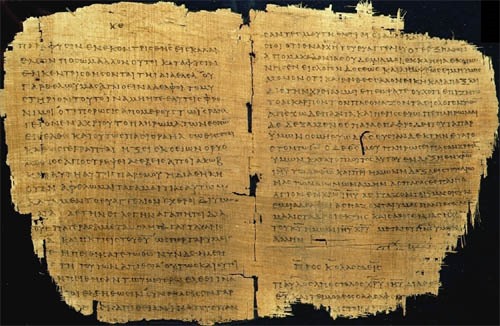
Compare this to the New Testament. between 50 and 100 A.D. There are more than five thousand six hundred (5,686, to be exact) ancient copies of these documents. The oldest copy of any part of the New Testament is a fragment of the book of John (known as the Rylands Manuscript) which is dated very close to the time which John actually wrote the book – certainly within forty years, but possibly even part of the original. Another fragment of Matthew is believed to be so close as to be part of the original gospel as written down by Matthew himself. Many of the books exist in copies that were made within 100 years of the original. There are complete New Testament manuscripts – i.e. all the books gathered together as part of one document – that date merely 225 years after the time of the apostles. In addition to all this, we have ancient translations of the New Testament in Latin, Coptic (an ancient Egyptian language), Arabic, Slavic, Armenian and several more languages. In fact there are 19,284 ancient copies of all or part of the New Testament in languages other than Greek. The oldest are in Latin and Syriac, and are dated around 150 AD – or, less than 100 years after the originals were written in Greek.

To put it another way, there are 284 times more copies of the Greek New Testament than there are of Tacitus. And the age of the copies is almost a thousand times better. That makes the New Testament a much better historical document (hundreds of times better) than the best other documents from that same period.

The fact that there are so many ancient copies also makes it possible to know with a good deal of certainty what the original documents said. In other words, with so many good copies out there, we can compare the texts and see if they are the same or not. If all or most of the texts show that John wrote “Jesus wept,” than we can be very sure that John did in fact write, “Jesus wept.” People have now been comparing and compiling these ancient manuscripts for some time and we can be very confident that what we read in English has been translated from a Greek text that would be probably 99% exactly the same as what was originally written. There are some differences between ancient copies, of course. Some of them are easily identified as copying errors. Some of the differences show up in only a few of the manuscripts, while all of the others agree. But there are a few differences in ancient copies of the New Testament that can’t be easily resolved. None of those textual differences have any impact on any major Christian beliefs. None of them change doctrine. The NIV Bible translation makes of a note of any major differences between ancient Greek manuscripts. One example is Luke 23:42. Luke writes that the thief on the cross said, “Jesus remember me when you come into your kingdom.” The NIV makes a note at the bottom that there is enough evidence to note a variant manuscript reading. The variant would read like this: “Jesus remember me when you come with your kingly power.” You may say: “What’s the big deal with that? What’s so different about it? What does it change? Doesn’t it mean the same thing?” That, of course, is the point. It changes nothing significant. Nor do any of the “significant” variants. If you have an NIV Bible you can scan the bottom of the text as you flip through the pages and see all the significant variants.

Probably the biggest significant variant comes from John 7:53-8:11. The NIV makes this note: “The earliest and most reliable manuscripts and other ancient witnesses do not have John 7:53-8:11.” In all probability this little section was not included by John when he wrote the gospel. It may have been a story told by John, that was well known to those who knew John. After his death, they might have included in the gospel so that the story would not be lost. It might have been written by John some other time, or by one of the other apostles and included in John’s gospel so the story wouldn’t get lost. But even if you take this little section out of the Bible, it doesn’t change any major doctrine.

In addition to the all the copies of the New Testament, we have surviving letters and writings of early Christian leaders. These early Christians quoted both the Old and New Testaments extensively in their writings. It is obvious from this that the books of the New Testament must have existed during the lifetimes of the people who quoted them. Since we know when these early church leaders lived, we know that the New Testament is at least as old as they are. The oldest of these is Clement of Rome, who died in 99 AD. Thus we know that books of the New Testament that he quoted had to exist before the year 99. Another early church leader was Ignatius of Antioch, who died, at latest, in 116 AD (he may have died as much as twenty years earlier).

There are other ancient writings about Jesus – writings that were not included in the New Testament. These include The Shepherd of Hermas, Didache, Apocalypse of Peter, The Gospel of Judas, The Gnostic Gospel of Thomas and several more. These texts do not boast the same number of ancient copies New Testament books do, nor are they well preserved or as close to the time of the originals. These writings generally have no historical validation whatsoever, certainly none of the type enjoyed by the New Testament writings.

There were several things that caused a book to be included in the New Testament.

  1. The New Testament book had to be connected to an apostle, or someone closely connected to Jesus (we looked at this earlier). The Apocalypse of Peter, though it names an apostle in the title, was never recognized in any early writing or by any evidence as having anything to do with the real historical Peter. It was rejected because the people at the time knew that Peter had no connection to it.
  2. The New Testament book had to enjoy widespread use among churches. (for example, the Gospel of John was used and recognized in churches all over the known world by a very early date; whereas the “Gospel of Judas” was never really recognized outside of Alexandria, Egypt and that at a fairly late date, by people who weren’t even Christians.)
  3. The New Testament writings had to agree with generally accepted Christian doctrine. In the 140s AD a man named Marcion came up with his own very twisted version of Christianity and listed various writings which he thought should be considered sacred. He and his “New Testament” were rejected because they were contrary to the teachings that the churches had held since the time of the apostles.

So you see, when it comes to something like The DaVinci code, or National Geographic’s Judas Gospels there is a little bit of truth, mixed with a lot of big lies. The little bit of truth is that there are indeed ancient writings other than the New Testament, which talk about Jesus. The big lie is the idea that those other writings are validated or historical in any way. They don’t have the historical or documentary qualifications which the New Testament does. Compared side by side, the New Testament wins every time.

The point of everything we’ve learned so far is this: There are some very good reasons to believe that what the Bible says is true, accurate and important. Ultimately we do have to take a step of faith. But perhaps you haven’t realized until now, that that step of faith is not as big as many people think it is. We have sound scientific and historical reasons to believe what the Bible tells us. I don’t think we can call it absolute proof, because God does want us to trust him, and in order to trust, there has to be the possibility of doubt. But even though that possibility of doubt remains, all of the evidence points to the conclusion that the Bible is true, trustworthy and reliable.

Next time, we’ll talk more about the “mystery” of Jesus, and how that helps us to understand the whole bible.

WHY SHOULD WE LISTEN TO THE BIBLE?

oldbible

The Bible is unique among religious books. We will start to learn why, with this post.

To listen to the sermon, click the play button:

To download, right click on the link (or do whatever you do on a Mac) and save it to your computer: Download Understanding the Bible Part 1

UNDERSTANDING THE BIBLE #1

Someone recently liked this blog, and as I often do, I went over to his blog, to check out what he was writing about. I noticed a post with an eye-catching title, and I read it. What I found is similar to many blogs and Facebook posts that I have seen over the past few years. The basic argument went something like this:

  • Many Christians claim that, according to the bible, [enter something here that the bible says, which you don’t like].
  • But the bible also says lots of goofy things, like:
    • Rapists can pay their victims’ parents 50 shekels, and get off the hook (the writer mis-quoted Deuteronomy 21, but I think he was referring to chapter 22).
    • It’s OK to sell daughters into slavery (Exodus 21:7)
    • It’s OK to marry multiple wives (21:10)
  • Since we don’t agree with these goofy things in the bible, we shouldn’t pay attention to what the bible says about sex before marriage.

I’ve seen this sort of argument before. Most commonly, it is made in order to justify sinning in whatever way you prefer to sin. But logically, if that argument was valid (it isn’t) there would be no reason to pay attention to any part of the bible at all. If that blogger is right, we ought to just ignore it altogether as irrelevant. If he’s right, we shouldn’t pay attention to what the bible says about Jesus, or  forgiveness, or love, either. To be fair, he wasn’t saying that in his blog, but it is the logical conclusion.

Here’s what I wonder: do you know why the blogger’s argument is invalid? Do you understand how to answer the questions of someone who has this attitude? Do you have a firm grasp on what the Bible is, how we got it, and how to understand it?

If you answered “no” to any of those questions, I think you’ll find this sermon series helpful, and even enjoy it. By the way, I have two helpful and reasonable answers to the guy who posted the blog entry I mentioned above. I could explain it in about five minutes. But rather than do that, what I want to do is help you learn enough about the Bible, and how to understand it, so that you can answer questions like that yourselves. You’ve heard the old proverb: “Give a man a fish, and he’ll eat for a day; teach a man to fish, and he’ll spend all his nights and weekends in the boat, and his family will never see him anymore.”

Actually, I think the second part is “teach a man to fish, and he’ll eat for the rest of his life.”

I want to teach you to “fish.” I could give you the answers the questions posed by the blog entry I mentioned above. But then, when you encounter new questions, you’ll be dependent upon me, or someone like me, to give you answers again. I’d rather help you understand enough so that you can do some digging, and find the answers for yourselves.

It might take a little while. I’ve been studying the bible seriously for more than twenty-five years. It won’t take you that long to get started and to begin finding answers yourself, but I do hope you look on the bible as a source that you can and should continue to study for the rest of your life. I think that over the course of the next few weeks, you can learn enough about the Bible to begin.

The best place to start, as is often the case, is at the beginning. What is the Bible? Where did it come from? Who wrote it, and what is its purpose?

The bible is not actually one book. It is a collection of books. That is one reason why I never recommend starting in Genesis (the first book), and trying to read it straight through all the way to Revelation (the last book). It won’t make sense that way, because it isn’t that kind of book.

The very earliest parts of the bible were handed down as oral traditions, and later were written down. Even today Hebrew scholars of very moderate learning can see linguistic evidence that much of the first five books of the Bible were originally memorized orally. We’ll talk about what that means, next time. The oral traditions, and some new material were first written down, probably by one man named Moses, sometime around 1400 B.C.

By the way, many scholars now prefer to note dates as “BCE” and “CE” (“Before Common Era,” and “Common Era,” respectively). However, BCE is exactly the same as “BC” and “Common Era” means the same thing as AD. It is downright silly to pretend that “common era” is defined by anything other than historical life of Jesus Christ. Whether or not you believe in him as anything other than a man, whether or not you like it, the world numbers history by the life of Jesus Christ.

Back to the Bible. More history and more oral tradition were recorded by another man, probably the prophet Samuel, sometime around 1000 B.C. Samuel also recorded many of the current events of his time. As the monarchy in Israel took shape, court historians kept records of happenings, and further unknown writers recorded more of we know call the Bible. Prophets spoke, and scribes wrote down what they said. Later, the New Testament was formed from letters and writings of those associated with Jesus Christ.

All in all, the Bible was written by several dozen different people. It was written in three different languages (Hebrew, Aramaic and Greek). The people who wrote it were from all different walks of life: Farmers, shepherds, kings, court officials, prophets, fisherman, doctors, prisoners, church leaders and more. Some of them were rich, some were poor, some were in between. The writers came from different cultures, different countries and different continents. There is no sense in which one can say that the Bible was just made up by one person, or even one small group of people at one time. It does not claim that it was dictated in secret by angels.

These facts about the formation of the Bible have never been secret. Scholars have known these things for many centuries. Archeology has consistently confirmed all this. Manuscript study and comparisons also confirm it. These facts are not hidden away somewhere; they are not closely guarded secrets. They are well established.

Now, let’s look at the bible in comparison to some other ancient writings. This is not to “slam” anybody, but rather for the sake of knowledge, let’s compare the Bible to two other well-known Holy Books: The Koran, and the Book of Mormon. Hinduism and Buddhism do not have authoritative scriptures that they hold in the same way as do Christians, Jews, Muslims and Mormons. Therefore the Koran and the Book of Mormon are really the only other major books that claim the same sort of authority as the Bible.

The Koran was formed in this way: During the early 600s (AD), a man named Mohammed, a former resident of the city of Mecca in Arabia, went into a cave. He came out with the Koran, claiming that an angel had dictated it to him. Much of the Koran appears to be a copy of parts of the Old and New Testaments, although often distorted. Other parts of the Koran are quite different. It is not a very large book. Muslims also receive a lot of direction from the sayings of Mohammed (Hadith) and the biographies of Mohammed. As with the Koran, these all depend upon the words of a single man.

The Book of Mormon was “given” to Joseph Smith on golden tablets in 1823. Again, Mormonism uses Christianity as a jumping off point, but contains many things which contradict the Christian/Jewish bible.

No Muslim denies that the Koran came through just one man at one particular time in history. They do not deny that it was written in only one language, in one place and arose from one culture. The Book of Mormon is similar: by the admission of Mormons it was revealed to just one man in one time and in one place.

Now, you might ask, what difference does it make whether one person wrote the bible, or dozens did? Why does it matter if the bible was written over the course of 1500 years, or just in one lifetime? What is the significance of what we’ve just learned? Why does it matter?

Alexander McCall Smith is the author of many fiction novels set in Africa. In one of his novels, the main character has these reflections on morality (from Morality for Beautiful Girls page 77-78)

Most morality, thought Mma Ramotswe, was about doing the right thing because it had been identified as such by a long process of acceptance and observance. You simply could not create your own morality because your experience would never be enough to do so. What gives you the right to say that you know better than your ancestors? Morality is for everybody, and this means that the views of more than one person are needed to create it. That was what made the modern morality, with its emphasis on individuals, and the working out of an individual position, so weak.

If you gave people the chance to work out their morality, then they would work out the version which was easiest for them and which allowed them to do what suited them for as much of the time as possible. That, in Mma Ramotswe’s view was simple selfishness, whatever grand name one gave to it.

Mr. Smith gives us a tremendous and profound insight here. Moral authority cannot come from one person. No single human being, by himself or herself, has the breadth of experience, nor the wisdom, nor the character, to create morality. Yet in Islam, all moral and spiritual authority comes from one man. Likewise with Mormonism. The same thing is true of atheists, agnostics and secular humanists.

If you are agnostic or atheistic, in a very real way you are saying that you know better than everybody else. You, in your few years of life upon this earth, are claiming to have wisdom, experience and authority greater than that of the collective wisdom and experience of entire cultures of people whose lives spanned more than a millennium and a half, whose morality and wisdom still profoundly shape the world we live in.

When I was in high school, the teachers said to us kids that we needed to decide for ourselves what is right or wrong. We were told to create our own morality. The very thought of such a thing is nothing less than overwhelming, towering, ugly, arrogant pride. “Hubris” is another word for it. What, in all the universe, makes us think that we, in 16 years, could match the wisdom and experience that spanned 16 centuries and survived thousands of years? What makes us think even a 90 year old person could match all that? Only ugly pride.

Remember, just for today we are trying to evaluate this from a secular position, rather than a spiritual one. Does it seem rational to suppose that one person, in one lifetime, however varied her experience, however deep her wisdom, could match the wisdom and morality and experience contained in the Bible? Of course not. It’s simple logic. And in this same respect, the Bible is logically superior to those other “holy books” which were brought into the world by single individuals.

Now some folks may say, “well, I look at what’s in the Bible, and make use of all that experience, but I still decide what is right for me.” On the one hand, of course everybody does have to decide whether or not they will accept what is written in the Bible. But nonetheless, it seems awfully arrogant to say, “I know what the Bible says, but I still think I am wiser than Moses, Isaiah, Paul, Samuel, David, Peter, John, and Jesus (plus about two dozen more) all put together.”

You see, even from a secular standpoint, the Bible is unique in history. There is no other ancient document so well preserved, so thoroughly verified as genuine by legitimate scholarly work (more on that in in the near future). There is no other source of moral and spiritual authority that has so much objective logic to back up its claim. Here is a quote from it, which seems rather fitting:

For my thoughts are not your thoughts, neither are your ways my ways, declares the Lord

As the heavens are higher than the earth, so my ways are higher than your ways, and my thoughts

than your thoughts. (Isaiah 55:8-9)

This book, this Bible, goes far beyond the thoughts or ways of any one human being. Next week we’ll begin to see how it goes beyond even collective human morality.

SOWING THE SEED

sowingseed

To listen to the sermon, click the play button:

To download, right click on the link (or do whatever you do on a Mac) and save it to your computer: Download Experiencing Life Together Part 12

EXPERIENCING LIFE TOGETHTER #12

You are almost at the end of 15 weeks of a cell/house church experience. Hopefully this is been a positive experience. If things have gone as they often do, you might not want this experience to end; you might want this group to continue to meet together. That is generally a good thing, and our hope is that your group does continue for many months to come. In many ways a house church group that has been together for 15 weeks is only just beginning, and there might be months, or even a year or two of meeting as you are. But in the life of every house church group there comes a time when things ought to change. Your group leader has probably spoken about this already during one of the previous house church group meetings. In house church group circles this change is called “multiplication.” Generally, a healthy house church group in the United States should multiply after it has been together for between nine months and two years. So your 15 week group is probably not ready to multiply, and that’s okay. But this business of multiplication is sometimes hard to understand and even harder to accept, and so as we reach the end of this group curriculum it is an important topic to devote some time to.

Just in case anyone is still confused about what “multiplication” or “multiplying” is, let’s review it briefly. House church groups are supposed to be small groups. Technically a small group consists of 15 members or less. There is a certain dynamic in a group of this size that helps it to feel “small.” This dynamic is what facilitates the ministry of house church groups. In a small group all members are more likely to feel included. In a small group, it is easier for members to use their gifts to serve one another. In a small group sharing and praying take place on a deeper level. In a small group it is easier to recognize and welcome new visitors, and to devote the energies of the group to minister to particularly needy families. Of course the true key to house-church ministry is the Lord working in and amongst the members of the house church group. But this working is greatly facilitated by keeping the size of the group relatively small.

When the group has more than 15 members, the group dynamics change. There are so many different possible relationships, that the group no longer feels small; often, sub-groups start to form. It becomes harder to tell if someone within the group is hurting and sometimes absences may even go unnoticed; needs may go un-ministered to. When the group is large enough for people to sit back passively and not participate, they do not usually grow as disciples very much. A large group certainly has its purposes. Notably, it is often more fun to worship in a large group and it is more effective to teach a large number of people at one time. But a large group is not the most effective weekly context for making disciples. A large group does not make a good house church. Therefore when a house church group grows by reaching out to new people, eventually it becomes time to take what has become a large group and make it into two new small groups. This is what we mean when we say multiplication — the one group multiplies into two.

There are a few common objections that people offer to multiplication. Many people feel that the new group, because it is missing some of the members of the old group, could never be as close or effective in ministry as the old group was. Other people simply enjoy the group so much they don’t want anything to change. It is easy to empathize with these feelings — none of us enjoys changing things that don’t appear to need change. We all like to feel secure and have a group with whom we feel safe. Others fear that relationships will be lost without the continuity of a regular group meeting.

All these fears arise when we are focused upon ourselves, our desires, and our comfort. But Jesus calls us not to be comfortable, but to let him live his life out through us. Paul put it like this:

I have been crucified with Christ. It is no longer I who live, but Christ who lives in me. And the life I now live in the flesh I live by faith in the Son of God, who loved me and gave himself for me. (Gal 2:20, ESV2011)

We are here to let Christ live in and through us. His purpose is to make disciples. He said:

All authority in heaven and on earth has been given to me. Therefore go and make disciples of all nations, baptizing them in the name of the father and of the sun and of the holy spirit, and teaching them to obey everything I’ve commanded you. And surely I am with you always, to the very end of the age (Matthew 28:18-20).

The church is not on earth to please itself. If we are Christians, our purpose in life should not be to make ourselves more comfortable. Every single believer in Jesus Christ should be about at least some aspect of the business of making disciples of Jesus Christ. We need to be about this business even when it involves sacrifice and discomfort for ourselves. After all, Jesus made the ultimate sacrifice for us. Jesus describes his own sacrifice, and the call to live for his purposes, like this:

I tell you the truth, unless a kernel of wheat falls to the ground and dies, it remains only a single seed. But if it dies, it produces many seeds. The man who loves his life will lose it, while the man who hates his life in this world will keep it for eternal life (John 12:24-25).

Jesus is explaining that in order to bear fruit for the Kingdom of God, God’s people must sometimes make sacrifices. A way of paraphrasing this for house church groups might be as follows:

I tell you the truth, unless the members of a house church group are willing to move out of their own comfort zones and multiply, the house church group remains only a single group and its influence for the Kingdom of God is limited to just the members of that group. But if the members are willing, and the group grows and multiplies, many more groups may be formed as a result and many more lives may be touched by Jesus. For if group wants to stay together for its own sake eventually it will become stale and stagnant and may even end. But those who are willing to multiply will find that they have fellowship with their dear friends even if they are not in the same group, and will find the reward of serving their Lord and Savior.

Over the past few months, we’ve looked a little bit at early church in Jerusalem, as described in the first few chapters of Acts. It was surely one of the most wonderful churches that anyone could be a part of. They had such sweet fellowship, and everything seemed to work together. And yet, the Lord allowed persecution to break out against that church, and it was scattered. This appeared to be a negative thing and it appeared as though their sweet fellowship had been broken. And yet, as a result of this scattering of the church, many more people in other places were given the chance to know Jesus.

On that day a severe persecution broke out against the church in Jerusalem, and all except the apostles were scattered throughout the land of Judea and Samaria…

So those who were scattered went on their way preaching the message of good news…

Philip went down to a city in Samaria and proclaimed the Messiah to them…

So there was great joy in that city (excerpts from Acts 8:1-8)

The breaking up of the sweet fellowship in Jerusalem resulted in the spreading of the good news, and the joy of salvation in other places. They were scattered, like seed, and that seed took root, and bore even more fruit.

The 12 apostles, while they had their occasional quarrels, must surely have been a tight group. And yet, once the Holy Spirit came upon them, they never were all together again — they never were the same small group that they had once been. While they could have chosen to look on this as personal tragedy, instead they accepted what the Lord was doing, and as a result, we know Jesus today. If those first Christians had not been open to multiplication, we probably would not be Christians today. Consider what results may occur years down the road if you too, are open, as they were.

The truth is, those that fear a new house-church group could never be the same as the old, overlook the fact that the power, and joy and love that they feel in a house church group comes not from the members, but really from God through the Holy Spirit as he works in and through the members of the group. And when a group multiplies, the Holy Spirit goes with each new group. Therefore the same love, the same power, and the same fellowship are all present in the new group just as they were in the old.

Some of you reading these notes may not even be in a house-church. How does this apply to you? At a personal level, these verses call all believers, wherever they are, to be ready to let Jesus work in them, and through them, even if it involves sacrifice. Some people, even today (in some areas of the world), give up their very lives for the sake of Jesus. At the very least, we should be willing to give up our personal comfort, so that someone else might be able become his disciple.

But I want to encourage each one of you, our comfort really comes from the presence of God, and his Holy Spirit goes with us, even when we leave our comfort zone. Jesus’ mission was to leave his comfort zone, and reach out to those who would receive him. Now, he lives in us, through the Holy Spirit, and he still wants to fulfill that same mission. There is joy and grace for us when we let him do that through us.

BODY LIFE

body of Christ 2


To listen to the sermon, click the play button:

To download, right click on the link (or do whatever you do on a Mac) and save it to your computer: Download Experiencing Life Together Part 11


Experiencing Life Together #11. Body Life (1 Corinthians 12:12-31)

I learned an important lesson when I was a camp counselor: Never throw an unwilling camper into the lake, especially if one of his buddies is standing on your foot. I learned this lesson the hard way, for although the camper was unharmed (albeit, wet), his friend’s weight on my foot, combined with my momentum, broke the bone of my little toe.

The truth is, I had never paid much attention to my ‘pinkie” toe up until that point in my life, other than to clean lint off of it. For the next few weeks however, I began to learn what an indispensable appendage that smallest piece of my body is. For one thing, what it lacks in size, it makes up for in intensity. I have learned that there is a kind of “nerve layer” that is part of any bone in your body. When the bone is broken, that nerve layer becomes very distressed, no matter how small the bone is. A bone is a bone, no matter how puny and silly looking, and pain is painful, no matter where it originates. Second, I learned how important the health of my little toe is to the rest of my body. My injury interfered greatly in ordinary physical activities. I couldn’t do many things that I normally did, like running, jumping, throwing campers in the lake – even walking was quite difficult and painful for a while. I had to limp in an odd sideways sort of way that eventually caused a great deal of pain to the rest of my foot, and my ankle. I contorted into even stranger methods of motion to ease that pain, and eventually my back became seriously out of line- all because of one tiny little bone in my foot.

Even beyond the ways my puny little toe affected the rest of my body, the injury had ramifications for my greater existence in society. For more than a week I couldn’t even drive a car (it was the toe on the right foot). This had all sorts of implications, not least of which was my inability to get to the Laundromat. For a while I had to stand downwind of everyone. My little toe may even have had a hand in destiny, as it was a certain lovely young camp counselor by the name of Kari Perina who finally offered to help me in my distress, and run me into town for laundry and errands (‘this is the beginning of a beautiful friendship’).

My point is this: though my pinkie toe seems insignificant, even unnecessary, I found I could not get along without it. And when I had to try to operate without it, it affected almost every aspect of my life (I’m not even going to mention bathing).

The Apostle Paul is attempting to make the same point in 1 Corinthians 12:12-31, although without the enriching personal experience of a broken toe. This is a passage that is vital to the understanding and practice of house-church ministry. There is an atmosphere, a context for house-church ministry, and that context is what I like to call “body life.” A house-church group really doesn’t work properly unless all members participate in body life and use the gifts and blessings God has given them.

Paul calls the church “the body of Christ’ and he expresses four main truths that this reveals. The first truth is that just as in a physical body, each part belongs to the others. We all have been called to “one Lord one faith, one baptism, one God and Father of all” (Ephesians 4:5). Paul describes the superficial differences that were predominant in his day: (Jew-Greek, Slave-Free) and asserts that that these are indeed superficial. In Jesus, we all belong to each other. The differences that we may be tempted to point to might include rich-poor, white-colored, expressive-quiet, or any one of a number of things. These differences are not as deep as the truth that if we are in Christ, we are all parts of the same body.

The second Truth is that while we are part of the same body, we do not all have the same function. Each part is distinct. As Paul writes:

“If the whole body were an eye, where would the sense of hearing be? If the whole body were an ear, where would the sense of smell be? But in fact God has arranged the parts in the body, every one of them, just as he wanted them to be. If they were all one part, where would the body be? As it is, there are many parts, but one body.” (1 Cor 14:17-19).

We are not all given the same personalities, talents and traits. We are given our differences so that the Church may function as a healthy body, with all systems operating correctly. There was a time, shortly after the accident I described above, when I felt like my whole body was one huge, throbbing toe. Believe me, it was not a pleasant experience. Trust me, the whole body was not meant to be a toe. In the same, way, we in the body of Christ are supposed to be diverse in our personalities, gifts, backgrounds, races and life situations. These differences do not mean that we don’t belong – but they do mean that we each have a different function to fulfill in touching lives according to God’s pattern.

Third, each part of the body is indispensable. As I illustrated in the beginning, even the smallest part is essential to the well-being of the whole body. As Paul writes:

The eye cannot say to the hand “I don’t need you!’ And the head cannot say to the feet, “I don’t need you? On the contrary, those parts that seem to be weaker are indispensable….

But God has combined the members of the body and given greater honor to the parts that lacked it, so that there should be no division in the body, but that its parts should have equal concern for each other. (12:21-22, 24-25)

The body of Christ needs all of its members to be functioning properly to be healthy. If one part is sick, the entire body is affected. Have you ever thought of Tabitha, the believer from Joppa? We will never know until we get to heaven, whether she spoke in tongues or not. We have no idea whether God used her to bring prophecy or healing. But we do know that she was used by God to help the poor, and this gift was so indispensable to the body of believers in Joppa, that God raised her from the dead to continue using her (Acts 9:36-41).

The fourth main truth that Paul expresses about the church as the body of Christ is that each part needs to work together. This is very similar to the truth he expresses in Ephesians 4:16, where he writes: “From him the whole body, joined and held together by every supporting ligament, grows and builds itself up in love as each part does its work (emphasis mine).

To put it in very direct terms, I will offer a free rendering of what Paul is trying to get at:

If the whole church were the pastor where would the house-church leaders be? If the whole church were house-church leaders, where would the administrators be? What about those who minister in prayer, or who visit the sick? The deacons cannot say to the house-church members, “we don’t need you,” and those who lead worship cannot say to those who sing, “we don’t need you.”

Are you starting to get the picture? God has a plan for each and every member. If you are a part of this church (or any church) God has a special reason for you to be here. He wants to use you to touch lives in a way that he cannot use any other part of the body. It certainly will require some working together, and perhaps you alone cannot make much of a difference, but without you, the entire body will be affected. This is great news. You are special, unique and absolutely indispensable. In the body of Christ, you are somebody. You also have a responsibility to participate in body life, so that God can use you. You might decide that you cannot be used, or that you are to insignificant. But if you decide that you do not want to be used, or you do not make yourself available to be used, you like my little toe, could end up affecting the very backbone of the body. Now, you don’t need to become anxious over your responsibility. You can only function as part of the body and do your piece, as you depend upon the power of the Holy Spirit. You need only to be willing and available and God will see to it that the details of how you are used work out.You should not be anxious, but instead, rejoice that God sees you as important in his plan to touch the lives of other people. Rejoice that He will give you the wisdom and power you need to be a properly functioning member of His body- even if you are just a little toe.

Your church might need your wisdom, given you speak up. We might need your prayers. Perhaps it is your willingness to serve, or your skill with tools, or your solid dependability, or your education, or your administrative ability. I hope you get the picture: the list is endless. You are somewhere on it. Don’t be the broken toe, remember that each part of the body needs the other parts.

WHAT IS GOSSIP?

gossip

You don’t have to bury all conflict or hurt. But you should share your hurts and conflicts and struggles with the appropriate person, rather than talking about it with someone else.

To listen to the sermon, click the play button:


To download, right click on the link (or do whatever you do on a Mac) and save it to your computer: Download Experiencing Life Together Part 10


Experiencing Life Together #10. Biblical Communication in the Church

Matthew 5:23-24; Matthew 18:15-17

What I am about to discuss here cannot be properly put into action without a strong commitment to loving others in the house-church. In order for the following principles to be practiced in a way that honors God, they must be used in the context of a commitment to value others – that is, in the context of Christian love.

Within churches in the United States, there is a pervasive unwillingness to deal openly with sin and/or conflict. This unwillingness is not only unhealthy, but it is also unbiblical, and unchristian. Many times, churches have been torn apart by conflicts that could have been resolved peacefully following biblical directives. Let me describe what commonly happens, and then we will look at what God would like to happen.

Linda was a member of Rachel’s house church. They had never been best friends, but they got along OK until Rachel invited every child in the group to her daughter’s birthday party – every child except Linda’s twins, who were the same age as Rachel’s daughter. Linda was enraged – the next week she could hardly look at Rachel. The following week she missed church, because she couldn’t stand to be around that snobby, stuck up woman. So full of hurt and anger, she couldn’t contain it, Linda called her friend Susan, also a member of the house church. In her anger, Linda had begun to see more of Rachel’s faults, and she sounded off at length to Susan, who listened sympathetically, promising not to pass any of it on to Rachel. Linda felt better for a while after this, but she could never be more than cold toward Rachel, and she stopped sharing anything personal or significant with the house church meeting. In the meantime, Susan was burdened with the rift between her two house-church mates. In a chance conversation with Rachel, Susan hinted that someone was upset with her. When Rachel wanted to know who, and why, Susan refused to tell, because she “didn’t want to gossip.” Rachel was puzzled and hurt, and she too, stopped sharing anything significant in church. This affected the rest of the group, and soon sharing and praying was just superficial.

This is just a hypothetical story, but it portrays a very real phenomenon. Not only that, but we could carry it on, ad infinitum. Susan may share with a friend in another house-church what is going on, and that person may call the pastor and sworn to “secrecy,” simply tell the pastor that there’s a big problem with the other house-church group. This sort of backward communication weaves an intricate and love-killing web. The Bible has a name for it – it is called gossip.

Paul saw it at work in several churches, among them, the Corinthian house churches:

For I fear that perhaps when I come I may find you not as I wish, and that you may find me not as you wish—that perhaps there may be quarreling, jealousy, anger, hostility, slander, gossip, conceit, and disorder. (2Cor 12:20, ESV2011)

He knew that it all goes together: gossip, quarreling, jealousy hostility and anger.

Now, some of you may have been shocked to hear this called “gossip.” Many people think that gossip is simply sharing vicious or dirty secrets that shouldn’t be shared. While that is also part of gossip, I believe that gossip, in essence, is saying what shouldn’t be said to anyone, or saying what should be said to the wrong person. Some of you may protest and object that Linda should have the right to express her frustration to her friend whenever she wants to. The truth is, Linda does not have the right to say anything about Rachel that she has not already said to her face. She should not share her frustration with anyone until she has first brought it to Rachel herself. The only possible exception to this is her spouse, if it is understood that he is one with Linda, and will not share it with anyone else, and will encourage her to go to Rachel.

It is important also to note that two people committed the sin of gossip in the above story. Linda was the first, and Susan was the second. As unfair as it sounds, listening to gossip is a sin in the same way that speaking gossip is. Without a listener, there can be no gossip. Not only that, but by listening, Susan provided an inappropriate emotional outlet for Linda’s anger. The appropriate outlet would be for her to lovingly confront Rachel. But instead, she felt a bit better after talking to Susan, and so did not feel the need to talk directly with Rachel. Thus, by listening, Susan gave tension and hidden conflict a place to grow. By listening, Susan perpetuated and strengthened an unhealthy pattern of communication. Not only did her listening do further damage to the relationship between Rachel and Linda, but it also did damage to the whole house-church group. What happened between Linda, Rachel and Susan is a well-known communication pattern, referred to in psychological jargon as “triangulation.” You see, it is not only sinful – it is also recognized in secular psychological circles as an unhealthy and destructive way of relating. It ruins families and house-church groups wherever it occurs.

In contrast to this, let us look at God’s design for conflict resolution in Matthew 18:15-17.

“If your brother sins against you, go and show him his fault just between the two of you. If he listens to you, you have won your brother over. But if he will not listen, take one or two others along so that every matter may be established by the testimony of two or three witnesses. If he refuses to listen to them, tell it to the church; and if he refuses to listen even to the church, treat him as you would a pagan or a tax collector.” (emphasis mine)

First we need to recognize that these instructions were intended for a situation in which one person is actually sinning. I’m not sure that snubbing someone at a birthday party qualifies as a sin. However, it may in fact, qualify as a sin against you even if it is not against God. In addition, sin or no sin, this passage also contains some universal principles relating to conflict resolution and communication. And the basic underlying principle is to talk with the person directly, one on one. There is no thought, Biblically, of going to someone other than who you have the problem with – at least not until you have tried going to them directly. Even after this has been done, there is not really room to gossip – instead the idea is to bring a few more people, and again, talk to the person directly. Talking about the person to someone else simply has no place. The difficulty is, of course, that it is a scary and unpleasant thing to go directly to someone you have an issue with. Some people, faced with either sinning when they tell someone else about their conflict, or facing the other person directly, choose to do neither. Now, this is fine if you can forgive the other person, and get over the issue, and move on. But if your anger continues to burn inside, and you find yourself treating the person who hurt you differently than before, these are signals that you need to talk to them directly. Clamming up may not be sinful in the same way that gossip is, but it can be nearly as destructive if you are unable to forgive and move on. Matthew 5:23-24 speaks of this:

“Therefore, if you are offering your gift at the altar and there remember that your brother has something against you, leave your gift there in front of the altar. First go and be reconciled to your brother; then come and offer your gift.”

The basic point is, we cannot worship God when our grudges remain unsettled. Worship is something we Christians do together, in community, and it is very hard to do that when we remain angry or unforgiving toward someone who is worshipping with us. If we cannot truly forgive it and move on, we need to settle it by going directly to the one we have a conflict with – as soon as humanly possible. Jesus uses as an example someone who is in the very act of bringing a sacrifice to the temple, and he urges such a person to break off their worship until reconciliation can be made.

As always, this applies to us as individual Christians, but it also applies to our churches. I want you to know that it is absolutely possible to have a church that does not engage in gossip. I’ve been in such churches. It starts when people rely on the Holy Spirit to stop them from saying what they should not say (or saying it to the wrong person), and also from listening to something they should not be involved in. For those of us in Life Together Churches, I want to encourage you to be that sort of church.

I don’t mean you should bury all conflict or hurt. I mean you should share your hurts and conflicts and struggles with the appropriate person, rather than talking about it with someone else. If that person does not listen, share it with them again, only this time feel free to bring along one or two trusted others.

I realize that some folks really would rather avoid the hassle that comes from talking one-on-one with someone with whom you have an issue. But the truth is, talking directly with a person about an area of significant conflict, is far more loving than suppressing it. When you deal directly with people, you are investing in your relationship with them. You are saying that this person is worth the hassle, worth working it out. When you suppress the conflict without being able to get over it, you are saying “this person is not worth the trouble. I’d rather be superficial with them my whole life, than invest the time and energy in working out our differences.” It is love that leads us to deal honestly and openly with each other.

Some people do find this whole topic a bit confusing. Can you ever listen to someone’s frustrations with another person? Can you ever share your aggravation with a non-involved party? One good way to determine whether you are saying something that ought to be said to a different person, is to imagine what you would feel if the person you are talking about were to overhear your conversation.

Suppose you are mad at Bob about something. You are at a coffee shop, talking to your friend Rex about Bob. Now, suddenly, you realize that Bob is sitting in the booth right behind you, and he’s heard everything you’ve said. Are you embarrassed? Are you sorry that Bob heard you saying that? Do you feel a little awkward? If the answer is “yes” to any of those questions, then you have been engaged in gossip.

Or suppose you are Rex, listening to your friend talk about Bob. If you suddenly noticed Bob in the booth behind your friend, would you feel badly? If so, you need to stop your friend, and ask him gently to go see Bob first, before you can have this conversation. Gossip cannot spread if no one will listen to it.

Large churches can sometimes get away with gossip. It is still a sin, but in a large congregation, two people can attend without really have a relationship with each other. However, in networked house-churches, gossip and talk-behind-backs will absolutely kill a house church. It is too small to avoid somebody. It is too intimate to be so superficial. Since the New Testament was written by and for people in house-churches, we need take what it says about gossip and slander very seriously.

Ask for guidance from the Holy Spirit as you seek to apply what he has already said through the Word, which we have looked at this week.