2 SAMUEL #8: GOD’S GRACIOUS HEART TOWARD YOU

The text today highlights David’s sincere yet misguided intentions to build a permanent place of worship for God, and how God’s corrective guidance reveals His gracious heart. Through David’s story, we learn about the immense freedom and comfort in trusting God’s leadership, the boundless nature of His grace, and the ultimate promise of a Messiah who will save all people and reign forever. It invites us to reflect upon our own relationship with God and embrace the abundant grace He offers, even in the face of life’s uncertainties and challenges

To listen to the sermon, click the play button:

For some people, the player above may not work. If that happens to you, use the link below to either download, or open a player in a new page to listen.

To download, right click on the link (or do whatever you do on a Mac) and save it to your computer: Download 2 Samuel Part

We’ve been considering what we learned about God’s holiness and worship from the time that the ark of the covenant was brought to Jerusalem. 2 Samuel describes the event with one chapter, chapter six. However, 1 Chronicles takes two long chapters to recount the same thing (1 Chronicles 15 & 16). Mainly what we learn from 1 Chronicles is that David set up various ministries for the priests and Levites: not just the priests who offer sacrifices, but also professional worship musicians and song-writers, full time door-keepers, administrators and so on. There were probably more than 100 full time ministers taking care of the ark and of the tabernacle.

But after all, when it was all said and done, the place for all this amazing ministry was just a very old tent. The tent was put together in the days of Moses, more than four-hundred years before. Israel has a dry climate, but I have to imagine that sometime during four-hundred years, there had been mold. I’m sure there were rips and scuffs, and it is a good guess that there were a lot of patches by this point in time.

David talked to Nathan about it. He said, “Look, here I am in a palace – and God lives in a tent.” The implication, not spoken explicitly, is that it is time to build a permanent place of worship. Nathan the prophet said, “Go and do all that is on your heart, for the LORD is with you.”

But right afterwards, the Lord spoke to Nathan, and said, “No, I have a different plan.”

The first thing that struck me when I read this was the safety  and freedom there is in living in daily relationship with God. God doesn’t allow our misguided good intentions to go unchecked. Both Nathan and David had their hearts in the right place. They were sincere. Both of them, however, were sincerely wrong. Even so, because they were keeping in step with the Lord, they were able to hear it when the Lord corrected them. And the Lord did correct them. He didn’t say, “Well, shucks, they got it wrong again. Oh well.” No, when they didn’t get it right away, he spoke to them again. So we can trust God’s leadership. Picture someone walking with a friend who is blind and using a cane. They come to the corner of a street where there is traffic. The friend says quietly, “stop here.” The blind person doesn’t hear it, and keeps walking. Of course the guide is going to repeat himself, more loudly, and maybe even grab onto his blind friend, to prevent him from being hurt. Do we expect any less from God?

Now, one important thing here is that Nathan and David really did want to do whatever God wanted in this situation. They weren’t insisting on their own way. So when they made the wrong choice, they were able to hear the Lord when he spoke to them about it.

Unfortunately, sometimes we are like a blind person who says to our guide, “I don’t trust you, so I won’t go where you are taking me.” We ignore Him when he says “turn here,” or “stop there.” Then, sad to say, often we blame God for the bad things that result from our unwillingness to listen to him. But when Nathan and David were open, the Lord kept them moving in the right direction, and they were able to hear it.

This is tremendously comforting to me. Sometimes, we get so caught up in wanting to do the right thing that we become almost paralyzed with fear, thinking we will make the wrong choice. We think, “If I mess this up, it will be disaster. I could destroy God’s plan for my life. I could destroy my chance at happiness.” Maybe we’re looking at a job or a career move. Maybe we’re buying a house, or choosing a college or deciding what we want to be when we grow up. Maybe we’re trying to decide if we should marry someone or not. Brothers and sisters in Jesus, we can have tremendous freedom, hope and joy in these choices. If we truly want God to do what he wants in and through our lives, then ask the Lord for guidance. If you aren’t sure which way he is leading, step forward boldly and make your best choice. If you are wrong, the Lord will correct you. We don’t have to be experts at hearing from God. But we have to be open to letting him do whatever he wants. If we maintain that openness, we’ll be able to hear it if we start down a path where he doesn’t want us to go.

The fact that we really can trust the Lord to guide us is wonderfully comforting. It is part of God’s grace. But wait, there’s more!

David, good-hearted man that he was, was thinking something like this: “God chose me, the youngest son of an unremarkable family, to be king over his people. He was with me, protected me, sustained me, and finally established me as king. After that, he helped me defeat the surrounding enemies, like the Philistines. Isn’t it about time I start paying back what I owe the Lord? Isn’t it time for me to do something for him?”

And God said: “No, my grace doesn’t work like that. Not only do you not pay me back, but I will pile on with the grace and blessing. You want to build me a house? How about this: I will build you a ‘house,’ a dynasty that will last forever, and it will be used to bring immeasurable blessing to the entire human race.”

The word used for “house” is the same all the way through. It is the Hebrew word pronounced “va’yit.” This is a pretty flexible word. It is used for David’s palace, for describing a dwelling and also for a family, a line of descendants and so on. I think the Lord deliberately inspired the writer to use the same word, in order to emphasize what he was doing. He was piling on the grace.

What God promises is that David will have a descendant who will rule forever. David’s descendant will preside over the kingdom of God. This is a prophecy. Now, I have said before that prophecy is kind of like viewing a mountain range from a long way away. It looks like all the mountains are next to each other in a line across the horizon. But when you actually get into the mountains, you often find a great gap between peaks that looked like they were right next to each other when viewed from a distance. In the same way, when you read a text like this one it looks like all parts of the prophecy are supposed to take place at the same time; yet we find that parts of prophecy were fulfilled a few years after, and others hundreds of years later. Here, the prophecy is not a complete revelation of every detail. But it shows that there will be a descendant of David who reigns forever. This descendant will be chastised and punished – just as Jesus was punished for our sins. God will do something eternal through this person. There are a few things here that may refer to Solomon, and some that may refer to other kings descended from David, but clearly, the prophecy is talking mainly about Jesus.

God didn’t just say that David was his favorite choice for king. He didn’t just give him victory over a giant. He didn’t just take care of him in those years of hardship and trouble. He didn’t just protect David during battle and make him victorious – often against overwhelming odds. He didn’t just actually make David king. He didn’t just deliver David from his enemies and give him a secure place to live and rule. He also promised (and delivered generations later) that David’s name and family line would be honored forever. He promised that the messiah would be descended from David. He is showering grace after grace upon David. You can’t out-give God.

David, understandably, was overwhelmed. He went and “sat before the Lord.” And then he prayed. David says something very important in verse nineteen that seems to be lost in translation in many English versions of the bible:

“Who am I, O Sovereign LORD, and what is my family, that you have brought me this far? 19 And now, Sovereign LORD, in addition to everything else, you speak of giving your servant a lasting dynasty! Do you deal with everyone this way, O Sovereign LORD? (2 Samuel 7:18-19, NLT)

Though I like the NLT in general, I think they could have done a better job with the final phrase. A few other versions do something similar. But in Hebrew it says, literally: “and this is torah for all mankind.”

The Hebrew word “torah” has various related meanings, as many words do. It can mean custom or rule. But the most common meaning is “instruction from God.” It is often translated “law.” During the time of Jesus, torah was one of two terms that described God’s revelation in the Bible. When a Jew said “the torah (law) and the prophets” he meant “the word of God as revealed in the bible.” So, I think the best translation is probably the HCSB, which says: “And this is a revelation for mankind, Lord GOD.

I think David is speaking prophetically. He is saying that this promise of the descendant who will come–a messiah who will reign forever–is God’s very word for humankind. It is a law and a promise for all humanity. In fact, this promise to David was remembered, and repeated, throughout the centuries that followed, and it was always understood as a promise for a messiah who would bring God’s blessing to all human beings.

In verse 21 David says this:

21 Because of your promise, and according to your own heart, you have brought about all this greatness, to make your servant know it.

This shows us that the promise is according to God’s own heart. Some translations have “will” but “heart” is more literal. This promise reveals the generous, gracious, loving, wise heart of God.

So let’s make this personal right now. Do you believe that this extreme graciousness is according to the heart of God? Even more personal – do you believe that this great grace is the way that God deals with you?

Let me remind you about David. He lied in a moment of pressure. He blew his top when he was insulted. He ignored what God said about marriage. He was not perfect. God was not gracious to David because David deserved it. David did not deserve it. God was gracious because that is the heart of God.

So set aside any thought of “well, I don’t deserve God to treat me that way.” Of course you don’t. Neither do I. Neither did David. Do you understand and believe that if you let him, God will deal with you in the same way he dealt with David?

I would guess that a lot of us don’t experience God in this way, and sometimes we believe that we cannot. There are reasons for this.

At times, I think we don’t experience the gracious heart of God in day to day life, because we insist that God must be gracious in the particular way we want him to. We want a better income, and so if he doesn’t do that, even though he is offering us tremendous joy through relationships with dear friends, we don’t really receive that grace. We want healing, and so we spurn the grace he offers us to grow and have joy even in pain. We want our spouse to change, and so we don’t want to receive the grace the Lord offers us through that person – just as he is. When we have an attitude of entitlement: “God must provide grace in exactly the way I want it”—it is difficult to really receive.

Please understand me. I don’t think it is wrong to ask God for healing, or for an income that meets your needs, or for a good marriage. Those are all good gifts that God often wants to give. The problem comes in when the only way we will see God as gracious is if he gives us specifically what we are asking for. If he doesn’t give us the particular gifts we want, we become hurt, and we fail to see how gracious he is to us in other ways. In this issue, it doesn’t help when we compare ourselves with others. Especially in these days of social media, I think we usually believe that other people are doing better than we are. When we practice thanking God for the many good things he has given us, it becomes easier to see how gracious he really is.

At other times, we don’t recognize the gracious heart of God because we have allowed lies about God into our lives, especially through difficult events. A child dies. A spouse leaves. And we interpret those events in such a way that we begin to distrust the heart of God. The first problem creeps in when we insist on understanding everything. Why did the child have to die? I’m not saying we can’t ever honestly struggle with our pain, but I do believe that sometimes the answers to those questions are simply bigger than we can understand. When we demand that everything must make sense in a way that we can understand, it is easy to start to believe that God isn’t the good Person that the Bible tells us he is. Don’t get me wrong. If you follow this blog, you know I am an intellectual, and I’m all for using your mind. But the human mind is finite. Trying to understand an infinite God is not logical. At times, faith calls us to trust even beyond our understanding. When we can’t understand, we are faced with a choice – will we trust that God’s heart is good and gracious towards us in ways we can’t comprehend, or will we demand that the universe function according to our own personal sense of justice and goodness? This text calls us to trust that the heart of God is good and full of gracious intentions for us.

Finally, we can trust God’s goodness because of the promise he made to David. It was the promise that God himself would come to earth, and take it upon himself to heal the distance between us and God. This promise to David was not for David alone. It was a word of God, for all humankind.

Therefore, when we doubt the goodness of God, we turn to the cross. There, we can see how much he loves us. He suffered unimaginably so that our suffering could be limited to this short life on earth. If you doubt he loves you, remember this: He died for you.

Take some time to contemplate the goodness of God today.

2 SAMUEL #7: GOD’S HOLINESS AND WORSHIP

Photo by Luis Quintero on Pexels.com

Worship is not necessarily an expression of spontaneous feelings, though that can be part of it. One of the things that liturgical churches get right is that we can make a plan for how to worship God, and follow through on it, regardless of how we feel. Worship is based upon the objective truth that God is God. He is Holy, whether we really get that or not. He is good, whether we feel that at the moment, or not. All of the good things in our lives have come about because of him, whether we recognize that or not. And so, we can decide to worship God, even when we “don’t feel like it.”

To listen to the sermon, click the play button:

For some people, the player above may not work. If that happens to you, use the link below to either download, or open a player in a new page to listen.

To download, right click on the link (or do whatever you do on a Mac) and save it to your computer: Download 2 Samuel Part 7

Second Samuel# 7. 2 Samuel 6:12-23

Last time we considered the holiness of God. When we realize how holy God is, and how sinful we are, and how much Jesus has done for us, the appropriate response is worship and thanksgiving.

I want to return to God’s holiness before we talk more about worship. Last time we mostly considered how God’s holiness is a problem for sinful humans (which means: all humans). We talked about how God’s holiness destroys sin. But it’s an even bigger problem than that. Bear with me as we look at it another way.

Pause, and try to think of a time when you were filled with some deep, positive emotion. Maybe it was profound gratitude as you held your kids or grandkids on your lap. Perhaps it was an inward delight as you listened to some really good music. It could have been a time when you were the one playing the music, and everything came together, and you felt lifted above yourself. Another such moment might come when you are looking at beautiful scenery, or, perhaps, some stunning artwork. Possibly, you felt a kind of inward rush of admiration and awe when you read a great book, or saw an amazing movie. Maybe it was a recognition of how blessed you are to be loved by the important people in your life. It could also be that time you were at a sporting event, and together with the whole crowd, you were there for an amazing win, even though your team was the underdog. I could go on, but I hope you know what I’m talking about. There are moments in life when we experience joy, or hope, or longing, or some kind of sweet, deep emotion. Think about something like one of these things. Picture it, especially how you felt. Stop reading and just enter that wonderful memory for a little while.

OK, now what I want to say is this: That terrific moment, that amazing feeling you had, originated from the holy presence of God. James writes this:

16 Do not be deceived, my dear friends! 17 Every good gift and every perfect present comes from heaven; it comes down from God, the Creator of the heavenly lights, who does not change or cause darkness by turning. 18 By his own will he brought us into being through the word of truth, so that we should have first place among all his creatures. (James 1:16-18, GNT)

The apostle Paul, preaching to people in the town of Lystra about God, put it like this:

17 But he has always given evidence of his existence by the good things he does: he gives you rain from heaven and crops at the right times; he gives you food and fills your hearts with happiness.” (Acts 14:17, GNT)

Everything good, beautiful, praiseworthy, excellent, joyful, gratitude-inducing comes from the presence of God. In fact, it may be that everything that brings us true joy is a by-product of God’s holiness. That doesn’t mean that all of these things are automatically righteous. For instance, I can imagine that someone having an extra-marital affair might feel real joy in being loved by their lover. That doesn’t mean God has approved and blessed the adulterous relationship. It just means the joy of feeling loved is an echo of the fact that we were made for the love of God. But that echo doesn’t mean it’s righteous – it means that God has created us for relationship, and even in illicit relationships what we are really seeking is God himself. The euphoria of affairs wear off eventually, and they tend to be wildly self-destructive to the closest people in your life. My main argument is that joy always points toward God, but it doesn’t necessarily mean everything that gives you joy is blessed and approved by God.

God scatters these moments to all people, whether or not they have trusted Jesus. But they are always temporary, sometimes only momentary. And that hints at the problem: Without the intervention of Jesus, eventually we would be separated from all such joy, happiness, contentment, goodness, and so on, forever. It isn’t just that we will be separated from an uncomprehensible God who is “other” in his holiness. It is that, because of our inborn sin, we would be separated from everything we crave, everything we love and find joy in, everything we so deeply need.

In our text today, the Lord offers David and his people just a hint of that. This terrible and holy Ark, the instrument of the death of Uzzah, is also the instrument of tremendous blessing to Obed-edom, on whose land the Ark now stood. His whole family was blessed by good fortune. David was encouraged by this. He saw that God is not just holy, but is also loving and good. In fact, the love and goodness are part of the holiness. So David returned to the Ark with many people to joyfully bring it to Jerusalem, to be a blessing available to all of the people of Israel.

Verse 13 shows us that David, or the priests, or both, had searched the scriptures to see what they had done wrong the first time. They now knew it should be carried with poles through the rings that were secured to the four corners of the Ark. And that is what they did.

After the first six steps, the priests carrying it stopped, while the people sacrificed a bull. There is significance to the number six. In six days, God created the earth, and on the seventh, he rested. He set aside the seventh day as holy. Seven was considered the number representing God’s perfect work. So David and the priests set aside the seventh step as holy, and offered an approved sacrifice for worship. As they proceeded, David and the others with him were filled with joy and thankfulness to God.

5 David and the whole house of Israel were celebrating before the LORD with all kinds of fir wood instruments, lyres, harps, tambourines, sistrums, and cymbals. (2Sam 6:5, HCSB)

14David was dancing with all his might before the LORD wearing a linen ephod.15He and the whole house of Israel were bringing up the ark of the LORD with shouts and the sound of the ram’s horn. (2 Samuel 6:14-15).

David, filled with the Holy Spirit, understood more than probably anyone else in his generation that God is wonderful and  good. And so he entered whole-heartedly into worship. There is a sense of extravagance and freedom here. There are all sorts of instruments. People are shouting, and dancing and blowing horns. God’s grace and joy are filling the people.

Now, I want to point out a few things about this. First, it shows us that we don’t have to be narrow in how we worship God. Some people sang. Others danced. We have six different instruments named, and it sounds like there may have been others used that weren’t specified. Worship, as described here, included free and open expressions of joy through music and dancing. The instruments listed here are a lot more like guitars, bass and drum than they are like a pipe organ. It looks like there was a lot of spontaneity also.

David’s first wife, Michal, did not approve. She told David that he made a fool of himself. David’s response is one of the best verses in 2 Samuel:

21 David replied to Michal, “I was dancing before the LORD who chose me over your father and his whole family to appoint me ruler over the LORD’s people Israel. I will celebrate before the LORD, 22 and I will humble myself even more and humiliate myself. (2Sam 6:21-22, HCSB)

David understood that the only opinion about worship that matters is God’s opinion. He worshipped the way he did for the Lord, not for anyone else. He was willing to go even further, and look even more foolish for the Lord. David understood the awesome power of God’s holiness, and how gracious God is to come close to us anyway. Not only that, but David also understood that part of God’s holiness is his sheer goodness. In David’s mind, nothing at all could compare with the wonder, goodness, glory and holiness of God. He refused to hold back anything from the Lord.

I think we need to be encouraged by this to give honor and worship to God, even if it means looking silly to the people around us. If you are worried about how you look, you will not be able to fully worship God. When I’m not playing guitar, sometimes I raise my hands. I do this sometimes even when I’m not “feeling the vibe.” I do it because God is worthy to raise my hands to – he deserves that kind of honor, and, in fact, much more. I do it to remind myself to quit thinking what others around me might be thinking, and wonder instead what God thinks. Worship should not be governed by what we think is socially expected, but rather by how we can truly honor God.

The second point is this: Worship should not be governed by what we think is socially expected, but rather by how we can truly honor God. Yes, I know I just said that, but this time, turn it around the other way. I’ve been in worship services where the social expectation is that you raise your hands and dance and jump up and down. I think that is terrific if those things are the way you express honor to God. But sometimes, I want to honor God by kneeling quietly, or bowing my head and standing still, or just singing with all my heart. I should not allow social expectations to force me to raise my hands or dance, any more than I should allow them to stop me from doing those things.

Now, please don’t use that as an excuse to stand with your hands in your pocket, refusing to give God the honor he deserves. I’m just saying, don’t let what others think you should do, or what others are doing (or not doing) be your guide for how you worship. Freely and fully express yourself to God in keeping with the person he made you to be. Sometimes the Holy Spirit may nudge you to go out on a limb and be more expressive, even if what he wants you to do feels a bit uncomfortable or unnatural. You might, in fact, look foolish if you worship that way. David shows us the way. If your choice is between looking like a fool to other human beings, or looking like a fool to the Lord, it’s obvious that we should choose the first.

Sometimes the Spirit may nudge you and remind you not to put on a show for others, but to focus on Him alone. Listen to that too.

I do want to make sure we understand worship. You can worship through singing, but worship incorporates more than just singing. As we receive the Lord’s Supper in faith, we are worshipping. When we thank God for a meal, or for a good gift of any kind, we are worshipping. The heart of worship is thanking God for all of his good gifts, and, above all, thanking God for who he is, which is sometimes called “giving glory to God.” Those thanks, and that “giving glory” can be offered in a variety of ways: singing, praying, saying liturgy, reading scripture out loud, having a time of silence.

One way to worship is to enjoy God’s gifts while consciously acknowledging the fact that they come from him. For example, I used to worship while I was skiing in the Cascade Mountains. I recognized that the mountains, and my ability to enjoy them that moment while skiing, were gifts from God. My heart was lifted up to God while I skied.

The Bible also teaches us that worship is most unique and precious when it is done alongside other believers. Something special happens when believers worship together that is more meaningful and powerful than worshipping alone. Being with other believers helps to keep us humble–because we need each other to worship God in the way that delights him most. While there are examples of believers worshipping alone in the Bible, by far the most numerous examples of worship involve more than one person. People who suggest that the only worship that they “need” to do is being in nature by themselves misunderstand the nature of worship. As deeply introverted as I am, I cannot deny that God created us, and redeemed us, to worship him alongside others of his people.

Also, worship is not necessarily an expression of spontaneous feelings, though that can be part of it. One of the things that liturgical churches get right is that we can make a plan for how to worship God, and follow through on it, regardless of how we feel. Worship is based upon the objective truth that God is God. He is Holy, whether we really get that or not. He is good, whether we feel that at the moment, or not. All of the good things in our lives have come about because of him, whether we recognize that or not. And so, we can decide to worship God, even when we don’t “feel” like it.

Our God is holy. I think one reason David and his people worshipped so extravagantly, is because they had a very recent reminder of how holy God is, and how big the gap was between them; and yet they also had a reminder of how good and gracious he is to bridge that gap himself.

Let the Holy Spirit speak to you about this today.

2 SAMUEL #6: THE SHOCKING PROBLEM WITH HOLINESS

This text shows us just how vast is the distance between God and us. It shows how much we need Jesus and just how much God went through in order to bring us back to him.

To listen to the sermon, click the play button:

For some people, the player above may not work. If that happens to you, use the link below to either download, or open a player in a new page to listen.

To download, right click on the link (or do whatever you do on a Mac) and save it to your computer: Download 2 Samuel Part 6

2 Samuel #6. 2 Samuel 6:1-10

After David defeated the Philistines decisively and captured Jerusalem, he decided that he should bring the Ark of the Lord to Jerusalem, the new capital city of Israel. Remember, the Ark was a wooden box plated with gold, with carved angel’s wings over it. Inside the box were the stone tablets of the ten commandments, and possibly part the staff that Aaron, the High Priest, had used. At this point in time, the Ark would have been about four-hundred years old. If you remember, back even before Saul became the first king of Israel, the Israelites had taken the Ark into battle with them, trusting in the Ark to save them. The Lord was not pleased by this, because they were treating the Ark as if it were an idol, using it the way the pagan people around them used idols. So the Lord let them be defeated, since they were not actually trusting the Lord Himself. During the battle, the Philistines captured the Ark. After this the Lord showed his power to the Philistines, and wherever they put the Ark, trouble came upon them. Finally, they sent the Ark back to the Israelites. That story is told in 1 Samuel chapters 4-6, and we covered it in part 4 of the sermon series on 1 Samuel. The ark ended up at a place in Israel called Kiriath-jearim (also called Baalah of Judah).

Now, a few decades later, David and his elite warriors went to that place to bring the Ark back to Jerusalem. It was on the property of a man named Abinadab. His sons, Uzzah and Ahio walked beside the cart that held the Ark while David and his men celebrated along the way. And then this happened:

6 But when they arrived at the threshing floor of Nacon, the oxen stumbled, and Uzzah reached out his hand and steadied the Ark of God. 7 Then the LORD’s anger was aroused against Uzzah, and God struck him dead because of this. So Uzzah died right there beside the Ark of God.
8 David was angry because the LORD’s anger had burst out against Uzzah. He named that place Perez-uzzah (which means “to burst out against Uzzah”), as it is still called today.
9 David was now afraid of the LORD, and he asked, “How can I ever bring the Ark of the LORD back into my care?” 10 So David decided not to move the Ark of the LORD into the City of David. Instead, he took it to the house of Obed-edom of Gath. 11 The Ark of the LORD remained there in Obed-edom’s house for three months, and the LORD blessed Obed-edom and his entire household. (2 Samuel 6:5-11, NLT)

Here we have the two major themes of this text. First is this: God is so Holy, so different and “other” that he is inapproachable. If it means death to touch the mere representation of God’s presence, who can endure his actual presence? This was shocking and horrifying to David. It even made him angry. I think we forget that the Holiness of God is shocking, terrifying and horrifying. It may even make us angry. Why does God behave so inexplicably?

One of the things that makes the Bible unique is that it contains things like David’s response. The story isn’t only that God killed Uzzah. Part of the story is also that this event made David angry and upset. That is a comfort to me, because it kind of makes me upset, also. It shows us that it isn’t wrong for this sort of thing to get our attention, and it isn’t wrong even for it to bother us.

I don’t want us to gloss over this too quickly. Many people read these types of things in the Bible and think they are the first ones ever to be shocked by this sort of thing, or to question God about it. But here is David, shocked and angry at God in the very moment that this happened. It is shocking. If we are not shocked by this, we don’t really get the message. God’s holiness is shocking, terrifying, unfathomable. It should leave us saying, “Well then how could we ever be close to God? How could anyone ever please him?”

So, don’t feel bad if, like David, these kinds of things in the Bible upset you. That’s normal. But don’t stop with simply being upset by it. Pursue it. Ask the Lord to help you understand such things. Let’s pursue it together right now.

One thing we ought to know right away is that David, his men, and the priests were not transporting the Ark the way God had commanded through Moses. Moses was very clear about how the ark was to be moved from place to place:

12 You shall cast four rings of gold for it and put them on its four feet, two rings on the one side of it, and two rings on the other side of it. 13 You shall make poles of acacia wood and overlay them with gold. 14 And you shall put the poles into the rings on the sides of the ark to carry the ark by them. 15 The poles shall remain in the rings of the ark; they shall not be taken from it. (Exodus 25:12-15, NLT)

However, David and his men put the ark in a cart. If the Ark had been carried by the poles—as God commanded—no one would have had to worry about it slipping off a cart and falling to the ground. So, in the first place, they were ignoring God’s command, which is never a wise thing to do. We won’t cover the latter part of the chapter until next time, but we see that this error was corrected when they moved the Ark again later. Verse 13 shows us that this second move was accomplished with human beings carrying the Ark by the poles, not riding in an ox-cart. In any case, it does seem that this incident would have been avoided if they had taken God’s commands seriously. When God commanded the Ark be moved this way, it was to protect people from accidentally touching it. We often don’t realize, or perhaps we just forget, that God’s commands are there to protect us.

One of the things that might bother us is that Uzzah himself was only trying to protect the Ark. He didn’t want it to fall on the ground. How can that be such a terrible thing? However, by doing this, there were two assumptions that Uzzah was making. First, he assumed that God himself was incapable of protecting the Ark. He thought it was up to him to protect God’s glory. This reveals a lack of faith. Remember the recent history: The enemies of Israel had captured the Ark, but God used it to show them his glory, and then also he made sure that the Ark was returned to Israel. In spite of that, Uzzah assumed that in this instance, God would not take care of his glory, or the Ark. In other words, he didn’t have real faith in God.

The second assumption Uzzah made is that it would be better for the Ark to touch him than to touch the ground. He thought he himself was more holy and sanctified than the very earth that was created by God. In other words he didn’t really believe in his own sinfulness, nor in God’s complete holiness.

Now, even with that explained, I still think this passage is troubling. I suspect the reason it bothers us so much is because it is about the Holiness of God, and that is not something we truly understand, or even think about much.

Sometimes I think because of the grace given in Jesus, we forget why that grace is so important and so unbelievable. We forget the huge gulf that separated human beings from God. Without Jesus, if we were simply to wrongly touch a representation of a holy God, we could be killed, like Uzzah. There was an irreconcilable gap between us and God. But since Jesus intervened, we no longer live in that situation, and we often forget how serious the problem would be without him.

One question that I hear quite often is, “Doesn’t God just accept us as we are?” Actually, no. If he could do that, there would have been no need for Jesus to sacrifice himself. Well then, can’t God do anything? Why couldn’t he have made it so that he could just accept us?

God can do anything, but the one thing he will not do is change his own nature. God is the most wonderful, glorious, amazing, loving being in all of existence. To change his nature would be to change the very nature of reality, and it would be an unbelievably terrible thing for all creation if God changed his nature. If God changed his nature, there would be no hope that human beings would ever be better than they have been. Hatred, jealousy, strife, murder, rape, torture, selfishness and so on would become eternal, with no hope of any change, ever. So, because of our sinful flesh, God instead chose to sacrifice himself in order to change our nature.

At times, we might be tempted to think, “Are we really so bad? I mean I can be a bit selfish sometimes, but am I really so awful that my very nature had to be changed?” But we often forget that the problem is deeper than our behavior. Individual sins are about what we do, and some people are pretty good at minimizing those—at least the ones that others can see. But Jesus made it clear that sin is not only about behavior, it is also about what is in our hearts. So, he said, for example, that the Law of Moses tells us not to murder. But if we have murder in our hearts, even if we don’t act on it, we are guilty.

21 “You have heard that it was said to your ancestors, ‘Never murder. Whoever murders will answer for it in court.’ 22 But I can guarantee that whoever is angry with another believer will answer for it in court. Whoever calls another believer an insulting name will answer for it in the highest court. Whoever calls another believer a fool will answer for it in hellfire. (Matthew 5:21-22, GW)

You see, sin is a disease that is passed on genetically to every human being. In some people, that disease has obvious and radical effects. In others, we don’t see much of it on the outside. But every single person carries the disease. The thing that made Hitler such a monster is inside all of us. Most of us don’t let it get so out of control, but it’s there:

20 And then Jesus added, “It is what comes from inside that defiles you. 21 For from within, out of a person’s heart, come evil thoughts, sexual immorality, theft, murder, 22 adultery, greed, wickedness, deceit, lustful desires, envy, slander, pride, and foolishness. 23 All these vile things come from within; they are what defile you.” (Mark 7:20-23, NLT)

Because sin is inside of every human, we would be destroyed by the presence of God. God has to change us before he can welcome us into his presence. Through Jesus, it is the power of God that does the changing, not our own work and effort. Without that work, God’s holiness would destroy us, just like it did to Uzzah.

There is nothing I can think of that really illustrates the holiness of God adequately. But let me take a few tries at it. I’ve mentioned in other sermons about the chemical reaction that occurs when pure sodium is put into water. Sodium is a soft metal, a chemical element. It literally explodes when it comes into contact with water. When you are done reading this sermon, do an internet search for pure sodium and water, and watch a few videos; they are highly entertaining. I found one in which the reaction blows up a toilet. The point is because of the laws of physics and chemistry, sodium cannot exist in its pure form in water. If you bring the two substances together, the sodium explodes. The intrinsic properties of each substance prevents them from being together.

In the same way, sin cannot continue to exist in the presence of God’s holiness. You might say that it, too, explodes. This is because of the intrinsic nature of sin, and of God’s holiness. You might say that if a sinful person touched even a representation of the one true holy God (as Uzzah did) that person would die instantly. That’s what happened in our passage today.

Here’s another illustration. Though we don’t do it any longer, for a number of years we raised goats, pigs, and chickens on our little farm. Except for when we had to bottle feed baby animals, we did not generally allow these animals in the house with us. Think about it for a minute. Why don’t we allow pigs in the kitchen? Why don’t we allow goats to stand on our table and eat with us? Why do we care if they defecate on the table while we eat?

It starts with this – we are other than these animals. They are fundamentally different than us. I think most people would be willing to agree that pigs are not humans, and that goats do not behave according to human standards. Even though goats often stand and poop into their own food trough, and that is quite natural for them, there is something in us that rebels against having a farm animal defecate on the table where we eat. We simply do not tolerate it. It revolts us. This revulsion is deep and instinctive, showing us that the differences between us and our animals are also deep and persistent. We love our animals but we can still be revolted by their behavior. We love them, but we refuse to let their behavior into our home. We must place limits on how and when those animals can be with us.

We do allow some animals in our home – dogs and cats. But part of why we allow this is because we train them to behave according to our standards. Even so, most people still don’t allow dogs or cats to eat food off the table, and certainly they aren’t allowed to defecate on it.

When our dog Mario went out and rolled in manure – as dogs like to do naturally at times – we insisted upon cleaning him up before we let him back in the house. Imagine that instead, after rolling in manure, he decided to try and clean himself up, still having no more than a dog’s understanding of the world. Dogs lick themselves a little bit, but they can’t reach most of their backs, or any of their heads, and they don’t clean themselves even as much as cats do. Mario might lick his own tail a little bit, and then think his efforts should make him acceptable to us, but there’s no way he could actually clean himself well enough to meet our standards. We had to do the work of making him clean. And we were willing to do that work, to make him clean, because we loved him and wanted him to be with us. But he couldn’t be with us while he was covered in manure. Our human nature would not tolerate it. It was unacceptable.

Why can’t we just accept the animals as they are, and allow the goats to defecate in our food, and the dog to come into the house covered in manure? Sometimes it is hard to explain why we can’t allow such things, but we can’t. We are too different.  It is simply not in our nature to accept such things, while it is in the nature of the animals to do such things.

So, because we are born sinful in nature, it is natural for us to behave in ways that God simply cannot accept. Remember, though, it’s not just about what we do. Sin is inside us, even when we behave properly. God’s nature is even more different from ours than a pig’s nature is different from a human’s. Our sin is far worse to God than manure on a dog is to us. The idea of an animal pooping in our food is only a poor reflection of how revolting our sin is.

Our attempts to clean ourselves up are as pathetic as our dog Mario’s attempts. On our own, we don’t even really understand what it is to be cleansed. We need God to do the work of cleaning us up. And he is willing to do that work, because he loves us and wants us to be with him.

Once in a while, our dog would manage to sneak into the house covered in manure. On those occasions  my reaction was swift and shocking. I moved quickly and loudly to keep him from transferring manure to our carpet, or to us. He couldn’t have understood me if I had tried to explain it to him reasonably, so I had to get his attention in a way that might have seemed shocking and horrifying to him.

So it is with God. His response to Uzzah is shocking and horrifying. David became afraid, and even angry, when he saw it, and said, “how can the ark of the Lord ever come to me?” Meaning, “how could I ever be close to a God who is like this?”

But what the Lord did for us in Jesus is to give us a new nature. This is one of the reasons I think it is so important to realize that when we are in Jesus, (that is, when we have received him through faith) we are no longer fundamentally sinful. God cannot fellowship with fundamentally sinful beings. He has cleaned us up, changed us in ways we could not change ourselves.

Even though that was still in the future during the time of David, the Lord found ways to communicate that was his plan. And he included even those who lived before the time of Jesus in that plan:

For God presented Jesus as the sacrifice for sin. People are made right with God when they believe that Jesus sacrificed his life, shedding his blood. This sacrifice shows that God was being fair when he held back and did not punish those who sinned in times past, for he was looking ahead and including them in what he would do in this present time. (Romans 3:25-26)

So, if God has taken care of the problem, why is this text in 2 Samuel still here for us, who have trusted in Jesus to do these things for us? Why do we need this part of the Bible?

Imagine a friend comes over to your house, and while you are doing something else, he notices a bill open on your table. He decides to pay it for you. If that was a thirty-dollar phone bill, you’d be grateful, but not wildly so. It would be really sweet of him to pay that bill, and you’d thank him, and it would be a fairly restrained thankfulness. But imagine instead, he paid your mortgage. Not your monthly payment, but the whole mortgage—all $200,000 that you still owe on your house. That would be an entirely different kind of situation, with an entirely different level of thankfulness. Texts like this one in 1 Samuel Six show us just how much God has done for us, of how overwhelmingly thankful we ought to be.

I think we can view this text with three thoughts: First, we often need to be reminded of God’s precious holiness. God has not changed. He is still as holy now as he was then. When we understand his greatness, his “other-ness” it should lead us to be in awe of him. Scripture says in several places that “the fear of the Lord is the beginning of wisdom” (e.g. Proverbs 9:10 & 15:33; Psalm 111:10). We need to relearn that God is awesome, powerful, and that without Jesus we are incapable of interacting with him on our own terms.

Second, we need to remember how truly horrible and unacceptable our sin is. If you imagine how  revolting it would be to eat food in which pigs have defecated, you are only beginning to think of how horrible our sins are to a holy God. Our sins keep us from fellowship with God. Imagine your dog covered in manure, standing on your  table, pooping in your food. Would you hug that dog before getting him off the table and cleaning him up? Our sin is worse than that for God’s holy nature.

Third, we need to remember how amazing God’s grace is. He came as a human so that he could take our sin upon himself. He sacrificed himself to make us into new people who can now fellowship with God. He didn’t just pay a phone bill, he paid off our entire debt. And then on top of that, ensured that we will never owe anything again, and on top of that, he has piled blessing after blessing. When we know the size of our debt, the huge gap that was between us and God, we can begin to be appropriately thankful.

Thanks to Jesus, we can have God’s presence in our lives. He has done the work to clean us. He has changed our nature so that we are not destroyed by God’s holiness if we get close to him.

21 Christ was without sin, but for our sake God made him share our sin in order that in union with him we might share the righteousness of God. (2 Corinthians 5:21, GNT)

Let’s thank him and praise him right now! Next time we will consider what all this means for worship.

2 SAMUEL #5. THE REAL HERO OF YOUR STORY

David understood that his life was part of God’s story, told for God’s purposes. He even understood that it was the Lord, not himself, who was the hero of his life-story. So, when everything that he worked so hard to gain seemed to fall apart, David continued to trust in God. Even in obvious-seeming situations, he did not assume he knew what God wanted. The Lord invites us into the same sort of relationship that David had. When we trust him, we find we can be at peace, even in difficult times.

To listen to the sermon, click the play button:

For some people, the player above may not work. If that happens to you, use the link below to either download, or open a player in a new page to listen.

To download, right click on the link (or do whatever you do on a Mac) and save it to your computer: Download 2 Samuel Part 5

2 Samuel #5. 2 Samuel 5:12-25; 1 Chronicles 11:15-19; 1 Chronicles 14:1-17  

I want to revisit something we skipped over rather quickly last time. 2 Samuel 5:12 says this:

“Then David knew that the Lord had established him as king over Israel and had exalted his kingdom for the sake of His people Israel.” (italics added for emphasis)

I think this is a key to most of this chapter, and actually, to the entire life of David. David did not consider his monarchy to be his doing, or his kingdom. David did not consider his life to be about himself. The Lord was the main character in the story of David’s life. Even after he was anointed, for fifteen years David wasn’t king, because God didn’t want him to be king yet. When he finally became king, it was because God wanted him to be king. The Lord did it, for the Lord’s own glory and purposes. It wasn’t about David. It was about God.

The incidents that follow this verse confirm that David maintained this attitude, especially about his kingdom.

5:17-25 appears to describe the same event as 1 Chronicles 11:15-20, and also 1 Chronicles 14:1-17. What happened is this. When Saul was king of Israel, David was his enemy. For the Philistines, that meant that Israel was divided, and less of a threat. Plus they gained a great victory over Israel in the battle when Saul was killed. But seven years have passed. David alone was now king over a united Israel. The Philistines rightly perceived this as a threat to them, so they immediately went looking for David, to bring him to battle and kill him if possible.

The Philistines invaded by coming up a valley that led from their lands by the coast, up into the highlands that were controlled by the Israelis. They did this once before, early in the reign of Saul. The valley the Philistines used against David is called “Rephaim.” There is no place with that name anymore, but scholars feel pretty sure that the lower end of the valley comes out on the plains by modern-day Beit Shemesh – or, as it is called in Samuel, Beth Shemesh. There are two main branches in the higher part of this valley, one that begins to the north of Ancient Jerusalem, and one that starts at a point to the south of Jerusalem, just north of Bethlehem. My personal opinion from reading the text is that the Philistines were in between Jerusalem and Bethlehem (see picture below). In fact, 1 Chronicles 11 says that when they invaded up the valley of Rephaim, they took over Bethlehem and kept a garrison of soldiers there.

Some scholars feel that all this happened before David captured Jerusalem, but it isn’t clear. One reason to think it was before the capture of Jerusalem is that Jerusalem was such a fortress, David didn’t need to go to a different stronghold. However, David, being the great tactician he was, may have decided he didn’t want his troops trapped in the city where he could not effectively do battle, and so he took them down to the south of the Philistine advance. There is no way to know for sure, although the account of the battle in 1 Chronicles 14 puts it this way:

8 When the Philistines heard that David had been anointed king over all Israel, they mobilized all their forces to capture him. But David was told they were coming, so he marched out to meet them. (1 Chronicles 14:8, NLT)

So, whether it was before, or after Jerusalem was captured, it appears that David took his army back to one of his old haunts – the Cave of Adullam, where he had previously hidden from both Saul and the Philistines (1 Samuel 22). We don’t know exactly where the cave was (in fact it probably refers to a number of caves in the same area. But from what the Bible says, and from the existence of actual caves in the region, it was probably to the south and west of Bethlehem, and to the south of the Philistine forces in the valley.

15 Once three of the thirty leading men went down to David’s rock at the cave of Adullam when the army of the Philistines was camping in the valley of Rephaim. 16 While David was in the fortified camp, Philistine troops were in Bethlehem. (1 Chronicles 11:15-16, GW)

It seems that David went to the cave of Adullam before the Philistines got to Bethlehem. So, when David attacked, it was from an unexpected direction. Instead of meeting them head on, he attacked on their right flank.

Let’s pause here and consider a few things.

After probably fifteen years of running, hiding, eking out existence and barely surviving, David became king of Judah. After seven years as king of only one tribe, his own tribe of Judah, he finally received the fulfillment of the Lord’s call on his life. Finally, he became king of all Israel.

The confetti had hardly settled to the ground before he was invaded. In short order indeed, David was right back to hiding in caves. Maybe an economic analogy would help us understand how this could have affected David. Think of a person who spent half her life in poverty, working steadily at a plan to build wealth, but seeing few results. None of the breaks ever seemed to come her way. After years, she finally reached the upper middle class. At last, seven years after that, she made her first million. Three weeks later she was flat broke again.

It had to be an awful feeling for David to find himself back in the caves where he hid from his enemies fifteen years or more before. If he was like me, he would have spent a lot of time whining to God about how he had done everything that was asked from him, and why couldn’t he ever catch a break? If he were like me, he would explained to the Lord that he had already been here and already learned this lesson, and what was the freaking point of this kind of hardship anyway? But David was not like me. He was like I want to become. He was like the person the Holy Spirit was showing the world through him – the true Messiah.

So when David went to the cave, he continued to trust the Lord. He asked God a simple question: What do you want to do here? What are you after in this situation? Shall I go and fight these guys or not?

Before we continue the main narrative, there’s a cool story about something that happened while David was in the cave during the invasion. There is no doubt that he did experience distress – he was a human being, after all. The enemy were camped in his own home-town (Bethlehem, in case you have forgotten). It was a hot and dry day, and David said (this was as close as he got to complaining) “I wish I could get a drink from the well at Bethlehem.” I think he was expressing that he was hot and thirsty. I think he was also upset that Bethlehem – his own town – was an enemy camp. He’s basically saying: “Wouldn’t it be wonderful, right now, if we could just walk up to that beautiful cold well in Bethlehem and have a drink? Wouldn’t it be great if there were no invasion at all?”

David was a fearsome warrior, and he led a bunch of other very powerful warriors. Three of the mightiest took David at his word, and broke through the Philistine lines and brought David a drink from the well at Bethlehem. David’s response is interesting:

They brought it back to David, but he refused to drink it. Instead, he poured it out to the LORD. 19 David said, “I would never do such a thing in the presence of God! How can I drink the blood of these men who risked their lives? ” For they brought it at the risk of their lives. So he would not drink it. Such were the exploits of the three warriors. (1 Chronicles 11:18-19)

When I first read this, I thought, “I’d be angry if I were one of those three warriors.” But actually, I think what David was saying was this: “I am not worthy of such a costly drink. I can’t claim it. Only the Lord is worthy of that kind of effort and self-sacrifice.” He was actually honoring the men more by pouring it out than by drinking it. He “poured it out to the Lord.” He was saying that the lives of these men were precious to the Lord. There was a actually a type of offering called a drink offering, where a drink (usually wine) was poured into the ground. The idea was to say, “this is God’s, not mine, and I pour it out to show that everything I drink ultimately comes from God.” So David did not consider himself worthy of that kind of sacrifice from his men, and he directed their attention to the Lord. Life wasn’t about him, it was about God. God was the one who gave them the strength and flat-out guts to do this amazing deed. He was the one who was to be honored, not David.

The hero of this entire story is the Lord. David consciously realized this, and made statements to draw attention to the Lord, rather than himself. We think of God as loving and gracious and giving and kind – like the best possible parent. And yet, he is also the best, the only true Greatest Of All Time. No NBA superstar has more game than the Holy Spirit. No downhill skier can take a mogul like God. No warrior can be more ferocious and cunning than Jesus. No writer can craft a better story, no historian can plumb more significance from events than the Father. No musician can play a concerto or improvise a lick better than the Lord. Our Triune God is not just the writer and director of the play – he himself is the star performer, and he is brilliant at all he does.

I don’t know about you, but at my age, I don’t go in for hero-worship. Actually, I never did. Human heroes always suffer from significant flaws, and we get disappointed when we really give them our admiration. But there is one Person who is worthy of our hero-worship. David understood that, and he also understood that it wasn’t him. The amazing feats we see in other people – or the amazing things we can do ourselves – are just tiny reflections of the overwhelming awesomeness of God.

So David heard that God wanted to drive the Philistines out of Israel, and David obediently attacked. The Philistines were defeated, and David named the spot, “The Lord Breaks Out” (that’s what “Baal-perazim” means). Not “I have gotten victory.” Not even, “God helped me get a victory,” or even yet, “God got victory – for me.” No – it was God’s victory for God’s purposes and God’s glory. David and his men got to be the fierce warriors that they were created to be – but it was all about the Lord and for the Lord.

The Philistines made a second try. I love the fact that David did not assume that he should do the same thing again, just because it was the same situation. Instead, once more, he asked God what he wanted to do. The Lord did want him to fight again, but he gave David a different specific battle plan, along with the promise that God would be marching out in front of him, doing the real work of winning the battle.

So what do we take away from all this? The first thing I need to get straight is this business that my life is here for God’s plan, God’s purposes and his glory. None of what I am supposed to do is about me. God is amazing and gracious, and so even while he makes use of our lives for his own purposes, he blesses us in the midst of that. David got to be the king and lead like he was made to lead; he got to fight like the warrior he was created to be.

I get to study the bible and think and use my brain and then share it with people who are willing to listen to me. I get to sit here and tap on my keyboard and express the thoughts that the Lord gives me to express. I love it – I really do. It isn’t my message, and it isn’t about me, but I get blessed when I let God do his thing with my life. You will get blessed when you let him do his thing with your life – which is almost certainly going to look different from everybody else, because God has a unique purpose for each one of us. When I say “blessed,” I don’t necessarily mean financially or physically blessed – we Americans, especially, think that’s the main kind of blessing (it’s not). But you will experience the grace and favor of God if you let him be the hero of your life’s story. You’ll appreciate the story he writes through you.

Second, I need to remember that one kind of hero-worship IS acceptable. I need to pay more attention to how skilled, talented, smart, funny, tender, fierce and truly excellent God is. He deserves my worship and admiration. He is the best – at everything.

Third, when life takes a turn for the worse – as it did for David, many times in his life – I need to remember that this is all in God’s hands. If he wanted to hide this great leader of men, this fearsome warrior, in a cave, that was his business – David was his man whether on the throne, or in a cave. If God wants to allow hardship in my life, I will certainly pray for it to be cut short, and I will certainly believe that he will bring better times too. But I will also trust in the meantime that he knows what he is doing and I am ALWAYS in his hands.

I also want to take this away from the text: God is the one who fights the battles I have to be involved in. Most people are probably not called to physical warfare, like David was (although some people certainly are). But sometimes we are called to make a stand for something that is important to God. At other times the Lord calls us to engage in some project, or to work at a certain place, or be involved with certain people, and so on. We can consider all these things “battles” for the purposes of applying this text.

There are some battles we don’t have to fight. Sometimes we go to war without asking God, and so we end up fighting for ourselves. But David went to war only when God directed him. And when he did that, it was God who fought his battles for him. So if you are in a battle that you have to be in, one that you are supposed to fight, remember, it is God who really achieves the victory. All we need to do is show up and let him use us. I take great comfort in that.

The flipside is important, too. We don’t need to fight any battles except the ones the Lord has for us. It’s a good lesson to learn from David that we should ask the Lord before just launching into some kind of endeavor. Even though it may have seemed obvious, David kept asking the Lord before engaging in battle. We might find that we have fewer battles to fight if we only engage when the Lord is telling us to.

When we realize that God is the main character in our story, the one true hero, it takes a lot of pressure off us. Our part is to respond to God, to let him work in and through our lives. But he’s the one telling the story of our lives, and he’s the one who is responsible for how it turns out. I don’t mean that there are no consequences to our actions. But I do mean that if we do our best to be faithful to him, we can be at rest about how things turn out. We can be at rest even when we fail at times to be faithful, because God’s nature does not change:

11 The saying is trustworthy, for:
If we have died with him, we will also live with him;
12 if we endure, we will also reign with him;
if we deny him, he also will deny us;
13 if we are faithless, he remains faithful—
for he cannot deny himself. (2 Timothy 2:11-13, ESV)

What is the Lord saying to you today?

2 SAMUEL #4: THE CONQUERING KING

Photo by Bharath Kumar Venkatesh on Pexels.com

David was the rightful king of the Israelites. He was God’s choice for them. He had already fought for them, and he was their own flesh and blood. In the same way, Jesus is our rightful king. He is God’s choice for us. He has already conquered the devil on our behalf. For our sakes, he became human—he is our own flesh and blood. Give him permission to be king over every area of your life. If you can’t quite give him permission to take a particular area of your life, give him just a crack, and see what happens.

To listen to the sermon, click the play button:

For some people, the player above may not work. If that happens to you, use the link below to either download, or open a player in a new page to listen.

To download, right click on the link (or do whatever you do on a Mac) and save it to your computer: Download 2 Samuel Part 4

2 SAMUEL #4. 2 SAMUEL 5:1-12

After Saul’s war-leader, Abner, died, his coalition fell apart. Saul’s last surviving son Ish-Bosheth was murdered, and then finally the leaders of the other 11 tribes of Israel came to David to ask him to become their king.

The material for the book of Samuel was recorded more or less as it happened by Samuel, Gad, and Nathan. It was put into order and made into this book during the time of David’s grandchildren. We don’t know who put it all together, but we do know that they were willing to show David’s faults and failings. There is another book in the Bible that describes some of the same events that are found in 2 Samuel. That book is 1 Chronicles. Whoever wrote 1 Chronicles did so more than 400 years after David’s time. The author of 1 Chronicles clearly used some of the book of Samuel, but he was interested in different things, and he had a different purpose in writing, and so sometimes we get more detail, sometimes less. From here on out in this sermon series, we will occasionally refer to chapters in 1 Chronicles to fill in details.

1 Chronicles 12:23-40 describes more about the names and tribes of other Israelites involved in making David King over the whole nation. In Chronicles, specific leaders and groups of leaders are named, showing that a large number of influential people from all twelve tribes came to make David king. Chronicles records that they feasted and celebrated joyfully.

Back to the text in 2 Samuel. These leaders gave three reasons why they wanted to finally receive David as their king. First, they said, “you are our flesh and blood.” They were saying, “you aren’t a foreigner, that we should fight you – we are all Israelites after all. Judah is part of Israel.” They were recognizing that Saul’s attitude was wrong.

Second, the leaders said to David, “you were the one who used to lead us out to battle, and bring us back safely.” They are remembering his faithful service to Saul, which perhaps David thought had gone forgotten and unrewarded. David had already been their leader in the past, though that service was not officially acknowledged up until now. As a leader, he had accomplished great victories, and brought the troops back more safely than he would have in defeat.

Finally, they were acknowledging that God himself had chosen David to be their king. They were at last submitting to God’s plan for his people. They said: The LORD also said to you, ‘You will shepherd My people Israel and be ruler over Israel.’ ” They are acknowledging at last that God had a call on David’s life, and it was God’s will for him to be their king.

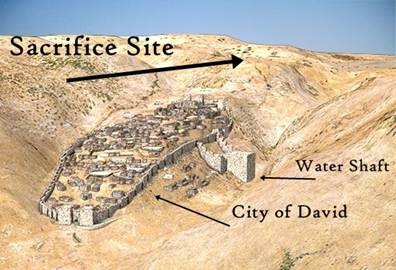
Verses 6-12 of 2 Samuel 5 tells us about Jerusalem. Up until that time, Jerusalem was controlled by a pagan tribe of people known as the Jebusites. They were a sub-tribe of Amorites – one of the non-Israelite tribes that the Israelites were supposed to conquer and drive out. However, there were steep ravines to the south, west and east of Jerusalem, and at the top of the slope, the walls began.

 It was a formidable fortress. The Israelites had defeated several kings of Jerusalem and had burned the city itself once (perhaps before it had walls), but they had never managed to capture it and hold it. Now, with walls, the Jebusites are confident that no one could take it. We should understand that it was much smaller in those days. The Jebusite City of Jerusalem covered only about 12 acres on the very top of the end of the ridge. This area is now known as Mount Zion. In the following years, the city spread out greatly, and in modern times, Mt Zion is just one hill in the very large metropolis that is Jerusalem.

In spite of its reputation and history of being impossible to conquer, one of David’s first acts as king of all Israel was to attempt it. David shows here that he is smart and cunning, as well as courageous and strong. Water for the city was collected from the spring of Gihon, which was near the bottom of the Kidron valley, on the east side of the city. The fortifications around those springs (shown in the picture above) were built by David, after he conquered the city. The Jebusites did not bother to guard the spring.

There was a shaft, or tunnel, that went through the hill down to the spring, so that the Jebusites could get water without going outside the city walls. David learned of this. It is quite possible that he observed Jebusites drawing water there, back when he was worshipping God at the tabernacle, when it was kept across the Kidron valley, at Nob (now known as the Mount of Olives). In any case, he determined that the way to take the city was to infiltrate men up the water tunnel. It was a very narrow space, and the men would certainly have had to go one by one, gathering at the top before the assault. That is what David did, with his nephew Joab leading the way and killing the first enemy. By doing that, Joab cemented his position as commander of David’s armies. The city fell without any destruction to the walls, and David made it the new capital of Israel.

These are the actions of a brilliant leader. First, it was terrific military strategy to make use of the water shaft, and attack the Jebusites from within the city. Second, Jerusalem was still an impregnable fortress, an excellent choice for the seat of government in troubled times. Afterward, David built towers covering the entrance to the water shaft, so no one would take the city the same way he had.

Third, it was an extraordinary diplomatic move. David was from the tribe of Judah and up until this time, his capital was a city of Judah. Saul had been from Benjamin, and had made his hometown into the center of power. But Jerusalem did not belong to any of the tribes – it was held by the Jebusites. So when David captured it, it became a city for all Israelites. No tribe could claim it, and no tribe would be offended that it was the capital city. It belonged to no one, and yet at the same time, to everyone. It was not quite centrally located, but it was close.

By the way, some secular archaeologists dispute the existence of David (they choose to ignore the incredible documentary reliability of the Old Testament). However, a water shaft from the spring of Gihon leading up to Mount Zion was discovered in the 1860s. It doesn’t have David’s name on it, of course, but once more, the Bible told us of it before archeologists discovered it. In the 1980’s archaeologists were convinced that this shaft was dug after the time of David. But more recent work suggests that the water tunnel originally occurred naturally, long before David’s time.

The point is, the book of Samuel describes things that are actually still there. In a sense you might say that if the bible is right, there should be evidence of a water shaft in that location, and sure enough, there is not only evidence, but the actual tunnel itself.

As always, I think it is helpful when we read the Old Testament, to ask “where is Jesus here? How does this reveal Jesus to me?” Well, Jesus, is the rightful king of every Christian. That is God’s desire for us. He should be the ruler over everything in our lives. But even though David was chosen by God to be the king, he waited patiently until the people accepted that and submitted their lives to him joyfully. Even though the Lordship of Jesus is God’s will for us, we have not all submitted to that. Jesus is waiting patiently for us to submit all areas of our lives joyfully to him. Does Jesus determine how you spend your money? Does he determine how you spend your time or energy? Is it the words of Jesus that you speak to your family and friends and co-workers?

Jesus should be king over our lives for some of the same reasons that the Israelites gave for submitting to David. Jesus is fully God, yes, but he is also our flesh and blood – he is fully human, just like us. Hebrews 2:14-18 says:

14 Now since the children have flesh and blood in common, Jesus also shared in these, so that through His death He might destroy the one holding the power of death — that is, the Devil — 15 and free those who were held in slavery all their lives by the fear of death. 16 For it is clear that He does not reach out to help angels, but to help Abraham’s offspring. 17 Therefore, He had to be like His brothers in every way, so that He could become a merciful and faithful high priest in service to God, to make propitiation for the sins of the people. 18 For since He Himself was tested and has suffered, He is able to help those who are tested. (Heb 2:14-18, HCSB)

Jesus is our flesh and blood. He belongs to us and we to him. In Jesus, God became more accessible, more understandable, by taking on, forever, human nature. He has a right to be the king of humans, because he is a human. He can sympathize with us and understand our struggles.

Second, Jesus is the originator and creator of everything. He is our protector and sustainer. He has already helped us, already served us, already kept us safe. He has already suffered and died on our behalf. By virtue of how he has already served us, he deserves to be our Lord.

Finally, it is God’s desire that we surrender entirely to Jesus (Philippians 2:9-11). He is the rightful and chosen king of our lives. This is God’s desire – that we allow Jesus to live his life through us, as the owner of our lives. If you feel a little frustrated for David that it took the Israelites so long to accept what God was doing, consider accepting what God wants for your own life!

What about the conquering of Jerusalem? Does that tell us anything about Jesus and his work in our own lives?

Sometimes we really want Jesus to be king over all our lives, but there are parts of our lives that seem like they will never be changed. Maybe you think you will never be able to stop drinking. Some folks struggle with other particular sins that they feel they can never conquer. Perhaps you think, “I am a person who easily gets depressed. That’s just who I am. Nothing is going to change that.” Or, “I’m angry. That’s just my nature, and it’s never going to change.” We might feel like there are parts of our lives that Jesus simply won’t be able to conquer, places where we just can’t let him be king.  Maybe you feel like that about some loved one in your life. You think “Jesus can never get into his life.”

The Jebusites thought they were invulnerable. They had an impressive fortress. But one crack, big enough to fit one man at a time, led to their downfall, and then the city belonged to the king. Jesus is a warrior like David. He is wise and cunning like David. If there is just one little crack, one place where you can say “yes” to Jesus, he can exploit it, and use it to conquer the evil in your life. He can get to people that you think are invulnerable to him.

So if you are concerned about someone else in your life, I say trust him. Ask him to do his work on your loved one. And if the problem is in your own life, I say, simply give him a “yes.” Find some way to say “yes, Jesus. I don’t think I can ever give up drinking [or whatever], but I give you permission to try and take over that part of my life.” Watch what he can do if  you just give him the tiny crack of your willingness.

So, where you can, welcome Jesus as your king. Surrender your life to him, submit to him. Let it be his life from now on. And where you can’t do that, where there is a fortress around your heart, just give him a tiny crack. Just be willing for him to make the attempt.

How is the Holy Spirit speaking to you today?

2 SAMUEL #3. BREAKING MARRIAGE.

In the areas of marriage, family and sexuality, David gave in to cultural pressure. He accepted the attitude of the surrounding culture, and it led to deep heartache and strife for himself personally, and also chaos for the entire nation of Israel. Today, we Christians face tremendous cultural pressure in the areas of marriage, family and sexuality. Let’s learn from the example of David, and instead of conforming to the culture, live as God’s faithful people, even when that looks strange to those around us. With the help of the Holy Spirit, we can do this, even when we make mistakes.

To listen to the sermon, click the play button:

For some people, the player above may not work. If that happens to you, use the link below to either download, or open a player in a new page to listen.

To download, right click on the link (or do whatever you do on a Mac) and save it to your computer: Download 2 Samuel Part 3

Second Samuel Chapters one through five give us the history of a half-hearted civil war between Saul’s family and David’s followers. We looked at some of the details of that during our first two installments of this series on 2 Samuel. But right in the middle, chapter three interrupts the war narrative to tell us briefly about the sons that David had during this time, and about his wives. There are some significant things to say about this interlude. Some of it might be hard to hear. You might even be offended by what I am going to say. If you do feel upset by what I teach, please do two things:

  • First, please read through to the very end of the sermon, so you hear everything I say, not just a small piece of it. Consider listening to the whole thing with the audio file, because I can convey some things by tone of voice that I can’t with the written word.
  • Second, feel free to disagree with me. If I am wrong, I want to know it. But let our disagreement be about what the Bible actually teaches. Don’t just tell me (or yourself) I’m wrong. Look at the Bible yourself, and understand what it teaches about this topic (which is marriage). If you think I have misunderstood what the Bible says about this, I want to hear it, to correct my mistakes. Use the comments, or contact section and explain to me, from the Bible, why I am mistaken. I’m serious. I don’t think I’m infallible.

All right, let’s get to the text. Six sons of David are named in 3:2-5, and each one came from a different wife. The Old Testament does not offer many outright condemnations of polygamy. Yet it unflinchingly and consistently records the negative results of having more than one spouse. And there are passages that warn against polygamy, even especially for kings.

Of David’s sons named in this passage, Chileab, Ithream and Shephatiah are mentioned only here in the history of Israel (though the same passage is repeated in 1 Chronicles 3). It is reasonable, therefore, to assume that they died in infancy or childhood; because of their absence in later genealogies it is virtually certain that they died before they themselves had children. David’s three surviving sons demonstrate the brokenness that results from ignoring God’s intended plan for marriage and families.

The first surviving son is Amnon. When he grew up he raped his half-sister Tamar. Absalom, the second one (and from a different mother), had Amnon murdered for what he did to his sister. Later, he started a civil war with his father David, and made him flee for his life. Eventually, Absalom was killed during his rebellion. The third son was Adonijah, a schemer who also tried to seize control of the kingdom when David was old and weak. He was ultimately executed by his half-brother Solomon (who is not mentioned here because he was not born until later).

In other words, this business of multiple wives did not work out so well. It led to tremendous family strife. When the bible describes God’s people having more than one wife, it always also describes that the resulting family was a serious mess. This is just one example.

There is one more note in chapter three concerning marriage. In verses 13-16 David demanded that his first wife Michal, Saul’s daughter, be returned to him. It is true that at one time it seemed like David and Michal were in love (1 Samuel 18:20). But the marriage had been dissolved a long time ago by this point. During the years when David was on the run, Saul had Michal marry another man, named, Palti. So, why did David force Michal to come back and become his wife again?

I suspect it was for two reasons, both of them ugly. First, the main written scripture at this point was the Torah (the first five books of our Bible). The Torah made it clear that women are equal in worth to men, and are equal heirs and partners as the people of God. However, the people of Israel took their cues about gender relationships from the surrounding culture rather than from the scripture. In other ancient middle-eastern cultures, women were considered property, like slaves and animals. David probably saw Michal as his own rightful property, and he wanted that property restored to him.

Second, David might have been concerned that if Michal had a son with her second husband (Palti), either the son, or Palti, might claim that, as a grandson of Saul, he was Saul’s rightful heir, and therefore the rightful king of Israel, rather than David. David wanted to avoid yet another civil war.

On a slightly more positive note, it may have also been an attempt to solidify the unity of his kingdom – joining the house of Saul and the house of David once more. But there was tragedy here. Michal’s new husband, Palti, loved her very much. He followed her all the way to the borders of David’s area, weeping because he was losing her. This was an awful, tragic event.

It is a fact that David had many wives, and many children by them. It is also a fact that the resulting family was full of greed, lust, hatred, murder, mayhem and grief. David was a man after God’s heart in many ways. But in his role as a husband and father, he failed spectacularly, as men of power and fame frequently do.

The strife in his family began with the fact that David ignored God’s plan for marriage, which is laid out clearly in Genesis 1 and 2. Those chapters describe marriage as the joining of one man and one woman for life. Genesis chapter two teaches that human beings were generally created to reflect God’s image in this way. Once David ignored that, things went downhill. We might excuse him for marrying again after being separated from Michal. That divorce was beyond his control. But he continued to add wives like state-stickers on the back of a retired couple’s RV.

In those days, polygamy (that is the name for having more than one wife) was a sign that the polygamist was rich and powerful. Many wives were a sign of status, sort of like a brand new Mercedes-Benz these days, only more expensive. It was expected that powerful men would have many wives. I believe that part of David’s motivation in marrying so many women was to gain respect in the eyes of his followers and in the eyes of foreign leaders. I’m sure he was also happy to have sex with many different women, while claiming he was not sinning. The truth is, David caved in to cultural pressure about marriage. And in doing so, he ignored a very clear warning from Moses that even kings were not to take many wives:

14 “When you enter the land the LORD your God is giving you, take possession of it, live in it, and say, ‘I will set a king over me like all the nations around me,’ 15 you are to appoint over you the king the LORD your God chooses…  …17 He must not acquire many wives for himself so that his heart won’t go astray. He must not acquire very large amounts of silver and gold for himself. (Deut 17:14 & 17, HCSB)

There is a lot of cultural pressure on godly marriage these days also. A newer, and growing trend is the idea of never marrying in the first place. In popular culture, marriage is often portrayed as restricting and repressive, an instrument of oppression and injustice, something that cramps your individual style. So, women are taught to think that marriage will diminish them. Men are encouraged to think that marriage will lead to no more sex, or to the undermining of their manhood. Both men and women are often presented with very negative ideas about marriage by TV, movies, the internet and music. This has a noticeable affect on our culture: the number of people who have never married is increasing dramatically.

There is, unfortunately, some truth to those ideas. Some men do dominate their wives. Sometimes they limit them, and hold them back. Some women do withhold sex from their husbands, and others are controlling and domineering. But all of that is the result of the fact that people are sinful, not that the idea of marriage in itself is flawed or wrong. Those things are much like polygamy: some people think it’s OK to be that way in marriage, but the Bible disagrees.

One of the biggest cultural pressures on marriage today is divorce. Divorce is just as much against God’s design for marriage as is polygamy, and these other things. If you think it was wrong for David to have several wives, then biblically speaking, you’d better admit that divorce is wrong too.

I feel that I ought to say something about sex here as well. The Bible gives all human beings two options with regard to sexual expression. The first option is to remain celibate, and channel sexual energy into the pursuit of God, and work, and creativity. This option is for everyone who is not in a heterosexual marriage. Jesus clearly taught this, but also he taught that not everyone has what it takes to live a life of single celibacy. (Matthew 19:1-12). The second option is to marry one person of the opposite sex, and remain sexually available and faithful to that person for life. Being sexually available to your spouse is a part of what it means to be sexually faithful (1 Corinthians 7:1-8). When Jesus taught these things, they were not especially counter-cultural. Today, they are very different from the way our culture thinks.

What was counter-cultural then, and remains so now, is the reason God created marriage. He did so first so that marriage would help human beings understand a little bit about what God is like (Genesis 1:27; Genesis 2:23-25; 1 Corinthians 11:3), and what Christ’s relationship to the church is like (Ephesians 5:22-33). Secondly, God created marriage for the benefit of human beings. All of history points to the fact that when marriage is stable, children and families flourish. And when families flourish, communities thrive. And when communities thrive, civilization is built, and the foundation is solid. Most, if not all, of the very serious problems facing western cultures today can be traced back to the fact that we have devalued marriage.

The nation of Israel flourished for a time, but ultimately it abandoned God and fell to pieces because it did not listen to, or practice, what scripture teaches about marriage.

Just as David’s culture thought polygamy was normal, our culture looks at divorce, and many other non-biblical things, as normal. I don’t think Christians need to try to change the laws. We ought to try to bring people into a relationship with Jesus so that their hearts are changed. Laws about marriage are mostly irrelevant. We need to concern ourselves with what God’s Word tells us.

There are loopholes in the law that allow unscrupulous people and companies to legally cheat and scam others. Does that mean it is OK for Christians to make money by doing those things?  Of course not. Legality is not the same as morality. The law in Nevada says prostitution is legal there. Does that mean it is OK for a Christian woman to choose that for a career – as long as she lives in Nevada? Of course not. Government laws are not the same as God’s standards, and we can’t expect them to be. In the same way, it doesn’t matter what any human government says about marriage. What God says is the only relevant thing, and Jesus was sky-clear about marriage:

3 Some Pharisees approached [Jesus] to test Him. They asked, “Is it lawful for a man to divorce his wife on any grounds? ”

 4 “Haven’t you read,” He replied, “that He who created them in the beginning made them male and female,” 5 and He also said: “For this reason a man will leave his father and mother and be joined to his wife, and the two will become one flesh?  6 So they are no longer two, but one flesh. Therefore, what God has joined together, man must not separate.”

 7 “Why then,” they asked Him, “did Moses command us to give divorce papers and to send her away? ”

 8 He told them, “Moses permitted you to divorce your wives because of the hardness of your hearts. But it was not like that from the beginning. 9 And I tell you, whoever divorces his wife, except for sexual immorality, and marries another, commits adultery.”

It might be nice if our legal system reflected our Christian morality. But there are already so many places in which it does not. If we make disciples and Jesus changes the hearts of people, they will do what is right, even if the law says it is OK to do wrong.

I wish Christians in America would quit fussing about things like gay marriage or trans issues, and instead let their hearts be broken in repentance over divorce, and over our failure to really submit to Jesus in all areas of our lives, especially marriage.

Now, what if you have already had a divorce and have remarried? I’ve said it in previous messages, and I’ll say it again: These instructions are for you right now. What’s past is past. All of us have made mistakes, and we all have to live with the consequences. Receive the forgiveness and acceptance of Jesus, and move on. Live each present moment in step with the Holy Spirit. Maybe you got a divorce even after you knew that your situation did not meet the criteria Jesus gave (above). In other words, you knowingly and deliberately sinned by divorcing when you did. Again, I say to you, receive the grace and forgiveness of God, and move on. If you are married now, regardless of which number your marriage is, stay married to this one. Make it work, starting now. I think this principle is illustrated (in a negative way) by what David did to Michal. He tore her away from a man who deeply loved her. David destroyed another marriage and another family by trying to “undo” his divorce. The whole thing was a big disaster, as divorce always is. We’ll learn later that neither he nor Michal were happy about how it worked out after they were married again. So don’t try to undo your present marriage, whether it is your first or your fifth.

If your present marriage is truly intolerable (but keep in mind that we often exaggerate how bad it is) then it does appear that you can get divorced without sinning – as long as you never marry anyone but your present spouse again. In other words, for a Christian, divorce should lead to a lifetime of celibate singleness, or reconciliation with your estranged spouse. The one exception where a person is free to get divorced and marry someone else is explained by Jesus – if your spouse (not you) commits adultery. Even there, Jesus does not say that you must divorce – only that you may. Again, I am not speaking about things that happened in the past. Receive the grace of God in your past mistakes, and live in his grace in the present.

Before you decide that your present marriage is intolerable, I want to suggest to you that marriage is kind of a living thing. Things will get difficult, or even bad – for a while. They always do. Things might even be bad for a period of years. But your marriage will also get better, if you keep working at it. If you stay with it, that is inevitable too. And then it will get rocky, and then better again. That’s life. Marriage is the most intimate relationship available to human beings. Two sinful human beings relating that closely are bound to cause trouble for each other. But they can also be a source of incredible strength and joy to each other, if they stick with it. At its best, marriage gives us glimpses into the very nature of God. At its worst, it forces us to confront our own flaws and foibles, and maybe gives us a glimpse into the heartache that the Lord feels when we turn away from him. Either way, it’s a good thing. Notice I didn’t say easy but rather, good.

I want to add one more thing. I think Kari and I have a good marriage. Other people probably think we do also. So keep that in mind when I tell you that we have sought marriage counseling a number of times during our three decades together. Marriage is difficult, because it is a lifetime bond between two people who each have sinful flesh. Our society makes marriage even more difficult for a variety of reasons. Many people have been called and gifted by God to help others improve their marriages. There is no shame in getting their help, and in fact, I think there is a great deal of wisdom in doing that. If you are in a rough period with your spouse, if you haven’t made progress for a while, please consider seeing a Christian marriage counselor together. Christian marriage counselors are part of the body of Christ, with unique gifts from God to help. Again, if you think Kari and I have a good marriage, consider that perhaps one of the reasons we do is because we aren’t ashamed to get help.

When David ignored God’s plan for marriage, it led to disaster for his children. Not only did his children suffer, but many around them suffered also. In other words, David’s disregard of God’s view of marriage was not merely a personal choice that affected only him – in his case it affected hundreds of people. In fact, his son Solomon followed in David’s polygamous footsteps and it destroyed an entire nation of people. So David’s bad choices continued to have negative effects for generations.

As the years go by, I feel more and more uncomfortable teaching like this. Twenty-five years ago when I would preach about marriage I worried that a few people might take it the wrong way and be upset. Ten years ago, I worried quite a bit more. Today, I am not worried, but rather, certain, that many people will be very troubled by this sermon. I could be “cancelled,” publicly shamed, for repeating what the Bible says.

I’m sure David was also under a lot of pressure to conform to his culture. Everyone around him accepted polygamy, especially for a man in his situation. But I believe that if David had been truly willing to follow the Lord in this area of his life, the Holy Spirit would have given him the strength to do so. I know the same is true for us. The grace of God is always available to us to help us in our struggles – all we have to do is submit to God’s design and reach out for that grace. Let me reiterate, that does not mean that things will always be easy. But it does mean that the Lord walks with us through difficult times. Sometimes, as I just mentioned, that grace might come from Christian marriage counselors.

Again, this type of thing gets harder and harder to say in public with each passing year. However, I will not water down the word of God. Marriage is very important to God. It is supposed to be between one man and one woman for life.

At the same time, please do hear me when I say that the Lord is gracious and compassionate, slow to anger, abounding in steadfast love. Jesus has taken our sins on himself, and given us his righteous nature. So, there is no condemnation for those of us who are in Christ Jesus. We have God’s approval through Jesus, and  we should not wallow in our mistakes, or beat ourselves up about our past. We can move forward, joyfully and at peace.

Let the Holy Spirit speak to you right now.

2 SAMUEL #2: TRUSTING GOD IN TIMES OF CONFUSION AND HATE

When we belong to Jesus, we can, and should, be gracious even to those who consider themselves to be our enemies. In our text today, many people resisted God’s choice for king. For a long time, it seemed that David’s enemies were successful. Ultimately, even with all the people who wanted something different, David still became the king, and it was the best possible thing – even for all the people who did not want him at first. Sometimes we resist God’s Lordship in our lives. It would be better for us than us running things ourselves, but we fight it anyway. It is better for us in the long run to trust the Lord to work things out.

To listen to the sermon, click the play button:

For some people, the player above may not work. If that happens to you, use the link below to either download, or open a player in a new page to listen.

To download, right click on the link (or do whatever you do on a Mac) and save it to your computer: Download 2 Samuel Part 2

2 SAMUEL #2. 2 SAMUEL 2:8-4:12

Last time we considered some of the events of 2 Samuel, chapters 1-5. Mostly, we learned how at first, David only received part of the kingdom that he felt he was destined to lead. Today, we will go over those same verses, and deal with some more of the details.

Chapters two through five of second Samuel describe the years after David was made king of Judah, but before he became king of all Israel. There is some natural confusion about the time period involved, because the text puts it like this:

8 Abner son of Ner, commander of Saul’s army, took Saul’s son Ish-bosheth and moved him to Mahanaim. 9 He made him king over Gilead, Asher, Jezreel, Ephraim, Benjamin — over all Israel. 10 Saul’s son Ish-bosheth was 40 years old when he began his reign over Israel; he ruled for two years. The house of Judah, however, followed David. 11 The length of time that David was king in Hebron over the house of Judah was seven years and six months. (2Sam 2:8-11, HCSB)

We are going to go into the political history of all this for a moment. 3000 year old politics might seem confusing, irrelevant and boring to you. But please bear with me, for a short time, because I think once we understand the politics, we will actually understand better what the Lord wants to say to us today.

Ish-bosheth (try to say that name quickly!) was the only son of Saul who was still alive. He was clearly not king for the entire time of David’s reign over Judah alone. To put it another way, for five of the years that David was king over Judah, the rest of Israel had no king at all. Those five years may have been split between a time before Ish-bosheth’s rule and after. Or they might have come all before-hand, or all after. There is no way to tell for sure, but here is my guess:

After Saul’s death there was a great deal of confusion among the northern tribes of Israel. Many Israelites were now living in subservience to the Philistines, who had conquered a good portion of the country. The others had no leader or central organization to turn to for national identity. Remember, Saul was the very first king of Israel, and just a generation or so before him, the people had no king, no single leader. So when Saul died, and three of his four sons with him, the tribes reverted back to how they had lived before-hand – as a federation of tribes, loosely connected, but without a strong national identity. Some of them may have recalled Samuel’s warnings about having a king – and they had seen that Saul didn’t work out so well. So I suspect that there were several years immediately following Saul’s death without any strong desire or impetus to get another king.

In the meantime, the writer of the book of Samuel says that there was a war between Saul’s family and David’s. The text says that Abner became more and more powerful in the family of Saul (3:6). Abner was Saul’s  nephew or cousin, depending on how you read the Hebrew. He had also been Saul’s chief war-leader. It looks as though after Saul’s death it was mainly Abner and his ambitions who opposed David’s kingship over all Israel. It took Abner some time to pull all his plans together. David was king for probably five years, while Abner blocked his every attempt to lead the whole nation. Meanwhile Abner himself was making connections, re-establishing a national identity, and finally setting up Saul’s son as the new king, but with himself as the real power-holder.

I think there are several understandable (but not justifiable) reasons for Abner’s actions. As Saul’s chief general, he had been the second most powerful man in Israel. With Saul dead and everything in confusion, all that went away. I think Abner wanted to go back to the way it was. I think he loved the power and position and wealth, and he was trying to regain it. In addition, Abner had been Saul’s right-hand man since the beginning. He was already there when David killed Goliath (1 Samuel 17:55-58). So I imagine he had completely internalized Saul’s attitude toward David. Along with that, he may have felt that David was just like him – a great warrior, to be sure, but not a king. They had served Saul together for a short time – who was David to now pretend he was a king? Why did David think he was better than everyone else? He was a warrior, just like Abner, not a king. In fact, during the time David served Saul, Abner might have been jealous, and he may have worried that David would take his place. Finally, remember when Saul was hunting David, and David and his nephew Abishai stole Saul’s spear and water-bottle? Afterwards, they mocked Abner in front of Saul and his men. So there may have been some personal animosity there also, fueling Abner’s ambitions.

At some point, Abner was finally able to get the other Israelites to declare Ish-bosheth king over “all Israel.” But I think realistically, we have to assume that Ish-bosheth was more or less just a figurehead. The real driving force behind the civil war and behind Ish-bosheth’s monarchy was Abner. In fact, we see this reflected when Ish-bosheth was afraid to argue with Abner (3:11), and also because once Abner died, the whole thing fell apart.

Now, I want to pause for a moment to consider this. It seems to me that Abner was not a very admirable man. Later on, we’ll see that he was completely willing to switch his allegiance to David when he realized that David was going to win. Abner was an unscrupulous political hatchet-man looking only for his own gain and ambition. We have plenty of people like that today. Modern-day politics drives me crazy, because the people in power seem to get there and hold onto their power through blatant dishonesty, corruption and scheming. Sometimes it helps me to calm down when I realize that this sort of thing has been going on for at least three-thousand years, since Abner lived that long ago.

But there is more than that here for us. Abner was a scoundrel. For five years, he carried out his schemes successfully. For two more years, it seemed that he had achieved his ambition. For seven years total, it seemed that he had thwarted David and thwarted God. And yet all the work that Abner did for himself and his selfish ambitions ended up serving God’s purposes and plans for David.

You see, the nation was fractured after the death of Saul. It was Abner who reunited them. It was he who encouraged them to return to a sense of national identity. It was Abner who got Israel to commit once more to having one king over the whole nation. And once that was done, God handed that united kingdom over to his chosen servant, David.

If David had become king right after Saul, he would have inherited a kingdom that was disorganized, disheartened and fractured. He would have had to do the work of rallying the tribes and unifying them. But instead, he simply watched while Abner did the work for him, and then God turned it over to him.

This is incredibly encouraging for me. There are long periods of time in my life where I think that God’s will is being thwarted, or that evil is prevailing, and unscrupulous people are successful. But God knows what  he is doing. He will use it all, sooner or later, to accomplish his purposes. Not even a man who gained control of an entire nation through dirty politics can stop God from working. And it turns out that all that selfish evil work was turned into God’s work.

Let’s continue on with the historical events. After Ish-bosheth became king, there was a significant battle between his men and David’s. The location of this battle, and of Ish-bosheth’s headquarters, is telling. The battle took place in the heart of the territory belonging to Benjamin – the tribe of Saul, Ish-bosheth and Abner. However, Ish-bosheth’s headquarters were located far to the east, across the Jordan valley. This means that by this point, David’s kingdom of Judah was starting to dominate the surrounding areas. It wasn’t safe for Abner and Ish-bosheth to be based in the territory of their own tribe.

The rest of chapter 2 describes the battle, beginning with the tragic death of twelve young men from each side. If your response is “that’s horrible,” then you got the message. After the twenty-four young men killed each other, the men of Judah fell upon Abner’s men and crushed them. Abner and his forces flat out ran away.

During the chase, David’s nephew Asahel fixed his sights upon Abner. Asahel was the brother of Abishai, the man who went into Saul’s camp with David, and stole Saul’s water jug and spear (1 Samuel 26). His other brother was Joab who was David’s chief war-leader. All three of them were the sons of David’s sister Zeruiah. Remember, it is likely that even though they were David’s nephews, all four of them were probably pretty close in age.

Asahel was apparently an unusually fast runner. He probably knew that Abner was the main force behind this war, and Asahel seemed determined to kill him. Perhaps he wanted to win great honor, like his other brothers had. He might also have thought that if he killed Abner, it would end the war altogether.

Now, we come to the curious sense of honor that often restrained the brutality of war in those days. Abner saw Asahel pursuing him. He knew who Asahel was, and he warned him off.

18 Joab, Abishai, and Asahel—the three sons of Zeruiah—were among David’s forces that day. Asahel could run like a gazelle, 19 and he began chasing Abner. He pursued him relentlessly, not stopping for anything. 20 When Abner looked back and saw him coming, he called out, “Is that you, Asahel?”
“Yes, it is,” he replied.
21 “Go fight someone else!” Abner warned. “Take on one of the younger men, and strip him of his weapons.” But Asahel kept right on chasing Abner.
22 Again Abner shouted to him, “Get away from here! I don’t want to kill you. How could I ever face your brother Joab again?” (2 Samuel 2:18-22, NLT)

Nowadays we think in terms of total war. But war in those days was a curious mixture of unimaginable brutality combined with strangely restraining rules of honor. Abner and Joab have just been commanding their men to kill each other in hand to hand combat – the most brutal, personal kind of war there is. And yet, Abner now was extremely reluctant to kill one of the chief leaders of the enemy. However, Asahel would not stop. So finally Abner did. The language seems to indicate that Abner stopped with his spear sticking out, butt-first behind him. He might have stuck the sharp point into the ground to brace it. His intent was probably to knock the wind out of Asahel, and bruise him to the point where he would stop pursuing him. But Asahel was running so fast that the blunt end of the spear pierced him through the body and killed him.

The pursuit continued until Abner rallied his men on a hilltop. He called to Joab to stop, and again, following those curious rules of war, Joab agreed to let them go.

Not long after all of that, Abner had a falling-out with king Ish-bosheth. I think he could see the writing on the wall, and he knew that David was going to prevail. The argument with Ish-bosheth was the final breaking point, and Abner decided to change his allegiance, to gain power in David’s new kingdom. He openly promised Ish-bosheth that he was going to turn the whole kingdom over to David. Chapter 3, verse 11 shows us that Ish-bosheth was indeed merely a figurehead, while Abner held the real power:

11 Ish-bosheth could not answer Abner because he was afraid of him. (2Sam 3:11, HCSB)

After this, Abner opened negotiations with David. He came to visit David in Hebron, and he left just before David’s nephew and war-leader, Joab, got back from a trip. Remember, Asahel, whom Abner recently killed in the battle, was Joab’s younger brother. Joab was full of bitterness and rage about it. Unknown to David, Joab sent messengers to Abner to bring him back. Abner believed he was there under the agreement of truce and safe passage that David had made with him. So he was taken by surprise when Joab pulled him aside and stabbed him, killing him. It was a nasty, cowardly deed, not at all like it would have been if Joab had killed Abner in battle.

David’s reaction to Abner’s death was just like his reaction to Saul’s death. I don’t think David had any illusions about what kind of man Abner was. He had known him for a long time, and Abner had been trying as hard as Saul to put an end to David. Even so, David refused to treat him like an enemy. Instead, he deplored the actions of Joab. David immediately declared that what Joab had done was wrong, and he prayed for God to repay him for it. He made Joab tear his clothes and mourn for Abner, the man who had killed his brother. He publicly praised Abner, and publicly condemned Joab.

David was clearly not concerned with what people thought about him. He was concerned about what was right and wrong.

Not long after this, with no Abner there to hold things together, Ish-bosheth was betrayed and killed. The murderers brought David his head, believing that David would be pleased to have his rival dead. But David treated them just as he had the Amalekite who claimed to have killed Saul – he had them executed.

This makes three times in five chapters that David punished people who claimed to have killed his enemies. I think we need to pay attention to it. Saul was clearly David’s enemy – he tried to kill him numerous times. Abner was clearly David’s enemy – he too tried to kill David by way of helping Saul, and then Ish-bosheth. Ish-bosheth was also technically David’s enemy.

And yet David mourned each of these men. He reacted strongly and negatively to those who caused their deaths. He was not pleased when they died, and he was not pleased with those who killed them. We have seen that David is a man with many faults and failings. But we have also seen that however imperfect, he was a man with a real and living faith in the real and living God. The Lord often used David to show us the Lord’s own heart.

David maintained a gracious perspective. He could look beyond personal rivalry, jealousy and even personal attacks. In the end, David was never willing to consider another Israelite – one of God’s chosen people – to be his enemy. In fact, when we read these chapters carefully, we find that David himself never participated in these battles against other Israelites. David wasn’t stupid. He knew that his enemies hated him, and were fearful and ambitious. But he never took it personally, and he didn’t consider the people themselves to be his enemies.

So let’s think about how to apply these chapters to our own lives.

I am working on this sermon about ten days after someone tried to kill former-president Donald Trump. Political tensions are very high right now. Friendships and families are being split apart by people with strong feelings about politics. In this moment, I think we can learn a lot from David. David trusted God to convince those that needed to be convinced. David seemed genuinely and deeply upset when his enemies were killed. We too, can trust God when it comes to people who disagree with us. Whatever you think of Donald Trump, I think all Christians should be sad about such a terrible thing happening in our culture. If you wish Trump had actually been killed, shame on you! I think you might need to repent of that. In the same way, I think we should also be sad that President Biden has become too feeble to go on campaigning for reelection. It’s one thing to make a sober judgment that he is no longer fit to be president. But if you are actually happy that his health has declined so much, shame on you! You might need to repent. We Christians belong to the God of the universe, who loves all people. Even when those who claim to hate us are killed, or otherwise hurt, we should be sad, not glad.

We can afford to be gracious, because we belong to a gracious God. I am not suggesting that you cannot hold strong opinions, or that we need to pretend to agree with everything anyone says.  But our disagreements should be kept in perspective. Politicians have been saying for years that if the other side wins, it will be the end of America as we know it. Unfortunately, that tradition goes back to the first presidential election after George Washington retired. And yet, we’re still here. Don’t believe their lies. Maintain your perspective.

There is another piece of this. Sometimes we get caught up in personality conflicts, and we become very upset at other humans who frustrate or oppose us. But the real enemies are the demonic forces that only use and influence other humans (Ephesians 6:12). Other human beings are not the enemy. Particularly, if we follow the example of David, other Christians may often be misled and used by the devil, but they are never our real enemies.

I am also encouraged to not be overly stressed when people I distrust are succeeding and growing in power. If I was David, I would have been very concerned about Abner and his schemes. I would have been upset that for seven years Abner apparently succeeded (seven years is almost as long as two presidential administrations). But David simply trusted God and waited. The ultimate result is that his enemy Abner did a lot of hard work on David’s behalf, and David got to reap the benefits – all for God’s glory. We don’t know when David wrote Psalm 37, but it certainly could have been shortly after these times:

1 Don’t worry about the wicked
or envy those who do wrong.
2 For like grass, they soon fade away.
Like spring flowers, they soon wither.
3 Trust in the LORD and do good.
Then you will live safely in the land and prosper.
4 Take delight in the LORD,
and he will give you your heart’s desires.
5 Commit everything you do to the LORD.
Trust him, and he will help you.
6 He will make your innocence radiate like the dawn,
and the justice of your cause will shine like the noonday sun.
7 Be still in the presence of the LORD,
and wait patiently for him to act.
Don’t worry about evil people who prosper
or fret about their wicked schemes.
8 Stop being angry!
Turn from your rage!
Do not lose your temper—
it only leads to harm.
9 For the wicked will be destroyed,
but those who trust in the LORD will possess the land. (Psalms 37:1-9, NLT)

Abner, and to some degree the other Israelites, either resisted, or passively ignored God’s choice for king. Ultimately, David still became the king, and it was the best possible thing – even for all the people who did not want him at first. Sometimes we resist God’s Lordship in our lives. It would be better for us than us running things ourselves, but we fight it anyway. It is better for us in the long run to let God have his way.

2 SAMUEL #1: WHEN DREAMS KINDA, SORTA, COME TRUE. MAYBE. A LITTLE BIT, ANWAY.

David shows us that God does not hate those who hate him, and does not delight when bad things happen to them. He also serves as a model of patience. God’s promises were only partially fulfilled for him at this point, but he trusted and waited, because he recognized his life was about God’s purposes, not his own ambitions. In this life, even for Jesus, God’s promises have only been partially fulfilled. We wait with joyful expectation for the day when all of them come to complete fruition.

To listen to the sermon, click the play button:

For some people, the player above may not work. If that happens to you, use the link below to either download, or open a player in a new page to listen.

To download, right click on the link (or do whatever you do on a Mac) and save it to your computer: Download 2 Samuel Part 1

We recently finished the book of 1 Samuel. However, that book leaves off in the middle of the action, so to speak. It doesn’t tell us what happened to David after Saul died. The reason for this is that originally, First and Second Samuel were one book. The Jews who translated the Old Testament into Greek divided this history into two books. Probably the division arose because Greek uses vowels, where Hebrew does not. This means that the Greek translation is much longer than the original Hebrew. As a result, it had to be put into two separate scrolls – the “first,” and “second.” Bear in mind as we study it, however, that it is all part of one work.

At the very end of 1 Samuel, we considered the lament that David wrote about Saul and Jonathan (2 Samuel 1:17-27). But there were a few things which preceded that. Remember, David and his men had fought a battle of their own with the Amalekites, who had attacked when everyone else in the region was off to the Israelite-Philistine war. Two days after he got back from defeating the Amalekites, a man came from the north, bringing news of the great battle between the Philistines and Israelites in the valley of Jezreel.

This man got the main news correct – Israel lost the battle, and Saul and Jonathan were killed. But then his story diverges from the one recorded in 1 Samuel 31. In 1 Samuel 31, it says that Saul killed himself when the Philistines got close to him. The writer does not make editorial comments, but it is clear that whoever wrote it regarded 1 Samuel 31 as the accurate record of events, and the story of this stranger as embellishments and lies.

Jewish tradition holds that the man who came to David with this story was actually the son of Doeg the Edomite, whom they also suppose was Saul’s armor bearer at the time Saul died. They think his claim to be an Amalekite was to hide from David the fact that his father was the infamously evil Doeg. There is nothing in the text one way or another to tell us if this is so or not, but it is possible that Doeg was elevated to the status of Saul’s personal armor bearer and bodyguard after he did him the favor of killing the priests when no one else would. If this man is Doeg’s son (and if Doeg was Saul’s armor bearer), it would explain his presence close to Saul, and how he was able to take Saul’s crown and escape.

He claims that the Philistine chariots were coming close to Saul. This shows us, the readers, that he is not being completely truthful. He probably said it to try and justify to David why he (allegedly) ended Saul’s life. Chariots were formidable weapons that the Philistines had and the Israelites did not (at this time). It would be the modern equivalent of tanks closing in on an infantry position. If the chariots were close, then indeed all was certainly lost. However, we know that Saul was on Mount Gilboa, and the messenger even affirms this. There were no roads (the way we think of roads) in those days. Chariots simply did not work well, if at all, on roadless mountainsides. Therefore, it is extremely unlikely that they used chariots on the mountain where Saul died.

David, experienced warrior that he is, probably sensed right then there was something wrong with the story. Even how the messenger begins is quite suspicious: “I happened to be on Mount Gilboa…” He “just happened” to be in the middle of a battle? Just “happened” to be near king Saul? Not likely.

It was clear however, that this man thought claiming to have killed Saul would make him a favorite with David. Whoever he was, he completely misunderstood David. This was because he assumed that deep down, David was not really serious about being the Lord’s man; or perhaps since he was part of Saul’s retinue, he had never heard anyone talk about David’s strong faith. He condemns himself with his lie.

16 And David said to him, “Your blood be on your head, for your own mouth has testified against you, saying, ‘I have killed the LORD’s anointed.’”

David had him executed immediately for the crime of killing Saul. Once again, as harsh as this seems, it is a reflection of David’s humble heart and in a way, a reflection of how the Lord felt about Saul. God is not happy that Saul is dead. Neither is God’s servant. And David, by executing this man showed everyone that there was nothing to be gained by lies or treachery or unnecessary bloodshed. If anyone thought they could ingratiate themselves to David with that kind of behavior, their illusions would be shattered. God didn’t want Saul dead, and neither did David. You won’t earn any favors with God by hating or hurting people whom you think are God’s enemies. People do turn away from God and do evil, and God does not want them to do that. But he doesn’t hate them — He grieves over them, as he grieved over Saul. Saul was destroyed by himself and his own choices, not by God. You can destroy your own life, as Saul did, but the Lord is never out to destroy you.

I am writing this less than a week after someone tried to assassinate former President Trump, who is campaigning to become president again. Our political situation in America is very tense at the moment. It is a good and timely reminder that God does not rejoice at the death of those who have turned away from him. So, we who follow Jesus should not be happy at the downfall of others, even others whom we think might be enemies of God. We will not earn God’s favor for hating, or trying to harm his “enemies.” This goes for all sides of the political spectrum. War and the punishment of crime are situations in which evil might be restrained, or good defended, but they should not be motivated by hatred or anger. Rather, they are a sad necessity in this fallen world. Listen to how the Lord puts it to the people who were rebelling against him:

11 As surely as I live, says the Sovereign LORD, I take no pleasure in the death of wicked people. I only want them to turn from their wicked ways so they can live. Turn! Turn from your wickedness, O people of Israel! Why should you die? (Ezekiel 33:11, NLT)

 By the way, this lesson is repeated three times in the first four chapters of 2 Samuel, which means we are really supposed to pay attention to it, and take it seriously.

OK, moving on, once Saul was dead, David’s reason for staying out of Israel was gone. His main obstacle to becoming king and fulfilling the Lord’s calling was removed. David knew he was anointed to be the next king of Israel. A large portion of the population knew this also. I think a lot of people at this point would move ahead and “just go for it.”

Not David. The first thing he did was to ask God what he should do. He did not assume anything. I think the reason for this is that David was not trying to establish his own kingdom – instead, he was trying to be God’s servant. His attitude was not, “How can I behave so that God can help me?” That was Saul’s basic approach to life. But David’s heart was this: “Lord, what do you want to do next?” He did not view God as his assistant in achieving his goals. Instead, he felt that his whole life was God’s own project. His role was to try and assist God, not the other way around. David’s anointing and his destiny were not about David – they were about the Lord. So becoming king is not David’s idea nor his goal – his goal is to serve the Lord.

I also want to point out that in this matter, David learned from his mistakes. He did not ask God before he took his family, his men, and their families to live among the Philistines (1 Samuel 27:1-3. We looked at this in 1 Samuel sermon #28). However, after that mistake, he started asking God what to do even for decisions where the conclusion seemed obvious.

As I have pointed out before, David is one of the people in the Old Testament who sheds light on what Jesus is like (that is, David is a “type” of Christ). Jesus expressed this same attitude of being here for the Father’s purposes in John 8:28 and 12:49 (among other places)

So Jesus said to them, “When you have lifted up the Son of Man, then you will know that I am he, and that I do nothing on my own authority, but speak just as the Father taught me. (John 8:28, ESV)

For I have not spoken on my own authority, but the Father who sent me has himself given me a commandment-what to say and what to speak. (John 12:49, ESV)

This is not complicated, but it is HUGE when it comes to living out our faith practically. It is so easy to fall into the idea that the life of faith is about God helping us each achieve our own destiny. We make this seem good and spiritual, because we assume that our destiny was created by God. And of course, it is. But it isn’t about us. It is about God. When we think that it is about us, we inevitably get angry or disappointed with God when he fails to do things for us that we think would bring about our destiny.

Our true destiny is to bring glory and honor and praise to God – not  to meet our own personal goals. Achieving that destiny is God’s business from beginning to end. Some people, like David, brought glory to God in very public ways, like becoming a well-known leader. Others do it quietly, like being a loving wife and mother, or praying regularly for others.

I think some things in life get a bit easier once we really accept this. We should give all of our strength, skill and energy to the things God wants us to, but we no longer have to control the outcome. Our hearts can be at rest as we trust God to fulfill his own plan and purpose.

Now, I think it would be wrong to assume that David didn’t care either way if he became king. First, he wanted what God wanted, and God did want that. Second, because God wanted to work in this way through him, David was drawn to it. He wanted to lead because he was created for it. So I am sure that David really wanted to become king. Even so, he subordinated his own desires to God, because he understood that it wasn’t really about him. Like Samuel’s mother, he had real desires that he acknowledged, but at the same time, he also surrendered them to God.

This is important, because right after he asked God what to do, David received a partial fulfillment of God’s calling, but it was only partial. The Lord told David to return to Israel, to the town of Hebron in the territory of Judah. When he did that, the tribe of Judah received David as their king. However, Saul’s war-leader, Abner, rallied the other tribes around Saul’s one remaining son, Ish-Bosheth. So the other 11 tribes still did not acknowledge David as their king.

Judah was one of the largest, most powerful and prestigious tribes. Though just one of twelve tribes, their territory made up about one quarter of all the land held by Israel in Saul’s lifetime.  In two generations after David, Judah became its own independent country and most of the Jews living today come from that tribe (that’s why they are called Jews. “Jews;” from “Judah”). Even so, being king over just one tribe and about one quarter of the territory of Israel isn’t exactly what David thought the Lord had planned for him. It is sort of a fulfillment of God’s promise and calling. He was now a king. But he wasn’t the king of the whole nation. At that point, his kingdom was only 25% of the kingdom that Saul had ruled.

There was potential here for David to become frustrated. After all, you could not make any argument that Saul was more worthy than David, but even so, Saul’s kingdom was much larger than David’s (at least during this period of time). And David waited a really long time, even for this partial fulfillment of God’s call on him.

Think about it. Samuel anointed David when David was perhaps fourteen or fifteen years old. At first it seemed like everything was falling into place. He grew a little, killed the giant and became a famous warrior and trusted member of the king’s court, all while he was very young. But it all fell apart again after just a few years. It was likely more than a decade that David had been living like a vagabond, with only a band of misfits who called him their leader. When Saul died, David was thirty years old. Probably fifteen years went by between the time he was anointed to be king and the time when Saul died. That’s a long time – half of his entire life up until that point. And now finally he was one out of two kings of Israel. His kingdom was the smaller of the two. It will be seven more years before he becomes king of all Israel. That’s a total of twenty-two years waiting for God to fulfill his promises.

This partial fulfillment is also a “type of Christ.” The kingdom of Jesus Christ has only come in part so far. Jesus reigns over the hearts of those who will let him, but not everything is under his rule, as it will be when this world ends. Speaking of Jesus, Paul writes:

9 For this reason God highly exalted Him and gave Him the name that is above every name, 10 so that at the name of Jesus every knee will bow — of those who are in heaven and on earth and under the earth — 11 and every tongue should confess that Jesus Christ is Lord, to the glory of God the Father. (Phil 2:9-11, HCSB)

But currently, at the name of Jesus, not every knee does bow, not every person does worship. There is a part of Jesus’ exaltation and kingship that is still in the future. It is not fully here yet. The writer of Hebrews says:

7 You made him lower than the angels for a short time; You crowned him with glory and honor 8 and subjected everything under his feet. For in subjecting everything to him, He left nothing that is not subject to him. As it is, we do not yet see everything subjected to him. 9 But we do see Jesus — made lower than the angels for a short time so that by God’s grace He might taste death for everyone — crowned with glory and honor because of His suffering in death. (Heb 2:7-9, HCSB) (added italicization)

We do not yet see everything subjected to Jesus. The fulfillment of the prophecies about Jesus are, at this point in time, only partial. In the same way, we too have only partially what has been promised us. Paul writes to the Ephesians:

13 You heard and believed the message of truth, the Good News that he has saved you. In him you were sealed with the Holy Spirit whom he promised. 14 This Holy Spirit is the guarantee that we will receive our inheritance. We have this guarantee until we are set free to belong to him. God receives praise and glory for this. Ephesians 1:13-14, God’s Word)

We haven’t received the whole inheritance yet. We have the Holy Spirit as a guarantee that some day we will fully receive everything that He has promised us.In other words, right now, we have only part of what has been promised us. This means that Christianity is above all, a faith that is all about hope. We know this world doesn’t fully satisfy. True justice isn’t available here and now. True, unblemished joy is scarce and temporary. True satisfaction, contentment and fulfillment are always elusive. Those who don’t surrender their hearts to Jesus get angry at God because of this. But they aren’t listening. The true fulfillment of  God’s love for us and his promises to us comes after this world ends. We don’t have to make the credits outweigh the debits in this life. We don’t have to have everything we have dreamed of before we die. It is still coming. It was still coming for David. It is even now, still coming for Jesus, who is not yet king over everything. And it is still coming for us.

How is the Lord speaking to you through this text today? Perhaps you need to remember that even those who have rejected the Lord are not our enemies. We could all use a reminder that not even God is happy when those who reject him are hurt. I am not suggesting that we allow people to do evil without attempting to resist it. But even when we have to be involved in restraining evil and defending good, we can reflect God’s heart of sadness that people have chosen to reject him.

Possibly you need to remember that your life is not really yours, but that it belongs to God. I think we could use reminding that God is not there to help us fulfill our personal desires or destinies. Instead, we are here to serve God.

Maybe you are struggling because it seems like you have received only part of what you think God has promised you. First, make sure you know what God has indeed promised. And then, remind yourself that in this life, all fulfillments are partial. We have an amazing future in which everything that God has promised will indeed be completely ours, and that future is in a New Creation where there is no more sorrow, suffering or death. Until we reach those eternal shores, everything we have here is just a temporary shadow of the stunning reality that will be ours. This should help us to have patience as we wait in hope.

GRACE IN JUDGMENT

census-workers1

Judgment always has this purpose: to turn people back to God, where they can find joy and grace.

To listen to the sermon, click the play button:

To download, right click on the link (or do whatever you do on a Mac) and save it to your computer: Download 2 Samuel Part 22

2 Samuel #22 . 2 Samuel Chapter 24

This is yet one more of those difficult passages in Samuel. Thankfully, it is the very last chapter of the book J. Even so, as with the other difficult parts, there are rich and grace-filled lessons to be learned here.

This same incident is also recorded in 1 Chronicles 21. I’ll be using both passages to help us understand. It says here that the Lord was angry at Israel, and stirred up David to take a census. In Chronicles, it says that Satan, plotting against Israel, incited David to sin by taking a census. Either way, we can see that the consequence of David’s sin was that all Israel suffered. I think one of the first questions should be, “Was it God or was it Satan?” As I have mentioned in previous messages, there are several other places in the Old Testament where the Lord used evil spirits to accomplish his purposes: Judges 9:23-24, 1 Kings 22:18-23 1 Samuel 16:14, and Job 1:6-12. In each case the picture we get is the Lord allowing an evil spirit to affect a particular person or group. In each case, the evil spirit wants to do the evil, but must get permission from God first. God’s permission seems to be limited to what will accomplish his purpose. In most of these cases, the purpose is to bring judgment, and if possible, repentance. [For a longer discussion of this issue please go to one of my previous sermons: Does God Send Evil Spirits?]

So it is entirely consistent to see God allowing a limited evil influence upon David in order to accomplish his purposes. It was Satan who tempted David, but it was ultimately God who allowed it. The answer to our first question then is: both. It was both God and the devil.

The next natural question is, “Why did God let this happen?” My most honest answer is, “I don’t know for sure.” I do have some ideas, however.

Clearly, the Lord felt that there was something not right in David’s heart – and also not right in the hearts of the people. Let’s start with an clear biblical understanding of sin and punishment and judgment. There is only one satisfactory and just punishment for sin. According to the Bible that one appropriate punishment is eternal separation from God. Since God is the source of all Life and all Good, that separation means death and unimaginable suffering. So if David and the people of Israel were not killed and sent away from God’s presence forever (that is, hell) then they were not being punished for doing wrong. They were being judged. There is a difference. In fact, it was God’s punishment for our sins that Jesus took upon himself.

In the Bible, God’s judgment establishes that his actions are right and good, and that ours are wrong and sinful. God uses judgment to try and get people to repent and turn to Him and receive life, hope and forgiveness in Jesus. Judgment always has this purpose: to turn people back to God. It isn’t vindictiveness or anger or even righteous punishment. It is an extreme measure of love. It is like amputating a limb to keep the deadly cancer from spreading, or taking the cars keys away from someone who drinks too much. It seems harsh, but it is intended for good, for love.

So God allowed the sin in the hearts of David and his people to be revealed through temptation, and then he brought judgment to turn them back to Himself.

When I was fifteen I tore open the back of my heel in accident, and had to have stitches. The wound became infected. It sealed up on the outside, but underneath, it was filled pus and infection. Left alone, it would have looked all right, but eventually it would have developed gangrene and rotted my foot and leg, finally killing me. My dad realized what was happening. He made me lie down, while he clamped my leg to hold it still. He squeezed around the wound and it was incredibly painful. The wound burst open and what came out was truly disgusting. For almost a week afterward I had a gaping hole in my heel. I still have a scar. But it was absolutely necessary that the infection be exposed and cleaned out.

So, the Lord exposed what was hidden in the hearts of David and of the people, and then cleaned the infection, though it was a painful, awful-seeming process. My dad inflicted pain upon me in order to bring about my healing. He didn’t cause the infection, but he did cause me pain in order to first expose it, and then eliminate it. So God did not cause the problem in the hearts of his people, but he loved them enough to engage in the painful process of exposing it and judging it, to bring them back to himself.

Now, another question that I have is, what was so bad about taking a census? Moses did it twice – because God told him to. So why shouldn’t David do it? How did the census expose the sin of David and of Israel? I think this is an important question to ask.

I want to admit, this part is speculative. Here are some possible reasons. Perhaps it was pride. Maybe David wanted to know how great his kingdom was. Or maybe he was contemplating a new conquest that was not sanctioned by the Lord, and he wanted to know if his army was big enough to do it. Another possibility is that he was afraid of another rebellion, and was using the census to ferret out any potential enemies. The men of Judah and those of the other tribes were recorded separately. So maybe David was afraid, and was trying to see if the men of Judah had enough soldiers to defeat the other tribes if it came to civil war again.

In any case, it did not arise from faith. Romans 14:23 says: “For whatever does not proceed from faith is sin.” We want a book of rules, so we can just take care of things on our own, and not make the effort of staying close to the Lord. Rule 447, paragraph 8, section c: “Do not ever take a census.” But living that way actually separates us from God, because it allows us to function “righteously” without really interacting with him. Even if we do the right thing, it needs to be because we are living in right relationship. Taking a census is not always wrong. But David was not walking in faith.

Here is one other possibility with this census. It could be that David ordered it to be conducted in a way that violated something the Lord said in Exodus 30:11-16.

The LORD spoke to Moses: “When you take a census of the Israelites to register them, each of the men must pay a ransom for himself to the LORD as they are registered. Then no plague will come on them as they are registered. Everyone who is registered must pay half a shekel according to the sanctuary shekel. This half shekel is a contribution to the LORD. Each man who is registered, 20 years old or more, must give this contribution to the LORD. The wealthy may not give more and the poor may not give less than half a shekel when giving the contribution to the LORD to atone for your lives. Take the atonement money from the Israelites and use it for the service of the tent of meeting. It will serve as a reminder for the Israelites before the LORD to atone for your lives.” (Exod 30:11-16, HCSB)

The point of this was to recognize that the Lord owns all of the people. They don’t own themselves – they owe their lives to the Lord. In the same way, no leader owns the people – they all belong to God. It may be that the people did not want to pay the census fee, nor did David want to require it of them. This exposed that in their hearts they were not serious about belonging to God as a people. This may be the sin in the hearts of the poeple that God was exposing.

With the sin exposed, God acted in judgment, to bring the people back to himself. Because David repented so quickly, the Lord gave David a choice about the form of judgment: three months more of rebellion and battle, or three years of famine, or three days of a plague. David chose the last one, as I would have. He trusted God’s mercy (in the form of the plague) more than the “mercy” of a human enemy.

As the plague was coming to Jerusalem, David apparently had a vision of God’s angel striking the people. He cried out for mercy for them, pleading with God to limit the judgment to himself, to strike him and save the people. God did not do that, but he did end the plague at that point. The angel in the vision stopped. David’s plea to be punished instead of the people echoes the heart of the ultimate chosen one, Jesus, whom God did strike in place of all sinful people.

What follows is very interesting. The Lord sent the prophet Gad, who told David to make sacrifices and offerings on the spot where he saw the angel stop. If you remember, Jerusalem in David’s time was fairly small, maybe ten or fifteen acres. It was on the tip of a ridge, with deep ravines to the east and west and south. Behind David’s city to the north, the ridge rose to the top of the mountain. It was there, at the top of that ridge or mountain, where David went to offer his sacrifices. This was about 1/3 of a mile from the south wall. The picture below gives you a rough sense of the geography, though it is not 100% accurate.

clip_image002

He found the land was owned by a Jebusite, not an Israelite. Refusing to take it as a gift, David purchased the land, and made offerings and sacrifices there. This ridge-top was the very place where Abraham had taken his son Isaac, when he obeyed God’s call to sacrifice him. On that mountaintop, Isaac, not knowing what was to come, asked what they were going to use for a sacrifice. Abraham answered prophetically, saying, “God Himself will provide the lamb for the burnt offering, my son.” (Gen 22:8, HCSB). God stopped Abraham when he saw that he was willing to give up even his son. Instead, God planned to give his own son. And so on this same spot, almost eight hundred years later, the plague was stopped. On this same spot, David offered his life in exchange for his people, but again, the Lord refused that sacrifice, looking ahead to the time he would offer his own son. And this same spot, purchased by David, Solomon built the temple of the Lord, where for years they offered sacrifices that were all a shadow, pointing toward the ultimate sacrifice of Jesus to save people from their sins.

So David ended his reign, still being used by the Lord to point toward the ultimate messiah. 2 Samuel 23 records the last psalm he wrote:

These are the last words of David: The declaration of David son of Jesse, the declaration of the man raised on high, the one anointed by the God of Jacob, the favorite singer of Israel:

The Spirit of the LORD spoke through me, His word was on my tongue.

The God of Israel spoke; the Rock of Israel said to me, “The one who rules the people with justice, who rules in the fear of God, is like the morning light when the sun rises on a cloudless morning, the glisten of rain on sprouting grass.

Is it not true my house is with God? For He has established an everlasting covenant with me, ordered and secured in every detail.

Will He not bring about my whole salvation and my every desire? (2Sam 23:1-5, HCSB)

BAD KARMA

badkarma-big

Does this passage disturb you at all? I hope so. In such passages, we are meant to be shocked, horrified and put off. This is how bad sin is. This is how completely unattainable holiness is. This is how much we need Jesus.

To listen to the sermon, click the play button:

To download, right click on the link (or do whatever you do on a Mac) and save it to your computer: Download 2 Samuel Part 21

2 Samuel #21 . 2 Samuel Chapter 21

I’m very glad we’ve done this extended series on the Old Testament, because we have encountered many of the things that cause trouble for people when they think about the bible. The first part of 2 Samuel Chapter 21 is another one of those troublesome parts for me. Hopefully, however, as we have gone through these difficult passages, you have begun to learn (as I have) how to hear what the Holy Spirit is saying through them.

The New Testament tells us that everything in the Old Testament was written for our instruction; it is useful and helpful for Christians today. Another thing the New Testament teaches is that the Old Testament is about Jesus. So, first and foremost, we should ask, “What does this have to do with Jesus? How does it teach me about him?” Next, we can ask, “What does this have to do with my present day relationship with the Lord? What does it teach me about myself?”

Some Old Testament passages paint a picture, a foreshadowing of what Jesus was going to be like. People like David and Samuel and Uriah show us, through very limited parts of their lives, something of the attitude, life or teaching of Jesus. Theologians call these “types of Christ.”

There are other passages that are primarily about how people relate to Jesus – how they respond to him. We’ve had quite a bit of that lately, seeing how people responded to David when he forgave his enemies. There are lessons there for us in how we respond to Jesus.

Some of the most difficult passages, however, are there to show us how much we need Jesus. They show us the depths of our sin, the heights of God’s holiness, and the huge gap in between. They show us how it was between God and people before Jesus made it right. They show us what our situation would be without Jesus. I think this is one such passage.

It started with a famine. This is equivalent to a modern-day economic recession or depression. Times were tough, families were struggling. After three years of this, David began to wonder if there was a spiritual reason for the hardship. When he worshipped and inquired of the Lord (probably through the prophet Gad, and through the urim and thummim, the “holy dice”) he learned that the famine was because of something king Saul had done.

There was a group of people known as the Gibeonites. They were not Israelites, but when Israel invaded in the time of Joshua, the Gibeonites had tricked the leaders of Israel into swearing an oath that they would not destroy the Gibeonites. So they had lived for more than four hundred years in Israel’s territory. According to the old agreement, they were essentially a tribe of servant-class people for the Israelites. They kept their part of the agreement, working as laborers for the Israelites, and remaining peaceful. But at some point not recorded in the bible, Saul had tried to wipe them out. Essentially, he tried to commit genocide, similar to what Adolf Hitler did to the Jews in the 1930s and ‘40s. Apparently he slaughtered a great many of them, but obviously not all.

Stop for a moment here. The famine came along years later. Saul was dead. The whole nation had repudiated Saul’s family, and chosen David. David had never done anything like Saul’s slaughter. He had never hurt the Gibeonites. But the entire nation was still punished, years later, for what Saul did.

My first response to this is to think that it was not fair. Why should David’s kingdom pay for something David did not do? Why should the people suffer for a crime they had no part in?

But there is another question here also. Why should the Gibeonites suffer? Why should they be denied justice? Would it be right to ignore the crimes that were done to them?

When David heard what the problem was, he spoke to the Gibeonites directly.

He asked the Gibeonites, “What should I do for you? How can I make atonement so that you will bring a blessing on the LORD’s inheritance? ” (2Sam 21:3, HCSB)

There is a key concept here: atonement. The idea is that harm done must be made right; justice must be appeased. When you break a window, you atone for it pay paying for a new window. But how do you atone for something like genocide? It would appalling and offensive to simply suggest we should “just forget about it.”

The Gibeonites told David that they would like to execute seven of Saul’s descendants. David made sure to protect Mephibosheth, son of Jonathan. The seven who were executed were Armoni and Mephibosheth (a different one) – sons of Saul by his concubine Rizpah. The other five were sons of Merab, Saul’s oldest daughter, who was originally supposed to be David’s wife (thus they were Saul’s grandchildren). They were hanged, and their bodies were left exposed.

Does this disturb you at all? I hope so. In such passages, we are meant to be shocked, horrified and put off. This is how bad sin is. This is how completely unattainable holiness is.

In many areas of our lives, we accept that things must be made right. When we make our bank statement right, we call it, reconciling. The balance MUST equal deposits minus expenditures. That is the nature of a bank balance. If we refuse to accept that, our finances will be in a mess. All of our hurt will not change the basic facts of mathematics. Our ignorance will not make any difference either. 2+2 MUST equal 4. If you have a two, and then you have another two, what you have is four. It HAS to be four – that is simply how the universe works.

Too look at it another way, we sometimes say, “there is no such thing as a free lunch.” Someone pays for it, even if it isn’t you. The food had to come from somewhere. Someone had to work to harvest it and cook it.

But for some reason, we seem to think that in terms of moral actions, nothing must be paid for, and nothing has to add up. This passage shows us how horribly wrong that is. Sin MUST be accounted for. The balance must be reconciled. Deep down, we know this. It would be a permanent obscenity upon the human race if no one had tried to bring justice upon the perpetrators of Jewish holocaust. We know that. If the man who killed all those young children in Connecticut were still alive, it would be an insult to all humanity if we simply let him go free.

If sin isn’t atoned for, it lasts. There is no statute of limitation. In the case of the Gibeonites, the atonement required was gruesome and was itself full of tragedy.

This passage shows us the futility of what some religions call “karma.” If it is true that “what goes around, comes around,” then we are doomed. If we need to make up for all of our sins not only in this life, but also for past lives, we will never find rest for our souls. If the sins of previous generations are on our heads, there is no hope. If even just our own sins are accounted to us, there is no hope.

Now, if you read this passage, and you think about what I’m saying, there are two possible responses. One response is to say, “Wow! I really need to straighten out my act and get serious.” If that’s your response, you still don’t get it. If this makes you think you need to get it together, you still don’t understand how bad this is.

The only appropriate response to this passage is: “If this is the way things are, I’m screwed.”

We are screwed.

Saul’s sons and grandsons were screwed. There wasn’t anything they could do to avoid a shameful death. According to moral law – according to God, if we understand this passage correctly – they deserved it. Nothing would be right until they got what was coming to them.

This how it stands in the universe. The moral equation must add up. The only way to make it add up is for you to suffer and die. Too many Christians don’t take it seriously enough. When someone tries to straighten out her life and live morally, to be a good person for God, she isn’t taking this seriously.

Imagine a homeless bum who is stupid-drunk. In his intoxication, he kills a woman – someone else’s wife and mother. Now imagine he sobers up, and realizes he’s done something bad. In response, to try and make up for it, he offers the family all the money he has, which amounts to $3.35.

“I’ve given them everything I have,” he says. “It’ll just have to be enough.”

It’s an insult. It is offensive that he would even offer it, let alone that he would try to pretend that it would make up for what he did. That is just how ridiculous and offensive it is to suppose that we can be good enough to make up for the times when we sin. We are screwed.

That is what this passage is all about. You have no hope. You have no options. You deserve to die and your attempt to make up for things is so pathetic that it is offensive.

Thankfully, these are not the only verses in the bible. Thankfully, the Lord loves us too much to leave us without hope. But get this straight: there is no hope in your behavior. There is no hope in you straightening out and doing better next time. You can’t dig yourself out of this pit – the walls will come crashing in and bury you.

Too many churches give the impression that Christianity is about getting your act together. It isn’t. That’s entirely false. If you think you can get your act together enough to make a difference to God, you aren’t a Christian. Sometimes I think Christians don’t get excited about the “Good News” because they haven’t taken the bad news seriously enough.

The accounts of morality must be balanced. But we can’t do it. And that is why Jesus came to earth. Soon, we will be celebrating his birth. We often do that with a lot of vague feelings of peace and goodwill. But the most appropriate response should be profound gratefulness.

Jesus took our sins upon himself. The balance was paid out through his torturous death. Through faith in him, we were punished by his death. That is what we call atonement. There is no other hope of settling the score.

But in Jesus, that hope is real and true. There isn’t anything you can do. And so he did it all. Our part is merely to believe that, and accept it with gratitude. When we truly believe both the bad news and the good news, Jesus changes us from the inside out. When we know we truly don’t have to measure up, there is a tremendous freedom and joy that brings us even closer to God.

Pause now, and let the Holy Spirit speak to you today.