TRUST AND TIMING

When God sends your enemy into your cave with his pants down, unable to see you in the dark,  how do you know that it isn’t God’s will for you to kill him?

engediwaterfall

To listen to the sermon, click the play button:

To download, right click on the link (or do whatever you do on a Mac) and save it to your computer: Download 1 Samuel Part 23

1 Samuel #23. (Chapter 23:14 – Chapter 24:20)

This is one of my favorites stories in the entire history of David. I think what David does, and what he refrains from doing in 1 Samuel 24, shows more courage, faith and heart for God than any of his amazing feats in battle. This is David at his best.

I want to briefly summarize the end of chapter 23, since we did not cover it in detail anywhere else. After David left the town of Keilah, he took his men and went into the wilderness on the other side of the Judean mountains. It may have been more green there 3,000 years ago, but these days, it is mostly desert. It was farther away from Saul, and in terrain that was significantly more rugged. Even so, Saul pursued David there, hoping to capture or kill him. During this time, Jonathan came secretly to David, and “encouraged him in his faith in God.” They renewed their friendship.

The people of the region betrayed David, as the citizens of Keilah had done. When you read the Psalms that David wrote, you will often find references to treacherous people, liars and friends who betray. This is because this sort of thing happened to David astonishingly often. In spite of his integrity and the help he brought to others, in spite of his faithfulness to God and respect for Saul as king, people were quick to believe the worst of him, and spread lies about him, and betray him to Saul.

I don’t know about you, but this encourages me. I think my natural expectation is that if I surrender my life to Jesus and have integrity in letting him live through me, people will see it, and like it, and praise God for it. I expect a positive response to God’s life shining through me. I expect good results, and favor with people. But Jesus said we ought to expect the opposite:

18 “If the world hates you, understand that it hated Me before it hated you. 19 If you were of the world, the world would love you as its own. However, because you are not of the world, but I have chosen you out of it, the world hates you. 20 Remember the word I spoke to you: ‘A slave is not greater than his master.’ If they persecuted Me, they will also persecute you. If they kept My word, they will also keep yours. 21 But they will do all these things to you on account of My name, because they don’t know the One who sent Me. (John 15:18-21, HCSB)

He explains that there is blessing for us in this situation:

10 Those who are persecuted for righteousness are blessed, for the kingdom of heaven is theirs. 11 “You are blessed when they insult and persecute you and falsely say every kind of evil against you because of Me. 12 Be glad and rejoice, because your reward is great in heaven. For that is how they persecuted the prophets who were before you. (Matt 5:10-12, HCSB)

Peter, in his first letter, also talks about this:

19 For it brings favor if, mindful of God’s will, someone endures grief from suffering unjustly. 20 For what credit is there if you sin and are punished, and you endure it? But when you do what is good and suffer, if you endure it, this brings favor with God. (1Pet 2:19-20, HCSB)

13 And who will harm you if you are deeply committed to what is good? 14 But even if you should suffer for righteousness, you are blessed. Do not fear what they fear or be disturbed, (1Pet 3:13-14, HCSB)

Seeing the life of David, and hearing what the New Testament says, gives me hope. Being a person with a heart for God is not necessarily a way to get a whole bunch of people to like you. It isn’t a road to sure success. It is often the opposite. But I cling to these promises that there is great blessing for us in those sorts of trials, sooner or later. At this point for David, he experienced the persecution, but not the blessing.

At one point, David was almost caught. He and his men were in a valley or canyon, and Saul and his men were coming down another valley on the opposite side of the mountain. They were gaining on David. But before they could close, messengers found Saul, reporting that the Philistines were attacking elsewhere in Israel. Saul had to break off the pursuit. Once again, I want to point out that David did not know what his future held. He didn’t know for sure what God was doing, and he might very well have been caught. In that particular incident, it was merely lucky timing that saved him.

And then comes the incident described in chapter 24. This is later. Saul is back to his new hobby of trying to find David and kill him. He and his men are traipsing around the rugged desert and mountain terrain where, according to rumour, David is hiding. They aren’t having any luck. David appears to be miles away. One day, Saul has to relieve himself, and he goes into a cave alone for privacy. It just happens to be the cave where David and some of his men are holed up.

I want to make sure we understand the scenario. David was anointed by Samuel to be God’s chosen instrument. It was understood along with that, that he was supposed to be Israel’s next king. Israel’s present king – Saul – who is no longer God’s instrument, has been trying for a long time to kill David. Now Saul is alone, unarmed and unaware, standing right in front of David, night-blind, back-turned with his pants down. Saul could not be more helpless.

David’s men believe that this is a gift from God. Now is the time for David to kill Saul, and become king himself. I suspect that nine people out of ten would agree with David’s men. Killing Saul at that moment would have been easily justifiable self-defense – after all, Saul was there for the express purpose of killing David. Saul was acting contrary to God’s stated will and purposes – he was trying to kill God’s chosen instrument. So killing Saul would be not only self-defense, but also protection of God’s work in the world. I don’t believe there was a person living at the time who would have blamed David.

David creeps forward, knife held low and ready. He raises his arm to strike…and then lowers it, and quietly cuts off the corner of Saul’s robe. He creeps back to his men, and a furious but quiet argument ensues. Now David’s men, seeing that he will not kill Saul, are eager to do the deed themselves. Once again, who could have blamed David if he had let one of his men do it? Not only would he have the justifications listed already, but he could always claim that it wasn’t actually him who killed Saul, and he really didn’t want it to happen. But David argues vehemently, and commands his men not to touch Saul. Finally, Saul leaves the cave and the opportunity is lost.

I imagine the cave was up on the slope of a hill or something. After Saul has gone down a little ways, David emerges, and calls to Saul. He shows him the corner of his robe and says:

11 See, my father! Look at the corner of your robe in my hand, for I cut it off, but I didn’t kill you. Look and recognize that there is no evil or rebellion in me. I haven’t sinned against you even though you are hunting me down to take my life. 12 “May the LORD judge between you and me, and may the LORD take vengeance on you for me, but my hand will never be against you. 13 As the old proverb says, ‘Wickedness comes from wicked people.’ My hand will never be against you. (1Sam 24:11-13, HCSB)

All this wisdom from a man not yet thirty years old. But of course, it wasn’t really David’s wisdom – it was the Spirit of God at work within David. I think the key is verse 12: “May the Lord judge between you and me, and may the Lord take vengeance on you for me, but my hand will never be against you.” David literally refused to take matters into his own hands. Remember when Saul was about to lose the entire southern portion of Israel? His army was deserting him, Samuel wasn’t showing up, and so Saul held a worship service merely for the purpose of getting people to stick around. Saul took matters into his own hands. But David will not do that. His trust is not in what he can do, but in what God will do.

However, there is a natural question. When God sends your enemy into your cave with his pants down, unable to see in the dark, facing away from you, how do you know that it isn’t God’s will for you to kill him? I mean, we’ve already offered many reasons why no one would condemn David for doing it. So how did David know he shouldn’t do it?

I think there are two answers. The first is one that I never get tired of talking about: we need to live in a day-by-day, moment-by-moment relationship with the Lord. The ten commandments told David not to murder, but it could have justifiably been called self-defense, or war, not murder. There is no rule-book that covers this scenario. David, like us, had to rely on a connection of faith with the Lord. Through that faith, the Lord communicated to him that it would be wrong. We might say David just knew it in his heart. The reason he knew it in his heart is because God put that knowledge there through the faith-relationship.

Second, in context of this faith relationship, what God showed David was that to kill Saul at this point would be taking matters into his own hands, rather than trusting. I believe that there are times when God calls us to act speedily and courageously without hesitation. But there are also times when the Lord calls us to let opportunities pass by, and trust Him to bring about his purposes in his own way. Personally, I think the second way is harder, and in our culture we almost never think that way. We typically assume that if we see a means to meet our goals, it is God giving us that chance, and we should take it. Sometimes, that may indeed be true. But sometimes the Lord calls us to wait and trust so we can receive it from him, not get it by our own effort.

Consider this: if David had killed Saul at this point, he might always afterwards wonder if God really wanted him to be king, or if he had made himself king. And there was something that was more important to David than reaching his goal of becoming king. It was more important to him to be right with God than to achieve his ambitions. So he says, “Yes, I’d like God to judge you Saul, for what you’ve done. But my priority is not to judge you, nor to make my goals happen. My priority is to be right with the Lord.”

What’s your priority? Think of something that you really, truly want. Now imagine that the power to make it happen is in your hand. Would you do it, even if you knew in your heart that God didn’t want you to?

Now, I don’t want the message to be that we are just not as righteous as David. David wasn’t any better than us. He just learned to trust God, and he made the trust the primary and most important part of his life. The message is not “you aren’t as good as David.” The message is: Trust God. I’ll say it again: Trust God. The thing that you want so much, the thing that you are convinced is even God’s will for you – God will take care of that. David eventually did become king. It didn’t happen that day. In fact it was still years away. But God did take care of it. He worked it out the best way possible.

So trust him.
TRUST DURING A TIME OF TROUBLE

Saul doubted and feared. David trusted and listened. Which one are you like?

1 Samuel 22:3-23

Doeg1

To listen to the sermon, click the play button:

To download, right click on the link (or do whatever you do on a Mac) and save it to your computer: Download 1 Samuel Part 21

The Bible calls David a man after God’s own heart. We have already seen why on several occasions. He trusted the Lord to do battle with Goliath. Later he gave Goliath’s sword to the priests, because he saw it as God’s victory, not his own. David ran not to his family, but to the Lord when he was in trouble. His orientation was toward God, and all his hope and trust were in the Lord.

But this does not mean that David was perfect. Most of probably know about his major sins in connection with Bathsheba and her husband. But that wasn’t the only time he screwed up, and it certainly wasn’t the first. Two weeks ago we looked at 1 Samuel chapter 21, and saw that even though David ran to the Lord when he was in trouble, he gave in to fear and lied to the priest Ahimelech. Now in chapter 22, we see the horrible results of that lie.

Before we get to that, however, I want to point out some unrelated positive things. At this point, David was in the cave with some of his relatives, and number of other desperate men. It is unclear whether his parents had also joined him there or not. In any case, he knew his parents were likely to be in danger from Saul, and he could not expose them to the kind of harsh conditions that he would have to bear for the foreseeable future. So he took his parents to the kingdom of Moab.

There are two special things about this action. First, is the relationship David’s family had with the Kingdom of Moab. The book of Ruth is a short history (four chapters) of David’s great-grandmother Ruth. She was the grandmother of David’s father, Jesse, and it is possible that she was alive during the first part of Jesse’s life. It is a sweet story about a family that went through hard times, but still trusted in the Lord. It shows us that David came from a family of people who had a heart for God. But the important thing here is that Ruth was originally from Moab. So David did not just randomly dump his parents on the first foreign dignity he could find. He took them to people who were actually relatives, albeit distant ones.

Second, this highlights something we don’t talk about much in modern western society. Both Old and New Testaments are clear that we have a responsibility to take care of our families, and even particularly, the elderly members.

But if a widow has children or grandchildren, they should first learn to fulfill their duty toward their own household and so repay their parents what is owed them. For this is what pleases God. (1Tim 5:4, NET)

If any believing woman has widows in her family, she should help them, and the church should not be burdened, so that it can help those who are genuinely widows. (1Tim 5:16, HCSB)

But if anyone does not provide for his relatives, and especially for members of his household, he has denied the faith and is worse than an unbeliever. (1Tim 5:8, ESV)

David took his responsibility to his family seriously. He could have said, “Look Ma and Pa, I’m just really busy these days. I’m trying not to get killed, I have this band of men to lead, I am God’s chosen instrument in this generation, and oh, by the way, I have a kingdom to win.” Those things might have easily been more pressing than taking care of his parents. But he didn’t feel right doing anything else until he knew that they were safe and well cared for. We sometimes forget that both retirement and social security are relatively new developments. In all of history until about 50 years ago, elderly people did not have these. Instead, they had children. Where I grew up in Papua New Guinea, it is still that way. When someone gets too old or infirm to provide for themselves, their family takes care of them. It may have to be that way again in America before too long. That isn’t the end of the world. It worked pretty well for most of human history. And David managed it, even in his precarious situation. I hope my kids are reading this.

When David leaves his parents there, his words to the king of Moab are very humble: “Please let my father and my mother stay with you, until I know what God will do with me.” He is not arrogant. Even though he knows Samuel anointed him as God’s chosen instrument, and to be the next king, David does not presume upon God. He humbly admits that he is in a pretty uncertain situation. I think this is also important because sometimes we read the Bible and we think faith was easy for the people that we read about. But this shows that David felt he had no guarantee of how his life would turn out, or even if he would survive the next few weeks. It is easy in hindsight to see how powerfully God worked in his life. It seems inevitable to us, reading it three thousand years later. But when David lived it, he had no more reason to trust God than you and I do today. He had no special guarantee. This should help us to have confidence that God is still working in our lives, even when we, like David, can’t be sure how things will turn out.

Now, it appears that he stayed there in Moab for a time. In fact, it says that David himself took care of his parents (they lived with him) while he was “in the stronghold.” Then the prophet Gad (this is the first time we’ve heard of him) says, “Don’t stay in the stronghold, but return to Judah.” It can be confusing, but obviously then, the “stronghold” doesn’t mean the cave, but rather, the stronghold of the king of Moab. “Judah” means the area belonging to the tribe of Judah in southern Israel.

The presence of this prophet is interesting. Samuel the prophet was Saul’s advisor for a time, but Saul never really listened to him. Finally, they parted ways forever. At this point Samuel is very elderly indeed, and would have been unable to live the hard life David was living. So the Lord sent David another prophet – this man named Gad. Fittingly enough, Gad appears to have been one of those original desperate, in-debt malcontented men that joined David. But the Lord has gifted him to speak prophetically into David’s life. And unlike Saul, David listened and immediately responded to the Lord. This wasn’t necessarily an easy choice to make. The Lord was telling David to go back to Israel, where he would be in danger from Saul. David wasn’t going to fight Saul or any Israelites, yet he was supposed to go there and remain in danger. Even so, David didn’t hesitate.

Meanwhile, we get a glimpse into what is happening with Saul. Saul has completely given himself over to hatred and jealousy of David. He verbally abuses his own son Jonathan, as well as his men, accusing them of conspiring against him. He thinks David has bribed them with promises of land and military commands. You can see that Saul has moved from insecurity to almost full blown paranoia.

It is at this time, through Saul, that David’s lie to the priest brings forth its terrible fruit. Doeg, the man from the region of Edom (not a true Israelite) speaks up. He tells Saul what he saw and heard when David came to the sanctuary at Nob. He mentions that not only did David get bread, and the sword of Goliath, but Ahimelech the priest “inquired of the Lord” for David. “Inquiring of the Lord” at the very least meant a brief worship service and then use of the Urim and Thummim (– the “holy dice,” so to speak). It may have included a more thorough time of worship, and a sacrifice. So here is our proof that David went there not only for physical help, but to hear from God and worship in his presence.

Saul summons Ahimelech (the high priest) and all the priests of Nob. He confronts Ahimelech, who protests his innocence. He knew nothing of the rift between David and Saul, because David had lied to him. It may well be that he would have helped David anyway, but David never gave him the chance to do so honestly. Ahimelech freely admits that helped David, and reminds Saul that David has always faithfully served the king – indeed he has been Saul’s most faithful and potent warrior. In a way, I think when Ahimelech confronted Saul with the truth that Saul is being unjust to both David and to himself, he sealed his own fate.

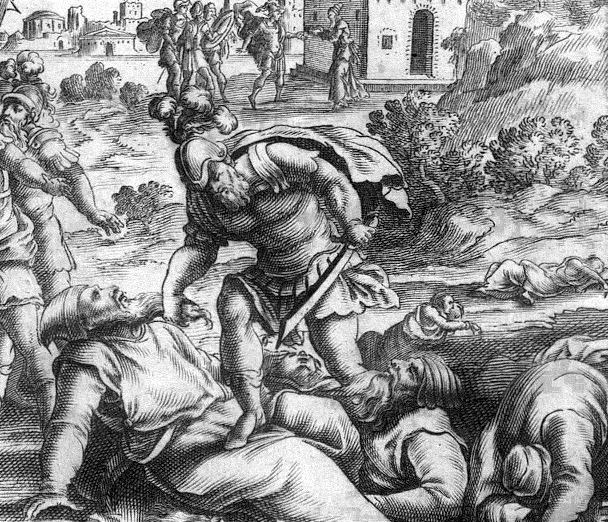
Saul rages, and orders his bodyguards to kill Ahimelech and all the high priests. They balk. This is an abomination. Even Saul’s faithful followers know that he is ordering a horrible murder. I picture Saul screaming and raging, and then Doeg, who is not an Israelite, and who is cunning and ambitious, does the deed. He murders 85 priests that day. He continues on afterwards, and directs the murder of all of their families and the destruction of the village at Nob. With eighty-five men, plus their wives and children Saul, through Doeg and Doeg’s men, murdered two-hundred people or more.

However, they missed one. Abiathar, son of Ahimelech escaped, and he took his priestly garment (called an “ephod”) with him. He fled to David and told him what happened.

Then David said to Abiathar, “I knew that Doeg the Edomite was there that day and that he was sure to report to Saul. I myself am responsible for the lives of everyone in your father’s family. (1Sam 22:22, HCSB)

David’s response is remarkable. Saul is the one who ordered the murder of the priests. Doeg is the one who carried it out and did the actual killing, probably assisted by some underlings. But David says, “this was my fault. I am responsible for the loss of those lives.”

You see David had a heart that God loved. It wasn’t because David was perfect. He lied when he was running from Saul. But he was open, willing, humble and even repentant. When Samuel confronted Saul about the sins he committed, Saul’s response was always something like: well I had to do it. Circumstances demanded it. I was losing men.” David could easily have said, “I had to lie to save my life.” He might have said, “It was an extreme situation, calling for extreme measure. Besides, I’m not the one who killed them. But instead, his response is: “I was responsible for this great tragedy.”

This is not to say that David was blind to the evil of Saul and Doeg. At this time he wrote Psalm 52, in which he castigates the evil of Doeg, and by implication, Saul. In David’s eyes, their biggest sin is this:

Here is the man who would not make God his refuge, but trusted in the abundance of his riches, taking refuge in his destructive behavior. (Psalm 52:7)

What is even more amazing is what David wrote next. Remember he is still hiding in fear of his life. Remember, he had no more reason to trust the Lord than you and I do.

But I am like a flourishing olive tree in the house of God; I trust God’s faithful love forever.

I will praise you forever for what you have don. In the presence of your faithful people, I will put my hope in your name, for it is good. (Psalm 52:8)

As always, the Lord brings some good out of every terrible situation. David is his chosen servant. Now David has both a prophet and a priest to worship with him, and give him godly counsel. And unlike Saul, David humbly and willingly receives what God says through them.

Now what does all this mean for us today?

Maybe you need to hear the specific practical advice that you should take care of your family, and even your parents when they are unable to take care of themselves.

Perhaps you face the temptation that Saul had, to let your insecurity rule you. Do your fears drive away the people you love, or cause them harm? I doubt anyone reading this has committed murder on the scale that Saul perpetrated that day. Even so, the difference between faith and doubt is huge, and matters a great deal. Without trust in the Lord, if we trust only in ourselves, like Saul, we are doomed to hurt those around us. See how much better it is to be like David and put your trust in the Lord alone.

Like David with Gad and Abiathar, do you have godly spiritual advisors who listen to the Lord and have permission to speak honestly into your life? If not, ask the Lord to send you a few.

There is one last thing. Last time we talked about the concept that in the Old Testament we find people or events that remind us of Jesus, or show us what Jesus is like, or what following him is like. There is another one this week. More than two hundred people lost their lives for helping David. So today and throughout all history, people around the world have been persecuted and killed for following Jesus. It is a reminder that we should pray for those who are persecuted today, and also that we should be ready to make a choice between our own life and our obedience to Jesus.

Let the Holy Spirit speak to you about all this right now.

REBEL WITH A CAUSE

Adullam-Cave-interior_fjenkins 090211

David was God’s chosen king, the rightful heir to the throne of Israel. But for a time he had to live hiding in his own kingdom. While he did a few unlikely characters joined him, and were molded into the future heroes of Israel.

The rightful King of this world, Jesus, is here incognito, so to speak, and he calls us to join him in a campaign of rebellion against the usurper, Satan.

To listen to the sermon, click the play button:

To download, right click on the link (or do whatever you do on a Mac) and save it to your computer: Download 1 Samuel Part 20

1 Samuel #20. 1 Samuel 22:1-2

Last time we saw how David took the time to make one last stop to worship the Lord. He almost certainly lost a chance to go home to Bethlehem one last time. He did this because he wanted to be in the presence of the Lord once more. He wanted to hear what God had to say to him in this difficult circumstance. Those things were more important to him than home, family or even the certain help he would have received in Bethlehem. After stopping at the temple, he spent some time in Philistine territory. Realizing he’d made a mistake, he fled from there, and ended up hiding and living in a cave near a place called Adullam.

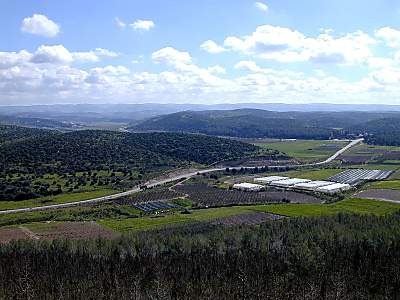
Elah_Valley_from_Azekah_tb_n022201

Pause for a moment and consider how low David has fallen. He was anointed to be God’s chosen instrument, ultimately, to be the king. He served as a feared and honored warrior – he was, in fact, a national hero. He was the son in law of the king. He had lived in comfort and honor. Now he is hiding for fear of his life, in a cave. Caves are not known for their comfort. There is nothing soft to sleep on. There is no natural light. There are no bathrooms, so after a while of living there, it would smell pretty ripe. And yet, David’s heart didn’t falter. He did not appear to think he was somehow too good to live that way. Arthur W. Pink commented on this:

“The high favorites of Heaven are sometimes to be located in queer and unexpected places. Joseph in prison, the descendants of Abraham laboring in the brick-kilns of Egypt, Daniel in the lions’ den, Jonah in the great fish’s belly, Paul clinging to a spar in the sea, forcibly illustrate this principle. Then let us not murmur because we do not now live in as fine a house as do some of the ungodly; our “mansions” are in Heaven!”

Sometimes I think we Christians in the Western world are a little soft. God loves to bless his people, but his main purpose for us in this world is not that we merely feel comfortable. David was God’s chosen instrument, just as we Christians are today. And the Lord was with him in the cave, perhaps even more potently than when David finally lived in a palace. We need to take the long view, the view of eternity. What happens here and now is not the end. I like where I live right now, but it is a dump compared to my permanent home in heaven. David knew that was true for him as well.

There are two Psalms that show in the title that they were written by David “in the cave.” Unfortunately for David, he spent time hiding in several different caves, at different periods in his life. So we can’t know for sure that these were written in the caves near Adullam. But there’s a good chance that either one or both of Psalm 57 and 142 were written at this point in his life. Remember, the Psalms are not collected in chronological order, so 142 could easily have been written before 57.

Both Psalms start with David expressing fear and anguish at his dangerous and uncertain situation. But both end with him declaring his trust in the Lord, and his praise to him. The last line of Psalm 142 says, “The righteous will gather around me; because you deal generously with me.”

This is a declaration of trust. It is also an optimistic take on what actually happened shortly afterwards. David’s brothers and his father’s whole family came to live with him in the cave. He was no longer all alone – his family shared in his hardship and persecutions. In addition, more men joined him until there were about 400 altogether. The text says that these men were all either “desperate, in debt or discontented.” It doesn’t sound exactly like “the righteous.” It sounds more like a ragtag band of malcontents and ne’er-do-wells. David’s family aside, these sound not like the cream of the crop, but rather the sludge of society.

However, they all agreed upon one thing – David was now their leader. This was actually a pretty big deal. As we will learn in a moment, Saul the King felt that anyone who helped David was committing treason, and he sentenced them to death. So when these men gave their allegiance to David, they forfeited their lives. There was no going back. If David failed to vindicate himself, they were dead men.

In the Old Testament, sometimes we encounter people or events that theologians call “a type of Christ.” What they mean is, sometimes God used historical events or individuals to show the world what Jesus was like, even though Jesus had not come yet. It is a foreshadowing – a partial picture of what the real messiah will look like. These “types of Christ” serve two purposes. First they were for the people in Old Testament times, to help them understand what God is really like, and how he really saves people. Remember, Romans 3:25-26 tells us that even people in Old Testament times were saved through Jesus, as God looked ahead to what he was going to do at the cross. And so there are these shadows and parts of pictures that gave people a sense of what was to come. Second, these “types” are there to strengthen our faith. Even the Old Testament is all about Jesus, and so when we read it, we should be looking for Jesus and how it shows Him to us.

By the time Jesus walked the earth, even the Jewish Pharisees believed that many of the people and incidents in the Old Testament were pictures of the coming Messiah. In particular, the Jews felt that David’s life and character would help them to identify what the Messiah was like. David was anointed with oil and with the Holy Spirit to be God’s uniquely chosen instrument. Both the Hebrew word “Messiah” and the Greek “Christ” mean simply “anointed one.” Jesus Christ means “Jesus, Anointed One.” So some of the life of David, the anointed one, looks ahead to the ultimate Anointed One.

In this particular case, there are several significant comparisons. David was God’s chosen anointed one, and yet he was rejected by the leader of the nation. He lived with integrity and didn’t do anything wrong, yet he was forced to live as an outcast. Jesus was God in flesh, the Ultimate Anointed One, and yet he was rejected by the status quo of Israel. He too was an outcast. David accomplished miraculous things in battle against the Philistines. Once he and another warrior were surrounded by Philistines in an open field. They stood back to back and killed three hundred enemies that day.

Jesus also performed many miraculous signs – healings, driving out demons, calming storms and more. He destroyed demonic enemy strongholds.

There is one “type of Christ” in this passage that I want to dwell on a little bit longer, and that is the followers of God’s anointed. The men that followed David were of no account. They were shiftless and in trouble, the dregs of society. And yet mostly from these ragtag 400, came some of the mightiest names in the history of Israel. There was an exclusive trio of warriors, known as “the three.” One of these was the warrior that stood back to back with David when they were surrounded. There was a larger elite force of “thirty mighty men.” From what we can tell, they all started out among this group of no-name, no-account people.

In the same way, the important members of society did not join the ragtag band of Jesus’ disciples. Instead he got tax-collectors, prostitutes and smelly, calloused fishermen. He had his “three” – Peter, James and John. He had his twelve then beyond that, a few more.

The followers of David had to be kind of desperate to go to him. They were literally giving up everything to join him. If he didn’t come through, they were lost. There was no halfway commitment. This wasn’t, “I’ll go hang with David for a while, and if it doesn’t work out, I can always go back.” No it was an irrevocable alignment with David, breaking off the loyalties of the past.

Jesus calls for that kind of allegiance from us also. He doesn’t want us to come to him, keeping our options open in case something we like better comes along. Jesus talked to his disciples about this very thing, and Peter expressed the kind of commitment they made to him:

66 After this many of his disciples turned back and no longer walked with him. 67 So Jesus said to the Twelve, “Do you want to go away as well?” 68 Simon Peter answered him, “Lord, to whom shall we go? You have the words of eternal life, 69 and we have believed, and have come to know, that you are the Holy One of God.” (John 6:66-69, ESV)

Just as David’s followers were desperate and poor, Jesus calls to the broken and poor in spirit. Let’s face it, it hard to really give ourselves over to Jesus unless we realize that without him, we are lost. Paul describes it like this:

26 Brothers, consider your calling: Not many are wise from a human perspective, not many powerful, not many of noble birth. 27 Instead, God has chosen what is foolish in the world to shame the wise, and God has chosen what is weak in the world to shame the strong. 28 God has chosen what is insignificant and despised in the world — what is viewed as nothing — to bring to nothing what is viewed as something, 29 so that no one can boast in His presence. 30 But it is from Him that you are in Christ Jesus, who became God-given wisdom for us — our righteousness, sanctification, and redemption, 31 in order that, as it is written: The one who boasts must boast in the Lord. (1Cor 1:26-31, HCSB)

Let’s be honest. Sometimes it seems like it might be more exciting to be one of David’s men than to follow Jesus. I mean, as I read this, I think this real history was likely the inspiration for the legend of Robin Hood, and even if Robin Hood was real, he might have been inspired to his deeds by this very story. There are battles, betrayals, secret hiding places, defections. It is all very well to say David is a type of Christ, but following Jesus might sometimes seem more boring. I mean we go to work or school and come home and do stuff, go to bed and then get up and do it all again. Sometimes we’re so bored, we make excitement for ourselves.

I think that is all because we fail to recognize the spiritual reality that exists with and alongside our world, hidden, but no less real. What David was involved with physically, we are engaged in spiritually. David was the king who was chosen by God, but rejected by many of the people. He lived almost as an agent in enemy territory, gathering those few worthless people who had nowhere else to turn to help him. In the same way, C.S. Lewis describes our life of following Jesus like this:

Enemy occupied territory – that’s what this world is. Christianity is the story of how the rightful King has landed, you might say landed in disguise, and is calling us all to take part in a great campaign of sabotage.

–C. S. Lewis, Mere Christianity

You see, though the battle is more spiritual than physical, it is no less real for all that. We have a faithful, loving intrepid leader. We are undercover – living as part of society, but not living for the same purposes as the rest of the world. Sometimes perhaps we need to wake up, and open up our lives to be more engaged in this secret mission. We need to be more aware of how the Lord wants to work, to be more aware of the people he is bringing across our paths and into our lives.

Joining the Rebel King paints a target on our backs, a target his enemies would love to use. But if we trust him and submit to his leadership, he will mold us into mighty men and women of faith, significant in God’s kingdom forever.

ARE YOU TRULY FREE?

1 Samuel # 5. Kingship, Freedom and Responsibility

aslannew

GOD IS KING OF HIS PEOPLE

To listen to the sermon, click the play button:

To download, right click on the link (or do whatever you do on a Mac) and save it to your computer: Download 1 Samuel Part 5

Please read 1 Samuel 8:1-22

The battle recorded in 1 Samuel chapter seven ended when Samuel when was in his twenties. Verses 13-17 summarize most of the rest of his life. He led Israel, listening to the Lord, and telling them what the Lord had to say, helping them to understand what it means to follow him, and encouraging them to actually do it. And the people seemed to respond to his leadership. After those first tumultuous twenty years or so, things went well for that generation. The Philistine threat was greatly reduced. There was peace and people seemed listen to the Lord. What began with a simple woman wanting to become a mother, had brought peace, joy and goodness to thousands and thousands of people.

As he aged, Samuel tried to groom his two sons to lead Israel as he had. But it looked like they were headed down the same path as Hophni and Phinehas, the wicked sons of Eli, who had been in charge when Samuel was very young. History seemed poised to repeat itself. Samuel’s sons were dishonest – they took bribes to settle disputes, instead of judging fairly.

People Samuel’s age and older probably remembered what it was like back in the days of Eli, and were afraid of going back to those dark times. So the people gathered and told Samuel they wanted him to find them a king. I love Samuel’s response. The same little boy that was ready to hear God, still wanted to hear him as an old man.

One bible version says, “the request displeased Samuel.” The Hebrew word for “displeased” actually means to “ruin or spoil.” So it could mean that Samuel was upset about it – it ruined his heart. Or maybe he thought that the Israelites were going to spoil a very good thing. I think that is the best way to translate it, considering what followed.

So the first part of Samuel’s response is that he thinks it is a bad idea. He has good reasons for thinking that, and history basically proved him right. But, while that is what he thinks, he doesn’t just come right back with that. Instead, the second part of his response is to pray about what the people have said. In other words, Samuel was a humble God-follower. He was old and wise. He was a proven and popular leader. But he did not assume that his own opinion was right. Instead, he asked God about it.

Samuel’s attitude is definitely one worth learning from. When we have to make decisions about something, or deal with others, too often I know I’m right, and when I know I’m right, I think I don’t have to ask the Lord about it. Now, I’m not talking about things that the bible is very clear about – like who Jesus is, or whether it is wrong to lie. But there are many situations where God hasn’t given us a set of rules or a manual, and instead, we are supposed to rely on him to reveal his will in various situations. Should you take the new job or not? Does the Lord think it’s a good idea for you to go that party? Should your let your kids go on the overnight trip? Does the Lord want you to talk to your co-worker about what the bible says in this situation?

What God said to Samuel is surprising, puzzling and (I think) extremely interesting. He said,

The LORD said to Samuel, “Do everything the people request of you. For it is not you that they have rejected, but it is me that they have rejected as their king. (1 Sam 8:7)

So, let’s get this straight. He is saying, “Samuel, you have it right. When they ask for a king, they are rejecting me as king. This is a bad idea. So go ahead and help them get a king.”

Say what?

I think there are several things going on here. First, Samuel may have felt that he had personally failed as a leader. After he led them for a lifetime as a prophet, the people of Israel said, “we don’t want a prophet anymore. We want a king.” So Samuel may have felt that he somehow failed to teach them or encourage them in their relationship with God. He may also have felt bad about the choices his sons had made. The Lord was saying first of all “No Samuel, it isn’t you. You haven’t failed. They aren’t rejecting you, they are rejecting me.”

Sometimes this is a word we need to hear from the Lord. Maybe you have a family member you’ve been praying with or for. Maybe there’s a friend who has sought your advice. And yet the relative or the friend has ultimately decided to ignore what you have shared with them. Your prayers don’t seem effective. That person is going her own way, and that way is to move farther away from the Lord. Perhaps the Lord wants to say to you right now, “My beloved child, that person has not rejected you. She is rejecting my will for her life. Don’t take it personally. Don’t feel that you are a failure. This is about Me, not you.”

I want to talk for a minute about what the Lord meant when he said the Israelites were rejecting Him as their king. Since the time of Abraham, the people of Israel were not ruled by kings. For four hundred years in Egypt, and another four-hundred after they came to the promised land, the people were supposed to live free, with God as their only king. They were supposed to answer to Him – above any earthly authority.

The problem is, it didn’t work very well. Most people didn’t want to live that way. I am fascinated by how similar this is to the basic political philosophy of the Founding Fathers of the United States of America. Laura Ingalls Wilder wrote about her life growing up on the American Frontier during the late 1800s. In Little Town on the Prairie she makes some observations that are surprisingly relevant to our text today. One year, the new town she was living in celebrated the fourth of July. As part of the celebration, they read aloud the Declaration of Independence. After that, the crowd sang “My Country ‘Tis of Thee” ending with this verse:

Long may our land be bright; With Freedom’s holy light. Protect us by Thy might; Great God our King.

The crowd was scattering away then, but Laura stood stock still. Suddenly she had a completely new thought. The Declaration and the song came together in her mind, and she thought: God is America’s king.

She thought: Americans won’t obey any king on earth. Americans are free. That means they have to obey their own consciences. No king bosses Pa; he has to boss himself. Why (she thought) when I am a little older, Pa and Ma will stop telling me what to do, and there isn’t anyone else who has a right to give me orders. I will have to make myself be good.

Her whole mind seemed to be lighted up by that thought. This is what it means to be free. It means, you have to be good. “Our father’s God’s, author of Liberty — ” The Laws of Nature and of Nature’s God endow you with a right to life and liberty. Then you have to keep the laws of God, for God’s law is the only thing that gives you the right to be free. (Little Town on the Prairie, page 76)

This is what God meant when he said to Samuel that the Israelites were not rejecting Samuel, but God himself. They were saying, “It is too hard to have to listen to what God says for ourselves. It is too much responsibility for us to do what is right. Give us a king to lead us. He can tell us what to do. He can listen to God and be responsible for what happens.”

There is a deeper truth here. Whenever we reject the Lord, we are actually rejecting freedom. We tend to think of it the other way around. We think God gives us rules to follow and that is the opposite of being free. I want the teenagers reading this to pay careful attention, because you are at an age where you crave freedom. True freedom only exists with true responsibility. What that means is, you can’t really be free unless you are also really responsible.

Think about it like this. Suppose you are sixteen years old, and you want the freedom to go wherever you want, whenever you want to. In other words, you want the freedom to drive your own car. In order to get that freedom, you must take on the responsibility of learning how to drive, and you must take on the responsibility of learning the traffic laws, and abiding by them, and maintaining your license, and maintaining your car and paying for gas. You get the idea? You can be free, but in order to be free, you must also be responsible. If you don’t want to be responsible enough to do these things, you won’t be free to drive either.

Ever since Adam and Eve sinned, we human beings want to be free without being responsible. It never works. The two things simply go together. What the Israelites finally admitted is that they would rather not be free, if it meant they actually had to be responsible for their own relationships with God. They were saying, “we don’t want to grow up spiritually. It’s too hard. We would rather give up our freedom, so that we don’t have to be responsible for ourselves.”

In verses 9-18, the Lord through Samuel, told the people that this was exactly the choice they were making. But they said that they still wanted a king.

I think we do the same thing when we rely too much on Christian leaders or religious rules that aren’t really in the Bible. I don’t want anyone to feel bad, but sometimes people in my church come to me and say, “pastor what should I do in this situation?”

My answer is usually something like this: “Get to know the Lord through reading the bible, prayer, sermons, worship and fellowship. Learn to hear for yourself what he has to say to you. Talk to him about it yourself.” That’s not to say that I never have any God-given insight for anyone. Hearing God through other believers is a valuable thing, a gift that the Lord sometimes gives us. But the truth is, we are all supposed to connect with the Lord on our own also.

These things require effort and personal responsibility. It’s easier just to have someone tell you what to do. Some people find it easier to have an extensive list of rules that can apply to every situation. That way you don’t have to actually deepen your relationship with God, to learn to hear him, to put in the time required to get close to him.

God’s response to the people is fascinating. What they want is a bad idea. They will ruin his plan for them to be free as they follow him. And yet, he says to Samuel, “Let them go ahead with it. In fact, help them pick a king.” Basically he said, “I’ll give you what you want, but it will frustrate you in the end. In the end it will just bring you back to the same place.”

This is one of those places in the Bible where we see clearly two things that seem contradictory, and yet they are both true. God gives everyone free will. He let the Israelites choose something that was not what he wanted for them. They truly had a choice, and they used it to choose against God’s plan. But then, once they made their free choice, God began to work his will in and through the circumstances that their choice created. They got to have their free choice. And yet God’s will was not ultimately thwarted, and he began to work. It is a reflection of Romans 8:28

We know that all things work together for the good of those who love God: those who are called according to His purpose.

All things – even our own bad choices. God let the Israelites ruin his plan for a nation that lived free from tyranny and served only God. In fact, before he ever made the universe, he knew this would happen. He didn’t stop them. But he didn’t give up on them either. He continued to work with them.

Sometimes we are like the Israelites. We want what we want, even when someone (perhaps even the Lord) has warned us it is a bad idea. The Israelites experienced a lot of pain and heartache from their bad choices, but it did not separate them from the love of God. We may experience pain and heartache. But if we continue in faith, if we continue on in Jesus, God will work it out some way to our good.

JESUS WANTS TO LIVE YOUR LIFE

christinme

To listen to the sermon, click the play button:


To download, right click on the link (or do whatever you do on a Mac) and save it to your computer: Download Living in Reverse Part 7


LIVING IN REVERSE PART 7. JESUS LIVES YOUR LIFE

We’ve been moving through this series about Living in Reverse. We’ve learned to put what God says after the “but…” – to agree with Him, and to let our dominant reality be determined by God’s Word and God’s actions. We’ve learned to draw life from the Spirit, not from our outward circumstances – not even the good ones. We’ve learned that when we are in Christ, our old self has been crucified, and we are dead to sin to the law. We’ve begun to learn how to fight the ongoing temptations that would try remove us from all these truths we’ve been talking about. We have begun to explore our new life as citizens of heaven, and all the resources we now have in Christ. We’ve been learning our new identity.

All this is leading toward an ultimate purpose: so that Jesus Christ can express His Life through you. Let me put a different way: The purpose of it here on earth is so that Jesus Christ can live your life. Paul puts it like this:

I have been crucified with Christ. It is no longer I who live, but Christ who lives in me. And the life I now live in the flesh I live by faith in the Son of God, who loved me and gave himself for me. (Gal 2:20, ESV)

Now, as I have preached these messages, I have noticed that some people have a certain amount of fear. I have had some fear of my own. That fear is that if we believe that sin is truly taken care of we (or maybe other Christians) will sort of go crazy and completely indulge ourselves in a lifestyle of sin. Now, I’ve addressed that in other messages, by trying to explain the relational connection we now have with God. But I want to point that there are two probable roots to this kind of fear.

The first root is control. Believe it or not, a lot people feel more comfortable with the idea that spiritual things are up to them. If I have to somehow measure up, then I have some control – I can work to make sure that I do in fact measure up. Some folks are very uncomfortable with the idea that they can’t do anything about their spiritual condition – not even after they are Christians. Some people would rather check spiritual items off a list than actually interact with the living God in a daily, personal way.

The second reason we often fear grace, is that we don’t really trust that Jesus will live his life through us and other Christians. I had neighbors once who weren’t Christians. The woman was pretty much a pagan feminist. We prayed for her and her husband for years. Eventually she started coming to our church. One night in our small group she confessed to us, and to the Lord that she was a Wiccan – a witch. She asked for God’s forgiveness. The next day she renounced Wicca and burned her Wiccan books. Not long after that, she completely gave her life to Jesus.

Shortly after she became a Christian we had a conversation, and I realized that she still held a lot of pagan and feminist views. She believed that there was nothing wrong homosexual behavior or abortion. I thought, “Oh my goodness, she’s a Christian now, but she still has all these pagan attitudes.” I had no idea where to start with her.

You see this really works. When we are truly surrendered to Jesus, he really will live his life through us.

I didn’t have to. Over the next year or so the Lord worked within her to change her attitudes. I don’t know exactly when or how it happened, but Jesus living within her made sure that she did not continue in unbiblical beliefs or practices.

I didn’t even know she was a Wiccan, before she told us, but the Lord did. He worked within her to change that. The Lord knew before I did the thoughts and attitudes she held that were wrong. He worked within her to change that. She had been a feminist, but before any of us more mature believers talked to her about that, she felt the Lord leading her to change her feminist attitudes and actions toward her husband. That change led him to become a Christian a few months later.

You see this really works. When we are truly surrendered to Jesus, he really will live his life through us. I didn’t have to lay out religious rules for my neighbor to follow – I just had to introduce her to Jesus, and once she surrendered to Him, He began to live his life through her.

We had another lady who started coming to a cell group in that church. She had been raised in a Christian home, but as far as we could tell, she didn’t have a living faith. She lived with her boyfriend and thought nothing was wrong with that. One night she wanted prayer to receive the Holy Spirit. I thought that was jumping the gun a little bit, since she didn’t really know Jesus. But we prayed. When we were done she said, “when you prayed for me, I really did get the Holy Spirit.” I didn’t think so, but I didn’t want to burst her bubble, so I didn’t say anything.

The next day she called me. “I just told my boyfriend he had to move out,” she said. “I have the Holy Spirit now, and the Holy Spirit doesn’t want to live like that.” She told me some other changes she was making in her life. I was floored. She really did have the Spirit!

Once she was surrendered to Jesus, once he lived in her through the Spirit, I did not have to tell her it was wrong to live with her boyfriend. The Spirit showed her.

Now I am not saying there is no use in knowing what the Bible says. The Spirit works through the Word to guide, correct and teach us. Both of these women got extensive Bible teaching and mentoring. But the changes in their lives were brought about not by other Christians giving them rules to follow, nor by them making a tremendous effort, but rather Jesus living his life through them. Their main work was simply to trust Jesus and respond to him as he led them.

I could tell you more true stories but my hope is that if you are a believer, you will see for yourself that Jesus will live his life through you if you let him. And this is why we don’t need to focus on whether or not we are sinning. If we are focused on Jesus and if we respond to him as he teaches us and leads us, we are not going to sin very often. You see, if Jesus is the one living your life, Jesus isn’t going to sin. It’s only when we stop believing it, and stop responding in faith to Jesus that we get into trouble. We get into trouble when WE try to live our OWN lives. Even when we are trying live our lives in a holy way, if we are doing it on our own, we tend to get into trouble.

READ ON TO FINISH THE MESSAGE….

Continue reading “JESUS WANTS TO LIVE YOUR LIFE”

YOUR IDENTITY IS DETERMINED BY YOUR BIRTH

new birth

Living in Reverse Part 6: Born Again.

To listen to the sermon, click the play button:


Right click and save the link below to download the audio:

Download Living in Reverse Part 6


We’ve been moving through this series about Living in Reverse. We’ve learned to put what God says after the “but…” – to agree with Him, and to let our dominant reality be determined by God’s Word and God’s actions. We’ve learned to draw life from the Spirit, not from our outward circumstances – not even the good ones. We’ve learned that when we are in Christ, our old self has been crucified, and we are dead to sin to the law. We’ve begun to learn how to fight the ongoing temptations that would try remove us from all these truths we’ve been talking about.

Some of you may have been trying to put some of this into practice recently. Maybe you’ve been facing temptation and saying, “I’m dead to sin, I don’t want to do that anymore,” but it hasn’t always worked for you. Maybe you’ve been trying to believe desperately, who you really are in Christ, but you still have doubts. And because you don’t fully believe, your actions still don’t look like someone who is dead to sin. If sin is still a struggle, I want to preach the good news to you again today. We’ve discussed why and how it can be problem. We’ve talked about how to fight it. But remember, we are dead to it. I want to start now, talking about our new life. We died to sin, but what are we alive to?

. Maybe you don’t need this today. If not, save this sermon for some time in the future when you do need it.

There is one other thing I think we ought to consider before we jump into the scriptures I want to share. And that is, spiritually speaking, we are often terribly confused about the place of our actions. We understand that our actions are of no value in getting salvation for ourselves. Salvation is a free a gift of God, and it cannot be earned through good deeds (Ephesians 2:8-9). It is appropriated through faith. In other words, we get it when we believe that we need it, and that God has really done this for us.

But now, after we are in Christ, we think our actions determine everything. We think our actions determine who we are. If we act sinful, we think we are fundamentally sinners. If we act righteous, we feel good about ourselves and think we are, by our own efforts, incorporating the righteousness of Christ into our lives. It is to people acting like this that Paul writes:

I only want to learn this from you: Did you receive the Spirit by the works of the law or by hearing with faith? Are you so foolish? After beginning with the Spirit, are you now going to be made complete by the flesh? Did you suffer so much for nothing — if in fact it was for nothing? So then, does God supply you with the Spirit and work miracles among you by the works of the law or by hearing with faith? (Gal 3:2-5, HCSB)

You see, your actions do not determine who you are. Instead, your identity is determined by your birth. I was born in the United States of America. But when I was very young, my family went overseas to be missionaries. The majority of my childhood was spent in other countries.

By the time I was sixteen I did not sound like an American – I actually had an Australian accent. I didn’t really know American culture. My first few years in the US, I didn’t get most of the jokes and wise-cracks, because humor is one of the most culture-specific things there is. I didn’t dress in American fashion.

My memories were not of America. In fact my memories and experiences were in a place that was radically different in very fundamental ways from the United States. In short, America had very limited role in shaping my thoughts, actions, personality, memory or experience. I did not feel like an American at all.

For that reason, did I cease to be an American? Not at all. My citizenship was determined by the country I was born into – not by my feelings, not even by actions. The key was my birth.

Even though I didn’t feel American, I recognized that America offered me more opportunity than anywhere else in the world. I saw my citizenship here as a gift that I could use. I believed what my parents told me, that I was an American citizen. I believed my American passport was valid. So I came to America, in faith that my birth certificate and passport were valid. And now, because I believed that my birth determined my citizenship, I have received many benefits from being American.

Spiritually speaking we need to recognize that it our birth, not our actions, which determines our identity.

Remember, action follows belief. And Romans chapter ten tells us that the kind of belief we need for this comes from hearing the word of God. So I am going to dwell on some more truth from God’s Word today. If we have trusted in Jesus, the bible is very clear about our birth:

Jesus answered him, “Truly, truly, I say to you, unless one is born again he cannot see the kingdom of God.” Nicodemus said to him, “How can a man be born when he is old? Can he enter a second time into his mother’s womb and be born?” Jesus answered, “Truly, truly, I say to you, unless one is born of water and the Spirit, he cannot enter the kingdom of God. That which is born of the flesh is flesh, and that which is born of the Spirit is spirit. (John 3:3-6)

Blessed be the God and Father of our Lord Jesus Christ! According to his great mercy, he has caused us to be born again to a living hope through the resurrection of Jesus Christ from the dead, (1Pet 1:3, ESV)

Since you have been born again — not of perishable seed but of imperishable — through the living and enduring word of God. (1Pet 1:23, HCSB)

Everyone who believes that Jesus is the Messiah has been born of God, and everyone who loves the Father also loves the one born of Him. (1John 5:1, HCSB)

For through him we both have access in one Spirit to the Father. So then you are no longer strangers and aliens, but you are fellow citizens with the saints and members of the household of God, (Eph 2:18-19, ESV)

But our citizenship is in heaven, and from it we await a Savior, the Lord Jesus Christ, (Phil 3:20, ESV)

We have been crucified with Christ. The old has gone. The new you has been born into a new life. We have born citizens of heaven, members of God’s household. Regardless of what we know about heaven, regardless of how we sometimes act like we are from someplace else, Heaven is the place of our citizenship. Our birth certificate proclaims it, our passport affirms it. All of the resources of heaven are ours.

Now, one of the problems, is that sometimes we don’t know our own birth rights. We are like princes and princess who have born to inherit a kingdom. But we were kidnapped as babies, and raised in poverty. Now, our Father, the king has found us and brought us back to the palace. But we don’t even know the rights and privileges and tasks that are ours as royal children. We don’t know the vast resources we have now to fulfill those things. In the same way, so often Christians don’t even know everything that is ours, in Christ Jesus. So Paul writes to the Ephesians:

I pray that the God of our Lord Jesus Christ, the glorious Father, would give you a spirit of wisdom and revelation in the knowledge of Him. I pray that the perception of your mind may be enlightened so you may know what is the hope of His calling, what are the glorious riches of His inheritance among the saints, and what is the immeasurable greatness of His power to us who believe, according to the working of His vast strength. (Eph 1:17-19, HCSB)

His prayer is that they (and all followers of Jesus) can know these things. He wants us to know our birthrights, now that we have been born again. So I am going to share with you, some of the riches that are yours and mine when we are in Christ. This is what it means to be born again as a citizen of heaven:

In Christ, we are holy, blameless, righteous and above reproach (Eph 5:4; 2 Cor 5:21; Col 3:12; 1 Cor 6;19).

He has now reconciled in his body of flesh by his death, in order to present you holy and blameless and above reproach before him, if indeed you continue in the faith, stable and steadfast, not shifting from the hope of the gospel that you heard, which has been proclaimed in all creation under heaven, and of which I, Paul, became a minister. (Col 1:22-23)

The “if you continue” is clearly about continuing in faith and hope. It is not continue to “act righteous” but continue to hold fast to the faith that this is true, that Christ has done this for you. A wise pastor named Dan Stone wrote: “It is not your striving that releases Christ’s life through you. It is your trusting.” We are in Christ when we continue to trust Him and rest in Him day by day. And in Christ, we are holy and blameless.

In Christ, we are safe and free. I am free from condemnation. I am free from sin and death. I cannot be separated from the love of God (Romans 8:1-2; also 8:31-39). God works for my good in all circumstances (Romans 8:28). I have been established, anointed and sealed by God. (2 Corinthians 1:21-22). I can approach God with freedom, confidence and boldness (Eph 3;12; Hebrews 4:16). My real life is already hidden away with Christ in God (Colossians 3:1-4). I am born of God and the evil one cannot touch me. (1 John 5:18).

In Christ, we are significant and important. I am a branch of Jesus Christ, the true vine, and a channel of His life (John 15:5). I have been chosen and appointed to bear fruit (John 15:16). I am God’s temple (1 Corinthians 3:16). I am a minister of reconciliation for God (2 Corinthians 5:17-21). I am seated with Jesus Christ in the heavenly realm (Ephesians 2:6). I am God’s workmanship; created by Him to do good works, which he has already prepared for me to do (Ephesians 2:10).

These are just a few of many verses and concepts that describe who we are when we are born into Christ and into citizenship in Heaven. This is the real you, the you that is more real more powerful than what you see in the flesh or feel in the soul. If you continue in faith (that is, if you continue to believe, to trust Jesus and trust that this is all true in Him) then this you will last forever, and ultimately will be expressed through a transformed soul and a new, eternal body.

You may still act or think like a foreigner, from time to time. But if you trust Jesus, you have born again as a citizen of heaven. All this is truly yours, even though your actions may not yet reflect it perfectly.

All this is leading toward an ultimate purpose: so that Jesus Christ can express His Life through you. Let me put a different way: The purpose of it here on earth is so that Jesus Christ can live your life. That is what we will explore next week.

WHY DO WE SIN? HOW CAN WE FIGHT IT?

LIVING IN REVERSE PART 5.

To listen to the sermon, click the play button:

Right click the link to download: Download Living in Reverse Part 5

Now, there is another question we need to address. If we are already holy, and already free from sin, why do we sin anymore at all? And how do we deal with it?

I’m so glad you ask, because the answer is found in a passage of scripture that is frequently misunderstood: Romans chapter 7:15-20.

For I do not understand my own actions. For I do not do what I want, but I do the very thing I hate.

Now if I do what I do not want, I agree with the law, that it is good. So now it is no longer I who do it, but sin that dwells within me. For I know that nothing good dwells in me, that is, in my flesh. For I have the desire to do what is right, but not the ability to carry it out. For I do not do the good I want, but the evil I do not want is what I keep on doing. Now if I do what I do not want, it is no longer I who do it, but sin that dwells within me. (Rom 7:15-20, ESV)

We read this and we say, “Yeah, I understand that, that’s me.” And we hear Paul say “sin is living me” and “nothing good lives in me” we think: “See? Isn’t that a sinful nature?”

But this passage is frequently misinterpreted. First, in verses 7-14, Paul is talking about the past, about how life was before Jesus. In verse 15, he begins to speak in the present tense, but it isn’t clear if he has switched to his present circumstances, even after salvation, or if he is still explaining the past. Just to move the discussion along, let’s say that in verse 15, Paul is talking about sins he commits as a Christian.

We always need to interpret scripture in context. The entire context of chapter seven is actually chapters six, seven and the first part of chapter eight. The chapters and verse marks were not inspired by God. They were put in by monks 1000 years after the New Testament was written, to help us in navigating around the bible. So pretend they aren’t there, and you can clearly see that the first several paragraphs of chapter 8 are still on the same subject as chapters six and seven.

So with that in mind, what is the general topic that Paul keeps coming around to? You are dead to sin, dead to the law, and alive to Jesus. Therefore, when Paul describes his struggle with sin here, he is not contradicting himself. It is the in the same letter, in the same section, talking about the same subject as when he said: “Likewise, you also have died to the law.”

Therefore, clearly Paul is not turning around and saying “You have not died to the law. You are not free from sin. Your old self is alive and well.” That would be ridiculous and unsustainable biblical interpretation.

I used to believe I had a sinful nature that was alive and well. So when I read this, I was focused on Paul saying “I do bad things…even though I don’t want to.” Actually, Paul’s emphasis is not that he is sinning, but rather that he doesn’t want to commit these sins. What Paul is saying is, “In the deepest part of me, I don’t want to sin. This shows that this part of me is holy and agrees with God. In my deepest nature, I am not a sinner.” He says, in verse 22: “For I delight in the law of God in my inner being.”

And so he says in 8:1-3

There is therefore now no condemnation for those who are in Christ Jesus. For the law of the Spirit of life has set you free in Christ Jesus from the law of sin and death. For God has done what the law, weakened by the flesh, could not do. By sending his own Son in the likeness of sinful flesh and for sin, he condemned sin in the flesh, (Rom 8:1-3, ESV)

I had friend once who was not a Christian. After a lot of time and people praying for him, and some long conversations, he gave his heart to Jesus. Afterward, we started to meet together to pray and talk about the Bible and generally encourage each other in faith. One time the subject of lust came up. He said, “You know, before I became a Christian, I did not struggle with lust. Now I struggle with it all the time.”

I was shocked. What had we done wrong? I asked him to explain.

“Well, before I was Christian,” he said, “there wasn’t any struggle. I lusted, and it didn’t bother me. But since I came to Jesus, it bothers me when I lust because I don’t want to do that now.”

You see the fact that he didn’t want to sin any more was proof that he had died to sin. In his deepest heart, he knew that he didn’t desire sin. In his inner being, he delighted in God’s perfect standard and holiness.

Continue reading “WHY DO WE SIN? HOW CAN WE FIGHT IT?”

If I’m Dead to Sin, Can I sin all the time now?

LIVING IN REVERSE, PART 4. ROMANS 6:12-23

dead-alive


To listen to the sermon, click the play button:

To download, right click the link and save: Download Living in Reverse Part 4

Last time we considered the New Testament teaching that in Jesus we died to sin and to the law. Through this death, which is accomplished through the death of Jesus, we have been set free from sin and the law. (Romans 6:7,14,18; Romans 7:4,6) Last week I shared no less than one dozen scriptures that teach explicitly that in Christ we have died.

The picture Paul gives us at the beginning of Romans 7:2-3 is of marriage. When two people are married in the eyes of the law, they are married. It would be a sin to marry someone else at the same time. But if the husband dies, the laws regarding marriage no long apply. Because of the death, the law doesn’t apply any more. It would no longer be sinful or illegal for the woman to marry someone else. The law was made irrelevant by death.

In the same way, the power of sin to bring us condemnation through the law has been destroyed by the death of Jesus, and by our death which happened in Jesus, as we have trusted him. We can’t be condemned as sinners anymore, because as Paul writes:

Likewise, my brothers, you also have died to the law through the body of Christ, so that you may belong to another, to him who has been raised from the dead, in order that we may bear fruit for God. (Rom 7:4, ESV)

Now, when you really get this, there is a natural question that arises. Does this mean I can sin all I want, because the law no longer applies to me? Now stick with me here. I am going to give you an answer that may surprise you, but you need to follow through the ENTIRE answer I am about to give.

Technically, the answer is, Yes, you can sin all you want. If you are in Jesus, your sins don’t “count” anymore. In the eyes of the law, you are dead, so the law cannot be used to condemn you for anything you do now.

Now, that is a shocking answer. It isn’t the whole story yet, and I want you to stick with me as I give some further explanation in a moment. But just pause here for a moment. Do you see how outrageous the grace of God is? He has made it so that if you simply continue to trust Him, you cannot fail. Even when you do fail, it isn’t counted as you anymore. That’s why we see all those passages in the New Testament saying that when we are in Christ we are New Creation, we are Holy, we are Blameless and so on.

You see it isn’t our job to work ourselves into a state of holiness. God has already put us into a state of holiness, in our spirits. Our only job is to keep believing that he has done this, and through that faith, He will continue to work the holiness deeper and deeper into our soul and body life.

I use the expression keep believing quite deliberately. It is a daily (sometimes hourly) habit of continuing to believe who Jesus is, what he has done for us, how he feels about us, and continuing to rest upon it. This is not a one shot deal. This is not a situation where you just say, “Well I got baptized, so I’m good now.” Or “Well, I got saved five years ago, so I’m good now.” This is a process of continually putting our trust in Jesus, day by day. That is what it means to be “in Jesus” and all these things are ours, only in Jesus. I’m not saying that you have to work hard and live the Christian life on your own strength in order to be in Jesus. But I am saying that to be in Jesus, you need to continually rest in Him with trust in what his Word says, and in what he has done for us.

Last week I spent some time talking about how what we believe profoundly shapes what we do. So the next part of the answer comes here. Technically, you can sin all you want, and it doesn’t count against you. But if you really believe that God has freed you from sin, that you have already been made holy, you will be far less inclined to sin than if you believe you are still fundamentally a sinner.

If you believe you are half sinner, and half saint, then it is only natural for you to go through life sinning half the time. If you believe that, and you sin less than half the time, I commend you for your great will power, though it is misguided. The bible does not say you are half sinner, half saint. It says that if you are in Jesus, then in the most essential part of your being, the part that doesn’t change, the part that already has a solid connection to eternity – your spirit – you are entirely holy. You are completely separated from sin and the law.

When you believe what the Bible says – that the essential you is already holy and is free from sin – you will sin less, not more, because action follows belief. If you find that you are sinning a lot, what you need is not to try harder to stop, but to believe more fully what God says about you.

Now, there is another thing that will eventually restrain our sinful actions. There is a movie from the 1990s called Groundhog Day. In it, a weather reporter named Phil gets trapped in an endlessly repeating day – February 2 1993, to be precise. Only Phil is trapped in this day. Every day, the other people he meets are living the day as if it is their first February 2, 1993. The only thing that carries over from day to day is Phil’s memory. Naturally, at first he is depressed. One night he is drowning his sorrows in drink, and he says out loud: “What if nothing you did mattered. What if you woke up every morning as if the previous day had never happened?”

One of the other drinkers in the bar said, “That would mean there would be no consequences. You could do anything you like.”

Phil catches on to this idea, and at first, he abuses the fact that there are no consequences for his actions. He gets drunk, commits crimes, and does many morally reprehensible things. After a while all that loses its luster, because he realizes there is no life there. So he tries to commit suicide. He kills himself dozens of times, but always wakes up the next morning at 6:00am on February 2, 1993.

But finally, truly knowing there are no consequences, he begins to live for love. Repeating this day endlessly with one of his co-workers, he falls in love with her. And knowing it doesn’t matter what he does, he finally chooses, because of love, to do what is good and right and noble. He devotes himself to literature and music. He tries as much as possible to help others. Every day he says the same boy from breaking his leg, and the same man from choking. Every day, he tries to save the life of the same old bum who dies on February 2, 1993. Day after day, he tries to bless the people that he is stuck with.

I suggest that you are really in Jesus, and you really know you are free from sin, you will discover quickly that there is no real life in sin, and the pleasure you get from it is false and always disappoints you. When you really know you are free from sin and law, you will find yourself more often drawn to the Lord and REAL life, than the shallow, brief and bitter pleasures of sin. And when we learn to love God, we find that living for love naturally moves us away from what would hurt our loved one, and toward things that are good and right and noble.

Here’s another analogy. I am married to Kari. We have a legal marriage license from the state of Illinois. Suppose we went to a marriage counselor and I said: “Kari committed to be my wife, ’till death do us part. We are legally married, and there is no part of the legal document that specifies what I must do, or what I may not do. So does that mean I can stay out until 3 AM every night and party all I want? Can I stop working, and let her provide all of our finances? Can I spend all our money however I want, without talking to her about it? Can I leave dirty dishes and smelly laundry all over the house?” I could go on, but you get the picture.

Marriage is not about a legal contract in which I fulfill my duties or else face the consequences. I could technically do all those things and remain legally married to Kari. But what kind of relationship is that? I don’t do those things (except leaving the occasional dirty dish) because I love Kari. Now there are times when either Kari or I do things that hurt each other. When that happens, we have to talk about it, and ask forgiveness, and give forgiveness, and heal the relationship. But we don’t say sorry because we have rules about saying sorry. I don’t clean up after myself (a lot of the time, anyway) because there is a rule that I have to. But I know it is helpful for our relationship if I do. I am motivated by love.

This is the picture the New Testament gives us of our relationship with God. Truly, if you are in Jesus Christ, sin is irrelevant. But what is relevant is your relationship with him, your love for him.

Paul describes it almost exactly this way. He uses the analogy of a woman who husband dies, and then she is free to marry someone else. Paul says:

Likewise, my brothers, you also have died to the law through the body of Christ, so that you may belong to another, to him who has been raised from the dead, in order that we may bear fruit for God. (Rom 7:4, ESV)

We died to sin and to the law so that we could be raised into relationship.

If you are looking to find out how much sin you can get away with, then I question whether you actually are in relationship with God. I would say at the very least, you relationship with him is in very serious trouble. And, believe it or not, that is really the question of someone who is still trying to live by the law. You want a rule about how many rules you can break and still be OK. You aren’t really in relationship with God.

So, to go back to the sin question, since you are free from sin, dead to it, is there a problem if you sin? Well, is there a problem in your marriage if you cheat on your spouse? Of course there is. It isn’t a law problem, it is a problem that shows lack of belief in what God says, and lack of love for him. But we need to understand that it isn’t about performing correctly for God or reforming ourselves or making ourselves holy. It is about believing Him and loving him.

I don’t like it when I hurt Kari feelings. I hate the feeling when we are fighting and our relationship isn’t right. I feel the same way with the Lord. And the truth is this. If I say something hurtful to Kari, and I never say sorry and seek her forgiveness, it puts a barrier in our relationship. The more I hurt her and refuse to resolve the hurt I’ve done or acknowledge my mistake, the more distant our relationship will become. Eventually all the hurts and barriers and distance add up, and if we let it go, we might end up divorced. But you can’t divorced without signing papers. It can’t happen without you knowing about it and agreeing to it.

In the same way, if we continue to live in such a way as to hurt our relationship with God, we will become more and more distant from him. Eventually, we may be so distant that we get no benefit from our relationship with Him. The prodigal son left his father. The father still loved his son, and called him his son, but the son got no benefit from it. Even though he was the son of a loving, kind and generous father, he was living with pigs and eating pig food to survive. He might have died that way, and so, through his neglect of the relationship, never received anything more from his father.

Some of you reading this believe you can never lose your salvation. Some of you believe you can. Wherever you come down, the Bible is very clear that it is very serious thing to be distant from God. The bible exhorts us to continue to have a daily relationship with Him, through faith.

But once more, I want to emphasize that if you truly believe how outrageous God’s grace is, when you truly know that He really has freed you from sin, you will not be motivated to sin nearly as often as before. The more you believe, the less you injure that relationship with God, and the more quickly you will seek healing and resolution when you do hurt that relationship.

We don’t fight sin by trying be good with our own willpower. We don’t conquer temptation by gritting our teeth and getting over it. We start by believing that we are already holy, that in fact, we don’t have any relationship to sin any more. We live now in relationship to God, a relationship of faith that is based upon unconditional love, not rules.

Now, there is another question we need to address. If we are already holy, and already free from sin, why do we sin anymore at all? I apologize, but this message is getting long, and so I will answer that question next time.

YOU’RE DEAD MEAT!!

To listen to the sermon, click the play button:

Download “Living in Reverse Part 3

LIVING IN REVERSE PART 3.

This is actually the third part in a series called Living in Reverse, but due to a speaking engagement, a vacation and then an illness, it has been almost a month since the second part was posted. So I want to remind us of where we are. We began the series by looking at the life of Leah, and how she learned to make God’s love and God’s view of her more important than her life circumstances. We call this “Living after the But.” We need to understand that the final and most important factor in any situation, feeling, thought or circumstance, is what God says and does. Second, we looked at the life of Elijah, and how God showed him that true Life is not in our external circumstances – not even in how God may or may be changing them. True Life is found in the Spirit, and God designed it to flow through our spirits into our souls and then our behavior.

With all that in mind, we will move on. I want us to begin this time by considering how much our actions are affected by what we believe.

In the 1850s, people began to keep track of how fast a man could run one mile. The time-pieces back then were fully accurate enough to make across the board comparisons to modern times. For almost a hundred years, no one was able to run a mile faster than four minutes and several seconds. There was a general consensus that no human being could run a mile in less time than four minutes.

One of the fastest mile-runners in the world in the 1950s was Roger Bannister. On 2 May 1953, he made an attempt on the British record at Oxford. Bannister ran 4:03.6, shattering a previous record set in 1945. "This race made me realize that the four-minute mile was not out of reach," said Bannister. What I want to point out is that it was at this point that Bannister began to believe that he could run a mile in less than four minutes.

A year later, on May 6, 1954, Roger Bannister broke the four minute mile barrier, completing it in 3:59.4. I contend that he was able to do this simply because he believed he could. For a hundred years, no had run a mile in less than four minutes. Most people believed it couldn’t be done. Bannister believed, and a year later it became reality. Now, once Bannister proved a man could run a mile in less than four minutes, what do you think happened? Now everyone believed it could be done. Bannister’s record was broken less than two months after he set it. His record and subsequent faster records were broken five more times during the next decade. In a hundred years, no one had run a four minute mile. But once one man did it, and others believed it could be done, dozens began to do it. During the past sixty years, it is estimated that more than 850 people have run a sub four minute mile. Let me state it clearly: In the first hundred years, not a single person ran a sub-four minute mile. In the past sixty years since that record was first broken, almost nine-hundred people have done it.

Now you could probably make a case for nutrition and a more sports-oriented culture to explain some of this. But I personally believe that the biggest difference between the first hundred years of records, and the last sixty, is that now people believe it can be done.

Your belief affects how you act, what you attempt, and what you achieve. If you want to change the results you are getting, you must start by changing your belief. At the family camp where I recently spoke, another speaker observed that preachers have two basic options: to ask you to do something, or to ask you to believe something. I would add that we can also impart information and inspiration. This week, I will give you some information, but my main purpose is to encourage you to believe something that God says in the Bible. When you believe it, it may change your life. You may find that you are living with a perspective that you used to think was impossible.

This what I am asking you to believe: When you trust Jesus, you are dead to sin.

Many of us come out of a Lutheran background. The writers of the old “Green Hymnal” did not do us any favors when they had us say, week after week, for decades: “I am in bondage to sin.” Many us, Lutheran or not, have used the NIV bible translation for years. The NIV is generally a great translation, but they didn’t do us any favors when they translated the Greek word “sarx” as “sinful nature” when really what it means is “flesh.”

There is another problem. Our experience tells us that we are capable of sinning a lot, and sinning horribly. We get angry. We lie. We cheat. We are dishonest. We lust. We get drunk. When we combine the reality that we still sin, with the concept of bondage to sin and sinful nature, we have an entire generation – maybe two – of Christians who have grown up believing that even after we have come to Jesus, we are fundamentally sinful beings.

We recognize that the Bible actually says something that sounds different than this. And so we reconcile it by saying this: “I know I am redeemed by Jesus. But I also have this sinful nature living in me that I will have to fight with until I die.” But brothers and sisters, the story is different than that. Read carefully:

  • By no means! How can we who died to sin still live in it? Do you not know that all of us who have been baptized into Christ Jesus were baptized into his death? We were buried therefore with him by baptism into death.. (Rom 6:2-4 ESV)

  • We know that our old self was crucified with him in order that the body of sin might be brought to nothing, so that we would no longer be enslaved to sin. For one who has died has been set free from sin (Romans 6:6-7)

  • So you also must consider yourselves dead to sin and alive to God in Christ Jesus (Romans 6:11)

  • Likewise, my brothers, you also have died to the law through the body of Christ, so that you may belong to another, to him who has been raised from the dead, in order that we may bear fruit for God (Romans 7:4)

  • But now we are released from the law, having died to that which held us captive, so that we serve in the new way of the Spirit and not in the old way of the written code (Romans 7:6)

  • Set your minds on things that are above, not on things that are on earth. For you have died, and your life is hidden with Christ in God. (Colossians 3:3)

  • For through the law I died to the law, so that I might live to God. I have been crucified with Christ. (Gal 2:19-20, ESV)

  • If with Christ you died to the elemental spirits of the world, why, as if you were still alive in the world, do you submit to regulations (Col 2:20, ESV)

  • The saying is trustworthy, for: ​​​​​​​​​​​​​​​​​​​​​​​​​If we have died with him, we will also live with him; ​​​ (2 Tim 2:11, ESV)

  • He Himself bore our sins in His body on the tree, so that, having died to sins, we might live for righteousness (1 Pet 2:24, HCSB)

  • For the love of Christ controls us, because we have concluded this: that one has died for all, therefore all have died; and he died for all, that those who live might no longer live for themselves but for him who for their sake died and was raised. From now on, therefore, we regard no one according to the flesh. Even though we once regarded Christ according to the flesh, we regard him thus no longer. Therefore, if anyone is in Christ, he is a new creation. The old has passed away; behold, the new has come. (2 Cor 5:14-17, ESV)

Just a quick note. I have run into some folks who want to debate what part of us, exactly, was crucified with Christ. What died? I think this is a little bit beside the point. Paul says variously, “our old self” or “I” or “you.” He is not terribly specific or theological about it. I have my professional theological opinion, but let’s not get side tracked.

The point is, in Jesus Christ, you have died in such a way that the connection between you and sin is broken. Paul says we are dead to the law. Think about it. There are no laws for dead people. A dead person is beyond the law. Imagine you committed a horrible crime, and you were sentenced to life in prison without the possibility of parole. Once you are dead, your sentence is over. They bury you in the prison graveyard, and you are done. Once you are dead, the law can require nothing more from you. Paul says “You are released from the law. You died to what held you captive.”

And we are dead to sin: “So you also must consider yourselves dead to sin and alive to God in Christ Jesus.” He says this in several places. Peter also says it.

The point then, is not really what part of us died. The point is that we need go forward, from this point, believing that in Jesus Christ, we have died to sin and to the law that keeps us on the hook for sins we commit. The connection between us and sin, us and the law is so thoroughly broken, it is like trying to get a dead person to keep serving a prison sentence. It’s over. There is no more connection.

You see, I spent years trying to make myself behave better. I thought my old self was still alive. I thought I still had some deep internal connection to sin. And so I kept trying to reform myself, and always failing Finally, I saw that God doesn’t try to reform the Tom. Instead, he killed him. In Jesus, the new Tom – at least the spirit of the new Tom – has already been raised. And there is no connection between that new Tom and sin. When I began to really believe that – that I am truly dead to sin – I began to sin less.

Do you believe that your old self is dead and buried with Christ through his death? Do you believe that you are dead to sin? Do believe that you are no longer enslaved to sin? Do you believe that the old has passed away and the new has come? Do you count yourself dead to sin but alive to Jesus?

I find that the biggest objection this idea is that it is not usually our daily experience. We feel like the old us is still there. We don’t feel like we are free from sin. We feel like the law still applies to us and holds us captive. We don’t feel new, and like we are living according the Spirit and not flesh.

Now is the time we must remember the first two messages in this series. If you never heard them or read them, stop reading this, and go back and get those first two messages. You see? Our experience is telling us one thing and God is telling us another. What should we put after the but? Our experience, or God’s word? God’s word, of course. We should say it something like this. “I know that in my flesh, there is still a struggle with sin – BUT God says I am dead to sin. I know I feel like I have sinful nature – BUT God says my old self was crucified with Christ.”

Then, remember Elijah. Where does real life come from – the flesh and the soul, or the spirit? The spirit, of course. What is eternal, and more powerful? The spirit. And where is is that the old self is dead and the new is come? The spirit. The spirit trumps flesh and soul.

Now, this is a deep concept. I will take next week to talk about the struggles with have with sin, and how that fits into it all.

But for now, I am calling you to believe what God says, and give it more power than your feelings and your experiences. I am calling you to draw life not from what is happening in soul and flesh, but in what God has done and is doing in your spirit.

You see, if you believe that you have a sinful nature, how are you going to act? You are going to sin, of course, because that is what someone with a sinful nature does. As I said at the beginning, what you believe ultimately determines how you will act. You cannot consistently or for very long, act in opposition to what you truly believe.

If you trust Jesus, at the most important place, in the heart of your being, you are not a sinner. I am not saying you never commit sins. But you are not a sinful nature. And the part of you that is holy and blameless and perfect will outlast the part of you that still struggles. The place in which you are dead to sin is more powerful, more enduring and more important than the place where you struggle. Life comes from the Lord, through place where you are already dead to sin.

We need to believe that when God says we died with Christ, we really did die.

I killed a snake one time. I blew it half with a shotgun. The snake was dead, there was absolutely no question about that. There was a the head, with a little piece of neck, and there was the body, completely separate. But the mouth kept opening and closing like it was trying to bite something. The body twisted and coiled and uncoiled for ten or fifteen minutes afterward.

All that twisting and coiling and movement looked like life – but it wasn’t life. It was merely the death throes. If I was a really dumb veterinarian, I could have wasted time and energy treating the dead snake that acted like it was alive. But there was no life there.

Our old person can sometimes act as if it is still alive. We still get the impulses and signals that seem to show that our old self is alive and well. But this is nothing but death throes. There is no life there. If we work to try and kill it again, or try and reform it, we are wasting time and energy in a futile exercise.

Paul says, “don’t gratify the flesh.” Our old body is rotting in the prison graveyard. We don’t have to follow the prison rules any more. We don’t have to try and make up for the laws we broke before. Satan is the one who comes to you and says: see all the twisting and turning and activity – you have a sinful nature and it is alive and well. But the Bible never says anywhere that our old self got un-crucified. It never suggests that the old nature got resurrected. It is is a lie of the devil. He’s trying to get you to live as if you are still alive, back in the prison of your sinful self.

Here’s the thing: he can’t put you back in prison. But if you don’t believe what God says – if you don’t put God’s word after the but – the devil and your flesh can trick you into living as if you were still in prison.

Now, I will talk next week more about this struggle with the devil and the flesh, and how it all fits together. But for this week I am calling you to faith. I am asking to believe that what God says is really true:

In Christ, you have already died. In Christ you are not sinful. You are not divided into good and evil. You are holy and blameless and without reproach.

Yes sin in your flesh is still writhing around in its death throes. But it is already dead. Pay it no mind. Instead fix your eyes on Jesus, put your focus on the unseen and eternal truth – you old self is dead and your true self is alive in perfection with Jesus.

REAL LIFE

LIVING IN REVERSE PART II: ELIJAH AND THE TRUE SOURCE OF LIFE

1 KINGS 19:1-13. JOHN 6:26-36


Download “Living in Reverse Part II”

Elijah-cloud-cmg

There is a story from the Old Testament that has always fascinated me. It’s about the prophet Elijah. God used Elijah to confront Ahab, king of Israel, and his evil wife Jezebel, who were worshiping false gods, and leading the whole country away from God. God told Elijah that it wouldn’t rain for three years. Elijah had enough faith to tell the king and queen that this would happen, and that it was God’s judgment. This was a great act of faith and courage. Even so, he hid from the king and queen for most of the time of the drought.

At the end of three years, God told him to stop hiding and confront them. In that confrontation, God showed himself powerful, and the false gods, of course, proved false. All the people were ready to listen to Elijah, rather than the king. So, in accordance with Old Testament law, he had them execute all the false prophets for blasphemy.

Next, Elijah prayed for God to make it rain again. It didn’t happen at first, but Elijah persevered in prayer, and the cloud formed and a great storm broke. This was an amazing victory for God, and Elijah was central to it.

Immediately afterward, the queen sent Elijah a message. She had already killed many of the prophets of the Lord, and she told Elijah that he was dead meat. She was sending men to kill him.

The great prophet, flush with all the amazing things God had just done….ran away. He went a very long distance away. At first God just patiently comforted him. Elijah went further. Then God came and told Elijah to get ready. He said he was about show Elijah His presence.

And he said, “Go out and stand on the mount before the LORD.” And behold, the LORD passed by, and a great and strong wind tore the mountains and broke in pieces the rocks before the LORD, but the LORD was not in the wind. And after the wind an earthquake, but the LORD was not in the earthquake. And after the earthquake a fire, but the LORD was not in the fire. And after the fire, a thin silence.

Many translations say, “a still small voice.” But it is an odd Hebrew expression that is hard to capture. I’m not much of a Hebrew scholar, so I’m mostly relying on the research of others. But a literal rendering might be “a voice, silent and intangible.” What is a “silent voice?” But what is fascinating, is that when Elijah heard the silent voice, he went out and listened to the Lord. The presence of God was in calm silent voice in a way that it was not in all kinds of noise and thunder.

There was a great wind – strong enough to split rocks. Obviously God’s presence was around, but the heart of God was not in the wind. The same was true of the earthquake and the fire.

Now, why did God do this? Why send the wind and the earthquake and the fire. Did he need to impress Elijah? And why send those things, if that was not really his presence?

I think there was a lesson here for Elijah.

Remember Elijah’s recent life. He confronted the king and queen – that was awesome! God was with him. But they didn’t listen That was a real letdown. Then he predicted and prayed in drought and famine as judgment. God was at work again, making things happen – how thrilling. But the king and queen still didn’t listen, and continued in their evil, idol-worshiping ways, and Elijah ran away in fear. That was a bust. After three years in hiding, he confronted the rulers again. God showed up by burning up Elijah’s sacrifice! The people followed his commands! Then when Elijah prayed, God ended the drought. This was amazing!

But the queen remained evil, and killed many other followers of God, and put out a contract to kill Elijah. All the fire and excitement went out of Elijah, leaving him like a wet kitten. He ran in fear for his life.

You see what was going on? Elijah was drawing his life from what was going on externally. When things were going well on the outside, Elijah was doing well. When God was working miracles and Elijah was feeling bold, everything was great. But when things were going badly, Elijah was not doing well. When the king and queen refused to repent, when they threatened him, he was discouraged. He was a coward.

We might say, “So what?” Isn’t it normal to do well when things are good, and to feel discouraged when things are not good?”

God was saying to Elijah: “No. It doesn’t have to be that way. My life is not in the external things. My Life is not in things going well, and my life is not absent when things are bad.”

And so God sent a storm. Raging wind, splitting rocks, this beats any tornado you’ve ever heard of. It was noise, excitement, huge, awe-inspiring. But the LORD was not in the storm. So he sent an earthquake. Nothing is solid anymore, everything is shaken. There is nothing to hold on to, no security. But the LORD was not in the earthquake. Then came the fire. I’ve heard many people – even preachers – pray for God to “send your fire.” But the LORD was not in the fire.

Now, obviously, God sent the wind, caused the earthquake, lit the fire. So he was in them in a sense – they resulted from his action. But the true presence of God was not in those things that he sent and did. The true presence of God was a silent, calm voice that spoke into Elijah’s spirit.

We look for God in action. We want Him to do external things for us and for others. We want Him to show off His power. And there are times when that is exactly what He also wants to do, and He does it. But we need to understand – the deepest presence of God cannot be found in external things. It is found as he communicates with our spirit. And in the spirit, it doesn’t matter what storms, what fires, what earthquakes are happening on the outside – for bad or for good. In the spirit, where true life can always be found through Jesus, it is calm and still.

We seek life externally. We try to stop the downs and live in the ups. We try to organize our physical environment. We try to reform our behavior, to learn to how cope. But God is not in the externals, not in the deepest sense. Elijah’s externals were not all bad. In fact, some of the miracles God did through him were downright awesome. But they were still externals. God did them, yes. God used them, yes. But the Lord showed Elijah that those external things could not be a source of life and power for him. You can’t draw life from Externals.

We keep trying to live like Elijah. We want to maximize the victories, and minimize the defeats. We want it to be all “wow! God!” times, and no “uh-oh, Jezebel” times. But just stop and think about this for a moment. Has anyone, in the history of mankind, ever been able to make that happen? Has anyone ever lived moving only from victory to victory, all ups, no downs? Of course not. Elijah didn’t. Peter didn’t. Paul didn’t. Jesus in his physical life here on earth, had his setbacks here on earth. His hometown wouldn’t accept him, and their lack of faith prevented him from working the way he wanted to there. The leaders of the people – including the religious elite – rejected him. His own closest disciples consistently misunderstood him and his message. The book of Hebrews tells us that Jesus was tested in every way, just as we were (Hebrews 4;15). The word for “tested” or “tempted” is the Greek word pronounced “peiradzo.” Some English translations say “tempted” but it doesn’t really mean just temptation to sin. It means undergoing trials to determine an outcome. In other words, this is life. Everyone faces the trials. No one, not the prophets, not the apostles, not even the Son of God is exempt .

If Jesus could not throw a lasso around life and make it behave for him, do you really think you can?

Now, when we face the idea that this is just how life is – that can be a daunting idea. You mean the rest of my life, I’m going to go up, and down, and up and down? I’m going to win victories – and then be defeated. I’m going to see God at work…and then I won’t see him at work. I’m going to live a holy life — and then I’m going to sin. And then I’m going live holy again.

The reason that idea is so daunting to us, is because we are trying to get life here and now. We are trying to get life out of our behavior. We are trying to get life out of our externals, like money, or success or relationships, or sex or drugs or alcohol or even…religion.

Brothers and sisters, there is no life there. There is no life in mood-altering substances. That’s easy, we know that – even addicts know it, but they can’t seem to stop looking there. There is no life in money or success or accomplishment. Read Ecclesiastes. It’s been tried. There is no life in partying. There is no life in abstaining. I’m not saying that they are morally equal – but I am saying that you can’t get real life out of either excess or self-denial.

There is no life in “living for God.” That’s right. If you are living for God with your own will and effort, you will not find life in it – not lasting life, not the streams of living water which flow from within and cause you to never thirst again.

To understand all this fully we need a brief lesson on our human anatomy, at least from God’s perspective. There are three essential parts to a human being: body, soul and spirit.

For the word of God is living and active, sharper than any two-edged sword, piercing to the division of soul and of spirit, of joints and of marrow, and discerning the thoughts and intentions of the heart. Heb 4:12 (ESV)

May God himself, the God of peace, sanctify you through and through. May your whole spirit soul and body be kept blameless at the coming of your Lord Jesus Christ. The one who calls you is faithful, and he will do it. (1 Thessalonians 5:23-24)

We each have a body. We know what that is. Our body life is what our body does – what we do and say, how we behave. We also have a soul. The Greek word in the New Testament for “soul” is “psuche” which have changed in English to “psyche.” Just like that English word, the soul is your personality, your emotions, your thoughts and decisions.

The third part of a human being is the Spirit. The New Testament word for Spirit is a lot like the word for breath. The spirit is the part of the human that interacts directly with God.

Your soul provides the connection between spirit and body. It functions almost like a valve through which the life of the spirit can flow to our behavior.

We are aware of our bodies. We are aware of what is going on in our souls. But we are less aware of our spirit. Just like Elijah.

One of the problems with living our lives with an external focus, is that we can only get external results by doing that. Jesus pointed it out to his disciples:

“Be careful not to practice your righteousness in front of people, to be seen by them. Otherwise, you will have no reward from your Father in heaven. So whenever you give to the poor, don’t sound a trumpet before you, as the hypocrites do in the synagogues and on the streets, to be applauded by people. I assure you: They’ve got their reward! But when you give to the poor, don’t let your left hand know what your right hand is doing,so that your giving may be in secret. And your Father who sees in secret will reward you. “Whenever you pray, you must not be like the hypocrites, because they love to pray standing in the synagogues and on the street corners to be seen by people. I assure you: They’ve got their reward! But when you pray, go into your private room, shut your door, and pray to your Father who is in secret. And your Father who sees in secret will reward you. (Matthew 6:1-7 emphasis added)

He says the same sorts of things about other observances. Notice the contrast – the people who focus on externals get an external reward – that is, they get the result of their behavior here and now on earth. Their reward – at best – is temporary. Those who focus on the spiritual reality get an eternal reward from their Father in heaven. When we live our life from externals, then that’s all we get – the external result. That’s our reward. And that is temporary, not eternal.

God says the Spirit is what is most important.

Therefore we do not give up. Even though our outer person is being destroyed, our inner person is being renewed day by day.For our momentary light affliction is producing for us an absolutely incomparable eternal weight of glory.So we do not focus on what is seen, but on what is unseen. For what is seen is temporary, but what is unseen is eternal. (2 Cor 4:16-18)

And it is from the spirit – connected to His Holy Spirit through the work of Jesus – that life comes; real life, life that does not change and fluctuate and sometimes desert us. Once we are in Jesus, that life is always there. It is always available, though we often forget it. That is because it doesn’t come from our behavior. We can’t control it by manipulating our circumstances, or even our own actions. It doesn’t come from our thoughts or feelings. It comes from the spirit – a place that Elijah found was still and silent, and the voice of God is quiet. And the only way we can access it is by believing that what God says is true. We receive it only through faith.

Jesus talked about this with some people one time. They had just eaten a big meal that he provided for them. We call it the feeding of the 5,000. He said to them:

“I assure you: You are looking for Me, not because you saw the signs, but because you ate the loaves and were filled. Don’t work for the food that perishes but for the food that lasts for eternal life, which the Son of Man will give you, because God the Father has set His seal of approval on Him.”

“What can we do to perform the works of God? ” they asked.

Jesus replied, “This is the work of God — that you believe in the One He has sent.”

“What sign then are You going to do so we may see and believe You? ” they asked. “What are You going to perform?Our fathers ate the manna in the wilderness, just as it is written: He gave them bread from heaven to eat.

Jesus said to them, “I assure you: Moses didn’t give you the bread from heaven, but My Father gives you the real bread from heaven. For the bread of God is the One who comes down from heaven and gives life to the world.”

Then they said, “Sir, give us this bread always! ”

These people experienced a little of how Jesus could change their body life and maybe their soul life. But they don’t know anything about the spirit. Jesus challenges them on it. He says “don’t work for food that perishes.” In other words, don’t look for life in the body or the soul.

So they said, basically, “what should we work for? How do we get life?”

His reply is crystal clear: “This is the work of God — that you believe in the One He has sent.” But they utterly miss the point. They go right back to looking for body and soul life. They say “show us! Prove it to us in the body. After some more conversation, Jesus again makes it clear:

“I am the bread of life,” Jesus told them. “No one who comes to Me will ever be hungry, and no one who believes in Me will ever be thirsty again. But as I told you, you’ve seen Me, and yet you do not believe.”

The life is not in your behavior. It is not in your thoughts and feelings. It is in Jesus, and the only way to get it is to believe he offers it to you!