GOOD SHEPHERD SEEKING STUPID SHEEP. NO EXPERIENCE REQUIRED.

lostsheepboulder

Some people view God as a harsh old man waiting in heaven to smite them. Others view him as a sort of hipster-dad who is cool with whatever you choose to do, as long as you are ‘true to yourself.’ Jesus portrays him as neither one. What you do actually matters. Sin separates you from God, it gets you lost. But rather than endorsing your actions, or cutting you off with no hope, the Father comes looking for you.


To listen to the sermon, click the play button:

To download, right click on the link (or do whatever you do on a Mac) and save it to your computer: Download Matthew Part 62


Matthew #62 Matthew 18:10-14

If you simply sit down and read it, it becomes obvious that the whole of Matthew chapter 18 goes together. Actually, I encourage you to do that, right now: read the whole chapter at one sitting; it’s not long. Starting with the issue of greatness, Jesus’ teaching flows from one thing to the other, and all of them are connected. So he moves from the issue of greatness to the value of smallness, including how valuable “little ones” are in heaven; so valuable that the good Shepherd will leave 99 sheep to find the one lost little one. Speaking of finding lost ones, Jesus goes on to talk about the best ways to actually bring back a straying sheep. But there’s more to it than simply a procedure for bringing someone back; there is also forgiveness involved, and so Jesus tells the story of the forgiven and unforgiving servant.

Matthew shows Jesus covering all of this in just one discourse. I have to assume that Matthew was summarizing, but even if he wasn’t, the words of Jesus are so profound that there is far too much in Matthew chapter 18 to cover in just one message. For this reason, I have broken it up into three or four different sermons, but I want us to keep in mind that all of these subjects are closely connected to one another.

Last time, we considered Jesus’ comments about greatness, and his special contempt for those who lead others astray or corrupt them. In contrast to the disciples’ focus on greatness, Jesus now focuses on “little ones.” As I mentioned last time, I do think Jesus had children in mind when he used this term. However, I think he is also using it more generally, as a gentle reminder to his disciples who wanted to be great. Thus, “little ones” also means, in general, everyone who has that childlike trust in Jesus, that trust that he himself said was so necessary for anyone who wants to enter the kingdom of heaven. He is serious about what he said in verses one through ten: he really does want us to think of ourselves like little children of our heavenly father.

He says that not only should we not look down on little ones, but that “their angels continually view the face” of the Heavenly Father. I want to pause on this thought for a second. This is probably one of the main places where we get the idea of a “guardian angel.” It sounds like Jesus is saying that each person has an angel associated with her or him. The first Christians apparently had this idea also. Some time after Jesus’ death and resurrection, the apostle Peter was put in prison. When he was miraculously released, he showed up at a house church meeting in Jerusalem. At first, the people did not believe it was him, and said that it must be “his angel” instead (Acts 12:15).

The writer of Hebrews tells us about angels:

14Are they not all ministering spirits sent out to serve those who are going to inherit salvation? (Heb 1:14, HCSB)

This also sounds a little bit like what we think of as guardian angels. However, we should keep in mind, there are more than 170 verses in the New Testament alone which talk about angels, and most of them do not describe angels doing “guardian duty” for individual believers. Certainly, angels do a lot more than take care of individuals.

For myself, I tend to think that perhaps each of us believers does have an angel helping us out; perhaps it is always the same one, perhaps not. I find it a comfort to think that God has assigned real spiritual resources to help us, and there is the evidence I have just shared with you. However, the doctrine of guardian angels is not so significant that it matters much if I am wrong. Also, we should make sure to not make angels more important than they are. Paul writes:

18Let no one disqualify you, insisting on ascetic practices and the worship of angels, claiming access to a visionary realm and inflated without cause by his unspiritual mind. (Col 2:18, HCSB)

Now, let’s look at what we call “the parable of the lost sheep.” It’s really more of analogy than a parable (parables are usually stories). Our family has kept goats for about twelve years, and I really relate to this idea. Our goats roam the pastures during the day, and at night, they return to our barn. More than once, when we go out to feed them in evening, we have found that one is missing. When this happens, we don’t simply shrug and say, “Oh well, those are the breaks. I guess we’ve lost one. Farming is tough.” No, a missing goat means the whole family turns out with flashlights to go look for it. Usually, in this scenario, a goat has stuck her head through a fence, and can’t get loose again. What kind of person would leave the goat trapped out there, to be torn apart by coyotes while she is stuck helplessly? We search until we find the animal, free her, and escort her back to the barn where the others are waiting.

We used to keep goats with horns. Often, they got caught in the fences through their own stupidity, and many times, the same goat would get caught, over and over. Freeing a goat with horns caught in a fence is a tricky thing. The stupid animal fights you, because it doesn’t understand what is going on. Most of us have had our fingers pinched, our feet stomped on, and even been knocked over by animals we were trying to help. We never said, “This is a stupid animal. It doesn’t even act like it wants my help. Forget it.” No, we patiently worked to get it free, even when it cost us some bruises and scratches.

So, Jesus says, our heavenly Father, seeing that we stray, does not simply shrug and say “Oh well.” He comes after us, he seeks us, he doesn’t stop until we are found. We are usually lost because of our own stupidity. Sometimes, in our foolishness, we even fight the One who is trying to set us free and bring us to safety. But he frees us anyway, at great cost to Himself.

Jesus is reflecting the same heart of God that spoke through the Prophet Isaiah:

3For I am the LORD your God, the Holy One of Israel, your Savior.

I give Egypt as your ransom, Cush and Seba in exchange for you.

4Because you are precious in my eyes, and honored,

and I love you,

I give men in return for you, peoples in exchange for your life.

5​Fear not, for I am with you; I will bring your offspring from the east,

and from the west I will gather you.6

I will say to the north, Give up, and to the south, Do not withhold;

bring my sons from afar

and my daughters from the end of the earth,

7everyone who is called by my name,

whom I created for my glory, whom I formed and made.” (Isa 43:3-7, ESV2011)

Some people view God as a harsh old man waiting in heaven to smite them. Others view him as a sort of hipster-dad who is cool with whatever you choose to do, as long as you are ‘true to yourself.’ Jesus portrays him as neither one. What you do actually matters. Sin separates you from God, it gets you lost. But rather than endorsing your actions, or cutting you off with no hope, the Father comes looking for you.

Now, I used to be bothered by Jesus’ words in verse 13:

And if he finds it, truly, I say to you, he rejoices over it more than over the ninety-nine that never went astray. (Matt 18:13, ESV2011)

I used to feel like maybe that meant God loved people who rebelled against him more than he loved someone who tried their best to trust him and follow him always. But I don’t think that’s what Jesus means. He loves us each just as much as the other. But it is a special cause for joy when someone who was lost becomes found, and learns to trust Jesus. Those who have already learned to trust him should be rejoicing right along with Jesus.

Jesus adds:

14So it is not the will of my Father who is in heaven that one of these little ones should perish. (Matt 18:14, ESV2011)

We talk of people who are seeking God, but the truth is, this parable of the lost sheep means that long before anyone thought to do so, God has been seeking us. So Paul writes:

7For rarely will someone die for a just person — though for a good person perhaps someone might even dare to die.8But God proves His own love for us in that while we were still sinners, Christ died for us! (Rom 5:7-8, HCSB)

Francis Thompson was a man who lived in the 19th Century. For most of his life, he was a lost sheep. In fact, he was not just wandering, but was actively running away from God. At last, he surrendered to the Love who pursued him. He wrote a poem about this experience that has become a classic work of English literature from that time. The poem is called “The Hound of Heaven.” The language might be difficult for some today, but someone has created a fabulous illustrated, modernized adaption of the poem including music and drawings. In spite of modernization, it retains a lot of the feeling of the original. You can find it here: The Hound of Heaven: A Modern Adaption: https://www.youtube.com/watch?v=RXlgz4aBKt8 It is well worth the twenty minutes to watch. If you are braver (or want something only 8 minutes long) you can hear actor Richard Burton read the original poem here: https://www.youtube.com/watch?v=gToj6SLWz8Q. One of the great things about the poem is the way it portrays God as both tender and relentless. Thompson came to realize that everything he was seeking was fulfilled only in the One who sought him.

God does not automatically approve of everything you do, or every choice you make. But he seeks you, relentlessly. He doesn’t say, “Oh well, I guess, I’ve lost that one.” He comes after the lost sheep. Maybe today you need to stop and realize that it is the Lord who has been pursuing you all these years, frustrating you, haunting you with desires that can’t be fulfilled. Or perhaps, you need to remember that this is true for one of your loved ones. He doesn’t just leave them out there, lost. He does everything in his power to bring them back to Himself.

Pause and listen to the Holy spirit today.

Thanks again for making use of Clear Bible.

I want to remind you again that we are a listener-supported ministry, and that means, first and foremost, that we are supported by your prayers. We need and value your prayers for us.

Please pray that this ministry will continue to be a blessing to those who hear it. Ask God, if it is his will, to touch even more lives with these messages. Ask him to use this ministry in making disciples of Jesus Christ.

Please also pray for our finances. Pray for us to receive what we need. Please pray for us in this way before you give anything. And then, as you pray, if the Lord leads you to give us a gift, please go ahead and do that. But if he doesn’t want you to give to us, that is absolutely fine. We don’t want you to feel bad about it. We want you to follow Jesus in this matter. But do continue to pray for our finances.

If the Lord does lead you to give, just use the Paypal Donate button on the right hand side of the page. You don’t have to have a Paypal account – you can use a credit card, if you prefer. You can also set up a recurring donation through Paypal. We can make this tax-deductible if you just mention that it want it to be so in the “note” part of the transaction.

You could also send a check to:

New Joy Fellowship

917 Canyon Creek Drive

Lebanon, TN 37087

Just put “Clear Bible” in the memo. Your check will be tax-deductible.

Thank for your prayers, and your support!

CHILD-LIKE GREATNESS

toddler wide eyed


Only those who abandon control and learn to trust can truly let Jesus give them his grace. To the extent you do not trust, you cannot receive.

There is something else we need to get from all this. Jesus’ main point to his disciples about being great is that great Christians don’t look like “great Christians.”


To listen to the sermon, click the play button:

To download, right click on the link (or do whatever you do on a Mac) and save it to your computer: Download Matthew Part 61


Matthew #61. Matthew 18:1-14

Thanks for making use of Clear Bible. We’ll be talking this time about true greatness, and the willingness to give up whatever we need to in order to enter the life that Jesus offers us. Before we get into all that, however, I’d like to remind you that we deeply appreciate your prayers for this ministry. Please pray that this ministry will continue to be a blessing to those who hear it. Ask God, if it is his will, to touch even more lives with these messages. Ask him to use this ministry in making disciples of Jesus Christ.

Please also pray for our finances. Pray for us to receive everything we need. Please pray for us in this way before you give anything. And then, as you pray, if the Lord leads you to give us a gift, please go ahead and do that. Click on the “Donate” at the top of the page for more information about how to give. But if the Lord doesn’t want you to give financially to us, that is absolutely fine. We don’t want you to feel bad about it. We want you to follow Jesus in this matter. But do continue to pray for our finances and the ministry as a whole.

Now, on to the main message.

This teaching of Jesus begins, as so many of his teaching do, with the disciples messing up. That’s a happy thought for me. I think when I mess up that I have, well, you know, messed things up. But Jesus sees the mistakes of his followers as opportunities to help them grow.

In this case, their way of messing up was to seek greatness for themselves. It is just possible that Matthew was slightly ashamed of this incident: he merely records that the disciples raised the issue with Jesus. Mark and Luke both record that in fact, the disciples were arguing about it while away from the presence Jesus, and Jesus, finding out, spoke with them.

It is also encouraging to see how gentle Jesus is with them in this particular instance. He brings a child into their midst, and says basically, “turn from your ambitions and become like this child.”

Now, like any of Jesus’ parables or analogies, he has just a few main points in mind. If you can remember your own childhood, or if you can remember being the parent of young children, you know that children come with their own sets of issues. They can be selfish, angry, easily upset, stubborn, rebellious and so on. But Jesus didn’t mean that his followers should become like children in every possible way. Other places in the New Testament tell Jesus-followers not to be like children – at least not in our thinking:

Then we will no longer be little children, tossed by the waves and blown around by every wind of teaching, by human cunning with cleverness in the techniques of deceit. Ephesians 4:14 (HCSB)

I think probably Jesus had three or four characteristics of children in mind. First, I believe, is humility. A young child does not usually have ambitions to rule the world, or to be greatest in the Kingdom of Heaven. Particularly in the presence of adults, a child knows his limitations and accepts them humbly. Jesus is telling these men who are jockeying for position in the kingdom of heaven: “Forget all that. Instead, be humble, like a child.” In fact, he mentions humility specifically in verse 4. Psalm 131 portrays this childlike humility:

1LORD, my heart is not proud; my eyes are not haughty. I do not get involved with things too great or too difficult for me.2Instead, I have calmed and quieted myself like a little weaned child with its mother; I am like a little child.3Israel, put your hope in the LORD, both now and forever. (Ps 131:1-3, HCSB)

Another characteristic of children that Jesus might have had in mind is innocence. I don’t mean children don’t sin – obviously, they do. But they usually haven’t been exposed to the full depth of evil in the world. So Paul writes:

Brothers, don’t be childish in your thinking, but be infants in regard to evil and adult in your thinking. 1 Corinthians 14:20 (HCSB)

A third possibility that Jesus might have meant us to understand is that a child’s main job is to learn. A child has not mastered any subject, but humbly learns from others, and in fact, at least until we ruin it with school, most children are naturally inclined to learn. Peter puts it this way:

Like newborn infants, desire the pure spiritual milk, so that you may grow by it for your salvation, 1 Peter 2:2 (HCSB)

So, the followers of Jesus should regard themselves as learners.

Finally, I think one thing Jesus definitely meant by “become like children” was to learn to trust. Children know how to trust – they have to. Unless a child has been very unfortunate, trusting is the one thing that very young children are better at than anyone else. They are dependent upon adults for their entire survival. I think this is precisely what Jesus means when he says, “unless you turn and become like children, you will never enter the kingdom of heaven.” Only those who abandon control and learn to trust can truly let Jesus give them his grace. To the extent you do not trust, you cannot receive. Psalm 131(quoted above) connects childlike humility to trust.

There is something very important we need to get from all this. Jesus’ main point to his disciples about being great is that great Christians don’t look like “great Christians.” I don’t mean they look like bad Christians, but what Jesus does mean is that He judges greatness based upon entirely different criteria than the world.

I think this is very relevant. We live in a culture that is obsessed with celebrity. The world reveres people who have managed to become famous, no matter how they achieved it. A large number of famous people today, regardless of their notoriety, have achieved almost nothing worthwhile. Think about it: the people we most admire and talk about either play games for a living (athletes), or pretend to be other people for a living (actors). Their lasting contributions to the human race are almost worthless. It would be hard to argue that the world will be a better place one-hundred years from now because of Leonardo DiCaprio or Anne Hathaway or Jennifer Anniston.

It’s almost impossible to over-emphasize how backwards our culture’s view of greatness has become. Recently Bruce/Caitlyn Jenner won an award for courage. What did he to do to merit the award? Rather than face his own brokenness with the courage to pursue healing, instead of learning to accept himself how he was, he spent hundreds of thousands of dollars to physically change the body he was born with, all the while knowing that the media would be eager to praise him for it. That’s not courage. That’s not greatness – but we have called it such.

Unfortunately, many Christians have bought into society’s model for greatness. We don’t necessarily honor the same people as great, but we honor “Christian Celebrities” as great, and often they have done just as little or less than secular celebrities. We merely replace the Kardashians with the Robertsons (of Duck Dynasty fame). Or instead of admiring One Direction, we admire Hillsong (or, more probably, both). In fact, recently I saw an ad for a movie about the success and fame of the musicians at Hillsong. It looked like any other movie about a bunch of celebrities; these just happen to be Christian ones.

You know what I am talking about. You know that the Christian celebrity culture is alive and well. Chris Tomlin and Matt Redmond are celebrity worship leaders. Joel Osteen and Joyce Meyer are celebrity preachers. David Platt is a celebrity author. Christian culture in America thrives on this stuff, because “Christian culture” is not very different from secular culture in how it judges greatness.

But Jesus said, “this is not how greatness looks in the kingdom of heaven.” In heaven, greatness looks like a child: humble, willing to learn, not caught up in the entanglements of what the world has to offer, and above all, trusting the Lord for everything. I doubt we will know who the real celebrities in God’s kingdom are until we are resurrected in the new heavens and new earth. If we could somehow see it truly, I think we would be surprised at who the great ones are in our present generation. I doubt it is anyone we have heard about from our Christian Celebrity culture.

I am not judging the ministries of the people I have named. I am merely saying that even we Christians have lost sight of how Jesus defines true greatness.

After this, Jesus turns the conversation slightly. He was telling the disciples to be like children, and now he goes on to talk about “little ones.” I think Jesus is probably referring both to actual children, and also to those who enter the Kingdom of Heaven like a child.

First he warns against causing the downfall of one of the little ones. I have said before that all sins are equal in that no matter what sin we commit, it separates us from God. However, not all sins have the same earthly consequences. Jesus now says something that is as close as he ever gets to “There is a special place in hell for sinners like that.”

6 “But whoever causes the downfall of one of these little ones who believe in Me — it would be better for him if a heavy millstone4 were hung around his neck and he were drowned in the depths of the sea!

It seems that when someone corrupts a child, or a naïve disciple, this makes Jesus especially angry. People are going to sin, but if you are the one who leads another person into sin, you have done something particularly contemptible. That sin – corrupting others, seducing them into sin – can be forgiven, of course. It isn’t the unforgiveable sin. If you think you have done this, repent now, quit corrupting others and trust that Jesus has forgiven and changed you. If not, you’d be better off swimming with the giant stone necklace than facing the wrath of Jesus.

Next, Jesus reiterates something he said earlier in his ministry, during the sermon on the mount:

8 If your hand or your foot causes your downfall, cut it off and throw it away. It is better for you to enter life maimed or lame, than to have two hands or two feet and be thrown into the eternal fire. 9 And if your eye causes your downfall, gouge it out and throw it away. It is better for you to enter life with one eye, rather than to have two eyes and be thrown into hellfire!

I think there are two helpful thoughts here. First, sin is serious. Jesus isn’t messing around here. Sin is the cancer of the soul. If your foot has cancer in it, you have an operation to get the cancer removed. If you can’t remove the cancer without amputating, you amputate, because otherwise the cancer will spread, and your whole body will eventually die. When dealing with cancer, we understand, this is life or death. We do what is necessary to get rid of the cancer, including removing major body parts.

Jesus is telling us that sin is just as serious as cancer. If alcohol is causing you to sin, quit drinking. If watching certain TV shows or movies is getting your head into a bad place, quit watching. If friends are influencing you to sin, maybe you aren’t strong enough to keep those friendships at this time. I don’t mean you should never have non-Christian friends. But I do mean that if it becomes a choice between following Jesus faithfully, or having a certain person in your life, you would be better off to choose Jesus. Jesus is telling us that this is serious business. Do what it takes to keep on following him.

There is a second piece to what Jesus is saying here. He says: “It is better for you to enter life maimed or lame, than to have two hands or two feet and be thrown into the eternal fire.” The eternal fire is the serious, scary thing. But there is a serious, good thing too: Life. The promise is that we can indeed enter life. There is something good up ahead – a life waiting for us. This life now is temporary. What’s ahead is the real thing.

Would you give up a thousand dollars right now if you knew it would get you a million dollars when you retire? Of course. A temporary sacrifice is worth a long-term reward.

So, what if you’re never allowed to get drunk and party again in this temporary life – the life is coming that will be better than any party you’ve been to, and you can enjoy it fully without the aid of alcohol, and remember the whole thing clearly, too.

Is it worth giving up a few temporary pleasures (which don’t bring lasting fulfilment anyway) in order to enter eternal life? The answer should be obvious.

There’s an old song written by Rich Mullins, that wasn’t well known, called Heaven is waiting. Perhaps fittingly considering the message today, it is one of his least-known songs, and was only ever recorded once. I strongly encourage you to go listen to the song, and reflect on all these things as you do. Unfortunately the best recording I could find was here, and there is a little bit of distortion; even so, it’s a great song:

Heaven is Waiting (You Tube Music Video)

HEAVEN IS WAITING

By Rich Mullins and Mitch McVicker

“I don’t need no woman to kiss me
And I don’t need no man to stand by my side
I don’t need to slake my thirst with whiskey
Don’t need to shuffle cards to pass the time
‘Cause the stars are bright and silvery
And with the dry ache of a lone coyote’s whine
My Savior’s calling and I’m listening
Time to saddle up my pony and ride
‘Cause heaven is waiting
Just past the horizon
Just over the mesas
Across the great divide
And faith is blazing
This trail that I ride on up this mountain
I’m prayin’ I have the strength to climb
I ain’t looking for no seven golden cities
But I know there’s a fortune somewhere to find
There’s a peace that I hear whisperin’ through the
pinyons
And a love that’s taller than the ponderosa pines
And heaven is waiting
Just past the horizon
Just over the mesas
Across the great divide
And faith is blazing
This trail that I ride on up this mountain
I’m prayin’ I have the strength to climb
So don’t ask for no lengthy explanation
When there ain’t no reason quite wild enough
No words could be as tender
It’s greater than the fears that we imagine
More than the warmth that we remember
It’s always just beyond the pass
And I must go
‘Cause heaven is waiting
Just past the horizon
Just over the mesas
Across the great divide
And faith is blazing
This trail that I ride on up this mountain
I’m prayin’ I have the strength to climb
Oh heaven is waiting
Heaven is waiting”

GO FISH

Money in Fish mouth


Jesus is like this sometimes. Sometimes, he really does want you to do something that seems stupid and unnecessary and difficult (like paying the temple tax). Sometimes he really does invite us to just go fishing, (or whatever your personal equivalent of that is) and trust him to deal with a situation. And especially, he is like this: he was willing to pay the debt you owed, though he did not have to.


To listen to the sermon, click the play button:

To download, right click on the link (or do whatever you do on a Mac) and save it to your computer: Download Matthew Part 60


Matthew #60. Matthew 17:22-27

In Matthew 17:22, Jesus predicts his own death once more. We don’t need to spend a great deal of time on this verse, other than to note that Peter has learned his lesson, and this time, the disciples don’t argue, but instead, are deeply distressed. I do want to mention something interesting, however. Jesus predicts not only his own death, but also his resurrection. However, the disciples appear to only pay attention to the part about his death. Although his warning is of hardship and suffering and fear, he is also giving them something for which to have joyful hope. Even so, the disciples focus only on the bad. There is no evidence that they rejoiced in his talk of resurrection to the same degree that they were distressed about his talk of crucifixion.

Obviously, the crucifixion was horrible for Jesus, and very traumatic even for his disciples. However, even that horror turned out to be the means by which grace and salvation were brought to the world. Through this horrible thing that Jesus predicted, God conquered sin and made it possible for love to thrive. Not only that, but after the crucifixion came the resurrection, and Jesus told his disciples about that also. The resurrection was to be proof of victory, the power of God revealed. Yet the disciples, hearing about all this, were distressed.

I wonder how often I am like them. I face something difficult, utterly failing to see that God uses such things to accomplish his purposes in the world and in me. I hear the good news about what will come after the trouble, but I pay no attention to it, or I don’t even believe it. Lucky for them (and for us) human doubt does not stop God from doing what he plans to do; even so I wonder if we could have more peace and joy in the moment if we paid as much attention to the good promises of God about the resurrection as we do to the warnings of hardship and trouble.

Next, comes this little incident concerning a particular tax. Jewish men were required to pay a tax that was used to maintain the temple in Jerusalem, and keep it running; in Jesus’ day it was known as the double-drachma tax (some bible translations might simply call it the “temple tax”). The amount collected was equal to about two-days’ wages for a manual laborer. During the time of Jesus, there was a certain amount of wiggle-room in paying this tax. It was a religious tax, not a civil one, and so the Roman rulers did not require it, or enforce its collection. It was an internal matter between Jews, and a Jewish man would be safe from any official penalty if he chose not to pay it. Jewish groups like the Sadducees, who were fairly secular, typically did not pay it. On the other hand, many Jews felt it was the patriotic Jewish thing to do. After all, the temple was the heart of Judaism at the time.

Before we get into the text itself, I want to make a note about what this passage means for history. It means that when Matthew wrote his gospel, he expected that the temple-tax, and also the Jewish temple in Jerusalem, would have been of interest and concern for his readers. In addition, he makes no attempt to explain these customs, so he assumes that readers were quite familiar with all of this background. This makes it virtually certain that the gospel of Matthew was written before the temple was destroyed permanently in 70 AD. Once more, this is very strong evidence that contradicts the popular (and ignorant) idea that the bible was made up or changed long after the time of Jesus.

Now, let’s look at the passage itself.

When they came to Capernaum, those who collected the double-drachma tax approached Peter and said, “Doesn’t your Teacher pay the double-drachma tax? ”

“Yes,” he said.

When he went into the house, Jesus spoke to him first, “What do you think, Simon? Who do earthly kings collect tariffs or taxes from? From their sons or from strangers? ”

“From strangers,” he said.

“Then the sons are free,” Jesus told him. “But, so we won’t offend them, go to the sea, cast in a fishhook, and take the first fish that you catch. When you open its mouth you’ll find a coin. Take it and give it to them for Me and you.” (Matt 17:24-27, HCSB)

In the first place the tax collectors were looking for money to keep the temple running. They ask for it from Peter, but also specifically, they ask if Jesus pays the tax. Not only that, but I suspect that their question was a kind of political litmus test. The Sadducees were faithless and arrogant, and their lack of support for the temple was a symptom of those things. However, if you were Jewish, but not a Sadducee, people were quite likely to regard you with suspicion if you did not pay the temple tax. The question behind the actual words was “What kind of Jew are you? Are you a real Jew?”

It would be as if you were running for public office in America in 2015, and someone asked you, “Are you in favor of helping the poor?” Poverty in America today is a complex subject, and often the reasons for it are not strictly about economics. But the only possible answer a politician could give in such a situation is “Of course I am in favor of helping the poor.” A politician who tries to go into detail, or to tries to actually explain what that might involve, is likely to be misunderstood and attacked by large numbers of people who prefer not to think too hard. In the same way, the only possible answer Peter could give the tax collectors is “Of course we support the temple.”

Jesus knows what Peter has just encountered. Before Peter can even broach the subject, Jesus brings it up himself. His first question to Peter is one more place where Jesus reveals that he thought he was in fact, the Son of God, divine in nature. He clearly means that he himself is the Son, and should not be required to pay tax for the temple built for the glory of his Father and Himself. I want us to get the irony here: When God came to earth in human flesh, they wanted to tax him to pay for the temple that they built in his honor. But there is even more. The temple always pointed toward the nature of God. The layout, and the sacrifices, told the story of Holy God who is gracious, and yet whom cannot be approached by sinful people. The tabernacle and the temples built on its pattern were put in place to point people to Jesus Christ. The meaning of the temple, all of its symbolism, was fulfilled in the person and work of Jesus Christ.

But they wanted to tax Jesus Christ himself to keep it going, even though he came to make it irrelevant.

I find Jesus’ response quite interesting. Basically he says, “Look, I don’t have to pay the tax. In fact, the tax is collected more or less on my behalf. But let’s pay it, anyway.”

In a way, this exemplifies the entire mission of Jesus on earth. He came to pay a debt that he didn’t owe. In fact, he paid the debt that was owed to himself by all people on earth. But where we should have, and yet couldn’t, atone for our own sins, he did.

There is a practical aspect to all this, also. This wasn’t a small tax. This was two days’ wages for Peter, and another two days’ worth for Jesus. But Jesus, Peter and the other disciples did not have paying jobs. Luke 8:1-3 records that Jesus and the twelve were living on what other people gave to support their ministry. Two days’ wages were tough to give up for a poor working stiff, but what about for two people who had no regular income?

So, to summarize, and put ourselves into Peter’s shoes: we do not have the money sitting around to pay for this tax. Even if we did, we don’t have to pay it, and it is almost silly to do so…and Jesus says, “Let’s pay it anyway.”

Next, comes the fun part. Jesus tells Peter to go fishing, and get the money out of the mouth of the first fish he catches. I used to read this and nod my head wisely. I am a fisherman, and I know that larger species of fish often strike at flashing pieces of metal, thinking they are struggling minnows. So, if a bright coin fell into the water, it wouldn’t be so crazy to think of a fish swallowing it.

Recently, I realized how stupid this really is. I have been fishing whenever possible for roughly forty years, and I have never caught a single fish with any amount of money its mouth, let alone four days’ wages. This isn’t a likely occurrence – it is a miracle.

As a fisherman, bear with me as we consider this in more detail; I think we might learn some interesting things. In the first place, skeptics sometimes scoff at the idea that anyone fished with a hook and line in those days. However, long before the time of Jesus, both Isaiah and Amos referred to fishing with a line and hook (Isaiah 19:8, Amos 4:2). In addition, actual fishhooks dating from ancient times have been discovered in archaeological digs in Israel. Once more, bible-skeptics seems to be lacking knowledge of the actual facts.

However, (and I think this is the important part) it would have been unusual for Peter to fish with a hook and line. Peter was a commercial fisherman before he met Jesus. The easiest way for him to catch large numbers of fish (and thus to make enough money to support himself) was with nets. Fishing with lines is pretty inefficient compared to netting. On the other hand, if you fished with a line and hook, you could choose your bait, and be more selective about what you caught. If your goal was to catch a big fish, you could improve your odds by using a hook and line. What it amounts to is this: In general, Peter would only fish with a hook and line for the fun of it. Therefore, Jesus was not telling Peter to go back to work and find the money by running the fishing business again for a while. He was telling him to take the day off and go fishing – to go do something fun. And while he relaxed in this way, the Lord would provide what they needed.

I have a friend who is a scholar. He reads a lot for his work. But he also enjoys reading “for the fun of it.” It would be like Jesus telling my friend, “Go the library and pick out a book you want to read for fun. Go ahead and read it. In the pages of that book you’ll find six $100 bills.”

So, Peter got to relax and do something fun, his taxes were paid by doing it, plus he brought dinner home for his family and Jesus.

Now, I love this story because of these things. However, we need to be careful in application. Does this mean that we should just relax and go do something fun, and God will provide for us while we do it? I bet I could build a pretty big church preaching something like that. But let’s look at this carefully. Right now, that’s what Jesus told Peter to do. This was a particular day in Peter’s life. On another day, Jesus told him to deny himself, take up his cross and follow him. On another day, Peter went to prison for the sake of Jesus. On one other day, Peter gave up his life rather than deny Jesus. In other words, Jesus did this thing for Peter. He said, go fishing, don’t worry about it. Enjoy yourself. But it was not a life direction – it was a wonderful moment, but we should not get the idea that point of following Jesus is to have only moments like this. Once more, I quote C.S. Lewis:

“The settled happiness and security which we all desire, God withholds from us by the very nature of the world: but joy, pleasure, and merriment, He has scattered broadcast. We are never safe, but we have plenty of fun, and some ecstasy. It is not hard to see why. The security we crave would teach us to rest our hearts in this world and pose an obstacle to our return to God: a few moments of happy love, a landscape, a symphony, a merry meeting with our friends, a bathe or a football match, have no such tendency. Our Father refreshes us on the journey with some pleasant inns, but will not encourage us to mistake them for home.” — CS Lewis, the Problem of Pain

This was a refreshing, joyful time for Peter. As Lewis’ says, the Lord scatters these throughout life, and we do well to enjoy them and thank Him for them. But they are not meant to constitute all of life. We aren’t meant to forget that our real home is heaven.

You might ask, how do I know when Jesus is inviting me to relax, or when he’s calling me to do something I don’t want to do. I could give you seven steps for knowing this, but it would be a waste of everyone’s time. There isn’t  a manual. We need to follow Jesus, we need to let him tell us these things. These days, we start with reading the bible, praying conversationally, and hanging out and worshiping with other Christians who are trying to the same. Add some solid bible teaching, and then be consciously listening for what Jesus is telling you. There is no formula – it’s about following in faith.

I think the real message here is this: Jesus is like this sometimes. Sometimes, he really does want you to do something that seems stupid and unnecessary and difficult (like paying the temple tax). Sometimes he really does want us to just go fishing, (or whatever your personal equivalent of that is) and trust him to deal with a situation. And especially, he is like this: he was willing to pay the debt you owed, though he did not have to.

~

Thanks again for making use of Clear Bible.

I want to remind you again that we are a listener-supported ministry, and that means, first and foremost, that we are supported by your prayers. We need and value your prayers for us.

Please pray that this ministry will continue to be a blessing to those who hear it. Ask God, if it is his will, to touch even more lives with these messages. Ask him to use this ministry in making disciples of Jesus Christ.

Please also pray for our finances. Pray for us to receive what we need. Please pray for us in this way before you give anything. And then, as you pray, if the Lord leads you to give us a gift, please go ahead and do that. But if he doesn’t want you to give to us, that is absolutely fine. We don’t want you to feel bad about it. We want you to follow Jesus in this matter. But do continue to pray for our finances.

If the Lord does lead you to give, just use the Paypal Donate button on the right hand side of the page. You don’t have to have a Paypal account – you can use a credit card, if you prefer. You can also set up a recurring donation through Paypal. We can make this tax-deductible if you just mention that it want it to be so in the “note” part of the transaction.

You could also send a check to:

New Joy Fellowship

917 Canyon Creek Drive

Lebanon, TN 37087

Just put “Clear Bible” in the memo. Your check will be tax-deductible.

Thank for your prayers, and your support!

THE HOMOSEXUAL MOVEMENT & BIBLE INTERPRETATION

Romans 3:23 says all people have sinned and fallen short of the glory of God. I don’t care what your sexual orientation is, you are a sinner. It also says, all who receive it are justified freely through the grace given to us in Jesus Christ. I don’t care what your sexual orientation is, if you repent of your sins and trust him, you are redeemed and made whole and holy in Jesus.


To listen to the sermon, click the play button:

To download, right click on the link (or do whatever you do on a Mac) and save it to your computer: Download Homosexuality & the Bible Part 3


The Bible & Homosexuality Part 3

Once more, if you have not read the first or second sermons on this subject, please go back and do that now. I guarantee, you will not understand what I am saying or where I am coming from if you do not. I really mean it.

I want to reiterate why I am preaching on the subject of homosexuality at this point. It is not because homosexuality is particularly worse than any other sin. It is not because I want people to go around condemning gay folks. I don’t even think it’s a good idea for Christians to be focused on one particular sin. The reason I have been preaching about it is because, plain and simple, the issue of homosexuality is being used these days to undermine the bible. The problem is not homosexuality, or homosexuals. The main problem is that Christians don’t seem to know how to properly understand the bible, and this issue is merely the most prominent example of it today.

So, some people say things like this: “But aren’t there many parts of the bible that we ignore today? Don’t we sort of pick and choose what we want to obey?”

This is one of the great dangers for Christians concerning this issue; this is, in fact, one reason I am preaching about it. There is great confusion about all this in the church today.

Let me put the problem to you this way. Say we agree that we will simply pick and choose parts of the bible, more or less as we please.

You say: I’m going to ignore the parts where it says homosexual behavior is sinful.

I say: I hate you. (I don’t, I’m just using this as an example).

You: But Tom, Jesus told us to love one another. In fact, you just shared a lot of scripture two weeks ago that told us we ought to love and forgive each other.

Me: I’m ignoring those parts of the bible, just as you’re ignoring the parts about homosexual behavior.

Here’s another one:

You: I’m ignoring the parts of the bible where it says homosexual behavior is sinful.

Me: I’m ignoring the parts of the bible where it says murder is sinful.

We could do this all day. But let’s cut to the bottom-line with one more example.

You: I’m ignoring the parts of the bible where it says homosexual behavior is sinful.

Me: I’m ignoring the parts of the bible where it says Jesus is the Messiah and that through him we have forgiveness, grace and salvation.

You see, if this is what we really think about the bible, we have no basis for faith in Jesus Christ, and no reason to be Christians at all. If you really think we can just pick and choose according to our whims, then who is to say that Jesus really died to forgive your sins? Who is to say God really created the world? Who is to say that Jesus really is the Messiah? Can’t we pick and choose whether or not those things are true? If we simply pick and choose what we want to from the bible, we are not Christians in any meaningful sense.

In fact, to decide for ourselves what we will consider right and wrong is to nominate ourselves for the position of God. Listen carefully here, because this has been seriously twisted the other way. You may have heard someone say: “Who are you to say that homosexual acts are sinful? Aren’t you playing God?”

My answer is, “I am nobody. I have no right to say such a thing. In fact, I don’t say such a thing. I am only submitting to what the bible says.” We might properly ask “Who are you to say it is not sinful?”

When I say, “According to the bible homosexual acts are sins,” I am not speaking on my own authority. I am not setting myself in the place of God. I am merely repeating what the bible says. In fact, I am only humbly agreeing that what God said through the bible is correct.

But when someone else says “I don’t believe it is a sin, as long as it is done in love,” that person is actually setting up herself in the place of God. She is saying, “I am going to determine what is right and wrong. The bible says X, but I disagree. I am saying Y.” Now, she may protest, “I am not the only one who thinks that way. Others agree with me.” OK then, she is setting up polytheism – many gods. She and the others who think like her are saying that they have the authority of determining right and wrong; an authority that is held only by God himself.

There is another option, taken by many. You may prefer to just throw your hands up and say, “Man, I don’t know. I don’t think it’s my place to decide these things.” But actually, such a person is making a decision. He is basically saying, “I know what the bible says, but I’m not going to say for sure that I agree with it. I’m not willing to let the bible determine right or wrong in this situation.” In other words, he has the authority to ignore the bible. He is saying, in essence, “the bible doesn’t have the authority to say that.”

Now, when it comes to picking and choosing, let’s be fair, and consider all the angles. It does seem like there are things in the Bible that Christians no longer pay attention to, doesn’t it? The bible says we shouldn’t eat pork, and yet Christians today don’t worry about that. You might say, “Tom, if you eat bacon, aren’t you picking and choosing, and putting yourself in the place of God?”

Actually, no. I’m not the one who decided it was OK to eat pork. In fact, it was Jesus declared all foods clean in Mark 7:18-23. The freedom to eat whatever we want is affirmed in Acts 10:9-16 and also Acts 15:28-29, and 1Corinthians 8:8 and Romans 14:1-3 and other places. In other words, I didn’t pick and choose for myself – I was guided by the New Testament in interpreting the Old Testament. In eating pork, I am still submitted to the bible.

Some people might say, “But isn’t that just your interpretation of the bible, not the bible itself?”

Christians have been studying the bible for two thousand years. Over that time, several simple rules have developed for how to interpret and understand the bible properly. Mostly, they were developed to keep people from twisting the bible to say whatever they would like. I refer you to my sermon series “Understanding the Bible,” where I explain these rules and how to use them. These rules of interpretation are not complicated, but it does take some time and mental effort to apply them consistently and thoroughly. A lot of people simply can’t be bothered to do it.

My interpretation of what the bible says about homosexual behavior was carefully and thoroughly developed in harmony with those basic, well-recognized Christian rules. My interpretation is also in harmony with that of virtually every Christian thinker in history until about the year 2000. Come on, now, let’s be honest: most of the culture, including President Barack Obama, claimed to agree with this straightforward reading of the bible as recently as 2008. In other words, it is not simply my personal opinion about what the bible says. I got there through careful bible study and interpretation, and found that virtually all Christians in history had arrived at the same conclusions before me. I am not just picking and choosing. I am going through a careful, well-established, scholarly process of consistent interpretation.

Frankly, I do not see this from those who disagree with me. For instance, one the arguments against the verses in Leviticus (18:22 and 20:13) goes like this. “Those verses are in the section of the bible known as the holiness codes. It includes things like not eating shellfish, or wearing cloth made of two different kinds of fibers. Christians don’t pay attention to that stuff anymore.”

Actually, the verse about shellfish is in Leviticus chapter 11, nowhere near 18:22 or 20:13. The verse about the blended cloth is Leviticus 19:19, twenty seven verses apart from 18:22 and thirty verses apart from 20:13. You cannot seriously argue the same textual context for blended cloth and homosexual sex.

But let’s slow down a minute and consider: what else is in this section of scripture?

A lot of Leviticus chapter eighteen is spend on forbidding various kinds of incest. 18:20 forbids adultery, 18:21 forbids the burning of children alive, 18:22 forbids homosexual sex and 18:23 forbids sex with animals.

If you argue that homosexual acts should not be considered sinful because these verses are found in the “holiness codes,” you must also argue that it should not be a sin to commit adultery, burn your baby alive, rape your children or mate with animals. I’m sorry for the graphic nature of these words – they are right there in the bible, and I think if you cringe at the thought of making these activities legitimate and “moral” among Christians, you should do the same for the activity in 18:22.

Now, let’s look more carefully at the verse for blended cloth.

15 “You must not act unjustly when deciding a case. Do not be partial to the poor or give preference to the rich; judge your neighbor fairly. 16 You must not go about spreading slander among your people; you must not jeopardize your neighbor’s life; I am Yahweh.

17 “You must not harbor hatred against your brother. Rebuke your neighbor directly, and you will not incur guilt because of him. 18 Do not take revenge or bear a grudge against members of your community, but love your neighbor as yourself; I am Yahweh.

19 “You are to keep My statutes. You must not crossbreed two different kinds of your livestock, sow your fields with two kinds of seed, or put on a garment made of two kinds of material.

Remember, the argument about homosexual sex is: “It’s in the same section as the part about blended cloth, so we don’t have to listen to it.” But these (above) are the verses right next to the part about blended cloth. By that logic, we shouldn’t have to love our neighbor, or be just to the poor. If you do away with the part about homosexual acts, you must surely do away with “love your neighbor,” and “do not hate.”

Now, there are reasons that we wear polyester blends today, and yet still maintain that we must love our neighbor. But we don’t just say, “That thing about blended cloth is outdated.” There is a careful process of interpretation involved in determining why the ancient Israelites were not to blend different types of fibers, and what the principle is behind that verse, and how that principle still applies, even today, though it applies differently to us than to the ancient Israelites. After that careful process, we find something encouraging and instructive from the verse about blended cloth, but also we find that it is now OK to mix cloths. We go through the same process with the verses about not hating, and loving our neighbor, but in those cases, once we have done the work, we find that the underlying principles apply to us in exactly the same way they applied to the ancient Israelites.

Once more, I refer you to my series “Understanding the Bible.” Virtually anyone can do this work of responsible bible interpretation, but it does take time and effort. I want to say, as kindly as possible, if you are not willing to go through the effort of first learning how to do, and then engaging in, careful, consistent bible interpretation, you ought not to go around throwing out scraps of verses and poorly-thought theological-sounding arguments.

Of course, the verses from the New Testament which I shared last time are just as clear. If we wanted to eliminate homosexual activity from those lists of sins, we would have no choice but to also eliminate adultery, murder, slave-trading, lying, stealing, greed, drunkenness and more.

It is true, some Christians focus on homosexual behavior, and ignore some of the other things, like greed, for instance. I say, “shame on those Christians!” Neither one is worse than the other, but according to the bible, both are sins in the eyes of God, and it is wrong to give one a “pass” while condemning the other.  This is not a legitimate approach to the bible either. However, the fact that some people do this does not change what the bible actually says.

Once again I want to close with a reminder of God’s incredible grace to all sinners. Romans 3:23 says all people have sinned and fallen short of the glory of God. I don’t care what your sexual orientation is, you are a sinner. It also says, all who receive it are justified freely through the grace given to us in Jesus Christ. I don’t care what your sexual orientation is, if you repent of your sins and trust him, you are redeemed and made whole and holy in Jesus.

Next time, we will close this subject with some final thoughts about grace particularly for gay Christians.

Thanks again for making use of Clear Bible.

I want to remind you again that we are a listener-supported ministry, and that means, first and foremost, that we are supported by your prayers. We need and value your prayers for us.

Please pray that this ministry will continue to be a blessing to those who hear it. Ask God, if it is his will, to touch even more lives with these messages. Ask him to use this ministry in making disciples of Jesus Christ.

Please also pray for our finances. Pray for us to receive what we need. Please pray for us in this way before you give anything. And then, as you pray, if the Lord leads you to give us a gift, please go ahead and do that. But if he doesn’t want you to give to us, that is absolutely fine. We don’t want you to feel bad about it. We want you to follow Jesus in this matter. But do continue to pray for our finances.

If the Lord does lead you to give, just use the Paypal Donate button on the right hand side of the page. You don’t have to have a Paypal account – you can use a credit card, if you prefer. You can also set up a recurring donation through Paypal. We can make this tax-deductible if you just mention that it want it to be so in the “note” part of the transaction.

You could also send a check to:

New Joy Fellowship

917 Canyon Creek Drive

Lebanon, TN 37087

Just put “Clear Bible” in the memo. Your check will be tax-deductible.

Thank for your prayers, and your support!

COMING DOWN THE MOUNTAIN

down-the-mountain

There was still beheading ahead of James, a life of proclaiming Jesus ahead of Peter and John, a crucifixion for Peter and a long imprisonment for John. Quite literally, they had to leave the mountain and return to the valley. But don’t miss the good news: Jesus came down the mountain with them. He hid his full glory once more, but he did not abandon them. His presence was still with them, even if it was diminished from their previous experience.


To listen to the sermon, click the play button:

To download, right click on the link (or do whatever you do on a Mac) and save it to your computer: Download Matthew Part 58


Matthew #58 . Matthew 17:1-13

Jesus ends his discussion about taking up the cross by promising this:

I assure you: There are some standing here who will not taste death until they see the Son of Man coming in His kingdom.” (Matt 16:28, HCSB)

I personally believe that Matthew 17:1-13 records the fulfillment of this promise. In short, about six days after Jesus finished talking about taking up the cross, and receiving rewards, he allowed Peter, James and John to catch a glimpse of him in his glory.

The appearance of Jesus was changed. Matthew records that his face began to shine with an intense brightness, and his clothes became bright also with a white light. The description given here is similar to the visions of some of the prophets of the Old Testament.

There was a form with the appearance of a human on the throne high above. From what seemed to be His waist up, I saw a gleam like amber, with what looked like fire enclosing it all around. From what seemed to be His waist down, I also saw what looked like fire. There was a brilliant light all around Him. The appearance of the brilliant light all around was like that of a rainbow in a cloud on a rainy day. This was the appearance of the form of the LORD’s glory. When I saw it, I fell facedown and heard a voice speaking. (Ezek 1:26-28, HCSB)

“As I kept watching, thrones were set in place, and the Ancient of Days took His seat. His clothing was white like snow, and the hair of His head like whitest wool. His throne was flaming fire; its wheels were blazing fire. (Dan 7:9, HCSB)

His body was like topaz, his face like the brilliance of lightning, his eyes like flaming torches, his arms and feet like the gleam of polished bronze, and the sound of his words like the sound of a multitude. (Dan 10:6, HCSB)

This business of light appears to be significant. Both the old and new Testaments describe a God who is “filled with light.”

Now this is the message we have heard from Him and declare to you: God is light, and there is absolutely no darkness in Him. (1John 1:5, HCSB)

He wraps Himself in light as if it were a robe, spreading out the sky like a canopy, (Ps 104:2, HCSB)

So the revelation not only shows Jesus in glory, but also shows him as Divine in nature.

In a very special way, Peter, James and John were witnesses to the hidden glory of Jesus. The law of Moses require that all facts must be established by two or three witnesses (Deuteronomy 19:15). Paul quotes this in a number of places, as does Jesus and the apostle John. This was an important part of Jewish culture by the time of Jesus. And so Jesus here has three witnesses to the unveiling of his glory. John does not describe this event specifically but I think he is referring to it when he writes this:

The Word became flesh and took up residence among us. We observed His glory, the glory as the One and Only Son from the Father, full of grace and truth. (John 1:14, HCSB)

The glory that John saw was never more fully revealed on earth than on that mountaintop. Peter refers to this event also, considering it extremely important:

For we did not follow cleverly contrived myths when we made known to you the power and coming of our Lord Jesus Christ; instead, we were eyewitnesses of His majesty. For when He received honor and glory from God the Father, a voice came to Him from the Majestic Glory: This is My beloved Son. I take delight in Him! And we heard this voice when it came from heaven while we were with Him on the holy mountain. So we have the prophetic word strongly confirmed. You will do well to pay attention to it, as to a lamp shining in a dismal place, until the day dawns and the morning star rises in your hearts. (2Pet 1:16-19, HCSB)

I am quite sure that Peter was thinking of this incredible transformation when he wrote that. And I think this is the first reason why Jesus did this. Some people complain that it would have been a lot simpler if Jesus simply let people truly see who he was as God-the-Son. Of course, if Jesus had done that, people would not be truly free to either choose or reject him – his glory was too overwhelming to deny. I’ve talked about this in past messages. The Lord wants our love for him to be real, and that means we have to be able to reject him if we choose. He says, “Blessed are those who do not see and yet believe,” (John 20:29). But at this point, Peter had already made his confession about Jesus, and James and John, along with Peter, appeared to be the disciples with the most complete faith in him. In other words, they had already freely made their choice of faith, and so it was “safe” to let them catch a glimpse of his glory – it would not force them to love Jesus, since they had already chosen Him.

We see this idea of special witnesses throughout Scripture. God does not usually show himself to the whole world at the same time, or even often a large number of people at once. Instead, he chooses people who will be witnesses to his glory and to his truth, and who will speak his word. So he chose one nation, Israel to be a witness to his reality and truth. He chose 12 apostles. And in this case he chose just three of the 12 to witness the incredible reality of his true nature, even before his resurrection. So, although he did not show himself this way to everyone, the fact was established “by two or three witnesses.”

So this is the revelation of who Jesus truly is. For a brief moment the curtain between this world and God’s eternal presence was pulled back, and Peter, James and John got to see a reality that is deeper and more true than our own.

Actually, there were two additional witnesses to the glory and divine nature of Jesus: Moses and Elijah. The appearance of these two is fascinating in many respects, and I have often use this incident to speculate about life after death in the period before the new heavens and new earth are created. However, you have to read one of my other sermons for that. Instead, here I want to talk about the significance of these two individuals appearing with Jesus as he is transformed.

Moses, of course, is responsible for the first five books of the Bible which are known collectively as the Law, or the Torah. The rest of the Old Testament is usually referred to by the Jews as “the Prophets.” So, “the Law and the Prophets” refers to the entire Old Testament. Moses, standing here with Jesus revealed in his full glory, shows us that the Law (the Torah) is a witness to the true and divine identity of Jesus. Elijah of course, was one of the prophets. He stands as a witness for the “Prophets” part of the Old Testament. In other words, Peter, James and John would get the message that not only are they witnesses to the glory of Jesus, but also the entire Old Testament (Moses and the Prophets) is a witness to Jesus. Now back up a little bit further. Peter, James and John are representatives of the apostles. Today, we have the New Testament which is made up of the writings of the apostles. So then, we have the Law, the Prophets and the Apostles as our “two or three” reliable witnesses of the identity of Jesus. Under Jewish law, this makes his identity as the glorious son of God an established fact.

If that was all a little complex for you, let me make it very simple: the entire Bible establishes that Jesus is the Messiah, the son of God, Savior of the world, the only way to be reconciled to God, the only path to eternal life. He is worthy of our praise, honor and worship.

Quite naturally, Peter and the others were thrilled and awed to be in the presence of the full glory of Jesus. Peter’s suggestion that he make tents for Jesus, Moses and Elijah might have been motivated by a desire to prolong the experience, to stay there in glory. Unfortunately for them, the revelation and experience of glory was temporary. Regretfully, that is always true on this earth. This world is not our home and so eternal joy will not be ours until we are done with it. C.S. Lewis once made a brilliant observation about this:

“The settled happiness and security which we all desire, God withholds from us by the very nature of the world: but joy, pleasure, and merriment, He has scattered broadcast. We are never safe, but we have plenty of fun, and some ecstasy. It is not hard to see why. The security we crave would teach us to rest our hearts in this world and pose an obstacle to our return to God: a few moments of happy love, a landscape, a symphony, a merry meeting with our friends, a bathe or a football match, have no such tendency. Our Father refreshes us on the journey with some pleasant inns, but will not encourage us to mistake them for home.”

— CS Lewis, the Problem of Pain

In the case of Peter, James and John, there was still the cross ahead of them. There was still beheading ahead of James, a life of proclaiming Jesus ahead of Peter and John, a crucifixion for Peter and a long imprisonment for John. In a very short time, it was time for them to come down from the mountain again. Quite literally, they had to leave the mountain and return to the valley. But don’t miss the good news: Jesus came down the mountain with them. He hid his full glory once more, but he did not abandon them. His presence was still with them, even if it was diminished from their previous experience.

And there is another sense of promise here, too. Moses spent forty years in the wilderness alone, and then another forty as shepherd to the recalcitrant sheep of Israel. He struggled and sometimes failed. Elijah had his victories, but also his great defeats, and one of the significant events of his life was a deep depression. But their struggles ended long before, and two-thousand years ago there they were, with all that behind them, sharing in the glory of Jesus. The struggles of Peter, James and John eventually ended also. Now they too are permanently living in the joy and glory of Jesus and the full power of his presence.

We may experience moments of great joy, and even moments of great closeness to the Lord. We may also have struggles ahead of us yet. However, if we are in Jesus, one day, we too will share in that never-ending experience of glory and joy with Him. In the meantime, it should help us to remember that Jesus goes with us. We don’t experience the full glory and power of his presence, yet he is here with us through the Holy Spirit, and he does not abandon us.

Let the Holy spirit speak to you today about the glory of Jesus, about the reliability of those who witnessed it, and about the continuing grace and presence of Jesus when we walk through the valleys of this world.

Thanks again for making use of Clear Bible.

I want to remind you again that we are a listener-supported ministry, and that means, first and foremost, that we are supported by your prayers. We need and value your prayers for us.

Please pray that this ministry will continue to be a blessing to those who hear it. Ask God, if it is his will, to touch even more lives with these messages. Ask him to use this ministry in making disciples of Jesus Christ.

Please also pray for our finances. Pray for us to receive what we need. Please pray for us in this way before you give anything. And then, as you pray, if the Lord leads you to give us a gift, please go ahead and do that. But if he doesn’t want you to give to us, that is absolutely fine. We don’t want you to feel bad about it. We want you to follow Jesus in this matter. But do continue to pray for our finances.

If the Lord does lead you to give, just use the Paypal Donate button on the right hand side of the page. You don’t have to have a Paypal account – you can use a credit card, if you prefer. You can also set up a recurring donation through Paypal. We can make this tax-deductible if you just mention that it want it to be so in the “note” part of the transaction.

You could also send a check to:

New Joy Fellowship

917 Canyon Creek Drive

Lebanon, TN 37087

Just put “Clear Bible” in the memo. Your check will be tax-deductible.

Thank for your prayers, and your support!
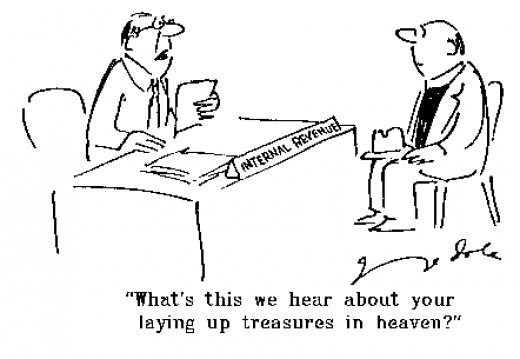
ARE THERE “EXTRA” REWARDS IN HEAVEN?

IRS Treasure in heaven

The concept of rewards in addition to simply being in heaven is one of the least-taught, least understood aspects of the New Testament. Too often we look at the subject as though in heaven we will still struggle with resentment, pride and envy.


To listen to the sermon, click the play button:

To download, right click on the link (or do whatever you do on a Mac) and save it to your computer: Download Matthew Part 57


Matthew #57 . Matthew 16:27-28

My wife recently told me that I’m still trying to pack too much into one sermon. So this time, I’ll attempt to cover only the next verse in Matthew:

For the Son of Man is going to come with His angels in the glory of His Father, and then He will reward each according to what he has done. (Matt 16:27 HCSB)

If we just stop and think about this for a moment, it could be problematic. I mean, I have always taught that we are judged based on our response to Jesus, not on the good works we have done (or failed to do). But here, it sounds like we will be rewarded based not on our faith in Jesus, but on our behavior. If we investigate, we find something puzzling: The New Testament appears to teach both things.

In his first letter to the Corinthians, Paul brings up the issue of rewards in heaven:

Now the one who plants and the one who waters are equal, and each will receive his own reward according to his own labor. (1 Cor 3:8-9)

According to God’s grace that was given to me, I have laid a foundation as a skilled master builder, and another builds on it. But each one must be careful how he builds on it. For no one can lay any other foundation than what has been laid down. That foundation is Jesus Christ. If anyone builds on that foundation with gold, silver, costly stones, wood, hay, or straw, each one’s work will become obvious, for the day will disclose it, because it will be revealed by fire; the fire will test the quality of each one’s work. If anyone’s work that he has built survives, he will receive a reward. If anyone’s work is burned up, it will be lost, but he will be saved; yet it will be like an escape through fire. (1Cor 3:10-15, HCSB)

This is one of the least understood and taught doctrines in the New Testament. Paul says the foundation is Jesus Christ. But then he talks about the quality of what we build on that foundation, and receiving rewards for what our work. But Paul makes sure we understand that it starts with the foundation of Jesus Christ; in fact, the foundation that was revealed by Peter’s confession. Let’s begin by making sure of it.

The Bible teaches in numerous places, over and over again, that we are saved only through God’s grace, which comes to us through a faith-based relationship with Jesus Christ.

Here are just a few of many, many, many verses that affirm we are not justified before God by what we do, but by God’s grace given to us when we trust Him. I’ll italicize a few parts for emphasis:

We too all previously lived among them in our fleshly desires, carrying out the inclinations of our flesh and thoughts, and we were by nature children under wrath as the others were also. But God, who is rich in mercy, because of His great love that He had for us, made us alive with the Messiah even though we were dead in trespasses. You are saved by grace! Together with Christ Jesus He also raised us up and seated us in the heavens, so that in the coming ages He might display the immeasurable riches of His grace through His kindness to us in Christ Jesus. For you are saved by grace through faith, and this is not from yourselves; it is God’s gift — not from works, so that no one can boast. (Eph 2:3-9, HCSB)

Where then is boasting? It is excluded. By what kind of law? By one of works? No, on the contrary, by a law of faith. For we conclude that a man is justified by faith apart from the works of the law. (Rom 3:27-28, HCSB)

He has saved us and called us with a holy calling, not according to our works, but according to His own purpose and grace, which was given to us in Christ Jesus before time began. This has now been made evident through the appearing of our Savior Christ Jesus, who has abolished death and has brought life and immortality to light through the gospel. (2Tim 1:9-10, HCSB)

He saved us — not by works of righteousness that we had done, but according to His mercy, through the washing of regeneration and renewal by the Holy Spirit. He poured out this Spirit on us abundantly through Jesus Christ our Savior, so that having been justified by His grace, we may become heirs with the hope of eternal life. (Titus 3:5-7, HCSB)

Yet we know that no one is justified by the works of the law but by faith in Jesus Christ. And we have believed in Christ Jesus, so that we might be justified by faith in Christ and not by the works of the law, because by the works of the law no human being will be justified. (Gal 2:16-17)

Clear enough for you? Over and over again, the New Testament teaches that we are saved when we trust Jesus Christ, and our own “good works” have nothing to do with it. So we know that our eternal destiny – whether we go to heaven or hell – is determined not by us being good enough, but by trusting Jesus. That is the foundation. Paul says, you can’t build on any other basis (1 Corinthians 3:11). If we have that foundation, we will spend eternity with Jesus and our loved ones in the New Heavens and New Earth. The whole Bible is crystal clear on that.

However, we do find many places in the New Testament, including several places in Matthew, which talk about rewards for doing good works. Now, we have just reiterated that heaven itself is not a reward for doing good. So when the New Testament talks about some kind of reward in the afterlife based upon what we do here, it cannot mean salvation. Well then, what kind of reward does Jesus mean here?

This is actually very important for how we interpret the Bible. When we read any other book, we assume that the author will not deliberately contradict herself. It should be the same with the Bible. So if the Bible says clearly (as it does) that salvation is not a reward for good behavior, but only the result of faith in Jesus; and then it says there is a reward for good works, we have to assume that the reward for good works is something other than salvation. As it turns out, there are many Bible verses that talk about these rewards. Just a few of them are Revelation 22:12; Matthew 5:11-2, 6:1-6, 17-18, 10:41-42; Luke 6:35; and this one:

7 Serve wholeheartedly, as if you were serving the Lord, not men, 8 because you know that the Lord will reward everyone for whatever good he does, whether he is slave or free. (Ephesians 6:7-8)

James writes that not many should presume to be Bible teachers, because they will be judged more strictly (James 3:1). Well, as a Bible teacher I know that my salvation will be judged based on whether or not I trust Jesus. So in what way will I be judged more strictly? The logical answer is: in the matter of my work, and any reward I might get for it.

Now, for many people, the idea of reward in heaven presents some problems. First, some people feel that it implies that there might be inequality in heaven. Second, some people feel it implies unhappiness there also.

Scripture is clear that in heaven, God wipes every tear from our eyes, and there will be no more grief or suffering or pain (Revelation 21:3-5). So rest assured, reward or not, your joy will be complete.

In addition, when we think this way, we forget that jealousy and resentment are the product of sin, the flesh and the devil. In eternity, all these things will be defeated and destroyed. We will be able to fully rejoice at the triumph of another, and bear in humble joy our own situation, unmarred by sin, bitterness, resentment or envy. Seeing someone else rewarded more than you will lead only to praise to God for his goodness, mercy and justice.

What Paul says in the Corinthians passage I quoted above is that those who have no reward will still be saved, but it will be like an escape through a fire. If we really imagine that, we get a sense for what it is like. Ultimately we will be safe, and will find joy in that. But as we initially enter heaven, if we have built poorly on the foundation of Jesus, we might find the judgment day to be harrowing.

Consider it this way: do you think it would be fair if Mother Theresa, with all her self-sacrifice, receives nothing more than me, with all my self-centeredness? We are both saved entirely by God’s grace. But shouldn’t she be rewarded somehow for the fact that in Jesus Christ, she used her life more faithfully than I used mine? Shouldn’t heaven celebrate and appreciate those who have done good things for the Lord on earth? Again, I think what we know of the kingdom of God is such that there will be no resentment involved.

Now, I want to speculate a bit on what the rewards mean. I do have some scripture that suggests what I think about this, but I can’t nail this down for sure. In other words, what I am going to share next falls more into the realm of conjecture than solid biblical teaching. In Matthew 25:14-30, Jesus tells the parable of the Talents. In it, three servants were given different resources to use on behalf of the Master. They were rewarded according to how they made use of those resources. The reward is that they were given additional resources to use, according the ability they had demonstrated.

This makes me think of rewards in heaven in terms of capacity. Picture two buckets. One bucket can hold one gallon of fresh, clear water. The other bucket can hold five gallons of beautiful clean water. Now imagine both buckets, filled to the brim. Which bucket has more water? Obviously, the one that can hold more. But they are both full. The one gallon bucket has as much water as it can possibly hold. It doesn’t have as much as the five gallon bucket, but then, it can’t. It is still completely full. I think maybe heaven will be like that. We will all be as full as we can be. But some people will be able to contain more of God’s fullness and joy than others. The ones with smaller capacity will still be completely full and satisfied – but the ones with greater capacity will experience their joy to level that the others can’t.

Here’s another way to look at it. In my left eye, my vision is about 20/100. It cannot be corrected, and so I am considered legally blind in that eye. Now, my right eye is basically fine, and it does most of the seeing work for me. I can drive, and watch movies, appreciate visual art and generally enjoy life. Where my half-blindness affects me most is in depth perception. I have a horrible time shooting a basketball. Things that are far away look equally distant from me. If I see man standing 100 yards away, and another man 200 yards away, the only way I can tell they are not next to each other is because one looks smaller than the other. I can get some experience of 3-D movies, but not the same as other people. Binoculars only work for me if I close my left eye. But I was born this way, I have never seen correctly out of my left eye, and so I’m perfectly happy with my vision: I don’t really know what I’m missing, except the basketball hoop. I don’t feel sorry for myself and I enjoy my vision fully, and I feel no lack. But if there was something I could do to get true binocular vision, I would be a fool not to do it. Though I enjoy the visual aspects of life as much as I can, wouldn’t it be great if I could somehow exercise my eyes to get full range of vision?

One more analogy. When I was younger, I could eat all day long, and it did not affect my weight, my health or even how I felt. Now that I am older, I can’t eat so much, and certainly, what I eat has greater consequences for my body. I even get full faster. Sometimes I find myself at an event a party where there are all kinds of delicious food. At such times, I wish I could eat like I did when I was younger. I could enjoy more of that delicious food, if my metabolism was still young. I have a close friend who has aged differently than me. He can’t eat like he’s twenty, but he can still eat more than I can, with fewer consequences. Sometimes I envy him. I wonder if I had made different choices, if I might still have been able to enjoy as much food as he does. Now, what if I had the chance to get that metabolism back, so I could enjoy delicious food all the time without feeling too full, gaining weight or negatively affecting my health? There’s a billion dollar industry trying to sell people exactly that: everyone wants that.

You can get that, in heaven. You’ll have all the delicious food you can handle. But maybe some people will be able to handle more. I think this is probably how rewards in heaven will work. Everyone will be happy. They will get as much joy as they can handle. But if they had made different choices while they were living on this earth, they might have been able to experience much more in heaven. C.S. Lewis explores some of these ideas a little bit in his excellent and entertaining book, The Great Divorce, which is all about Heaven (it has nothing to do with divorce; the title was not well chosen). He speculates that perhaps even after we get there, we can still increase our capacity to experience more joy and fullness.

I used to say that heaven itself was enough reward for me, and so it should be – it is, in fact, far more than I deserve. Even so, what a fool I would be to waste any opportunity to enjoy heaven to the fullest possible capacity! Think of it like this: Do you really want to make a deliberate choice to enter heaven by the skin of your teeth, with the minimum possible capacity to enjoy it? That is an attitude that comes not from the Spirit, but from the flesh. And it is ridiculous, when you think about it. It’s like a teenager saying, “I don’t care about my future after High School. As long as I’m alive and can work a minimum wage job, I’ll be fine. So right now I’m not going to study or learn or prepare for the future. What is important is not life after graduation, but only life right now.” Some people have that attitude, but it is a very short-sighted one, and most people who do take that approach end up regretting it within a few years.

Jesus’ words should encourage us to take a more spiritual approach to the future, and to the here and now. It should be helpful to know that we do or endure here and now does not go unnoticed. It should motivating to think of the joy that awaits all of us who trust Jesus.

Thanks again for making use of Clear Bible.

I want to remind you again that we are a listener-supported ministry, and that means, first and foremost, that we are supported by your prayers. We need and value your prayers for us.

Please pray that this ministry will continue to be a blessing to those who hear it. Ask God, if it is his will, to touch even more lives with these messages. Ask him to use this ministry in making disciples of Jesus Christ.

Please also pray for our finances. Pray for us to receive what we need. Please pray for us in this way before you give anything. And then, as you pray, if the Lord leads you to give us a gift, please go ahead and do that. But if he doesn’t want you to give to us, that is absolutely fine. We don’t want you to feel bad about it. We want you to follow Jesus in this matter. But do continue to pray for our finances.

If the Lord does lead you to give, just use the Paypal Donate button on the right hand side of the page. You don’t have to have a Paypal account – you can use a credit card, if you prefer. You can also set up a recurring donation through Paypal. We can make this tax-deductible if you just mention that it want it to be so in the “note” part of the transaction.

You could also send a check to:

New Joy Fellowship

917 Canyon Creek Drive

Lebanon, TN 37087

Just put “Clear Bible” in the memo. Your check will be tax-deductible.

Thank for your prayers, and your support!

DYING IN ORDER TO LIVE

follow Jesus to cross

The yoke and the burden of Christ are his cross. To go one’s way under the sign of the cross is not misery and desperation, but peace and refreshment for the soul, it is the highest joy. Then we do not walk under our self-made laws and burdens, but under the yoke of him who knows us and walks under the yoke with us. Under his yoke we are certain of his nearness and communion. It is he whom the disciple finds as he lifts up his cross. – Dietrich Bohnhoeffer


To listen to the sermon, click the play button:

To download, right click on the link (or do whatever you do on a Mac) and save it to your computer: Download Matthew Part 56


Matthew #56 . Matthew 16:20-27

Last time we began to talk about the call of Jesus to take up the cross and follow him. Let’s review his words:

Then he strictly charged the disciples to tell no one that he was the Christ.

From that time Jesus began to show his disciples that he must go to Jerusalem and suffer many things from the elders and chief priests and scribes, and be killed, and on the third day be raised.

And Peter took him aside and began to rebuke him, saying, “Far be it from you, Lord! This shall never happen to you.”

But he turned and said to Peter, “Get behind me, Satan! You are a hindrance to me. For you are not setting your mind on the things of God, but on the things of man.”

Then Jesus told his disciples, “If anyone would come after me, let him deny himself and take up his cross and follow me. For whoever would save his life will lose it, but whoever loses his life for my sake will find it. For what will it profit a man if he gains the whole world and forfeits his soul? Or what shall a man give in return for his soul?

For the Son of Man is going to come with his angels in the glory of his Father, and then he will repay each person according to what he has done.

Truly, I say to you, there are some standing here who will not taste death until they see the Son of Man coming in his kingdom.” (Matt 16:20-28, ESV2011)

I admit, I was deliberately vague about what exactly it means to “deny yourself, take up your cross, and follow Jesus.” Instead, last time we considered that this is indeed the call of Jesus, and in general it contradicts the values of the world around us. We also considered that the cross can bring us unexpected joy.

So this time I want to dwell on what, more specifically, is the call of the cross? What does it mean to follow Jesus by taking up our cross?

Before we do that, once again I want to thank you for listening, and remind you that we deeply appreciate your prayers for this ministry. I believe in the power of prayer, and I’m grateful for you asking our Father in heaven to use this ministry, to bless it, and to supply all our needs. I don’t want you think I’m requesting prayer as a covert way of asking for money. We really do value your prayers most of all. It is possible, of course, that as you pray, Lord leads you to give us some financial support. Obviously, if he does, please go ahead and do that. But if he doesn’t want you to give to us, that is absolutely fine. We don’t want you to feel bad about it. We want you to follow Jesus in this matter. But please do continue to pray for us, regardless.

If the Lord does lead you to give, just use the Paypal Donate button on the right hand side of the page. You don’t have to have a Paypal account – you can use a credit card, if you prefer. You can also set up a recurring donation through Paypal. We can make this tax-deductible if you just mention that it want it to be so in the “note” part of the transaction. You could also send a check to:

New Joy Fellowship

917 Canyon Creek Drive

Lebanon, TN 37087

Just put “Clear Bible” in the memo. Your check will be tax-deductible.

Thank for your prayers, and your support!

Now, back to the text. Let me start by clarifying what it does not mean. It is not ordinary human suffering. You may have heard the expression: “That’s just my own cross to bear.” That saying is almost always used wrongly, at least in the sense of what Jesus meant here. For instance, suppose someone with arthritis says, “This arthritis is my cross to bear.” That is not at all the kind of thing Jesus is talking about here. How do I know that Jesus didn’t mean things like arthritis? To put it bluntly, arthritis is painful and difficult, but is not a consequence of following Jesus. Jesus clearly tells us here that the cross is all about following him.

Not everyone has arthritis, but most people suffer in some way. This is true of people who follow Jesus and true of those who do not. Obviously, not all suffering is a consequence of being his disciple. Also it is important to realize Jesus doesn’t call us to have arthritis – sometimes things like that just happen because we live in a fallen world.

On the other hand, the cross is always about Jesus. So what does the call of the cross involve?

First, death to self. Jesus says we must deny ourselves and not seek to save our own lives, but lose our lives for his sake. This is not a call to suicide. But it is a call to make Jesus even more important than everything, including (perhaps especially) yourself. Ordinary flesh rebels at this thought. I mean, let’s be honest. For most us, the default “most important thing” is ourselves.

What could possibly motivate us to be willing to put the needs of someone else above our own? What could possibly induce us to be willing to even die for someone else? A few remarkable individuals might die for another for the sake of duty or honor. But I think for most of us the answer to those questions is: love. We can put the needs of another above our own needs as an act of love. We can die for another, say a spouse or child, motivated by love.

I think we need to understand the call of Jesus in this light. I think for most of us, the only way to do this is to love Jesus more than anything else.

Obviously, I am not talking about romantic/erotic love. I’m talking about making a choice and a commitment to value and honor Jesus above all else. The better we know him, the easier it is to do this. This is one reason it is so important for us to have regular habits of Bible reading, prayer, fellowship with other Christians, and regular, solid Bible teaching. These things help us to know Jesus better which help us also to love him better. They lay the only reasonable groundwork for being able to deny ourselves and follow him, even when it involves dying to our own desires, and perhaps even martyrdom. Matthew records that Jesus already said this once before:

Whoever loves father or mother more than me is not worthy of me, and whoever loves son or daughter more than me is not worthy of me. And whoever does not take his cross and follow me is not worthy of me. Whoever finds his life will lose it, and whoever loses his life for my sake will find it. (Matt 10:37-39, ESV2011)

To sum up this point: the cross means that I love Jesus so much that I am truly willing to give up anything for his sake. This isn’t about feeling guilty when we fail to do so, but we need to live with an ongoing recognition that the focal point of the universe is Jesus, not ourselves, and not anyone else.

Another aspect of “taking up your cross” is that it means accepting shame and rejection and even sometimes persecution. It involves following in the footsteps of Jesus, who was (and is still) rejected and scorned by many people.

“If the world hates you, understand that it hated Me before it hated you. If you were of the world, the world would love you as its own. However, because you are not of the world, but I have chosen you out of it, the world hates you. Remember the word I spoke to you: ‘A slave is not greater than his master.’ If they persecuted Me, they will also persecute you. If they kept My word, they will also keep yours. But they will do all these things to you on account of My name, because they don’t know the One who sent me. (John 15:18-21, HCSB)

This is part of the cross we take up to follow Jesus – that the people around will not understand, and in many cases will even hate us. I think sometimes it surprises us that Christians are considered by many to be hateful and bigoted. But if people slandered Jesus, why should we be surprised when we are slandered today?

For me, it has been a perplexing thing to have others who call themselves Christians speaking mockingly and hatefully about those of us who seem to be serious about following Jesus and believing the bible. However, it may be helpful for us to remember that those who first persecuted Jesus and his followers were religious people who claimed to be of the same faith as Jesus and the disciples. Saul (who later became Paul, the apostle) viciously persecuted the followers of Jesus in the name of God. I think today, more than ever for the past 500 years, we have a large number of people who are willing to call themselves Christian, but who also willfully ignore what the Bible teaches. It isn’t right, and it isn’t fair, but it is part of the cross of Jesus to be misunderstood, criticized, and ostracized even by others who claim to follow the same God.

Paul, who was both persecutor, and persecuted, notes this in many places. Here is a small sample:

For the message of the cross is foolishness to those who are perishing, but it is God’s power to us who are being saved. (1Cor 1:18, HCSB)

But if I, brothers, still preach circumcision, why am I still being persecuted? In that case the offense of the cross has been removed. (Gal 5:11, ESV2011)

But we preach Christ crucified, a stumbling block to the Jews and foolishness to the Gentiles. Yet to those who are called, both Jews and Greeks, Christ is God’s power and God’s wisdom, because God’s foolishness is wiser than human wisdom, and God’s weakness is stronger than human strength. (1Cor 1:23-25, HCSB)

The cross of Christ means, among other things, that we will be considered foolish, dangerous, evil and offensive. This is happening more and more even in historically Christian-friendly societies. However, we in the West have not even begun to suffer when you consider how Christians are persecuted in other places around the world. Many countries have laws limiting the expression of Christian faith. Others include laws that make Christians “second class citizens.” From North Africa, east to Indonesia and north to China, there are Christians being imprisoned, physically assaulted and even killed for following Jesus. As far as I know, since Jesus was crucified and for two-thousand years since, at least some of his followers have been persecuted in at least some places in the world. Jesus said to expect it. This part of what it means to take up our crosses.

Not everything about taking up the cross is hard and negative. One thing that it means is that we are dead to sin. That should be positive and encouraging for us.

Do you not know that all of us who have been baptized into Christ Jesus were baptized into his death? We were buried therefore with him by baptism into death, in order that, just as Christ was raised from the dead by the glory of the Father, we too might walk in newness of life. For if we have been united with him in a death like his, we shall certainly be united with him in a resurrection like his. We know that our old self was crucified with him in order that the body of sin might be brought to nothing, so that we would no longer be enslaved to sin. For one who has died has been set free from sin. Now if we have died with Christ, we believe that we will also live with him. (Rom 6:3-8, ESV2011)

Taking up our cross means that we recognize that in regard to sin, our flesh is as good as dead. The old sinner, Tom, has been killed with Jesus on the cross. I need to remember this, and trust that it is true, every day. I’m dead to sin. Sin has no relationship with a dead body, and sin has no relationship to me. Now, I am not claiming that I never commit sins, but the disease of sin has been killed in me, though some symptoms might linger. In the eyes of God, the sin problem is over. And so every day I need to take up my cross, and trust again that I am dead to sin, and live accordingly.

To sum it all up, when I take up my cross, I die to myself in order to live for Jesus. Paul says this so eloquently in Galatians 2:19-20

I have been crucified with Christ and I no longer live, but Christ lives in me. The life I now live in the body, I live by faith in the Son of God, who loved me and gave Himself for me. (Gal 2:19-20, HCSB)

I think it is important to understand that what many churches market as “Christianity” is really woefully lacking compared to what Jesus actually calls us to. Being a Christian is so much more than merely subscribing to a certain set of truths – though those truths are important. Instead, it is about selling out completely for Jesus Christ – loving Him with heart, mind, soul and strength, and dying to ourselves, dying to sin and being willing to undergo anything for His sake.

All this is not simply so that we can learn more about discipleship, instead, I want us to hear the invitation of the Lord here. All he needs from us is our willingness – he will take care of the rest. Martin Luther frames the call of Jesus to discipleship in this way:

Discipleship is not limited to what you can comprehend – it must transcend all comprehension. Plunge into the deep waters beyond your own comprehension, and I will help you to comprehend even as I do… You cannot find it yourself, so you must let me lead you as though you were blind men. Wherefore it is not you, no man, no living creature, but I myself, who instruct you by my Word and Spirit in the way you should go.

Now, I realize that all of this might sound a little bit “heavy.” But remember what we talked about last time: when we accept the cross we enter a life of joy. It is not the pleasure or comfort that the world seeks, but it is true joy. When we give up on ourselves, and accept the will of Jesus for our lives, we find a peace and grace and the joy that cannot be found any other way. Dietrich Bonhoeffer wrote about this in his excellent book, The Cost of Discipleship. But Bonhoeffer did not just write about it, he lived it. Ultimately, he gave his life for the sake of Jesus; he was executed in Nazi Germany because his Christian faith was a threat to Hitler’s regime. When he speaks of the cross, and the cost of discipleship, he has authority, because he lived it. So, I think we can trust him when he shares about the strange joy that comes through accepting the cross of Jesus.

But Jesus invites all who travail and are heavy laden to throw off their own yoke and take his yoke upon them – and his yoke is easy, and his burden is light. The yoke and the burden of Christ are his cross. To go one’s way under the sign of the cross is not misery and desperation, but peace and refreshment for the soul, it is the highest joy. Then we do not walk under our self-made laws and burdens, but under the yoke of him who knows us and walks under the yoke with us. Under his yoke we are certain of his nearness and communion. It is he whom the disciple finds as he lifts up his cross.

THE COST OF FOLLOWING JESUS

self grave

We are not necessarily called to an life of increasing comfort and ease. We are not called specifically to get more and more financially secure. We aren’t even directly called to success, or even excellence. What we are definitely called to is the cross. A faith that says: “Yes I believe, but not so much that I would give up my life for him,” is not a faith that truly grasps who Jesus is.


To listen to the sermon, click the play button:

To download, right click on the link (or do whatever you do on a Mac) and save it to your computer: Download Matthew Part 55


Matthew #55 . Matthew 16:20-27

I’m afraid that I’m going to have to take this section slowly also. Don’t blame me: blame Jesus, for saying such profound things. Let’s start with this:

And He gave the disciples orders to tell no one that He was the Messiah. (Matt 16:20, HCSB)

It is natural to read this, do a double take and then go “Say What?! Why wouldn’t he want people to know that he is the Messiah?” We have considered this briefly before, when Jesus told various people that he healed to keep silent about who healed them. In fact Jesus gives us a clue by what he says next:

From then on Jesus began to point out to His disciples that He must go to Jerusalem and suffer many things from the elders, chief priests, and scribes, be killed, and be raised the third day. (Matt 16:21, HCSB)

In fact, he says this partly as an explanation for why they should not tell people that he is the Messiah. As far as Jesus was concerned, there were three dangers with the disciples telling people he was the Messiah at this point. The first thing is that if enough people genuinely trusted him as Peter and the others did, no one would ever crucify him – and his crucifixion was a necessary part of his mission on earth. The other possibility is that his support among the people would grow so quickly that the authorities would have him killed before he was done training his apostles. Third, his work as the Messiah would not complete until the resurrection, the ascension and the coming of the Holy Spirit. His disciples simply would not grasp the whole message until all that had happened. They really were not supposed to start evangelizing until Pentecost.

Next comes Peter’s misplaced rebuke:

Then Peter took Him aside and began to rebuke Him, “Oh no, Lord! This will never happen to You! ”

But He turned and told Peter, “Get behind Me, Satan! You are an offense to Me because you’re not thinking about God’s concerns, but man’s.” (Matt 16:22-23, HCSB)

Remember how just a few minutes earlier, Jesus was giving Peter the keys the kingdom? Here we discover that those keys can’t lock something that the Lord has already decided be opened, or unlock what the Lord has decided to close. I think this little exchange is extremely relevant in our world today. The essence of it this: Peter, thinking he has the authority of God to do so, is trying to bypass the cross. He is trying to assert man’s perspective, completely missing, and even possibly trying to reject, God’s view.

This is one of the reasons I find the prosperity gospel, with all its emphasis on success, so offensive. What is even worse is that many churches who do not preach “prosperity” still often (perhaps unwittingly) pick up on the “success mentality.” Bigger is always assumed to be better. More people, more followers, more money is assumed to mean more kingdom impact. For far too many people, externally measurable success must mean God’s approval.

Perhaps they forget that greatest impact ever had on earth for the kingdom of God was made by a single person who died alone, rejected and abandoned. Perhaps they forget that the Holy Spirit spread the gospel in the early days of Christianity by dismantling the Jerusalem mega-church and scattering its members all over the place (really. Read Acts 8). Perhaps they forget that Abraham was a nomad with no permanent home, or that the anointed king, David, wandered for years like a criminal in the wilderness, or that Ezekiel, Jeremiah and Daniel were rejected and persecuted, and very few people listened to them. The writer of Hebrews reminds of others who

experienced mockings and scourgings, as well as bonds and imprisonment. They were stoned, they were sawed in two, they died by the sword, they wandered about in sheepskins, in goatskins, destitute, afflicted, and mistreated. The world was not worthy of them. They wandered in deserts and on mountains, hiding in caves and holes in the ground. (Heb 11:36-38, HCSB)

The world was not worthy of them. Too often, we want to be worthy of the world, instead of realizing that the rejection of the world often is a sign that we are on the right path. Peter wanted to do things the world’s way. “We’ve got the Messiah. Now it’s on to glory! Come on, Jesus, no more of this nonsense about dying and being rejected – you’re the Messiah.” In the language of many Christians today, it might be something like this: “Your words have power. Don’t speak the negative. Speak only the good, and it will come to pass. Stop speaking about death and pain. This will never happen to you. Claim the victory!”

We want to go straight to the glory, and skip the pain. That’s understandable; it’s human nature. Even Jesus himself was tempted in that way. But we forget something that Jesus said right here: that the true path to glory always leads through the cross:

Then Jesus said to His disciples, “If anyone wants to come with Me, he must deny himself, take up his cross, and follow Me. For whoever wants to save his life will lose it, but whoever loses his life because of Me will find it. What will it benefit a man if he gains the whole world yet loses his life? Or what will a man give in exchange for his life? (Matt 16:24-26, HCSB)

Jesus never promised to enrich us in this life. He never said that everything would work out the way we want it to. He never said “Speak what you want and it will come into being.” He never said, “make it your goal to have a big church.” Instead, what he said was, “You want to follow me? Then deny yourself, your wants, and be ready to die to everything except me. If necessary, be ready to even physically die for me.”

Now, I am not trying to eliminate any hope you have for a better life now. We can find great joy, satisfaction, peace, love, grace and fulfillment in following Jesus, even in this life. But to follow Jesus in the first place, we have to deny ourselves and take up our cross. Joy in this life starts when we give up on the world’s way of doing things, and quit wanting what the world says we should want. To put it plainly, to get the joy that Jesus offers, we need to accept the cross.

Let’s look at the apostle Paul for an example. He did not live a life free from all trouble or hardship. He did not accumulate wealth, or have a nice house, or a great means of transportation (or anything equivalent to a nice car). For Jesus’ sake, he was beaten, imprisoned, slandered, and mocked. Even some of the people that he taught did not really respect him. He wasn’t considered an impressive public speaker. He started a number of churches, yet all of them were pretty small while he was in charge. Some of them apparently did not remain very spiritually healthy. A few them apparently didn’t last. He even had chronic health issues that were never cleared up (as far as we know). There is very little about Paul’s life that is attractive to the world. There are even very few Christians (at least in America) who aspire to be like Paul in these ways.

And yet, Paul, through his writing, records what he considers a good life. He was engaged in interesting, challenging and fulfilling work. He got to travel extensively. He found joy in his calling, and even in his daily experiences. From the outside, Paul’s life looks pretty tough. But from the inside, from his own perspective, he lived in joy.

And in this I rejoice. Yes, and I will rejoice because I know this will lead to my deliverance through your prayers and help from the Spirit of Jesus Christ. My eager expectation and hope is that I will not be ashamed about anything, but that now as always, with all boldness, Christ will be highly honored in my body, whether by life or by death. For me, living is Christ and dying is gain. (Philippian 1:18-21)

Paul wrote this while in prison, while other people were trying to take away his influence in the church! Even in these circumstances, he had joy. I don’t think it was a shallow happiness – it was an abiding sense that the life and power of Jesus in him were greater than the worst that the world could throw at him.

He wrote to the Corinthians:

We are pressured in every way but not crushed; we are perplexed but not in despair; we are persecuted but not abandoned; we are struck down but not destroyed. We always carry the death of Jesus in our body, so that the life of Jesus may also be revealed in our body. (2Cor 4:8-10, HCSB)

He was not “living the dream life” at least, not as the world sees it, but he was living out the call of the cross: carrying the death of Jesus in his body so that the life of Jesus would also be revealed. He found great joy in living this way:

I have great confidence in you; I have great pride in you. I am filled with encouragement; I am overcome with joy in all our afflictions. (2Cor 7:4, HCSB)

The bible is very clear that we can have joy on the inside, regardless of what happens on the outside:

Consider it a great joy, my brothers, whenever you experience various trials, knowing that the testing of your faith produces endurance. But endurance must do its complete work, so that you may be mature and complete, lacking nothing. (Jas 1:2-4, HCSB)

Therefore, since we have been declared righteous by faith, we have peace with God through our Lord Jesus Christ. We have also obtained access through Him by faith into this grace in which we stand, and we rejoice in the hope of the glory of God. And not only that, but we also rejoice in our afflictions, because we know that affliction produces endurance, endurance produces proven character, and proven character produces hope. This hope will not disappoint us, because God’s love has been poured out in our hearts through the Holy Spirit who was given to us. (Rom 5:1-5, HCSB)

Paul answered Jesus’ call to take up his cross daily and follow. He did find hardship in doing so. But he also found hope, peace and joy, time after time:

Now may the God of hope fill you with all joy and peace as you believe in Him so that you may overflow with hope by the power of the Holy Spirit. (Rom 15:13, HCSB)

I wrote this very thing so that when I came I wouldn’t have pain from those who ought to give me joy, because I am confident about all of you that my joy will also be yours. (2Cor 2:3, HCSB)

I don’t say this out of need, for I have learned to be content in whatever circumstances I am. I know both how to have a little, and I know how to have a lot. In any and all circumstances I have learned the secret of being content — whether well fed or hungry, whether in abundance or in need. I am able to do all things through Him who strengthens me. Still, you did well by sharing with me in my hardship. (Phil 4:11-14, HCSB)

We are not necessarily called to an life of increasing comfort and ease. We are not called specifically to get more and more financially secure. We aren’t even directly called to success, or even excellence. What we are definitely called to is the cross. It is true, the Lord promises glory – but that comes later. Jesus’ own life demonstrates that:

Make your own attitude that of Christ Jesus, who, existing in the form of God, did not consider equality with God as something to be used for His own advantage. Instead He emptied Himself by assuming the form of a slave, taking on the likeness of men. And when He had come as a man in His external form, He humbled Himself by becoming obedient to the point of death — even to death on a cross. For this reason God highly exalted Him and gave Him the name that is above every name, so that at the name of Jesus every knee will bow — of those who are in heaven and on earth and under the earth — and every tongue should confess that Jesus Christ is Lord, to the glory of God the Father. (Phil 2:5-11, HCSB)

Yes, Jesus is now exalted, and he shall be even more exalted when every single soul confesses the truth of who he is, like Peter did. But before all that, he emptied himself in humility and obedience and suffered humiliation, rejection and death. We can’t skip the cross. The only path to glory is through it.

I want to take more time later and talk about specifically what it means to follow Jesus by taking up your cross. But for now, I think the first thing is to hear the call and respond to it. We need to understand that this foolishness in the eyes of the world. We need to give up our own ambitions and take Jesus on his terms, not our own.

It is a life involving sacrifice – what do “deny yourself” and “lose your own life” mean if not some sort of sacrifice? But Christians like Paul show us that when we take Jesus on his terms, when we give up our own, it is also a life of joy, wonder, fulfillment, peace and grace.

Too many Christians treat this as optional. We think, “I’ll agree that my sins need to be forgiven. I’ll gladly receive that forgiveness through Jesus. But this business about taking up my cross, denying myself, dying to self – that’s kind of extreme. That’s only for hard-core Christians.” And, God help us, too many of us pastors, fearing to lose church members, have let people continue to think this way. We’ve acted as if there is “Hard-core Christianity,” and “Christianity-lite.”

But listen again to Jesus:

Now great crowds were traveling with Him. So He turned and said to them: “If anyone comes to Me and does not hate his own father and mother, wife and children, brothers and sisters — yes, and even his own life — he cannot be My disciple. Whoever does not bear his own cross and come after Me cannot be My disciple. (Luke 14:25-27, HCSB)

Clear enough for you? There is no “Christianity-lite.” The call is let Him own your life.

You might say that this is the other side of the coin of belief. If we affirm Peter’s confession, with all that it means, then Jesus has the only claim on our ultimate allegiance. If we really believe Jesus is the Messiah, son of God, then we must believe that he has the right to ask everything of us; that nothing, not even our own desires, not even our own life on earth, should be more important to us than him. This is why there is no “Christianity-lite.” A faith that says: “Yes I believe, but not so much that I would give up my life for him,” is not a faith that truly grasps who Jesus is.

Imagine you are trapped in a burning building. Through the smoke and the flames a Firefighter emerges. He tells you that he has 15 years’ experience fighting fires; not only that, but the building you are in is owned by his Father and he knows it like the back of his hand. He says “Follow me, and I will lead you to safety. I may have to ask you to do some pretty scary things at certain points, and you’re going to have to trust me . But if you do what I say I promise you, you will be saved.”

So you follow the Firefighter as he leads you through smoky corridors and strange doorways. Suddenly you come to a place where the path in front of you is filled with flames and fallen debris. The Firefighter says, “the flames are not thick. Put this blanket over you, hold my hand, and I will take you through safely.” If you truly trust the Firefighter, you will do what he says.

But suppose, at this point, you balk and say, “No. I can’t do that, it’s too scary. I’m sure there must be some other way that you haven’t thought of.” The fact that you will not do what he asks reveals that, actually, you do not really believe that he knows the best way to save you. You can say that you believe he is a Firefighter with a lot of experience. You can say that you believe this is his Father’s building and he knows his way around. But if you won’t listen to him when things get tough, it shows that you only trust him as long as there is no risk involved. In fact, you don’t really believe what he has told you.

If Jesus is who he says he is, then he has the right to tell us to follow him through the cross. If he truly is “Messiah, son of God,” with all that it means (which we have studied these last few weeks) then when he says “take up your cross,” we can trust him. Believing that Jesus is Messiah, son of God means trusting him as calls us to the cross. They are one and the same thing. If he has the authority to call us to deny ourselves and even to die for him, then he must be the Messiah, the son of God. If he does not have the authority to do that, then he is not the Messiah, the son of God. The way we respond to this call of the cross reveals what we truly believe.

John records that many people, when confronted with these things, quit following Jesus:

After this many of his disciples turned back and no longer walked with him. So Jesus said to the Twelve, “Do you want to go away as well?” Simon Peter answered him, “Lord, to whom shall we go? You have the words of eternal life, and we have believed, and have come to know, that you are the Holy One of God.” (John 6:66-69, ESV2011)

Peter’s words here, as before, are words of faith. He truly believes that Jesus is the Messiah, the son of God, so what alternative does he have, but to follow him? There is no halfway-Christianity.

Now obviously, we struggle. There are days I whine and complain about having to deny myself. There are days I don’t deny myself. But I don’t think Jesus expects us to follow him perfectly. He knows that our minds and hearts are clouded by our battle with our own flesh, influenced by the sinful world and confused by the devil. What he wants is for us to be on the road of following him and not our own road. I am not just going along with him until his way diverges from what I want. I’m not walking with him only as long as the two of us are going the same direction. However imperfect and weak I am, I am his. I may fall down on the road while following him, I may sometimes have to stop and gather my courage, but I am not on some other road. I think that’s what he’s after.

Next time we will consider more thoroughly what it means to take up our crosses. But we don’t need to know any more than we do at the moment to say “yes” to Jesus.

Why don’t you ask the Holy Spirit right now to give you the strength to do that?

Thanks again for making use of Clear Bible.

I want to remind you again that we are a listener-supported ministry, and that means, first and foremost, that we are supported by your prayers. We need and value your prayers for us.

Please pray that this ministry will continue to be a blessing to those who hear it. Ask God, if it is his will, to touch even more lives with these messages. Ask him to use this ministry in making disciples of Jesus Christ.

Please also pray for our finances. Pray for us to receive what we need. Please pray for us in this way before you give anything. And then, as you pray, if the Lord leads you to give us a gift, please go ahead and do that. But if he doesn’t want you to give to us, that is absolutely fine. We don’t want you to feel bad about it. We want you to follow Jesus in this matter. But do continue to pray for our finances.

If you feel led to give, click on the “donate” tab above for more information about how.

THE KEYS TO THE KINGDOM

keys

A man was meant to be doubtful about himself, but undoubting about the truth; this has been exactly reversed. Nowadays the part of a man that a man does assert is exactly the part he ought not to assert–himself. The part he doubts is exactly the part he ought not to doubt–the Divine Reason. – GK Chesterton


To listen to the sermon, click the play button:

To download, right click on the link (or do whatever you do on a Mac) and save it to your computer: Download Matthew Part 54


Matthew #54 . Matthew 16:13-20 Part C

Jesus says something in these verses that a lot of people wish he had explained a bit more:

“And I tell you, you are Peter, and on this rock I will build my church, and the gates of hell shall not prevail against it. I will give you the keys of the kingdom of heaven, and whatever you bind on earth shall be bound in heaven, and whatever you loose on earth shall be loosed in heaven.”

Many hundreds of years later, after Christianity had become legal and the church had changed from local gatherings of Jesus-followers into a centralized, power-holding institution, these verses were used to justify the position of Pope in the Roman Catholic church. The theory goes that here, Jesus is establishing the office of “Pope,” his chief representative on earth, and installs Peter as the first one. The idea is that this passage teaches that Jesus invests Peter (and his successors) with the “keys of the kingdom.” By the way, this is where we get the popular image of Saint Peter greeting people in front of the “pearly gates;” it is because Peter supposedly has the keys.

Now, I want to point out that a lot of “interpretation” must go into it to make this passage establish the Roman Catholic Papacy. In other words, it doesn’t call Peter the “Pope” or explicitly establish the institution of the Papacy in plain, unequivocal language. I am not saying this to make Roman Catholics angry. The reason I point it out is to show, once again, that clearly, the New Testament we have today is the very same one that was written by the apostles who knew Jesus Christ personally. It was not tampered with by generations who came after the apostles. Certainly, the Roman Catholic church, if it had changed or edited the bible, would have made this passage much more clearly about the Papacy.

Though I do not agree with the Roman Catholic application of this passage, it is not my intention here to attack the Papacy. I think we have more useful things to do with this passage. So may I simply suggest some other ways to understand this passage, and apply them to our lives?

First, it is somewhat interesting to know that in Greek, Jesus is making a play on words. Let me give it to you somewhat literally with the Greek words, and then I’ll explain.

“And I say to you that you are Petros and upon this petra I will build of me the church.”

The Greek word that we translate “Peter” is “petros,” and it means rock. It is the special name that Jesus gave Jesus (prior to this point, we should remember). The second word Jesus uses is petra, which means, more or less, “rock formation.” It is not the same word as the name “Peter,” and it cannot be an affectionate nickname for him, because it is in the feminine gender.

So it seems very doubtful that it is Peter personally upon whom Jesus says he will build his church. I think it is far more likely that Jesus says “upon this rock I will build my church” because he is making a play on words. Bible commentator Matthew Henry reminds us that we don’t get to see expressions and body language in the bible. He writes:

Others, by this rock, understand Christ; “Thou art Peter, thou hast the name of a stone, but upon this rock, pointing to himself, I will build my church.” Perhaps he laid his hand on his breast, as when he said, Destroy this temple (John ii. 19), when he spoke of the temple of his body.

In other words, Jesus could have pointed to himself when he said “upon this rock.” Another possibility is that Jesus meant that he would build the church on the foundation of what Peter has just said, his confession that Jesus is Messiah and son of God, with all that means. I personally favor this interpretation, because, in fact, that is what has happened. The one thing that unifies true Christians all over the world is that Jesus Christ is the Messiah, true God, true man, who died to cleanse us from sin and rose to show his power and give us new life. That is, and always has been, the foundation of the Church (and by “the church” I do not mean any particular institution, but rather, the true spiritual fellowship of those who trust Jesus Christ, no matter where they “attend church”). I am not arguing against the Papacy (though given enough provocation, I would). I am insisting however, that the foundation of the true church is not the apostle Peter, nor the Papacy, but the true confession that Jesus is Messiah and Lord. That has always been true, and I think even most Roman Catholics would agree that without this foundational belief, the Papacy itself would be meaningless.

I want to highlight another thing here. Jesus says, “I will build my church, and the gates of hell will not prevail against it.” Virtually every time the New Testament uses the word “church” it is a Greek word, simply meaning, “the gathering of people with a common purpose .” (Greek: ekklesia; you may recognize that the English word, ecclesiastic comes from this term). In context, of course, it means “the gathering of people who have faith in Jesus.” At its most essential level, that is what a church is – a group of people who are connected to one another and gather together intentionally, and who have faith in Jesus. So the church that Jesus will build refers to the true spiritual fellowship that includes all who trust and obey Him as Lord and Messiah. We aren’t talking about a particular institution, denomination or congregation.

I love that Jesus promises He will build it. It reminds me a little of Psalm 127:1

Unless the LORD builds a house, its builders labor over it in vain; unless the LORD watches over a city, the watchman stays alert in vain. (Ps 127:1, HCSB)

Sometimes we get caught up in the future of the church on earth. Sometimes we are concerned about local congregations; at other times we worry about the whole thing. Jesus is the builder of the church. We can trust him to do it. And the gates of hell can’t withstand the onslaught of grace and truth that comes from those who trust and obey Jesus. This picture not one of the church defending itself while hell attacks – it is the reverse. The idea is that church will attack hell itself, and overcome it through the power of Jesus.

Now, Jesus says some other things also. He adds: “I will give you the keys of the kingdom of heaven, and whatever you bind on earth shall be bound in heaven, and whatever you loose on earth shall be loosed in heaven.” I need to teach with integrity here. In Greek, “you” is singular. In other words, Jesus directed these comments specifically to Peter, not to all the disciples. However, this is not a problem for me, nor should it be for you. God directed many promises specifically to Abraham. He made the first promise of the Messiah specifically to Eve. He made many promises directly and personally to David. This is how the Lord works throughout scriptures: He speaks to specific people at specific times and places, and yet his promises also encompass all come after, those who believe. The individuals who first received them stood as representatives of those who would come after, and believe what God had said.

So Paul writes, for example:

Just as Abraham believed God, and it was credited to him for righteousness, then understand that those who have faith are Abraham’s sons. Now the Scripture saw in advance that God would justify the Gentiles by faith and told the good news ahead of time to Abraham, saying, All the nations will be blessed through you. So those who have faith are blessed with Abraham, who had faith. (Gal 3:6-9, HCSB)

Matthew Henry writes of our verses in Matthew 16:

The Old Testament promises relating to the church were given immediately to particular persons, eminent for faith and holiness, as to Abraham and David; which yet gave no supremacy to them, much less to any of their successors; so the New-Testament charter is here delivered to Peter as an agent, but to the use and behoof of the church in all ages, according to the purposes therein specified and contained.

The gift and promise here is for every believer in Jesus Christ, Son of God. Paul says, if we have the faith of Abraham, we also have the promises that were given to him. I add, if we have the faith that Peter had, we also have the promises given to him. So, yes, these words (in Matthew 16) were spoken directly and specifically to Peter. However, Jesus says almost exactly the same thing a little while later, when he is teaching about how to deal with his followers who are struggling with sin:

I assure you: Whatever you bind on earth is already bound in heaven, and whatever you loose on earth is already loosed in heaven. (Matt 18:18, HCSB)

The second time Jesus says it (in 18:18) the Greek “you” is plural – in other words, the next time Jesus says this, he makes it clear that he is talking to all of his disciples. John records Jesus saying something similar. John’s Greek is pretty rudimentary (though better than mine) but he makes it clear that Jesus is talking to all the disciples when he says:

Jesus said to them again, “Peace to you! As the Father has sent Me, I also send you.” After saying this, He breathed on them and said, “Receive the Holy Spirit. If you forgive the sins of any, they are forgiven them; if you retain the sins of any, they are retained.” (John 20:21-23, HCSB)

So, what is this business of binding loosing that Jesus promises to Peter, the disciples and, through them, to us? To understand it, we need one more brief note about the Greek. The HCSB is the best English translation of these verses that I have found, and I have used it in this message. However, I’d like to give you the most literal rendering I can:

Whatever you might bind on earth, it shall have already been bound in heaven; whatever you might loosen on earth, it shall have already been loosened in heaven.

The point is this. It is not about us, or even Peter, telling heaven what to do. It is Peter (and us) expressing on earth what has already been decided in heaven. By the way, this is confirmed by Peter’s screw-up just a few verses later. Jesus says he has to go to Jerusalem and die. Peter, probably flush with these words of Jesus, tries to “bind” the upcoming death of Jesus.

Then Peter took Him aside and began to rebuke Him, “Oh no, Lord! This will never happen to You! ”

But He turned and told Peter, “Get behind Me, Satan! You are an offense to Me because you’re not thinking about God’s concerns, but man’s.” (Matt 16:22-23, HCSB)

To put it mildly, Peter’s “binding” of something contrary to God’s will did not work out very well. We can see from this incident that Jesus did not give Peter a blank check. Just because Peter wanted it or said it did not mean it was God’s will. Jesus tells him “you are not thinking about God’s concerns, but man’s.” In that case, Peter has no authority to bind or loosen anything. Nor, thankfully, does anyone else. So this authority to bind or loose is simply the authority for a human being to express the will of Heaven on earth. To the extent that we express what has already been bound or loosed in heaven, we have authority. To the extent we do not, we have no authority. Whatever we “bind” isn’t actually bound unless it is also heaven’s will. But if it is, according to the scripture, according to God’s will, we puny humans have the authority to declare it done.

Jesus is saying that he will use human instruments to do his will and work in the world. When a Christian declares the good news, it is as if Jesus himself is speaking. When a Christian preaches the law, it is as if Jesus himself is speaking.

In a way this goes beyond our typical approach of “in my humble opinion.” No, if it has already been done in heaven, then it is not just my humble opinion. My words spoken in heaven’s authority do have heaven’s authority. GK Chesterton wrote:

What we suffer from to-day is humility in the wrong place. Modesty has moved from the organ of ambition. Modesty has settled upon the organ of conviction; where it was never meant to be. A man was meant to be doubtful about himself, but undoubting about the truth; this has been exactly reversed. Nowadays the part of a man that a man does assert is exactly the part he ought not to assert–himself. The part he doubts is exactly the part he ought not to doubt–the Divine Reason.

Saying “that’s just my opinion” makes you the important part of the equation: It’s your opinion. It asserts you, not the truth you are declaring. Instead, we might say, “I know I personally am nothing, but this is what the Bible says…” My opinion is not worth sharing. But the Truth? I don’t need to be reticent about that, because it is not my personal property.

All of this leads to a natural question: How do we know that what we are doing has already been done in heaven?

Jesus has already given us some clues. Remember how he taught the disciples (and us) to pray? “Your will be done, your kingdom come, on earth as it is heaven.” When we pray this way, the Lord often answers by helping us to get in step with his will and his kingdom. So, to “bind” or “loosen” correctly, we should learn to pray for the kingdom and will of heaven in our lives, and on earth.

Second, Jesus says all this to Peter after Peter’s confession that Jesus is the Messiah, the Son of the Living God, with all that means. We must make sure that what we “bind” or “loosen” is consistent with this confession, with who Jesus truly is.

Let me give you an example of “binding” and one of “loosening.”

Many years ago, a married man who professed to be a Christian began having an affair. When he was found out, he did not respond with repentance or sorrow for his sin. Instead, he tried to justify the affair. He invited the other woman to live with he and his wife, and told me that he wasn’t having an affair at all, he had just married a second wife, like Jacob or David. His wife, who had major self-esteem struggles at that point, went along with it, but it was a terrible, awful experience for her.

Finally, I had a very difficult conversation with him. I know what the Bible says about marriage and sex. I know what it says about sin generally, and repentance, and persisting in sin. I said to him, “You are trying to justify this, but I am here, in front of you, meeting your eyes, speaking with my voice and I am telling you, with the authority of Jesus, that you are living in sin. No one is perfect, and the Lord forgives all who repent, but you have not repented; instead, you keep on in a lifestyle of sin, claiming there is nothing wrong with it. The longer you wait to repent, the worse it will be for you. If you continue to refuse to repent, eventually your choice to hold on to sin will take you so far from God that you will be destroyed. You can’t get there by accident. You know what you are doing. Just in case you wonder, I am telling you, I am warning you, this sin will destroy you if you don’t repent.”

I grieve to tell you that this man never did repent. He was a good friend, and I cared about him deeply. He held on to his sin. He was thirty-five at the time this began, and though he smoked, and drank too much, he was in pretty good health. Quickly after this, however, his health failed, and he died within ten years.

I was “binding” his sins. In other words, I was communicating the biblical truth that if we do not repent, if we persist in an ongoing lifestyle of sin when we know better, if we refuse to even admit we are sinning, we are actually refusing the forgiveness that Jesus offers us. This is neither more nor less than what the bible says about it. I wasn’t “acting on my own authority.” I was saying what the bible says. Sometimes, hopefully not very often, we need somebody to confront us with physical presence (I do not mean violence I just mean simply being there) and a physical voice and say “knock it off! You are doing wrong and it needs to stop.” Sometimes we need somebody in front of us who can point out our self-deception and tear apart our self-serving justifications. Actually, this need is well known in secular addiction treatment, and it is called an “intervention.”

This “binding,” though necessary, is often a very difficult thing. But when you think about it, it is actually just one more way in which God can show grace to sinners. This man knew what the Bible said about sex and marriage. He knew when he started the affair that he was wrong. But through a fellow believer (in this case it was me) God was giving him yet one more chance. The Lord had every right to hold him accountable for what he knew, and yet God sent me to plead with him one more time. Far from being judgmental, this was the Lord doing all that he could to try and bring this man to repentance.

Now let me give you a happier example. Around that same time, a different young man came to me. He confessed that he was addicted to pornography. He was attending a local seminary to become a pastor, and he was sure that his sin had disqualified him from ministry; he wasn’t even sure, deep in his heart, that he was forgiven. The main difference between this guy and the first man was that this second young man was deeply broken up about his sin. He did not try to justify it. He did not want to do it any longer. He knew the bible pretty well, and so I reminded him of these verses, and then said, “OK, now look me in the eye. You can see my face, you can hear my voice. Jesus is speaking to you right now just as surely as I am. And what he says, and what I say, is that you are entirely forgiven. There is no condemnation for those who are in Christ Jesus (Romans 8;1). You have been made clean by the word that is spoken to you (John 15). If you are in Christ, you are a new creation; the old has passed away, the new has come (2 Corinthians 5;17). Your sin was absolutely destroyed on the cross. Your real life is in heaven with God (Colossians 3), your spirit is seated with Christ in heavenly places (Ephesians 1). You are dead to sin, yes really (Col 3, Romans 6). You – are – forgiven.”

Now, obviously I was quoting various Scriptures: either verbatim or repeating the gist of it. This young man could have looked in his Bible and found the same verses and read them for himself. But there is something powerful and gracious about hearing somebody else directly tell you what the Lord says in the Bible. It is vital for us to interact with the Lord alone. But it is also vital for us to be connected to each other and to sometimes hear another person declare the truth of Scripture to you.

Some of us are very suspicious of our own motives, and so we don’t easily let our own selves off the hook. For people like that, it can be a wonderful, grace-filled experience to have someone else look you in the eye and say “You are forgiven. You truly are.” This is the gift that Jesus gives Peter, and to the whole church: that we can hear flesh and blood speak the truth to us. Jesus is saying, “I am giving you authority to speak my words to each other, so that you don’t have to wonder if it is real or not; you don’t have to question your own motives.”

So when Kathy says, “I am telling you what you are doing is a sin,” you know that you need to knock it off. And when Tom says to you, “you are forgiven,” you really are forgiven.

Let the Lord speak to you today.


Thanks again for making use of Clear Bible.

I want to remind you again that we are a listener-supported ministry, and that means, first and foremost, that we are supported by your prayers. We need and value your prayers for us.

Please pray that this ministry will continue to be a blessing to those who hear it. Ask God, if it is his will, to touch even more lives with these messages. Ask him to use this ministry in making disciples of Jesus Christ.

Please also pray for our finances. Pray for us to receive what we need. Please pray for us in this way before you give anything. And then, as you pray, if the Lord leads you to give us a gift, please go ahead and do that. But if he doesn’t want you to give to us, that is absolutely fine. We don’t want you to feel bad about it. We want you to follow Jesus in this matter. But do continue to pray for our finances.

If the Lord does lead you to give, just use the Paypal Donate button on the right hand side of the page. You don’t have to have a Paypal account – you can use a credit card, if you prefer. You can also set up a recurring donation through Paypal. We can make this tax-deductible if you just mention that it want it to be so in the “note” part of the transaction.

You could also send a check to:

New Joy Fellowship

917 Canyon Creek Drive

Lebanon, TN 37087

Just put “Clear Bible” in the memo. Your check will be tax-deductible.

Thank for your prayers, and your support!

THE BLESSING OF FAITH

BLESSING OF FAITH

All of this should be cause for great comfort for us – our very belief is evidence of God’s work in us. If you, like Peter, believe that Jesus is the Messiah, the Son of the Living God, you are blessed! It means that God himself is at work in your heart. It means that our trials and grief and suffering in this life are not the full story.


To listen to the sermon, click the play button:

To download, right click on the link (or do whatever you do on a Mac) and save it to your computer: Download Matthew Part 53


Matthew #53 . Matthew 16:13-20 (Part B)

Bible passages like the one we have been studying these past few weeks strike me as extremely important. As I have been working on these past few messages, I have found myself hoping and praying that more and more people can hear them.

That is one reason I deeply appreciate your partnership in prayer. It is a great joy to me to know that some of you are praying along with us that the Lord uses this ministry to get his message out to the world. We aren’t the only ministry preaching God’s word, not by a long shot; but I truly believe that we do have responsibility for one small part of what God wants to do in the world during our lifetimes. Please pray that his purposes are fulfilled in and through Clear Bible. Please pray for protection and provision for me and my family.

Another thing I’d like prayer for is the idea of getting more “space” on the internet to archive more sermons. The hosting for our sermons is relatively inexpensive, but it is also limited. I recently had to delete about a hundred old sermons in order to make room for new ones. The great thing about the internet is that someone could come along and benefit from this sermon years from now. But to make that possible, we’re going to have change some things. Pray for guidance in this process, and technical help.

We value your prayer partnership above all. We do also welcome your financial partnership, if the Lord leads you to give. Please don’t feel guilty or bad if he does not. If the Lord does lead you to give financially, you can, just use the Paypal Donate button on the right hand side of the page. You don’t have to have a Paypal account – you can use a credit card, if you prefer. You can also set up a recurring donation through Paypal. We can make this tax-deductible if you just mention that it want it to be so in the “note” part of the transaction.

You could also send a check to:

New Joy Fellowship

917 Canyon Creek Drive

Lebanon, TN 37087

Just put “Clear Bible” in the memo. Your check will be tax-deductible.

Thank for your prayers, and your support!

~

Last time we considered the substance of Peter’s statement that Jesus is the Christ (Messiah), Son of the Living God. Theologians sometimes call a statement like this a “confession.” Many people think “confessing” is the same as “admitting,” but there are subtle and important differences. To confess in a biblical sense means “to say with,” or “to agree with the truth.” So, when we confess our sins, we are agreeing with the truth that the Bible teaches about those actions: namely, that they are wrong (they are sins) and also that we have done them. You see, it isn’t just admitting that we sin, it is agreeing with what the bible says about it. Confession can also be positive. You may have been in a church service where everyone said the Apostles’ Creed together. The pastor probably said something like: “Let us confess our faith together in the words of the Apostles’ Creed.” We are agreeing with the truth – thus, confessing. So Peter is agreeing with something that was already true – the identity of Jesus.

Now Jesus tells us several very important things about this confession:

He says, “Blessed are you, Simon Bar-Jonah! (literally, “Simon, son of Jonah”). This confession blesses those who make it. Actually, it is hard to overstate how much blessing comes from truly believing and confessing that Jesus is the Messiah, the Son of the Living God. To agree with this truth, to submit to the implications of it – that is, to personally submit to Jesus Christ and put your trust in Him – this is the only path to Life, according to the Bible. Jesus says elsewhere:

“I am the way, the truth, and the life. No one comes to the Father except through Me. (John 14:6, HCSB)

John writes:

The one who believes in the Son of God has this testimony within him. The one who does not believe God has made Him a liar, because he has not believed in the testimony God has given about His Son. And this is the testimony: God has given us eternal life, and this life is in His Son. The one who has the Son has life. The one who doesn’t have the Son of God does not have life. I have written these things to you who believe in the name of the Son of God, so that you may know that you have eternal life. (1John 5:10-13, HCSB)

That Life starts now. Even now, before we die, through Jesus we can find increasing wholeness in our spirits and souls. Even now, we can begin to experience love, joy, peace, patience, kindness, gentleness, goodness faithfulness and self-control in increasing measures.

But of course, it doesn’t stop when we die. The bible is pretty clear that we can’t even begin to grasp the wonder and joy and hope of the life to come, but it gives us some very exciting hints. I think this is one of the great biblical truths, one of the great Christian hopes. Our trials and grief and suffering in this life are not the full story. The Life after death – promised in Jesus alone – gives meaning and hope and joy to all things now, even the ones that seem to defy explanation. 1 Corinthians says:

What eye did not see and ear did not hear, and what never entered the human mind — God prepared this for those who love Him. (1Cor 2:9, HCSB)

Life begins now, but it continues on into eternity in a way that has “never entered the human mind.” If this is not so, says Paul:

If we have put our hope in Christ for this life only, we should be pitied more than anyone. (1Cor 15:19, HCSB)

Our hope is much, much greater than simply a good life for 100 years on earth. This life we have in Jesus makes sense of things that are otherwise terrible tragedies.

For I consider that the sufferings of this present time are not worth comparing with the glory that is going to be revealed to us. (Rom 8:18, HCSB)

Now in this hope we were saved, yet hope that is seen is not hope, because who hopes for what he sees? But if we hope for what we do not see, we eagerly wait for it with patience. (Rom 8:24-25, HCSB)

We know that all things work together for the good of those who love God: those who are called according to His purpose. (Rom 8:28, HCSB)

All of this begins with truly confessing, along with Peter, that Jesus is the Messiah, the Son of the Living God. Those who confess it are blessed.

There is another thing. Jesus tells Peter he is blessed because “flesh and blood” did not reveal it to Peter, but rather the Father in Heaven. The only reason Peter is able to really trust and obey Jesus as Messiah and Lord, is because the Father has enabled him to do so. Paul put it like this:

Now concerning what comes from the Spirit: brothers, I do not want you to be unaware. You know that when you were pagans, you used to be led off to the idols that could not speak. Therefore I am informing you that no one speaking by the Spirit of God says, “Jesus is cursed,” and no one can say, “Jesus is Lord,” except by the Holy Spirit. (1Cor 12:1-3, HCSB)

Obviously, anyone can pronounce the words “Jesus is Lord.” But what Paul means is that no can say it and truly believe it unless God has enabled him or her to do so. I think this is exactly what Jesus is saying to Peter. If you truly believe Jesus is Lord and Messiah, it is because God has done something in your heart. This is true of all believers. To make Peter’s confession (and believe it) is a sign that God is at work in us, and we are saved. There are many places in the bible that demonstrate that faith in Jesus as the Messiah comes about as a gift from God. I will italicize the relevant parts in the following verses:

Now God has revealed these things to us by the Spirit, for the Spirit searches everything, even the depths of God. For who among men knows the thoughts of a man except the spirit of the man that is in him? In the same way, no one knows the thoughts of God except the Spirit of God. Now we have not received the spirit of the world, but the Spirit who comes from God, so that we may understand what has been freely given to us by God.  (1Cor 2:10-12, HCSB)

This is a reiteration of what Jesus said to Peter. This confession is given to us through the Holy Spirit.

For you are saved by grace through faith, and this is not from yourselves; it is God’s gift — not from works, so that no one can boast. For we are His creation, created in Christ Jesus for good works, which God prepared ahead of time so that we should walk in them. (Eph 2:8-10, HCSB)

This is very clear – even our faith is “not from ourselves, it is God’s gift.”

[Jesus said]: “No one can come to Me unless the Father who sent Me draws him, and I will raise him up on the last day.” (John 6:44, HCSB)

It’s hard to be clearer than that. If we come to Jesus, it is because the Father has drawn us.

He made known to us the mystery of His will, according to His good pleasure that He planned in Him for the administration of the days of fulfillment — to bring everything together in the Messiah, both things in heaven and things on earth in Him. (Eph 1:9-10, HCSB)

The mystery of the Messiah was made known to us by God, just as it was to Peter.

For it has been given to you on Christ’s behalf not only to believe in Him, but also to suffer for Him, (Phil 1:29, HCSB)

To believe in the Messiah was “given to us.”

For it is God who is working in you, enabling you both to desire and to work out His good purpose. (Phil 2:13, HCSB)

God is the one working in us for His good purpose.

I give thanks to my God for every remembrance of you, always praying with joy for all of you in my every prayer, because of your partnership in the gospel from the first day until now. I am sure of this, that He who started a good work in you will carry it on to completion until the day of Christ Jesus. (Phil 1:3-6, HCSB)

The “good work” is salvation – and it was started in us by God Himself, and will be carried to completion by Him.

All of this should be cause for great comfort for those of us who believe – our very belief is evidence of God’s work in us. If you, like Peter, believe that Jesus is the Messiah, the Son of the Living God, you are blessed! It means, among many wonderful things, that God himself is at work in your heart.

But what about those who do not believe? Does this mean God isn’t at work in them, or doesn’t care about them? Not at all. The verses I have already shared make it clear that even faith is a gift from God. But, because God wants love to be real, the choice to receive God must also be real. Scripture shows that though we don’t create our own faith, or accomplish our own salvation, human beings can refuse and reject the gift that the Lord offers. I’ll share some more verses, again marking important parts with italics. Jesus says, later in Matthew:

“Jerusalem, Jerusalem! She who kills the prophets and stones those who are sent to her. How often I wanted to gather your children together, as a hen gathers her chicks under her wings, yet you were not willing! (Matt 23:37, HCSB)

For thus said the Lord GOD, the Holy One of Israel, “In returning and rest you shall be saved; in quietness and in trust shall be your strength.” But you were unwilling, and you said, “No! We will flee upon horses”; therefore you shall flee away; and, “We will ride upon swift steeds”; therefore your pursuers shall be swift. (Isa 30:15-16, ESV2011)

The Lord’s desire is always for all of us to receive the gift of grace through faith when he offers us. But some people are not willing. Some people say “No.” The negative result is their own responsibility, not the Lord’s fault.

Woe to them, for they fled from Me; destruction to them, for they rebelled against Me! Though I want to redeem them, they speak lies against Me. (Hos 7:13, HCSB)

“You stiff-necked people with uncircumcised hearts and ears! You are always resisting the Holy Spirit; as your ancestors did, so do you. (Acts 7:51, HCSB)

God does enables us to receive his grace through faith, but he does not force us to do so. Also, the fact that someone has so far resisted God’s grace does not mean he or she always will. The apostle Paul violently rejected Jesus for a number of years; but finally he repented and did receive grace and salvation through the Messiah.

Now, I want to make something clear. Jesus’ words to Peter are also words to us. We don’t need to go around wondering if we have rejected God or not. Although we are called to continue trusting and obeying Jesus, we don’t need to do it perfectly, and we don’t need to fear that we will somehow accidentally reject him in the future. As we trusted him to save us, we can trust him to continue to keep us. Your very faith is evidence that God has got you. You don’t have to worry.

Let’s close by meditating on one of my favorite passages of scripture:

What then are we to say about these things? If God is for us, who is against us? He did not even spare His own Son but offered Him up for us all; how will He not also with Him grant us everything? Who can bring an accusation against God’s elect? God is the One who justifies. Who is the one who condemns? Christ Jesus is the One who died, but even more, has been raised; He also is at the right hand of God and intercedes for us.

Who can separate us from the love of Christ? Can affliction or anguish or persecution or famine or nakedness or danger or sword? As it is written: Because of You we are being put to death all day long; we are counted as sheep to be slaughtered.

No, in all these things we are more than victorious through Him who loved us. For I am persuaded that not even death or life, angels or rulers, things present or things to come, hostile powers, height or depth, or any other created thing will have the power to separate us from the love of God that is in Christ Jesus our Lord! (Rom 8:31-39, HCSB)