WALKING ON WATER AND SINKING

Jesus-walking-on-water

…When things go well, that is not proof that we are doing what God wants; and when things go badly that is not proof that we are doing something wrong…

…Where do you see Jesus? Is there some way in which you want to be with Jesus, doing what he is doing, a way that looks crazy or impossible? I suggest that you say, like Peter, “Lord if it is you, call me to come to you in this context.”

To listen to the sermon, click the play button:

To download, right click on the link (or do whatever you do on a Mac) and save it to your computer: Download Matthew Part


Matthew #47. Matthew 14:22-36

Jesus was on a real roll for these few days. Just as the feeding of the five-thousand accomplished a number of important things, so did his next miracle.

After the big picnic, he knew that some people had the wrong idea, and wanted to make him king, wanted to follow him simply because he had fed them for free. So he dismissed the people, sent his disciples away and withdrew by himself to a remote place, where he talked to the Father. Finally, he had some time alone with the Father to process his grief over John, and to be strengthened through prayer. It was after this that Jesus came to the disciples who were in the middle of the lake in their boat.

As I read this Scripture I find myself asking, why did Jesus do this?

The first answer is ridiculously simple, and yet I think it is one reason for Jesus’ action. He did it because he wanted to catch up with his disciples, and he didn’t have his own boat, and walking is faster than swimming. That’s right: I think the first reason for this miracle is that Jesus found it the most practical way to rejoin his friends.

Second, I think it is obvious that he used the opportunity to show his disciples yet again that he is the promised Messiah.

Third, as with the feeding of the 5000, Jesus used this miracle as a chance to teach his disciples, and us, some important things. It is on this – what we can learn from this incident – that I want to focus.

First, I want us to notice something. Jesus explicitly told his disciples to get in the boat and start back across the lake, and when they did, the wind was against them. In those days, in that part of the world, they had not yet developed the type of sail which allows a boat to move forward close to the direction from which the wind is coming. In short, when the wind was behind them they could use the sail, but when it was coming from the general direction in which they wished to travel they had to row. Jesus knew the wind was against them and he sent them out anyway.

I think this demonstrates an important principle about following Jesus. I’m not sure where we get it, but a lot of Christians seem to think that if we are following Jesus our lives should be easy. In some ways I understand why we might think this way. When we surrender our lives to God and follow Jesus, we are starting to live the way our Creator intends us to live. This naturally makes certain things better in our lives. If we learn from Jesus how to love others sacrificially, our family life is likely to be happier and more peaceful that if we don’t obey Jesus in this way. If we obey what the Scripture says about not getting drunk we are likely to wake up with fewer headaches and fewer regrets. If we follow God’s plan for sexuality, our relationships will be more stable, our children will grow up in loving families and we will not contract sexually transmitted diseases. I could go on like this about any number of topics, but you get the idea.

On the other hand, there is no promise that everything will be easy if we simply follow Jesus, and in fact there is plenty of evidence to the contrary. This particular passage shows us that. The disciples were doing exactly what Jesus told them to, and it wasn’t going well. After hours of struggling they had only made it a mile away from shore. The truth is, it would have been much easier if they had turned around and let the wind blow them back to where they had started. If they wanted easy, they should have done exactly the opposite of what Jesus told them. This encourages me. When I am encountering difficulties, that doesn’t necessarily mean I have made a mistake; it doesn’t mean that I have messed up God’s plan for me. When things go well, that is not proof that we are doing what God wants; and when things go badly that is not proof that we are doing something wrong. This Scripture teaches us not to judge our actions and decisions based upon results.

There is another thing I want us to notice. When Jesus came to them, walking on the water, they were afraid. I imagine that the whole picture was surreal. The HCSB says that they cried out “it’s a ghost!” The Greek word used for ghost is phantasm. You have to remember, many of us have heard the story all of our lives, but none of the disciples had heard any such thing. They were the first ones to experience it. It wasn’t like they had the thought somewhere in the back of their consciousness, “Oh yeah, the Messiah is going to walk on water.” The Old Testament scriptures did not say the Messiah would do this (they don’t say he wouldn’t, either). Nothing whatsoever prepared them to see Jesus coming towards them in this way. This is another lesson for us. Jesus often approaches us in ways that we do not expect; ways that we do not recognize at first.

Now, there are limits to this. I don’t mean that Jesus will somehow suddenly reveal himself as Buddha; or that he will show you some secret knowledge which contradicts the Bible. Our faith is based in the understanding that the Bible is God’s word revealed to human beings. I have preached extensively in the past about why we can trust that the Bible is reliable. Once we go beyond the Bible or contradict it, our faith is meaningless; if we don’t trust that the Scripture is the word of God there is no reason to believe in Jesus in the first place. However, it is important to understand that while the Bible tells us what we need to know, it does not give us all knowledge in the universe. It is quite possible, likely even, that Jesus can surprise us even if we know and trust the Scriptures. Just as the Messiah walking on the water was not predicted by the Old Testament, it was not contradicted by it either.

On the one hand, it is perfectly acceptable for us to be surprised and even fearful when Jesus shows up in a way that we did not expect. As he sees their fear, he calls out to them, “It is I, do not be afraid!” He is comforting them and reassuring them that this new strange thing they are seeing is in fact himself. I think we can trust that Jesus will do the same for us.

Now let’s take a look at how Jesus and Peter interacted during this incident.

I have thought through how I might react in a similar situation, and have come to the conclusion that I am nothing like the apostle Peter. Here are some things I might have said: “Lord, if it is you then please do something about this wind.” Or, “Lord, if it is you, then hurry up and get into the boat.” Here’s another: “Lord, if it is you, will you please explain what you are doing and what is going on?”

But Peter’s response is something that I think is worth aspiring to. He had a little bit of faith, but he wanted more. One of the things that fascinates me about this whole incident is that Peter did not have to get out of the boat. It was Peter who said to Jesus, “call me to come.” It was not Jesus who insisted Peter get out of the boat. I believe this tells us something about Peter. He wanted everything he could possibly have with Jesus. He didn’t want to get to heaven and find out he could have walked on water, or raised the dead, or healed the sick or anything else he could have done. He wanted to push in to everything Jesus had for him. Now, Jesus did not rebuke the other eleven for staying in the boat, but I believe he laughed with delight when he heard Peter’s request. He was glad to show Peter the amazing things Peter could do with his (Jesus’) help. And we see the later fruit of Peter’s desires to apprehend by faith all that Jesus had for him. It was Peter who was the first of the apostles to heal a lame man. It was he who preached aloud in tongues and saw more than 3,000 people converted at one time. It was he who raised Dorcas from the dead, and who was the first to bring the gospel to non-Jews. It was he who walked out of Herod’s prison without a scratch, faithfully following the angel God sent, even though he was pretty sure it was just a dream, just as he had once thought Jesus on the water was a dream.

Now, if we look at this text carefully, Peter does not seem to be asking to walk on water just so that he can say he walked on water. He did not say, “Lord, if it is you, empower me to walk on water in general,” or “Lord, if it is you, tell me to run two laps around the boat.” What he said was, “Lord, tell me to come to you.” What Peter was after was being close to Jesus. He saw Jesus out there and it filled him with love and admiration and inspiration. Just as a child who wants to be like his dad, Peter wanted to be where Jesus was and do what Jesus did. For Peter, the point was not the miracle, but Jesus. He wanted to be where Jesus was, even when that place looked dangerous and uncertain. He wanted to know that the wind and the waves could not stop him from coming to Jesus.

At first, Peter’s faith holds up. He is actually walking on the water toward Jesus! Now, I would think this is even more difficult than we imagine. Forget about sinking: simply walking and keeping your balance on a moving surface that is going up and down underneath you has got to be very difficult. And then comes verse 30:

But when he saw the strength of the wind, he was afraid. And beginning to sink he cried out, “Lord, save me! ”
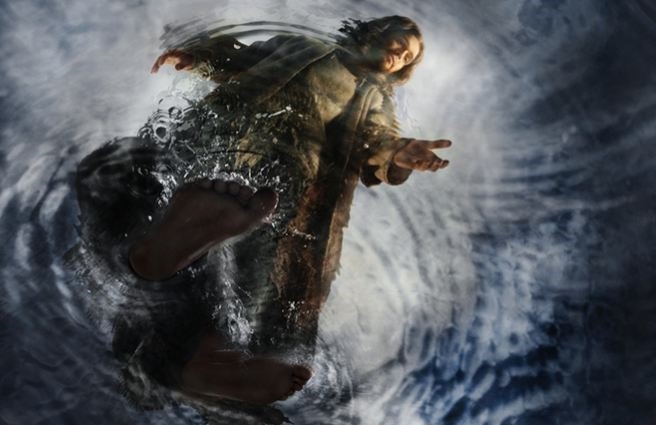
jesus-walks-on-waterPeter’s first impulse was inspired by Jesus. His heart and his mind were fixed on Jesus; his goal was Jesus. But then something happened: he looked around at his environment. He started paying attention to his circumstances rather than to Jesus. And when he quit looking at Jesus and started focusing on what was going on around him, he became afraid; and when he became afraid, he sank.

But it was all good! Jesus was there, and Jesus made sure he didn’t go under. Peter got soaking wet and probably cold; he had a good scare, but ultimately, everything came out okay.

It seems to me that we can find some obvious applications to our own lives here. First, it is worth aspiring to the kind of faith and focus on Jesus that Peter shows us. He wasn’t the kind of guy to cower in the boat, and because of that, the Holy Spirit was able to use him in wonderful ways later on.

Second, this whole thing reminds me of Hebrews chapter 12:

Therefore, since we also have such a large cloud of witnesses surrounding us, let us lay aside every weight and the sin that so easily ensnares us. Let us run with endurance the race that lies before us, keeping our eyes on Jesus, the source and perfecter of our faith, who for the joy that lay before Him endured a cross and despised the shame and has sat down at the right hand of God’s throne. (Heb 12:1-2, HCSB)

Peter’s goal all along was Jesus, and when he kept his heart and attention focused on Jesus, he was able to walk on water. I have met people who would love to “walk on water” so to speak, but I wonder how much of their desire is about wanting to do amazing things as opposed to wanting to be like Jesus and to be close to him. There have been times in my own life when I was so excited about the idea of doing something amazing by faith that my focus was more on what I was trying to accomplish than it was on Jesus. But Peter’s focus, at least in the beginning, was all on Jesus. It shouldn’t be about the amazing things we want to do. Instead, it should be that we want to join Jesus where we see him at work, even if that place looks very strange and impossible.

With that foundation firmly in mind, where do you see Jesus? Where is it that you want him to invite you to join him? Jesus did not command any of the disciples to join him on the water, but Peter wanted to, even though it looked crazy. Is there some way in which you want to join with Jesus, a way that looks crazy or impossible? I suggest that you say, like Peter, “Lord if it is you, call me to come to you in this context.”

And then, no matter where we are in faith, one of the keys is keeping our eyes fixed on Jesus, and as much as possible, ignoring the wind and the waves around us. If we want to live by faith, we cannot find security in our circumstances. Our circumstances will often scare us; they may sink us. Like Peter, we are most safe when we keep her eyes fixed on Jesus.

The other thing I love about this, is that Peter was safe. What he tried to do was crazy. Through faith, he was able to do it for a while, but ultimately he failed. What I want to point out is that his failure was not fatal. “Peter” is just the word for “rock” in Greek. I wonder how much fun Jesus and the other disciples had talking about relative buoyancy of rocks. “Hey, Peter! You float like a rock!” Or, “Nice going…Rock!” Even so, Peter was the only one who even bothered to try, and he was no worse off for it. I think this should encourage us. When we step out in faith we may succeed, or we may fail. Either way, Jesus is there.

Be still for a few minutes now, and listen to what the Holy Spirit has to say to you today.

Are you looking at Jesus, or the wind and waves

Thanks again for making use of Clear Bible.

I want to remind you again that we are a listener-supported ministry, and that means, first and foremost, that we are supported by your prayers. We need and value your prayers for us.

Please pray that this ministry will continue to be a blessing to those who hear it. Ask God, if it is his will, to touch even more lives with these messages. Ask him to use this ministry in making disciples of Jesus Christ.

Please also pray for our finances. Pray for us to receive what we need. Please pray for us in this way before you give anything. And then, as you pray, if the Lord leads you to give us a gift, please go ahead and do that. But if he doesn’t want you to give to us, that is absolutely fine. We don’t want you to feel bad about it. We want you to follow Jesus in this matter. But do continue to pray for our finances.

If the Lord does lead you to give, just use the Paypal Donate button on the right hand side of the page. You don’t have to have a Paypal account – you can use a credit card, if you prefer. You can also set up a recurring donation through Paypal. We can make this tax-deductible if you just mention that it want it to be so in the “note” part of the transaction.

You could also send a check to:

New Joy Fellowship

625 Spring Creek Road

Lebanon, TN 37087

Just put “Clear Bible” in the memo. Your check will be tax-deductible.

Thank for your prayers, and your support!

A DAY OF RULES, OR A DAY OF REST?

sabbath rest


What the Pharisees did was to change the Sabbath from a picture of God’s holiness into a series of steps you could follow. It was no longer a challenge that made you turn to God in desperation. It wasn’t even any more an invitation to rest in God’s grace and trust Him to take care of you. Instead, it was a series of boxes that you checked off in order to feel good about yourself


To listen to the sermon, click the play button:

To download, right click on the link (or do whatever you do on a Mac) and save it to your computer: Download Matthew Part 38


Matthew #38 . Matthew 12:1-13

I think that one of the most frequently misunderstood things in the gospels is Jesus’ conflict with the Pharisees. Many people think that Jesus had a particular problem with them because they were religious and traditional. In a way, that is true, but it’s not quite as simple as most people make it. Also, far too many people go on to take that as a blank check to reject anything they want to call “religion” including things like being a part of a church, or worshipping regularly with other believers.

The truth is, what Jesus rejected was a particular kind of religiousness, and a particular way of using traditions. It is good for us to follow in his example, to understand and avoid those same types of dangers; however it is also good not to throw out the baby with the bathwater.

Let me back up and set the stage for the religious behavior of the Pharisees in the time of Jesus. In the middle part of the history of the people of Israel, the time of the judges and kings, a majority of Israelites did not live according to the covenant that God had made with them. During the time of the judges, they continually turned away from God, and God continually got their attention by allowing the nations around them to oppress them. Then, for a few generations under Samuel, David and Solomon, the nation of Israel lived generally true to their faith, and they flourished. After Solomon, however, they turned to the worship of idols. There were good kings who led them back to worshipping God, but the overall trend was for them to get further and further away from living like the people of God. Finally, God allowed Assyria and Babylon to totally conquer the people of Israel, and a huge proportion of them were taken away in exile.

When the Lord engineered the return from exile, it seemed like the remaining Israelites had learned their lesson. The Jews became much more strict in their observance of the Law of Moses. At some level, they understood the consequences of turning away from God, and they wanted to avoid repeating history. There were some Jews, however, who were much more secular, and whom embraced the ways of the conquering Greeks. (the Greeks controlled the region for a while after the return of the exiles). After a struggle, a group of observant Jews succeeded cleansing the temple, and then in taking control from both the secular Jews and the Greeks (they were led by Judas Maccabaeus). Jewish independence under the Maccabeans only lasted a few generations, but the lesson seemed clear to many: the way to freedom as a nation was to strictly follow the Laws of Moses.

Another thing began to happen during the two centuries right before Jesus. The Jewish people concerned about following the law began to ask questions about how to do it. Moses had said:

Remember the Sabbath day, to keep it holy: You are to labor six days and do all your work, but the seventh day is a Sabbath to the LORD your God. You must not do any work — you, your son or daughter, your male or female slave, your livestock, or the foreigner who is within your gates. For the LORD made the heavens and the earth, the sea, and everything in them in six days; then He rested on the seventh day. Therefore the LORD blessed the Sabbath day and declared it holy. (Exodus 20:8-11)

That was all well and good, said the Jews, but what does it mean, practically speaking? What, really is work? What makes a day holy? What constitutes rest? The Jews began to make up rules that explained in excruciating detail what it meant to properly observe the Sabbath. They came up with a certain number of steps that you were allowed to walk. They decided that lighting a lamp or candle was “work” and so the mother of the house would light these things on Friday night, and let them burn until Saturday night, so that she wouldn’t “work” by messing with lamps on the Sabbath. They basically created a new set of rules that you were supposed to follow, and if you just followed them, then you had done your duty to God.

The Jews did this with almost every command given by Moses. So you see, observing the Law no longer meant living in faith by trying to follow the commands in relationship with God; instead it meant following the rules made up by Rabbis. In general, those rules might have been irritating or inconvenient, but anyone could do them.

There are two major problems with this. The first is that the commands of the moral law given through Moses were meant to show us God’s holiness, and, in comparison, our sin. The law was supposed to show us how Holy God is, and how far short we fall. It was meant to show us our true and desperate need for God, and to make us seek a Savior. But what the Jews did was to turn this picture of God’s holiness into a series of steps you could follow. The Sabbath was no longer a picture of God’s holiness. It was no longer a challenge that made you turn to God in desperation. It wasn’t even any more an invitation to rest in God’s grace. Instead, it was a series of boxes that you checked off in order to feel good about yourself. Every law became similarly debased by man-made steps. Every law became just a manageable checklist. If you checked most of the boxes, and went to the temple and made sacrifices for the ones you missed, you could call yourself holy. Now there was no need for savior – if you just followed the rules of the Rabbis, (which were easier than the actual law) you were righteous.

The second thing that this rule-making did was to make following God about performance, rather than heartfelt repentance, worship and relationship. All you had to do was follow the steps. Your heart could be filled with murder, lust, greed and bitterness, but if you just did the steps, everyone would consider you to be holy. You could even hate God, but if you followed the steps laid out by the Rabbis, you were holy. What all this meant, is that God wasn’t even really in the picture any more. You could do the entire Jewish religion without God.

The great Israelites of the past followed God in faith. Abraham believed God, and God counted it to him as righteousness – not because he performed well, but because he trusted wholeheartedly in God’s promises (Genesis 15:6, Galatians 3:6, James 2:23). Moses interacted with God face to face. David worshipped God heart and soul through music and poetry and personal prayer, as did many others (just read the Psalms). Ruth and Naomi trusted in God’s gracious provision. Elijah prayed and trusted God.

But most of the Jews of Jesus’ time had reduced the life of faith to checking off boxes on lists of rules.

Now, we come to Matthew chapter 12. The disciples are walking through the fields on the Sabbath – with Jesus. What could make the Sabbath more truly holy than the presence of God in the flesh? Their day is set apart for spending time with the Lord. The fields were apparently fields of ripe grain which had not yet been harvested. For a snack, the disciples were pulling of heads of wheat as they walked, and munching on the whole wheat berries. It was equivalent to finding crab apples on a hike, and picking one or two, eating them as you walk.

But the Pharisees saw them and said: “Picking heads of wheat is technically harvesting grain, and harvesting grain is working; therefore, you are violating the rules of the Sabbath!”

But Moses never said, “Don’t even grab some wheat berries as you pass through the fields on the Sabbath.” He said, “Remember the Sabbath and keep it holy. Don’t do any work on that day.” It was the Pharisees who defined what the disciples were doing as work. It has as little resemblance to work as tossing a football around with the family in a private backyard resembles the practice-work of a professional football athlete. The disciples weren’t toiling at their livelihood; they weren’t threshing or grinding, or even cooking. They were relaxing with Jesus, and snacking from the readily available bounty of His creation. They were in fact, honoring the Sabbath and resting in the Holy Presence of the Creator Himself.

Jesus could have responded to the Pharisees in a number of ways. He chose to direct their attention the scriptures. First, he reminds them that when David had need, he ate the bread that was set aside only for the priests; yet David did no wrong in doing so. He then reminds them that priests work on the Sabbath. Since he says “the priests of the temple,” he is probably referring to the offering of sacrifices on Sabbath days, which was part of the work of a priest. He adds:

But I tell you that something greater than the temple is here! If you had known what this means: I desire mercy and not sacrifice, you would not have condemned the innocent. For the Son of Man is Lord of the Sabbath.” (Matt 12:6-8, HCSB)

He is making two points. First, the important thing is not to follow man-made rules about the Sabbath – what God really wants is “mercy, not sacrifice.” In other words, the Lord is after a changed heart, not an external conformity to man-made rules. Second, he says that he (when Jesus says “son of man” he is referring to himself) is Lord of the Sabbath. Once more this is a claim to be Divine. He is saying, “I made the Sabbath, I think I know what is appropriate for it or not.”

Matthew records another confrontation over the Sabbath. This time, the Pharisees are actually using the Sabbath as an excuse to accuse and discredit him, to prove he is a bad Jew. There in the synagogue on the Sabbath was a man with a paralyzed hand. The Pharisees say to Jesus, “Is it lawful to heal on the Sabbath?” Once again, what they are doing is insisting on viewing the Sabbath as a checklist of dos and don’ts, instead of an invitation to trust and rest. They are insisting upon their own, man-made version of the Sabbath, instead of taking God’s word through Moses in faith and trust.

Most of the world, at that time, including Galilee, was largely agricultural. Jesus points out that if someone has an animal in trouble on the Sabbath, they help it. How much more worthwhile to heal a human being in need! Again, Jesus’ response is to get to the heart of the Sabbath.

I want to point out something that is often misunderstood: Jesus is not abolishing the Sabbath here. He is not saying, “The Sabbath no longer matters; do what you want every day of the week.” But he is saying this:

“The Sabbath, like all of the Old Testament, is all about me (Jesus). It shows you your need for me, and it is fulfilled by trusting me and living your life in relationship to me. There is still rest that you need to take, and that rest is found in me alone.” He is not against the Sabbath, or any of the Old Testament law, but he is against the man-made rules that the Pharisees have made about it.

I have several pastor friends whom rarely take a day set aside for honoring the Lord by resting. When we talk about it, they sort of take an “aw, shucks,” attitude. Sure, they’d like to rest, but they’re just too busy doing the Lord’s work. In America, we’re inclined to give people like this a pass. How can working hard be a sin? In fact, we are inclined to admire people who work hard and are too busy to take a whole day to rest.

My friends are good men. If I told them that I regularly stole money and didn’t feel bad about it, they’d be shocked. If I told them I was committing adultery, they would urge me to repent. Yet the command to keep the Sabbath comes in the ten commandments, just like the commands to avoid stealing and adultery. It is no more holy for them to not take a special day of rest than it is for me to steal.

Let me say it again: Jesus does not abolish this command. He points out the error of how the Pharisees have turned it into a mere man-made checklist. He makes it clear that the true rest is found in trusting in him and being with him. He is clearly against a legalistic set of rules defining how the day must be spent. But he does not say, “forget the Sabbath.”

Returning to my friends who do not set aside a “Sabbath,” a time to rest and honor God, let’s consider a few things. They may feel like they are honoring God by working, however, what I think is really going on is that they are dishonoring God by not trusting him. They don’t trust that everything will be OK if they take time out. They act as if everything depends upon their hard work, as if their churches will fall apart without them. The Sabbath shows us, among other things, that God is in charge, it is up to him, and we can trust him. When we don’t take it, we are missing the chance to strengthen that trust.

Ironically, the Pharisees had turned the Sabbath into things that had to be done, rules that had to be followed, so that rest and trust no longer had much to do with it for them either. This is what Jesus criticizes them for. Never taking a Sabbath on the one hand, or insisting upon strict rules for how to implement it on the other, are two sides of the same coin, and that coin reads: “In ourselves we trust.” I want to make sure you understand what I am saying here. In today’s world, a Christian who does not set aside a day to honor and trust
God through rest, is essentially the same as a Pharisee in Jesus’ time who used rules to take the honor and trust and rest out of the Sabbath day. Even though the Pharisees outwardly looked righteous, they had gutted the real substance of the Sabbath. Even though non-resting Christians outwardly don’t look like Pharisees, they too, have gutted the real substance of the Sabbath, which again, is to remember and enter into God’s holiness through trust and rest.

Like so many things in the Christian life, what we need here trust and balance. Jesus clearly shows us that it is wrong to create a Sabbath checklist, a set of rules to show us we’ve righteously observed the Sabbath. On the other hand, the Sabbath, like the other commandments of the moral law, remains important for Christians. Though it may look different for different people, it is important for us to set aside a day that belongs to God, in which we honor and trust him by resting.

Let me use an example that may be helpful: Is it OK to mow the lawn on your “Sabbath?” (by the way, I don’t think the particular day of the week is as important as simply having some day that is set aside for trustful rest in the Lord; again, Jesus shows us not to be legalistic about such details). The answer is, first of all: stop trying to figure out a set of rules for the Sabbath. Trust the Lord. Accept that you need rest, and if you take it, the Lord will take care of what you are not working at. If you need specifics, ask Him first what it should look like for you.

Now, I’m aware that my first answer may not be immediately satisfying. You may genuine want to know, “how do we do this?” So here’s another answer: it depends. For me, mowing the lawn is a chore. It isn’t restful for me, and I usually end up wanting to curse at the lawnmower. So I don’t mow my lawn on my Sabbath (nor do I make my children to do it). But I have a friend who finds mowing the lawn enjoyable and restful to his soul. For my friend, mowing the lawn might be one of the most God-honoring and restful things he could do for a Sabbath; for me it is the opposite. The point is not to have a rule about a specific activity – rather it is whether that activity helps us to rest and to honor and trust God. So my friend sets apart the day as restful and holy by mowing the lawn; I set apart the day as holy and restful by not mowing the lawn.

Here’s another one. I often find writing restful. However, there are times when I find myself getting anxious about my career as an author. The result is that on some Sabbaths I write, and on others, when I’m finding it difficult to trust God with my writing, and it feels like work, or that I would be doing it because I’m worried about it, I avoid it. Do you get the idea here?

What about you? Have you been prone to the error of the Pharisees, making rules to control the Sabbath, or some other part of the moral law, thinking “if I just do a, b and c, I’ll be fine,”? Hear from the Jesus that He is the point of it all. Learn to listen to him and not lose sight of the point.

Perhaps you are on the other end of the spectrum, thinking you can safely ignore God’s invitation to remember his holiness by resting and trusting? Learn from Jesus that these things matter, because they are all about Him.

Let the Holy Spirit speak to you today.

~

Thanks again for making use of Clear Bible.

I want to remind you again that we are a listener-supported ministry, and that means, first and foremost, that we are supported by your prayers. We need and value your prayers for us.

Please pray that this ministry will continue to be a blessing to those who hear it. Ask God, if it is his will, to touch even more lives with these messages. Ask him to use this ministry in making disciples of Jesus Christ.

Please also pray for our finances. Pray for us to receive what we need. Please pray for us in this way before you give anything. And then, as you pray, if the Lord leads you to give us a gift, please go ahead and do that. But if he doesn’t want you to give to us, that is absolutely fine. We don’t want you to feel bad about it. We want you to follow Jesus in this matter. But do continue to pray for our finances.

If the Lord does lead you to give, just use the Paypal Donate button on the right hand side of the page. You don’t have to have a Paypal account – you can use a credit card, if you prefer. You can also set up a recurring donation through Paypal.

You could also send a check to:

New Joy Fellowship

625 Spring Creek Road

Lebanon, TN 37087

Just put “Clear Bible” in the memo. Your check will be tax-deductible.


Thank for your prayers, and your support!

REST FOR YOUR SOUL

rest

Our own expectations are a burden to us. Our demand for Jesus to behave the way we want him to turns our spiritual life into a wearying struggle. There are other things that wear us out, also: our own goals and ambitions for this life, our attempts to control circumstances and relationships, our attempt to hold onto things that we know are sinful and wrong. Jesus says, “Drop all of that! Take on me, and me alone, and you will find rest and ease for your souls.” This is not a word of judgment, but of grace.


To listen to the sermon, click the play button:

To download, right click on the link (or do whatever you do on a Mac) and save it to your computer: Download Matthew Part 37

Matthew #37 . Matthew 11:7-30

Last time we considered how Jesus failed to meet the (quite reasonable) expectations of John the Baptist. Jesus responded essentially by saying, “Look back to the Bible and trust what it says. You are blessed when you aren’t upset because I don’t act like you expect me to.”

We pick up this time as John’s disciples are leaving to give him the message. Jesus continues his thoughts by talking to those who are left about John.

John has been overshadowed in history by Jesus, but during his life, and for an entire generation during after his death, John the Baptist was a very influential figure. Many of his followers did not make the transition to following Jesus, and instead, they formed a powerful sub-segment of Judaism until the destruction of Jerusalem in 70 AD.

Jesus clearly acknowledges John’s greatness. He explains John’s place in the history of God’s people: he is a prophet and more than that, he was the one predicted by Isaiah who would come before the Messiah and announce him to the world. In fact, Jesus calls him the greatest man alive. Then Jesus adds two interesting thoughts. First, he says that in spite of John’s greatness, “the least in the kingdom of God” is greater than him. This is puzzling, and there are several possible things that Jesus may have meant. It could be that what Jesus means is that John represents the old covenant, the one which the people of Israel never could keep, and by which they could never be reconciled to God. In this scenario then, John was the greatest man who could live by the old covenant, but the righteousness that comes through Jesus Christ is a completely different and greater righteousness. The most pathetic one who is justified by faith in Jesus Christ is closer to God than even the most diligent and self-denying law keeper of the old covenant.

Another possibility is that Jesus means that those who have died and gone on to glory are greater than even the greatest living man. This fits somewhat with what we learned last time, where John was anxious about his present circumstance. Jesus might be saying, “John’s greatness in this life is nothing compared to what he will experience once he dies in faith and fully enters the kingdom of heaven. He is concerned about temporary salvation, but the eternal salvation I offer is so much greater.”

The second strange thought that Jesus shares is this:

12 From the days of John the Baptist until now, the kingdom of heaven has been suffering violence, and the violent have been seizing it by force. 13 For all the prophets and the Law prophesied until John; 14 if you’re willing to accept it, he is the Elijah who is to come.

I think what Jesus is referring to here is the widespread belief, perhaps also held by John the Baptist, that the Messiah would bring physical and political deliverance from foreign oppressors. In fact the Jewish people (and possibly John as well) were expecting a violent Messiah. This may sound shocking to us; we know what actually happened, what Jesus actually did and taught. But at the time Jesus walked the earth, the Jewish people sincerely believed that the Messiah would arrive to do violence to their enemies. Jesus is not affirming this. In a continuation of what he said to John, he is explaining that he will not meet those expectations. The idea that the Messiah would preach love, and seek to reconcile all human beings to God (even Romans and foreign soldiers), was completely unique and unexpected to the people at the time.

In fact, for most of the rest of Chapter 11 Jesus is pointing out that he is not meeting expectations. The people criticized John for overt, severe self-discipline; then they turned around and denounced Jesus for not showing overt, severe self-discipline. Both C.S. Lewis and G.K. Chesterton have observed this continuing habit of criticizing Jesus and Christianity for opposite things. One the one hand, people say that our faith is merely wish-fulfillment and pie-in-the-sky; we are too optimistic. On the other hand, Christians are frequently criticized for the doctrine of original sin and the future of the world; we are too pessimistic.

When Jesus speaks to the towns ins verses 21-25, he is continuing with this same theme. The towns he mentions are all in the area of Galilee, where he has been ministering. His point is that he has done amazing miracles, that he has fulfilled many prophecies about the Messiah, and yet the people in these towns have not accepted him. Most likely, the reason they did not was because he did not behave the way they expected the Messiah to behave.

It’s hard to believe that the culture at the time thought the Messiah would be a violent man of war. But what are the common strange expectations of our time?

Our culture believes that God asks nothing from us, and holds us to no personal moral standard. We expect to do as we please, and then be welcomed into heaven when the time comes. To the extent that our culture believes in Jesus at all, it believes that Jesus died to show us love, and that now we should continue our lives unchanged and unaffected by that sacrifice. In fact, Jesus himself calls us to die to ourselves and surrender to Him and His purposes; we’ve seen that already in the book of Matthew. Just as the people at the time ignored what the Scripture actually said about the Messiah, so also our culture ignores what the Bible actually says about Jesus.

Our culture believes that Jesus preaches a kind of universal religion, no different from anything else in the world, when in fact, Jesus’ own words proclaim that he is unique, and that our entire future hinges on our response to him, and him alone. Of course, there are elements of truth in other religions. But Jesus makes it clear that he himself is the ultimate revelation of truth, and that our choice to either receive him or reject him is of eternal consequence.

When we hear the words of the Bible, do we receive them and surrender to them, or do we, like the towns in Galilee, reject the truth because it does not conform to our expectations?

Jesus closes this discourse with one of my favorite passages in the Bible:

“Come to Me, all of you who are weary and burdened, and I will give you rest. All of you, take up My yoke and learn from Me, because I am gentle and humble in heart, and you will find rest for yourselves. For My yoke is easy and My burden is light.” (Matt 11:28-30, HCSB)

Our own expectations are a burden to us. Our demand for Jesus to behave the way we want him to turns our spiritual life into a wearying struggle. There are other things that wear us out, also: our own goals and ambitions for this life, our attempts to control circumstances and relationships, our attempt to hold onto things that we know are sinful and wrong. Jesus says, “Drop all of that! Take on me, and me alone, and you will find rest and ease for your souls.” This is not a word of judgment, but of grace.

Just to make sure we have the picture correct, let me explain what Jesus meant by “yoke.” A yoke was a kind of farm or work implement. It was a piece of wood that was somewhat curved and could fit over the necks of animals or human beings. If the yoke was for a human, the ends might attach to a harness, which then could be attached to a plow or a cart. The man with the yoke across his shoulders could then use the leverage of the yoke to pull the plow or the cart. Alternatively, a load could be hung from each end of the yoke, balanced across the shoulders of the man. Picture a man with a bar across his shoulders, and a bucket hanging from each end of the bar, and you get the idea. There were also yokes made for animals. Some of them were double-yokes in which, say, two oxen could be fastened, and using the yoke, their strength could be combined to pull a load.

I think there are two things we can get from this image, both of them appropriate. The first is the straightforward meaning of Jesus’ words, which is that the burden or work involved in trusting him is light, and even restful for the soul. Picture a yoke with no weight or harness attached to it. The point is, when we give up our own expectations or demands, and surrender to Jesus, and to living life his way, it is restful and healing for our souls.

The second image is that of the two oxen pulling together. Jesus might be saying: “Hitch yourself to me, and let me do the pulling. When I do the work alongside you, you will find it easy and restful.” The idea is that we trust Jesus to do what needs to be done, we let his strength take the weight of the burdens that we face.

I like to picture it like this. Imagine that you are wearing a large, hiker’s backpack. The pack is absolutely stuffed with equipment and all sorts of things that you might reasonably think you need for the journey. It weighs 60 pounds or more. Now you meet Jesus standing by the trail. He is holding a very small, comfortable -looking pack. As he hands it to you, you feel that it is maybe 5 pounds. There is no way it could hold anything more than perhaps food for your next meal.

Now, you are carrying so much weight and bulk that when you try to add that 5 pound pack from Jesus, you find it is considerably harder than before. Jesus laughs at you. “No, silly! Get rid of your big old pack and carry only my pack.” The key of course, is to trust that if we take on only the 5 pound pack, Jesus will be with us to give us the other things we need, when we need them.

You see, I think so many Christians do not find following Jesus to be restful. The reason is, they try to follow Jesus, and at the same time, try to maintain their own control, their own goals, ambitions and expectations. This is not the rest that Jesus offers. The rest and peace come when we give up our own burdens and take his yoke, and only his yoke, upon ourselves. The way to lightness and ease for our souls is to take the yoke of Jesus on ourselves, leaving our own “yoke” behind.

I invite you to do that right now. There is no time like the present. Are there expectations that you have of this life, or of Jesus, expectations that the Holy Spirit is now calling you to release? Are you holding onto the weight of controlling your own life? Is it possible that your own ambitions and plans are a burden to you? Is there some way in which you are insisting that you get what you want, or that you must get it in your way?

These are all heavy burdens that Jesus is calling you to release. In exchange, he offers you just one light, ease-filled, restful burden: to trust him, and to let him be in control. Let him pull the weight, while you relax and trust him.

Thanks again for making use of Clear Bible.

I want to remind you again that we are a listener-supported ministry, and that means, first and foremost, that we are supported by your prayers. We need and value your prayers for us.

Please pray that this ministry will continue to be a blessing to those who hear it. Ask God, if it is his will, to touch even more lives with these messages. Ask him to use this ministry in making disciples of Jesus Christ.

Please also pray for our finances. Pray for us to receive what we need. Please pray for us in this way before you give anything. And then, as you pray, if the Lord leads you to give us a gift, please go ahead and do that. But if he doesn’t want you to give to us, that is absolutely fine. We don’t want you to feel bad about it. We want you to follow Jesus in this matter. But do continue to pray for our finances.

If the Lord does lead you to give, just use the Paypal Donate button on the right hand side of the page. You don’t have to have a Paypal account – you can use a credit card, if you prefer. You can also set up a recurring donation through Paypal.

You could also send a check to:

New Joy Fellowship

625 Spring Creek Road

Lebanon, TN 37087

Just put “Clear Bible” in the memo. Your check will be tax-deductible. Unfortunately, we cannot do the tax deductible option with the paypal donate button, however the money does go directly to support this ministry.


Thank for your prayers, and your support!

JESUS CLAIMS #1 SPOT FOR HIS FOLLOWERS

carryingthecross-2

At some point, anyone who calls himself or herself a Christian is faced with a call to daily deny himself or herself, die to self, be willing to actually die, and follow Jesus. This isn’t just theoretical. It will affect the way we relate to other people. It will affect what kind of jobs we take, and when and where we take them. It should make an impact on how much we indulge ourselves. It may even at some point cost us our lives.


To listen to the sermon, click the play button:

To download, right click on the link (or do whatever you do on a Mac) and save it to your computer: Download Matthew Part 35


Matthew #35. Matthew 10:32-42

Remember, Matthew chapter 10 begins with Jesus sending his disciples out on a training mission. He gave them certain instructions, from which we can gain certain principles, and we looked at those already. Last time, we looked at the words of warning that Jesus gave his disciples. He told them to expect persecution and trouble. But he also gave them (and, by extension, us) many wonderful words of comfort and promise, words which we can hold on to in times of trouble.

After these comforting promises, Jesus begins with this: “Therefore…” One of my old Bible school teachers always used to say “What is that therefore there for?” It’s a useful little question. In this case, it is to remind us that what Jesus is going to say next is connected with what he has already said. In other words, because we have these warnings, and especially because we have these promises, Jesus says this:

“Therefore, everyone who will acknowledge Me before men, I will also acknowledge him before My Father in heaven. But whoever denies Me before men, I will also deny him before My Father in heaven. (Matt 10:32-33, HCSB)

Jesus doesn’t simply say, “Acknowledge me before men.” He first gives us instructions, and a sure and beautiful promise of his presence and his grace to us in the middle of hard times. Considering those things, he now says, “All these promises are connected to me. To receive them, you must confess me. You must put me before all things.”

The Greek word that is here translated “acknowledge,” might also be “confess.” The two root words of the Greek term, put together, really mean “to say the same thing as,” or “to speak with.” Some translations make it “confess.” I like this better than “acknowledge.” We are to confess Jesus. Confession means not only to admit something, but also to agree with something or someone. We are to say the same things that Jesus says, to agree with him. Jesus makes it clear that we are to do so not only privately, but also in public.

Jesus goes on. He makes reference to a verse in the book of Micah, implying that it is a messianic verse and he is fulfilling it:

Surely a son considers his father a fool, a daughter opposes her mother, and a daughter-in-law is against her mother-in-law; a man’s enemies are the men of his own household. But I will look to the LORD; I will wait for the God of my salvation. My God will hear me. Do not rejoice over me, my enemy! Though I have fallen, I will stand up; though I sit in darkness, the LORD will be my light. (Mic 7:6-8, HCSB)

He also says “Don’t assume that I came to bring peace on the earth. I did not come to bring peace, but a sword.” This is one of those things Jesus said that many people don’t seem to know about. You don’t have to go far to hear Christians and non-Christians alike saying, “Why do conservative Christians have to stir up so much trouble? Christians are supposed to get along with everybody. It isn’t Christian to cause controversy.” In light of these verses, I guess maybe Jesus wasn’t a Christian. He is quite clear: He is a polarizing personality; those who follow him will find themselves at times embroiled in conflict, even within their own families. This isn’t an endorsement of violence in any way, shape or form. It isn’t a license to be rude, or to bully. But Jesus does want us to recognize that following him can lead to controversy and difficult relationships.

I don’t believe I’ve ever heard this preached by anyone else before. But obviously, it is right here in the text. If Jesus said anything at all, he said this as well. We can’t ignore it. These days, when we agree with (that is, confess) the things that Jesus said, or the things that his Holy Spirit inspired his apostles to write, it is easy to draw flak. If we agree with the Bible about what the Holy Spirit calls “sin,” we are called hatemongers. If we agree with what Jesus actually said about himself, we are called narrow-minded and intolerant. Following Jesus does indeed lead us to be peaceful and loving. But it does not mean that others will see us that way, or even that our lives will be free from conflict with those who do not follow Jesus or his word.

Now, Jesus ratchets it up a notch. Not only does he suggest that following him can lead us into conflict, but he demands that when there is a conflict, we choose him above anything and anybody else.

The person who loves father or mother more than Me is not worthy of Me; the person who loves son or daughter more than Me is not worthy of Me. (Matt 10:37, HCSB)

It’s easy to breeze through these words of Jesus. But hold on a minute: we are supposed to choose Jesus even above our own children? That is what He says here. Now obviously, much of the time we are not faced with choices like this. Following Jesus is usually compatible with loving our children. But Jesus is saying, flat out, that we should always love him more than we love our own children, or anyone else for that matter.

Let’s step back a minute and look at this message. This is not merely a great moral teaching about loving other people. It is, in fact, a demand that we love Jesus, and that we do so at a higher level than we love anyone else. Unless Jesus is God, this teaching is either nonsense or pure evil. There is no sense in which Jesus is saying “Follow your own path to enlightenment.” He is not saying, “Follow me, follow Buddha, it makes no difference as long as you are sincere.” He is not saying, “Just love everybody else and you’ll be fine.” Instead, he is clearly saying: “Everything comes down to how you relate to me. I am the basis upon which you must prioritize your life and make your decisions.” To put it another way, the central teachings of Jesus are about himself. No wonder he was such a polarizing figure.

Next he says this:

And whoever doesn’t take up his cross and follow Me is not worthy of Me. Anyone finding his life will lose it, and anyone losing his life because of Me will find it. (Matt 10:38-39, HCSB)

Over the years, this little part of what Jesus said has morphed into this: “I have my own cross to bear.” But this is not at all the meaning that Jesus had in mind. It’s true, each person has their own unique struggles in life; I think it’s fine to recognize that. But when Jesus was talking about taking up our cross, he wasn’t talking about that. This was the period in history when the Romans used crucifixion as a method of execution. Typically, if the condemned person was healthy enough, he had to carry the instrument of his own death to the place of execution. In other words, condemned people could be seen from time to time carrying the crosses upon which they were to be killed. To carry a cross was to be on your way to death. So when Jesus tells us that we must pick up our crosses and follow him, he is saying that we must follow in his example of dying.

I think it is appropriate to understand that Jesus means, among other things, that we must die to our own ambitions, comforts, and goals. Jesus actually repeats this teaching again later on in his ministry. Luke records that the second time Jesus said it, it was “let him deny himself and take up his cross daily and follow me.” I think this definitely captures the meaning. Taking up our cross means that we deny ourselves. We don’t deny ourselves just to show that we are self-disciplined, but we put Jesus’ goals and ambitions and desires for us ahead of our own. I think it’s useful that Luke says this needs to happen “daily.” But even more than dying to our own desires, right here, Jesus is telling us that in order to follow him we need to be willing to go as far as actual physical death. Throughout the past 2000 years, many Christians have been faced with the choice to either deny Jesus or give up their physical lives. I live in a time and a place where that is unlikely to happen, even so, Jesus wants my willingness. Not even continuing to live should be more important to me than Jesus Christ. As Jesus says, if you save your own life, by compromising your relationship with him, you have actually lost it.

In the next few verses Jesus’ claim is emphasized once more. He says that he is so central to everything, that when people offer respect, regard, or even a cup of water, to his followers, because they are his followers, they will be rewarded. The point here is not the reward, it is the fact of people recognizing who Jesus is and honoring that in the way they relate to his followers. It is about honoring Jesus.

I hope you understand that these words of Jesus are confrontational. He is presenting us with a choice: does he have the preeminent place in our lives? Do we love him more than we love anyone else? Is Jesus our number one priority? He is claiming here that he should be. This isn’t about following a moral code, it isn’t about living according to some sort of principle. It is about making Jesus Christ, the person, number one in our lives.

When controversy comes because you confess Jesus Christ, or you agree with what he says, what is your response? It isn’t wrong to seek peace with those with whom you disagree. But when peace is impossible, when agreement cannot be reached, Jesus unequivocally calls us to side with him.

At some point, anyone who calls himself or herself a Christian is faced with a call to daily deny himself or herself, die to self, be willing to actually die, and follow Jesus. This isn’t just theoretical. It will affect the way we relate to other people. It will affect what kind of jobs we take, and when and where we take them. It should make an impact on how much we indulge ourselves. It may even at some point cost us our lives.

Now of course, we can’t be perfect in putting Jesus first. I know I fail to do that in many ways. I believe Jesus offers me grace and forgiveness when I fail. But I do think he wants me to make the choice to put him above everything, even if at times I fail in following through. It is good to know, that my failures are not the final word.

Once again, we do not have the comfortable choice of viewing Jesus as a kind, harmless moral teacher. In some ways, he has been at the center of controversy for the past 2000 years. We can reject what he has said here, and call him a lunatic, or a megalomaniac. Or, we can receive him as our Lord, take up our crosses, and follow him.

LORD OF THE NATURAL AND SUPERNATURAL

demoniac

Sometimes it is hard to believe in the supernatural. But it should be obvious that there are giant swaths of reality that will never be explained as anything but supernatural. For example, take the idea of freedom. You can describe what the idea of freedom means, but you can’t study it in the same way you study what we call a “natural phenomenon” (like an eclipse). Instead, it is something “metaphysical,” or, in the old parlance, “supernatural.” There are many other supernatural things as well.

To listen to the sermon, click the play button:

To download, right click on the link (or do whatever you do on a Mac) and save it to your computer: Download Matthew Part 29

Matthew #29 . 8:28-34

When He had come to the other side, to the region of the Gadarenes, two demon-possessed men met Him as they came out of the tombs. They were so violent that no one could pass that way. Suddenly they shouted, “What do You have to do with us, Son of God? Have You come here to torment us before the time? ” Now a long way off from them, a large herd of pigs was feeding. “If You drive us out,” the demons begged Him, “send us into the herd of pigs.” “Go! ” He told them. So when they had come out, they entered the pigs. And suddenly the whole herd rushed down the steep bank into the sea and perished in the water. Then the men who tended them fled. They went into the city and reported everything — especially what had happened to those who were demon-possessed. At that, the whole town went out to meet Jesus. When they saw Him, they begged Him to leave their region. (Matt 8:28-34, HCSB)

Mark and Luke record this same incident, but with one fairly large difference from Matthew: they tell of only one demon possessed man (Mark 5:1-20; Luke 8:26-39). This is one of those places that is used by some people to suggest that the Bible contradicts itself and is not reliable. However, I think this misses the point entirely. It reminds me of an old joke. Joe and Jack went down to the lake with Joe’s dog. Joe said, “watch this!” He picked up a stick and hurled it far out into the lake. “Fetch, boy,” he said. The dog immediately went bounding toward the lake, but instead of swimming, the animal ran out on top of the water, picked up the stick, ran back, still on top of the water, and then lay down a few feet away and began gnawing on it. His fur wasn’t even wet.

“So, what do you think?” said Joe.

Jack shook his head sadly. “Pathetic. Your dog didn’t release the stick to you, and he can’t even swim.”

The point of this passage, and of the parallel ones in Mark and Luke, is how Jesus dealt with a serious case of demonization. All three of them agree about that. Changing the number of men involved does not change the message about what Jesus did and who he is.

Secondly, I think the supposed contradiction is easily resolved. First, Matthew was actually there, while Mark and Luke were not; they were reporting something they had heard from other apostles. Mark and Luke do not say “there was only one demon-possessed man.” Instead, it is just that the focus of their telling of the incident is on only the one man – that doesn’t mean there was no second man there with him.

Kari and I have been married for twenty-two years. There are certain stories from our lives and ministry together that we love to tell other people. But usually, Kari tells a story differently from the way I tell it. She focuses on details that are important to her, but don’t seem that significant to me. If you heard both of us tell the same incident, you might notice apparent discrepancies in various small details. If you probed what we were saying, however, you would find that we don’t actually contradict each other – we just tell the story in different ways, with emphasis on different things. I am quite certain that this is exactly the same kind of thing we find when we compare the gospels to each other.

What I think personally, is that there were two demonized men there, but one of them was in much worse shape than the other. I suspect that Mark and Luke decided to focus on the drama of the worst of the two, and kept the story simple by leaving his companion out of it. Matthew, however, experienced it as it happened. He probably didn’t know the back-story of the one man until later. At the time, the most dramatic thing for him was not the back-story of one of the men, but rather the person and actions of Jesus.

So let’s look at Matthew’s telling and see what the Holy Spirit tells us through it.

I find several things here remarkable, and worth looking at. First, there is something about this story that sort of pulls back the curtain, and gives us a glimpse into a corner of reality that frankly, we would often prefer to ignore. I call it the “spiritual dimension.” Others may call it the “spirit world,” or “the supernatural.” Frankly, the Bible doesn’t usually call it something special – in fact, the bible doesn’t really separate it from everyday life – it is just part of reality.

In the Western world, we’ve grown accustomed to the idea that science will eventually be able to account for everything, proving at last that there is no such thing as the spiritual world. For instance, primitive peoples used to think that eclipses of the sun or moon were caused by angry spirits. Now we know that spirits have nothing to do with eclipses. But to any truly thoughtful person, it should be obvious that there are giant swaths of reality that will never be accessible to science. For example, take the idea of freedom. You can describe what the idea of freedom means, but you can’t study it in the same way you study what we call a “natural phenomenon” (like an eclipse). You may come up with some reason, based upon evolution, for the idea of freedom – but that doesn’t explain what the idea actually is. Even if someday scientists are able to isolate the proteins, chemicals and electrical impulses used in the human brain when we think “freedom” they still will not be studying what freedom actually is. If you kill someone who has the idea of freedom, somehow the idea continues to exist. I think it is safe to say that if you raised a generation of people who had never been exposed to the idea, somehow the idea of freedom would find its way into some of those people. Freedom has profoundly influenced entire civilizations – in fact the entire history of the world. Even so, you can’t touch it, or smell it or look at it under a microscope. It has no body; in fact, freedom (strictly speaking) has no physical properties at all. But any intelligent person can see that freedom is a real thing, even if we can’t quite lay hold of it with science.

We know that our reality is filled with non-corporeal things like freedom and hope and love and hate which are real things, and yet cannot be adequately explained or quantified by science. In fact these things are not “natural phenomena” at all. Strictly speaking, we might call them “supernatural,” though most modern people prefer the term “metaphysical.” If we so easily accept supernatural/metaphysical things like these, why should we dismiss out of hand, the idea of non-corporeal spirits?

In any case, if we are to believe the bible, we must realize that this is part of the reality that the bible takes for granted. Jesus, Paul, Peter, Moses, Matthew – all of the biblical writers assume that spirits – both good and evil, are part of what we call reality. In general, it calls evil spirits “demons” and good spirits “angels.” It appears that demons are actually angels who chose to follow Satan when he rebelled against God (Revelation 12:4; Jude 1:6)

I think one of the questions many American Christians have is, “if this is just part of reality, why don’t we see it more?” We always hear missionary stories from places Africa, the Middle-East and my childhood home, New Guinea, describing encounters with demons, but not often from the United States or Europe. I think there are two main reasons why.

First, this passage shows us that in a straight up, power-to-power encounter, Jesus always wins. In other words, demons, when faced with the presence and authority of Jesus, must leave. America and Europe have had, at least until very recently (and perhaps still), a strong presence of Christian disciples throughout the population. If demons operate so obviously, they will be driven out by the authority of Jesus, exercised by his followers. In a culture where there are many disciples of Jesus, it is more effective for the devil to operate through deception and moral corruption, than to risk a direct confrontation with the power of Jesus. In Africa and New Guinea and many other places in the world, the church has not been so strong or present in great numbers. There, demons are less likely to be driven out by the authority of Jesus, even if they overtly torment people.

Second, what there is of overt demonic activity in the United States is often not recognized as such. A few weeks ago I shared a story of deliverance from demonic harassment. If you remember, the individual in question had been diagnosed with a psychiatric disorder. Let me be clear, once again. I do not think that every psychological or mental disorder is demonic. Many, (perhaps most), of them are simply about brain chemistry or emotional injury. But I do know that there are some times when we mistakenly call something a psychological or emotional problem when in reality it is demonic.

I think is absolutely a mistake to suppose that every negative thing is caused directly by demonic activity. However, I think it is just as much a mistake to suppose that nothing is ever caused by it. For further reading I highly recommend reading The Screwtape Letters, by C.S. Lewis. He weaves a compelling picture of how the demonic might work in ordinary modern life.

Back to the text, we have these evil spirits, connected with the bodies of these two unfortunate men, recognizing the Spirit of Jesus, in spite of the fact that Jesus also present in physical bodily form. Though there are physically three men involved, the confrontation is almost entirely spiritual.

The demons immediately knew Jesus as the Son of God. This is actually very important, because it tells us something significant about faith. These demons obviously knew who Jesus was. They weren’t denying that he was the Son of God. They weren’t denying his power or divinity. But they did not willingly embrace his authority over their lives. They knew who he was, but they rejected him as Lord over them. James writes:

You believe that God is one; you do well. The demons also believe — and they shudder. (Jas 2:19, HCSB)

This goes along with the discipleship theme we spoke about a few weeks ago. Sometimes, we think that Christianity is simply about agreeing with a certain set of doctrines, but living our lives however we choose. Well, here we have demons who agree with the doctrine that Jesus is divine. But they did not follow him. They did not submit to him. With his power, he forced them to leave, but they did not leave out of willing obedience. You might say, in a narrow sense, that these demons held the correct doctrine about the identity of Jesus. But what they rejected was a relationship with him based upon love, grace and obedience. The demons weren’t wrong in their belief. They were wrong in attitude toward Jesus; specifically, they refused to willingly submit to him and obey him. They were rebellious.

So, as Jesus approaches and these rebellious spirits recognize him, they shout: “What have you to do with us, Son of God? Have you come here to torment us before the time?”

The book of Revelation describes a lake of fire, where the devil and his followers are tormented forever (Revelation, chapters 19-20). Jude also predicts the final judgment of fallen angels:

And the angels who did not stay within their own position of authority, but left their proper dwelling, he has kept in eternal chains under gloomy darkness until the judgment of the great day— (Jude 1:6, ESV2011)

These demons apparently have some sort of awareness of the great torment awaiting them. Once again, we sort of looking behind the curtain at things we might not fully understand. Even though they remained disobedient, the demons knew that Jesus had the power to force them to do whatever he commanded. That alone is worth a thought or two. We find this surprising thing: they begged Jesus to let them go into a nearby herd of pigs. The impression I get is that Jesus normally sent demons to a place of anguish and suffering; perhaps just being among themselves with no opportunity to torment anything else was a terrible punishment for them. So they ask that he doesn’t send them (presumably) to hell, but instead lets them escape into a herd of nearby pigs. Even more surprising, Jesus grants their request.

The irony, of course, is that the demons drove the pigs mad, and they all killed themselves in the lake, presumably leaving the demons with no place else to go but to the place of torment after all. Evil always finds a way to do harm not only to others, but to self also.

The reaction of the people in that area still surprises me. They ask Jesus to leave, please. Some commenters suppose that they didn’t like the fact that they lost all those pigs, which were certainly valuable economic assets. However, Matthew says that the men who told about the incident emphasized not the loss of the pigs, but the fact that the two demonized men were restored to wholeness. Even so, the townspeople begged Jesus to leave.

I think the unfortunate truth is that the presence of Jesus stirs things up, makes changes in people’s lives, and many people would rather not deal with that. In addition, many people are afraid when they realize the kind of power Jesus actually has. It was more comfortable for them if Jesus would simply leave them alone. Yes, it was a hassle that no one could go near the tombs where the demon-possessed men were, but they were used to it, and had learned to work around it. Now Jesus comes along, and anything might happen. It wasn’t a comfortable thought for them. They would rather remain comfortable and live with their issues, than have him come in and shake things up.

So what is the Lord saying to you through this scripture today? Did you need to be confronted with the reality of the spiritual dimension? Have you been ignoring the fact that we have enemies there who would do us harm?

Or maybe you needed to be reminded today that Jesus’ power is infinitely greater than that of any demon – even greater than the devil himself. One whiff of the presence of Jesus, one word spoken in His authority, sends any demonic power away. You can trust Jesus. He is Lord not only of nature (as he showed with the calming of the storm) but also of supernature – the spiritual dimension.

Perhaps for you the important thing to hear was that evil finds a way to harm itself. Maybe you’ve been toying with some sin, or some course of action that, deep in your heart, you know is not right. Maybe you think if God just leaves you alone, you’ll be fine. Perhaps you need to remember what happened to the pigs.

Or maybe you need to be confronted with the fact that you’ve been pushing Jesus off to the side in order to keep your life more comfortable. Maybe he’s showing you that, so that you can make a better, choice, a choice to let him work in your life, however painful or scary that may feel.

Another possibility is that you have been hiding behind the same faith that demons have. You believe in Jesus; you have no problem acknowledging that he is the Son of God. But frankly, you don’t want him to have much to do with your life. You want to be in control yourself, rather than let him be Lord. Don’t be fooled: that kind of faith isn’t Christian faith at all. Surrender your “right” to be in charge of your own life, and give it to Jesus instead.

Let the Spirit speak to you right now! Listen and obey.

Thanks again for making use of Clear Bible.

I want to remind you again that we are a listener-supported ministry, and that means, first and foremost, that we are supported by your prayers. We need and value your prayers for us.

Please pray that this ministry will continue to be a blessing to those who hear it. Ask God, if it is his will, to touch even more lives with these messages. Ask him to use this ministry in making disciples of Jesus Christ.

Please also pray for our finances. Pray for us to receive what we need. Please pray for us in this way before you give anything. And then, as you pray, if the Lord leads you to give us a gift, please go ahead and do that. But if he doesn’t want you to give to us, that is absolutely fine. We don’t want you to feel bad about it. We want you to follow Jesus in this matter. But do continue to pray for our finances.

If the Lord does lead you to give, just use the Paypal Donate button on the right hand side of the page. You don’t have to have a Paypal account – you can use a credit card, if you prefer. You can also set up a recurring donation through Paypal.

You could also send a check to:

New Joy Fellowship

625 Spring Creek Road

Lebanon, TN 37087

Just “Clear Bible” in the memo. Your check will be tax-deductible. Unfortunately, we cannot do the tax deductible option with the paypal donate button, however the money does go directly to support this ministry.


Thank for your prayers, and your support!

WHAT IS MORE IMPORTANT THAN JESUS?

no-excuses

Jesus did not give people the option of being half-hearted about Him. We cannot escape the fact that receiving the grace we find in Jesus is inextricably connected, by Jesus Himself, to following and obeying Him, even when it means we have to give up many significant things in this life.

To listen to the sermon, click the play button:

To download, right click on the link (or do whatever you do on a Mac) and save it to your computer: Download Matthew Part 27


Matthew #27 . Matthew 8:14-22

When Jesus went into Peter’s house, He saw his mother-in-law lying in bed with a fever. So He touched her hand, and the fever left her. Then she got up and began to serve Him. When evening came, they brought to Him many who were demon-possessed. He drove out the spirits with a word and healed all who were sick, so that what was spoken through the prophet Isaiah might be fulfilled: He Himself took our weaknesses and carried our diseases.

Starting at the beginning of chapter eight, Matthew has been telling us of several healing incidents. Some commentators like to point out that the first two healings were done to people who were outcasts in the eyes of normal Jewish society at the time, so they say that Peter’s mother-in-law was also a kind of outcast – in that she was a woman. However, you can’t get this idea from either the text itself, or from actual historical evidence. In point of fact, given that Peter’s mother-in-law serves Jesus as soon as she is well (presumably meaning she cooked and served his dinner) and the fact that she lives with Peter, it’s pretty ridiculous to view her as some kind of outcast. I bring this up merely to caution us against trying to make the bible fit neatly with our pre-conceived patterns or biases. It’s unfortunate, but true, that sometimes people misinterpret, or even make up, historical and cultural details in order to get the bible to support their own agenda.

The point here is that Jesus didn’t just heal two outcasts – he healed a whole bunch of people, including good Jewish people like Peter’s mother-in-law. Even more than that, Matthew points out that this is a fulfillment of another prophecy about the Messiah, this time from Isaiah 53:4

Yet He Himself bore our sicknesses, and He carried our pains

In other words, Jesus’ healing miracles provided yet another confirmation of who He truly was, and backed up his claims to have the authority of God Himself.

It also says that people brought many to Him who were demon-possessed, and Jesus drove out the spirits with a word. There has been some confusion for many Christians about the condition of being “demon-possessed.” The Greek word here is daimonidzomenous, which could be literally translated “being oppressed by demons.” A good shorthand translation of the root word would be “demonized.” The point I want to make is this. The New Testament does not usually paint a picture of someone being completely “taken over” or “inhabited” by demons (though there are a few exceptions). In most cases, when we see “demon possessed” in English, we should probably read it as meaning, “harassed by demons.” The ESV does a good job with this word, often translating it “oppressed by demons.”

I have some friends who have a son. Several years ago, the boy was exhibiting huge behavioral problems, and he was diagnosed by psychiatrists as having a condition called “reactive detachment disorder.” The parents didn’t know what to do, and had very little hope – they had tried everything that psychiatry and medicine had to offer. I talked to them about the possibility that their son was harassed by demons. They said, “We don’t think so. If we know anything, we do know that he truly trusts in Jesus.” They believed, as many Christians do, that a Jesus-follower cannot be possessed by a demon. I believe that too, but I do think that Jesus-followers can be harassed by demons, or, “demonized,” and the language of the New Testament suggests that is true; in fact, that is most often what daimonidzomai means. Anyway, we got together with the parents, their son, and some other friends, and confronted the demonic harassment in the name of Jesus, and their son’s life was transformed. We witnessed a genuine, New Testament miracle brought about by Jesus Christ.

I share all this for two reasons. First, so that if you are struggling with something that seems very difficult to get handle on, and nothing else seems to work, you may consider the possibility of demonic harassment. I certainly don’t think that all mental illnesses or behavioral issues are demon-induced. However, even among Christians, there is that possibility. The second thing is, Jesus is here present with us just as fully as he was in Peter’s house that evening, and through us He can and will still remove demonic oppression and set people free.

When Jesus saw large crowds around Him, He gave the order to go to the other side of the sea. A scribe approached Him and said, “Teacher, I will follow You wherever You go! ” Jesus told him, “Foxes have dens and birds of the sky have nests, but the Son of Man has no place to lay His head.”

“Lord,” another of His disciples said, “first let me go bury my father.” But Jesus told him, “Follow Me, and let the dead bury their own dead.”

It appears that Jesus was not entirely happy about having crowds of people following him. These days, we think that the bigger a ministry or church is, the better and more effective it must be. Jesus didn’t seem to think so. He wanted to get away from them, and (it seems, from what follows) even thin out their ranks a little bit.

A man in the crowd comes to him. This individual was a scribe, which makes him one of the educated elite, and probably even wealthy. He calls Jesus “Rabbi,” or, “teacher.” He seems enthusiastic as he declares his commitment to Jesus and you would think Jesus would want to encourage him. These days, if an educated elite person came to a modern Christian pastor and enthusiastically said he wanted to join the church, most of us would say, “Oh Absolutely! I know you are going to love being part of our community. Please just let us know how we can minister to you.” Initially, we would talk about the benefits of following Jesus and of joining our church. We would probably feel nervous about suggesting ways that such a person might contribute until he had been with us for a while, and it would probably be even longer than that, if ever, before we pointed out how it might negatively affect his standing in the community and his financial security.

But Jesus’ response to this man amounts to basically this: “Whatever. You aren’t going to be able to keep your home if you follow me.”

If you have never noticed this side of Jesus before, I want you to pay attention now. He is shocking, almost rude. It almost seems like He doesn’t care if the man follows Him or not. I could quickly name a hundred or more church-goers and even church leaders who would chastise any pastor who acted like Jesus did in this situation; but actually, I’m not sure I know any pastor who would risk it.

But the truth is, all four gospels record Jesus behaving like this. Rather than trying to make discipleship appealing, he often seems to say things to discourage people from “joining the movement.” He consistently avoided and distrusted large crowds of people who appeared to be excited about him, at least, at a superficial level. In America, for a whole generation, Christian leaders have been trying to gather large, superficial crowds, hoping that they will move from shallow, non-committal church goers into true disciples. We challenge them only reluctantly and even then we do it very, very gently. However, Jesus immediately confronts people with the cost and commitment level required to follow him.

A second person was with Jesus. Matthew calls him a “disciple” and records that he calls Jesus “Lord.” The ancient church leader, Clement of Alexandria, writing about this passage one-hundred and fifty years later, records a tradition that says this was actually Philip, one of Jesus’ first two disciples, and one of the “twelve,” but we can’t know for sure.

This disciple says that he needs to bury his father before he can come with Jesus. Some commentators have speculated that the man’s father was not actually dead yet, but was elderly, and expected to die soon. In this case, the disciple was saying, “I’ll follow you, but not until I after I have finished dealing with my dad’s illness and eventual death.” The other possibility is that this disciple’s father had just died, and the burial was about to happen, and so he was saying to Jesus that he couldn’t go across the lake with him just now, because he had to go to the funeral.

Either way, Jesus’ response is once again shocking and rude: “Follow me, and let the dead bury their own dead.” This is another one of those places that is not great moral teaching, or wise philosophy, or a kind outlook. In these two incidents Jesus plainly puts it to people that what he wants from them is to obey Him, and put Him above everything else. It is not good teaching or wise philosophy unless Jesus is in fact, the Messiah, God-in-the-flesh.

Could I put it this way? Jesus is not trying sell people on the benefits of being his disciple. He is up front about how hard it is. The reason to follow him is not because it will benefit you. The reason to follow him is because he is the Messiah, the Savior of the World, God the Son come in flesh.

The Word of God is always relevant. Just this week as I was preparing this sermon, one of the leaders of the largest church in the United States made a statement that the real reason to follow God and worship Him is for what we get out it, because it benefits us, and makes us happy, and that’s what makes God happy. All you have to do is read these verses to know how distorted that message is.

There’s more. This passage is not a specific command for every Christian to sell her house, or let her parents die unattended. But Matthew uses these as examples of the fact that Jesus intends us to put Him in front of absolutely everything and everyone else, and that there are times when doing that results in radical obedience that involves very difficult choices, and giving up things that are very dear to us.

At some point, following Jesus will cost us. Nothing should be more important to us than Jesus, and if it comes to it, yes, we should leave our family in His hands and follow Him, or be willing to give up our home and our financial security to follow him. It may cost us family members or friends, or a career, or the kind of life we think we want.

Let me be a little bold. I know many people who call themselves Christians who have a very difficult time taking even just a couple hours a week to worship Jesus with other believers, let alone dedicating any other time to serving Him. Something like giving up financial security to follow Jesus is not even on the horizons of their minds. Sports get in the way, especially sports for children. Families will think nothing of running their nine-year-old children to practices and games that chew up six to twenty hours in a week, and then say they are too tired to spend an hour or two learning more about Jesus and worshipping him with other believers, or even just hanging out with other Christians who need emotional or spiritual support. Jobs and careers interfere. People get busy with all sort of things: hobbies, home-improvement, social events, entertainment, even television.

Here we read that Jesus confronted one man about having a home, and a second about going to his father’s funeral. What do you think he has to say to you about your excuses for not following him, and not being more involved with others who do?

Following Jesus means he comes first, before everything and everyone. He comes before your home. Before your family, your friends or career. He comes before getting a sports scholarship for your child. He comes before your comfort, your security, your preferences, your plans.

We want to give half-hearted Christians an option. In part, we pastors allow half-hearted Christians in our churches because it feels safer, financially. Honestly, if I had whole bunch of half-hearted Christians in my church who would at least just give some money, I would feel better off financially than I am with these few whole-hearted Jesus-followers. If just don’t offend them, everything will be stable for me We also do it in the name of compassion. We don’t want people to feel bad about the choices they are making, especially if they are not choices to sin overtly. I mean, what’s so bad about sports?

But do we really think we are more compassionate than Jesus? Isn’t it compassion to tell someone the truth? Would you want a doctor to tell you that you were absolutely fine, when in reality you were suffering from cancer, and needed treatment immediately if you were to be cured? Compassion would speak the hard truth: “You need treatment, and you need it now.”

Jesus did not give people an option to be half-hearted about Him. “You want to follow me, you will have no house.” Or, “You want to follow me, you won’t be able to take care of your elderly father, or even go to his funeral.” This is not an obscure teaching of Jesus. We will revisit it again in the book of Matthew, and it appears all throughout the New Testament. Still to come (in just Matthew) are: “You want to follow me, you have to put me above father, mother, husband, wife, children, sister and brother,” and “You want to follow me, be willing to die – to give up everything for me – every single day.” The compassion of Jesus tells us this: If He is not first, if he does not come before everything, we are in danger, and we need treatment.

Now, there is grace to us when we fail to put Jesus first. Let’s suppose for moment that the second man here, the disciple, was in fact Philip. He had been putting his father first. Jesus confronted him about it. We know that Philip humbly received that correction, and he went on to become an important leader in the early church, responsible for sending Christianity to Africa for the very first time. I fail to put Jesus first sometimes. I imagine we all do. He has compassion on us, and forgives us, but he does also call us to correct the mistake.

It often seems like we have made the faith into a set of intellectual beliefs which to which we subscribe. And that’s comfortable, because we can say believe those things, no matter what our behavior. But what the bible calls faith is really just following Jesus. We cannot escape the fact that receiving the grace we find in Jesus is inextricably connected by Jesus Himself to following and obeying Him, even when it means we have to give up many significant things in this life.

“Happy are they who, knowing that grace, can live in the world without being of it, who, by following Jesus Christ are so assured of their heavenly citizenship that they are truly free to live their lives in this world. Happy are those who know that discipleship simply means the life that springs from grace, and that grace simply means discipleship. Happy are they who have become Christians in this sense of the word. For them the word of grace has proved a fount of mercy.” Dietrich Bonhoeffer, The Cost of Discipleship

Thanks again for making use of Clear Bible.

I want to remind you again that we are a listener-supported ministry, and that means, first and foremost, that we are supported by your prayers. We need and value your prayers for us.

Please pray that this ministry will continue to be a blessing to those who hear it. Ask God, if it is his will, to touch even more lives with these messages. Ask him to use this ministry in making disciples of Jesus Christ.

Please also pray for our finances. Pray for us to receive what we need. Please pray for us in this way before you give anything. And then, as you pray, if the Lord leads you to give us a gift, please go ahead and do that. But if he doesn’t want you to give to us, that is absolutely fine. We don’t want you to feel bad about it. We want you to follow Jesus in this matter. But do continue to pray for our finances.

If the Lord does lead you to give, just use the Paypal Donate button on the right hand side of the page. You don’t have to have a Paypal account – you can use a credit card, if you prefer. You can also set up a recurring donation through Paypal.

You could also send a check to:

New Joy Fellowship

625 Spring Creek Road

Lebanon, TN 37087

Just “Clear Bible” in the memo. Your check will be tax-deductible. Unfortunately, we cannot do the tax deductible option with the paypal donate button, however the money does go directly to support this ministry.


Thank for your prayers, and your support!

WHICH IS MORE IMPORTANT: LOVE OR TRUTH?


truth-love (1)

The fact is this: Love and Truth are equally important. We need to hold on to both. Love without truth is just meaningless and ineffective sentiment. Truth without love is arrogant and cruel.


To listen to the sermon, click the play button:

To download, right click on the link (or do whatever you do on a Mac) and save it to your computer: Download Matthew Part 26


Matthew #26 . Matthew 8:5-13

When He entered Capernaum, a centurion came to Him, pleading with Him, “Lord, my servant is lying at home paralyzed, in terrible agony! ”

“I will come and heal him,” He told him.

“Lord,” the centurion replied, “I am not worthy to have You come under my roof. But only say the word, and my servant will be cured. For I too am a man under authority, having soldiers under my command. I say to this one, ‘Go! ’ and he goes; and to another, ‘Come! ’ and he comes; and to my slave, ‘Do this! ’ and he does it.”

Hearing this, Jesus was amazed and said to those following Him, “I assure you: I have not found anyone in Israel with so great a faith! I tell you that many will come from east and west, and recline at the table with Abraham, Isaac, and Jacob in the kingdom of heaven. But the sons of the kingdom will be thrown into the outer darkness. In that place there will be weeping and gnashing of teeth.” Then Jesus told the centurion, “Go. As you have believed, let it be done for you.” And his servant was cured that very moment. (Matt 8:5-13, HCSB)

Last time we saw how Jesus reached out and physically and spiritually touched someone who was literally untouchable – a leper. Now Matthew records another incident where Jesus interacted with someone whom the Jewish culture of his time saw as unacceptable. The man in question is a centurion – an army officer. Automatically, this means two things. First, he was not Jewish. The Jews at the time were an occupied people, a people under the oppression of Rome and Rome’s vassals. The Jews were not permitted to have their own army, so any army officer would certainly be a Gentile.

Second, because he was an army officer, not only was this centurion a non-Jew, but he was also one of the oppressors. Part of his job was to enforce laws that the Jewish people had not made, and to keep them from rebelling. He was part of the conquering and occupying army that was kept in the Jewish homeland. He would have been viewed by the Jews much the same way patriotic Frenchmen would have viewed a German officer in the army that occupied France during the Second World War. To put it another way – he was the enemy.

So here is Jesus, heading home with his Jewish disciples, and along comes the enemy. I think it is worthwhile to look both at how the man approached Jesus, and what Jesus said to him and about him.

Let’s begin with the centurion. He was probably in charge of the local garrison of soldiers. Jesus was a young, homeless, Jewish Rabbi with no official standing. The centurion could have come to Jesus and said, “Look, I’m the law in the town. Some officials might consider you a troublemaker. But I could make things easier for you if you take care of me, too.”

Instead, he came to Jesus and called him “Lord.” We’ve already talked about what this word means in Greek. It could mean “sir,” or it could mean “The Lord” as in, God. Even for a Gentile army officer to call a homeless Jewish Rabbit “Sir” is startling. But I think as we go through the text, we’ll see that this Centurion meant not only “Sir” but also “Lord” in the sense that he personally believed that Jesus was The Lord.

Let’s continue to look at the humility of this man. He doesn’t even actually make a request of Jesus. He simply tells him the problem. He says, “My servant is paralyzed with pain.” He doesn’t tell Jesus what to do about it – he just brings his burden to the Lord. I think this is very useful to us when we come to God in prayer. So often I am tempted to tell the Lord how to deal my prayer request: “Sally has leukemia, Lord, would you please touch her bone-marrow and remove the problem, and let those white and red blood cells come into balance?” But this Centurion shows us the way of simple trust. He simply says, “Lord, my servant is ill and in pain.” He figures that Jesus will know exactly what to do about it. He seems to think that simply just bringing the problem to Jesus will be enough. I can learn a lot from this.

Jesus, confronted by this enemy soldier, by a man who enforces the oppression of his people and who, by his cooperation, keeps them in crushing poverty, responds immediately: “I will come and heal him.”

The Centurion again displays both humility and faith. First, he knows that if Jesus enters his house, it will cause trouble for Jesus. Jews were not supposed to go into the houses of Gentiles. In those days, that would make them ceremonially unclean, and they would have to go through a cleansing ritual before they could worship again, or even eat with other Jews.

So the Centurion demurs. He could have said, “My servant is not worth all that trouble,” but what he actually said was, “I am not worthy, and besides, there is no need.” This is where he reveals that he already sees Jesus as the “The Lord.” He describes his own command. He is in Palestine under the orders of the Roman Caesar, and so he has authority to tell his soldiers what to do. He recognizes that Jesus is on earth under the orders of God the Father, and so Jesus has the authority to tell the very creation what to do. He only needs to give the order, and the sickness will leave.

Most of the New Testament was originally written on a paper-like material called “Papyrus.” It was much more rare and expensive than paper and ink today. So Matthew doesn’t take the time to give us this man’s back story. But clearly, he had spent some time around Jesus, and he believed absolutely that Jesus had all the authority of God.

The next line is worth analyzing a little bit. It says that Jesus was amazed. The Greek doesn’t have a direct English equivalent, but it might be best translated, “Hearing this, Jesus marveled at it, and said…” You almost get the sense that Jesus was surprised. But how could Jesus be at the same time the one true omniscient God, and yet also be surprised? I think this question is very important, so we’ll take it as a side-topic for a minute. When Jesus came to earth, though he came in the fullness of his God-nature (Colossians 1:16-20) he chose, for the entire time he was on earth, to set aside all the advantages of being God, and to remain every bit as dependent upon the Father as we are (Philippians 2:6-11). And so, every miracle He did, He did not from His own power as God the Son, but rather, as any human would do – by completely depending upon the Father:

Then Jesus replied, “I assure you: The Son is not able to do anything on His own, but only what He sees the Father doing. For whatever the Father does, the Son also does these things in the same way. For the Father loves the Son and shows Him everything He is doing, and He will show Him greater works than these so that you will be amazed. (John 5:19-20, HCSB)

So Jesus was not using his divine omniscience when he spoke with the Centurion. He had chosen to set that aside, and not use it. Therefore, he did not know the future any more than you or I, except when the Father chose to reveal it to him. This was part of Jesus’ sacrifice for us – that he became like us, even to the extent of setting aside his Godly powers, and depending instead on the Father, just like any other human being must do. Remember the temptations of Satan in Matthew chapter four? They were aimed at trying to get Jesus to use his own power, rather than depending upon the Father. Jesus agreed to live a life that required trust in the Father, so that he was like us in every way.

Now since the children have flesh and blood in common, Jesus also shared in these, so that through His death He might destroy the one holding the power of death — that is, the Devil — and free those who were held in slavery all their lives by the fear of death. For it is clear that He does not reach out to help angels, but to help Abraham’s offspring. Therefore, He had to be like His brothers in every way, so that He could become a merciful and faithful high priest in service to God, to make propitiation for the sins of the people. For since He Himself was tested and has suffered, He is able to help those who are tested. (Heb 2:14-18, HCSB)

This business of being amazed at the Centurion is just one example of how Jesus made himself like us, dependent on the Father. He knows what it is like to not know what God is going to do. He knows what it is like to blindly trust that God will do the right thing, the best thing, even when he personally doesn’t know what that will be. He has truly “walked in our shoes.”

With that, let’s get back to the Centurion. Speaking (as always) what the Father leads him to speak, Jesus makes a statement that would have been startling, and even offensive, to many of the Jews around him.

First, Jesus unequivocally makes trust in Him the requirement for entering the Kingdom. Second, he adds, basically, “A lot of non-Jewish people will be there in the Final Kingdom of Heaven – and many Jewish people will not be there.”

Over the fifteen-hundred from Moses to Jesus, the Jewish people went through an difficult and tragic arc in their attitudes toward non-Jews. God’s promise to Abraham was designed to bless both Abraham’s descendants, and the nations around them. The laws given through Moses commanded the people of Israel to be different from those around them, in order to show the nations something of what God was like, and so encourage those pagan people to come into God’s blessing. But the Hebrew people did not really obey those laws. Instead, after they entered the promised land, they embraced the cultures around them and let go of the things that made them unique, the things that would show foreigners the truth of God. They let the cultures around them influence them, and ultimately, lead them astray into abandoning the One true God. They went through many cycles of repenting and coming back to God, and then straying away again. Finally, they were utterly destroyed as nation roughly 587 years before Jesus (587 BC). When the nation was re-formed seventy years later, it seemed they had finally learned their lesson. The Jews after that maintained a very distinct identity. They no longer seemed inclined to mix with the cultures around them, nor worship false gods. But now, they went too far in the opposite direction. Not only did they not mix with the non-Jews around them, but they no longer cared if those outsiders ever learned anything about the One true God. They became self-satisfied, and by the time of Jesus, felt that Heaven was the birthright of all Jews, and all those who were not born Jewish were generally out of luck. It is true, there were still converts to the Jewish religion from other nations, but as whole, at the time of Jesus, Jews did not pursue non-Jews or make much effort to tell them about God. If an outsider expressed a passionate interest in Judaism, he could probably find a Jewish person to help him convert, but in general Jewish folks were not very eager to spread the word, being content to have it to themselves.

So when Jesus states that many Gentiles (non-Jews) will be in heaven, and many Jews will not, this was a shocking and offensive idea. Many people may have felt that they would automatically be in Heaven, just because they were Jews by birth. By the same token, they felt that non-Jews would not be there, simply because they were born to the wrong kind of parents. But Jesus challenges their entire basis for salvation and heaven. He says it is about trusting Him.

There are so many applications to this passage. Let’s go back to the Centurion. He was a soldier in an especially brutal army in an especially brutal era of history. Sometimes we think, “I want to follow Jesus, but it’s really tough to do that in my profession. No one around me understands. It just doesn’t fit my circumstance.” But this man in the Roman Army found it possible to trust Jesus and follow him, even in his exceptionally brutal and profane circumstances. If you find yourself saying, “It’s hard to follow Jesus while I do _______ for a living,” I encourage you to pause and consider this Centurion.

Now let’s think about Jesus welcoming this enemy soldier, this oppressor, when he comes in faith. We Christians struggle with both of the same extremes with which the Jews had difficulties. When Jesus welcomes this outsider, this enemy, it reminds us of his words that we should love our enemies. It challenges us to welcome and accept people who are very different from us, people whom we might even tend to think of as enemies. Have we become self-satisfied and content to believe we are going to Heaven because we go to a Christian church, while meanwhile, we don’t care if our friends and neighbors and co-workers take the road to hell? Too many Christians seem to have this attitude. We think it is about organizational membership, rather than trust in the person, Jesus Christ.

We forget that Jesus Himself tells us to reach out and tell those who don’t know Him yet. Are you willing to tell Muslims about the grace of God that comes through Jesus Christ? What about black folks or white people? Are you ready to show God’s grace and love and forgiveness to gay people and Democrats? Or maybe your problem is with people who oppose gay marriage, or with Republicans, or members of the National Rifle Association – can you show them the love and truth of God?

But there is another side to all this, one that we must not forget. The Jewish people before 587 BC had a problem too, and it was the opposite problem. They welcomed all cultures, regardless of the Truth, regardless of their attitudes toward the One true God; and they let those cultures influence their own beliefs and their own relationship with God. This passage does not teach us that everyone is saved, regardless of their attitude to Jesus. It does not tell us to give up truth or give up the standards of the bible. Instead, it teaches us that we are all the same in our need for Jesus. The Centurion did not come to Jesus and say, “This is who I am and I’m not gonna change for you. You must accept me, but you may not change me or command me.” Instead, as we have seen, the Centurion came to Jesus in trust and humility.

Many Christians these days have difficulty accepting this. They can accept people who are different from them, and even embrace different cultures. But they have a hard time insisting that all people must repent of their sins and receive Jesus in trust. Jesus welcomed this Centurion precisely because he trusted Him in humility. If we welcome people regardless of their attitude toward Jesus, we are not helping them. If we tell people who are sinning that they are not sinning, we ourselves are distorting God’s Word and are endangering our own position of humbly trusting Jesus and what He says.

The fact is this: Love and Truth are equally important. We need to hold on to both. Love without truth is meaningless and ineffective sentiment. Truth without love is arrogant and cruel.

This incident with the Centurion challenges us to hold on to the truth that to enter the Kingdom of Heaven, we must trust Jesus and humbly receive Him and His truth. At the same time, it also challenges us to accept anyone in the world who wants to come to Jesus with faith and humility. It encourages us to bring our burdens to Jesus with humble faith.

Listen to the Holy Spirit today as He uses this passage to speak to you.

Thanks again for making use of Clear Bible.

I want to remind you again that we are a listener-supported ministry, and that means, first and foremost, that we are supported by your prayers. We need and value your prayers for us.

Please pray that this ministry will continue to be a blessing to those who hear it. Ask God, if it is his will, to touch even more lives with these messages. Ask him to use this ministry in making disciples of Jesus Christ.

Please also pray for our finances. Pray for us to receive what we need. Please pray for us in this way before you give anything. And then, as you pray, if the Lord leads you to give us a gift, please go ahead and do that. But if he doesn’t want you to give to us, that is absolutely fine. We don’t want you to feel bad about it. We want you to follow Jesus in this matter. But do continue to pray for our finances.

If the Lord does lead you to give, just use the Paypal Donate button on the right hand side of the page. You don’t have to have a Paypal account – you can use a credit card, if you prefer. You can also set up a recurring donation through Paypal.

You could also send a check to:

New Joy Fellowship

625 Spring Creek Road

Lebanon, TN 37087

Just “Clear Bible” in the memo. Your check will be tax-deductible. Unfortunately, we cannot do the tax deductible option with the paypal donate button, however the money does go directly to support this ministry.

ARE YOU REALLY BLESSED IF YOU HAVE NOTHING?

poor


Jesus calls “blessed” what we usually call “NOT blessed.”


To listen to the sermon, click the play button:

To download, right click on the link (or do whatever you do on a Mac) and save it to your computer:  Download Matthew Part 10


Matthew #10 . Chapter 5:1-2

Chapter five is the beginning of what many people call “The Sermon on the Mount.” At the end of chapter four, we saw large crowds of people following Jesus around, mostly because he healed people. Matthew records that Jesus took his disciples aside, up a nearby mountain and spent some time teaching them. It isn’t spelled out, but it the picture seems to be of more than just the twelve apostles here. Instead, this teaching was for everyone who wanted to follow him. I think the main point Matthew was making was that there was a difference between “the crowds” and “Jesus disciples.” In other words, this teaching was given to people who trust Jesus and want to continue to trust him and be related to him. These are not standards we should try to apply to people who are not Christians. They are, however for all disciples of Jesus. Today, if you believe in Jesus and trust him, you are one of his disciples. This teaching is for you.

I’ve always heard Matthew 5:3-12, (the first part of the Sermon on the Mount) called “the beatitudes.” This never made any sense to me, because the word “beatitude” doesn’t appear anywhere in this passage in the English translations; it is a word of Latin/French origin anyway, not a Greek or Aramaic term. Besides that, until I looked it up in a dictionary, I didn’t know what “beatitude” meant.[1]

What Jesus is really teaching in this first section of the Sermon on the Mount are attitudes of the heart that ought to mark every person who is a Christian. Once again, we need to recall that He is speaking to people who are already in relationship with him. I don’t believe that the “blessings” which he pronounces over these heart-attitudes can be separated. In other words, he is not saying, “some of you are blessed because you are poor in spirit, and others are blessed because they are pure in heart…” No, the truth is one cannot be pure of heart unless one is also poor in Spirit. Likewise it may not be possible to be a peace-maker unless one is also gentle or meek. So the point is, Jesus wants all of his followers to be growing, and possessing all of these character traits in increasing measure. Certainly, some people may find it easier to be a peace-maker than to maintain a pure heart, while others have trouble with the idea of persecution, even while they desperately hunger for righteousness. Jesus certainly takes us just the way we are. It is also true that when we come into relationship with Jesus, he begins to change us by the power of the Holy Spirit, to help us to become more like the original blue-print he had when he made human beings, before Adam and Eve sinned. In other words, if we are tune with the Holy Spirit and with the Bible, we will continue to grow.

Before we look at what Jesus pronounces “blessed” I would like us to briefly consider what most of our culture might say about these same topics, if we were honest with ourselves. I am sad to say that many of us who are Christians often fall into the same patterns of thought, myself included. So an American version might read like this:

    • Blessed are the financially secure, for they have no worries, and money sets them free to pursue who they want to be.
    • Blessed are those who never experience any grief or pain, for life is easy for them.
    • Blessed are those with ambition, for they will get what they really “go for.”
    • Blessed are those who remain outwardly moral and upright, for they will be respected by all.
    • Blessed are those who are kind when it doesn’t really hurt them, for we think they are both good and smart.
    • Blessed are those who “seize the day” and are not encumbered by prudish moral distinctions, for they get to enjoy all things.
    • Blessed are those who can arrange circumstances to get what they want.
    • Blessed are those who never face persecution.

I honestly believe that most people in America, even many Christians, would find themselves agreeing with some, or even most, of the statements above. As I just mentioned, in unguarded moments I even find myself thinking this way, especially with regard to the first two and the last one. But this just one example of how Jesus’ thinking is so counter-cultural. Many of the blessings above are diametrically opposed to the statements Jesus makes in Matthew 5. And some of them, while not precisely opposite in meaning, completely miss the intentions of Jesus. So what does Jesus say? We will begin to look at that in detail right now.

The sermon on the mount continues through all of chapters five, six and seven. It includes the teaching that to lust is equal to the sin of adultery, that to hate or call someone a fool is the same as murder. In Matthew 5:48, Jesus said, “Be perfect, therefore, as your heavenly Father is perfect.” As we read these things, I think you will be continually struck by one recurring question: Who could actually live like this? Who is truly capable of living up to these holy standards?

We are meant to ask that question, and to struggle with it. The standards of the sermon on the mount show us our spiritual poverty. They make us hunger and thirst to be that righteous. This shows us clearly that we do not have the resources to be that Holy We are meant to realize that the answer is “not me.” In fact, only one person could possibly live up that standard: Jesus himself.

So where does that leave us? We need Jesus to live his holy live “inside” of our lives, through our lives. We need to recognize our deep spiritual poverty, our desperate need for Jesus.

And that is why Jesus begins his whole discourse with this sentence:

“The poor in spirit are blessed, for the kingdom of heaven is theirs. (Matt 5:3, HCSB)

We begin to have the right attitude when we realize that we are utterly without resources. We cannot be perfect. We cannot attain to the standard of Jesus. Instead, we recognize that we are dependent upon Jesus to manifest his holy and perfect character in and through our lives.

To be poor in spirit means to realize our true position before God. Consider Revelation 3:17. This is part of the message Jesus gave to the church in Laodicea.

“You say, ‘I am rich, and have become wealthy and have need of nothing,” and you do not know that you are wretched, and miserable and poor and blind and naked…”

It is so easy to come before God thinking we have something of value to offer him. We think the fact that we live basically moral lives ought to count for something. We think that we are certainly not as bad as some people, and that ought to be a bargaining chip for dealings with God. Sometimes if we do something particularly noble or self-sacrificing, we suppose God has to recognize that. This is not the attitude of someone who is poor in spirit. The poor in spirit know that before God, we have nothing. They know that we are in fact wretched, miserable, poor, blind and naked when it comes to spiritual things. Now, if this were our physical condition, I imagine we would be desperate. We would urgently seek help for our impoverished situation. In the same way, the mark of spiritual poverty is desperation for God. For the poor in spirit, all back-up plans have failed, all safety nets have broken, all contingency actions have been fruitless. The last drop of water is gone from the desert traveler’s broken canteen; the safety line of the rock climber has snapped in the fall; the last bullet is gone from the gun of the soldier, and the enemy is advancing.

Does this describe your spiritual life? Are you desperate for the Lord? Do you cling to his promises as a shipwrecked sailor clings to his life-ring? Do you truly believe that without the great mercy of God you have nothing, that without him you are utterly lost? And do you believe that you have no claim on him, that nothing you have or are can manipulate him to act on your behalf? Jesus once asked his disciples if they wanted to leave him. Peter said:

“Lord, to what person could we go? Your words give eternal life. Besides, we believe and know that you are the Holy one of God” (John 6:68-69)

Peter and the others were desperate. They knew that they had no where else to turn. And they knew also that they had no claim to make on God, no basis by which to demand deliverance. Desperate, they threw themselves on the mercy of God. The words of the old hymn, Rock of Ages put it very well:

Nothing in my hand I bring; simply to thy cross I cling

Naked come to thee for dress; Helpless, look to thee for grace;

Foul, I to the fountain fly; Wash me savior, or I die.

The Kingdom of heaven belongs to the spiritually poor because only the spiritually poor are willing to come on God’s terms. I encourage you this week to think of yourself as poor in spirit, and to receive the blessing of all of God’s fullness poured into all of your emptiness.

Hold on to this lesson, and return to it during these next weeks as we continue through the Sermon on the Mount.


[1] If you want to know, look it up yourself!

WHAT BARACK OBAMA HAS IN COMMON WITH JESUS

obama1


To listen to the sermon, click the play button:

To download, right click on the link (or do whatever you do on a Mac) and save it to your computer:

Download Matthew Part 4


Matthew #4 . 2:12-23

Sometimes, at my house, we have leftovers for supper. We often do this on Sunday nights, so no one has to cook, and we can all have a day off. I actually really enjoy this, particularly when we have high-quality leftovers. So, we might get it all out, and then call the family together and say something like:

“OK, everyone, we have some leftover lasagna from when we went out to eat, some spinach pie, and some curry. Take your pick, and dig in.”

Sometimes, I think of bible passages like leftover-night. We’ve got several good things to choose from, and maybe everyone will get something a little bit different from it. That’s how I feel about our text this time. So, I’ll set out the food and let you dig in. Start out by reading the passage, if you haven’t already (Matthew 2:12-23). For those of you who got sucked in by the title, let me offer full disclosure: I’ll get to Jesus and Barack Obama in the second half of this post. That’s part of the “second serving.”

Last time, we looked at the Magi (wise men). Our text this time picks up at the end of their appearance in the bible. On the way to see Jesus, they had stopped first in Jerusalem and asked King Herod about the birth of the Messiah. Herod had pretended to be interested for the sake of worshipping the Messiah himself, but in truth, he asked the Magi to come back and tell him about it so that he could learn the identity of the child, and have him killed.

Herod had become king of Judea through scheming with Rome, and he held the position because he was supported by the Roman army. He wasn’t a Jew, and the Jews resented him. Just a little more than a generation before Herod, the Jews had still been ruled by a Jewish king. As a king, Herod was smart, insecure and ruthless, which was a bad combination for the people he ruled. Most likely, he thought that the child was some kind of descendant of the Hasmonean (Jewish) kings who had ruled the region in his father’s time. He saw the messiah as a real and political threat to his throne and to his life.

God warned the Magi in a dream not to go back to Herod, and they obeyed. After they left, God spoke to Joseph in a dream also, and warned him to take Mary and Jesus to Egypt to escape from Herod. Joseph also obeyed. The fact that Jesus spent time in Egypt fulfilled another Old Testament prophecy, the fifth fulfilled prophecy that Matthew refers to:

When Israel was a child, I loved him, and out of Egypt I called My son. (Hos 11:1, HCSB).

After time passed, and Herod never heard from the wise men again, he realized he was not going to learn the identity of the Messiah. He flew into an evil rage, but it was also a cold and ruthless rage. By simple mathematics, he figured out how old the Messiah would be, and had every male child that age and younger in Bethlehem killed. This fulfilled yet another prophecy, from Jeremiah 31:15.

This is what the LORD says: A voice was heard in Ramah, a lament with bitter weeping — Rachel weeping for her children, refusing to be comforted for her children because they are no more. (Jer 31:15, HCSB)

After Herod died, Joseph had yet another visit from the Lord in a dream. This time he was told it was safe to return to the territory of Israel. One more dream warned him not to go back to Bethlehem or Jerusalem, however, which were controlled by Herod’s son Archelaus. So Joseph settled the family back in Nazareth, Mary’s hometown. Matthew makes reference to one more prophecy, the seventh so far, that the Messiah would be called a Nazarene. This probably comes from one or two sources. Isaiah 11:1 says:

Then a shoot will grow from the stump of Jesse, and a branch from his roots will bear fruit. (Isa 11:1, HCSB)

In Hebrew the word “branch” sounds a lot like the word Nazarene. There is another prophecy that does not name Nazareth, but it does name the region (Galilee):

Nevertheless, the gloom of the distressed land will not be like that of the former times when He humbled the land of Zebulun and the land of Naphtali. But in the future He will bring honor to the Way of the Sea, to the land east of the Jordan, and to Galilee of the nations. The people walking in darkness have seen a great light; a light has dawned on those living in the land of darkness. (Isa 9:1-2, HCSB)

Matthew may have been thinking of either or both of these passages, which were widely regarded to apply to the Messiah.

These fulfilled prophecies are important, not only to the Jews who first read Matthew’s book, but also to us. Let me review them for you, with a reference to where Matthew shows them as fulfilled. The Messiah was supposed to be a descendant of David (1:1-17), but born of virgin (1:18-25). He was supposed to be born in Bethlehem (2:1) and associated with a star (from Numbers 24:17, fulfilled in Matt 2:1). Though born in Bethlehem, he was to come from Egypt (2:14), and there would be lamenting in Bethlehem near the time of his birth (2:16-18). Though born in Bethlehem and called from Egypt, the Messiah was supposed to come from Galilee/Nazareth (2:23).

Even if you took out the virgin birth, the probability of a single individual meeting all these criteria is extremely low. You see, this is one reason that prevented every woman who had a baby boy out-of-wedlock from claiming that she was really a virgin and her baby was actually the Messiah. There were simply too many strange requirements to meet. Only Jesus met them. And Matthew is not even close to finished pointing out all the ways Jesus fulfilled the Old Testament. If you were with us on our study called “Understanding the Bible” you know that there is no doubt that all those prophecies were written long before Jesus was born.

That should encourage our faith. This is one of our “meals” this time. Do you need to hear again how unique Jesus was? Do you need the faith-boost of understanding how he fulfilled things that were written about him hundreds of years before he was born? Do you need to be reminded of how amazing and how reliable the bible is? Sink your teeth into these fulfilled prophecies.

There is another one here that is very personal for me. Some of you know that I grew up in Papua New Guinea. When you grow up in a country that is not the home-country of your parents, you experience some very unique things. People who grew up this way are called Third-Culture-Kids (TCKs), because we are not really from the first culture (the home country of our parents), but we aren’t really from the second culture either (the place in which we grew up). By the way, President Barack Obama is one of us.

When I was younger I had to come to terms with the fact that I am a person without a real home culture or home country. Sometimes, I felt like I was from outer space. Even after more than twenty years in the same country, I still feel like this at times. For all my life, I’ve had to deal with being absent from either one home, or the other. I’m not trying to say “poor me,” but the fact is, I’ve found that only other TCKs really understand. When I was coming to terms with all this, I remember complaining a little to the Lord. I said, “You say that you can understand and empathize with our weaknesses, because you’ve been tested in every way just as we have (Hebrews 2:17-18). What about this? What about the strange struggles of being a TCK?”

I thought I had him, until the Lord pointed me to this passage in Matthew, and it hit me like a cement truck: Jesus was a Third Culture Kid. Like me, and like Barack Obama, Jesus was a TCK. He was born in Judea, but raised for some of his childhood in Egypt, a place where his parents were not from. He wasn’t really from there either, but by the time he came back to Nazareth, he would not have really thought of himself as from that place, either. If you had asked him, “Where are you from?” he would have given a typical TCK type answer:

“Well, I was born in Bethlehem, Judea, but I grew up in Egypt. I come from Nazareth, but right now I’m living in Capernaum.”

To make this more applicable to people other than TCKs, let me clarify the main point: Jesus can really, truly identify with you. There are probably only a few hundred thousand TCKs in the entire world (maybe far fewer), but Jesus made sure he could relate to us, and us to him. Whether you are a TCK or not, realize this – Jesus has made it so that he can truly understand you and your struggles. Don’t doubt that he knows and understands what you are going through, and cares about you in the midst of it.

A third “dish,” that I notice in this passage is the way the Lord spoke to people in dreams. In this passage, he did it four times – three to Joseph. Joseph also heard from the Lord in a dream in Matthew 1:20. Dreams are a tricky thing. First, and most importantly, I want to caution that you should never listen to your dreams if they are “guiding” you to do something that the bible clearly says you should not; or if they guide you to refrain from doing what the bible says you should. The bible is our final and authoritative guide. Even so, I do think that sometimes Christians put God in a box – that is they won’t even consider the possibility that he may speak to them in dreams. Joseph’s experience shows us that the Lord can and does lead us directly in choices and directions where the bible is not specific, or in things that the bible does not address. It may be through dreams, or some other method, but the point is, God remains active in our lives.

Yes, it is true, Joseph was the step-father of the Messiah, so his choices were pretty important. But there is nothing in the text that suggests other Christians should be different, or treated differently by God. In fact, the Holy Spirit gave dreams to lead Peter (Acts 10:10-19) and Paul (Acts 16:9-10) and even Cornelius (Acts 10:3-5). Joel, the prophet, inspired by the Holy Spirit, predicted that the Lord would use all sorts of ways to speak to his people after the outpouring of the Holy Spirit

After this I will pour out My Spirit on all humanity; then your sons and your daughters will prophesy, your old men will have dreams, and your young men will see visions. I will even pour out My Spirit on the male and female slaves in those days. (Joel 2:28-29, HCSB)

So, what I get from Joseph’s dreams is that God wants to speak to us, even about our specific lives and the choices that we face. As you face choices, I encourage you to ask the Holy Spirit to speak to you and guide you; and then trust that He will. In fact, I trust that he is speaking to you right now. Why don’t you pause and listen, and absorb what he wants to do right now?

~

I want to briefly make you aware of our situation. This ministry (Clear Bible) until recently was supported by our local church. However, we have had some changes there, and we are now a house church. Today, we have about 8 families. Our church cannot fully support me financially any longer.


In contrast, about 430 people subscribe to this blog, and an additional 300 or so each week come and visit the site. In other words, by far, most of the people who benefit from this ministry are not part of our little church.


I’m asking you internet readers/listeners to pray for us. Seriously, before you give any financial support, please give us some prayer support. I value that more than anything else. Pray for this ministry to touch lives. Pray also for financial provision for my family and me.

But then, as you pray, do ask the Lord if he wants you to give financially as well. Be assured, after a small fee to Paypal, 100% of your donations will go to help support my family and me in ministry. In turn, supporting this blog means that you are helping to bless more than 15,000 people each year who visit this blog.


Some of you may have noticed that I am also a novelist. Often, people have misconceptions about authors. Most of us, including me, make a part-time income through writing, and no more. In other words, we aren’t “raking it in” somewhere else. Now, we trust the Lord to provide, and I don’t want you to give out of guilt or fear. I just don’t want you to get the idea that your donations will only be an “extra” for us somehow.


If most of our subscribers gave just five or ten dollars each month, (or even less, if everyone pitched in) we would be in good shape. It’s easy to set up a recurring donation when you click the Paypal donate button that is located on the right hand side of this page, down just a little ways.


You could also send a check to:

New Joy Fellowship

625 Spring Creek Road

Lebanon, TN 37087


Your check will be tax-deductible. Unfortunately, we cannot do the tax deductible option with the paypal donate button, however the money does go directly to support my family and me.


Thank for your prayers, and your support!

WHAT DO CHRISTIANS DO WITH SILLY OLD TESTAMENT LAWS?

law-books-and-gavel

Jesus did not set aside the laws of the Old Testament. He fulfilled them. This is very important, as we seek to understand the law-genre we find in the bible. When we really understand how to interpret those ancient laws, there is tremendous blessing and grace there for us.


To listen to the sermon, click the play button:


To download, right click on the link (or do whatever you do on a Mac) and save it to your computer: Download Understanding the Bible Part 7


Understanding the Bible #7 .

One of the most misunderstood and misused genres in the bible are the laws, particularly the laws contained in the Old Testament.

Here’s an example. I have heard it said, many times: “In the same section of the bible where it says homosexual sex is wrong, it also says eating shellfish is wrong. It also says it is wrong to wear clothes with more than one kind of fiber. Therefore, unless you want to stop eating shrimp and wearing anything that isn’t 100% cotton, you can’t say that homosexual behavior is a sin.”

Let me say that I do understand the confusion. However, let me also say that if you say some such thing, it reveals that a) You haven’t read the bible in context and b) You don’t understand how to read laws in the bible.

First, let me remind you about context. The verse in question is Leviticus 18:22. The immediate context includes more laws regarding sexual behavior. The verses just before 18:22 prohibit incest, including child sexual abuse. The verses just after it prohibit sex with animals, and also the practice of burning babies alive. So, if you throw out Leviticus 18:22 because of context, congratulations! You’ve now endorsed incest, bestiality and the brutal murder of live infants. You don’t get to the part about two kinds of cloth for another 28 verses, and before you get there, you find laws protecting the poor and prohibiting oppression and hatred. By the reasoning I shared above, you ought to throw those things out also! (By the way, the verse about shellfish isn’t anywhere near Leviticus 18:22 – it’s in chapter 11).

However, there is a legitimate core question here. Let’s move the question over to Leviticus 19:17-19, to make it more clear:

“You must not harbor hatred against your brother. Rebuke your neighbor directly, and you will not incur guilt because of him. Do not take revenge or bear a grudge against members of your community, but love your neighbor as yourself; I am Yahweh.

“You are to keep My statutes. You must not crossbreed two different kinds of your livestock, sow your fields with two kinds of seed, or put on a garment made of two kinds of material. (Lev 19:17-19, HCSB)

Here we have a law that says you should not hate or hold grudges. It says we should love our neighbor as ourselves. Immediately after, we have a law against cross-breeding and also the one against wearing clothing made up of mixed fibers. Why do we agree that we shouldn’t hate, but yet we have no problem wearing something that is 75% cotton and 25% polyester? That’s a legitimate question.

There are three types of laws given in the bible: Laws for Ancient Israel; Ceremonial Laws for Worship; and Moral Laws. One of the difficulties is that the bible doesn’t always make it clear which ones are which kind; even worse, sometimes you find all three different types of laws mixed together. Sometimes you might have a moral law (“do not commit adultery”) combined with a law that applies only to ancient Israel (“adulterers must be put to death”) as in Leviticus 20:10. Since we feel free to not execute adulterers any more, does that mean we should also feel free to commit adultery?

The laws for ancient Israel are exactly that: laws that applied literally and directly to the nation of Israel from about 1400 BC until Jerusalem was destroyed in 587 BC. No one lives in ancient Israel any more – that nation has not existed for more than 2,000 years. There is a modern nation of Israel, but they are set up with a constitution and a set of laws that are different from those given by Moses. So when we read a law that applies to citizenship in ancient Israel, we know right away that we should not apply it literally without further investigation.

Some Jewish leaders once tried to trick Jesus with one of these ancient laws. They caught a woman in adultery, and brought her to him, and said “According the Law, we should stone her.” The truth was, they weren’t serious. At the time of Jesus, the Jews lived under Roman law, which forbade such things. It was illegal for them to stone her. If Jesus affirmed the Old Testament law, they could bring him before the Romans for attempted murder. If Jesus rejected the law, they could claim to his followers that he did not follow the teaching of Moses. It’s the same thing I’ve seen countless times on blogs and facebook posts: “You claim to follow the bible, but the bible says this. Are you going to do that, or not?”

Jesus knew it was a trap. He couldn’t explain about ancient laws without being misquoted. So he said

“The one without sin among you should be the first to throw a stone at her.” (John 8:7, HCSB)

Caught in their own trap, they left. When they were gone, he told the woman that he did not condemn her (meaning, condemn her to death) but he also said: “Go, and from now on, do not sin any more.” (John 8:11). The whole story is in John 8:1-11. It shows us Jesus’ attitude toward two kinds of laws. The laws of the ancient nation of Israel no longer apply in the literal sense. Jesus himself changed all that (more on that in the next paragraph). But the moral law – “do not commit adultery” – still applies. Jesus called it a sin, and told the woman to stop it.

There is something else. The law of death for adulterers was fulfilled. There was death for the woman who committed adultery, the one they brought to Jesus. Only, it wasn’t her death. Jesus died in her place. He did not set aside the law – he fulfilled it. Death came as a result of her sin. This is why she did not have to be condemned – he chose to fulfill the law on her behalf. He also chose to fulfill the law on our behalf. Do you see, how (as Jesus said) all the law and the prophets are fulfilled in Jesus? When we understand that, so much more of the bible opens up for us.

I want to pause here and reiterate something I said earlier in the series. Even though the ancient laws of the Israelite nation no longer apply in a direct, literal sense, they do still apply in the sense that they teach us important eternal principles. We no longer directly apply the law “death to adulterers.” But it still means something for us. It means that adultery is a very serious thing in God’s eyes. It is a graphic illustration, even today, that sin leads to death. It shows us again our need for Jesus, and how amazing is his love and grace to us.

By showing us Jesus’ attitude toward Old Testament law, I just did something that demonstrates the final common sense principle of bible reading. I used one part of the bible to help us understand another, more difficult, part. We call this rule Scripture Interprets Scripture. The idea includes several things.

First, we let the clear parts of the bible shed light on the obscure parts. Remember our book on penguins? The author said “Penguins are large, flightless birds.” Later she said she rejoiced as she observed them “soaring and diving through the open blue.” The first statement is very clear – it tells us that penguins are birds that cannot fly. Therefore, when we look at the second statement, we already know that it must not mean flying. We should use the bible in the same way. Much of it is very clear. We should use the clear parts to help us understand the more difficult things.

There’s another thing with the bible, however. The New Testament quotes and explains the Old Testament on numerous occasions. We use the explanations of the New Testament to help us understand the Old. The bible explains itself in many places, if we pay attention.

Scripture Interprets Scripture is a very helpful principle when it comes to understanding the laws of the Old Testament. What I mean is, the New Testament helps us a great deal in understanding those laws. Let’s look at how:

1. Laws of Ancient Israel. We’ve already looked at how Jesus viewed these. He fulfilled them in his life, death and resurrection. What remains are not things for us to do, but principles that we can learn. Paul demonstrated this when he referred to law about not muzzling oxen (1 Corinthians 9). That is no longer a law for anyone to obey literally. But that ancient law does contain an eternal principle that we should try to apply to our own lives as Jesus-followers. The same is true of all of those ancient-Israel laws. Sometimes it takes work to uncover the principle. We have to read in context, and learn the cultural and historical setting of those laws. We are guided by the New Testament. We don’t apply these thing literally. But there is good stuff for us there.

2. Laws regarding worship ceremonies. There are hundreds of laws in the Old Testament about how the people of Israel were to worship God. Among these are laws about what makes a person ceremonially “clean” or “unclean” – including what we call “kosher” laws about food. Thankfully, the New Testament is very clear about all of this. Jesus himself said this:

“Are you also as lacking in understanding? Don’t you realize that nothing going into a man from the outside can defile him? For it doesn’t go into his heart but into the stomach and is eliminated.” (As a result, He made all foods clean.) Then He said, “What comes out of a person — that defiles him. For from within, out of people’s hearts, come evil thoughts, sexual immoralities, thefts, murders, adulteries, greed, evil actions, deceit, promiscuity, stinginess, blasphemy, pride, and foolishness. All these evil things come from within and defile a person.” (Mark 7:18-23, HCSB)

Mark comments “As a result, He made all foods clean.” He is clear that Jesus eliminated the kosher laws, while, at the same time, affirming the moral laws.

Peter had a vision that confirmed the fact that kosher laws are not necessary for those who are in Jesus (Acts 10:9-16). The first apostles wrestled with what the law meant after Jesus’ life, death and resurrection. Acts 15:28-29 records their conclusions:

For it has seemed good to the Holy Spirit and to us to lay on you no greater burden than these requirements: that you abstain from idol-offerings, and from blood, from smothering [abortion], and from sexual immorality. If you keep yourselves from these, you will do well. Farewell.”

(Acts 15:28-29 My rendering from Greek. The word variously translated “what is strangled” or “smothered” was a colloquial expression referring to the practice of smothering unwanted newborn infants)

In other words, the New Testament permits you to eat all the shellfish you want, and wear what you choose.

In addition, the book of Hebrews deals extensively with the laws regarding worship. The short version is this: All of the Old Testament worship ceremonies and practices were designed to do two things: 1. Show us our need for a Messiah, a savior and 2. Help us to understand what he would do for us.

Therefore, Jesus fulfilled all of these laws. It is not necessary for us to practice them any more.

These serve as a copy and shadow of the heavenly things, as Moses was warned when he was about to complete the tabernacle. For God said, Be careful that you make everything according to the pattern that was shown to you on the mountain. But Jesus has now obtained a superior ministry, and to that degree He is the mediator of a better covenant, which has been legally enacted on better promises. (Heb 8:5-6, HCSB)

Since the law has only a shadow of the good things to come, and not the actual form of those realities, it can never perfect the worshipers by the same sacrifices they continually offer year after year. (Heb 10:1, HCSB)

So we do not need to sacrifice animals in worship, or wear special clothes, or burn incense, or live “kosher” or follow any of those Old Testament regulations for worship or festivals and feasts. However, learning about those things can still greatly enrich our appreciation and understanding of Jesus and what he has done for us. For example, our family has celebrated the Passover Feast for the past 20 years. We don’t believe it is necessary. But it is a helpful tradition that points us toward Jesus and reminds us of all the promises God fulfilled in Him. We can learn similar things by studying these other Old Testament worship laws. But we do not have to literally follow them as written.

3. Moral Laws. The moral laws in the bible are a reflection of God’s Holy nature. They do not change. The ten commandments are moral laws. Laws about not hating and sexual purity and loving others are all moral laws. The New Testament teaches that Jesus fulfilled the entire moral law for us, so we do not have to do the impossible task of keeping the moral law perfectly. However, Jesus, living inside us, wants to continue to keep the moral law. He doesn’t want to hate, or murder, or commit sexual sin or lie or cheat. Therefore the moral law remains a standard for Christians. Jesus himself affirmed the ten commandments. He affirmed that sexual purity is found in abstinence before marriage, and faithfulness in marriage. He affirmed that we should love others, and not hate. He taught that lies and oppression were sinful. The apostles of Jesus also affirmed the moral law in every book of the New Testament.

We can’t keep it perfectly, but when we break the moral law, it is sign that there is something wrong in our relationship with Jesus. We are not meant to engage in a lifestyle in which we regularly break the moral law that is a reflection of the Holy nature of God. When we do as we please, and consistently, deliberately live in a pattern of breaking the moral law, we reveal that either we don’t have real faith in Jesus, or that we are in danger of rejecting Jesus.

Thanks to Jesus, the moral law is no longer a standard we must reach in order to be reconciled to God. Jesus has already done that for us. Even so, it’s a good thing to want to please God by doing the right thing. I’m pleased when I see my kids following the moral law – being kind, being responsible, staying away from drugs and so on.  But it doesn’t cause me to love them more nor does it have any bearing upon their identity as my kids.

In addition to showing us how God would like us to live, the moral law remains like a warning sign. The moral law tells us when we are danger of messing up our lives. It tells us when we are in danger of moving away from Jesus, and heading toward rejecting who He is, and what he has done for us. It is a message that shouts “Danger! Wrong Way! Turn Back! Death Ahead!” We ignore the moral law to our own peril and destruction.

I encourage you to take some time with these sermon notes. This is an important subject that too few Christians genuinely understand. As you do, I encourage you to listen to the Holy Spirit. As we Christians, we do not need to be afraid of the law any more. In Jesus, the law is no longer dangerous and condemning – it is a blessing. The ancient laws show us God’s grace and compassion. The ceremonial laws show us God’s holiness, and how much we need Jesus. And the moral laws protect us, by keeping us away from danger, and close to God.

Let the Holy Spirit speak to you today.