2 SAMUEL #17: TRUTH AND RECONCILIATION

This Old Testament narrative reveals profound insight into redemption, forgiveness and the tension between Truth and Love. This scripture points beyond itself to Jesus Christ as the only satisfying answer to our need for both justice and reconciliation.

To listen to the sermon, click the play button:

For some people, the player above may not work. If that happens to you, use the link below to either download, or open a player in a new page to listen.

To download, right click on the link (or do whatever you do on a Mac) and save it to your computer: Download 2 Samuel Part 17

2 SAMUEL #17. 2 SAMUEL 13:37-14:24

Remember the horrible story: David’s firstborn son, Amnon, the crown prince, raped his half-sister, Tamar, who was full sister to David’s next son, Absalom. Absalom killed his half-brother Amnon, and then ran away to Geshur, which was the kingdom of his grandfather.

David mourned for his firstborn son. He had turned out to be a rapist, but nobody is just one thing, and that’s important for us to remember. This isn’t just a story, it’s about real people, who are usually a very complicated mix of good and bad. David probably mourned for what Amnon had become, as well as the loss of any opportunity for Amnon to become a better man. And certainly, David simply mourned because he lost someone he loved.

But after three years, David put Amnon’s loss behind him. Now he mourned for the second son he had lost—Absalom. But of course, Absalom wasn’t dead, just banished from Israel. Remember, when it came to Amnon, David did not know how to reconcile both love and justice, and he erred on giving love without justice.

Now, with Absalom, he is making the opposite error. He has banished him forever, which was his attempt at justice, but he has not provided for any way to love Absalom.

It is interesting that Joab is the one who does something about this state of affairs. A little history about Joab is useful here. If you remember, Joab was the son of David’s sister, Zeruiah (therefore, he was David’s nephew). He had two brothers, Abishai and Asahel. After Saul’s death, during a battle with Saul’s son’s men, Asahel insisted on fighting Saul’s old war leader, Abner. Abner didn’t want to engage with Asahel, and it seems that when he did kill him, it was almost by accident (2 Samuel 2:12-23).

Joab did not forgive Abner for killing his brother in battle, and he later tricked him and murdered him while there was a truce between them (2 Samuel 3:20-30). This shows us something about Joab. He was not like David. He did not have any use for grace or forgiveness. He didn’t even have a sense of honoring any kind of agreement with an adversary. Instead, once someone was his enemy, he wanted to kill him, no matter what. There was no change of heart for Joab. You saved the people on your own side, and you killed the ones who weren’t.

With regard to Absalom, I think Joab was thinking two things. First, Absalom had killed a rapist and I’m sure that such a thing met with Joab’s approval. That’s the sort of thing that Joab himself would have done, and had done. Joab understood it, he probably had sympathy with Absalom because he was suffering for doing the kind of thing that Joab himself would do. So, I think that Joab approved of Absalom as his kind of prince. Second, Joab knew that David did not trust him since his murder of Abner. He wanted to get back into David’s good graces. Joab thought, rightly, that David needed some kind of excuse to forgive Absalom, so he cooked up the scheme that the wise woman presented to David in chapter 14.

To finish out the story, at Joab’s prompting, a woman came and presented a story to David, much like Nathan the prophet had done in confronting  David about adultery and murder. The story was basically the same situation as the one with Absalom. As expected, David got into the story, and proclaimed that the woman should not have her only remaining son executed for murder, but that he should be given mercy.

Obviously, the point of the whole exercise was verse 13, in which she says that David’s own judgment tells him he should forgive Absalom.

13 She replied, “Why don’t you do as much for the people of God as you have promised to do for me? You have convicted yourself in making this decision, because you have refused to bring home your own banished son.

However, there are important differences in this event compared to the story told by Nathan the prophet. First, David had not sinned in any way. Absalom should have been banished. In fact, he should have been executed. Second, Absalom’s situation is actually not really like the fake situation cooked up by Joab and the woman. In her scenario, her sons got into a fight, and in the heat of the moment, one of them was killed. She had only the one remaining son, and if he was executed for murder, she would be destitute, and her family name would be erased from the people of Israel. That is not like the situation of David and Absalom at all. Absalom did not kill his brother in the heat of the moment. He waited two years, and schemed it all out carefully. It was utterly premeditated. And he was not David’s only remaining son, either.

Even so, David was willing to listen, and respond graciously. I think sometimes we in the 21st century don’t understand what a big deal that was. David was king in 1000 BC. We read his psalms in the Bible, and we see his heart for God. We see, rightly, that he was God’s man. But culturally, he was still an ancient king and warrior. Such people were held in great awe, and had as much power as any dictator that has ever lived. If you got him angry, even accidentally, you could end up dead in a heartbeat. So, the woman who told him the story was, in a very real way, risking her life. So was Joab. That is, Joab was risking both her life, and his own.

I think Joab was a complicated person. There is no doubt he felt personal loyalty to his uncle, David, and probably even admiration. He also got very frustrated with David at times, and felt that David sometimes looked weak or cowardly. Joab had seen David do amazing and courageous things, so he couldn’t believe David was actually weak, or a coward, but it is clear that he never understood David’s heart for God, and therefore he deeply disagreed with many of the decisions that David made. In addition, Joab in the past had utterly refused to forgive or reconcile with those he thought had done wrong (like Abner). Because of that, he would have no standing at all to tell David to forgive. David could rightly call him a hypocrite for suggesting that he forgive Absalom.

In any case, Joab knew that David wanted someone to tell him to bring Absalom back, and Joab knew it couldn’t be him, because David hadn’t trusted him since he murdered Abner. So Joab was trying to help David. But I think that Joab also admired Absalom for being bold enough to kill his enemy. Finally, I think perhaps Joab thought that Absalom might be king one day, and it wouldn’t hurt for the next king to owe him a favor.

So, David allowed Absalom to return to Israel, but he was forbidden to see David, the king. It was a kind of combination of justice and love, but it was a weak and ineffective one. Absalom was not grateful to either David, or Joab, and he didn’t thank either one of them. Absalom was not repentant in any way. He was, however, ambitious, and he needed to have the king’s official blessing for a little while in order to fulfill his ambitions. So, he tried to get Joab to help him again. When Joab ignored him, Absalom set fire to one of his fields. Finally, Absalom got Joab to do what he wanted, and David fully restored him as a prince in Israel. But I think Joab realized at that point that Absalom was not likely to remember that he owed favors to anyone except Absalom. Absalom’s mistreatment of Joab, and his lack of gratitude, had fatal consequences for Absalom in the future. Again, it is significant that nowhere here did Absalom show any sign of repentance or remorse.

One of the things that jumps out at me from this chapter is the tension between justice and reconciliation, between truth and love. We talked about this last time, but I want to draw out the importance of this in our relationships and churches.

We human beings are very bad at holding truth and love together at the same time. Usually, we err on one side or the other. David certainly did so. With both Amnon and Absalom, David tended to prioritize love and mercy at the expense of justice and truth. With both people, that backfired in spectacularly tragic ways.

Many churches, and even whole Christian movements, also tend to err on one side or another. I know of a small church near us where the pastor often publicly shames people who come to Sunday morning worship. I heard from someone who was there that one day he proclaimed to the church that a young woman was sleeping with her boyfriend. The pastor made this declaration while the young woman herself was present at the worship service. If his information about her was correct, the pastor was right about one thing: the young woman and her boyfriend were sinning, and they needed to know that their actions were jeopardizing their relationships with the Lord. But the way the pastor went about communicating that makes me sick to my stomach. There was no love or kindness in that pastor’s actions. He had truth, yes, but no mercy or compassion. His approach would likely generate anger, or shame, or both, but I doubt it led to repentance.

To make it perfectly clear: scripture does tell us in several places that we ought to speak to Christians who are openly sinning, and to make the truth known to them. For example:

1 Brothers and sisters, if a person gets trapped by wrongdoing, those of you who are spiritual should help that person turn away from doing wrong. Do it in a gentle way. At the same time watch yourself so that you also are not tempted. 2 Help carry each other’s burdens. In this way you will follow Christ’s teachings. (Galatians 6:1-2)

It is not OK to deliberately, consistently, live a lifestyle of sinning. The truth of scripture should be proclaimed generally, including clear words about things that God declares are sinful. Also, people who have meaningful relationships with a Christian who is living in sin should speak to that person specifically in the hopes of leading them to repentance. But the Bible tells us clearly that such a process should be done first of all in love and gentleness, and when applied to a specific person, it should begin with a private conversation. So, truth without love can be harsh and legalistic, and drive people either to despair, and sometimes to turn away from God.

On the other hand there are churches who prioritize “love” over truth. In such places, out of sensitivity to the feelings of others, the leaders proclaim that some things that the bible calls sins are not, in fact, sinful. Not even people who are openly living sinful lifestyles are confronted. The message seems to be that God affirms and loves everyone, so the way you live doesn’t actually matter. The truth about God’s holiness and justice is lost.

And frankly, love without truth ceases to be loving. If you truly love an addict, you won’t “affirm” him in his addiction. If someone is walking toward the edge of a cliff but believes she is perfectly safe, it is not loving to affirm her course of action.

I think one of the most damaging lies these days is the idea that to tell someone the truth, when the truth will force them to face the idea that they are sinful and wrong, is less loving than simply accepting them how they are, no matter what.

So, Truth without love is harsh, condemning and legalistic. It offers no hope.

Love without truth leads to compromise and eventually it fails to be loving at all. It also offers no hope for change.

I know that here in the Southeast USA, there are a number of Christians and churches who emphasize truth at the expense of love. I do not give them a pass. Truth without love ultimately condemns all people, even those who prefer truth over love. This approach does not honor Jesus Christ.

On the other hand, I think the overall practice of our culture, including a majority of churches in America and the Western world, is to try to prioritize love over truth. We don’t like to suggest that anyone is wrong, or sinful, or needs to address things that are painful, but true. We offer only affirmation, and not correction. As I just said a minute ago, when this is pushed very far, it ceases to be loving. We end up affirming people every step of the way on their journey away from God.

The wise woman who confronted David said something very profound:

14 All of us must die eventually. Our lives are like water spilled out on the ground, which cannot be gathered up again. But God does not just sweep life away; instead, he devises ways to bring us back when we have been separated from him. (2 Samuel 14:14, NLT)

This was said one thousand years before the time of Jesus. I think it was a kind of prophecy, because it sounds exactly like the gospel as we find it in the New Testament.

6 When we were utterly helpless, Christ came at just the right time and died for us sinners. 7 Now, most people would not be willing to die for an upright person, though someone might perhaps be willing to die for a person who is especially good. 8 But God showed his great love for us by sending Christ to die for us while we were still sinners. 9 And since we have been made right in God’s sight by the blood of Christ, he will certainly save us from God’s condemnation. 10 For since our friendship with God was restored by the death of his Son while we were still his enemies, we will certainly be saved through the life of his Son. 11 So now we can rejoice in our wonderful new relationship with God because our Lord Jesus Christ has made us friends of God. (Romans 5:6-11, NLT)

21 For God made Christ, who never sinned, to be the offering for our sin, so that we could be made right with God through Christ. (2 Corinthians 5:21, NLT)

27 And just as each person is destined to die once and after that comes judgment, 28 so also Christ was offered once for all time as a sacrifice to take away the sins of many people. He will come again, not to deal with our sins, but to bring salvation to all who are eagerly waiting for him. (Hebrews 9:27-28, NLT)

One of the remarkable things about this is that the New Testament writers don’t ever explicitly quote this verse from 2 Samuel. In other words, it’s not like someone thought of this verse in 2 Samuel, and then constructed the gospel to fit it. And yet, you can see that the basic idea is the same: human beings are separated from God, and are doomed to die in despair. God, in his mercy provided Jesus as a way to reconcile to God all of those who will receive him. Once again, we find the gospel in the Old Testament, but in such a way that we can see it was intended by God, rather than clever human beings.

Jesus is the answer to the struggle between truth and love, justice and reconciliation. The truth of our sins is fully evident in the things that Jesus suffered for us. Our sins—all of them—were severely punished by God through the suffering and death of Jesus. God doesn’t just give us a pass—he deals with sin as it deserves. We see how serious sin is. Sin is terrible. We can’t just say, “it’s no big deal,” when we look at the death of Jesus. We can’t say, “no, that’s not really a sin.” As it says in Romans 6:23, the wages of sin is death.

At the same time, when we look at the death of Jesus, we cannot claim, “God doesn’t love us.” We cannot say that God doesn’t want us, or that we must be cut off from him forever. We cannot say that love is too weak to help us, or that there is a limit to God’s love for us. We cannot say that anyone is beyond redemption, because to say that would be to claim that the sacrifice of Jesus was not enough.

In 2019 there was a movie called “Unplanned.” It is an extremely powerful story about a woman who became the director of a Planned Parenthood clinic because she wanted to help women. After several years working for Planned Parenthood, she was called to assist with one of the abortions – the first one she had ever witnessed. She saw the baby in the ultrasound—clearly, a tiny human being—writhing in pain, and trying to move away from the needle that was killing him. This experienced caused her to see abortion in an entirely new light. She came to believe that abortion was morally equivalent to murder. One night she broke down sobbing about her own part in the deaths of so many children. She said something like: “How can I ever be forgiven?”

This was the worst moment in the film, in my opinion, because the question was not answered satisfactorily. But there is a satisfying answer. It isn’t enough to say, “It’s OK, no one is perfect.” That is an entirely inadequate response to such turmoil of soul, and the horror of sin. On the other hand, It is horrible to say, “There is no hope, you’re going to hell.”

But what if your sins were fully punished and paid for? Could someone then be welcome in God’s kingdom? Of course.

And that is what Jesus accomplished for us. We can’t say sin doesn’t matter. If we do, we are also saying that the death of Jesus was pointless, and we are actually really good people. But if we are honest with ourselves, we know we don’t have enough goodness to make up for our selfishness.

On the other hand, we can’t say that we, or anyone else, must still pay for our sins. To say that would be to claim that the death of Jesus was not enough, that we demand more than God himself asked for.

In Jesus, love and justice are perfectly fulfilled and balanced, opening up for us a way to be fully reconciled with God, even though we deserve to be separated from him.

Receive Jesus today. Trust him. Trust the love of God that he was willing to suffer for you. Trust the justice of God that your sins have already been paid for.

2 SAMUEL #10: FULFILLING PROMISES AND DEFEATING ENEMIES

In this text we see that God uses his chosen instrument to fulfil promises and conquer the enemies of his people. This is true of Jesus, also, except in an even more universal way. In Jesus, all the promises of God are given and fulfilled. Jesus will work in and through our lives to defeat the work of our spiritual enemies, and bring our entire beings under his loving leadership.

To listen to the sermon, click the play button:

For some people, the player above may not work. If that happens to you, use the link below to either download, or open a player in a new page to listen.

To download, right click on the link (or do whatever you do on a Mac) and save it to your computer: Download 2 Samuel Part 10

Second Samuel Chapter eight chronicles many of the conquests of David after he became king. These did not all take place at one point in his life; rather, this is a record of what David did over a his lifetime of military leadership. In other words, up until this point, the book of Samuel has mostly been chronological. But here, in chapter eight, the writer provides a summary of David’s many military victories encompassing his entire life.

In verse one, the writer tells us that “Metheg-ammah” is taken from the Philistines. This is an Hebrew expression that gives translators trouble. Some think it refers to the city of Gath. Literally it says that David took “the bridle out of the mother” of the Philistines. It is probably a kind of slang meaning he took control (the bridle) of the chief Philistine city (which would be Gath). The main point is clear – the Philistines have lost any kind of control or initiative that they once had against the Israelites, and they are, for all intents and purposes, subdued. The Philistines had been a problem for Israel for several hundred years, now, through David, the Lord ends the problem.

The second verse describes how David defeated the Moabites. This is another one of those troubling parts of scripture, because David was quite severe with them, apparently executing two thirds of the men who fought against him. This is made even more perplexing when we remember that David’s great-grandmother was a Moabite, and David had left his elderly parents in the care of the king of Moab when he was running from Saul. We need to remember, however, that narrative parts of scripture record what actually happened. That might be different from what should have happened. The text here does not tell us that David was righteous to do what he did to the Moabites. It cannot be used by Christians as justification for executing people.

However, some context might help. First Samuel, 22:1-5 describes David taking his parents to live under the protection of the king of Moab. This was when David was still hiding from both Saul and the Philistines. Some Jewish scholars believe that at some point later on, the Moabites killed David’s parents. There is no Biblical record of them still living after David left them in Moab. In addition, the Lord told David not to remain with the Moabite king (1 Samuel 22:5). So it is possible that the Moabites planned all along to betray David, and that the Lord told David to leave there to protect him from their betrayal. His parents, however, were still there when the Moabites turned on him. This seems plausible to me.

There is more as well. In Numbers chapters 22-25, the Israelites had left Egypt and were wandering in the wilderness. This was more than four hundred years before the time of David. The Israelites camped near the country of Moab, and the Moabites were afraid of them, even though Israel was not interested in taking their land. The Moabites didn’t want to fight the Israelites, so the king of Moab at that time hired a prophet of God to curse the Israelites. However, the prophet was a true prophet, and he couldn’t curse Israel in God’s name. Instead, he blessed them. The Moabites then tried to trick the Israelites into becoming one people with them, and worshipping their false gods. But the prophet prophesied about the future of the two nations. He said:

I see him, but not now; I perceive him, but not near. A star will come from Jacob, and a scepter will arise from Israel. He will smash the forehead of Moab and strike down all the Shethites. (Num 24:17, HCSB)

David fulfilled this prophecy in 2 Samuel chapter 8. Now, I don’t think was consciously trying to fulfill the prophecy. I think he was punishing them for killing his parents. But as it happened that also fulfilled the prophecy given more than four hundred years before.

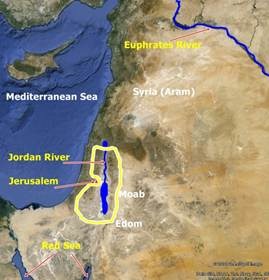
In fact, at one level, this whole passage is about the fulfillment of ancient promises and prophecies. Eight hundred years before David, God promised Abraham that his descendants would inherit the land of Canaan. In Genesis 15:18-21, that land was described as extending from the Red Sea in the South to the Euphrates river in the north where it runs southeast through modern-day Syria. Other promises in Deuteronomy 1:7, 11:24 and Joshua 1:4 describe those same borders, and lay out an eastern border that included almost all of modern day Jordan and Syria. The phrase “the river to the sea” is actually a biblical phrase describing the land God gave to the people of Israel. Today, the enemies of the modern state of Israel chant this phrase in mockery, intending to drive out all the Jews in this region.

Returning to our text, in all the time that the descendants of Abraham lived in the promised land, they had not possessed nearly that much territory. For four hundred years, they had lived on far less than God had promised. The map at left shows the region. The area outlined in yellow is the area that the Israelites controlled during the time of the Judges and during Saul’s reign. Keep in mind that my maps are accurate enough to give you the general situation, but they are not totally accurate.)

The people of God were living in far less than God had promised.

However, as a result of the conquests made by David, as described in 2 Samuel chapter 8, the area under the control of Israel was extended to almost the exact boundaries described in God’s promises to Abraham and to the people through Moses. This next picture shows the approximate area of David’s kingdom, outlined in purple. As you can see, Israel now had influence from the Euphrates river to the Red Sea. This is not to say that all of this area was considered “the nation of Israel,” however, David’s court in Jerusalem controlled and influenced all of it. If you are still having trouble picturing it, look at a world map. This area includes modern Israel, Jordan, Lebanon and most of Syria.

So what does all this mean for us today? I think it always helps to ask, “where is Jesus in this passage?” I see him here in two places: he is fulfilling promises, and defeating enemies. First let’s talk about the promises. On one hand, this seems to show us that God’s promises don’t always get fulfilled in what we consider a timely fashion. It was more than eight hundred years between God’s promise to Abraham about the size of the land, and the complete fulfillment of that promise. That’s a long time, and many generations didn’t live in the full reality of what God had promised. On the other hand, God doesn’t forget his promises, and he does truly bring them to pass. If you wanted to take the time, you could go through the bible, and find dozens of examples of promises that He made and then kept. Many times in the past I have explained where the bible came from, and how it has been verified time and again as a historically valid document. Here, I want to emphasize that it is also a spiritually valid document. We have a historical record of a promise from God and a historical record from a different period showing its fulfillment.

A natural question is “Why did it take so long for God to fulfill this?” The only completely honest answer is “I don’t know.”

Yet again, I think we have a Bible passage that is pretty unlikely if the Bible was made up. Can you imagine saying, “Let’s make up a story about God promising us all this land.”

“Yes, but let’s say that it took almost a thousand years for the promise to come to pass.”

“And then let’s say that the promise only lasted for two generations.”

“Yeah, we’ll have them flocking to our made up religion by the thousands!”

I do have some thoughts, about why it might have been so long, however. God told Abraham when he made the promise that it wouldn’t happen for at least four-hundred years, because he was giving the residents of the land a chance to repent. So, for the first four-hundred years, God waited, in order to be merciful to people who were rejecting him. But when the Israelites finally came out of Egypt four hundred years later, the Lord told them through Moses to go into the land, drive out the other nations and possess it. They simply didn’t do it. The reason they didn’t do it is because they lacked faith in God’s promise to be with them. In Numbers 13, Moses sent twelve spies into the land prior to invading it. Ten of the spies came back and said it would be impossible to drive out the nations who lived there. But two said it could be done. Their names were Joshua and Caleb. They said:

“The land we passed through and explored is an extremely good land. 8 If the LORD is pleased with us, He will bring us into this land, a land flowing with milk and honey, and give it to us. 9 Only don’t rebel against the LORD, and don’t be afraid of the people of the land, for we will devour them. Their protection has been removed from them, and the LORD is with us. Don’t be afraid of them! ” (Num 14:7-9, HCSB)

But the people didn’t listen to them. Instead they gave into fear and blaming. The result was forty years more of wandering for that generation, and then another four-hundred years of living in only part of what God promised.

I don’t think the lesson here is “do more.” I think it is “trust more.” As I have said many times, believing comes before doing. If the people were living in trust, they would have done what they were supposed to do. If they had attempted to do it without trust (as indeed they often did in the next four hundred years) their results would also have fallen short (as indeed, they did). The key is believing what God has promised, and trusting Him. We have seen that the one thing that makes David a hero is that he trusts God. David isn’t perfect. But he lives out of the understanding that his life belongs to God; that through him, God can and should do whatever he wants. So when David came along, the Lord finally had someone he could use, someone who trusted Him enough so that God could fully give everything that was promised.

We can’t always understand why God doesn’t completely fulfill his promises in our own lives. It isn’t always about our faith – sometimes it is about God’s bigger purposes in the world. For the first four hundred years after Abraham, God did not bring his people into the promised land, because he was trying to be merciful to the people who already lived there. So, it wasn’t the fault of God’s people that they hadn’t received his full promise. For many years, even David did not live in the fullness of God’s promises to him. That wasn’t his fault – God was arranging other things, because it wasn’t just about David – it was about God’s purposes. So don’t feel badly if you truly trust God, and yet you don’t see the complete reality of his promises in your life. It isn’t just about you.

But at least, we can try to eliminate lack of faith as a reason that we don’t experience the fullness of God’s promises to us. David trusted him fully, and eventually, the Lord used that trust in a huge and positive way for both David and the entire people of God.

I want to say one more thing about God’s promises. God’s best promises are the ones that will last for eternity. The people of Israel lived in the land stretching “from the river to the sea” for roughly two generations. None of the other Israelites before or since lived in a country that large or influential. But the bible contains promises that can never spoil or fade. The apostle Peter explains like this:

3 All praise to God, the Father of our Lord Jesus Christ. It is by his great mercy that we have been born again, because God raised Jesus Christ from the dead. Now we live with great expectation, 4 and we have a priceless inheritance—an inheritance that is kept in heaven for you, pure and undefiled, beyond the reach of change and decay. 5 And through your faith, God is protecting you by his power until you receive this salvation, which is ready to be revealed on the last day for all to see.
6 So be truly glad. There is wonderful joy ahead, even though you must endure many trials for a little while. 7 These trials will show that your faith is genuine. It is being tested as fire tests and purifies gold—though your faith is far more precious than mere gold. So when your faith remains strong through many trials, it will bring you much praise and glory and honor on the day when Jesus Christ is revealed to the whole world. 1 Peter 1:3-7

The best promises of God are the ones that last forever. While we wait for those, we may experience trials in the meantime. But we can rejoice in the knowledge that in the end, everything really will be OK. Our hearts will be filled with overwhelming joy, peace and love. Nothing that happens to us in this life can take that away from us.

Now let’s talk about Jesus defeating enemies. Is there “unconquered territory” in your life? What I mean is: are there certain areas of your life that are outside the control of Jesus? Hebrews 2:8 says this:

“You put all things under his control.” For when he put all things under his control, he left nothing outside of his control. At present we do not yet see all things under his control, (Heb 2:8, NET)

Like with God’s promises, we often see a partial fulfillment of the Lord ruling in our lives. I’ll be honest and say, usually this is for the same reason – our own lack of trust. But it has the same solution. If we trust Jesus, and let him have us more fully, he will supply the power to defeat the failures, temptations and self-will that we struggle with. Paul writes about the struggle this way:

For though we live as human beings, we do not wage war according to human standards, for the weapons of our warfare are not human weapons, but are made powerful by God for tearing down strongholds. We tear down arguments and every arrogant obstacle that is raised up against the knowledge of God, and we take every thought captive to make it obey Christ. (2Cor 10:3-5, NET)

Like David, we are called to wage war while trusting in God’s promises. But our war isn’t physical – it is the war of a mind, to let the Lord conquer all that he has promised for us. I think we should understand this from our text: the key is to trust our Lord, and to be willing to do whatever that trust leads us to do. Sometimes that means opposing whatever opposes the truth of the Word of God in our thoughts. David illustrates physically in the land of Israel what Jesus wants to do spiritually in our hearts and minds.

Sometimes, as we wage this spiritual battle, our path to victory involves surrendering to God. We need to say to him, “You win. All that I am is yours. My full being: body, heart, soul and mind belongs to you. Do with me whatever you want.” The main battle then becomes allowing God permission to do whatever he wants to in and through our lives.

Think about this during the coming week. What is one eternal promise that you can cling to, that will bring you comfort no matter what you face? We have more than one, of course, but maybe pick one to focus on this week, and then pick another next week.

Another thought: What is one area of your life that is not fully surrendered to the Lordship of Jesus Christ? In other words, what is a part of your life that Jesus needs to conquer? Will you give him permission? I know there may be many areas, but perhaps focus on just one for this week, and then pick another for next week, and so on.

What is the Holy Spirit saying to you right now?

1 SAMUEL #15: TRUSTING OBEDIENCE

Photo by Yuri Catalano on Pexels.com

The essence of following Jesus can be summed up in three words: Trust and Obey. But it is so very important that we keep the concepts in that order. Without trust, all the obedience in the world is only a pointless work of the flesh. And if we truly trust Jesus, we will naturally obey him. The two are deeply connected. Saul shows us a negative example: he did not trust God, and therefore he did not obey him. On the other hand, Jesus obeyed perfectly on our behalf.

To listen to the sermon, click the play button:

For some people, the player above may not work. If that happens to you, use the link below to either download, or open a player in a new page to listen.

To download, right click on the link (or do whatever you do on a Mac) and save it to your computer: Download 1 Samuel Part 15

1 SAMUEL #15. 1 SAMUEL 15:10-26

The Old Testament has a lot of value for us in many ways. We can learn from examples, both positive and negative. We can see how God deals with people who live by faith, and with those who don’t. We can receive comfort in God’s promises to his people (and if we trust Jesus, we are his people, those promises are for us). We can learn about God’s standard for holiness.

But we must never forget that the Old Testament is first and foremost about Jesus. The Life, death and resurrection of Jesus are the central concern not only of the New Testament, but also of the Old Testament. Luke describes how Jesus helped his disciples to understand this.

He said to them, “How unwise and slow you are to believe in your hearts all that the prophets have spoken! Didn’t the Messiah have to suffer these things and enter into His glory? ” Then beginning with Moses and all the Prophets, He interpreted for them the things concerning Himself in all the Scriptures.

Luke 24:25-27

Then he said to them, “These are my words that I spoke to you while I was still with you, that everything written about me in the Law of Moses and the Prophets and the Psalms must be fulfilled.” Then he opened their minds to understand the Scriptures

Luke 24:44-45

The Jews divided the Old Testament into two parts: “the Law” or “the book of Moses” which are the first five books of the Bible. The second part was called “the Prophets” and it included not only the books which we call “prophetic” but in fact, all of the other books of the Old Testament. So when the New Testament says “the Law and the Prophets” or “Moses and the Prophets” (as it does in the verses above) it means “the entire Old Testament.”

The purpose of the entire Bible is to help us to know Jesus better and walk with him in faith. So even as we read these Old Testament scriptures, we should be asking, “Holy Spirit, show us Jesus in this part of scripture.”

I think this is particularly important when we come to a section like 1 Samuel 15. We talked about the concerns of Holy War for two messages. Let’s be done with the considerations of Holy War and get to the main point of this passage: the obedience that comes from faith.

Saul disregarded the Lord’s command to utterly destroy the Amalekites. He spared the life of the Amalekite king. Quite possibly he did this because, out of fear for his own head, he wanted his followers as well as foreign armies, to differentiate between royalty and ordinary people. In any case, he disobeyed God’s command in this respect. He also allowed his followers to keep the best livestock alive. When Samuel first confronted Saul about what he had done (or, failed to do) Saul claimed that he saved all the animals for sacrificing to the Lord. He was lying. He got caught in disobeying the Lord’s command, and so he decided in that moment to make up for his failure to obey by making a sacrifice with the captured animals.

Samuel didn’t buy it. He said:

22 “Which does the LORD prefer: obedience or offerings and sacrifices? It is better to obey him than to sacrifice the best sheep to him. 23 Rebellion against him is as bad as witchcraft, and arrogance is as sinful as idolatry. Because you rejected the LORD’s command, he has rejected you as king.” (1 Samuel 15:22-23, GNT)

Saul’s warriors may have been grumbling about pointlessly killing good animals. Even if they weren’t, he may have wanted to appear gracious and become popular by rewarding those who fought with him. There may not be anything wrong with that, except that the Lord clearly commanded otherwise. In fact, Saul himself told Samuel that he failed to kill the animals because he wanted the approval of his men:

24 “Yes, I have sinned,” Saul replied. “I disobeyed the LORD’s command and your instructions. I was afraid of my men and did what they wanted. (1 Samuel 15:24, GNT)

Samuel’s proclamation that obedience is better than sacrifice is a theme repeated throughout both the Old and New Testaments. The Psalms reference this exact concept several times. So does Isaiah, and also Hosea. Jesus mentioned the idea a few times in the New Testament. Even so, we need to be careful as we apply this to our own lives. It is very easy to say, “That’s right. I just need to obey God. We just need to do the right thing. What’s the point of saying we follow God if we don’t obey him?” I understand this attitude. There are in fact times when some people just need to step up and obey what God tells us through the Bible. Some of us ought to stop making excuses, quit fooling around, and get serious about doing what Jesus tells us to do. It’s appropriate for some of us to take this approach at times. But this attitude, if it is applied in the wrong way, can also lead us away from what God is really after. It can tend to make us rely on our own strength and effort in the flesh.

So, first, we need to understand that Jesus fulfilled this passage on our behalf. The writer of Hebrews quotes Psalm 40, and says that it is fulfilled in Jesus:

​​​​​​​​In sacrifice and offering you have not delighted, ​​​​​​​but you have given me an open ear. ​​​​​​​Burnt offering and sin offering ​​​​​​​you have not required. ​​​ ​​​​​Then I said, “Behold, I have come; ​​​​​​​in the scroll of the book it is written of me: ​​​ ​​​​​​​​I delight to do your will, O my God; ​​​​​​​your law is within my heart.” ​​​ Ps 40:6-8 (ESV)

Jesus delighted in God’s will. He didn’t live according to religious rules – the law of God was within his heart and during his time on earth he lived out that law through dependence upon the Father. He obeyed God perfectly. We cannot obey perfectly. So Jesus did it on our behalf. The obedience we owe God is complete and perfect in Jesus Christ, and only in Him. So when you think, “Oh, I have to obey God, because to obey is better than sacrifice” actually what you should hear is “I need to trust Jesus even more. Trusting him is my obedience, because he has already done the obedience for me.” Jesus even said so:

8 Then they said to him, “What must we do, to be doing the works of God?” 29 Jesus answered them, “This is the work of God, that you believe in him whom he has sent.” (John 6:28-29, ESV)

I think in the New Testament most of the times it says “believe” it would be more helpfully translated as “trust.” So, trusting is our obedience.

One reason we sometimes get confused is because obedience and trust can sometimes look the same. When you live by faith, it does result in certain actions. It does eliminate other actions. The Bible does use the term “obedience.” But we must remember, it is the obedience of faith – not the obedience of self-effort and religion.

Saul was religious, but had no relationship with God. He claimed that what he did was good, because he was thinking about religious appearances. Saving the animals to sacrifice later was a religious thing. After all, sacrifices were part of Jewish religion. But Saul used this aspect of religion to keep from actually interacting with God, actually listening to him and responding in faith to what God said. Jesus said the Pharisees were religious in this way, also. Instead of listening to what the Lord actually said, they obeyed man made rules and put their trust in their own efforts. Religion keeps track of rules and regulations to follow, instead of living in a real, faith-relationship. The Pharisees obeyed religiously. But, again, they put their trust in man-made rules, and also in their own efforts to keep those rules.

So, what does living in faith look like? Are we supposed to obey, or not? Let me give you a little analogy to help us understand this.

I love spy/suspense shows like the Bourne Identity. Not everything in these shows is entirely righteous, but living in faith, we can find good things in them. Sometimes in shows like this, one of the characters may encounter a bomb that is counting down to an explosion. Picture a scene like this, where the heroine of the story has just a minute or so to defuse a bomb. She doesn’t know how to do it. But she gets on the phone with her superior officer who does. He tells her, “cut the blue wire, but be sure not to cut the red one.” So she carefully cuts the blue wire, but not the red one.

Now what is going on here? Is she obeying her boss, or trusting him? Reflecting on this takes us right to the heart of the matter. Before you read on, think about this for a moment.

She is doing, both, of course. But you see, her actions of obedience proceed from her trust of her chief. She trusts that he knows how to save her. She trusts that if she does what he says, she will be safe. And so, because of that trust, she acts according to what he says – that is, she obeys. She isn’t just doing what her bomb-expert supervisor says because obeying superior officers is the right thing to do. She isn’t doing it from a sense of moral obligation. She is “obeying” him because she trusts that he wants to save her life, and has the power (in this case knowledge) to do so.

You could call it obedience. But I would call it primarily trust. The obedience is a result of the trust. This is so important: we obey because we trust. Sometimes Christians call this “the obedience of faith.”

I want to pursue this analogy a little bit further so let’s return to the time bomb scene. In order to get this kind of trust-obedience, you need several factors. First, the heroine had to believe that her life really was in danger. If she didn’t believe the bomb was real, chances are, she wouldn’t have called her boss anyway. She would not have been seeking to follow his instructions, because she wouldn’t have believed she had any reason to do so. Second, she had to believe that her supervisor had the knowledge that could save her. Third, she had to believe that he wanted to save her.

When we encounter problems with obeying God in our own lives, I think it is usually a combination of these factors at play. Maybe we believe that the situation isn’t really very serious. Although we think obeying God is the right thing, when it comes down to it, we think we’ll be OK even if we don’t. We don’t see his words as life and salvation. So we don’t obey because we don’t believe our problems, or struggles with sin, are really that serious. We aren’t truly convinced that we need saving.

Second, maybe we doubt whether God truly has the answers we need. Perhaps we don’t obey him because we aren’t sure that what he is saying to us is relevant and helpful to us in our own situation. I think this was one of Saul’s major issues. He seemed to feel that God was fine for religious things, but in everyday life, you had to take care of yourself and use your common sense. Saul didn’t seem to think the commands of God had any value in his own situation.

Third, we sometimes don’t obey because we aren’t sure we can trust God. Maybe we aren’t sure if he really has our best interests at heart. This was also part of Saul’s issue. He was insecure about his position as king of Israel, even though God had called him to be king. Saul felt he had to look out for himself; he didn’t trust God to protect or defend him.

Do you see the solution to the obedience problem – no matter what causes it? Faith. In each case, we need to address what we believe; it is essential for us to learn to trust God more deeply. We must accept that our situation is in fact serious – deadly serious, fatally serious – and that we really do need the Lord at the very deepest level. We need to trust that the Lord really does have what it takes to save us, that his words are life. We have to develop the confidence that He is relevant in every moment of our lives. And we ought to rely on the fact that he truly loves us and has our best interests in his heart. I think this last one is where a lot of us struggle. We tend to think that what we want is best, and if there is a conflict between what we want and what the Lord wants for us, our own way is better. We have to abandon that attitude entirely, and place our hope in His goodness and grace.

Peter expressed this attitude of faith. A lot of people had turned away from following, and Jesus was left with just the twelve apostles.

After this many of his disciples turned back and no longer walked with him. So Jesus said to the Twelve, “Do you want to go away as well?” Simon Peter answered him, “Lord, to whom shall we go? You have the words of eternal life, and we have believed, and have come to know, that  you are the Holy One of God.” (John 6:66-69)

Peter understood that there was no alternative to Jesus. “Where else would we go? You are the one with the words of eternal life.” That is magnificent trust. He knew he needed help. He didn’t think he could, through his own effort, please God. He trusted that Jesus, and only Jesus, could save him. He actively trusted that God’s way was always best.

The reality is, we all behave according to what we believe to be true. In the past, I’ve mentioned the story of the four minute mile. For decades, no one believed that a person could run a mile in less than four minutes. Then one man began to believe it might be possible. Within six weeks of believing it, he had done it. As soon as he proved it could be done, several others broke the same barrier within a matter of months. A few decades later, hundreds of people had done it. The only thing that changed from before was that people believed it could be done. What I’m trying to say is that if you truly do trust Jesus, your actions will begin to reflect that trust. It might be slow, with fits and starts, but over time, you will act differently. You will obey him because you trust him.

The devil likes to trick us into religion. Do the right thing because it is the right thing. And something in us responds to that. After all, it is the right thing. But it is the wrong path, the wrong way to go about it. This attitude can lead us to trust in our own efforts. We can do the right thing with our own effort – for a while. If we manage it, the devil leads us astray through our pride in our own accomplishments. But most of us fail eventually because it is based upon our efforts, not the obedience that Jesus has already done on our behalf.

Instead, we should do the right thing because we believe we are in desperate need of help, and we trust that only God can help us, and that he really does want the very best for us.

When we fail, the devil likes to beat us up: You just aren’t obedient enough. You just don’t try hard enough. But the problem isn’t effort. The real solution lies in trusting more. Jesus has obeyed perfectly. His righteous obedience has become ours (2 Corinthians 5:21). Our part is to trust. If we do truly trust, then our lives will reflect the kind of actions the Lord desires. But it doesn’t start with our action, it starts with our trust. You see, because Jesus has perfectly obeyed in our place, we can no longer fail at this. The more we truly believe that, the more our behavior reflects it.

So let me put it to you today. Do you trust that your situation is serious? Do you remember that no one gets out of this world without dying? Do you recognize that even handling day to day life is difficult? Do you know that you are in a desperate place, the bomb is about to go off and you can only get help from one place?

Do you trust that the Lord has the right, relevant Word for you? Do you accept that he knows better than you, that he will save you and guide you if you trust him to?

Do you know that he wants to save you and help you? Do you trust his goodness?

And finally, do you accept that Jesus has already obeyed perfectly as a “stand in” for you? In other words, do you trust that you are safe, that you can no longer fail?

Take a moment right now to let the Lord into your thoughts and prayers as you consider these things.

1 PETER #32: GOD CARES FOR YOU

Photo by Pixabay on Pexels.com

The key to balancing our understanding of God’s care for us is to remember to humble ourselves before God, recognizing that life is not about you or me. At the same time we are called to trust that he does, in fact, care for us. Humility means we do not demand that God serve us, and especially, we do not insist that he must answer our prayers only in the way we intend. We come to him humbly, in awe and wonder at the fact that he really does care for us, knowing that we do not deserve it, but trusting that he does care all the same. We come to him humbly, agreeing that we do need his help and love and grace. And we come to him in trust, relying on him to care for us, knowing for certain he does, because of Jesus.

To listen to the sermon, click the play button:

For some people, the player above may not work. If that happens to you, use the link below to either download, or open a player in a new page to listen.

To download, right click on the link (or do whatever you do on a Mac) and save it to your computer: Download 1 Peter Part 32

1 Peter #32. 1 Peter 5:6-7

Last time we discussed humility. We noted that there is a connection between humility, and casting your anxieties on God, because in order to give our cares to Him, we must admit that we can’t handle them ourselves. This topic reminds me of the poorly worded church sign that said “Don’t let worry destroy you – our church can help!”

There are two possible errors when we consider the idea that God truly cares for us. The first is to believe that this is the main thing about God. We can begin to believe that God’s main purpose is to care for us; that this is what God is for. We start to think that this is what being a Christian is all about – having a God who will take care of our problems.

Making this error leads to all sorts of problems. The first, and biggest, is that we believe that life is all about us. People think that God is there to serve them, so naturally that means that they, and their needs, desires and problems, are the most important things about faith in God. Now, they probably wouldn’t actually put it that way so bluntly to themselves. But when people make this error, the way they pray, and pursue God, shows that they think God is primarily there to help and serve them (and, to be fair, other believers). This is really where the “prosperity gospel” comes from. One of the big dangers of it is that it is often so close to the truth, yet distorted in significant ways. If the main thing about God is that he exists to care for them, then what they really need is to find a way to get access to God’s caring and blessing. They might do this by reducing how much they sin. After all, (the thinking goes) sin gets in the way of God giving them what they need. Now, reducing sin is a good thing. I’m all for it. But the reason we try to sin less is because God is holy, because some things are right and some are wrong, not because it will help us get more stuff that we want.

People might try to get more of God’s blessing and care through prayer and worship – prayer and worship unlock God’s blessing (so many people would put it). Again, I think prayer and worship are good things. But we should do them because God is God, and deserves our worship, and much more besides. It is true that sometimes we are blessed through prayer and worship. However, doing such things mainly in order to get more blessings is a serious distortion of what the Bible teaches.

People who buy into this error go to church primarily in order to learn how to “release” more of God’s care and blessing into their lives. They give their tithe not because God is God, and owns everything, but rather, they give primarily in order to get greater blessing back.

Many churches and ministries that take this approach are very large and outwardly successful. This is because the whole idea appeals to human selfishness. Instead of dealing with the basic sin of self-centeredness, ministries actually appeal to it in order to get people to do religious things, and to grow the church. It’s easier to grow a ministry if you encourage and manipulate the sinful desires people have, rather than confronting them with the gospel.

When we look at our text today, we can see the main mistake. People who make this error keep “God cares for you,” but they ignore “humble yourself before God.”

The other major problem that comes out of thinking that God is mainly there to take care of us is that when he doesn’t take care of us the way we think he should, our faith is shaken. I have met many, many people who turned away from God, in essence, because they felt like God let them down. He didn’t care for them in the way they wanted to, or in a way that they could understand. It is a fragile and unstable foundation for faith.

I’ll be honest, I do not remotely understand how to reconcile these thoughts: 1) God cares for me. 2) God is all powerful. 3) God has not healed me from my constant, brutal pain. If I thought God’s primary job was taking care of me, I would be tempted to think he’s pretty bad at it, and I might want to abandon my faith. As it is, though I do believe God cares for me, I also believe that his ultimate purposes are bigger than just me, and that, because he is God, I should not expect to understand everything he does, or does not, do. I can trust him beyond what I can understand.

There is another error that people sometimes make about these verses. Some people find it very hard to believe that God actually does care for individuals, families and small groups. They understand that God is God, all right, but they can’t believe he has any true interest in dealing with eight billion separate people, nor yet the time to do it.

This error is also dangerous. It is a rejection of what the Bible actually says. As incredible as it seems, God actually cares what happens in the lives of individual people:

16 But I will call on God,
and the LORD will rescue me.
17 Morning, noon, and night
I cry out in my distress,
and the LORD hears my voice. (Psalms 55:16-17, NLT)
17 As for me, I am poor and needy,
but the Lord takes thought for me.
You are my help and my deliverer;
do not delay, O my God! (Psalms 40:17, ESV)
8 Your Father knows what you need before you ask him. (Matthew 6:8, ESV)
26 Look at the birds of the air: they neither sow nor reap nor gather into barns, and yet your heavenly Father feeds them. Are you not of more value than they? 27 And which of you by being anxious can add a single hour to his span of life? 28 And why are you anxious about clothing? Consider the lilies of the field, how they grow: they neither toil nor spin, 29 yet I tell you, even Solomon in all his glory was not arrayed like one of these. 30 But if God so clothes the grass of the field, which today is alive and tomorrow is thrown into the oven, will he not much more clothe you, O you of little faith? 31 Therefore do not be anxious, saying, ‘What shall we eat?’ or ‘What shall we drink?’ or ‘What shall we wear?’ 32 For the Gentiles seek after all these things, and your heavenly Father knows that you need them all. (Matthew 6:26-32, ESV)

As you might imagine, there are many other such verses. According to the Bible, God really does care for each person in the world. The details of our lives, and our struggles, are important to Him.

 In 2017, we were incredibly blessed to take a one month sabbatical in Europe. My wife Kari was struggling to believe this very thing: how can God really care for each one of the billions of people on earth? How can he even keep track of them all? Traveling often brings this up. When you travel, you realize how many people and places there are in the world. It seems impossible for God to keep track of everyone.

We had two surprising experiences in which God showed us once again that he is God. At one point, we went to Venice, Italy, where we stayed in a Methodist guest house. Breakfast was included with the cost of the stay, and one morning we ate next to a German family. I was excited to practice my German, so I spoke to them. The man asked me where I learned German, and I explained that I grew up in Papua New Guinea (PNG), and many of our friends there, including our neighbors, were Germans. To shorten the story, it turned out that he had worked, in Germany, with one of my former German neighbors for several years! The odds of bumping into someone who knows someone else from PNG are astronomically small anywhere in the world. The odds that it would be someone who knew my actual neighbor are infinitesimally small. You would be a fool to bet any amount of money on such a thing happening by random coincidence.  

Another “coincidence” began about a week later, when we were in southern Italy on a ferry boat. On the boat, we got to talking with a friendly couple from Australia, and we enjoyed our time with one another. We left them once we reached shore, and didn’t see them again. A week after that, we were in the Rome airport, to take our flight back to the U.S.. That particular airport is stunningly gigantic. We went through all sorts of lines, and rushed from one point to another, passing thousands of people, until we came to the international departures checkpoint. There were several hundred people in the line, which snaked back and forth over a huge area. We got settled into the line, and took a moment to catch our breath. We turned around, only to find the Australian couple immediately behind us. I wouldn’t know how to begin to calculate how unlikely this was. If I put this sort of coincidence in one of my books, people would call it bad writing; they would say that as the author, I am clearly manipulating the plot in an unbelievable way. Perhaps that is exactly what it was, with, of course, God being the author of our experiences, manipulating things so that we can catch a glimpse of him.

Speaking of writing, my own experience as an author has helped me to see how God can care for each individual person. Suppose I am writing a scene in which my main character (Jonah Borden) meets another key character in the story, named Peter. Jonah goes on a hike, and coming around a corner, he meets Peter. In the pages of my book, all this happens instantaneously. But in my life, as the author, I can write (speaking as Jonah) “I came to a fork in the trail, and took it. Around the next bend, I met a man.” Then, I can stop, and take two days to think about Peter, and his motivations and needs, and how he came to be there at that particular time, and everything else about Peter’s life, and how his life will affect Jonah’s life, and vice-versa. In the time-frame of the book, it all happens from one moment to the next. But I can step out of the pages of the book, into my own time-location and take all the time I want to work all this out. I am not bound by the time-frame of the people in the story.

If Jonah believed in me as the god of his world, he could pray, “O Author, please let me meet someone in the next five minutes who will help me with my troubles.” I could take as much time as I need to set up an answer for him, even though only five minutes (or less) elapsed for him, in my story. Or, alternatively, I could see that Jonah’s request doesn’t work with the story I am telling, and so I would not have him meet anyone, but that doesn’t mean I don’t care for him. In fact, he is my creation, and I am pretty fond of him, to be honest, but that doesn’t stop me from putting him into a lot of difficult situations.

In the same way, God is not bound by our time frame. He has all the time in the world to hear my prayer, and yours, and the prayers of believers in China, and India, and South America. He has all the time there is to arrange for us to meet someone significant at just the right time and place. He has much more time, in fact, than I do as an author. God is infinite, and we are not, and so he has, literally, more than enough time, and more than enough capacity, to care for not just eight billion people at once, but even trillions and trillions more.

The ultimate demonstration of God’s love for us is the death of Jesus Christ. God did not have to save us. Jesus did not have to die. He chose to die, and he did so because he loves us.

6 When we were utterly helpless, Christ came at just the right time and died for us sinners. 7 Now, most people would not be willing to die for an upright person, though someone might perhaps be willing to die for a person who is especially good. 8 But God showed his great love for us by sending Christ to die for us while we were still sinners. 9 And since we have been made right in God’s sight by the blood of Christ, he will certainly save us from God’s condemnation. 10 For since our friendship with God was restored by the death of his Son while we were still his enemies, we will certainly be saved through the life of his Son. (Romans 5:6-10, NLT)

He has already proven his love for us, and if we ever doubt it, we can remember the cross, the torture and suffering, the incredible spiritual agony that he endured for you and me. Look at the cross, and see how much he cares for us.

We are called not just to know that God cares for us, but to actively cast our cares upon him. Peter obviously means that we should pray about the things that burden us. Paul says something similar:

6 Don’t worry about anything; instead, pray about everything. Tell God what you need, and thank him for all he has done. 7 Then you will experience God’s peace, which exceeds anything we can understand. His peace will guard your hearts and minds as you live in Christ Jesus. (Philippians 4:6-7, NLT)

 Unburden yourself to the Lord. Tell him, in plain language, in your own words, what is troubling you. But there is a second part of casting your cares on the Lord that we often forget. If we cast our cares upon God, that means we have to let go of them. The same word is used in Luke when the disciples threw their cloaks onto the donkey that Jesus rode. They couldn’t throw their cloaks onto the animal, and still wear them, or hold onto them at the same time. To cast your cares on God means to release them into his hands. If you tell God what concerns you, and then you continue to worry and think and imagine about it, you haven’t really cast your cares on him, have you? You’ve just given him a look at your worries, while you still hold them tight. He can’t carry your burden for you if you insist on carrying it yourself.

Now, I do know that this is easier said than done. But the first step toward really giving God your concerns is to recognize that once you have prayed, you must let go of them. I think that sometimes, worrying is our way of trying to control the uncontrollable. We can’t actually stop a loved one from getting into a car accident, but it almost feels like if we worry about it, we have some measure of control. To cast your cares on the Lord, you have to humble yourself to the point where you give up the idea of controlling what happens. You have to trust him.

I have a few practical suggestions about how to actually do that. In the first place, pray to God for the ability to trust him, and the capacity to give up control. Seriously, ask him to help you. As much as you can, give him your willingness to change. I think this is probably the best thing we can do.

Another thing that sometimes helps me is to set a timer for how long I will pray about something that really bothers me. When the timer is done, my time is up. It’s in God’s hands, no take-backs. At other times, I might write down my deep concerns, and, after praying, physically burn them in order to leave them with God. At other times, if I am walking and praying. I might pick up a rock, and use it to represent my anxieties. After praying, I will throw the rock away from me as far as I can.

As I mentioned a while ago, the key to balancing our understanding of God’s care for us is to remember both to humble ourselves before God, and also to trust that he does, in fact, care for us. The humility means we do not demand that God serve us, and especially, we do not insist that he must answer our prayers only in the way we intend. We come to him humbly, in awe and wonder at the fact that he really does care for us, knowing that we do not deserve it, but trusting that he does care all the same. We come to him humbly, agreeing that we do need his help and love and grace. And we come to him in trust, relying on him to care for us, knowing for certain he does, because of Jesus.

1 PETER #26: SIN, SUFFERING & GLORY

Photo by Karolina Grabowska on Pexels.com

Suffering loosens our focus on getting what we want in this present life, and instead, helps us to focus on our amazing eternal future in the New Creation with the unlimited joy of God filling us entirely. It also has a way of carrying us further down the road of discipleship, which means further from an interest in sin, more towards an interest in God, and his kingdom. Therefore, Peter tells us to equip ourselves with the mindset of suffering that Jesus shows us.

To listen to the sermon, click the play button: For some people, the player above may not work. If that happens to you, use the link below to either download, or open a player in a new page to listen. To download, right click on the link (or do whatever you do on a Mac) and save it to your computer: Download 1 Peter Part 26

1 PETER #26. 1 PETER 4:1-2.

1 Since therefore Christ suffered in the flesh, arm yourselves with the same way of thinking, for whoever has suffered in the flesh has ceased from sin, 2 so as to live for the rest of the time in the flesh no longer for human passions but for the will of God.

(1 Peter 4:1-2, ESV)

Though we paused to look deeply at baptism, the main point Peter has been making in this section is that we should be inspired, and empowered, by the example of Jesus to follow in his footsteps – particularly with regard to suffering. He began this section in 3:13, saying we should not fear to suffer, and that it is a wonderful thing in God’s sight to endure suffering even when we have done no wrong. We can live this way (says Peter) because Christ has suffered for us, once for all, and saved us through his grace (using baptism along the way). Chapter 4:1, our first verse for today, is basically a summary of all that: since Christ suffered, we should equip ourselves with the same way of thinking.

The first puzzler comes in the next phrase: “for whoever has suffered in the flesh has ceased from sin.”

First, we need to take into account the teaching of the whole Bible, so there is at least one thing that this cannot mean: It cannot mean that by suffering, we somehow atone for our own sin. Only through Jesus are our sins forgiven. Only Jesus, and his work can address the inner problem of the Sin that lives in our hearts.

But within a Biblical framework, there are a few things it might mean. Most of the possibilities have various problems. I feel badly that I got so deeply into baptism, so I won’t bore you with all the ins and outs of this phrase. Many different Bible scholars have different views about it, but rather than get too detailed about those views, I’ll give you my own best guess.

I think there are actually a few different levels of meaning here. First, I think it means that we Christians, (through baptism, as Peter mentions above) have been identified with the sufferings of Christ. We have been brought into union with his suffering, death, resurrection, and new life. Because we are identified with the suffering of Christ, sin no longer has any claim on us. We’re done with it as a factor in our relationship with God. Our sin has been atoned for. There was suffering for our sin, and so now that sin has no more connection to us, in the eyes of God.

There’s a second aspect to this, which Peter mentions in verses 2-4. Because we have been brought into union with the suffering of Christ, sin is no longer our typical lifestyle. We certainly don’t live perfect, sinless lives. Outside of Christ, we lived not for him, but for our own desires, which were corrupted by sin. We lived to make the best life for ourselves, on our own terms, apart from God. In other words, the pattern of our lives was sinful, and the  inner problem of sin in our hearts was never addressed. Now, however, we belong to Jesus. Though we are not perfect, the pattern of our lives is not all about ourselves. We may commit sins at times (sometimes, discouragingly often!) but we aren’t living in sin. It is not a consistent pattern anymore, it’s not the direction we are going. As Peter says in verse 2, the point is: “to live for the rest of the time in the flesh no longer for human passions but for the will of God.” By “the rest of the time in the flesh” he means “this present life, before our ultimate death and resurrection.”

All this is tremendously comforting. Through the suffering of Jesus, our connection with sin is fundamentally broken, and this is true, in spite of the fact that we still sometimes commit sins.

I think it is right to understand that Peter means all this. However, I don’t want us to overlook the fact that he is also clearly talking about our own personal suffering, not just the suffering of Christ. He has already been talking about specifically our own sufferings in 3:14 & 17. He will speak of our own suffering more, a few verses later in this chapter. So, I think it would be a mistake to make this only about our spiritual union with the suffering of Christ. Clearly, the topic at hand also involves our actual experience of suffering in this life.

My friend Wade Jones is fond of saying: “If you are really trying to live like Jesus, you should expect to have the kind of life he had.” And, of course, Jesus suffered. Not only that, but he calls us to suffer, with the expectation of joy and glory and grace following our earthly suffering.

For his Spirit joins with our spirit to affirm that we are God’s children. And since we are his children, we are his heirs. In fact, together with Christ, we are heirs of God’s glory. But if we are to share in his glory, we must also share his suffering.

Yet what we suffer now is nothing compared to the glory he will reveal to us later.

(Romans 8:16-18, NLT)

I don’t want to overstep my own limitations here, but I want to make a comment about suffering and sin. Most of you know that I suffer tremendous pain, on an hourly basis. Right now I am in so much pain that I will probably quit for a while, and come back to this later.

I have found that when I am able to see my suffering as suffering for Christ, and when I joyfully receive it as his will (without, however understanding it, or even liking it), I have a special closeness with Jesus. As a result of this, I am just less interested in sin than I am during the times when I act as if my suffering has no connection to Jesus. I have not been able to maintain this perfectly. But there is no doubt in my mind that my suffering has, in general, led me to sin less often than I did before. Again, I’m not claiming to be without sin. Sometimes, I fall hard. But compared to my life before suffering, conscious sin is less of a daily struggle.

Something I think is more important is that suffering has loosened my focus on getting what I want in this present life, and instead, helped me to focus on our amazing eternal future in the New Creation with the unlimited joy of God filling us entirely. It also has a way of carrying me further down the road of discipleship, which means further from an interest in sin. Theologian Wayne Grudem puts it like this:

 Thus, following through with a decision to obey God even when it will mean physical suffering has a morally strengthening effect on our lives: it commits us more firmly than ever before to a pattern of action where obedience is even more important than our desire to avoid pain.

(Wayne A. Grudem The Epistle of First Peter, p 167. W.B. Eerdmans, Grand Rapids, MI, 1988, 1996.)

At present, it seems clear that I will suffer whether I trust God, or not. But if, when I suffer, I choose to trust God, rather than reject him because I don’t like it, it has the same effect described by Grudem above. It takes me further down the road with God. My trust in God becomes more important, and more vital than my desire for healing. God’s love for me matters more to me than relief from pain in this life. All of this leads my interests and desires away from the direction of satisfying sinful passions.

Suffering and hardship can be used, in some ways, like a spiritual discipline:

My son, do not take the Lord’s discipline lightly
or lose heart when you are reproved by him,
6 for the Lord disciplines the one he loves
and punishes every son he receives.
7 Endure suffering as discipline: God is dealing with you as sons. For what son is there that a father does not discipline? 8 But if you are without discipline ​— ​which all receive ​— ​then you are illegitimate children and not sons. 9 Furthermore, we had human fathers discipline us, and we respected them. Shouldn’t we submit even more to the Father of spirits and live? 10 For they disciplined us for a short time based on what seemed good to them, but he does it for our benefit, so that we can share his holiness. 11 No discipline seems enjoyable at the time, but painful. Later on, however, it yields the peaceful fruit of righteousness to those who have been trained by it.

(Hebrews 12:5-11, CSB)

I don’t think this means that God is personally inflicting suffering on people. But when suffering comes, God makes use of it to shape us more and more into the people he designed us to be. He uses it for our benefit, as it says in verse 10 of the passage above.

Sometimes, Christ living in me is able to use my daily pain almost in the same way as he uses my hunger when I fast. The pain becomes a reminder of his presence. I submit to it. I use it to say: “You, Jesus, are more important to me than getting relief right now. Though of course I want relief, I am using this pain to cry out for you first, and relief only in your time and in your way.” The pain reminds me that this world is not my home. It makes it easy to see that my sinful flesh can never be satisfied, never be made whole. Therefore, I crave, not just momentary relief from pain, but ultimate deliverance from this corrupted body and world into the New Creation that is coming.

Now, this process is not automatic. There are plenty of times when I just want relief. But when I come to Jesus with my pain, even if I take a pill soon after, he can and does use it to move my focus from this life toward the glory that is coming. The Holy Spirit inspired Paul to write about this also:

16 That is why we never give up. Though our bodies are dying, our spirits are being renewed every day. 17 For our present troubles are small and won’t last very long. Yet they produce for us a glory that vastly outweighs them and will last forever! 18 So we don’t look at the troubles we can see now; rather, we fix our gaze on things that cannot be seen. For the things we see now will soon be gone, but the things we cannot see will last forever.

(2 Corinthians 4:16-18, NLT)

Suffering helps us to keep fixing our gaze on the unseen, on the glory that will be revealed that will last forever. Because of this, we can learn to see suffering as a gift. If you know my story, you know I’m not speaking theoretically. I’m not sitting here comfortably imposing some idea about suffering onto the poor souls who actually suffer. I’m in it. I’m not teaching anything here that I haven’t personally had to grapple with.

Many people I know wish for a revival in American Christianity. They hope for a time when the people of God are truly repentant, and joyfully follow Jesus whole-heartedly in such a way that the whole culture is transformed by it. I hope for it too, however I cannot see how it could possibly come about except by suffering.

The broader point Peter is making is that, whether we personally suffer or not, it is time to be done with the values of the world around us. The things he describes are shockingly similar to twentieth century Western culture. Basically, he says, those who don’t follow God live for personal pleasure and excitement. In short they party – using substances, sex, and whatever else works, to feed their endless cravings and emptiness.

Peter also mentions idolatry. We don’t worship literal idols any more, but the essence of idolatry is to make something other than God the most important thing to you. If it is not God, whatever you “live for” is an idol. If you are seeking comfort from something other than God, it might be an idol.

Now, we should understand that God provides things through his creation, and through other human beings, and we can receive comfort through various things. So, for instance, we might be comforted by our families. As long as we remember that our families were given to us by God, and that the comfort we get from them really comes ultimately from him, I don’t think family is an idol. However, if we were to begin making family more important than God, if we made choices in favor of family that took us further from God, than, in that case, family might be an idol.

So the picture Peter gives us of the non-Christian world is that it a)Lives for pleasure and b)Lives for comfort (that is the point of idolatry). But we who follow Jesus live for Him. We live for his love, and for the amazing future that he has promised us. That leads us to be different from the world, to say no to pleasure and comfort as the ultimate goals, even if for a little while we suffer.

GOD’S GLORY FOR OUR GOOD

Photo by Jaime Reimer on Pexels.com

To listen to the sermon, click the play button:

For some people, the player above may not work. If that happens to you, use the link below to either download, or open a player in a new page to listen.

To download, right click on the link (or do whatever you do on a Mac) and save it to your computer: Download God’s Glory, Our Good

3 Praise the God and Father of our Lord Jesus Christ, who has blessed us in Christ with every spiritual blessing in the heavens. 4 For He chose us in Him, before the foundation of the world, to be holy and blameless in His sight. In love 5 He predestined us to be adopted through Jesus Christ for Himself, according to His favor and will, 6 to the praise of His glorious grace that He favored us with in the Beloved. (Ephesians 1:3-6, HCSB)

11 We have also received an inheritance in Him, predestined according to the purpose of the One who works out everything in agreement with the decision of His will, 12 so that we who had already put our hope in the Messiah might bring praise to His glory.
13 When you heard the message of truth, the gospel of your salvation, and when you believed in Him, you were also sealed with the promised Holy Spirit. 14 He is the down payment of our inheritance, for the redemption of the possession, to the praise of His glory. (Ephesians 1:11-14, HCSB)

4 But God, who is rich in mercy, because of His great love that He had for us, 5 made us alive with the Messiah even though we were dead in trespasses. You are saved by grace! 6 Together with Christ Jesus He also raised us up and seated us in the heavens, 7 so that in the coming ages He might display the immeasurable riches of His grace through His kindness to us in Christ Jesus.(Ephesians 2:4-7, HCSB)

I want to share some things this time that the Lord has been showing me. I don’t want to pretend that this is something new. Many, many people have written about what I am going to say here. Even so, it is a subject that is often neglected in churches these days. Also, I think I have a piece to share that makes the main lesson a bit more concrete and personal.

I have highlighted several phrases from the first two chapters of Ephesians. Here’s the first thing I want us to notice from the verses above: God wants to display his glory and his grace to the universe he created.

God is the best, most beautiful, most wonderful, amazing, superlative being in all of existence. There is nothing better than him. Nothing more beautiful. Nothing more wonderful. Nothing more worthy of praise or attention. He is the highest and best good. Therefore, the highest and supreme good, the most wonderful thing that can ever happen at any time, is that God’s wonderfulness and goodness and amazingness is displayed to, and known by, all of creation. For short, we can call this: “God is glorified.” When God is glorified, it means that his goodness, wonderfulness (and so on) is being displayed, and recognized.

Think of it like this. Just as we should seek to honor and glorify God because he is the Supreme Good, so he should seek to bring honor and glory to himself – for the same reason. That is God’s focus. That is His continual, ongoing activity. In a big-picture sense, this is always what God is up to: bringing glory to himself. This is always the end result that he has in mind, because it the best thing that can happen in the universe, and it is the best thing for the universe. The best thing that can ever happen, in any situation, at any time, is that God is glorified. This is always God’s end-goal, in every situation. Scripture tells that:

10 at the name of Jesus
every knee will bow —
of those who are in heaven and on earth
and under the earth —
11 and every tongue should confess
that Jesus Christ is Lord,
to the glory of God the Father. (Philippians 2:9-11, HCSB)

25 For Christ must reign until he humbles all his enemies beneath his feet. 26 And the last enemy to be destroyed is death. 27 For the Scriptures say, “God has put all things under his authority.” (Of course, when it says “all things are under his authority,” that does not include God himself, who gave Christ his authority.) 28 Then, when all things are under his authority, the Son will put himself under God’s authority, so that God, who gave his Son authority over all things, will be utterly supreme over everything everywhere. (1 Corinthians 15:25-28, NLT)

33 Oh, how great are God’s riches and wisdom and knowledge! How impossible it is for us to understand his decisions and his ways!
34 For who can know the LORD’s thoughts?
Who knows enough to give him advice?
35 And who has given him so much
that he needs to pay it back?
36 For everything comes from him and exists by his power and is intended for his glory. All glory to him forever! Amen. (Romans 11:33-36, NLT)

Stay with me here, because I think the end result will bless you. We have a bit of mind-work to do first, however. If God’s main purpose is to show his glory, then that is the thing that will most certainly happen. Nothing compares to God, and the scripture says he does not change or waver. So, we can count on the fact that God will be glorified. It is more certain, even, than death or taxes. Nothing will prevent God from ultimately being glorified in all things. His own nature and his own purpose guarantee it.

Now, if you are a self-centered creature like me, or maybe even if you are just hurting, you might say, “I can recognize that God’s goal is to be glorified, and, with my mind, I can even agree with that goal. But I don’t see how it helps me when God is glorified.” I know this is a shallow, selfish approach, but I can’t help feeling that way at times. I might think: “Good for God, that he gets the glory that he deserves. But in the meantime, I’m suffering.” If you know me, you know that I mean that part quite literally. I am physically suffering right now, as I write this. But even if you aren’t suffering, you might wonder: “What does God’s glory have to do with me?” It’s nice for God that his purpose will not be thwarted. It’s great for him that ultimately he will be glorified. But life is hard right now. Sometimes, I wonder if the idea of God working so that his wonderfulness is displayed to all creation really does much for me.

But it does.

You see, what the verses I quoted in the beginning (from Ephesians) tell us is not just that God is glorifying himself. They tell us the way he goes about bringing glory to himself. And, simply because he chose to do so, he has decided that he will make loving us a central part of his own glory. The foundation of God’s glory is his love. So, when he glorifies himself, he does it through love. Particularly, he does it by loving human beings. Even more specifically, he does it through loving you and me.

This means that God’s love is not based on something so shallow as our own lovableness, or even our own need. No, he has connected loving us to the eternal good purpose of showing his glory. He will never stop loving us, because he will never stop showing his glory. He has made his love for us central to his own nature, and integral to his own best purpose for the universe.

So now, we can say that because God will always be glorified, God will always love you. Not because you deserve it. Not even because you need it. But because God’s love for you is built into the very purpose for the universe.

This has several implications for us. First, and I mean this is a very positive way, life is not about you. This is in contrast to the message we generally get from our culture, which is all about people being the “best authentic selves” that they can be. However, for Christians, self-fulfillment can be a by-product of trusting God, but it should never be our goal. God does not exist to help you become a fulfilled person. He does not exist to fix the people around you, or to make your circumstances better. He exists to glorify himself. But because of his very nature, when he glorifies himself, you will be loved. We are safe to live not for ourselves, but for God, because God has us at the center of his own purpose. When we let God become the center of everything, our own lives in are in their proper place. It frees us from being focused on ourselves. God’s got us, because we are part of us his purpose and plan. We can relax, and let him do his work in us and through us.

Second, it means that we can trust that God is working for our good in all things. In fact, he has tied our own good to the highest good and purpose of the universe – his own glory. So Paul writes:

28 We know that all things work together for the good of those who love God: those who are called according to His purpose. 29 For those He foreknew He also predestined to be conformed to the image of His Son, so that He would be the firstborn among many brothers. 30 And those He predestined, He also called; and those He called, He also justified; and those He justified, He also glorified.
(Romans 8:28-30, HCSB)

Not only does God love us for his own glory, but he invites us to partake in that glory! This is not theoretical for me, and I don’t want it to be theoretical for you, either. Simply put, it means that no matter what we might experience – even very difficult things – it will be used for God’s glory, and for our good.

Most of you know that I am in a very difficult season of life. Every day I experience hours of excruciating pain. Doctors cannot figure out exactly way – the best they come up with are guesses. Doctors can’t make it stop, either – they can only provide medicine that eases it a bit, a couple times a day.

If I did not have the confidence that God was using my suffering for his glory, and my good, I would be going crazy. I would feel like these hours and hours of pain (more than 61,000 hours at this point. Not that I’m keeping track) are pointless, meaningless. I would be angry, and bitter, and I’m sure that would filter into my relationships, and make my life even worse.

But as it is, because of God’s word I know this: God will use my pain for his own glory, and for my good. He will do so not because I am worthy, but rather, because it is according to his own nature, and his own unchanging purpose.

I certainly hope you aren’t experiencing physical pain like mine. But you might be experiencing other difficult things in your life. It might be grief and loss. It might be uncertainty, or fear. It might be broken relationships, or a struggle of some other sort. You can have confidence that in every situation, God will be glorifying himself. That means that every situation, he will be glorifying himself by loving you and blessing you. Glory for him means goodness and grace for us. So in every single situation, God will bring goodness and grace to you.

I cannot guarantee that you will always understand exactly how God is making that happen. I can’t guarantee that you will always feel like God is doing good things through our pain, sorrow and struggles. But God himself guarantees that he is, in fact, glorifying himself, and bringing grace to you. He guarantees it by his own nature.

16 Now when people take an oath, they call on someone greater than themselves to hold them to it. And without any question that oath is binding. 17 God also bound himself with an oath, so that those who received the promise could be perfectly sure that he would never change his mind. 18 So God has given both his promise and his oath. These two things are unchangeable because it is impossible for God to lie. Therefore, we who have fled to him for refuge can have great confidence as we hold to the hope that lies before us. (Hebrews 6:16-18, NLT)

God has got this. He’s got it because his very nature means that he will glorify himself by being loving and good to us. Therefore, we can be patient in difficult times. We can be at peace and trust God.

16 That is why we are not discouraged. Though outwardly we are wearing out, inwardly we are renewed day by day. 17 Our suffering is light and temporary and is producing for us an eternal glory that is greater than anything we can imagine. 18 We don’t look for things that can be seen but for things that can’t be seen. Things that can be seen are only temporary. But things that can’t be seen last forever. (2 Corinthians 4:16-18, GW)

1 PETER #25: THE MEANING OF BAPTISM.

Photo by Su Casa Panamu00e1 on Pexels.com

Using this text as our starting point, we are going to take a deep dive into the meaning and practice of baptism. Before we do, I want to make sure some things are very clear. For several centuries now, good and true Christians have disagreed about baptism – what exactly it is and what it means. It is not necessary, therefore, at New Joy Fellowship, or the Life Together Churches network, that everyone hold the same view about baptism.  What is necessary with regard to this issue, is that we treat each other with respect, and allow the same differences of opinion that the Lord has allowed in his church for the past five centuries. Since so many great Christians of the past have disagreed about this issue, it would be a tragic mistake to let differences of opinion on baptism divide New Joy Fellowship.

However, let us also not let different opinions keep us from seeking what the Bible says about it. If we end up disagreeing, that’s OK. It won’t divide us. But we can still seek the best understanding possible about baptism. I think we can all agree that the goal is to search the scriptures with an open mind, and a desire to know what it really teaches.

To listen to the sermon, click the play button: For some people, the player above may not work. If that happens to you, use the link below to either download, or open a player in a new page to listen. To download, right click on the link (or do whatever you do on a Mac) and save it to your computer: Download 1 Peter Part 24

1 PETER #24. 1 PETER 3:18-22

Our focus this time is on verses 21-22. In verse 20, Peter uses the people who disobeyed during the time of Noah as an example of the types of people to whom Jesus proclaimed the gospel in hell. I think Peter uses Noah’s time particularly, because he wants to introduce the next thought, which is about baptism. In Noah’s time, the flood killed almost everyone by drowning. But the water also washed the earth clean of wickedness and filth, and it lifted up the ark and carried it, causing the people within it to be saved. Peter says “this corresponds to baptism.” Or, in other words, “it gives us a picture of baptism.” The water brought a special kind of cleansing. Before, Noah and his family lived in a horribly depraved, sinful world. Then, through water, and a special vehicle (the ark), they were brought into a world that had been renewed by God. How does this paint a picture of baptism? We live in a horribly depraved, sinful world. Through water, combined with a special vehicle (the promise of God) baptism cleanses us, lifts us from the dying, sinful world, into the Kingdom of God.

Using this text as our starting point, we are going to take a deep dive into the meaning and practice of baptism. Before we do, I want to make sure some things are very clear. For several centuries now, good and true Christians have disagreed about baptism – what exactly it is and what it means. Since it has not been necessary for about 500 years that Christians agree about this, it is not necessary, at New Joy Fellowship, or the Life Together Churches network, that everyone hold the same view about baptism.  What is necessary with regard to this issue, is that we treat each other with respect, and allow the same differences of opinion that the Lord has allowed in his church for the past five centuries. Since so many great Christians of the past have disagreed about this issue, it would be a tragic mistake to let differences of opinion on baptism divide New Joy Fellowship.

Having said that, I will present my understanding of the Bible, and of history, with the same force and rigor that I try to use with every sermon. In my own mind, the most important things about baptism are quite clear from the scripture. Please understand, however, that if you disagree with me about baptism, it is not a problem. I have my opinions, but I recognize many of the great Christians of the past five hundred years have had different ones about this topic. Though I think I’m right, and I might come on strong, I’m telling you right now that I realize I could be wrong. So, let’s give each other grace here.

In the meantime, I want to teach clearly what I really think the Bible says about baptism, because it seems to me that these days, many things about baptism often get confused, and distorted. Sometimes, some of the most powerful scriptures about baptism are not even part of the conversation.

When it comes to baptism, I think there are three main issues: 1. What, exactly is baptism? What kind of meaning does the Bible attach to it? 2. Who should be baptized (for instance what about infants in believing families?) 3. How should we go about baptizing people?

The truth is, there is quite a bit of Biblical material about the first question. The biblical information about the second two questions is much more thin, and harder to process. Therefore, today, we’ll try to consider the first. What is baptism? What does the Bible say about it? I want to point out that today, what we cover should not be particularly controversial. We’ll simply be looking at the things the bible clearly teaches about the nature of baptism.

The English word baptism comes directly from the Greek word in the Bible. We don’t really have a good single English word for all the Biblical meanings. In general, it means “a ceremonial, or religious washing with water.” The International Standard Bible Encyclopedia says this:

The Greek words from which our English “baptism” has been formed are used by Greek writers, in classical antiquity, in the LXX and in the NT, with a great latitude of meaning. It is not possible to exhaust their meaning by any single English term. The action which the Greek words express may be performed by plunging, drenching, staining, dipping, sprinkling.

(International Standard Bible Encyclopedia, article on Baptism)

“The LXX” means: “the ancient Greek version of the Old Testament.” So, even before the time of Jesus, Greek-speaking Jews used the words baptize/baptism to mean a wide variety of things, but the common idea was some kind of ceremonial, or ritual, washing with water. The Easton’s Bible Dictionary agrees, saying:

Baptists say that it means “to dip,” and nothing else. That is an incorrect view of the meaning of the word. It means both (1) to dip a thing into an element or liquid, and (2) to put an element or liquid over or on it. Nothing therefore as to the mode of baptism can be concluded from the mere word used. The word has a wide latitude of meaning, not only in the New Testament, but also in the LXX Version of the Old Testament, where it is used of the ablutions and baptisms required by the Mosaic law. These were effected by immersion, and by affusion and sprinkling; and the same word, “washings” (Heb. 9:10, 13, 19, 21) or “baptisms,” designates them all.

(Easton’s Bible Dictionary, article on Baptism)

So, we don’t get a ton of help from the word itself. As the two quotes above point out, in the Greek version of the Old Testament (which was probably used by most of the early Christians) the word generally used for rituals involving cleansing with water was “baptism.” Again, it can mean immersion, dipping, pouring or sprinkling.

John the Baptist used baptism in his ministry. For those who received it, it meant that they were repenting of their old way of life, receiving forgiveness of sins, and entering into a new mode of living. Baptism was a kind of “initiation” into that  new way of life.

4 John appeared, baptizing in the wilderness and proclaiming a baptism of repentance for the forgiveness of sins. 5 And all the country of Judea and all Jerusalem were going out to him and were being baptized by him in the river Jordan, confessing their sins. 6 Now John was clothed with camel’s hair and wore a leather belt around his waist and ate locusts and wild honey. 7 And he preached, saying, “After me comes he who is mightier than I, the strap of whose sandals I am not worthy to stoop down and untie. 8 I have baptized you with water, but he will baptize you with the Holy Spirit.”

(Mark 1:4-8, ESV)

This concept of initiation into a new way of life seems to be a key factor with regard to baptism. Also, put a little mental note on the part where John says that Jesus will baptize with the Holy Spirit. Mark records these words of Jesus:

28 I tell you, of all who have ever lived, none is greater than John. Yet even the least person in the Kingdom of God is greater than he is!”
29 When they heard this, all the people—even the tax collectors—agreed that God’s way was right, for they had been baptized by John. 30 But the Pharisees and experts in religious law rejected God’s plan for them, for they had refused John’s baptism.

(Luke 7:28-30, NLT)

The people, by being baptized, had aligned themselves with John, they were, in a sense, one with him. By refusing baptism, the religious leaders made it clear that they were not aligned with him. They did not want to be part of him or his movement. So baptism initiates you into something, aligns you with it. Christian baptism means you have been joined with Jesus Christ, and with his people. Galatians makes the same sort of argument about Christian baptism. We weren’t just “baptized” in some vague, general way. We were baptized into Christ.

26 It is through faith that all of you are God’s children in union with Christ Jesus. 27 You were baptized into union with Christ, and now you are clothed, so to speak, with the life of Christ himself. 28 So there is no difference between Jews and Gentiles, between slaves and free people, between men and women; you are all one in union with Christ Jesus. 29 If you belong to Christ, then you are the descendants of Abraham and will receive what God has promised.

(Galatians 3:26-29, GNT)

So, being baptized into Christ means that you become “part of Christ,” in some way – you were baptized into union with Christ. You are initiated into him. Paul uses this same concept of being brought into union with someone or something in 1 Corinthians 10:1-5. He affirms this again in 1 Corinthians chapter 12:

12 For just as the body is one and has many members, and all the members of the body, though many, are one body, so it is with Christ. 13 For in one Spirit we were all baptized into one body—Jews or Greeks, slaves or free—and all were made to drink of one Spirit.

(1 Corinthians 12:12-13, ESV)

We were all baptized into something. We are brought into union with Christ, and brought into the body of Christ (that is, true spiritual fellowship with everyone who trusts Jesus). In Romans, Paul says that part of the meaning of baptism is that we were united with Christ specifically in his death and resurrection.

3 Do you not know that all of us who have been baptized into Christ Jesus were baptized into his death? 4 We were buried therefore with him by baptism into death, in order that, just as Christ was raised from the dead by the glory of the Father, we too might walk in newness of life.

(Romans 6:3-4, ESV)

He says something similar in Colossians:

11 In him you were also circumcised. It was not a circumcision performed by human hands. But it was a removal of the corrupt nature in the circumcision performed by Christ. 12 This happened when you were placed in the tomb with Christ through baptism. In baptism you were also brought back to life with Christ through faith in the power of God, who brought him back to life.

(Colossians 2:11-12, God’s Word version, bold formatting added by me)

So baptism unites us with Christ in a general way. It also, in a special way, applies his crucifixion and resurrection to us, or unites us with them. God does something in us when we are baptized. This leads to another thought. No one baptizes themselves. Baptism is something that is done to us, and for us.

I want to pause and point out a few things. Some people view baptism as a kind of testimony – something we do for God to show that we do indeed have faith. That could be a part of it. But clearly, in the New Testament, baptism is also much more than our testimony of faith and obedience. In fact, it is portrayed mainly as something that God does for us.

Baptism brings you into union with Christ. It identifies you with the death and resurrection of Christ. It initiates you into the body of Christ. All that should be plain from a straightforward reading of the texts above.

But wait! There’s more! In the New Testament, baptism is often also connected to forgiveness of sins:

37 Now when they heard this they were cut to the heart, and said to Peter and the rest of the apostles, “Brothers, what shall we do?” 38 And Peter said to them, “Repent and be baptized every one of you in the name of Jesus Christ for the forgiveness of your sins, and you will receive the gift of the Holy Spirit. 39 For the promise is for you and for your children and for all who are far off, everyone whom the Lord our God calls to himself.”

(Acts 2:37-39, ESV)

16 And now why do you wait? Rise and be baptized and wash away your sins, calling on his name.’

(Acts 22:16, ESV)

The early church took this very seriously. Sometimes too seriously, in fact, or at least, too literally. The only arguments critical of infant baptism during the first 1,500 years of the church were about this. Some few people thought that since baptism washes away sins, it was a waste to baptize infants, since they were certainly going to sin again as they got older. Instead, these folks argued, baptism should be delayed as long as possible, so that the baptized person had a chance of dying before they sinned again.

Finally, there are many promises connecting the Holy Spirit to baptism. Acts 2:37-39, already quoted above, seems to say that the Holy Spirit is connected in some way to baptism. Mark 1:4-8 (return to the mental note I told you to make) supports this. Jesus himself had a special encounter with the Spirit at his baptism, and he involves the Holy Spirit in his command to baptize:

19 Go therefore and make disciples of all nations, baptizing them in the name of the Father and of the Son and of the Holy Spirit, 20 teaching them to observe all that I have commanded you. And behold, I am with you always, to the end of the age.”

(Matthew 28:19-20, ESV)

Paul found some people who were baptized with John the Baptist’s baptism. He demonstrated that they needed to be baptized into Jesus, after which they received the Holy Spirit:

1 And it happened that while Apollos was at Corinth, Paul passed through the inland country and came to Ephesus. There he found some disciples. 2 And he said to them, “Did you receive the Holy Spirit when you believed?” And they said, “No, we have not even heard that there is a Holy Spirit.” 3 And he said, “Into what then were you baptized?” They said, “Into John’s baptism.” 4 And Paul said, “John baptized with the baptism of repentance, telling the people to believe in the one who was to come after him, that is, Jesus.” 5 On hearing this, they were baptized in the name of the Lord Jesus. 6 And when Paul had laid his hands on them, the Holy Spirit came on them, and they began speaking in tongues and prophesying.

(Acts 19:1-6, ESV)

The apostle Peter preached to some Gentiles. The people heard and believed, and it became clear to Peter that they had been given the Holy Spirit, so he ordered them to be baptized. Later, he explained this to the Jewish church:

15 As I began to speak, the Holy Spirit fell on them just as on us at the beginning. 16 And I remembered the word of the Lord, how he said, John baptized with water, but you will be baptized with the Holy Spirit.’ 17 If then God gave the same gift to them as he gave to us when we believed in the Lord Jesus Christ, who was I that I could stand in God’s way?”

(Acts 11:15-17, ESV)

To reiterate what we’ve learned so far. Baptism is an initiation into Jesus. It unites us with his death, his resurrection, and his life. It unites us to other Christians. It is connected in some way to the forgiveness of sins, and to the Holy Spirit.

I also want to make it clear that these verses, along with many others, show that baptism is a part of the salvation process. If you are a follower of Jesus, you should be baptized. It’s part of the deal. Jesus commanded us to baptize as part of the process of making disciples (Matthew 28:1-20, quoted above).

Also, much like with salvation in general, we cannot receive any of the gifts given to us by baptism unless we repent of our sins and put our trust in Jesus Christ. Jesus died for all people, whether or not they repent and trust him. If someone does not repent, and does not trust, she will not receive any benefit from the death of Jesus. The benefit is there. But without faith, it is not applied to a person. The person cannot “take hold of” salvation, except through faith. So, in a similar way, when we are baptized, all of the benefits of baptism are made available to us. But they do us no good unless we receive them in repentance and faith.

We’ll talk more about infant baptism next time, but there is an important point here. Those who support infant baptism do so with the understanding that the baby will be brought up to, and taught, a life of repentance and faith, so that the child can take hold of the wonderful promises given to him at his baptism. No real Christians believe that baptism works like magic. Those who baptize infants simply believe that faith can begin very early.

In brief then, we can see that baptism is a ritual that involves water connected to the promises of God. Water, combined with the Ark was, in a sense, a gateway from the old world to the new for Noah’s family. In the same way, water, combined with the promises of God (that is, baptism) is a kind of gateway from our old life, a life that was oriented on our sinful flesh into our new life – into the life of Jesus himself, who lives in and through us. Peter is saying that, combined with faith, this baptism is part of the process God uses to save us, through the death and resurrection of Jesus.

One useful way to think about baptism is to compare it to a passport given to a child that was born outside of his home country. As a citizen of his own country, but living elsewhere, that child needs a passport. He doesn’t earn it for himself – it is given to him as part of his citizenship. It allows him to go back to his country of citizenship when the time comes. The passport means he belongs to his home country. The passport enables him to live where he is, but it gives him all the rights and privileges of his home country.

In the same way, we are children born again as citizens of heaven. We don’t yet live in our real country, our true home. But baptism marks us as belonging to God through Jesus Christ. Baptism grants us the rights and privileges of the children of God, even while we live this mortal life.

A couple of possibilities for application: first, if you are a follower of Jesus and have not been baptized, I strongly encourage you to be baptized soon. Second, for those of us who have been baptized, let’s learn to appreciate and understand all that God has given us through baptism and faith. He has dealt with the problem of our sinful flesh, by crucifying it with Jesus in baptism. He lives his new life in us by the Holy Spirit, through baptism. We have been initiated into Christ – we belong in the kingdom of God. Baptism is our passport, our certificate of birth and citizenship. Take hold of these things by thanking God for them!

1 PETER #13: THE ROCK-HARD TRUTH

Photo by Angelo Duranti on Pexels.com

Many people, both past and present, recognize that Christianity has been a greater force for good in this world than any other religion or worldview. But some people want to have the benefits of Christianity without the difficult, almost embarrassing, business of actually entrusting their lives to Jesus Christ. That is, they want to stop short of having faith. However, Jesus’ chief apostle, Peter, presents us with something we in the modern world seem to hate: a binary choice. Jesus is the cornerstone, the foundation upon which everything depends. Those who trust in him will not be put to shame. Those who reject him will find themselves destroyed by that rejection. To be a Christian is to trust Jesus. Without that, there is no Christianity.

To listen to the sermon, click the play button: To download, right click on the link (or do whatever you do on a Mac) and save it to your computer: Download 1 Peter Part 13

1 PETER 13: 1 PETER 2:6-8

Every year, during the week leading up to Easter, there are always a number of articles about Christianity written by public intellectuals. (According to Kari, I am not a public intellectual, but I am a private intellectual. I’m still not sure what to make of that…)

This past week I read an article by Tim DeRoche, a writer who is wrestling with Christianity. He recognizes that many intelligent people, even today, acknowledge the power for good that is found in Christianity, and how faith in Jesus Christ: “over the last 2,000 years has largely been correlated with decreasing levels of slavery, war, crime, poverty, and general suffering.” He is not the first person to recognize this, and it is not a matter of opinion, but rather, established historical fact.

At the same time, this writer seems to want the benefits of Christianity without insisting that we actually have to have faith in Jesus. DeRoche considers the modern philosophers who are also wrestling with the fact that Christianity has been such a tremendous force for good in the world. He writes:

Instead of arguing that Christianity is factually accurate or literally true, they show us how and why Christianity works—for the individual and for the common good. 

So where do I stand now? Am I a “believer” or a “nonbeliever”? I don’t know. I’m not sure it matters all that much.

(https://bariweiss.substack.com/p/the-secular-case-for-christianity?s=r)

At a different point, he tries to argue that the Christian and secular worldviews have been “falsely” separated by – if you can imagine – “belief.” I appreciate DeRoche’s interest and honesty, but unfortunately, he is utterly confused. He is not remotely the first person to want to have the good parts of Christianity without the difficult, self-denying leap of faith. But our verses today clearly point out that faith in Jesus Christ is something that irrevocably separates Christians from non-Christians. Jesus is the cornerstone. Those who trust him will not be put to shame, and those who do not will be undone by Him.

To help us understand this Bible concept, below is a picture showing a “cornerstone.”

The illustration shows the cornerstone as the largest stone in the middle of the picture. As you can see, the cornerstone is generally quite large compared to the other stones, and it supports the entire wall along both sides. In fact, in ancient building techniques, all four walls ultimately depend upon the cornerstone. If you were to remove the cornerstone, all the other walls would collapse, at least to some extent. So, the structural integrity of the entire building rests upon the cornerstone. It is, for all intents and purposes, the foundation of the building.

There are three important implications of this picture of Jesus as the cornerstone.

First, it means that everything depends upon Jesus. He is the foundation. Without him, there is no Christian faith. When I read the article by Tim DeRoche, (quoted above) I appreciated his interest in Christianity, and his openness and honesty. But it seemed like he has no understanding of what Christianity actually is. It is faith in Jesus Christ. Without that, there is no foundation, Everything falls apart.

Imagine I said: “I can see the benefits of technology. Electricity, running water, medical devices, computers and the internet have benefitted millions. I can agree with that. But I don’t like this business of science. I want to have the technology without all that troublesome science.” That is silly, of course. Without the science, the technology would never have happened.

That is what it sounds like when someone says they want the benefits of Christianity without having to have faith in Jesus. It simply doesn’t work that way. Without the faith, there would be no benefits. The Christianity that changed the world, the religion that has led to greater freedom for billions, more economic security, the end of slavery, the reduction of crime and suffering, is faith in Jesus Christ. Without people who actually trusted Jesus Christ, none of the benefits of Christianity would ever have come to be. You cannot be a Christian without having actual faith in Jesus Christ.

Second, when we trust him, when we build our lives upon him, we are ultimately secure. We can rely upon him. We won’t be put to shame. This doesn’t mean we will never suffer, or that life will always go well for us. But when we trust Jesus, ultimately we will be vindicated for doing so. Certainly if not before, our trust will be vindicated at the final judgment, which is where it matters most. Peter’s readers were a tiny religious minority in a culture that at times ignored them, and other times mocked them, or even persecuted them. Peter is telling them: don’t worry about that. Your trust in Jesus will turn out to be the most important thing in eternity. When life is over, the only thing that will matter is whether or not you trusted him. At that point everyone will see and be unable to deny that trusting Jesus was more important than any lost opportunity, any insult, any harm suffered for his sake.

The trajectory of our lives is bound to that of Jesus Christ:

who, though he was in the form of God, did not count equality with God a thing to be grasped, 7 but emptied himself, by taking the form of a servant, being born in the likeness of men. 8 And being found in human form, he humbled himself by becoming obedient to the point of death, even death on a cross. 9 Therefore God has highly exalted him and bestowed on him the name that is above every name, 10 so that at the name of Jesus every knee should bow, in heaven and on earth and under the earth, 11 and every tongue confess that Jesus Christ is Lord, to the glory of God the Father.

(Philippians 2:6-11, ESV)

There may be a time where we are humbled by our faith in Jesus, when we may have to suffer, when it may look like the enemies of Christ are winning. But eventually, all humanity will have to acknowledge the victory of Christ. Eventually, just as we may be included in the path of his suffering, those of us who trust in him will also be included in the victory he has achieved.

This leads us to the third thing: the person of Jesus Christ is unmoving and unyielding. All who oppose him will ultimately be destroyed. Imagine trying to fight a rock with nothing more than your body. If a giant rock and your body collide, it is your body that will be destroyed, not the rock. So, Peter writes this:

7 So the honor is for you who believe, but for those who do not believe,
“The stone that the builders rejected
has become the cornerstone,”8 and  “A stone of stumbling, and a rock of offense.”
They stumble because they disobey the word, as they were destined to do.

(1 Peter 2:7-8, ESV)

I’m sure Peter was thinking of Jesus’ own words when he wrote this. Here’s how Jesus himself put it:

42 Jesus said to them, “Have you never read in the Scriptures:
The stone that the builders rejected has become the cornerstone. This is what the Lord has done
and it is wonderful in our eyes?
43 Therefore I tell you, the kingdom of God will be taken away from you and given to a people producing its fruit. 44 Whoever falls on this stone will be broken to pieces; but on whomever it falls, it will shatter him.”

(Matthew 21:42-44, CSB)

Those who reject Jesus will eventually be broken by him. Right now, we live in a time of grace. As long as you are still alive, you have the chance to repent, and to trust Jesus. But when Jesus returns, or, when you die (either of which could happen at any time), if you have rejected Jesus, you will be broken to pieces and shattered by the cornerstone.

We don’t have the option of saying, “I’ll take Christianity, except without all the business about whether or not I actually believe.” Christianity is trusting Jesus. Jesus himself, in the passage I just quoted, made it clear that if we do not trust him, we will be destroyed. If you simply read the gospels, this is all quite clear. Jesus himself was the one who claimed that he was the only way to be saved. He consistently taught, time and time again, that our eternal future depends upon how we respond to him. That is the essential core of Christianity.

This business of being destroyed is not a threat. Christian theology has never allowed us to try and convert anyone by fear or by force. (History records Christians occasionally trying to convert people by force or coercion. But those who did so were defying the teachings of the Bible).

The situation is like this: you are in the middle of the Pacific Ocean, and your ship has sunk. There is nothing around you but empty ocean for three-thousand miles in every direction. There is only one lifeboat. If  you want to be saved, that lifeboat is your only option, and there is plenty of room on it. Anyone who is willing to get on it will be helped to do so. If you don’t like the idea of being in that particular boat, or you don’t like the people on it, you don’t have to get in it. But it is the only option if you want to live. If the words of Jesus are correct, he is the only lifeboat in the entire ocean. If you reject him, you have refused your only chance of living. The result will be predictable.

That might sound arrogant – to say that Jesus is the only way to be saved. But that is the claim of Jesus himself, given in his own words, and also in the words of those who knew him personally, and knew what he taught about himself:

6 Jesus told him, “I am the way, the truth, and the life. No one comes to the Father except through me. (John 14:6, CSB)

1 This Jesus is the stone rejected by you builders, which has become the cornerstone.
12 There is salvation in no one else, for there is no other name under heaven given to people by which we must be saved.” (Acts 4:11-12, CSB. This was said by Peter, who wrote the letter we are studying)

11 And this is the testimony: God has given us eternal life, and this life is in his Son. 12 The one who has the Son has life. The one who does not have the Son of God does not have life. 13 I have written these things to you who believe in the name of the Son of God so that you may know that you have eternal life. (1 John 5:11-13, CSB)

There are many other places in which Jesus clearly taught that the only important thing was how people responded to him. The heart of the teaching of Jesus is that we must trust him to be saved. There is no Christianity without that.

Some people might be troubled by Peter’s words in verse eight. It makes it sound as if some people were born to go to hell. I  find the words of Matthew Henry to be helpful here:

God himself hath appointed everlasting destruction to all those who stumble at the word, being disobedient. All those who go on resolutely in their infidelity and contempt of the gospel are appointed to eternal destruction; and God from eternity knows who they are.

1 Peter 2:4 – Matthew Henry’s Complete Commentary on the Bible

As Matthew Henry points out, God knows who will receive Jesus, and who will reject him. So, in that sense certain people were always going to end up in hell. But even so, they go there by their own choice. What God foreordains is not who goes, but rather where they go. Those who reject Jesus are destined to be lost, because they have refused the only way of salvation.

So where are we today? Perhaps this idea of Jesus as the cornerstone is new to you. Perhaps you didn’t realize that Jesus calls each person to have allegiance to Himself above all others. Maybe you didn’t realize that Christianity without faith in Jesus is no longer Christianity. Maybe you need to hear his call today. He is either who he claimed to be, or he is a liar, or a crazy person. He doesn’t sound like a liar or crazy person, though.

The movement Jesus founded has unquestionably brought immense good into the world. It sounds bigoted to say this next thing, but it is indisputably true: Christianity has brought more good into the world, and has resulted in more human flourishing, than any other religion or worldview. Though Hinduism and Islam were dominant in the country of India for many centuries before Christianity, it was Christians who built the first hospitals and universities in India. It was Christians who turned Hindi and Urdu into written languages and taught Indians to read. It was a Christian woman (Mother Theresa) – not a Hindu mystic – who founded the first and most famous organization to bless the poorest of the poor in India. The same kinds of stories can be repeated about almost every country in the world. It is hard to believe that a liar or crazy person would have such an incredibly positive influence on the world. Maybe it’s time you came to grips with the real Person, Jesus Christ.

Perhaps you have already trusted Jesus with your life. But maybe you need to hear again today that those – like you – who trust in him, will not be put to shame. Life can be hard and cruel sometimes. It’s easy to feel abandoned by God. But we have a promise that we will be ultimately vindicated. Our trust in him is not misplaced. We may sometimes walk in the valley of the shadow of death, but we do not need to fear any evil there. Jesus too, walked through that valley, and he does so still – alongside his people who are suffering. We have eternal promises that can never be broken by this world. Our hope is in the right place, and will be rewarded with more than we could ask or imagine.

Finally, perhaps some of you need to hear that the choice is binary, because Jesus himself makes it binary. To choose against Jesus is to choose ultimate suffering, and blackest darkness, forever. This doesn’t sound like much of a choice, but that doesn’t really matter if it is a reflection of reality. If you decide you don’t like the binary confines of gravity, and you jump off a cliff, you will die, whether that seems fair to you, or not. Truth matters, and sometimes truth is hard. The incredible grace of God is that, in the person of Jesus Christ, he reconciled the truth of our rebellion against him with the truth of his immeasurable love for us. His tortuous death shows us just how serious our rebellion against God is. It also shows us how much God loves us – how much he went through to save us. The cross, and the resurrection, offer us a gateway to new life, to a new kind of life. Perhaps today is the day you will decide to receive it.

Let the Holy Spirit speak to you today!

LENT #1: THE UNEXPECTED GRACE OF SUFFERING

Photo by Walid Ahmad on Pexels.com

God the Father made it quite clear that he was pleased with Jesus. It is certain that Jesus was led by the Holy Spirit. And yet, the Father’s approval, and the Spirit’s leading brought Jesus into a wilderness where he had nothing to eat, and had to battle with the devil. Our circumstances are not a reliable guide to understanding how God feels about us. Often, God leads us into suffering, because he is treating us as his children; treating us, in fact, exactly how he treated Jesus.

To listen to the sermon, click the play button: To download, right click on the link (or do whatever you do on a Mac) and save it to your computer: Download Lent 1

Lent 2022 #1. Luke 4:1-4

On March 2, this year, we entered the church-season of Lent. The “church year” with its various seasons – like Lent, Advent, Pentecost, etc. – is not found in the Bible. It was developed over time, in conjunction with “church festivals.” Church festivals include days like Christmas, Pentecost, Resurrection (Easter), All Saints, and also days celebrating the lives of various famous Christians. The church year developed as church leaders found it useful to remember different important parts of the Bible, and to highlight certain Biblical themes and events. Eventually, by the middle ages, the lives of most people in Europe revolved around the church year, and the various festivals of the church. It was helpful, at that time, for people to have their lives rooted and grounded in the Church year. The rhythms of their lives, all year round, were deeply attached to themes and holidays that reminded them of God. The very word “holiday” actually comes from the phrase “holy day.”

There are negatives to the church year. The seasons and festivals of the church year are associated with various Bible readings. Eventually, the Church began to focus only on those particular Bible readings, which were chosen by human beings to create the church year. Most people did not have their own Bibles, so they only heard the Bible when it was read at church. Because of the way the church year is structured, no one ever heard a whole Biblical book read in order – that is, in context. Not only that, but the readings of the church year (called “the lectionary,” or “the pericope” [pronounced per-ik-uh-pee]) leave out well over half of the Bible. Many pastors only preach on the lectionary, which means, in such churches, there is over half the Bible that you will never hear taught or explained. When pastors preach on the lectionary, it is, by necessity, preaching out of context. I know some pastors who would argue that the lectionary, along with the church year, is the context, but those are man-made contexts, not the context given by the Bible itself.

All of this is good to know, and important to take into consideration. The church year is man-made, neither created by, nor demanded by the Bible. Paul writes this, in Colossians:

16 So don’t let anyone condemn you for what you eat or drink, or for not celebrating certain holy days or new moon ceremonies or Sabbaths. 17 For these rules are only shadows of the reality yet to come. And Christ himself is that reality. 18 Don’t let anyone condemn you by insisting on pious self-denial or the worship of angels, saying they have had visions about these things. Their sinful minds have made them proud, 19 and they are not connected to Christ, the head of the body. For he holds the whole body together with its joints and ligaments, and it grows as God nourishes it.

(Colossians 2:16-19, NLT)

It is easy to see how those verses apply to the church year. But there is another aspect also. We should not judge those who do find the church year helpful. In addition, the church year is the product of centuries of thoughtful consideration. Times have changed, of course, but I think sometimes we in the 21st century are perhaps too quick to dismiss ancient Christian practices that followers of Jesus found helpful in former times. Even today, millions of people find the church year helpful for following Jesus. I do think it has its deficiencies, but I also want us to be able to draw from what is good and helpful in Christian tradition.

All that is a very long way of saying that this year, I would like to at least experiment with following a church-season – in particular, the season of Lent. I do not intend to follow the church year always, but I do want to expose you to this ancient Christian tradition. As always, we will base it firmly in scripture. In fact, it is possible that we will spend all seven weeks of Lent in just one scripture passage, but we will see.

The season of Lent is arranged to last forty days, in remembrance of the forty days that Jesus spent fasting and praying in the wilderness, and battling temptation, just before he began his world-changing ministry. It also echoes the forty years that the people of Israel spent wandering in the wilderness before they entered the promised land. The forty days of Lent begin with Ash Wednesday, and end with Easter. We will begin this Lenten season by looking at that experience Jesus had in the wilderness.

1 Then Jesus left the Jordan, full of the Holy Spirit, and was led by the Spirit in the wilderness 2 for forty days to be tempted by the devil. He ate nothing during those days, and when they were over, he was hungry. 3 The devil said to him, “If you are the Son of God, tell this stone to become bread.”
4 But Jesus answered him, “It is written: Man must not live on bread alone.”

(Luke 4:1-4, CSB)

Let’s remember the context. Jesus has spent thirty-years living in obscurity, most of it in the town of Nazareth. Most sons in those days probably ended up doing whatever their fathers did for a living, so it is likely that Jesus was a builder, like Joseph. Now, at the age of thirty, led by the Spirit, he visits his cousin John, and is baptized by him. At his baptism, the Father made it known that He was pleased with Jesus. He affirmed Jesus in his Divine Sonship. And then, the first thing the Spirit leads Jesus to do is to go out into the wilderness, where he is to refrain from eating, and face the temptations of the devil.

There is an important point here. I think it is very significant for many of us. The Father was pleased with Jesus. The Spirit was with him, leading him. And he was brought into a desert wasteland where he had no food and had to fight with the devil.

You don’t have to go very far in America to hear a Christian who says something like this: “If you just follow God, he’ll take care of you. Your life will go better.” The Father was pleased with Jesus. The Spirit was leading him. However, his life did not get easier as a result of this, but harder. Following God is not a guarantee that everything will go well for you. That’s hard, but it’s the truth. When we follow God, he is often kind enough to lead us to the place where we understand that this life on earth is not the main focus. He usually uses suffering to help us absorb that message.

There is something else that many people may need to hear today: Our circumstances do not necessarily reflect how God feels about us. Jesus had nothing to eat. He was assailed by the devil, and living in a desert wasteland. And the Father was so pleased with him; the Spirit was with him. The Father had his reasons for allowing Jesus to go through that. But his reasons had nothing to do with  his delight in Jesus.

Sometimes, when I’m going through tough times, I think maybe God is angry at me, or perhaps I’ve done something that has caused him to teach me a lesson. Another thought I have sometimes is that I’m going through hard times because I’ve made the wrong choice, and not listened to the Holy Spirit. But that could not have been the case with Jesus. The Father was pleased with him. The Spirit was leading him. And he ended up in a wasteland with no food, fighting the devil.

I think this passage calls us to dare to look at our circumstances differently. Because we are in Jesus, the Father is pleased with us, too. What we are going through is not necessarily a sign of how God feels about us. It’s true that, unlike Jesus, we sin. Sometimes we go astray and hard circumstances are a result of our bad choices. But Jesus shows us that you can follow the Spirit and still end up in the desert with no food and the devil attacking you constantly. Just because you are in a hard time does not mean that God is displeased with you. Trust his love and grace to you – it comes to you through Jesus, which is to say, perfectly!

And here is one of the first lessons we can take from the season of Lent: there is a time and place in the Christian life for hardship and discipline. It is not because you’ve done something wrong. It’s not because God is displeased with you, or that you need to get your act together. It is because that is the best possible thing for you, at this time.

I’ve come to this place with my own intense physical suffering. I have prayed, and received prayer for my suffering, including many types of prayer, and from many different people. I’ve tried literally dozens of things, medically. Yet I am still in pain. I trust therefore, that if God continues to allow it, it is because this difficult thing is, in fact, the very best thing for me. The writer of Hebrews addresses this same topic, telling us to consider the suffering of Jesus. His temptation in the wilderness was part of his earthly suffering:

3 For consider him who endured such hostility from sinners against himself, so that you won’t grow weary and give up. 4 In struggling against sin, you have not yet resisted to the point of shedding your blood. 5 And you have forgotten the exhortation that addresses you as sons:
My son, do not take the Lord’s discipline lightly
or lose heart when you are reproved by him,
6 for the Lord disciplines the one he loves
and punishes every son he receives.
7 Endure suffering as discipline: God is dealing with you as sons. For what son is there that a father does not discipline? 8 But if you are without discipline ​— ​which all receive ​— ​then you are illegitimate children and not sons. 9 Furthermore, we had human fathers discipline us, and we respected them. Shouldn’t we submit even more to the Father of spirits and live? 10 For they disciplined us for a short time based on what seemed good to them, but he does it for our benefit, so that we can share his holiness. 11 No discipline seems enjoyable at the time, but painful. Later on, however, it yields the peaceful fruit of righteousness to those who have been trained by it.

(Hebrews 12:3-11, CSB)

God disciplines us for our benefit, so that we can share in his holiness. Though it isn’t pleasant at the time, later it yields the peaceful fruit of righteousness. It is not punishment, but training; training in holiness. Most importantly, God deals with us this way because he loves us, because he considers us his children, bearers of his own name.

So here is the first lesson for this year’s Lenten season: allow God to use whatever hardship is in your life to bless you, and train you to share in his holiness. If you can alleviate your suffering, go ahead and do it. But if you find yourself dealing with some kind of hardship that you have no control over, perhaps you could be open to the idea that God will use it to bless you. God is treating you as a beloved child, as a member of the family.

All suffering is difficult. But not all suffering needs to be evil.

Let me say this again, because many 21st century American Christians don’t really know this, or want to accept it: not all suffering is evil. In fact, when we are in Jesus, nothing that we suffer needs to be evil. Instead, the Father can use every bit of it to bless us, and to train us to share in His holiness.

We should not miss this fact, also: God didn’t just use the suffering that happened to come to Jesus as he went about life. There was plenty of hardship in the ordinary, everyday life of someone who lived in 1st Century Israel under the Roman empire. There was poverty the like of which most of us have never seen. There was injustice. There was hard work. There was no modern medicine, so even a headache was not easily solved. But God called Jesus deliberately into even more suffering.

I don’t believe we ought to go looking for ways to suffer. But we don’t need to fear it either, and we need to recognize that sometimes, God’s gracious hand is in the thing that causes us suffering. It is a tremendous comfort for me to know that I suffer because it is God’s best will for me. It is a wonderful joy to know that there is purpose in my pain, and it is accomplishing something in God’s Kingdom, even when I don’t understand it. I am being treated as God’s beloved child. I know this not only because of the Hebrews passage above, but because this is exactly how God dealt with Jesus Himself.

Let the Lord speak to you today about the joy and discipline and love that He can impart to you through whatever suffering he calls you to.

Let me add one final thought. I have heard many Christians say that they believe revival is coming to America. Many of the people who say this are people that I know and respect. But even as they are convinced that revival will come to the American church, I am convinced about the way it will come to us: through suffering. I cannot see any way that American Christians can come to a profound, life changing place in their faith, and have a significant impact on our culture, without suffering. I am more and more convinced that a time of suffering is coming to the church at large. When it comes, let us not be surprised by it. Peter, who knew what suffering  is, wrote:

Dear friends, don’t be surprised when the fiery ordeal comes among you to test you, as if something unusual were happening to you. Instead, rejoice as you share in the sufferings of Christ, so that you may also rejoice with great joy when his glory is revealed.

1 Peter 4:12-13 (CSB)

Let us not be worried, or fearful, or dismayed. Jesus suffered, and part of following him, involves following him in suffering. It can be difficult, yes, but it is not bad, not evil. It might be the most wonderful thing God can do in us and through us.

The Spirit himself testifies together with our spirit that we are God’s children, and if children, also heirs — heirs of God and coheirs with Christ — if indeed we suffer with him so that we may also be glorified with him. For I consider that the sufferings of this present time are not worth comparing with the glory that is going to be revealed to us.

(Romans 8:16-18, CSB)

Once again, we see the connection between being a child of God, and being called to suffer.

During this time of Lent, let us use the season to prepare ourselves, to train our minds and hearts to recognize that suffering does not need to be evil, and it can actually accomplish much good for the kingdom of God. Let us use the practices of Lent to train ourselves, so that we recognize we are indeed God’s children, and he will use us in his kingdom, and in this world.

1 PETER #12: ORDINARY PRIESTS, SPIRITUAL SACRIFICES

Photo by cottonbro on Pexels.com

In Christ, we do not need priests to help us connect to God. ALL of us have direct access to God through Jesus Christ. This means that in a sense, we are all priests. That priesthood extends to the fact that all Christians are called to represent and serve God wherever we live, work and relax.

To listen to the sermon, click the play button: To download, right click on the link (or do whatever you do on a Mac) and save it to your computer: Download 1 Peter Part 12

1 Peter #12.  1 Peter 2:4-5

As you come to him, a living stone—rejected by people but chosen and honored by God—5 you yourselves, as living stones, a spiritual house, are being built to be a holy priesthood to offer spiritual sacrifices acceptable to God through Jesus Christ.

1 PETER 2:4-5

As in pretty much the entire letter, when Peter writes “you,” in Greek, it is plural. In English it should be “you all,” which is just one more argument for adopting “Y’all” as an actual, proper word. Anyway, Peter is saying that Christian communities are part of something that God is building. He begins the building with the foundation of Jesus – the living stone, rejected by humans – but he is building us Christians, through our local church communities, into living stones, and those living stones are making a spiritual house. Next, he explains that within the spiritual house of God, every single Christian is a priest.

I want to unpack this a little bit. We will deal with Jesus as a “living stone,” next time. Peter also calls his readers (that is, all Christians) “living stones.” He is providing an analogy about the church. If we needed any reminder that the church is not contained in physical buildings, here it is: we, the people who follow Jesus, are the building blocks, and we are being built into a spiritual house, not a physical one. Remember, there were no “church buildings,” until three hundred years after Peter wrote this letter. One of the main points Peter is making is that God lives within the community of his people (not within physical buildings). When we gather together to worship (even when it is on zoom), God inhabits our spiritual community in a special, and spiritual, way. Part of our purpose as Christians is to be a community in which God dwells.

Let’s spend the bulk of our time exploring the fact that Peter calls Christians “a holy priesthood.” In the first place, in ancient times, only a priest was allowed to “approach God” to make a sacrifice. For the Israelites, the priests had to be born into a particular bloodline. Most people were not priests, and as close as they ever could get to the presence of God was to stand outside of God’s temple, in the courtyard. The priests (lucky enough to be born into priestly families) were allotted into divisions, and the divisions were rotated in their service at the temple. The priests had to go through various cleansing rituals in order to be considered holy enough to complete their service of offering sacrifices on behalf of the people. No one but a priest ever got to go inside the temple, and even for a priest, it was probably a once in a lifetime chance, because you were chosen for the duty by random chance.

Most of Peter’s first readers were probably not Jews, so they might have been more familiar with the pagan religious rites of Greece and Rome.  Although perhaps the requirements were not so stringent, certainly, to engage in anything beyond a minor act of worship (like burning incense in front of an image in your own house), a priest or priestess had to be involved. If you really wanted to connect with a deity, or enlist its help, you needed someone in the class of priests. You couldn’t do it directly.

But Peter says: “Now, through Jesus, you are all priests!” This is one of the revolutionary aspects of Christianity: Because of Jesus Christ, by God’s grace, anyone can directly approach God through faith. You don’t need a priest to pray for you: you yourself can pray directly to God. And in fact, the prayers of a Christian priest/pastor are no better than those of any other Christian. Our prayers are heard because of Jesus Christ, not because the one who prays is somehow special. I have non-Christian friends who sometimes say something like this: “Put in a good word at the Pearly Gates for me.” I usually respond like this: “My word is no better than yours at the Pearly Gates. But I can introduce you to the guy I’m counting on to get me in.”

I am a called, trained, and ordained minister of God’s church. That does mean something. It means that I have a particular kind of calling to spend as much time as I can (ideally, all of my “working hours”) teaching people the Word of God, helping them to grow closer to Jesus, and training them to engage in the callings God has for their lives.. The calling to vocational ministry is relatively rare – maybe 1-5% of Christians are called to it. But my calling does not give me some special hotline to God that other people don’t get. It is about my role in the church, and about dedicating myself entirely to God’s service. It most certainly does not mean that people have to use me as an intermediary to talk to God. In fact, there is no point in trying to use a priest or pastor that way.

So that’s the first part of all Christians being the “priesthood of believers:” we all have direct access to God through Jesus Christ. No one is excluded. There is a second thing, also. While it is true that being called to full time vocational ministry is fairly rare, every single Christian is called to live in such a way that God is glorified, and the church is built up. Ephesians 4:11-16 explains:

11 Now these are the gifts Christ gave to the church: the apostles, the prophets, the evangelists, and the pastors and teachers. 12 Their responsibility is to equip God’s people to do his work and build up the church, the body of Christ. 13 This will continue until we all come to such unity in our faith and knowledge of God’s Son that we will be mature in the Lord, measuring up to the full and complete standard of Christ.
14 Then we will no longer be immature like children. We won’t be tossed and blown about by every wind of new teaching. We will not be influenced when people try to trick us with lies so clever they sound like the truth. 15 Instead, we will speak the truth in love, growing in every way more and more like Christ, who is the head of his body, the church. 16 He makes the whole body fit together perfectly. As each part does its own special work, it helps the other parts grow, so that the whole body is healthy and growing and full of love.

(Ephesians 4:11-16, NLT)

This passage lays it out plainly. There are callings and gifts for vocational (full-time) ministry: apostle, prophet, evangelist, pastor, teacher. Some people say that all of these gifts are found in one person, and they call this “the five-fold ministry.” Others say that they are all supposed to be in separate people, so that every church should have at least five leaders (one with each of the gifts). My own inclination is to believe that all of these gifts are present, to some degree, in anyone who is called to full time ministry, but that they are not all found in equal measure.

So, for example, I have a friend who is also called to full time ministry. His strongest gift is that of pastor, and he has a clear gift of prophecy, also. He undoubtedly serves the broader church, like an apostle. He can also lead people to Jesus, as an evangelist (and has), and he can teach, but those are not his greatest strengths. Each of us who is called to vocational ministry has a unique combination of these five things. My friend is a bit older than me, and he has observed that over the many years of his ministry, at times he was called to be more of a prophet, and other times more of a pastor, and right now is doing more with his gifts of apostle (serving not just one congregation, but the church at large).

We see that one of the main aims in the work of those who are called to full time ministry is to equip everybody else in the church to also minister in some way. It is not the full time ministers who are supposed to do everything, but rather, we (the vocational ministers) are supposed to train others to use their talents and time to build up the church, and let love overflow to the world. In other words: every Christian is called to minister in some way. This is part of what it means to be a holy priesthood, offering spiritual sacrifices to God.

Pastors do have a particular and unique calling and gifting. But so does every other Christian! This is Christianity 101. Being a Christian means to follow Jesus, and that involves all of your life. It means your life is now to be used to lift up and glorify Jesus Christ. Paul describes it like this:

4 Now there are different gifts, but the same Spirit. 5 There are different ministries, but the same Lord. 6 And there are different activities, but the same God activates each gift in each person. 7 A demonstration of the Spirit is given to each person to produce what is beneficial

(1 Corinthians 12:4-7, HCSB)

This does not necessarily mean that you should quit your job and just “live for Christ.” For most Christians, instead, it means, live for Christ where you are right now. If all the Christians who worked in a factory quit their jobs, who would be left to show the grace and truth of God to the others in the factory? If everyone became pastors, so many important things would be left undone.

12 For as the body is one and has many parts, and all the parts of that body, though many, are one body — so also is Christ. 13 For we were all baptized by one Spirit into one body — whether Jews or Greeks, whether slaves or free — and we were all made to drink of one Spirit. 14 So the body is not one part but many. 15 If the foot should say, “Because I’m not a hand, I don’t belong to the body,” in spite of this it still belongs to the body. 16 And if the ear should say, “Because I’m not an eye, I don’t belong to the body,” in spite of this it still belongs to the body. 17 If the whole body were an eye, where would the hearing be? If the whole body were an ear, where would the sense of smell be? 18 But now God has placed each one of the parts in one body just as He wanted. 19 And if they were all the same part, where would the body be? 20 Now there are many parts, yet one body.

(1 Corinthians 12:12-20, HCSB)

No, for most people, it means that you are called to represent God where you are right now. And, according to the verses above, that role is indispensable. God desires Christians in factories, in offices, in homes raising children, in transportation, in technology, in government, in education, in law, in sales, in small business – the list is almost endless. We are called to be priests wherever we are – that is representatives, and servants, of God. We are called to glorify God, and to touch others with God’s truth and love. That doesn’t mean you can never change jobs, but it does mean that whatever you do, wherever you go, you do it as a priest of God.

The third thing about the holy priesthood is that now we are set apart, special to God, just as priests were considered specially set apart to God. This can offer us a helpful rule of thumb for everyday behavior. You might ask yourself: “Can I say what I am about to say as a priest of God?” In other words, do my actions and words reflect my calling as one of God’s priests where I am? If not, maybe we need to change what we do and say. We can’t make that change without the help of the Holy Spirit, but recognizing the need to change is the first step.

Another aspect of this is integrity. Being a priest of God where you are may get you fired sometimes. I don’t mean that we should be unnecessarily confrontational. We shouldn’t go out of our way to create conflict. But at times, we may find ourselves facing a choice between doing what is right – that is, doing God’s will – or doing what our boss tells us to do. In such cases, being God’s representative may cost us something in material or financial terms. God promises, however, that whatever we lose in this life is more than compensated for:

18 For I consider that the sufferings of this present time are not worth comparing with the glory that is going to be revealed to us.

(Romans 8:18, HCSB)

In addition to being a priest in the workplace, and at home, you are a priest within the body of Christ, as well. That is, you can provide encouragement and support to other Christians in unique ways. You may have a call to lead a ministry to serve the poor, or to teach the Bible to children, or lead worship, or help maintain the physical resources of your church. You are probably called, at least from time to time, to say things to your fellow Christians that they need to hear. We are all called to pray together, and pray for one another. We are called to love one another, and the way we do that reflects the unique way God made each of us. God has designed you to encourage his people, and to help bring them to maturity, in a special way.

Peter says as God’s priests, we offer spiritual sacrifices that are acceptable to God through Jesus Christ. There are several important things to understand about these “spiritual sacrifices.” The first thing is they are something different from the actual, physical animal sacrifices common to almost all religions at that time. In the ancient world, most major worship events involved sacrificing animals in the name of one god or another (or, in Israel, the sacrifice was for the God we worship today). Usually, after the sacrifice, the worshippers would eat together, consuming the meat of the sacrificed animal. In the case of non-Jewish worship, any leftover meat was sold in the public marketplace. So, people understood that one of the primary acts of worship was an actual, sacrifice: a physical animal. In some cases, instead of an animal, an amount of grain was used, or a drink was poured out in honor of the deity.

Peter says, now, through Jesus Christ, we are no longer killing animals or burning up food or wasting drink as part of worship. Instead, what we offer God is spiritual. How do we do that? What is a spiritual sacrifice? Paul tells us, in Romans:

So then, my friends, because of God’s great mercy to us I appeal to you: Offer yourselves as a living sacrifice to God, dedicated to his service and pleasing to him. This is the true worship that you should offer. 2 Do not conform yourselves to the standards of this world, but let God transform you inwardly by a complete change of your mind. Then you will be able to know the will of God—what is good and is pleasing to him and is perfect.

(Romans 12:1-2, GNT)

The spiritual sacrifice we offer is our very selves. We make ourselves available to God: body, soul and spirit. The verse above explains that part of that sacrifice involves allowing God to transform us inwardly in such a way that results in outward changes. . What God wants is our hearts. He wants us to willingly come to him in love, and trust him, even when we have doubts and don’t understand. The transformation begins through God’s Word as we learn it, and believe it.

In case that gets too esoteric and difficult to understand, let’s make it practical. It starts with reading the Bible and believing what we read. And it continues like this: When I believe that all the good in my life proceeds ultimately from God, and I thank him for it, I am offering  a spiritual sacrifice. When I am hurting, and struggling, but I choose to trust that God is good, and is working good in my life – even though I can’t see or understand it at the moment – and I thank him for that good, that is a spiritual sacrifice. The contemporary song Blessed Be Your Name captures both of these types of spiritual sacrifices beautifully.

Blessed be Your name // When the sun’s shining down on me // When the world’s all it should be:

Blessed be Your name.

And blessed be Your name // On the road marked with suffering // Though there’s pain in the offering: Blessed be Your name

There are other types of spiritual sacrifices that we can offer God. When I want to do certain things, but I learn that God does not want me to do that, and I obey him, rather than my own desires or preferences, that is a spiritual act of worship. When I give God my time and energy, to be used as he wishes, that is spiritual worship. When I choose to let God love others through me (though I might prefer not to) I am giving God my spiritual worship through Jesus Christ. Prayer is spiritual worship, as is music. Quieting my mind to listen to His Spirit is spiritual worship.

I hope you can see, that it all comes back to giving ourselves wholly to God in faith, through Jesus Christ. Why don’t you spend some time offering yourself to Him right now?