1 SAMUEL #19: GRACE, JEALOUSY, LOVE AND INTEGRITY

1 Samuel 18 depicts the rise of David as a warrior and leader, and the escalating tension between him and Saul. Jonathan, Saul’s son, recognizes David’s faith and forms a covenant with him, seeing in David a kindred spirit. Despite David being the hero of the day, Jonathan, as the king’s son, was seen as the more important man. Yet, he reached out to David in an act of grace, giving him his robe and belt, symbolizing their bond and enabling David to stand without shame in the king’s court. This act is reminds us of how Jesus gives us his righteousness so we can stand without fear or shame in the presence of God.

To listen to the sermon, click the play button:

For some people, the player above may not work. If that happens to you, use the link below to either download, or open a player in a new page to listen.

To download, right click on the link (or do whatever you do on a Mac) and save it to your computer: Download 1 Samuel Part 19

1 SAMUEL #19. 1 SAMUEL CHAPTER 18:1-30.

1 Samuel chapter 18 is part of a larger section that records the development of David as a warrior and leader, and the increasing tension between Saul and David.

In number 11 in this series, we looked at 1 Samuel chapter 14, and saw that Jonathan, son of Saul was a very different man from his father. Jonathan was a man of faith. He trusted that if God wanted to deliver his people, he could do it, whatever the odds. I have wondered at times, why Jonathan, being the man he was, did not fight Goliath himself. The bible doesn’t tell us, but I suspect that Saul might have forbidden him to do it, since he was the eldest son, and thus very important to Saul. In any case, it was God’s desire to use David in that situation.

David approached Goliath with exactly the same kind of faith that Jonathan had when he fought the Philistines in chapter 14. Jonathan recognized the faith of David and recognized in him, a kindred spirit. Without any pretensions as the king’s son, and in self-confident humility, Jonathan reached out to David in brotherly love, and made a covenant with him. Remember, though David was the hero of the day, everyone around them would have felt that Jonathan was the more important man. Jonathan reaching out to David was an act of grace – he didn’t have to do it. A “covenant” was a solemn agreement. It doesn’t spell out here what exactly the covenant was. I think we can assume that it was a little bit like the old native American tradition of becoming blood brothers. Certainly, they became lifelong friends, inseparable in spirit, loyal to each other in spite of the difficult circumstances that could have come between them. In addition, after the victory over Goliath and the Philistine armies, Jonathan gave David some of his precious iron-age battle equipment.

Jonathan also gave David his robe and his belt. In those days, robes, belts, tunics and so on were actually quite precious. There was no mass produced clothing; every piece had to be painstakingly made by hand. Jonathan, son of the king, likely had more than one set of clothing, but David, eighth and youngest son of a sheep farmer, had only his rough shepherd’s outfit. David’s clothing was probably not very nice, and not really appropriate to the court of the king. So Jonathan gave David a robe and a belt to wear over his clothes, probably so that he could be at Saul’s court without embarrassment.

I think it is always worth asking: “Can we learn anything about Jesus from this passage of scripture?” I think in this place, Jonathan shows us something about Jesus, and then, elsewhere in the text, David does. So, right here, Jonathan, the son of the king, clothed David, who was the least honored son from a poor family, so that he could stand without shame in the presence of the king. Does that remind you of anything? I’m thinking of 2 Corinthians 5:21:

21 He made the one who did not know sin to be sin for us, so that in him we might become the righteousness of God. (2 Corinthians 5:2, CSB)

Just as Jonathan imparted his own clothes to David, so that he could feel that he belonged in the presence of the king and court, so Jesus gives us his own righteousness, so that we can stand without fear or shame in the presence of God. This text, through Jonathan, reminds us of that. Jonathan’s gracious covenant with David reminds us how God has reached out to us in a covenant secured by the death of Jesus Christ.

After Goliath was killed, the armies of Israel pursued the Philistines to the gates of two of their cities. Previously, Israel had won only defensive victories against the Philistines – they had driven the Philistines out of the hill country when they invaded. However, this time, spurred by David’s feat of faith, they took the battle into Philistine territory. As they returned from the fight, the people celebrated and sang songs of victory and joy. In their songs they sang that Saul had killed thousands, and David tens of thousands.

When we looked at the psalms, we learned that Hebrew poetry and song is not about rhyme, rhythm and meter. Instead, it uses parallelism. In parallelism, a thought is stated, and then it is re-stated in a slightly different way. So that’s all that was happening in the song that the Israelites were singing about the victory, recorded in verse seven: Saul has killed thousands; David, ten thousands.

Saul should have known that this was just a poetic way of celebrating the victory. In fact, he must have known that. It was just a song, and it was typical of Hebrew songs. But it bothered him. This was a faith opportunity for Saul. He could trust that God was Lord of both him and David, and that God would be merciful and good to him even now. Before this, the Lord had used David’s music to deliver him from his torment of the mind. He had just used David to deliver the whole country from the giant, and the Philistines. He could have been thankful for what the Lord had done for him through David. But he let this poetically expressed song eat into his mind. It bothered him, and he gave in to doubt and insecurity. 18:10 says this:

The next day an evil spirit sent from God took control of Saul, and he began to rave inside the palace. David was playing the lyre as usual, but Saul was holding a spear, and he threw it, thinking, “I’ll pin David to the wall.” But David got away from him twice. (1Sam 18:10-11, HCSB)

We can see a horrifying progression happening in Saul. First, Saul was God’s chosen instrument, and the Spirit of God moved him to lead the people victoriously against their enemies. But then, he began to give in to insecurity. He tried to manipulate the people through religion; he even tried to manipulate God. Then, he stopped seeking the Lord whenever it was inconvenient. After that he flat out disobeyed God, and then lied about it. He lost his status as the Lord’s instrument, but the Lord reached out to him, allowing him to be in need, and then providing a way to meet that need through David’s music.

Previously, when the Lord used the evil spirit to try and bring Saul to repentance, Saul was able to find hope and relief by God’s spirit working through David’s music. But at this time, it seems that Saul utterly rejected God’s spirit. He chose to not live by faith. He chose to try and control his own fate, apart from God’s plans. And so when David played music for him after this, there was no relief, because Saul had cut off all of God’s efforts to reach him. Now, instead of bringing relief, David’s music made Saul worse. He threw a javelin at David, while he was playing.  Apparently, David thought this was just one of the fits that Saul had. It seems like he didn’t, at that point, believe that Saul was truly, actively, trying to kill him. So after the fit passed, David returned to Saul’s service.

Before Goliath was dead, Saul had promised that whoever killed him would be made rich, would marry the King’s daughter, and his family would be freed from taxes. But after David killed Goliath, Saul did not immediately let him marry his daughter. Instead, he added conditions, saying that David must join the army and prove himself. David’s response: “Who am I, that I should become son-in-law to the king?” was probably just the normal, proper form in such a situation. It didn’t mean David was refusing the marriage, it just meant he was proving his humility and loyalty to the king. Saul, however, ignored his promise, and had his eldest daughter married to another man. It is possible that Saul did this to try and provoke David into anger, so that David would respond in some way that could be called treasonous, after which Saul could have him executed. But if that was Saul’s plan, it didn’t work.

In the meantime, Saul’s youngest daughter had fallen in love with David. In those days, in that part of the world, a prospective groom was supposed to give goods and property to the father of the bride. This  gift was called the “Bride Price.” They did the same thing in Papua New Guinea where I grew up. In New Guinea, the price was usually paid in livestock and other property, and ancient Israel was probably similar. In chapter 17, Saul promised that killing Goliath was the bride price for marrying Saul’s daughter. Yet, Saul didn’t let him marry the first daughter, and when he finally offered his youngest daughter, Michal to be married to David, in verse 23, David said basically, that he couldn’t afford to become the king’s son in law. Probably David said this as a gentle reminder that Saul had already promised the marriage as a reward for killing Goliath. It would give Saul the opportunity to say: “No, no, don’t worry about it, you’ve already paid the bride price.”

But Saul didn’t say that. Instead, he actually demanded something more from David than the death of  Goliath. In other words, he did not keep his promise. Second, David’s statement that he was poor, and couldn’t afford the bride-price meant that Saul must have also gone back on his promise to make the giant killer a wealthy man (17:25).

Saul’s new bride price was that David had to kill 100 Philistines, and mutilate their bodies to bring back a certain gruesome proof of each death. He was hoping that the Philistines would get so angry about this that they would hunt down David and kill him.

None of this is fair. None of Saul’s treatment of David from here on out was righteous or godly. David was God’s chosen instrument – and yet through Saul, the devil was continually cheating him and threatening his life.

Even so, David voluntarily paid double what Saul asked – he killed not 100, but 200 Philistines. So Saul finally let David and his daughter, Michal get married. But even then, he treated David poorly. The law of Moses says this:

5 “When a man takes a bride, he must not go out with the army or be liable for any duty. He is free to stay at home for one year, so that he can bring joy to the wife he has married.( Deuteronomy 24:5, ESV)

But Saul made David continue to serve in the army. So, in his hatred of David, Saul was willing to hurt his own daughter. In spite of all this, David did not become bitter, or even disrespectful toward Saul. He did not even confront him about his false promises. He continued to trust the Lord to work in him and through him. He continued to do what the Lord put in front of him to do, which in this case, was to fight in Saul’s army. And through the Lord, he was protected and blessed in his endeavors.

I want to point out a few things that come out of this particular chapter. First, let’s look at the negative example of Saul. When we close the door on God, it means we open a door to the realm of Satan and evil spirits. I don’t mean that this happens every time we make a single mistake and choose wrongly or fall into sin. But Saul persistently and deliberately rejected God over a long period of time. When he experienced the torment that resulted from that, God sent him help. But at this point in his life, he deliberately and explicitly refused the help that God sent. Therefore, it seems to me that chapter 18 records a time when Saul makes a firm, final decision to not trust God. As a result, God had no way to reach him anymore. And since Saul put himself beyond God’s reach, he was a sitting duck for the devil.

Second, we see the intention of all evil spirits – to destroy the work of the Holy Spirit. David was the instrument of the Holy Spirit at that time. The evil spirit, when given control took the most direct route – destroy God’s chosen instrument.

I think it is important for us to recognize the spiritual war that this reveals. David was aware of it in the battle against Goliath. Jonathan was aware of it in his earlier battles. The devil wants to destroy the work of God. Jesus, talking about Satan in John 10:10 said, “a thief comes to kill, steal and destroy.” Peter wrote this:

Be serious! Be alert! Your adversary the Devil is prowling around like a roaring lion, looking for anyone he can devour. (1Pet 5:8, HCSB)

This world is not neutral territory – it is a battle ground. All of us who trust in Jesus are now the chosen instruments of the Holy Spirit. The devil cannot kill us all. But he seeks to undo the work that God wants to do in and through us. We don’t need to fear the devil – Jesus told us that he has won the definitive victory over Satan.

And he said to them, “I saw Satan fall like lightning from heaven. Behold, I have given you authority to tread on serpents and scorpions, and over all the power of the enemy, and nothing shall hurt you. Nevertheless, do not rejoice in this, that the spirits are subject to you, but rejoice that your names are written in heaven.” (Luke 10:18-20, ESV)

Satan cannot harm us if we remain in Jesus. Therefore the New Testament tells us to be alert (1 Peter 5:8), to remain in Jesus (John 15:1), to resist the devil (1 Peter 5:9 and James 4:7) and to take our stand against all the powers of evil in the spiritual realms (Ephesians 6:10-18). We don’t need to be afraid, but we shouldn’t be naïve either. If the devil could, he would drive a spear through you too. Saul shows us the only way the devil can get at us – when we shut God out. No doubt it would have been hard for Saul, given his insecurity, to keep receiving help from David, whom he now saw as a rival, but that help was there for him. However, he was not willing to humble himself to receive it. He was unwilling to trust God’s goodness, and so he put himself into a very bad situation.

We have several positive things in this text, also. Jonathan, as I mentioned earlier, shows us a bit of what Jesus is like. He made a covenant of grace with David, and by giving David his clothes, made him able to stand without shame or fear in the king’s court. This is exactly what Jesus does for us. We do not have to be ashamed or fearful in the presence of God, because Jesus has clothed us in his own righteousness. He made a covenant with us, though we have nothing to give to him in return. David was not too proud to receive that grace. I believe that we too, should give up our own pride and our own “rights” so that we can receive the grace that is offered to us in Jesus Christ.

There is something else here. Yesterday and today I saw items in the news that bothered me deeply. People with a great deal of power are using it to impose their own personal view of the world upon others. When I read things like this, I feel angry and worried about the future. But then I think about today’s text. David was God’s own chosen instrument. Yet he encountered massive injustice. The king was changing the terms of his own promises, making things harder and harder on David, and there was no one to hold him accountable. David had no option but to live with the injustices, and they kept piling up. Even so, the Lord was with him, and there was nothing that king Saul could do that would stop God’s work in David’s life. David’s response was to trust God, and do the work that was in front of him to the best of his ability.

We are not promised a life free from hardship. But we are promised that God’s presence is with us, no matter how difficult things get, or whether or not we can consciously feel that presence.

We tend to look at David as a special person, and of course, he was. But what was most special about him was that he trusted the Lord. Do you know that the Lord does not love David any more than he loves you? If you are a follower of Jesus, you are a chosen instrument of the Holy Spirit, just like David was. There is no quality of love or grace that God gave David that he withholds from you. His grace to all of us is overwhelming. His desire to save each one of us is powerful. If you look at David and think “He was special to God,” you would be right. But you are no less special to God than David was.

Receive the grace of the Lord now. Ask the Lord for the faith to trust Him.

1 SAMUEL #16: THE BOY WITH A GOOD HEART.

AI generated image by Copilot

Saul was willing to grudgingly obey to a certain extent, but he never gave the Lord his heart. What God wants from us, above all, are hearts that seek him, and have found their belonging in him. What we look like, our personal history, our talents – all these things are secondary to our hearts. The Lord found that kind of heart in young David. When our hearts belong fully to God, he can use us. No one in this life perfectly surrenders their heart to the Lord, of course, but when we trust him, he begins a work that will be complete and beautiful in the new creation. All of the good that David did, his lasting, permanent legacy, is that his heart belonged to the Lord.

To listen to the sermon, click the play button:

For some people, the player above may not work. If that happens to you, use the link below to either download, or open a player in a new page to listen.

To download, right click on the link (or do whatever you do on a Mac) and save it to your computer: Download 1 Samuel Part 16

1 SAMUEL #16. 1 SAMUEL 16:1-13

I mentioned previously that we need to understand the Old Testament in the light of the New Testament. It contains the first two acts of a three-act play. It won’t make sense until you also see the end. It is all about Jesus. If we just read the Old Testament alone, we get a message that seems to contain a lot about following rules and a mean, incomprehensible God. But every once in a while we get a hint that this is a set up for something more to come – the more that was fully explained and fulfilled in Jesus. In 1 Samuel 16, we get another of these hints.

Saul struggled with insecurity. In his fears he did not turn to God for mercy and grace – instead, he tried to control and manipulate God through religion. He did not want a relationship of trust in the Almighty – he just wanted an Almighty who would do what he (Saul) wanted him to. When it came right down to it, Saul wanted God to serve him, not the reverse. Ultimately, he rejected God, and so God made plans to bring in a different king. That is how things stood at the end of 1 Samuel chapter 15.

The prophet Samuel grieved over this turn of events, and even mourned for Saul personally. This shows us something of the man Samuel was. He knew it was wrong for the people to want a king. He knew that Saul was insecure and not a true follower of the Lord. But Samuel hated to see him fail, hated that he had turned away from God. He knew that because of Saul’s own choices, God could not do anything more with him, but even so, he grieved for Saul.

Here in chapter sixteen, the Lord told Samuel to go anoint the one who would be the next king of Israel. It is interesting to note that Samuel, for all his care for Saul, had no illusions about what kind of man he was. He thought Saul would have him killed if he found out he was anointing another person to be king. Even so, he obeyed and went to the home of Jesse, of the tribe of Judah, who lived in Bethlehem.

He had Jesse bring his sons with him to a sacrifice that they offered to the Lord. When Samuel saw Jesse’s oldest son, he was impressed.

6 When they arrived, Samuel took one look at Eliab and thought, “Surely this is the LORD’s anointed!”
7 But the LORD said to Samuel, “Don’t judge by his appearance or height, for I have rejected him. The LORD doesn’t see things the way you see them. People judge by outward appearance, but the LORD looks at the heart.” 1 Samuel 16:6-7

This is one of those times when the curtain is drawn back, and the Old Testament shows plainly what God is after. It may be one of the most important verses in the Old Testament. God looks at the heart. The word for “heart” is a form of the Hebrew word “leb.” This is a word with a rich meaning, just as “heart” is in English. In Hebrew this word means innermost being, intellect, the center of a person or thing.

Writer Brent Curtis points out how important the heart is:

We describe a person without compassion as “heartless,” and we urge him or her to “have a heart.” Our deepest hurts we call “heartaches.” Jilted lovers are “brokenhearted.” Courageous soldiers are “bravehearted.” The truly evil are ‘black-hearted” and saints have “hearts of gold.” If we need to speak at the most intimate level we ask for a “heart-to-heart” talk. “Lighthearted” is how we feel on vacation. And when we love someone as truly as we may, we love “with all our heart.” But when we lose our passion for life, when a deadness sets in which we cannot seem to shake, we confess, “My heart’s just not in it.”

[Curtis adds], “it is in our heart that we first hear the voice of God and it is in the heart that we come to know him and live in his love…For above all else, the Christian life is a love affair of the heart.”

Brent Curtis & John Eldredge, The Sacred Romance

No wonder Solomon calls the heart “the wellspring of life”(Proverbs 4:23). Both Saul and Jesse’s son Eliab were impressive on the outside. Though probably not as tall as Saul, Jesse’s first born, Eliab, was apparently tall and impressive looking.

There is a reason the creator of 1 Samuel put this narrative right after the one about Saul’s failure. Saul’s problem was that his heart was not turned toward God. Outwardly, he was impressive. Outwardly, he pretended to follow God by being superficially religious. But God is after our hearts. Saul’s heart was closed to him. Eliab’s also, apparently. What the Lord wanted was not an impressive looking person. He wasn’t after a great warrior or commander of men. He wanted first and foremost a heart that would belong to him.

Samuel went down the line of Jesse’s sons – seven of them. The Lord did not choose any of them. Finally, they called in the youngest, a boy named David. The fact that David was not at the sacrifice with the others opens up the possibility that at this time he was younger than thirteen years old, and so not a normal adult guest at an audience with the Prophet. We can’t know this for sure, however. At any event, he was quite young, and unimportant enough in his family to be left tending the sheep while the older men held council with Samuel. If I had to guess, I would say that this event was pretty close to David’s thirteenth birthday, either just before or after, because in those days,  a male was considered a man at his thirteenth birthday. This brings to mind the history of Samuel himself, who was very young when God began to speak to him. God told Samuel that this youngest brother was the one he had chosen to be the next king of Israel.

I want to give us a bit more background on how surprising God’s choice was. David was born into the tribe of Judah. Although the founder of the tribe, the patriarch Judah, was eventually considered the leader among his brothers, he had a inconsistent spiritual history, to say the least. Judah was the one who saved his brother Joseph when the others wanted to kill him. But he “saved” Joseph by suggesting they sell him into slavery. Later, Judah participated in deceiving his father Jacob about what had happened to Joseph. A few years on, Judah slept with a woman pretending to be a prostitute, and his ultimate line of descendants – including Jesse and David – came from that union. Centuries later as the Israelites were entering the promised land, a Canaanite prostitute named Rahab converted to the worship of the Lord. A man from the tribe of Judah married her, and she became one of the ancestors of David’s family as well. Three generations before David, his great-grandfather married a widow woman who wasn’t even an Israelite. So in David’s family history are two prostitutes, and two women who didn’t even come from the tribes of Israel. If you were imagining the family that God would use, you might not think it would be one like this.

Next let’s look at David’s own position in the family. In those days, firstborn sons were considered more important than all other children. The firstborn usually got twice as much inheritance as anyone else. The family line was usually counted through the firstborn. The remaining birth order was also generally considered important. So, the second born was next in importance, and so on. There was also some significance to the number seven, which was associated with God’s perfection. David however, was not the firstborn, and not even the seventh! He was eighth, and last, and barely thirteen years old. There was nothing about his position in his own family that would make him important.

All of this may not be such a big deal to us, but to Samuel, and David, and the others alive at that time, the idea that David would become the Lord’s new anointed king was utterly surprising, maybe even flabbergasting.

However, we have seen that Samuel was a true and faithful follower of the Lord. So, he obeyed the Lord, and anointed David with oil. Up until Saul was anointed by Samuel, anointing usually  meant pouring oil on vessels that were dedicated to be used in worshipping God, or pouring oil on a priest to show that he was set apart to serve God. No one except Samuel and Saul had been present when Saul was anointed to serve God as king. Therefore, though the his family probably understood that David was being set apart to serve God in some way, most of them would have been fuzzy on exactly how he was meant to serve. In other words, though his father and brothers were present when Samuel did this, it is not clear that any of them understood that David was being chosen as the next king of Israel.

The physical pouring on of oil was  a symbol of what the Lord did spiritually. For at that time, the Spirit of the Lord came into David, and left Saul. Remember, before Jesus, the Spirit of God usually worked only in one or two individuals or one small group in any given generation of people.

 Now I want to stop with the text here, and seek some application. I cannot over emphasize the importance of the heart when it comes to our interactions with God. If the Lord has your religious service, but he doesn’t have your heart, he doesn’t have you. If God has your intellectual agreement, but he doesn’t have your heart, he doesn’t have you. I think this was partly what the apostle Paul meant when he wrote this:

If I speak in the tongues of men and of angels, but have not love, I am a noisy gong or a clanging cymbal. And if I have prophetic powers, and understand all mysteries and all knowledge, and if I have all faith, so as to remove mountains, but have not love, I am nothing. If I give away all I have, and if I deliver up my body to be burned, but have not love, I gain nothing. 1Cor 13:1-3 (ESV)

We are going to learn more about David. He became a fierce warrior. He turned into the greatest king of Israel in a thousand year period. He was wise. He was a tremendous musician, with the soul of a poet, who wrote worship songs that are still being used today, three thousand years later. But ultimately, the legacy of David was this: his heart belonged fully to God (1 Kings 14:8; 1 Kings 15:3; Acts 13:22). Everything that David achieved was merely a result of that.

Listen to David’s heart, expressed in the words he wrote:

1 ​​​​​​​​As a deer pants for flowing streams, ​​​​​​​so pants my soul for you, O God. ​​​ 2 ​​​​​​​​My soul thirsts for God, ​​​​​​​for the living God. ​​​​​​​When shall I come and appear before God? ​​​ Ps 42:1-2 (ESV)
1 God, You are my God; I eagerly seek You. I thirst for You; my body faints for You in a land that is dry, desolate, and without water. 2 So I gaze on You in the sanctuary to see Your strength and Your glory. 3 My lips will glorify You because Your faithful love is better than life. Ps 63:1-3 (HCSB)

Now sometimes, I think we don’t give our hearts to God because we don’t recognize it when he calls to our hearts. Like Saul, we tend to think God mainly wants religious service. And in some ways, he does, but he wants that to flow out of hearts that belong fully to him. David heard God calling his heart as he was alone in the wilderness with sheep. Somewhere inside that sharp pang of loneliness he heard the voice of the Lord, and he answered in faith, and wrote songs and poems. He recognized God was romancing his heart through the beauty of the wild lands. He recognized God reaching to his heart through the excitement and fierce rushing joy of protecting his sheep from bears and lions. When he saw beauty and was drawn to it, he recognized that it was ultimately God’s beauty and God seeking his heart.

We can do the same. Maybe there is music that stirs your soul, that wakes you up and makes you yearn for something – you might not even know what. Recognize that that yearning is actually for  God. He is reaching out to you through that music (I don’t think it matters if the music is overtly Christian or not). Listen to it more. Let God into your heart through it.

Maybe being in nature causes a stirring in you, a desire. Recognize that the God who made nature is reaching out to you. Don’t mistake nature for God himself. But let him use the beauty of the mountains and fall colors and rushing streams to draw you to Him.

Maybe you long to have a soul mate, another person who really knows you completely and accepts you for who you are. Sometimes the Lord fulfills that desire partially through the person we marry. Often, however, we get disappointed. I don’t know about you, but the soul mate of my wife Kari turned out to be a sinful, flawed human man, who often fails to meet her needs. I bet if you are married, the same thing has happened to you. We can rejoice at the gift our spouses are. But what our spouses lack is supposed to help us desire God even more. He is calling to your heart with that yearning.

Perhaps you long for adventure, for the rush and thrill of danger or accomplishment. We can get some of that in this world, and there is nothing wrong with it. But recognize that we can only get part of it without God. The true fulfillment of that yearning is found when our hearts belong to the God of adventure.

I think one common mistake we make is to believe that our yearning can be fully satisfied in this mortal life. That is why we chase desperately after achievement, money, sex, adventure, and relationships. It is also why, when we are disappointed in those things, we often turn to drugs, alcohol, or overeating. But we were not meant to be fulfilled in this life. Our desires here and now are supposed to point us toward God, and eternal fulfillment. C.S. Lewis wrote:

“The settled happiness and security which we all desire, God withholds from us by the very nature of the world: but joy, pleasure, and merriment, He has scattered broadcast. We are never safe, but we have plenty of fun, and some ecstasy. It is not hard to see why. The security we crave would teach us to rest our hearts in this world and pose an obstacle to our return to God: a few moments of happy love, a landscape, a symphony, a merry meeting with our friends, a bathe or a football match, have no such tendency. Our Father refreshes us on the journey with some pleasant inns, but will not encourage us to mistake them for home.”

(C.S. Lewis, The Problem of Pain)

God is calling your heart. In this life, while we still inhabit these mortal bodies, the call is bittersweet, and never fully satisfied. The presence of sin prevents full satisfaction. But when we give him our hearts, he begins in us the work that will be complete in the new creation. There, and only there, we will be fully satisfied in our hearts.

David was the eighth son of a family with a pretty sketchy history, and barely thirteen years old. None of that mattered. What mattered then and through all history was that he turned his heart toward God as fully as a sinful person can. What you look like, what you do for a living, how successful you are – none of those things really matter. What God looks at is your heart. Does it belong to him? Will you trust that He is both the source and fulfilment of all your heart’s longing?

The truth is, we can’t even recognize his call, or trust that he is the source of our desires, without help from the Holy Spirit. Take a moment now to ask him to give you a heart that seeks him above all else. If you will, you might be pleasantly surprised at the results.

1 SAMUEL #14: HOLY WAR, PART II.

Photo by Pixabay on Pexels.com

Whether or not we take the command to kill every last Amalekite as literal, and even though these commands are strictly limited to specific historic situations and places, we still have to deal with the fact that God commanded a very violent action against a few Canaanite tribes. This time, we will grapple with the reasons a loving God might give such a command.

To listen to the sermon, click the play button:

For some people, the player above may not work. If that happens to you, use the link below to either download, or open a player in a new page to listen.

To download, right click on the link (or do whatever you do on a Mac) and save it to your computer: Download 1 Samuel Part 14

1 SAMUEL #14. 1 SAMUEL 15:1-35 (PART 2)

Last time we considered the topic of Holy War. I suggested that in the rare places when the Bible commands the killing of every man, woman and child, it may not mean that literally. That sort of talk was typical for the ancient middle east, and there are many instances from history, and within the Bible, that helps us to see that it was normal to use such exaggerated language. It is similar to the way we talk of one sports team “obliterating” another.

Having said all that, I don’t think we can say definitively that it is not literal. I could be wrong about it being expressed in cultural idiom. And even if it doesn’t mean the death of literally every last person in the tribes named, it clearly does mean death for a great number of them, and the complete destruction of their cultures. Therefore, literal or not, we need to grapple with this issue. How could a loving God command such violence?

First, God does not answer to us. The questions are natural, but the truth is, God does not owe us an explanation. Our human nature wants God to justify himself toward us. But this is exactly the opposite of the situation the Bible describes. We are accountable for our actions before God, not the other way around. If God indeed made the universe, if he is infinite and we are not, then he has the right to do what he wants.

Not only that, but he may choose to do something that looks terrible to us, and yet, if we only had the knowledge and wisdom he has, we would be able to see that it is actually good and right. In short, God’s ways are often beyond the ability of our limited minds to comprehend.

The third thing to consider is that this is about holiness. Several weeks ago I shared what happens when pure sodium is exposed to water. The sodium explodes and burns up. Pure sodium simply cannot exist in the presence of water. The greatest scientist in the world cannot bring the two things into actual contact without creating spontaneous combustion. In the same way, sin simply cannot exist in the presence of God. So unless there is some kind of intervention, God’s presence will destroy sin. We live after the time of Jesus. Jesus and his sacrifice have eliminated the holiness problem for us, if we trust him. He has made us holy. He took the destruction of sin into himself so we could be spared. But we sometimes forget that without Jesus, God’s holiness is a huge problem for sinful people (which is to say, all people). Sin is so serious and God’s holiness is so pure that if it wasn’t for Jesus every living thing associated with sin would have to be destroyed.

 The Israelites, however imperfectly, were living in faith that God’s promises to Abraham and Moses were true, and that God would redeem them from their sins. So the Lord included them in what he was going to do through Jesus. Their faith in God’s promises protected them from the effect of God upon sin. Paul writes to the Romans:

1 So what advantage does the Jew have? Or what is the benefit of circumcision? 2 Considerable in every way. First, they were entrusted with the spoken words of God. 3 What then? If some did not believe, will their unbelief cancel God’s faithfulness? 4 Absolutely not! God must be true, even if everyone is a liar, as it is written: That You may be justified in Your words and triumph when You judge. 5 But if our unrighteousness highlights God’s righteousness, what are we to say? I use a human argument: Is God unrighteous to inflict wrath? 6 Absolutely not! Otherwise, how will God judge the world?  (Rom 3:1-6 )

Is God unrighteous to inflict wrath? Absolutely not. His presence destroys sin, whether or not you believe his words. The only salvation is through Jesus Christ, by faith. This was true even for the generations who lived before Jesus came:

We are made right with God by placing our faith in Jesus Christ. And this is true for everyone who believes, no matter who we are. For everyone has sinned; we all fall short of God's glorious standard. Yet God, with undeserved kindness, declares that we are righteous. He did this through Christ Jesus when he freed us from the penalty for our sins. For God presented Jesus as the sacrifice for sin. People are made right with God when they believe that Jesus sacrificed his life, shedding his blood. This sacrifice shows that God was being fair when he held back and did not punish those who sinned in times past, for he was looking ahead and including them in what he would do in this present time. God did this to demonstrate his righteousness, for he himself is fair and just, and he declares sinners to be right in his sight when they believe in Jesus. (Romans 3:22-26 NLT, emphasis mine)

Everyone in the past who believed God’s promises was included in what God was going to do through Jesus. But in Old Testament times, before Jesus had come, those who rejected God became physical illustrations of how serious God’s holiness is, and how big a problem our sin is. God was showing the world their desperate need for a messiah who could bridge a gap between our sin and God’s holiness.

The fourth thing to consider is that all these people groups were given both a witness to God’s holiness and grace, and an abundance of time to repent and turn to him. All the way back in the time of Abraham, the Lord said this:

13 Then the LORD said to Abram, “Know this for certain: Your offspring will be foreigners in a land that does not belong to them; they will be enslaved and oppressed 400 years. 14 However, I will judge the nation they serve, and afterward they will go out with many possessions. 15 But you will go to your fathers in peace and be buried at a ripe old age. 16 In the fourth generation they will return here, for the iniquity of the Amorites has not yet reached its full measure.” Gen 15:13-16 (emphasis mine)

The Amorites were just one of the cultures that Israel was supposed to drive out or destroy. All of the Canaanite tribes were witnesses to the truth of God through Abraham, Lot, Isaac, and Jacob. They had four hundred years after Jacob to correct their ways. This was while Israel was in Egypt. God was still giving them a chance to repent and live in faith. Then, for forty years, after the Israelites left Egypt the nations in Canaan heard about what God did for his people. They had the chance to repent during that time, also, and a few of them did (Joshua 2:9-15).

The Israelites invaded the Canaanite lands under Joshua. Subsequent generations did not overcome the Canaanite cultures as they were supposed to. During that time, those Canaanite tribes often corrupted the Israelites, and led them away from worshipping the Lord. Even so, as it worked out, the tribes of Canaan had four hundred more years through the time of the Judges to repent and follow the Lord.

I want to make sure this is clear: If anyone in these tribes wanted to repent and serve the Lord, they were welcomed into the people of God. One of king David’s mighty men was a Hittite (one of the Canaanite tribes) who did exactly that. So did other, less famous people.

All told, these cultures had  roughly 800 years before the time of Saul to repent and follow God. During all of those centuries, they were witnesses to the truth about God through the Israelites. So it isn’t as if God suddenly woke up one day and said, “ You know,  I hate the Amalekites.” Basically, the Canaanite cultures had showed, over the course of those 800 years, that most of them would not live by faith in the Lord, that they would not repent, that they were determined to continue in their sinful, rebellious ways. As such, there was no purpose in giving them more time, and until they were eradicated, they remained a spiritual and military threat to God’s people.

Another reason for this harsh command was that while the Canaanite peoples continued to live in the land next to the people of Israel, the people of God were often led astray. The Israelites were the only people in the whole world who understood about living in faith. They were the people entrusted with the Word of God, as Paul points out in the first Romans passage I quoted above. God could not allow them to be corrupted and lose that truth. If they lost it, the whole world lost it. So the Lord commanded his people to take extreme measures to make sure the world did not lose the truth about faith-relationship with God.

Yet another point is this: the Promised Land was situated at a crossroads of civilizations, and the people who lived there influenced many, many other nations. Trade routes flowed through the land from Africa to Asia and Europe, back from Europe to Asia and Africa, and from Asia to Africa and Europe. It is the meeting place of three continents and two oceans. Whoever lived in this geographical location from the beginning of civilization until the fall of the Roman Empire was in a position to spread ideas, culture and religion to most of the people in the world. In fact, one reason Christianity spread so quickly and influentially is because it began in the Holy Land. It is not coincidence that the three most influential religions in the world – Judaism, Christianity and Islam – all began in the Holy Land. The reasons these three are so widespread is due in part to geography. Even today, Israel is a major epicenter of the world political situation.

Back in the time of Saul, God did not want the depraved, evil practices of the Canaanites to spread around the entire world. The Canaanites engaged in prostitution as a part of worship. They sacrificed their children to false gods in acts of demonic worship, burning the infants alive. They accepted sexual perversions without question, even bestiality. Their religion and culture was like a cancer. It was a cancer situated in a prime spot to spread quickly around the entire world. So God had to take the extreme measure of completely removing the cancer before it metastasized. He did not want traders and travelers carrying these depraved demonic ideas around the world. In Leviticus 18:21-30, the Lord describes some of the vile practices of the Canaanites.

21 “You are not to make any of your children pass through the fire to Molech. Do not profane the name of your God; I am Yahweh. 22 You are not to sleep with a man as with a woman; it is detestable. 23 You are not to have sexual intercourse with any animal, defiling yourself with it; a woman is not to present herself to an animal to mate with it; it is a perversion. 24 “Do not defile yourselves by any of these practices, for the nations I am driving out before you have defiled themselves by all these things. 25 The land has become defiled, so I am punishing it for its sin, and the land will vomit out its inhabitants. 26 But you are to keep My statutes and ordinances. You must not commit any of these detestable things — not the native or the foreigner who lives among you. 27 For the men who were in the land prior to you have committed all these detestable things, and the land has become defiled. 28 If you defile the land, it will vomit you out as it has vomited out the nations that were before you.

We don’t have God’s all knowing perspective. Last time I mentioned how the Allied nations annihilated Germany and Japan, dismantling their economies, and their cultures of brutal conquest. It is possible that one of the Canaanite tribes could have become the Nazi Germany or Imperial Japan of the ancient world. We don’t know what kind of horror might have been unleashed upon the world if these tribes had been allowed to grow and prosper.

Another thing I mentioned previously is that Jesus made it clear that his disciples are not to engage in war to kill his enemies, nor to convert them. Just to make sure, here are some verses that are pretty clear:

52 Then Jesus told him, “Put your sword back in its place because all who take up a sword will perish by a sword. 53 Or do you think that I cannot call on My Father, and He will provide Me at once with more than 12 legions of angels? (Matthew 26:52-53)
49 When those around Him saw what was going to happen, they asked, “Lord, should we strike with the sword? ” 50 Then one of them struck the high priest’s slave and cut off his right ear. 51 But Jesus responded, “No more of this! ” And touching his ear, He healed him. (Luke 22:49-51, HCSB)
36 “My kingdom is not of this world,” said Jesus. “If My kingdom were of this world, My servants would fight, so that I wouldn’t be handed over to the Jews. As it is, My kingdom does not have its origin here.” (John 18:36 HCSB)
38 “You have heard the law that says the punishment must match the injury: ‘An eye for an eye, and a tooth for a tooth.’ 39 But I say, do not resist an evil person! If someone slaps you on the right cheek, offer the other cheek also. 40 If you are sued in court and your shirt is taken from you, give your coat, too. 41 If a soldier demands that you carry his gear for a mile, carry it two miles. 42 Give to those who ask, and don’t turn away from those who want to borrow.
43 “You have heard the law that says, ‘Love your neighbor’ and hate your enemy. 44 But I say, love your enemies! Pray for those who persecute you! 45 In that way, you will be acting as true children of your Father in heaven. For he gives his sunlight to both the evil and the good, and he sends rain on the just and the unjust alike. 46 If you love only those who love you, what reward is there for that? Even corrupt tax collectors do that much. 47 If you are kind only to your friends, how are you different from anyone else? Even pagans do that. (Matthew 5:38-47, NLT)

So if someone ever comes to you and says, “the bible commands holy war, just like the Koran,” you know it is not true. The two are in fact very different. Even in the Old Testament this kind of “holy war” is very rare and limited both geographically and historically. In addition, the New Testament shows us that Jesus completely rejects it. We Christians interpret the entire Bible in the light of Jesus and the New Testament. The teachings of Jesus and his apostles are the lens through which we understand even the Old Testament. So this is absolutely clear: Christians are not to engage in literal warfare to spread the gospel, nor to kill the enemies of the gospel.

But there is still a kind of Holy War for we who have put our faith in Jesus. It isn’t literal warfare. But it is an internal commitment to follow Jesus, even if it means utterly rejecting something in our lives that is holding us back from him. Jesus did command this type of “war”:

29 If your right eye causes you to sin, gouge it out and throw it away. For it is better that you lose one of the parts of your body than for your whole body to be thrown into hell. 30 And if your right hand causes you to sin, cut it off and throw it away. For it is better that you lose one of the parts of your body than for your whole body to go into hell! Matt 5:29-30 (HCSB)

In many ways, the challenge to obey this is the same as Saul’s challenge. Is there anything this coming year that God wants you to leave entirely up to him? Anything about which he is saying to you, “this belongs to me – all of it. And it all belongs to me alone. It is time to give it up.”

Maybe you like to drink sometimes. Drinking moderately – drinking without getting buzzed/tipsy or drunk – is something that the Bible does not condemn. But maybe in your own personal relationship with the Lord, alcohol is a hindrance. Maybe you can’t drink without getting a buzz. Maybe it is costing you too much money. Maybe it is something you find comfort in instead of seeking God. It could be that the Lord is calling you to stop consuming all alcohol. Maybe that feels radical. But the Lord may be calling you to that kind of radical obedience.

Maybe it is a friendship or relationship. I’m not talking about marriage now, but maybe you are dating someone that the Lord is asking you to break up with. Or maybe you are hanging out with friends who are actually a hindrance to you growing in your faith. I am not saying you should cut off all contact with them. But I am saying that sometimes the Lord calls us to obey him radically in that kind of situation, so radically that he does ask us to do those sorts of things. So, ask him, and pay attention.

God is compassionate and gracious. But this scripture reminds us that he also calls us to a life of radical obedience. It reminds us that he does not want anything to get between us and him. We might not understand immediately why we have to take such a drastic step, but we can trust that his reasons are good, even when we don’t understand. Let him speak to you right now.

1 SAMUEL #13: HOLY WAR, PART I

Photo by Pixabay on Pexels.com

God’s commands to the Israelites to wage “holy war” are difficult for us to understand today. How could a holy and loving God desire the deaths of women and children, and even animals? Why would texts like this one be included in God’s Word? How can Christians still trust the Bible as God’s Word when things like this are in it?

To listen to the sermon, click the play button:

For some people, the player above may not work. If that happens to you, use the link below to either download, or open a player in a new page to listen.

To download, right click on the link (or do whatever you do on a Mac) and save it to your computer: Download 1 Samuel Part 13

1 SAMUEL #13. 1 SAMUEL 15:1-23

There is one big and totally natural question when we read 1 Samuel chapter 15: Why did God want the Israelites to destroy every living Amalekite? Why the women and children and babies too? How can we accept that God wanted this, and yet still believe that he is merciful, forgiving and loving? There are a handful of passages like this in the Old Testament, and for the modern Western mind, it seems inexplicable and even repulsive. We will dive into this topic in detail. Many people who aren’t Christian or Jewish use these sorts of bible passages to criticize and even mock the Bible, so it’s worth spending some time on the issue.

Before we get into detail however, I want to point out that every single religion and worldview has a similar problem. Even now, in the 21st century, Buddhists in Myanmar are brutally persecuting Muslims and Christians in the name of Buddhism. The Japanese used their Shinto Buddhism to justify the Second World War, and many of the atrocities they committed during it. The history of Hinduism includes wars to spread it, and to suppress rival religions. Even today, Hindus severely persecute Christians in India. We all know that Islam has a history and culture of war and terrorism in the name of Allah.

Some atheists tend to get smug at this point, and claim that religion in general is the big problem. However, when it comes to the genocidal extermination of enemies, history shows that no one is more relentless and vicious than atheists. Hitler and the core Nazis were atheists who were deeply influenced by Darwinism and by the atheist philosopher Friedrich Nietzsche. That’s right: it was atheists that tried to exterminate the Jews, Roma, Slavs, etc.. Joseph Stalin, who ordered the killing of tens of millions directly and indirectly, was a committed communist atheist. So was Mao Tse Tung, the communist leader of China who was responsible for more than 100 million deaths, and likewise Pol Pot, and Ho Chi Minh in South East Asia. In the 20th century alone, atheism inspired the brutal deaths of almost 200 million people, many of them women and children.

So don’t let anyone get smug. If someone doesn’t like this part of the Bible, they must reckon with the same issues – usually at a much worse level – in every other major worldview, including their own, no matter what it happens to be. In other words, if this invalidates the Bible, it also invalidates every single worldview held by humans.

Even so, let’s be honest: knowing the fact that every world view has a similar problem does not really answer any questions about the issue as it pertains to Christianity. So we’ll dig into it.

I’ll talk more about this next time, but I want to note first that Jesus makes it very clear that from his time onwards, the people of God are not to engage in physical warfare in his name. After Jesus, the focus is on the spiritual war, and nothing in the New Testament supports the idea of fighting a literal war in the name of God.In other words, the Christian reading of the Bible does not teach or endorse wars in the name of God. In fact, the main reason we have issues with texts like this in the present day is because of the teachings of Jesus Christ.

Just to be perfectly clear, the Bible does not prohibit people from being soldiers. What I’m saying is, we are not commanded to fight in the name of Jesus. There may be other legitimate reasons to participate in a war, but eliminating non-Christians, or converting people by force, are not legitimate reasons for Christians to fight. I know that to some extent Christians did those very things in the wars and persecutions of the fifteenth and sixteenth centuries in Europe, but they did them in contradiction to the teachings of Jesus. In other words, though they claimed to be fighting in the name of Jesus, those wars were clearly against his own teachings.

Now, let’s get to it. Throughout the history of both Judaism and Christianity, God’s commands to destroy the Canaanites (and Amalekites, as in our text today) have been understood to be severely limited. These wars were to be against only certain specific peoples at specific times and specific places. The texts make it clear that this is not a general endorsement of war in the name of God, and the overwhelming majority of Jewish and Christian theologians throughout the past 3,000 years have seen these commands to war as historically and geographically limited to those specific instances. In other words, even in Old Testament times, this was not an endorsement of “holy war” as a general thing.

Second, it is also important to understand that the language of killing every single man, woman and child is a figure of speech. This kind of hyperbolic exaggeration was quite typical of the ancient Middle East. For instance, Tuthmosis III, Pharoah of Egypt about five hundred years before king Saul, boasted that when he fought the army of Mitanni, they were “annihilated totally, like those (now) not existent.” But historians know that actually, at least some of Mitanni’s soldiers survived. In fact, they even survived as an effective fighting force, and went on to engage in later battles. Ramses II, about two hundred years later, announced that he killed the “entire force” of the Hittites, however, the truth was that he merely defeated them. In about 835 BC, the king of Moab declared that the Northern Kingdom of Israel had “utterly perished for always,” but once more, we know that actually, that kingdom survived for another century before the Assyrians devastated it. Other ancient middle eastern leaders used similar language in the same way. So, this language of killing every man, woman and child is not meant to be understood at face value. It’s a bit like how we in modern times sometimes speak about sporting events. A sports announcer might say: “The Seahawks obliterated the Rams, 42 to 3.” When we hear that, we know that the Seahawks won an impressive victory, but we also know it was not literal obliteration for the Rams. After the game, there was still a normally functioning team called “the Rams.”

In the same way, “kill every man, woman and child, do not spare them,” is just typical language for the situation, and it is an exaggeration for illustration. The people at the time would have understood that God’s command didn’t mean to literally kill every single human, including women and babies. (I do want to say that the command to kill the animals was different, and was literal. We’ll come back to this point in a moment.)

It’s not that the writers of the Bible were trying to be deceptive. They were using words and idioms that the people at the time knew were not meant to be taken literally. Actually, even people reading today should be able to realize that this kind of language was not meant literally. All we have to do is keep reading the book of 1 Samuel. Look at chapter 15, verses 7-8:

7 Then Saul struck down the Amalekites from Havilah all the way to Shur, which is next to Egypt. 8 He captured Agag king of Amalek alive, but he completely destroyed all the rest of the people with the sword. (1 Samuel 15:7-8, HCSB, italic formatting added for emphasis)

So it says Saul completely destroyed all the rest of the Amalekites with the sword. Now fast forward to chapter 30, where the same writer in the same book, says this:

1 David and his men arrived in Ziklag on the third day. The Amalekites had raided the Negev and attacked and burned down Ziklag. (1 Samuel 30:1, HCSB)

Wait, what? The same writer who told us that all the Amalekites were completely destroyed now tells that they still had an army big enough to mount an effective raid. Is he an idiot, who can’t even keep track of what he’s already written? No. He is simply using typical Middle Eastern exaggeration to describe decisive military conquests. So we can see clearly for ourselves that the language of killing all human beings is just a figure of speech.

By the way, included with the command completely wipe out these peoples is another command forbidding the Israelites from marrying any of them (Deuteronomy 7:1-6, quoted below). This makes no sense if they are supposed to all be dead. Therefore, the command against intermarriage is another clue that they didn’t need to kill literally every single human of these tribes.

Now, if we don’t take the killing of every human being literally, how should we understand this sort of language? Actually, it isn’t too difficult. It’s a lot like asking, “How should we understand it when we say the Seahawks obliterated the Rams?” It means “a very decisive victory.” When the Bible records God commanding this type of Holy War, it means that the Israelites were to utterly defeat the enemies in question. Specifically, there should be no peace treaties, nor intermarriage, and the Israelites were to continue the warfare until the Canaanite tribes no longer functioned as distinct societies.

One analogy might be the way Germany and Japan were defeated at the end of the Second World War. Many Germans and Japanese survived the war – many millions, in fact. But the allies utterly defeated them, and destroyed not only their armies, but also their economies, institutions, and all ability they had to sustain themselves as independent nations. The allies dismantled the cultures of pride and conquest that led those nations to start the war. Both countries were essentially rebuilt from the ground up, with an entirely different cultural ethos. This is the sort of thing God is commanding the Israelites to do.

Again, I want to emphasize that the Bible does not command the Israelites to do this with all of their enemies. In fact, this kind of holy warfare is only ever commanded concerning the people groups who were living in the promised land, plus the Amalekites, who were nomadic, but roamed within the promised land. The reason is to protect the true worship of the Lord, so that God’s people would remain his people.

1 “When the LORD your God brings you into the land you are entering to possess, and He drives out many nations before you — the Hittites, Girgashites, Amorites, Canaanites, Perizzites, Hivites and Jebusites, seven nations more numerous and powerful than you — 2 and when the LORD your God delivers them over to you and you defeat them, you must completely destroy them. Make no treaty with them and show them no mercy. 3 Do not intermarry with them. Do not give your daughters to their sons or take their daughters for your sons, 4 because they will turn your sons away from Me to worship other gods. Then the LORD’S anger will burn against you, and He will swiftly destroy you. 5 Instead, this is what you are to do to them: tear down their altars, smash their sacred pillars, cut down their Asherah poles, and burn up their carved images. 6 For you are a holy people belonging to the LORD your God. The LORD your God has chosen you to be His own possession out of all the peoples on the face of the earth. (Deuteronomy 7:1-6, HCSB, bold format added for emphasis)

Out of all the people in the world at the time, only the people of Israel, as a nation, worshipped the one true God. Sometimes, it might be hard for us to realize how different the world was back then. The idea that there was only one God was considered ludicrous. The morality of the Israelites – not murdering, not committing adultery, not stealing, being honest, and so on – was considered weak and pointless. The big danger to God’s people was that they would turn away from God because of the influence of the pagans living around them. If the Israelites did not resoundingly defeat their neighbors, they were in danger of being led astray into the worship of false gods, and leaving no one in the world who worshipped the one true God. So the command was given for them to defeat the people of Canaan so completely that they no longer functioned as separate, ungodly societies in the holy land. This didn’t actually require that every single Canaanite human being be killed, but rather that they were so thoroughly defeated that they ceased to function as separate cultures within the land of Israel, and instead became assimilated into the nation of Israel and the worship of the one true God. The commands for this to happen were written in typical ancient middle eastern exaggerated language.

Just to be clear: if a Canaanite wanted to convert to the worship of the Lord and join the Israelites, they were welcome to do so. Many did, including famous individuals like Rahab of Jericho, and Uriah the Hittite, who was one of David’s mighty men. The problem wasn’t their existence as individuals, but rather the cultures that led the Israelites astray. It was those cultures that had to be utterly defeated. This was one reason it was so bad for Saul to keep the Amalekite king alive. A king is a unifying figure for a group of people. The people needed to stop seeing themselves as “Amalekites” but by keeping their king alive, Saul preserved some of their sense of cultural identity.

Also, the Bible is radically different from other middle eastern sources in that when God commands this war to be waged, he commands that all the animals and goods belonging to the defeated foe must be destroyed. This is wildly different from other ancient middle eastern wars, and I do think this part was meant literally, as 1 Samuel 15 confirms.

The killing of animals seems strange to modern people. But in those days, animals were wealth. Everyone lived by farming. The more animals you had, the wealthier you were. Typically in warfare, the animals of the defeated were seized by the victorious army, and this enriched them immensely.

By commanding that all the animals be killed, and all the loot destroyed, it meant that these wars did not make the Israelites wealthier. In fact, it would cost them in material goods and lives lost, without them gaining anything. This was to keep the Israelites from making war simply in order to enrich themselves. In other words, no one would fight this way to benefit themselves. The only reason to do it was because God commanded it. God’s command to kill the animals kept the Israelites from becoming habitual warriors in order to get rich.

Secondly, killing all the animals and destroying all goods makes much more sense if, as I have been saying, they did not kill literally all of the human beings. The people who were left would have no animals, no wealth or economic base from which to build a separate culture, or to influence the Israelites. Destroying the economic base of a people group means that they have to assimilate into the more powerful society.

Saul did not trust that God knew what he was doing. He wanted to enrich himself with the animals. (His claim that he kept them for sacrifice is almost certainly a face-saving lie). I think he kept the king alive because he was afraid that if he let his men kill the king, they might start to think that kings were no different from anyone else, and then they might consider killing him. In short, Saul was not willing to trust the Lord, and therefore he did not obey him. That is the real point of this text. That is what we should meditate on. Obviously we should think about how we can be different from Saul when the Lord asks us to do something we don’t fully understand.

Now, I don’t want to pretend that we have solved all the problems raised by these kinds of texts. In fact, we’ll have another message on this topic, and even after that, it won’t be all wrapped up in a tidy bow. We can see Saul’s issues of trust and obedience, but still, the holy war thing seems difficult to wrap our heads around. I think we are dealing with things here that human beings may never fully understand.

However, though we may not understand God when he commands Holy War, (even though it is in a very constrained and limited way), we cannot deny that God is gracious, loving and forgiving. Jesus commanded his followers to love their enemies, and forgive them. He told his followers not to fight back when he was arrested. In fact, he allowed his enemies to kill him. He suffered in ways we cannot even comprehend to save anyone (including the Amalekites) who is willing to put their trust in the Lord. Paul Copan writes:

Since God was willing to go through all of this for our salvation, the Christian can reply to the critic, “While I can’t tidily solve the problem of the Canaanites, I can trust a God who has proven his willingness to go to such excruciating lengths—and depths—to offer rebellious humans reconciliation and friendship.” However we’re to interpret and respond to some of the baffling questions raised by the Old Testament, we shouldn’t stop with the Old Testament if we want a clearer revelation of the heart and character of God.

… Though a Canaanite-punishing God strikes us as incompatible with graciousness and compassion, we cannot escape a redeeming God who loves his enemies, not simply his friends (Matt. 5:43–48). Indeed, he allows himself to be crucified by his enemies in hopes of redeeming them.

(Copan, Paul. Is God a Moral Monster? (p. 197). Baker Publishing Group. Kindle Edition.)

Let’s be different than Saul today. Let’s entrust ourselves to a God who has proved his trustworthiness and love by dying for us. As a part of that trust, let’s obey him, even when we don’t fully understand his ways.

ADVENT #2: TRUTH FROM THE BIBLE ABOUT HEAVEN

Photo by Matthew Montrone on Pexels.com

This is the second from pastor Peter Churness in his advent series with a focus on heaven. Again, there is no written version, so you’ll have to listen.

To listen to the sermon, click the play button:

For some people, the player above may not work. If that happens to you, use the link below to either download, or open a player in a new page to listen.

To download, right click on the link (or do whatever you do on a Mac) and save it to your computer: Download Advent 2023 Week 2

1 SAMUEL #10: WHAT COMES OUT WHEN YOU ARE SQUEEZED?

Photo by Charlotte May on Pexels.com

When Saul was in a tough spot, his insecurities, and need to be in control were revealed. Though there were consequences when he gave in to sin, those did not have to be fatal. When hard times reveal what is inside us, our hope is in Jesus, who crucified our old selves along with himself, and makes us a new creation.

To listen to the sermon, click the play button:

For some people, the player above may not work. If that happens to you, use the link below to either download, or open a player in a new page to listen.

To download, right click on the link (or do whatever you do on a Mac) and save it to your computer: Download 1 Samuel Part 10

1 Samuel #10.  1 Samuel 13:1-15

During his first battle as leader of Israel, Saul defeated an enemy that dominated the Eastern tribes of Israel, as well as the Jordan valley. After that victory, the people finally accepted him officially as king. Saul conscripted 3,000 professional warriors and sent everyone else home. He let his son Jonathan command 1,000 of the soldiers.

Everything we read about Jonathan suggests he was an outstanding young man in every way. He took his 1,000 men and promptly handed the Philistines a stinging defeat at Geba. We will see as we go on that Jonathan had a warrior’s heart, and a trust in the Lord, and he wasn’t worried about stirring up Israel’s old enemy. He trusted that the Lord was with his people. The problem was, the rest of Israel – including his father – was worried. The news of Jonathan’s victory was carried throughout the land, but listen to how it was described:

“Saul has attacked the Philistine garrison, and Israel is now repulsive to the Philistines.” (1 Samuel 13:4)

So, even though Jonathan won the first round, the take-away was that they were now in big trouble. No one cared much for the victory. Instead, the feeling in Israel was that what Jonathan had done was basically the same as kicking a hornet’s nest, or shooting a grizzly bear with a BB gun. Jonathan inflicted damage, but he didn’t impair the power of the Philistines to make war. In addition, after almost a generation of peace with the Philistines (under the leadership of Samuel), this kicked off another round of war with them.

The Philistines began a major campaign, pushing up one of the valleys, into the hills and the heart of Israelite territory. Saul retreated, and they occupied a place near his former position.

At this point, we need some historical and geographical background. At the end of chapter 13, the writer (again who wrote this down about a generation or so later) explains something very significant.

19 There were no blacksmiths in the land of Israel in those days. The Philistines wouldn’t allow them for fear they would make swords and spears for the Hebrews. 20 So whenever the Israelites needed to sharpen their plowshares, picks, axes, or sickles, they had to take them to a Philistine blacksmith. 21 The charges were as follows: a quarter of an ounce of silver for sharpening a plowshare or a pick, and an eighth of an ounce for sharpening an ax or making the point of an ox goad. 22 So on the day of the battle none of the people of Israel had a sword or spear, except for Saul and Jonathan. (1 Samuel 13:19-22, NLT)

This information indicates that these events took place at the end of the Bronze Age, and the beginning of the Iron Age. Quite simply, at this point the Philistines had Iron-Age technology and the Israelites did not, and the Philistines were not interested in sharing it. This is one clue to why the Philistines were so feared by the Israelites, and why they were such a persistent military problem. They had iron weapons, and most of the Israelites did not. When we keep this in mind, this makes any Israelite victory over the Philistines something of a miracle. The Philistines lived on the south coast of Palestine, in areas that include modern-day Gaza. The Israelites mostly lived in the hills and mountains inland, and also on the other side of the Jordan river, north of the Dead Sea. The hills and small mountains helped keep the Philistines contained, in spite of their technological superiority.

As we look at the numbers of soldiers here, remember in part 8 we learned that the Hebrew word for “thousand” and for “chieftain,” or “well-armed professional soldier” are exactly the same. Remember also that chieftains were usually accompanied by peasant-militia troops without good weapons.

In addition, we have examples of parallel passages where extra zeroes have been added or dropped. 2 Samuel 10:18 records the defeat of 700 chariots; 1 Chronicles 19:18, speaking of exactly the same incident, writes 7,000. Generally, I would suspect the lower number to be correct. So if you ever read these numbers and think, “Gee, that sounds like a much bigger number than seems likely,” you can knock off a zero – and in some cases, three zeros – and still agree that the bible is faithful and reliable. The problem is simply in the translation.

In any case, we ought to understand that whatever the actual number recorded in verse 5 – 3,600 or 36,000 – for the times, it was a formidable professional fighting force that the Philistines sent into Israelite territory, along with a large number of peasant-militia troops. It was a big threat in two additional ways. First, up until this point, the Philistines had stayed mostly on the coastal plain. Technically, that was Israelite territory also, given to them by the Lord when they entered the promised land, however, the Israelites had never really lived there. But in the incident recorded in 1 Samuel 13, the Philistines were pushing inland, up into the hills and mountains that had been occupied by the Israelites for hundreds of years.

Secondly, the Philistine invasion recorded here nearly cut the nation of Israel in half. They pushed all the way to Michmash, which was just a few miles short of the Jordan River valley. If they moved all the way down to the Jordan, the largest tribe in Israel (Judah) would be cut off, along with the tribes of Benjamin and Dan, and roughly half of the territory of Israel would be isolated from the other tribes. In other words, the Philistines were about to take a gigantic, and possibly fatal bite out of Israel.

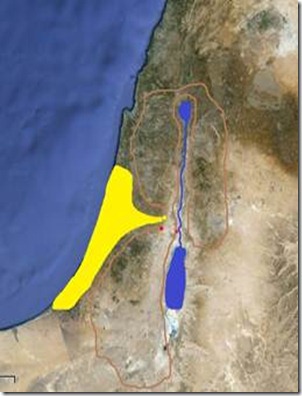
See the picture at left. The brown line shows the territory occupied by Israelite tribes, and the yellow area is the Philistines (this is a rough approximation, just to give you an idea of the danger they were in). Michmash is the yellow dot. The red dot next to the river is Gilgal, and the red dot closer to the Philistines is Gibeah.

Israel was just a few miles and one lost battle away from a huge national catastrophe.

It is interesting to note that Saul had originally held the position at Michmash, but retreated from the Philistines down into the Jordan valley. He gathered his army at Gilgal, a town in the Jordan river valley not far from the Philistines as the crow flies, but a very rough hike up or down the mountains by foot. The text doesn’t explain things clearly but apparently Samuel had sent a message to Saul, telling him to wait until he came, and then they would seek the Lord and worship him together before commencing the battle. In other words, they wanted God’s favor and help when they went out to fight. Samuel wanted Saul to rely on the Lord in this dire situation.

Now it is quite likely that Samuel’s home town was affected by this invasion – we do know that the Philistine forces came quite close to it. The position of the Philistines might have also forced Samuel to travel a considerable distance out of his way to get to Saul – remember, they had almost cut the nation in half. In any case, days passed, and Samuel did not show up. Saul’s army got restless and afraid. No doubt, many men were thinking of their families, wanting to prepare them for the disaster, or wondering if their homes had already been overrun by the enemy.

They were waiting to seek the Lord with Samuel the Prophet before they made a move. However, Samuel wasn’t there. Nothing was happening and the soldiers were worried about their families, and so they began to desert Saul and the army. So Saul took action. He decided to go ahead and lead the worship and offer the sacrifices himself. He made the burnt offering. This was an animal that was killed and completely burned up. No part of it was eaten – it was all “given” to the Lord through fire. It was used to seek God’s favor, to bring God’s forgiveness or to avert judgment. Just when Saul finished, Samuel finally made it to the camp.

Now, here is what troubles me. I think many Americans, if they didn’t read any further, would approve of what Saul did. People might say, “he’s a go-getter, a self-motivated leader.” They might think, “There’s a real leader – he’s losing men so he takes bold decisive action, he makes something happen.”

But Samuel didn’t see it that way, and apparently, neither did God.

13 And Samuel said to Saul, “You have done foolishly. You have not kept the command of the LORD your God, with which he commanded you. For then the LORD would have established your kingdom over Israel forever. 14 But now your kingdom shall not continue. The LORD has sought out a man after his own heart, and the LORD has commanded him to be prince over his people, because you have not kept what the LORD commanded you.” 15 And Samuel arose and went up from Gilgal.  (1Sam 13:13-15, ESV)

The prophet immediately identified that the problem was Saul’s heart. It wasn’t fixed on God. We can now see clearly that Saul was insecure. He was worried about the future of Israel, of course. He was worried about his own ability to keep the men with him and maintain an effective fighting force. He did not trust the Lord with these concerns. Instead, he trusted in his own action. He trusted in the offering ceremony, but not God himself. Clearly, Saul viewed the offerings as a tool. It was a way to keep his army together and energized; perhaps also a way to manipulate God into helping him. Saul did not offer the sacrifices to please the Lord, or because he was personally repentant or worshipful. If either of those had been the case, he would have waited for Samuel, who was the one who was supposed to do such things. Saul was not a priest, nor a prophet and was not supposed to lead that kind of worship. This is bad religion. He went through the motions of a religious ceremony, but it wasn’t about God at all. He was using religion for his own ends – to keep the men from deserting.

And of course, the fact that Saul couldn’t wait showed that he wasn’t willing to trust the Lord when he didn’t understand what was happening, or when the Lord wasn’t moving as fast as he wanted.

Now, there’s no doubt that Saul was in a tight spot. But the tense situation did not create the problem in his heart. It only revealed it. When you squeeze an orange, what comes out? Whatever is inside the orange of course, which is orange juice. When you are squeezed, what comes out? Whatever is inside you, of course. If you curse and rage when you are in a tough spot, that is because cursing and rage are inside you. Jesus said:

20“What comes out of a person — that defiles him. 21 For from within, out of people’s hearts, come evil thoughts, sexual immoralities, thefts, murders, 22 adulteries, greed, evil actions, deceit, promiscuity, stinginess, blasphemy, pride, and foolishness. 23 All these evil things come from within and defile a person.” (Mark 7:7-23)
45 The good person out of the good treasure of his heart produces good, and the evil person out of his evil treasure produces evil, for out of the abundance of the heart his mouth speaks. (Luke 6:45)

When Saul was squeezed by his circumstances, he did not put his faith steadfastly in the Lord. He refused to wait on God or on other people. His situation was not easy. But it didn’t cause his heart-problem – it just revealed it. He let his insecurity rule him, and he chose to act, rather than depend on the Lord.  When Saul was squeezed, it was fear that came out, and a need to be in control. He put his trust in the number of men he had, rather than the Lord. It was more important to him to keep as many men as possible than it was to seek God and his favor.

Saul failed in this incident, and revealed what was truly in his heart. However, the Lord did not give up on him, and with the Lord’s help, Saul did many more good things, as we will see. In fact we will see God continually trying to reach Saul throughout his life. Samuel’s words were supposed to be a kind of prophetic warning. If we read carefully, we see that God wasn’t even saying Saul shouldn’t be the king. It was something like this: “Unless your heart changes, your dynasty won’t continue. The Lord will find someone whose heart is tender toward God. If yours doesn’t change it will have to be someone else.” We should understand that God was not taking away the kingship of Saul, but saying instead that because of Saul’s sin, he could not be the founder of a dynasty. The kingship would pass to a different family.

This is all about trusting God when things don’t look good – maybe things look disastrous. If you get squeezed, what do you think will come out? What is in the treasure-store of your heart?

What if it isn’t good? What if, like Saul, you have insecurity hiding there? What if there is rage or hatred or jealousy or selfishness, or other ugly things? I think Saul had the opportunity to repent. Again, I think Samuel’s words were more of a prophetic warning than an absolute statement of judgment. However, even if we take it as a settled judgment, the punishment is not that Saul himself could not return to the Lord, or even that he himself could no longer be king. It was that none of his sons would be king after him. This means that there was still hope for Saul, and there is still hope for all of us.

When he was tempted, Saul could have turned to the Lord, confessed his weakness, and put his trust in the Lord. I think that is what we need to do when we are squeezed, and we see there is a problem in our hearts.

14 For the love of Christ controls us, because we have concluded this: that one has died for all, therefore all have died; 15 and he died for all, that those who live might no longer live for themselves but for him who for their sake died and was raised.

16 From now on, therefore, we regard no one according to the flesh. Even though we once regarded Christ according to the flesh, we regard him thus no longer. 17 Therefore, if anyone is in Christ, he is a new creation. The old has passed away; behold, the new has come. 18 All this is from God, who through Christ reconciled us to himself and gave us the ministry of reconciliation; 19 that is, in Christ God was reconciling the world to himself, not counting their trespasses against them, and entrusting to us the message of reconciliation. 20 Therefore, we are ambassadors for Christ, God making his appeal through us. We implore you on behalf of Christ, be reconciled to God. 21 For our sake he made him to be sin who knew no sin, so that in him we might become the righteousness of God. (2 Corinthians 5:14-21, ESV)

We should be sad when we discover bad things in our heart, but that is not the final word. We need to remember that through Jesus, our heart problem has been solved. Our old self, with all its insecurities, jealousies and lusts, has been killed with Jesus on the cross. Through Jesus, our spirit has already been renewed, and we wait with passionate hope for the day when that renewal is completed in our soul and body.

There might also be an application here for you if you are faced with a difficult situation. Perhaps you feel a lot of pressure just to act, to do something, to make something happen. Sometimes the Lord does lead us to do that. We’ll see that with Jonathan next time. But if the Lord is calling you to wait, or if your action would be from fear or insecurity, maybe you need to sit still and wait for God to show up.

Take a moment to let the Lord speak to you now.

1 SAMUEL #5. THE POEPLE WHO REPENTED

Photo by Luis Quintero on Pexels.com

The ancient Israelites faced tremendous cultural pressure to worship false gods. But even when they finally resolved to follow the Lord with all of their hearts, things did not go well for them at first. This passage reminds us of God’s holiness. It reminds us that we need Jesus. It shows us the parallels between the ancient Israelites, and us today. It shows us that it is good and helpful to deliberately reminisce about times past when we had powerful experiences with God.

To listen to the sermon, click the play button:

For some people, the player above may not work. If that happens to you, use the link below to either download, or open a player in a new page to listen.

To download, right click on the link (or do whatever you do on a Mac) and save it to your computer: Download 1 Samuel Part 5

First Samuel #5. 1 Samuel 6:13-7:17. Repentance.

We left off last time where the Philistines put the Ark of the Covenant into a cart, and hooked it up to two cows who had been separated from their calves. Rather than return home to their calves, the cows pulled the cart into Israelite territory. They stopped near the town of Beth-shemesh, which was a town given to the tribe of Levi. The tribe of Levi (Levites) were the priests for the people of Israel.

13 The people of Beth-shemesh were harvesting wheat in the valley, and when they looked up and saw the ark, they were overjoyed to see it. 14 The cart came to the field of Joshua of Beth-shemesh and stopped there near a large rock. The people of the city chopped up the cart and offered the cows as a burnt offering to the LORD. 15 The Levites removed the ark of the LORD, along with the box containing the gold objects, and placed them on the large rock. That day the men of Beth-shemesh offered burnt offerings and made sacrifices to the LORD. (1 Samuel 6:13-15, HCSB)

The Ark had come home, so to speak. Remember, the Lord had refused to let the Israelites manipulate him through the Ark; he had erased their idea that it was a kind of lucky rabbit’s foot. Next, he used the Ark to show the Philistines that he was more real and powerful than the idols and demons they worshiped. And now, he brought it back to Israel. Even so, the Lord does not seem to be finished with the lesson. This perplexing incident is recorded:

And he struck some of the men of Beth-shemesh, because they looked upon the ark of the LORD. He struck seventy men of them, and the people mourned because the LORD had struck the people with a great blow. Then the men of Beth-shemesh said, “Who is able to stand before the LORD, this holy God? And to whom shall he go up away from us?” So they sent messengers to the inhabitants of Kiriath-jearim, saying, “The Philistines have returned the ark of the LORD. Come down and take it up to you.” (1Sam 6:19-21, ESV)

The Old Testament has several stories like this. They can be confusing and perplexing. A few years ago I was reading through Leviticus for my daily devotions. I did this almost to dare God to speak to me through Leviticus, which is some pretty dry reading at the points when you can even understand it. I got nothing out of it for almost two weeks. Then I read a story from chapter ten. Two priests sacrificed “unauthorized incense” and God burned them up instantly. I said, “What’s up with that, Lord? That doesn’t sound like you. It doesn’t sound like my Father, my Comforter, my never failing Friend.” Then I read Leviticus 10:3

I will show my holiness among those who come to me. I will show my glory to all the people.

So also, the Israelites say when they are struck down for disrespecting the ark: “Who is able to stand before the Lord, this holy God?

When I was a teenager, my High School science teacher took a very small piece of pure sodium (which exists as a soft metal) and put it into a tub of water. It immediately began to hiss and steam, and then suddenly the sodium exploded into flames. Pure sodium cannot exist in water. It burns up and explodes in the presence of water, becoming a different chemical in the process.

Just for grins, below is a video of two guys dropping pure sodium into a toilet. It’s pretty dramatic, especially if you start at about 3:10 into the video.

All right, hope you enjoyed that. The video was kind of fun and whimsical, but it portrays a physical reality: two elements that simply cannot coexist. In the same way, though we often forget it, sin cannot exist in the presence of God. It burns up, explodes and is destroyed. It isn’t a matter of God not tolerating sin – the very nature of God destroys it. The problem however, is that we human beings are born in sinful flesh – from our very birth, we are corrupted by a nature that rebels against God. This means that there is no way for us to get close to God without being destroyed. Who is able to stand before the Lord, this holy God? Who indeed? Certainly, no one with sin in him or her. So in the time of the Old Testament, unless people took the extreme precautions laid out by God, they were destroyed if they even did something like touch the ark improperly, or offer unauthorized incense. In the case of our text today, it might be that some people actually looked inside the ark at the stone tablets, or possibly that they gloated over the fact that they were now in charge of it.

The difference between these incidents I read about in the Old Testament, and my own experience of relationship with God, is the work of Jesus. Jesus took all of our sin – past, present and future – into himself. When Jesus took that sin into himself,

“God made him who knew no sin, to be sin for us, so that we might become the righteousness of God,” (2 Corinthians 5:21).

Because Jesus was in nature God, and as a human was not himself sinful, the sin which God laid on him could be destroyed without destroying Jesus also.

So now, through Jesus, we are no longer in a situation where the presence of God destroys us. Now his holiness is not a problem that keeps us apart, because our sin has been removed. This is one reason why I say that if we are in Jesus, we don’t have a sinful nature anymore. If we did, the Holy Spirit could not live in us, and we would be destroyed by God’s presence. We continue to battle with the effects of a body corrupted by sin, but in Christ we have been given a spirit that is holy in God’s sight.

In any case, the point I’m making is this: the way the Old Testament describes God is not inconsistent with the way God is revealed by the New Testament. They are not two different Gods. In fact, we don’t really understand how much we need Jesus without passages like this in the Old Testament. Now, through faith in Jesus, we are reconciled to the holiness of God in a way that in those days, people were not. This passage, above all, reminds me of my deep need for Jesus.

The writer of 1 Samuel continues the narrative, twenty years later. An entire new generation grew up. Previously, under the leadership of Eli, Hopni and Phinehas, the people were disconnected from God, and they didn’t care. They were arrogant, sure of themselves, sure they could manipulate God through the ark. They blamed God in their defeat, and tried to force him to give them victory.

But after their defeat, and their difficult experiences with the ark, the new generation grew up in humility. By the way, this was Samuel’s generation. He was probably in the middle of it, age-wise, and he led them spiritually. This generation didn’t take anything for granted.

2 A long time passed after the ark came to stay at Kiriath Jearim. For 20 years the entire nation of Israel mournfully sought the LORD. (1 Samuel 7:2, GW)

Finally, for a sustained period of time, the Israelites were humbly seeking God. For once it appears that it wasn’t their circumstances that they were upset about. They truly repented. They actually wanted to be close to the Lord. Samuel told them that they needed to get rid of the idols in their lives, to stop seeking comfort and hope in anything that was not the Lord.

And Samuel said to all the house of Israel, “If you are returning to the LORD with all your heart, then put away the foreign gods and the Ashtaroth from among you and direct your heart to the LORD and serve him only, and he will deliver you out of the hand of the Philistines.” So the people of Israel put away the Baals and the Ashtaroth, and they served the LORD only. (1 Sam 7:3-4)

The “Ashtaroth” means the idols made in the image of the goddess Ashtoreth, a Canaanite deity of war and fertility. Baal was the most important male god, and Ashtoreth the most important female one. Typically, every family had copies of idols to these gods. It may seem obvious to us that the Israelites should get rid of these false gods if they wanted to worship the Lord. But if we think that, we may not really understand the culture of that time.

We need to remember that in the first place, four-hundred years before, the Israelites had failed to do as God commanded, and displace the Canaanite peoples (like the Philistines) who lived in the Promised Land. As a result, for four hundred years the people of Israel had been influenced by the pagan cultures that lived around them. Though they often had small wars, just as often they traded with the pagan peoples, and sometimes, even though they weren’t supposed to, they married people from these pagan groups. In other words, there was a lot of peaceful interaction between the Israelites, and those who worshipped pagan gods. This interaction exerted a lot of cultural pressure on God’s people.

The Israelites were literally the only people in the entire world who were supposed to believe in only one God. The kind of cultural pressure they felt to at least believe that there were other gods is similar to the type of cultural pressure we might feel today if we believed the world is flat. Israelites would have felt inferior, not smarter, for believing in just one God.

“Of course there are other gods,” said the people around them. “Everyone knows that. It’s obvious. Yahweh might be the god of Israel, but he can’t be the only god. That’s ridiculous. You might as well say the sky is brown. You people are ignorant twits.”

Practically speaking, a lot of Israelites caved into this pressure. Many of them probably believed that Yahweh was indeed Israel’s special god, but that, obviously, other gods must exist. And the gods Baal and Ashtoreth had been in the land long before the Israelites and Yahweh came along. It made sense, even if you were going to worship Yahweh primarily, to make sure you didn’t get on the bad side of the local gods that were here before you and your god.

It made even more sense when you realized that if you worshipped other gods, you’d get to eat meat more often. People didn’t eat meat very often in every day life. But animal sacrifice and then feasting on the animal, were a regular part of many worship rituals. So, if you worshipped lots of gods, you got to eat meat more frequently.

Some pagan gods were also worshipped with fertility rituals. In these, women were encouraged to have sex with any man at the festival who wanted to, in order to get the god/goddess to bless the harvest. If you lusted after the spouse of one of your neighbors, you might get a chance to indulge your lust if you all worshipped these pagan gods. Even if your lust was more general, there were obvious reasons to participate in these rituals. It’s possible that some of the cultural pressure even came from pagan women inviting Israelite men to such ceremonies. And actually, these festivals were not exclusively heterosexual, either.

I hope you can see that actually, the Israelites faced the same types of cultural pressures that Biblical Christians face today. After about 500 CE, up until quite recently, a lot of the dominant cultures in the world believed in only one true God. But we’re back to ancient times again, now, in that respect. Christians are considered strange and backwards for believing that there is only one way to God, or even just one God. It’s hard to maintain our true beliefs when everyone around us thinks we are obviously wrong, and also thinks we are ignorant and bigoted for believing as we do.

We’re also back to a culture that thinks we are stupid for not indulging our every desire as fully as we want to. How silly is it to only have sex within marriage? There are plenty of temptations and opportunities to do otherwise. How silly is it not to indulge your every desire whenever you can?

Everyone around us is doing it. Everyone around us thinks we are stupid, and even dangerous for our beliefs. So, it shouldn’t be too hard to understand the ancient Israelites.

In Samuel’s generation, however, under his leadership, the people found courage. They listened to Samuel, and quit worshipping the false gods, and remained faithful to the one true God.

What happened next is something that I think surprises most of us in America these days. They turned to the Lord with their whole hearts and then things got worse. While they were gathered to worship God, the Philistines attacked. For some reason, preachers in America have been telling us for awhile now that if you just start following Jesus, everything will go well for you. Funny thing – Jesus never said that. Following Jesus, giving their whole lives to him, brought plenty of trouble to Peter, Paul, John James, Barnabas and many others. Following God brought trouble and hardship to Jeremiah, Ezekiel and yes, to Samuel’s generation.

It’s a bad idea to turn back to God in the hope that doing so will make your life go more smoothly. It just ain’t necessarily so. The great thing about Samuel and his generation was that they wanted to follow God because they believed he was the one true God. They dedicated their lives to him because it was good and right, and their hope was in God alone. If he gave them victory, that would be very good indeed. But they planned to follow him regardless. They turned their hearts to the Lord before Samuel told them that he would deliver them.

One of the reasons I get so angry at people who preach that following Jesus brings mainly prosperity and peace is that when trouble comes, those who believe that lie are undone spiritually and emotionally. A common reaction among those who believe this is that if they experience trouble, either they must have failed to follow God, or God is not truly real. They won’t allow for the idea that God might lead us directly into trouble sometimes.

The truth is, not only did Jesus promise persecution and trouble (Matt 6:10-11; John 16:33), but we also have spiritual enemies who will do whatever they can to make trouble for us – the devil and his demons (Eph 6:12; 1 Peter 5:8-10). The older I get, the more I think we should be surprised if we are truly seeking the Lord with all our hearts, and we experience no opposition at all. At the very least, we should be deeply grateful for those times. I’m not trying to make you depressed. I’m only suggesting that we take what Jesus said seriously:

 I have said these things to you, so that in me you may have peace. In the world you will have tribulation. But take heart; I have overcome the world.” (John 16:33, ESV)

So how did Samuel’s generation react when the Philistines attacked them? Naturally, they were afraid. No one with any sense at all wants to fight in a war. No one really wants suffering or tribulation. At the same time, they faced it with courage, and asked the Lord humbly for help. They didn’t assume he would deliver them, but they asked for it, in case he would. They didn’t try to manipulate him; they didn’t blame him. They just asked for his help, and they seemed ready to trust him and follow him whether or not he gave it at that particular time.

As it happened, the Lord helped them. The text says that he “thundered against the Philistines with a great and loud voice” (7:10). As I have pointed out before, these older manuscripts were often originally written on either papyrus, or animal skins. If you wanted to explain things in detail, you had to go out and kill another animal to make another manuscript. In the case of papyrus, though it was a paper-like substance, it was also time consuming and costly to make, and it wore out quickly. So you didn’t write down any more than you really had to. Therefore, the thunder is not explained, because the writer didn’t think it was as important as the main thing, which is that God did something to deliver his people. It may even be an expression that was common in those days, something almost like slang, that we don’t understand the full meaning for nowadays. In any case, it was clear that the Lord intervened, and protected his people on that occasion.

As the Philistines, fled, the Israelites chased them. Where the battle stopped, Samuel set up a stone, and called it “Ebenezer,” which means, “stone of help.” It was a way for the people to remember how God helped them that day.

Sometimes it may be helpful for people of faith these days to have our own “stones of help” – something that reminds us of specific times when God helped us. This sort of remembrance can be helpful when we face the pressures of a culture that mocks and denigrates us for worshipping the God of the Bible.

One way to set up an “Ebenezer” is to keep a journal, and record the times when God helped. For other folks, it might be a song that you listened to frequently during a time when God was especially present or helpful. I know of some Christians who collect rocks, and each rock reminds them of something the Lord has done. These days, photographs aren’t a bad way to remember what God has done for you, though you might want to create a special “Ebenezer” album to preserve photos that remind you of what God has done for you. The principle is to have a helpful, concrete way to remember times when God’s presence was obvious to you.

Take a minute to reflect on what the Lord is saying to you through 1 Samuel 6:13 through 7:15. Do you need to be reminded of your need for Jesus? Do you need to remember that in Jesus, your sin has been thoroughly removed and is no longer a barrier between you and the Lord? Is the Lord calling you to come back to him with your whole heart, like Samuel’s generation? Maybe you are really feeling the culture’s pressure to believe there are many ways to God, or many lifestyles that are equally acceptable for those who follow Jesus (in spite of what the Bible says about that). Maybe you need to be encouraged to stay strong.

Perhaps you need to be reminded that trouble is a normal part of life, even when you are walking with the Lord. Or perhaps today you need to set up an “Ebenezer” – a reminder of God’s presence and help in your life. Let him speak to you.

1 SAMUEL #4: THE GOD-IN-THE-BOX

Sometimes we confuse good spiritual things with God himself. We put our trust in things like baptism, or prayer, or “getting saved” rather than trusting in the Lord himself. We also, at times, make the mistake of thinking that God is on our side, rather than asking if we are on his side. Our text today shows us the pitfalls of that sort of thinking, and encourages us to find a better way.

To listen to the sermon, click the play button:

For some people, the player above may not work. If that happens to you, use the link below to either download, or open a player in a new page to listen.

To download, right click on the link (or do whatever you do on a Mac) and save it to your computer: Download 1 Samuel Part 4

1 SAMUEL #4. PLEASE READ 1 SAMUEL 4:1-6:21.

When I was a kid, I was a little bit scared of lightning. But somewhere I had heard that rubber or plastic could protect you from electricity. Now there is a kernel of truth in that. If the rubber is between you and the electric current, the electricity can’t even reach you. Or, if the rubber is between you and the ground, the electricity won’t pass through you, and it will cause no harm. In other words, it insulates you from electricity. But as a child, I didn’t have the complete picture. I thought that simply holding something made out of plastic or rubber would protect me from any form of electricity, no matter what direction it came from.

I had a toy tomahawk that was made out of rubber. It said so, right next to “made in Hong Kong” (which is where I got it). I believed without question that if I held this tomahawk, I was safe from electricity. In New Guinea it rained a lot, and puddles formed on the top of the ground very quickly. It wasn’t uncommon for a large area in a flat field to be covered by a foot of water or more, at least for a few hours. The ditches and low places would quickly fill up to three or four feet of water sometimes, creating instant, temporary swimming holes. The rain was warm, so my friends and I actually swam in the low places in the fields and ditches. At times the rain would be accompanied by lightning and thunder. In those circumstances, I took my tomahawk with me. I would frequently stand up to my knees in water in the middle of a thunderstorm, secure in the knowledge that I wouldn’t be hit by lightning because I was holding my toy rubber tomahawk.

Now, I had a piece of the truth here. It is true that rubber won’t conduct electricity. I was close to something real. But even though there was something true about rubber protecting me from electricity, I had twisted that truth into a practical application that was nothing more than superstition. It is only by God’s grace that I was never struck by lightning. The rubber tomahawk had nothing to do with it.

1 Samuel chapters 4-6 describe a series of events where the people of Israel were close to something real and true about God, and yet they twisted it into mere superstition. Unlike me, they paid a difficult price for it.

As we go through 1 Samuel I want to occasionally point out some important thoughts for bible study and reading. The Jews in Jesus’ time divided the Old Testament into two parts: The Law (which was the first five books of the Bible) and The Prophets (everything else). That means that even though 1 Samuel is basically a history book, it was considered by the Jews to be “prophetic” in the sense that the history recorded here teaches us many things about God. I myself might call it, “prophetic history.”

We need to read prophetic history with a different approach than we might read most of the New Testament. The truths about God are contained in the telling of historical narratives, rather than in a straightforward letter or in teachings given by Jesus. “Narrative” is another word for “true story.” So when we are looking at the New Testament, you may have noticed that we often spend a great deal of time on just a few verses. Now, as we study prophetic history, I think that generally we need to look at whole narratives, rather than merely the individual verses within those stories. I think when we read this part of the Bible, we will miss the main meanings unless we consider things in the context of the overall historical narrative that is being told.

This week, the narrative happens to span three chapters – four, five and six – of first Samuel. You may remember that as a very young boy Samuel started hearing God speak. One of the first things God told him was that Eli and his sons were going to be judged for being such bad leaders. This is how that happened, and more.

One of the problems that the people of Israel had at this point in history is that they had not obeyed God and driven out all the pagan people who lived in the land. As a result, they were surrounded by people who worshiped false gods and demons. When the Israelites made friends with these people, they were led away from God into the worship of these demonic pagan gods. When the Israelites “woke up” and remembered the Lord, they refused to worship with their pagan neighbors, and then those people became enemies of the Israelites, and made war on them.

One of these pagan people groups was called the Philistines. They lived in an area along the Mediterranean coast of Israel, where they had five main cities, with five main Chieftains for each one. They worshiped two main false gods: Dagon and Ashtaroth. During the time of Samuel and the history recorded here, the Philistines were the biggest threat to the people of Israel.

War broke out between the Philistines and Israelites, as it often did. The Israelites were defeated in battle. They asked an interesting question:

And when the troops came to the camp, the elders of Israel said, “Why has the LORD defeated us today before the Philistines?

(1 Samuel 4:3)

Another translation says, “why did the Lord let us be defeated today?” They blamed God for their defeat. They didn’t come back and say, “we stink as warriors,” or “the Philistines are really good.” They said, “it’s God’s fault.”

In a sense, I understand this. God could have given them the victory, but he did not. Since it was in his power, and he didn’t do it, they blamed him. But it isn’t exactly that God made them fail. He simply did not intervene to make them succeed.

They had forgotten something that happened centuries before, when the Israelites first came into the land. At that time, their leader Joshua experienced an interesting incident:

When Joshua was near Jericho, he looked up and saw a man standing in front of him with a drawn sword in His hand. Joshua approached Him and asked, “Are You for us or for our enemies? ”

“Neither,” He replied. “I have now come as commander of the LORD’s army.” Then Joshua bowed with his face to the ground in worship and asked Him, “What does my Lord want to say to His servant? ”

(Josh 5:13-14, HCSB)

You see the proper perspective is not “Is God on my side or not?” but rather, “Am I on God’s side or not?” In the battle with the Philistines, the Israelites blamed God for not being on their side. But they never confronted the idea that they were not necessarily on God’s side.

Isn’t this what people still do in so many situations these days? We moan and gripe: “Why didn’t God let me see the policeman before I ran the red light?” That one may seem a bit obvious – because you should not have run the red light!

 But maybe our situation is more serious and complex: “Why didn’t God heal my mother?” Believe me, I understand that those types of questions can be real and difficult. You know that I live with this kind of question on a daily basis. In some ways, such questions are natural. And yet, I think we have the wrong perspective if we think that God is obligated to help us and do what we want him to, rather than the other way around. The question is never “Is God on our side?” If you insist on thinking in that way, the only appropriate question is, “Am I on His side?” Personally, I think the whole question of “sides” is counterproductive. We don’t want God to control us and make us do only the things he wants us to do. As it happens, God does not do that to us. So why do we think we should get to control him, and make him do only what we want him to?

Instead of confronting this problem in their relationship with God, the Israelites did something to avoid it. They decided to ignore the problem in their relationship with God, and put their trust, not in God himself, but rather in a shadow of him, a symbol: the ark of the covenant.

The ark of the covenant was a carved wooden box, about four feet long, overlaid with gold. Inside the box were the tablets on which Moses had carved the ten commandments. It was a symbol of God’s presence with his people, a symbol of the agreement that he made with them at Mount Sinai. It may have looked a little bit like the picture at the top of this post.

The leaders of Israel decided to bring this box into battle with them. The idea was, if the ark was there, God must be there with them. This way, they didn’t have to face the fact that they had turned away from him. They didn’t have to deal with all those uncomfortable ideas like repentance, and surrender to God’s purposes for their lives. All they had to do was bring a box into battle, and God would automatically fight for them.

Some of the other leaders, perhaps some of the priests, probably thought about it in a slightly more complex way. They thought that by bringing the ark into battle, they could manipulate God into fighting on their side. After all, if God didn’t fight and protect the ark, it would send a message to the Philistines that God either wasn’t real or wasn’t very strong. So even if the Israelites didn’t repent and seek out a true faith-relationship with the Lord, he would still have to fight for them, to protect his own honor, in the form of the ark, to make sure the truth about him was known.

So they sent the ark into battle. Along with it, went Hophni and Phinehas, priests, the sinful, unrepentant sons of Eli, the chief priest. Obviously, those two did not take relationship with God seriously.

Here’s one lesson from this incident: never try to manipulate God.

The Israelites lost the battle. In fact, the writer records “a very great slaughter.” Among those killed were the evil priests, Hophni and Phinehas. When the news was carried to their father Eli, he fell and died. His daughter-in-law, the wife of Phinehas, went into premature labor, and she died. As she died she said, “The glory of the Lord has departed Israel.” This reveals what she and most of the people around her believed – that God lived in that box called the ark. The deaths of this priestly family fulfilled those first words that Samuel had heard from God.

Now, God did indeed want to show the Philistines that he was real, and all powerful. But he could not do that through the Israelites, because they had rejected a true faith relationship with Him. He could not reward the Israelites for putting their faith in a gold-covered wooden box. He needed to reveal the poverty of their faith. So they lost the battle and the ark was captured.

Even so, once the Philistines had the ark, God began to confront them with their own false worship. They took it first to the temple of their idol, Dagon, probably as a representation that Dagon was greater than the Lord, and had arranged for the Lord to be captured. The next morning, the statue of Dagon was found toppled over, face down in front of the Ark. The Philistines put it back. But the morning after that Dagon had fallen again, and broken into pieces.

In addition to the problem with their idol, the Philistines began to get sick. Somewhat skeptical, they sent the ark to a different Philistine city, but got the same results. Finally, they decided to see if God wanted the Ark back in Israel. They put it on a cart with some offerings of gold. They hitched the cart up to two cows that had never pulled anything. They took the calves of those cows, and penned them up at home.

In fact, this shows us that the priests of the Philistines really did not want anyone to believe that it was the Lord who was behind the sickness in their cities. They said, “if the cows take the cart to Israeli territory, then we know it was the Lord. But if they don’t, we’ll know it wasn’t him. This is sort of like saying: “If we toss a coin and it lands on heads, I win. If it lands on tails, I also win. But if it lands on the edge, you win.”

We had a cow with a calf on our little farm a couple of times. One time, the mother cow was keeping her calf far from the safety of our barn, so I picked it up and carried it to the barn. Let me tell you, that mother followed uncomfortably close behind! (She had horns, too). In the normal course of things, cows do not leave their calves behind. That’s why the Philistines did this. They really wanted to make it unlikely that the ark would go back to Israel. In fact, in the normal course of things, this was a totally rigged experiment. In such a scenario, the cows should always return to their homes, and their calves. Even so, these cows walked away from their home pastures and their calves and went straight to an Israelite town on the border, a town that was originally set aside for the Israeli priests. The Philistine priests must have been flabbergasted and enraged.

So God made it clear that he was real. He made it clear that there was significance to the agreement he had made with Israel, the agreement which the ark represented. But at the same time, he did not affirm or reward the superstition and manipulation of the Israelites.

You see the Israelites were close to something real and true. God had made promises to be in a special relationship with them. That was true. God often intervenes to help his people. That was also true. But there were some other truths that they ignored – that the special relationship with God involves faith and surrender on the part of God’s people. By surrender, I mean that God’s people are supposed to make their lives available for God to use and work through. The old time language for this is “obedience.” Sometimes that gives us the idea that we have to obey God in order to be holy, but that isn’t it. Through Jesus we have already been made holy. Our obedience is so that God can live his life through us.

These days, we are often as superstitious and manipulative as those Israelites. If you come from Lutheran, Presbyterian or Episcopal traditions, you might feel that if you just get baptized as a baby, confirmed as a teen and take communion sometimes, you will be saved. Baptism and communion and confirmation are all useful things, and they are engaged with true spiritual reality. But they are useless without faith. By themselves they won’t help you at all. If you use them and receive them in a way that strengthens your relationship of faith and obedience/surrender, then they will indeed be helpful. But if you do them for their own sake, without faith, you might as well forget it.

Those from the Baptist/Methodist/Church of Christ type traditions do the same thing, usually with an event called “getting saved.” I’ve met many people who “got saved” when they were twelve or fifteen years old. Since then, they’ve had nothing to do with God, but they are putting their trust in the fact that one day in their distant past, they walked down the aisle and “got saved.” I’m afraid this is nothing more than empty superstition. There’s something real and true that can happen when a person is saved, but it must involve true faith and surrender to the living God.

Other people might do this with a special kind of prayer. A few years back there was a whole thing about “the prayer of Jabez.” People were buying books and learning how to pray a certain way, because it was supposed to get the kind of results people wanted. Traditional Roman Catholics might do this with the rosary, or “hail Mary.”

Others do it with going to church. I think there are many positive reasons to come to church on a regular basis, but if you are doing it to try and get God on your side, or for him to do you a favor, I’m afraid you are in for disappointment.

All these things are like expecting a rubber tomahawk to protect you from lightning. There is something true about rubber and electricity, but it doesn’t work like a magic wand. The rubber and the electricity need to be in the right relationship to each other for the insulating power of rubber to work. There is something real and true about getting saved, baptism and the Lord’s Supper, prayer, and coming to church, but it all has to come in the context of faith and surrender in relationship to Jesus Christ.

So what is the Lord saying to you right now? Have you been upset with Him because he’s not acting like he’s on your side? Have you been putting your faith in religious activity or a religious symbol instead of in Him alone? Take a moment right now to surrender your life to him in faith.

1 SAMUEL #1: THE WOMAN WHO WANTED

Photo by cottonbro studio on Pexels.com

To listen to the sermon, click the play button:

For some people, the player above may not work. If that happens to you, use the link below to either download, or open a player in a new page to listen.

To download, right click on the link (or do whatever you do on a Mac) and save it to your computer: Download 1 Samuel Part 1

1 SAMUEL #1. 1 SAMUEL 1:1-127

Hannah honestly admitted to her desire, and the pain it caused her. At the same time, she fully surrendered that desire of the Lord. Because of that, the Lord used her to change the course of history, and Hannah became one of the great heroines of the faith.

We are doing something unusual with the next sermon series: we will be redoing the books of first and second Samuel. I want to do this for several reasons. First, as we have recently been in the book of Psalms, we have touched on the life of David several times. The many questions and comments I have had about David’s life have helped me realize that it might be worthwhile to examine his life again.

Second, David is very important because he is one of the clearest Old Testament examples of a “type of Christ.” The Holy Spirit, working through the writers of 1-2 Samuel shows us, through David, a little bit of what Jesus is like. Because these things are so clear in David’s life, they can help us to learn to read the Old Testament while “looking for Jesus” as we do so. In other words, these scriptures help us learn to see messages about Jesus even in the Old Testament. In a sense, they teach us how to read the Old Testament as Christians.

Third, though I did preach through 1-2 Samuel about eleven years ago, the audio for those messages has been lost. Because the series seemed so rich and helpful back then, I would like to have audio to go with it.

There is an interesting note at the end of the book of 2 Chronicles. It says this:

29 Now the acts of King David, from first to last, are written in the Chronicles of Samuel the seer, and in the Chronicles of Nathan the prophet, and in the Chronicles of Gad the seer, 30 with accounts of all his rule and his might and of the circumstances that came upon him and upon Israel and upon all the kingdoms of the countries. 1 Chronicles 29:29-30, CSB)

This is probably a summary of how we got the books of First and Second Samuel. By the way even though our English versions split the story between First, and Second, Samuel, originally it was probably all one book: the Book of Samuel. The verse I just quoted tells us how the book came about: some of it was told by Samuel, some of it by Nathan, and other parts of it by Gad. I say it was “told” because at least some parts of the book(s) of Samuel were probably memorized as oral history. In Hebrew, you can see in those parts that the text includes little tricks for memorization, and for delivery as a spoken story. Other parts were probably written down pretty close to the actual events. Eventually, of course, all of it was written down, and the material was put into its final written form during the days of David’s grandson, Rehoboam. There are convincing reasons to believe that, but I won’t bore you with the details unless I run out of other ideas when we get to 1 Samuel chapter 27.

The book of Samuel begins at a very unsettling time in the history of the people of Israel. It was roughly four-hundred years after the time of Moses and the Exodus. The Israelites certainly had their problems in the wilderness, but at the end of it all, they had entered the promised land as a united nation, under strong leadership. However, once they began to settle the land, they splintered back into a loose confederation of tribes. Worse, they ignored the Lord’s command to drive out and completely eliminate the pagan cultures around them in the land. What followed was a few hundred years of the darkest times in their history. They forgot God, and began to adopt the pagan practices of the peoples around them – the very people whom they were supposed to drive out. They were oppressed by those same people, and frequently various areas and tribes of Israel were almost slaves to other cultures. God did not forget them. He used the negative circumstances to remind them about Him. When they prayed for his help, He answered and saved them, but usually within a generation or so, they forgot Him again, and went back to a cycle of worshiping false gods, being oppressed by the surrounding people. Then they remembered God again, and asked for his help, and so the cycle continued. The people were ignorant of God, brutal, and divided.  At the time recorded by 1 Samuel this had been going on for so long, most people probably felt like this was just how life was. There was certainly no reason to hope or expect that anything could ever change and be permanently different.

The nation of Israel was supposed to be united by their common faith, and they were meant to function as a nation by following God, as they had during the Exodus. Because God was supposed to be the King, technically they were all free. But because they weren’t following the Lord, it wasn’t working. Instead of freedom, they generally alternated between chaos and oppression.

At the time that this particular historical record begins, the spiritual leadership was as bad as the rest of the country. Eli, the High Priest was short-sighted and a weak leader. His sons Hophni and Phineas were self serving bullies – they took every opportunity to abuse the power they had over the people. None of them actively led the country from a position of faith in the Lord or obedience to Him.

1 Samuel 1:1-27 records how the Lord began to change all this, not just for a few years, or even just a generation but for the long term. It was an unlikely and surprising beginning. God didn’t call a hero to defeat the enemies of Israel (he had already done that many times over the past few hundred years, and it never lasted). He did not raise up someone to campaign for unity among the tribes. God did not lead anyone to go on a crusade to clean up corruption among the priests, or to start a movement to educate the ignorant children in the outlying areas. If Hollywood screenwriters were making a movie, any one of those choices might be their storyline.

But God did something different and unexpected. He began with a woman who just wanted to be a mother. Her name was Hannah. Her deepest desire was to have a child. She turned her desire over to the Lord, even while continuing to desperately want it. And the Lord pursued his goals through her life and those desires.

Hannah was married to a man named Elkanah. He had a second wife, called Peninnah. He almost certainly married Peninnah only because Hannah couldn’t have children. Chapter 1:5 and 1:8 record that Elkanah loved Hannah deeply. But in those days, having children was simply not considered optional. The culture considered it a curse from the Lord if a couple could not conceive. God blessed Adam and Eve and told them to be fruitful and multiply (Genesis 1:28). If someone could not do that, they figured it must mean that God’s blessing wasn’t on them. Besides that, children were the only source of “social security.” When someone got too old to work, he relied on his children to take care of him. Finally, having children ensured that the family name would continue, and be included among God’s people (Israel) for another generation.

 All this is why a man like Elkanah, who seemed to have a genuine love for Hannah, would go the length of marrying a second woman just to have children. By the way, some folks say that the Old Testament endorses polygamy without reservation. That is not exactly true. It records that some men had many wives, and it does not condemn them, but it also almost always describes that situation in a negative light. This is true here as well. Elkanah had two wives, and there was rivalry and jealousy and strife between them. This was true also of Jacob, even though his wives were sisters. Solomon, had hundreds of wives and scripture makes it clear that it was his downfall.

Anyway, Hannah’s lack of children meant several things to her. First, she thought it meant God somehow had something against her. It had led to the destruction of her married happiness and love with Elkanah. Finally, if Elkanah were to die before she did, there would be no one to take care of her in old age. As we can see, the issue was both emotional and practical. There was deep hurt and pain wrapped up in Hannah’s barrenness, as well as practical concern about the future.

One year, when the family was at the annual worship pilgrimage,  Hannah reached a breaking point. I love her attitude in 1:9-18. She is another one of those unsung heroines of the faith. I think what makes her so special is that she honestly acknowledgesher desire to the Lord, while at the same time, she surrenders it. She tells Eli, the priest:

I am a woman with a broken heart. I haven’t had any wine or beer; I’ve been pouring out my heart before the Lord. Don’t think of me as a wicked woman; I’ve been praying from the depth of my anguish and resentment. (1 Samuel 1:15-16)

Many Christians in this day and age would encourage you to pursue your desire as if it was somehow holy just because you had it. They paint a picture of God as if he was there for the sole purpose of making your life comfortable and giving you anything you want. They preach a gospel of personal gain here and now. There are other Christians (though less common these days) who treat every personal desire as if it is evil; they suggest the only way to deal with any desire for anything personal is to get rid of it.

Hannah did not follow either path. She desired a child. She wasn’t going to pretend that she didn’t, and she wasn’t going to pretend that she thought her desire was wrong or sinful. She let God hear her anger, anguish and resentment. At the same time, as she asked God to fulfill her desire, she surrendered it back to him. Verses 10-11 in the message version record it this way:

Crushed in soul, Hannah prayed to God and cried and cried — inconsolably. Then she made a vow:

“Oh, God-of-the-Angel-Armies, If you’ll take a good, hard look at my pain, If you’ll quit neglecting me and go into action for me By giving me a son, I’ll give him completely, unreservedly to you. I’ll set him apart for a life of holy discipline.” (1 Sam 1:10-11)

Some people may look at this part of Hannah’s prayer as making a bargain with God. But I think it is a little different than that. Hannah will not let go of her desire. She’s asking for a son, not the strength to go on being barren. And yet, while not letting go, she does surrender that desire to God. It isn’t completely clear in the Message version of the bible, but what she is pledging is that when he is old enough, she will physically bring the child to the tent of meeting and he will stay there with the priests and serve the Lord. The child will not stay with Hannah or her family. In a sense, Hannah is saying, “I want to be a mother. But I also want to surrender to you. So if you do make me a mother, I will turn around and live as if I was not a mother again. You will gain a child Lord, not me.” So, yes, in a sense it was a bargain. But I don’t see how else Hannah could both hold on to her desire and surrender it at the same time. It is this bravery and honesty that makes her a great woman of faith in my eyes.

To help us understand what Hannah did, I want to put it in simplistic and shallow terms. It is as if you prayed, “Lord, please give me one million dollars. If you do, I will give all one million dollars to the church.” Now, looking at it that way, you may say, “What would be the point of that?” We see no point in that because our desire is either not real or not surrendered. If our desire isn’t real, then we don’t want one million dollars so badly that we’re willing to give it all up again just to say we did have it once. If it isn’t surrendered, then we don’t want one million dollars unless we can keep some of it, or all of it.

By the way, this text brings up something obvious and important. In this day and age, women have the freedom to pursue any career they choose, and they often do. I am in my early fifties, and I cannot remember a time when anyone seriously suggested that women should not have careers. But sometimes, I wonder if our culture has gone too far that direction. What I mean is, sometimes, women whose primary desire is to be wives and mothers are mocked, belittled, or questioned, as if motherhood is not something worthwhile to aspire to. I know some women who primarily want to be mothers, and others speak of them as if they are somehow throwing their lives away, selling themselves short. I think that is wrong.  Motherhood was Hannah’s deep desire, and through that desire, God changed history. Hannah is in the Bible precisely because she was a faithful mother.

I have no problem with women who want careers. I also have no problem with women who want to devote their lives to their families. Such women often change history, though we often don’t recognize it. I think it is wrongheaded to pressure women into careers if their strongest sense of calling is to the home. I don’t think that honors women or offers them freedom at all.

Hannah’s desire was real, and it was truly surrendered. The result of that true and surrendered desire was a baby boy named Samuel. Because Hannah surrendered him to the Lord, the Lord was able to use him to change the course of Israel’s history.

The Lord needed both Hannah’s desire AND her surrender to do what he did through her. If she had kept the desire for a child, but did not give that up to the Lord, Samuel would not have been raised in the house of the Lord and become the greatest spiritual leader since Moses. If Hannah had not truly desired a child as deeply as she did, she probably would not have been driven to surrender him in the first place.

Israel was in a bad place spiritually and politically. Society was fractured, life was dangerous, people were ignorant. God did change everything for them. And he did it through a simple woman who was honest about her desire to be a mother while also surrendering that desire. That’s not how we expect Him to save society. But he often works in these unexpected ways.

So what about you? What are the deep desires of your heart? Are you willing to be honest about them? And are you willing to surrender them to the Lord at the same time? God needs people who are willing to follow in Hannah’s footsteps.

What about desires that are sinful? What do we do with them? I think we do the same thing, although we also aim for a third step, which is to totally give up the sinful desire. But we can’t do that until we are honest that we do indeed desire it. So we confess that sinful desire to the Lord, being honest that we do want it, and even honest about how much we want it. Then, we also confess that we know it is sinful, and, instead of seeking it for ourselves, we surrender it to the Lord. Finally, we allow the Lord to lead us to desire good things.

I think the psalmist was talking about people like Hannah when he wrote:

Delight yourself in the LORD, and he will give you the desires of your heart.  (Ps 37:4, ESV)

PSALMS #7. PSALM 51: A BATH GONE HORRIBLY WRONG

Photo by Vlada Karpovich on Pexels.com

Psalm 51 is a remarkable part of scripture. David committed horrific sins, including murder. And yet the Holy Spirit did not give up on him, and eventually brought forth this precious and powerful psalm as a result of that horrible sin and tragedy. David identifies the deepest need of anyone who really understands themselves: a new heart, a clean spirit. And through David and Bathsheba physically, God brought a savior to the world who gives us that new heart.

To listen to the sermon, click the play button:

For some people, the player above may not work. If that happens to you, use the link below to either download, or open a player in a new page to listen.

To download, right click on the link (or do whatever you do on a Mac) and save it to your computer: Download Psalms Part 7

PSALMS #7: PSALM 51.

King David is famous for many things: killing Goliath, being a great warrior and leader, being fair and just. He was not only a manly man, but also a sensitive and passionate one: he was a skilled musician and prolific songwriter, and his heart was constantly oriented toward worship and spiritual things. Unfortunately, along with all the good, David is also known for a spectacular failure: his affair with Bathsheba, and the killing of her husband.

David spent years in a tough situation, hiding from both king Saul, and the Philistines. Then in a battle that was disastrous for Israel, Saul was killed. Finally, the way was open for David to step into his destiny as the next king of Israel. There were still significant bumps on the road, but at last David became king of all Israel, and he led his people into becoming the dominant power in the region. He eliminated the immediate threats to Israel, and then began attacking countries further away, expanding the kingdom. Although he was a formidable warrior and great leader, at some point, his advisors made him stop participating in battles personally, because the whole country depended on his leadership, so it was too risky for him to be exposed to the weapons of the enemy.

So it was that David found himself in Jerusalem while his army was away elsewhere, conquering more territory. This man of action suddenly had a lot of time on his hands. One evening, from his palace, probably the tallest building in Jerusalem, he noticed a beautiful woman, bathing. Most likely, he saw her naked, since people don’t usually bathe with their clothes on. David immediately ordered his men to find her, and bring her to him. The woman, as we know, was named Bathsheba, and her husband, Uriah, was away at the war. It is possible that David seduced her, but it is also possible that Bathsheba could not have said “no” even if she wanted to. Even if she did, technically, have the choice to not sleep with him, David was the most famous and powerful man in the entire region. She would have felt a great deal of pressure to please him.

The affair was bad enough. But then she got pregnant. David, like so many men after him, decided to try and cover it up. He brought Uriah back from the war, and urged him to go home and sleep with his wife, Bathsheba. The plan, obviously, would be for Bathsheba to pretend that the child was Uriah’s, not David’s. However, in those days, it was traditional for soldiers to abstain from sex until after the battle was over. Back on the front line, Uriah’s fellow soldiers were still in danger, and in solidarity with them, and possibly also out of a superstitious fear that he might jeopardize victory, Uriah chose not to sleep with his wife. David even got him drunk, and sent him home, hoping that would erode his self control, but Uriah remained steadfast.

That self-control and integrity cost Uriah not only his wife, but his life. David gave up, and sent Uriah back to the front line. He had Uriah carry sealed orders to the commanding officer. Those orders were that Uriah should be sent to the fiercest part of the battle, and then his fellow soldiers were to withdraw from him, so that he would be killed in battle. In other words, David made Uriah carry the orders for his own murder.

It’s even worse when we realize that Uriah was one of David’s “thirty mighty men,” part of a faithful core of warriors who had been loyal to David in the difficult days before he became king. He was David’s faithful follower, who had endured many hardships with, and for, David, and now David slept with his wife, and then had him killed.

David did not appear to repent. Not long after this, the prophet Nathan came to the king. He told David about a rich man in Israel who had a great flock of sheep, goats and other animals, and a poor man who had nothing except one little lamb who was his beloved pet. The rich man had a visitor, and he was obliged to feed the visitor. But rather than take one of his own vast herd, he extorted the one beloved pet from the poor man, killed it, and fed it to his visitor, while the poor man was helpless to prevent it.

David was enraged by the injustice of what the rich man had done, and furious that such a thing would happen in Israel, where he was king. He demanded to know the name of the rich man, so he could punish him for such blatant extortion and injustice.

Nathan said: “You are the man.”

Shocked and horrified, David finally admitted his terrible sins. He repented, and he expressed his remorse and repentance by writing Psalm 51.

I think Psalm 51 is amazing at so many levels. It is a powerful part of scripture, and contains much important truth. And yet, this amazing and helpful part of the Bible came about because of terrible sins. Therefore, one of the things this psalm shows us is that God can bring good out of any situation, even good out of our own horrible, deliberate sins.

The important truths begin with the very first verse, in the way that David asks for forgiveness. He could have said, “Forgive me, Lord. After all, I am your chosen king.” He might have written: “Lord, if you don’t forgive me, all the amazing things you’ve done in my life up until now would be wasted.” Another possibility: “Forgive me, or the enemies of Israel will be encouraged. If you let something bad happen to me because of this sin, your people will be without a leader.”

He could also have made the claim – correctly – that compared to others, he had lived a mostly righteous life. Before this, he had followed the Lord even in spite of great suffering. He had refused to kill king Saul – twice – when he had him in his power. There was a lot of credit he could have claimed. But instead he asks for forgiveness on the basis of one thing alone: God’s hesed; that is, the covenant love that God has for his people. By doing so, David is saying: “I have no claim on you for forgiveness. I don’t deserve it. I dare to ask for forgiveness only because I know that you are a loving God. Please forgive me because of your own good and loving character.”

One of the things that is so amazing here is that it is a thousand years before Jesus. We might have expected David to offer sacrifices at the tabernacle, and then consider that he had fulfilled his duty. In other words, he might have expected God to forgive him based on offering the right sacrifices. But he recognizes (and he says it explicitly in verses 16-17) that sacrifices mean nothing unless his heart is in it. He knows that there is nothing he can do to earn God’s forgiveness, and no good he has done in the past is enough to “make up” for his sin. His only hope is that God will have mercy on him. This is one half of the very same gospel preached by Jesus and the apostles a thousand years later. No one can be righteous enough to please God. Instead, we depend entirely on God’s willingness to have mercy on us.

In verses 3-6 David expounds on this. He fully confesses his sin and brokenness, and he goes out of this way to show that he is not making excuses. There is no hope in excuses. There is no excuse. When speaking of his sin, David uses three words, translated by the ESV as: “transgression,” “iniquity,” and “sin.”  Transgression describes a moral revolt against God. This is the part inside of us that rises up and says, “I know what’s right and wrong, but I want what I want, and I’m going to get it for myself even if it’s wrong.”

Iniquity describes an internal character of sinfulness. David says: “I was born in iniquity,” (verse 5). He means he was born with a flawed and sinful nature. The New Testament describes this as our sinful flesh. We are all deeply flawed, and not all of those flaws are wonderful and beautiful. Some part of us is broken and twisted from birth, always oriented away from God.

Finally, David uses the word “sin.” Sin (or sins) describes the wrong, bad action. His affair was a sin. The arranged murder was a sin. But it is important to see that sin is just the tip of the iceberg. It starts with a broken and twisted internal character, and then desire that rises up in rebellion against God, and bears fruit with the actual wrong action. This reminds me of what James wrote:

13 And remember, when you are being tempted, do not say, “God is tempting me.” God is never tempted to do wrong, and he never tempts anyone else. 14 Temptation comes from our own desires, which entice us and drag us away. 15 These desires give birth to sinful actions. And when sin is allowed to grow, it gives birth to death. (James 1:13-15, NLT)

David says something interesting in verse 4: “Against you, you only, have I sinned and done what is evil in your sight, so that you may be justified in your words and blameless in your judgment.” When we first read this, it can sound surprising. Surely David sinned against Uriah as well, by committing adultery with his wife, and then by having him killed! How is it that David says his sin is against only God? Although this sounds wrong at first, it turns out to be quite accurate, and important – perhaps even more important today than it was when David wrote it.

In the first place, think of it like this: If there was no God, there would be no such thing as sin. Atheists believe this, and if they were right about the non-existence of God, they would also be correct about the non-existence of sin. If there is no God, even the idea that it is wrong to hurt someone else is just an arbitrary, made up human rule. If there was no God, what David did to Uriah would be a tragedy for Uriah personally, but without God, who has the authority or power to declare it was a sin? David got away with it, after all, and he was the most powerful person in the region. Without God, that’s just the way the world works, and we need to live with it. So, you see, it can’t be a real sin unless there is some absolute standard.

The Bible tells us that the absolute standard is God’s holy character. Therefore, all sins are ultimately and finally sins against God. They are a violation of God’s holy character, and against his design for the human beings he made. There is no way to sin against another person without sinning against God as well.

Next, ask which is worse: violating the trust of another human being, or violating God’s? As a very imperfect analogy, suppose you kill your neighbor’s dog. Obviously, this is terrible for the dog, and it was wrong for you to hurt the dog. But the heart of your sin is really against your neighbor who loves the dog and is responsible for it. Obviously any human is more important than a dog, and in the same way, God is infinitely more important than any human being.

David is not saying that he did not wrong Uriah. Instead his point is that all sin is ultimately against God, and since God is infinitely greater, his sin against God is the heart of the issue. If he had not sinned against God, he certainly would not have sinned against Uriah.

This is especially important because in our world today, many people claim that nothing is really sinful if it doesn’t “hurt someone else.” So, for example, it is claimed, pornography doesn’t hurt anyone, so it’s not wrong to view it. Of course, they are wrong about pornography not hurting anyone. Hundreds, if not thousands, of former porn stars have testified that performing porn devastated them emotionally, spiritually, and sometimes physically. In addition, some of the performers are undoubtedly women who are forced or coerced into it one way or another; no better off than sex slaves. But even if everyone was truly willing to do it, and happy about it later in life, porn is still a sin against God. We can’t say “it doesn’t hurt anyone,” because even if we lived in a fantasy world where it didn’t, it would still be a sin against God.

The same arguments are made about virtually any activity engaged in by consenting adults. We claim that the only sin is when someone doesn’t consent. But David puts us straight: all sin is sin against God. Even if Bathsheba went along with it willingly, they were both sinning, because God’s holy character intends sex for marriage alone. We can’t get ourselves off the hook by saying “I didn’t hurt anyone,” or even “I didn’t coerce anyone.” No, because all sin is against God, we have no defense. David, for his part, did not pretend to have a defense. He says: “therefore you are right when you speak, and justified when you judge me.”

In verse seven, David again affirms that it must be God who cleanses him; God alone can forgive and purify, and no one can earn it. David can’t make up for what he’s done. Verses 10-12 are the heart of this hard-hitting psalm:

10 Create in me a clean heart, O God,
and renew a right spirit within me.
11 Cast me not away from your presence,
and take not your Holy Spirit from me.
12 Restore to me the joy of your salvation,
and uphold me with a willing spirit. (Psalms 51:10-12, ESV)

The problem is not just our actions. Our actions come from what is inside of us. David wants an enduring solution. I know many well-meaning Christians who get this confused. Many people, after sinning like David, might say something like this. “OK, from now on, I’m not going to go up on my rooftop alone. I’ll always have a guy with me up there, to make sure I’m not watching women bathe. In fact, I’ll give my wife the key to my rooftop, and she can go up there anytime, to make sure I don’t have any views of women’s bath houses, and we’ll build a wall if I do. Next, I’m going to have Nathan as my accountability partner. Finally, I won’t stay home from the wars anymore, because I might get bored and so get into trouble.”

All that is reasonably good, but it misses the point. David didn’t sin because he happened to see Bathsheba naked. He sinned because from birth, his heart was filled with iniquity. He sinned because he didn’t take that inborn iniquity seriously. Now, after these terrible actions, David knows that the problem is inside. It’s a problem he, personally, cannot fix. So he asks the Lord to give him a new heart, a righteous spirit.

I have never committed adultery, nor conspired to have someone murdered. But my heart is no better than David’s. The same transgression inside David that led him to rebel against God is inside me, also. I’m not just saying that as a theological truth – I know myself well enough to know, experientially, that it’s true about my heart. It is good to protect ourselves against temptation. But it is not enough. We need, along with David, to ask for a brand new heart from the Lord.

God answered David’s prayer for a new and clean heart. He answered that prayer for all mankind through Jesus. When Jesus came, he made it clear that the human heart is the real problem; and that is exactly why he came to redeem us. And the power of God for redemption is so great that it was both David and Bathsheba who became physical ancestors of Jesus who brought us that salvation. If he can turn their sin around and provide, through it, salvation for all humankind, he can also renew our hearts and spirits. Like David, let’s ask him.