RESURRECTION: DON’T LOSE HOPE, DON’T GIVE IN TO DISAPPOINTMENT

heaven

In our everyday life experience, we may feel far removed from the resurrection of Jesus. We may feel like it has nothing to do with us, like from now on we just have to get on with life as best we can. But Jesus is walking right next to us. Feeling or no feeling, whether we can perceive it somehow or not, the Resurrection of Jesus was real, and the resurrection life that he offers us is just as real. Don’t settle for anything less than Him, and his Resurrection Life.

To listen to the sermon, click the play button:

To download, right click on the link (or do whatever you do on a Mac) and save it to your computer:
Download Easter 2018

EASTER SUNDAY, 2018.

Luke 24:13-35; John 14:1-7; John 16:33

It’s always a challenge for me to preach about the Resurrection of Jesus. It is the central truth of our faith. Jesus physically rose from death; you either believe it or you don’t. In the past I have offered many facts and logical arguments that tell us it is reasonable to believe it. But this year I want to look at the difference it makes in our lives. It makes a huge difference in eternity, of course – the difference between heaven and hell. But it starts to make a difference right now, in the choices we make, and in how we deal with disappoint and grief here in this life.

Please read Luke 14:13-35. This is not the usual story you hear on Easter, but it is one of the Resurrection appearances that Jesus made the very same day he rose. I want you to hear the confusion of these disciples: Cleopas, and his unnamed friend. Things didn’t turn out the way they thought. They were processing, but it sounds like they were about to give up hope.

One of my favorite movies of all time is Cast Away starring Tom Hanks. Hanks’ character, named “Chuck,” is on the verge of proposing to his girlfriend Kelly, the love of his life. But he has to take a business trip first. Over the Pacific Ocean, his plane goes down. He survives the next four years completely alone on a deserted island. Finally, he is rescued. But four years with no word is a long time. When he returns, he finds that everyone had given up on him, and considered him dead. Even his true love Kelly, had mourned him, and then moved on. She is now married, with a toddler.

Naturally, when Chuck returns – from the dead, so to speak – it is traumatic to both of them. Chuck drives to see Kelly at her house in the middle of the night, as the rain pours down. They both say goodbye in a heartbreaking scene, where much is left unsaid. Then, as Chuck pulls down the driveway, Kelly comes running out in the rain, calling his name. They stand in the rain, hugging and kissing. Then Kelly says:

“I always knew you were alive, I knew it. But everybody said I had to stop saying that, that I had to let you go.” Kelly pauses while they stare at each other. “I love you. You’re the love of my life.”

After another long pause while they look at each other, Chuck says, “I love you too Kelly, more than you’ll ever know.”

They get into Chuck’s car and sit in silence. But they both know that Kelly has to go back home, that it is too late for them to ever be together like that again. And so he drives her back up the driveway, and leaves her there.

There is a lot of tragedy in this scene that is simply the result of circumstances that neither one of them could control. But there is also the tragedy that Kelly gave up on Chuck, even when deep in her heart, she knew that she shouldn’t stop hoping. So she settled for life as best as she could get it. She quit working on her dream to be a professor. She married a decent man (not her true love) and had a child. And so when Chuck came back – the true love of her life – it was too late. She had already made another life for herself, and there was no place for Chuck in it anymore.

This is heartbreaking, but it is, after all, just a movie. Even so, I think this part of the movie taps into a spiritual truth. It reveals the struggle of faith that we have sometimes as Christians. Our Lover – Jesus – has  been gone for a long time now. All around us, voices tell us to give up, to move on, to settle for life as best as we can get it. But if we do that, we find, like Kelly, that when Jesus returns, we have no room for him in our lives anymore.

Jesus’ very first disciples struggled with this. They traveled with Jesus, watched his miracles and heard him preach. They came to believe that he was God’s chosen Messiah – true God in the flesh, their only true hope for salvation and real life. And then he was killed. Now they didn’t know what to do with all their hopes and dreams. It was all over. So, on the third day after his death, Cleopas and his friend went on a short journey. A stranger joined them as they walked and asked them why they seemed so sad. They told the stranger about Jesus and all he had done and said, and then they told him how Jesus had been handed over and killed. They end with a brief and poignant expression of their loss and confusion:

“But we were hoping that he was the one who was about to redeem Israel.”

You can almost hear the pain in their words. Things didn’t turn out the way they planned. They were sure they were following God. They were sure they had it right, and that their future was bright with their savior. They were hurt and lost. They had put their hope in Jesus, and now Jesus wasn’t there anymore.

Only he was.

He was right next to them. He was the very stranger that they were talking to. This is extremely important. In our everyday life experience, we may feel far removed from the resurrection of Jesus. We may feel like it has nothing to do with us, like from now on we just have to get on with life as best we can. But Jesus is walking right next to us. Feeling or no feeling, whether we can perceive it somehow or not, the Resurrection of Jesus was real, and the resurrection life that he offers us is just as real.

The disciples’ lack of faith is surprising. Jesus told them exactly what was going to happen. He said several times that he would be taken captive by the authorities and executed, and then that he would rise from death on the third day. They didn’t want to believe the part about him dying, until they had no choice. They wouldn’t accept what he was saying. Peter told him not to have such a negative outlook. The others heard too, but it bounced off their skulls like water off a duck. They simply didn’t get it. And then when he did die, they still didn’t believe the part where he told them he would rise again physically. So the death of Jesus destroyed them mentally and emotionally. They were completely lost.

Sometimes, we are like those disciples. Jesus told us exactly what is going to happen. He said we would have trouble in this world (John 16:33), but he also told us not to let our hearts be troubled (John 14:1). Living in a world of sin, we will experience sorrow and grief. But living in faith in Jesus Christ, those sorrows and griefs are not the final word. They are not as real as the great reality that is coming for those who trust Jesus. The pain and severe disappointment experienced by those disciples walking along the road was real. But the man walking beside them was real too, and he had already overcome their grief, even before they were aware of it. The reality of his resurrection was greater than the reality of their sorrow, whether they knew it or not.

I think the danger we face as believers in the risen Messiah is that, like those other disciples, we forget the promises of Jesus, or we think he is not close, not next to us. And so, in the meantime, we try to just go on and get some kind of life and hope for ourselves.

There is another poignant scene in the film Cast Away. For four years alone on the island, Chuck had no companion. So he began to talk to a volleyball that had a face-shaped bloodstain on it. He called it Wilson. In a strange way, he grew to care for the volleyball and became deeply attached to it. When he is sailing to try and find help, the volleyball comes loose from where it is tied. Chuck tries to swim after it but he is held back by a rope that attaches him to the raft. He finally needs to make a choice whether to hold on to raft, which is his only chance at living and seeing Kelly again – or swimming after the volleyball, and drowning with it in his arms.

He reluctantly chooses life, but he cries his heart out at the loss of Wilson. It may be just a stupid volleyball, but it is all he has had for four long years. It is hard to blame Chuck for being so broken up after he lets Wilson go. We can understand it and even feel some of his pain. In the context of the whole movie, it is actually a very moving scene. And yet even though it is perfectly understandable, we know (and even the character Chuck knows) that ultimately, it is just a volleyball. It isn’t a real person. It isn’t worth giving your life for.

Sometimes I think we spend half our lives like Chuck in that scene, tugging on the end of the rope, not quite sure whether we are going to give up the raft, or give up the volleyball. Chuck’s problem was that after four years alone, part of him actually believed that Wilson was a real person. He wasn’t sure of the truth. He may not have been fully convinced that the raft would really bring him back to civilization and real people. Because of his experience, Wilson seemed more real, more important than the raft.

We are like that sometimes. This life sometimes seems so much more real than the Resurrection Life that Jesus told us about. The things we can have here tempt us to believe the lie that they are more real and more important than our eternal future. This is understandable. It is understandable also to have a hard time giving them up, just like Chuck had difficulty letting go of Wilson. But even though we understand, and it is hard, the choice is perfectly and completely clear. There is nothing in this life that is worth holding on to if it keeps us from the real Life that Jesus offers us.

Will we hold onto something that is ultimately worthless, or will we give it up for real life? To give it up requires faith. It requires us to trust that there is a real resurrection, that real life is still waiting for us. We can see and touch the fake things, like Chuck could touch and see the volleyball Wilson. But those things are not as real and true as what awaits us when we trust in Jesus. Jesus said:

1 “Your heart must not be troubled. Trust in God; trust also in Me. 2 In My Father’s house are many dwelling places; if not, I would have told you. I am going away to prepare a place for you. 3 If I go away and prepare a place for you, I will come back and receive you to Myself, so that where I am you may be also. 4 You know the way to where I am going.”

5 “Lord,” Thomas said, “we don’t know where You’re going. How can we know the way? ” 6 Jesus told him, “I am the way, the truth, and the life. No one comes to the Father except through Me. 7 “If you know Me, you will also know My Father. From now on you do know Him and have seen Him.” (John 14:1-7)

The fact of the resurrection tells us that there is real life waiting for us. There is still true love possible. Our dreams have not been shattered and lost. We just need to recognize that the time is not yet. We are in the dress rehearsal, the practice before the real game begins. We are living in a deserted island in a cave, not in our real home. We are practicing to love, practicing to be great.

One of the things that helped Chuck through, was his hope of the life that existed away from his island. So I want us to dwell for a little bit on the resurrection life that waits for us, away from this little island that we mistakenly call life.

I think a lot Christians have the feeling that the resurrection life will be a never ending worship service. Let me be honest with you. I am a pastor, and that thought does not excite me. Don’t get me wrong, I love to worship the Lord with other believers. But I also love to fish, to hike and come around the corner of ridge to a new vista I’ve never seen before. I love to just hang out and laugh with my family and close friends. I like to write, and read and experience moving stories. I believe amazing worship will be part of our experience of resurrection life. But I think there will also be so much more.

John Eldredge writes that you cannot hope for something you do not desire. The overwhelmingly good news is that resurrection life is where our deepest, strongest, purest desires are fulfilled. The desire for intimacy that sometimes we get confused with a desire for only sex – that intimacy will be fulfilled in resurrection life. The desire to be deeply connected to beauty – the thing that causes us to ache when see a beautiful person, or an awe-inspiring view, or hear uplifting music – that will be fulfilled. The desire to be significant, to be recognized for who you are and for the God-given gifts you have – that will be fulfilled in resurrection life. That thing in you that loves to rise to the occasion and meet challenges – that will find its ultimate expression in resurrection life.

We won’t be ghosts or angels, floating around somewhere. Jesus was not resurrected as a spirit – he had a physical body. On several occasions after he was raised, he sat down and ate with the disciples. He promises us resurrection bodies also (1 Corinthians 15). He promises us a new heavens and new earth (Revelation 21 & 22) where will live and love and do the things we love to do, and be connected to God and to each other without the destruction and cruelty of sin and sorrow.

I will never get the love I am seeking from human beings. I may never be recognized for who I am I this life. My talents might go unappreciated. I might have to toil and spend a lot of time doing things I don’t really want to do. If this life is all there is, that would be tragic. But if all that is fulfilled in the next life, in my resurrection, which Jesus made possible – then what I face here and now is bearable. It isn’t the final word. I’m not getting too old – I’m actually getting closer to the fulfillment of all I want as I age.

I’ve heard an expression: “Some people are so heavenly-minded, they are no earthly good.” I detest that expression. It is entirely false. I have never met anyone who is too heavenly-minded. And the most resurrection-oriented people I know are the ones who have done the most for the Lord and for their fellow human beings here and now. It is only when we lost sight of resurrection that we become focused on making ourselves happy here and now, whatever the cost.

Think back to Kelly, from Cast Away. Deep in her heart, she knew Chuck was alive. But she lost faith. She gave up that hope and settled for what she could get at the moment. Because of that, she missed out forever on the life she might have had with Chuck if she had only held on.

Think about the disciples. Jesus was right at their shoulder during the moment they were ready to give up on him. He is right at your shoulder too. They didn’t sense him, but that didn’t have anything to do with the actual facts of the matter. He was there the whole time. He is here the whole time. Don’t give up. Don’t settle for less than Him, and His resurrection life.

We who are Christians know that Jesus is alive. We know it through faith. We know there is more life, better life waiting for us with him. We know it. But everyone keeps saying we have to move on. Everyone tells us we shouldn’t spend so much time thinking about it. Sometimes it feels like God hasn’t come through. But we know better. Don’t let go of that knowledge. Don’t give up that hope. Don’t fill your life with other things, don’t make yourself a life apart from the one who truly loves you and is coming back for you, no matter how long it seems.

He is Risen!

REVELATION #22. THE SWEET & THE BITTER

Rev #22

 It is a sweet thing for us to absorb the Word of God into our minds and hearts. It is good to tell others. However, the fact that some will reject God finally and forever is a bitter truth. Even so, the Lord will exhaust all possibilities before unleashing the full and final judgment that is coming. He wants to give the people on earth every possible opportunity to repent before it is too late.

To listen to the sermon, click the play button:

To download, right click on the link (or do whatever you do on a Mac) and save it to your computer:
Download Revelation Part 22

Revelation #22.  Revelation 10:1-11

1Then I saw another mighty angel coming down from heaven, wrapped in a cloud, with a rainbow over his head, and his face was like the sun, and his legs like pillars of fire. 2He had a little scroll open in his hand. And he set his right foot on the sea, and his left foot on the land, 3and called out with a loud voice, like a lion roaring. When he called out, the seven thunders sounded. 4And when the seven thunders had sounded, I was about to write, but I heard a voice from heaven saying, “Seal up what the seven thunders have said, and do not write it down.” (Rev 10:1-4, ESV2011)

We are in the third major section of Revelation. We have studied six of the seven parts of that section. This is the beginning of the seventh part. As with the seventh part of the second section, it is not a continuation of what was going on (the blowing of the trumpets) but an interlude, giving us a “pause in the action” and telling us some other things before moving on.

Some people have interpreted the mighty angel to be Christ himself, but Jesus is never described as an angel elsewhere; quite the contrary. There is no reason to think this is anything but what John describes: A mighty angel. The fact that he has one foot on the sea and the other on land, and that he is wrapped in a cloud, with a rainbow over his head, describes that his mission is for all of creation. Also, the rainbow might be a reminder of God’s promise to Noah, that he would never again destroy everything by flood. I tend to favor that idea, because I think this entire interlude is about how God is almost reluctant to bring about the final destruction of those who reject him. The rainbow reminds us of that.

Moving on, let us consider the seven thunders. I have mentioned before that there are many ways of interpreting the book of  Revelation. Perhaps the most popular method these days is the method of creating a timeline by picking parts of Daniel and Zechariah, taking a chapter of Matthew here, a passage in Luke there, and a few verses from both 1st and 2nd Thessalonians. All these passages are combined with Revelation, and a timeline for the end of the world is created. This timeline does not arise naturally from any of the books separately. That should be a warning to us. Picking and choosing from different pieces of the Bible and combining those pieces to make something that isn’t actually found in the Bible is not good Bible scholarship. With that method, we could make the Bible say anything at all. In fact, that method is frequently used by cults.

I wonder if the Holy Spirit inspired Revelation 10:1-4 precisely in order to rebuke that sort of activity. Think about this. We have had seven seals and six trumpets. We will shortly have the seventh trumpet, and then seven “bowls.” Each of the seals contained significant signs and events. This was also true of the trumpets, and it will be true of the bowls. It is natural then, to assume that these “thunders” contain significant things in the same way as the seals, trumpets and bowls. However, the thunders are sealed up, and not revealed to anyone. Because of this, there is no “timeline” that can accurately incorporate the seven thunders, therefore there can be no accurate timeline for the end of the world. The content of the seven thunders could render any and all of these very specific theories invalid.

Respected Bible scholar Leon Morris puts it very well:

“…it is a warning against the kind of date-fixing that has characterized some schemes of prophecy based upon this book. On John’s own showing we do not have all the information. God has kept some things back from us. Let us not proceed as though all has been revealed.”

The text for this time continues like this.

5And the angel whom I saw standing on the sea and on the land raised his right hand to heaven 6and swore by him who lives forever and ever, who created heaven and what is in it, the earth and what is in it, and the sea and what is in it, that there would be no more delay, 7but that in the days of the trumpet call to be sounded by the seventh angel, the mystery of God would be fulfilled, just as he announced to his servants the prophets. (Rev 10:5-7, ESV2011)

Remember, the seven seals describe the time leading up to the end. For all intents and purposes, I believe we are now living during the time of the seven seals. So, during this time, God allows wars, economic hardships and diseases, in the hope that they will bring some to repentance. But above all, during this time, the Gospel is going out into all the world, so that people can receive the grace of God through Jesus.

When the seventh seal is opened, this time of grace will be ended. God will begin to allow a limited judgment for sin to fall on people. But before God ends that time of grace, he pauses. During that pause, (found in Revelation chapter 7) We are given assurances that God knows his own people, and will protect them from His wrath against sin. We were given a vision of the future of God’s people when all this is over.

Once the pause ends with the opening of the seventh seal, things get much worse for those who reject God. Each trumpet escalates the judgments against sin; each trumpet escalates the pain and suffering of those who refuse to repent. We can imagine how much worse it will be after the final trumpet. But before that final trumpet, we have another, much longer pause. The angel swears that once that seventh trumpet has been sounded, there will be no more delay. Therefore, God delays now, before the trumpet sounds, and it is a longer delay than previously.

One thing that  this shows us is that the Lord will exhaust all possibilities before unleashing the full and final judgment that is coming. He wants to give the people on earth every possible opportunity to repent before it is too late. At this point in Revelation we are no longer in the “age of grace,” but that does not mean there will be no grace at all to be found. One of the major themes of Revelation is God’s continued reluctance to have to destroy those who reject him. Though judgment is coming, there are many pauses before the final end.

Once more the text goes on:

8Then the voice that I had heard from heaven spoke to me again, saying, “Go, take the scroll that is open in the hand of the angel who is standing on the sea and on the land.” 9So I went to the angel and told him to give me the little scroll. And he said to me, “Take and eat it; it will make your stomach bitter, but in your mouth it will be sweet as honey.” 10And I took the little scroll from the hand of the angel and ate it. It was sweet as honey in my mouth, but when I had eaten it my stomach was made bitter. 11And I was told, “You must again prophesy about many peoples and nations and languages and kings.” (Rev 10:8-11, ESV2011)

John is told to take and eat the little scroll. Many people have speculated about what this scroll represents. I think it represents the remaining part of the prophecy of Revelation. The scroll is described as a “bibliaridion,” which means, essentially, “booklet.” In other words, there isn’t a lot to it. I think this is meant to communicate that the end is almost upon us – there is not much left to say; God’s word is almost complete.

The eating of a scroll is actually a well-known illustration to symbolize absorbing God’s word in order to then communicate it to others. Ezekiel had a similar experience, five hundred years before John:

1And he said to me, “Son of man, eat whatever you find here. Eat this scroll, and go, speak to the house of Israel.” 2So I opened my mouth, and he gave me this scroll to eat. 3And he said to me, “Son of man, feed your belly with this scroll that I give you and fill your stomach with it.” Then I ate it, and it was in my mouth as sweet as honey. (Ezek 3:1-3, ESV2011)

Jeremiah did also, a little earlier than Ezekiel:

16Your words were found, and I ate them. Your words became a delight to me and the joy of my heart, for I am called by Your name, Yahweh God of Hosts. (Jer 15:16, HCSB)

The picture is that these prophets took God’s words into their very beings, they absorbed it fully. It “tasted good” to them because it was a sweet experience to be so close to God that they were receiving His message directly. There is a glorious intimacy with God associated with hearing his word, and having a call to proclaim it. I am nothing compared to these men, but I have found that same sweetness in deeply studying God’s Word, absorbing it into my mind and heart, and telling others about it.

That made the taste sweet for John as well. But for John, it was also bitter. As he absorbed the message, and saw that what is coming is the full unleashing of God’s wrath, he also felt the bitterness of knowing that some people will continue to reject God finally and ultimately, without repentance. For some, he is proclaiming eternal damnation. Once again, this is a picture of God’s desire for all people to return to Him. It is a bitter thing that some will not.

I am seeing two major themes from the text today. The first theme is about God’s Word. In the first place, we must not be arrogant enough to believe we know everything there is to know about life in general, or even about God; nor about the end times in particular. This text tells us that he has withheld some information from us. I have said for many years that the Bible tells us all that we need to know about God, human nature, how to be saved for eternity, and how best to live while we are on earth. However, it does not tell us all there is to know about everything. Certainly there are many things that are true that are not contained in the Bible – mathematical equations, factual discoveries and so on. This text suggests that there are even spiritual things that the Bible does not reveal, because we don’t need to know them. This should help to keep us humble.

Secondly, however, this text reminds us how sweet it is to know God better through his Word – the Bible. It is sweet to study, and meditate, and to take the words of scripture deeply to heart. I strongly commend this to all Christians. It’s the best-tasting spiritual diet there is. Just open up your Bibles every day; find the best time that works for you. Put a bit of effort into it – the reward is large in proportion to the effort.

Third, the text today reveals two attitudes of God that are held in tension. On the one hand, He is determined to finally put all things right, and bring about the end of this decaying, corrupted, temporary world. He will do it. On the other hand, God continues to delay in the hopes that perhaps more people will turn to Him and avoid the final and eternal sorrow. Even when the time for judgment is at hand, he continues to extend grace.

Allow the Holy Spirit to speak to your heart today!

Revelation #20 THE JOY THAT AWAITS

THE JOY THAT AWAITS

The writer of Hebrew says of Jesus that “for the joy set before him, he endured the cross, scorning its shame, and sat down at the right hand of the throne of God (Hebrews 12:2).” This passage today describes the joy set before us. Let us keep it in mind, keep it in focus, so that we too can endure whatever comes in this life, and finally enter the glorious and thrilling presence of God.

To listen to the sermon, click the play button:

To download, right click on the link (or do whatever you do on a Mac) and save it to your computer:
Download Revelation Part 20

Revelation #20.  Revelation 7:9-17

I believe Revelation is divided into seven major sections. Each section begins with a return to the perspective of heaven. Section one began with a vision of Jesus, and his words about being the first and last, and about having control of all things. After that initial vision, which established the perspective of Heaven, there were seven letters, addressing the concerns among churches here on earth. Next, we entered the Heavenly throne room, and got a glimpse of the Glory and Power of the Lamb and the One seated on the throne. After that came section two, in which God laid the groundwork for the coming of the end of the world as we know it. Now, we begin a new section, and so we return once more to the Heavenly view of things.

The first two heavenly visions were concerned primarily with God. Remember, at the beginning of the book, John had a vision of Jesus. All focus was on Him, and what he said. The second part of the book began with a vision of the Heavenly throne room. Neither of these visions were primarily about human beings: the focus is on God. The first thing about Heaven is God himself. The entire universe is all about God. Heaven is about the magnificence, and glory, and goodness, and power of God. God doesn’t exist to serve us. Heaven wasn’t made for us, it was made by God, for God. God in his grace has made it possible for us to enter into His presence, and to find eternal joy there. But we should not make the mistake of thinking it is all about us. It is always all about God, and the goodness of God is such that he gives us a place by his side, that he makes room for us in his presence. This third vision is focused on what it looks like, or feels like, to be in the presence of God. John is reminding us where all of this is headed. With each new section, he reiterates what we have to look forward to in the presence of God.

John begins the new vision of Heaven with this:

9After this I looked, and there was a vast multitude from every nation, tribe, people, and language, which no one could number, standing before the throne and before the Lamb. They were robed in white with palm branches in their hands. (Rev 7:9, HCSB)

Heaven is filled with people of every ethnic group (the Greek word translated “nation” could also be “ethnicity”). There are people there from every tribe, every language, every distinct “people group” in the world. Heaven is a multi-cultural, multi-racial, joyful celebration. Some people think of Christianity as a European religion, or as the religion of Western Culture. But that has never been true. From the very beginning, Christianity crossed social, racial and cultural boundaries, both in doctrine, and in actual practice. There are churches in India, Ethiopia, and Egypt that date back 2,000 years. Although Christianity is currently struggling with secular culture in Europe and America, it is growing dynamically in Africa and China and other parts of the world. It has been embraced all over the globe.

This is all in accordance with what Jesus and his followers taught from the very beginning. Jesus always intended the gospel to go to all nations (again, the word could mean “ethnicities”). In fact, he commanded it.

18Then Jesus came near and said to them, “All authority has been given to Me in heaven and on earth. 19Go, therefore, and make disciples of all nations, baptizing them in the name of the Father and of the Son and of the Holy Spirit, 20teaching them to observe everything I have commanded you. And remember, I am with you always, to the end of the age.” (Matt 28:18-20, HCSB)

The apostles obeyed, and passed on the value that this gospel is for all people, both near and far. We who are in Jesus are not foreigners to each other, but fellow citizens, fellow members of God’s household.

17When the Messiah came, He proclaimed the good news of peace to you who were far away and peace to those who were near. 18For through Him we both have access by one Spirit to the Father. 19So then you are no longer foreigners and strangers, but fellow citizens with the saints, and members of God’s household, 20built on the foundation of the apostles and prophets, with Christ Jesus Himself as the cornerstone. (Eph 2:17-20, HCSB)

Jesus is greater than race, nationality or language. By the way, this is an affirmation of the very beginning of Revelation, where John reminds us that we belong to God’s kingdom, and we are citizens of “God’s country” in a way that takes preeminence over any earthly citizenship.

To him who loves us and has freed us from our sins by his blood 6 and made us a kingdom, priests to his God and Father…(Revelation 1:5-6)

It also says this in the book of Galatians:

So in Christ Jesus you are all children of God through faith, for all of you who were baptized into Christ have clothed yourselves with Christ. There is neither Jew nor Gentile, neither slave nor free, nor is there male and female, for you are all one in Christ Jesus. (Galatians 3:26-28, NIV).

I want to make sure I say this clearly. The Bible does not teach a universal “brotherhood” of all humankind. It does not say that all people are God’s special children. It says that all those who trust Jesus are the children of God, and are brothers and sisters, no matter what our cultural or ethnic background. Without Jesus, we are not in God’s family, not according to the Bible. It is Jesus who makes us into the family of God.

11He came to His own, and His own people did not receive Him. 12But to all who did receive Him, He gave them the right to be children of God, to those who believe in His name, 13who were born, not of blood, or of the will of the flesh, or of the will of man, but of God. (John 1:11-13, HCSB, italics added for emphasis)

But if we are in Jesus, we are one with all others who are in Him. No human conventions should divide us. It doesn’t matter what race or gender we are. The fact that we have surrendered our lives to Jesus means that we are brothers and sisters with everyone else who has done the same. Our unity in Jesus is greater than our cultural and ethnic differences. The early church most definitely lived that out:

 1Now there were in the church at Antioch prophets and teachers, Barnabas, Simeon who was called Niger, Lucius of Cyrene, Manaen a lifelong friend of Herod the tetrarch, and Saul. (Acts 13:1, ESV2011)

Barnabas was a Jew, as was Saul. Simeon was called “Niger,” which means “black,” so he was probably an African. Lucius was from Cyrene, which is in modern day Libya, so he would have been an African of different ethnicity than Simeon. Manaen was probably an Idumean, from the area now known as Jordan.

Even today, despite racial tensions in some parts of the world, Christianity is by no means dominated by any particular ethnicity. Ethnicity is not something that ever divides true Christians. In Revelation, it is a great joy to see people of every tribe, tongue and nation in heaven. Our race, color, culture ,and language are never barriers to the unity we have as followers of our one Lord, Jesus Christ.

I feel so blessed in that I have had the chance to travel to almost twenty different countries, and to meet so many Christians of different ethnic and cultural backgrounds. It’s amazing and encouraging to hear eight or ten different languages spoken as you gather for worship, and then to see the unity of everyone’s love for Jesus when worship begins. It is a powerfully moving experience, and I think this passage in Revelation tells us that in Heaven it will be like that, only so much greater!

I want to add something else that I find interesting. “Secularism” is a way of looking at the world apart from religion. Secularists are often atheists, or, if not, they still tend to think of God as impersonal and uninvolved in human affairs. In the US and Europe, most people in government, higher education and the news media are secularists.

Many secular people pride themselves for being in favor of diversity in race and culture. However, secularism in itself (the way of looking at the world apart from God) does not appeal to a very diverse group of people. Most secularists are products of Western culture. It has very little appeal to people from other backgrounds. Christianity is far more culturally diverse in actual fact than secularism.

Moving on, this multitude praises God together. They are clothed in white; their clothes are made white by the blood of the lamb. Now obviously, when you dip clothes in blood, they don’t come out white. This is a symbolic picture. It means that the sacrificial death of Jesus has cleansed them from all sin, and made them holy and righteous in the eyes of God. We are supposed to remember that it is Jesus who makes us holy and righteous, not anything we ourselves do. The palm branches may signify a kind of victory celebration.

In verse 13, one of the twenty-four elders asks a question that we all naturally have: “Who are these people?” I believe (as do several other respected commentators) that these are the same people who were sealed in the last passage (7:1-8). I think the sealing of the 144,000 (which we covered last time) is a picture of what it looks like on earth. All of God’s people are sealed, but sometimes it seems like there aren’t very many of us. In our daily lives, if we haven’t traveled much, we may even feel like all Christians seem to be of the same people group. That’s how it appears on earth. On earth we must be protected from God’s wrath, and from the Devil. On earth, the true extent and glory of the Church is hidden. But now, starting in verse 9, John shows us what it looks like in Heaven. When we get there, we see that there is a huge multitude that cannot be numbered. Far from looking limited, far from looking like all God’s people come from one nation, John shows us the true spiritual reality of God’s people in heaven.

Once again, some commentators make the argument that the 144,000 are Jewish people who come to faith in Jesus after all of the Gentile believers are “raptured,” and the multitude in our passage today are those Gentile believers who were raptured before the great tribulation. However, that interpretation depends upon an elaborate system of picking and choosing obscure parts of several different books of the Bible, and weaving them together in highly specific ways to create a kind of “timeline” of the end times. It does not arise naturally from the text of Revelation, not even remotely. The Holy Spirit inspired the books of Ezekiel, Daniel, Zechariah, Matthew, and Revelation. But He did not clearly inspire the timeline that people make up by picking and choosing from those books. That timeline is not contained within any text of scripture.

I certainly could be wrong. But every instinct I have as a scholar of the Bible tells me that picking and choosing from different books to create a distinct message that is not clear within any of the books individually is bad Bible interpretation.

In addition of course, the actual text of Revelation says that these people:

“…are they who have come out of the great tribulation; they have washed their robes and made them white in the blood of the Lamb.” (Revelation 7:14, NIV).

The Greek makes it clear that they were in the great tribulation, and now, they have come out of it. In other words, they were not raptured before it started. In fact, some commentators feel that the “great tribulation” refers to the struggles and sufferings of the church throughout all of history, not just the end times. John, however, sees them at a time when all suffering and sorrow is behind them.

15“Therefore they are before the throne of God, and serve him day and night in his temple; and he who sits on the throne will shelter them with his presence. (Rev 7:15, ESV2011)

Let’s be honest. If we take this at face value, it sounds a little bit boring: serving in a temple all day and all night. But we need to remember that this is figurative and symbolic. Picture it this way: Think back to a time in your life when you were with a group of people that you knew well, and loved. Everyone was at peace with each other, there was laughter, fun, good food. Imagine a time like that, one of those moments that you wished would never end; you wished it could just go on and on like that forever. That is what it means to serve God day and night in his temple.

It says that God will shelter them with his presence. There have been a few times in my own life where I have sensed the presence of God in a particularly strong way. It is overwhelming, it is joyful. This is not some dreary, boring ceremony; it is the essence of joy, it is life itself, continually poured into us, continually overflowing out of us.

It says they shall neither hunger nor thirst, and they shall be protected from the sun. Again, this is figurative language. It means, more or less, that all of our needs will be met, and that we will never suffer anymore. This is because the Lamb himself will be our shepherd. He will guide us to springs of living water, he will wipe every tear from our eyes. God himself will remove all of our grief. He will satisfy our deepest needs and longings. He will lead us from goodness to goodness.

This is what God’s people are sealed for. This is our future, if we continue to trust Jesus, if we continue to surrender our lives to him. This is God making everything right; this is him making room for us in his all-joyful, all-satisfying presence. This is what we’re waiting for, and the book of Revelation is assuring us that this is indeed coming, that God is putting into motion the things that need to happen for this to come about.

The writer of Hebrew says of Jesus that “for the joy set before him, he endured the cross, scorning its shame, and sat down at the right hand of the throne of God (Hebrews 12:2).” This passage today describes the joy set before us. Let us keep it in mind, keep it in focus, so that we too can endure whatever comes in this life, and finally enter the glorious and thrilling presence of God.

Let the Holy Spirit speak to you today!

Revelation #19 SEALED FOR LOVE & PROTECTION

sealed document

We who are in Jesus have been marked in a such a way that shows every spiritual entity in the universe – whether angels, or demons, or even the devil – that we belong to God. The seal protects us until we arrive at our destination, the New Heavens and New Earth where God himself will wipe every tear from our eyes. We are also protected from the judgment and wrath of God. He does not evaluate our performance, instead he evaluates the performance of Jesus on our behalf.

To listen to the sermon, click the play button:

To download, right click on the link (or do whatever you do on a Mac) and save it to your computer:
Download Revelation Part 19

Revelation #19.  Revelation 7:1-8

The first major section of Revelation was made up of the seven letters to the churches. The second section is made up of the first six seals, and then the little paragraph that we will look at today: Revelation 7:1-8. I think John deliberately leaves the seals “unfinished.” He does the same thing with the seven trumpets. I think this is meant to indicate that even though we have come to an end of one of the major sections, he is not done describing the things the Holy Spirit wants him to describe. The leaving of these things “unfinished” tells us that there is more to come. There will be some technical detail in this message. I want to encourage you to read it all the way through. If you do that with each message, when you are done you will understand the book of Revelation better than 90% of other Christians. In addition, there is a rich message of grace and joy in this passage.

So this section ends not with the opening of the seventh seal, but instead with a different kind of “sealing.” Verses 1-3 set the stage:

1After this I saw four angels standing at the four corners of the earth, restraining the four winds of the earth so that no wind could blow on the earth or on the sea or on any tree. 2Then I saw another angel, who had the seal of the living God rise up from the east. He cried out in a loud voice to the four angels who were empowered to harm the earth and the sea: 3“Don’t harm the earth or the sea or the trees until we seal the slaves of our God on their foreheads.” (Rev 7:1-3, HCSB)

The idea here is that something big is about to happen on the earth. God commands the angels to pause in their work of judging the earth until the “slaves of God” are sealed. In other words, God is going to protect his people in some way from the implacable, righteous judgment of the world. God knows who belongs to him. He is not just waving his hand and saying “destroy them all.” Instead, he knows his people, and he takes precautions so that they are not included in the judgments that are about to come. This is demonstrated later on, in chapter nine:

2He opened the shaft of the abyss, and smoke came up out of the shaft like smoke from a great furnace so that the sun and the air were darkened by the smoke from the shaft. 3Then locusts came out of the smoke on to the earth, and power was given to them like the power that scorpions have on the earth. 4They were told not to harm the grass of the earth, or any green plant, or any tree, but only people who do not have God’s seal on their foreheads. (Rev 9:2-4, HCSB)

Now, there are several questions raised by this text: What does it mean to be “sealed?” Who, exactly are the people being sealed? What is the meaning of the number 144,000?

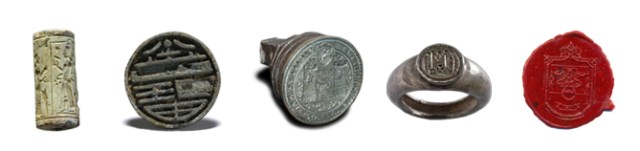
The text says that an angel arises from the east, carrying the seal of the living God. Let’s remember what a seal was for John’s first readers; we are not talking about the animal. In ancient times there were no self-sealing envelopes. Documents were folded, or rolled, and then a large dollop of hot wax (sealing wax) was placed over the line where the edge of the document rested against the rest of it, in order to hold the scroll or letter closed. While the wax was still hot, the sender of the letter (or document) pushed the end of a special metal, wooden, or clay piece into the wax. The piece had a design or logo on the end of it, and this left an impression on the wax. When the wax dried, the impression was hardened into it, and the wax, with impression kept the document sealed.

This special piece of metal, wood or clay with the design on it was called a “seal,” since it was used to seal documents in this way. Here are some examples of what all this looks like:

sealing ring

A modern seal, on the face of a ring.

A sealed letter.

sealed document

Some examples of ancient seals.

seals ancient

Usually, individuals had their own unique seals, and your seal would be one of your most important and closely guarded possessions. Seals were often kept on rings (as you can see above), or on necklaces. So, if I sent you a letter, you could look at the blob of wax that kept it closed, and see my seal upon it, and therefore you would know that the letter came from me. Also, the seal prevented unauthorized people from opening, or tampering with the document. In short, a seal shows who “owns” a document, and protects that document from harm until it arrives where it is supposed to go.

When we apply this to the text, we understand what it means to be sealed: God is putting his own special mark on his people, to identify them as his own, and to protect them. He is saying “these people are mine.” He is also saying, “No one can tamper with my people.” This is so important that he stops his angels who are about do his work in the world until his people are sealed.

Now, this is a symbolic picture: we are not meant to understand that an angel is going to put a dollop of sealing wax on 144,000 foreheads, and then push God’s seal into the wax on each person. So, how exactly is God doing the sealing?

Thankfully, we have other parts of scripture to shed light onto this. Several times in the New Testament, the Holy Spirit is described as the “seal” of our salvation.

22He has also sealed us and given us the Spirit as a down payment in our hearts. (2Cor 1: 22, HCSB)

 13When you heard the message of truth, the gospel of your salvation, and when you believed in Him, you were also sealed with the promised Holy Spirit. 14He is the down payment of our inheritance, for the redemption of the possession, to the praise of His glory. (Eph 1:13-14, HCSB)

 29No foul language is to come from your mouth, but only what is good for building up someone in need, so that it gives grace to those who hear. 30And don’t grieve God’s Holy Spirit. You were sealed by Him for the day of redemption. (Eph 4:29-30, HCSB)

So God seals people with his Holy Spirit. The Spirit does many things in the life of one who trusts Jesus, and one of those things is to show everything in the universe that we belong to the Father, and to protect us until we arrive in the New Heavens and the New Earth. I do want to say, for the sake of honesty, that not all commentators on Revelation agree that this sealing is the Holy Spirit. Many people think this is some other sort of “sealing,” given only for the end times. However, they all agree that the sealing is some sort of spiritual (not physical) indication that these people belong to God, and I say that the Holy Spirit does that anyway.

Now, who exactly are the people who will be sealed? In the first place, they are “slaves of our God.” The word slaves has a very negative connotation in our culture; we tend to think of the horrible practice of enslaving Africans that is a dark spot on American and British history. In the New Testament however, slavery was not racial: There were slaves of all races and colors in the ancient Roman empire. In addition, most slaves in those days (with the exception of galley [ship] slaves and slaves condemned to hard labor) had a fair degree of personal freedom. In fact, many slaves entered into that condition voluntarily, because a master was bound to provide for and protect the slaves in his household. Most slaves also had the opportunity to purchase their freedom back from their masters. The key concept when we think about being a slave of God is this: We have made God our owner. We live for His interests, not our own. This should be true of anyone who calls him/her self a Christian. So the slaves of God are Christians.

It also says that these sealed people are “144,000 from every tribe of Israel.” The apostle Paul, in the book of Romans seems to say that at some point in the future, many Jews/Israelites will repent and trust in Jesus Christ. Because of that, some people believe that these verses in Revelation describe a great movement of God among people of Jewish descent, with many of them becoming Christians. According to this idea, it is these Jewish Christians who will be sealed for protection against God’s judgment.

The idea that these are Jewish Christians has many problems however. Why would God protect only Jewish Christians from judgment, but not all other Christians? If we accept that this sealing is related to the Holy Spirit, we can’t certainly can’t say that only Israelite Christians have the Holy Spirit. Some people answer this by saying that the other Christians will be “raptured” (that is, taken up to heaven without dying) by this point in the end times. It is the rapture of Gentile believers, (they say) that will cause all these Israelites to come to faith in Jesus. If you have been paying attention, however, you will realize that there has been no mention of a “rapture” yet in Revelation, and in fact, such a thing is never clearly described in Revelation.

There are other problems with taking this text at face value – that is, taking it to mean that only the twelve tribes of Israel will be sealed against God’s judgment. For one thing, most of the tribes appear to have been destroyed. In approximately 721 BC, the Assyrian empire conquered the area held by the tribes of Reuben, Simeon, Zebulun, Issachar, Dan, Gad, Asher, Naphtali, and Ephraim and Manasseh (ten tribes). These tribes were deported from the land, and they were scattered all around the Assyrian empire. People were brought in from elsewhere to occupy the territory they left. The result was that those tribes eventually lost all of their separate identity as descendants of Israel. Only the tribes of Judah, Benjamin and Levi continued to have an ongoing sense of being Israelites. For all intents and purposes, 9 out of twelve tribes have been “lost.”

In addition, even if the other tribes still existed, John’s list is all wrong. The tribe of Dan is not even mentioned in the Revelation text. The tribe of Manasseh is mentioned, and also the tribe of Joseph, but Manasseh is part of Joseph; in other words, It should have been either “Manasseh and Ephraim” (but not Joseph); or “Joseph” (but neither Manasseh or Ephraim). Never in any other place in the Bible are they described as “Manasseh and Joseph.”

Some people say Dan is not mentioned because the antichrist is supposed to come from Dan. They base this on one obscure verse:

16“The snorting of their horses is heard from Dan; at the sound of the neighing of their stallions the whole land quakes. They come and devour the land and all that fills it, the city and those who dwell in it. (Jer 8:16, ESV2011)

In context, the verse is about the invasion of the Babylonians, which came from the north, through the territory historically held by Dan. But even if it was about the antichrist, it would be pretty harsh to exclude an entire tribe because of one individual.

No, a Jew like John should certainly have known better than list the twelve tribes like this. I think he did it to show us that we are not to take “from the Israelites” literally. I think he means us to understand “Israelites” as “all of God’s people,” whether descended from the twelve tribes or not. Remember, Revelation was written in a kind of code language, in case it fell into the wrong hands. Jewish people were less likely to be persecuted for their faith than Christians, so this is a neat trick to sound like it is about the Jewish faith, while, to those who know anything about the twelve tribes, it is obviously not meant to be taken at face value. Remember, also, that John seems to think of Christians as the true spiritual Jews, even if they aren’t physically Israelites:

8“Write to the angel of the church in Smyrna: “The First and the Last, the One who was dead and came to life, says: 9I know your affliction and poverty, yet you are rich. I know the slander of those who say they are Jews and are not, but are a synagogue of Satan. (Rev 2:8-9, HCSB)

 9Take note! I will make those from the synagogue of Satan, who claim to be Jews and are not, but are lying — note this — I will make them come and bow down at your feet, and they will know that I have loved you. (Rev 3:9, HCSB)

So John sees Christians as the true children of Israel, spiritually speaking. He is not alone in this. The New Testament clearly teaches that those who trust Jesus are the ones who inherit the promises given to Abraham, Isaac and Jacob. In other words, since the time of Jesus, it is the followers of Jesus, whether of Jewish descent, or not, who are the “true Israelites.”

A person is not a Jew who is one only outwardly, nor is circumcision merely outward and physical. No, a person is a Jew who is one inwardly; and circumcision is circumcision of the heart, by the Spirit, not by the written code. Such a person’s praise is not from other people, but from God. (Romans 2:28-29, NIV)

In the time of the New Testament, “the circumcised,” or, “circumcision” was sort of a slang for “Jewish” or “Israelite.”

15For neither circumcision counts for anything, nor uncircumcision, but a new creation. 16And as for all who walk by this rule, peace and mercy be upon them, and upon the Israel of God. (Gal 6:15-16, ESV)

In this context the “Israel of God” appears to mean Christians – both Jewish, and non-Jewish Christians. Many Jews took pride in the fact that they were descended from Abraham. But the New Testament says that all who trust Jesus are also spiritually descendants of Abraham:

9Is this blessing only for the circumcised, then? Or is it also for the uncircumcised? For we say, Faith was credited to Abraham for righteousness. 10In what way then was it credited — while he was circumcised, or uncircumcised? Not while he was circumcised, but uncircumcised. 11And he received the sign of circumcision as a seal of the righteousness that he had by faith while still uncircumcised. This was to make him the father of all who believe but are not circumcised, so that righteousness may be credited to them also. (Rom 4:9-11, HCSB)

 27For as many of you as were baptized into Christ have put on Christ. 28There is neither Jew nor Greek, there is neither slave nor free, there is no male and female, for you are all one in Christ Jesus. 29And if you are Christ’s, then you are Abraham’s offspring, heirs according to promise. (Gal 3:27-29, ESV2011)

6Just as Abraham believed God, and it was credited to him for righteousness, 7then understand that those who have faith are Abraham’s sons. (Gal 3:6-7, HCSB)

 This is very important to understand,  and not only for this passage. It explains how we should read the Old Testament. Christians are the true spiritual nation of Israel. The promises of God given in the Old Testament are often meant as much, or more, for Christians as they are for ethnic Jews. They are all fulfilled in Jesus Christ. For example, consider the promised land. The physical land in Israel was not promised to Christians who are not physically descendants of Abraham. But we do have a promised land: the New Heavens and the New Earth which God is preparing for all who trust Jesus. And the promised land in Jesus is eternal: so much better than the mere physical land. So “the twelve tribes” of Israel, here in Revelation 7, means “Christians.”

Now, let’s tackle the number: 144,000. In Revelation, the number 12 represents the people of God. There were twelve tribes of Israel, and there were twelve apostles. If you multiply 12×12, you get 144. The number “one thousand” in revelation represents “all” of something. Imagine someone saying, “If I’ve told you once, I’ve told you a thousand times.” They don’t mean they have actually told you 1,000 times – it just means “a great number of times.” Or “Mine is a thousand times better than yours.” Again, the number 1,000 is not meant to be taken literally. So, in Revelation, 1,000 of something means “Lots and lots,” or, “all of it.” We put this together: we have all of God’s people from Old Testament times (represented by 12,000), and all of God’s people since the time of Jesus (represented by another 12,000) and you multiply them together, and you get 144,000. It just means that God is going to seal every single person who trusts Him.

Now, this “sealing” doesn’t mean that God’s people will never experience hardship. But it does mean that they will not be judged by God based on their own performance. They will be judged based on the performance of Jesus. The people of God, sealed by the Holy Spirit, will never have to worry that God will be angry at them for their sins, or cause them to suffer for their failings. Jesus took the judgment upon himself. When God enacts the final and complete judgment of the world, all of the people of God will be protected from that judgment.

These are wonderful truths for us to understand. We who are in Jesus have been marked in a such a way that shows every spiritual entity in the universe – whether angels, or demons, or even the devil – that we belong to God. The seal protects us until we arrive at our destination, the New Heavens and New Earth where God himself will wipe every tear from our eyes. We are also protected from the judgment and wrath of God. He does not evaluate our performance, instead he evaluates the performance of Jesus on our behalf. In addition, even the promises of the Old Testament for the Israelites are given to us.

Take a moment to allow these things to sink in.

Revelation #18 JUDGMENT: GOOD, OR EVIL?

Judgment

The judgment of God is problematic for many people in today’s culture. Read on for some thoughts about how to understand and talk about justice, and God’s judgment of the world.

To listen to the sermon, click the play button:

To download, right click on the link (or do whatever you do on a Mac) and save it to your computer:
Download Revelation Part 18

Revelation #18. The Problem of Judgment & Punishment

This next message is not directly about the text of Revelation, but rather about issues raised by the text. I think it is important that we deal openly and clearly with the messages of judgment, justice and vengeance. All over the Book of Revelation we find God judging the wicked, and, in many cases, causing them to suffer. For instance:

3 Then from the smoke came locusts on the earth, and they were given power like the power of scorpions of the earth. 4 They were told not to harm the grass of the earth or any green plant or any tree, but only those people who do not have the seal of God on their foreheads. 5 They were allowed to torment them for five months, but not to kill them, and their torment was like the torment of a scorpion when it stings someone. 6 And in those days people will seek death and will not find it. They will long to die, but death will flee from them. (Revelation 9:3-6, HCSB).

Even the good saints who have already been martyred, seem almost bloodthirsty. When the fifth seal is opened, the Martyrs cry out:

10They cried out with a loud voice: “Lord, the One who is holy and true, how long until You judge and avenge our blood from those who live on the earth? ” (Rev 6:10, HCSB)

The idea that the wicked will be punished for their sins is problematic for our culture. For one thing, the dominant view in Western culture is that no one is truly wicked (with the exception of one or two people like Hitler). On the other hand, they also believe that no one is truly good, either: they think, in general, that all people of faith are hypocrites who don’t actually practice what they preach.

Non-Christians and pseudo-Christians in Western society do have a sense of morality, a curious mix that is partially derived from the Bible, and partially from secular humanism. Very high on the moral list of secular culture is that we should not judge anyone. I think this has rubbed off on most Christians also. So, how do we handle the judgments in Revelation? How do we handle the destruction and death that is released by God’s command? What do we do with this almost black and white view of the righteous and the wicked? I think there are several points that might help us understand and accept these concepts in Revelation.

1. God is infinite, and we are not. If you’ve been following this blog in real time, you know that last time we talked extensively about how God is so much greater than we are. Trying to understand God is like trying to use a tablespoon to contain the contents of a running garden hose. The tablespoon is filled up immediately, but there is no end to the water that comes out of the hose. This is what it is like when we try to understand God. What this means is that there could be a very convincing and satisfying explanation for all of the things that trouble us, and yet we will never be able to understand it. In fact because God is infinite, and we are not, it is very likely that we won’t be able to understand much about God at all, including the way he judges the earth. In plain language, we need to accept that God has very good reasons for what he does, and that we cannot understand very many of those reasons.

2. God is God, and we are not. In other words he can do whatever he wants to do. He made this world and he can do what he likes with it. Even if we could understand the reasons for what he does, we have no right to judge him. Another very important aspect of this point is that we human beings are not the ones who do the judging. It is absolutely wrong for us to take judgment into our own hands.

If we say something different from what the Bible says, even if we think we are being more lenient, then we are putting ourselves in the place of God, and judging others.

When we tell other people what the Bible says, we are not judging others – we are simply repeating what God has already said. Even so, we must remember that final judgment belongs to God, and it is not up to us to put God’s judgment into action.

The martyrs under the altar were asking God to act, because they understood that it was not their own place. Violence is never an appropriate expression for any part of the life of a Christian. We may, in extreme situations use violence to defend ourselves from physical danger. But we may never consider ourselves the instrument of God’s judgment, and it is not our place to deliberately harm any other human being. When David had the opportunity to kill King Saul, even when Saul was pursuing him in order to kill him, David refused. He said:

12“May the LORD judge between you and me, and may the LORD take vengeance on you for me, but my hand will never be against you. 13As the old proverb says, ‘Wickedness comes from wicked people.’ My hand will never be against you. (1Sam 24:12-13, HCSB)

This should be our attitude towards those who oppose us also. Paul wrote to the Romans:

17Do not repay anyone evil for evil. Try to do what is honorable in everyone’s eyes. 18If possible, on your part, live at peace with everyone. 19Friends, do not avenge yourselves; instead, leave room for His wrath. For it is written: Vengeance belongs to Me; I will repay, says the Lord. (Rom 12:17-19, HCSB)

We Christians interpret the whole  Bible in relationship to Jesus. Therefore, even though there are texts in the Old Testament instructing the Israelites to wage “Holy War,” those texts cannot be taken literally by those who follow Jesus. Jesus himself made this very clear:

38 “You have heard that it was said, ‘An eye for an eye and a tooth for a tooth.’ 39But I say to you, Do not resist the one who is evil. But if anyone slaps you on the right cheek, turn to him the other also. 40And if anyone would sue you and take your tunic, let him have your cloak as well. 41And if anyone forces you to go one mile, go with him two miles. 42 Give to the one who begs from you, and do not refuse the one who would borrow from you.

 43 “You have heard that it was said, ‘You shall love your neighbor and hate your enemy.’ 44But I say to you, Love your enemies and pray for those who persecute you, 45 so that you may be sons of your Father who is in heaven. (Matt 5:38-45, ESV2011)

Clear enough? God will take care of these things. It isn’t our place to harm anyone.

3. These violent and overwhelming judgments tell us that sin is serious.

Imagine that a terrible sickness was discovered. It is a virus that inflames the lining of the brain. Those who get it eventually go mad, and if not restrained, many of them, in their insanity, commit cruel and horrible crimes. Driven by the disease, they rape, humiliate, torture and murder others. Eventually, everyone who gets the virus dies; the mortality rate is 100%. It is extremely contagious, and there is no cure.

Now, some of the people who get this virus manage to control it to some extent. They are able to refrain from the worst cruelties. However, that same virus that makes some people do unspeakable horrors lives inside everyone who has it. You never know when the sickness might suddenly progress and cause someone to commit a horrific crime. The potential for the most awful cruelty will always be there, in every single person who has the disease.

In addition, everyone who has it is a carrier. Everyone who has it will infect others. So even if someone has mild symptoms, that person will pass the disease on to others; and those others may end up with the very worst symptoms.

You can see that this is a terrible, horrific virus. To control it, you would have to implement a zero tolerance quarantine, and enforce it 100%. The only thing to do, is to wait for those who have it to die.

My little analogy is actually quite true. The disease exists: it is called sin. In some people, sin exhibits mild symptoms. But the same thing that makes me snap at a dear friend in selfish anger is what makes someone else commit the most horrific crimes: rape, torture, murder. The root cause is the same.

Yehiel Dinur was a Jew. During the 1930s he experienced the increasing bigotry and persecution of the Jews, fostered by Hitler. During WWII, he ended up in a concentration camp, and after unspeakable horrors, survived. Many years afterward, he was summoned to Nuremberg Germany, to testify at the War Crimes Tribunal. He was called upon to testify against Adolf Eichmann, one of the architects of the holocaust, who had been one of Dinur’s torturers. When he stepped into the courtroom and saw Eichmann sitting on trial, he broke down in uncontrollable sobs, and had to be escorted out of the room until he could compose himself. When he was later interviewed, the news reporter assumed that Dinur’s breakdown was due to hatred, fear, or terrible memories. Or perhaps it was just the overwhelming emotion that came as a result of knowing that this terrible man was finally brought to justice.

Dinur denied all of these. He gave this as the reason for his uncontrollable emotion: “I was afraid about myself. I am — exactly like he is.”

Dinur knew that the same horror that caused the Nazi to commit such atrocities lived also inside of him. According to the Bible, he was absolutely correct. That horror lives inside each one of us, even if some of us suppress it better than others. The sin that lives in me is just as evil as the sin that lived inside of Nazi torturers. It is that serious.

All this is to say that we cannot criticize God for taking severe measures to stop the horrible disease of sin, even when its outward symptoms are mild among some people.

4. Although judgment is coming, Jesus has provided a way out for all people. That is why the gospel must be preached before the end can come (Revelation 6:1-2): so that all those who want to can escape the final judgment. The full judgment for sin fell upon Jesus. Jesus died, and if we trust him, our sinful nature was killed along with him. As Paul writes, we were united with him in his death, which means that the terminal illness of sin has been purged from our souls and spirits.

3Or are you unaware that all of us who were baptized into Christ Jesus were baptized into His death? 4Therefore we were buried with Him by baptism into death, in order that, just as Christ was raised from the dead by the glory of the Father, so we too may walk in a new way of life. 5For if we have been joined with Him in the likeness of His death, we will certainly also be in the likeness of His resurrection. 6For we know that our old self was crucified with Him in order that sin’s dominion over the body may be abolished, so that we may no longer be enslaved to sin, 7since a person who has died is freed from sin’s claims. (Rom 6:3-7, HCSB)

Anyone who trusts Jesus is counted as having already died; we were included in the punishment and death that was given to Jesus on our behalf. In addition, he creates within us a new life, a spirit that wants to do good, and not evil:

“If anyone is in Christ, he is a new creation. The old has passed away, behold the new has come” (Second Corinthians 5:17)

What about those who never got a chance to hear the gospel before they died? Only God knows. But we know that he is merciful and gracious. Again, it is not our place to determine what happens to such people – thank the Lord!

5. The terrible judgments are also paid out against the spiritual forces of evil. In other words, if it makes you uncomfortable to think of God judging human beings, remember that some of this judgment is also given out against evil, demonic forces. If you feel like it is hard to give your hearty agreement to the judgment of the world, even after all these things we’ve been saying, we can certainly agree with these sorts of judgments against the devil, and his evil spirits.

6. Human beings are hardwired for justice. Think about this: every day, all over the world, 12 and 13-year-old girls are being kidnapped. They are raped repeatedly until the abuse brain-washes them into submission, and then they are sold as sex slaves. How can we possibly say that this is okay? How could we possibly suggest that God gives those evil and twisted abusers a pass, because “he’s a God of love?” He wouldn’t be a loving God if he allowed that to go on without consequence. I don’t believe that anyone reading this thinks God should give these rapists/slave traders a pass. Our natural response to hearing this is to demand justice. Revelation tells us that God will put all things right, including this evil. He will finally destroy the awful disease that makes people do this. He will fully punish everyone who refuses to repent. When we open our eyes to the true evil that lives in this world, how can we wish for anything less?

When we think about judgment, there is a very useful acronym to sum all of this up. The acronym is LOVE.

Look beyond the human instrumentation to the real enemy of our souls (Eph. 6:12).

On the cross, Jesus himself bore every curse (Gal. 3:13).

Vengeance belongs only to God (Rom. 12:19).

Eventually, God will set all things right (Rev. 11:15).

(This acronym is not original with me. I found it at: (http://psalms.seedbed.com/frequently-asked-questions-about-psalms/  accessed 2/6/18)

Let the Spirit speak to you today!

Epiphany 5: TRUST BEYOND UNDERSTANDING

hands

There is no peace in thinking that you can control life to avoid trouble and sorry. There is no peace in trying to figure out why God does or doesn’t do particular things. Although God reveals himself to people, we cannot truly understand him. In the end, understanding and illumination will only take us to the threshold of relationship with him. What we need, even more than understanding, is to trust him.

To listen to the sermon, click the play button:

To download, right click on the link (or do whatever you do on a Mac) and save it to your computer:
Download Trust Beyond Understanding

Trust Beyond Understanding. Isaiah 40:21-31; Psalm 147:1-11; Mark 1:29-39

Whenever I preach on the Lectionary, I read all of the passages, and pray, and listen to see if the Holy Spirit is bringing up something in one or more of the readings. It’s a slightly different thing than preaching through a book of the Bible. Anyway, I trust that this time, the Spirit has been speaking, and has also been making me able to hear what he is saying.

Some of you may know all about the Church Year, and some may not. The lectionary readings are organized around the themes of the church year. Presently, we are in the church season of Epiphany. Epiphany is all about God revealing himself to human beings. It is about the Lord illuminating His Truth and His personality to all the people of the world. So there are themes of wisdom and understanding; themes about the mission of taking the gospel into all the world. But this week, which is technically the last week of Epiphany, the Holy Spirit seems to be saying something slightly different: that although God reveals himself to people, we cannot truly understand him. In the end, understanding and illumination will only take us to the threshold of relationship with him. What we need, even more than understanding, is to trust him.

I strongly encourage you to read all of the scripture passages I have listed above. Please take time to do that now.

I want to begin with the gospel reading for this week from Mark, which is familiar to many people. Jesus came to Peter’s house, and found his mother-in-law sick. Jesus healed her. Word spread rapidly, and then from all over the town, people brought sick people for Jesus to heal. He worked at it all evening. The next morning he got up early, and left, and the disciples found him in a lonely place praying. So far, all that is good and familiar. Jesus heals the sick. Right on! Jesus got up early, and went out by himself to pray. A generation of Christians insisted that this means we should have our quiet times in the mornings. But none of that is what this passage is about, in context. Listen to how it goes down:

36And Simon and those who were with him searched for him, 37and they found him and said to him, “Everyone is looking for you.” 38And he said to them, “Let us go on to the next towns, that I may preach there also, for that is why I came out.” (Mark 1:36-38, ESV2011)

I think we often miss how shocking this incident was for the disciples. Here he was, in their home-town, healing their friends and neighbors. Mark says he healed “many” (Greek: “pollous”)  but he doesn’t use the word “all” (Greek: “panta”). In other words, he wasn’t done healing people. But the next day, instead of getting up, having breakfast, and resuming the healing ministry, he slipped away before dawn, to get away from everyone. When the disciples found him, he wouldn’t go back there with them. The impression you get from reading the Greek is this: “I’ve come to preach in many places, and that is why I came away from there.” What is implied is also this: “I haven’t come mainly to heal, or make life easier for people. I’ve come to tell them about something more important than that.”

But what could be more important than physical healing? I mean, if we don’t have physical health, how can we serve God? Jesus took the same strange attitude about feeding people, also. After he fed the five thousand, they were ready to make him king. But he hid himself from them, and later told them, basically, “There’s something far more important here than food,” (John 6:26-35). Though Jesus healed the sick and fed the hungry as he went along, that wasn’t the reason he came. His primary mission was something different, and that perplexed many people.

The truth is, sometimes God behaves in ways that we ourselves don’t understand. Perhaps it seems like Jesus turns away, and moves on to another place, just as you needed him. It must have seemed that way to the people in Capernaum. Maybe you need healing, but he doesn’t give it. Maybe you need financial help, and none seems to come. Maybe you have simply asked him to show you some kind of a sign, just to let you know that he sees you, but if he sent it, you certainly missed it. Maybe you are reading the scripture, and you find some passage you just can’t wrap your head around, and you can’t make sense of it even after you pray and ask for insight.

Let me make myself clear. I absolutely know (not believe, but know) that God answers prayer. I know that many, many times if you pray for help, you will find it, just as you ask for it. I know that there are many wonderful promises in God’s word, and many people fail to take hold of them by faith, and so they miss out on great things.

I could tell you story after story of how God showed up when his people prayed. But there is a kind of shallowness to a relationship when it is all about what one person does for the other. We scorn someone who “uses” another for their money. We find it contemptible if someone is in a relationship  only in order to get something from the other person. And properly speaking, God doesn’t exist to help us: rather, we exist to bring glory to him. It’s easy to start to love God’s blessings more than God himself. It’s easy to become arrogant about your faith, and cold and hurtful to those who struggle.

Ultimately, God wants to take us beyond the place where we need his blessings in order to feel good about Him. This is what the Spirit is saying today through the  reading from Isaiah:

25 “Who will you compare Me to,

or who is My equal? ” asks the Holy One.

 26 Look up and see:

who created these?

He brings out the starry host by number;

He calls all of them by name.

Because of His great power and strength,

not one of them is missing.

 27 Jacob, why do you say,

and Israel, why do you assert:

“My way is hidden from the LORD,

and my claim is ignored by my God”?

 28 Do you not know?

Have you not heard?

* Yahweh is the everlasting God,

the Creator of the whole earth.

He never grows faint or weary;

there is no limit to His understanding. (Isaiah 40:25-28)

These texts today tell us that God can do whatever he wants. We can’t use the Bible as some sort of legal document, and say, “God you must heal in every situation. God you must provide.” I know this is really difficult. I know it might challenge, or even offend some of you. But I encourage you to look beyond a shallow reading of scripture, and beware of arrogance. Job’s friends thought they had it figured out, and they had a very hard time with Job, who challenged there simple view of God. When they saw him suffering, they decided it must be because he wasn’t trusting the Lord, or praying in the right way, or… something. Because they were afraid. But Job noted that they saw what they did not understand, and it frightened them. God agreed with Job, and rebuked his friends for thinking that they could control Him or understand him.

For you have now become nothing;
you see my calamity and are afraid. (Job 6:21)

Job understood better than his friends. He knew that God is always in control.

“But ask the beasts, and they will teach you;
the birds of the heavens, and they will tell you;
or the bushes of the earth, and they will teach you;
and the fish of the sea will declare to you.
Who among all these does not know
that the hand of the Lord has done this?

In his hand is the life of every living thing
and the breath of all mankind. (Job 12:7-10)

Somewhere along the line, our Christian culture has decided that God needs our help defending or explaining himself. We hurry to say things like: “God didn’t want this to happen.” But that is a tremendously unsettling idea. Are things happening to you that God didn’t want? Then why? Is he unable to protect us, or unable to help us?

I know all about the consequences of original sin, as well as our own personal sins. And it is true that some people are in a fix because they have made poor choices; because they haven’t listened to God. But some people have followed the Lord faithfully, and they are still in a fix. It isn’t their own doing. And even if the problem is the result of being in a fallen world (like cancer), or someone else’s sin (like a drunk driver) are we going to say that God couldn’t stop it? Is he really that weak?

There is another way. I think it is the Biblical way. We are not called to defend God’s actions, or even explain them. He does not need to justify himself to human beings. We are finite, and God is infinite. Trying to understand him is like trying to empty a garden hose into a tablespoon. The tablespoon holds almost nothing, and there is no end to the water coming out of the hose.

The texts tell us that we don’t need to explain or justify God’s actions. We cannot understand God. But what we do need to do is trust him. Our Isaiah text puts it like this:

30 Youths may faint and grow weary,

and young men stumble and fall,

 31 but those who trust in the LORD

will renew their strength;

they will soar on wings like eagles;

they will run and not grow weary;

they will walk and not faint. (Isaiah 40:30-31)

This doesn’t mean everything will go the way we want it to. It means that our strength and hope are found only in trusting God. The Psalmist agrees:

The Lord values those who fear Him, those who put their hope in His faithful love. (Psalm 147:11)

The great English preacher, Charles Spurgeon suffered greatly during his life. He battled very serious and dark depression. He had a kidney disease, as well as gout, and both were so intensely painful, that they often laid him up for weeks at a time. He was frequently harshly criticized, and even slandered, by others. But Spurgeon held to an unwavering belief that God was sovereign in all things, even the things that were difficult for him. He trusted that God was at work, even in his difficulties, and it made all the difference. He wrote:

“It would be a very sharp and trying experience to me to think that I have an affliction which God never sent me, that the bitter cup was never filled by his hand, that my trials were never measured out by him, nor sent to me by his arrangement of their weight and quantity” (John Piper, Charles Spurgeon: Preaching Through Adversity).

David Brainerd, that missionary who has inspired many generations of missionaries, wrote this:

In this world I expect tribulation; and it does not now, as formerly, appear strange to me; I don’t in such seasons of difficulty flatter myself that it will be better hereafter; but rather think how much worse it might be; how much greater trials others of God’s children have endured; and how much greater are yet perhaps reserved for me. Blessed be God that he makes the comfort to me, under my sharpest trials; and scarce ever lets these thoughts be attended with terror or melancholy; but they are attended frequently with great joy”

We will not always understand God. We cannot understand how some terrible thing could be part of his plan for us. We don’t know how he can make good out of evil. The only way to truly find peace about these things is to trust Him. Trust that he sees something that you cannot. Trust that even when it seems contrary to his very nature, he is so far beyond us that it can, and does, work for your good (Romans 8:28).

Kari and I often read from a devotional called “Streams in the desert.” While I was preparing this message this week, one of the readings went like this:

My child, I have a message for you today. Let me whisper it in your ear so any storm clouds that may arise will shine with glory, and the rough places you may have to walk will be made smooth. It is only four words, but let them sink into your inner being, and use them as a pillow to rest your weary head. “This is my doing.”

Have you ever realized that whatever concerns you concerns Me too? “For whoever touches you touches the apple of [my] eye” (Zech. 2:8). “You are precious and honored in my sight” (Isa. 43:4). Therefore it is My special delight to teach you.

I want you to learn when temptations attack you, and the enemy comes in “like a pent up flood” (Isa. 59:19)., that “this is my doing” and that your weakness needs My strength, and your safety lies in letting Me fight for you.

Are you in difficult circumstances, surrounded by people who do not understand you, never ask your opinion, and always push you aside? “This is my doing.” I am the God of circumstances. You did not come to this place by accident — you are exactly where I meant for you to be.

Have you not asked Me to make you humble? Then see that I have placed you in the perfect school where this lesson is taught. Your circumstances and the people around you are only being used to accomplish My will.

Are you having problems with money, finding it hard to make ends meet? “This is my doing,” for I am the One who keeps your finances, and I want you to learn to depend upon Me. My supply is limitless and I “will meet your needs” (Phil. 4:19). I want you to prove My promises so no one may say, “You did not trust in the Lord your God” (Deut. 1:32).

Are you experiencing a time of sorrow? “This is my doing.” I am “a man of sorrows, and familiar with suffering” (Isa. 53:3). I have allowed your earthly comforters to fail you, so that by turning to Me you may receive “eternal encouragement and good hope” (2 Thess. 2:16). Have you longed to do some great work for Me but instead have been set aside on a bed of sickness and pain? “This is my doing.” You were so busy I could not get your attention, and I wanted to teach you some of My deepest truths. “They also serve who only stand and wait.” In fact, some of My greatest workers are those physically unable to serve, but who have learned to wield the powerful weapon of prayer.

Today I place a cup of holy oil in your hands. Use it freely, My child. Anoint with it every new circumstance, every word that hurts you, every interruption that makes you impatient, and every weakness you have. The pain will leave as you learn to see Me in all things.
–Laura A. Barter Snow

Revelation #16 THE GOSPEL CONQUERS!

splash1

The seals begin with a picture of the gospel going out and “conquering.” Before the end, the gospel will be proclaimed to every tribe, language and nation. We Christians are destined to be a part of that.

To listen to the sermon, click the play button:

To download, right click on the link (or do whatever you do on a Mac) and save it to your computer:
Download Revelation Part 16

evelation #16. Revelation 6:1-2

So far, most of what we have studied in the book of Revelation is reasonably clear. Going forward, we enter the parts of the book that are less clear. There are many different possible interpretations for some parts of Revelation, and it isn’t always obvious which is the best. I want to stress that compared to the rest of the Bible, this is unusual. Most of the Bible is not too difficult to understand. We may find layers of meaning, or various nuances in some passage, but the basic message of most of the Bible is not in doubt, and it is not up for debate. This is one reason that many preachers do not use the book of Revelation – it is unusually obscure. In my introduction, I have already shared the various approaches to interpreting Revelation. As we go on, I will try to briefly share the most reasonable perspectives, and then focus on the interpretation that I find most helpful. Occasionally I will also share poor interpretations that are very popular, in order to warn you against them. In fact, I will do that today.

With chapter five, we have finished with the second vision of heaven’s perspective, and we now move on to the second major section of the book of Revelation. In chapter five, John introduced the Lamb (Jesus), and the scroll sealed with seven seals. Now, the Lamb (Jesus) breaks each seal. The first four seals result in a horseman appearing, and going out into the world.

We should keep in mind that these verses, as with much of Revelation, are symbolic “word-pictures,” not literal. John did not mean us to think that an actual horse will come out of heaven, with an actual riders. The horses and riders stand for something else.

There is debate about whether the seven seals are in fact a description of the end of all things, or if they are just preliminaries: the opening battle in a long war, so to speak. I tend toward the idea that the seven seals represent, for the most part, “the beginning of the end.” In other words, I suspect that these are things that take place before the real “end times.” One reason I think this way is because of how I interpret the first seal.

The first seal reveals a white horse. Its rider has a bow, a crown and is sent forth to conquer. The horse that is next after the white one is red, and it is the horse of war. It takes peace from the earth. This gives us a bit of a problem. You would think that the first horse, “conquest” would take peace from the earth, and create war. So these first two horses appear to be almost the same thing. The distinction between conquest and war is very, very small. So what are we supposed to learn from this?

Let me begin by offering you an interpretation with which I disagree, though I think it is quite reasonable: The horse and rider represents a time of conquest. The horses that follow represent widespread war, famine and death, resulting from the ambitions of those who seek to conquer. This could very well be the right understanding of the first seal; in fact, if my preferred idea is wrong, this would be my second choice.

There is another popular interpretation that I don’t care. In this other view, the white horseman represents a single person who will seek to conquer the entire world. Some with this view take it even farther, and suggest that this person is also the antichrist. Revelation was written in Roman times, and in those days, the great threats to the Roman empire were in the east. The Parthians in the east were renowned bowmen. Therefore, the people with this interpretation believe that this conqueror/antichrist will come from Iran or Romania, or from somewhere else in the territories once controlled by the Parthians. I think that this is unlikely to be the correct interpretation. I share this with you, however, because it is very popular idea, and I want to warn you against it. This interpretation relies on many assumptions that go far beyond the actual text. Clearly, none of the other three horsemen are meant to represent actual individual people, so why should this one? There is no mention of the antichrist in the text, so why make that assumption? There is no suggestion as to where the horseman comes from, other than that it is sent by God, so why decide it should come from the ancient realms of the Parthians? The bow is flimsy evidence, at best.

My own interpretation of this text is one that some respected commentators agree with; at the same time, some respected commentators have different ideas. Obviously, I think I’m correct, and I’ll explain my reasoning, but I certainly could be wrong. If I am, I think the first idea I shared above is probably the next best (the idea that ambitions for conquest will lead to warfare, famine and death in the time just before the end times).

I did a little digging into the Greek word for “conquest” (nikao). John uses this word (in various forms) 23 times, throughout his writings. It is found in The Gospel of John, 1 John, and Revelation. Two times this word is used to convey that the power of evil was given a limited amount of time to conquer the people of God. In those instances, that is spelled out clearly. However, every other time John uses it – 20 times – it refers to the people of God overcoming the world, or the powers of evil. In the letters to the seven churches (Revelation chapters 2-3) every single church is given a promise in connection with “conquering.” For example, he says to the church at Ephesus:

7“Anyone who has an ear should listen to what the Spirit says to the churches. I will give the victor the right to eat from the tree of life, which is in God’s paradise. (Rev 2:7, HCSB)

“The victor” is a version of this same Greek word, nikao. In other words, it might be better translated: “the one who conquers.” Each of the other seven churches gets a similar promise, using this same Greek word. John also uses this word in connection with the Lamb himself:

And one of the elders said to me, “Weep no more; behold, the Lion of the tribe of Judah, the Root of David, has conquered, so that he can open the scroll and its seven seals.” (Rev 5:5, ESV2011)

Outside of Revelation, John uses this word exclusively in connection with Jesus, or his followers, conquering the world:

33I have told you these things so that in Me you may have peace. You will have suffering in this world. Be courageous! I have conquered the world.” (John 16:33, HCSB)

 4You are from God, little children, and you have conquered them, because the One who is in you is greater than the one who is in the world. (1John 4:4, HCSB)

 3For this is what love for God is: to keep His commands. Now His commands are not a burden, 4because whatever has been born of God conquers the world. This is the victory that has conquered the world: our faith. (1John 5:3-4, HCSB)

In addition, the first horse is white in color. The colors in Revelation are not random. They have significance. The color “white” is mentioned in Revelation 14 times, in addition to this passage. Every single other time, white is associated either with God, or with God’s people. It is the color of Jesus’ hair (1:14); it is the color of the stone promised to the faithful believers in Pergamum; it is the color of the clothing promised to the faithful in Sardis and Laodicea; it is the color of the clothing worn by: the 24 elders (4:4), the faithful martyrs (6:11) and the great multitude of the saved from every nation (7:9). Jesus rides a white horse (19:11) as do the armies of heaven, who also wear white linen (19:14). You get the idea: White symbolizes the purity and holiness of God and his people.

Therefore, I believe “the white horseman who conquers” represents the spiritual victory of God’s people over worldly values and lust, over our own sinful flesh, and over the devil. It represents God’s Word, carried by Christians, going out into very part of the world. It means that before the “end times” begin, Christians will take the gospel to every tribe, language and nation. Jesus, when he spoke with his disciples about end of the world, said this:

9“Then they will hand you over for persecution, and they will kill you. You will be hated by all nations because of My name. 10Then many will take offense, betray one another and hate one another. 11Many false prophets will rise up and deceive many. 12Because lawlessness will multiply, the love of many will grow cold. 13But the one who endures to the end will be delivered. 14This good news of the kingdom will be proclaimed in all the world as a testimony to all nations. And then the end will come. (Matt 24:9-14, HCSB)

I think the white horseman represents verses 13 & 14 above. It represents the fact that Christians will endure, and be saved, and that the gospel will be proclaimed in all nations. The very beginning of the end is marked by the perseverance of Christians in taking the gospel to the entire world. Later on, Revelation will show us a multitude of Christians from every nation, tribe, people and language. That means that the gospel must be brought to every nation, tribe, people and language before the end can come. This also fits in with the fifth seal. I will talk about it more later, but when the fifth seal is opened, those who have been killed for being faithful to God’s word are told to rest a little longer, until everyone who is going to be martyred has, in fact, been martyred. This implies some sort of work of carrying the gospel into the world, of proclaiming it in places where it is rejected.

So, if this is the case, what is the message for us, today? First, I think it should comfort us. Nothing is going to destroy our faith. We will win the spiritual victory over the world, our own flesh, and the devil. The church will succeed in its mission to take the gospel to all peoples in the world.

Second, I think this should also wake us up to the need for every Christian to get involved in the mission of taking the gospel to every tribe, tongue and nation. Jesus more-or-less said that He will not return to put things right and take us into the New Heavens and New Earth until the gospel is proclaimed to all peoples (Matthew 24:14, above). We trust that God will accomplish his purposes on earth, but we also recognize that he wants to use us to do so. We are supposed to be part of the first seal!

So, does this mean we must all go overseas and become cross-cultural missionaries? Certainly, some people are called to that. But just as certainly, some are called to different ways of spreading the gospel.

One thing that every Christian can do is pray for the gospel to reach every tribe, tongue and nation. Jesus, considering the size of this task, said to his disciples:

37Then He said to His disciples, “The harvest is abundant, but the workers are few. 38Therefore, pray to the Lord of the harvest to send out workers into His harvest.” (Matt 9:37-38, HCSB)

So we can pray for others to be sent. When they are sent, we should continue to uphold them in prayer. We can pray for specific countries and specific groups of people. I think one of the best ways to be involved in Christian missions is for every church (or, if it is a big church, every small group) to help sponsor a missionary. This means praying, giving financially, and reading the missionary’s letters, in order to better support them. Your group may not be able to fully support a missionary, but you could at least provide some resources.

Another way to help the mission of Jesus is to create resources that can be used by others. These sermons of mine that you read have been used to help start churches in the USA, England, Finland, Brazil, Mongolia, Vietnam, India and East Africa. And those are only the places that I know about.

I’ve alluded to this already, but an additional way to help the cause of Jesus is to give financially to missionaries and leaders who are helping to spread the gospel. I think prayer should always be connected to giving, so if you give financially, be sure that you also pray for those to whom you give.

One of the most effective ways of spreading the gospel is to train Christian leaders from among the people who need to be reached. An Indian pastor, ministering in India, will usually be more effective at reaching other Indians than an American pastor. So we can pray for, and support efforts to train such leaders.

Also, you don’t have to be sent as a missionary to tell people of other cultures about Jesus. In every major metropolitan area in the United States you can find people from dozens and dozens of other countries: people of every tribe, tongue and nation. Never has it been so convenient to spread the gospel to all nations. Even in our rural town of thirty-thousand I met a Muslim man from the little country of Guyana (in the Northern part of South America). We were friends for about two years, until he had to return home. While he was here, we talked about Jesus quite a bit. That’s something you may not realize: it’s usually quite easy to talk about Jesus with people from other countries. In fact it’s usually much easier to talk about Jesus with International folks than it is with Americans. Muslims, in particular, are very open to talk about religion. If a person turned to Jesus while living in the United States, they might return home, and begin to spread the gospel in their country of origin. I think Jesus needs people in America who are simply willing to befriend people from other places, and share their lives – and their faith – with them. For those of you in the LTC network, we can provide some training, if you like, but it’s not rocket science. It simply involves befriending people.

Listen to what the Spirit is saying to you today!

Revelation #15 THE PLAN FOR THE FULFILLMENT OF HISTORY

seven seals 2

This life will never completely fulfill us or satisfy us, because it is not supposed to. The good news is that Jesus Christ is enacting God’s plan to bring history to its ultimate fulfilment, and to bring those who trust him – his people – into the New Heaven and New Earth, where we will be completely fulfilled, and completely joyful.

To listen to the sermon, click the play button:

To download, right click on the link (or do whatever you do on a Mac) and save it to your computer:
Download Revelation Part 15

Revelation #15. 5:1-14

Pieces of Revelation chapters four and five can be found in countless hymns, songs and liturgies. “Holy, Holy, Holy,” is of course, from 4:8. There’s a line in that song: “casting down their golden crowns, around the glassy sea.” This is, clearly from 4:6 & 10. The music group “Casting Crowns” obviously got their name from here. Several of my favorite other hymns reference this part of Revelation. The phrase: “Worthy is the Lamb” is found in probably thousands of Christian songs.

All that shows us that these chapters can, and should, present us with a powerful desire for heaven. These images inspired generations of Christians to live their lives with a view of heaven. Some people object to this. There used to be a very common phrase: “He (or she) is so heavenly minded, he’s no earthly good.” I hate that phrase with a passion. The truth is exactly the opposite. If we do not have a clear picture of the hope that awaits us, and a deep, strong desire for the goodness and joy of heaven, we will be relatively useless as God’s people here on earth.

Let me make sure this is clear. If we are Christians, the best is yet to come. This life will never completely fulfill us or satisfy us, because it is not supposed to. We are made for something better, truer, deeper than this life can offer. And the wonderful news is this: because the of the Lamb of God, we will someday enter the world that we were made for. We will find true joy, total satisfaction and all that we need. Because we know that, we can be patient in the here and now. We can be willing to be less self-centered, because we now that someday, our hearts will be completely satisfied. We can put up with the crushing imperfections of this life, knowing that the best is yet to come. That allows us to work for good here and now, even when it does not directly benefit us. It is those people who are trying to get satisfaction here and now, who aren’t willing to trust and wait, that are not much use in this world to the One who sits on the throne.

Chapter five begins with a scroll, sealed with seven seals (5:1). The NAS version translates it “book,” and indeed, the Greek (biblios) would be literally rendered “book.” However, “book” to the majority of John’s readers would have meant some sort of written document in a scroll form (bound books were relatively uncommon until about hundred years after Revelation was written). The reason this is important is so we can picture what John is picturing. He is seeing a scroll –something like a rolled up poster. Instead of a rubber band to keep it rolled up, there are seven “seals” that keep the scroll from unrolling. A “document seal” in the ancient world was made of wax. The wax was heated and dropped onto the scroll. Usually, the sender of the document made an “impression” on the wax while it was still warm. The “impression” or picture that was pushed into the wax was often from some sort of ring or stamp that had a design on it. The design was usually unique to the owner of the ring or stamp. The reason it was called a “seal” is because the wax was dropped half on the edge of the end of the scroll, and half on the rest of the roll where it met the edge. This resulted in the wax holding the documented closed, or rolled up. On the scroll that John saw, there were seven seals; I would imagine them running across the width of the scroll, holding it closed in seven places. Another way to picture it would be as follows: The scroll held one seal on the outside. After the first seal had been broken, it was unrolled a bit, and another seal was revealed, keeping the rest of the document closed. After this was broken, further on came another seal and another. This certainly would have been an unusual arrangement, and not easily envisaged even by the initial readers of Revelation, though it is favored by many Bible interpreters. I personally prefer to think of the seven seals as found in the first arrangement – all at the beginning of the document.

In any case, the scroll and the seals clearly represent something more than just a written document. The scroll is in fact, God’s plan for the culmination of human history. In other words, the unrolling of the scroll results in God setting in motion the judgment of the world, the return of Jesus Christ and the ultimate salvation of all who know Jesus. The scroll gives meaning to human history. Without this plan, without God’s control and deliberate intervention, human history is just a series of random and meaningless incidents strung together in time. With it, the entire picture is given coherence and hope.

I believe that there is one primary purpose for the seals, and that is that they prevent anyone other than Jesus Christ from “opening the book.” In this way we are given a complete picture of God’s control of history. First, the scroll is in the right hand of the One who sits on the throne – God is holding the plan for the end of history. Second, only one person has the ability to enact this plan, and that is Jesus Christ. It is supremely important to understand therefore, that the breaking of the seals and the opening of the scroll is a GOOD thing, if you are a Christian. John wept bitterly when he thought that the scroll would not be opened – he wanted to see God’s plan brought to fullness. I have spoken with many people who are a bit afraid of Revelation and the things it predicts and teaches. They don’t like the thought of plagues and wars and all that. We must understand however, that to John and to the first readers of the book, the opening of the scroll and the beginning of God’s judgment on the earth was a completely positive thing. They weren’t afraid of the scroll being opened – to the contrary, they were afraid it wouldn’t be opened. Therefore, as we continue through Revelation, we ought to interpret it wherever possible in a way that brings hope and joy to the Christian – for that is how the first recipients of the book read it.

In chapter four we had a picture of God the Father in heaven – on the throne, in control, seeing everything. Now, in chapter five we are given insight into the role of God the Son – Jesus Christ.

Jesus is described as the “Lion of the tribe of Judah;” “the root of David;” and “a Lamb, looking as if it had been slain, (5:6)” In his Gospel, John remembers that John the Baptist had called Jesus, “the lamb of God, who takes away the sin of the world,” (John 1:29). Peter also compares Jesus to a sacrificial lamb (1 Peter 1:19) as does the prophecy about Jesus found in Isaiah 53:7. The fact that Jesus appears as a lamb serves both to identify who John is talking about (Jesus) and what the Lamb’s great work was (to die for our sins).

That this lamb (Jesus) is part of the Trinity –in very nature the same as God – is indicated by the fact that he is “in the midst of the throne” (the most literal translation from the Greek). Once again we are dealing with things that go beyond our dimension, but it is clear enough that at some level, the Lamb is somehow ‘the same’ as the One who sits on the throne, yet also somehow different.

The four living creatures in God’s throne room worship and praise Jesus, the lamb of God. The 24 elders worship and praise him. A multitude of angels worships and praises him. Since the entire Bible is very clear that only God Himself is to be worshipped, this is yet one more strong affirmation that Jesus is in very nature, God. This is exactly what our Christian doctrine of the Trinity tells us (that God is one Being who exists in three persons: Father, Son and Holy Spirit).

The picture of Jesus as a lamb also reminds us that like a sacrificial lamb, He was perfect in every way. Lest we be led astray imagining a cute cuddly little baby sheep, we are also told that the lamb “has seven horns and seven eyes, which are the seven spirits of God (5:6).” These horns and eyes are not literal – it is a word picture, used to communicate something. “Horns” represent strength throughout the Old Testament, and also elsewhere in Revelation. Although we might be tempted to think Jesus is weak and helpless, this picture reminds us that he is perfect in strength – you can’t get any stronger than seven horns. In addition, of course, he is also “the Lion of Judah.” The eyes, as the verse tells us, represent the Holy Spirit, completing the picture of a God who is “three-in-one.” Here is one, who with all the power in the universe at his command, laid it aside to willingly die for us (Philippians 2:6-11). He died instead of us, to pay the penalty for sins we committed (he committed none himself). By his sacrifice he lost none of his strength, and now arisen offers everyone a chance for a new life – for free. In all heaven and earth there is no one else so powerful or so perfect or so loving as to be able to break the seals of the scroll, and execute God’s plan of judgment and salvation. Only Jesus Christ, the Lamb of God can do it. Only He is worthy.

So taken together, these two things in chapter five tell us that Revelation is a book about Father God’s purposes being fulfilled through the work of God the Son, Jesus Christ and through God the Holy Spirit. This book (like the rest of the Bible) is all about Jesus, and the dark and scary things to come are only supposed to be dark and scary for those who do not know Him. The calamities unleashed by the breaking of the seals are unleashed by Jesus himself; to bring judgment to those who have rejected him, and to allow them one last chance to repent. As we read on, we must bear in mind that redeemed in heaven rejoiced at the breaking of the seals, and the martyrs groaned at how long it seemed to take before it was all brought to completion. The scroll will soon be opened, and it is time to rejoice!

So, let’s try to apply this to our lives right now. In the first place, perhaps some of us need to focus on the power and majesty and authority of God. In this day and age, we tend to not respect authority. But this picture of God leaves no room for insolence. He is God, we are not. This is a simple truth, but it is also very powerful. We don’t get to control things. We don’t get to judge God. He is the Supreme ruler of everything that is. Even Jesus, the compassionate lamb of God, is revealed as perfectly strong and all-knowing.

Secondly, perhaps we need to remember that Jesus Christ is in control of history. It is unfolding according to God’s plan. The seals are broken by Jesus himself; it is Jesus who enacts God’s will through history. If we trust God, we have nothing to fear from international tension, or corrupt politics. We have nothing to fear in the events of our own lives. That is not to say that everything will always work out according to how we want it to; but it is clear that we are never, even for a moment, out of the care of Jesus Christ. Even when things seems chaotic and scary (like much of Revelation) we know that Jesus is working all things for our good. In view of this truth, the apostle Paul writes some of the most comforting words in the entire Bible:

28 And we know that for those who love God all things work together for good,8  for those who are called according to his purpose. 29 For those whom he foreknew he also predestined to be conformed to the image of his Son, in order that he might be the firstborn among many brothers.30 And those whom he predestined he also called, and those whom he called he also justified, and those whom he justified he also glorified. 31 What then shall we say to these things? If God is for us, who can be9  against us? 32 He who did not spare his own Son but gave him up for us all, how will he not also with him graciously give us all things? 33 Who shall bring any charge against God’s elect? It is God who justifies. 34 Who is to condemn? Christ Jesus is the one who died—more than that, who was raised— who is at the right hand of God, who indeed is interceding for us.10  35 Who shall separate us from the love of Christ? Shall tribulation, or distress, or persecution, or famine, or nakedness, or danger, or sword? 36 As it is written,

“For your sake we are being killed all the day long;

we are regarded as sheep to be slaughtered.”

 37 No, in all these things we are more than conquerors through him who loved us. 38 For I am sure that neither death nor life, nor angels nor rulers, nor things present nor things to come, nor powers, 39 nor height nor depth, nor anything else in all creation, will be able to separate us from the love of God in Christ Jesus our Lord. (Romans 8:28-38)

I pray that we would have such a clear vision of the joy that awaits us that any tribulation in the meantime seems small in comparison. I pray that we begin to truly desire God to enact his plan in history, to bring his will to culmination and welcome us into the New Heaven and New Earth.

Revelation #14 THE THRONE AT THE CENTER OF THE UNIVERSE

glowing Jesus

To listen to the sermon, click the play button:

To download, right click on the link (or do whatever you do on a Mac) and save it to your computer:
Download Revelation Part 14

Revelation #14. Revelation 4:1-11

We have come to the end of the first section of Revelation. Each of the seven major sections of the book begins with a view from the perspective of Heaven. Section one began with a vision of Jesus, and his words about being the first and last, about having control of all things. After that initial vision, which established the perspective of Heaven, there were seven letters, addressing the concerns among churches here on earth. Now that the entire first section is done, we return once more to the perspective of heaven.

To understand Revelation chapter four, it is useful to think of an analogy. In our world, a thing can move in three different ways: forward-backward; side-to-side; and downward-upward. Every direction is either one of these, or a compromise between them. We call these the three dimensions. If you are using only one dimension, you could draw a straight line, like this:Slide1

If you are using two dimensions you could draw a figure, say a square. The figure is made up of straight lines in combination, like this:

Slide2

If you have three dimensions you could build a solid body, like a cube. Now imagine a world which was only two-dimensional; populated, I suppose, by stick-people. How could we communicate to those two-dimensional people what our three-dimensional world is like? If we simply tried to show them something three dimensional, they couldn’t comprehend it. For instance if we stuck cube in the middle of their world, they would only see a square, where the cube intersected with their two-dimensional plane. A better way might be to draw a cube. It would thus represented in a two dimensional way. Unfortunately, it could easily be misunderstood as simply six squares that are connected, like this:

Slide4

I’m sure you are all thrilled by my grasp of spatial relations, but the point is this: When God tries to communicate with us about heaven and what eternity is like, it can be difficult for us to understand. He tries to use language that we are familiar with, and “word pictures” that help, but ultimately we cannot understand completely until he takes us there. It is sort of like we are living in a different dimension from him. That is why we find some of the language in Revelation so difficult – John is trying to use human words to describe something that human existence cannot fully comprehend. So he says things like: “he was like a jasper; or “the rainbow was like an emerald;” and so on. It’s OK if this is a bit confusing, because it is a bit beyond us. So what we will do as we continue to study Revelation is to seek out the main points that John is making, without getting lost in the sometimes-confusing details. I continue to believe that the major points of most Biblical passages – even in Revelation – are clear.

And so we come to Chapter 4. Remember what chapter one was all about? It was about God in control. Chapter four is a repetition of the same theme – God is in control – using different images to convey the same message. In chapter one God told us he was in control. He said things like “I am the Alpha and Omega, who is, who was and who is to come (1:8),” and “Do not be afraid; I am the first and the last, and the living one; and I was dead and behold I am alive forevermore, and I have the keys of death and Hades (1:17-18).” Now, in chapter four through what John saw, he shows us that he is in control. He shows us this by means of “pictures” that John records.

For example, John sees a throne standing in heaven, and the throne is not empty! There is One sitting on the throne (4:2). The secular people in the 90’s AD were inclined to believe that the Roman Emperor was in charge of the world. Secular people today, though they don’t admit it, are inclined to believe that the throne should be occupied by self. They believe that we are supposed to pursue fulfilment by focusing on our own needs and desires. Others believe that the “throne of the universe” is entirely empty, and we are simply meaningless by-products of a random process.

Revelation chapter four contradicts these world-views. The control of the universe is not up for grabs. The direction of history is not controlled by a worldly ruler. Neither are we in charge of our own destiny. Nor does the universe roll on by mere chance – someone is sitting on the throne of heaven, ruling and directing – Someone is in charge.

When we get to the description of that Someone, we come to one of those places where a five, or ten, dimensional world is trying to communicate with our paltry three-dimensional senses. John says the one on the throne (in case you haven’t figured it out, it’s God) is like jasper and sardius in appearance. The truth is, we don’t know for sure which particular stones John’s language is referring to – the names of precious stones have often changed over the years. I personally resort to the idea that God simply looked amazing, but mostly indescribable to human senses. I place the emerald rainbow in the same category, though the reference to the rainbow could be a reminder that God has never forgotten his promises (Genesis 9:12-17). In any case, it is God’s position (on the throne) and not his appearance, that matters most.

John goes on to describe the rest of what he sees – what I call “heaven’s throne room.” Near the throne are twenty-four other thrones, with twenty-four elders on them (v. 4). There is quite a bit of speculation about who these elders are. They are often said to represent God’s people throughout history: twelve elders for the twelve tribes of Israel (representing the faithful before the coming of Christ) and twelve for the twelve apostles (representing the Christian church throughout history). There are a few clues, however, that suggest that instead these twenty-four elders are not human, but rather are angelic beings. I will not go into all the details here, but suffice it to say that elders “act” more like angels than like redeemed human beings. They appear expedite the prayers of the saints (5:8); they communicate God’s truth to men (7:13-14) and when they praise God they do not sing the song of the redeemed – instead they sing about the redeemed (5:9-10). They also cannot learn the song of those purchased by the lamb (14:3). So they appear to be some sort of heavenly council of elders, perhaps angelic beings who represent the interests of God’s people in the throne room of heaven.

The spirit of God is present in its fullness in heaven’s throne room (as represented by the seven lamps), and the presence of God is forcefully felt by thunder and lightning. God is not just a benign old man – sort of a white-robed Santa Claus – instead, he is an awesome and powerful being. His presence cannot be ignored. The ruler of the universe is not an ineffectual, weak king – he is firmly in control, and has the power to effect his will.

The living creatures are fascinating. They appear elsewhere (in similar form) in Ezekiel 1:4-28 (in a vision which is quite similar to John’s). Once again we are talking about a dimension we know very little about, but my best guess about the creatures is as follows: They represent the fullness of God’s creation, and possibly also they symbolize that his will is done all over the world, and that he knows and sees everything that happens in this world. The lion’s face represents God’s presence in, knowledge of, and provision for, the wild places of the earth. The ox-face likewise tells us that God does his will in, and provides for, the rural areas. The man-face indicates God’s activity in civilizations and cities, and the eagle represents the air. Probably there is no representation of the oceans and waters of the world because in Revelation John usually uses the sea as a picture of all that is evil. The fact that each creature has eyes everywhere indicates that God sees everything. The fact that the creatures are engaged in praising him indicates that all creation is under the authority of God, and gives him glory.

As we continue through Revelation we will be periodically brought back into the heavenly throne room, to be reminded that no matter what is going on here on earth, God is in control. He is awesome, powerful, and nothing escapes his attention. He knows exactly what is going on. When we look at the book of Revelation through this lens (as we should) it becomes a source of great joy and comfort.

Let’s try and make this practical. Is there some area of your life that is bothering you right now? Is there something that you are trying to control, or some outcome you are trying to achieve? Put God on the throne. Let Him be the one in charge. Picture Him dealing with the problem, and leave it with him.

Perhaps there is some area of your life where you feel like God doesn’t even know or care. Rest assured, he is paying attention. He knows exactly what is going on with you. We are called to hold on, even when it is long, and hard, even when it is boring and soul-numbing, because God is indeed at work, even when we don’t see it. As we go through Revelation, we will see that he has a grand plan that will culminate with God himself wiping the tears from your eyes. I’m not exaggerating, listen to the end:

3Then I heard a loud voice from the throne: Look! God’s dwelling is with humanity, and He will live with them. They will be His people, and God Himself will be with them and be their God. 4He will wipe away every tear from their eyes. Death will no longer exist; grief, crying, and pain will exist no longer, because the previous things have passed away. (Rev 21:3-4, HCSB)

Listen to what the Spirit is saying to you today!

THE COSTLY GIFT

mary2

When Mary agreed to receive Jesus into her body and her life, it cost her a great deal. She lost the one thing she had to look forward to in a life of crushing poverty – her wedding. She lost respect, and social standing. She lost her home town for many years. But she knew that what she gained was far better than anything she lost. My prayer is that we too, make the same choice as Mary, and unconditionally receive into our lives the Savior of the world, the Lord of our lives, Jesus Christ, and find that what we gain is worth losing anything else.

To listen to the sermon, click the play button:

To download, right click on the link (or do whatever you do on a Mac) and save it to your computer:
Download Christmas Eve 2017

 Christmas Eve 2017

Luke 1:26-38. 

Mary

Our first child was supposed to born right around Christmas: we even gave her a Christmas-themed name. Kari and I are different in a number of ways, but we both have trouble feeling comfortable when our house is a mess. We like things neat and orderly. We also prefer to prepare for things ahead of time, rather than waiting until the last minute. So, before our daughter was born, our house was all in order. We thought we were ready.

About a week after we got home from the hospital with our daughter, I looked around our place. There were diapers, and blankets strewn around everywhere. Rumpled clothing lay on the floor where it had been cast off. The kitchen was full of unwashed dishes. Kari and I stared at each other out of bleary, sleep-deprived eyes, and said, “What happened?”

I remember very clearly talking to my mother-in-law on the phone and saying, “It feels like a bomb went off in here.” I also remember thinking, “Why didn’t anyone tell us how difficult this is?”

The truth is, it never really got any easier. There were uncounted dirty diapers. There was throw-up. There were messes, and laundry, and to go anywhere we needed to pack gear that outweighed the baby by about 10-1. Our quiet, orderly life was thrown into chaos. There was crying, and I don’t mean the baby. Aside from all of the chaos on the outside, having a child meant we had to rearrange our priorities. We couldn’t live selfishly anymore. This tiny little person – who couldn’t, walk, talk, eat solid food, or even smile, at first – changed our lives profoundly.

Becoming a father was one of the three greatest things that has ever happened to me. Fatherhood has challenged me, changed me, and made me grow. When you become a parent, you can’t remain exactly the same as you were before.

Now, with that in mind, think about Mary, the mother of Jesus. We think of her as holy and exalted. She carried the divine nature of God, joined to her egg, within her very body. She shared her own blood with Jesus. Think of it – the blood that he shed for the salvation of the world came originally from her. After he was born, she nursed him, feeding him still from her own body. She wiped his bottom when he did what all babies do. And yet, he was ultimately her Lord, her creator, her savior. In some ways, Mary must have had the most unique relationship with Jesus that any human being has ever had.

Even so, I think we can learn from Mary. In many other ways, her experiences were exactly like our own. One of the messages of Christmas, of Jesus coming to earth, is that we are faced with a choice. He isn’t just a sweet little baby. He himself said:

“Do not think that I have come to bring peace to the earth. I have not come to bring peace, but a sword.  For I have come to set a man against his father, and a daughter against her mother, and a daughter-in-law against her mother-in-law.  And a person’s enemies will be those of his own household.  Whoever loves father or mother more than me is not worthy of me, and whoever loves son or daughter more than me is not worthy of me. And whoever does not take his cross and follow me is not worthy of me.  Whoever finds his life will lose it, and whoever loses his life for my sake will find it.  (Matt 10:34-39, ESV2011)

And yet, we think of Christmas as a time for “peace on earth.” The truth is, Jesus is divisive, because he calls us to respond to him. Even Mary, who, for more than anyone, had a real relationship with a sweet little baby, found that even Jesus as a baby, as an unborn baby, presented her with a difficult choice.

Let’s back up to a young woman entering adulthood. We make much of the fact that Mary was only a teenager, but in her culture, she was considered an adult. She was betrothed to Joseph, a carpenter. In that culture, her betrothal meant several things. First, it meant that the marriage was a done deal. Solemn promises and vows had already been exchanged. The only thing different between betrothal and marriage was that the couple did not yet live together, and had not consummated the marriage. Breaking a betrothal was like getting a divorce.

Generally, the betrothal period lasted about a year. I’m not sure why. It’s likely that it might take that much time for bridegroom to raise the necessary money for the bride-price and for the wedding festivities. It would probably also take several months to spread the word and gather any relatives who lived far away.

Wedding festivities lasted for week. The actual “wedding” began with an extensive parade through the town. The bridegroom paraded to the house of his wife, with friends and family accompanying him and celebrating along the way. It was obviously a very public occasion; in a small town, a wedding would be almost like a holiday.

On this occasion, the bride would be wearing the most beautiful clothing that she could possibly obtain. Her hair would be elaborately styled, and all in all, she would feel as beautiful as she ever would in this life. For this one day, all eyes would see her as beautiful.

After meeting at her family’s house, the bride and groom would parade back through the town, again with singing and celebrating, to the home of the groom. Again, they would be surrounded with the joyful faces of friends and families, singing, shouting and joking.

Back at the groom’s home, they would eat one of the most lavish and delicious meals of they would ever have in their lifetimes. A wedding in those difficult times was one of the few places you could count on to eat more than enough of your favorite foods. Guests would look forward to the food alone for months ahead of time. Surrounded by loving family and friends, the bride and groom would be blessed, prayed for and toasted. They wore crowns, and were treated like royalty on this day. After that, after the guests departed, the couple would consummate the marriage, and they would be officially husband and wife.

The angel came to Mary sometime during the year of betrothal. Aside from whatever daily chores she had to do, her life would have been consumed with the details of the coming wedding. In dirt-poor Nazareth, her wedding was one of the only major life-events that Mary had to really look forward to. No one took vacations or pleasure trips, or had the resources for such things. For a young woman like Mary, her wedding was going to be the highlight of her entire life.

Now, enter the angel. He told her that she would become pregnant. It was obvious that he meant right now,  not after she was officially married, but now, before she had ever been with a man. We know from Matthew’s account that Joseph found out Mary was pregnant some time before the wedding celebration, so this may have happened fairly early during the year of betrothal.

And just like that, there went the one thing in all her life that Mary had to look forward to. She didn’t know Joseph very well – engaged couples were seldom in love, or even close to each other, before the marriage. The safe assumption was that Joseph would divorce her before the wedding day. Not only that, but she would have to take on the incredible burden of parenthood all alone.

We know that a quiet divorce was, in fact, Joseph’s plan. God intervened and angel appeared to him also. Trusting God, Joseph did not divorce her. Matthew records that he took her as his wife, but that they did not consummate the marriage until after Jesus was born (Matthew 1:24-25). He doesn’t give any great detail about the timeline – in other words we don’t actually when they were married. Luke, with a little more detail, suggests that they were still only engaged when Jesus was born (Luke 2:1-7).

I highly doubt that Mary ever got her “event-of-a-lifetime” wedding. In fact, I doubt they had any wedding celebration at all. It was quite unlikely that they would do so, because it would only highlight the shameful and disgraceful fact of her pregnancy. If they had the celebration after Jesus was born, it would have been just as bad. Of course, Joseph and Mary knew that there was nothing shameful or wrong going on, but no one else was likely to believe them. If they had a wedding celebration, many guests might have refused to come.

I think this is one reason why both Joseph and Mary went to Bethlehem for the census. It was probably sufficient for Joseph to go alone, but they were probably both eager to get out of Nazareth and the shame and disgrace they were under. There are indications that they lived in Bethlehem for almost two years after Jesus was born. The census certainly did not require them to move there. I think they weren’t excited to get back to Nazareth.

Now, understanding the background, I want to say this a different way. When Mary received Jesus into her body and her life, it meant she lost the one cherished event in her whole life that she was really looking forward to. It meant she was exposing herself to disgrace and ridicule, and accepting a very uncertain future. It wasn’t as easy as saying “I get to be the Messiah’s mother? Cool! Bring it on!” By agreeing, Mary was inviting, divorce (without ever getting the fun of the wedding), ridicule and shame. She was relinquishing her only chance to have just one beautiful shining week in a life that was otherwise filled with crushing poverty. This is in addition to all of the “normal sacrifice” that is involved in becoming a parent.

The angel said that Mary had God’s favor. God has a funny way of showing his favor. It probably wasn’t what Mary would have chosen for herself. With all that in mind, listen to her reply:

And Mary said, “Behold, I am the servant of the Lord; let it be to me according to your word.” (Luke 1:38, ESV2011)

Mary’s sacrifice is something we often overlook in the warm-fuzzies of Christmas. We are happy enough to contemplate the little baby Jesus, all clean and quiet. We could hold that little child and feel all peaceful and happy. Mary did. But she also gave up her own dreams to do so, and received much hardship and disgrace in their place. It really cost her something to receive Jesus.

Are we ready to recognize that receiving Jesus costs us our own agenda, or own control over our lives? Mary took Jesus on God’s terms, not her own. It meant giving up something she really wanted, but she was willing to do so. Are you ready to do the same? Can you receive Jesus on God’s terms, and give up your requirements?

Becoming a parent meant a whole lot of self-sacrifice on my part, throughout the years. It has sometimes been very difficult. And yet, I would not hesitate to do it all again. I have gained so much more than anything I’ve lost.

Mary shows us the way. She submitted to God. She agreed to the sacrifice. And though she and Joseph never got their wedding, they found incredible grace and joy. A few months later, talking to her relative, Elizabeth, Mary said these words:

My soul proclaims the greatness of15  the Lord,

 47 and my spirit has rejoiced in God my Savior,

 48 because He has looked with favor

on the humble condition of His slave.

Surely, from now on all generations

will call me blessed,

 49 because the Mighty One

has done great things for me,

and His name is holy.

 50 His mercy is from generation to generation

on those who fear Him.

 51 He has done a mighty deed with His arm;

He has scattered the proud

because of the thoughts of their hearts;

 52 He has toppled the mighty from their thrones

and exalted the lowly.

 53 He has satisfied the hungry with good things

and sent the rich away empty.

 54 He has helped His servant Israel,

mindful of His mercy,16

 55 just as He spoke to our ancestors,

to Abraham and his descendants17  forever.

When we give up our agenda, and humbly say, “I’m your servant, Lord. I’ll receive you on your terms,” we may lose some cherished dream, or control over life the way we want it. But in turn, we do receive the Savior, the healer of our souls, the unending source of grace and unquenchable joy. Mary could have had a week of joy during her wedding feast. She gave that up for an eternity of joy in presence of God. Losing her wedding, being subject to disgrace, she actually felt blessed, because what she received was greater than what she gave up.

For those of you who are parents, you know what we all give up to be good Fathers and Mothers. You know what we take on in added burdens and responsibilities. And yet, you know that every bit of it is entirely worth it.

God invites us to receive a child this Christmas. It involves just as much sacrifice as becoming a parent. But the promise is that what receive is even greater than parenthood, greater than all we can ask or imagine. I’m reminded of the words of the apostle Paul, in Ephesians:

14For this reason I bow my knees before the Father, 15from whom every family in heaven and on earth is named, 16that according to the riches of his glory he may grant you to be strengthened with power through his Spirit in your inner being, 17so that Christ may dwell in your hearts through faith—that you, being rooted and grounded in love, 18may have strength to comprehend with all the saints what is the breadth and length and height and depth, 19and to know the love of Christ that surpasses knowledge, that you may be filled with all the fullness of God. 20Now to him who is able to do far more abundantly than all that we ask or think, according to the power at work within us, 21to him be glory in the church and in Christ Jesus throughout all generations, forever and ever. Amen. (Eph 3:14-21, ESV2011)

My prayer for all of us this Christmas is that we make the same choice as Mary, and unconditionally receive into our lives the Savior of the world, the Lord of our lives, Jesus Christ.

Merry Christmas!