
LEAVING ALL FOR JESUS: THE HAPPY, FUN SIDE!

happy

Following Jesus is not a reliable way to wealth, health and earthly security. But Jesus is unequivocally promising his disciples that their sacrifices will not go unnoticed or unrewarded.

To listen to the sermon, click the play button:

To download, right click on the link (or do whatever you do on a Mac) and save it to your computer: Download Matthew Part 69


Matthew #69. Matthew 19:27-30

27Then Peter responded to Him, “Look, we have left everything and followed You. So what will there be for us? ”28Jesus said to them, “I assure you: In the Messianic Age, when the Son of Man sits on His glorious throne, you who have followed Me will also sit on 12 thrones, judging the 12 tribes of Israel.29And everyone who has left houses, brothers or sisters, father or mother, children, or fields because of My name will receive 100 times more and will inherit eternal life.30But many who are first will be last, and the last first. (Matt 19:27-30, HCSB)

After the encounter with the rich young ruler, and the discussion about the difficulties of riches, Peter points out to Jesus that he and the others did what the rich young ruler was unwilling to do. In all of the Gospels, the disciples are usually portrayed as very human and fallible. In some ways, this is both a very human moment for Peter, but also a touching one. Peter sees the rich young man keeping his great wealth. But he, and James, and John, and Matthew, and perhaps some of the others, left thriving businesses to follow Jesus. They didn’t have the same kind of wealth as the rich young man, but at least those four certainly appeared to have viable livelihoods until they started following Jesus. You almost get the sense that as Peter watches him walk away he wonders “Did I do the right thing? Was this guy smarter than me?” I don’t see Peter here as a failure, or dense. Instead, I think he is just being very real. He left an actual business, and actual way of making a living, for something very insubstantial: faith. Peter was a fisherman. You can see fish, you can smell them, and you can trade them for coins that you hold in your hand. He owned boats and nets and sails and oars – real things that hold real value for people. But you can’t see faith, you can’t smell it, and you can’t touch it physically. You certainly can’t trade it for money. It is only natural for him to be insecure from time to time. It is only natural to wonder: “What kind of future can I really have, when I have left everything that might have given me security?” Following Jesus can feel very lonely at times, especially when you see others who are not as “sold out” as you are, and yet they appear to be thriving in this life.

Especially in these types of sermons, I feel a little funny pausing to ask for your prayers, because I have all these fine words about giving up everything to follow Jesus. But the truth is, we all need help in that journey, me no less than anyone else. We don’t do this on our own. So I do deeply appreciate your prayers for this ministry of Bible Teaching. I believe the Lord works when we invite him to, so please invite him to work in and through this ministry, and to provide for us. Thank you!

It seems like these days, most Christians make one of two errors when we start talking about Jesus rewarding his followers. The first error, I mentioned last time: the prosperity gospel. Some people, calling themselves Christians, teach that following Jesus is a way to wealth, health and prosperity. We considered this in the previous message in this series. But there is another error. For some Christians, perhaps because of the falsehood represented by the prosperity gospel, it has become “unfashionable” to talk about being rewarded for faith. However, clearly, in our passage for today, Jesus promises rewards to those who make sacrifices for him.

Mark and Luke record Jesus as also saying that his followers will receive some of these rewards “in this time” (Mark 10:30; Luke 18:30). In fact Mark has, “now, in this time.” I think there are three things to consider about this.

First, there are a few main Greek words for “time.” One is hora which is literally, “hour.” Another is hemera which is literally “day.” A third is kronos, which you may recognize in English as the root of chronological, or chronograph. It refers to specific moments. A fourth word is kairos which is used to designate a special or proper moment in time, as in “My time has come.” Kairos is the word Jesus uses in Mark and Luke. So it isn’t necessarily “chronological time” (that would be kronos) – it is the proper time, the right moment in which the apostles will receive their reward.

Second, let’s suppose for a minute that we should take it literally as “in this very moment.” The fact is, Peter and the others did not receive literal houses and fields and so on in that moment, nor did they literally receive them during their lives on earth. But it could be something like this: at the moment they made their sacrifice for Jesus, their reward in heaven was set apart, and reserved for them. So, in a sense, they received their reward immediately, but they had no way to make use of it until after they had died and gone to be with Jesus. By the way, this does not contradict the first point.

A third idea is that in following Jesus they found 100 times the joy that they might have had with the families that they left in order to follow the Lord; they found 100 times the peace and security that they might have had from possessions and money; They found, leaving home for Jesus, that they were at home anywhere in the world in his presence. That sort of reward begins now, in this life, and continues on in eternity.

I think it is clear that Jesus is not speaking literally. When he says they will receive brothers and sisters, I highly doubt that he means their mothers will conceive and give birth to more siblings for them. But they did indeed find relationships with other Jesus-followers that became as close and wonderful as those between brothers and sisters. They did not receive literal houses; and yet, within a very short period of time they could go to almost any city in the Roman empire and find a house where they would be welcomed, where the Jesus-following owners would invite them to stay and be refreshed.

By the way, I have found this true in my own life, going all the way back to my childhood as a missionary kid. We left behind friends, uncles, aunts, and grandparents when we went overseas. But we found people there who are now just as close and dear to us as our blood relatives. I have many “aunts and uncles,” dozens of “cousins.” I too, have houses all over the world where I know I would be welcome. In terms of relationships, I have already been richly rewarded for following Jesus.

I could even say the same, in terms of “fields.” I don’t love cities. We live in a semi-rural area, on ten acres of land. Ten acres is really nice – much better than the tiny little lot we came from, but we do have neighbors on either side of us, probably 100 yards away or less. Shortly after we moved here, we met the man who owns 400 acres and a tall hill, running up against back of our property. He invited us to go hiking on his land anytime we wanted to. His is a beautiful piece of land, with trees and rocks and little creeks and from the top of the hill, views that go on for twenty miles or more. One day I was hiking up there, and I prayed, “Lord, why can’t we have all this?” (yes, sometimes I’m that shallow). I don’t hear audible voices from God, but sometimes I get a sense of a “conversation” between He and I. What I heard that day was: “What is that you want here that you don’t have? Did you want to pay to keep the meadows mowed? Did you want maintain the fences or pay taxes on the land?”

I realized that I “had” the land in any way I wanted it – which was simply to roam around and explore and look at wildlife and views. I don’t own it, of course, and I’m deeply grateful to my neighbor for letting me hike there, but I don’t have to own it to enjoy it. So sometimes, when we give up ownership for the Lord, he gives us the enjoyment of things we don’t own. And frankly, I probably enjoy my neighbor’s land more because I don’t have to maintain it.

Now, I don’t want to get too caught up in material things. I am saying that Jesus promises some sort of sense of being blessed for following him, even here and now. But of course, the main reward is spiritual things, not physical. I also think it is clear that many times scripture uses things we can see and touch – like fields, houses, brothers and sisters, to describe spiritual truths that we cannot fully grasp, this side of heaven. So, for instance, part of our reward in the spiritual realm, will be something sort of like a house is to us in physical realm. It isn’t necessarily an actual house, but maybe something like the joy and security and rest you get from a physical house will be given to you in some way (100-fold, says Jesus!).

Again, following Jesus is not a reliable way to wealth, health and earthly security. But Jesus is unequivocally promising his disciples that their sacrifices will not go unnoticed or unrewarded.

At first, the promise seems a little, well, underwhelming. We give up real things like houses and fields and boats and money, and we get insubstantial things like love and joy and peace. We give up things we can hold and smell and touch for things that we don’t actually “get” until after we die. But stop and think about it for a minute. We know that everyone dies. In the entire history of earth, no one has ever managed to take a single physical thing from this world with them when they die. So we know that whatever we accumulate here – the things we smell, and touch and hold – are temporary, and useless to us after we die. But Jesus offers us rewards we can have even after death. It’s like he is saying, “If you give me your monopoly money, your pretend money, I will give you solid gold ingots.” We are trading the temporary for the eternal, and that’s a darn good trade. As missionary-martyr Jim Elliot said:

He is no fool who gives what he cannot keep to gain what he can never lose.

Jesus says something else here, in verse 30, that I find tremendously comforting:

But many who are first will be last, and the last first.

At first, I felt ashamed that these words comfort me, but, as usual, Jesus is saying something very profound and important. As a Christian, it is a great temptation for me to compare myself to others, especially when I’m feeling insecure. Peter might have been comparing himself to the rich young ruler. The young man kept his wealth, and Peter gave up his own. In this life, it appeared that the young man had made the wise decision, and Peter the foolish one. Peter had nothing, the rich man had everything. But Jesus says, “things are not always going to be the way they seem right now. Those who appear to be making it here and now, those who are ‘winning’ by the standards of the world might actually be ultimately losing. In the same way, those who appear to be ‘last,’ the losers, they might be the ones coming in ‘first.’”

What I get from this is that it is pointless to compare yourself with others. We can’t see, here and now, whether who is really “getting ahead.” As much as we might feel like we are being left behind, left out, the opposite may be true.

I think it is important to remember that this life is not all there is, and that sometimes, the greatest rewards are the hardest to quantify. Jesus is telling us that he will not forget what we have given up for him, and he will not fail to reward it, starting now in some ways, but more fully in the Life to come.

ARE THERE “EXTRA” REWARDS IN HEAVEN?

IRS Treasure in heaven

The concept of rewards in addition to simply being in heaven is one of the least-taught, least understood aspects of the New Testament. Too often we look at the subject as though in heaven we will still struggle with resentment, pride and envy.


To listen to the sermon, click the play button:

To download, right click on the link (or do whatever you do on a Mac) and save it to your computer: Download Matthew Part 57


Matthew #57 . Matthew 16:27-28

My wife recently told me that I’m still trying to pack too much into one sermon. So this time, I’ll attempt to cover only the next verse in Matthew:

For the Son of Man is going to come with His angels in the glory of His Father, and then He will reward each according to what he has done. (Matt 16:27 HCSB)

If we just stop and think about this for a moment, it could be problematic. I mean, I have always taught that we are judged based on our response to Jesus, not on the good works we have done (or failed to do). But here, it sounds like we will be rewarded based not on our faith in Jesus, but on our behavior. If we investigate, we find something puzzling: The New Testament appears to teach both things.

In his first letter to the Corinthians, Paul brings up the issue of rewards in heaven:

Now the one who plants and the one who waters are equal, and each will receive his own reward according to his own labor. (1 Cor 3:8-9)

According to God’s grace that was given to me, I have laid a foundation as a skilled master builder, and another builds on it. But each one must be careful how he builds on it. For no one can lay any other foundation than what has been laid down. That foundation is Jesus Christ. If anyone builds on that foundation with gold, silver, costly stones, wood, hay, or straw, each one’s work will become obvious, for the day will disclose it, because it will be revealed by fire; the fire will test the quality of each one’s work. If anyone’s work that he has built survives, he will receive a reward. If anyone’s work is burned up, it will be lost, but he will be saved; yet it will be like an escape through fire. (1Cor 3:10-15, HCSB)

This is one of the least understood and taught doctrines in the New Testament. Paul says the foundation is Jesus Christ. But then he talks about the quality of what we build on that foundation, and receiving rewards for what our work. But Paul makes sure we understand that it starts with the foundation of Jesus Christ; in fact, the foundation that was revealed by Peter’s confession. Let’s begin by making sure of it.

The Bible teaches in numerous places, over and over again, that we are saved only through God’s grace, which comes to us through a faith-based relationship with Jesus Christ.

Here are just a few of many, many, many verses that affirm we are not justified before God by what we do, but by God’s grace given to us when we trust Him. I’ll italicize a few parts for emphasis:

We too all previously lived among them in our fleshly desires, carrying out the inclinations of our flesh and thoughts, and we were by nature children under wrath as the others were also. But God, who is rich in mercy, because of His great love that He had for us, made us alive with the Messiah even though we were dead in trespasses. You are saved by grace! Together with Christ Jesus He also raised us up and seated us in the heavens, so that in the coming ages He might display the immeasurable riches of His grace through His kindness to us in Christ Jesus. For you are saved by grace through faith, and this is not from yourselves; it is God’s gift — not from works, so that no one can boast. (Eph 2:3-9, HCSB)

Where then is boasting? It is excluded. By what kind of law? By one of works? No, on the contrary, by a law of faith. For we conclude that a man is justified by faith apart from the works of the law. (Rom 3:27-28, HCSB)

He has saved us and called us with a holy calling, not according to our works, but according to His own purpose and grace, which was given to us in Christ Jesus before time began. This has now been made evident through the appearing of our Savior Christ Jesus, who has abolished death and has brought life and immortality to light through the gospel. (2Tim 1:9-10, HCSB)

He saved us — not by works of righteousness that we had done, but according to His mercy, through the washing of regeneration and renewal by the Holy Spirit. He poured out this Spirit on us abundantly through Jesus Christ our Savior, so that having been justified by His grace, we may become heirs with the hope of eternal life. (Titus 3:5-7, HCSB)

Yet we know that no one is justified by the works of the law but by faith in Jesus Christ. And we have believed in Christ Jesus, so that we might be justified by faith in Christ and not by the works of the law, because by the works of the law no human being will be justified. (Gal 2:16-17)

Clear enough for you? Over and over again, the New Testament teaches that we are saved when we trust Jesus Christ, and our own “good works” have nothing to do with it. So we know that our eternal destiny – whether we go to heaven or hell – is determined not by us being good enough, but by trusting Jesus. That is the foundation. Paul says, you can’t build on any other basis (1 Corinthians 3:11). If we have that foundation, we will spend eternity with Jesus and our loved ones in the New Heavens and New Earth. The whole Bible is crystal clear on that.

However, we do find many places in the New Testament, including several places in Matthew, which talk about rewards for doing good works. Now, we have just reiterated that heaven itself is not a reward for doing good. So when the New Testament talks about some kind of reward in the afterlife based upon what we do here, it cannot mean salvation. Well then, what kind of reward does Jesus mean here?

This is actually very important for how we interpret the Bible. When we read any other book, we assume that the author will not deliberately contradict herself. It should be the same with the Bible. So if the Bible says clearly (as it does) that salvation is not a reward for good behavior, but only the result of faith in Jesus; and then it says there is a reward for good works, we have to assume that the reward for good works is something other than salvation. As it turns out, there are many Bible verses that talk about these rewards. Just a few of them are Revelation 22:12; Matthew 5:11-2, 6:1-6, 17-18, 10:41-42; Luke 6:35; and this one:

7 Serve wholeheartedly, as if you were serving the Lord, not men, 8 because you know that the Lord will reward everyone for whatever good he does, whether he is slave or free. (Ephesians 6:7-8)

James writes that not many should presume to be Bible teachers, because they will be judged more strictly (James 3:1). Well, as a Bible teacher I know that my salvation will be judged based on whether or not I trust Jesus. So in what way will I be judged more strictly? The logical answer is: in the matter of my work, and any reward I might get for it.

Now, for many people, the idea of reward in heaven presents some problems. First, some people feel that it implies that there might be inequality in heaven. Second, some people feel it implies unhappiness there also.

Scripture is clear that in heaven, God wipes every tear from our eyes, and there will be no more grief or suffering or pain (Revelation 21:3-5). So rest assured, reward or not, your joy will be complete.

In addition, when we think this way, we forget that jealousy and resentment are the product of sin, the flesh and the devil. In eternity, all these things will be defeated and destroyed. We will be able to fully rejoice at the triumph of another, and bear in humble joy our own situation, unmarred by sin, bitterness, resentment or envy. Seeing someone else rewarded more than you will lead only to praise to God for his goodness, mercy and justice.

What Paul says in the Corinthians passage I quoted above is that those who have no reward will still be saved, but it will be like an escape through a fire. If we really imagine that, we get a sense for what it is like. Ultimately we will be safe, and will find joy in that. But as we initially enter heaven, if we have built poorly on the foundation of Jesus, we might find the judgment day to be harrowing.

Consider it this way: do you think it would be fair if Mother Theresa, with all her self-sacrifice, receives nothing more than me, with all my self-centeredness? We are both saved entirely by God’s grace. But shouldn’t she be rewarded somehow for the fact that in Jesus Christ, she used her life more faithfully than I used mine? Shouldn’t heaven celebrate and appreciate those who have done good things for the Lord on earth? Again, I think what we know of the kingdom of God is such that there will be no resentment involved.

Now, I want to speculate a bit on what the rewards mean. I do have some scripture that suggests what I think about this, but I can’t nail this down for sure. In other words, what I am going to share next falls more into the realm of conjecture than solid biblical teaching. In Matthew 25:14-30, Jesus tells the parable of the Talents. In it, three servants were given different resources to use on behalf of the Master. They were rewarded according to how they made use of those resources. The reward is that they were given additional resources to use, according the ability they had demonstrated.

This makes me think of rewards in heaven in terms of capacity. Picture two buckets. One bucket can hold one gallon of fresh, clear water. The other bucket can hold five gallons of beautiful clean water. Now imagine both buckets, filled to the brim. Which bucket has more water? Obviously, the one that can hold more. But they are both full. The one gallon bucket has as much water as it can possibly hold. It doesn’t have as much as the five gallon bucket, but then, it can’t. It is still completely full. I think maybe heaven will be like that. We will all be as full as we can be. But some people will be able to contain more of God’s fullness and joy than others. The ones with smaller capacity will still be completely full and satisfied – but the ones with greater capacity will experience their joy to level that the others can’t.

Here’s another way to look at it. In my left eye, my vision is about 20/100. It cannot be corrected, and so I am considered legally blind in that eye. Now, my right eye is basically fine, and it does most of the seeing work for me. I can drive, and watch movies, appreciate visual art and generally enjoy life. Where my half-blindness affects me most is in depth perception. I have a horrible time shooting a basketball. Things that are far away look equally distant from me. If I see man standing 100 yards away, and another man 200 yards away, the only way I can tell they are not next to each other is because one looks smaller than the other. I can get some experience of 3-D movies, but not the same as other people. Binoculars only work for me if I close my left eye. But I was born this way, I have never seen correctly out of my left eye, and so I’m perfectly happy with my vision: I don’t really know what I’m missing, except the basketball hoop. I don’t feel sorry for myself and I enjoy my vision fully, and I feel no lack. But if there was something I could do to get true binocular vision, I would be a fool not to do it. Though I enjoy the visual aspects of life as much as I can, wouldn’t it be great if I could somehow exercise my eyes to get full range of vision?

One more analogy. When I was younger, I could eat all day long, and it did not affect my weight, my health or even how I felt. Now that I am older, I can’t eat so much, and certainly, what I eat has greater consequences for my body. I even get full faster. Sometimes I find myself at an event a party where there are all kinds of delicious food. At such times, I wish I could eat like I did when I was younger. I could enjoy more of that delicious food, if my metabolism was still young. I have a close friend who has aged differently than me. He can’t eat like he’s twenty, but he can still eat more than I can, with fewer consequences. Sometimes I envy him. I wonder if I had made different choices, if I might still have been able to enjoy as much food as he does. Now, what if I had the chance to get that metabolism back, so I could enjoy delicious food all the time without feeling too full, gaining weight or negatively affecting my health? There’s a billion dollar industry trying to sell people exactly that: everyone wants that.

You can get that, in heaven. You’ll have all the delicious food you can handle. But maybe some people will be able to handle more. I think this is probably how rewards in heaven will work. Everyone will be happy. They will get as much joy as they can handle. But if they had made different choices while they were living on this earth, they might have been able to experience much more in heaven. C.S. Lewis explores some of these ideas a little bit in his excellent and entertaining book, The Great Divorce, which is all about Heaven (it has nothing to do with divorce; the title was not well chosen). He speculates that perhaps even after we get there, we can still increase our capacity to experience more joy and fullness.

I used to say that heaven itself was enough reward for me, and so it should be – it is, in fact, far more than I deserve. Even so, what a fool I would be to waste any opportunity to enjoy heaven to the fullest possible capacity! Think of it like this: Do you really want to make a deliberate choice to enter heaven by the skin of your teeth, with the minimum possible capacity to enjoy it? That is an attitude that comes not from the Spirit, but from the flesh. And it is ridiculous, when you think about it. It’s like a teenager saying, “I don’t care about my future after High School. As long as I’m alive and can work a minimum wage job, I’ll be fine. So right now I’m not going to study or learn or prepare for the future. What is important is not life after graduation, but only life right now.” Some people have that attitude, but it is a very short-sighted one, and most people who do take that approach end up regretting it within a few years.

Jesus’ words should encourage us to take a more spiritual approach to the future, and to the here and now. It should be helpful to know that we do or endure here and now does not go unnoticed. It should motivating to think of the joy that awaits all of us who trust Jesus.

Thanks again for making use of Clear Bible.

I want to remind you again that we are a listener-supported ministry, and that means, first and foremost, that we are supported by your prayers. We need and value your prayers for us.

Please pray that this ministry will continue to be a blessing to those who hear it. Ask God, if it is his will, to touch even more lives with these messages. Ask him to use this ministry in making disciples of Jesus Christ.

Please also pray for our finances. Pray for us to receive what we need. Please pray for us in this way before you give anything. And then, as you pray, if the Lord leads you to give us a gift, please go ahead and do that. But if he doesn’t want you to give to us, that is absolutely fine. We don’t want you to feel bad about it. We want you to follow Jesus in this matter. But do continue to pray for our finances.

If the Lord does lead you to give, just use the Paypal Donate button on the right hand side of the page. You don’t have to have a Paypal account – you can use a credit card, if you prefer. You can also set up a recurring donation through Paypal. We can make this tax-deductible if you just mention that it want it to be so in the “note” part of the transaction.

You could also send a check to:

New Joy Fellowship

917 Canyon Creek Drive

Lebanon, TN 37087

Just put “Clear Bible” in the memo. Your check will be tax-deductible.

Thank for your prayers, and your support!

MAKING USE OF THE SEASON

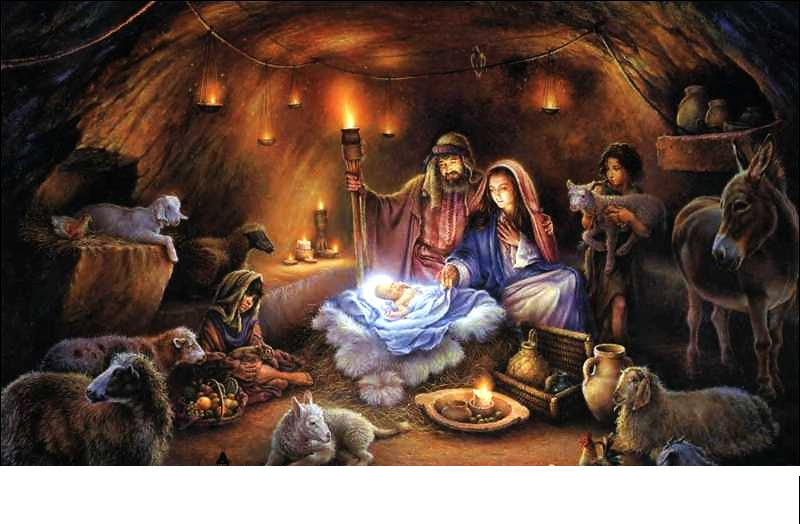
Christmas-Eve-Picture

So this season, get into it. Enjoy the anticipation. Look forward the presents. For crying out loud, have some eggnog for me. But use it all to let God draw you closer. Use it to feed a hunger and thirst for him.


To listen to the sermon, click the play button:

To download, right click on the link (or do whatever you do on a Mac) and save it to your computer: Download Christmas 2014


CHRISTMAS 2014: Using the Season

I have felt disconnected from Christmas this year. What with one thing and another, we didn’t get a tree until about ten days before Christmas. The house wasn’t decorated, and we weren’t listening to Christmas music. We were busy, and I, at least, wasn’t out and about where Christmas stuff was happening. Then just a few days ago I did some Christmas shopping. I was ashamed to find that the decorations and music and the ways the stores are decked out actually started to get me more into the “Christmas spirit.” I thought, “Really? This is what helps me appreciate Christmas? This isn’t even what it’s about!”

Like it or not, the truth is, Christmas has become a cultural phenomenon. Sometimes, as Christians, we want to fight it. The commercialism can be disgusting. The whole holiday adds a great deal of stress to every December. And everyone seems to miss the point, anyway. We don’t want to get caught up in it all, because we know that when it is all over, we’ll just be left with new stuff that will eventually become old stuff, a ten-foot-high-pile of wrapping paper, a dead tree and maybe seven extra pounds.

But why not, this year, get into the whole Christmas thing again? Get caught up in it all, get excited, let the joy infect you – and use it to let Jesus draw you closer to himself.

No one knows for sure the exact date of Jesus’ birth but I did some research recently. Jesus was born less than nine months after his relative, John the Baptist. John’s father, Zechariah, was a priest in the priestly division of Abijah. Zechariah’s priestly division was the eighth out of twenty-four, and so we can estimate when he was serving at the temple and when John’s birth was first predicted. The Jewish new year varied a little bit each year, but the best guess for that year would be that Zechariah encountered the angel sometime in May or June. Luke says “after those days,” Zechariah’s wife Elizabeth conceived John. Five months later, the angel visited Mary, and then Luke says “in those days” Mary came to Elizabeth’s house. So if it all happened immediately, that would mean John was born in April and Jesus was born in September. But we don’t know exactly how much “after those days” and “in those days” really means. If there was a total lag time of just two months in those two flexible periods, then Jesus was indeed born in December. The exact date of his birth doesn’t really matter, of course. I just think it is interesting, after all the years I’ve heard “Jesus wasn’t even born on Christmas” to find that the evidence shows it is quite possible, maybe even likely, that he was born, if not on December 25, sometime close to it.

Even so, no one knows the exact date. So how did we get December 25th? In the middle 300s (AD) the Roman Emperor Constantine became a Christian. At that time, the big Celebration of the year for the Romans, was Winter Solstice. They celebrated it on December 25, because that was the first day they could tell that the days were getting longer again. It was a big time holiday. It had nothing to do with Jesus.

But Constantine, after becoming a believer, decided to make use of the pagan holiday to help people think about Jesus. So he declared December 25 to be no longer Winter Solstice, but now the commemoration of the birth of Jesus. He used the joy and pageantry in the service of the one true God.

In some ways, in our culture, Christmas has returned once more to a pagan holiday. Christmas trees come from a pagan tradition. The way stores use Christmas to drive sales has nothing to do with Jesus. Probably a majority of the people who celebrate Christmas, don’t care much one way or the other about Jesus. Even so, like Constantine, we can make use of it.

Think of it this way: what is it that we like about Christmas? What gives us so much anticipation and excitement. What makes it “the most wonderful time of the year?” I think most people look forward to one or more of these things:

• Time spent with loved ones.

• Rest – very few people have to work on Christmas

• Receiving gifts (and, in some cases, people look forward to giving them too)

• Food and Celebration

• Connecting with something deeper and bigger than ourselves (often through traditions).

Each of these are worthwhile things in and of themselves. We can make them even more worthwhile by using them to provide a boost to our relationship with Jesus. Let’s look at how.

TIME SPENT WITH LOVED ONES. One the greatest joys of Christmas is spending it with someone we love. One of the greatest sorrows is the first Christmas you spend after a loved one is no longer with you. If you are missing loved ones this year, use that to remind you of the promise of Jesus’ resurrection. Because of his forgiveness, and his resurrection from death, our sorrow will be turned to Joy. One day, nothing will ever part us from those we love:

Then I saw a new heaven and a new earth, for the old heaven and the old earth had disappeared. And the sea was also gone. And I saw the holy city, the new Jerusalem, coming down from God out of heaven like a bride beautifully dressed for her husband.

I heard a loud shout from the throne, saying, “Look, God’s home is now among his people! He will live with them, and they will be his people. God himself will be with them. He will wipe every tear from their eyes, and there will be no more death or sorrow or crying or pain. All these things are gone forever.” (Rev 21:1-4)

Don’t let your hearts be troubled. Trust in God, and trust also in me. 2 There is more than enough room in my Father’s home. If this were not so, would I have told you that I am going to prepare a place for you? 3 When everything is ready, I will come and get you, so that you will always be with me where I am. 4 And you know the way to where I am going.” (John 14:1-4)

REST. We love the break of Christmas. Most people don’t do unnecessary chores at Christmas. We can relax and enjoy at least a single day. But God has promised us a rest that continues, not just for one, day, but forever:

God’s promise of entering his rest still stands, so we ought to tremble with fear that some of you might fail to experience it. For this good news—that God has prepared this rest—has been announced to us just as it was to them….So there is a special rest still waiting for the people of God. For all who have entered into God’s rest have rested from their labors, just as God did after creating the world. So let us do our best to enter that rest. But if we disobey God, as the people of Israel did, we will fall. (Heb 4:1-2 & 9-11)

Then Jesus said, “Come to me, all of you who are weary and carry heavy burdens, and I will give you rest. Take my yoke upon you. Let me teach you, because I am humble and gentle at heart, and you will find rest for your souls. For my yoke is easy to bear, and the burden I give you is light.” (Matt 11:28-30)

Turn the mood of this Christmas season into leverage for helping you rest in Jesus.

RECEIVING GIFTS. What did you get for Christmas last year? To be truthful, I cannot remember without putting some serious thought to it. What I do know is this: I am usually thrilled about new gifts, but it isn’t terribly long until the thrill wears off. But the Lord gives us gifts that never spoil or fade:

“Don’t store up treasures here on earth, where moths eat them and rust destroys them, and where thieves break in and steal. Store your treasures in heaven, where moths and rust cannot destroy, and thieves do not break in and steal. Wherever your treasure is, there the desires of your heart will also be. (Matt 6:19-21)

“You fathers—if your children ask for a fish, do you give them a snake instead? Or if they ask for an egg, do you give them a scorpion? Of course not! So if you sinful people know how to give good gifts to your children, how much more will your heavenly Father give the Holy Spirit to those who ask him.” (Luke 11:11-13)

Use the joy and anticipation of gifts to help you receive what the Lord is offering us – his Holy Spirit, and an unfading eternal future. Use the presents to help you focus on the eternal and immeasurably valuable gifts that the Father has given us through Jesus Christ.

FOOD & CELEBRATION. Often in scripture, food is used as a metaphor for fellowship with God. As we anticipate eating, and actually eat, let’s consciously invite the Lord to be a part of our lives.

Yes, I am the bread of life! Your ancestors ate manna in the wilderness, but they all died. Anyone who eats the bread from heaven, however, will never die. I am the living bread that came down from heaven. Anyone who eats this bread will live forever; and this bread, which I will offer so the world may live, is my flesh.” (John 6:47-51)

Listen! I stand at the door and knock. If anyone hears My voice and opens the door, I will come in to him and have dinner with him, and he with Me. (Revelation 3:20)

So let’s feast! Enjoy the food. And as we do, worship, and receive Jesus’ invitation to close fellowship. Celebrate with loved ones, and use it to remind you of the eternal celebration we will have when we are finally together with Lord and our loved ones in the New Heavens and the New Earth.

CONNECTING WITH DEEPER REALITY. I think it is during this season the greatest numbers of people are really open and willing to consider something bigger than themselves. At Christmas we seem more ready to acknowledge that we want more – not just more stuff, but more –something – in our lives. That something is a relationship with Jesus, empowered by the Holy Spirit.

By the way, we can use more than just Christmas. I find that I usually deeply enjoy the period leading up to New Year’s also, and can use it the same way. But it isn’t even just season. We can use any time of joy, any celebration or event to which we are looking forward. We can use these things to point us toward what is greater and more eternal; the real celebration.

So this season, get into it. Enjoy the anticipation. Look forward the presents. For crying out loud, have some eggnog for me. But use it all to let God draw you closer. Use it to feed a hunger and thirst for him.

Pause for a moment. Can you sense we are on Holy Ground? The presence of Jesus transformed a plain, ordinary, smelly stable into a holy place. Let his presence do that for you not just at Christmas, but year round, wherever you find yourself.

Have a very merry Christmas!

GIVING THANKS EVEN WHEN IT’S HARD

tgiving

Giving thanks is a way to really take hold of, and receive, what God has done and who he is. It is a key component in faith, grace and peace.


To listen to the sermon, click the play button:

To download, right click on the link (or do whatever you do on a Mac) and save it to your computer: Download Thanksgiving 2014 Sermon


THANKSGIVING

Thanksgiving has become an American holiday and tradition, but it does originate from deep, Christian spiritual roots. One of the things that I find interesting is that many of significant Thanksgiving celebrations early in the history of America took place in the middle of very difficult times.

The “original thanksgiving” took place in the New England settlement of Pilgrims during the sixteen-hundreds. It is true that at the time they celebrated, they had a good harvest. But they had just gone through an incredibly difficult year in which large numbers of the Pilgrims had perished from disease and malnutrition. From a simple cataloging of bad events versus good, they had much more to be upset about than to be thankful for. Yet they held a three day feast, thanking God for his blessings.

The first national day of thanksgiving was proclaimed by the brand-new American government in 1777. It is true, at the time many people were elated by the American victory over the British at Saratoga. But also at the time of the proclamation, the British still occupied the capital city of the new country (which was Philadelphia at that point) and also held New York City and several significant southern cities. The war was far from over, and times were still quite desperate, and yet they called for a national day of prayer, thankfulness, and repentance toward God.

Considering this history, perhaps it is appropriate that Thanksgiving became an official national holiday during the middle of the Civil War. Once again, the war was far from over, and many desperate times and terrible battles were both behind and ahead. Yet President Lincoln wrote of the many blessings that persisted in spite of war, and said:

It has seemed to me fit and proper that they should be solemnly, reverently and gratefully acknowledged as with one heart and voice by the whole American people. I do therefore invite my fellow citizens in every part of the United States, and also those who are at sea and those who are sojourning in foreign lands, to set apart and observe the last Thursday of November next, as a day of Thanksgiving and Praise to our beneficent Father who dwelleth in the Heavens. And I recommend to them that while offering up the ascriptions justly due to Him for such singular deliverances and blessings, they do also, with humble penitence for our national perverseness and disobedience, commend to his tender care all those who have become widows, orphans, mourners or sufferers in the lamentable civil strife in which we are unavoidably engaged, and fervently implore the interposition of the Almighty Hand to heal the wounds of the nation and to restore it as soon as may be consistent with the Divine purposes to the full enjoyment of peace, harmony, tranquility and Union.

It isn’t my intention to give a history lesson. But I want to point out explicitly that the early Americans seemed eager and able to thank God, even in the middle of significant hardship. In fact, the American Thanksgiving tradition arose more from hardship and war than from peace and prosperity. Even more, I want to point out that this idea of thanking God at all times, even in difficult circumstances, is a biblical practice.

Job chapter one records a series of calamites that befall Job, a righteous man. At the end of it all, this is what he did:

20 At this, Job got up and tore his robe and shaved his head. Then he fell to the ground in worship 21 and said:

“Naked I came from my mother’s womb,

and naked I will depart.

The LORD gave and the LORD has taken away;

may the name of the LORD be praised.”

Psalm 69 was written by someone who felt he was “poor and in pain.” His appropriate response was to thank the Lord:

But as for me — poor and in pain — let Your salvation protect me, God. I will praise God’s name with song and exalt Him with thanksgiving. (Ps 69:29-30, HCSB)

Paul says, “Good, bad, normal, it doesn’t matter. Give thanks all the time.”

Rejoice always! Pray constantly. Give thanks in everything, for this is God’s will for you in Christ Jesus. (1Thess 5:16-18, HCSB)

And let the peace of the Messiah, to which you were also called in one body, control your hearts. Be thankful. Let the message about the Messiah dwell richly among you, teaching and admonishing one another in all wisdom, and singing psalms, hymns, and spiritual songs, with gratitude in your hearts to God. And whatever you do, in word or in deed, do everything in the name of the Lord Jesus, giving thanks to God the Father through Him. (Col 3:15-17, HCSB)

Devote yourselves to prayer; stay alert in it with thanksgiving. (Col 4:2, HCSB)

The older I get, the more I am inclined to believe that thankfulness is a key part in receiving the grace and love and joy that are offered to us through Jesus Christ. I have long known that when I confess my sins to the Lord and repent, what really helps me to feel forgiven is the act of thanking him for that forgiveness. When we thank God, we are, in a way, reaching out and receiving what we thank him for. We are agreeing with what the Bible says about his graciousness and love toward us; we affirming something true about the nature of God. We are saying, “Yes, I have received your love and grace,” and as we declare that to be true, it somehow becomes more real to us. I think this is one of the reasons that the New Testament is so clear about the fact that whenever we pray, part of our praying should involve thankfulness to the Lord. Thankfulness breeds faith and grace.

Thankfulness also leads to peace and contentment. Philippians 4:5-7 teaches that thankful prayer is an antidote to worry:

Let your graciousness be known to everyone. The Lord is near. Don’t worry about anything, but in everything, through prayer and petition with thanksgiving, let your requests be made known to God. And the peace of God, which surpasses every thought, will guard your hearts and minds in Christ Jesus. (Phil 4:5-7, HCSB)

Yes, it is good and proper to ask God for what we need, and to share our burdens with him. It is also important to thank him as we offer up those prayers. Through turning our burdens over with thankfulness, we experience the peace of God, which is beyond understanding. The fact that it is beyond understanding means that sometimes we will experience peace when our circumstances suggest that we shouldn’t be able to do so. It is thankfulness, at least in part, which leads to this sort of peace in all circumstances.

I have found that thankfulness (and the benefits of peace, grace and faith which come with it) can be encouraged by some self-discipline. Sometimes, it is helpful to just make myself start thanking God. I don’t like mornings, and I’m not usually very happy until after mid-morning. But, stepping into the shower grumpy and irritated, I can begin by thanking the Lord for running hot water, and then soap, and then a towel. I can thank him that I have my own bathroom. That reminds me that I have my own house to live in, and it is plenty for my whole family. I can go on, and thank the Lord for warm, clean socks, and the existence of coffee, and then for my wife and children. You see how it goes: once we get started, there are an endless stream of things to thank the Lord for. I think one thing that is biblically appropriate is to frequently thank Jesus for his sacrifice for us, and for his promise of eternal life to us.

Thank the Lord today and this week, and let him encourage thankfulness in your heart!

Thanks again for making use of Clear Bible.

I want to remind you again that we are a listener-supported ministry, and that means, first and foremost, that we are supported by your prayers. We need and value your prayers for us.

Please pray that this ministry will continue to be a blessing to those who hear it. Ask God, if it is his will, to touch even more lives with these messages. Ask him to use this ministry in making disciples of Jesus Christ.

Please also pray for our finances. Pray for us to receive what we need. Please pray for us in this way before you give anything. And then, as you pray, if the Lord leads you to give us a gift, please go ahead and do that. But if he doesn’t want you to give to us, that is absolutely fine. We don’t want you to feel bad about it. We want you to follow Jesus in this matter. But do continue to pray for our finances.

If the Lord does lead you to give, just use the Paypal Donate button on the right hand side of the page. You don’t have to have a Paypal account – you can use a credit card, if you prefer. You can also set up a recurring donation through Paypal.

You could also send a check to:

New Joy Fellowship

625 Spring Creek Road

Lebanon, TN 37087

Just put “Clear Bible” in the memo. Your check will be tax-deductible. Unfortunately, we cannot do the tax deductible option with the paypal donate button, however the money does go directly to support this ministry.


Thank for your prayers, and your support!

THE JOY OF HOPE

joy

Joy seems to be connected to hope. The more superficial your hope, the more superficial your joy. And so, from that most powerful and eternal of hopes, comes the most powerful and lasting joy. When our largest and deepest hope is rooted in eternity, no circumstance, no trouble, hardship or grief can prevent us from having joy. And that is the picture of joy that we get from the Bible.

To listen to the sermon, click the play button:

To download, right click on the link (or do whatever you do on a Mac) and save it to your computer: Download Galatians Part 20

Galatians #20 . Chapter 5:22

Last week, we looked at what Paul calls the “works” of the flesh. This time, we’ll dig into his description of the “fruits” of the Spirit. When Paul calls the one “works” and the other “fruits,” it is definitely intentional. He isn’t just using a literary device to make the letter more interesting to read. I believe that Paul means us to understand that there is something completely different in the character of the Spirit, versus the character of the flesh. Not only do they desire what is opposed to each other, but they also operate in completely different ways.

The flesh exerts energy. The word “works” is actually the Greek word from which we get our English term, “energy.” The flesh involves effort and “push” and, well, work. And the energy of the flesh results in all those things Paul wrote about in verses 19-21.

But the Spirit operates in a completely different way. It is not about energy and effort and working. It is about bearing fruit. This picture was originally given by Jesus, in John 15:

I am the true vine, and My Father is the vineyard keeper. Every branch in Me that does not produce fruit He removes, and He prunes every branch that produces fruit so that it will produce more fruit. You are already clean because of the word I have spoken to you. Remain in Me, and I in you. Just as a branch is unable to produce fruit by itself unless it remains on the vine, so neither can you unless you remain in Me.

I am the vine; you are the branches. The one who remains in Me and I in him produces much fruit, because you can do nothing without Me. If anyone does not remain in Me, he is thrown aside like a branch and he withers. They gather them, throw them into the fire, and they are burned. If you remain in Me and My words remain in you, ask whatever you want and it will be done for you. My Father is glorified by this: that you produce much fruit and prove to be My disciples. (John 15:1-8, HCSB; italics applied for emphasis)

Bearing fruit is a passive activity. I don’t mean that we never do anything. But I mean that real spiritual fruit is not the result of our great effort; it is the result of our great trust in Jesus. Spiritual fruit grows in us as we get closer to Jesus. The more we trust Jesus and obey him and grow closer to him, the natural result will be the fruit of the Spirit. It isn’t up to you to generate energy. It isn’t up to you to push and strive. Instead, sink your roots deep into Jesus, into his love and into his Word (the bible). The fruit of Spirit has both a power and a peace behind it. The fruit illustration, used by Jesus and by Paul, shows us that the key to the Christian life is to remain close to Jesus, and indeed, to keep getting closer to him. What we do flows out of our connection to Jesus. In fact, Jesus points out that we don’t do anything ourselves. He says, “apart from me, you can do nothing.” He bears the fruit through us, as we trust him, and give him access to our lives.

I’m cautious when it comes to speaking about different “styles” of ministry or spirituality. Even so, I have come to have a distrust of people who are always going and always pushing. They may be doing wonderful things “for God,” but I wonder sometimes if is really Jesus working through them, or if it is more them working hard from the effort of their own flesh. And I certainly distrust those who demand that other Christians be always pushing and energetic and doing a lot of activities.

Don’t misunderstand me. I’m not saying a good Christian never does anything. But there is a difference between doing something out of self-effort and self-esteem and obligation, and doing something because Jesus, living in you, wants to do it. There is either guilt or stress or competition behind the one; there is joy and peace behind the other.

I want to talk a little bit about some of these fruits of the Spirit, because sometimes, we have a superficial idea of what they mean.

Love. This is the Greek word agape. It does not mean “a feeling of attraction.” It doesn’t mean “brotherly or friendly affection.” Agape (love) is a decision to value and honor another person, and place them and their interests equal to your own (or even ahead of your own). Sometimes feelings are associated with it; sometimes they are not. You can actually feel bad, or even negative, toward someone, and still make a choice to “agape” them – to honor them, value them, and make their interests and needs a high priority. This is impossible to do out of self-effort or flesh. It comes from God.

Joy. Let’s not get confused about this one. Joy is not a superficial pleasure found in the present moment. It is not merely a human emotional response to good or pleasant circumstances. Over and over again, the Bible talks about joy in the midst of difficulty and suffering. Here are just a few examples:

Though the fig tree should not blossom, nor fruit be on the vines, the produce of the olive fail and the fields yield no food, the flock be cut off from the fold and there be no herd in the stalls, ​yet I will rejoice in the LORD; I will take joy in the God of my salvation. GOD, the Lord, is my strength; he makes my feet like the deer’s; he makes me tread on my high places. (Hab 3:17-19, ESV2011)

Habakkuk declares that he is rejoicing in the Lord. He takes joy in the God of his salvation. His circumstances are, frankly, rotten. But his joy is rooted not in what is going on externally in his life, but in his relationship with God.

Therefore, since we have been declared righteous by faith, we have peace with God through our Lord Jesus Christ. We have also obtained access through Him by faith into this grace in which we stand, and we rejoice in the hope of the glory of God. And not only that, but we also rejoice in our afflictions… (Rom 5:1-3, HCSB)

Paul says that we rejoice in the hope of the glory of God, and we do so, even in our afflictions. Affliction does not bring pleasure. It does not naturally result in happiness. But joy is possible in affliction. That joy, says Paul, comes from our hope in God and his work in us to make us righteous and give us grace.

For our gospel did not come to you in word only, but also in power, in the Holy Spirit, and with much assurance. You know what kind of men we were among you for your benefit, and you became imitators of us and of the Lord when, in spite of severe persecution, you welcomed the message with joy from the Holy Spirit. (1Thess 1:5-6, HCSB)

The Thessalonians went through severe persecution, and were filled with joy from the Holy Spirit in the midst of it.

We want you to know, brothers, about the grace of God granted to the churches of Macedonia: During a severe testing by affliction, their abundance of joy and their deep poverty overflowed into the wealth of their generosity. (2Cor 8:1-2, HCSB)

Again, the Macedonian Christians experienced a severe testing by affliction and, at the same time, an abundance of joy.

When I was a young single man, I found myself living in a city I did not like, doing a job I did not like, with very few friends, little money and some difficult relationships with co-workers. At the same time, I was filled with joy. The joy came from the fact that I was falling in love with a young woman who was falling in love with me. Even so, Kari lived almost four-hundred miles away. My daily reality was not very pleasant. I didn’t have joy from my circumstances. But my joy was in my growing relationship with Kari – even though she was not physically present with me. Believe it or not, young folks, this was before the Internet, email and cell phones. We talked on the phone once in a while, but mostly, we wrote letters to each other. Though I hoped and yearned for us to be together, I did not need Kari’s physical presence with me in order to have joy in our relationship. That joy was independent of anything else that was going on in my life.

Christian joy, Holy-Spirit-joy is very similar. You don’t need to have great circumstances going on in order to have it. Spirit-joy comes from your relationship with Jesus. It comes from your hope of eternal life with him. Matthew Henry writes this:

The joy and peace of believers arise chiefly from their hopes. What is laid out upon them is but little, compared with what is laid up for them; therefore the more hope they have the more joy and peace they have.

I think Matthew Henry is on to something. Paul says to the Romans:

Now may the God of hope fill you with all joy and peace as you believe in Him so that you may overflow with hope by the power of the Holy Spirit. (Romans 15:13)

Joy seems to be connected to hope. This makes a great deal of sense. The more superficial your hope, the more superficial your joy. If you hope to find donuts at church, and you do find them there, you may have a momentary burst of joy, but it will not last much longer than the final bite. It is a small hope, and therefore a small joy. When we hope for things that will not last, we will have joy that does not last.

We also find, strangely, that when a shallow hope is fulfilled, joy diminishes. A few months ago, I was looking forward toward a two-day block of free time that I would have when I was in California for a conference. I was hoping to spend time climbing in Joshua Tree National Park. That hope gave me joy for two or three months. Now that I have been there and done that, and it is no longer something to look forward to, I get less joy when I think about it. Now, this is not true of more meaningful hopes. I still get a great deal of joy from my relationship with Kari. But that relationship is life-long, and much deeper than a trip to California, or a donut.

This is why we get the greatest, most powerful and enduring joy from our hope of heaven, and hope of an entirely restored relationship with God and all of his new creation. It is a hope that will not be fulfilled in this life. It is a love that cannot be marred by our circumstances or our failures. And so from that most powerful and eternal of hopes, comes the most powerful and lasting joy. When our largest and deepest hope is rooted in eternity, no circumstance, no trouble, hardship or grief can prevent us from having joy. And that is the picture of joy that we get from the Bible.

Now, feelings of joy can come and go. But I suspect that we can tap into those joyful feelings more reliably when we fix our hope more fully on being close to Jesus and the wonder of the New Creation that comes after this life.

It seems to me that far too many people think like this: “I’ll deal with eternal matters at some point when I have the time. Right now, I need to focus on getting my next raise, and putting my kids through college.” Maybe it isn’t about a raise or college, but too often, we focus on superficial and shallow hopes, and as a result we have only superficial and shallow joys. We think it is most important to deal with what is immediately in front of us. However, even though it seems like eternal life and Jesus are “out there,” if we focus on them, and put our hope on them right now, it makes a huge difference in our level of joy, right now.

This wasn’t exactly my original plan for this message, but that’s okay. I assume that some of you needed to hear this about hope and joy this morning. Take a minute to ask the Holy Spirit what he is saying to you right now. Be sure and be willing to do whatever he asks you to do as a result of what he is saying.