Revelation #7 WHO’S ON FIRST?

Jesus

Nothing – absolutely nothing, should come before God in our lives. What is your first love, really? Jesus is clear here – it should be Him. If Jesus is your first love, He should have first claim on your time, energy and resources of all kinds. This message shows you how much we need to repent, and promises how much we gain when we do.

To listen to the sermon, click the play button:

To download, right click on the link (or do whatever you do on a Mac) and save it to your computer:
Download Revelation Part 7

Revelation #7. The Letter to the Ephesian Church, part 2. Rev 2:1-7.

I want you to know that it is my hope and prayer that you always get more out of any given Bible passage than my sermon notes alone can offer. Sermons, in whatever form, should just be the icing on the cake for disciples of Jesus Christ. Our bread and butter, so to speak, ought to come from our own regular study of scripture, guided and assisted by teaching from sermons. Remember that “you reap what you sow” is a scriptural principle. If you put in fifteen minutes each week, reading the sermon notes during a hurried dinner without cracking the Bible, expect to learn and grow accordingly. If on the other hand, you spend twenty minutes or so with the sermon notes one day, and twenty minutes the next day with the scripture passage, and perhaps review them both on a third day, you can expect much more benefit from it all. Depending on the passage, you might spend twenty minutes or so each day for the entire week simply going over the verses and sermon notes for that week.

I know that some of you will automatically respond with “that is totally unrealistic.” Well, as it happens, that response relates to our sermon today. The basic question that arises from Revelation 2:1-7 is this: What place does Jesus have in your heart?

Last time we talked about the things for which Jesus praised the Ephesian church: an intolerance for Christians who sin openly and without repenting, and an intolerance for false teachers. In addition, they bore up under opposition, hostility and hard labor with endurance and grit. These are important examples that we too, should follow.

But we ended, more or less, with verse three (and a peek ahead to verse 6 also). In verses 4-5, Jesus tackles a problem with the Ephesian church.

The church at Ephesus had a rich spiritual heritage. Paul had spent about a week there early on, but the church there was most likely founded by Priscilla, Aquila and Apollos. When Paul came there to spend some time, a few years later, there was already an established community of Christians. Paul spent two years there (Acts 19:10). After Paul left, Timothy, his protégé, spent many years in the city as one of the leaders of the church there. At some point, the apostle John also arrived and took up residence, training the next great Christian leader, who became the wise old martyr, Polycarp.

In short, the Ephesian church had one of the richest theological traditions of any early Christian church, having been home to no less than six remarkable first-generation Christian leaders, including two genuine apostles and their two protégés. At the time of Revelation, their doctrine was still strong. Their endurance was good. But they had lost something:

4But I have this against you: You have abandoned the love you had at first. 5Remember then how far you have fallen; repent, and do the works you did at first. Otherwise, I will come to you and remove your lampstand from its place — unless you repent. (Rev 2:4-5, HCSB)

Most commentators, myself included think that “first love” refers to love for Jesus himself. All other loves spring from that. Though the Ephesians were convinced of the truth of the gospel, they had begun to let the love seep out of their commitment of faith. They were zealous for truth, but apparently not particularly zealous for Jesus himself, or for other Christians.

They were committed to Jesus, certainly, but they were far more committed to the ideas of faith in him, than to Him personally. They were missing the emotional and spiritual relationship that Jesus Christ desires with his people. It is no mistake that in speaking to these people Jesus emphasized that he was the one who “walks among the seven golden lampstands.” The lampstands, as you remember from 1:20 are the churches. The point that Jesus is making that he is actually with his people. The Ephesians needed to remember the importance of God’s presence with them, and to fall in love with Jesus all over again.

Just as it is possible to become fiercely committed to the idea of marriage while at the same time neglecting your spouse, it is possible to be committed to truth, while neglecting your relationship with Jesus. Frankly, I see it all the time in people who are conservative and have been Christians for a long time. Sometimes I even recognize it in myself. For a short time I attended a seminary where students were not allowed to announce unauthorized gatherings for prayer, but they were welcome to announce keggers (parties involving lots of beer). Their doctrine was good, but clearly something was wrong with their first love.

Jesus calls the Ephesians (and us) to repent, and to love Him above everything and everyone else. He wants us not just to be faithful and true, but to be actively engaged in relationship with him. He says very clearly that the church or Christian that does not continue in this relational aspect of faith will cease to be the church. The lampstand will be removed (2:5).

This first love message is deep and far reaching. In fact, it is nothing less than the first of the ten commandments. When Jesus was still on earth, someone asked him about the most important commandment:

36“Teacher, which command in the law is the greatest? ”

37He said to him, “Love the Lord your God with all your heart, with all your soul, and with all your mind. 38This is the greatest and most important command. (Matt 22:36-38, HCSB)

Nothing – absolutely nothing, should come before God in our lives. What is your first love, really? Jesus is clear here – it should be Him. If Jesus is your first love, He should have first claim on your time, energy and resources of all kinds. This brings us back to the beginning of these notes: if you think it’s unrealistic to spend an hour or two learning more about Jesus over the course of a week, how likely is it that he truly is your first love?

If you give to the mission of Jesus out of what is left over after you have spent your money on everything else first, does that really reflect that Jesus is your first love?

If you invest an hour or so a week in Christian community, and the other 167 hours in other things, can you truly say that you love Jesus more than you love anyone (or thing) else?

If you go through your day, doing things you have to do to make a living and take care of your family, and Jesus is not a part of how and why you do those things, how could you claim that you love Him more than anyone else?

Obviously, we can’t all be monks, and just sit in a monastery worshipping Jesus all day. Most of us need to work, and raise kids, and invest ourselves in our communities. But the way we do all that changes when Jesus is our first love. The motivations for what we do change. And when he is truly first, we are willing and able to say “no” to some things (even good things) in order to say “yes” to more time spent with Him in prayer and Bible reading, “yes” to more time and energy invested in a community of his people, “yes” to more concrete actions that advance the kingdom of God.

A few years ago, I knew a good Christian family who was having trouble with one of their children. So they invested more time in sports teams and events, thinking to teach him character and teamwork. Their investment in sports caused them often to say “no” to investing in worship and Christian community. There were many other factors involved, but needless to say, the sports strategy failed. The child became alienated from the family and from God. However, even if their strategy had succeeded in helping the child, their choice clearly communicated that Jesus was not the first love in that family.

I bet a lot of you think I’m talking about you. Actually, I doubt if any of you reading this knows whom I am speaking of, but I do know that it strikes close to home for a lot of people.

Remember, Jesus said this:

37The person who loves father or mother more than Me is not worthy of Me; the person who loves son or daughter more than Me is not worthy of Me. 38And whoever doesn’t take up his cross and follow Me is not worthy of Me. 39Anyone finding his life will lose it, and anyone losing his life because of Me will find it. (Matt 10:37-39, HCSB)

This is hard to say, and hard to hear. But Jesus very clearly calls the Ephesians to repent. He also calls us to repent. Repentance means we stop doing the things that we shouldn’t be doing, and start making choices that reflect Jesus as our first love. We won’t be able to do these things perfectly, but we are called to a lifestyle of repentance. Even when we fail, we continue on the repentance road.

We might need to repent of putting a career ahead of Jesus, or a relationship, or even family (see above). We might need to repent of putting entertainment above Jesus, or alcohol, or food or other substances. Sometimes it is money. Sometimes it is even loving Christian doctrine more than loving Jesus. But the message of Jesus is clear: He will not stand for anyone or anything to rival Himself in our affections. He must be our first love.

I want to add one more thing. This isn’t just about some “litmus test.” I don’t want to be legalistic. But as we go through Revelation, we will find that God’s plan will force all human beings to make a choice. Pressure, persecution and hardship will get more and more extreme. The message of Revelation is terrific news for people who are totally sold out for Jesus, who have put all their eggs into the one basket of faith in Jesus Christ; in other words, for those who have Jesus as their first love. But for those with divided loyalties, the truth of Revelation will crush them between a rock and a hard place. If you read this, and Jesus is not your first love, it will sound either boring (because you don’t really believe it), or terrifying; perhaps it will even sound like bad news. If you have this reaction as we go on, hear what the Spirit says: Repent!

We need to repent not just so that we can feel good about ourselves, or “to be a better person.” No! We need to repent, or we will be destroyed and the light of our lampstands will be removed! Jesus is uncompromising about this. Read it again:

4But I have this against you: You have abandoned the love you had at first. 5Remember then how far you have fallen; repent, and do the works you did at first. Otherwise, I will come to you and remove your lampstand from its place — unless you repent. (Rev 2:4-5, HCSB)

Jesus offers forgiveness and restoration for those who repent. There is only one unforgiveable sin, and that is to refuse and malign the work of the Holy Spirit (Matthew 12:31-32). In other words, the one thing that will keep you from forgiveness is if you are not willing to repent. If we do repent, however, we have forgiveness and new life.

7“Anyone who has an ear should listen to what the Spirit says to the churches. I will give the victor the right to eat from the tree of life, which is in God’s paradise. (Rev 2:7, HCSB)

The Garden of Eden held a “tree of life.” Adam and Eve sinned before they ate of it, and then they were driven out of the garden, before they could eat it and gain eternal life as sinners. Jesus is telling us that if we repent, his forgiveness is so complete, that He will so thoroughly remake us without sin, that we will be able to eat of the tree of life. This is nothing less than the promise of eternal life in paradise.

Matthew Henry puts it this way, in the slightly archaic language of his own generation:

They shall have that perfection of holiness, and that confirmation therein, which Adam would have had if he had gone well through the course of his trial: he would then have eaten of the tree of life which was in the midst of paradise, and this would have been the sacrament of confirmation to him in his holy and happy state; so all who persevere in their Christian trial and warfare shall derive from Christ, as the tree of life, perfection and confirmation in holiness and happiness in the paradise of God; not in the earthly paradise, but the heavenly.

Let us “have an ear” and listen to what the Spirit says to the churches.

Revelation #5 NO ROOM FOR FEAR

Old keys on a old book, antique wood background

Following Jesus often involves some sort of trouble or hardship, in the middle of which we are called to remain faithful and obedient to the Father, even when we don’t understand. Jesus words to each of us today are: “Do not be afraid. I have the keys to death and hades. I have this. I have you. I am the first and the last – I have your trouble surrounded.

To listen to the sermon, click the play button:

To download, right click on the link (or do whatever you do on a Mac) and save it to your computer:
Download Revelation Part 5

Revelation #5. Revelation 1:9-20

John continues his letter with a reminder, and then, his first vision of the heavenly realm.

I, John, your brother and partner in the tribulation and the kingdom and the patient endurance that are in Jesus, was on the island called Patmos on account of the word of God and the testimony of Jesus.

John says he is a brother and partner in three things that “are in Jesus.” I think these things are very important for Christians in our time to remember, or perhaps to realize for the first time. Being “in Jesus” involves each of these things.

First, John writes he is a brother in the tribulation that is in Jesus Christ. The Greek word here (thlipsis) implies pressure, or “being squeezed.” It can be translated, as tribulation, affliction, distress, or pressure. In his gospel, John records that Jesus said that tribulation or affliction will be a normal part of following him. In the passage below, it is this same Greek word that Jesus uses:

33I have told you these things so that in Me you may have peace. You will have suffering in this world. Be courageous! I have conquered the world.” (John 16:33, HCSB)

You will have suffering/trouble/affliction/distress in this world if you follow Jesus. Peter affirms this idea:

12Dear friends, don’t be surprised when the fiery ordeal comes among you to test you as if something unusual were happening to you. 13Instead, rejoice as you share in the sufferings of the Messiah, so that you may also rejoice with great joy at the revelation of His glory. (1Pet 4:12-13, HCSB)

We Christians in 21st Western Civilization need to understand this, for two reasons. First, we need to recognize that suffering and tribulation are the present reality for millions of Christians in various places around the world. Like John, we need to act as siblings and partners in tribulation with those Christians who are suffering for their faith more than we. In China, Indonesia, all over the Middle-East and North Africa, our brothers and sisters in Jesus Christ are in trouble for believing what we believe and trying to live it in their everyday lives. We need to stand with them in prayer. We need to support those who support them. We need to communicate our love and encouragement to them.

Second, we need to recognize that, as we remain obedient to Jesus, we encounter various types of suffering – not all of them persecution. John Piper writes, in Desiring God:

The suffering that comes is a part of the price of living where you are in obedience to the call of God. In choosing to follow Christ in the way he directs, we choose all that this path includes under his sovereign providence. Thus, all suffering that comes in the path of obedience is suffering with Christ and for Christ – whether it is cancer or conflict.

Following Jesus often involves some sort of trouble or hardship, in the middle of which we are called to remain faithful and obedient to the Father, even when we don’t understand.

Those of you who know me well will realize that I know what I am talking about. More importantly, John knew what he was talking about.

The second thing that is “in Jesus” is “the kingdom.” We examined this in greater depth last week. When we follow Jesus, we belong to His heavenly kingdom. Our primary “citizenship” is in heaven, not in any earthly country. Our primary “fellow-citizens” are those who follow Jesus, whatever country they come from, whatever ethnicity or culture they wear on the outside. There is one other thing about “the kingdom that is in Jesus” and it is this: it means we must obey the King.

The third thing that John says is part of being in Jesus is “patient endurance.” This goes along with suffering/pressure/trouble.  Paul puts it together in his letter to the Romans:

3And not only that, but we also rejoice in our afflictions, because we know that affliction produces endurance, 4endurance produces proven character, and proven character produces hope. 5This hope will not disappoint us, because God’s love has been poured out in our hearts through the Holy Spirit who was given to us. (Rom 5:3-5, HCSB)

In case you were wondering, Paul’s word for “afflictions” is the Greek word thlipsis – the same that John uses, the one we discussed above. We aren’t called merely to suffer, we are called endure it patiently, to stick to Jesus, to have “grit.” This would have been very important for John’s first readers, since, as we shall see, they were facing all sorts of pressures and troubles. John is saying, “You aren’t alone in your struggles. This is part of the deal, this is part of what it means to be ‘in Jesus.’ You aren’t off track and you aren’t doing something wrong. We are all in this together.”

Next, John goes on to share one reason why we should be encouraged as we suffer and endure patiently in Jesus. He records that Jesus gave him a message for seven specific churches, but also to all Christians at all times. And Jesus not only gave him the message, he also gave him a picture of the heavenly reality that should encourage us; a reality that exists even when our lives are in the midst of pressure and struggle.

John says that he was “beginning-to-be in spirit on the Lord’s day,” (my rough literal translation) when he heard a loud voice behind him. I’ll tell you frankly, that I don’t have a clear idea of what that means. I suspect it means that John was meditating, deeply. But here’s something interesting. Even though John was “in the spirit,” the voice he heard came from behind him. It’s not much, but perhaps this is a reminder that even when we do all that we can, we still God to reveal Himself to us. For all his meditation, the voice of God came from a direction he did not expect. The revelation had to be given to him – he couldn’t get it simply by meditating.

John looked and saw a scene with seven golden lampstands, and Jesus standing among them. By the way, my own way of looking at Revelation divides the book into seven “heavenly encounters.” A “heavenly encounter,” for my purposes, is a vision of things as they are in heaven, or from heaven’s perspective. After each heavenly encounter in Revelation follows some content divided up into sets of seven. This vision of Jesus among the lampstands is the first Heavenly Encounter.

Thankfully, verse 20 explains what is going on. The seven golden lampstands are the seven churches to whom the letter is written. I think there is every reason to believe that the seven churches (named in chapters 2-3) were seven actual Christian communities that existed at the time John saw his vision. At the same time, I believe that the Lord chose seven particular churches in order to communicate that this amazing vision is for all Christian churches at all times in history. Remember, the number seven represents God’s complete work. So, I think he picked seven churches (there were certainly more than seven in existence at the time) to show he meant this to be for all of us.

In the midst of the seven lampstands John sees “one like a son of man.” He means Jesus, who consistently called himself “the son of man.” John’s vision of the Heavenly Jesus sounds similar to visions that were seen by Daniel and Ezekiel, down to details like the hair, feet, eyes and the sound of his voice; especially, however, the sense of bright light emanating from him (Daniel 7:9 and 10:5-6; Ezekiel 1:26-27).

Jesus holds seven stars in his hand. Again, we are given an explanation in verse 20. The stars are the seven angels of the churches. I don’t know about you, but this surprises me. I don’t normally think of an individual congregation as having an angel watching out for it.

While we are here, we might as well briefly talk about angels, since there is a boatload of them in Revelation. Though we don’t talk about angels very often, there are 182 verses in the New Testament that mention them directly, and a few others that speak of them indirectly. Sixty-five of the direct verses are in Revelation. Angels are usually portrayed as spiritual beings who do God’s work, often serving God as messengers. Hebrews 1:14 (one of the indirect mentions of them) gives us the clearest description of what angels are:

14Are they not all ministering spirits sent out to serve for the sake of those who are to inherit salvation? (Heb 1:14, ESV2011)

So, angels do God’s work, and part of what they do for Him is to minister to us who are inheriting salvation through Jesus Christ. Apparently, also, some of them are responsible for individual churches. To put this theologically: That’s awesome. It might also give us a different view of church. There is an angel assigned to your church. Just think on that.

In verse 16, we get our first taste of the weirdness of Revelation: there is a sword coming out of the mouth of Jesus. This is meant to be symbolic. The Apostle Paul pictures a sword as a spiritual weapon:

17Take the helmet of salvation, and the sword of the Spirit, which is God’s word. (Eph 6:17, HCSB)

The sword coming out of Jesus’ mouth is The Word. For us who follow Jesus, that “word,” that sword, is the Bible. His words are powerful and strong. His words created the universe:

1In the beginning was the Word, and the Word was with God, and the Word was God. 2He was with God in the beginning. 3All things were created through Him, and apart from Him not one thing was created that has been created. (John 1:1-3, HCSB)

 3By faith we understand that the universe was created by God’s command, so that what is seen has been made from things that are not visible. (Heb 11:3, HCSB)

So Jesus stands among the churches, with the power of his Word evident. Now, listen once more to His words:

17When I saw Him, I fell at His feet like a dead man. He laid His right hand on me and said, “Don’t be afraid! I am the First and the Last, 18and the Living One. I was dead, but look — I am alive forever and ever, and I hold the keys of death and Hades. 19Therefore write what you have seen, what is, and what will take place after this. 20The secret of the seven stars you saw in My right hand and of the seven gold lampstands is this: The seven stars are the angels of the seven churches, and the seven lampstands are the seven churches. (Rev 1:17-20, HCSB)

“He laid his right hand on me and said, ‘Don’t be afraid!’” How deeply we need this sometimes! We are afraid of so many things: the future, or the future of those we love. We are afraid of financial ruin, or social ruin. We fear pain, and sorrow and difficulty and loss. Most of all, we fear death, and the death of those we love. I invite you to gather your fears up right now. It’s OK. Admit to them, let them show themselves. Now, feel the strong hand of Jesus on your shoulder. Listen to him say: “Do not be afraid!”

And why should we not? Because Jesus is the First and the Last. He has us, and our lives, and everything surrounded. We fear death, but look – he has overcome death, and he holds the keys. Not only that, but he is with his church – he stands among the lampstands. He holds our angels in his right hand.

Jesus is with us. He hasn’t forgotten or abandoned us. He touches us and says “do not fear!”

Will you listen to Him today?


WAR AND HOPE

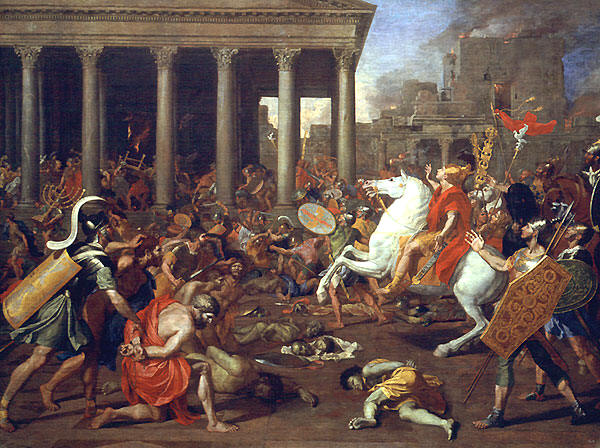
Temple _Destruction

The words of Jesus in this passage are intended to help us stand steadfast in trouble, they are intended to give us hope. Even in the middle of great tribulation we can have hope, knowing that God is in charge, that he cares about us, and has not forgotten us. Above all, Jesus’ promise to return again and make all things right, is something to give us hope and peace. The fact that he is already been right about some of the things he prophesied should encourage us.

To listen to the sermon, click the play button:

To download, right click on the link (or do whatever you do on a Mac) and save it to your computer:
Download Matthew Part 85

Matthew #85. Matthew 24:15-34

In the very first part of this chapter, Jesus told his disciples that the temple was going to be destroyed, while some of “this present generation” were still alive. Certainly, the apostle John lived to see it happen, and survived even twenty years longer, after the event.

I also mentioned the fact that in this section of Scripture Jesus appears to be jumbling together both the destruction of Jerusalem, and what we call “the end of the world.” When we get to our text for next time, it will become clear that Jesus, remaining in complete dependence upon the Father, was not told by the Father when the end of the world would come (24:36). However, it is also clear (from verse 34) that Jesus himself did know that the destruction of Jerusalem in 70 A.D. was not going to be at the same time as the end of the world. Though he talks about the details of the two things together, when we examine the text closely, it is obvious that he knows that they are two different sets of events.

In our passage today, it is very helpful to understand some in-depth background. Stick with me through that, and I think you’ll find greater understanding and encouragement from these scriptures.

Much of what we know of the Jewish-Roman war of 66-73 A.D. comes from the Jewish-Born man, Titus Flavius Josephus. Josephus was a Jewish General in Galilee, who fought against the Romans in the war of 66-73 A.D.. He was captured in 67 by the Romans, after a six-week siege of the town of Jotopata, where he led the resistance. He then ingratiated himself with the Romans by claiming that it was prophesied that Vespasian, the Roman general who was leading the war in Palestine, would become Emperor. He was made the slave of Vespasian, and later Vespasian’s son Titus, and served as a translator for the remainder of the war. Vespasian did, in fact, become Emperor as Josephus predicted, in the year 69, and he granted Josephus his freedom. Josephus continued to serve the Romans, taking on Vespasian’s family name, Flavius. He became a historian, writing a very large volume about the Jewish wars, and also another volume of ancient Jewish history. I will share more from Josephus’ writings in a little while.

For now, let’s turn to our text. All throughout this passage, Jesus is using ideas and images that come from the book of Daniel, chapters 9, 11, and 12. Daniel, living in the Persian Empire, prophesied about the future tribulations of the Jewish people. Daniel 12:1 says:

1At that time Michael the great prince who stands watch over your people will rise up. There will be a time of distress such as never has occurred since nations came into being until that time. But at that time all your people who are found written in the book will escape. (Dan 12:1, HCSB)

This sounds a lot like what Jesus is saying in our passage today:

21For at that time there will be great tribulation, the kind that hasn’t taken place from the beginning of the world until now and never will again! 22Unless those days were limited, no one would survive. But those days will be limited because of the elect. (Matt 24:21-22, HCSB)

In verse 15, Jesus says:

15“So when you see the abomination that causes desolation, spoken of by the prophet Daniel, standing in the holy place” (let the reader understand), 16“then those in Judea must flee to the mountains! (Matt 24:15-16, HCSB)

The first time I read this, I was about thirteen years old, and I did not understand, and that bothered me. I think I comprehend a bit more today, so let me help you. Here’s what Daniel says in the prophecies to which Jesus is referring:

31His forces will rise up and desecrate the temple fortress. They will abolish the daily sacrifice and set up the abomination of desolation. (Dan 11:31, HCSB)

 27He will make a firm covenant with many for one week, but in the middle of the week he will put a stop to sacrifice and offering. And the abomination of desolation will be on a wing of the temple until the decreed destruction is poured out on the desolator.” (Dan 9:27, HCSB)

The Jewish people at the time of Jesus generally felt that Daniel’s prophecies had already been fulfilled. About 200 years prior, when the Jews were under Greek/Seleucid rule, the Greek leader Antiochus Epiphanes entered the temple and built a statue there. This desecrated the temple, making it unclean, and it was an abomination to all the Jewish people. It was the year 167 B.C. This led to the Maccabean rebellion, which led to a brief period of Jewish independence (See my first message on the book of Matthew for more background).

Jesus did not say, “Let the reader understand.” That was Matthew’s insertion. He wanted his readers to realize that Jesus was saying that Daniel’s prophecy had not yet been fulfilled.

The desecration of the temple in 167 B.C. may have been a partial fulfillment, but Matthew wants his readers to understand that something like those events was going to happen again. In fact, the Jewish war with the Romans of 66-73 A.D. looked a lot more like a fulfillment of Daniel than the events of 167 B.C., when Antiochus desecrated the temple.

In July of A.D. 70, the Roman general Titus set fire to the temple, slaughtered those within it, and had the Roman standards brought into the Most Holy Place. The Roman standards were poles with various decorations on them. The kind most likely brought into the temple sanctuary would have had a square flag, hanging from a crossbar near the top of the pole. Stitched on the flag would be the name of the unit and probably an image of a god, or perhaps even the Emperor (who was considered a god). It might also have had a carved image of the Roman Eagle at the top of the pole. These sorts of Roman standards were considered to be idolatrous by the Jews, and by bringing them into the Most Holy Place, Titus desecrated the temple, much as Antiochus Epiphanes did 237 years before him.

Therefore, to unwind these words of Jesus, and the parenthetical comment of Matthew, it is something like this: “When you see the Roman legions marching, carrying the standards of the Emperor, flee!” I think that the Jewish people at the time would have understood these things much more easily than us.

Later, Jesus says:

19Woe to pregnant women and nursing mothers in those days! 20Pray that your escape may not be in winter or on a Sabbath. 21For at that time there will be great tribulation, the kind that hasn’t taken place from the beginning of the world until now and never will again! 22Unless those days were limited, no one would survive. But those days will be limited because of the elect. (Matt 24:19-22, HCSB)

You might think that Jesus has begun talking about the end of the world again, but I don’t think so. First, he encouraged his followers to pray that it wouldn’t happen in winter. That doesn’t make sense for the end of the world: the weather really won’t matter. But in 1st Century Israel, winter rains made most roads impassible with mud, and cold could kill those forced to camp outside with no shelter. Perhaps many people did pray, because, in fact, the worst part of the war was in spring, and the temple was not desecrated until July, and not fully destroyed until after that.

Historian Josephus, although somewhat familiar with the life of Jesus of Nazareth, was not a Christian; Christianity remained illegal in the Roman empire during his lifetime. Even so, the way he describes the war sounds very much like what Jesus predicted. Jesus said, “Woe to pregnant women and nursing mothers!”

In a section about the siege engines used by the Romans against him in Jotopata, Josephus writes (warning: these words contain matter-of-fact graphic violence):

And any one may learn the force of the engines by what happened this very night; for as one of those that stood round about Josephus was near the wall, his head was carried away by such a stone, and his skull was flung as far as three furlongs. In the day time also, a woman with child had her belly so violently struck, as she was just come out of her house, that the infant was carried to the distance of half a furlong, so great was the force of that engine. (Josephus, The Wars of the Jews. Book 3, chapter 7, paragraph 23).

Josephus describes many such terrible and heart-wrenching events. It was a brutal, horrific conflict. When Jerusalem was besieged, people became lawless, and many took food and other things from mothers and babies, and did violence to them. In fact, some historians have described the Jewish-Roman War as the worst massacre of ancient times. Jesus is not wrong to call it a “great tribulation.”

Josephus also describes the kinds of natural disturbances that Jesus mentions:

There broke out a prodigious storm in the night, with the utmost violence, and very strong winds, with the largest showers of rain, with continued lightnings, terrible thunderings, and amazing concussions and bellowings of the earth, that was in an earthquake. These things were a manifest indication that some destruction was coming upon men, when the system of the world was put into this disorder; and any one would guess that these wonders foreshowed some grand calamities that were coming. (Josephus, The Wars of the Jews, Book 4, chapter 4, paragraph five)

Some of the language that Jesus uses in our passage today is probably exaggerated imagery (in other words, he did not mean everything literally), but given the writings of Josephus, I think it is worth noting that Jesus predicted a horrific, unbelievable tribulation, and that is exactly what happened.

In verses 23-30 it seems clear that Jesus turns to talking about the end of the world. In fact, he is warning his disciples not to confuse the coming turmoil in Israel with his own return at the end of the world. This is the second time in the same discussion that Jesus has warned us not to be taken in by false prophets and deceivers who claim that the end of the world has come, or who claim to be Jesus himself, returned for his people. He makes it clear that when he comes back again, no one can miss it:

27For as the lightning comes from the east and flashes as far as the west, so will be the coming of the Son of Man. (Matt 24:27, HCSB)

In verse 32, he may be returning to the discussion about the coming destruction of the nation of Israel. The fig tree is a useful analogy: just as we can tell the season from looking at the trees, those who hear him should be able to recognize the signs that these things are about to take place. For my part, I would think that as soon as I heard of the Jewish rebellion that led to the war, it would seem to me a sign that Jerusalem would soon be destroyed.

Verse 34 clearly refers back to the first part of the discussion, about the coming tribulation to the Jewish nation. This is clear both from what Jesus said about his own return (it will be unmistakable) and also what he says later on in verse 36 when he insists that the Father has not revealed the day or the hour to him. If the Father hasn’t told him when the end of the world is, Jesus certainly can’t claim to know it will happen before the present generation passes away. Therefore that comment must refer to the events of verses 15-22.  The short discussion from verse 32-33 is a warning not to be mistaken about the coming of Jesus.

Even though much of our passage today is concerned with events that have already occurred, I think we can learn a great deal from it, and be encouraged by it.

First, as I said last time, this is very good evidence that Jesus is reliable when he speaks prophetically. Since he also prophesied that he would return, and that we would recognize his return, I think we can bank on that, and look forward to it. Though there may be difficult times we have to endure, we can trust his promise to deliver us, and to bring us into his eternal kingdom.

A second thing gets my attention from this text. Jesus told his followers to pray that these events did not happen in winter. As it turns out, they did not happen in winter. I can’t help wondering if many Jesus-followers did, in fact pray, and so influenced the events to happen in summer. It encourages me to believe in the power of prayer.

Another thing I get from the text is this: If we find ourselves in the middle of trouble and tribulation, it isn’t wrong to try and get out of it. We may not be able to escape it; it may not be God’s will for us to escape it. Even so, it isn’t wrong to try (as long as it does not involve sinning).

The analogy of the fig tree is also helpful for me. As we will see next time, it is absolutely pointless to try and build a timeline for the end of the world. Even so, verses 32 and 33 show us that it is possible to recognize the “signs of the times.” In other words, we can look at history, and culture, and current events, and evaluate them with wisdom.

Overall, the words of Jesus here are not intended to scare us. They are intended to help us stand steadfast in trouble, they are intended to give us hope. Certainly, many Jesus-followers left Jerusalem before all this took place. They escaped this terrible tribulation. And even in the middle of great tribulation we can have hope, knowing that God is in charge, that he cares about us, and has not forgotten us. Above all, Jesus’ promise to return again and make all things right, is something to give us hope and peace. The fact that he is already been right about some of the things he prophesied should encourage us.

Allow the Holy Spirit to speak to you about all of this right now.


WOE, IS ME!

woe

The Pharisees and religious leaders. They are bad and wrong, and by pointing out exactly how so, Jesus is warning us about other leaders like them. He is also warning us about becoming like them ourselves. In other words, Jesus, as God-the-Son, is expressing his very real, and thoroughly righteous anger against sin. Let’s consider how the Holy Spirit might want to speak to us through these ‘woes.’
To listen to the sermon, click the play button:

To download, right click on the link (or do whatever you do on a Mac) and save it to your computer:
Download Matthew Part 82

Matthew #82.  Matthew 23:13-36

We are in the middle of a long rant that Jesus makes against the religious leaders of his time. Frankly, when I just read through quickly, I don’t get a lot out of this portion of Matthew. The Pharisees are bad, Jesus is mad, end of story, right?

Whenever I encounter a piece of scripture that leaves me cold, like this, I often find it useful to pause and ask some questions. Why exactly does Jesus rant and rave like this? Is he just angry? Is he just venting? What is the purpose of this section of scripture – why did the Holy Spirit preserve these words of Jesus for Christians throughout the ages?

As I do that with this particular passage, I think the Spirit can show us several things.

First, there is the straightforward issue of the behavior of the Pharisees and religious leaders. They are bad and wrong, and by pointing out exactly how so, Jesus is warning us about other leaders like them. He is also warning us about becoming like them ourselves. In other words, Jesus, as God-the-Son, is expressing his very real, and thoroughly righteous anger against sin. Let’s consider how these woes might affect us as well.

Jesus points out seven or eight areas where the religious leaders are in deep trouble. He begins each one with the phrase: “Woe to you, Scribes and Pharisees, hypocrites!”

First, let’s talk about the word “woe.” It can mean: “trouble, sorrow and distress.” There is often an element of sorrow associated with this word, both in Greek and in English; it can be a lament, like “Alas!” So, in Matthew 24:19, Jesus says:

“Woe to pregnant women and nursing mothers in those days! Pray that your escape may not be in winter or on a Sabbath.”

But I think here, in this passage, Jesus is adding a sense of warning and judgment with it. The “woe” upon the pregnant women and nursing mothers was not because of anything they did. But here, Jesus clearly connects each woe to the behavior of the religious leaders. I still think he speaks with sorrow; I don’t think he is happy about it. Even so, clearly, he is enumerating their sins, and pronouncing that they will experience trouble and sorrow as judgement for them.

The first woe and sorrow (in verse 13) is because they refuse to enter the kingdom of heaven, and stop others from entering in. This is Jesus’ core issue with the Pharisees. They warned people against the only way of salvation, which is Jesus himself. Instead, they believed that they did not need him. Specifically, they taught (and obviously believed) that they could earn their salvation by behaving well. In a more general sense, this woe applies to anyone who leads others to believe that they can be saved by any other path than repentance from sin, and trust in Jesus. So Paul reiterates this woe in the first chapter of Galatians:

6I am amazed that you are so quickly turning away from Him who called you by the grace of Christ and are turning to a different gospel — 7not that there is another gospel, but there are some who are troubling you and want to change the good news about the Messiah. 8But even if we or an angel from heaven should preach to you a gospel other than what we have preached to you, a curse be on him! 9As we have said before, I now say again: If anyone preaches to you a gospel contrary to what you received, a curse be on him! (Gal 1:6-9, HCSB)

Make no mistake. Christianity has always insisted that Jesus Christ is the only way to forgiveness, reconciliation with God, and eternal life:

5“Lord,” Thomas said, “we don’t know where You’re going. How can we know the way? ” 6Jesus told him, “I am the way, the truth, and the life. No one comes to the Father except through Me. 7“If you know Me, you will also know My Father. From now on you do know Him and have seen Him.” (John 14:5-7, HCSB)

 11And this is the testimony: God has given us eternal life, and this life is in His Son. 12The one who has the Son has life. The one who doesn’t have the Son of God does not have life. 13I have written these things to you who believe in the name of the Son of God, so that you may know that you have eternal life. (1John 5:11-13, HCSB)

11This Jesus is the stone rejected by you builders, which has become the cornerstone. 12There is salvation in no one else, for there is no other name under heaven given to people, and we must be saved by it.” (Acts 4:11-12, HCSB)

The Pharisees and Scribes rejected Jesus, and therefore rejected salvation, and led others to do so as well. Today, Christians must remember that our core belief is grace, forgiveness and salvation through Jesus Christ alone. We don’t have forgiveness or life because “God is love, and just wouldn’t send anyone to hell.” That lie is just as bad as anything the Pharisees taught: Woe to anyone who tells it! We are not saved because we “have lived a good life, and tried to do the right thing.” We are not forgiven because we “aren’t worse than anyone else.” Sin is much more serious than that. We aren’t forgiven because we make sacrifices, or take mission trips, or because we “speak the words of truth.” We are saved through Jesus Christ alone, and we receive that salvation by grace when we repent and trust him. Woe to anyone else who teaches otherwise!

The second woe is found in verse 15. Some of you may not have verse 14 in your Bibles: it will skip from 13 to 15. Verse 14 is actually one of those places where there is a dispute about the original manuscript of the New Testament. The oldest and best manuscripts do not contain it. The textus receptus (which is the source for the King James version of the Bible), does contain it, as do some other later manuscripts. I think the best evidence suggests that this was not originally part of the book of Matthew. This is one example of why I am not a fan of the King James version. Even so, I’d like to point out that whether you leave verse 15 in, or take it out, it does not change very much at all; certainly it changes no Christian doctrine. This is considered a major variant, and once again we see that even major variants are actually extremely minor. We can have great confidence that the New Testament we read today is, in fact, what was written by the apostles.

In any case, I will move on to verse 15, where Jesus pronounces judgment upon the religious leaders for converting even non-Jews to the belief that they can earn their way into God’s favor, and eternal life. This is very much like the first woe, the main difference being who gets led astray: Jews, or non-Jews. For our purposes, it is a warning that if we get people to join our church, but do not teach them that forgiveness, life and salvation are found only in Jesus, given to us by grace through faith, we would be better off not bringing the new people in the first place.

The third woe is described in verses 16 through 22. Basically, Jesus is giving an example of how the teachers of the law, and Pharisees twist and undermine God’s word. Many times I have given you the example of the Sabbath, and how they added their own laws on top of the commands of God. Here, Jesus is referring to the way that they do mental gymnastics in order to benefit themselves in the matter of taking oaths. They argued that certain kinds of vows were not binding, and made fine distinctions that sounded intellectual, but were completely against all common sense.

These days, we don’t often make vows, particularly not religious vows. I made vows when I was married, and when I was ordained as a pastor. However, even in those cases, I did not swear by or on anything; I simply said: “I will, and I ask God to help me.” So the practice of swearing by (or on) something is no longer a big issue, at least not in Western culture. True, some folks might say something like: “I swear by my mother’s grave.” I don’t think anyone takes them seriously. Even so, I think we can learn something from this particular woe. The underlying issue is that the teachers of the law and the Pharisees were playing games with the truth. As Jesus points out, clearly, if you swear by the altar in the temple, really, you are swearing by God. But the religious leaders came up with all sorts of obscure reasoning to avoid that obvious, common-sense conclusion.

I think that today this woe could refer to the way some people treat the Bible. Unfortunately, I have many times read Bible commentaries that tried to say that certain verses mean the exact opposite of what they clearly say. Now, you know that I’m all for thoughtful, scholarly Bible interpretation. Not all Bible verses are obvious in meaning. Even so, there are many people today, whom I can only call false teachers, who twist the words of the Bible, play games with the truth, and do mental gymnastics in order to eliminate the plain, common sense meaning of God’s Word. What they are doing is not careful interpretation, but rather, twisting the obvious truth. I think Jesus would say to them: “Woe to you!”

The fourth woe is essentially captured by Jesus’ words in verse 24:

24Blind guides! You strain out a gnat, yet gulp down a camel! (Matt 23:24, HCSB)

The religious leaders spent a great deal of energy on relatively trivial matters, while ignoring the more important things. Notice that Jesus says that the trivial things are, in fact, good to do; but the important things should have first priority. I want to try and finish the woes in this sermon, so I won’t go into this one in great depth, but there are many, obvious applications for it. Woe to the church that is more concerned about the color of their carpet than about the homeless population all around it. Woe to the leaders who police the kinds of clothes people wear, and ignore the lust in their own hearts. I could spend all day on this one, but I believe you will be able to think of your own examples without too much effort. I do want to point out that this particular woe contains much of what really turns people off about churches and Christians. I think it’s good to know that Jesus hates it when people focus on minor things, while neglecting the things that are most important to true faith.

The fifth woe, found in verses 25-26, is much like the one before it. The religious leaders are concerned about looking good. They are focused on outward appearances, while they ignore the filth inside of their own hearts. Probably, Jesus is referring to the Jewish tradition of ceremonially washing cups. Mark records a different instance, where Jesus spoke about this at greater length. After discussion about ceremonial washing with the religious leaders, Jesus said this to his disciples:

18And He said to them, “Are you also as lacking in understanding? Don’t you realize that nothing going into a man from the outside can defile him? 19For it doesn’t go into his heart but into the stomach and is eliminated.” (As a result, He made all foods clean.) 20Then He said, “What comes out of a person — that defiles him. 21For from within, out of people’s hearts, come evil thoughts, sexual immoralities, thefts, murders, 22adulteries, greed, evil actions, deceit, promiscuity, stinginess, blasphemy, pride, and foolishness. 23All these evil things come from within and defile a person.” (Mark 7:18-23, HCSB)

The sixth woe, is also similar. This time, Jesus describes them as whitewashed tombs, which look good on the outside, but inside are filled with rotten flesh and bone. I’m going to get personal for a moment. I don’t want to be offensive, but I do want us to get the full impact of the words of Jesus here. Here in the Southeastern USA, we have a somewhat religious culture. Even in areas where the culture at large is not particularly Christian, some churches can have a religious culture within their community. I personally know many people who are like these whitewashed tombs. They go to church and they talk a good talk. As far as the people that they go to church with know, these are wonderful Christian folks. But during the week they have affairs, they do drugs, they get drunk, they run businesses that are dishonest, they cheat people, and they are stingy and miserly. Of course, everyone struggles with sin. I’m not talking about Christians who have surrendered their lives to Jesus, but who sometimes fail and fall. I’m talking about people who pretend; people who talk the talk, but do not let Jesus have any real influence in their lives. Jesus says to such people: “Woe to you!”

Finally, Jesus says: “Woe to you who reject God’s messengers!” (verses 29-34). That is what this seventh woe is all about: rejecting those whom God has sent, and rejecting his message through them. In the Western world, thankfully, people do not kill, crucify, or whip Christian teachers and preachers. However, I think it is important for us to remember that this still happens regularly in other places in the world. And even in the Western world, often times those who seek to be vocal about their faith in Jesus are treated with contempt and derision. As one small, and relatively insignificant example, I offer Tim Tebow, former NFL quarterback. Tebow had a year or two as a starting quarterback in the NFL. It was his habit to kneel down as a sign of humility, and praise to the Lord, whenever his team scored. That may or may not be a silly thing; but it was relatively harmless. However, Tebow received a huge amount of criticism for this, and for his outspoken faith. In fact, he received more negative media coverage than many NFL stars at the time who were accused of things like drunk driving, drug possession, assault and rape. Woe to a culture that is more concerned about a public expression of Christian faith than about crimes that deeply hurt others!

Let me say another thing about mistreating God’s messengers. I will admit that this one feels a little personal with me, but that does not make it untrue. I also want to say that I am not complaining, and for the most part I have been very blessed to not experience too much of what I’m about to share with you. Even so, it is shameful – I can think of no better word – the way that many Christians and churches treat their pastors and teachers. Of course there are some bad pastors, and bad leaders, just as there are bad bartenders, truck drivers and school teachers. Even so, many of the pastors who are mistreated by their congregations have good hearts, pure motives, and have done no wrong. Sometimes people direct hateful and hurtful words towards them for doing and saying what they believe God wants them to do and say. Sometimes people slander them. Sometimes people try to run them out of a job, for no reason other than that the pastor has threatened their sense of personal power within the congregation. Sometimes pastors are threatened after teaching something unpopular that the word of God says. Quite often, pastors are underpaid, and it is unusual to find anyone who cares, in most churches, whether or not a pastor is being appropriately compensated. Almost all the time at least some people are critical of their pastor, without doing the least thing to help him.

When I look at these seven woes spoken by Jesus, I think of it as an extreme measure he is taking in order to bring the religious leaders to repentance.

Let me try and illustrate what I mean. About a year ago, I began to have constant pain in one of my kidneys, like I was having a kidney stone. After a long and difficult time, doctors finally determined that some of my nerves have been damaged by frequent kidney stones. I sat down with a pain specialist, and he outlined a number of steps to help me deal with the pain that I still have.

First, we will try a very safe, well-tested, inexpensive medication that has very few side effects. If that works, great! If not the next step is to try a second medication. The second drug is more expensive, and has not been tested for as long as the first. It has more side effects and risk factors. If the second drug works, great! However, if not, there is another step, involving directly stimulating the nerve. This is a more invasive procedure, with greater risks. There is another step after that, and another. Each new step is more drastic, increasingly invasive, and carries greater and greater risk. The final step involves “killing” the nerve that serves my kidney.

When Jesus confronts the religious leaders during these last few days of his life, he is taking the final and most drastic step in trying to bring them to repentance, faith, and salvation. He lived among them, letting his life be a testimony, but that was not enough. He gave them his preaching and his teaching, but they did not respond. He showed them miracles, and the power of God, but they turned away. And so now, he is directly confronting them with their sin. It is their last chance, and he says that if they do not take it, judgment will come upon them. He will “kill” the problem, if it can’t be fixed any other way.

In fact, he says: “I assure you, all these things will come on this generation.” I want to point out two things about this. First, it was literally fulfilled among those who heard Jesus say these words. Jesus was crucified sometime around 30-35 AD. In 70 AD, while that generation still lived, the Romans utterly crushed the Jewish people, slaughtering huge numbers, destroying the temple, and sending the Jews that survived into an exile that lasted almost 2000 years. That generation of unbelieving Jews was indeed judged.

Second, because of how Jesus said it, these words are also for us. Whether or not we are judged as a group, when it comes to the end of our life, when our “generation” passes, we will stand before the judgment seat of God. This is true of every generation that reads Jesus’ words. Let his words sink in. They are drastic, yes. But they are spoken in order to ultimately lead is into the grace of God by driving us to Jesus as our hope, life and salvation.


JESUS INVADES YOUR “SACRED SPACE”


Sometimes, I think we forget this side of Jesus. In Jesus, both God’s judgement, and also his grace, are perfectly in harmony. Jesus’ actions weren’t reasonable. They weren’t nuanced. But they were righteous

To listen to the sermon, click the play button:

To download, right click on the link (or do whatever you do on a Mac) and save it to your computer:

Download Matthew Part 73

Matthew #73 Matthew 21:12-17

As often happens, there is more than one layer to what Jesus was doing and saying in this passage. The first layer is that Jesus is setting the political wheels in motion which will lead to his crucifixion. He is now becoming much more public and noticeable in his ministry, for the very deliberate purpose of provoking the religious leaders. He is getting in their faces, beginning the process that will force them to make a choice about him. It began with his ostentatious entry into Jerusalem. He continues it now by challenging the institution that was at the very heart of the religious elite in his day – the temple. He is actively pursuing the path that leads to crucifixion.

The second layer is that while he is doing this so that he can suffer and die as he was meant to, he is also doing it in a way that is completely righteous. Everything he says and does here is right and good and legitimate. He is not taking the attitude of “the ends justify the means.” He isn’t doing something wrong when he confronts the religious leaders in this way. His “means” of speaking truth to the leaders are just as good and righteous as his goal of dying for the sin of the world.

Sometimes, I think we forget this side of Jesus. In Jesus, both God’s judgement, and also his grace, are perfectly in harmony. Most Christians tend toward one or the other. Some of us focus on what we’re doing wrong, and how we need to fix that, and we lose sight of God’s incredible grace, forgiveness and love. Other Christians focus on the love and forgiveness so much that we lose sight of God’s holiness and the seriousness of our sin. We end up watering it down so much that we are in danger of losing sight of the truth.

Though Jesus is headed towards the cross in order to make his grace and love freely available, during this last week of his life, he often reminds us of why the cross is necessary; of how serious our sin is, and how absolute God’s holiness is. That is true in the incident we are looking at today.

Let’s start by understanding what was going on in the temple in those days.

The Old Testament commands God’s people to make animal sacrifices as a reminder of how serious their sin is, and how holy God is. The people were commanded to bring various types of animals for sacrifice, depending on the type of sacrifice, and the financial means of those coming to worship. Normally, you would sacrifice a goat or sheep at the temple. However, not everyone could afford that, so poor families were allowed to bring a pair of doves or pigeons, as it says in Leviticus:

7“But if he cannot afford an animal from the flock, then he may bring to the LORD two turtledoves or two young pigeons as restitution for his sin — one as a sin offering and the other as a burnt offering. (Lev 5:7, HCSB)

First, the animal brought for sacrifice had to be inspected by a priest to make sure it was without blemish, as was commanded in the law of Moses. However, by the time of Jesus, this system had become corrupt. Some of the priests turned away perfectly good animals, and then recommended that the family buy a different animal from one of the livestock merchants on the temple grounds. The priests would get a financial reward, or “kickback” from the merchants for every sale that was made in this way. In this way, the merchants and the priests were using the laws of Moses to extort people.

A second thing was also offensive. Since the Passover drew so many people to Jerusalem, it was the normal time when people paid their half-shekel temple tax. The specific wording of this law comes from Exodus 30:13

13Everyone who is registered must pay half a shekel according to the sanctuary shekel (20 gerahs to the shekel). This half shekel is a contribution to the LORD. (Exod 30:13, HCSB)

Over time, “the sanctuary shekel” became its own unit of currency. People couldn’t pay the tax with the money they made in everyday life. They had to have their money converted to “sanctuary shekels” in order to pay. Eventually money changers set up on the temple grounds and they charged a fee to convert the real money into “sanctuary money.” Sanctuary money was no good for anything but the temple tax, so the money changers made out like, well, thieves.

The third thing that was generally offensive was that the temple became a marketplace. Some people did not bother to bring animals at all, but planned to buy them at the temple. And who could blame them, since the priests were likely to rip them off if they brought their own animal? Merchants hawked doves to the poorer families, and doubtless everyone paid much more for “temple animals” then they would have anywhere else in the country. God’s holy place of worship became one of the busiest marketplaces in Jerusalem during the Passover season.

I’d like to point something out here. All four gospels make it clear that Jesus substantially interfered with all of this sort of “temple business” that was going on that day. He overturned the tables of the money changers, spilling their coins everywhere. He knocked over the stalls of those who sold pigeons and doves. He made them leave the temple complex. John records that Jesus even drove out the sheep and oxen. It would only be natural for these merchants and money changers to resist him, to try and stop him. For one man to do all this, it must have taken a great deal of physical strength, and even violence. In fact, it was a remarkable feat of physical power. I think a lot of people picture Jesus as a sort of wimpy, sensitive guy, but this gives us convincing evidence that he was capable of great strength when he wanted to be.

Now, I want us to see Jesus’ actions for what they are: extremism. God’s holiness is extreme, and uncompromising. We don’t like to remember this. I think if Jesus did something equivalent in the church today, it would meet with widespread disapproval. Let’s start with an obvious one. Jesus drove out those who sold doves, and doves were the sacrifice of choice for poor people. I can see someone saying: “Where are the lower income folks supposed to get their doves now? How could this be a loving action? It hurts the poor! What about all those who traveled from home without animals, expecting to be able to buy one at the temple? How were they supposed to make a sacrifice if they couldn’t buy their animals? You have to be reasonable. Your response has to take all the nuances into account.”

I can see other people saying, “Look, I know having a marketplace in the outer courts isn’t ideal, but ultimately it allows a greater number of people to come and worship here. It makes it easier on worshipers; it makes us more seeker friendly.”

I can see yet others saying, “Yes, I know that some of the merchants, and even some of the priests, are over-charging people. That’s deplorable, and I condemn it. But we can’t expect a perfect system in this imperfect world. It is what it is, and really, it isn’t that bad. We have to be reasonable.”

Jesus’ actions weren’t reasonable. They weren’t nuanced. But they were righteous. This was about the holiness of God. Holiness isn’t nuanced. It isn’t reasonable. It is absolute.

Jesus quoted to them from Jeremiah. Matthew records only the tail end of the passage in Jeremiah, but I want to share the beginning of it with you here:

9“Do you steal, murder, commit adultery, swear falsely, burn incense to Baal, and follow other gods that you have not known? 10Then do you come and stand before Me in this house called by My name and say, ‘We are delivered, so we can continue doing all these detestable acts’? 11Has this house, which is called by My name, become a den of robbers in your view? Yes, I too have seen it.” This is the LORD‘s declaration. (Jer 7:9-11, HCSB)

Today, we do not have a temple where we worship. We don’t have money changers who charge to turn real money into “church money.” But we have different ways in which we degrade the holiness of God through our worship. Let me suggest a few of them.

Here where I live in the Southeastern USA, a lot of people still go to church because it is considered the right thing to do. Many of those same church-goers spend the rest of the week living as if they were not Christians at all: They get drunk, they have sex outside of marriage, they make shady business deals, they treat people badly, they gossip and slander. These verses from Jeremiah are for people like that:

10Then do you come and stand before Me in this house called by My name and say, ‘We are delivered, so we can continue doing all these detestable acts’?

Going to worship will not save you if you have not humbly repented and submitted your life to Jesus Christ. You cannot be a Christian, and at the same time, live however you please. When you submit your life to Jesus Christ, you will, however slowly and imperfectly, be led to change. Don’t think you can come to church, and then say “We are delivered!” when he has no say whatsoever in how you actually live. If your faith doesn’t change you, it isn’t real faith. Jesus drove such people out of the temple.

Before some of us start feeling smug, let me speak to another group of people. To set it up, let me give you an analogy. Imagine I meet someone who tells me that he is in the United States Marine Corps.

“Wow!” I say. “Where are you stationed?”

“Well, I’m not really a part of any organized unit at the moment.”

“Oh,” I say, puzzled. “How does that work?”

“Well, the actual organization of the Marine Corps does a lot of stupid things. I don’t like to salute. I think it’s stupid. Saluting has nothing to do with actually being a Marine. On the battlefield, that stuff doesn’t matter.”

“Go on.”

“Also, when you join the Marines, they force you to make your bed perfectly, and iron your clothes perfectly, and shine your shoes and boots. None of that has anything to do with being a real Marine. Your boots aren’t going to be polished in the middle of a battle. I think it’s fake and hypocritical.”

“So you are a Marine, but you don’t actually belong to the Marine Corps.”

“That’s another stupid thing. Why should I have to sign up, and complete boot camp and do all that? I don’t enjoy all the rigid structure. That’s not the essence of being a Marine.”

“So what makes you a Marine?”

“I believe in the mission of the Corps, to protect and defend America. Sometimes I do some pushups, you know, to keep in shape.”

“So, if the Marines go into battle, they can’t count on you.”

“Oh they can count on me. I’ll fight the battles too. In my own way.”

“But not alongside them.”

“No. Because they would make me jump through all those stupid hoops.”

You get the idea. This guy is not a Marine, and never will be. It doesn’t matter how much breath he wastes claiming that he is. There are a large number of people in our Western culture who are just like him, only they apply it to being a Christian. They say something like this : “I’m a Christian, but I don’t go to church. I don’t want to be a part of all that hypocrisy, and all those politics.” So they live their own lives, giving nothing of value to the church, which the Holy Spirit calls “the body of Christ.” They think they can claim Christ while having nothing to do with his mission or his followers; his very Body. They deceive themselves, like my hypothetical “Marine Corps” solider. Again, the words of Jeremiah are chilling:

10Then do you come and stand before Me in this house called by My name and say, ‘We are delivered, so we can continue doing all these detestable acts’?

A Christian who is not connected to other Christians in regular fellowship and worship won’t be a real Christian for very long.

Let me give you one more general thought about Jesus’ actions here. By doing this, he was challenging the heart of the religious leadership. This was their sacred place, and he came busting in, acting like he had the right do whatever he pleased there – and indeed, he did have that right. So I want us to consider this question: Where is Jesus challenging your “sacred place” and asserting his right to be true God, truly in charge of your entire life? Maybe it is in one of the things already mentioned here. Maybe it is in some other area. But the big question is this: will you recognize that Jesus has the right to come and upset your world, just as he turned over the tables in the temple? Will you receive what he wants to do in your life?

In Jesus we have both God’s holiness – which brings judgement upon the entire world – and also his grace and forgiveness. We need to be reminded from this passage that our sin is nothing less than evil. You are not “OK,” you are not graded on a curve, and you are (on your own) separated from a Holy and Righteous God. If you don’t want to trust Jesus and submit to him as ruler of your life, you are like those people he drove out of the temple. Not everyone goes to heaven, Jesus made that very clear:

13“Enter through the narrow gate. For the gate is wide and the road is broad that leads to destruction, and there are many who go through it. 14How narrow is the gate and difficult the road that leads to life, and few find it. (Matt 7:13-14, HCSB)

Just let that sink in for a moment.

Now, I’m not a fan of just saying “You’re going to hell,” because you don’t have to. In Jesus, your sin is not excused, or explained away, or ignored – it is punished by crucifixion. In Jesus death, righteousness is satisfied so that you are now free to live in the grace, forgiveness and righteousness that Jesus obtained for you. It is simple to receive. What I mean is, it is not complicated – though it usually involves a battle of surrendering your will and your desires. All we need to do is repent, surrender our will to Jesus, and trust that through his work, we are indeed make right with God, and given eternal life. We don’t have to be perfect – Jesus was perfect on our behalf. But our faith in Him, and our surrender to him, will lead us to live lives that are increasingly more holy, more in line with what the Bible teaches, more in accordance with our Holy God. It happens very slowly at times, and we often fall down, or even take steps backward, but when we truly trust Jesus, it does happen – the speed at which it happens is not the important thing, but rather, that it is happening.

Many of you reading have already repented and given your lives to Jesus. If you haven’t, I encourage you to do so right now.

For those of us who have already done so, we may still need to repent of certain sins or certain areas where we have been holding out on God. Let’s do that now. Let’s allow Jesus to come into our “sacred place” and challenge even the things we hold very dear. He has the right. Let’s receive what he is doing in us.

And let’s all of us trust and receive that grace that came through Jesus so that the Holiness of God is no longer a problem for us, but rather, part of our own inheritance now and in the future.

THE KING WHO CHANGED NOTHING…AND EVERYTHING

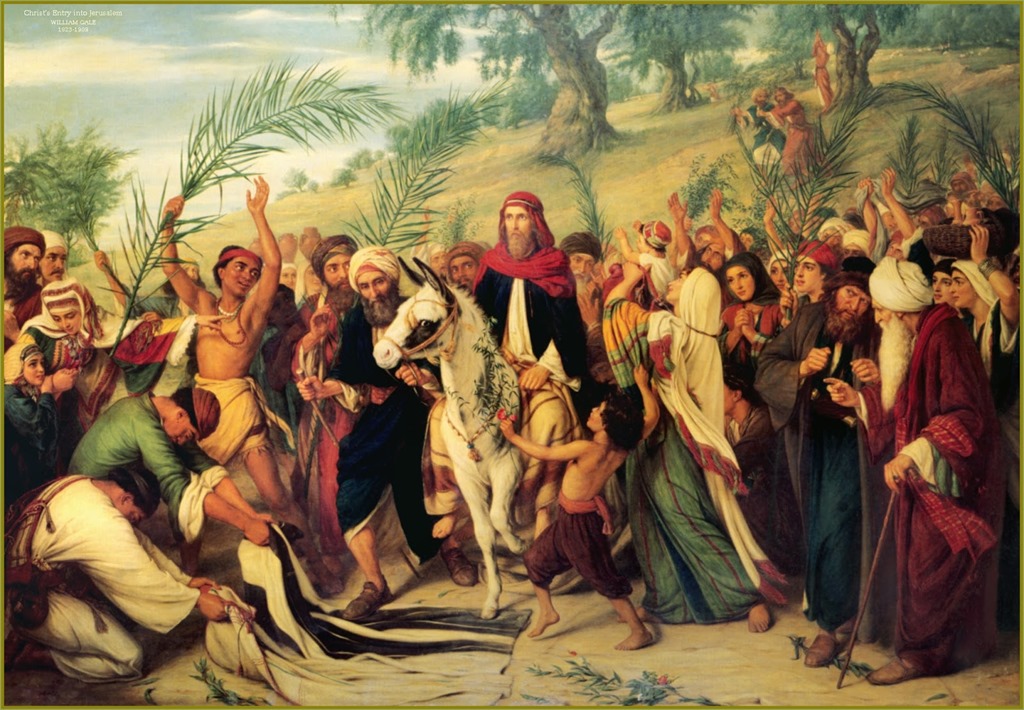
palm sunday

The crowd on Palm Sunday was looking for a king who ultimately would have been just a historical footnote. Instead, they got someone who did not change their political or economic situation at all. And yet, he changed the entire history of the world.

To listen to the sermon, click the play button:

To download, right click on the link (or do whatever you do on a Mac) and save it to your computer: Download Matthew Part 72


Matthew #72. Matthew 21:1-11

Each year, Christians celebrate and remember the last week in the life of Jesus before his resurrection. We call it “Holy Week.” For Jesus, the week began when he rode into Jerusalem on the back of a donkey, to cries of praise and celebration from the people. By Friday night of the same week, he was hanging dead on a Roman crucifix. On the very next Sunday, he rose from death; one week in total after riding into Jerusalem. Roughly one quarter of Matthew’s entire gospel is about that week, and with chapter 21, we have now entered that section of the book.

It was a kind of Holy Week for the Jews of that time too. The ancient Jewish calendar was different from ours, and sometime in March (it varies from year to year) was the beginning of the Jewish New Year. Fourteen days into the New Year, the Jews celebrated Passover – a feast commemorating their deliverance from slavery in Egypt. Following Passover was a week-long celebration – the Festival of Unleavened Bread. Although you could celebrate this wherever you lived, most Jews felt the best place to spend Passover and Unleavened Bread was in Jerusalem. Then, forty days later was the Feast of Pentecost. Picture this time of year a little bit Thanksgiving and Christmas in the United States. A lot of people traveled to be with family and loved ones. There was a delicious meal (usually the same food every year) and good feelings and a lot of gratitude. Along with it was the knowledge that you were all probably going to get together again in a bit more than a month, for Pentecost. In Israel, this was the “most wonderful time of the year.”

So there was a big crowd headed into Jerusalem that day, just three days before the Passover and the start the Festival. They were probably in a good mood. They were ready for something new and exciting to happen. Then along comes Jesus, riding on a donkey. Certainly, he could not have been the only person riding a donkey into Jerusalem that day. But Luke records that his disciples started shouting and praising God joyfully. Matthew says that the people directly in front of Jesus and those behind him took up the cry. John records that many of the people there for the festival had heard about Jesus raising Lazarus. So they went out to meet him and joined in the praises. Soon, it was a kind of uproar that stirred up the whole city:

When He entered Jerusalem, the whole city was shaken, saying, “Who is this? ” (Matt 21:10, HCSB)

The people took up the cry of Zechariah 9:9

Rejoice greatly, O daughter of Zion! Shout aloud, O daughter of Jerusalem! Behold, your king is coming to you; righteous and having salvation is he, humble and mounted on a donkey, on a colt, the foal of a donkey. (Zech 9:9, ESV2011)

That particular prophecy of Zechariah was all about salvation and deliverance. Many Jews probably felt it was fulfilled in some ways when the Maccabaeus Family led the rebellion that freed Israel from Greek rule, some hundred and sixty years before the time of Jesus. Now they were thinking that maybe God was going to do the same thing to the Romans and to king Herod, through this Jesus. They were thinking salvation all right, but political salvation.

Now the truth is, I think most of the crowd was cheering in ignorance, and for the wrong reasons. After the crucifixion, the entire number of Jesus’ followers was about 120. But this crowd sounds a lot bigger than that. It would take more than 120 people to shake up the whole city. So a lot people were cheering who didn’t know Jesus very well, or only knew of him. It was party time, and they were partying. It sounded exciting. They thought maybe they had a new Judas Maccabaeus on their hands, and maybe they were going to be free from the oppression of Rome and king Herod (Herod was not a Jew).

But why did Jesus participate in this? What Matthew records makes it sound like Jesus planned it: apparently Jesus had arranged the donkey ahead of time, and even agreed upon some sort of “password” with the owner of the animals. Luke and Mark also suggest that it was intentional on Jesus’ part. But the crowd had all the wrong reasons, so why did Jesus do it?

Matthew records one of the reasons: it fulfilled the prophecy of Zechariah 9. Some of that prophecy certainly sounds like military deliverance from oppressing nations. In fact, it mentions war against Greece, so some of it may indeed have been fulfilled by the Maccabaeus Family. Remember, however, biblical prophecies usually have multiple layers that are not necessarily fulfilled at in one piece. And there are other clues in Zechariah 9 that show us that, whatever else it was about, it was also about Jesus.

It says that the one coming to Jerusalem on the donkey is righteous. Who else is truly righteous besides Jesus? It says he is the true king. Who has the right to claim kingship, but him? Judas Maccabaeus, more than a century before, was never a true Israelite king, because he was from the tribe of Levi, not the tribe of King David, which was Judah. The prophecy says he is bringing salvation, and that he is humble and peaceful. Zechariah 9:11-12, a few verses later, also says this:

As for you also, because of the blood of my covenant with you, I will set your prisoners free from the waterless pit. Return to your stronghold, O prisoners of hope; today I declare that I will restore to you double. (Zech 9:11-12, ESV2011)

Prisoners are set free and given hope – because of the blood of the covenant. Jesus was riding into Jerusalem to shed his blood, to create the New Covenant, sealed with his blood, brought about by his death. Certainly, at the time, no one else knew that, but Jesus did. And later, John writes, the disciples remembered it (John 12:16).

So, in this act of riding into Jerusalem on a donkey, receiving the praises of the people around him, Jesus was fulfilling prophecy, and giving anyone who cared to think about it a clue that he was the promised Messiah.

I think Jesus did this for other reasons too. It was time for him to give up his life for our sins. I think he was deliberately provoking the Jewish leaders into taking the actions that would lead to his crucifixion. Up until this very last week of his earthly life, Jesus had kept a fairly low profile, and avoided popular acclaim and confrontation with the Jewish leaders. But now, I think he was deliberately antagonizing them so that they would do what had to be done.

Finally, if Jesus really is who we believe he is, he was always worthy of worship at any moment in time. So, it is only good and right that as people come to celebrate the Passover, they worshipped the true Passover lamb who would give his life so that they could be spared. It is entirely appropriate that people worship him. He said as much to the Pharisees who criticized him.

Now, as I have pointed out, even those who praised Jesus, did so with quite a bit of ignorance. Frankly, I don’t think most Christians get the point any more than the First Century Jews. The Jews got all excited about Passover and the Festival of Unleavened Bread, and I’m sure many of them forgot that it was really all about God’s deliverance. We have the same issues in America with Christmastime and Thanksgiving. We get all happy and excited, but often neglect real thankfulness or real remembrance of Jesus. And we do the same with the beginning of Christian Holy Week.

Most churches I’ve been to wave palm leaves around at some point in the Palm Sunday service. I’ve been in churches where they brought in live donkeys and camels for the occasion. People shout and jump and sing, just like the Jews did on that first Palm Sunday. Just like the Jews did in ignorance. But we should know better, now.

It reminds me of Elijah’s experience with God:

Then He said, “Go out and stand on the mountain in the LORD’s presence.” At that moment, the LORD passed by. A great and mighty wind was tearing at the mountains and was shattering cliffs before the LORD, but the LORD was not in the wind. After the wind there was an earthquake, but the LORD was not in the earthquake. After the earthquake there was a fire, but the LORD was not in the fire. And after the fire there was a voice, a soft whisper. When Elijah heard it, he wrapped his face in his mantle and went out and stood at the entrance of the cave. (1Kgs 19:11-13, HCSB)

We look for God in the excitement, the noise, the action. And there is some of God in that, sometimes. But Elijah found that the heart of God was something, deeper, quieter, more meaningful. It wasn’t wrong for the Palm Sunday crowd in Jerusalem to have a raucous celebration. It wasn’t wrong for them to want deliverance from the Romans. But the real thing, the most important thing, was deeper than that. Two-thousand years later, Judas Maccabaeus is sort of a footnote in the ancient history of the Greek empire; many of you may not have heard about him before today. And that’s what the Jews were looking for – another person to give them temporary relief, another person who would end up as just another historical footnote. But they got someone who would not change their local political situation at all. Instead, he changed the entire world.

I think we need to take notice of this. Too often, our vision is too small and limited. We just want Jesus to give us a better job, or more compliant kids, or to “fix” our spouse. Those aren’t necessarily bad things to want; it’s just that the vision is too small. What he wants to do inside our soul and spirit is so much bigger than a temporary situation fix. He has a permanent solution to the holes inside our hearts. He has brought us hope, and grace and love and permanent salvation; he has sealed it with his blood.

Zechariah’s prophecy says: “Behold, your king is coming to you, righteous and having salvation.” I say the same thing: Jesus is coming to us. Do you recognize him as your king, the one with the right to rule your life? Are you willing to be part of his real mission, not to temporarily change a little corner of your world, but to bring hope and salvation to all people for eternity? Are you willing to receive not just what you want, but what he chooses to do in your life and with your life?

Right after “Palm Sunday,” Jesus made this comment:

“I assure you: Unless a grain of wheat falls to the ground and dies, it remains by itself. But if it dies, it produces a large crop. The one who loves his life will lose it, and the one who hates his life in this world will keep it for eternal life. If anyone serves Me, he must follow Me. Where I am, there My servant also will be. If anyone serves Me, the Father will honor him. (John 12:24-26, HCSB)

Jesus literally gave up his life. The result was eternal salvation for billions. He invites us to join him – not necessarily to literally lose our physical life (though he has called some to martyrdom) but to surrender our hearts and minds and wills to him, so that in return we can receive his salvation and honor.

The party is fine, as far it goes. The celebration is fun. The happiness is good and right and genuine. But let’s use this text as an opportunity to go deeper, to engage with the real mission of Jesus, and to receive him as our true king.

Step-Dad to God’s Son

DF-09134
Nativity
,  
May 18, 2006
Photo by Jaimie Trueblood/newline.wireimage.com

To license this image (9139053), contact NewLine:
U.S. +1-212-686-8900 / U.K. +44-207 659 2815 / Australia +61-2-8262-9222 / Japan: +81-3-5464-7020
+1 212-686-8901 (fax)
info@wireimage.com (e-mail)
NewLine.wireimage.com (web site)

The Christmas Story in the Bible has a lot of heroes, and few villains, but one of the most overlooked heroes is the Step-Father of God’s son – Joseph. The fact is, Joseph is man of profound faith and steadfastness. His example is one that could help us.


To listen to the sermon, click the play button:

To download, right click on the link (or do whatever you do on a Mac) and save it to your computer: Download Christmas 2015

Christmas Eve 2015


Matthew 1:18-25; 2:13-15; 2:19-23

The Christmas Story in the Bible has a lot of heroes, and few villains, but one of the most overlooked heroes is the Step-Father of God’s son – Joseph. The fact is, Joseph is man of profound faith and steadfastness. His example is one that could help us.

Let’s consider his situation. Back in those days, engagement was a big deal – in fact it was almost as big of a deal as marriage. So when it says Joseph was engaged to Mary, this was no casual thing. Engagement involved what we might consider marriage vows, and engagements were not usually broken off except for some very serious causes, like the discovery that one partner was unfaithful. An engaged couple still hadn’t had the ceremony and begun to live together, but in general, they were considered to be as committed to each other as a married couple. Unwed pregnancy was also a very big deal in those days. Jewish law actually provided that a woman who was unfaithful to her husband could be stoned to death. By the time of the New Testament, that didn’t happen very often any more, partly because the Romans put a stop to it, but it was still there in the Jewish law. Even without that, it was a major scandal for an unmarried woman to have a child.

So here is Joseph, engaged, and he finds out his fiancée is pregnant – and of course, it wasn’t his baby. Even in this day and age, that would be enough for most men to call off a relationship.

A few years ago, I shared what the wedding day would have meant to Mary – it would have been the biggest, best day of her life. But this was also true of Joseph. On that day – and most likely, only on that day, in his entire life – he would feel like a king, and eat like a king. Your wedding was the highlight of life in a place where the poverty was soul-crushing. I’m sure Joseph was looking forward to that day.

Everything we read about Joseph tells us he was a good, decent man. He still cares enough for Mary that he doesn’t want her to suffer public disgrace, so he plans to break of the engagement quietly and discreetly. Even so, think of the hurt and humiliation he must feel! Even before they are properly married, this woman has cheated on him. All his happy dreams for the future are shattered around him by this humiliating betrayal.

So, after making his plans, he goes to bed. He has a dream in which an angel of the Lord tells him what’s really going on with Mary. Now, I want you to consider something. They knew just as much about the birds and bees back then as we do now. It’s not like they thought, “Oh sure, every so often you’re gonna have a virgin get pregnant, even though she’s never been with a man.” And in Hebrew culture, the idea of God impregnating someone was borderline blasphemy. The ancient Greeks worshiped Gods who were sort of like really big and powerful human beings. Their gods, from time to time, would get enamored with some beautiful human woman and come down and have an affair. But this is not at all the type of God that the Jews (or we) believe in. To a Jewish man, this is a strange and almost blasphemous idea.

So here’s Joseph. In his mind, he’s already been made a fool and rejected. Now some sort of angelic being comes in a dream, and says, “don’t worry, she’s still a virgin, she hasn’t been unfaithful. God put the baby in there through his Holy Spirit.”

I think my response might have been, “Yeah, right. Whatever.” But here is Joseph, being played for an even bigger fool than before, and what is his response?

“When Joseph got up from sleeping, he did as the Lord’s angel had commanded him. He married her, but did not know her intimately until she gave birth to a son. And he named him Jesus. (Matt 1:24-25)

Joseph was confronted with a crisis of faith. He had a choice. He could follow proper social convention and save face for himself and protect his injured pride. Or he could step out into the wild abyss of faith, risking ridicule and humiliation. He chose faith. And though we don’t often make a big deal of it, he is truly one of the heroes of faith in the Bible.

There’s another thing, too. Okay, he accepts in faith that God is in this. But now, think of it: Joseph was going to be God’s step-dad. Seriously! There’s a song by Michael Card that I love. The picture is of Joseph standing there, holding Jesus as a baby, rocking him to sleep. And he’s thinking, “How can I do this? How can I be a father to the son of God?” Again, he faced the choice. He could have said, “This is ridiculous. I can’t do this!” He could have made all kinds of objections: “I can’t provide him with the education he will need. I can’t even be sure I’ll be able to feed and clothe this child. How do I raise him? How do I discipline him? Will I need to discipline him?”

But, as before, he responded in faith. The first few chapters of Matthew show us a man who relied on God, was sensitive to him, and responded quickly and obediently to the prompting of the Holy Spirit. He marries Mary, just as the angel told him, though it is almost certain that the ceremony was nothing like the celebration involved in a normal Jewish wedding.

Mary has the baby, and they stay in Bethlehem for about two years. Then, after a visit from the Magi, the Lord tells Jospeh to move the whole family down to Egypt. This is a major journey. And of course, Egypt is a whole other country. But Joseph doesn’t hesitate. The same thing happens a few years later: the Holy Spirit tells him to go back, and even which town to settle in. Joseph does it.

I think that it is no accident that Joseph was the kind of man who heard from God. God picked not only Mary, but Mary and Joseph together. Joseph was ready to hear from God. He was probably the sort of man who wanted to be closer to God, wanted to hear from him. He remained sensitive to him and willing to make the hard choices of faith over feelings, faith over conventional wisdom, faith over fear. He made the choice of faith time after time.

Joseph is great example to us. Christmas can give us sweet, warm fuzzy feelings. But when we really think about it, that little child is confronting us with a choice. Will we believe and accept that the Creator of the universe willingly joined himself to a human egg, laid aside the privileges of divinity, and became this little baby? We really believe that here, in this frail, impoverished child, with the young, inexperienced mother and the plain, ordinary step-father, is the salvation of the world? Are we willing to take action on that choice of faith?

I hope Joseph’s example will encourage us to say, “yes.” If Joseph can look that stupid, so can we. If he can marry a pregnant woman, be step-father to God’s son, move all around the world because he heard something in a dream, we can certainly give up our pride, and trust this little child Jesus with our lives now, and our eternal future.

GO FISH

Money in Fish mouth


Jesus is like this sometimes. Sometimes, he really does want you to do something that seems stupid and unnecessary and difficult (like paying the temple tax). Sometimes he really does invite us to just go fishing, (or whatever your personal equivalent of that is) and trust him to deal with a situation. And especially, he is like this: he was willing to pay the debt you owed, though he did not have to.


To listen to the sermon, click the play button:

To download, right click on the link (or do whatever you do on a Mac) and save it to your computer: Download Matthew Part 60


Matthew #60. Matthew 17:22-27

In Matthew 17:22, Jesus predicts his own death once more. We don’t need to spend a great deal of time on this verse, other than to note that Peter has learned his lesson, and this time, the disciples don’t argue, but instead, are deeply distressed. I do want to mention something interesting, however. Jesus predicts not only his own death, but also his resurrection. However, the disciples appear to only pay attention to the part about his death. Although his warning is of hardship and suffering and fear, he is also giving them something for which to have joyful hope. Even so, the disciples focus only on the bad. There is no evidence that they rejoiced in his talk of resurrection to the same degree that they were distressed about his talk of crucifixion.

Obviously, the crucifixion was horrible for Jesus, and very traumatic even for his disciples. However, even that horror turned out to be the means by which grace and salvation were brought to the world. Through this horrible thing that Jesus predicted, God conquered sin and made it possible for love to thrive. Not only that, but after the crucifixion came the resurrection, and Jesus told his disciples about that also. The resurrection was to be proof of victory, the power of God revealed. Yet the disciples, hearing about all this, were distressed.

I wonder how often I am like them. I face something difficult, utterly failing to see that God uses such things to accomplish his purposes in the world and in me. I hear the good news about what will come after the trouble, but I pay no attention to it, or I don’t even believe it. Lucky for them (and for us) human doubt does not stop God from doing what he plans to do; even so I wonder if we could have more peace and joy in the moment if we paid as much attention to the good promises of God about the resurrection as we do to the warnings of hardship and trouble.

Next, comes this little incident concerning a particular tax. Jewish men were required to pay a tax that was used to maintain the temple in Jerusalem, and keep it running; in Jesus’ day it was known as the double-drachma tax (some bible translations might simply call it the “temple tax”). The amount collected was equal to about two-days’ wages for a manual laborer. During the time of Jesus, there was a certain amount of wiggle-room in paying this tax. It was a religious tax, not a civil one, and so the Roman rulers did not require it, or enforce its collection. It was an internal matter between Jews, and a Jewish man would be safe from any official penalty if he chose not to pay it. Jewish groups like the Sadducees, who were fairly secular, typically did not pay it. On the other hand, many Jews felt it was the patriotic Jewish thing to do. After all, the temple was the heart of Judaism at the time.

Before we get into the text itself, I want to make a note about what this passage means for history. It means that when Matthew wrote his gospel, he expected that the temple-tax, and also the Jewish temple in Jerusalem, would have been of interest and concern for his readers. In addition, he makes no attempt to explain these customs, so he assumes that readers were quite familiar with all of this background. This makes it virtually certain that the gospel of Matthew was written before the temple was destroyed permanently in 70 AD. Once more, this is very strong evidence that contradicts the popular (and ignorant) idea that the bible was made up or changed long after the time of Jesus.

Now, let’s look at the passage itself.

When they came to Capernaum, those who collected the double-drachma tax approached Peter and said, “Doesn’t your Teacher pay the double-drachma tax? ”

“Yes,” he said.

When he went into the house, Jesus spoke to him first, “What do you think, Simon? Who do earthly kings collect tariffs or taxes from? From their sons or from strangers? ”

“From strangers,” he said.

“Then the sons are free,” Jesus told him. “But, so we won’t offend them, go to the sea, cast in a fishhook, and take the first fish that you catch. When you open its mouth you’ll find a coin. Take it and give it to them for Me and you.” (Matt 17:24-27, HCSB)

In the first place the tax collectors were looking for money to keep the temple running. They ask for it from Peter, but also specifically, they ask if Jesus pays the tax. Not only that, but I suspect that their question was a kind of political litmus test. The Sadducees were faithless and arrogant, and their lack of support for the temple was a symptom of those things. However, if you were Jewish, but not a Sadducee, people were quite likely to regard you with suspicion if you did not pay the temple tax. The question behind the actual words was “What kind of Jew are you? Are you a real Jew?”

It would be as if you were running for public office in America in 2015, and someone asked you, “Are you in favor of helping the poor?” Poverty in America today is a complex subject, and often the reasons for it are not strictly about economics. But the only possible answer a politician could give in such a situation is “Of course I am in favor of helping the poor.” A politician who tries to go into detail, or to tries to actually explain what that might involve, is likely to be misunderstood and attacked by large numbers of people who prefer not to think too hard. In the same way, the only possible answer Peter could give the tax collectors is “Of course we support the temple.”

Jesus knows what Peter has just encountered. Before Peter can even broach the subject, Jesus brings it up himself. His first question to Peter is one more place where Jesus reveals that he thought he was in fact, the Son of God, divine in nature. He clearly means that he himself is the Son, and should not be required to pay tax for the temple built for the glory of his Father and Himself. I want us to get the irony here: When God came to earth in human flesh, they wanted to tax him to pay for the temple that they built in his honor. But there is even more. The temple always pointed toward the nature of God. The layout, and the sacrifices, told the story of Holy God who is gracious, and yet whom cannot be approached by sinful people. The tabernacle and the temples built on its pattern were put in place to point people to Jesus Christ. The meaning of the temple, all of its symbolism, was fulfilled in the person and work of Jesus Christ.

But they wanted to tax Jesus Christ himself to keep it going, even though he came to make it irrelevant.

I find Jesus’ response quite interesting. Basically he says, “Look, I don’t have to pay the tax. In fact, the tax is collected more or less on my behalf. But let’s pay it, anyway.”

In a way, this exemplifies the entire mission of Jesus on earth. He came to pay a debt that he didn’t owe. In fact, he paid the debt that was owed to himself by all people on earth. But where we should have, and yet couldn’t, atone for our own sins, he did.

There is a practical aspect to all this, also. This wasn’t a small tax. This was two days’ wages for Peter, and another two days’ worth for Jesus. But Jesus, Peter and the other disciples did not have paying jobs. Luke 8:1-3 records that Jesus and the twelve were living on what other people gave to support their ministry. Two days’ wages were tough to give up for a poor working stiff, but what about for two people who had no regular income?

So, to summarize, and put ourselves into Peter’s shoes: we do not have the money sitting around to pay for this tax. Even if we did, we don’t have to pay it, and it is almost silly to do so…and Jesus says, “Let’s pay it anyway.”

Next, comes the fun part. Jesus tells Peter to go fishing, and get the money out of the mouth of the first fish he catches. I used to read this and nod my head wisely. I am a fisherman, and I know that larger species of fish often strike at flashing pieces of metal, thinking they are struggling minnows. So, if a bright coin fell into the water, it wouldn’t be so crazy to think of a fish swallowing it.

Recently, I realized how stupid this really is. I have been fishing whenever possible for roughly forty years, and I have never caught a single fish with any amount of money its mouth, let alone four days’ wages. This isn’t a likely occurrence – it is a miracle.

As a fisherman, bear with me as we consider this in more detail; I think we might learn some interesting things. In the first place, skeptics sometimes scoff at the idea that anyone fished with a hook and line in those days. However, long before the time of Jesus, both Isaiah and Amos referred to fishing with a line and hook (Isaiah 19:8, Amos 4:2). In addition, actual fishhooks dating from ancient times have been discovered in archaeological digs in Israel. Once more, bible-skeptics seems to be lacking knowledge of the actual facts.

However, (and I think this is the important part) it would have been unusual for Peter to fish with a hook and line. Peter was a commercial fisherman before he met Jesus. The easiest way for him to catch large numbers of fish (and thus to make enough money to support himself) was with nets. Fishing with lines is pretty inefficient compared to netting. On the other hand, if you fished with a line and hook, you could choose your bait, and be more selective about what you caught. If your goal was to catch a big fish, you could improve your odds by using a hook and line. What it amounts to is this: In general, Peter would only fish with a hook and line for the fun of it. Therefore, Jesus was not telling Peter to go back to work and find the money by running the fishing business again for a while. He was telling him to take the day off and go fishing – to go do something fun. And while he relaxed in this way, the Lord would provide what they needed.

I have a friend who is a scholar. He reads a lot for his work. But he also enjoys reading “for the fun of it.” It would be like Jesus telling my friend, “Go the library and pick out a book you want to read for fun. Go ahead and read it. In the pages of that book you’ll find six $100 bills.”

So, Peter got to relax and do something fun, his taxes were paid by doing it, plus he brought dinner home for his family and Jesus.

Now, I love this story because of these things. However, we need to be careful in application. Does this mean that we should just relax and go do something fun, and God will provide for us while we do it? I bet I could build a pretty big church preaching something like that. But let’s look at this carefully. Right now, that’s what Jesus told Peter to do. This was a particular day in Peter’s life. On another day, Jesus told him to deny himself, take up his cross and follow him. On another day, Peter went to prison for the sake of Jesus. On one other day, Peter gave up his life rather than deny Jesus. In other words, Jesus did this thing for Peter. He said, go fishing, don’t worry about it. Enjoy yourself. But it was not a life direction – it was a wonderful moment, but we should not get the idea that point of following Jesus is to have only moments like this. Once more, I quote C.S. Lewis:

“The settled happiness and security which we all desire, God withholds from us by the very nature of the world: but joy, pleasure, and merriment, He has scattered broadcast. We are never safe, but we have plenty of fun, and some ecstasy. It is not hard to see why. The security we crave would teach us to rest our hearts in this world and pose an obstacle to our return to God: a few moments of happy love, a landscape, a symphony, a merry meeting with our friends, a bathe or a football match, have no such tendency. Our Father refreshes us on the journey with some pleasant inns, but will not encourage us to mistake them for home.” — CS Lewis, the Problem of Pain

This was a refreshing, joyful time for Peter. As Lewis’ says, the Lord scatters these throughout life, and we do well to enjoy them and thank Him for them. But they are not meant to constitute all of life. We aren’t meant to forget that our real home is heaven.

You might ask, how do I know when Jesus is inviting me to relax, or when he’s calling me to do something I don’t want to do. I could give you seven steps for knowing this, but it would be a waste of everyone’s time. There isn’t  a manual. We need to follow Jesus, we need to let him tell us these things. These days, we start with reading the bible, praying conversationally, and hanging out and worshiping with other Christians who are trying to the same. Add some solid bible teaching, and then be consciously listening for what Jesus is telling you. There is no formula – it’s about following in faith.

I think the real message here is this: Jesus is like this sometimes. Sometimes, he really does want you to do something that seems stupid and unnecessary and difficult (like paying the temple tax). Sometimes he really does want us to just go fishing, (or whatever your personal equivalent of that is) and trust him to deal with a situation. And especially, he is like this: he was willing to pay the debt you owed, though he did not have to.

~

Thanks again for making use of Clear Bible.

I want to remind you again that we are a listener-supported ministry, and that means, first and foremost, that we are supported by your prayers. We need and value your prayers for us.

Please pray that this ministry will continue to be a blessing to those who hear it. Ask God, if it is his will, to touch even more lives with these messages. Ask him to use this ministry in making disciples of Jesus Christ.

Please also pray for our finances. Pray for us to receive what we need. Please pray for us in this way before you give anything. And then, as you pray, if the Lord leads you to give us a gift, please go ahead and do that. But if he doesn’t want you to give to us, that is absolutely fine. We don’t want you to feel bad about it. We want you to follow Jesus in this matter. But do continue to pray for our finances.

If the Lord does lead you to give, just use the Paypal Donate button on the right hand side of the page. You don’t have to have a Paypal account – you can use a credit card, if you prefer. You can also set up a recurring donation through Paypal. We can make this tax-deductible if you just mention that it want it to be so in the “note” part of the transaction.

You could also send a check to:

New Joy Fellowship

917 Canyon Creek Drive

Lebanon, TN 37087

Just put “Clear Bible” in the memo. Your check will be tax-deductible.

Thank for your prayers, and your support!

THE KEYS TO THE KINGDOM

keys

A man was meant to be doubtful about himself, but undoubting about the truth; this has been exactly reversed. Nowadays the part of a man that a man does assert is exactly the part he ought not to assert–himself. The part he doubts is exactly the part he ought not to doubt–the Divine Reason. – GK Chesterton


To listen to the sermon, click the play button:

To download, right click on the link (or do whatever you do on a Mac) and save it to your computer: Download Matthew Part 54


Matthew #54 . Matthew 16:13-20 Part C

Jesus says something in these verses that a lot of people wish he had explained a bit more:

“And I tell you, you are Peter, and on this rock I will build my church, and the gates of hell shall not prevail against it. I will give you the keys of the kingdom of heaven, and whatever you bind on earth shall be bound in heaven, and whatever you loose on earth shall be loosed in heaven.”

Many hundreds of years later, after Christianity had become legal and the church had changed from local gatherings of Jesus-followers into a centralized, power-holding institution, these verses were used to justify the position of Pope in the Roman Catholic church. The theory goes that here, Jesus is establishing the office of “Pope,” his chief representative on earth, and installs Peter as the first one. The idea is that this passage teaches that Jesus invests Peter (and his successors) with the “keys of the kingdom.” By the way, this is where we get the popular image of Saint Peter greeting people in front of the “pearly gates;” it is because Peter supposedly has the keys.

Now, I want to point out that a lot of “interpretation” must go into it to make this passage establish the Roman Catholic Papacy. In other words, it doesn’t call Peter the “Pope” or explicitly establish the institution of the Papacy in plain, unequivocal language. I am not saying this to make Roman Catholics angry. The reason I point it out is to show, once again, that clearly, the New Testament we have today is the very same one that was written by the apostles who knew Jesus Christ personally. It was not tampered with by generations who came after the apostles. Certainly, the Roman Catholic church, if it had changed or edited the bible, would have made this passage much more clearly about the Papacy.

Though I do not agree with the Roman Catholic application of this passage, it is not my intention here to attack the Papacy. I think we have more useful things to do with this passage. So may I simply suggest some other ways to understand this passage, and apply them to our lives?

First, it is somewhat interesting to know that in Greek, Jesus is making a play on words. Let me give it to you somewhat literally with the Greek words, and then I’ll explain.

“And I say to you that you are Petros and upon this petra I will build of me the church.”

The Greek word that we translate “Peter” is “petros,” and it means rock. It is the special name that Jesus gave Jesus (prior to this point, we should remember). The second word Jesus uses is petra, which means, more or less, “rock formation.” It is not the same word as the name “Peter,” and it cannot be an affectionate nickname for him, because it is in the feminine gender.

So it seems very doubtful that it is Peter personally upon whom Jesus says he will build his church. I think it is far more likely that Jesus says “upon this rock I will build my church” because he is making a play on words. Bible commentator Matthew Henry reminds us that we don’t get to see expressions and body language in the bible. He writes:

Others, by this rock, understand Christ; “Thou art Peter, thou hast the name of a stone, but upon this rock, pointing to himself, I will build my church.” Perhaps he laid his hand on his breast, as when he said, Destroy this temple (John ii. 19), when he spoke of the temple of his body.

In other words, Jesus could have pointed to himself when he said “upon this rock.” Another possibility is that Jesus meant that he would build the church on the foundation of what Peter has just said, his confession that Jesus is Messiah and son of God, with all that means. I personally favor this interpretation, because, in fact, that is what has happened. The one thing that unifies true Christians all over the world is that Jesus Christ is the Messiah, true God, true man, who died to cleanse us from sin and rose to show his power and give us new life. That is, and always has been, the foundation of the Church (and by “the church” I do not mean any particular institution, but rather, the true spiritual fellowship of those who trust Jesus Christ, no matter where they “attend church”). I am not arguing against the Papacy (though given enough provocation, I would). I am insisting however, that the foundation of the true church is not the apostle Peter, nor the Papacy, but the true confession that Jesus is Messiah and Lord. That has always been true, and I think even most Roman Catholics would agree that without this foundational belief, the Papacy itself would be meaningless.

I want to highlight another thing here. Jesus says, “I will build my church, and the gates of hell will not prevail against it.” Virtually every time the New Testament uses the word “church” it is a Greek word, simply meaning, “the gathering of people with a common purpose .” (Greek: ekklesia; you may recognize that the English word, ecclesiastic comes from this term). In context, of course, it means “the gathering of people who have faith in Jesus.” At its most essential level, that is what a church is – a group of people who are connected to one another and gather together intentionally, and who have faith in Jesus. So the church that Jesus will build refers to the true spiritual fellowship that includes all who trust and obey Him as Lord and Messiah. We aren’t talking about a particular institution, denomination or congregation.

I love that Jesus promises He will build it. It reminds me a little of Psalm 127:1

Unless the LORD builds a house, its builders labor over it in vain; unless the LORD watches over a city, the watchman stays alert in vain. (Ps 127:1, HCSB)

Sometimes we get caught up in the future of the church on earth. Sometimes we are concerned about local congregations; at other times we worry about the whole thing. Jesus is the builder of the church. We can trust him to do it. And the gates of hell can’t withstand the onslaught of grace and truth that comes from those who trust and obey Jesus. This picture not one of the church defending itself while hell attacks – it is the reverse. The idea is that church will attack hell itself, and overcome it through the power of Jesus.

Now, Jesus says some other things also. He adds: “I will give you the keys of the kingdom of heaven, and whatever you bind on earth shall be bound in heaven, and whatever you loose on earth shall be loosed in heaven.” I need to teach with integrity here. In Greek, “you” is singular. In other words, Jesus directed these comments specifically to Peter, not to all the disciples. However, this is not a problem for me, nor should it be for you. God directed many promises specifically to Abraham. He made the first promise of the Messiah specifically to Eve. He made many promises directly and personally to David. This is how the Lord works throughout scriptures: He speaks to specific people at specific times and places, and yet his promises also encompass all come after, those who believe. The individuals who first received them stood as representatives of those who would come after, and believe what God had said.

So Paul writes, for example:

Just as Abraham believed God, and it was credited to him for righteousness, then understand that those who have faith are Abraham’s sons. Now the Scripture saw in advance that God would justify the Gentiles by faith and told the good news ahead of time to Abraham, saying, All the nations will be blessed through you. So those who have faith are blessed with Abraham, who had faith. (Gal 3:6-9, HCSB)

Matthew Henry writes of our verses in Matthew 16:

The Old Testament promises relating to the church were given immediately to particular persons, eminent for faith and holiness, as to Abraham and David; which yet gave no supremacy to them, much less to any of their successors; so the New-Testament charter is here delivered to Peter as an agent, but to the use and behoof of the church in all ages, according to the purposes therein specified and contained.

The gift and promise here is for every believer in Jesus Christ, Son of God. Paul says, if we have the faith of Abraham, we also have the promises that were given to him. I add, if we have the faith that Peter had, we also have the promises given to him. So, yes, these words (in Matthew 16) were spoken directly and specifically to Peter. However, Jesus says almost exactly the same thing a little while later, when he is teaching about how to deal with his followers who are struggling with sin:

I assure you: Whatever you bind on earth is already bound in heaven, and whatever you loose on earth is already loosed in heaven. (Matt 18:18, HCSB)

The second time Jesus says it (in 18:18) the Greek “you” is plural – in other words, the next time Jesus says this, he makes it clear that he is talking to all of his disciples. John records Jesus saying something similar. John’s Greek is pretty rudimentary (though better than mine) but he makes it clear that Jesus is talking to all the disciples when he says:

Jesus said to them again, “Peace to you! As the Father has sent Me, I also send you.” After saying this, He breathed on them and said, “Receive the Holy Spirit. If you forgive the sins of any, they are forgiven them; if you retain the sins of any, they are retained.” (John 20:21-23, HCSB)

So, what is this business of binding loosing that Jesus promises to Peter, the disciples and, through them, to us? To understand it, we need one more brief note about the Greek. The HCSB is the best English translation of these verses that I have found, and I have used it in this message. However, I’d like to give you the most literal rendering I can:

Whatever you might bind on earth, it shall have already been bound in heaven; whatever you might loosen on earth, it shall have already been loosened in heaven.

The point is this. It is not about us, or even Peter, telling heaven what to do. It is Peter (and us) expressing on earth what has already been decided in heaven. By the way, this is confirmed by Peter’s screw-up just a few verses later. Jesus says he has to go to Jerusalem and die. Peter, probably flush with these words of Jesus, tries to “bind” the upcoming death of Jesus.

Then Peter took Him aside and began to rebuke Him, “Oh no, Lord! This will never happen to You! ”

But He turned and told Peter, “Get behind Me, Satan! You are an offense to Me because you’re not thinking about God’s concerns, but man’s.” (Matt 16:22-23, HCSB)

To put it mildly, Peter’s “binding” of something contrary to God’s will did not work out very well. We can see from this incident that Jesus did not give Peter a blank check. Just because Peter wanted it or said it did not mean it was God’s will. Jesus tells him “you are not thinking about God’s concerns, but man’s.” In that case, Peter has no authority to bind or loosen anything. Nor, thankfully, does anyone else. So this authority to bind or loose is simply the authority for a human being to express the will of Heaven on earth. To the extent that we express what has already been bound or loosed in heaven, we have authority. To the extent we do not, we have no authority. Whatever we “bind” isn’t actually bound unless it is also heaven’s will. But if it is, according to the scripture, according to God’s will, we puny humans have the authority to declare it done.

Jesus is saying that he will use human instruments to do his will and work in the world. When a Christian declares the good news, it is as if Jesus himself is speaking. When a Christian preaches the law, it is as if Jesus himself is speaking.

In a way this goes beyond our typical approach of “in my humble opinion.” No, if it has already been done in heaven, then it is not just my humble opinion. My words spoken in heaven’s authority do have heaven’s authority. GK Chesterton wrote:

What we suffer from to-day is humility in the wrong place. Modesty has moved from the organ of ambition. Modesty has settled upon the organ of conviction; where it was never meant to be. A man was meant to be doubtful about himself, but undoubting about the truth; this has been exactly reversed. Nowadays the part of a man that a man does assert is exactly the part he ought not to assert–himself. The part he doubts is exactly the part he ought not to doubt–the Divine Reason.

Saying “that’s just my opinion” makes you the important part of the equation: It’s your opinion. It asserts you, not the truth you are declaring. Instead, we might say, “I know I personally am nothing, but this is what the Bible says…” My opinion is not worth sharing. But the Truth? I don’t need to be reticent about that, because it is not my personal property.

All of this leads to a natural question: How do we know that what we are doing has already been done in heaven?

Jesus has already given us some clues. Remember how he taught the disciples (and us) to pray? “Your will be done, your kingdom come, on earth as it is heaven.” When we pray this way, the Lord often answers by helping us to get in step with his will and his kingdom. So, to “bind” or “loosen” correctly, we should learn to pray for the kingdom and will of heaven in our lives, and on earth.

Second, Jesus says all this to Peter after Peter’s confession that Jesus is the Messiah, the Son of the Living God, with all that means. We must make sure that what we “bind” or “loosen” is consistent with this confession, with who Jesus truly is.

Let me give you an example of “binding” and one of “loosening.”

Many years ago, a married man who professed to be a Christian began having an affair. When he was found out, he did not respond with repentance or sorrow for his sin. Instead, he tried to justify the affair. He invited the other woman to live with he and his wife, and told me that he wasn’t having an affair at all, he had just married a second wife, like Jacob or David. His wife, who had major self-esteem struggles at that point, went along with it, but it was a terrible, awful experience for her.

Finally, I had a very difficult conversation with him. I know what the Bible says about marriage and sex. I know what it says about sin generally, and repentance, and persisting in sin. I said to him, “You are trying to justify this, but I am here, in front of you, meeting your eyes, speaking with my voice and I am telling you, with the authority of Jesus, that you are living in sin. No one is perfect, and the Lord forgives all who repent, but you have not repented; instead, you keep on in a lifestyle of sin, claiming there is nothing wrong with it. The longer you wait to repent, the worse it will be for you. If you continue to refuse to repent, eventually your choice to hold on to sin will take you so far from God that you will be destroyed. You can’t get there by accident. You know what you are doing. Just in case you wonder, I am telling you, I am warning you, this sin will destroy you if you don’t repent.”

I grieve to tell you that this man never did repent. He was a good friend, and I cared about him deeply. He held on to his sin. He was thirty-five at the time this began, and though he smoked, and drank too much, he was in pretty good health. Quickly after this, however, his health failed, and he died within ten years.

I was “binding” his sins. In other words, I was communicating the biblical truth that if we do not repent, if we persist in an ongoing lifestyle of sin when we know better, if we refuse to even admit we are sinning, we are actually refusing the forgiveness that Jesus offers us. This is neither more nor less than what the bible says about it. I wasn’t “acting on my own authority.” I was saying what the bible says. Sometimes, hopefully not very often, we need somebody to confront us with physical presence (I do not mean violence I just mean simply being there) and a physical voice and say “knock it off! You are doing wrong and it needs to stop.” Sometimes we need somebody in front of us who can point out our self-deception and tear apart our self-serving justifications. Actually, this need is well known in secular addiction treatment, and it is called an “intervention.”

This “binding,” though necessary, is often a very difficult thing. But when you think about it, it is actually just one more way in which God can show grace to sinners. This man knew what the Bible said about sex and marriage. He knew when he started the affair that he was wrong. But through a fellow believer (in this case it was me) God was giving him yet one more chance. The Lord had every right to hold him accountable for what he knew, and yet God sent me to plead with him one more time. Far from being judgmental, this was the Lord doing all that he could to try and bring this man to repentance.

Now let me give you a happier example. Around that same time, a different young man came to me. He confessed that he was addicted to pornography. He was attending a local seminary to become a pastor, and he was sure that his sin had disqualified him from ministry; he wasn’t even sure, deep in his heart, that he was forgiven. The main difference between this guy and the first man was that this second young man was deeply broken up about his sin. He did not try to justify it. He did not want to do it any longer. He knew the bible pretty well, and so I reminded him of these verses, and then said, “OK, now look me in the eye. You can see my face, you can hear my voice. Jesus is speaking to you right now just as surely as I am. And what he says, and what I say, is that you are entirely forgiven. There is no condemnation for those who are in Christ Jesus (Romans 8;1). You have been made clean by the word that is spoken to you (John 15). If you are in Christ, you are a new creation; the old has passed away, the new has come (2 Corinthians 5;17). Your sin was absolutely destroyed on the cross. Your real life is in heaven with God (Colossians 3), your spirit is seated with Christ in heavenly places (Ephesians 1). You are dead to sin, yes really (Col 3, Romans 6). You – are – forgiven.”

Now, obviously I was quoting various Scriptures: either verbatim or repeating the gist of it. This young man could have looked in his Bible and found the same verses and read them for himself. But there is something powerful and gracious about hearing somebody else directly tell you what the Lord says in the Bible. It is vital for us to interact with the Lord alone. But it is also vital for us to be connected to each other and to sometimes hear another person declare the truth of Scripture to you.

Some of us are very suspicious of our own motives, and so we don’t easily let our own selves off the hook. For people like that, it can be a wonderful, grace-filled experience to have someone else look you in the eye and say “You are forgiven. You truly are.” This is the gift that Jesus gives Peter, and to the whole church: that we can hear flesh and blood speak the truth to us. Jesus is saying, “I am giving you authority to speak my words to each other, so that you don’t have to wonder if it is real or not; you don’t have to question your own motives.”

So when Kathy says, “I am telling you what you are doing is a sin,” you know that you need to knock it off. And when Tom says to you, “you are forgiven,” you really are forgiven.

Let the Lord speak to you today.


Thanks again for making use of Clear Bible.

I want to remind you again that we are a listener-supported ministry, and that means, first and foremost, that we are supported by your prayers. We need and value your prayers for us.

Please pray that this ministry will continue to be a blessing to those who hear it. Ask God, if it is his will, to touch even more lives with these messages. Ask him to use this ministry in making disciples of Jesus Christ.

Please also pray for our finances. Pray for us to receive what we need. Please pray for us in this way before you give anything. And then, as you pray, if the Lord leads you to give us a gift, please go ahead and do that. But if he doesn’t want you to give to us, that is absolutely fine. We don’t want you to feel bad about it. We want you to follow Jesus in this matter. But do continue to pray for our finances.

If the Lord does lead you to give, just use the Paypal Donate button on the right hand side of the page. You don’t have to have a Paypal account – you can use a credit card, if you prefer. You can also set up a recurring donation through Paypal. We can make this tax-deductible if you just mention that it want it to be so in the “note” part of the transaction.

You could also send a check to:

New Joy Fellowship

917 Canyon Creek Drive

Lebanon, TN 37087

Just put “Clear Bible” in the memo. Your check will be tax-deductible.

Thank for your prayers, and your support!

THE BLESSING OF FAITH

BLESSING OF FAITH

All of this should be cause for great comfort for us – our very belief is evidence of God’s work in us. If you, like Peter, believe that Jesus is the Messiah, the Son of the Living God, you are blessed! It means that God himself is at work in your heart. It means that our trials and grief and suffering in this life are not the full story.


To listen to the sermon, click the play button:

To download, right click on the link (or do whatever you do on a Mac) and save it to your computer: Download Matthew Part 53


Matthew #53 . Matthew 16:13-20 (Part B)

Bible passages like the one we have been studying these past few weeks strike me as extremely important. As I have been working on these past few messages, I have found myself hoping and praying that more and more people can hear them.

That is one reason I deeply appreciate your partnership in prayer. It is a great joy to me to know that some of you are praying along with us that the Lord uses this ministry to get his message out to the world. We aren’t the only ministry preaching God’s word, not by a long shot; but I truly believe that we do have responsibility for one small part of what God wants to do in the world during our lifetimes. Please pray that his purposes are fulfilled in and through Clear Bible. Please pray for protection and provision for me and my family.

Another thing I’d like prayer for is the idea of getting more “space” on the internet to archive more sermons. The hosting for our sermons is relatively inexpensive, but it is also limited. I recently had to delete about a hundred old sermons in order to make room for new ones. The great thing about the internet is that someone could come along and benefit from this sermon years from now. But to make that possible, we’re going to have change some things. Pray for guidance in this process, and technical help.

We value your prayer partnership above all. We do also welcome your financial partnership, if the Lord leads you to give. Please don’t feel guilty or bad if he does not. If the Lord does lead you to give financially, you can, just use the Paypal Donate button on the right hand side of the page. You don’t have to have a Paypal account – you can use a credit card, if you prefer. You can also set up a recurring donation through Paypal. We can make this tax-deductible if you just mention that it want it to be so in the “note” part of the transaction.

You could also send a check to:

New Joy Fellowship

917 Canyon Creek Drive

Lebanon, TN 37087

Just put “Clear Bible” in the memo. Your check will be tax-deductible.

Thank for your prayers, and your support!

~

Last time we considered the substance of Peter’s statement that Jesus is the Christ (Messiah), Son of the Living God. Theologians sometimes call a statement like this a “confession.” Many people think “confessing” is the same as “admitting,” but there are subtle and important differences. To confess in a biblical sense means “to say with,” or “to agree with the truth.” So, when we confess our sins, we are agreeing with the truth that the Bible teaches about those actions: namely, that they are wrong (they are sins) and also that we have done them. You see, it isn’t just admitting that we sin, it is agreeing with what the bible says about it. Confession can also be positive. You may have been in a church service where everyone said the Apostles’ Creed together. The pastor probably said something like: “Let us confess our faith together in the words of the Apostles’ Creed.” We are agreeing with the truth – thus, confessing. So Peter is agreeing with something that was already true – the identity of Jesus.

Now Jesus tells us several very important things about this confession:

He says, “Blessed are you, Simon Bar-Jonah! (literally, “Simon, son of Jonah”). This confession blesses those who make it. Actually, it is hard to overstate how much blessing comes from truly believing and confessing that Jesus is the Messiah, the Son of the Living God. To agree with this truth, to submit to the implications of it – that is, to personally submit to Jesus Christ and put your trust in Him – this is the only path to Life, according to the Bible. Jesus says elsewhere:

“I am the way, the truth, and the life. No one comes to the Father except through Me. (John 14:6, HCSB)

John writes:

The one who believes in the Son of God has this testimony within him. The one who does not believe God has made Him a liar, because he has not believed in the testimony God has given about His Son. And this is the testimony: God has given us eternal life, and this life is in His Son. The one who has the Son has life. The one who doesn’t have the Son of God does not have life. I have written these things to you who believe in the name of the Son of God, so that you may know that you have eternal life. (1John 5:10-13, HCSB)

That Life starts now. Even now, before we die, through Jesus we can find increasing wholeness in our spirits and souls. Even now, we can begin to experience love, joy, peace, patience, kindness, gentleness, goodness faithfulness and self-control in increasing measures.

But of course, it doesn’t stop when we die. The bible is pretty clear that we can’t even begin to grasp the wonder and joy and hope of the life to come, but it gives us some very exciting hints. I think this is one of the great biblical truths, one of the great Christian hopes. Our trials and grief and suffering in this life are not the full story. The Life after death – promised in Jesus alone – gives meaning and hope and joy to all things now, even the ones that seem to defy explanation. 1 Corinthians says:

What eye did not see and ear did not hear, and what never entered the human mind — God prepared this for those who love Him. (1Cor 2:9, HCSB)

Life begins now, but it continues on into eternity in a way that has “never entered the human mind.” If this is not so, says Paul:

If we have put our hope in Christ for this life only, we should be pitied more than anyone. (1Cor 15:19, HCSB)

Our hope is much, much greater than simply a good life for 100 years on earth. This life we have in Jesus makes sense of things that are otherwise terrible tragedies.

For I consider that the sufferings of this present time are not worth comparing with the glory that is going to be revealed to us. (Rom 8:18, HCSB)

Now in this hope we were saved, yet hope that is seen is not hope, because who hopes for what he sees? But if we hope for what we do not see, we eagerly wait for it with patience. (Rom 8:24-25, HCSB)

We know that all things work together for the good of those who love God: those who are called according to His purpose. (Rom 8:28, HCSB)

All of this begins with truly confessing, along with Peter, that Jesus is the Messiah, the Son of the Living God. Those who confess it are blessed.

There is another thing. Jesus tells Peter he is blessed because “flesh and blood” did not reveal it to Peter, but rather the Father in Heaven. The only reason Peter is able to really trust and obey Jesus as Messiah and Lord, is because the Father has enabled him to do so. Paul put it like this:

Now concerning what comes from the Spirit: brothers, I do not want you to be unaware. You know that when you were pagans, you used to be led off to the idols that could not speak. Therefore I am informing you that no one speaking by the Spirit of God says, “Jesus is cursed,” and no one can say, “Jesus is Lord,” except by the Holy Spirit. (1Cor 12:1-3, HCSB)

Obviously, anyone can pronounce the words “Jesus is Lord.” But what Paul means is that no can say it and truly believe it unless God has enabled him or her to do so. I think this is exactly what Jesus is saying to Peter. If you truly believe Jesus is Lord and Messiah, it is because God has done something in your heart. This is true of all believers. To make Peter’s confession (and believe it) is a sign that God is at work in us, and we are saved. There are many places in the bible that demonstrate that faith in Jesus as the Messiah comes about as a gift from God. I will italicize the relevant parts in the following verses:

Now God has revealed these things to us by the Spirit, for the Spirit searches everything, even the depths of God. For who among men knows the thoughts of a man except the spirit of the man that is in him? In the same way, no one knows the thoughts of God except the Spirit of God. Now we have not received the spirit of the world, but the Spirit who comes from God, so that we may understand what has been freely given to us by God.  (1Cor 2:10-12, HCSB)

This is a reiteration of what Jesus said to Peter. This confession is given to us through the Holy Spirit.

For you are saved by grace through faith, and this is not from yourselves; it is God’s gift — not from works, so that no one can boast. For we are His creation, created in Christ Jesus for good works, which God prepared ahead of time so that we should walk in them. (Eph 2:8-10, HCSB)

This is very clear – even our faith is “not from ourselves, it is God’s gift.”

[Jesus said]: “No one can come to Me unless the Father who sent Me draws him, and I will raise him up on the last day.” (John 6:44, HCSB)

It’s hard to be clearer than that. If we come to Jesus, it is because the Father has drawn us.

He made known to us the mystery of His will, according to His good pleasure that He planned in Him for the administration of the days of fulfillment — to bring everything together in the Messiah, both things in heaven and things on earth in Him. (Eph 1:9-10, HCSB)

The mystery of the Messiah was made known to us by God, just as it was to Peter.

For it has been given to you on Christ’s behalf not only to believe in Him, but also to suffer for Him, (Phil 1:29, HCSB)

To believe in the Messiah was “given to us.”

For it is God who is working in you, enabling you both to desire and to work out His good purpose. (Phil 2:13, HCSB)

God is the one working in us for His good purpose.

I give thanks to my God for every remembrance of you, always praying with joy for all of you in my every prayer, because of your partnership in the gospel from the first day until now. I am sure of this, that He who started a good work in you will carry it on to completion until the day of Christ Jesus. (Phil 1:3-6, HCSB)

The “good work” is salvation – and it was started in us by God Himself, and will be carried to completion by Him.

All of this should be cause for great comfort for those of us who believe – our very belief is evidence of God’s work in us. If you, like Peter, believe that Jesus is the Messiah, the Son of the Living God, you are blessed! It means, among many wonderful things, that God himself is at work in your heart.

But what about those who do not believe? Does this mean God isn’t at work in them, or doesn’t care about them? Not at all. The verses I have already shared make it clear that even faith is a gift from God. But, because God wants love to be real, the choice to receive God must also be real. Scripture shows that though we don’t create our own faith, or accomplish our own salvation, human beings can refuse and reject the gift that the Lord offers. I’ll share some more verses, again marking important parts with italics. Jesus says, later in Matthew:

“Jerusalem, Jerusalem! She who kills the prophets and stones those who are sent to her. How often I wanted to gather your children together, as a hen gathers her chicks under her wings, yet you were not willing! (Matt 23:37, HCSB)

For thus said the Lord GOD, the Holy One of Israel, “In returning and rest you shall be saved; in quietness and in trust shall be your strength.” But you were unwilling, and you said, “No! We will flee upon horses”; therefore you shall flee away; and, “We will ride upon swift steeds”; therefore your pursuers shall be swift. (Isa 30:15-16, ESV2011)

The Lord’s desire is always for all of us to receive the gift of grace through faith when he offers us. But some people are not willing. Some people say “No.” The negative result is their own responsibility, not the Lord’s fault.

Woe to them, for they fled from Me; destruction to them, for they rebelled against Me! Though I want to redeem them, they speak lies against Me. (Hos 7:13, HCSB)

“You stiff-necked people with uncircumcised hearts and ears! You are always resisting the Holy Spirit; as your ancestors did, so do you. (Acts 7:51, HCSB)

God does enables us to receive his grace through faith, but he does not force us to do so. Also, the fact that someone has so far resisted God’s grace does not mean he or she always will. The apostle Paul violently rejected Jesus for a number of years; but finally he repented and did receive grace and salvation through the Messiah.

Now, I want to make something clear. Jesus’ words to Peter are also words to us. We don’t need to go around wondering if we have rejected God or not. Although we are called to continue trusting and obeying Jesus, we don’t need to do it perfectly, and we don’t need to fear that we will somehow accidentally reject him in the future. As we trusted him to save us, we can trust him to continue to keep us. Your very faith is evidence that God has got you. You don’t have to worry.

Let’s close by meditating on one of my favorite passages of scripture:

What then are we to say about these things? If God is for us, who is against us? He did not even spare His own Son but offered Him up for us all; how will He not also with Him grant us everything? Who can bring an accusation against God’s elect? God is the One who justifies. Who is the one who condemns? Christ Jesus is the One who died, but even more, has been raised; He also is at the right hand of God and intercedes for us.

Who can separate us from the love of Christ? Can affliction or anguish or persecution or famine or nakedness or danger or sword? As it is written: Because of You we are being put to death all day long; we are counted as sheep to be slaughtered.

No, in all these things we are more than victorious through Him who loved us. For I am persuaded that not even death or life, angels or rulers, things present or things to come, hostile powers, height or depth, or any other created thing will have the power to separate us from the love of God that is in Christ Jesus our Lord! (Rom 8:31-39, HCSB)