DID JESUS REALLY COME TO BRING PEACE ON EARTH?

mary_2

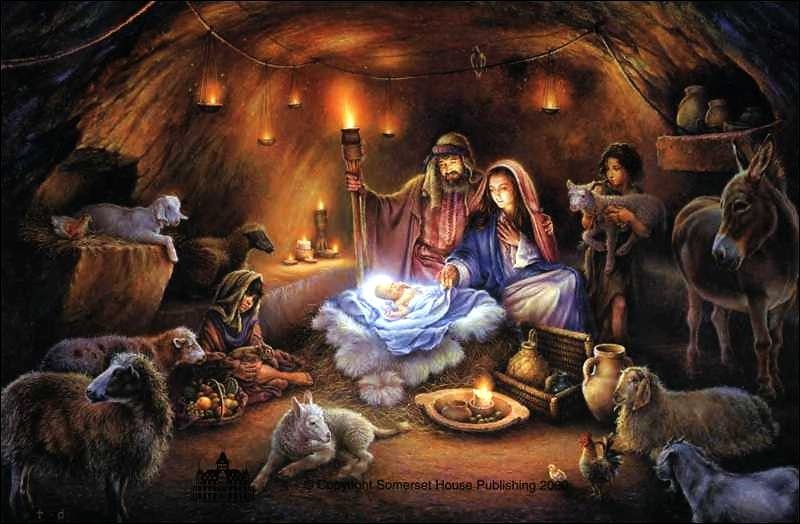
This little baby presents each one of us with a difficult choice. Even Mary, his mother, was faced with the same choice.

To listen to the sermon, click the play button:


To download, right click on the link (or do whatever you do on a Mac) and save it to your computer: Download Christmas 2013


Christmas Eve 2013

Luke 1:26-38. Mary

Tonight, I’d like to focus a little on Mary, the mother of Jesus. We think of her as holy and exalted. She carried the divine nature of God, joined to her egg, within her very body. She shared her own blood with Jesus. Think of it – the blood that he shed for the salvation of the world came originally from her. After he was born, she nursed him, feeding him still from her own body. She wiped his bottom when he did what all babies do. And yet, he was ultimately her Lord, her creator, her savior. In some ways, Mary must have had the most unique relationship with Jesus that any human being has ever had.

Even so, I think we can learn from Mary. In many other ways, her experiences were exactly like our own. One of the messages of Christmas, of Jesus coming to earth, is that we are faced with a choice. He isn’t just a sweet little baby. He himself said:

“Do not think that I have come to bring peace to the earth. I have not come to bring peace, but a sword. For I have come to set a man against his father, and a daughter against her mother, and a daughter-in-law against her mother-in-law. And a person’s enemies will be those of his own household. Whoever loves father or mother more than me is not worthy of me, and whoever loves son or daughter more than me is not worthy of me. And whoever does not take his cross and follow me is not worthy of me. Whoever finds his life will lose it, and whoever loses his life for my sake will find it. (Matt 10:34-39, ESV2011)

And yet, we think of Christmas as a time for “peace on earth.” The truth is, Jesus is divisive, because he calls us to respond to him. Even Mary, who, for more than anyone, had a real relationship with a sweet little baby, found that even Jesus as a baby, as an unborn baby, presented her with a difficult choice.

Let’s back up to a young woman entering adulthood. We make much of the fact that Mary was only a teenager, but in her culture, she was considered an adult. She was betrothed to Joseph, a carpenter. In that culture, her betrothal meant several things. First, it meant that the marriage was a done deal. Solemn promises and vows had already been exchanged. The only thing different between betrothal and marriage was that the couple did not yet live together, and had not consummated the marriage. Breaking a betrothal was like getting a divorce.

Generally, the betrothal period lasted about a year. I’m not sure why. It’s likely that it might take that much time for bridegroom to raise the necessary money for the bride-price and for the wedding festivities. It would probably also take several months to spread the word and gather any relatives who lived far away.

Wedding festivities lasted for week. The actual “wedding” began with an extensive parade through the town. The bridegroom paraded to the house of his wife, with friends and family accompanying him and celebrating along the way. It was obviously a very public occasion; in a small town, a wedding would be almost like a holiday.

On this occasion, the bride would be wearing the beautiful clothing that she could possibly obtain. Her hair would be elaborately styled, and all in all, she would feel as beautiful as she ever would in this life. For this one day, all eyes would see her as beautiful.

After meeting at her family’s house, the bride and groom would parade back through the town, again with singing and celebrating, to the home of the groom. Again, they would be surrounded with the joyful faces of friends and families, singing, shouting and joking.

Back at the groom’s home, they would eat one of the most lavish and delicious meals of their lives. A wedding in those difficult times was one of the few places you could count on to eat more than enough of your favorite foods. Guests would look forward to the food alone for months ahead of time. Surrounded by loving family and friends, the bride and groom would be blessed, prayed for and toasted. They wore crowns, and were treated like royalty on this day. After that, after the guests departed, the couple would consummate the marriage, and they would be officially husband and wife.

The angel came to Mary sometime during the year of betrothal. Aside from whatever daily chores she had to do, her life would have been consumed with the details of the coming wedding. In dirt-poor Nazareth, her wedding was one of the only major life-events that Mary had to really look forward to. No one took vacations or pleasure trips, or had the resources for such things. For a young woman like Mary, her wedding was going to be the highlight of her entire life.

Now, enter the angel. He told her that she would become pregnant. It was obvious that he meant right now, not after she was officially married, but now, before she had ever been with a man. We know from Matthew’s account that Joseph found out Mary was pregnant some time before the wedding celebration, so this may have happened fairly early during the year of betrothal.

And just like that, there went the one thing in all her life that Mary had to look forward to. She didn’t know Joseph very well – engaged couples were seldom in love, or even close to each other, before the marriage. The safe assumption was that Joseph would divorce her before the wedding day.

We know that a quiet divorce was, in fact, Joseph’s plan. God intervened and angel appeared to him also. Trusting God, Joseph did not divorce her. Matthew records that he took her as his wife, but that they did not consummate the marriage until after Jesus was born (Matthew 1:24-25). He doesn’t give any great detail about the timeline – in other words we don’t actually when they were married. Luke, with a little more detail, suggests that they were still only engaged when Jesus was born (Luke 2:1-7).

I think it is quite probable that Mary never got her “event-of-a-lifetime” wedding. In fact, I doubt they had any wedding celebration at all. It was highly unlikely that they would do so, because it would only highlight the shameful and disgraceful fact of her pregnancy. If they had the celebration after Jesus was born, it would have been just as bad. Of course, Joseph and Mary knew that there was nothing shameful or wrong going on, but no one else was likely to believe them. If they had a wedding celebration, many guests might have refused to come.

I think this is one reason why both Joseph and Mary went to Bethlehem for the census. It was probably sufficient for Joseph to go alone, but they were probably both eager to get out of Nazareth and the shame and disgrace they were under. There are indications that they lived in Bethlehem for almost two years after Jesus was born. The census certainly did not require them to move there. I think they weren’t excited to get back to Nazareth.

Now, understanding the background, I want to say this a different way. When Mary received Jesus into her body and her life, it meant she lost the one cherished event in her whole life that she was really looking forward to. It meant she was exposing herself to disgrace and ridicule, and accepting a very uncertain future. It wasn’t as easy as saying “I get to be the Messiah’s mother? Cool! Bring it on!” By agreeing, Mary was inviting, divorce (without ever getting the fun of the wedding), ridicule and shame. She was relinquishing her only chance to have just one beautiful shining week in a life that was otherwise filled with crushing poverty.

I’ve thought before, the angel said that Mary had God’s favor. God has a funny way of showing his favor. It probably wasn’t what Mary would have chosen for herself.

With all that in mind, listen to her reply:

And Mary said, “Behold, I am the servant of the Lord; let it be to me according to your word.” (Luke 1:38, ESV2011)

Mary’s sacrifice is something we often overlook in the warm-fuzzies of Christmas. We are happy enough to contemplate the little baby Jesus, all clean and quiet. We could hold that little child and feel all peaceful and happy. Mary did. But she also gave up her own dreams to do so, and received much hardship and disgrace in their place. It really cost her something to receive Jesus.

Are we ready to recognize that receiving Jesus costs us our own agenda, or own control over our lives? Mary took Jesus on God’s terms, not her own. It meant giving up something she really wanted, but she was willing to do so. Are you ready to do the same? Can you receive Jesus on God’s terms, and give up your requirements?

The good news, is that when Mary did that, she found incredible grace and joy. A few months later, talking to her relative, Elizabeth, she said:

And Mary said, “My soul magnifies the Lord, ​and my spirit rejoices in God my Savior,

for he has looked on the humble estate of his servant.

For behold, from now on all generations will call me blessed;

for he who is mighty has done great things for me, and holy is his name. (Luke 1:46-49, ESV2011)

When we give up our agenda, and humbly say, “I’m your servant, Lord. I’ll receive you on your terms,” we may lose some cherished dream, or control over life the way we want it. But in turn, we do receive the Savior, the healer of our souls, the unending source of grace and unquenchable joy. Mary could have had a week of joy during her wedding feast. She gave that up for an eternity of joy in presence of God. Losing her wedding, being subject to disgrace, she actually felt blessed, because what she received was greater than what she gave up.

My prayer for all of us this Christmas is that we make the same choice as Mary, and unconditionally receive into our lives the Savior of the world, the Lord of our lives, Jesus Christ.


The Main Point of The Bible: Jesus

jesus-smiling-bobby-shaw

Jesus is the main point of the entire bible. Reading the bible should help us get to know Jesus better. It should encourage us in our faith in Jesus. Reading the bible should strengthen us spiritually, from the inside out. That is what is for. So read it with that in mind.

To listen to the sermon, click the play button:

To download, right click on the link (or do whatever you do on a Mac) and save it to your computer: Download Understanding the Bible Part 4

Understanding the Bible #4.

Last time, we talked about the documentary history of the New Testament. In other words, we learned that it is, without doubt, the accurately preserved teachings of those who knew Jesus Christ when he walked on the earth.

One question I did not address is about the historical accuracy of the New Testament. I’ll talk about it briefly here, and then we’ll move on.

Last time we learned that no ancient document has been as verifiably well preserved as the New Testament. Since we get a lot of our knowledge about history from ancient documents, that, in and of itself, should give us confidence that the New Testament is historically reliable. If the writings of Tacitus, or Julius Caesar are to be accepted as reliable sources of ancient history, then the New Testament should be accepted in the same way; even more so.

However, many skeptical people, including scholars, insist upon a position of assuming that the New Testament is wrong until proved right. No doubt, this is because they do not want to believe what it says about Jesus. Even so, time and time again, the New Testament has been proven right, while the skeptics have been proved wrong. Let me give you a few instances.

Luke Chapter 2 talks about a census taken by Caesar Augustus. He said that it happened while Quirnius was governor of Syria. This is a historical event. Roman records (not as well preserved as the New Testament) do indicate a census during the time of Emperor Augustus. But there has been no Roman record uncovered that mentions a governor of Syria named Quirinius. Skeptics long held out that this proved that the New Testament is unreliable. First, let’s consider the logic of that claim. Those skeptics did not have actual evidence that contradicted the New Testament. What they had was a lack of evidence to confirm it. Of course, they had an equal lack of evidence to contradict it. However, eventually, some coins were excavated in the ancient Roman province of Syria. In those days, provincial coins were stamped with the name and likeness of the governor who ruled at the time the coin was made. The coins discovered in Syria were from the reign of Caesar Augustus, right at the beginning of the “common era” and they were stamped with the name “Quirinius.” In other words, we now have positive proof that Luke wrote accurately. The skeptics were wrong.

Another place where skeptics held there was a “lack of evidence” was for the existence of a high priest named Caiaphas. Caiaphas was involved in the trial of Jesus. Archaeologists had not found any record of him outside the New Testament. Then, in the mid-1990s, excavations were made to build a water park in Jerusalem. The excavators discovered an ossuary – a “bone box.” It was labeled as holding the bones of Caiaphas, who was identified as a high priest in Jerusalem.

There are many more areas where skeptics never even had a chance. The New Testament names dozens of Roman officials, and makes references to hundreds of little cultural details that have all been affirmed by archaeology and other ancient documents. There can be no question that the New Testament is entirely historically reliable.

Let’s use the rest of our time right now to consider how the New Testament can help us understand and interpret the Old Testament. Last time, we looked at the idea that the New Testament was the unveiling of a mystery that began with the record of the Old Testament. Jesus himself, and his apostles, affirm this. The mystery, the key to the entire Bible, is Jesus himself. Jesus said to the Jews who believed the Old Testament:

The Father who sent Me has Himself testified about Me. You have not heard His voice at any time, and you haven’t seen His form. You don’t have His word living in you, because you don’t believe the One He sent. You pore over the Scriptures because you think you have eternal life in them, yet they testify about Me. (John 5:37-39, HCSB)

Both before and after his resurrection, Jesus pointed out to his disciples how the scriptures (that is, the Old Testament) looked ahead to the Messiah, to Him:

He said to them, “How unwise and slow you are to believe in your hearts all that the prophets have spoken! Didn’t the Messiah have to suffer these things and enter into His glory? ” Then beginning with Moses and all the Prophets, He interpreted for them the things concerning Himself in all the Scriptures. (Luke 24:25-27, HCSB)

Then He told them, “These are My words that I spoke to you while I was still with you — that everything written about Me in the Law of Moses, the Prophets, and the Psalms must be fulfilled.” Then He opened their minds to understand the Scriptures. (Luke 24:44-45, HCSB)

Paul also used the Old Testament to share the good news about Jesus:

For he vigorously refuted the Jews in public, demonstrating through the Scriptures that Jesus is the Messiah. (Acts 18:28, HCSB)

The specifics of how Paul did that are all throughout his letters. That is one reason why it is helpful to understand the New Testament first – it gives us a guide for understanding what came before. The key is Jesus. Therefore, one very helpful trick in reading the Old Testament is to ask this question of every passage: “Where is Jesus in this passage? What part of the message about the Messiah is this? How does it teach me something about Jesus? Does one of the people in this story act in a way that reminds me what Jesus is like? Is it a prophecy about his life on earth, or what he will do at the end of time? What does it tell me about my need for a Messiah?”

Jesus is the main point of the entire bible. Reading the bible should help us get to know Jesus better. It should encourage us in our faith in Jesus. Reading the bible should strengthen us spiritually, from the inside out. That is what is for. So read it with that in mind.

There are also some secondary things. When we put our trust in Jesus, and let him lead our lives, it has enormous implications for everything in life. So the main point of the Bible is Jesus. In addition, there are many “secondary” points that flesh out what trust in Jesus means for us in hundreds of practical, emotional and spiritual ways. So Paul writes:

But as for you, continue in what you have learned and firmly believed. You know those who taught you, and you know that from childhood you have known the sacred Scriptures, which are able to give you wisdom for salvation through faith in Christ Jesus. All Scripture is inspired by God and is profitable for teaching, for rebuking, for correcting, for training in righteousness, so that the man of God may be complete, equipped for every good work. (2Tim 3:14-17, HCSB)

Of course, Paul didn’t know that his own letter to Timothy would be included in the bible. But Christians today believe that the Holy Spirit had Paul write this, and that it is intended for both the Old and New Testaments. Jesus spoke prophetically about this:

“Therefore,” He said to them, “every student of Scripture instructed in the kingdom of heaven is like a landowner who brings out of his storeroom what is new and what is old.” (Matt 13:52, HCSB)

The “old treasure” in the storehouse are the writings of the Law and the Prophets – that, is, the Old Testament. The New Treasure is the mystery, now revealed, of Jesus Christ. Peter wrote about the scripture:

First of all, you should know this: No prophecy of Scripture comes from one’s own interpretation, because no prophecy ever came by the will of man; instead, men spoke from God as they were moved by the Holy Spirit. (2Pet 1:20-21, HCSB)

Christians have believed for almost two-thousand years that this is as true of the New Testament, as well as the Old.

So, all scripture (both Old and New Testaments) is useful for teaching, rebuking, correcting, training in righteousness and equipping. So, first we read in order to get to know Jesus better. And as we do, the Bible teaches, trains, corrects and so on. It gives us instruction.

Paul said it a different way in his letter to the Romans:

For whatever was written in the past was written for our instruction, so that we may have hope through endurance and through the encouragement from the Scriptures. (Rom 15:4, HCSB)

I want to look at two examples today of how all scripture is to help us get to know Jesus, and how it is for our instruction.

First, consider these words from Isaiah:

Yet He Himself bore our sicknesses, and He carried our pains; but we in turn regarded Him stricken, struck down by God, and afflicted. But He was pierced because of our transgressions, crushed because of our iniquities; punishment for our peace was on Him, and we are healed by His wounds. We all went astray like sheep; we all have turned to our own way; and the LORD has punished Him for the iniquity of us all. He was oppressed and afflicted, yet He did not open His mouth. Like a lamb led to the slaughter and like a sheep silent before her shearers, He did not open His mouth. (Isa 53:4-7, HCSB)

…My righteous servant will justify many, and he will carry their iniquities (Isa 53:11)

This was written hundreds of years before Jesus was born. There is not a scholar in the world who disputes that. And yet, it is clearly the message that someone (Isaiah doesn’t know whom) would take the sins of others upon himself, and through his suffering, bring us peace with God. That someone would not object to the suffering imposed upon him, but engage in it willingly.

This passage is in the Old Testament. But clearly, it points to Jesus. It is about Jesus, and what he did for us, though it was written long before he came into the world. So we read the Bible, even the Old Testament, and find Jesus.

Now, let me give you an example of instruction.

Deuteronomy 25:4 says “Do not Muzzle an ox while it treads out grain.” Now, not too many people who read these sermon notes own oxen. I bet none of you even own a muzzle for an ox. So what is the point of this verse for you today? Remember, it was written for your instruction. All scripture is given by God and is useful for teaching, training, correcting and encouraging. So we should not read a verse like this and say “Well, I don’t have an ox, so never mind about that one.” Instead, we should read a verse like this and pray something like this: “Holy Spirit, I’m not getting much out of this one. Please show me something about Jesus here. Or give me some instruction or teaching. Speak to me through this verse.” I have added, sometimes, “I dare you,” because, like you, I find many bible passages hard to understand at first.

In the case of the non-muzzled ox, we have it easy, because the apostle Paul showed us the way.

For it is written in the law of Moses, Do not muzzle an ox while it treads out grain. Is God really concerned with oxen? Or isn’t He really saying it for us? Yes, this is written for us, because he who plows ought to plow in hope, and he who threshes should do so in hope of sharing the crop. If we have sown spiritual things for you, is it too much if we reap material benefits from you? If others have this right to receive benefits from you, don’t we even more?

However, we have not made use of this right; instead we endure everything so that we will not hinder the gospel of Christ. Don’t you know that those who perform the temple services eat the food from the temple, and those who serve at the altar share in the offerings of the altar? In the same way, the Lord has commanded that those who preach the gospel should earn their living by the gospel. (1Cor 9:9-14, HCSB)

It was written originally about oxen. It taught the people of Israel to be kind and even generous with the animals that worked for them. It taught them that the harvest was to be shared – even with the animals. Paul sees an enduring principle here that applies to preachers of the gospel. Paul writes, “Is God really concerned with oxen?” Asking questions is always a good way to begin to understand the underlying principle. I’m sure God is concerned about oxen, but if we treat our oxen well, shouldn’t we also treat people well? If we are generous with the animals who make the physical harvest possible, what should we do with the people who make the spiritual harvest possible? Paul concludes: “Those who preach the gospel should earn their living by the gospel.”

This is not directly about Jesus. But it is instruction for those of us who are trying to follow Jesus. It tells us that we should financially support those who are called to teach the bible. You may not have oxen, but you probably have a pastor, or at least some leader or ministry from where you get spiritual leadership and solid biblical teaching. This passage about oxen doesn’t apply to oxen any more (unless you still own them, and use them to tread out grain). But it still applies to our lives as Jesus-followers. We are still supposed to share generously with those who help us spiritually.

By the way, of course I am one of those that preaches the gospel, and I know this passage applies to me and to my ministry. But I don’t share it here as a covert way of asking for money. I have no problem doing that directly: If the Lord leads you, then give. Use the donate button on the blog site, or send a check the address I used this passage because the New Testament serves it up for us on a platter. It’s a clear example of how we can use even what appear to be silly ancient laws to hear what the Lord wants to teach us.

We will look at some of these principles of bible interpretation later on in the series. For now, we need to know that that the entire bible, even the Old Testament is to help us get to know Jesus better, and to provide us with instruction, training and teaching in how to be his disciples.

The Presence, Power and Purpose of Jesus

3 Ps 1

The church is not a therapy group, or an advice repository. It is a gathering of unique people who experience the Presence, Power and Purpose of the living God as we come together in his name.

To listen to the sermon, click the play button:

To download, right click on the link (or do whatever you do on a Mac) and save it to your computer: Download Experiencing Life Together Part 2

EXPERIENCING LIFE TOGETHER #2

We were almost all set to wrap up the house-church meeting. Our discussion was over, we had spent some time in worship and now we were praying for one another.

“Does anyone else want prayer?”

“I’ll take prayer.” It was a neighbor lady, who came to house church, off and on. She had been raised Roman Catholic, and it was clear that she knew the right answers. But it was also clear that somehow, she had not fully connected with the life that is in Jesus Christ. She shared a few things that she wanted prayer for: her relationship with her boss, a sore back and a few other things. These were mostly shallow issues and it seemed to me that if all her prayers were answered the way she wanted them to be, nothing much would change in her life. But we stepped forward to pray for her anyhow. Tonight, we were anointing the people with oil as we prayed for them. I explained that this practice came from the book of James 5:13-16. I opened my Bible and read from it. Usually, I simply read vs. 14 to show newcomers that were not completely wacky to anoint people with a little olive oil as we pray for them. But for some reason, this time I continued to read all the way to the end of verse 16. And this is what vs. 16 says:

“Therefore, confess your sins to one another, and pray for one another, so that you may be healed. The effective prayer of a righteous man can accomplish much.”

I opened my mouth to begin the prayer. But the woman held up her hand and said “wait.”

She continued, “that little verse you read at the end, about confessing your sins to one another? I need to confess something. I’m a witch.”

It is my suspicion that in many churches this is not a particularly common scenario. In any case, however, she spoke a little longer, and then we prayed with her and for her, and the next day she took all of her witching paraphernalia and burned it. Shortly after that she turned her life over to Jesus Christ as her Lord and savior.

In our experiences of networked-house-church, we could tell many such stories — all of them true. But the fact is, these things don’t happen simply because we strictly adhere to some sort of methodology. They happen because house-church ministry is used as a vehicle for the Presence, Power and Purpose of Jesus Christ. Last time, we considered the fact that our basic need is Jesus, not a certain way of doing church or small groups. We believe that house-church ministry lends itself quite well to being used by Jesus. But when we come together, we are not meeting as a therapy group, social club or even a Bible study. Instead, we come together to experience that Presence, Power and Purpose of Jesus Christ. For the sake of brevity, we often call these the three P’s. Whenever we come together, we keep in mind that we are here to facilitate the three P’s. Sometimes, like in the case above, this happens quite dramatically. At other times, we seem to have a “normal” night. We usually employ a house-church agenda, but we always have in mind that the true agenda belongs to the Holy Spirit.

On the night which I described above, we did not set out to find out if there were any witches in our midst and to get them to confess their sins and come to Jesus. We purposed instead to experience the presence, power and purpose of Jesus in our midst. It was the Holy Spirit who prompted me to read a verse that I don’t usually read. It was the Holy Spirit, working on that woman’s heart, who prompted her to confess her involvement in witchcraft. It was the Holy Spirit who directed our response. We had an agenda for that evening, and in fact we followed it for the most part. But when something came up that was not on our agenda (for example a person confessing involvement in witchcraft), we adjusted our agenda to fit what God was doing that night.

Let’s take a brief moment to examine the biblical bases of the three P’s.

1. The presence of Jesus.

I assure you: Whatever you bind on earth is already bound in heaven, and whatever you loose on earth is already loosed in heaven. Again, I assure you: If two of you on earth agree about any matter that you pray for, it will be done for you by My Father in heaven. For where two or three are gathered together in My name, I am there among them.” (Matt 18:18-20, HCSB)

These verses are about exercising the authority of Jesus. It is a promise that when we come together under his authority, for his purposes, his presence is with us. In fact, this verse ties together the three P’s — his power (authority), his and his presence. When we come to house-church meetings, we are not there merely to socialize, nor even simply to study the Bible. We are there to be in the presence of Jesus.

We know that Jesus is always with us. He said he would be, in Matthew 28:20 (more on that in a moment). But this verse tells us, and Christians have always recognized, that Jesus is with us in a special way, when we gather together in his name. The gathering of believers is not just social interaction – it invites Jesus to be with us in a way that he cannot be with us when we are alone. I believe he does this because he wants his people to understand that they need each other. The Holy Spirit expressed His desire for His people to keep meeting together in Hebrews 10:24-25

And let us be concerned about one another in order to promote love and good works, not staying away from our worship meetings, as some habitually do, but encouraging each other, and all the more as you see the day drawing near. (Heb 10:24-25, HCSB)

We need each other, because the Presence of Jesus is expressed differently through each individual.

2. The power of Jesus.

For I didn’t think it was a good idea to know anything among you except Jesus Christ and Him crucified. I came to you in weakness, in fear, and in much trembling. My speech and my proclamation were not with persuasive words of wisdom but with a powerful demonstration by the Spirit, so that your faith might not be based on men’s wisdom but on God’s power. (1Cor 2:2-5, HCSB)

The fact is, if we are going to follow the agenda of the Holy Spirit, we must rely on the power of the Holy Spirit to do so. There is a tendency at times within small groups to try and find a solution within the resources of the group itself. For instance, if somebody is struggling with an emotional issue, other group members may be tempted to offer their advice or to share their past experiences with similar issues. While advice is not always inappropriate, we must make sure that it does not keep us from relying on the power of God. We must always keep in mind that the only resource of lasting value within the house-church group is the power of God. In practical terms this means that prayer is almost always a first response to a need or problem that a shared with the group. This doesn’t mean that the group never offers practical help to its members, however, that practical help should arise from the Lord’s direction as we look to him for his resources. We don’t rely on human wisdom, but rather, the Spirit’s power.

Practically, that means when someone shares a struggle, we should start racking our brains for a solution; nor should we simply pretend we are therapists, and just listen sympathetically. Instead, we should listen carefully, both the person, and the Lord. We should ask the Lord quietly, “What do you want to do here and now? In what way do you want to use me to accomplish your goal?”

3. The purpose of Jesus.

Then Jesus came near and said to them, “All authority has been given to Me in heaven and on earth. Go, therefore, and make disciples of all nations, baptizing them in the name of the Father and of the Son and of the Holy Spirit, teaching them to observe everything I have commanded you. And remember, I am with you always, to the end of the age.” (Matt 28:18-20, HCSB)

When we come together in a house-church group we ought to have one unified purpose: to make disciples of Jesus. Making disciples involves helping those who are already Christians to grow in their faith (becoming better disciples) and also helping to lead others who don’t know Jesus to true saving faith in him. We don’t come to church simply to increase our knowledge or to fulfill a program of the church. We come to be motivated by Jesus’ mission.

It should be obvious as we consider the presence, the power and the purpose of Jesus, that we cannot experience these things without being completely dependent upon God. We cannot make Jesus come to us. We cannot fake his power. And we cannot fulfill his purpose without his presence and his power. In the house-church we do not depend on our own resources, rather we depend fully and completely upon God. God may use other house-church members to minister to you; or he may use you to minister to other house-church members. But in the end it is God who is doing the ministering through us.

HOW DO YOU LIVE BY FAITH?

live by faith

Living by faith means we depend upon God; particularly we depend upon his mercy, forgiveness and underserved kindness to us in every situation and on into eternity. It means we depend on him when things are good, and when they are not good. It means we trust even when we don’t understand.

To listen to the sermon, click the play button:


To download, right click on the link (or do whatever you do on a Mac) and save it to your computer:
Download Galatians Part 7
Galatians #7 . Chapter 2:19-21

For through the law I died to the law, so that I might live to God. I have been crucified with Christ. It is no longer I who live, but Christ who lives in me. And the life I now live in the flesh I live by faith in the Son of God, who loved me and gave himself for me. I do not nullify the grace of God, for if righteousness were through the law, then Christ died for no purpose. (Gal 2:19-21, ESV2011)

Last week in our small-group, someone raised this question about trust: How do we do it? It’s a good question. Paul said in the verses we studied last time, that we are justified by faith. We looked at what that means. Now, in these verses, he says that we “live by faith in the Son of God.” So how do we “do” trust? How do we live by faith?

Paul says here that living in faith/trust starts with dying. He says he died to the law. He was crucified with Christ. I think being crucified with Christ means several things. First, that is how God accomplished our justification. When we trust Jesus, we were punished by Christ’s crucifixion. We deserved to die because we cannot meet the holiness standard* (*see last week’s message). So we did die – through Jesus.

Laws only apply to live people. You can’t serve a prison term if you are dead. You can’t obey traffic laws if you are dead. There is no relationship between the law and dead people. So, because we died in Jesus, we are dead to the law. According to the law, we were punished and killed and buried with Christ. So living in faith means we are done with the law. We are done with thinking we can make ourselves holy. We are done with thinking we can earn something from God.

Therefore, part of living in faith, means recognizing that we can’t do anything. We always want God to do things for us. But dying to the law and living in faith means that we can’t get him to do anything for us. Our own resources are useless. There’s no plan, and no back-up plan. We have to abandon ourselves to Him.

I have met people who seem to turn “live by faith” back into a law. They suggest that the reason you don’t have enough money is because you aren’t claiming it by faith. Others might say that if you are sick, it is because you have not claimed your healing by faith. Their idea is this: you must “speak the word of faith” and believe it with all your might; also, you must avoid speaking or thinking words of doubt.

These people frequently says things like this: “I am not accepting this diagnosis of appendicitis. I am speaking against it in the name of Jesus. I claim his healing, and I am believing on Jesus for it.” Then, if they are healed, they chalk it up to their exertion of faith. If they are not healed, and have to have surgery, they think they somehow failed to have enough faith, or maybe they didn’t speak the right promise.

It sounds exhausting to me. In fact, it sounds a lot like living by law. If this is how to “live by faith” then it is still all up to you. If have the right kind of faith and speak the right words and avoid saying things that express doubt about an outcome, then God has to respond by making everything right for you. But if you fail to do these things, then the bad outcome is your own fault. Brothers and sisters, this is just another version of the law. The good news is, it isn’t up to us. But the scary thing is, it isn’t up to us. We can’t control God either by obeying the law or by “speaking in faith.” Living by faith means we allow him to be in control.

We have to depend on his choice of mercy and grace, even when we don’t understand why he makes certain choices. We have to trust that he truly does love us with an unimaginably great love, that he always has our best in mind. We have to trust those things to be true, even when we don’t understand what we are going through in life. Living by faith means we depend upon God; particularly we depend upon his mercy, forgiveness and underserved kindness to us in every situation and on into eternity. It means we depend on him when things are good, and when they are not good. It means we trust even when we don’t understand.

Now, I realize that some people may read this and say, “but you still aren’t telling me how to do it. What do I do?” I am very cautious about giving specifics, because we could easily turn them back to into laws that we think we have to obey to get right with God. If I give you seven steps to living in faith, will you really live by faith, or will you live by those seven steps?

It’s a little bit like gardening. How do you make flowers or vegetables grow? You don’t. You can prepare the soil. You can water the plants. You can plant seeds in places that get the right amounts of sunlight and soil drainage. But you can’t make them grow. Nobody grows anything. We tend to things that grow. But the growth itself is beyond us. All we can do is try to maximize conditions for growth to take place.

Living by faith is exactly like that. You can take advantage of certain things so that you are in a position to live by faith. But the life – according to Paul – is lived by Jesus, not by you. Jesus has to do it. All we can do is maximize conditions for him to live our lives. This is what he means when he writes: “It is no longer I who live, but Christ who lives in me.”

A friend of mine, and one of my mentors in ministry, wrote this on Facebook this week. It is a specific example of what I am talking about:

“I am experimenting asking Jesus if He wants me to give to those standing at stop signs on street corners. I do not meant to sound spiritual with this. I am seriously asking Jesus what He wants me to do. Sometimes I hear yes, sometimes I hear, you decide, sometimes I hear nothing. The question is not, “What would Jesus do WWJD??” but what does Jesus want me to do? I am learning how to live my life in the kingdom with Jesus as Jesus would live my life if He were who I am.” – Pastor Joe Johnson (emphasis added)

It is no longer Joe who lives, but Jesus who lives in Joe. What Pastor Joe wants, is to let Jesus have the freedom to express himself through Joe’s life. That is what it means to live by faith. It has nothing to do with pleasing God. It has nothing to do with controlling life, or using God to make life work out better. It is about depending on the Lord, so that he can do in you and through what he wants.

So please don’t turn what follows into rules that please God. You can’t please God. Jesus did that for you. You can’t live like Christ. Instead, Jesus Christ uses your life to express his own will and intentions in the world. All we can do is let him – or not.

With all that in mind, here are some things we can do that help us to allow him to live his life more fully through us.

Read the Bible. The bible reveals Jesus to us. If we want to live in dependence on him, it is helpful to know him. Reading the bible doesn’t make you a better person. But it does help you get to know Jesus, and the better you know him, the easier it is to trust him. It isn’t a law or a rule. But it’s hard to trust a stranger. So as you read the bible, Jesus becomes more real, more familiar and trust is easier. The Bible is one of the primary ways, and is certainly the most reliable and important way, that God speaks to you. If you never hear someone talk, it will be hard to get to know him. Reading the bible is like listening to the Lord. Sometimes he says things that we don’t understand, or that seem irrelevant. That is just because we are very young spiritual children. As we grow, we will gradually understand more and more. So regular contact with the bible is for us, what sunshine is for plants. It will cause us to grow. Here are two tips: ask God to reveal himself whenever you read the bible. If you aren’t a big reader, just read a chapter or less at one sitting. Or, get the bible on CD or MP3 and listen to it while you drive. It’s not a law. But it will really help you to live by faith.

Pray conversationally. I have had one long ongoing conversation with God going back to at least 1979. A lot of it is pretty stupid, and from one angle, embarrassing. I remember asking him for things that I am now glad he didn’t give me. I think once I asked him to help me win at marbles. I was playing a kid whose parents were Hindu. I didn’t ask for the kid or his family to become Christians. I just wanted to win his marbles. A lot of my prayers over the years have been like that: childish, selfish and ignorant. A lot of them probably still are. Most of them missed the point. But they had one redeeming quality that overrides all the problems: they were the expression of a life of faith. What I mean is, I was always relating to the Lord. He was always with me. He was there, so I talked to him. I didn’t know Him as well as I do now. I understood Him even less. But I treated him as if he were real and he was with me, and indeed, he was and is. I didn’t have to get it all right. The important thing was, I was constantly living in trust. I wasn’t always living in understanding. I wasn’t always living in external righteousness. But I was living in faith. That’s all he wants. If we live in faith, he can take care of the other stuff. So talk to him. He’s there. Talk to him just like you would any other friend. You can’t get this wrong.

Engage in real relationships with other Christians. Jesus designed the church – the community of those who follow him. He says he is committed to building it. The church is body of Christ, and the Bride of Christ. Jesus says he is with us in a special way when we gather together in his name. So, if you truly want to let Jesus live his life through you, we need to recognize that he really enjoys hanging out with people who are gathered to together to worship him and listen to him. No church is perfect, because we keep getting in the way of Jesus living his life through our lives. But as we truly commit to each other to love each other, in spite of our annoying habits and serious flaws; as we commit to supporting each other as we struggle with life in general and faith in particular, Jesus is with us in a special way. We can learn from each other. Even the flaws and failings of other Christians can be used by Jesus help us to grow. When we stumble the other Jesus-followers around us can help us back to our feet.

By the way, the best place I know of for real, authentic Christian relationships is in small groups of other Christians – fifteen or fewer people gathered together to hang out with Jesus and help each other along.

Music. The first three things to help us live in faith are for everyone. There is no one on earth who would not benefit from all three of those, in terms of getting closer to Jesus. Music isn’t for everyone. It doesn’t do anything for some people. But for a large majority of people, music can help us connect with the life of Jesus in a special way. It doesn’t have to be particularly Christian music either. I know that there is music out there that glorifies violence, or that glorifies and encourages immoral sexuality. Obviously, that kind of thing probably won’t help you to depend upon Jesus in faith. But there are many other songs and musical pieces that can encourage your faith, even if they aren’t explicitly Christian. If you find it helps you feel close to Jesus, make use of it. I suggest that you invite Jesus into your ears as you listen. Say to him, “hey, I love this song. What do you think of it?”

Beauty/Joy. I find my trust in Jesus encouraged by experiences of beauty and joy. I can put myself in a position to experience these things, and thus increase my trust in Jesus. I can’t always have an experience like I want to, but I have discovered certain things that often lift my heart and increase my faith. More often than not, when I am alone at a place of beautiful scenery, I feel closer to Jesus. When I am in the wilderness, I feel it. When I connect with nature through the feel of a fish on the end of my line, I experience a kind of joy and often feel more thankful to Jesus. For some people, they feel it when they exercise. Others get it by building something, or by being with certain people, or by helping folks who need it. Some get it by creating works of art, and others by admiring those works of art. If you start paying attention, you’ll soon learn the kinds of things that are helpful for you.

Christian faith is not a method for getting God to do what you want him to do. It is a life of dependence on Jesus, and learning to let him do what he wants to do through you.

CHRISTMAS 2012


Nativity-Scene


The gift of Christmas is a person. It is not the blessings and things we think we want. It is not “presents” but rather, presence. Like children, we are so easily distracted by the things we want. We don’t dream that we could be satisfied by a relationship with a person. But what the Bible says is the greatest Christmas present of all time, is a person


To listen to the sermon, click the play button:

To download, right click on the link (or do whatever you do on a Mac) and save it to your computer: Download Christmas Eve 2012


CHRISTMAS EVE 2012

Imagine a woman from a poor family who gets married to a wealthy and talented doctor. She loves the status that her marriage brings. She loves the privilege of belonging to exclusive country clubs, and being treated deferentially by restaurant managers at expensive places. She likes being seen at society events. She enjoys driving newer models of luxury cars. Shopping is a joy and a delight, and she loves the fact that she hardly ever has to worry about how much something costs. She is constantly adding shoes to her closet and jewelry to her case.

Now, she isn’t entirely shallow. Coming from poverty, she knows what it is like. So she likes to give money away too, as long as it doesn’t affect her lifestyle too much. She even gets involved in charitable causes, and those charitable organizations are grateful for the social standing and monetary support that she represents.

But none of these things that she spends so much time and energy in, none of what she values so much, is her relationship with her husband. It comes with the husband, but it isn’t him. When they talk, she likes to talk about new purchases or ways to increase their social status and fame. She talks with him about the possibility of joining new clubs, or maybe trading in that two-year old Mercedes for a brand new Lexus.

This woman rarely listens to her husband when he has something say. Occasionally, she is brought up short when he refuses to spend the money for a trip to Vienna or something like that. Usually, that gets her attention, but mostly, she just complains and asks why. Her relationship with her husband is all about what his wealth and status can do for her. It isn’t about living life with her soul mate. It isn’t about loving him for better or worse. When things are “worse,” she wants to know why, and she wants it to change right away. Although she seldom really expresses love for him personally, she’ll probably never leave him, because she thinks he is the best chance she has to get what she wants in life.

If we are honest with ourselves, I think most of us would look down on somebody like this. Such a person, is clearly using her spouse to get what she wants out of life. Her life is not partnered with his. Her goals and desires are her own; he is a part of them only to the extent that he can grant her wishes. She has not taken the time to really know him. She has not learned to appreciate him, admire him and love him at anything more than a superficial level.

Suppose one day, the doctor comes home to his wife and shares his burning desire to be a medical missionary in central Asia. He wants her to be a part of his mission, heart and soul. It means that they will have sell everything they own, and move to a place where no one knows them, or cares who they are. They will be living in conditions akin to poverty. He invites her to join with him in his work, to be his partner and co-laborer. But this is not what she wants. She married him in order to get all of the things that he now wants to leave behind. She files for divorce.

Brothers and sisters, do we treat God this way?

Christmas is a terrific time to evaluate this, because it involves both an eternal relationship, and bunch of blessings. Which do we focus on more? Would Christmas feel just as joyous to you if you received no presents? Would you be equally as excited about simply receiving Jesus and getting closer to him?

Too often, I think I treat God mostly as a source of blessings, rather than the abiding passion of my life. I want his help more than I want him for his own sake. I like what I think he will give me. But do I like him? Author Larry Crabb said this:

“Offer a young child the choice of having Daddy present Christmas morning with no gifts, or having Daddy absent and a stack of gifts pile high beneath the tree, and the child might choose the gifts. Only the mature value the blessing of presence over the blessing of presents.”

Crabb rightly says it is about maturity. As we get older, presents become less important. But unfortunately for many of us, the same isn’t necessarily true about God’s blessings. Imagine you were given a choice: You could have a life where you had the blessings of getting paid to do what you love, and harmonious relationships, and no financial struggle; OR, you could struggle financially and in relationships and in your work, but the presence and love of God would be incredibly real and dominant in your life. The choice is between a better life, or a closer relationship with God. Which would you take? Would you sell all you own and live in a mud hut to be with the one you love? Or would you find that you don’t love him that much?

We all want both, of course. But we can’t have both unless we want God more than his blessings; and for that we have to be willing to do without his blessings. If we insist upon having God’s blessings along with God, then we aren’t willing to have him without them. We would be like the woman in the analogy above. Once her husband stopped providing what she wanted out of life, she left him.

People do this to God all the time. They don’t get the promotion they want. Sometimes it is much more serious than that – maybe their loved one dies of cancer, in spite of all their prayers. So they walk away from God. He didn’t do for them what they wanted him to, and so they abandon him. This is demand that God give us blessings. It is a refusal to follow Him unless he blesses us. What makes a such a person any different from the shallow woman in our analogy?

The gift of Christmas is a person. It is not the blessings and things we think we want. It is not “presents” but rather, presence. Like children, we are so easily distracted by the things we want. We don’t dream that we could be satisfied by a relationship with a person. But what the Bible says is the greatest Christmas present of all time, is a person. Listen to Isaiah:

For a child will be born for us, a son will be given to us, and the government will be on His shoulders. He will be named Wonderful Counselor, Mighty God, Eternal Father, Prince of Peace. (Isa 9:6, HCSB)

Or to John:

And this is the testimony: God has given us eternal life, and this life is in His Son. The one who has the Son has life. The one who doesn’t have the Son of God does not have life. (1John 5:11-12, HCSB)

Or to Jesus himself:

Jesus told him, “I am the way, the truth, and the life. No one comes to the Father except through Me. “If you know Me, you will also know My Father. From now on you do know Him and have seen Him.” (John 14:6-7, HCSB)

The gift is a person. It is a relationship. He came to be the love of your life. It isn’t about how he can improve your life or fulfill your dreams. It is about HIM. Sometimes, he blesses our lives with good things. Sometimes he does not. Often it is hard to tell why he does or does not. But the point is never supposed to be about the blessings or their lack. It is supposed to be about closeness with Jesus.

The truth is that a life of blessings without God as our prime desire, is an empty one. For proof, look in any celebrity-oriented magazine, any day of the year. You’ll see beautiful, incredibly wealthy people, married to other beautiful people, adored by millions, completely free from any financial burdens, who are desperately unhappy. They have access to the best healthcare. Anyone in the world would jump at a chance to have a friendship with them. Their spouses are attractive beyond belief. They have the money to pursue any path they choose. But droves of them are addicted to drugs and alcohol; they have eating disorders; many of them secretly feel they are ugly; they get divorced in record numbers.

There is no meaningful life in blessings alone. Listen carefully. If our relationship with God is mostly about the blessings he can give us in life, then we are still just living for the blessings. God is just a means to get them, just as movie-acting is just means to fame and fortune. We are no different from those celebrities.

So this year, I plead with you to struggle, as I do, to connect with the truth that the only true and lasting blessing, the only one I need, is Jesus himself. Not what he does for me, but him.

Jesus does promise us a life full of blessing, of freedom from worry, pain and fear. But that is not this life. That is the eternal life we will receive if we choose Him, here and now.

My prayer is that you do that.

Imagine an alternative ending to my little parable. Suppose the woman takes a risk. Realizing what a good man her husband is, she changes her mind. Full of fear, she agrees to go to central Asia with him. There, in service and near-poverty, she learns to love her husband more than she ever thought possible. She finds un-dreamed of joy serving with him, even in spite of the rough conditions. Now the blessings she tried so hard to hold on to mean very little to her. Instead what means the most is being with the one she loves.

May this be your story! Merry Christmas!

PREPARE THE WAY–THE WAY TO PREPARE

Mayan-Calendar

This is a good time of year to consider our lives, and where we need to be “raised up” or “leveled out.” Isaiah’s words, spoken 2600 years ago, are far more relevant than the recently expired Mayan calendar.

To listen to the sermon, click the play button:


To download, right click on the link (or do whatever you do on a Mac) and save it to your computer:
Download Sermon for Dec 23, 2012
DECEMBER 23, 2012

“Comfort, comfort My people,” says your God. “Speak tenderly to Jerusalem, and announce to her that her time of forced labor is over, her iniquity has been pardoned, and she has received from the LORD’s hand double for all her sins.” A voice of one crying out: Prepare the way of the LORD in the wilderness; make a straight highway for our God in the desert. Every valley will be lifted up, and every mountain and hill will be leveled; the uneven ground will become smooth and the rough places, a plain. And the glory of the LORD will appear, and all humanity together will see it, for the mouth of the LORD has spoken. (Isa 40:1-5, HCSB)

Well, the Mayans were wrong and the world didn’t end on Friday, which is a pretty big disappointment for those us who go to work and pay taxes. It was also probably surprising and discouraging for the folks who got blind drunk Friday night and woke up alive on Saturday. Now the president and congress still have to save us from the fiscal cliff and everyone is still on the hook for Christmas credit-card bills. In a bible passage that is often read near Christmas time, the prophet Isaiah also made a prophecy about something momentous that was going to happen. He wasn’t a Mayan, by the way, and some of his prophecy has already come true.

I have talked before about how biblical prophecy is multi-layered. It’s like looking at a mountain range on a clear day, from a distance. All of the mountains and ridges look like they are next to each other. However, as you get closer, it becomes obvious that some of the heights are closer to you, while others are actually many miles behind the first line of ridges and peaks. So a prophet speaks what the Lord has shown him. In biblical prophecy, particularly in the Old Testament, you often find prophecies that were fulfilled before Jesus right next to prophecies that Jesus himself fulfilled, and also next to prophecies about the end of the world. From a distance, they were all “sometime in the future.” But some have already come to pass, while others are still some way off. In addition, most biblical prophecy also contains some sort of message that was relevant even before the fulfillment of the prophetically predicted event.

With all that in mind, let’s look at Isaiah 40:1-5. Isaiah prophesied to the nation primarily during the reign of Hezekiah, King of Judah, from about 750 to 690 or so, BC. One of the many things he prophesied, was that the nation of Judah would be conquered by the Babylonians, and that many of the people would be taken away to Babylon as exiles. This was fulfilled in 587 BC, about 200 years after Isaiah’s time. Looking even further ahead, after his prophecies about the future exile, Isaiah goes on to prophesy about the return of the Jews from Babylon. This also happened, starting in the 520s BC. Isaiah 40 is basically the beginning of the section about that future return from future exile. And yet, at the same time, parts of this passage (and others in this section) are about the future coming of Jesus Christ to earth, which he did, as we know, roughly 2000 years ago, or, about 700 years after Isaiah prophesied. And finally, elements of these prophecies also refer to the time when Jesus Christ will come back again, at the end of time.

Whew! If you wonder how one passage can contain all those elements, just don’t forget how those distant mountains look.

The essential message for those in the days of Isaiah, and later for those exiles who returned from Babylon, was this: God is bringing his glory back to his people. Even in the days of Isaiah, the nation of Israel had clearly become a second rate power. The magnificent days of David and Solomon were history. The one nation ruled by King David had long since been split into a Northern Kingdom (called “Israel”) and a southern Kingdom (called “Judah”). These two nations often fought each other. They were dominated by the powers around them – Syria, Assyria and Egypt (and later, Babylon). In fact, while Isaiah was still alive, the Northern Kingdom (Israel) was utterly destroyed by Assyria, and ceased to exist. The glory days were over. But Isaiah 40:5 says

“And the glory of the Lord will be revealed, and all mankind together will see it. For the mouth of the LORD has spoken.”

Something that was lost is going to be restored. Now, “Glory” in the Bible, isn’t just about victory and success and triumph. In fact, the key element to Biblical “glory” is the presence of God. Maybe another way to say Isaiah 40:5 would be this:

“God’s presence will once more be manifest among you. He will be with you in such a way that it is obvious to all people. God has promised it.”

Along with this idea of the return of God’s presence, is the theme of deliverance. When we look at the context of the passage, clearly God is returning, and when he returns, he will bring deliverance. Salvation would be another word for it.

It is significant that the voice calls in the desert, and the rest of the passage refers to making a way in the wilderness. When we consider the context of exile in Babylon, it may help to know that caravans and armies from Babylon to Israel always traveled North, around the desert, west toward the Mediterranean Sea, and then South into Palestine. When Babylon invaded, it did so from the North. And yet God is coming straight across the desert. The idea here is that there is no delay in his coming and that obstacles will be removed. God will come by the direct route. His isn’t bound by the caravans routes and traditional paths of men.

This passage from Isaiah is used in all four gospels. Each of the gospel writers identifies John the Baptist as the one who is calling in the desert, “prepare the way for the Lord…” It is probably no coincidence that John did most of his preaching out in the desert, directly east of most of Israel. John’s ministry took things one step beyond a return from exile. Once again, as a fulfillment of this passage, John was declaring that the presence of God would be manifest among his people. Certainly that promise was fulfilled in the person of Jesus Christ. God was present now in a way that went far beyond what the exiles could imagine.

Each time, along with this promise of God’s manifest presence and his deliverance (in short, his glory), comes an admonition that we should “prepare the way.” I think this bears some looking at, and perhaps has some application for our own lives. One of the primary places where this passage can really be played out, is in the human heart. God will come, someday, in the flesh once more and end this world. But he wants to come to you right now in your heart. And the best way for you to prepare for that “someday” is to let him in your heart today.

First, we need to be clear – we don’t “prepare” in order to get God to come be with us. He has already promised to come. His coming is not dependent on our preparation. He’s said, essentially, “I’m coming, whether you get ready or not – so get ready!” We can prepare by learning his word, by telling others about him, by discovering our gifts and using them for his Kingdom. But even more profound than that, this passage gives us a clue as to how to prepare. Isaiah says: “Make straight in the wilderness a highway for our God.”

What he is getting at is this: we need to give God access. The image here is to let God come straight at your heart. Take out the twists and curves we put in to deceive others, ourselves, and even God. Let him get straight to the heart of the matter. I think the way to do this is to be honest with ourselves and with God about who we really are. Sometimes we might not be completely ready to be honest with other people as well. I’m convinced, however that once we make the way straight for God, once we give him unlimited access, we will experience His grace and love to such a degree that eventually we’ll be able to “be straight” with certain other people as well. Giving God clear access to your heart and life is simply a matter of saying “yes” to him. Doing that is the best way I know to receive him now into your life, and also to be prepared for when he comes back to put an end to this world.

Look at what else this passage has to say. God is coming. Give him access. And, “every valley shall be raised up.” Do you have any “valleys” in your life? Are there “low spots” – places where you are lacking or empty? I guess that’s a stupid question – of course there are. God says this. “I’m coming, give me access. And those low and empty spots, those places of weakness and hurt will be filled in. My presence is coming, and it will fill in all of your failings and inadequacies.”

Now for the final thought, which is perhaps not quite as comfortable: “every mountain and hill made low;

the rough ground shall become level, the rugged places a plain…” Are there any places in your life that “need to be leveled?” Any sins that stick out? Bad habits, pride, ambitions that have nothing to do with God? Get ready, because God’s got a big bulldozer. This isn’t entirely a negative thought. No doctor that I have ever heard of can remove a tumor from his or her own body. Sometimes we badly need and even want someone to bulldoze all the junk out of our lives that we can’t quite seem to handle ourselves.

This idea of the valleys being filled and the hills being leveled is really a sort of promise. The passage tells us to “prepare” by making the way straight. But then, when it talks about the valleys and hills, it says “they shall be…” in other words, it is something God will do for us.

God has promised to bring his manifest presence to his people – that includes us! Let’s give him access, and watch in wonder as he makes us more and more shaped to receive and reflect His glory.

David & Bathsheba

davidandbathsheba

Even in this dark time of selfish passion, betrayal, conspiracy and murder, God shows us that he is never far, that his love is constant and always available.


To listen to the sermon, click the play button:


To download, right click on the link (or do whatever you do on a Mac) and save it to your computer: Download 2 Samuel Part 12


2 Samuel #12 . 2 Samuel Chapter 11

Unfortunately for David, this is the second most well-known incident in his life. Most of us know how he killed the giant when he was a boy. And most of us know how he committed adultery as a middle-aged man. Hopefully we have learned there is so much more to him than those two things, but there is no doubt that 2 Samuel chapter 11 records a very dark time in David’s spiritual life.

Since we’ve been going through the book sequentially, we can set in its context. Chapter 10 records a war started by the Ammonites. For perhaps a year, David’s army fought the Arameans – allies of the Ammonites. After they were defeated, David sent his military commander, Joab, after the Ammonites themselves. Many preachers have made a big deal out of the fact that David didn’t go with the army this time. I’m not sure how important that was. He did not go out with them the year before this either, at least, not at first (2 Samuel 10:7 & 17). David was maybe around fifty years old at this point, and it would be natural for campaigns to start to get physically more demanding for him. Not only that, but as king of a growing nation, he certainly had responsibilities other than war. In any case, when the army went off to war, David stayed in Jerusalem. I think the main reason this is significant is because of what happened to Bathsheba’s husband later.

One evening, walking on the roof of the palace, David observes a beautiful woman bathing in a nearby dwelling.

3 So David sent someone to inquire about her, and he reported, “This is Bathsheba, daughter of Eliam and wife of Uriah the Hittite.”

Bathsheba’s identity is interesting. She was the wife of Uriah the Hittite. Uriah was one of David’s “thirty mighty men,” among the most famous and honorable warriors in Israel, part of the faithful band that fought alongside David and did great deeds. “The thirty” (there were actually 31) are listed in 2 Samuel 23 and again in 1 Chronicles 11. Bathsheba is also the daughter of Eliam. That name appears elsewhere only as another one of the thirty. Not all of them survived as long as David, and it seems that perhaps not all of them had been with David since his days in hiding – some might have become part of “the thirty” later on. So the picture we get is that Bathsheba was the daughter of one of David’s elite warriors, probably one from the very beginning. When she grew up, she married another one of that elite band (who may have been considerably younger than both David and her father). She had might have met David when she was a child, but if so, he probably had not seen her since she grew up and got married. In any case, her family life had probably been bound up with David as long as she could remember.

When David finds out who she is, he sends for her. In his own mind, he may have fooled himself into thinking he only wanted to greet her and remember her father with her – we don’t really know. But when she came to the palace, he slept with her.

It’s hard to know what part Bathsheba played in all this. There are some scholars who believe that this was basically rape. He sent for her, and she came and was forced to do his bidding. Certainly, his proposal would have put her in a very difficult position in those days it was a pretty big deal to defy your king. In addition, given her identity, David would have been the bright star in her sky all of her life – both the life of her father and her husband had been intimately bound to him. So she may have been a little star-struck. And there is no doubt that David was the initiator of the sin. It would not have happened without him pursuing it.

But on the other hand, it’s hard to imagine a woman bathing naked (as she probably was) without checking all angles to make sure no one could see her. So she may have let David see her. In addition, there is no record of her protesting. Knowing David, if Bathsheba had reminded him of the right thing to do, as Abigail once had (1 Samuel 25:26-31), it is likely that David would have repented of his intentions and praised her righteousness, as he did in the case of Abigail (1 Samuel 25:32-34). We also know that none of the Old Testament writers, including the one who wrote 2 Samuel, were shy about calling rape what it was (cf. 2 Samuel 13:14). However, that is not what they called this. My conclusion is that they both sinned deliberately, but that David was the one who really made it happen.

Now David compounded the sexual sin with several others, and I want to talk about those things. But I don’t want to gloss over the first sin here. One of the reasons the church is now on the ropes in our culture, barely able to continue to maintain that homosexual behavior is sinful, is that decades ago, we quit publicly emphasizing that sex was made for marriage, and marriage alone. Adultery is a sin. Sex between umarried people is also a sin, according to the bible. The New Testament calls it “porneia.” Old English translations write is “fornication” and newer ones call it “sexual immorality.” In some ways “sexual immorality” is a better translation, because the word really means “any sexual activity that is not between a man and the woman he is married to.”

So “porneia” includes lust, sex before marriage, adultery, homosexual sex and all shades of those things. Jesus said it was evil in Mark 7:21-23. Some of the other verse that condemn porneia as sinful are: Romans 13:3, 1 Corinthians 6:9-18; Galatians 5:19; Ephesians 5:5 and many more. You have heard it here, if nowhere else: the bible teaches that God created sex, and that it is good. Also, and very important, it was created for marriage, and any kind of sex outside of marriage is sinful. You may disagree with that idea, but that is what the Bible actually says. Sex in marriage is good. Sex outside of marriage, in any form, is sinful. So don’t listen to anyone who says David’s main sin was lying, covering up and then the murder. Those were sins too. But the first sin, just as bad as all the rest, was sex with someone he was not married to.

As I pointed out, David didn’t stop there. After the deed was done, Bathsheba sent him word that she was pregnant. Now it wasn’t just a problem of sinning against God, Bathsheba and her husband. It was a problem of other people finding out about it. I think this attitude is very revealing. It is utterly unlike David for most of his life, but in this case, he is far more concerned about what others think than he is about what God thinks. God already knew about the sin, but David didn’t seem worried until he realized that others would find out.

Now, there was something very serious about others finding out. The penalty for adultery in ancient Israel was supposed to be death. Both David and Bathsheba were supposed to be stoned to death, according to the laws of Moses. (Deuteronomy 22:22). So in David’s mind, their own lives were at stake.

Everything that happened after Bathsheba got pregnant was the result of David trying to handle the situation himself, with his own resources. He tried to correct the situation without admitting his guilt or seeking forgiveness.

So his first attempt is essentially to try and undo what he did. He brings Uriah home to be with his wife, so everyone will think the baby is legitimate. It an almost childish effort to make things right. You can picture David thinking (but not saying) “I slept with your wife. But it should have been you, so now you do it.” But unfortunately for everyone, Uriah had apparently taken vows that were common for elite soldiers in those days. Such warriors sometimes pledged to not sleep with their wives until the war was won, and the whole army was home again. This cut back on desertions (because they’d be breaking a vow if they went home and resumed normal relations with their wives), motivated soldiers to fight, and contributed to a sense of camaraderie. Uriah was a man of great integrity, committed to keeping his vows. David even enticed into getting drunk (thus causing him to sin in that way); but even in his drunken state, he would not go home.

Notice the difference here. Uriah knows that if he goes home and sees his wife, he is very likely to give in to temptation. So he doesn’t even go there. David, on the other hand, in a premeditated act, brought the woman into his home. Temptation is easiest to resist on the very front end. If you take a spoonful of ice-cream, it is much harder to resist having a big bowl. It’s easier to refrain if you don’t even taste it.

So David’s first plan didn’t work. Instead of confessing and repenting, he keeps trying to fix it on his own. No doubt, certain thoughts had probably crossed his mind. If only Uriah were killed in battle, then I could marry Bathsheba and the baby would be legitimate. He is a soldier, after all. These things do happen. From that sort of thinking, it isn’t such a stretch to move to actually giving some orders to make that more likely. It was a cruel irony that David trusted Uriah himself to carry the orders for his own death to Joab, the commander of the army.

It is uncertain how much Joab knew. He knew Uriah had been recalled to Jerusalem. So when he got the orders, he probably assumed that Uriah had displeased David in some way, but that David preferred him to die in battle, rather than to dishonor one of the thirty through public execution. Afterwards, of course, Joab had to have figured out what happened. But in this way David tricked Joab into being an accomplice in murder. Joab did as David asked, and put Uriah in a difficult place in the battle, where he was killed. Unfortunately, Uriah didn’t die alone, but other soldiers died alongside him, unnecessarily.

So David committed adultery, got Uriah to sin by becoming drunk, got Joab to sin as an accomplice to murder, and then got Uriah and several others killed to cover it all up. As the final verse of the chapter says:

However, the LORD considered what David had done to be evil. (2 Samuel 11:27)

So, what does all this mean for us today?

One thing, as I have said, is that it is a reminder of God’s standard for sexual morality. It doesn’t matter what the culture says. Sex was made by God, to be celebrated in marriage between one man and one woman. Anything other than that is sin. Period. That really is what the bible says. If you doubt me, look up the verses I referenced earlier, or email me or comment, and I’ll show you even more. As Christians, we need to hold to that standard. Our failure to do so is part of what is wrong with our culture today.

Something else we might get out of this, is a strategy for dealing with temptation. David first looked. Then he investigated. Then he brought Bathsheba closer, and then he sinned. If, as soon as he saw her, he had turned away, perhaps spent some time with one of his many wives, he probably would not have done all the evil that he did. It is easier to resist temptation at the very beginning. Don’t play with the idea of doing something you know is wrong – it will burn you.

There is another thing I noticed here. It is interesting to realize when this happens. It isn’t when David is afraid for his life. It isn’t when people are betraying him, or when after twenty years, he finds himself back in a cave again. No, David’s failure was during time of prosperity and security. We almost always look on struggle as bad and lack of struggle as good. Don’t get me wrong. I’m the same way. I like it when everything is going my way without a bump in the road. But the truth is, times of prosperity and security can be the most dangerous spiritual times of all. Jospeh Excell, a bible commentator of the nineteenth century, said it like this:

“The likelihood is that the great prosperity that was now flowing in upon David in every direction had had an unfavourable effect upon his soul.”

Sometimes, we think the goal is to get to a place where everything is smooth and there are no struggles. But maybe that’s like thinking how safe we would be if only we could get to the very edge of a cliff and sleep there. Physical prosperity and ease are not always good for the soul.

How about this: where is Jesus in this passage? In some ways, that isn’t quite a fair question, because the story is longer than just chapter 11. The whole passage goes on. But we can see Jesus quite clearly here too. However, this time, it isn’t in David. That’s important. David was not the Messiah. God often used him to show the world what the Messiah was like, but God was not dependent upon David alone. In this passage, he shows us Jesus through the good man, Uriah.

Uriah did not do anything wrong. In fact, it was both David and Bathsheba who wronged Uriah. By the law of Moses, they were supposed to die for the sin they committed against him. But instead, he died for them. He did no wrong, even when he was tempted. He was obedient, and carried the orders for his own execution with him. When ordered by Joab, he went into battle, to his death, in order to save those who had sinned against him.

This is exactly what Jesus did for us. We have sinned against God (Romans 3:23). We deserve death and hell as penalty for our sin (Romans 6:23). Jesus came to earth in obedience to the Father, carrying the orders for his own execution(Philippians 2:8). When he was tempted he did no wrong (Hebrews 4:15). And yet Jesus died instead of us, so that we could live eternally (Romans 3:25; 1 Timothy 2:6; John 3:16).

Jesus is constantly calling to us, reminding us who he is, and how much he cares for us. Even in this awful story of betrayal and murder, Jesus is calling to us, saying “See how I love you! See what I was willing to do for you, even in face of the worst evil you could conceive.” No evil can overcome that kind of grace and good. That grace is ours if we simply confess we need it, turn way from our sins, and receive it.

WHAT IF SOMEONE REJECTS GOD’S LOVE?

halfbeard

Last time, we considered the amazing love of God, showered on those who do not deserve or expect it. What if God does that and someone rejects it? This incident from David’s life sheds light on that issue.

To listen to the sermon, click the play button:

To download, right click on the link (or do whatever you do on a Mac) and save it to your computer: Download 2 Samuel Part 11

2 Samuel #11 . 2 Samuel Chapter 10

I want to begin this time with a little bit of my own personal interaction with this text. Last time I made the point that the whole Old Testament points to Jesus, and everything in it is helpful for us who trust in him. In all honesty, I was regretting that statement this week as I looked at 2 Samuel chapter 10. I felt like I had painted myself into a corner, because I didn’t want to preach on this text. The reason I didn’t want to preach on it is because I was having a hard time seeing what value there is in these verses. I started to wonder: are there any texts that were really more for the people back in ancient Israel, or even Jesus’ time, and now, these days, we don’t need them anymore?

I don’t know about absolutely needing these texts, but the Lord immediately brought several New Testament verses to my mind:

27 And beginning with Moses and all the Prophets, [Jesus] interpreted to them in all the Scriptures the things concerning himself. (Luke 24:27, ESV2011)

14 But as for you, continue in what you have learned and firmly believed. You know those who taught you, 15 and you know that from childhood you have known the sacred Scriptures, which are able to give you wisdom for salvation through faith in Christ Jesus. 16 All Scripture is inspired by God and is profitable for teaching, for rebuking, for correcting, for training in righteousness, 17 so that the man of God may be complete, equipped for every good work. (2Tim 3:14-17, HCSB)

4 For whatever was written in the past was written for our instruction, so that we may have hope through endurance and through the encouragement from the Scriptures. (Rom 15:4, HCSB)

12 For the word of God is living and effective and sharper than any double-edged sword, penetrating as far as the separation of soul and spirit, joints and marrow. It is able to judge the ideas and thoughts of the heart. (Heb 4:12, HCSB)

I have underlined several words here that show that these things refer to all scripture. Hebrews says the scripture is living and active – meaning, among other things, that it continues to be relevant for every generation. So I couldn’t just say “there is no point in studying 2 Samuel Chapter 10.” There is a clear principle taught in the New Testament that it is all worth studying and knowing, and it can all be used to teach us, correct us and draw us closer to Jesus.

So, trapped by my own words last week, I started asking the Holy Spirit to show me the point of 2 Samuel 10 for us today. I sure didn’t see it at first. But let me share with you what the Lord showed me as he began to open my eyes.

First, this is still all ultimately about Jesus. It should help us get to know him better. Last week, we saw that David revealed the heart of God’s ultimate Messiah, Jesus. The heart of Jesus is to find the lost and broken and show them God’s everlasting and faithful love. David lived that out, and Mephibosheth received that love.

But there is another possible outcome. Jesus wants to show God’s faithful and everlasting love to each person. But what about the person that doesn’t want it, who won’t receive it? That is what 2 Samuel 10 is all about. It is the other side of the same coin, the second part in the same story of God’s love for people.

You’ll notice that 2 Samuel 10 begins with the same basic idea as the last chapter. David, led by the Holy Spirit to show us what Jesus is like, seeks another person whom he can show God’s love and favor to. Many English bibles say that David wanted to show “kindness” to Hanun, the king of the Ammonites. This is the same Hebrew word we talked about last time: chesed. It certainly can mean simply kindness, but it can also mean “the faithful eternal love of God.” In the Psalms chesed is used more than 100 times, and almost always it is translated “faithful love,” “unfailing love” or “enduring love.” So David is still showing us how Jesus reaches out to show his love.

In 2 Samuel 10, the one David is reaching out to is Hanun, son of Nahash, king of the Ammonites. Hanun’s father Nahash was the first enemy that king Saul met in battle. Nahash was a cruel king who besieged the Israelite city of Jabesh-Gilead and tried to humiliate the residents. Saul defeated him. We don’t know what Nahash did for David – it isn’t recorded, so he may not have helped him very much, but obviously, he gave him some support, probably when David was on the run from Saul. Even so, it would be a stretch to suggest that the Ammonites were allies of Israel at any time in recent history. Now David reaches out to the Ammonite Hanun, sending representatives to express his condolences on the death of his father. Just as most kings would have considered Mephibosheth a threat, most would also have considered Hanun an enemy. In addition, the Ammonites were among those Canaanite tribes who worshipped idols and at times led the people of Israel away from the Lord. But David reaches out to Hanun in his grief, seeking to show him the faithful love of God.

However, Hanun responds in a way that is entirely different from Mephibosheth. If you remember from last time, Mephibosheth was overwhelmed with David’s kindness. He came when he was summoned and he gratefully received what David gave, and entered into a lifelong relationship with him, eating at his table every day. Hanun’s response is more like saying: “Up yours! Screw you!” and then spitting in David’s face. The shaving of the beards and the cutting of the clothes of David’s emissaries was a deadly insult.

Now, it is true, Hanun received some bad advice. But even so, he believed his advisors, rather than the emissaries of the kind king, and the responsibility for that belief was all on him. Yes, he had people lying to him. But he also had David’s men telling him the truth, and Hanun made a choice to believe the lies rather than the truth. The consequences were all his own fault.

Now, I don’t know what would have happened if Hanun had repented and sent messengers to David acknowledging his wrong and asking for forgiveness. But Hanun, realizing that he had done wrong, proceeded to do even more wrong. He armed for war, and called on allies to help him. He was proud and stubborn and was willing to make both soldiers and civilians pay for his own mistakes.

The consequences were severe. David sent his army to besiege the capital city. Joab and his brother Abishai commanded the armies, and they defeated the Aramean allies of Hanun, while the army of Hanun fled back inside the walled city. Then the Arameans were upset, and sent another army. David himself took charge of the army of Israel, and the Arameans were defeated a second time. They never again helped the Ammonites.

Ultimately, though it took at least a year, the Ammonites themselves were utterly defeated and their capital city destroyed. Hanun lost his crown, and possibly his head; while his people were made into heavy-laborers for the Israelites (these final events are recorded in 2 Samuel 12).

Hanun demonstrates for us what happens when we reject the faithful love of God that is offered through his chosen messiah, Jesus. Mephibosheth humbly received that love, and it blessed him for his entire life. But Hanun rejected it. It took some time, but ultimately, because he rejected it, he lost everything, and ruined the lives of tens of thousands of others.

We like to talk about the love and mercy and grace of God. I know I do. And it is ours if we will trust the good heart of Jesus. When we receive it, we are brought into a daily relationship with Jesus, just as Mephibosheth had a daily relationship with David.

But the other side of the story is this: it does not go well for those who reject the love of God offered in Jesus Christ. Yes, it’s true, people lied to Hanun about David and his intentions. And the devil will use people to lie to us about Jesus. But ultimately the truth was there for Hanun to choose, if he would just trust David. And the truth about Jesus is there, if we will just trust him. When we refuse to do that, we are inviting destruction upon ourselves. None of our allies or misplaced hopes will be able to save us.

This isn’t just an Old Testament teaching either. The writer of Hebrews says this:

1 Therefore, while the promise to enter His rest remains, let us fear that none of you should miss it. 2 For we also have received the good news just as they did; but the message they heard did not benefit them, since they were not united with those who heard it in faith 3 (for we who have believed enter the rest), in keeping with what He has said: “So I swore in My anger, they will not enter My rest.”

…..5 Again, in that passage He says, They will never enter My rest. 6 Since it remains for some to enter it, and those who formerly received the good news did not enter because of disobedience, 7 again, He specifies a certain day — today — speaking through David after such a long time, as previously stated:

Today, if you hear His voice, do not harden your hearts.

…..10 For the person who has entered His rest has rested from his own works, just as God did from His. 11 Let us then make every effort to enter that rest, so that no one will fall into the same pattern of disobedience. (Hebrews 4:1-8)

This is pretty clear: we need to rest from our own self-life, our own works and ambitions, and rest in God’s great love for us, surrendering to him. If we don’t, we are in a pattern of disobedience and the good news we have heard about Jesus does not help us. Paul writes something similar in 1 Corinthians:

1 Now I want you to know, brothers, that our fathers were all under the cloud, all passed through the sea, 2 and all were baptized into Moses in the cloud and in the sea. 3 They all ate the same spiritual food, 4 and all drank the same spiritual drink. For they drank from a spiritual rock that followed them, and that rock was Christ. 5 But God was not pleased with most of them, for they were struck down in the wilderness.

6 Now these things became examples for us, so that we will not desire evil things as they did.

Isaiah wrote:

In repentance and rest is your salvation. In quietness and trust is your strength. But you would have none of it. (Isaiah 30:15)

Jesus himself mourned because the people of Jerusalem refused to receive him, and he said that as a result they would experience much suffering and sorrow. He also said this:

16 “For God loved the world in this way: He gave His One and Only Son, so that everyone who believes in Him will not perish but have eternal life. 17 For God did not send His Son into the world that He might condemn the world, but that the world might be saved through Him. 18 Anyone who believes in Him is not condemned, but anyone who does not believe is already condemned, because he has not believed in the name of the One and Only Son of God.

We usually only read verse 16. But verse 18 adds that if we reject God’s chosen messiah, we have condemned ourselves. About 75% of all Americans think there is a heaven, and they will go there when they die. 40% of people think it doesn’t even matter how you relate to God, he’ll accept everyone anyway. But the bible is clear: grace and truth and eternal life are offered through Jesus Christ alone. When you reject Jesus, you reject God, and you condemn yourself. John wrote:

11 And this is the testimony: God has given us eternal life, and this life is in His Son. 12 The one who has the Son has life. The one who doesn’t have the Son of God does not have life. 13 I have written these things to you who believe in the name of the Son of God, so that you may know that you have eternal life. (1John 5:11-13, HCSB)

Hanun shows us the route of “not-life.” It is real. Some people do reject Jesus. Believing the lies someone told them is not an excuse for people when they also have the truth in front of them. You have the truth in front of you if you are reading this now.

Jesus Christ does offer forgiveness, second, third and 233rd chances, love, grace and peace. He offers us daily relationship with himself, and joy. But outside of Jesus, none of that is ours. It all comes only in and through Jesus. If we reject Jesus, we reject it all, and none of the other things we rely on will be able to save us. So let’s pay attention to the writer of Hebrews, and today, let us not harden our hearts. Let’s be like Mephibosheth, not Hanun.

KEEPING PROMISES, CONQUERING TERRITORY

davidchariot

God keeps his promises, but not always on our timetable. David illustrates physically in the land of Israel what Jesus wants to do spiritually in our hearts and minds.

2 Samuel #9 . 2 Samuel Chapter 8

To listen to the sermon, click the play button:

To download, right click on the link (or do whatever you do on a Mac) and save it to your computer: Download 2 Samuel Part 9

Chapter eight chronicles many of the conquests of David after he became king. These did not all necessarily take place at one point in his life; rather this is a record of what David did over a lifetime of military leadership.

In verse one, the writer tells us that “Metheg-ammah” is taken from the Philistines. This is an Hebrew expression that gives translators trouble. Some think it refers to the city of Gath. Literally it says that David took “the bridle out of the mother” of the Philistines. It may be a kind of slang meaning he took control (the bridle) of the chief Philistine city (which would be Gath). The main point is clear – the Philistines have lost any kind of control or initiative that they once had against the Israelites, and they are, for all intents and purposes, subdued. The Philistines had been a problem for Israel for several hundred years, now, through David, the Lord ends the problem.

The second verse describes how David defeated the Moabites. This is a bit troubling, because David was quite severe with them, apparently executing two thirds of the men who fought against him. This is made even more perplexing when we remember that David’s great-grandmother was a Moabite, and David had left his elderly parents in the care of the king of Moab when he was running from Saul. Some Jewish scholars believe that the Moabites killed David’s parents. There is no record of them after David left them in Moab. In addition, the Lord told David not to remain there (1 Samuel 22:5). So it is possible that the Moabites planned all along to betray him, and that the Lord told David to leave there to protect him from their betrayal. His parents, however were still there when the Moabites turned on him. This seems plausible to me.

There is more as well. In Numbers chapters 22-25, the Israelites had left Egypt and were wandering in the wilderness. This was more than four hundred years before the time of David. The Israelites camped near the country of Moab, and the Moabites were afraid of them. They didn’t want to fight the Israelites, so the king of Moab hired a prophet of God to curse the Israelites. Only, the prophet was a true prophet, and he couldn’t curse Israel in God’s name. Instead, he blessed them. The Moabites tried to trick the Israelites into becoming one people with them, and worshipping their false gods. But the prophet prophesied about the future of the two nations. He said:

I see him, but not now; I perceive him, but not near. A star will come from Jacob, and a scepter will arise from Israel. He will smash the forehead of Moab and strike down all the Shethites. (Num 24:17, HCSB)

David fulfilled this prophecy in 2 Samuel chapter 8. Now, I don’t think was consciously trying to fulfill the prophecy. I think he was punishing them for killing his parents. But as it happened that also fulfilled the prophecy given more than four hundred years before.

clip_image002In fact, at one level, this whole passage is about the fulfillment of ancient promises and prophecies. Eight hundred years before David, God promised Abraham that his descendants would inherit the land of Canaan. In Genesis 15:18-21, that land was described as extending from the Red Sea in the South to the Euphrates river in the north where it runs southeast through modern-day Syria. Other promises in Deuteronomy 1:7, 11:24 and Joshua 1:4 describe those same borders, and lay out an eastern border that included almost all of modern day Jordan and Syria. However, in all the time that the descendants of Abraham lived in the promised land, they had not possessed nearly that much territory. For four hundred years, they had lived on far less than God had promised. The map at left shows the region. The area outlined in yellow is the area that the Israelites controlled during the time of the Judges and during Saul’s reign.

They were living in far less than God had promised.

However, as a result of the conquest made by David, as described in 2 Samuel chapter 8, the borders of Israel were extended to almost the exact boundaries described in God’s promises to Abraham and to the people through Moses. This next picture shows the approximate area of David’s clip_image004kingdom, outlined in purple. As you can see, Israel now had influence from the Euphrates river to the Red Sea. This is not to say that all of this area was considered “Israelite” however David’s court in Jerusalem controlled and influenced all of it. If you are still having trouble picturing it, look at a world map. This area includes modern Israel, Jordan, Lebanon and most of Syria.

So what does all this mean for us today? I think it always helps to ask, “where is Jesus in this passage?” I see him here in two places: he is fulfilling promises, and defeating enemies. First let’s talk about the promises. On one hand, this seems to show us that God’s promises don’t always get fulfilled in what we consider a timely fashion. It was more than eight hundred years between God’s promise to Abraham about the size of the land, and the complete fulfillment of that promise. That’s a long time, and many generations didn’t live in the full reality of what God had promised. On the other hand, God doesn’t forget his promises, and he does truly bring them to pass. If you wanted to take the time, you could go through the bible, and find dozens of examples of promises that He made and then kept. Many times in the past I have explained where the bible came from, and how it has been verified time and again as a historically valid document. Here, I want to emphasize that it is also a spiritually valid document. We have a historical record of a promise from God and a historical record from a different period showing its fulfillment.

A natural question is “Why did it take so long for God to fulfill this?” The only completely honest answer is “I don’t know.” I do have some thoughts, however. God told Abraham when he made the promise that it wouldn’t happen for at least four-hundred years. He was giving the residents of the land a chance to repent. But when the Israelites came out of Egypt four hundred years later, the Lord told them through Moses to go into the land, drive out the other nations and possess it. They simply didn’t do it. The reason they didn’t do it is because they lacked faith in God’s promise to be with them. In Numbers 13, Moses sent twelve spies into the land prior to invading it. Ten of the spies came back and said it would be impossible to drive out the nations who lived there. But two said it could be done. Their names were Joshua and Caleb. They said:

The land we passed through and explored is an extremely good land. If the LORD is pleased with us, He will bring us into this land, a land flowing with milk and honey, and give it to us. Only don’t rebel against the LORD, and don’t be afraid of the people of the land, for we will devour them. Their protection has been removed from them, and the LORD is with us. Don’t be afraid of them!  (Num 14:7-9, HCSB)

But the people didn’t listen to them. Instead they gave into fear and blaming. The result was forty years more of wandering for that generation, and then four-hundred years more of living in only part of what God promised.

I don’t think the lesson here is “do more.” I think it is “trust more.” As I have said many times, believing comes before doing. If the people were living in trust, they would have done what they were supposed to do. If they had attempted to do it without trust (as indeed they often did in the next four hundred years) their results would also have fallen short. The key is believing what God has promised, and trusting Him. We have seen that the one thing that makes David a hero is that he trusts God. David isn’t perfect. But he lives out of the understanding that his life belongs to God; that through him, God can and should do whatever he wants. So when David came along, the Lord finally had someone he could use, someone who trusted Him enough so that God could fully give everything that was promised.

We can’t always understand why God doesn’t completely fulfill his promises in our own lives. It isn’t always about our faith – sometimes it is about God’s bigger purposes in the world. For many years, David did not live in the fullness of God’s promises to him. That wasn’t his fault – God was arranging other things, because it wasn’t just about David – it was about God’s purposes. So don’t feel badly if you truly trust God, and yet you don’t see the complete reality of his promises in your life. It isn’t just about you. But at least, we can try to eliminate lack of faith as a reason that we don’t experience the fullness of God’s promises to us. David trusted him fully, and eventually, the Lord used that trust in a huge and positive way for both David and the entire people of God.

Now let’s talk about Jesus defeating enemies. is there “unconquered territory” in your life? I mean, are there certain areas of your life that are outside the control of Jesus? Hebrews 2:8 says this:

You put all things under his control.” For when he put all things under his control, he left nothing outside of his control. At present we do not yet see all things under his control, (Heb 2:8, NET)

Like with God’s promises, we often see a partial fulfillment of the Lord ruling in our lives. I’ll be honest and say, usually this is for the same reason – our own lack of trust. But it has the same solution. If we trust Jesus, and let him have us more fully, he will supply the power to defeat the failures, temptations and self-will that we struggle with. Paul writes about the struggle this way:

For though we live as human beings, we do not wage war according to human standards, for the weapons of our warfare are not human weapons, but are made powerful by God for tearing down strongholds. We tear down arguments and every arrogant obstacle that is raised up against the knowledge of God, and we take every thought captive to make it obey Christ. (2Cor 10:3-5, NET)

Like David, we are called to wage war while trusting in God’s promises. But our war isn’t physical – it is the war of a mind, to let the Lord conquer all that he has promised for us. Now I could do an entire sermon series on the battle for the mind – maybe I will soon. But for now, I think we should understand this from our text: the key is to trust our Lord, and to be willing to do whatever that trust leads us to do. Sometimes that means opposing whatever opposes the truth of the Word of God in our thoughts. David illustrates physically in the land of Israel what Jesus wants to do spiritually in our hearts and minds.

WHOSE AGENDA?

before_palm_sunday

Sometimes the big crowd is all excited about Jesus, but for the wrong reasons. We aren’t aware of, or we don’t accept Jesus’ real agenda.

To listen to the sermon, click the play button:


To download, right click on the link (or do whatever you do on a Mac) and save it to your computer:
Download Palm Sunday 2012

Palm Sunday, 2012 (Luke 19:28-44)

Most of us are familiar with the story of Palm Sunday: Jesus sends his disciples to get a mysteriously available young donkey. He gets on the donkey and rides to Jerusalem. As he does so, people start throwing down cloaks and branches to create a kind of “red carpet” as he goes along, and they all start cheering and praising him.

But have you ever wondered, why? What was the point of it all? Why is this story preserved for us in the Bible? First of all, we haven’t named it well. It isn’t “palm” Sunday at all – palm trees don’t even grow near Jerusalem, so the branches they cut were from other kinds of plants. But most importantly – why did Jesus do it? What was it all about?

One startling thought was that maybe Jesus wanted to ride the donkey because he was tired. Jesus and the disciples walked everywhere they went (except when they were in Galilee, where they occasionally rode in boats). Maybe he wanted to sit down and experience the entry into Jerusalem without thinking how much his feet hurt. This isn’t as flippant as it sounds. Jesus was God in human flesh, true. But he did have a human body too – just like yours and mine until his resurrection. Sometimes we forget that, but I guarantee you, he didn’t.

I think it goes beyond that, however. Jesus must have been familiar with the prophecy of Zechariah 9:9 which says:

Rejoice greatly, O Daughter of Zion! Shout, Daughter of Jerusalem! See, your king comes to you,

righteous and having salvation, gentle and riding on a donkey, on a colt, the foal of a donkey.

I don’t know if he was going out of his way to fulfill this prophecy or not. He certainly had no control over whether the crowd shouted, or what they said. But in any case, this procession into Jerusalem fulfilled a prediction about the messiah.

The symbolism of the donkey is somewhat important too. In that culture, when a leader entered a city as a conqueror or military hero, he rode a horse or in a chariot. When a leader came on a donkey it was an indication of peace and mercy for the people. Riding a donkey conveyed a promise of graciousness and mercy from a ruler. It was not a challenge or a military assertion.

So, he was tired. He was fulfilling prophecy. He was also conveying his intention to offer people grace and mercy. But I think there is also one more thing going on here. If you are familiar with other parts of Matthew, Mark, Luke and John, you may remember that often times, when Jesus did miracles, he told people to keep it quiet (for example, the leper in Mark 1:44). He was reluctant to turn water into wine (John 3). When Peter said that Jesus was the messiah, the Son of God, Jesus told them all not to tell anyone else (Matt 16:20). When he fed the 5,000, the people wanted to make him king, but he slipped away. He always seems so modest and humble, like he wants to keep his power and his identity a secret. But now suddenly, he is perfectly willing to be the cause of a big uproar at the beginning of the most crowed week of the year in Jerusalem, the capital of the region. It seems almost out of character. He spends three years, mostly away from Jerusalem, almost like he is hiding, and now in one day he blows his cover.

I believe Jesus allowed the crowd to go wild, in order to create the pressure on the Jewish leaders that would ultimately lead to his crucifixion. What I mean is this: Before, the time was not right. He was still training his disciples, and it wasn’t yet time for him to die. But now, this week, this “palm” Sunday, he is coming to Jerusalem in order to die. In fact, his mission on earth would fail if he does not die. So he allows the Jewish and Roman leaders to be confronted with who he really is – knowing full well that they will do what they can to eliminate him as a threat to their power. In other words, by riding in a royal procession, surrounded by a cheering crowd, he is deliberately provoking the leadership of Jerusalem into having him executed.

Luke gives us a few verses that shed a little bit of light on Jesus’ attitude toward this triumphant procession.

39 Some of the Pharisees in the crowd said to Jesus, “Teacher, rebuke your disciples!”

40 “I tell you,” he replied, “if they keep quiet, the stones will cry out.”

41 As he approached Jerusalem and saw the city, he wept over it 42 and said, “If you, even you, had only known on this day what would bring you peace—but now it is hidden from your eyes. 43 The days will come upon you when your enemies will build an embankment against you and encircle you and hem you in on every side. 44 They will dash you to the ground, you and the children within your walls. They will not leave one stone on another, because you did not recognize the time of God’s coming to you.” (Luke 19:39-44)

I think we can learn two things about Jesus’ attitude from this. First, he fully accepts that it is good and right for the people to praise him the way they were doing. You see if Jesus really was God (as Christians believe he was and is) then it was not wrong or blasphemous for people to praise him and worship him. He didn’t stop them. He never stopped anyone from worshiping him before either, but on previous occasions he tried to keep his identity quiet. So at this time, he feels that the cheering crowd is entirely appropriate. In fact, he implies that as Lord of creation, even the rocks owe him their worship.

Second, even while the crowd is doing the right thing (praising Jesus), Jesus can see that they are doing it for the wrong reasons. What he says indicates that they do not understand what is going on, or what he is all about. He says Jerusalem will be destroyed “because you did not recognize the time of God’s coming to you.” So even though they are praising him and that is good and proper, they do not understand his mission, or why he is there, or what it means. And they don’t accept it.

So at the one level, his triumphant entry is good and right – he is the messiah, after all, God in human flesh – and he deserves the adulation of the crowd. But at another level, the cheering crowd really doesn’t connect with why Jesus is there. They don’t accept that he has come to defeat sin and the devil – they are more concerned about food in their bellies and freedom from Rome. They want victory and excitement, but they know nothing about the coming crucifixion, and would be repulsed by it if they had known it. They certainly didn’t hang around the cross when Friday came.

What does all this mean for us, two-thousand years later? Well, maybe we just need to be reminded that Jesus experienced the same things we experience as human beings. It might be a comfort to know that he got tired and had sore feet sometimes. Or perhaps you needed to hear how Jesus fulfilled a four-hundred year old prophecy when he rode down the path on that donkey with people shouting and singing all around him.

For me, one of the big applications is how the crowd was doing the right thing, praising God for Jesus, and yet they totally missed the priorities and goals that Jesus had. By coming on a donkey, he was implying that he came in peace – but they ignored that, and still wanted him to militarily overthrow the Romans. Even more telling, they were caught up in excitement and busyness and noise, and because of that, they missed out on how God was really working. The whole, time, what Jesus was really doing was coming to die. They missed that in all the activity.

I think we can miss the point of Jesus sometimes also. Jesus does want to fulfill us, because he made us to be vessels of his grace and glory, and when are fulfilled in him, it brings glory to him. And maybe we get excited and praise God for the things he can do for us, to make our lives more comfortable right now. But he also wants to crucify our flesh. We often forget that. The real reason to praise God is because he has delivered us from ourselves, from sin, our fallen flesh and the devil. And sometimes, he is riding in to town so that the parts of us that are still in rebellion to God can be crucified. Let’s not miss that point, like most of the crowd did that day. We need to be in tune with His mission, not our own goals or comforts.

There’s another temptation for churches and Christians in America today. If we can create lots of busyness and excitement and action, it appears that we are really participating in the kingdom of God. But I think when we gravitate to action and excitement, for the sake of those things in themselves, we often miss out on what God is really doing. I think sometimes he works more through the quiet, unrecognized ways than through the really splashy programs. He’s often at work when a few friends get together for breakfast or coffee to pray and read the Bible. He’s at work when we talk to our kids, and the friends of our kids, about Jesus. He’s at work when take time to make a phone call and see how we can encourage someone else in faith, or when we spend a minute or two praying for someone else. He works in our small groups.

So, it’s good and right to praise Jesus. It’s even better to praise him for the right reasons, and accept that his mission is far greater than our temporary comfort on earth. I’m not saying he won’t do anything for you in the here and now. But when Good Friday and the cross came, this crowd didn’t understand, and for the most part, gave up their hope in Jesus. But for Jesus, the cross was the whole point of the thing in the first place. So let’s remember that, and praise God while accepting His mission in our life is to crucify our flesh, use us to glorify Himself and bring us to eternal, joyful life in the coming new creation.