SERENITY PRAYER #4: WISDOM

Photo by cottonbro studio on Pexels.com

To listen to the sermon, click the play button:

For some people, the player above may not work. If that happens to you, use the link below to either download, or open a player in a new page to listen.

To download, right click on the link (or do whatever you do on a Mac) and save it to your computer: Download Serenity Prayer Part 4

James 3:13-18

            Brothers and sisters in Christ, welcome back for another look at the Serenity Prayer and how God can use it in our lives as part of His work in transforming us into the image of Christ. Two weeks ago, we talked about serenity – the ability to accept with peace and confidence the reality that life is sometimes difficult and painful. Last week, we talked about courage and the need at times to take action in response to those circumstances. This pretty naturally leads to the question, “How do I know when to serenely accept something and when to courageously take action to change it?” And this week, we will look at at least a partial answer to that question. We are going to talk about asking God for the wisdom to know the difference.

            What does it mean to have wisdom? We will look to the Biblical text in just a minute, but before we do that I want to distinguish between wisdom and knowledge. Knowledge is information, facts, data. These days, you can learn in five minutes on your phone what would once have taken hours at the library to look up. Is that good or bad? Probably some of both. But my point here is that some knowledge is pretty easy to obtain. How much did it rain in London yesterday? Who holds the world record for the 100m dash? When was Louis the 14th King of France? How can I get to this address? But having information and knowing how to use that information – those are two different things. Wisdom is more concerned with the second.

            For instance, knowledge can tell you where you can purchase a certain piece of equipment for your home or business, how much it will cost, even how long the warranty will last. But it takes wisdom to know if now is the right time to make that purchase. And particularly when it comes to human relationships, knowledge may be important, but wisdom is far more helpful in navigating those relationships. So, one way to look at wisdom is by saying, “How do I use the information and tools that I have?” And as Christians, we are asking, “God, how do You want me to use the information and tools that You have given me in order to bring You glory?” This includes the tools of serenity and courage – things that He has been giving us in response to our prayers.

Wisdom is something that appears to be pretty high on God’s radar for us. The Bible is full of references to wisdom and descriptions of wisdom, including entire books of the Old Testament like Job, Proverbs and Ecclesiastes. Several of the psalms also connect with that theme of wisdom. But I want to start with a New Testament reference to wisdom. The book of James, traditionally assigned to James the brother of Jesus, is clearly influenced by his knowledge of the Jewish wisdom tradition. As with most of the New Testament, the Jewish background that prepared the way for the Messiah takes on new depths once Jesus has come and paved the way for the indwelling of the Holy Spirit. So, while the language that James uses would have been very familiar to his readers, who were primarily early Jewish Christians, he is adding depth to their understanding now that the Messiah has been revealed. In some ways, this is similar to what Jesus was doing with the law when He preached the Sermon on the Mount – building on a foundation that God has laid in Israel and taking it farther than Israel had dreamed it could go.

            Let’s look at one of the passages in James that describes wisdom. We’re going to read from James 3:13-18.

“13 Who is wise and understanding among you? Let them show it by their good life, by deeds done in the humility that comes from wisdom. 14 But if you harbor bitter envy and selfish ambition in your hearts, do not boast about it or deny the truth. 15 Such “wisdom” does not come down from heaven but is earthly, unspiritual, demonic. 16 For where you have envy and selfish ambition, there you find disorder and every evil practice. 17 But the wisdom that comes from heaven is first of all pure; then peace-loving, considerate, submissive, full of mercy and good fruit, impartial and sincere. 18 Peacemakers who sow in peace reap a harvest of righteousness.”

            There’s a lot packed into these six verses. If God gives us wisdom, what is it going to look like? One of the first attributes James mentions is humility. There’s one place where the difference between knowledge and wisdom comes sharply into focus. I love the way C.S. Lewis describes humility in Mere Christianity at the end of the chapter The Great Sin, which is about pride:

Do not imagine that if you meet a really humble man he will be what most people call ‘humble’ nowadays: he will not be a sort of greasy, smarmy person, who is always telling you that, of course, he is nobody. Probably all you will think about him is that he seemed a cheerful, intelligent chap who took a real interest in what you said to him. If you do dislike him it will be because you feel a little envious of anyone who seems to enjoy life so easily. He will not be thinking about humility: he will not be thinking about himself at all.

If anyone would like to acquire humility, I can, I think, tell him the first step. The first step is to realize that one is proud. And a biggish step, too. At least, nothing whatever can be done before it. If you think you are not conceited, it means you are very conceited indeed.

Honestly, I’m tired of hearing Christians – myself included – go on and one about how smart we are, how we have the right answers to everything, and how everyone ought to just stop and listen to us. We may have the right knowledge – but in that case we are still lacking in wisdom. And that can be hard when I do, in fact, have some right answers. But James is right to point us to humility as a key component of wisdom. If my response to a situation is built on how good it is going to make me look, or boosting my ego, that solution is not based in wisdom (at least, not in Godly wisdom). One of the most brilliant Bible professors I ever knew, a man who was fluent in multiple ancient languages, the contexts in which the passages were written, and the history of their interpretation, would often begin his answers to a difficult theological question by saying, “I might be wrong, but it seems to me…” His humility was profound.

            James goes on to talk about the dangers of envy and selfish ambition. Paul says almost the same thing in Philippians 2:3. He is calling the church in Philippi to imitate Christ in unity, and he also makes the connection between humility and selfish ambition:

Do nothing out of selfish ambition or vain conceit. Rather, in humility value others above yourselves.”

Am I seeking to get my own way in a situation? Am I trying to make sure I come out ok? Then I am probably not operating in wisdom. James associates that kind of wisdom with disorder, wickedness, and even the demonic. So, what is Godly wisdom like? We’ve already talked about humility, and the important role that it plays. Let’s look at a few more of the characteristics James mentions

            Full of mercy and good fruit. Mercy is so central to God’s character. And wisdom will often call on us to show mercy to others rather than demand what we may deserve in a situation. Our responses are to be full of the attitude that God has toward us – rich in mercy, slow to anger, and desiring repentance where there has been wrong. Wisdom, like love in 1 Corinthians 13, is not self-seeking and does not keep a record of wrongs. And I think James is intentionally connecting this to good fruit. Merciful actions toward others will often result in good fruit – and especially when we are engaging other believers. Of course, sometimes we don’t see that fruit until years later, if ever. But wise choices on our part should be ones that open doors to good outcomes in the lives of the people we are engaging.

            Impartial. Wisdom doesn’t play favorites. If we use the information or influence we have to steer the outcome of a situation toward what we want (instead of seeking what God wants), we are operating in that realm of competition to get what I want – we are engaging like the world does. James goes on in the next verses (which start chapter 4) to talk about how the world fights for what it wants, but that is not God’s way for us. And it can be so easy for me to convince myself that what I want is really what is best anyway. That’s why I need God’s wisdom – and in just a few minutes we will talk about some ways to help us sort through our own agendas, needs, and preferences to hear the wisdom of God more clearly.

            Sincere. Wisdom is honest in its dealings with others. Wisdom does not play the game of pretending to believe one thing so that we can manipulate a situation to get what we want out of it. God’s wisdom doesn’t need to be sneaky and deceptive in its dealings. When we are behaving wisely, we mean what we say, and we follow through on it as best we can. No promising one thing while intending to deliver another.

            And finally, peace. Wisdom leads to peace. Now, what is James, as a Godly Jew, thinking of when he uses his word for peace? The Hebrew word for peace is “shalom.” We often use “peace” to describe a situation where there is an absence of conflict. We sent the kids to their separate rooms so that we could have a little peace. But shalom is deeper. Shalom is not just an absence of conflict – getting everyone to put down their weapons. Shalom describes a situation where the conflict has gone away because the causes of the conflict have been appropriately and healthily dealt with. In other words, the peace that is a part of Godly wisdom is not just accepting whatever happens, no matter if it is right or wrong (that is not the serenity that we have been asking God to give us). But this peace is the peace that comes when things are well-settled. And that may actually require some healthy conflict in order to get to a place of real peace. Wisdom will move in the direction of peace – eventually. But wisdom does not always mean just doing what it takes to “keep the peace.” With God, things often are more difficult in the short-term, but He is looking toward a very long end – eternal even – and He is willing to have conflict now to bring true and lasting peace.

            My wife and I have had our struggles over the years with doing this well. I’ll give you one example that may seem small, but it points to a bigger problem. When we first started dating, I really wasn’t good at remembering flowers for special occasions. Well, one time I brought her some chrysanthemums. And she was so glad that I bought her some flowers that she made a big deal over them, and I decided that must be her favorite flower. For the next ten years or so, any time I got her flowers, I bought chrysanthemums. It turns out, those weren’t particularly her favorite. But she didn’t want to upset me or discourage my flower-buying, so she didn’t say anything. And I thought all was well until she eventually told me the rest of the story. Now I sometimes buy her chrysanthemums, but I also buy roses, or lilies, or whatever I see that makes me think of her. And in that small area of our lives, we are closer to shalom. But we only got there when she took the risk – found the courage – to bring up an area that could have caused conflict. By the way, there are much more significant examples of conflict in our marriage over the years – I just decided to tell a simple one.

            Okay, there’s several of the attributes of wisdom. But, in addition to praying, what else can we practically do to help us make wise decisions? Here are three things that I have found helpful in making wise decisions.

            First, slow down. Yes, some decisions have to be made in the moment, but even then, there is rarely a time where I am faced with a significant decision, and I can’t take a moment to breathe and ask God for help, rather than simply react. This is especially true for me when I’m feeling strong emotions about whatever is going on where I need wisdom. Alcoholics Anonymous has a great line for me to remember: “We pause when agitated or doubtful and ask for the right thought or action.” If I want wisdom, I generally need to stop, take a breath, remember that God is running the universe, not Wade, and see what He has to say.

            And most of the time, I don’t have to make a decision on the most important things in that moment. I usually have time to stop, to think, to pray. And what has become really important for me is having trusted friends that I can ask for input. When I am facing a difficult decision, it is easy for me to be blind to my pride, selfishness, hidden agendas, and mixed motives. And taking my own advice about what is wise has led me to some of the stupidest decisions of my life. When I talk to my wife, my fellow pastors, my most mature friends, and others, I can gain a perspective on the situation that is not skewed by what I know I want. And I am much more likely to receive the wisdom that God has for me.

             About two years ago, Jayme and I were trying to make a difficult decision about how to handle a situation with our children. We both stopped and prayed. We took time to think about it. And after months of doing that, we were still in different places about what God wanted us to do. So, we came together to Tom and Kari and laid out our perspectives as best we could. Jayme (my wife) and I agreed ahead of time that we would trust Tom and Kari and take their advice. I didn’t like their answer. They agreed more with Jayme. And we have followed their input since then. I still don’t know that I like it – but I agree that it was wise to listen to them. Involving other people takes courage, because I am surrendering my right to be in charge and trusting that God will use His people to help me.

            Here’s a different example, also family-related, where getting input from the Holy Spirit through other believers has led me towards the serenity to accept something I can’t change instead of the courage to change something. I run into this with my kids regularly. They have a problem. I have an answer. And my answer is probably right. But one of the wisest pieces of advice I’ve ever been given – and this applies to more than just my children – is, “Wade, stop answering questions that people aren’t asking you.” Wow! That requires a lot of the humility James talked about. I have to stop thinking of myself as the fount of information and answers and trust that God is at work in the situation, and sometimes the wisest thing for me to do is Shut Up! I don’t like that. And it may not always be the perfect answer – but it is often a good one.

            And that’s suggestion number three. Some of us, including me, can get hyper-focused on making sure we have the wisest answer, and then we get bogged down and don’t do anything because we are not completely sure which way to go. I am convinced that God is more interested in the long process of developing relationship with Him than He is whether we get a specific decision exactly right. So sometimes, we pause, we take input, and then we make the best decision we can, trusting that even if we got it wrong, God is able to work with us and in us and around us to bring things back on course. He certainly did that with the history of Israel. And He has certainly done that with me.

            So, when do we accept a thing we cannot change, and when do we courageously act to bring change? We ask God for wisdom. We look for answers that lead to humility, mercy, and true peace. We take a breath, ask others for help, and take action trusting that God can work in our imperfect decisions.

I’ll close again this week by praying the Serenity Prayer, and if God leads you, please feel free to join me in learning and praying this prayer.

God, grant me the serenity to accept the things I cannot change, the courage to change the things I can, and the wisdom to know the difference.

Living one day at a time, enjoying one moment at a time, accepting hardships as a pathway to peace.

Taking, as Jesus did, this sinful world as it is, not as I would have it to be.

Trusting that He will make all things right if I surrender to His will – that I may be reasonably happy in this life and supremely happy with Him forever.

Well, now we have gotten through the more familiar part of the Serenity Prayer. Next week we will start into the less-known part. May God bless you with serenity, courage, and wisdom until we talk again next week.

1 PETER #32: GOD CARES FOR YOU

Photo by Pixabay on Pexels.com

The key to balancing our understanding of God’s care for us is to remember to humble ourselves before God, recognizing that life is not about you or me. At the same time we are called to trust that he does, in fact, care for us. Humility means we do not demand that God serve us, and especially, we do not insist that he must answer our prayers only in the way we intend. We come to him humbly, in awe and wonder at the fact that he really does care for us, knowing that we do not deserve it, but trusting that he does care all the same. We come to him humbly, agreeing that we do need his help and love and grace. And we come to him in trust, relying on him to care for us, knowing for certain he does, because of Jesus.

To listen to the sermon, click the play button:

For some people, the player above may not work. If that happens to you, use the link below to either download, or open a player in a new page to listen.

To download, right click on the link (or do whatever you do on a Mac) and save it to your computer: Download 1 Peter Part 32

1 Peter #32. 1 Peter 5:6-7

Last time we discussed humility. We noted that there is a connection between humility, and casting your anxieties on God, because in order to give our cares to Him, we must admit that we can’t handle them ourselves. This topic reminds me of the poorly worded church sign that said “Don’t let worry destroy you – our church can help!”

There are two possible errors when we consider the idea that God truly cares for us. The first is to believe that this is the main thing about God. We can begin to believe that God’s main purpose is to care for us; that this is what God is for. We start to think that this is what being a Christian is all about – having a God who will take care of our problems.

Making this error leads to all sorts of problems. The first, and biggest, is that we believe that life is all about us. People think that God is there to serve them, so naturally that means that they, and their needs, desires and problems, are the most important things about faith in God. Now, they probably wouldn’t actually put it that way so bluntly to themselves. But when people make this error, the way they pray, and pursue God, shows that they think God is primarily there to help and serve them (and, to be fair, other believers). This is really where the “prosperity gospel” comes from. One of the big dangers of it is that it is often so close to the truth, yet distorted in significant ways. If the main thing about God is that he exists to care for them, then what they really need is to find a way to get access to God’s caring and blessing. They might do this by reducing how much they sin. After all, (the thinking goes) sin gets in the way of God giving them what they need. Now, reducing sin is a good thing. I’m all for it. But the reason we try to sin less is because God is holy, because some things are right and some are wrong, not because it will help us get more stuff that we want.

People might try to get more of God’s blessing and care through prayer and worship – prayer and worship unlock God’s blessing (so many people would put it). Again, I think prayer and worship are good things. But we should do them because God is God, and deserves our worship, and much more besides. It is true that sometimes we are blessed through prayer and worship. However, doing such things mainly in order to get more blessings is a serious distortion of what the Bible teaches.

People who buy into this error go to church primarily in order to learn how to “release” more of God’s care and blessing into their lives. They give their tithe not because God is God, and owns everything, but rather, they give primarily in order to get greater blessing back.

Many churches and ministries that take this approach are very large and outwardly successful. This is because the whole idea appeals to human selfishness. Instead of dealing with the basic sin of self-centeredness, ministries actually appeal to it in order to get people to do religious things, and to grow the church. It’s easier to grow a ministry if you encourage and manipulate the sinful desires people have, rather than confronting them with the gospel.

When we look at our text today, we can see the main mistake. People who make this error keep “God cares for you,” but they ignore “humble yourself before God.”

The other major problem that comes out of thinking that God is mainly there to take care of us is that when he doesn’t take care of us the way we think he should, our faith is shaken. I have met many, many people who turned away from God, in essence, because they felt like God let them down. He didn’t care for them in the way they wanted to, or in a way that they could understand. It is a fragile and unstable foundation for faith.

I’ll be honest, I do not remotely understand how to reconcile these thoughts: 1) God cares for me. 2) God is all powerful. 3) God has not healed me from my constant, brutal pain. If I thought God’s primary job was taking care of me, I would be tempted to think he’s pretty bad at it, and I might want to abandon my faith. As it is, though I do believe God cares for me, I also believe that his ultimate purposes are bigger than just me, and that, because he is God, I should not expect to understand everything he does, or does not, do. I can trust him beyond what I can understand.

There is another error that people sometimes make about these verses. Some people find it very hard to believe that God actually does care for individuals, families and small groups. They understand that God is God, all right, but they can’t believe he has any true interest in dealing with eight billion separate people, nor yet the time to do it.

This error is also dangerous. It is a rejection of what the Bible actually says. As incredible as it seems, God actually cares what happens in the lives of individual people:

16 But I will call on God,
and the LORD will rescue me.
17 Morning, noon, and night
I cry out in my distress,
and the LORD hears my voice. (Psalms 55:16-17, NLT)
17 As for me, I am poor and needy,
but the Lord takes thought for me.
You are my help and my deliverer;
do not delay, O my God! (Psalms 40:17, ESV)
8 Your Father knows what you need before you ask him. (Matthew 6:8, ESV)
26 Look at the birds of the air: they neither sow nor reap nor gather into barns, and yet your heavenly Father feeds them. Are you not of more value than they? 27 And which of you by being anxious can add a single hour to his span of life? 28 And why are you anxious about clothing? Consider the lilies of the field, how they grow: they neither toil nor spin, 29 yet I tell you, even Solomon in all his glory was not arrayed like one of these. 30 But if God so clothes the grass of the field, which today is alive and tomorrow is thrown into the oven, will he not much more clothe you, O you of little faith? 31 Therefore do not be anxious, saying, ‘What shall we eat?’ or ‘What shall we drink?’ or ‘What shall we wear?’ 32 For the Gentiles seek after all these things, and your heavenly Father knows that you need them all. (Matthew 6:26-32, ESV)

As you might imagine, there are many other such verses. According to the Bible, God really does care for each person in the world. The details of our lives, and our struggles, are important to Him.

 In 2017, we were incredibly blessed to take a one month sabbatical in Europe. My wife Kari was struggling to believe this very thing: how can God really care for each one of the billions of people on earth? How can he even keep track of them all? Traveling often brings this up. When you travel, you realize how many people and places there are in the world. It seems impossible for God to keep track of everyone.

We had two surprising experiences in which God showed us once again that he is God. At one point, we went to Venice, Italy, where we stayed in a Methodist guest house. Breakfast was included with the cost of the stay, and one morning we ate next to a German family. I was excited to practice my German, so I spoke to them. The man asked me where I learned German, and I explained that I grew up in Papua New Guinea (PNG), and many of our friends there, including our neighbors, were Germans. To shorten the story, it turned out that he had worked, in Germany, with one of my former German neighbors for several years! The odds of bumping into someone who knows someone else from PNG are astronomically small anywhere in the world. The odds that it would be someone who knew my actual neighbor are infinitesimally small. You would be a fool to bet any amount of money on such a thing happening by random coincidence.  

Another “coincidence” began about a week later, when we were in southern Italy on a ferry boat. On the boat, we got to talking with a friendly couple from Australia, and we enjoyed our time with one another. We left them once we reached shore, and didn’t see them again. A week after that, we were in the Rome airport, to take our flight back to the U.S.. That particular airport is stunningly gigantic. We went through all sorts of lines, and rushed from one point to another, passing thousands of people, until we came to the international departures checkpoint. There were several hundred people in the line, which snaked back and forth over a huge area. We got settled into the line, and took a moment to catch our breath. We turned around, only to find the Australian couple immediately behind us. I wouldn’t know how to begin to calculate how unlikely this was. If I put this sort of coincidence in one of my books, people would call it bad writing; they would say that as the author, I am clearly manipulating the plot in an unbelievable way. Perhaps that is exactly what it was, with, of course, God being the author of our experiences, manipulating things so that we can catch a glimpse of him.

Speaking of writing, my own experience as an author has helped me to see how God can care for each individual person. Suppose I am writing a scene in which my main character (Jonah Borden) meets another key character in the story, named Peter. Jonah goes on a hike, and coming around a corner, he meets Peter. In the pages of my book, all this happens instantaneously. But in my life, as the author, I can write (speaking as Jonah) “I came to a fork in the trail, and took it. Around the next bend, I met a man.” Then, I can stop, and take two days to think about Peter, and his motivations and needs, and how he came to be there at that particular time, and everything else about Peter’s life, and how his life will affect Jonah’s life, and vice-versa. In the time-frame of the book, it all happens from one moment to the next. But I can step out of the pages of the book, into my own time-location and take all the time I want to work all this out. I am not bound by the time-frame of the people in the story.

If Jonah believed in me as the god of his world, he could pray, “O Author, please let me meet someone in the next five minutes who will help me with my troubles.” I could take as much time as I need to set up an answer for him, even though only five minutes (or less) elapsed for him, in my story. Or, alternatively, I could see that Jonah’s request doesn’t work with the story I am telling, and so I would not have him meet anyone, but that doesn’t mean I don’t care for him. In fact, he is my creation, and I am pretty fond of him, to be honest, but that doesn’t stop me from putting him into a lot of difficult situations.

In the same way, God is not bound by our time frame. He has all the time in the world to hear my prayer, and yours, and the prayers of believers in China, and India, and South America. He has all the time there is to arrange for us to meet someone significant at just the right time and place. He has much more time, in fact, than I do as an author. God is infinite, and we are not, and so he has, literally, more than enough time, and more than enough capacity, to care for not just eight billion people at once, but even trillions and trillions more.

The ultimate demonstration of God’s love for us is the death of Jesus Christ. God did not have to save us. Jesus did not have to die. He chose to die, and he did so because he loves us.

6 When we were utterly helpless, Christ came at just the right time and died for us sinners. 7 Now, most people would not be willing to die for an upright person, though someone might perhaps be willing to die for a person who is especially good. 8 But God showed his great love for us by sending Christ to die for us while we were still sinners. 9 And since we have been made right in God’s sight by the blood of Christ, he will certainly save us from God’s condemnation. 10 For since our friendship with God was restored by the death of his Son while we were still his enemies, we will certainly be saved through the life of his Son. (Romans 5:6-10, NLT)

He has already proven his love for us, and if we ever doubt it, we can remember the cross, the torture and suffering, the incredible spiritual agony that he endured for you and me. Look at the cross, and see how much he cares for us.

We are called not just to know that God cares for us, but to actively cast our cares upon him. Peter obviously means that we should pray about the things that burden us. Paul says something similar:

6 Don’t worry about anything; instead, pray about everything. Tell God what you need, and thank him for all he has done. 7 Then you will experience God’s peace, which exceeds anything we can understand. His peace will guard your hearts and minds as you live in Christ Jesus. (Philippians 4:6-7, NLT)

 Unburden yourself to the Lord. Tell him, in plain language, in your own words, what is troubling you. But there is a second part of casting your cares on the Lord that we often forget. If we cast our cares upon God, that means we have to let go of them. The same word is used in Luke when the disciples threw their cloaks onto the donkey that Jesus rode. They couldn’t throw their cloaks onto the animal, and still wear them, or hold onto them at the same time. To cast your cares on God means to release them into his hands. If you tell God what concerns you, and then you continue to worry and think and imagine about it, you haven’t really cast your cares on him, have you? You’ve just given him a look at your worries, while you still hold them tight. He can’t carry your burden for you if you insist on carrying it yourself.

Now, I do know that this is easier said than done. But the first step toward really giving God your concerns is to recognize that once you have prayed, you must let go of them. I think that sometimes, worrying is our way of trying to control the uncontrollable. We can’t actually stop a loved one from getting into a car accident, but it almost feels like if we worry about it, we have some measure of control. To cast your cares on the Lord, you have to humble yourself to the point where you give up the idea of controlling what happens. You have to trust him.

I have a few practical suggestions about how to actually do that. In the first place, pray to God for the ability to trust him, and the capacity to give up control. Seriously, ask him to help you. As much as you can, give him your willingness to change. I think this is probably the best thing we can do.

Another thing that sometimes helps me is to set a timer for how long I will pray about something that really bothers me. When the timer is done, my time is up. It’s in God’s hands, no take-backs. At other times, I might write down my deep concerns, and, after praying, physically burn them in order to leave them with God. At other times, if I am walking and praying. I might pick up a rock, and use it to represent my anxieties. After praying, I will throw the rock away from me as far as I can.

As I mentioned a while ago, the key to balancing our understanding of God’s care for us is to remember both to humble ourselves before God, and also to trust that he does, in fact, care for us. The humility means we do not demand that God serve us, and especially, we do not insist that he must answer our prayers only in the way we intend. We come to him humbly, in awe and wonder at the fact that he really does care for us, knowing that we do not deserve it, but trusting that he does care all the same. We come to him humbly, agreeing that we do need his help and love and grace. And we come to him in trust, relying on him to care for us, knowing for certain he does, because of Jesus.

1 PETER #31: HUMILITY

The Bible

Jesus explicitly taught his disciples to be humble. Humility is not the same as humiliation. Jesus, being who he was, understood that he was, in fact, the most amazing being in the universe. Yet, he did not insist that others recognize him as such, even though he knew it to be true. The essence of humility is trusting God to make all things right, in his own time.

To listen to the sermon, click the play button:

For some people, the player above may not work. If that happens to you, use the link below to either download, or open a player in a new page to listen.

To download, right click on the link (or do whatever you do on a Mac) and save it to your computer: Download 1 Peter Part 31

Humility is a challenging topic for me to teach about, because it’s so difficult to be humble when you are as amazing as me. (Sorry, I had to do that one – it was so obvious!) Actually, when I think of how bad I am at humility, I am humbled. (OK, I’ll quit now). All right, on a serious note, I do actually struggle with the whole topic of humility, because I struggle with the idea of injustice. It seems wrong to me – unjust – when people are not recognized for their amazing gifts, achievements, or personalities, while other people, less deserving, get credit when they don’t really deserve it. However, Jesus and his apostles are crystal clear about humility: Humility is part of the character of Jesus, and therefore it should be part of the character of every Christian. Paul explains this in many places, but perhaps nowhere better than in his letter to the Philippians:

3 Do nothing from selfish ambition or conceit, but in humility count others more significant than yourselves. 4 Let each of you look not only to his own interests, but also to the interests of others. 5 Have this mind among yourselves, which is yours in Christ Jesus, 6 who, though he was in the form of God, did not count equality with God a thing to be grasped, 7 but emptied himself, by taking the form of a servant, being born in the likeness of men. 8 And being found in human form, he humbled himself by becoming obedient to the point of death, even death on a cross. 9 Therefore God has highly exalted him and bestowed on him the name that is above every name, 10 so that at the name of Jesus every knee should bow, in heaven and on earth and under the earth, 11 and every tongue confess that Jesus Christ is Lord, to the glory of God the Father.

(Philippians 2:3-11, ESV)

Jesus himself explained the importance of humility to his disciples many times:

7 Now he told a parable to those who were invited, when he noticed how they chose the places of honor, saying to them, 8 “When you are invited by someone to a wedding feast, do not sit down in a place of honor, lest someone more distinguished than you be invited by him, 9 and he who invited you both will come and say to you, ‘Give your place to this person,’ and then you will begin with shame to take the lowest place. 10 But when you are invited, go and sit in the lowest place, so that when your host comes he may say to you, ‘Friend, move up higher.’ Then you will be honored in the presence of all who sit at table with you. 11 For everyone who exalts himself will be humbled, and he who humbles himself will be exalted.”

(Luke 14:7-11, ESV)

Jesus’ own life was one huge example of humility. Being God, the Creator and Ruler of the universe, he humbly confined himself to the limits of human flesh. Even when he did that, he did not choose to be born in Rome, or Athens, which were the centers of power and culture in those days. He did not become the son of a king, emperor, or even just a noble family. Instead, he became the son of a poor family. Not only was he not born in a palace, he wasn’t even born in an ordinary house, but rather a stable. He grew up in Nazareth, which was a no-account town in a no-account region in a no-account country. When he spoke, it was with a Galilean accent, which sounded to the people of Jerusalem like a hillbilly/redneck way of talking. He washed the feet of his disciples as if he was a common servant. He was put on trial and mocked by people who should have fallen on their faces to worship him. The wood that was used to crucify him came from a tree that would not have existed if he hadn’t caused it to be. And even today his name is mocked. This is how it is supposed to be, for now, says Jesus:

25 But Jesus called them to him and said, “You know that the rulers of the Gentiles lord it over them, and their great ones exercise authority over them. 26 It shall not be so among you. But whoever would be great among you must be your servant, 27 and whoever would be first among you must be your slave, 28 even as the Son of Man came not to be served but to serve, and to give his life as a ransom for many.”

(Matthew 20:25-28, ESV)

Now, I do think sometimes we misunderstand humility. Perhaps we think it is similar to humiliation. We might imagine that to be humble means to have a low opinion of ourselves, or even hate ourselves. But if we look at Jesus as the greatest example of humility, I think we can see more clearly.

Jesus did not have a low opinion of himself. He did not think of himself as worthless, useless or pointless. If you took every human being who ever lived, and every great work of art, culture, literature or engineering that was ever made, and threw in all the gold and jewels and real estate in all of the history of the entire world, all of it together is not as valuable as the life of Jesus. And if Jesus is who the Bible says he is, he must have known that. He knew that he was the most amazing human being to ever walk on the surface of this planet. He knew that the entire planet was not equal in worth to a single drop of his own blood.

So Biblical humility does not mean self-hatred. It does not mean you pretend you are worthless when you know you are not. But Jesus, being who he was, knowing who he was, did not insist that everyone else acknowledge that. He had self-respect, but he did not demand that others treat him with the respect he deserved. In the verses from Matthew chapter 20 (above) he says: “I didn’t come to be served, but to serve, and to give my life as a ransom for many.”

When we are humble, we do not insist upon our own way, even when we could rightfully do so. We do not insist upon getting credit for something, even when we deserve that credit. When we are humble we patiently endure it when others treat us unjustly and unfairly, knowing that one way or another, God will eventually make all things right. We don’t have to defend ourselves, our abilities, our work, or our reputation, because God will do so in his time and in his way.

This leads us to another important aspect of humility. In order to truly be humble, we need to trust God. We need to trust that he will look out for our interests, for our credit, for our good and safety. If we think we are on our own, if it is up to us to look out for ourselves, we cannot be humble, because the world will run over us, and we won’t get what we need and deserve. But if we trust that God will look out for us, we can let go of the need to make sure we get “our rightful share” of everything in life.

On the other hand, in order to trust God, we need to be humble. Humility says, “I need God. I am not enough on my own. I need grace and forgiveness.”

I recently watched a TV show. The story was about a woman named Donna who was married to a violently abusive husband. She had an affair, and got pregnant from the affair. A teenage girl found out, and threatened to tell her husband, so Donna killed the girl. She allowed an innocent man to be convicted of the murder, and that man served twenty-years in prison for Donna’s crime, until she was found out.

When the police finally found out that Donna was the murderer, she blamed everyone but herself. She said it was her abusive husband’s fault. She said it was the girl’s fault for threatening to tell. It was the fault of the man she had an affair with. It was the police’s fault for not making her feel safe from her husband (though she never told anyone, until after he died, that he was abusive).

After serving a few years in prison herself, she developed terminal cancer. The sister of the girl who she murdered came to see Donna, to tell her that she forgave her. Donna’s response was “-—you, and -—forgiveness!” (“—” stands for a swearword). I think this portrays a very real kind of attitude. You see, in order to receive forgiveness, Donna would have to admit that the murder was indeed her fault. She would have to give up defending herself. She would have to put herself in a place of need that she could not fill herself. In short, she would have had to humble herself, and she refused to be humble.

I know that’s only a story, but like all good stories, it connects us to something real about life. Most of us have not committed murder. Even so, we need forgiveness no less than the character of Donna in the story. But in order to be forgiven, we have to admit that we have a need for it, and we cannot meet that need ourselves. Humility means we must depend upon God – we can’t do it alone. We have to rely on him for something – we cannot rely on ourselves alone. We need forgiveness, but we don’t deserve forgiveness, and we are at the mercy of God’s willingness to give it to us. That is a place of humility, and many, many people refuse to be so humble.

We will spend next week on the phrase “casting all your anxieties on him, because he cares for you.” But for now, I want to point out that to cast our anxieties upon God requires humility. We have to admit that we can’t handle it all. We have to give up trying ourselves to make life work, and trust God. That requires humility.

Peter urges us to be humble not only toward God, but also toward one another. A few weeks ago in one of our local house churches, someone shared some very personal struggles they were having. This person was allowing us to see that they didn’t have it all together, admitting that they had needs that they themselves could not fill. I was struck by two things. First, it required real humility to be so open and vulnerable with us. That person’s open sharing was a demonstration of humility in action. They were willing for us to see their personal struggles, willing to show that they did not have life all working well. Second, it struck me that this kind of humility requires great courage and strength. We tend to think of people who keep it all in as “strong, silent types.” But I realized, while the person was sharing, that I was seeing incredible bravery and incredible inner strength on display. I think it takes much more courage and inner fortitude to be openly humble like that than it does to keep silent.

So humility can be difficult. It requires vulnerability and trust. But Peter tells us that we will not have to humble ourselves forever. Right now, it is the attitude we should have. But what Jesus and his disciples taught, and what the Old Testament teaches also, is that when we humble ourselves, we are trusting ourselves into God’s hands. If we will trust him by being humble, he will make sure that in his own time, we are lifted up. That of course, is what Peter says in the text today: humble yourselves, and then God, in his time, will lift you up. That is the implication of what Paul writes in Philippians: Jesus humbled himself, and then God lifted him up and gave him honor, and he will receive even more honor when  he returns. Many Old Testament scriptures teach the same thing:

6 Though the LORD is great, he cares for the humble,
but he keeps his distance from the proud. (Psalms 138:6, NLT)
15 For thus says the One who is high and lifted up,
who inhabits eternity, whose name is Holy:
“I dwell in the high and holy place,
and also with him who is of a contrite and lowly spirit,
to revive the spirit of the lowly,
and to revive the heart of the contrite. (Isaiah 57:15, ESV)
34 He mocks those who mock,
but gives grace to the humble.( Proverbs 3:34, HCSB)

We need to trust that he will indeed “lift us up” when the time comes.

A few thoughts for application: As you have been reading this, is there some way in which the Holy Spirit is prompting you to be humble? Is he asking you to be vulnerable about something with other believers? Is he gently calling you to let go of getting your own way in something? Perhaps he wants you to hold your peace when someone less deserving gets credit for something.

On a different line of thought: how is the Lord calling you to humbly trust him right now? Do you need to let go of pride, or self-sufficiency?

Let the Spirit speak to you today!

HUMBLE…OR INSECURE?

saul-nahash

1 SAMUEL #7. 1 Samuel 10:24 – 11:15

To listen to the sermon, click the play button:

To download, right click on the link (or do whatever you do on a Mac) and save it to your computer: Download 1 Samuel Part 7

I want to reiterate something that happened at the end of chapter 10, and then we’ll move on to chapter 11. Remember, Samuel anointed Saul as king of Israel when it was just the two of them in private. After being anointed king, Saul went home. As he journeyed back, his anointing was confirmed by several signs that Samuel had given him before hand – things Samuel said would happen, which then came true.

Even so, Saul did not tell anyone that Samuel had anointed him king. At first glance this looks like humility, and maybe it was. It looks like he is waiting for God to confirm it before he says anything. And yet – God already did confirm it. Maybe it is something else altogether – insecurity.

After some time, Samuel gathered the people together, and they asked the Lord to choose a king by lots. Saul was chosen. This was another powerful confirmation of Saul’s calling. But Saul hid among the baggage while it was happening. This could be humility also, but again, it could just as well be insecurity. Actually, I think it is a little bit of both. When we read the texts carefully, we can see that Saul is a very complex, very real person. I suspect that he had a lot of insecurity, but that he was also capable of genuine humility.

Briefly, I want to point out that his insecurity seems to be because he has trouble believing what God has said. Through Samuel, God told him he would be king. Through the signs, he confirmed it. Through the choices by lot, God confirmed it again. But I suspect, for the reasons I shared last week, that Saul had never really been a man of faith. He did not know God, and had not ever been very interested in Him. It’s hard to believe what God says if you don’t really know God. It’s hard to trust someone you don’t know. If you go your whole life ignoring God, then it is hard to believe it when someone tells you that God has a purpose for your life.

Listen to what happened next:

25 Then Samuel told the people the rights and duties of the kingship, and he wrote them in a book and laid it up before the LORD. Then Samuel sent all the people away, each one to his home. 26 Saul also went to his home at Gibeah, and with him went men of valor whose hearts God had touched. 27 But some worthless fellows said, “How can this man save us?” And they despised him and brought him no present. But he held his peace.

Just put yourself in Saul’s situation for a minute. You have just made king – twice. It has been confirmed by lot and by prophesied signs that came true. A future with possibilities you never dreamed of is opening up in front of you. Everyone shakes your hand and slaps you on the back, and congratulates you…and then goes home. You look around. It’s time for you to go home also. There’s nothing else to do. I can’t help thinking that this was a major let down for Saul. So he’s king. Now he’s got to go back and plow his fields.

A few warriors felt called to stick with the new king and serve him. The Lord touched them and they believed in him and stuck with him. But there were at least an equal number of people who didn’t believe in him at all, and mocked him and his calling.

I think all of this must have been disappointing, and it would not have helped his struggles in believing God and setting aside his insecurity.

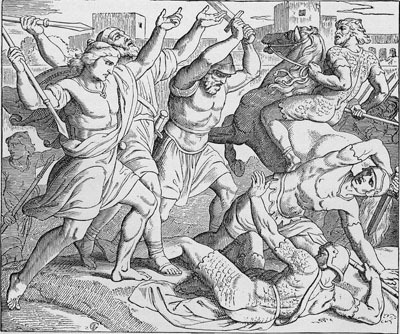
Now, I want to leave Saul for a moment and go back and set the stage for what happened next. I spoke about this a little bit last time, but I want to go into more detail now. Roughly two hundred years earlier the residents of a town called Gibeah, in the tribe of Benjamin, had committed an atrocity. Rather than welcome a traveling priest, they had attempted to abuse and rape him. When they were prevented from this they raped and killed his concubine instead. In those days a concubine was considered a wife.

The priest took the dead body of his wife, and cut it up, and sent the pieces to the twelve tribes of Israel as a graphic way of letting the whole nation know what had taken place in Gibeah. Eleven of the tribes assembled – the tribe of Benjamin did not come, and Gibeah was in their territory. The other tribes demanded that the tribe of Benjamin deliver the residents of Gibeah to the rest of the nation so that justice could be done. Benjamin refused, and fought a war with the other tribes rather than punish the evil-doers. Naturally, there was a great deal of outrage against the tribe of Benjamin. The other Israelites destroyed almost the entire tribe, which numbered about 30,000 adult men, plus women and children – possibly more than 120,000 people altogether. The only survivors were six hundred Benjamite warriors who escaped into the hills. Everyone else – including women and children, had been killed.

In their rage, the other tribes had sworn an oath to not allow their daughters to marry any Benjamite. That meant that within a few years, there would be no more tribe of Benjamin. But after the war, the Israelites began to mourn for the loss of the twelfth tribe. They looked for a way to get them wives without violating their oaths, so that the tribe could be eventually restored. They found that one city in Israel had refused to go to war along with the other people – the city of Jabesh-Gilead, on the other side of the Jordan river Valley. In effect, Jabesh-Gilead had also been defending the evil doers, just passively, by refusing to fight for justice. So the rest of the Israelites took all of the unmarried women in that city, and gave them to the Benjamites to be their wives.

I mentioned some of this last week. I think the Lord’s choice of Saul was in part to remove the shame of the tribe of Benjamin. Not only was Saul from Benjamin, but he was from the town of Gibeah – the very town that had committed such shameful acts. The Lord was saying to them, “You are no longer under a cloud of shame. You are not second-class in my eyes. Your forgiveness is complete.”

But there was another group under a cloud of shame for that incident – the city of Jabesh-Gilead. They too, had defended the evil act of Benjamin, even if only passively. When Saul was made king, the shame of Benjamin and Gibeah was finally removed. But it appeared that Jabesh-Gilead was forgotten by God in all this. Their sin had not been as great, but they had suffered too, and they still lived under a cloud of shame. God is noticing Benjamin and Gibeah, but no one seems to remember poor Jabesh-Gilead.

Now, after Saul was chosen as king, things got even worse for Jabesh-Gilead. The foreign nation of Ammon came up to besiege the city. You can almost see the low self-esteem born of 200 years of shame. They don’t even pretend they will fight. They start negotiating a surrender right away, ready to give up their freedom in order to keep their lives. As often happens when a bully encounters someone with a poor sense of self-worth, the bully senses weakness, and begins to pile it on. Surrender isn’t good enough for the Ammonites. They want to rub the faces of their enemies in it. They demand that all the men have their right eyes gouged out, as one of the conditions of surrender.

The next exchange of messages sounds strange to us who are used to modern warfare. They city of Jabesh- Gilead asks for seven days to see if anyone will help them. The strange thing is that the Ammonites grant them the time. But there are three reasons for this. First, if the Ammonites don’t grant the time they will end up having to fight anyway, when there is still a chance of a bloodless victory. Second, the Ammonites probably felt that the other Israelite tribes were too disorganized to do anything within seven days anyway. Third, both the Ammonites and the people of Jabesh-Gilead seem doubtful that anyone would help them anyway. They are the black sheep of the family. Of any town in Israel, they are the least likely to be helped.

Their messengers go all over Israel. When the messengers get to Gibeah, Saul’s home town, no one thinks to go get the king. In fact, his royal majesty was plowing a field at that moment. He happens to come to town as the people were weeping over the fate of Jabesh-Gilead.

. 6 And the Spirit of God rushed upon Saul when he heard these words, and his anger was greatly kindled. 7 He took a yoke of oxen and cut them in pieces and sent them throughout all the territory of Israel by the hand of messengers, saying, “Whoever does not come out after Saul and Samuel, so shall it be done to his oxen!” Then the dread of the LORD fell upon the people, and they came out as one man.

Many of you don’t know this, but my wife has a bachelor’s degree in Biblical Studies. Years ago she did an exhaustive study on the Holy Spirit. She has pointed out to me many times that when the Holy Spirit comes on people in the Old Testament, it often seems to be almost an external thing, and God seems to use people whether or not they are close to him or in tune with him. For instance, the hero Samson was clearly ignorant of God and lived a sinful life – and yet God used him. After Jesus came, however, the Holy Spirit stopped working in that external way, and now he is connected with all who believe in Jesus through a spirit-to-spirit connection. Now the spirit is within everyone who trusts Jesus, and he flows through us and does his work from the inside out.

Saul is living in those Old Testament times, and in spite of his lack of faith, God used him. The Spirit came on him, and he acted. Even as God is using him, however, you can see his insecurity. First, he calls the people not only in his name, but also the name of Samuel, as if he is afraid they won’t come for the summons of the king alone. Second, he cuts up his oxen and sends out the pieces. Normally a middle-eastern leader in those days would say something like, “so shall I do to you if you do not fulfill your oath of loyalty to me.” But Saul says, “I will do this to your oxen.” It’s almost humorous. He has already destroyed his own oxen, and now he threatens not the people but their cattle.

Even so, God was with him. They assembled for battle and when up and destroyed the Ammonites, saving the city of Jabesh-Gilead. This no-account, shame-filled place suddenly has the tender care and affection of the entire country. Their shame also, has been forgiven and removed.

I have pointed out many of Saul’s faults, but as I said last week, God was not just trying to screw the Israelites for rejecting the Lord as their king. Saul, among all the tribes of Israel, would have been more sensitive to the shame and disgrace of Jabesh-Gilead than anyone else. His own tribe and clan had been under that same cloud until he was chosen as king. I am reminded again of 1 Corinthians, written by another man from the tribe of Benjamin, who was also called Saul:

26 Brothers, consider your calling: Not many are wise from a human perspective, not many powerful, not many of noble birth. 27 Instead, God has chosen what is foolish in the world to shame the wise, and God has chosen what is weak in the world to shame the strong. 28 God has chosen what is insignificant and despised in the world — what is viewed as nothing — to bring to nothing what is viewed as something, 29 so that no one can boast in His presence. (1Cor 1:26-29, HCSB)

Saul was chosen by the Lord. He started out well. God graciously gave him opportunity after opportunity to respond in faith. In this instance, he did.

So what does all this mean for you right now?

Maybe, like Saul, you are facing confusion, hurt and disappointment with God. Perhaps the Lord has given you a calling or done something in your life that seemed momentous. It seemed like it was all heading somewhere. But now everyone is turning out the lights and heading home, and you are left to make your way back to life as usual, and you don’t understand. You wonder what it was all about, if all these ways in which God seemed to be at work amount to nothing. I don’t have every answer for you. But I do know that Saul experienced that. In time, however, God showed him what to do and opened up the opportunity to step fully into his calling. Trust the Lord that he will do that for you also, even if it looks like it is all over right now.

On the other hand, maybe you have been dealing with insecurity, like Saul. The Lord has shown you he is real. He has spoken to your heart, revealed himself through the Bible. But you aren’t sure if you can trust him. Maybe you are afraid to step up to God’s calling. Perhaps that is because you don’t yet know him very well. Here, you can take a different path than Saul. Seek the Lord. Seek him by reading the bible, or listening to recordings of scripture passages. Seek him in music, in fellowship with other Christians, in worship. And make a decision to trust him and trust that what he says is true.

You might be someone who feels like the city of Jabesh-Gilead. For a while maybe other people shared your shame or humiliation. But now they’ve been able to move on, and you are stuck in the same old place. You feel forgotten. Maybe things have even gotten worse lately. You’ve gone from a bad place to a really dangerous or horrible place. I think the Lord would say to you, through this scripture, “do not fear! Do not give up hope. I never forget you. Sometimes I let things get a lot worse so I can then make them far, far better than ever before.”

Pause for a few moments now, and listen to what the Lord is saying. Thank him for it, and receive it with a choice of faith.