1 SAMUEL #14: HOLY WAR, PART II.

Photo by Pixabay on Pexels.com

Whether or not we take the command to kill every last Amalekite as literal, and even though these commands are strictly limited to specific historic situations and places, we still have to deal with the fact that God commanded a very violent action against a few Canaanite tribes. This time, we will grapple with the reasons a loving God might give such a command.

To listen to the sermon, click the play button:

For some people, the player above may not work. If that happens to you, use the link below to either download, or open a player in a new page to listen.

To download, right click on the link (or do whatever you do on a Mac) and save it to your computer: Download 1 Samuel Part 14

1 SAMUEL #14. 1 SAMUEL 15:1-35 (PART 2)

Last time we considered the topic of Holy War. I suggested that in the rare places when the Bible commands the killing of every man, woman and child, it may not mean that literally. That sort of talk was typical for the ancient middle east, and there are many instances from history, and within the Bible, that helps us to see that it was normal to use such exaggerated language. It is similar to the way we talk of one sports team “obliterating” another.

Having said all that, I don’t think we can say definitively that it is not literal. I could be wrong about it being expressed in cultural idiom. And even if it doesn’t mean the death of literally every last person in the tribes named, it clearly does mean death for a great number of them, and the complete destruction of their cultures. Therefore, literal or not, we need to grapple with this issue. How could a loving God command such violence?

First, God does not answer to us. The questions are natural, but the truth is, God does not owe us an explanation. Our human nature wants God to justify himself toward us. But this is exactly the opposite of the situation the Bible describes. We are accountable for our actions before God, not the other way around. If God indeed made the universe, if he is infinite and we are not, then he has the right to do what he wants.

Not only that, but he may choose to do something that looks terrible to us, and yet, if we only had the knowledge and wisdom he has, we would be able to see that it is actually good and right. In short, God’s ways are often beyond the ability of our limited minds to comprehend.

The third thing to consider is that this is about holiness. Several weeks ago I shared what happens when pure sodium is exposed to water. The sodium explodes and burns up. Pure sodium simply cannot exist in the presence of water. The greatest scientist in the world cannot bring the two things into actual contact without creating spontaneous combustion. In the same way, sin simply cannot exist in the presence of God. So unless there is some kind of intervention, God’s presence will destroy sin. We live after the time of Jesus. Jesus and his sacrifice have eliminated the holiness problem for us, if we trust him. He has made us holy. He took the destruction of sin into himself so we could be spared. But we sometimes forget that without Jesus, God’s holiness is a huge problem for sinful people (which is to say, all people). Sin is so serious and God’s holiness is so pure that if it wasn’t for Jesus every living thing associated with sin would have to be destroyed.

 The Israelites, however imperfectly, were living in faith that God’s promises to Abraham and Moses were true, and that God would redeem them from their sins. So the Lord included them in what he was going to do through Jesus. Their faith in God’s promises protected them from the effect of God upon sin. Paul writes to the Romans:

1 So what advantage does the Jew have? Or what is the benefit of circumcision? 2 Considerable in every way. First, they were entrusted with the spoken words of God. 3 What then? If some did not believe, will their unbelief cancel God’s faithfulness? 4 Absolutely not! God must be true, even if everyone is a liar, as it is written: That You may be justified in Your words and triumph when You judge. 5 But if our unrighteousness highlights God’s righteousness, what are we to say? I use a human argument: Is God unrighteous to inflict wrath? 6 Absolutely not! Otherwise, how will God judge the world?  (Rom 3:1-6 )

Is God unrighteous to inflict wrath? Absolutely not. His presence destroys sin, whether or not you believe his words. The only salvation is through Jesus Christ, by faith. This was true even for the generations who lived before Jesus came:

We are made right with God by placing our faith in Jesus Christ. And this is true for everyone who believes, no matter who we are. For everyone has sinned; we all fall short of God's glorious standard. Yet God, with undeserved kindness, declares that we are righteous. He did this through Christ Jesus when he freed us from the penalty for our sins. For God presented Jesus as the sacrifice for sin. People are made right with God when they believe that Jesus sacrificed his life, shedding his blood. This sacrifice shows that God was being fair when he held back and did not punish those who sinned in times past, for he was looking ahead and including them in what he would do in this present time. God did this to demonstrate his righteousness, for he himself is fair and just, and he declares sinners to be right in his sight when they believe in Jesus. (Romans 3:22-26 NLT, emphasis mine)

Everyone in the past who believed God’s promises was included in what God was going to do through Jesus. But in Old Testament times, before Jesus had come, those who rejected God became physical illustrations of how serious God’s holiness is, and how big a problem our sin is. God was showing the world their desperate need for a messiah who could bridge a gap between our sin and God’s holiness.

The fourth thing to consider is that all these people groups were given both a witness to God’s holiness and grace, and an abundance of time to repent and turn to him. All the way back in the time of Abraham, the Lord said this:

13 Then the LORD said to Abram, “Know this for certain: Your offspring will be foreigners in a land that does not belong to them; they will be enslaved and oppressed 400 years. 14 However, I will judge the nation they serve, and afterward they will go out with many possessions. 15 But you will go to your fathers in peace and be buried at a ripe old age. 16 In the fourth generation they will return here, for the iniquity of the Amorites has not yet reached its full measure.” Gen 15:13-16 (emphasis mine)

The Amorites were just one of the cultures that Israel was supposed to drive out or destroy. All of the Canaanite tribes were witnesses to the truth of God through Abraham, Lot, Isaac, and Jacob. They had four hundred years after Jacob to correct their ways. This was while Israel was in Egypt. God was still giving them a chance to repent and live in faith. Then, for forty years, after the Israelites left Egypt the nations in Canaan heard about what God did for his people. They had the chance to repent during that time, also, and a few of them did (Joshua 2:9-15).

The Israelites invaded the Canaanite lands under Joshua. Subsequent generations did not overcome the Canaanite cultures as they were supposed to. During that time, those Canaanite tribes often corrupted the Israelites, and led them away from worshipping the Lord. Even so, as it worked out, the tribes of Canaan had four hundred more years through the time of the Judges to repent and follow the Lord.

I want to make sure this is clear: If anyone in these tribes wanted to repent and serve the Lord, they were welcomed into the people of God. One of king David’s mighty men was a Hittite (one of the Canaanite tribes) who did exactly that. So did other, less famous people.

All told, these cultures had  roughly 800 years before the time of Saul to repent and follow God. During all of those centuries, they were witnesses to the truth about God through the Israelites. So it isn’t as if God suddenly woke up one day and said, “ You know,  I hate the Amalekites.” Basically, the Canaanite cultures had showed, over the course of those 800 years, that most of them would not live by faith in the Lord, that they would not repent, that they were determined to continue in their sinful, rebellious ways. As such, there was no purpose in giving them more time, and until they were eradicated, they remained a spiritual and military threat to God’s people.

Another reason for this harsh command was that while the Canaanite peoples continued to live in the land next to the people of Israel, the people of God were often led astray. The Israelites were the only people in the whole world who understood about living in faith. They were the people entrusted with the Word of God, as Paul points out in the first Romans passage I quoted above. God could not allow them to be corrupted and lose that truth. If they lost it, the whole world lost it. So the Lord commanded his people to take extreme measures to make sure the world did not lose the truth about faith-relationship with God.

Yet another point is this: the Promised Land was situated at a crossroads of civilizations, and the people who lived there influenced many, many other nations. Trade routes flowed through the land from Africa to Asia and Europe, back from Europe to Asia and Africa, and from Asia to Africa and Europe. It is the meeting place of three continents and two oceans. Whoever lived in this geographical location from the beginning of civilization until the fall of the Roman Empire was in a position to spread ideas, culture and religion to most of the people in the world. In fact, one reason Christianity spread so quickly and influentially is because it began in the Holy Land. It is not coincidence that the three most influential religions in the world – Judaism, Christianity and Islam – all began in the Holy Land. The reasons these three are so widespread is due in part to geography. Even today, Israel is a major epicenter of the world political situation.

Back in the time of Saul, God did not want the depraved, evil practices of the Canaanites to spread around the entire world. The Canaanites engaged in prostitution as a part of worship. They sacrificed their children to false gods in acts of demonic worship, burning the infants alive. They accepted sexual perversions without question, even bestiality. Their religion and culture was like a cancer. It was a cancer situated in a prime spot to spread quickly around the entire world. So God had to take the extreme measure of completely removing the cancer before it metastasized. He did not want traders and travelers carrying these depraved demonic ideas around the world. In Leviticus 18:21-30, the Lord describes some of the vile practices of the Canaanites.

21 “You are not to make any of your children pass through the fire to Molech. Do not profane the name of your God; I am Yahweh. 22 You are not to sleep with a man as with a woman; it is detestable. 23 You are not to have sexual intercourse with any animal, defiling yourself with it; a woman is not to present herself to an animal to mate with it; it is a perversion. 24 “Do not defile yourselves by any of these practices, for the nations I am driving out before you have defiled themselves by all these things. 25 The land has become defiled, so I am punishing it for its sin, and the land will vomit out its inhabitants. 26 But you are to keep My statutes and ordinances. You must not commit any of these detestable things — not the native or the foreigner who lives among you. 27 For the men who were in the land prior to you have committed all these detestable things, and the land has become defiled. 28 If you defile the land, it will vomit you out as it has vomited out the nations that were before you.

We don’t have God’s all knowing perspective. Last time I mentioned how the Allied nations annihilated Germany and Japan, dismantling their economies, and their cultures of brutal conquest. It is possible that one of the Canaanite tribes could have become the Nazi Germany or Imperial Japan of the ancient world. We don’t know what kind of horror might have been unleashed upon the world if these tribes had been allowed to grow and prosper.

Another thing I mentioned previously is that Jesus made it clear that his disciples are not to engage in war to kill his enemies, nor to convert them. Just to make sure, here are some verses that are pretty clear:

52 Then Jesus told him, “Put your sword back in its place because all who take up a sword will perish by a sword. 53 Or do you think that I cannot call on My Father, and He will provide Me at once with more than 12 legions of angels? (Matthew 26:52-53)
49 When those around Him saw what was going to happen, they asked, “Lord, should we strike with the sword? ” 50 Then one of them struck the high priest’s slave and cut off his right ear. 51 But Jesus responded, “No more of this! ” And touching his ear, He healed him. (Luke 22:49-51, HCSB)
36 “My kingdom is not of this world,” said Jesus. “If My kingdom were of this world, My servants would fight, so that I wouldn’t be handed over to the Jews. As it is, My kingdom does not have its origin here.” (John 18:36 HCSB)
38 “You have heard the law that says the punishment must match the injury: ‘An eye for an eye, and a tooth for a tooth.’ 39 But I say, do not resist an evil person! If someone slaps you on the right cheek, offer the other cheek also. 40 If you are sued in court and your shirt is taken from you, give your coat, too. 41 If a soldier demands that you carry his gear for a mile, carry it two miles. 42 Give to those who ask, and don’t turn away from those who want to borrow.
43 “You have heard the law that says, ‘Love your neighbor’ and hate your enemy. 44 But I say, love your enemies! Pray for those who persecute you! 45 In that way, you will be acting as true children of your Father in heaven. For he gives his sunlight to both the evil and the good, and he sends rain on the just and the unjust alike. 46 If you love only those who love you, what reward is there for that? Even corrupt tax collectors do that much. 47 If you are kind only to your friends, how are you different from anyone else? Even pagans do that. (Matthew 5:38-47, NLT)

So if someone ever comes to you and says, “the bible commands holy war, just like the Koran,” you know it is not true. The two are in fact very different. Even in the Old Testament this kind of “holy war” is very rare and limited both geographically and historically. In addition, the New Testament shows us that Jesus completely rejects it. We Christians interpret the entire Bible in the light of Jesus and the New Testament. The teachings of Jesus and his apostles are the lens through which we understand even the Old Testament. So this is absolutely clear: Christians are not to engage in literal warfare to spread the gospel, nor to kill the enemies of the gospel.

But there is still a kind of Holy War for we who have put our faith in Jesus. It isn’t literal warfare. But it is an internal commitment to follow Jesus, even if it means utterly rejecting something in our lives that is holding us back from him. Jesus did command this type of “war”:

29 If your right eye causes you to sin, gouge it out and throw it away. For it is better that you lose one of the parts of your body than for your whole body to be thrown into hell. 30 And if your right hand causes you to sin, cut it off and throw it away. For it is better that you lose one of the parts of your body than for your whole body to go into hell! Matt 5:29-30 (HCSB)

In many ways, the challenge to obey this is the same as Saul’s challenge. Is there anything this coming year that God wants you to leave entirely up to him? Anything about which he is saying to you, “this belongs to me – all of it. And it all belongs to me alone. It is time to give it up.”

Maybe you like to drink sometimes. Drinking moderately – drinking without getting buzzed/tipsy or drunk – is something that the Bible does not condemn. But maybe in your own personal relationship with the Lord, alcohol is a hindrance. Maybe you can’t drink without getting a buzz. Maybe it is costing you too much money. Maybe it is something you find comfort in instead of seeking God. It could be that the Lord is calling you to stop consuming all alcohol. Maybe that feels radical. But the Lord may be calling you to that kind of radical obedience.

Maybe it is a friendship or relationship. I’m not talking about marriage now, but maybe you are dating someone that the Lord is asking you to break up with. Or maybe you are hanging out with friends who are actually a hindrance to you growing in your faith. I am not saying you should cut off all contact with them. But I am saying that sometimes the Lord calls us to obey him radically in that kind of situation, so radically that he does ask us to do those sorts of things. So, ask him, and pay attention.

God is compassionate and gracious. But this scripture reminds us that he also calls us to a life of radical obedience. It reminds us that he does not want anything to get between us and him. We might not understand immediately why we have to take such a drastic step, but we can trust that his reasons are good, even when we don’t understand. Let him speak to you right now.

1 SAMUEL #13: HOLY WAR, PART I

Photo by Pixabay on Pexels.com

God’s commands to the Israelites to wage “holy war” are difficult for us to understand today. How could a holy and loving God desire the deaths of women and children, and even animals? Why would texts like this one be included in God’s Word? How can Christians still trust the Bible as God’s Word when things like this are in it?

To listen to the sermon, click the play button:

For some people, the player above may not work. If that happens to you, use the link below to either download, or open a player in a new page to listen.

To download, right click on the link (or do whatever you do on a Mac) and save it to your computer: Download 1 Samuel Part 13

1 SAMUEL #13. 1 SAMUEL 15:1-23

There is one big and totally natural question when we read 1 Samuel chapter 15: Why did God want the Israelites to destroy every living Amalekite? Why the women and children and babies too? How can we accept that God wanted this, and yet still believe that he is merciful, forgiving and loving? There are a handful of passages like this in the Old Testament, and for the modern Western mind, it seems inexplicable and even repulsive. We will dive into this topic in detail. Many people who aren’t Christian or Jewish use these sorts of bible passages to criticize and even mock the Bible, so it’s worth spending some time on the issue.

Before we get into detail however, I want to point out that every single religion and worldview has a similar problem. Even now, in the 21st century, Buddhists in Myanmar are brutally persecuting Muslims and Christians in the name of Buddhism. The Japanese used their Shinto Buddhism to justify the Second World War, and many of the atrocities they committed during it. The history of Hinduism includes wars to spread it, and to suppress rival religions. Even today, Hindus severely persecute Christians in India. We all know that Islam has a history and culture of war and terrorism in the name of Allah.

Some atheists tend to get smug at this point, and claim that religion in general is the big problem. However, when it comes to the genocidal extermination of enemies, history shows that no one is more relentless and vicious than atheists. Hitler and the core Nazis were atheists who were deeply influenced by Darwinism and by the atheist philosopher Friedrich Nietzsche. That’s right: it was atheists that tried to exterminate the Jews, Roma, Slavs, etc.. Joseph Stalin, who ordered the killing of tens of millions directly and indirectly, was a committed communist atheist. So was Mao Tse Tung, the communist leader of China who was responsible for more than 100 million deaths, and likewise Pol Pot, and Ho Chi Minh in South East Asia. In the 20th century alone, atheism inspired the brutal deaths of almost 200 million people, many of them women and children.

So don’t let anyone get smug. If someone doesn’t like this part of the Bible, they must reckon with the same issues – usually at a much worse level – in every other major worldview, including their own, no matter what it happens to be. In other words, if this invalidates the Bible, it also invalidates every single worldview held by humans.

Even so, let’s be honest: knowing the fact that every world view has a similar problem does not really answer any questions about the issue as it pertains to Christianity. So we’ll dig into it.

I’ll talk more about this next time, but I want to note first that Jesus makes it very clear that from his time onwards, the people of God are not to engage in physical warfare in his name. After Jesus, the focus is on the spiritual war, and nothing in the New Testament supports the idea of fighting a literal war in the name of God.In other words, the Christian reading of the Bible does not teach or endorse wars in the name of God. In fact, the main reason we have issues with texts like this in the present day is because of the teachings of Jesus Christ.

Just to be perfectly clear, the Bible does not prohibit people from being soldiers. What I’m saying is, we are not commanded to fight in the name of Jesus. There may be other legitimate reasons to participate in a war, but eliminating non-Christians, or converting people by force, are not legitimate reasons for Christians to fight. I know that to some extent Christians did those very things in the wars and persecutions of the fifteenth and sixteenth centuries in Europe, but they did them in contradiction to the teachings of Jesus. In other words, though they claimed to be fighting in the name of Jesus, those wars were clearly against his own teachings.

Now, let’s get to it. Throughout the history of both Judaism and Christianity, God’s commands to destroy the Canaanites (and Amalekites, as in our text today) have been understood to be severely limited. These wars were to be against only certain specific peoples at specific times and specific places. The texts make it clear that this is not a general endorsement of war in the name of God, and the overwhelming majority of Jewish and Christian theologians throughout the past 3,000 years have seen these commands to war as historically and geographically limited to those specific instances. In other words, even in Old Testament times, this was not an endorsement of “holy war” as a general thing.

Second, it is also important to understand that the language of killing every single man, woman and child is a figure of speech. This kind of hyperbolic exaggeration was quite typical of the ancient Middle East. For instance, Tuthmosis III, Pharoah of Egypt about five hundred years before king Saul, boasted that when he fought the army of Mitanni, they were “annihilated totally, like those (now) not existent.” But historians know that actually, at least some of Mitanni’s soldiers survived. In fact, they even survived as an effective fighting force, and went on to engage in later battles. Ramses II, about two hundred years later, announced that he killed the “entire force” of the Hittites, however, the truth was that he merely defeated them. In about 835 BC, the king of Moab declared that the Northern Kingdom of Israel had “utterly perished for always,” but once more, we know that actually, that kingdom survived for another century before the Assyrians devastated it. Other ancient middle eastern leaders used similar language in the same way. So, this language of killing every man, woman and child is not meant to be understood at face value. It’s a bit like how we in modern times sometimes speak about sporting events. A sports announcer might say: “The Seahawks obliterated the Rams, 42 to 3.” When we hear that, we know that the Seahawks won an impressive victory, but we also know it was not literal obliteration for the Rams. After the game, there was still a normally functioning team called “the Rams.”

In the same way, “kill every man, woman and child, do not spare them,” is just typical language for the situation, and it is an exaggeration for illustration. The people at the time would have understood that God’s command didn’t mean to literally kill every single human, including women and babies. (I do want to say that the command to kill the animals was different, and was literal. We’ll come back to this point in a moment.)

It’s not that the writers of the Bible were trying to be deceptive. They were using words and idioms that the people at the time knew were not meant to be taken literally. Actually, even people reading today should be able to realize that this kind of language was not meant literally. All we have to do is keep reading the book of 1 Samuel. Look at chapter 15, verses 7-8:

7 Then Saul struck down the Amalekites from Havilah all the way to Shur, which is next to Egypt. 8 He captured Agag king of Amalek alive, but he completely destroyed all the rest of the people with the sword. (1 Samuel 15:7-8, HCSB, italic formatting added for emphasis)

So it says Saul completely destroyed all the rest of the Amalekites with the sword. Now fast forward to chapter 30, where the same writer in the same book, says this:

1 David and his men arrived in Ziklag on the third day. The Amalekites had raided the Negev and attacked and burned down Ziklag. (1 Samuel 30:1, HCSB)

Wait, what? The same writer who told us that all the Amalekites were completely destroyed now tells that they still had an army big enough to mount an effective raid. Is he an idiot, who can’t even keep track of what he’s already written? No. He is simply using typical Middle Eastern exaggeration to describe decisive military conquests. So we can see clearly for ourselves that the language of killing all human beings is just a figure of speech.

By the way, included with the command completely wipe out these peoples is another command forbidding the Israelites from marrying any of them (Deuteronomy 7:1-6, quoted below). This makes no sense if they are supposed to all be dead. Therefore, the command against intermarriage is another clue that they didn’t need to kill literally every single human of these tribes.

Now, if we don’t take the killing of every human being literally, how should we understand this sort of language? Actually, it isn’t too difficult. It’s a lot like asking, “How should we understand it when we say the Seahawks obliterated the Rams?” It means “a very decisive victory.” When the Bible records God commanding this type of Holy War, it means that the Israelites were to utterly defeat the enemies in question. Specifically, there should be no peace treaties, nor intermarriage, and the Israelites were to continue the warfare until the Canaanite tribes no longer functioned as distinct societies.

One analogy might be the way Germany and Japan were defeated at the end of the Second World War. Many Germans and Japanese survived the war – many millions, in fact. But the allies utterly defeated them, and destroyed not only their armies, but also their economies, institutions, and all ability they had to sustain themselves as independent nations. The allies dismantled the cultures of pride and conquest that led those nations to start the war. Both countries were essentially rebuilt from the ground up, with an entirely different cultural ethos. This is the sort of thing God is commanding the Israelites to do.

Again, I want to emphasize that the Bible does not command the Israelites to do this with all of their enemies. In fact, this kind of holy warfare is only ever commanded concerning the people groups who were living in the promised land, plus the Amalekites, who were nomadic, but roamed within the promised land. The reason is to protect the true worship of the Lord, so that God’s people would remain his people.

1 “When the LORD your God brings you into the land you are entering to possess, and He drives out many nations before you — the Hittites, Girgashites, Amorites, Canaanites, Perizzites, Hivites and Jebusites, seven nations more numerous and powerful than you — 2 and when the LORD your God delivers them over to you and you defeat them, you must completely destroy them. Make no treaty with them and show them no mercy. 3 Do not intermarry with them. Do not give your daughters to their sons or take their daughters for your sons, 4 because they will turn your sons away from Me to worship other gods. Then the LORD’S anger will burn against you, and He will swiftly destroy you. 5 Instead, this is what you are to do to them: tear down their altars, smash their sacred pillars, cut down their Asherah poles, and burn up their carved images. 6 For you are a holy people belonging to the LORD your God. The LORD your God has chosen you to be His own possession out of all the peoples on the face of the earth. (Deuteronomy 7:1-6, HCSB, bold format added for emphasis)

Out of all the people in the world at the time, only the people of Israel, as a nation, worshipped the one true God. Sometimes, it might be hard for us to realize how different the world was back then. The idea that there was only one God was considered ludicrous. The morality of the Israelites – not murdering, not committing adultery, not stealing, being honest, and so on – was considered weak and pointless. The big danger to God’s people was that they would turn away from God because of the influence of the pagans living around them. If the Israelites did not resoundingly defeat their neighbors, they were in danger of being led astray into the worship of false gods, and leaving no one in the world who worshipped the one true God. So the command was given for them to defeat the people of Canaan so completely that they no longer functioned as separate, ungodly societies in the holy land. This didn’t actually require that every single Canaanite human being be killed, but rather that they were so thoroughly defeated that they ceased to function as separate cultures within the land of Israel, and instead became assimilated into the nation of Israel and the worship of the one true God. The commands for this to happen were written in typical ancient middle eastern exaggerated language.

Just to be clear: if a Canaanite wanted to convert to the worship of the Lord and join the Israelites, they were welcome to do so. Many did, including famous individuals like Rahab of Jericho, and Uriah the Hittite, who was one of David’s mighty men. The problem wasn’t their existence as individuals, but rather the cultures that led the Israelites astray. It was those cultures that had to be utterly defeated. This was one reason it was so bad for Saul to keep the Amalekite king alive. A king is a unifying figure for a group of people. The people needed to stop seeing themselves as “Amalekites” but by keeping their king alive, Saul preserved some of their sense of cultural identity.

Also, the Bible is radically different from other middle eastern sources in that when God commands this war to be waged, he commands that all the animals and goods belonging to the defeated foe must be destroyed. This is wildly different from other ancient middle eastern wars, and I do think this part was meant literally, as 1 Samuel 15 confirms.

The killing of animals seems strange to modern people. But in those days, animals were wealth. Everyone lived by farming. The more animals you had, the wealthier you were. Typically in warfare, the animals of the defeated were seized by the victorious army, and this enriched them immensely.

By commanding that all the animals be killed, and all the loot destroyed, it meant that these wars did not make the Israelites wealthier. In fact, it would cost them in material goods and lives lost, without them gaining anything. This was to keep the Israelites from making war simply in order to enrich themselves. In other words, no one would fight this way to benefit themselves. The only reason to do it was because God commanded it. God’s command to kill the animals kept the Israelites from becoming habitual warriors in order to get rich.

Secondly, killing all the animals and destroying all goods makes much more sense if, as I have been saying, they did not kill literally all of the human beings. The people who were left would have no animals, no wealth or economic base from which to build a separate culture, or to influence the Israelites. Destroying the economic base of a people group means that they have to assimilate into the more powerful society.

Saul did not trust that God knew what he was doing. He wanted to enrich himself with the animals. (His claim that he kept them for sacrifice is almost certainly a face-saving lie). I think he kept the king alive because he was afraid that if he let his men kill the king, they might start to think that kings were no different from anyone else, and then they might consider killing him. In short, Saul was not willing to trust the Lord, and therefore he did not obey him. That is the real point of this text. That is what we should meditate on. Obviously we should think about how we can be different from Saul when the Lord asks us to do something we don’t fully understand.

Now, I don’t want to pretend that we have solved all the problems raised by these kinds of texts. In fact, we’ll have another message on this topic, and even after that, it won’t be all wrapped up in a tidy bow. We can see Saul’s issues of trust and obedience, but still, the holy war thing seems difficult to wrap our heads around. I think we are dealing with things here that human beings may never fully understand.

However, though we may not understand God when he commands Holy War, (even though it is in a very constrained and limited way), we cannot deny that God is gracious, loving and forgiving. Jesus commanded his followers to love their enemies, and forgive them. He told his followers not to fight back when he was arrested. In fact, he allowed his enemies to kill him. He suffered in ways we cannot even comprehend to save anyone (including the Amalekites) who is willing to put their trust in the Lord. Paul Copan writes:

Since God was willing to go through all of this for our salvation, the Christian can reply to the critic, “While I can’t tidily solve the problem of the Canaanites, I can trust a God who has proven his willingness to go to such excruciating lengths—and depths—to offer rebellious humans reconciliation and friendship.” However we’re to interpret and respond to some of the baffling questions raised by the Old Testament, we shouldn’t stop with the Old Testament if we want a clearer revelation of the heart and character of God.

… Though a Canaanite-punishing God strikes us as incompatible with graciousness and compassion, we cannot escape a redeeming God who loves his enemies, not simply his friends (Matt. 5:43–48). Indeed, he allows himself to be crucified by his enemies in hopes of redeeming them.

(Copan, Paul. Is God a Moral Monster? (p. 197). Baker Publishing Group. Kindle Edition.)

Let’s be different than Saul today. Let’s entrust ourselves to a God who has proved his trustworthiness and love by dying for us. As a part of that trust, let’s obey him, even when we don’t fully understand his ways.

Revelation #18 JUDGMENT: GOOD, OR EVIL?

Judgment

The judgment of God is problematic for many people in today’s culture. Read on for some thoughts about how to understand and talk about justice, and God’s judgment of the world.

To listen to the sermon, click the play button:

To download, right click on the link (or do whatever you do on a Mac) and save it to your computer:
Download Revelation Part 18

Revelation #18. The Problem of Judgment & Punishment

This next message is not directly about the text of Revelation, but rather about issues raised by the text. I think it is important that we deal openly and clearly with the messages of judgment, justice and vengeance. All over the Book of Revelation we find God judging the wicked, and, in many cases, causing them to suffer. For instance:

3 Then from the smoke came locusts on the earth, and they were given power like the power of scorpions of the earth. 4 They were told not to harm the grass of the earth or any green plant or any tree, but only those people who do not have the seal of God on their foreheads. 5 They were allowed to torment them for five months, but not to kill them, and their torment was like the torment of a scorpion when it stings someone. 6 And in those days people will seek death and will not find it. They will long to die, but death will flee from them. (Revelation 9:3-6, HCSB).

Even the good saints who have already been martyred, seem almost bloodthirsty. When the fifth seal is opened, the Martyrs cry out:

10They cried out with a loud voice: “Lord, the One who is holy and true, how long until You judge and avenge our blood from those who live on the earth? ” (Rev 6:10, HCSB)

The idea that the wicked will be punished for their sins is problematic for our culture. For one thing, the dominant view in Western culture is that no one is truly wicked (with the exception of one or two people like Hitler). On the other hand, they also believe that no one is truly good, either: they think, in general, that all people of faith are hypocrites who don’t actually practice what they preach.

Non-Christians and pseudo-Christians in Western society do have a sense of morality, a curious mix that is partially derived from the Bible, and partially from secular humanism. Very high on the moral list of secular culture is that we should not judge anyone. I think this has rubbed off on most Christians also. So, how do we handle the judgments in Revelation? How do we handle the destruction and death that is released by God’s command? What do we do with this almost black and white view of the righteous and the wicked? I think there are several points that might help us understand and accept these concepts in Revelation.

1. God is infinite, and we are not. If you’ve been following this blog in real time, you know that last time we talked extensively about how God is so much greater than we are. Trying to understand God is like trying to use a tablespoon to contain the contents of a running garden hose. The tablespoon is filled up immediately, but there is no end to the water that comes out of the hose. This is what it is like when we try to understand God. What this means is that there could be a very convincing and satisfying explanation for all of the things that trouble us, and yet we will never be able to understand it. In fact because God is infinite, and we are not, it is very likely that we won’t be able to understand much about God at all, including the way he judges the earth. In plain language, we need to accept that God has very good reasons for what he does, and that we cannot understand very many of those reasons.

2. God is God, and we are not. In other words he can do whatever he wants to do. He made this world and he can do what he likes with it. Even if we could understand the reasons for what he does, we have no right to judge him. Another very important aspect of this point is that we human beings are not the ones who do the judging. It is absolutely wrong for us to take judgment into our own hands.

If we say something different from what the Bible says, even if we think we are being more lenient, then we are putting ourselves in the place of God, and judging others.

When we tell other people what the Bible says, we are not judging others – we are simply repeating what God has already said. Even so, we must remember that final judgment belongs to God, and it is not up to us to put God’s judgment into action.

The martyrs under the altar were asking God to act, because they understood that it was not their own place. Violence is never an appropriate expression for any part of the life of a Christian. We may, in extreme situations use violence to defend ourselves from physical danger. But we may never consider ourselves the instrument of God’s judgment, and it is not our place to deliberately harm any other human being. When David had the opportunity to kill King Saul, even when Saul was pursuing him in order to kill him, David refused. He said:

12“May the LORD judge between you and me, and may the LORD take vengeance on you for me, but my hand will never be against you. 13As the old proverb says, ‘Wickedness comes from wicked people.’ My hand will never be against you. (1Sam 24:12-13, HCSB)

This should be our attitude towards those who oppose us also. Paul wrote to the Romans:

17Do not repay anyone evil for evil. Try to do what is honorable in everyone’s eyes. 18If possible, on your part, live at peace with everyone. 19Friends, do not avenge yourselves; instead, leave room for His wrath. For it is written: Vengeance belongs to Me; I will repay, says the Lord. (Rom 12:17-19, HCSB)

We Christians interpret the whole  Bible in relationship to Jesus. Therefore, even though there are texts in the Old Testament instructing the Israelites to wage “Holy War,” those texts cannot be taken literally by those who follow Jesus. Jesus himself made this very clear:

38 “You have heard that it was said, ‘An eye for an eye and a tooth for a tooth.’ 39But I say to you, Do not resist the one who is evil. But if anyone slaps you on the right cheek, turn to him the other also. 40And if anyone would sue you and take your tunic, let him have your cloak as well. 41And if anyone forces you to go one mile, go with him two miles. 42 Give to the one who begs from you, and do not refuse the one who would borrow from you.

 43 “You have heard that it was said, ‘You shall love your neighbor and hate your enemy.’ 44But I say to you, Love your enemies and pray for those who persecute you, 45 so that you may be sons of your Father who is in heaven. (Matt 5:38-45, ESV2011)

Clear enough? God will take care of these things. It isn’t our place to harm anyone.

3. These violent and overwhelming judgments tell us that sin is serious.

Imagine that a terrible sickness was discovered. It is a virus that inflames the lining of the brain. Those who get it eventually go mad, and if not restrained, many of them, in their insanity, commit cruel and horrible crimes. Driven by the disease, they rape, humiliate, torture and murder others. Eventually, everyone who gets the virus dies; the mortality rate is 100%. It is extremely contagious, and there is no cure.

Now, some of the people who get this virus manage to control it to some extent. They are able to refrain from the worst cruelties. However, that same virus that makes some people do unspeakable horrors lives inside everyone who has it. You never know when the sickness might suddenly progress and cause someone to commit a horrific crime. The potential for the most awful cruelty will always be there, in every single person who has the disease.

In addition, everyone who has it is a carrier. Everyone who has it will infect others. So even if someone has mild symptoms, that person will pass the disease on to others; and those others may end up with the very worst symptoms.

You can see that this is a terrible, horrific virus. To control it, you would have to implement a zero tolerance quarantine, and enforce it 100%. The only thing to do, is to wait for those who have it to die.

My little analogy is actually quite true. The disease exists: it is called sin. In some people, sin exhibits mild symptoms. But the same thing that makes me snap at a dear friend in selfish anger is what makes someone else commit the most horrific crimes: rape, torture, murder. The root cause is the same.

Yehiel Dinur was a Jew. During the 1930s he experienced the increasing bigotry and persecution of the Jews, fostered by Hitler. During WWII, he ended up in a concentration camp, and after unspeakable horrors, survived. Many years afterward, he was summoned to Nuremberg Germany, to testify at the War Crimes Tribunal. He was called upon to testify against Adolf Eichmann, one of the architects of the holocaust, who had been one of Dinur’s torturers. When he stepped into the courtroom and saw Eichmann sitting on trial, he broke down in uncontrollable sobs, and had to be escorted out of the room until he could compose himself. When he was later interviewed, the news reporter assumed that Dinur’s breakdown was due to hatred, fear, or terrible memories. Or perhaps it was just the overwhelming emotion that came as a result of knowing that this terrible man was finally brought to justice.

Dinur denied all of these. He gave this as the reason for his uncontrollable emotion: “I was afraid about myself. I am — exactly like he is.”

Dinur knew that the same horror that caused the Nazi to commit such atrocities lived also inside of him. According to the Bible, he was absolutely correct. That horror lives inside each one of us, even if some of us suppress it better than others. The sin that lives in me is just as evil as the sin that lived inside of Nazi torturers. It is that serious.

All this is to say that we cannot criticize God for taking severe measures to stop the horrible disease of sin, even when its outward symptoms are mild among some people.

4. Although judgment is coming, Jesus has provided a way out for all people. That is why the gospel must be preached before the end can come (Revelation 6:1-2): so that all those who want to can escape the final judgment. The full judgment for sin fell upon Jesus. Jesus died, and if we trust him, our sinful nature was killed along with him. As Paul writes, we were united with him in his death, which means that the terminal illness of sin has been purged from our souls and spirits.

3Or are you unaware that all of us who were baptized into Christ Jesus were baptized into His death? 4Therefore we were buried with Him by baptism into death, in order that, just as Christ was raised from the dead by the glory of the Father, so we too may walk in a new way of life. 5For if we have been joined with Him in the likeness of His death, we will certainly also be in the likeness of His resurrection. 6For we know that our old self was crucified with Him in order that sin’s dominion over the body may be abolished, so that we may no longer be enslaved to sin, 7since a person who has died is freed from sin’s claims. (Rom 6:3-7, HCSB)

Anyone who trusts Jesus is counted as having already died; we were included in the punishment and death that was given to Jesus on our behalf. In addition, he creates within us a new life, a spirit that wants to do good, and not evil:

“If anyone is in Christ, he is a new creation. The old has passed away, behold the new has come” (Second Corinthians 5:17)

What about those who never got a chance to hear the gospel before they died? Only God knows. But we know that he is merciful and gracious. Again, it is not our place to determine what happens to such people – thank the Lord!

5. The terrible judgments are also paid out against the spiritual forces of evil. In other words, if it makes you uncomfortable to think of God judging human beings, remember that some of this judgment is also given out against evil, demonic forces. If you feel like it is hard to give your hearty agreement to the judgment of the world, even after all these things we’ve been saying, we can certainly agree with these sorts of judgments against the devil, and his evil spirits.

6. Human beings are hardwired for justice. Think about this: every day, all over the world, 12 and 13-year-old girls are being kidnapped. They are raped repeatedly until the abuse brain-washes them into submission, and then they are sold as sex slaves. How can we possibly say that this is okay? How could we possibly suggest that God gives those evil and twisted abusers a pass, because “he’s a God of love?” He wouldn’t be a loving God if he allowed that to go on without consequence. I don’t believe that anyone reading this thinks God should give these rapists/slave traders a pass. Our natural response to hearing this is to demand justice. Revelation tells us that God will put all things right, including this evil. He will finally destroy the awful disease that makes people do this. He will fully punish everyone who refuses to repent. When we open our eyes to the true evil that lives in this world, how can we wish for anything less?

When we think about judgment, there is a very useful acronym to sum all of this up. The acronym is LOVE.

Look beyond the human instrumentation to the real enemy of our souls (Eph. 6:12).

On the cross, Jesus himself bore every curse (Gal. 3:13).

Vengeance belongs only to God (Rom. 12:19).

Eventually, God will set all things right (Rev. 11:15).

(This acronym is not original with me. I found it at: (http://psalms.seedbed.com/frequently-asked-questions-about-psalms/  accessed 2/6/18)

Let the Spirit speak to you today!

KEEPING PROMISES, CONQUERING TERRITORY

davidchariot

God keeps his promises, but not always on our timetable. David illustrates physically in the land of Israel what Jesus wants to do spiritually in our hearts and minds.

2 Samuel #9 . 2 Samuel Chapter 8

To listen to the sermon, click the play button:

To download, right click on the link (or do whatever you do on a Mac) and save it to your computer: Download 2 Samuel Part 9

Chapter eight chronicles many of the conquests of David after he became king. These did not all necessarily take place at one point in his life; rather this is a record of what David did over a lifetime of military leadership.

In verse one, the writer tells us that “Metheg-ammah” is taken from the Philistines. This is an Hebrew expression that gives translators trouble. Some think it refers to the city of Gath. Literally it says that David took “the bridle out of the mother” of the Philistines. It may be a kind of slang meaning he took control (the bridle) of the chief Philistine city (which would be Gath). The main point is clear – the Philistines have lost any kind of control or initiative that they once had against the Israelites, and they are, for all intents and purposes, subdued. The Philistines had been a problem for Israel for several hundred years, now, through David, the Lord ends the problem.

The second verse describes how David defeated the Moabites. This is a bit troubling, because David was quite severe with them, apparently executing two thirds of the men who fought against him. This is made even more perplexing when we remember that David’s great-grandmother was a Moabite, and David had left his elderly parents in the care of the king of Moab when he was running from Saul. Some Jewish scholars believe that the Moabites killed David’s parents. There is no record of them after David left them in Moab. In addition, the Lord told David not to remain there (1 Samuel 22:5). So it is possible that the Moabites planned all along to betray him, and that the Lord told David to leave there to protect him from their betrayal. His parents, however were still there when the Moabites turned on him. This seems plausible to me.

There is more as well. In Numbers chapters 22-25, the Israelites had left Egypt and were wandering in the wilderness. This was more than four hundred years before the time of David. The Israelites camped near the country of Moab, and the Moabites were afraid of them. They didn’t want to fight the Israelites, so the king of Moab hired a prophet of God to curse the Israelites. Only, the prophet was a true prophet, and he couldn’t curse Israel in God’s name. Instead, he blessed them. The Moabites tried to trick the Israelites into becoming one people with them, and worshipping their false gods. But the prophet prophesied about the future of the two nations. He said:

I see him, but not now; I perceive him, but not near. A star will come from Jacob, and a scepter will arise from Israel. He will smash the forehead of Moab and strike down all the Shethites. (Num 24:17, HCSB)

David fulfilled this prophecy in 2 Samuel chapter 8. Now, I don’t think was consciously trying to fulfill the prophecy. I think he was punishing them for killing his parents. But as it happened that also fulfilled the prophecy given more than four hundred years before.

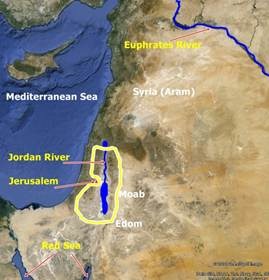
clip_image002In fact, at one level, this whole passage is about the fulfillment of ancient promises and prophecies. Eight hundred years before David, God promised Abraham that his descendants would inherit the land of Canaan. In Genesis 15:18-21, that land was described as extending from the Red Sea in the South to the Euphrates river in the north where it runs southeast through modern-day Syria. Other promises in Deuteronomy 1:7, 11:24 and Joshua 1:4 describe those same borders, and lay out an eastern border that included almost all of modern day Jordan and Syria. However, in all the time that the descendants of Abraham lived in the promised land, they had not possessed nearly that much territory. For four hundred years, they had lived on far less than God had promised. The map at left shows the region. The area outlined in yellow is the area that the Israelites controlled during the time of the Judges and during Saul’s reign.

They were living in far less than God had promised.

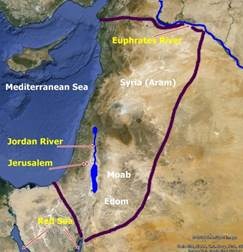
However, as a result of the conquest made by David, as described in 2 Samuel chapter 8, the borders of Israel were extended to almost the exact boundaries described in God’s promises to Abraham and to the people through Moses. This next picture shows the approximate area of David’s clip_image004kingdom, outlined in purple. As you can see, Israel now had influence from the Euphrates river to the Red Sea. This is not to say that all of this area was considered “Israelite” however David’s court in Jerusalem controlled and influenced all of it. If you are still having trouble picturing it, look at a world map. This area includes modern Israel, Jordan, Lebanon and most of Syria.

So what does all this mean for us today? I think it always helps to ask, “where is Jesus in this passage?” I see him here in two places: he is fulfilling promises, and defeating enemies. First let’s talk about the promises. On one hand, this seems to show us that God’s promises don’t always get fulfilled in what we consider a timely fashion. It was more than eight hundred years between God’s promise to Abraham about the size of the land, and the complete fulfillment of that promise. That’s a long time, and many generations didn’t live in the full reality of what God had promised. On the other hand, God doesn’t forget his promises, and he does truly bring them to pass. If you wanted to take the time, you could go through the bible, and find dozens of examples of promises that He made and then kept. Many times in the past I have explained where the bible came from, and how it has been verified time and again as a historically valid document. Here, I want to emphasize that it is also a spiritually valid document. We have a historical record of a promise from God and a historical record from a different period showing its fulfillment.

A natural question is “Why did it take so long for God to fulfill this?” The only completely honest answer is “I don’t know.” I do have some thoughts, however. God told Abraham when he made the promise that it wouldn’t happen for at least four-hundred years. He was giving the residents of the land a chance to repent. But when the Israelites came out of Egypt four hundred years later, the Lord told them through Moses to go into the land, drive out the other nations and possess it. They simply didn’t do it. The reason they didn’t do it is because they lacked faith in God’s promise to be with them. In Numbers 13, Moses sent twelve spies into the land prior to invading it. Ten of the spies came back and said it would be impossible to drive out the nations who lived there. But two said it could be done. Their names were Joshua and Caleb. They said:

The land we passed through and explored is an extremely good land. If the LORD is pleased with us, He will bring us into this land, a land flowing with milk and honey, and give it to us. Only don’t rebel against the LORD, and don’t be afraid of the people of the land, for we will devour them. Their protection has been removed from them, and the LORD is with us. Don’t be afraid of them!  (Num 14:7-9, HCSB)

But the people didn’t listen to them. Instead they gave into fear and blaming. The result was forty years more of wandering for that generation, and then four-hundred years more of living in only part of what God promised.

I don’t think the lesson here is “do more.” I think it is “trust more.” As I have said many times, believing comes before doing. If the people were living in trust, they would have done what they were supposed to do. If they had attempted to do it without trust (as indeed they often did in the next four hundred years) their results would also have fallen short. The key is believing what God has promised, and trusting Him. We have seen that the one thing that makes David a hero is that he trusts God. David isn’t perfect. But he lives out of the understanding that his life belongs to God; that through him, God can and should do whatever he wants. So when David came along, the Lord finally had someone he could use, someone who trusted Him enough so that God could fully give everything that was promised.

We can’t always understand why God doesn’t completely fulfill his promises in our own lives. It isn’t always about our faith – sometimes it is about God’s bigger purposes in the world. For many years, David did not live in the fullness of God’s promises to him. That wasn’t his fault – God was arranging other things, because it wasn’t just about David – it was about God’s purposes. So don’t feel badly if you truly trust God, and yet you don’t see the complete reality of his promises in your life. It isn’t just about you. But at least, we can try to eliminate lack of faith as a reason that we don’t experience the fullness of God’s promises to us. David trusted him fully, and eventually, the Lord used that trust in a huge and positive way for both David and the entire people of God.

Now let’s talk about Jesus defeating enemies. is there “unconquered territory” in your life? I mean, are there certain areas of your life that are outside the control of Jesus? Hebrews 2:8 says this:

You put all things under his control.” For when he put all things under his control, he left nothing outside of his control. At present we do not yet see all things under his control, (Heb 2:8, NET)

Like with God’s promises, we often see a partial fulfillment of the Lord ruling in our lives. I’ll be honest and say, usually this is for the same reason – our own lack of trust. But it has the same solution. If we trust Jesus, and let him have us more fully, he will supply the power to defeat the failures, temptations and self-will that we struggle with. Paul writes about the struggle this way:

For though we live as human beings, we do not wage war according to human standards, for the weapons of our warfare are not human weapons, but are made powerful by God for tearing down strongholds. We tear down arguments and every arrogant obstacle that is raised up against the knowledge of God, and we take every thought captive to make it obey Christ. (2Cor 10:3-5, NET)

Like David, we are called to wage war while trusting in God’s promises. But our war isn’t physical – it is the war of a mind, to let the Lord conquer all that he has promised for us. Now I could do an entire sermon series on the battle for the mind – maybe I will soon. But for now, I think we should understand this from our text: the key is to trust our Lord, and to be willing to do whatever that trust leads us to do. Sometimes that means opposing whatever opposes the truth of the Word of God in our thoughts. David illustrates physically in the land of Israel what Jesus wants to do spiritually in our hearts and minds.

Holy War! What is it Good For?

1 SAMUEL #12. (1 SAMUEL 15:1-3)

holywar


To listen to the sermon, click the play button:


To download, right click on the link (or do whatever you do on a Mac) and save it to your computer: Download 1 Samuel Part 12


There is one big and totally natural question when we read 1 Samuel chapter 15. Why did God want the Israelites to destroy every living Amalekite? Why the women and children too? How can we accept that God wanted this, and yet still believe that he is merciful, forgiving and loving? There are a handful of passages like this in the Old Testament, and for the modern mind, it seems inexplicable and even repulsive. I think we can get help sorting this out if we consider three things.

First, God does not answer to us. The questions are natural, but the truth is, God does not owe us an explanation. Our human nature wants God to justify himself toward us. But this is exactly the opposite of the situation the Bible describes. We are accountable for our actions before God, not the other way around. If God indeed made the universe, if he is infinite and we are not, then he has the right to do what he wants, and what he wants may be beyond the ability of our limited minds to comprehend.

This is true, but the Lord often chooses to reveal his reasons anyway. So the second thing to consider is that this is about holiness. Several weeks ago I shared what happens when pure sodium is exposed to water. The sodium explodes and burns up. Pure sodium simply cannot exist in the presence of water. The greatest scientist in the world cannot bring the two things into actual contact without creating spontaneous combustion. In the same way, sin simply cannot exist in the presence of God. So unless there is some kind of intervention, God’s presence will destroy sin. We live after the time of Jesus. Jesus and his sacrifice have eliminated the holiness problem for us, if we trust him. He has made us holy. He took the destruction of sin into himself so we could be spared. But we forget that without Jesus, God’s holiness is a huge problem for sinful people. Sin is so serious and God’s holiness is so pure, that if it wasn’t for Jesus, it requires the destruction of every living thing associated with sin.

The Israelites, however imperfectly, were living in faith that God’s promises to Abraham were true, and that God would redeem them from their sins. So the Lord included them in what he was going to do through Jesus. Their faith in God’s promises protected them from the effect of God upon sin. Paul writes to the Romans:

1 So what advantage does the Jew have? Or what is the benefit of circumcision? 2 Considerable in every way. First, they were entrusted with the spoken words of God. 3 What then? If some did not believe, will their unbelief cancel God’s faithfulness? 4 Absolutely not! God must be true, even if everyone is a liar, as it is written: That You may be justified in Your words and triumph when You judge. 5 But if our unrighteousness highlights God’s righteousness, what are we to say? I use a human argument: Is God unrighteous to inflict wrath? 6 Absolutely not! Otherwise, how will God judge the world? (Rom 3:1-6 )

Is God unrighteous to inflict wrath? Absolutely not. His presence destroys sin, whether or not you believe his words. The only salvation through Jesus Christ, by faith. This was true even for the generations who lived before Jesus came:

We are made right with God by placing our faith in Jesus Christ. And this is true for everyone who believes, no matter who we are. For everyone has sinned; we all fall short of God’s glorious standard. Yet God, with undeserved kindness, declares that we are righteous. He did this through Christ Jesus when he freed us from the penalty for our sins. For God presented Jesus as the sacrifice for sin. People are made right with God when they believe that Jesus sacrificed his life, shedding his blood. This sacrifice shows that God was being fair when he held back and did not punish those who sinned in times past, for he was looking ahead and including them in what he would do in this present time. God did this to demonstrate his righteousness, for he himself is fair and just, and he declares sinners to be right in his sight when they believe in Jesus. (Romans 3:22-26 NLT, emphasis mine)

Everyone in the past who believed God’s promises, was included in what God was going to do through Jesus. But in Old Testament times, before Jesus had come, those who rejected God became physical illustrations of how serious God’s holiness is, and how big a problem our sin is. God was showing the world their desperate need for a messiah who could bridge a gap between our sin and God’s holiness.

In the case of the Amalekites and the other Canaanite tribes that God commanded Israel to destroy, they were given both a witness to God’s holiness and grace, and an abundance of time to repent of sin. All the way back in the time of Abraham, the Lord said this:

13 Then the LORD said to Abram, “Know this for certain: Your offspring will be foreigners in a land that does not belong to them; they will be enslaved and oppressed 400 years. 14 However, I will judge the nation they serve, and afterward they will go out with many possessions. 15 But you will go to your fathers in peace and be buried at a ripe old age. 16 In the fourth generation they will return here, for the iniquity of the Amorites has not yet reached its full measure.” Gen 15:13-16 (emphasis mine)

Amorites were just one of the tribes that Israel was supposed to drive out or destroy. They had witnesses to the truth of God through Abraham, Lot, Isaac, and Jacob. They had four hundred years after Jacob to correct their ways – God was still giving them a chance to repent and live in faith. For forty years, after the Israelites left Egypt the nations in Canaan heard about what God did for them. They had the chance to repent during that time, and a few of them did (Joshua 2:9-15).

The Israelites invaded the Canaanite lands under Joshua. The Israelites in subsequent generations did not eradicate the Canaanites as they were supposed to. So the tribes of Canaan had four hundred more years through the time of the Judges to repent and follow the Lord. All told, these civilizations had roughly 800 years before the time of Saul to repent and follow God. During all of those centuries, they were witnesses to the truth about God through the Israelites. So it isn’t as if God suddenly woke up one day and said, “ You know, I hate the Amalekites.” Basically, the Canaanite civilizations had showed, over the course of about 800 years, that they would not live by faith, that they would not repent, that they were determined to continue in their sinful, rebellious ways. As such, there was no purpose in giving them more time, and until they were eradicated, they remained a spiritual and military threat to God’s people.

A third possible reason for this harsh command was that while the Canaanite peoples continued to live in the land next to the people of Israel, the people of God were often led astray. The Israelites were the only people in the whole world who understood about living in faith. They were the people entrusted with the word of God, as Paul points out in Romans. God could not allow them to be corrupted and lose the truth. If they lost it, the whole world lost it. So the Lord commanded his people to take extreme measures to make sure the world did not lose the truth about faith-relationship with God.

Fourth, God did not choose the promised land randomly. For thousands of years it has been both the cradle and the crossroads of civilization. Trade routes flowed through the land from Africa to Asia and Europe, back from Europe to Asia and Africa, and from Asia to Africa and Europe. It is the meeting place of three continents and two oceans. Whoever lived in this geographical location from the beginning of civilization until the fall of the Roman Empire was in a position to spread ideas, culture and religion to most of the people in the world. In fact, one reason Christianity spread so quickly and influentially is because it began in the Holy Land. In fact, the three most dominant religions in the world – Judaism, Christianity and Islam – all began in the Holy Land. The reasons these three are so widespread is due in part to geography. Even today, Jerusalem is a major epicenter of the world political situation. [click the link to keep reading]

Continue reading “Holy War! What is it Good For?”