
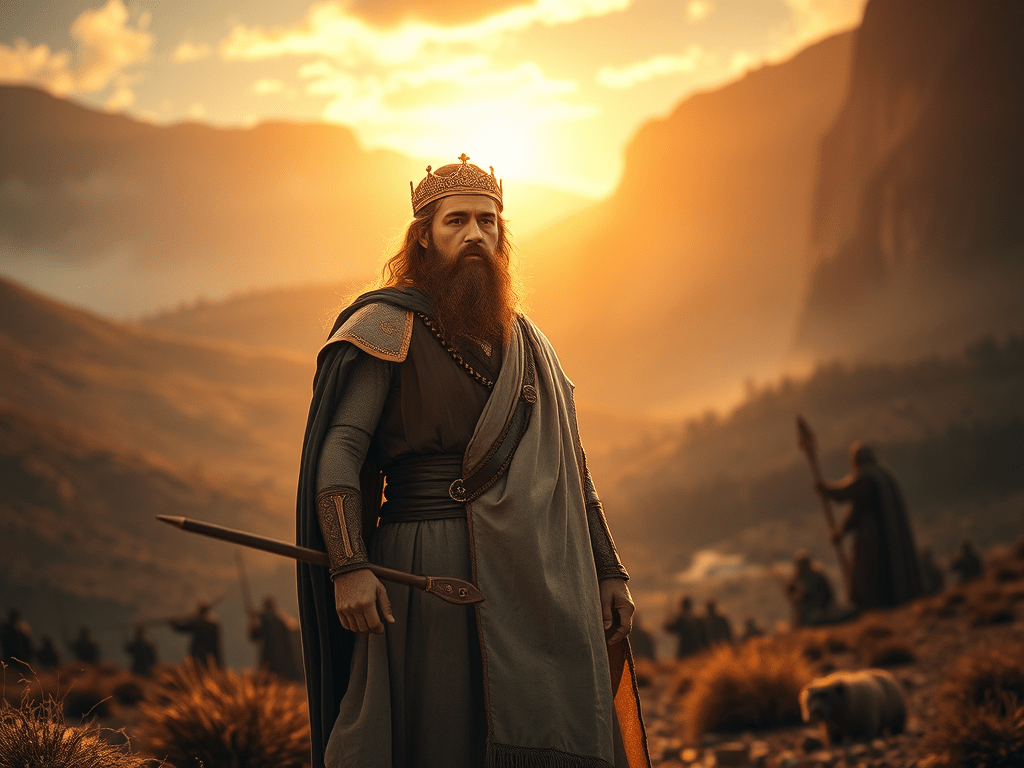
David understood that his life was part of God’s story, told for God’s purposes. He even understood that it was the Lord, not himself, who was the hero of his life-story. So, when everything that he worked so hard to gain seemed to fall apart, David continued to trust in God. Even in obvious-seeming situations, he did not assume he knew what God wanted. The Lord invites us into the same sort of relationship that David had. When we trust him, we find we can be at peace, even in difficult times.
To listen to the sermon, click the play button:
For some people, the player above may not work. If that happens to you, use the link below to either download, or open a player in a new page to listen.
To download, right click on the link (or do whatever you do on a Mac) and save it to your computer: Download 2 Samuel Part 5
2 Samuel #5. 2 Samuel 5:12-25; 1 Chronicles 11:15-19; 1 Chronicles 14:1-17
I want to revisit something we skipped over rather quickly last time. 2 Samuel 5:12 says this:
“Then David knew that the Lord had established him as king over Israel and had exalted his kingdom for the sake of His people Israel.” (italics added for emphasis)
I think this is a key to most of this chapter, and actually, to the entire life of David. David did not consider his monarchy to be his doing, or his kingdom. David did not consider his life to be about himself. The Lord was the main character in the story of David’s life. Even after he was anointed, for fifteen years David wasn’t king, because God didn’t want him to be king yet. When he finally became king, it was because God wanted him to be king. The Lord did it, for the Lord’s own glory and purposes. It wasn’t about David. It was about God.
The incidents that follow this verse confirm that David maintained this attitude, especially about his kingdom.
5:17-25 appears to describe the same event as 1 Chronicles 11:15-20, and also 1 Chronicles 14:1-17. What happened is this. When Saul was king of Israel, David was his enemy. For the Philistines, that meant that Israel was divided, and less of a threat. Plus they gained a great victory over Israel in the battle when Saul was killed. But seven years have passed. David alone was now king over a united Israel. The Philistines rightly perceived this as a threat to them, so they immediately went looking for David, to bring him to battle and kill him if possible.
The Philistines invaded by coming up a valley that led from their lands by the coast, up into the highlands that were controlled by the Israelis. They did this once before, early in the reign of Saul. The valley the Philistines used against David is called “Rephaim.” There is no place with that name anymore, but scholars feel pretty sure that the lower end of the valley comes out on the plains by modern-day Beit Shemesh – or, as it is called in Samuel, Beth Shemesh. There are two main branches in the higher part of this valley, one that begins to the north of Ancient Jerusalem, and one that starts at a point to the south of Jerusalem, just north of Bethlehem. My personal opinion from reading the text is that the Philistines were in between Jerusalem and Bethlehem (see picture below). In fact, 1 Chronicles 11 says that when they invaded up the valley of Rephaim, they took over Bethlehem and kept a garrison of soldiers there.

Some scholars feel that all this happened before David captured Jerusalem, but it isn’t clear. One reason to think it was before the capture of Jerusalem is that Jerusalem was such a fortress, David didn’t need to go to a different stronghold. However, David, being the great tactician he was, may have decided he didn’t want his troops trapped in the city where he could not effectively do battle, and so he took them down to the south of the Philistine advance. There is no way to know for sure, although the account of the battle in 1 Chronicles 14 puts it this way:
8 When the Philistines heard that David had been anointed king over all Israel, they mobilized all their forces to capture him. But David was told they were coming, so he marched out to meet them. (1 Chronicles 14:8, NLT)
So, whether it was before, or after Jerusalem was captured, it appears that David took his army back to one of his old haunts – the Cave of Adullam, where he had previously hidden from both Saul and the Philistines (1 Samuel 22). We don’t know exactly where the cave was (in fact it probably refers to a number of caves in the same area. But from what the Bible says, and from the existence of actual caves in the region, it was probably to the south and west of Bethlehem, and to the south of the Philistine forces in the valley.
15 Once three of the thirty leading men went down to David’s rock at the cave of Adullam when the army of the Philistines was camping in the valley of Rephaim. 16 While David was in the fortified camp, Philistine troops were in Bethlehem. (1 Chronicles 11:15-16, GW)
It seems that David went to the cave of Adullam before the Philistines got to Bethlehem. So, when David attacked, it was from an unexpected direction. Instead of meeting them head on, he attacked on their right flank.
Let’s pause here and consider a few things.
After probably fifteen years of running, hiding, eking out existence and barely surviving, David became king of Judah. After seven years as king of only one tribe, his own tribe of Judah, he finally received the fulfillment of the Lord’s call on his life. Finally, he became king of all Israel.
The confetti had hardly settled to the ground before he was invaded. In short order indeed, David was right back to hiding in caves. Maybe an economic analogy would help us understand how this could have affected David. Think of a person who spent half her life in poverty, working steadily at a plan to build wealth, but seeing few results. None of the breaks ever seemed to come her way. After years, she finally reached the upper middle class. At last, seven years after that, she made her first million. Three weeks later she was flat broke again.
It had to be an awful feeling for David to find himself back in the caves where he hid from his enemies fifteen years or more before. If he was like me, he would have spent a lot of time whining to God about how he had done everything that was asked from him, and why couldn’t he ever catch a break? If he were like me, he would explained to the Lord that he had already been here and already learned this lesson, and what was the freaking point of this kind of hardship anyway? But David was not like me. He was like I want to become. He was like the person the Holy Spirit was showing the world through him – the true Messiah.
So when David went to the cave, he continued to trust the Lord. He asked God a simple question: What do you want to do here? What are you after in this situation? Shall I go and fight these guys or not?
Before we continue the main narrative, there’s a cool story about something that happened while David was in the cave during the invasion. There is no doubt that he did experience distress – he was a human being, after all. The enemy were camped in his own home-town (Bethlehem, in case you have forgotten). It was a hot and dry day, and David said (this was as close as he got to complaining) “I wish I could get a drink from the well at Bethlehem.” I think he was expressing that he was hot and thirsty. I think he was also upset that Bethlehem – his own town – was an enemy camp. He’s basically saying: “Wouldn’t it be wonderful, right now, if we could just walk up to that beautiful cold well in Bethlehem and have a drink? Wouldn’t it be great if there were no invasion at all?”
David was a fearsome warrior, and he led a bunch of other very powerful warriors. Three of the mightiest took David at his word, and broke through the Philistine lines and brought David a drink from the well at Bethlehem. David’s response is interesting:
They brought it back to David, but he refused to drink it. Instead, he poured it out to the LORD. 19 David said, “I would never do such a thing in the presence of God! How can I drink the blood of these men who risked their lives? ” For they brought it at the risk of their lives. So he would not drink it. Such were the exploits of the three warriors. (1 Chronicles 11:18-19)
When I first read this, I thought, “I’d be angry if I were one of those three warriors.” But actually, I think what David was saying was this: “I am not worthy of such a costly drink. I can’t claim it. Only the Lord is worthy of that kind of effort and self-sacrifice.” He was actually honoring the men more by pouring it out than by drinking it. He “poured it out to the Lord.” He was saying that the lives of these men were precious to the Lord. There was a actually a type of offering called a drink offering, where a drink (usually wine) was poured into the ground. The idea was to say, “this is God’s, not mine, and I pour it out to show that everything I drink ultimately comes from God.” So David did not consider himself worthy of that kind of sacrifice from his men, and he directed their attention to the Lord. Life wasn’t about him, it was about God. God was the one who gave them the strength and flat-out guts to do this amazing deed. He was the one who was to be honored, not David.
The hero of this entire story is the Lord. David consciously realized this, and made statements to draw attention to the Lord, rather than himself. We think of God as loving and gracious and giving and kind – like the best possible parent. And yet, he is also the best, the only true Greatest Of All Time. No NBA superstar has more game than the Holy Spirit. No downhill skier can take a mogul like God. No warrior can be more ferocious and cunning than Jesus. No writer can craft a better story, no historian can plumb more significance from events than the Father. No musician can play a concerto or improvise a lick better than the Lord. Our Triune God is not just the writer and director of the play – he himself is the star performer, and he is brilliant at all he does.
I don’t know about you, but at my age, I don’t go in for hero-worship. Actually, I never did. Human heroes always suffer from significant flaws, and we get disappointed when we really give them our admiration. But there is one Person who is worthy of our hero-worship. David understood that, and he also understood that it wasn’t him. The amazing feats we see in other people – or the amazing things we can do ourselves – are just tiny reflections of the overwhelming awesomeness of God.
So David heard that God wanted to drive the Philistines out of Israel, and David obediently attacked. The Philistines were defeated, and David named the spot, “The Lord Breaks Out” (that’s what “Baal-perazim” means). Not “I have gotten victory.” Not even, “God helped me get a victory,” or even yet, “God got victory – for me.” No – it was God’s victory for God’s purposes and God’s glory. David and his men got to be the fierce warriors that they were created to be – but it was all about the Lord and for the Lord.
The Philistines made a second try. I love the fact that David did not assume that he should do the same thing again, just because it was the same situation. Instead, once more, he asked God what he wanted to do. The Lord did want him to fight again, but he gave David a different specific battle plan, along with the promise that God would be marching out in front of him, doing the real work of winning the battle.
So what do we take away from all this? The first thing I need to get straight is this business that my life is here for God’s plan, God’s purposes and his glory. None of what I am supposed to do is about me. God is amazing and gracious, and so even while he makes use of our lives for his own purposes, he blesses us in the midst of that. David got to be the king and lead like he was made to lead; he got to fight like the warrior he was created to be.
I get to study the bible and think and use my brain and then share it with people who are willing to listen to me. I get to sit here and tap on my keyboard and express the thoughts that the Lord gives me to express. I love it – I really do. It isn’t my message, and it isn’t about me, but I get blessed when I let God do his thing with my life. You will get blessed when you let him do his thing with your life – which is almost certainly going to look different from everybody else, because God has a unique purpose for each one of us. When I say “blessed,” I don’t necessarily mean financially or physically blessed – we Americans, especially, think that’s the main kind of blessing (it’s not). But you will experience the grace and favor of God if you let him be the hero of your life’s story. You’ll appreciate the story he writes through you.
Second, I need to remember that one kind of hero-worship IS acceptable. I need to pay more attention to how skilled, talented, smart, funny, tender, fierce and truly excellent God is. He deserves my worship and admiration. He is the best – at everything.
Third, when life takes a turn for the worse – as it did for David, many times in his life – I need to remember that this is all in God’s hands. If he wanted to hide this great leader of men, this fearsome warrior, in a cave, that was his business – David was his man whether on the throne, or in a cave. If God wants to allow hardship in my life, I will certainly pray for it to be cut short, and I will certainly believe that he will bring better times too. But I will also trust in the meantime that he knows what he is doing and I am ALWAYS in his hands.
I also want to take this away from the text: God is the one who fights the battles I have to be involved in. Most people are probably not called to physical warfare, like David was (although some people certainly are). But sometimes we are called to make a stand for something that is important to God. At other times the Lord calls us to engage in some project, or to work at a certain place, or be involved with certain people, and so on. We can consider all these things “battles” for the purposes of applying this text.
There are some battles we don’t have to fight. Sometimes we go to war without asking God, and so we end up fighting for ourselves. But David went to war only when God directed him. And when he did that, it was God who fought his battles for him. So if you are in a battle that you have to be in, one that you are supposed to fight, remember, it is God who really achieves the victory. All we need to do is show up and let him use us. I take great comfort in that.
The flipside is important, too. We don’t need to fight any battles except the ones the Lord has for us. It’s a good lesson to learn from David that we should ask the Lord before just launching into some kind of endeavor. Even though it may have seemed obvious, David kept asking the Lord before engaging in battle. We might find that we have fewer battles to fight if we only engage when the Lord is telling us to.
When we realize that God is the main character in our story, the one true hero, it takes a lot of pressure off us. Our part is to respond to God, to let him work in and through our lives. But he’s the one telling the story of our lives, and he’s the one who is responsible for how it turns out. I don’t mean that there are no consequences to our actions. But I do mean that if we do our best to be faithful to him, we can be at rest about how things turn out. We can be at rest even when we fail at times to be faithful, because God’s nature does not change:
11 The saying is trustworthy, for:
If we have died with him, we will also live with him;
12 if we endure, we will also reign with him;
if we deny him, he also will deny us;
13 if we are faithless, he remains faithful—
for he cannot deny himself. (2 Timothy 2:11-13, ESV)
What is the Lord saying to you today?
 Clear Bible