RELIGIOUS RULES ARE USELESS

Religious-Circumcision

Following rules and regulations cannot make us close to God. Only Jesus can do that.

To listen to the sermon, click the play button:


To download, right click on the link (or do whatever you do on a Mac) and save it to your computer: Download Galatians Part 4


Galatians #4 . Chapter 2:1-5


Last time we considered Paul’s claim that he received the gospel from Jesus alone, not from any human being.

He makes three basic points. 1. If he got it from a human source, it hasn’t resulted in him pleasing other human beings (1:10). 2. The message that he preaches was revealed to him directly by Jesus, in his experience on the way to Damascus. He began preaching immediately after that, before receiving any instruction from humans. 3. He didn’t consult with anyone right away. Three years after his conversion, and after he began preaching, he did meet with the apostle Peter privately. But he remained unknown by and unconnected to the other apostles and the Jewish churches in Judea.

Chapter two continues Paul’s thoughts about these matters. He explains that fourteen years after his visit with Peter, (seventeen years altogether after his conversion) he went back to Jerusalem and met with the apostles.

I went up according to a revelation and presented to them the gospel I preach among the Gentiles — but privately to those recognized as leaders — so that I might not be running, or have run the race, in vain. (Gal 2:2, HCSB)

He says he did this because he had a revelation, or vision. He does not explain if he had a new revelation about the gospel, or if the Lord told him in a vision to go to Jerusalem. But in any case, at this point, seventeen years after he was converted and began preaching the gospel, he takes the opportunity to compare notes, to make sure that what he was preaching was in fact the true gospel. The apostles affirmed that Paul was called by God to the Gentiles, and that he was preaching the true gospel (2:6-10).

While Paul was in Jerusalem, the very issue that concerns the Galatians was brought up. Paul explains:

But not even Titus who was with me, though he was a Greek, was compelled to be circumcised. This issue arose because of false brothers smuggled in, who came in secretly to spy on the freedom that we have in Christ Jesus, in order to enslave us. But we did not give up and submit to these people for even an hour, so that the truth of the gospel would be preserved for you. (Gal 2:3-5, HCSB)

Since Paul talks about circumcision quite a bit, let’s clarify what it was all about. Circumcision was part of the Jewish law. It involves removing a little bit of extra skin from a body part that only males have. According to Jewish law, all men and boys had to be circumcised, or they could not be part of God’s people. Even if man ate according to kosher regulations, and followed all the Jewish rules, he would not considered Jewish, or capable of pleasing God, unless he was circumcised first.

Think of it like this. When I lived in Minnesota, there were a few times when I happened to go fishing the same day that a professional fishing tournament was held. Once, the next day, I picked up the newspaper and found out that I caught more and bigger fish than anyone in the tournament. But I didn’t get any prize money, because I was not officially part of the tournament. I had never registered. It didn’t matter how many fish I caught, or how big they were. It didn’t count, because I wasn’t part of the tournament in the first place. In this analogy, circumcision would be like registering for the tournament. Fishing afterwards would be like keeping the other Jewish regulations. You have to do the first thing before you can do the second. If you choose to fish without being part of the tournament, that’s fine – but in that case your fishing has no relationship to the contest. If you choose to be kosher, that’s fine. But if you aren’t circumcised, that has nothing to do with Jewish law.

The reason Paul uses circumcision to make his argument is because it is the most basic requirement of Jewish law (at least for men). So he says, “Look, not only did Titus not have to be kosher, he didn’t even have to be circumcised. The very first and most basic requirement of the law did not apply to him.” There was pressure by “false brothers” to make Titus get circumcised. But Paul did not bend to it, and neither did the other apostles in Jerusalem.

Undoubtedly, one of you bright readers will come across Acts 16:1-2, and find out that later on, Paul mentored a young man named from Galatia named Timothy, and he encouraged Timothy to get circumcised. So what does that mean? Did Paul change his mind after he wrote this letter to the Galatians?

In the case of Timothy, I believe that both Paul and Timothy felt that it would be helpful for his ministry if he was circumcised. They were sometimes staying with Jewish people who weren’t Christians. Good Jews could not allow a Gentile to spend the night in their home, or even eat with him. Circumcision gave Timothy greater flexibility in reaching out to those Jews who did not yet trust Jesus. So he was circumcised – not in order to be saved, nor to keep the law, but because the Holy Spirit led him to do it in order to be more effective in reaching people for Jesus.

Our family has celebrated Passover every year for the past seventeen years. We do it because we enjoy it and it encourages us a Christians. But we don’t think it is required. If we didn’t do it this year, we would miss it, but no one in our family would think that we’d be in trouble with God if we failed to do it.The point is this: You do not have to keep any part of the Jewish law in order be saved through faith in Jesus Christ. In fact, keeping the law won’t help you in the least. But you are allowed to follow some or all of Jewish law – if you want to, and if you do it for some other reason than because you think it is required in order to be saved.

We no longer have a law that says you must be circumcised. But neither do we have a law that says you cannot be circumcised. The important point here is that following rules and regulations cannot make us close to God. Only Jesus can do that. So when it was all about salvation and the true gospel, as it was in the case of Titus, Paul refused to budge. But when the Holy Spirit led Timothy to get circumcised in order to be more effective at reaching people for Jesus, Paul encouraged him to do it. You see, certain things are useful in our lives, to keep us close to Jesus. But only one thing is necessary: to trust Jesus. There is not law you can keep, no good deed you can do that will help you receive salvation. You can only trust Jesus, and trust that he did it all for you.

When we really understand this, I think there are two very common responses. The first is say, “OK, got it. I trust Jesus. I’m saved. Now I am going to go off live however I please, because I don’t get to heaven by being good anyway.”

A huge number of people who call themselves Christians seem to have that response. I have used the analogy before, but I’ll use it again because it is both helpful and biblical. That approach is like saying: “OK, I’m married now. Now, I’m going to go live my own life. I’m not really interested in spending time with my wife or being faithful to her and all that. She said ‘I do,’ and so we’re good. When it’s time to retire, she’ll be there for me to nurse me in my failing years. If I get into a crisis before then, I’ll call. But until I hit retirement or a crisis, I’ve got better things to do than hang around with this woman.”

The natural questions are: Do you really truly your wife? Do you really have a relationship with her? Can you honestly call that relationship “marriage” when you have no intention of making a life together?

In the same way, “Christians” who have nothing to do with Jesus probably don’t really trust him in the first place. I doubt very much if their faith is genuine when they treat him like that. This group of people is not focused on Jesus, but on their own selfish behavior. They are fixated on the things they want to do.

But there is another response that some Christians have. They look at the first group of people and say, correctly, “That’s wrong. I don’t want to be like that.” Their solution, however, is to create a list of things to do that ensure you don’t become one of the first group. Like circumcision was for Timothy, some of these things can be genuinely helpful in your relationship with Jesus. Others are actually a natural part of a real relationship of faith – like praying, and listening to God through the bible, and living in community with other Christians.

But we cannot make them into laws. This second group can also end up focused on behavior – in their case, it is good behavior. But it is not Jesus himself.

This is where trust comes in. We have to trust that as we fix our eyes on Jesus, rather than our own behavior, He will make things right. We trusted him to make things right for our past sins. We need to do the same for our present behavior as well. It is only common sense to do things that are helpful, like praying, and reading the bible and fellowshipping with other believers. But we can’t trust in those things to keep us in Jesus. We trust Jesus himself, not any part of our own behavior.

If you are truly focused on Jesus, not on how you want to behave, you will begin to sin less. Jesus will work from the inside out and your goals will come from him, not your selfish desires. If you are truly focused on Jesus, not your behavior, you will begin to find more joy and freedom. You won’t worry so much about how you’re doing, because you are full of Jesus, not your own performance.

I play tennis. There are certain stances and racquet positions that are important in that game. Good footwork is helpful. But if you keep looking at your feet and hands and racquet, you will absolutely fail at tennis. Once you learn the basics, you need to watch the ball, always. If you watch the ball, the other stuff kind of takes care of itself. That’s a simplification of the sport of course, but it holds an important true lesson. When we are fixed on Jesus, not our behavior, he takes care of the behavior.

Martin Luther describes a similar situation in his own lifetime:

“In the same way we today do not reject fasting and other pious practices as something damnable, but we do teach that by these practices we do not obtain the forgiveness of sins.”

Luther says, basically: Look fasting and prayer and so on can be very helpful for living in relationship with Jesus. But they do not get you that relationship; they do not help Jesus to forgive you. They don’t contribute to your salvation.

Remember the illustration I gave a few weeks ago. Jesus has come all the way; he has closed the entire gap between us and God. We can’t do any of it for ourselves, whether by fasting or by circumcision or by any other good work.

Paul’s hard-line approach is not about being confident in himself or sick of opposition. It is his confidence in Jesus, and the importance of this issue that lead him to come across this way.

But we did not give up and submit to these people for even an hour, so that the truth of the gospel would be preserved for you. (Gal 2:5, HCSB) emphasis added

Let’s understand the issue. It is that Jesus alone has done everything that is necessary to bring us into relationship with God. Our only “work” according to Jesus, (and to Paul) is to trust him (John 6:29). This isn’t about “being free” or “standing up for my rights.” It is nothing less than defending the truth of the Gospel.


NOW THAT’S GOOD NEWS!

good-news

There is no gap for you to make up. There is no fruitless striving for you to do. There are no blessings that you could ever deserve or earn. The good news is, there is nothing we can do, and so Jesus has already done it all for us.

To listen to the sermon, click the play button:

 
To download, right click on the link (or do whatever you do on a Mac) and save it to your computer:
Download Galatians Part 2
 

GALATIANS #2; GALATIANS 1:3-11

This is as good a time as any to talk about the word “gospel.” When Paul writes “gospel,” he is not really talking about the books written by Matthew, Mark, Luke or John (John’s gospel was probably written after Paul died). The Greek meaning is basically, “message of good news.” As we see it used in the New Testament, it is not just any good news about anything, but rather a specific, established, consistent message: that is, the message about Jesus Christ, who he is and what he has done.

Jews in the time of Paul used to talk about “the Law.” “The Law” was a specific, established message given by God through Moses, who wrote and spoke under the inspiration of the Holy Spirit. Technically, what Jews call “the Law” (the Torah) is made up of the first five books of the bible (Genesis, Exodus, Leviticus, Numbers and Deuteronomy). We will talk more later about different ways that the word “law” is used, but for now, it’s helpful to know this.

All of the other books of the Old Testament – those that come after the first five – are called by Jews “the Prophets.” First and Second Samuel, which we have just finished studying, are part of “the prophets.” They too represent a specific, established message given by God through people who wrote and spoke by the inspiration of the Holy Spirit.

By the time of Jesus, no one would think of changing the Law or the Prophets. The message was already established. Paul sees “The Gospel” as the third and final piece of God’s special revelation to human beings. It is the fulfillment of “the Law,” and “the Prophets.” It is the specific, established message given by God through people who wrote and spoke under the inspiration of the Holy Spirit. In the case of the gospel, the message completes the law and prophets, and is very good news for human beings.

The point is, in the eyes of the New Testament writers, you cannot change the Gospel. It is as established as the Law and the Prophets. It goes with the Law and the Prophets. If a Jew would be shocked if someone changed the message of Moses, so a Christian should be equally shocked at someone trying to change the message of Jesus Christ.

Paul gives the Galatians the gospel message in a nutshell in his greeting:

3 Grace to you and peace from God the Father and our Lord2 Jesus Christ, 4 who gave Himself for our sins to rescue us from this present evil age, according to the will of our God and Father.

That’s it: grace and peace are available to us only in Jesus, because he gave himself as a sacrifice for our sins, attaining forgiveness for us, and a restored relationship with God, rescuing us from the devil. We have some additional clues to the kinds of things that Paul preached to the Galatian Christians. In Pisidian Antioch, he said this:

Therefore, let it be known to you, brothers, that through this man forgiveness of sins is being proclaimed to you, and everyone who believes in Him is justified from everything that you could not be justified from through the law of Moses. (Acts 13:38-39, HCSB)

In Iconium, this is what happened:

So they stayed there for some time and spoke boldly in reliance on the Lord, who testified to the message of His grace by granting that signs and wonders be performed through them. (Acts 14:2-3, HCSB)

The gospel is a message of grace. It is good news. Jesus has done for us what we cannot do. Jesus lived a perfect life on our behalf; and Jesus accepted the punishment for sin, on our behalf. Whatever was required from us has been provided by Jesus.

In Lystra the Lord did a miracle through Paul, and healed a lame man. The crowds wanted to make sacrifices to Paul and Barnabas, thinking they were pagan gods. Paul said this:

“Men! Why are you doing these things? We are men also, with the same nature as you, and we are proclaiming good news to you, that you should turn from these worthless things to the living God, who made the heaven, the earth, the sea, and everything in them. In past generations He allowed all the nations to go their own way, although He did not leave Himself without a witness, since He did what is good by giving you rain from heaven and fruitful seasons and satisfying your hearts with food and happiness.” (Acts 14:15-17, HCSB)

His message: turn from these worthless things to the living God. What worthless things? Certainly, their pagan gods. But also this: the idea of offering sacrifices, as if you could actually please God. Paul is saying, “turn from trying to do what has already been done for you. Turn away from the worthless activity of trying to earn something from God. Jesus has already earned everything for you.”

Paul goes on to explain that God gives good things – even to pagans – to show them that he was both real and full of love and grace. You don’t get good things by being good. Instead, you get good things when God chooses to be gracious to you. You cannot earn grace. If you could, it would not be grace. It is God’s free gift, given by His choice, not in response to something you do or don’t do.

So, when Paul writes to these Christians, he is deeply distressed, because he is heard that they are already turning away from this message of grace. Apparently, certain Jewish leaders in the churches were saying something like this: “Yes, Jesus is the messiah. We need to believe that. But of course, we still need to keep the Jewish law. You can’t expect to please God if you don’t follow Jewish rules like circumcision and kosher eating. You can’t have God’s favor unless you are one of God’s chosen people – that is a Jew.”

We don’t have any writings from the Galatians themselves, so we don’t know exactly what they were saying. But it seems that the basic message was what I just shared. Now, as I mentioned before, today, you don’t hear many Christians saying that. But we do have many churches and individuals who seem to preach “a different gospel.”

What are those “different gospels” that we might hear today?

Here’s one: Jesus has done what you cannot do. But he won’t do what you can do. Suppose God is a thousand yards away from you. You, flawed human being that you are, can only move one yard in his direction. So Jesus comes 999 yards to meet you. But if you don’t move that one yard in his direction, you’re screwed, because Jesus won’t do that extra three feet when you are capable of doing that yourself. A lot of churches teach this, without putting it so obviously. I have many friends who were raised Roman Catholic, and many of them experienced something like this. The problem is this: we are always left wondering, “Did I move my full three feet? What if I’m a few inches short?” Practically speaking, you are left still trying to work your way to God. There is still a separation between you and God – and you are responsible to close that gap yourself. You always feel a little guilty, a little unsettled, because maybe you haven’t done quite enough. It doesn’t really matter if the gap is one mile or one yard – if it is up to you to close it, this isn’t good news.

Brothers and sisters, this is not the message of the gospel. Jesus came all the way to get you. You can’t move an inch to meet him, and you don’t have to. There is no part of the gap between you and God that you are expected to close. Jesus has done it ALL. Do not listen to a false gospel. The good news is truly and completely good.

Here’s another false one. Jesus has done it all. Now you are set free to try and live a good life. You’ll fail, of course, but God forgives you because of Jesus, and so you have an infinite number of opportunities to keep trying to get it right.

I read something on Facebook just the other day that captures this idea. Someone mentioned Ephesians 4:17-32 and said:

While it is impossible for us to do we are to work at it daily. When we fail we shouldn’t beat ourselves up nor should we make excuses, just pick ourselves up again and keep trying.

Does that sound like good news to you? It sounds sadistic to me – to have to keep trying to do what both God and I know I will never be able to do. To try and fail infinitely: that sounds discouraging, exhausting and frankly, pointless. It almost sounds like punishment, not forgiveness.

Thankfully, that is not the real gospel either. The real gospel tells me I can’t do a single thing to measure up. Jesus has done all the measuring up for me. I can’t add to what he’s done. I am free from pointless striving. In Jesus I have never sinned. In Jesus I have already done every good, and never failed to do what I should.

Now, in our small-group last week, the question came up: If that’s so, then why are there so many passages in the New Testament that tell to do certain things (like use our money and talents for God) and to not do other things (like getting drunk or committing adultery)?

We will get into that more deeply as we go through the book of Galatians. The short answer is this: if we truly believe the good news and trust Jesus, he lives in us, and our lives will naturally begin to look more and more like Jesus as time goes on. It won’t be us striving – it will be the life of Jesus increasing in power in our lives as we surrender to him and trust him more. If that doesn’t happen, if we never show any improvement, the appropriate response is not to try harder to do the right thing, but to examine whether we really trust Jesus. Those commands in the New Testament are there to help us see if we are really trusting Jesus or not. For instance, in Ephesians 4:17-32, which led to the quote above, people always miss the first part

But that is not how you learned about the Messiah, assuming you heard about Him and were taught by Him, because the truth is in Jesus. You took off your former way of life, the old self that is corrupted by deceitful desires; you are being renewed in the spirit of your minds; you put on the new self, the one created according to God’s likeness in righteousness and purity of the truth. (Eph 4:20-24, HCSB)

You don’t keep trying to do what you can’t. Instead, through faith, you “put on Jesus.” As you trust him, your spirit and your mind are renewed, and as a result, your behavior begins to change. You don’t change your behavior – the Holy Spirit changes it as you trust Jesus and daily.

There’s a final “other gospel” that I want to point out, one that is becoming more and more common in America. That false gospel is something like this: Jesus has forgiven our sins. Because of that, now if we do good works, God will give us blessings in this life. This particular false gospel has two errors. The first is that it puts the focus of our faith on getting blessings in this life. I know far too many people who have been sucked into this. They are focused on getting good finances, good health and good relationships through God. God is just a means to their goal, and their goal is a good life here and now. Paul says this about such people:

If we have put our hope in Christ for this life only, we should be pitied more than anyone. (1 Corinthians 15:19)

These folks usually do believe in heaven and are happy enough to think they’ll go there someday. But for now, what they’re really after is good stuff here and now. Faith isn’t about being reunited with God. Instead, it treats God like Santa Claus. If the boys and girls are only good, they’ll get lots of presents. By the way, I think these folks do more to turn other people off Christianity than all the atheist clubs in the world.

The second error is that those blessings are based upon what we do. We earn them. They are not given by God’s grace. This false gospel says if you just believe right, behave right, and speak “in faith,” that means that God has to do what you want him to do. God is a vending machine: you put in good works, and get blessings in return. If you want to gain a lot of followers, that is what you should preach. A lot people do. But Paul says he is not preaching to please people. That isn’t the gospel. The gospel is about our eternal relationship with God. Sometimes he blesses us here and now – certainly more than we deserve. Sometimes he doesn’t.

The real gospel is the message that we are completely and totally dependent on God’s grace, and he has given us that grace fully through Jesus Christ. There is no gap for you to make up. There is no fruitless striving for you to do. There are no blessings that you could ever deserve or earn. As we trust him, he changes us (we don’t change ourselves). And the hope of eternity outshines and dominates the struggles and disappointments we encounter in this life.

I encourage you to receive this message more and more fully each day. And let no one lead you astray to any “false gospel.”

WHAT ARE YOUR CREDENTIALS?

credentials_reduced

To listen to the sermon, click the play button:

To download, right click on the link (or do whatever you do on a Mac) and save it to your computer: Download Galatians Part 1

Galatians #1 . Chapter 1:1-2

This week we are beginning a new series on the book of Galatians. It is a relatively short book – six chapters. As with all of the bible, we believe that the Holy Spirit inspired the writer to write this, and for it to be preserved and chosen as part of the New Testament. Even so, it is helpful to understand some things about how it first was written and why.

Like much of the New Testament, Galatians is actually a letter written to several Christian churches. It was written by the Apostle Paul. Paul and his colleague Barnabas (and a few others) took a mission trip from their home church in Antioch (in modern day Syria) in the 40’s AD. They went to Cyprus, and then to what is now South Central Turkey. Acts 13-14 describes this journey. They returned home to Syria.

Shortly after this, word came to Paul (we don’t know exactly how) of a controversy that was arising among many of the churches they had just visited. In response, Paul wrote this letter. It was probably the first letter that he wrote to any church, and it is certainly the first letter of his that we have preserved. He may have written it sometime in the year 49.

When I was seminary, the exciting controversy about this book was this: did “Galatians” refer to “North Galatia,” or “South Galatia?” Properly, the province of Galatia was north-central Turkey, but we don’t really know if Paul ever went there. There was a point in history when south-Central Turkey also was called Galatia, but that was before Paul’s time a little bit. So did Paul go somewhere we never heard about? Or are scholars wrong about when Galatia included the southern area? This was considered a major and probably unsolvable conundrum. Theologians don’t get out much.

I’m telling you now, Paul was writing to churches in south-central Turkey, in the cities recorded in Acts 13 and 14: Towns like Pisidian Antioch, Iconium, Lystra and Derbe. There, I’ve solved it. Part of the reason I favor this view, is because the things that happened in these cities when Paul was there seem to be reflected in the letter.

Pisidian Antioch was the first city in the region where Paul and Barnabas really made an effort to talk to people about Jesus. They went to a local synagogue and shared the good news. It was well received at first, but after just a week some of the Jewish community began to oppose him:

But when the Jews saw the crowds, they were filled with jealousy and began to oppose what Paul was saying by insulting him. (Acts 13:45)

Again,

So the message of the Lord spread through the whole region. But the Jews incited the prominent women, who worshiped God, and the leading men of the city. They stirred up persecution against Paul and Barnabas and expelled them from their district. (Acts 13:49-50, HCSB)

And yet again,

The same thing happened in Iconium; they entered the Jewish synagogue and spoke in such a way that a great number of both Jews and Greeks believed. But the Jews who refused to believe stirred up and poisoned the minds of the Gentiles against the brothers. (Acts 14:1-2, HCSB)

The same sorts of things happened in the nearby towns of Lystra and Derbe. So when these churches were just starting, there was a great deal of controversy with some Jewish people. We have to remember that in the beginning, the first believers thought of Christianity as merely the completion of the Jewish religion. In fact, I still kind of think that way. In any case, the Jews who did not like the teaching of the Christians took it personally, because it seemed to them, not a separate religion, but a pollution of pure Judaism and a threat to it. To make matters even more complicated, many of the first Christians in these towns were Jewish themselves, although some were not.

Apparently after Paul and Barnabas left the area, the Jews did not leave things alone, and many of the Jewish Christians in the churches began to listen to their non-Christian Jewish brothers. Within the churches, Jewish Christians began to teach that the “good news” was not salvation through Jesus Christ alone, but salvation through Jesus AND through following Jewish law. In other words, only the Jewish Christians were truly saved, and if the Gentiles wanted to be saved through Jesus, they had to become Jews first, and faithfully observe Jewish religious laws.

Paul wrote Galatians when he learned of all this. Now, as we jump in here, I have a few thoughts. Every once in a while, I run across a group of Christians who teach that you need to follow Jewish law in order to be truly saved. Really – I do meet these people. I can scarcely believe it, since this book of Galatians so clearly refutes that. But they’re out there. So, if you ever run into them, this study of Galatians will help.

Let’s be honest though – most of us don’t have regular contact with folks like that. It isn’t exactly a front-burner issue in most Christian churches these days. So what’s the good for us today?

I think we find the answer when we look a little deeper at the issue of following the law or living by grace. Strange as it seems, the truth is, it is easier to live by a set of rules than by grace. It’s all laid out for you. You just consult the rule book, and if you do the right thing – even if your heart wants nothing to do with God – God has to deliver on his promises. You are in control of things – it is up to you. You live right, and God will give you a good life.

But grace is messy. We can’t control it. And it is all about the heart – we can’t get grace with hearts that are not interested in God. We can’t get grace when our hearts are too proud to admit we really have no claim on God, and nothing we do could ever change that. Grace is hard to evaluate. No checklist will tell you if you have it or not. Grace can’t be controlled. We can’t make God respond to us by behaving rightly. We just have to trust him.

Galatians is all about Law and Grace. And truthfully, most Christians still struggle with how those two things relate. Our natural tendency is to try fix things ourselves – and that is law. We want to believe that if we do certain things – like pray and live right – then God will be obligated to do certain things in response – like answer our prayers or keep us from hardship. But that is law, not grace. This letter is very relevant indeed to people who struggle with these things.

So, with all that in mind, let’s begin.

Paul, an apostle — not from men or by man, but by Jesus Christ and God the Father who raised Him from the dead — and all the brothers who are with me: To the churches of Galatia.

Grace to you and peace from God the Father and our Lord Jesus Christ, who gave Himself for our sins to rescue us from this present evil age, according to the will of our God and Father. To whom be the glory forever and ever. Amen. (Gal 1:1-5, HCSB)

This is Paul’s first letter, and it is possible that those around him encouraged him to be more tactful in the future. But the truth is, he is hopping mad, and he doesn’t waste time on saying nice things to no purpose. He begins immediately by reminding the Galatians that he writes with a spiritual authority that comes from God.

There are two reasons for this, I think. Clearly, the Galatian churches were being influenced by people who considered themselves leaders. Paul is reminding them that his leadership comes from a call he received from Jesus Christ himself on the Damascus road. It’s as if he’s beginning by saying: “who are these people to say that I’m wrong? I’m a messenger from Jesus Christ and God Father Himself.”

Secondly, since Paul’s opposition is mostly Jewish, he is creating a big contrast from the way Jewish rabbis teach, and his own approach. Jewish rabbis in that day typically taught by quoting other authorities, sometimes going back several ‘generations.’ They might say something like this:

“We have just read from the Torah how Moses led the people across the Red Sea. Rabbi Hillel quotes rabbi Judah ben Tabbai as saying that it was the obedience of Moses in stretching out his staff that we must notice here.”

By the way, I made that example up. The point is, the style of Jewish teaching was to quote authorities, who often quoted other authorities. In contrast, Paul says, “I’m speaking for Jesus. He himself sent me. I don’t need to quote authorities.” Paul himself had been a Jewish rabbi before he became a Christian. He could have established his Jewish credentials to impress the Galatians. Instead, he believed his only worthwhile credential was the fact that Jesus saved him and called him.

This is key to the entire message of Galatians. Paul’s only credential is Jesus Christ, and he considers it far greater than any possible contenders. Ultimately, he is going to tell the Galatians that Jesus is their only credential as well. From the very first sentence he is asserting the fact that everything is Jesus, and whatever is not in Jesus is useless.

So maybe the place to begin application is to ask this: What are your credentials? Are you a generation or two removed, or do you know Jesus for yourself? Is the basis for your faith what someone else said, or is it your own trust in Jesus? Are you willing to say, “Jesus is my all I have; Jesus is my only claim?”

Let the Holy Spirit speak to you right now.

OFFENSIVE FORGIVENESS

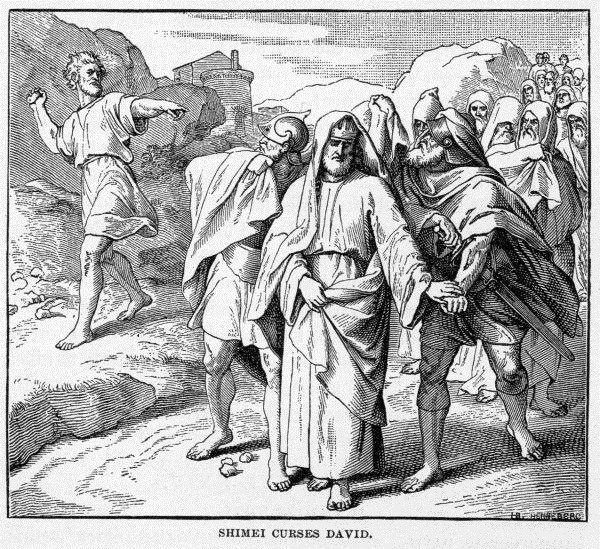
shimei-curses-david

Sometimes the love and grace of God is given to people who are so undeserving that it seems offensive. But Jesus’ love and forgiveness is given time and again to those who don’t deserve it – because no one deserves it. So, if you think you are unworthy, you are correct. But that doesn’t stop Jesus from giving you grace and forgiveness anyway. On the other hand, if his grace offends you, maybe you don’t yet know how much you yourself need it.

To listen to the sermon, click the play button:

To download, right click on the link (or do whatever you do on a Mac) and save it to your computer:
Download 2 Samuel Part 19

The second half of chapter 19 appears to be mostly a detailed record of the political history of that time. This was valuable and significant to the ancient Israelites who lived not long after David’s time. It is still interesting today to historians, and bible-geeks like me. But what is the point of it really?

I know I’ve mentioned this before, but I think it is important to revisit it periodically. We all tend to forget. The Holy Spirit made sure first that this history was written; second, that it was preserved through the years; and third, that it was included in the bible. So there must be some reason for this. There must be some way the Lord wants to speak through it to Christians living today.

Sometimes, in order to hear what the Lord wants to say today, we first need to understand it better. So please bear with me. I think we’ll find some fruitful bible application here if we pay attention to details that might otherwise seem tedious.

Here’s the situation. David’s army has defeated and killed Absalom, who had rebelled against him and set himself up as king in David’s place. There were no computers or telephones or newspapers in those days, so it took a while for the news of David’s victory to spread. Meanwhile, David seems to have waited. This might seem a little bit strange. But remember who David is. He has many faults, to be sure, but he has never grasped at power. Instead, he always waited for the Lord, even refusing to take opportunities to gain the kingdom. So here, he once more waits until he is sure that Lord still wants him as king. He doesn’t want the civil war to continue, so he waits until he is sure he can return in peace. This David once more at his best, trusting the Lord.

The writer of Samuel often makes a distinction between the tribe of Judah and the other eleven tribes of Israel. Often when he writes “Israel” he appears to mean the tribes as distinct from the tribe of Judah. This shows us that there was some tension between those two factions even in the time of David. In the time of David’s grandson, the nation was split. Judah absorbed most of the tribe of Benjamin and became a separate nation named “Judah” (from which we get the word, “Jew”). The other ten tribes formed a kingdom to the north of Judah, which was called “Israel.”

After Absalom’s rebellion, people from the other tribes began talking about inviting David back officially, and officially receiving him once more as king.

Now Israel had fled every man to his own home.  9 And all the people were arguing throughout all the tribes of Israel, saying, “The king delivered us from the hand of our enemies and saved us from the hand of the Philistines, and now he has fled out of the land from Absalom.  10 But Absalom, whom we anointed over us, is dead in battle. Now therefore why do you say nothing about bringing the king back?”

Apparently, the people really had committed to Absalom. They said he was the one they had anointed to be king over them. This wasn’t as strange as it might seem. After all, he was the king’s son and heir. I’m sure many people assumed that sooner or later, Absalom would be king anyway, and why not have him in the full vigor of his youth? But now, he was gone. I would have thought that at this point it was a clear choice to go back to David, but the people still seemed at a loss. Even so, from most of the tribes, sentiment turned back toward David.

But the tribe of Judah did not seem to know what to do. At first, this seems strange, since David was from the tribe of Judah. But then, so was Absalom. Absalom’s rebellion was conceived and carried out in Hebron, the chief city of Judah. His military commander, Amasa, was a relative of his (and David’s) from the tribe. In fact, most of his inner circle were probably from Judah. In other words, although they were David’s people, they were also Absalom’s people, and they were probably chiefly responsible for the rebellion.

David reached out them. He sent a message to the leaders of the tribe of Judah, saying,

‘Why should you be the last to restore the king to his palace? The talk of all Israel has reached the king at his house. 12 You are my brothers, my flesh and blood. So why should you be the last to restore the king? ’ 13 And tell Amasa, ‘Aren’t you my flesh and blood? May God punish me and do so severely if you don’t become commander of the army from now on instead of Joab! ’ ” 14 So he won over all the men of Judah, and they sent word to the king: “Come back, you and all your servants.” (2Sam 19:11-14, HCSB)

As David makes his way back, he is met at the Jordan river by a host of people who want the honor of escorting him to Jerusalem. What follows is a slightly sickening display of sycophancy. People end up arguing amongst themselves about who gets to show David honor, and who is honoring him more (19:40-43).

Along with the leaders of the tribe of Judah, one of the first people to come meet him is Shimei. You may remember him from 2 Samuel 16:5-13. This was the man who cursed David and pelted him with rocks and dust as he fled from Absalom. When David was down, he piled on with insults and taunting. Shimei did not just screw up and make a mistake – what he did was clear and deliberate. Now that David is king again, he comes fawning to him like a disobedient dog, and begs forgiveness. I don’t know about you, but I think that Shimei was pond-scum. His behavior and attitude are despicable, detestable, the lowest and ugliest forms of hypocrisy and cowardice. He is a jerk, plain a simple, the kind of person I want nothing to do with.

And David forgives him.

Stop for a second, and think on that. Let it sink in.

Let’s be honest. David’s forgiveness and compassion are offensive. Abishai, brother of Joab suggests, as he did before, that Shimei would be a more attractive person if his head was removed. I tend to agree with Abishai. But David did not.

Does this remind you of anything? The love and compassion of Jesus were also offensive. The Pharisees were offended that he would eat with tax collectors and known sinners. He allowed a prostitute to kiss his feet in public, and wash them. It offended them.

I think once more, this text is a far-off picture of Jesus, the ultimate anointed savior of God’s people. It isn’t really about David, it is about Jesus, his wisdom and love, and how people respond to him. So let’s consider the rest of this text in that light.

We’ve been talking about Shimei. His sin was obvious and deliberate. There was no excuse for it. It wasn’t a momentary slip. It revealed an ugly character. Even so, David offers him forgiveness and redemption. Jesus does the same. That’s right, Jesus came to redeem and forgive class-A jerks, cowards and crawling hypocrites. It is offensive sometimes, to think Jesus would forgive someone that I want to hate so much. But he does.

Abishai was like me. Shimei’s character was clear to him. He was offended by David’s compassion and mercy. But David rebuked him. Sometimes we really are offended by the idea that Jesus would forgive certain people. Would he forgive a child-molester? Based on what I know of the bible, the answer is “yes.” Jesus is king, and he can forgive who he pleases. He does not answer to us.

But as an illustration, I do want to finish the story of Shimei, though it does not end for many years. When David was dying, he told Solomon to watch out for Shimei. So, even though David forgave him, he certainly saw the truth about what kind of person he was. Solomon made a just and fair ruling for Shimei, allowing him to live in peace if he would show his obedience and faithfulness by never leaving Jerusalem. Shimei ignored that when it became inconvenient, and Solomon had him executed. So in the end, forgiveness did Shimei no good, because he did not allow it to touch his heart and change the kind of person he was.

In the same way, the forgiveness of Jesus does not help those who don’t truly repent, who don’t allow him to work in their lives. Jesus sees all, let ultimate judgment rest with him.

Back to David, the next person to arrive was Ziba. At this point, Ziba was revealed as a trickster and manipulator, because right behind him was Mephibosheth, whom Ziba was supposed to serve. Mephibosheth revealed how Ziba took advantage of his disability, and took the donkey that was supposed to be for him, and told David that Mephibosheth rejoiced over David’s trouble. David does not seem to know who to believe, but he reverses his earlier decision that gave all of Mephibosheth’s land to Ziba. Now, instead, he tells Mephibosheth to divide the land between them. Even so, this amounts to forgiveness for the trickster and manipulator, Ziba. There it is again, that offensive forgiveness.

Mephibosheth’s response shows that his loyalty was always true. He doesn’t care about the land, as long as David is safe, and king again. I mentioned before that Mephibosheth is a great picture of God’s grace. Unlike Shimei, the grace he received through David changed him permanently. He doesn’t just want what David can give him. He wants the best for the king that saved him, and he wants fellowship with him, whether he has blessings from him or not. Mephibosheth rejoiced that David was back and safe, far more than he rejoiced about being vindicated in the dispute with Ziba.

This is an encouragement to me to have a similar attitude. It isn’t about what Jesus can do for me in this life. It isn’t about me getting what I think I deserve, or being proved right. It is about loving Jesus and being in relationship with him. You can’t manufacture that. It only comes when you love Jesus for who he is. If you feel like you lack that kind of love (as I often do), ask the Holy Spirit to give it to you.

One of the people who helped David in his exile was an old man named Barzillai. David blessed him and rewarded him, though again, Barzillai wanted no other reward than the safety of the king, and in fact, was too old to enjoy any of the blessings David wants to bestow. So too, I find it helpful to remember that even though Jesus sometimes offends me by his radical forgiveness of people whom I think are undeserving, he does also love his faithful servants. He does not forget them, or offer them less than anyone else. Maybe, like Barzillai, we don’t enjoy the blessings in the this life. Even so, Jesus offers us blessing and joy that can never spoil or fade.

Another group to consider is the leaders of the tribe of Judah. They made a deliberate choice to follow Absalom instead of David. But before they even repented, David was reaching out to them, forgiving them, restoring them to a relationship with him. So Paul writes about Jesus in Romans 5:

For while we were still helpless, at the appointed moment, Christ died for the ungodly. For rarely will someone die for a just person — though for a good person perhaps someone might even dare to die. But God proves His own love for us in that while we were still sinners, Christ died for us! (Rom 5:6-8, HCSB)

Jesus’ love and forgiveness is given time and again to those who don’t deserve it – because no one deserves it. So, if you think you are unworthy, you are correct. But that doesn’t stop Jesus from giving you grace and forgiveness anyway.

Abishai was not the only one who took offense at the mercy of God that David showed to all who would see. The ten other tribes of Israel were also offended that even though they were the ones who first talked of bringing David back, it was the tribes of Judah and Benjamin who got the honor of doing so.

In Jesus’ time, the Pharisees were also offended at Jesus’ grace. That was because they did not believe they had need of it themselves. I think that may be a key. If the forgiveness and mercy of God to others offends you, is it possible that perhaps you do not realize how much you yourself need that same grace?

Let the Spirit speak to you today.

A LIFETIME OF FREE LUNCHES

king's table

David’s counter-intuitive actions show us that the heart of Jesus is to seek out and love the lost and broken — even those who think they are God’s enemies.

To listen to the sermon, click the play button:

To download, right click on the link (or do whatever you do on a Mac) and save it to your computer: Download 2 Samuel Part 10

2 Samuel #10 . 2 Samuel Chapter 9

2 Samuel chapter 9 contains an interesting anecdote about David. I assume that the Lord allowed this to be included in the bible for a reason, so let’s look at it.

2 Samuel 4:4 tells us that Saul’s son Jonathan had a son named Mephibosheth. He was just a little boy of five years old when his father Jonathan was killed in the battle with the Philistines. In the chaos that followed that battle, Mephibosheth’s nurse fled with him, and at some point there was an accident. The text says the nurse fell, presumably with the child in her arms, and Mephibosheth was permanently crippled in both feet.

If you remember, Jonathan was Saul’s firstborn son. Mephibosheth was Jonathan’s only surviving son. That means that he was Saul’s rightful heir. But if you remember, it was Jonathan’s brother, Ish-bosheth, who claimed the throne and fought with David. What this means is that Mephibosheth’s life was probably in danger from his uncle and the war leader, Abner. No doubt, those who took care of him believed he was also in danger from David. So the adults in his life took him into hiding.

The fact that Mephibosheth was even alive was obviously not well known, and his location appears to have been a secret. He had probably lived in fear most of his life, thinking that both his own uncle, and then David, must have wanted him dead. Most civilizations in those days were not kind to people with disabilities, and certainly made no effort to make life easier for them. Especially a man who could not work or fight was considered somehow less of a man. So Mephibosheth was an outcast because his birth made him a threat to others, and he was doubly outcast because he was a cripple. There is little doubt that he spent most of his life hiding in both fear and shame.

Now once David was well-established as king and he had a little time to reflect, he wanted to honor the memory of his dear friend Jonathan. So he began looking for anyone in Saul’s remaining family he could help. His attendants found a man who had been one of the chief servants of Saul’s household, a man named Ziba. David said to Ziba

“Is there anyone left of Saul’s family that I can show the kindness of God to? ”

David’s choice of words here is interesting. If you have been a church-goer for a while, you’ve probably heard a sermon on the Greek word agape, which mean “sacrificial, selfless love.” The Hebrew word David uses for “kindness” is essentially the equivalent of agape. In Hebrew is pronounced “hesed” (but it should sound like you are clearing your throat on the ‘h’). It is often translated “everlasting love,” or “faithful love.” It is usually used to describe God’s love for his people. I think the sense of what David is saying is, “I want to show the family of Saul the faithful love of God.” In a moment I will explain why I think this is so significant.

Ziba reveal the existence and location of Mephibosheth. Ziba is a complex person, and we’ll learn more about him later. I think it is quite possible that he was hoping David was being deceptive, and actually wanted to completely eliminate the entire family of Saul. But Ziba played his cards close to the chest, and simply gave David the information he wanted. So David brought Mephibosheth out of hiding, gave the ancestral lands of Saul, and ordered Ziba and his family to work the land and manage it. This wasn’t entirely a bad deal for Ziba – it was a position of great responsibility and some honor, and they would be able to make a good living. But he may have wanted Saul’s inheritance for himself, because later there is trouble between Ziba and Mephibosheth.

David also gave Mephibosheth a permanent place to eat at the royal table, which was a great honor, and also meant that Mephibosheth would be provided for the rest of his life. Mephibosheth’s reaction is understandable. He says,

“What is your servant that you take an interest in a dead dog like me? ”

These things really happened – they were real historical occurrences. I’ve shared many reasons at various times to believe that the bible is historically reliable. Even so, we need to realize that the writers did not record every single incident in the lives of those they wrote about; and many documents were lost or not included in the bible. As Christians we believe that the Holy Spirit guided the process all the way through. He prompted people to write what they wrote, he allowed the loss of some documents and the exclusion of others. The Holy Spirit had a purpose for including this particular piece of the bible (and in fact, every piece). The writer himself was may have been unaware of that purpose. Jesus told his disciples that the entire Old Testament points to him. I think this is one more place where the Holy Spirit used something from the life of David to show people what the true and ultimate messiah would be like. David’s actions here reveal the heart of Jesus in him. This really happened – it isn’t an allegory. But we can still use it a little bit like a spiritual allegory, and learn about the heart of Jesus from second Samuel nine. Jesus once told the following story:

1 All the tax collectors and sinners were approaching to listen to Him. 2 And the Pharisees and scribes were complaining, “This man welcomes sinners and eats with them! ” 3 So He told them this parable: 4 “What man among you, who has 100 sheep and loses one of them, does not leave the 99 in the open field and go after the lost one until he finds it? 5 When he has found it, he joyfully puts it on his shoulders, 6 and coming home, he calls his friends and neighbors together, saying to them, ‘Rejoice with me, because I have found my lost sheep! ’ 7 I tell you, in the same way, there will be more joy in heaven over one sinner who repents than over 99 righteous people who don’t need repentance (Luke 15:1-8, HCSB)

Jesus’ heart is for the lost and the broken. He has a special tenderness for those who think they are worthless. He doesn’t wait for people to straighten themselves up and come looking for God. Instead, he goes after them, seeks them himself.

David reflected this with Mephibosheth. He didn’t wait for someone in Saul’s family to summon the courage to find him. Instead, David sent people out looking for someone to show God’s faithful love to. This one reason I think that Hebrew word is so important. David wanted to bring God’s faithful love into the life of Mephibosheth. Jesus wants to bring that same love into our lives.

Mephibosheth was afraid of David. Technically he was David’s enemy. As the grandson of Saul, he could have made a claim to Israel’s throne. Most middle-eastern leaders in David’s situation would have found him in order to put him to death. In addition, Mephibosheth felt he was damaged goods – a worthless man who couldn’t work or fight. No self-respecting life-insurance agent would ever write a policy on him, because clearly he was worth more dead than alive. I think when he called himself a dead dog, it wasn’t just an expression. More than likely, he really thought of himself that way.

But the king sought out this worthless “dead dog.” He brought him out of exile. He gave honor to the man who had none. He made others serve him. And he gave him a permanent place at the royal table, making him essentially a prince, a son of the man who by rights should kill him.

Technically, we should be the enemies of Jesus. Because of our ancestors and tragedies in our own life, we belong in the kingdom of the devil. We aren’t worth much in the eyes of the world. And truthfully, a lot of people hide from God in various ways. They completely avoid him, or deny that he exists and spend their days as far from him as possible. Others hide in religion, using empty words and good works as a way to avoid actually dealing with him face to face.

But Jesus doesn’t leave us there. He doesn’t wait for us to come to him. He seeks us, and brings us back from exile. He himself restores us as rightful citizens of his kingdom. He honors us, and declares that we are not worthless, but rather worth his attention and love. Not only that, but he gives us a permanent place with him – eternal life in relationship with him. And he treats us as his own children, inheritors of the promises of God.

David’s treatment of Mephibosheth is a signal for us that this how Jesus will treat us, if we let him. All Mephibosheth had to do is come when David summoned him, and gratefully place his life in David’s hands, allowing David to show him God’s everlasting and gracious love. That’s all we have to do with Jesus. Mephibosheth didn’t have to make himself acceptable to David, or earn what was given him. In fact, Mephibosheth had done nothing to deserve the kindness David showed him. We can’t earn God’s grace and kindness either. But he showers it on us freely if we will come when he calls and trust our lives into his hands.

WELL-GOTTEN GAINS

WadiBesor


David’s undeserved generosity is a picture of the grace of God to us – who do not deserve the goodness God gives us.


To listen to the sermon, click the play button:


To download, right click on the link (or do whatever you do on a Mac) and save it to your computer: Download 1 Samuel Part 29


1 Samuel #29. Chapter 30

Remember last week, we read that David traveled 130 miles or so north with the Philistine army, and then returned. It took them three days on the return trip. That’s a pace of around 40 or more miles per day. Because of events which happened later on, I assume that they had some beasts of burden with them – either donkeys or camels or both (horses were never used widely in ancient Israel). That’s a very fast walk or slow jog for 10 hours (not counting rests) for humans. It is basically the same for either donkeys or camels. Even if they rode the entire way, they were being bounced and swayed for hour upon hour, probably traveling from just before dawn to a little after dark.

It was long distance at an exhausting pace. And when they got home, they found their town burned to the ground, and their wives and children taken for slaves.

Last time we examined David’s reactions in detail. After grieving, and after holding on to the Lord with all his strength, David and his men worshipped, and ask God what he wanted to do.

When he was convinced that God did indeed want him to pursue the Amalekites, David and his men set out again, possibly late on the same day that they arrived home. They came to a place called Wadi Besor. It’s hard to pin down the exact location today, but it was somewhere in what is now southern Israel, probably near Gaza, but further inland. My best guess is that it formed a kind of psychological border between the dry land and the extreme desert. Now remember, they have come from the northern part of Israel (where they were with the Philistines) to the extreme south. Two-hundred of the six-hundred men were too exhausted to continue. These men had traveled a round trip of almost 300 miles in a matter of days, either by foot, or by slow, uncomfortable animals. Exhaustion was nothing to be ashamed of. David left them with some of their provisions, and carried on, lighter and faster.

They encountered a lone Egyptian slave out in the desert, almost dead from hunger, thirst and exposure. David and his men treated him kindly, giving him food and water. As he revived, they asked for information. There is no doubt that they hoped to get good intelligence from him when they stopped to help him, but even so, they helped him before they knew he could help them. This is in stark contrast to how the Amalekites had treated this slave. Though they had plenty of loot, when he took sick, they left him in the desert with nothing.

As it turns out, the Egyptian helped them find the place where the Amalekites had stopped. No doubt they figured both Philistines and Israelites (whom they had raided) were still engaged in battle (as indeed they were). The Amalekites thought they were safe, so they stopped to celebrate their victory, to engage in eating and drinking what they had won, and probably to do worse things with the women they had captured.

David and his men fell upon them like an avenging fury. Four hundred Amalekites escaped, but the rest were killed. That statistic tells you something about the kind of warrior David was, and the men he had with him. The number of Amalekites that escaped was equal to the total number of men that David used in the attack. In other words, the Amalekites outnumbered David’s men considerably. David and his men had traveled several hundred miles in a matter of days, and yet David achieved total victory. It is true that David and some of his men were exceptional warriors. But I think it is impossible to look at this without seeing a miracle of God.

David recovered not only his own family and those of his men, but virtually everything that the Amalekites had taken from them. In addition, they recovered the loot that the Amalekites had taken from the Philistines and other Israelites in their expedition. So they ended up with far more than they had even before Ziklag was destroyed. The end of chapter thirty devotes some time to talking about what happened to all this stuff. There is a reason for that, so we will look at it too.

First, some of David’s men were not inclined to share with those who collapsed in exhaustion at the edge of the desert. David could have gone along with that, and no one would have blamed him. On the other hand, he would also have been within his rights as their leader to rebuke the miserly ones harshly, if he did not like their attitudes. Again, he chooses neither typical reaction. Instead, he speaks as a companion, urging them to do right:

23 But David said, “My brothers, you must not do this with what the LORD has given us. He protected us and handed over to us the raiders who came against us. 24 Who can agree to your proposal? The share of the one who goes into battle is to be the same as the share of the one who remains with the supplies. They will share equally.” (1Sam 30:23-24, HCSB)

His main point is very important. David feels clearly that it was the Lord who gave them the victory; therefore all that they gained from the Amalekites belongs not to them, but to God. It is the Lord’s loot, so to speak. Yes they worked for it. But even so, it was given by God. He says they shouldn’t be selfish “with what the Lord has given us.” David wants to distribute his gains with an understanding that it all came from the Lord.

It was not the fault of the 200 that they were not strong enough. And they did play an important strategic purpose, guarding a portion of their equipment. And it isn’t as if they those 200 had not already shared in many battles and hardships with the others. David would rather err on the side of kindness and generosity. This policy apparently become law when David was king – the ones who guarded the baggage received an equal share with those who fought.

There are two important points in connection with this. First, it shows that David continually placed his trust in God, not in his own strength or the strength of his warriors. In some ways, giving the baggage-guards equal shares would make some people more inclined to stay back and guard in the future. After all, guarding the baggage is safer than fighting the battle, and the pay will now be the same. But David is not worried about weakening his army. He trusts God – he doesn’t have to try and motivate people to help him – he trusts that God will be all the help he needs.

Second, this is where David again shows us a type of Christ. Jesus told a parable about workers in a field in Matthew 20:1-16. The basic point Jesus made is that the person who comes to him at the end of her life will receive the same eternal life as the one who followed Jesus for all her days. This can be seen as offensive. When I work harder than another person, but I get paid the same amount, something in me doesn’t like that – even if I agreed beforehand to work for that amount. But what David’s actions show us is a picture of the grace of God. God’s grace is not fair. If it was fair, no one would be allowed to have it all, and it wouldn’t be grace. No, God graciously gives us what we do not deserve at all – and so here David mirrors that. The bible clearly says that no one has the capacity to be good enough to get to heaven or earn God’s love or favor. But when something concrete like this happens, it forces us to see what that really means.

After everyone has received his own possessions back, plus a share of spoils, there is still more left over. David also uses this extra wealth as if it belongs to God, not to him.

First, he sent a portion to the elders at Bethel (verse 27). This could be the town of Bethel. But in Hebrew “Beth-el” means “house of God.” So far, we don’t know of any special connection between David and the town of Bethel. Considering that, and knowing David’s heart for God, I think that probably the best translation is that David’s first gifts were given to the “house of God” – meaning the tabernacle where the Ark was kept and where all Israel went to worship God.

Next, he sent gifts to a variety of towns and people. I think verse 31 sums up what he was doing. He was giving back “to all the places where David and his men had roamed.” He had depended on the generosity of others for years. Now, as soon as he has the chance, he returns the generosity. I don’t think he is trying to pay them back – I think it is gift of thanks, in honor of God.

Now, what do we do with this?

I have met people before who are proud of what they have accomplished, and who are unwilling to admit that they ever had God’s help with anything. “I’ve worked hard for what I have” is their underlying attitude. But David and his men clearly worked hard for what they gained also. They traveled 300 miles and fought a battle at the end of it. But even so, David receives it not as something he got for himself, but as a gift from God.

I want to encourage all of us to understand that everything we have ultimately comes from God – even if we feel we worked hard for it. A lot of people in this world work harder every day than your toughest day at work, and barely get enough to stay warm and fed. What makes your hard work better than theirs? Nothing, of course.

Now, I am not trying to condemn anyone. The point I want to make however, is that even the opportunity to be rewarded for hard work comes from the Lord. What I want us to understand is that everything that we have has been loaned to us by God, even if we work for it. It is His, not ours. If you aren’t sure about this, just ask yourself – how long do you get to keep what you have worked for? When you die, it isn’t yours anymore. It’s all given to us in trust, for us to use for God’s purposes. So like David, this first thing to do with it, is give some back to His work, and then to bless those we are led to bless, and then yes, to keep some to enjoy for ourselves.

The most important thing for us to understand from 1 Samuel 30, however, is God’s grace. We don’t deserve it. No one does. The men who waited at the edge of the desert simply failed physically. They couldn’t keep up. They didn’t journey as far. They didn’t risk their lives fighting to recover even their own families and goods, let alone the extra goods. Notice that those men did not speak up or argue, because the others were correct. But David spoke up for them, on their behalf. God shows his gracious heart through his servant David.

We have all failed, like those men. We haven’t done what we needed to do to get salvation for ourselves or our loved ones. We don’t have any excuse, or any claim upon the goodness of God. And yet, God gives us what we do not deserve. He blesses us abundantly with his love, his forgiveness, his acceptance, his favor, the material things we need to live, and especially his presence in our lives. I exhort you, receive from Him in faith right now, everything you need physically, spiritually and emotionally.

More Mistakes, More Grace


1 SAMUEL #26. CHAPTER 27:1-12

David was not a great hero of the faith because he was particularly righteous. He became one of the Bible’s great ones because whenever he failed, he returned to the Lord seeking mercy, and went back to trusting God again.

To listen to the sermon, click the play button:


To download, right click on the link (or do whatever you do on a Mac) and save it to your computer: Download 1 Samuel Part 26


Many people have the misunderstanding that David only failed spiritually once in his life, in the matter with Bathsheba. If you have been following this sermon series, however, you will have noticed that in fact, David has already failed a number times in his life, both spiritually and in terms of achieving his goals. The picture we have of David is not a man who was almost perfect. Instead, he is a very flawed human being. But he was a person who was always willing to admit his mistakes, and he continually looked to the Lord (not to himself or to others) for forgiveness, help and encouragement.

Chapter twenty-seven records yet another time when David failed spiritually. The last time the Lord spoke to David about where he should be making his base, he said, through the prophet Gad, that David should stay in the land of Israel, in the territory of the Tribe of Judah (1 Samuel 22:5).

David did that for several years, but it was brutal. He and his men couldn’t live in a town for fear that Saul would catch them. If they stayed in a town, but escaped before Saul got to them, it was likely that Saul would punish the citizens of that place. So David and his men lived in caves and outdoors. They couldn’t farm to support themselves. There were six-hundred of them, so they couldn’t hunt or gather enough food either. They relied on friends and strangers to help them through their tough times. But often, the people alerted Saul to their location, and they found themselves running for their lives. They continued to barely survive, but it didn’t look (at least on the outside) like they were doing anything constructive.

At one point, it looked like David had convinced Saul to leave him alone, by sparing Saul’s life in the cave. But Saul eventually came back, and David was so surprised, he had to go see for himself. Last time we saw how David once again dramatically showed Saul that he meant him no harm. This caused Saul to leave again, but you can almost see the wheels turning in David’s head, as he realizes that Saul will never leave him alone for good. If sparing his life the first time would not convince Saul that David was a loyal subject, nothing could.

There is something else that the text mentions that we haven’t talked about yet. These men were young, but many of them, including David, had families (v.2). Living like they were, it must have been hard on their wives and children.

So David does something uncharacteristic – he makes a unilateral decision without consulting the Lord. The last thing he heard on the subject was that he should stay in the territory of Judah. Without asking God again, he takes his men and their families and goes to the territory of the Philistines. The Hebrew shows David’s thoughts to be something like this: “There is nothing good left for me. So I’ll go to the Philistines.”

Now, we should be careful stating absolutely that David was sinning here. The scripture doesn’t say one way or the other. But I think we can say that to do this without asking God was unusual for David, and it did not reflect the relationship of trust in the Lord that he normally had. In fact, it seems more like something that Saul would do, than David. At the very least, it looks like David made a decision that was based more on fear, hopelessness and weariness than on faith. We can also see that as a result, he put himself in a position where he had to be deceptive.

He went back to Achish, king of the Philistine city of Gath – the same place he went when he first fled from Saul (chapter 21). No doubt Achish has heard what David has been doing since he left last time, and he knows now that David is not insane. Even so, David might be a powerful ally. He is bringing six-hundred men who have been hardened by the wilderness and by some battles. He is technically the enemy of Saul, king of Israel. So Achish once again allows David to take refuge in his territory. He sees the potential in an alliance, and also the potential danger in picking a fight with David and his six-hundred hard men.

This time, however, David is a little wiser, and seeks to keep physical distance between himself and the king. He asks if he and his men can stay in some town out in the country, away from the capital, Gath. So Achish gave David the town of Ziklag to live in.

Four hundred years before, when Joshua led the people of Israel across the Jordan river, the entire land was given to the Israelites by God. They still had to enter in and take possession of the land by driving out the pagan tribes – but the Lord promised to be with them and help them do that. However, no tribe truly trusted God enough to fully possess what he had promised. So the town of Ziklag was supposed to belong to the tribe of Judah – but they had never actually taken possession of it, being too afraid to challenge the Philistines. Now, David – a man from the tribe of Judah – receives this little town as a gift, without any fight at all.

We could look at this and say, “Oh, I guess David did the right thing after all, because things began to work out for him.” But I don’t think so. Just a little more than a year after David went to the Philistines, David’s problem with Saul was solved, and he was free to live in any city in Israel. This would have happened whether or not he had gone to live in Philistine territory. So I don’t think the gift of Ziklag was God’s endorsement on David’s actions. Instead, I think it shows us how gracious God is. Even when David was afraid and more or less ran away, the Lord blessed him, and through him, blessed his people. The Lord did not allow David’s fear and lack of faith to hinder what He (God) wanted to do. Though David didn’t deserve it, God used him anyway. Though David didn’t deserve it, God allowed he and his men to have a time of relative rest and stability. God continues to work, no matter what happens. Our own failure will never stop him from being at work.

There is something else that strikes me. Right or wrong, now that David has done this, the Lord moves forward from here, and he leads David to do the same. Remember in chapter 15, earlier in Saul’s reign, the Lord told Saul to wipe out the tribe called the Amalekites? Saul only partly obeyed. He didn’t carry out the war the way the Lord asked. But now David begins a campaign of raids against the Amalekite clans. In each raid, he completely wiped out everyone he found. This was something that God wanted to happen. We don’t have time and space to re-hash all the discussion about Holy War, where we considered why God might want to do this. Go back to http://tinyurl.com/7zuaqcv to review this subject. The point here, is that David, even after he messed up, is back on track. He is letting the Lord accomplish his purposes through his (David’s) life. David and his men were warriors, with the hearts and desires that go along with that. So the Lord used them just as he made them. Even so, there is an obedience here. They weren’t fighting just anyone they could find. They were letting the Lord fight His battles through them, making war only when and where the Lord led them to.

Unfortunately, David had to engage is some deliberate deception at this point. King Achish wanted to know what he was up to. So David replied accurately, but deceptively. He said he was raiding in the southern territories of Judah and Israel. Technically, that was true. All that land was supposed to belong to Israel, including the places where David fought the Amalekites. But he certainly was not fighting other Israelites. Even so, he let Achish believe that he was making war on his own countrymen.

Now, we might say that David’s deception was part of the war between Israel and the Philistines, and therefore it is justified. After all, Achish was actually David’s enemy, though they were in a temporary truce. So it is almost like a spy lying to the enemy – it is an act of war, not a sin. I won’t say that interpretation is definitely wrong. And in the short term, David’s deception allowed him and his men to be at peace, and to advance God’s agenda.

Even so, David’s deception led to problems in the future – even as it had in the past. It put him in a very awkward position not too long after this. He had to be saved from that position by people and circumstances beyond his control. In fact, I suspect it was the Lord who saved him from the consequences of his own lies.

In the long run, true honesty is always the best policy. The fact that David put himself in a position where he basically had to lie, is one reason that I suspect that God did not lead him to go live among the Philistines. In addition, I am not sure why David and his men could not have raided the Amalekites from their base in the Wilderness of Judah, and thus gained much needed supplies and food.

Here are some things that I personally take away from this passage:

One thing that strikes me is how the Lord moves forward with us and with his plan, even when we take a wrong turn. We don’t go back to where we screwed up and do it over. Instead, the Lord mercifully picks us up where we are, gets us back on track. He didn’t make David go back to Judah and start over. Instead he adapted his plan, accounting for David’s mistake.

As we have seen before, the main goal in the life of faith is to trust God. If we do that, our behavior will naturally be pleasing to God. And even when we fail, if we return to a place of faith and trust, God is overwhelmingly gracious. Despite David’s failure, God gave him stability and rest, and through him, restored to Israel one of the towns that had been given them. Despite David’s failure, he continued to use him and bless him. I can trust that the Lord will deal with me in the same. I know I am not perfect – not in behavior, not even in how well I trust God. Because of Jesus, my failure is not the final word, not the most important factor. God’s grace is always a bigger factor than my failure. God has a way of turning failure into gracious victory and blessing. That takes a lot of pressure off me.

What is the Holy Spirit saying to you?

GRACE FOR YOUR MISTAKES

1 SAMUEL PART 8. (chapter 12)

saul

To listen to the sermon, click the play button:

To download, right click on the link (or do whatever you do on a Mac) and save it to your computer: Download 1 Samuel Part 8

Think for a moment about some decision you made, or action you took that you now know was a mistake. What would you change today, if you could? How would your life be different?

We all know that you can’t go back and unsay those cruel words, or un-make that decision that led you to where you are today. I’m not going to pretend that I’ve found a way to do that. But I do think that through 1 Samuel chapter 12, God is offering grace even after we have stepped out on the wrong road. It isn’t grace to go back. It is grace to go on.

In first Samuel chapter 8, the people asked God, through Samuel, to give them a king. This was a rejection of God’s plan for them as a nation. It was a choice to exchange the freedom and protection they could have had in following the Lord for the false-security of a king who would take care of them, but also rule over them. Samuel, in his wisdom knew it was a mistake. He talked to God about it, who affirmed Samuel’s instinct that it was mistake. But the people were determined.

Not only did they want a king, they wanted a certain kind of king. Their requirements were also a mistake. But the people were determined. The Lord allowed them to choose their own way. They did, and their choice was a major screw up. Even so, God let them go ahead with it, and helped them to find a king. The man who met their specifications was Saul, a big impressive looking fellow was also insecure and spiritually insensitive and ignorant.

Even so, the Lord began to use Saul right away. In choosing him, the Lord removed an old shame from many thousands of people, and set up Israel with a magnificent big champion to match a Philistine giant whom no one yet knew about.

God chose Saul through the prophet Samuel. First Samuel anointed Saul in private. Later he was chosen by God in a public assembly of the leaders of Israel. Even so, nothing really happened. After the events we looked at last time – after a great military victory – the people finally made Saul an honest king.

15 So all the people went to Gilgal, and there in the LORD’s presence they made Saul king. There they sacrificed fellowship offerings in the LORD’s presence, and Saul and all the men of Israel greatly rejoiced. 1 Sam 11:15 (HCSB)

So you see, even their approach to the king was not one of faith in the Lord and his choice. They waited until Saul gave them something of what they were looking for – military victory – before they accepted God’s help in choosing the king.

After it was finally all official, Samuel stood before the people and made a speech. That speech is the text of 1 Samuel chapter 12.

First, Samuel wanted to make sure his conscience was clear. He also wanted to draw a contrast between his own actions, and the rights of a king. Samuel has never taken anything that wasn’t his. Yet he had warned the people in 8:10-18 that the King would have the right to take many things from the people in taxes to run his household and the kingdom. The people affirmed that Samuel had been a good and fair leader. There is an almost an unspoken implication to this part of Samuel’s speech “So – in me, God gave you a good and fair leader who listened to him and did right. But you wanted a king!”

Next, Samuel reminded them of God’s faithfulness. The Lord led them out of Egypt as a great nation – but without a king. They had Moses, a prophet, and Aaron, a priest, but no king. And the Lord cared for them and provided for them. Although Samuel doesn’t mention this explicitly, the troubles the people had in the wilderness during the exodus were not due to lack of a king, but rather to disobedience to the Lord.

During the time of the Judges, the people had troubles again. But Samuel points out two things. First, the trouble was their own doing, not because they lacked a king. It came because they quit following the Lord. Second, when they repented and cried out for God’s help, he was gracious and delivered them.

11 So the LORD sent Jerubbaal, Barak, Jephthah, and Samuel. He rescued you from the power of the enemies around you, and you lived securely.

The point Samuel is making is that when they followed the Lord faithfully, he delivered them protected them, and they lived in peace and security. All this took place without a human king. The Lord was their king. Samuel is saying – look, when you were faithful to God, the old way worked just fine. God did so much for you. Even so, you are ignoring everything he did for you. You are claiming it just isn’t working out, when the reason it isn’t working out is your own stubbornness, your own turning away from God.

After the people heard this, they recognized that Samuel was right. They felt bad about what they had done, and they were afraid. I would bet that no one reading this – even you folks who live outside the United States – has asked God to give you a king. But have you asked him for something that was a mistake? Have you ever determined to go ahead your own way, and later realized it was a mistake – maybe even a huge error of judgment?

I have.

1 Samuel 12 gives a picture of how God deals with us in those kinds of situations. I always want to go back and do it over, only correctly this time. I want to have my mistakes undone. But God doesn’t work that way.

Sometimes, I enjoy playing computer games. One of the great things about computer games, is that you can screw up, you can even die – and it doesn’t matter. You just start the game over from the last point at which you saved it. I have often thought – and maybe you have too – wouldn’t it be cool if life was like a computer game? If you screw up, you just get a “do-over.” If you make a bad choice, you go back to that point and make a right choice now.

But there is something else about computer games. They are fun, but they are also meaningless. I don’t mean that it is evil or wrong to play them. But the choices you make within a computer game are meaningless. Death in a computer game is meaningless in real life. Life in a computer game is meaningless. We need to understand something here: choices without consequences have no meaning.

There is a famous old story about a young man faced with a choice to open one of two doors. Behind one is a beautiful maiden. If he chooses her door, he will be married to her immediately. Behind the other door is an angry, hungry tiger which will surely kill him. He doesn’t know which door holds the lady and which holds the tiger. The young man’s lover knows the secret of the doors. If she tells him to open the tiger-door, he will be killed in agony. But if she tells him to open the lady-door, he will be married to another woman, one who is quite beautiful, and the woman who loves him will be left alone. She signals him secretly to open the door on the right. What was behind that door?

This story has endured for over a hundred years, in part because there is an agony in knowing that their choices matter. But suppose that no matter which door he chose, the tiger would be there. Or, no matter which door he chose, he would get the princess. The story is no longer compelling if the choices do not result in some consequence.

Imagine I held in one hand a bag containing a candy bar, and in the other hand, a bag containing a piece of scrap wood that was good for nothing. If you think you might have a shot at the candy bar, it would be fun to try and make the right choice. If you knew that no matter what you chose, I would give you the wood, you wouldn’t bother even playing. If you knew that no matter what you did, I would give you the candy bar, you might be happy about the candy, but you would probably think going through the motion of choosing is pretty pointless and stupid – in fact, meaningless.

So we see that with the Israelites, the Lord gave them their free and meaningful choice. He cannot undo it without actually taking away free choice. If He undid their choice, it would mean their choices would have no consequences, and therefore no meaning, and therefore they would not actually have free choice. The same is true of our choices. So he doesn’t undo them.

God is golfer. He plays the ball from where it lies, even that is off in the bushes somewhere. But he is a master golfer. He can put a ball that is the most ridiculous position, back into play in one stroke. What he does do for the Israelites is promise to walk with them through the consequences they have brought on themselves. Samuel encourages them to walk with the Lord NOW.

20 Samuel replied, “Don’t be afraid. Even though you have committed all this evil, don’t turn away from following the LORD. Instead, worship the LORD with all your heart. 21 Don’t turn away to follow worthless things that can’t profit or deliver you; they are worthless. 22 The LORD will not abandon His people, because of His great name and because He has determined to make you His own people.

23 “As for me, I vow that I will not sin against the LORD by ceasing to pray for you. I will teach you the good and right way. 24 Above all, fear the LORD and worship Him faithfully with all your heart; consider the great things He has done for you. 25 However, if you continue to do what is evil, both you and your king will be swept away.” (1 Samuel 12:20-25)

It was not God’s plan for Israel to be led by king. Once they made that choice they had some difficult consequences to follow, as we will see. But even so, God worked through that mistake. In fact he worked through it in a mighty and amazing way. Eventually he used the monarchy of mistake as a way to bring his salvation to the entire world; Jesus, in his human ancestry, was descended from the kings of Israel.

Maybe it was a mistake for you to take the job you have right now. Perhaps the Lord was calling you to something else, but you just didn’t have the faith to take the risk. OK, so you screwed up. But don’t turn away from following the Lord. He can do great things through this. Just be sure to let him.

Maybe you married the wrong person. People think this all the time. They think that somehow they missed out on their real soul mate, and now their entire marriage was a mistake. Fine, what if it was? God can and will work through this, if you let him. Even now, don’t turn away from following the Lord. Don’t follow worthless things. God will redeem your mistake and make it beautiful, if you allow him to.

I’m not only talking about honest mistakes, either. The people of Israel knew that God didn’t want them to have a human king. They did it anyway. Sometimes we deliberately make a sinful choice. God can redeem even those choices; maybe especially those choices.

God is so good. He wants our lives to have meaning, so he allows our choices be free and real. And yet, even when we make the wrong choice, if we turn back to him, he can work through any circumstance we might create for ourselves, and make good come out of it.

ARE YOU TRULY FREE?

1 Samuel # 5. Kingship, Freedom and Responsibility

aslannew

GOD IS KING OF HIS PEOPLE

To listen to the sermon, click the play button:

To download, right click on the link (or do whatever you do on a Mac) and save it to your computer: Download 1 Samuel Part 5

Please read 1 Samuel 8:1-22

The battle recorded in 1 Samuel chapter seven ended when Samuel when was in his twenties. Verses 13-17 summarize most of the rest of his life. He led Israel, listening to the Lord, and telling them what the Lord had to say, helping them to understand what it means to follow him, and encouraging them to actually do it. And the people seemed to respond to his leadership. After those first tumultuous twenty years or so, things went well for that generation. The Philistine threat was greatly reduced. There was peace and people seemed listen to the Lord. What began with a simple woman wanting to become a mother, had brought peace, joy and goodness to thousands and thousands of people.

As he aged, Samuel tried to groom his two sons to lead Israel as he had. But it looked like they were headed down the same path as Hophni and Phinehas, the wicked sons of Eli, who had been in charge when Samuel was very young. History seemed poised to repeat itself. Samuel’s sons were dishonest – they took bribes to settle disputes, instead of judging fairly.

People Samuel’s age and older probably remembered what it was like back in the days of Eli, and were afraid of going back to those dark times. So the people gathered and told Samuel they wanted him to find them a king. I love Samuel’s response. The same little boy that was ready to hear God, still wanted to hear him as an old man.

One bible version says, “the request displeased Samuel.” The Hebrew word for “displeased” actually means to “ruin or spoil.” So it could mean that Samuel was upset about it – it ruined his heart. Or maybe he thought that the Israelites were going to spoil a very good thing. I think that is the best way to translate it, considering what followed.

So the first part of Samuel’s response is that he thinks it is a bad idea. He has good reasons for thinking that, and history basically proved him right. But, while that is what he thinks, he doesn’t just come right back with that. Instead, the second part of his response is to pray about what the people have said. In other words, Samuel was a humble God-follower. He was old and wise. He was a proven and popular leader. But he did not assume that his own opinion was right. Instead, he asked God about it.

Samuel’s attitude is definitely one worth learning from. When we have to make decisions about something, or deal with others, too often I know I’m right, and when I know I’m right, I think I don’t have to ask the Lord about it. Now, I’m not talking about things that the bible is very clear about – like who Jesus is, or whether it is wrong to lie. But there are many situations where God hasn’t given us a set of rules or a manual, and instead, we are supposed to rely on him to reveal his will in various situations. Should you take the new job or not? Does the Lord think it’s a good idea for you to go that party? Should your let your kids go on the overnight trip? Does the Lord want you to talk to your co-worker about what the bible says in this situation?

What God said to Samuel is surprising, puzzling and (I think) extremely interesting. He said,

The LORD said to Samuel, “Do everything the people request of you. For it is not you that they have rejected, but it is me that they have rejected as their king. (1 Sam 8:7)

So, let’s get this straight. He is saying, “Samuel, you have it right. When they ask for a king, they are rejecting me as king. This is a bad idea. So go ahead and help them get a king.”

Say what?

I think there are several things going on here. First, Samuel may have felt that he had personally failed as a leader. After he led them for a lifetime as a prophet, the people of Israel said, “we don’t want a prophet anymore. We want a king.” So Samuel may have felt that he somehow failed to teach them or encourage them in their relationship with God. He may also have felt bad about the choices his sons had made. The Lord was saying first of all “No Samuel, it isn’t you. You haven’t failed. They aren’t rejecting you, they are rejecting me.”

Sometimes this is a word we need to hear from the Lord. Maybe you have a family member you’ve been praying with or for. Maybe there’s a friend who has sought your advice. And yet the relative or the friend has ultimately decided to ignore what you have shared with them. Your prayers don’t seem effective. That person is going her own way, and that way is to move farther away from the Lord. Perhaps the Lord wants to say to you right now, “My beloved child, that person has not rejected you. She is rejecting my will for her life. Don’t take it personally. Don’t feel that you are a failure. This is about Me, not you.”

I want to talk for a minute about what the Lord meant when he said the Israelites were rejecting Him as their king. Since the time of Abraham, the people of Israel were not ruled by kings. For four hundred years in Egypt, and another four-hundred after they came to the promised land, the people were supposed to live free, with God as their only king. They were supposed to answer to Him – above any earthly authority.

The problem is, it didn’t work very well. Most people didn’t want to live that way. I am fascinated by how similar this is to the basic political philosophy of the Founding Fathers of the United States of America. Laura Ingalls Wilder wrote about her life growing up on the American Frontier during the late 1800s. In Little Town on the Prairie she makes some observations that are surprisingly relevant to our text today. One year, the new town she was living in celebrated the fourth of July. As part of the celebration, they read aloud the Declaration of Independence. After that, the crowd sang “My Country ‘Tis of Thee” ending with this verse:

Long may our land be bright; With Freedom’s holy light. Protect us by Thy might; Great God our King.

The crowd was scattering away then, but Laura stood stock still. Suddenly she had a completely new thought. The Declaration and the song came together in her mind, and she thought: God is America’s king.

She thought: Americans won’t obey any king on earth. Americans are free. That means they have to obey their own consciences. No king bosses Pa; he has to boss himself. Why (she thought) when I am a little older, Pa and Ma will stop telling me what to do, and there isn’t anyone else who has a right to give me orders. I will have to make myself be good.

Her whole mind seemed to be lighted up by that thought. This is what it means to be free. It means, you have to be good. “Our father’s God’s, author of Liberty — ” The Laws of Nature and of Nature’s God endow you with a right to life and liberty. Then you have to keep the laws of God, for God’s law is the only thing that gives you the right to be free. (Little Town on the Prairie, page 76)

This is what God meant when he said to Samuel that the Israelites were not rejecting Samuel, but God himself. They were saying, “It is too hard to have to listen to what God says for ourselves. It is too much responsibility for us to do what is right. Give us a king to lead us. He can tell us what to do. He can listen to God and be responsible for what happens.”

There is a deeper truth here. Whenever we reject the Lord, we are actually rejecting freedom. We tend to think of it the other way around. We think God gives us rules to follow and that is the opposite of being free. I want the teenagers reading this to pay careful attention, because you are at an age where you crave freedom. True freedom only exists with true responsibility. What that means is, you can’t really be free unless you are also really responsible.

Think about it like this. Suppose you are sixteen years old, and you want the freedom to go wherever you want, whenever you want to. In other words, you want the freedom to drive your own car. In order to get that freedom, you must take on the responsibility of learning how to drive, and you must take on the responsibility of learning the traffic laws, and abiding by them, and maintaining your license, and maintaining your car and paying for gas. You get the idea? You can be free, but in order to be free, you must also be responsible. If you don’t want to be responsible enough to do these things, you won’t be free to drive either.

Ever since Adam and Eve sinned, we human beings want to be free without being responsible. It never works. The two things simply go together. What the Israelites finally admitted is that they would rather not be free, if it meant they actually had to be responsible for their own relationships with God. They were saying, “we don’t want to grow up spiritually. It’s too hard. We would rather give up our freedom, so that we don’t have to be responsible for ourselves.”

In verses 9-18, the Lord through Samuel, told the people that this was exactly the choice they were making. But they said that they still wanted a king.

I think we do the same thing when we rely too much on Christian leaders or religious rules that aren’t really in the Bible. I don’t want anyone to feel bad, but sometimes people in my church come to me and say, “pastor what should I do in this situation?”

My answer is usually something like this: “Get to know the Lord through reading the bible, prayer, sermons, worship and fellowship. Learn to hear for yourself what he has to say to you. Talk to him about it yourself.” That’s not to say that I never have any God-given insight for anyone. Hearing God through other believers is a valuable thing, a gift that the Lord sometimes gives us. But the truth is, we are all supposed to connect with the Lord on our own also.

These things require effort and personal responsibility. It’s easier just to have someone tell you what to do. Some people find it easier to have an extensive list of rules that can apply to every situation. That way you don’t have to actually deepen your relationship with God, to learn to hear him, to put in the time required to get close to him.

God’s response to the people is fascinating. What they want is a bad idea. They will ruin his plan for them to be free as they follow him. And yet, he says to Samuel, “Let them go ahead with it. In fact, help them pick a king.” Basically he said, “I’ll give you what you want, but it will frustrate you in the end. In the end it will just bring you back to the same place.”

This is one of those places in the Bible where we see clearly two things that seem contradictory, and yet they are both true. God gives everyone free will. He let the Israelites choose something that was not what he wanted for them. They truly had a choice, and they used it to choose against God’s plan. But then, once they made their free choice, God began to work his will in and through the circumstances that their choice created. They got to have their free choice. And yet God’s will was not ultimately thwarted, and he began to work. It is a reflection of Romans 8:28

We know that all things work together for the good of those who love God: those who are called according to His purpose.

All things – even our own bad choices. God let the Israelites ruin his plan for a nation that lived free from tyranny and served only God. In fact, before he ever made the universe, he knew this would happen. He didn’t stop them. But he didn’t give up on them either. He continued to work with them.

Sometimes we are like the Israelites. We want what we want, even when someone (perhaps even the Lord) has warned us it is a bad idea. The Israelites experienced a lot of pain and heartache from their bad choices, but it did not separate them from the love of God. We may experience pain and heartache. But if we continue in faith, if we continue on in Jesus, God will work it out some way to our good.

YOUR IDENTITY IS DETERMINED BY YOUR BIRTH

new birth

Living in Reverse Part 6: Born Again.

To listen to the sermon, click the play button:


Right click and save the link below to download the audio:

Download Living in Reverse Part 6


We’ve been moving through this series about Living in Reverse. We’ve learned to put what God says after the “but…” – to agree with Him, and to let our dominant reality be determined by God’s Word and God’s actions. We’ve learned to draw life from the Spirit, not from our outward circumstances – not even the good ones. We’ve learned that when we are in Christ, our old self has been crucified, and we are dead to sin to the law. We’ve begun to learn how to fight the ongoing temptations that would try remove us from all these truths we’ve been talking about.

Some of you may have been trying to put some of this into practice recently. Maybe you’ve been facing temptation and saying, “I’m dead to sin, I don’t want to do that anymore,” but it hasn’t always worked for you. Maybe you’ve been trying to believe desperately, who you really are in Christ, but you still have doubts. And because you don’t fully believe, your actions still don’t look like someone who is dead to sin. If sin is still a struggle, I want to preach the good news to you again today. We’ve discussed why and how it can be problem. We’ve talked about how to fight it. But remember, we are dead to it. I want to start now, talking about our new life. We died to sin, but what are we alive to?

. Maybe you don’t need this today. If not, save this sermon for some time in the future when you do need it.

There is one other thing I think we ought to consider before we jump into the scriptures I want to share. And that is, spiritually speaking, we are often terribly confused about the place of our actions. We understand that our actions are of no value in getting salvation for ourselves. Salvation is a free a gift of God, and it cannot be earned through good deeds (Ephesians 2:8-9). It is appropriated through faith. In other words, we get it when we believe that we need it, and that God has really done this for us.

But now, after we are in Christ, we think our actions determine everything. We think our actions determine who we are. If we act sinful, we think we are fundamentally sinners. If we act righteous, we feel good about ourselves and think we are, by our own efforts, incorporating the righteousness of Christ into our lives. It is to people acting like this that Paul writes:

I only want to learn this from you: Did you receive the Spirit by the works of the law or by hearing with faith? Are you so foolish? After beginning with the Spirit, are you now going to be made complete by the flesh? Did you suffer so much for nothing — if in fact it was for nothing? So then, does God supply you with the Spirit and work miracles among you by the works of the law or by hearing with faith? (Gal 3:2-5, HCSB)

You see, your actions do not determine who you are. Instead, your identity is determined by your birth. I was born in the United States of America. But when I was very young, my family went overseas to be missionaries. The majority of my childhood was spent in other countries.

By the time I was sixteen I did not sound like an American – I actually had an Australian accent. I didn’t really know American culture. My first few years in the US, I didn’t get most of the jokes and wise-cracks, because humor is one of the most culture-specific things there is. I didn’t dress in American fashion.

My memories were not of America. In fact my memories and experiences were in a place that was radically different in very fundamental ways from the United States. In short, America had very limited role in shaping my thoughts, actions, personality, memory or experience. I did not feel like an American at all.

For that reason, did I cease to be an American? Not at all. My citizenship was determined by the country I was born into – not by my feelings, not even by actions. The key was my birth.

Even though I didn’t feel American, I recognized that America offered me more opportunity than anywhere else in the world. I saw my citizenship here as a gift that I could use. I believed what my parents told me, that I was an American citizen. I believed my American passport was valid. So I came to America, in faith that my birth certificate and passport were valid. And now, because I believed that my birth determined my citizenship, I have received many benefits from being American.

Spiritually speaking we need to recognize that it our birth, not our actions, which determines our identity.

Remember, action follows belief. And Romans chapter ten tells us that the kind of belief we need for this comes from hearing the word of God. So I am going to dwell on some more truth from God’s Word today. If we have trusted in Jesus, the bible is very clear about our birth:

Jesus answered him, “Truly, truly, I say to you, unless one is born again he cannot see the kingdom of God.” Nicodemus said to him, “How can a man be born when he is old? Can he enter a second time into his mother’s womb and be born?” Jesus answered, “Truly, truly, I say to you, unless one is born of water and the Spirit, he cannot enter the kingdom of God. That which is born of the flesh is flesh, and that which is born of the Spirit is spirit. (John 3:3-6)

Blessed be the God and Father of our Lord Jesus Christ! According to his great mercy, he has caused us to be born again to a living hope through the resurrection of Jesus Christ from the dead, (1Pet 1:3, ESV)

Since you have been born again — not of perishable seed but of imperishable — through the living and enduring word of God. (1Pet 1:23, HCSB)

Everyone who believes that Jesus is the Messiah has been born of God, and everyone who loves the Father also loves the one born of Him. (1John 5:1, HCSB)

For through him we both have access in one Spirit to the Father. So then you are no longer strangers and aliens, but you are fellow citizens with the saints and members of the household of God, (Eph 2:18-19, ESV)

But our citizenship is in heaven, and from it we await a Savior, the Lord Jesus Christ, (Phil 3:20, ESV)

We have been crucified with Christ. The old has gone. The new you has been born into a new life. We have born citizens of heaven, members of God’s household. Regardless of what we know about heaven, regardless of how we sometimes act like we are from someplace else, Heaven is the place of our citizenship. Our birth certificate proclaims it, our passport affirms it. All of the resources of heaven are ours.

Now, one of the problems, is that sometimes we don’t know our own birth rights. We are like princes and princess who have born to inherit a kingdom. But we were kidnapped as babies, and raised in poverty. Now, our Father, the king has found us and brought us back to the palace. But we don’t even know the rights and privileges and tasks that are ours as royal children. We don’t know the vast resources we have now to fulfill those things. In the same way, so often Christians don’t even know everything that is ours, in Christ Jesus. So Paul writes to the Ephesians:

I pray that the God of our Lord Jesus Christ, the glorious Father, would give you a spirit of wisdom and revelation in the knowledge of Him. I pray that the perception of your mind may be enlightened so you may know what is the hope of His calling, what are the glorious riches of His inheritance among the saints, and what is the immeasurable greatness of His power to us who believe, according to the working of His vast strength. (Eph 1:17-19, HCSB)

His prayer is that they (and all followers of Jesus) can know these things. He wants us to know our birthrights, now that we have been born again. So I am going to share with you, some of the riches that are yours and mine when we are in Christ. This is what it means to be born again as a citizen of heaven:

In Christ, we are holy, blameless, righteous and above reproach (Eph 5:4; 2 Cor 5:21; Col 3:12; 1 Cor 6;19).

He has now reconciled in his body of flesh by his death, in order to present you holy and blameless and above reproach before him, if indeed you continue in the faith, stable and steadfast, not shifting from the hope of the gospel that you heard, which has been proclaimed in all creation under heaven, and of which I, Paul, became a minister. (Col 1:22-23)

The “if you continue” is clearly about continuing in faith and hope. It is not continue to “act righteous” but continue to hold fast to the faith that this is true, that Christ has done this for you. A wise pastor named Dan Stone wrote: “It is not your striving that releases Christ’s life through you. It is your trusting.” We are in Christ when we continue to trust Him and rest in Him day by day. And in Christ, we are holy and blameless.

In Christ, we are safe and free. I am free from condemnation. I am free from sin and death. I cannot be separated from the love of God (Romans 8:1-2; also 8:31-39). God works for my good in all circumstances (Romans 8:28). I have been established, anointed and sealed by God. (2 Corinthians 1:21-22). I can approach God with freedom, confidence and boldness (Eph 3;12; Hebrews 4:16). My real life is already hidden away with Christ in God (Colossians 3:1-4). I am born of God and the evil one cannot touch me. (1 John 5:18).

In Christ, we are significant and important. I am a branch of Jesus Christ, the true vine, and a channel of His life (John 15:5). I have been chosen and appointed to bear fruit (John 15:16). I am God’s temple (1 Corinthians 3:16). I am a minister of reconciliation for God (2 Corinthians 5:17-21). I am seated with Jesus Christ in the heavenly realm (Ephesians 2:6). I am God’s workmanship; created by Him to do good works, which he has already prepared for me to do (Ephesians 2:10).

These are just a few of many verses and concepts that describe who we are when we are born into Christ and into citizenship in Heaven. This is the real you, the you that is more real more powerful than what you see in the flesh or feel in the soul. If you continue in faith (that is, if you continue to believe, to trust Jesus and trust that this is all true in Him) then this you will last forever, and ultimately will be expressed through a transformed soul and a new, eternal body.

You may still act or think like a foreigner, from time to time. But if you trust Jesus, you have born again as a citizen of heaven. All this is truly yours, even though your actions may not yet reflect it perfectly.

All this is leading toward an ultimate purpose: so that Jesus Christ can express His Life through you. Let me put a different way: The purpose of it here on earth is so that Jesus Christ can live your life. That is what we will explore next week.