2 SAMUEL #8: GOD’S GRACIOUS HEART TOWARD YOU

The text today highlights David’s sincere yet misguided intentions to build a permanent place of worship for God, and how God’s corrective guidance reveals His gracious heart. Through David’s story, we learn about the immense freedom and comfort in trusting God’s leadership, the boundless nature of His grace, and the ultimate promise of a Messiah who will save all people and reign forever. It invites us to reflect upon our own relationship with God and embrace the abundant grace He offers, even in the face of life’s uncertainties and challenges

To listen to the sermon, click the play button:

For some people, the player above may not work. If that happens to you, use the link below to either download, or open a player in a new page to listen.

To download, right click on the link (or do whatever you do on a Mac) and save it to your computer: Download 2 Samuel Part

We’ve been considering what we learned about God’s holiness and worship from the time that the ark of the covenant was brought to Jerusalem. 2 Samuel describes the event with one chapter, chapter six. However, 1 Chronicles takes two long chapters to recount the same thing (1 Chronicles 15 & 16). Mainly what we learn from 1 Chronicles is that David set up various ministries for the priests and Levites: not just the priests who offer sacrifices, but also professional worship musicians and song-writers, full time door-keepers, administrators and so on. There were probably more than 100 full time ministers taking care of the ark and of the tabernacle.

But after all, when it was all said and done, the place for all this amazing ministry was just a very old tent. The tent was put together in the days of Moses, more than four-hundred years before. Israel has a dry climate, but I have to imagine that sometime during four-hundred years, there had been mold. I’m sure there were rips and scuffs, and it is a good guess that there were a lot of patches by this point in time.

David talked to Nathan about it. He said, “Look, here I am in a palace – and God lives in a tent.” The implication, not spoken explicitly, is that it is time to build a permanent place of worship. Nathan the prophet said, “Go and do all that is on your heart, for the LORD is with you.”

But right afterwards, the Lord spoke to Nathan, and said, “No, I have a different plan.”

The first thing that struck me when I read this was the safety  and freedom there is in living in daily relationship with God. God doesn’t allow our misguided good intentions to go unchecked. Both Nathan and David had their hearts in the right place. They were sincere. Both of them, however, were sincerely wrong. Even so, because they were keeping in step with the Lord, they were able to hear it when the Lord corrected them. And the Lord did correct them. He didn’t say, “Well, shucks, they got it wrong again. Oh well.” No, when they didn’t get it right away, he spoke to them again. So we can trust God’s leadership. Picture someone walking with a friend who is blind and using a cane. They come to the corner of a street where there is traffic. The friend says quietly, “stop here.” The blind person doesn’t hear it, and keeps walking. Of course the guide is going to repeat himself, more loudly, and maybe even grab onto his blind friend, to prevent him from being hurt. Do we expect any less from God?

Now, one important thing here is that Nathan and David really did want to do whatever God wanted in this situation. They weren’t insisting on their own way. So when they made the wrong choice, they were able to hear the Lord when he spoke to them about it.

Unfortunately, sometimes we are like a blind person who says to our guide, “I don’t trust you, so I won’t go where you are taking me.” We ignore Him when he says “turn here,” or “stop there.” Then, sad to say, often we blame God for the bad things that result from our unwillingness to listen to him. But when Nathan and David were open, the Lord kept them moving in the right direction, and they were able to hear it.

This is tremendously comforting to me. Sometimes, we get so caught up in wanting to do the right thing that we become almost paralyzed with fear, thinking we will make the wrong choice. We think, “If I mess this up, it will be disaster. I could destroy God’s plan for my life. I could destroy my chance at happiness.” Maybe we’re looking at a job or a career move. Maybe we’re buying a house, or choosing a college or deciding what we want to be when we grow up. Maybe we’re trying to decide if we should marry someone or not. Brothers and sisters in Jesus, we can have tremendous freedom, hope and joy in these choices. If we truly want God to do what he wants in and through our lives, then ask the Lord for guidance. If you aren’t sure which way he is leading, step forward boldly and make your best choice. If you are wrong, the Lord will correct you. We don’t have to be experts at hearing from God. But we have to be open to letting him do whatever he wants. If we maintain that openness, we’ll be able to hear it if we start down a path where he doesn’t want us to go.

The fact that we really can trust the Lord to guide us is wonderfully comforting. It is part of God’s grace. But wait, there’s more!

David, good-hearted man that he was, was thinking something like this: “God chose me, the youngest son of an unremarkable family, to be king over his people. He was with me, protected me, sustained me, and finally established me as king. After that, he helped me defeat the surrounding enemies, like the Philistines. Isn’t it about time I start paying back what I owe the Lord? Isn’t it time for me to do something for him?”

And God said: “No, my grace doesn’t work like that. Not only do you not pay me back, but I will pile on with the grace and blessing. You want to build me a house? How about this: I will build you a ‘house,’ a dynasty that will last forever, and it will be used to bring immeasurable blessing to the entire human race.”

The word used for “house” is the same all the way through. It is the Hebrew word pronounced “va’yit.” This is a pretty flexible word. It is used for David’s palace, for describing a dwelling and also for a family, a line of descendants and so on. I think the Lord deliberately inspired the writer to use the same word, in order to emphasize what he was doing. He was piling on the grace.

What God promises is that David will have a descendant who will rule forever. David’s descendant will preside over the kingdom of God. This is a prophecy. Now, I have said before that prophecy is kind of like viewing a mountain range from a long way away. It looks like all the mountains are next to each other in a line across the horizon. But when you actually get into the mountains, you often find a great gap between peaks that looked like they were right next to each other when viewed from a distance. In the same way, when you read a text like this one it looks like all parts of the prophecy are supposed to take place at the same time; yet we find that parts of prophecy were fulfilled a few years after, and others hundreds of years later. Here, the prophecy is not a complete revelation of every detail. But it shows that there will be a descendant of David who reigns forever. This descendant will be chastised and punished – just as Jesus was punished for our sins. God will do something eternal through this person. There are a few things here that may refer to Solomon, and some that may refer to other kings descended from David, but clearly, the prophecy is talking mainly about Jesus.

God didn’t just say that David was his favorite choice for king. He didn’t just give him victory over a giant. He didn’t just take care of him in those years of hardship and trouble. He didn’t just protect David during battle and make him victorious – often against overwhelming odds. He didn’t just actually make David king. He didn’t just deliver David from his enemies and give him a secure place to live and rule. He also promised (and delivered generations later) that David’s name and family line would be honored forever. He promised that the messiah would be descended from David. He is showering grace after grace upon David. You can’t out-give God.

David, understandably, was overwhelmed. He went and “sat before the Lord.” And then he prayed. David says something very important in verse nineteen that seems to be lost in translation in many English versions of the bible:

“Who am I, O Sovereign LORD, and what is my family, that you have brought me this far? 19 And now, Sovereign LORD, in addition to everything else, you speak of giving your servant a lasting dynasty! Do you deal with everyone this way, O Sovereign LORD? (2 Samuel 7:18-19, NLT)

Though I like the NLT in general, I think they could have done a better job with the final phrase. A few other versions do something similar. But in Hebrew it says, literally: “and this is torah for all mankind.”

The Hebrew word “torah” has various related meanings, as many words do. It can mean custom or rule. But the most common meaning is “instruction from God.” It is often translated “law.” During the time of Jesus, torah was one of two terms that described God’s revelation in the Bible. When a Jew said “the torah (law) and the prophets” he meant “the word of God as revealed in the bible.” So, I think the best translation is probably the HCSB, which says: “And this is a revelation for mankind, Lord GOD.

I think David is speaking prophetically. He is saying that this promise of the descendant who will come–a messiah who will reign forever–is God’s very word for humankind. It is a law and a promise for all humanity. In fact, this promise to David was remembered, and repeated, throughout the centuries that followed, and it was always understood as a promise for a messiah who would bring God’s blessing to all human beings.

In verse 21 David says this:

21 Because of your promise, and according to your own heart, you have brought about all this greatness, to make your servant know it.

This shows us that the promise is according to God’s own heart. Some translations have “will” but “heart” is more literal. This promise reveals the generous, gracious, loving, wise heart of God.

So let’s make this personal right now. Do you believe that this extreme graciousness is according to the heart of God? Even more personal – do you believe that this great grace is the way that God deals with you?

Let me remind you about David. He lied in a moment of pressure. He blew his top when he was insulted. He ignored what God said about marriage. He was not perfect. God was not gracious to David because David deserved it. David did not deserve it. God was gracious because that is the heart of God.

So set aside any thought of “well, I don’t deserve God to treat me that way.” Of course you don’t. Neither do I. Neither did David. Do you understand and believe that if you let him, God will deal with you in the same way he dealt with David?

I would guess that a lot of us don’t experience God in this way, and sometimes we believe that we cannot. There are reasons for this.

At times, I think we don’t experience the gracious heart of God in day to day life, because we insist that God must be gracious in the particular way we want him to. We want a better income, and so if he doesn’t do that, even though he is offering us tremendous joy through relationships with dear friends, we don’t really receive that grace. We want healing, and so we spurn the grace he offers us to grow and have joy even in pain. We want our spouse to change, and so we don’t want to receive the grace the Lord offers us through that person – just as he is. When we have an attitude of entitlement: “God must provide grace in exactly the way I want it”—it is difficult to really receive.

Please understand me. I don’t think it is wrong to ask God for healing, or for an income that meets your needs, or for a good marriage. Those are all good gifts that God often wants to give. The problem comes in when the only way we will see God as gracious is if he gives us specifically what we are asking for. If he doesn’t give us the particular gifts we want, we become hurt, and we fail to see how gracious he is to us in other ways. In this issue, it doesn’t help when we compare ourselves with others. Especially in these days of social media, I think we usually believe that other people are doing better than we are. When we practice thanking God for the many good things he has given us, it becomes easier to see how gracious he really is.

At other times, we don’t recognize the gracious heart of God because we have allowed lies about God into our lives, especially through difficult events. A child dies. A spouse leaves. And we interpret those events in such a way that we begin to distrust the heart of God. The first problem creeps in when we insist on understanding everything. Why did the child have to die? I’m not saying we can’t ever honestly struggle with our pain, but I do believe that sometimes the answers to those questions are simply bigger than we can understand. When we demand that everything must make sense in a way that we can understand, it is easy to start to believe that God isn’t the good Person that the Bible tells us he is. Don’t get me wrong. If you follow this blog, you know I am an intellectual, and I’m all for using your mind. But the human mind is finite. Trying to understand an infinite God is not logical. At times, faith calls us to trust even beyond our understanding. When we can’t understand, we are faced with a choice – will we trust that God’s heart is good and gracious towards us in ways we can’t comprehend, or will we demand that the universe function according to our own personal sense of justice and goodness? This text calls us to trust that the heart of God is good and full of gracious intentions for us.

Finally, we can trust God’s goodness because of the promise he made to David. It was the promise that God himself would come to earth, and take it upon himself to heal the distance between us and God. This promise to David was not for David alone. It was a word of God, for all humankind.

Therefore, when we doubt the goodness of God, we turn to the cross. There, we can see how much he loves us. He suffered unimaginably so that our suffering could be limited to this short life on earth. If you doubt he loves you, remember this: He died for you.

Take some time to contemplate the goodness of God today.

2 SAMUEL #1: WHEN DREAMS KINDA, SORTA, COME TRUE. MAYBE. A LITTLE BIT, ANWAY.

David shows us that God does not hate those who hate him, and does not delight when bad things happen to them. He also serves as a model of patience. God’s promises were only partially fulfilled for him at this point, but he trusted and waited, because he recognized his life was about God’s purposes, not his own ambitions. In this life, even for Jesus, God’s promises have only been partially fulfilled. We wait with joyful expectation for the day when all of them come to complete fruition.

To listen to the sermon, click the play button:

For some people, the player above may not work. If that happens to you, use the link below to either download, or open a player in a new page to listen.

To download, right click on the link (or do whatever you do on a Mac) and save it to your computer: Download 2 Samuel Part 1

We recently finished the book of 1 Samuel. However, that book leaves off in the middle of the action, so to speak. It doesn’t tell us what happened to David after Saul died. The reason for this is that originally, First and Second Samuel were one book. The Jews who translated the Old Testament into Greek divided this history into two books. Probably the division arose because Greek uses vowels, where Hebrew does not. This means that the Greek translation is much longer than the original Hebrew. As a result, it had to be put into two separate scrolls – the “first,” and “second.” Bear in mind as we study it, however, that it is all part of one work.

At the very end of 1 Samuel, we considered the lament that David wrote about Saul and Jonathan (2 Samuel 1:17-27). But there were a few things which preceded that. Remember, David and his men had fought a battle of their own with the Amalekites, who had attacked when everyone else in the region was off to the Israelite-Philistine war. Two days after he got back from defeating the Amalekites, a man came from the north, bringing news of the great battle between the Philistines and Israelites in the valley of Jezreel.

This man got the main news correct – Israel lost the battle, and Saul and Jonathan were killed. But then his story diverges from the one recorded in 1 Samuel 31. In 1 Samuel 31, it says that Saul killed himself when the Philistines got close to him. The writer does not make editorial comments, but it is clear that whoever wrote it regarded 1 Samuel 31 as the accurate record of events, and the story of this stranger as embellishments and lies.

Jewish tradition holds that the man who came to David with this story was actually the son of Doeg the Edomite, whom they also suppose was Saul’s armor bearer at the time Saul died. They think his claim to be an Amalekite was to hide from David the fact that his father was the infamously evil Doeg. There is nothing in the text one way or another to tell us if this is so or not, but it is possible that Doeg was elevated to the status of Saul’s personal armor bearer and bodyguard after he did him the favor of killing the priests when no one else would. If this man is Doeg’s son (and if Doeg was Saul’s armor bearer), it would explain his presence close to Saul, and how he was able to take Saul’s crown and escape.

He claims that the Philistine chariots were coming close to Saul. This shows us, the readers, that he is not being completely truthful. He probably said it to try and justify to David why he (allegedly) ended Saul’s life. Chariots were formidable weapons that the Philistines had and the Israelites did not (at this time). It would be the modern equivalent of tanks closing in on an infantry position. If the chariots were close, then indeed all was certainly lost. However, we know that Saul was on Mount Gilboa, and the messenger even affirms this. There were no roads (the way we think of roads) in those days. Chariots simply did not work well, if at all, on roadless mountainsides. Therefore, it is extremely unlikely that they used chariots on the mountain where Saul died.

David, experienced warrior that he is, probably sensed right then there was something wrong with the story. Even how the messenger begins is quite suspicious: “I happened to be on Mount Gilboa…” He “just happened” to be in the middle of a battle? Just “happened” to be near king Saul? Not likely.

It was clear however, that this man thought claiming to have killed Saul would make him a favorite with David. Whoever he was, he completely misunderstood David. This was because he assumed that deep down, David was not really serious about being the Lord’s man; or perhaps since he was part of Saul’s retinue, he had never heard anyone talk about David’s strong faith. He condemns himself with his lie.

16 And David said to him, “Your blood be on your head, for your own mouth has testified against you, saying, ‘I have killed the LORD’s anointed.’”

David had him executed immediately for the crime of killing Saul. Once again, as harsh as this seems, it is a reflection of David’s humble heart and in a way, a reflection of how the Lord felt about Saul. God is not happy that Saul is dead. Neither is God’s servant. And David, by executing this man showed everyone that there was nothing to be gained by lies or treachery or unnecessary bloodshed. If anyone thought they could ingratiate themselves to David with that kind of behavior, their illusions would be shattered. God didn’t want Saul dead, and neither did David. You won’t earn any favors with God by hating or hurting people whom you think are God’s enemies. People do turn away from God and do evil, and God does not want them to do that. But he doesn’t hate them — He grieves over them, as he grieved over Saul. Saul was destroyed by himself and his own choices, not by God. You can destroy your own life, as Saul did, but the Lord is never out to destroy you.

I am writing this less than a week after someone tried to assassinate former President Trump, who is campaigning to become president again. Our political situation in America is very tense at the moment. It is a good and timely reminder that God does not rejoice at the death of those who have turned away from him. So, we who follow Jesus should not be happy at the downfall of others, even others whom we think might be enemies of God. We will not earn God’s favor for hating, or trying to harm his “enemies.” This goes for all sides of the political spectrum. War and the punishment of crime are situations in which evil might be restrained, or good defended, but they should not be motivated by hatred or anger. Rather, they are a sad necessity in this fallen world. Listen to how the Lord puts it to the people who were rebelling against him:

11 As surely as I live, says the Sovereign LORD, I take no pleasure in the death of wicked people. I only want them to turn from their wicked ways so they can live. Turn! Turn from your wickedness, O people of Israel! Why should you die? (Ezekiel 33:11, NLT)

 By the way, this lesson is repeated three times in the first four chapters of 2 Samuel, which means we are really supposed to pay attention to it, and take it seriously.

OK, moving on, once Saul was dead, David’s reason for staying out of Israel was gone. His main obstacle to becoming king and fulfilling the Lord’s calling was removed. David knew he was anointed to be the next king of Israel. A large portion of the population knew this also. I think a lot of people at this point would move ahead and “just go for it.”

Not David. The first thing he did was to ask God what he should do. He did not assume anything. I think the reason for this is that David was not trying to establish his own kingdom – instead, he was trying to be God’s servant. His attitude was not, “How can I behave so that God can help me?” That was Saul’s basic approach to life. But David’s heart was this: “Lord, what do you want to do next?” He did not view God as his assistant in achieving his goals. Instead, he felt that his whole life was God’s own project. His role was to try and assist God, not the other way around. David’s anointing and his destiny were not about David – they were about the Lord. So becoming king is not David’s idea nor his goal – his goal is to serve the Lord.

I also want to point out that in this matter, David learned from his mistakes. He did not ask God before he took his family, his men, and their families to live among the Philistines (1 Samuel 27:1-3. We looked at this in 1 Samuel sermon #28). However, after that mistake, he started asking God what to do even for decisions where the conclusion seemed obvious.

As I have pointed out before, David is one of the people in the Old Testament who sheds light on what Jesus is like (that is, David is a “type” of Christ). Jesus expressed this same attitude of being here for the Father’s purposes in John 8:28 and 12:49 (among other places)

So Jesus said to them, “When you have lifted up the Son of Man, then you will know that I am he, and that I do nothing on my own authority, but speak just as the Father taught me. (John 8:28, ESV)

For I have not spoken on my own authority, but the Father who sent me has himself given me a commandment-what to say and what to speak. (John 12:49, ESV)

This is not complicated, but it is HUGE when it comes to living out our faith practically. It is so easy to fall into the idea that the life of faith is about God helping us each achieve our own destiny. We make this seem good and spiritual, because we assume that our destiny was created by God. And of course, it is. But it isn’t about us. It is about God. When we think that it is about us, we inevitably get angry or disappointed with God when he fails to do things for us that we think would bring about our destiny.

Our true destiny is to bring glory and honor and praise to God – not  to meet our own personal goals. Achieving that destiny is God’s business from beginning to end. Some people, like David, brought glory to God in very public ways, like becoming a well-known leader. Others do it quietly, like being a loving wife and mother, or praying regularly for others.

I think some things in life get a bit easier once we really accept this. We should give all of our strength, skill and energy to the things God wants us to, but we no longer have to control the outcome. Our hearts can be at rest as we trust God to fulfill his own plan and purpose.

Now, I think it would be wrong to assume that David didn’t care either way if he became king. First, he wanted what God wanted, and God did want that. Second, because God wanted to work in this way through him, David was drawn to it. He wanted to lead because he was created for it. So I am sure that David really wanted to become king. Even so, he subordinated his own desires to God, because he understood that it wasn’t really about him. Like Samuel’s mother, he had real desires that he acknowledged, but at the same time, he also surrendered them to God.

This is important, because right after he asked God what to do, David received a partial fulfillment of God’s calling, but it was only partial. The Lord told David to return to Israel, to the town of Hebron in the territory of Judah. When he did that, the tribe of Judah received David as their king. However, Saul’s war-leader, Abner, rallied the other tribes around Saul’s one remaining son, Ish-Bosheth. So the other 11 tribes still did not acknowledge David as their king.

Judah was one of the largest, most powerful and prestigious tribes. Though just one of twelve tribes, their territory made up about one quarter of all the land held by Israel in Saul’s lifetime.  In two generations after David, Judah became its own independent country and most of the Jews living today come from that tribe (that’s why they are called Jews. “Jews;” from “Judah”). Even so, being king over just one tribe and about one quarter of the territory of Israel isn’t exactly what David thought the Lord had planned for him. It is sort of a fulfillment of God’s promise and calling. He was now a king. But he wasn’t the king of the whole nation. At that point, his kingdom was only 25% of the kingdom that Saul had ruled.

There was potential here for David to become frustrated. After all, you could not make any argument that Saul was more worthy than David, but even so, Saul’s kingdom was much larger than David’s (at least during this period of time). And David waited a really long time, even for this partial fulfillment of God’s call on him.

Think about it. Samuel anointed David when David was perhaps fourteen or fifteen years old. At first it seemed like everything was falling into place. He grew a little, killed the giant and became a famous warrior and trusted member of the king’s court, all while he was very young. But it all fell apart again after just a few years. It was likely more than a decade that David had been living like a vagabond, with only a band of misfits who called him their leader. When Saul died, David was thirty years old. Probably fifteen years went by between the time he was anointed to be king and the time when Saul died. That’s a long time – half of his entire life up until that point. And now finally he was one out of two kings of Israel. His kingdom was the smaller of the two. It will be seven more years before he becomes king of all Israel. That’s a total of twenty-two years waiting for God to fulfill his promises.

This partial fulfillment is also a “type of Christ.” The kingdom of Jesus Christ has only come in part so far. Jesus reigns over the hearts of those who will let him, but not everything is under his rule, as it will be when this world ends. Speaking of Jesus, Paul writes:

9 For this reason God highly exalted Him and gave Him the name that is above every name, 10 so that at the name of Jesus every knee will bow — of those who are in heaven and on earth and under the earth — 11 and every tongue should confess that Jesus Christ is Lord, to the glory of God the Father. (Phil 2:9-11, HCSB)

But currently, at the name of Jesus, not every knee does bow, not every person does worship. There is a part of Jesus’ exaltation and kingship that is still in the future. It is not fully here yet. The writer of Hebrews says:

7 You made him lower than the angels for a short time; You crowned him with glory and honor 8 and subjected everything under his feet. For in subjecting everything to him, He left nothing that is not subject to him. As it is, we do not yet see everything subjected to him. 9 But we do see Jesus — made lower than the angels for a short time so that by God’s grace He might taste death for everyone — crowned with glory and honor because of His suffering in death. (Heb 2:7-9, HCSB) (added italicization)

We do not yet see everything subjected to Jesus. The fulfillment of the prophecies about Jesus are, at this point in time, only partial. In the same way, we too have only partially what has been promised us. Paul writes to the Ephesians:

13 You heard and believed the message of truth, the Good News that he has saved you. In him you were sealed with the Holy Spirit whom he promised. 14 This Holy Spirit is the guarantee that we will receive our inheritance. We have this guarantee until we are set free to belong to him. God receives praise and glory for this. Ephesians 1:13-14, God’s Word)

We haven’t received the whole inheritance yet. We have the Holy Spirit as a guarantee that some day we will fully receive everything that He has promised us.In other words, right now, we have only part of what has been promised us. This means that Christianity is above all, a faith that is all about hope. We know this world doesn’t fully satisfy. True justice isn’t available here and now. True, unblemished joy is scarce and temporary. True satisfaction, contentment and fulfillment are always elusive. Those who don’t surrender their hearts to Jesus get angry at God because of this. But they aren’t listening. The true fulfillment of  God’s love for us and his promises to us comes after this world ends. We don’t have to make the credits outweigh the debits in this life. We don’t have to have everything we have dreamed of before we die. It is still coming. It was still coming for David. It is even now, still coming for Jesus, who is not yet king over everything. And it is still coming for us.

How is the Lord speaking to you through this text today? Perhaps you need to remember that even those who have rejected the Lord are not our enemies. We could all use a reminder that not even God is happy when those who reject him are hurt. I am not suggesting that we allow people to do evil without attempting to resist it. But even when we have to be involved in restraining evil and defending good, we can reflect God’s heart of sadness that people have chosen to reject him.

Possibly you need to remember that your life is not really yours, but that it belongs to God. I think we could use reminding that God is not there to help us fulfill our personal desires or destinies. Instead, we are here to serve God.

Maybe you are struggling because it seems like you have received only part of what you think God has promised you. First, make sure you know what God has indeed promised. And then, remind yourself that in this life, all fulfillments are partial. We have an amazing future in which everything that God has promised will indeed be completely ours, and that future is in a New Creation where there is no more sorrow, suffering or death. Until we reach those eternal shores, everything we have here is just a temporary shadow of the stunning reality that will be ours. This should help us to have patience as we wait in hope.

1 PETER #21: LETTING JESUS OUT

Photo by lalesh aldarwish on Pexels.com

Peter gives us some challenging instructions in this text: we are to love one another deeply, have compassion and sympathy, be like minded, be humble. We are not to return evil for evil, or respond to insults, but rather we are to bless. All this seems like a pretty tall order. But there are two keys to pursuing this: first, we focus on the wonderful, eternal promises of God. Second, we rely on Jesus to live his life through us.

To listen to the sermon, click the play button:

For some people, the player above may not work. If that happens to you, use the link below to either download, or open a player in a new page to listen. To download, right click on the link (or do whatever you do on a Mac) and save it to your computer: Download 1 Peter Part 21

1 PETER #21. 1 PETER 3:8-14

Peter is going to encourage us to live out our relationships in a way that can be pretty difficult and challenging. It might even seem impossible. We’ll look first at what he asks us to do, but don’t be discouraged. We’ll finish with how we can actually do such things.

After dealing with various relationships that involve authority in one way or another, Peter turns his attention to relationships within the church in general. Earlier, he established that we are God’s specially chosen people, an ethnicity of holiness, citizens of God’s kingdom. Now, he is beginning to explain what all that means for how we should treat fellow Christians. He starts with “unity of mind,” as the ESV translates it. I prefer the translation “like minded,” which several translations use. The idea is not that there are never differing opinions in the church. It’s not that no one ever thinks different thoughts, but even when the thoughts are different, the thinking is similar. Because we have the mind of Christ, we think alike. One way to put it is that because the Holy Spirit lives in our spirits, we will look at the world in a similar way. We understand things through the same spiritual lens, because it is the same Holy Spirit that informs our understanding. Paul describes this to the Corinthians:

14 But people who aren’t spiritual can’t receive these truths from God’s Spirit. It all sounds foolish to them and they can’t understand it, for only those who are spiritual can understand what the Spirit means. 15 Those who are spiritual can evaluate all things, but they themselves cannot be evaluated by others. 16 For,
“Who can know the LORD’s thoughts?
Who knows enough to teach him?”
But we understand these things, for we have the mind of Christ.

(1 Corinthians 2:14-16, NLT)

Because we have the mind of Christ, our intentions, our sentiments, our goals and purposes are the same. We might get there in different ways, but we should be able to recognize “the mind of Christ,” in other Christians, and that should motivate us to get along, even when we disagree with each other about particulars.

Peter adds that we should be full of sympathy. Sympathy means that we “feel with,” one another. As Paul also wrote to the Corinthians:

22 In fact, some parts of the body that seem weakest and least important are actually the most necessary. 23 And the parts we regard as less honorable are those we clothe with the greatest care. So we carefully protect those parts that should not be seen, 24 while the more honorable parts do not require this special care. So God has put the body together such that extra honor and care are given to those parts that have less dignity. 25 This makes for harmony among the members, so that all the members care for each other. 26 If one part suffers, all the parts suffer with it, and if one part is honored, all the parts are glad.
27 All of you together are Christ’s body, and each of you is a part of it.

(1 Corinthians 12:22-27, NLT)

This is exactly what Peter is getting at in our text for today. Your joy is my joy. Your sorrow is also mine. Not in a fake way, but in a real way that says: “Because of Jesus Christ, we belong together in the same family forever. So, I’m with you. I’ve got your back.”

Peter adds three more things that should characterize Christian community (that is to say, churches): brotherly love, a tender heart, and a humble mind. I think we understand brotherly love. I just want to make sure that we don’t start faking it. As Paul writes elsewhere: “Love must be genuine.” Brotherly love isn’t actually brotherly love unless it is real. This could be very challenging – how do you love some one genuinely if you actually sort of dislike them?

The next one is translated by the ESV as “a tender heart.” Several translations have “compassion,” here. This is actually a very rich word in Greek. A literal translation might be: “a good feeling in your very bowels.” In practice it means, a deeply felt emotion toward others that is positive. At your deepest being, you are committed to other followers of Jesus.

Finally, there is a humble mind, or humble thinking. Humility in your thinking doesn’t necessarily mean that you think you are wrong. You can be absolutely certain you are correct about something, and yet still approach others with humility. Our humility is to be directed at our own selves in a particular way. We are to be humble about getting our own way, humble about being heard; preferring to let others be honored. You can be absolutely sure you are correct, with no doubts, and yet still approach others with humility. You aren’t humble about what you believe, but rather, because of Jesus, you don’t need to insist on your own way. You don’t need to show off, or make people see that you are right, after all.

If Christians took these instructions of Peter to heart, churches – which, again, are supposed to be communities of Christians – would be wonderful places to be. We wouldn’t just be nice to each other in a surface way. In fact, sometimes, real love means confronting one another with a kind and humble attitude, but not compromising the truth. Such churches would be very attractive to non-Christians – beacons of grace and love in a world that cares about performances, wealth and status. But a lot of Christians don’t because we think it is up to us to make it all work.

Peter once again admonishes us to follow the example of Jesus in all of our relationships:

9 Do not repay evil for evil or reviling for reviling, but on the contrary, bless, for to this you were called, that you may obtain a blessing

(1 Peter 3:9, ESV)

This, along with everything before, would be impossible, and even foolish, unless we could look to promises that were imperishable, undefiled and unfading. Which of course, is why Peter began his letter by reminding us that we do have such promises. If this life is all there is, how could it possibly be useful to bless those who revile us, or to not repay those who do wrong with a taste of their own medicine? We would live a life where people hurt us, we did nothing, and then we died. So what? What would be the point in being that sort of person? Peter says that by behaving this way, we “obtain a blessing.” He seems to think that Psalm 34 provides some help on this subject, so the next few lines he writes are a quotation from that Psalm. Here’s the section he quotes:

12 Who is someone who desires life,
loving a long life to enjoy what is good?
13 Keep your tongue from evil
and your lips from deceitful speech.
14 Turn away from evil and do what is good;
seek peace and pursue it.
15 The eyes of the LORD are on the righteous,
and his ears are open to their cry for help.
16 The face of the LORD is set
against those who do what is evil,
to remove all memory of them from the earth.

(Psalms 34:12-16, CSB. [If you compare it to 1 Peter 3:10-12, you will see that they are the same, except that Peter’s translation is slightly abbreviated])

When we think about this, I believe it is very important to understand how the promises of God work. Everything we have in this life, except for our own selves, and our relationships with others, will eventually pass away. Our  strength will fail, and our bodies will die. Our wealth will either be used up, or passed to others when our bodies die. Our cars will eventually fall apart, probably sooner rather than later. Our houses might stand for a long time, but they will no longer be ours, and eventually, they, too, will be either bulldozed, or fall apart on their own.

Therefore, any promise of God that is for this life, is only temporary. As such, it isn’t really much of a promise, if it is only for the here and now. As Paul says in 1 Corinthians 15:9, “If we have put our hope in Christ for this life only, we should be pitied more than anyone (CSB).” To make it practical, imagine I had the promise of physical healing from my pain in this life, but NO promise for eternal life. Even a couple decades free from pain would not be comparable to eternal life in a perfect body, living in fellowship with Jesus and all those who trust him in a beautiful, pain-free world.

So any promise that is for this life is only a partial promise. The promises of God that are most precious are those that last forever. We can ask for, and receive in thankfulness, God’s blessings in our lives today. But those are just extras, thrown in to remind us that the real thing is coming soon. Those blessings and miracles and answered prayers are just a foretaste, and aperitif, of the main course that is coming.

Now, it isn’t wrong to ask for blessings here and now. It isn’t wrong to crave more of the delicious foretaste. What is wrong, however, is to declare that God is somehow unjust, or evil, or cruel, for not doing what we think is best here and now. In many cases, I assume, God’s promises can’t be truly fulfilled until we are in the new creation. Take the promise of eternal life, for instance. Imagine God gave eternal life to your sinful flesh. You would be stuck in your present body forever. Every little thing you don’t like about your body would be with you forever. Because your body is corrupted by sin, you would be stuck in patterns of sin and disappointment and self-centeredness that last forever. No, I don’t want that particular promise (eternal life) fulfilled before it is time, before God’s perfect plan has come to fruition. In fact, if God fulfilled it now, it would become a truly horrible thing. I believe that if we could know what God already knows, we’d be able to see clearly that so many of his eternal promises are like that. So many things that we want cannot really be had as long as we live in this sin-corrupted world, and in these sin-corrupted bodies.

So, when Psalm 34 talks about long life and good days, or evil people being removed from the world, I believe that is referring mainly to eternal life. I think that is also true when Peter says that when we don’t return evil for evil, we “obtain a blessing.” Now, perhaps what God does in eternity has echoes here and now. So maybe we do have some sense of blessing, and “good days” now. The foretaste is real, but it’s not the main course. Your best day in this life will be unbelievably worse than your worst day in the New Creation. Therefore, because of what we have coming to us in eternity, we can live a different sort of life, here and now.

Maybe it’s a bit like a multiplayer video game. You’re playing a game with several other real people, and maybe some computer generated players. In the game, one of the real people pulls a kind of dirty trick. That would make most normal people a bit angry. The emotion of anger is, I think, normal in such a situation, and not wrong. And yet, if you take a moment to get perspective, you can let it go fairly easily, because it doesn’t actually impact your real life. Though it matters at this moment, once you are done with the game it won’t matter at all.

If we can remember that we have a new creation and eternal life waiting for us, that allows us to treat others more kindly. If we remember that we have promises in the New Creation that will never spoil or fade, promises of a life full of joy and adventure and love and friendship, that makes it easier to put up with stupid stuff right now.

All of this is confirmed, I think, by Peter’s next words:

13 Now who is there to harm you if you are zealous for what is good? 14 But even if you should suffer for righteousness’ sake, you will be blessed. Have no fear of them, nor be troubled.

(1 Peter 3:13-14, ESV)

Even if we suffer for doing good, even if we suffer unjustly, we will be blessed. How can he say that? Because of the eternal promises of God. How can we possibly live like this? Even though we have the promises of God, sometimes it is hard to love our fellow Christians as Peter exhorts us to. Sometimes it is hard to not return evil for evil. What can we do?

If you think about it, what Peter is really asking of us is that we should be like Jesus. But I think the concept of being like Jesus isn’t quite right, because frankly, I can’t be like Jesus – at least not for very long at a time (I speak only for myself, but I trust you to be honest about yourself). If that’s all that Peter is saying, we are back to living by the law.

I don’t think that’s what Peter is asking, however. Instead, I would put it like this: we are supposed to manifest the character of Jesus. Jesus lives in us, through the Holy Spirit. We need to “let him out.” Let Jesus, who is inside of you, live his life through you, as you. It isn’t about me making a huge effort to love my fellow Christians, and to not repay evil for evil. Instead, it is about me surrendering my life to Jesus, to let him do as he pleases with my life, and through my life.

The life of Jesus living through me will look slightly different from the life of Jesus living through you, but there will be a commonality, which is why Peter says we ought to be “like minded.” We recognize Jesus in each other, and that leads to the love and deep compassion, sympathy and humility that Peter talks about. Our main work is to trust that Jesus will do it, and then trust when the Holy Spirit gives us a nudge to do something, or not do something. When we rely on him, it is no longer about us.

This is one reason it is so important to know the Bible. The more time we spend with the Bible, the easier it is to recognize the voice of the Holy Spirit, how he leads you. We also learn by engaging with our fellow-disciples, and through prayer and worship, and through self discipline.

Why not give it a try right now? Let Jesus live his life through you. Pay attention to the Bible as you read it. Pay attention to the little nudges you get from the Holy Spirit. Listen to how other Jesus-followers encourage you. Above all, ask, and then trust, the Holy Spirit to do this work in you and through you.

LIVING CRUCIFIED #4: HEAVENLY BUTS

Photo by Szabu00f3 Viktor on Pexels.com

We tend to say things like: “Today was OK, but I think tomorrow is going to be really hard.” What we really think of as most important, or most powerful, we but after that ‘but.’ Leah was a saint who had a very difficult life. People considered her ugly. Her husband didn’t love her, and it didn’t seem like that would ever change. But (!) she learned to put God’s love after the but. We too, can find incredible life and grace by learning to put eternal truth after the ‘buts’ in our life.

To listen to the sermon, click the play button: To download, right click on the link (or do whatever you do on a Mac) and save it to your computer: Download Living Crucified Part 4

LIVING CRUCIFIED #4

Genesis 29:16-35

In order to really grab hold of the riches that we have in Jesus Christ, we need to start talking about your buts. We all have buts in life. (All right, insert whatever joke you like here, and then move on). What I mean is, we all say things like this:

Things are going well now, but who knows what will happen in the future?

I know God promises to take care of me, but things aren’t going well right now.

Generally, I have a good marriage, but sometimes he drives me crazy.

I would love to read my bible more, but I just don’t have the time.

I know God has forgiven me, but I still sin, and I don’t always feel forgiven.

There is something I have noticed – we give the most power, the most credibility, to what we put after the but. What we say after the but is what we think is the dominant thing about our reality. The first thing may be some kind of factor, but what we put after the but is more or less the final word on the subject.

What we need to learn, is to put what God says after the but.  You might say, we need “heavenly buts.” [Sorry if that term brought you’re here on an different kind of internet search, but since you’re here, why not keep reading?] Putting God’s word after the but is an act of will, but before that even, it is an act of faith. Much of what we are talking about in this sermon series will not make sense until you agree, as an act of faith, to put God’s Word after the but.

I want us to look at the life of someone in the Bible who learned to do this. She is one of the least known, least talked-about heroines of faith in the Bible. Her name is Leah. Leah was the  daughter of a man named Laban. Her story picks up in Genesis chapter 29. One day their cousin Jacob, whom they had never met, came from a far country. Jacob ended up working for his uncle Laban (Leah’s father). Laban asked Jacob how he should be paid for his work. At this point, the scripture says something about the two young women:

17 Leah's eyes were weak, but Rachel was beautiful in form and appearance. (Genesis 29:17, ESV)

We don’t know exactly what it means when it says Leah had “weak eyes.” It seems to be a somewhat unique expression. It might even mean she was hard to look at, sort of the opposite of “she’s easy on the eyes.” In any case, we are given a comparison so that the point is very clear: Leah had weak eyes, but Rachel was beautiful in form and appearance. Whatever Leah was, it was not beautiful. Did you notice the “but” there? What a powerful but! “My sister has a beautiful face and figure, but I have weak eyes.” It was probably one of the dominant “buts” in Leah’s life.

This isn’t a fairy tale, or a animated show about ogres. Jacob fell in love with the beautiful one, not the ugly one. That’s generally the way the world works. So, he told his uncle he would work for seven years as a dowry in order to marry Rachel, (the beautiful sister) and Laban agreed. 

Only, when the time came, Laban tricked Jacob.  Brides in those days were heavily veiled, and the wedding took place at night – and there was no electricity. And (let’s be honest) there was drinking.  So Laban gave his older daughter, Leah, in marriage to Jacob, and Jacob didn’t find out until the light of the next morning. Jacob was understandably angry and disappointed. Laban, the father of the women, made some excuse about how there was a custom that the older daughter had to be married first, before a younger sister could get married. Then he said:

27 “But wait until the bridal week is over; then we’ll give you Rachel, too—provided you promise to work another seven years for me.”
28 So Jacob agreed to work seven more years. A week after Jacob had married Leah, Laban gave him Rachel, too. (Genesis 29:26-28, NLT)

Now, think about this. Suppose Laban was not lying about the custom. What did this imply? That no one else had wanted to marry Leah. She was so unattractive that her father had to trick someone into marrying her. Obviously, her father did not expect that anyone ever would ask to marry her. Leah almost certainly knew all of this. It says she was ugly, not stupid. So she had to live with that knowledge. Not only that, but she got to be the bride for only one week before her husband married her beautiful sister, the one he had always wanted in the first place.

Naturally, Jacob favored Rachel. He loved her, not Leah. Leah’s only consolation was that she had children fairly easily, while Rachel went for a long time with none. When Leah’s first son (Reuben) was born, she said, “The Lord has seen my affliction; surely my husband will love me now (Genesis 29:32).” Notice that her focus was on her unhappy situation, and she hopes the fact that she bore him the first child will change it. Applying this to the concepts we have been talking about, Leah was focused on things “below the line,” in the seen, temporary realm.

When her second son (Simeon) came along she said, “The Lord heard I was unloved, and gave me this son also (Genesis 29:33).” Still, her dominant reality is that Jacob doesn’t love her. After her third son was born, she was still focused on her struggles, saying, “at last my husband will become attached to me, because I have borne him three sons (Genesis 29:34).”

Now we know that it takes nine months to make a baby. There was no birth control in those days, but in general, when a woman is breastfeeding, that sometimes helps prevent pregnancy. Back in those days, children were probably breastfed pretty consistently for at least a year. So it is reasonable to assume at least two years between each child. When you throw in the fact that Jacob had another wife, and everything that was involved in the family dynamics, it may have been more like three years, or even more between children. So Leah went at least six years, and maybe as long as ten or twelve, while the dominant fact in her life was that her husband did not love her.

But (notice the but) by the time her fourth son arrives, something has changed.  There is no evidence that Jacob ever changed his attitude very much toward her.  Reasonably, at least eight years might have passed by this point, perhaps as many as twelve or even more.  Say, a decade; ten long years of realizing her marriage will never be what she dreamed it might be.  But listen to what she says when this fourth son, Judah, is born: “This time, I will praise the Lord (29:35).”

Leah is no longer fixated on what she lacks in her life.  She isn’t trying to get Jacob to change anymore.  She isn’t focused on the seen, temporary world, the “below the line” reality. Instead, her focus is on the Lord, and his love and favor for her.  Her struggle had been with God and with her husband.  But when she gave birth to Judah, she has given up the fight – in a positive way.  Her troubles have led her to a place where she looks to God to meet her needs, and can receive his love and mercy with joy and thankfulness.  I’m sure that Leah still struggled.  I think it is only reasonable to assume that emotionally, her situation never changed much. Certainly, the Bible never records that Jacob changed his attitude toward her. But she came to the point where the dominant thing in her life was not her struggle, or her unfilled needs, but rather, God’s awesome love for her.

Genesis 29:31 says that when the Lord saw that Leah was unloved, he opened her womb. In other words, the Lord was the one who gave Leah these children; and even more, he gave them to her because he saw that her husband did not love her. Now, at first, her response was basically this: “Good! This child will change my situation. This child will make my husband love me.” But think about it. God gave the children to Leah, not as tools to coerce Jacob’s love – the Lord gave Leah children because the Lord loved her. He was showing her that regardless of what Jacob thought of her, He loved her. She was not unloved. At first she missed the point. She was still putting Jacob’s lack of love after the but. Finally however, she got it. When Judah was born, she praised the Lord. She finally saw that these children would not make her loved – they showed her that she was already loved.

Sometimes when we pray, God changes our situation, and makes it better.  Sometimes, he leaves us in the same circumstances. When he does that, his desire is that our lives can be so filled with him, that the negative aspects of our situation pale in comparison.  When Kari and I first started dating, I was in a job situation that I didn’t like, living in a city I didn’t care for, with few real friends nearby.  I remember sitting in a meeting at work, filled with joy.  I wasn’t joyful because I was in the meeting. I wasn’t joyful because I liked where I was living, or because I was making much money, or that I liked my work. None of those things were true. But I was joyful because I knew that wherever I was, whatever I was doing, Kari loved me.

Now, I don’t mean to be negative, but the kind of joy that came when I first knew that Kari loved me, does not sustain me in the same way thirty years later. We still love each other. It is still an enormous thing in my life that Kari loves me. But no human being has the power to fill you with joy consistently for a long period of time. Only God’s love is that strong. His love can change everything without changing one bit of our circumstances.

I think that was the kind of place Leah finally reached. Jacob still didn’t love her. He probably never would. But God did, and the fact that God loved her was more important than the fact that her husband did not.

This is the key to “Living after the But.” Remember, whatever you put after “but” is the dominant reality to you.  For many years, Leah probably said something like this: “I know God loves me, but my husband does not. I’m just a third wheel.”  Finally, after the birth of Judah, she started thinking this way: “I know Jacob never wanted to marry me.  He may never love me the way I want him to. But God loves me and cares for me.”  The only thing that really changed for Leah is which thing she put after the “But.”  However, I think it transformed everything for her.

Now, I want to make sure you do hear this correctly. I’m not trying to create a rule for you to follow. “I must always put the correct thing after the but.” Instead this is an invitation for you to dive into God’s grace. There is an everlasting well of the water of life, a cool, clear, beautiful spring of love, joy, beauty and strength. One very helpful way to access that deep well of grace is to put the promises of God after the but. Again, not a rule, but an invitation, a door by which we can access what God is offering us.

Now, I want the Holy Spirit to make this practical for you. What have you been putting after the but? Has your dominant reality been what God says? Or have you given more power and credence to your circumstances, or how you feel, or what your mind tells you logically? Take a moment to think about it. Let the Lord bring to mind what you have reversed right now.

I am not saying that your struggles aren’t real. I am not saying that you aren’t dealing with things that are truly bad, or difficult or wrong. But I am saying that God’s Word is more true, more powerful. It is an act of faith to believe it.

Your dominant reality might be very negative, and very powerful. Leah spent her whole life thinking, “but I’m ugly.” Long years of marriage only added, “and I’m unwanted, and I’ll never get the chance to be with someone who does want me.” That’s powerful stuff.  And it was all true. She never was loved by her husband or anyone else in that way.

 But…BUT – there was another thing that was true. It was true that she was made in the image of God. It was true that God loved her. It was true that God wanted her. She let God’s love become her dominant reality. She let his word be the final word.

So pause for a moment. Think about your own life. What are your struggles? What is bothering you? What is stealing your peace, joy, or love? Now, put the promises of God after the but:

“I’m so upset that my child has gone this direction….but______”

“I feel so anxious and lonely, but _____”

“I want to follow God, and yet I constantly fail, but ______”

“I am so upset about something, but ____”

You get the idea. We need to learn to believe that what God says is more real than what we think or feel. And so, we need to learn what God says. Try reading some of the verses below. Believe that these promises are for you, that God himself loves you!

Zephaniah 3:16-18; Isaiah 43:1-5; Matthew 11:28-30; Matthew 6:31-34; Romans 8:1-39; 2 Corinthians 4:16-18; 2 Corinthians 5:1-21; Ephesians 1:1-14; Ephesians 2:1-10; Philippians 4:6-8.

Revelation #3 LORD OF PAST, PRESENT AND FUTURE

Jesus with us

The first five verses of Revelation bring us incredible grace and comfort, by reminding who God is.

To listen to the sermon, click the play button:

To download, right click on the link (or do whatever you do on a Mac) and save it to your computer:
Download Revelation Part 3

Revelation #3. 1:1-5

 We have spent two messages on introductory material. There is much more to learn about the background and writing of Revelation, but my plan is to teach about those things as we go along. That way, you’ll get the information when you need it to understand the text.

I want to clean up just a few details from the first three verses. John says in verse 1 that what he is sharing what “will quickly take place.” This is the best way to phrase it in English because it shows the ambiguity of the phrase. It could mean “it will all take place soon,” or, “it will happen, whenever it happens, suddenly.” Also, at the end of verse 3, “the time is near,” speaks, in Greek, of physical nearness, more than chronological nearness. Make of that what you will, but I keep thinking of Peter, who wrote:

8Dear friends, don’t let this one thing escape you: With the Lord one day is like a thousand years, and a thousand years like one day. 9The Lord does not delay His promise, as some understand delay, but is patient with you, not wanting any to perish but all to come to repentance. (2Pet 3:8-9, HCSB)

This is very important to keep in mind as we read Revelation.

It is almost as if in verses 1-3 John is preparing his readers. He knows that the contents of his letter (the book of Revelation) are strange and weird. He is preparing us for that. Next, in verse 4, John writes a somewhat more traditional introduction:

4John: To the seven churches in Asia. Grace and peace to you from the One who is, who was, and who is coming; from the seven spirits before His throne; 5and from Jesus Christ, the faithful witness, the firstborn from the dead and the ruler of the kings of the earth.

John identifies himself simply by his name. Though some Christians believe there was another John, “the elder of Ephesus,” there really isn’t any hard evidence for that. This is almost certainly John the Apostle. The Greek of Revelation is very different from that of John’s gospel and his three letters, but I think that is easily explained. It is likely that John wrote his other works with the aid of an amanuensis, which was, basically, a secretary, or scribe in the ancient world. So, the secretary-person probably helped John with the Greek phrases of his other work (Remember, Greek was not John’s native language). For Revelation, (also sometimes called “John’s Apocalypse”) however, John was a prisoner, on an island that was used as a prison camp. It would have been very surprising if John had the use of a secretary. In verses 1&2, he identifies himself by name, and as the one “who testified to God’s word and to the testimony  about Jesus Christ, in all he saw.” This sounds exactly like the Apostle John in his gospel:

He who saw this has testified so that you also may believe. His testimony is true, and he knows he is telling the truth. (John 19:35, HCSB)

This is the disciple who testifies to these things and who wrote them down. We know that his testimony is true. (John 21:24, HCSB)

It also sounds like John in his first letter:

2that life was revealed, and we have seen it and we testify and declare to you the eternal life that was with the Father and was revealed to us — 3what we have seen and heard we also declare to you, so that you may have fellowship along with us (1John 1:2-4, HCSB)

 14And we have seen and we testify that the Father has sent His Son as the world’s Savior. (1John 4:14, HCSB)

 This is also in John’s third letter:

12Demetrius has a good testimony from everyone, and from the truth itself. And we also testify for him, and you know that our testimony is true. (3John 1: 12, HCSB)

 I think we should certainly accept that this is John the Apostle. If for some reason, you still don’t want to think it was written by John the Apostle, that’s fine. Let’s understand, however, that Revelation is still the Word of God.

There is no reason to believe that the seven churches of Asia are symbolic, and every reason to believe that they were real, historical congregations of house churches in each of the named cities. When John writes, “Grace and peace to you,” that much is normal for most of the letters of the New Testament. His next phrases, however, are a bit different:

from the One who is, who was, and who is coming; from the seven spirits before His throne; 5and from Jesus Christ, the faithful witness, the firstborn from the dead and the ruler of the kings of the earth.

This description of God as the one who is, was, and is to come provides us with a clue for the whole of Revelation. Some of what we read in this book is past, some present, some future. God himself is Lord over all three “at the same time,” so to speak. Understanding this will help us to make sense of the some of the crazy things in this book.

When we read “from the seven spirits before his throne,” it sounds a bit strange. Most commentators believe that this is how John is representing the Holy Spirit. That makes sense. The first part (who is, was and is to come) is the Father. Jesus Christ, the Son, is named in verse 5. The seven spirits, then, represent the fullness of the Holy Spirit at work in the world. Later on, in Revelation 3:1 and 4:5, John explicitly calls them “the seven spirits of God.” In other words, together, they represent the work of the Holy Spirit.

This interpretation is bolstered by other parts of the Bible. The prophet Zechariah once had a vision. In the vision, he saw a golden oil lampstand with seven connected lamps, and oil channels running to each of the seven. Zechariah asked an angel what it meant, and this is what the angel said:

6So he answered me, “This is the word of the LORD to Zerubbabel: ‘Not by strength or by might, but by My Spirit,’ says the LORD of Hosts. (Zech 4:6, HCSB)

In other words, the seven oil lamps symbolized the Holy Spirit. Remember, like Zechariah, John is writing in apocalyptic language. It is reasonable to assume the same meaning: the seven spirits of God are the many-branches of the work of the Holy Spirit.

The Number 7 in Revelation

We might as well pause here and deal with the number seven. For Jewish people, the number seven meant completeness, finality, and perfection.

For John, I believe it especially means the completion of God’s full and perfect work in the world. John, and all Christians after him, believed in a Triune God: one being, made up of three distinct persons, The Father, Son, and Holy Spirit. This means that three is the number of God.

John, and all Jews before him, thought of the number of four as indicating all of creation. We will see this when we get to chapter four in Revelation. Jews as far back as Ezekiel (590 BC, or so) imagined the world as divided into four parts: 1. The Wilderness 2. The Rural Areas 3. The Cities, and Cultures of Humankind 4. The Air.

So seven equals three (the number of God) plus four (the entirety of creation). It signifies God’s perfect work, plan, and will, expressed in the world.

Returning to our text, we don’t worship seven separate Holy Spirits. Instead, John describes him as “the sevenfold spirit of God” or “seven spirits of God” to express the work and will of the Holy Spirit in God’s creation. We are meant to know from this that the Holy Spirit is at work in the world.

Next, John brings Greeting from “Jesus Christ, the faithful witness.” It seems like a somewhat strange title. Aren’t the followers of Jesus witnesses for Christ? Why is He a witness? It might help to  know that in Greek, the word for “witness” is the same as the word for “martyr.” In John’s time, many Christians were being imprisoned, and some were even killed, for holding to their testimony that Jesus Christ is the God-man, savior of the world. I think John means to remind everyone that they are following in the footsteps of the original martyr: Jesus himself. Those who have died for their faith are in the best possible company: Jesus, the faithful martyr. Finally, Jesus is called, Ruler of the kings of earth.

I think, for now, we have enough to apply to our lives. Let’s begin with remembering that our Father is, was, and is to come. Nothing has ever happened to you that God cannot redeem for good (Romans 8:28). Even if you did not know him until later in life, He is the God of your past. If you let him, he can go back even to the muck of terrible things that you did, even to terrible things that were done to you, and redeem them through Jesus Christ. If you struggle with your past, I strongly urge you to pray about it. Invite the Lord of the past into your past. Give him permission to forgive, heal and redeem.

Our Father is also present. Nothing going on in your life right now is out of God’s control. He isn’t wringing his hands, saying, “Oh my! I never thought my people would ever get into this situation! What shall I do?” His plans are sometimes difficult – or even impossible – to understand (we only have to read on in Revelation to realize that). As I write this, I am fighting chronic pain in my left kidney that has been present for more than two years. I also have a new, arthritis-type pain all over my body, and I feel nauseous, two days out of three. But my greatest hope is to know my Father better in this present moment. Of course, I want pain relief and healing. It’s just that I want more to experience Him. And the wonderful thing is, that is what He promises I can have, here and now. He is my God, not just in the past or future, but now.

Our Heavenly Father is also our future. Nothing that comes to us in the future will be without God. When we worry about the future, the primary reason is that we are leaving God out of our calculations. He has already been to the future. He is there, and if we trust him, we can have peace about what is to come. Also, in the ultimate future, we will have more than just peace of mind. This book we are studying tells me that I will have pain relief and healing – if not now, then for certain, one day in the future. Paul wrote:

19If we have put our hope in Christ for this life only, we should be pitied more than anyone. (1Cor 15:19, HCSB)

We have an unimaginably glorious, thrilling, joyful, meaningful, PERFECT future waiting for us if we persist in our faith. John will describe it in detail at the end of this book.

Perhaps we need to remember that the Holy Spirit, in all its fullness, is at work in the world, and in our hearts. If we are followers of Jesus, the Spirit of God is in us. Revelation will go on to show us that the Spirit is work all around us in the world, though we usually don’t notice it.

John describes Jesus Christ as the faithful martyr. Sometimes we feel alone in our suffering. Perhaps a divorced woman, suffering the results of the unfaithfulness of her husband, feels all alone in her emotional pain. Maybe a man who lost his wife to cancer feels the death of all his dreams about their future together. Jesus has gone ahead of you. He too died – not just in part, but in every way. And somehow, he took upon himself all of the struggles of humanity. He has experienced all of the same struggles we have:

14Therefore, since we have a great high priest who has passed through the heavens — Jesus the Son of God — let us hold fast to the confession. 15For we do not have a high priest who is unable to sympathize with our weaknesses, but One who has been tested in every way as we are, yet without sin. 16Therefore let us approach the throne of grace with boldness, so that we may receive mercy and find grace to help us at the proper time. (Heb 4:14-16, HCSB)

Sometimes, ridiculous as it is, I feel like a martyr. No one else I know seems to struggle like I do. I suspect, however, that my feelings are quite common among all people. Jesus Christ was the faithful martyr who suffered unjustly, yet remained faithful. I am in good company when I suffer in any way. Not only that, but he is with me in my suffering. He is here to give me grace and mercy as I struggle. His presence is right here in the middle of struggles, suffering, and loneliness.

Jesus is also the firstborn of the dead, which is another title of hope. My future is tied to his. His resurrection ensures my own. I won’t always suffer or struggle. There are wonderful things ahead. Paul, thinking of this wrote:

18For I consider that the sufferings of this present time are not worth comparing with the glory that is going to be revealed to us. (Rom 8:18, HCSB)

Lastly, John writes that Jesus is also the ruler of the kings of the earth. That seems like a strange title, doesn’t it? When John wrote, there would have been almost no Christians in government, and very little hope (apparently) of there ever being Christians with influence in a worldly government. The most powerful man in the world insisted that others worship him as a god. He and his government were brutal, cruel, immoral and greedy. But John has just seen a vision of the world as God sees it, and he knows that no matter what it looks like, ultimate authority belongs to Jesus. Regardless of how it appears, Jesus Christ is over every king and ruler, and there is no power on earth greater than Him.

When John wrote, the Roman emperor, and everyone around him, believed he was the most powerful man on earth. No doubt, in our time, the current president of the United States believes he is the most powerful man in the world. They are all wrong. Jesus is the ultimate power. Though for a little while, Jesus gives rulers and kings a limited ability to do what they want, the buck stops not with the president, but with Jesus. He is in control. This calls for faith, because it sure doesn’t look like Jesus is in control. Yet, that is why John writes, and shares his vision: to encourage our faith. This is a call to believe these things that John has written. One way to “take hold” of these things in faith is by thanking God for them. I encourage you to take some time right now to thank God for being there in your past, here in your present, and in control of your future. Thank Jesus for his faithful death on our behalf, and that he allows us to be part of his company of witnesses. Even thank him for the “little deaths” that you might have to die here and now, knowing, like Jesus, that our reward is certain. Thank him for his many-splendoured work in the world, and in your heart, through the Holy Spirit. Thank him for being in control of the world, even in control of those who have worldly authority over us.

Let the Holy Spirit continue to apply these verses to your life right now.

KEEPING PROMISES, CONQUERING TERRITORY

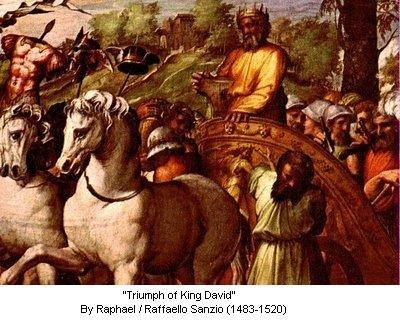
davidchariot

God keeps his promises, but not always on our timetable. David illustrates physically in the land of Israel what Jesus wants to do spiritually in our hearts and minds.

2 Samuel #9 . 2 Samuel Chapter 8

To listen to the sermon, click the play button:

To download, right click on the link (or do whatever you do on a Mac) and save it to your computer: Download 2 Samuel Part 9

Chapter eight chronicles many of the conquests of David after he became king. These did not all necessarily take place at one point in his life; rather this is a record of what David did over a lifetime of military leadership.

In verse one, the writer tells us that “Metheg-ammah” is taken from the Philistines. This is an Hebrew expression that gives translators trouble. Some think it refers to the city of Gath. Literally it says that David took “the bridle out of the mother” of the Philistines. It may be a kind of slang meaning he took control (the bridle) of the chief Philistine city (which would be Gath). The main point is clear – the Philistines have lost any kind of control or initiative that they once had against the Israelites, and they are, for all intents and purposes, subdued. The Philistines had been a problem for Israel for several hundred years, now, through David, the Lord ends the problem.

The second verse describes how David defeated the Moabites. This is a bit troubling, because David was quite severe with them, apparently executing two thirds of the men who fought against him. This is made even more perplexing when we remember that David’s great-grandmother was a Moabite, and David had left his elderly parents in the care of the king of Moab when he was running from Saul. Some Jewish scholars believe that the Moabites killed David’s parents. There is no record of them after David left them in Moab. In addition, the Lord told David not to remain there (1 Samuel 22:5). So it is possible that the Moabites planned all along to betray him, and that the Lord told David to leave there to protect him from their betrayal. His parents, however were still there when the Moabites turned on him. This seems plausible to me.

There is more as well. In Numbers chapters 22-25, the Israelites had left Egypt and were wandering in the wilderness. This was more than four hundred years before the time of David. The Israelites camped near the country of Moab, and the Moabites were afraid of them. They didn’t want to fight the Israelites, so the king of Moab hired a prophet of God to curse the Israelites. Only, the prophet was a true prophet, and he couldn’t curse Israel in God’s name. Instead, he blessed them. The Moabites tried to trick the Israelites into becoming one people with them, and worshipping their false gods. But the prophet prophesied about the future of the two nations. He said:

I see him, but not now; I perceive him, but not near. A star will come from Jacob, and a scepter will arise from Israel. He will smash the forehead of Moab and strike down all the Shethites. (Num 24:17, HCSB)

David fulfilled this prophecy in 2 Samuel chapter 8. Now, I don’t think was consciously trying to fulfill the prophecy. I think he was punishing them for killing his parents. But as it happened that also fulfilled the prophecy given more than four hundred years before.

clip_image002In fact, at one level, this whole passage is about the fulfillment of ancient promises and prophecies. Eight hundred years before David, God promised Abraham that his descendants would inherit the land of Canaan. In Genesis 15:18-21, that land was described as extending from the Red Sea in the South to the Euphrates river in the north where it runs southeast through modern-day Syria. Other promises in Deuteronomy 1:7, 11:24 and Joshua 1:4 describe those same borders, and lay out an eastern border that included almost all of modern day Jordan and Syria. However, in all the time that the descendants of Abraham lived in the promised land, they had not possessed nearly that much territory. For four hundred years, they had lived on far less than God had promised. The map at left shows the region. The area outlined in yellow is the area that the Israelites controlled during the time of the Judges and during Saul’s reign.

They were living in far less than God had promised.

However, as a result of the conquest made by David, as described in 2 Samuel chapter 8, the borders of Israel were extended to almost the exact boundaries described in God’s promises to Abraham and to the people through Moses. This next picture shows the approximate area of David’s clip_image004kingdom, outlined in purple. As you can see, Israel now had influence from the Euphrates river to the Red Sea. This is not to say that all of this area was considered “Israelite” however David’s court in Jerusalem controlled and influenced all of it. If you are still having trouble picturing it, look at a world map. This area includes modern Israel, Jordan, Lebanon and most of Syria.

So what does all this mean for us today? I think it always helps to ask, “where is Jesus in this passage?” I see him here in two places: he is fulfilling promises, and defeating enemies. First let’s talk about the promises. On one hand, this seems to show us that God’s promises don’t always get fulfilled in what we consider a timely fashion. It was more than eight hundred years between God’s promise to Abraham about the size of the land, and the complete fulfillment of that promise. That’s a long time, and many generations didn’t live in the full reality of what God had promised. On the other hand, God doesn’t forget his promises, and he does truly bring them to pass. If you wanted to take the time, you could go through the bible, and find dozens of examples of promises that He made and then kept. Many times in the past I have explained where the bible came from, and how it has been verified time and again as a historically valid document. Here, I want to emphasize that it is also a spiritually valid document. We have a historical record of a promise from God and a historical record from a different period showing its fulfillment.

A natural question is “Why did it take so long for God to fulfill this?” The only completely honest answer is “I don’t know.” I do have some thoughts, however. God told Abraham when he made the promise that it wouldn’t happen for at least four-hundred years. He was giving the residents of the land a chance to repent. But when the Israelites came out of Egypt four hundred years later, the Lord told them through Moses to go into the land, drive out the other nations and possess it. They simply didn’t do it. The reason they didn’t do it is because they lacked faith in God’s promise to be with them. In Numbers 13, Moses sent twelve spies into the land prior to invading it. Ten of the spies came back and said it would be impossible to drive out the nations who lived there. But two said it could be done. Their names were Joshua and Caleb. They said:

The land we passed through and explored is an extremely good land. If the LORD is pleased with us, He will bring us into this land, a land flowing with milk and honey, and give it to us. Only don’t rebel against the LORD, and don’t be afraid of the people of the land, for we will devour them. Their protection has been removed from them, and the LORD is with us. Don’t be afraid of them!  (Num 14:7-9, HCSB)

But the people didn’t listen to them. Instead they gave into fear and blaming. The result was forty years more of wandering for that generation, and then four-hundred years more of living in only part of what God promised.

I don’t think the lesson here is “do more.” I think it is “trust more.” As I have said many times, believing comes before doing. If the people were living in trust, they would have done what they were supposed to do. If they had attempted to do it without trust (as indeed they often did in the next four hundred years) their results would also have fallen short. The key is believing what God has promised, and trusting Him. We have seen that the one thing that makes David a hero is that he trusts God. David isn’t perfect. But he lives out of the understanding that his life belongs to God; that through him, God can and should do whatever he wants. So when David came along, the Lord finally had someone he could use, someone who trusted Him enough so that God could fully give everything that was promised.

We can’t always understand why God doesn’t completely fulfill his promises in our own lives. It isn’t always about our faith – sometimes it is about God’s bigger purposes in the world. For many years, David did not live in the fullness of God’s promises to him. That wasn’t his fault – God was arranging other things, because it wasn’t just about David – it was about God’s purposes. So don’t feel badly if you truly trust God, and yet you don’t see the complete reality of his promises in your life. It isn’t just about you. But at least, we can try to eliminate lack of faith as a reason that we don’t experience the fullness of God’s promises to us. David trusted him fully, and eventually, the Lord used that trust in a huge and positive way for both David and the entire people of God.

Now let’s talk about Jesus defeating enemies. is there “unconquered territory” in your life? I mean, are there certain areas of your life that are outside the control of Jesus? Hebrews 2:8 says this:

You put all things under his control.” For when he put all things under his control, he left nothing outside of his control. At present we do not yet see all things under his control, (Heb 2:8, NET)

Like with God’s promises, we often see a partial fulfillment of the Lord ruling in our lives. I’ll be honest and say, usually this is for the same reason – our own lack of trust. But it has the same solution. If we trust Jesus, and let him have us more fully, he will supply the power to defeat the failures, temptations and self-will that we struggle with. Paul writes about the struggle this way:

For though we live as human beings, we do not wage war according to human standards, for the weapons of our warfare are not human weapons, but are made powerful by God for tearing down strongholds. We tear down arguments and every arrogant obstacle that is raised up against the knowledge of God, and we take every thought captive to make it obey Christ. (2Cor 10:3-5, NET)

Like David, we are called to wage war while trusting in God’s promises. But our war isn’t physical – it is the war of a mind, to let the Lord conquer all that he has promised for us. Now I could do an entire sermon series on the battle for the mind – maybe I will soon. But for now, I think we should understand this from our text: the key is to trust our Lord, and to be willing to do whatever that trust leads us to do. Sometimes that means opposing whatever opposes the truth of the Word of God in our thoughts. David illustrates physically in the land of Israel what Jesus wants to do spiritually in our hearts and minds.