PHILIPPIANS #4: SOMETIMES HYPOCRITES SPEAK THE TRUTH

The gospel is bigger and more important than anything: imprisonment, fear, or even hypocrisy.

To listen to the sermon, click the play button:


You can also find us on Spotify at https://open.spotify.com/show/6KKzSHPFT466aXfNT2r9OD

(This will open to the latest sermon. You can search from there if you are looking for a previous one)

To download, right click on the link (or do whatever you do on a Mac) and save it to your computer: Download Philippians Part 4

Philippians #4. Philippians 1:12-18

12 I want you to know, brothers, that what has happened to me has really served to advance the gospel, 13 so that it has become known throughout the whole imperial guard and to all the rest that my imprisonment is for Christ. 14 And most of the brothers, having become confident in the Lord by my imprisonment, are much more bold to speak the word without fear.
15 Some indeed preach Christ from envy and rivalry, but others from good will. 16 The latter do it out of love, knowing that I am put here for the defense of the gospel. 17 The former proclaim Christ out of selfish ambition, not sincerely but thinking to afflict me in my imprisonment. 18 What then? Only that in every way, whether in pretense or in truth, Christ is proclaimed, and in that I rejoice. Philippians 1:12-18

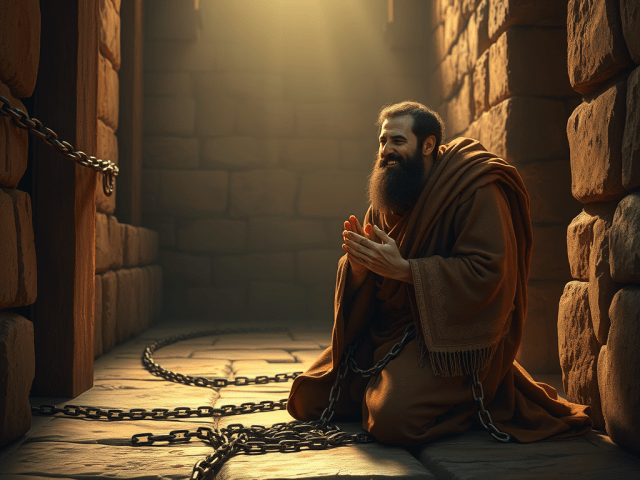
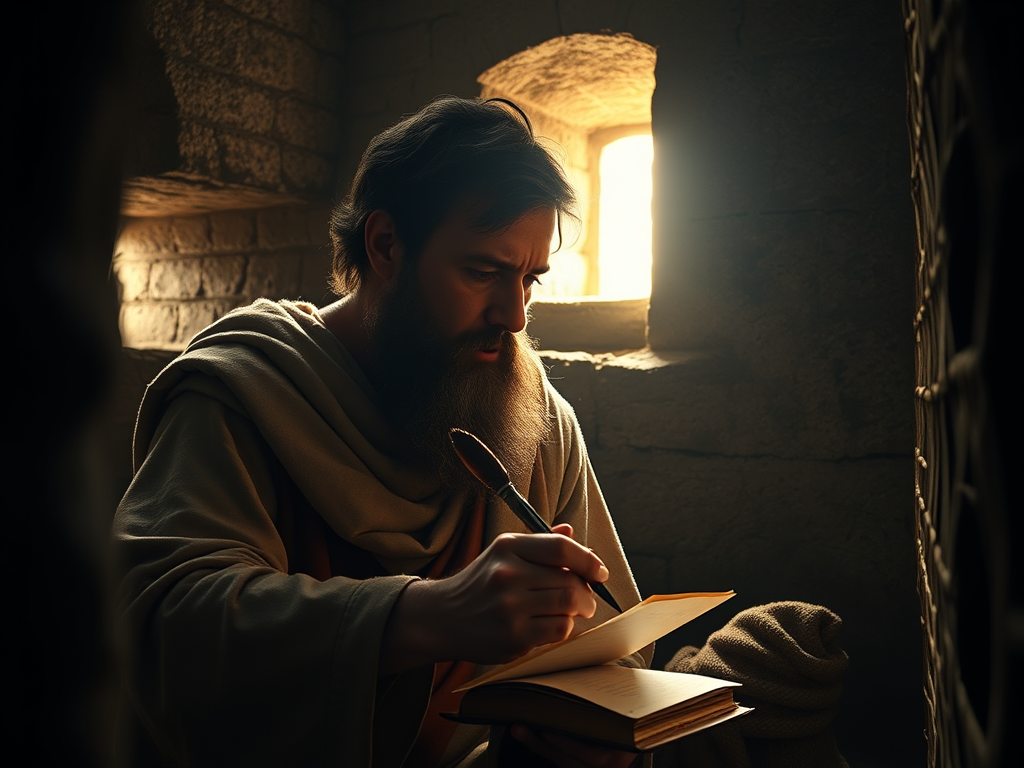
Paul says that “what has happened to me has really served to advance the gospel.” The natural question is: “What is it that has happened to Paul?” Surprisingly, Paul doesn’t elaborate. Remember, the Philippians sent a gift with the messenger Epaphroditus, and almost certainly others accompanied him. Epaphroditus was sick, and stayed in Rome. But those others would have returned to Philippi, and told the believers there how Paul was doing, and what was going on with him. However now, probably months later, Paul is writing a letter. He’s on trial for his Christian faith. Because he’s a Roman citizen, his case will be decided by Caesar himself, or a close representative of Caesar. I would expect Paul to go into detail about how the case is going, and the attitude of the court toward him, and the evidence given, and things like that. But that’s not what Paul does. He says “what has happened to me has advanced the gospel.” And then, he goes on, as we see, by explaining, not what has happened to him, but rather, how the gospel has advanced.

It’s easy to jump over this small part until you really put yourself in the shoes of Paul, or the Philippian believers. Surely what is happening with Paul must be the most important thing in his life, right? At the moment, he lives under guard. If he is acquitted, he gets to go free. If he is not acquitted, he’ll be killed. This is literally life or death. But for Paul, the really important thing is that the gospel is advancing.

Paul was imprisoned by Caesar’s court. So, apparently, Paul took the opportunity of his imprisonment to tell Caesar’s guards about the gospel. At the end of the letter he writes: “All the saints greet you, especially those of Caesar’s household. (Philippians 4:22, ESV)” So, because Paul was imprisoned by Caesar, even members of Caesar’s own household became Christians! That was pretty incredible news, by any standards.

He adds that most of the Christians in Rome were bolder as a result of his imprisonment. This seems like the opposite of what I would expect. You would think that if one of the main leaders of Christianity were imprisoned for being a Christian, that would discourage other Christians. But instead, it did the opposite. I think this happened for several reasons.

First, Jesus himself told his followers that they were blessed if they were persecuted for following him:

10 “Blessed are those who are persecuted for righteousness’ sake, for theirs is the kingdom of heaven.
11 “Blessed are you when others revile you and persecute you and utter all kinds of evil against you falsely on my account. 12 Rejoice and be glad, for your reward is great in heaven, for so they persecuted the prophets who were before you. (Matthew 5:10-12, ESV)

18 “If the world hates you, know that it has hated me before it hated you. 19 If you were of the world, the world would love you as its own; but because you are not of the world, but I chose you out of the world, therefore the world hates you. 20 Remember the word that I said to you: A servant is not greater than his master.’ If they persecuted me, they will also persecute you. (John 15:18-20, ESV)

So, Paul’s example probably reminded the other followers of Jesus that Jesus himself told us we would be persecuted for following him. He told us we would be blessed to suffer for him.

Second, when Paul refused to deny the gospel even when he was imprisoned for it, I think it showed other Christians that Paul (along with the other apostles) really meant what he said. If the gospel is true, then it is worth giving up or losing absolutely anything in this world, if by doing so we gain eternal life in the presence of the One True God. Paul showed that he absolutely believed that, that he really meant what he said when he claimed that Jesus was the true messiah, and all else was rubbish compared to the surpassing greatness of knowing him. His willingness to be imprisoned for Christ, and to continue to speak boldly about Jesus even while he was imprisoned for it, encouraged many others to be bold themselves.

Paul then mentions that while there some people who are preaching Christ from sincere motives, there are others who are preaching Christ not sincerely, but because they see Paul as a rival, and so they want him to feel bad, and to take advantage of his imprisonment to grow their own audience and influence, and to shrink his. But such people misunderstand the reality of Jesus. As long as they are actually preaching the true message of Christ, Paul doesn’t care how it might affect him personally. The real point is that the message of Christ is being preached.

I want us to be clear about Paul’s position in his own lifetime. We think of him as “The Great Apostle Paul,” a Christian missionary Hero, used by the Lord to write a large chunk of the New Testament. We don’t even know the names of his rivals who preached the gospel in an effort to spite him. But in his own lifetime, Paul planted house churches in fewer than a dozen cities. Many of the churches he himself planted did not respond well to Paul’s own teaching. Other people considered themselves rivals to Paul. Though the original twelve apostles accepted Paul as an fellow apostle, many other Christians did not. He was embroiled in controversy for most of his time as a Christian, both within the Christian community, and with the governing authorities. By the time of this writing, he was a prisoner, a “con.” He had no idea that the letters he wrote were inspired by the Holy Spirit and destined to become scripture. But none of those discouraging things really mattered to Paul. He knew he was called to spread the gospel, and so that’s what he did, as best as he could, and he rejoiced when other people spread the gospel too, even if they intended it to hurt Paul.

That is a point more pastors and Christian leaders could stand to remember. About fifteen years ago, not long after we started New Joy Fellowship, I helped a fellow pastor as he started a different church in our town, known as The Journey Church (TJC). TJC now has several hundred people in attendance each week. One of my own daughters goes there. Meanwhile, our own New Joy Fellowship remains as just two connected house churches. If everyone from both house churches came at the same time, we could still all squeeze into our living room (granted, it’s a big living room, but still). Over the years, I have often steered people to TJC, because they are looking for a faithful church in town that has many programs and resources that New Joy Fellowship doesn’t have. The point is this: I am not trying to build “my” church. I am contributing to the kingdom of God, and, at least with regard to weekly attendance numbers, I am called to a smaller field than my fellow-pastor who leads TJC.

This is a little off topic, but I think it’s somewhat relevant: If I had started a church that grew to hundreds of people in weekly attendance, I would have had to resign years ago, because my severe daily pain would have prevented me from devoting the energy necessary to a church that size. I can relax. I’m on “team gospel,” and that team is much bigger than any of the individuals on it. This was Paul’s own attitude, and Paul’s words here are one reason I feel at peace about my situation.

This attitude isn’t only for pastors and leaders. I want to reiterate something that has become important to our house church network. We are called to Walk with God; Walk with Others; Work in the Kingdom; and, Stay Salty. Our mission is not necessarily to enlarge our own church or ministry. Our mission is to be faithful to Jesus in all areas of our lives, and to be available to be used by him whether or not it grows our own church. In our little fellowship we have a manager who is known by his coworkers to be a Christian, and they come to him for prayer and encouragement. We have another manager who helps his employees with substance abuse issues, and general life problems, even though that has nothing to do with his actual job. We have an attorney who advocates for children. We have an oncology nurse, and a hospice nurse, a hospital nurse, and a prison nurse, all of whom faithfully shine the light in their workplaces. (We’ve got your nursing needs covered!). There are many others doing similar things in their places of work. We also have mothers and grandmothers who pour love and light into their families. The point is this New Joy Fellowship doesn’t exist to enlarge New Joy Fellowship. Instead, we gather to be encouraged and equipped to spread the gospel in every place we spend our daily lives. Trust me, I would like to see our churches grow. I might feel a little more financially secure if we did. But I am at peace if our people lead other people closer to the Lord, even if those people end up at other churches. The point is that we are being used for the kingdom of God.

Over the years, I’ve run into many Christians who speak of unity. But their vision of unity seems to be gathering a lot of Christians into one place while they lead a program for the gathering. That sort of thing has a place, I’m sure. But Paul shows us real unity here: it is rejoicing when someone else’s ministry grows while yours shrinks, because the end result is that the gospel spreads.

There is something else: Paul’s attitude toward those who are not sincere. For Paul, the main thing is this: are they preaching the true gospel? If so, he isn’t overly worried about the fact that they are people of questionable character. We need to think carefully here, because it could be easy to get the wrong idea. As I write this, only a few days ago, popular Evangelical author Philip Yancey has admitted to an eight-year adulterous affair. Although something about Yancey never really connected for me, I do know that many people felt blessed by his writing and speaking. And, of course, this sort of thing seems to happen all too often. Sometimes it’s a Christian music celebrity, sometimes a speaker or celebrity pastor, sometimes it’s an author. Anyway, someone that many people admire, someone who seemed to be bringing a Biblical message, turns out to be a massive hypocrite. Usually, the sin is sexual, but sometimes it’s money, or abuse of power.

By the way, this is one reason that the New Testament urges Christians not to live in sin (it isn’t the only reason, but it is one). When Christians are so clearly hypocrites, it tends to not be a good thing for the gospel. People can use our own failings as a way to dismiss the truth of what we say. That isn’t logical, but it is what people do. So, part of the reason we Christians are told to put off sinning is because it hurts the gospel when we don’t live like we believe it.

I think it is useful to think about this sort of thing in two ways, even though there is a tension between the two ways. First, we need to consider Paul’s attitude here, and it is this: even if the person bringing the message is a hypocrite, or a bad person, if the message itself is true, we can receive it and be blessed by it. God can use scoundrels to speak truth. We can receive all the good, and still recognize the sinfulness of the person who delivered it. Martin Luther was crystal clear on this with regard to communion. He wrote that even if the priest who spoke the blessing over communion was a bad person, we can still receive the good and pure and true communion as from Jesus. God is not limited by human sin. We trust God’s Word, even if it is brought to us by a broken vessel. The true Word of God is not tainted just because it came to us through sinful human beings.

Jesus himself said:

2 “The teachers of the Law and the Pharisees are the authorized interpreters of Moses’ Law. 3 So you must obey and follow everything they tell you to do; do not, however, imitate their actions, because they don’t practice what they preach. (Matthew 23:2-3, GNT)

We do this all the time in other areas of life. You’ve probably known a doctor or nurse who smokes, or is overweight. Maybe you’ve met a personal trainer who drinks a lot, or smokes weed. Even so, these health-related professionals give us good advice: don’t smoke, keep a healthy weight, don’t get drunk or high. The fact that they don’t keep their own advice does not make it bad advice.

So there is precedent for us to learn from anyone who speaks the truth, even if their actions are not consistent with their teachings. We, ourselves, should strive to live as we believe. That is clear. When we don’t, it can hurt the spread of the gospel. But we can receive every good gift as coming from God, even if the gift comes through a very flawed and sinful person.

In fact, when Christian leaders fail, it actually confirms the truth of part of the gospel. The gospel tells us first of all that we are sinful human beings, and we cannot save ourselves from our own sins. People like Philip Yancey are dramatic examples that confirm that this is true.

At the same time, the fact that their teaching is correct is not an endorsement of their sins and failings. This brings us to the second way to think about this: Christians in our day and age are far too influenced by “celebrity Christian culture.” We are prone to think that if someone is a well known speaker, singer or writer, they must be well known because God approves of them. But that was not true in Bible times, and it isn’t true now. I saw this online, and it’s worth quoting:

Platform is not proof of character.

We keep making this mistake.

Someone writes well, we assume they live well.

Someone preaches powerfully, we assume they walk uprightly.

Someone sells millions of books, we assume God is cosigning their integrity.

But gifting and character are not the same thing.

Anointing and obedience are not the same thing.

Influence and faithfulness are not the same thing.

“Many will say to Me in that day, ‘Lord, Lord, have we not prophesied in Your name, cast out demons in Your name, and done many wonders in Your name?’ And then I will declare to them, ‘I never knew you; depart from Me, you who practice lawlessness!’” (Matthew 7:22-23)

I think the fact that we have a “Christian celebrity culture” is one of the most destructive things to the witness of the gospel in our time. We ought to have only one celebrity: Jesus Christ. No one else is worthy of our allegiance. We need to remember this:

20 So where does this leave the philosophers, the scholars, and the world’s brilliant debaters? God has made the wisdom of this world look foolish. 21 Since God in his wisdom saw to it that the world would never know him through human wisdom, he has used our foolish preaching to save those who believe. 22 It is foolish to the Jews, who ask for signs from heaven. And it is foolish to the Greeks, who seek human wisdom. 23 So when we preach that Christ was crucified, the Jews are offended and the Gentiles say it’s all nonsense.
24 But to those called by God to salvation, both Jews and Gentiles, Christ is the power of God and the wisdom of God. 25 This foolish plan of God is wiser than the wisest of human plans, and God’s weakness is stronger than the greatest of human strength.
26 Remember, dear brothers and sisters, that few of you were wise in the world’s eyes or powerful or wealthy when God called you. 27 Instead, God chose things the world considers foolish in order to shame those who think they are wise. And he chose things that are powerless to shame those who are powerful. 28 God chose things despised by the world, things counted as nothing at all, and used them to bring to nothing what the world considers important. 29 As a result, no one can ever boast in the presence of God.
30 God has united you with Christ Jesus. For our benefit God made him to be wisdom itself. Christ made us right with God; he made us pure and holy, and he freed us from sin. 31 Therefore, as the Scriptures say, “If you want to boast, boast only about the LORD.” (1 Corinthians 1:20-31, NLT)

All of this points back to the gospel. Paul is hovering between life and death, but all he cares about is how the gospel is spreading. He has taken seriously some things that Jesus said:

44 “The kingdom of heaven is like treasure hidden in a field, which a man found and covered up. Then in his joy he goes and sells all that he has and buys that field.
45 “Again, the kingdom of heaven is like a merchant in search of fine pearls, 46 who, on finding one pearl of great value, went and sold all that he had and bought it. Matthew 13:44-46

Paul discovered the treasure, and was willing to give up everything else for it. The treasure is that God loves us so much that he came to earth and suffered a humiliating, tortuous death in order to restore our relationships to him, and to each other. He not only died, but he physically rose from death, opening the way so that we, too, will one day be eternally and physically resurrected, and live in the light of God’s boundless joy.

PHILIPPIANS #3: A BUFFET OF THANKSGIVING

Today we will consider Paul’s introductory prayer, offered right after his first greeting to the Philippians. These nine verses are filled with important ideas and rich food for our souls. Think of it as a kind of buffet. You may feel more hungry for the steak than the salad, and that’s fine. Maybe not every part of this passage will be equally meaningful for you. But let’s dig in and see what is on offer here.

To listen to the sermon, click the play button:


For some people, the player above may not work. If that happens to you, use the link to either download, or open a player in a new page to listen.

You can also find us on Spotify at https://open.spotify.com/show/6KKzSHPFT466aXfNT2r9OD

(This will open to the latest sermon. You can search from there if you are looking for a previous one)

PHILIPPIANS 1:3-11

3 I thank my God in all my remembrance of you, 4 always in every prayer of mine for you all making my prayer with joy, 5 because of your partnership in the gospel from the first day until now. 6 And I am sure of this, that he who began a good work in you will bring it to completion at the day of Jesus Christ. 7 It is right for me to feel this way about you all, because I hold you in my heart, for you are all partakers with me of grace, both in my imprisonment and in the defense and confirmation of the gospel. 8 For God is my witness, how I yearn for you all with the affection of Christ Jesus. 9 And it is my prayer that your love may abound more and more, with knowledge and all discernment, 10 so that you may approve what is excellent, and so be pure and blameless for the day of Christ, 11 filled with the fruit of righteousness that comes through Jesus Christ, to the glory and praise of God. (Philippians 1:3-11, ESV)

As I said in the introduction, the Philippians were a church with which Paul had few, if any, theological issues. He had deep, affectionate relationships with many in the church. So, he begins by mentioning that whenever he prays for them, he thanks the Lord, and prays with joy. Later in the letter, he will remind them explicitly that when they pray, they should do so with thanksgiving and joy.

I’ll say more about joy and thanksgiving in prayer when we get to that passage, but I do want to say something here, because it’s worth saying more than once. Sometimes, I pray about something, and when I’m done, I feel just as worried and bothered by it as I did before I prayed. But at other times, when I pray, I feel so much better afterwards. I think the difference is that during the times I don’t feel at peace, I have forgotten to thank the Lord when I pray.

When we give thanks as we pray, we are encouraging our hearts to trust the Lord. When I ask for the Lord’s help, adding “thank you,” is like saying, “I trust you to deal with this, Lord. I’ve asked you to do something, and I’m thanking you, because I trust that you have heard me, you understand my concerns, and you will do what is best.” When we thank him, we are putting the matter in the Lord’s hands, and leaving it with him. Just to be perfectly clear: saying “Thank you,” does not mean that I think the Lord will respond exactly how I want him to. It means I trust him to work in the best way, even if I don’t recognize it as the best way at this point in time. Thanking the Lord is a concrete way of releasing our concerns into the hands of the Lord.

Paul says he is thankful for the Philippians’ partnership in the gospel. The word for “partnership” is a pretty flexible word. In general it describes a close fellowship, an involvement with one another’s lives. I think Paul means a number of things by this word.

The first Philippian to become a Christian was a businesswoman called Lydia. As soon as she received Jesus, she invited Paul and his companions to stay with her. She said: “If you consider me a believer in the Lord, come and stay at my house” (Acts 16:15, HCSB). Her newfound faith immediately led her to reach out to Paul and the missionaries and partner with them by giving them a place to stay. So, from the very first day, Lydia became a partner in the gospel. Apparently the other Philippians responded in a similar way.

The partnership undoubtedly included fellowship and friendship as well. The long, ongoing connection between Paul and the Philippians testifies to genuine love and concern for one another. And, for these Philippians, the partnership also included financial giving to enable Paul to continue to preach the gospel. If you remember, one of the reasons Paul  is writing this letter is because the Philippians sent  him a financial gift, and he wants to thank them. This was not the first time they gave him financial support. At the end of the letter, Paul again thanks them, explicitly, for their financial gift. He says:

5 And you Philippians yourselves know that in the beginning of the gospel, when I left Macedonia, no church entered into partnership with me in giving and receiving, except you only. 16 Even in Thessalonica you sent me help for my needs once and again. (Philippians 4:15-16, ESV)

We’ll talk about all this more when we get to those verses, but I want to make a few quick observations. In Paul’s mind, one way to be “a partner in the gospel” is to give financially, and one of the reasons he thanks the Lord for the Philippians is because they have partnered with him in that way from the very beginning of their Christian lives. This partnership of financial giving is not something that Paul demanded, but rather, the Philippians freely chose to enter into it. We’ll unpack more about this when we get to the end of the letter.

Next Paul writes one of the most comforting verses in the New Testament:

“And I am sure of this, that he who began a good work in you will bring it to completion at the day of Jesus Christ.”

Their partnership in the gospel (and Paul’s too) began with God’s work in them. It continues until Jesus returns, and it continues as the work of the Lord. In other words, Paul is not saying, “I’m sure you will all be good Christians until Jesus returns. No, he says: “The Lord (not you), began the work within you, and it will be the Lord himself who brings it to completion.”

Sometimes we Christians get messed up in our theology. We think “Jesus forgave all of my sins by dying on the cross. Now, it’s up to me to live a good life to honor what Jesus did for me.” But that’s not the Biblical picture at all. Jesus did all that was needed to save us, and he also provides all that is needed for us to live as his people for the rest of our lives. We do not “complete” the work of Jesus by being good people after we’re saved. Jesus himself is the one who completes the work in us. From start to finish, the work is His.

Now, this is all a bit tricky. I’ve mentioned before that there are many tensions in the teaching of the Bible. This is one of them. We are saved entirely by grace. Not only that, but we live as Jesus wants us to live entirely by grace. Jesus is the one who does it within us. At the same time, we have the ability to either allow Jesus to complete his work, or to hinder him from doing the work within us. Our main job is to allow Jesus to do within us what he wants to. Sometimes, that means saying “no” to things we’d like to do, but which will hinder his work in us. Sometimes, that means saying “yes” to things we feel like we’d rather not do. It is all the work of Jesus, a work of grace. But we do have to be diligent about allowing Jesus to do what he wants to do in us and through us. And yet, don’t let this sound like a law you must follow. It is the Lord who provides the power and energy for us to be the people he wants us to be. Our part is to allow him to be at work in us. Our part is not so much to be good people, as it is just to not hinder him from making us into his people. Maybe what I’m trying to say is this: if you belong to Jesus, you will want him to guide you, and empower you to follow him. If you are consistently going your own way, and not too concerned about it, there is something wrong. On the other hand, if you belong to Jesus, he himself will empower you through the Holy Spirit to become more and more the person he wants you to be. You can allow your soul to rest as you trust him to do what you cannot do anyway.

Paul continues on in his gratefulness for the Philippians:

7 It is right for me to feel this way about you all, because I hold you in my heart, for you are all partakers with me of grace, both in my imprisonment and in the defense and confirmation of the gospel. 8 For God is my witness, how I yearn for you all with the affection of Christ Jesus.

Paul reaffirms the sense of fellowship and partnership he feels with them in the gospel. This is important. Christians are supposed to live in fellowship and partnership with other Christians. The idea of someone who is a Christian but does not belong to a church is wildly unbiblical. Even the idea of belonging to a church, but not really knowing or being involved in the lives of your fellow believers is completely against the Biblical view. When you become a Christian, you become part of the family of God, and you are supposed to become anchored to some specific part of that (i.e., a local church, and/or a small group in that church). Being a follower of Jesus involves being a partaker in the lives of other believers. This is not optional. If we don’t love others who belong to Jesus, then we need to seriously wonder if we even love Jesus.

7 Dear friends, let us love one another, because love is from God, and everyone who loves has been born of God and knows God. 8 The one who does not love does not know God, because God is love. 9 God’s love was revealed among us in this way: God sent His One and Only Son into the world so that we might live through Him. 10 Love consists in this: not that we loved God, but that He loved us and sent His Son to be the propitiation for our sins. 11 Dear friends, if God loved us in this way, we also must love one another. 12 No one has ever seen God. If we love one another, God remains in us and His love is perfected in us. (1 John 4:7-12, HCSB)

20 If anyone says, “I love God,” yet hates his brother, he is a liar. For the person who does not love his brother he has seen cannot love the God he has not seen. 21 And we have this command from Him: The one who loves God must also love his brother. (1 John 4:20-21, HCSB)

Paul’s words demonstrate his love for the Philippians. A bit later in the letter we will see that the Philippian church is not perfect, by any means, and there are struggles in the way they love one another. Even so, they kept at it, and Paul reveals his own love for Jesus by showing us that he loves his fellow-believers.

Paul adds this to his prayer for the Philippians:

9And it is my prayer that your love may abound more and more, with knowledge and all discernment, 10 so that you may approve what is excellent, and so be pure and blameless for the day of Christ, 11 filled with the fruit of righteousness that comes through Jesus Christ, to the glory and praise of God.

The first part of the prayer is about this business of loving other believers. Love should abound (that is, be plentiful, and even increase). Love should also be accompanied by knowledge and discernment. In other words, there is a time and place to discern whom we love, and how, and whether or not our fellowship with them is based upon truth and excellence. Our love should grow, and so should our discernment about who we welcome as fellow followers of Jesus. To make it clear: love does not mean that we should accept the corruption of the truth. It does not mean that we should never try to discern with whom we should fellowship. In fact, in addition to love, we need knowledge and discernment.

So, for instance, there are people who call themselves Christians who do not believe that Jesus is the only way to God. There are some who flatly deny parts of what the bible teaches: for instance, the teachings about sexuality which are so out of step with our current culture. But they have no reason for denying the Bible’s teaching on sexuality, while not denying what it says about God’s love. We can and should exercise discernment in our fellowship. I don’t have to judge the status of their salvation, but I can say that through knowledge and discernment, it is appropriate that I don’t have a great deal of fellowship with such people.

Paul ends his prayer with the hope that they will be “pure and blameless for the day of Christ, filled with the fruit of righteousness that comes through Jesus Christ, to the glory and praise of God.”

Once again we return to the comfort of verse six. The fruit of righteousness comes through Christ Jesus, not through our own efforts. The very last phrase is important as well: “to the glory and praise of God.” This is also a comfort: God’s ultimate design is that we glorify him. And he has made it so that when we are glorifying him, it is also the best thing possible for us. Because it is about God’s glory, we can be sure that God himself will complete his work in us. And because it is about God’s glory, we can trust that God’s will is good for us.

So what is the Lord speaking to you about today? Do you need to be reminded to pray with thanksgiving? Again, if you find that your prayers are not bringing you to the peace you hope for, it might be because you need to thank the Lord as you pray?

Maybe you need to be reminded about partnership in the gospel. When we become believers, we join a family, and that ultimately leads to a deep fellowship and partnership with a small group of other followers of Jesus. That partnership shares in joy and pain, in plenty and in times of need. It involves the sharing of all of our lives with one another in the cause of the gospel. Do you hear the gracious invitation of Jesus to “plug-in,” to go all in with other believers? The idea of following Jesus mostly on your own, apart from other believers, is not a Biblical idea. It is directly contrary to scripture.

I think sooner or later we all need to hear the deep comfort of verse six: It is Jesus himself who began his good work in us, and it is Jesus himself who will complete it. God’s love for us, and our future as his people, rest upon Jesus Christ, not upon our own efforts. We trust Jesus to do what needs doing in us. Our main task is to not hinder him; that is to say yes to him.

Maybe we are eager to  partner with other Christians, but we need to be reminded that discernment and knowledge are also important. There is such a thing as truth, and it matters, and even at times, knowledge and discernment should lead us into deep fellowship with some believers, and not with others who claim to be Christian.

Finally, do you need to be reminded that you were created to show a piece of God’s glory? It is a wonderful thing to remember, because it means that your whole life is God’s own project, for God’s own purposes, and those are good and wonderful.

CHRISTMAS 2025: IT WASN’T SUPPOSED TO BE THIS WAY

Sometimes it seems like so much is wrong, so many things are not the way they are supposed to be. It feels like the world is spinning in chaos, out of control. But God is still in charge. He is working out everything according to his plan, and that is good for all who love God. During that first Christmas, it seemed like nothing was working out the way it was supposed to. But God was powerfully working all things according to his plan.

To listen to the sermon, click the triangle “play” button below

You can also find us on Spotify at https://open.spotify.com/show/6KKzSHPFT466aXfNT2r9OD

(This will open to the latest sermon. You can search from there if you are looking for a previous one)

“This wasn’t supposed to happen.” “This is not the way it was supposed to be.” Those are powerful feelings. They are feelings I have myself, right now. My life, and that of my family, has been turned upside down. My youngest daughter has cancer; a very serious, life-threatening cancer. Even now, she is fighting for her life.

Some of the rest of you have probably experienced some times when it feels like it wasn’t supposed to be this way. Maybe like me, a loved one of yours is in danger of losing their life, or maybe even has lost it. Maybe your career didn’t turn out the way you thought. Maybe your future is horribly different from the future you dreamed of, years ago. Your marriage wasn’t supposed to be this way.

It may surprise you to learn that Christian History is full of “this is not the way it was supposed to be’s.” Abraham and Sarah weren’t supposed to be so old, and they thought they were supposed to have more than one child. Jacob wasn’t supposed to marry Leah. Joseph wasn’t supposed to be sold as a slave, and later he wasn’t supposed to be thrown in prison too – he deserved none of it. The people of Israel weren’t supposed to be slaves in Egypt. The twelve tribes weren’t supposed to be oppressed by the surrounding peoples. The shepherd boy wasn’t supposed to have to fight the giant warrior. The anointed King, David, wasn’t supposed to have to run for his life in the wilderness. He also wasn’t supposed to have an affair. The prophets weren’t supposed to be rejected. The Kingdom of David was not supposed to be split, and the nations were not supposed to be destroyed and the people deported.

I’m sure a lot of the people involved in the very first Christmas might have felt the same way. Let’s hear from some of them.

(Zechariah and) Elizabeth: “We were supposed to be parents. We would have a house full of laughing, running children. Little girls that I would teach to sew and cook and clean. Little boys that Zechariah would teach to care for the animals and the house. Boys and girls both that we would teach the Law and the Prophets. Instead, now we are old. It is a joy, I am sure, to have a child, even now, but we were supposed to be young and fit. We were supposed to run with our children, and take them on picnics, and journeys to the temple, and play. But now, our bones are old, and we need our rest. This is no time to have a child. This is not how it was supposed to be.

Joseph: This was not the way it was supposed to be. On my wedding night, I was to be the man of the hour, honored, celebrated. I was supposed to be serenaded by the wedding party outside my house. Then we were supposed to process through the town singing songs and laughing and joking, and then we’d arrive at Mary’s house. She would come out, radiant, beautiful, perfect. We’d join hands and parade joyfully back to my house, the toast of the town, and then the feast. We would laugh and dance and eat until our stomachs and hearts were full to bursting. Then, we would go to the marriage bed, pure and uncomplicated, and consummate the joy of God’s gift of marriage.

Instead, we had to leave Nazareth under a cloud of shame. No procession, no singing, dancing or feasting, just contempt and disgust on the faces of our friends and families—contempt that we do not deserve. Mary’s young body is already stretched and changed by a child, and I’ve never even so much as kissed her lips. Instead of a parade of laughter and joy and singing, we are on this journey of cold and hardship and not much to eat, going to a town I barely remember from my childhood, a town where no one knows us enough to take us in, a town where we can’t even find paid lodging at an inn.

And then this! This birth. Mary heard from the angel, and I heard from the angel, and at least we knew this child was to be special. This is God’s own king, the promised Messiah. But there is not even a cradle or bed for him. We have to make do with an animal’s feed stall. No kings or princes are here, only plain shepherds who are even worse off than ourselves. Surely this is not the way it was supposed to be.

We all have those moments: It wasn’t supposed to be like this. This wasn’t supposed to happen. One of the most powerful scenes in Forrest Gump (my favourite movie of all time), is when Lieutenant Dan Taylor pulls Forrest out of bed in the middle of the night. Taylor has just lost his legs in combat. He feels that his destiny has been stolen from him, and with that he has lost not only his legs, but everything that matters in life. He says in despair. “This wasn’t supposed to happen. Not to me.” And later: “What am I going to do now?”

My own life feels like it has plenty of “this was not the way it was supposed to be” factors. My daughter wasn’t supposed to get cancer, and be in danger of losing her life, or her leg. I wasn’t supposed to be facing the rest of my life with grinding, unrelenting pain. My writing career was supposed to be bigger.

I’m sure each one of you could list all sorts of this is not the way it was supposed to be’s for your own lives. I can think of several big ones for those of you whom I know. And there are some pretty common ones out there for everyone: “This isn’t the way my career was supposed to go.” “This isn’t the way my marriage was supposed to be.” “I was supposed to be like that by this point in my life.” There are big ones in the world at large. We weren’t supposed to be so bitterly divided by politics. The world wasn’t supposed to be so unsafe as nations compete with each other. Sometimes it seems like the whole of the past few years is one giant “this is not how it was supposed to be.”

The ultimate: “This wasn’t the way it was supposed to be,” occurred almost two thousand years ago now. The God of the universe wasn’t supposed to come into the world, to unite his God-nature to our human nature. And if he were to do something like that, he wasn’t supposed to be poor, with no place for him to sleep. He certainly wasn’t supposed to die, certainly he wasn’t supposed to die like that, because of injustice. He wasn’t supposed to be the victim of a cruel, tortuous murder.

Or was he?

All praise to God, the Father of our Lord Jesus Christ, who has blessed us with every spiritual blessing in the heavenly realms because we are united with Christ. Even before he made the world, God loved us and chose us in Christ to be holy and without fault in his eyes. God decided in advance to adopt us into his own family by bringing us to himself through Jesus Christ. This is what he wanted to do, and it gave him great pleasure. So we praise God for the glorious grace he has poured out on us who belong to his dear Son. He is so rich in kindness and grace that he purchased our freedom with the blood of his Son and forgave our sins. He has showered his kindness on us, along with all wisdom and understanding.
God has now revealed to us his mysterious will regarding Christ—which is to fulfill his own good plan. And this is the plan: At the right time he will bring everything together under the authority of Christ—everything in heaven and on earth. Furthermore, because we are united with Christ, we have received an inheritance from God, for he chose us in advance, and he makes everything work out according to his plan. (NLT, Ephesians 1:3-11, italic formatting added to some parts for emphasis)

So many things seem like they weren’t supposed to happen, at least not like this. But God makes everything work out according to his plan. We are never outside of God’s reach. Even when everything screams at you that it was not supposed to be this way, God is at work.

It is good and healthy to leave room for grief and sadness about how we wanted it to be. It is not wrong to mourn the things that are lost, to be upset about the way things turned out. That’s one of the things I love the most about that scene from Forrest Gump. It gives the grief room to breathe. It’s OK, to feel: “This wasn’t supposed to happen. What am I going to do now?” But sorrow is not the last word. When the grieving is done, we find that God is still at work. The world is not spinning away, flying by accident out of His reach. No. Every moment that seemed like it wasn’t supposed to be that way turned out to be God working all things out according to his plan. He, himself, tells us that this is true:

28 And we know that God causes everything to work together for the good of those who love God and are called according to his purpose for them. 29 For God knew his people in advance, and he chose them to become like his Son, so that his Son would be the firstborn among many brothers and sisters. 30 And having chosen them, he called them to come to him. And having called them, he gave them right standing with himself. And having given them right standing, he gave them his glory. (NLT, Romans 8:28-30)

R.C. Lenski, the great Lutheran Bible scholar, has this to say about these verses:

So here the thought is simple and appropriate: God’s loving providence takes perfect care of those who love God. The idea is just as natural as that a father should keep his own beloved and loving children…

“All things are working together for good,” all of them without exception operate together to produce “good” in the sense of what is beneficial for God’s lovers. This includes every kind of painful experience in Christian lives, all those that press groans from our lips and make us groan inwardly in unuttered and unutterable distress. Some of the things that Paul has in mind he states in v. 38, 39. The Old Testament story of Joseph is a striking example of the mysterious and the wonderful way in which God makes the evil done to us eventuate for our good. Another instance is the story of the persecution precipitated by Saul. It scattered the great congregation at Jerusalem to distant parts, it seemed to be a calamity but served only for the good of the church by planting it in a hundred new places to flourish more than ever. (Lenski’s commentary on the New Testament, Romans 8:28)

Maybe, just maybe, God is still in charge. Maybe, just maybe, when things go wrong, God is still working all things out according to his plan. Maybe, just maybe, the Bible is true when it tells us that God’s plan creates the best possible good for us.

God’s son was more innocent than the youngest, sweetest child. His life was more precious than all the children in the world together. He deserves more honor than all the heroes in history put together. Yet he was beaten, mocked, insulted, spit upon. He was whipped and nailed to one of the most horrific instruments of torture ever devised. Surely that wasn’t how it was supposed to be.

But it was.

In that horrendous moment of shocking injustice and gruesome, violent, torture, God was working out all things according to his plan. It was surely the most appalling this is not the way it was supposed to be moments that ever occurred in history. And yet it was also the moment that God used to defeat evil, to allow justice and love to exist peacefully together forever.

Return again to that scene on that cold night in Bethlehem. The son of God entering the world, as a human, in an obscure town in an obscure country, not even recognized by the people right next door, let alone the powerful and influential people of the world.

If we humans were setting it up, there would have been a warm, bright room in a palace in the most important city in the world, and servants standing by, and a doctor and nurses and a host of people making sure everything went just right. But in reality, they didn’t even have a proper room. No bed, no clean sheets. It seemed they were abandoned and forgotten, alone.

But in all of it, God was working out everything according to his plan. What looked like a mistake, an oversight, a failure – was actually the unseen hand of God.

God is still at work. He is working out everything according to his plan, and for the good of his people. It’s OK to give ourselves space to grieve; in fact, it’s necessary. Even so, as much as we may feel it sometimes, we are not abandoned, not alone, not forgotten. From the distance of two-thousand years we can look back at Zechariah and Elizabeth, Joseph and Mary, and say, “Don’t sweat it. God is in control. I know it seems almost impossible, but actually this is exactly the way it is supposed to be. I know you can’t see it or feel it at this exact moment, but you are right in the heart  of God’s plan.”

Perhaps we can see the faithful, powerful working of God that very first Christmas, and step back and say the same thing to ourselves, and to each other. It seems like it wasn’t supposed to be this way. It looks like we are alone and abandoned. But that has never stopped God. In fact, it is in the moments like this when he seems to work most powerfully.

All that was required for Elizabeth and Zechariah, Joseph and Mary, was to trust God. He said he would do it. He assured them that he had a plan, and he would carry it out. That is all that is required of us, as well. Look back at that first Christmas, a birth that looked like it happened at the worst possible time, in the worst possible way, and learn to trust that nothing is beyond God’s reach. He is working out all things according to his plan. All that we need to do to be a part of that is to trust Him. Will you do that right now? Take a moment of silence and tell him that you do trust him, and you will continue to trust him, with his help.

Merry Christmas!

2025 ADVENT WEEK 4: ALMOST THERE

Photo by Adi K on Pexels.com

This is the final advent sermon of Wade Jones, friend to me (Tom) and to the Life Together Churches network.

We are almost there. And it is appropriate in this Advent season to take that expression several different ways. We are almost to that moment when we celebrate the birth of the Incarnate God in Jesus the Messiah. We are almost to that moment when He breaks into our lives to win a decisive victory. We are almost to that moment when He makes all creation new and right under His complete authority and the new life begins in all its fullness. We are almost there…but we are not there yet. And God uses this Advent season so richly in my life, and in our lives, to help us experience the tension that comes from living in a space where the light is always just beginning to dawn. The sun has not risen yet, but He is about to rise. And as certain as we are of the dawn that is coming, as much as we are able to see by the glow that is beginning to give light, we still live in a world with shadows and dimness. As the Apostle Paul says in First Corinthians 13:12, “For now we see in a mirror, dimly, but then face to face.”

As I write this, Tom and Kari’s daughter Elise is back in the hospital, and she is struggling. By the time you read and discuss this, she may be back home and doing much better. That’s what I am praying for. We know that eventually she will be fully healed. That’s where our hope ultimately lives. But in the dimness now, we don’t know what the next days, weeks, and months hold. What a strange thing it is to live in the timelines of God, where our state a thousand years from now is in some ways more certain than our state tomorrow. And that is where we are. We wait for God to finish forever what He has begun in Jesus.

Once again, it is good to be with you at New Joy Fellowship and the other churches in Tom’s network. I am Wade Jones, a pastor at Priest Lake Christian Fellowship and part of the Hilperts’ extended family. And today we will engage the last Sunday of Advent together. It’s interesting to me the way I have bounced around the gospel of Matthew in this Advent season – beginning in chapter 24, then going back to chapter 3, forward again to chapter 11, and now, as Advent draws to a close, we go to almost the beginning of the gospel. We are going to skip reading the genealogy part, although there is much to learn from it. In fact, the Swiss reformer Zwingli said, “The Genealogy of Jesus, if understood correctly, contains the essential theology or the main message of the Reformation.” I won’t get into all that today, but I will point out that Matthew is grounding today’s passage in the history of Israel, beginning with Abraham, the father of the nation, going through David, the great king, to the lesser-known figures after the return from exile, and finally bringing us to Joseph, who is the husband of Mary, the mother of Jesus the Messiah.

For Matthew, it is critical to situate the life and work of Jesus firmly in the history of God’s work through His people Israel. Jesus is not some sudden departure from what God has been doing for centuries; rather, He is the culmination of all that God has been doing from the very beginning.  We will talk about some of that as we go through this passage today. Let’s go to the text now. I am going to read from the Gospel of Matthew 1:18-25.

18 The birth of Jesus Christ came about this way: After His mother Mary had been engaged to Joseph, it was discovered before they came together that she was pregnant by the Holy Spirit. 19 So her husband Joseph, being a righteous man, and not wanting to disgrace her publicly, decided to divorce her secretly.

20 But after he had considered these things, an angel of the Lord suddenly appeared to him in a dream, saying, “Joseph, son of David, don’t be afraid to take Mary as your wife, because what has been conceived in her is by the Holy Spirit. 21 She will give birth to a son, and you are to name Him Jesus, because He will save His people from their sins.”

22 Now all this took place to fulfill what was spoken by the Lord through the prophet:

23 See, the virgin will become pregnant
and give birth to a son,
and they will name Him Immanuel,

which is translated “God is with us.”

24 When Joseph got up from sleeping, he did as the Lord’s angel had commanded him. He married her 25 but did not know her intimately until she gave birth to a son. And he named Him Jesus.”

After taking us through the genealogy, Matthew begins this passage with another Old Testament allusion. He chooses the Greek word genesis for the birth of Jesus. This is not an unusual word choice, to be sure, but for any Jewish readers it would immediately connect them to the very beginning of the story. “In the beginning…” from Genesis 1:1, and now a new genesis, a new beginning, a new entry of God into His creation is here. The echoes of Creation surround the Incarnation and birth of the Son of God.

Matthew tells us this story primarily through Joseph’s eyes. In most of our Christmas storybooks or plays, we combine Luke and Matthew’s information so that we don’t leave anything out, but today I want to pay attention to how Matthew, under the inspiration of the Holy Spirit, has chosen to tell the story. Why does he share from Joseph’s perspective? I think he is being pretty intentional with this choice. And it connects to the genealogy he has just taken his readers through.

For us, as twenty-first century Gentile readers, the title “Son of David” is one we could acknowledge belongs to Jesus, but it’s one we don’t think about very much. In fact, at times, the Gentile church has tended to overlook (at best) the Jewish nature of our Messiah. We can forget that we are grafted into the root that God established in Israel, and sometimes that forgetting has had tragic consequences. But if when we read Matthew’s gospel, he is going to make it very clear that Jesus is the climax of a plan that God has been working on for generations, for centuries. And that plan is rooted in the children of Abraham.

For first-century Jews, the title “Son of David” was not an afterthought. It was a key component of their Messianic expectations. When the Messiah comes, He is going to be another David. And while Jesus will redirect some of those expectations, and outright refuse others, God’s people were right to expect King David’s successor to appear. Jesus is coming as the answer to hundreds of years of prayer and prophecy, which Matthew is going to repeatedly point out – including explicitly in this passage. So, it is important to Matthew and his readers to know that the lineage of Jesus through Joseph, who was His father legally if not biologically, can be traced back to David. Jesus is a descendant of the great king.

By pointing us to Joseph, Matthew may also be highlighting one of the aspects of response to God. In Luke’s gospel, Mary is more passive – she receives what God is doing in her and through her. In Matthew’s gospel, God acts, and His actions call for Joseph to take action in response.

(As an aside, neither of these are better or worse ways to respond. Both are appropriate ways that both men and women will respond to God at times. God is always the primary actor, but sometimes His actions call for us to wait patiently for Him to act, and sometimes His actions call for us to act in response. Matthew tends to emphasize the ways we can act in response – think about the judgment scene in Matthew 25, for example. We cannot act to deliver ourselves, but we can and do sometimes act in response to the deliverance that God has provided.)

So, who is this Joseph, besides a many-times-great-grandson of King David? Matthew describes him as a man who is righteous or just. That is, someone who is concerned with obedience to God. Don’t hear this in legalistic terms. Think about Psalm 119: the longest chapter in the Bible filled with 176 verses of inspired affirmation of the goodness of knowing what God wants from His children. Like the psalmist, Joseph knows that the way to a real life is through doing what God has asked us to do. And part of that is the sexual integrity He expects from His children.

Now, Joseph has found out that his fiancée is pregnant, and he is one of two people who can be absolutely certain that the baby is not his. At this point, he has the right to make this a scandal and make Mary pay for her betrayal, but, because he is a man who seeks the heart of God, he has decided not to make this any worse for her than it has to be. He is going to end the engagement quietly and let her go. (Many of you already know this: first-century Jewish culture took engagement very seriously. It was almost a marriage except that the bride and groom did not live together or have a sexual relationship until the wedding day. But in other ways, their commitment to each other was already considered to be in place. From all Joseph could have known, Mary had to have violated this covenant agreement – whether willingly or unwillingly — so he couldn’t, in good conscience, go forward with the marriage.)

Think about how painful this must have been for Joseph! We know how the story is going to develop, so it’s easy for us to just move right one from verse 18 to verse 20. But Joseph had to live in verses 18 and 19 for at least a little while. We don’t know how long. But even if it was just one afternoon, what a miserable, disappointing, heartbreaking afternoon that must have been for him. And Matthew doesn’t give us a calendar. This part of the hurt may have lasted for days or weeks before God tells him more of the story.

I want to sit with that thought for a moment. Joseph had done nothing wrong. He wasn’t jumping to any conclusions based on gossip. And the emotions he felt, the struggle he faced, was one I think many of us can identify with on at least some level. What do you do when it seems that a decision you thought you had made well, made prayerfully, made in line with God’s will, turns out to be something completely different than what you had expected? Yes, God is going to make it all right (at least as far as Joseph’s relationship with Mary). But that doesn’t negate the wrestling that Joseph had to do in the meantime, as he lived through verse 19.

And it’s likely that we are all going to spend significant parts of our lives in our own versions of verse 19. We’ve made thoughtful decisions. We have sought the will of God and wise counsel. We’ve prayed about it and set out on a course of action, confident that we are walking in the will of the God we honor. And then things take a turn. The business goes under. The friendship falls apart. The new house has black mold. And while we believe that God will always act to redeem, we don’t know what the timetable will be. How will we react in the meantime? As we wait through Advent, can we be okay as people who can still wait on God in trust when things appear to be falling apart?

Waiting doesn’t always mean passivity. Joseph is taking steps to deal with the crisis in his life, and he is trying to take them in ways that honor God. I find great comfort in this part of the story. When Joseph is about to miss what God is doing, even though he is trying to follow Him, God shows up. He doesn’t leave him hanging out there forever (maybe for a while – a painful while, but not forever). Instead, He shows up to Joseph with an angelic messenger in a dream – the first of three times that a messenger of God will appear to Joseph in a dream. And each time, God tells him to change course – to stop something he was planning to do or doing and begin to do something different. In a way, there is an echo here of what it will mean when John and then Jesus tell Israel to “Repent, for the kingdom of heaven is at hand.” It’s time to turn your head, change your direction, and go a different way so that you can participate fully in the surprising thing that your God is doing.

In this case, once he comes to terms with what God is telling him, I imagine this “repentance” would have been pleasant for Joseph. No, you don’t have to abandon this woman that you were planning to spend your life with. And no, she hasn’t been unfaithful to you. This is actually something that I have caused to happen. So, stop planning for the divorce, and resume your plans for the wedding and the marriage. You and Mary still have work to do together.

By the way, notice here that Matthew does not really try to explain or defend the birth of Jesus to a virgin mother. He, like Luke, just accepts it as something that is known by faithful believers to be true. The gospels give us hints that questions – and not polite ones – were asked about the circumstances of Jesus’ birth, and to an extent, the gospel writers are just setting the record straight. “This is what it was actually like.” No pagan mythological encounters. No detailed biological mechanics. Just a straightforward statement that God did this, and we accept it. Honestly, when we look at the rest of Jesus’ life, death, and finally resurrection, this is just one incredible part of a long miraculous story. And if our modern ears have trouble with it, that says more about us than it does about Jesus. If we are Christians, we believe in a God who does impossible things. The virgin birth is one of them.

Now, I do wonder if it was hard for Joseph to accept this at first. I mean, it does seem rather strange to us. But remember (and hear Matthew’s intended echoes here), this is not the first time that God has been involved in the conception of a child. Yes, this One is different. This One is unique – the unique Son of the Father who has existed together with Him and the Holy Spirit since well before the creation began. And also, this difference is in line with ways that God has acted throughout the history of His people. Joseph, as a righteous Jewish man, would have known that. Go back to the beginning of Israel, with Abram and Sarai (yes, before their names changed). God promised a son to a couple that was way too old to have a child. They struggled to believe it and even tried to find ways to help God with His plan (which was a terrible idea, as it generally is). But eventually, God gave Isaac. And He gave Samsom to Manoah and his anonymous wife. And He gave Samuel to Hannah and Elkanah. Does Joseph fully grasp the mystery that the Eternal God is already incarnate in his fiancée’s womb? I seriously doubt it. Does he know that he serves a God who has caused miraculous births before? Absolutely he does. And based on that knowledge of what God has done in the past, he is ready to accept that He is doing something similar now, and that God wants him – Joseph – to be a part of it.

So, Joseph acts. Now remember, his action is in response to God’s. Joseph doesn’t cause the Incarnation. Joseph doesn’t bring God to be Immanuel with His people, present with them as an embodied part of Israel. But he does have a part to play. And he does it. He puts down the idea of divorce and picks up his pregnant fiancée, along with the snide comments, and damage to his reputation, and possible loss of business that will come with it. He marries her and takes cold showers until the child is born. He accepts a burden that he can’t even imagine at this point, although it will start to become clear early on when he and his family have to flee the country. And in doing so, he becomes the man that will raise the Son of David and the Son of God.

Church, what surprising thing is God asking you to respond to in this Advent season? Oh, He isn’t going to ask any of us to raise His Son – that job only needed to be done once. But I assume that most everyone listening to or reading this message is trying to live a righteous and just life in response to the love of God shown to us in Christ Jesus. He has come, as this passage says, to save His people from their sins. And there are ways He would like us to respond to that. There are good works, as the Apostle Paul says in Ephesians 2:10, “which God prepared beforehand that we should walk in them.” A lot of them are going to be like the life Joseph was living before the dream. We listen to the Word of God and do what He says. Love our neighbors and our enemies, put off anger and drunkenness and greed, put on humility and gentleness and peace. But sometimes – and maybe more often than we might expect – there will be something specific. Something unique. A work that God prepared ahead of time planning for you – no one else, you – to do.

That work may be like what He asked of Joseph. It may require you to lay aside legitimate emotional hurt. It may require you to ignore the way it will look to others. It may mean that you end up having to leave a relatively settled, comfortable life behind for a few years or longer. It might even mean you attract the unwanted attention of the wealthy and powerful when your obedience threatens the cultural or political narratives that serve their purposes.

Here’s what we know. If we listen to God, what He accomplishes in and through us will be good. Not necessarily my specific good – I’m not sure what Joseph personally got out of all this. But the good of His people. The good of His creation. The good of His purpose and plan to “gather together in one all things in Christ, both which are in heaven and which are on earth – in Him.” (Ephesians 1:10)

Jesus is coming. The new Creation is coming. The day of the Lord is coming. And if we listen to Him, if we respond to Him, if we lay aside our own agendas to agree with Him and live His way – we will rejoice when the sun finally does crest the top of the hill and we are fully immersed in the Light. Until then, we respond to Him and we wait.

ADVENT 2025, WEEK 3.

Thanks again to Wade Jones for helping us out during this time while we are trying to help our daughter, Elise.

To listen to the sermon, click the play button:

For some people, the player above may not work. If that happens to you, use the link below to either download, or open a player in a new page to listen.

You can also find us on Spotify at https://open.spotify.com/show/6KKzSHPFT466aXfNT2r9OD

(This will open to the latest sermon. You can search from there if you are looking for a previous one)

Matthew 11:2-11 – Advent Week Three
December 14, 2025

            New Joy Fellowship, thank you for letting me be with you again this week. I don’t think I actually introduced myself last week. My name is Wade Jones, and I am one of the pastors at Priest Lake Christian Fellowship in Antioch, Tennessee, as well as a good friend of your pastor Tom. I’m filling in through the Advent and Christmas season this year so that Tom and Kari can focus on Elise and her health. Lord, have mercy and heal Elise. Amen.

As we enter this week into the third week of Advent, we are again engaging with John the Baptist. Last week, Jesus was “off-stage,” and John was the focus, with the family of the Herods in the background. This week, the Herods are still an important part of the setting and the context, and the conflict between the kingdom of Herod and those like him and the kingdom of heaven remains a major part of the narrative. However, it is now John who has exited the stage, and Jesus has taken the center. This is what John saw coming in Matthew chapter three, and what he was looking forward to. But as we will see in today’s reading, the way things have unfolded in the time period between chapter three and chapter eleven has raised some questions in John’s mind. I want to look at two things in this passage: John’s question to Jesus and Jesus’ answer to John’s question. But first, let’s catch up on where we are in the story Matthew is giving us.

Not long after last week’s passage in Matthew 3, where John announced that he was preparing the way for the coming Anointed One of God, Jesus came to John for baptism and went into the desert. After His temptation there, Jesus hears about John’s arrest and begins His own public ministry. John stays in prison for the rest of his life, but he continues to hear about Jesus and His ministry. That’s what leads to the question John has in today’s passage. I’m going to read from Matthew 11:2-11.

When John, who was in prison, heard about the deeds of the Messiah, he sent his disciples to ask him, “Are you the one who is to come, or should we expect someone else?”

Jesus replied, “Go back and report to John what you hear and see: The blind receive sight, the lame walk, those who have leprosy are cleansed, the deaf hear, the dead are raised, and the good news is proclaimed to the poor. Blessed is anyone who does not stumble on account of me.”

As John’s disciples were leaving, Jesus began to speak to the crowd about John: “What did you go out into the wilderness to see? A reed swayed by the wind? If not, what did you go out to see? A man dressed in fine clothes? No, those who wear fine clothes are in kings’ palaces. Then what did you go out to see? A prophet? Yes, I tell you, and more than a prophet. 10 This is the one about whom it is written:

“‘I will send my messenger ahead of you,
    who will prepare your way before you.’

11 Truly I tell you, among those born of women there has not risen anyone greater than John the Baptist; yet whoever is least in the kingdom of heaven is greater than he.”

     In Matthew chapter three, John seems pretty clear about Jesus and who He is. Now, he has questions. And I think these questions are real. Some scholars suggest that John is really only asking these questions for his disciples’ benefit, or that he is not serious about his question in some way. I don’t think that takes John very seriously as a human being. And I think sometimes we are tempted to do that with the people we read about in Scripture. We want to make them “heroes of the faith,” and in that light, we have trouble processing the truth that they were (with the exception of Jesus, of course), human beings who were just as susceptible to sin and doubt and failure as we are. I think when we do that, we miss one of the main points of the story of the Bible, which is a story of a perfect and righteous God who continues to work redemptively with a bunch of flawed and sinful human beings. All that to say, I think John was having some real questions. And I think we can understand why.

            John was expecting a Messiah who would quickly bring judgment and fire, to set right the injustice of this world and putting the people of God in their rightful place as partners with YHWH in governing the world He had created. Instead, a Herod had locked John up (and will, in fact, kill him soon – you can read about that in Matthew 14). And meanwhile, Jesus doesn’t appear to be doing anything about the unjust systems of the kingdoms of this world. Instead, He is going about doing things that are good, to be sure, but not at all the good John was expecting.

            Can’t we relate to that? It is so easy, at least it is for me, to decide that based on what I know of God and His character, I can predict what He is going to do, and when He is going to do it. And then when He doesn’t operate on my schedule, or when things go in a direction I did not expect, I can fall into discouragement, doubt, and even despair. And all that can happen for me without the additional challenges of being incarcerated as a religious prisoner simply for saying things that God has said are true.

I think we should take John’s question at face value: Jesus, I really believed You were the Messiah who was coming to bring judgment to God’s enemies and relief to His people, but I don’t hear You taking the steps that would seem to me to lead to those results. Did I miss it? Is there another Messiah coming?

One other factor to consider here: remember, John is the last of the Old Testament prophets. That means he has sporadic, occasional experiences with the Holy Spirit. The Spirit of God comes on him, gives him words to speak or actions to perform as He did with Elijah, Isaiah, Ezekiel and so many others. But the Holy Spirit is not a permanent presence in John’s life – that is one of the things that shift for us with the death and resurrection of Jesus, but we’ll have to talk about that another time. And like any responsible prophet, John can question whether or not he heard the Lord as clearly as he thought he did. Prophets can make mistakes, not by being dishonest (unless they are false prophets), but simply by being human. John knows that he has sent followers to Jesus because of what the Spirit of God told him about Jesus. He feels some responsibility. And now, he needs to know if he has made a mistake.

What John does next is really wise. He asks Jesus directly. At least, as directly as he can while locked up. He sends some of his own disciples to Jesus with a direct question: was I right about You, or was I wrong? I love this approach from John. He doesn’t rely on his own ability to figure it out. He doesn’t let his potential frustration with Jesus, or with YHWH, drive a wedge between them. He doesn’t just stew in self-pity and disappointment. He goes directly with his questions and expects to receive an answer. And that in itself is a beautiful example for us. When God doesn’t act and respond in the ways that we expect Him to, what are we going to do with our discouragement? I encourage us to act like John – go directly to Him and ask, “What’s going on? Why are You doing things this way? This is not how I thought You would handle the situation – did I miss it? Are You who I think You are?”

Brothers and sisters, I believe if we are honest with ourselves and our faith, we are going to have questions like this. If God has not surprised you yet, follow Him a little longer. He will. And while the pleasant surprises rarely raise questions for me, the unpleasant ones definitely do. If John could ask this question, we can too. And I regularly do. In fact, we’ve been in the middle of those questions for years with Tom and his pain (as well as others in our fellowship at Priest Lake). And now, we ask them with Elise as well. “God, we know You can heal. We are confident that You intend to give us resurrected bodies that are fully healed. Why not do some of that now for these people we care about?” Whether or not we understand His answers – and sometimes I do, but sometimes I don’t – I think it is good and right for our relationship with Him for us to ask the questions.

And in Matthew 11, Jesus doesn’t seem to take any issue with the question John’s disciples bring to Him. He takes the question seriously, but He doesn’t take offense at it. And He answers it indirectly, which I think He does on purpose. So often, Jesus responds to a question by addressing the deeper needs under the question. He could just tell John’s disciples: “Yes, I’m the Messiah. John was right.” Instead, he answers the question in a way that is both practically wise, and more importantly, an invitation for John, John’s disciples, and the crowd following Jesus to engage more deeply with the question of what God intends to do in and through His Messiah.

Let’s dispense with the practical reason first. We’ve been talking for two weeks about the conflict between the kingdom of this world, which Herod and his descendants exemplify, and the kingdom of heaven, which John prophesied and Jesus is inaugurating. We already know that Herod the Great, the dad of the Herod who imprisoned John, wiped out all the baby boys in a village to eliminate a potential threat to his kingdom. There’s no reason to think that his son’s response will be any different. If someone in the crowd carries word back to this Herod that Jesus, John’s cousin, has declared Himself the new David, God’s anointed king over Israel, then this conflict may come to a head sooner than God intends. Jesus has work to do before His execution, and He doesn’t want word to get out too soon to the wrong people. Remember how often He tells someone He has healed, “Don’t tell anyone about this.”? His answer to John is a little bit cryptic, and it’s intended to be that way.

But the cryptic answer has another, bigger purpose. Even John, great as he was, has a different picture of what it means for Jesus to be Messiah. Jesus lists all these works that we, two thousand years later, think of as actions of the Messiah: healing the blind, the lame, the leper, returning the dead to life, speaking good news to the poor and oppressed. Because we know the whole story, because the writers of the gospels and the rest of the New Testament have explained some of the prophecies to us, we see these as Messianic actions. But first century Jews did not. Who is their model for God’s Anointed? David. Now, David did some pretty spectacular things – like the time he took down Goliath. But none of these miracles Jesus lists bring David to mind, do they? They sound like actions of God’s people, and they were actions first century Jews associated with the kingdom of heaven. But they weren’t supposed to happen yet. John was expecting the same order: first judgment on the rebellious powers of this world’s kingdom, then an age of healing, liberation, and real life will begin. They expect judgment to precede mercy.

I can understand their perspective. From one angle, what good does it do to heal someone, or return someone to life, or bring the poor out of poverty, or set free the slave, in a world that is still full of disease, death, oppression, and slavery? Doesn’t it make sense to abolish the cause first, then deal with the effects? What good does it do to proclaim freedom when the Herods and the Romans still appear to have power? They believe that until they have national liberation, healing and good news for the poor are not especially relevant – they can’t last. But Jesus is offering a new way of understanding God’s timeline. Judgment is absolutely coming – for Israel, for Rome, for every world power before or since – and one day, for us. But God is going to bring mercy first, then judgment. What Jesus is doing is bringing the reality of the kingdom of heaven into the middle of the world dominated by the kingdom of Herod. He is offering an appetizer for the banquet that is coming – a taste of the feast that God will set out for all His people in the new heavens and the new earth.

And He knows this is going to be a challenge. It’s not the kind of neat and tidy solution that we would like – or at least think we would like. But when I get worked up and stressed out in my desire for God to eradicate all evil, it’s good for me to ask myself, “What about the evil that remains in me? What about the evil that remains in those I love? I don’t really want God’s fire there yet, do I?” Our desire for God’s judgment is generally directed toward those people over there. But God doesn’t have “those people over there.” All human beings are His children, and He does not desire that any of them should perish, but that all should come into the life that the kingdom of heaven brings. So He initiates the breakthrough of the kingdom of heaven through the merciful healing, reconciling, and saving power of Jesus. In doing that, He challenges our belief that mercy is for “us” and judgment for “them.” And Jesus recognizes this challenge: “Blessed is the man who does not fall away on account of me.” In other words, “I know I’m doing this differently than you expected, John. In fact, I’m doing it differently than almost anyone expected. You’re going to have to watch and listen to me to develop your definition of Messiah; you can’t use your definition of Messiah as a filter for what I do and say.”

With John’s question, we enter a long section of Matthew’s gospel where Jesus is defining for us what Messiah is going to mean. John isn’t the last one to ask these questions. Religious leaders will ask them. Family members will ask them. The crowds around Him will ask them. And His closest followers will ask them. But Matthew is leading us to chapter 16, where Peter identifies Jesus as the Messiah, the Son of God. Not that they understand it all even then, but the disciples have come to a point where Jesus becomes the starting point for understanding God and what He is doing, instead of insisting that He fit into the models they have devised (not that they don’t still try – it takes the fact of the Resurrection and the presence of the Holy Spirit to fully deal with those misconceptions).

Brothers and sisters, this remains the challenge Jesus puts in front of us. I don’t agree with a lot of what the French philosopher Voltaire said, but he is right on with this one: “In the beginning God created man in His own image, and man has been trying to repay the favor ever since.” This is one of the primary reasons for the opposition to Jesus in His own day, and in every generation since then: We keep thinking we know what kind of God we want, and what we want Him to act like. Sometimes those pictures come from evil places in ourselves or our culture – but often, like with John the Baptist, they come from desires that sound right, and that are partially in line with God. But any picture of God that begins with me is, inherently, wrong. My brain, my heart, my will are never going to be mature and complete enough to actually develop a framework for God that is totally correct. Instead of beginning with me, I have to begin with God. And God has told us that His nature is most fully revealed in the Incarnation of the Son, Jesus. It is Jesus who displays most completely the nature of the Godhead in a way that we have some chance to comprehend. We won’t get it fully right – but it’s the only right place for us to begin. That is what Jesus is asking John to do in this passage: start with what you see me doing and hear me saying and let that define what it means to be the Messiah.

As we get ready to wrap up this week, let me pose some questions for each of us to ponder.

  • What do I see and hear God doing in my life and the world around me?
  • Where do I experience tensions between what God appears to be doing and the things I would expect Him to do?
  • When does it bother me for God to act with mercy first, especially when I don’t yet see the judgment coming?
  • How can the Holy Spirit help me remove the filters of my expectations for God so that I can see Him more clearly?
  • How do I develop trust that what God is doing is right even when it doesn’t make sense to me and may not meet the needs I feel most painfully in this moment?

Brothers and sisters, the kingdom of heaven is breaking into our lives, and sometimes it will do that in ways that disappoint or disturb us. This week, as we draw closer to the celebration of the birth of Jesus, may God help us receive Him as He is, and not as we would have Him to be. Amen.

ADVENT WEEK 2, 2025

Photo by George Becker on Pexels.com

I was very excited to do an Advent series this year. I had a pretty strong sense of what we might do. However, before I was putting the final touches on my first Advent sermon, we found out that my youngest daughter has a rare and very serious kind of bone cancer. I’ve spent most of the past two weeks sitting by her hospital bed, along with my wife, her siblings, and may friends. I would deeply appreciate your prayers for her.

My friend Wade Jones, who did the Serenity Prayer series for us, called and offered to share his own advent sermons, so that I can be with my family in all the ways I am needed. I am very grateful to Wade for helping us out.

Without further ado, here’s Wade:

To listen to the sermon, click the play button:

<p>For some people, the player above may not work. If that happens to you, use the link below to either download, or open a player in a new page to listen.

You can also find us on Spotify at https://open.spotify.com/show/6KKzSHPFT466aXfNT2r9OD

(This will open to the latest sermon. You can search from there if you are looking for a previous one)

Matthew 3:1-12 – Advent Week Two
December 7, 2025

       This morning as I begin this sermon, I feel pretty significantly conflicted. On one hand, I am glad to be back with New Joy Fellowship and the churches in Tom’s network. And I always enjoy preaching during this season of Advent as we engage the coming of Christ (past, present and future). It is such a season of hope and joy and expectation. And at the same time, the reason I am preaching for a few weeks – the serious illness of Tom and Kari’s daughter Elise – is deeply painful. I feel an emotional tension between what I want Advent to be about, and what, this year, Advent is for the Hilpert family and all of us who love them.

       In some ways, this tension is inherent in Advent. Advent is full of God’s promises about what it means for Jesus to come as Messiah, and Advent takes place in the middle of a world in which those promises are not yet fully realized. And that isn’t really the main direction I’m going today, but it is impossible for me to start without acknowledging the truth of the pain that is an important part of our community here right now. So, I’m going to pray for Elise and her family and then move into today’s Advent message.

       Father, You love Elise and her family. You are able to heal. We have seen You heal. And we ask You to heal in ways that show Your Glory to the world and Your love to and for Elise. You tell us to ask You for what we need and desire, and so we ask for her complete healing. And even as we ask this, we also trust You to do what is good and right. Your will, not mine be done. In the name of Jesus our Deliverer, Amen.

       One of the most familiar figures of Advent is John the Baptist. Last of the great prophets of the Old Testament (I know Matthew is in the New Testament, but John really belongs to the stream before Jesus, not the one after). The one whose birth was announced to his priestly father in the temple and the announcement was so surprising that Zechariah’s reaction got him muted for months. The same child who leapt in his mother’s womb in recognition of the Messiah that Mary was carrying in her pregnancy. But all those stories come to us from Luke’s gospel, and we are reading today from Matthew’s. Since the Holy Spirit was at work on purpose in guiding each of those men in how they told the story of Jesus, let’s take a look at how Matthew is setting the stage for John the Baptist. What is he telling us about John’s role in announcing the coming of Jesus, the Advent of the promised Messiah?

       Matthew begins with a genealogy – not of John, of course, but of Jesus. And he tells us more about Joseph than Mary. An angel tells Joseph to stay with his pregnant fiancée. Magicians come from the East to visit and worship the baby after His birth. And then an angel appears again to Joseph warning him to run for Egypt because the local king, Herod, is trying to have the baby killed. Then Joseph has a third angelic dream telling him that Herod is dead, and they can come back home – but since Herod’s son is ruling Judea, they go north to Nazareth in Galilee instead.

Not a word about Zechariah, Elizabeth, or John yet. In fact, if I counted right, the personal name that is mentioned most often in the first two chapters of Matthew is actually Herod. More than Mary, more than Joseph, more than Jesus. I think that’s on purpose. Matthew is setting up the conflict between the heir of King David, the true Messiah, and the kingdom that Herod and those like him rule over. It’s in the middle of this conflict that we come to today’s passage: Matthew 3:1-12. Let’s read that together.

3 1In those days John the Baptist came, preaching in the wilderness of Judea 2 and saying, “Repent, for the kingdom of heaven has come near.” 3 This is he who was spoken of through the prophet Isaiah:

“A voice of one calling in the wilderness, ‘Prepare the way for the Lord,
    make straight paths for him.’”

4 John’s clothes were made of camel’s hair, and he had a leather belt around his waist. His food was locusts and wild honey. 5 People went out to him from Jerusalem and all Judea and the whole region of the Jordan. 6 Confessing their sins, they were baptized by him in the Jordan River.

7 But when he saw many of the Pharisees and Sadducees coming to where he was baptizing, he said to them: “You brood of vipers! Who warned you to flee from the coming wrath? 8 Produce fruit in keeping with repentance. 9 And do not think you can say to yourselves, ‘We have Abraham as our father.’ I tell you that out of these stones God can raise up children for Abraham. 10 The ax is already at the root of the trees, and every tree that does not produce good fruit will be cut down and thrown into the fire.

11 “I baptize you with water for repentance. But after me comes one who is more powerful than I, whose sandals I am not worthy to carry. He will baptize you with[c] the Holy Spirit and fire. 12 His winnowing fork is in his hand, and he will clear his threshing floor, gathering his wheat into the barn and burning up the chaff with unquenchable fire.”

Wow! John the Baptist hits the gospel of Matthew like a lightning bolt out of a clear blue sky. He just shows up. And he shows up dressed like Elijah, the Old Testament prophet who wore a garment made of hair and a leather belt around his waist (2 Kings 1:8). Now if Elijah is known for anything, it’s probably the conflicts he had with King Ahab and his wife, Jezebel: drought, famine, the epic divine battle with the prophets of Baal on Mt. Carmel, the death sentence on Elijah’s head after that, and the confrontation over Naboth’s vineyard. Do you see what Matthew is setting up here? The parallels to John’s life and death? John is coming to denounce the way that God’s people have turned from their loyalty to Him. Oh, they don’t serve crude idols anymore (the exile pretty much broke that), but they are not wholeheartedly devoted to YHWH above all else and exclusive of all other priorities. They have their own agendas and aims. And all that means when God draws near, just as in the days of Elijah and Ahab, it’s going to create real issues for anyone who is trying to make the kingdom of this world work.

“In those days” … well, really, it’s been almost thirty years from chapter 2 to chapter 3. Jesus is now a grown man, although we don’t meet Him in today’s reading. We do hear about Him though. But that isn’t where John begins. And even the famous quote from Isaiah isn’t where John begins. The first words John the Baptist speaks here are these: “Repent, for the kingdom of heaven is near.” There it is, right out in the open. The things Herod was afraid of when the Magi reported to him: another king is coming, and he is going to take your throne. In fact, the king is already here, although no one recognizes Him yet. Jesus will begin His public ministry in the next chapter. And here are the first words Jesus speaks when He begins to preach: “Repent, for the kingdom of heaven is near.” (Matthew 4:17) He picks up where John left off when John got arrested.

What does it mean for us to “Repent, for the kingdom of heaven is near.” Let me start by telling what John (and later Jesus) is not saying. He is not saying, “One day you will die, and when you do you will go to either heaven or hell, so you need to say the sinner’s prayer now so that you can go to heaven when you die instead of hell.” John (and Jesus) might agree with all of that, but that is not what either of them are proclaiming in their preaching. No, the coming kingdom that they are proclaiming is not “coming someday, maybe thousands of years from now.” It literally “has come near.” When Jesus shows up, YHWH is beginning to reclaim His rule over all the nations. And John is looking out at the children of Israel and recognizing that yet again, as has happened so many times in their history, the children of Israel are not ready for their God to show up. He is coming, and if Israel does not change, it’s going to be a disaster.

That’s why we get the quote from Isaiah: Prepare the way for the Lord! God is headed this way. His arrival is imminent. And I have just looked at the roads, and they are a mess. Is this really the way you want to welcome your God? N.T. Wright observes that by and large, most of the time we keep our houses relatively clean. But the standard for day-to-day clean that we live in suddenly feels insufficient when you hear a knock on the door and it is the king. (Or maybe your mother or grandmother has come for a surprise visit.) Things that are “good enough” for just us suddenly look like glaring problems in the light of an important and prestigious visitor who we’d really like to impress – and maybe one we’d like to ask for a favor.

That is a part of what John is saying to Israel. You think you are ready for God to show up. Why? Because you’re doing better than the nations around you? Because you Pharisees rigorously keep the Law and honor the Prophets (or at least you try to)? Because you Sadducees are maintaining the Temple and its sacrifices? Yes, do all those things – but you are settling for half-measures. The God who is coming to take up His throne among you is not looking for surface compliance, or trying to do enough to get by, or checking the right boxes. He is asking for – really, He is demanding – all of it! He is coming to rule, not only Israel, but the entire world system that has been in rebellion against Him. And you who should be ready for Him to do that think that what you are offering is good enough to get by! John is telling them that they are sadly mistaken. The God of Israel and of all creation will not be satisfied with anything less than all of it. And they have not given Him all of it.

They need to repent! Now, what are they repenting of? We tend to think of repentance in terms of particular sins. I told this lie. I said this word in anger. I had too much to drink. I took a second look at her because she was hot. I responded judgmentally to an action my neighbor took. John would agree with repenting of all those – but it goes deeper. It’s not the actions themselves. It’s the attitude of rebellion against God that they indicate. Those actions are just symptoms of the real problem. And the real problem often comes down to this: I don’t really want God to be King. At least, I don’t want Him to be King of all of it. And that’s not going to fixed by a plan to “stop cussing in 21 days.” It requires a deeper change; a change of identity.

Look at what John says to the religious leaders (both groups): Don’t count on being children of Abraham to save you from the consequences of your self-centered lives. What you have as Jews is not enough (of course, for pagan Gentiles the gap is even greater, but John is talking to Jews). Is the throne room vacant and ready for God to take His seat, or do you still think that you have a right to determine how and when that will happen? Do you have a God that needs to meet your conditions and satisfy your requirements so that you can let Him be in charge? If that’s where you are, Israel – and it is! – the ax and the fire are coming for you.

I want to take a breath here. Some of you might be hearing me say, “You have to have it all together or when God shows up, you are condemned.” Let me be clear. That’s why we need Jesus. That’s why He came to us through the incarnation, born of the virgin Mary, through a life as God fully in the flesh of a man. That’s why the suffering, the death, the burial, and the resurrection were all needed. Because we were never going to get it right. We had to have God visit us in the person of Jesus Christ to take our humanity and transform it into something that could bear the weight of the presence and the glory of God. And He has done that. What John’s baptism could not accomplish, our baptism into Jesus has. We are saved by grace, through trust in the person of Jesus Christ, not by anything we do or don’t do. And also…

Israel was saved by grace as well. The Exodus was grace. The times of deliverance through the judges were grace. The victory over the Philistines through Saul and David was grace. The return from exile was grace. But grace does demand a response. And the response is to let the Gracious Deliverer be king. To turn our back on Herod in all his forms and live in the kingdom of heaven that is already breaking into our lives.

Israel was about to miss it. Not all Israel. Peter, James, and John got it (eventually). Mary Magdalane and Mary (Jesus’ mother) and Salome got it (maybe a little more quickly). Paul got it, even if he had to be hit over the head with it. But in large part, Israel missed it. And the hellfire of Rome would rain down on them and they would be demolished as a nation and a people in ways that would take hundreds of years or more to recover from. What John saw coming, what Jesus saw coming, came to pass. The kingdom of heaven showed up, and the people of God were not ready for it. God Himself appeared, and His people didn’t recognize Him or respond to Him.

Brothers and sisters, Israel was not unique. And they certainly weren’t uniquely wrong. So now, as those who have been grafted into Israel, how do we respond differently? Certainly, the presence of the Holy Spirit in us helps. But I think we face some of the same challenges as Israel – and we could miss it too. So, what does it look like for us to “repent, because the kingdom of heaven is here.”

The kingdom of Herod (and those like him) is sneaky. Most of us aren’t in danger of falling into the obvious rebellions. But the Pharisees weren’t either. And yet, they could fall into the trap of deciding for God what His reign would look like. For one thing, they knew who belonged and who didn’t. There were “good people” and “bad people,” and God was for the “good people” and against the “bad people.” And then Jesus showed up and hung out with all the wrong people. People who could do nothing for Him. People who were broken, needy, and a mess. And He chose to welcome them into the kingdom while some of the “good people” stayed outside. Am I trying to tell God who does and doesn’t deserve His mercy, His time and attention? Then I need to repent, because the kingdom of heaven is here.

The Sadducees had a different route figured out. They knew how important the Temple worship was, and they were willing to work with the kingdoms of this world to keep things going at the temple. If giving in a little to Herod here and Pilate there meant they kept freedom to worship as God had commanded, wasn’t that a worthwhile trade? A few decades later Christians would face the question of offering a pinch of incense to the emperor to escape death. It seems like a small trade-off, doesn’t it? But God, the King of heaven, wants all of us – not some, or most, but all. Am I willing to give the kings of this world something, even something small, to make it easier for me to live the way I want to live? Where am I willing to collaborate with principalities or powers because “that’s just what you have to do to get by in this world”?

John is not concerned about getting by in this world. And he ends up dead. Jesus was not concerned about getting by in this world. And he ends up dead. Stephen, James, Peter, Polycarp, Justin, and centuries of faithful followers decided that they would live for and in the kingdom of heaven. And they ended up dead. “Repent, for the kingdom of heaven is near” isn’t a guarantee that you’ll die for your faith. In our context that seems unlikely at the moment. But I think it does guarantee that we will be uncomfortable. That as we live by the teachings of Jesus, we will seem ridiculous. That our abandonment of common sense for the Word of God will cost us in our jobs, our finances, our relationships. But the thing is, the kingdom of heaven really is here. Jesus really has already begun to reign. And we are called to be citizens of the kingdom of heaven forever, beginning now. May God help us by His Holy Spirit to do just that. Amen.

PHILIPPIANS #1: INTRODUCTION

Paul and his companions were a part of some very eventful happenings in the Roman Colony of Philippi.

To listen to the sermon, click the play button:

For some people, the player above may not work. If that happens to you, use the link below to either download, or open a player in a new page to listen.

You can also find us on Spotify at https://open.spotify.com/show/6KKzSHPFT466aXfNT2r9OD (This will open to the latest sermon. You can search from there if you are looking for others)

To download, right click on the link (or do whatever you do on a Mac) and save it to your computer: Download Philippians Part 1

PHILIPPIANS #1: BACKGROUND, INTRODUCTION AND THE ENTIRE BOOK

We are going to begin a new series on the book of Philippians. I am excited for this. Philippians is one of my favorite books. It is a letter, written by the apostle Paul, to the Christians in the city of Philippi. Clearly, Paul had a warm relationship with the Philippian Christians, and the whole book is suffused with affection and joy.

Let’s start with a little bit of background on the city of Philippi, and some of the people and events associated with it.

In the book of Acts, we first hear about the city of Philippi shortly after Luke joins Paul and his companions. Luke was in a city named Troas on the western coast of Asia minor, not extremely far, as the crow flies, from Philippi. This is the first time that Luke, in his book of Acts, starts to write as if he himself were part of the events. Instead of writing: “they went and did this,” as he did for the first fifteen or so chapters of the book of Acts, Luke writes: “we went and did this.”

Luke traveled with Paul and his companions to Macedonia, after Paul had a vision in a dream that he was supposed to proclaim the gospel in that region. They landed at a Macedonian port (Neapolis), and then the companions traveled together to Philippi, which Luke describes as “a leading city of Macedonia.” After the events which took place in Philippi, it reads as if Luke is no longer accompanying Paul and his companions. In Acts chapter 20, Luke once again rejoins Paul—at Philippi—as he travels towards Jerusalem. The best guess is that this is after a period of about eight years. It seems clear that Luke made Philippi his home for that eight year period.

Paul’s first visit to Philippi was quite eventful. These events are described in Acts chapter 16:11-40. I will read these verses on the audio version of this sermon. If you are reading my words right now, I encourage you to stop for a moment, and go and read those same verses in your own Bible.

(I’m trusting that you have now read those verses). So, obviously, some major and unusual things took place with the beginnings of Christianity in Philippi. It was a very exciting time for the new Christians there.

Philippi was named after King Philip of Macedonia, father of Alexander the Great. Later it was conquered by the Romans, and was the site of a decisive battle in the Roman civil war that took place as a result of the assassination of Julius Caesar (this was roughly 42 years before the birth of Jesus Christ). Twelve years later (30 BC), when Octavian/Augustus became Caesar, he made Philippi a Roman colony. This meant that citizens of Philippi, which is in Macedonia (north of Greece) had exactly the same rights and privileges as Romans who lived in Rome. City business was conducted in Latin, rather than Greek. Citizens were exempt from Roman taxes, and could own property just like Romans who lived in Rome. This was one reason that Paul’s status as a Roman citizen was such a big deal to the Philippians. They had violated his civil rights as a Roman in a Roman colony. To them, it was a shameful act, and they wanted it forgotten and covered up immediately.

I have done a little bit of ministry that sometimes reminds me of Paul and Silas (or Barnabas). My great friend Peter Churness and I have traveled to meet people we had not met previously, and stayed in strangers’ homes while we did some teaching, and eventually helped organize churches in those places. Some of you listening or reading are among those people. I have to say that staying in someone’s home, there is a closeness of fellowship that develops, especially if you keep in touch over a period of time. When we read Paul’s letter, we can hear the warmth he feels for these people.

So, when did Paul write this? It appears that he wrote it while he was awaiting trial in front of Caesar. In the book of Acts, near the end, we read that Paul, facing charges from local Jewish authorities who wanted him dead, made an appeal for Caesar to hear his case. This was his right as a Roman citizen. It appears that Paul wrote to the Philippians when he was in Rome, waiting for that trial. So, this would have been shortly after the ending of the book of Acts, in about 62 AD. Just from reading between the lines, it seems like the Philippians sent Paul a gift of money to support him while he awaited trial. It was delivered by a messenger named Epaphroditus and others. The others presumably returned to Philippi (about 800 miles away) but Epaphroditus was ill, and had to stay with Paul for some time. After he recovered fully, Paul wrote a letter to send with him back to the Philippians.

Some of you know how important I think it is to read the Bible the way it was written, that is, book, by book. You know that I also think it is vitally important to understand the textual context of any given verse. Happily, Philippians is a short book, which can be read quite quickly. So, I will complete this message by reading the entire book to you, so that we understand the context of the various parts. If you are a reader, more than a listener, please go and read the whole book of Philippians right now. It shouldn’t take much more than 20 minutes. Have some paper and a pen handy and briefly note down the verses that speak to you, and why. Next time, we’ll start in on the text in detail.

LAMENT #6: MY GOD, WHY HAVE YOU FORSAKEN ME?

Once again, during this series I encourage you to listen to the sermon, rather than simply reading the text. My right arm is in a sling, and I cannot type effectively. I am using voice dictation software to type these words, as well as any other content that I add to pastor Kevin’s message. Sometimes the results are not entirely accurate. I add things in the audio message that I cannot type out.

To listen to the sermon, click the play button:

For some people, the player above may not work. If that happens to you, use the link below to either download, or open a player in a new page to listen. You can also find us on Spotify at https://open.spotify.com/show/6KKzSHPFT466aXfNT2r9OD

To download, right click on the link (or do whatever you do on a Mac) and save it to your computer: Download Lament Part 6

Grumbling vs Lamenting #6. Psalm 22

Today I want to explore the lament of Jesus from the cross. He is echoing the lament of David in Psalm 22. The Lord Jesus only quoted the first line, but it will be good to read the first two verses:

My God, my God, why have you forsaken me?

    Why are you so far from saving me,

    so far from my cries of anguish?

My God, I cry out by day, but you do not answer,

    by night, but I find no rest.

(Psalm 22:1-2)

    Have you ever stopped to consider that Jesus actually felt forsaken, abandoned and alone in those moments when He was languishing on the cross? Or, is it your opinion that He said these words so we’d connect the dots back to this messianic psalm which predicted the events of the day He was crucified?

   To be entirely honest, until recently I (Kevin) never seriously considered that Jesus actually felt forsaken. I suspect that this is because I imagined that as God the Son He couldn’t possibly have felt that way. I don’t think I’m alone in this perception. However I remind myself that Jesus was not only God the Son, He was also an actual human being who felt psychological pain (“…he was a man of sorrows and acquainted with grief”– Isaiah 53:3) and physical pain (he experienced scourging, the crown of thorns and crucifixion, an unthinkably brutal form of torture which inevitably ends in death– Matthew 27:27-35). 

Scripture shows us that during the course of His life, first as the son of Mary and Joseph and later as an adult, he sat at the feet of elders and learned (Luke 2:41-51), He experienced physical maturation (Luke 2:52), hunger (Matthew 4:2), thirst (John 19:28), exhaustion (Matthew 8:24) and such things as anger and frustration (Mark 9:19). Also, we know that He experienced the unsettling effects of being tempted “in all ways as we are” and yet He didn’t sin (Hebrews 4:15).

I have come to believe that Jesus truly felt forsaken while He was on the cross. I  base this perspective on some things Jesus said and some things that we observe about Him.

In the Garden, on the night of His betrayal, He admitted to His followers, “I’m overwhelmed with sorrow to the point of death” (Matthew 26:38). Note the word “overwhelmed.” Such a strong word. Dictionary.com defines it as “being completely overcome in mind or feeling.” Overwhelmed? Yes, that’s the word the scholars think best represents the Greek word which is used in this text. Too strong for your taste? Some translations use the words, “crushed,” or “consumed.” Much to think about. Then, there’s “sorrow” so terrible that it was lethal (“unto death”).

Then we have His famous prayer that ends with “Not My will, but Yours be done.” We love to give that our attention but it would be good for us to spend some time thinking about, maybe even camping on: “Father, if possible, let this cup pass Me by,” before saying, “Yet not My will…”

Jesus had a will that was independent of His Father’s. He clearly reveals, doesn’t He, that He wanted the cup of suffering to “pass Him by?”

Then if we go back in the narrative about Jesus’ suffering, in the days leading up to His time in the Garden of Gethsemane, we see that He acknowledges to His followers, “I have a baptism to be baptized with, and how great is my distress until it is accomplished” (Luke 12:50). Have you ever thought of Jesus being distressed? He was and He didn’t hide it from His disciples.

Then we see that His disciples observed, “And being in agony…his sweat became like great drops of blood falling down to the ground” (Luke 22:44).

Based on these things, can you consider that your Savior actually felt forsaken? Might this help you when you feel abandoned and alone in your suffering?

(Tom now) And the Bible seems to tell us that we do not have to suffer complete abandonment by God, like Jesus did. In fact, Scripture teaches that through faith, we live in spiritual union with Christ. In fact the way the apostle Paul puts it is this:

20 I have been crucified with Christ. It is no longer I who live, but Christ who lives in me. And the life I now live in the flesh I live by faith in the Son of God, who loved me and gave himself for me. Galatians 2:20

The idea is that Jesus himself lives his life through ours. That means that when we suffer, Jesus himself suffers along with us. In other words we ourselves are never abandoned or forsaken in the way that Jesus was. He is with us even in suffering; perhaps, especially in suffering. So in the first place, as Kevin says, we can know that Jesus understands what we are going through. But even more, we can lean on him, trusting he is there even when we don’t perceive him, knowing that he is feeling the abandonment and hopelessness along with us.

I want to close with some words from the Gospel transformation study Bible. It comes from the note found at Luke 22:42:

 Jesus has previously given his disciples (including us) instructions on praying (11:1–13; 18:1–8). Here he models one of the most important and universal truths about what our prayer life should be like. Jesus expresses his desires and even laments before the Father with full honesty and humility (22:44). He desires to be delivered from the pain and suffering he is facing (v. 42). Yet there is something in his prayer that is even more important than his requests. It is his acknowledgment of God’s sovereignty and goodness in all situations and his glad submission to whatever God’s greater plan might be: “Nevertheless, not my will, but yours, be done” (v. 42). This is the banner that should fly over all of our prayer requests. It is the heart of childlike faith that honors God and blesses us. We can pray bold prayers, knowing that God is our Father, through our adoption based on the work of Christ. Yet we can also rest in confidence that since he is our Father, even his denials of our requests can only be what is best for us—as can be his granting us “far more abundantly than all that we ask or think” (Eph. 3:20).

GRUMBLINGS vs LAMENTING #1. WHAT’S THE DIFFERENCE?

Photo by RDNE Stock project on Pexels.com

To listen to the sermon, click the play button:

For some people, the player above may not work. If that happens to you, use the link below to either download, or open a player in a new page to listen. You can also find us on Spotify at https://open.spotify.com/show/6KKzSHPFT466aXfNT2r9OD

To download, right click on the link (or do whatever you do on a Mac) and save it to your computer: Download Lament Part 1

Numbers 14:1-4; 26-28 & Psalm 142

When I was a young pastor, I used to meet weekly with another pastor who was about 18 years older than me. His name is Kevin McClure. We met almost every week for about seven years. Kevin and I encouraged one another, learned from one another, and became friends.  I don’t see him very often any more (2 times in the last two years) but I still consider him a dear friend, and precious brother in Christ.

Kevin writes a weekly email called the E-pistle. The E-pistles are generally fairly short and pithy. Kevin might take several weeks to offer short teachings on one subject, and then move on to another topic. Recently, he started an E-pistle series on the topic of Lament and Grumbling. I found his thoughts interesting and helpful.

For the next several weeks, I’m going to be laid up after rotator cuff surgery, which will add a layer on top of my “normal” pain. So, I got Pastor Kevin’s permission to use his E-pistles on Grumbling vs. Lamenting. I know that many of you prefer to listen. Kevin is retired, which means he is too busy to record these as sermons 😊. So, with Kevin’s permission, I’ll read what he has written, and, at times, add a few thoughts of my own. I probably won’t mess much with what Kevin has written, because I won’t be able to type for a few weeks. So if you normally read, you might want to consider listening to this series instead; otherwise you might miss some of the sermon. Usually, I’ll probably use 2-3 E-pistle episodes as one sermon. In general, I would say that 80-95% of what I say in the recording will be Kevin’s words, and, depending on the message, 5-20% will be clarifications or other comments that I add.

If you are blessed by this series, please consider leaving a comment below, and I’ll share the comments with pastor Kevin McClure.

Ever grumble? If you are familiar with Scripture, you know that God doesn’t look kindly at it (Numbers 14:27). He was very upset by the grumbling and murmuring of some of the people whom He liberated from Egyptian slavery. In spite of what God had done for them when He provided a miraculous deliverance from Egyptian oppression, in spite of the way He led them through the Red Sea and demonstrated His presence quite supernaturally in a pillar of fire by night and a pillar of loud by day– in spite of all of this, some of His people whined every time it looked like they’d be facing another trial. There seemed to be little trust in God. Grumbling and murmuring dishonors God and sets you up for additional trouble.

The New Testament isn’t soft on grumbling either. Check out the following words by Paul: “Do everything without complaining or arguing…” (Philippians 2:14,15). James takes a dim view of it too: “”Do not grumble against one another, brothers, so that you will not be judged…” (5:9)

On the other hand, God seems to welcome laments. These have the tone of a complaint but they are different. How? The people who are recorded as lamenting are worshippers, psalmists, who like the murmurers are suffering, but unlike them, they turn to God in their pain. They ask the questions every suffering person will eventually ask if he or she is actually paying attention. They ask, “Why?” and “How long?” and “Where are You?”

Jesus Himself lamented. Remember, “My God, My God, why have You forsaken me?” That’s a lament. Lamenting is an honest way to pour out your troubles and invite God into them.

Over the course of the next few weeks I want to address the upside of being absolutely honest with God about the pain you are feeling in your suffering– identifying it and presenting it to Him to invite Him into it. We’ll explore a number of things, eventually getting to the three questions the lamenting psalmists ask.

During the days of Moses’ leadership, grumblers incurred God’s wrath because they were ungrateful and because they did not invite God into their concerns. In essence, they spurned God, belly-aching, but not inviting Him in.  Lamenters also face pain. But in their suffering they cry out to God. Consider Psalm 142:

A psalm of David, regarding his experience in the cave. A prayer.
1 I cry out to the LORD;
I plead for the LORD’s mercy.
2 I pour out my complaints before him
and tell him all my troubles.
3 When I am overwhelmed,
you alone know the way I should turn.
Wherever I go,
my enemies have set traps for me.
4 I look for someone to come and help me,
but no one gives me a passing thought!
No one will help me;
no one cares a bit what happens to me.
5 Then I pray to you, O LORD.
I say, “You are my place of refuge.
You are all I really want in life.
6 Hear my cry,
for I am very low.
Rescue me from my persecutors,
for they are too strong for me.
7 Bring me out of prison
so I can thank you.
The godly will crowd around me,
for you are good to me.” (Psalms 142, NLT)

David probably prayed this before he wrote it. This “complaint” bubbled out of him when he was in a cave. When was he in a cave? He may have been in a cave a  time or two when he was shepherding his dad’s sheep, but more than likely, he’s talking about the time he was hiding from King Saul, who was trying to kill him (1 Samuel 24). In this psalm, he specifically mentions being in trouble. So, if he’s referring to the incident I think he is, his very life was at risk. That’s serious trouble. Unlike a grumbler who would simply harp about his situation, he talks to the Lord. Why? Because God had shown David  many times that He is trustworthy. David didn’t hide from God that he didn’t like his situation. It’s okay to do that, especially if  you invite God into it. 

     It takes faith to invite God into  your troubles. You might be low on faith at the moment. When you go through trouble, your faith takes a lot of hits and it can influence you to question whether God really cares. You might feel like you are really shaky. That’s okay. If you’ve never gotten to that place, it’s probably because you haven’t been tried to the extreme. When you  have faced extreme pain, pain that leaves  you feeling unstable, when you feel like your soundness of mind is hardly hanging on by a thread, you are probably not feeling strong in faith. That’s okay! It’s okay! That’s a great time to talk to God and ask Him to bolster your faith. Ask Him to help you find Him in the pain. It’s certainly fine to even ask Him  to deliver you out of your suffering– remember Someone saying, “Father, if possible, let this cup pass me by…?” Yes, even Jesus prayed that way. Yes, we know he also added, “yet not my will, but Yours be done” but we sometimes fail to linger in that place where our pain instructs us to cry for deliverance. This is another subject that I hope to explore some day in an E-pistle, but for now I just want to mention that Christians are far less in touch with their humanity than Jesus was. 

     If you’ve never done this, write out your prayer-complaint to God. What is it that you are facing that is so distressing? What would you like Him to do about it? Add that too. More on this next week.

2 SAMUEL #25: SALVATION DOES NOT COME FROM GREAT LEADERS.

The writer of Samuel is using his epilogue (closing part of the book) to emphasize certain themes again and again. One of the most important of these ideas is this: The Lord is the only source of salvation and hope. Even if the people imagined that a king like David could save them again, David’s own words point them not to any human leader, but to the Lord himself.

To listen to the sermon, click the play button:

For some people, the player above may not work. If that happens to you, use the link below to either download, or open a player in a new page to listen. You can also find us on Spotify at https://open.spotify.com/show/6KKzSHPFT466aXfNT2r9OD

To download, right click on the link (or do whatever you do on a Mac) and save it to your computer: Download 2 Samuel Part 25

1 SAMUEL #25. 1 SAMUEL CHAPTER 22:1-51.

Let’s remember where we are. The narrative history of the book of Samuel ended with 2 Samuel chapter 20. Chapter 21 does describe a historical incident, but it’s out of chronological order—it happened much earlier in David’s reign. Chapters 21-25 form a six part epilogue, organized according to an ancient writing style called chiastic structure. I want to remind us of the overall picture of this epilogue, because we have now come to the center of the structure.

Part A: A sin, and the need for atonement

Part B: God’s provision of salvation for his people, even when David becomes too old to fight

Part X (our section today): A psalm of David proclaiming that the Lord saves

Part X1: A psalm of David proclaiming that the Lord works through leaders

Part B1: The warriors who helped David save and lead Israel

Part A1: A sin, and the need for atonement, and God’s provision for it.

So we see that our section today (which is all of chapter 22) is building on what has come before.

2 Samuel chapter 22 is almost identical to Psalm 18, but there are quite a few differences between the Hebrew text of 2 Samuel 22 and Psalm 18, and some of those show up in the English translations. Almost all of those differences are due to the fact that the book of Psalms was gathered together and compiled a few centuries after the book of Samuel was written. During those intervening centuries, written Hebrew changed somewhat. Whoever collected the Psalms into one collection updated and standardized them so that all of the psalms used the same, latest form of Hebrew. Our verses today were written in the older form of Hebrew. The small differences between 2 Samuel 22 and Psalm 18 do not change any major teaching of the Bible (nor indeed any minor one).

The beginning of 2 Samuel 22 says:

 “1 And David spoke to the LORD the words of this song on the day when the LORD delivered him from the hand of all his enemies, and from the hand of Saul.”

Because of the mention of Saul, and a few other things in the psalm, most Bible scholars think that David wrote this when he was a fairly young man, probably around the time when he first became king of all Israel.

Remember, the first section of this epilogue was about the seriousness of sin and the need for atonement. Next came the crisis of the giants, and how the Lord made sure to provide a warrior to save Israel from each one. Now, in the first part of the psalm, David makes the overall theme perfectly clear: God alone is our salvation:

“The LORD is my rock and my fortress and my deliverer,
3 my God, my rock, in whom I take refuge,
my shield, and the horn of my salvation,
my stronghold and my refuge,
my savior; you save me from violence.
4 I call upon the LORD, who is worthy to be praised,
and I am saved from my enemies. (2 Samuel 22:2-4, ESV)

The people of Israel may have begun to feel that David was their savior. He saved them from the first giant. He fought the Philistines and won many battles for Israel. He outlasted the unstable, volatile, king Saul. As a new young king, he defeated the Philistines again, more completely. But here he says clearly that salvation and deliverance come only from the Lord. He, David, is not Israel’s savior. That title belongs to the Lord.

Verse 4 is a concept that appears throughout the Bible. To call on the name of the Lord is to worship him, and to give over your life to serving and worshipping him.  Abraham “called on the name of the Lord.” So did Isaac and Jacob. Moses and the prophets urged the people to “call on the name of the Lord.”

The apostles made it clear that to call upon the name of the Lord was, in fact, the same thing as receiving and worshipping Jesus Christ. The apostle Peter quoted from one of the prophets when he urged people to receive Jesus:

21 And it shall come to pass that everyone who calls upon the name of the Lord shall be saved.’ (Acts 2:21, ESV)

Paul wrote:

13 For “everyone who calls on the name of the Lord will be saved.” (Romans 10:13, ESV)

To call upon  God’s name is to look to him earnestly and trustfully for help. It is to recognize that the only true help comes from the Lord, the only true salvation or deliverance comes from him alone. And as I said, the apostles taught that this was the same thing as receiving Jesus.

So calling on the name of the Lord is not simply saying the name “Yahweh,” or even “Jesus.” It means to worship the Lord, and to follow him, to allow your whole life to belong to him. David, for all his faults, did indeed do that.

In the next section of the psalm, verses 5-7, David talks about being in very serious distress. He called out to God for help in his particular situation. The way I read it, he is talking about the precarious way he lived for almost fifteen years. King Saul wanted him dead, so it wasn’t safe for him to go north into Israel. The Philistines wanted him dead, so it wasn’t safe among them, to the west. If he strayed too far south, the Amalekites were ready to get him. The wilderness he lived in was no picnic either. At different times during that period of his life, David faced all of those dangers.

The person who put together the book of Samuel included this psalm because he wants us to remember that following God did not always mean life was easy for David. We can therefore expect that sometimes life will be hard for us, even if we are faithfully following God.

Next, David gives us a very pictorial, metaphorical representation of how God responded to save him. The most remarkable thing about this is that God in all his majesty and power, cared deeply about David, and came to save him. Again, it was not David who delivered Israel, but the Lord who saved both David and Israel. David ends this section with this:

17 “He sent from on high, he took me;
he drew me out of many waters.
18 He rescued me from my strong enemy,
from those who hated me,
for they were too mighty for me.
19 They confronted me in the day of my calamity,
but the LORD was my support.
20 He brought me out into a broad place;
he rescued me, because he delighted in me. (2 Samuel 22:17-20, ESV)

The next section of the psalm, verses 21-25, is probably the hardest one to stomach. In it David claims that God dealt with him according to his (David’s) own righteousness. In the first place, that can make it sound like we have to be good people before God will help us. Second, we know that David was far from perfect. We know that even before the terrible sins he committed in the Bathsheba incident, he still sometimes forgot to ask the Lord for guidance, or, at other times, he was hot-headed and angry. He didn’t listen to what the Lord said about having many wives.

However, remember, David wrote this in his youth, long before he sinned with Bathsheba and had Uriah murdered. And I think that David, when he talks about being “blameless” here, means that he faithfully followed the Lord in not killing Saul, and in not trying to steal the kingdom for himself. In other words, he isn’t claiming to be blameless in every area of his life, but rather, he is talking specifically about the way he waited patiently for God to make him king, and the times he refused to kill Saul.

Remember when Saul promised that whoever killed the giant would marry his oldest daughter, and be made rich? Saul broke those promises to David. Not only that, but he added conditions onto his public promises. Saul made David kill an additional 100 Philistines before he allowed him to  marry his youngest daughter. David did not complain about the broken promises, nor use them as an excuse to serve Saul poorly. Instead, he continued to faithfully serve Saul, even when Saul treated him badly. David is thinking about specific things like this when he says he was “blameless.”

He is saying, in fact, that he knows the Lord gave him the kingdom, because he did get the kingdom for himself. He was “righteous” in not assassinating Saul, and in not leading a rebellion. He goes on:

26 “To the faithful you show yourself faithful;
to those with integrity you show integrity.
27 To the pure you show yourself pure,
but to the crooked you show yourself shrewd.
(2 Samuel 22:26-27, NLT)

This section includes amazing promises, and serious warnings. First, this isn’t about earning our salvation. It’s more like this: if we allow the Lord to build a straight, open pipeline within our hearts and minds, then God can show us his love and goodness directly. When we trust the Lord, He uses that to build an open channel to show us his love and goodness.

On the other hand, when we don’t trust God, we tend to make deals with him, or try to manipulate him into giving us what we want, no matter what. We ourselves throw twists and curves and complications into our relationship with God, and then we blame him because he seems tricky and shrewd to us.

This isn’t actually all that complicated. Imagine a good human father who has two sons. He showers both sons with love, and he also creates strong boundaries with discipline. The first son, Peter, responds by trusting his dad, even when he isn’t always happy about the boundaries, or when he doesn’t understand them. The second son, Eric, wants what he wants, right now. He doesn’t see his dad’s boundaries as loving—he only sees that his dad appears to be denying him what he wants. So he tries his best to subvert the rules, and manipulate his dad, and get what he wants. Peter’s relationship with his dad is likely to be warm and loving, and not super complicated. But Eric will have a totally different experience with the same loving father. Because Eric himself has not responded to his dad in love and trust, his dad will have to find additional ways to discipline him, different ways to relate to him, and get through to him. Because Eric is so fixated on what he wants, his perception is that his dad is standing in the way of that. Therefore, Eric will not easily be able to have an open, honest, loving relationship with his dad, even though it’s the same dad that Peter has, who loves Eric just as much as he loves Peter.

Honestly, I think perhaps David was thinking of Saul when he wrote this part of the Psalm. Both David and Saul served the same loving God. But they had a totally different experience of God because David responded to God in trusting faith, while Saul only tried to use and manipulate God. When we try to make deals with God, or manipulate him, we find that these things backfire on us.

David finished this part of the psalm with this thought:

28 You save a humble people; but your eyes are on the haughty to bring them down. (2 Samuel 22:28, ESV)

This is another concept that is echoed and re-echoed throughout the Bible—in both the Old and New Testaments.

Here are two examples from the New Testament:

6 But he gives more grace. Therefore it says, “God opposes the proud but gives grace to the humble.” 7 Submit yourselves therefore to God. Resist the devil, and he will flee from you. 8 Draw near to God, and he will draw near to you. Cleanse your hands, you sinners, and purify your hearts, you double-minded. 9 Be wretched and mourn and weep. Let your laughter be turned to mourning and your joy to gloom. 10 Humble yourselves before the Lord, and he will exalt you. (James 4:6-10, ESV)

Clothe yourselves, all of you, with humility toward one another, for “God opposes the proud but gives grace to the humble.”
6 Humble yourselves, therefore, under the mighty hand of God so that at the proper time he may exalt you, 7 casting all your anxieties on him, because he cares for you. (1 Peter 5:5-7, ESV)

If we try to claim that we have something worthwhile to offer God, something with which to bargain, we will find God hard and inaccessible. If we think we don’t really need God, or that we can stand in judgment of him, we find that he opposes us. But if we approach him with true humility, with a understanding and attitude that we have nothing whatsoever to bargain with, no claim on him, no reason he should be kind to us, we find that he reaches out toward us in love and grace.

David continues in this psalm with a lot of words about his victories in battles, but if we pay attention as we read it, we notice that David always insists that it is the Lord who brought him victory, not his own skill or athleticism. He can “run through a troop” because the Lord enables him to do it. Over and over, in different ways, David tells us that the Lord alone is the source of hope and salvation. He is not king because he is an amazing person. He is king because God chose him. He did not win battles because he was a great warrior. He won them because he looked humbly to God, and God fought for him. We are meant to hear it clearly: God is the only source of hope and salvation.

One thought is that the way we approach God can have a large influence on our relationship with him. If we approach him like Saul, if our ultimate commitment is to ourselves, or to our own goals and desires, we might find that God seems difficult and tricky. If we approach him with pride or preconditions, we might feel almost like God opposes us. But if we approach him with open faith, and the humility to receive everything from him, even if some of what we receive we’d rather not have, we will find that God is kind and gracious and loving. He opposes the proud, but gives grace to the humble. If you feel like God has been opposing you lately, give thought to whether you have been humble enough to trust him in all things.

Finally, we need to train our hearts and minds to look to the Lord alone for salvation. And “salvation” doesn’t mean “everything goes the way we want it to.” It means that God has us in his hands, that he will be with us no matter what we face in this present life, and in the life to come we will find joy beyond imagining with the Lord, and with his people.