FRUIT, OR FLESH?

fruit

When you are facing a choice or considering whether or not something is from the Lord, ask yourself: “Does it look more like the flesh, or more like the fruit?” The fruits of Spirit are the manifestations of the character of Jesus in us.

To listen to the sermon, click the play button:

To download, right click on the link (or do whatever you do on a Mac) and save it to your computer: Download Galatians Part 22

Galatians # 22 . Chapter 5:22

We’ll consider the other fruits of the Spirit this time, and possibly even wrap up chapter 5.

The next is patience. The New Testament uses this word in connection with two main things. The first, is to describe the patience of God, when he withholds judgment (Rom 2:4; 9:22; 1 Peter 3:20; 2 Peter 3:15). In that context, it has the idea of withholding punishment, putting up with us and forbearing.

This saying is trustworthy and deserving of full acceptance: “Christ Jesus came into the world to save sinners” — and I am the worst of them. But I received mercy for this reason, so that in me, the worst of them, Christ Jesus might demonstrate His extraordinary patience as an example to those who would believe in Him for eternal life. (1Tim 1:15-16, HCSB)

There are many other verses using the same Greek word. Often it used just like it is here (2 Cor 6:6, Eph 4:2; Col 1:10-12).The Christian Life should be characterized by it:

Walk worthy of the Lord, fully pleasing to Him, bearing fruit in every good work and growing in the knowledge of God. May you be strengthened with all power, according to His glorious might, for all endurance and patience, with joy giving thanks to the Father, who has enabled you to share in the saints’ inheritance in the light. (Col 1:10-12, HCSB)

Patience is not the same as mere restraint. I think one key to understanding it is that there is waiting involved. Patience doesn’t give up – it waits with expectation, but it waits without agitation. You can’t manufacture Holy Spirit-patience. The only way to get it is to keep on getting closer to Jesus.

Kindness is an interesting Greek word: chrestotes. If you know any other languages, you know that sometimes a direct word-to-word translation is impossible. Some languages have words that others simply don’t have. I think chrestotes is probably one of those words. A few versions of the bible translate the word as “graciousness.” The word means something like “moral excellence, combined with compassionate intentions and actions.” In other words, it isn’t just blindly being nice to people. It is moral goodness combined with benevolent actions or intentions. The “moral excellence” is a very important part of this word.

Or do you despise the riches of His kindness, restraint, and patience, not recognizing that God’s kindness is intended to lead you to repentance? (Rom 2:3-4, HCSB)

Another way to describe kindness might be “righteousness combined with compassion.”

Goodness. “Good” is such a common word, both in Greek and English, that is sometimes hard to get a handle on it. What does it mean that goodness should be growing in us like a fruit? Moral “rightness” is part of goodness. A sense of being blessed is associated with what we call goodness. In this case, your goodness will give others a sense of being blessed through you. I know a few people that I would describe as good. You know, almost right away, that they are trustworthy. You know that they will do the right thing. You know you are safe around them.

Faith is the Greek word pistis, which I have often mentioned in the past. I contend that most often, it should be translated to mean “trust in Jesus.” In this context, however, we assume that you won’t have any fruit of the Spirit at all, unless you first trust Jesus. So here, I think Paul means a practical, daily trust, an entrusting of your everyday life to Jesus, his will and his purposes. It means you trust him with your problems and relationships, you trust his guidance and what he says through the Bible. You release control of your life to Jesus.

Gentleness. 1 Peter 3:16; 2 Timothy 2:25 and Galatians 6:1 all talk about gentleness in the context of correcting others. We are supposed to hold firmly to our beliefs. But we are not supposed to be harsh with those who are going astray.

Always be ready to give a defense to anyone who asks you for a reason for the hope that is in you. However, do this with gentleness and respect, keeping your conscience clear, so that when you are accused, those who denounce your Christian life will be put to shame. (1Pet 3:15-16, HCSB)

In other verses, gentleness is supposed to generally characterize how we treat each other.

Self-Control is not a compound word in Greek, as it is in English. It implies that you are master of your own desires. Remember, the flesh gratifies itself. But the Spirit exerts control over desires of the flesh. As the Spirit grows in you, you become more able to say “no” to the flesh and “no” to your immediate desires.

As I mentioned last week, all of these thing grow in us, if we remain in Jesus. I also suspect that the different kinds of fruit grow at different rates in each person. I know people who seem to exude peace, but they don’t have much self-control. I know others who have a lot of self-control, but joy is still a very small and immature fruit in their lives. That’s probably normal. We do want all the fruit of the Spirit to keep growing in us, but I think it is OK to accept that some kinds will grow faster than others, and that other people will have different strengths and weaknesses.

Let’s back up and remember the context for all of this. Paul has said we do not live any more by law. This isn’t an excuse to gratify or indulge the flesh. Instead, now, free from the law, we walk by the Spirit. The Holy Spirit, working through our spirits, leads us. More than that, the Holy Spirit is putting the character of Jesus into our lives.

Remember what Paul said in Galatians 2:20

For through the law I have died to the law, so that I might live for God. I have been crucified with Christ and I no longer live, but Christ lives in me. The life I now live in the body, I live by faith in the Son of God, who loved me and gave Himself for me. (Gal 2:19-20, HCSB. Italic formatting added for emphasis)

To put it another way, the fruits of Spirit are the manifestations of the character of Jesus in us. That character is being formed in us by the power of the Holy Spirit. This is important for several reasons.

First, this gives us a little bit of help in knowing where we stand with Jesus. The law can’t help us, but the evidence of Jesus’ character in us can. Paul says the works of the flesh are obvious. If we see those having power in our lives, we know that there is problem. Jesus, living in us, does not do the works of the flesh. On the other hand, when we see the fruit of the Spirit growing – even if it is small and unripe – we know that Jesus is at work in us. The point here is not how much you have, but rather, how much it is growing. The question is not, “How much peace do you have?” Rather, the appropriate thing to ask is “Do you have more peace now than you did last time you faced this kind of situation?”

It is helpful to remember the fruit of the Spirit when you are looking for guidance. I actually knew a Christian once who claimed that God led him to have an affair. He was out of a job, and we prayed for him to find a new job. He did, and he felt like God gave him that job. The first person he met at the new job was a woman, and they really connected. So, he reasoned that God wanted them to meet, and to have an affair. But if he had been willing to pay attention, this passage would have showed immediately that God was not leading him to sin. That is clearly listed as one of the works of the flesh. It was his flesh, not the character of Jesus, which led him.

Say you have to make a decision, and you want to walk by the Spirit, not by the flesh. If you think you are being led, make sure, first of all that your choice will not result in the works of the flesh. Then, look at the fruits of the Spirit. Is there joy associated with one choice? Joy is a fruit of the spirit, so the Spirit may be leading you in that direction. Is what you want to do motivated by self-sacrificing love, love that puts the welfare of others before your own? If so, it may be the work of the Spirit. Do you have peace as you move forward in this direction? True peace comes from the Spirit, so it may be him. Are your desires, and the desires of the flesh, under control, or is this about self-gratification? Does your choice involve moral excellence or kindness or gentleness? We can learn to recognize Jesus at work in us, showing his character, to point us in the right direction. To sum it up, when you are facing a choice or considering whether or not something is from the Lord, ask yourself: “Does it look more like the flesh, or more like the fruit?”

There is another place where knowing about the fruit of the Spirit can be helpful. True Christian maturity is measured in terms of the fruit of the Spirit. A lot of folks like to measure it by the gifts the Spirit, or even by outward appearances. But the Lord gives different gifts and abilities and looks. A mature Christian may or not be a dynamic preacher. A mature Christian may or may not be gifted in making people comfortable. He might not have a gift of making others feel good about themselves. A mature Christian may or may not have the gift of tongues, or the gift of healing. A mature Christian might not be outwardly successful. She might be fit, or might be a little bit overweight. She might be plain, or beautiful. None of these things have to do with maturity.

And just because someone does have the gift of healing, or does have a successful ministry, does not make them mature. I know of two different individuals who have a proven gift of healing. When they pray for people, those people are genuinely healed of real physical ailments and diseases. It’s amazing. And yet, both of these individuals are significantly immature in the fruit of the Spirit.

We don’t measure Christian maturity in terms of gifts, skills or talents or success. We don’t measure it by outward appearances. We measure Christian maturity by these things right here: the fruits of Spirit. That is because these fruits are manifestations of the life of Jesus inside of us.

Paul finishes with this thought:

Now those who belong to Christ Jesus have crucified the flesh with its passions and desires. Since we live by the Spirit, we must also follow the Spirit. We must not become conceited, provoking one another, envying one another. (Gal 5:24-26, HCSB)

In many ways, this verse reiterates what Paul said in Galatians 2:20. We are dead to the law. Our flesh is also dead to us. As I’ve said before in this series, our flesh is actually physically dying. Let its passions and desires die with it. Now, I know that all sounds fine and noble, but the truth is, Paul describes it as a crucifixion. Our flesh is crucified with Jesus. But when deny our flesh, it does hurt. It is hard. Crucifixion is painful. So, I’m not saying it is easy. But it is a matter of focusing on who you truly are, in Jesus.

Paul said something very similar in Romans:

For those who live according to the flesh set their minds on the things of the flesh, but those who live according to the Spirit set their minds on the things of the Spirit. For to set the mind on the flesh is death, but to set the mind on the Spirit is life and peace. For the mind that is set on the flesh is hostile to God, for it does not submit to God’s law; indeed, it cannot. Those who are in the flesh cannot please God. You, however, are not in the flesh but in the Spirit, if in fact the Spirit of God dwells in you. Anyone who does not have the Spirit of Christ does not belong to him. But if Christ is in you, although the body is dead because of sin, the Spirit is life because of righteousness. (Rom 8:5-10, ESV2011)

We need to set our minds on the things of the Spirit. We need to focus on who we really are, in Jesus. What are those things? Well, a great place to start is right here in Galatians 5:22, with the fruit of Spirit.

Ask the Lord to speak to you about this today.

WHEN TRADITION HURTS FAITH

traditions

To listen to the sermon, click the play button:

To download, right click on the link (or do whatever you do on a Mac) and save it to your computer: Download Galatians Part 11

GALATIANS #11 . Chapter #4:8-11

8 But in the past, when you didn’t know God, you were enslaved to things3 that by nature are not gods. 9 But now, since you know God, or rather have become known by God, how can you turn back again to the weak and bankrupt elemental forces? Do you want to be enslaved to them all over again? 10 You observe special days, months, seasons, and years. 11 I am fearful for you, that perhaps my labor for you has been wasted.

The Galatians probably worshipped the Roman/Greek pagan gods, and this is mostly likely what Paul is referring to when he refers to their past. But this makes it an interesting statement. The Galatians are not trying to go back and worship pagan gods – they are trying to follow Jewish Laws and earn something from the true God. But Paul says, this would be just the same as going back to the pagan gods. He says “How can you go back again to these bankrupt elemental principles?” Elemental principles is that word “stoikeon,” which we talked about last time. It is the idea that one thing necessarily follows another; the idea that you earn what you get, and you get what you deserve. Although many things in the universe do generally operate this way, Paul explained last time that this is not how God operates spiritually with those who are in Jesus Christ. Last time we saw that what God says to us is this: “Stoikeon doesn’t work for you, because you aren’t able to do anything of real value to me. So instead, we’ll let Jesus do all the work, and through Him, I’ll adopt you as my dearly beloved children. Let’s have no more of this ‘you do something for me, and in return I’ll do something for you.’ Instead, through Jesus, I’ll treat you as my kids, and you treat me as your daddy.”

Paul says here that going back to that idea of trying to do something for God in order to get him to do something for us, is the same as going back to the old pagan worship that the Galatians used to practice. Even if they are following Jewish Law, they are doing it with the same attitude and relationship with God that is exhibited in their old pagan worship. Pagan worship was all about “stoikeon” or “sequential principles.” If you wanted the help of a god, then you made some sort of sacrifice or vow to the deity you need to please, and you got his or her help in return. Usually in pagan worship, you had to follow the rituals of worship precisely. You had to do and say the right things at the right time in order to get the desired result.

Paul says that when they seek to follow the Jewish law, the Galatians are doing exactly the same kind of thing. They are attempting to do things for God so he will do things for them. Jewish Law emphasizes following certain rituals, and doing things the right way. Paul says, “You observe special days, months, seasons and years.” And he says that the fact that they do this scares him. It makes him think they are losing their faith.

What were the special days and seasons they were observing? The entire letter was written because the Galatians were starting to believe that in addition to believing in Jesus, they had to follow the Jewish law. We need to understand a little bit about Jewish law. The Old Testament, of course, contains many rituals and laws that Jews were supposed to keep. But there is more to it than that. Over the years, Jewish rabbis taught extensively about the Old Testament, and their teachings were passed down orally from one generation to the next. These teachings, or commentaries on the Old Testament, came to be seen as an essential part of Jewish doctrine. Eventually, these commentaries were written down and collected, and today they are called “the Talmud.” So Jewish law came to mean much more than even just the Old Testament. Paul himself, before converting to Christianity, was a rising star in the Talmudic tradition of Hillel.

Though the Talmud was still in development during New Testament times, many of its teachings were already established at that time. So, for instance, the Old Testament commands us to remember the Sabbath and keep it holy. Over the centuries, the Jews grappled with what exactly that means, in practical terms. By the time of Jesus, most Jews accepted to remember the Sabbath and keep it holy, there were “sub-rules,” you had to follow, rules found in Talmudic teaching. For instance, you could only take a certain number of steps, or carry certain things.

I suspect that the Galatians were following both Old Testament commands, and also commands and rituals that were part of the Talmudic tradition. They probably followed a strict Talmudic interpretation of the Sabbath, and celebrated the Jewish events like New Moon, the first and seventh month and the Feasts of Unleavened Bread, Pentecost, and the festival of Booths. Paul writes about these things more specifically to the Colossians:

Therefore let no one pass judgment on you in questions of food and drink, or with regard to a festival or a new moon or a Sabbath. These are a shadow of the things to come, but the substance belongs to Christ. (Col 2:16-17, ESV2011)

Now, it isn’t that these things are bad in and of themselves. Our church, New Joy Fellowship, celebrates the Jewish Feast of Passover every year. But there are two important things to remember, and this is what Paul is getting at:

  1. Such things, in and of themselves do not contribute to our salvation or worth in God’s eyes. Celebrate the Passover, or don’t. Eat Pork, or not – it doesn’t matter, spiritually. You won’t be more holy if you do these things; you won’t be less holy if you do. Following laws and traditions will not get God to love you more, and they won’t manipulate God into blessing you. God doesn’t relate to us according to sequential principles.
  2. Such things are shadows; the substance is Christ. Sometimes they are helpful, but they are only helpful if they point us to the real thing, which is Christ. Tradition is nothing, Christ is everything. Tradition is great if it points us to Christ, it is inherently spiritually dangerous if it does anything other than that.

I heard a great quote last week. A pastor at a conference said, “Tradition is the living faith of dead people, but traditionalism is the dead faith of living people.” Tradition can be good. When we remember how people who have gone before us lived their lives in faith and hope, it encourages hope and faith in us. We can use memories and repeated traditions to remind us of those faithful believers who have gone on to their reward. We can use traditions to keep pointing us toward the substance, which is Jesus Christ. But sometimes our faith becomes tied to the traditions. We start to feel that we must keep certain traditions, and if we don’t, we haven’t done it right. We sort of get the idea not that traditions is there to help encourage us, but rather, that certain traditions are a necessary part of our faith. This is what Paul is so concerned about.

Let me give a few examples of good traditions that can lead us astray when we think they are necessary. One of those is the altar call. That is a tradition in most Baptist churches. Sometimes it is helpful. But if you find yourself thinking that no worship service is truly complete without an altar call, you are in danger. If you think the only proper way to get saved is to come to the front of church during an altar call, you are in grave of becoming traditionalist, of confusing living faith with tradition. Lutherans have a lot of traditions in worship too. Some of them can be helpful at times. But if we get the idea that it isn’t really a worship service unless we say the Lord’s prayer, or stand for the reading of the gospel, we are in danger of confusing living faith with tradition.

Our church typically doesn’t fight over these kinds of things, but there are thousands of churches that do fight over traditions; things that are not necessary to true and living faith in Jesus Christ. The reason it becomes such a big deal is that people start thinking traditions are the same thing as faith. They are not. They are only there to aid it, and when they are not useful, they should not be used. The danger of relying too much on tradition is that some people end up with only tradition, and no real faith that is active and alive.

Picture a battery powered radio, the kind of thing we used to call a “boom box.” Imagine someone brought one of these radios to a remote village in Papua New Guinea where there was no electricity. Picture the villagers amazed and thrilled as they hear the music coming from the radio. Imagine the hours they spend, uplifted and made joyful by the music. Every evening at the same time, after they are done with their hard work, the villagers gather together around the radio to listen to the music. They call it “music time.”

But as time goes on, those batteries will die. Picture a time when the music starts to fade, and then imagine one day, it is gone. Now, what will those villagers do? If they are sensible, they will make their own music and enjoy it, and perhaps hope for a time when someone will bring new batteries to the village, so that the radio may be refreshed. But it is entirely possible that after a long time of gathering together every night to listen to the music, they may retain the habit, even after the batteries die. The radio is no longer bringing them music, but still they gather and look at it. Eventually, the villagers may even forget why they gather each night to look at the radio. It’s just what they do. If asked, many of them will say they do it because of music. As they forget, they have started to think of the evening time gathered around the radio as their “music time,” even though music has long ceased to be a part of it.

That is how some of us are with traditions. Tradition is there to bring us the “music” of faith. But tradition itself is not the same as faith. It can bring the music, but it is not music in itself. Sometimes we continue to follow traditions long after they have ceased to encourage our faith. Sometimes we get mixed up, and we forget that our faith is something greater and more alive than the traditions that once helped us in it. We even sometimes start to think that the traditions are faith, or at least an inseparable part of it.

So, we think we haven’t worshipped if we didn’t say a certain prayer or have an altar call or sing a certain song. We think it is isn’t a real church if it doesn’t have candles, or an altar, or a cross, or if it is in someone’s home, or…[you fill in the blank]. We start to think you have to have a guitar, or you can’t have a guitar and many other silly things.

Now, let me be clear. When tradition brings you closer to Jesus and makes you more open to the Holy Spirit, it is a wonderful and useful thing. There is nothing wrong with embracing those kinds of traditions. We need all the help we can get. But we need to be careful that we do not start to think that traditions are necessary to faith, or that they are the same thing as faith.

This is a normal, human tendency, and this is why Paul was so frightened when he heard about the Galatians mindlessly following the Jewish traditions. They were perverting the true gospel, adding on requirements, as if what Jesus did was not enough. They were confusing things that were designed to help faith, with the substance of faith itself.

HOW DO YOU LIVE BY FAITH?

live by faith

Living by faith means we depend upon God; particularly we depend upon his mercy, forgiveness and underserved kindness to us in every situation and on into eternity. It means we depend on him when things are good, and when they are not good. It means we trust even when we don’t understand.

To listen to the sermon, click the play button:


To download, right click on the link (or do whatever you do on a Mac) and save it to your computer:
Download Galatians Part 7
Galatians #7 . Chapter 2:19-21

For through the law I died to the law, so that I might live to God. I have been crucified with Christ. It is no longer I who live, but Christ who lives in me. And the life I now live in the flesh I live by faith in the Son of God, who loved me and gave himself for me. I do not nullify the grace of God, for if righteousness were through the law, then Christ died for no purpose. (Gal 2:19-21, ESV2011)

Last week in our small-group, someone raised this question about trust: How do we do it? It’s a good question. Paul said in the verses we studied last time, that we are justified by faith. We looked at what that means. Now, in these verses, he says that we “live by faith in the Son of God.” So how do we “do” trust? How do we live by faith?

Paul says here that living in faith/trust starts with dying. He says he died to the law. He was crucified with Christ. I think being crucified with Christ means several things. First, that is how God accomplished our justification. When we trust Jesus, we were punished by Christ’s crucifixion. We deserved to die because we cannot meet the holiness standard* (*see last week’s message). So we did die – through Jesus.

Laws only apply to live people. You can’t serve a prison term if you are dead. You can’t obey traffic laws if you are dead. There is no relationship between the law and dead people. So, because we died in Jesus, we are dead to the law. According to the law, we were punished and killed and buried with Christ. So living in faith means we are done with the law. We are done with thinking we can make ourselves holy. We are done with thinking we can earn something from God.

Therefore, part of living in faith, means recognizing that we can’t do anything. We always want God to do things for us. But dying to the law and living in faith means that we can’t get him to do anything for us. Our own resources are useless. There’s no plan, and no back-up plan. We have to abandon ourselves to Him.

I have met people who seem to turn “live by faith” back into a law. They suggest that the reason you don’t have enough money is because you aren’t claiming it by faith. Others might say that if you are sick, it is because you have not claimed your healing by faith. Their idea is this: you must “speak the word of faith” and believe it with all your might; also, you must avoid speaking or thinking words of doubt.

These people frequently says things like this: “I am not accepting this diagnosis of appendicitis. I am speaking against it in the name of Jesus. I claim his healing, and I am believing on Jesus for it.” Then, if they are healed, they chalk it up to their exertion of faith. If they are not healed, and have to have surgery, they think they somehow failed to have enough faith, or maybe they didn’t speak the right promise.

It sounds exhausting to me. In fact, it sounds a lot like living by law. If this is how to “live by faith” then it is still all up to you. If have the right kind of faith and speak the right words and avoid saying things that express doubt about an outcome, then God has to respond by making everything right for you. But if you fail to do these things, then the bad outcome is your own fault. Brothers and sisters, this is just another version of the law. The good news is, it isn’t up to us. But the scary thing is, it isn’t up to us. We can’t control God either by obeying the law or by “speaking in faith.” Living by faith means we allow him to be in control.

We have to depend on his choice of mercy and grace, even when we don’t understand why he makes certain choices. We have to trust that he truly does love us with an unimaginably great love, that he always has our best in mind. We have to trust those things to be true, even when we don’t understand what we are going through in life. Living by faith means we depend upon God; particularly we depend upon his mercy, forgiveness and underserved kindness to us in every situation and on into eternity. It means we depend on him when things are good, and when they are not good. It means we trust even when we don’t understand.

Now, I realize that some people may read this and say, “but you still aren’t telling me how to do it. What do I do?” I am very cautious about giving specifics, because we could easily turn them back to into laws that we think we have to obey to get right with God. If I give you seven steps to living in faith, will you really live by faith, or will you live by those seven steps?

It’s a little bit like gardening. How do you make flowers or vegetables grow? You don’t. You can prepare the soil. You can water the plants. You can plant seeds in places that get the right amounts of sunlight and soil drainage. But you can’t make them grow. Nobody grows anything. We tend to things that grow. But the growth itself is beyond us. All we can do is try to maximize conditions for growth to take place.

Living by faith is exactly like that. You can take advantage of certain things so that you are in a position to live by faith. But the life – according to Paul – is lived by Jesus, not by you. Jesus has to do it. All we can do is maximize conditions for him to live our lives. This is what he means when he writes: “It is no longer I who live, but Christ who lives in me.”

A friend of mine, and one of my mentors in ministry, wrote this on Facebook this week. It is a specific example of what I am talking about:

“I am experimenting asking Jesus if He wants me to give to those standing at stop signs on street corners. I do not meant to sound spiritual with this. I am seriously asking Jesus what He wants me to do. Sometimes I hear yes, sometimes I hear, you decide, sometimes I hear nothing. The question is not, “What would Jesus do WWJD??” but what does Jesus want me to do? I am learning how to live my life in the kingdom with Jesus as Jesus would live my life if He were who I am.” – Pastor Joe Johnson (emphasis added)

It is no longer Joe who lives, but Jesus who lives in Joe. What Pastor Joe wants, is to let Jesus have the freedom to express himself through Joe’s life. That is what it means to live by faith. It has nothing to do with pleasing God. It has nothing to do with controlling life, or using God to make life work out better. It is about depending on the Lord, so that he can do in you and through what he wants.

So please don’t turn what follows into rules that please God. You can’t please God. Jesus did that for you. You can’t live like Christ. Instead, Jesus Christ uses your life to express his own will and intentions in the world. All we can do is let him – or not.

With all that in mind, here are some things we can do that help us to allow him to live his life more fully through us.

Read the Bible. The bible reveals Jesus to us. If we want to live in dependence on him, it is helpful to know him. Reading the bible doesn’t make you a better person. But it does help you get to know Jesus, and the better you know him, the easier it is to trust him. It isn’t a law or a rule. But it’s hard to trust a stranger. So as you read the bible, Jesus becomes more real, more familiar and trust is easier. The Bible is one of the primary ways, and is certainly the most reliable and important way, that God speaks to you. If you never hear someone talk, it will be hard to get to know him. Reading the bible is like listening to the Lord. Sometimes he says things that we don’t understand, or that seem irrelevant. That is just because we are very young spiritual children. As we grow, we will gradually understand more and more. So regular contact with the bible is for us, what sunshine is for plants. It will cause us to grow. Here are two tips: ask God to reveal himself whenever you read the bible. If you aren’t a big reader, just read a chapter or less at one sitting. Or, get the bible on CD or MP3 and listen to it while you drive. It’s not a law. But it will really help you to live by faith.

Pray conversationally. I have had one long ongoing conversation with God going back to at least 1979. A lot of it is pretty stupid, and from one angle, embarrassing. I remember asking him for things that I am now glad he didn’t give me. I think once I asked him to help me win at marbles. I was playing a kid whose parents were Hindu. I didn’t ask for the kid or his family to become Christians. I just wanted to win his marbles. A lot of my prayers over the years have been like that: childish, selfish and ignorant. A lot of them probably still are. Most of them missed the point. But they had one redeeming quality that overrides all the problems: they were the expression of a life of faith. What I mean is, I was always relating to the Lord. He was always with me. He was there, so I talked to him. I didn’t know Him as well as I do now. I understood Him even less. But I treated him as if he were real and he was with me, and indeed, he was and is. I didn’t have to get it all right. The important thing was, I was constantly living in trust. I wasn’t always living in understanding. I wasn’t always living in external righteousness. But I was living in faith. That’s all he wants. If we live in faith, he can take care of the other stuff. So talk to him. He’s there. Talk to him just like you would any other friend. You can’t get this wrong.

Engage in real relationships with other Christians. Jesus designed the church – the community of those who follow him. He says he is committed to building it. The church is body of Christ, and the Bride of Christ. Jesus says he is with us in a special way when we gather together in his name. So, if you truly want to let Jesus live his life through you, we need to recognize that he really enjoys hanging out with people who are gathered to together to worship him and listen to him. No church is perfect, because we keep getting in the way of Jesus living his life through our lives. But as we truly commit to each other to love each other, in spite of our annoying habits and serious flaws; as we commit to supporting each other as we struggle with life in general and faith in particular, Jesus is with us in a special way. We can learn from each other. Even the flaws and failings of other Christians can be used by Jesus help us to grow. When we stumble the other Jesus-followers around us can help us back to our feet.

By the way, the best place I know of for real, authentic Christian relationships is in small groups of other Christians – fifteen or fewer people gathered together to hang out with Jesus and help each other along.

Music. The first three things to help us live in faith are for everyone. There is no one on earth who would not benefit from all three of those, in terms of getting closer to Jesus. Music isn’t for everyone. It doesn’t do anything for some people. But for a large majority of people, music can help us connect with the life of Jesus in a special way. It doesn’t have to be particularly Christian music either. I know that there is music out there that glorifies violence, or that glorifies and encourages immoral sexuality. Obviously, that kind of thing probably won’t help you to depend upon Jesus in faith. But there are many other songs and musical pieces that can encourage your faith, even if they aren’t explicitly Christian. If you find it helps you feel close to Jesus, make use of it. I suggest that you invite Jesus into your ears as you listen. Say to him, “hey, I love this song. What do you think of it?”

Beauty/Joy. I find my trust in Jesus encouraged by experiences of beauty and joy. I can put myself in a position to experience these things, and thus increase my trust in Jesus. I can’t always have an experience like I want to, but I have discovered certain things that often lift my heart and increase my faith. More often than not, when I am alone at a place of beautiful scenery, I feel closer to Jesus. When I am in the wilderness, I feel it. When I connect with nature through the feel of a fish on the end of my line, I experience a kind of joy and often feel more thankful to Jesus. For some people, they feel it when they exercise. Others get it by building something, or by being with certain people, or by helping folks who need it. Some get it by creating works of art, and others by admiring those works of art. If you start paying attention, you’ll soon learn the kinds of things that are helpful for you.

Christian faith is not a method for getting God to do what you want him to do. It is a life of dependence on Jesus, and learning to let him do what he wants to do through you.

HOW DO WE KNOW THE BIBLE IS TRUE?

GreekNT6

If you are a Christian for any length of time, sooner or later you’ll probably have a thought like this: “What if this is all made up? What if none of it is real?”

To listen to the sermon, click the play button:

To download, right click on the link (or do whatever you do on a Mac) and save it to your computer: Download Galatians Part 3

Galatians #3 . Chapter 1:11-12

Now I want you to know, brothers, that the gospel preached by me is not based on human thought. For I did not receive it from a human source and I was not taught it, but it came by a revelation from Jesus Christ. (Gal 1:11-12, HCSB)

Apparently, the people who were misleading the Galatians said something like this: “Look, Paul is just a human being. We are teaching you based upon the authority of many wise rabbis who have gone before us. But here he is, coming along making up new stuff. He got what he learned from the apostles in Jerusalem, and put his own spin on it. He isn’t even a real apostle.”

But Paul responds here. Remember last time, we talked about the different “false gospels” that we encounter from time to time. Now, Paul talks about the source of the true gospel.

The first apostles were considered reliable teachers of the true gospel, because they had known Jesus personally, and he had personally chosen them. Paul was a little different. He had not known Jesus when Jesus was alive. In fact, Paul was a Pharisee, considered by those in Jerusalem to be one of the rising young bright stars of Judaism. He saw the followers of Jesus as a threat to Judaism, and he persecuted the Christians, causing them to be arrested, and many times, causing them to be executed. But on a trip he was taking to arrest and kill more Christians, Jesus appeared to Paul in a vision. We have a partial record of this in Acts 9:1-18. We don’t know everything that Jesus said to Paul in that appearance, but apparently the Holy Spirit revealed the true gospel to him. Just a few days after encountering Jesus this way, this is what Paul did:

Immediately he began proclaiming Jesus in the synagogues: “He is the Son of God.” But all who heard him were astounded and said, “Isn’t this the man who, in Jerusalem, was destroying those who called on this name and then came here for the purpose of taking them as prisoners to the chief priests? ” But Saul grew more capable and kept confounding the Jews who lived in Damascus by proving that this One is the Messiah. (Acts 9:20-22, HCSB)

Paul had been an anti-Christian. Just a few days after his conversion he was preaching so powerfully that the Jews in Damascus could not dispute him. Where did he learn the message of the gospel that he preached? He had only been a Christian for a few days. Paul tells us, right here in Galatians: it was revealed to him by Jesus himself. Paul, talking about the message of gospel, given by Jesus, tells the Corinthians:

Last of all, as to one abnormally born, [Jesus] also appeared to me. For I am the least of the apostles, unworthy to be called an apostle, because I persecuted the church of God. But by God’s grace I am what I am, and His grace toward me was not ineffective. However, I worked more than any of them, yet not I, but God’s grace that was with me. Therefore, whether it is I or they, so we proclaim and so you have believed. (1Cor 15:8-11, HCSB)

The point is, Paul got the message from the same place that the other apostles got it: from Jesus Christ himself. Paul then passed it along to the churches. The source for our gospel is the same as the source for the early Christians: the teaching of the apostles who knew Jesus Christ (including Paul). Today, we call that teaching “The New Testament.”

I have friends who think the New Testament was made up by people who wanted to gain power through religion. Now, I’ve covered this in the past, but I suppose it’s possible that some of you have forgotten, and also that others never did hear this. Paul felt that it was important for the Galatians to understand that the message about Jesus came from God, not from human beings. I think it is important for us to understand the same thing.

So, the gospel we believe comes from the New Testament. Where did that come from?

Historians can determine the date of ancient documents through a variety of methods. They can look at the writing materials that were used, and compare them to materials used at known dates and places. They can study the language, and compare it to various time periods to see if it is similar (or not) to other writings in various eras. They can check some historical references with other documents, and against the discoveries of archaeology.

When more than one copy of an ancient document is discovered, scholars compare the various copies. If all the copies say the same thing, scholars conclude that they have accurately preserved what was originally written. Where copies vary, scholars consider which copies are older, and how many copies say the same thing, and how many contain the variant. This way, they can reasonable determine what the original said, even when they don’t have the original to study.

A book called Gallic Wars was supposed to have been written sometime around 50 B.C., dictated by Julius Caesar to a scribe. Historians believe that this book is what it claims to be, and was written in the time of Caesar. Even so, the oldest actual manuscript they have of this book is a copy of a copy (and so on) that was actually made 1,000 years after Caesar. The idea is, the book was made, and then as it fell into disrepair, new copies were made, and as those copies got older, new copies were made of the first copies, and so on. They have discovered ten ancient copies of Gallic Wars, with the oldest one, as I said, 1,000 years later than the original. This is considered an excellent historical document for that period in history (which is very close to the New Testament).

Another ancient book is Annals by Tacitus. This too, is considered an excellent source, written around 100 AD (or CE, if you prefer). Today, twenty ancient texts of Tacitus’ writing exist. The oldest is a copy that was made in 1100 AD – 1000 years after Tacitus wrote the original. With regard to Annals, no historian seriously disputes that they were indeed written by Tacitus. Most also accept that what Tacitus wrote has been accurately preserved.

How do these excellent sources compare to the New Testament?

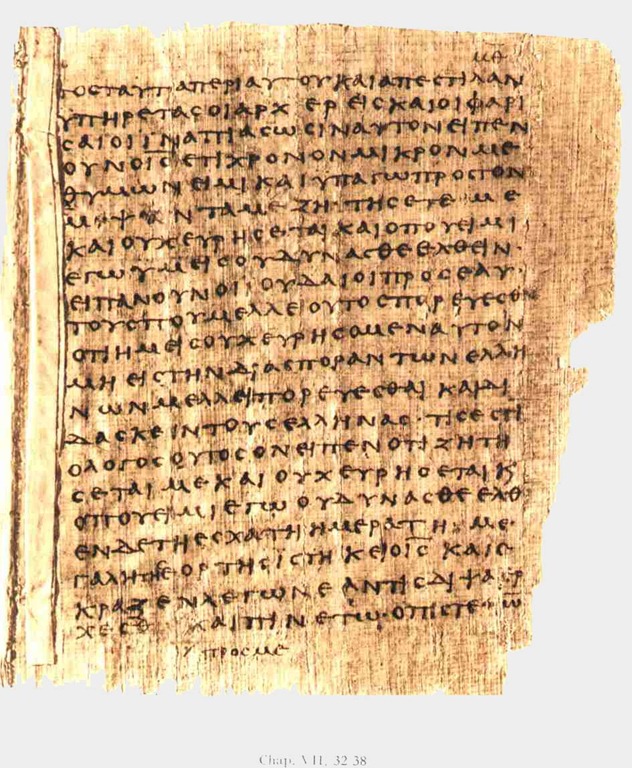
GreekNT3A fragment of parchment containing part of the book of John has been discovered. This piece is believed to be either part of the original written by the apostle himself, or a copy that was made within forty years. A fragment of Matthew has been discovered that most scholars believe was part of the very parchment written by Matthew himself. Other fragments, and even whole books of New Testament, date from within a hundred years of the time of the apostles. The oldest complete copy of the New Testament is about 150 years removed from the time of the apostles. This is far, far better than any other ancient document that exists.

Compared to twenty ancient copies of Tacitus, or ten of Julius Caesar, scholars have discovered roughly 5,500 very ancient copies of the New Testament in Greek (the original language), and an additional 19,000 ancient copies in other languages like Syrian, Latin and Coptic. For hundreds of years, scholars have been comparing these manuscripts to one another. If all or most of the texts show that John wrote “Jesus wept,” than we can be pretty darn sure that John did in fact write, “Jesus wept.” In addition to all these actual copies of the New Testament, we have extensive quotations of the books of the New Testament contained in letters and writings from early Christians, dating from the time of the apostles and on.

With the overwhelming number of copies and the various languages, scholars have found some variations in part of the New Testament. These variations are all very small, and none of them change the essential meaning of any New Testament passage. By the way if you have an NIV version of the bible, it will make a footnote of every major textual variation. Here’s an example of a major variation:

In Luke 23:42, Luke writes that the thief on the cross said, “Jesus remember me when you come into your kingdom.” The NIV version of the bible makes a footnote there is enough evidence to note a variant manuscript reading. The variant would read like this: “Jesus remember me when you come with your kingly power.” You may say: “What’s the big deal with that? What does it change? Doesn’t it mean the same thing?” That, of course, is the point. It changes nothing significant. Nor do any of the “significant” variants. If you have an NIV Bible you can scan the bottom of the text as you flip through the pages and see all the significant variants.

Because of the great number of copies which all record the same words, and because they are so ancient, we can be quite sure that the New Testament we read today is the truly and accurately preserved teaching of the apostles of Jesus Christ.

Every year around Easter, the National Geographic society trots out a documentary or story about the “lost gospels” or the “books that should have been included in the bible.” It’s true that there are a few ancient documents about Jesus that are not included in the New Testament. But there are huge differences between them and the New Testament.

GNT2

We know historically that by around 250 AD at the latest, virtually all Christians were using the twenty-seven books that make up our present day New Testament. The New Testament was not officially defined by a conference of Churches until sometime in the mid 300’s AD, but for all intents and purposes it was well established even earlier than that.

There were several things that caused a book to be included in the New Testament.

  1. The New Testament book had to be connected to an apostle (either written by an apostle, as in the case of Paul’s letters, or written by someone who associated closely with one or more apostles, as in the case of Luke and Mark). So the ancient book, The Apocalypse of Peter, though it names an apostle in the title, was never recognized in any early writing, or by any other evidence, as having anything to do with the real historical Peter. Needless to say, it isn’t in the bible.
  2. The New Testament book had to enjoy widespread early use among churches. For example, the Gospel of John was used and recognized in churches all over the known world by a very early date; whereas the “Gospel of Judas” was never really recognized outside of Alexandria, Egypt and that at a fairly late date, by people who weren’t even Christians. Again, by at least 250 AD, virtually all churches were using a common set of apostolic writings – this set of books was later called “The New Testament.”
  3. The New Testament writings had to agree with generally accepted Christian doctrine. In the 140s AD, a man named Marcion came up with his own very twisted version of Christianity and listed various writings which he thought should be considered sacred. He and his “New Testament” were rejected by almost all churches, because they were contrary to the teachings that the churches had held since the time of the apostles.

I guess what I am saying to you today, is the same thing that Paul was trying to say to the Galatians. I want you to know brothers and sisters, that this gospel that we received and have believed does not come from human beings. It was preserved by human beings, and we can see that it was preserved accurately. But it came from Jesus Christ. But there is even more. John recorded that Jesus said this:

“I have spoken these things to you while I remain with you. But the Counselor, the Holy Spirit — the Father will send Him in My name — will teach you all things and remind you of everything I have told you. “Peace I leave with you. My peace I give to you. I do not give to you as the world gives. Your heart must not be troubled or fearful. (John 14:25-27, HCSB)

And a little later, he said this:

When the Spirit of truth comes, He will guide you into all the truth. For He will not speak on His own, but He will speak whatever He hears. He will also declare to you what is to come. He will glorify Me, because He will take from what is Mine and declare it to you. (John 16:13-14, HCSB)

The Holy Spirit inspired and guided those who wrote down the gospel. And the Spirit guided the process by which these writings were either preserved, or not preserved. We know that there was a third letter which Paul wrote to the Corinthians, which is lost to history. The Holy Spirit caused that happen – that letter was not part of what the Spirit wanted preserved.

All Scripture is inspired by God and is profitable for teaching, for rebuking, for correcting, for training in righteousness, so that the man of God may be complete, equipped for every good work. (2Tim 3:16-17, HCSB)

We have the written words of the true gospel in the form of the New Testament. And we also have the Holy Spirit, given to us through Jesus, who continues to remind us what Jesus said, and guides us to receive and understand the truth of God’s Word. It doesn’t come from human beings who made it up for their own purposes.

If you are a Christian for any length of time, sooner or later you’ll probably have a thought like this: “What if this is all made up? What if none of it is real?” Don’t feel bad about having those thoughts. Instead, remember this: It is entirely reasonable to believe that the New Testament is the unaltered teaching of those who knew Jesus, whom Jesus chose as his apostles. All the evidence says so. It is reasonable to believe that that they believed what they wrote, since most of them gave their lives for that belief (incidentally, they didn’t get power or wealth out of it). But it does require faith to believe that their writings are true, and inspired by the Holy Spirit. It requires faith to believe that Spirit continues to speak through the New Testament today. That faith means we risk being foolish. It means we risk believing something that isn’t true – that risk is the nature of faith. But when we embrace that faith, the Holy Spirit makes these words real and relevant in our lives today.

For the word of God is living and effective and sharper than any double-edged sword, penetrating as far as the separation of soul and spirit, joints and marrow. It is able to judge the ideas and thoughts of the heart. (Heb 4:12, HCSB)

The true gospel, not made by human beings, can speak directly to your heart and to your attitudes. It can convict you of sin, comfort you with grace and lead you closer to the true and living God. It can and will change your life eternally.

RELIGION WITHOUT RELATIONSHIP IS DEADLY

witchofendor2

Saul begins to reap the deadly benefits of religion without relationship.

To listen to the sermon, click the play button:

To download, right click on the link (or do whatever you do on a Mac) and save it to your computer: Download 1 Samuel Part 27

1 SAMUEL PART#27. Chapter 28

Remember all that we have learned about king Saul. One of the most important things we discovered is that he was a religious man, but not a man of faith. Time after time, when he felt he could somehow use or exploit God, he did so. But when he was confident in himself, or when he felt that God had nothing to offer him, he ignored God. He had the trappings of religion and he used them to control others and manipulate God. But he did not live in a day to day walk of faith, trusting God in all things, relating to him, loving him. The depths of Saul’s spiritual poverty are revealed in 1 Samuel chapter 28.

Saul, having no real trust in God, was terrified when he saw the Philistines. Now consider something. Every time Saul was involved in a battle with the Philistines up to this point, God saved the Israelites. The Lord used Jonathan in chapter 13, and David in chapter 17, and several other times. But none of that seemed to make any difference to Saul. He was just as scared and faithless as he had always been.

I want to pause and say something about that here. Sometimes we think that if God just did a miracle for us, then we would really trust him. If we saw the Lord do something really great, then we wouldn’t doubt, then we wouldn’t disobey or draw back in fear. But that wasn’t the case with Saul. God’s previous miracles didn’t matter. The same was true with the first Israelites who came out of Egypt. They saw many miracles. Their food and water were daily miracles. And yet it did not help them to have faith and surrender to the Lord.

Jesus addressed this issue in his own ministry. Though he did many miracles, often people came and demanded miracles on the spot – basically asking him to prove himself to them. Jesus addressed this Luke 11:27-29:

27 As He was saying these things, a woman from the crowd raised her voice and said to Him, “The womb that bore You and the one who nursed You are blessed! ” 28 He said, “Even more, those who hear the word of God and keep it are blessed! ” 29 As the crowds were increasing, He began saying: “This generation is an evil generation. It demands a sign, but no sign will be given to it except the sign of Jonah. (Luke 11:27-29, HCSB)

John records that many miracles (‘signs’) still did not convince people who did not want to be convinced:

37 Even though He had performed so many signs in their presence, they did not believe in Him. (John 12:37, HCSB)

In another place, Jesus told a story about a poor man named Lazarus, and a rich man. At the end of the story, the rich man found himself in hell. He begged that someone be sent from heaven to tell his family the truth about the afterlife. Jesus concludes the story like this:

31 “But he told him, ‘If they don’t listen to Moses and the prophets, they will not be persuaded if someone rises from the dead.’ ” (Luke 16:31, HCSB)

When people in the New Testament say “Moses and the Prophets” they mean “the bible” since that was as much Bible as they had at that time. What Jesus is saying is this: if you don’t trust God’s word and the promises in scripture, no amount of miracles will cause you to trust.” The problem can’t be fixed by a miracle. That is both hard and good for us to remember. Seeing is not believing. With God, believing is seeing.

So Saul, in spite of all that he has seen God do, is a religious pretender, not a man of real faith. Therefore, now, facing the Philistines, he is quaking in fear. It says that he inquired of the Lord. As before, Saul doesn’t go to the Lord unless he thinks God can do something for him. So now, he inquires of the Lord only out of fear and a desire to manipulate God. It doesn’t tell us what Saul was asking God. I think it is most likely that he made an animal sacrifice to the Lord, and was hoping for some prophecy that God was pleased with the sacrifice, and would give Saul the victory. But he didn’t hear anything by way of the “sacred dice” (the urim and thummin) or through prophets, or in dreams. Basically, Saul is demanding another sign here, before he will really trust God. He has had God’s help all his life, but he still won’t trust the Lord without some kind of additional sign.

God has been working on Saul all of his life. Remember how he called him to be king? Remember how he gave him the victory at Jabesh Gilead? Remember how even after Saul proved to be useless to God, God kept pursuing Saul’s heart, sending him a troubling spirit to get him to turn to the Holy Spirit for relief? Saul has had decades to surrender his heart to the Lord. The Lord has never quit trying to win him over. I think this lack of a sign is one more chance for Saul to surrender his heart. The Lord has put him in a crisis where he has the same two choices he has always had: 1. Trust God, or 2. Manipulate God and other people to control his own destiny, and get the outcome he wants. Before this, Saul has always chosen #2. He doesn’t know it, but this will be his last chance to give his heart to the Lord.

Tragically, Saul once again chooses to try to control his own life and outcomes, rather than trusting God. When he doesn’t hear from the Lord, trust is not even an option. Saul simply must find some way to manipulate God into saying what he wants to hear, or doing what he wants God to do. So he seeks out a medium, or witch, or spiritist, or whatever you want to call it.

Deuteronomy 18:9-14 says this:

10 There shall not be found among you anyone who burns his son or his daughter as an offering, anyone who practices divination or tells fortunes or interprets omens, or a sorcerer 11 or a charmer or a medium or a necromancer or one who inquires of the dead, 12 for whoever does these things is an abomination to the LORD. And because of these abominations the LORD your God is driving them out before you. 13 You shall be blameless before the LORD your God, 14 for these nations, which you are about to dispossess, listen to fortune-tellers and to diviners. But as for you, the LORD your God has not allowed you to do this.

These practices were part of the reason for Holy War, which Saul failed to carry out as king. Not only were the people of God not supposed to do these things, they were supposed to wipe out those who did. Such things separate people from God and put them under the influence of hell. Saul did make some attempt to stamp out the practice of the occult, but obviously he wasn’t entirely successful. And now he is willing to deliberately abandon faith in God, abandon his previous laws against these things, and seek help from the dead.

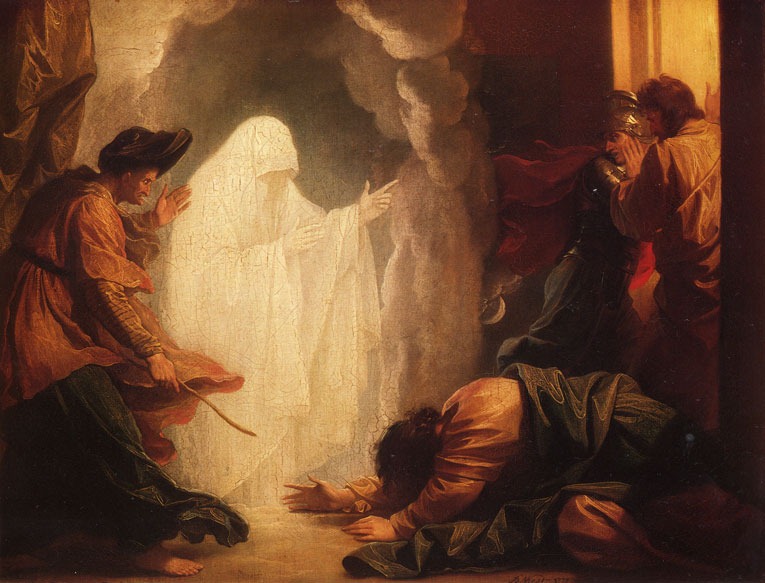
Here is the final proof of Saul’s internal condition. Religion is just something to be used and manipulated, and if one approach doesn’t work to accomplish his aim, he’ll try another. So he and a few of his men disguise themselves and go to the witch. The disguise is actually pretty pathetic. The woman lives not far from the battlefield. Her visitor is the tallest man she’s ever seen, and he wants to talk to the ghost of the prophet Samuel. It doesn’t take a genius to figure out it is Saul. So at first she thinks it is a trap. Then when she is convinced, she pretends that the ghost of Samuel told her who Saul was.

Now it is natural to wonder, what really happened here? Was the woman a charlatan who made it all up? Was there really a spiritual presence there? And if so, was it really Samuel?

To answer that, we need to consider what the Bible says about life after death. Certainly, the entire New Testament teaches that at the end of time, there will be a judgment day. Those who rejected Jesus will be thrown into a lake of fire with the devil and his demons. Those who receive him will be physically resurrected to an eternal, joyful existence.

But there is that period of time in between. Samuel was in the period, as is every person who has died up until today (except for Jesus). Some people believe that in that “between-time,” you are unaware of existence until judgment day, at the end of time. Others believe, as I do, that there is a period of time when dead souls are either with Jesus in joy and freedom, or in hell. The presence of Moses and Elijah with Jesus in Matthew 17, suggests this very strongly. Jesus painted this picture of life after death in his story of Lazarus and the rich man. Revelation 6:9-11 shows people who have died, yet are aware and are waiting for the final judgment day and the resurrection. Actually several passages in Revelation suggest that there is life with Jesus between death and the physical resurrection that will occur at the end of time.

Therefore in order to believe that it really was the spirit of Samuel, we have to believe that some people on earth – mediums, fortune tellers etc. – have the power to pull people out of the presence of God and back to earth so we can talk to them. I don’t buy it for second.

There is another reason to believe that this was not really Samuel. God chose not to answer Saul when Saul wanted some reassurance. He did not answer through the urim, or through the prophets or in dreams. If God would chose not to speak to Saul through these holy and righteous means, why would he then work through the unrighteous means of a medium – basically rewarding Saul’s wicked behavior?

Even beyond these most significant facts, there are other things in the text which suggest that this was not Samuel. Saul himself could not see the spirit – he had to ask the medium what he looked like. Her reply was very vague: “An old man wearing robes.” That’s pretty much how I picture Samuel myself. Saul accepted this description as true, but there is nothing in it that actually identifies Samuel personally.

Finally, there is the message that Saul got from this apparition. Once again we need to question why God would speak through this illegitimate means after not answering by any legitimate route. But secondly, listen to the tone of the message. It is angry, bitter and hopeless. There is no encouragement. There is not even any opportunity for repentance. Not too long after this, Saul becomes wounded and commits suicide, rather than fight on with courage. I personally believe that his encounter with this evil spirit contributed to that act.

I do believe that there was something spiritual going on here – something creepy and utterly evil. Remember the other Saul, in the New Testament, the one who repented and came to Jesus, and later was known as Paul? He encountered a girl who could tell the future. But it was an evil spirit that gave her the power of limited fortune telling (Acts 16:16-19). I met someone once, who used to be involved in fortune telling, and spirit communication for money. She became a Christian and rejected all that. We asked her what was involved in it. She said that sometimes, she was just tricking people by being observant, and making vague statements combined with educated guesses. But she also told us that sometimes, she was aware of a spiritual presence which gave her information – which she now realizes was a demon.

I personally believe that Saul unknowingly sought (and received) an audience with a demon, masquerading as Samuel. Saul was rewarded with the kind of the thing you would expect from a demon: condemnation and hopelessness. By turning to witchcraft and séance to try and control his life, he was turning his back utterly on God and seeking help from hell. And he got exactly what you might expect from hell.

So where to do we go with this text?

First, if this isn’t too obvious, don’t play around with séances, spirit-guides, mediums, psychics and so on. That stuff comes straight out of the pit of hell, and you are inviting the depths of hell into your life if you fool with it. Saul’s results were dramatic and self-destructive.

I find some reminders here about religion. There are many people like Saul who go to church and talk the religious talk as a way to manipulate God or influence others. It became a way of life for Saul, and ultimately it destroyed him. God never gave up on him, but by his empty religious spirit, Saul took himself out of God’s jurisdiction. I hate religion. I love Jesus, but I hate religion. I think maybe God hates it too. Religion is about appearance and manipulation. Real faith is about surrendering your heart to the One who created you, and cares about you more than anyone else in the universe. Saul had plenty of religion. David had faith.

There is also a caution here about how you view miracles. I’ve seen miracles. I love it when God does them. But my faith does not depend on them, and I know I cannot demand them from God, on my cue. We sometimes think (like Mike and the Mechanics) that all we need is a miracle. Not so. All we need is the Lord, and to get him all we need is faith to believe he is there and to trust him. Miracles are real, and great, but if we make them necessary to trusting God, we are in trouble. Jesus himself warned against that attitude.

I think there are many times when we get ourselves into situations like Saul’s. We come face to face with a problem. We can try to manage and control life ourselves; or we can trust the Lord and surrender to him. I pray that we make the second choice, not the first.

I guess the main message is the same message we hear over and over through scripture: Trust the Lord. Base that trust on his word and his promises, not on anything else.

More Mistakes, More Grace


1 SAMUEL #26. CHAPTER 27:1-12

David was not a great hero of the faith because he was particularly righteous. He became one of the Bible’s great ones because whenever he failed, he returned to the Lord seeking mercy, and went back to trusting God again.

To listen to the sermon, click the play button:


To download, right click on the link (or do whatever you do on a Mac) and save it to your computer: Download 1 Samuel Part 26


Many people have the misunderstanding that David only failed spiritually once in his life, in the matter with Bathsheba. If you have been following this sermon series, however, you will have noticed that in fact, David has already failed a number times in his life, both spiritually and in terms of achieving his goals. The picture we have of David is not a man who was almost perfect. Instead, he is a very flawed human being. But he was a person who was always willing to admit his mistakes, and he continually looked to the Lord (not to himself or to others) for forgiveness, help and encouragement.

Chapter twenty-seven records yet another time when David failed spiritually. The last time the Lord spoke to David about where he should be making his base, he said, through the prophet Gad, that David should stay in the land of Israel, in the territory of the Tribe of Judah (1 Samuel 22:5).

David did that for several years, but it was brutal. He and his men couldn’t live in a town for fear that Saul would catch them. If they stayed in a town, but escaped before Saul got to them, it was likely that Saul would punish the citizens of that place. So David and his men lived in caves and outdoors. They couldn’t farm to support themselves. There were six-hundred of them, so they couldn’t hunt or gather enough food either. They relied on friends and strangers to help them through their tough times. But often, the people alerted Saul to their location, and they found themselves running for their lives. They continued to barely survive, but it didn’t look (at least on the outside) like they were doing anything constructive.

At one point, it looked like David had convinced Saul to leave him alone, by sparing Saul’s life in the cave. But Saul eventually came back, and David was so surprised, he had to go see for himself. Last time we saw how David once again dramatically showed Saul that he meant him no harm. This caused Saul to leave again, but you can almost see the wheels turning in David’s head, as he realizes that Saul will never leave him alone for good. If sparing his life the first time would not convince Saul that David was a loyal subject, nothing could.

There is something else that the text mentions that we haven’t talked about yet. These men were young, but many of them, including David, had families (v.2). Living like they were, it must have been hard on their wives and children.

So David does something uncharacteristic – he makes a unilateral decision without consulting the Lord. The last thing he heard on the subject was that he should stay in the territory of Judah. Without asking God again, he takes his men and their families and goes to the territory of the Philistines. The Hebrew shows David’s thoughts to be something like this: “There is nothing good left for me. So I’ll go to the Philistines.”

Now, we should be careful stating absolutely that David was sinning here. The scripture doesn’t say one way or the other. But I think we can say that to do this without asking God was unusual for David, and it did not reflect the relationship of trust in the Lord that he normally had. In fact, it seems more like something that Saul would do, than David. At the very least, it looks like David made a decision that was based more on fear, hopelessness and weariness than on faith. We can also see that as a result, he put himself in a position where he had to be deceptive.

He went back to Achish, king of the Philistine city of Gath – the same place he went when he first fled from Saul (chapter 21). No doubt Achish has heard what David has been doing since he left last time, and he knows now that David is not insane. Even so, David might be a powerful ally. He is bringing six-hundred men who have been hardened by the wilderness and by some battles. He is technically the enemy of Saul, king of Israel. So Achish once again allows David to take refuge in his territory. He sees the potential in an alliance, and also the potential danger in picking a fight with David and his six-hundred hard men.

This time, however, David is a little wiser, and seeks to keep physical distance between himself and the king. He asks if he and his men can stay in some town out in the country, away from the capital, Gath. So Achish gave David the town of Ziklag to live in.

Four hundred years before, when Joshua led the people of Israel across the Jordan river, the entire land was given to the Israelites by God. They still had to enter in and take possession of the land by driving out the pagan tribes – but the Lord promised to be with them and help them do that. However, no tribe truly trusted God enough to fully possess what he had promised. So the town of Ziklag was supposed to belong to the tribe of Judah – but they had never actually taken possession of it, being too afraid to challenge the Philistines. Now, David – a man from the tribe of Judah – receives this little town as a gift, without any fight at all.

We could look at this and say, “Oh, I guess David did the right thing after all, because things began to work out for him.” But I don’t think so. Just a little more than a year after David went to the Philistines, David’s problem with Saul was solved, and he was free to live in any city in Israel. This would have happened whether or not he had gone to live in Philistine territory. So I don’t think the gift of Ziklag was God’s endorsement on David’s actions. Instead, I think it shows us how gracious God is. Even when David was afraid and more or less ran away, the Lord blessed him, and through him, blessed his people. The Lord did not allow David’s fear and lack of faith to hinder what He (God) wanted to do. Though David didn’t deserve it, God used him anyway. Though David didn’t deserve it, God allowed he and his men to have a time of relative rest and stability. God continues to work, no matter what happens. Our own failure will never stop him from being at work.

There is something else that strikes me. Right or wrong, now that David has done this, the Lord moves forward from here, and he leads David to do the same. Remember in chapter 15, earlier in Saul’s reign, the Lord told Saul to wipe out the tribe called the Amalekites? Saul only partly obeyed. He didn’t carry out the war the way the Lord asked. But now David begins a campaign of raids against the Amalekite clans. In each raid, he completely wiped out everyone he found. This was something that God wanted to happen. We don’t have time and space to re-hash all the discussion about Holy War, where we considered why God might want to do this. Go back to http://tinyurl.com/7zuaqcv to review this subject. The point here, is that David, even after he messed up, is back on track. He is letting the Lord accomplish his purposes through his (David’s) life. David and his men were warriors, with the hearts and desires that go along with that. So the Lord used them just as he made them. Even so, there is an obedience here. They weren’t fighting just anyone they could find. They were letting the Lord fight His battles through them, making war only when and where the Lord led them to.

Unfortunately, David had to engage is some deliberate deception at this point. King Achish wanted to know what he was up to. So David replied accurately, but deceptively. He said he was raiding in the southern territories of Judah and Israel. Technically, that was true. All that land was supposed to belong to Israel, including the places where David fought the Amalekites. But he certainly was not fighting other Israelites. Even so, he let Achish believe that he was making war on his own countrymen.

Now, we might say that David’s deception was part of the war between Israel and the Philistines, and therefore it is justified. After all, Achish was actually David’s enemy, though they were in a temporary truce. So it is almost like a spy lying to the enemy – it is an act of war, not a sin. I won’t say that interpretation is definitely wrong. And in the short term, David’s deception allowed him and his men to be at peace, and to advance God’s agenda.

Even so, David’s deception led to problems in the future – even as it had in the past. It put him in a very awkward position not too long after this. He had to be saved from that position by people and circumstances beyond his control. In fact, I suspect it was the Lord who saved him from the consequences of his own lies.

In the long run, true honesty is always the best policy. The fact that David put himself in a position where he basically had to lie, is one reason that I suspect that God did not lead him to go live among the Philistines. In addition, I am not sure why David and his men could not have raided the Amalekites from their base in the Wilderness of Judah, and thus gained much needed supplies and food.

Here are some things that I personally take away from this passage:

One thing that strikes me is how the Lord moves forward with us and with his plan, even when we take a wrong turn. We don’t go back to where we screwed up and do it over. Instead, the Lord mercifully picks us up where we are, gets us back on track. He didn’t make David go back to Judah and start over. Instead he adapted his plan, accounting for David’s mistake.

As we have seen before, the main goal in the life of faith is to trust God. If we do that, our behavior will naturally be pleasing to God. And even when we fail, if we return to a place of faith and trust, God is overwhelmingly gracious. Despite David’s failure, God gave him stability and rest, and through him, restored to Israel one of the towns that had been given them. Despite David’s failure, he continued to use him and bless him. I can trust that the Lord will deal with me in the same. I know I am not perfect – not in behavior, not even in how well I trust God. Because of Jesus, my failure is not the final word, not the most important factor. God’s grace is always a bigger factor than my failure. God has a way of turning failure into gracious victory and blessing. That takes a lot of pressure off me.

What is the Holy Spirit saying to you?

RESURRECTION LIFE: ARE YOUR DREAMS SHATTERED?

How do you react to broken dreams? Do you seek life in things and people apart from Jesus, or do you recognize that True Life is only in him. We have movie clips this, so enjoy the message!

To listen to the sermon, click the play button:

 
To download, right click on the link (or do whatever you do on a Mac) and save it to your computer:
Download the Easter Message


It’s always a challenge for me to preach about the Resurrection of Jesus. It is the central truth of our faith. Jesus physically rose from death; you either believe it or you don’t. In the past I have offered many facts and logical arguments that tell us it is reasonable to believe it. But this year I want to look at the difference it makes in our lives. It makes a huge difference in eternity, of course – the difference between heaven and hell. But it starts to make a difference right now, in the choices we make, and in how we deal with disappoint and grief here in this life.

One of my favorite movies of all time is Cast Away starring Tom Hanks. Hanks’ character, named “Chuck,” is on the verge of proposing to his girlfriend Kelly, the love of his life. But he has to take a business trip first. Over the Pacific Ocean, his plane goes down. He survives the next four years completely alone on a deserted island. Finally, he is rescued. But four years with no word is a long time. When he returns, he finds that everyone had given up on him, and considered him dead. Even his true love Kelly, had mourned him, and then moved on. She is now married, with a toddler.

Naturally, when Chuck returns – from the dead, so to speak – it is traumatic to both of them. Chuck drives to see Kelly at her house in the middle of the night, as the rain pours down. They both say goodbye in a heartbreaking scene, where much is left unsaid. Then, as Chuck pulls down the driveway, Kelly comes running out in the rain, calling his name. They stand in the rain, hugging and kissing. Then Kelly says:

“I always knew you were alive, I knew it. But everybody said I had to stop saying that, that I had to let you go.” Kelly pauses while they stare at each other. “I love you. You’re the love of my life.”

After another long pause while they look at each other, Chuck says, “I love you too Kelly, more than you’ll ever know.”

They get into Chuck’s car and sit in silence. But they both know that Kelly has to go back home, that it is too late for them to ever be together like that again. And so he drives her back up the driveway, and leaves her there.

There is a lot of tragedy in this scene that is simply the result of circumstances that neither one of them could control. But there is also the tragedy that Kelly gave up on Chuck, even when deep in her heart, she knew that she shouldn’t stop hoping. So she settled for life as best as she could get it. She quit working on her dream to be a professor. She married a decent man and had a child. And so when Chuck came back, it was too late. She had already made another life for herself, and there was no place for Chuck in it anymore.

This is heartbreaking, but it is, after all, just a movie. Even so, I think this part of the movie taps into a spiritual truth. It reveals the struggle of faith that we have sometimes as Christians. Our Lover – Jesus – has been gone for a long time now. All around us, voices tell us to give up, to move on, to settle for life as best as we can get it. But if we do that, we find, like Kelly, that when Jesus returns, we have no room for him in our lives anymore.

Jesus’ very first disciples struggled with this. They traveled with Jesus, watched his miracles and heard him preach. They came to believe that he was God’s chosen Messiah – true God in the flesh, their only true hope for salvation and real life. And then he was killed. Now they didn’t know what to do with all their hopes and dreams. It was all over. On the third day after his death, some of these disciples went on a short journey. A stranger joined them as they walked and asked them why they seemed so sad. They told the stranger about Jesus and all he had done and said, and then they told him how Jesus had been handed over and killed. They end with a brief and poignant expression of their loss and confusion:

“But we were hoping that he was the one who was about to redeem Israel.”

You can almost hear the pain in their words. Things didn’t turn out the way they planned. They were sure they were following God. They were sure they had it right, and that their future was bright with their savior. They are hurt and lost. They had put their hope in Jesus, and now Jesus wasn’t there anymore.

Only he was.

He was right next to them. He was the very stranger that they were talking to. This is extremely important. In our everyday life experience, we may feel far removed from the resurrection of Jesus. We may feel like it has nothing to do with us, like from now on we just have to get on with life as best we can. But Jesus is walking right next to us. Feeling or no feeling, whether we can perceive it somehow or not, the Resurrection of Jesus was real, and the resurrection life that he offers us is just as real.

The disciples’ lack of faith is surprising. Jesus told them exactly what was going to happen. He said several times that he would be taken captive by the authorities and executed, and then that he would rise from death on the third day. They didn’t want to believe the part about him dying, until they had no choice. They wouldn’t accept what he was saying. Peter told him not to have such a negative outlook. The others heard too, but it bounced off their skulls like water off a duck. They simply didn’t get it. And then when he did die, they still didn’t believe the part where he told them he would rise again physically. So the death of Jesus destroyed them mentally and emotionally. They were completely lost.

Sometimes, we are like those disciples. Jesus told us exactly what is going to happen. He said we would have trouble in this world (John 16:33), but he also told us not to let our hearts be troubled (John 14:1). Living in a world of sin, we will experience sorrow and grief. But living in faith in Jesus Christ, those sorrows and griefs are not the final word. They are not as real as the great reality that is coming for those who trust Jesus. The pain and severe disappointment experienced by those disciples walking along the road was real. But the man walking beside them was real too, and he had already overcome their grief, even before they were aware of it. The reality of his resurrection was greater than the reality of their sorrow, whether they knew it or not.

I think the danger we face as believers in the risen Messiah is that, like those other disciples, we forget the promises of Jesus, or we think he is not close, not next to us. And so, in the meantime, we try to just go on and get some kind of life and hope for ourselves.

There is another poignant scene in the film Cast Away. For four years alone on the island, Chuck had no companion. So he began to talk to a volleyball that had a face-shaped bloodstain on it. He called it Wilson. In a strange way, he grew to care for the volleyball and became deeply attached to it. When he is sailing to try and find help, the volleyball comes loose from where it is tied. Chuck tries to swim after it but he is held back by a rope that attaches him to the raft. He finally needs to make a choice whether to hold on to raft, which is his only chance at living and seeing Kelly again – or swimming after the volleyball, and drowning with it in his arms.

He reluctantly chooses life, but he cries his heart out at the loss of Wilson. It may be just a stupid volleyball, but it is all he has had for four long years. It is hard to blame Chuck for being so broken up after he lets Wilson go. We can understand it and even feel some of his pain. In the context of the whole movie, it is actually a very moving scene. And yet even though it is perfectly understandable, we know (and even the character Chuck knows) that ultimately, it is just a volleyball. It isn’t a real person. It isn’t worth giving your life for.

Sometimes I think we spend half our lives like Chuck in that scene, tugging on the end of the rope, not quite sure whether we are going to give up the raft, or give up the volleyball. Chuck’s problem was that after four years alone, part of him actually believed that Wilson was a real person. He wasn’t sure of the truth. He may not have been fully convinced that the raft would really bring him back to civilization and real people. Because of his experience, Wilson seemed more real, more important than the raft.

We are like that sometimes. This life sometimes seems so much more real than the Resurrection Life that Jesus told us about. The things we can have here tempt us to believe the lie that they are more real and more important than our eternal future. This is understandable. It is understandable also to have a hard time giving them up, just like Chuck had difficulty letting go of Wilson. But even though we understand, and it is hard, the choice is perfectly and completely clear. There is nothing in this life that is worth holding on to if it keep us from the real Life that Jesus offers us.

Will we hold onto something that is ultimately worthless, or will we give it up for real life? To give it up requires faith. It requires us to trust that there is a real resurrection, that real life is still waiting for us. We can see and touch the fake things, like Chuck could touch and see the volleyball Wilson. But those things are not as real and true as what awaits us when we trust in Jesus. Jesus said:

1 “Your heart must not be troubled. Trust in God; trust also in Me. 2 In My Father’s house are many dwelling places; if not, I would have told you. I am going away to prepare a place for you. 3 If I go away and prepare a place for you, I will come back and receive you to Myself, so that where I am you may be also. 4 You know the way to where I am going.”

5 “Lord,” Thomas said, “we don’t know where You’re going. How can we know the way? ” 6 Jesus told him, “I am the way, the truth, and the life. No one comes to the Father except through Me. 7 “If you know Me, you will also know My Father. From now on you do know Him and have seen Him.” (John 14:1-7)

The fact of the resurrection tells us that there is real life waiting for us. There is still true love possible. Our dreams have not been shattered and lost. We just need to recognize that the time is not yet. We are in the dress rehearsal, the practice before the real game begins. We are camping in a tent, not living in our home. We are practicing to love, practicing to be great.

One of the things that helped Chuck through, was his hope of the life that existed away from his island. So I want us to dwell for a little bit on the resurrection life that waits for us, away from this little island that we mistakenly call life.

I think a lot Christians have the feeling that the resurrection life will be a never ending worship service. Let me be honest with you. I am a pastor, and that thought does not excite me. Don’t get me wrong, I love to worship the Lord with other believers. But I also love to fish, to hike and come around the corner of ridge to a new vista I’ve never seen before. I love to just hang out and laugh with my family and close friends. I like to write, and read and experience moving stories. I believe amazing worship will be part of our experience of resurrection life. But I think there will also be so much more.

John Eldredge writes that you cannot hope for something you do not desire. The overwhelmingly good news is that resurrection life is where our deepest, strongest, purest desires are fulfilled. The desire for intimacy that sometimes we get confused with a desire for only sex – that intimacy will be fulfilled in resurrection life. The desire to be deeply connected to beauty – the thing that causes us to ache when see a beautiful person, or an awe-inspiring view, or hear uplifting music – that will be fulfilled. The desire to be significant, to be recognized for who you are and for the God-given gifts you have – that will be fulfilled in resurrection life. That thing in your that loves to rise to the occasion and meet challenges – that will find its ultimate expression in resurrection life.

We won’t be ghosts or angels, floating around somewhere. Jesus was not resurrected as a spirit – he had a physical body. On several occasions after he was raised, he sat down and ate with the disciples. He promises us resurrection bodies also (1 Corinthians 15). He promises us a new heavens and new earth (Revelation 21 & 22) where will live and love and do the things we love to do, and be connected to God and to each other without the destruction and cruelty of sin and sorrow.

I will never get the love I am seeking from human beings. I may never be recognized for who I am I this life. My talents might go unappreciated. I might have to toil and spend a lot of time doing things I don’t really want to do. If this life is all there is, that would be tragic. But if all that is fulfilled in the next life, in my resurrection, which Jesus made possible – then what I face here and now is bearable. It isn’t the final word. I’m not getting too old – I’m actually getting closer to the fulfillment of all I want as I age.

I’ve heard an expression: “Some people are so heavenly-minded, they are no earthly good.” I detest that expression. It is entirely false. I have never met anyone who is too heavenly-minded. And the most resurrection-oriented people I know are the ones who have done the most for the Lord and for their fellow human beings here and now. It is only when we lost sight of resurrection that we become focused on making ourselves happy here and now, whatever the cost.

Think back to Kelly, from Cast Away. Deep in her heart, she knew Chuck was alive. But she lost faith. She gave up that hope and settled for what she could get at the moment. Because of that, she missed out forever on the life she might have had with Chuck if she had only held on.

We who are Christians know that Jesus is alive. We know it through faith. We know there is more life, better life waiting for us with him. We know it. But everyone keeps saying we have to move on. Everyone tells us we shouldn’t spend so much time thinking about it. Sometimes it feels like God hasn’t come through. But we know better. Don’t let go of that knowledge. Don’t give up that hope. Don’t fill your life with other things, don’t make yourself a life apart from the one who truly loves you and is coming back for you, no matter how long it seems.

He is Risen!

TRUST AND TIMING

When God sends your enemy into your cave with his pants down, unable to see you in the dark,  how do you know that it isn’t God’s will for you to kill him?

engediwaterfall

To listen to the sermon, click the play button:

To download, right click on the link (or do whatever you do on a Mac) and save it to your computer: Download 1 Samuel Part 23

1 Samuel #23. (Chapter 23:14 – Chapter 24:20)

This is one of my favorites stories in the entire history of David. I think what David does, and what he refrains from doing in 1 Samuel 24, shows more courage, faith and heart for God than any of his amazing feats in battle. This is David at his best.

I want to briefly summarize the end of chapter 23, since we did not cover it in detail anywhere else. After David left the town of Keilah, he took his men and went into the wilderness on the other side of the Judean mountains. It may have been more green there 3,000 years ago, but these days, it is mostly desert. It was farther away from Saul, and in terrain that was significantly more rugged. Even so, Saul pursued David there, hoping to capture or kill him. During this time, Jonathan came secretly to David, and “encouraged him in his faith in God.” They renewed their friendship.

The people of the region betrayed David, as the citizens of Keilah had done. When you read the Psalms that David wrote, you will often find references to treacherous people, liars and friends who betray. This is because this sort of thing happened to David astonishingly often. In spite of his integrity and the help he brought to others, in spite of his faithfulness to God and respect for Saul as king, people were quick to believe the worst of him, and spread lies about him, and betray him to Saul.

I don’t know about you, but this encourages me. I think my natural expectation is that if I surrender my life to Jesus and have integrity in letting him live through me, people will see it, and like it, and praise God for it. I expect a positive response to God’s life shining through me. I expect good results, and favor with people. But Jesus said we ought to expect the opposite:

18 “If the world hates you, understand that it hated Me before it hated you. 19 If you were of the world, the world would love you as its own. However, because you are not of the world, but I have chosen you out of it, the world hates you. 20 Remember the word I spoke to you: ‘A slave is not greater than his master.’ If they persecuted Me, they will also persecute you. If they kept My word, they will also keep yours. 21 But they will do all these things to you on account of My name, because they don’t know the One who sent Me. (John 15:18-21, HCSB)

He explains that there is blessing for us in this situation:

10 Those who are persecuted for righteousness are blessed, for the kingdom of heaven is theirs. 11 “You are blessed when they insult and persecute you and falsely say every kind of evil against you because of Me. 12 Be glad and rejoice, because your reward is great in heaven. For that is how they persecuted the prophets who were before you. (Matt 5:10-12, HCSB)

Peter, in his first letter, also talks about this:

19 For it brings favor if, mindful of God’s will, someone endures grief from suffering unjustly. 20 For what credit is there if you sin and are punished, and you endure it? But when you do what is good and suffer, if you endure it, this brings favor with God. (1Pet 2:19-20, HCSB)

13 And who will harm you if you are deeply committed to what is good? 14 But even if you should suffer for righteousness, you are blessed. Do not fear what they fear or be disturbed, (1Pet 3:13-14, HCSB)

Seeing the life of David, and hearing what the New Testament says, gives me hope. Being a person with a heart for God is not necessarily a way to get a whole bunch of people to like you. It isn’t a road to sure success. It is often the opposite. But I cling to these promises that there is great blessing for us in those sorts of trials, sooner or later. At this point for David, he experienced the persecution, but not the blessing.

At one point, David was almost caught. He and his men were in a valley or canyon, and Saul and his men were coming down another valley on the opposite side of the mountain. They were gaining on David. But before they could close, messengers found Saul, reporting that the Philistines were attacking elsewhere in Israel. Saul had to break off the pursuit. Once again, I want to point out that David did not know what his future held. He didn’t know for sure what God was doing, and he might very well have been caught. In that particular incident, it was merely lucky timing that saved him.

And then comes the incident described in chapter 24. This is later. Saul is back to his new hobby of trying to find David and kill him. He and his men are traipsing around the rugged desert and mountain terrain where, according to rumour, David is hiding. They aren’t having any luck. David appears to be miles away. One day, Saul has to relieve himself, and he goes into a cave alone for privacy. It just happens to be the cave where David and some of his men are holed up.

I want to make sure we understand the scenario. David was anointed by Samuel to be God’s chosen instrument. It was understood along with that, that he was supposed to be Israel’s next king. Israel’s present king – Saul – who is no longer God’s instrument, has been trying for a long time to kill David. Now Saul is alone, unarmed and unaware, standing right in front of David, night-blind, back-turned with his pants down. Saul could not be more helpless.

David’s men believe that this is a gift from God. Now is the time for David to kill Saul, and become king himself. I suspect that nine people out of ten would agree with David’s men. Killing Saul at that moment would have been easily justifiable self-defense – after all, Saul was there for the express purpose of killing David. Saul was acting contrary to God’s stated will and purposes – he was trying to kill God’s chosen instrument. So killing Saul would be not only self-defense, but also protection of God’s work in the world. I don’t believe there was a person living at the time who would have blamed David.

David creeps forward, knife held low and ready. He raises his arm to strike…and then lowers it, and quietly cuts off the corner of Saul’s robe. He creeps back to his men, and a furious but quiet argument ensues. Now David’s men, seeing that he will not kill Saul, are eager to do the deed themselves. Once again, who could have blamed David if he had let one of his men do it? Not only would he have the justifications listed already, but he could always claim that it wasn’t actually him who killed Saul, and he really didn’t want it to happen. But David argues vehemently, and commands his men not to touch Saul. Finally, Saul leaves the cave and the opportunity is lost.

I imagine the cave was up on the slope of a hill or something. After Saul has gone down a little ways, David emerges, and calls to Saul. He shows him the corner of his robe and says:

11 See, my father! Look at the corner of your robe in my hand, for I cut it off, but I didn’t kill you. Look and recognize that there is no evil or rebellion in me. I haven’t sinned against you even though you are hunting me down to take my life. 12 “May the LORD judge between you and me, and may the LORD take vengeance on you for me, but my hand will never be against you. 13 As the old proverb says, ‘Wickedness comes from wicked people.’ My hand will never be against you. (1Sam 24:11-13, HCSB)

All this wisdom from a man not yet thirty years old. But of course, it wasn’t really David’s wisdom – it was the Spirit of God at work within David. I think the key is verse 12: “May the Lord judge between you and me, and may the Lord take vengeance on you for me, but my hand will never be against you.” David literally refused to take matters into his own hands. Remember when Saul was about to lose the entire southern portion of Israel? His army was deserting him, Samuel wasn’t showing up, and so Saul held a worship service merely for the purpose of getting people to stick around. Saul took matters into his own hands. But David will not do that. His trust is not in what he can do, but in what God will do.

However, there is a natural question. When God sends your enemy into your cave with his pants down, unable to see in the dark, facing away from you, how do you know that it isn’t God’s will for you to kill him? I mean, we’ve already offered many reasons why no one would condemn David for doing it. So how did David know he shouldn’t do it?

I think there are two answers. The first is one that I never get tired of talking about: we need to live in a day-by-day, moment-by-moment relationship with the Lord. The ten commandments told David not to murder, but it could have justifiably been called self-defense, or war, not murder. There is no rule-book that covers this scenario. David, like us, had to rely on a connection of faith with the Lord. Through that faith, the Lord communicated to him that it would be wrong. We might say David just knew it in his heart. The reason he knew it in his heart is because God put that knowledge there through the faith-relationship.

Second, in context of this faith relationship, what God showed David was that to kill Saul at this point would be taking matters into his own hands, rather than trusting. I believe that there are times when God calls us to act speedily and courageously without hesitation. But there are also times when the Lord calls us to let opportunities pass by, and trust Him to bring about his purposes in his own way. Personally, I think the second way is harder, and in our culture we almost never think that way. We typically assume that if we see a means to meet our goals, it is God giving us that chance, and we should take it. Sometimes, that may indeed be true. But sometimes the Lord calls us to wait and trust so we can receive it from him, not get it by our own effort.

Consider this: if David had killed Saul at this point, he might always afterwards wonder if God really wanted him to be king, or if he had made himself king. And there was something that was more important to David than reaching his goal of becoming king. It was more important to him to be right with God than to achieve his ambitions. So he says, “Yes, I’d like God to judge you Saul, for what you’ve done. But my priority is not to judge you, nor to make my goals happen. My priority is to be right with the Lord.”

What’s your priority? Think of something that you really, truly want. Now imagine that the power to make it happen is in your hand. Would you do it, even if you knew in your heart that God didn’t want you to?

Now, I don’t want the message to be that we are just not as righteous as David. David wasn’t any better than us. He just learned to trust God, and he made the trust the primary and most important part of his life. The message is not “you aren’t as good as David.” The message is: Trust God. I’ll say it again: Trust God. The thing that you want so much, the thing that you are convinced is even God’s will for you – God will take care of that. David eventually did become king. It didn’t happen that day. In fact it was still years away. But God did take care of it. He worked it out the best way possible.

So trust him.

OBEDIENCE, OR TRUST (OR BOTH)?

What does it mean to obey God? Do we have to?

1 Samuel #13. The Obedience of Faith


defusebomb2

(and what the heck does this picture have to do with it?)

To listen to the sermon, click the play button:

To download, right click on the link (or do whatever you do on a Mac) and save it to your computer: Download 1 Samuel Part 13


The Old Testament has a lot of value for us in many ways. We can learn from examples, both positive and negative. We can see how God deals with people who live by faith, and with those who don’t. We can receive comfort in God’s promises to his people (and if we trust Jesus, we are his people, those promises are for us). We can learn about God’s standard for holiness.

But we must never forget that the Old Testament is first and foremost about Jesus. The Life, death and resurrection of Jesus are the central concern not only of the New Testament, but also of the Old Testament. Luke describes how Jesus helped his disciples to understand this.

25 He said to them, “How unwise and slow you are to believe in your hearts all that the prophets have spoken! 26 Didn’t the Messiah have to suffer these things and enter into His glory? ” 27 Then beginning with Moses and all the Prophets, He interpreted for them the things concerning Himself in all the Scriptures. Luke 24:44-45 (ESV)

44 Then he said to them, “These are my words that I spoke to you while I was still with you, that everything written about me in the Law of Moses and the Prophets and the Psalms must be fulfilled.” 45 Then he opened their minds to understand the Scriptures

The Jews divided the Old Testament into two parts: “the Law” or “the book of Moses” which are the first five books of Bible. The second part was called “the Prophets” and it included not only the books which we call “prophetic” but in fact, all of the other books of the Old Testament. So when the New Testament says “the Law and the Prophets” or “Moses and the Prophets” it means “the entire Old Testament.”

The purpose of the entire Bible is to help us to know Jesus better and walk with him in faith. So even as we read these Old Testament scriptures, we should be asking, “Lord, show us Jesus in this part of scripture.”

I think this is particularly important when we come to a section like 1 Samuel 15. We talked about the concerns of Holy War last time, but now we get to a part that is very easy to apply wrongly.

Saul disregarded the Lord’s command to utterly destroy the Amalekites. He spared the life of the Amalekite king. Quite possibly he did this because, out of fear for his own head, he wanted his followers as well as foreign armies, to differentiate between royalty and ordinary people. In any case, he disobeyed God’s command in this respect. He also allowed his followers to keep the best livestock alive. Once again, this may have been from insecurity. His warriors may have been grumbling about pointlessly killing good animals. Even if they weren’t, he may have wanted to appear gracious and become popular by rewarding those who fought with him. There may not be anything wrong with that, except that the Lord clearly commanded otherwise.

When Samuel confronts Saul about what he has done (or, failed to do) Saul claims that he has saved all the animals for sacrificing to the Lord. Frankly, I think he was lying. I think he got caught, and he decided in that moment to make up for his failure to obey by making a sacrifice with the captured animals.

Samuel says something very significant:

Then Samuel said: Does the LORD take pleasure in burnt offerings and sacrifices as much as in obeying the LORD? Look: to obey is better than sacrifice, to pay attention is better than the fat of rams. (1Sam 15:22)

This is theme repeated throughout both the Old and New Testaments. The Psalms reference this exact concept several times. So does Isaiah, and Hosea. Jesus mentioned the idea a few times in the New Testament. Even so, we need to be careful as we apply this to our own lives. It is very easy to say, “That’s right. I just need to obey God. We just need to do the right thing. What’s the point of saying we follow God if we don’t obey him?” I understand this attitude, but I think it tends to lead us away from the true meaning of this passage.

First, I think it comes back again to the fact that Saul was religious, but had no relationship with God. What he did seemed good. Saving the animals to sacrifice later was a religious thing. After all, sacrifices were part of Jewish religion. But Saul used his religion to keep from actually interacting with God, actually listening to him and responding in faith to what God said. Jesus said the Pharisees were religious like Saul too, and he hated it. Instead of listening to what the Lord actually said, they practiced religion. So this is a warning to us, to not let religion get in the way of faith. Religion keeps track of rules and regulations to follow, instead of living in a real, faith-relationship. In all sincerity, I try not to be religious. But living in faith is very important to me. Sometimes “sacrifice” is obedience. But we don’t live by rules, rather by relationship.

Second, we must understand that Jesus fulfilled this passage on our behalf. The writer of Hebrews quotes Psalm 40, and says that it is fulfilled in Jesus:

6 ​​​​​​​​In sacrifice and offering you have not delighted, ​​​​​​​but you have given me an open ear. ​​​​​​​Burnt offering and sin offering ​​​​​​​you have not required. ​​​ 7 ​​​​​​​​Then I said, “Behold, I have come; ​​​​​​​in the scroll of the book it is written of me: ​​​ 8 ​​​​​​​​I delight to do your will, O my God; ​​​​​​​your law is within my heart.” ​​​ Ps 40:6-8 (ESV)

Jesus delighted in God’s will. He didn’t live according to religious rules – the law of God was within his heart and during his time on earth he lived out that law through dependence upon the Father. He obeyed God perfectly. We cannot obey perfectly. So Jesus did it on our behalf. The obedience we owe God is complete and perfect in Jesus Christ, and only in Him. So when you think, “Oh, I have to obey God, because to obey is better than sacrifice” actually what you should hear is “I need to trust Jesus even more. Trusting him is my obedience, because has already done the obedience for me. Rather than act more religious, I need to trust more.” This is living by faith.

One reason we sometimes get confused is because obedience and trust can sometimes look the same. When you live by faith, it does result in certain actions. It does eliminate other actions. The bible does use the term “obedience.” But we must remember, it is the obedience of faith – not the self-effort of religion. Let me give you a little analogy to help us understand this.

I love spy/suspense shows like the Bourne Identity. Not everything in these shows is entirely righteous, but living in faith, we can find good things in them. Sometimes in shows like this, one of the characters may encounter a time-bomb. Picture a scene like this, where a lady has just a few seconds to defuse a bomb. She doesn’t know how to do it. But she gets on the phone with her friend who does. He tells her, “cut the blue wire, but be sure not to cut the red one.” So she carefully cuts the blue wire, but not the red one.

Now what is going on here? Is she obeying her friend, or trusting him?

Well, both, of course. But you see, her actions of obedience proceed from her trust of her friend. She trusts that he knows how to save her. She trusts that if she does what he says, she will be safe. And so, because of that trust, she acts according to what he says. She isn’t just doing what her bomb-expert friend says because it is the right thing to do. She isn’t doing it from a sense of moral obligation. She is “obeying” him because she trusts that he wants to save her life, and has the power (in this case knowledge) to do so.

You could call it obedience. But I would call it primarily trust. The obedience is a result of the trust.

I want to pursue this analogy a little bit further. In order to get this kind of trust-obedience, you need several factors. First, you have to believe that your life is really in danger. If the lady didn’t believe the bomb was real, chances are, she wouldn’t have called her friend anyway. She would not have been seeking the help she needed, because she wouldn’t have believed she needed it. Second, she had to believe that her friend had the knowledge that could save her. Third, she had to believe that her friend wanted to save her.

Peter expressed this attitude of faith. A lot of people had turned away from following God and Jesus was left with just the twelve apostles.

66 f After this many of his disciples turned back and no longer walked with him. 67 So Jesus said to g the Twelve, “Do you want to go away as well?” 68 Simon Peter answered him, “Lord, to whom shall we go? You have h the words of eternal life, 69 and i we have believed, and have come to know, that j you are k the Holy One of God.” (John 6:66)

When we encounter problems with obeying God in our own lives, I think it is usually a combination of these factors at play. Maybe we believe that the situation isn’t really very serious. Although we think obeying God is the right thing, when it comes down to it, we think we’ll be OK even if we don’t. We don’t see his words as life and salvation. So we don’t obey because we don’t believe our problem is that big.

Second, maybe we doubt whether God really has the answers we need. Perhaps we don’t obey him because we aren’t sure that what he is saying to us is relevant and helpful to us in our own situation. I think this was one of Saul’s major issues. He seemed to feel that God was fine for religious things, but in everyday life, you had to take care of yourself and use your common sense. Saul didn’t seem to think the command for Holy War was really right or had any value in his situation.

Third, we sometimes don’t obey because we aren’t sure we can trust God. Maybe we aren’t sure if he really has our best interests at heart.

Do you see the solution to the obedience problem – no matter what causes it? Faith. In each case, we need to change what we believe. We need to make a leap of trust. We need to trust that our situation is in fact serious, and we really do need the Lord to make it through life. We need to trust that the Lord really does have what it takes to save us, that his words are life; we need to trust that He is relevant in every moment of our lives. And we need to trust that he really has our best interests in his heart.

The devil likes to trick us into religion. Do the right thing because it is the right thing. And something in us responds to that. After all, it is the right thing. But is the wrong path, the wrong way to go about it. We can do the right thing with our own effort – for a while. But we fail eventually because it based upon our efforts, not the obedience that Jesus has already done on our behalf.

Then the devil likes to beat us up: You just aren’t obedient enough. You just don’t try hard enough. But the problem isn’t effort. The real solution lies in trusting more. Jesus has obeyed perfectly. His righteous obedience has become ours (2 Corinthians 5:21). Our part is to trust. If we do truly trust, then our lives will reflect the kind of actions the Lord desires. But it doesn’t start with our action, it starts with our trust.

So let me put it to you today. Do you trust that your situation is serious? Do you remember that no one gets out of this world without dying? Do you recognize that you are in a desperate place, the bomb is about to go off and you can only get help from one place?

Do you trust that the Lord has the right, relevant Word for you? Do you accept that he knows better than you, that he will save you if you trust him to?

And do you know that he wants to save you? Do you trust his goodness?

Take a moment right now to let the Lord into your thoughts and prayers as you consider these things.

Faith Healing? Miracles? 1 Corinthians #21


Download 1 Corinthians Part 21


To another faith by the same Spirit, to another gifts of healing by that one Spirit, to another miraculous powers…” (1Cor 12:9-10)

healing


We have been looking at “spiritual things.” Paul tells the Corinthians he does not want them to be ignorant of them. I think it is safe to say that we should not be ignorant of them either. Because the goal of this passage is to alleviate our ignorance, these next two messages or so will seem very informational in style. Even so, as you read this, pray that the Lord not only informs you, but also inspires you and fills you. We don’t want to only know about spiritual things – we want these things of the Holy Spirit to be active and real in our own lives.

A gift of faith. When Paul includes faith among his examples of the workings of the Holy Spirit, he clearly does not mean saving faith in Jesus Christ. The faith we place in Jesus, the faith we exercise in giving Jesus control of our entire life, is indeed a gift of God, and it is a gift which is given to all who will receive it. In other words, if you are a Christian, you already have the gift of saving faith – faith that trusts everything to Jesus alone. The point Paul is illustrating is that God gives many different kinds of gifts, and they are all given to the church as whole. No single individual exhibits every possible gift of God for touching lives. Therefore, here, Paul is speaking about a gift of faith that some Christians do not possess – a faith that blesses the Church in a unique way beyond the faith that entrusts one’s life to Jesus. Perhaps the best way to describe this gift of faith is to offer some examples of Christians who possessed it.

James Hudson Taylor was a missionary to China in the nineteenth century, who clearly possessed the gift of faith. Hudson Taylor founded one of the world’s largest and most effective missionary societies in the face of a complete absence of financial backing, while holding to a principle that forbade members of the society to ask for any kind of material support. Taylor had only a firm conviction (a gift of faith) about God’s desire for the China Inland Mission to be formed – while all of common sense, and past history suggested that his goal was impossible. The gift of faith through J. Hudson Taylor was used by God to bless the church at large in mighty ways. Many Chinese met Jesus through the work of the China Inland Mission (CIM); many new missionary organizations were formed, inspired by God’s provision for CIM; glory was given to God as He was given opportunity to show how He provides for his children. The work of the China Inland Mission continues today, though under a different name. The gift God gave the church was one of faith to lay hold of something beyond human vision, and the result was that lives were touched!

George Müller was another through whom God gave the church at large the gift of faith. Müller founded and maintained a large orphanage, depending on God in prayer alone, for the resources to build buildings, maintain facilities and operate from day to day. The orphanages he founded, provided for and ministered to literally thousands of children in Müller’s lifetime, and the work has been continued (albeit in different form) to this day.

We can see then, that the gift of faith is given by God to his Church, to touch lives by trusting God for things that may seem impossible, perhaps even things that have never been done before. The gift of faith may be given to someone in the church for the salvation of someone who seems absolutely beyond hope. The gift of faith is exercised in starting new churches and ministries. It is a powerful gift.

Graces of healings”. The next “grace” mentioned is healing. It is interesting to note that in the Greek, both “graces” and “healings” are plural. The implication is that rather than giving one individual a certain “gift of healing,” God considers each time a person is miraculously healed to be a gift. There are some individuals through whom the gift of healing seems to be given fairly often. However the emphasis seems to be on the incidence the healing itself, rather than the person through whom it comes. Though some people clearly have “healing ministries,” any Christian might be used to bring this gift to another as they lay hands on, and pray for, a sick person.

When I pray for others to be healed, I usually do it in a small group. The Lord has healed a few of people I have prayed for in this way. Once we prayed for a lady with Crohn’s disease, the night before she was to have surgery. The next day, the doctors sent her home, saying she didn’t need surgery any more. I once prayed for a friend who was trying to quit smoking, but couldn’t seem to do it. That was 15 years ago, and he hasn’t had a cigarette since that prayer.

There is just one time in my life when I am positive I experienced miraculous healing myself. Some of you were there – it was at a church retreat a few years ago, and I was immediately healed from a kidney stone.

But quite often, when I pray for people to be healed, I don’t see anything happen. The same is usually true when others pray for healing for me. I am not alone in my mixed experiences. You could fill a library with books written about this subject. Some people claim that the problem is lack of faith. I don’t buy it. I had no faith that my friend would quit smoking when I prayed for him. I didn’t even ask for prayer about my kidney stone – I asked for pain meds (some of you can testify to this). At other times I have felt tremendous faith, either in praying for others, or in being prayed for – and nothing has happened.

I don’t think we can boil it down to a formula that always works. That is the nature of our faith-relationship with Jesus. If we had a formula for healing, then who needs Jesus? Jesus told us many times to keep praying and not give up. So I keep praying, and though sometimes people are not healed, sometimes they are.

It is important also to remember that any healing that takes place during our life on earth, (whether supernatural or “normal”) is always temporary. Jesus raised Lazarus from the dead, but eventually, years later, Lazarus died again. The judgment of sin on our physical bodies is death, and death’s effects will always be manifested sooner or later. There is no such thing as truly complete physical healing until Jesus gives us new bodies when he comes again. Perhaps this is one of the reasons Jesus did not devote his full energy to healing while he was on earth.

Miraculous powers. The Greek term describing this action of the Holy Spirit conveys the sense of dynamic power in operation. Since the term is distinguished from healing, we must assume that Paul is speaking of supernatural power manifested in some way other than healing. The New Testament brings to mind several incidences of such power. After a shipwreck, Paul was bitten by a poisonous snake and suffered no ill effects. On the island of Cyprus, Paul caused the “magician” Elymas to be struck blind. But the most pervasive New Testament example of the Spirit’s dynamic power (apart from healings and conversions) is exorcism. Jesus dramatically and unequivocally demonstrated his power by casting out evil spirits. He himself connects the exorcism of demons with the life changing activity of the Holy Spirit saying, “But if I drive out demons by the Spirit of God, then the kingdom of God has come upon you” (Matthew 12:28). The apostles, at Jesus’ command, made exorcism a significant part of their ministry, both before and after his death and resurrection. There can be no doubt that the Lord wants to continue the offensive against the powers of evil, and that he wants to do so by power of the Holy Spirit through His Church. He may indeed want to bless us with miracles of many kinds, but it is also safe to say that he wants gifts of exorcism (power) to be part of the pattern of a church that touches lives.

My former professor and mentor, Dr. Eugene Bunkowske, was a missionary in Nigeria for 22 years. When he first went there, he moved in among a tribe which had no Christians. The most prominent witch doctor of the area heard they were coming. He said, “I will put a curse on this man’s wife and his children, they will get sick and they will die, and then the missionary will go back to where he came from.”

Shortly after Bunkowske arrived, the witch doctor got sick; and then he died. Many people came to Jesus as a result of seeing the power of God manifested in this way. My friend only found out about the witch-doctor’s words later, but he believes firmly that it was the Lord, demonstrating his power and relevance to people who had been trapped in animistic religion.

More needs to be said about using the gift of powers, particularly exorcism. Jesus gives all of those who know him, spiritual authority over evil spirits. The principle is simply that Jesus is in us, and His power is greater than that of the devil (1 John 4:4). Our power is not sufficient to drive out Satan or demons, as the sons of Sceva found out (Acts 19:13-16). Jesus does promise us the power to overcome evil (Luke 10:18-20), but he cautions that if we simply drive out an evil spirit and do not see that the Holy Spirit enters in afterward, the individual will be no better off than before (Luke 11:24-26). We must also use discernment (that gift will be discussed later) in determining whether the problem is truly caused by the presence of demonic power, or something else.

There are some individuals who have a special calling to help others address demonic strongholds. It is an exhausting ministry, but also intensely rewarding. Our neighbors a few years ago were people with that calling. Some other friends of ours were struggling with their adopted son. He was diagnosed with reactive-detachment disorder, a traumatic and violent psychological syndrome that is very difficult to treat. Our friends were in despair over their son, and were on the verge of placing him permanently in an institution. I suggested that before they did that, we should take him to our neighbors who had the gift of dealing with demonic issues. We spent about three hours with boy. I can’t say it was a comfortable time. But when we were done, he no longer had the disorder. A psychaitrist later confirmed that he no longer had it. The boy’s life, and the lives of his parents, were completely changed. This is a wonderful gift for the body of Christ!

Years ago, I preached through this passage of 1 Corinthians with the goal that the church I was leading at that time should learn about these “things of the Holy Spirit.” The church was full of ordinary people. They weren’t super-Christians. They had jobs, and rent payments and car trouble and kids, just like most people. But we all agreed that we wanted the Lord to be doing these “spiritual things” among us, just as he did in the early church. And so, when someone wondered once if just maybe God wanted to say something, he spoke up, and it turned out to be a message of wisdom from the Lord. Another person was physically ill, and we laid hands on him, and prayed for him, and he was healed. Over time, the Lord did all kinds of amazing things in that church because the people were informed about these spiritual things, and they asked God to do them among us, and they were willing to take risks and possibly look foolish in order to learn.

The Lord can do that anywhere, if he has people who are willing. I pray that you are willing.