HOW DO WE LIVE BY THE PROMISE?

lighthouse

The law is still right. It is still good. It still reflects the character of God. But it is no longer something external to us. When we trust Jesus, The character of Jesus is being formed inside us. We learn to rely on the Spirit within us to guide us; we learn to listen and respond obediently to his prompting. We no longer consult a rule-book. We consult a person.

To listen to the sermon, click the play button:

To download, right click on the link (or do whatever you do on a Mac) and save it to your computer: Download Galatians Part 9

GALATIANS #9

The Law shows the absolute necessity of the promise. The law shows us our need for the promise. If we didn’t have the law, we wouldn’t understand the holy character of God. If we didn’t have the law, we would not realize that sin is a problem, and one we cannot overcome. The Law isn’t wrong. The problem is, we can’t do it.

The Law is not in contradiction to the promise. It was given as complement, to show that the promise was needed. God gave the promise first, to invite his people to live by faith. But he gave the law later, to help them understand why they needed to live by faith.

In Galatians 3:24 it says that the law was our guardian. Although the Greek word sounds like “pedagogue,” (which in English means “instructor of children,” or “teacher”) it has a different meaning here. The best English translation might be chaperone.

In the culture of New Testament times, the guardian, or chaperone, was there to make sure that boys who were intended to be great and noble did not “go bad.” They were there to keep them from making stupid mistakes, or compromising moral character. They protected them from both physical harm and moral harm.

That was the purpose of the law, and in some ways, is the continuing purpose of the law. Sometimes we view the law as a restriction – it seems to be a fence, keeping us in, restricting our freedom. But what there is a cliff on the other side? What if the wall is actually preventing us from great harm?

We considered the first commandment last time. Let’s look at it again. “You shall have no other Gods besides me.” This means that God is supposed to be the most important thing in our lives. He is to be number one, to have precedence over everything. Now, we could look at this and say, “Hey, that’s not fair. What if I want to make sports my number one priority – at least for a period of time? What if I want to make money, or my career or my spouse or my pleasure to be first priority? What’s wrong with going for it? Didn’t God make me with certain desires? Why shouldn’t I embrace them to the fullest?”

All right, let’s say you did make sports your number one priority. What happens when you get too old to compete with younger, fitter people? Your whole life crumbles. You are still alive, but you can’t live for sports anymore. The command protects you from this.

Suppose I decide that being a pastor should be the most important thing for me. That sounds good and reasonable, doesn’t it? But if I put that in front of my relationship with God, look at what happens. If the church does well, I am doing well. But if someone complains, or people start leaving, it destroys my whole world. I have nothing left if I can’t succeed as a pastor. The first commandment protects me from that. If God is the first thing, the most important thing, than no matter what else in the world crumbles, I am ultimately OK.

The other commandments protect us in similar ways. I am sure that adultery must be pleasurable and exciting. But ultimately it destroys marriages, it handicaps the lives of the children conceived by it, and the lives of the children whose parents divorce because of it. It often spreads diseases. Eventually, it destroys society as a whole, and we are even now starting to see the unraveling of Western culture because so many people have run away from the protection of the commandment against adultery. Now, let’s be clear that God forgives it, and works in the lives of those who have failed to obey it, and brings healing and redemption. But my point is that the commandment is to protect us, not to spoil our fun.

So Paul says, the law was a chaperone, a protector. In Greek and Roman culture, the chaperone’s job ended when the child became a man. The idea was that by that time, the young man had internalized good moral character. He knew right from wrong, and was willing to do right. He was strong enough to protect himself from physical harm also. It isn’t that he should no longer live morally or safely. The idea was that now those attitudes were inside of him; he would behave that way because of the character that been formed in him.

The law is still right. It is still good. It still reflects the character of God. Our lives should still look more and more like the character of God as shown in the law. But it is no longer something external to us. When we trust Jesus, The character of Jesus is being formed inside us. We learn to rely on the Spirit within us to guide us; we learn to listen and respond obediently to his prompting. We no longer consult a rule-book. We consult a person. The prophet Jeremiah prophesied about this new relationship to the law:

“Look, the days are coming” — this is the LORD’s declaration — “when I will make a new covenant with the house of Israel and with the house of Judah. This one will not be like the covenant I made with their ancestors when I took them by the hand to bring them out of the land of Egypt — a covenant they broke even though I had married them” — the LORD’s declaration. “Instead, this is the covenant I will make with the house of Israel after those days” — the LORD’s declaration. “I will put My teaching within them and write it on their hearts. I will be their God, and they will be My people. No longer will one teach his neighbor or his brother, saying, ‘Know the LORD,’ for they will all know Me, from the least to the greatest of them” — this is the LORD’s declaration. “For I will forgive their wrongdoing and never again remember their sin.” (Jer 31:31-34, HCSB)

In the case of the noble Greek and Roman families, the chaperone/guardian did not take a child and turn him into a nobleman. No, the child was born a nobleman. They did not become noble by following the guidance of the guardian; rather, they were made noble by their birth. Something preceded the guardian, and that was noble birth.

So with Christians, following the guardian (that is, the law) is not what makes us Christians. It is our spiritual re-birth into Jesus –what we call “being born again.” We are born according to God’s promise to save and transform all who trust in Jesus Christ. The law is good and right. But the promise is greater. The law serves the promise, not vice versa.

Paul puts it this way:

The law, then, was our guardian until Christ, so that we could be justified by faith. But since that faith has come, we are no longer under a guardian, for you are all sons of God through faith in Christ Jesus. For as many of you as have been baptized into Christ have put on Christ like a garment. There is no Jew or Greek, slave or free, male or female; for you are all one in Christ Jesus. And if you belong to Christ, then you are Abraham’s seed, heirs according to the promise. (Gal 3:24-29, HCSB)

In the Greco-Roman culture of the Galatians, the sons in the family were the ones who inherited everything and carried the family name. But they did not have the rights and privileges of sons until they reached adulthood Until then, they were still under the authority of their chaperone. So Paul says – we are all “sons.” I think he means sons who have come into adulthood. We are no longer under the chaperone of the law, but in the trust-relationship of the promise. When he says were are “sons,” he doesn’t mean we are all male, he means that all of us – whether male or female, Jewish or not, slave or free – are inheriting the grace of God through Jesus Christ. We are all counted as legitimate and free, we all carry God’s family name, through faith in Jesus Christ. The Jews in Galatia have been telling the Christians that being Jewish is necessary and important, that anyone who is not Jewish is, in a sense, “illegitimate.” But Paul says, “No. We are all the same in Jesus Christ. We are all legitimate in Jesus Christ. Jews aren’t better than Gentiles. Free people aren’t better than slaves. Men aren’t better than women. The only thing that counts is Jesus Christ. In him, we are all legitimate inheritors, legitimate bearers of the family name of God.”

Paul wraps it up by saying that if you are in Christ (that is, if you trust Jesus) you are a true Jew – you are a “descendant” of Abraham. You stand in the true tradition of Abraham, which is salvation by trust in God’s promises, especially trust in the promises that were fulfilled in Jesus.

So, what does this mean for all of us today?

First, it is important to realize that the law is good and right. But we don’t become righteous through it, because we cannot do it all, or consistently. We don’t live by a set of rules. We live by a relationship of trust in Jesus, and reliance upon the Holy Spirit. He has already fulfilled the law for us. We are already completely righteous through him. He will guide us so that our lives do reflect the character of God as expressed in the law. But that character and that behavior forms in us not through our strenuous efforts, but through listening to the Holy Spirit and obeying his guidance.

How does this work? Some things are quite obvious. It’s silly to pray, “Jesus, do you want me to commit adultery?” Of course he does not. Although the law can’t save us, it is still true and right and good. A better prayer might be “Jesus, prevent me from even having the opportunity to commit adultery.” Or, “Jesus I give you my will and my body, to use as you want. Keep me from sinning.” Remember and recognize that through Jesus, you are already holy in spirit. Keep up that conversational prayer. It’s hard to be talking to Jesus, while at the very same time you are doing something unrighteous and unholy. His character within you doesn’t want to do it. If you feel a strong desire to sin, be honest with him about that, and keep up that conversational prayer.

Second, as I read these verses, I have a strong sense that some of you need to hear this: you are legitimate. You aren’t second class. You are a full heir of God, you carry His family name. No one who trusts Jesus is any worse – or any better – than you. There are no second-class citizens in the kingdom of God. Your failures are irrelevant. Your socio-economic position is irrelevant. Your gender is irrelevant. Your ethnicity is irrelevant. Through Jesus, you have become one of God’s Chosen Ones.


LIVING THE LIFE OF FAITH

Jesus Comforting Kids

The Christian life continues in the same way as Christian salvation. We keep coming to Jesus with all our inner emptiness, with all our desire for sin, all our hypocrisy, our lack of will-power. He takes us each moment, as we truly are, and his presence, through the Holy Spirit, does the work of forming the character of Jesus within us.

To listen to the sermon, click the play button:

To download, right click on the link (or do whatever you do on a Mac) and save it to your computer: Download Galatians Part 8

Galatians #8 . Chapter 3

You foolish Galatians! Who has hypnotized you, before whose eyes Jesus Christ was vividly portrayed as crucified? I only want to learn this from you: Did you receive the Spirit by the works of the law or by hearing with faith? Are you so foolish? After beginning with the Spirit, are you now going to be made complete by the flesh? Did you suffer so much for nothing — if in fact it was for nothing? So then, does God supply you with the Spirit and work miracles among you by the works of the law or by hearing with faith? (Gal 3:1-5, HCSB)

In many ways, the things we spoke about last week are also applicable here. Paul is continuing on his theme of living by faith. But here, he makes a clear parallel between being saved by faith, and living by faith. Most protestant Christians understand that we are saved by grace through faith in Jesus Christ. With our minds at least, we believe that there is nothing we can do to earn God’s forgiveness. We recognize (to some degree) that we can’t address the holiness problem, and Jesus did that for us.

But far too many Christians proceed from there like the Galatians. The Galatians seem to have had some vague idea that it was necessary to believe in Jesus Christ for salvation, but that they had to continue on afterwards by obeying the Jewish law. The idea was this: “OK, Christ gives us salvation. But now that we are part of God’s people, we must act like it by obeying the Jewish law.” In other words: salvation is up to Jesus. Holy living afterwards is up to us.” Many Christians still think this way. Most do not think we need to obey the Jewish law. But there is a moral code, given in the Old Testament and reiterated in the New Testament. It is true that our lives should reflect the moral standards of God’s character. But, too often, we think it is up to us. We think we can get our lives to conform to those standards by our own efforts. We some kind of vague idea that Jesus’ part was to save us from hell, in and in return, our part is to put for the effort to become holy.

Brothers and sisters, that is lie from the pit of hell. I say it is from hell because it leads to the destruction of many lives, and even the destruction of faith. What happens when we believe this depends on the person.

Some people come from a relatively healthy home and are born with a strong will. These folks can push along for quite some time without screwing up in a major way. They don’t have affairs. They don’t get drunk or cheat their employers. They live productive, even giving, lives. Truly, it is better to live this way than not. A good, upright life generally leads to stable, loving relationships and benefits society as a whole. But this is far short of the real holiness that is necessary to stay in the presence of God. Those who do not realize how far short of holiness they still are, tend to become superior and legalistic. They may use their “success” at religion to put others down, and even control them. They put pressure on others to “just do it.” But even when you seem to be able to do it, it is a lot of work and a lot of pressure to feel that it is all up to you to keep on this way. These people are never at peace, never at rest. The closest they come to peace is a kind of smugness.

Other folks seem to screw up a lot more. In despair, they feel like they are poor excuses for Christians. Some of these people pretend they have it together. Then, when they are found out, non-Christians accuse them of being the worst kind of hypocrites.

Sometimes a person who fails at lot at living a holy, Christian, life ends up just giving up altogether. She might say, “Christianity isn’t for me – I just can’t seem to do it. It doesn’t work for me.”

Another person who often fails might say, “Well, I guess I’ll just squeak into heaven by the skin of my teeth. I’m just a dirty rotten sinner, and that’s all I’ll ever be until I get to heaven.” Then that person decides to go ahead and get drunk (or whatever his area of failure is), because he knows he’ll do it sooner or later anyway. He has no hope of seeing the character of Christ formed inside of him during this mortal life.

But all of these people have one thing in common: they are trying to live the Christian life by their own effort. In effect, having been saved by grace, they are now trying to live by law and works. That’s exactly what the Galatians were doing. Paul calls them foolish. He says:

After beginning with the Spirit, are you now going to be made complete by the flesh?

In salvation, we come to God as we are: snotty nosed, selfish, dirty and smelling of rotten garbage; unable to clean ourselves up. We come, and he takes us in his arms, snot and smell and all, and we realize that through Jesus, he has transformed us into clean, beautiful children. The Christian life continues in the same way. We keep coming to him with all our inner emptiness, with all our desire for sin, all our hypocrisy, our lack of will-power. He takes us each moment, as we truly are, and his presence, through the Holy Spirit, does the work of forming his moral character within us.

The reason so many Christians struggle to live the Christian life, is because they are still struggling to live the Christian life. What I mean is, they still think they can pull it off. They can’t. You can’t. You live the Christian life the same way you got salvation – through trusting in Jesus. As Paul says, it happens when you hear the word of God, and trust it (Galatians 3:5).

Now, shouldn’t we do the right thing? There are a lot of verses in the New Testament telling us to avoid sins, and to practice good works. But the question isn’t whether we should do them. The question is how. Do we live the Christian life by our own effort (which Paul calls “flesh” in the passage) or do we do we trust Jesus to live his life through us?

This is important, so please pay attention. A lot of folks feel that Christian faith ends up being just another set of requirements that we follow imperfectly at best. It’s true that we Christians aren’t perfect. But the Christian life isn’t about following a set of requirements. It is entirely about trusting a person: Jesus Christ.

We need to admit that we are powerless to manifest the character of God and his holiness. Even after salvation, we are powerless to do this. Then we need to trust God to do it for us, to turn it over to him, and rely upon him daily to live his life through us.

Does that sound a little vague? A little like hocus-pocus religious crap? Tell that to the hundreds of millions of people who have overcome drug and alcohol addictions in exactly this way. I just gave you the first three steps of the Alcoholics Anonymous (AA) twelve step program. Not coincidentally, AA was created by a Christian, and the twelve steps came directly from the bible. Alcoholics in AA don’t say, “Well I’m powerless to change on my own, so I might as well just keep drinking.” No, recognizing that they can’t control it, and say, “therefore, I will trust God, rather than my own efforts.”

You see, when you give up hope of doing it yourself and put your trust in Jesus, he can, and he will change your life. Giving up, when combined with trust in God, does not lead to despair or dissolution. It doesn’t lead to more sin and failure. It leads to healing and wholeness, to recovery. It is self-effort and moral self-reliance that leads to failure.

The wonderful thing too, is that in giving up on our own resources and efforts, we can experience tremendous freedom. The burden is lifted. The pressure is off. It isn’t up to you to do it. It is up to you only to trust Jesus to do it.

Just in case, you aren’t convinced, let’s follow Paul’s argument a little further. Remember, the Galatians were kind of wanna-be Jews. They thought you had to be Jewish to be a Christian. Now, one definition of a Jew was “descendant of Abraham.” So Paul says, “Do you want to be connected with Abraham? Do you want to be counted as one of his descendants? The understand, the only way for that to happen is through faith.”

Paul quotes Genesis 15:6, which says that God considered Abraham to be righteous, not because Abraham always behaved well, but because he trusted God. So, all those who have faith in Jesus are the true spiritual descendants of Abraham. They are the “true Jews.” I’m not trying to be offensive to any Jewish people. Paul is pointing out the spiritual heritage of being a descendant of Abraham is not about physical ethnicity, but about trusting God. It isn’t about observing certain rules or rites, it is about trusting God. In verse 11, Paul quotes from Habakkuk 2:4 – the “righteous shall live by faith.” What makes them righteous? What they do? No: they are righteous because of whom they trust.

By contrast, if you want to live by the law, you must live by the whole law. A lot of people don’t realize what this means. They say, “well, I’ve never committed adultery. I’ve never stolen anything. I’ve never lied or murdered.” Come on, people, those are the easy ones. How about this: has anything in your life ever been more important to you than God? If so, you’ve blown the very first commandment, and you are already out of the race. Jesus pointed this out to a man whom we call “the rich young ruler.” This guy came to Jesus and said, “Look, I’ve kept the commandments. I haven’t stolen, I’ve honored my parents, I haven’t lied, murdered or committed adultery.” Jesus said, “Good. Now, how about the first commandment? God in the flesh is standing before you. Put me first. Sell everything you have, and have only me instead.” Jesus was referring to the first commandment, of course. And the young man failed. He couldn’t put Jesus before his money (Paraphrase of Luke 18:19-23). If you’ve ever put anything in front of Jesus, you’ve already failed to keep the law.

So you’ve never stolen. That’s good. But have you ever wanted something that someone else had? If so, you’ve failed to keep the tenth commandment, and you are already out of the race. Folks, if you want credit with God for what you do (that is, for works) you have to do it all, without ever failing once. It’s an all-or-nothing proposition. You have a choice. If you want to be self-righteous, then you need to be nothing less than perfect. Or, you can admit your problem, admit your inability to fix it, and trust Jesus to take care of it as you surrender your life to him.

I’m not talking about despair. I am not talking about using our inability to be good as an excuse to be bad. I am talking about giving up hope in ourselves, while at the same time, putting hope and trust in Jesus, who can and will transform you by his power, not your effort.

Recently, a family from our town moved to Florida. I did not know this family, but several friends of mine knew them well. The wife of the family was pregnant with their fifth child. She gave birth shortly after they moved to Florida – just a couple weeks ago. There were complications, and for the past week she has been in a coma, fighting for clip_image002her life. Just a few days ago, she died. A friend posted this heartbreaking picture of the newborn baby with the mama she will never know. The family did all the right things. Thousands of people prayed. They trusted the Lord. But nothing they could do saved this woman from death. We live by trusting, not doing. Yesterday, the husband wrote this note:

Two days ago I spent some time next to the shell of my best friend as she lay in the hospital. While I was devastated, my last words to her were “I will see you in heaven.” These have been the most difficult days of my life and I am facing a huge void that has been created. I wake up in the morning and realize that it is not a dream. Many of you have shared tragedies that have occurred in your life: The loss of a child, parent or a spouse; a painful divorce, or a battle with depression. These things we are going through are all things that as humans we are guaranteed to experience. I will be the first to admit that in the past when I have faced difficult circumstances I have many times tried to shoulder them on my own, or maybe question God and why he would let these things happen. The fact is we live in a fallen and broken world. I want to tell you that I have felt God’s presence in my life that passes my understanding. While I have my moments where I come apart, the presence of the Lord comforts me, putting me back together and assures me that a level path lies ahead.

These are not the words of a man who just happens to be very emotionally strong. These are words from someone who trusts Jesus, who is allowing Jesus to transform him and comfort him. That, my friends, is living by faith.

HOW DO YOU LIVE BY FAITH?

live by faith

Living by faith means we depend upon God; particularly we depend upon his mercy, forgiveness and underserved kindness to us in every situation and on into eternity. It means we depend on him when things are good, and when they are not good. It means we trust even when we don’t understand.

To listen to the sermon, click the play button:


To download, right click on the link (or do whatever you do on a Mac) and save it to your computer:
Download Galatians Part 7
Galatians #7 . Chapter 2:19-21

For through the law I died to the law, so that I might live to God. I have been crucified with Christ. It is no longer I who live, but Christ who lives in me. And the life I now live in the flesh I live by faith in the Son of God, who loved me and gave himself for me. I do not nullify the grace of God, for if righteousness were through the law, then Christ died for no purpose. (Gal 2:19-21, ESV2011)

Last week in our small-group, someone raised this question about trust: How do we do it? It’s a good question. Paul said in the verses we studied last time, that we are justified by faith. We looked at what that means. Now, in these verses, he says that we “live by faith in the Son of God.” So how do we “do” trust? How do we live by faith?

Paul says here that living in faith/trust starts with dying. He says he died to the law. He was crucified with Christ. I think being crucified with Christ means several things. First, that is how God accomplished our justification. When we trust Jesus, we were punished by Christ’s crucifixion. We deserved to die because we cannot meet the holiness standard* (*see last week’s message). So we did die – through Jesus.

Laws only apply to live people. You can’t serve a prison term if you are dead. You can’t obey traffic laws if you are dead. There is no relationship between the law and dead people. So, because we died in Jesus, we are dead to the law. According to the law, we were punished and killed and buried with Christ. So living in faith means we are done with the law. We are done with thinking we can make ourselves holy. We are done with thinking we can earn something from God.

Therefore, part of living in faith, means recognizing that we can’t do anything. We always want God to do things for us. But dying to the law and living in faith means that we can’t get him to do anything for us. Our own resources are useless. There’s no plan, and no back-up plan. We have to abandon ourselves to Him.

I have met people who seem to turn “live by faith” back into a law. They suggest that the reason you don’t have enough money is because you aren’t claiming it by faith. Others might say that if you are sick, it is because you have not claimed your healing by faith. Their idea is this: you must “speak the word of faith” and believe it with all your might; also, you must avoid speaking or thinking words of doubt.

These people frequently says things like this: “I am not accepting this diagnosis of appendicitis. I am speaking against it in the name of Jesus. I claim his healing, and I am believing on Jesus for it.” Then, if they are healed, they chalk it up to their exertion of faith. If they are not healed, and have to have surgery, they think they somehow failed to have enough faith, or maybe they didn’t speak the right promise.

It sounds exhausting to me. In fact, it sounds a lot like living by law. If this is how to “live by faith” then it is still all up to you. If have the right kind of faith and speak the right words and avoid saying things that express doubt about an outcome, then God has to respond by making everything right for you. But if you fail to do these things, then the bad outcome is your own fault. Brothers and sisters, this is just another version of the law. The good news is, it isn’t up to us. But the scary thing is, it isn’t up to us. We can’t control God either by obeying the law or by “speaking in faith.” Living by faith means we allow him to be in control.

We have to depend on his choice of mercy and grace, even when we don’t understand why he makes certain choices. We have to trust that he truly does love us with an unimaginably great love, that he always has our best in mind. We have to trust those things to be true, even when we don’t understand what we are going through in life. Living by faith means we depend upon God; particularly we depend upon his mercy, forgiveness and underserved kindness to us in every situation and on into eternity. It means we depend on him when things are good, and when they are not good. It means we trust even when we don’t understand.

Now, I realize that some people may read this and say, “but you still aren’t telling me how to do it. What do I do?” I am very cautious about giving specifics, because we could easily turn them back to into laws that we think we have to obey to get right with God. If I give you seven steps to living in faith, will you really live by faith, or will you live by those seven steps?

It’s a little bit like gardening. How do you make flowers or vegetables grow? You don’t. You can prepare the soil. You can water the plants. You can plant seeds in places that get the right amounts of sunlight and soil drainage. But you can’t make them grow. Nobody grows anything. We tend to things that grow. But the growth itself is beyond us. All we can do is try to maximize conditions for growth to take place.

Living by faith is exactly like that. You can take advantage of certain things so that you are in a position to live by faith. But the life – according to Paul – is lived by Jesus, not by you. Jesus has to do it. All we can do is maximize conditions for him to live our lives. This is what he means when he writes: “It is no longer I who live, but Christ who lives in me.”

A friend of mine, and one of my mentors in ministry, wrote this on Facebook this week. It is a specific example of what I am talking about:

“I am experimenting asking Jesus if He wants me to give to those standing at stop signs on street corners. I do not meant to sound spiritual with this. I am seriously asking Jesus what He wants me to do. Sometimes I hear yes, sometimes I hear, you decide, sometimes I hear nothing. The question is not, “What would Jesus do WWJD??” but what does Jesus want me to do? I am learning how to live my life in the kingdom with Jesus as Jesus would live my life if He were who I am.” – Pastor Joe Johnson (emphasis added)

It is no longer Joe who lives, but Jesus who lives in Joe. What Pastor Joe wants, is to let Jesus have the freedom to express himself through Joe’s life. That is what it means to live by faith. It has nothing to do with pleasing God. It has nothing to do with controlling life, or using God to make life work out better. It is about depending on the Lord, so that he can do in you and through what he wants.

So please don’t turn what follows into rules that please God. You can’t please God. Jesus did that for you. You can’t live like Christ. Instead, Jesus Christ uses your life to express his own will and intentions in the world. All we can do is let him – or not.

With all that in mind, here are some things we can do that help us to allow him to live his life more fully through us.

Read the Bible. The bible reveals Jesus to us. If we want to live in dependence on him, it is helpful to know him. Reading the bible doesn’t make you a better person. But it does help you get to know Jesus, and the better you know him, the easier it is to trust him. It isn’t a law or a rule. But it’s hard to trust a stranger. So as you read the bible, Jesus becomes more real, more familiar and trust is easier. The Bible is one of the primary ways, and is certainly the most reliable and important way, that God speaks to you. If you never hear someone talk, it will be hard to get to know him. Reading the bible is like listening to the Lord. Sometimes he says things that we don’t understand, or that seem irrelevant. That is just because we are very young spiritual children. As we grow, we will gradually understand more and more. So regular contact with the bible is for us, what sunshine is for plants. It will cause us to grow. Here are two tips: ask God to reveal himself whenever you read the bible. If you aren’t a big reader, just read a chapter or less at one sitting. Or, get the bible on CD or MP3 and listen to it while you drive. It’s not a law. But it will really help you to live by faith.

Pray conversationally. I have had one long ongoing conversation with God going back to at least 1979. A lot of it is pretty stupid, and from one angle, embarrassing. I remember asking him for things that I am now glad he didn’t give me. I think once I asked him to help me win at marbles. I was playing a kid whose parents were Hindu. I didn’t ask for the kid or his family to become Christians. I just wanted to win his marbles. A lot of my prayers over the years have been like that: childish, selfish and ignorant. A lot of them probably still are. Most of them missed the point. But they had one redeeming quality that overrides all the problems: they were the expression of a life of faith. What I mean is, I was always relating to the Lord. He was always with me. He was there, so I talked to him. I didn’t know Him as well as I do now. I understood Him even less. But I treated him as if he were real and he was with me, and indeed, he was and is. I didn’t have to get it all right. The important thing was, I was constantly living in trust. I wasn’t always living in understanding. I wasn’t always living in external righteousness. But I was living in faith. That’s all he wants. If we live in faith, he can take care of the other stuff. So talk to him. He’s there. Talk to him just like you would any other friend. You can’t get this wrong.

Engage in real relationships with other Christians. Jesus designed the church – the community of those who follow him. He says he is committed to building it. The church is body of Christ, and the Bride of Christ. Jesus says he is with us in a special way when we gather together in his name. So, if you truly want to let Jesus live his life through you, we need to recognize that he really enjoys hanging out with people who are gathered to together to worship him and listen to him. No church is perfect, because we keep getting in the way of Jesus living his life through our lives. But as we truly commit to each other to love each other, in spite of our annoying habits and serious flaws; as we commit to supporting each other as we struggle with life in general and faith in particular, Jesus is with us in a special way. We can learn from each other. Even the flaws and failings of other Christians can be used by Jesus help us to grow. When we stumble the other Jesus-followers around us can help us back to our feet.

By the way, the best place I know of for real, authentic Christian relationships is in small groups of other Christians – fifteen or fewer people gathered together to hang out with Jesus and help each other along.

Music. The first three things to help us live in faith are for everyone. There is no one on earth who would not benefit from all three of those, in terms of getting closer to Jesus. Music isn’t for everyone. It doesn’t do anything for some people. But for a large majority of people, music can help us connect with the life of Jesus in a special way. It doesn’t have to be particularly Christian music either. I know that there is music out there that glorifies violence, or that glorifies and encourages immoral sexuality. Obviously, that kind of thing probably won’t help you to depend upon Jesus in faith. But there are many other songs and musical pieces that can encourage your faith, even if they aren’t explicitly Christian. If you find it helps you feel close to Jesus, make use of it. I suggest that you invite Jesus into your ears as you listen. Say to him, “hey, I love this song. What do you think of it?”

Beauty/Joy. I find my trust in Jesus encouraged by experiences of beauty and joy. I can put myself in a position to experience these things, and thus increase my trust in Jesus. I can’t always have an experience like I want to, but I have discovered certain things that often lift my heart and increase my faith. More often than not, when I am alone at a place of beautiful scenery, I feel closer to Jesus. When I am in the wilderness, I feel it. When I connect with nature through the feel of a fish on the end of my line, I experience a kind of joy and often feel more thankful to Jesus. For some people, they feel it when they exercise. Others get it by building something, or by being with certain people, or by helping folks who need it. Some get it by creating works of art, and others by admiring those works of art. If you start paying attention, you’ll soon learn the kinds of things that are helpful for you.

Christian faith is not a method for getting God to do what you want him to do. It is a life of dependence on Jesus, and learning to let him do what he wants to do through you.

WHEN YOU CAN’T MEASURE UP

tapemeasure

The law is not a means to get right with God. It is a measurement that shows that on our own, we can never get right with God. The good news is, we don’t have to measure up.

To listen to the sermon, click the play button:

To download, right click on the link (or do whatever you do on a Mac) and save it to your computer: Download Galatians Part 6

Galatians # 6. Chapter 2:15-18

15 We who are Jews by birth and not “Gentile sinners” 16 know that no one is * justified by the works of the law but by faith in Jesus Christ.6 And we have believed in Christ Jesus so that we might be justified by faith in Christ7 and not by the works of the law, because by the works of the law no human being will8 be justified. 17 But if we ourselves are also found to be “sinners” while seeking to be justified by Christ, is Christ then a promoter9 of sin? Absolutely not! 18 If I rebuild the system10 I tore down, I show myself to be a lawbreaker.

There is a word in this passage that we need to understand. The word is “justified.” We do occasionally use this word in every language. We might say, “My suspicions of that man were justified, because he turned out to be a criminal.” Or, “I was justified in taking that risk, because it worked out.” When we use the word in this way, what we mean is, “I have been proven right. My actions were good, reasonable and righteous.” When the Bible talks about being justified (or, “justification”) it usually means this: God approves of us. We are proven to be right and good in God’s eyes.

These four verses talk about how human beings are justified in God’s eyes (and, how they are not justified).

Paul says that no one gets God’s approval by works of the law. In this case, “law” means God’s objective, unchanging standard of holiness. God is holy – that is his nature. God’s holiness is, in effect, one of the basic laws of the universe, like the law of gravity, or the laws concerning the properties of light or matter. God’s holiness is so powerful that it destroys all un-holiness. Therefore, if you are unholy and you come into the presence of God, you will be destroyed. The “law” is simply a way for us to measure our holiness, to see if we can come into God’s presence or not. It tells us if we are holy or not. If we are not holy, God cannot approve of us. Instead, his nature destroys us.

Picture a high jump – two upright poles with a crosspiece between them. The idea is, you have to jump over the crosspiece without knocking it down. The world record high jump is 2.45 meters, or about 8 feet. Now imagine a high jump with the bar set at sixteen feet, or five meters. The bar up there shows you exactly how high you need to jump. There is nothing wrong with the measurement. The measurement is accurate and correct. It is good. It would be terrific to jump that high.

But the measurement simply shows you what you must do. It does not help you to do it. It cannot help you – that’s not what a measurement is for. So if the measurement shows you that you fall short, that’s not the fault of the measurement. It doesn’t mean the measurement is wrong or bad. It just shows you that you failed to reach the standard. The problem is not with the measurement, it is with you.

The law simply shows us what holiness looks like. It provides a way for us to measure and see if we have reached it or not. The standard is what it is, because holiness is what it is. It is a law of God’s nature. And what the law shows us, is that we cannot reach the standard. We cannot be holy enough to be justified, to be proven right in God’s eyes. The law shows us that the standard is impossible. That is all that the law can accomplish. It shows us that we are not holy, that we are sinners. And every time you try and reach that standard, the law will show you the same thing again. Because of the sin of Adam and Eve, we were born without a chance. We were born with a congenital illness called sin, and the law shows us that we simply cannot overcome that. The law is not a means to get right with God. It is a measurement that shows that on our own, we can never get right with God.

Justification is the process by which we are made holy, so that we can experience the presence of God. It doesn’t come through the law. It comes through Jesus. He kept the law – on our behalf. He suffered and died – as punishment for our failure to meet the holiness standard. All that is left for us to do is to trust that this is indeed true.

The New Testament often uses the Greek word pistis and it is usually translated “faith.” I think perhaps a more helpful translation is “trust.” When we hear “faith” we often think it just means “belief.” But trust implies something more than just belief.

Use your imagination for a moment. Imagine you have been working hard all day, pounding rocks with a sledgehammer, and then loading them into a backpack, moving those rocks a mile down the road, and then going back to pound and move another load. After a long exhausting day, you see a chair. A stranger, standing behind the chair, invites you to sit down and rest. You believe that the chair is really there. That’s belief, of a sort. Now, suppose you look at the chair more closely. You think it would probably hold you if you sat down on it. It’s hard to tell, but it may even be comfortable. That’s another kind of belief. But trust or pistis is to actually sit down in the chair. Your confidence in the chair leads you to put your weight on it, to trust it to hold you. That is what the New Testament means when it talks about faith.

Some people believe that Jesus Christ was a real person; maybe they even believe he is still alive today. That’s belief, but it isn’t trust. Others believe that Jesus died for their sins. They believe that he could get them into heaven. That’s belief too, but it isn’t biblical trust. Trust is resting in Jesus, putting all your eggs into one basket, trusting that he has made you holy, and living daily with that trust.

Now, we’ve talked about this before, but it is helpful to revisit. If the law is only to show that we fail, and all we have to do is trust Jesus, then what is wrong with sort believing that we are forgiven through Jesus, and then going off and doing whatever we want? We can’t be holy anyway, so why should we worry about whether or not we sin?

Someone mentioned a few weeks ago that it’s interesting how we pray or sing “thank you for dying for me.” To be honest, we are often kind of flippant about it. We say it to Jesus with same kind of emotion we might say, “thanks for the coffee,” or “thanks for picking up lunch today.” I think the reason we do that is because we don’t truly understand or believe what Jesus has done.

Imagine you were in a concentration camp during a war. An evil prison guard selects you to be executed. Another prisoner steps forward and says, “No. I’ll go instead. Kill me instead.” The guard accepts the offer. If someone really did that, truly took your place for execution, it would be a life-changing, life defining event. Not a day would go by without you thinking about it. The rest of your life would be shaped by the memory of how you were spared. It would affect your goals, your thoughts, even perhaps how you treat other people. You would want your life to be worthy of the one who gave up his own life on your behalf.

Every once in a while you may meet someone, maybe a soldier, who was saved when someone else gave his life to keep them safe. When you meet such people, that story, about how they were saved, is often one of the first things they tell you about themselves. It irrevocably changes them. It leaves a mark.

When we truly believe and trust that Jesus has given his life to make us holy, it leaves a mark. It is a life-changing, life-defining thing. If we really trust that it is true, it is hard to be flippant about it.

If you really believed someone gave his life for you, you would realize that there is no way to ever repay that act. You might want to live a worthy life, to make your life count for something so that his was not wasted. But you would never get the idea that somehow you could repay that person or his family. You would simply have to accept that you have been given an incredible gift. In fact, it would be offensive to act as if you could somehow earn that gift, or as if you were inherently worthy enough for someone else to die for.

The same is true if you go through life trying to be good to somehow earn forgiveness. You can’t earn the right for Jesus to die for you. There is no way you could do enough. You cannot be worthy of what God has done for you. All that is left is for you to accept it, or not.

By the same principle, if we are living our lives to please ourselves, if we have no enduring sense of gratitude, no certainty that our lives have been defined by the event when Jesus offered himself up in our place, the problem is not that we are failing to live righteously. The problem is, if you live like that, you must not actually trust that Jesus has given his life for you. It isn’t real to you. You don’t really believe it.

Paul says, the only thing is to trust Jesus. We have God’s approval when we cling in faith to what he has already done on our behalf. You can’t earn it. It is offensive for you to try. It’s offensive also when we refuse to let it change us or define our lives.

The law shows us how hopeless we are. Jesus is our only hope. As the writer of Hebrews says,

That is why we have a great High Priest who has gone to heaven, Jesus the Son of God. Let us cling to him and never stop trusting him. This High Priest of ours understands our weaknesses, for he faced all of the same temptations we do, yet he did not sin. So let us come boldly to the throne of our gracious God. There we will receive his mercy, and we will find grace to help us when we need it. (Hebrews 4:14-16)

A MATTER OF OPINION?

argument-380x258

A man was meant to be doubtful about himself, but undoubting about the truth; this has been exactly reversed. – G.K. Chesterton

To listen to the sermon, click the play button:

To download, right click on the link (or do whatever you do on a Mac) and save it to your computer:

Download Galatians Part 5

Galatians #5. Chapter 2:6-14

This time around, I’d like to take these verse one piece at a time. The overall message from 1:6 to 2:14, is that there is one true gospel, and Paul received that gospel from Jesus Himself, and preaches it to all people, including the Galatians. But within that overall message and context, there are several “lesser” messages that contain a lot of wisdom for us. We need to keep the context in mind, so we don’t mistake what the Bible is actually saying; however, I would like to look at each of these smaller bits of wisdom also.

This whole section is one where it is easy to misunderstand Paul and his attitude. He says the apostles added nothing to his message. He says “what they are makes no difference to me.” He tells us that he refused to bow to pressure about circumcising Titus, and later, rebuked Peter in front of a whole church.

When we read this quickly, we tend toward two opposite extremes. Some people read it and say, “Whoa! Paul is an arrogant little twerp. He has no respect for anything or anyone except himself.” Other people read this and say, “I like this Paul guy. He doesn’t let anybody push him around. That affirms my own attitude. I don’t take crap from anyone, and I’m proud of it.”

But I think both of those views of Paul are misinformed. Let’s look at this carefully. In verse six Paul says:

 Now from those recognized as important (what they really were makes no difference to me; God does not show favoritism1 ) — they added nothing to me.

It sounds arrogant. But it has nothing to do with personal pride. Paul is actually referencing Deuteronomy 10:17 which says:

For the LORD your God is the God of gods and Lord of lords, the great, mighty, and awesome God, showing no partiality and taking no bribe. (Deut 10:17, HCSB)

Paul’s point is this: The apostles hold important positions. But that does not make them, personally, more important to God than anyone else. What God does through the apostles is good and important. But it is God’s work that is important, not the people themselves. Martin Luther, interpreting and applying this verse in his own time said this:

I am not to fear the judge or love the judge; but my fear and my trust are to be in someone else beyond the judge, namely, in God, who is the real Judge. I ought to respect and honor the civil judge, who is the mask of God, for the sake of God. But my conscience dare not repose its trust in his justice; nor dare it be intimidated by his tyranny.

Paul is not advocating disrespect for authority, nor is he even acting disrespectful personally. His point is, people are people, either used by God, or not. The person we ought to fear and obey is the Lord himself. We listen to the apostles not because they are great people, or even because they are apostles, but because the Lord is speaking through them.

In the HBO miniseries, Band of Brothers, there is a junior officer who is reluctant to salute a senior officer whom he disrespects. The senior officer stops and says, “You salute the rank, not the man.” His point is, your respect should be for the military, for its authority. You don’t salute a person whom you have personal feelings about. You salute the ranks that are above you in authority. Paul’s point is actually quite similar. What he respects is the true gospel. The people who bring the gospel are instruments – what is most important is the true message.

More than a hundred years ago, G.K. Chesterton said this:

A man was meant to be doubtful about himself, but undoubting about the truth; this has been exactly reversed.

Paul was not arrogant about himself. He was undoubting and unyielding concerning the truth of the gospel message. These days, we often say of things that we believe, “that’s just my opinion.” Well, of course it is your opinion. Whatever you believe is your opinion. But you are not the important factor here. The important question is this: is it the truth? If the gospel is just your opinion, you’re sunk. Paul says, “personal opinions don’t matter. It doesn’t matter what or who the apostles are, because the gospel is not just their opinion. It came from Jesus himself. What matters is the truth of the gospel.” If it’s true, it’s true, and it doesn’t matter who you are.

It is not arrogant to say “this is the truth.” But it is arrogant in the extreme to say, “this is just my opinion.” Your opinion? Twenty-five thousand ancient, verified manuscripts testify the same gospel message. This is not opinion. Thousands of archaeological discoveries confirm that it is trustworthy even in small details. That is not opinion. The gospel has been believed and taught by billions of people – billions – through two-thousand years of history. Men, women and children from every country on earth have come to see it as truth. From starving peasants in India to rich kings and queens in Europe, humans from every walk of life have put it to the test and believed it. Uncounted miracles have been reported in connection with this gospel. This gospel message has fundamentally transformed cultures. It led to the abolition of slavery in Europe and North America. It was the catalyst for modern democracy. Millions have suffered for holding fast to the gospel message, and hundreds of thousands of people have died for it. And you call it “your opinion?”

Saying “that’s my opinion,” is not humble, it is arrogant. It puts the focus on you, instead of the message. This passage is a call to us in our generation to get beyond ourselves, to stake a claim of unwavering faith on the truth of gospel message. Paul says elsewhere that he is not ashamed of the gospel. We should not be ashamed of it either. Who we are doesn’t matter. It doesn’t matter who holds to it – the power and reality are in the truth of gospel, not in any person’s opinion of it.

There is a second thing I want to highlight in this passage. Paul says that when he explained what he had been preaching, the other apostles “added nothing to it.” In other words, they agreed that Paul had the true gospel from Jesus. But they did something else. They affirmed Paul’s calling to preach the gospel to the Gentiles. Now this was personal, because it was about the role that Jesus wanted to play specifically through Paul. They agreed that Paul had been called to preach this true gospel to the Gentiles, just as Peter had been called to preach it to Jews. Jesus had already told Paul that, seventeen years before. But it was still good for other believers to affirm that they saw what Jesus was doing in Paul.

There are two important things that I draw from this. First, it means that not every Christian has the same calling. Paul was called to the Gentiles, while Peter was called to the Jews. I can’t tell you how many Christians I meet who think that everyone else ought to be doing what Jesus has called them, personally to do. The first Christians did not behave this way. When the church wanted the apostles to get deeply involved in food-distribution for the poor they said, “It is not right that we should give up preaching the word of God to serve tables. (Acts 6:2)” In other words, “that is not our calling, and we cannot abandon our calling in order to do it.” The other apostles recognized Paul’s calling. They didn’t say, “Aw shoot, I haven’t been going to the Gentiles, I’m a terrible Christian.” And Paul didn’t say, “You people need to be preaching to the Gentiles – just like I am.” Instead, they recognized that the Lord accomplishes different parts of his work through different people.

But there is a second thing here. The apostles didn’t just say, “OK, well the Gentiles are your thing. See ya in heaven.” Although it wasn’t their personal call, they recognized that it was the call of Jesus on Paul’s life. Therefore, they gave Paul encouragement and affirmation. They supported was he was doing, and agreed that it was from God.

Though people have different callings, we are supposed to support and affirm one another in our callings. No one should be a lone ranger. If you think the Lord has called you to a particular ministry, it is very good and wise to seek affirmation of that call from other believers. And as fellow members of God’s family, we should encourage and support each other in our different callings.

Finally, I want to deal with verses 11-14, where Paul records his rebuke of Peter. Paul has just explained how he went to Jerusalem, and was recognized as an apostle to the Gentiles. Afterward, Peter came and spent some time with Paul and the church at Antioch. He joined Paul in eating with the Gentile Christians, which was against Jewish ceremonial law. Although Peter had preached to non-Jews (Acts 10), he wasn’t used to Gentile ministry. He was used to living as a Jew among Jews. So when some hard-line Jewish people came from the church in Jerusalem, Peter grew nervous about not following the Jewish law, and he stopped eating with the Gentile Christians, and started overtly observing the law.

Paul saw this as threat – not to him, but to the true gospel. It could send the wrong idea to the new Gentile believers. It gave the impression that it was somehow necessary, or at least important, to observe Jewish ceremonial law.

Paul has already been affirmed as someone called to be an apostle to the Gentiles. His deepest concern is the true gospel. So he asserts his authority as an apostle to the Gentiles. This is his own sphere of influence, so to speak, not Peter’s. But more importantly, he asserts the truth of gospel, that doing good works and following laws will not help any person become saved by Jesus.

This context is important, because Paul’s willingness to take on Peter was all about the truth of the gospel. It was not about personal preference or personality clashes. It was about preserving the gospel. Paul was not arrogant. And we can’t use him as justification for acting like a jerk. The bible never says, “don’t take crap from anyone,” and that wasn’t Paul’s attitude. He wasn’t unyielding in his personality or his personal preferences. He was unyielding in holding to the true gospel.

We don’t need to proud or arrogant. We don’t have to refuse to budge on personal issues. Instead, let’s be unwavering in our trust in Jesus.

Let the Holy Spirit speak to you through these verses.

RELIGIOUS RULES ARE USELESS

Religious-Circumcision

Following rules and regulations cannot make us close to God. Only Jesus can do that.

To listen to the sermon, click the play button:


To download, right click on the link (or do whatever you do on a Mac) and save it to your computer: Download Galatians Part 4


Galatians #4 . Chapter 2:1-5


Last time we considered Paul’s claim that he received the gospel from Jesus alone, not from any human being.

He makes three basic points. 1. If he got it from a human source, it hasn’t resulted in him pleasing other human beings (1:10). 2. The message that he preaches was revealed to him directly by Jesus, in his experience on the way to Damascus. He began preaching immediately after that, before receiving any instruction from humans. 3. He didn’t consult with anyone right away. Three years after his conversion, and after he began preaching, he did meet with the apostle Peter privately. But he remained unknown by and unconnected to the other apostles and the Jewish churches in Judea.

Chapter two continues Paul’s thoughts about these matters. He explains that fourteen years after his visit with Peter, (seventeen years altogether after his conversion) he went back to Jerusalem and met with the apostles.

I went up according to a revelation and presented to them the gospel I preach among the Gentiles — but privately to those recognized as leaders — so that I might not be running, or have run the race, in vain. (Gal 2:2, HCSB)

He says he did this because he had a revelation, or vision. He does not explain if he had a new revelation about the gospel, or if the Lord told him in a vision to go to Jerusalem. But in any case, at this point, seventeen years after he was converted and began preaching the gospel, he takes the opportunity to compare notes, to make sure that what he was preaching was in fact the true gospel. The apostles affirmed that Paul was called by God to the Gentiles, and that he was preaching the true gospel (2:6-10).

While Paul was in Jerusalem, the very issue that concerns the Galatians was brought up. Paul explains:

But not even Titus who was with me, though he was a Greek, was compelled to be circumcised. This issue arose because of false brothers smuggled in, who came in secretly to spy on the freedom that we have in Christ Jesus, in order to enslave us. But we did not give up and submit to these people for even an hour, so that the truth of the gospel would be preserved for you. (Gal 2:3-5, HCSB)

Since Paul talks about circumcision quite a bit, let’s clarify what it was all about. Circumcision was part of the Jewish law. It involves removing a little bit of extra skin from a body part that only males have. According to Jewish law, all men and boys had to be circumcised, or they could not be part of God’s people. Even if man ate according to kosher regulations, and followed all the Jewish rules, he would not considered Jewish, or capable of pleasing God, unless he was circumcised first.

Think of it like this. When I lived in Minnesota, there were a few times when I happened to go fishing the same day that a professional fishing tournament was held. Once, the next day, I picked up the newspaper and found out that I caught more and bigger fish than anyone in the tournament. But I didn’t get any prize money, because I was not officially part of the tournament. I had never registered. It didn’t matter how many fish I caught, or how big they were. It didn’t count, because I wasn’t part of the tournament in the first place. In this analogy, circumcision would be like registering for the tournament. Fishing afterwards would be like keeping the other Jewish regulations. You have to do the first thing before you can do the second. If you choose to fish without being part of the tournament, that’s fine – but in that case your fishing has no relationship to the contest. If you choose to be kosher, that’s fine. But if you aren’t circumcised, that has nothing to do with Jewish law.

The reason Paul uses circumcision to make his argument is because it is the most basic requirement of Jewish law (at least for men). So he says, “Look, not only did Titus not have to be kosher, he didn’t even have to be circumcised. The very first and most basic requirement of the law did not apply to him.” There was pressure by “false brothers” to make Titus get circumcised. But Paul did not bend to it, and neither did the other apostles in Jerusalem.

Undoubtedly, one of you bright readers will come across Acts 16:1-2, and find out that later on, Paul mentored a young man named from Galatia named Timothy, and he encouraged Timothy to get circumcised. So what does that mean? Did Paul change his mind after he wrote this letter to the Galatians?

In the case of Timothy, I believe that both Paul and Timothy felt that it would be helpful for his ministry if he was circumcised. They were sometimes staying with Jewish people who weren’t Christians. Good Jews could not allow a Gentile to spend the night in their home, or even eat with him. Circumcision gave Timothy greater flexibility in reaching out to those Jews who did not yet trust Jesus. So he was circumcised – not in order to be saved, nor to keep the law, but because the Holy Spirit led him to do it in order to be more effective in reaching people for Jesus.

Our family has celebrated Passover every year for the past seventeen years. We do it because we enjoy it and it encourages us a Christians. But we don’t think it is required. If we didn’t do it this year, we would miss it, but no one in our family would think that we’d be in trouble with God if we failed to do it.The point is this: You do not have to keep any part of the Jewish law in order be saved through faith in Jesus Christ. In fact, keeping the law won’t help you in the least. But you are allowed to follow some or all of Jewish law – if you want to, and if you do it for some other reason than because you think it is required in order to be saved.

We no longer have a law that says you must be circumcised. But neither do we have a law that says you cannot be circumcised. The important point here is that following rules and regulations cannot make us close to God. Only Jesus can do that. So when it was all about salvation and the true gospel, as it was in the case of Titus, Paul refused to budge. But when the Holy Spirit led Timothy to get circumcised in order to be more effective at reaching people for Jesus, Paul encouraged him to do it. You see, certain things are useful in our lives, to keep us close to Jesus. But only one thing is necessary: to trust Jesus. There is not law you can keep, no good deed you can do that will help you receive salvation. You can only trust Jesus, and trust that he did it all for you.

When we really understand this, I think there are two very common responses. The first is say, “OK, got it. I trust Jesus. I’m saved. Now I am going to go off live however I please, because I don’t get to heaven by being good anyway.”

A huge number of people who call themselves Christians seem to have that response. I have used the analogy before, but I’ll use it again because it is both helpful and biblical. That approach is like saying: “OK, I’m married now. Now, I’m going to go live my own life. I’m not really interested in spending time with my wife or being faithful to her and all that. She said ‘I do,’ and so we’re good. When it’s time to retire, she’ll be there for me to nurse me in my failing years. If I get into a crisis before then, I’ll call. But until I hit retirement or a crisis, I’ve got better things to do than hang around with this woman.”

The natural questions are: Do you really truly your wife? Do you really have a relationship with her? Can you honestly call that relationship “marriage” when you have no intention of making a life together?

In the same way, “Christians” who have nothing to do with Jesus probably don’t really trust him in the first place. I doubt very much if their faith is genuine when they treat him like that. This group of people is not focused on Jesus, but on their own selfish behavior. They are fixated on the things they want to do.

But there is another response that some Christians have. They look at the first group of people and say, correctly, “That’s wrong. I don’t want to be like that.” Their solution, however, is to create a list of things to do that ensure you don’t become one of the first group. Like circumcision was for Timothy, some of these things can be genuinely helpful in your relationship with Jesus. Others are actually a natural part of a real relationship of faith – like praying, and listening to God through the bible, and living in community with other Christians.

But we cannot make them into laws. This second group can also end up focused on behavior – in their case, it is good behavior. But it is not Jesus himself.

This is where trust comes in. We have to trust that as we fix our eyes on Jesus, rather than our own behavior, He will make things right. We trusted him to make things right for our past sins. We need to do the same for our present behavior as well. It is only common sense to do things that are helpful, like praying, and reading the bible and fellowshipping with other believers. But we can’t trust in those things to keep us in Jesus. We trust Jesus himself, not any part of our own behavior.

If you are truly focused on Jesus, not on how you want to behave, you will begin to sin less. Jesus will work from the inside out and your goals will come from him, not your selfish desires. If you are truly focused on Jesus, not your behavior, you will begin to find more joy and freedom. You won’t worry so much about how you’re doing, because you are full of Jesus, not your own performance.

I play tennis. There are certain stances and racquet positions that are important in that game. Good footwork is helpful. But if you keep looking at your feet and hands and racquet, you will absolutely fail at tennis. Once you learn the basics, you need to watch the ball, always. If you watch the ball, the other stuff kind of takes care of itself. That’s a simplification of the sport of course, but it holds an important true lesson. When we are fixed on Jesus, not our behavior, he takes care of the behavior.

Martin Luther describes a similar situation in his own lifetime:

“In the same way we today do not reject fasting and other pious practices as something damnable, but we do teach that by these practices we do not obtain the forgiveness of sins.”

Luther says, basically: Look fasting and prayer and so on can be very helpful for living in relationship with Jesus. But they do not get you that relationship; they do not help Jesus to forgive you. They don’t contribute to your salvation.

Remember the illustration I gave a few weeks ago. Jesus has come all the way; he has closed the entire gap between us and God. We can’t do any of it for ourselves, whether by fasting or by circumcision or by any other good work.

Paul’s hard-line approach is not about being confident in himself or sick of opposition. It is his confidence in Jesus, and the importance of this issue that lead him to come across this way.

But we did not give up and submit to these people for even an hour, so that the truth of the gospel would be preserved for you. (Gal 2:5, HCSB) emphasis added

Let’s understand the issue. It is that Jesus alone has done everything that is necessary to bring us into relationship with God. Our only “work” according to Jesus, (and to Paul) is to trust him (John 6:29). This isn’t about “being free” or “standing up for my rights.” It is nothing less than defending the truth of the Gospel.

HOW DO WE KNOW THE BIBLE IS TRUE?

GreekNT6

If you are a Christian for any length of time, sooner or later you’ll probably have a thought like this: “What if this is all made up? What if none of it is real?”

To listen to the sermon, click the play button:

To download, right click on the link (or do whatever you do on a Mac) and save it to your computer: Download Galatians Part 3

Galatians #3 . Chapter 1:11-12

Now I want you to know, brothers, that the gospel preached by me is not based on human thought. For I did not receive it from a human source and I was not taught it, but it came by a revelation from Jesus Christ. (Gal 1:11-12, HCSB)

Apparently, the people who were misleading the Galatians said something like this: “Look, Paul is just a human being. We are teaching you based upon the authority of many wise rabbis who have gone before us. But here he is, coming along making up new stuff. He got what he learned from the apostles in Jerusalem, and put his own spin on it. He isn’t even a real apostle.”

But Paul responds here. Remember last time, we talked about the different “false gospels” that we encounter from time to time. Now, Paul talks about the source of the true gospel.

The first apostles were considered reliable teachers of the true gospel, because they had known Jesus personally, and he had personally chosen them. Paul was a little different. He had not known Jesus when Jesus was alive. In fact, Paul was a Pharisee, considered by those in Jerusalem to be one of the rising young bright stars of Judaism. He saw the followers of Jesus as a threat to Judaism, and he persecuted the Christians, causing them to be arrested, and many times, causing them to be executed. But on a trip he was taking to arrest and kill more Christians, Jesus appeared to Paul in a vision. We have a partial record of this in Acts 9:1-18. We don’t know everything that Jesus said to Paul in that appearance, but apparently the Holy Spirit revealed the true gospel to him. Just a few days after encountering Jesus this way, this is what Paul did:

Immediately he began proclaiming Jesus in the synagogues: “He is the Son of God.” But all who heard him were astounded and said, “Isn’t this the man who, in Jerusalem, was destroying those who called on this name and then came here for the purpose of taking them as prisoners to the chief priests? ” But Saul grew more capable and kept confounding the Jews who lived in Damascus by proving that this One is the Messiah. (Acts 9:20-22, HCSB)

Paul had been an anti-Christian. Just a few days after his conversion he was preaching so powerfully that the Jews in Damascus could not dispute him. Where did he learn the message of the gospel that he preached? He had only been a Christian for a few days. Paul tells us, right here in Galatians: it was revealed to him by Jesus himself. Paul, talking about the message of gospel, given by Jesus, tells the Corinthians:

Last of all, as to one abnormally born, [Jesus] also appeared to me. For I am the least of the apostles, unworthy to be called an apostle, because I persecuted the church of God. But by God’s grace I am what I am, and His grace toward me was not ineffective. However, I worked more than any of them, yet not I, but God’s grace that was with me. Therefore, whether it is I or they, so we proclaim and so you have believed. (1Cor 15:8-11, HCSB)

The point is, Paul got the message from the same place that the other apostles got it: from Jesus Christ himself. Paul then passed it along to the churches. The source for our gospel is the same as the source for the early Christians: the teaching of the apostles who knew Jesus Christ (including Paul). Today, we call that teaching “The New Testament.”

I have friends who think the New Testament was made up by people who wanted to gain power through religion. Now, I’ve covered this in the past, but I suppose it’s possible that some of you have forgotten, and also that others never did hear this. Paul felt that it was important for the Galatians to understand that the message about Jesus came from God, not from human beings. I think it is important for us to understand the same thing.

So, the gospel we believe comes from the New Testament. Where did that come from?

Historians can determine the date of ancient documents through a variety of methods. They can look at the writing materials that were used, and compare them to materials used at known dates and places. They can study the language, and compare it to various time periods to see if it is similar (or not) to other writings in various eras. They can check some historical references with other documents, and against the discoveries of archaeology.

When more than one copy of an ancient document is discovered, scholars compare the various copies. If all the copies say the same thing, scholars conclude that they have accurately preserved what was originally written. Where copies vary, scholars consider which copies are older, and how many copies say the same thing, and how many contain the variant. This way, they can reasonable determine what the original said, even when they don’t have the original to study.

A book called Gallic Wars was supposed to have been written sometime around 50 B.C., dictated by Julius Caesar to a scribe. Historians believe that this book is what it claims to be, and was written in the time of Caesar. Even so, the oldest actual manuscript they have of this book is a copy of a copy (and so on) that was actually made 1,000 years after Caesar. The idea is, the book was made, and then as it fell into disrepair, new copies were made, and as those copies got older, new copies were made of the first copies, and so on. They have discovered ten ancient copies of Gallic Wars, with the oldest one, as I said, 1,000 years later than the original. This is considered an excellent historical document for that period in history (which is very close to the New Testament).

Another ancient book is Annals by Tacitus. This too, is considered an excellent source, written around 100 AD (or CE, if you prefer). Today, twenty ancient texts of Tacitus’ writing exist. The oldest is a copy that was made in 1100 AD – 1000 years after Tacitus wrote the original. With regard to Annals, no historian seriously disputes that they were indeed written by Tacitus. Most also accept that what Tacitus wrote has been accurately preserved.

How do these excellent sources compare to the New Testament?

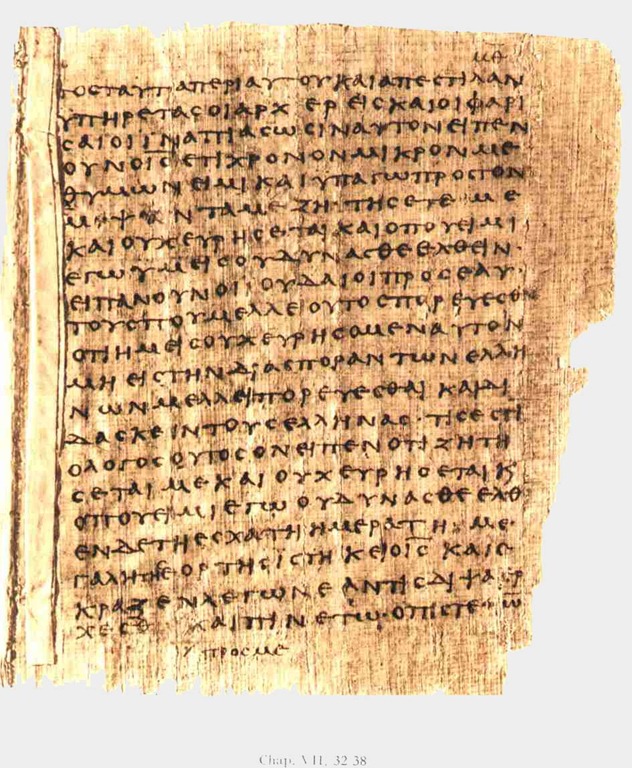
GreekNT3A fragment of parchment containing part of the book of John has been discovered. This piece is believed to be either part of the original written by the apostle himself, or a copy that was made within forty years. A fragment of Matthew has been discovered that most scholars believe was part of the very parchment written by Matthew himself. Other fragments, and even whole books of New Testament, date from within a hundred years of the time of the apostles. The oldest complete copy of the New Testament is about 150 years removed from the time of the apostles. This is far, far better than any other ancient document that exists.

Compared to twenty ancient copies of Tacitus, or ten of Julius Caesar, scholars have discovered roughly 5,500 very ancient copies of the New Testament in Greek (the original language), and an additional 19,000 ancient copies in other languages like Syrian, Latin and Coptic. For hundreds of years, scholars have been comparing these manuscripts to one another. If all or most of the texts show that John wrote “Jesus wept,” than we can be pretty darn sure that John did in fact write, “Jesus wept.” In addition to all these actual copies of the New Testament, we have extensive quotations of the books of the New Testament contained in letters and writings from early Christians, dating from the time of the apostles and on.

With the overwhelming number of copies and the various languages, scholars have found some variations in part of the New Testament. These variations are all very small, and none of them change the essential meaning of any New Testament passage. By the way if you have an NIV version of the bible, it will make a footnote of every major textual variation. Here’s an example of a major variation:

In Luke 23:42, Luke writes that the thief on the cross said, “Jesus remember me when you come into your kingdom.” The NIV version of the bible makes a footnote there is enough evidence to note a variant manuscript reading. The variant would read like this: “Jesus remember me when you come with your kingly power.” You may say: “What’s the big deal with that? What does it change? Doesn’t it mean the same thing?” That, of course, is the point. It changes nothing significant. Nor do any of the “significant” variants. If you have an NIV Bible you can scan the bottom of the text as you flip through the pages and see all the significant variants.

Because of the great number of copies which all record the same words, and because they are so ancient, we can be quite sure that the New Testament we read today is the truly and accurately preserved teaching of the apostles of Jesus Christ.

Every year around Easter, the National Geographic society trots out a documentary or story about the “lost gospels” or the “books that should have been included in the bible.” It’s true that there are a few ancient documents about Jesus that are not included in the New Testament. But there are huge differences between them and the New Testament.

GNT2

We know historically that by around 250 AD at the latest, virtually all Christians were using the twenty-seven books that make up our present day New Testament. The New Testament was not officially defined by a conference of Churches until sometime in the mid 300’s AD, but for all intents and purposes it was well established even earlier than that.

There were several things that caused a book to be included in the New Testament.

  1. The New Testament book had to be connected to an apostle (either written by an apostle, as in the case of Paul’s letters, or written by someone who associated closely with one or more apostles, as in the case of Luke and Mark). So the ancient book, The Apocalypse of Peter, though it names an apostle in the title, was never recognized in any early writing, or by any other evidence, as having anything to do with the real historical Peter. Needless to say, it isn’t in the bible.
  2. The New Testament book had to enjoy widespread early use among churches. For example, the Gospel of John was used and recognized in churches all over the known world by a very early date; whereas the “Gospel of Judas” was never really recognized outside of Alexandria, Egypt and that at a fairly late date, by people who weren’t even Christians. Again, by at least 250 AD, virtually all churches were using a common set of apostolic writings – this set of books was later called “The New Testament.”
  3. The New Testament writings had to agree with generally accepted Christian doctrine. In the 140s AD, a man named Marcion came up with his own very twisted version of Christianity and listed various writings which he thought should be considered sacred. He and his “New Testament” were rejected by almost all churches, because they were contrary to the teachings that the churches had held since the time of the apostles.

I guess what I am saying to you today, is the same thing that Paul was trying to say to the Galatians. I want you to know brothers and sisters, that this gospel that we received and have believed does not come from human beings. It was preserved by human beings, and we can see that it was preserved accurately. But it came from Jesus Christ. But there is even more. John recorded that Jesus said this:

“I have spoken these things to you while I remain with you. But the Counselor, the Holy Spirit — the Father will send Him in My name — will teach you all things and remind you of everything I have told you. “Peace I leave with you. My peace I give to you. I do not give to you as the world gives. Your heart must not be troubled or fearful. (John 14:25-27, HCSB)

And a little later, he said this:

When the Spirit of truth comes, He will guide you into all the truth. For He will not speak on His own, but He will speak whatever He hears. He will also declare to you what is to come. He will glorify Me, because He will take from what is Mine and declare it to you. (John 16:13-14, HCSB)

The Holy Spirit inspired and guided those who wrote down the gospel. And the Spirit guided the process by which these writings were either preserved, or not preserved. We know that there was a third letter which Paul wrote to the Corinthians, which is lost to history. The Holy Spirit caused that happen – that letter was not part of what the Spirit wanted preserved.

All Scripture is inspired by God and is profitable for teaching, for rebuking, for correcting, for training in righteousness, so that the man of God may be complete, equipped for every good work. (2Tim 3:16-17, HCSB)

We have the written words of the true gospel in the form of the New Testament. And we also have the Holy Spirit, given to us through Jesus, who continues to remind us what Jesus said, and guides us to receive and understand the truth of God’s Word. It doesn’t come from human beings who made it up for their own purposes.

If you are a Christian for any length of time, sooner or later you’ll probably have a thought like this: “What if this is all made up? What if none of it is real?” Don’t feel bad about having those thoughts. Instead, remember this: It is entirely reasonable to believe that the New Testament is the unaltered teaching of those who knew Jesus, whom Jesus chose as his apostles. All the evidence says so. It is reasonable to believe that that they believed what they wrote, since most of them gave their lives for that belief (incidentally, they didn’t get power or wealth out of it). But it does require faith to believe that their writings are true, and inspired by the Holy Spirit. It requires faith to believe that Spirit continues to speak through the New Testament today. That faith means we risk being foolish. It means we risk believing something that isn’t true – that risk is the nature of faith. But when we embrace that faith, the Holy Spirit makes these words real and relevant in our lives today.

For the word of God is living and effective and sharper than any double-edged sword, penetrating as far as the separation of soul and spirit, joints and marrow. It is able to judge the ideas and thoughts of the heart. (Heb 4:12, HCSB)

The true gospel, not made by human beings, can speak directly to your heart and to your attitudes. It can convict you of sin, comfort you with grace and lead you closer to the true and living God. It can and will change your life eternally.

BAD KARMA

badkarma-big

Does this passage disturb you at all? I hope so. In such passages, we are meant to be shocked, horrified and put off. This is how bad sin is. This is how completely unattainable holiness is. This is how much we need Jesus.

To listen to the sermon, click the play button:

To download, right click on the link (or do whatever you do on a Mac) and save it to your computer: Download 2 Samuel Part 21

2 Samuel #21 . 2 Samuel Chapter 21

I’m very glad we’ve done this extended series on the Old Testament, because we have encountered many of the things that cause trouble for people when they think about the bible. The first part of 2 Samuel Chapter 21 is another one of those troublesome parts for me. Hopefully, however, as we have gone through these difficult passages, you have begun to learn (as I have) how to hear what the Holy Spirit is saying through them.

The New Testament tells us that everything in the Old Testament was written for our instruction; it is useful and helpful for Christians today. Another thing the New Testament teaches is that the Old Testament is about Jesus. So, first and foremost, we should ask, “What does this have to do with Jesus? How does it teach me about him?” Next, we can ask, “What does this have to do with my present day relationship with the Lord? What does it teach me about myself?”

Some Old Testament passages paint a picture, a foreshadowing of what Jesus was going to be like. People like David and Samuel and Uriah show us, through very limited parts of their lives, something of the attitude, life or teaching of Jesus. Theologians call these “types of Christ.”

There are other passages that are primarily about how people relate to Jesus – how they respond to him. We’ve had quite a bit of that lately, seeing how people responded to David when he forgave his enemies. There are lessons there for us in how we respond to Jesus.

Some of the most difficult passages, however, are there to show us how much we need Jesus. They show us the depths of our sin, the heights of God’s holiness, and the huge gap in between. They show us how it was between God and people before Jesus made it right. They show us what our situation would be without Jesus. I think this is one such passage.

It started with a famine. This is equivalent to a modern-day economic recession or depression. Times were tough, families were struggling. After three years of this, David began to wonder if there was a spiritual reason for the hardship. When he worshipped and inquired of the Lord (probably through the prophet Gad, and through the urim and thummim, the “holy dice”) he learned that the famine was because of something king Saul had done.

There was a group of people known as the Gibeonites. They were not Israelites, but when Israel invaded in the time of Joshua, the Gibeonites had tricked the leaders of Israel into swearing an oath that they would not destroy the Gibeonites. So they had lived for more than four hundred years in Israel’s territory. According to the old agreement, they were essentially a tribe of servant-class people for the Israelites. They kept their part of the agreement, working as laborers for the Israelites, and remaining peaceful. But at some point not recorded in the bible, Saul had tried to wipe them out. Essentially, he tried to commit genocide, similar to what Adolf Hitler did to the Jews in the 1930s and ‘40s. Apparently he slaughtered a great many of them, but obviously not all.

Stop for a moment here. The famine came along years later. Saul was dead. The whole nation had repudiated Saul’s family, and chosen David. David had never done anything like Saul’s slaughter. He had never hurt the Gibeonites. But the entire nation was still punished, years later, for what Saul did.

My first response to this is to think that it was not fair. Why should David’s kingdom pay for something David did not do? Why should the people suffer for a crime they had no part in?

But there is another question here also. Why should the Gibeonites suffer? Why should they be denied justice? Would it be right to ignore the crimes that were done to them?

When David heard what the problem was, he spoke to the Gibeonites directly.

He asked the Gibeonites, “What should I do for you? How can I make atonement so that you will bring a blessing on the LORD’s inheritance? ” (2Sam 21:3, HCSB)

There is a key concept here: atonement. The idea is that harm done must be made right; justice must be appeased. When you break a window, you atone for it pay paying for a new window. But how do you atone for something like genocide? It would appalling and offensive to simply suggest we should “just forget about it.”

The Gibeonites told David that they would like to execute seven of Saul’s descendants. David made sure to protect Mephibosheth, son of Jonathan. The seven who were executed were Armoni and Mephibosheth (a different one) – sons of Saul by his concubine Rizpah. The other five were sons of Merab, Saul’s oldest daughter, who was originally supposed to be David’s wife (thus they were Saul’s grandchildren). They were hanged, and their bodies were left exposed.

Does this disturb you at all? I hope so. In such passages, we are meant to be shocked, horrified and put off. This is how bad sin is. This is how completely unattainable holiness is.

In many areas of our lives, we accept that things must be made right. When we make our bank statement right, we call it, reconciling. The balance MUST equal deposits minus expenditures. That is the nature of a bank balance. If we refuse to accept that, our finances will be in a mess. All of our hurt will not change the basic facts of mathematics. Our ignorance will not make any difference either. 2+2 MUST equal 4. If you have a two, and then you have another two, what you have is four. It HAS to be four – that is simply how the universe works.

Too look at it another way, we sometimes say, “there is no such thing as a free lunch.” Someone pays for it, even if it isn’t you. The food had to come from somewhere. Someone had to work to harvest it and cook it.

But for some reason, we seem to think that in terms of moral actions, nothing must be paid for, and nothing has to add up. This passage shows us how horribly wrong that is. Sin MUST be accounted for. The balance must be reconciled. Deep down, we know this. It would be a permanent obscenity upon the human race if no one had tried to bring justice upon the perpetrators of Jewish holocaust. We know that. If the man who killed all those young children in Connecticut were still alive, it would be an insult to all humanity if we simply let him go free.

If sin isn’t atoned for, it lasts. There is no statute of limitation. In the case of the Gibeonites, the atonement required was gruesome and was itself full of tragedy.

This passage shows us the futility of what some religions call “karma.” If it is true that “what goes around, comes around,” then we are doomed. If we need to make up for all of our sins not only in this life, but also for past lives, we will never find rest for our souls. If the sins of previous generations are on our heads, there is no hope. If even just our own sins are accounted to us, there is no hope.

Now, if you read this passage, and you think about what I’m saying, there are two possible responses. One response is to say, “Wow! I really need to straighten out my act and get serious.” If that’s your response, you still don’t get it. If this makes you think you need to get it together, you still don’t understand how bad this is.

The only appropriate response to this passage is: “If this is the way things are, I’m screwed.”

We are screwed.

Saul’s sons and grandsons were screwed. There wasn’t anything they could do to avoid a shameful death. According to moral law – according to God, if we understand this passage correctly – they deserved it. Nothing would be right until they got what was coming to them.

This how it stands in the universe. The moral equation must add up. The only way to make it add up is for you to suffer and die. Too many Christians don’t take it seriously enough. When someone tries to straighten out her life and live morally, to be a good person for God, she isn’t taking this seriously.

Imagine a homeless bum who is stupid-drunk. In his intoxication, he kills a woman – someone else’s wife and mother. Now imagine he sobers up, and realizes he’s done something bad. In response, to try and make up for it, he offers the family all the money he has, which amounts to $3.35.

“I’ve given them everything I have,” he says. “It’ll just have to be enough.”

It’s an insult. It is offensive that he would even offer it, let alone that he would try to pretend that it would make up for what he did. That is just how ridiculous and offensive it is to suppose that we can be good enough to make up for the times when we sin. We are screwed.

That is what this passage is all about. You have no hope. You have no options. You deserve to die and your attempt to make up for things is so pathetic that it is offensive.

Thankfully, these are not the only verses in the bible. Thankfully, the Lord loves us too much to leave us without hope. But get this straight: there is no hope in your behavior. There is no hope in you straightening out and doing better next time. You can’t dig yourself out of this pit – the walls will come crashing in and bury you.

Too many churches give the impression that Christianity is about getting your act together. It isn’t. That’s entirely false. If you think you can get your act together enough to make a difference to God, you aren’t a Christian. Sometimes I think Christians don’t get excited about the “Good News” because they haven’t taken the bad news seriously enough.

The accounts of morality must be balanced. But we can’t do it. And that is why Jesus came to earth. Soon, we will be celebrating his birth. We often do that with a lot of vague feelings of peace and goodwill. But the most appropriate response should be profound gratefulness.

Jesus took our sins upon himself. The balance was paid out through his torturous death. Through faith in him, we were punished by his death. That is what we call atonement. There is no other hope of settling the score.

But in Jesus, that hope is real and true. There isn’t anything you can do. And so he did it all. Our part is merely to believe that, and accept it with gratitude. When we truly believe both the bad news and the good news, Jesus changes us from the inside out. When we know we truly don’t have to measure up, there is a tremendous freedom and joy that brings us even closer to God.

Pause now, and let the Holy Spirit speak to you today.

LOYALTY IS TESTED ONLY IN TIMES OF DISAGREEMENT OR TROUBLE

I understand the hurt feelings we can have sometimes when God doesn’t come through the way we think he ought to. I’ve had them myself, frequently. But he is the king. He can do what he wants to. He is wiser than us, and he sees things we don’t. It’s better to trust him and stay engaged.

sheba-rebellion

To listen to the sermon, click the play button:

To download, right click on the link (or do whatever you do on a Mac) and save it to your computer: Download 2 Samuel Part 20

2 Samuel #20 . 2 Samuel Chapter 20

Last week we spoke of the political situation at this point in time in Ancient Israel. There are more politics here, but be patient, I think we’ll find some good stuff. After David returned, having reached out the leaders of the tribe of Judah, who were in shame, the leaders of the other tribes were offended. They had not provided the key support of Absalom’s rebellion, like Judah had; they had talked of bringing David back before Judah had. So they were offended that David reached out to Judah and gave them the honor of escorting him back to Jerusalem.

Apparently while David was returning to Jerusalem and all this was being discussed, a man named Sheba, from the tribe of Benjamin (Saul’s tribe), stepped up and said, essentially, “Fine then. If that’s how David wants it, let’s leave.”

He left, and most of the people of the other ten tribes followed him. Now, at this point, as I read this text, they were simply choosing not to escort David to Jerusalem. Most of the leaders of the tribes were willing to express their displeasure with Judah and with David’s forgiveness in this way. So they all went home and left the leaders of Judah to escort David.

But Sheba, the man who instigated the walk-out, wanted to take it one step further. He wanted to immediately start another rebellion. For David, this was one thing after another. However, Sheba was not like Absalom. This was not a carefully laid plot with long preparation. He was only able to get the Berites to join him. The “Berites” were probably citizens of the town of Beeroth in Benjamin; it was almost certainly Sheba’s hometown. So his influence was quite limited.

Even so, David thought it best to stamp out the small rebellion quickly. He didn’t want to give it a chance to spread. So he ordered his new military commander, Amasa, to gather the troops.

When Absalom rebelled, he had chosen Amasa to be his general. After the rebellion failed, one of the ways that David reached out to the tribe of Judah was by promising Amasa that he was forgiven, and that he would command the army in place of Joab. Joab had murdered Abner years before this, and at that point he had David’s tolerance, but never again did David approve of him. More recently, Joab murdered David’s own son, Absalom. Now, I know it was when they were at war with Absalom, but when Joab came upon him, the battle had already been won, and Absalom was alone, unarmed and helpless. Moreover, David had commanded Joab to capture and spare Absalom if he could. Instead, Joab killed him while he hung helpless and trapped in a tree. So Joab was in disgrace, and David wanted no more part of him.

Another reason David made Amasa the new general, was to try and mend the relationships he had with the leaders of the tribe of Judah. It was a peace offering to them, showing them he had forgiven them, restoring them to normal relations. In addition, Amasa, like Joab, was one of David’s nephews. In fact, he was Joab’s cousin.

Amasa took too long to gather the army, so in the meantime, David sent Abishai, Joab’s brother, after the rebel, with David’s personal force of elite warriors. Joab went along. Eventually, Amasa and the army he had raised, met up with David’s forces under Abishai. Joab went up to Amasa. He deliberately allowed his sword to fall out of its sheath as he approached his cousin. He bent down and picked it up, and then, still holding the sword, reached out as if to greet Amasa. Instead, he stabbed him, killing him. This was very similar to what he had done to Abner. Immediately, he took control of the whole army again. He had one his loyal followers cry out

“Whoever favors Joab and whoever is for David, follow Joab! ” (2Sam 20:11, HCSB)

The implication is that if you didn’t follow Joab you were against David and for the rebel that they were pursuing. Eventually, Joab’s flunky hid the body of Amasa, so it wouldn’t distract the soldiers as they marched by.

They pursued Sheba and his followers to the northern borders of Israel, where he took refuge in a walled city. There Joab negotiated with a woman with a reputation for wisdom. She begged Joab not to destroy the city. Joab made it clear that their war was against the rebel, not the city. So the citizens executed Sheba, and thus ended the rebellion, and saved their city from destruction.

Now, what do we make of this? It’s a petty, bloody and gruesome chapter in the history of Israel. What would the Lord say to us through it? Well, let’s remember that the whole bible is about Jesus. This chapter is here to show us something about Jesus, or something about ourselves and how we relate to him.

Let’s start with the people from the ten tribes. They began by insisting how much they wanted to honor David, but ended up snubbing him deliberately because they were offended and hurt by the way he forgave his enemies.

Sometimes we might be tempted to behave this way with Jesus. It’s easy to get disappointed with him when he behaves in ways we don’t expect. Sometimes it’s hard to accept that he loves our enemies as much as he loves us. Sometimes what he does or doesn’t do, or the things he allows to happen in our lives, are difficult to understand. Often we respond by withdrawing from him. Maybe we aren’t overtly rejecting him or rebelling, but we just “go home.” We back off. I understand the hurt feelings we can have sometimes when God doesn’t come through the way we think he ought to. I’ve had them myself, frequently. But he is the king. He can do what he wants to. He is wiser than us, and he sees things we don’t. It’s better to trust him and stay engaged.

Maybe it’s not even Jesus himself, but something he’s doing that he wanted us to be involved in. For example, suppose you feel called to help out with a ministry to the poor. You do, and you truly make a significant difference, but no one recognizes your efforts. In the meantime, they honor people who seem to deserve it less than you. So you back off. I understand backing off a situation like that. But the question is: did the Lord call you to back off, or are you just withdrawing because your feelings were hurt? That can be tough, but the way of maturity in Jesus is to listen to him more than your emotions.

What about Joab? Joab comes across as someone who was always loyal to David, even though David did things he didn’t like. But was it really loyalty? He was loyal when he agreed with David. But we see now, for at least the third time, that when Joab had different ideas, he chose his own way. He did what he wanted, no matter what the king commanded. Loyalty and submission to leadership are only really revealed in hardship and especially in disagreement. But whenever there was disagreement, Joab chose himself over David.

By and large, Joab looked like a loyal and faithful servant. And, throughout his life, he did a lot for David. But ultimately, he did not buy into who David was and what he was all about. He was offended by David’s compassion and forgiveness. He liked the part where they got to kill their enemies together. He didn’t like the forgiveness part, so he didn’t do that, and he did not let David’s will thwart his own designs. Joab was aligned with the right side. But his heart was all about Joab and what he felt and what he wanted. He did not actually accept David’s wisdom and judgment if it was different from his own.

Sometimes Christians can be that way with Jesus. Usually, these days, it is the reverse of Joab. We like the love and forgiveness stuff. But when it comes to giving up our favorite sins, we choose our own way. Or maybe we’re fine to go to church and sing songs. But when it comes to forgiving someone who has hurt us badly, we hold on to the right to nurse our grudges. We like to be perceived by others as believers, but we won’t listen to the Spirit’s call to be intimately involved in the lives of other believers, or to study the bible. Jesus said something very scary in Matthew chapter seven:

“Not everyone who says to Me, ‘Lord, Lord! ’ will enter the kingdom of heaven, but only the one who does the will of My Father in heaven. On that day many will say to Me, ‘Lord, Lord, didn’t we prophesy in Your name, drive out demons in Your name, and do many miracles in Your name? ’ Then I will announce to them, ‘I never knew you! Depart from Me, you lawbreakers!’” (Matt 7:21-23, HCSB)

You can look like a Christian, act like a Christian and talk like one, but not really allow Jesus to change your life. You can even do things for Jesus, but those things won’t count if you don’t really receive him as your savior and king. Joab looked like a friend, but his actions revealed him here as someone completely separated from David and his values. We see how terrible and ugly that was in Joab. We see that the fruit of it was pure evil. The same is true for us: the fruit of our own self-will when it is asserted as better than the will of Jesus, is never good.

Finally, consider the wise woman in the town of Abel. At first, they probably received Sheba into their town willingly. But when the realized the destruction he would bring and that there was no righteousness to his cause, they were willing to get rid of him in a very final way.

This also reminds me of something Jesus said:

If your right eye causes you to sin, gouge it out and throw it away. For it is better that you lose one of the parts of your body than for your whole body to be thrown into hell. And if your right hand causes you to sin, cut it off and throw it away. For it is better that you lose one of the parts of your body than for your whole body to go into hell! (Matt 5:29-30, HCSB)

The people of Abel realized that they had something in their midst that would lead to their downfall. They got rid of it with awful finality. Sometimes maybe we need to something similar. Maybe you have a habit of going out after work and having a few drinks before you head home. Maybe you fudge the numbers a little bit at work. Perhaps you have some activity or habit that seems OK at first, and you like it, but Jesus has made you aware that this is a problem in your life. The time to get rid of it is right now, with finality. The people of Abel were considered wise for choosing to get rid of the rebel rather than having their town destroyed. We too, sometimes need to make a wise choice that is hard, even drastic.

Let the Spirit speak to you through the text today.

OFFENSIVE FORGIVENESS

shimei-curses-david

Sometimes the love and grace of God is given to people who are so undeserving that it seems offensive. But Jesus’ love and forgiveness is given time and again to those who don’t deserve it – because no one deserves it. So, if you think you are unworthy, you are correct. But that doesn’t stop Jesus from giving you grace and forgiveness anyway. On the other hand, if his grace offends you, maybe you don’t yet know how much you yourself need it.

To listen to the sermon, click the play button:

To download, right click on the link (or do whatever you do on a Mac) and save it to your computer:
Download 2 Samuel Part 19

The second half of chapter 19 appears to be mostly a detailed record of the political history of that time. This was valuable and significant to the ancient Israelites who lived not long after David’s time. It is still interesting today to historians, and bible-geeks like me. But what is the point of it really?

I know I’ve mentioned this before, but I think it is important to revisit it periodically. We all tend to forget. The Holy Spirit made sure first that this history was written; second, that it was preserved through the years; and third, that it was included in the bible. So there must be some reason for this. There must be some way the Lord wants to speak through it to Christians living today.

Sometimes, in order to hear what the Lord wants to say today, we first need to understand it better. So please bear with me. I think we’ll find some fruitful bible application here if we pay attention to details that might otherwise seem tedious.

Here’s the situation. David’s army has defeated and killed Absalom, who had rebelled against him and set himself up as king in David’s place. There were no computers or telephones or newspapers in those days, so it took a while for the news of David’s victory to spread. Meanwhile, David seems to have waited. This might seem a little bit strange. But remember who David is. He has many faults, to be sure, but he has never grasped at power. Instead, he always waited for the Lord, even refusing to take opportunities to gain the kingdom. So here, he once more waits until he is sure that Lord still wants him as king. He doesn’t want the civil war to continue, so he waits until he is sure he can return in peace. This David once more at his best, trusting the Lord.

The writer of Samuel often makes a distinction between the tribe of Judah and the other eleven tribes of Israel. Often when he writes “Israel” he appears to mean the tribes as distinct from the tribe of Judah. This shows us that there was some tension between those two factions even in the time of David. In the time of David’s grandson, the nation was split. Judah absorbed most of the tribe of Benjamin and became a separate nation named “Judah” (from which we get the word, “Jew”). The other ten tribes formed a kingdom to the north of Judah, which was called “Israel.”

After Absalom’s rebellion, people from the other tribes began talking about inviting David back officially, and officially receiving him once more as king.

Now Israel had fled every man to his own home.  9 And all the people were arguing throughout all the tribes of Israel, saying, “The king delivered us from the hand of our enemies and saved us from the hand of the Philistines, and now he has fled out of the land from Absalom.  10 But Absalom, whom we anointed over us, is dead in battle. Now therefore why do you say nothing about bringing the king back?”

Apparently, the people really had committed to Absalom. They said he was the one they had anointed to be king over them. This wasn’t as strange as it might seem. After all, he was the king’s son and heir. I’m sure many people assumed that sooner or later, Absalom would be king anyway, and why not have him in the full vigor of his youth? But now, he was gone. I would have thought that at this point it was a clear choice to go back to David, but the people still seemed at a loss. Even so, from most of the tribes, sentiment turned back toward David.

But the tribe of Judah did not seem to know what to do. At first, this seems strange, since David was from the tribe of Judah. But then, so was Absalom. Absalom’s rebellion was conceived and carried out in Hebron, the chief city of Judah. His military commander, Amasa, was a relative of his (and David’s) from the tribe. In fact, most of his inner circle were probably from Judah. In other words, although they were David’s people, they were also Absalom’s people, and they were probably chiefly responsible for the rebellion.

David reached out them. He sent a message to the leaders of the tribe of Judah, saying,

‘Why should you be the last to restore the king to his palace? The talk of all Israel has reached the king at his house. 12 You are my brothers, my flesh and blood. So why should you be the last to restore the king? ’ 13 And tell Amasa, ‘Aren’t you my flesh and blood? May God punish me and do so severely if you don’t become commander of the army from now on instead of Joab! ’ ” 14 So he won over all the men of Judah, and they sent word to the king: “Come back, you and all your servants.” (2Sam 19:11-14, HCSB)

As David makes his way back, he is met at the Jordan river by a host of people who want the honor of escorting him to Jerusalem. What follows is a slightly sickening display of sycophancy. People end up arguing amongst themselves about who gets to show David honor, and who is honoring him more (19:40-43).

Along with the leaders of the tribe of Judah, one of the first people to come meet him is Shimei. You may remember him from 2 Samuel 16:5-13. This was the man who cursed David and pelted him with rocks and dust as he fled from Absalom. When David was down, he piled on with insults and taunting. Shimei did not just screw up and make a mistake – what he did was clear and deliberate. Now that David is king again, he comes fawning to him like a disobedient dog, and begs forgiveness. I don’t know about you, but I think that Shimei was pond-scum. His behavior and attitude are despicable, detestable, the lowest and ugliest forms of hypocrisy and cowardice. He is a jerk, plain a simple, the kind of person I want nothing to do with.

And David forgives him.

Stop for a second, and think on that. Let it sink in.

Let’s be honest. David’s forgiveness and compassion are offensive. Abishai, brother of Joab suggests, as he did before, that Shimei would be a more attractive person if his head was removed. I tend to agree with Abishai. But David did not.

Does this remind you of anything? The love and compassion of Jesus were also offensive. The Pharisees were offended that he would eat with tax collectors and known sinners. He allowed a prostitute to kiss his feet in public, and wash them. It offended them.

I think once more, this text is a far-off picture of Jesus, the ultimate anointed savior of God’s people. It isn’t really about David, it is about Jesus, his wisdom and love, and how people respond to him. So let’s consider the rest of this text in that light.

We’ve been talking about Shimei. His sin was obvious and deliberate. There was no excuse for it. It wasn’t a momentary slip. It revealed an ugly character. Even so, David offers him forgiveness and redemption. Jesus does the same. That’s right, Jesus came to redeem and forgive class-A jerks, cowards and crawling hypocrites. It is offensive sometimes, to think Jesus would forgive someone that I want to hate so much. But he does.

Abishai was like me. Shimei’s character was clear to him. He was offended by David’s compassion and mercy. But David rebuked him. Sometimes we really are offended by the idea that Jesus would forgive certain people. Would he forgive a child-molester? Based on what I know of the bible, the answer is “yes.” Jesus is king, and he can forgive who he pleases. He does not answer to us.

But as an illustration, I do want to finish the story of Shimei, though it does not end for many years. When David was dying, he told Solomon to watch out for Shimei. So, even though David forgave him, he certainly saw the truth about what kind of person he was. Solomon made a just and fair ruling for Shimei, allowing him to live in peace if he would show his obedience and faithfulness by never leaving Jerusalem. Shimei ignored that when it became inconvenient, and Solomon had him executed. So in the end, forgiveness did Shimei no good, because he did not allow it to touch his heart and change the kind of person he was.

In the same way, the forgiveness of Jesus does not help those who don’t truly repent, who don’t allow him to work in their lives. Jesus sees all, let ultimate judgment rest with him.

Back to David, the next person to arrive was Ziba. At this point, Ziba was revealed as a trickster and manipulator, because right behind him was Mephibosheth, whom Ziba was supposed to serve. Mephibosheth revealed how Ziba took advantage of his disability, and took the donkey that was supposed to be for him, and told David that Mephibosheth rejoiced over David’s trouble. David does not seem to know who to believe, but he reverses his earlier decision that gave all of Mephibosheth’s land to Ziba. Now, instead, he tells Mephibosheth to divide the land between them. Even so, this amounts to forgiveness for the trickster and manipulator, Ziba. There it is again, that offensive forgiveness.

Mephibosheth’s response shows that his loyalty was always true. He doesn’t care about the land, as long as David is safe, and king again. I mentioned before that Mephibosheth is a great picture of God’s grace. Unlike Shimei, the grace he received through David changed him permanently. He doesn’t just want what David can give him. He wants the best for the king that saved him, and he wants fellowship with him, whether he has blessings from him or not. Mephibosheth rejoiced that David was back and safe, far more than he rejoiced about being vindicated in the dispute with Ziba.

This is an encouragement to me to have a similar attitude. It isn’t about what Jesus can do for me in this life. It isn’t about me getting what I think I deserve, or being proved right. It is about loving Jesus and being in relationship with him. You can’t manufacture that. It only comes when you love Jesus for who he is. If you feel like you lack that kind of love (as I often do), ask the Holy Spirit to give it to you.

One of the people who helped David in his exile was an old man named Barzillai. David blessed him and rewarded him, though again, Barzillai wanted no other reward than the safety of the king, and in fact, was too old to enjoy any of the blessings David wants to bestow. So too, I find it helpful to remember that even though Jesus sometimes offends me by his radical forgiveness of people whom I think are undeserving, he does also love his faithful servants. He does not forget them, or offer them less than anyone else. Maybe, like Barzillai, we don’t enjoy the blessings in the this life. Even so, Jesus offers us blessing and joy that can never spoil or fade.

Another group to consider is the leaders of the tribe of Judah. They made a deliberate choice to follow Absalom instead of David. But before they even repented, David was reaching out to them, forgiving them, restoring them to a relationship with him. So Paul writes about Jesus in Romans 5:

For while we were still helpless, at the appointed moment, Christ died for the ungodly. For rarely will someone die for a just person — though for a good person perhaps someone might even dare to die. But God proves His own love for us in that while we were still sinners, Christ died for us! (Rom 5:6-8, HCSB)

Jesus’ love and forgiveness is given time and again to those who don’t deserve it – because no one deserves it. So, if you think you are unworthy, you are correct. But that doesn’t stop Jesus from giving you grace and forgiveness anyway.

Abishai was not the only one who took offense at the mercy of God that David showed to all who would see. The ten other tribes of Israel were also offended that even though they were the ones who first talked of bringing David back, it was the tribes of Judah and Benjamin who got the honor of doing so.

In Jesus’ time, the Pharisees were also offended at Jesus’ grace. That was because they did not believe they had need of it themselves. I think that may be a key. If the forgiveness and mercy of God to others offends you, is it possible that perhaps you do not realize how much you yourself need that same grace?

Let the Spirit speak to you today.