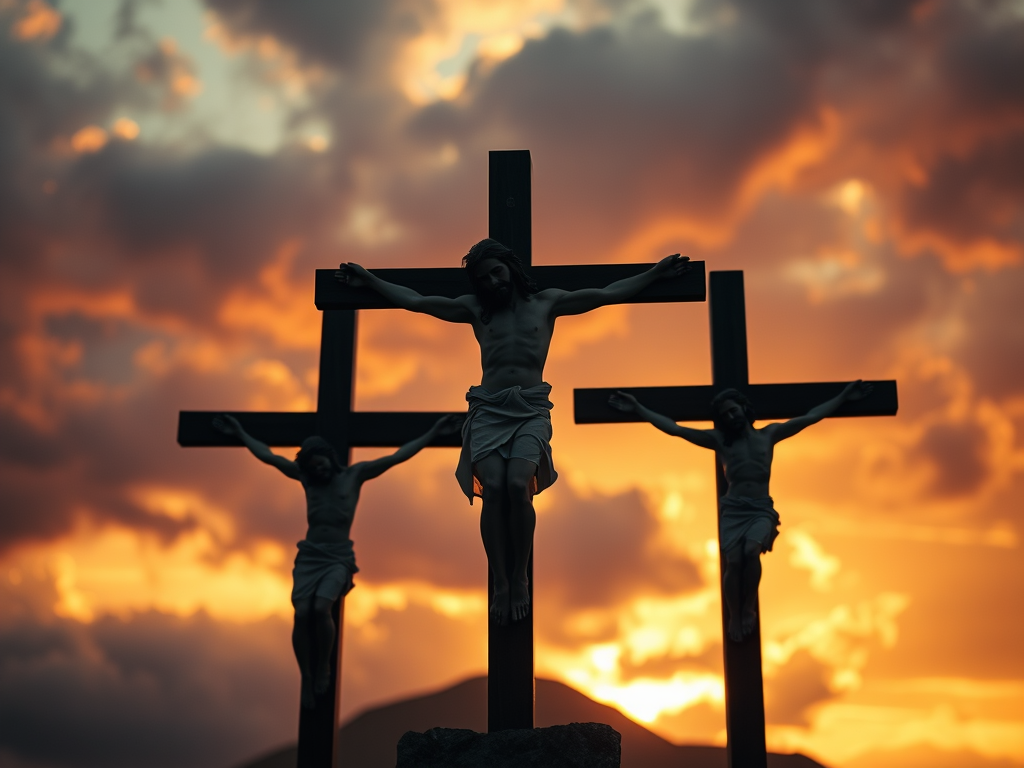
2 SAMUEL #28: THE LORD SAVES

The very end of the book of Samuel encourages us to put our hope in the only appropriate place: God’s mercy. We don’t need to waste time wishing for a great leader. We don’t need to waste our hopes and dreams on things that will always, eventually, let us down. Instead, the Lord is continually calling us to look to him for our greatest and most enduring hope. Sometimes that call from the Lord comes through judgment, but even then, the ultimate purpose is to bring us back to the Lord.

To listen to the sermon, click the play button:

For some people, the player above may not work. If that happens to you, use the link below to either download, or open a player in a new page to listen. You can also find us on Spotify at https://open.spotify.com/show/6KKzSHPFT466aXfNT2r9OD

To download, right click on the link (or do whatever you do on a Mac) and save it to your computer: Download 2 Samuel Part 28

2 SAMUEL #28. 2 SAMUEL 24:1-25

This is our very last sermon on the book of Samuel (which includes both 1st and 2nd Samuel). Remember it began with the prayer of a godly woman, who desperately wanted a baby, but, at the same time, she wanted it only on God’s terms. So the Lord gave her Samuel, who became a great prophet and leader for Israel. As Samuel grew older, the people began to fear. His sons were nothing like him, and the people were worried about what would happen when Samuel left. So, they asked for a king. In Saul they got the kind of king they wanted: Big, and impressive looking. But Saul had deep fears and insecurities, and time and time again, he refused to trust the Lord. Instead, when he was worried, he took control of things, rather than trusting the Lord, or doing things the way the Lord commanded. Then came David, and we followed his life from the time he was an unknown shepherd, through his slaying of Goliath, his many victories as a battle-leader for Saul, and then his trials and sufferings when Saul tried for years to have him killed. Then David became king, and in general, he was a good one, deeply concerned, above all, with what the Lord wanted. David failed horribly during his middle-aged years, but he returned to whole-heartedly following the Lord.

When we read 2 Samuel chapter 24, it seems like the whole book of Samuel ends rather abruptly. But when we understand that it is the final part of a six-part epilogue, it begins to make more sense.

Up through the end of the chronological narrative, in chapter twenty, David appears to be an inspiring hero, a wise and just leader. Yes, we learned of his failings during the years with Bathsheba, but following that, he returned to being the man whose one goal was to please the Lord. By the end of 2 Samuel chapter 20 (the end of the chronological narrative) readers are bound to be very impressed by David, because he really was an extraordinary and admirable person.

David’s amazingness is one reason for the epilogue at the end of the book. The author of Samuel wants to make sure we aren’t confused. This book isn’t about David, it’s about the Lord. So the author is using this epilogue to show us that not even an earthly leader like David is the answer for our hopes and fears. He keeps pointing us back to the Lord himself. Remember that this epilogue is written in ancient chiastic structure, which involves sections that mirror one another. The very first part of the epilogue told of a famine that came upon the land because of a terrible sin committed by Saul. This last part, which mirrors the first, is about a plague that came upon the land because of a sin committed by David. In the first part, we learned that the only way they could atone for Saul’s sin was to execute seven men from his family. Now we learn that at some point, David also committed a similar sin that affected the entire country. I feel pretty confident that this was not at the end of David’s life, but rather some point when he was younger. Remember, this epilogue is not set out chronologically.

This same incident is also recorded in 1 Chronicles 21. I’ll be using some things from that passage to help us understand the situation. It says in this text that the Lord was angry at Israel, and stirred up David to take a census. In 1 Chronicles 21, it says that Satan, plotting against Israel, incited David to sin by taking a census. Either way, we can see that the consequence of David’s sin was that all Israel suffered. I think one of the first questions should be, “Was it God or was it Satan?” As I have mentioned in previous messages, there are several other places in the Old Testament where the Lord used evil spirits to accomplish his purposes: Judges 9:23-24, 1 Kings 22:18-23, 1 Samuel 16:14, and Job 1:6-12. In each case the picture we get is the Lord allowing an evil spirit to affect a particular person or group. In each case, the evil spirit wants to do the evil, but must get permission from God first. God’s permission to the evil spirit seems to be limited to what will accomplish his (God’s) purpose. In most of these cases, the purpose is to bring judgment, and if possible, repentance. [For a longer discussion of this issue please go to one of my previous sermons: Does God Send Evil Spirits?]

So it is entirely consistent to see God allowing a limited evil influence upon David in order to accomplish his purposes. It was Satan who tempted David, but it was ultimately God who allowed that temptation to happen. The answer to our first question then is: both. It was both God and the devil.

The next natural question is, “Why did God let this happen?” My most honest answer is, “I don’t know for sure.” I do have some ideas, however.

Clearly, the Lord felt that, at this point in time, there was something not right in David’s heart – and also not right in the hearts of the people. Again, we don’t know exactly when this happened. In fact, I suspect that this may have happened before David sinned with Bathsheba, during the time when he had begun to drift away from the Lord for a season.

Let’s start with a clear biblical understanding of sin and punishment and judgment. There is only one satisfactory and just punishment for sin. According to the Bible that one appropriate punishment is eternal separation from God. Since God is the source of all Life and all Good, that separation means death and unimaginable suffering. So if David and the people of Israel were not killed and sent away from God’s presence forever (that is, hell) then they were not being punished for doing wrong. They were being judged. There is a difference. It was God’s punishment for our sins that Jesus took upon himself.

In the Bible, God’s judgment establishes that his actions are right and good, and that ours are wrong and sinful. God uses judgment to try and get people to repent and turn to Him and receive life, hope and forgiveness through Jesus. Judgment always has this purpose: to turn people back to the Lord. It isn’t vindictiveness or anger or even righteous punishment. It is an extreme measure of love. It is like amputating a limb to keep the deadly cancer from spreading, or taking the car keys away from someone who drinks too much. It seems harsh, but it is intended for good, for love.

So God allowed the sin in the hearts of David and his people to be revealed through temptation, and then he brought judgment to turn them back to Himself.

When I was fifteen I tore open the back of my heel in an accident, and had to have stitches. It was in Papua New Guinea, and the healthcare I received was, unfortunately, typical for third world countries at the time. The wound became infected. It sealed up on the outside, but underneath, it was filled with pus and infection. Left alone, it would have looked all right, but eventually it would have developed gangrene and rotted my foot and leg, finally killing me. My dad realized what was happening. He made me lie down, while he clamped my leg to hold it still. He squeezed around the wound and it was incredibly painful. The wound burst open and what came out was truly disgusting. For almost a week afterward I had a gaping, weeping hole in my heel. I still have a scar there. But it was absolutely necessary that the infection be exposed and cleaned out.

So, the Lord exposed what was hidden in the hearts of David and of the people, and then cleaned the infection, though it was a painful, awful-seeming process. My dad inflicted pain upon me in order to bring about my healing. He didn’t cause the infection, but he did cause me pain in order to first expose it, and then eliminate it. So God did not cause the problem in the hearts of his people, but he loved them enough to engage in the painful process of exposing it and judging it, to bring them back to himself.

Now, another question that I have is: what was so bad about taking a census? Moses did it twice – because God told him to. So why shouldn’t David do it? How did the census expose the sin of David and of Israel? I think this is also an important question to ask.

I have to admit, this part is speculative. Here are some possible reasons. Perhaps it was pride. Maybe David wanted to know how great his kingdom was. Or maybe he was contemplating a new conquest that was not sanctioned by the Lord, and he wanted to know if his army was big enough to do it. Another possibility is that he was afraid of rebellion, and was using the census to ferret out any potential enemies. The men of Judah and those of the other tribes were recorded separately. So maybe David was afraid, and was trying to see if the men of Judah had enough soldiers to defeat the other tribes if it came to civil war again.

In any case, it did not arise from faith. Romans 14:23 says: “For whatever does not proceed from faith is sin.” We want a book of rules, so we can just take care of things on our own, and not make the effort of staying close to the Lord. Rule 447, paragraph 8, section c: “Do not ever take a census.” But living that way actually separates us from God, because it allows us to function “righteously” without really interacting with him. Even if we do the right thing, it needs to be because we are living in right relationship. Taking a census is not always wrong. But David was not walking in faith.

Here is one other possible problem with this census, and it is the one I am inclined to think most likely. It could be that David ordered it to be conducted in a way that violated something the Lord said in Exodus 30:11-16.

The LORD spoke to Moses: “When you take a census of the Israelites to register them, each of the men must pay a ransom for himself to the LORD as they are registered. Then no plague will come on them as they are registered. Everyone who is registered must pay half a shekel according to the sanctuary shekel. This half shekel is a contribution to the LORD. Each man who is registered, 20 years old or more, must give this contribution to the LORD. The wealthy may not give more and the poor may not give less than half a shekel when giving the contribution to the LORD to atone for your lives. Take the atonement money from the Israelites and use it for the service of the tent of meeting. It will serve as a reminder for the Israelites before the LORD to atone for your lives.”  (Exod 30:11-16, HCSB)

The point of this was to recognize that the Lord owns all of the people. They don’t own themselves – they owe their lives to the Lord. In the same way, no leader (for example, like David) owns the people – they all belong to God. It may be that the people did not want to pay the census fee, nor did David want to require it of them. This exposed that in their hearts they were not serious about belonging to God as a people. This may be the sin in the hearts of the people that God was exposing.

With the sin exposed, God acted in judgment, to bring the people back to himself. Because David repented so quickly, the Lord gave David a choice about the form of judgment: three months of rebellion and battle, or three years of famine, or three days of a plague. David chose the last one, as I would have. He trusted God’s mercy (in the form of the plague) more than the “mercy” of a human enemy.

As the plague was coming to Jerusalem, David apparently had a vision of God’s angel striking the people. He cried out for mercy for them, pleading with God to limit the judgment to himself, to strike him and save the people. God did not do that—not yet—but he did end the plague at that point. The angel in the vision stopped. David’s plea to be punished instead of the people echoes the heart of the ultimate chosen one, Jesus, whom God did punish in place of all sinful people.

What follows is very interesting. The Lord sent the prophet Gad, who told David to make sacrifices and offerings on the spot where he saw the angel stop. If you remember, Jerusalem in David’s time was fairly small, maybe ten or fifteen acres. It was on the tip of a ridge, with deep ravines to the east and west and south. Behind David’s city to the north, the ridge rose to the top of the mountain. It was there, at the top of that ridge or mountain, where David went to offer his sacrifices. This was about 1/3 of a mile from the north wall. The picture below gives you a rough sense of the geography, though it is not 100% accurate.

David found the land was owned by a Jebusite, not an Israelite. Refusing to take it as a gift, David purchased the land, and made offerings and sacrifices there. This ridge-top was the very place where Abraham had taken his son Isaac, when he obeyed God’s call to sacrifice him. On that mountaintop, Isaac, not knowing what was to come, asked what they were going to use for a sacrifice. Abraham answered prophetically, saying, “God Himself will provide the lamb for the burnt offering, my son.” (Gen 22:8, HCSB). God stopped Abraham when he saw that he was willing to give up even his son. Instead, God planned to give his own son. And so on this same spot, almost eight hundred years later, the plague was stopped. On this same spot, David offered his life in exchange for his people, but again, the Lord refused that sacrifice, looking ahead to the time he would offer his own son. On this same spot, purchased by David, Solomon later built the temple of the Lord. This temple became a meeting place between the Lord and his people, a place where sacrifices were offered to reconcile the people with the Lord and each other. So, the author of Samuel, who lived in the next generation after the temple was built, is saying: “Don’t waste your energy wanting another king like David. Instead, pay attention to the presence of God among his people.”

The New Testament teaches us that those sacrifices were all a shadow, pointing toward the ultimate sacrifice of Jesus to save people from their sins. The writer of Hebrews writes about the temple, and its purpose:

9 This is an illustration pointing to the present time. For the gifts and sacrifices that the priests offer are not able to cleanse the consciences of the people who bring them. 10 For that old system deals only with food and drink and various cleansing ceremonies—physical regulations that were in effect only until a better system could be established.
11 So Christ has now become the High Priest over all the good things that have come. He has entered that greater, more perfect Tabernacle in heaven, which was not made by human hands and is not part of this created world. 12 With his own blood—not the blood of goats and calves—he entered the Most Holy Place once for all time and secured our redemption forever. (Hebrews 9:9-12, NLT)

In other words, even though the writer of Samuel did not know it, this epilogue points beyond David, even beyond the temple, and to the eternal atonement that Jesus secured for us. The message is that we need atonement, and only God himself can truly provide it. And not only that, but God has provided it, through Jesus Christ, the descendant of David.

We human beings tend to make the same mistakes in each generation. Many people in our country are very focused on politics and on the “culture wars.” But our main focus should be on Jesus Christ, and reconciliation with the Lord through him.

What are the things you tend to put your hope in? A job? Your skill or experience? Your family? Your investments, your house? All these are good things when they are held in the right place of importance in our lives. But as good as it is to enjoy the blessings God gives us, our only hope should be found in Jesus Christ alone.

How has the Lord spoken to you through the book of Samuel?

2 SAMUEL #23: BAD KARMA

We have now entered the final section of 2 Samuel. It is arranged according to a typical ancient middle eastern pattern: chiastic structure. This first section shows us that the problem of sin is much worse than we usually imagine. It is meant to show us that we have no hope unless God does something to save us. Thankfully, he has, through Jesus Christ.

To listen to the sermon, click the play button:

For some people, the player above may not work. If that happens to you, use the link below to either download, or open a player in a new page to listen.

To download, right click on the link (or do whatever you do on a Mac) and save it to your computer: Download 2 Samuel Part 23

2 SAMUEL #23. 2 SAMUEL 20:1-14

If you look at 2 Samuel chapters 21-24, they seem, at first glance, a bit messy, and even random. These chapters don’t seem to fit with everything else that has been going on. One of the things that is confusing is that up until now, the life of David has been going on mostly from beginning to end. In this last section, however, things appear to be more random, and there are stories from all throughout David’s life.

Some skeptics use this last section as the basis for claiming that these were all just stories that were embellished and put together more or less randomly over time, rather than a carefully written book by an author who had reliable source material and who wrote close to the time of David.

In fact, I myself believe that the narrative arc (that is, the main story) of 2 Samuel ends at chapter 20. However, in chapters 21, 22, 23 and 24, we have a kind of epilogue, a carefully structured end to the book of Samuel. It is not random or haphazard at all.

In our modern western way of thinking we often use outlines like this:

Introduction

Part I

Part II

Part III

Summary/Conclusion.

In ancient middle eastern  societies, they also had their own practices in making points. One of them is called “chiastic structure.” A chiastic outline looks like this:

Part A

Part B

Part X (Middle Part)

Part B1 (connects back to part B in some way)

Part A1 (connects back to part A in some way)

If you just look at this arrangement on the page, it looks like the left-hand side of an “X,” or , possibly, a “greater than” sign from mathematics, with the wide end on the left, pointing to the right. This is where it gets its name, since the Greek letter “Chi” (pronounced “kai”) looks like an English “X.”

There are variations on this structure, but you get the idea. As it turns out we can see that 2 Samuel chapters 21-24 form a chiastic structure like this:

A. Plague that ends with an atonement (21:1-14)

B. Battles and Warriors (21:15-22)

X. David’s Psalm (22:1-51)

X1 David’s Last words (23:1-7)

B1 More about warriors and battles (23:8-39)

A1 Another plague and atonement (24:1-25)

When we see it like this, it becomes apparent that this material was carefully arranged, not randomly thrown in at the end. It is arranged differently than a modern author might do it, but by looking at the arrangement, we can better understand what this material would mean to the original readers, and then think about how that meaning could apply to us.

So, in the first place, we need to know that this material is not chronological. Meaning, we are now done with the story of David moving from his youth to his older years. These chapters do add to David’s story, but we are not meant to think that all of these things happened in order, or after the rebellion of Absalom. In fact, it is quite clear that the incident in chapter 25:13-17 actually happened before the one described in 21:15-17. In fact, the one in chapter 25:13-17 occurred when David was much younger, during the events described by chapter 5:17-25.

We will take this section piece by piece. The first piece is in chapter 21:1-14. It could have happened any time during the reign of David. I’m inclined to think it happened before Absalom rebelled, mostly because there is no mention of David’s sin with Bathsheba, or any other disturbance in Israel. Also, because it concerns the family of Saul, I expect it was earlier in David’s reign.

The situation was this:

It started with a famine. This is equivalent to a modern-day economic recession or depression. Times were tough, families were struggling. After three years of this, David began to wonder if there was a spiritual reason for the hardship. When he worshipped and inquired of the Lord (probably through the prophet Gad, and through the Urim and Thummim, the “holy dice”) he learned that the famine was because of something king Saul had done.

There was a group of people known as the Gibeonites. They were not Israelites, but when Israel invaded in the time of Joshua, the Gibeonites had tricked the leaders of Israel into swearing an oath that they would not destroy the Gibeonites. So they had lived for more than four hundred years in Israel’s territory. According to the old agreement, they were essentially a tribe of servant-class people for the Israelites. They kept their part of the agreement, working as laborers for the Israelites, and remaining peaceful. But at some point not recorded elsewhere in the bible, Saul had tried to wipe them out. Essentially, he tried to commit genocide, similar to what Adolf Hitler did to the Jews in the 1930s and ‘40s. Apparently he slaughtered a great many of them, but obviously not all.

Stop for a moment here. The famine came along years later. Saul was dead. The whole nation had repudiated Saul’s family, and chosen David. David had never done anything like Saul’s slaughter. David is now leading the nation, and he had never hurt the Gibeonites. But the entire nation was still punished, years later, for what Saul did.

My first response to this is to think that it was not fair. Why should David’s kingdom pay for something David did not do? Why should the people suffer for a crime they had no part in?

But there is another question here also, and it is equally valid: Why should the Gibeonites suffer? Why should they be denied justice? Would it be right to ignore the crimes that were done to them?

When David heard what the problem was, he spoke to the Gibeonites directly.

He asked the Gibeonites, “What should I do for you? How can I make atonement so that you will bring a blessing on the LORD’s inheritance? ”  (2Sam 21:3, HCSB)

There is a key concept here: atonement. The idea is that harm done must be made right; justice must be appeased. When you break a window, you atone for it by paying for a new window. But how do you atone for something like genocide? It would be appalling and offensive to simply suggest we should “just forget about it.”

The Gibeonites told David that they would like to execute seven of Saul’s descendants. David made sure to protect Mephibosheth, son of Jonathan. The seven who were executed were Armoni and Mephibosheth (a different one) – sons of Saul by his concubine Rizpah. The other five were sons of Merab, Saul’s oldest daughter (thus, they were Saul’s grandchildren). If you remember, Merab was  originally supposed to be David’s wife. They were hanged, and their bodies were left exposed.

I think there is an important cultural difference between the ancient world and our own. We think of the individual as the most important unit of society. So, we defend the rights of individuals to be free. Our laws primarily protect individuals. But in the ancient world, a person’s family identity was much more important than their individual personhood. So, even though the individuals who were executed did not themselves, murder the Gibeonites (at least we don’t know for sure that they did), both the other Israelites, and they, themselves, would recognize that guilt upon their family is the same as guilt upon them. The execution would not have seemed as unjust to ancient Israelites as it does to us. Family identity, and family honor and shame, was much more important to them than the rights of individuals.

Does this story disturb you at all? I hope so. In such passages, we are meant to be shocked, horrified and put off. This is how bad sin is. This is how completely unattainable holiness is.

In many areas of our lives, we accept that things must add up. If we want lunch from a restaurant, we must pay for it. If we aren’t willing to pay the price, we do not get the food. If we work for x number of hours, we should get paid for those hours. If our employer is unwilling to pay what was agreed,  the employment contract is broken. The only way to fix it is for the employer to give what is owed. If we break something that doesn’t belong to us, we must pay for it to be repaired, or replaced.

For another example, we sometimes say, “there is no such thing as a free lunch.” Someone pays for it, even if it isn’t you. The food had to come from somewhere. Someone had to work to grow it, harvest it and cook it.

We understand that similar things are true in the laws of physics that govern the universe. If you jump off a cliff, you will fall to the bottom of it, and if the cliff is high and the bottom is solid, you will die. No one says, “That’s not fair. I want to be able to jump off this cliff without dying.” We understand physical actions have real world consequences.

But for some reason, we seem to think that in terms of moral actions, nothing must be paid for, and nothing has to add up, nothing has to have consequences. We readily accept that there is no such thing as a free lunch, but do we know that there is no such thing as a free lie, or free adultery, or free robbery? Why in the world would we think that moral behavior is exempted from the laws that are so clear in the rest of the universe? Immoral behavior incurs a “moral cost” that will be paid, one way or another.

Imagine you get drunk, and crash your car right into my living room. That action incurs a physical cost. Someone will bear the cost of that accident. If you, or your insurance company don’t pay, then I must bear the cost. If I say, “I’m not paying,” and you also refuse to pay, then I will bear the even greater cost of watching my house become unlivable because the front wall is open to the weather. The cost is there, whether we want it to be or not. It will get paid, one way or another.

This is also true of moral behavior. When we sin, it MUST be accounted for. The balance must be reconciled. Deep down, we know this. It would be a permanent obscenity upon the human race if no one had tried to bring justice upon the perpetrators of the Jewish holocaust. We know that. If someone entered a school and shot dozens of schoolchildren, it would be an insult to all humanity if we simply let the murderer go free. In the case of both of those incidents, however, the moral cost is even more than can be paid by the perpetrators. Executing the school shooter will not eliminate the horrible burden of grief and loss that he caused all of the families of his victims. Such a person cannot make up for his actions. The cost is too great.

If sin isn’t atoned for, it lasts. The cost is too great, and the consequences last. There is no statute of limitation. In the case of the Gibeonites, the atonement required was gruesome and was itself full of tragedy.

This passage shows us the futility of what some religions call “karma.” If it is true that “what goes around, comes around,” then we are doomed. If we need to make up for all of our sins not only in this life, but also for past lives, we will never find rest for our souls. If the sins of previous generations are on our heads, there is no hope. If even “only” our own sins are accounted to us, there is no hope.

Now, if you read this passage, and you think about what I’m saying, there are two possible responses. One response is to say, “Wow! I really need to straighten out my act and get serious.” If that’s your response, you still don’t get it. If this makes you think you need to get it together, you still don’t understand how bad this is.

The only appropriate response to this passage is: “If this is the way things are, I’m dead meat.”

We are all dead meat.

Saul’s sons and grandsons were dead meat. There wasn’t anything they could do to avoid a shameful death. According to the moral law – according to God, if we understand this passage correctly – they deserved it. Nothing would be right until they got what was coming to them.

This is how it stands in the universe. The moral equation must add up. The only way to make it add up is for you to suffer and die. But even though that is the most any of us can pay, that is not really enough. Too many Christians don’t take it seriously enough. When someone tries to straighten out her life and live morally, to be a good person for God, she isn’t taking this seriously.

Imagine a homeless bum who is stupid-drunk. In his intoxication, he kills a woman – someone else’s wife and mother. Now imagine he sobers up, and realizes he’s done something bad. In response, to try and make up for it, he offers the family all the money he has, which amounts to $17.

“I’ve given them everything I have,” he says. “It’ll just have to be enough.”

It’s an insult. It is offensive that he would even offer it, let alone that he would try to pretend that it could make up for what he did, even if it is everything he has. That is just how ridiculous and offensive it is to suppose that we can be good enough to make up for the times when we sin. We are dead meat.

That is what this passage is all about. You have no hope. You have no options. You deserve to die and your attempt to make up for things is so pathetic that it is offensive.

Thankfully, these are not the only verses in the bible. Thankfully, the Lord loves us too much to leave us without hope. But get this straight: there is no hope in your behavior. There is no hope in you straightening out and doing better next time. You can’t dig yourself out of this pit – the walls will come crashing in and bury you.

Too many churches give the impression that Christianity is about getting your act together. It isn’t. That’s entirely false. If you think you can get your act together enough to make up for your moral failings, you aren’t a Christian. Sometimes I think Christians don’t get excited about the “Good News” because they haven’t taken the bad news seriously enough.

The accounts of morality must be balanced. But we can’t do it. And that is why Jesus came to earth. The most appropriate response should be profound gratefulness.

Jesus took our sins upon himself. The balance was paid out through his torturous death. Through faith in him, we were punished by his death. That is what we call atonement. There is no other hope of settling the score.

But in Jesus, that hope is real and true. There isn’t anything you can do. And so he did it all. Our part is to trust that, and accept it with gratitude, and live like it’s true. When we truly believe both the bad news and the good news, Jesus changes us from the inside out. When we know we truly don’t have to measure up, there is a tremendous freedom and joy that brings us even closer to God. We will actually start to live better lives, but not to try and make up for something, rather because we trust that God has already done it,

Pause now, and let the Holy Spirit speak to you today.

1 PETER #23: YOU CAN’T KEEP A GOOD MAN DOWN

Photo by Micah Boerma on Pexels.com

The life of Jesus is the most precious thing in all of existence. When it is offered, there is no limit to what it can “purchase.” If the entire universe was given in exchange for Jesus, it still wouldn’t be enough to “pay back” what he is worth. That precious life was given for you, to bring you back to God. There is no limit to how much forgiveness his life obtains for you. Nothing can stop this good news. Not even hell can block out the glory and grace of the gospel, though, of course, in hell, it makes everyone there more bitter and angry.

To listen to the sermon, click the play button:

For some people, the player above may not work. If that happens to you, use the link below to either download, or open a player in a new page to listen. To download, right click on the link (or do whatever you do on a Mac) and save it to your computer: Download 1 Peter Part 23

1 PETER #23. 1 PETER 3:18-20

Throughout this last section, Peter has been urging us to behave in certain ways. Prior to doing that, he laid out all of the wonderful things God has done for us through Jesus Christ. Now, after spending some time telling us how our trust in God’s promises should play out in our practical lives, Peter once more reminds us of what God has done. This time, he is focusing specifically on what Jesus Christ did for us. We are called to suffer patiently because of the joy that awaits us. Peter reminds us that Jesus suffered, and did so in far more significant ways.

18 For Christ also suffered once for sins, the righteous for the unrighteous, that he might bring us to God, being put to death in the flesh but made alive in the spirit, 19 in which he went and proclaimed to the spirits in prison, 20 because they formerly did not obey, when God’s patience waited in the days of Noah, while the ark was being prepared, in which a few, that is, eight persons, were brought safely through water.

1 Peter 3:18-20, ESV

This is the core of the gospel: that Jesus Christ died for our sins. There are dozens of verses in the New Testament that declare this:

1 Now I would remind you, brothers, of the gospel I preached to you, which you received, in which you stand, 2 and by which you are being saved, if you hold fast to the word I preached to you—unless you believed in vain.
3 For I delivered to you as of first importance what I also received: that Christ died for our sins in accordance with the Scriptures, 4 that he was buried, that he was raised on the third day in accordance with the Scriptures,

(1 Corinthians 15:1-4, ESV)

Though we cannot claim to be without sin, Christ was without sin, and yet he suffered. The term “the righteous” is singular, in Greek, and “the unrighteous,” is plural. In other words, it says he was “the righteous one,” suffering for “the unrighteous ones.” It is his suffering that reconciles us to God. His blood was shed to redeem us. Peter says that Christ’s suffering for our sins happened “once.” The point of that is that the process is complete. His one-time suffering is sufficient to cover all of your sins – all the sins you have ever committed, in addition to those you might still commit in the future. This is true, in fact, of every human being. The writer of Hebrews also insists that Jesus’ sacrifice was once, for all sins, for all time:

11 Under the old covenant, the priest stands and ministers before the altar day after day, offering the same sacrifices again and again, which can never take away sins. 12 But our High Priest offered himself to God as a single sacrifice for sins, good for all time. Then he sat down in the place of honor at God’s right hand. 13 There he waits until his enemies are humbled and made a footstool under his feet. 14 For by that one offering he forever made perfect those who are being made holy.
15 And the Holy Spirit also testifies that this is so. For he says,
16 “This is the new covenant I will make
with my people on that day, says the LORD:
I will put my laws in their hearts,
and I will write them on their minds.”
17 Then he says,
“I will never again remember
their sins and lawless deeds.”
18 And when sins have been forgiven, there is no need to offer any more sacrifices.

(Hebrews 10:11-18, NLT)

Some people might wonder how, exactly this could be. Jesus was just one person – how can the death of one person save all people? I want to say three things about this. First, it is not necessary that we understand it. What we are called to do is trust that it is true. Technically, a person might perfectly understand how this works in theory, but unless she trusts that Jesus’ sacrifice was made for her (and that she needs it), her understanding would not save her. Usually trust involves stretching beyond what you can understand or verify. It involves a kind of surrender.

Second, we can make a brief attempt at understanding – while knowing that full understanding may not be possible, and certainly isn’t necessary. Toward understanding the sacrifice of Jesus, we need to keep in mind that there has never been, nor will there ever be, anyone like Jesus Christ. He was entirely righteous, entirely perfect in soul and spirit. No human being has ever been that way. He is, at one and the same time, both human, and God. Because of righteousness, and because of his Divine nature, Jesus Christ is infinitely precious. Therefore, if the life of Jesus is offered in exchange, there is no limit to what can be asked in return.

As a thought experiment, imagine you walk into a convenience store with a million dollars in cash. You ask: “Is this enough for a candy bar?”

The convenience store owner (who happens to be honest) says, “Of course. It’s worth far more than a candy bar.”

“What about five candy bars?”

“Of course. You can have five candy bars for that amount of money!”

“What about a hundred?”

“Yes! Listen, there aren’t enough candy bars in my entire store to equal a million dollars. What you have is worth more than all the goods in this whole store put together.”

“How many candy bars can I get, from you, then?”

“Listen, Dude,” says the owner, “if you give me that million dollars, I will give you a candy bar any time you want, for the rest of your life. As far as I’m concerned, it buys you a lifetime supply.” (If you bought 10 candy bars every single day at $1.50 each, even after 100 years, you still would have used only about half a million dollars)

In our economy, a million dollars is worth far more than  a candy bar – almost infinitely more. The life of Jesus IS worth infinitely more than anything else that might be compared to it. Similar to the way a million dollars could purchase unlimited candy bars for life from a convenience store, there is no limit to what the life of Jesus can “purchase.” So, no matter how many sinners are born into this world, the sacrifice of Jesus will always be enough, because he is infinitely valuable. Therefore he only had to make the one sacrifice, because the value of the entire universe, past, present and future, is still nothing compared to the value of the life of Jesus Christ.

To make it personal: the death of Jesus has purchased you forgiveness for all time. You can keep going back for more forgiveness any time you want. There is no end to the amount of grace that Jesus obtained for us.

The infinitely precious life of Jesus was given, of his own free will, for you. And me. And everyone. The Bible makes it clear that the sacrifice of Jesus is sufficient for every human being who ever lived, or will live. Not all human beings take advantage of God’s grace in Jesus Christ, but there is enough for everyone. It is offered to everyone. Keep that in mind: it is offered to everyone – that will be important a bit later in this message.

The third thing I want to say is that the Bible leaves us with a certain amount of what I call “mystery.” Not everything is fully explained. It is possible to speculate about some things, but not always to know. What the Bible does give us is enough knowledge to call us to trust in God.

Speaking of mystery, next comes a phrase that we might never fully understand in this life:

…being put to death in the flesh but made alive in the spirit, 19 in which he went and proclaimed to the spirits in prison, 20 because they formerly did not obey, when God’s patience waited in the days of Noah

(1 Peter 3:18-20, ESV)

Bible scholars throughout the ages have been confounded by these verses. Martin Luther says this about them:

This is a strange and certainly more obscure passage than any other passage in the New Testament. I still do not know for sure what the apostle means. At first the words give the impression that Christ preached to the spirits, that is, to the souls who did not believe many years ago, when Noah was building the ark. I do not understand this. Nor can I explain it. Nor has anyone ever explained it. But if anyone chooses to maintain that after Christ had died on the cross, he descended to the souls and preached to them there, I will not stand in the way. These words could give such a meaning. But I do not know whether Saint Peter wants to say this.

(Martin Luther, “Luther’s Works, vol 30,” The Catholic Epistles, pg 113. Concordia Publishing, St. Louis, MO, 1967.)

Let’s start with what we can know. In the Biblical worldview, the only place that might imprison dead spirits is hell. Therefore, I am partial to the theory that, in some way, Christ appeared in hell. This is the way it is worded in the Apostles’ Creed. The Apostles’ Creed, however, is not scripture, though virtually all Christians have accepted it for more than a thousand years as a true summary of our faith. In any case, if our punishment for sin is not only death, but hell, it seems to me that when Jesus was punished for our sin, in order to receive our penalty, that had to include hell. On the other hand, maybe the fact that His life is infinitely precious made the simple fact of his death alone (without hell) enough to pay for our sins. On the other hand (I have lots of hands) 2 Corinthians 5:21 says that God made Jesus, who knew no sin, to be sin, for us, and sin is punished by hell, which suggests that Jesus had to go to hell.

Getting back to the main point, concerning our text for today, most Bible scholars agree with me that at some point during the process of his death and resurrection, Jesus was present in hell in some way, either physically (if such a thing is possible) or spiritually.

 I don’t think it is useful to wonder what length of time Jesus spent in hell. God’s existence, and, presumably hell, are outside of our experience of time. In a very real sense, Jesus might have spent both a mere moment, but also an eternity, in hell. The great Bible scholar R. Lenski reminds us:

In the other world time and space as we know both here on earth do not exist. Our minds are chained to both in their thinking and in their language; hence we ask so many useless questions where acts that take place in eternity and in the other world are concerned. In the other world no act requires time for its execution. This is really inconceivable to our minds; we are compelled to speak as if time were involved and must thus ever tell ourselves that this is not in fact the case. In this way we are kept from deductions that are based on our concepts of time, knowing that such deductions would be false.

(Lenski’s New Testament Commentary; 1 Peter.)

The one thing we know for sure he did “while” he was there is that he proclaimed the gospel to the spirits of human beings, and perhaps other spiritual entities as well. Just a few verses later, Peter says something that shows he means what he wrote:

6 For this is why the gospel was preached even to those who are dead, that though judged in the flesh the way people are, they might live in the spirit the way God does.

(1 Peter 4:6, ESV)

Most commentators (including me) think that Peter mentions those who disobeyed during the time of Noah as an example of the sorts of spirits that Jesus proclaimed the gospel to. So, Peter might be saying: “He preached to spirits imprisoned in hell – like those who disobeyed during the time of Noah.” In other words, it wasn’t just those who disobeyed during the time of Noah, but all those imprisoned in hell who heard the proclamation of Jesus. [Peter uses Noah’s example also, because he wants to use it as a springboard to talk about baptism. But that will have to wait for another sermon. We still have plenty to deal with right now.]

These passages remind me of something Paul says in Romans:

23 For everyone has sinned; we all fall short of God’s glorious standard. 24 Yet God, in his grace, freely makes us right in his sight. He did this through Christ Jesus when he freed us from the penalty for our sins. 25 For God presented Jesus as the sacrifice for sin. People are made right with God when they believe that Jesus sacrificed his life, shedding his blood. This sacrifice shows that God was being fair when he held back and did not punish those who sinned in times past, 26 for he was looking ahead and including them in what he would do in this present time. God did this to demonstrate his righteousness, for he himself is fair and just, and he makes sinners right in his sight when they believe in Jesus.

(Romans 3:23-26, NLT, bold formatting added for emphasis)

Like Luther, I want to be very tentative about how we interpret what Peter is saying. It would be very easy to give the impression that actually, it doesn’t matter whether or not you trust Jesus in this life, because if you go to hell, you’ll get a chance to repent from there. I don’t agree with that at all. Instead, I think there are two things happening.

First, and I say this very tentatively, if we look at 1 Peter 3:19, and then 1 Peter 4:6, and then Romans 3:23-26, we may have an answer to the age-old question about those who never had a chance to hear about Jesus Christ. It seems you can’t even avoid hearing about Jesus, even in hell. So, if somehow, someone is cut off from God because they never heard about Jesus, they definitely will hear about him in hell. 1 Peter 4:6 seems to indicate that people may have a chance to repent there – but, based upon what it says elsewhere in the Bible, they would have that chance only if they had no chance to hear and respond in this present life. This brings back to mind what I said earlier, about saying that salvation is indeed offered to every human being.

Second, (and I think I’m on firmer theological ground here) it seems to me that this is about the power and majesty of the gospel. The good news about Jesus is so powerful, that not even hell can keep from hearing it, not though they try to stop up their ears. My own theory is that hearing the gospel proclaimed will cause torment to most of the residents of hell, because they hate Jesus, and hate to be reminded of what he has done for all who were willing to trust him, hate to be reminded, in their pride, that they are wrong. In hell, the gospel is a reminder that the enemy has triumphed, totally and finally. Proclaiming the gospel in hell is the same as raising your flag over the land of your conquered foe. Even where he is rejected, Jesus is still the one in power. So Paul writes:

13 And you, who were dead in your trespasses and the uncircumcision of your flesh, God made alive together with him, having forgiven us all our trespasses, 14 by canceling the record of debt that stood against us with its legal demands. This he set aside, nailing it to the cross. 15 He disarmed the rulers and authorities and put them to open shame, by triumphing over them in him.

(Colossians 2:13-15)

In the Colossians text above, it says that Jesus triumphs over the rulers and authorities, and puts them to open shame. “Rulers and authorities” is one of the ways the Bible describes evil spiritual entities (the devil and various types of demons). I think that when Jesus proclaimed the gospel in hell it was a triumph over the devil and his minions; it put them to shame – they couldn’t even keep Jesus, or the gospel, out of their own domain in hell. Even hell is under Jesus’ authority.

Your forgiveness is absolutely secure. You can’t sin more than the sacrifice of Jesus is worth. God’s grace is unstoppable: not even hell can keep the message out, and no one will be able to say they never had a chance to receive God’s salvation through Jesus Christ.