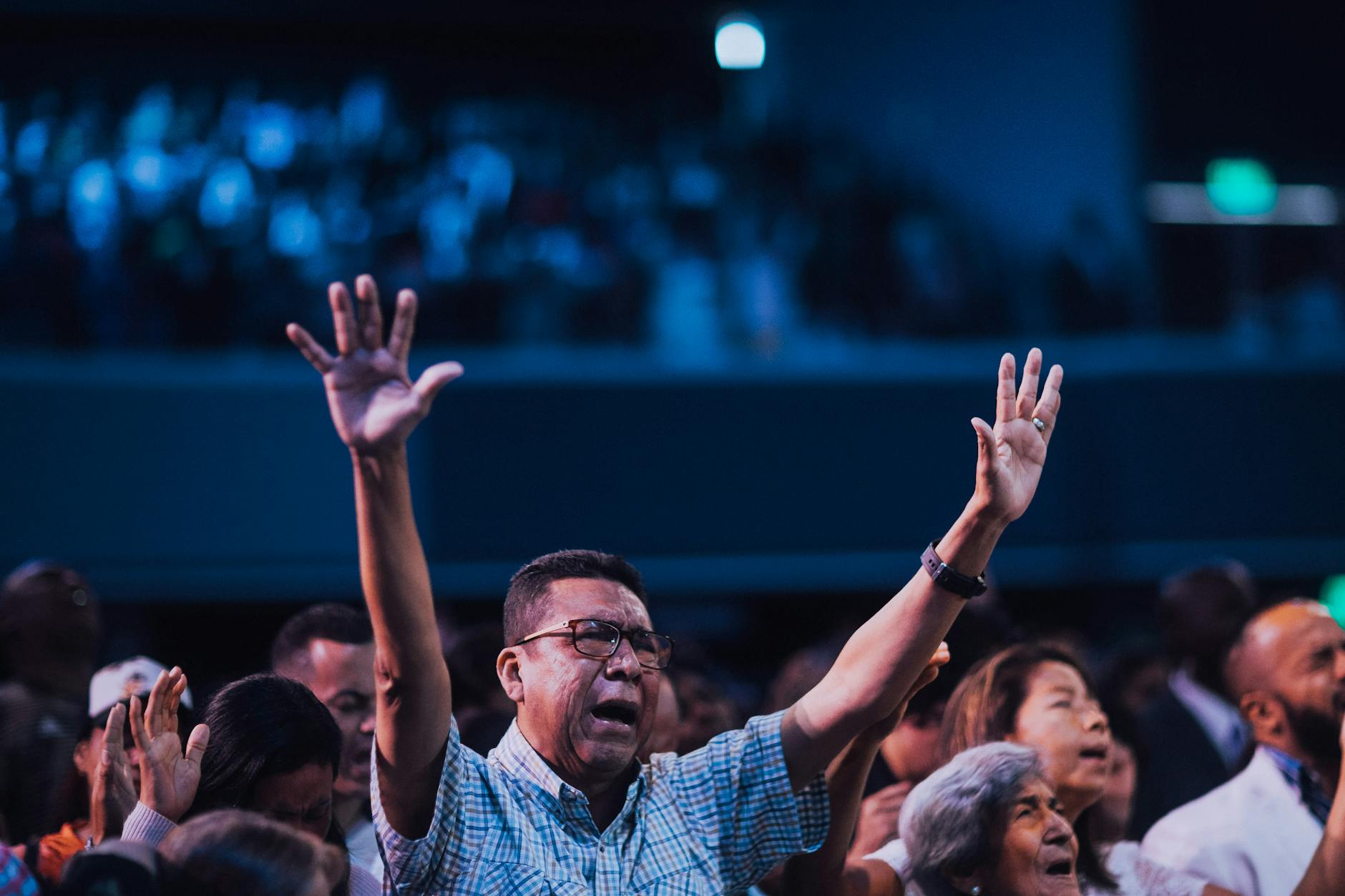
Join me this week in an approach that is different from my usual teaching. Let’s pray through Psalm 25 together.
To listen to the sermon, click the play button:
For some people, the player above may not work. If that happens to you, use the link below to either download, or open a player in a new page to listen.
To download, right click on the link (or do whatever you do on a Mac) and save it to your computer: Download Advent Week 2
Advent really has three main purposes. First, it helps us remember and celebrate how God came into the world as a human being, two thousand years ago. The church-term for this is “the Incarnation.” The second purpose of Advent is to help us look forward to the time when Jesus will return to the earth, bring history to its conclusion, and bring us into the New Creation. In fact, if you happen to come across this message during some other time of the year, it can still be relevant to you, because in a very real way, we are always living during advent. Since we are waiting for Jesus to return, every day and every year is, in a sense, during advent.
You might say the first purpose is about the past, and the second is about the future. But Advent is also about our present. Advent reminds us to receive Jesus into our daily lives, here and now.
Psalm 25 is one of the readings for the second Sunday in Advent this year (technically, it is part of the Sunday evening lectionary). Psalm 25 is really about the third purpose of Advent – receiving Jesus into our lives in the present. There are also themes in this psalm of waiting for God with anticipation.
Normally, I like to do what is called “expository preaching.” If you’ve heard two or more of my sermons, you’ve probably heard my expository preaching. It’s what I do about 90% of the time. This time, I feel like the Holy Spirit was asking me to step outside my comfort zone, and take a different approach. So, rather than my normal approach, I want to invite you to pray this psalm with me, and reflect upon it during this season of waiting and expectation. If you sometimes struggle to pray, I recommend praying with a psalm, like we are about to do here. If you struggle to come up with words, or know what to say when you pray, using scripture to pray could be very helpful. Since we are using the very words of the Bible, we can also know that our prayers are on track.
I encourage you to listen to the sermon this time, even if you normally read it. I’m not sure the written version captures this as well, although it may be better for some people.
I encourage you, after reading this message, to go back through the psalm yourself, and pray it your own way. Consider doing that two or three times this week as part of your prayer life.
1 To you, O LORD, I lift up my soul.
Yes, Lord, I do!
2 O my God, in you I trust;
let me not be put to shame; let not my enemies exult over me.
I trust you, Lord, but not as much as I should. Please help me to trust you more. Lord, please protect my loved ones, and me, from the Evil One, and from all the forces of evil.
3 Indeed, none who wait for you shall be put to shame; they shall be ashamed who are wantonly treacherous.
Thank you for this promise, Lord. Help me trust it, and cling to it.
4 Make me to know your ways, O LORD; teach me your paths. 5 Lead me in your truth and teach me, for you are the God of my salvation; for you I wait all the day long.
Lord, please increase my desire to know your ways. Let me live moment by moment in your truth. Give me patience to wait for you, and for your promises. I wait for your salvation to come to those I love who are not following you right now.
6Remember your mercy, O LORD, and your steadfast love, for they have been from of old.
7Remember not the sins of my youth or my transgressions; according to your steadfast love remember me, for the sake of your goodness, O LORD!
Even after receiving you, I continue to sin. I confess my self-centeredness, my pride, my gluttony. Please forgive me! I trust that you do so, not because I deserve it, but because of your goodness to me, and to the world, through Jesus.
8 Good and upright is the LORD; therefore he instructs sinners in the way. 9 He leads the humble in what is right, and teaches the humble his way.
Help me Lord to be humble enough to be taught by you, and led by you. Help me to be humble even when I see others around me who are not, and who still seem to succeed. Teach me to live in your ways, day by day.
10 All the paths of the LORD are steadfast love and faithfulness, for those who keep his covenant and his testimonies. 11 For your name’s sake, O LORD, pardon my guilt, for it is great.
And thank you, Lord, that you forgive me because it is according to your nature. Your forgiveness is not contingent on me in any way. I praise you for that!
12 Who is the man who fears the LORD? Him will he instruct in the way that he should choose. 13 His soul shall abide in well-being, and his offspring shall inherit the land.
Lord, do instruct me to choose the things that you choose. Please do let my soul abide in well-being. Help me to trust these promises even when I don’t see them.
14 The friendship of the LORD is for those who fear him, and he makes known to them his covenant.
Thank you, Lord! I receive this promise!
15 My eyes are ever toward the LORD, for he will pluck my feet out of the net.
Lord, keep my eyes fixed on you.
16 Turn to me and be gracious to me, for I am lonely and afflicted. 17 The troubles of my heart are enlarged; bring me out of my distresses.
Lord you know my troubles. My daily pain, my lack of self-discipline, my concern for my family, and the future. I lay all my troubles in front of you. Be gracious, O Lord!
18 Consider my affliction and my trouble, and forgive all my sins. 19 Consider how many are my foes, and with what violent hatred they hate me. 20 Oh, guard my soul, and deliver me! Let me not be put to shame, for I take refuge in you.
Yes Lord! I agree with all of this, with your Word. Forgive me, deliver me, guard me. Do all those same things for my loved ones.
21 May integrity and uprightness preserve me, for I wait for you. 22 Redeem Israel, O God, out of all his troubles.
Thank you, Lord that your promises to Israel are also promises to all who trust in Jesus. Give us hope and patience as we wait for you this advent season. You see what a crazy and dangerous place the world is right now. Come soon, and redeem your people. Protect us as we wait. Let the uprightness and integrity of Jesus guard our hearts, minds, and bodies. AMEN.
Advent is a time when we remind ourselves that God is at work in human history. We reflect on what God has done in the past, and on his promises for our future. As we do these things, we can live with patience, and hopeful anticipation.
To listen to the sermon, click the play button:
For some people, the player above may not work. If that happens to you, use the link below to either download, or open a player in a new page to listen.
To download, right click on the link (or do whatever you do on a Mac) and save it to your computer: Download Advent 2024 Week 1
ADVENT 2024 #1. 2 Peter 3:1-13
I grew up in a church that observed the “church year,” and the “lectionary.” Stick with me while I explain this a bit. Many centuries ago, one way that the medieval church sought to bring unity to congregations scattered around the world was to have all churches use the same set of readings from the Bible each day. These became known as “the lectionary.” As church became less central to the lives of most people, the readings were generally reduced to just the ones used each Sunday. The lectionary readings were organized around various “church seasons.” Even after the reformation, many protestant churches continued to use the church year.
There are some small variations, but in general the seasons are: Advent, Christmas, Epiphany, Lent, Easter, Pentecost and “after Pentecost,” (sometimes call “ordinary time”). Each season has a kind of “character” to it. For instance, Christmas is all about the birth of Jesus and the significance of His incarnation. Lent is a time many Christians use to reflect on the suffering of Jesus, and to engage in personal repentance. Easter is about the resurrection, and so on.
I want to emphasize that these church seasons are not given to us by the bible; they are traditions, and no true Christian would say that it is necessary to observe them in order to be a follower of Jesus. One of the negatives of the church year is that it means that huge portions of the bible will never be read in churches which strictly observe it, since those churches focus only on the lectionaries given for each season. Even so, I think we can benefit at times from the traditions associated with the church year.
For me particularly, Advent is one of the seasons that I find very helpful. Advent is the first season in the church year, so that means the church year begins at the end of November, or in early December. One reason I appreciate advent is because the readings serve to remind us that God is still pursuing his goals for human beings. Advent reminds us that history is not random (as atheists might say) nor is it just an endlessly repeating cycle (as Buddhist or Hindus might suggest, and as most ancient pagan religions believed). No, the Bible teaches us that history is going someplace, that it is being guided by God toward a goal, an endpoint. God is at work in the world.
I think advent is a particularly helpful season in our current cultural moment as well. Things seem to be changing rapidly, and generally not for the better. The effect of AI is uncertain, and is likely to shake things up. Presently there is a war in Ukraine, and another in Israel, and both of them seem to be teetering on the edge of engulfing other nations. The economy is pretty good – but only for those who own businesses or a lot of stocks. Most of us ordinary people are paying a lot more for basic necessities than a few years ago, and our incomes haven’t kept pace. Our politics appear to be broken—people seem to be no longer able to maintain friendships with those who think differently from them. Advent can help to reorient our thinking, to make sure that our trust is in the Lord and his promises, not in our circumstances.
We’ll kick off advent with the third chapter of 2 Peter. Things weren’t exactly wonderful when Peter wrote this letter, either. The emperor was Nero, who blamed the great fire of Rome on Christians, and instituted a great persecution, burning many Christians alive. Peter himself was executed by Nero probably less than six months after he wrote this letter.
When Peter wrote, the days when Jesus walked the earth were thirty years in the past. Jesus said he was coming back, but apparently nothing had changed, at least not for the better. Instead, things appeared to be getting worse. What was going on? Peter wrote his second letter to address those kinds of concerns. Our first advent reading comes from 2 Peter 3:1-13.
In the first chapter, Peter reminds us of the amazing promises we have through Jesus Christ, and how they are enough to supply us in this life as we wait for our eternal home. Next, he identifies false prophets and false teachers who are trying to lead Christians astray. He makes it clear that they will be judged by God. Then he says this:
1 This is my second letter to you, dear friends, and in both of them I have tried to stimulate your wholesome thinking and refresh your memory. 2 I want you to remember what the holy prophets said long ago and what our Lord and Savior commanded through your apostles. (2 Peter 3:1-2, NLT).
This is a pretty good description of what Advent is all about. It is intended to stimulate our wholesome thinking, and to remind us of the Biblical prophecies, how they were fulfilled in the past, and what we can look forward to in the future.
Peter writes that he wants to stir up his readers, to remind them of two things. In the first place, he wants to remind us of the teachings of the Old Testament prophets, and the teachings of Jesus through the apostles (in other words, the New Testament). These scriptures tell us that Jesus will return one day to bring an end to history as we know it, to destroy this present world, and then to remake it into a new creation. Jesus taught extensively about his own return in Matthew chapters 24-25. After speaking about it for a little while, he says:
36 “But concerning that day and hour no one knows, not even the angels of heaven, nor the Son, but the Father only. 37 For as were the days of Noah, so will be the coming of the Son of Man. 38 For as in those days before the flood they were eating and drinking, marrying and giving in marriage, until the day when Noah entered the ark, 39 and they were unaware until the flood came and swept them all away, so will be the coming of the Son of Man. 40 Then two men will be in the field; one will be taken and one left. 41 Two women will be grinding at the mill; one will be taken and one left. 42 Therefore, stay awake, for you do not know on what day your Lord is coming. 43 But know this, that if the master of the house had known in what part of the night the thief was coming, he would have stayed awake and would not have let his house be broken into. 44 Therefore you also must be ready, for the Son of Man is coming at an hour you do not expect. (Matthew 24:36-44, ESV)
History is neither meaningless, nor an endless cycle. The Lord is working in the world, and one day, his purposes will be complete, and then our history as fallen and sinful people will end, and a new history will begin.
Now, it often doesn’t feel like this is so. Instead, it feels like things are only getting worse. Peter, addresses this. Clearly drawing on the teaching of Jesus (above, from Matthew 24), Peter explains that though people believe nothing will ever change, they thought the same things in the days of Noah, and yet the flood did finally come.
The same was true about the first arrival of Jesus as a human. The prophecies about the messiah were spoken many, many centuries before Jesus actually came to earth. The people of Israel failed to recognize him when he did come, but the signs were all there. What Peter is saying is that we should live with an attitude of patient expectation. I want to consider both patience, and expectation.
We need patience because we mostly do not see how God is at work in the world, and things appear to be going on as they always have since the beginning of human civilization. Our technology is much better now than it was in the beginning, but our human nature shows no signs of improvement. We still murder each other, as Cain did to Abel at the dawn of human history. We still hate, still lust, still hoard our treasures selfishly, still get drunk and high, still manipulate and ruin one another. In fact the main change seems to be that with our advanced technology, we do all these things more frequently, and more efficiently: that is to say, we are becoming even more destructive.
Even so, we can have patience for two reasons: First: God’s timing is not our timing. For him, a thousand years might pass like a day; or maybe sometimes he can accomplish in just one day the work of a thousand years. Jesus will return in his own time, and we human beings are not given to know that time. So it could be another thousand years. It could also be tomorrow. Jesus himself made it clear that no one will know exactly when it will come. God doesn’t work like us. God has not forgotten us, nor is he moving too slowly. Just as he promised the messiah, and then sent the messiah, so too, he will send Jesus once more to lead us into the new creation.
The second reason we can have patience is that God’s apparent inaction is, in fact, an open door that allows more people to repent and turn to him. The delay in Jesus returning is so that the maximum number of people will receive salvation. Since it is out of love and goodness that God waits, we too can be patient, knowing that every moment allows more people to join us in the new creation.
Now, what about the expectation? We aren’t just waiting around patiently for nothing. There is an end goal, a hope for which we wait. Peter gives it to us succinctly:
But we are looking forward to the new heavens and new earth he has promised, a world filled with God’s righteousness (2 Peter 3:13, NLT)
Peter makes it clear that the old world will be destroyed by fire. That’s part of what we hope for, because it means the end of sin and suffering. But it isn’t just an end that we hope for. After the end comes the real beginning. We will be given new immortal bodies which will inhabit a new, uncorrupted creation. The limitations that bother us in this life will not be present in the new one. We will begin new lives that are untouched by sorrow and suffering, lives that will last forever.
Even though our bodies are corrupted by sin, we can still experience some of God’s goodness and joy in this life. In the same way, even though we can appreciate the goodness and beauty of the earth right now, it, too, has been corrupted by sin. Both our bodies, and the earth, will be recreated new, without corruption, decay, sin or evil:
18 Yet what we suffer now is nothing compared to the glory he will reveal to us later. 19 For all creation is waiting eagerly for that future day when God will reveal who his children really are. 20 Against its will, all creation was subjected to God’s curse. But with eager hope, 21 the creation looks forward to the day when it will join God’s children in glorious freedom from death and decay. 22 For we know that all creation has been groaning as in the pains of childbirth right up to the present time. 23 And we believers also groan, even though we have the Holy Spirit within us as a foretaste of future glory, for we long for our bodies to be released from sin and suffering. We, too, wait with eager hope for the day when God will give us our full rights as his adopted children, including the new bodies he has promised us. 24 We were given this hope when we were saved. (If we already have something, we don’t need to hope for it. 25 But if we look forward to something we don’t yet have, we must wait patiently and confidently.) (Romans 8:18-25, NLT)
That is what we wait for with expectation. That is the promise of Second Advent – a Christmas present so amazing that the world itself groans in anticipation.
Peter tells us that our patience and our amazing hope should lead us to live in certain ways. He says that in anticipation of these promises we should live holy and righteous lives. Another way to say it might be this: we should begin living now the way we will live in the New Creation. Even now, we are citizens not of this earth, but of the one to come. So, live like it. If I am just a stranger on earth, just passing through, I don’t need to worry about getting everything I want here and now. The future is coming when my every desire will be fully satisfied directly in the presence of God. So, I can wait, and leave some desires unfulfilled now.
My friend Wade Jones has a great illustration of this kind of living. He and his wife were called, for a time, to be missionaries in Prague, Czechia. For a period of time they were still living in the United States, while they prepared for the move overseas. They started learning the Czech language, even while they were here. Czech wasn’t much use here, in America, but they were getting ready for their new home, so they learned it even though it didn’t benefit them immediately.
In the same way, as we learn to live like citizens of our eternal new home, some of the ways we live won’t make sense to people who live fully in this world. That’s OK. We have the patient expectation of an amazing hope, and the more we live like it now, the more real it becomes, and the more ready we will be when eventually we enter that hope.
David understood that his life was part of God’s story, told for God’s purposes. He even understood that it was the Lord, not himself, who was the hero of his life-story. So, when everything that he worked so hard to gain seemed to fall apart, David continued to trust in God. Even in obvious-seeming situations, he did not assume he knew what God wanted. The Lord invites us into the same sort of relationship that David had. When we trust him, we find we can be at peace, even in difficult times.
To listen to the sermon, click the play button:
For some people, the player above may not work. If that happens to you, use the link below to either download, or open a player in a new page to listen.
To download, right click on the link (or do whatever you do on a Mac) and save it to your computer: Download 2 Samuel Part 5
2 Samuel #5. 2 Samuel 5:12-25; 1 Chronicles 11:15-19; 1 Chronicles 14:1-17
I want to revisit something we skipped over rather quickly last time. 2 Samuel 5:12 says this:
“Then David knew that the Lord had established him as king over Israel and had exalted his kingdom for the sake of His people Israel.” (italics added for emphasis)
I think this is a key to most of this chapter, and actually, to the entire life of David. David did not consider his monarchy to be his doing, or his kingdom. David did not consider his life to be about himself. The Lord was the main character in the story of David’s life. Even after he was anointed, for fifteen years David wasn’t king, because God didn’t want him to be king yet. When he finally became king, it was because God wanted him to be king. The Lord did it, for the Lord’s own glory and purposes. It wasn’t about David. It was about God.
The incidents that follow this verse confirm that David maintained this attitude, especially about his kingdom.
5:17-25 appears to describe the same event as 1 Chronicles 11:15-20, and also 1 Chronicles 14:1-17. What happened is this. When Saul was king of Israel, David was his enemy. For the Philistines, that meant that Israel was divided, and less of a threat. Plus they gained a great victory over Israel in the battle when Saul was killed. But seven years have passed. David alone was now king over a united Israel. The Philistines rightly perceived this as a threat to them, so they immediately went looking for David, to bring him to battle and kill him if possible.
The Philistines invaded by coming up a valley that led from their lands by the coast, up into the highlands that were controlled by the Israelis. They did this once before, early in the reign of Saul. The valley the Philistines used against David is called “Rephaim.” There is no place with that name anymore, but scholars feel pretty sure that the lower end of the valley comes out on the plains by modern-day Beit Shemesh – or, as it is called in Samuel, Beth Shemesh. There are two main branches in the higher part of this valley, one that begins to the north of Ancient Jerusalem, and one that starts at a point to the south of Jerusalem, just north of Bethlehem. My personal opinion from reading the text is that the Philistines were in between Jerusalem and Bethlehem (see picture below). In fact, 1 Chronicles 11 says that when they invaded up the valley of Rephaim, they took over Bethlehem and kept a garrison of soldiers there.
Some scholars feel that all this happened before David captured Jerusalem, but it isn’t clear. One reason to think it was before the capture of Jerusalem is that Jerusalem was such a fortress, David didn’t need to go to a different stronghold. However, David, being the great tactician he was, may have decided he didn’t want his troops trapped in the city where he could not effectively do battle, and so he took them down to the south of the Philistine advance. There is no way to know for sure, although the account of the battle in 1 Chronicles 14 puts it this way:
8 When the Philistines heard that David had been anointed king over all Israel, they mobilized all their forces to capture him. But David was told they were coming, so he marched out to meet them. (1 Chronicles 14:8, NLT)
So, whether it was before, or after Jerusalem was captured, it appears that David took his army back to one of his old haunts – the Cave of Adullam, where he had previously hidden from both Saul and the Philistines (1 Samuel 22). We don’t know exactly where the cave was (in fact it probably refers to a number of caves in the same area. But from what the Bible says, and from the existence of actual caves in the region, it was probably to the south and west of Bethlehem, and to the south of the Philistine forces in the valley.
15 Once three of the thirty leading men went down to David’s rock at the cave of Adullam when the army of the Philistines was camping in the valley of Rephaim. 16 While David was in the fortified camp, Philistine troops were in Bethlehem. (1 Chronicles 11:15-16, GW)
It seems that David went to the cave of Adullam before the Philistines got to Bethlehem. So, when David attacked, it was from an unexpected direction. Instead of meeting them head on, he attacked on their right flank.
Let’s pause here and consider a few things.
After probably fifteen years of running, hiding, eking out existence and barely surviving, David became king of Judah. After seven years as king of only one tribe, his own tribe of Judah, he finally received the fulfillment of the Lord’s call on his life. Finally, he became king of all Israel.
The confetti had hardly settled to the ground before he was invaded. In short order indeed, David was right back to hiding in caves. Maybe an economic analogy would help us understand how this could have affected David. Think of a person who spent half her life in poverty, working steadily at a plan to build wealth, but seeing few results. None of the breaks ever seemed to come her way. After years, she finally reached the upper middle class. At last, seven years after that, she made her first million. Three weeks later she was flat broke again.
It had to be an awful feeling for David to find himself back in the caves where he hid from his enemies fifteen years or more before. If he was like me, he would have spent a lot of time whining to God about how he had done everything that was asked from him, and why couldn’t he ever catch a break? If he were like me, he would explained to the Lord that he had already been here and already learned this lesson, and what was the freaking point of this kind of hardship anyway? But David was not like me. He was like I want to become. He was like the person the Holy Spirit was showing the world through him – the true Messiah.
So when David went to the cave, he continued to trust the Lord. He asked God a simple question: What do you want to do here? What are you after in this situation?Shall I go and fight these guys or not?
Before we continue the main narrative, there’s a cool story about something that happened while David was in the cave during the invasion. There is no doubt that he did experience distress – he was a human being, after all. The enemy were camped in his own home-town (Bethlehem, in case you have forgotten). It was a hot and dry day, and David said (this was as close as he got to complaining) “I wish I could get a drink from the well at Bethlehem.” I think he was expressing that he was hot and thirsty. I think he was also upset that Bethlehem – his own town – was an enemy camp. He’s basically saying: “Wouldn’t it be wonderful, right now, if we could just walk up to that beautiful cold well in Bethlehem and have a drink? Wouldn’t it be great if there were no invasion at all?”
David was a fearsome warrior, and he led a bunch of other very powerful warriors. Three of the mightiest took David at his word, and broke through the Philistine lines and brought David a drink from the well at Bethlehem. David’s response is interesting:
They brought it back to David, but he refused to drink it. Instead, he poured it out to the LORD. 19 David said, “I would never do such a thing in the presence of God! How can I drink the blood of these men who risked their lives? ” For they brought it at the risk of their lives. So he would not drink it. Such were the exploits of the three warriors. (1 Chronicles 11:18-19)
When I first read this, I thought, “I’d be angry if I were one of those three warriors.” But actually, I think what David was saying was this: “I am not worthy of such a costly drink. I can’t claim it. Only the Lord is worthy of that kind of effort and self-sacrifice.” He was actually honoring the men more by pouring it out than by drinking it. He “poured it out to the Lord.” He was saying that the lives of these men were precious to the Lord. There was a actually a type of offering called a drink offering, where a drink (usually wine) was poured into the ground. The idea was to say, “this is God’s, not mine, and I pour it out to show that everything I drink ultimately comes from God.” So David did not consider himself worthy of that kind of sacrifice from his men, and he directed their attention to the Lord. Life wasn’t about him, it was about God. God was the one who gave them the strength and flat-out guts to do this amazing deed. He was the one who was to be honored, not David.
The hero of this entire story is the Lord. David consciously realized this, and made statements to draw attention to the Lord, rather than himself. We think of God as loving and gracious and giving and kind – like the best possible parent. And yet, he is also thebest, the only true Greatest Of All Time. No NBA superstar has more game than the Holy Spirit. No downhill skier can take a mogul like God. No warrior can be more ferocious and cunning than Jesus. No writer can craft a better story, no historian can plumb more significance from events than the Father. No musician can play a concerto or improvise a lick better than the Lord. Our Triune God is not just the writer and director of the play – he himself is the star performer, and he is brilliant at all he does.
I don’t know about you, but at my age, I don’t go in for hero-worship. Actually, I never did. Human heroes always suffer from significant flaws, and we get disappointed when we really give them our admiration. But there is one Person who is worthy of our hero-worship. David understood that, and he also understood that it wasn’t him. The amazing feats we see in other people – or the amazing things we can do ourselves – are just tiny reflections of the overwhelming awesomeness of God.
So David heard that God wanted to drive the Philistines out of Israel, and David obediently attacked. The Philistines were defeated, and David named the spot, “The Lord Breaks Out” (that’s what “Baal-perazim” means). Not “I have gotten victory.” Not even, “God helped me get a victory,” or even yet, “God got victory – for me.” No – it was God’s victory for God’s purposes and God’s glory. David and his men got to be the fierce warriors that they were created to be – but it was all about the Lord and for the Lord.
The Philistines made a second try. I love the fact that David did not assume that he should do the same thing again, just because it was the same situation. Instead, once more, he asked God what he wanted to do. The Lord did want him to fight again, but he gave David a different specific battle plan, along with the promise that God would be marching out in front of him, doing the real work of winning the battle.
So what do we take away from all this? The first thing I need to get straight is this business that my life is here for God’s plan, God’s purposes and his glory. None of what I am supposed to do is about me. God is amazing and gracious, and so even while he makes use of our lives for his own purposes, he blesses us in the midst of that. David got to be the king and lead like he was made to lead; he got to fight like the warrior he was created to be.
I get to study the bible and think and use my brain and then share it with people who are willing to listen to me. I get to sit here and tap on my keyboard and express the thoughts that the Lord gives me to express. I love it – I really do. It isn’t my message, and it isn’t about me, but I get blessed when I let God do his thing with my life. You will get blessed when you let him do his thing with your life – which is almost certainly going to look different from everybody else, because God has a unique purpose for each one of us. When I say “blessed,” I don’t necessarily mean financially or physically blessed – we Americans, especially, think that’s the main kind of blessing (it’s not). But you will experience the grace and favor of God if you let him be the hero of your life’s story. You’ll appreciate the story he writes through you.
Second, I need to remember that one kind of hero-worship IS acceptable. I need to pay more attention to how skilled, talented, smart, funny, tender, fierce and truly excellent God is. He deserves my worship and admiration. He is the best – at everything.
Third, when life takes a turn for the worse – as it did for David, many times in his life – I need to remember that this is all in God’s hands. If he wanted to hide this great leader of men, this fearsome warrior, in a cave, that was his business – David was his man whether on the throne, or in a cave. If God wants to allow hardship in my life, I will certainly pray for it to be cut short, and I will certainly believe that he will bring better times too. But I will also trust in the meantime that he knows what he is doing and I am ALWAYS in his hands.
I also want to take this away from the text: God is the one who fights the battles I have to be involved in. Most people are probably not called to physical warfare, like David was (although some people certainly are). But sometimes we are called to make a stand for something that is important to God. At other times the Lord calls us to engage in some project, or to work at a certain place, or be involved with certain people, and so on. We can consider all these things “battles” for the purposes of applying this text.
There are some battles we don’t have to fight. Sometimes we go to war without asking God, and so we end up fighting for ourselves. But David went to war only when God directed him. And when he did that, it was God who fought his battles for him. So if you are in a battle that you have to be in, one that you are supposed to fight, remember, it is God who really achieves the victory. All we need to do is show up and let him use us. I take great comfort in that.
The flipside is important, too. We don’t need to fight any battles except the ones the Lord has for us. It’s a good lesson to learn from David that we should ask the Lord before just launching into some kind of endeavor. Even though it may have seemed obvious, David kept asking the Lord before engaging in battle. We might find that we have fewer battles to fight if we only engage when the Lord is telling us to.
When we realize that God is the main character in our story, the one true hero, it takes a lot of pressure off us. Our part is to respond to God, to let him work in and through our lives. But he’s the one telling the story of our lives, and he’s the one who is responsible for how it turns out. I don’t mean that there are no consequences to our actions. But I do mean that if we do our best to be faithful to him, we can be at rest about how things turn out. We can be at rest even when we fail at times to be faithful, because God’s nature does not change:
11 The saying is trustworthy, for: If we have died with him, we will also live with him; 12 if we endure, we will also reign with him; if we deny him, he also will deny us; 13 if we are faithless, he remains faithful— for he cannot deny himself. (2 Timothy 2:11-13, ESV)
David was the rightful king of the Israelites. He was God’s choice for them. He had already fought for them, and he was their own flesh and blood. In the same way, Jesus is our rightful king. He is God’s choice for us. He has already conquered the devil on our behalf. For our sakes, he became human—he is our own flesh and blood. Give him permission to be king over every area of your life. If you can’t quite give him permission to take a particular area of your life, give him just a crack, and see what happens.
To listen to the sermon, click the play button:
For some people, the player above may not work. If that happens to you, use the link below to either download, or open a player in a new page to listen.
To download, right click on the link (or do whatever you do on a Mac) and save it to your computer: Download 2 Samuel Part 4
2 SAMUEL #4. 2 SAMUEL 5:1-12
After Saul’s war-leader, Abner, died, his coalition fell apart. Saul’s last surviving son Ish-Bosheth was murdered, and then finally the leaders of the other 11 tribes of Israel came to David to ask him to become their king.
The material for the book of Samuel was recorded more or less as it happened by Samuel, Gad, and Nathan. It was put into order and made into this book during the time of David’s grandchildren. We don’t know who put it all together, but we do know that they were willing to show David’s faults and failings. There is another book in the Bible that describes some of the same events that are found in 2 Samuel. That book is 1 Chronicles. Whoever wrote 1 Chronicles did so more than 400 years after David’s time. The author of 1 Chronicles clearly used some of the book of Samuel, but he was interested in different things, and he had a different purpose in writing, and so sometimes we get more detail, sometimes less. From here on out in this sermon series, we will occasionally refer to chapters in 1 Chronicles to fill in details.
1 Chronicles 12:23-40 describes more about the names and tribes of other Israelites involved in making David King over the whole nation. In Chronicles, specific leaders and groups of leaders are named, showing that a large number of influential people from all twelve tribes came to make David king. Chronicles records that they feasted and celebrated joyfully.
Back to the text in 2 Samuel. These leaders gave three reasons why they wanted to finally receive David as their king. First, they said, “you are our flesh and blood.” They were saying, “you aren’t a foreigner, that we should fight you – we are all Israelites after all. Judah is part of Israel.” They were recognizing that Saul’s attitude was wrong.
Second, the leaders said to David, “you were the one who used to lead us out to battle, and bring us back safely.” They are remembering his faithful service to Saul, which perhaps David thought had gone forgotten and unrewarded. David had already been their leader in the past, though that service was not officially acknowledged up until now. As a leader, he had accomplished great victories, and brought the troops back more safely than he would have in defeat.
Finally, they were acknowledging that God himself had chosen David to be their king. They were at last submitting to God’s plan for his people. They said: The LORD also said to you, ‘You will shepherd My people Israel and be ruler over Israel.’ ” They are acknowledging at last that God had a call on David’s life, and it was God’s will for him to be their king.
Verses 6-12 of 2 Samuel 5 tells us about Jerusalem. Up until that time, Jerusalem was controlled by a pagan tribe of people known as the Jebusites. They were a sub-tribe of Amorites – one of the non-Israelite tribes that the Israelites were supposed to conquer and drive out. However, there were steep ravines to the south, west and east of Jerusalem, and at the top of the slope, the walls began.
It was a formidable fortress. The Israelites had defeated several kings of Jerusalem and had burned the city itself once (perhaps before it had walls), but they had never managed to capture it and hold it. Now, with walls, the Jebusites are confident that no one could take it. We should understand that it was much smaller in those days. The Jebusite City of Jerusalem covered only about 12 acres on the very top of the end of the ridge. This area is now known as Mount Zion. In the following years, the city spread out greatly, and in modern times, Mt Zion is just one hill in the very large metropolis that is Jerusalem.
In spite of its reputation and history of being impossible to conquer, one of David’s first acts as king of all Israel was to attempt it. David shows here that he is smart and cunning, as well as courageous and strong. Water for the city was collected from the spring of Gihon, which was near the bottom of the Kidron valley, on the east side of the city. The fortifications around those springs (shown in the picture above) were built by David, after he conquered the city. The Jebusites did not bother to guard the spring.
There was a shaft, or tunnel, that went through the hill down to the spring, so that the Jebusites could get water without going outside the city walls. David learned of this. It is quite possible that he observed Jebusites drawing water there, back when he was worshipping God at the tabernacle, when it was kept across the Kidron valley, at Nob (now known as the Mount of Olives). In any case, he determined that the way to take the city was to infiltrate men up the water tunnel. It was a very narrow space, and the men would certainly have had to go one by one, gathering at the top before the assault. That is what David did, with his nephew Joab leading the way and killing the first enemy. By doing that, Joab cemented his position as commander of David’s armies. The city fell without any destruction to the walls, and David made it the new capital of Israel.
These are the actions of a brilliant leader. First, it was terrific military strategy to make use of the water shaft, and attack the Jebusites from within the city. Second, Jerusalem was still an impregnable fortress, an excellent choice for the seat of government in troubled times. Afterward, David built towers covering the entrance to the water shaft, so no one would take the city the same way he had.
Third, it was an extraordinary diplomatic move. David was from the tribe of Judah and up until this time, his capital was a city of Judah. Saul had been from Benjamin, and had made his hometown into the center of power. But Jerusalem did not belong to any of the tribes – it was held by the Jebusites. So when David captured it, it became a city for all Israelites. No tribe could claim it, and no tribe would be offended that it was the capital city. It belonged to no one, and yet at the same time, to everyone. It was not quite centrally located, but it was close.
By the way, some secular archaeologists dispute the existence of David (they choose to ignore the incredible documentary reliability of the Old Testament). However, a water shaft from the spring of Gihon leading up to Mount Zion was discovered in the 1860s. It doesn’t have David’s name on it, of course, but once more, the Bible told us of it before archeologists discovered it. In the 1980’s archaeologists were convinced that this shaft was dug after the time of David. But more recent work suggests that the water tunnel originally occurred naturally, long before David’s time.
The point is, the book of Samuel describes things that are actually still there. In a sense you might say that if the bible is right, there should be evidence of a water shaft in that location, and sure enough, there is not only evidence, but the actual tunnel itself.
As always, I think it is helpful when we read the Old Testament, to ask “where is Jesus here? How does this reveal Jesus to me?” Well, Jesus, is the rightful king of every Christian. That is God’s desire for us. He should be the ruler over everything in our lives. But even though David was chosen by God to be the king, he waited patiently until the people accepted that and submitted their lives to him joyfully. Even though the Lordship of Jesus is God’s will for us, we have not all submitted to that. Jesus is waiting patiently for us to submit all areas of our lives joyfully to him. Does Jesus determine how you spend your money? Does he determine how you spend your time or energy? Is it the words of Jesus that you speak to your family and friends and co-workers?
Jesus should be king over our lives for some of the same reasons that the Israelites gave for submitting to David. Jesus is fully God, yes, but he is also our flesh and blood – he is fully human, just like us. Hebrews 2:14-18 says:
14 Now since the children have flesh and blood in common, Jesus also shared in these, so that through His death He might destroy the one holding the power of death — that is, the Devil — 15 and free those who were held in slavery all their lives by the fear of death. 16 For it is clear that He does not reach out to help angels, but to help Abraham’s offspring. 17 Therefore, He had to be like His brothers in every way, so that He could become a merciful and faithful high priest in service to God, to make propitiation for the sins of the people. 18 For since He Himself was tested and has suffered, He is able to help those who are tested. (Heb 2:14-18, HCSB)
Jesus is our flesh and blood. He belongs to us and we to him. In Jesus, God became more accessible, more understandable, by taking on, forever, human nature. He has a right to be the king of humans, because he is a human. He can sympathize with us and understand our struggles.
Second, Jesus is the originator and creator of everything. He is our protector and sustainer. He has already helped us, already served us, already kept us safe. He has already suffered and died on our behalf. By virtue of how he has already served us, he deserves to be our Lord.
Finally, it is God’s desire that we surrender entirely to Jesus (Philippians 2:9-11). He is the rightful and chosen king of our lives. This is God’s desire – that we allow Jesus to live his life through us, as the owner of our lives. If you feel a little frustrated for David that it took the Israelites so long to accept what God was doing, consider accepting what God wants for your own life!
What about the conquering of Jerusalem? Does that tell us anything about Jesus and his work in our own lives?
Sometimes we really want Jesus to be king over all our lives, but there are parts of our lives that seem like they will never be changed. Maybe you think you will never be able to stop drinking. Some folks struggle with other particular sins that they feel they can never conquer. Perhaps you think, “I am a person who easily gets depressed. That’s just who I am. Nothing is going to change that.” Or, “I’m angry. That’s just my nature, and it’s never going to change.” We might feel like there are parts of our lives that Jesus simply won’t be able to conquer, places where we just can’t let him be king. Maybe you feel like that about some loved one in your life. You think “Jesus can never get into his life.”
The Jebusites thought they were invulnerable. They had an impressive fortress. But one crack, big enough to fit one man at a time, led to their downfall, and then the city belonged to the king. Jesus is a warrior like David. He is wise and cunning like David. If there is just one little crack, one place where you can say “yes” to Jesus, he can exploit it, and use it to conquer the evil in your life. He can get to people that you think are invulnerable to him.
So if you are concerned about someone else in your life, I say trust him. Ask him to do his work on your loved one. And if the problem is in your own life, I say, simply give him a “yes.” Find some way to say “yes, Jesus. I don’t think I can ever give up drinking [or whatever], but I give you permission to try and take over that part of my life.” Watch what he can do if you just give him the tiny crack of your willingness.
So, where you can, welcome Jesus as your king. Surrender your life to him, submit to him. Let it be his life from now on. And where you can’t do that, where there is a fortress around your heart, just give him a tiny crack. Just be willing for him to make the attempt.
In the areas of marriage, family and sexuality, David gave in to cultural pressure. He accepted the attitude of the surrounding culture, and it led to deep heartache and strife for himself personally, and also chaos for the entire nation of Israel. Today, we Christians face tremendous cultural pressure in the areas of marriage, family and sexuality. Let’s learn from the example of David, and instead of conforming to the culture, live as God’s faithful people, even when that looks strange to those around us. With the help of the Holy Spirit, we can do this, even when we make mistakes.
To listen to the sermon, click the play button:
For some people, the player above may not work. If that happens to you, use the link below to either download, or open a player in a new page to listen.
To download, right click on the link (or do whatever you do on a Mac) and save it to your computer: Download 2 Samuel Part 3
Second Samuel Chapters one through five give us the history of a half-hearted civil war between Saul’s family and David’s followers. We looked at some of the details of that during our first two installments of this series on 2 Samuel. But right in the middle, chapter three interrupts the war narrative to tell us briefly about the sons that David had during this time, and about his wives. There are some significant things to say about this interlude. Some of it might be hard to hear. You might even be offended by what I am going to say. If you do feel upset by what I teach, please do two things:
First, please read through to the very end of the sermon, so you hear everything I say, not just a small piece of it. Consider listening to the whole thing with the audio file, because I can convey some things by tone of voice that I can’t with the written word.
Second, feel free to disagree with me. If I am wrong, I want to know it. But let our disagreement be about what the Bible actually teaches. Don’t just tell me (or yourself) I’m wrong. Look at the Bible yourself, and understand what it teaches about this topic (which is marriage). If you think I have misunderstood what the Bible says about this, I want to hear it, to correct my mistakes. Use the comments, or contact section and explain to me, from the Bible, why I am mistaken. I’m serious. I don’t think I’m infallible.
All right, let’s get to the text. Six sons of David are named in 3:2-5, and each one came from a different wife. The Old Testament does not offer many outright condemnations of polygamy. Yet it unflinchingly and consistently records the negative results of having more than one spouse. And there are passages that warn against polygamy, even especially for kings.
Of David’s sons named in this passage, Chileab, Ithream and Shephatiah are mentioned only here in the history of Israel (though the same passage is repeated in 1 Chronicles 3). It is reasonable, therefore, to assume that they died in infancy or childhood; because of their absence in later genealogies it is virtually certain that they died before they themselves had children. David’s three surviving sons demonstrate the brokenness that results from ignoring God’s intended plan for marriage and families.
The first surviving son is Amnon. When he grew up he raped his half-sister Tamar. Absalom, the second one (and from a different mother), had Amnon murdered for what he did to his sister. Later, he started a civil war with his father David, and made him flee for his life. Eventually, Absalom was killed during his rebellion. The third son was Adonijah, a schemer who also tried to seize control of the kingdom when David was old and weak. He was ultimately executed by his half-brother Solomon (who is not mentioned here because he was not born until later).
In other words, this business of multiple wives did not work out so well. It led to tremendous family strife. When the bible describes God’s people having more than one wife, it always also describes that the resulting family was a serious mess. This is just one example.
There is one more note in chapter three concerning marriage. In verses 13-16 David demanded that his first wife Michal, Saul’s daughter, be returned to him. It is true that at one time it seemed like David and Michal were in love (1 Samuel 18:20). But the marriage had been dissolved a long time ago by this point. During the years when David was on the run, Saul had Michal marry another man, named, Palti. So, why did David force Michal to come back and become his wife again?
I suspect it was for two reasons, both of them ugly. First, the main written scripture at this point was the Torah (the first five books of our Bible). The Torah made it clear that women are equal in worth to men, and are equal heirs and partners as the people of God. However, the people of Israel took their cues about gender relationships from the surrounding culture rather than from the scripture. In other ancient middle-eastern cultures, women were considered property, like slaves and animals. David probably saw Michal as his own rightful property, and he wanted that property restored to him.
Second, David might have been concerned that if Michal had a son with her second husband (Palti), either the son, or Palti, might claim that, as a grandson of Saul, he was Saul’s rightful heir, and therefore the rightful king of Israel, rather than David. David wanted to avoid yet another civil war.
On a slightly more positive note, it may have also been an attempt to solidify the unity of his kingdom – joining the house of Saul and the house of David once more. But there was tragedy here. Michal’s new husband, Palti, loved her very much. He followed her all the way to the borders of David’s area, weeping because he was losing her. This was an awful, tragic event.
It is a fact that David had many wives, and many children by them. It is also a fact that the resulting family was full of greed, lust, hatred, murder, mayhem and grief. David was a man after God’s heart in many ways. But in his role as a husband and father, he failed spectacularly, as men of power and fame frequently do.
The strife in his family began with the fact that David ignored God’s plan for marriage, which is laid out clearly in Genesis 1 and 2. Those chapters describe marriage as the joining of one man and one woman for life. Genesis chapter two teaches that human beings were generally created to reflect God’s image in this way. Once David ignored that, things went downhill. We might excuse him for marrying again after being separated from Michal. That divorce was beyond his control. But he continued to add wives like state-stickers on the back of a retired couple’s RV.
In those days, polygamy (that is the name for having more than one wife) was a sign that the polygamist was rich and powerful. Many wives were a sign of status, sort of like a brand new Mercedes-Benz these days, only more expensive. It was expected that powerful men would have many wives. I believe that part of David’s motivation in marrying so many women was to gain respect in the eyes of his followers and in the eyes of foreign leaders. I’m sure he was also happy to have sex with many different women, while claiming he was not sinning. The truth is, David caved in to cultural pressure about marriage. And in doing so, he ignored a very clear warning from Moses that even kings were not to take many wives:
14 “When you enter the land the LORD your God is giving you, take possession of it, live in it, and say, ‘I will set a king over me like all the nations around me,’ 15 you are to appoint over you the king the LORD your God chooses… …17 He must not acquire many wives for himself so that his heart won’t go astray. He must not acquire very large amounts of silver and gold for himself. (Deut 17:14 & 17, HCSB)
There is a lot of cultural pressure on godly marriage these days also. A newer, and growing trend is the idea of never marrying in the first place. In popular culture, marriage is often portrayed as restricting and repressive, an instrument of oppression and injustice, something that cramps your individual style. So, women are taught to think that marriage will diminish them. Men are encouraged to think that marriage will lead to no more sex, or to the undermining of their manhood. Both men and women are often presented with very negative ideas about marriage by TV, movies, the internet and music. This has a noticeable affect on our culture: the number of people who have never married is increasing dramatically.
There is, unfortunately, some truth to those ideas. Some men do dominate their wives. Sometimes they limit them, and hold them back. Some women do withhold sex from their husbands, and others are controlling and domineering. But all of that is the result of the fact that people are sinful, not that the idea of marriage in itself is flawed or wrong. Those things are much like polygamy: some people think it’s OK to be that way in marriage, but the Bible disagrees.
One of the biggest cultural pressures on marriage today is divorce. Divorce is just as much against God’s design for marriage as is polygamy, and these other things. If you think it was wrong for David to have several wives, then biblically speaking, you’d better admit that divorce is wrong too.
I feel that I ought to say something about sex here as well. The Bible gives all human beings two options with regard to sexual expression. The first option is to remain celibate, and channel sexual energy into the pursuit of God, and work, and creativity. This option is for everyone who is not in a heterosexual marriage. Jesus clearly taught this, but also he taught that not everyone has what it takes to live a life of single celibacy. (Matthew 19:1-12). The second option is to marry one person of the opposite sex, and remain sexually available and faithful to that person for life. Being sexually available to your spouse is a part of what it means to be sexually faithful (1 Corinthians 7:1-8). When Jesus taught these things, they were not especially counter-cultural. Today, they are very different from the way our culture thinks.
What was counter-cultural then, and remains so now, is the reason God created marriage. He did so first so that marriage would help human beings understand a little bit about what God is like (Genesis 1:27; Genesis 2:23-25; 1 Corinthians 11:3), and what Christ’s relationship to the church is like (Ephesians 5:22-33). Secondly, God created marriage for the benefit of human beings. All of history points to the fact that when marriage is stable, children and families flourish. And when families flourish, communities thrive. And when communities thrive, civilization is built, and the foundation is solid. Most, if not all, of the very serious problems facing western cultures today can be traced back to the fact that we have devalued marriage.
The nation of Israel flourished for a time, but ultimately it abandoned God and fell to pieces because it did not listen to, or practice, what scripture teaches about marriage.
Just as David’s culture thought polygamy was normal, our culture looks at divorce, and many other non-biblical things, as normal. I don’t think Christians need to try to change the laws. We ought to try to bring people into a relationship with Jesus so that their hearts are changed. Laws about marriage are mostly irrelevant. We need to concern ourselves with what God’s Word tells us.
There are loopholes in the law that allow unscrupulous people and companies to legally cheat and scam others. Does that mean it is OK for Christians to make money by doing those things? Of course not. Legality is not the same as morality. The law in Nevada says prostitution is legal there. Does that mean it is OK for a Christian woman to choose that for a career – as long as she lives in Nevada? Of course not. Government laws are not the same as God’s standards, and we can’t expect them to be. In the same way, it doesn’t matter what any human government says about marriage. What God says is the only relevant thing, and Jesus was sky-clear about marriage:
3 Some Pharisees approached [Jesus] to test Him. They asked, “Is it lawful for a man to divorce his wife on any grounds? ”
4 “Haven’t you read,” He replied, “that He who created them in the beginning made them male and female,” 5 and He also said: “For this reason a man will leave his father and mother and be joined to his wife, and the two will become one flesh? 6 So they are no longer two, but one flesh. Therefore, what God has joined together, man must not separate.”
7 “Why then,” they asked Him, “did Moses command us to give divorce papers and to send her away? ”
8 He told them, “Moses permitted you to divorce your wives because of the hardness of your hearts. But it was not like that from the beginning. 9 And I tell you, whoever divorces his wife, except for sexual immorality, and marries another, commits adultery.”
It might be nice if our legal system reflected our Christian morality. But there are already so many places in which it does not. If we make disciples and Jesus changes the hearts of people, they will do what is right, even if the law says it is OK to do wrong.
I wish Christians in America would quit fussing about things like gay marriage or trans issues, and instead let their hearts be broken in repentance over divorce, and over our failure to really submit to Jesus in all areas of our lives, especially marriage.
Now, what if you have already had a divorce and have remarried? I’ve said it in previous messages, and I’ll say it again: These instructions are for you right now. What’s past is past. All of us have made mistakes, and we all have to live with the consequences. Receive the forgiveness and acceptance of Jesus, and move on. Live each present moment in step with the Holy Spirit. Maybe you got a divorce even after you knew that your situation did not meet the criteria Jesus gave (above). In other words, you knowingly and deliberately sinned by divorcing when you did. Again, I say to you, receive the grace and forgiveness of God, and move on. If you are married now, regardless of which number your marriage is, stay married to this one. Make it work, starting now. I think this principle is illustrated (in a negative way) by what David did to Michal. He tore her away from a man who deeply loved her. David destroyed another marriage and another family by trying to “undo” his divorce. The whole thing was a big disaster, as divorce always is. We’ll learn later that neither he nor Michal were happy about how it worked out after they were married again. So don’t try to undo your present marriage, whether it is your first or your fifth.
If your present marriage is truly intolerable (but keep in mind that we often exaggerate how bad it is) then it does appear that you can get divorced without sinning – as long as you never marry anyone but your present spouse again. In other words, for a Christian, divorce should lead to a lifetime of celibate singleness, or reconciliation with your estranged spouse. The one exception where a person is free to get divorced and marry someone else is explained by Jesus – if your spouse (not you) commits adultery. Even there, Jesus does not say that you must divorce – only that you may. Again, I am not speaking about things that happened in the past. Receive the grace of God in your past mistakes, and live in his grace in the present.
Before you decide that your present marriage is intolerable, I want to suggest to you that marriage is kind of a living thing. Things will get difficult, or even bad – for a while. They always do. Things might even be bad for a period of years. But your marriage will also get better, if you keep working at it. If you stay with it, that is inevitable too. And then it will get rocky, and then better again. That’s life. Marriage is the most intimate relationship available to human beings. Two sinful human beings relating that closely are bound to cause trouble for each other. But they can also be a source of incredible strength and joy to each other, if they stick with it. At its best, marriage gives us glimpses into the very nature of God. At its worst, it forces us to confront our own flaws and foibles, and maybe gives us a glimpse into the heartache that the Lord feels when we turn away from him. Either way, it’s a good thing. Notice I didn’t say easy but rather, good.
I want to add one more thing. I think Kari and I have a good marriage. Other people probably think we do also. So keep that in mind when I tell you that we have sought marriage counseling a number of times during our three decades together. Marriage is difficult, because it is a lifetime bond between two people who each have sinful flesh. Our society makes marriage even more difficult for a variety of reasons. Many people have been called and gifted by God to help others improve their marriages. There is no shame in getting their help, and in fact, I think there is a great deal of wisdom in doing that. If you are in a rough period with your spouse, if you haven’t made progress for a while, please consider seeing a Christian marriage counselor together. Christian marriage counselors are part of the body of Christ, with unique gifts from God to help. Again, if you think Kari and I have a good marriage, consider that perhaps one of the reasons we do is because we aren’t ashamed to get help.
When David ignored God’s plan for marriage, it led to disaster for his children. Not only did his children suffer, but many around them suffered also. In other words, David’s disregard of God’s view of marriage was not merely a personal choice that affected only him – in his case it affected hundreds of people. In fact, his son Solomon followed in David’s polygamous footsteps and it destroyed an entire nation of people. So David’s bad choices continued to have negative effects for generations.
As the years go by, I feel more and more uncomfortable teaching like this. Twenty-five years ago when I would preach about marriage I worried that a few people might take it the wrong way and be upset. Ten years ago, I worried quite a bit more. Today, I am not worried, but rather, certain, that many people will be very troubled by this sermon. I could be “cancelled,” publicly shamed, for repeating what the Bible says.
I’m sure David was also under a lot of pressure to conform to his culture. Everyone around him accepted polygamy, especially for a man in his situation. But I believe that if David had been truly willing to follow the Lord in this area of his life, the Holy Spirit would have given him the strength to do so. I know the same is true for us. The grace of God is always available to us to help us in our struggles – all we have to do is submit to God’s design and reach out for that grace. Let me reiterate, that does not mean that things will always be easy. But it does mean that the Lord walks with us through difficult times. Sometimes, as I just mentioned, that grace might come from Christian marriage counselors.
Again, this type of thing gets harder and harder to say in public with each passing year. However, I will not water down the word of God. Marriage is very important to God. It is supposed to be between one man and one woman for life.
At the same time, please do hear me when I say that the Lord is gracious and compassionate, slow to anger, abounding in steadfast love. Jesus has taken our sins on himself, and given us his righteous nature. So, there is no condemnation for those of us who are in Christ Jesus. We have God’s approval through Jesus, and we should not wallow in our mistakes, or beat ourselves up about our past. We can move forward, joyfully and at peace.
When we belong to Jesus, we can, and should, be gracious even to those who consider themselves to be our enemies. In our text today, many people resisted God’s choice for king. For a long time, it seemed that David’s enemies were successful. Ultimately, even with all the people who wanted something different, David still became the king, and it was the best possible thing – even for all the people who did not want him at first. Sometimes we resist God’s Lordship in our lives. It would be better for us than us running things ourselves, but we fight it anyway. It is better for us in the long run to trust the Lord to work things out.
To listen to the sermon, click the play button:
For some people, the player above may not work. If that happens to you, use the link below to either download, or open a player in a new page to listen.
To download, right click on the link (or do whatever you do on a Mac) and save it to your computer: Download 2 Samuel Part 2
2 SAMUEL #2. 2 SAMUEL 2:8-4:12
Last time we considered some of the events of 2 Samuel, chapters 1-5. Mostly, we learned how at first, David only received part of the kingdom that he felt he was destined to lead. Today, we will go over those same verses, and deal with some more of the details.
Chapters two through five of second Samuel describe the years after David was made king of Judah, but before he became king of all Israel. There is some natural confusion about the time period involved, because the text puts it like this:
8 Abner son of Ner, commander of Saul’s army, took Saul’s son Ish-bosheth and moved him to Mahanaim. 9 He made him king over Gilead, Asher, Jezreel, Ephraim, Benjamin — over all Israel. 10 Saul’s son Ish-bosheth was 40 years old when he began his reign over Israel; he ruled for two years. The house of Judah, however, followed David. 11 The length of time that David was king in Hebron over the house of Judah was seven years and six months. (2Sam 2:8-11, HCSB)
We are going to go into the political history of all this for a moment. 3000 year old politics might seem confusing, irrelevant and boring to you. But please bear with me, for a short time, because I think once we understand the politics, we will actually understand better what the Lord wants to say to us today.
Ish-bosheth (try to say that name quickly!) was the only son of Saul who was still alive. He was clearly not king for the entire time of David’s reign over Judah alone. To put it another way, for five of the years that David was king over Judah, the rest of Israel had no king at all. Those five years may have been split between a time before Ish-bosheth’s rule and after. Or they might have come all before-hand, or all after. There is no way to tell for sure, but here is my guess:
After Saul’s death there was a great deal of confusion among the northern tribes of Israel. Many Israelites were now living in subservience to the Philistines, who had conquered a good portion of the country. The others had no leader or central organization to turn to for national identity. Remember, Saul was the very first king of Israel, and just a generation or so before him, the people had no king, no single leader. So when Saul died, and three of his four sons with him, the tribes reverted back to how they had lived before-hand – as a federation of tribes, loosely connected, but without a strong national identity. Some of them may have recalled Samuel’s warnings about having a king – and they had seen that Saul didn’t work out so well. So I suspect that there were several years immediately following Saul’s death without any strong desire or impetus to get another king.
In the meantime, the writer of the book of Samuel says that there was a war between Saul’s family and David’s. The text says that Abner became more and more powerful in the family of Saul (3:6). Abner was Saul’s nephew or cousin, depending on how you read the Hebrew. He had also been Saul’s chief war-leader. It looks as though after Saul’s death it was mainly Abner and his ambitions who opposed David’s kingship over all Israel. It took Abner some time to pull all his plans together. David was king for probably five years, while Abner blocked his every attempt to lead the whole nation. Meanwhile Abner himself was making connections, re-establishing a national identity, and finally setting up Saul’s son as the new king, but with himself as the real power-holder.
I think there are several understandable (but not justifiable) reasons for Abner’s actions. As Saul’s chief general, he had been the second most powerful man in Israel. With Saul dead and everything in confusion, all that went away. I think Abner wanted to go back to the way it was. I think he loved the power and position and wealth, and he was trying to regain it. In addition, Abner had been Saul’s right-hand man since the beginning. He was already there when David killed Goliath (1 Samuel 17:55-58). So I imagine he had completely internalized Saul’s attitude toward David. Along with that, he may have felt that David was just like him – a great warrior, to be sure, but not a king. They had served Saul together for a short time – who was David to now pretend he was a king? Why did David think he was better than everyone else? He was a warrior, just like Abner, not a king. In fact, during the time David served Saul, Abner might have been jealous, and he may have worried that David would take his place. Finally, remember when Saul was hunting David, and David and his nephew Abishai stole Saul’s spear and water-bottle? Afterwards, they mocked Abner in front of Saul and his men. So there may have been some personal animosity there also, fueling Abner’s ambitions.
At some point, Abner was finally able to get the other Israelites to declare Ish-bosheth king over “all Israel.” But I think realistically, we have to assume that Ish-bosheth was more or less just a figurehead. The real driving force behind the civil war and behind Ish-bosheth’s monarchy was Abner. In fact, we see this reflected when Ish-bosheth was afraid to argue with Abner (3:11), and also because once Abner died, the whole thing fell apart.
Now, I want to pause for a moment to consider this. It seems to me that Abner was not a very admirable man. Later on, we’ll see that he was completely willing to switch his allegiance to David when he realized that David was going to win. Abner was an unscrupulous political hatchet-man looking only for his own gain and ambition. We have plenty of people like that today. Modern-day politics drives me crazy, because the people in power seem to get there and hold onto their power through blatant dishonesty, corruption and scheming. Sometimes it helps me to calm down when I realize that this sort of thing has been going on for at least three-thousand years, since Abner lived that long ago.
But there is more than that here for us. Abner was a scoundrel. For five years, he carried out his schemes successfully. For two more years, it seemed that he had achieved his ambition. For seven years total, it seemed that he had thwarted David and thwarted God. And yet all the work that Abner did for himself and his selfish ambitions ended up serving God’s purposes and plans for David.
You see, the nation was fractured after the death of Saul. It was Abner who reunited them. It was he who encouraged them to return to a sense of national identity. It was Abner who got Israel to commit once more to having one king over the whole nation. And once that was done, God handed that united kingdom over to his chosen servant, David.
If David had become king right after Saul, he would have inherited a kingdom that was disorganized, disheartened and fractured. He would have had to do the work of rallying the tribes and unifying them. But instead, he simply watched while Abner did the work for him, and then God turned it over to him.
This is incredibly encouraging for me. There are long periods of time in my life where I think that God’s will is being thwarted, or that evil is prevailing, and unscrupulous people are successful. But God knows what he is doing. He will use it all, sooner or later, to accomplish his purposes. Not even a man who gained control of an entire nation through dirty politics can stop God from working. And it turns out that all that selfish evil work was turned into God’s work.
Let’s continue on with the historical events. After Ish-bosheth became king, there was a significant battle between his men and David’s. The location of this battle, and of Ish-bosheth’s headquarters, is telling. The battle took place in the heart of the territory belonging to Benjamin – the tribe of Saul, Ish-bosheth and Abner. However, Ish-bosheth’s headquarters were located far to the east, across the Jordan valley. This means that by this point, David’s kingdom of Judah was starting to dominate the surrounding areas. It wasn’t safe for Abner and Ish-bosheth to be based in the territory of their own tribe.
The rest of chapter 2 describes the battle, beginning with the tragic death of twelve young men from each side. If your response is “that’s horrible,” then you got the message. After the twenty-four young men killed each other, the men of Judah fell upon Abner’s men and crushed them. Abner and his forces flat out ran away.
During the chase, David’s nephew Asahel fixed his sights upon Abner. Asahel was the brother of Abishai, the man who went into Saul’s camp with David, and stole Saul’s water jug and spear (1 Samuel 26). His other brother was Joab who was David’s chief war-leader. All three of them were the sons of David’s sister Zeruiah. Remember, it is likely that even though they were David’s nephews, all four of them were probably pretty close in age.
Asahel was apparently an unusually fast runner. He probably knew that Abner was the main force behind this war, and Asahel seemed determined to kill him. Perhaps he wanted to win great honor, like his other brothers had. He might also have thought that if he killed Abner, it would end the war altogether.
Now, we come to the curious sense of honor that often restrained the brutality of war in those days. Abner saw Asahel pursuing him. He knew who Asahel was, and he warned him off.
18 Joab, Abishai, and Asahel—the three sons of Zeruiah—were among David’s forces that day. Asahel could run like a gazelle, 19 and he began chasing Abner. He pursued him relentlessly, not stopping for anything. 20 When Abner looked back and saw him coming, he called out, “Is that you, Asahel?” “Yes, it is,” he replied. 21 “Go fight someone else!” Abner warned. “Take on one of the younger men, and strip him of his weapons.” But Asahel kept right on chasing Abner. 22 Again Abner shouted to him, “Get away from here! I don’t want to kill you. How could I ever face your brother Joab again?” (2 Samuel 2:18-22, NLT)
Nowadays we think in terms of total war. But war in those days was a curious mixture of unimaginable brutality combined with strangely restraining rules of honor. Abner and Joab have just been commanding their men to kill each other in hand to hand combat – the most brutal, personal kind of war there is. And yet, Abner now was extremely reluctant to kill one of the chief leaders of the enemy. However, Asahel would not stop. So finally Abner did. The language seems to indicate that Abner stopped with his spear sticking out, butt-first behind him. He might have stuck the sharp point into the ground to brace it. His intent was probably to knock the wind out of Asahel, and bruise him to the point where he would stop pursuing him. But Asahel was running so fast that the blunt end of the spear pierced him through the body and killed him.
The pursuit continued until Abner rallied his men on a hilltop. He called to Joab to stop, and again, following those curious rules of war, Joab agreed to let them go.
Not long after all of that, Abner had a falling-out with king Ish-bosheth. I think he could see the writing on the wall, and he knew that David was going to prevail. The argument with Ish-bosheth was the final breaking point, and Abner decided to change his allegiance, to gain power in David’s new kingdom. He openly promised Ish-bosheth that he was going to turn the whole kingdom over to David. Chapter 3, verse 11 shows us that Ish-bosheth was indeed merely a figurehead, while Abner held the real power:
11 Ish-bosheth could not answer Abner because he was afraid of him. (2Sam 3:11, HCSB)
After this, Abner opened negotiations with David. He came to visit David in Hebron, and he left just before David’s nephew and war-leader, Joab, got back from a trip. Remember, Asahel, whom Abner recently killed in the battle, was Joab’s younger brother. Joab was full of bitterness and rage about it. Unknown to David, Joab sent messengers to Abner to bring him back. Abner believed he was there under the agreement of truce and safe passage that David had made with him. So he was taken by surprise when Joab pulled him aside and stabbed him, killing him. It was a nasty, cowardly deed, not at all like it would have been if Joab had killed Abner in battle.
David’s reaction to Abner’s death was just like his reaction to Saul’s death. I don’t think David had any illusions about what kind of man Abner was. He had known him for a long time, and Abner had been trying as hard as Saul to put an end to David. Even so, David refused to treat him like an enemy. Instead, he deplored the actions of Joab. David immediately declared that what Joab had done was wrong, and he prayed for God to repay him for it. He made Joab tear his clothes and mourn for Abner, the man who had killed his brother. He publicly praised Abner, and publicly condemned Joab.
David was clearly not concerned with what people thought about him. He was concerned about what was right and wrong.
Not long after this, with no Abner there to hold things together, Ish-bosheth was betrayed and killed. The murderers brought David his head, believing that David would be pleased to have his rival dead. But David treated them just as he had the Amalekite who claimed to have killed Saul – he had them executed.
This makes three times in five chapters that David punished people who claimed to have killed his enemies. I think we need to pay attention to it. Saul was clearly David’s enemy – he tried to kill him numerous times. Abner was clearly David’s enemy – he too tried to kill David by way of helping Saul, and then Ish-bosheth. Ish-bosheth was also technically David’s enemy.
And yet David mourned each of these men. He reacted strongly and negatively to those who caused their deaths. He was not pleased when they died, and he was not pleased with those who killed them. We have seen that David is a man with many faults and failings. But we have also seen that however imperfect, he was a man with a real and living faith in the real and living God. The Lord often used David to show us the Lord’s own heart.
David maintained a gracious perspective. He could look beyond personal rivalry, jealousy and even personal attacks. In the end, David was never willing to consider another Israelite – one of God’s chosen people – to be his enemy. In fact, when we read these chapters carefully, we find that David himself never participated in these battles against other Israelites. David wasn’t stupid. He knew that his enemies hated him, and were fearful and ambitious. But he never took it personally, and he didn’t consider the people themselves to be his enemies.
So let’s think about how to apply these chapters to our own lives.
I am working on this sermon about ten days after someone tried to kill former-president Donald Trump. Political tensions are very high right now. Friendships and families are being split apart by people with strong feelings about politics. In this moment, I think we can learn a lot from David. David trusted God to convince those that needed to be convinced. David seemed genuinely and deeply upset when his enemies were killed. We too, can trust God when it comes to people who disagree with us. Whatever you think of Donald Trump, I think all Christians should be sad about such a terrible thing happening in our culture. If you wish Trump had actually been killed, shame on you! I think you might need to repent of that. In the same way, I think we should also be sad that President Biden has become too feeble to go on campaigning for reelection. It’s one thing to make a sober judgment that he is no longer fit to be president. But if you are actually happy that his health has declined so much, shame on you! You might need to repent. We Christians belong to the God of the universe, who loves all people. Even when those who claim to hate us are killed, or otherwise hurt, we should be sad, not glad.
We can afford to be gracious, because we belong to a gracious God. I am not suggesting that you cannot hold strong opinions, or that we need to pretend to agree with everything anyone says. But our disagreements should be kept in perspective. Politicians have been saying for years that if the other side wins, it will be the end of America as we know it. Unfortunately, that tradition goes back to the first presidential election after George Washington retired. And yet, we’re still here. Don’t believe their lies. Maintain your perspective.
There is another piece of this. Sometimes we get caught up in personality conflicts, and we become very upset at other humans who frustrate or oppose us. But the real enemies are the demonic forces that only use and influence other humans (Ephesians 6:12). Other human beings are not the enemy. Particularly, if we follow the example of David, other Christians may often be misled and used by the devil, but they are never our real enemies.
I am also encouraged to not be overly stressed when people I distrust are succeeding and growing in power. If I was David, I would have been very concerned about Abner and his schemes. I would have been upset that for seven years Abner apparently succeeded (seven years is almost as long as two presidential administrations). But David simply trusted God and waited. The ultimate result is that his enemy Abner did a lot of hard work on David’s behalf, and David got to reap the benefits – all for God’s glory. We don’t know when David wrote Psalm 37, but it certainly could have been shortly after these times:
1 Don’t worry about the wicked or envy those who do wrong. 2 For like grass, they soon fade away. Like spring flowers, they soon wither. 3 Trust in the LORD and do good. Then you will live safely in the land and prosper. 4 Take delight in the LORD, and he will give you your heart’s desires. 5 Commit everything you do to the LORD. Trust him, and he will help you. 6 He will make your innocence radiate like the dawn, and the justice of your cause will shine like the noonday sun. 7 Be still in the presence of the LORD, and wait patiently for him to act. Don’t worry about evil people who prosper or fret about their wicked schemes. 8 Stop being angry! Turn from your rage! Do not lose your temper— it only leads to harm. 9 For the wicked will be destroyed, but those who trust in the LORD will possess the land. (Psalms 37:1-9, NLT)
Abner, and to some degree the other Israelites, either resisted, or passively ignored God’s choice for king. Ultimately, David still became the king, and it was the best possible thing – even for all the people who did not want him at first. Sometimes we resist God’s Lordship in our lives. It would be better for us than us running things ourselves, but we fight it anyway. It is better for us in the long run to let God have his way.
David shows us that God does not hate those who hate him, and does not delight when bad things happen to them. He also serves as a model of patience. God’s promises were only partially fulfilled for him at this point, but he trusted and waited, because he recognized his life was about God’s purposes, not his own ambitions. In this life, even for Jesus, God’s promises have only been partially fulfilled. We wait with joyful expectation for the day when all of them come to complete fruition.
To listen to the sermon, click the play button:
For some people, the player above may not work. If that happens to you, use the link below to either download, or open a player in a new page to listen.
To download, right click on the link (or do whatever you do on a Mac) and save it to your computer: Download 2 Samuel Part 1
We recently finished the book of 1 Samuel. However, that book leaves off in the middle of the action, so to speak. It doesn’t tell us what happened to David after Saul died. The reason for this is that originally, First and Second Samuel were one book. The Jews who translated the Old Testament into Greek divided this history into two books. Probably the division arose because Greek uses vowels, where Hebrew does not. This means that the Greek translation is much longer than the original Hebrew. As a result, it had to be put into two separate scrolls – the “first,” and “second.” Bear in mind as we study it, however, that it is all part of one work.
At the very end of 1 Samuel, we considered the lament that David wrote about Saul and Jonathan (2 Samuel 1:17-27). But there were a few things which preceded that. Remember, David and his men had fought a battle of their own with the Amalekites, who had attacked when everyone else in the region was off to the Israelite-Philistine war. Two days after he got back from defeating the Amalekites, a man came from the north, bringing news of the great battle between the Philistines and Israelites in the valley of Jezreel.
This man got the main news correct – Israel lost the battle, and Saul and Jonathan were killed. But then his story diverges from the one recorded in 1 Samuel 31. In 1 Samuel 31, it says that Saul killed himself when the Philistines got close to him. The writer does not make editorial comments, but it is clear that whoever wrote it regarded 1 Samuel 31 as the accurate record of events, and the story of this stranger as embellishments and lies.
Jewish tradition holds that the man who came to David with this story was actually the son of Doeg the Edomite, whom they also suppose was Saul’s armor bearer at the time Saul died. They think his claim to be an Amalekite was to hide from David the fact that his father was the infamously evil Doeg. There is nothing in the text one way or another to tell us if this is so or not, but it is possible that Doeg was elevated to the status of Saul’s personal armor bearer and bodyguard after he did him the favor of killing the priests when no one else would. If this man is Doeg’s son (and if Doeg was Saul’s armor bearer), it would explain his presence close to Saul, and how he was able to take Saul’s crown and escape.
He claims that the Philistine chariots were coming close to Saul. This shows us, the readers, that he is not being completely truthful. He probably said it to try and justify to David why he (allegedly) ended Saul’s life. Chariots were formidable weapons that the Philistines had and the Israelites did not (at this time). It would be the modern equivalent of tanks closing in on an infantry position. If the chariots were close, then indeed all was certainly lost. However, we know that Saul was on Mount Gilboa, and the messenger even affirms this. There were no roads (the way we think of roads) in those days. Chariots simply did not work well, if at all, on roadless mountainsides. Therefore, it is extremely unlikely that they used chariots on the mountain where Saul died.
David, experienced warrior that he is, probably sensed right then there was something wrong with the story. Even how the messenger begins is quite suspicious: “I happened to be on Mount Gilboa…” He “just happened” to be in the middle of a battle? Just “happened” to be near king Saul? Not likely.
It was clear however, that this man thought claiming to have killed Saul would make him a favorite with David. Whoever he was, he completely misunderstood David. This was because he assumed that deep down, David was not really serious about being the Lord’s man; or perhaps since he was part of Saul’s retinue, he had never heard anyone talk about David’s strong faith. He condemns himself with his lie.
16 And David said to him, “Your blood be on your head, for your own mouth has testified against you, saying, ‘I have killed the LORD’s anointed.’”
David had him executed immediately for the crime of killing Saul. Once again, as harsh as this seems, it is a reflection of David’s humble heart and in a way, a reflection of how the Lord felt about Saul. God is not happy that Saul is dead. Neither is God’s servant. And David, by executing this man showed everyone that there was nothing to be gained by lies or treachery or unnecessary bloodshed. If anyone thought they could ingratiate themselves to David with that kind of behavior, their illusions would be shattered. God didn’t want Saul dead, and neither did David. You won’t earn any favors with God by hating or hurting people whom you think are God’s enemies. People do turn away from God and do evil, and God does not want them to do that. But he doesn’t hate them — He grieves over them, as he grieved over Saul. Saul was destroyed by himself and his own choices, not by God. You can destroy your own life, as Saul did, but the Lord is never out to destroy you.
I am writing this less than a week after someone tried to assassinate former President Trump, who is campaigning to become president again. Our political situation in America is very tense at the moment. It is a good and timely reminder that God does not rejoice at the death of those who have turned away from him. So, we who follow Jesus should not be happy at the downfall of others, even others whom we think might be enemies of God. We will not earn God’s favor for hating, or trying to harm his “enemies.” This goes for all sides of the political spectrum. War and the punishment of crime are situations in which evil might be restrained, or good defended, but they should not be motivated by hatred or anger. Rather, they are a sad necessity in this fallen world. Listen to how the Lord puts it to the people who were rebelling against him:
11 As surely as I live, says the Sovereign LORD, I take no pleasure in the death of wicked people. I only want them to turn from their wicked ways so they can live. Turn! Turn from your wickedness, O people of Israel! Why should you die? (Ezekiel 33:11, NLT)
By the way, this lesson is repeated three times in the first four chapters of 2 Samuel, which means we are really supposed to pay attention to it, and take it seriously.
OK, moving on, once Saul was dead, David’s reason for staying out of Israel was gone. His main obstacle to becoming king and fulfilling the Lord’s calling was removed. David knew he was anointed to be the next king of Israel. A large portion of the population knew this also. I think a lot of people at this point would move ahead and “just go for it.”
Not David. The first thing he did was to ask God what he should do. He did not assume anything. I think the reason for this is that David was not trying to establish his own kingdom – instead, he was trying to be God’s servant. His attitude was not, “How can I behave so that God can help me?” That was Saul’s basic approach to life. But David’s heart was this: “Lord, what do you want to do next?” He did not view God as his assistant in achieving his goals. Instead, he felt that his whole life was God’s own project. His role was to try and assist God, not the other way around. David’s anointing and his destiny were not about David – they were about the Lord. So becoming king is not David’s idea nor his goal – his goal is to serve the Lord.
I also want to point out that in this matter, David learned from his mistakes. He did not ask God before he took his family, his men, and their families to live among the Philistines (1 Samuel 27:1-3. We looked at this in 1 Samuel sermon #28). However, after that mistake, he started asking God what to do even for decisions where the conclusion seemed obvious.
As I have pointed out before, David is one of the people in the Old Testament who sheds light on what Jesus is like (that is, David is a “type” of Christ). Jesus expressed this same attitude of being here for the Father’s purposes in John 8:28 and 12:49 (among other places)
So Jesus said to them, “When you have lifted up the Son of Man, then you will know that I am he, and that I do nothing on my own authority, but speak just as the Father taught me. (John 8:28, ESV)
For I have not spoken on my own authority, but the Father who sent me has himself given me a commandment-what to say and what to speak. (John 12:49, ESV)
This is not complicated, but it is HUGE when it comes to living out our faith practically. It is so easy to fall into the idea that the life of faith is about God helping us each achieve our own destiny. We make this seem good and spiritual, because we assume that our destiny was created by God. And of course, it is. But it isn’t about us. It is about God. When we think that it is about us, we inevitably get angry or disappointed with God when he fails to do things for us that we think would bring about our destiny.
Our true destiny is to bring glory and honor and praise to God – not to meet our own personal goals. Achieving that destiny is God’s business from beginning to end. Some people, like David, brought glory to God in very public ways, like becoming a well-known leader. Others do it quietly, like being a loving wife and mother, or praying regularly for others.
I think some things in life get a bit easier once we really accept this. We should give all of our strength, skill and energy to the things God wants us to, but we no longer have to control the outcome. Our hearts can be at rest as we trust God to fulfill his own plan and purpose.
Now, I think it would be wrong to assume that David didn’t care either way if he became king. First, he wanted what God wanted, and God did want that. Second, because God wanted to work in this way through him, David was drawn to it. He wanted to lead because he was created for it. So I am sure that David really wanted to become king. Even so, he subordinated his own desires to God, because he understood that it wasn’t really about him. Like Samuel’s mother, he had real desires that he acknowledged, but at the same time, he also surrendered them to God.
This is important, because right after he asked God what to do, David received a partial fulfillment of God’s calling, but it was only partial. The Lord told David to return to Israel, to the town of Hebron in the territory of Judah. When he did that, the tribe of Judah received David as their king. However, Saul’s war-leader, Abner, rallied the other tribes around Saul’s one remaining son, Ish-Bosheth. So the other 11 tribes still did not acknowledge David as their king.
Judah was one of the largest, most powerful and prestigious tribes. Though just one of twelve tribes, their territory made up about one quarter of all the land held by Israel in Saul’s lifetime. In two generations after David, Judah became its own independent country and most of the Jews living today come from that tribe (that’s why they are called Jews. “Jews;” from “Judah”). Even so, being king over just one tribe and about one quarter of the territory of Israel isn’t exactly what David thought the Lord had planned for him. It is sort of a fulfillment of God’s promise and calling. He was now a king. But he wasn’t the king of the whole nation. At that point, his kingdom was only 25% of the kingdom that Saul had ruled.
There was potential here for David to become frustrated. After all, you could not make any argument that Saul was more worthy than David, but even so, Saul’s kingdom was much larger than David’s (at least during this period of time). And David waited a really long time, even for this partial fulfillment of God’s call on him.
Think about it. Samuel anointed David when David was perhaps fourteen or fifteen years old. At first it seemed like everything was falling into place. He grew a little, killed the giant and became a famous warrior and trusted member of the king’s court, all while he was very young. But it all fell apart again after just a few years. It was likely more than a decade that David had been living like a vagabond, with only a band of misfits who called him their leader. When Saul died, David was thirty years old. Probably fifteen years went by between the time he was anointed to be king and the time when Saul died. That’s a long time – half of his entire life up until that point. And now finally he was one out of two kings of Israel. His kingdom was the smaller of the two. It will be seven more years before he becomes king of all Israel. That’s a total of twenty-two years waiting for God to fulfill his promises.
This partial fulfillment is also a “type of Christ.” The kingdom of Jesus Christ has only come in part so far. Jesus reigns over the hearts of those who will let him, but not everything is under his rule, as it will be when this world ends. Speaking of Jesus, Paul writes:
9 For this reason God highly exalted Him and gave Him the name that is above every name, 10 so that at the name of Jesus every knee will bow — of those who are in heaven and on earth and under the earth — 11 and every tongue should confess that Jesus Christ is Lord, to the glory of God the Father. (Phil 2:9-11, HCSB)
But currently, at the name of Jesus, not every knee does bow, not every person does worship. There is a part of Jesus’ exaltation and kingship that is still in the future. It is not fully here yet. The writer of Hebrews says:
7 You made him lower than the angels for a short time; You crowned him with glory and honor 8 and subjected everything under his feet. For in subjecting everything to him, He left nothing that is not subject to him. As it is, we do not yet see everything subjected to him. 9 But we do see Jesus — made lower than the angels for a short time so that by God’s grace He might taste death for everyone — crowned with glory and honor because of His suffering in death. (Heb 2:7-9, HCSB) (added italicization)
We do not yet see everything subjected to Jesus. The fulfillment of the prophecies about Jesus are, at this point in time, only partial. In the same way, we too have only partially what has been promised us. Paul writes to the Ephesians:
13 You heard and believed the message of truth, the Good News that he has saved you. In him you were sealed with the Holy Spirit whom he promised. 14 This Holy Spirit is the guarantee that we will receive our inheritance. We have this guarantee until we are set free to belong to him. God receives praise and glory for this. Ephesians 1:13-14, God’s Word)
We haven’t received the whole inheritance yet. We have the Holy Spirit as a guarantee that some day we will fully receive everything that He has promised us.In other words, right now, we have only part of what has been promised us. This means that Christianity is above all, a faith that is all about hope. We know this world doesn’t fully satisfy. True justice isn’t available here and now. True, unblemished joy is scarce and temporary. True satisfaction, contentment and fulfillment are always elusive. Those who don’t surrender their hearts to Jesus get angry at God because of this. But they aren’t listening. The true fulfillment of God’s love for us and his promises to us comes after this world ends. We don’t have to make the credits outweigh the debits in this life. We don’t have to have everything we have dreamed of before we die. It is still coming. It was still coming for David. It is even now, still coming for Jesus, who is not yet king over everything. And it is still coming for us.
How is the Lord speaking to you through this text today? Perhaps you need to remember that even those who have rejected the Lord are not our enemies. We could all use a reminder that not even God is happy when those who reject him are hurt. I am not suggesting that we allow people to do evil without attempting to resist it. But even when we have to be involved in restraining evil and defending good, we can reflect God’s heart of sadness that people have chosen to reject him.
Possibly you need to remember that your life is not really yours, but that it belongs to God. I think we could use reminding that God is not there to help us fulfill our personal desires or destinies. Instead, we are here to serve God.
Maybe you are struggling because it seems like you have received only part of what you think God has promised you. First, make sure you know what God has indeed promised. And then, remind yourself that in this life, all fulfillments are partial. We have an amazing future in which everything that God has promised will indeed be completely ours, and that future is in a New Creation where there is no more sorrow, suffering or death. Until we reach those eternal shores, everything we have here is just a temporary shadow of the stunning reality that will be ours. This should help us to have patience as we wait in hope.
For some people, the player above may not work. If that happens to you, use the link below to either download, or open a player in a new page to listen.
To download, right click on the link (or do whatever you do on a Mac) and save it to your computer: Download Serenity Prayer Part 12
This week I just want to do a brief summary of the lessons on the Serenity Prayer. We’ve talked about a lot of things, and while I don’t expect everyone to connect with everything, I also trust that at least some things have been helpful in your journey with God. As I quickly go through the lines of the prayer, I’d like to ask you to consider these questions:
What is one new or refreshed way of thinking about my life in Christ that I have seen through this study?
What is one practice, habit, or discipline in my life in Christ that I have begun to practice or would like to begin practicing after this study?
What is one area we talked about that I’d like to know more about, whether in this group, or in my own personal times of studying God’s Word?
Ok, let’s walk through the lines as we did week by week. And if your most important takeaways were different from what I summarize here, I think that may well be a good thing. We serve a God who speaks to us both as a community and as individual children.
God, grant: The character of the God we pray to shapes the way we pray and how we expect Him to answer. And we recognize our dependence on God, not just for our salvation, but for our day-to-day sanctification.
The serenity to accept the things we cannot change: Life is outside our control, and that’s not only ok, it’s actually good. We can turn to the God who is in control and trust Him as we learn to accept life on life’s terms. We also recognize the truth that we are limited beings, not gods ourselves.
The courage to change the things we can: Living faithfully means doing hard things and costly things at times. We operate in trust that God is at work, and that He will give us what we need to make the changes in ourselves that He is asking us to make. We set aside fear-based decision making and the need to blame others and bravely face what we can do something about.
The wisdom to know the difference: We look for wisdom from God, not from ourselves. That wisdom will come through His Word, through Christian community, and through our time in prayer. It will generally be found in humility and peace.
Living one day at a time, enjoying one moment at a time: We don’t stay trapped in the past, or live in anxiety about the future. We try to pay attention to what God is doing in our lives right now and respond to Him in the present. We enjoy what He has given us today for our daily bread more than we focus on what we had in the past or hope to have in the future.
Accepting hardships as a pathway to peace: Hardship and suffering are part of the normal Christian life. We can fight against that reality, or we can look for ways to accept what we have and find contentment in the presence of God with us in the middle of the pain.
Taking, as Jesus did, this sinful world as it is, not as we would have it to be: Jesus was able to live a holy and righteous life of perfect submission to the Father in the middle of a very broken and sinful world. If we want to navigate this world well, as He did, we need to adopt the same tools of prayer and acceptance.
Trusting that He will make all things right: Trust does not just mean agreeing with an idea, it means taking actions that show that idea. And God gets to determine what “right” looks like. If that doesn’t match our definitions, we choose to trust Him and revise our definitions.
If we surrender to His will: Choosing to follow Jesus means I die to my self and give control of my life to Him. I don’t have to like His will. I don’t have to understand His will. I choose to give up my rights to Him and obey His will.
That we may be reasonably happy in this life: There are things about living God’s way that work even in this life. They won’t give us perfect happiness, but happiness is not really our goal anyway; it is a by-product of having good and God-centered goals for our lives.
And supremely happy with Him forever: Following Jesus is ultimately not about this life anyway. It is about life in a kingdom that is coming and will last forever. We live in all these ways (because God makes it possible for us to do that) because we believe that our lives after the resurrection are going to be incredible in union with Christ. We are learning to live now in ways that will make sense then.
Before we pray the Serenity Prayer together one last time (at least in this study), let me share again the questions I asked at the beginning.
What is one new or refreshed way of thinking about my life in Christ that I have seen through this study?
What is one practice, habit, or discipline in my life in Christ that I have begun to practice or would like to begin practicing after this study?
What is one area we talked about that I’d like to know more about, whether in this group, or in my own personal times of studying God’s Word?
And now let’s pray.
God, grant us the serenity to accept the things we cannot change, the courage to change the things we can, and the wisdom to know the difference.
Living one day at a time, enjoying one moment at a time, accepting hardships as a pathway to peace.
Taking, as Jesus did, this sinful world as it is, not as we would have it to be.
Trusting that He will make all things right if we surrender to His will – that we may be reasonably happy in this life and supremely happy with Him forever.
This is what we are doing as Christians: We are trying to learn, by the power of the Holy Spirit, what the language of the kingdom of God is, what its culture is like, how to function in an environment that is foreign to much of what we experience here on a day-to-day level. But in doing that, we are becoming more and more fit for the life that God has waiting for us when He comes again to re-create the heavens and the earth in full reconciliation to Him and full submission to His rule. Much of what we have been praying throughout this study is a part of that training for eternal life. And alongside that training, the tools that we need to keep us going until then.
To listen to the sermon, click the play button:
For some people, the player above may not work. If that happens to you, use the link below to either download, or open a player in a new page to listen.
To download, right click on the link (or do whatever you do on a Mac) and save it to your computer: Download Serenity Prayer Part 11
And Supremely Happy with Him Forever
1 John 3:2-3; 1 Corinthians 13:12; Revelation 7:16-17; Revelation 21:3-5
Here we are at the end – and we are going to finish by talking about the end, although I might question whether what we usually refer to as the end (or the last days, or the finish) is really more of a true new beginning. We’ll talk about that as we move through the last phrase of the Serenity Prayer: “And supremely happy with Him forever.” First, let’s pray.
Last week, we talked about being reasonably happy in this life, and hopefully we realized that our reasonable happiness in this life is tied to our confident expectation that we have something beyond this life. While we live in the present moment, we live as those who are anticipating a meaningful future. The events of this world, from the beginning of time until the end, are not just random, and they are not just a cycle that we are destined to endlessly repeat. As Christians, we believe that history is heading somewhere – that there is a final destination, not only for us, but for all of creation. And this is where we find ultimate happiness.
The idea of deferring pleasure is not a new one, but it is one that we increasingly struggle with in our culture, and I include the church in that. We can gratify so many of our desires so quickly and so easily – at least in part – that we can easily forget the value of having both to work and to wait for something meaningful. It’s easy to put something in the microwave, or have it delivered, or take the shortcut. And so, things that require sustained discipline in one direction in order to gain a reward have become less common than maybe they once were (or maybe that’s just what all of us say as we get older). But most of the meaningful experiences and changes in my life have come because I have believed that continuing to practice good, healthy, and holy things will eventually produce results that surpass what I can get from a microwave. Much of what the Serenity Prayer has been calling us to is a practice of good, healthy, and holy things now that will benefit us some in the present, and even more so in the life to come.
Let me be clear: our efforts toward living the life God calls us to live are not in any way the means by which we enter the life of the kingdom. We enter the life of the kingdom by invitation of the King, which He has extended to us in the death and resurrection of His Son. And, there are things we can and should do in order to participate in that kingdom life – not only in the future, but now. As we looked at the Beatitudes last week, I hope that connection came through. What Jesus calls His followers (us) to do in the Beatitudes is to live in line with the life that we are receiving now and will fully enter into when He returns in triumph. We are being trained, equipped, and fitted for the life that is to come – the life that is unending, the life of perfect fellowship with God in all His fullness. And that way of living won’t necessarily make sense now. It will often go against the things that bring temporary worldly success in any field. But we aren’t living for this world. We are living now for the next.
The closest analogy I can think of for this is preparing to live in a foreign country with a very different culture. My wife Jayme and I were blessed to live in Prague, the capital of Czechia, for three years, and we’ve gotten to travel extensively to visit missionaries from our church across the world. Many of the things we do to get ready for another culture are of little to no value in this one. Before we left for Prague, I spent a lot of time beginning to learn the language. How valuable do you think that was in Nashville, Tennessee? Not very. And knowing the history and geography of the Czech people didn’t do me much good here. Neither did learning how their public transportation system works, or what the established churches in that country were like. We put considerable time and effort into things that only really helped when we moved to that new country. Oh, there was a place here or there when some of that knowledge came in handy in the US. But for the most part, if we had never gone to Prague, the vast majority of that time, energy, and money would have been for nothing.
And this is what we are doing as Christians. We are trying to learn, by the power of the Holy Spirit, what the language of the kingdom of God is, what its culture is like, how to function in an environment that is foreign to much of what we experience here on a day-to-day level. But in doing that, we are becoming more and more fit for the life that God has waiting for us when He comes again to re-create the heavens and the earth in full reconciliation to Him and full submission to His rule. Much of what we have been praying throughout this study is a part of that training for eternal life. And alongside that training, the tools that we need to keep us going until then.
What is that eternal life going to be like? The most important part of it is contained in this line of the prayer. We will be “with Him.” That is the most meaningful and satisfying aspect of the kingdom life that God is preparing us for (and preparing for us). That we will be “with Him.” That we will walk in deep, fulfilling, intimate relationship with our Creator: Father, Son, and Holy Spirit. As I introduced the lesson today, I said that what we usually refer to as “the end” might better be described as the true new beginning. What do I mean by that? Let’s look back to the beginning – the first three chapters of Genesis.
When God created the universe, how did He describe it? It was all good, right? Until He got to people – then it became “very good.” “So God created man in His own image, in the image of God He created him; male and female He created them. God blessed them and said to them, ‘Be fruitful and increase in number; fill the earth and subdue it. Rule over the fish of the sea and the birds of the air and over every living creature that moves on the ground.” (Genesis 1:27-28) Man and woman worked together in the garden to exercise the authority God had given them to rule together over all creation. Adam later shows that authority by giving names to all the animals – that was part of his job. Did you realize that there was work to do in Eden? Genesis 2:15, “The Lord God took the man and put him in the Garden of Eden to work it and take care of it.” And later in the chapter, Eve joins him. Yes, after the fall, work becomes cursed because of sin, but in the beginning, it was not so. Adam and Eve worked together in harmony to take care of the world that God had entrusted to them. And they were in harmony not only with one another, but with God Himself. We don’t know how long things lasted that way, but until the fall, creation functioned in perfect order with all the pieces meshing together under the Lordship of God.
And that beautiful picture is what is coming again for us. In Ephesians 1, as Paul is describing what it means to be a saint, a faithful one in Christ – a Christian – he shares one of the mysteries of what God is doing. Ephesians 1:9-10, “And He made known to us the mystery of His will according to His good pleasure, which He purposed in Christ, to be put into effect when the times will have reached their fulfillment – to bring all things in heaven and on earth together under one Head, even Christ.” God is coming to renew all creation and bring back the Garden of Eden – only this time with no serpent waiting in the wings! A day is coming when Jesus will emerge to exert the authority He already has over all powers and principalities, purifying the earth and all creation, and then reigning over the new heavens and the new earth along with us. We (humanity) are going to be given our old jobs back – we will rule over a sanctified and re-created world alongside Jesus!
Sometimes our images of heavenly life have more to do with movie depictions or even favorite hymns than they do with Scripture. And granted, Scripture doesn’t give all the details I would like (probably because I couldn’t understand them anyway), but John tells us this:
“2 Dear friends, we are God’s children now, and what we will be has not yet been revealed. We know that when He appears, we will be like Him because we will see Him as He is. 3 And everyone who has this hope in Him purifies himself just as He is pure.” (1 John 3:2-3)
In living as God’s children now, we are being prepared for something even more that will be revealed when we see Him (Jesus) as He is. Paul makes a similar point at the end of the great love chapter in 1 Corinthians 13:
“For now we see only a reflection as in a mirror; then we shall see face to face. Now I know in part; then I shall know fully, even as I am fully known.” (1 Corinthians 13:12)
I want to make one more point about the life that is waiting for us before connecting back to the Serenity Prayer. I have often heard the Christian life described in terms that I will summarize like this: “Say a prayer with these words. Now you will go to heaven when you die instead of hell. Just hang on until then.” I think that is well-meaning. I think there is truth in it. And I believe it is a woefully inadequate picture of what God intends as we live this life in anticipation of the one to come. John, after describing the transformation waiting for us as children of God, then says, “Everyone who has this hope in Him purifies himself just as He is pure.” Knowing the transformation that is coming when we are raised into our new bodies in the new creation does not lead John to say, “So just hang on until then.” No, he calls us to purity because we know what’s coming and we want to be preparing for it! And Paul’s statement about the full knowledge that awaits us when we see God clearly is at the end of a long chapter encouraging us to live lives full of very practical love. So, our trust that Jesus is coming for us is intended to shape us now!
And what we’ve been talking about for the last several weeks is also intended to do exactly that. Accepting the things we cannot change is an acknowledgement of God’s sovereignty in anticipation of His ultimate rule. Courageously changing what we can moves us and, hopefully, those around us, closer to the kingdom life that is coming. The peace that accepting hardship is intended to lead us to is the peace that comes when Jesus overthrows all enemies once and for all. And every time we surrender to His will, we become a little closer to what we will be in the resurrection. We move further into the identity that God the Father has given, is giving, and will give us in His Son by the power of the Holy Spirit.
And in other ways this prayer helps us move well through things now that will no longer be a part of life in the resurrection. Some of the hardships we have to accept now will not be allowed into the kingdom where:
“Never again will they hunger; never again will they thirst. The sun will not beat upon them, nor any scorching heat. For the Lamb at the center of the throne will be their shepherd; He will lead them to springs of living water, and God will wipe away every tear from their eyes.” (Revelation 7:16-17)
We will no longer need to take this sinful world as it is, because Satan will be overthrown, and God will descend from heaven to live with His people:
“3 And I heard a loud voice from the throne saying, ‘Look! God’s dwelling place is now among the people, and he will dwell with them. They will be his people, and God himself will be with them and be their God. 4 He will wipe every tear from their eyes. There will be no more deathor mourning or crying or pain, for the old order of things has passed away.’ 5 He who was seated on the throne said, ‘I am making everything new!’ Then he said, ‘Write this down, for these words are trustworthy and true.’” (Revelation 21:3-5)
We will still take the world as it is, but the world will finally be as God would have it to be, and we will get to enjoy Him and His Presence forever.
This is why we practice the things we’ve been studying for the past several weeks, as well as all the Word of God teaches us about the way to live: because we believe a new and better life is coming. And in that hope, we choose to do things that are often difficult and painful in this life, because we no longer think of this place as our permanent home. Ultimately, we don’t live in Prague, or Lebanon, or Antioch, or Carthage. We are citizens of heaven. And we are called to live as those who know that one day, we will be supremely happy in our home.
We will wrap up next week with a summary of the Serenity Prayer. I hope that God has used this to shape your lives in some of the ways that He has shaped mine. Let’s close again this week with the Serenity Prayer. Please join with me as we pray this prayer as a community together.
God, grant us the serenity to accept the things we cannot change, the courage to change the things we can, and the wisdom to know the difference.
Living one day at a time, enjoying one moment at a time, accepting hardships as a pathway to peace.
Taking, as Jesus did, this sinful world as it is, not as we would have it to be.
Trusting that He will make all things right if we surrender to His will – that we may be reasonably happy in this life and supremely happy with Him forever.
May God empower us this week to live this life in confident hope of the even better life to come. In the name of Jesus, Amen.
What kind of happiness should Christians desire? How does that come into our life as we follow Jesus? What does the bible say about the happiness of those who follow Jesus?
To listen to the sermon, click the play button:
For some people, the player above may not work. If that happens to you, use the link below to either download, or open a player in a new page to listen.
To download, right click on the link (or do whatever you do on a Mac) and save it to your computer: Download Serenity Prayer Part 10
Matthew 5:1-12; 1 Thessalonians 4:13-14
Imagine with me for a moment that you are talking to a friend or relative you haven’t seen in several years. It may be at a family get-together, or a friend’s wedding, or a high school class reunion. You talk for a few minutes about life, catching up on the events of the last few years, and then the other person asks you a question: “Are you happy?” How would you respond? What does it mean to be happy – even reasonably happy? This week, as we continue to meditate on the Serenity Prayer, we will take a look at that question. But first, let’s pray.
Over the last several weeks, we have been asking God for several things: serenity, courage, wisdom, the ability to be present and enjoy this moment, acceptance, trust, surrender. And now we finally get to the end result. What is it that we are hoping all these things produce in our lives? There are probably several right answers to that question, but the Serenity Prayer provides an answer connected to happiness – reasonable happiness in this life, and supreme happiness in the life to come. Next week we will talk about our happiness in the life to come, but this week we are focused on the here and now – what does it mean to live a life that is reasonably happy?
One of the first things we need to confront is one of our culture’s idols. Our culture has idolized happiness. It has become a critical – maybe the critical – way to evaluate any decision. If you do X, will it make you happy? I’m not suggesting that we shouldn’t consider happiness at all, but it needs to be way down the list. Too many people have walked away from callings, responsibilities, marriages, and even God Himself because they didn’t feel like they were happy where they were. I’m not saying this to heap coals of guilt on anyone who has made those decisions in the past – I’ve made some of them myself. If that’s a part of your story, grace upon grace to you – God is faithful to forgive. But if we want to live the life that God is giving us through Jesus Christ, if we want to walk out what He has been offering us as we pray this prayer, we need to make decisions moving forward that are not primarily directed toward our happiness.
You see, happiness is actually not an aiming point. It’s not a goal. It is, instead, a byproduct of pursuing the right aims, of moving toward the right goals. If we set out to find happiness, it will almost certainly elude us. But if we set out to find the things that God is calling us to, if we set out to live the life He is offering us, then at least at times, we are going to encounter happiness along the way. Not always – as the prayer says, we are “reasonably” happy in this life. Something more and better is ahead of us, and we will talk about that next week. But in the meanwhile, we can expect to have some measure of happiness in this life – particularly if we are looking for something else.
What should we look for? Well, I am going to point us to the Beatitudes: Jesus’ first public teaching in the gospel of Matthew. Jesus’ disciples gather to listen to Him in what we have come to call the Sermon on the Mount, and Jesus begins by telling them what the good life looks like. In most translations, these beatitudes begin with the word “blessed.” And frankly, I generally like that, because of what I’ve already said about how misplaced our pursuit of happiness can become. But the handful of translations that choose the word “happy” to begin these statements aren’t doing a bad job either. I’m not a Greek scholar, but I’m fairly well-trained in the language, and it’s a valid choice for the Greek word makarios. But what does it mean to say that Jesus begins by speaking the blessing of happiness over His listeners?
Let me detour for just a minute here. I’ve spent this year reading through the Bible with three close friends, and one part of my intention in doing that is to listen to the whole story with fresh ears. In doing that, there are some words that I’ve recognized that I may have a more partial understanding of than I’ve thought. It is ridiculously easy for us to bring our own meanings to the text of the Bible, and so I’ve been asking the Holy Spirit to clarify the meanings of some key words based on how God is using them in telling His story. And I’d like to do that with “happy” in the Beatitudes. If we start with our definition of happiness and try to make what Jesus says fit into it, we are probably going to miss at least some of what He is saying. But what if we start by saying, “Jesus is about to teach us what really brings happiness,” and then let that shape how we understand what happiness is and means, and how it functions in our lives? I think if we do that, we may come closer to realizing that reasonable happiness in this life. Let’s read this text. (Matthew 5:1-12) As I read, I’m going to intentionally use the word “happy” in place of the familiar “blessed,” (as the Good News Translation does).
“1Now when Jesus saw the crowds, He went up on the mountain; and after He sat down, His disciples came to Him. 2 And He opened His mouth and began to teach them, saying, 3 “Happy are the poor in spirit, for theirs is the kingdom of heaven. 4 “Happy are those who mourn, for they will be comforted. 5 “Happy are the gentle, for they will inherit the earth. 6 “Happy are those who hunger and thirst for righteousness, for they will be satisfied. 7 “Happy are the merciful, for they will receive mercy. 8 “Happy are the pure in heart, for they will see God. 9 “Happy are the peacemakers, for they will be called sons of God. 10 “Happy are those who have been persecuted for the sake of righteousness, for theirs is the kingdom of heaven.
11 “Happy are you when people insult you and persecute you, and falsely say all kinds of evil against you because of Me. 12 Rejoice and be glad, for your reward in heaven is great; for in this same way they persecuted the prophets who were before you.”
Obviously, we could do an entire series on the teaching of Jesus in these verses. But for our purposes, I want to focus on just two of them, and help us see how understanding what Jesus is saying about happiness in those two verses can help us understand what it will mean for us to be reasonably happy in this life, and how it may challenge our internal definitions and desires for happiness. And I believe what we discover in those two examples can probably be applied to the others as well with time, meditation on God’s Word, and prayer.
Of all the statements Jesus makes here, the one that seems most counter-intuitive if we think in terms of happiness is verse four, “Happy are those who mourn, for they will be comforted.” As I tend to define it, happiness and mourning are almost polar opposites. If I am mourning, then I have lost something – or more likely, someone – that I did not want to lose. I am grieving that loss. And this is where I believe we need to begin to redefine our picture of happiness. Is Jesus calling us to be happy because we have experienced loss? No. Why does He say we can be happy? Because we will be comforted. Paul talks about this in 1 Thessalonians 4:13-14,
13 Brothers and sisters, we do not want you to be uninformed about those who sleep in death, so that you do not grieve like the rest of mankind, who have no hope. 14 For we believe that Jesus died and rose again, and so we believe that God will bring with Jesus those who have fallen asleep in him.
Neither Paul nor Jesus is telling us that we should not be sad (although that false message has crept into some aspects of American Christianity). What they are both telling us is that our sadness is different, and even includes a dimension of happiness, because we believe that our mourning isn’t the final answer.
There is a strong connection here to what we have talked about in the last two weeks, “Trusting that God will make all things right if we surrender to His will.” Why can our mourning bring us to happiness? Because we believe that God is able to make things right. That doesn’t mean we sit back in our loss and do nothing. Think about the three parables of loss in Luke 15. A sheep is lost, a coin is lost, a son is lost. The shepherd who lost his sheep goes looking for it in the countryside until he finds it. The woman who lost her coin turns the house upside down until she finds it. And what about the father who lost his son? Well, he doesn’t go looking. Finding people and restoring relationships with them is more complicated than chasing down a sheep or a coin. But the father was watching as he waited. Even watching and waiting can be active in the kingdom of God. And what happens in each of these parables when what has been lost is now found? They have a party! The anxiety, fear, and frustration of the search has been replaced by joy that spreads through the whole neighborhood! A part of what Jesus calls us to in this Beatitude is to believe, even as we mourn, that a party is coming. And to let that belief bring us some modicum of happiness, even as we mourn.
That blend of happiness and pain is obvious in another of the Beatitudes: “
11 Happy are you when people insult you and persecute you, and falsely say all kinds of evil against you because of Me.”
Let this sentence challenge how you (and I) have been defining happiness. If happiness is primarily a product of my circumstances, then this sentence makes no sense. I don’t enjoy being insulted, excluded, lied about, and left out – not to mention the more physical persecutions and punishments that were waiting for many of Jesus’ listeners that day. If happiness means feeling good about what is happening in my life because I’m getting what I want, then I couldn’t possibly be happy in the middle of this kind of response from people around me. But what if I have been learning to accept hardships as a pathway to peace? What if God has been teaching me how to accept with serenity the things I cannot change? Because my ability to change what someone thinks of me or how they treat me is pretty limited. If I make it my goal in life to ensure that no one says anything evil about me, then I’d be better off going down to the beach and yelling at the tide to keep it from coming in. But what if I learn to accept life on life’s terms? To surrender to God’s will that allows me to suffer in these ways, and trust that He will make it right…eventually?
And that’s what Jesus goes on to say in the next verse: “12 Rejoice and be glad, for your reward in heaven is great; for in this same way they persecuted the prophets who were before you.” How do we find happiness in the middle of persecution? One, we recognize that a day is coming when God will make this right. We are confidently hoping to enjoy the Presence of God forever (what reward could be greater?) And two, we see that we are finding our place among the people of God. This is what has always happened for people who are devoted to God and committed to Him above everything else. Whether we are going around making prophetic proclamations or not, when we live as citizens of the coming kingdom, we are setting ourselves up to be mocked, scorned, and ridiculed. And the good news is, we are in good company! The painful opposition we face is the same painful opposition the faithful people of God have almost always faced.
I believe if we took the time, we would see the same theme running through each of the Beatitudes: that we can be reasonably happy in this life because we trust that living as citizens of the heavenly kingdom is a part of our learning to live the eternal lives that God is preparing for us and preparing us for. Now, it won’t “work” in this world. We will see other people accumulate more wealth, get more honor and recognition, satisfy desires that are not kingdom-oriented, benefit from stirring up conflict, and get what they want in the short term. And at times, that will be painful for us. But we can find reasonable happiness in knowing that God is the one who will ultimately be responsible for our well-being, and we are preparing ourselves for eternal life with Him by living now in ways that really don’t work in the kingdom of this world, but will work admirably in the kingdom of heaven that has begun to break into this world, and will eventually, when Christ returns, overwhelm it.
Now, that is only going to produce reasonable happiness. We aren’t going to be ecstatic and bubbly all the time – honestly, I wonder about the well-being of people who come across that way. But we also aren’t dragging around with our faces cast to the ground, morosely hanging on until Jesus comes back. And our ability to be reasonably happy is connected to our willingness to surrender, as we talked about last week from Philippians 4. Paul was able to be reasonably happy because he had learned to accept life on life’s terms – to experience contentment in whatever circumstances God had given him as he lived out his calling in a broken, sinful world. Paul could see Jesus at work in the circumstances of his life, whether they were good or bad, and because Jesus was at work, Paul could engage his life as a child of God. The abundant life that Jesus promises us in John 10 isn’t just coming one day in the resurrection. It has already begun. And since it has already begun, we get to experience, at least in part, the joy that will one day be ours forever.
It’s probably been obvious as we go through the message today that we can’t really talk about our reasonable happiness in this life without talking about our supreme happiness in the next. They are inextricably connected – our happiness here is rooted in the happiness that is to come. And we’ll talk about that more next week.
With that said, let’s close again this week with the Serenity Prayer. I hope you’ll join with me as we pray. As I mentioned earlier, I have changed the wording to make it a communal prayer.
God, grant us the serenity to accept the things we cannot change, the courage to change the things we can, and the wisdom to know the difference.
Living one day at a time, enjoying one moment at a time, accepting hardships as a pathway to peace.
Taking, as Jesus did, this sinful world as it is, not as we would have it to be.
Trusting that He will make all things right if we surrender to His will – that we may be reasonably happy in this life and supremely happy with Him forever.
May God teach us to experience reasonable happiness this week as we wait for Him. In the name of Jesus, Amen.