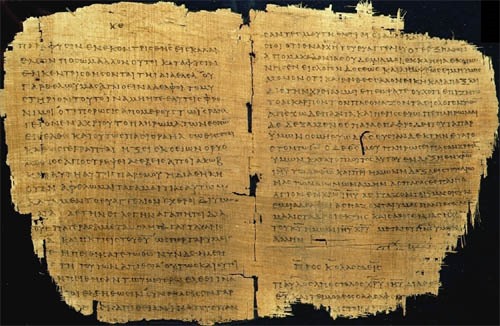
THE BLESSING OF FAITH

BLESSING OF FAITH

All of this should be cause for great comfort for us – our very belief is evidence of God’s work in us. If you, like Peter, believe that Jesus is the Messiah, the Son of the Living God, you are blessed! It means that God himself is at work in your heart. It means that our trials and grief and suffering in this life are not the full story.


To listen to the sermon, click the play button:

To download, right click on the link (or do whatever you do on a Mac) and save it to your computer: Download Matthew Part 53


Matthew #53 . Matthew 16:13-20 (Part B)

Bible passages like the one we have been studying these past few weeks strike me as extremely important. As I have been working on these past few messages, I have found myself hoping and praying that more and more people can hear them.

That is one reason I deeply appreciate your partnership in prayer. It is a great joy to me to know that some of you are praying along with us that the Lord uses this ministry to get his message out to the world. We aren’t the only ministry preaching God’s word, not by a long shot; but I truly believe that we do have responsibility for one small part of what God wants to do in the world during our lifetimes. Please pray that his purposes are fulfilled in and through Clear Bible. Please pray for protection and provision for me and my family.

Another thing I’d like prayer for is the idea of getting more “space” on the internet to archive more sermons. The hosting for our sermons is relatively inexpensive, but it is also limited. I recently had to delete about a hundred old sermons in order to make room for new ones. The great thing about the internet is that someone could come along and benefit from this sermon years from now. But to make that possible, we’re going to have change some things. Pray for guidance in this process, and technical help.

We value your prayer partnership above all. We do also welcome your financial partnership, if the Lord leads you to give. Please don’t feel guilty or bad if he does not. If the Lord does lead you to give financially, you can, just use the Paypal Donate button on the right hand side of the page. You don’t have to have a Paypal account – you can use a credit card, if you prefer. You can also set up a recurring donation through Paypal. We can make this tax-deductible if you just mention that it want it to be so in the “note” part of the transaction.

You could also send a check to:

New Joy Fellowship

917 Canyon Creek Drive

Lebanon, TN 37087

Just put “Clear Bible” in the memo. Your check will be tax-deductible.

Thank for your prayers, and your support!

~

Last time we considered the substance of Peter’s statement that Jesus is the Christ (Messiah), Son of the Living God. Theologians sometimes call a statement like this a “confession.” Many people think “confessing” is the same as “admitting,” but there are subtle and important differences. To confess in a biblical sense means “to say with,” or “to agree with the truth.” So, when we confess our sins, we are agreeing with the truth that the Bible teaches about those actions: namely, that they are wrong (they are sins) and also that we have done them. You see, it isn’t just admitting that we sin, it is agreeing with what the bible says about it. Confession can also be positive. You may have been in a church service where everyone said the Apostles’ Creed together. The pastor probably said something like: “Let us confess our faith together in the words of the Apostles’ Creed.” We are agreeing with the truth – thus, confessing. So Peter is agreeing with something that was already true – the identity of Jesus.

Now Jesus tells us several very important things about this confession:

He says, “Blessed are you, Simon Bar-Jonah! (literally, “Simon, son of Jonah”). This confession blesses those who make it. Actually, it is hard to overstate how much blessing comes from truly believing and confessing that Jesus is the Messiah, the Son of the Living God. To agree with this truth, to submit to the implications of it – that is, to personally submit to Jesus Christ and put your trust in Him – this is the only path to Life, according to the Bible. Jesus says elsewhere:

“I am the way, the truth, and the life. No one comes to the Father except through Me. (John 14:6, HCSB)

John writes:

The one who believes in the Son of God has this testimony within him. The one who does not believe God has made Him a liar, because he has not believed in the testimony God has given about His Son. And this is the testimony: God has given us eternal life, and this life is in His Son. The one who has the Son has life. The one who doesn’t have the Son of God does not have life. I have written these things to you who believe in the name of the Son of God, so that you may know that you have eternal life. (1John 5:10-13, HCSB)

That Life starts now. Even now, before we die, through Jesus we can find increasing wholeness in our spirits and souls. Even now, we can begin to experience love, joy, peace, patience, kindness, gentleness, goodness faithfulness and self-control in increasing measures.

But of course, it doesn’t stop when we die. The bible is pretty clear that we can’t even begin to grasp the wonder and joy and hope of the life to come, but it gives us some very exciting hints. I think this is one of the great biblical truths, one of the great Christian hopes. Our trials and grief and suffering in this life are not the full story. The Life after death – promised in Jesus alone – gives meaning and hope and joy to all things now, even the ones that seem to defy explanation. 1 Corinthians says:

What eye did not see and ear did not hear, and what never entered the human mind — God prepared this for those who love Him. (1Cor 2:9, HCSB)

Life begins now, but it continues on into eternity in a way that has “never entered the human mind.” If this is not so, says Paul:

If we have put our hope in Christ for this life only, we should be pitied more than anyone. (1Cor 15:19, HCSB)

Our hope is much, much greater than simply a good life for 100 years on earth. This life we have in Jesus makes sense of things that are otherwise terrible tragedies.

For I consider that the sufferings of this present time are not worth comparing with the glory that is going to be revealed to us. (Rom 8:18, HCSB)

Now in this hope we were saved, yet hope that is seen is not hope, because who hopes for what he sees? But if we hope for what we do not see, we eagerly wait for it with patience. (Rom 8:24-25, HCSB)

We know that all things work together for the good of those who love God: those who are called according to His purpose. (Rom 8:28, HCSB)

All of this begins with truly confessing, along with Peter, that Jesus is the Messiah, the Son of the Living God. Those who confess it are blessed.

There is another thing. Jesus tells Peter he is blessed because “flesh and blood” did not reveal it to Peter, but rather the Father in Heaven. The only reason Peter is able to really trust and obey Jesus as Messiah and Lord, is because the Father has enabled him to do so. Paul put it like this:

Now concerning what comes from the Spirit: brothers, I do not want you to be unaware. You know that when you were pagans, you used to be led off to the idols that could not speak. Therefore I am informing you that no one speaking by the Spirit of God says, “Jesus is cursed,” and no one can say, “Jesus is Lord,” except by the Holy Spirit. (1Cor 12:1-3, HCSB)

Obviously, anyone can pronounce the words “Jesus is Lord.” But what Paul means is that no can say it and truly believe it unless God has enabled him or her to do so. I think this is exactly what Jesus is saying to Peter. If you truly believe Jesus is Lord and Messiah, it is because God has done something in your heart. This is true of all believers. To make Peter’s confession (and believe it) is a sign that God is at work in us, and we are saved. There are many places in the bible that demonstrate that faith in Jesus as the Messiah comes about as a gift from God. I will italicize the relevant parts in the following verses:

Now God has revealed these things to us by the Spirit, for the Spirit searches everything, even the depths of God. For who among men knows the thoughts of a man except the spirit of the man that is in him? In the same way, no one knows the thoughts of God except the Spirit of God. Now we have not received the spirit of the world, but the Spirit who comes from God, so that we may understand what has been freely given to us by God.  (1Cor 2:10-12, HCSB)

This is a reiteration of what Jesus said to Peter. This confession is given to us through the Holy Spirit.

For you are saved by grace through faith, and this is not from yourselves; it is God’s gift — not from works, so that no one can boast. For we are His creation, created in Christ Jesus for good works, which God prepared ahead of time so that we should walk in them. (Eph 2:8-10, HCSB)

This is very clear – even our faith is “not from ourselves, it is God’s gift.”

[Jesus said]: “No one can come to Me unless the Father who sent Me draws him, and I will raise him up on the last day.” (John 6:44, HCSB)

It’s hard to be clearer than that. If we come to Jesus, it is because the Father has drawn us.

He made known to us the mystery of His will, according to His good pleasure that He planned in Him for the administration of the days of fulfillment — to bring everything together in the Messiah, both things in heaven and things on earth in Him. (Eph 1:9-10, HCSB)

The mystery of the Messiah was made known to us by God, just as it was to Peter.

For it has been given to you on Christ’s behalf not only to believe in Him, but also to suffer for Him, (Phil 1:29, HCSB)

To believe in the Messiah was “given to us.”

For it is God who is working in you, enabling you both to desire and to work out His good purpose. (Phil 2:13, HCSB)

God is the one working in us for His good purpose.

I give thanks to my God for every remembrance of you, always praying with joy for all of you in my every prayer, because of your partnership in the gospel from the first day until now. I am sure of this, that He who started a good work in you will carry it on to completion until the day of Christ Jesus. (Phil 1:3-6, HCSB)

The “good work” is salvation – and it was started in us by God Himself, and will be carried to completion by Him.

All of this should be cause for great comfort for those of us who believe – our very belief is evidence of God’s work in us. If you, like Peter, believe that Jesus is the Messiah, the Son of the Living God, you are blessed! It means, among many wonderful things, that God himself is at work in your heart.

But what about those who do not believe? Does this mean God isn’t at work in them, or doesn’t care about them? Not at all. The verses I have already shared make it clear that even faith is a gift from God. But, because God wants love to be real, the choice to receive God must also be real. Scripture shows that though we don’t create our own faith, or accomplish our own salvation, human beings can refuse and reject the gift that the Lord offers. I’ll share some more verses, again marking important parts with italics. Jesus says, later in Matthew:

“Jerusalem, Jerusalem! She who kills the prophets and stones those who are sent to her. How often I wanted to gather your children together, as a hen gathers her chicks under her wings, yet you were not willing! (Matt 23:37, HCSB)

For thus said the Lord GOD, the Holy One of Israel, “In returning and rest you shall be saved; in quietness and in trust shall be your strength.” But you were unwilling, and you said, “No! We will flee upon horses”; therefore you shall flee away; and, “We will ride upon swift steeds”; therefore your pursuers shall be swift. (Isa 30:15-16, ESV2011)

The Lord’s desire is always for all of us to receive the gift of grace through faith when he offers us. But some people are not willing. Some people say “No.” The negative result is their own responsibility, not the Lord’s fault.

Woe to them, for they fled from Me; destruction to them, for they rebelled against Me! Though I want to redeem them, they speak lies against Me. (Hos 7:13, HCSB)

“You stiff-necked people with uncircumcised hearts and ears! You are always resisting the Holy Spirit; as your ancestors did, so do you. (Acts 7:51, HCSB)

God does enables us to receive his grace through faith, but he does not force us to do so. Also, the fact that someone has so far resisted God’s grace does not mean he or she always will. The apostle Paul violently rejected Jesus for a number of years; but finally he repented and did receive grace and salvation through the Messiah.

Now, I want to make something clear. Jesus’ words to Peter are also words to us. We don’t need to go around wondering if we have rejected God or not. Although we are called to continue trusting and obeying Jesus, we don’t need to do it perfectly, and we don’t need to fear that we will somehow accidentally reject him in the future. As we trusted him to save us, we can trust him to continue to keep us. Your very faith is evidence that God has got you. You don’t have to worry.

Let’s close by meditating on one of my favorite passages of scripture:

What then are we to say about these things? If God is for us, who is against us? He did not even spare His own Son but offered Him up for us all; how will He not also with Him grant us everything? Who can bring an accusation against God’s elect? God is the One who justifies. Who is the one who condemns? Christ Jesus is the One who died, but even more, has been raised; He also is at the right hand of God and intercedes for us.

Who can separate us from the love of Christ? Can affliction or anguish or persecution or famine or nakedness or danger or sword? As it is written: Because of You we are being put to death all day long; we are counted as sheep to be slaughtered.

No, in all these things we are more than victorious through Him who loved us. For I am persuaded that not even death or life, angels or rulers, things present or things to come, hostile powers, height or depth, or any other created thing will have the power to separate us from the love of God that is in Christ Jesus our Lord! (Rom 8:31-39, HCSB)


THE KINGDOM OF HEAVEN: BETTER THAN ALL YOUR DREAMS?

delicious food


The kingdom of heaven is worth far more than anything else we have, or could have. It beats winning the Superbowl. It is better than the best sex, or the most delicious food, the most powerful drug. Having the kingdom of heaven is worth more than being fabulously wealthy in this life. It’s better than being stunningly good-looking, incredibly healthy or amazingly talented. All these are things many of us want or aspire to. But Jesus paints a picture that says these are nothing compared to being in the kingdom of heaven. This is a challenge for all followers of Jesus. Do we believe it, or not?


To listen to the sermon, click the play button:

To download, right click on the link (or do whatever you do on a Mac) and save it to your computer: Download Matthew Part 44


Matthew #44. Matthew 13:31-58

This time we’ll try to cover four more parables, and finish Matthew chapter 13.

Remember that last time we observed how Matthew recorded three “sets” of parables, each one made up of two different stories. We covered one of those sets, which was The Wheat and the Weeds and the Two Kinds of Fish. The theme of both of those was good and evil mixed in the real world, with a promise that at the end, it will be sorted out and made right.

Another set from Matthew 13 is this one: The Yeast and The Mustard Seed. Both of these illustrations carry the same theme, so let’s look at them right now.

He presented another parable to them: “The kingdom of heaven is like a mustard seed that a man took and sowed in his field. It’s the smallest of all the seeds, but when grown, it’s taller than the vegetables and becomes a tree, so that the birds of the sky come and nest in its branches.” He told them another parable: “The kingdom of heaven is like yeast that a woman took and mixed into 50 pounds of flour until it spread through all of it.” (Matt 13:31-33, HCSB)

A mustard seed is about as thick as an uncooked grain of rice, but only about 1/3 as long. The mustard plant, when full grown, is not a tree exactly, but it is bush that grows up to twelve feet high. The idea is that something very tiny can have a disproportionate result. The parable of the yeast is similar. Jesus talks about a small amount of yeast spread through “fifty pounds” of flour. Our modern bread is typically one to two pounds per loaf, so we are talking about 25 to 50 loaves of bread. Again, the idea is that a small amount of yeast has an impact that is surprising considering its size. Jesus is saying “the kingdom of heaven is like these things.” What does he mean?

I think there are several possibilities, and perhaps all of them are intended by Jesus.

First, the influence exerted by the seed and the yeast are way out of proportion to their size. A tiny seed results in a big bush; a handful of yeast makes fifty loaves of bread. Another way to put this is that they are powerful. So maybe one way to state Jesus’ message is: a little bit of “kingdom of heaven” goes a long way.

Historically speaking, Jesus’ point here has been proven magnificently true. Jesus started with twelve peasants in the “boondocks” of the world, a tiny, no-account backwater part of a tiny, no-account backwater province of the Roman empire. His life and simple message were captured by Matthew in about thirty pages. Yet, the kingdom of heaven through Jesus has profoundly affected the entire course of world history.

Within forty years, the message of the kingdom had caused a noticeable stir in the Roman empire, exerting enough influence to draw persecution from Roman emperors. Within four-hundred years, this message with such a tiny, humble beginning dominated the Roman Empire, and continued to dominate the history of Europe for sixteen more centuries. It went out from there to all parts of the globe.

Set aside for a moment the spiritual things which Jesus has accomplished for us. These of course, are the main and most important thing. But to help us understand how huge the impact of Jesus and his message have been, let us look at it from a purely secular point of view. The kingdom of heaven brought by Jesus is responsible for modern universities. In fact, it is responsible for the foundation upon which most of the world’s learning is based. Modern hospitals and standards of patient care exist because of the “mustard seed” planted by Jesus. The idea of religious tolerance comes from the same mustard seed, as do most of our notions of human rights, and many of our laws. The very concept of democratic government, which has blessed countless millions and led to the preservation of many lives, comes from the “yeast” introduced by Jesus.

The art of Michelangelo, the music of Bach and the Mathematics of Sir Isaac Newton were all done in the name of Jesus for the glory of God. Some of the most awe-inspiring architecture in the world, the most profoundly moving literature were produced by Jesus followers because they were moved by his mustard-seed message. It would be difficult to overstate the influence that Jesus has had. Yet, in his own time and place, as we see at the end of Matthew chapter 13, he was seldom appreciated.

I think there is something here for our immediate encouragement also. Often, when we are a part of small and insignificant-seeming things, we are prone to be discouraged. I recently read the story of Dr. William and Clara Leslie, missionaries to the Congo from Chicago about a hundred years ago. They spent seventeen years at a mission station called Vanga, on the Kwilu river. Eventually, Dr. Leslie’s relationship with the village elders near Vanga deteriorated, and he was asked not to return to Africa. He left in 1929, considering his mission work a failure.

In 2010, some missionaries led by Eric Ramsey made an exploratory trip across the Kwilu river to the remote region past Vanga, to evangelize the Yansi people, who were believed to have no Christian churches. What they found, to their surprise was a network of vibrant, reproducing Christian churches, who traced their spiritual roots to Dr. William Leslie, a hundred years ago. Apparently, in addition to his ministry from Vanga, once each year Leslie traveled across the Kwilu river for about a month, trying to evangelize the people of that even more remote region. He died, not knowing that he had succeeded in starting something that would lead generations of people to Jesus. He planted a mustard seed. It didn’t look like much when he left, but it grew into a beautiful network of churches.

When I was going to primary school and high school, I noticed that most of the people who were world-famous and highly honored were also dead. It wasn’t until after their lives were over, sometimes long afterwards, that people could see the impact made by such individuals.

During my own lifetime, however, that has changed. The rise of 24-hour television and the internet have created a market for thousands of celebrities who are famous and hailed as great, long before their real contribution to society can be evaluated. President Obama was given a Nobel peace prize when his only accomplishment was to win a presidential election. History may view him a great president, or it may not. Regardless, the Nobel prize was given before he had actually done anything significant. This is merely a symptom of how our society views greatness. YouTube has created many overnight celebrities and successes. All this this has led to a situation where we are often discouraged when we don’t see immediate results and rewards from our efforts.

But God may use us to plant a mustard seed that we won’t see full-grown in our own lifetimes. Certainly Peter, John, Paul and the other apostles died long before the Christian faith became the incredible force in history that it is. They were neither widely famous nor well-respected before they died. They received no awards, prizes or great financial benefits. I think the mustard-seed idea should encourage us that God can use in ways beyond anything we might imagine.

What the mustard seed/yeast parables come down to is the long-term power of the word of God. Not everything with small and humble beginnings has power and influence and changes history. But what makes the yeast effective, what makes the seed grow, is God’s word.

For just as rain and snow fall from heaven and do not return there without saturating the earth and making it germinate and sprout, and providing seed to sow and food to eat, so My word that comes from My mouth will not return to Me empty, but it will accomplish what I please and will prosper in what I send it to do.” (Isa 55:10-11, HCSB)

Let’s us stand firm in our faith that God’s word is a mustard seed, or a little bit of yeast, with the power to work in us and through us in ways that might one day be absolutely mind-blowing.

~

There is one more set of parables in Matthew 13 left to discuss. The two stories in question are the Treasure in the Field and the Pearl of Great Price.

“The kingdom of heaven is like treasure, buried in a field, that a man found and reburied. Then in his joy he goes and sells everything he has and buys that field. Again, the kingdom of heaven is like a merchant in search of fine pearls. When he found one priceless pearl, he went and sold everything he had, and bought it. (Matt 13:44-46, HCSB)

The idea is pretty straightforward. You give up everything in order to get that which is greater than everything. A modern equivalent might be like a man who wants to buy a farm. He find out that one farm he is looking at is sitting on top of an oil well. Even if it is more money than he thought he could afford, he’ll find a way to buy it, because he knows it will pay him back many times more than what he invests. The treasure in the field was worth more than everything else the man had, put together. Likewise with the pearl.

I think Jesus is making two main points with these parables. The first is that the kingdom of heaven is worth far more than anything else we have, or could have. It beats Superbowl tickets. It beats winning the Superbowl. It is better than the best sex, or the most delicious food, the most powerful drug. Having the kingdom of heaven is worth more than being fabulously wealthy in this life. It’s better than being stunningly good-looking, incredibly healthy or amazingly talented. All these are things many of us want or aspire to. But Jesus paints a picture that says these are nothing compared to being in the kingdom of heaven. This is a challenge for all followers of Jesus. Do we believe it, or not?

That leads us to the second point Jesus is making. It is worth giving up anything to be in the kingdom. Paul knew this, and lived accordingly:

But everything that was a gain to me, I have considered to be a loss because of Christ. More than that, I also consider everything to be a loss in view of the surpassing value of knowing Christ Jesus my Lord. Because of Him I have suffered the loss of all things and consider them filth, so that I may gain Christ and be found in Him, not having a righteousness of my own from the law, but one that is through faith in Christ — the righteousness from God based on faith. My goal is to know Him and the power of His resurrection and the fellowship of His sufferings, being conformed to His death, assuming that I will somehow reach the resurrection from among the dead. Not that I have already reached the goal or am already fully mature, but I make every effort to take hold of it because I also have been taken hold of by Christ Jesus. Brothers, I do not consider myself to have taken hold of it. But one thing I do: Forgetting what is behind and reaching forward to what is ahead, I pursue as my goal the prize promised by God’s heavenly call in Christ Jesus. (Phil 3:7-14, HCSB)

Paul was not the only one. Just this past week twenty-one Egyptian Christians had a choice to renounce Jesus, or have their heads cut off by Islamic terrorists. They chose death. But what they really chose was Jesus, and therefore, abundant, eternally renewing LIFE. They knew that the kingdom of heaven was worth far more than anything that could be offered by this life. Christians throughout the ages have suffered and even died, holding fast to this truth. As missionary Jim Elliot wrote, a few years before he, too, was killed for his faith:

He is no fool who gives what he cannot keep to gain that which he cannot lose.

Matthew closes chapter thirteen with a reiteration of the truth of these parables in real life. Jesus asks his disciples:

“Have you understood all these things? ” “Yes,” they told Him. “Therefore,” He said to them, “every student of Scripture instructed in the kingdom of heaven is like a landowner who brings out of his storeroom what is new and what is old.” (Matt 13:51-52, HCSB)

I have mentioned this before. This is reiteration of the power of God’s word, the scriptures. Jesus is encouraging them to see that both the Old Testament, and his own teachings, have that mustard seed/yeast power.

After this,

He went to His hometown and began to teach them in their synagogue, so that they were astonished and said, “How did this wisdom and these miracles come to Him? Isn’t this the carpenter’s son? Isn’t His mother called Mary, and His brothers James, Joseph, Simon, and Judas? And His sisters, aren’t they all with us? So where does He get all these things? ” And they were offended by Him. But Jesus said to them, “A prophet is not without honor except in his hometown and in his household.” And He did not do many miracles there because of their unbelief. (Matt 13:54-58, HCSB)

Jesus’ own people did not recognize him at the time. He was like the hidden power of the yeast, the insignificant seed. They didn’t see what God was doing. In addition, they were offended at the idea of giving up their preconception and receiving the kingdom of heaven through Jesus. They were the opposite of the pearl merchant. They looked at the priceless pearl and said, “Nah. I like my own pearls better.”

So, what do we do with these messages? How do we let them become real in our own lives? Perhaps you need to be encouraged. What the Lord is doing in your life right now is only the size of a mustard seed – one third the size of a grain of rice. If you my age or older, you can’t even see it without reading glasses. So, let the scripture be your reading glasses. See that God uses tiny, insignificant things to great result.

Brothers, consider your calling: Not many are wise from a human perspective, not many powerful, not many of noble birth. Instead, God has chosen what is foolish in the world to shame the wise, and God has chosen what is weak in the world to shame the strong. God has chosen what is insignificant and despised in the world — what is viewed as nothing — to bring to nothing what is viewed as something, so that no one can boast in His presence. (1Cor 1:26-29, HCSB)

Perhaps you need to be reminded that kingdom of heaven is worth more than anything else you might be seeking. You might even need the reminder to be willing to give something up in order to take hold of that kingdom. I know that giving things up for God may be difficult sometimes, but I say again, with Jim Elliot, that it is clearly a good bargain to trade what you cannot keep (anything or anyone on this earth, including your own life) for something that can never be taken from you (the love of God in Jesus Christ, and the abundant, vibrant eternal life that comes with Him).

Let the Holy Spirit speak to you today!

Thanks again for making use of Clear Bible.

I want to remind you again that we are a listener-supported ministry, and that means, first and foremost, that we are supported by your prayers. We need and value your prayers for us.

Please pray that this ministry will continue to be a blessing to those who hear it. Ask God, if it is his will, to touch even more lives with these messages. Ask him to use this ministry in making disciples of Jesus Christ.

Please also pray for our finances. Pray for us to receive what we need. Please pray for us in this way before you give anything. And then, as you pray, if the Lord leads you to give us a gift, please go ahead and do that. But if he doesn’t want you to give to us, that is absolutely fine. We don’t want you to feel bad about it. We want you to follow Jesus in this matter. But do continue to pray for our finances.

If the Lord does lead you to give, just use the Paypal Donate button on the right hand side of the page. You don’t have to have a Paypal account – you can use a credit card, if you prefer. You can also set up a recurring donation through Paypal. We can make this tax-deductible if you just mention that it want it to be so in the “note” part of the transaction.

You could also send a check to:

New Joy Fellowship

625 Spring Creek Road

Lebanon, TN 37087

Just put “Clear Bible” in the memo. Your check will be tax-deductible.

Thank for your prayers, and your support!

WHAT IS MORE IMPORTANT THAN JESUS?

no-excuses

Jesus did not give people the option of being half-hearted about Him. We cannot escape the fact that receiving the grace we find in Jesus is inextricably connected, by Jesus Himself, to following and obeying Him, even when it means we have to give up many significant things in this life.

To listen to the sermon, click the play button:

To download, right click on the link (or do whatever you do on a Mac) and save it to your computer: Download Matthew Part 27


Matthew #27 . Matthew 8:14-22

When Jesus went into Peter’s house, He saw his mother-in-law lying in bed with a fever. So He touched her hand, and the fever left her. Then she got up and began to serve Him. When evening came, they brought to Him many who were demon-possessed. He drove out the spirits with a word and healed all who were sick, so that what was spoken through the prophet Isaiah might be fulfilled: He Himself took our weaknesses and carried our diseases.

Starting at the beginning of chapter eight, Matthew has been telling us of several healing incidents. Some commentators like to point out that the first two healings were done to people who were outcasts in the eyes of normal Jewish society at the time, so they say that Peter’s mother-in-law was also a kind of outcast – in that she was a woman. However, you can’t get this idea from either the text itself, or from actual historical evidence. In point of fact, given that Peter’s mother-in-law serves Jesus as soon as she is well (presumably meaning she cooked and served his dinner) and the fact that she lives with Peter, it’s pretty ridiculous to view her as some kind of outcast. I bring this up merely to caution us against trying to make the bible fit neatly with our pre-conceived patterns or biases. It’s unfortunate, but true, that sometimes people misinterpret, or even make up, historical and cultural details in order to get the bible to support their own agenda.

The point here is that Jesus didn’t just heal two outcasts – he healed a whole bunch of people, including good Jewish people like Peter’s mother-in-law. Even more than that, Matthew points out that this is a fulfillment of another prophecy about the Messiah, this time from Isaiah 53:4

Yet He Himself bore our sicknesses, and He carried our pains

In other words, Jesus’ healing miracles provided yet another confirmation of who He truly was, and backed up his claims to have the authority of God Himself.

It also says that people brought many to Him who were demon-possessed, and Jesus drove out the spirits with a word. There has been some confusion for many Christians about the condition of being “demon-possessed.” The Greek word here is daimonidzomenous, which could be literally translated “being oppressed by demons.” A good shorthand translation of the root word would be “demonized.” The point I want to make is this. The New Testament does not usually paint a picture of someone being completely “taken over” or “inhabited” by demons (though there are a few exceptions). In most cases, when we see “demon possessed” in English, we should probably read it as meaning, “harassed by demons.” The ESV does a good job with this word, often translating it “oppressed by demons.”

I have some friends who have a son. Several years ago, the boy was exhibiting huge behavioral problems, and he was diagnosed by psychiatrists as having a condition called “reactive detachment disorder.” The parents didn’t know what to do, and had very little hope – they had tried everything that psychiatry and medicine had to offer. I talked to them about the possibility that their son was harassed by demons. They said, “We don’t think so. If we know anything, we do know that he truly trusts in Jesus.” They believed, as many Christians do, that a Jesus-follower cannot be possessed by a demon. I believe that too, but I do think that Jesus-followers can be harassed by demons, or, “demonized,” and the language of the New Testament suggests that is true; in fact, that is most often what daimonidzomai means. Anyway, we got together with the parents, their son, and some other friends, and confronted the demonic harassment in the name of Jesus, and their son’s life was transformed. We witnessed a genuine, New Testament miracle brought about by Jesus Christ.

I share all this for two reasons. First, so that if you are struggling with something that seems very difficult to get handle on, and nothing else seems to work, you may consider the possibility of demonic harassment. I certainly don’t think that all mental illnesses or behavioral issues are demon-induced. However, even among Christians, there is that possibility. The second thing is, Jesus is here present with us just as fully as he was in Peter’s house that evening, and through us He can and will still remove demonic oppression and set people free.

When Jesus saw large crowds around Him, He gave the order to go to the other side of the sea. A scribe approached Him and said, “Teacher, I will follow You wherever You go! ” Jesus told him, “Foxes have dens and birds of the sky have nests, but the Son of Man has no place to lay His head.”

“Lord,” another of His disciples said, “first let me go bury my father.” But Jesus told him, “Follow Me, and let the dead bury their own dead.”

It appears that Jesus was not entirely happy about having crowds of people following him. These days, we think that the bigger a ministry or church is, the better and more effective it must be. Jesus didn’t seem to think so. He wanted to get away from them, and (it seems, from what follows) even thin out their ranks a little bit.

A man in the crowd comes to him. This individual was a scribe, which makes him one of the educated elite, and probably even wealthy. He calls Jesus “Rabbi,” or, “teacher.” He seems enthusiastic as he declares his commitment to Jesus and you would think Jesus would want to encourage him. These days, if an educated elite person came to a modern Christian pastor and enthusiastically said he wanted to join the church, most of us would say, “Oh Absolutely! I know you are going to love being part of our community. Please just let us know how we can minister to you.” Initially, we would talk about the benefits of following Jesus and of joining our church. We would probably feel nervous about suggesting ways that such a person might contribute until he had been with us for a while, and it would probably be even longer than that, if ever, before we pointed out how it might negatively affect his standing in the community and his financial security.

But Jesus’ response to this man amounts to basically this: “Whatever. You aren’t going to be able to keep your home if you follow me.”

If you have never noticed this side of Jesus before, I want you to pay attention now. He is shocking, almost rude. It almost seems like He doesn’t care if the man follows Him or not. I could quickly name a hundred or more church-goers and even church leaders who would chastise any pastor who acted like Jesus did in this situation; but actually, I’m not sure I know any pastor who would risk it.

But the truth is, all four gospels record Jesus behaving like this. Rather than trying to make discipleship appealing, he often seems to say things to discourage people from “joining the movement.” He consistently avoided and distrusted large crowds of people who appeared to be excited about him, at least, at a superficial level. In America, for a whole generation, Christian leaders have been trying to gather large, superficial crowds, hoping that they will move from shallow, non-committal church goers into true disciples. We challenge them only reluctantly and even then we do it very, very gently. However, Jesus immediately confronts people with the cost and commitment level required to follow him.

A second person was with Jesus. Matthew calls him a “disciple” and records that he calls Jesus “Lord.” The ancient church leader, Clement of Alexandria, writing about this passage one-hundred and fifty years later, records a tradition that says this was actually Philip, one of Jesus’ first two disciples, and one of the “twelve,” but we can’t know for sure.

This disciple says that he needs to bury his father before he can come with Jesus. Some commentators have speculated that the man’s father was not actually dead yet, but was elderly, and expected to die soon. In this case, the disciple was saying, “I’ll follow you, but not until I after I have finished dealing with my dad’s illness and eventual death.” The other possibility is that this disciple’s father had just died, and the burial was about to happen, and so he was saying to Jesus that he couldn’t go across the lake with him just now, because he had to go to the funeral.

Either way, Jesus’ response is once again shocking and rude: “Follow me, and let the dead bury their own dead.” This is another one of those places that is not great moral teaching, or wise philosophy, or a kind outlook. In these two incidents Jesus plainly puts it to people that what he wants from them is to obey Him, and put Him above everything else. It is not good teaching or wise philosophy unless Jesus is in fact, the Messiah, God-in-the-flesh.

Could I put it this way? Jesus is not trying sell people on the benefits of being his disciple. He is up front about how hard it is. The reason to follow him is not because it will benefit you. The reason to follow him is because he is the Messiah, the Savior of the World, God the Son come in flesh.

The Word of God is always relevant. Just this week as I was preparing this sermon, one of the leaders of the largest church in the United States made a statement that the real reason to follow God and worship Him is for what we get out it, because it benefits us, and makes us happy, and that’s what makes God happy. All you have to do is read these verses to know how distorted that message is.

There’s more. This passage is not a specific command for every Christian to sell her house, or let her parents die unattended. But Matthew uses these as examples of the fact that Jesus intends us to put Him in front of absolutely everything and everyone else, and that there are times when doing that results in radical obedience that involves very difficult choices, and giving up things that are very dear to us.

At some point, following Jesus will cost us. Nothing should be more important to us than Jesus, and if it comes to it, yes, we should leave our family in His hands and follow Him, or be willing to give up our home and our financial security to follow him. It may cost us family members or friends, or a career, or the kind of life we think we want.

Let me be a little bold. I know many people who call themselves Christians who have a very difficult time taking even just a couple hours a week to worship Jesus with other believers, let alone dedicating any other time to serving Him. Something like giving up financial security to follow Jesus is not even on the horizons of their minds. Sports get in the way, especially sports for children. Families will think nothing of running their nine-year-old children to practices and games that chew up six to twenty hours in a week, and then say they are too tired to spend an hour or two learning more about Jesus and worshipping him with other believers, or even just hanging out with other Christians who need emotional or spiritual support. Jobs and careers interfere. People get busy with all sort of things: hobbies, home-improvement, social events, entertainment, even television.

Here we read that Jesus confronted one man about having a home, and a second about going to his father’s funeral. What do you think he has to say to you about your excuses for not following him, and not being more involved with others who do?

Following Jesus means he comes first, before everything and everyone. He comes before your home. Before your family, your friends or career. He comes before getting a sports scholarship for your child. He comes before your comfort, your security, your preferences, your plans.

We want to give half-hearted Christians an option. In part, we pastors allow half-hearted Christians in our churches because it feels safer, financially. Honestly, if I had whole bunch of half-hearted Christians in my church who would at least just give some money, I would feel better off financially than I am with these few whole-hearted Jesus-followers. If just don’t offend them, everything will be stable for me We also do it in the name of compassion. We don’t want people to feel bad about the choices they are making, especially if they are not choices to sin overtly. I mean, what’s so bad about sports?

But do we really think we are more compassionate than Jesus? Isn’t it compassion to tell someone the truth? Would you want a doctor to tell you that you were absolutely fine, when in reality you were suffering from cancer, and needed treatment immediately if you were to be cured? Compassion would speak the hard truth: “You need treatment, and you need it now.”

Jesus did not give people an option to be half-hearted about Him. “You want to follow me, you will have no house.” Or, “You want to follow me, you won’t be able to take care of your elderly father, or even go to his funeral.” This is not an obscure teaching of Jesus. We will revisit it again in the book of Matthew, and it appears all throughout the New Testament. Still to come (in just Matthew) are: “You want to follow me, you have to put me above father, mother, husband, wife, children, sister and brother,” and “You want to follow me, be willing to die – to give up everything for me – every single day.” The compassion of Jesus tells us this: If He is not first, if he does not come before everything, we are in danger, and we need treatment.

Now, there is grace to us when we fail to put Jesus first. Let’s suppose for moment that the second man here, the disciple, was in fact Philip. He had been putting his father first. Jesus confronted him about it. We know that Philip humbly received that correction, and he went on to become an important leader in the early church, responsible for sending Christianity to Africa for the very first time. I fail to put Jesus first sometimes. I imagine we all do. He has compassion on us, and forgives us, but he does also call us to correct the mistake.

It often seems like we have made the faith into a set of intellectual beliefs which to which we subscribe. And that’s comfortable, because we can say believe those things, no matter what our behavior. But what the bible calls faith is really just following Jesus. We cannot escape the fact that receiving the grace we find in Jesus is inextricably connected by Jesus Himself to following and obeying Him, even when it means we have to give up many significant things in this life.

“Happy are they who, knowing that grace, can live in the world without being of it, who, by following Jesus Christ are so assured of their heavenly citizenship that they are truly free to live their lives in this world. Happy are those who know that discipleship simply means the life that springs from grace, and that grace simply means discipleship. Happy are they who have become Christians in this sense of the word. For them the word of grace has proved a fount of mercy.” Dietrich Bonhoeffer, The Cost of Discipleship

Thanks again for making use of Clear Bible.

I want to remind you again that we are a listener-supported ministry, and that means, first and foremost, that we are supported by your prayers. We need and value your prayers for us.

Please pray that this ministry will continue to be a blessing to those who hear it. Ask God, if it is his will, to touch even more lives with these messages. Ask him to use this ministry in making disciples of Jesus Christ.

Please also pray for our finances. Pray for us to receive what we need. Please pray for us in this way before you give anything. And then, as you pray, if the Lord leads you to give us a gift, please go ahead and do that. But if he doesn’t want you to give to us, that is absolutely fine. We don’t want you to feel bad about it. We want you to follow Jesus in this matter. But do continue to pray for our finances.

If the Lord does lead you to give, just use the Paypal Donate button on the right hand side of the page. You don’t have to have a Paypal account – you can use a credit card, if you prefer. You can also set up a recurring donation through Paypal.

You could also send a check to:

New Joy Fellowship

625 Spring Creek Road

Lebanon, TN 37087

Just “Clear Bible” in the memo. Your check will be tax-deductible. Unfortunately, we cannot do the tax deductible option with the paypal donate button, however the money does go directly to support this ministry.


Thank for your prayers, and your support!

TEMPTATIONS


TEMPTATION

Jesus faced some powerful temptations. We face the same kinds of tests. The way that he overcame them can help us to trust him to overcome them in our lives also.


To listen to the sermon, click the play button:

To download, right click on the link (or do whatever you do on a Mac) and save it to your computer: Download Matthew Part


Matthew #7 . 4:1-11

Last time we saw how, at the baptism of Jesus, the Father and the Spirit showed how pleased they were with him. The next thing Matthew records is that the Spirit led Jesus into the wilderness to be tempted by the devil. Mark records that this happened immediately after:

Immediately the Spirit drove Him into the wilderness. (Mark 1:12, HCSB)

There is an important point here. It isn’t the main message of the text, but I think it is very significant for many of us. The Father was pleased with Jesus. The Spirit was with him, leading him. And he was brought into a desert wasteland where he had no food and had to fight with devil.

You don’t have to go very far in America to hear a Christian says something like this: “If you just follow God, he’ll take care of you. Your life will go better.” The Father was pleased with Jesus. The Spirit was leading him. However, his life did not get better, but harder. Following God is not a guarantee that everything will go well for you. That’s hard, but it’s the truth. When we follow God, his goal is to lead us to the place where we understand that this life on earth is not the main focus.

There is something else that many people may need to hear today: Our circumstances do not necessarily reflect how God feels about us. Jesus had nothing to eat. He was assailed by the devil, and living in a desert wasteland. And the Father was so pleased with him; the Spirit was with him. The Father has his reasons for allowing Jesus to go through that. But his reasons had nothing to do with his delight in Jesus.

Sometimes, when I’m going through tough times, I think maybe God is mad at me, or perhaps I’ve done something that has caused him to teach me a lesson. Another thought I have sometimes is that I’m going through hard times because I’ve made the wrong choice, and not listened to the Holy Spirit. But that could not have been the case with Jesus. The Father was pleased with him. The Spirit was leading him.

I think this passage calls us to dare to look at our circumstances differently. In Jesus, the Father is pleased with us, too. What we are going through is not necessarily a sign of how God feels about us. It’s true that, unlike Jesus, we sin. Sometimes we go astray and hard circumstances are a result of our bad choices. But Jesus shows us that you can follow the Spirit and still end up in wasteland with no food and the devil attacking you constantly. Just because you are in a hard time does not mean that God is displeased with you. Trust his love and grace to you!

Now, let’s take a look at some of the specific temptations faced by Jesus at this point. By the way, Matthew does not claim that these were the only ways Jesus was tempted by the devil. These are just a few of the many. But they were very powerful and difficult. You could classify these three incidents as temptation to doubt God’s provision, his protection and his purpose. But I think it’s worth looking at all three more closely.

Jesus was fasting. In some ways, fasting is all about dependence upon God. It’s almost like saying, “I need you more even, than I need food!” In my experience, when done right, fasting leads me to a greater sense of dependence upon God, regardless of what needs I may perceive in my life.

4:2 says that Jesus was hungry. Satan came along and said, “Why don’t you just create some food for yourself? You are God in human flesh, after all.” Pay attention, now. Being hungry isn’t a sin. It was natural for Jesus to be hungry. He was hungry because He himself had created the human body to need food. So, the temptation here is not about eating – it is about control. Satan was saying, “You’re hungry. You can satisfy your own hunger. Just reach out and do it – meet your own needs.”

Jesus, in taking on human nature, committed himself to live in complete dependence upon the Father, even as we humans are called to live in dependence upon him. To live as a human, to fulfill his mission, he had to trust in the Father to take care of him. In reply to the devil, Jesus quotes Deuteronomy 8:3. The whole verse says this:

He humbled you by letting you go hungry; then He gave you manna to eat, which you and your fathers had not known, so that you might learn that man does not live on bread alone but on every word that comes from the mouth of the LORD. (Deut 8:3, HCSB)

In that verse, Moses was reminding the people of Israel how God dealt with them in their desert wanderings. The point is, the hunger came about as a result of God’s work, and the hunger was ultimately satisfied by God. Jesus was saying: I will not meet my own needs. I will allow the Father to put me in a place of need, and I will allow Him to meet those needs in His way, and His time.

We experience similar situations, even when we aren’t fasting. Maybe it is in regard to physical needs, like hunger, or physical intimacy. Or maybe we are “hungry” for emotional needs. God wants us to depend on him to satisfy our needs in his way and in his time. Satan wants us to insist upon our needs getting met in our way and in our time. The temptation is to take control of the situation rather than trusting God. Jesus chose to trust God even while his need to eat was not being met. He calls us to that same kind of faith. Can we trust God to meet our need for love, even when we feel unloved? Can we trust him to take care of us, even while we can’t pay the bills?

We can’t manufacture that kind of faith. But Jesus has that sort of trust in the Father, and he put it into action as a human. And if he we trust Jesus, his strength, faith and integrity are available to us. Through faith, we can let Jesus, living inside us, overcome those temptations and bring us to a place of trust in the Father.

The next temptation recorded may not seem like much of a temptation to most of us. The devil suggests that Jesus should throw himself off the highest place in Jerusalem. From there, he would certainly die, unless God saved him. I think there are several temptations here. One is an inducement to suicide. Jesus faced some incredible hardships within a few years. It would be easy to simply retreat from life, and go back to heaven through death.

Without contradicting that, there are other things going here also. I think the devil was trying to cast doubt on Jesus’ sense of identity as the Son of God. He says, “If you are the Son of God, throw yourself down…” In other words: “You think you are God’s beloved Son? Prove it.” Again, the devil is inviting Jesus to doubt God, to doubt what had been said at Jesus’ baptism. As an evil twist, he is also casting doubt about whether the Father really would rescue Jesus, really protect him.

As a final, diabolical element, Satan quotes scripture, twisting its meaning and purpose, to try and convince Jesus to do it. I think that is a very important point. In this world of sin, anyone’s words can be twisted and misused, even God’s. Psalm 91 (quoted here by Satan) is an assurance of God’s care for his people. It is not an invitation to commit suicide and see if God will stop you. It’s not an invitation to force God to prove something.

But I think we all have the temptation sometimes to want God to prove himself to us. Sometimes we all doubt whether God will really keep his promises, and we think it would be nice if we could make him show us. We also feel the temptation to doubt who we are in Jesus. The bible says that in Jesus, we have forgiveness and redemption; we are holy and blameless; we have every spiritual blessing; we are more than conquerors; we have rest for our souls; we are the righteousness of God; we are a new creation, we have real life, everlasting life; we have peace; we have grace; we stand in God’s favor…and much, much more. It all seems too good to be true. That can’t really be us. The devil will tempt you to believe that it IS too good to be true. He’ll make you doubt your true identity in Christ. When he does, ignore him, and trust Jesus in you to send him packing.

In verses 8-10 the devil makes Jesus an offer: “Worship me, and you can have the world.” I think we read this and sometimes think, “That’s silly! Jesus is Lord, why would he worship the devil?” Remember, however, when Jesus lived on earth, he made himself completely dependent upon the Father, just as we are completely dependent upon him. The Father had a mission for him, and it involved a lot of hard work and pain and suffering. What the devil offered Jesus was a shortcut. Jesus came to save the world. The devil says, “I’ll give you the world without all that suffering. Just call me ‘Lord.’”

Remember, the previous two temptations questioned Jesus’ very identity. Now, the devil is trying to assume he has succeeded, and Jesus is willing to doubt himself enough to do that. Along with that, he is offering the inducement of an easy way out. He’s saying, “You can accomplish your mission without all that hardship and pain and suffering. I’ll just hand it all over to you. The Father is trying to make you jump through hoops – I won’t do that. Just worship me, and I’ll take care of everything else.”

Since the time of Jesus, there have been many stories about people “selling their soul to the devil” in exchange for some wonderful thing. But the truth is, the temptation is not usually so blatant as that. I think it is more like these examples:

You really just need to relax and “check out” of all the stress for a while. You want some peace. There’s pill you can take, or a joint you can smoke that will take care of it all, or you could drink enough alcohol to “take the edge off.” Smoking, pot, taking the pill, or having a few drinks is easy. It’s deals with the pain or the stress quickly. But it doesn’t really deal with it – not permanently. And in exchange, you give up control and end up needing the pot or the pill, or the booze. You trade more and more of your life away in order to keep those things in your life. You think it’s a momentary out, a harmless short-cut. But you are trading your life to the devil in exchange for it.

Let me say something briefly about marijuana. Everyone I’ve spoken with who smokes it tells me that it is not addictive. I think it’s true that physically, there are no withdrawal symptoms if you quit. But the same people who say it isn’t addictive keep smoking it, even when it costs them their jobs or their relationships and even sometimes their freedom. If you are willing to give up friendships and livelihood for it, you are addicted, no ifs, ands or buts.

Here’s another soul-trade. You want security in your life. You want to make sure that you will never be in a place of need. So you work long hours. You give your life to your career, and exchange you get a savings or investment account. But it turns out, no amount is enough to make you feel secure. You work harder, and trade more time with your family, more time with God – more and more of your life – for this security. It’s a deal with the devil. It costs too much.

People do the same thing with status and fame and power. Maybe a little bit of “tough business practice” which is really just cheating, will allow you to get where you want to be. Maybe just a little more time away from the family.

Sometimes people even think they can accomplish God’s mission but do it the easy way. Just go to church, throw some money in the offering plate, and then you can ignore God the rest of the week. It’s easy.

Now, I don’t mean to say that it’s never easy to do what God wants of you. Sometimes it is extremely grace-filled and easy. But we need to pay attention to the deals we make to get what we want.

Real peace comes from trusting Jesus in the middle of hard times. Real security comes from trusting Jesus in hard times. Sometimes God just gives peace, or sometimes he just gives us sense of security. But those things come as we trust him, not from taking short-cuts.

When we look to anything but God for peace, security or comfort, we are in danger of looking to that thing as an idol. I don’t mean that we can only have peace or comfort through severe meditation and scripture study. The Lord may touch you through music, or a friendship, or a good book or movie, or a meal enjoyed (without gluttony). The Lord blesses us through all sorts of things. But we need to look beyond the things themselves to the Lord who gives them. And certain things and activities are just deals with the devil.

Jesus overcame this the third temptation the way he did the other two – he relied upon the scripture, throwing the truth at the temptation. This is one reason why it is important for us to know the bible for ourselves. It is vital ammunition in the spiritual battles we face.

One final thought from this passage. The temptation, the fasting and the desert wasteland were a season for Jesus. It came to end. The trials do not last forever. When it was over, angels came and ministered to Jesus – in other words there was relief from the difficulties that Jesus had faced. Some of us need to hear this – that our hard time does have an ending. We can’t predict when that will be, but there is light at the end of the tunnel, and it isn’t just an oncoming train.

Let the Holy Spirit speak to you right now.

THE MOST PERNICIOUS AND PERVASIVE HERESY (IN AMERICAN CHRISTIANITY) [BY ROGER E OLSON)

“For the typical Protestant church member middle class commitments to family, career, and standard of living are so strong that the church commitment is largely instrumental to them and contingent on whether the church appears to serve them. As a result, many local churches tend to become instruments for achieving middle class interests, whether or not these interests can be defended in New Testament terms.”

…Most American “church people” look for a church that will entertain and comfort them. As soon as it challenges their most basic values and lifestyles, they either protest or leave.”


THE MOST PERNICIOUS AND PERVASIVE HERESY (IN AMERICAN CHRISTIANITY)

February 9, 2014 By 
[at: http://www.patheos.com/blogs/rogereolson/2014/02/the-most-pernicious-and-pervasive-heresy-within-american-christianity/#disqus_thread]
 

It’s not what you expect. In fact, most people would never even recognize it. It’s so pervasive (at least in American Christianity) that it’s hardly ever noticed. I suspect, however, that if a first century apostle or second century church father came among us it would be one of the first things they would notice—and condemn—about our “Christianity.” It’s not a formal heresy like “Arianism” or “Pelagianism.” It’s a mostly unconscious heresy that we have fallen into without thinking about it. But if you were to step back and away, especially if you were able to take a space ship to the moon, so to speak, and look down at American Christianity from a large distance, it would stand out like the Great Wall of China. In other words, as long as you are immersed in “American church life” you don’t see it; I suspect only missionaries to us from foreign lands can really tell us who we have become and what we have done to authentic Christianity.

Years ago Presbyterian sociologist of religion Dean Hoge (Catholic University of America, d. 2008) wrote this about American Christianity:

“For the typical Protestant church member middle class commitments to family, career, and standard of living are so strong that the church commitment is largely instrumental to them and contingent on whether the church appears to serve them. As a result, many local churches tend to become instruments for achieving middle class interests, whether or not these interests can be defended in New Testament terms.” (I wrote this quote down on a three-by-five card years ago and have it still, but unfortunately I did not write down its source. My possibly mistaken memory is that it was published inChristian Century.)

Of course there are many exceptions, but, in my experience, they are rare. Most American “church people” look for a church that will entertain and comfort them. As soon as it challenges their most basic values and lifestyles, they either protest or leave.

Here is the heresy I’m talking about most clearly and prophetically stated by Karl Barth himself:

“When the gospel is offered to man, and he stretches out his hand to receive it and takes it into his hand, an acute danger arises which is greater than the danger that he may not understand it and angrily reject it. The danger is that he may accept it peacefully and at once make himself its lord and possessor, thus rendering it innocuous, making that which chooses him something which he himself has chosen, which therefore comes to stand as such alongside all the other things that he can also choose, and therefore control. … Wherever the gospel is proclaimed…it is exposed at once to the danger or respectability.” (Church Dogmatics II/1, p. 141)

Can we give the heresy a name? I think so: the desire for respectability and domestication of the gospel and the church. If you need a single word, then I suggest “respectabilism.” We want our churches to be respectable.

Do I need to detail the ways in which respectabilism appears?

In my opinion, the main way is that we expect our pastors (and other Christian leaders) to comfort, encourage and support us and never seriously challenge us to the core of who we are. Most pastors know very well that if they do that, their job will be in jeopardy.

Another way is the influence of money and power in church life. Churches usually choose successful businessmen to be their lay leaders and they are not always the most spiritually-minded people of the congregation.

Yet another way is “professionalism” in worship. Many churches hire people, whether Christians or not, to sing in their choirs, play their organs, etc. Appearance and polished performance become more important than real Christian community (participation) and spirituality. Ordinary people of little beauty or talent are rarely, if ever, asked to participate “up front.” How far we have wandered away from 1 Corinthians 14:26!

Finally, many pastors and their congregations feel the need for the pastor to be known as “Dr. So-and-So”—whether he or she has an earned doctoral degree or not. I often see pastors’ names on church signs with the honorific title “Dr.” before them and know the pastor does not have an earned doctoral degree from any reputable institution of higher education.

I’m sure there are many other manifestations of respectabilism in American Christianity. And I’m sure there are many churches and Christian organizations that are not guilty of it. However, in my opinion (and I know in that of many observers of American Christianity), it is a common feature of American Christian church life.


DID JESUS REALLY COME TO BRING PEACE ON EARTH?

mary_2

This little baby presents each one of us with a difficult choice. Even Mary, his mother, was faced with the same choice.

To listen to the sermon, click the play button:


To download, right click on the link (or do whatever you do on a Mac) and save it to your computer: Download Christmas 2013


Christmas Eve 2013

Luke 1:26-38. Mary

Tonight, I’d like to focus a little on Mary, the mother of Jesus. We think of her as holy and exalted. She carried the divine nature of God, joined to her egg, within her very body. She shared her own blood with Jesus. Think of it – the blood that he shed for the salvation of the world came originally from her. After he was born, she nursed him, feeding him still from her own body. She wiped his bottom when he did what all babies do. And yet, he was ultimately her Lord, her creator, her savior. In some ways, Mary must have had the most unique relationship with Jesus that any human being has ever had.

Even so, I think we can learn from Mary. In many other ways, her experiences were exactly like our own. One of the messages of Christmas, of Jesus coming to earth, is that we are faced with a choice. He isn’t just a sweet little baby. He himself said:

“Do not think that I have come to bring peace to the earth. I have not come to bring peace, but a sword. For I have come to set a man against his father, and a daughter against her mother, and a daughter-in-law against her mother-in-law. And a person’s enemies will be those of his own household. Whoever loves father or mother more than me is not worthy of me, and whoever loves son or daughter more than me is not worthy of me. And whoever does not take his cross and follow me is not worthy of me. Whoever finds his life will lose it, and whoever loses his life for my sake will find it. (Matt 10:34-39, ESV2011)

And yet, we think of Christmas as a time for “peace on earth.” The truth is, Jesus is divisive, because he calls us to respond to him. Even Mary, who, for more than anyone, had a real relationship with a sweet little baby, found that even Jesus as a baby, as an unborn baby, presented her with a difficult choice.

Let’s back up to a young woman entering adulthood. We make much of the fact that Mary was only a teenager, but in her culture, she was considered an adult. She was betrothed to Joseph, a carpenter. In that culture, her betrothal meant several things. First, it meant that the marriage was a done deal. Solemn promises and vows had already been exchanged. The only thing different between betrothal and marriage was that the couple did not yet live together, and had not consummated the marriage. Breaking a betrothal was like getting a divorce.

Generally, the betrothal period lasted about a year. I’m not sure why. It’s likely that it might take that much time for bridegroom to raise the necessary money for the bride-price and for the wedding festivities. It would probably also take several months to spread the word and gather any relatives who lived far away.

Wedding festivities lasted for week. The actual “wedding” began with an extensive parade through the town. The bridegroom paraded to the house of his wife, with friends and family accompanying him and celebrating along the way. It was obviously a very public occasion; in a small town, a wedding would be almost like a holiday.

On this occasion, the bride would be wearing the beautiful clothing that she could possibly obtain. Her hair would be elaborately styled, and all in all, she would feel as beautiful as she ever would in this life. For this one day, all eyes would see her as beautiful.

After meeting at her family’s house, the bride and groom would parade back through the town, again with singing and celebrating, to the home of the groom. Again, they would be surrounded with the joyful faces of friends and families, singing, shouting and joking.

Back at the groom’s home, they would eat one of the most lavish and delicious meals of their lives. A wedding in those difficult times was one of the few places you could count on to eat more than enough of your favorite foods. Guests would look forward to the food alone for months ahead of time. Surrounded by loving family and friends, the bride and groom would be blessed, prayed for and toasted. They wore crowns, and were treated like royalty on this day. After that, after the guests departed, the couple would consummate the marriage, and they would be officially husband and wife.

The angel came to Mary sometime during the year of betrothal. Aside from whatever daily chores she had to do, her life would have been consumed with the details of the coming wedding. In dirt-poor Nazareth, her wedding was one of the only major life-events that Mary had to really look forward to. No one took vacations or pleasure trips, or had the resources for such things. For a young woman like Mary, her wedding was going to be the highlight of her entire life.

Now, enter the angel. He told her that she would become pregnant. It was obvious that he meant right now, not after she was officially married, but now, before she had ever been with a man. We know from Matthew’s account that Joseph found out Mary was pregnant some time before the wedding celebration, so this may have happened fairly early during the year of betrothal.

And just like that, there went the one thing in all her life that Mary had to look forward to. She didn’t know Joseph very well – engaged couples were seldom in love, or even close to each other, before the marriage. The safe assumption was that Joseph would divorce her before the wedding day.

We know that a quiet divorce was, in fact, Joseph’s plan. God intervened and angel appeared to him also. Trusting God, Joseph did not divorce her. Matthew records that he took her as his wife, but that they did not consummate the marriage until after Jesus was born (Matthew 1:24-25). He doesn’t give any great detail about the timeline – in other words we don’t actually when they were married. Luke, with a little more detail, suggests that they were still only engaged when Jesus was born (Luke 2:1-7).

I think it is quite probable that Mary never got her “event-of-a-lifetime” wedding. In fact, I doubt they had any wedding celebration at all. It was highly unlikely that they would do so, because it would only highlight the shameful and disgraceful fact of her pregnancy. If they had the celebration after Jesus was born, it would have been just as bad. Of course, Joseph and Mary knew that there was nothing shameful or wrong going on, but no one else was likely to believe them. If they had a wedding celebration, many guests might have refused to come.

I think this is one reason why both Joseph and Mary went to Bethlehem for the census. It was probably sufficient for Joseph to go alone, but they were probably both eager to get out of Nazareth and the shame and disgrace they were under. There are indications that they lived in Bethlehem for almost two years after Jesus was born. The census certainly did not require them to move there. I think they weren’t excited to get back to Nazareth.

Now, understanding the background, I want to say this a different way. When Mary received Jesus into her body and her life, it meant she lost the one cherished event in her whole life that she was really looking forward to. It meant she was exposing herself to disgrace and ridicule, and accepting a very uncertain future. It wasn’t as easy as saying “I get to be the Messiah’s mother? Cool! Bring it on!” By agreeing, Mary was inviting, divorce (without ever getting the fun of the wedding), ridicule and shame. She was relinquishing her only chance to have just one beautiful shining week in a life that was otherwise filled with crushing poverty.

I’ve thought before, the angel said that Mary had God’s favor. God has a funny way of showing his favor. It probably wasn’t what Mary would have chosen for herself.

With all that in mind, listen to her reply:

And Mary said, “Behold, I am the servant of the Lord; let it be to me according to your word.” (Luke 1:38, ESV2011)

Mary’s sacrifice is something we often overlook in the warm-fuzzies of Christmas. We are happy enough to contemplate the little baby Jesus, all clean and quiet. We could hold that little child and feel all peaceful and happy. Mary did. But she also gave up her own dreams to do so, and received much hardship and disgrace in their place. It really cost her something to receive Jesus.

Are we ready to recognize that receiving Jesus costs us our own agenda, or own control over our lives? Mary took Jesus on God’s terms, not her own. It meant giving up something she really wanted, but she was willing to do so. Are you ready to do the same? Can you receive Jesus on God’s terms, and give up your requirements?

The good news, is that when Mary did that, she found incredible grace and joy. A few months later, talking to her relative, Elizabeth, she said:

And Mary said, “My soul magnifies the Lord, ​and my spirit rejoices in God my Savior,

for he has looked on the humble estate of his servant.

For behold, from now on all generations will call me blessed;

for he who is mighty has done great things for me, and holy is his name. (Luke 1:46-49, ESV2011)

When we give up our agenda, and humbly say, “I’m your servant, Lord. I’ll receive you on your terms,” we may lose some cherished dream, or control over life the way we want it. But in turn, we do receive the Savior, the healer of our souls, the unending source of grace and unquenchable joy. Mary could have had a week of joy during her wedding feast. She gave that up for an eternity of joy in presence of God. Losing her wedding, being subject to disgrace, she actually felt blessed, because what she received was greater than what she gave up.

My prayer for all of us this Christmas is that we make the same choice as Mary, and unconditionally receive into our lives the Savior of the world, the Lord of our lives, Jesus Christ.

The Main Point of The Bible: Jesus

jesus-smiling-bobby-shaw

Jesus is the main point of the entire bible. Reading the bible should help us get to know Jesus better. It should encourage us in our faith in Jesus. Reading the bible should strengthen us spiritually, from the inside out. That is what is for. So read it with that in mind.

To listen to the sermon, click the play button:

To download, right click on the link (or do whatever you do on a Mac) and save it to your computer: Download Understanding the Bible Part 4

Understanding the Bible #4.

Last time, we talked about the documentary history of the New Testament. In other words, we learned that it is, without doubt, the accurately preserved teachings of those who knew Jesus Christ when he walked on the earth.

One question I did not address is about the historical accuracy of the New Testament. I’ll talk about it briefly here, and then we’ll move on.

Last time we learned that no ancient document has been as verifiably well preserved as the New Testament. Since we get a lot of our knowledge about history from ancient documents, that, in and of itself, should give us confidence that the New Testament is historically reliable. If the writings of Tacitus, or Julius Caesar are to be accepted as reliable sources of ancient history, then the New Testament should be accepted in the same way; even more so.

However, many skeptical people, including scholars, insist upon a position of assuming that the New Testament is wrong until proved right. No doubt, this is because they do not want to believe what it says about Jesus. Even so, time and time again, the New Testament has been proven right, while the skeptics have been proved wrong. Let me give you a few instances.

Luke Chapter 2 talks about a census taken by Caesar Augustus. He said that it happened while Quirnius was governor of Syria. This is a historical event. Roman records (not as well preserved as the New Testament) do indicate a census during the time of Emperor Augustus. But there has been no Roman record uncovered that mentions a governor of Syria named Quirinius. Skeptics long held out that this proved that the New Testament is unreliable. First, let’s consider the logic of that claim. Those skeptics did not have actual evidence that contradicted the New Testament. What they had was a lack of evidence to confirm it. Of course, they had an equal lack of evidence to contradict it. However, eventually, some coins were excavated in the ancient Roman province of Syria. In those days, provincial coins were stamped with the name and likeness of the governor who ruled at the time the coin was made. The coins discovered in Syria were from the reign of Caesar Augustus, right at the beginning of the “common era” and they were stamped with the name “Quirinius.” In other words, we now have positive proof that Luke wrote accurately. The skeptics were wrong.

Another place where skeptics held there was a “lack of evidence” was for the existence of a high priest named Caiaphas. Caiaphas was involved in the trial of Jesus. Archaeologists had not found any record of him outside the New Testament. Then, in the mid-1990s, excavations were made to build a water park in Jerusalem. The excavators discovered an ossuary – a “bone box.” It was labeled as holding the bones of Caiaphas, who was identified as a high priest in Jerusalem.

There are many more areas where skeptics never even had a chance. The New Testament names dozens of Roman officials, and makes references to hundreds of little cultural details that have all been affirmed by archaeology and other ancient documents. There can be no question that the New Testament is entirely historically reliable.

Let’s use the rest of our time right now to consider how the New Testament can help us understand and interpret the Old Testament. Last time, we looked at the idea that the New Testament was the unveiling of a mystery that began with the record of the Old Testament. Jesus himself, and his apostles, affirm this. The mystery, the key to the entire Bible, is Jesus himself. Jesus said to the Jews who believed the Old Testament:

The Father who sent Me has Himself testified about Me. You have not heard His voice at any time, and you haven’t seen His form. You don’t have His word living in you, because you don’t believe the One He sent. You pore over the Scriptures because you think you have eternal life in them, yet they testify about Me. (John 5:37-39, HCSB)

Both before and after his resurrection, Jesus pointed out to his disciples how the scriptures (that is, the Old Testament) looked ahead to the Messiah, to Him:

He said to them, “How unwise and slow you are to believe in your hearts all that the prophets have spoken! Didn’t the Messiah have to suffer these things and enter into His glory? ” Then beginning with Moses and all the Prophets, He interpreted for them the things concerning Himself in all the Scriptures. (Luke 24:25-27, HCSB)

Then He told them, “These are My words that I spoke to you while I was still with you — that everything written about Me in the Law of Moses, the Prophets, and the Psalms must be fulfilled.” Then He opened their minds to understand the Scriptures. (Luke 24:44-45, HCSB)

Paul also used the Old Testament to share the good news about Jesus:

For he vigorously refuted the Jews in public, demonstrating through the Scriptures that Jesus is the Messiah. (Acts 18:28, HCSB)

The specifics of how Paul did that are all throughout his letters. That is one reason why it is helpful to understand the New Testament first – it gives us a guide for understanding what came before. The key is Jesus. Therefore, one very helpful trick in reading the Old Testament is to ask this question of every passage: “Where is Jesus in this passage? What part of the message about the Messiah is this? How does it teach me something about Jesus? Does one of the people in this story act in a way that reminds me what Jesus is like? Is it a prophecy about his life on earth, or what he will do at the end of time? What does it tell me about my need for a Messiah?”

Jesus is the main point of the entire bible. Reading the bible should help us get to know Jesus better. It should encourage us in our faith in Jesus. Reading the bible should strengthen us spiritually, from the inside out. That is what is for. So read it with that in mind.

There are also some secondary things. When we put our trust in Jesus, and let him lead our lives, it has enormous implications for everything in life. So the main point of the Bible is Jesus. In addition, there are many “secondary” points that flesh out what trust in Jesus means for us in hundreds of practical, emotional and spiritual ways. So Paul writes:

But as for you, continue in what you have learned and firmly believed. You know those who taught you, and you know that from childhood you have known the sacred Scriptures, which are able to give you wisdom for salvation through faith in Christ Jesus. All Scripture is inspired by God and is profitable for teaching, for rebuking, for correcting, for training in righteousness, so that the man of God may be complete, equipped for every good work. (2Tim 3:14-17, HCSB)

Of course, Paul didn’t know that his own letter to Timothy would be included in the bible. But Christians today believe that the Holy Spirit had Paul write this, and that it is intended for both the Old and New Testaments. Jesus spoke prophetically about this:

“Therefore,” He said to them, “every student of Scripture instructed in the kingdom of heaven is like a landowner who brings out of his storeroom what is new and what is old.” (Matt 13:52, HCSB)

The “old treasure” in the storehouse are the writings of the Law and the Prophets – that, is, the Old Testament. The New Treasure is the mystery, now revealed, of Jesus Christ. Peter wrote about the scripture:

First of all, you should know this: No prophecy of Scripture comes from one’s own interpretation, because no prophecy ever came by the will of man; instead, men spoke from God as they were moved by the Holy Spirit. (2Pet 1:20-21, HCSB)

Christians have believed for almost two-thousand years that this is as true of the New Testament, as well as the Old.

So, all scripture (both Old and New Testaments) is useful for teaching, rebuking, correcting, training in righteousness and equipping. So, first we read in order to get to know Jesus better. And as we do, the Bible teaches, trains, corrects and so on. It gives us instruction.

Paul said it a different way in his letter to the Romans:

For whatever was written in the past was written for our instruction, so that we may have hope through endurance and through the encouragement from the Scriptures. (Rom 15:4, HCSB)

I want to look at two examples today of how all scripture is to help us get to know Jesus, and how it is for our instruction.

First, consider these words from Isaiah:

Yet He Himself bore our sicknesses, and He carried our pains; but we in turn regarded Him stricken, struck down by God, and afflicted. But He was pierced because of our transgressions, crushed because of our iniquities; punishment for our peace was on Him, and we are healed by His wounds. We all went astray like sheep; we all have turned to our own way; and the LORD has punished Him for the iniquity of us all. He was oppressed and afflicted, yet He did not open His mouth. Like a lamb led to the slaughter and like a sheep silent before her shearers, He did not open His mouth. (Isa 53:4-7, HCSB)

…My righteous servant will justify many, and he will carry their iniquities (Isa 53:11)

This was written hundreds of years before Jesus was born. There is not a scholar in the world who disputes that. And yet, it is clearly the message that someone (Isaiah doesn’t know whom) would take the sins of others upon himself, and through his suffering, bring us peace with God. That someone would not object to the suffering imposed upon him, but engage in it willingly.

This passage is in the Old Testament. But clearly, it points to Jesus. It is about Jesus, and what he did for us, though it was written long before he came into the world. So we read the Bible, even the Old Testament, and find Jesus.

Now, let me give you an example of instruction.

Deuteronomy 25:4 says “Do not Muzzle an ox while it treads out grain.” Now, not too many people who read these sermon notes own oxen. I bet none of you even own a muzzle for an ox. So what is the point of this verse for you today? Remember, it was written for your instruction. All scripture is given by God and is useful for teaching, training, correcting and encouraging. So we should not read a verse like this and say “Well, I don’t have an ox, so never mind about that one.” Instead, we should read a verse like this and pray something like this: “Holy Spirit, I’m not getting much out of this one. Please show me something about Jesus here. Or give me some instruction or teaching. Speak to me through this verse.” I have added, sometimes, “I dare you,” because, like you, I find many bible passages hard to understand at first.

In the case of the non-muzzled ox, we have it easy, because the apostle Paul showed us the way.

For it is written in the law of Moses, Do not muzzle an ox while it treads out grain. Is God really concerned with oxen? Or isn’t He really saying it for us? Yes, this is written for us, because he who plows ought to plow in hope, and he who threshes should do so in hope of sharing the crop. If we have sown spiritual things for you, is it too much if we reap material benefits from you? If others have this right to receive benefits from you, don’t we even more?

However, we have not made use of this right; instead we endure everything so that we will not hinder the gospel of Christ. Don’t you know that those who perform the temple services eat the food from the temple, and those who serve at the altar share in the offerings of the altar? In the same way, the Lord has commanded that those who preach the gospel should earn their living by the gospel. (1Cor 9:9-14, HCSB)

It was written originally about oxen. It taught the people of Israel to be kind and even generous with the animals that worked for them. It taught them that the harvest was to be shared – even with the animals. Paul sees an enduring principle here that applies to preachers of the gospel. Paul writes, “Is God really concerned with oxen?” Asking questions is always a good way to begin to understand the underlying principle. I’m sure God is concerned about oxen, but if we treat our oxen well, shouldn’t we also treat people well? If we are generous with the animals who make the physical harvest possible, what should we do with the people who make the spiritual harvest possible? Paul concludes: “Those who preach the gospel should earn their living by the gospel.”

This is not directly about Jesus. But it is instruction for those of us who are trying to follow Jesus. It tells us that we should financially support those who are called to teach the bible. You may not have oxen, but you probably have a pastor, or at least some leader or ministry from where you get spiritual leadership and solid biblical teaching. This passage about oxen doesn’t apply to oxen any more (unless you still own them, and use them to tread out grain). But it still applies to our lives as Jesus-followers. We are still supposed to share generously with those who help us spiritually.

By the way, of course I am one of those that preaches the gospel, and I know this passage applies to me and to my ministry. But I don’t share it here as a covert way of asking for money. I have no problem doing that directly: If the Lord leads you, then give. Use the donate button on the blog site, or send a check the address I used this passage because the New Testament serves it up for us on a platter. It’s a clear example of how we can use even what appear to be silly ancient laws to hear what the Lord wants to teach us.

We will look at some of these principles of bible interpretation later on in the series. For now, we need to know that that the entire bible, even the Old Testament is to help us get to know Jesus better, and to provide us with instruction, training and teaching in how to be his disciples.

What is the Historical Basis for the New Testament?

NT Old MSS

The actual facts obliterate the claims of skeptics. We know for certain that New Testament as we have it today was actually written by the apostles and those who knew Jesus. And it did not give them control or power over others – it led to their martyrdom.

To listen to the sermon, click the play button:

To download, right click on the link (or do whatever you do on a Mac) and save it to your computer: Download Understanding the Bible Part 3

Understanding the Bible #3.

Last time, we looked at the origins of the Old Testament. We will come back to the Old Testament, and talk about how to understand the various kinds of writing we find there. However, for Christians, the key to understanding the Old Testament is found in the New Testament, so we’ll look at that this week.

I’m a mystery novelist. If you haven’t already, I’d love it if you can help me become rich and famous by buying my books and then telling everyone you know about them, and posting about them online. But that’s not my point. My point is, when I write a book, the mystery is not revealed until near the end. If you read two-thirds of one of my books, and then stopped, the story-line would not make sense. You can’t fully understand the beginning until you have read the entire book.

On the other hand, if you read the last one-third of one of my books, but not the beginning, you would get the main gist of the story. You would understand the basic, underlying plot, and the mystery would be unveiled for you. However, you would miss out on many rich nuances and many enjoyable parts of the story. If you hadn’t read the beginning, you might not understand why some of the events at the end were so significant for the characters. You’d get the idea, but you would still be missing out on a lot.

The bible is not a novel. I don’t recommend reading it from beginning to end. Even so, you cannot get the whole “story” of the bible until you have read the New Testament. The Old Testament is the record of how God prepared the world. He laid the foundations of culture and history and geopolitics until the world was uniquely primed to understand and spread the message of his grace. Then he sent Jesus. Jesus is the revelation of what God was doing. He is the solution to the mystery. The New Testament writers even refer to the message about Jesus as a “mystery”:

By reading this you are able to understand my insight about the mystery of the Messiah. This was not made known to people in other generations as it is now revealed to His holy apostles and prophets by the Spirit: (Eph 3:4-5, HCSB)

Instead we speak the wisdom of God, hidden in a mystery, that God determined before the ages for our glory. None of the rulers of this age understood it. If they had known it, they would not have crucified the Lord of glory. (1Cor 2:7-8, NET)

This idea of “mystery” is one of the keys to understanding the relationship between the Old and New Testaments. The New Testament is the revelation of the mystery. It shows us what God was ultimately aiming at, in the Old Testament. We cannot understand the Old Testament without the New Testament. You can get the basic message from the New Testament, even if you haven’t read the Old. In fact, I think it is best to read the New Testament first. It won’t “spoil the ending,” in fact, it will help you to understand the whole bible. But you won’t understand the incredible grace and wisdom and power of God unless you read both the Old and the New Testaments.

So, with that in mind, where did the New Testament come from?

The short answer is this: Jesus chose twelve people who knew him personally to be his apostles. Later, he chose another, Paul. He lived with them, taught them and trained them. He sent his Holy Spirit to reveal his truth to them. After Jesus left his earth, his apostles taught and wrote about him. The apostles wrote down their teaching in letters. These writings about Jesus became what we call the New Testament.

The apostle Paul did not know Jesus while he walked on the earth. But Jesus called him specially, and revealed things to him by his Holy Spirit. Paul wrote:

Now God has revealed these things to us by the Spirit, for the Spirit searches everything, even the depths of God. For who among men knows the thoughts of a man except the spirit of the man that is in him? In the same way, no one knows the thoughts of God except the Spirit of God. Now we have not received the spirit of the world, but the Spirit who comes from God, so that we may understand what has been freely given to us by God. We also speak these things, not in words taught by human wisdom, but in those taught by the Spirit, explaining spiritual things to spiritual people. (1Cor 2:10-13, HCSB)

If you studied Galatians with me, you know that the revelation Paul received was affirmed and agreed with by the apostles who had been with Jesus personally.

Besides Paul, there are four authors in the New Testament who were not in the group of original apostles. Mark (who wrote the gospel of Mark) was not in that group. However, he traveled with Paul and Barnabas, and spent extensive time with the apostle Peter. His gospel is believed to be a basic summary of the things he heard Peter say about Jesus.

The man who wrote the book of James was not James the apostle. The apostle James was beheaded within about ten years of Jesus’ death. But the James who wrote the book was the son of Mary, mother of Jesus. In other words, he was Jesus’ half-brother (Galatians 1:19). Obviously, he knew him, and James experienced a special encounter with Jesus after the resurrection (1 Corinthians 15:7). James’ brother Jude (thus, another one of Jesus’ half-brothers) wrote a short letter.

Luke was the only other person who contributed to the New Testament. He wrote the gospel of Luke, and the book of Acts. It is clear from both that he spent extensive time with the apostle Paul, and with many other Christians, including Mary, mother of Jesus.

No one knows for sure who wrote the letter to the Hebrews. Many people believe it was Paul, though it is missing Paul’s usual personal greetings. Others think it might have been James, or another of the apostles. We do know however, that it has been accepted as a genuine apostolic letter for as long as the other books in the New Testament.

That brings us to the next point. How do we know that the teachings of these people who knew Jesus are, in fact accurately preserved?

Skeptics generally criticize the New Testament with these ideas: [They say] it was created a long time after Jesus, by people who never knew him. If there was any truth to it, it has been distorted by people who changed the stories to suit their own purposes. Usually, they say the reason it was created was to give power and control to religious leaders.

The actual facts obliterate these ideas. In the first place, the idea that New Testament was created to give control to religious people, is nonsensical. We can trace many New Testament books (in their present form) back to around 150 AD. It is well established that the entire New Testament as we know it was used from 250 AD onwards. The problem for skeptics is that up until 320 AD, Christianity itself was illegal in the Roman empire (which is where it began). It is well established that during this time in history, Christians were often deprived of freedom and property. Christian leaders were sometimes tortured and martyred. Far from giving them power, the New Testament gave them the status of outcasts. If the original purpose for the present-day New Testament was power for religious leaders, it would contain verses affirming Emperor-worship and pagan gods. Instead, during the time it was supposedly “made up,” it led to the opposite of power and control.

Secondly, we can know for sure that the stories and teachings of Jesus, and the teachings about him, were not changed and distorted. Ancient documents were written by hand. Because writing materials wear out, when those documents started to degrade, new copies were made. The New Testament was the same. In addition, because Christianity is faith that is supposed to spread, numerous copies were made, and carried all over the known world. Not only that, but the New Testament was also translated into several languages, and copies were made, and recopied in those other languages, also.

If you can find numerous copies of an ancient document, you can compare them to each other, to see if they are same. It helps if they come from different places and different time periods.

Much of what we know of the history of 0-100 AD comes from just a few ancient documents. One of them is called Annals. A Roman named Tacitus wrote it in about A.D. 100. Tacitus is considered to be a very good historical source for that period. Today, twenty ancient texts of Tacitus’ writing exist. The oldest is a copy that was made in 1100 A.D. — 1000 years after Tacitus wrote the original. With regard to Annals, no historian seriously disputes that they were indeed written by Tacitus. Scholars have compared the twenty surviving ancient manuscripts, and most accept that what Tacitus originally wrote has been accurately preserved.

There is no document that old (besides the New Testament) that has even 300 ancient copies of it still in existence. There is no document that old (besides the New Testament) in which the copies date within 500 years of the original.

Compare this to the New Testament. between 50 and 100 A.D. There are more than five thousand six hundred (5,686, to be exact) ancient copies of these documents. The oldest copy of any part of the New Testament is a fragment of the book of John (known as the Rylands Manuscript) which is dated very close to the time which John actually wrote the book – certainly within forty years, but possibly even part of the original. Another fragment of Matthew is believed to be so close as to be part of the original gospel as written down by Matthew himself. Many of the books exist in copies that were made within 100 years of the original. There are complete New Testament manuscripts – i.e. all the books gathered together as part of one document – that date merely 225 years after the time of the apostles. In addition to all this, we have ancient translations of the New Testament in Latin, Coptic (an ancient Egyptian language), Arabic, Slavic, Armenian and several more languages. In fact there are 19,284 ancient copies of all or part of the New Testament in languages other than Greek. The oldest are in Latin and Syriac, and are dated around 150 AD – or, less than 100 years after the originals were written in Greek.

To put it another way, there are 284 times more copies of the Greek New Testament than there are of Tacitus. And the age of the copies is almost a thousand times better. That makes the New Testament a much better historical document (hundreds of times better) than the best other documents from that same period.

The fact that there are so many ancient copies also makes it possible to know with a good deal of certainty what the original documents said. In other words, with so many good copies out there, we can compare the texts and see if they are the same or not. If all or most of the texts show that John wrote “Jesus wept,” than we can be very sure that John did in fact write, “Jesus wept.” People have now been comparing and compiling these ancient manuscripts for some time and we can be very confident that what we read in English has been translated from a Greek text that would be probably 99% exactly the same as what was originally written. There are some differences between ancient copies, of course. Some of them are easily identified as copying errors. Some of the differences show up in only a few of the manuscripts, while all of the others agree. But there are a few differences in ancient copies of the New Testament that can’t be easily resolved. None of those textual differences have any impact on any major Christian beliefs. None of them change doctrine. The NIV Bible translation makes of a note of any major differences between ancient Greek manuscripts. One example is Luke 23:42. Luke writes that the thief on the cross said, “Jesus remember me when you come into your kingdom.” The NIV makes a note at the bottom that there is enough evidence to note a variant manuscript reading. The variant would read like this: “Jesus remember me when you come with your kingly power.” You may say: “What’s the big deal with that? What’s so different about it? What does it change? Doesn’t it mean the same thing?” That, of course, is the point. It changes nothing significant. Nor do any of the “significant” variants. If you have an NIV Bible you can scan the bottom of the text as you flip through the pages and see all the significant variants.

Probably the biggest significant variant comes from John 7:53-8:11. The NIV makes this note: “The earliest and most reliable manuscripts and other ancient witnesses do not have John 7:53-8:11.” In all probability this little section was not included by John when he wrote the gospel. It may have been a story told by John, that was well known to those who knew John. After his death, they might have included in the gospel so that the story would not be lost. It might have been written by John some other time, or by one of the other apostles and included in John’s gospel so the story wouldn’t get lost. But even if you take this little section out of the Bible, it doesn’t change any major doctrine.

In addition to the all the copies of the New Testament, we have surviving letters and writings of early Christian leaders. These early Christians quoted both the Old and New Testaments extensively in their writings. It is obvious from this that the books of the New Testament must have existed during the lifetimes of the people who quoted them. Since we know when these early church leaders lived, we know that the New Testament is at least as old as they are. The oldest of these is Clement of Rome, who died in 99 AD. Thus we know that books of the New Testament that he quoted had to exist before the year 99. Another early church leader was Ignatius of Antioch, who died, at latest, in 116 AD (he may have died as much as twenty years earlier).

There are other ancient writings about Jesus – writings that were not included in the New Testament. These include The Shepherd of Hermas, Didache, Apocalypse of Peter, The Gospel of Judas, The Gnostic Gospel of Thomas and several more. These texts do not boast the same number of ancient copies New Testament books do, nor are they well preserved or as close to the time of the originals. These writings generally have no historical validation whatsoever, certainly none of the type enjoyed by the New Testament writings.

There were several things that caused a book to be included in the New Testament.

  1. The New Testament book had to be connected to an apostle, or someone closely connected to Jesus (we looked at this earlier). The Apocalypse of Peter, though it names an apostle in the title, was never recognized in any early writing or by any evidence as having anything to do with the real historical Peter. It was rejected because the people at the time knew that Peter had no connection to it.
  2. The New Testament book had to enjoy widespread use among churches. (for example, the Gospel of John was used and recognized in churches all over the known world by a very early date; whereas the “Gospel of Judas” was never really recognized outside of Alexandria, Egypt and that at a fairly late date, by people who weren’t even Christians.)
  3. The New Testament writings had to agree with generally accepted Christian doctrine. In the 140s AD a man named Marcion came up with his own very twisted version of Christianity and listed various writings which he thought should be considered sacred. He and his “New Testament” were rejected because they were contrary to the teachings that the churches had held since the time of the apostles.

So you see, when it comes to something like The DaVinci code, or National Geographic’s Judas Gospels there is a little bit of truth, mixed with a lot of big lies. The little bit of truth is that there are indeed ancient writings other than the New Testament, which talk about Jesus. The big lie is the idea that those other writings are validated or historical in any way. They don’t have the historical or documentary qualifications which the New Testament does. Compared side by side, the New Testament wins every time.

The point of everything we’ve learned so far is this: There are some very good reasons to believe that what the Bible says is true, accurate and important. Ultimately we do have to take a step of faith. But perhaps you haven’t realized until now, that that step of faith is not as big as many people think it is. We have sound scientific and historical reasons to believe what the Bible tells us. I don’t think we can call it absolute proof, because God does want us to trust him, and in order to trust, there has to be the possibility of doubt. But even though that possibility of doubt remains, all of the evidence points to the conclusion that the Bible is true, trustworthy and reliable.

Next time, we’ll talk more about the “mystery” of Jesus, and how that helps us to understand the whole bible.

WHERE DOES THE OLD TESTAMENT COME FROM?

coins2_1211697c

This is fact: the bible is, without question, the best documentary record of life and history in the ancient middle east.

To listen to the sermon, click the play button:

To download, right click on the link (or do whatever you do on a Mac) and save it to your computer: Download Understanding the Bible Part 2

Understanding the Bible #2 . How We Got the Bible & Can we trust it? (Old Testament)

Psalm 119

Last week we considered the Bible from a non-spiritual standpoint, evaluating it as if it were merely a system that was developed to guide human behavior (that is, a “moral” system). We found that objectively, the Bible offers a superior guide to human behavior than other “holy books” and one that is much superior to any “individual morality” that individuals choose for themselves. The next few weeks I want to dig more deeply into the origins of the Bible. This will help us to evaluate spurious claims like those of the “DaVinci Code” and the “Judas gospels” and other part-truth/mostly lies stories that have been floated about the bible for years. For now, we’ll just consider the Old Testament. We will tackle the New Testament later in the series.

Several early portions of the Old Testament were originally recited orally and passed down from generation to generation through memorization and repetition. Most of Genesis, as well as probably Ruth and Judges were all originally spoken, rather than written. How do we know this? Well, the first portions of Genesis, if accurate at all, took place before reading and writing was widespread. But even more than that, examining the Bible texts in Hebrew (which was the original language) shows several easily recognized mnemonic devices (that is, verbal cues used to help people memorize a recitation). One way to picture it this: those texts which were originally recited orally, look (at least in Hebrew) more like a play than a novel. Usually, these little memory points are lost in translation to English, but one passage in which the NIV has preserved them fairly well is Genesis 5:1-31. There are seven small sections in these verses. Each section begins with “When [somebody’s name] had lived [a number] of years…” and then some details about that person and his descendants. The section closes with “and then he died.”

If this is the first time you have heard of that, this may make you a bit uncertain about how reliable those portions of scripture could be. This is because our culture has mostly lost the art and practice of memorization. But the fact is, there used to be professional oral historians. These were people who were responsible to memorize the oral histories, word for word and teach them to the next generation. Not only that, but in the case of the Hebrew people and the Old Testament, every father had a duty to teach the spiritual history to his children. People are capable of remembering a great deal. The philosopher Socrates, who lived almost a thousand years after the time of Moses, lamented the fact that during his lifetime the Greeks started writing things down in books. He felt that if books came into widespread use, people would stop remembering things, because they would be able to simply look them up in a book. He felt memorization was a much superior way to preserve knowledge for future generations.

Even in the twentieth century, Michail Gorbachev memorized the entire text of all four gospels when he was a child. We remember more, and better, than we realize. If you have seen the movie “Monty Python and the Holy Grail” I bet you can fill in this blank. Patsy, the trusty squire is shot by an arrow. He says: “I’m not quite ______ yet.” If you have seen the movie “The Princess Bride” I bet you know the word that the Sicilian kidnapper, Vicini, says all the time. These are things we memorize – word for word – without even trying. How much more are people capable of in a culture where oral history is valued and practiced!

Aside from the oral histories, other parts of the Old Testament were written down, more or less at the time the events occurred or the words were spoken. The first five books of the Old Testament are called the Pentateuch; they are also known by Jews as the “Torah,” or “Law.” Over time the Torah, and the writings of the scribes and prophets were compiled into what today we call the Old Testament. We don’t know the exact date at which the Old Testament was considered to be “closed,” but it is probably around 250 B.C., which is the approximate date most scholars agree that the Old Testament was first translated into Greek (the ancient Greek version of the Old Testament is called the Septuagint). We don’t have any original copies of the Old Testament. Professional scribes carefully copied the originals when they became worn, and then destroyed the originals. When the copies became worn, new copies were made and the older copies destroyed. For many years, the oldest copy that had been found was made in the 800s A.D. — much newer, in fact, than many New Testament manuscripts. Because of this, many scholars assumed that if the Old Testament manuscript copies were compared to the originals, there would be many errors. However, it should be noted that later manuscripts agree very closely with these earliest texts, which shows that the scribes took great care when making copies. In 1947, the “Dead Sea Scrolls” were discovered. These are not all Biblical writings, but among them are parts of the Old Testament. The Dead Sea Scrolls date back to 1000 years before those previous Old Testament manuscripts. As it turns out, at least in the texts that are available for comparison, during those thousand years very few copying errors were made, and none were significant. Again it is an example of how carefully the Old Testament was preserved by the scribes. I have personally seen a scroll of Isaiah that was made in about 1400 AD and used in a synagogue in Germany for 400 years — until the mid-1800s, when it was taken out of use because it was “worn.” It looked cleaner, clearer and more pristine than these sermon notes. In other words, new copies were long before manuscripts became difficult to read. Taken all in all, it has been demonstrated thoroughly that the contents of the Old Testament have been preserved, largely unchanged, from when they originated.

Now, in spite of these well-preserved texts, there is a prevalent and long-standing tendency to discount the Old Testament as “religious writing” and therefore inaccurate. For many decades the trendy thing was to doubt everything the Bible said – even the “normal, historical” parts of it – unless it could be confirmed by some sort of archaeological discovery. For instance, until very recently, Skeptical scholars claimed that king David of Israel was a mythical figure who had been made up by the writers of the Bible. Unfortunately for them, archaeologists discovered a reference to David in the writings of another culture in the middle east. The reference to David matched the approximate time period that the Bible puts him in. Since that time, architecture with inscriptions referring to David has also been found.

In the Old Testament, Isaiah writes about the invasion of the Assyrian army. He describes how they laid siege to the town of Lacish, and then how they came and surrounded Jerusalem. He mentioned Sennacherib, the Assyrian emperor at the time. Over where Assyria used to be, they have uncovered some of the records and court-commissioned art from the time of Sennacherib. We shouldn’t be surprised to learn that the Assyrians recorded some of the same events, and even mentioned the name of Hezekiah, King of Judah at the time, according to the Bible.

According to the Old Testament, the Israelites destroyed the town of Jericho in about 1400 BC. According to archaeologists, Jericho was indeed destroyed about 1400 BC. There is not enough time and space to describe all of the archaeological discoveries which have, over and over, proven that the Bible is a reliable historical source. The people it talks about were real people; the situations it describes were real. The history it records really happened. The texts were truly written or memorized when the events they record were actually happening.

Millar Burrows, a PhD graduate of Yale University, and one of the leading authorities on the Dead Sea Scrolls, said this:

The Bible is supported by archaeological evidence again and again. On the whole, there can be no question that the results of excavation have increased the respect of scholars for the Bible as a collection of historical documents. The confirmation is both general and specific. The fact that the record can be soften explained or illustrated by archaeological data shows that it fits into the framework of history as only a genuine product of ancient life could do. In addition to this general authentication, however, we find the record verified repeatedly as specific points. Name of places and persons turn up at the right places and in the right periods.

What is strange is that some people persist in doubting the Bible until is proven by some non-Biblical source. The truth is, there is no non-biblical source that has been so thoroughly verified as the Bible itself. It is, without question, the best documentary record of life and history in the ancient middle east.

But the bible isn’t just a history book. There are many kinds of literature in the bible: family histories, genealogies, laws, national histories, biographies, poetry, prophecy, letters and songs. All those different books, written in different times and places by people in widely varied life situations, carry message. The message is easier to understand in some places; in other parts, it takes time and patience to hear it. But it is there throughout the entire bible.

Imagine the song “Silent Night.” Like many Christmas songs it has been arranged in many different ways, and played by many different groups and performing artists. Think of it being played instrumentally, by an orchestra. You’ve probably heard it that way. Now, imagine how it sounds sung by a full choir, with no instruments at all. It’s the same song. The same music is being conveyed, and yet, it sounds very different. Now, picture Willie Nelson (a country-western singer) singing Silent Night. Now, try to imagine Barbara Streisand singing the same song. Picture it done to swing-rhythm, crooned by Harry Connick Jr. Now imagine it as “muzak” or “elevator music,” played at the mall. Think of a rendition of the song by Frank Sinatra. Hear it done by Reggae artists.

All of these are the same song, conveying the same “musical message.” And yet each style and performance conveys that same “musical message” in a very different way. We can appreciate some of those ways better than others, but it all goes back to the same composer, the same basic set of notes, the same lyrics.

This is kind of how the bible is. Sometimes, God conveyed his message through the life of an old man, or a young princess. Sometimes, he sent it through laws that helped people at that time understand him better. At other times, God’s message came through prophets, or teachers, or letter writers, kings or musicians. Sometimes, it is hard to recognize as the same message, because three-thousand year-old laws require more work to understand than clearly written letters from more than a thousand years later. But the messages about God, human beings and relationships are consistent throughout the bible. Like with Silent Night, though the “performances” are widely varied, the basic underlying message is the same. Different musicians may play the music, different instruments may create it, but at the same time, the music is, and always was, the product of the original composer.

Paul puts it this way:

All Scripture is breathed out by God and profitable for teaching, for reproof, for correction, and for training in righteousness, that the man of God may be complete, equipped for every good work. (2Tim 3:16-17, ESV2011)

The bible comes to us through various human writers and poets and kings. But it is all the work of the Holy Spirit. Another way to look at it, is like an amazing building, say a cathedral. One architect designs the cathedral. He plans it. Many builders of different types are involved in actually building the cathedral, but it all comes together under the plan and direction of the one architect. If someone asks, “who built this cathedral?” we would probably say the name of the architect, not the many and various laborers who put it together. So, many people contributed to the bible, but it was God who planned it and put it together.

The best way that I know to start understanding the bible is to start reading it. It is very difficult to understand in little bits and pieces, especially if you get those bits and pieces from other people, or the internet. I would recommend, if you have never done this, to start reading one of the books of the New Testament, say, Matthew. Read a chapter a day (or more, if you are so inclined), until you’ve read the whole book of Matthew. Then find another New Testament book (any one of them, except Revelation. Leave that until you have more understanding), and read it the same way. After you’ve read the New Testament, go back, and pick an Old Testament book, and try a few of those. I would return and read a book in the New Testament after every second or third Old Testament book. Some people, in addition to this kind of reading, also read one of the psalms every day. That’s a great reading plan. Don’t knock it until you’ve tried it!

Psalm 119 talks about “the law.” It really means “the scripture” in general. Verses 97-103 says this:

97 Oh, how I love your law!

I meditate on it all day long.

98 Your commands make me wiser than my enemies,

for they are ever with me.

99 I have more insight than all my teachers,

for I meditate on your statutes.

100 I have more understanding than the elders,

for I obey your precepts.

101 I have kept my feet from every evil path

so that I might obey your word.

102 I have not departed from your laws,

for you yourself have taught me.

103 How sweet are your words to my taste,

sweeter than honey to my mouth!

Have you tasted the “sweetness” of God’s message to you through the Bible? I encourage you to start reading it, and experience that for yourself!

~

I want to briefly make you aware of our situation. This ministry (Clear Bible) until recently was supported by our local church. However, we have had some changes there, and we are now a house church. Today, we have about 8 families. Our church cannot fully support me financially any longer.

 In contrast, about 430 people subscribe to this blog, and an additional 300 or so each week come and visit the site. In other words, by far, most of the people who benefit from this ministry are not part of our little church.

 I’m asking you internet readers/listeners to pray for us. Seriously, before you give any financial support, please give us some prayer support. I value that more than anything else. Pray for this ministry to touch lives. Pray also for financial provision for my family and me.

But then, as you pray, do ask the Lord if he wants you to give financially as well. Be assured, after a small fee to Paypal, 100% of your donations will go to help support my family and me in ministry. In turn, supporting this blog means that you are helping to bless more than 15,000 people each year who visit this blog.

 Some of you may have noticed that I am also a novelist. Often, people have misconceptions about authors. Most of us, including me, make a part-time income through writing, and no more. In other words, we aren’t “raking it in” somewhere else. Now, we trust the Lord to provide, and I don’t want you to give out of guilt or fear. I just don’t want you to get the idea that your donations will only be an “extra” for us somehow.

 If most of our subscribers gave just five or ten dollars each month, (or even less, if everyone pitched in) we would be in good shape. It’s easy to set up a recurring donation when you click the Paypal donate button that is located on the right hand side of this page, down just a little ways.

 You could also send a check to:

New Joy Fellowship

625 Spring Creek Road

Lebanon, TN 37087

 Your check will be tax-deductible. Unfortunately, we cannot do the tax deductible option with the paypal donate button, however the money does go directly to support my family and me.

 Thank for your prayers, and your support!