1 SAMUEL #15: TRUSTING OBEDIENCE

Photo by Yuri Catalano on Pexels.com

The essence of following Jesus can be summed up in three words: Trust and Obey. But it is so very important that we keep the concepts in that order. Without trust, all the obedience in the world is only a pointless work of the flesh. And if we truly trust Jesus, we will naturally obey him. The two are deeply connected. Saul shows us a negative example: he did not trust God, and therefore he did not obey him. On the other hand, Jesus obeyed perfectly on our behalf.

To listen to the sermon, click the play button:

For some people, the player above may not work. If that happens to you, use the link below to either download, or open a player in a new page to listen.

To download, right click on the link (or do whatever you do on a Mac) and save it to your computer: Download 1 Samuel Part 15

1 SAMUEL #15. 1 SAMUEL 15:10-26

The Old Testament has a lot of value for us in many ways. We can learn from examples, both positive and negative. We can see how God deals with people who live by faith, and with those who don’t. We can receive comfort in God’s promises to his people (and if we trust Jesus, we are his people, those promises are for us). We can learn about God’s standard for holiness.

But we must never forget that the Old Testament is first and foremost about Jesus. The Life, death and resurrection of Jesus are the central concern not only of the New Testament, but also of the Old Testament. Luke describes how Jesus helped his disciples to understand this.

He said to them, “How unwise and slow you are to believe in your hearts all that the prophets have spoken! Didn’t the Messiah have to suffer these things and enter into His glory? ” Then beginning with Moses and all the Prophets, He interpreted for them the things concerning Himself in all the Scriptures.

Luke 24:25-27

Then he said to them, “These are my words that I spoke to you while I was still with you, that everything written about me in the Law of Moses and the Prophets and the Psalms must be fulfilled.” Then he opened their minds to understand the Scriptures

Luke 24:44-45

The Jews divided the Old Testament into two parts: “the Law” or “the book of Moses” which are the first five books of the Bible. The second part was called “the Prophets” and it included not only the books which we call “prophetic” but in fact, all of the other books of the Old Testament. So when the New Testament says “the Law and the Prophets” or “Moses and the Prophets” (as it does in the verses above) it means “the entire Old Testament.”

The purpose of the entire Bible is to help us to know Jesus better and walk with him in faith. So even as we read these Old Testament scriptures, we should be asking, “Holy Spirit, show us Jesus in this part of scripture.”

I think this is particularly important when we come to a section like 1 Samuel 15. We talked about the concerns of Holy War for two messages. Let’s be done with the considerations of Holy War and get to the main point of this passage: the obedience that comes from faith.

Saul disregarded the Lord’s command to utterly destroy the Amalekites. He spared the life of the Amalekite king. Quite possibly he did this because, out of fear for his own head, he wanted his followers as well as foreign armies, to differentiate between royalty and ordinary people. In any case, he disobeyed God’s command in this respect. He also allowed his followers to keep the best livestock alive. When Samuel first confronted Saul about what he had done (or, failed to do) Saul claimed that he saved all the animals for sacrificing to the Lord. He was lying. He got caught in disobeying the Lord’s command, and so he decided in that moment to make up for his failure to obey by making a sacrifice with the captured animals.

Samuel didn’t buy it. He said:

22 “Which does the LORD prefer: obedience or offerings and sacrifices? It is better to obey him than to sacrifice the best sheep to him. 23 Rebellion against him is as bad as witchcraft, and arrogance is as sinful as idolatry. Because you rejected the LORD’s command, he has rejected you as king.” (1 Samuel 15:22-23, GNT)

Saul’s warriors may have been grumbling about pointlessly killing good animals. Even if they weren’t, he may have wanted to appear gracious and become popular by rewarding those who fought with him. There may not be anything wrong with that, except that the Lord clearly commanded otherwise. In fact, Saul himself told Samuel that he failed to kill the animals because he wanted the approval of his men:

24 “Yes, I have sinned,” Saul replied. “I disobeyed the LORD’s command and your instructions. I was afraid of my men and did what they wanted. (1 Samuel 15:24, GNT)

Samuel’s proclamation that obedience is better than sacrifice is a theme repeated throughout both the Old and New Testaments. The Psalms reference this exact concept several times. So does Isaiah, and also Hosea. Jesus mentioned the idea a few times in the New Testament. Even so, we need to be careful as we apply this to our own lives. It is very easy to say, “That’s right. I just need to obey God. We just need to do the right thing. What’s the point of saying we follow God if we don’t obey him?” I understand this attitude. There are in fact times when some people just need to step up and obey what God tells us through the Bible. Some of us ought to stop making excuses, quit fooling around, and get serious about doing what Jesus tells us to do. It’s appropriate for some of us to take this approach at times. But this attitude, if it is applied in the wrong way, can also lead us away from what God is really after. It can tend to make us rely on our own strength and effort in the flesh.

So, first, we need to understand that Jesus fulfilled this passage on our behalf. The writer of Hebrews quotes Psalm 40, and says that it is fulfilled in Jesus:

​​​​​​​​In sacrifice and offering you have not delighted, ​​​​​​​but you have given me an open ear. ​​​​​​​Burnt offering and sin offering ​​​​​​​you have not required. ​​​ ​​​​​Then I said, “Behold, I have come; ​​​​​​​in the scroll of the book it is written of me: ​​​ ​​​​​​​​I delight to do your will, O my God; ​​​​​​​your law is within my heart.” ​​​ Ps 40:6-8 (ESV)

Jesus delighted in God’s will. He didn’t live according to religious rules – the law of God was within his heart and during his time on earth he lived out that law through dependence upon the Father. He obeyed God perfectly. We cannot obey perfectly. So Jesus did it on our behalf. The obedience we owe God is complete and perfect in Jesus Christ, and only in Him. So when you think, “Oh, I have to obey God, because to obey is better than sacrifice” actually what you should hear is “I need to trust Jesus even more. Trusting him is my obedience, because he has already done the obedience for me.” Jesus even said so:

8 Then they said to him, “What must we do, to be doing the works of God?” 29 Jesus answered them, “This is the work of God, that you believe in him whom he has sent.” (John 6:28-29, ESV)

I think in the New Testament most of the times it says “believe” it would be more helpfully translated as “trust.” So, trusting is our obedience.

One reason we sometimes get confused is because obedience and trust can sometimes look the same. When you live by faith, it does result in certain actions. It does eliminate other actions. The Bible does use the term “obedience.” But we must remember, it is the obedience of faith – not the obedience of self-effort and religion.

Saul was religious, but had no relationship with God. He claimed that what he did was good, because he was thinking about religious appearances. Saving the animals to sacrifice later was a religious thing. After all, sacrifices were part of Jewish religion. But Saul used this aspect of religion to keep from actually interacting with God, actually listening to him and responding in faith to what God said. Jesus said the Pharisees were religious in this way, also. Instead of listening to what the Lord actually said, they obeyed man made rules and put their trust in their own efforts. Religion keeps track of rules and regulations to follow, instead of living in a real, faith-relationship. The Pharisees obeyed religiously. But, again, they put their trust in man-made rules, and also in their own efforts to keep those rules.

So, what does living in faith look like? Are we supposed to obey, or not? Let me give you a little analogy to help us understand this.

I love spy/suspense shows like the Bourne Identity. Not everything in these shows is entirely righteous, but living in faith, we can find good things in them. Sometimes in shows like this, one of the characters may encounter a bomb that is counting down to an explosion. Picture a scene like this, where the heroine of the story has just a minute or so to defuse a bomb. She doesn’t know how to do it. But she gets on the phone with her superior officer who does. He tells her, “cut the blue wire, but be sure not to cut the red one.” So she carefully cuts the blue wire, but not the red one.

Now what is going on here? Is she obeying her boss, or trusting him? Reflecting on this takes us right to the heart of the matter. Before you read on, think about this for a moment.

She is doing, both, of course. But you see, her actions of obedience proceed from her trust of her chief. She trusts that he knows how to save her. She trusts that if she does what he says, she will be safe. And so, because of that trust, she acts according to what he says – that is, she obeys. She isn’t just doing what her bomb-expert supervisor says because obeying superior officers is the right thing to do. She isn’t doing it from a sense of moral obligation. She is “obeying” him because she trusts that he wants to save her life, and has the power (in this case knowledge) to do so.

You could call it obedience. But I would call it primarily trust. The obedience is a result of the trust. This is so important: we obey because we trust. Sometimes Christians call this “the obedience of faith.”

I want to pursue this analogy a little bit further so let’s return to the time bomb scene. In order to get this kind of trust-obedience, you need several factors. First, the heroine had to believe that her life really was in danger. If she didn’t believe the bomb was real, chances are, she wouldn’t have called her boss anyway. She would not have been seeking to follow his instructions, because she wouldn’t have believed she had any reason to do so. Second, she had to believe that her supervisor had the knowledge that could save her. Third, she had to believe that he wanted to save her.

When we encounter problems with obeying God in our own lives, I think it is usually a combination of these factors at play. Maybe we believe that the situation isn’t really very serious. Although we think obeying God is the right thing, when it comes down to it, we think we’ll be OK even if we don’t. We don’t see his words as life and salvation. So we don’t obey because we don’t believe our problems, or struggles with sin, are really that serious. We aren’t truly convinced that we need saving.

Second, maybe we doubt whether God truly has the answers we need. Perhaps we don’t obey him because we aren’t sure that what he is saying to us is relevant and helpful to us in our own situation. I think this was one of Saul’s major issues. He seemed to feel that God was fine for religious things, but in everyday life, you had to take care of yourself and use your common sense. Saul didn’t seem to think the commands of God had any value in his own situation.

Third, we sometimes don’t obey because we aren’t sure we can trust God. Maybe we aren’t sure if he really has our best interests at heart. This was also part of Saul’s issue. He was insecure about his position as king of Israel, even though God had called him to be king. Saul felt he had to look out for himself; he didn’t trust God to protect or defend him.

Do you see the solution to the obedience problem – no matter what causes it? Faith. In each case, we need to address what we believe; it is essential for us to learn to trust God more deeply. We must accept that our situation is in fact serious – deadly serious, fatally serious – and that we really do need the Lord at the very deepest level. We need to trust that the Lord really does have what it takes to save us, that his words are life. We have to develop the confidence that He is relevant in every moment of our lives. And we ought to rely on the fact that he truly loves us and has our best interests in his heart. I think this last one is where a lot of us struggle. We tend to think that what we want is best, and if there is a conflict between what we want and what the Lord wants for us, our own way is better. We have to abandon that attitude entirely, and place our hope in His goodness and grace.

Peter expressed this attitude of faith. A lot of people had turned away from following, and Jesus was left with just the twelve apostles.

After this many of his disciples turned back and no longer walked with him. So Jesus said to the Twelve, “Do you want to go away as well?” Simon Peter answered him, “Lord, to whom shall we go? You have the words of eternal life, and we have believed, and have come to know, that  you are the Holy One of God.” (John 6:66-69)

Peter understood that there was no alternative to Jesus. “Where else would we go? You are the one with the words of eternal life.” That is magnificent trust. He knew he needed help. He didn’t think he could, through his own effort, please God. He trusted that Jesus, and only Jesus, could save him. He actively trusted that God’s way was always best.

The reality is, we all behave according to what we believe to be true. In the past, I’ve mentioned the story of the four minute mile. For decades, no one believed that a person could run a mile in less than four minutes. Then one man began to believe it might be possible. Within six weeks of believing it, he had done it. As soon as he proved it could be done, several others broke the same barrier within a matter of months. A few decades later, hundreds of people had done it. The only thing that changed from before was that people believed it could be done. What I’m trying to say is that if you truly do trust Jesus, your actions will begin to reflect that trust. It might be slow, with fits and starts, but over time, you will act differently. You will obey him because you trust him.

The devil likes to trick us into religion. Do the right thing because it is the right thing. And something in us responds to that. After all, it is the right thing. But it is the wrong path, the wrong way to go about it. This attitude can lead us to trust in our own efforts. We can do the right thing with our own effort – for a while. If we manage it, the devil leads us astray through our pride in our own accomplishments. But most of us fail eventually because it is based upon our efforts, not the obedience that Jesus has already done on our behalf.

Instead, we should do the right thing because we believe we are in desperate need of help, and we trust that only God can help us, and that he really does want the very best for us.

When we fail, the devil likes to beat us up: You just aren’t obedient enough. You just don’t try hard enough. But the problem isn’t effort. The real solution lies in trusting more. Jesus has obeyed perfectly. His righteous obedience has become ours (2 Corinthians 5:21). Our part is to trust. If we do truly trust, then our lives will reflect the kind of actions the Lord desires. But it doesn’t start with our action, it starts with our trust. You see, because Jesus has perfectly obeyed in our place, we can no longer fail at this. The more we truly believe that, the more our behavior reflects it.

So let me put it to you today. Do you trust that your situation is serious? Do you remember that no one gets out of this world without dying? Do you recognize that even handling day to day life is difficult? Do you know that you are in a desperate place, the bomb is about to go off and you can only get help from one place?

Do you trust that the Lord has the right, relevant Word for you? Do you accept that he knows better than you, that he will save you and guide you if you trust him to?

Do you know that he wants to save you and help you? Do you trust his goodness?

And finally, do you accept that Jesus has already obeyed perfectly as a “stand in” for you? In other words, do you trust that you are safe, that you can no longer fail?

Take a moment right now to let the Lord into your thoughts and prayers as you consider these things.

1 SAMUEL #13: HOLY WAR, PART I

Photo by Pixabay on Pexels.com

God’s commands to the Israelites to wage “holy war” are difficult for us to understand today. How could a holy and loving God desire the deaths of women and children, and even animals? Why would texts like this one be included in God’s Word? How can Christians still trust the Bible as God’s Word when things like this are in it?

To listen to the sermon, click the play button:

For some people, the player above may not work. If that happens to you, use the link below to either download, or open a player in a new page to listen.

To download, right click on the link (or do whatever you do on a Mac) and save it to your computer: Download 1 Samuel Part 13

1 SAMUEL #13. 1 SAMUEL 15:1-23

There is one big and totally natural question when we read 1 Samuel chapter 15: Why did God want the Israelites to destroy every living Amalekite? Why the women and children and babies too? How can we accept that God wanted this, and yet still believe that he is merciful, forgiving and loving? There are a handful of passages like this in the Old Testament, and for the modern Western mind, it seems inexplicable and even repulsive. We will dive into this topic in detail. Many people who aren’t Christian or Jewish use these sorts of bible passages to criticize and even mock the Bible, so it’s worth spending some time on the issue.

Before we get into detail however, I want to point out that every single religion and worldview has a similar problem. Even now, in the 21st century, Buddhists in Myanmar are brutally persecuting Muslims and Christians in the name of Buddhism. The Japanese used their Shinto Buddhism to justify the Second World War, and many of the atrocities they committed during it. The history of Hinduism includes wars to spread it, and to suppress rival religions. Even today, Hindus severely persecute Christians in India. We all know that Islam has a history and culture of war and terrorism in the name of Allah.

Some atheists tend to get smug at this point, and claim that religion in general is the big problem. However, when it comes to the genocidal extermination of enemies, history shows that no one is more relentless and vicious than atheists. Hitler and the core Nazis were atheists who were deeply influenced by Darwinism and by the atheist philosopher Friedrich Nietzsche. That’s right: it was atheists that tried to exterminate the Jews, Roma, Slavs, etc.. Joseph Stalin, who ordered the killing of tens of millions directly and indirectly, was a committed communist atheist. So was Mao Tse Tung, the communist leader of China who was responsible for more than 100 million deaths, and likewise Pol Pot, and Ho Chi Minh in South East Asia. In the 20th century alone, atheism inspired the brutal deaths of almost 200 million people, many of them women and children.

So don’t let anyone get smug. If someone doesn’t like this part of the Bible, they must reckon with the same issues – usually at a much worse level – in every other major worldview, including their own, no matter what it happens to be. In other words, if this invalidates the Bible, it also invalidates every single worldview held by humans.

Even so, let’s be honest: knowing the fact that every world view has a similar problem does not really answer any questions about the issue as it pertains to Christianity. So we’ll dig into it.

I’ll talk more about this next time, but I want to note first that Jesus makes it very clear that from his time onwards, the people of God are not to engage in physical warfare in his name. After Jesus, the focus is on the spiritual war, and nothing in the New Testament supports the idea of fighting a literal war in the name of God.In other words, the Christian reading of the Bible does not teach or endorse wars in the name of God. In fact, the main reason we have issues with texts like this in the present day is because of the teachings of Jesus Christ.

Just to be perfectly clear, the Bible does not prohibit people from being soldiers. What I’m saying is, we are not commanded to fight in the name of Jesus. There may be other legitimate reasons to participate in a war, but eliminating non-Christians, or converting people by force, are not legitimate reasons for Christians to fight. I know that to some extent Christians did those very things in the wars and persecutions of the fifteenth and sixteenth centuries in Europe, but they did them in contradiction to the teachings of Jesus. In other words, though they claimed to be fighting in the name of Jesus, those wars were clearly against his own teachings.

Now, let’s get to it. Throughout the history of both Judaism and Christianity, God’s commands to destroy the Canaanites (and Amalekites, as in our text today) have been understood to be severely limited. These wars were to be against only certain specific peoples at specific times and specific places. The texts make it clear that this is not a general endorsement of war in the name of God, and the overwhelming majority of Jewish and Christian theologians throughout the past 3,000 years have seen these commands to war as historically and geographically limited to those specific instances. In other words, even in Old Testament times, this was not an endorsement of “holy war” as a general thing.

Second, it is also important to understand that the language of killing every single man, woman and child is a figure of speech. This kind of hyperbolic exaggeration was quite typical of the ancient Middle East. For instance, Tuthmosis III, Pharoah of Egypt about five hundred years before king Saul, boasted that when he fought the army of Mitanni, they were “annihilated totally, like those (now) not existent.” But historians know that actually, at least some of Mitanni’s soldiers survived. In fact, they even survived as an effective fighting force, and went on to engage in later battles. Ramses II, about two hundred years later, announced that he killed the “entire force” of the Hittites, however, the truth was that he merely defeated them. In about 835 BC, the king of Moab declared that the Northern Kingdom of Israel had “utterly perished for always,” but once more, we know that actually, that kingdom survived for another century before the Assyrians devastated it. Other ancient middle eastern leaders used similar language in the same way. So, this language of killing every man, woman and child is not meant to be understood at face value. It’s a bit like how we in modern times sometimes speak about sporting events. A sports announcer might say: “The Seahawks obliterated the Rams, 42 to 3.” When we hear that, we know that the Seahawks won an impressive victory, but we also know it was not literal obliteration for the Rams. After the game, there was still a normally functioning team called “the Rams.”

In the same way, “kill every man, woman and child, do not spare them,” is just typical language for the situation, and it is an exaggeration for illustration. The people at the time would have understood that God’s command didn’t mean to literally kill every single human, including women and babies. (I do want to say that the command to kill the animals was different, and was literal. We’ll come back to this point in a moment.)

It’s not that the writers of the Bible were trying to be deceptive. They were using words and idioms that the people at the time knew were not meant to be taken literally. Actually, even people reading today should be able to realize that this kind of language was not meant literally. All we have to do is keep reading the book of 1 Samuel. Look at chapter 15, verses 7-8:

7 Then Saul struck down the Amalekites from Havilah all the way to Shur, which is next to Egypt. 8 He captured Agag king of Amalek alive, but he completely destroyed all the rest of the people with the sword. (1 Samuel 15:7-8, HCSB, italic formatting added for emphasis)

So it says Saul completely destroyed all the rest of the Amalekites with the sword. Now fast forward to chapter 30, where the same writer in the same book, says this:

1 David and his men arrived in Ziklag on the third day. The Amalekites had raided the Negev and attacked and burned down Ziklag. (1 Samuel 30:1, HCSB)

Wait, what? The same writer who told us that all the Amalekites were completely destroyed now tells that they still had an army big enough to mount an effective raid. Is he an idiot, who can’t even keep track of what he’s already written? No. He is simply using typical Middle Eastern exaggeration to describe decisive military conquests. So we can see clearly for ourselves that the language of killing all human beings is just a figure of speech.

By the way, included with the command completely wipe out these peoples is another command forbidding the Israelites from marrying any of them (Deuteronomy 7:1-6, quoted below). This makes no sense if they are supposed to all be dead. Therefore, the command against intermarriage is another clue that they didn’t need to kill literally every single human of these tribes.

Now, if we don’t take the killing of every human being literally, how should we understand this sort of language? Actually, it isn’t too difficult. It’s a lot like asking, “How should we understand it when we say the Seahawks obliterated the Rams?” It means “a very decisive victory.” When the Bible records God commanding this type of Holy War, it means that the Israelites were to utterly defeat the enemies in question. Specifically, there should be no peace treaties, nor intermarriage, and the Israelites were to continue the warfare until the Canaanite tribes no longer functioned as distinct societies.

One analogy might be the way Germany and Japan were defeated at the end of the Second World War. Many Germans and Japanese survived the war – many millions, in fact. But the allies utterly defeated them, and destroyed not only their armies, but also their economies, institutions, and all ability they had to sustain themselves as independent nations. The allies dismantled the cultures of pride and conquest that led those nations to start the war. Both countries were essentially rebuilt from the ground up, with an entirely different cultural ethos. This is the sort of thing God is commanding the Israelites to do.

Again, I want to emphasize that the Bible does not command the Israelites to do this with all of their enemies. In fact, this kind of holy warfare is only ever commanded concerning the people groups who were living in the promised land, plus the Amalekites, who were nomadic, but roamed within the promised land. The reason is to protect the true worship of the Lord, so that God’s people would remain his people.

1 “When the LORD your God brings you into the land you are entering to possess, and He drives out many nations before you — the Hittites, Girgashites, Amorites, Canaanites, Perizzites, Hivites and Jebusites, seven nations more numerous and powerful than you — 2 and when the LORD your God delivers them over to you and you defeat them, you must completely destroy them. Make no treaty with them and show them no mercy. 3 Do not intermarry with them. Do not give your daughters to their sons or take their daughters for your sons, 4 because they will turn your sons away from Me to worship other gods. Then the LORD’S anger will burn against you, and He will swiftly destroy you. 5 Instead, this is what you are to do to them: tear down their altars, smash their sacred pillars, cut down their Asherah poles, and burn up their carved images. 6 For you are a holy people belonging to the LORD your God. The LORD your God has chosen you to be His own possession out of all the peoples on the face of the earth. (Deuteronomy 7:1-6, HCSB, bold format added for emphasis)

Out of all the people in the world at the time, only the people of Israel, as a nation, worshipped the one true God. Sometimes, it might be hard for us to realize how different the world was back then. The idea that there was only one God was considered ludicrous. The morality of the Israelites – not murdering, not committing adultery, not stealing, being honest, and so on – was considered weak and pointless. The big danger to God’s people was that they would turn away from God because of the influence of the pagans living around them. If the Israelites did not resoundingly defeat their neighbors, they were in danger of being led astray into the worship of false gods, and leaving no one in the world who worshipped the one true God. So the command was given for them to defeat the people of Canaan so completely that they no longer functioned as separate, ungodly societies in the holy land. This didn’t actually require that every single Canaanite human being be killed, but rather that they were so thoroughly defeated that they ceased to function as separate cultures within the land of Israel, and instead became assimilated into the nation of Israel and the worship of the one true God. The commands for this to happen were written in typical ancient middle eastern exaggerated language.

Just to be clear: if a Canaanite wanted to convert to the worship of the Lord and join the Israelites, they were welcome to do so. Many did, including famous individuals like Rahab of Jericho, and Uriah the Hittite, who was one of David’s mighty men. The problem wasn’t their existence as individuals, but rather the cultures that led the Israelites astray. It was those cultures that had to be utterly defeated. This was one reason it was so bad for Saul to keep the Amalekite king alive. A king is a unifying figure for a group of people. The people needed to stop seeing themselves as “Amalekites” but by keeping their king alive, Saul preserved some of their sense of cultural identity.

Also, the Bible is radically different from other middle eastern sources in that when God commands this war to be waged, he commands that all the animals and goods belonging to the defeated foe must be destroyed. This is wildly different from other ancient middle eastern wars, and I do think this part was meant literally, as 1 Samuel 15 confirms.

The killing of animals seems strange to modern people. But in those days, animals were wealth. Everyone lived by farming. The more animals you had, the wealthier you were. Typically in warfare, the animals of the defeated were seized by the victorious army, and this enriched them immensely.

By commanding that all the animals be killed, and all the loot destroyed, it meant that these wars did not make the Israelites wealthier. In fact, it would cost them in material goods and lives lost, without them gaining anything. This was to keep the Israelites from making war simply in order to enrich themselves. In other words, no one would fight this way to benefit themselves. The only reason to do it was because God commanded it. God’s command to kill the animals kept the Israelites from becoming habitual warriors in order to get rich.

Secondly, killing all the animals and destroying all goods makes much more sense if, as I have been saying, they did not kill literally all of the human beings. The people who were left would have no animals, no wealth or economic base from which to build a separate culture, or to influence the Israelites. Destroying the economic base of a people group means that they have to assimilate into the more powerful society.

Saul did not trust that God knew what he was doing. He wanted to enrich himself with the animals. (His claim that he kept them for sacrifice is almost certainly a face-saving lie). I think he kept the king alive because he was afraid that if he let his men kill the king, they might start to think that kings were no different from anyone else, and then they might consider killing him. In short, Saul was not willing to trust the Lord, and therefore he did not obey him. That is the real point of this text. That is what we should meditate on. Obviously we should think about how we can be different from Saul when the Lord asks us to do something we don’t fully understand.

Now, I don’t want to pretend that we have solved all the problems raised by these kinds of texts. In fact, we’ll have another message on this topic, and even after that, it won’t be all wrapped up in a tidy bow. We can see Saul’s issues of trust and obedience, but still, the holy war thing seems difficult to wrap our heads around. I think we are dealing with things here that human beings may never fully understand.

However, though we may not understand God when he commands Holy War, (even though it is in a very constrained and limited way), we cannot deny that God is gracious, loving and forgiving. Jesus commanded his followers to love their enemies, and forgive them. He told his followers not to fight back when he was arrested. In fact, he allowed his enemies to kill him. He suffered in ways we cannot even comprehend to save anyone (including the Amalekites) who is willing to put their trust in the Lord. Paul Copan writes:

Since God was willing to go through all of this for our salvation, the Christian can reply to the critic, “While I can’t tidily solve the problem of the Canaanites, I can trust a God who has proven his willingness to go to such excruciating lengths—and depths—to offer rebellious humans reconciliation and friendship.” However we’re to interpret and respond to some of the baffling questions raised by the Old Testament, we shouldn’t stop with the Old Testament if we want a clearer revelation of the heart and character of God.

… Though a Canaanite-punishing God strikes us as incompatible with graciousness and compassion, we cannot escape a redeeming God who loves his enemies, not simply his friends (Matt. 5:43–48). Indeed, he allows himself to be crucified by his enemies in hopes of redeeming them.

(Copan, Paul. Is God a Moral Monster? (p. 197). Baker Publishing Group. Kindle Edition.)

Let’s be different than Saul today. Let’s entrust ourselves to a God who has proved his trustworthiness and love by dying for us. As a part of that trust, let’s obey him, even when we don’t fully understand his ways.

1 SAMUEL #11: FOLLOWING IN FAITH

Photo by Maria Pop on Pexels.com

Jonathan lived by faith. He trusted the Lord, and gave the Lord opportunities to lead him and use him. The result was a great victory for God’s people. Today, the most important way we learn to know God and trust him like that is through the Bible.

To listen to the sermon, click the play button:

For some people, the player above may not work. If that happens to you, use the link below to either download, or open a player in a new page to listen.

To download, right click on the link (or do whatever you do on a Mac) and save it to your computer: Download 1 Samuel Part 11

1 Samuel #11. 1 Samuel 14:1-23

Please read 1 Samuel chapter 14 in order to understand what we will talk about here. I recommend using the New Living Translation (NLT) because it helps to clarify some things that are a little confusing in other versions.

Last time we saw what came out of Saul when he was pressured. In that particular situation, what the Lord wanted him to do was wait in faith. He did not want Saul to try and save himself. He did not want Saul to just do something to hold things together. Instead, he wanted Saul to trust Him. But Saul tried to make something happen on his own. This revealed his internal commitment to his own way of doing things, and the prophet Samuel told Saul that the Lord could not use him to build a dynasty.

In chapter 14, Saul and his son Jonathan and the rest of the army were still basically in the same situation. The Philistines had almost cut the nation of Israel in half. The ordinary people in the region of the invasion went into hiding. Saul started out with 3,000 professional soldiers, but at the beginning of chapter 14, he was left with only 600. In other words the only difference between the situation recorded here in chapter 14 and that in chapter 13, is that now, Saul has lost two thirds of his men to desertion. All his efforts to do something on his own achieved nothing. Some might have thought of Saul’s actions as bold leadership. He offered the sacrifice. He made a move. He didn’t just sit there. But that didn’t stop a large majority of people from deserting anyway.

Now, we might conclude from this that when great pressure is upon us, the Lord wants us to sit still and wait for him, and do nothing. That could indeed be true. But we can’t make a law out of it. Sometimes the Lord may indeed want us to wait, even when things seem to be falling apart. But at other times, in almost the exact same situation, he may want us to act. The key to understanding whether you should act, or whether you should sit still is to cultivate your relationship with the Lord. The Bible is an indispensable tool in doing that. If we treated it as only a rule-book, we wouldn’t need God at all. We could just follow the book. But actually, “the book” is all about helping us follow God, not a pre-determined set of rules covering all possible eventualities.

In fact, I think that is one of the major lessons of this part of 1 Samuel. We are to walk in ongoing faith, seeking the Lord and listening to him. But Saul tried to live by rules – rules which he changed to suit himself. In chapter fourteen we have a better example: Saul’s son Jonathan.

Jonathan, is NOT a chip off the old block. He appears to be a man of great faith. Even though he saw that his father had made a mistake, Jonathan did not, from that, assume that it meant things were the same for him and he should sit still and do nothing. He seems to have had a genuine faith relationship with God. He is willing to act, but he is also willing to not act. He knew the point was to ask this question: “Lord, what do you want to do in this situation?”

We see Jonathan’s faith first in his remarks to his armor bearer, his assistant in battle.

6 “Let’s go across to the outpost of those pagans,” Jonathan said to his armor bearer. “Perhaps the LORD will help us, for nothing can hinder the LORD. He can win a battle whether he has many warriors or only a few!” (1 Samuel 14:6, NLT)

He had it on his heart to do something. He assumed that the Lord was working through that. In addition, see how he was motivated not by fear, but by faith. In chapter 13, Saul acted out of fear. He thought, “I am outnumbered already, and now I am losing men. I just need to do something.” Jonathan thinks the opposite: “It doesn’t matter how many men we have. What matters is whether or not God wants us to do something. If he does, the two of us are enough.” Jonathan’s actions were prompted not by fear, but by faith. The things he did came from the relationship he had with God.

Notice that Jonathan didn’t leave it there. He was prompted by faith. He trusted that God didn’t need 3,000 or even 600 men to defeat the Philistines. But he did want God to confirm that he was leading Jonathan to fight. So when they got closer, Jonathan gave the Lord a chance to show him, one way or another, what He wanted him to do.

8 “All right, then,” Jonathan told him. “We will cross over and let them see us. 9 If they say to us, ‘Stay where you are or we’ll kill you,’ then we will stop and not go up to them. 10 But if they say, ‘Come on up and fight,’ then we will go up. That will be the LORD’s sign that he will help us defeat them.” 1 Samuel 14:8-10, NLT).

Jonathan was not following a rule book. He was following the living God. And so he made sure that he allowed space for the Lord to interact with him, to show him what to do. As it happened, what the Lord wanted Jonathan to do was the opposite of what he had wanted Saul to do just a short time earlier.

The Philistines taunted Jonathan. Basically, they shouted, “Hey, c’mere. We want to show you something.” It was basically trash-talking. If he were to climb up to their position, they would kill him. They didn’t expect him to take the bait. But this is the sign that Jonathan asked for, so he and his armor-bearer climbed up to them.

The Philistines had assumed they were just trading taunts. They didn’t really expect two people to be crazy enough to attack uphill against overwhelming numerical superiority. They didn’t count on a warrior like Jonathan, and they didn’t count on God. Jonathan and his assistant killed twenty Philistines in a short span of time and within a pretty small area. We already know from the end of chapter 13 that Jonathan had iron weapons and armor. It is possible that many of the Philistines in the garrison he attacked did not, which explains in part how he was able to overwhelm them, and also explains part of their panic. Even so, it is likely that at least a few of the Philistines had good weapons, since they were stationed close to the Israeli army. The text clearly means us to understand that Jonathan was victorious because the Lord was with him, not because of better weapons. One possibility is that Jonathan quickly defeated the soldiers who had iron weapons, and this caused the others with inferior weapons to flee.

The attack threw the Philistine garrison into panic and confusion. Perhaps they sensed something supernatural in the ferocity and deadliness of Jonathan’s attack. Their panic spread to the other Philistine soldiers as they fled. Apparently, God timed an earthquake to coincide with the assault, only increasing the confusion and fear.

Soldiers talk about the “fog of war.” In the midst of battle things are very hectic and often happen very fast and confusion develops in a hurry. The Philistines had no radios, no overhead airplanes or other modern conveniences to offset the fog of war. Things got worse for them and soon there was a general panic.

Saul, encamped some distance away with his army noticed the stir in the Philistine positions. Just a few days (at the most, weeks) earlier, Saul had been ready to do something – anything – to try and make something happen and show himself a leader. If he had listened to God, he would have heard that at that point in time, that was the wrong course. But Saul still hadn’t learned his lesson. Now was the time to act. If he had prayed and listened for God’s response, he would have known it. But Saul did not have that kind of relationship with God. Last time, Samuel told him that it was wrong to act. So now, when he should have been following up on Jonathan’s bold blow, Saul hesitated.

He sent for the priest and the Ark of the Covenant. Saul didn’t have the confidence that Jonathan had, the confidence that God would lead him. So he wanted to have the priest perform a religious ceremony to tell him what to do. Even so, as the ceremony began, the confusion among the Philistines increased even more, and Saul basically said to the priest, “Forget it. Let’s just go.”

So you see he wasn’t really serious about hearing from God. He just wasn’t sure at first if the battle would go his way. When things got to a point where it was obvious that the Philistines could be defeated, he dropped his attempt to hear from God, and instead, joined in the battle without seeking the Lord’s will. As before in his life, in this situation, Saul just looked at God as a means to an end. He only wanted to connect with God in situations where God could do something for him. When he saw all of the Philistines running away, he decided he didn’t need God’s guidance. You can see that he didn’t know God well enough to be led by him in the way that Jonathan was.

The battle became a rout. Remember, the Philistines were led by five kings, from five different Philistine cities. So, many of the professional warriors on the battlefield did not know each other, and most of the peasant-soldiers certainly didn’t. It is highly unlikely that there were any kind of regular Philistine uniforms. There would have been many different war banners, designating different leaders and army units.

Now, during the initial assault, the first garrison of Philistines were faced with only two warriors: Jonathan and his armor bearer. They lost a lot of men, and quickly fled. It is likely that those retreating Philistines ran headlong toward other Philistine positions to get away. But the other Philistine units may not have recognized them. They may have been on the lookout for enemies, and then they saw a group of unknown soldiers running towards them. In other words, the retreat of the Philistine unit that Jonathan routed was probably mistaken as an Israelite attack by the other Philistine units that they fled toward. This kind of confusion spread rapidly. Scripture records that they began fighting each other, and this is probably why.

By the time Saul and the rest of his 600 men joined in it was easy. The Israelites who had been hiding realized the Philistines were fleeing, and they came out to help also. Apparently some Israelites had joined the Philistines, or been conscripted by them. They turned on their Philistine masters. Now the victory was really on.

So in chapter thirteen, the Lord wanted Saul to wait but Saul didn’t. Now, in chapter fourteen Jonathan was not supposed to wait, and Saul hesitated when he should not have. How was he supposed to know what to do?

Part of Saul’s problem is that he didn’t approach God as a person. He treated God like a thing to be used. So, he had no idea how to understand God’s will in any situation. When I was at Oregon State University, I took a course in botany. I was given a “key” to the flora of Western Oregon. It was a book, about as thick as a bible, that could help me figure out the species of virtually any plant I was likely to see in that area. The way it worked was to present me with a possible choice, and, depending on what I chose, send me to another page with another set of choices, until my choices narrowed down to the correct answer. So I might start by deciding if I was dealing with an evergreen or deciduous plant. Say I chose deciduous. Then it would ask me to choose whether the leaves were lobed or not. Say I chose lobed. Next I might choose whether the leaves were directly opposite each other, or if they were staggered, or if they were in clumps. And so in one case I proceeded through each step, covering every possible plant I might encounter, until I narrowed it down to find out I was holding poison oak, which I could have found out just by waiting a few days for the rash to appear.

Sometimes, we are tempted to treat the Bible or religion like a “key” to life. We expect that we should find specific instructions for every possible scenario. And we assume that if the answer was “X” one time, than the next time we encounter a similar scenario, the answer will still be “X.” That was part of Saul’s mistake. For him, religion was only ever a means to an end.

But that isn’t what true faith is about. True faith is about getting to know God, and responding to him. Though the Bible is not some kind of “answer key,” it is the most important way we have to get to know God. You cannot get to know God apart from the Bible. The Bible helps us get to know the Lord – and then the Lord tells us what he wants us to know, trust or do. God’s guidance will not contradict the Bible.

The lesson here is not, “you should wait when you are pressured.” Nor is it, “you should move forward decisively when you are pressured.” No. The message is that you should cultivate your relationship with God. Then when you are under pressure and need to know what to do, you won’t be like Saul, hesitating and unsure. You can simply check with the Lord, and move forward – or not – as he leads you. Jonathan shows us the way.

This shows us how much we need to read the Bible regularly, because the Bible helps us get to know God. Again, the Bible is not like an answer key, but it is indispensable. If you don’t read (or listen to) the Bible regularly, you are in danger of thinking your own feelings are the voice of God. You might start, like Saul, using God or religion as a tool to justify whatever you want to do. It is clear that Saul practiced religion without really knowing God at all. I know I sound like a broken record, because I say this sort of thing all the time. But I am still talking with people all the time who claim that they want to follow Jesus, but they don’t take even five minutes a day to get to know God by reading the Bible. I don’t understand how you can be serious about following Jesus if you don’t read the Bible. Without something objective, outside yourself – like the Bible – you will end up thinking your own thoughts and feelings are God. You may end up thinking “Christianity didn’t really work for me.” I say: “It won’t work for you without the Bible.” Please, please, read your Bible regularly. If you are having trouble knowing how to go about it, please, reach out to me through the messaging sections on this blog site. Or, read my book: Who Cares About the Bible?

Now, I did say that the Bible is not an “answer key” but instead, the way we get to know God. So, let’s assume we are getting to know God through the Bible. How do we know if we are being led by God in a particular situation? I have some thoughts. My thoughts are not hard and fast rules, but they are questions that can help us discern God’s will in various situations. Let’s  pretend we are Jonathan’s armor bearer, and evaluate the guidance that Jonathan said he received from God:

1. Is it true of God’s nature? We can only answer this if we have begun to get to know God’s nature. We do this by – you guessed it! – reading the Bible. But the question is essentially this: Does this course of action seem consistent with what I know about God, as revealed to me through the Bible? So, Jonathan knew that God often uses the small and weak to defeat and shame the strong. Yes it is consistent with God’s nature.

2. Is it consistent with Biblical truth? Again, we need to know the Bible a little bit to answer that. But for instance, if you think you are being led to do something that the Bible says is a sin, that guidance is not from God. For Jonathan, the idea that God’s help is worth more than an army is consistent with scripture. There is nothing in scripture that labels Jonathan’s actions as sinful.

3. Is it true of the personal life of the person offering the guidance? Jonathan was bold and faithful. The guidance he got was consistent with his own character.

4. Do those close to that person testify to the integrity of that person’s life? The armor bearer knew Jonathan. He knew that Jonathan was someone who earnestly tried to follow God.

5. Is it wise? Jonathan didn’t start with a headlong attack. He set up a situation where he would be safe while he waited for God’s answer. He made room for God to tell him “no.” So, he showed wisdom.

6. Are there circumstances that confirm the word? Again in the case of Jonathan, he made it so that the guidance would be confirmed by the response of the Philistines. So he had confirming circumstances built right in to the guidance he received.

Maybe there is something else in this text for you. You might be in a difficult situation, with what seems like no way out. Although this text ends with victory for the Israelites, at the beginning of it, they were still just a step away from a national catastrophe. With Saul’s tiny army, there appeared to be no hope. So, for you right now, you might be facing a situation where things might appear hopeless. Perhaps you need to hear God speak through Jonathan: “nothing can stop the Lord from saving, whether by many, or by few.” Maybe you are tempted, like Saul, to believe deliverance cannot come until you have more – more people, more resources, more time, more money…whatever. But maybe the Lord is saying to you, “what you have is plenty. The point is not your resources, but mine.”

Let Him speak to you right now.

1 SAMUEL #10: WHAT COMES OUT WHEN YOU ARE SQUEEZED?

Photo by Charlotte May on Pexels.com

When Saul was in a tough spot, his insecurities, and need to be in control were revealed. Though there were consequences when he gave in to sin, those did not have to be fatal. When hard times reveal what is inside us, our hope is in Jesus, who crucified our old selves along with himself, and makes us a new creation.

To listen to the sermon, click the play button:

For some people, the player above may not work. If that happens to you, use the link below to either download, or open a player in a new page to listen.

To download, right click on the link (or do whatever you do on a Mac) and save it to your computer: Download 1 Samuel Part 10

1 Samuel #10.  1 Samuel 13:1-15

During his first battle as leader of Israel, Saul defeated an enemy that dominated the Eastern tribes of Israel, as well as the Jordan valley. After that victory, the people finally accepted him officially as king. Saul conscripted 3,000 professional warriors and sent everyone else home. He let his son Jonathan command 1,000 of the soldiers.

Everything we read about Jonathan suggests he was an outstanding young man in every way. He took his 1,000 men and promptly handed the Philistines a stinging defeat at Geba. We will see as we go on that Jonathan had a warrior’s heart, and a trust in the Lord, and he wasn’t worried about stirring up Israel’s old enemy. He trusted that the Lord was with his people. The problem was, the rest of Israel – including his father – was worried. The news of Jonathan’s victory was carried throughout the land, but listen to how it was described:

“Saul has attacked the Philistine garrison, and Israel is now repulsive to the Philistines.” (1 Samuel 13:4)

So, even though Jonathan won the first round, the take-away was that they were now in big trouble. No one cared much for the victory. Instead, the feeling in Israel was that what Jonathan had done was basically the same as kicking a hornet’s nest, or shooting a grizzly bear with a BB gun. Jonathan inflicted damage, but he didn’t impair the power of the Philistines to make war. In addition, after almost a generation of peace with the Philistines (under the leadership of Samuel), this kicked off another round of war with them.

The Philistines began a major campaign, pushing up one of the valleys, into the hills and the heart of Israelite territory. Saul retreated, and they occupied a place near his former position.

At this point, we need some historical and geographical background. At the end of chapter 13, the writer (again who wrote this down about a generation or so later) explains something very significant.

19 There were no blacksmiths in the land of Israel in those days. The Philistines wouldn’t allow them for fear they would make swords and spears for the Hebrews. 20 So whenever the Israelites needed to sharpen their plowshares, picks, axes, or sickles, they had to take them to a Philistine blacksmith. 21 The charges were as follows: a quarter of an ounce of silver for sharpening a plowshare or a pick, and an eighth of an ounce for sharpening an ax or making the point of an ox goad. 22 So on the day of the battle none of the people of Israel had a sword or spear, except for Saul and Jonathan. (1 Samuel 13:19-22, NLT)

This information indicates that these events took place at the end of the Bronze Age, and the beginning of the Iron Age. Quite simply, at this point the Philistines had Iron-Age technology and the Israelites did not, and the Philistines were not interested in sharing it. This is one clue to why the Philistines were so feared by the Israelites, and why they were such a persistent military problem. They had iron weapons, and most of the Israelites did not. When we keep this in mind, this makes any Israelite victory over the Philistines something of a miracle. The Philistines lived on the south coast of Palestine, in areas that include modern-day Gaza. The Israelites mostly lived in the hills and mountains inland, and also on the other side of the Jordan river, north of the Dead Sea. The hills and small mountains helped keep the Philistines contained, in spite of their technological superiority.

As we look at the numbers of soldiers here, remember in part 8 we learned that the Hebrew word for “thousand” and for “chieftain,” or “well-armed professional soldier” are exactly the same. Remember also that chieftains were usually accompanied by peasant-militia troops without good weapons.

In addition, we have examples of parallel passages where extra zeroes have been added or dropped. 2 Samuel 10:18 records the defeat of 700 chariots; 1 Chronicles 19:18, speaking of exactly the same incident, writes 7,000. Generally, I would suspect the lower number to be correct. So if you ever read these numbers and think, “Gee, that sounds like a much bigger number than seems likely,” you can knock off a zero – and in some cases, three zeros – and still agree that the bible is faithful and reliable. The problem is simply in the translation.

In any case, we ought to understand that whatever the actual number recorded in verse 5 – 3,600 or 36,000 – for the times, it was a formidable professional fighting force that the Philistines sent into Israelite territory, along with a large number of peasant-militia troops. It was a big threat in two additional ways. First, up until this point, the Philistines had stayed mostly on the coastal plain. Technically, that was Israelite territory also, given to them by the Lord when they entered the promised land, however, the Israelites had never really lived there. But in the incident recorded in 1 Samuel 13, the Philistines were pushing inland, up into the hills and mountains that had been occupied by the Israelites for hundreds of years.

Secondly, the Philistine invasion recorded here nearly cut the nation of Israel in half. They pushed all the way to Michmash, which was just a few miles short of the Jordan River valley. If they moved all the way down to the Jordan, the largest tribe in Israel (Judah) would be cut off, along with the tribes of Benjamin and Dan, and roughly half of the territory of Israel would be isolated from the other tribes. In other words, the Philistines were about to take a gigantic, and possibly fatal bite out of Israel.

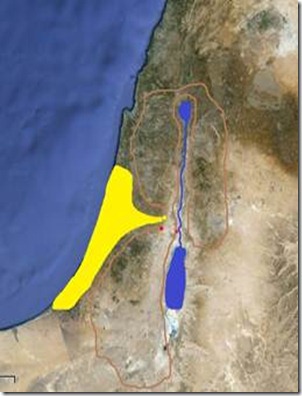
See the picture at left. The brown line shows the territory occupied by Israelite tribes, and the yellow area is the Philistines (this is a rough approximation, just to give you an idea of the danger they were in). Michmash is the yellow dot. The red dot next to the river is Gilgal, and the red dot closer to the Philistines is Gibeah.

Israel was just a few miles and one lost battle away from a huge national catastrophe.

It is interesting to note that Saul had originally held the position at Michmash, but retreated from the Philistines down into the Jordan valley. He gathered his army at Gilgal, a town in the Jordan river valley not far from the Philistines as the crow flies, but a very rough hike up or down the mountains by foot. The text doesn’t explain things clearly but apparently Samuel had sent a message to Saul, telling him to wait until he came, and then they would seek the Lord and worship him together before commencing the battle. In other words, they wanted God’s favor and help when they went out to fight. Samuel wanted Saul to rely on the Lord in this dire situation.

Now it is quite likely that Samuel’s home town was affected by this invasion – we do know that the Philistine forces came quite close to it. The position of the Philistines might have also forced Samuel to travel a considerable distance out of his way to get to Saul – remember, they had almost cut the nation in half. In any case, days passed, and Samuel did not show up. Saul’s army got restless and afraid. No doubt, many men were thinking of their families, wanting to prepare them for the disaster, or wondering if their homes had already been overrun by the enemy.

They were waiting to seek the Lord with Samuel the Prophet before they made a move. However, Samuel wasn’t there. Nothing was happening and the soldiers were worried about their families, and so they began to desert Saul and the army. So Saul took action. He decided to go ahead and lead the worship and offer the sacrifices himself. He made the burnt offering. This was an animal that was killed and completely burned up. No part of it was eaten – it was all “given” to the Lord through fire. It was used to seek God’s favor, to bring God’s forgiveness or to avert judgment. Just when Saul finished, Samuel finally made it to the camp.

Now, here is what troubles me. I think many Americans, if they didn’t read any further, would approve of what Saul did. People might say, “he’s a go-getter, a self-motivated leader.” They might think, “There’s a real leader – he’s losing men so he takes bold decisive action, he makes something happen.”

But Samuel didn’t see it that way, and apparently, neither did God.

13 And Samuel said to Saul, “You have done foolishly. You have not kept the command of the LORD your God, with which he commanded you. For then the LORD would have established your kingdom over Israel forever. 14 But now your kingdom shall not continue. The LORD has sought out a man after his own heart, and the LORD has commanded him to be prince over his people, because you have not kept what the LORD commanded you.” 15 And Samuel arose and went up from Gilgal.  (1Sam 13:13-15, ESV)

The prophet immediately identified that the problem was Saul’s heart. It wasn’t fixed on God. We can now see clearly that Saul was insecure. He was worried about the future of Israel, of course. He was worried about his own ability to keep the men with him and maintain an effective fighting force. He did not trust the Lord with these concerns. Instead, he trusted in his own action. He trusted in the offering ceremony, but not God himself. Clearly, Saul viewed the offerings as a tool. It was a way to keep his army together and energized; perhaps also a way to manipulate God into helping him. Saul did not offer the sacrifices to please the Lord, or because he was personally repentant or worshipful. If either of those had been the case, he would have waited for Samuel, who was the one who was supposed to do such things. Saul was not a priest, nor a prophet and was not supposed to lead that kind of worship. This is bad religion. He went through the motions of a religious ceremony, but it wasn’t about God at all. He was using religion for his own ends – to keep the men from deserting.

And of course, the fact that Saul couldn’t wait showed that he wasn’t willing to trust the Lord when he didn’t understand what was happening, or when the Lord wasn’t moving as fast as he wanted.

Now, there’s no doubt that Saul was in a tight spot. But the tense situation did not create the problem in his heart. It only revealed it. When you squeeze an orange, what comes out? Whatever is inside the orange of course, which is orange juice. When you are squeezed, what comes out? Whatever is inside you, of course. If you curse and rage when you are in a tough spot, that is because cursing and rage are inside you. Jesus said:

20“What comes out of a person — that defiles him. 21 For from within, out of people’s hearts, come evil thoughts, sexual immoralities, thefts, murders, 22 adulteries, greed, evil actions, deceit, promiscuity, stinginess, blasphemy, pride, and foolishness. 23 All these evil things come from within and defile a person.” (Mark 7:7-23)
45 The good person out of the good treasure of his heart produces good, and the evil person out of his evil treasure produces evil, for out of the abundance of the heart his mouth speaks. (Luke 6:45)

When Saul was squeezed by his circumstances, he did not put his faith steadfastly in the Lord. He refused to wait on God or on other people. His situation was not easy. But it didn’t cause his heart-problem – it just revealed it. He let his insecurity rule him, and he chose to act, rather than depend on the Lord.  When Saul was squeezed, it was fear that came out, and a need to be in control. He put his trust in the number of men he had, rather than the Lord. It was more important to him to keep as many men as possible than it was to seek God and his favor.

Saul failed in this incident, and revealed what was truly in his heart. However, the Lord did not give up on him, and with the Lord’s help, Saul did many more good things, as we will see. In fact we will see God continually trying to reach Saul throughout his life. Samuel’s words were supposed to be a kind of prophetic warning. If we read carefully, we see that God wasn’t even saying Saul shouldn’t be the king. It was something like this: “Unless your heart changes, your dynasty won’t continue. The Lord will find someone whose heart is tender toward God. If yours doesn’t change it will have to be someone else.” We should understand that God was not taking away the kingship of Saul, but saying instead that because of Saul’s sin, he could not be the founder of a dynasty. The kingship would pass to a different family.

This is all about trusting God when things don’t look good – maybe things look disastrous. If you get squeezed, what do you think will come out? What is in the treasure-store of your heart?

What if it isn’t good? What if, like Saul, you have insecurity hiding there? What if there is rage or hatred or jealousy or selfishness, or other ugly things? I think Saul had the opportunity to repent. Again, I think Samuel’s words were more of a prophetic warning than an absolute statement of judgment. However, even if we take it as a settled judgment, the punishment is not that Saul himself could not return to the Lord, or even that he himself could no longer be king. It was that none of his sons would be king after him. This means that there was still hope for Saul, and there is still hope for all of us.

When he was tempted, Saul could have turned to the Lord, confessed his weakness, and put his trust in the Lord. I think that is what we need to do when we are squeezed, and we see there is a problem in our hearts.

14 For the love of Christ controls us, because we have concluded this: that one has died for all, therefore all have died; 15 and he died for all, that those who live might no longer live for themselves but for him who for their sake died and was raised.

16 From now on, therefore, we regard no one according to the flesh. Even though we once regarded Christ according to the flesh, we regard him thus no longer. 17 Therefore, if anyone is in Christ, he is a new creation. The old has passed away; behold, the new has come. 18 All this is from God, who through Christ reconciled us to himself and gave us the ministry of reconciliation; 19 that is, in Christ God was reconciling the world to himself, not counting their trespasses against them, and entrusting to us the message of reconciliation. 20 Therefore, we are ambassadors for Christ, God making his appeal through us. We implore you on behalf of Christ, be reconciled to God. 21 For our sake he made him to be sin who knew no sin, so that in him we might become the righteousness of God. (2 Corinthians 5:14-21, ESV)

We should be sad when we discover bad things in our heart, but that is not the final word. We need to remember that through Jesus, our heart problem has been solved. Our old self, with all its insecurities, jealousies and lusts, has been killed with Jesus on the cross. Through Jesus, our spirit has already been renewed, and we wait with passionate hope for the day when that renewal is completed in our soul and body.

There might also be an application here for you if you are faced with a difficult situation. Perhaps you feel a lot of pressure just to act, to do something, to make something happen. Sometimes the Lord does lead us to do that. We’ll see that with Jonathan next time. But if the Lord is calling you to wait, or if your action would be from fear or insecurity, maybe you need to sit still and wait for God to show up.

Take a moment to let the Lord speak to you now.

1 SAMUEL #9. UNFAILING GRACE

Photo by Ali Arapou011flu on Pexels.com

The things that God did for his people in the past are supposed to be considered part of his faithfulness to us in the present. What God did for previous generations, he also did for us. God’s goodness to others is part of his goodness to us, because we belong to his people. His faithfulness does not end when we make mistakes. He walks with us even when we choose the wrong path, and redeems us in our mistakes, if we will let him.

To listen to the sermon, click the play button:

For some people, the player above may not work. If that happens to you, use the link below to either download, or open a player in a new page to listen.

To download, right click on the link (or do whatever you do on a Mac) and save it to your computer: Download 1 Samuel Part 9

1 Samuel # 9. God’s faithfulness to us at all times. 1 Samuel 12:1-25

Think for a moment about some decision you made, or action you took that you now know was a mistake. What would you change today, if you could? How would your life be different?

We all know that you can’t go back and unsay those cruel words, or un-make that decision that led you to where you are today. I’m not going to pretend that I’ve found a way to do that. But I do think that through 1 Samuel chapter 12, God is offering grace even after we have stepped out on the wrong road. It isn’t grace to go back. It is grace to go on.

In first Samuel chapter 8, the people asked God, through Samuel, to give them a king. This was a rejection of God’s plan for them as a nation. It was a choice to exchange the freedom and protection they could have had in following the Lord for the false-security of a king who would take care of them, but also rule over them. Samuel, in his wisdom, knew it was a mistake. He talked to God about it, who affirmed Samuel’s instinct that it was a mistake. But the people were determined.

Not only did they want a king, they wanted a certain kind of king. Their requirements were also a mistake. But the people were determined. The Lord allowed them to choose their own way. They did, and their choice was a major mistake. Even so, God let them go ahead with it, and helped them to find a king. The man who met their specifications was Saul, a big impressive looking fellow who was also insecure and spiritually insensitive and ignorant.

Even so, the Lord began to use Saul right away. In choosing him, the Lord removed an old shame from many thousands of people, and set up Israel with a magnificent big champion to match a Philistine giant whom no one yet knew about.

God chose Saul through the prophet Samuel. First Samuel anointed Saul in private. Later he was chosen by God in a public assembly of the leaders of Israel. Even so, nothing really happened. After the events we looked at last time – after a great military victory – the people finally made Saul an honest king.

15 So all the people went to Gilgal, and there in the LORD’s presence they made Saul king. There they sacrificed fellowship offerings in the LORD’s presence, and Saul and all the men of Israel greatly rejoiced. 1 Sam 11:15 (HCSB)

So you see, even their approach to the king was not one of faith in the Lord and his choice. They waited until Saul gave them something of what they were looking for – military victory – before they fully accepted God’s help in choosing the king.

After it was finally all official, Samuel stood before the people and made a speech. That speech is the text of 1 Samuel chapter 12.

In the first place (12:1-5), Samuel wanted to make sure his conscience was clear. He also wanted to draw a contrast between his own actions, and the rights of a king. Samuel has never taken anything that wasn’t his. Yet he had warned the people in 8:10-18 that the King would have the right to take many things from the people in taxes to run his household and the kingdom. The people affirmed that Samuel had been a good and fair leader. There is an unspoken implication to this part of Samuel’s speech “So – in me, God gave you a good and fair leader who listened to him and did right. But you wanted a king!”

Next, Samuel reminded them of God’s faithfulness. The Lord led them out of Egypt as a great nation – but without a king. They had Moses, a prophet, and Aaron, a priest, but no king. And the Lord cared for them and provided for them. Although Samuel doesn’t mention this explicitly, the troubles the people had in the wilderness during the exodus were not due to lack of a king, but rather to disobedience to the Lord.

During the time of the Judges, the people had troubles again. But Samuel points out two things. First, the trouble was their own doing, not because they lacked a king. It came because they quit following the Lord. Second, when they repented and cried out for God’s help, he was gracious and delivered them.

11 So the LORD sent Jerubbaal, Barak, Jephthah, and Samuel. He rescued you from the power of the enemies around you, and you lived securely.

There is something else about part of Samuel’s speech that is striking: most of the incidents he described of God’s goodness to the people happened to previous generations of Israelites, not to the people with whom he was speaking. However, he speaks as if God had done all this for the present generation. This is something important that Moses taught the people of Israel long before. Every generation of Israelites was called to remember the great acts of God in the past, and to live like God had done those things for themselves, in this present generation. The people of God are heirs to all that God has done in the past. God’s work in the past should be considered a sign of his faithfulness in the present.

We live in a highly individualized society, and on top of that, our culture is obsessed with the future, and new things. But there are other ways to live, other ways to view the world. God’s people in ancient times were much more communal, and much more in touch with the past. If God did something for past generations, it was counted very much as if he had done it for the present generation. If God did something for me, he did it for his people. If he did it for his people he did it for me.

I think we should learn from this way of looking at the world. I find that I easily forget the things God has done in the past even in my own life. I hardly even consider things he has done for others, or what he did for previous generations of his people. But if we start to see ourselves as part of the intergenerational community of God’s people, then his faithfulness to us becomes overwhelmingly apparent. Twenty years ago God healed my friend Adam from a broken back. The healing was documented by before and after x-rays. A few years ago, he healed my friend Doug from twisted intestines – again documented before and after by CT scan. But those healings weren’t just for Adam and Doug – they were for me, for all of us in the community of faith. And they weren’t just for those moments in the past – they were for us now, and for future generations. I could easily name a dozen other amazing things God has done for me, and for people I know. And then add in God’s graciousness to Christians I don’t even know, and then to his people of previous generations, and suddenly, God’s grace and faithfulness become overwhelming. I think it would be very helpful if we began to consider God’s faithfulness to his people as a whole, including his faithfulness to previous generations. The writer of Hebrews encourages us to do exactly that. After writing about God’s mighty acts for his people in the past, he says this:

1 Therefore, since we also have such a large cloud of witnesses surrounding us, let us lay aside every weight and the sin that so easily ensnares us. Let us run with endurance the race that lies before us, 2 keeping our eyes on Jesus, the source and perfecter of our faith, who for the joy that lay before Him endured a cross and despised the shame and has sat down at the right hand of God’s throne. (Hebrews 12:1-2, HCSB)

There is a great cloud of witnesses to God’s faithfulness to his people. We belong to God’s people. His goodness to them is also his goodness to us. Everything God did in the past, he did for us, the people of God.

4 For whatever was written in the past was written for our instruction, so that we may have hope through endurance and through the encouragement from the Scriptures. (Romans 15:4, HCSB)

Let that sink in, and let it lead us to lay aside all heaviness and sin, and run our race with perseverance, knowing that we too, are a part of that group of witnesses.

Back to Samuel’s speech. The overall point Samuel is making is that when they followed the Lord faithfully, he delivered his people, protected them, and they lived in peace and security. All this took place without a human king. The Lord was their king. Samuel is saying – look, when you were faithful to God, the old way worked just fine. God did so much for you. Even so, you are ignoring everything he did for you. You are claiming it just isn’t working out, when the reason it isn’t working out is your own stubbornness, your own turning away from God.

After the people heard this, they recognized that Samuel was right. They felt bad about what they had done, and they were afraid. I would bet that no one reading this – even you folks who live outside the United States – has asked God to give you a king. But have you asked him for something that was a mistake? Have you ever determined to go ahead your own way, and later realized it was a mistake – maybe even a huge error of judgment?

1 Samuel 12 gives a picture of how God deals with us in those kinds of situations. I always want to go back and do it over, only correctly this time. I want to have my mistakes undone. But God doesn’t work that way.

Sometimes, I enjoy playing computer games. One of the great things about computer games, is that you can mess up, you can even die – and it doesn’t matter. You just start the game over from the last point at which you saved it. I have often thought – and maybe you have too – wouldn’t it be cool if life was like a computer game? If you blow it, you just get a “do-over.” If you make a bad choice, you go back to that point and make a right choice now.

But there is something else about computer games. They are fun, but they are also meaningless. I don’t mean that it is evil or wrong to play them. But the choices you make within a computer game are meaningless. Death in a computer game is meaningless in real life. Life in a computer game is meaningless. We need to understand something here: choices without consequences have no meaning.

There is a famous old story about an ordinary young man who falls in love with a princess, and she loves him back. The father of the princess, the king, is not pleased. He decrees that the young man be placed in front of two doors, with a choice to open one or the other. Behind one of the doors is a beautiful maiden, however, not his beloved princess. If he chooses her door, he will be married to her immediately and they will be exiled to another kingdom. Behind the other door is an angry, hungry tiger which will surely kill him. He doesn’t know which door holds the lady and which holds the tiger. However, the princess, the young man’s lover, knows the secret of the doors. If she tells him to open the tiger-door, he will be killed in agony. But if she tells him to open the lady-door, he will be married to the beautiful maiden behind that one, and the princess who loves him will be left alone. She signals him secretly to open one of the doors. Here’s the question: which door did she tell him to open?

 This story has endured for over a hundred years, in part because there is an agony in knowing that the choices matter. However, as a thought experiment, change the story a little. Suppose that no matter which door he chose, the tiger would be there. Or, no matter which door he chose, he would get the princess herself and they would live happily ever after. The story is no longer compelling if the choices do not result in some consequence.

Imagine I held in one hand a bag containing a candy bar, and in the other hand, a bag containing a piece of scrap wood that was good for nothing. If you think you might have a shot at the candy bar, it would be fun to try and make the right choice. If you knew that no matter what you chose, I would give you the wood, you wouldn’t bother even playing. If you knew that no matter what you did, I would give you the candy bar, you might be happy about the candy, but you would probably think going through the motion of choosing is pretty pointless and stupid – in fact, meaningless.

So we see that with the Israelites, the Lord gave them their free and meaningful choice. If He undid their choice, it would mean their choices would have no consequences, and therefore no meaning, and therefore they would not actually have free choice. The same is true of our choices. So the Lord doesn’t undo them.

What the Lord did do for the Israelites was promise to walk with them through the consequences they brought on themselves. He works even with their wrong choices, and accomplishes his purposes in spite of them. So, Samuel encourages them to walk with the Lord NOW.

20 Samuel replied, “Don’t be afraid. Even though you have committed all this evil, don’t turn away from following the LORD. Instead, worship the LORD with all your heart. 21 Don’t turn away to follow worthless things that can’t profit or deliver you; they are worthless. 22 The LORD will not abandon His people, because of His great name and because He has determined to make you His own people.

23 “As for me, I vow that I will not sin against the LORD by ceasing to pray for you. I will teach you the good and right way. 24 Above all, fear the LORD and worship Him faithfully with all your heart; consider the great things He has done for you. 25 However, if you continue to do what is evil, both you and your king will be swept away.” (1 Samuel 12:20-25)

It was not God’s plan for Israel to be led by a king. Once they made that choice they had some difficult consequences to follow, as we will see. But even so, God worked through that mistake. In fact he worked through it in a mighty and amazing way. Eventually he used the monarchy of mistake as a way to bring his salvation to the entire world; Jesus, in his human ancestry, was descended from the kings of Israel.

Maybe it was a mistake for you to take the job you have right now. Perhaps the Lord was calling you to something else, but you just didn’t have the faith to take the risk. OK, so you messed up. But don’t turn away from following the Lord. He can do great things through this. Just be sure to let him.

Maybe you married the wrong person. People think this all the time. They think that somehow they missed out on their real soul mate, and now their entire marriage was a mistake. Fine, what if it was? God can and will work through this marriage, if you let him. Even now, don’t turn away from following the Lord. Don’t follow worthless things. God will redeem your mistake and make it beautiful, if you allow him to.

I’m not only talking about honest mistakes, either. The people of Israel knew that God didn’t want them to have a human king. They did it anyway. In the same way, sometimes we deliberately make a sinful choice. God can redeem even those choices; maybe especially those choices.

God is so good. He wants our lives to have meaning, so he allows our choices to be free and real. And yet, even when we make the wrong choice, if we turn back to him, he can work through any circumstance we might create for ourselves, and make good come out of it.

Once again I’m reminded of Romans 8:28:

28 We know that all things work together for the good of those who love God: those who are called according to His purpose. (Romans 8:28, HCSB)

1 SAMUEL #7. THE PEOPLE’S CHOICE AWARD

Photo by Pixabay on Pexels.com

Saul was a tall, impressive, handsome man. The people wanted a king that would make them look good to other nations, and that made Saul the best choice, given their own parameters, which God honored, though it limited the options. Even at this early stage, there were some warning signs about Saul’s character. Yet, when the Lord chose Saul, he used that choice to end the shame of the small tribe of Benjamin, and he began to give Saul opportunities to respond to Him in faith.

To listen to the sermon, click the play button:

For some people, the player above may not work. If that happens to you, use the link below to either download, or open a player in a new page to listen.

To download, right click on the link (or do whatever you do on a Mac) and save it to your computer: Download 1 Samuel Part 7

1 SAMUEL #7. 1 SAMUEL 9-10. THE CALLING OF SAUL

There is an age-old story line, repeated in all the great books and movies. Boy meets donkeys. Boy loses donkeys, and goes looking for them. Boy forgets donkeys when he meets the prophet who anoints him as the first king of his country. Boy briefly joins a group of different prophets, then goes back home, because the donkeys, having more common sense, are already home as well. You know what I’m talking about, right?

OK, so it isn’t a normal or well-known tale. But I love it, in part because it seems almost random. Yet in that randomness, we can see God at work. That gives me comfort when events in my own life seem both ordinary and random.

In chapter 8, The elders of Israel gathered and asked God to give them a king. Through Samuel, God warned them against it, but they persisted in asking for it anyway, so the Lord agreed to give them a king. Then everyone went home.

The narrative suddenly switches, and 1 Samuel chapter 9 tells us about a young man who went out with his servant to look for some lost donkeys. The young man was named Saul. He was not at the meeting where the people asked for the king. He was not seeking the Lord, or going on a pilgrimage to a place of worship. He was just doing his job, which at that moment, was to find his dad’s lost donkeys.

After a few days of wandering in the hills, Saul and his servant decided to give up. As they turned back, they were near Samuel’s hometown. Saul’s servant knew this, and suggested that they ask Samuel to ask God where the donkeys are. Saul wasn’t sure about it, because they had nothing to give Samuel, but the servant had some money. Saul then said, basically, “OK, if you think it will help us find the donkeys.” In other words, he had no desire to see a prophet in order to get closer to God, or to learn God’s will for his life. He just wanted God’s help with his own problems.

We learned at the end of chapter seven that Samuel used to travel around to various places in Israel and lead worship and judge disputes and share God’s words with the people. Even though Samuel did not live very far from Saul (compared to other areas of Israel) the two had never met. This implies that Saul had not, up to that point, been particularly interested in God. He clearly had never sought guidance from the Lord through Samuel for any other purpose, and he obviously had never taken a sacrifice to worship with Samuel when he was in Saul’s area. Even in our text for today, he seeks Samuel not because he wants to know God, but because he’s lost his donkeys. His focus is not on the will of God or on relationship with God, but rather what Samuel can do for him.

So by this point, we can already see some things about Saul. The first few verses tell us that he was an unusually tall and large man – the tallest man in all twelve tribes. It also says he was handsome. But other than that, there is nothing out of the ordinary about him. We can see from the incident with the donkeys that he isn’t particularly persistent. He isn’t especially patient, or spiritually sensitive. He’s just an ordinary person, except that he is very tall, and impressive to look at. He had no clue what was coming.

Samuel, as always, had been talking to God and listening. Samuel is one of my favorite heroes of the faith. The people wanted a king. God told Samuel he would grant their request. So Samuel went back to work, and waited for God. He didn’t immediately go out and try to find a king for them. He talked to God and listened, and then, some time later, God told him when to anoint the first king. So when Saul showed up in town, Samuel was ready. He recognized him as the person God had chosen to be the answer to the request of the people of Israel. God had previously told Samuel to expect someone like Saul, and so Samuel made him a guest of honor at the feast he was going to.

After the feast, Saul stayed overnight with Samuel. They spoke for a long time. Later, in private, Samuel poured oil on Saul’s head which was a symbolic gesture showing that Saul was now chosen by God. The significance of oil was that it represented the Spirit of God. The idea was, that along with the oil, the Holy Spirit was poured out onto Saul, and he was to be God’s chosen instrument from now on. The pouring of oil on the head, and the pouring out of God’s Spirit are both sometimes called “anointing.”

This anointing shows us one of the big spiritual differences between the time before Jesus, and the time since his resurrection. In the Old Testament it appears that God generally filled only one or two people with His Holy Spirit in each generation. It was as if he had just a few chosen instruments for each period. But the prophet Joel predicted a great change that would arrive after the coming of Jesus Christ, the Messiah:

 28 ​​​​​​​After all of this ​​​​​​I will pour out my Spirit on all kinds of people. ​​​​​​Your sons and daughters will prophesy. ​​​​​​Your elderly will have revelatory dreams; ​​​​​​your young men will see prophetic visions. 29 ​​​​​​​Even on male and female servants ​​​​​​I will pour out my Spirit in those days. (Joel 2:28-29, NET)

That’s a promise that things were going to change. No longer would God limit his spirit to one or two people in each generation. Instead, all people who trusted the Messiah (Jesus) would have God’s Spirit in them.

In Acts 2:17, on the day of Pentecost, the Lord gave his Holy Spirit to all 120 followers of Jesus. Peter quotes this prophecy from Joel and affirms that it was fulfilled from that day on. And so, from that day on, God’s chosen instruments to work in this world are every single person who trusts in Jesus. It is no longer one or two people in a generation – it is all of God’s people. We are all given the anointing of the Holy Spirit to do God’s work here and now.

But in the time of Saul, this was still many centuries into the future. And so when Samuel anointed Saul, it was something very significant and very special. We can see this anointing at work almost immediately. Samuel predicts that the Spirit of God will fall on Saul, and change him:

The Spirit of the LORD will control you, you will prophesy with them, and you will be transformed into a different person. (1 Sam 10:6)

When Saul turned around to leave Samuel, God changed his heart, and all the signs came about that day.(1 Sam 10:9).

So the anointing was the outward sign of what was to take place spiritually with Saul. However, it was done in private, because Samuel wanted to make sure that Saul really was God’s choice. So he did this privately, and then also arranged a public ceremony (more on that later) where they asked God who should be king, and through the casting of lots, God again chose Saul.

Now, I want us to pause for a moment, and ask “Why Saul?” Saul himself asks basically the same thing in verse 21. Again, the only thing remarkable at all about him was that he was tall and handsome, and those had nothing to do with this character. I think God choosing Saul is all about God’s grace.

First, Saul was from the tribe of Benjamin. The patriarch Benjamin (son of Jacob) was the youngest of the twelve brothers who founded the twelve tribes. In those days, elders were honored above those who were born later. Even though we are talking about many centuries later, still, the tribe of Benjamin was descended from the youngest brother, which was not a place of honor.

Next, about two hundred years before the events we are looking at right now, one of the towns belonging to the tribe of Benjamin perpetuated a terrible atrocity. The story is in Judges 19-21. The other tribes demanded justice from the evil town, but the whole tribe of Benjamin made a terrible choice, and rose up to defend the evildoers. The result was war between Benjamin and the other eleven tribes, and the tribe of Benjamin was almost wiped out – everyone was killed except for six-hundred men who fled to the hills. The other Israelites eventually forgave them, and wives were found from the other tribes for those six hundred Benjamites. This is why, two hundred years later, Benjamin was still the smallest tribe in Israel. Even in the time of Samuel and Saul, the tribe of Benjamin was probably still under a cloud of shame for their history of fighting a war to defend something that was truly wicked and sinful.

The Lord had twelve tribes from which to choose a king. But he chose the tribe of the last-born patriarch, the smallest tribe, and the one that was still under the cloud of a shameful history, to bring forth the first king of Israel. It is as if he is saying, “Tribe of Benjamin, your shame is removed. Look – I am paying attention to you. You are as significant and important as any other part of my people.” It is sheer grace.

There is another reason God might have chosen Saul himself. In the very near future, the Philistines were going to challenge Israel with a huge warrior – a giant of a man named Goliath. Israel’s new king – Saul – was also a very large man. Saul was not as tall as Goliath (who was probably nine feet tall) but many commentators speculate that while the average height of a man was maybe five foot three, Saul must have been well over six feet. Regardless of what the actual heights were, the Bible is clear that everyone else only came up to Saul’s shoulders in height; which is to say he was almost a foot taller than the next tallest man. Israel wanted a king who would lead them in battle. They wanted someone who would bring them respect among the other nations. Saul is big and strong and impressive. He is exactly what the people of Israel asked for.

Once Samuel heard from the Lord, he gathered the people of Israel. They chose the king not by election, but by a process that was like rolling a special kind of “dice” that had been blessed by God. The “dice” might have been the Urim and Thummin – special stones first mentioned in Exodus 28:30. This process was called “casting lots.” They would pray, ask God a question, and then cast the lots, trusting that God would determine the result. So they went through, asking about each tribe until Benjamin was chosen by the casting of the lots. Then Saul’s father’s family was chosen, and then Saul himself. So the choice that Samuel privately felt God had made was now confirmed in this public process. But when he was chosen, Saul hid himself among the baggage.

At first this makes it seem like Saul is charmingly humble. However, in light of what we will see in Saul’s life later on, maybe it wasn’t actually humility. Maybe it was reluctance to let himself belong so fully to God, reluctance to give up his own agenda in order to be God’s instrument in this world. We know that Saul was not spiritually sensitive, or even interested in God to begin with. God gave him his anointing, but we don’t see Saul really embracing it. We don’t really know much about how Saul received these things. It looks like it was mostly external for him.

Think of the contrast between Saul and Samuel. When Samuel was called, he invited God to speak to him. He said “speak for your servant is listening.” he spent his life listening to the Lord, and not shrinking back from what God said, waiting when God said “wait” and acting when God said “act,” speaking when God said, “speak.” He was willing to let God be God even when he didn’t understand why God would, for instance, let the people have a king.

Saul, on the other hand, didn’t look for God. He looked for donkeys. He didn’t look for the responsibility of leadership, and God practically had to force it on him. There is no record of him saying to the Lord, “I am your servant, use me as you please.” These things in Saul’s character are warning signs. They are seeds of destruction that, if not rooted out and given to the Lord, will end up causing big problems later on.

It wasn’t that God was trying to mess with the Israelites because they had rejected Him as king. But he was trying to allow them their free will, and answer their prayers. They had certain parameters. They wanted a king to give them respect among the nations. They wanted him to be a fine figure, impressive, a war leader. They didn’t want a prophet – they had rejected the idea of someone who listened to God and then encouraged them to do God’s will.

Before the lots were cast, Samuel warned the people again about the folly of choosing a king. But they went ahead with it anyway. So the Lord gave them the best possible king he could, given their demands and choices. But those demands and choices meant that their king would have other deficiencies. We can see those deficiencies already.

Sometimes God is more gracious to us and gives us greater blessing when he does not answer our prayers the way we want him to. But the Israelites insisted, and he allowed them to make their own choices.

We can see that this might all end badly, even so, this incident in Saul’s life shows us a little bit of how gracious and caring God is. Saul was not looking for God, he was looking for donkeys. And yet God was still reaching out to Saul. Saul had no thought of becoming a king, but God gave him a kingdom. He was not special in any way, except perhaps physically, and of course, his physical characteristics were something given to him genetically, not earned. Ultimately, his physical appearance came from God as well. Yet, in spite of the fact that Saul did nothing to deserve it, God chose him. This is grace, all the more amazing because it is totally unexpected, and totally undeserved.

So where does this leave us? Are you making demands of God? Perhaps God will give you what you ask for, but maybe you should consider letting him have his way instead. He is gracious sometimes to give us our free choices, but His will is always best. Sometimes there is more grace in a prayer that is not answered the way we want it to be.

Maybe the Lord is making it clear to you that he wants you to be his instrument in this world, but you, like Saul, are reluctant. God did use Saul, but Saul would have been much better off if he had willingly given up his own will and desires. Maybe like Saul, you’ve been coasting along, doing your thing, and God has gone out of his way to get your attention. Don’t be like Saul, who remained insensitive to the Lord even afterward. This is grace, and I encourage you to respond in faith and surrender, and re-orient your life and priorities around listening to God and letting Him live his life through you.

I myself was like Saul in that way for about three years. In college, I became convinced I was called to ministry. I finished college, and then spent almost five years in graduate school, and jumping through hoops in order to become a pastor. But then, after I had been a pastor for a few years, I decided I didn’t have to do that anymore, and I walked away from ministry. It didn’t go particularly well for me. After many hard lessons, the Lord brought me around to his way of thinking, and I went back into ministry. I learned that accepting the Lord’s call is always best.

Perhaps you feel like the tribe of Benjamin. You feel insignificant. Maybe there is a cloud of shame or disgrace in your past. Think of God’s grace to this tribe. That grace is for us as well:

26 Remember, dear brothers and sisters, that few of you were wise in the world’s eyes or powerful or wealthy when God called you. 27 Instead, God chose things the world considers foolish in order to shame those who think they are wise. And he chose things that are powerless to shame those who are powerful. 28 God chose things despised by the world, things counted as nothing at all, and used them to bring to nothing what the world considers important. (1 Corinthians 1:26-28, NLT)

Listen! God has chosen you. He chooses the foolish to shame the wise, the lowly to shame the great, the small to teach the grand. Your shame is removed and God wants you.

Let the Holy Spirit speak to you now.

1 SAMUEL #5. THE POEPLE WHO REPENTED

Photo by Luis Quintero on Pexels.com

The ancient Israelites faced tremendous cultural pressure to worship false gods. But even when they finally resolved to follow the Lord with all of their hearts, things did not go well for them at first. This passage reminds us of God’s holiness. It reminds us that we need Jesus. It shows us the parallels between the ancient Israelites, and us today. It shows us that it is good and helpful to deliberately reminisce about times past when we had powerful experiences with God.

To listen to the sermon, click the play button:

For some people, the player above may not work. If that happens to you, use the link below to either download, or open a player in a new page to listen.

To download, right click on the link (or do whatever you do on a Mac) and save it to your computer: Download 1 Samuel Part 5

First Samuel #5. 1 Samuel 6:13-7:17. Repentance.

We left off last time where the Philistines put the Ark of the Covenant into a cart, and hooked it up to two cows who had been separated from their calves. Rather than return home to their calves, the cows pulled the cart into Israelite territory. They stopped near the town of Beth-shemesh, which was a town given to the tribe of Levi. The tribe of Levi (Levites) were the priests for the people of Israel.

13 The people of Beth-shemesh were harvesting wheat in the valley, and when they looked up and saw the ark, they were overjoyed to see it. 14 The cart came to the field of Joshua of Beth-shemesh and stopped there near a large rock. The people of the city chopped up the cart and offered the cows as a burnt offering to the LORD. 15 The Levites removed the ark of the LORD, along with the box containing the gold objects, and placed them on the large rock. That day the men of Beth-shemesh offered burnt offerings and made sacrifices to the LORD. (1 Samuel 6:13-15, HCSB)

The Ark had come home, so to speak. Remember, the Lord had refused to let the Israelites manipulate him through the Ark; he had erased their idea that it was a kind of lucky rabbit’s foot. Next, he used the Ark to show the Philistines that he was more real and powerful than the idols and demons they worshiped. And now, he brought it back to Israel. Even so, the Lord does not seem to be finished with the lesson. This perplexing incident is recorded:

And he struck some of the men of Beth-shemesh, because they looked upon the ark of the LORD. He struck seventy men of them, and the people mourned because the LORD had struck the people with a great blow. Then the men of Beth-shemesh said, “Who is able to stand before the LORD, this holy God? And to whom shall he go up away from us?” So they sent messengers to the inhabitants of Kiriath-jearim, saying, “The Philistines have returned the ark of the LORD. Come down and take it up to you.” (1Sam 6:19-21, ESV)

The Old Testament has several stories like this. They can be confusing and perplexing. A few years ago I was reading through Leviticus for my daily devotions. I did this almost to dare God to speak to me through Leviticus, which is some pretty dry reading at the points when you can even understand it. I got nothing out of it for almost two weeks. Then I read a story from chapter ten. Two priests sacrificed “unauthorized incense” and God burned them up instantly. I said, “What’s up with that, Lord? That doesn’t sound like you. It doesn’t sound like my Father, my Comforter, my never failing Friend.” Then I read Leviticus 10:3

I will show my holiness among those who come to me. I will show my glory to all the people.

So also, the Israelites say when they are struck down for disrespecting the ark: “Who is able to stand before the Lord, this holy God?

When I was a teenager, my High School science teacher took a very small piece of pure sodium (which exists as a soft metal) and put it into a tub of water. It immediately began to hiss and steam, and then suddenly the sodium exploded into flames. Pure sodium cannot exist in water. It burns up and explodes in the presence of water, becoming a different chemical in the process.

Just for grins, below is a video of two guys dropping pure sodium into a toilet. It’s pretty dramatic, especially if you start at about 3:10 into the video.

All right, hope you enjoyed that. The video was kind of fun and whimsical, but it portrays a physical reality: two elements that simply cannot coexist. In the same way, though we often forget it, sin cannot exist in the presence of God. It burns up, explodes and is destroyed. It isn’t a matter of God not tolerating sin – the very nature of God destroys it. The problem however, is that we human beings are born in sinful flesh – from our very birth, we are corrupted by a nature that rebels against God. This means that there is no way for us to get close to God without being destroyed. Who is able to stand before the Lord, this holy God? Who indeed? Certainly, no one with sin in him or her. So in the time of the Old Testament, unless people took the extreme precautions laid out by God, they were destroyed if they even did something like touch the ark improperly, or offer unauthorized incense. In the case of our text today, it might be that some people actually looked inside the ark at the stone tablets, or possibly that they gloated over the fact that they were now in charge of it.

The difference between these incidents I read about in the Old Testament, and my own experience of relationship with God, is the work of Jesus. Jesus took all of our sin – past, present and future – into himself. When Jesus took that sin into himself,

“God made him who knew no sin, to be sin for us, so that we might become the righteousness of God,” (2 Corinthians 5:21).

Because Jesus was in nature God, and as a human was not himself sinful, the sin which God laid on him could be destroyed without destroying Jesus also.

So now, through Jesus, we are no longer in a situation where the presence of God destroys us. Now his holiness is not a problem that keeps us apart, because our sin has been removed. This is one reason why I say that if we are in Jesus, we don’t have a sinful nature anymore. If we did, the Holy Spirit could not live in us, and we would be destroyed by God’s presence. We continue to battle with the effects of a body corrupted by sin, but in Christ we have been given a spirit that is holy in God’s sight.

In any case, the point I’m making is this: the way the Old Testament describes God is not inconsistent with the way God is revealed by the New Testament. They are not two different Gods. In fact, we don’t really understand how much we need Jesus without passages like this in the Old Testament. Now, through faith in Jesus, we are reconciled to the holiness of God in a way that in those days, people were not. This passage, above all, reminds me of my deep need for Jesus.

The writer of 1 Samuel continues the narrative, twenty years later. An entire new generation grew up. Previously, under the leadership of Eli, Hopni and Phinehas, the people were disconnected from God, and they didn’t care. They were arrogant, sure of themselves, sure they could manipulate God through the ark. They blamed God in their defeat, and tried to force him to give them victory.

But after their defeat, and their difficult experiences with the ark, the new generation grew up in humility. By the way, this was Samuel’s generation. He was probably in the middle of it, age-wise, and he led them spiritually. This generation didn’t take anything for granted.

2 A long time passed after the ark came to stay at Kiriath Jearim. For 20 years the entire nation of Israel mournfully sought the LORD. (1 Samuel 7:2, GW)

Finally, for a sustained period of time, the Israelites were humbly seeking God. For once it appears that it wasn’t their circumstances that they were upset about. They truly repented. They actually wanted to be close to the Lord. Samuel told them that they needed to get rid of the idols in their lives, to stop seeking comfort and hope in anything that was not the Lord.

And Samuel said to all the house of Israel, “If you are returning to the LORD with all your heart, then put away the foreign gods and the Ashtaroth from among you and direct your heart to the LORD and serve him only, and he will deliver you out of the hand of the Philistines.” So the people of Israel put away the Baals and the Ashtaroth, and they served the LORD only. (1 Sam 7:3-4)

The “Ashtaroth” means the idols made in the image of the goddess Ashtoreth, a Canaanite deity of war and fertility. Baal was the most important male god, and Ashtoreth the most important female one. Typically, every family had copies of idols to these gods. It may seem obvious to us that the Israelites should get rid of these false gods if they wanted to worship the Lord. But if we think that, we may not really understand the culture of that time.

We need to remember that in the first place, four-hundred years before, the Israelites had failed to do as God commanded, and displace the Canaanite peoples (like the Philistines) who lived in the Promised Land. As a result, for four hundred years the people of Israel had been influenced by the pagan cultures that lived around them. Though they often had small wars, just as often they traded with the pagan peoples, and sometimes, even though they weren’t supposed to, they married people from these pagan groups. In other words, there was a lot of peaceful interaction between the Israelites, and those who worshipped pagan gods. This interaction exerted a lot of cultural pressure on God’s people.

The Israelites were literally the only people in the entire world who were supposed to believe in only one God. The kind of cultural pressure they felt to at least believe that there were other gods is similar to the type of cultural pressure we might feel today if we believed the world is flat. Israelites would have felt inferior, not smarter, for believing in just one God.

“Of course there are other gods,” said the people around them. “Everyone knows that. It’s obvious. Yahweh might be the god of Israel, but he can’t be the only god. That’s ridiculous. You might as well say the sky is brown. You people are ignorant twits.”

Practically speaking, a lot of Israelites caved into this pressure. Many of them probably believed that Yahweh was indeed Israel’s special god, but that, obviously, other gods must exist. And the gods Baal and Ashtoreth had been in the land long before the Israelites and Yahweh came along. It made sense, even if you were going to worship Yahweh primarily, to make sure you didn’t get on the bad side of the local gods that were here before you and your god.

It made even more sense when you realized that if you worshipped other gods, you’d get to eat meat more often. People didn’t eat meat very often in every day life. But animal sacrifice and then feasting on the animal, were a regular part of many worship rituals. So, if you worshipped lots of gods, you got to eat meat more frequently.

Some pagan gods were also worshipped with fertility rituals. In these, women were encouraged to have sex with any man at the festival who wanted to, in order to get the god/goddess to bless the harvest. If you lusted after the spouse of one of your neighbors, you might get a chance to indulge your lust if you all worshipped these pagan gods. Even if your lust was more general, there were obvious reasons to participate in these rituals. It’s possible that some of the cultural pressure even came from pagan women inviting Israelite men to such ceremonies. And actually, these festivals were not exclusively heterosexual, either.

I hope you can see that actually, the Israelites faced the same types of cultural pressures that Biblical Christians face today. After about 500 CE, up until quite recently, a lot of the dominant cultures in the world believed in only one true God. But we’re back to ancient times again, now, in that respect. Christians are considered strange and backwards for believing that there is only one way to God, or even just one God. It’s hard to maintain our true beliefs when everyone around us thinks we are obviously wrong, and also thinks we are ignorant and bigoted for believing as we do.

We’re also back to a culture that thinks we are stupid for not indulging our every desire as fully as we want to. How silly is it to only have sex within marriage? There are plenty of temptations and opportunities to do otherwise. How silly is it not to indulge your every desire whenever you can?

Everyone around us is doing it. Everyone around us thinks we are stupid, and even dangerous for our beliefs. So, it shouldn’t be too hard to understand the ancient Israelites.

In Samuel’s generation, however, under his leadership, the people found courage. They listened to Samuel, and quit worshipping the false gods, and remained faithful to the one true God.

What happened next is something that I think surprises most of us in America these days. They turned to the Lord with their whole hearts and then things got worse. While they were gathered to worship God, the Philistines attacked. For some reason, preachers in America have been telling us for awhile now that if you just start following Jesus, everything will go well for you. Funny thing – Jesus never said that. Following Jesus, giving their whole lives to him, brought plenty of trouble to Peter, Paul, John James, Barnabas and many others. Following God brought trouble and hardship to Jeremiah, Ezekiel and yes, to Samuel’s generation.

It’s a bad idea to turn back to God in the hope that doing so will make your life go more smoothly. It just ain’t necessarily so. The great thing about Samuel and his generation was that they wanted to follow God because they believed he was the one true God. They dedicated their lives to him because it was good and right, and their hope was in God alone. If he gave them victory, that would be very good indeed. But they planned to follow him regardless. They turned their hearts to the Lord before Samuel told them that he would deliver them.

One of the reasons I get so angry at people who preach that following Jesus brings mainly prosperity and peace is that when trouble comes, those who believe that lie are undone spiritually and emotionally. A common reaction among those who believe this is that if they experience trouble, either they must have failed to follow God, or God is not truly real. They won’t allow for the idea that God might lead us directly into trouble sometimes.

The truth is, not only did Jesus promise persecution and trouble (Matt 6:10-11; John 16:33), but we also have spiritual enemies who will do whatever they can to make trouble for us – the devil and his demons (Eph 6:12; 1 Peter 5:8-10). The older I get, the more I think we should be surprised if we are truly seeking the Lord with all our hearts, and we experience no opposition at all. At the very least, we should be deeply grateful for those times. I’m not trying to make you depressed. I’m only suggesting that we take what Jesus said seriously:

 I have said these things to you, so that in me you may have peace. In the world you will have tribulation. But take heart; I have overcome the world.” (John 16:33, ESV)

So how did Samuel’s generation react when the Philistines attacked them? Naturally, they were afraid. No one with any sense at all wants to fight in a war. No one really wants suffering or tribulation. At the same time, they faced it with courage, and asked the Lord humbly for help. They didn’t assume he would deliver them, but they asked for it, in case he would. They didn’t try to manipulate him; they didn’t blame him. They just asked for his help, and they seemed ready to trust him and follow him whether or not he gave it at that particular time.

As it happened, the Lord helped them. The text says that he “thundered against the Philistines with a great and loud voice” (7:10). As I have pointed out before, these older manuscripts were often originally written on either papyrus, or animal skins. If you wanted to explain things in detail, you had to go out and kill another animal to make another manuscript. In the case of papyrus, though it was a paper-like substance, it was also time consuming and costly to make, and it wore out quickly. So you didn’t write down any more than you really had to. Therefore, the thunder is not explained, because the writer didn’t think it was as important as the main thing, which is that God did something to deliver his people. It may even be an expression that was common in those days, something almost like slang, that we don’t understand the full meaning for nowadays. In any case, it was clear that the Lord intervened, and protected his people on that occasion.

As the Philistines, fled, the Israelites chased them. Where the battle stopped, Samuel set up a stone, and called it “Ebenezer,” which means, “stone of help.” It was a way for the people to remember how God helped them that day.

Sometimes it may be helpful for people of faith these days to have our own “stones of help” – something that reminds us of specific times when God helped us. This sort of remembrance can be helpful when we face the pressures of a culture that mocks and denigrates us for worshipping the God of the Bible.

One way to set up an “Ebenezer” is to keep a journal, and record the times when God helped. For other folks, it might be a song that you listened to frequently during a time when God was especially present or helpful. I know of some Christians who collect rocks, and each rock reminds them of something the Lord has done. These days, photographs aren’t a bad way to remember what God has done for you, though you might want to create a special “Ebenezer” album to preserve photos that remind you of what God has done for you. The principle is to have a helpful, concrete way to remember times when God’s presence was obvious to you.

Take a minute to reflect on what the Lord is saying to you through 1 Samuel 6:13 through 7:15. Do you need to be reminded of your need for Jesus? Do you need to remember that in Jesus, your sin has been thoroughly removed and is no longer a barrier between you and the Lord? Is the Lord calling you to come back to him with your whole heart, like Samuel’s generation? Maybe you are really feeling the culture’s pressure to believe there are many ways to God, or many lifestyles that are equally acceptable for those who follow Jesus (in spite of what the Bible says about that). Maybe you need to be encouraged to stay strong.

Perhaps you need to be reminded that trouble is a normal part of life, even when you are walking with the Lord. Or perhaps today you need to set up an “Ebenezer” – a reminder of God’s presence and help in your life. Let him speak to you.

1 SAMUEL #4: THE GOD-IN-THE-BOX

Sometimes we confuse good spiritual things with God himself. We put our trust in things like baptism, or prayer, or “getting saved” rather than trusting in the Lord himself. We also, at times, make the mistake of thinking that God is on our side, rather than asking if we are on his side. Our text today shows us the pitfalls of that sort of thinking, and encourages us to find a better way.

To listen to the sermon, click the play button:

For some people, the player above may not work. If that happens to you, use the link below to either download, or open a player in a new page to listen.

To download, right click on the link (or do whatever you do on a Mac) and save it to your computer: Download 1 Samuel Part 4

1 SAMUEL #4. PLEASE READ 1 SAMUEL 4:1-6:21.

When I was a kid, I was a little bit scared of lightning. But somewhere I had heard that rubber or plastic could protect you from electricity. Now there is a kernel of truth in that. If the rubber is between you and the electric current, the electricity can’t even reach you. Or, if the rubber is between you and the ground, the electricity won’t pass through you, and it will cause no harm. In other words, it insulates you from electricity. But as a child, I didn’t have the complete picture. I thought that simply holding something made out of plastic or rubber would protect me from any form of electricity, no matter what direction it came from.

I had a toy tomahawk that was made out of rubber. It said so, right next to “made in Hong Kong” (which is where I got it). I believed without question that if I held this tomahawk, I was safe from electricity. In New Guinea it rained a lot, and puddles formed on the top of the ground very quickly. It wasn’t uncommon for a large area in a flat field to be covered by a foot of water or more, at least for a few hours. The ditches and low places would quickly fill up to three or four feet of water sometimes, creating instant, temporary swimming holes. The rain was warm, so my friends and I actually swam in the low places in the fields and ditches. At times the rain would be accompanied by lightning and thunder. In those circumstances, I took my tomahawk with me. I would frequently stand up to my knees in water in the middle of a thunderstorm, secure in the knowledge that I wouldn’t be hit by lightning because I was holding my toy rubber tomahawk.

Now, I had a piece of the truth here. It is true that rubber won’t conduct electricity. I was close to something real. But even though there was something true about rubber protecting me from electricity, I had twisted that truth into a practical application that was nothing more than superstition. It is only by God’s grace that I was never struck by lightning. The rubber tomahawk had nothing to do with it.

1 Samuel chapters 4-6 describe a series of events where the people of Israel were close to something real and true about God, and yet they twisted it into mere superstition. Unlike me, they paid a difficult price for it.

As we go through 1 Samuel I want to occasionally point out some important thoughts for bible study and reading. The Jews in Jesus’ time divided the Old Testament into two parts: The Law (which was the first five books of the Bible) and The Prophets (everything else). That means that even though 1 Samuel is basically a history book, it was considered by the Jews to be “prophetic” in the sense that the history recorded here teaches us many things about God. I myself might call it, “prophetic history.”

We need to read prophetic history with a different approach than we might read most of the New Testament. The truths about God are contained in the telling of historical narratives, rather than in a straightforward letter or in teachings given by Jesus. “Narrative” is another word for “true story.” So when we are looking at the New Testament, you may have noticed that we often spend a great deal of time on just a few verses. Now, as we study prophetic history, I think that generally we need to look at whole narratives, rather than merely the individual verses within those stories. I think when we read this part of the Bible, we will miss the main meanings unless we consider things in the context of the overall historical narrative that is being told.

This week, the narrative happens to span three chapters – four, five and six – of first Samuel. You may remember that as a very young boy Samuel started hearing God speak. One of the first things God told him was that Eli and his sons were going to be judged for being such bad leaders. This is how that happened, and more.

One of the problems that the people of Israel had at this point in history is that they had not obeyed God and driven out all the pagan people who lived in the land. As a result, they were surrounded by people who worshiped false gods and demons. When the Israelites made friends with these people, they were led away from God into the worship of these demonic pagan gods. When the Israelites “woke up” and remembered the Lord, they refused to worship with their pagan neighbors, and then those people became enemies of the Israelites, and made war on them.

One of these pagan people groups was called the Philistines. They lived in an area along the Mediterranean coast of Israel, where they had five main cities, with five main Chieftains for each one. They worshiped two main false gods: Dagon and Ashtaroth. During the time of Samuel and the history recorded here, the Philistines were the biggest threat to the people of Israel.

War broke out between the Philistines and Israelites, as it often did. The Israelites were defeated in battle. They asked an interesting question:

And when the troops came to the camp, the elders of Israel said, “Why has the LORD defeated us today before the Philistines?

(1 Samuel 4:3)

Another translation says, “why did the Lord let us be defeated today?” They blamed God for their defeat. They didn’t come back and say, “we stink as warriors,” or “the Philistines are really good.” They said, “it’s God’s fault.”

In a sense, I understand this. God could have given them the victory, but he did not. Since it was in his power, and he didn’t do it, they blamed him. But it isn’t exactly that God made them fail. He simply did not intervene to make them succeed.

They had forgotten something that happened centuries before, when the Israelites first came into the land. At that time, their leader Joshua experienced an interesting incident:

When Joshua was near Jericho, he looked up and saw a man standing in front of him with a drawn sword in His hand. Joshua approached Him and asked, “Are You for us or for our enemies? ”

“Neither,” He replied. “I have now come as commander of the LORD’s army.” Then Joshua bowed with his face to the ground in worship and asked Him, “What does my Lord want to say to His servant? ”

(Josh 5:13-14, HCSB)

You see the proper perspective is not “Is God on my side or not?” but rather, “Am I on God’s side or not?” In the battle with the Philistines, the Israelites blamed God for not being on their side. But they never confronted the idea that they were not necessarily on God’s side.

Isn’t this what people still do in so many situations these days? We moan and gripe: “Why didn’t God let me see the policeman before I ran the red light?” That one may seem a bit obvious – because you should not have run the red light!

 But maybe our situation is more serious and complex: “Why didn’t God heal my mother?” Believe me, I understand that those types of questions can be real and difficult. You know that I live with this kind of question on a daily basis. In some ways, such questions are natural. And yet, I think we have the wrong perspective if we think that God is obligated to help us and do what we want him to, rather than the other way around. The question is never “Is God on our side?” If you insist on thinking in that way, the only appropriate question is, “Am I on His side?” Personally, I think the whole question of “sides” is counterproductive. We don’t want God to control us and make us do only the things he wants us to do. As it happens, God does not do that to us. So why do we think we should get to control him, and make him do only what we want him to?

Instead of confronting this problem in their relationship with God, the Israelites did something to avoid it. They decided to ignore the problem in their relationship with God, and put their trust, not in God himself, but rather in a shadow of him, a symbol: the ark of the covenant.

The ark of the covenant was a carved wooden box, about four feet long, overlaid with gold. Inside the box were the tablets on which Moses had carved the ten commandments. It was a symbol of God’s presence with his people, a symbol of the agreement that he made with them at Mount Sinai. It may have looked a little bit like the picture at the top of this post.

The leaders of Israel decided to bring this box into battle with them. The idea was, if the ark was there, God must be there with them. This way, they didn’t have to face the fact that they had turned away from him. They didn’t have to deal with all those uncomfortable ideas like repentance, and surrender to God’s purposes for their lives. All they had to do was bring a box into battle, and God would automatically fight for them.

Some of the other leaders, perhaps some of the priests, probably thought about it in a slightly more complex way. They thought that by bringing the ark into battle, they could manipulate God into fighting on their side. After all, if God didn’t fight and protect the ark, it would send a message to the Philistines that God either wasn’t real or wasn’t very strong. So even if the Israelites didn’t repent and seek out a true faith-relationship with the Lord, he would still have to fight for them, to protect his own honor, in the form of the ark, to make sure the truth about him was known.

So they sent the ark into battle. Along with it, went Hophni and Phinehas, priests, the sinful, unrepentant sons of Eli, the chief priest. Obviously, those two did not take relationship with God seriously.

Here’s one lesson from this incident: never try to manipulate God.

The Israelites lost the battle. In fact, the writer records “a very great slaughter.” Among those killed were the evil priests, Hophni and Phinehas. When the news was carried to their father Eli, he fell and died. His daughter-in-law, the wife of Phinehas, went into premature labor, and she died. As she died she said, “The glory of the Lord has departed Israel.” This reveals what she and most of the people around her believed – that God lived in that box called the ark. The deaths of this priestly family fulfilled those first words that Samuel had heard from God.

Now, God did indeed want to show the Philistines that he was real, and all powerful. But he could not do that through the Israelites, because they had rejected a true faith relationship with Him. He could not reward the Israelites for putting their faith in a gold-covered wooden box. He needed to reveal the poverty of their faith. So they lost the battle and the ark was captured.

Even so, once the Philistines had the ark, God began to confront them with their own false worship. They took it first to the temple of their idol, Dagon, probably as a representation that Dagon was greater than the Lord, and had arranged for the Lord to be captured. The next morning, the statue of Dagon was found toppled over, face down in front of the Ark. The Philistines put it back. But the morning after that Dagon had fallen again, and broken into pieces.

In addition to the problem with their idol, the Philistines began to get sick. Somewhat skeptical, they sent the ark to a different Philistine city, but got the same results. Finally, they decided to see if God wanted the Ark back in Israel. They put it on a cart with some offerings of gold. They hitched the cart up to two cows that had never pulled anything. They took the calves of those cows, and penned them up at home.

In fact, this shows us that the priests of the Philistines really did not want anyone to believe that it was the Lord who was behind the sickness in their cities. They said, “if the cows take the cart to Israeli territory, then we know it was the Lord. But if they don’t, we’ll know it wasn’t him. This is sort of like saying: “If we toss a coin and it lands on heads, I win. If it lands on tails, I also win. But if it lands on the edge, you win.”

We had a cow with a calf on our little farm a couple of times. One time, the mother cow was keeping her calf far from the safety of our barn, so I picked it up and carried it to the barn. Let me tell you, that mother followed uncomfortably close behind! (She had horns, too). In the normal course of things, cows do not leave their calves behind. That’s why the Philistines did this. They really wanted to make it unlikely that the ark would go back to Israel. In fact, in the normal course of things, this was a totally rigged experiment. In such a scenario, the cows should always return to their homes, and their calves. Even so, these cows walked away from their home pastures and their calves and went straight to an Israelite town on the border, a town that was originally set aside for the Israeli priests. The Philistine priests must have been flabbergasted and enraged.

So God made it clear that he was real. He made it clear that there was significance to the agreement he had made with Israel, the agreement which the ark represented. But at the same time, he did not affirm or reward the superstition and manipulation of the Israelites.

You see the Israelites were close to something real and true. God had made promises to be in a special relationship with them. That was true. God often intervenes to help his people. That was also true. But there were some other truths that they ignored – that the special relationship with God involves faith and surrender on the part of God’s people. By surrender, I mean that God’s people are supposed to make their lives available for God to use and work through. The old time language for this is “obedience.” Sometimes that gives us the idea that we have to obey God in order to be holy, but that isn’t it. Through Jesus we have already been made holy. Our obedience is so that God can live his life through us.

These days, we are often as superstitious and manipulative as those Israelites. If you come from Lutheran, Presbyterian or Episcopal traditions, you might feel that if you just get baptized as a baby, confirmed as a teen and take communion sometimes, you will be saved. Baptism and communion and confirmation are all useful things, and they are engaged with true spiritual reality. But they are useless without faith. By themselves they won’t help you at all. If you use them and receive them in a way that strengthens your relationship of faith and obedience/surrender, then they will indeed be helpful. But if you do them for their own sake, without faith, you might as well forget it.

Those from the Baptist/Methodist/Church of Christ type traditions do the same thing, usually with an event called “getting saved.” I’ve met many people who “got saved” when they were twelve or fifteen years old. Since then, they’ve had nothing to do with God, but they are putting their trust in the fact that one day in their distant past, they walked down the aisle and “got saved.” I’m afraid this is nothing more than empty superstition. There’s something real and true that can happen when a person is saved, but it must involve true faith and surrender to the living God.

Other people might do this with a special kind of prayer. A few years back there was a whole thing about “the prayer of Jabez.” People were buying books and learning how to pray a certain way, because it was supposed to get the kind of results people wanted. Traditional Roman Catholics might do this with the rosary, or “hail Mary.”

Others do it with going to church. I think there are many positive reasons to come to church on a regular basis, but if you are doing it to try and get God on your side, or for him to do you a favor, I’m afraid you are in for disappointment.

All these things are like expecting a rubber tomahawk to protect you from lightning. There is something true about rubber and electricity, but it doesn’t work like a magic wand. The rubber and the electricity need to be in the right relationship to each other for the insulating power of rubber to work. There is something real and true about getting saved, baptism and the Lord’s Supper, prayer, and coming to church, but it all has to come in the context of faith and surrender in relationship to Jesus Christ.

So what is the Lord saying to you right now? Have you been upset with Him because he’s not acting like he’s on your side? Have you been putting your faith in religious activity or a religious symbol instead of in Him alone? Take a moment right now to surrender your life to him in faith.

1 SAMUEL #3. THE BOY WHO LISTENED

Photo by Ketut Subiyanto on Pexels.com

Samuel shows us the importance of seeking God diligently, and the power of listening to God when we do so.

To listen to the sermon, click the play button:

For some people, the player above may not work. If that happens to you, use the link below to either download, or open a player in a new page to listen.

To download, right click on the link (or do whatever you do on a Mac) and save it to your computer: Download 1 Samuel Part 3

The boy Samuel served the LORD in Eli’s presence. In those days the word of the LORD was rare and prophetic visions were not widespread.

1 Samuel 3:1

Times were bad in Israel. There was an old man who was supposed to teach everyone about God, kind of like a pastor, except he was the pastor for the entire country. His name was Eli. Eli had two sons, named Hophni and Phineas. These two sons were grown men, and they were supposed to help their father Eli with the work of teaching people about God and leading them in worship. Instead, they took advantage of their positions. They took food from people who had saved up all year so they could bring the food to the place of worship and celebrate with God. When people complained, Hophni and Phineas told them that they were working for God, and so the people had to do what they said. They did even worse things than that. They either seduced, or coerced the female workers at the tabernacle to sleep with them.

Their father Eli told them that what they did was wrong, but they didn’t stop doing those things, and Eli didn’t take any more action to put an end to it. As we look at 1 Samuel chapters 1-3, it seems like Eli is not a bad man, but he was weak-willed and he did not do a good job raising his own children.

This wasn’t the only reason times were bad. The text says, “In those days the word of the Lord was rare and prophetic visions were not widespread.” In other words, no one was paying attention to God, and so no one knew what he wanted to say or do. No one seemed to be seeking God. I think one of the things we can learn from these chapters of 1 Samuel is the importance of seeking God. Many, many years later, King Asa of Judah wanted to do the right thing. God brought the prophet Azariah to him, who said this:

The LORD is with you while you are with him. If you seek him, he will be found by you, but if you forsake him, he will forsake you. 3 For a long time Israel was without the true God, and without a teaching priest and without law, 4 but when in their distress they turned to the LORD, the God of Israel, and sought him, he was found by them. 5 In those times there was no peace to him who went out or to him who came in, for great disturbances afflicted all the inhabitants of the lands. 6 They were broken in pieces. Nation was crushed by nation and city by city, for God troubled them with every sort of distress. 7 But you, take courage! Do not let your hands be weak, for your work shall be rewarded.” (2 Chronicles 15:2-7, ESV)

The time that Azariah was speaking about was roughly the time of our text today – the time right before the boy Samuel began to seek God, and listen to him. The future of an entire nation was changed because a few people, like Hannah, and her son, were willing to seek God. Throughout the history of God’s people, he has reminded them that he will be there for those who truly seek him:

But from there you will seek the LORD your God and you will find him, if you search after him with all your heart and with all your soul. (Deuteronomy 4:29, ESV)

6 “Seek the LORD while he may be found;
call upon him while he is near;
7 let the wicked forsake his way,
and the unrighteous man his thoughts;
let him return to the LORD, that he may have compassion on him,
and to our God, for he will abundantly pardon.

(Isaiah 55:6-7, ESV)

17 I love those who love me,
and those who seek me diligently find me.

(Proverbs 8:17, ESV)

You will seek me and find me, when you seek me with all your heart. I will be found by you, declares the LORD

(Jer 29:13-14, ESV)

Jesus Christ put it this way:

And I tell you, ask, and it will be given to you; seek, and you will find; knock, and it will be opened to you. For everyone who asks receives, and the one who seeks finds, and to the one who knocks it will be opened.

(Luke 11:9-10, ESV)

So God says, if you look for him, you’ll find him, if you are looking with all your heart. If you want to hear what he says, you will, if you really, truly want to. He will speak to you through the Bible, and he will affirm it in your heart. He will use circumstances and other people. But your seeking must be genuine.

However in the days of Samuel’s childhood, no one was doing that. It wasn’t that God was ignoring his people. People didn’t hear from God because they weren’t listening. They did not really truly want to know God better; they didn’t really want to know what he had to say to them. Probably, they just couldn’t be bothered. The result was four hundred of the darkest years in the history of God’s people.

But one person started to listen. It wasn’t Hophni or Phineas, the bad priests who were abusing their power and position. It wasn’t Eli, the old man who was supposed to lead the country in following God. It wasn’t a mighty warrior or a great scholar.

The one person who started to listen was a young boy. His name was Samuel. In the first of this series we learned how his mother held on to her desire to have a son, but also surrendered that desire to God. Because of that, after Samuel was born, when he was between four and six years old, she let God adopt him. Of course it was Eli, the old chief priest who took care of him and taught him at the house of God, but it was really as if Samuel was adopted by God.

It wasn’t necessarily right after he came to live at the sanctuary that Samuel first heard the voice of God. But it is clear that when Samuel started to listen to  God, he was still only a young boy. Both the Hebrew Text and the Greek Old Testament (called the Septuagint) agree on this point. The Greek uses a word that means “young child.” The Hebrew uses a word that can mean any child younger than thirteen years old. So he is definitely not a grown up; not even a teenager. It isn’t any more specific than that. He could have been twelve years old, or he could have been six. But we know he was only a kid.

Many of us know the story. It is right there in 1 Samuel chapter 3. One night Samuel was sleeping and he heard a voice call him. He thought it was Eli, the old priest. Now Eli took care of Samuel, and made sure he was fed and washed, taken care of and educated. But Samuel also took care of Eli, because Eli could not see very well. So Samuel thought it was Eli who called him. Maybe he thought Eli needed some help finding something or walking somewhere in the dark. Probably there were times when Eli did call him to come help for things like that.

So Samuel got up to see what Eli needed. Only Eli had not called him. He sent Samuel back to bed.  A little while later, Samuel heard a voice calling his name again. He got up and ran to Eli once more. Once more Eli sent him back to bed.

Then it happened again. Eli had his problems, but he wasn’t an entirely bad person, and it seemed like when he was caring for Samuel, he avoided the mistakes he must have made with his own sons. Eli realized that it must be God speaking to Samuel. So he sent Samuel back again, but this time, he told Samuel to ask God to keep speaking, and to listen to what God says.

Now there is something interesting about this story. I think a lot of people feel that if God speaks to them, it is going to be easy to hear him and easy to know that it IS God who is giving them the message. But that wasn’t the case with Samuel. It really was God. He was even speaking in a voice that Samuel heard audibly. Even so, it took both Samuel and Eli several tries until they realized that God was at work.

Many times, I think we don’t hear God because we think it should be easy. We think, “if God wants to say something to me, well, he can.” But that isn’t really seeking God, like Jeremiah and Jesus talked about. And even with Samuel, it took some time and energy to discern that God was speaking. You can see here again, one of the important things is that Samuel really wanted to hear God. He was willing to put in the time and effort.

It is not good to assume that everything that comes into our heads came from God. But at the same time, it is good to take a little time and energy to evaluate unusual thoughts or experiences, in case the Lord does want to speak to us through them. We evaluate it first of all through comparing what we think we heard, with the Bible. If it came from God, it won’t contradict the bible. Of course there are some things that aren’t in the bible, like what job we should take or where we should go to school. We should pray about those things too, and ask for God to speak to us, and then listen. When we think we hear something, we should talk with other Christians about it, and pray about what we heard, asking God to confirm it or not.

In Samuel’s case, what he heard was very much like something that another man of God had heard a few years before: Eli and his sons were going to be judged. The sons would be judged for the evil they were doing. Eli would be judged for allowing that evil to continue. This wasn’t actually a very nice or comforting thing to hear from God.

This is where Eli did teach Samuel an important lesson. The next morning, Samuel didn’t want to tell Eli what God said, because it was all about Eli and his family, and it was bad news for them. But Eli told Samuel that when God speaks, it is important to tell others what he said – even if it may be hard for some of them to hear. This is still true today. In fact, I think one of the biggest mistakes that many American pastors make is that they try to avoid saying challenging or difficult things to their churches.

I have to admit, I don’t like saying things that I know will be hard for people to hear. I don’t actually enjoy it when people are upset with me. In this day and age, the hardest things to say are about sin. People have conveniently “forgotten” that God does indeed care about our behavior, and that he judges certain things to be wrong. They expect churches to be places where they only hear things that are encouraging and accepting, and never anything that challenges or confronts them. So when pastors say anything like: “The bible says it is a sin for people to have sex outside of marriage,” or “The Bible says it is a sin to get drunk,” or “Greed is a sin,” it is offensive to individual people, and to the culture at large.

While pastors and Christian leaders have a special responsibility to say what the Bible says, all Christians share that responsibility to a certain degree. Teachers of the Bible will be judged more stringently by God (James 3:1), but all Christians are called to bear witness to what they know, when the opportunity arises. I don’t mean we should go looking for fights, but if someone asks, “Do you think it’s OK to ________ (fill in the blank)?” we need to be honest about what the Bible says. I have heard many Christian celebrities fail, in public, in this way, apparently mostly because they don’t want to lose their popularity. I am concerned that such people will be held accountable for leading others astray.

1 Jesus said to his disciples, “Things that make people fall into sin are bound to happen, but how terrible for the one who makes them happen! 2 It would be better for him if a large millstone were tied around his neck and he were thrown into the sea than for him to cause one of these little ones to sin.

(Luke 17:1-2, NLT)

Eli coached Samuel, however, and with his encouragement, Samuel told him exactly what God said. Even though it was hard for Eli and his grown sons to hear, it was actually a very encouraging message for the rest of the people. Eli’s sons were bad men, and no one was stopping them. It was  a good thing for the people to hear that God himself was bringing their evil ways to an end. It meant that God cared about his people, and would not let someone treat them unjustly.

So what can we learn from all this? Are you like the people of Israel in those times? Could it be that you don’t hear from God and you don’t see him at work in your life because you really haven’t devoted much time or energy to seeking him? I don’t mean this to sound judgmental or condemning. I just mean that this passage shows us a connection between hearing God and seeking God, and we saw many other passages that show the importance of seeking God with our entire heart. It shows that even when God is speaking to us, it takes some effort and focus to realize that, and to hear what he is saying. It isn’t like a lightning bolt spelling something out in letters in the sky. We need to devote our attention to it.

Here’s another thing. It doesn’t matter who you are, or how old you are – God can speak to you. Samuel was a young boy. He was not an adult. He did not have the respect of a grown up or any relevant experience to convince people that they ought to listen to him. But God spoke to him. He chose him, out of all the people in Israel, to listen to God and to tell others what God was saying. You may think, “I’m just a kid,” or “I’m not a preacher” or “I don’t know much about the bible.” But all those were true of Samuel also. God can use any of us. In fact, he wants to use each one of us, in different ways.

I mentioned in the first sermon that these were some of the darkest days in the history of Israel. But because of one young boy, all that was about to change. People were going to begin to hear God again. I pray that we can all be like the young boy Samuel.

1 SAMUEL #2. THE WOMAN WHO BELIEVED GOD WAS IN CONTROL

Photo by Pixabay on Pexels.com

The idea that God is in control raises many objections for some people, but even before her situation was totally changed, Hannah found peace, comfort and joy in the fact that God is entirely in control.

To listen to the sermon, click the play button:

For some people, the player above may not work. If that happens to you, use the link below to either download, or open a player in a new page to listen.

To download, right click on the link (or do whatever you do on a Mac) and save it to your computer: Download 1 Samuel Part 2

1 SAMUEL #2. 1 SAMUEL 2:1-11

Not long ago, we were looking at various psalms. I said at the beginning of the series on the psalms that in every case where we know the author of a given psalm, it was written by a man. I want to make sure I was clear though, that there is still the possibility that some of the psalms were written by women, it’s just that we don’t know which ones might have been. However, here we have a psalm that we know for certain was written by a woman: Hannah, mother of Samuel.  I might call this particular psalm an example of “prophetic poetry.” Hannah is proclaiming God’s truth through poetic language, and there are several important truths to look at here. One reason I call it prophetic is because even though Hannah wrote this about her own life, in a big-picture kind of way, it reflects what God is doing, and will do, for the entire nation of Israel during the lifetime of her children and grandchildren.

When Hannah says, in verse 1 that her “horn is lifted by the Lord,” she is using pictorial language that would have been understood by the people of her time, but probably not by most modern readers. The horn was a symbol of strength, power and victory. So by saying this, she means that the Lord has given her strength, and victory.

No doubt Hannah was thinking of her husband’s second wife, Penninah, when she writes about her adversaries, or says things like: “Do not boast so proudly.” But the things she writes about could apply to the whole nation of Israel. The whole nation was poor and needy, seemingly neglected by God, at that time. Other nations dominated the Israelites, and were proud and boastful about their power. But God was about to give the Israelites strength and honor, in part, through Hannah’s son, Samuel. The mighty nations around them were about to be humbled, while the poor and needy Israelites would soon find themselves to be a dominant power in the region.

The heart of Hannah’s psalm is verses 6-9:

6 The LORD brings death and gives life;
He sends some to Sheol, and He raises others up.
7 The LORD brings poverty and gives wealth;
He humbles and He exalts.
8 He raises the poor from the dust
and lifts the needy from the garbage pile.
He seats them with noblemen
and gives them a throne of honor.
For the foundations of the earth are the LORD’S;
He has set the world on them.

1 SAMUEL 2:6-9

This is not just about Hannah’s life, nor even just the life of Israel. These verses declare an important truth that is often hard for us to get our heads around: God really is in control of everything.

Before we dive deeper into this, I want to make  sure to reiterate another biblical truth: human beings are responsible for their own actions. The Bible makes that very clear. We are held accountable for what we do. That is one reason we need Jesus: because every human being does sin, and break faith with God. We need forgiveness, and that forgiveness is found only through Jesus Christ. If we weren’t responsible for our own actions, we could not be considered accountable for our sins. But we are accountable for what we do, and since we all sin, that means we need Jesus.

22 God puts people right through their faith in Jesus Christ. God does this to all who believe in Christ, because there is no difference at all: 23 everyone has sinned and is far away from God’s saving presence. 24 But by the free gift of God’s grace all are put right with him through Christ Jesus, who sets them free. 25-26 God offered him, so that by his blood he should become the means by which people’s sins are forgiven through their faith in him.

(Romans 3:22-26, GNT)

Sometimes the Bible describes two truths that need to be held in tension with one another. On the one hand, we are responsible for our own actions. On the other hand, as Hannah tells us here, God is entirely in control.

I want to share two analogies to help us wrap our heads around this. The first comes from the laws of physics. In general at the level of our everyday experience, physical things are either particles, or waves. A particle is something with physical mass in a specific place. Think of a piece of wood. The wood is made up of a bunch of particles. They don’t move, and they weigh something – they have mass. For an example of a wave, think about sound. You don’t have “a piece of sound.” It doesn’t really weigh anything. Instead, sound is a wave that acts on the air ( or other medium) through which it travels, pushing it in wave patterns that act against our eardrums. So you have particles, or you have waves.

And yet, when you get to quantum physics, suddenly some things can act like both particles and waves, especially light. Light appears to be both a particle, and a wave. It doesn’t really make sense, but it’s true anyway. Both things are true. In the same way, the Bible describes two truths that seem in conflict: we are entirely responsible for our own free choices, and, at the same time, God is entirely in control.

Here’s another analogy. I write murder mysteries – I like to say I kill people for fun and profit (to be clear, I’m talking about making up stories where certain people die, not real killing). Early on I noticed that sometimes, as I was writing, I “realized” that my characters wanted to do and say things that I hadn’t originally planned for them. I have since found out from other writers that this is fairly normal.

Now, I’m the author, the only author of my books. No one in my books can do anything at all unless I write it. At the same time, I’ve realized if I want to write stories that ring true, I have to allow my characters to choose things that are consistent with the kind of people I’ve made them to be, and sometimes those things surprise me, or turn out to be different from what I had originally planned for them. In my first book, there are two main bad guys. I had plans for one of them to repent of his wrongdoing at the end. But when I got to that point in the story, I realized that the kind of man that he was, and the choices he had made up to that point meant that he would not really repent. He was too proud, for one thing. I could have made him repent, but it would have made a bad story. My readers would have known that I, as the author, intruded on the story and forced it. They would have sensed that the story did not reflect reality, that my characters were not real people, free to make real choices. Now, on the other hand, even when I allowed the character to choose a different path, I was the one writing it. He couldn’t have moved a muscle without me. But on the other hand, he “chose” something different from my original plan. The path he chose turned out worse for him than I wanted it to be.

So, what does this have to do with 1 Samuel 2:6-9? Human beings are truly morally free agents. We are responsible for what we do. But, at the same time, nothing that happens is out of God’s control. He allows us to do things that he wishes we would not do, but nothing in this world is ever out of his control. Both things are true at the same time.

All right, having established both of those truths, I want to, like Hannah, spend some time focusing on the truth that God is in control. I think most of us understand instinctively that human beings are free agents, responsible for the choices we make. But we often struggle to believe that even so, God is in control, and we can trust him. Some people think that if God is really in control, he must be some kind of monster, because so many horrible things happen in this life, and if he is in control, why can’t he stop them?

That kind of question is worth a whole book, not just a paragraph or two in the middle of a sermon. But I’ll offer two suggestions. First, because we human beings do, in fact, make free choices for a which we are responsible, we often make a big mess of things. For instance, God did not choose the Second World War. It was largely the choices made by leaders in Nazi Germany and Imperial Japan that made that happen (along with other choices by leaders in other countries). It’s true, God could have stopped it, but if so, he would have had to take away human free will. And when you take away human free will, you take away love.

The essence of love is that one has a choice to love, or not love. If you take away the choice to not love, then love itself is no longer real. But to not love a perfect, good God is ultimately to choose evil. Even indirect suffering, like sickness and death, is a result of the fact that the first humans chose to rebel against God. So my own intense chronic pain is the result of the fact that sin is in the world. It isn’t anyone’s fault in particular (unless maybe Adam and Eve’s) but it is a result of the fact that human beings as a race chose to not love God, and so corrupted not only human DNA, but the entire natural creation. In other words, it is not God’s direct doing. If all human beings had chosen to never forsake God, I wouldn’t be in pain, babies wouldn’t be born disabled, and human beings wouldn’t hurt one another. So if God brought an end to suffering by making it impossible to choose anything that leads to suffering, then he would also make it impossible to truly love.

The second thing is that the bible’s teaching that God is in control of everything is an invitation for us to trust him. When we respond to that invitation, and do, in fact, trust him, the result is often wonderful grace and comfort.

 I will have to stop writing this soon, and take a break, because it is becoming difficult to maintain focus through the intense pain that I am experiencing at this moment. Even with this level of pain, the knowledge that God is in control of my pain has brought me deep and wonderful comfort.

(I’ve had my break. In fact, it’s the next day now). Let’s start with the alternative. If God does not want my pain to continue, and yet it does continue (as it has), that would mean he is not all-powerful. It would mean that I am at the mercy of something stronger than God. It would mean that there are forces other than my own choice, that can take me away from God’s plan for my life, and keep me from his help. If God is not in control of my pain, we live in a horrific world where not even God can help us in our suffering. If God is not in control of my suffering, then I am utterly alone. Life is very difficult, and I am beyond God’s help. That is not a helpful, or comforting idea.

Now, someone might ask, “But Tom, if God could change someone’s terrible circumstances, and yet he doesn’t do it, doesn’t that make God cruel, or at the very least, uncaring?”

The thought behind that question often causes people to lose their faith. Thankfully, I didn’t experience my eight years of suffering until I had already experienced almost forty years of following God. So, I couldn’t abandon my faith over my suffering, because I already knew God too well. I have experienced too much, studied too much, thought too much, to convince myself that God isn’t real, or that he isn’t loving, or that he isn’t powerful. What I did have to learn is that I don’t know what God knows, and in many circumstances, I am simply not capable of comprehending why he might do something, or not do something. God’s control, even of my suffering invites me to trust him beyond my own understanding.

Little children don’t always know why their parents do things. Sometimes parents take their children to a cold room, where a stranger in a white coat stabs a needle into the child. How could loving parents do that? Are the parents not strong enough to protect their children from being stabbed with needles by strangers? Does this mean the parents don’t care about their children?

Sometimes, if the child is seriously ill, parents make their children go through far worse things than just being poked with needles. Childhood cancer and chemotherapy come to mind as examples of this. The children in those cases are often too young to really understand why they have to suffer in this way. Their only real hope of peace and comfort is to trust their parents; trust that their parents love them, and want the best for them, and are in fact, making sure that everything that happens is for their best good.

Hannah’s viewpoint was one of trust. Remember, at this point, she had borne Samuel, and then brought him to live apart from her. She had other children, but that was not until later. She wrote this psalm before everything turned out better for her. That’s trust! She learned, and gave us an example of, the kind of joy and peace that comes when we trust that God is in control of all things.

This is our best chance for peace and comfort as well. We often won’t understand why we, or our loved ones might have to suffer. But, I tell you, speaking from personal experience, the best path to peace and comfort is in admitting that I don’t know what God knows, and trusting that he loves me, even when I can’t understand what is happening.

If ever I begin to doubt that love, the best antidote is to look at Jesus. He literally went through hell for me, so I cannot doubt that I am indeed loved. That helps me trust in a God who is indeed in control. I pray you can do the same.