2 SAMUEL #28: THE LORD SAVES

The very end of the book of Samuel encourages us to put our hope in the only appropriate place: God’s mercy. We don’t need to waste time wishing for a great leader. We don’t need to waste our hopes and dreams on things that will always, eventually, let us down. Instead, the Lord is continually calling us to look to him for our greatest and most enduring hope. Sometimes that call from the Lord comes through judgment, but even then, the ultimate purpose is to bring us back to the Lord.

To listen to the sermon, click the play button:

For some people, the player above may not work. If that happens to you, use the link below to either download, or open a player in a new page to listen. You can also find us on Spotify at https://open.spotify.com/show/6KKzSHPFT466aXfNT2r9OD

To download, right click on the link (or do whatever you do on a Mac) and save it to your computer: Download 2 Samuel Part 28

2 SAMUEL #28. 2 SAMUEL 24:1-25

This is our very last sermon on the book of Samuel (which includes both 1st and 2nd Samuel). Remember it began with the prayer of a godly woman, who desperately wanted a baby, but, at the same time, she wanted it only on God’s terms. So the Lord gave her Samuel, who became a great prophet and leader for Israel. As Samuel grew older, the people began to fear. His sons were nothing like him, and the people were worried about what would happen when Samuel left. So, they asked for a king. In Saul they got the kind of king they wanted: Big, and impressive looking. But Saul had deep fears and insecurities, and time and time again, he refused to trust the Lord. Instead, when he was worried, he took control of things, rather than trusting the Lord, or doing things the way the Lord commanded. Then came David, and we followed his life from the time he was an unknown shepherd, through his slaying of Goliath, his many victories as a battle-leader for Saul, and then his trials and sufferings when Saul tried for years to have him killed. Then David became king, and in general, he was a good one, deeply concerned, above all, with what the Lord wanted. David failed horribly during his middle-aged years, but he returned to whole-heartedly following the Lord.

When we read 2 Samuel chapter 24, it seems like the whole book of Samuel ends rather abruptly. But when we understand that it is the final part of a six-part epilogue, it begins to make more sense.

Up through the end of the chronological narrative, in chapter twenty, David appears to be an inspiring hero, a wise and just leader. Yes, we learned of his failings during the years with Bathsheba, but following that, he returned to being the man whose one goal was to please the Lord. By the end of 2 Samuel chapter 20 (the end of the chronological narrative) readers are bound to be very impressed by David, because he really was an extraordinary and admirable person.

David’s amazingness is one reason for the epilogue at the end of the book. The author of Samuel wants to make sure we aren’t confused. This book isn’t about David, it’s about the Lord. So the author is using this epilogue to show us that not even an earthly leader like David is the answer for our hopes and fears. He keeps pointing us back to the Lord himself. Remember that this epilogue is written in ancient chiastic structure, which involves sections that mirror one another. The very first part of the epilogue told of a famine that came upon the land because of a terrible sin committed by Saul. This last part, which mirrors the first, is about a plague that came upon the land because of a sin committed by David. In the first part, we learned that the only way they could atone for Saul’s sin was to execute seven men from his family. Now we learn that at some point, David also committed a similar sin that affected the entire country. I feel pretty confident that this was not at the end of David’s life, but rather some point when he was younger. Remember, this epilogue is not set out chronologically.

This same incident is also recorded in 1 Chronicles 21. I’ll be using some things from that passage to help us understand the situation. It says in this text that the Lord was angry at Israel, and stirred up David to take a census. In 1 Chronicles 21, it says that Satan, plotting against Israel, incited David to sin by taking a census. Either way, we can see that the consequence of David’s sin was that all Israel suffered. I think one of the first questions should be, “Was it God or was it Satan?” As I have mentioned in previous messages, there are several other places in the Old Testament where the Lord used evil spirits to accomplish his purposes: Judges 9:23-24, 1 Kings 22:18-23, 1 Samuel 16:14, and Job 1:6-12. In each case the picture we get is the Lord allowing an evil spirit to affect a particular person or group. In each case, the evil spirit wants to do the evil, but must get permission from God first. God’s permission to the evil spirit seems to be limited to what will accomplish his (God’s) purpose. In most of these cases, the purpose is to bring judgment, and if possible, repentance. [For a longer discussion of this issue please go to one of my previous sermons: Does God Send Evil Spirits?]

So it is entirely consistent to see God allowing a limited evil influence upon David in order to accomplish his purposes. It was Satan who tempted David, but it was ultimately God who allowed that temptation to happen. The answer to our first question then is: both. It was both God and the devil.

The next natural question is, “Why did God let this happen?” My most honest answer is, “I don’t know for sure.” I do have some ideas, however.

Clearly, the Lord felt that, at this point in time, there was something not right in David’s heart – and also not right in the hearts of the people. Again, we don’t know exactly when this happened. In fact, I suspect that this may have happened before David sinned with Bathsheba, during the time when he had begun to drift away from the Lord for a season.

Let’s start with a clear biblical understanding of sin and punishment and judgment. There is only one satisfactory and just punishment for sin. According to the Bible that one appropriate punishment is eternal separation from God. Since God is the source of all Life and all Good, that separation means death and unimaginable suffering. So if David and the people of Israel were not killed and sent away from God’s presence forever (that is, hell) then they were not being punished for doing wrong. They were being judged. There is a difference. It was God’s punishment for our sins that Jesus took upon himself.

In the Bible, God’s judgment establishes that his actions are right and good, and that ours are wrong and sinful. God uses judgment to try and get people to repent and turn to Him and receive life, hope and forgiveness through Jesus. Judgment always has this purpose: to turn people back to the Lord. It isn’t vindictiveness or anger or even righteous punishment. It is an extreme measure of love. It is like amputating a limb to keep the deadly cancer from spreading, or taking the car keys away from someone who drinks too much. It seems harsh, but it is intended for good, for love.

So God allowed the sin in the hearts of David and his people to be revealed through temptation, and then he brought judgment to turn them back to Himself.

When I was fifteen I tore open the back of my heel in an accident, and had to have stitches. It was in Papua New Guinea, and the healthcare I received was, unfortunately, typical for third world countries at the time. The wound became infected. It sealed up on the outside, but underneath, it was filled with pus and infection. Left alone, it would have looked all right, but eventually it would have developed gangrene and rotted my foot and leg, finally killing me. My dad realized what was happening. He made me lie down, while he clamped my leg to hold it still. He squeezed around the wound and it was incredibly painful. The wound burst open and what came out was truly disgusting. For almost a week afterward I had a gaping, weeping hole in my heel. I still have a scar there. But it was absolutely necessary that the infection be exposed and cleaned out.

So, the Lord exposed what was hidden in the hearts of David and of the people, and then cleaned the infection, though it was a painful, awful-seeming process. My dad inflicted pain upon me in order to bring about my healing. He didn’t cause the infection, but he did cause me pain in order to first expose it, and then eliminate it. So God did not cause the problem in the hearts of his people, but he loved them enough to engage in the painful process of exposing it and judging it, to bring them back to himself.

Now, another question that I have is: what was so bad about taking a census? Moses did it twice – because God told him to. So why shouldn’t David do it? How did the census expose the sin of David and of Israel? I think this is also an important question to ask.

I have to admit, this part is speculative. Here are some possible reasons. Perhaps it was pride. Maybe David wanted to know how great his kingdom was. Or maybe he was contemplating a new conquest that was not sanctioned by the Lord, and he wanted to know if his army was big enough to do it. Another possibility is that he was afraid of rebellion, and was using the census to ferret out any potential enemies. The men of Judah and those of the other tribes were recorded separately. So maybe David was afraid, and was trying to see if the men of Judah had enough soldiers to defeat the other tribes if it came to civil war again.

In any case, it did not arise from faith. Romans 14:23 says: “For whatever does not proceed from faith is sin.” We want a book of rules, so we can just take care of things on our own, and not make the effort of staying close to the Lord. Rule 447, paragraph 8, section c: “Do not ever take a census.” But living that way actually separates us from God, because it allows us to function “righteously” without really interacting with him. Even if we do the right thing, it needs to be because we are living in right relationship. Taking a census is not always wrong. But David was not walking in faith.

Here is one other possible problem with this census, and it is the one I am inclined to think most likely. It could be that David ordered it to be conducted in a way that violated something the Lord said in Exodus 30:11-16.

The LORD spoke to Moses: “When you take a census of the Israelites to register them, each of the men must pay a ransom for himself to the LORD as they are registered. Then no plague will come on them as they are registered. Everyone who is registered must pay half a shekel according to the sanctuary shekel. This half shekel is a contribution to the LORD. Each man who is registered, 20 years old or more, must give this contribution to the LORD. The wealthy may not give more and the poor may not give less than half a shekel when giving the contribution to the LORD to atone for your lives. Take the atonement money from the Israelites and use it for the service of the tent of meeting. It will serve as a reminder for the Israelites before the LORD to atone for your lives.”  (Exod 30:11-16, HCSB)

The point of this was to recognize that the Lord owns all of the people. They don’t own themselves – they owe their lives to the Lord. In the same way, no leader (for example, like David) owns the people – they all belong to God. It may be that the people did not want to pay the census fee, nor did David want to require it of them. This exposed that in their hearts they were not serious about belonging to God as a people. This may be the sin in the hearts of the people that God was exposing.

With the sin exposed, God acted in judgment, to bring the people back to himself. Because David repented so quickly, the Lord gave David a choice about the form of judgment: three months of rebellion and battle, or three years of famine, or three days of a plague. David chose the last one, as I would have. He trusted God’s mercy (in the form of the plague) more than the “mercy” of a human enemy.

As the plague was coming to Jerusalem, David apparently had a vision of God’s angel striking the people. He cried out for mercy for them, pleading with God to limit the judgment to himself, to strike him and save the people. God did not do that—not yet—but he did end the plague at that point. The angel in the vision stopped. David’s plea to be punished instead of the people echoes the heart of the ultimate chosen one, Jesus, whom God did punish in place of all sinful people.

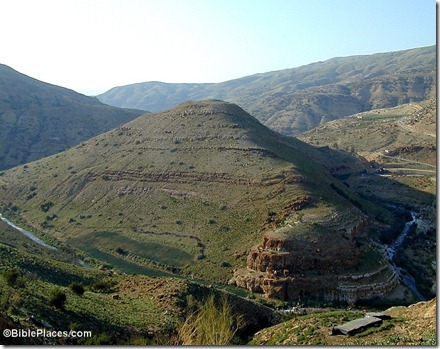
What follows is very interesting. The Lord sent the prophet Gad, who told David to make sacrifices and offerings on the spot where he saw the angel stop. If you remember, Jerusalem in David’s time was fairly small, maybe ten or fifteen acres. It was on the tip of a ridge, with deep ravines to the east and west and south. Behind David’s city to the north, the ridge rose to the top of the mountain. It was there, at the top of that ridge or mountain, where David went to offer his sacrifices. This was about 1/3 of a mile from the north wall. The picture below gives you a rough sense of the geography, though it is not 100% accurate.

David found the land was owned by a Jebusite, not an Israelite. Refusing to take it as a gift, David purchased the land, and made offerings and sacrifices there. This ridge-top was the very place where Abraham had taken his son Isaac, when he obeyed God’s call to sacrifice him. On that mountaintop, Isaac, not knowing what was to come, asked what they were going to use for a sacrifice. Abraham answered prophetically, saying, “God Himself will provide the lamb for the burnt offering, my son.” (Gen 22:8, HCSB). God stopped Abraham when he saw that he was willing to give up even his son. Instead, God planned to give his own son. And so on this same spot, almost eight hundred years later, the plague was stopped. On this same spot, David offered his life in exchange for his people, but again, the Lord refused that sacrifice, looking ahead to the time he would offer his own son. On this same spot, purchased by David, Solomon later built the temple of the Lord. This temple became a meeting place between the Lord and his people, a place where sacrifices were offered to reconcile the people with the Lord and each other. So, the author of Samuel, who lived in the next generation after the temple was built, is saying: “Don’t waste your energy wanting another king like David. Instead, pay attention to the presence of God among his people.”

The New Testament teaches us that those sacrifices were all a shadow, pointing toward the ultimate sacrifice of Jesus to save people from their sins. The writer of Hebrews writes about the temple, and its purpose:

9 This is an illustration pointing to the present time. For the gifts and sacrifices that the priests offer are not able to cleanse the consciences of the people who bring them. 10 For that old system deals only with food and drink and various cleansing ceremonies—physical regulations that were in effect only until a better system could be established.
11 So Christ has now become the High Priest over all the good things that have come. He has entered that greater, more perfect Tabernacle in heaven, which was not made by human hands and is not part of this created world. 12 With his own blood—not the blood of goats and calves—he entered the Most Holy Place once for all time and secured our redemption forever. (Hebrews 9:9-12, NLT)

In other words, even though the writer of Samuel did not know it, this epilogue points beyond David, even beyond the temple, and to the eternal atonement that Jesus secured for us. The message is that we need atonement, and only God himself can truly provide it. And not only that, but God has provided it, through Jesus Christ, the descendant of David.

We human beings tend to make the same mistakes in each generation. Many people in our country are very focused on politics and on the “culture wars.” But our main focus should be on Jesus Christ, and reconciliation with the Lord through him.

What are the things you tend to put your hope in? A job? Your skill or experience? Your family? Your investments, your house? All these are good things when they are held in the right place of importance in our lives. But as good as it is to enjoy the blessings God gives us, our only hope should be found in Jesus Christ alone.

How has the Lord spoken to you through the book of Samuel?

2 SAMUEL #27: THE GLORIOUS COMPANY

God shines his glory not just through David, but also through the many people who were part of what the Lord was doing at the time of David. As each part of this epilogue shows, once again we see that salvation does not come from David, but from the Lord. He used some amazing people to build the kingdom of Israel. Just as those people shared in David’s hardship, and then, finally, David’s glory, so we too will one day share in the glory of Jesus, even when we suffer with him in this present life.

To listen to the sermon, click the play button:

For some people, the player above may not work. If that happens to you, use the link below to either download, or open a player in a new page to listen. You can also find us on Spotify at https://open.spotify.com/show/6KKzSHPFT466aXfNT2r9OD

To download, right click on the link (or do whatever you do on a Mac) and save it to your computer: Download 2 Samuel Part 27

2 Samuel #27.  2 Samuel 23:8-39

As I have mentioned before, 2 Samuel chapters 21-24 are a carefully crafted epilogue to the book of Samuel. The content is arranged in a common ancient middle-eastern pattern called chiastic structure. We are now in part B1.

A. The need for atonement

B. The Giant-killing warriors who took over that role from David

X.  David’s psalm declaring that the Lord alone saves his people

X1. David’s last words depending on God’s promise alone to bring an eternal messiah

B1. The warriors who helped David throughout the years

A1. The need for atonement and the provision for it.

One of the purposes of this epilogue is to encourage people to hope not in an earthly leader, not even a really good one, like David, but rather, to put all of their hope in the Lord alone. We can see looking at part B, above, that when David could no longer fight there were other warriors who stepped up. The point was, the Lord is the one who saves his people, and he is not dependent on any one person. That point is being reiterated now. Now, the author of Samuel is saying, “Look, even when David was young, it wasn’t only David whom the Lord used. He was surrounded by these amazing warriors, even in his prime.” Again, the message is that we shouldn’t look to any single person like David. The Lord is the one who saves.” There’s something else too. The beginning and end of this epilogue are focused on our need for salvation. Ultimately, there is something deeply ugly and rebellious at the core of every human being. But the Lord also made humans in his own image, and people are not only sinful: they are, at the same time, beautiful and amazing too. So here we see some of the amazing things done by David’s closest associates.

We are introduced first to “the three;” that is, the three most famous and honored warriors led by David. First was Josheb Basshebeth, also known, in 1 Chronicles 11, as “Jashobeam.” He killed 800 enemies with his spear in a single battle. Next of “the three” was Eleazar. He and David stood alone together against the Philistines at a place called Pas Dammin. They fought so long and furiously that Eleazar’s hand cramped around his sword, and he couldn’t let go of it for some time afterwards. Although David was a part of that battle, the point in this passage is not about David, but his men. Third was Shammah, son of Agee from Harar. He defended a field from the Philistines, apparently all by himself, and won a great victory. Apparently, one of the “thirty mighty men,” a man named Jonathan, was the son of this Shammah.

In verses 13-17 we have another exploit that “the three” undertook together. Some translations, in verse 13 say something like: “And three of the thirty chief men went down (ESV).” This casts doubt on whether it was “the three” or just three unidentified men out of “the thirty.” However, the text has not yet introduced us to “the thirty” and verses 16 and 17 seem to be talking specifically about “the three.” So I prefer the NLT. “The Three (who were among the Thirty—an elite group among David’s fighting men) went down to meet him there.” There is a bit of interpretation, or clarification, added to the Hebrew here by the NLT, but I think it’s the right interpretation, and it is supported by the context.

In any case, the incident took place when David was in the cave of Adullam, and the Philistines were in the valley of Rephaim, and had spread out all the way to Bethlehem. Although this could have been before David was king, when he was hiding from both Saul and the Philistines, I think the context best fits 2 Samuel 5:17-25. In fact, we looked briefly at this story in 2 Samuel #5.

David had only recently become king, and the Philistines invaded up the valley of Rephaim, getting as far as Bethlehem, which was David’s hometown. David, being a great strategist, had already taken his army and concealed it in the caves that were found in the south side of that valley. They were in a good strategic position, but it broke David’s heart that he had to let the Philistines occupy Bethlehem. It was probably a hot day, and he exclaimed how much he wished he could have a drink from the well at Bethlehem, the clear, cold water he grew up drinking. He was certainly wishing for that drink because he was hot and thirsty. But he was also wishing that the battle was over and the Philistines were defeated, and his hometown was safe. But “the three” took David at his word, and broke through the Philistine lines, drew water from the well, and brought it back to David without getting hurt themselves. David’s response is interesting

But he refused to drink it. Instead, he poured it out as an offering to the LORD. 17 “The LORD forbid that I should drink this!” he exclaimed. “This water is as precious as the blood of these men who risked their lives to bring it to me.” (2 Samuel 23:16-17, NLT)

The reason the author of the book of Samuel tells that story here, and not in chapter five, is because it illustrates his main point in this epilogue. David is not the hero. Salvation does not come from David. Instead, David is just a servant of the Lord. It is through the Lord that salvation comes, and even David himself consistently testified to this.

When I first read this, I thought, “I’d be angry if I were one of those three warriors.” But actually, I think what David was saying was this: “I am not worthy of such a costly drink. I can’t claim it. Only the Lord is worthy of that kind of effort and self-sacrifice.” He was actually honoring the men more by pouring it out than by drinking it. He “poured it out to the Lord.” He was saying that the lives of these men were precious to the Lord. There was a type of offering called a drink offering, where a drink (usually wine) was poured into the ground. The idea was to say, “this is God’s, not mine, and I pour it out to show that everything I drink ultimately comes from God.” So, David did not consider himself worthy of that kind of sacrifice from his men, and he directed their attention to the Lord. Life wasn’t about him, it was about God. The Lord was the one who gave them the strength and flat-out guts to do this amazing deed. He was the one who was to be honored, not David.

The hero of this entire story is the Lord. David consciously realized this, and made statements to draw attention to the Lord, rather than himself.

The author of Samuel goes on to tell about a few more people whom the Lord used to establish the kingdom of his people, Israel. The next one is Abishai. There are some differences of opinion about the original wording of verses 18-19, about Abishai. Here’s one way it could be:

18 Abishai, Joab’s brother and son of Zeruiah, was leader of the Three. He raised his spear against 300 men and killed them, gaining a reputation among the Three. 19 Was he not more honored than the Three? He became their commander even though he did not become one of the Three. (2 Samuel 23:18-19, HCSB)

Or:

18 Now Abishai, the brother of Joab, the son of Zeruiah, was chief of the thirty. And he wielded his spear against three hundred men and killed them and won a name beside the three. 19 He was the most renowned of the thirty and became their commander, but he did not attain to the three. (2 Samuel 23:18-19, ESV)

This difference is known as a “major variant” in textual criticism. Basically, the main Hebrew textual traditions have it the way the HCSB says it. But there are some early Hebrew texts, as well as a translation of this passage into Syriac (an ancient middle eastern language) that have it as the ESV translates it. The ESV contains a note explaining this.

 We don’t know which one of these is closest to the original. You can see that it doesn’t matter theologically at all. What we can know for sure either way is that Abishai is one of the four most honored warriors of David. He’s either number one, and the chief of the three, or he is number four, the chief of the other thirty most elite soldiers.

As we’ve gone through the book of Samuel I’ve found myself admiring Abishai more and more. He shared David’s troubles while David was still an outlaw. He and David performed the amazing feat of sneaking into the camp of Saul and stealing his spear and water jug. He was clearly a fearsome warrior. He often didn’t understand, or agree with, the decisions David made, but he went along with David anyway, and submitted to David’s leadership. For instance, when they were standing next to a sleeping Saul, Abishai wanted to kill Saul, for David’s sake. David said, “no,” and Abishai acquiesced. Much later, Abishai accompanied David when he left Jerusalem in shame, fleeing from Absalom. The man named Shimei insulted David in a cowardly way, and Abishai wanted to kill him, but when David said no, Abishai did as he was told. When they returned in victory, Abishai wanted to kill Shimei again, then, but David still said no, and Abishai, again, obeyed. In other words, he followed David, and obeyed him, even when he didn’t understand, or agree. It boils down to this: he trusted David and David’s leadership even when he didn’t understand it. In that respect, he shows us how we ought to follow Jesus Christ.

In all of this, Abishai was very different from his older brother, Joab. We know that Abishai killed at least 300 enemies in a single battle. He certainly fought in many other battles, presumably killing other enemies. But the scripture never mentions Joab killing enemies in battle, except as a general, in which case he, personally, was not likely involved in the fighting. The only time we know for sure that Joab killed anyone was on the three occasions when he committed murder. And Joab committed those murders explicitly in defiance of David. Joab himself is not honored in this text as one of David’s elite warriors. Even though he was the overall commander of the army as a whole, here, he is only mentioned as Abishai’s brother. He also gets a mention because one of the thirty, Naharai, was his armor-bearer. Abishai had the strength of character to be a better man than his older brother, following God’s chosen leader faithfully, even when he didn’t understand, or fully agree.

The final person singled out for special praise is Benaiah, son of Jehoiada. If you want to think about what kind of a warrior he was, simply remember these things: on a snowy day he chased a lion into a pit and killed it; and on another occasion he faced an imposing Egyptian warrior with a spear, while he only held a wooden staff. He took the spear away from the other warrior, and killed him with his own weapon. Benaiah was younger than many of those named here, and only served David later on in his reign. However, he went on to serve as the chief bodyguard of king Solomon as well. In that capacity, he executed both Shimei and Joab.

Next, we come to the list of “the thirty,” who are, along with the others mentioned, the most fearsome, elite warriors of David. You may notice that the list of “the thirty” includes more than thirty people. It’s not clear whether Abishai is to be counted among them, or Benaiah son of Jehoiada. We know that some of those listed died when David was still relatively young. Asahel was killed before David became king over all Israel. We know, of course, that Uriah was killed when David was middle aged. So “the thirty” is obviously a round number, and there was some change in the composition of the group, but it was a special and exclusive company.

As we read about these people, their names are very foreign to English speakers. Even worse, most of them are also identified by their family or clan name, or possibly the town they are from, and those names are difficult as well. These things make this text hard to follow. Because of this I recommend reading a translation like the New Living Translation, since it simplifies and clarifies the names. The God’s Word version helpfully puts each name on a new line so we can keep track of them more easily, and that also helps us separate the first names from the family names and place names. Of course, what remains are still names that are strange to us.

But maybe these names are there for a reason. After thirty centuries, these names have never been forgotten. God knows his own people, by name. He knows you, too, and your name, if you trust Jesus, is also written in God’s book.

Even though we humans have been broken by sin, there is still part of the amazing image of God that shines through our brokenness. David’s gang of thirty were people who willingly gave themselves to serve David; ultimately, to serve God. Because of that, we see God’s glory through them. We too, are called, broken as we are, to let the glory of God shine through us, as we serve God’s chosen one, Jesus Christ.

Another thing I think we are meant to understand is that David did not become king all by himself. Though he was a remarkable man in many different ways, he needed the help of many others. No one really does anything significant without help from others.

We all need each other. We each need to find our own “gang of thirty” and guard each other’s backs, deal with life side by side together, and cheer one another on. Start with a “gang of three or four,” and build from there. In other words, we need close fellowship with a few other believers who will stand with us when we need it. We need to be prepared to stand with them in times of need, as well. If you don’t have a gang of three or four, or a larger support network, start by asking the Lord to provide that for you, and then keep your eyes and ears open to hear from the Lord who you should spend time with to develop that support network. Remember that these people will not only be there for you, but you should be there for them, as well.

Most of “the thirty” joined David when he was still an outlaw. Some of the others were children, who grew up in David’s nomadic camp, and then joined the thirty when they were older. They traveled with him, fought alongside him, planned, did chores and simply lived life together. They willingly shared David’s hardships and suffering, and, at the end of it all, they also shared in the success and honor of David. They were an important part of the kingdom that David was building.

David was not the messiah, but the Lord used him to show us some things about the true Messiah, Jesus Christ. Jesus invites us into close fellowship with himself. He invites us into everyday life with him. He also sometimes invites us into hardship and suffering; but that suffering is to be alongside him—we are not alone in it. In fact, if our lives truly belong to him (as they do, if, in fact, we trust him) then it is really his suffering that we are sharing in. David’s followers encountered that hardship and suffering as, and because, they went through life with David. Though they all suffered, it was, in a sense, David’s suffering; they shared in it because they were connected with him. In the same way, even our own sufferings are not really our own. We encounter them as we are part of the people of Jesus. So, we are not alone as we suffer. We have God’s own promise that one day the suffering will end, and we will share in the glory.

16 For his Spirit joins with our spirit to affirm that we are God’s children. 17 And since we are his children, we are his heirs. In fact, together with Christ we are heirs of God’s glory. But if we are to share his glory, we must also share his suffering.
18 Yet what we suffer now is nothing compared to the glory he will reveal to us later. 19 For all creation is waiting eagerly for that future day when God will reveal who his children really are. (Romans 8:16-19, NLT)

When we see the earthly glory that David’s followers shared, we should be encouraged to look beyond. Jesus is better than David. His promises are powerful and real. We can learn to have peace and joy now, no matter what is going on, because we know that one day glory will far outshine the worst sufferings we experience.

16 That is why we never give up. Though our bodies are dying, our spirits are being renewed every day. 17 For our present troubles are small and won’t last very long. Yet they produce for us a glory that vastly outweighs them and will last forever! 18 So we don’t look at the troubles we can see now; rather, we fix our gaze on things that cannot be seen. For the things we see now will soon be gone, but the things we cannot see will last forever. (2 Corinthians 4:16-18, NLT)

Finally, we should be reminded that hope does not come from earthly leaders, even really good ones. True hope that lasts is found only in God’s promised messiah, Jesus Christ. In Christ we will be led to our support network. In Christ, we will share in suffering, and in Christ we will share in eternal glory and joy so amazing that we will consider the sufferings of this life not worth mentioning.

2 SAMUEL #26: THE LAST WORDS OF A GREAT KING

David’s last words speak of the goodness of authority when it is used well; especially when it is exercised with a recognition that all authority comes from God, and we are all accountable to him.  The heart of David’s words reveal that he was resting fully on the promises that the Lord had made to him. May we, too, rest completely on God’s promises to us, and upon the covenant that he established with us through the messiah, Jesus Christ.

To listen to the sermon, click the play button:

For some people, the player above may not work. If that happens to you, use the link below to either download, or open a player in a new page to listen. You can also find us on Spotify at https://open.spotify.com/show/6KKzSHPFT466aXfNT2r9OD

To download, right click on the link (or do whatever you do on a Mac) and save it to your computer: Download 2 Samuel Part 26

2 SAMUEL #26. The Last Words of David. 2 Samuel 23:1-7

1 Now these are the last words of David:
The oracle of David, the son of Jesse,
the oracle of the man who was raised on high,
the anointed of the God of Jacob,
the sweet psalmist of Israel:
2 “The Spirit of the LORD speaks by me;
his word is on my tongue.
3 The God of Israel has spoken;
the Rock of Israel has said to me:
When one rules justly over men,
ruling in the fear of God,
4 he dawns on them like the morning light,
like the sun shining forth on a cloudless morning,
like rain that makes grass to sprout from the earth.
5 “For does not my house stand so with God?
For he has made with me an everlasting covenant,
ordered in all things and secure.
For will he not cause to prosper
all my help and my desire?
6 But worthless men are all like thorns that are thrown away,
for they cannot be taken with the hand;
7 but the man who touches them
arms himself with iron and the shaft of a spear,
and they are utterly consumed with fire.” (2 Samuel 23:1-7, ESV)

Chapter 23:1-7 contains “the last words of David.” This is not meant to be literal, but it is a picturesque way of saying “these are the thoughts David was having at the end of his life, this was something he wrote near the end.” All of these verses (1-7) are in the form of Hebrew poetry. Hebrew poetry does not usually rhyme. It is about “parallel thoughts.” You can see the parallelism if you just read it carefully. My Bible separates the parallel thoughts by starting new lines. I’ll do it here with two slashes, like this: “//.” So we have: “The last words of David//the declaration of the son of Jesse//the declaration of the man raised on high//the one anointed by the God of Jacob//the favorite singer of Israel” You can see that each phrase gives us a parallel description of David. First he is named, then he is the son of Jesse, and so on. They are parallel thoughts about who David was.

Next come David’s own words. Verses two and three express poetically that David is sharing insights that he received from the Lord.

The first insight is that when someone rules a group of people in justice, and in the fear of the Lord, it is a wonderful, positive thing. I think sometimes, even yet today, it is hard for us to grasp what life was like for people in the ancient middle east. Existence was difficult, brutal and short. When someone had wealth and power, they used that power to benefit themselves, and their family and friends. If you did not have wealth or power, and were not related to someone who did, you were out of luck. Of course, that meant that, by far, most people were out of luck. The powerful would do to you whatever they could get away with, if they thought it would benefit them, and often, that was a lot. They might simply take your things, including your home. If you were a man, they might take your wife or daughter, if they found them attractive. If you were a woman, you had no rights even to your own person. So David’s words here are revolutionary:

“The one who rules the people with justice,
who rules in the fear of God,
4 is like the morning light when the sun rises
on a cloudless morning,
the glisten of rain on sprouting grass.”

David is saying that a ruler does not get to do whatever he wants. Even kings themselves are under a greater authority—God. The only responsible way to exercise authority is by being under authority yourself. In other words, no matter how much authority or influence we might have, we must use it with a recognition that we are accountable before God for the way we use it. When we do that, it is a wonderful blessing.

Do a thought experiment with me. Picture a policeman. He has the authority to compel you to obey the law. If you refuse to obey him when he gives you a lawful order, he has the authority to use force to compel you to obey, or to enact consequences on you if you don’t obey. But the key here is that what he is telling you to do is a lawful order. If he stops you while you are driving and demands to see your driver’s license, that is a lawful order. The policeman is himself acting appropriately under authority – the authority of the laws and regulations that say the police can stop you and ask for your license. However, if he stops you and demands that you give him all your money, the policeman is no longer acting “under authority.” No law gives him the authority to take your money. Therefore, when he is not himself under authority, he has no real authority to exercise.

Or imagine a boss. Suppose you work at a place of business that has a dress code, or uniforms, for employees. In that situation, your boss, under the authority of the rules of employment, has the right (the authority) to tell you how to dress. If you show up to work dressed inappropriately, she has the authority to enact consequences on you for that. But if the boss sees you when you are not working, she does not have the authority to tell you what to wear. In that situation she is not under authority as your supervisor, therefore she has no authority over what you wear.

We take all this as a matter of course. But these things were not always obvious, especially not during David’s lifetime. The idea that the king himself must be under God’s authority in order to exercise authority was revolutionary. The only reason we think it’s normal is because we live in a civilization that was profoundly shaped by the bible, including David’s words right here. When David said these things, it was an amazing thought: even the king has no appropriate authority unless he himself remains under the authority of God.

By the way, I think this is one reason that the Lord inspired Nathan the prophet to tell the story he did when he confronted David about Bathsheba and Uriah. David himself was passionate about people not abusing their authority. When he saw that he himself had been abusing his authority, it broke him. So, now, at the end of his life, David wants people to remember that even he himself had to remain under God’s authority.

Jonathan Leeman, in his book Authority, describes two different kinds of authority. The first is an authority to command. This is the authority to compel others to obey by causing serious consequences for those who disobey. A policewoman has that kind of authority. Bosses and owners have that sort of authority as well, at least in the workplace. Parents have that sort of authority over young children.

The second kind of authority is an authority of counsel. This is an authority that can strongly recommend a course of action, however, if someone wants to disregard it, the person with counsel authority cannot make someone else listen to them or compel them to obey them, or enact serious consequences upon them.

Most adult humans in the western world do have certain areas where they exercise appropriate authority. If you are a business owner, you have authority over your employees. If you are a boss, or supervisor, or team-lead, you have authority over others at your workplace. Even if you are a server at a restaurant, you have a kind of authority over the restaurant patrons. You can tell them not to go into the kitchen, or not to be disruptive. They must wait on your service before they can order or eat. Parents, of course, exercise significant authority over their children. Many children have authority over their pets. Even parents of adult children have a kind of authority over their grown children, in that their words feel “weighty,” to their kids. We can easily brush off something said by a random stranger, but it’s harder to ignore the words of a parent, even when we are grown.

Authority can be abused—I would guess we all know that. But do we know that when authority exists and is used properly, under the authority of God, it is, in fact, a blessing? Without God-blessed parental authority many children would die, or be treated cruelly. Without lawful authority the strong and wealthy would take whatever they wanted, and the rest of us would not be able to stop them. Authority that recognizes that God is over everything is a force for good. It allows families and societies to flourish in safety.

In verse five, David moves on. I spent a lot of time and labor trying to get at the Hebrew of this verse, because there is something that is not evident in the English translations. The closest is the ESV, which typically is the most literal. But let me give it to you in a “literal-ish” translation so you can see something going on in Hebrew:

Indeed, is it not right, my house, with God?

Indeed, an everlasting covenant he made with me, being arranged in the whole and being secured

Indeed, all of my salvation and every desire

Indeed, will he not bring to fruition?

There are four phrases, each one beginning with the Hebrew word that I have translated here “indeed.” The word is a conjunction that can be used as “for,” “and,” “but” and several other possibilities depending on context, but the point is, in Hebrew these four phrases each begin with the same word.  This sets apart this verse from the others, and also makes us pay attention to each of the phrases.

In the first place, David has confidence that his house is indeed right with God. Now, he is not claiming to be innocent before God. But he is confident that the Lord has made things right with his entire family line. Indeed, it is about the covenant that the Lord made with David in 2 Samuel 7:8-17, the covenant of a messiah, a descendant of David, who will reign forever. David does not feel confident because of anything within himself. No, he is confident because the Lord made a covenant—a solemn agreement—with David, and the Lord arranged it, and the Lord secured it. The promise is not contingent upon David: it is the Lord’s doing from first to last. In case we missed it, David is talking, indeed, about all of his salvation, all of his desire, which, indeed, the Lord himself will bring to fulness.

This is the core of David’s last word and testimony, and it is that all his hope is in the coming of the promised Messiah, a descendant of David, and David dares to trust this hope because it is the Lord who made the covenant, the promise, and he who will make it happen.

Once again we see that the writer of Samuel is pointing us to something beyond just David. David’s own hope was not in himself, but in the Lord, and the Lord’s promises, especially in the promised messiah. We too, should not hope in a worldly leader, government, or system, nor even in our own talent or hard work, but in the promises of God, and in salvation through his promised Messiah, Jesus Christ. All our hopes and desires should be, like David, fixed on the promises of God, and upon the messiah, Jesus Christ. When that is the case, we can find rest and peace in our hearts, even as David himself did.

This last saying of David is put forward in a kind of shortened chiastic structure. The first part talks about the goodness of God when people live under his authority. The middle part, the “main point,” is the one we’ve just looked at, which is that our hope should be firmly rooted in the eternal promises of God, our desire should be for his chosen Messiah. Next, the ending part is a kind of reverse mirror of the first part: the fate of people who do not live under the Lord’s authority, and who do not hope in the promises of his covenant. Such people are like thorns. You can’t even touch them, lest you hurt yourself. Instead, thorns are killed by cold iron and then destroyed by hot fire. In the same way, for those who reject the authority of the Lord, the end is one to consider soberly.

All right, so where does this leave you? Perhaps you need to give some thought to the areas in your life where you have some authority. Maybe you need to remember that we can only properly be in authority if we are under authority, especially, under the authority of the Lord.

The writer of the book of Samuel probably lived two generations after David. The kingdom of Israel that David had worked so hard to create and secure was now split in half. The kings of both new kingdoms were not remotely like David. I suspect that people during that time were inclined to look at the past, especially to the time of David, and wish that they could have another king like him. But the author of this book is saying: “Don’t waste time wanting another David to come along. Instead, want what David himself wanted.” The heart of David’s last words are his trust in the promises of God. All his desire is wrapped up in what God promised. His heart is at peace because he believes what God has said.

I’m at an age where it’s easy to look back at earlier parts of my life and wish things were like that again. I’m tempted to want to somehow regain things that are lost in the past. But the message here is this: what’s past is past, and even back then it wasn’t everything you needed. Instead, like David, let’s learn to desire the Lord and the fulfillment of his promises above everything else.

One of my prayers for myself is that I desire what God has promised more than I desire anything else. When what we desire most is the Lord himself, our innermost being is fully satisfied. Often, I find that I have all sorts of other desires competing with my desire for the Lord. Sometimes, I have to pray kind of like this: “Lord, I want to want you more than anything. Please work in me so that I desire most what you want me to desire most.” That is a prayer that he loves to answer. All he requires is our willingness for him to make it so.

May we, too, trust God and be at rest in our souls.

2 SAMUEL #25: SALVATION DOES NOT COME FROM GREAT LEADERS.

The writer of Samuel is using his epilogue (closing part of the book) to emphasize certain themes again and again. One of the most important of these ideas is this: The Lord is the only source of salvation and hope. Even if the people imagined that a king like David could save them again, David’s own words point them not to any human leader, but to the Lord himself.

To listen to the sermon, click the play button:

For some people, the player above may not work. If that happens to you, use the link below to either download, or open a player in a new page to listen. You can also find us on Spotify at https://open.spotify.com/show/6KKzSHPFT466aXfNT2r9OD

To download, right click on the link (or do whatever you do on a Mac) and save it to your computer: Download 2 Samuel Part 25

1 SAMUEL #25. 1 SAMUEL CHAPTER 22:1-51.

Let’s remember where we are. The narrative history of the book of Samuel ended with 2 Samuel chapter 20. Chapter 21 does describe a historical incident, but it’s out of chronological order—it happened much earlier in David’s reign. Chapters 21-25 form a six part epilogue, organized according to an ancient writing style called chiastic structure. I want to remind us of the overall picture of this epilogue, because we have now come to the center of the structure.

Part A: A sin, and the need for atonement

Part B: God’s provision of salvation for his people, even when David becomes too old to fight

Part X (our section today): A psalm of David proclaiming that the Lord saves

Part X1: A psalm of David proclaiming that the Lord works through leaders

Part B1: The warriors who helped David save and lead Israel

Part A1: A sin, and the need for atonement, and God’s provision for it.

So we see that our section today (which is all of chapter 22) is building on what has come before.

2 Samuel chapter 22 is almost identical to Psalm 18, but there are quite a few differences between the Hebrew text of 2 Samuel 22 and Psalm 18, and some of those show up in the English translations. Almost all of those differences are due to the fact that the book of Psalms was gathered together and compiled a few centuries after the book of Samuel was written. During those intervening centuries, written Hebrew changed somewhat. Whoever collected the Psalms into one collection updated and standardized them so that all of the psalms used the same, latest form of Hebrew. Our verses today were written in the older form of Hebrew. The small differences between 2 Samuel 22 and Psalm 18 do not change any major teaching of the Bible (nor indeed any minor one).

The beginning of 2 Samuel 22 says:

 “1 And David spoke to the LORD the words of this song on the day when the LORD delivered him from the hand of all his enemies, and from the hand of Saul.”

Because of the mention of Saul, and a few other things in the psalm, most Bible scholars think that David wrote this when he was a fairly young man, probably around the time when he first became king of all Israel.

Remember, the first section of this epilogue was about the seriousness of sin and the need for atonement. Next came the crisis of the giants, and how the Lord made sure to provide a warrior to save Israel from each one. Now, in the first part of the psalm, David makes the overall theme perfectly clear: God alone is our salvation:

“The LORD is my rock and my fortress and my deliverer,
3 my God, my rock, in whom I take refuge,
my shield, and the horn of my salvation,
my stronghold and my refuge,
my savior; you save me from violence.
4 I call upon the LORD, who is worthy to be praised,
and I am saved from my enemies. (2 Samuel 22:2-4, ESV)

The people of Israel may have begun to feel that David was their savior. He saved them from the first giant. He fought the Philistines and won many battles for Israel. He outlasted the unstable, volatile, king Saul. As a new young king, he defeated the Philistines again, more completely. But here he says clearly that salvation and deliverance come only from the Lord. He, David, is not Israel’s savior. That title belongs to the Lord.

Verse 4 is a concept that appears throughout the Bible. To call on the name of the Lord is to worship him, and to give over your life to serving and worshipping him.  Abraham “called on the name of the Lord.” So did Isaac and Jacob. Moses and the prophets urged the people to “call on the name of the Lord.”

The apostles made it clear that to call upon the name of the Lord was, in fact, the same thing as receiving and worshipping Jesus Christ. The apostle Peter quoted from one of the prophets when he urged people to receive Jesus:

21 And it shall come to pass that everyone who calls upon the name of the Lord shall be saved.’ (Acts 2:21, ESV)

Paul wrote:

13 For “everyone who calls on the name of the Lord will be saved.” (Romans 10:13, ESV)

To call upon  God’s name is to look to him earnestly and trustfully for help. It is to recognize that the only true help comes from the Lord, the only true salvation or deliverance comes from him alone. And as I said, the apostles taught that this was the same thing as receiving Jesus.

So calling on the name of the Lord is not simply saying the name “Yahweh,” or even “Jesus.” It means to worship the Lord, and to follow him, to allow your whole life to belong to him. David, for all his faults, did indeed do that.

In the next section of the psalm, verses 5-7, David talks about being in very serious distress. He called out to God for help in his particular situation. The way I read it, he is talking about the precarious way he lived for almost fifteen years. King Saul wanted him dead, so it wasn’t safe for him to go north into Israel. The Philistines wanted him dead, so it wasn’t safe among them, to the west. If he strayed too far south, the Amalekites were ready to get him. The wilderness he lived in was no picnic either. At different times during that period of his life, David faced all of those dangers.

The person who put together the book of Samuel included this psalm because he wants us to remember that following God did not always mean life was easy for David. We can therefore expect that sometimes life will be hard for us, even if we are faithfully following God.

Next, David gives us a very pictorial, metaphorical representation of how God responded to save him. The most remarkable thing about this is that God in all his majesty and power, cared deeply about David, and came to save him. Again, it was not David who delivered Israel, but the Lord who saved both David and Israel. David ends this section with this:

17 “He sent from on high, he took me;
he drew me out of many waters.
18 He rescued me from my strong enemy,
from those who hated me,
for they were too mighty for me.
19 They confronted me in the day of my calamity,
but the LORD was my support.
20 He brought me out into a broad place;
he rescued me, because he delighted in me. (2 Samuel 22:17-20, ESV)

The next section of the psalm, verses 21-25, is probably the hardest one to stomach. In it David claims that God dealt with him according to his (David’s) own righteousness. In the first place, that can make it sound like we have to be good people before God will help us. Second, we know that David was far from perfect. We know that even before the terrible sins he committed in the Bathsheba incident, he still sometimes forgot to ask the Lord for guidance, or, at other times, he was hot-headed and angry. He didn’t listen to what the Lord said about having many wives.

However, remember, David wrote this in his youth, long before he sinned with Bathsheba and had Uriah murdered. And I think that David, when he talks about being “blameless” here, means that he faithfully followed the Lord in not killing Saul, and in not trying to steal the kingdom for himself. In other words, he isn’t claiming to be blameless in every area of his life, but rather, he is talking specifically about the way he waited patiently for God to make him king, and the times he refused to kill Saul.

Remember when Saul promised that whoever killed the giant would marry his oldest daughter, and be made rich? Saul broke those promises to David. Not only that, but he added conditions onto his public promises. Saul made David kill an additional 100 Philistines before he allowed him to  marry his youngest daughter. David did not complain about the broken promises, nor use them as an excuse to serve Saul poorly. Instead, he continued to faithfully serve Saul, even when Saul treated him badly. David is thinking about specific things like this when he says he was “blameless.”

He is saying, in fact, that he knows the Lord gave him the kingdom, because he did get the kingdom for himself. He was “righteous” in not assassinating Saul, and in not leading a rebellion. He goes on:

26 “To the faithful you show yourself faithful;
to those with integrity you show integrity.
27 To the pure you show yourself pure,
but to the crooked you show yourself shrewd.
(2 Samuel 22:26-27, NLT)

This section includes amazing promises, and serious warnings. First, this isn’t about earning our salvation. It’s more like this: if we allow the Lord to build a straight, open pipeline within our hearts and minds, then God can show us his love and goodness directly. When we trust the Lord, He uses that to build an open channel to show us his love and goodness.

On the other hand, when we don’t trust God, we tend to make deals with him, or try to manipulate him into giving us what we want, no matter what. We ourselves throw twists and curves and complications into our relationship with God, and then we blame him because he seems tricky and shrewd to us.

This isn’t actually all that complicated. Imagine a good human father who has two sons. He showers both sons with love, and he also creates strong boundaries with discipline. The first son, Peter, responds by trusting his dad, even when he isn’t always happy about the boundaries, or when he doesn’t understand them. The second son, Eric, wants what he wants, right now. He doesn’t see his dad’s boundaries as loving—he only sees that his dad appears to be denying him what he wants. So he tries his best to subvert the rules, and manipulate his dad, and get what he wants. Peter’s relationship with his dad is likely to be warm and loving, and not super complicated. But Eric will have a totally different experience with the same loving father. Because Eric himself has not responded to his dad in love and trust, his dad will have to find additional ways to discipline him, different ways to relate to him, and get through to him. Because Eric is so fixated on what he wants, his perception is that his dad is standing in the way of that. Therefore, Eric will not easily be able to have an open, honest, loving relationship with his dad, even though it’s the same dad that Peter has, who loves Eric just as much as he loves Peter.

Honestly, I think perhaps David was thinking of Saul when he wrote this part of the Psalm. Both David and Saul served the same loving God. But they had a totally different experience of God because David responded to God in trusting faith, while Saul only tried to use and manipulate God. When we try to make deals with God, or manipulate him, we find that these things backfire on us.

David finished this part of the psalm with this thought:

28 You save a humble people; but your eyes are on the haughty to bring them down. (2 Samuel 22:28, ESV)

This is another concept that is echoed and re-echoed throughout the Bible—in both the Old and New Testaments.

Here are two examples from the New Testament:

6 But he gives more grace. Therefore it says, “God opposes the proud but gives grace to the humble.” 7 Submit yourselves therefore to God. Resist the devil, and he will flee from you. 8 Draw near to God, and he will draw near to you. Cleanse your hands, you sinners, and purify your hearts, you double-minded. 9 Be wretched and mourn and weep. Let your laughter be turned to mourning and your joy to gloom. 10 Humble yourselves before the Lord, and he will exalt you. (James 4:6-10, ESV)

Clothe yourselves, all of you, with humility toward one another, for “God opposes the proud but gives grace to the humble.”
6 Humble yourselves, therefore, under the mighty hand of God so that at the proper time he may exalt you, 7 casting all your anxieties on him, because he cares for you. (1 Peter 5:5-7, ESV)

If we try to claim that we have something worthwhile to offer God, something with which to bargain, we will find God hard and inaccessible. If we think we don’t really need God, or that we can stand in judgment of him, we find that he opposes us. But if we approach him with true humility, with a understanding and attitude that we have nothing whatsoever to bargain with, no claim on him, no reason he should be kind to us, we find that he reaches out toward us in love and grace.

David continues in this psalm with a lot of words about his victories in battles, but if we pay attention as we read it, we notice that David always insists that it is the Lord who brought him victory, not his own skill or athleticism. He can “run through a troop” because the Lord enables him to do it. Over and over, in different ways, David tells us that the Lord alone is the source of hope and salvation. He is not king because he is an amazing person. He is king because God chose him. He did not win battles because he was a great warrior. He won them because he looked humbly to God, and God fought for him. We are meant to hear it clearly: God is the only source of hope and salvation.

One thought is that the way we approach God can have a large influence on our relationship with him. If we approach him like Saul, if our ultimate commitment is to ourselves, or to our own goals and desires, we might find that God seems difficult and tricky. If we approach him with pride or preconditions, we might feel almost like God opposes us. But if we approach him with open faith, and the humility to receive everything from him, even if some of what we receive we’d rather not have, we will find that God is kind and gracious and loving. He opposes the proud, but gives grace to the humble. If you feel like God has been opposing you lately, give thought to whether you have been humble enough to trust him in all things.

Finally, we need to train our hearts and minds to look to the Lord alone for salvation. And “salvation” doesn’t mean “everything goes the way we want it to.” It means that God has us in his hands, that he will be with us no matter what we face in this present life, and in the life to come we will find joy beyond imagining with the Lord, and with his people.

2 SAMUEL 24: WHAT IF THE GIANTS KEEP ON COMING?

As David grew older and became less of a force on the battlefield, the people of Israel must have wondered what was going to happen when he was gone. The writer of Samuel reminds us that it was never David who saved them, but rather, it was the Lord who saved them, whether through Samuel, Saul, David, or the next generation. This encourages us to not make idols out of the methods the Lord uses to bless us. We don’t need anything but the Lord himself.

To listen to the sermon, click the play button:

For some people, the player above may not work. If that happens to you, use the link below to either download, or open a player in a new page to listen. 

To download, right click on the link (or do whatever you do on a Mac) and save it to your computer: Download 2 Samuel Part 24

If you generally prefer to listen, you can also find us on Spotify at https://open.spotify.com/show/6KKzSHPFT466aXfNT2r9OD

SECOND SAMUEL #24. 2 SAMUEL 21:15-22

Last time we looked at the gruesome story of how Saul’s evil deeds against the Gibeonites created a need for atonement. We considered the overall message that we human beings are dead meat. We cannot be good enough to atone for sin. But the writer of the book of Samuel does not want to leave us with the wrong impression. So, in this next section of the epilogue, he tells about some people who were quite remarkable. The incidents described here probably took place near the end of David’s reign.

The first incident was when David was an older man. He was fighting the Philistines, and in the battle came face to face with a particularly fearsome Philistine warrior, a descendant of giants. As David faltered, his nephew Abishai came to assist him, and they struck down the Philistine. It was at this point in David’s life that his elite warriors convinced him not to risk his own life in battle anymore.

I want to talk about Abishai for just a second. He was the second of three brothers. From oldest to youngest they were: Joab, Abishai, Asahel. Their father probably died young, since his name is not mentioned, and when Asahel also died young, he was buried next to their father. Their mother was Zeruiah, David’s sister. This made Abishai David’s nephew. Abishai’s brother Joab had his conflicts with David, and we have seen that Joab was a complex man, but among other things, he murdered three people. We assume that he killed many in battle also, but Joab murdered Abner, Absalom and Amasa in cold blood. Two of those (Absalom and Amasa) were Joab’s own cousins. Abishai, the one who helped David against the Philistine, Ishbi-benob, was a fearsome warrior, but there is no indication that he was a murderer, like his brother Joab. He was eager to kill David’s enemies, but unlike Joab, when David said “no,” Abishai listened. I like to think that Abishai was a physically gifted warrior who rejoiced to use those gifts, but who listened to David, and to the Lord.

Abishai is listed as the chief of the “Thirty Mighty Men” of David (there were actually thirty-seven). On one occasion he killed three hundred Philistines with his spear in a single battle. After David, and “the three” (mightiest men), Abishai was considered the most fearsome warrior in Israel. He was younger than David, and so on the occasion listed here, he was able to help him against the Philistine Ishbi-benob, who was descended from giants. The text doesn’t say so, but we can safely assume that they were unusually large and strong men, even if they weren’t as big as the Goliath killed by David.

Next came Sibbecai. He is listed in 1 Chronicles 11:29 as being one of David’s thirty mighty men, but he is not found by that name in the list here in 2  Samuel chapter 23. Chapter 23:7 mentions Mebunnai the Hushathite, and that might be a different name for the same person. 1 Chronicles also mentions that he was a commander of an army division. In any case, Sibbecai/Mebunnai killed another descendent of the giants, named Saph.

Next with have Elhanan. He was also one of the thirty mighty men, and he killed another man named Goliath from the same city (Gath) as David’s Goliath. 1 Chronicles 20:5 puts it like this:

5 And there was again war with the Philistines, and Elhanan the son of Jair struck down Lahmi the brother of Goliath the Gittite, the shaft of whose spear was like a weaver’s beam. (1 Chronicles 20:5, ESV)

My assumption is that “Goliath” was a kind of a family name, and David killed an older member of the family, and then, years later, Elhanan killed a younger brother, or possibly even the son of the original Goliath. I think that’s the most likely, and it fits best with both texts.

Then we have a final descendant of the giants, a man of large stature, with some kind of genetic anomaly that gave him six fingers on each hand, and six toes on each foot. He was killed by yet another nephew of David: Jonathan, son of David’s brother, Shimei. David’s family produced some fearsome warriors.

Now, what do we make of this? Why did the author of the book of Samuel put this in here? Let’s back out and remember the big picture. All the way back at the beginning of the history recorded in this book, Israel was a mess, with no one to guide them. God used a righteous woman, Hannah, to bring Samuel into the world. God then used Samuel to lead the people, give them direction, and provide deliverance from their enemies. But as Samuel grew old, the people grew afraid. Samuel’s sons were not like him. Who was going to lead Israel next? God provided Saul, the kind of King the people really wanted: big and impressive-looking. Saul began well, but after some time, he faltered because of fear and insecurity. When Israel was challenged by a giant, Saul had no answer. The Lord brought David forward, and the young man (probably a teenager) killed the giant, and then became the most fearsome battle leader that had yet lived. Eventually David became king, and he led the people well, but at times even he failed and faltered. And now—this is where we get to this text today—now, David is too old to fight giants any more.

What will happen? Who will save the people from their enemies now? David, the brilliant battle-leader, created an empire. For the first and only time, Israel became a regional power, uncowed by either Egypt to the south or Mesopotamia to the north and east. But now the battle leader is too old to lead. Who will protect and save Israel?

These four younger men step in to fill David’s shoes. Now, we have not one, but four giant-slayers. However, the point is not that these four younger men will replace David, or even that one of them will. The point is this: It is the Lord himself who always provides salvation. He was the one who raised up Samuel. The Lord was the one who raised up Saul, and then, when Saul fell, brought David. The people of Israel do not need to fear. Their hope should never have been in Samuel, Saul or even David, in the first place. Their salvation comes from the Lord himself. Even when David can no longer fully use his tremendous gifts, the Lord protects Israel. We are meant to understand this: Even when the time comes for David to die, the Lord will be with his people.

Again and again, the people of Israel were tempted to put their hope in a human being: first Samuel, then Saul, and then David. And the Lord did indeed use all three of those men to deliver and protect his people. But the writer of Samuel is showing us: “Look it continues! The people change, but the one constant is this: The Lord is our salvation.” And of course, David himself knew this to be true. The people don’t need David, or any other particular individual. They only need the Lord.

I think sometimes we need to hear this message as well. We put our hopes on the way God might save us, instead of God himself. When we do that, we create idols. One purpose of the book of Samuel is to show that God did indeed bless Israel through David, but not to make an idol of him, and not to depend on God always using someone like that.

For instance, a few years ago there was a popular Christian teacher named Ravi Zacharias. He encouraged and helped a great number of people, probably millions. He passed away in 2020. Around the time of his death it came out that he had engaged in sexual misconduct over the course of about five years. As far as I know, the accusations have been proved credible. I spoke with someone who had trouble processing this. She felt like she had been blessed by Ravi’s ministry, and even strengthened in her faith by his words. But how could she square that with the kind of man he had been in secret?

I helped her to see that it was the Lord who had blessed her and strengthened her faith. Yes, he used Ravi Zacharias to bring those blessings, but the source wasn’t Ravi, it was the Lord. The blessings were real, no matter what kind of man he was. Just as David was a very imperfect man whom God used to bless his people, so today, we ought to avoid making human beings into idols. Let’s receive God’s blessings, however he brings them, but let’s trust the source of those blessings, which is the Lord, not any human being, or human process. That way, we can receive God’s goodness, even when the people who bring it to us turn out to be less than perfect.

Or, maybe we trust in something else, like our job, or work ethic, or physical stamina, or our good marriage, or our savings account. God does indeed bless us through things like these. But if we find ourselves saying “As long as I have my health…” or, “as long as I have a good marriage…” or, “as long as I have a good investment portfolio…” we might be in danger of idolizing that thing. We don’t need any “as long as.” The Lord can bless us apart from such things as well. If we lose something like one of those things, all is not lost. David and the Israelites lost David’s giant-killing skills. It didn’t matter. The Lord protected them anyway. Whatever else we might lose, we cannot lose the Lord, and he is all we truly need:

28 And we know that for those who love God all things work together for good, for those who are called according to his purpose. 29 For those whom he foreknew he also predestined to be conformed to the image of his Son, in order that he might be the firstborn among many brothers. 30 And those whom he predestined he also called, and those whom he called he also justified, and those whom he justified he also glorified.

31 What then shall we say to these things? If God is for us, who can be against us? 32 He who did not spare his own Son but gave him up for us all, how will he not also with him graciously give us all things? 33 Who shall bring any charge against God’s elect? It is God who justifies. 34 Who is to condemn? Christ Jesus is the one who died—more than that, who was raised—who is at the right hand of God, who indeed is interceding for us. 35 Who shall separate us from the love of Christ? Shall tribulation, or distress, or persecution, or famine, or nakedness, or danger, or sword? 36 As it is written,
“For your sake we are being killed all the day long;
we are regarded as sheep to be slaughtered.”
37 No, in all these things we are more than conquerors through him who loved us. 38 For I am sure that neither death nor life, nor angels nor rulers, nor things present nor things to come, nor powers, 39 nor height nor depth, nor anything else in all creation, will be able to separate us from the love of God in Christ Jesus our Lord. (Romans 8:28-39, ESV)

Really pay attention to what the Holy Spirit is saying to you today.

2 SAMUEL #23: BAD KARMA

We have now entered the final section of 2 Samuel. It is arranged according to a typical ancient middle eastern pattern: chiastic structure. This first section shows us that the problem of sin is much worse than we usually imagine. It is meant to show us that we have no hope unless God does something to save us. Thankfully, he has, through Jesus Christ.

To listen to the sermon, click the play button:

For some people, the player above may not work. If that happens to you, use the link below to either download, or open a player in a new page to listen.

To download, right click on the link (or do whatever you do on a Mac) and save it to your computer: Download 2 Samuel Part 23

2 SAMUEL #23. 2 SAMUEL 20:1-14

If you look at 2 Samuel chapters 21-24, they seem, at first glance, a bit messy, and even random. These chapters don’t seem to fit with everything else that has been going on. One of the things that is confusing is that up until now, the life of David has been going on mostly from beginning to end. In this last section, however, things appear to be more random, and there are stories from all throughout David’s life.

Some skeptics use this last section as the basis for claiming that these were all just stories that were embellished and put together more or less randomly over time, rather than a carefully written book by an author who had reliable source material and who wrote close to the time of David.

In fact, I myself believe that the narrative arc (that is, the main story) of 2 Samuel ends at chapter 20. However, in chapters 21, 22, 23 and 24, we have a kind of epilogue, a carefully structured end to the book of Samuel. It is not random or haphazard at all.

In our modern western way of thinking we often use outlines like this:

Introduction

Part I

Part II

Part III

Summary/Conclusion.

In ancient middle eastern  societies, they also had their own practices in making points. One of them is called “chiastic structure.” A chiastic outline looks like this:

Part A

Part B

Part X (Middle Part)

Part B1 (connects back to part B in some way)

Part A1 (connects back to part A in some way)

If you just look at this arrangement on the page, it looks like the left-hand side of an “X,” or , possibly, a “greater than” sign from mathematics, with the wide end on the left, pointing to the right. This is where it gets its name, since the Greek letter “Chi” (pronounced “kai”) looks like an English “X.”

There are variations on this structure, but you get the idea. As it turns out we can see that 2 Samuel chapters 21-24 form a chiastic structure like this:

A. Plague that ends with an atonement (21:1-14)

B. Battles and Warriors (21:15-22)

X. David’s Psalm (22:1-51)

X1 David’s Last words (23:1-7)

B1 More about warriors and battles (23:8-39)

A1 Another plague and atonement (24:1-25)

When we see it like this, it becomes apparent that this material was carefully arranged, not randomly thrown in at the end. It is arranged differently than a modern author might do it, but by looking at the arrangement, we can better understand what this material would mean to the original readers, and then think about how that meaning could apply to us.

So, in the first place, we need to know that this material is not chronological. Meaning, we are now done with the story of David moving from his youth to his older years. These chapters do add to David’s story, but we are not meant to think that all of these things happened in order, or after the rebellion of Absalom. In fact, it is quite clear that the incident in chapter 25:13-17 actually happened before the one described in 21:15-17. In fact, the one in chapter 25:13-17 occurred when David was much younger, during the events described by chapter 5:17-25.

We will take this section piece by piece. The first piece is in chapter 21:1-14. It could have happened any time during the reign of David. I’m inclined to think it happened before Absalom rebelled, mostly because there is no mention of David’s sin with Bathsheba, or any other disturbance in Israel. Also, because it concerns the family of Saul, I expect it was earlier in David’s reign.

The situation was this:

It started with a famine. This is equivalent to a modern-day economic recession or depression. Times were tough, families were struggling. After three years of this, David began to wonder if there was a spiritual reason for the hardship. When he worshipped and inquired of the Lord (probably through the prophet Gad, and through the Urim and Thummim, the “holy dice”) he learned that the famine was because of something king Saul had done.

There was a group of people known as the Gibeonites. They were not Israelites, but when Israel invaded in the time of Joshua, the Gibeonites had tricked the leaders of Israel into swearing an oath that they would not destroy the Gibeonites. So they had lived for more than four hundred years in Israel’s territory. According to the old agreement, they were essentially a tribe of servant-class people for the Israelites. They kept their part of the agreement, working as laborers for the Israelites, and remaining peaceful. But at some point not recorded elsewhere in the bible, Saul had tried to wipe them out. Essentially, he tried to commit genocide, similar to what Adolf Hitler did to the Jews in the 1930s and ‘40s. Apparently he slaughtered a great many of them, but obviously not all.

Stop for a moment here. The famine came along years later. Saul was dead. The whole nation had repudiated Saul’s family, and chosen David. David had never done anything like Saul’s slaughter. David is now leading the nation, and he had never hurt the Gibeonites. But the entire nation was still punished, years later, for what Saul did.

My first response to this is to think that it was not fair. Why should David’s kingdom pay for something David did not do? Why should the people suffer for a crime they had no part in?

But there is another question here also, and it is equally valid: Why should the Gibeonites suffer? Why should they be denied justice? Would it be right to ignore the crimes that were done to them?

When David heard what the problem was, he spoke to the Gibeonites directly.

He asked the Gibeonites, “What should I do for you? How can I make atonement so that you will bring a blessing on the LORD’s inheritance? ”  (2Sam 21:3, HCSB)

There is a key concept here: atonement. The idea is that harm done must be made right; justice must be appeased. When you break a window, you atone for it by paying for a new window. But how do you atone for something like genocide? It would be appalling and offensive to simply suggest we should “just forget about it.”

The Gibeonites told David that they would like to execute seven of Saul’s descendants. David made sure to protect Mephibosheth, son of Jonathan. The seven who were executed were Armoni and Mephibosheth (a different one) – sons of Saul by his concubine Rizpah. The other five were sons of Merab, Saul’s oldest daughter (thus, they were Saul’s grandchildren). If you remember, Merab was  originally supposed to be David’s wife. They were hanged, and their bodies were left exposed.

I think there is an important cultural difference between the ancient world and our own. We think of the individual as the most important unit of society. So, we defend the rights of individuals to be free. Our laws primarily protect individuals. But in the ancient world, a person’s family identity was much more important than their individual personhood. So, even though the individuals who were executed did not themselves, murder the Gibeonites (at least we don’t know for sure that they did), both the other Israelites, and they, themselves, would recognize that guilt upon their family is the same as guilt upon them. The execution would not have seemed as unjust to ancient Israelites as it does to us. Family identity, and family honor and shame, was much more important to them than the rights of individuals.

Does this story disturb you at all? I hope so. In such passages, we are meant to be shocked, horrified and put off. This is how bad sin is. This is how completely unattainable holiness is.

In many areas of our lives, we accept that things must add up. If we want lunch from a restaurant, we must pay for it. If we aren’t willing to pay the price, we do not get the food. If we work for x number of hours, we should get paid for those hours. If our employer is unwilling to pay what was agreed,  the employment contract is broken. The only way to fix it is for the employer to give what is owed. If we break something that doesn’t belong to us, we must pay for it to be repaired, or replaced.

For another example, we sometimes say, “there is no such thing as a free lunch.” Someone pays for it, even if it isn’t you. The food had to come from somewhere. Someone had to work to grow it, harvest it and cook it.

We understand that similar things are true in the laws of physics that govern the universe. If you jump off a cliff, you will fall to the bottom of it, and if the cliff is high and the bottom is solid, you will die. No one says, “That’s not fair. I want to be able to jump off this cliff without dying.” We understand physical actions have real world consequences.

But for some reason, we seem to think that in terms of moral actions, nothing must be paid for, and nothing has to add up, nothing has to have consequences. We readily accept that there is no such thing as a free lunch, but do we know that there is no such thing as a free lie, or free adultery, or free robbery? Why in the world would we think that moral behavior is exempted from the laws that are so clear in the rest of the universe? Immoral behavior incurs a “moral cost” that will be paid, one way or another.

Imagine you get drunk, and crash your car right into my living room. That action incurs a physical cost. Someone will bear the cost of that accident. If you, or your insurance company don’t pay, then I must bear the cost. If I say, “I’m not paying,” and you also refuse to pay, then I will bear the even greater cost of watching my house become unlivable because the front wall is open to the weather. The cost is there, whether we want it to be or not. It will get paid, one way or another.

This is also true of moral behavior. When we sin, it MUST be accounted for. The balance must be reconciled. Deep down, we know this. It would be a permanent obscenity upon the human race if no one had tried to bring justice upon the perpetrators of the Jewish holocaust. We know that. If someone entered a school and shot dozens of schoolchildren, it would be an insult to all humanity if we simply let the murderer go free. In the case of both of those incidents, however, the moral cost is even more than can be paid by the perpetrators. Executing the school shooter will not eliminate the horrible burden of grief and loss that he caused all of the families of his victims. Such a person cannot make up for his actions. The cost is too great.

If sin isn’t atoned for, it lasts. The cost is too great, and the consequences last. There is no statute of limitation. In the case of the Gibeonites, the atonement required was gruesome and was itself full of tragedy.

This passage shows us the futility of what some religions call “karma.” If it is true that “what goes around, comes around,” then we are doomed. If we need to make up for all of our sins not only in this life, but also for past lives, we will never find rest for our souls. If the sins of previous generations are on our heads, there is no hope. If even “only” our own sins are accounted to us, there is no hope.

Now, if you read this passage, and you think about what I’m saying, there are two possible responses. One response is to say, “Wow! I really need to straighten out my act and get serious.” If that’s your response, you still don’t get it. If this makes you think you need to get it together, you still don’t understand how bad this is.

The only appropriate response to this passage is: “If this is the way things are, I’m dead meat.”

We are all dead meat.

Saul’s sons and grandsons were dead meat. There wasn’t anything they could do to avoid a shameful death. According to the moral law – according to God, if we understand this passage correctly – they deserved it. Nothing would be right until they got what was coming to them.

This is how it stands in the universe. The moral equation must add up. The only way to make it add up is for you to suffer and die. But even though that is the most any of us can pay, that is not really enough. Too many Christians don’t take it seriously enough. When someone tries to straighten out her life and live morally, to be a good person for God, she isn’t taking this seriously.

Imagine a homeless bum who is stupid-drunk. In his intoxication, he kills a woman – someone else’s wife and mother. Now imagine he sobers up, and realizes he’s done something bad. In response, to try and make up for it, he offers the family all the money he has, which amounts to $17.

“I’ve given them everything I have,” he says. “It’ll just have to be enough.”

It’s an insult. It is offensive that he would even offer it, let alone that he would try to pretend that it could make up for what he did, even if it is everything he has. That is just how ridiculous and offensive it is to suppose that we can be good enough to make up for the times when we sin. We are dead meat.

That is what this passage is all about. You have no hope. You have no options. You deserve to die and your attempt to make up for things is so pathetic that it is offensive.

Thankfully, these are not the only verses in the bible. Thankfully, the Lord loves us too much to leave us without hope. But get this straight: there is no hope in your behavior. There is no hope in you straightening out and doing better next time. You can’t dig yourself out of this pit – the walls will come crashing in and bury you.

Too many churches give the impression that Christianity is about getting your act together. It isn’t. That’s entirely false. If you think you can get your act together enough to make up for your moral failings, you aren’t a Christian. Sometimes I think Christians don’t get excited about the “Good News” because they haven’t taken the bad news seriously enough.

The accounts of morality must be balanced. But we can’t do it. And that is why Jesus came to earth. The most appropriate response should be profound gratefulness.

Jesus took our sins upon himself. The balance was paid out through his torturous death. Through faith in him, we were punished by his death. That is what we call atonement. There is no other hope of settling the score.

But in Jesus, that hope is real and true. There isn’t anything you can do. And so he did it all. Our part is to trust that, and accept it with gratitude, and live like it’s true. When we truly believe both the bad news and the good news, Jesus changes us from the inside out. When we know we truly don’t have to measure up, there is a tremendous freedom and joy that brings us even closer to God. We will actually start to live better lives, but not to try and make up for something, rather because we trust that God has already done it,

Pause now, and let the Holy Spirit speak to you today.

2 SAMUEL #22: ARE WE WILLING TO FOLLOW JESUS WHEN HE DISAPPOINTS US?

As we consider the events of 2 Samuel chapter 20, we can see that David’s prayer for a new heart, and a willingness to obey God have been answered. After his awful mistake with Bathsheba, he returned to following the Lord faithfully, as he did when he was young. The way people responded to David at this time can inform us as we think about how we respond to Jesus Christ.

2 SAMUEL 2024 To listen to the sermon, click the play button:

For some people, the player above may not work. If that happens to you, use the link below to either download, or open a player in a new page to listen.

To download, right click on the link (or do whatever you do on a Mac) and save it to your computer: Download 2 Samuel Part 22

2 Samuel #22. 2 Samuel Chapter 20:1-26

Last week we spoke of the political situation at this point in time in Ancient Israel. There are more politics here, but be patient, I think we’ll find some good stuff.

If you remember, after David’s men defeated Absalom and Absalom was murdered by Joab, David waited, to make sure that the Lord wanted him to be king again. I think this is a really important point, and I want us to see how significant it is. If you remember, David had spent at least a couple of years “sliding” further and further away from the Lord, until he was willing to commit adultery, and then murder to cover it up. But after he was confronted by Nathan the prophet, David repented. We looked at his repentance in 2 Samuel #14. During his time of initial repentance, David wrote psalm 51. In that psalm he prayed (among other things):

10 Create in me a clean heart, O God.
Renew a loyal spirit within me.
11 Do not banish me from your presence,
and don’t take your Holy Spirit from me.
12 Restore to me the joy of your salvation,
and make me willing to obey you.
13 Then I will teach your ways to rebels,
and they will return to you. (Psalms 51:10-13, NLT)

We can now see, by David’s actions, that God answered this prayer. David has a new heart, and he is now, once again, willing to obey the Lord, and to teach the Lord’s ways to rebels. He didn’t force his way back into the kingship. In addition, he reached out to the rebels. The key leaders of the rebellion were from his own tribe, the tribe of Judah. Many of the leaders of Judah had betrayed David to follow Absalom, and afterwards they felt ashamed, and concerned about David’s attitude toward them. Even so, David reached out and forgave them, even before they came back and said sorry. He gave Judah the honor of escorting him across the Jordan River on his way back to Jerusalem.

Now, this act of forgiveness and kindness offended the leaders of the other tribes. They had not provided the key support of Absalom’s rebellion, like Judah had; they had talked of bringing David back as king even before Judah had. So they were offended that David reached out to Judah and gave them the honor of escorting him back to Jerusalem.

Apparently while David was returning to Jerusalem and all this was being discussed, a man named Sheba, from the tribe of Benjamin (Saul’s tribe), stepped up and said, essentially, “Fine then. If that’s how David wants it, let’s leave.”

He left, and most of the people of the other ten tribes followed him. The text doesn’t make this clear, but at this point, the leaders of the other tribes simply went home. They were simply choosing not to escort David to Jerusalem.

But Sheba, the man who instigated the walk-out, wanted to take it one step further. He wanted to immediately start another rebellion. However, Sheba was not like Absalom. This was not a carefully laid plot with long preparation. He was only able to get the Berites to join him. Some translations say “Bichrites,” but that is based on the Greek and Latin text of this passage. The original was written in Hebrew, and it says, “Berites.” These “Berites” were probably citizens of the town of Beeroth in Benjamin; it was almost certainly Sheba’s hometown. The Greek and Latin texts probably used “Bichrites” to make it clear that these were the followers of Sheba son of Bichri, who were almost certainly limited to the members of his own extended family (the family of Bichri, so “Bichrites”). The point is, this wasn’t a large rebellion: it was limited to the families from the town of Beeroth, or to put it another way, to the “family clan” of Bichri. So Sheba’s influence was quite limited.

Even so, David thought it best to stamp out the small rebellion quickly. He didn’t want to give it a chance to spread. So he ordered his new military commander, Amasa, to gather the troops.

When Absalom rebelled, he (Absalom) had chosen Amasa to be his general. After the rebellion failed, one of the ways that David reached out to the tribe of Judah was by promising Amasa that he was forgiven, and that he would command the army in place of Joab. Joab had murdered Abner years before this, and at that point he had David’s tolerance, but never again did David approve of him. More recently, Joab murdered David’s own son, Absalom. It happened when they were at war with Absalom, but when Joab came upon him, the battle had already been won, and Absalom was alone, unarmed and helpless. Moreover, David had commanded Joab to capture and spare Absalom if he could. Instead, Joab killed him while he hung helpless and trapped in a tree. So Joab was in disgrace, and David wanted no more part of him. So he replaced Joab with Amasa.

Another reason David made Amasa the new general was to try and mend the relationships he had with the leaders of the tribe of Judah. It was a peace offering to them, showing them he had forgiven them, restoring them to normal relations. In addition, Amasa, like Joab, was one of David’s nephews. In fact, he was Joab’s cousin.

Amasa took too long to gather the army, so in the meantime, David sent Abishai, Joab’s younger brother, after the rebel, with David’s personal force of elite warriors. Joab went along, supposedly to assist his brother. Eventually, Amasa and the army he had raised, met up with David’s forces under Abishai. Joab went up to Amasa. He deliberately allowed his sword to fall out of its sheath as he approached his cousin. He bent down and picked it up, and then, still holding the sword, reached out as if to greet Amasa. Instead, he stabbed him, killing him. This was very similar to what he had done to Abner. Immediately, he took control of the whole army again. He had one of his loyal followers cry out

“Whoever favors Joab and whoever is for David, follow Joab! ” (2 Sam 20:11, HCSB)

The implication is that if you didn’t follow Joab you were against David and for the rebel that they were pursuing. Eventually, Joab’s flunky hid the body of Amasa, so it wouldn’t distract the soldiers as they marched by.

 They pursued Sheba and his followers to the northern borders of Israel, where he took refuge in a walled city. There Joab negotiated with a woman with a reputation for wisdom. She begged Joab not to destroy the city. Joab made it clear that their war was against the rebel, not the city. So the citizens executed Sheba, and thus ended the rebellion, and saved their city from destruction.

Now, what do we make of this? It’s a petty, bloody and gruesome chapter in the history of Israel. What would the Lord say to us through it? Well, let’s remember that the whole bible is about Jesus. This chapter is here to show us something about Jesus, or something about ourselves and how we relate to him.

Let’s start with the people from the ten tribes. They began by insisting how much they wanted to honor David, but ended up snubbing him deliberately because they were offended and hurt by the way he forgave his enemies.

Sometimes we might be tempted to behave this way with Jesus. It’s easy to get disappointed with him when he behaves in ways we don’t expect. Sometimes it’s hard to accept that he loves our enemies as much as he loves us. Sometimes what he does or doesn’t do, or the things he allows to happen in our lives, are difficult to understand. Maybe he’s not answering our prayers about our marriage. Isn’t God pro-marriage? I might think: “I’m trying to do the right thing, and work on our marriage instead of giving up on it, but you’re still not answering!” It’s disappointing. Or maybe we’ve been praying for someone we love who isn’t a believer. Doesn’t God want them to be reconciled with himself? Why isn’t he answering my prayers the way I expect him to, based upon the bible? Maybe we feel like God led us to take a certain job, and now it’s not going well. It’s tempting to think: Why would you let me believe that this is what you wanted, Lord? Why would you let me take this job? There are many other possible scenarios, but you get the picture. And so, we feel disappointed in him.

Often we respond by withdrawing from him. Maybe we aren’t overtly rejecting him or rebelling, but we just “go home.” We back off. I understand the hurt feelings we can have sometimes when God doesn’t come through the way we think he ought to. I’ve had them myself, frequently. But he is the king. He can do what he wants to. He is wiser than us, and he sees things we don’t. It’s better to trust him and stay engaged.

Maybe it’s not even Jesus himself, but something he’s doing that he wanted us to be involved in. For example, suppose you feel called to help out with a ministry to the poor. You do, and you truly make a significant difference, but no one recognizes your efforts. In the meantime, they honor people who seem to deserve it less than you. So you back off. I understand backing off a situation like that. But the question is: did the Lord call you to back off, or are you just withdrawing because your feelings were hurt? That can be tough, but the way of maturity in Jesus is to listen to him more than your emotions.

What about Joab? Joab comes across as someone who was always loyal to David, even though David did things he didn’t like. But was it really loyalty? He was loyal when he agreed with David. But we see now, for at least the third time, that when Joab had different ideas, he chose his own way. In fact, this was the third time he committed murder. He did what he wanted, no matter what the king commanded. Loyalty and submission to leadership are only really revealed in hardship and especially in disagreement. If you are only loyal when you agree with a leader, then you are not loyal at all. As we have seen, whenever there was disagreement, Joab chose himself over David.

By and large, Joab looked like a loyal and faithful servant. And, throughout his life, he did a lot for David. But ultimately, he did not buy into who David was and what he was all about. He was offended by David’s compassion and forgiveness. He liked the part where they got to kill their enemies together. He didn’t like the forgiveness part, so he didn’t do that, and he did not let David’s will thwart his own designs. Joab was aligned with the right side. But his heart was all about Joab and what he felt and what he wanted. He did not actually accept  David’s wisdom and judgment if it was different from his own.

Sometimes Christians can be that way with Jesus. Usually, these days, it is the reverse of Joab. We like the love and forgiveness stuff. But when it comes to giving up our favorite sins, we choose our own way. Or maybe we’re fine to go to church and sing songs. But when it comes to forgiving someone who has hurt us badly, we hold on to the right to nurse our grudges. We like to be perceived by others as believers, but we won’t listen to the Spirit’s call to be intimately involved in the lives of other believers, or to study the bible. Jesus said something very scary in Matthew chapter seven:

“Not everyone who says to Me, ‘Lord, Lord! ’ will enter the kingdom of heaven, but only the one who does the will of My Father in heaven. On that day many will say to Me, ‘Lord, Lord, didn’t we prophesy in Your name, drive out demons in Your name, and do many miracles in Your name? ’ Then I will announce to them, ‘I never knew you! Depart from Me, you lawbreakers!’” (Matt 7:21-23, HCSB)

You can look like a Christian, act like a Christian and talk like one, but not really allow Jesus to change your life. You can even do things for Jesus, but those things won’t count if you don’t really receive him as your savior and king. Joab looked like a friend, but his actions revealed him here as someone completely separated from David and his values. We see how terrible and ugly that was in Joab. In fact, we can see that the fruit of it was pure evil: murder. The same is true for us: the fruit of our own self-will when it is asserted as better than the will of Jesus, is never good.

Finally, consider the wise woman in the town of Abel. At first, the townspeople probably received Sheba into their town willingly. But when they realized the destruction he would bring and that there was no righteousness to his cause, they were willing to get rid of him in a very final way.

This also reminds me of something Jesus said:

If your right eye causes you to sin, gouge it out and throw it away. For it is better that you lose one of the parts of your body than for your whole body to be thrown into hell. And if your right hand causes you to sin, cut it off and throw it away. For it is better that you lose one of the parts of your body than for your whole body to go into hell!  (Matt 5:29-30, HCSB)

The people of Abel realized that they had something in their midst that would lead to their downfall. They got rid of it with awful finality. Sometimes maybe we need to do something similar. Maybe you have a habit of going out after work and having a few drinks before you head home. It might be fine for now, but it could be the kind of thing that ruins your life some day. Or, maybe you fudge the numbers a little bit at work, to make it look like you are doing better than you are. You could justify that because your bosses are themselves dishonest and unfair. But someday, probably sooner than you realize, you need to come clean, or your “fudging” could destroy your life.

 Perhaps you have some activity or habit that seems OK at first, and you like it, but Jesus has made you aware that this is a problem in your life. The time to get rid of it is right now, with finality. The people of Abel were considered wise for choosing to get rid of the rebel rather than having their town destroyed. We too, sometimes need to make a wise choice that is hard, even drastic.

Let the Spirit speak to you through the text today.

2 SAMUEL #21: OUTRAGEOUS GRACE

After Absalom was dead, and his rebellion put down, David encountered various individuals and groups who had conspired against him, or used the situation in some way to their own advantage. These people ranged from cowards to treasonous quislings. David, once again with the power of kingship, chose not to punish them, but rather, to forgive them. His kindness and grace to such despicable people comes across as offensive; outrageous, even. In this way, David reminds us once more of the Messiah, Jesus Christ, whose forgiveness to undeserving people is also outrageous. God’s grace is for those who don’t deserve it. We must never forget that.

To listen to the sermon, click the play button:

For some people, the player above may not work. If that happens to you, use the link below to either download, or open a player in a new page to listen.

To download, right click on the link (or do whatever you do on a Mac) and save it to your computer: Download 2 Samuel Part 21

2 Samuel #21 .  2 Samuel Chapter 19:9-43

The second half of chapter 19 appears to be mostly a detailed record of the political history of that time. This was valuable and significant to the ancient Israelites who lived not long after David’s time. It is still interesting today to historians, and bible-geeks like me. But what is the point of it really?

I know I’ve mentioned this before, but I think it is important to revisit it periodically. We all tend to forget. The Holy Spirit made sure first that this history was written; second, that it was preserved through the years; and third, that it was included in the bible. So there must be some reason for this. There must be some way the Lord wants to speak through it to Christians living today.

Sometimes, in order to hear what the Lord wants to say today, we first need to understand it better. So please bear with me. I think we’ll find some fruitful bible application here if we pay attention to details that might otherwise seem tedious.

Here’s the situation. David’s army has defeated and killed Absalom, who had rebelled against him and set himself up as king in David’s place. There were no computers or telephones or newspapers in those days, so it took a while for the news of David’s victory to spread. Meanwhile, David seems to have waited. This might seem a little bit strange. But remember who David is. He has many faults, to be sure, but he has never grasped at power. Instead, he always waited for the Lord, even refusing to take opportunities to gain the kingdom when he was younger. It is my opinion that once Nathan confronted him about the Bathsheba incident, David once again became like the person he was when he was younger. All of his confidence was once more in the Lord. So here, he once more waits until he is sure that the Lord still wants him as king. He doesn’t want the civil war to continue, so he waits until he is sure he can return in peace. This is David once more at his best, trusting the Lord.

The writer of Samuel often makes a distinction between the tribe of Judah and the other eleven tribes of Israel. Often when he writes “Israel” he appears to mean the tribes as distinct from the tribe of Judah. This shows us that there was some tension between those two factions even in the time of David. In the time of David’s grandsons, the nation was split. Judah absorbed most of the tribe of Benjamin and became a separate nation named “Judah” (from which we get the word, “Jew”). The other ten tribes formed a kingdom to the north of Judah, which was called “Israel.” I’m of the opinion that it was shortly after this split that someone took the writings of the prophets Samuel, Nathan and Gad, along with some official court history, and made it all into the books of First and Second Samuel.

After Absalom’s rebellion, people from the other tribes began talking about inviting David back officially, and officially receiving him once more as king.

Now Israel had fled every man to his own home.  9 And all the people were arguing throughout all the tribes of Israel, saying, “The king delivered us from the hand of our enemies and saved us from the hand of the Philistines, and now he has fled out of the land from Absalom.  10 But Absalom, whom we anointed over us, is dead in battle. Now therefore why do you say nothing about bringing the king back?” 

Apparently, the people really had committed to Absalom. They said he was the one they had anointed to be king over them. This wasn’t as strange as it might seem. After all, he was the king’s son and heir. I’m sure many people assumed that sooner or later, Absalom would be king anyway, and why not have him in the full vigor of his youth? But now, he was gone. I would have thought that at this point it was a clear choice to go back to David, but the people still seemed at a loss. Even so, from most of the tribes, sentiment turned back toward David.

But the tribe of Judah did not seem to know what to do. At first, this seems strange, since David was from the tribe of Judah. But then, so was Absalom, David’s son. Absalom’s rebellion was conceived and carried out in Hebron, the chief city of Judah. Absalom’s military commander, Amasa, was a relative of his (and David’s) from the tribe. In fact, most of his inner circle were probably from Judah. In other words, although they were David’s people, they were also Absalom’s people, and they were probably chiefly responsible for the rebellion.

David reached out to them. He sent a message to the leaders of the tribe of Judah, saying,

 ‘Why should you be the last to restore the king to his palace? The talk of all Israel has reached the king at his house. 12 You are my brothers, my flesh and blood. So why should you be the last to restore the king? ’ 13 And tell Amasa, ‘Aren’t you my flesh and blood? May God punish me and do so severely if you don’t become commander of the army from now on instead of Joab! ’ ” 14 So he won over all the men of Judah, and they sent word to the king: “Come back, you and all your servants.” (2Sam 19:11-14, HCSB)

As David made his way back, he was met at the Jordan river by a host of people who wanted the honor of escorting him to Jerusalem. What follows was a slightly sickening display of sycophancy. People ended up arguing amongst themselves about who got to show David honor, and who was honoring him more (19:40-43).

Along with the leaders of the tribe of Judah, one of the first people to come meet him was Shimei. You may remember him from 2 Samuel 16:5-13, which we covered in Part 18 of this sermon series. This was the man who cursed David and pelted him with rocks and dust as he fled from Absalom. When David was down, he piled on with insults and taunting, rubbing David’s face in the humiliation, exulting in David’s misfortune and shame. Shimei did not just mess up and make a mistake – what he did was clear and deliberate. Now that David was king again, Shimei came fawning to him like a disobedient dog, begging forgiveness. Clearly, he wouldn’t have had this attitude of Absalom had won. I don’t know about you, but I think that Shimei was pond-scum. His behavior and attitude are despicable, detestable, the lowest and ugliest forms of hypocrisy and cowardice. He is a jerk, plain a simple, the kind of person I want nothing to do with.

And David forgave him.

Stop for a second, and think on that. Let it sink in.

Let’s be honest. David’s forgiveness and compassion are offensive. Abishai, brother of Joab suggests, as he did before, that Shimei would be a more attractive person if his head was removed. I tend to agree with Abishai. But David did not.

Does this remind you of anything? The love and compassion of Jesus were also offensive. The Pharisees were offended that he would eat with tax collectors and known sinners. He allowed a prostitute to kiss his feet in public, and wash them. It offended them.

I think once more, this text is a far-off picture of Jesus, the ultimate anointed savior of God’s people. It isn’t really about David, it is about Jesus, his wisdom and love, and how people respond to him. So let’s consider the rest of this text in that light.

We’ve been talking about Shimei. His sin was obvious and deliberate. There was no excuse for it. It wasn’t a momentary slip. It revealed an ugly character. Even so, David offered him forgiveness and redemption. Jesus does the same. That’s right, Jesus came to redeem and forgive class-A jerks, cowards and crawling hypocrites. It is offensive sometimes, to think Jesus would forgive someone that I want to hate so much. But he does.

Abishai was like me. Shimei’s character was clear to him. He was offended by David’s compassion and mercy. But David rebuked him. Sometimes we really are offended by the idea that Jesus would forgive certain people. Would he forgive a child-molester? Based on what I know of the bible, the answer is “yes.” Jesus is king, and he can forgive who he pleases. He does not answer to us.

But as an illustration, I do want to finish the story of Shimei, though it does not end for many years. When David was dying, he told Solomon to watch out for Shimei. So, even though David forgave him, he certainly saw the truth about what kind of person he was. Solomon made a just and fair ruling for Shimei, allowing him to live in peace if he would show his obedience and faithfulness by never leaving Jerusalem. Shimei, revealing his true character, agreed, but then ignored the agreement when it became inconvenient. As a result, Solomon had him executed. So in the end, forgiveness did Shimei no good, because he did not allow it to touch his heart and change the kind of person he was.

In the same way, the forgiveness of Jesus does not help those who don’t truly repent, who don’t allow him to work in their lives. Jesus sees all, so we can let ultimate judgment rest with him. He knows what’s really in each person’s heart, and responds accordingly. You can’t be truly repentant without letting God’s love change you.

Back to David, the next person to arrive was Ziba. At this point, Ziba was revealed as a trickster and manipulator, because right behind him was Mephibosheth, whom Ziba was supposed to serve. Mephibosheth revealed how Ziba took advantage of his disability, and took the donkey that was supposed to be for him, and lied, telling David that Mephibosheth rejoiced over David’s trouble. Mephibosheth had not washed his clothes, or cared for his hair or feet since David left. In those days, anyway, it was not possible to fake long fingernails and toenails. Mephibosheth’s physical condition proved that he was telling the truth.

So, David reversed his previous declaration, that Ziba should have all of Mephibosheth’s property, which was, no doubt, why Ziba lied in the first place.

Even so, even though he tried to trick his master Mephibosheth, David told Mephibosheth to divide the land between him and Ziba. This amounts to forgiveness, and even a reward, for the trickster and manipulator, Ziba. There it is again, that offensive forgiveness.

Mephibosheth’s response shows that his loyalty was always true. He didn’t care about the land, as long as David was safe, and king again. I mentioned before that Mephibosheth is a great picture of God’s grace. Unlike Shimei, the grace he received through David changed him permanently. He didn’t just want what David could give him. He wanted the best for the king that saved him, and he wanted fellowship with him, whether he had blessings from him or not. Mephibosheth rejoiced that David was back and safe, far more than he rejoiced about being vindicated in the dispute with Ziba.

This is an encouragement to me to have a similar attitude. It isn’t about what Jesus can do for me in this life. It isn’t about me getting what I think I deserve, or being proved right. It is about loving Jesus and being in relationship with him. You can’t manufacture that. It only comes when you love Jesus for who he is. If you feel like you lack that kind of love (as I often do), ask the Holy Spirit to give it to you.

One of the people who helped David in his exile was an old man named Barzillai. David blessed him and rewarded him, though again, Barzillai wanted no other reward than the safety of the king, and in fact, was too old to enjoy any of the blessings David wants to bestow. So too, I find it helpful to remember that even though Jesus sometimes offends me by his radical forgiveness of people whom I think are undeserving, he does also love his faithful servants. He does not forget them, or offer them less than anyone else. Maybe, like Barzillai, we don’t enjoy the blessings in this life. Even so, Jesus offers us blessing and joy that can never spoil or fade.

Another group to consider is the leaders of the tribe of Judah. They made a deliberate choice to follow Absalom instead of David. But before they even repented, David was reaching out to them, forgiving them, restoring them to a relationship with him. So Paul writes about Jesus in Romans 5:

For while we were still helpless, at the appointed moment, Christ died for the ungodly. For rarely will someone die for a just person — though for a good person perhaps someone might even dare to die. But God proves His own love for us in that while we were still sinners, Christ died for us! (Rom 5:6-8, HCSB)

Jesus’ love and forgiveness is given time and again to those who don’t deserve it – because no one deserves it. So, if you think you are unworthy, you are correct. But that doesn’t stop Jesus from giving you grace and forgiveness anyway. You may think someone else is unworthy. You are also correct about that. But if you don’t want the Lord to forgive them, you cannot have forgiveness yourself. We are all unworthy. Instead of being resentful about how God forgives others, be grateful about how he forgives you.

Abishai was not the only one who took offense at the mercy of God that David showed to all who would see. The ten other tribes of Israel were also offended that even though they were the ones who first talked of bringing David back, it was the tribes of Judah and Benjamin who got the honor of doing so.

In Jesus’ time, the Pharisees were also offended at Jesus’ graciousness. In those days, the Roman government and the provincial government were corrupt and horribly oppressive.  Roman soldiers often raped local women and got away with no repercussions. Government officials took whatever they wanted, including, at times, the daughters of Jewish families. Tax collectors were Jewish people who worked for these awful Romans and got them the money they needed to maintain their power. Not only that, but they could collect whatever tax they wanted. So if the Roman and local taxes equaled six months labor, the tax collector could add whatever he wanted on top of that to make himself rich. Some people ended up as slaves because they couldn’t pay their taxes. Therefore, tax collectors were deeply hated, and with good reason. They were like Nazi collaborators in German occupied Holland or France during WWII. And yet Jesus forgave tax collectors. He fellowshipped with them. It was offensive.

God offers not only amazing grace. He offers outrageous grace. This is good news, and a tremendous comfort for those who know they need it, but it can be dangerous when we think only certain people should be allowed to receive God’s grace. The very essence of grace is that it is given to those who don’t deserve it.

I think that may be a key. If the forgiveness and mercy of God to others offends you, is it possible that perhaps you do not realize how much you yourself need that same grace? Jesus said:

“Blessed is the one who is not offended by me.” (Matthew 11:5-6, ESV)

Let the Spirit speak to you today.

2 SAMUEL #20: HOW DOES GOD FEEL ABOUT HIS ENEMIES?

David knew that his son Absalom had to be stopped, and so he did what was necessary to make that happen. Even so, David always wanted reconciliation with Absalom. This is typical of how David viewed his enemies. Showing us the heart of God, David usually loved his enemies, and longed to be reconciled with them. In the same way, except even more, God loves every human being, and wants us to return to him, no matter what we’ve done. It was while we were God’s enemies that Christ died for us.

To listen to the sermon, click the play button:

For some people, the player above may not work. If that happens to you, use the link below to either download, or open a player in a new page to listen.

To download, right click on the link (or do whatever you do on a Mac) and save it to your computer: Download 2 Samuel Part 20

2 SAMUEL #20: 2 SAMUEL 18:1–19:8

Second Samuel chapter eighteen records the end of Absalom’s rebellion, and of Absalom himself. If you remember, David fled for his life across the Jordan river and to the city of Mahanaim. This was about ten miles east of the Jordan river, up in the mountains, about halfway between the Dead Sea and the Sea of Galilee. It was within the nation of Israel at the time (now it is part of the country of Jordan). It was a fair distance over rough country from Jerusalem, if you were traveling on foot.

There, David gathered an army of those who were still loyal to him. Six-hundred to one-thousand soldiers had fled with David. The bible doesn’t tell us how many more he found, but the Jewish historian Josephus says that he had four thousand men when he went to fight the army of his son Absalom (I don’t know where Josephus got his information). The bible doesn’t tell us how many men Absalom had either, but considering the casualties listed in 18:7, there must have been many.

David created military units with lines of communication, devised a battle plan, and prepared to go out with his men. But his men convinced him to stay in the city of Mahanaim while they fought on his behalf. This made sense. Absalom had to kill only one man–David—in order to win. David had the humility and wisdom to recognize this, and so he listened to his men and stayed behind. But he gave his three chief commanders clear orders to “deal gently, for my sake, with the young man, Absalom” (2 Samuel 18:5). Many of his regular foot soldiers were present, and overheard those orders. It is very likely that they passed on this information to soldiers who weren’t close enough to hear.

Many of those who fought for David were probably veterans of his earlier campaigns. They remain today some of the most famous warriors in history. Certainly, David had most of the best military leaders of the nation on his side, even though he was at a disadvantage in numbers. Their strategy had been devised with the help of David himself. It is quite likely that David chose to go to the city of Mahanaim precisely because it was in the Forest of Ephraim, since the terrain there would help him in the upcoming battle. The area is not forested today, but it remains rugged and mountainous, as it was in those times also (see picture at left). In the rough terrain and the forest, the advantage of greater numbers that Absalom had would have been largely neutralized. David’s smaller, more experienced force had a better chance there than in a pitched battle in an open area.

This rough terrain was forested in David’s time  

Absalom’s army was out-maneuvered, out-led and out-fought. They were defeated. The scripture records that many men perished in the rough terrain, in addition to those lost in battle, totaling 20,000 in all. In previous teachings I have explained the difficulties of numbers of soldiers in Hebrew. If you think it would be more realistic if the number was 2,000 men, by all means, go with that. The Hebrew could read either way.

In the defeat, Absalom fled on his mule. He went under the twisted, low-hanging branches of an oak tree, and his head was caught in the branches. The mule kept going, and left him hanging there, unable to touch the ground, and apparently unable to extricate himself from the tree. The text simply says that Absalom was caught by his head. It is the Jewish historian Josephus who claims it was, in particular, Absalom’s beautiful thick hair, about which he was so conceited, that trapped him.

Remember, David wanted his men to deal gently with Absalom. In a pitched battle, that could have been very difficult. If he was well and wielding weapons, and defended by others, it might have been impossible to take him prisoner without severely wounding him or even killing him. But here was the perfect opportunity to bring him back to David whole and unharmed. He was helpless and disarmed, a threat to no one. The first Israelite to discover this went and found Joab, David’s chief general, and told him. But Joab, instead of seeing this as a stroke of extreme good fortune, allowing him to capture Absalom without anyone getting hurt, took advantage of his helplessness and attacked him as he hung there. No doubt not wanting to be the only guilty party, he recruited ten young soldiers to assist him, so that the blame was shared. Absalom was struck dead.

I think that there was probably some bad blood between Absalom and Joab. It seems likely that previously, Joab had a soft spot for the charismatic prince. He helped Absalom get permission to return to Israel after he had murdered his brother. Even after that, Joab helped David and Absalom reunite. But Absalom had been arrogant and high-handed with Joab, and it was doubtful he had ever thanked him. In addition, Absalom had tricked Joab, making him an unwitting assistant in the rebellion. Finally, he never invited Joab to join him, which would have hurt Joab’s pride. So I think it is quite likely that Joab bore special grudges against Absalom, and that he killed him as much for his own sake as for David’s.

David first heard the news that the battle was won, and he was glad. But shortly after that, he heard that his son had been killed. He was overcome by grief and he lamented loudly. As a result, the victorious army marched into the city without the celebration and joy that were normal when the battle was won.

Joab, never deterred, rebuked David. He pointed out, honestly, correctly, that it was almost an insult to his men. Then Joab expresses what is really on his heart:

6 You love your enemies and hate those who love you! Today you have made it clear that the commanders and soldiers mean nothing to you. In fact, today I know that if Absalom were alive and all of us were dead, it would be fine with you!

Joab never understood David’s kindness, forbearance and love toward those who tried to destroy him: Saul, Abner and Ish-bosheth, to name a few. The world was black and white to Joab—there was our side (the good guys) and everyone who was against us (the bad guys). But David was God’s chosen instrument because he had a heart that God could use to show the world what the coming savior was really like. David, expressing God’s heart, encountered very few people that he truly hated or called enemies. He had a more nuanced view, and always hoped for reconciliation with those who hated him.

Even so, David was not a blind idealist. He did what had to be done. So he fought when it was necessary. But he always wished for reconciliation, and the death of those who called themselves his enemies grieved him. In this case, although he still grieved for his son, he was humble enough to recognize that Joab was right, and he was shaming the men who had risked their lives for him. So he went out to them and congratulated them.

I really want us to hear the heart of God through this part of David’s life. There are people who have turned their backs on God. God doesn’t hate them. There are people who mock God and rejoice at insulting and offending and even persecuting those who follow Him. God doesn’t hate them. There are people who have twisted the truth about God into manipulative and evil false religions that oppress millions of people. God doesn’t hate them. People may set themselves up as enemies of God, but God does not see it that way. He does see the reality – that some people hate him and have rebelled against him, even as Absalom did to David. Like David, God understands that at times it is necessary to put and end to the schemes of evil people. But he also looks at each one of them and sees a unique human being whom he loves deeply.

I have to admit. I’m more often tempted to be like Joab than like David. But listen:

10 For if, while we were enemies, we were reconciled to God through the death of His Son, then how much more, having been reconciled, will we be saved by His life! (Rom 5:10, HCSB)

We ourselves were once in Absalom’s place. We were enemies of God. God did not hate us. He reconciled us to himself. How can we turn and hate others when we’ve received such grace?

The bible is clear that some human beings can and do choose their own destruction rather than admit their need for God. God allows them to do that, or else love for God could never be real. But like David, he grieves deeply when people choose their own destruction. It happens, but he is never happy about it.

11 Tell them: As I live” — the declaration of the Lord GOD — “I take no pleasure in the death of the wicked, but rather that the wicked person should turn from his way and live. Repent, repent of your evil ways! Why will you die, house of Israel? (Ezek 33:11, HCSB)

Sometimes when we’ve been wandering away from God, we stay away because we think that God feels about us the way we deserve. Sometimes we think he feels about us the way we have felt against him. The prodigal son went home with a prepared speech, hoping he might be given a place among his father’s servants. But his father saw him from a distance and ran toward him, arms thrown open to welcome him back and to restore him to the family. That is how he is with us.

But while the son was still a long way off, his father saw him and was filled with compassion. He ran, threw his arms around his neck, and kissed him. (Luke 15:20, HCSB)

By the way, in ancient Middle Eastern culture, important men never ran in public. To run in public was humiliating for such men. But the Father of the prodigal didn’t care. He ran. That’s how God feels about us, even when we are his enemies, even when we think he couldn’t possibly love us after what we’ve done and where we’ve been.

While Jesus was being tortured to death, he prayed for the people who were killing him, saying, “Father, forgive them!” (Luke 24:34).

Peter betrayed Jesus in his darkest hour. Jesus forgave him and restored him. He welcomed him back into a relationship of trust, even after what Peter did. Paul persecuted those who trusted Jesus. He had them arrested and even executed. But Jesus welcomed him and forgave him when Paul repented. Jesus himself said:

7 I tell you, in the same way, there will be more joy in heaven over one sinner who repents than over 99 righteous people who don’t need repentance. (Luke 15:7, HCSB)

The plan, of course, is that the 99 righteous people, already living in God’s grace, rejoice along with Jesus and the angels of heaven.

David knew that he had been forgiven much. He had sinned horribly and yet, repented and received forgiveness. He hoped for the same thing for Absalom. This is a reflection of Jesus’ hope for us. Jesus sees us as we are, but he loves us anyway. He doesn’t hate you, and he never will. He wants the best for you, and he knows that comes only when you trust him. If you have already returned to him, why don’t you share the good news with others who also may not know that he longs to show them grace and compassion?

2 SAMUEL #19: BETRAYAL, FAITH AND RESILIENCE

David and his followers worked hard and were faithful and finally stepped into what the Lord had promised: David’s godly Kingship. But now, in a few short years, Absalom had stolen it all away, destroying what his father, David, had worked for decades to achieve. Even in the midst of this awful betrayal, in fear for his life, David wrote: “Cast your burden on the LORD, and He will sustain you; He will never allow the righteous to be shaken.” When we trust Jesus Christ, we too, cannot be shaken, no matter what disaster overtakes us.

2 SAMUEL 2024 To listen to the sermon, click the play button:

For some people, the player above may not work. If that happens to you, use the link below to either download, or open a player in a new page to listen.

To download, right click on the link (or do whatever you do on a Mac) and save it to your computer: Download 2 Samuel Part 19

It is no secret that American politics have become very angry and divisive. No matter which party wins, almost half of the country apparently feels that it is a terrible disaster. We are no longer content to say that we disagree with politicians from the other party. Instead, we now declare our political opponents to be wicked and evil. With every election, to believe the rhetoric, the very existence of our country is at stake. Both sides claim this to be true.

The scripture that we are looking at today is especially relevant in these times. David was a good king; in fact, he was God’s choice for king. But Absalom sounded good, looked good and deceived enough good people, and recruited enough schemers, to take power and send his dad, David, running for his life. Politically, things looked bad for Israel. How could the country be so ignorant as to let this smooth-talking, charming megalomaniac come to power? Obviously, there were still many who supported David, and who felt that Absalom was a very bad choice for king. But they were defeated and silenced. God’s choice no longer mattered. Righteousness and right didn’t matter. Instead, power went to the one who was most ruthless and clever. Those who were wise and aware in Israel, who trusted the Lord, must have been deeply dismayed.

At the end of 2 Samuel chapter 15, we learned that when David fled from his son Absalom, he left behind a kind of spy network. Two priests who were loyal to David stayed in the city—Zadok and Abiathar. Their two sons—Ahimaaz and Jonathan—stayed outside the city, ready to relay messages to David. David also had a friend and advisor named Hushai. Hushai stayed behind and pretended to betray David, and so became a false advisor to Absalom, a kind of double agent.

David had another close friend who was an advisor. This man was named Ahithophel. 2 Samuel 16:23 says this:

23 Now the advice Ahithophel gave in those days was like someone asking about a word from God — such was the regard that both David and Absalom had for Ahithophel’s advice. (2Sam 16:23, HCSB)

This man truly did betray David. He supported Absalom and threw his lot in entirely with him. It is quite likely that when David wrote psalm 55, it was primarily Ahithophel whom he had in mind. He said these things:

12 Now it is not an enemy who insults me — otherwise I could bear it; it is not a foe who rises up against me — otherwise I could hide from him. 13 But it is you, a man who is my peer, my companion and good friend! 14 We used to have close fellowship; we walked with the crowd into the house of God. (Ps 55:12-14, HCSB)

…20 My friend acts violently against those at peace with him; he violates his covenant. 21 His buttery words are smooth, but war is in his heart. His words are softer than oil, but they are drawn swords.

When David first heard that Ahithophel had betrayed him, he prayed for the Lord to confound his advice and to defeat him. He said similar things in Psalm 55. There is something here that intrigues me. If you read the Psalms especially, David is never shy about praying for destruction to come upon evil and evil-doers. Whenever I read such things, I cringe a little bit. I think most modern Christians do. It sounds so simplistic to our sophisticated ears. These types of prayers seem to assume that we ourselves are good, not bad, and those who oppose us are the bad guys. I don’t think I’ve ever heard modern Christians pray that way. Now, Jesus did say to love our enemies and to pray for those who persecute us. So I think we ought to do that. But have we ever considered that part of our prayers could be asking God to frustrate and confound the schemes of unrighteous and wicked people? Here’s another sample from David:

14 Let those who seek to take my life be disgraced and confounded. Let those who wish me harm be driven back and humiliated. 15 Let those who say to me, “Aha, aha! ” be horrified because of their shame. (Ps 40:14-15, HCSB)

If we pray in faith, trusting that God knows who truly needs to be confounded and frustrated, and who doesn’t, I think it is appropriate at times to pray against the success of those who appear to be against God. I’m not saying that we get to judge who those people are – I’m just saying that we can appeal to God to restrain and defeat wickedness, trusting him to judge who is wicked and who is not.

Ahithophel certainly appeared to become a wicked person. His first advice to Absalom was that he publicly violate the women of David’s harem, who had been left behind when David fled. This was a symbolic cultural gesture, expressing contempt for David, and showing the people that he had completely cowed and defeated him. The possession of the King’s concubines was a way of solidifying his own claim to be the new king.

It’s worth clarifying who these women were. In the ancient middle east, powerful men often took multiple wives. We’ve already talked about that. In addition to many wives, such men also took on concubines. A concubine was officially recognized as a kind of lower-status wife. The main difference between a concubine and a wife was that the children of concubines were never recognized as legitimate heirs to their fathers. Thus concubines also had lower social status than wives. All of this is, of course, awful, and oppressive to women. The Bible never, anywhere, endorses polygamy, let alone the practice of having concubines. But this was one of the ways in which David failed, and we talked about that at greater length in 2 Samuel part # 3.

Absalom took Ahithophel’s advice, fulfilling Nathan’s prophecy that David’s wives would be treated publicly as David treated Uriah’s wife privately (2 Samuel 12:11-12). The Hebrew here leaves a little bit of room for interpretation. Absalom’s men pitched tents in public view – on the roof of the palace. The text says that Absalom “went in” to the women. It could mean that he raped them. But in the customs of those days, when a married woman was alone with a man who was not her husband, it was a disgrace. Whether or not anything happened, it was assumed that something had. So, whatever happened, from that time forth, those women were treated as if they had been raped. In those days, the custom (not biblical, just cultural) was that no other man would ever again be with them. They would have no place with their previous husband, nor any chance of a new one. Normally, such a thing would condemn them to lives of begging and/or prostitution. This is horribly unfair, but it’s simply the way the culture was (not how God wanted it to be). However, after the rebellion was all over, David made sure that these women were well cared-for, for the rest of their lives.

Ahithophel’s next advice was cunning and might have been effective. He told Absalom to pursue David quickly, to strike  and kill him while he was still on the run, and end any doubt about who was king. But Absalom chose to also ask Hushai, David’s secret agent in the palace. Hushai gave advice that sounded excellent. He reminded Absalom that David was a cunning, fearsome old warrior, and that some of the Thirty were also with him. It would be no small thing to take such heroes on without enough preparation or force.  David and Abishai (who was with him) had once killed six hundred men in a single battle, just between the two of them. Hushai suggested that Absalom could not risk bad news like a battle gone wrong, so early in his bid for power. Hushai’s advice was meant to give David more time to escape and organize a resistance, but it wasn’t necessarily wrong. We’ll see that it turned out that when Absalom’s men finally engaged David’s men, Absalom’s people became quickly terrified when they were face to face with David’s legendarily fearsome warriors.

 In any case, the Lord heard David’s prayer, and Ahithophel’s scheme was frustrated.

Ahithophel’s reaction seems completely out of proportion. He went out and hanged himself. The text doesn’t really tell us why. I have a few theories, but they are only guesses. One thought is that Ahithophel reacted a little bit like Judas did one thousand years later, when he betrayed Jesus. Ahithophel may have realized that what he had done was wrong, and failed to believe that he could be forgiven and restored. So rather than repent and trust the mercy of God, he listened to lies of the devil that there was no forgiveness or hope, and destroyed himself.

The text does give us one clue. It says that Ahithophel killed himself after he realized that his advice had not been followed. So, it could be that in his wisdom, he realized even at that early stage that if they didn’t kill David quickly, then they would inevitably lose. He may have seen right then that Absalom’s rebellion was doomed to failure. Rather than wait through all the turmoil and then be executed by David, he decided to put his affairs in order and deprive David the satisfaction of doing justice upon his body.

Finally, Ahithophel’s suicide was an answer to David’s prayer in Psalm 55. His prayer against evil was answered quite clearly.

Chapter 17 verses 17-29 read like an adventure novel. Hushai didn’t know at this point if Absalom would follow his advice or Ahithophel’s, and so he activated the spy network, warning David to flee across the Jordan river that very night. A servant girl went out from the palace bearing a message to the sons of the two priests. But the activity was noticed, and the two young men were pursued as they carried the message to the fleeing king. They took refuge in the courtyard of a friend, hiding in the well. The woman of the house spread canvas out over the well, and covered it with grain, so that no one even knew it was there. The soldiers of Absalom searched, but failed to discover the hidden well. Afterward, the young men continued on and successfully delivered their message, with the result that David and his household fled further on to safety.

So what do we do with all this? I know that many informed faithful Christians have been deeply concerned about every political election for the past twenty-five years. Some appear to feel real angst about the results of elections. This was also probably true for followers of the Lord in the time of our text. When David was kicked out and Absalom was the new king, many people became very concerned.

Even so, I want to point out that people have been following the Lord for thousands of years, and really only in the last two hundred and fifty years have human beings had consistent opportunities to choose their own government. Christian faith thrives in freedom. Christian faith thrives in oppression. God is not hindered by unrighteous rulers – if he were, Christianity would never have survived. Just remember your hope should be in the Lord, not in a ruler. This is true whether you approve or disapprove of any particular government.

Leaders and governments come and go. So do countries and nations. Israel’s true hope was not in David’s leadership, but in God’s faithfulness and sovereignty. Our hope is the same. If we are shaken by an election, for good or for bad, then to that extent, our faith is not truly grounded in an eternal God who promises us an eternal hope. David, as he fled from his murderous son and treacherous friend, wrote this:

Cast your burden on the LORD, and He will sustain you; He will never allow the righteous to be shaken. (Psalm 55:22)

This isn’t just about elections. This is about anything in life that threatens to shake us. What does it mean, “he will never allow the righteous to be shaken?” When David wrote that, he had lost all that he had worked so hard for decades to attain. He was in danger of losing his life. His own son was trying to kill him. But he says, “the Lord will never allow the righteous to be shaken.” Obviously, he did not mean that things would never be hard. Obviously, he did not mean that the future on earth would never look bleak. What he meant is that our faith in the Lord looks beyond the here and now.

You may wonder, “am I one of ‘the righteous’?” You are, if you trust Jesus. The promise of scripture is that Jesus imparts his own righteousness to us. This is not based upon what we have done, but rather on our faith in what he has done for us.

I think it is helpful to see David’s heart of faith in his extremely difficult and discouraging circumstance. Paul writes to the Philippians. He mentions people who are focused mainly on what is happening here and now:

They are focused on earthly things, but our citizenship is in heaven, from which we also eagerly wait for a Savior, the Lord Jesus Christ. (Philippians 3:20)

We are citizens of heaven. We have the same eternal king today that we had before the last election, or before the last crisis that threatened to shake us. We have the same leader that our predecessors in faith had two thousand years ago. Our best future is ahead of us, and nothing can take it away. It is difficult when life is unpleasant, or hard, or full of sorrow. But circumstances did not fundamentally shake David. They don’t have to shake you either. Set your hope fully in your eternal future with Jesus.