GRACE FROM HARSH WORDS

Canaanite Woman

When we recognize that we are sinners, that we are in desperate need of Jesus, but with no right to ask anything of him, then we can receive the only grace that will save us. I don’t mean that we should spend a lot of time feeling guilty. But the truth is, we cannot receive grace until we believe that we are in desperate need, and yet we deserve nothing. And in this situation, faith inspires us to ask anyway, assures us that there is grace for the humble and repentant.


To listen to the sermon, click the play button:

To download, right click on the link (or do whatever you do on a Mac) and save it to your computer: Download Matthew Part 49


Matthew #49 . Matthew 15:21-28

This is one of those places in scripture that is very troubling when you read it through quickly. It just doesn’t sound like Jesus, at least, not until we stop and consider it more carefully.

Jesus is in the region of Tyre and Sidon, the area, where long ago, Elijah healed the dead son of a Gentile woman, while the nation of Israel suffered under famine. A Gentile woman comes to Jesus, asking for help for her demon possessed daughter. Now, I would think this would be right up Jesus’ alley. He has delivered people from demons before and there is no question that he has the power to do what she asks. It is in the tradition of the great prophet, Elijah. In addition, demonization represents the one power that all Christians would call “the enemy.” It seems obvious that Jesus would want to strike a blow against this sort of thing. Not only that, but we have come to see Jesus as a person of great compassion, and this is an opportunity to combine that gracious mercy with a blow against the enemy.

And yet, when this Canaanite woman comes to Jesus, he flat-out ignores her. And when he finally does pay attention to her, his words are almost insulting, and appear to be designed to send her away in shame. But I do not think that what we see on the surface truly reflects the heart of Jesus. In fact, in this incident I believe, we have again an example of how he sees into the heart of each one, and endeavors to give each person what they truly need.

The woman continues her pleading until the disciples are so distracted that they ask Jesus to do something. Jesus’ reply, when it finally comes, sounds harsh: “I was sent only to the lost sheep of Israel.” Somehow, the woman gains admittance into Jesus’ presence and again she begs him to heal her daughter. Again Jesus’ reply is appears unsympathetic, quoting what some commentators believe was probably a common proverb. In any case, it certainly sounds severe. The woman replies, comparing herself with a dog licking the crumbs from the children’s table. Jesus, apparently satisfied, grants her request.

How shall we understand this incident? Is Jesus truly so uncaring? Why did he deal with woman as he did? Ole Hallesby offers some insightful words about this incident:

Every time Jesus sees that there is a possibility of giving us more than we know how to ask, He does so. And in order to do so He often has to deal with us in ways which are past our finding out……

Jesus had somewhat the same thing in mind with the Canaanitish woman when He delayed and postponed the answer to her prayer, first by remaining painfully silent and then by using some sharp, harsh words. he wanted to give her more than a healed daughter. He wanted to give her something for herself besides.

Jesus is seeing something here that we don’t initially see: the heart-need of the Canaanite woman. In his response, he is seeking to address that need. I’m not sure the woman herself was aware of the need in her heart until Jesus got her attention by responding so strangely.

She comes to him initially because she has an obvious external problem: her daughter is tormented by a demon. I think most sensible people understand her position. She has a problem. It’s a serious one; a spiritual one, and here is Jesus who has shown himself willing and able to deal with issues like this. That’s all she wants from him: to heal her daughter. To her (and, I suspect, to us) this seems fairly simple and straightforward.

But Jesus wants to do more than simply fix her problem. This is another aspect of something Jesus said earlier:

“Don’t collect for yourselves treasures on earth, where moth and rust destroy and where thieves break in and steal. But collect for yourselves treasures in heaven, where neither moth nor rust destroys, and where thieves don’t break in and steal. For where your treasure is, there your heart will be also. (Matt 6:19-21, HCSB)

The woman is looking at the here and now. What she wants is not bad, but it is not eternal. The healing of her daughter is not a treasure that would last forever; in fact, we know this for certain, because both the woman and her daughter are now dead. Jesus wants to give her something that will last forever, a treasure that will neither spoil nor fade.

Let’s look at the progression. I admit, I am reading between the lines a little bit here, but when we are done, I think you’ll agree that looking at the passage in this way gives us a satisfactory understanding of why Jesus would behave like this.

At first, the woman is upset about her daughter. Her mind is focused almost entirely on her daughter’s situation. When she comes to Jesus at first, she is not interested in him for his own sake; she simply wants her daughter to be healed.

When Jesus does not respond at all to her request, it creates tension for the woman. Now, for the first time, she is thinking about something besides her daughter’s condition. She is now also wondering why Jesus won’t even speak to her. In this way, by ignoring her, Jesus is beginning to get her attention. She was upset about her daughter; now she is also upset about Jesus. He has started the process of moving her focus away from her problem and toward himself.

As I believe Jesus had hoped, the woman does not give up, and keeps asking for help. I think, however, that now she was interested not only in the help of Jesus, but also in his behavior. The disciples appear to have less patience than Jesus, and finally they plead with him to respond to her, if for no other reason than to simply get her off their backs.

Jesus’ response, when it finally comes, must have been very unsatisfactory to the woman:

He replied, “I was sent only to the lost sheep of the house of Israel.”

However, this does not deter her. She kneels before him, and says simply, “Lord help me.” Again, this is reading between the lines, but this is not the same as her initial request. She does not mention her daughter this time. She simply asks him to help her. I think she is beginning to see that she has a bigger need than simply the healing of her daughter.

I think Jesus sees the change in her. However, he wants to make sure she really understands, so his response is still apparently very callous:

He answered, “It isn’t right to take the children’s bread and throw it to their dogs.”

Jesus is trying to help her understand grace. She has no more right to ask anything of him than the dogs have to the food of children. The first lesson of grace is that we desperately need it; the second lesson is that we do not deserve it, cannot demand it, and could never earn it. Her response shows that she gets it:

“Yes, Lord,” she said, “yet even the dogs eat the crumbs that fall from their masters’ table! ”

She understands that she has nowhere to turn but Jesus, and no hope apart from him. She understands also that Jesus owes her nothing, and she has no right to ask. The greatness of her faith is that with this understanding, she asks anyway.

When she acknowledged that she was indeed in the position of “the dogs” – completely dependent on the grace and favor of the Master – then she received the very unmerited grace and blessing that she desired. And because Jesus had brought her to this place by her harsh words, she received God’s grace not only in the healing of her daughter, but in the healing of her soul, as a helpless, needy sinner. Though his response seemed harsh, he succeeded in giving her not only what she wanted, but what her deepest need required.

This is one of the reasons it is so important for Christians to remember the seriousness of sin. If we do not recognize that we are sinners, that we are in desperate need of Jesus, but with no right to ask anything of him, then we cannot receive the only grace that will save us. I don’t mean that we should spend a lot of time trying to make people feel guilty. But the truth is, we cannot receive grace until we understand that we are in exactly the same position as that Canaanite woman: we are in desperate need, and yet we deserve nothing. And in this situation, faith inspires us to ask anyway, assures us that even though our Savior sometimes gets our attention with harsh words, there is grace for the humble and repentant.

There’s something else about this passage that I think is quite important. If we walk with Jesus long enough, sooner or later he will appear to us in the same way that he appeared to this Canaanite woman: unresponsive, distant, and even harsh. We might want something from him that appears to be simple, straightforward and like something he would obviously want to do for us. And yet, sometimes he doesn’t seem to respond at all, and at other times he appears to respond with a harsh or callous answer. When this happens, I want us to remember this Canaanite woman. From Jesus’ response she learned and acknowledged her true position of dependency upon grace; and yet her faith led her to keep seeking Jesus, in spite of the disappointment with how he was initially.

I think it may help for us to remember that sometimes Jesus has a vision that is bigger than our vision, that he often wants to give us much more than the small things that we ask for. The Canaanite woman was not looking for saving faith. She wasn’t looking for eternal life, even though that was so much better than the temporary healing she sought for her daughter. However, because she persisted in faith, she received both things. Sometimes, the Lord appears distant, or even harsh, because he is trying to get our attention. Our focus is so often on present things that will not last, while He wants to give us something eternal. He’s trying to get our eyes off of our problems and onto himself.

Will you allow him to do that in your life today? Allow him to remind you of your desperate need, and the fact that you deserve nothing from him. Allow the Scripture to strengthen your faith however that even when we have no standing, the Lord is gracious, and his heart goes out to those who seek him in humility and repentance.

Hallesby is a source of rich application for this text. How many times have we stormed heaven with an unanswered prayer request, crying out again and again, in distress, because the Lord says not a word to us? How often the Lord’s response to our prayers seems delayed so long, or harsh when it comes. Yet, we see in the way he dealt with the Syro-phoenician woman that his intent is always to give us more than what we ask for. He desires not only that are needs are met, but that we live in greater and closer reliance on Him and His promises. He wants us to see that we have no other hope.

Thanks again for making use of Clear Bible.

I want to remind you again that we are a listener-supported ministry, and that means, first and foremost, that we are supported by your prayers. We need and value your prayers for us.

Please pray that this ministry will continue to be a blessing to those who hear it. Ask God, if it is his will, to touch even more lives with these messages. Ask him to use this ministry in making disciples of Jesus Christ.

Please also pray for our finances. Pray for us to receive what we need. Please pray for us in this way before you give anything. And then, as you pray, if the Lord leads you to give us a gift, please go ahead and do that. But if he doesn’t want you to give to us, that is absolutely fine. We don’t want you to feel bad about it. We want you to follow Jesus in this matter. But do continue to pray for our finances.

If the Lord does lead you to give, just use the Paypal Donate button on the right hand side of the page. You don’t have to have a Paypal account – you can use a credit card, if you prefer. You can also set up a recurring donation through Paypal. We can make this tax-deductible if you just mention that it want it to be so in the “note” part of the transaction.

You could also send a check to:

New Joy Fellowship

625 Spring Creek Road

Lebanon, TN 37087

Just put “Clear Bible” in the memo. Your check will be tax-deductible.

Thank for your prayers, and your support!

WHAT DO YOU GET WHEN YOU FOLLOW YOUR HEART?

wickedheart

Jesus says our hearts are full of “evil thoughts, murders, adulteries, sexual immoralities, thefts, false testimonies and blasphemies.” Jeremiah calls the human heart “deceitful” and “desperately sick.”  If this is true, is it really a good idea to follow your heart?

All this is pointing towards one important thing. Jesus doesn’t say in these verses, but I read ahead, and it says that Jesus came to give us new hearts.


To listen to the sermon, click the play button:

To download, right click on the link (or do whatever you do on a Mac) and save it to your computer: Download Matthew Part 48


Matthew #48 . Matthew 15:1-20

Thanks for making use of Clear Bible. Messages like this one, about what Jesus has done for our hearts, are so very important for many people. This is why we deeply appreciate your prayers. We believe that prayer is the cutting edge of this ministry, that prayer is where it all begins. So we ask you to consider praying for us regularly. Your prayers help in preparing, preaching and promoting these messages.

Please pray that this ministry will continue to be a blessing to those who hear it. Ask God, if it is his will, to touch even more lives with these messages. Ask him to use this ministry in making disciples of Jesus Christ. Pray for Tom’s family and for his local church, New Joy Fellowship. Ask the Lord to keep them close to Him and each other. Pray for protection from evil, and for safety.

Please also pray for our finances. We operate week-to-week with this ministry. That is absolutely fine – the Lord has always provided; but we believe that your prayers are an important part of that provision. We value your prayers even more than your financial giving, because we believe that asking God for what we need is more effective than asking only people. So we’d love it if you would ask God to provide for us.

If, as you pray, the Lord leads you to give us a financial gift, please go ahead and do that. But if he doesn’t want you to give to us, that is absolutely fine. We don’t want you to feel bad about it. We want you to follow Jesus in this matter.

If the Lord does lead you to give, just use the Paypal Donate button on the right hand side of the page. You don’t have to have a Paypal account – you can use a credit card, if you prefer. You can also set up a recurring donation through Paypal. We can make this tax-deductible if you just mention that it want it to be so in the “note” part of the transaction.

You could also send a check to:

New Joy Fellowship

625 Spring Creek Road

Lebanon, TN 37087

Just put “Clear Bible” in the memo. Your check will be tax-deductible.

Thank you again for your prayers, and your support!

~

Now to the text. In order to understand Jesus’ words in Matthew chapter 15, we need to remember a few things about the Jewish religion at the time of Jesus. Let’s start by comparing it to Christianity. Properly speaking, Christianity is based upon understanding and applying the Bible to daily life. Many traditions have grown up during the history of Christianity, but these traditions do not carry the same sort of authority that Christians claim for the Bible alone. For instance, many Christians celebrate Ash Wednesday and the season of Lent. This can be a meaningful way for believers to reconnect with the need to live in humility and repentance. However, Ash Wednesday and Lent are entirely optional for true Christians; one can observe them and be a good Christian, or one can ignore them and still be a good Christian. This is because Ash Wednesday and Lent are neither commanded nor taught by the Bible. If they help us in following Jesus, that’s great, on the other hand, it is not necessary to observe them.

What is necessary for followers of Jesus is to learn what the Bible says and to learn how to apply it to our daily lives. So for instance, it says in Hebrews chapter 10

Let us draw near with a true heart in full assurance of faith, with our hearts sprinkled clean from an evil conscience and our bodies washed with pure water. Let us hold fast the confession of our hope without wavering, for he who promised is faithful. And let us consider how to stir up one another to love and good works, not neglecting to meet together, as is the habit of some, but encouraging one another, and all the more as you see the Day drawing near. (Heb 10:22-25, ESV2011)

This teaches us to hold on to the truth we have learned about Jesus, and to continue to meet regularly with other believers for worship and encouragement. Reasonable interpretation leads us to conclude that it is talking about regular involvement in a church community. This is a passage directly from the New Testament, and it is something that all Christians should practice, and most Christians agree that according to the Bible we should be regularly involved in some sort of Christian church.

You see the difference? Ash Wednesday and Lent are traditions that may or may not be useful. They are optional. Regular meeting together with other Christians for the purpose of encouraging and equipping each other in faith is not a tradition, but a biblical command. Churches have not always been completely successful in distinguishing traditions from essential biblical teaching, but officially speaking, true Christianity is based upon Scripture alone.

The Jews in the days of Jesus were little bit different. Jews, of course, share common Scriptures with Christians: the Old Testament. But even by the time of Jesus, Jewish religion involved more than simply understanding and applying the Old Testament. Over time, various Jewish teachers had taught and written about different Old Testament texts, and various traditions had developed. In the time of Jesus, the Pharisees insisted that these traditions were just as important as the Old Testament itself.

So, when some Pharisees came from Jerusalem to see Jesus, they notice that he is not observing all of the traditions taught by rabbis. In this particular instance, they see that Jesus does not engage in the ceremonial hand washing that most Jews thought was proper.

It would be a little bit like someone coming to me and saying, “How can you call yourself a Christian? You don’t even celebrate Lent!” Now, don’t get me wrong, I’m not knocking Lent. It can be a very useful season for entering into true repentance and humility. In the same way, I don’t think Jesus was completely against ceremonial hand washing. But what did bother him was the fact that the Jews found such things more important than the essential truths of Scripture, and in fact, had replaced scripture with traditions.

To go back to our Lent analogy, it would be as if there were some people who felt like if you went to Ash Wednesday service and got smeared with ashes, and then avoided meat on Fridays, that’s all you had to do to be truly repentant and humble. You could act and think arrogantly, you could continue in a pattern of willful and deliberate sin, but as long as you observed Ash Wednesday and Lent, you were all good. That was more or less the attitude of the Pharisees – if you dipped your fingers in water in the proper ceremonial fashion, then it didn’t matter what happened in your heart. You were clean.

So, essentially, these Pharisees, who came from Jerusalem to check out Jesus, said, “Look, you and your disciples are not following the traditions, therefore you are not spiritually clean.”

One very important thing that we get from Jesus’ response is the understanding that the Bible trumps our own desires, as well as tradition. The Pharisees had a way of twisting biblical texts. Jesus points this out in the example of “honor your father and mother.” The Pharisees had found a “greater principle” in Scripture, namely, honoring God. And so they created a tradition that said if you are “honoring God,” you do not have to honor your father and mother. Jesus calls them hypocrites, whose hearts were far from God.

I think that this is very important for Christians today, because we have modern-day Pharisees who do the same thing, albeit with different topics. For instance, there are people who teach that the overall point of Jesus’ message was to love one another. Therefore, they say, you can do whatever you like in terms of sexual activity, as long as you are acting in a loving manner. In fact, some of these folks would say that anyone like me, (and also Jesus, truth be told) who repeats what the Bible says, that sex outside of marriage is a sin, is not acting in a loving manner, and therefore we are the ones who are sinning. In the same way as the Pharisees, these people are completely distorting the message of Scripture. They have replaced what the Scripture actually says with their own tradition, and their own desire. Jesus’ rebuke falls upon them just as surely as it did the Pharisees.

Jesus said something very important to his disciples:

But what comes out of the mouth comes from the heart, and this defiles a man. For from the heart come evil thoughts, murders, adulteries, sexual immoralities, thefts, false testimonies, blasphemies. These are the things that defile a man, but eating with unwashed hands does not defile a man.” (Matt 15:18-20, HCSB)

Part of my responsibility as a teacher of the bible is to point out and rebuke errors and false teachings. This is more important than ever in these days of the Internet when all kinds of false ideas about Jesus and his teachings are easily spread. I have read some theologians who use this verse to say that your external behavior does not matter – all that matters is what is in your heart. In other words, for example, you can commit sexual immorality as long as your heart is pure (!). You can lie or steal, as long as you do it for the right reason. They do not say it, but if they are right, it also means that you could commit murder without sinning, as long as you were not angry or hateful about it. But clearly, that is not what Jesus means here. Jesus is saying that the heart is the source of sinful actions, and fixing the outside won’t fix the heart. His point is not that external things do not matter; it is that external things come from the heart, and to deal with them we have to address the heart.

This may be surprising to some people. One of the persistent messages in our culture is “follow your heart.” I love how Rich Mullins captured this in a song:

They said boy you just follow your heart; But my heart just led me into my chest;

They said follow your nose, But the direction changed every time I went and turned my head.

And they said boy you just follow your dreams, But my dreams were only misty notions.

But the Father of hearts and the Maker of noses And the Giver of dreams He’s the one I have chosen

And I will follow Him.– Rich Mullins, “The Maker of Noses”

Jesus says here that your heart is the source of all kinds of sin; it is the center of your separation from God. Jeremiah wrote:

The heart is deceitful above all things, and desperately sick; who can understand it? ​

“I the LORD search the heart and test the mind, to give every man according to his ways, according to the fruit of his deeds.” (Jer 17:9-10, ESV2011)

If your heart is deceitful and desperately sick, is it really a good idea to follow it? If our hearts are full of “evil thoughts, murders, adulteries, sexual immoralities, thefts, false testimonies and blasphemies,” then maybe we should not simply “follow our hearts.”

All this is pointing towards one important thing. Jesus doesn’t say in these verses, but I read ahead, and it says that Jesus came to give us new hearts. We can’t fix our hearts by washing our hands, like the Pharisees. We can’t fix our hearts by attending Ash Wednesday services, or giving up meat for Lent. We can’t make sin go away by creating new traditions that change what the Scripture says in order to make it easier on us. Not even open-heart surgery can help us – we need an entirely new heart – a transplant. Jesus came to kill our sinful hearts, to bury them. And in that same transaction, he replaces those old sin-filled hearts with new, redeemed, holy ones.

But it all starts with the understanding and acceptance that our old hearts are indeed filled with the things that Jesus says they are filled with, here in this passage. Without the work of Jesus, our hearts are full of sin; our hearts are the problem, they are deceitful and desperately sick. I can’t follow my heart, and I can’t even reform it. Instead, I have to let Jesus kill it.

Once we let Jesus crucify our old hearts, he replaces them with new ones, hearts like his. That heart trusts the Father, and obeys. With that heart, I can follow not myself, but Jesus.

For we know that our old self was crucified with Him in order that sin’s dominion over the body may be abolished, so that we may no longer be enslaved to sin, since a person who has died is freed from sin’s claims. Now if we died with Christ, we believe that we will also live with Him, because we know that Christ, having been raised from the dead, will not die again. Death no longer rules over Him. For in light of the fact that He died, He died to sin once for all; but in light of the fact that He lives, He lives to God. So, you too consider yourselves dead to sin but alive to God in Christ Jesus. (Rom 6:6-11, HCSB)

Therefore, if anyone is in Christ, he is a new creation; old things have passed away, and look, new things have come. (2Cor 5:17, HCSB)

True purity starts in the heart. External behavior is important, but it starts with a new heart. There are several places to go with this. First, have you agreed with God that your natural heart is full of deceit, wickedness and rebellion against God? If not, that is where to begin. Next, have you asked Jesus to take that old heart and crucify it along with him? That’s the next step. Third, we need to agree with Jesus that we need a new heart, and receive the one he gives us. And with that new heart, we can (and should) trust the Lord, listen to him, and follow him.

Maybe you’ve been through the whole transaction with Jesus, but you feel like you are still full of sin and evil. To pursue the analogy, after we get our new hearts, we still have some blood left in our veins that is used to doing what the old heart wanted to do. Our bodies and minds are still sometimes influenced by the way we were with that old, wicked heart. We still sometimes fail to trust and obey. But our sins and failings are no longer central to who we are. We don’t have to live like that anymore. It is no longer who you are.

The bottom line? Jesus Christ came to clean us from the inside out. Actually, not just to clean, but to replace what was wrong. To receive it, we simply need to trust him, to believe it is true. Sometimes we have to believe in spite of what seems to be evidence to the contrary. In such cases, we make a deliberate choice to trust God’s word over our own experience. Over time, we will act more and more in accordance with what we believe.

Let the Holy Spirit speak to you right now.

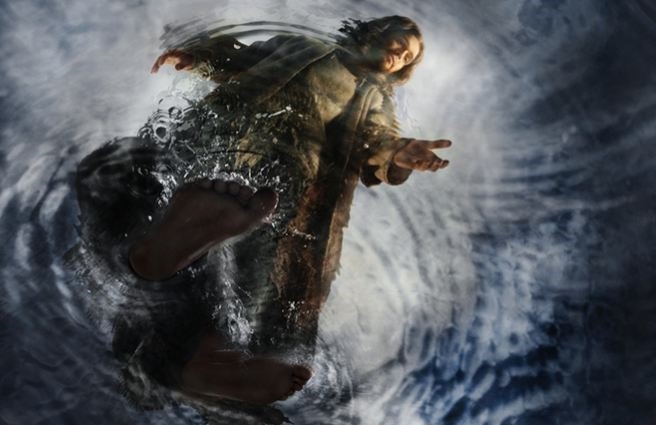
WALKING ON WATER AND SINKING

Jesus-walking-on-water

…When things go well, that is not proof that we are doing what God wants; and when things go badly that is not proof that we are doing something wrong…

…Where do you see Jesus? Is there some way in which you want to be with Jesus, doing what he is doing, a way that looks crazy or impossible? I suggest that you say, like Peter, “Lord if it is you, call me to come to you in this context.”

To listen to the sermon, click the play button:

To download, right click on the link (or do whatever you do on a Mac) and save it to your computer: Download Matthew Part


Matthew #47. Matthew 14:22-36

Jesus was on a real roll for these few days. Just as the feeding of the five-thousand accomplished a number of important things, so did his next miracle.

After the big picnic, he knew that some people had the wrong idea, and wanted to make him king, wanted to follow him simply because he had fed them for free. So he dismissed the people, sent his disciples away and withdrew by himself to a remote place, where he talked to the Father. Finally, he had some time alone with the Father to process his grief over John, and to be strengthened through prayer. It was after this that Jesus came to the disciples who were in the middle of the lake in their boat.

As I read this Scripture I find myself asking, why did Jesus do this?

The first answer is ridiculously simple, and yet I think it is one reason for Jesus’ action. He did it because he wanted to catch up with his disciples, and he didn’t have his own boat, and walking is faster than swimming. That’s right: I think the first reason for this miracle is that Jesus found it the most practical way to rejoin his friends.

Second, I think it is obvious that he used the opportunity to show his disciples yet again that he is the promised Messiah.

Third, as with the feeding of the 5000, Jesus used this miracle as a chance to teach his disciples, and us, some important things. It is on this – what we can learn from this incident – that I want to focus.

First, I want us to notice something. Jesus explicitly told his disciples to get in the boat and start back across the lake, and when they did, the wind was against them. In those days, in that part of the world, they had not yet developed the type of sail which allows a boat to move forward close to the direction from which the wind is coming. In short, when the wind was behind them they could use the sail, but when it was coming from the general direction in which they wished to travel they had to row. Jesus knew the wind was against them and he sent them out anyway.

I think this demonstrates an important principle about following Jesus. I’m not sure where we get it, but a lot of Christians seem to think that if we are following Jesus our lives should be easy. In some ways I understand why we might think this way. When we surrender our lives to God and follow Jesus, we are starting to live the way our Creator intends us to live. This naturally makes certain things better in our lives. If we learn from Jesus how to love others sacrificially, our family life is likely to be happier and more peaceful that if we don’t obey Jesus in this way. If we obey what the Scripture says about not getting drunk we are likely to wake up with fewer headaches and fewer regrets. If we follow God’s plan for sexuality, our relationships will be more stable, our children will grow up in loving families and we will not contract sexually transmitted diseases. I could go on like this about any number of topics, but you get the idea.

On the other hand, there is no promise that everything will be easy if we simply follow Jesus, and in fact there is plenty of evidence to the contrary. This particular passage shows us that. The disciples were doing exactly what Jesus told them to, and it wasn’t going well. After hours of struggling they had only made it a mile away from shore. The truth is, it would have been much easier if they had turned around and let the wind blow them back to where they had started. If they wanted easy, they should have done exactly the opposite of what Jesus told them. This encourages me. When I am encountering difficulties, that doesn’t necessarily mean I have made a mistake; it doesn’t mean that I have messed up God’s plan for me. When things go well, that is not proof that we are doing what God wants; and when things go badly that is not proof that we are doing something wrong. This Scripture teaches us not to judge our actions and decisions based upon results.

There is another thing I want us to notice. When Jesus came to them, walking on the water, they were afraid. I imagine that the whole picture was surreal. The HCSB says that they cried out “it’s a ghost!” The Greek word used for ghost is phantasm. You have to remember, many of us have heard the story all of our lives, but none of the disciples had heard any such thing. They were the first ones to experience it. It wasn’t like they had the thought somewhere in the back of their consciousness, “Oh yeah, the Messiah is going to walk on water.” The Old Testament scriptures did not say the Messiah would do this (they don’t say he wouldn’t, either). Nothing whatsoever prepared them to see Jesus coming towards them in this way. This is another lesson for us. Jesus often approaches us in ways that we do not expect; ways that we do not recognize at first.

Now, there are limits to this. I don’t mean that Jesus will somehow suddenly reveal himself as Buddha; or that he will show you some secret knowledge which contradicts the Bible. Our faith is based in the understanding that the Bible is God’s word revealed to human beings. I have preached extensively in the past about why we can trust that the Bible is reliable. Once we go beyond the Bible or contradict it, our faith is meaningless; if we don’t trust that the Scripture is the word of God there is no reason to believe in Jesus in the first place. However, it is important to understand that while the Bible tells us what we need to know, it does not give us all knowledge in the universe. It is quite possible, likely even, that Jesus can surprise us even if we know and trust the Scriptures. Just as the Messiah walking on the water was not predicted by the Old Testament, it was not contradicted by it either.

On the one hand, it is perfectly acceptable for us to be surprised and even fearful when Jesus shows up in a way that we did not expect. As he sees their fear, he calls out to them, “It is I, do not be afraid!” He is comforting them and reassuring them that this new strange thing they are seeing is in fact himself. I think we can trust that Jesus will do the same for us.

Now let’s take a look at how Jesus and Peter interacted during this incident.

I have thought through how I might react in a similar situation, and have come to the conclusion that I am nothing like the apostle Peter. Here are some things I might have said: “Lord, if it is you then please do something about this wind.” Or, “Lord, if it is you, then hurry up and get into the boat.” Here’s another: “Lord, if it is you, will you please explain what you are doing and what is going on?”

But Peter’s response is something that I think is worth aspiring to. He had a little bit of faith, but he wanted more. One of the things that fascinates me about this whole incident is that Peter did not have to get out of the boat. It was Peter who said to Jesus, “call me to come.” It was not Jesus who insisted Peter get out of the boat. I believe this tells us something about Peter. He wanted everything he could possibly have with Jesus. He didn’t want to get to heaven and find out he could have walked on water, or raised the dead, or healed the sick or anything else he could have done. He wanted to push in to everything Jesus had for him. Now, Jesus did not rebuke the other eleven for staying in the boat, but I believe he laughed with delight when he heard Peter’s request. He was glad to show Peter the amazing things Peter could do with his (Jesus’) help. And we see the later fruit of Peter’s desires to apprehend by faith all that Jesus had for him. It was Peter who was the first of the apostles to heal a lame man. It was he who preached aloud in tongues and saw more than 3,000 people converted at one time. It was he who raised Dorcas from the dead, and who was the first to bring the gospel to non-Jews. It was he who walked out of Herod’s prison without a scratch, faithfully following the angel God sent, even though he was pretty sure it was just a dream, just as he had once thought Jesus on the water was a dream.

Now, if we look at this text carefully, Peter does not seem to be asking to walk on water just so that he can say he walked on water. He did not say, “Lord, if it is you, empower me to walk on water in general,” or “Lord, if it is you, tell me to run two laps around the boat.” What he said was, “Lord, tell me to come to you.” What Peter was after was being close to Jesus. He saw Jesus out there and it filled him with love and admiration and inspiration. Just as a child who wants to be like his dad, Peter wanted to be where Jesus was and do what Jesus did. For Peter, the point was not the miracle, but Jesus. He wanted to be where Jesus was, even when that place looked dangerous and uncertain. He wanted to know that the wind and the waves could not stop him from coming to Jesus.

At first, Peter’s faith holds up. He is actually walking on the water toward Jesus! Now, I would think this is even more difficult than we imagine. Forget about sinking: simply walking and keeping your balance on a moving surface that is going up and down underneath you has got to be very difficult. And then comes verse 30:

But when he saw the strength of the wind, he was afraid. And beginning to sink he cried out, “Lord, save me! ”

jesus-walks-on-waterPeter’s first impulse was inspired by Jesus. His heart and his mind were fixed on Jesus; his goal was Jesus. But then something happened: he looked around at his environment. He started paying attention to his circumstances rather than to Jesus. And when he quit looking at Jesus and started focusing on what was going on around him, he became afraid; and when he became afraid, he sank.

But it was all good! Jesus was there, and Jesus made sure he didn’t go under. Peter got soaking wet and probably cold; he had a good scare, but ultimately, everything came out okay.

It seems to me that we can find some obvious applications to our own lives here. First, it is worth aspiring to the kind of faith and focus on Jesus that Peter shows us. He wasn’t the kind of guy to cower in the boat, and because of that, the Holy Spirit was able to use him in wonderful ways later on.

Second, this whole thing reminds me of Hebrews chapter 12:

Therefore, since we also have such a large cloud of witnesses surrounding us, let us lay aside every weight and the sin that so easily ensnares us. Let us run with endurance the race that lies before us, keeping our eyes on Jesus, the source and perfecter of our faith, who for the joy that lay before Him endured a cross and despised the shame and has sat down at the right hand of God’s throne. (Heb 12:1-2, HCSB)

Peter’s goal all along was Jesus, and when he kept his heart and attention focused on Jesus, he was able to walk on water. I have met people who would love to “walk on water” so to speak, but I wonder how much of their desire is about wanting to do amazing things as opposed to wanting to be like Jesus and to be close to him. There have been times in my own life when I was so excited about the idea of doing something amazing by faith that my focus was more on what I was trying to accomplish than it was on Jesus. But Peter’s focus, at least in the beginning, was all on Jesus. It shouldn’t be about the amazing things we want to do. Instead, it should be that we want to join Jesus where we see him at work, even if that place looks very strange and impossible.

With that foundation firmly in mind, where do you see Jesus? Where is it that you want him to invite you to join him? Jesus did not command any of the disciples to join him on the water, but Peter wanted to, even though it looked crazy. Is there some way in which you want to join with Jesus, a way that looks crazy or impossible? I suggest that you say, like Peter, “Lord if it is you, call me to come to you in this context.”

And then, no matter where we are in faith, one of the keys is keeping our eyes fixed on Jesus, and as much as possible, ignoring the wind and the waves around us. If we want to live by faith, we cannot find security in our circumstances. Our circumstances will often scare us; they may sink us. Like Peter, we are most safe when we keep her eyes fixed on Jesus.

The other thing I love about this, is that Peter was safe. What he tried to do was crazy. Through faith, he was able to do it for a while, but ultimately he failed. What I want to point out is that his failure was not fatal. “Peter” is just the word for “rock” in Greek. I wonder how much fun Jesus and the other disciples had talking about relative buoyancy of rocks. “Hey, Peter! You float like a rock!” Or, “Nice going…Rock!” Even so, Peter was the only one who even bothered to try, and he was no worse off for it. I think this should encourage us. When we step out in faith we may succeed, or we may fail. Either way, Jesus is there.

Be still for a few minutes now, and listen to what the Holy Spirit has to say to you today.

Are you looking at Jesus, or the wind and waves

Thanks again for making use of Clear Bible.

I want to remind you again that we are a listener-supported ministry, and that means, first and foremost, that we are supported by your prayers. We need and value your prayers for us.

Please pray that this ministry will continue to be a blessing to those who hear it. Ask God, if it is his will, to touch even more lives with these messages. Ask him to use this ministry in making disciples of Jesus Christ.

Please also pray for our finances. Pray for us to receive what we need. Please pray for us in this way before you give anything. And then, as you pray, if the Lord leads you to give us a gift, please go ahead and do that. But if he doesn’t want you to give to us, that is absolutely fine. We don’t want you to feel bad about it. We want you to follow Jesus in this matter. But do continue to pray for our finances.

If the Lord does lead you to give, just use the Paypal Donate button on the right hand side of the page. You don’t have to have a Paypal account – you can use a credit card, if you prefer. You can also set up a recurring donation through Paypal. We can make this tax-deductible if you just mention that it want it to be so in the “note” part of the transaction.

You could also send a check to:

New Joy Fellowship

625 Spring Creek Road

Lebanon, TN 37087

Just put “Clear Bible” in the memo. Your check will be tax-deductible.

Thank for your prayers, and your support!

WHAT DO YOU DO WHEN YOU DON’T HAVE ENOUGH?


feed5K


It isn’t what you bring that makes a difference. What makes the difference is that you bring it to Jesus. He can take the little you have and make it enough – more than enough.


To listen to the sermon, click the play button:

To download, right click on the link (or do whatever you do on a Mac) and save it to your computer: Download Matthew Part 46


Matthew #46 . Matthew 14:12-21

NOTE: THIS IS ANOTHER MESSAGE THAT WILL PROBABLY BE MORE MEANINGFUL IF YOU LISTEN TO THE AUDIO VERSION. IN THE AUDIO, I INVITE YOU TO LISTEN AND GET INTO IT WITH YOUR IMAGINATION.

I love this particular passage of scripture. In one elegant action, Jesus accomplishes so much. First, he shows his miraculous power once more. Second, he takes care of a bunch of hungry people. Third, he uses it as an extremely effective object lesson for his disciples.

Before we start into the “meat” of this scripture, however, let me address a very common, but ill-conceived idea about the feeding of the five-thousand. Many people read about this miracle and say, “Oh, I know what happened here. All the people actually had food with them, and Jesus simply got them to share. The real miracle is that Jesus got ordinary people to share with each other.” I have heard more than one person add something like, “To me, that’s a much bigger miracle than producing a bunch of food.”

To which, I say, politely, “That is a load of male-bovine defecation” (figure it out).

I say this for several reasons. First, the reason most people gravitate toward the idea that the miracle was “sharing” is because they believe in sharing, but they don’t really believe Jesus was capable of providing more food than was there to start with. In other words, it starts from a point of disbelief.

Second, the idea is in itself nonsensical. Everyone ate, and there was a significant amount left over. If there was no miraculous provision by Jesus, then obviously, everyone had more than enough to start with. In other words, in this scenario, sharing wasn’t even required. If that’s the case, the “miracle” is reduced to the fact that Jesus got a bunch of people to sit down and eat their supper. I could see the miraculous aspect of this if they were all three-year olds, but for adults, that is ridiculous.

Third, this was widely reported as a miracle, and it made a huge impression on the people. People don’t generally get excited and worked up just because they heard that some other people ate supper. They don’t usually see it as a messianic sign that one man can get five-thousand people to unpack their bagged lunches and eat them at dinner time. But clearly, the disciples, and the others who were there, took this event as a sign that Jesus was someone special. John records their reaction to the feeding of the five thousand.

When the people saw the sign He had done, they said, “This really is the Prophet who was to come into the world! ” Therefore, when Jesus knew that they were about to come and take Him by force to make Him king, He withdrew again to the mountain by Himself. (John 6:14-15, HCSB)

This response makes no sense if all Jesus did was to get them to eat the food they had already brought.

All right, now that we have settled that if anything happened here at all, it was miraculous, let’s get on with it. As we have sometimes done in the past, I want to invite you to put yourself into the middle of the situation with Jesus.

It’s been a difficult time. You just heard that John the Baptist died. You and some of the other disciples knew John pretty well – in fact, it was John who first told you about Jesus. But Jesus knew him even better than you did. The news of his execution has hit you all hard. Jesus wants to get away from it all for a while, and you agree whole-heartedly. You all climb into Simon-Peter’s boat and head across the lake. The trip is peaceful and healing, but not long after you put ashore, far from any town, people start showing up. Someone must have overheard where Jesus was going, and now they are all here, begging for him to heal their diseases and illnesses.

Jesus is tired and full of grief, but when he looks at the people, you can see his heart going out to them. He closes his eyes for a minute in silent prayer, and then starts going through crowd, healing those who need it, and then speaking about the kingdom of heaven. More and more people keep coming, until there are enough to populate a small town, and even more.

It’s been a long afternoon, and now evening is coming along. You start getting hungry, and then it hits you – what about all these people? You cut across the lake in the boat with Jesus, but these folks spent a good portion of the day walking, and if they make it home at all tonight, it will be very late.

“Jesus,” you say. “You better get these people going before it gets too late. They’re going to get hungry, and there is no place here to get food.”

But then it gets weird. Jesus says, “They don’t need to go. You give them something to eat.”

Now seriously, this isn’t fair. You didn’t want these people here in the first place. Jesus was the one who encouraged them to stay when they started showing up. He’s the one who got you into the situation, and now he tells you to figure it out? You look around the crowd. You would have to work for about nine months and save every single penny of it in order to buy enough bread for everyone to have a small bite. In truth, the cost represents more money than you expect to save in a lifetime. You ask around, after a while, what you come up with is five small loaves of barely bread and two dried fish, each one less than ½ a pound.

You take it to Jesus. Now, honestly, you do that more just to show him how impossible the situation is, than for any other reason. He looks at you with a big, slow smile.

“Perfect,” he says.

He starts by thanking the Father for the pathetic little meal. Then he breaks off some of the bread, and about half of one of the fish, and hands the food to Peter. “Go on and break off pieces, and give it to the people,” says Jesus. He breaks off more bread, and another piece of fish, and hands it James, with the same instruction. Next comes John, and then Judas, and then Philip. You sit down, because at this point, the food is all gone. But it isn’t. Jesus gives some to Nathaniel and then Thomas. He motions to you, and hands you a surprisingly large chunk of fish, and some bread. “Don’t skimp now,” he says, grinning. “Give people as much as they want.” He’s crazy. You know you will run out before you have fed four people.

You find a skinny old man who hasn’t yet been served by the others. He looks so hungry and thin, you don’t have the heart to deny him. You break off a big piece of fish, and tear your loaf of bread in half, and give it to him. Next is a young man, at the age where one is hungry all the time. You give him some, and he asks for more. You tear off some more, surprised there is any left. As you go through the crowd, it dawns on you. No matter how much you hand out, you still have plenty left to give the next person.

It keeps going like that, and once you are done serving, you sit down and eat until you are full. Afterwards, each of you grabs a fish-sorting basket from Peter’s boat, and you go around collecting what the people couldn’t eat.

Later, when you think about it, the whole thing reminds you of how the Lord dealt with your ancestors when they left Egypt. He led them to the desert, where they grew hungry, and then he fed them, to demonstrate that they could and should rely upon him for everything. You recall Deuteronomy 8:3

He humbled you by letting you go hungry; then He gave you manna to eat, which you and your fathers had not known, so that you might learn that man does not live on bread alone but on every word that comes from the mouth of the LORD. (Deut 8:3, HCSB)

All right, now, let’s make this practical in our own lives right now. First, of course, Jesus did this particular miracle in this way to show the people that he was the messiah. His actions are a very close parallel of how the Lord dealt with the people of Israel during the Exodus. They could hardly miss the significance of it all. He led them into the wilderness where they experienced their need, and then he satisfied that need.

Second, this is often exactly how Jesus deals with us. Jesus allowed a difficult situation to develop, and then left it to the disciples, to see what they would do. More than once, I have faithfully followed Jesus to the best of my ability, and I wind up, figuratively speaking, alone and hungry in the wilderness. Instead of great results from trying to be faithful to Jesus, I end up feeling like I’m worse off than I was before. And then comes the worst part. Like the disciples, I go to him with the problem and he says, “Look at your own resources. What have you got? What will you do?”

I’m sure the disciples first thought this was unfair. Jesus got them into this – why should they be the ones to figure a way out? But that wasn’t Jesus’ point, and it isn’t his point when he does this with us. His point is this: whatever resources you have – when you bring them to Him – are enough. Five loaves of bread split between five thousand people is one one-thousandth of a loaf of bread for everyone. It is pathetic, even laughable. We are supposed to look at our resources and see how hopeless it is without Jesus. But when we bring what we have to Jesus – even when it is as pathetic as five loaves and two fish among five thousand – Jesus can turn it into enough.

You probably aren’t reading this on a deserted hillside in Galilee with five-thousand hungry people. But you might be in the middle of another difficult situation, one that seems impossible. Perhaps you are in a very troubled place in one of your important relationships. Maybe you are in the midst of work or career difficulties. Maybe your struggle has to do with finances, or health. It might seem like you got into this mess in the first place by trying to follow Jesus. It might feel like he’s asking you to care of everything.

Take a moment right now, and bring to mind a situation that seem difficult or impossible for you. Stop reading for a bit, if you need to, and enter into that situation. Now picture Jesus. Let him ask you to give him your resources. It’s OK if your resources are pathetic. In fact, imagine him as he looks at the inadequacies you bring to this situation and smiles a big smile, and says “Perfect.”

You see, it isn’t what you bring that makes a difference. What makes the difference is that you bring it to Jesus. He can take the little you have, and make it enough – more than enough.

Now, Jesus did ask the disciples to trust him. He provided the food. He supplied the miracle. But he asked his disciples to trust him, and to act on that trust. They took what he gave, and went out the crowd and gave it away. So also, he asks you to trust him. He will provide. He will take your pathetic resources and make them more than enough. But he wants you to trust that, and act on that trust. Listen as he tells you what to do right now, and then obey.

Thanks again for making use of Clear Bible.

I want to remind you again that we are a listener-supported ministry, and that means, first and foremost, that we are supported by your prayers. We need and value your prayers for us.

Please pray that this ministry will continue to be a blessing to those who hear it. Ask God, if it is his will, to touch even more lives with these messages. Ask him to use this ministry in making disciples of Jesus Christ.

Please also pray for our finances. Pray for us to receive what we need. Please pray for us in this way before you give anything. And then, as you pray, if the Lord leads you to give us a gift, please go ahead and do that. But if he doesn’t want you to give to us, that is absolutely fine. We don’t want you to feel bad about it. We want you to follow Jesus in this matter. But do continue to pray for our finances.

If the Lord does lead you to give, just use the Paypal Donate button on the right hand side of the page. You don’t have to have a Paypal account – you can use a credit card, if you prefer. You can also set up a recurring donation through Paypal. We can make this tax-deductible if you just mention that it want it to be so in the “note” part of the transaction.

You could also send a check to:

New Joy Fellowship

625 Spring Creek Road

Lebanon, TN 37087

Just put “Clear Bible” in the memo. Your check will be tax-deductible.

Thank for your prayers, and your support!
SUFFERING, GRIEF AND HOPE

hope

The truth is earthly suffering is intolerable unless there is a glorious, loving, sorrow-free eternity. We Christians are a people of hope. But our hope is not primarily in this temporary life. Everyone dies, sooner or later. All hopes – for this life – come to an end. Jesus, as usual said it best: “You will have suffering in this world. Be courageous! I have conquered the world.”

To listen to the sermon, click the play button:

To download, right click on the link (or do whatever you do on a Mac) and save it to your computer: Download Matthew Part 45


Matthew #45 . Matthew 14:1-12

The first part of Matthew 14 relates the details of how John the Baptist was killed. It’s important for us to remember that the life and teachings of John the Baptist continued to influence a large number of Jews for at least a generation after he was killed. I think this is one reason Matthew describes this incident in detail – it would have been important to the readers he had in mind when he was writing.

Matthew has already told us that John was in prison. I want to spend a moment dwelling on the reason for that, and the thing that got him killed, because it may surprise us. The short version is, John was imprisoned, and then killed, for publicly supporting biblical sexual morality. He publicly said that Herod was wrong for having sexual relations with his brother’s wife, Herodias.

I point this out because I think it is very relevant today. Our culture is extremely intolerant of people who insist that sex has any moral significance in and of itself.

If you say that sex has intrinsic moral significance, then you set it within a larger moral framework and set limits to the legitimate use of sex. In doing so, you declare certain sexual acts illegitimate, something which is now considered hate speech…

By divesting sex of intrinsic moral significance [an activist] has helped to create a world where those who attempt to set limits to the legitimacy of sexual activity are seen as the moral equivalent of racists and the intellectual equivalent of flat-earthers: Irrational bigots who have no place in the public square. (Carl R Trueman, First Things, 2-23-15 http://www.firstthings.com/blogs/firstthoughts/2015/02/congratulating-wesleyan).

There are many people who call themselves Christians who either don’t know, or don’t believe what the bible says about sex. There are many more who don’t like it, and refuse to adhere to it. A lot of people think that it gives Christians a bad name if we go around saying what the bible says about sex. Even more suggest that sexual morality is a “secondary issue” and we Christians should stay out of it for the sake of the gospel.

But John the Baptist died for it.

He could have said, “Well what Herod does in his own bedroom is Herod’s own business.” It’s likely that he could have made a public apology to Herod and Herodias, and at least have been spared execution. But he didn’t. He insisted upon telling the truth, and doing so publicly, and not retracting it. It got him killed.

Someday, a sermon like this may lead to my own imprisonment. It is no longer a question of disagreement in our culture. The power-brokers in the media, academe and government, as well as millions of narrow-minded citizens, want people like John the Baptist to be silenced. They don’t want to hear something they disagree with.

We have not yet come to executions for saying that adultery is a sin. But our government is already considering laws that make it a hate-crime to say in a public speech that homosexual behavior is a sin. In October of 2014, the city of Houston demanded in a subpoena that pastors turn over any sermon or communication with their congregation that mentions homosexuality, the lesbian mayor or transgender issues. To refuse to turn over the sermons would have been contempt of court, punishable by imprisonment. The government’s position is that pastors were using their religious positions to campaign politically, since there was law on the ballot about gay and transgender issues. But the fact remains, when the pastors spoke about the law (if they did) they did so because the issues raised by it are of biblical concern, and it is manifest that the city government wanted to silence and punish them for it.

Now, please understand me clearly. I am not saying that we should go around investigating everyone’s sex life, looking for something to criticize. But I do think sometimes we Jesus-followers avoid the topic because we don’t like getting flack for calling sin “sin.” I simply want to point out that perhaps this passage shows us that the issue of sexual morality is more important than we want to think, and I do suspect that it is with that issue that the persecution of Christians will begin in the Western world. Lest we think it is a secondary issue, remember that John the Baptist died for speaking the truth about morality. I think we Christians should consider this very carefully before we decide to keep silent about it.

~

After John was killed, his disciples buried his body, and then they did something very important: they went to Jesus. There is no doubt that they were full of grief and sorrow. There is no doubt that some of them wondered why Jesus didn’t do anything to save John. But they went to him anyway.

Jesus’ reaction is also important:

When Jesus heard about it, He withdrew from there by boat to a remote place to be alone. (Matt 14:13)

Obviously, the news of John’s death had an impact on Jesus. He wanted to be alone to process it. Jesus and John were relatives, and they had known each other all their lives. John had worked hard to prepare people for the ministry of Jesus, and he had unfailingly pointed people toward him. In short, they were family, friends and ministry partners. And now John is gone. Jesus knew his eternal home was heaven. He knew he would see John there again. But that didn’t change the fact that just like us, Jesus experienced pain and suffering in the world, and it hit him hard at times.

I think it’s important for us to dwell on this for a minute. We human beings have a very difficult time with pain and suffering. How can a good and loving God let these things happen? The answers to this are only partial, and sometimes complex. But I take comfort from the example of Jesus here. On the one hand, he knows everything is going to be all right. In fact, he knows that in eternity, everything is better than all right. John’s suffering on earth is over. He himself will be with John again in just a few short years. On the other hand, in the present moment, he grieves.

The truth is earthly suffering is intolerable unless there is a glorious, loving, sorrow-free eternity. About a year ago, I spoke at the funeral of a twenty-one year old who died unexpectedly and tragically. I said then that of course it was good and right to grieve. I said that we Christians are also people of hope. But our hope is not primarily in this temporary life. Everyone dies, sooner or later. All hopes – for this life – come to an end. Paul writes:

If we have put our hope in Christ for this life only, we should be pitied more than anyone. But now Christ has been raised from the dead, the firstfruits of those who have fallen asleep. For since death came through a man, the resurrection of the dead also comes through a man. For as in Adam all die, so also in Christ all will be made alive. But each in his own order: Christ, the firstfruits; afterward, at His coming, those who belong to Christ. (1Cor 15:19-23, HCSB)

Jesus shows us that it is good and appropriate to grieve the tragedies of this life. But he also gives us a better hope, an eternal hope. I am reminded of the old song, Wayfarin’ Stranger:

I’m just a poor, wayfarin’ stranger

Travelin’ through this world of woe

But there’s no sickness, no toil or danger

In that bright world to which I go.


I’m goin’ there to see my Father

I’m goin’ there no more to roam

I’m just a goin’ over Jordan

I’m just a goin’ over home.

Jesus, preparing his disciples for his own death, said this:

I have told you these things so that in Me you may have peace. You will have suffering in this world. Be courageous! I have conquered the world.” (John 16:33, HCSB)

We will have trouble and suffering in the world. Hope which cannot apply equally to the free man with the possibility of making his life better, and also the man doomed to suffer and die in prison, is not hope at all. Jesus offers us real hope, eternal hope. There is a time for grief, and Jesus himself grieved for his dear friend and cousin John. If this was the experience of Jesus, we should not think that we will be exempt from it. But even in grief, there is hope, hope not based on everything coming out right here and now, but on something greater and more lasting than anything in this life.

Like John’s disciples, and Jesus himself, it is often appropriate to mourn. But also like John’s disciples, let us bring our grief to Jesus, and receive from him the eternal hope we so desperately need.

Thanks again for making use of Clear Bible.

I want to remind you again that we are a listener-supported ministry, and that means, first and foremost, that we are supported by your prayers. We need and value your prayers for us.

Please pray that this ministry will continue to be a blessing to those who hear it. Ask God, if it is his will, to touch even more lives with these messages. Ask him to use this ministry in making disciples of Jesus Christ.

Please also pray for our finances. Pray for us to receive what we need. Please pray for us in this way before you give anything. And then, as you pray, if the Lord leads you to give us a gift, please go ahead and do that. But if he doesn’t want you to give to us, that is absolutely fine. We don’t want you to feel bad about it. We want you to follow Jesus in this matter. But do continue to pray for our finances.

If the Lord does lead you to give, just use the Paypal Donate button on the right hand side of the page. You don’t have to have a Paypal account – you can use a credit card, if you prefer. You can also set up a recurring donation through Paypal. We can make this tax-deductible if you just mention that it want it to be so in the “note” part of the transaction.

You could also send a check to:

New Joy Fellowship

625 Spring Creek Road

Lebanon, TN 37087

Just put “Clear Bible” in the memo. Your check will be tax-deductible.

Thank for your prayers, and your support!

Good and Evil grow together in the Real world


wheatandweeds

We should be comforted by these words, knowing that it is okay to be honestly ignorant, and to ask Jesus for help understanding. We should be blessed in knowing that our real life experience of seeing good and evil jumbled together is normal. We should rejoice in the word promises that through Jesus we are made righteous and shall shine like the sun in our Father’s kingdom.


To listen to the sermon, click the play button:

To download, right click on the link (or do whatever you do on a Mac) and save it to your computer: Download Matthew Part 43


Matthew #43 . Matthew 13;24-58

24 He presented another parable to them: “The kingdom of heaven may be compared to a man who sowed good seed in his field. 25 But while people were sleeping, his enemy came, sowed weeds among the wheat, and left. 26 When the plants sprouted and produced grain, then the weeds also appeared. 27 The landowner’s slaves came to him and said, ‘Master, didn’t you sow good seed in your field? Then where did the weeds come from? ’

28 “ ‘An enemy did this! ’ he told them.

“ ‘So, do you want us to go and gather them up? ’ the slaves asked him.

29 “ ‘No,’ he said. ‘When you gather up the weeds, you might also uproot the wheat with them. 30 Let both grow together until the harvest. At harvest time I’ll tell the reapers: Gather the weeds first and tie them in bundles to burn them, but store the wheat in my barn.’ ”

At the beginning of Matthew 13, Jesus told a somewhat long parable, and then there is some discussion of why he spoke in parables, and after that, the parable is explained. This next section, Matthew 13:24-43 is similar in structure. Jesus tells one long parable and then two short ones, and then Matthew describes his manner of teaching as a fulfilment of prophecy. After that, the long parable is explained to the disciples. I’m not sure why Matthew took that approach, but obviously he did.

In fact there is something interesting about the entire section of Matthew 13:24-58. There are six parables in total in this passage. Two of them (the wheat and weeds, and the fishing net) appear to be about the idea that the visible kingdom of heaven here on earth is flawed; it contains many individuals who do not truly belong to God.

There is another set of two parables which seem to be related to each other. The illustration of the mustard seed, and also the story of the yeast seem to be about the same theme, which is that the kingdom of heaven starts small and often works secretly and unnoticed.

Finally a third pair of parables describes a third thing: the idea of the extreme value of the kingdom of God, and of sacrificing much in order to gain it.

Let’s begin with the first theme, as expressed in the parable of the wheat and weeds, and reiterated in the parable of the fishing net. Before we jump into this, I want us to notice something. Matthew has told us in several different ways in this chapter that Jesus spoke in parables because the people were hardhearted and did not want to understand. It could be that the parables were a way to keep them from understanding; but it might also be that he spoke in parables in order to try and help them see things from a different perspective so that they might become receptive to him. I know that some people in our groups were concerned about this, wondering if perhaps they themselves didn’t understand. But pay close attention to the disciples in verse 36. They didn’t understand. So what did they do? They asked Jesus. And Jesus was happy to explain it to them. The fact that we follow Jesus does not mean that we automatically understand everything he teaches. We are not in trouble if we don’t. I think we should be encouraged by the disciples here to admit it when we don’t get it, and to go to Jesus seeking wisdom. The only problem with lack of comprehension is when it occurs because our hearts are spiritually hardened against the Holy Spirit. In other words, some people don’t understand because, frankly, they don’t care. Their lack of understanding is a symptom of spiritual insensitivity. But there is another kind of ignorance, and that is an honest lack of comprehension. The Lord delights to help us when we come to him admitting our need for wisdom and instruction:

The LORD is good and upright; therefore He shows sinners the way. He leads the humble in what is right and teaches them His way. (Ps 25:8-9, HCSB)

Now if any of you lacks wisdom, he should ask God, who gives to all generously and without criticizing, and it will be given to him. (Jas 1:5, HCSB)

So the disciples asked Jesus about the meaning of the story of the wheat and weeds.

37 He replied: “The One who sows the good seed is the Son of Man; 38 the field is the world; and the good seed — these are the sons of the kingdom. The weeds are the sons of the evil one, 39 and the enemy who sowed them is the Devil. The harvest is the end of the age, and the harvesters are angels. 40 Therefore, just as the weeds are gathered and burned in the fire, so it will be at the end of the age. 41 The Son of Man will send out His angels, and they will gather from His kingdom everything that causes sin and those guilty of lawlessness. 42 They will throw them into the blazing furnace where there will be weeping and gnashing of teeth. 43 Then the righteous will shine like the sun in their Father’s kingdom. Anyone who has ears should listen!

I find this parable tremendously comforting because it affirms my experience of being a Christian, and of being part of the kingdom of God on earth. In the real world, good and bad are often all jumbled together. Let me share a few examples:

  • In these days, there are famous television preachers who are clearly preaching things that are biblically incorrect. It is almost certain that they are leading some people astray; and yet at the same time it is almost certain that the Lord is using their ministries to bring some people closer to himself.
  • I personally know someone who has been used by the Lord to bring actual, physical healing to others; yet he also believes that he should be a preacher, and he preaches things that I would call heresy.
  • Kari and I have friends who were led to Jesus by a group that those same friends would now call a cult. Our friends affirm that this group is a cult, and they reject their cultish beliefs; but they also affirm that they were led to Jesus by those people.

It is obvious that there are many good people who call themselves Christians; it is equally obvious that there are many bad people who call themselves Christians. Our churches are full of both kinds.

In this parable, Jesus describes exactly this type of world, the real world that we encounter every day. Good and evil are growing together, sometimes even found in the same groups, the same individuals.

When we encounter this sort of thing, many times our reaction is to try and do something about it. Jesus included this idea in the parable: the servants wanted to uproot the weeds right away. I find myself often with the same attitude. But the master tells the servants: “No. You might destroy the good plants with the weeds. Instead, let them grow together until harvest, and the reapers will sort it out then.”

I think it is important for Christians to understand the difference between good and evil. The rest of the New Testament clearly affirms the idea that we should distinguish between false teaching and the true word of God.

Be on guard for yourselves and for all the flock that the Holy Spirit has appointed you to as overseers, to shepherd the church of God, which He purchased with His own blood. I know that after my departure savage wolves will come in among you, not sparing the flock. And men will rise up from your own number with deviant doctrines to lure the disciples into following them. Therefore be on the alert, remembering that night and day for three years I did not stop warning each one of you with tears. (Acts 20:28-31, HCSB)

To Timothy, my true son in the faith. Grace, mercy, and peace from God the Father and Christ Jesus our Lord. As I urged you when I went to Macedonia, remain in Ephesus so that you may instruct certain people not to teach different doctrine or to pay attention to myths and endless genealogies. These promote empty speculations rather than God’s plan, which operates by faith. Now the goal of our instruction is love that comes from a pure heart, a good conscience, and a sincere faith. (1Tim 1:2-5, HCSB)

Hold on to the pattern of sound teaching that you have heard from me, in the faith and love that are in Christ Jesus. Guard, through the Holy Spirit who lives in us, that good thing entrusted to you. (2Tim 1:13-14, HCSB)

Be diligent to present yourself approved to God, a worker who doesn’t need to be ashamed, correctly teaching the word of truth. (2Tim 2:15, HCSB)

I solemnly charge you before God and Christ Jesus, who is going to judge the living and the dead, and because of His appearing and His kingdom: Proclaim the message; persist in it whether convenient or not; rebuke, correct, and encourage with great patience and teaching. For the time will come when they will not tolerate sound doctrine, but according to their own desires, will multiply teachers for themselves because they have an itch to hear something new. They will turn away from hearing the truth and will turn aside to myths. (2Tim 4:1-4, HCSB)

But in another sense, it is not our job to sort it all out here and now. For instance, I think it is good and proper for me to point out the errors of what we call the “prosperity gospel.” It is part of my job as a teaching elder to keep those under my care from being led astray. But it is not my job to stop the prosperity preachers. I don’t know what to make of some their ministries. I suspect that it will go hard with them when Jesus returns. But I don’t have to sort it all out – that is the Lord’s job, on the last day.

I want to make a few more points, some of which are reiterated by the parable of the fish in the net:

47 “Again, the kingdom of heaven is like a large net thrown into the sea. It collected every kind of fish, 48 and when it was full, they dragged it ashore, sat down, and gathered the good fish into containers, but threw out the worthless ones. 49 So it will be at the end of the age. The angels will go out, separate the evil people from the righteous, 50 and throw them into the blazing furnace. In that place there will be weeping and gnashing of teeth.

Both the parable of the net, and of the wheat and weeds describe a situation where good is mixed with evil until the end of time. But they both clearly also describe an “end time” when good will be separated from evil, and evil will be entirely destroyed, while good is preserved forever. This is important in several ways:

First, there are many people, some even claiming to be Christians, who say that there is no such place as hell, and all people go to heaven. However, clearly, Jesus did not think that was true. He teaches us right here that there will be a time when evil, and evil people, will be punished and cast away from his presence forever. You cannot claim to follow the teachings of Jesus, and that same time, believe that all people go to heaven. For many, this is one of the big negatives about Christianity. I understand why people think this is negative. But you might just as well say that falling is one of the big negatives about gravity. It is what it is. And if gravity were different, we wouldn’t exist. In the same way, the spiritual universe has absolute truths, and if they were different, we couldn’t exist.

Second, there is a positive side to the punishment of wickedness and evil. Most people can still recognize some things as evil. Beheading innocent women, children and men is evil. Making girls, boys and young women into sex-slaves is evil. Rape is evil. At least our culture still agrees with those statements. So do we want those kinds of evil to take place with no justice? What kind of universe would it be if the strong can do these things to the weak with no accountability, ever? Jesus, through these stories, tells us that there is justice. Evil cannot have its way forever. There will be accountability.

I do not want to close without pointing out the grace inherent in these things. We may be thinking, “well, yes, I can see that punishment for the wicked is a good thing, but what if that means me?” It does mean you. It means me, also. But it doesn’t have to. Jesus came precisely to save us from ourselves, from the eternal separation from God that we deserve because of our sins. Hear the end of Jesus’ explanation of the parable of the wheat and weeds:

Then the righteous will shine like the sun in their Father’s kingdom. Anyone who has ears should listen!

I know I’m not righteous. I know you aren’t, either. But Jesus is! And Jesus offers us his own righteousness. That’s one of the amazing things he accomplished in his death and resurrection. Our wickedness and evil were punished, and we were given his righteousness. If we simply trust that he has done this for us, we have the righteousness of Jesus. In this parable, those of us who trust Jesus are “the righteous.” We will shine like the sun in our Father’s kingdom. Jesus meant this to be a comfort to his disciples, and we are his disciples if we trust him and allow him to be ruler of our lives.

We should be comforted by these words, knowing that it is okay to be honestly ignorant, and to ask Jesus for help understanding. We should be blessed in knowing that our real life experience of seeing good and evil jumbled together is normal. We should rejoice in the word promises the righteous – those who trust and surrender to Jesus – shall shine like the sun in our Father’s kingdom.

Let the Holy Spirit speak to you today.

Thanks again for making use of Clear Bible.

I want to remind you again that we are a listener-supported ministry, and that means, first and foremost, that we are supported by your prayers. We need and value your prayers for us.

Please pray that this ministry will continue to be a blessing to those who hear it. Ask God, if it is his will, to touch even more lives with these messages. Ask him to use this ministry in making disciples of Jesus Christ.

Please also pray for our finances. Pray for us to receive what we need. Please pray for us in this way before you give anything. And then, as you pray, if the Lord leads you to give us a gift, please go ahead and do that. But if he doesn’t want you to give to us, that is absolutely fine. We don’t want you to feel bad about it. We want you to follow Jesus in this matter. But do continue to pray for our finances.

If the Lord does lead you to give, just use the Paypal Donate button on the right hand side of the page. You don’t have to have a Paypal account – you can use a credit card, if you prefer. You can also set up a recurring donation through Paypal. We can make this tax-deductible if you just mention that it want it to be so in the “note” part of the transaction.

You could also send a check to:

New Joy Fellowship

625 Spring Creek Road

Lebanon, TN 37087

Just put “Clear Bible” in the memo. Your check will be tax-deductible.

Thank for your prayers, and your support!

DO YOU SEE WHAT IS DIRECTLY IN FRONT OF YOUR FACE?

in-blind-spot-truck-sign-s-4468

I think a lot of people have the question: “Why didn’t more people recognize Jesus for who he was when we walked on earth?” We human beings are prone to see what we want to see, and to be blind to things we don’t want to acknowledge. Jesus wasn’t the kind of Messiah that many of the Jews wanted, so they did not “see” him for who he was. Not only that, but the bible is clear that mainly, this is a spiritual condition. We can ignore it, and let it get worse, or we can do some things to alleviate it.


To listen to the sermon, click the play button:

To download, right click on the link (or do whatever you do on a Mac) and save it to your computer: Download Matthew Part 41


Matthew #41 . Matthew 13:1-17

The first nine verse of Matthew 13 are taken up with the parable of the sower, which Jesus explains later in the chapter. We will consider that parable next time, along with Jesus’ explanation of it. This time, I’d like to consider something that Matthew introduces in chapter 13: Jesus’ tendency to teach in parables. Matthew writes:

Then the disciples came up and asked Him, “Why do You speak to them in parables? ”

He answered them, “Because the secrets of the kingdom of heaven have been given for you to know, but it has not been given to them. For whoever has, more will be given to him, and he will have more than enough. But whoever does not have, even what he has will be taken away from him. For this reason I speak to them in parables, because looking they do not see, and hearing they do not listen or understand. Isaiah’s prophecy is fulfilled in them, which says: You will listen and listen, yet never understand; and you will look and look, yet never perceive. For this people’s heart has grown callous; their ears are hard of hearing, and they have shut their eyes; otherwise they might see with their eyes and hear with their ears, understand with their hearts and turn back — and I would cure them.

“But your eyes are blessed because they do see, and your ears because they do hear! For I assure you: Many prophets and righteous people longed to see the things you see yet didn’t see them; to hear the things you hear yet didn’t hear them.” (Matt 13:10-17, HCSB)

It’s true that parables can often be used to make a point. People have said that Jesus’ use of parables show what a great communicator he was. But Matthew records that at the time the parables confused many people, and especially, he records that one reason Jesus used them was to remain obscure to certain people.

Now, if you think that sounds strange, you aren’t alone. However, this is connected to a significant recurring theme of the bible. Over and over again throughout both the Old and New Testaments, we have the concept of people who do not perceive or understand God or His work; and it is implied that their lack of perception has to do with the fact that they have become spiritually calloused.

But to this day the LORD has not given you a heart to understand or eyes to see or ears to hear. (Deut 29:4)

“Son of man, you dwell in the midst of a rebellious house, who have eyes to see, but see not, who have ears to hear, but hear not, for they are a rebellious house. (Ezekiel 12:2)

As it is written, “God gave them a spirit of stupor, eyes that would not see and ears that would not hear, down to this very day.” (Romans 11:8)

For the message of the cross is foolishness to those who are perishing, but it is God’s power to us who are being saved. For it is written: I will destroy the wisdom of the wise, and I will set aside the understanding of the experts. Where is the philosopher? Where is the scholar? Where is the debater of this age? Hasn’t God made the world’s wisdom foolish? (1Cor 1:18-20, HCSB)

I think a lot of people have the question: “Why didn’t more people recognize Jesus for who he was when we walked on earth?” This is something of an answer to that. We human beings are prone to see what we want to see, and to be blind to things we don’t want to acknowledge. Jesus wasn’t the kind of Messiah that many of the Jews wanted, so they did not “see” him for who he was. Not only that, but the bible is clear that mainly, this is a spiritual condition. It isn’t just an ordinary human tendency – it is a sign that some people have chosen to be oriented away from God. In the last chapter, Jesus suggested that a miracle would not convince the Pharisees. This theme is continued here. They have already made up their minds, and turned their hearts from God. So they see the miracles, or at the least hear about them from many witnesses, and yet they do not “see it.” Though seeing, they don’t perceive, though hearing, they don’t understand.

Paul explains the spiritual workings of this to the Corinthians:

Now God has revealed these things to us by the Spirit, for the Spirit searches everything, even the depths of God. For who among men knows the thoughts of a man except the spirit of the man that is in him? In the same way, no one knows the thoughts of God except the Spirit of God. Now we have not received the spirit of the world, but the Spirit who comes from God, so that we may understand what has been freely given to us by God. We also speak these things, not in words taught by human wisdom, but in those taught by the Spirit, explaining spiritual things to spiritual people. But the unbeliever does not welcome what comes from God’s Spirit, because it is foolishness to him; he is not able to understand it since it is evaluated spiritually. (1Cor 2:10-14, HCSB

I don’t think Jesus used parables to confuse people, so much as to reveal the fact that it is the Holy Spirit who leads people into truth. I don’t mean (and I don’t think Jesus meant) that no truth at all can be grasped without the Spirit. Certainly, we can learn many true things without the Spirit, like 2+2=4, and that it’s a bad idea to start a land war in Asia. But the saving truth of who Jesus is, and of what the Bible says: these things come from the Holy Spirit.

When the Spirit of truth comes, He will guide you into all the truth. For He will not speak on His own, but He will speak whatever He hears. He will also declare to you what is to come. He will glorify Me, because He will take from what is Mine and declare it to you. Everything the Father has is Mine. This is why I told you that He takes from what is Mine and will declare it to you. (John 16:13-15, HCSB)

By the way, when we get to the parable of the sower, we will see this theme reiterated. The whole premise of that parable is the idea that some people are spiritually receptive and others are not. However, we will consider that particular parable in greater depth next week.

For now, I’d like to see what all this means for us today. There are many rational and positive reasons to consider Christianity an reasonable and intellectual world view. I sometimes get caught up in trying to explain how rational and reasonable it is to trust Jesus. But the truth is, there are aspects of our faith that go entirely against worldly common sense. And this Scripture, along with the others I have quoted, show us that the key factor in saving faith is our spiritual response, not our intellectual conviction.

For many people, this can be good news. You do not have to be a Bible scholar to help other people spiritually. You do not have to have all of the logical and intellectual answers. The most important thing is not intellectual understanding, but spiritual receptivity. And the Scriptures show us how to increase our own spiritual receptivity, and how to help others do the same.

First, we encounter the Holy Spirit through the words of the Bible.

One believes with the heart, resulting in righteousness, and one confesses with the mouth, resulting in salvation. Now the Scripture says, Everyone who believes on Him will not be put to shame, for there is no distinction between Jew and Greek, since the same Lord of all is rich to all who call on Him. For everyone who calls on the name of the Lord will be saved. But how can they call on Him they have not believed in? And how can they believe without hearing about Him? And how can they hear without a preacher? And how can they preach unless they are sent? As it is written: How beautiful are the feet of those who announce the gospel of good things! (Rom 10:10-15, HCSB)

It is clear that saving faith begins with hearing the word of God.

For the word of God is living and effective and sharper than any double-edged sword, penetrating as far as the separation of soul and spirit, joints and marrow. It is able to judge the ideas and thoughts of the heart. (Heb 4:12, HCSB)

If we would like be people who hear and understand; people who are not spiritually blind, we should spend time reading the Scripture and listening to those who preach it. We would like to influence the world for God, one of the best places to start is to share the words of the Bible with others, and to support preachers who preach the word of God.

There is another thing that we can do to make ourselves more open to the Holy Spirit, and also to help others to be more open. Paul wanted exactly these things for the Ephesians. So he spoke the word of God to them, and he prayed, as shown below. Prayer is a powerful mechanism for opening our own hearts to the Holy Spirit and opening the hearts of others.

For this reason I kneel before the Father from whom every family in heaven and on earth is named. I pray that He may grant you, according to the riches of His glory, to be strengthened with power in the inner man through His Spirit, and that the Messiah may dwell in your hearts through faith. I pray that you, being rooted and firmly established in love, may be able to comprehend with all the saints what is the length and width, height and depth of God’s love, and to know the Messiah’s love that surpasses knowledge, so you may be filled with all the fullness of God. (Eph 3:14-19, HCSB)

By the way you can take this prayer that Paul prayed here and pray it for yourself and for others. There’s nothing wrong with using Paul’s words, after all, they were inspired by the Holy Spirit. When I pray this scripture, I do it something like this:

Father, I come before you trusting in the riches of your glory and mercy and ask you to strengthen me and my friends in our inner beings so that through your Holy Spirit Jesus can dwell more fully in our hearts and our faith is increased. Make us rooted and firmly established in your love and help us to understand the incredible greatness and depth and height of your love and to be filled with all of your fullness. In Jesus name, amen.

A very important third way to help ourselves and others be open to the Holy Spirit, is to meet regularly with other believers for worship, prayer and encouragement.

Therefore, brothers, since we have boldness to enter the sanctuary through the blood of Jesus, by a new and living way He has opened for us through the curtain (that is, His flesh), and since we have a great high priest over the house of God, let us draw near with a true heart in full assurance of faith, our hearts sprinkled clean from an evil conscience and our bodies washed in pure water. Let us hold on to the confession of our hope without wavering, for He who promised is faithful. And let us be concerned about one another in order to promote love and good works, not staying away from our worship meetings, as some habitually do, but encouraging each other, and all the more as you see the day drawing near. (Heb 10:19-25, HCSB)

I meet people all the time who say, “but I don’t get much out of church.”

What I want to say in response is: “So church is all about you? You feel no need to encourage others? You have nothing to offer anyone else?” I understand that you won’t make good connections in every possible church, and you should certainly try to be in a place where the bible teaching actually comes from the bible, glorifies Jesus, and calls people to trust and obey Him. But it is vitally important to be connected to other Christians, and you need to be there for them, as well as for yourself. Quit “going when you feel like it” and take some responsibility not only for your own spiritual condition, but that of your Christian brothers and sisters. You will struggle spiritually if you are erratic about connecting with other believers for worship, prayer and encouragement. And also, you will cause some other believers to struggle as well, if they can’t count on you to be there for them. We are family, and God is our Father. He wants us to be here for each other.

When we step back and consider this whole topic, there is a downside. Jesus is clearly saying that some people don’t “get it.” It may seem discouraging to realize that some people have a spiritual condition and keeps their hearts closed to the Lord. But if we know anything from Scripture, it is that that spiritual condition does not have to be permanent; it can be changed. Saul of Tarsus was blinded to the truth of who Jesus was; he was not receptive to the Holy Spirit. And yet, he did not stay that way. The Lord broke through into his life, and he became known as “Paul,” a great apostle.

I was recently reminded of how powerfully the Holy Spirit can work, even in someone who seems opposed to it. About six months ago, someone came to this sermon blog. This person, whom I will call “Jane,” for anonymity, did not like what I had written or said in a particular sermon. She posted a long and vehemently negative comment on the blog. It looked to me as if she’d missed the entire point of the sermon, and I tried to encourage her to make sure she understood what I was saying. She replied with an even longer, more angry comment. At that point, I assumed she was just a “troll,” someone who is simply out looking for an argument. It bothered me however, and I shared the situation with one of our elders. He suggested that I should respond at least one more time, and then we said a brief prayer for Jane.

Just this past week, Jane contacted me again. She described how the Lord had been working on her heart, and she asked forgiveness for the negative things she had said in her comments on the blog. If you had asked me six months ago to evaluate Jane’s spiritual condition based on her comments, I probably would have been fairly negative in my assessment. Praise the Lord, it isn’t my job to evaluate anyone else’s spiritual condition! I think it is important for all of us remember that we can’t really see everything that God may be doing in a person’s life.

Maybe it isn’t someone else that you’re frustrated with, but yourself. The same truth applies: God is not done with you yet. The battle isn’t over, you are not doomed to be hardhearted toward the Holy Spirit. As we continue to read the Bible and pray and remain connected to other believers, the Holy Spirit continues to work on us.

It is somewhat like the business of the sin against the Holy Spirit: I think if you have any concern that you might be calloused toward the Lord, that you might be in danger of “seeing but not perceiving, hearing but not understanding,” then your concern should be a cause for hope. The people who are truly calloused toward the Lord are not concerned about it. If you are worried about it, then he still probably has room to work in your heart.

Let’s hear the good news that Jesus shared with his disciples: “the secrets of the Kingdom of Heaven have been given to you to know.” Paul says: “Now we have not received the spirit of the world, but the Spirit who comes from God, so that we may understand what has been freely given to us by God.” We can be among Jesus’ disciples. We can be among those who have received the Holy Spirit so that we may understand what has been freely given us by God. All we need to do is continue to trust him, continue to obey him, and continue on in reading the Bible, prayer, and being connected with other believers.

Pause for a moment and let the Holy Spirit speak to you about this Scripture.

Thanks again for making use of Clear Bible.

I want to remind you again that we are a listener-supported ministry, and that means, first and foremost, that we are supported by your prayers. We need and value your prayers for us.

Please pray that this ministry will continue to be a blessing to those who hear it. Ask God, if it is his will, to touch even more lives with these messages. Ask him to use this ministry in making disciples of Jesus Christ.

Please also pray for our finances. Pray for us to receive what we need. Please pray for us in this way before you give anything. And then, as you pray, if the Lord leads you to give us a gift, please go ahead and do that. But if he doesn’t want you to give to us, that is absolutely fine. We don’t want you to feel bad about it. We want you to follow Jesus in this matter. But do continue to pray for our finances.

If the Lord does lead you to give, just use the Paypal Donate button on the right hand side of the page. You don’t have to have a Paypal account – you can use a credit card, if you prefer. You can also set up a recurring donation through Paypal. We can make this tax-deductible if you just mention that it want it to be so in the “note” part of the transaction.

You could also send a check to:

New Joy Fellowship

625 Spring Creek Road

Lebanon, TN 37087

Just put “Clear Bible” in the memo. Your check will be tax-deductible.

Thank for your prayers, and your support!

MIRACLES ON DEMAND? MAYBE NOT…

miracles

G.K. Chesterton writes about miracles that those who believe in them, do so because there is evidence for them, and those who reject miracles do so because they already have a belief against them. Jesus clearly knew that a miracle will never convince someone who demands it as proof.

To listen to the sermon, click the play button:

To download, right click on the link (or do whatever you do on a Mac) and save it to your computer: Download Matthew Part 40


Matthew #40 . Matthew 12:35-50

Remember that the overall theme of chapter twelve is Jesus’ growing conflict with the Pharisees. We’ve covered Jesus’ staggering claims that he is the “Son of Man” who has all authority, and also “Lord of Sabbath” which is a claim to Divinity, and we saw how this was unacceptable to the Pharisees. We considered how some of the Pharisees, by rejecting Jesus, committed to utterly rejecting the work of God’s Holy Spirit, putting themselves in a place where God could not help them. Matthew closes chapter twelve with three more thoughts centered in this conflict.

First, some of the Scribes and Pharisees said to him: “Teacher, we want to see a sign from you.”

Presumably, these are some of the same people with whom Jesus has been speaking. What they are saying is, “Show us a miracle to prove that you have authority to say these things.”

At one level, this is a staggering request. The whole conflict came about first because Jesus healed the crippled hand of a man on the Sabbath. The present conversation was started because he delivered a man from a demon. Before Jesus did that, the man could not speak or see, and afterwards, he was perfectly normal. Matthew has recorded numerous miracles done by Jesus even before those things, and surely the Pharisees had heard of them. Now, it is barely possible that this particular group of Pharisees did not include anyone who had personally seen him do any of his miracles. In this case, their request is, “Do one for us, so that we can see it for ourselves and judge that you are from God.”

This demand for the “sign” was essentially the very same thing the devil had tempted Jesus to do in the wilderness (Matthew 4:2-3). They are saying, just as Satan said, “If you are the Son of God, prove it!” Satan tempted Jesus to prove it by making bread out of rocks and satisfying his hunger. Through the Pharisees, Satan is bringing the same type of temptation: “Prove it! Just do a miracle.” No wonder Jesus calls them “an evil and adulterous generation.” He recognized that they were doing the work of the devil.

Now, why couldn’t Jesus just prove it? I taught about this a little bit in our sermon series: Matthew #7 (Chapter 4:1-11). Remember, part of the sacrifice Jesus made was to set aside the use of his own divine power, and rely entirely upon the Father through the Holy Spirit. Jesus, in taking on human nature, committed himself to live in complete dependence upon the Father, even as we humans are called to live in dependence upon him. To live as a human, to fulfill his mission, he had to trust in the Father to take care of him. He had to trust in the Father to do his work through him when and where he wanted. The Pharisees said, “If you are Divine, you can easily show us.” But that would have ruined his mission. He would no longer be living, as we must, in complete dependence upon the Father. If the Father didn’t want to do a miracle right then and there, then Jesus chose to trust and obey him, rather than “prove” himself.

There is another thing. Jesus clearly knew that a miracle will never convince someone who demands it as proof. Luke records a parable that Jesus told about an unrighteous rich man, and a faithful poor man named Lazarus. After they die, the rich man finds himself in hell, and sees Lazarus sitting with Abraham in heaven. He calls across the void, pleading with Abraham to send the spirit of Lazarus back to earth to warn his family:

“ ‘Father,’ he said, ‘then I beg you to send Lazarus to my father’s house — because I have five brothers — to warn them, so they won’t also come to this place of torment.’

“But Abraham said, ‘They have Moses and the prophets; they should listen to them.’

“ ‘No, father Abraham,’ he said. ‘But if someone from the dead goes to them, they will repent.’

“But he told him, ‘If they don’t listen to Moses and the prophets, they will not be persuaded if someone rises from the dead.’ ” (Luke 16:27-31, HCSB)

Remember, when the New Testament says “Moses and the Prophets” or “The Law and the Prophets” what it means is “the bible.” The moral of this story is that if we do not believe the words of scripture, even a miracle will not be enough. This story of course is also a veiled reference to the fact that Jesus would die and come back from the dead, and even then, most of these Pharisees refused to believe it.

So, Jesus knows that even if he produced a miracle on demand, it wouldn’t be enough. The Pharisees have already convinced themselves that Jesus can’t be from God. They have already decided in their hearts, they have already ignored the scriptures about the Messiah. The truth is, anything can be explained away. G.K. Chesterton writes about miracles that those who believe in them, do so because there is evidence for them, and those who reject miracles do so because they already have a belief against them. This was certainly true of the Pharisees. They have rejected the testimony of those who saw Jesus heal and deliver others. They have rejected the testimony of the people themselves who said they were healed and delivered by Jesus. It is clear that even if Jesus were to perform a miracle in front of their faces, they would find a way to discount it. In fact, we know that Jesus healed the man with the crippled hand in front of some of the Pharisees, and obviously, they rejected it, saying it couldn’t be a miracle from God because it was done on the Sabbath.

I’ve used this illustration before, but I think it’s useful. Consider a person whom you think is entirely reliable. If she tells you that chicken is only $0.99/pound at Kroger on Wednesday, you know that you can go to Kroger and find chicken for exactly that price. If she tells you that she once met the mayor of New York City, it does not surprise you at all when she produces a picture of her with the Mayor, and a signed note from him to her. If you ask her to give you the square root of 361, you can bet your next paycheck that she’ll say 19.

Now, suppose, one day, your friend tells you that she just found out she has cancer. You know she wouldn’t lie to you. You know she wouldn’t be mistaken. You absolutely believe she has cancer. A few weeks later, she tells you that she went to a prayer meeting, and people prayed for her healing. A few days after that, she went to the doctor, and found out she is now entirely cancer-free. She claims she has been miraculously healed. Would you believe her?

The only reason not to believe her, is that you have already decided miracles do not happen. If that was the case, you might attribute good motives to your friend, but you would be ready with a host of alternative explanations for her healing.

It’s a simple fact: miracles won’t convince people who have already made up their minds.

Jesus does tell the Pharisees that they will get one sign/miracle: the sign of Jonah.

For as Jonah was in the belly of the huge fish three days and three nights, so the Son of Man will be in the heart of the earth three days and three nights. The men of Nineveh will stand up at the judgment with this generation and condemn it, because they repented at Jonah’s proclamation; and look — something greater than Jonah is here! (Matt 12:40-41, HCSB)

This, of course, is a prediction of Jesus’ death and resurrection. This is the first time in Matthew that Jesus has overtly mentioned such a thing. In dependence upon the Father, Jesus can’t decide when and where to do a miracle – he waits for the Father to act. But the Father has shown him his mission: his coming death and resurrection. So that’s the only miracle Jesus can guarantee that they will get to witness. In fact, the resurrection is the main sign that Jesus has the authority to say the things he has been saying. Even so, the Father has revealed to Jesus that most of the Pharisees will reject that sign also.

Jesus continues by chastising the Pharisees and their generation. He calls them evil and adulterous. He says that the people of Nineveh, and the Queen of Sheba will stand in judgment on them on the last day. The point of that is that the people of Nineveh were particularly evil, yet when confronted with the preaching of Jonah they repented and were saved. The queen of the South (Sheba) was a pagan; but she sought the word of God from Solomon, repented and was saved. He is comparing his generation to those people, and pointing out that the main difference is that his generation has not repented. Then he tells a little parable, and basically suggests that they are like a man who was once possessed by a demon which left for a time, and then brought back more demons into the man’s life.

I think sometimes we would get so much more from the scripture when we just pause and think about it for bit, and ask the questions that arise for us. Here’s what strikes me: this is Jesus talking. Jesus is calling people evil and adulterous. He is saying they are going from bad to worse. He is saying they will be judged by previous generations who were considered evil, but repented.

We are inclined to think of Jesus as being loving, and never being judgmental or unkind, so what is going on here?

First, of course, often our idea of Jesus is not much like what the scripture actually tells us about him. We need to let the scripture correct that. Second, I think Jesus says these things because they are true. Third, he says them because it might possibly save a few of these people.

Think of a surgeon performing a heart procedure on a patient. If it is possible, doctors often try to fix blockages to the heart by running a tiny tube through the blood vessels of the patient. Using this method they can clear arteries and insert tiny “stents” which keep the blood vessels open and flowing properly. These types of procedures are best for most patients, because they are minimally invasive. Recovery time after such a procedure is relatively short. Imagine a surgeon doing this, and suddenly the patient goes into cardiac arrest. Nothing the surgical team tries is working. They will progress through a series of procedures that are more and more invasive and dangerous to the patient. The more the patient continues to fail, the more desperate and dangerous the interventions become. If necessary, they may have to cut open the patient’s chest and do open heart surgery. A surgeon may even have to reach in and massage the heart with his own hand.

These difficult and dangerous procedures are not usually recommended, but sometimes, it becomes the only chance the patient has for survival. It may be extreme, but it is done when hope is failing, when all measures are being used to try and save the dying patient.

I think that is exactly what is going on here. The Pharisees are in danger of rejecting the work of the Holy Spirit. A kind, gentle word is not sufficient to save them anymore. That “procedure” has become ineffective on them. Jesus speaks to them so harshly to try and get their attention, to warn them, to save them, if possible. Make no mistake, these harsh words are spoken in love, as Jesus tries everything possible to bring them back to repentance and faith.

Matthew adds a final incident here.

Someone told Him, “Look, Your mother and Your brothers are standing outside, wanting to speak to You.”

We know that Jesus had a least two half-brothers: James, who became a leader in the early church and wrote the Epistle of James, and Jude, who wrote the second-last book of the New Testament, a short letter. Imagine being the younger brother of Jesus! Your teachers at school would never let you hear the end of it. Matthew doesn’t record why they wanted to see him. But Jesus takes the moment to teach those around him.

But He replied to the one who told Him, “Who is My mother and who are My brothers? ” And stretching out His hand toward His disciples, He said, “Here are My mother and My brothers! For whoever does the will of My Father in heaven, that person is My brother and sister and mother.” (Matt 12:47-50, HCSB)

Jesus is putting into action his own words that the kingdom of God is even more important than family relationships. This is also a final word aimed at the Pharisees. True fellowship is found in doing the will of the Father. I want to point out here that in the Greek, Jesus does, in fact, says “sisters” as well as “brothers.” This would have been a bit surprising to the Jews. Jesus is including women as equals members of the kingdom of Heaven.

I have a tremendous spiritual heritage in my earthly family. The first Hilperts that we know about were French Huguenots, who stood up for their faith. They were persecuted for it, and lost land and home and all they owned, but they continued to remain faithful. They had to leave France, and flee to Germany. The next we know of them, the first Hilperts in America came as Lutheran missionaries. Since coming to America, the record is fairly well known, and every generation of my family has had at least one individual who served the Lord full time as a pastor or missionary.

My wife has none of this spiritual heritage in her family. She was the first in her family to follow Jesus. When she was in Bible school, she would meet missionary families like mine, and feel like she was some sort of second-class Christian.

But you know what? As much as I am grateful for the spiritual heritage of my family, it doesn’t do me any good unless I myself trust Jesus and obey. I don’t mean I have to be perfect at it. Jesus knew we weren’t perfect – he knew that’s why he was here on earth, to address our inability to perfectly do the will of the Father. But what he wants is for that to be our orientation, our direction. When we fall, we get back up, and continue in the direction of trust and obedience. In any case, my point is, I have to trust and obey for myself. I am not “born” into Christianity – I enter in faith and obedience, like everyone else. My wife Kari, with no spiritual ancestors, is just as much part of the family of God as I am. He welcomes us all on the same basis.

So, what do we do with all this?

I think the piece about miracles is worth considering. Do we demand that God act in order to satisfy us before we will trust him? Jesus had some harsh words for the Pharisees who were like that. Sometimes, this is a comfort to me. I think, “If only God would do ________, my friend would believe and trust!” But God doesn’t do it. However, this passage shows that my thinking isn’t necessarily right. Miracles do not always help a person in their relationship with God. I suppose it depends on the person and the situation, because clearly, Jesus continued to do miracles after this.

Speaking of Jesus’ harsh words to the Pharisees, I think it is far more difficult for us to judge when harsh words might be needed. Too often, we use harsh words because we are angry, not because it is the extreme act of love in trying to help someone turn back to the Lord. I think great caution is required here. We are not Jesus. It isn’t easy for us to tell when this approach is needed. But I do think it is important for us to understand that sometimes, telling the truth without sugar-coating it is necessary, and it might possibly lead someone to repentance and faith.

I think it’s also important for us to see Jesus’ harshness here for what it is: love, doing everything it possibly can to bring people into reconciliation with God.

Likewise, I love the picture of Jesus looking at his disciples and saying, “You are my family. You are my brothers and sisters. We’re bound more closely than family, because we all trust and obey the Father.”

Listen to what the Lord is saying to you today.

Thanks again for making use of Clear Bible.

I want to remind you again that we are a listener-supported ministry, and that means, first and foremost, that we are supported by your prayers. We need and value your prayers for us.

Please pray that this ministry will continue to be a blessing to those who hear it. Ask God, if it is his will, to touch even more lives with these messages. Ask him to use this ministry in making disciples of Jesus Christ.

Please also pray for our finances. Pray for us to receive what we need. Please pray for us in this way before you give anything. And then, as you pray, if the Lord leads you to give us a gift, please go ahead and do that. But if he doesn’t want you to give to us, that is absolutely fine. We don’t want you to feel bad about it. We want you to follow Jesus in this matter. But do continue to pray for our finances.

If the Lord does lead you to give, just use the Paypal Donate button on the right hand side of the page. You don’t have to have a Paypal account – you can use a credit card, if you prefer. You can also set up a recurring donation through Paypal. We can make this tax-deductible if you just mention that it want it to be so in the “note” part of the transaction.

You could also send a check to:

New Joy Fellowship

625 Spring Creek Road

Lebanon, TN 37087

Just put “Clear Bible” in the memo. Your check will be tax-deductible.

Thank for your prayers, and your support!

A DAY OF RULES, OR A DAY OF REST?

sabbath rest


What the Pharisees did was to change the Sabbath from a picture of God’s holiness into a series of steps you could follow. It was no longer a challenge that made you turn to God in desperation. It wasn’t even any more an invitation to rest in God’s grace and trust Him to take care of you. Instead, it was a series of boxes that you checked off in order to feel good about yourself


To listen to the sermon, click the play button:

To download, right click on the link (or do whatever you do on a Mac) and save it to your computer: Download Matthew Part 38


Matthew #38 . Matthew 12:1-13

I think that one of the most frequently misunderstood things in the gospels is Jesus’ conflict with the Pharisees. Many people think that Jesus had a particular problem with them because they were religious and traditional. In a way, that is true, but it’s not quite as simple as most people make it. Also, far too many people go on to take that as a blank check to reject anything they want to call “religion” including things like being a part of a church, or worshipping regularly with other believers.

The truth is, what Jesus rejected was a particular kind of religiousness, and a particular way of using traditions. It is good for us to follow in his example, to understand and avoid those same types of dangers; however it is also good not to throw out the baby with the bathwater.

Let me back up and set the stage for the religious behavior of the Pharisees in the time of Jesus. In the middle part of the history of the people of Israel, the time of the judges and kings, a majority of Israelites did not live according to the covenant that God had made with them. During the time of the judges, they continually turned away from God, and God continually got their attention by allowing the nations around them to oppress them. Then, for a few generations under Samuel, David and Solomon, the nation of Israel lived generally true to their faith, and they flourished. After Solomon, however, they turned to the worship of idols. There were good kings who led them back to worshipping God, but the overall trend was for them to get further and further away from living like the people of God. Finally, God allowed Assyria and Babylon to totally conquer the people of Israel, and a huge proportion of them were taken away in exile.

When the Lord engineered the return from exile, it seemed like the remaining Israelites had learned their lesson. The Jews became much more strict in their observance of the Law of Moses. At some level, they understood the consequences of turning away from God, and they wanted to avoid repeating history. There were some Jews, however, who were much more secular, and whom embraced the ways of the conquering Greeks. (the Greeks controlled the region for a while after the return of the exiles). After a struggle, a group of observant Jews succeeded cleansing the temple, and then in taking control from both the secular Jews and the Greeks (they were led by Judas Maccabaeus). Jewish independence under the Maccabeans only lasted a few generations, but the lesson seemed clear to many: the way to freedom as a nation was to strictly follow the Laws of Moses.

Another thing began to happen during the two centuries right before Jesus. The Jewish people concerned about following the law began to ask questions about how to do it. Moses had said:

Remember the Sabbath day, to keep it holy: You are to labor six days and do all your work, but the seventh day is a Sabbath to the LORD your God. You must not do any work — you, your son or daughter, your male or female slave, your livestock, or the foreigner who is within your gates. For the LORD made the heavens and the earth, the sea, and everything in them in six days; then He rested on the seventh day. Therefore the LORD blessed the Sabbath day and declared it holy. (Exodus 20:8-11)

That was all well and good, said the Jews, but what does it mean, practically speaking? What, really is work? What makes a day holy? What constitutes rest? The Jews began to make up rules that explained in excruciating detail what it meant to properly observe the Sabbath. They came up with a certain number of steps that you were allowed to walk. They decided that lighting a lamp or candle was “work” and so the mother of the house would light these things on Friday night, and let them burn until Saturday night, so that she wouldn’t “work” by messing with lamps on the Sabbath. They basically created a new set of rules that you were supposed to follow, and if you just followed them, then you had done your duty to God.

The Jews did this with almost every command given by Moses. So you see, observing the Law no longer meant living in faith by trying to follow the commands in relationship with God; instead it meant following the rules made up by Rabbis. In general, those rules might have been irritating or inconvenient, but anyone could do them.

There are two major problems with this. The first is that the commands of the moral law given through Moses were meant to show us God’s holiness, and, in comparison, our sin. The law was supposed to show us how Holy God is, and how far short we fall. It was meant to show us our true and desperate need for God, and to make us seek a Savior. But what the Jews did was to turn this picture of God’s holiness into a series of steps you could follow. The Sabbath was no longer a picture of God’s holiness. It was no longer a challenge that made you turn to God in desperation. It wasn’t even any more an invitation to rest in God’s grace. Instead, it was a series of boxes that you checked off in order to feel good about yourself. Every law became similarly debased by man-made steps. Every law became just a manageable checklist. If you checked most of the boxes, and went to the temple and made sacrifices for the ones you missed, you could call yourself holy. Now there was no need for savior – if you just followed the rules of the Rabbis, (which were easier than the actual law) you were righteous.

The second thing that this rule-making did was to make following God about performance, rather than heartfelt repentance, worship and relationship. All you had to do was follow the steps. Your heart could be filled with murder, lust, greed and bitterness, but if you just did the steps, everyone would consider you to be holy. You could even hate God, but if you followed the steps laid out by the Rabbis, you were holy. What all this meant, is that God wasn’t even really in the picture any more. You could do the entire Jewish religion without God.

The great Israelites of the past followed God in faith. Abraham believed God, and God counted it to him as righteousness – not because he performed well, but because he trusted wholeheartedly in God’s promises (Genesis 15:6, Galatians 3:6, James 2:23). Moses interacted with God face to face. David worshipped God heart and soul through music and poetry and personal prayer, as did many others (just read the Psalms). Ruth and Naomi trusted in God’s gracious provision. Elijah prayed and trusted God.

But most of the Jews of Jesus’ time had reduced the life of faith to checking off boxes on lists of rules.

Now, we come to Matthew chapter 12. The disciples are walking through the fields on the Sabbath – with Jesus. What could make the Sabbath more truly holy than the presence of God in the flesh? Their day is set apart for spending time with the Lord. The fields were apparently fields of ripe grain which had not yet been harvested. For a snack, the disciples were pulling of heads of wheat as they walked, and munching on the whole wheat berries. It was equivalent to finding crab apples on a hike, and picking one or two, eating them as you walk.

But the Pharisees saw them and said: “Picking heads of wheat is technically harvesting grain, and harvesting grain is working; therefore, you are violating the rules of the Sabbath!”

But Moses never said, “Don’t even grab some wheat berries as you pass through the fields on the Sabbath.” He said, “Remember the Sabbath and keep it holy. Don’t do any work on that day.” It was the Pharisees who defined what the disciples were doing as work. It has as little resemblance to work as tossing a football around with the family in a private backyard resembles the practice-work of a professional football athlete. The disciples weren’t toiling at their livelihood; they weren’t threshing or grinding, or even cooking. They were relaxing with Jesus, and snacking from the readily available bounty of His creation. They were in fact, honoring the Sabbath and resting in the Holy Presence of the Creator Himself.

Jesus could have responded to the Pharisees in a number of ways. He chose to direct their attention the scriptures. First, he reminds them that when David had need, he ate the bread that was set aside only for the priests; yet David did no wrong in doing so. He then reminds them that priests work on the Sabbath. Since he says “the priests of the temple,” he is probably referring to the offering of sacrifices on Sabbath days, which was part of the work of a priest. He adds:

But I tell you that something greater than the temple is here! If you had known what this means: I desire mercy and not sacrifice, you would not have condemned the innocent. For the Son of Man is Lord of the Sabbath.” (Matt 12:6-8, HCSB)

He is making two points. First, the important thing is not to follow man-made rules about the Sabbath – what God really wants is “mercy, not sacrifice.” In other words, the Lord is after a changed heart, not an external conformity to man-made rules. Second, he says that he (when Jesus says “son of man” he is referring to himself) is Lord of the Sabbath. Once more this is a claim to be Divine. He is saying, “I made the Sabbath, I think I know what is appropriate for it or not.”

Matthew records another confrontation over the Sabbath. This time, the Pharisees are actually using the Sabbath as an excuse to accuse and discredit him, to prove he is a bad Jew. There in the synagogue on the Sabbath was a man with a paralyzed hand. The Pharisees say to Jesus, “Is it lawful to heal on the Sabbath?” Once again, what they are doing is insisting on viewing the Sabbath as a checklist of dos and don’ts, instead of an invitation to trust and rest. They are insisting upon their own, man-made version of the Sabbath, instead of taking God’s word through Moses in faith and trust.

Most of the world, at that time, including Galilee, was largely agricultural. Jesus points out that if someone has an animal in trouble on the Sabbath, they help it. How much more worthwhile to heal a human being in need! Again, Jesus’ response is to get to the heart of the Sabbath.

I want to point out something that is often misunderstood: Jesus is not abolishing the Sabbath here. He is not saying, “The Sabbath no longer matters; do what you want every day of the week.” But he is saying this:

“The Sabbath, like all of the Old Testament, is all about me (Jesus). It shows you your need for me, and it is fulfilled by trusting me and living your life in relationship to me. There is still rest that you need to take, and that rest is found in me alone.” He is not against the Sabbath, or any of the Old Testament law, but he is against the man-made rules that the Pharisees have made about it.

I have several pastor friends whom rarely take a day set aside for honoring the Lord by resting. When we talk about it, they sort of take an “aw, shucks,” attitude. Sure, they’d like to rest, but they’re just too busy doing the Lord’s work. In America, we’re inclined to give people like this a pass. How can working hard be a sin? In fact, we are inclined to admire people who work hard and are too busy to take a whole day to rest.

My friends are good men. If I told them that I regularly stole money and didn’t feel bad about it, they’d be shocked. If I told them I was committing adultery, they would urge me to repent. Yet the command to keep the Sabbath comes in the ten commandments, just like the commands to avoid stealing and adultery. It is no more holy for them to not take a special day of rest than it is for me to steal.

Let me say it again: Jesus does not abolish this command. He points out the error of how the Pharisees have turned it into a mere man-made checklist. He makes it clear that the true rest is found in trusting in him and being with him. He is clearly against a legalistic set of rules defining how the day must be spent. But he does not say, “forget the Sabbath.”

Returning to my friends who do not set aside a “Sabbath,” a time to rest and honor God, let’s consider a few things. They may feel like they are honoring God by working, however, what I think is really going on is that they are dishonoring God by not trusting him. They don’t trust that everything will be OK if they take time out. They act as if everything depends upon their hard work, as if their churches will fall apart without them. The Sabbath shows us, among other things, that God is in charge, it is up to him, and we can trust him. When we don’t take it, we are missing the chance to strengthen that trust.

Ironically, the Pharisees had turned the Sabbath into things that had to be done, rules that had to be followed, so that rest and trust no longer had much to do with it for them either. This is what Jesus criticizes them for. Never taking a Sabbath on the one hand, or insisting upon strict rules for how to implement it on the other, are two sides of the same coin, and that coin reads: “In ourselves we trust.” I want to make sure you understand what I am saying here. In today’s world, a Christian who does not set aside a day to honor and trust
God through rest, is essentially the same as a Pharisee in Jesus’ time who used rules to take the honor and trust and rest out of the Sabbath day. Even though the Pharisees outwardly looked righteous, they had gutted the real substance of the Sabbath. Even though non-resting Christians outwardly don’t look like Pharisees, they too, have gutted the real substance of the Sabbath, which again, is to remember and enter into God’s holiness through trust and rest.

Like so many things in the Christian life, what we need here trust and balance. Jesus clearly shows us that it is wrong to create a Sabbath checklist, a set of rules to show us we’ve righteously observed the Sabbath. On the other hand, the Sabbath, like the other commandments of the moral law, remains important for Christians. Though it may look different for different people, it is important for us to set aside a day that belongs to God, in which we honor and trust him by resting.

Let me use an example that may be helpful: Is it OK to mow the lawn on your “Sabbath?” (by the way, I don’t think the particular day of the week is as important as simply having some day that is set aside for trustful rest in the Lord; again, Jesus shows us not to be legalistic about such details). The answer is, first of all: stop trying to figure out a set of rules for the Sabbath. Trust the Lord. Accept that you need rest, and if you take it, the Lord will take care of what you are not working at. If you need specifics, ask Him first what it should look like for you.

Now, I’m aware that my first answer may not be immediately satisfying. You may genuine want to know, “how do we do this?” So here’s another answer: it depends. For me, mowing the lawn is a chore. It isn’t restful for me, and I usually end up wanting to curse at the lawnmower. So I don’t mow my lawn on my Sabbath (nor do I make my children to do it). But I have a friend who finds mowing the lawn enjoyable and restful to his soul. For my friend, mowing the lawn might be one of the most God-honoring and restful things he could do for a Sabbath; for me it is the opposite. The point is not to have a rule about a specific activity – rather it is whether that activity helps us to rest and to honor and trust God. So my friend sets apart the day as restful and holy by mowing the lawn; I set apart the day as holy and restful by not mowing the lawn.

Here’s another one. I often find writing restful. However, there are times when I find myself getting anxious about my career as an author. The result is that on some Sabbaths I write, and on others, when I’m finding it difficult to trust God with my writing, and it feels like work, or that I would be doing it because I’m worried about it, I avoid it. Do you get the idea here?

What about you? Have you been prone to the error of the Pharisees, making rules to control the Sabbath, or some other part of the moral law, thinking “if I just do a, b and c, I’ll be fine,”? Hear from the Jesus that He is the point of it all. Learn to listen to him and not lose sight of the point.

Perhaps you are on the other end of the spectrum, thinking you can safely ignore God’s invitation to remember his holiness by resting and trusting? Learn from Jesus that these things matter, because they are all about Him.

Let the Holy Spirit speak to you today.

~

Thanks again for making use of Clear Bible.

I want to remind you again that we are a listener-supported ministry, and that means, first and foremost, that we are supported by your prayers. We need and value your prayers for us.

Please pray that this ministry will continue to be a blessing to those who hear it. Ask God, if it is his will, to touch even more lives with these messages. Ask him to use this ministry in making disciples of Jesus Christ.

Please also pray for our finances. Pray for us to receive what we need. Please pray for us in this way before you give anything. And then, as you pray, if the Lord leads you to give us a gift, please go ahead and do that. But if he doesn’t want you to give to us, that is absolutely fine. We don’t want you to feel bad about it. We want you to follow Jesus in this matter. But do continue to pray for our finances.

If the Lord does lead you to give, just use the Paypal Donate button on the right hand side of the page. You don’t have to have a Paypal account – you can use a credit card, if you prefer. You can also set up a recurring donation through Paypal.

You could also send a check to:

New Joy Fellowship

625 Spring Creek Road

Lebanon, TN 37087

Just put “Clear Bible” in the memo. Your check will be tax-deductible.


Thank for your prayers, and your support!

REST FOR YOUR SOUL

rest

Our own expectations are a burden to us. Our demand for Jesus to behave the way we want him to turns our spiritual life into a wearying struggle. There are other things that wear us out, also: our own goals and ambitions for this life, our attempts to control circumstances and relationships, our attempt to hold onto things that we know are sinful and wrong. Jesus says, “Drop all of that! Take on me, and me alone, and you will find rest and ease for your souls.” This is not a word of judgment, but of grace.


To listen to the sermon, click the play button:

To download, right click on the link (or do whatever you do on a Mac) and save it to your computer: Download Matthew Part 37

Matthew #37 . Matthew 11:7-30

Last time we considered how Jesus failed to meet the (quite reasonable) expectations of John the Baptist. Jesus responded essentially by saying, “Look back to the Bible and trust what it says. You are blessed when you aren’t upset because I don’t act like you expect me to.”

We pick up this time as John’s disciples are leaving to give him the message. Jesus continues his thoughts by talking to those who are left about John.

John has been overshadowed in history by Jesus, but during his life, and for an entire generation during after his death, John the Baptist was a very influential figure. Many of his followers did not make the transition to following Jesus, and instead, they formed a powerful sub-segment of Judaism until the destruction of Jerusalem in 70 AD.

Jesus clearly acknowledges John’s greatness. He explains John’s place in the history of God’s people: he is a prophet and more than that, he was the one predicted by Isaiah who would come before the Messiah and announce him to the world. In fact, Jesus calls him the greatest man alive. Then Jesus adds two interesting thoughts. First, he says that in spite of John’s greatness, “the least in the kingdom of God” is greater than him. This is puzzling, and there are several possible things that Jesus may have meant. It could be that what Jesus means is that John represents the old covenant, the one which the people of Israel never could keep, and by which they could never be reconciled to God. In this scenario then, John was the greatest man who could live by the old covenant, but the righteousness that comes through Jesus Christ is a completely different and greater righteousness. The most pathetic one who is justified by faith in Jesus Christ is closer to God than even the most diligent and self-denying law keeper of the old covenant.

Another possibility is that Jesus means that those who have died and gone on to glory are greater than even the greatest living man. This fits somewhat with what we learned last time, where John was anxious about his present circumstance. Jesus might be saying, “John’s greatness in this life is nothing compared to what he will experience once he dies in faith and fully enters the kingdom of heaven. He is concerned about temporary salvation, but the eternal salvation I offer is so much greater.”

The second strange thought that Jesus shares is this:

12 From the days of John the Baptist until now, the kingdom of heaven has been suffering violence, and the violent have been seizing it by force. 13 For all the prophets and the Law prophesied until John; 14 if you’re willing to accept it, he is the Elijah who is to come.

I think what Jesus is referring to here is the widespread belief, perhaps also held by John the Baptist, that the Messiah would bring physical and political deliverance from foreign oppressors. In fact the Jewish people (and possibly John as well) were expecting a violent Messiah. This may sound shocking to us; we know what actually happened, what Jesus actually did and taught. But at the time Jesus walked the earth, the Jewish people sincerely believed that the Messiah would arrive to do violence to their enemies. Jesus is not affirming this. In a continuation of what he said to John, he is explaining that he will not meet those expectations. The idea that the Messiah would preach love, and seek to reconcile all human beings to God (even Romans and foreign soldiers), was completely unique and unexpected to the people at the time.

In fact, for most of the rest of Chapter 11 Jesus is pointing out that he is not meeting expectations. The people criticized John for overt, severe self-discipline; then they turned around and denounced Jesus for not showing overt, severe self-discipline. Both C.S. Lewis and G.K. Chesterton have observed this continuing habit of criticizing Jesus and Christianity for opposite things. One the one hand, people say that our faith is merely wish-fulfillment and pie-in-the-sky; we are too optimistic. On the other hand, Christians are frequently criticized for the doctrine of original sin and the future of the world; we are too pessimistic.

When Jesus speaks to the towns ins verses 21-25, he is continuing with this same theme. The towns he mentions are all in the area of Galilee, where he has been ministering. His point is that he has done amazing miracles, that he has fulfilled many prophecies about the Messiah, and yet the people in these towns have not accepted him. Most likely, the reason they did not was because he did not behave the way they expected the Messiah to behave.

It’s hard to believe that the culture at the time thought the Messiah would be a violent man of war. But what are the common strange expectations of our time?

Our culture believes that God asks nothing from us, and holds us to no personal moral standard. We expect to do as we please, and then be welcomed into heaven when the time comes. To the extent that our culture believes in Jesus at all, it believes that Jesus died to show us love, and that now we should continue our lives unchanged and unaffected by that sacrifice. In fact, Jesus himself calls us to die to ourselves and surrender to Him and His purposes; we’ve seen that already in the book of Matthew. Just as the people at the time ignored what the Scripture actually said about the Messiah, so also our culture ignores what the Bible actually says about Jesus.

Our culture believes that Jesus preaches a kind of universal religion, no different from anything else in the world, when in fact, Jesus’ own words proclaim that he is unique, and that our entire future hinges on our response to him, and him alone. Of course, there are elements of truth in other religions. But Jesus makes it clear that he himself is the ultimate revelation of truth, and that our choice to either receive him or reject him is of eternal consequence.

When we hear the words of the Bible, do we receive them and surrender to them, or do we, like the towns in Galilee, reject the truth because it does not conform to our expectations?

Jesus closes this discourse with one of my favorite passages in the Bible:

“Come to Me, all of you who are weary and burdened, and I will give you rest. All of you, take up My yoke and learn from Me, because I am gentle and humble in heart, and you will find rest for yourselves. For My yoke is easy and My burden is light.” (Matt 11:28-30, HCSB)

Our own expectations are a burden to us. Our demand for Jesus to behave the way we want him to turns our spiritual life into a wearying struggle. There are other things that wear us out, also: our own goals and ambitions for this life, our attempts to control circumstances and relationships, our attempt to hold onto things that we know are sinful and wrong. Jesus says, “Drop all of that! Take on me, and me alone, and you will find rest and ease for your souls.” This is not a word of judgment, but of grace.

Just to make sure we have the picture correct, let me explain what Jesus meant by “yoke.” A yoke was a kind of farm or work implement. It was a piece of wood that was somewhat curved and could fit over the necks of animals or human beings. If the yoke was for a human, the ends might attach to a harness, which then could be attached to a plow or a cart. The man with the yoke across his shoulders could then use the leverage of the yoke to pull the plow or the cart. Alternatively, a load could be hung from each end of the yoke, balanced across the shoulders of the man. Picture a man with a bar across his shoulders, and a bucket hanging from each end of the bar, and you get the idea. There were also yokes made for animals. Some of them were double-yokes in which, say, two oxen could be fastened, and using the yoke, their strength could be combined to pull a load.

I think there are two things we can get from this image, both of them appropriate. The first is the straightforward meaning of Jesus’ words, which is that the burden or work involved in trusting him is light, and even restful for the soul. Picture a yoke with no weight or harness attached to it. The point is, when we give up our own expectations or demands, and surrender to Jesus, and to living life his way, it is restful and healing for our souls.

The second image is that of the two oxen pulling together. Jesus might be saying: “Hitch yourself to me, and let me do the pulling. When I do the work alongside you, you will find it easy and restful.” The idea is that we trust Jesus to do what needs to be done, we let his strength take the weight of the burdens that we face.

I like to picture it like this. Imagine that you are wearing a large, hiker’s backpack. The pack is absolutely stuffed with equipment and all sorts of things that you might reasonably think you need for the journey. It weighs 60 pounds or more. Now you meet Jesus standing by the trail. He is holding a very small, comfortable -looking pack. As he hands it to you, you feel that it is maybe 5 pounds. There is no way it could hold anything more than perhaps food for your next meal.

Now, you are carrying so much weight and bulk that when you try to add that 5 pound pack from Jesus, you find it is considerably harder than before. Jesus laughs at you. “No, silly! Get rid of your big old pack and carry only my pack.” The key of course, is to trust that if we take on only the 5 pound pack, Jesus will be with us to give us the other things we need, when we need them.

You see, I think so many Christians do not find following Jesus to be restful. The reason is, they try to follow Jesus, and at the same time, try to maintain their own control, their own goals, ambitions and expectations. This is not the rest that Jesus offers. The rest and peace come when we give up our own burdens and take his yoke, and only his yoke, upon ourselves. The way to lightness and ease for our souls is to take the yoke of Jesus on ourselves, leaving our own “yoke” behind.

I invite you to do that right now. There is no time like the present. Are there expectations that you have of this life, or of Jesus, expectations that the Holy Spirit is now calling you to release? Are you holding onto the weight of controlling your own life? Is it possible that your own ambitions and plans are a burden to you? Is there some way in which you are insisting that you get what you want, or that you must get it in your way?

These are all heavy burdens that Jesus is calling you to release. In exchange, he offers you just one light, ease-filled, restful burden: to trust him, and to let him be in control. Let him pull the weight, while you relax and trust him.

Thanks again for making use of Clear Bible.

I want to remind you again that we are a listener-supported ministry, and that means, first and foremost, that we are supported by your prayers. We need and value your prayers for us.

Please pray that this ministry will continue to be a blessing to those who hear it. Ask God, if it is his will, to touch even more lives with these messages. Ask him to use this ministry in making disciples of Jesus Christ.

Please also pray for our finances. Pray for us to receive what we need. Please pray for us in this way before you give anything. And then, as you pray, if the Lord leads you to give us a gift, please go ahead and do that. But if he doesn’t want you to give to us, that is absolutely fine. We don’t want you to feel bad about it. We want you to follow Jesus in this matter. But do continue to pray for our finances.

If the Lord does lead you to give, just use the Paypal Donate button on the right hand side of the page. You don’t have to have a Paypal account – you can use a credit card, if you prefer. You can also set up a recurring donation through Paypal.

You could also send a check to:

New Joy Fellowship

625 Spring Creek Road

Lebanon, TN 37087

Just put “Clear Bible” in the memo. Your check will be tax-deductible. Unfortunately, we cannot do the tax deductible option with the paypal donate button, however the money does go directly to support this ministry.


Thank for your prayers, and your support!