2 SAMUEL #12: JUSTICE FOR THOSE WHO REJECT GOD’S LOVE

If someone rejects God, do you think God should force them to be eternally in His presence? It would mean that our choices don’t actually mean anything, that we aren’t, in fact, free. If there are no consequences for a choice, it’s not really a choice, is it? It’s meaningless to “choose” if everything will work out the same way, no matter what you choose.

Mephibosheth shows us what it looks like when we freely accept the faithful love of God. But in today’s passage, Hanun shows us what happens when we make the opposite choice and reject that love.

To listen to the sermon, click the play button:

For some people, the player above may not work. If that happens to you, use the link below to either download, or open a player in a new page to listen.

To download, right click on the link (or do whatever you do on a Mac) and save it to your computer: Download 2 Samuel Part 12

Remember that in chapter eight, many of David’s military victories are described. Then, in chapter nine, we read about how David was kind to Mephibosheth, son of Jonathan. Now, in chapter 10, we get the details concerning how one of the wars described in chapter eight came about. Although it seems like chapter nine was an interruption in the flow of the narrative, actually, chapter nine fits perfectly with chapter ten.

In chapter nine, David reached out with the faithful love of God to Mephibosheth, who probably assumed that David was his enemy. Mephibosheth courageously responded to David’s overtures, and the result was a beautiful demonstration of God’s grace through David.

Now, in chapter ten, something similar happens. Nahash, king of Ammon, died. If you remember, it was Nahash who attacked the Israelite town of Jabesh-Gilead, shortly after Saul became king. This is recorded in 1 Samuel chapter eleven. Against all expectation, Saul attacked and defeated Nahash, and the armies of Ammon.

However, it appears from our text today (verse 2) that Nahash had helped David during the period he was running from Saul. This was probably more from a desire to keep the country of Israel unstable and divided, and to get revenge on Saul, than from any true kindness toward David on the part of Nahash.

Even so, when Nahash died, David sent ambassadors to his son, Hanun, to offer his condolences. Just as most kings in David’s situation would have considered Mephibosheth a threat, most would also have considered Hanun an enemy. In addition, the Ammonites were among those Canaanite tribes who worshipped idols and at times led the people of Israel away from the Lord. But David reached out to Hanun in his grief, seeking to show him the faithful love of God, just as he had done with Mephibosheth. In other words, this story starts the same way as the story of Mephibosheth in chapter nine. If you remember from last time, David said he wanted to show “the faithful love of God” to someone in Saul’s family. The Hebrew word for “faithful love of God” is hesed. That same word, hesed, is used here in chapter ten. David says he wants to show hesed to Hanun, in honor of his father (verse 20.

In this case, however, the results were very different from the situation with Mephibosheth. On the advice of his councilors, Nahash seized David’s emissaries, shaved off half their beards, and cut their robes off to show their bare buttocks. He sent them back to David that way, in utter humiliation. I think even today, we can get a sense for how rude and spiteful this was. It was like giving David “the finger” and saying “screw you!” It communicated an absolute lack of respect for David. It was more or less a declaration of war.

In other words, Hanun’s response to David, and to the faithful love of God, was pretty much the exact opposite of Mephibosheth’s response. Hanun rejected the faithful love of God that was offered to him through God’s chosen instrument, David.

Remember that Jesus and his apostles taught that even the Old Testament is ultimately about Jesus. These things actually happened, but God guided their happening in such a way as to reveal to us the Messiah, Jesus Christ.

27 And beginning with Moses and all the Prophets, [Jesus] interpreted to them in all the Scriptures the things concerning himself. (Luke 24:27, ESV2011)

14 But as for you, continue in what you have learned and firmly believed. You know those who taught you, 15 and you know that from childhood you have known the sacred Scriptures, which are able to give you wisdom for salvation through faith in Christ Jesus. 16 All Scripture is inspired by God and is profitable for teaching, for rebuking, for correcting, for training in righteousness, 17 so that the man of God may be complete, equipped for every good work. (2Tim 3:14-17, HCSB)

4 For whatever was written in the past was written for our instruction, so that we may have hope through endurance and through the encouragement from the Scriptures. (Rom 15:4, HCSB)

12 For the word of God is living and effective and sharper than any double-edged sword, penetrating as far as the separation of soul and spirit, joints and marrow. It is able to judge the ideas and thoughts of the heart. (Heb 4:12, HCSB)

So, to really understand this, we need to remember that this is still all ultimately about Jesus. It should help us get to know him better. Last week, we saw that David revealed the heart of God’s ultimate Messiah, Jesus. The heart of Jesus is to find the lost and broken and show them God’s everlasting and faithful love. David lived that out, and Mephibosheth received that love.

But there is another possible outcome. Jesus wants to show God’s faithful and everlasting love to each person. But what about the person who doesn’t want it, who won’t receive it? That is what 2 Samuel 10 is all about. It is the other side of the same coin, the second part in the same story of God’s love for people. It is the story of what happens when people reject the faithful love of God.

Now, it is true, Hanun received some bad advice from his councilors. But even so, he believed his advisors, rather than the emissaries of the kind king, and the responsibility for that belief was all on him. Yes, he had people lying to him. But he also had David’s men telling him the truth, and Hanun made a choice to believe the lies rather than the truth. The consequences were all his own fault.

Now, I don’t know what would have happened if Hanun had repented and sent messengers to David acknowledging his wrong and asking for forgiveness. But Hanun, realizing that he had done wrong, proceeded to do even more wrong. He armed for war, and called on allies to help him. He was proud and stubborn and was willing to make both soldiers and civilians pay for his own mistakes.

The consequences were severe. David sent his army to besiege the capital city. Joab and his brother Abishai commanded the armies, and they defeated the Aramean allies of Hanun, while the army of Hanun fled back inside the walled city. Then the Arameans were upset, and sent another army. David himself took charge of the army of Israel, and the Arameans were defeated a second time. They never again helped the Ammonites. We are basically finding out the details of the military campaigns described in chapter eight.

Ultimately, though it took at least a year, the Ammonites themselves were utterly defeated and their capital city destroyed. Hanun lost his crown, and probably his head; while his people were made into heavy-laborers for the Israelites (these final events are recorded in 2 Samuel 12).

Hanun demonstrates for us what happens when we reject the faithful love of God that is offered through his chosen messiah, Jesus. Mephibosheth humbly received that love, and it blessed him for his entire life. But Hanun rejected it. It took some time, but ultimately, because he rejected it, he lost everything, and ruined the lives of tens of thousands of others.

We like to talk about the love and mercy and grace of God. I know I do. And that love and mercy and grace is indeed ours if we will simply trust the good heart of Jesus. When we receive it, we are brought into a daily relationship with Jesus, just as Mephibosheth had a daily relationship with David.

But the other side of the story is this: it does not go well for those who reject the love of God offered in Jesus Christ. Yes, it’s true, people lied to Hanun about David and his intentions. And the devil will use people and circumstances to lie to us about Jesus. But ultimately the truth was there for Hanun to choose, if he would just trust David. And the truth about Jesus is there, if we will just trust him. When we refuse to do that, we are inviting destruction upon ourselves. None of our allies or misplaced hopes will be able to save us.

This isn’t just an Old Testament teaching either. The writer of Hebrews says this:

1 God’s promise of entering his rest still stands, so we ought to tremble with fear that some of you might fail to experience it. 2 For this good news—that God has prepared this rest—has been announced to us just as it was to them. But it did them no good because they didn’t share the faith of those who listened to God. 3 For only we who believe can enter his rest. As for the others, God said,
“In my anger I took an oath:
‘They will never enter my place of rest,’”
even though this rest has been ready since he made the world. 4 We know it is ready because of the place in the Scriptures where it mentions the seventh day: “On the seventh day God rested from all his work.” 5 But in the other passage God said, “They will never enter my place of rest.”
6 So God’s rest is there for people to enter, but those who first heard this good news failed to enter because they disobeyed God. 7 So God set another time for entering his rest, and that time is today. God announced this through David much later in the words already quoted:
“Today when you hear his voice,
don’t harden your hearts.” (Hebrews 4:1-7, NLT)

This is pretty clear: we need to rest from our own life that centered around our own desires and selfishness, our own works and ambitions, and instead rest in God’s great love for us, surrendering to him. We enter that rest by trusting the Word, that is Jesus. If we don’t, the good news we have heard about Jesus does not help us. That’s the lesson of Hanun, king of the Ammonites. When we reject the faithful love of God, we are inviting judgment onto ourselves.

Paul writes something similar in 1 Corinthians:

1 Now I want you to know, brothers, that our fathers were all under the cloud, all passed through the sea, 2 and all were baptized into Moses in the cloud and in the sea. 3 They all ate the same spiritual food, 4 and all drank the same spiritual drink. For they drank from a spiritual rock that followed them, and that rock was Christ. 5 But God was not pleased with most of them, for they were struck down in the wilderness.

 6 Now these things became examples for us, so that we will not desire evil things as they did.

Those ancient Israelites chose not to trust God, and as a result they suffered the consequences.

Isaiah wrote:

In repentance and rest is your salvation. In quietness and trust is your strength. But you would have none of it. (Isaiah 30:15)

Jesus himself mourned because the people of Jerusalem refused to receive him, and he said that as a result they would experience much suffering and sorrow. He also said this:

16 “For God loved the world in this way: He gave His One and Only Son, so that everyone who believes in Him will not perish but have eternal life.  17 For God did not send His Son into the world that He might condemn the world, but that the world might be saved through Him. 18 Anyone who believes in Him is not condemned, but anyone who does not believe is already condemned, because he has not believed in the name of the One and Only Son of God.

We usually only read verse 16. But verse 18 adds that if we reject God’s chosen messiah, we have condemned ourselves. About 75% of all Americans think there is a heaven, and they will go there when they die. 40% of people think it doesn’t even matter how you relate to God, he’ll accept everyone anyway. But the bible is clear: grace and truth and eternal life are offered through Jesus Christ alone. When you reject Jesus, you reject God, and you condemn yourself. John wrote:

11 And this is the testimony: God has given us eternal life, and this life is in His Son. 12 The one who has the Son has life. The one who doesn’t have the Son of God does not have life. 13 I have written these things to you who believe in the name of the Son of God, so that you may know that you have eternal life. (1John 5:11-13, HCSB)

Hanun shows us the route of “not-life.” It is real. Some people do reject Jesus. Believing the lies someone told them is not an excuse for people when they also have the truth in front of them. There are consequences to rejecting God’s faithful love.

This is difficult for many people in modern Western culture. We think it’s unfair unless everyone is included, regardless of their response. But if you think about it, it makes a great deal of sense. If someone rejects God, do you think God should force them to be eternally in His presence? It would mean that our choices don’t actually mean anything, that we aren’t, in fact, free. If there are no consequences for a choice, it’s not really a choice, is it? It’s meaningless to “choose” if everything will work out the same way, no matter what you choose.

This is the part of the Christian message that most people don’t like. In fact many people say that ideas like this are judgmental, and mean and intolerant. Do a thought experiment with me. Imagine you are at the top of a cliff, and there are many bushes all around you, so you can’t see the ground under your feet. You come upon a sign that says, “Warning! Stay Back! If you walk forward from here you may die!” Is that sign mean and judgmental, or intolerant? Of course not. The message is there to protect you from making a tragic mistake. Or imagine an inviting swimming hole in a small river. Next to the water a sign says: “Do not Swim Here! Dangerous currents and undertow! High risk of Drowning!” Is that sign being cruel and bigoted? Of course not. It is an entirely appropriate warning, trying to protect you from throwing away your own life out of foolish ignorance. The truly cruel and horrible thing to do would be to let people fall of the cliff, or drown in the swimming hole, because you were afraid of offending them by posting such signs.

Listen to God’s heart-cry toward us:

10 “Son of man, give the people of Israel this message: You are saying, ‘Our sins are heavy upon us; we are wasting away! How can we survive?’ 11 As surely as I live, says the Sovereign LORD, I take no pleasure in the death of wicked people. I only want them to turn from their wicked ways so they can live. Turn! Turn from your wickedness, O people of Israel! Why should you die? (Ezekiel 33:10-11, NLT)

It might surprise you to learn that Jesus spoke about hell more than any other person in the Bible. He did not want anyone to suffer eternal separation from God, and that is why he came and died for us. But he was very clear about what happens if we reject the faithful love of God offered to us through Himself. He was so clear about it, because he does not want anyone to perish:

3 This is good and pleases God our Savior. 4 He wants all people to be saved and to learn the truth. 5 There is one God. There is also one mediator between God and humans—a human, Christ Jesus. 6 He sacrificed himself for all people to free them from their sins. (1 Timothy 2:3-6, GW)

Jesus Christ does offer forgiveness, second, third and 233rd chances, love, grace and peace. He offers us daily relationship with himself, and joy. But outside of Jesus, none of that is ours. It all comes only in and through Jesus. If we reject Jesus, we reject it all, and none of the other things we rely on will be able to save us. So let’s pay attention to the lesson of Hanun, and today, let us not harden our hearts. Let’s be like Mephibosheth, not Hanun.

Listen to the Holy Spirit right now.

2 SAMUEL #11: GRACE FOR THE UNWORTHY

This Old Testament story is ultimately about how Jesus Christ loves us, pursues us, and redeems us, most especially when we know we are unworthy. It is a beautiful story, the gospel, given to us through the life of David.

To listen to the sermon, click the play button:

For some people, the player above may not work. If that happens to you, use the link below to either download, or open a player in a new page to listen.

To download, right click on the link (or do whatever you do on a Mac) and save it to your computer: Download 2 Samuel Part 11

Second Samuel #11. The Kind Messiah. 2 Samuel 9;1-13

2 Samuel chapter 9 contains an interesting anecdote about David. I assume that the Lord allowed this to be included in the bible for a reason, so let’s look at it.

2 Samuel 4:4 tells us that Saul’s son Jonathan had a son named Mephibosheth. He was just a little boy of five years old when his father Jonathan was killed in the battle with the Philistines. In the chaos that followed that battle, Mephibosheth’s nurse fled with him, and at some point there was an accident. The text says the nurse fell, presumably with the child in her arms, and Mephibosheth was permanently crippled in both feet.

If you remember, Jonathan was Saul’s firstborn son. Mephibosheth was Jonathan’s only surviving son. That means that he was Saul’s rightful heir. But if you remember, it was Jonathan’s brother, Ish-bosheth, who claimed the throne and fought with David. What this means is that when he was a child, Mephibosheth’s life was probably in danger from his uncle (Ish-bosheth) and also the war leader, Abner. No doubt, those who took care of him believed he was also in danger from David. So the adults in his life took him into hiding.

The fact that Mephibosheth was even alive was obviously not well known, and his location appears to have been a secret. He had probably lived in fear most of his life, thinking that both his own uncle, and then David, must have wanted him dead. Most civilizations in those days were not kind to people with disabilities, and certainly made no effort to make life easier for them. Especially a man who could not work or fight was considered somehow less of a man. So Mephibosheth was an outcast because his birth made him a threat to others, and he was doubly outcast because he was a cripple. There is little doubt that he spent most of his life hiding in both fear and shame.

Now once David was well-established as king and he had a little time to reflect, he wanted to honor the memory of his dear friend Jonathan. So he began looking for anyone in Saul’s remaining family he could help. His attendants found a man who had been one of the chief servants of Saul’s household, a man named Ziba. David said to Ziba

“Is there anyone left of Saul’s family that I can show the kindness of God to? ”

David’s choice of words here is interesting. If you have been a church-goer for a while, you’ve probably heard a sermon on the Greek word agape, which means “sacrificial, selfless love.” The Hebrew word David uses for “kindness” is essentially the equivalent of agape. In Hebrew is pronounced “hesed” (but it should sound like you are clearing your throat on the ‘h’). It is often translated “everlasting love,” or “faithful love.” It is usually used to describe God’s love for his people. I think the sense of what David is saying is, “I want to show the family of Saul the faithful love of God.” In a moment I will explain why I think this is so significant.

Ziba revealed the existence and location of Mephibosheth. Ziba is a complex person, and we’ll learn more about him later. He was the manager of Saul’s family’s land and property. I think it is quite possible that he was hoping David was being deceptive, and that he actually wanted to completely annihilate the family of Saul, because then he (Ziba) would have that land and property for himself. But Ziba played his cards close to the chest, and simply gave David the information he wanted. So David brought Mephibosheth out of hiding, and officially turned over to him the ancestral lands of Saul, and ordered Ziba and his family to work the land and manage it. This wasn’t entirely a bad deal for Ziba – it was a position of great responsibility and some honor, and they would be able to make a good living. But he may have wanted Saul’s inheritance for himself. I say this because later on it looks like Ziba created a nasty scheme against Mephibosheth. But we’ll tackle that incident when we get to it.

David also gave Mephibosheth a permanent place to eat at the royal table. Not only was this a great honor, but it also basically meant that Mephibosheth would never again have to worry about where he would live or what he would eat. In other words, it was kind of like being given a really good permanent retirement income. Mephibosheth’s reaction is understandable. He says,

“What is your servant that you take an interest in a dead dog like me? ”

These things really happened – they were real historical occurrences. I’ve shared many reasons at various times to believe that the bible is historically reliable. Even so, we need to realize that the writers did not record every single incident in the lives of those they wrote about; and many documents were lost or not included in the bible. As Christians we believe that the Holy Spirit guided the process all the way through. He prompted people to write what they wrote, he allowed the loss of some documents and the exclusion of others. The Holy Spirit had a purpose for including this particular piece of the bible (and in fact, every piece). The writer himself may have been unaware of God’s purpose. Jesus told his disciples that the entire Old Testament points to him. I think this is one more place where the Holy Spirit used something from the life of David to show people what the true and ultimate messiah would be like. David’s actions here reveal the heart of Jesus in him. This really happened – it isn’t an allegory. But we can still use it a little bit like a spiritual allegory, and learn about the heart of Jesus from second Samuel nine. Jesus once told the following story:

1 All the tax collectors and sinners were approaching to listen to Him. 2 And the Pharisees and scribes were complaining, “This man welcomes sinners and eats with them! ” 3 So He told them this parable: 4 “What man among you, who has 100 sheep and loses one of them, does not leave the 99 in the open field and go after the lost one until he finds it? 5 When he has found it, he joyfully puts it on his shoulders, 6 and coming home, he calls his friends and neighbors together, saying to them, ‘Rejoice with me, because I have found my lost sheep! ’ 7 I tell you, in the same way, there will be more joy in heaven over one sinner who repents than over 99 righteous people who don’t need repentance (Luke 15:1-8, HCSB)

Jesus’ heart is for the lost and the broken. He has a special tenderness for those who think they are worthless. He doesn’t wait for people to straighten themselves up and come looking for God. Instead, he goes after them, seeks them himself.

David reflected this with Mephibosheth. He didn’t wait for someone in Saul’s family to summon the courage to find him. Instead, David sent people out looking for someone to show God’s faithful love to. This is one reason I think that Hebrew word is so important. David wanted to bring God’s faithful love into the life of Mephibosheth. Jesus wants to bring that same love into our lives.

Mephibosheth was afraid of David. Technically he was David’s enemy. As the grandson of Saul, he could have made a claim to Israel’s throne. Most middle-eastern leaders in David’s situation would have found him in order to put him to death. In addition, Mephibosheth felt he was damaged goods – a worthless man who couldn’t work or fight, because of his disability. No self-respecting life-insurance agent would ever write a policy on him, because clearly he was worth more dead than alive. I think when he called himself a dead dog, it wasn’t just an expression. More than likely, he really thought of himself that way.

But the king sought out this worthless “dead dog.” He brought him out of exile. He gave honor to the man who had none. He made others serve him. And he gave him a permanent place at the royal table, making him essentially a prince, a son of the man who by rights should kill him.

Technically, we should be the enemies of Jesus. Because of our ancestors, and tragedies in our own life, we belong in the kingdom of the devil. We aren’t worth much in the eyes of the world. And truthfully, a lot of people hide from God in various ways. They completely avoid him, or deny that he exists and spend their days as far from him as possible. Others hide in religion, using empty words and good works as a way to avoid actually dealing with him face to face.

But Jesus doesn’t leave us there. He doesn’t wait for us to come to him. He seeks us out, to show us the faithful love of God. He brings us back from exile. He himself restores us as rightful citizens of his kingdom. He honors us, and declares that we are not worthless, but rather worth his attention and love. Not only that, but he gives us a permanent place with him – eternal life in relationship with him. And he treats us as his own children, inheritors of the promises of God.

David’s treatment of Mephibosheth is a signal for us that this is how Jesus will treat us, if we let him. All Mephibosheth had to do is come when David summoned him, and gratefully place his life in David’s hands, allowing David to show him God’s everlasting and gracious love. That’s all we have to do with Jesus. Mephibosheth didn’t have to make himself acceptable to David, or earn what was given him. In fact, Mephibosheth had done nothing to deserve the kindness David showed him. We can’t earn God’s grace and kindness either. But he showers it on us freely if we will come when he calls and trust our lives into his hands.

2 SAMUEL #10: FULFILLING PROMISES AND DEFEATING ENEMIES

In this text we see that God uses his chosen instrument to fulfil promises and conquer the enemies of his people. This is true of Jesus, also, except in an even more universal way. In Jesus, all the promises of God are given and fulfilled. Jesus will work in and through our lives to defeat the work of our spiritual enemies, and bring our entire beings under his loving leadership.

To listen to the sermon, click the play button:

For some people, the player above may not work. If that happens to you, use the link below to either download, or open a player in a new page to listen.

To download, right click on the link (or do whatever you do on a Mac) and save it to your computer: Download 2 Samuel Part 10

Second Samuel Chapter eight chronicles many of the conquests of David after he became king. These did not all take place at one point in his life; rather, this is a record of what David did over a his lifetime of military leadership. In other words, up until this point, the book of Samuel has mostly been chronological. But here, in chapter eight, the writer provides a summary of David’s many military victories encompassing his entire life.

In verse one, the writer tells us that “Metheg-ammah” is taken from the Philistines. This is an Hebrew expression that gives translators trouble. Some think it refers to the city of Gath. Literally it says that David took “the bridle out of the mother” of the Philistines. It is probably a kind of slang meaning he took control (the bridle) of the chief Philistine city (which would be Gath). The main point is clear – the Philistines have lost any kind of control or initiative that they once had against the Israelites, and they are, for all intents and purposes, subdued. The Philistines had been a problem for Israel for several hundred years, now, through David, the Lord ends the problem.

The second verse describes how David defeated the Moabites. This is another one of those troubling parts of scripture, because David was quite severe with them, apparently executing two thirds of the men who fought against him. This is made even more perplexing when we remember that David’s great-grandmother was a Moabite, and David had left his elderly parents in the care of the king of Moab when he was running from Saul. We need to remember, however, that narrative parts of scripture record what actually happened. That might be different from what should have happened. The text here does not tell us that David was righteous to do what he did to the Moabites. It cannot be used by Christians as justification for executing people.

However, some context might help. First Samuel, 22:1-5 describes David taking his parents to live under the protection of the king of Moab. This was when David was still hiding from both Saul and the Philistines. Some Jewish scholars believe that at some point later on, the Moabites killed David’s parents. There is no Biblical record of them still living after David left them in Moab. In addition, the Lord told David not to remain with the Moabite king (1 Samuel 22:5). So it is possible that the Moabites planned all along to betray David, and that the Lord told David to leave there to protect him from their betrayal. His parents, however, were still there when the Moabites turned on him. This seems plausible to me.

There is more as well. In Numbers chapters 22-25, the Israelites had left Egypt and were wandering in the wilderness. This was more than four hundred years before the time of David. The Israelites camped near the country of Moab, and the Moabites were afraid of them, even though Israel was not interested in taking their land. The Moabites didn’t want to fight the Israelites, so the king of Moab at that time hired a prophet of God to curse the Israelites. However, the prophet was a true prophet, and he couldn’t curse Israel in God’s name. Instead, he blessed them. The Moabites then tried to trick the Israelites into becoming one people with them, and worshipping their false gods. But the prophet prophesied about the future of the two nations. He said:

I see him, but not now; I perceive him, but not near. A star will come from Jacob, and a scepter will arise from Israel. He will smash the forehead of Moab and strike down all the Shethites. (Num 24:17, HCSB)

David fulfilled this prophecy in 2 Samuel chapter 8. Now, I don’t think was consciously trying to fulfill the prophecy. I think he was punishing them for killing his parents. But as it happened that also fulfilled the prophecy given more than four hundred years before.

In fact, at one level, this whole passage is about the fulfillment of ancient promises and prophecies. Eight hundred years before David, God promised Abraham that his descendants would inherit the land of Canaan. In Genesis 15:18-21, that land was described as extending from the Red Sea in the South to the Euphrates river in the north where it runs southeast through modern-day Syria. Other promises in Deuteronomy 1:7, 11:24 and Joshua 1:4 describe those same borders, and lay out an eastern border that included almost all of modern day Jordan and Syria. The phrase “the river to the sea” is actually a biblical phrase describing the land God gave to the people of Israel. Today, the enemies of the modern state of Israel chant this phrase in mockery, intending to drive out all the Jews in this region.

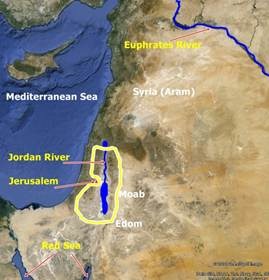
Returning to our text, in all the time that the descendants of Abraham lived in the promised land, they had not possessed nearly that much territory. For four hundred years, they had lived on far less than God had promised. The map at left shows the region. The area outlined in yellow is the area that the Israelites controlled during the time of the Judges and during Saul’s reign. Keep in mind that my maps are accurate enough to give you the general situation, but they are not totally accurate.)

The people of God were living in far less than God had promised.

However, as a result of the conquests made by David, as described in 2 Samuel chapter 8, the area under the control of Israel was extended to almost the exact boundaries described in God’s promises to Abraham and to the people through Moses. This next picture shows the approximate area of David’s kingdom, outlined in purple. As you can see, Israel now had influence from the Euphrates river to the Red Sea. This is not to say that all of this area was considered “the nation of Israel,” however, David’s court in Jerusalem controlled and influenced all of it. If you are still having trouble picturing it, look at a world map. This area includes modern Israel, Jordan, Lebanon and most of Syria.

So what does all this mean for us today? I think it always helps to ask, “where is Jesus in this passage?” I see him here in two places: he is fulfilling promises, and defeating enemies. First let’s talk about the promises. On one hand, this seems to show us that God’s promises don’t always get fulfilled in what we consider a timely fashion. It was more than eight hundred years between God’s promise to Abraham about the size of the land, and the complete fulfillment of that promise. That’s a long time, and many generations didn’t live in the full reality of what God had promised. On the other hand, God doesn’t forget his promises, and he does truly bring them to pass. If you wanted to take the time, you could go through the bible, and find dozens of examples of promises that He made and then kept. Many times in the past I have explained where the bible came from, and how it has been verified time and again as a historically valid document. Here, I want to emphasize that it is also a spiritually valid document. We have a historical record of a promise from God and a historical record from a different period showing its fulfillment.

A natural question is “Why did it take so long for God to fulfill this?” The only completely honest answer is “I don’t know.”

Yet again, I think we have a Bible passage that is pretty unlikely if the Bible was made up. Can you imagine saying, “Let’s make up a story about God promising us all this land.”

“Yes, but let’s say that it took almost a thousand years for the promise to come to pass.”

“And then let’s say that the promise only lasted for two generations.”

“Yeah, we’ll have them flocking to our made up religion by the thousands!”

I do have some thoughts, about why it might have been so long, however. God told Abraham when he made the promise that it wouldn’t happen for at least four-hundred years, because he was giving the residents of the land a chance to repent. So, for the first four-hundred years, God waited, in order to be merciful to people who were rejecting him. But when the Israelites finally came out of Egypt four hundred years later, the Lord told them through Moses to go into the land, drive out the other nations and possess it. They simply didn’t do it. The reason they didn’t do it is because they lacked faith in God’s promise to be with them. In Numbers 13, Moses sent twelve spies into the land prior to invading it. Ten of the spies came back and said it would be impossible to drive out the nations who lived there. But two said it could be done. Their names were Joshua and Caleb. They said:

“The land we passed through and explored is an extremely good land. 8 If the LORD is pleased with us, He will bring us into this land, a land flowing with milk and honey, and give it to us. 9 Only don’t rebel against the LORD, and don’t be afraid of the people of the land, for we will devour them. Their protection has been removed from them, and the LORD is with us. Don’t be afraid of them! ” (Num 14:7-9, HCSB)

But the people didn’t listen to them. Instead they gave into fear and blaming. The result was forty years more of wandering for that generation, and then another four-hundred years of living in only part of what God promised.

I don’t think the lesson here is “do more.” I think it is “trust more.” As I have said many times, believing comes before doing. If the people were living in trust, they would have done what they were supposed to do. If they had attempted to do it without trust (as indeed they often did in the next four hundred years) their results would also have fallen short (as indeed, they did). The key is believing what God has promised, and trusting Him. We have seen that the one thing that makes David a hero is that he trusts God. David isn’t perfect. But he lives out of the understanding that his life belongs to God; that through him, God can and should do whatever he wants. So when David came along, the Lord finally had someone he could use, someone who trusted Him enough so that God could fully give everything that was promised.

We can’t always understand why God doesn’t completely fulfill his promises in our own lives. It isn’t always about our faith – sometimes it is about God’s bigger purposes in the world. For the first four hundred years after Abraham, God did not bring his people into the promised land, because he was trying to be merciful to the people who already lived there. So, it wasn’t the fault of God’s people that they hadn’t received his full promise. For many years, even David did not live in the fullness of God’s promises to him. That wasn’t his fault – God was arranging other things, because it wasn’t just about David – it was about God’s purposes. So don’t feel badly if you truly trust God, and yet you don’t see the complete reality of his promises in your life. It isn’t just about you.

But at least, we can try to eliminate lack of faith as a reason that we don’t experience the fullness of God’s promises to us. David trusted him fully, and eventually, the Lord used that trust in a huge and positive way for both David and the entire people of God.

I want to say one more thing about God’s promises. God’s best promises are the ones that will last for eternity. The people of Israel lived in the land stretching “from the river to the sea” for roughly two generations. None of the other Israelites before or since lived in a country that large or influential. But the bible contains promises that can never spoil or fade. The apostle Peter explains like this:

3 All praise to God, the Father of our Lord Jesus Christ. It is by his great mercy that we have been born again, because God raised Jesus Christ from the dead. Now we live with great expectation, 4 and we have a priceless inheritance—an inheritance that is kept in heaven for you, pure and undefiled, beyond the reach of change and decay. 5 And through your faith, God is protecting you by his power until you receive this salvation, which is ready to be revealed on the last day for all to see.
6 So be truly glad. There is wonderful joy ahead, even though you must endure many trials for a little while. 7 These trials will show that your faith is genuine. It is being tested as fire tests and purifies gold—though your faith is far more precious than mere gold. So when your faith remains strong through many trials, it will bring you much praise and glory and honor on the day when Jesus Christ is revealed to the whole world. 1 Peter 1:3-7

The best promises of God are the ones that last forever. While we wait for those, we may experience trials in the meantime. But we can rejoice in the knowledge that in the end, everything really will be OK. Our hearts will be filled with overwhelming joy, peace and love. Nothing that happens to us in this life can take that away from us.

Now let’s talk about Jesus defeating enemies. Is there “unconquered territory” in your life? What I mean is: are there certain areas of your life that are outside the control of Jesus? Hebrews 2:8 says this:

“You put all things under his control.” For when he put all things under his control, he left nothing outside of his control. At present we do not yet see all things under his control, (Heb 2:8, NET)

Like with God’s promises, we often see a partial fulfillment of the Lord ruling in our lives. I’ll be honest and say, usually this is for the same reason – our own lack of trust. But it has the same solution. If we trust Jesus, and let him have us more fully, he will supply the power to defeat the failures, temptations and self-will that we struggle with. Paul writes about the struggle this way:

For though we live as human beings, we do not wage war according to human standards, for the weapons of our warfare are not human weapons, but are made powerful by God for tearing down strongholds. We tear down arguments and every arrogant obstacle that is raised up against the knowledge of God, and we take every thought captive to make it obey Christ. (2Cor 10:3-5, NET)

Like David, we are called to wage war while trusting in God’s promises. But our war isn’t physical – it is the war of a mind, to let the Lord conquer all that he has promised for us. I think we should understand this from our text: the key is to trust our Lord, and to be willing to do whatever that trust leads us to do. Sometimes that means opposing whatever opposes the truth of the Word of God in our thoughts. David illustrates physically in the land of Israel what Jesus wants to do spiritually in our hearts and minds.

Sometimes, as we wage this spiritual battle, our path to victory involves surrendering to God. We need to say to him, “You win. All that I am is yours. My full being: body, heart, soul and mind belongs to you. Do with me whatever you want.” The main battle then becomes allowing God permission to do whatever he wants to in and through our lives.

Think about this during the coming week. What is one eternal promise that you can cling to, that will bring you comfort no matter what you face? We have more than one, of course, but maybe pick one to focus on this week, and then pick another next week.

Another thought: What is one area of your life that is not fully surrendered to the Lordship of Jesus Christ? In other words, what is a part of your life that Jesus needs to conquer? Will you give him permission? I know there may be many areas, but perhaps focus on just one for this week, and then pick another for next week, and so on.

What is the Holy Spirit saying to you right now?

2 SAMUEL #9: GOD’S HOUSE?

Photo by Filippo Bergamaschi on Pexels.com

God’s true presence is not found inside of special buildings, but rather, within the community of his people as they gather together to worship, learn and serve.

To listen to the sermon, click the play button:

For some people, the player above may not work. If that happens to you, use the link below to either download, or open a player in a new page to listen.

To download, right click on the link (or do whatever you do on a Mac) and save it to your computer: Download 2 Samuel Part 9

2 Samuel #9 .  2 Samuel Chapter 7:1-29 ; 1 Chronicles 17:1-26

Last time we examined the covenant the Lord established with David: to make one of his descendants the Messiah, the forever-King and savior of God’s people. We also considered God’s over the top grace offered to David and to us, and the security knowing that when we want to do God’s will, even if, by mistake, we try to do the wrong thing, the Lord will make sure to keep us from pursuing it. I think there is yet one more lesson to glean from this passage.

David set up various full-time ministries for the tent of meeting, and then he wanted to build the Lord a permanent temple in Jerusalem. The prophet Nathan agreed with David, and they were ready to start the project when the Lord spoke to Nathan, and told them to wait.

It wasn’t that David’s heart was in the wrong place, or Nathan’s instincts. They just didn’t fully understand the Lord (no one ever does, of course). The Lord wanted to show David and Nathan a few things. The first thing the Lord wanted to make sure they knew is this: He doesn’t need a house. He says this:

5 “Go and tell my servant David, ‘This is what the LORD has declared: Are you the one to build a house for me to live in? 6 I have never lived in a house, from the day I brought the Israelites out of Egypt until this very day. I have always moved from one place to another with a tent and a Tabernacle as my dwelling. 7 Yet no matter where I have gone with the Israelites, I have never once complained to Israel’s tribal leaders, the shepherds of my people Israel. I have never asked them, “Why haven’t you built me a beautiful cedar house?”’ (2 Samuel 7:5-7, NLT)

During the historical period in which David lived, most people believed that gods were attached to specific places and people-groups. This is important in understanding the Old Testament. The Philistines had a primary god named “Dagon.” They built a temple for him, and made an idol of him. The Canaanite peoples who lived nearby also believed in Dagon—but not as their god. He was the god of the Philistines, and no one needed to worry about him—unless you went into Philistine territory. If you did that, then you needed to respect Dagon, because that was where he lived. The Ammonites, who lived on the other side of the Jordan river, and to the south, worshipped a god named Moloch. For their part, the Philistines theoretically believed that Moloch was a deity, but they didn’t worship him because his territory was some distance from where they lived. There were various other gods in the region as well, including the one known as Baal. It is likely that all of the non-Israeli people around the area had some level of belief in Yahweh, the God of Israel. But they thought of him like every other ‘god.’ To them, he must be just the god of the Israelites, and only really powerful in Israelite territory.

The Israelites were continually tempted to believe in the Lord in the same way: as their personal god, one among many, generally most powerful only in their own territory. But the Lord had been continually trying to get them to see the truth: that there is only one real God, the Lord Himself, and that he is God over every people and place. That was one reason the Lord had never, before this, asked his people to build a temple for him. I think God was trying to stop the Israelites from getting the idea that he really was just like all the gods of the people who lived around and near the Israelites. They might tend to get stuck on that idea if there was a permanent temple in which he “lived.” The idea that the Lord traveled with Israel wherever they went was entirely new and unique in the ancient world. No one had ever heard of a God who went with his people, wandering anywhere he chose, even into the territory of other gods. No one had ever really conceived of the idea that there was only one true God. So, a temple might tempt the Israelites to think of God as only a local, Israelite deity.

By the way, the Canaanites worshipped a god they called “Baal.” In the ancient Canaanite legends, Baal demanded a bigger and better temple. So the Lord’s response also shows David how different he is from the supposed “god” of the people who lived nearby.

Now, eventually, of course, Solomon, David’s son, did build a temple to the Lord. Why would God do that? Did he change his mind? One way in which it was very different from the temples of the gods of the surrounding people is that there was no statue (idol) of God anywhere. But I think the main issue was this: During Solomon’s reign there was much more peace with surrounding cultures, because the Israelites had conquered them. Because they lived at peace, the Israelites started befriending their non-Israelite neighbors, and going with them to worship sites on top of high hills, where the heathen people worshipped their false gods. Therefore, one purpose of the temple in Solomon’s time was to bring the Israelites together to worship the Lord alone. Even though, as we know, a person can worship the Lord anywhere, the Israelites were being drawn to worship false gods when they went to other places. The temple, when Solomon finally built it, was intended to make sure they would worship the Lord only, and do so together as one people. Even so, in the end, that didn’t really work out. Solomon himself recognized the limits of a temple. After it was built, he prayed:

18 “But will God indeed dwell with man on the earth? Behold, heaven and the highest heaven cannot contain you, how much less this house that I have built! (2Chr 6:18, ESV)

So God wants us to understand that he lives everywhere. He doesn’t need a dwelling place on earth. I get a little crazy when I hear Christians calling their church buildings “the house of God.” No church building, not even the most magnificent cathedral, is a place where God “lives.” If you want to see “the house of God,” look around at your fellow believers, and look in the mirror.

19 Don’t you realize that your body is the temple of the Holy Spirit, who lives in you and was given to you by God? You do not belong to yourself, 20 for God bought you with a high price. So you must honor God with your body. (1 Corinthians 6:19-20, NLT)

We believers are individually temples of the Holy Spirit, but most especially, believers who live and worship together are the place where the Holy Spirit “lives.” The Lord lives “in his body,” and his body is made up of the people of the church (not the building).

27 Now you are the body of Christ and individually members of it. (1 Corinthians 12:27, ESV)

11 Now these are the gifts Christ gave to the church: the apostles, the prophets, the evangelists, and the pastors and teachers. 12 Their responsibility is to equip God’s people to do his work and build up the church, the body of Christ. 13 This will continue until we all come to such unity in our faith and knowledge of God’s Son that we will be mature in the Lord, measuring up to the full and complete standard of Christ.
14 Then we will no longer be immature like children. We won’t be tossed and blown about by every wind of new teaching. We will not be influenced when people try to trick us with lies so clever they sound like the truth. 15 Instead, we will speak the truth in love, growing in every way more and more like Christ, who is the head of his body, the church. 16 He makes the whole body fit together perfectly. As each part does its own special work, it helps the other parts grow, so that the whole body is healthy and growing and full of love. (Ephesians 4:11-16, NLT)

God “lives” in each of us individually, and also in a special way with all of us together. None of this has anything to do with physical buildings. So this was one reason God didn’t want David to build a temple.

This might sound a bit startling, but stay with me: a building accomplishes nothing spiritual.

A building is completely unnecessary to real church, and often has a negative impact on making disciples. History bears out what I am saying here. It was precisely at that point in time – during the time of Solomon and his temple – when the people of Israel began to go astray again and worship other things. The temple did not help in the least, and an argument might be made that it hurt. Solomon’s temple was destroyed four hundred years later, and about a century after that, another was made. Four hundred years after that, king Herod built a  third temple to please the Jewish people who were his subjects. It was even more magnificent than Solomon’s temple. Even with these amazing temples, the Jews utterly failed to walk with God. Let me make it very clear – the magnificent temple of the Jews did not help them when it came to actually receiving God’s salvation in Jesus Christ.

Jesus himself found the most receptive hearts far away from the temple – in the outlying areas of Palestine, not in Jerusalem. The temple, as God gave it to the people, was intended to help people recognize the Messiah when he came to earth. But most people missed the point entirely, and instead made the temple itself into a kind of idol.

Some people make church buildings into an idol as well. The closest thing in the New Testament that we have to modern church buildings is the synagogue. Jesus apparently was regular in going to the synagogues. But most of his real ministry and disciple-making took place outside of weekly worship services.

After the time of Jesus, the church worshipped in private homes, in small groups, for almost three hundred years. Even now, that period stands as one of the most effective disciple-making eras in history. After Christianity finally became legal in the Roman empire, Christians began creating buildings for their church meetings. The emergence of this trend of constructing dedicated physical church buildings coincides with the beginning of a long decline in Christianity. In fact, it wasn’t long after this that Europe entered what we call “the dark ages.” We can’t blame all of the problems of the dark ages on church buildings, but it was a period where Christianity was focused on buildings and institutions, and did very little real disciple-making that truly transformed lives.

A building dedicated to worship sometimes has practical value. However, a lot of church buildings are used for only a few hours each week – which doesn’t seem very practical after all. If the bible and history teach us anything about worship-buildings, it is that they often lead believers to live with the wrong focus, and sometimes to entirely miss the point.

I want to be honest here. I think one of the reasons New Joy Fellowship (our church here in Lebanon, TN) has not grown much numerically is because we have not built a church building. I think a lot of folks would be up for that – to build something we could look at and see and touch and say “We did that. That’s ours.” I deeply wish that people would be that committed to building a life that belongs entirely to Jesus and to living for his purposes. I think a lot of people who might otherwise come back to our worship after visiting just don’t feel like it is really “church” without a church building. I want to be blunt: when we have a building, we can divert our attention to religious activity that keeps God at arm’s length. But when there is no building, we are confronted with what it is really about: walking with God, walking in fellowship with each other, and working in God’s kingdom. If you have a building you can “have church” without those things. But if you don’t have a building, and you don’t have those things, you don’t have a church. It’s easier to have a building – you can pretend to be a church without really engaging with Jesus.

I’m not saying it is wrong for churches to build their own buildings to worship in. But I am saying it is unnecessary, and often it slows down spiritual growth and disciple-making.

Let’s see what Jesus said about worshipping in a particular building:

21 Jesus said to her, “Woman, believe me, the hour is coming when neither on this mountain nor in Jerusalem will you worship the Father. 22 You worship what you do not know; we worship what we know, for salvation is from the Jews. 23 But the hour is coming, and is now here, when the true worshipers will worship the Father in spirit and truth, for the Father is seeking such people to worship him. 24 God is spirit, and those who worship him must worship in spirit and truth.” (John 4:21-24)

Jesus essentially says here that worship is not about a place. It is about turning to God in spirit and truth. In fact, that is the kind of worship God is seeking, not people who just want to go to a certain place. God said to David, look, the place of worship for the past four-hundred years has been that moldy tent, wherever it happens to be parked. Why do you suddenly think that isn’t good enough?

So, what does all this do for your relationship with God today? First, I want to encourage you to hold on to the understanding that a real church is a community of people who trust Jesus and walk in fellowship with God, and in fellowship with one another, and allow God to use their lives for his kingdom purposes. It has nothing to do with where, when or in what building they worship.

There are people who take things too far the other way. They claim it is not important to have dedicated times of worship with other believers. They think “Hey, my body is a temple of the Holy Spirit. I don’t need to be part of a worshipping community.” But that picture is not Biblical either. Such a thing would not even have occurred to the apostles, or any Christians throughout history, until quite recently. Historically, all cultures were very communal, and the idea of an individual who doesn’t need a community was entirely unknown in Biblical times, and even for centuries afterwards. So, to be clear, though Christians don’t need a church building, they do need a church—that is, a community of people with whom they regularly worship and serve.

David and Nathan were both godly men who thought at first that a building for God was important. So don’t feel bad if you have thought that in the past. But understand, God told Nathan and David, “No, it isn’t important. I don’t want a building right now.”

The focus that God wanted was on his work to bring salvation into the world. He wanted his people to receive the Messiah and put their trust in him. That is the focus he wants for us also.  Jesus said:

19 Again, I assure you: If two of you on earth agree about any matter that you pray for, it will be done for you by My Father in heaven. 20 For where two or three are gathered together in My name, I am there among them.” (Matt 18:19-20, HCSB)

The word “where” means “whatever place you happen to be in.” The full presence of God, and full authority of heaven is found among God’s people gathered together, not in a building somewhere.

Now, I want to speak directly to New Joy Fellowship and to the people of Life Together Churches for a few moments. It’s easy to say “come help us build a building.” People understand that. It’s a helpful thing to motivate people. It is a simple vision to grasp and it is less threatening than real discipleship.

But I want to challenge you to present new people with a vision to “come help us build disciples.” Think about it this way. Not a single church building that now exists will be there in the New Creation. Not. One. But every single disciple that we make will be there with us. Let’s not waste time and money building what is after all, a fake church. I mean it. A building is not a church, no matter how many crosses and altars you slap on it. Let’s put our time into real church. We can present the vision clearly and simply. We want to make disciples. We do that by walking with God, walking with others and working in the kingdom. Let’s build a real house of God in that way!

2 SAMUEL #8: GOD’S GRACIOUS HEART TOWARD YOU

The text today highlights David’s sincere yet misguided intentions to build a permanent place of worship for God, and how God’s corrective guidance reveals His gracious heart. Through David’s story, we learn about the immense freedom and comfort in trusting God’s leadership, the boundless nature of His grace, and the ultimate promise of a Messiah who will save all people and reign forever. It invites us to reflect upon our own relationship with God and embrace the abundant grace He offers, even in the face of life’s uncertainties and challenges

To listen to the sermon, click the play button:

For some people, the player above may not work. If that happens to you, use the link below to either download, or open a player in a new page to listen.

To download, right click on the link (or do whatever you do on a Mac) and save it to your computer: Download 2 Samuel Part

We’ve been considering what we learned about God’s holiness and worship from the time that the ark of the covenant was brought to Jerusalem. 2 Samuel describes the event with one chapter, chapter six. However, 1 Chronicles takes two long chapters to recount the same thing (1 Chronicles 15 & 16). Mainly what we learn from 1 Chronicles is that David set up various ministries for the priests and Levites: not just the priests who offer sacrifices, but also professional worship musicians and song-writers, full time door-keepers, administrators and so on. There were probably more than 100 full time ministers taking care of the ark and of the tabernacle.

But after all, when it was all said and done, the place for all this amazing ministry was just a very old tent. The tent was put together in the days of Moses, more than four-hundred years before. Israel has a dry climate, but I have to imagine that sometime during four-hundred years, there had been mold. I’m sure there were rips and scuffs, and it is a good guess that there were a lot of patches by this point in time.

David talked to Nathan about it. He said, “Look, here I am in a palace – and God lives in a tent.” The implication, not spoken explicitly, is that it is time to build a permanent place of worship. Nathan the prophet said, “Go and do all that is on your heart, for the LORD is with you.”

But right afterwards, the Lord spoke to Nathan, and said, “No, I have a different plan.”

The first thing that struck me when I read this was the safety  and freedom there is in living in daily relationship with God. God doesn’t allow our misguided good intentions to go unchecked. Both Nathan and David had their hearts in the right place. They were sincere. Both of them, however, were sincerely wrong. Even so, because they were keeping in step with the Lord, they were able to hear it when the Lord corrected them. And the Lord did correct them. He didn’t say, “Well, shucks, they got it wrong again. Oh well.” No, when they didn’t get it right away, he spoke to them again. So we can trust God’s leadership. Picture someone walking with a friend who is blind and using a cane. They come to the corner of a street where there is traffic. The friend says quietly, “stop here.” The blind person doesn’t hear it, and keeps walking. Of course the guide is going to repeat himself, more loudly, and maybe even grab onto his blind friend, to prevent him from being hurt. Do we expect any less from God?

Now, one important thing here is that Nathan and David really did want to do whatever God wanted in this situation. They weren’t insisting on their own way. So when they made the wrong choice, they were able to hear the Lord when he spoke to them about it.

Unfortunately, sometimes we are like a blind person who says to our guide, “I don’t trust you, so I won’t go where you are taking me.” We ignore Him when he says “turn here,” or “stop there.” Then, sad to say, often we blame God for the bad things that result from our unwillingness to listen to him. But when Nathan and David were open, the Lord kept them moving in the right direction, and they were able to hear it.

This is tremendously comforting to me. Sometimes, we get so caught up in wanting to do the right thing that we become almost paralyzed with fear, thinking we will make the wrong choice. We think, “If I mess this up, it will be disaster. I could destroy God’s plan for my life. I could destroy my chance at happiness.” Maybe we’re looking at a job or a career move. Maybe we’re buying a house, or choosing a college or deciding what we want to be when we grow up. Maybe we’re trying to decide if we should marry someone or not. Brothers and sisters in Jesus, we can have tremendous freedom, hope and joy in these choices. If we truly want God to do what he wants in and through our lives, then ask the Lord for guidance. If you aren’t sure which way he is leading, step forward boldly and make your best choice. If you are wrong, the Lord will correct you. We don’t have to be experts at hearing from God. But we have to be open to letting him do whatever he wants. If we maintain that openness, we’ll be able to hear it if we start down a path where he doesn’t want us to go.

The fact that we really can trust the Lord to guide us is wonderfully comforting. It is part of God’s grace. But wait, there’s more!

David, good-hearted man that he was, was thinking something like this: “God chose me, the youngest son of an unremarkable family, to be king over his people. He was with me, protected me, sustained me, and finally established me as king. After that, he helped me defeat the surrounding enemies, like the Philistines. Isn’t it about time I start paying back what I owe the Lord? Isn’t it time for me to do something for him?”

And God said: “No, my grace doesn’t work like that. Not only do you not pay me back, but I will pile on with the grace and blessing. You want to build me a house? How about this: I will build you a ‘house,’ a dynasty that will last forever, and it will be used to bring immeasurable blessing to the entire human race.”

The word used for “house” is the same all the way through. It is the Hebrew word pronounced “va’yit.” This is a pretty flexible word. It is used for David’s palace, for describing a dwelling and also for a family, a line of descendants and so on. I think the Lord deliberately inspired the writer to use the same word, in order to emphasize what he was doing. He was piling on the grace.

What God promises is that David will have a descendant who will rule forever. David’s descendant will preside over the kingdom of God. This is a prophecy. Now, I have said before that prophecy is kind of like viewing a mountain range from a long way away. It looks like all the mountains are next to each other in a line across the horizon. But when you actually get into the mountains, you often find a great gap between peaks that looked like they were right next to each other when viewed from a distance. In the same way, when you read a text like this one it looks like all parts of the prophecy are supposed to take place at the same time; yet we find that parts of prophecy were fulfilled a few years after, and others hundreds of years later. Here, the prophecy is not a complete revelation of every detail. But it shows that there will be a descendant of David who reigns forever. This descendant will be chastised and punished – just as Jesus was punished for our sins. God will do something eternal through this person. There are a few things here that may refer to Solomon, and some that may refer to other kings descended from David, but clearly, the prophecy is talking mainly about Jesus.

God didn’t just say that David was his favorite choice for king. He didn’t just give him victory over a giant. He didn’t just take care of him in those years of hardship and trouble. He didn’t just protect David during battle and make him victorious – often against overwhelming odds. He didn’t just actually make David king. He didn’t just deliver David from his enemies and give him a secure place to live and rule. He also promised (and delivered generations later) that David’s name and family line would be honored forever. He promised that the messiah would be descended from David. He is showering grace after grace upon David. You can’t out-give God.

David, understandably, was overwhelmed. He went and “sat before the Lord.” And then he prayed. David says something very important in verse nineteen that seems to be lost in translation in many English versions of the bible:

“Who am I, O Sovereign LORD, and what is my family, that you have brought me this far? 19 And now, Sovereign LORD, in addition to everything else, you speak of giving your servant a lasting dynasty! Do you deal with everyone this way, O Sovereign LORD? (2 Samuel 7:18-19, NLT)

Though I like the NLT in general, I think they could have done a better job with the final phrase. A few other versions do something similar. But in Hebrew it says, literally: “and this is torah for all mankind.”

The Hebrew word “torah” has various related meanings, as many words do. It can mean custom or rule. But the most common meaning is “instruction from God.” It is often translated “law.” During the time of Jesus, torah was one of two terms that described God’s revelation in the Bible. When a Jew said “the torah (law) and the prophets” he meant “the word of God as revealed in the bible.” So, I think the best translation is probably the HCSB, which says: “And this is a revelation for mankind, Lord GOD.

I think David is speaking prophetically. He is saying that this promise of the descendant who will come–a messiah who will reign forever–is God’s very word for humankind. It is a law and a promise for all humanity. In fact, this promise to David was remembered, and repeated, throughout the centuries that followed, and it was always understood as a promise for a messiah who would bring God’s blessing to all human beings.

In verse 21 David says this:

21 Because of your promise, and according to your own heart, you have brought about all this greatness, to make your servant know it.

This shows us that the promise is according to God’s own heart. Some translations have “will” but “heart” is more literal. This promise reveals the generous, gracious, loving, wise heart of God.

So let’s make this personal right now. Do you believe that this extreme graciousness is according to the heart of God? Even more personal – do you believe that this great grace is the way that God deals with you?

Let me remind you about David. He lied in a moment of pressure. He blew his top when he was insulted. He ignored what God said about marriage. He was not perfect. God was not gracious to David because David deserved it. David did not deserve it. God was gracious because that is the heart of God.

So set aside any thought of “well, I don’t deserve God to treat me that way.” Of course you don’t. Neither do I. Neither did David. Do you understand and believe that if you let him, God will deal with you in the same way he dealt with David?

I would guess that a lot of us don’t experience God in this way, and sometimes we believe that we cannot. There are reasons for this.

At times, I think we don’t experience the gracious heart of God in day to day life, because we insist that God must be gracious in the particular way we want him to. We want a better income, and so if he doesn’t do that, even though he is offering us tremendous joy through relationships with dear friends, we don’t really receive that grace. We want healing, and so we spurn the grace he offers us to grow and have joy even in pain. We want our spouse to change, and so we don’t want to receive the grace the Lord offers us through that person – just as he is. When we have an attitude of entitlement: “God must provide grace in exactly the way I want it”—it is difficult to really receive.

Please understand me. I don’t think it is wrong to ask God for healing, or for an income that meets your needs, or for a good marriage. Those are all good gifts that God often wants to give. The problem comes in when the only way we will see God as gracious is if he gives us specifically what we are asking for. If he doesn’t give us the particular gifts we want, we become hurt, and we fail to see how gracious he is to us in other ways. In this issue, it doesn’t help when we compare ourselves with others. Especially in these days of social media, I think we usually believe that other people are doing better than we are. When we practice thanking God for the many good things he has given us, it becomes easier to see how gracious he really is.

At other times, we don’t recognize the gracious heart of God because we have allowed lies about God into our lives, especially through difficult events. A child dies. A spouse leaves. And we interpret those events in such a way that we begin to distrust the heart of God. The first problem creeps in when we insist on understanding everything. Why did the child have to die? I’m not saying we can’t ever honestly struggle with our pain, but I do believe that sometimes the answers to those questions are simply bigger than we can understand. When we demand that everything must make sense in a way that we can understand, it is easy to start to believe that God isn’t the good Person that the Bible tells us he is. Don’t get me wrong. If you follow this blog, you know I am an intellectual, and I’m all for using your mind. But the human mind is finite. Trying to understand an infinite God is not logical. At times, faith calls us to trust even beyond our understanding. When we can’t understand, we are faced with a choice – will we trust that God’s heart is good and gracious towards us in ways we can’t comprehend, or will we demand that the universe function according to our own personal sense of justice and goodness? This text calls us to trust that the heart of God is good and full of gracious intentions for us.

Finally, we can trust God’s goodness because of the promise he made to David. It was the promise that God himself would come to earth, and take it upon himself to heal the distance between us and God. This promise to David was not for David alone. It was a word of God, for all humankind.

Therefore, when we doubt the goodness of God, we turn to the cross. There, we can see how much he loves us. He suffered unimaginably so that our suffering could be limited to this short life on earth. If you doubt he loves you, remember this: He died for you.

Take some time to contemplate the goodness of God today.

2 SAMUEL #7: GOD’S HOLINESS AND WORSHIP

Photo by Luis Quintero on Pexels.com

Worship is not necessarily an expression of spontaneous feelings, though that can be part of it. One of the things that liturgical churches get right is that we can make a plan for how to worship God, and follow through on it, regardless of how we feel. Worship is based upon the objective truth that God is God. He is Holy, whether we really get that or not. He is good, whether we feel that at the moment, or not. All of the good things in our lives have come about because of him, whether we recognize that or not. And so, we can decide to worship God, even when we “don’t feel like it.”

To listen to the sermon, click the play button:

For some people, the player above may not work. If that happens to you, use the link below to either download, or open a player in a new page to listen.

To download, right click on the link (or do whatever you do on a Mac) and save it to your computer: Download 2 Samuel Part 7

Second Samuel# 7. 2 Samuel 6:12-23

Last time we considered the holiness of God. When we realize how holy God is, and how sinful we are, and how much Jesus has done for us, the appropriate response is worship and thanksgiving.

I want to return to God’s holiness before we talk more about worship. Last time we mostly considered how God’s holiness is a problem for sinful humans (which means: all humans). We talked about how God’s holiness destroys sin. But it’s an even bigger problem than that. Bear with me as we look at it another way.

Pause, and try to think of a time when you were filled with some deep, positive emotion. Maybe it was profound gratitude as you held your kids or grandkids on your lap. Perhaps it was an inward delight as you listened to some really good music. It could have been a time when you were the one playing the music, and everything came together, and you felt lifted above yourself. Another such moment might come when you are looking at beautiful scenery, or, perhaps, some stunning artwork. Possibly, you felt a kind of inward rush of admiration and awe when you read a great book, or saw an amazing movie. Maybe it was a recognition of how blessed you are to be loved by the important people in your life. It could also be that time you were at a sporting event, and together with the whole crowd, you were there for an amazing win, even though your team was the underdog. I could go on, but I hope you know what I’m talking about. There are moments in life when we experience joy, or hope, or longing, or some kind of sweet, deep emotion. Think about something like one of these things. Picture it, especially how you felt. Stop reading and just enter that wonderful memory for a little while.

OK, now what I want to say is this: That terrific moment, that amazing feeling you had, originated from the holy presence of God. James writes this:

16 Do not be deceived, my dear friends! 17 Every good gift and every perfect present comes from heaven; it comes down from God, the Creator of the heavenly lights, who does not change or cause darkness by turning. 18 By his own will he brought us into being through the word of truth, so that we should have first place among all his creatures. (James 1:16-18, GNT)

The apostle Paul, preaching to people in the town of Lystra about God, put it like this:

17 But he has always given evidence of his existence by the good things he does: he gives you rain from heaven and crops at the right times; he gives you food and fills your hearts with happiness.” (Acts 14:17, GNT)

Everything good, beautiful, praiseworthy, excellent, joyful, gratitude-inducing comes from the presence of God. In fact, it may be that everything that brings us true joy is a by-product of God’s holiness. That doesn’t mean that all of these things are automatically righteous. For instance, I can imagine that someone having an extra-marital affair might feel real joy in being loved by their lover. That doesn’t mean God has approved and blessed the adulterous relationship. It just means the joy of feeling loved is an echo of the fact that we were made for the love of God. But that echo doesn’t mean it’s righteous – it means that God has created us for relationship, and even in illicit relationships what we are really seeking is God himself. The euphoria of affairs wear off eventually, and they tend to be wildly self-destructive to the closest people in your life. My main argument is that joy always points toward God, but it doesn’t necessarily mean everything that gives you joy is blessed and approved by God.

God scatters these moments to all people, whether or not they have trusted Jesus. But they are always temporary, sometimes only momentary. And that hints at the problem: Without the intervention of Jesus, eventually we would be separated from all such joy, happiness, contentment, goodness, and so on, forever. It isn’t just that we will be separated from an uncomprehensible God who is “other” in his holiness. It is that, because of our inborn sin, we would be separated from everything we crave, everything we love and find joy in, everything we so deeply need.

In our text today, the Lord offers David and his people just a hint of that. This terrible and holy Ark, the instrument of the death of Uzzah, is also the instrument of tremendous blessing to Obed-edom, on whose land the Ark now stood. His whole family was blessed by good fortune. David was encouraged by this. He saw that God is not just holy, but is also loving and good. In fact, the love and goodness are part of the holiness. So David returned to the Ark with many people to joyfully bring it to Jerusalem, to be a blessing available to all of the people of Israel.

Verse 13 shows us that David, or the priests, or both, had searched the scriptures to see what they had done wrong the first time. They now knew it should be carried with poles through the rings that were secured to the four corners of the Ark. And that is what they did.

After the first six steps, the priests carrying it stopped, while the people sacrificed a bull. There is significance to the number six. In six days, God created the earth, and on the seventh, he rested. He set aside the seventh day as holy. Seven was considered the number representing God’s perfect work. So David and the priests set aside the seventh step as holy, and offered an approved sacrifice for worship. As they proceeded, David and the others with him were filled with joy and thankfulness to God.

5 David and the whole house of Israel were celebrating before the LORD with all kinds of fir wood instruments, lyres, harps, tambourines, sistrums, and cymbals. (2Sam 6:5, HCSB)

14David was dancing with all his might before the LORD wearing a linen ephod.15He and the whole house of Israel were bringing up the ark of the LORD with shouts and the sound of the ram’s horn. (2 Samuel 6:14-15).

David, filled with the Holy Spirit, understood more than probably anyone else in his generation that God is wonderful and  good. And so he entered whole-heartedly into worship. There is a sense of extravagance and freedom here. There are all sorts of instruments. People are shouting, and dancing and blowing horns. God’s grace and joy are filling the people.

Now, I want to point out a few things about this. First, it shows us that we don’t have to be narrow in how we worship God. Some people sang. Others danced. We have six different instruments named, and it sounds like there may have been others used that weren’t specified. Worship, as described here, included free and open expressions of joy through music and dancing. The instruments listed here are a lot more like guitars, bass and drum than they are like a pipe organ. It looks like there was a lot of spontaneity also.

David’s first wife, Michal, did not approve. She told David that he made a fool of himself. David’s response is one of the best verses in 2 Samuel:

21 David replied to Michal, “I was dancing before the LORD who chose me over your father and his whole family to appoint me ruler over the LORD’s people Israel. I will celebrate before the LORD, 22 and I will humble myself even more and humiliate myself. (2Sam 6:21-22, HCSB)

David understood that the only opinion about worship that matters is God’s opinion. He worshipped the way he did for the Lord, not for anyone else. He was willing to go even further, and look even more foolish for the Lord. David understood the awesome power of God’s holiness, and how gracious God is to come close to us anyway. Not only that, but David also understood that part of God’s holiness is his sheer goodness. In David’s mind, nothing at all could compare with the wonder, goodness, glory and holiness of God. He refused to hold back anything from the Lord.

I think we need to be encouraged by this to give honor and worship to God, even if it means looking silly to the people around us. If you are worried about how you look, you will not be able to fully worship God. When I’m not playing guitar, sometimes I raise my hands. I do this sometimes even when I’m not “feeling the vibe.” I do it because God is worthy to raise my hands to – he deserves that kind of honor, and, in fact, much more. I do it to remind myself to quit thinking what others around me might be thinking, and wonder instead what God thinks. Worship should not be governed by what we think is socially expected, but rather by how we can truly honor God.

The second point is this: Worship should not be governed by what we think is socially expected, but rather by how we can truly honor God. Yes, I know I just said that, but this time, turn it around the other way. I’ve been in worship services where the social expectation is that you raise your hands and dance and jump up and down. I think that is terrific if those things are the way you express honor to God. But sometimes, I want to honor God by kneeling quietly, or bowing my head and standing still, or just singing with all my heart. I should not allow social expectations to force me to raise my hands or dance, any more than I should allow them to stop me from doing those things.

Now, please don’t use that as an excuse to stand with your hands in your pocket, refusing to give God the honor he deserves. I’m just saying, don’t let what others think you should do, or what others are doing (or not doing) be your guide for how you worship. Freely and fully express yourself to God in keeping with the person he made you to be. Sometimes the Holy Spirit may nudge you to go out on a limb and be more expressive, even if what he wants you to do feels a bit uncomfortable or unnatural. You might, in fact, look foolish if you worship that way. David shows us the way. If your choice is between looking like a fool to other human beings, or looking like a fool to the Lord, it’s obvious that we should choose the first.

Sometimes the Spirit may nudge you and remind you not to put on a show for others, but to focus on Him alone. Listen to that too.

I do want to make sure we understand worship. You can worship through singing, but worship incorporates more than just singing. As we receive the Lord’s Supper in faith, we are worshipping. When we thank God for a meal, or for a good gift of any kind, we are worshipping. The heart of worship is thanking God for all of his good gifts, and, above all, thanking God for who he is, which is sometimes called “giving glory to God.” Those thanks, and that “giving glory” can be offered in a variety of ways: singing, praying, saying liturgy, reading scripture out loud, having a time of silence.

One way to worship is to enjoy God’s gifts while consciously acknowledging the fact that they come from him. For example, I used to worship while I was skiing in the Cascade Mountains. I recognized that the mountains, and my ability to enjoy them that moment while skiing, were gifts from God. My heart was lifted up to God while I skied.

The Bible also teaches us that worship is most unique and precious when it is done alongside other believers. Something special happens when believers worship together that is more meaningful and powerful than worshipping alone. Being with other believers helps to keep us humble–because we need each other to worship God in the way that delights him most. While there are examples of believers worshipping alone in the Bible, by far the most numerous examples of worship involve more than one person. People who suggest that the only worship that they “need” to do is being in nature by themselves misunderstand the nature of worship. As deeply introverted as I am, I cannot deny that God created us, and redeemed us, to worship him alongside others of his people.

Also, worship is not necessarily an expression of spontaneous feelings, though that can be part of it. One of the things that liturgical churches get right is that we can make a plan for how to worship God, and follow through on it, regardless of how we feel. Worship is based upon the objective truth that God is God. He is Holy, whether we really get that or not. He is good, whether we feel that at the moment, or not. All of the good things in our lives have come about because of him, whether we recognize that or not. And so, we can decide to worship God, even when we don’t “feel” like it.

Our God is holy. I think one reason David and his people worshipped so extravagantly, is because they had a very recent reminder of how holy God is, and how big the gap was between them; and yet they also had a reminder of how good and gracious he is to bridge that gap himself.

Let the Holy Spirit speak to you about this today.

ADVENT 2024 #1: WHAT HOPE IS THERE?

Advent is a time when we remind ourselves that God is at work in human history. We reflect on what God has done in the past, and on his promises for our future. As we do these things, we can live with patience, and hopeful anticipation.

To listen to the sermon, click the play button:

For some people, the player above may not work. If that happens to you, use the link below to either download, or open a player in a new page to listen.

To download, right click on the link (or do whatever you do on a Mac) and save it to your computer: Download Advent 2024 Week 1

ADVENT 2024 #1. 2 Peter 3:1-13

I grew up in a church that observed the “church year,” and the “lectionary.” Stick with me while I explain this a bit. Many centuries ago, one way that the medieval church sought to bring unity to congregations scattered around the world was to have all churches use the same set of readings from the Bible each day. These became known as “the lectionary.” As church became less central to the lives of most people, the readings were generally reduced to just the ones used each Sunday. The lectionary readings were organized around various “church seasons.” Even after the reformation, many protestant churches continued to use the church year.

There are some small variations, but in general the seasons are: Advent, Christmas, Epiphany, Lent, Easter, Pentecost and “after Pentecost,” (sometimes call “ordinary time”). Each season has a kind of “character” to it. For instance, Christmas is all about the birth of Jesus and the significance of His incarnation. Lent is a time many Christians use to reflect on the suffering of Jesus, and to engage in personal repentance. Easter is about the resurrection, and so on.

I want to emphasize that these church seasons are not given to us by the bible; they are traditions, and no true Christian would say that it is necessary to observe them in order to be a follower of Jesus. One of the negatives of the church year is that it means that huge portions of the bible will never be read in churches which strictly observe it, since those churches focus only on the lectionaries given for each season. Even so, I think we can benefit at times from the traditions associated with the church year.

For me particularly, Advent is one of the seasons that I find very helpful. Advent is the first season in the church year, so that means the church year begins at the end of November, or in early December. One reason I appreciate advent is because the readings serve to remind us that God is still pursuing his goals for human beings. Advent reminds us that history is not random (as atheists might say) nor is it just an endlessly repeating cycle (as Buddhist or Hindus might suggest, and as most ancient pagan religions believed). No, the Bible teaches us that history is going someplace, that it is being guided by God toward a goal, an endpoint. God is at work in the world.

I think advent is a particularly helpful season in our current cultural moment as well. Things seem to be changing rapidly, and generally not for the better. The effect of AI is uncertain, and is likely to shake things up. Presently there is a war in Ukraine, and another in Israel, and both of them seem to be teetering on the edge of engulfing other nations. The economy is pretty good – but only for those who own businesses or a lot of stocks. Most of us ordinary people are paying a lot more for basic necessities than a few years ago, and our incomes haven’t kept pace. Our politics appear to be broken—people seem to be no longer able to maintain friendships with those who think differently from them. Advent can help to reorient our thinking, to make sure that our trust is in the Lord and his promises, not in our circumstances.

We’ll kick off advent with the third chapter of 2 Peter. Things weren’t exactly wonderful when Peter wrote this letter, either. The emperor was Nero, who blamed the great fire of Rome on Christians, and instituted a great persecution, burning many Christians alive. Peter himself was executed by Nero probably less than six months after he wrote this letter.

When Peter wrote, the days when Jesus walked the earth were thirty years in the past. Jesus said he was coming back, but apparently nothing had changed, at least not for the better. Instead, things appeared to be getting worse. What was going on? Peter wrote his second letter to address those kinds of concerns. Our first advent reading comes from 2 Peter 3:1-13.

In the first chapter, Peter reminds us of the amazing promises we have through Jesus Christ, and how they are enough to supply us in this life as we wait for our eternal home. Next, he identifies false prophets and false teachers who are trying to lead Christians astray. He makes it clear that they will be judged by God. Then he says this:

1 This is my second letter to you, dear friends, and in both of them I have tried to stimulate your wholesome thinking and refresh your memory. 2 I want you to remember what the holy prophets said long ago and what our Lord and Savior commanded through your apostles. (2 Peter 3:1-2, NLT).

This is a pretty good description of what Advent is all about. It is intended to stimulate our wholesome thinking, and to remind us of the Biblical prophecies, how they were fulfilled in the past, and what we can look forward to in the future.

 Peter writes that he wants to stir up his readers, to remind them of two things. In the first place, he wants to remind us of the teachings of the Old Testament prophets, and the teachings of Jesus through the apostles (in other words, the New Testament). These scriptures tell us that Jesus will return one day to bring an end to history as we know it, to destroy this present world, and then to remake it into a new creation. Jesus taught extensively about his own return in Matthew chapters 24-25. After speaking about it for a little while, he says:

36 “But concerning that day and hour no one knows, not even the angels of heaven, nor the Son, but the Father only. 37 For as were the days of Noah, so will be the coming of the Son of Man. 38 For as in those days before the flood they were eating and drinking, marrying and giving in marriage, until the day when Noah entered the ark, 39 and they were unaware until the flood came and swept them all away, so will be the coming of the Son of Man. 40 Then two men will be in the field; one will be taken and one left. 41 Two women will be grinding at the mill; one will be taken and one left. 42 Therefore, stay awake, for you do not know on what day your Lord is coming. 43 But know this, that if the master of the house had known in what part of the night the thief was coming, he would have stayed awake and would not have let his house be broken into. 44 Therefore you also must be ready, for the Son of Man is coming at an hour you do not expect. (Matthew 24:36-44, ESV)

History is neither meaningless, nor an endless cycle. The Lord is working in the world, and one day, his purposes will be complete, and then our history as fallen and sinful people will end, and a new history will begin.

Now, it often doesn’t feel like this is so. Instead, it feels like things are only getting worse. Peter, addresses this. Clearly drawing on the teaching of Jesus (above, from Matthew 24), Peter explains that though people believe nothing will ever change, they thought the same things in the days of Noah, and yet the flood did finally come.

The same was true about the first arrival of Jesus as a human. The prophecies about the messiah were spoken many, many centuries before Jesus actually came to earth. The people of Israel failed to recognize him when he did come, but the signs were all there. What Peter is saying is that we should live with an attitude of patient expectation. I want to consider both patience, and expectation.

We need patience because we mostly do not see how God is at work in the world, and things appear to be going on as they always have since the beginning of human civilization. Our technology is much better now than it was in the beginning, but our human nature shows no signs of improvement. We still murder each other, as Cain did to Abel at the dawn of human history. We still hate, still lust, still hoard our treasures selfishly, still get drunk and high, still manipulate and ruin one another. In fact the main change seems to be that with our advanced technology, we do all these things more frequently, and more efficiently: that is to say, we are becoming even more destructive.

Even so, we can have patience for two reasons: First: God’s timing is not our timing. For him, a thousand years might pass like a day; or maybe sometimes he can accomplish in just one day the work of a thousand years. Jesus will return in his own time, and we human beings are not given to know that time. So it could be another thousand years. It could also be tomorrow. Jesus himself made it clear that no one will know exactly when it will come. God doesn’t work like us. God has not forgotten us, nor is he moving too slowly. Just as he promised the messiah, and then sent the messiah, so too, he will send Jesus once more to lead us into the new creation.

The second reason we can have patience is that God’s apparent inaction is, in fact, an open door that allows more people to repent and turn to him. The delay in Jesus returning is so that the maximum number of people will receive salvation. Since it is out of love and goodness that God waits, we too can be patient, knowing that every moment allows more people to join us in the new creation.

Now, what about the expectation? We aren’t just waiting around patiently for nothing. There is an end goal, a hope for which we wait. Peter gives it to us succinctly:

But we are looking forward to the new heavens and new earth he has promised, a world filled with God’s righteousness (2 Peter 3:13, NLT)

Peter makes it clear that the old world will be destroyed by fire. That’s part of what we hope for, because it means the end of sin and suffering. But it isn’t just an end that we hope for. After the end comes the real beginning. We will be given new immortal bodies which will inhabit a new, uncorrupted creation. The limitations that bother us in this life will not be present in the new one. We will begin new lives that are untouched by sorrow and suffering, lives that will last forever.

Even though our bodies are corrupted by sin, we can still experience some of God’s goodness and joy in this life. In the same way, even though we can appreciate the goodness and beauty of the earth right now, it, too, has been corrupted by sin. Both our bodies, and the earth, will be recreated new, without corruption, decay, sin or evil:

18 Yet what we suffer now is nothing compared to the glory he will reveal to us later. 19 For all creation is waiting eagerly for that future day when God will reveal who his children really are. 20 Against its will, all creation was subjected to God’s curse. But with eager hope, 21 the creation looks forward to the day when it will join God’s children in glorious freedom from death and decay. 22 For we know that all creation has been groaning as in the pains of childbirth right up to the present time. 23 And we believers also groan, even though we have the Holy Spirit within us as a foretaste of future glory, for we long for our bodies to be released from sin and suffering. We, too, wait with eager hope for the day when God will give us our full rights as his adopted children, including the new bodies he has promised us. 24 We were given this hope when we were saved. (If we already have something, we don’t need to hope for it. 25 But if we look forward to something we don’t yet have, we must wait patiently and confidently.) (Romans 8:18-25, NLT)

That is what we wait for with expectation. That is the promise of Second Advent – a Christmas present so amazing that the world itself groans in anticipation.

Peter tells us that our patience and our amazing hope should lead us to live in certain ways. He says that in anticipation of these promises we should live holy and righteous lives. Another way to say it might be this: we should begin living now the way we will live in the New Creation. Even now, we are citizens not of this earth, but of the one to come. So, live like it. If I am just a stranger on earth, just passing through, I don’t need to worry about getting everything I want here and now. The future is coming when my every desire will be fully satisfied directly in the presence of God. So, I can wait, and leave some desires unfulfilled now.

My friend Wade Jones has a great illustration of this kind of living. He and his wife were called, for a time, to be missionaries in Prague, Czechia. For a period of time they were still living in the United States, while they prepared for the move overseas. They started learning the Czech language, even while they were here. Czech wasn’t much use here, in America, but they were getting ready for their new home, so they learned it even though it didn’t benefit them immediately.

In the same way, as we learn to live like citizens of our eternal new home, some of the ways we live won’t make sense to people who live fully in this world. That’s OK. We have the patient expectation of an amazing hope, and the more we live like it now, the more real it becomes, and the more ready we will be when eventually we enter that hope.

2 SAMUEL #4: THE CONQUERING KING

Photo by Bharath Kumar Venkatesh on Pexels.com

David was the rightful king of the Israelites. He was God’s choice for them. He had already fought for them, and he was their own flesh and blood. In the same way, Jesus is our rightful king. He is God’s choice for us. He has already conquered the devil on our behalf. For our sakes, he became human—he is our own flesh and blood. Give him permission to be king over every area of your life. If you can’t quite give him permission to take a particular area of your life, give him just a crack, and see what happens.

To listen to the sermon, click the play button:

For some people, the player above may not work. If that happens to you, use the link below to either download, or open a player in a new page to listen.

To download, right click on the link (or do whatever you do on a Mac) and save it to your computer: Download 2 Samuel Part 4

2 SAMUEL #4. 2 SAMUEL 5:1-12

After Saul’s war-leader, Abner, died, his coalition fell apart. Saul’s last surviving son Ish-Bosheth was murdered, and then finally the leaders of the other 11 tribes of Israel came to David to ask him to become their king.

The material for the book of Samuel was recorded more or less as it happened by Samuel, Gad, and Nathan. It was put into order and made into this book during the time of David’s grandchildren. We don’t know who put it all together, but we do know that they were willing to show David’s faults and failings. There is another book in the Bible that describes some of the same events that are found in 2 Samuel. That book is 1 Chronicles. Whoever wrote 1 Chronicles did so more than 400 years after David’s time. The author of 1 Chronicles clearly used some of the book of Samuel, but he was interested in different things, and he had a different purpose in writing, and so sometimes we get more detail, sometimes less. From here on out in this sermon series, we will occasionally refer to chapters in 1 Chronicles to fill in details.

1 Chronicles 12:23-40 describes more about the names and tribes of other Israelites involved in making David King over the whole nation. In Chronicles, specific leaders and groups of leaders are named, showing that a large number of influential people from all twelve tribes came to make David king. Chronicles records that they feasted and celebrated joyfully.

Back to the text in 2 Samuel. These leaders gave three reasons why they wanted to finally receive David as their king. First, they said, “you are our flesh and blood.” They were saying, “you aren’t a foreigner, that we should fight you – we are all Israelites after all. Judah is part of Israel.” They were recognizing that Saul’s attitude was wrong.

Second, the leaders said to David, “you were the one who used to lead us out to battle, and bring us back safely.” They are remembering his faithful service to Saul, which perhaps David thought had gone forgotten and unrewarded. David had already been their leader in the past, though that service was not officially acknowledged up until now. As a leader, he had accomplished great victories, and brought the troops back more safely than he would have in defeat.

Finally, they were acknowledging that God himself had chosen David to be their king. They were at last submitting to God’s plan for his people. They said: The LORD also said to you, ‘You will shepherd My people Israel and be ruler over Israel.’ ” They are acknowledging at last that God had a call on David’s life, and it was God’s will for him to be their king.

Verses 6-12 of 2 Samuel 5 tells us about Jerusalem. Up until that time, Jerusalem was controlled by a pagan tribe of people known as the Jebusites. They were a sub-tribe of Amorites – one of the non-Israelite tribes that the Israelites were supposed to conquer and drive out. However, there were steep ravines to the south, west and east of Jerusalem, and at the top of the slope, the walls began.

 It was a formidable fortress. The Israelites had defeated several kings of Jerusalem and had burned the city itself once (perhaps before it had walls), but they had never managed to capture it and hold it. Now, with walls, the Jebusites are confident that no one could take it. We should understand that it was much smaller in those days. The Jebusite City of Jerusalem covered only about 12 acres on the very top of the end of the ridge. This area is now known as Mount Zion. In the following years, the city spread out greatly, and in modern times, Mt Zion is just one hill in the very large metropolis that is Jerusalem.

In spite of its reputation and history of being impossible to conquer, one of David’s first acts as king of all Israel was to attempt it. David shows here that he is smart and cunning, as well as courageous and strong. Water for the city was collected from the spring of Gihon, which was near the bottom of the Kidron valley, on the east side of the city. The fortifications around those springs (shown in the picture above) were built by David, after he conquered the city. The Jebusites did not bother to guard the spring.

There was a shaft, or tunnel, that went through the hill down to the spring, so that the Jebusites could get water without going outside the city walls. David learned of this. It is quite possible that he observed Jebusites drawing water there, back when he was worshipping God at the tabernacle, when it was kept across the Kidron valley, at Nob (now known as the Mount of Olives). In any case, he determined that the way to take the city was to infiltrate men up the water tunnel. It was a very narrow space, and the men would certainly have had to go one by one, gathering at the top before the assault. That is what David did, with his nephew Joab leading the way and killing the first enemy. By doing that, Joab cemented his position as commander of David’s armies. The city fell without any destruction to the walls, and David made it the new capital of Israel.

These are the actions of a brilliant leader. First, it was terrific military strategy to make use of the water shaft, and attack the Jebusites from within the city. Second, Jerusalem was still an impregnable fortress, an excellent choice for the seat of government in troubled times. Afterward, David built towers covering the entrance to the water shaft, so no one would take the city the same way he had.

Third, it was an extraordinary diplomatic move. David was from the tribe of Judah and up until this time, his capital was a city of Judah. Saul had been from Benjamin, and had made his hometown into the center of power. But Jerusalem did not belong to any of the tribes – it was held by the Jebusites. So when David captured it, it became a city for all Israelites. No tribe could claim it, and no tribe would be offended that it was the capital city. It belonged to no one, and yet at the same time, to everyone. It was not quite centrally located, but it was close.

By the way, some secular archaeologists dispute the existence of David (they choose to ignore the incredible documentary reliability of the Old Testament). However, a water shaft from the spring of Gihon leading up to Mount Zion was discovered in the 1860s. It doesn’t have David’s name on it, of course, but once more, the Bible told us of it before archeologists discovered it. In the 1980’s archaeologists were convinced that this shaft was dug after the time of David. But more recent work suggests that the water tunnel originally occurred naturally, long before David’s time.

The point is, the book of Samuel describes things that are actually still there. In a sense you might say that if the bible is right, there should be evidence of a water shaft in that location, and sure enough, there is not only evidence, but the actual tunnel itself.

As always, I think it is helpful when we read the Old Testament, to ask “where is Jesus here? How does this reveal Jesus to me?” Well, Jesus, is the rightful king of every Christian. That is God’s desire for us. He should be the ruler over everything in our lives. But even though David was chosen by God to be the king, he waited patiently until the people accepted that and submitted their lives to him joyfully. Even though the Lordship of Jesus is God’s will for us, we have not all submitted to that. Jesus is waiting patiently for us to submit all areas of our lives joyfully to him. Does Jesus determine how you spend your money? Does he determine how you spend your time or energy? Is it the words of Jesus that you speak to your family and friends and co-workers?

Jesus should be king over our lives for some of the same reasons that the Israelites gave for submitting to David. Jesus is fully God, yes, but he is also our flesh and blood – he is fully human, just like us. Hebrews 2:14-18 says:

14 Now since the children have flesh and blood in common, Jesus also shared in these, so that through His death He might destroy the one holding the power of death — that is, the Devil — 15 and free those who were held in slavery all their lives by the fear of death. 16 For it is clear that He does not reach out to help angels, but to help Abraham’s offspring. 17 Therefore, He had to be like His brothers in every way, so that He could become a merciful and faithful high priest in service to God, to make propitiation for the sins of the people. 18 For since He Himself was tested and has suffered, He is able to help those who are tested. (Heb 2:14-18, HCSB)

Jesus is our flesh and blood. He belongs to us and we to him. In Jesus, God became more accessible, more understandable, by taking on, forever, human nature. He has a right to be the king of humans, because he is a human. He can sympathize with us and understand our struggles.

Second, Jesus is the originator and creator of everything. He is our protector and sustainer. He has already helped us, already served us, already kept us safe. He has already suffered and died on our behalf. By virtue of how he has already served us, he deserves to be our Lord.

Finally, it is God’s desire that we surrender entirely to Jesus (Philippians 2:9-11). He is the rightful and chosen king of our lives. This is God’s desire – that we allow Jesus to live his life through us, as the owner of our lives. If you feel a little frustrated for David that it took the Israelites so long to accept what God was doing, consider accepting what God wants for your own life!

What about the conquering of Jerusalem? Does that tell us anything about Jesus and his work in our own lives?

Sometimes we really want Jesus to be king over all our lives, but there are parts of our lives that seem like they will never be changed. Maybe you think you will never be able to stop drinking. Some folks struggle with other particular sins that they feel they can never conquer. Perhaps you think, “I am a person who easily gets depressed. That’s just who I am. Nothing is going to change that.” Or, “I’m angry. That’s just my nature, and it’s never going to change.” We might feel like there are parts of our lives that Jesus simply won’t be able to conquer, places where we just can’t let him be king.  Maybe you feel like that about some loved one in your life. You think “Jesus can never get into his life.”

The Jebusites thought they were invulnerable. They had an impressive fortress. But one crack, big enough to fit one man at a time, led to their downfall, and then the city belonged to the king. Jesus is a warrior like David. He is wise and cunning like David. If there is just one little crack, one place where you can say “yes” to Jesus, he can exploit it, and use it to conquer the evil in your life. He can get to people that you think are invulnerable to him.

So if you are concerned about someone else in your life, I say trust him. Ask him to do his work on your loved one. And if the problem is in your own life, I say, simply give him a “yes.” Find some way to say “yes, Jesus. I don’t think I can ever give up drinking [or whatever], but I give you permission to try and take over that part of my life.” Watch what he can do if  you just give him the tiny crack of your willingness.

So, where you can, welcome Jesus as your king. Surrender your life to him, submit to him. Let it be his life from now on. And where you can’t do that, where there is a fortress around your heart, just give him a tiny crack. Just be willing for him to make the attempt.

How is the Holy Spirit speaking to you today?

2 SAMUEL #3. BREAKING MARRIAGE.

In the areas of marriage, family and sexuality, David gave in to cultural pressure. He accepted the attitude of the surrounding culture, and it led to deep heartache and strife for himself personally, and also chaos for the entire nation of Israel. Today, we Christians face tremendous cultural pressure in the areas of marriage, family and sexuality. Let’s learn from the example of David, and instead of conforming to the culture, live as God’s faithful people, even when that looks strange to those around us. With the help of the Holy Spirit, we can do this, even when we make mistakes.

To listen to the sermon, click the play button:

For some people, the player above may not work. If that happens to you, use the link below to either download, or open a player in a new page to listen.

To download, right click on the link (or do whatever you do on a Mac) and save it to your computer: Download 2 Samuel Part 3

Second Samuel Chapters one through five give us the history of a half-hearted civil war between Saul’s family and David’s followers. We looked at some of the details of that during our first two installments of this series on 2 Samuel. But right in the middle, chapter three interrupts the war narrative to tell us briefly about the sons that David had during this time, and about his wives. There are some significant things to say about this interlude. Some of it might be hard to hear. You might even be offended by what I am going to say. If you do feel upset by what I teach, please do two things:

  • First, please read through to the very end of the sermon, so you hear everything I say, not just a small piece of it. Consider listening to the whole thing with the audio file, because I can convey some things by tone of voice that I can’t with the written word.
  • Second, feel free to disagree with me. If I am wrong, I want to know it. But let our disagreement be about what the Bible actually teaches. Don’t just tell me (or yourself) I’m wrong. Look at the Bible yourself, and understand what it teaches about this topic (which is marriage). If you think I have misunderstood what the Bible says about this, I want to hear it, to correct my mistakes. Use the comments, or contact section and explain to me, from the Bible, why I am mistaken. I’m serious. I don’t think I’m infallible.

All right, let’s get to the text. Six sons of David are named in 3:2-5, and each one came from a different wife. The Old Testament does not offer many outright condemnations of polygamy. Yet it unflinchingly and consistently records the negative results of having more than one spouse. And there are passages that warn against polygamy, even especially for kings.

Of David’s sons named in this passage, Chileab, Ithream and Shephatiah are mentioned only here in the history of Israel (though the same passage is repeated in 1 Chronicles 3). It is reasonable, therefore, to assume that they died in infancy or childhood; because of their absence in later genealogies it is virtually certain that they died before they themselves had children. David’s three surviving sons demonstrate the brokenness that results from ignoring God’s intended plan for marriage and families.

The first surviving son is Amnon. When he grew up he raped his half-sister Tamar. Absalom, the second one (and from a different mother), had Amnon murdered for what he did to his sister. Later, he started a civil war with his father David, and made him flee for his life. Eventually, Absalom was killed during his rebellion. The third son was Adonijah, a schemer who also tried to seize control of the kingdom when David was old and weak. He was ultimately executed by his half-brother Solomon (who is not mentioned here because he was not born until later).

In other words, this business of multiple wives did not work out so well. It led to tremendous family strife. When the bible describes God’s people having more than one wife, it always also describes that the resulting family was a serious mess. This is just one example.

There is one more note in chapter three concerning marriage. In verses 13-16 David demanded that his first wife Michal, Saul’s daughter, be returned to him. It is true that at one time it seemed like David and Michal were in love (1 Samuel 18:20). But the marriage had been dissolved a long time ago by this point. During the years when David was on the run, Saul had Michal marry another man, named, Palti. So, why did David force Michal to come back and become his wife again?

I suspect it was for two reasons, both of them ugly. First, the main written scripture at this point was the Torah (the first five books of our Bible). The Torah made it clear that women are equal in worth to men, and are equal heirs and partners as the people of God. However, the people of Israel took their cues about gender relationships from the surrounding culture rather than from the scripture. In other ancient middle-eastern cultures, women were considered property, like slaves and animals. David probably saw Michal as his own rightful property, and he wanted that property restored to him.

Second, David might have been concerned that if Michal had a son with her second husband (Palti), either the son, or Palti, might claim that, as a grandson of Saul, he was Saul’s rightful heir, and therefore the rightful king of Israel, rather than David. David wanted to avoid yet another civil war.

On a slightly more positive note, it may have also been an attempt to solidify the unity of his kingdom – joining the house of Saul and the house of David once more. But there was tragedy here. Michal’s new husband, Palti, loved her very much. He followed her all the way to the borders of David’s area, weeping because he was losing her. This was an awful, tragic event.

It is a fact that David had many wives, and many children by them. It is also a fact that the resulting family was full of greed, lust, hatred, murder, mayhem and grief. David was a man after God’s heart in many ways. But in his role as a husband and father, he failed spectacularly, as men of power and fame frequently do.

The strife in his family began with the fact that David ignored God’s plan for marriage, which is laid out clearly in Genesis 1 and 2. Those chapters describe marriage as the joining of one man and one woman for life. Genesis chapter two teaches that human beings were generally created to reflect God’s image in this way. Once David ignored that, things went downhill. We might excuse him for marrying again after being separated from Michal. That divorce was beyond his control. But he continued to add wives like state-stickers on the back of a retired couple’s RV.

In those days, polygamy (that is the name for having more than one wife) was a sign that the polygamist was rich and powerful. Many wives were a sign of status, sort of like a brand new Mercedes-Benz these days, only more expensive. It was expected that powerful men would have many wives. I believe that part of David’s motivation in marrying so many women was to gain respect in the eyes of his followers and in the eyes of foreign leaders. I’m sure he was also happy to have sex with many different women, while claiming he was not sinning. The truth is, David caved in to cultural pressure about marriage. And in doing so, he ignored a very clear warning from Moses that even kings were not to take many wives:

14 “When you enter the land the LORD your God is giving you, take possession of it, live in it, and say, ‘I will set a king over me like all the nations around me,’ 15 you are to appoint over you the king the LORD your God chooses…  …17 He must not acquire many wives for himself so that his heart won’t go astray. He must not acquire very large amounts of silver and gold for himself. (Deut 17:14 & 17, HCSB)

There is a lot of cultural pressure on godly marriage these days also. A newer, and growing trend is the idea of never marrying in the first place. In popular culture, marriage is often portrayed as restricting and repressive, an instrument of oppression and injustice, something that cramps your individual style. So, women are taught to think that marriage will diminish them. Men are encouraged to think that marriage will lead to no more sex, or to the undermining of their manhood. Both men and women are often presented with very negative ideas about marriage by TV, movies, the internet and music. This has a noticeable affect on our culture: the number of people who have never married is increasing dramatically.

There is, unfortunately, some truth to those ideas. Some men do dominate their wives. Sometimes they limit them, and hold them back. Some women do withhold sex from their husbands, and others are controlling and domineering. But all of that is the result of the fact that people are sinful, not that the idea of marriage in itself is flawed or wrong. Those things are much like polygamy: some people think it’s OK to be that way in marriage, but the Bible disagrees.

One of the biggest cultural pressures on marriage today is divorce. Divorce is just as much against God’s design for marriage as is polygamy, and these other things. If you think it was wrong for David to have several wives, then biblically speaking, you’d better admit that divorce is wrong too.

I feel that I ought to say something about sex here as well. The Bible gives all human beings two options with regard to sexual expression. The first option is to remain celibate, and channel sexual energy into the pursuit of God, and work, and creativity. This option is for everyone who is not in a heterosexual marriage. Jesus clearly taught this, but also he taught that not everyone has what it takes to live a life of single celibacy. (Matthew 19:1-12). The second option is to marry one person of the opposite sex, and remain sexually available and faithful to that person for life. Being sexually available to your spouse is a part of what it means to be sexually faithful (1 Corinthians 7:1-8). When Jesus taught these things, they were not especially counter-cultural. Today, they are very different from the way our culture thinks.

What was counter-cultural then, and remains so now, is the reason God created marriage. He did so first so that marriage would help human beings understand a little bit about what God is like (Genesis 1:27; Genesis 2:23-25; 1 Corinthians 11:3), and what Christ’s relationship to the church is like (Ephesians 5:22-33). Secondly, God created marriage for the benefit of human beings. All of history points to the fact that when marriage is stable, children and families flourish. And when families flourish, communities thrive. And when communities thrive, civilization is built, and the foundation is solid. Most, if not all, of the very serious problems facing western cultures today can be traced back to the fact that we have devalued marriage.

The nation of Israel flourished for a time, but ultimately it abandoned God and fell to pieces because it did not listen to, or practice, what scripture teaches about marriage.

Just as David’s culture thought polygamy was normal, our culture looks at divorce, and many other non-biblical things, as normal. I don’t think Christians need to try to change the laws. We ought to try to bring people into a relationship with Jesus so that their hearts are changed. Laws about marriage are mostly irrelevant. We need to concern ourselves with what God’s Word tells us.

There are loopholes in the law that allow unscrupulous people and companies to legally cheat and scam others. Does that mean it is OK for Christians to make money by doing those things?  Of course not. Legality is not the same as morality. The law in Nevada says prostitution is legal there. Does that mean it is OK for a Christian woman to choose that for a career – as long as she lives in Nevada? Of course not. Government laws are not the same as God’s standards, and we can’t expect them to be. In the same way, it doesn’t matter what any human government says about marriage. What God says is the only relevant thing, and Jesus was sky-clear about marriage:

3 Some Pharisees approached [Jesus] to test Him. They asked, “Is it lawful for a man to divorce his wife on any grounds? ”

 4 “Haven’t you read,” He replied, “that He who created them in the beginning made them male and female,” 5 and He also said: “For this reason a man will leave his father and mother and be joined to his wife, and the two will become one flesh?  6 So they are no longer two, but one flesh. Therefore, what God has joined together, man must not separate.”

 7 “Why then,” they asked Him, “did Moses command us to give divorce papers and to send her away? ”

 8 He told them, “Moses permitted you to divorce your wives because of the hardness of your hearts. But it was not like that from the beginning. 9 And I tell you, whoever divorces his wife, except for sexual immorality, and marries another, commits adultery.”

It might be nice if our legal system reflected our Christian morality. But there are already so many places in which it does not. If we make disciples and Jesus changes the hearts of people, they will do what is right, even if the law says it is OK to do wrong.

I wish Christians in America would quit fussing about things like gay marriage or trans issues, and instead let their hearts be broken in repentance over divorce, and over our failure to really submit to Jesus in all areas of our lives, especially marriage.

Now, what if you have already had a divorce and have remarried? I’ve said it in previous messages, and I’ll say it again: These instructions are for you right now. What’s past is past. All of us have made mistakes, and we all have to live with the consequences. Receive the forgiveness and acceptance of Jesus, and move on. Live each present moment in step with the Holy Spirit. Maybe you got a divorce even after you knew that your situation did not meet the criteria Jesus gave (above). In other words, you knowingly and deliberately sinned by divorcing when you did. Again, I say to you, receive the grace and forgiveness of God, and move on. If you are married now, regardless of which number your marriage is, stay married to this one. Make it work, starting now. I think this principle is illustrated (in a negative way) by what David did to Michal. He tore her away from a man who deeply loved her. David destroyed another marriage and another family by trying to “undo” his divorce. The whole thing was a big disaster, as divorce always is. We’ll learn later that neither he nor Michal were happy about how it worked out after they were married again. So don’t try to undo your present marriage, whether it is your first or your fifth.

If your present marriage is truly intolerable (but keep in mind that we often exaggerate how bad it is) then it does appear that you can get divorced without sinning – as long as you never marry anyone but your present spouse again. In other words, for a Christian, divorce should lead to a lifetime of celibate singleness, or reconciliation with your estranged spouse. The one exception where a person is free to get divorced and marry someone else is explained by Jesus – if your spouse (not you) commits adultery. Even there, Jesus does not say that you must divorce – only that you may. Again, I am not speaking about things that happened in the past. Receive the grace of God in your past mistakes, and live in his grace in the present.

Before you decide that your present marriage is intolerable, I want to suggest to you that marriage is kind of a living thing. Things will get difficult, or even bad – for a while. They always do. Things might even be bad for a period of years. But your marriage will also get better, if you keep working at it. If you stay with it, that is inevitable too. And then it will get rocky, and then better again. That’s life. Marriage is the most intimate relationship available to human beings. Two sinful human beings relating that closely are bound to cause trouble for each other. But they can also be a source of incredible strength and joy to each other, if they stick with it. At its best, marriage gives us glimpses into the very nature of God. At its worst, it forces us to confront our own flaws and foibles, and maybe gives us a glimpse into the heartache that the Lord feels when we turn away from him. Either way, it’s a good thing. Notice I didn’t say easy but rather, good.

I want to add one more thing. I think Kari and I have a good marriage. Other people probably think we do also. So keep that in mind when I tell you that we have sought marriage counseling a number of times during our three decades together. Marriage is difficult, because it is a lifetime bond between two people who each have sinful flesh. Our society makes marriage even more difficult for a variety of reasons. Many people have been called and gifted by God to help others improve their marriages. There is no shame in getting their help, and in fact, I think there is a great deal of wisdom in doing that. If you are in a rough period with your spouse, if you haven’t made progress for a while, please consider seeing a Christian marriage counselor together. Christian marriage counselors are part of the body of Christ, with unique gifts from God to help. Again, if you think Kari and I have a good marriage, consider that perhaps one of the reasons we do is because we aren’t ashamed to get help.

When David ignored God’s plan for marriage, it led to disaster for his children. Not only did his children suffer, but many around them suffered also. In other words, David’s disregard of God’s view of marriage was not merely a personal choice that affected only him – in his case it affected hundreds of people. In fact, his son Solomon followed in David’s polygamous footsteps and it destroyed an entire nation of people. So David’s bad choices continued to have negative effects for generations.

As the years go by, I feel more and more uncomfortable teaching like this. Twenty-five years ago when I would preach about marriage I worried that a few people might take it the wrong way and be upset. Ten years ago, I worried quite a bit more. Today, I am not worried, but rather, certain, that many people will be very troubled by this sermon. I could be “cancelled,” publicly shamed, for repeating what the Bible says.

I’m sure David was also under a lot of pressure to conform to his culture. Everyone around him accepted polygamy, especially for a man in his situation. But I believe that if David had been truly willing to follow the Lord in this area of his life, the Holy Spirit would have given him the strength to do so. I know the same is true for us. The grace of God is always available to us to help us in our struggles – all we have to do is submit to God’s design and reach out for that grace. Let me reiterate, that does not mean that things will always be easy. But it does mean that the Lord walks with us through difficult times. Sometimes, as I just mentioned, that grace might come from Christian marriage counselors.

Again, this type of thing gets harder and harder to say in public with each passing year. However, I will not water down the word of God. Marriage is very important to God. It is supposed to be between one man and one woman for life.

At the same time, please do hear me when I say that the Lord is gracious and compassionate, slow to anger, abounding in steadfast love. Jesus has taken our sins on himself, and given us his righteous nature. So, there is no condemnation for those of us who are in Christ Jesus. We have God’s approval through Jesus, and  we should not wallow in our mistakes, or beat ourselves up about our past. We can move forward, joyfully and at peace.

Let the Holy Spirit speak to you right now.

2 SAMUEL #2: TRUSTING GOD IN TIMES OF CONFUSION AND HATE

When we belong to Jesus, we can, and should, be gracious even to those who consider themselves to be our enemies. In our text today, many people resisted God’s choice for king. For a long time, it seemed that David’s enemies were successful. Ultimately, even with all the people who wanted something different, David still became the king, and it was the best possible thing – even for all the people who did not want him at first. Sometimes we resist God’s Lordship in our lives. It would be better for us than us running things ourselves, but we fight it anyway. It is better for us in the long run to trust the Lord to work things out.

To listen to the sermon, click the play button:

For some people, the player above may not work. If that happens to you, use the link below to either download, or open a player in a new page to listen.

To download, right click on the link (or do whatever you do on a Mac) and save it to your computer: Download 2 Samuel Part 2

2 SAMUEL #2. 2 SAMUEL 2:8-4:12

Last time we considered some of the events of 2 Samuel, chapters 1-5. Mostly, we learned how at first, David only received part of the kingdom that he felt he was destined to lead. Today, we will go over those same verses, and deal with some more of the details.

Chapters two through five of second Samuel describe the years after David was made king of Judah, but before he became king of all Israel. There is some natural confusion about the time period involved, because the text puts it like this:

8 Abner son of Ner, commander of Saul’s army, took Saul’s son Ish-bosheth and moved him to Mahanaim. 9 He made him king over Gilead, Asher, Jezreel, Ephraim, Benjamin — over all Israel. 10 Saul’s son Ish-bosheth was 40 years old when he began his reign over Israel; he ruled for two years. The house of Judah, however, followed David. 11 The length of time that David was king in Hebron over the house of Judah was seven years and six months. (2Sam 2:8-11, HCSB)

We are going to go into the political history of all this for a moment. 3000 year old politics might seem confusing, irrelevant and boring to you. But please bear with me, for a short time, because I think once we understand the politics, we will actually understand better what the Lord wants to say to us today.

Ish-bosheth (try to say that name quickly!) was the only son of Saul who was still alive. He was clearly not king for the entire time of David’s reign over Judah alone. To put it another way, for five of the years that David was king over Judah, the rest of Israel had no king at all. Those five years may have been split between a time before Ish-bosheth’s rule and after. Or they might have come all before-hand, or all after. There is no way to tell for sure, but here is my guess:

After Saul’s death there was a great deal of confusion among the northern tribes of Israel. Many Israelites were now living in subservience to the Philistines, who had conquered a good portion of the country. The others had no leader or central organization to turn to for national identity. Remember, Saul was the very first king of Israel, and just a generation or so before him, the people had no king, no single leader. So when Saul died, and three of his four sons with him, the tribes reverted back to how they had lived before-hand – as a federation of tribes, loosely connected, but without a strong national identity. Some of them may have recalled Samuel’s warnings about having a king – and they had seen that Saul didn’t work out so well. So I suspect that there were several years immediately following Saul’s death without any strong desire or impetus to get another king.

In the meantime, the writer of the book of Samuel says that there was a war between Saul’s family and David’s. The text says that Abner became more and more powerful in the family of Saul (3:6). Abner was Saul’s  nephew or cousin, depending on how you read the Hebrew. He had also been Saul’s chief war-leader. It looks as though after Saul’s death it was mainly Abner and his ambitions who opposed David’s kingship over all Israel. It took Abner some time to pull all his plans together. David was king for probably five years, while Abner blocked his every attempt to lead the whole nation. Meanwhile Abner himself was making connections, re-establishing a national identity, and finally setting up Saul’s son as the new king, but with himself as the real power-holder.

I think there are several understandable (but not justifiable) reasons for Abner’s actions. As Saul’s chief general, he had been the second most powerful man in Israel. With Saul dead and everything in confusion, all that went away. I think Abner wanted to go back to the way it was. I think he loved the power and position and wealth, and he was trying to regain it. In addition, Abner had been Saul’s right-hand man since the beginning. He was already there when David killed Goliath (1 Samuel 17:55-58). So I imagine he had completely internalized Saul’s attitude toward David. Along with that, he may have felt that David was just like him – a great warrior, to be sure, but not a king. They had served Saul together for a short time – who was David to now pretend he was a king? Why did David think he was better than everyone else? He was a warrior, just like Abner, not a king. In fact, during the time David served Saul, Abner might have been jealous, and he may have worried that David would take his place. Finally, remember when Saul was hunting David, and David and his nephew Abishai stole Saul’s spear and water-bottle? Afterwards, they mocked Abner in front of Saul and his men. So there may have been some personal animosity there also, fueling Abner’s ambitions.

At some point, Abner was finally able to get the other Israelites to declare Ish-bosheth king over “all Israel.” But I think realistically, we have to assume that Ish-bosheth was more or less just a figurehead. The real driving force behind the civil war and behind Ish-bosheth’s monarchy was Abner. In fact, we see this reflected when Ish-bosheth was afraid to argue with Abner (3:11), and also because once Abner died, the whole thing fell apart.

Now, I want to pause for a moment to consider this. It seems to me that Abner was not a very admirable man. Later on, we’ll see that he was completely willing to switch his allegiance to David when he realized that David was going to win. Abner was an unscrupulous political hatchet-man looking only for his own gain and ambition. We have plenty of people like that today. Modern-day politics drives me crazy, because the people in power seem to get there and hold onto their power through blatant dishonesty, corruption and scheming. Sometimes it helps me to calm down when I realize that this sort of thing has been going on for at least three-thousand years, since Abner lived that long ago.

But there is more than that here for us. Abner was a scoundrel. For five years, he carried out his schemes successfully. For two more years, it seemed that he had achieved his ambition. For seven years total, it seemed that he had thwarted David and thwarted God. And yet all the work that Abner did for himself and his selfish ambitions ended up serving God’s purposes and plans for David.

You see, the nation was fractured after the death of Saul. It was Abner who reunited them. It was he who encouraged them to return to a sense of national identity. It was Abner who got Israel to commit once more to having one king over the whole nation. And once that was done, God handed that united kingdom over to his chosen servant, David.

If David had become king right after Saul, he would have inherited a kingdom that was disorganized, disheartened and fractured. He would have had to do the work of rallying the tribes and unifying them. But instead, he simply watched while Abner did the work for him, and then God turned it over to him.

This is incredibly encouraging for me. There are long periods of time in my life where I think that God’s will is being thwarted, or that evil is prevailing, and unscrupulous people are successful. But God knows what  he is doing. He will use it all, sooner or later, to accomplish his purposes. Not even a man who gained control of an entire nation through dirty politics can stop God from working. And it turns out that all that selfish evil work was turned into God’s work.

Let’s continue on with the historical events. After Ish-bosheth became king, there was a significant battle between his men and David’s. The location of this battle, and of Ish-bosheth’s headquarters, is telling. The battle took place in the heart of the territory belonging to Benjamin – the tribe of Saul, Ish-bosheth and Abner. However, Ish-bosheth’s headquarters were located far to the east, across the Jordan valley. This means that by this point, David’s kingdom of Judah was starting to dominate the surrounding areas. It wasn’t safe for Abner and Ish-bosheth to be based in the territory of their own tribe.

The rest of chapter 2 describes the battle, beginning with the tragic death of twelve young men from each side. If your response is “that’s horrible,” then you got the message. After the twenty-four young men killed each other, the men of Judah fell upon Abner’s men and crushed them. Abner and his forces flat out ran away.

During the chase, David’s nephew Asahel fixed his sights upon Abner. Asahel was the brother of Abishai, the man who went into Saul’s camp with David, and stole Saul’s water jug and spear (1 Samuel 26). His other brother was Joab who was David’s chief war-leader. All three of them were the sons of David’s sister Zeruiah. Remember, it is likely that even though they were David’s nephews, all four of them were probably pretty close in age.

Asahel was apparently an unusually fast runner. He probably knew that Abner was the main force behind this war, and Asahel seemed determined to kill him. Perhaps he wanted to win great honor, like his other brothers had. He might also have thought that if he killed Abner, it would end the war altogether.

Now, we come to the curious sense of honor that often restrained the brutality of war in those days. Abner saw Asahel pursuing him. He knew who Asahel was, and he warned him off.

18 Joab, Abishai, and Asahel—the three sons of Zeruiah—were among David’s forces that day. Asahel could run like a gazelle, 19 and he began chasing Abner. He pursued him relentlessly, not stopping for anything. 20 When Abner looked back and saw him coming, he called out, “Is that you, Asahel?”
“Yes, it is,” he replied.
21 “Go fight someone else!” Abner warned. “Take on one of the younger men, and strip him of his weapons.” But Asahel kept right on chasing Abner.
22 Again Abner shouted to him, “Get away from here! I don’t want to kill you. How could I ever face your brother Joab again?” (2 Samuel 2:18-22, NLT)

Nowadays we think in terms of total war. But war in those days was a curious mixture of unimaginable brutality combined with strangely restraining rules of honor. Abner and Joab have just been commanding their men to kill each other in hand to hand combat – the most brutal, personal kind of war there is. And yet, Abner now was extremely reluctant to kill one of the chief leaders of the enemy. However, Asahel would not stop. So finally Abner did. The language seems to indicate that Abner stopped with his spear sticking out, butt-first behind him. He might have stuck the sharp point into the ground to brace it. His intent was probably to knock the wind out of Asahel, and bruise him to the point where he would stop pursuing him. But Asahel was running so fast that the blunt end of the spear pierced him through the body and killed him.

The pursuit continued until Abner rallied his men on a hilltop. He called to Joab to stop, and again, following those curious rules of war, Joab agreed to let them go.

Not long after all of that, Abner had a falling-out with king Ish-bosheth. I think he could see the writing on the wall, and he knew that David was going to prevail. The argument with Ish-bosheth was the final breaking point, and Abner decided to change his allegiance, to gain power in David’s new kingdom. He openly promised Ish-bosheth that he was going to turn the whole kingdom over to David. Chapter 3, verse 11 shows us that Ish-bosheth was indeed merely a figurehead, while Abner held the real power:

11 Ish-bosheth could not answer Abner because he was afraid of him. (2Sam 3:11, HCSB)

After this, Abner opened negotiations with David. He came to visit David in Hebron, and he left just before David’s nephew and war-leader, Joab, got back from a trip. Remember, Asahel, whom Abner recently killed in the battle, was Joab’s younger brother. Joab was full of bitterness and rage about it. Unknown to David, Joab sent messengers to Abner to bring him back. Abner believed he was there under the agreement of truce and safe passage that David had made with him. So he was taken by surprise when Joab pulled him aside and stabbed him, killing him. It was a nasty, cowardly deed, not at all like it would have been if Joab had killed Abner in battle.

David’s reaction to Abner’s death was just like his reaction to Saul’s death. I don’t think David had any illusions about what kind of man Abner was. He had known him for a long time, and Abner had been trying as hard as Saul to put an end to David. Even so, David refused to treat him like an enemy. Instead, he deplored the actions of Joab. David immediately declared that what Joab had done was wrong, and he prayed for God to repay him for it. He made Joab tear his clothes and mourn for Abner, the man who had killed his brother. He publicly praised Abner, and publicly condemned Joab.

David was clearly not concerned with what people thought about him. He was concerned about what was right and wrong.

Not long after this, with no Abner there to hold things together, Ish-bosheth was betrayed and killed. The murderers brought David his head, believing that David would be pleased to have his rival dead. But David treated them just as he had the Amalekite who claimed to have killed Saul – he had them executed.

This makes three times in five chapters that David punished people who claimed to have killed his enemies. I think we need to pay attention to it. Saul was clearly David’s enemy – he tried to kill him numerous times. Abner was clearly David’s enemy – he too tried to kill David by way of helping Saul, and then Ish-bosheth. Ish-bosheth was also technically David’s enemy.

And yet David mourned each of these men. He reacted strongly and negatively to those who caused their deaths. He was not pleased when they died, and he was not pleased with those who killed them. We have seen that David is a man with many faults and failings. But we have also seen that however imperfect, he was a man with a real and living faith in the real and living God. The Lord often used David to show us the Lord’s own heart.

David maintained a gracious perspective. He could look beyond personal rivalry, jealousy and even personal attacks. In the end, David was never willing to consider another Israelite – one of God’s chosen people – to be his enemy. In fact, when we read these chapters carefully, we find that David himself never participated in these battles against other Israelites. David wasn’t stupid. He knew that his enemies hated him, and were fearful and ambitious. But he never took it personally, and he didn’t consider the people themselves to be his enemies.

So let’s think about how to apply these chapters to our own lives.

I am working on this sermon about ten days after someone tried to kill former-president Donald Trump. Political tensions are very high right now. Friendships and families are being split apart by people with strong feelings about politics. In this moment, I think we can learn a lot from David. David trusted God to convince those that needed to be convinced. David seemed genuinely and deeply upset when his enemies were killed. We too, can trust God when it comes to people who disagree with us. Whatever you think of Donald Trump, I think all Christians should be sad about such a terrible thing happening in our culture. If you wish Trump had actually been killed, shame on you! I think you might need to repent of that. In the same way, I think we should also be sad that President Biden has become too feeble to go on campaigning for reelection. It’s one thing to make a sober judgment that he is no longer fit to be president. But if you are actually happy that his health has declined so much, shame on you! You might need to repent. We Christians belong to the God of the universe, who loves all people. Even when those who claim to hate us are killed, or otherwise hurt, we should be sad, not glad.

We can afford to be gracious, because we belong to a gracious God. I am not suggesting that you cannot hold strong opinions, or that we need to pretend to agree with everything anyone says.  But our disagreements should be kept in perspective. Politicians have been saying for years that if the other side wins, it will be the end of America as we know it. Unfortunately, that tradition goes back to the first presidential election after George Washington retired. And yet, we’re still here. Don’t believe their lies. Maintain your perspective.

There is another piece of this. Sometimes we get caught up in personality conflicts, and we become very upset at other humans who frustrate or oppose us. But the real enemies are the demonic forces that only use and influence other humans (Ephesians 6:12). Other human beings are not the enemy. Particularly, if we follow the example of David, other Christians may often be misled and used by the devil, but they are never our real enemies.

I am also encouraged to not be overly stressed when people I distrust are succeeding and growing in power. If I was David, I would have been very concerned about Abner and his schemes. I would have been upset that for seven years Abner apparently succeeded (seven years is almost as long as two presidential administrations). But David simply trusted God and waited. The ultimate result is that his enemy Abner did a lot of hard work on David’s behalf, and David got to reap the benefits – all for God’s glory. We don’t know when David wrote Psalm 37, but it certainly could have been shortly after these times:

1 Don’t worry about the wicked
or envy those who do wrong.
2 For like grass, they soon fade away.
Like spring flowers, they soon wither.
3 Trust in the LORD and do good.
Then you will live safely in the land and prosper.
4 Take delight in the LORD,
and he will give you your heart’s desires.
5 Commit everything you do to the LORD.
Trust him, and he will help you.
6 He will make your innocence radiate like the dawn,
and the justice of your cause will shine like the noonday sun.
7 Be still in the presence of the LORD,
and wait patiently for him to act.
Don’t worry about evil people who prosper
or fret about their wicked schemes.
8 Stop being angry!
Turn from your rage!
Do not lose your temper—
it only leads to harm.
9 For the wicked will be destroyed,
but those who trust in the LORD will possess the land. (Psalms 37:1-9, NLT)

Abner, and to some degree the other Israelites, either resisted, or passively ignored God’s choice for king. Ultimately, David still became the king, and it was the best possible thing – even for all the people who did not want him at first. Sometimes we resist God’s Lordship in our lives. It would be better for us than us running things ourselves, but we fight it anyway. It is better for us in the long run to let God have his way.