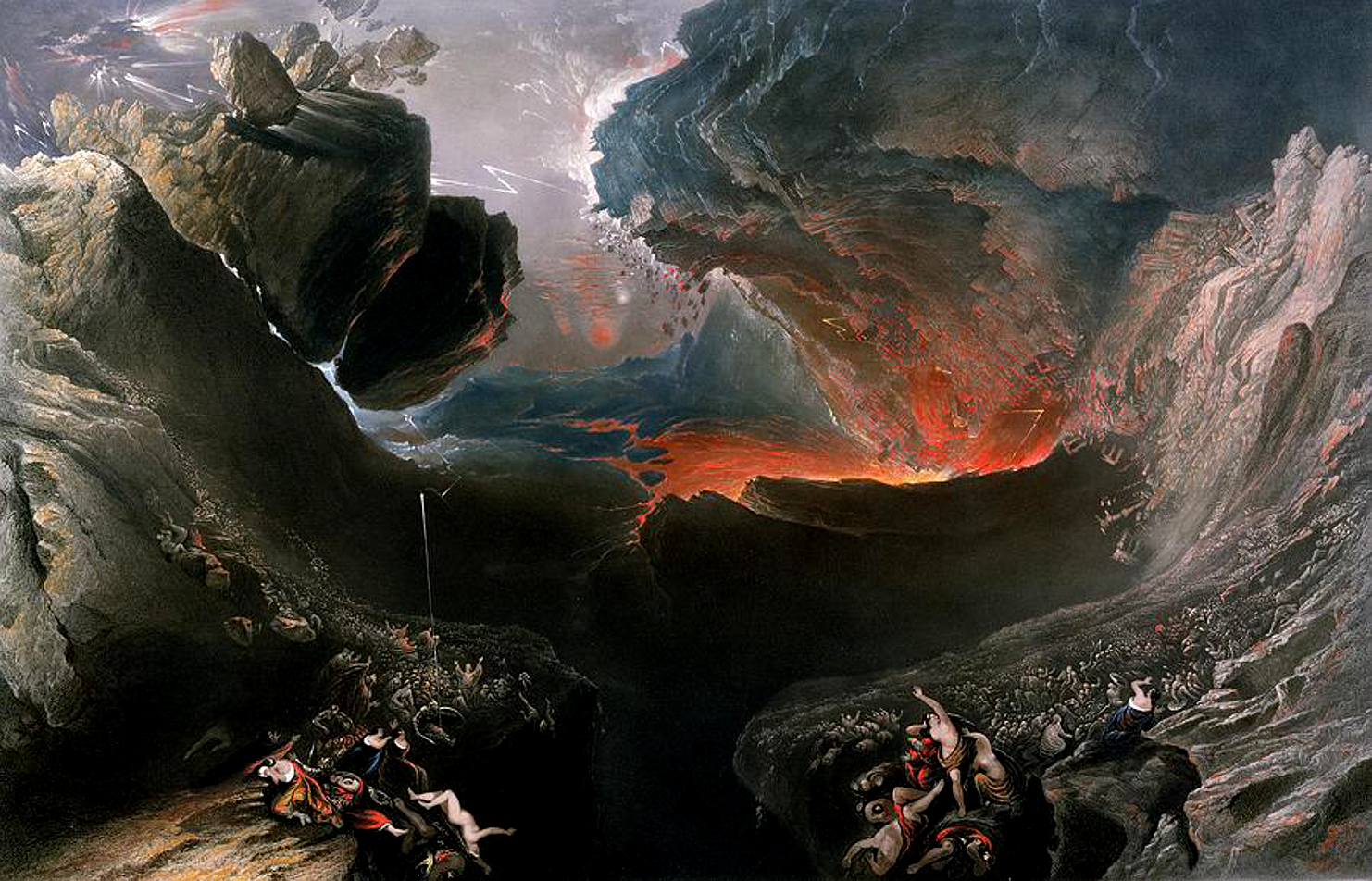
Revelation #39: The Millenium.

2worlds

We puny, stupid creatures are standing with one foot in heaven, and that gives us authority over all the power of the devil, plus a whole lot more, besides. We are called to focus on the spiritual reality that has already begun. Though we may look marginalized and defeated, we are, in fact, gloriously victorious. The one who is responsible for so much of our pain and misery has already been defeated.

To listen to the sermon, click the play button:

To download, right click on the link (or do whatever you do on a Mac) and save it to your computer:
Download Revelation Part 39

Revelation #39  Revelation 20:1-10.  THE MILLENIUM

As we come to Revelation chapter 20, I’m reminded of a quote from a wise, well-respected, Bible commentator:

This brings us to one of the most difficult parts of the entire book. There have been endless disputes, some of them very bitter, over the way to understand this chapter. Evangelicals have divided from one another and sometimes have been quite intolerant of views other than those of their own group. It is necessary to approach the chapter with humility and charity. (Leon Morris, Tyndale Commentary on Revelation)

Many years ago, someone left the church that I was pastoring at the time because they didn’t like the way I interpreted this next section of Revelation. I hope and pray that none of you will stop reading the sermon notes because of this chapter. Truly, I do not believe that this is worth dividing over. I have my own opinions, of course, but I hold them loosely, knowing that I could very easily be wrong. And, when we take a step back, this passage is almost unique in Scripture. What I mean is, there is nowhere else in Scripture that talks about a one thousand year block of time in which the devil is bound, and some of Christ’s followers reign with him for thousand years, to be followed by a brief period of releasing the devil, after which he is finally defeated. What this means to me, is that this is not a major biblical doctrine. I can say with absolute confidence that people who interpret this differently from each other will still be together with Jesus in heaven.

Please bear with me while I share something else. This may seem like a rabbit trail, but I think it will help us as we approach this text, and also the whole of Revelation. In the scholarly discipline of theology, we have something called “systematic theology.” In systematic theology, scholars study a particular subject. They investigate all of the various Bible passages that relate to that subject, and they also usually study what other theologians have written about it. Then, they gather the information about that subject into one clear series of statements. Systematic theology can be very useful. If, for example, you wanted to know how it is that the death of Jesus results in the forgiveness of sins, a systematic theology of the atonement is very helpful. Instead of having to comb through the Bible, and find everywhere it talks about that subject, systematic theologians have organized it and presented it all in one place. It is a useful scholarly discipline, and even somewhat useful to interested non-scholars.

Now, this is very important, because the vast majority of people use the book of Revelation to build a systematic theology of the end times (“end times” theology is technically called “eschatology”). In addition, Revelation chapter 20 – our text for today – is typically used as a very important point in building up that systematic eschatology.

That is not necessarily wrong, but we should never lose sight of the main purpose of the scripture. You see, systematic theology has some very big drawbacks. The biggest one is that that way of thinking tends to lead us away from the primary purpose of the Bible, and the primary means of achieving that purpose. The purpose of the Bible is to show us Jesus, and to bring us closer to him. The way that purpose is achieved is to read the Bible the way it was originally written: book by book. We read so that the text reveals Jesus to us, and so that we are drawn closer to him. What we are doing here – the ministry of Clear Bible – is to learn the Scriptures better, so that we know Jesus better. In a way, I don’t even care where Revelation chapter 20 fits in a systematic eschatology. It was not originally written in order to tell us how to build a scheme for the end times. It was written to help us know Jesus better, and encourage us to trust him. All scripture is there to reveal Jesus, to call us to repent and trust him more, and trust him more fully in all areas of our lives. Only when we understand that are we ready to look at the text.

Remember, I don’t believe that Revelation is a strict chronological account, nor do a large number of better scholars than I. Revelation describes, in various ways, the coming of the kingdom from the time of Jesus’ incarnation until it is fully present to all people not only spiritually, but also physically. This second-to-last section of Revelation is giving us seven different pictures of the ultimate victory of Jesus.

In the past part, we learned that those who reject the graciousness of God given to us in Jesus Christ are standing in the way of the full coming of the kingdom of God. People who do not want have Jesus as king cannot be in a place where Jesus is fully and completely king. They must be removed, before the full kingdom of God can be manifested. One part of the ultimate victory of Jesus is the removal of those who absolutely refuse to have him as king. That is what we studied last time.

Another part of the victory Jesus – the part we are looking at today – is that the originator of the rebellion against God, that is, Satan himself, must also be defeated and removed.

In the first part of this book of Revelation, Jesus dictated letters to seven churches, which also stand for all Christians at all times. To each of the seven churches Jesus promises certain things to those who overcome, are faithful, who repent, who are victorious. Revelation chapter 20 is beginning to describe in more detail the rewards that were promised in Revelation chapter 2 and 3. For instance, in the letter to Smyrna Jesus says:

“Anyone who has an ear should listen to what the Spirit says to the churches. The victor will never be harmed by the second death.” (Revelation 2:11).

In our text here it says:

“Blessed and holy is the one who shares in the first resurrection! The second death has no power over them, but they will be priests of God and of the Messiah, and they will reign with Him for 1,000 years.” (Revelation 20:6)

One of the big concerns of the book of Revelation is that good Christian people are being persecuted, imprisoned, and some, even deceived, and it seemed like God was absent; it seemed like He wasn’t doing anything. This text says “I am going to do something. I have a master plan, and the end result will be that you share in my victory, and justice will be served upon your enemies.”

Now, I suppose we must deal with this business of the thousand year reign. What, exactly does this mean? Once again, I hold my interpretation humbly and loosely, but, for what it’s worth, I’ll give it you. The picture we have is that Satan is bound for a definitive period of time – the perfect amount of time to give every human being a chance to repent. By the way, until recently, very few Christians throughout history thought this was a literal one-thousand years – not even those who were living before 1000 AD. After that, Satan will be released for a short time, and then defeated utterly. I believe that this passage is a word-picture, describing how Jesus defeated Satan through his death and resurrection, and how we who trust him are already, in a spiritual sense, united with Him in his victory. The time when Satan is released for a while is the time when some of these terrible things described in Revelation will happen. Then will come the final, ultimate victory. If I am right, then “the rest of the dead” refers to those who refuse to receive Jesus as their Lord and savior.

I have several biblical reasons for looking at it this way. First, Jesus himself, and his apostles after him, viewed what he did on the cross as a victory over the devil that resulted in the devil being severely limited in his ability to act in this world.

31 Now is the judgment of this world; now will the ruler of this world be cast out. (Jesus, in John 12:31)

14 Now since the children have flesh and blood in common, Jesus also shared in these, so that through His death He might destroy the one holding the power of death — that is, the Devil 15 and free those who were held in slavery all their lives by the fear of death. (Hebrews 2:14-15)

24 When the Pharisees heard this, they said, “The man drives out demons only by Beelzebul, the ruler of the demons.”
25 Knowing their thoughts, He told them: “Every kingdom divided against itself is headed for destruction, and no city or house divided against itself will stand. 26 If Satan drives out Satan, he is divided against himself. How then will his kingdom stand? 27 And if I drive out demons by Beelzebul, who is it your sons drive them out by? For this reason they will be your judges. 28 If I drive out demons by the Spirit of God, then the kingdom of God has come to you. 29 How can someone enter a strong man’s house and steal his possessions unless he first ties up the strong man? Then he can rob his house. (Matthew 12:24-29)

In this parable, most Bible teachers believe Jesus was referring to himself as the stronger man, who binds the devil.

Second, the New Testament often describes the process of salvation as moving from death to life, and also pictures us reigning with Christ, in some spiritual sense, even before we enter the New Heavens and the New Earth. I want to start with a couple passages that show two of three concepts covered in Revelation 20 – that on the cross, Jesus defeated the devil; that at the same time he also brought us from death to life:

. 13 He has rescued us from the domain of darkness and transferred us into the kingdom of the Son He loves. 14 We have redemption, the forgiveness of sins, in Him. Colossians 1:12-14

13 And when you were dead in trespasses and in the uncircumcision of your flesh, He made you alive with Him and forgave us all our trespasses. 14 He erased the certificate of debt, with its obligations, that was against us and opposed to us, and has taken it out of the way by nailing it to the cross. 15 He disarmed the rulers and authorities and disgraced them publicly; He triumphed over them by Him. Colossians 2:13-15

When the New Testament speaks of “rulers and authorities” in this way, it usually means, “spiritual powers of evil.” So, this passage teaches that by the cross, Jesus defeated Satan and his demons, and delivered those who trust him from death to life. A few more, talking about “the first resurrection;” being transferred from death to life:

4 Likewise, my brothers, you also have died to the law through the body of Christ, so that you may belong to another, to him who has been raised from the dead, in order that we may bear fruit for God. Romans 7:4

14 For Christ’s love compels us, since we have reached this conclusion: If One died for all, then all died. 15 And He died for all so that those who live should no longer live for themselves, but for the One who died for them and was raised. 2 Corinthians 5:14-15

But, what about reigning with him? Do Christians really reign with Jesus before the end times? The apostles certainly thought so. There is a mystery here – meaning we are dealing with a  truth that is beyond our ability to fully understand. But the Holy Spirit, through the New Testament, teaches that in some sense, even before the end, we are seated in heaven with Jesus, reigning with him:

4 But God, being rich in mercy, because of the great love with which he loved us, 5 even when we were dead in our trespasses, made us alive together with Christ—by grace you have been saved— 6 and raised us up with him and seated us with him in the heavenly places in Christ Jesus (Ephesians 2:4-6)

1 If then you have been raised with Christ, seek the things that are above, where Christ is, seated at the right hand of God. 2 Set your minds on things that are above, not on things that are on earth. 3 For you have died, and your life is hidden with Christ in God. 4 When Christ who is your life appears, then you also will appear with him in glory. (Colossians 3:1-4)

Jesus taught that his kingdom has already begun, and we are a part of it:

20 Being asked by the Pharisees when the kingdom of God would come, he answered them, “The kingdom of God is not coming in ways that can be observed, 21 nor will they say, ‘Look, here it is!’ or ‘There!’ for behold, the kingdom of God is in the midst of you.” (Luke 17:20-21)

He also taught that He has shared his kingly authority with us:

18 I assure you: Whatever you bind on earth is already bound in heaven, and whatever you loose on earth is already loosed in heaven. Matthew 18:18

19 I will give you the keys of the kingdom of heaven, and whatever you bind on earth is already bound in heaven, and whatever you loose on earth is already loosed in heaven.” Matthew 16:19

He even specifies that he has given believers for all time authority specifically over the devil:

17 The Seventy returned with joy, saying, “Lord, even the demons submit to us in Your name.”
18 He said to them, “I watched Satan fall from heaven like a lightning flash. 19 Look, I have given you the authority to trample on snakes and scorpions and over all the power of the enemy; nothing will ever harm you. 20 However, don’t rejoice that the spirits submit to you, but rejoice that your names are written in heaven.” (Luke 10:17-20)

He doesn’t mean snakes and scorpions literally, and he makes it clear that our authority is “over all the power of the enemy.”

Finally, Revelation 20:6 says that they will be priests of God most high. The New Testament certainly teaches us that this is something that happens when we become Christians. Peter writes to Christians everywhere:

9 But you are a chosen race, a royal priesthood, a holy nation, a people for His possession, so that you may proclaim the praises of the One who called you out of darkness into His marvelous light. (1 Peter 2:9)

John himself, earlier in Revelation, says that all believers in Jesus have been made priests of God:

To Him who loves us and has set us free from our sins by His blood, 6 and made us a kingdom, priests to His God and Father — the glory and dominion are His forever and ever. Amen. (Revelation 1:5-6)

Because the New Testament speaks of coming to Jesus as a change from being dead in our sins, to being alive in Christ; and also because it speaks of the cross as a victory over the devil and his demons; and because it says that somehow, spiritually, we are already with Christ in the heavenly places; and because it says that we share his authority over the devil, I think this 1000 year reign is a picture of the church between the time when God sent the Holy Spirit (shortly after the resurrection of Jesus) and the time of the end. By the way, I am not alone in this. There are many theologians who believe the same thing, including many who lived before 1,000 AD, and therefore might be forgiven for thinking that 1,000 was a literal number. The great Saint Augustine of Hippo (living in the 400’s), wrote:

During the “thousand years” when the devil is bound, the saints also reign for a “thousand years” and, doubtless, the two periods are identical and mean the span between Christ’s first and second coming.

Andrew of Caesarea, another early church bishop who also lived before the year 1,000, agrees, and he also advocates humility regarding the interpretation of these verses:

It is in no way good to understand the “thousand years” as referring to a thousand years as such…

Therefore, the “thousand years” are the time from the incarnation of the Lord until the arrival of the antichrist. Whether the matter is as we have interpreted it, or the thousand years are one hundred times ten, as some believe, or the thousand years are less than this, this is known to God alone, who knows how long his patience is beneficial to us, and he determines the continuance of the present life.

After the 1000 years, we have the great battle between good and evil. A lot of people make a big deal of Gog and Magog. God doesn’t. In fact, there is no battle at all. The powers of evil approach threateningly, and, while God’s people don’t lift a finger, the powers of evil are all destroyed by fire.                                                                                                                                                                                                           Let me offer a few brief lines for you consider as you apply this text to your life. First, I think many Christians don’t realize just how amazing our salvation is. Jesus doesn’t just give us a “barely passed.” Instead, he makes us rulers in his kingdom. We puny, stupid creatures are standing with one foot in heaven, and that gives us authority over all the power of the devil, plus a whole lot more, besides. Remember that: even in your darkest times, if you belong to Jesus, you are standing with one foot already in heaven.

Second, I think this text is telling us that to focus on the spiritual reality that has already begun. Though we may look marginalized and defeated, we are, in fact, gloriously victorious. The one who is responsible for so much of our pain and misery has already been defeated. He’s a bit like a mean dog on a chain – as long we pay attention, and don’t walk into his range, he can’t touch us. He will be released again only for a short while to accomplish God’s purpose for the end times. Then, it is lights out on him, forever.

Le the Spirit speak to you, today.

Revelation #38: The Danger of Superficial Grace

business care clean clinic
Photo by Pixabay on Pexels.com

It is our job to warn those who reject Jesus, but not to condemn them. On the other hand, when we tell people there is no judgment for sin, we are treating their brokenness superficially. We are misleading people that God loves, people whom he wants to repent, and that makes him angry. In Jesus alone is the perfect balance of grace and judgment.

To listen to the sermon, click the play button:

To download, right click on the link (or do whatever you do on a Mac) and save it to your computer:
Download Revelation Part 38

Revelation #38. Revelation 19:11 – 21. The Danger of Superficial Grace

I appreciate your patience with these sermon notes. I know I am not producing them as fast as before. The truth is, even as I write this, I am in severe pain, sick to my stomach, and I just generally feel awful. I will not allow all that to stop me, but sometimes I simply can’t help from slowing me down.

With the praise in heaven offered at the beginning of this chapter, and the announcement of the marriage of the Lamb, we have officially entered the second-to-last section of Revelation. I am not quite so sure of my own accuracy in dividing up this part of Revelation, but even if I get the chiastic structure somewhat wrong, we can still receive much simply from the text itself. In any case, I call this section: “The Seven-Part Victory of Jesus.” Today, we will cover the first part of the victory of Jesus, which is the first defeat of Satan, covered in verses 19:11 – 20:3.

In the second section of the book of Revelation, we had the seven seals. The first seal was a rider on a white horse. Our analysis of the text showed that that rider represented the gospel going out into all the world. It was an indication that we presently live in a time of grace, a time when no one is being judged for their sins. Instead, God has been appealing for people to repent, and receive the grace that is in Christ Jesus. Now, in the sixth (and connected to the second) section of Revelation, we have a new rider on a white horse. Listen to the description of this rider. He is:

called Faithful and True, and He judges and makes war in righteousness. 12 His eyes were like a fiery flame, and many crowns were on His head. He had a name written that no one knows except Himself. 13 He wore a robe stained with blood, and His name is the Word of God.

Along with the vast majority of commentators throughout history, I believe that this rider represents Jesus. Since no human being is perfect, no human being could judge and make war in righteousness. The description of his eyes matches that of the description of Jesus in the first part of the book of Revelation. But the clincher is the last part: he is called the word of God. Remember, this book of Revelation was transmitted to us through the apostle John. Listen to what John says about Jesus and his gospel:

1 In the beginning was the Word, and the Word was with God, and the Word was God. 2 He was in the beginning with God. 3 All things were made through him, and without him was not anything made that was made. 4 In him was life, and the life was the light of men. 5 The light shines in the darkness, and the darkness has not overcome it.
6 There was a man sent from God, whose name was John. 7 He came as a witness, to bear witness about the light, that all might believe through him. 8 He was not the light, but came to bear witness about the light.
9 The true light, which gives light to everyone, was coming into the world. 10 He was in the world, and the world was made through him, yet the world did not know him. 11 He came to his own, and his own people did not receive him. 12 But to all who did receive him, who believed in his name, he gave the right to become children of God, 13 who were born, not of blood nor of the will of the flesh nor of the will of man, but of God.
14 And the Word became flesh and dwelt among us, and we have seen his glory, glory as of the only Son from the Father, full of grace and truth. 15 (John bore witness about him, and cried out, “This was he of whom I said, He who comes after me ranks before me, because he was before me.’”) 16 For from his fullness we have all received, grace upon grace. 17 For the law was given through Moses; grace and truth came through Jesus Christ. 18 No one has ever seen God; the only God, who is at the Father’s side, he has made him known. (John 1:1-18)

So, it is crystal clear that “the word of God,” means Jesus.

In our text today, Jesus has another name, which no one knows except himself (verse 12). I think we are told this in order to remind us that Jesus, being in very nature God, is far beyond our comprehension. We will never be able to fully understand him, and we certainly cannot control him, or judge him. I believe it says that his clothes are dipped in blood to remind us of the sacrifice that he made for us, and for all people.

These things are very important for us as we consider this text. The first white horse came to signify a time of grace, when God’s offer of forgiveness through Jesus Christ is given to all the world, and his judgment is withheld. But now judgment is coming and it is coming through Jesus Christ himself.

We have seen all the way through the book of Revelation that time and time again, people are given opportunities to repent. But this text tells us that there will come a day when that time really is over. God’s patience is vast, and he takes no pleasure in the death of the unrighteous.

11 Say to them, As I live, declares the Lord God, I have no pleasure in the death of the wicked, but that the wicked turn from his way and live; turn back, turn back from your evil ways, for why will you die, O house of Israel? (Ezekiel 33:11)

But in order to bring his people into a place of eternal joy and eternal safety, he must, at last, judge those who reject him. Revelation clearly depicts these two truths: that God is reluctant to condemn anyone, but that there will come a day when he will indeed do so, in order to usher in the new heavens and new earth for those who have not rejected him.

Again, it is Jesus himself who is sent to do the judging. I believe the reminder of his sacrifice (his clothes dipped in blood), and the fact that he has a hidden name, are there to make his right to judge all the more compelling. He is God, we are not, and we can never truly know him, or put him in a box. Also, the fact that he himself shed his own blood for us and suffered the torment of hell for us, makes his right to judge indisputable. He has already taken this terrible judgment upon himself. But if we refuse to let him do that, there is no alternative. We will have to own the judgment for ourselves, which means we become objects of God’s wrath.

This is very important, because Christians seem to be confused about judgment, and the confusion cuts two different ways. On the one hand, some people seem to think that it is their job to bring judgment and condemnation on those who are not Christians. Obviously, this text shows us that that is wrong: it is the right of Jesus, and Jesus alone. I think the following analogy might be helpful:

Imagine that you have a friend who regularly cheats on her taxes. You have another friend who happens to work for the Internal Revenue Service. You know for a fact, from your IRS friend, that sometime soon the government is going to crack down on tax fraud. Sooner or later, if your friend continues her pattern of cheating on taxes, she will get caught, and she will go to prison. Now, it is not your job to catch her, nor to throw her in prison. But what you can do – and what you should do, if you really love your friend – is to warn her about the coming judgment. You aren’t bringing legal proceedings against her, you are not trying to have her thrown in prison; those things are not your job.

However, many Christians seem to be handing out condemnation tickets to non-Christians whom they do not like. But that is not our job; we have no right to do such a thing. What we can do, and should do, is to warn our non-Christian friends about the coming judgment, and to appeal to them to receive the grace and mercy of Jesus Christ instead, while there is still time. There’s a big difference between warning, and condemning. There is a very large difference also, between those who claim to be Christians, and those who do not. If someone claims to be part of the body of Christ, and under the authority of Jesus, and yet they are continuing in a long-term pattern of blatant sin, we do have the right to talk to them. The judging of those who are not believers is not our task. The apostle Paul helps to clarify this. Below, When Paul says “bears the name of brother” we need to remember that most Jesus-followers called each other brother and sister. The word “Christian” was still not widely used. So “brother” means “Christian.” :

9 I wrote to you in my letter not to associate with sexually immoral people— 10 not at all meaning the sexually immoral of this world, or the greedy and swindlers, or idolaters, since then you would need to go out of the world. 11 But now I am writing to you not to associate with anyone who bears the name of brother if he is guilty of sexual immorality or greed, or is an idolater, reviler, drunkard, or swindler—not even to eat with such a one. 12 For what have I to do with judging outsiders? Is it not those inside the church whom you are to judge? 13 God judges those outside. “Purge the evil person from among you.” (1 Corinthians 5:9-13)

So it is not our job to judge those who are outside the body of Christ. We are only to warn. And even when it comes to judging those within the body of Christ, Jesus and the apostles gave very specific criteria. It is not a matter of anybody and everybody going around condemning people. There is a very clear process for church discipline. It is mostly a matter for the church leadership, and only in rare cases does it involve everyone in the church.

There is another error that Christians make that this text corrects. Many, many Christians these days seem to think that there is no final judgment at all. They say things like: “It’s all about love. Love conquers all. All we have to do is love. Period.” In a way, they are right. But love is much bigger than they seem to realize. For love to be real, there must be an alternative; and the alternative to loving God is evil. Therefore, as part of his love, Christ brings true, final and complete judgment upon those who reject his loving salvation. Remember the name that no one knows? We cannot put Jesus in a box. Very often, those who want to say that Jesus is only loving, and never judges, are putting him in a box of their own making. This text is crystal clear, for those who reject Jesus, there is a thorough and terrible judgment awaiting.

When we tell people – whether Christian or not – that there is no judgment for sin, no penalty for rejecting the grace offered in Jesus, we are acting as false prophets. Jeremiah spoke about people like this:

14 They have treated My people’s brokenness superficially,
claiming, “Peace, peace,”
when there is no peace. (Jeremiah 6:14)

When we tell people there is no judgment for sin, we are treating their brokenness superficially. We are misleading people that God loves, people whom he wants to repent, and that makes him angry.

Isaiah also saw that people did not like to talk about the fact that one day God will indeed judge the earth:

9 For these are rebellious people, deceitful children, children unwilling to listen to the Lord’s instruction.
10 They say to the seers, “See no more visions !” and to the prophets,“ Give us no more visions of what is right! Tell us pleasant things, prophesy illusions. 11 Leave this way, get off this path,
and stop confronting us with the Holy One of Israel!” (Isaiah 30:9-11)

People in the time of Isaiah didn’t want to hear about a God who holds people accountable for their sins. Neither do people in 21st century. But we are not acting truly lovingly if we hide the truth.

Paul warned Timothy about people like this, who will go looking for people to affirm their ideas, and avoid those who tell them the truth about God as revealed in the Bible.

I solemnly charge you before God and Christ Jesus, who is going to judge the living and the dead, and because of His appearing and His kingdom: 2 Proclaim the message; persist in it whether convenient or not; rebuke, correct, and encourage with great patience and teaching. 3 For the time will come when they will not tolerate sound doctrine, but according to their own desires, will multiply teachers for themselves because they have an itch to hear something new. 4 They will turn away from hearing the truth and will turn aside to myths. (2 Timothy 4:1-4)

We do no one any favors by hiding the truth. This book of Revelation is as much holy Scripture as any of the Gospels. And, honestly, you cannot read the Gospels, paying attention, without seeing that Jesus judges everyone based upon how they respond to himself. The message of shallow love; love that only affirms and never confronts, is not the message of Jesus. It is true that the Holy Spirit appeals to all people, inviting them in love into salvation through Jesus. But the reason for God’s passionate desire to be reconciled to people is that if they refuse, they will face terrible judgment, and that judgment will come from Jesus Himself. John captures both God’s love, and his judgment, perfectly. But we need to read past the first, very familiar part, and on to the end, in order to get the complete picture.

16 “For God so loved the world, that he gave his only Son, that whoever believes in him should not perish but have eternal life. 17 For God did not send his Son into the world to condemn the world, but in order that the world might be saved through him. 18 Whoever believes in him is not condemned, but whoever does not believe is condemned already, because he has not believed in the name of the only Son of God. (John 3:16-18)

So what we do with this? What does it mean for us, as we engage in real Christian community, go to work, spend time with our families, and so on? For me, it is always good to remember the difference between warning, and condemning. Warning someone about a coming disaster is an act of love. When we appeal to people to repent of their sins, and escape judgment, our love for those people should be evident. The less loving my warning sounds, the more likely it is that I am leaning towards condemning someone.

This passage, for me, is still a reminder of the grace of God. Jesus has not yet come as an avenging warrior. We are still in a time of grace. We have seen throughout the book of Revelation that God gives opportunity after opportunity to all people, in the hopes that some might repent, receive his grace, and escape the coming judgment. If there was no coming judgment, all of that would be sort of silly; even pointless. But the fact that there is a coming judgment makes God’s grace shine all the more clearly.

This passage also reminds me that the time of grace will one day have an end. For every single person, that end is no farther off than the end of their mortal lives here on earth. Those who preach love, and no judgment whatsoever, are false prophets; they are treating people’s brokenness superficially. This is not loving at all.

Finally, the purpose of the coming judgment is so that God can bring his people into a new heavens and a new earth; a perfect world without sorrow, hatred, or fear. The end goal of judgment is a glorious, loving future with God.

Let the Holy Spirit speak to you about all this now.

Fishermen’s Delight (Luke 5:1-11)

photo of pile of fish

Photo by Oziel Gómez on Pexels.com

Jesus blessed the fishermen, not to endorse their fishing business, but rather, to lead them to repentance through His goodness. His blessing was not sign that they were doing something right, but rather, a sign that they should pay attention to Jesus, and where He wanted to lead them.

To listen to the sermon, click the play button:

To download, right click on the link (or do whatever you do on a Mac) and save it to your computer:
Download Luke 5:1-11

Single Sermons. Epiphany 5 Series C. Luke 5:1-11

​I could preach four or five different sermons on this text, so we will have to trust the Holy Spirit to say the things he wants to say this time, and leave some for another occasion.

Imagine you own a small business. Maybe it’s a real estate business, or a construction company. You aren’t rich – certainly not in your own eyes – but you have worked hard, and you’ve had a bit of luck (even if you don’t recognize it), and things are going OK. You employ three or four other people. You go to church, like most of your friends and family, and you know a little bit about the Bible. All in all, though you wouldn’t consider yourself wealthy, you are an important member of the community.

Now, imagine that you have one of those periods that small business owners have sometimes. Things just aren’t going right. Nothing disastrous, but certainly, stressful. You go to church, and listen to the preacher. Afterwards, the preacher suggests a certain strategy. His idea sounds pretty stupid; clearly he knows nothing about the way your business works. However, you pray about it, and decide to trust the Lord, and do it. The result is outstanding! You win a contract that will keep you prosperous and well for several months to come.

You probably know someone who had something like this happen to them. Maybe you’ve been in a position like this yourself. What do you think your reaction would be? How would you respond if you prayed, trusted God, and then received a big payoff? I think many people might say some things like this:

“It just goes to show that if you trust God, things will work out.”

“I worked hard on that contract, but it was God who made it happen.”

“I am so blessed that God gave me that sale.”

“God has really blessed me in my business.”

“I was starting to wonder if I should be in this line of work, but God showed me through this blessing that I’m supposed to keep on.”

Many people take this sort of blessing as an indication that they are doing something right, even, something that God wants them to do. They  take their success as God’s endorsement on what they are doing. I am sad to say that I have even seen people become arrogant when God blessed their business. They often begin to look at the world simplistically:

“God rewards you when you trust him, pray and work hard.”

“If you just pray and work like I did, God will bless you.”

Many people may not say it out loud, but sometimes, they may think something like this: “I don’t know what that other person’s problem is. They probably aren’t trusting God like I am.”

It strikes me very hard that the responses of Peter, Andrew, James and John were nothing like this at all. These two sets of brothers were small business owners. They owned their own boats and equipment. They hired other workers. They were church goers and hard workers. After a hard and fruitless night, Jesus gave them a stupid strategy. In the sea of Galilee, the fish they were after only come near the surface at night. It is a pointless waste of effort to throw a net during the day. But they trusted him, and as a result, they were blessed financially. But listen to how Peter responds:

When Simon Peter saw this, he fell at Jesus’ knees and said, “Go away from me, because I’m a sinful man, Lord!”

When Peter says “go away from me,” he doesn’t mean that he actually wants Jesus to go away. He is admitting that he doesn’t deserve to be blessed like this. He is saying he doesn’t even have the right to be in the presence of Jesus, because he isn’t worthy. When Jesus blessed Peter with success, he didn’t take it a sign that he was doing something right. Instead, the grace of material blessings given through Jesus led Peter to repent. Peter and the others knew, immediately, that they did not deserve any blessing from God. This blessing did not make them self-satisfied in the least. Instead, they fell to their knees in sorrow for their sin. I find that in my hard-hearted way, I secretly believe that I deserve blessings. I work hard. I trust the Lord. Of course he should bless me. But Peter’s heart was much more sensitive to God than mine is sometimes. He recognized that while he deserved nothing but hellfire, God was blessing him anyway. God’s goodness led him into a holy brokenness. This reminds me of what the Holy Spirit says through the apostle Paul to the Roman Jews:

4 Or do you presume on the riches of his kindness and forbearance and patience, not knowing that God’s kindness is meant to lead you to repentance? (Romans 2:4, ESV)

The ESV Study Bible says this about that verse:

They thought such blessings showed that they were right with God and had no need to trust in Christ, but Paul says the opposite is true: God’s blessings should have led them to repent of their sins.

In the lectionary, one of the other readings for this week is from Isaiah 6. Isaiah was praying, and suddenly he had a tremendous vision of the glory of God. He could have said, “I am such a devout and prayerful person that God chose to give me a vision of Himself.” He might very easily have seen this vision as a reward for his diligent devotion to God. Instead, he said:

“Woe is me for I am ruined! Because I am a man of unclean lips, and live among a people of unclean lips, and because my eyes have seen the King, the Lord of Hosts.”

God’s goodness in giving Isaiah that vision led Isaiah not to be self-satisfied, but to be broken over his sin. I often assume that if I am blessed, it is because I put myself in a position to be blessed. Peter and Isaiah felt the opposite. When they were blessed, they saw the huge gap between their brokenness and God’s goodness. It led them to repentance.

To repent is to fully own the fact that we have been wrong, with no excuses, and then to turn away from it, for all intents, forever. Now, our turning away forever almost never happens perfectly. But it does mean that we are going a different direction now. It’s as if we were walking on one road, and the we took a turn, and started down a different road, going a different direction. We may fall down sometimes as we walk in the new direction. But we get up, and continue on in the new direction; we don’t go back the other way. Our overall direction is new, oriented toward God, not away from him.

By the way, the New Testament talks about repentance in two different contexts. In several places, particularly in the book of Acts, it speaks of a big act of repentance accompanying salvation. In other words, the process of being saved involves a definitive turning away from sin, and a life oriented away from God, and turning toward God. But many Christians don’t appear to realize that the whole Christian life on earth involves repentance. It is not a one-time deal. In many different specific areas, we need to continue to repent, and allow Jesus to come more fully into our lives. We still give in to the flesh sometimes, and sin, and we must repent of that sin. There are many verses in the New Testament that call those who are already believers to repent, but I’ll give just a few, to save space. In the verse below, Paul is writing to Christians:

9Now I rejoice, not because you were grieved, but because your grief led to repentance. For you were grieved as God willed, so that you didn’t experience any loss from us. 10For godly grief produces a repentance not to be regretted and leading to salvation, but worldly grief produces death. (2Cor 7:9-10, HCSB)

Repentance is something different than feeling guilty. When you feel guilty, you feel bad about what happened, but you also feel stuck, like there is nothing you can do. Guilt does not motivate you, and Jesus died to take away our guilt. But repentance is motivating. You know you are wrong, and you really want to be different now. You are eager to walk the new way.

In the book of Revelation, Jesus dictated seven letters to Christian churches. In all but two of those letters he calls believers to repent. Here are two examples:

3Remember, therefore, what you have received and heard; keep it, and repent. But if you are not alert, I will come like a thief, and you have no idea at what hour I will come against you. (Rev 3:3, HCSB)

 19As many as I love, I rebuke and discipline. So be committed and repent. (Rev 3:19, HCSB)

5Remember then how far you have fallen; repent, and do the works you did at first. Otherwise, I will come to you and remove your lampstand from its place — unless you repent. (Rev 2:5, HCSB)

Clearly, he is calling those who are already saved to practice ongoing repentance. For me, I need to remember to look at blessings as a call to repentance.

There’s another thing that strikes me about this passage. Peter did not assume that this tremendous blessing meant that God wanted him to be a successful fisherman. In fact, he quit the business that God had blessed; they all quit, and apparently, even before they cashed in on that amazing catch. I think most of us assume that when God blesses us in some particular area of our lives – particularly with something like a promotion, contract or new job or business opportunity – it means that God wants us to keep doing the thing that he blessed. But this is not the case in this text at all. Jesus blessed their fishing business, and the result was that they were fishermen no longer. God’s blessing is not the same thing as God’s endorsement of what he blesses. If we Christians really understood that, we would avoid a host of sin and error. Blessing from God cannot be taken as a sign that he approves of what we are doing, because He blesses even those who have rejected him:

For he makes his sun rise on the evil and on the good, and sends rain on the just and on the unjust. (Matthew 5:45-46, ESV)

We are men also, with the same nature as you, and we are proclaiming good news to you, that you should turn from these worthless things to the living God, who made the heaven, the earth, the sea, and everything in them. 16 In past generations He allowed all the nations to go their own way, 17 although He did not leave Himself without a witness, since He did what is good by giving you rain from heaven and fruitful seasons and satisfying your hearts with food and happiness.” (Acts 14:15-17, HCSB)

God often blesses us to try and turn our hearts toward him. One of my favorite Hymns is “Come Thou Fount of every Blessing.” In it there is one line that strikes me particularly:

“Oh to grace, how great a debtor, daily I’m constrained to be // Let Thy goodness, like a fetter, bind my wandering hear to Thee.”

Jesus showed the apostles his goodness as way to turn them away from the fishing business, and toward Himself.

In the case of our text today, the blessing of God led to repentance, and to Jesus calling Peter and the others to leave their business and work in full time ministry. For a deeper look at the call to ministry, please go to: https://clearbible.blog/2014/04/01/jesus-and-fishing/

At the moment, I want to point out two things. First, this text shows us that some people are called uniquely to vocational ministry, it also shows us that everyone who trusts Jesus is called to participate in His mission. Not everyone is called to leave his or her career. However, all Christians are called to follow Jesus. For most, that means, among other things, expressing your faith and living for his purpose as you fulfill your everyday responsibilities at home and at work. It means being a disciple of Jesus when you are with your family, your friends, when you are at work, when you are driving, playing golf, fishing – in fact, all the time. It is obvious that all New Testament Christians believed this and practiced it (Matthew 28:16-19; Acts 11:19-26; 1 Peter 2:12-15, 3:15-16).

But there is also a call to unique vocational ministry. In our post-modern, anti-authoritarian culture, we are becoming so anti-institutional that many people have become suspicious of those who are called into vocational ministry. I’m not a fan of institutions or hierarchies myself.  But the bible does clearly teach that God calls certain individuals to specially dedicate their lives to teaching and training other Christians. Not many are:

Not many of you should become teachers, my brothers, for you know that we who teach will be judged with greater strictness.  (Jas 3:1, ESV2011)

It is unique calling for a small number of people. But some do have it. Right now, I want everyone who is reading this to stop and ask the Lord: “what is your call on my life?” Maybe he wants to affirm that you are called to be exactly where you are. Perhaps, for one or two of you, he has a special call on your life, a call to vocational ministry. If so, this will not be the first time you have heard this. It will strike a deep, exciting and terrifying chord in you. All of us, let us listen, repent, and follow Jesus into all of life.

Unwrapping Jesus

woman doing gift wrapping
Photo by freestocks.org on Pexels.com

Isaiah unpacks the greatest gift the world has ever had. 

To listen to the sermon, click the play button:

To download, right click on the link (or do whatever you do on a Mac) and save it to your computer:
Download Christmas 2018

Christmas Eve 2018. Isaiah 9:6

I’ve had trouble getting in the Christmas spirit this year. A big surgery two weeks ago kinda put the damper on things. I wish I could sit back and enjoy Christmas, but I don’t feel well physically. As I’ve aged, presents hold less appeal for me, too. I’ve started to think, maybe now that I’m an adult, Christmas isn’t really for me. It’s for the kids. It’s for the homeless. It’s for people who don’t have so much to do, or have enough money to get really cool gifts. But it isn’t for me, a middle-aged responsible adult.

As I’ve prepared this message this week, I realize I’m wrong. I don’t know about presents or “the spirit of Christmas,” but the meaning of Christmas is for me. It is for you too. For all of us. The central thing we Christians celebrate at this time of year is the gift of God’s presence in our lives. And that is for me, not just kids or others. And it really is for us, at all times.

Many years ago, centuries before Jesus was even born, Isaiah, prophesying by the Holy Spirit, described several key components of God’s present to us – Jesus Christ. He wrote this:

For to us a child is born,

to us a son is given,

and the government will be on his shoulders.

And he will be called

Wonderful Counselor, Mighty God,

Everlasting Father, Prince of Peace. (Isaiah 9:6)

The first thing we ought to note from this passage is that the child is born “to us” and given “to us.”  God did not come to earth for any other reason than our benefit.  Jesus did not come for himself, nor for “someone else” but to us.  Soren Kierkegaard, the famous Danish existentialist, always encouraged people to read the Bible as if it were a personal message for them.

“When you read God’s Word, in everything you read, continually say to yourself: It is I to whom it is speaking, it is I about whom it is speaking…”

So when we read this passage from Isaiah, the words “to us” are not a mistake.  The son was born to us he was given, to us – the message is for us.  Jesus is not an abstraction that exist for those “other people” – he was not just given to Jews or to those really “spiritual” people.  He was given for you and for me.  This is an important signal, a reminder for those who read Isaiah 9:6 that it is relevant.  The prophecy is not just a fascinating historical event, that was fulfilled two thousand years ago – it is relevant to us in our time, our situations, our individual lives. Christmas is for you. It continues even in these days.

So what exactly is this relevant message?

The government will be on his shoulders.  I grew up in a third world country, where the government was frequently entertaining, but never very efficient.  I remember as a youth of twelve, getting off of a plane in L.A., touching US soil for the first time in several years.  We were to be here for three months.  As the car drove smoothly down the empty, early morning freeway, I thought to myself, “Wow, we’re in America.  The government really works here.”  I suppose it was primarily the absence of potholes on the freeway that inspired that thought.  Since that time, of course, I have become as cynical as the next person about the American government. I don’t want to get sidetracked, but it has been a very long time since I’ve had any confidence that the United States government really operates to the benefit of most of the citizens. Of course, the New Guinean government was worse. For those of you who think you might emigrate if it gets really bad, where would you go? You think anywhere is else is better?

Truthfully, no earthly government is perfect.  However, Isaiah tells us that this child, the one given to us, is the one who is ultimately responsible for everything. The fate of the world rests on his shoulders, not on any government or official.

Our hope is not in our government, or any earthly government – our hope in Jesus.  When Pontius Pilate asked Jesus about government (as a governor, it was topic that interested him) Jesus responded that his  (Jesus’) kingdom is not of this world.  In other words, Jesus is not interested in establishing physical ruler-ship of the world at this time – in spite of the fact that the Jehovah’s witness cult says he is.  He is concerned with the government of our souls, lives and our eternal future.  Whom we pay taxes to is not generally his concern, other than that he wants us to obey the laws of the lands where we live.  The Bible does say that there will come a day when Jesus will return and then he will rule the world as  King might.  However, the time and circumstances of that are not our concern.  We can simply put our trust in him, as one finally responsible for what happens. I know earthly government frustrates us sometimes, but we need to take longer view, an eternal perspective on government.

Now this child, this one given to us, the one who bears the weight of the world on his shoulders, has been given several significant names. First, he is called wonderful.  In many translations it says “wonderful counselor” but the Hebrew is probably more like “wonderful – comma – counselor.” In other words, they are two separate descriptions of Jesus.  Another way to say “wonderful” might be  “miracle-full.”  Jesus, when he lived on earth, was certainly wonderful in this sense.  Many signs and wonders accompanied his birth – the star, the angels, the wise men and so on.  He did many signs and wonders during his ministry – turning water into wine, healing people, driving out demons, walking on water.  And because he is given to us as well, he wants to continue to work wonders in our lives – reconciling and restoring relationships, healing us and even doing more supernatural miracles as well.

Next, he is the counselor.  Counselor has two major implications of course.  It can refer to someone who helps another with inner healing, and also to someone who gives counsel, or advice.  Jesus does both.  Sometimes we might have struggles in relationships, or a question about how to handle a situation.  Sometimes in our small groups, our temptation is to try and counsel each other – but Jesus is the real counselor. Our real job is simply to connect people with Jesus and His counsel.  He has the wisdom of God.  He stands close by, supporting, listening, encouraging, as good counselor would. If we are honest with ourselves and with him, he can lead us into inner healing, both directly, and through other believers. Another connotation of “counselor” is “comforter.”  Jesus offers us comfort as a counselor – he is there to love us and support us in time of need.

Mighty God.  I think that this name of Jesus is put as the third of the five names for a reason.  It stands, alone, in the center of the other four.  The other four all point to it.  It is, in fact – wait for it – chiastic structure. Jesus is not just some benign, divine uncle, simply there to our beck and call.  He is God.  There is an allegiance that his existence demands on our lives.  Yes, he wants to work miracles for us, yes he wants to be our comforting counselor, but also, he is our God.  He wants to be our ruler.  He is not under our control – but he seeks for us to joyfully submit to His control.  At the heart of the truth about this child is the fact that the God of the universe did come himself to be with us.  Christmas, and this child, is about God’s presence in our lives, and His desire to bring us into a relationship with Him, and to become King of our lives.

Everlasting Father. This is interesting. Isaiah is anticipating the birth of a child that hasn’t even been conceived yet, and he calls this baby a “father.” I think there are several things going on here. First, this is a clear prophecy that the messiah will be God himself in human flesh. Only God was known as “everlasting father.” Isaiah is saying, this child, born to us, will be more than human. He will be eternal God come into the world. Second, fatherhood in those days was significant because it had to do with inheritance. All that your father owned was yours also, even before his death. Isaiah tells us that this “eternal father” is born to us. Through Jesus we gain an eternal inheritance that will never fade or spoil. Third, through Jesus, we get the perfection of fatherhood. Fatherhood is essential to the development of children. An absent or negative father can derail a child for life. A positive and present father goes a long way toward giving the child what he/she needs to succeed in life. In this country we are in a crisis of fatherhood.  Many fathers are negative or even absent altogether.  Yet here, the promise is that this Christ-child will make up for what our earthly fathers lacked.  He can and will fill that most essential void in our lives and even in the lives of our children.  He will treat us like a good father should – He wants to be present in our lives, giving us affection and support, protection and guidance.

Prince of Peace.  “Shalom” is the Hebrew word for peace.  It does not just mean absence of war or “inner calmness” – it means, wholeness, wellness, harmony.  At the heart of Jesus’ peace is reconciliation with God.  Without this reconciliation with God, all the inner calmness in the world is pointless.  Through Jesus, through the child, we can have this peace with God, and the wellness, wholeness and harmony that come with it.

I want to return to the part that I skimmed over before: unto us a son is given.

In ancient Israel, it was tremendously important to people that they have a son to carry on the family name. They saw themselves as belonging to God in groups of families, clans, tribes and then as a nation. If you didn’t have a son, your name would die out, and be remembered no more among the people of God. Therefore, this promise of a son would have meant to those first listeners that they would always have a place in the kingdom of God. This promise of a son meant that they would always belong to God. It means the same thing today. “The Son,” is Jesus, and through him we will belong to God eternally. As the apostle John wrote:

And this is the testimony: God has given us eternal life, and this life is in His Son.
The one who has the Son has life. The one who doesn’t have the Son of God does not have life. I have written these things to you who believe in the name of the Son of God, so that you may know that you have eternal life. 1 John 5:11-13

There is a story told about a man who came home from work one evening, tired and worn out, simply wanting to relax.  As he collapsed into the easy chair with the newspaper, his young son came up to him, wanting to his attention.  The father, unable to muster up much energy, found a picture of the world in his newspaper, and tore it up into small pieces.  He gave the pieces to his son and said, “Here’s a puzzle for you do.  See if you can put the world back together.”  He knew this would occupy his boy for quite some time, since the child did not know his world geography very well.  However in just a few minutes, the boy came back with the puzzle completed, all the countries in the right places

“How did you do that so quickly?” asked the father, amazed.

“It was easy!” replied the boy.  “On the back side of the paper was  a picture of a child.  As soon as I got the child right, the whole world was right.”

That’s sort of how it is with Jesus.  When we get THE CHILD right, our world becomes whole again.

Will you receive the promise of a son this year? Will you receive this child, who rules the universe, the wonderful counselor, everlasting father, mighty God, Prince of peace?

Merry Christmas!

REVELATION #37. THE DIVINE MARRIAGE.

rings wedding
Photo by Deesha Chandra on Pexels.com

Every human being longs for true, deep, honest intimacy. We want to be able to be fully ourselves, and totally known by Another Person. We long to be able to be completely “naked” – not pretending or hiding; body, soul and spirit, and in that state, be fully loved and accepted with no blemish or shadow to mar that experience. This is exactly what is being promised to us.

To listen to the sermon, click the play button:

To download, right click on the link (or do whatever you do on a Mac) and save it to your computer:
Download Revelation Part 37

We’ve come to Revelation chapter 19. It seems clear that the praise recorded in verses one through four is all about the fall of Babylon. So, in a sense, these verses wrap up the end of the section on Babylon. We have learned that “Babylon” represents ungodly cultures and world governmental powers that stand against the worship of the one true God, and that tend to either seduce Christians away from God, or persecute them if they won’t join the ungodly culture. Therefore, before Jesus can return, before God can culminate his plan in history, he must remove “Babylon.” This, he has done. Therefore verses one through four are praising God for accomplishing this milestone. Babylon’s fall means that God’s plan can move forward.

Before we move on from Babylon I want to note that one of the big issues associated with it is sexual immorality. Now, I think that sexual immorality includes the idea of worshiping false gods. The Bible uses that imagery over and over again, as I have mentioned in previous messages. At the same time, however, “sexual immorality” is also intended to be literal – it isn’t just about idolatry, it is about sex outside of marriage. One reason that Revelation focuses on this particular category of sin is that it is an incredibly powerful way of tempting people away from God. The human drive to reproduce is extremely strong, and one of the devil’s favorite tricks is to misdirect that drive toward inappropriate places. This is one reason why John records over and over again that not only is sexual immorality sinful, but it will be severely judged at the end of all things. I bring this up because the church in the 21st century in the Western world has almost completely stopped talking about it.

But it is a big concern throughout the New Testament. It is a sin that the Bible tells us to have nothing to do with it. The following verses are just a few of many like them:

Now the works of the flesh are obvious: sexual immorality, moral impurity, promiscuity, idolatry, sorcery, hatreds, strife, jealousy, outbursts of anger, selfish ambitions, dissensions, factions, envy, drunkenness, carousing, and anything similar. I tell you about these things in advance — as I told you before — that those who practice such things will not inherit the kingdom of God.  (Gal 5:19-21, HCSB)

Therefore, put to death what belongs to your worldly nature: sexual immorality, impurity, lust, evil desire, and greed, which is idolatry. Because of these, God’s wrath comes on the disobedient, and you once walked in these things when you were living in them.  (Col 3:5-7, HCSB)

For this is God’s will, your sanctification: that you abstain from sexual immorality, so that each of you knows how to control his own body in sanctification and honor, not with lustful desires, like the Gentiles who don’t know God. This means one must not transgress against and defraud his brother in this matter, because the Lord is an avenger of all these offenses, as we also previously told and warned you. For God has not called us to impurity but to sanctification. Therefore, the person who rejects this does not reject man, but God, who also gives you His Holy Spirit.  (1Thess 4:3-8, HCSB)

Now in response to the matters you wrote about: “It is good for a man not to have relations with a woman.” But because sexual immorality is so common, each man should have his own wife, and each woman should have her own husband.  (1Cor 7:1-2, HCSB)

By the way, I included the last verse to show that sexual intimacy in marriage is not sinful, but it is good, and righteous. So it isn’t that sex is bad in and of itself, but it is sinful outside of marriage.

Many people believe that historically Christian sexual ethics were used to control women. This does not fit with the facts of history, nor with the teaching of the Bible. The Bible’s teaching applies to both men and women. It is just as sinful for a man to have sex outside of marriage as it is for a woman. Men must submit to this teaching, and in so doing, are made equal to women. That is crystal clear in the Bible.

Secondly, Christian sexual ethics had the actual effect of protecting women from abuse and exploitation. In ancient cultures that did not have the Bible, women were used as objects and then cast aside. Jews and Christians were not permitted to do that. Christian and Jewish women were far better off, historically, than women of other religions. This is still true today, worldwide. The women’s equality movement would have been impossible without a Christian understanding of sexual ethics and the fundamental equality of genders.

Also, historically, Christian sexual ethics were at odds with the culture around them (which is part of the main point I’ve been making).

Now, if you’re reading this and you have sinned in the matter of sexual immorality, you do not need to despair. The reason Jesus came to earth is to forgive our sins. This is not the unforgivable sin. As a teacher of the Bible, however, I don’t want to gloss over what the scripture actually says about the subject. I also want to make sure that you hear very clearly: if you put your trust in Jesus, he forgives you, and cleanses you from all unrighteousness (1 John 1:7-9). Let the past be past, and let Jesus live his life in you from now on.

The other reason I bring this up, is because of the next part of our text today. Babylon engages in sexual immorality both spiritually and literally. But verses 5-10 now show us the alternative: the Marriage of the Lamb, and His bride. Verse six begins the sixth heavenly throne room scene in the book of Revelation. This means that we have come to the beginning of the sixth (and second to last) section of the book. As we enter the heavenly throne room, as always, the air is filled with praise to God. If you have shared the Passover Seder with us, you know that the word “hallel” means “praise in ancient Hebrew. “Jah” is short for “Yahweh.” Therefore “hallelujah” simply means “praise Yahweh,” or, “praise the Lord.”

Verses seven through nine are focused on praising God, particularly, because the marriage of the Lamb has come. Unlike Babylon, the bride of the Lamb is pure. She has remained faithful to Jesus.

When the New Testament talks about “sons,” and “brothers,” that includes not only men, but women also. When the New Testament talks about “the bride of Christ,” it includes not only women, but men also. For those who belong to Jesus, all women are sons and brothers (as are the men), and all men are brides (as are the women). These metaphors in the New Testament are pictures for us.

God’s people – that is, the people who belong to Jesus – are the bride of Christ. Why do we have this picture of the people of God as a bride?

In the first place, in first century culture, particularly among poor people, the biggest, most wonderful celebrations that they ever managed to take part in were wedding feasts. If you were a Christian, it was not an option for you to participate in the various feasts and celebrations dedicated to false gods. So the only place where you might truly get a wonderful meal and be part of a joyous, happy celebration, would be at a wedding. A wedding brought to mind imagery of joy. At weddings you were free from work and toil, you were surrounded by friends, family and loved ones. For poor people especially, weddings might be the only time they ever experienced having an abundance of good food.

There are two people who stand together at the center of any wedding: the Bride and the Groom. This is their day. More particularly, it is a celebration of their love, and their union. God has promised that a day will come that will be our day: ours, and his, together. That day will celebrate the love God has for us, and the love we have for him. It will also be the day when we enter perfect union by God, unspoiled by our sin or lack of faith. Ephesians chapter 5 talks about this a little bit:

22 Wives, submit to your own husbands as to the Lord, 23 for the husband is the head of the wife as Christ is the head of the church. He is the Savior of the body. 24 Now as the church submits to Christ, so wives are to submit to their husbands in everything. 25 Husbands, love your wives, just as Christ loved the church and gave Himself for her 26 to make her holy, cleansing her with the washing of water by the word. 27 He did this to present the church to Himself in splendor, without spot or wrinkle or anything like that, but holy and blameless. 28 In the same way, husbands are to love their wives as their own bodies. He who loves his wife loves himself. 29 For no one ever hates his own flesh but provides and cares for it, just as Christ does for the church, 30 since we are members of His body.
31 For this reason a man will leave
his father and mother
and be joined to his wife,
and the two will become one flesh.
32 This mystery is profound, but I am talking about Christ and the church. 33 To sum up, each one of you is to love his wife as himself, and the wife is to respect her husband. Ephesians 5:22-33

Earthly marriage is a just a shadow of a tremendous heavenly reality. As husbands and wives love each other sacrificially, it is a reflection of how Jesus loves us, and we love him. Our job, as the Bride of Christ, is to submit to Jesus. That means we obey what Jesus commands through the Bible. It means we make him the center of our lives. John also writes about this:

1 My little children, I am writing you these things so that you may not sin. But if anyone does sin, we have an advocate with the Father — Jesus Christ the Righteous One. 2 He Himself is the propitiation for our sins, and not only for ours, but also for those of the whole world.
3 This is how we are sure that we have come to know Him: by keeping His commands. 4 The one who says, “I have come to know Him,” yet doesn’t keep His commands, is a liar, and the truth is not in him. 5 But whoever keeps His word, truly in him the love of God is perfected. This is how we know we are in Him: 6 The one who says he remains in Him should walk just as He walked. 1 John 2:1-6

At the same time, Jesus is the one who makes sure that we pure, spotless and blameless. He clothes us with his own righteousness so that we can take our place in union with him, and nothing stand between us. Verse 8 says

8 it was granted her to clothe herself with fine linen, bright and pure”—for the fine linen is the righteous deeds of the saints. Revelation 19:8

These words capture the perfect balance of our salvation. “It was granted to her.” This means that we did not get the fine linen for ourselves. It was given to us, bright and pure. The linen is “the righteous deed of the saints.” Actually, the Greek of that last phrase is not quite so cut and dried. It says literally that the fine linen is “the “righteous-nesses” of the saints. In other words, it not necessarily that we got the righteous-nesses for ourselves. So, all that makes us worthy to be perfect union was given to us by God. And yet, at the same time we also, put on what is given us. We prepare ourselves (verse 7).

All of this, again, stand in contrast to Babylon, who wore the clothes of a prostitute, and acted like one.

So, where do we go with this? Let’s put it in terms that make sense for us. Every human being longs for true, deep, honest intimacy. We want to be able to be fully ourselves, and totally known by Another Person. We long to be able to be completely “naked” – not pretending or hiding; body, soul and spirit, and in that state, be fully loved and accepted with no blemish or shadow to mar that experience. This is exactly what is being promised to us.

Ultimately, that longing for intimacy is a longing for the Bridegroom, Jesus Christ. Our real, actual longing to be fully known and, at the same time, fully loved will be totally fulfilled in our union with Jesus at the end of this present world.

If this sounds vaguely sensual or sexual to you, try not to get uncomfortable. The Bible offers sex and marriage as a way to help us understand how truly amazing it is going to be when stand before Jesus on the last (or, more accurately, the first) day. The highest human experience of intimacy in marriage is supposed to give us a glimpse – just a tiny glimpse – of how we will feel on that day with Jesus.

It is time to start getting excited about this now. So many things get in the way. This, however, is the core desire of our hearts. We need to remember that, and focus on the reality of what is to come, instead of goofing around with temporary, silly pleasures here and now. C.S. Lewis writes:

We are halfhearted creatures, fooling about with drink and sex and ambition when infinite joy is offered us, like an ignorant child who wants to go on making mud pies in a slum because he cannot imagine what is meant by the offer of a holiday at the sea. We are far too easily pleased.

Now, if we are made for heaven, the desire for our proper place will be already in us, but not yet attached to the true object, and will even appear as the rival of that object. (C.S. Lewis, The Weight of Glory)

In other words, we do have the right desire, but we don’t always recognize it. If we would only open our eyes, so many things would remind of us our true desire for heaven. For instance, our reaction when we hear a beautiful piece of music, see a beautiful landscape, or picture, or even a beautiful person. Once again C.S. Lewis offers wisdom:

We do not want merely to see beauty, though, God knows, even that is bounty enough. We want something else which can hardly be put into words – to be united with the beauty we see, to pass into it, to receive it into ourselves, to bathe and it, to become part of it.

This passage today tells that that is exactly what is coming. We will be united to beauty, to pass into it, to receive into ourselves, to bathe in it and become part of it. Now, we can sing, with the angels:

“Hallelujah!
For the Lord our God
the Almighty reigns.
7 Let us rejoice and exult
and give him the glory,
for the marriage of the Lamb has come,
and his Bride has made herself ready; Revelation 19:6-7

REVELATION #36. COMING OUT OF BABYLON.

adult alcohol alcoholic beauty

Photo by Pixabay on Pexels.com

We Christians are called to live in this world, and love our fellow Christians, and also those outside the family of faith. But we are also called to be spiritually, morally and ethically different from the world around us. We are not supposed to be absorbed into the culture, but rather, we are to be “salt” and “light” for culture around us. That means we must be radically different from it. It means we cannot be full participants in any worldly culture.

To listen to the sermon, click the play button:

To download, right click on the link (or do whatever you do on a Mac) and save it to your computer:
Download Revelation Part 36

The whole of Revelation chapter 18 is about the fall of “Babylon.” Remember from last time that “Babylon” is a kind of code word for all world empires, governments, and powers that seduce people away from God, and persecute God’s people.

Verses 1-8 give us an overview of what is going on, and why. Verses 9-10 look at the judgment of Babylon from the perspective of world rulers: the wealthy and elite of ungodly culture. Verses 11-17 give us the perspective of the “business sector,” and verses 18-19 tell us about the working class (those who are not Christians). Verse 20 tells us what God’s people think. Verses 21-24 pronounce the final doom of Babylon.

I want to focus on verses 1-8, because that gives us the entire overview, plus, we get to see some more chiastic structure!

When I was in seminary, my friends and I took several classes from one professor whom we loved dearly, and deeply respected. As a sign of our love and respect, we occasionally gently mocked him by imitation. He was the one who introduced us to the concept of chiastic structure, and it seemed like he was always saying, “Consider this text, you see. The chiastic structure is evident in verses…”

I realize I have become that guy. Once again, I want to point out to you some chiastic structure in the book of Revelation. I fear I deserve any mocking I might get. But in all seriousness, I think that when we look at the structure of chapter 18, verses 1-8, we will be able to understand it much better. Hang with me, because I believe that the Holy Spirit really will speak to you through this text, if you only give Him the chance.

Remember chiastic structure always uses an odd number of points: sometimes three, or five; but in the book of Revelation, it is always found in sevens. Remember, in the introduction to this series, I explained that Revelation is a book of sevens; indeed, it has sevens within sevens. This isn’t some secret code: it is just a way of thinking that was common to the ancient Middle East, particularly, ancient Jews.

Chiastic structure looks like a “V” laid on its side, like this >. The first point is connected to the last. The second is connected to the second-to-last, and so on. The middle point is usually the most important point.

Before we examine these points, let’s remember our context. The first readers of Revelation were either persecuted by their culture, or they were in danger of being seduced by it. Either way, that culture was pagan, they worshiped many gods, and they were offended by the idea of only one true God. Christians were perceived as people who wouldn’t go along with culture, troublemakers. Those first Christians would have rejoiced to hear about the downfall of Babylon. This was very, good news. It meant that God was finally vindicating them, and holding accountable the people who had done evil to them. It was also a warning to those who were in danger of becoming just like the culture around them. The future of that pagan, pluralistic culture is destruction.

Now, let’s see what the text has to say.

  • The first and seventh points (verses 1, and 8, respectively) are about the fall of Babylon. The first part declares that she will indeed be destroyed; the seventh point shows us that she will be destroyed quickly, and that God’s judgment cannot be escaped.
  • As you can see, the second point (verse2) talks about what happens after the judgment: Babylon has become a ghost town, haunted by shades of evil. The fifth point contrasts that with how Babylon was before: she glorified herself and lived in luxury.
  • The third and fifth point (verses 3, and 5-6) talk about the sins of Babylon. The third point describes them, and fifth point shows that she will be held accountable for them.
  • The fourth point is placed in the middle because we are supposed to pay attention to it. That is the point where I want to spend the majority of our time today.

This “main point” is verse four:

4Then I heard another voice from heaven: Come out of her, My people, so that you will not share in her sins or receive any of her plagues. (Rev 18:4, HCSB)

It is only logical to assume that every culture that ever exists will be ungodly, at least in some respects, because it is formed by fallen human beings. But some are worse than others. In the culture of Western Civilization (Europe, America, New Zealand & Australia) we are moving farther and farther away from Biblical principles. (This is not true, by the way in Africa, and certain parts of Asia). At one time, it was possible to be a meaningful participant in mainstream Western culture, and also to be a true Christian, holding on to Biblical principles and values.

I believe that is no longer true.

Now, I don’t want to overstate the case, or sound alarmist. Mainstream America, for instance, still honors some values of the Bible, like racial equality, and care for the poor. By the way, those are principles that come originally from the Bible. Some secular people may be surprised to hear that. Christians need to remember that, also.

However, more and more of mainstream culture is contradicting other Biblical truths. Sexual immorality is not only commonplace and accepted, it is truly celebrated. The very idea of absolute moral truth is now mocked. If you believe that some things are always right and some always wrong, many people will think you are narrow-minded and mean-spirited. The same goes if you believe that there is one true God. If you simply state what the Bible says about certain behaviors, mainstream culture calls you a bigot and a hate-monger. In fact, many, many Christian beliefs are now labeled as hate.

The pressure to go along with culture is enormous. Christians are not hate-filled people, any more than the general population, so it hurts to have others think of us that way. Sometimes, it would be easier to pretend that the Bible doesn’t say what it actually says, or to pretend we don’t believe it. From there, it is a very small step to actually not believing the Bible.

The currency of our culture has become media, especially entertainment: Television, Music, Movies, Social media, News outlets, and (though, unfortunately, last and least) books. The vast majority of these kinds of media are pumping out messages that are odds with the truth of the Bible. They celebrate sexual immorality. But our text today tells us that will bring on God’s wrath:

For all the nations have drunk the wine of her sexual immorality, which brings wrath. (Revelation 18:3)

Media, more and more, celebrate violence, especially violence against women. They celebrate heroes who get things done, but whom are people of bad character. The celebrate the pursuit of the self-centered life. We are encouraged to satisfy ourselves, even that hurts others.

The business world has also changed. Greed is considered good in our culture, but that too, is judged as one of Babylon’s sins. The profit motive, which motivates capitalism, is a positive thing. But greed is something else. Greed is never satisfied, nothing is enough. Greed makes a person pursue more, and more, as the all-consuming goal and passion of life. Greed often leads people to cut corners, and to deceive others. I spent three years in the business world. I saw it time and time again: Bosses asking me to deceive clients so we could charge them more; the temptation for myself to allow someone to misunderstand a situation, so that I could personally make more money. The Bible, however, warns many times about greed, and the pursuit of wealth.

9 But those who want to be rich fall into temptation, a trap, and many foolish and harmful desires, which plunge people into ruin and destruction. 10 For the love of money is a root of all kinds of evil, and by craving it, some have wandered away from the faith and pierced themselves with many pains. (1 Timothy 6:9-10)

17 Instruct those who are rich in the present age not to be arrogant or to set their hope on the uncertainty of wealth, but on God, who richly provides us with all things to enjoy. 18 Instruct them to do what is good, to be rich in good works, to be generous, willing to share, 19 storing up for themselves a good reserve for the age to come, so that they may take hold of life that is real. (1 Timothy 6:17-19)

There used to be a myth about putting a frog in a kettle. If you dropped a frog into boiling water, it would jump out immediately. But if you put it in a pot of cool water, and then very, very, slowly increased the temperature it would sit in the pot until it was boiled to death. It turns out that with regard to actual frogs, that isn’t true. But it is a great analogy for Christians. Imagine you were watching television in 1990. Suddenly, due to a weird flux in the space-time continuum, your TV set is now receiving programs from 2018. I am convinced that if that happened, there would outrage, across American culture. People would decry the violence, the immorality, the main characters who are so flawed that they would the bad guys, not the heroes, in 1990.

But the same people who would have been outraged in 1990 are alive today, and they are not outraged. That is because as they culture has changed, so have they. This includes many, many Christians. If we continue to consume media without thinking critically about it, it will change our views. If we let our non-Christian friends and family influence the way we think and live, we will become more like them, and less like Jesus. If we continue to participate in the kinds of things that are culture thinks are normal, we will simply be absorbed into the culture.

That is why our text today says “Come out! So that you will not share in her sins, or receive the judgment that is coming again her.”

So, how do we come out of the culture?

I don’t think there is one easy answer. But there are two basic principles that I believe we desperately need to follow.

The first principle is to make the Bible – God’s Word – a greater influence on our life than any other media. Rather than imitating the “hero” of Breaking Bad, we need to imitate Jesus. Many Christians typically spend hours and hours consuming secular media, and rarely, if ever, read a book by Christian, or listen to Christian music, or watch a show that is compatible with Biblical values. Above all, we need to devote ourselves to taking the truth of the Bible into our hearts. This means making some hard, self-disciplined decisions about what else we read or watch. If, after watching a show, you find yourself in sympathy with a drug dealer, there is a real issue. Can we agree on that? Or have we come too far already to see that this is a problem?

I don’t want to be a legalist, and start making lists about what you can, and cannot watch or read. But can we use some common sense? And can we at least acknowledge that the biggest influence in our lives should be God’s truth, not a television show? If you are going to watch certain shows, can you pause, and make observations about what is in conflict with God’s Word, so that you are aware of it, and can limit how it influences you?

The second principle is to find true Christian community with a small group of people. Your primary place of community should be with people who also value the Word of God, people with whom you can share your life, and with whom you can be strengthened and encouraged in faith.

Neither of these principles is easy. But they are a matter of spiritual life and death. We simply cannot drift along with mainstream culture. It will destroy our faith. Therefore, we need to pursue both these two things – God’s Word, and Christian community – as if our lives depended on it, because they do. Jesus warned about this:

13 “You are the salt of the earth. But if the salt should lose its taste, how can it be made salty again? It’s no longer good for anything but to be thrown out and trampled on by men. (Matthew 5:13)

If we drift along with culture, we will lose our saltiness, and not only will we be in danger of losing salvation, but we also will fail to help anyone else to find God’s love and grace.

Let me be clear, I’m not talking about moving to monasteries and withdrawing entirely from the world. We Christians are called to live in this world, and love our fellow Christians, and also those outside the family of faith. But we are also called to be spiritually, morally and ethically different from the world around us. We are not supposed to be absorbed into the culture, but rather, we are to be “salt” and “light” for culture around us. That means we must be radically different from it. It means we cannot be full participants in any worldly culture.

Our primary influences need to be God’s Word, and God’s people. If we can live that way, then we will remain in the love of God, and have a chance of influencing others toward Jesus Christ.

GIVING THANKS LEADS TO MORE PEACE

Photo 42774317 / Thank You © Tanialerro | Dreamstime.com

We need to accept that God is truly good, he truly loves us, and he really does have our eternal best interests in mind. Giving thanks to God accomplishes that in a powerful way. Thanksgiving moves the promises of God from our heads into our hearts.

To listen to the sermon, click the play button:

To download, right click on the link (or do whatever you do on a Mac) and save it to your computer:

Download Thanksgiving 2018

GIVING THANKS – 2018

Rejoice always! Pray constantly. Give thanks in everything, for this is God’s will for you in Christ Jesus.  (1Thess 5:16-18, HCSB)

And let the peace of the Messiah, to which you were also called in one body, control your hearts. Be thankful. Let the message about the Messiah dwell richly among you, teaching and admonishing one another in all wisdom, and singing psalms, hymns, and spiritual songs, with gratitude in your hearts to God. And whatever you do, in word or in deed, do everything in the name of the Lord Jesus, giving thanks to God the Father through Him.  (Col 3:15-17, HCSB)

Devote yourselves to prayer; stay alert in it with thanksgiving.  (Col 4:2, HCSB)

4 Rejoice in the Lord always. I will say it again: Rejoice! 5 Let your graciousness be known to everyone. The Lord is near. 6 Don’t worry about anything, but in everything, through prayer and petition with thanksgiving, let your requests be made known to God. 7 And the peace of God, which surpasses every thought, will guard your hearts and minds in Christ Jesus.
8 Finally brothers, whatever is true, whatever is honorable, whatever is just, whatever is pure, whatever is lovely, whatever is commendable — if there is any moral excellence and if there is any praise — dwell on these things. (Philippians 4:4-8 HSCB)

6 So then, just as you received Christ Jesus as Lord, continue to live your lives in him, 7 rooted and built up in him, strengthened in the faith as you were taught, and overflowing with thankfulness. (Colossians 2:6-7 NIV)

Literally hundreds of times, the Bible exhorts Christians to be thankful. As we look at the small sample of such verses above, it is clear that Christians are supposed to be people who live with an attitude of continual thankfulness toward God. I want to talk about why it is so important, what it means be give thanks continually, and how to implement it.

WHY IT IS SO IMPORTANT

The older I get, the more I am inclined to believe that thankfulness is a key part in receiving the grace and love and joy that are offered to us through Jesus Christ. When we thank God, we are, in a way, reaching out and receiving what we thank him for. We are agreeing with what the Bible says about his graciousness and love toward us; we affirming something true about the nature of God. We are saying, “Yes, I have received your love and grace,” and as we declare that to be true, it somehow becomes more real to us.

In order to find Joy in God, we need to see Him as an ally, not an adversary. If we see him as something or someone that stands in our way, we cannot receive grace from him.

We need to accept that God is truly good, he truly loves us, and he really does have our eternal best interests in mind. Giving thanks to God accomplishes that in a powerful way.

When we thank him, we acknowledge that He knows more than we do about what is best for us. Thanksgiving opens the door to trusting God, even when we don’t understand. When we thank him, we begin to pay attention to the multitude of good things he has already given. When we thank him, our soul slowly begins to align with God’s purposes and plans.

Thanksgiving moves the promises of God from our heads into our hearts.

 WHAT IT MEANS TO GIVE THANKS

Many people feel that it is hard to be thankful unless you have a lot to be thankful for. I believe that is a very misleading idea. The American holiday and tradition of Thanksgiving originates from Christian spiritual roots. In addition, that tradition was born in the middle of deep hardship.

The “original thanksgiving” took place in the New England settlement of Pilgrims during the sixteen-hundreds. It is true that at the time they celebrated, they had a good harvest. But they had just gone through an incredibly difficult year in which large numbers of the Pilgrims had perished from disease and malnutrition. From a simple cataloging of bad events versus good, they had much more to be upset about than to be thankful for. Yet they held a three day feast, thanking God for his blessings.

The first national day of thanksgiving was proclaimed by the brand-new American government in 1777. It is true, at the time many people were elated by the American victory over the British at Saratoga. But also at the time of the proclamation, the British still occupied the capital city of the new country (which was Philadelphia at that point) and also held New York City and several significant southern cities. The war was far from over, and times were still quite desperate, and yet they called for a national day of prayer, thankfulness, and repentance toward God.

Considering this history, perhaps it is appropriate that Thanksgiving became an official national holiday during the middle of the Civil War. Once again, the war was far from over, and many desperate times and terrible battles were both behind and ahead. Yet President Lincoln wrote of the many blessings that persisted in spite of war, and said:

It has seemed to me fit and proper that they should be solemnly, reverently and gratefully acknowledged as with one heart and voice by the whole American people. I do therefore invite my fellow citizens in every part of the United States, and also those who are at sea and those who are sojourning in foreign lands, to set apart and observe the last Thursday of November next, as a day of Thanksgiving and Praise to our beneficent Father who dwelleth in the Heavens. And I recommend to them that while offering up the ascriptions justly due to Him for such singular deliverances and blessings, they do also, with humble penitence for our national perverseness and disobedience, commend to his tender care all those who have become widows, orphans, mourners or sufferers in the lamentable civil strife in which we are unavoidably engaged, and fervently implore the interposition of the Almighty Hand to heal the wounds of the nation and to restore it as soon as may be consistent with the Divine purposes to the full enjoyment of peace, harmony, tranquility and Union.

It isn’t my intention to give a history lesson. But I want to point out explicitly that the early Americans seemed eager and able to thank God, even in the middle of significant hardship. In fact, the American Thanksgiving tradition arose more from hardship and war than from peace and prosperity. Even more, I want to point out that this idea of thanking God at all times, even in difficult circumstances, is a biblical practice. Job chapter one records a series of calamities that befall Job, a righteous man. At the end of it all, this is what he did:

20 At this, Job got up and tore his robe and shaved his head. Then he fell to the ground in worship 21 and said:

“Naked I came from my mother’s womb,

and naked I will depart.

The LORD gave and the LORD has taken away;

may the name of the LORD be praised.”

Psalm 69 was written by someone who felt he was “poor and in pain.” His appropriate response was to thank the Lord:

But as for me — poor and in pain — let Your salvation protect me, God. I will praise God’s name with song and exalt Him with thanksgiving.  (Ps 69:29-30, HCSB)

Paul says, “Good, bad, normal, it doesn’t matter. Give thanks all the time.”

Rejoice always! Pray constantly. Give thanks in everything, for this is God’s will for you in Christ Jesus.  (1Thess 5:16-18, HCSB)

And let the peace of the Messiah, to which you were also called in one body, control your hearts. Be thankful. Let the message about the Messiah dwell richly among you, teaching and admonishing one another in all wisdom, and singing psalms, hymns, and spiritual songs, with gratitude in your hearts to God. And whatever you do, in word or in deed, do everything in the name of the Lord Jesus, giving thanks to God the Father through Him.  (Col 3:15-17, HCSB)

Devote yourselves to prayer; stay alert in it with thanksgiving.  (Col 4:2, HCSB)

When we give thanks in all things – especially in hard things – the love of God begins to take root deeply in our hearts.

Thankfulness also leads to peace and contentment. Philippians 4:5-7 teaches that thankful prayer is an antidote to worry:

Let your graciousness be known to everyone. The Lord is near. Don’t worry about anything, but in everything, through prayer and petition with thanksgiving, let your requests be made known to God. And the peace of God, which surpasses every thought, will guard your hearts and minds in Christ Jesus.  (Phil 4:5-7, HCSB)

Yes, it is good and proper to ask God for what we need, and to share our burdens with him. It is also important to thank him as we offer up those prayers. Through turning our burdens over with thankfulness, we experience the peace of God, which is beyond understanding. The fact that it is beyond understanding means that sometimes we will experience peace when our circumstances suggest that we shouldn’t be able to do so. It is thankfulness, at least in part, which leads to this sort of peace in all circumstances.

Many of you know of my own struggle with chronic pain. I hate the pain. I hate what it is doing to my body. But I have learned to be truly, genuinely thankful to God in the midst of it – not ignoring it. I feel closer to God today than ever before.

So giving thanks does not mean that everything is just the way we want it. Giving thanks is an expression of trust in a God who is beyond human understanding.

HOW TO LIVE A LIFE OF THANKFULNESS

I want to hasten to say that I am no expert on thankfulness. Many of you are probably better at it than I. What follows are merely suggestions from one who is still learning to live in thankfulness. I have found that thankfulness (and the benefits of peace, grace and faith which come with it) can be encouraged by some self-discipline. Sometimes, it is helpful to just make myself start thanking God. I don’t like mornings, and I’m not usually very happy until after mid-morning. But, stepping into the shower grumpy and irritated, I can begin by thanking the Lord for running hot water, and then soap, and then a towel. I can thank him that I have my own bathroom. That reminds me that I have my own house to live in, and it is plenty for my whole family. I can go on, and thank the Lord for warm, clean socks, and the existence of coffee, and then for my wife and children. You see how it goes: once we get started, there are an endless stream of things to thank the Lord for. I think one thing that is Biblically appropriate is to frequently thank Jesus for his sacrifice for us, and for his promise of eternal life to us.

When you read the Bible, or a devotional, stop and thank the Lord for what you are reading. Pay attention to anything that jumps out at you, and thank him. Even if the Bible passage is describing something difficult, you could pray something like: “Lord thank you that you are with me in all the difficulties and hardships that I face. Thank you that this passage shows me that it is normal for us to face hard times, even when we follow you.”

Thank the Lord today, and this week, and every day. Let him encourage thankfulness in your heart!


Revelation #34. The Dangerous, Good God.

MARTIN_John_Great_Day_of_His_Wrath

The first readers of Revelation would have seen this judgment as a good thing, precisely because it is a God thing. I’m reminded of a concept from the beloved books, The Chronicles of Narnia. The children discover that the King of the World is a lion. They are shocked. “But is he safe?” they ask.

“Of course he isn’t safe,” reply the citizens of Narnia. “He’s the King. But he is good.”

Our passage today shows us that God is not safe, and that God is good.

To listen to the sermon, click the play button:

To download, right click on the link (or do whatever you do on a Mac) and save it to your computer:
Download Revelation Part 34

Revelation #34. Revelation 16:1-21

There is a strong parallelism between the third section of Revelation (the trumpets) and where we are this time, the fifth section: the bowls of wrath. Let me draw it out for you:

  • Trumpet 1: Hail fire and blood fall on the earth. One third of the earth is burned.
  • Bowl 1: It is poured on the earth. Painful sores break out on those who followed the beast.
  • Trumpet 2: A third of the sea-life is killed.
  • Bowl 2: Poured on the sea. It turns to blood and everything in it is killed.
  • Trumpet 3: A great star falls on the fresh water. One third of it is spoiled.
  • Bowl 3: The bowl is poured on the fresh water, turning all of into blood.
  • Trumpet 4: A third of the sun, moon and stars is struck.
  • Bowl 4: Poured onto the sun. Its power burns those who worship the beast. They refuse to repent, however.
  • Trumpet 5: The bottomless pit is opened. The destroyer is released. The smoke of the abyss darkens the sun, and demonic creatures are given authority to inflict pain on those who reject Jesus.
  • Bowl 5: Poured onto the throne of the beast, plunging his kingdom into darkness and pain. But people continue to reject Jesus.
  • Trumpet 6: The four demons bound at the “great river Euphrates” are released. Their armies kill one third of the earth. The people refuse to repent.
  • Bowl 6: Is poured on “the great river Euphrates” It is dried up, in preparation for a coming invasion. The great battle, Armageddon, is set up by demonic deception.
  • Part 7 of the trumpets (but not a trumpet itself)*: the seven thunders, and God’s promise that there will be no delay.
  • Bowl 7: Great destruction through storms, earthquakes and 100-pound hailstones. The people still blaspheme God.

*(The seventh trumpet is actually the revelation of the seven bowls of wrath).

Now, the natural question is “What does this mean? Why is there such parallelism?” I have spoken before about a way of writing and thinking called “chiastic structure.” What I have just showed you is a clear example of it. In the overall, big-picture of Revelation, part 3 (the trumpets) is connected to part 5 (the bowls). Each individual subsection of part 3 has a matching subsection in part five.

Many, many commentators believe that Revelation is written with chiastic structure in mind, yet so many disagree with each other on the details of which parts are parallel to each other. The reason I favor my own outline of Revelation is precisely because the bowls and the trumpets are clearly related to each other as chiasms. From there, we can build out to understand the whole picture. If you don’t remember about chiastic structure, I strongly encourage you to go skim Revelation Part 2, for a refresher.

The meaning of Chiastic structure is difficult for us to grasp, because it really is a different way of presenting ideas; we aren’t used to it. You might even say, it is a different way of thinking, or of organizing thoughts. I will freely confess to you, that specifically in Revelation, my own understanding  of how John uses chiastic structure is limited. However, it is clear that he is doing so.

It is tempting to think that John is simply repeating the same information in a different way, but that is not how chiastic structure usually works. In part chiastic is used to repeat ideas, but at the same time, it is used to add new information to ideas already presented. What I mean is, we should not think that the trumpets and the bowls are the same; only, that they are related to each other.

In fact, I believe that the bowls are a completion of what was started with the trumpets. Judgment began with the seals, and only one quarter of the earth was affected. Then came the trumpets, and one third of the world was affected. In the bowls of wrath (sometimes called “the plagues”) the entire earth is affected.

With the trumpets, God allowed, for a limited time, and in limited ways, demonic powers to have authority to affect things. Now, with the bowls, he brings judgment down on those demonic powers, and on those who welcome them.

There is one important theme repeated in both sections. It is that some people, in spite of everything, refuse to repent. Their response to God’s glory and wrath is not repentance, but defiant rebellion. In our chapter today, three times, the people explicitly reject God (verses 9, 11 & 20).

So they blasphemed the name of God, who had the power over these plagues, and they did not repent and give Him glory.
10 The fifth poured out his bowl on the throne of the beast, and his kingdom was plunged into darkness. People gnawed their tongues because of their pain 11 and blasphemed the God of heaven because of their pains and their sores, yet they did not repent of their actions. (Revelation 16:9-11, HCSB)

God is showing everyone that his judgments are right and reflect true justice. In fact, verses 5-7 explicitly tell us that this is part of what is going on:

5 I heard the angel of the waters say:
You are righteous,
who is and who was, the Holy One,
for You have decided these things.
6 Because they poured out
the blood of the saints and the prophets,
You also gave them blood to drink;
they deserve it!
7 Then I heard someone from the altar say:
Yes, Lord God, the Almighty,
true and righteous are Your judgments. (Revelation 16:5-7 HCSB)

Many years before, one who did repent of his sins, King David, said something similar:

4 Against you, you only, have I sinned
and done what is evil in your sight;
so you are right in your verdict
and justified when you judge. (Psalms 51:4, NIV)

Paul writes in Romans:

Now we know that whatever the law says speaks to those who are subject to the law, so that every mouth may be shut and the whole world may become subject to God’s judgment. (Rom 3:19, HCSB)

This is one of the big themes for the book of Revelation: that God is justified in the way he will judge the world. He will make everything right. Child-molesters will get what is coming to them. Hitler, Stalin, Mao – any such monstrous people, will receive their due. Now, at the same time, anyone who repents and throws themselves on God’s mercy will be saved. But those who reject God, and reject the free, loving gracious salvation he offers, will find themselves crushed by his unchanging holiness. God has given them every opportunity to repent and be saved. Again and again, he delays. He starts by offering kindness to all people. When that time is over, he still does not give up, but tries to bring people to Himself through hardship. Even in this section of  Revelation, where the judgment of God is being executed, he is looking for repentance, though he doesn’t find it.

So, what do we do with all of this? Because of the chiastic structure of Revelation, we often revisit the major themes. I think one thing the Lord may be saying to his people today is to remember his holiness and righteousness. We live in a culture where the ultimate sin is to “judge” someone else. It is absolutely true and right that we humans do not have the right to condemn anyone. But God does have the right, both to judge that someone is wrong, and also to either save or condemn them. We don’t have to decide whom is going to heaven, and whom to hell. However, we should recognize that God does decide that. Though God is love, he is also holiness. Though he forgives, he also judges those who reject his forgiveness. There are some things that are right, and some that are wrong. We are playing with a toxic poison when act as if sin is no big deal, as if God is just a big, warm teddy bear.

The first readers of Revelation would have seen this judgment as a good thing, precisely because it is a God thing. May we do the same. I’m reminded of a concept from the beloved books, The Chronicles of Narnia. The children discover that the King of the World is a lion. They are shocked. “But is he safe?” they ask.

“Of course he isn’t safe,” reply the citizens of Narnia. “He’s the King. But he is good.”

Our passage today shows us that God is not safe, and that God is good. We are meant to read this and realize that we have no hope except to repent of our self-centeredness and sin, and throw ourselves upon His mercy and goodness.

Some of you have already done that, in the sense of becoming followers of Jesus. However, maybe there are ways in which we need to continue doing it. We need to remember that sin is a serious, toxic substance, and the future of those who blaspheme God is judgement. We don’t need to live in fear. Also, God often acts in ways that are hard to understand. In those times we need to remember his forgiveness and mercy are truly ours through Jesus, and that he has shown us the depth of his love for us through the Cross. We can know that even when it doesn’t feel safe, God is good.

REVELATION #33: FEAST YOUR SOUL ON GOD

alcoholic beverages close up cuisine cutlery

Photo by Flo Dahm on Pexels.com

At some time in the future, our eternal joy will be found in feasting our souls on God. Therefore, now in the present, it is important for us to learn how to enjoy God; to feast our souls on his presence. Ultimately, we are dependent upon Him to make it happen, but we can put ourselves in a position to make it easier. We can learn to delight in God as we delight in a delicious feast.

To listen to the sermon, click the play button:

To download, right click on the link (or do whatever you do on a Mac) and save it to your computer:
Download Revelation Part 33

Revelation #33. Revelation 15:1-8

We have come to part five of the book of Revelation. We had the seven letters to the seven churches. The second part was the seven seals. The third was made up of the seven trumpets, along with an interlude about the two witnesses. The fourth was the seven significant signs, and now we come to the seven bowls of wrath, along with an interlude about “Babylon the great.”

Each section begins with a vision of heaven. So chapter 15 is the heavenly vision for part five. Part four contained some heavy imagery: the devil and his beasts making war on God’s people, and even conquering them physically. Therefore, the heavenly vision that comes next shows the people of God on “the sea of glass.” In chapter 4:6, we saw that God’s throne was surrounded by this sea of glass. So the picture we have now is that the people who were threatened and oppressed and even killed in the spiritual war are now standing in victory in the very presence of God. On earth, it looks like the devil and his minions were winning. But we now see the end result, and that is that the worst the devil can do is to kill someone, and in so doing, he only sends God’s people directly into God’s presence. By doing his worst, the devil only reconciles God’s followers with God himself.

This is a powerful message to the first readers of the book of Revelation. In the very worst moments of history, when all appears to be lost, the martyrs are standing in the very presence of God praising him for his mighty deeds, recognizing him, in spite of circumstances, as King of all nations, Lord God Almighty. In spite of everything, they praise God’s decisions and actions as righteous.

Verses five through eight describe the final preparations for the bowls of wrath. The angels who are there to carry out God’s judgment are coming from the very presence of God: that is the meaning of them coming out of the sanctuary. The smoke from God’s glory and power are meant to remind us that he is indeed God, and nothing, and no one else, is.

It is interesting in verse three that the martyrs sing the song of Moses and the song of the Lamb. Seven bowls of wrath are about to be poured out onto all the earth. I think in his vision, John was reminded of how 10 plagues of wrath were poured out on the Egyptians, and then God’s people were finally delivered. That, I believe, is why they sing, “the song of Moses.” It is also “the song of the Lamb,” because, once again, God’s people are about to be finally, and completely delivered. The Egyptians, in the time of the Exodus, represented the ungodly political power of the world that was oppressing God’s people. So too, we are reminded that God has a plan to deliver his people spiritually in every age, but finally and completely at the end of all ages.

I want to point out a few things by way of application. This is one of many, many places in the Bible that looks forward to a day when God will reign completely, surrounded by those who find their joy in worshiping him and basking in his love. I want us to think a little bit more deeply about what that means. If we are God’s people, our future will be delighting ourselves in the fullness of God’s love, grace, joy, holiness, goodness, majesty, creativity… the list goes on forever.

Consider the song sung by God’s people in this vision. The words are entirely focused on God himself: his Majesty, his glory, his righteousness and holiness. They are entirely occupied with God himself.

The point I am making, is that at some time in the future, our eternal joy will be found in feasting our souls on God. Therefore, now in the present, it is important for us to learn how to enjoy God; to feast our souls on his presence. If we think, “That’s fine for the future, but at the moment I’m much more interested in feasting my soul on success (or, relationships, achievements, my house, pleasure, etc.),” then, we are in serious trouble. Now is the time to develop a taste for the eternal goodness and joy of God. If we can’t learn to enjoy it even a little bit right now, what makes us think that we will want it later on?

Obviously, at this point, our own sinful flesh gets in the way of true worship, and true enjoyment of God. Even so, we can orient our lives in ways that tend to distract us from God, or in ways that give us room to learn to enjoy him. If we can learn to feast our souls on God, that can make all the difference when we experience difficult times. This is one of the repeated themes in the book of Revelation: that even when times are desperately evil, we can rejoice in the hope of the glory of God.

Here are a few ways that we might begin to learn to feast our souls on God:

  1. Repentance. We need to recognize that we often are interested in so many other things more than we are interested in God. We cannot change without God’s help, but we must start by admitting where we really are with him, and turning away from other things toward him.
  2. Forgiveness. Once we have repented, we need to also accept that He will make it all right. You don’t have crawl into His presence in fear. Through Jesus, he has cleaned you up, and he will prepare you to enjoy God.
  3. Look “through” God’s wonderful gifts to God himself. Do you have a wonderful family? Recognize that all of the goodness in joy that you feel through your family are echoes of the goodness in joy in God’s presence. He is the one who gave you that family, and the point is not for you to make that family more important than him. Instead, he gave you that gift so that you could focus not on the gift, but on the nature of the Giver.

So for, example, I love the beauty of this world we live in. It would be silly for me to start worshiping nature. Instead, the joy I get from the beauty of creation is pointing me to the eternal joy available in the presence of God. So, I can fully enjoy the great outdoors, but even as I do I recognize that what I am truly enjoying is God himself; and even when I can’t be outdoors, I can still find that sort of joy with Him.

Other gifts that might lead you to enjoy God include (but are not limited to): art, music, dance, physical exercise, good food (but not gluttony), fun.

  1. Read the Bible. The Bible is the only written revelation of God. It is meant to point us to Jesus, and to teach us to feast our souls on Him. It takes self-discipline, but if we want to know God better, we cannot ignore the Bible.
  2. Worship & Fellowship with like-minded followers of Jesus. Not all who call themselves Christians are interested in feasting their souls on God. But many, many are. It is good to spend time with those who “get it,” and encourage one another, and worship together.
  3. Conversational Prayer. I think having an ongoing conversation with God helps us recognize that He is always with us.

What is the Spirit saying to you today through the Word? Do you need to remember that even in darkest times, God is in control? Do you need to repent, and learn to feast on God? Listen and respond to what the Spirit says to you today.

Revelation #31. Hell, and the Love of God

ash background beautiful blaze
Photo by icon0.com on Pexels.com

If God is infinitely good, infinitely glorious, then to sin against him is infinitely evil. And to say that a loving God would never send anyone to eternal punishment is to say that God himself is not eternally valuable. But even more than that, the Christian doctrine of hell shows us the extravagant extent of God’s love for us: Jesus suffered unimaginably in hell, for our sake.

 Hell itself cannot help but show the preciousness of God and depths of his love.

To listen to the sermon, click the play button:

To download, right click on the link (or do whatever you do on a Mac) and save it to your computer:
Download Revelation Part 31

Revelation #31.  Revelation 14:6-13

I strongly encourage you to listen to the audio version of this sermon. It is a bit long – 40 minutes, so please plan accordingly. This is an important message, and I believe it is well worth your time.

Please read Revelation 14:6-13

We are in the fourth major section of Revelation. We had the seven letters, the seven seals and the seven trumpets. This section is what I call “the seven significant signs.” These “signs” or visions, tell us that there is a spiritual reality that underlies and surrounds our physical existence. The signs explain what is happening in our lives, and what will happen in the future, from the perspective of this spiritual realm. So the sign of the Woman and the Child tell the story of the church and of the Messiah. Then, enters the Dragon, and we learn that there is a spiritual war going on between the Dragon and the Church. The two beasts show us how the Dragon attacks – through physical persecution and oppression; and also, through deception, lies and cultural pressure. The sign of the 144,000 and the Lamb shows us that not only does God have victory over the Dragon, but those who trust Jesus will also partake of that victory. And so we come to our text today, the sixth sign, which is the three angel messengers.

The three angel messengers go together – they are all part of one “sign,” one aspect of the spiritual reality that surrounds our physical existence. The previous sign showed that those who die are victorious, and are already with the Lamb in glorious light, joy and worship. But the three angel messengers are sent to those who are still on earth. There is a definite progression in the spiritual realm for those who are still alive:

  1. The Gospel is proclaimed. God comes first in peace to all the inhabitants of the earth, inviting everyone into his grace. Notice that the gospel contains both an invitation: “fear God, and give him glory;” and also a warning: “because the hour of his judgment has come.” As we have seen elsewhere in Revelation, God goes to great extremes to allow people to repent and be saved before the end. Once more, he delays judgment, giving yet one more chance.
  2. The judgment upon the empires of the beasts is announced. Babylon was the great enemy of God’s people at one time in Israel’s history. Here in Revelation, “Babylon” represents human society that is organized culturally, economically, and politically against God’s people. It is human culture manipulated by the two beasts. It will come up again soon in Revelation.
  3. The pronouncement of eternal punishment on those who finally refuse to repent and receive God’s grace offered in Jesus Christ. I want to spend the remainder of our time on this subject, since it is controversial in this day and age.

Please bear with me here, because we are going to go into deep and thoughtful territory. One of the great advantages of Christianity – in fact one of the reasons that the nations which were formerly Christian developed faster than many other areas of the world – is that Christianity is deeply thoughtful and intellectual. True Christian faith helps people think well.  Thinking well takes work, but it is important work. I want to entreat you to think on what I say carefully, and thoughtfully. Give some attention to it.

Hell, and the modern world.

The traditional, orthodox Christian view of hell is that it is a place of eternal torment, reserved for those who reject the offer of grace through faith in Jesus Christ. There were a few Christians with different opinions at various times, but the main Christian view was basically settled for all of Christian history. However, that view has come into dispute during the past fifty years or so.

According to Pew Research, only 70% of those who call themselves Christians believe in hell. That means 30% don’t. Fewer women believe in hell than men. 36% of the “Baby Boomer” generation does not believe in hell. Those Baby Boomers include several people who have influence on Christianity in America.

Among those who do believe in hell, there are other areas of dispute. Some Christians, including many influential thinkers, believe that hell is not eternal. Instead, they believe in “annihilation.” That is, they think that those who reject God, after the judgment day, are simply destroyed entirely, ceasing to exist. They reject the idea of eternal suffering.

Mostly the reason Christians  these days reject what the Bible says about hell is because it seems entirely out of step with modern culture. We have come to emphasize the love of God so much that we have lost sight of the holiness and righteousness of God. In fact many people write and speak as if God’s love far outweighs his holiness, purity and righteousness. That is not true. God’s love, and his holiness are in perfect, eternal balance. If they are not, then Jesus had no reason to die for our sins, and God’s forgiveness is no big deal. In fact, without the proper Biblical doctrine of hell, God would be far less loving, not more. You see, you don’t know how much Jesus loves you until you know how much he suffered. If God’s forgiveness is equivalent to paying for a speeding a ticket, that’s nice, and we should be grateful, but in the end, it’s not really a big deal.  But if the debt that he paid for you was eternal suffering, it is a stunning, overwhelming, unbelievable kind of love.

Hell and the Bible.

The Bible’s teaching on hell is really quite straightforward. Much of Revelation is figurative, not literal, and I think we can take it for granted that some elements of verses 9-11 are describing spiritual realities in a picturesque  way (that is, not exactly literal). For instance, the idea of the smoke going up “in the sight of the  holy angels and the lamb.” I don’t know if this is to be taken literally, but the ideas behind it are justice and vindication. Here on earth, the Lamb is blasphemed, and his followers persecuted while people either approve, or do nothing. In Revelation 14:9-11, that situation is reversed. The point of it is to show us that at the end, the name of Jesus will be vindicated, and his followers will  be proven right.

However, we need to know that what these verses say in general about hell are perfectly consistent with what the rest of the Bible clearly teaches about hell. So, what does the Bible say about hell?

It is interesting to note that there is one person in the Bible who talks about hell more than all of the other Biblical writers put together. That person is Jesus Christ. Jesus spent a surprisingly large amount of time talking about hell. Here’s a summary of what he (and the rest of the Bible) says:

  1. Hell is a place of real torment. The most common metaphors for the suffering of hell are those of fire, weeping, gnashing of teeth, and darkness:

43 And if your hand causes you to sin, cut it off. It is better for you to enter life crippled than with two hands to go to hell, to the unquenchable fire. 45 And if your foot causes you to sin, cut it off. It is better for you to enter life lame than with two feet to be thrown into hell. 47 And if your eye causes you to sin, tear it out. It is better for you to enter the kingdom of God with one eye than with two eyes to be thrown into hell, 48 ‘where their worm does not die and the fire is not quenched.’ (ESV) Mark 9:43-48

41The Son of Man will send out His angels, and they will gather from His kingdom everything that causes sin and those guilty of lawlessness. 42They will throw them into the blazing furnace where there will be weeping and gnashing of teeth. (Matt 13:41-42, HCSB)

10Hearing this, Jesus was amazed and said to those following Him, “I assure you: I have not found anyone in Israel with so great a faith! 11I tell you that many will come from east and west, and recline at the table with Abraham, Isaac, and Jacob in the kingdom of heaven. 12But the sons of the kingdom will be thrown into the outer darkness. In that place there will be weeping and gnashing of teeth.” (Matt 8:10-12, HCSB)

The fire and darkness and gnashing of teeth may or may not be literal. But the point is clear: Hell is a place of torment. There are dozens and dozens of other verses that describe hell as a place of torment, including our passage for today.

  1. Hell is forever.

41Then He will also say to those on the left, ‘Depart from Me, you who are cursed, into the eternal fire prepared for the Devil and his angels! (Matt 25:41, HCSB)

43 And if your hand causes you to sin, cut it off. It is better for you to enter life crippled than with two hands to go to hell, to the unquenchable fire. 45 And if your foot causes you to sin, cut it off. It is better for you to enter life lame than with two feet to be thrown into hell. 47 And if your eye causes you to sin, tear it out. It is better for you to enter the kingdom of God with one eye than with two eyes to be thrown into hell, 48 ‘where their worm does not die and the fire is not quenched.’ (ESV) Mark 9:43-48

These are the ones who are like dangerous reefs at your love feasts. They feast with you, nurturing only themselves without fear. They are waterless clouds carried along by winds; trees in late autumn — fruitless, twice dead, pulled out by the roots; wild waves of the sea, foaming up their shameful deeds; wandering stars for whom the blackness of darkness is reserved forever!  (Jude 1:12-13, HCSB)

Once again, this is just a small sample of verses that describe hell as eternal. In addition to the explicit verses, we have logic. We believe that God and Heaven exist outside of time. When we leave this life, we will step outside of time, and be “in eternity” so to speak. It isn’t just a long, long time. It is a whole different plane of existence. Hell also appears to exist outside of time. It is logical that it belongs to the same kind of eternity. Hold on to that thought, because the implication is mind blowing in regard to what Jesus Christ suffered on our behalf.

Some people object to hell in this way: “How,” they say, “can even lifetime of sinning – 70-80 years – merit an eternity of punishment?”  This is a very helpful question, and it helps us to understand exactly why hell is what it is. To get a handle on it, let’s think about crimes in the physical realm. A murder using a gun takes only one second to commit. Should the person who does so only go to jail for a second? Of course not. What about kidnapping? Suppose a kidnapper takes someone for just two days. Should he only serve two days in prison? Of course not.

We recognize that the time it takes to commit a crime is not a measure of its evil. But what is the measure of a crime? On what basis do we decide how to punish criminals? Let’s answer that with a though experiment. Suppose there was a society which said, “A murderer need not stay in prison so long. One or two days is enough.” What would we think? What conclusions could we draw about that culture? The obvious conclusion is that a culture which says that murder does not deserve severe punishment is a culture that does not value human life.

Do you see now? The punishment for a crime is a measure of how precious the thing was that was violated by the crime. This is true even when the crime was only attempted. If someone attempts to commit a crime of graffiti, but fails, there is no punishment. But what if someone attempts murder, but fails? They still go to prison for many years. Even attempted murder is striking at the heart of something precious: human life.

Now what if there was something even more precious than human life, something infinitely valuable, infinitely precious and good? If someone commits a crime against this infinite good, the most precious thing in all the universe – shouldn’t the punishment show how precious this good thing is? Shouldn’t  a crime against infinite good be punished with infinite punishment? If your answer is “no,” then you do not really believe in something that is infinitely good.

Let’s consider the nature of God. God is the ultimate good, the ultimate beauty, the ultimate wonder, joy and perfection in the universe. When God makes a judgment, or decision, there is nothing higher than Himself to which he can appeal. He is the Law. He is the ultimate authority. We say God is good, that he is righteous. What that means is that he is unwaveringly committed to uphold the value of what is infinitely valuable. What is infinitely valuable? His own glory. There is nothing better than him, nothing more valuable than him. As popular author John Piper puts it:

“God has no constitution or legal code outside himself by which to measure what is right and good in his own thinking and feeling and doing. It must be measured by himself. What then is righteousness in God? God’s righteousness is his devotion to, his allegiance to, his absolute unwavering commitment to stand for, and uphold, and vindicate, that which is infinitely valuable: Himself. If he for one millisecond diverted from his passionate, infinitely zealous cause of holding up his glory, he would be unrighteous, and unworthy of our worship.”

–John Piper The Echo and The Insufficiency of Hell (July 13, 2017).

So, if something strikes against the heart of God – who is infinitely good, infinitely precious – shouldn’t the punishment reflect the crime? That is exactly what is happening with hell. The crime is against the infinite good that is God himself. God’s character is infinitely precious. By our sins, we are attacking his character, violating the heart of this precious thing, as if to destroy it (if we could).

If God is infinitely good, infinitely glorious, then to sin against him is infinitely evil. And to say that a loving God would never send anyone to eternal punishment is to say that God himself is not eternally valuable.

We do not stop there. Now we come to stunning, unimaginable love of God. At the moment of Jesus Christ’s death, the whole land was cast into darkness, and he cried out: “My God, my God, why have you forsaken me?”

These things reveal what was happening to Jesus on the cross. Throughout his whole ordeal, Jesus never cried out about being whipped, or being deserted by his friends. This cry was not about physical or psychological pain. This is about hell. When Jesus took upon himself the punishment for our sins, he was “cast out into outer darkness.” He spent not 36 hours in hell, but an eternity. Hell isn’t bound by time, so when Jesus “went to hell” he experienced the eternal rejection of God the Father. He experienced an eternity of suffering. If that is what our sins deserve, and Jesus paid for our sins, then that was the price he paid. Not only that, but Jesus experienced an eternity of suffering for each person who ever lived!  There is more here than we can fully understand, but this is one reason it had to be Jesus who paid for our sins. Since he is eternal and infinite himself, he was able to suffer more than any created creature possibly can.

You see what I mean now, that hell shows us how shockingly extravagant is God’s love for us?

So, if you deny the Biblical doctrine of hell, not only do you say that God is not infinitely precious, you also say that Jesus is not infinitely loving.

Without hell, Jesus suffered 33 years of human burdens that he didn’t need to have. Then he suffered about 18 hours of intense physical pain, followed by 36 hours “just dead.” Sure, that’s pretty amazing too, but it is hardly infinitely loving.

So, our text today is not only describing what happens to those who reject the infinite preciousness of God, it also shows the magnificent extremes of his love for us. Not only that, but no one must go to hell – that was the point of Jesus’ incredible and ultimate suffering. So, when someone rejects this extravagant love, it is a spiteful evil of unbelievable proportion. The punishment of hell for someone who  rejects such precious love is one that fits the crime.

Hell itself cannot help but show the preciousness of God and depths of his love.

I want to add one final thought. In all that I have shared, what I want you to focus on is not the horror of eternal suffering, but rather, the infinite preciousness of God, and the magnificent extravagance of his love for you. Hell might scare you away from the wrong direction, but it cannot lead you to heaven. For that, you need the love of God. I hope this message has given you a deeper appreciation for it. Spend some time meditating on it right now.