
In John’s account of the resurrection, he shows us that faith in what we have not yet seen is more blessed than faith that insists upon personal, sight-and-touch verification. That kind of faith in the resurrected Jesus changes everything for those who have it.
To listen to the sermon, click the play button: You can also find us on Spotify at https://open.spotify.com/show/6KKzSHPFT466aXfNT2r9OD (This will open to the latest sermon. You can search from there if you are looking for a previous one) To download, right click on the link (or do whatever you do on a Mac) and save it to your computer: Download Resurrection 20262026 Resurrection Sunday John 20:1-31
If you are reading this, rather than listening, please read John 20:1-31. It’s important to have the whole chapter in front of us in order to see some of the points John is making.
John chapter twenty records the disciples as very human and lost on the morning of the resurrection. Mary Magdalene went to the tomb before it was light, and found the stone moved from the entrance. She ran back to Peter and John (John, writing, calls himself only “the disciple whom Jesus loved”) and the three together ran back to the tomb. John, being younger, outdistanced Peter, but when he arrived, he waited, whereas Peter went straight into the tomb. After Peter entered, John also went in. Jesus’ body had been wrapped very tightly in linen strips, with a separate cloth used for the head. Jewish records from the time show that this was a common tradition when someone was buried. Lazurus, also, had been wrapped the same way, as it describes in John 11:44. Peter and John could see that the strips of linen were lying there, empty and the head cloth was folded neatly. There is really no significance to the headcloth—the only reason John records it is because that is what he saw.
John then writes: “The other disciple, who had reached the tomb first, then also went in, saw, and believed.” (John 20:8, CSB). (Again, remember, John never names himself, so “the other disciple” is him). If we stopped reading right here, we might think that John is sort of pointing out that he was the first to believe in the resurrection. But he adds this:
“for as yet they did not understand the Scripture, that he must rise from the dead.” (John 20:9, CSB).
So, when we read this in the context of the whole chapter, we can see that actually, John is pointing out that his faith was weak, since he believed, like Thomas, only because he saw the physical evidence in front of him. He didn’t yet believe the scriptures which predicted the death and resurrection of the Messiah, scriptures which Jesus had mentioned many times. John is not proud of his faith; rather, he is lamenting the fact that he had to see before he believed. He makes no comment on the state of Peter’s faith at that time, although he does say that “they” did not yet understand the scriptures, so possibly Peter had the same response as John.
Next, John records that the first person to see Jesus in his resurrected body was Mary Magdalene. Matthew also records this, although he gives us the additional information that there was another Mary along with her. This is remarkable, because in First century Judaism, women were not allowed to give legal evidence or testimony—they were considered unreliable. And yet, all four gospels agree that the first people to hear and see that Jesus was alive again were women. The only reason for the gospel writers to say that is because it was what actually happened. A story that was made up in the ancient world would not have included this detail. This is one of the many things that give the gospels the ring of truth.
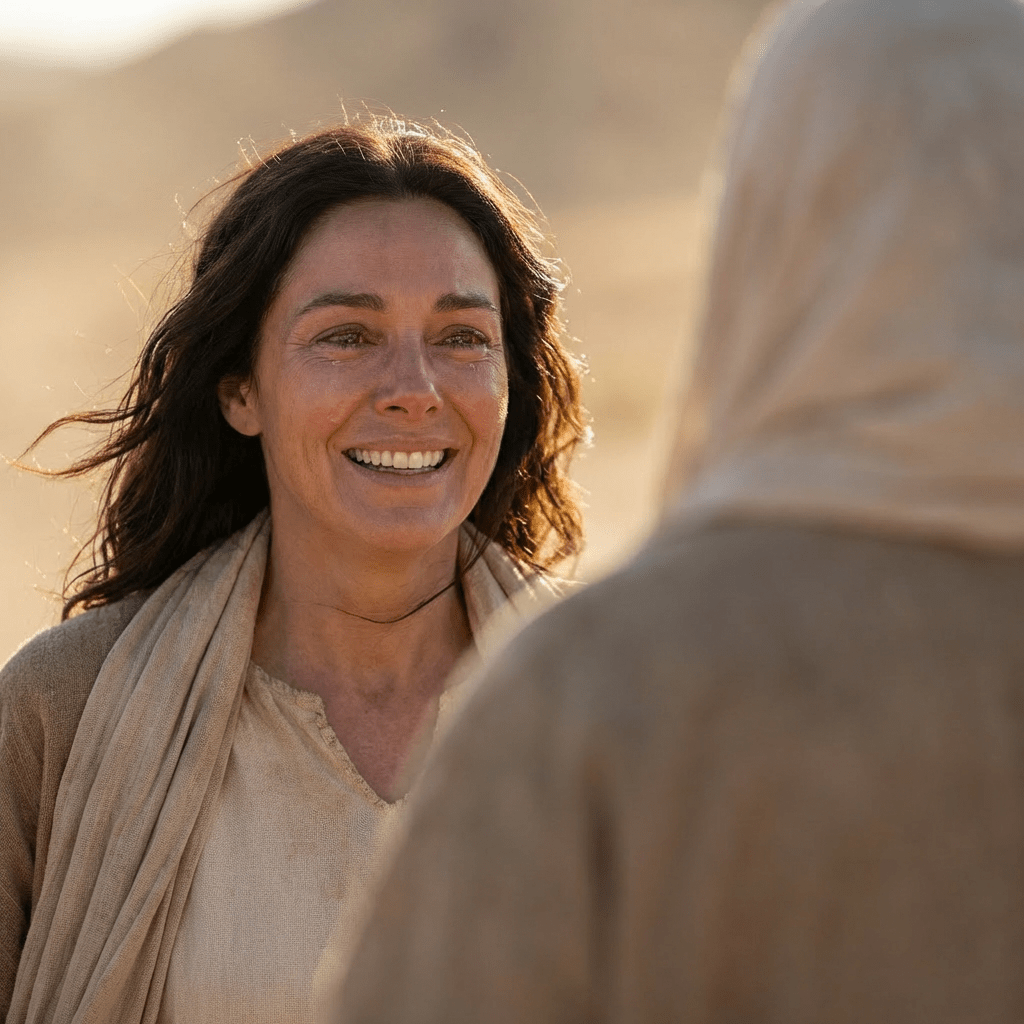
The scene with Mary is very poignant and moving. Jesus delivered her from seven demons (Luke 8:2), so it is likely that Jesus has become one of the most important people, if not the most important person, in her life. By the way, some people conflate her with the prostitute who anointed Jesus’ feet with perfume, but I doubt she is the same person. Mary Magdalene was apparently a woman of some wealth, since she helped provide for the physical needs of Jesus and the disciples. She went with them in their travels, supporting their ministry. Since her deliverance, her entire life had been oriented around Jesus. But then the enemies of Jesus captured him, abused him and then tortured him to death. And now, (she thinks), they won’t even leave him alone in death, but have taken his body, probably in order to humiliate him and his followers even more. I want us to pay attention here. The greatest thing since the creation of the world has just occurred, but to Mary, it looks like things are going from horrible to awful. Her way of viewing the situation was precisely the opposite of the reality. If we could talk to her in this moment before Jesus revealed himself to her, I’m certain she could give very coherent and logical reasons to believe that the empty tomb was more bad news. Her logic was impeccable. Of course this was worse, piled on top of bad. How could it be anything else? And she persisted in this belief while she was in the presence of two angels, and Jesus himself!
They did try to tell her. The angels said “Woman, why are you weeping?” She explained to them. Turning, she saw another man, whom she took to be the gardener. Apparently, Jesus could hide his true appearance from them, after the resurrection. The two disciples who met Jesus on the road to Emmaus did not recognize him either, until he revealed himself to them.
Jesus, too, says to Mary, “Woman, why are you weeping? Whom are you seeking?” I’m not saying it was wrong for Mary to weep. Certainly we have a plethora of examples of people of faith, weeping, struggling with depression, crying out to God in fear and so on. But Jesus is trying to show Mary that now, it is no longer the time for such things. There’s a lyric from a contemporary Christian song, “O My Soul.” It goes: “There’s a place where fear//Has to face the God you know.” It was time for Mary’s fear and grief to face the resurrected Jesus.
He simply spoke her name.
I can picture the scene so clearly. “Rabboni!” she screams. I imagine that she threw herself on him, sobbing, not knowing if they were tears of grief released, or of relief, or joy. What an incredible moment. He is here. He is with her. He has shown that he is greater even, than death. Everything is now permanently all right.
There is such a moment waiting for each one of us.
For the rest of the disciples, the moment was that same evening. Mary told them what had happened. Luke records that they had difficulty believing her. But then, that evening, Jesus came and stood among them, though the door was locked. I don’t know why the ESV says the disciples were “glad” when they saw the Lord. That makes it sound like their response was sort of low-key, chill, even. But the root Greek word is “rejoice,” and most other translations say things like: “So the disciples rejoiced when they saw the Lord (CSB),” or, “The disciples were overjoyed when they saw the Lord (NIV).” This moment was as big for them as it was for Mary. It changed everything.
And then we come to Thomas. Unfortunately, Thomas is famous for this one incident, his time of doubt. But his example provides us with some helpful instruction. Skepticism about someone rising from the dead is entirely natural. However, I wonder what Thomas thought of his brother-and-sister disciples. Were they all crazy together? Honestly, it seems a little rude to not trust their word, either as individuals, nor as a group. In any case, he dug his feet in, and said, “No, I can’t believe unless I see it with my own eyes.”
In our modern world, we think this is a reasonable position: skepticism until proof. But it’s almost impossible to actually function that way in every day life. I’ve been to nineteen countries in my lifetime. I have no “proof” that any of the others actually exist. I’m taking the words of other people on faith about those other countries. I have not gone to the bank and seen my physical dollars sitting in a vault somewhere. I take it on faith that I have those dollars, and I can use them when I need them. I have not seen proof that the food I eat is safe. I take it on faith, and that faith is almost always justified, but I am acting on faith again every time I eat something. I am trusting that my car will start when I turn the key. I trust that other drivers will stop for red traffic lights.
Some things have demonstrated themselves to be reliable to me, but the first demonstration of them came when I was too young to remember. I was four years old when I first flew in an airplane. I was too young to be skeptical, and after that, my own experience said that airplanes were a reliable means of transport. The same is true of motor vehicles. We have not actually verified by sight and touch even a fraction of the things that we trust to be true.
But Thomas took this position of radical skepticism. Jesus, of course, answered Thomas, but along with his answer came a mild rebuke. And now John finally reaches his main point. All of the disciples, himself included, believed Jesus physically rose from death, because they saw the evidence with their own eyes. They were all like Thomas, though they may not have spoken it as boldly as he. But we are called to something different.
29 Jesus said, “Because you have seen me, you have believed. Blessed are those who have not seen and yet believe.”
30 Jesus performed many other signs in the presence of his disciples that are not written in this book. 31 But these are written so that you may believe that Jesus is the Messiah, the Son of God, and that by believing you may have life in his name. (John 20:29-31, CSB)
John is inviting us, his readers, to a faith greater than his own was, at the time. Jesus says that we will be blessed when we believe even though we have not seen him with our own eyes. John says, “I’ve seen it for myself, it’s all true! But you could be more blessed than me if you believe it now, not having seen it.” We are called to believe what is written, to believe the scriptures.
Maybe you are in a place like Mary. Horrible things have been happening, and it looks like it won’t stop anytime soon. And yet, even as Mary held this very reasonable, logical point of view, she was standing right next to the risen Lord. Her most awful fears had already been resolved. Though she might experience more struggles in the future, the resurrection of Jesus changed everything, for good, forever.
Paul, in a letter to the Corinthians, describes how the resurrection changes things for him:
8 We are afflicted in every way, but not crushed; perplexed, but not driven to despair; 9 persecuted, but not forsaken; struck down, but not destroyed; 10 always carrying in the body the death of Jesus, so that the life of Jesus may also be manifested in our bodies. 11 For we who live are always being given over to death for Jesus’ sake, so that the life of Jesus also may be manifested in our mortal flesh. 12 So death is at work in us, but life in you.
13 Since we have the same spirit of faith according to what has been written, “I believed, and so I spoke,” we also believe, and so we also speak, 14 knowing that he who raised the Lord Jesus will raise us also with Jesus and bring us with you into his presence. 15 For it is all for your sake, so that as grace extends to more and more people it may increase thanksgiving, to the glory of God.
16 So we do not lose heart. Though our outer self is wasting away, our inner self is being renewed day by day. 17 For this light momentary affliction is preparing for us an eternal weight of glory beyond all comparison, 18 as we look not to the things that are seen but to the things that are unseen. For the things that are seen are transient, but the things that are unseen are eternal. (2 Corinthians 4:8-18, ESV, bold formatting added by me for emphasis)
We are invited to be among the blessed who do not see, but yet believe. We are invited to look to the things that are unseen and eternal. Yes, in the present we might be pressed, persecuted, struck down, followed by death. But the resurrection of Jesus means that in the end, life will prevail, and in the end, everything is actually, truly, very, very well. In the end, we do not lose anything worth keeping.
This is not theoretical for me. A few months ago, one of my children almost died. The doctors said later that she was actively dying, and they don’t know why she didn’t actually finish it. The experience was traumatic and heartbreaking for me. But it wasn’t ultimate. Even as it was happening, I knew for her, death would lead to a life that is unimaginably better. For me, it would lead to deep grief, but, even so, only temporary grief. Time does not heal all things. But resurrection does! Believing the scriptures, trusting the resurrected Jesus, made all the difference to me in those hours. It should do so all of the time, for those of us who have trusted Him.
And so the question to you is this: will you trust the Risen Savior, Jesus Christ? Will you trust, even before you can see? Will you focus on what is unseen and eternal, knowing that the Lord Jesus will one day raise you, and all who trust him?
 Clear Bible