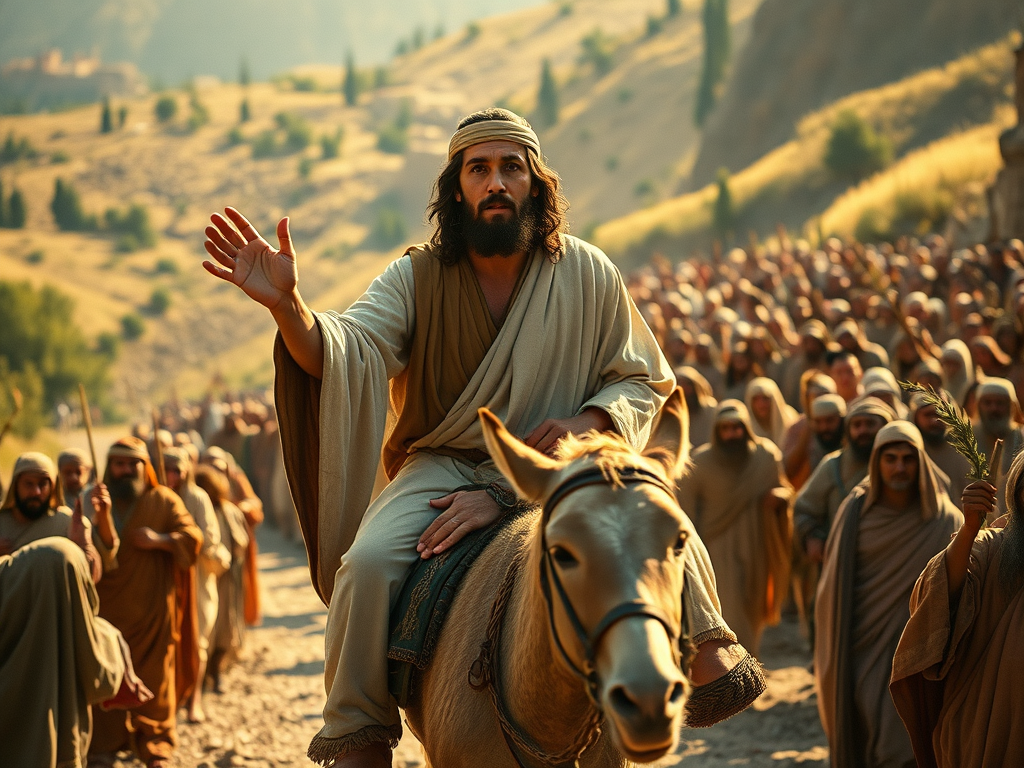
2026 PALM SUNDAY: DON’T MISS THE MAIN POINT

The crowd on Palm Sunday were worshipping Jesus, but it may have been for the wrong reasons. Sometimes, we too, miss the point of what Jesus is doing.

To listen to the sermon, click the play button: You can also find us on Spotify at https://open.spotify.com/show/6KKzSHPFT466aXfNT2r9OD (This will open to the latest sermon. You can search from there if you are looking for a previous one) To download, right click on the link (or do whatever you do on a Mac) and save it to your computer: Download Palm Sunday 2026

Luke 19:29-44

Most of us are familiar with the story of Palm Sunday: Jesus sends his disciples to get a mysteriously available young donkey. He gets on the donkey and rides to Jerusalem. As he does so, people start throwing down cloaks and branches to create a kind of “red carpet” as he goes along, and they all start cheering and praising him.

But have you ever wondered, why? What was the point of it all? Why is this story preserved for us in the Bible? Why did Jesus do it? What was it all about?

One startling thought was that maybe Jesus wanted to ride the donkey because he was tired. Jesus and the disciples walked everywhere they went (except when they were in Galilee, where they occasionally rode in boats). Maybe he wanted to sit down and experience the entry into Jerusalem without thinking about how much his feet hurt. This isn’t as flippant as it sounds. Jesus was God in human flesh, true. But he did have a human body too – just like yours and mine until his resurrection. Sometimes we forget that, but I guarantee you, he didn’t.

I think it goes beyond that, however. Jesus must have been familiar with the prophecy of Zechariah 9:9 which says:

Rejoice greatly, O Daughter of Zion! Shout, Daughter of Jerusalem! See, your king comes to you,

righteous and having salvation, gentle and riding on a donkey, on a colt, the foal of a donkey.

I don’t know if he was going out of his way to fulfill this prophecy or not. He certainly had no control over whether the crowd shouted, or what they said. But in any case, this procession into Jerusalem fulfilled a prediction about the messiah.

The symbolism of the donkey is somewhat important too. In that culture, when a leader entered a city as a conqueror or military hero, he rode a horse or in a chariot. When a leader came on a donkey it was an indication of peace and mercy for the people. Riding a donkey conveyed a promise of graciousness and mercy from a ruler. It was not a challenge or a military assertion.

So, he was tired. He was fulfilling prophecy. He was also conveying his intention to offer people grace and mercy. But I think there is also one more thing going on here. If you are familiar with other parts of Matthew, Mark, Luke and John, you may remember that often times, when Jesus did miracles, he told people to keep it quiet (for example, the leper in Mark 1:44). He was reluctant to turn water into wine (John 3). When Peter said that Jesus was the messiah, the Son of God, Jesus told them all not to tell anyone else (Matt 16:20). When he fed the 5,000, the people wanted to make him king, but he slipped away. He always seems so modest and humble, like he wants to keep his power and his identity a secret. But now suddenly, he is perfectly willing to be the cause of a big uproar at the beginning of the most crowded week of the year in Jerusalem, the capital of the region. It seems almost out of character. He spends three years, mostly away from Jerusalem, almost like he is hiding, and now in one day he blows his cover.

I believe Jesus allowed the crowd to go wild in order to create the pressure on the Jewish leaders that would ultimately lead to his crucifixion. What I mean is this: Before, the time was not right. He was still training his disciples, and it wasn’t yet time for him to die. But now, this week, this “palm” Sunday, he is coming to Jerusalem in order to die. In fact, his mission on earth would fail if he does not die. So he allows the Jewish and Roman leaders to be confronted with who he really is – knowing full well that they will do what they can to eliminate him as a threat to their power. In other words, by riding in a royal procession, surrounded by a cheering crowd, he is deliberately provoking the leadership of Jerusalem into having him executed.

Luke gives us a few verses that shed a little bit of light on Jesus’ attitude toward this triumphant procession.

39 Some of the Pharisees in the crowd said to Jesus, “Teacher, rebuke your disciples!”

40 “I tell you,” he replied, “if they keep quiet, the stones will cry out.”

41 As he approached Jerusalem and saw the city, he wept over it 42 and said, “If you, even you, had only known on this day what would bring you peace—but now it is hidden from your eyes. 43 The days will come upon you when your enemies will build an embankment against you and encircle you and hem you in on every side. 44 They will dash you to the ground, you and the children within your walls. They will not leave one stone on another, because you did not recognize the time of God’s coming to you.” (Luke 19:39-44)

I think we can learn two things about Jesus’ attitude from this. First, he fully accepts that it is good and right for the people to praise him the way they were doing. You see if Jesus really was God (as Christians believe he was and is) then it was not wrong or blasphemous for people to praise him and worship him. In fact, it would have been wrong for him to stop them from worshipping him, just as it would be wrong for me to try to stop someone else from worshipping God. So, Jesus didn’t stop them. He never stopped anyone from worshiping him before either, but on previous occasions he tried to keep his identity quiet. So at this time, he feels that the cheering crowd is entirely appropriate. In fact, he implies that as Lord of creation, even the rocks owe him their worship.

 Second, even while the crowd is doing the right thing (praising Jesus), Jesus can see that they are doing it for the wrong reasons. What he says indicates that they do not understand what is going on, or what he is all about. He says Jerusalem will be destroyed “because you did not recognize the time of God’s coming to you.” So even though they are praising him and that is good and proper, they do not understand his mission, or why he is there, or what it means. And they don’t accept it.

By the way Jesus’ prophecy about the destruction of Jerusalem was so right-on to what happened about forty years later that skeptical scholars insist that the gospels were written after  the events, because they can’t admit the possibility that Jesus could accurately prophesy.

In any case at the one level, his triumphant entry is good and right – Jesus is the messiah, after all, God in human flesh – and he deserves the adulation of the crowd. But at another level, the cheering crowd really doesn’t connect with why Jesus is there. They don’t accept that he has come to defeat sin and the devil – they are more concerned about food in their bellies and freedom from Rome. They want victory and excitement, but they know nothing about the coming crucifixion, and would be repulsed by it if they had known it. They certainly didn’t hang around the cross when Friday came.

What does all this mean for us, two-thousand years later? Well, maybe we just need to be reminded that Jesus experienced the same things we experience as human beings. It might be a comfort to know that he got tired and had sore feet sometimes. Or perhaps you needed to hear how Jesus fulfilled a four-hundred year old prophecy when he rode down the path on that donkey with people shouting and singing all around him.

For me, one of the big applications is how the crowd was doing the right thing, praising God for Jesus, and yet they totally missed the priorities and goals that Jesus had. By coming on a donkey, he was implying that he came in peace – but they ignored that, and still wanted him to militarily overthrow the Romans. Even more telling, they were caught up in excitement and busyness and noise, and because of that, they missed out on how God was really working. The whole, time, what Jesus was really doing was coming to die. They missed that in all the activity.

I think we can miss the point of Jesus sometimes also. Especially these days, as a lot of Christians think that Jesus came to assist us in fulfilling our dreams. Jesus does want to fulfill us, because he made us to be vessels of his grace and glory, and when we are fulfilled in him, it brings glory to him. And maybe we get excited and praise God for the things he can do for us, to make our lives more comfortable right now. But he also wants to crucify our flesh. We often forget that. The real reason to praise God is because he has delivered us from ourselves, from sin, our fallen flesh and the devil. And sometimes, he is riding in to town so that the parts of us that are still in rebellion to God can be crucified. Let’s not miss that point, like most of the crowd did that day. We need to be in tune with His mission, not our own goals or comforts.

There’s another temptation for churches and Christians in America today. If we can create lots of busyness and excitement and action, it appears that we are really participating in the kingdom of God. But I think when we gravitate to action and excitement, for the sake of those things in themselves, we often miss out on what God is really doing. I think sometimes he works more through the quiet, unrecognized ways than through the really splashy programs. He’s often at work when a few friends get together for breakfast or coffee to pray and read the Bible. He’s at work when we talk to our kids, and the friends of our kids, about Jesus. He’s at work when we take time to make a phone call and see how we can encourage someone else in faith, or when we spend a minute or two praying for someone else. He works in our small groups.

So, it’s good and right to praise Jesus. It’s even better to praise him for the right reasons, and accept that his mission is far greater than our temporary comfort on earth. I’m not saying he won’t do anything for you in the here and now. But when Good Friday and the cross came, this crowd didn’t understand, and for the most part, gave up their hope in Jesus. But for Jesus, the cross was the whole point of the thing in the first place. So let’s remember that, and praise God while accepting His mission in our life is to crucify our flesh, use us to glorify Himself and bring us to eternal, joyful life in the coming new creation.


PHILIPPIANS #8: WORKING OUT WHAT GOD HAS WORKED IN

Photo by Jonathan Borba on Pexels.com

Being a Christian means that we trust Jesus in such a way that it has consequences in our daily lives. It’s a bit like marriage. Getting married is relatively simple (you don’t need all the wedding pomp and fancy things). But once you are married, there will be years working the implications of your marriage out into your life. So, in the same way, it is simple to come to Jesus. We also spend a lifetime working our salvation out into our lives. And yet, it is not we who do the work, but God himself.

To listen to the sermon, click the play button: You can also find us on Spotify at https://open.spotify.com/show/6KKzSHPFT466aXfNT2r9OD (This will open to the latest sermon. You can search from there if you are looking for a previous one)

To download, right click on the link (or do whatever you do on a Mac) and save it to your computer: Download Philippians Part 8

PHILIPPIANS #8. Philippians 2:12-13

12 Therefore, my beloved, as you have always obeyed, so now, not only as in my presence but much more in my absence, work out your own salvation with fear and trembling, 13 for it is God who works in you, both to will and to work for his good pleasure. (Philippians 2:12-13, ESV)

One of the ways the Christian faith is unique is that it holds a number of truths in tension with other truths. So, for example, we believe there is only one God. Yet we also believe that he exists eternally as three Persons. Or, we believe that Jesus Christ was God. We also believe that he was human. There are actually quite a few things like this in our faith. Today, we touch upon another one.

We hear, over and over again, that all we need to do is believe in Jesus Christ, and we will be saved. At the same time, we hear that our behaviour should be different from that of people who don’t believe. We should avoid sinning, and engage in the good things that the Lord calls us to. So, which is it? Do we have to behave a certain way to be Christians? Or are we simply saved by believing? There are verses that say it is just believing. In fact, it was in Philippi, after an earthquake shook that jail, that this was spoken:

29 And the jailer called for lights and rushed in, and trembling with fear he fell down before Paul and Silas. 30 Then he brought them out and said, “Sirs, what must I do to be saved?” 31 And they said, “Believe in the Lord Jesus, and you will be saved, you and your household.” (Acts 16:29-31, ESV)

It seems simple right? Just believe. And yet, there is a little more to it than that. The very next verse reads:

32 And they spoke the word of the Lord to him and to all who were in his house. (Acts 16:32)

So, Paul and Silas obviously explained things to them in greater depth than “just believe.” In addition, I think that in most cases, the Greek word for “believe” or “faith” is usually best translated “trust.”  In other words, it involves a lot more than just giving your intellectual assent to a mental proposition. In fact, James says that even demons “believe” in God in that sense.

19 You believe that God is one; you do well. Even the demons believe—and shudder! (James 2:19, ESV)

No, “saving faith” is a real trust in God that leads you to behave and think differently than you would if you did not have that trust. I’ve used this analogy before, but I think it’s really useful:

Imagine your friend tells you about the world’s greatest tightrope walker, The Great Bruno. He has walked across tightropes over deep canyons, and waterfalls, and cliffs. Your friend says, “Do you believe this?”

You think, sure, human beings are pretty amazing. I believe there is such a person as The Great Bruno, and I believe he can do such things. You are giving intellectual assent to the existence of this person, and to his abilities. But this is not at all the same thing as what the Bible calls “faith” when it applies to Jesus Christ. In fact, this kind of faith, mere intellectual assent, is the faith that demons have (as described by James, above).

Now, imagine you have come to see the Great Bruno perform. There is a tightrope strung between two skyscraper buildings, two hundred feet above the street. There is no safety net. You’ve heard about The Great Bruno, so when he asks “Do you believe I can walk across this tightrope and back again, without falling?” you say, “Yes!”

This kind of faith costs us nothing, asks nothing of us. If we say “yes,” it doesn’t really make any difference for us.

“Now,” The Great Bruno says, “who believes that I can carry a person safely across the rope and back again?” Again, you’ve heard of him, and you believe he could do that. Again, that faith costs you nothing, means nothing relevant to your actual life.

The Great Bruno now meets your eyes and points directly at you. “Will you allow me to carry you across on my back?”

Now, the question is about real trust. If you say “yes,” it will have direct consequences for your life. It requires actual trust from you. You have “skin in the game,” so to speak.

Another useful analogy is from marriage. If you want to get married, really all you have to do is repeat the vows after the pastor, and say “I do,” when he asks you. Is that really it? Yes it is. That’s all there is, in essence to getting married.

Is that all there is to marriage? Not by a long shot. You will spend the rest of your life working out the implications of what transpired when you said “I do.”

Do you have to behave like a good husband or wife in order to be married? Not necessarily, but if you don’t want to be a husband or wife, why are you getting married, anyway? Is it required that you behave a certain way after you are married? Again, no, you are married now, no matter how you behave. And yet, you normally will behave differently after you are married. Eventually, if you never actually behave in a loving way toward your spouse, you might lose your marriage. But you don’t lose it just by forgetting to clear the table after dinner once or twice. Ideally, you get married because you love each other unconditionally. Even so, after marriage, there is a great deal to “work out.”

So it is with trusting Jesus. All it takes is trust. Even so, we spend the rest of our lives “working out” the implications of that trust.

If we truly trust Jesus, as the Bible has revealed him to us, it will change the way we think and behave. Jesus said that if we want to follow him, we should die to ourselves daily. He said that we should put him above all other priorities. He said we should seek the kingdom of God first, and to not worry about little things like the necessities of life. He tells us to love our enemies. He tells us that we are forgiven, and that we should not continue to live in sin.

He says that we should live with our hearts and minds set upon the joy that is coming in the next life, that what we should truly treasure and work for are eternal things. If we follow Jesus, we might not be successful in the eyes of others. In fact, we might look foolish and humble. We might make decisions in following Jesus that other people do not understand or approve.  These are all things that require trust. This is not merely intellectual assent, but trust that profoundly affects the way we live, and the motivations we have.

And so, though we do not earn God’s love, or salvation, through what we do, our salvation does have profound consequences that must be worked out in practical ways in our lives. This is what Paul is talking about when he says that we should obey, and that we should work out our salvation with fear and trembling.

Paul’s words here apply in two different contexts. First, we are to work out the implications of our salvation personally, as I described above. But we are also supposed to work out our salvation in connection with our fellow believers. From the very beginning of chapter two, Paul has been talking to them about how to go through life together as fellow-Christians. Salvation puts us not only in a new kind of relationship with God, but also a new kind of relationship with others who are being saved. So we need to be diligent about letting our salvation influence how we interact with our fellow believers. Paul has already told us that this involves being humble with one another, and looking out not only for our own interests, but also the interests of others. We should be focused on the same goal, keeping the same attitude, thinking together about things from the perspective of those who belong to Jesus.

Today, in Western culture, this also means that we should have a level of commitment to one another that is maybe unusual in the larger culture. I confess, I think this is harder for people in typical, large churches. But, as you can, find a group of fellow believers with whom you “do life together.”

I think too many Christians look at churches as if they are consumers. They ask, “What will this church do for me? Does it have programs that will benefit me and my family?” Some of those questions are natural when you first move to a new area and are looking for a new church. But Christians should also be asking things like this: “Am I on the same page with these people concerning the Bible? Can I see myself going through life, side by side with them, being an encouragement to them, and leaning on them when I need encouragement? Could I be a blessing to these people in some way?” When Christians have no long-term, meaningful commitment to other Christians, they suffer. They are not fully embracing the life Jesus intends for us. They are not fully “working out their salvation.”

There is one more, extremely important, piece to working out our salvation:

“…for it is God who works in you, both to will and to work for his good pleasure”

We are not the ones doing the work of working out our salvation. It is God who does it, in you and through you. In fact, it is God who even causes you to want to work out your salvation. This reminds me of something Paul wrote to the Colossians:

29 For this I toil, struggling with all his energy that he powerfully works within me. (Colossians 1:29, ESV)

You see two pieces here. Paul is toiling, but he is using not his own strength. The energy with which he toils is power that comes from God himself. Jesus taught this himself. He used the analogy of the vine and the branches:

4 Remain in Me, and I in you. Just as a branch is unable to produce fruit by itself unless it remains on the vine, so neither can you unless you remain in Me.
5 “I am the vine; you are the branches. The one who remains in Me and I in him produces much fruit, because you can do nothing without Me. (John 15:4-5, HCSB)

Our first task is to make sure we are closely connected to Jesus.  Next, we make our voices and hands and minds available to him. Finally, we leave the results up to him.

Above all, this text is calling us to believe that the whole enterprise is not ours, but God’s. Working out our salvation into all areas of our lives is something God is doing. He is the one who works in us and through us. Even the will to grow in Christ comes from God himself. The more we trust this, the more we will act like it is true. The more we act like it is true, the easier it gets.

Now, why does Paul talk about obedience, and fear and trembling? This process—God working in us and through us through faith—is a beautiful, holy thing. God himself is at work in your life. We should take this seriously, out of reverence and gratitude. It is no small thing, and we should approach it with respect and joy.

I think the key to all this is to be willing. Part of being willing is making our bodies and minds available to God.  For example, one part that is essential for us if we are to work out our salvation is to read the Bible. If you aren’t a reader, listening to the Bible is just as good. God will not take over your body, make you walk over to the shelf, take down the bible and open it up. You have to do that part. Or, you have to call up the audio Bible on your phone and start it playing. But then, once you read or listen, what you get out of it is up to God. This may surprise you, but the Bible is very clear that results are God’s business, not ours. You need to put the bible into your mind and heart by reading or listening. But the second part – the growing and learning and changing – that is what God himself will do, in his own way, and own time. I have spoken to many people over the years who say they aren’t getting much from their Bible reading. That’s OK. What you “get out of it” is God’s business, not yours. Don’t stop reading, just because you can’t tell what is happening spiritually when you read.

I don’t remember every meal I’ve eaten during the past month, but even so, those meals nourished my body. In the same way, the scripture I’ve read during the past month has nourished my soul. Sometimes, I can feel my soul being built up as I read. Sometimes I can’t. But I give God my time and willingness, and he provides the growth in his time and way. I read the Bible almost every day. Many days, what I read does not stay in my conscious mind for very long. But after 40 years or so of regular Bible reading, God has implanted his word deep in my soul, and he uses it to bear fruit on many occasions. How it bears fruit, and when, is up to him.

So it is with everything. Jesus wants to love and bless my family through me. I have to give him my time and my words, but the way those things bring blessings to my family are up to Jesus. I have to be willing to spend time with other people Jesus has put in my life. I need to be willing to speak, or help them in practical ways. But even as I give my time and my physical actions, it is  God who uses those things to bless others. I have been saying “I,” but truthfully, this is for all of us. It isn’t just for preachers: Paul makes that clear here, and Jesus made it clear in the John 15 verse I just gave you. This is how we live. We use our voices and minds, and hearts and bodies, but it is God working in and through us at the same time.

Let the Holy Spirit speak to you today.

PHILIPPIANS #7: THE GLORY OF HUMILITY

Humility by Ernst Barlach by lacma is licensed under CC-CC0 1.0

I feel that at least on this occasion, we should look at this text in the way that Paul clearly meant the Philippians to understand it. He wasn’t trying to write a hymn. If he was using a piece of an existing hymn, that is beside the point. He wasn’t creating a theology of Jesus, either. Instead, he was urging the Philippians to be humble in practical, loving ways.

To listen to the sermon, click the play button: You can also find us on Spotify at https://open.spotify.com/show/6KKzSHPFT466aXfNT2r9OD (This will open to the latest sermon. You can search from there if you are looking for a previous one)

To download, right click on the link (or do whatever you do on a Mac) and save it to your computer: Download Philippians Part 7

Philippians #7. Philippians 2:1-10

1 So if there is any encouragement in Christ, any comfort from love, any participation in the Spirit, any affection and sympathy, 2 complete my joy by being of the same mind, having the same love, being in full accord and of one mind. 3 Do nothing from selfish ambition or conceit, but in humility count others more significant than yourselves. 4 Let each of you look not only to his own interests, but also to the interests of others. 5 Have this mind among yourselves, which is yours in Christ Jesus, 6 who, though he was in the form of God, did not count equality with God a thing to be grasped, 7 but emptied himself, by taking the form of a servant, being born in the likeness of men. 8 And being found in human form, he humbled himself by becoming obedient to the point of death, even death on a cross. 9 Therefore God has highly exalted him and bestowed on him the name that is above every name, 10 so that at the name of Jesus every knee should bow, in heaven and on earth and under the earth, 11 and every tongue confess that Jesus Christ is Lord, to the glory of God the Father. (Philippians 2:1-11, ESV)

Philippians 2:6-11 (the last half of our text today) is very significant for Christian theology about Jesus Christ. Many commentators also point out that those verses appear to be an ancient hymn. In Greek, the words in verses 6-8 create a rhythm, and they seem to be very deliberately chosen and placed to balance one another. However, commentators disagree on where the “hymn” starts and ends.

Also, of course, this text tells us some important things about Jesus, especially, that he is God, who came to earth as a man. There have been volumes written, fleshing out the theological implications of it.

However, I feel that at least on this occasion, we should look at this text in the way that Paul clearly meant the Philippians to understand it. He wasn’t trying to write a hymn. If he was using a piece of an existing hymn, that is beside the point. He wasn’t creating a theology of Jesus, either. Instead, he was urging the Philippians to be humble in practical, loving ways.

Paul has just been encouraging the Philippians to live as citizens of the gospel of Christ in a way that shows Christ as worthy above all. Remember, this letter is addressed to a group of Christians. Now Paul begins to explain that they are not just individual Christians who happen to go to church together; no, they are called to communal life together in unity and humility and truth. The way they are with one another communally is deeply connected to living as citizens of the kingdom of Christ.

Paul begins this section with a kind of rhetorical way of speaking, but his point is that we have been given so much through Jesus Christ. In him we have encouragement, comfort from love, participation in the Spirit, and sympathy. We have these things not only as individuals, but also together with one another. Let’s look at what Paul mentions:

The word encouragement means literally “coming alongside.” The idea here is that Christ comes alongside us through the Holy Spirit to comfort and encourage us. Not only that but in Christ, we have one another, and so we, too, come alongside one another. Many of you have come alongside us as we have dealt with the cancer of my daughter. I have a friend who has chronic head pain. Right now he is going through a tough time, and I’ve been coming alongside him, just letting him know he is not alone, that we are standing with him in spirit and in prayer.

Comfort from love. I prefer the HCSB: “consolation of love.” The Greek word for “comfort/consolation” means to speak tenderly alongside. Imagine a father with his arm around his five year old daughter after her beloved hamster has died. That’s an example of the consolation of love. We have that from Jesus, and through Christ, we can offer that to one another.

Participation in the spirit. The Greek word translated “participation” is koinonia, which includes a very strong idea of community and fellowship. Together, in the spirit, we have fellowship—close community—with God, and also with our fellow Christians.

Affection and sympathy. The word for affection is literally “intestines.” In English, “guts” are intestines, but “guts” can also mean  courage. Some Australians and British, when they are deeply upset, may say that they are “gutted.” In a similar way, in ancient Greek, “guts” also meant, “deep feeling.” Personally, I think “affection” doesn’t convey the depth of feeling meant by the Greek word. Maybe it should be something more like “deeply caring.” It is combined with another Greek word here, which means mercy, or compassion. I don’t like the ESV translating this as “sympathy,” because the word “sympathy” comes almost directly from a different Greek word. So, I would call this “deep compassion,” or “deep caring.”

Paul is saying: “Have you received any of this through Christ?” The answer is meant to be an obvious “yes.” And then: “Do you have these things along with, and partially through, other believers?” Again the answer is “yes.” Then, because that is so, he says:

“complete my joy by being of the same mind, having the same love, being in full accord and of one mind.” (Philippians 2:2, ESV)

I spent a ridiculous amount of time with the Greek, because, as the ESV correctly translates, it says “of the same mind,” and then “of one mind.” Why basically the same thing twice?  The first “being of the same mind” could maybe be captured by “have the same mindset amongst yourselves.” It’s not about thinking thoughts, so much as it is about attitude. The second “one mind” is telling them to think about things in the same way. What things? What attitude? I’m so glad you asked, because the answer is in the following verses:

3 Do nothing from selfish ambition or conceit, but in humility count others more significant than yourselves. 4 Let each of you look not only to his own interests, but also to the interests of others. (Philippians 2:3-4, ESV)

I bet that almost anyone reading this today feels that it is in poor taste to boast, or to be conceited. Most people do not respect someone who boasts, or who is conceited. We tend to approve of people who are humble, especially when they might have reasons not to be. But that was not true in the ancient world. The powerful people never got tired of telling everyone else how great they were. Humility was not seen as a virtue. Philippi, that proud Roman colony, did not have time for humility. They were Roman citizens, better than everyone else who lived around them. The glory of Rome was their glory. But Paul tells them instead to be humble. The reason almost all modern Western people think of humility as good is because of passages like this one in the Bible. We don’t even realize how much the bible has influenced even secular people. What I’m trying to say is that this teaching would have been stunningly radical to those who first heard it.

I don’t know about you, but verses 3-4 above really cut to my heart, because I don’t want to live by them. I have had a certain amount of selfish ambition in my life, and it dies hard. I always had an ambition to be a famous author. If I’m honest, though I don’t know if today it remains an ambition, exactly, I still would really like to sell millions of my books. Then, I have such a high opinion of myself, and I find it challenging to think of others as more significant than me. I often don’t feel like my own interests are being sufficiently considered, so it’s hard to put the interest of others at the same level as my own. Then Paul really hits us:

5 Have this mind among yourselves, which is yours in Christ Jesus, 6 who, though he was in the form of God, did not count equality with God a thing to be grasped, 7 but emptied himself, by taking the form of a servant, being born in the likeness of men. 8 And being found in human form, he humbled himself by becoming obedient to the point of death, even death on a cross. 9 Therefore God has highly exalted him and bestowed on him the name that is above every name, 10 so that at the name of Jesus every knee should bow, in heaven and on earth and under the earth, 11 and every tongue confess that Jesus Christ is Lord, to the glory of God the Father. (Philippians 2:5-11).

This is a profound passage. It provides a foundation for several important parts of Christian theology. But as we look at it today, I want us to remember it’s place in context. In context, Paul was not writing directly about the divinity of Jesus. As we have already begun to see, Paul wrote this to urge the Philippians to be humble. That’s how we’ll look at it today.

My Lord and savior, my ultimate hero, was profoundly humble. He was God in the flesh, and prior to his incarnation, he existed in a form that clearly showed his power and majesty. Jesus called himself “the son of man.” The son of man, in the Old Testament, was someone who appeared to various prophets in visions, shining in glory that so bright that it was painful to the eyes. But though Jesus could have come to earth “wearing” that unmistakable glory, instead he took on a form that no one paid any attention to: the form of a human, with no additional glory peeping through.

 Though Jesus created all things, the rich and powerful and ambitious people had no time for him. He had every right in the universe, and yet he gave up every right. He submitted himself to the most horrific and humiliating form of death, death by crucifixion. Crucifixion was meant to kill, but slowly, agonizingly. In addition to the agony, it was meant to humiliate. Though all of our pictures of Jesus on the cross modestly cover his “private parts,” he was almost certainly completely naked on the cross. When he died, if not before, it is likely that his bowels and bladder emptied. This sort of thing is awful to think about, but sometimes we sort of romanticize the cross. It was not romantic. Certainly, the people who lived in the Roman empire at that time could not imagine a more agonizing or humiliating way to die. I’m still not sure I can. And this is what the most glorious being in existence submitted himself to, out of love for you and me.

Let’s consider this picture of humility. In the first place, it doesn’t mean thinking you are somehow worth less than others, or a poor excuse for a person. To think those things about himself would have been a sin, for Jesus, a lie. In Mere Christianity, C.S. Lewis said:

Do not imagine that if you meet a really humble man he will be what most people call “humble” nowadays: he will not be a sort of greasy, smarmy person, who is always telling you that, of course, he is nobody. Probably all you will think about him is that he seemed a cheerful, intelligent chap who took a real interest in what you said to him. If you do dislike him it will be because you feel a little envious of anyone who seems to enjoy life so easily. He will not be thinking about humility: he will not be thinking about himself at all.

A humble person is interested in others as much as, or more then, herself. She will think that what others have to say is as important as what she might say. To her, the lives of others have as much right to be seen and respected as her own life.

I think one key aspect of what Paul is describing in this passage is that Jesus was secure in who he was. He was not insecure. He knew he was worthy, therefore, he didn’t need others to constantly affirm it. He knew he was God, and so, for his sense of personal well-being, it didn’t matter whether anyone else thought so. His only reason for wanting others to see that part of him was so that they would be saved. His own strong sense of self was the stable platform that allowed him to serve others, even if they never recognized him as God, or even as great.

In addition, Jesus trusted God to honor him at the right time and the right way. Even now, Jesus is not fully honored for who he is, and what he did for the human race. But, Paul explains that eventually, every knee will bow, every tongue will confess that Jesus Christ is Lord.

By the way, I don’t think that this is teaching that all people will be saved. It seems to me that some people will confess that Jesus Christ is Lord and be filled with joy about it. For them, that confession will be the glad exclamation after a lifetime of following him, rejoicing that now all people who have ever lived are recognizing who He is.

But others will confess the truth about Jesus reluctantly, angrily, horrified that they must admit it is true. They will admit the truth, but it will only make them more angry, bitter and hateful. My point is that Paul is not teaching that every person who ever lives will welcome Jesus gladly and be saved. Everyone, whether they want to, or not, will be forced to admit who Jesus is: the Lord of all creation, the savior of those who trust in him. Those who are being saved will confess it with joy, but those who are not being saved will confess it with savage anger and hatred. When they confess, it will also be an admission that they were wrong in their attitude toward Jesus.

So Jesus was able to be humble because he knew who he was, and because he entrusted his honor and success to the Father. He was relaxed, not needing to insist that everyone treat him as he deserved to be treated.

We are called to the same kind of humility: that’s what Paul means when he says: “Have this mind among yourselves, which is yours in Christ Jesus..” But it can be daunting. Jesus was secure in who he was. He trusted the Father with all things, so he could be humble. But what if I’m not quite as secure in myself? What if I feel that I need to look out for my own interests, because no one else will?

Here’s the thing: Jesus offers us that same security and stability that he himself has. The Lord sees who we truly are, and he loves us. If that is true, it really does not matter what anyone else thinks of us. Through Jesus, we can be secure in ourselves, in our worth as human beings loved by God. Through Jesus we can learn to trust him to look after our interests for us. Jesus, for the most part, did not receive the respect he deserved during his life on earth. He trusted that his Father would work it all out in the light of eternity. So, we too, don’t have to get everything we want or deserve in this life. Our lives are bound up with Jesus, and we will be part of the Father’s exaltation of Jesus in the new creation.

Several years ago, before we transitioned to house church here in Tennessee, I preached “live” every Sunday morning. One week, I was really excited about what the Lord had showed me in the text, and eager to give the sermon. However, that morning, the weather was really bad, and it was a holiday weekend to boot. I found myself standing up to preach in front of my family and about five other people. I was disappointed that so few people were going to hear the cool stuff the Lord had showed me from the text. I prayed silently: Really Lord? You want me to preach this for five people, plus my family?

I felt the reply: What if you were only preaching to an audience of one?

What do you mean, Lord?

What if I was the only one you were preaching for? Would that be enough?

It occurred to me that if I was called to preach only to the President of the United States, I would feel honored. Shouldn’t I feel even more honored to preach for the Master and Creator of the Universe?

My sermons are for the Lord, which is a great honor for me. I can relax about who, or how many others hear/read them. I can stop thinking about myself. I wish I could tell you that I always feel that way. Truthfully, it’s still a struggle. But I find that the more my sense of security and self is grounded in the Lord, the less I worry about myself, and the more appropriately humble I can be. I’m not claiming to have this down all the time. But I think one of the keys to humility is to learn to be secure in the love of the Lord for me, and the value that he puts on me. Then, I don’t have to defend myself, or promote myself.

I find this is most difficult as an author. Since I’m not very famous, most people have not heard of me, and won’t go buy my books, because they don’t even know my books exist. The way of the world is to promote not only my books, but myself. I think this is true of most artistic endeavors, like music, graphic art, filmmaking, performing arts (like acting and dance), and so on. I don’t really know what to do about it, other than to be aware of the potential problem, and consciously invite the Lord into the process of marketing my artistic endeavors.

Over the years, many people that I know met my dad. After about the first ten times, I began to get used to the fact that people were almost universally positively impressed by him. I can’t count the number of times people would say something like: “Your dad is a pretty amazing guy, isn’t he?” He was. He led a full and adventurous life, and he had so many varied and interesting experiences. He was very intelligent, and well read, and thoughtful. But I think what actually made such an impression on people is that he was humble. He was genuinely interested in what other people thought, and who they were. He set aside his own agenda and interests to listen to others, and ask them questions.

To be humble we have to trust God with our own needs; we need to let him take care of our rights, and privileges and honor. Then, we are free to focus on others. Paul shows us what happens because Jesus did that. He did not insist upon his own, rightful honor. Instead he humbled himself, even submitted himself to humiliation and death. Therefore, says the scripture, God (the Father) will exalt him, and everyone on earth will recognize his true greatness and glory.

Even more amazing, to my mind, is that he will include us in bringing glory to him!

Let the Holy Spirit speak to you today.