WHOSE AGENDA?

before_palm_sunday

Sometimes the big crowd is all excited about Jesus, but for the wrong reasons. We aren’t aware of, or we don’t accept Jesus’ real agenda.

To listen to the sermon, click the play button:


To download, right click on the link (or do whatever you do on a Mac) and save it to your computer:
Download Palm Sunday 2012

Palm Sunday, 2012 (Luke 19:28-44)

Most of us are familiar with the story of Palm Sunday: Jesus sends his disciples to get a mysteriously available young donkey. He gets on the donkey and rides to Jerusalem. As he does so, people start throwing down cloaks and branches to create a kind of “red carpet” as he goes along, and they all start cheering and praising him.

But have you ever wondered, why? What was the point of it all? Why is this story preserved for us in the Bible? First of all, we haven’t named it well. It isn’t “palm” Sunday at all – palm trees don’t even grow near Jerusalem, so the branches they cut were from other kinds of plants. But most importantly – why did Jesus do it? What was it all about?

One startling thought was that maybe Jesus wanted to ride the donkey because he was tired. Jesus and the disciples walked everywhere they went (except when they were in Galilee, where they occasionally rode in boats). Maybe he wanted to sit down and experience the entry into Jerusalem without thinking how much his feet hurt. This isn’t as flippant as it sounds. Jesus was God in human flesh, true. But he did have a human body too – just like yours and mine until his resurrection. Sometimes we forget that, but I guarantee you, he didn’t.

I think it goes beyond that, however. Jesus must have been familiar with the prophecy of Zechariah 9:9 which says:

Rejoice greatly, O Daughter of Zion! Shout, Daughter of Jerusalem! See, your king comes to you,

righteous and having salvation, gentle and riding on a donkey, on a colt, the foal of a donkey.

I don’t know if he was going out of his way to fulfill this prophecy or not. He certainly had no control over whether the crowd shouted, or what they said. But in any case, this procession into Jerusalem fulfilled a prediction about the messiah.

The symbolism of the donkey is somewhat important too. In that culture, when a leader entered a city as a conqueror or military hero, he rode a horse or in a chariot. When a leader came on a donkey it was an indication of peace and mercy for the people. Riding a donkey conveyed a promise of graciousness and mercy from a ruler. It was not a challenge or a military assertion.

So, he was tired. He was fulfilling prophecy. He was also conveying his intention to offer people grace and mercy. But I think there is also one more thing going on here. If you are familiar with other parts of Matthew, Mark, Luke and John, you may remember that often times, when Jesus did miracles, he told people to keep it quiet (for example, the leper in Mark 1:44). He was reluctant to turn water into wine (John 3). When Peter said that Jesus was the messiah, the Son of God, Jesus told them all not to tell anyone else (Matt 16:20). When he fed the 5,000, the people wanted to make him king, but he slipped away. He always seems so modest and humble, like he wants to keep his power and his identity a secret. But now suddenly, he is perfectly willing to be the cause of a big uproar at the beginning of the most crowed week of the year in Jerusalem, the capital of the region. It seems almost out of character. He spends three years, mostly away from Jerusalem, almost like he is hiding, and now in one day he blows his cover.

I believe Jesus allowed the crowd to go wild, in order to create the pressure on the Jewish leaders that would ultimately lead to his crucifixion. What I mean is this: Before, the time was not right. He was still training his disciples, and it wasn’t yet time for him to die. But now, this week, this “palm” Sunday, he is coming to Jerusalem in order to die. In fact, his mission on earth would fail if he does not die. So he allows the Jewish and Roman leaders to be confronted with who he really is – knowing full well that they will do what they can to eliminate him as a threat to their power. In other words, by riding in a royal procession, surrounded by a cheering crowd, he is deliberately provoking the leadership of Jerusalem into having him executed.

Luke gives us a few verses that shed a little bit of light on Jesus’ attitude toward this triumphant procession.

39 Some of the Pharisees in the crowd said to Jesus, “Teacher, rebuke your disciples!”

40 “I tell you,” he replied, “if they keep quiet, the stones will cry out.”

41 As he approached Jerusalem and saw the city, he wept over it 42 and said, “If you, even you, had only known on this day what would bring you peace—but now it is hidden from your eyes. 43 The days will come upon you when your enemies will build an embankment against you and encircle you and hem you in on every side. 44 They will dash you to the ground, you and the children within your walls. They will not leave one stone on another, because you did not recognize the time of God’s coming to you.” (Luke 19:39-44)

I think we can learn two things about Jesus’ attitude from this. First, he fully accepts that it is good and right for the people to praise him the way they were doing. You see if Jesus really was God (as Christians believe he was and is) then it was not wrong or blasphemous for people to praise him and worship him. He didn’t stop them. He never stopped anyone from worshiping him before either, but on previous occasions he tried to keep his identity quiet. So at this time, he feels that the cheering crowd is entirely appropriate. In fact, he implies that as Lord of creation, even the rocks owe him their worship.

Second, even while the crowd is doing the right thing (praising Jesus), Jesus can see that they are doing it for the wrong reasons. What he says indicates that they do not understand what is going on, or what he is all about. He says Jerusalem will be destroyed “because you did not recognize the time of God’s coming to you.” So even though they are praising him and that is good and proper, they do not understand his mission, or why he is there, or what it means. And they don’t accept it.

So at the one level, his triumphant entry is good and right – he is the messiah, after all, God in human flesh – and he deserves the adulation of the crowd. But at another level, the cheering crowd really doesn’t connect with why Jesus is there. They don’t accept that he has come to defeat sin and the devil – they are more concerned about food in their bellies and freedom from Rome. They want victory and excitement, but they know nothing about the coming crucifixion, and would be repulsed by it if they had known it. They certainly didn’t hang around the cross when Friday came.

What does all this mean for us, two-thousand years later? Well, maybe we just need to be reminded that Jesus experienced the same things we experience as human beings. It might be a comfort to know that he got tired and had sore feet sometimes. Or perhaps you needed to hear how Jesus fulfilled a four-hundred year old prophecy when he rode down the path on that donkey with people shouting and singing all around him.

For me, one of the big applications is how the crowd was doing the right thing, praising God for Jesus, and yet they totally missed the priorities and goals that Jesus had. By coming on a donkey, he was implying that he came in peace – but they ignored that, and still wanted him to militarily overthrow the Romans. Even more telling, they were caught up in excitement and busyness and noise, and because of that, they missed out on how God was really working. The whole, time, what Jesus was really doing was coming to die. They missed that in all the activity.

I think we can miss the point of Jesus sometimes also. Jesus does want to fulfill us, because he made us to be vessels of his grace and glory, and when are fulfilled in him, it brings glory to him. And maybe we get excited and praise God for the things he can do for us, to make our lives more comfortable right now. But he also wants to crucify our flesh. We often forget that. The real reason to praise God is because he has delivered us from ourselves, from sin, our fallen flesh and the devil. And sometimes, he is riding in to town so that the parts of us that are still in rebellion to God can be crucified. Let’s not miss that point, like most of the crowd did that day. We need to be in tune with His mission, not our own goals or comforts.

There’s another temptation for churches and Christians in America today. If we can create lots of busyness and excitement and action, it appears that we are really participating in the kingdom of God. But I think when we gravitate to action and excitement, for the sake of those things in themselves, we often miss out on what God is really doing. I think sometimes he works more through the quiet, unrecognized ways than through the really splashy programs. He’s often at work when a few friends get together for breakfast or coffee to pray and read the Bible. He’s at work when we talk to our kids, and the friends of our kids, about Jesus. He’s at work when take time to make a phone call and see how we can encourage someone else in faith, or when we spend a minute or two praying for someone else. He works in our small groups.

So, it’s good and right to praise Jesus. It’s even better to praise him for the right reasons, and accept that his mission is far greater than our temporary comfort on earth. I’m not saying he won’t do anything for you in the here and now. But when Good Friday and the cross came, this crowd didn’t understand, and for the most part, gave up their hope in Jesus. But for Jesus, the cross was the whole point of the thing in the first place. So let’s remember that, and praise God while accepting His mission in our life is to crucify our flesh, use us to glorify Himself and bring us to eternal, joyful life in the coming new creation.

TRUST AND TIMING

When God sends your enemy into your cave with his pants down, unable to see you in the dark,  how do you know that it isn’t God’s will for you to kill him?

engediwaterfall

To listen to the sermon, click the play button:

To download, right click on the link (or do whatever you do on a Mac) and save it to your computer: Download 1 Samuel Part 23

1 Samuel #23. (Chapter 23:14 – Chapter 24:20)

This is one of my favorites stories in the entire history of David. I think what David does, and what he refrains from doing in 1 Samuel 24, shows more courage, faith and heart for God than any of his amazing feats in battle. This is David at his best.

I want to briefly summarize the end of chapter 23, since we did not cover it in detail anywhere else. After David left the town of Keilah, he took his men and went into the wilderness on the other side of the Judean mountains. It may have been more green there 3,000 years ago, but these days, it is mostly desert. It was farther away from Saul, and in terrain that was significantly more rugged. Even so, Saul pursued David there, hoping to capture or kill him. During this time, Jonathan came secretly to David, and “encouraged him in his faith in God.” They renewed their friendship.

The people of the region betrayed David, as the citizens of Keilah had done. When you read the Psalms that David wrote, you will often find references to treacherous people, liars and friends who betray. This is because this sort of thing happened to David astonishingly often. In spite of his integrity and the help he brought to others, in spite of his faithfulness to God and respect for Saul as king, people were quick to believe the worst of him, and spread lies about him, and betray him to Saul.

I don’t know about you, but this encourages me. I think my natural expectation is that if I surrender my life to Jesus and have integrity in letting him live through me, people will see it, and like it, and praise God for it. I expect a positive response to God’s life shining through me. I expect good results, and favor with people. But Jesus said we ought to expect the opposite:

18 “If the world hates you, understand that it hated Me before it hated you. 19 If you were of the world, the world would love you as its own. However, because you are not of the world, but I have chosen you out of it, the world hates you. 20 Remember the word I spoke to you: ‘A slave is not greater than his master.’ If they persecuted Me, they will also persecute you. If they kept My word, they will also keep yours. 21 But they will do all these things to you on account of My name, because they don’t know the One who sent Me. (John 15:18-21, HCSB)

He explains that there is blessing for us in this situation:

10 Those who are persecuted for righteousness are blessed, for the kingdom of heaven is theirs. 11 “You are blessed when they insult and persecute you and falsely say every kind of evil against you because of Me. 12 Be glad and rejoice, because your reward is great in heaven. For that is how they persecuted the prophets who were before you. (Matt 5:10-12, HCSB)

Peter, in his first letter, also talks about this:

19 For it brings favor if, mindful of God’s will, someone endures grief from suffering unjustly. 20 For what credit is there if you sin and are punished, and you endure it? But when you do what is good and suffer, if you endure it, this brings favor with God. (1Pet 2:19-20, HCSB)

13 And who will harm you if you are deeply committed to what is good? 14 But even if you should suffer for righteousness, you are blessed. Do not fear what they fear or be disturbed, (1Pet 3:13-14, HCSB)

Seeing the life of David, and hearing what the New Testament says, gives me hope. Being a person with a heart for God is not necessarily a way to get a whole bunch of people to like you. It isn’t a road to sure success. It is often the opposite. But I cling to these promises that there is great blessing for us in those sorts of trials, sooner or later. At this point for David, he experienced the persecution, but not the blessing.

At one point, David was almost caught. He and his men were in a valley or canyon, and Saul and his men were coming down another valley on the opposite side of the mountain. They were gaining on David. But before they could close, messengers found Saul, reporting that the Philistines were attacking elsewhere in Israel. Saul had to break off the pursuit. Once again, I want to point out that David did not know what his future held. He didn’t know for sure what God was doing, and he might very well have been caught. In that particular incident, it was merely lucky timing that saved him.

And then comes the incident described in chapter 24. This is later. Saul is back to his new hobby of trying to find David and kill him. He and his men are traipsing around the rugged desert and mountain terrain where, according to rumour, David is hiding. They aren’t having any luck. David appears to be miles away. One day, Saul has to relieve himself, and he goes into a cave alone for privacy. It just happens to be the cave where David and some of his men are holed up.

I want to make sure we understand the scenario. David was anointed by Samuel to be God’s chosen instrument. It was understood along with that, that he was supposed to be Israel’s next king. Israel’s present king – Saul – who is no longer God’s instrument, has been trying for a long time to kill David. Now Saul is alone, unarmed and unaware, standing right in front of David, night-blind, back-turned with his pants down. Saul could not be more helpless.

David’s men believe that this is a gift from God. Now is the time for David to kill Saul, and become king himself. I suspect that nine people out of ten would agree with David’s men. Killing Saul at that moment would have been easily justifiable self-defense – after all, Saul was there for the express purpose of killing David. Saul was acting contrary to God’s stated will and purposes – he was trying to kill God’s chosen instrument. So killing Saul would be not only self-defense, but also protection of God’s work in the world. I don’t believe there was a person living at the time who would have blamed David.

David creeps forward, knife held low and ready. He raises his arm to strike…and then lowers it, and quietly cuts off the corner of Saul’s robe. He creeps back to his men, and a furious but quiet argument ensues. Now David’s men, seeing that he will not kill Saul, are eager to do the deed themselves. Once again, who could have blamed David if he had let one of his men do it? Not only would he have the justifications listed already, but he could always claim that it wasn’t actually him who killed Saul, and he really didn’t want it to happen. But David argues vehemently, and commands his men not to touch Saul. Finally, Saul leaves the cave and the opportunity is lost.

I imagine the cave was up on the slope of a hill or something. After Saul has gone down a little ways, David emerges, and calls to Saul. He shows him the corner of his robe and says:

11 See, my father! Look at the corner of your robe in my hand, for I cut it off, but I didn’t kill you. Look and recognize that there is no evil or rebellion in me. I haven’t sinned against you even though you are hunting me down to take my life. 12 “May the LORD judge between you and me, and may the LORD take vengeance on you for me, but my hand will never be against you. 13 As the old proverb says, ‘Wickedness comes from wicked people.’ My hand will never be against you. (1Sam 24:11-13, HCSB)

All this wisdom from a man not yet thirty years old. But of course, it wasn’t really David’s wisdom – it was the Spirit of God at work within David. I think the key is verse 12: “May the Lord judge between you and me, and may the Lord take vengeance on you for me, but my hand will never be against you.” David literally refused to take matters into his own hands. Remember when Saul was about to lose the entire southern portion of Israel? His army was deserting him, Samuel wasn’t showing up, and so Saul held a worship service merely for the purpose of getting people to stick around. Saul took matters into his own hands. But David will not do that. His trust is not in what he can do, but in what God will do.

However, there is a natural question. When God sends your enemy into your cave with his pants down, unable to see in the dark, facing away from you, how do you know that it isn’t God’s will for you to kill him? I mean, we’ve already offered many reasons why no one would condemn David for doing it. So how did David know he shouldn’t do it?

I think there are two answers. The first is one that I never get tired of talking about: we need to live in a day-by-day, moment-by-moment relationship with the Lord. The ten commandments told David not to murder, but it could have justifiably been called self-defense, or war, not murder. There is no rule-book that covers this scenario. David, like us, had to rely on a connection of faith with the Lord. Through that faith, the Lord communicated to him that it would be wrong. We might say David just knew it in his heart. The reason he knew it in his heart is because God put that knowledge there through the faith-relationship.

Second, in context of this faith relationship, what God showed David was that to kill Saul at this point would be taking matters into his own hands, rather than trusting. I believe that there are times when God calls us to act speedily and courageously without hesitation. But there are also times when the Lord calls us to let opportunities pass by, and trust Him to bring about his purposes in his own way. Personally, I think the second way is harder, and in our culture we almost never think that way. We typically assume that if we see a means to meet our goals, it is God giving us that chance, and we should take it. Sometimes, that may indeed be true. But sometimes the Lord calls us to wait and trust so we can receive it from him, not get it by our own effort.

Consider this: if David had killed Saul at this point, he might always afterwards wonder if God really wanted him to be king, or if he had made himself king. And there was something that was more important to David than reaching his goal of becoming king. It was more important to him to be right with God than to achieve his ambitions. So he says, “Yes, I’d like God to judge you Saul, for what you’ve done. But my priority is not to judge you, nor to make my goals happen. My priority is to be right with the Lord.”

What’s your priority? Think of something that you really, truly want. Now imagine that the power to make it happen is in your hand. Would you do it, even if you knew in your heart that God didn’t want you to?

Now, I don’t want the message to be that we are just not as righteous as David. David wasn’t any better than us. He just learned to trust God, and he made the trust the primary and most important part of his life. The message is not “you aren’t as good as David.” The message is: Trust God. I’ll say it again: Trust God. The thing that you want so much, the thing that you are convinced is even God’s will for you – God will take care of that. David eventually did become king. It didn’t happen that day. In fact it was still years away. But God did take care of it. He worked it out the best way possible.

So trust him.

WHAT DOES GOD REALLY FEEL ABOUT THE MESS YOU’RE IN?

WalledCity

As God’s “anointed one” David’s life and actions give us insight into what Jesus is like. When God’s people get themselves into trouble, both David and Jesus are eager to come to our aid.

To listen to the sermon, click the play button:

To download, right click on the link (or do whatever you do on a Mac) and save it to your computer: Download 1 Samuel Part 22

1 Samuel #22. God’s Heart for

Rescue. 1 Samuel 23:1-13

We are reading a book of the Bible that is primarily a record of history. Theologians call this kind of Biblical writing, “narrative.” In Sunday school, we all called them “bible stories.” The gospels – the bible stories about Jesus – are narrative. So is the book of Acts. So also, is much of the Old Testament. Whenever we read narrative we should keep in mind that there are three basic layers to it.

First, narrative parts of the Bible are descriptions of actual historical events. Archaeology has consistently confirmed and correlated the bible stories we read. Skeptics used to claim that it was all made up – but in trying to prove that, they instead proved how historically reliable the Bible is.

Even so, we need to realize that this history was written with a purpose in mind. This is true of all history, by the way. Dr Mark Cheathem will soon have a new volume published about Andrew Jackson. It will tell readers about Andrew Jackson and his life, to be sure. But Dr Cheathem will also be telling the events of Jackson’s life from a definite perspective, and building a case that it is a valid perspective. His main thesis is that Jackson’s life was shaped by his own perception of himself as part of the Southern gentry class. In a similar way, the Bible tells us real history, with a certain particular perspective. [For more information about Dr. Cheathem and his books go to http://mcheathem.wordpress.com/] The perspective used in the Bible is that God was at work in these events, and the writers, inspired by God, record how God was interacting with humans through the incidents that are recorded. So we not only look at the historical events, but, trusting that God inspired the writers, we look at how God was at work in them.

Finally, we recognize that God is still telling the story, and he uses the Bible to communicate with us today, to tell us how he is at work in us and around us today. The bible is there to help us know God better through Jesus Christ. So as we read, we look for how he wants to communicate with us in this very moment, and how it helps us to know Jesus better, and walk in relationship with him.

In 1 Samuel 23:1-13, David hears that the town of Keilah, near both the cave of Adullam and the forest of Hereth, is under attack by the Philistines. As soon as David hears of it, he has two immediate reactions. First, he wants to go rescue them. Second, he chooses to ask the Lord if he should do that. Remember, both a prophet and priest were with David at this point, and I am sure that together, the three of them asked God about it. David’s first reaction was exactly what God wanted. His heart, and David’s heart, was to deliver his people.

But David’s men said to him, “Look, we’re afraid here in Judah; how much more if we go to Keilah against the Philistine forces! ” (1Sam 23:3, HCSB)

Remember David now has about six hundred men with him. The way war was waged in those days, it is possible that some of them had previously been sent to help Saul for a short time in some of his battles. These citizen-soldiers usually just stayed for one battle or one short campaign, and they were not as significant as the professional warriors. Generally, they just hung around, and if the battle went well, they provided manpower for pursuing enemies; if the battle went badly, they would have been the first to flee. Because these men were so low in society, however, it is possible that very few of them had any experience at warfare. Certainly, aside from David, none of them were professional warriors – yet. Quite simply, they were afraid.

Last time when Saul wanted his men to take action he spoke to them sarcastically and accusingly. David does neither. Probably mostly out of concern for his men, he asks the Lord a second time. When they hear another affirmative, David wastes no more time. He leads them into battle, and they win a resounding victory, saving the town of Keilah.

But all is not well. No doubt David and his men were tired of living in the forest and the cave. So they weren’t in a hurry to leave Keilah – a real town with houses and even a wall. They were glad to hang out in civilization for a while. Saul hears that they are there, and declares: “God has handed him over to me, for he has trapped himself by entering a town with barred gates.”

I want to pause and point out two things. The first is a small difference. In all David’s interactions with God in this passage, he calls him “the Lord.” Saul calls him “God.” “The Lord,” is the way most English translations express the Hebrew personal name for God. So, in fact, it is a more casual and intimate way to talk to God. To picture it another way, say you were talking about a man named John Smith. David is calling him “John” and Saul is calling him “Mr. Smith.” I think this is a reflection of their different relationships with God. To Saul, God is a distant Supreme Being, one that might possibly be manipulated into helping him (Saul). To David, he is a close personal relation, a friend in all times.

The second thing I want to highlight is their different approach to God’s guidance. David pauses and talks to the Lord multiple times on many occasions. He asks what God wants to do in every situation. Four times in these thirteen verses, we see David seeking God’s guidance. On other hand, Saul simply assumes that God exists to assist him to fulfill his (Saul’s) own ambitions. In these verses, he doesn’t once seek to know what God wants him to do.

Let me state this even more clearly. In Saul’s mind, the whole point of God’s existence is to help Saul have the kind of life he wants. God is his assistant. But in David’s mind and heart, he (David) exists to serve God and carry out his will on earth. He is God’s servant, and even calls himself that exact thing in verse ten. I think that these two attitudes compete for dominance in everyone who believes in the existence of God. Is God there to help us live our lives – or are we here to express His Life and fulfill His Purpose here on earth? In other words, is my life about me (with God as a help and support to me), or is my life about God (with me as his valued tool and helper)? I think we all know the correct answer to that question. But practically speaking, many Christians live as if God is their servant, not the other way round. It is so easy to start thinking that the main point of God is to do good things for me. The truth is, the main point of my life is to let God work through me.

The citizens of Keilah are apparently not very grateful to David for his help. There is no record of any expression of thanks. Instead, when David asks the Lord if it is safe to stay there, the Lord tells him that the people of Keilah will hand David and his men over to Saul, if he stays. Saul’s intention is to surround the city and destroy it, with David and his men inside. It does not say so overtly, but it is quite possible that it was a citizen of the town who went to Saul with the information that David was there.

This is ironic. The people of Keilah rejected their rescuer. They sent for Saul to come and capture David. In rejecting God’s anointed one, the citizens of Keilah were inviting their own destruction. In their rejection of David, they were destroying themselves.

Thankfully for everyone, David sought God’s guidance, as he did so frequently, and he led his men back into the wilderness, saving both himself and the town of Keilah, yet once again.

Now, we have heard the history of what happened. We have noticed how God was involved back then. But what does this mean for you today? How is the Lord using this to speak to you, to help you know Jesus better and walk with him?

Remember that David is a type of Christ. God used his life to show us what the ultimate “anointed one” is like. One of the things I think the Lord shows us here is that the heart of God is to rescue us. David, anointed with God’s spirit, heard of people who were in trouble and oppressed, and his first response was, “Can I go save them? Please?” God’s heart is for redemption. He sees people in trouble and oppressed, and he says to the anointed one, “rescue them!” Jesus’ heart is for your rescue. I know there are many things that happen in this life which we don’t understand. But we can’t doubt that God loves us and wants to save us. He came in the flesh, he gave up his body in tortuous suffering to rescues us. His heart is for our redemption. Whatever you face, you are not forgotten. There is One who sees you as precious and valuable. His heart is for your ultimate salvation, for your best good.

David rescued the people of Keilah. Today, three thousand years later, it makes no difference to those people. But the redemption we get through God’s Ultimate anointed one is eternal. It is the redemption of our spirits, souls and eventually the re-making and resurrection of our bodies. Three thousand years from now, the redemption of Jesus will still make all the difference in the universe.

Sometimes, like the people of Keilah, we don’t welcome the one who delivers us. Their rejection of David is pretty poor behavior. Here, he has just saved them, but now they turn around and try to have him killed. When we reject Jesus, it is just as offensive and ugly. He gave his life for us. Some people would like his salvation, but want nothing to do with him – they don’t want a daily relationship with him. Perhaps he interferes with our lives in ways we don’t like. When we reject God’s anointed redeemer, we are inviting not freedom, but destruction into our lives. Let their behavior caution us to receive what God wants to do in our lives.

Maybe you identify with David’s men. You aren’t a professional, like he is. Perhaps God, through Jesus, is inviting you into something new and scary that you aren’t sure you are ready for. Maybe you’ve been invited to take part in a prayer ministry. You think, “I’ve been around church. I’ve prayed out loud a few times, but I’m not experienced like some other people.” When God’s anointed (Jesus) invites you into his mission, don’t shrink back. David’s rabble weren’t fighters at this point. But out of that same group came the greatest warriors in the history of Israel.

Maybe you think you don’t have the background to pray for others, or to share your faith with your neighbor, or make a stand for God. You might be right. You probably don’t have the right background. But neither did David’s men. All they really needed was enough trust to follow where God’s anointed one led them. That’s all we need. We small, no-account group of Jesus-followers might be exactly the tools God chooses to use.

Let the Lord speak to you right now.

TRUST DURING A TIME OF TROUBLE

Saul doubted and feared. David trusted and listened. Which one are you like?

1 Samuel 22:3-23

Doeg1

To listen to the sermon, click the play button:

To download, right click on the link (or do whatever you do on a Mac) and save it to your computer: Download 1 Samuel Part 21

The Bible calls David a man after God’s own heart. We have already seen why on several occasions. He trusted the Lord to do battle with Goliath. Later he gave Goliath’s sword to the priests, because he saw it as God’s victory, not his own. David ran not to his family, but to the Lord when he was in trouble. His orientation was toward God, and all his hope and trust were in the Lord.

But this does not mean that David was perfect. Most of probably know about his major sins in connection with Bathsheba and her husband. But that wasn’t the only time he screwed up, and it certainly wasn’t the first. Two weeks ago we looked at 1 Samuel chapter 21, and saw that even though David ran to the Lord when he was in trouble, he gave in to fear and lied to the priest Ahimelech. Now in chapter 22, we see the horrible results of that lie.

Before we get to that, however, I want to point out some unrelated positive things. At this point, David was in the cave with some of his relatives, and number of other desperate men. It is unclear whether his parents had also joined him there or not. In any case, he knew his parents were likely to be in danger from Saul, and he could not expose them to the kind of harsh conditions that he would have to bear for the foreseeable future. So he took his parents to the kingdom of Moab.

There are two special things about this action. First, is the relationship David’s family had with the Kingdom of Moab. The book of Ruth is a short history (four chapters) of David’s great-grandmother Ruth. She was the grandmother of David’s father, Jesse, and it is possible that she was alive during the first part of Jesse’s life. It is a sweet story about a family that went through hard times, but still trusted in the Lord. It shows us that David came from a family of people who had a heart for God. But the important thing here is that Ruth was originally from Moab. So David did not just randomly dump his parents on the first foreign dignity he could find. He took them to people who were actually relatives, albeit distant ones.

Second, this highlights something we don’t talk about much in modern western society. Both Old and New Testaments are clear that we have a responsibility to take care of our families, and even particularly, the elderly members.

But if a widow has children or grandchildren, they should first learn to fulfill their duty toward their own household and so repay their parents what is owed them. For this is what pleases God. (1Tim 5:4, NET)

If any believing woman has widows in her family, she should help them, and the church should not be burdened, so that it can help those who are genuinely widows. (1Tim 5:16, HCSB)

But if anyone does not provide for his relatives, and especially for members of his household, he has denied the faith and is worse than an unbeliever. (1Tim 5:8, ESV)

David took his responsibility to his family seriously. He could have said, “Look Ma and Pa, I’m just really busy these days. I’m trying not to get killed, I have this band of men to lead, I am God’s chosen instrument in this generation, and oh, by the way, I have a kingdom to win.” Those things might have easily been more pressing than taking care of his parents. But he didn’t feel right doing anything else until he knew that they were safe and well cared for. We sometimes forget that both retirement and social security are relatively new developments. In all of history until about 50 years ago, elderly people did not have these. Instead, they had children. Where I grew up in Papua New Guinea, it is still that way. When someone gets too old or infirm to provide for themselves, their family takes care of them. It may have to be that way again in America before too long. That isn’t the end of the world. It worked pretty well for most of human history. And David managed it, even in his precarious situation. I hope my kids are reading this.

When David leaves his parents there, his words to the king of Moab are very humble: “Please let my father and my mother stay with you, until I know what God will do with me.” He is not arrogant. Even though he knows Samuel anointed him as God’s chosen instrument, and to be the next king, David does not presume upon God. He humbly admits that he is in a pretty uncertain situation. I think this is also important because sometimes we read the Bible and we think faith was easy for the people that we read about. But this shows that David felt he had no guarantee of how his life would turn out, or even if he would survive the next few weeks. It is easy in hindsight to see how powerfully God worked in his life. It seems inevitable to us, reading it three thousand years later. But when David lived it, he had no more reason to trust God than you and I do today. He had no special guarantee. This should help us to have confidence that God is still working in our lives, even when we, like David, can’t be sure how things will turn out.

Now, it appears that he stayed there in Moab for a time. In fact, it says that David himself took care of his parents (they lived with him) while he was “in the stronghold.” Then the prophet Gad (this is the first time we’ve heard of him) says, “Don’t stay in the stronghold, but return to Judah.” It can be confusing, but obviously then, the “stronghold” doesn’t mean the cave, but rather, the stronghold of the king of Moab. “Judah” means the area belonging to the tribe of Judah in southern Israel.

The presence of this prophet is interesting. Samuel the prophet was Saul’s advisor for a time, but Saul never really listened to him. Finally, they parted ways forever. At this point Samuel is very elderly indeed, and would have been unable to live the hard life David was living. So the Lord sent David another prophet – this man named Gad. Fittingly enough, Gad appears to have been one of those original desperate, in-debt malcontented men that joined David. But the Lord has gifted him to speak prophetically into David’s life. And unlike Saul, David listened and immediately responded to the Lord. This wasn’t necessarily an easy choice to make. The Lord was telling David to go back to Israel, where he would be in danger from Saul. David wasn’t going to fight Saul or any Israelites, yet he was supposed to go there and remain in danger. Even so, David didn’t hesitate.

Meanwhile, we get a glimpse into what is happening with Saul. Saul has completely given himself over to hatred and jealousy of David. He verbally abuses his own son Jonathan, as well as his men, accusing them of conspiring against him. He thinks David has bribed them with promises of land and military commands. You can see that Saul has moved from insecurity to almost full blown paranoia.

It is at this time, through Saul, that David’s lie to the priest brings forth its terrible fruit. Doeg, the man from the region of Edom (not a true Israelite) speaks up. He tells Saul what he saw and heard when David came to the sanctuary at Nob. He mentions that not only did David get bread, and the sword of Goliath, but Ahimelech the priest “inquired of the Lord” for David. “Inquiring of the Lord” at the very least meant a brief worship service and then use of the Urim and Thummim (– the “holy dice,” so to speak). It may have included a more thorough time of worship, and a sacrifice. So here is our proof that David went there not only for physical help, but to hear from God and worship in his presence.

Saul summons Ahimelech (the high priest) and all the priests of Nob. He confronts Ahimelech, who protests his innocence. He knew nothing of the rift between David and Saul, because David had lied to him. It may well be that he would have helped David anyway, but David never gave him the chance to do so honestly. Ahimelech freely admits that helped David, and reminds Saul that David has always faithfully served the king – indeed he has been Saul’s most faithful and potent warrior. In a way, I think when Ahimelech confronted Saul with the truth that Saul is being unjust to both David and to himself, he sealed his own fate.

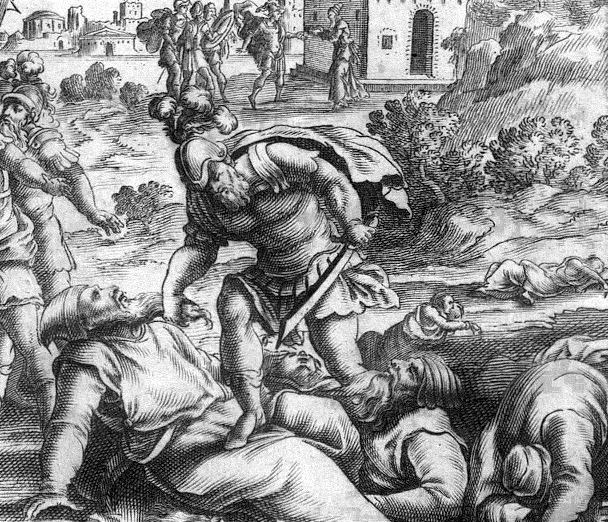
Saul rages, and orders his bodyguards to kill Ahimelech and all the high priests. They balk. This is an abomination. Even Saul’s faithful followers know that he is ordering a horrible murder. I picture Saul screaming and raging, and then Doeg, who is not an Israelite, and who is cunning and ambitious, does the deed. He murders 85 priests that day. He continues on afterwards, and directs the murder of all of their families and the destruction of the village at Nob. With eighty-five men, plus their wives and children Saul, through Doeg and Doeg’s men, murdered two-hundred people or more.

However, they missed one. Abiathar, son of Ahimelech escaped, and he took his priestly garment (called an “ephod”) with him. He fled to David and told him what happened.

Then David said to Abiathar, “I knew that Doeg the Edomite was there that day and that he was sure to report to Saul. I myself am responsible for the lives of everyone in your father’s family. (1Sam 22:22, HCSB)

David’s response is remarkable. Saul is the one who ordered the murder of the priests. Doeg is the one who carried it out and did the actual killing, probably assisted by some underlings. But David says, “this was my fault. I am responsible for the loss of those lives.”

You see David had a heart that God loved. It wasn’t because David was perfect. He lied when he was running from Saul. But he was open, willing, humble and even repentant. When Samuel confronted Saul about the sins he committed, Saul’s response was always something like: well I had to do it. Circumstances demanded it. I was losing men.” David could easily have said, “I had to lie to save my life.” He might have said, “It was an extreme situation, calling for extreme measure. Besides, I’m not the one who killed them. But instead, his response is: “I was responsible for this great tragedy.”

This is not to say that David was blind to the evil of Saul and Doeg. At this time he wrote Psalm 52, in which he castigates the evil of Doeg, and by implication, Saul. In David’s eyes, their biggest sin is this:

Here is the man who would not make God his refuge, but trusted in the abundance of his riches, taking refuge in his destructive behavior. (Psalm 52:7)

What is even more amazing is what David wrote next. Remember he is still hiding in fear of his life. Remember, he had no more reason to trust the Lord than you and I do.

But I am like a flourishing olive tree in the house of God; I trust God’s faithful love forever.

I will praise you forever for what you have don. In the presence of your faithful people, I will put my hope in your name, for it is good. (Psalm 52:8)

As always, the Lord brings some good out of every terrible situation. David is his chosen servant. Now David has both a prophet and a priest to worship with him, and give him godly counsel. And unlike Saul, David humbly and willingly receives what God says through them.

Now what does all this mean for us today?

Maybe you need to hear the specific practical advice that you should take care of your family, and even your parents when they are unable to take care of themselves.

Perhaps you face the temptation that Saul had, to let your insecurity rule you. Do your fears drive away the people you love, or cause them harm? I doubt anyone reading this has committed murder on the scale that Saul perpetrated that day. Even so, the difference between faith and doubt is huge, and matters a great deal. Without trust in the Lord, if we trust only in ourselves, like Saul, we are doomed to hurt those around us. See how much better it is to be like David and put your trust in the Lord alone.

Like David with Gad and Abiathar, do you have godly spiritual advisors who listen to the Lord and have permission to speak honestly into your life? If not, ask the Lord to send you a few.

There is one last thing. Last time we talked about the concept that in the Old Testament we find people or events that remind us of Jesus, or show us what Jesus is like, or what following him is like. There is another one this week. More than two hundred people lost their lives for helping David. So today and throughout all history, people around the world have been persecuted and killed for following Jesus. It is a reminder that we should pray for those who are persecuted today, and also that we should be ready to make a choice between our own life and our obedience to Jesus.

Let the Holy Spirit speak to you about all this right now.