
When times are difficult, or spiritually dry, David urges us to dwell upon the memories of spiritually good times to encourage our hearts to remain steadfast.
To listen to the sermon, click the play button:
For some people, the player above may not work. If that happens to you, use the link below to either download, or open a player in a new page to listen.
To download, right click on the link (or do whatever you do on a Mac) and save it to your computer:
Download Psalms Part 8
The Superscription for this psalm indicates that David wrote it while he was in the wilderness of Judah. There are a few times in his life that this might describe. When he was young, even before he was anointed to be the next king, or had killed Goliath, David was a shepherd for his father’s flocks of sheep. In those days, shepherds spent extensive time in the wilderness alone with the sheep. However, sheep need a fair amount of grass, which requires a certain amount of water, which doesn’t really fit the description here.
Some commentators think that David wrote this when he was much older, fleeing from the rebellion of his son Absalom. But the description of the land where David went at that time doesn’t match very well either. In his lifetime, there was a great forest near where David fled from Absalom. However, here, David talks of a dry and thirsty land, a weary land without water.
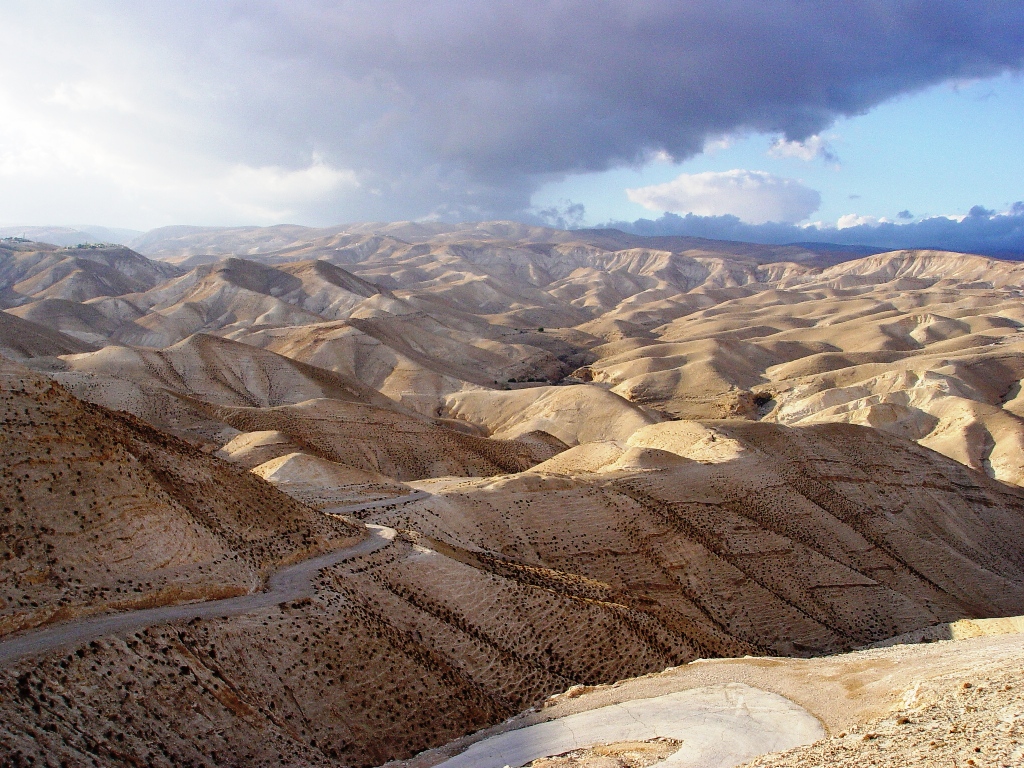
Therefore, I believe David wrote this during the period when he was running and hiding from king Saul. I think he is talking about the desert that is southeast of Jerusalem, and to the west of the Dead Sea, in Israel. At certain times of year, you can stand on a mountainside, and see for miles and miles, and there is hardly any vegetation visible at all. That area gets less than 8 inches of rain per year, which is a little bit less than the low desert outside of Phoenix, AZ (not the mountains, the flatlands). It is a very desolate place. David spent a couple of years in that area, avoiding king Saul’s unjustified jealous rage. I imagine that there were many days when David hiked through the dry, dusty mountains, hot, parched, and yearning for the sight and taste of fresh, cool water.
I want to point out the obvious here, that once again, David is not writing from a place of comfort and safety. In fact, he was struggling to survive in a hostile wilderness, and he was there because a very powerful person was trying to kill him. Even so, his focus was on the goodness of God.
I have wondered sometimes if David wrote this psalm not only in the wilderness, but also while fasting. Fasting from food, combined with prayer and focus on God, loosens our bonds to the world around us, and reminds us that we need God even more than we need food. It tends to sharpen our desire to be close to God. Certainly, this psalm seems to have those characteristics. David says that he thirsts for God. He says that the presence of God will satisfy him, like rich food satisfies a person. He says God’s love is better than life itself. If you find yourself dry spiritually, fasting might be a way to increase your hunger and thirst for God. If you’ve never done it, start out small – maybe stop eating after your evening meal one day, and don’t eat again until the following evening. Use the hunger pangs to remind you to pray, and to remind you that you need God even more than food.
David clearly understood that he could pray in all situations. Even so, he, and virtually all the Israelites of that time, felt that the truest, best way to worship God was at the tabernacle. This was the “holy tent” which contained the altar, for sacrifice, and the inner sanctuary into which God infused his presence in a special way. Personal prayer would tide you over for a while, but the presence of God was at the tabernacle in a special way that it was not elsewhere. You could make sacrifices and offerings to God only at the tabernacle. This is important to understand because during this time of his life David was cut off from the tabernacle. For the years in which David was “on the run,” it was set up near King Saul’s hometown, about five miles from Jerusalem. So, if David went to the tabernacle, Saul would easily capture and kill him.
Therefore, David was missing the special presence of God that, during his lifetime, could only be found through worshipping at the tabernacle. This psalm speaks of his longing to experience that presence again, to have the joy of worshipping God in the presence of his people.
Let’s consider David’s situation, and begin to apply this psalm to our lives. Because of the sacrifice and resurrection of Jesus, God sent his Holy Spirit to all people. Now, there is not just one place where God is present. He is present within all people who trust Jesus. We can worship God virtually anywhere, anytime. However, there remains something special about the gathering of God’s people together for worship. The Greek word for “church” means “the intentional gathering of God’s people.” Though “church” can happen almost anywhere, it cannot happen with just one person, and it cannot happen without intentionality. So, though our situation is not exactly the same as David’s, it still has some similarity. God is present in a special way when we gather with other believers to worship, pray, and apply his word. There is also something important and unique that happens when we take communion together, and that is not meant to happen individually. Sometimes, I think we don’t value that enough, or we think there is no difference between worshipping God with his people, or doing so on our own. I encourage you to recognize that God did not intend us to be a bunch of spiritually independent free agents. He wants us to worship him in community with other believers, and to receive communion together, and when we do so, something special happens. Like David, it is good to learn to long for, and desire, that special blessing.
There is another piece. At times, believers today experience spiritually dry periods. Maybe you are not cut off from worship and communion with God’s people, but even so, spiritually, it feels like you are in a dry and weary land. Though perhaps there was a time you delighted in the presence of God, and felt filled spiritually, there can also come times when you don’t feel the presence of God in a close way like you used to. If that happens to you, or is happening right now, do not panic. It does happen at times. Sometimes it even lasts years. For anyone in that situation, I think this psalm can be very helpful.
Now, of course, sometimes our own sin separates us from God. If you feel distant from God, the first thing to check is the state of your own soul. Have you been sinning without repenting? Have you been justifying your wrongdoing to yourself or to God? Such things will indeed create spiritual dry times, and make us feel far from God. Some sins are obvious, and you know you’ve committed them, even if you don’t want to admit it. And we don’t generally have to wonder if something is a sin, because for most things, the Bible makes it very clear. But if you are still not sure what is going on in your heart, it is a simple matter to ask God. Pray that he will show you. David prayed this very thing in other psalms:
23 Search me, O God, and know my heart; test me and know my anxious thoughts. 24 Point out anything in me that offends you, and lead me along the path of everlasting life.
(Psalms 139:23-24, NLT)
This is a prayer that God will certainly answer. When he does, we must be honest enough with ourselves to accept the truth that God shows us. Thankfully, if it is sin that is making you feel distant from God, the cure is simple: repent, and turn to Jesus. We have no excuses for any of our sins, but we have a defense: Jesus Christ, and the sacrifice he made to cleanse us from sins. When we confess our sins, repent, and turn to Jesus alone for hope of forgiveness, we have that forgiveness.
However, in David’s case, it was not his own sin that was cutting him off from a sense of God’s special presence. Sometimes, this is true of us, as well. If you have examined yourself, and you have prayed for God to reveal any hidden problems, you may find that you are still in a dry place. This is not necessarily your fault. So what can we do?
In the first place, David, cut off from the special presence of God, chooses to remember the wonderful times he has had with God in the past. He writes: “I have looked upon you in the sanctuary, beholding your power and glory.” God already knows what David is telling him. David isn’t writing to remind God – he’s reminding himself. So, we too, can help ourselves during dry times by reminding ourselves of the many wonderful things God has done for us in the past. We can, and should, dwell in the memories of times when we felt close to God. At times, we might be tempted to feel bad about this, like we are “living in the past,” and have no ongoing experience of God’s presence. But I’m not sure it’s ever a bad thing to dwell on times you have felt close to God. Sometimes, good spiritual memories can be very helpful and sustaining.
David also says he will praise God as long as he lives, and lift up his hands to God, and sing for joy. He is choosing to worship God in whatever ways he can, even though he can’t go to the tabernacle for now. He is not focused on what he is missing. Instead, he is doing whatever he can do at the moment. I think this is a path for us, also. With a little self-discipline, we can learn to thank God, and praise him, even when life isn’t going the way we want it to. Remember, at this point in his life, David is not just cut off from the sanctuary alone. He has been branded a criminal, with a bounty on his head. People are trying to kill him, and he has to move around somewhat frequently, and a lot of the time he is living in caves. But he chooses to praise God, lift up his hands, and sing. The choice is not about how he feels. We can make those same choices, and we might be surprised at how much it helps us to praise God in all things.
Next, David commits to remembering God, and meditating on Him. He will discipline his mind to think about what God has done, and what his character is like. David did not have the advantage of a written Bible to carry around with him. But we do. When we feel cut off from God’s presence, we can still read the Bible. We can discipline our minds to think about what God is like, and to remember his steadfast love. Whether or not we feel God’s love, this fact remains: Jesus died for our sins. That is worth remembering, and meditating on.
David writes: “My soul clings to you.” I love this. Whatever else is happening, David is clinging to God. It is a great example for us. We cling to the Lord when times are good and happy, and we cling to him when we are in a dry and weary place. We can become oblivious to the hard, dry place where we are, and focus entirely on the good, sweet, fresh presence of God. This is the essence of trust. This is what it means to be a believer: to cling to God through Jesus Christ.
The ending of this psalm has a slightly different tone. David has been earnestly seeking God, and it’s easy to identify with him, and then all of a sudden he seems to get angry and bloodthirsty:
9 But those who seek to destroy my life shall go down into the depths of the earth; 10 they shall be given over to the power of the sword; they shall be a portion for jackals. 11 But the king shall rejoice in God;
(Psalms 63:9-11, ESV)
all who swear by him shall exult, for the mouths of liars will be stopped.
There are many psalms that contain things like this. In fact, this is pretty tame compared to some of what we find. But what are we to make of this? In the first place, as I mentioned at the beginning, David is in this situation because of the evil of other people. He is cut off from God’s presence because of Saul, who has rejected God’s will, and who has almost unlimited power in Israel. David has no court to appeal to, no police who will protect him, no way to get justice. However, here, he is expressing confidence that God will make sure that justice is done. Notice that David does not say: “I will send my enemies to the depths of the earth,” or “I will kill them, and leave them as food for jackals.” Instead, he is saying, “I trust that God will make sure justice eventually prevails.” We can know that this was indeed David’s attitude, because two different times he had the opportunity to kill Saul, but very deliberately he chose not to do it. He trusted that God would bring justice.
The last part, about the king, might also be confusing. One possibility is that David is referring to himself, because even though he is not yet the official king, he has already been anointed to be the monarch. Another possibility is that he believed that the reason Saul was trying to kill him was because of advisors who were lying to Saul about David. That helps make sense out of David’s line: “the mouths of liars will be stopped.”
However we interpret the part about the king, what do we do with these last two verses, which sound slightly bloodthirsty? How do we apply them to our own situation?
In the first place, we should remember Paul’s words from Ephesians 6:12
12 For we are not fighting against flesh-and-blood enemies, but against evil rulers and authorities of the unseen world, against mighty powers in this dark world, and against evil spirits in the heavenly places.
(Ephesians 6:12, NLT)
All Christians do indeed have enemies, very real ones. They are the evil spiritual powers who rebelled against God along with Satan. They seek to destroy us. It is appropriate for us to want God to put an end to them, to their warfare against us. We can use verses like these in the psalms to ask God to deliver us from powers of evil.
There are also times when we experience injustice in this world, and probably many more times when we see others who do. Yet, often, we cannot really do anything about it. Although it is good and right to work for justice in ways that are legal and godly, we trust that final justice is not up to us, but to God. In such moments, we can learn with David to remember and trust that God will eventually make sure justice is done.
What is the Lord saying to you today through this Psalm?
 Clear Bible