

When Saul was in a tough spot, his insecurities, and need to be in control were revealed. Though there were consequences when he gave in to sin, those did not have to be fatal. When hard times reveal what is inside us, our hope is in Jesus, who crucified our old selves along with himself, and makes us a new creation.
To listen to the sermon, click the play button:
For some people, the player above may not work. If that happens to you, use the link below to either download, or open a player in a new page to listen.
To download, right click on the link (or do whatever you do on a Mac) and save it to your computer: Download 1 Samuel Part 10
1 Samuel #10. 1 Samuel 13:1-15
During his first battle as leader of Israel, Saul defeated an enemy that dominated the Eastern tribes of Israel, as well as the Jordan valley. After that victory, the people finally accepted him officially as king. Saul conscripted 3,000 professional warriors and sent everyone else home. He let his son Jonathan command 1,000 of the soldiers.
Everything we read about Jonathan suggests he was an outstanding young man in every way. He took his 1,000 men and promptly handed the Philistines a stinging defeat at Geba. We will see as we go on that Jonathan had a warrior’s heart, and a trust in the Lord, and he wasn’t worried about stirring up Israel’s old enemy. He trusted that the Lord was with his people. The problem was, the rest of Israel – including his father – was worried. The news of Jonathan’s victory was carried throughout the land, but listen to how it was described:
“Saul has attacked the Philistine garrison, and Israel is now repulsive to the Philistines.” (1 Samuel 13:4)
So, even though Jonathan won the first round, the take-away was that they were now in big trouble. No one cared much for the victory. Instead, the feeling in Israel was that what Jonathan had done was basically the same as kicking a hornet’s nest, or shooting a grizzly bear with a BB gun. Jonathan inflicted damage, but he didn’t impair the power of the Philistines to make war. In addition, after almost a generation of peace with the Philistines (under the leadership of Samuel), this kicked off another round of war with them.
The Philistines began a major campaign, pushing up one of the valleys, into the hills and the heart of Israelite territory. Saul retreated, and they occupied a place near his former position.
At this point, we need some historical and geographical background. At the end of chapter 13, the writer (again who wrote this down about a generation or so later) explains something very significant.
19 There were no blacksmiths in the land of Israel in those days. The Philistines wouldn’t allow them for fear they would make swords and spears for the Hebrews. 20 So whenever the Israelites needed to sharpen their plowshares, picks, axes, or sickles, they had to take them to a Philistine blacksmith. 21 The charges were as follows: a quarter of an ounce of silver for sharpening a plowshare or a pick, and an eighth of an ounce for sharpening an ax or making the point of an ox goad. 22 So on the day of the battle none of the people of Israel had a sword or spear, except for Saul and Jonathan. (1 Samuel 13:19-22, NLT)
This information indicates that these events took place at the end of the Bronze Age, and the beginning of the Iron Age. Quite simply, at this point the Philistines had Iron-Age technology and the Israelites did not, and the Philistines were not interested in sharing it. This is one clue to why the Philistines were so feared by the Israelites, and why they were such a persistent military problem. They had iron weapons, and most of the Israelites did not. When we keep this in mind, this makes any Israelite victory over the Philistines something of a miracle. The Philistines lived on the south coast of Palestine, in areas that include modern-day Gaza. The Israelites mostly lived in the hills and mountains inland, and also on the other side of the Jordan river, north of the Dead Sea. The hills and small mountains helped keep the Philistines contained, in spite of their technological superiority.
As we look at the numbers of soldiers here, remember in part 8 we learned that the Hebrew word for “thousand” and for “chieftain,” or “well-armed professional soldier” are exactly the same. Remember also that chieftains were usually accompanied by peasant-militia troops without good weapons.
In addition, we have examples of parallel passages where extra zeroes have been added or dropped. 2 Samuel 10:18 records the defeat of 700 chariots; 1 Chronicles 19:18, speaking of exactly the same incident, writes 7,000. Generally, I would suspect the lower number to be correct. So if you ever read these numbers and think, “Gee, that sounds like a much bigger number than seems likely,” you can knock off a zero – and in some cases, three zeros – and still agree that the bible is faithful and reliable. The problem is simply in the translation.
In any case, we ought to understand that whatever the actual number recorded in verse 5 – 3,600 or 36,000 – for the times, it was a formidable professional fighting force that the Philistines sent into Israelite territory, along with a large number of peasant-militia troops. It was a big threat in two additional ways. First, up until this point, the Philistines had stayed mostly on the coastal plain. Technically, that was Israelite territory also, given to them by the Lord when they entered the promised land, however, the Israelites had never really lived there. But in the incident recorded in 1 Samuel 13, the Philistines were pushing inland, up into the hills and mountains that had been occupied by the Israelites for hundreds of years.
Secondly, the Philistine invasion recorded here nearly cut the nation of Israel in half. They pushed all the way to Michmash, which was just a few miles short of the Jordan River valley. If they moved all the way down to the Jordan, the largest tribe in Israel (Judah) would be cut off, along with the tribes of Benjamin and Dan, and roughly half of the territory of Israel would be isolated from the other tribes. In other words, the Philistines were about to take a gigantic, and possibly fatal bite out of Israel.
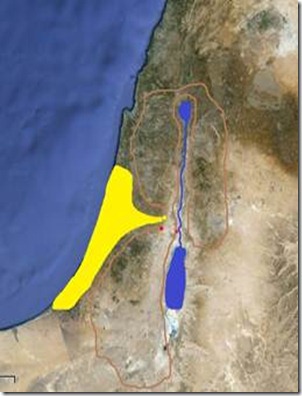
See the picture at left. The brown line shows the territory occupied by Israelite tribes, and the yellow area is the Philistines (this is a rough approximation, just to give you an idea of the danger they were in). Michmash is the yellow dot. The red dot next to the river is Gilgal, and the red dot closer to the Philistines is Gibeah.
Israel was just a few miles and one lost battle away from a huge national catastrophe.
It is interesting to note that Saul had originally held the position at Michmash, but retreated from the Philistines down into the Jordan valley. He gathered his army at Gilgal, a town in the Jordan river valley not far from the Philistines as the crow flies, but a very rough hike up or down the mountains by foot. The text doesn’t explain things clearly but apparently Samuel had sent a message to Saul, telling him to wait until he came, and then they would seek the Lord and worship him together before commencing the battle. In other words, they wanted God’s favor and help when they went out to fight. Samuel wanted Saul to rely on the Lord in this dire situation.
Now it is quite likely that Samuel’s home town was affected by this invasion – we do know that the Philistine forces came quite close to it. The position of the Philistines might have also forced Samuel to travel a considerable distance out of his way to get to Saul – remember, they had almost cut the nation in half. In any case, days passed, and Samuel did not show up. Saul’s army got restless and afraid. No doubt, many men were thinking of their families, wanting to prepare them for the disaster, or wondering if their homes had already been overrun by the enemy.
They were waiting to seek the Lord with Samuel the Prophet before they made a move. However, Samuel wasn’t there. Nothing was happening and the soldiers were worried about their families, and so they began to desert Saul and the army. So Saul took action. He decided to go ahead and lead the worship and offer the sacrifices himself. He made the burnt offering. This was an animal that was killed and completely burned up. No part of it was eaten – it was all “given” to the Lord through fire. It was used to seek God’s favor, to bring God’s forgiveness or to avert judgment. Just when Saul finished, Samuel finally made it to the camp.
Now, here is what troubles me. I think many Americans, if they didn’t read any further, would approve of what Saul did. People might say, “he’s a go-getter, a self-motivated leader.” They might think, “There’s a real leader – he’s losing men so he takes bold decisive action, he makes something happen.”
But Samuel didn’t see it that way, and apparently, neither did God.
13 And Samuel said to Saul, “You have done foolishly. You have not kept the command of the LORD your God, with which he commanded you. For then the LORD would have established your kingdom over Israel forever. 14 But now your kingdom shall not continue. The LORD has sought out a man after his own heart, and the LORD has commanded him to be prince over his people, because you have not kept what the LORD commanded you.” 15 And Samuel arose and went up from Gilgal. (1Sam 13:13-15, ESV)
The prophet immediately identified that the problem was Saul’s heart. It wasn’t fixed on God. We can now see clearly that Saul was insecure. He was worried about the future of Israel, of course. He was worried about his own ability to keep the men with him and maintain an effective fighting force. He did not trust the Lord with these concerns. Instead, he trusted in his own action. He trusted in the offering ceremony, but not God himself. Clearly, Saul viewed the offerings as a tool. It was a way to keep his army together and energized; perhaps also a way to manipulate God into helping him. Saul did not offer the sacrifices to please the Lord, or because he was personally repentant or worshipful. If either of those had been the case, he would have waited for Samuel, who was the one who was supposed to do such things. Saul was not a priest, nor a prophet and was not supposed to lead that kind of worship. This is bad religion. He went through the motions of a religious ceremony, but it wasn’t about God at all. He was using religion for his own ends – to keep the men from deserting.
And of course, the fact that Saul couldn’t wait showed that he wasn’t willing to trust the Lord when he didn’t understand what was happening, or when the Lord wasn’t moving as fast as he wanted.
Now, there’s no doubt that Saul was in a tight spot. But the tense situation did not create the problem in his heart. It only revealed it. When you squeeze an orange, what comes out? Whatever is inside the orange of course, which is orange juice. When you are squeezed, what comes out? Whatever is inside you, of course. If you curse and rage when you are in a tough spot, that is because cursing and rage are inside you. Jesus said:
20“What comes out of a person — that defiles him. 21 For from within, out of people’s hearts, come evil thoughts, sexual immoralities, thefts, murders, 22 adulteries, greed, evil actions, deceit, promiscuity, stinginess, blasphemy, pride, and foolishness. 23 All these evil things come from within and defile a person.” (Mark 7:7-23)
45 The good person out of the good treasure of his heart produces good, and the evil person out of his evil treasure produces evil, for out of the abundance of the heart his mouth speaks. (Luke 6:45)
When Saul was squeezed by his circumstances, he did not put his faith steadfastly in the Lord. He refused to wait on God or on other people. His situation was not easy. But it didn’t cause his heart-problem – it just revealed it. He let his insecurity rule him, and he chose to act, rather than depend on the Lord. When Saul was squeezed, it was fear that came out, and a need to be in control. He put his trust in the number of men he had, rather than the Lord. It was more important to him to keep as many men as possible than it was to seek God and his favor.
Saul failed in this incident, and revealed what was truly in his heart. However, the Lord did not give up on him, and with the Lord’s help, Saul did many more good things, as we will see. In fact we will see God continually trying to reach Saul throughout his life. Samuel’s words were supposed to be a kind of prophetic warning. If we read carefully, we see that God wasn’t even saying Saul shouldn’t be the king. It was something like this: “Unless your heart changes, your dynasty won’t continue. The Lord will find someone whose heart is tender toward God. If yours doesn’t change it will have to be someone else.” We should understand that God was not taking away the kingship of Saul, but saying instead that because of Saul’s sin, he could not be the founder of a dynasty. The kingship would pass to a different family.
This is all about trusting God when things don’t look good – maybe things look disastrous. If you get squeezed, what do you think will come out? What is in the treasure-store of your heart?
What if it isn’t good? What if, like Saul, you have insecurity hiding there? What if there is rage or hatred or jealousy or selfishness, or other ugly things? I think Saul had the opportunity to repent. Again, I think Samuel’s words were more of a prophetic warning than an absolute statement of judgment. However, even if we take it as a settled judgment, the punishment is not that Saul himself could not return to the Lord, or even that he himself could no longer be king. It was that none of his sons would be king after him. This means that there was still hope for Saul, and there is still hope for all of us.
When he was tempted, Saul could have turned to the Lord, confessed his weakness, and put his trust in the Lord. I think that is what we need to do when we are squeezed, and we see there is a problem in our hearts.
14 For the love of Christ controls us, because we have concluded this: that one has died for all, therefore all have died; 15 and he died for all, that those who live might no longer live for themselves but for him who for their sake died and was raised.
16 From now on, therefore, we regard no one according to the flesh. Even though we once regarded Christ according to the flesh, we regard him thus no longer. 17 Therefore, if anyone is in Christ, he is a new creation. The old has passed away; behold, the new has come. 18 All this is from God, who through Christ reconciled us to himself and gave us the ministry of reconciliation; 19 that is, in Christ God was reconciling the world to himself, not counting their trespasses against them, and entrusting to us the message of reconciliation. 20 Therefore, we are ambassadors for Christ, God making his appeal through us. We implore you on behalf of Christ, be reconciled to God. 21 For our sake he made him to be sin who knew no sin, so that in him we might become the righteousness of God. (2 Corinthians 5:14-21, ESV)
We should be sad when we discover bad things in our heart, but that is not the final word. We need to remember that through Jesus, our heart problem has been solved. Our old self, with all its insecurities, jealousies and lusts, has been killed with Jesus on the cross. Through Jesus, our spirit has already been renewed, and we wait with passionate hope for the day when that renewal is completed in our soul and body.
There might also be an application here for you if you are faced with a difficult situation. Perhaps you feel a lot of pressure just to act, to do something, to make something happen. Sometimes the Lord does lead us to do that. We’ll see that with Jonathan next time. But if the Lord is calling you to wait, or if your action would be from fear or insecurity, maybe you need to sit still and wait for God to show up.
Take a moment to let the Lord speak to you now.
 Clear Bible