

David was the rightful king of the Israelites. He was God’s choice for them. He had already fought for them, and he was their own flesh and blood. In the same way, Jesus is our rightful king. He is God’s choice for us. He has already conquered the devil on our behalf. For our sakes, he became human—he is our own flesh and blood. Give him permission to be king over every area of your life. If you can’t quite give him permission to take a particular area of your life, give him just a crack, and see what happens.
To listen to the sermon, click the play button:
For some people, the player above may not work. If that happens to you, use the link below to either download, or open a player in a new page to listen.
To download, right click on the link (or do whatever you do on a Mac) and save it to your computer: Download 2 Samuel Part 4
2 SAMUEL #4. 2 SAMUEL 5:1-12
After Saul’s war-leader, Abner, died, his coalition fell apart. Saul’s last surviving son Ish-Bosheth was murdered, and then finally the leaders of the other 11 tribes of Israel came to David to ask him to become their king.
The material for the book of Samuel was recorded more or less as it happened by Samuel, Gad, and Nathan. It was put into order and made into this book during the time of David’s grandchildren. We don’t know who put it all together, but we do know that they were willing to show David’s faults and failings. There is another book in the Bible that describes some of the same events that are found in 2 Samuel. That book is 1 Chronicles. Whoever wrote 1 Chronicles did so more than 400 years after David’s time. The author of 1 Chronicles clearly used some of the book of Samuel, but he was interested in different things, and he had a different purpose in writing, and so sometimes we get more detail, sometimes less. From here on out in this sermon series, we will occasionally refer to chapters in 1 Chronicles to fill in details.
1 Chronicles 12:23-40 describes more about the names and tribes of other Israelites involved in making David King over the whole nation. In Chronicles, specific leaders and groups of leaders are named, showing that a large number of influential people from all twelve tribes came to make David king. Chronicles records that they feasted and celebrated joyfully.
Back to the text in 2 Samuel. These leaders gave three reasons why they wanted to finally receive David as their king. First, they said, “you are our flesh and blood.” They were saying, “you aren’t a foreigner, that we should fight you – we are all Israelites after all. Judah is part of Israel.” They were recognizing that Saul’s attitude was wrong.
Second, the leaders said to David, “you were the one who used to lead us out to battle, and bring us back safely.” They are remembering his faithful service to Saul, which perhaps David thought had gone forgotten and unrewarded. David had already been their leader in the past, though that service was not officially acknowledged up until now. As a leader, he had accomplished great victories, and brought the troops back more safely than he would have in defeat.
Finally, they were acknowledging that God himself had chosen David to be their king. They were at last submitting to God’s plan for his people. They said: The LORD also said to you, ‘You will shepherd My people Israel and be ruler over Israel.’ ” They are acknowledging at last that God had a call on David’s life, and it was God’s will for him to be their king.
Verses 6-12 of 2 Samuel 5 tells us about Jerusalem. Up until that time, Jerusalem was controlled by a pagan tribe of people known as the Jebusites. They were a sub-tribe of Amorites – one of the non-Israelite tribes that the Israelites were supposed to conquer and drive out. However, there were steep ravines to the south, west and east of Jerusalem, and at the top of the slope, the walls began.

It was a formidable fortress. The Israelites had defeated several kings of Jerusalem and had burned the city itself once (perhaps before it had walls), but they had never managed to capture it and hold it. Now, with walls, the Jebusites are confident that no one could take it. We should understand that it was much smaller in those days. The Jebusite City of Jerusalem covered only about 12 acres on the very top of the end of the ridge. This area is now known as Mount Zion. In the following years, the city spread out greatly, and in modern times, Mt Zion is just one hill in the very large metropolis that is Jerusalem.
In spite of its reputation and history of being impossible to conquer, one of David’s first acts as king of all Israel was to attempt it. David shows here that he is smart and cunning, as well as courageous and strong. Water for the city was collected from the spring of Gihon, which was near the bottom of the Kidron valley, on the east side of the city. The fortifications around those springs (shown in the picture above) were built by David, after he conquered the city. The Jebusites did not bother to guard the spring.
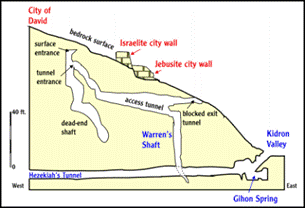
There was a shaft, or tunnel, that went through the hill down to the spring, so that the Jebusites could get water without going outside the city walls. David learned of this. It is quite possible that he observed Jebusites drawing water there, back when he was worshipping God at the tabernacle, when it was kept across the Kidron valley, at Nob (now known as the Mount of Olives). In any case, he determined that the way to take the city was to infiltrate men up the water tunnel. It was a very narrow space, and the men would certainly have had to go one by one, gathering at the top before the assault. That is what David did, with his nephew Joab leading the way and killing the first enemy. By doing that, Joab cemented his position as commander of David’s armies. The city fell without any destruction to the walls, and David made it the new capital of Israel.
These are the actions of a brilliant leader. First, it was terrific military strategy to make use of the water shaft, and attack the Jebusites from within the city. Second, Jerusalem was still an impregnable fortress, an excellent choice for the seat of government in troubled times. Afterward, David built towers covering the entrance to the water shaft, so no one would take the city the same way he had.
Third, it was an extraordinary diplomatic move. David was from the tribe of Judah and up until this time, his capital was a city of Judah. Saul had been from Benjamin, and had made his hometown into the center of power. But Jerusalem did not belong to any of the tribes – it was held by the Jebusites. So when David captured it, it became a city for all Israelites. No tribe could claim it, and no tribe would be offended that it was the capital city. It belonged to no one, and yet at the same time, to everyone. It was not quite centrally located, but it was close.
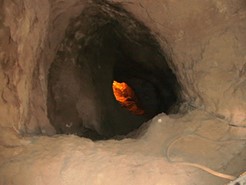
By the way, some secular archaeologists dispute the existence of David (they choose to ignore the incredible documentary reliability of the Old Testament). However, a water shaft from the spring of Gihon leading up to Mount Zion was discovered in the 1860s. It doesn’t have David’s name on it, of course, but once more, the Bible told us of it before archeologists discovered it. In the 1980’s archaeologists were convinced that this shaft was dug after the time of David. But more recent work suggests that the water tunnel originally occurred naturally, long before David’s time.
The point is, the book of Samuel describes things that are actually still there. In a sense you might say that if the bible is right, there should be evidence of a water shaft in that location, and sure enough, there is not only evidence, but the actual tunnel itself.
As always, I think it is helpful when we read the Old Testament, to ask “where is Jesus here? How does this reveal Jesus to me?” Well, Jesus, is the rightful king of every Christian. That is God’s desire for us. He should be the ruler over everything in our lives. But even though David was chosen by God to be the king, he waited patiently until the people accepted that and submitted their lives to him joyfully. Even though the Lordship of Jesus is God’s will for us, we have not all submitted to that. Jesus is waiting patiently for us to submit all areas of our lives joyfully to him. Does Jesus determine how you spend your money? Does he determine how you spend your time or energy? Is it the words of Jesus that you speak to your family and friends and co-workers?
Jesus should be king over our lives for some of the same reasons that the Israelites gave for submitting to David. Jesus is fully God, yes, but he is also our flesh and blood – he is fully human, just like us. Hebrews 2:14-18 says:
14 Now since the children have flesh and blood in common, Jesus also shared in these, so that through His death He might destroy the one holding the power of death — that is, the Devil — 15 and free those who were held in slavery all their lives by the fear of death. 16 For it is clear that He does not reach out to help angels, but to help Abraham’s offspring. 17 Therefore, He had to be like His brothers in every way, so that He could become a merciful and faithful high priest in service to God, to make propitiation for the sins of the people. 18 For since He Himself was tested and has suffered, He is able to help those who are tested. (Heb 2:14-18, HCSB)
Jesus is our flesh and blood. He belongs to us and we to him. In Jesus, God became more accessible, more understandable, by taking on, forever, human nature. He has a right to be the king of humans, because he is a human. He can sympathize with us and understand our struggles.
Second, Jesus is the originator and creator of everything. He is our protector and sustainer. He has already helped us, already served us, already kept us safe. He has already suffered and died on our behalf. By virtue of how he has already served us, he deserves to be our Lord.
Finally, it is God’s desire that we surrender entirely to Jesus (Philippians 2:9-11). He is the rightful and chosen king of our lives. This is God’s desire – that we allow Jesus to live his life through us, as the owner of our lives. If you feel a little frustrated for David that it took the Israelites so long to accept what God was doing, consider accepting what God wants for your own life!
What about the conquering of Jerusalem? Does that tell us anything about Jesus and his work in our own lives?
Sometimes we really want Jesus to be king over all our lives, but there are parts of our lives that seem like they will never be changed. Maybe you think you will never be able to stop drinking. Some folks struggle with other particular sins that they feel they can never conquer. Perhaps you think, “I am a person who easily gets depressed. That’s just who I am. Nothing is going to change that.” Or, “I’m angry. That’s just my nature, and it’s never going to change.” We might feel like there are parts of our lives that Jesus simply won’t be able to conquer, places where we just can’t let him be king. Maybe you feel like that about some loved one in your life. You think “Jesus can never get into his life.”
The Jebusites thought they were invulnerable. They had an impressive fortress. But one crack, big enough to fit one man at a time, led to their downfall, and then the city belonged to the king. Jesus is a warrior like David. He is wise and cunning like David. If there is just one little crack, one place where you can say “yes” to Jesus, he can exploit it, and use it to conquer the evil in your life. He can get to people that you think are invulnerable to him.
So if you are concerned about someone else in your life, I say trust him. Ask him to do his work on your loved one. And if the problem is in your own life, I say, simply give him a “yes.” Find some way to say “yes, Jesus. I don’t think I can ever give up drinking [or whatever], but I give you permission to try and take over that part of my life.” Watch what he can do if you just give him the tiny crack of your willingness.
So, where you can, welcome Jesus as your king. Surrender your life to him, submit to him. Let it be his life from now on. And where you can’t do that, where there is a fortress around your heart, just give him a tiny crack. Just be willing for him to make the attempt.
How is the Holy Spirit speaking to you today?
 Clear Bible