

To the very end, Saul chose to act as if he couldn’t trust the Lord, as if everything depended upon his own ability to stay in control. When his own schemes and capacities failed, he despaired, and determined to be in control of his own fate to the very last, he took his own life. The great tragedy is that the Lord was always there for him, and was constantly trying to get through to Saul. When Saul killed himself, the Lord lamented his loss.
Let’s use Saul’s story to remind us that even when we feel like God isn’t there, he has never abandoned us. Let us give up on control, and instead, like David, trust the Lord in all circumstances.
To listen to the sermon, click the play button:
For some people, the player above may not work. If that happens to you, use the link below to either download, or open a player in a new page to listen.
To download, right click on the link (or do whatever you do on a Mac) and save it to your computer: Download 1 Samuel Part 32
1 Samuel ends with the death of king Saul, recorded in chapter 31. While David was returning home, and then pursuing the Amalekites who had destroyed his town and taken his family, the Philistines and the Israelites began a great battle.
As I mentioned before, the Philistines invaded the valley of Jezreel, which was the only relatively easy way to get from the Mediterranean coast into the Jordan Valley of Israel. Saul’s forces were on a mountain ridge to the south of the valley, a place called Mount Gilboa. When the Philistines began to move east toward the Jordan, Saul moved to attack them and block them.
The picture below is of the actual area (with present day roads, reservoirs and buildings that would not have been there at the time, of course). The Philistines were invading through the valley in the left of the picture, starting in the foreground and pushing toward the Jordan valley in the distance. The Israelites were positioned on the ridges to the right. The little hill labeled “Tell Jezreel” was probably not there.

The massive Philistine army turned to destroy the Israelites. This was a good strategic move, because if they left them alone on the mountain, the Philistines couldn’t be secure in the valley. The battle became a rout. Israel’s army fell apart. Jonathan and his brothers were killed. I want us to consider some things in the following verses:
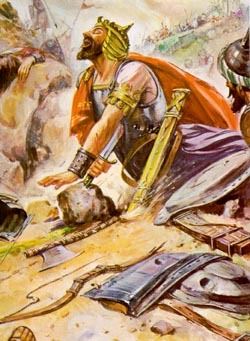
3 The battle pressed hard against Saul, and the archers found him, and he was badly wounded by the archers. 4 Then Saul said to his armor-bearer, “Draw your sword, and thrust me through with it, lest these uncircumcised come and thrust me through, and mistreat me.” But his armor-bearer would not, for he feared greatly. Therefore Saul took his own sword and fell upon it. (1 Samuel 31:3-4, ESV).
Verse 3 contains some ambiguous Hebrew expressions. Most English translations make it seem like Saul was severely wounded before he committed suicide. That is certainly one possible way of translating it, and probably a good one. But even so, it is quite possible that Saul was not wounded at all, but only in despair. An almost literal translation of verse 3 would be this:
“The battle became a great burden upon Saul. When the archers came within range of him, he was deeply traumatized.”
The “burden” of battle could be intense physical combat. However, that doesn’t make sense when we learn that the enemy archers have only just come into range. If he was fighting hand to hand, archers would be irrelevant. They would not shoot, for fear of hitting their own men. From this, it seems likely that Saul was not even involved in actual combat. Therefore it seems probable that the “intensity” or “burden” of the battle was purely psychological for Saul.
The literal translation of Saul being “wounded” is “deeply traumatized,” or “anguished.” We have just learned that the intensity of the battle is most likely only psychological for Saul, and probably not physical (see previous paragraph). “Traumatized” can mean physically wounded of course, and it isn’t wrong to translate it that way. Even so, knowing that what is happening with Saul is already psychological, it would not be wrong either to interpret the trauma as emotional distress, rather than a physical wound.
I believe that this view is reinforced by two things. First, Saul is clearly afraid of being captured and “mistreated.” He says so in verse 4. Several commentators speculate that Saul was thinking about what happened to Samson, the Israelite judge, who was captured by the Philistines. They blinded him, chained him like an animal, and paraded him around to be cursed and spit upon for their entertainment (Judges 16:21-25). Saul was clearly afraid of this sort of thing. That certainly makes it unlikely that Saul had any severe physical wound, because if he was badly wounded, the chances were much greater that he would simply die before the Philistines could do much else to him. Remember, in those days, there were no painkillers, no antibiotics, no modern medicine. Wounded people died at a much higher rate. Severely wounded people frequently died within a few minutes or hours. If Saul had been severely wounded, he would not have feared what else the Philistines might do to him, because he would have soon been dead.
Second, notice his armor-bearer’s response when Saul ordered the armor-bearer to kill him. The armor-bearer would not kill Saul, “because he was terrified,” (also verse 4). What was he afraid of? If Saul was mortally wounded, why would the armor bearer be afraid to finish what was inevitable anyway? No, I think Saul’s mood and his words are what scared the armor-bearer. He didn’t want to kill Saul because Saul was not physically anywhere near death.
The night before the battle was when Saul went to the witch of Endor, and consulted with a demonic spirit who masqueraded as Samuel. If you remember, that spirit had spoken only words of condemnation and despair to Saul. Saul accepted this message and believed it as if it was truly Samuel speaking. So, here’s how I think it went down: You have a man who has his entire life been insecure, erratic and manipulative. He is a control freak, now in a situation where he does not have control. He has recently accepted and believed the words of a demon. He is deeply emotionally troubled by the battle long before it even comes near him, in fact, he was troubled even before it began (because of his encounter with the witch the night before). When he sees that the archers are finally in range, he suffers deep psychological trauma. He is horrified at the idea that he might be taken prisoner, and made a spectacle in front of his enemies. So he orders his companion to kill him, and when that person refuses, he takes his own life. In other words, he gave up even before all was truly lost. The words of the demon were a self-fulfilling prophecy, in large part because Saul believed them and acted accordingly.
Now, I want to write about something that most Christians don’t talk much about: Suicide. It’s right there in the text, so I think the Holy Spirit wants to deal with the subject. But before we get into it, let’s get one thing clear. You may have known someone who committed suicide. Sadly, I’ve known several. I am convinced that some of the suicides I have known died still clinging to Jesus. There are others about whom I really don’t know. If there is any question, it doesn’t do anyone any good to wonder whether that person died in faith, or if he went to hell. That’s not the point of what we are about to consider. What’s done is done. I cling to the biblical truth that God is far more gracious and merciful than I can comprehend. We leave our loved ones in God’s hands. I certainly don’t believe that suicide in general is some kind of unforgiveable sin.
But right now, I want to talk to and about the living. If you are reading this, you are alive, and these words are for you, not for someone who has already died. Don’t waste your time wondering how to apply these words to someone else – these are for you, for me, for the living.
Saul’s suicide was clearly an evil, demonically influenced act. It was his lack of faith that prompted him to take his own life. It was his lack of trust in the Lord, combined with the fact that he believed and agreed with demonic words. He behaved as he believed. If you are ever tempted to suicide, please understand – you are being tempted by a demonic power. Do not listen to demons. Do not agree with them.
G.K. Chesterton has some insightful thoughts about killing oneself. He says:
The man who kills a man, kills a man. The man who kills himself, kills all men; as far as he is concerned, he wipes out the whole world.
His point is clear, but we don’t often think about it. The person who commits suicide does not merely kill herself. From her point of view, she is killing the whole world. Suicide looks at the world and says, “As far as I am concerned, there is nothing worthwhile in the entire universe. I would be just as well off if the whole world is destroyed.” Now, many times, this is because of despair and hopelessness that things will ever get better. I have compassion for people in that much despair. But that level of despair sure sounds demonic to me.
And of course, suicide is not a private decision that affects only yourself. It is a terrible thing for those left behind to know that you preferred death to living on with them. Sometimes the suicidal person knows this. They are angry at loved ones, and they want to hurt those people as well as themselves. Suicide is not just self-destruction – it destroys everyone who knows you. Once again, if that doesn’t sound demonic, I don’t know what does. Sometimes, of course, the suicidal person just can’t see beyond their own struggle. They just aren’t thinking about how their action might affect others, or maybe they even think that everyone will be better off without them. My heart breaks for such people, but suicide is not the answer.
Some Christians may say: “Well, I want to get to heaven. I’m tired of the struggles of this world – I want to be in the peace and rest of eternity with Jesus. Wouldn’t suicide get me to heaven faster?” But that is so much like Saul’s attitude. Saul always insisted upon his own way. He manipulated, fumed and got depressed and sought help from demons – all to get his own way. Like the ultimate spoiled brat, when he realized that this time there is simply no way it was going to happen, he would rather die. We Christians are supposed to live in trust – not in control. We don’t get to determine how and when we die. To do that is to put yourself in the place of God.
I’ll be honest. Several times a year the pain I live with gets so bad that I want to die. I have actually prayed for the Lord to take my life not once, but several times. But I will not take matters into my own hands, because my life is a gift from God. It isn’t mine—it belongs to Jesus. Only the Lord gets to say when and how it ends. No matter how bad things feel, suicide is not God’s answer for me, or anyone reading this.
Remember, Jonathan and his brothers died too. Their result was the same as Saul’s. And yet it was entirely different. They died fighting for their country and for each other.
Jonathan showed courage. Saul showed demonic self-centeredness. I don’t think Saul’s death was the result of God’s judgment. It was the result of a lifetime of Saul’s self-absorbed choices, culminating in the final ultimate act of selfishness. About Saul, you can say for certain, “he chose his own fate.”
Even so, Saul’s story ends with people who loved God mourning for him. I think this is because they were led by the Holy Spirit. God always wanted Saul to turn to Him and trust him. And so after he died, the Spirit of God moved two groups of people to honor Saul in a special way.
After the battle, the Israelites in the nearby parts of the Jordan valley fled. The Philistines took over their towns, among them a town named Beth-Shan, which has been the site of an archeological dig for many years in modern times. The Philistines found Saul’s body, cut off his head, and hung the corpse on the wall of Beth-Shan. They did the same with the bodies of Jonathan and his two brothers. There is a reason that we call brutal, ignorant cruel people “Philistines,” even today.
The residents of an Israelite town further south in the hills on the other side of the Jordan heard about this. That town was Jabesh-Gilead – the place of Saul’s very first battle, the town that had been shamed for centuries, but which Saul had rescued. They remembered how Saul had saved them and finally removed their shame. So they sent a commando-type unit through the night to Beth-Shan. They stole Saul’s body, and those of his sons, from the Philistines, and brought them back to Jabesh-Gilead. They burned the bodies and then buried the bones with honor. It was a bittersweet end to the reign of Saul, coming full circle to the beginning when he was younger, and did trust God. I think their actions were a reflection of the Lord’s sorrow at Saul’s choices. Saul chose his own way, and he suffered the consequences. But I do not believe that was what God wanted. He gave Saul the freedom to choose, and I believe he was sorrowful for what the king chose. The Lord reveals this same attitude in Ezekiel 33:11
Tell them: As I live” — the declaration of the Lord GOD — “I take no pleasure in the death of the wicked, but rather that the wicked person should turn from his way and live. Repent, repent of your evil ways! Why will you die, house of Israel? (Ezek 33:11, HCSB)
A second person who reveals this attitude toward Saul is David. Remember, David had the Spirit of God in a way that was special in those days. Often, he is a type of Christ – he reveals the kinds of actions and attitudes that the true Messiah has. And so when he heard of Saul’s death, he wept in sorrow. Because he was human, I’m sure he was more upset about the loss of his friend Jonathan than the death of Saul. But he reveals the heart of God. The Lord was never against Saul. He always wanted him to turn back, repent and receive grace. Inspired by God, David wrote a beautiful lament, recorded in 2 Samuel 1:19-27
19 The splendor of Israel lies slain on your heights.
How the mighty have fallen!
don’t announce it in the marketplaces of Ashkelon,
or the daughters of the Philistines will rejoice,
and the daughters of the uncircumcised will gloat.
let no dew or rain be on you,
or fields of offerings,
for there the shield of the mighty was defiled —
the shield of Saul, no longer anointed with oil.
22 Jonathan’s bow never retreated,
Saul’s sword never returned unstained,
from the blood of the slain,
from the bodies of the mighty.
loved and delightful,
they were not parted in life or in death.
They were swifter than eagles, stronger than lions.
24 Daughters of Israel, weep for Saul,
who clothed you in scarlet, with luxurious things,
who decked your garments with gold ornaments.
25 How the mighty have fallen in the thick of battle!
Jonathan lies slain on your heights.
26 I grieve for you, Jonathan, my brother.
You were such a friend to me.
Your love for me was more wonderful
than the love of women.
The greatest tragedy of Saul’s life is that the Lord always loved him, continually reached out to him, never stopped offering his grace, and yet Saul acted as if God wasn’t there for him. Saul was never in as much danger as David, and he didn’t have any real reasons to be afraid and insecure. Yet he let his fears and insecurities rule him. David’s life was often in danger and insecure, and yet he lived in deep security, because he trusted the Lord. But Saul rejected that path. He preferred to try to control things himself. He did not surrender his own will to God. But God’s love and grace and forgiveness were never more than a heartbeat away, if only he had turned to receive them. And so when Saul died, the heart of God was to lament his loss.

 Clear Bible