
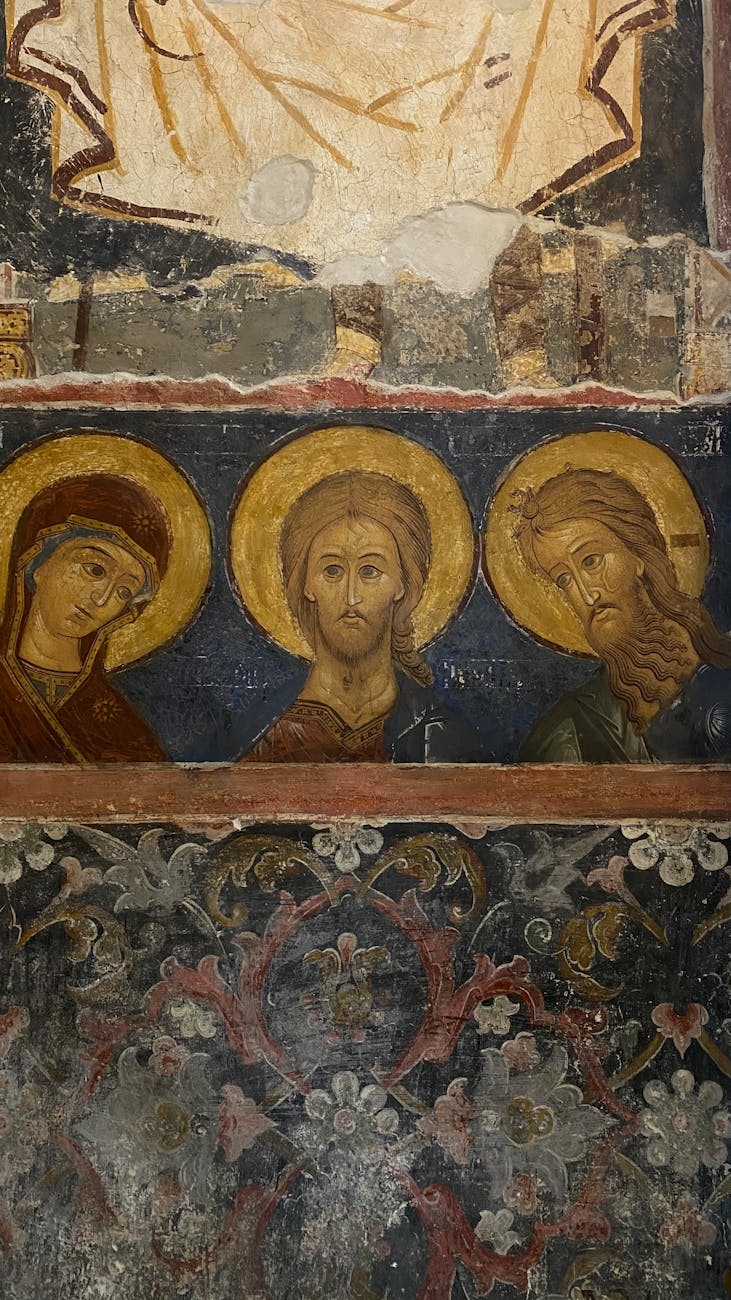
The Holy Spirit, through Paul, begins this letter by mentioning several significant names. Even today, these names apply to you and me in various important ways.
To listen to the sermon, click the play button:
For some people, the player above may not work. If that happens to you, use the link below to either download, or open a player in a new page to listen.
You can also find us on Spotify at https://open.spotify.com/show/6KKzSHPFT466aXfNT2r9OD (This will open to the latest sermon. You can search from there if you are looking for a previous one)
To download, right click on the link (or do whatever you do on a Mac) and save it to your computer: Download Philippians Part 2
Philippians #2. 1:1-2. Every Day Saints
1 Paul and Timothy, servants of Christ Jesus, To all the saints in Christ Jesus who are at Philippi, with the overseers and deacons:2 Grace to you and peace from God our Father and the Lord Jesus Christ. Philippians (1:1-2, ESV)
There is a great deal in just these two verses. I’m not sure that Paul himself knew how much significance would attach to this simple greeting, but it is the Holy Spirit who makes the Bible living and active, and the Spirit wastes no words. Paul’s words here are consistent with important truths that are found elsewhere in the Bible.
In the first half of my life, back when people actually wrote letters, they “signed” them at the end. If you didn’t recognize the handwriting, or if it was printed/typewritten, you looked at the end to see who it was from. In ancient times, however, it was the opposite. Letter writers in the first century A.D./C.E. stated who was writing at the very beginning of a letter. So Paul and Timothy identified themselves as the writers of this letter to the Philippians at the beginning. In fact, in a way, Paul begins the letter with a little bit of “name dropping.” I’ll explain.
Often, in his letters, Paul included his title as an apostle. It seems to me that he normally did that in situations where it was important that the senders recognize his calling, and therefore his authority to say what he said. He even does this in his letters to Timothy, his dear friend. However, I think he included his title in Timothy’s letters so that if Timothy got pushback when he taught and ministered as Paul urged him to, Timothy could say: “Look, the apostle Paul himself said this in his letter to me.” But here, Paul simply identifies himself as a servant of Christ Jesus (and Timothy also). There are several reasons. First, this letter speaks warmly and affectionately to the Christians at Philippi. Paul isn’t worried about their doctrine, and he doesn’t need to remind them of his authority in Christ. He’s writing as a friend.
By adding Timothy’s name, I don’t think he means to say that Timothy helped to compose the letter. The letter sounds like pure Paul, based upon his other writings. Instead, Timothy is included because he was well known to the Philippians, wished to send them his greetings, and surely he affirmed everything Paul was saying. It is possible that Timothy acted as a secretary, and took down Paul’s dictation of the letter.
I think Paul avoids the title of “apostle” because throughout much of the letter he speaks on the theme of humility. So, even as “Jesus did not consider equality with God something to be grasped, (2:6)” so Paul demonstrates that he doesn’t need to grasp at the title of honor: “apostle.”
Rather than “apostle,” Paul identifies himself as a servant of Christ Jesus. The word that the ESV translates “servant” is the Greek word “doulos.” (in this text it is actually “douloi,” the plural form of the word). We don’t really have a good English word for doulos (the feminine singular is “doule”). Literally, it means “slave.” But douloi (slaves) in the ancient Roman Empire were often very different from our modern idea of slaves. Many, if not a majority, of douloi were slaves only for a fixed period of time, often about twenty years. Many of them were paid. They often held very trusted positions, handling money and making business decisions for their masters. Many were allowed to marry, and their children did not automatically belong to their master. Even so, they were more than employees. A doulos/doule was considered a member of his/her master’s household. The upholding of the honor of the household was a serious business, and they were expected to be part of it. They could not seek other employment, and they were not free to leave unless given a certificate of manumission (manumission means “officially released from slavery”). Generally speaking, they had to do whatever their owner told them to do, and they could be physically punished if they refused.
So you see, they had more freedom and opportunity than, for example, the African slaves used by Southern plantation owners in America before the American Civil War. Even so, douloi were not exactly free. The closest equivalent I can think of in modern life would be an active-duty member of the military. An active duty Marine, for example, owes a certain period of his life to the Marine Corps. During that period, he must obey those who outrank him, and he must, generally, do what the Marine Corps tells him to do. He can’t simply say “I don’t want to,” or hold an outside job, or live wherever he feels like living. He can be punished for disobedience. The Marines “own” him for a period of time, even though he is paid, and might rise to a position of great responsibility within the Corps. For as long as he is a Marine, his mission in life is what the Marines tell him it is. Certainly, a Roman doulos/doule was worse off than a modern Marine, but somewhat comparable even so, and not nearly such a bad position compared to a plantation slave.
Here’s the startling thing: Partway into the letter, Paul says that Jesus Christ came as a doulos. So when Paul identifies himself and Timothy as slaves, he is doing so in imitation of his master, Jesus.
There’s another thing about Paul’s choice of words here. He wants us to understand that if we are Christians, all of us, also, should become douloi of Jesus Christ. In Jesus, we have the best Master possible. But our position is one where we do not belong to ourselves. We belong to Jesus. We ought to do what Jesus tells us to do. We can end up with a lot of freedom and responsibility, but it should all be in service to Jesus. Our lives are not our own—they belong to Jesus.
Paul, after calling himself and Timothy douloi, now has some words that he calls the Philippians. First, he calls them “saints.” The literal Greek translation of hagiois is “holies.” The Latin translation of it is sanctus, from where we get our English “saints.” Unfortunately, church history and modern culture have combined to lead us to misunderstand what it means to be a saint. In the understanding of many people today, a saint is a particularly holy person; someone whose personal holiness is much greater than that of “ordinary Christians.” The Roman Catholic church even has created specific criteria, and an institutional process for deciding if someone was a saint. A saint, in these terms, is often someone who died for their faith. In addition, someone of heroic virtue might become a saint (think Mother Theresa here, who is now known as Saint Theresa). Finally, if well-attested miracles were attributed to a person, those might qualify them for sainthood.
However, none of that church tradition reflects what the New Testament clearly says about sainthood. In the New Testament, there is only one way to become a saint, and there is only one kind of saint. Saints are people who have entrusted their lives to Jesus and received his grace. To put it simply: according to the New Testament, every true Christian is a saint, a “holy.”
The reason for this is that all of the holiness that every Christian has within them is imparted by Jesus Christ. We have that teaching right here in Philippians. Paul writes in chapter 1, verse 11 that he wants his readers to be: “filled with the fruit of righteousness that comes through Jesus Christ.” In other words, their righteousness comes not from their own works, but through Jesus Christ. In the same way, in chapter 2, he says:
13 for it is God who works in you, both to will and to work for his good pleasure. (Philippians 2:13, ESV)
In other words, we are saints because of God’s good work in us, not our own “personal holiness.” To the Corinthians, he wrote:
21 For our sake he made him to be sin who knew no sin, so that in him we might become the righteousness of God. (2 Corinthians 5:21, ESV)
Through Jesus, we are “the righteousness of God.” Along this same theme, Romans 8 says:
1 There is therefore now no condemnation for those who are in Christ Jesus. 2 For the law of the Spirit of life has set you free in Christ Jesus from the law of sin and death. 3 For God has done what the law, weakened by the flesh, could not do. By sending his own Son in the likeness of sinful flesh and for sin, he condemned sin in the flesh, 4 in order that the righteous requirement of the law might be fulfilled in us, who walk not according to the flesh but according to the Spirit. (Romans 8:1-4, ESV)
We dare to call ourselves “holies” not because we have any holiness we have gained for ourselves, but rather, because, through faith, God has included us in the holiness of Jesus Christ. If we say, “I’m no saint,” we are insulting the holiness of Jesus Christ himself, because that is what God has put into us. When we look at it that way, if we truly believe Jesus is who he claimed to be, we must agree that we are saints. Otherwise, we are saying that Jesus himself is not holy. On the other hand, the only way to boast about our holiness is to boast about Jesus Christ.
27 Then what becomes of our boasting? It is excluded. By what kind of law? By a law of works? No, but by the law of faith. 28 For we hold that one is justified by faith apart from works of the law. Romans (3:27-28, ESV)
28 God has chosen what is insignificant and despised in the world — what is viewed as nothing — to bring to nothing what is viewed as something, 29 so that no one can boast in His presence. 30 But it is from Him that you are in Christ Jesus, who became God-given wisdom for us — our righteousness, sanctification, and redemption, 31 in order that, as it is written: The one who boasts must boast in the Lord. (1 Corinthians 1:28-31, HCSB)
So, for the sake of Christ, we ought to insist that we are indeed saints, which is to say, people who have been made holy. However, to say that is not to lift ourselves up, but rather it glorifies the Lord, who makes us holy. Part of the idea of holiness is that we are “set apart.” A holy thing is used for special purposes. So, we are set apart from those who reject Jesus. That doesn’t make us intrinsically better than others. But it does mean that there will always be some tension between us and the ways of the world. Because we are set apart by the holiness of Jesus, we don’t fully belong to the world. The ways of the world are different in many respects from the way we are called to live. Jesus put it like this:
18 “If the world hates you, know that it has hated me before it hated you. 19 If you were of the world, the world would love you as its own; but because you are not of the world, but I chose you out of the world, therefore the world hates you. (John 15:18-19, ESV)
Paul drops two more names, in addition to servants and saints: overseers and deacons. He writes to “all the saints who are at Philippi, with overseers and deacons.” He doesn’t mean that overseers and deacons are not saints. But he is mentioning two main types of church leaders during New Testament times.
Let’s start with overseers. This is the Greek word episkopos, from which we get our English word Episcopal. It also evolved, via Latin and Old English, into our English word: “bishop.” When Paul used it, however it simply meant “overseer,” or, in today’s language: “supervisor.” In the New Testament, it is used interchangeably with the word for “elder” and also “pastor.”
5 This is why I left you in Crete, so that you might put what remained into order, and appoint elders in every town as I directed you— 6 if anyone is above reproach, the husband of one wife, and his children are believers and not open to the charge of debauchery or insubordination. 7 For an overseer, as God’s steward, must be above reproach. He must not be arrogant or quick-tempered or a drunkard or violent or greedy for gain, 8 but hospitable, a lover of good, self-controlled, upright, holy, and disciplined. 9 He must hold firm to the trustworthy word as taught, so that he may be able to give instruction in sound doctrine and also to rebuke those who contradict it. (Titus 1:5-9, ESV)
In Acts 21:1 Paul called the elders of the churches in Ephesus to meet with him. In verse 28, he says:
28 Pay careful attention to yourselves and to all the flock, in which the Holy Spirit has made you overseers, to care for the church of God (Acts 20:28, ESV)
1 Peter chapter 5 has all three terms together:
1 So I exhort the elders among you, as a fellow elder and a witness of the sufferings of Christ, as well as a partaker in the glory that is going to be revealed: 2 shepherd the flock of God that is among you, exercising oversight, (1 Peter 5:1-2, ESV)
The word “shepherd” in Peter’s letter is the verb form of “pastor,” and “oversight” is the verb form of overseer/episkopos. So we can see that all three words are used interchangeably in the New Testament.
Basically, churches were led in spiritual growth by a team of elders/overseers/pastors. Some of those elders might have been more prophetically-minded, others more teaching-minded, others more mission minded. But the people responsible for leading house churches, and groups of house churches, were known as elders, or overseers, or pastors. So Paul is making special mention of those were responsible for the spiritual leadership of the church.
Paul also mentions deacons. Deacons were people who were responsible for the financial and physical part of the church. The appointing of the very first deacons came about in this way:
1 At that time, as the number of disciples grew, Greek-speaking Jews complained about the Hebrew-speaking Jews. The Greek-speaking Jews claimed that the widows among them were neglected every day when food and other assistance was distributed.
2 The twelve apostles called all the disciples together and told them, “It’s not right for us to give up God’s word in order to distribute food. 3 So, brothers and sisters, choose seven men whom the people know are spiritually wise. We will put them in charge of this problem. 4 However, we will devote ourselves to praying and to serving in ways that are related to the word.” (Acts 6:1-4, NLT)
So, while elders/overseers imitated the apostles by focusing on prayer and teaching the word, setting the spiritual direction of the church, the deacons were involved in helping out with the practical concerns of the church: the distribution of money, service to the poor and elderly, and so on. The elders/overseers generally worked together with the deacons. I believe this is why Paul mentions both overseers and deacons. All of the house churches at Philippi got together and sent Paul some financial support—that is one reason he’s writing this letter. So Paul specifically mentions overseers, because they would have prayed about the gift, and then counseled the churches to go ahead with it, and the deacons would have been the ones who took the practical steps to make it happen.
I don’t think this format of church leadership is necessary for all churches; the New Testament doesn’t command it. But I’m inclined to think that a Biblical way of doing church is a pretty good model.
There is a final name that Paul drops: that of Jesus Christ. He and Timothy are not just dulois/servants in general, they are servants of Jesus Christ. The Philippians (and us) are not sort of generalized saints. We are saints only in Jesus Christ. Finally, Paul declares grace and peace to us from God our Father, in the name of Jesus Christ.
Let’s change gears: how might this apply to your life? Do you know that you are a saint? Behavior follows belief. If you believe you are fundamentally sinful, you won’t be able to stop yourself from sinning. But if you trust that Jesus has imparted his holiness into your life, you begin to see things differently, and act differently. I don’t mean anyone gets perfect on this side of heaven, but I am convinced that we act as we believe. If we believe we are “holies” our behavior will look much more like that is true than if we don’t believe it. It helps to remember that we are holy in Jesus Christ, not on our own.
How about the name of “servant/slave?” Do you believe that you fully belong to Jesus, that your life is not your own, but his? From birth until death, God’s intention is that you are on a mission in this world, a mission that is from and with God. He supplies what we need to pursue that mission, but our lives are for him, not for ourselves. And Jesus is not asking of us anything he did not do himself. He came in human form, and became a servant/slave himself.
What about the way Paul honors church leaders? I have no big complaints about the people I serve, but there are many of you visiting Clear Bible whom I have never met. Do you honor your local pastors, elders and deacons? Do you let them know that you appreciate their service, which can sometimes involve self-sacrifice? Do you prayerfully listen to your overseers/elders/pastors when they teach, or give you personal counsel?
Finally, how do you remind yourself of all the treasures you have in Christ? Do you know, remember that you are in Christ? What difference does that make in your life? If it doesn’t make much difference, why not? Or, are you someone who is not yet in Christ? To receive him is simple. Turn away from your sins (you won’t be able to do it perfectly, but start with the intention to do your best). Lean on Jesus. Ask him, in your own words, to take your life, to bring you into his kingdom.
Let the Holy Spirit apply these names to your life right now.

 Clear Bible