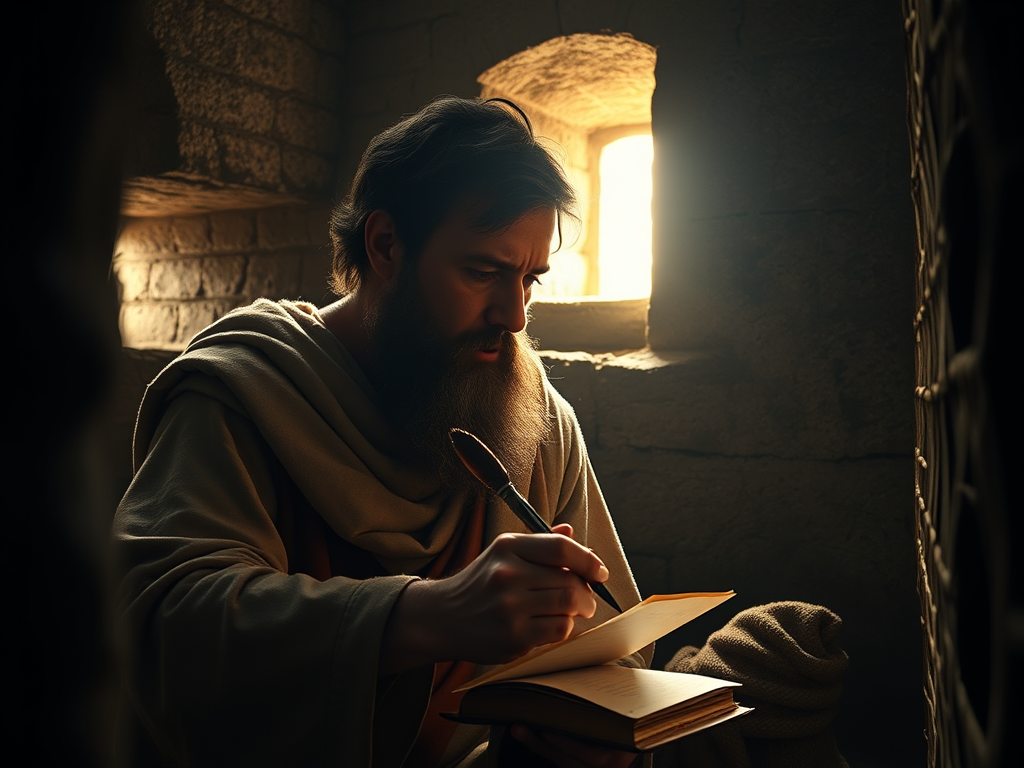
PHILIPPIANS #4: SOMETIMES HYPOCRITES SPEAK THE TRUTH

The gospel is bigger and more important than anything: imprisonment, fear, or even hypocrisy.

To listen to the sermon, click the play button:


You can also find us on Spotify at https://open.spotify.com/show/6KKzSHPFT466aXfNT2r9OD

(This will open to the latest sermon. You can search from there if you are looking for a previous one)

To download, right click on the link (or do whatever you do on a Mac) and save it to your computer: Download Philippians Part 4

Philippians #4. Philippians 1:12-18

12 I want you to know, brothers, that what has happened to me has really served to advance the gospel, 13 so that it has become known throughout the whole imperial guard and to all the rest that my imprisonment is for Christ. 14 And most of the brothers, having become confident in the Lord by my imprisonment, are much more bold to speak the word without fear.
15 Some indeed preach Christ from envy and rivalry, but others from good will. 16 The latter do it out of love, knowing that I am put here for the defense of the gospel. 17 The former proclaim Christ out of selfish ambition, not sincerely but thinking to afflict me in my imprisonment. 18 What then? Only that in every way, whether in pretense or in truth, Christ is proclaimed, and in that I rejoice. Philippians 1:12-18

Paul says that “what has happened to me has really served to advance the gospel.” The natural question is: “What is it that has happened to Paul?” Surprisingly, Paul doesn’t elaborate. Remember, the Philippians sent a gift with the messenger Epaphroditus, and almost certainly others accompanied him. Epaphroditus was sick, and stayed in Rome. But those others would have returned to Philippi, and told the believers there how Paul was doing, and what was going on with him. However now, probably months later, Paul is writing a letter. He’s on trial for his Christian faith. Because he’s a Roman citizen, his case will be decided by Caesar himself, or a close representative of Caesar. I would expect Paul to go into detail about how the case is going, and the attitude of the court toward him, and the evidence given, and things like that. But that’s not what Paul does. He says “what has happened to me has advanced the gospel.” And then, he goes on, as we see, by explaining, not what has happened to him, but rather, how the gospel has advanced.

It’s easy to jump over this small part until you really put yourself in the shoes of Paul, or the Philippian believers. Surely what is happening with Paul must be the most important thing in his life, right? At the moment, he lives under guard. If he is acquitted, he gets to go free. If he is not acquitted, he’ll be killed. This is literally life or death. But for Paul, the really important thing is that the gospel is advancing.

Paul was imprisoned by Caesar’s court. So, apparently, Paul took the opportunity of his imprisonment to tell Caesar’s guards about the gospel. At the end of the letter he writes: “All the saints greet you, especially those of Caesar’s household. (Philippians 4:22, ESV)” So, because Paul was imprisoned by Caesar, even members of Caesar’s own household became Christians! That was pretty incredible news, by any standards.

He adds that most of the Christians in Rome were bolder as a result of his imprisonment. This seems like the opposite of what I would expect. You would think that if one of the main leaders of Christianity were imprisoned for being a Christian, that would discourage other Christians. But instead, it did the opposite. I think this happened for several reasons.

First, Jesus himself told his followers that they were blessed if they were persecuted for following him:

10 “Blessed are those who are persecuted for righteousness’ sake, for theirs is the kingdom of heaven.
11 “Blessed are you when others revile you and persecute you and utter all kinds of evil against you falsely on my account. 12 Rejoice and be glad, for your reward is great in heaven, for so they persecuted the prophets who were before you. (Matthew 5:10-12, ESV)

18 “If the world hates you, know that it has hated me before it hated you. 19 If you were of the world, the world would love you as its own; but because you are not of the world, but I chose you out of the world, therefore the world hates you. 20 Remember the word that I said to you: A servant is not greater than his master.’ If they persecuted me, they will also persecute you. (John 15:18-20, ESV)

So, Paul’s example probably reminded the other followers of Jesus that Jesus himself told us we would be persecuted for following him. He told us we would be blessed to suffer for him.

Second, when Paul refused to deny the gospel even when he was imprisoned for it, I think it showed other Christians that Paul (along with the other apostles) really meant what he said. If the gospel is true, then it is worth giving up or losing absolutely anything in this world, if by doing so we gain eternal life in the presence of the One True God. Paul showed that he absolutely believed that, that he really meant what he said when he claimed that Jesus was the true messiah, and all else was rubbish compared to the surpassing greatness of knowing him. His willingness to be imprisoned for Christ, and to continue to speak boldly about Jesus even while he was imprisoned for it, encouraged many others to be bold themselves.

Paul then mentions that while there some people who are preaching Christ from sincere motives, there are others who are preaching Christ not sincerely, but because they see Paul as a rival, and so they want him to feel bad, and to take advantage of his imprisonment to grow their own audience and influence, and to shrink his. But such people misunderstand the reality of Jesus. As long as they are actually preaching the true message of Christ, Paul doesn’t care how it might affect him personally. The real point is that the message of Christ is being preached.

I want us to be clear about Paul’s position in his own lifetime. We think of him as “The Great Apostle Paul,” a Christian missionary Hero, used by the Lord to write a large chunk of the New Testament. We don’t even know the names of his rivals who preached the gospel in an effort to spite him. But in his own lifetime, Paul planted house churches in fewer than a dozen cities. Many of the churches he himself planted did not respond well to Paul’s own teaching. Other people considered themselves rivals to Paul. Though the original twelve apostles accepted Paul as an fellow apostle, many other Christians did not. He was embroiled in controversy for most of his time as a Christian, both within the Christian community, and with the governing authorities. By the time of this writing, he was a prisoner, a “con.” He had no idea that the letters he wrote were inspired by the Holy Spirit and destined to become scripture. But none of those discouraging things really mattered to Paul. He knew he was called to spread the gospel, and so that’s what he did, as best as he could, and he rejoiced when other people spread the gospel too, even if they intended it to hurt Paul.

That is a point more pastors and Christian leaders could stand to remember. About fifteen years ago, not long after we started New Joy Fellowship, I helped a fellow pastor as he started a different church in our town, known as The Journey Church (TJC). TJC now has several hundred people in attendance each week. One of my own daughters goes there. Meanwhile, our own New Joy Fellowship remains as just two connected house churches. If everyone from both house churches came at the same time, we could still all squeeze into our living room (granted, it’s a big living room, but still). Over the years, I have often steered people to TJC, because they are looking for a faithful church in town that has many programs and resources that New Joy Fellowship doesn’t have. The point is this: I am not trying to build “my” church. I am contributing to the kingdom of God, and, at least with regard to weekly attendance numbers, I am called to a smaller field than my fellow-pastor who leads TJC.

This is a little off topic, but I think it’s somewhat relevant: If I had started a church that grew to hundreds of people in weekly attendance, I would have had to resign years ago, because my severe daily pain would have prevented me from devoting the energy necessary to a church that size. I can relax. I’m on “team gospel,” and that team is much bigger than any of the individuals on it. This was Paul’s own attitude, and Paul’s words here are one reason I feel at peace about my situation.

This attitude isn’t only for pastors and leaders. I want to reiterate something that has become important to our house church network. We are called to Walk with God; Walk with Others; Work in the Kingdom; and, Stay Salty. Our mission is not necessarily to enlarge our own church or ministry. Our mission is to be faithful to Jesus in all areas of our lives, and to be available to be used by him whether or not it grows our own church. In our little fellowship we have a manager who is known by his coworkers to be a Christian, and they come to him for prayer and encouragement. We have another manager who helps his employees with substance abuse issues, and general life problems, even though that has nothing to do with his actual job. We have an attorney who advocates for children. We have an oncology nurse, and a hospice nurse, a hospital nurse, and a prison nurse, all of whom faithfully shine the light in their workplaces. (We’ve got your nursing needs covered!). There are many others doing similar things in their places of work. We also have mothers and grandmothers who pour love and light into their families. The point is this New Joy Fellowship doesn’t exist to enlarge New Joy Fellowship. Instead, we gather to be encouraged and equipped to spread the gospel in every place we spend our daily lives. Trust me, I would like to see our churches grow. I might feel a little more financially secure if we did. But I am at peace if our people lead other people closer to the Lord, even if those people end up at other churches. The point is that we are being used for the kingdom of God.

Over the years, I’ve run into many Christians who speak of unity. But their vision of unity seems to be gathering a lot of Christians into one place while they lead a program for the gathering. That sort of thing has a place, I’m sure. But Paul shows us real unity here: it is rejoicing when someone else’s ministry grows while yours shrinks, because the end result is that the gospel spreads.

There is something else: Paul’s attitude toward those who are not sincere. For Paul, the main thing is this: are they preaching the true gospel? If so, he isn’t overly worried about the fact that they are people of questionable character. We need to think carefully here, because it could be easy to get the wrong idea. As I write this, only a few days ago, popular Evangelical author Philip Yancey has admitted to an eight-year adulterous affair. Although something about Yancey never really connected for me, I do know that many people felt blessed by his writing and speaking. And, of course, this sort of thing seems to happen all too often. Sometimes it’s a Christian music celebrity, sometimes a speaker or celebrity pastor, sometimes it’s an author. Anyway, someone that many people admire, someone who seemed to be bringing a Biblical message, turns out to be a massive hypocrite. Usually, the sin is sexual, but sometimes it’s money, or abuse of power.

By the way, this is one reason that the New Testament urges Christians not to live in sin (it isn’t the only reason, but it is one). When Christians are so clearly hypocrites, it tends to not be a good thing for the gospel. People can use our own failings as a way to dismiss the truth of what we say. That isn’t logical, but it is what people do. So, part of the reason we Christians are told to put off sinning is because it hurts the gospel when we don’t live like we believe it.

I think it is useful to think about this sort of thing in two ways, even though there is a tension between the two ways. First, we need to consider Paul’s attitude here, and it is this: even if the person bringing the message is a hypocrite, or a bad person, if the message itself is true, we can receive it and be blessed by it. God can use scoundrels to speak truth. We can receive all the good, and still recognize the sinfulness of the person who delivered it. Martin Luther was crystal clear on this with regard to communion. He wrote that even if the priest who spoke the blessing over communion was a bad person, we can still receive the good and pure and true communion as from Jesus. God is not limited by human sin. We trust God’s Word, even if it is brought to us by a broken vessel. The true Word of God is not tainted just because it came to us through sinful human beings.

Jesus himself said:

2 “The teachers of the Law and the Pharisees are the authorized interpreters of Moses’ Law. 3 So you must obey and follow everything they tell you to do; do not, however, imitate their actions, because they don’t practice what they preach. (Matthew 23:2-3, GNT)

We do this all the time in other areas of life. You’ve probably known a doctor or nurse who smokes, or is overweight. Maybe you’ve met a personal trainer who drinks a lot, or smokes weed. Even so, these health-related professionals give us good advice: don’t smoke, keep a healthy weight, don’t get drunk or high. The fact that they don’t keep their own advice does not make it bad advice.

So there is precedent for us to learn from anyone who speaks the truth, even if their actions are not consistent with their teachings. We, ourselves, should strive to live as we believe. That is clear. When we don’t, it can hurt the spread of the gospel. But we can receive every good gift as coming from God, even if the gift comes through a very flawed and sinful person.

In fact, when Christian leaders fail, it actually confirms the truth of part of the gospel. The gospel tells us first of all that we are sinful human beings, and we cannot save ourselves from our own sins. People like Philip Yancey are dramatic examples that confirm that this is true.

At the same time, the fact that their teaching is correct is not an endorsement of their sins and failings. This brings us to the second way to think about this: Christians in our day and age are far too influenced by “celebrity Christian culture.” We are prone to think that if someone is a well known speaker, singer or writer, they must be well known because God approves of them. But that was not true in Bible times, and it isn’t true now. I saw this online, and it’s worth quoting:

Platform is not proof of character.

We keep making this mistake.

Someone writes well, we assume they live well.

Someone preaches powerfully, we assume they walk uprightly.

Someone sells millions of books, we assume God is cosigning their integrity.

But gifting and character are not the same thing.

Anointing and obedience are not the same thing.

Influence and faithfulness are not the same thing.

“Many will say to Me in that day, ‘Lord, Lord, have we not prophesied in Your name, cast out demons in Your name, and done many wonders in Your name?’ And then I will declare to them, ‘I never knew you; depart from Me, you who practice lawlessness!’” (Matthew 7:22-23)

I think the fact that we have a “Christian celebrity culture” is one of the most destructive things to the witness of the gospel in our time. We ought to have only one celebrity: Jesus Christ. No one else is worthy of our allegiance. We need to remember this:

20 So where does this leave the philosophers, the scholars, and the world’s brilliant debaters? God has made the wisdom of this world look foolish. 21 Since God in his wisdom saw to it that the world would never know him through human wisdom, he has used our foolish preaching to save those who believe. 22 It is foolish to the Jews, who ask for signs from heaven. And it is foolish to the Greeks, who seek human wisdom. 23 So when we preach that Christ was crucified, the Jews are offended and the Gentiles say it’s all nonsense.
24 But to those called by God to salvation, both Jews and Gentiles, Christ is the power of God and the wisdom of God. 25 This foolish plan of God is wiser than the wisest of human plans, and God’s weakness is stronger than the greatest of human strength.
26 Remember, dear brothers and sisters, that few of you were wise in the world’s eyes or powerful or wealthy when God called you. 27 Instead, God chose things the world considers foolish in order to shame those who think they are wise. And he chose things that are powerless to shame those who are powerful. 28 God chose things despised by the world, things counted as nothing at all, and used them to bring to nothing what the world considers important. 29 As a result, no one can ever boast in the presence of God.
30 God has united you with Christ Jesus. For our benefit God made him to be wisdom itself. Christ made us right with God; he made us pure and holy, and he freed us from sin. 31 Therefore, as the Scriptures say, “If you want to boast, boast only about the LORD.” (1 Corinthians 1:20-31, NLT)

All of this points back to the gospel. Paul is hovering between life and death, but all he cares about is how the gospel is spreading. He has taken seriously some things that Jesus said:

44 “The kingdom of heaven is like treasure hidden in a field, which a man found and covered up. Then in his joy he goes and sells all that he has and buys that field.
45 “Again, the kingdom of heaven is like a merchant in search of fine pearls, 46 who, on finding one pearl of great value, went and sold all that he had and bought it. Matthew 13:44-46

Paul discovered the treasure, and was willing to give up everything else for it. The treasure is that God loves us so much that he came to earth and suffered a humiliating, tortuous death in order to restore our relationships to him, and to each other. He not only died, but he physically rose from death, opening the way so that we, too, will one day be eternally and physically resurrected, and live in the light of God’s boundless joy.

PHILIPPIANS #1: INTRODUCTION

Paul and his companions were a part of some very eventful happenings in the Roman Colony of Philippi.

To listen to the sermon, click the play button:

For some people, the player above may not work. If that happens to you, use the link below to either download, or open a player in a new page to listen.

You can also find us on Spotify at https://open.spotify.com/show/6KKzSHPFT466aXfNT2r9OD (This will open to the latest sermon. You can search from there if you are looking for others)

To download, right click on the link (or do whatever you do on a Mac) and save it to your computer: Download Philippians Part 1

PHILIPPIANS #1: BACKGROUND, INTRODUCTION AND THE ENTIRE BOOK

We are going to begin a new series on the book of Philippians. I am excited for this. Philippians is one of my favorite books. It is a letter, written by the apostle Paul, to the Christians in the city of Philippi. Clearly, Paul had a warm relationship with the Philippian Christians, and the whole book is suffused with affection and joy.

Let’s start with a little bit of background on the city of Philippi, and some of the people and events associated with it.

In the book of Acts, we first hear about the city of Philippi shortly after Luke joins Paul and his companions. Luke was in a city named Troas on the western coast of Asia minor, not extremely far, as the crow flies, from Philippi. This is the first time that Luke, in his book of Acts, starts to write as if he himself were part of the events. Instead of writing: “they went and did this,” as he did for the first fifteen or so chapters of the book of Acts, Luke writes: “we went and did this.”

Luke traveled with Paul and his companions to Macedonia, after Paul had a vision in a dream that he was supposed to proclaim the gospel in that region. They landed at a Macedonian port (Neapolis), and then the companions traveled together to Philippi, which Luke describes as “a leading city of Macedonia.” After the events which took place in Philippi, it reads as if Luke is no longer accompanying Paul and his companions. In Acts chapter 20, Luke once again rejoins Paul—at Philippi—as he travels towards Jerusalem. The best guess is that this is after a period of about eight years. It seems clear that Luke made Philippi his home for that eight year period.

Paul’s first visit to Philippi was quite eventful. These events are described in Acts chapter 16:11-40. I will read these verses on the audio version of this sermon. If you are reading my words right now, I encourage you to stop for a moment, and go and read those same verses in your own Bible.

(I’m trusting that you have now read those verses). So, obviously, some major and unusual things took place with the beginnings of Christianity in Philippi. It was a very exciting time for the new Christians there.

Philippi was named after King Philip of Macedonia, father of Alexander the Great. Later it was conquered by the Romans, and was the site of a decisive battle in the Roman civil war that took place as a result of the assassination of Julius Caesar (this was roughly 42 years before the birth of Jesus Christ). Twelve years later (30 BC), when Octavian/Augustus became Caesar, he made Philippi a Roman colony. This meant that citizens of Philippi, which is in Macedonia (north of Greece) had exactly the same rights and privileges as Romans who lived in Rome. City business was conducted in Latin, rather than Greek. Citizens were exempt from Roman taxes, and could own property just like Romans who lived in Rome. This was one reason that Paul’s status as a Roman citizen was such a big deal to the Philippians. They had violated his civil rights as a Roman in a Roman colony. To them, it was a shameful act, and they wanted it forgotten and covered up immediately.

I have done a little bit of ministry that sometimes reminds me of Paul and Silas (or Barnabas). My great friend Peter Churness and I have traveled to meet people we had not met previously, and stayed in strangers’ homes while we did some teaching, and eventually helped organize churches in those places. Some of you listening or reading are among those people. I have to say that staying in someone’s home, there is a closeness of fellowship that develops, especially if you keep in touch over a period of time. When we read Paul’s letter, we can hear the warmth he feels for these people.

So, when did Paul write this? It appears that he wrote it while he was awaiting trial in front of Caesar. In the book of Acts, near the end, we read that Paul, facing charges from local Jewish authorities who wanted him dead, made an appeal for Caesar to hear his case. This was his right as a Roman citizen. It appears that Paul wrote to the Philippians when he was in Rome, waiting for that trial. So, this would have been shortly after the ending of the book of Acts, in about 62 AD. Just from reading between the lines, it seems like the Philippians sent Paul a gift of money to support him while he awaited trial. It was delivered by a messenger named Epaphroditus and others. The others presumably returned to Philippi (about 800 miles away) but Epaphroditus was ill, and had to stay with Paul for some time. After he recovered fully, Paul wrote a letter to send with him back to the Philippians.

Some of you know how important I think it is to read the Bible the way it was written, that is, book, by book. You know that I also think it is vitally important to understand the textual context of any given verse. Happily, Philippians is a short book, which can be read quite quickly. So, I will complete this message by reading the entire book to you, so that we understand the context of the various parts. If you are a reader, more than a listener, please go and read the whole book of Philippians right now. It shouldn’t take much more than 20 minutes. Have some paper and a pen handy and briefly note down the verses that speak to you, and why. Next time, we’ll start in on the text in detail.

Colossians Part 1: The Whole Shebang

panoramic photo of bridge
Photo by Diego Cano on Pexels.com

It is important for us to understand the world that these Colossian Christians lived in, so that we can see why Paul wrote what he did, and how they would have understood and applied it to their lives.

To listen to the sermon, click the play button:

To download, right click on the link (or do whatever you do on a Mac) and save it to your computer:
Download Colossians Part 1

Colossians Part 1: The Whole Shebang

Colossians is a letter written by Paul to the Christians in the city of Colossae. Colossae was a relatively small town in an area of the world that we would now call southern Turkey. It was three to five days’ journey east from the large city of Ephesus. In order to understand this book of the Bible, it is important to know a little bit about the kind of world those Colossian Christians lived in.

By that point in history, virtually all of the land within two-hundred miles of the Mediterranean sea had been conquered first by Greeks, and then by Romans. Though there were still local customs and languages, for the most part, everybody spoke Greek, and participated in what we call “Greco-Roman culture.”

Colossians has a lot to say about worshipping God. A big part of that culture was about worshipping various gods. The chief god was Zeus, and his wife was Hera. Apollo was the god of healing, among other things. Hermes was the god in charge of messages and communication. So, if you sent an important letter, you might make an offering to Hermes to make sure it was favorably received. If you wanted healing, you went to the shrine of Apollo. Athena, besides being a goddess of war, was in charge of weaving and pottery, so if you were a craftsman in these trades, you probably worshipped her. In fact, many trades (like baking, blacksmithing, leather working) had guilds, and one of the main things you did in your trade guild was come together and worship the god who was in charge of your trade. Colossians also mentions drunkenness, and sexual immorality. Often times, worshipping the various gods involved feasting, getting drunk, and then having sex in the temple or shrine of the god you worshipped. Generally, they were not having sex with their spouses in this context. So, Paul writes about sexual immorality.

In addition, the Greco-Roman people had a fascination with what they called “mystery religions.” Anything strange and mysterious and weird drew their attention. And, of course, there was a great tolerance of any sort of worship or religion. It was no big deal if one man preferred Apollo, and another Zeus. People didn’t care. But what was not tolerated, what eventually led to persecution, was when Christians said everyone else was wrong. As long as you could agree that your religion was one of several dozen equally valid ways, there was no problem. But it was thought arrogant to claim that your religion was the One True Way. Sound familiar?

The one exception to these sorts of religions was Judaism. Jews worshipped only the one God, and they had a special dispensation by the Roman government, so they were tolerated. By this point in history, however, Jews did not live simply according to the Old Testament. They had developed an elaborate system of laws and theology that went far beyond what the Old Testament teaches. Christians, of course, worship the same One God, though they did not add all of the things added by the Jews, and added instead, the wisdom and truth brought by Jesus Christ.

So, when Jews and Christians met each other, they had this in common: they worshipped only the One true God as revealed first in the Old Testament. They shared some of the moral values that no one else in the culture had. In some times and places Jewish people, recognizing the common ground they had with Christians, sought to turn the Gentile Christians into Jews. In other places, they condemned Jewish Christians, claiming they had fallen away from Judaism. They wanted to make Christians live according to the Jewish laws – even the ones that weren’t in the Bible. Paul writes about this sort of thing in this book of Colossians.

Paul talks about the roles of women and men in the family and the church. Women in that culture were not as free as they are now, but were not as oppressed as some people might think. For example, a woman named Hedea won the war-chariot race in Corinth in the year 43. If a woman won the race, it isn’t a stretch to assume that more than one woman participated. War chariot racing is a violent, physically demanding sport, but apparently, women did it. In many places, the New Testament talks about prominent women who had enough influence to get Christians kicked out of local towns. Lydia was a businesswoman; no mention is made of a man in her life. She appears to be self-sufficient, and no remark is made as if that was particularly unusual. In the first century, in Ephesus, there was a woman holding a position something like what we would call “superintendent of the school district.” Many women had work that required them to travel around the town and do business.

In Rome, at least, marriage was becoming a farce. Divorce was rampant. Men and women swapped wives and husbands like they were at a flea market. There is a marriage record of one woman marrying her twenty-third husband. For the man, she was his twenty-first wife. It was a time and place where sexual immorality was common, and marriage was just not valued. Again, sound familiar?

So we need to understand that Paul’s words about marriage and family were not simply re-affirming what everyone around there believed. They were counter-cultural. Radical, even.

One final cultural thing we should understand: slavery, since Paul briefly mentions that, also. In the Greco-Roman world, there were essentially two types of slavery. The first is what we usually think of when we hear that word. These were slaves used to mine precious minerals, or to work on the Roman war galleys. They were treated little better than animals. They were people who were wholly under the control of their masters, and they were treated horribly. This is not the type of slavery that the New Testament (or Colossians) writes about, since there were no such slaves living in the towns and cities of the Greco-Roman world. Most of these were captured in war.

There was, however, another kind of slave. They were “bound” into service to their masters with a legal agreement. But this situation was much like the position of indentured servant that was quite common among white Europeans during the American colonial period. Certainly, they weren’t free to leave their masters without a change in the legal situation. Certainly, they had fewer rights than legally free people. But it was nothing like the race-based chattel-slavery that took place in America during the nineteenth century. Some translations of the Bible translate this type as “bond-servant” which is probably a better term. There were huge numbers of this sort of “slave” in the world at this time. Many of these people were “slaves” only for a period of their life – ten or twenty years. Most of them reasonably expected to – and did, in fact – gain their freedom at some point in life. They were paid for their work, which basically defies the description of “slave.” They could own property themselves – in fact, there are records of slaves owning slaves! They could marry, and have families, and their “owners” could not separate them from their families.

In those days, a slave with an important job for a wealthy, noble family, was often far better off than a free person trying to make a living on their own.

Now, let’s talk about the specific reasons Paul wrote this letter. As far as we know, Paul himself never went to Colossae. For a time, he planted house churches in Ephesus, and apparently, a man from Colossae, named Epaphras, visited Ephesus while Paul was working there. Epaphras became a Christian while he was in Ephesus, and then returned home to Colossae, where he started teaching people to follow Jesus. Many people there became Christians, and one or more house churches were established there. We know that one of the Christians was man named Philemon, and another one was Philemon’s bond-servant, Onesimus.

A few years later, Paul was a prisoner in Rome, under house arrest, with a fair amount of freedom as he awaited an audience with Caesar. This man Epaphras came to help and encourage him. It appears that Paul had a long talk with Epaphras about how things were going with the church in Colossae, and Paul wrote this letter in response to that conversation.

There were already several people in Rome with Paul, including the slave named Onesimus. In addition there was a man from Ephesus named Tychicus (tik-ki-kis). Tychicus is mentioned several times in the New Testament. It appears that he often traveled with Paul as part of his ministry team, and Paul thought very highly of him. After the arrival of Epaphras, Paul wrote letters to the Ephesians (the one we have in our Bible) and possibly another letter to Laodicea, which has been lost. By the way, I like that we know that. It shows that God was in control of what went into the Bible. Not everything Paul wrote was supposed to be part of the Bible, so God, in his providence, allowed that letter to be lost, while, in his providence, others were preserved.

In addition to that lost letter, Paul also wrote this letter to the Colossians, and a letter to Philemon, whom I mentioned above. That letter is also part of the Bible. Tychicus was given the task of carrying the letters to Ephesus and beyond, and also encouraging the Christians in those cities.

All right, with all this background, I want to do something a little different. We will take the text piece by piece, as I normally do. However, it is very helpful to have a sense of the whole thing before we examine each little part. Therefore, please end your time by reading the entire book of Colossians at one sitting, right now. It took me eleven minutes to do so out loud in the spoken version of this sermon. If you prefer to listen to that, it starts at 26:11 in the recorded sermon. As you do so, write down anything that strikes you, and especially, jot down any questions that come up from what you read. However, jot quickly, and keep reading, so you have a sense for what the whole letter feels like.

Let the Holy Spirit speak to you today through the text!

1 Corinthians #13. Paul’s Example


Download 1 Corinthians Part 13

As always, it is important to study the bible in context. Remember that last week, Paul was tackling the issue of whether it was OK or not to eat meat that had been sacrificed to pagan idols. In chapter 8, he more or less bypassed that question, and said, “the point is, not what you are free to do, but how your actions affect your fellow Christians.”

Chapter nine, our text for this week, is a continuation of that theme, however Paul continues it with very personal examples. He describes for the Corinthians how he himself has refrained from exercising his freedom in order to encourage them in their own faith.

As we saw in the first section of the letter, and particularly in chapters 3 & 4, a little bit of Paul’s personal frustration comes out here. Paul went to Corinth and ministered to these people. He sacrificed so much that they never even knew about. And now, they sort of disrespect him. His underlying attitude is a little bit like this:

Don’t you see that I myself am free? I am an apostle, for Pete’s sake, and if anyone disputes it, at the very least I am your apostle. I’m free to do all kinds of things that I refrain from doing – and I refrain from them for your sake. The least you can do is have a little concern for your fellow believers.

So the main point is really a continuation and an illustration of what he said in chapter eight: that they ought to be willing to adjust their behavior in order to encourage and strengthen others in the church. In addition, however, because of the illustrations, Paul uses, there is much valuable teaching here about other subjects as well. Since we got the main point last week, this time we’ll look at the specific subjects that Paul brings up in chapter nine.

In Paul’s frustration with the Corinthians, he begins to enumerate exactly what his rights and freedoms are. First, he reiterates that he is an apostle, a leader in the church. The implication is that they owe him some respect, and that they ought to willingly support and follow his leadership. The New Testament is full of instructions for believers to listen to, and follow their spiritual leaders:

The elders who direct the affairs of the church well are worthy of double honor, especially those whose work is preaching and teaching.1 Timothy 5:17

Obey your leaders and submit to them, for they keep watch over your souls as those who will give an account, so that they can do this with joy and not with grief, for that would be unprofitable for you. Hebrews 13:17

Not many of you should presume to be teachers, my brothers, because you know that we who teach will be judged more strictly. James 3:1

Paul is an apostle, and especially, he is their apostle. They owe him their respect, though clearly, by his tone here, he has not insisted on it previously, nor have they really given it to him.

Next, Paul adds that he has the right to be married. This is another right and freedom that he has not insisted upon. In fact, he gave up that right in order to more fully dedicate his life to preaching the gospel (remember 7:8 & 7:32-35). It is a right that he chose not to exercise so that he could better serve people like the Corinthians.

I just want to mention a historical note here. As I’m sure you are aware, the Roman Catholic church forbids ordained priests from getting married. Sometimes they use the example of Paul, and the things he wrote here, and in 1 Corinthians 7 as justification for that. However, Paul’s entire point here is based on the fact that he could get married if he chose to. This passage in fact, teaches that pastors/priests and church leaders are certainly free to marry. And the Roman Catholic doctrine, though it cites biblical passages, actually came from the Pope, not the bible, and the Pope did not make that decree until around 1000 AD.

Paul’s next right is the right to financial compensation for his work as a teacher and preacher of God’s Word. I might as well just get this out in the open: obviously, this part of text is somewhat personal for me. I make my own living by preaching and teaching the bible. I might get a few hundred extra dollars from writing every year, but my profession and livelihood come as a pastor. I also want to say that I feel tremendously blessed that this is so. In addition, I am not teaching on this because of some lack that I feel from New Joy Fellowship. This is in the text for this week, and so I want to teach it faithfully, as I try to do every week, no matter what the topic is.

I have heard some Christians (not many, but certainly some) suggest that this text means that there should not be any such thing as a paid pastor, or at least, not one who makes his whole living from teaching God’s word. But just as it was with Paul’s words about marriage, the entire point Paul is making depends on the fact that he does have a right to be paid for preaching. In fact, he makes the case quite strongly. He says the claim is from the scriptures (meaning, for him, the Old Testament) and not from human authority. It can’t get much clearer than verse 14:

In the same way, the Lord commanded that those who proclaim the gospel should get their living by the gospel.

This isn’t the only place Paul teaches this. He writes to Timothy (keep in mind, the term “elder” is interchangeable with “pastor”):

The elders who direct the affairs of the church well are worthy of double honor, especially those whose work is preaching and teaching. For the Scripture says, “Do not muzzle the ox while it is treading out the grain,” and “The worker deserves his wages.” (1 Timothy 5:17-18)

There is clearly a principle here that God’s people have responsibility to financially support those who are called to preach the Bible. I say that not in an angry, demanding way, but rather in a sort of happy wonder that I get to do this for a living, and that it really is a good and righteous thing.

Paul’s point is that he had a right to receive a salary from the Corinthians, and yet he never did. This is not to say that Paul never received financial compensation from any church. It is almost certain that the church at Antioch helped support his missionary efforts. We know that at on more than one occasion he received financial support from the church at Philippi (Philippians 4:14-20). Even when he was at Corinth, after Silas and Timothy arrived, Paul stopped making tents (his other profession) and devoted himself fully to preaching (Acts 18:5). This means that someone was paying for his food, lodging and other expenses. It just wasn’t the Corinthians.

The following is a succinct summary of what Paul is saying overall:

But I have made no use of any of these rights, nor am I writing these things to secure any such provision. (9:15)

Again, his arguments depend on the fact that he actually has these rights, and that the normal thing would be for him to make use of them. Remember the context is about what freedoms or rights the Corinthians have. Basically, Paul is saying “Look at me! Look at all I’ve given up for you. Why don’t you take the same attitude towards each other?”

In verse 19-23, Paul expounds on the lengths to which he is willing to go so that people could become faithful disciples of Jesus. Though he is free, he’ll act like a slave. Though he is a Jew, he’ll become as a Gentile; though he is free from Jewish law, he’ll behave according to it. His whole focus is on how he can bring someone closer to Jesus. His heart is focused on heaven, and the reward he will have there (see 1 Corinthians 3:1-23, and the accompanying sermon notes [1 Corinthians #4]), and so he is willing endure discomfort here and now for the sake of others. He’s running to win the prize (verses 24-27).

There is a great missionary principle here. Paul never compromised on the message of the gospel. But he is willing to present it in different ways that are culturally relevant to those whom he is trying to reach.

Now, I want to offer a brief explanation here. I had a conversation with someone last week about chapter 8. If we don’t think about this carefully, it sounds like we need to submit to any stupid little rule in order to not put any obstacle in front of our fellow Christians. It seems almost like someone with a bunch of petty spiritual neuroses could control the way we live. We’ll talk about this a little more at the end of chapter 10, when Paul wraps up the whole discussion. But I want to point out now, the issue is not whether you offend someone – the issue is whether your actions hurt their conscience.

Suppose someone thinks it’s a sin to wear blue-jeans in church. Unfortunately, I’ve learned that this is not a hypothetical situation. Now, if you wear blue-jeans, and this causes the other person to also wear them – while he believes in his heart it is wrong – then you have injured his conscience. For his sake it would be better to stick with the dockers.

But often times people who have these ridiculously restrictive ideas are not in danger of violating their own conscience. They just want you to behave according to their conscience. If you don’t, it won’t change their behavior or their mind. They’ll think you’re sinning in Levi’s but they would still never put on a pair. In that case, wearing blue jeans will not damage the person’s conscience – it will just offend him.

Paul himself didn’t back down from offending people. Such people are not weak, but rather proud. Paul’s main focus here is to tell us to care for each other, and encourage one another in faith, and not do anything that would endanger the faith of someone else.