RELIGIOUS RULES ARE USELESS

Religious-Circumcision

Following rules and regulations cannot make us close to God. Only Jesus can do that.

To listen to the sermon, click the play button:


To download, right click on the link (or do whatever you do on a Mac) and save it to your computer: Download Galatians Part 4


Galatians #4 . Chapter 2:1-5


Last time we considered Paul’s claim that he received the gospel from Jesus alone, not from any human being.

He makes three basic points. 1. If he got it from a human source, it hasn’t resulted in him pleasing other human beings (1:10). 2. The message that he preaches was revealed to him directly by Jesus, in his experience on the way to Damascus. He began preaching immediately after that, before receiving any instruction from humans. 3. He didn’t consult with anyone right away. Three years after his conversion, and after he began preaching, he did meet with the apostle Peter privately. But he remained unknown by and unconnected to the other apostles and the Jewish churches in Judea.

Chapter two continues Paul’s thoughts about these matters. He explains that fourteen years after his visit with Peter, (seventeen years altogether after his conversion) he went back to Jerusalem and met with the apostles.

I went up according to a revelation and presented to them the gospel I preach among the Gentiles — but privately to those recognized as leaders — so that I might not be running, or have run the race, in vain. (Gal 2:2, HCSB)

He says he did this because he had a revelation, or vision. He does not explain if he had a new revelation about the gospel, or if the Lord told him in a vision to go to Jerusalem. But in any case, at this point, seventeen years after he was converted and began preaching the gospel, he takes the opportunity to compare notes, to make sure that what he was preaching was in fact the true gospel. The apostles affirmed that Paul was called by God to the Gentiles, and that he was preaching the true gospel (2:6-10).

While Paul was in Jerusalem, the very issue that concerns the Galatians was brought up. Paul explains:

But not even Titus who was with me, though he was a Greek, was compelled to be circumcised. This issue arose because of false brothers smuggled in, who came in secretly to spy on the freedom that we have in Christ Jesus, in order to enslave us. But we did not give up and submit to these people for even an hour, so that the truth of the gospel would be preserved for you. (Gal 2:3-5, HCSB)

Since Paul talks about circumcision quite a bit, let’s clarify what it was all about. Circumcision was part of the Jewish law. It involves removing a little bit of extra skin from a body part that only males have. According to Jewish law, all men and boys had to be circumcised, or they could not be part of God’s people. Even if man ate according to kosher regulations, and followed all the Jewish rules, he would not considered Jewish, or capable of pleasing God, unless he was circumcised first.

Think of it like this. When I lived in Minnesota, there were a few times when I happened to go fishing the same day that a professional fishing tournament was held. Once, the next day, I picked up the newspaper and found out that I caught more and bigger fish than anyone in the tournament. But I didn’t get any prize money, because I was not officially part of the tournament. I had never registered. It didn’t matter how many fish I caught, or how big they were. It didn’t count, because I wasn’t part of the tournament in the first place. In this analogy, circumcision would be like registering for the tournament. Fishing afterwards would be like keeping the other Jewish regulations. You have to do the first thing before you can do the second. If you choose to fish without being part of the tournament, that’s fine – but in that case your fishing has no relationship to the contest. If you choose to be kosher, that’s fine. But if you aren’t circumcised, that has nothing to do with Jewish law.

The reason Paul uses circumcision to make his argument is because it is the most basic requirement of Jewish law (at least for men). So he says, “Look, not only did Titus not have to be kosher, he didn’t even have to be circumcised. The very first and most basic requirement of the law did not apply to him.” There was pressure by “false brothers” to make Titus get circumcised. But Paul did not bend to it, and neither did the other apostles in Jerusalem.

Undoubtedly, one of you bright readers will come across Acts 16:1-2, and find out that later on, Paul mentored a young man named from Galatia named Timothy, and he encouraged Timothy to get circumcised. So what does that mean? Did Paul change his mind after he wrote this letter to the Galatians?

In the case of Timothy, I believe that both Paul and Timothy felt that it would be helpful for his ministry if he was circumcised. They were sometimes staying with Jewish people who weren’t Christians. Good Jews could not allow a Gentile to spend the night in their home, or even eat with him. Circumcision gave Timothy greater flexibility in reaching out to those Jews who did not yet trust Jesus. So he was circumcised – not in order to be saved, nor to keep the law, but because the Holy Spirit led him to do it in order to be more effective in reaching people for Jesus.

Our family has celebrated Passover every year for the past seventeen years. We do it because we enjoy it and it encourages us a Christians. But we don’t think it is required. If we didn’t do it this year, we would miss it, but no one in our family would think that we’d be in trouble with God if we failed to do it.The point is this: You do not have to keep any part of the Jewish law in order be saved through faith in Jesus Christ. In fact, keeping the law won’t help you in the least. But you are allowed to follow some or all of Jewish law – if you want to, and if you do it for some other reason than because you think it is required in order to be saved.

We no longer have a law that says you must be circumcised. But neither do we have a law that says you cannot be circumcised. The important point here is that following rules and regulations cannot make us close to God. Only Jesus can do that. So when it was all about salvation and the true gospel, as it was in the case of Titus, Paul refused to budge. But when the Holy Spirit led Timothy to get circumcised in order to be more effective at reaching people for Jesus, Paul encouraged him to do it. You see, certain things are useful in our lives, to keep us close to Jesus. But only one thing is necessary: to trust Jesus. There is not law you can keep, no good deed you can do that will help you receive salvation. You can only trust Jesus, and trust that he did it all for you.

When we really understand this, I think there are two very common responses. The first is say, “OK, got it. I trust Jesus. I’m saved. Now I am going to go off live however I please, because I don’t get to heaven by being good anyway.”

A huge number of people who call themselves Christians seem to have that response. I have used the analogy before, but I’ll use it again because it is both helpful and biblical. That approach is like saying: “OK, I’m married now. Now, I’m going to go live my own life. I’m not really interested in spending time with my wife or being faithful to her and all that. She said ‘I do,’ and so we’re good. When it’s time to retire, she’ll be there for me to nurse me in my failing years. If I get into a crisis before then, I’ll call. But until I hit retirement or a crisis, I’ve got better things to do than hang around with this woman.”

The natural questions are: Do you really truly your wife? Do you really have a relationship with her? Can you honestly call that relationship “marriage” when you have no intention of making a life together?

In the same way, “Christians” who have nothing to do with Jesus probably don’t really trust him in the first place. I doubt very much if their faith is genuine when they treat him like that. This group of people is not focused on Jesus, but on their own selfish behavior. They are fixated on the things they want to do.

But there is another response that some Christians have. They look at the first group of people and say, correctly, “That’s wrong. I don’t want to be like that.” Their solution, however, is to create a list of things to do that ensure you don’t become one of the first group. Like circumcision was for Timothy, some of these things can be genuinely helpful in your relationship with Jesus. Others are actually a natural part of a real relationship of faith – like praying, and listening to God through the bible, and living in community with other Christians.

But we cannot make them into laws. This second group can also end up focused on behavior – in their case, it is good behavior. But it is not Jesus himself.

This is where trust comes in. We have to trust that as we fix our eyes on Jesus, rather than our own behavior, He will make things right. We trusted him to make things right for our past sins. We need to do the same for our present behavior as well. It is only common sense to do things that are helpful, like praying, and reading the bible and fellowshipping with other believers. But we can’t trust in those things to keep us in Jesus. We trust Jesus himself, not any part of our own behavior.

If you are truly focused on Jesus, not on how you want to behave, you will begin to sin less. Jesus will work from the inside out and your goals will come from him, not your selfish desires. If you are truly focused on Jesus, not your behavior, you will begin to find more joy and freedom. You won’t worry so much about how you’re doing, because you are full of Jesus, not your own performance.

I play tennis. There are certain stances and racquet positions that are important in that game. Good footwork is helpful. But if you keep looking at your feet and hands and racquet, you will absolutely fail at tennis. Once you learn the basics, you need to watch the ball, always. If you watch the ball, the other stuff kind of takes care of itself. That’s a simplification of the sport of course, but it holds an important true lesson. When we are fixed on Jesus, not our behavior, he takes care of the behavior.

Martin Luther describes a similar situation in his own lifetime:

“In the same way we today do not reject fasting and other pious practices as something damnable, but we do teach that by these practices we do not obtain the forgiveness of sins.”

Luther says, basically: Look fasting and prayer and so on can be very helpful for living in relationship with Jesus. But they do not get you that relationship; they do not help Jesus to forgive you. They don’t contribute to your salvation.

Remember the illustration I gave a few weeks ago. Jesus has come all the way; he has closed the entire gap between us and God. We can’t do any of it for ourselves, whether by fasting or by circumcision or by any other good work.

Paul’s hard-line approach is not about being confident in himself or sick of opposition. It is his confidence in Jesus, and the importance of this issue that lead him to come across this way.

But we did not give up and submit to these people for even an hour, so that the truth of the gospel would be preserved for you. (Gal 2:5, HCSB) emphasis added

Let’s understand the issue. It is that Jesus alone has done everything that is necessary to bring us into relationship with God. Our only “work” according to Jesus, (and to Paul) is to trust him (John 6:29). This isn’t about “being free” or “standing up for my rights.” It is nothing less than defending the truth of the Gospel.
HOW DO WE KNOW THE BIBLE IS TRUE?

GreekNT6

If you are a Christian for any length of time, sooner or later you’ll probably have a thought like this: “What if this is all made up? What if none of it is real?”

To listen to the sermon, click the play button:

To download, right click on the link (or do whatever you do on a Mac) and save it to your computer: Download Galatians Part 3

Galatians #3 . Chapter 1:11-12

Now I want you to know, brothers, that the gospel preached by me is not based on human thought. For I did not receive it from a human source and I was not taught it, but it came by a revelation from Jesus Christ. (Gal 1:11-12, HCSB)

Apparently, the people who were misleading the Galatians said something like this: “Look, Paul is just a human being. We are teaching you based upon the authority of many wise rabbis who have gone before us. But here he is, coming along making up new stuff. He got what he learned from the apostles in Jerusalem, and put his own spin on it. He isn’t even a real apostle.”

But Paul responds here. Remember last time, we talked about the different “false gospels” that we encounter from time to time. Now, Paul talks about the source of the true gospel.

The first apostles were considered reliable teachers of the true gospel, because they had known Jesus personally, and he had personally chosen them. Paul was a little different. He had not known Jesus when Jesus was alive. In fact, Paul was a Pharisee, considered by those in Jerusalem to be one of the rising young bright stars of Judaism. He saw the followers of Jesus as a threat to Judaism, and he persecuted the Christians, causing them to be arrested, and many times, causing them to be executed. But on a trip he was taking to arrest and kill more Christians, Jesus appeared to Paul in a vision. We have a partial record of this in Acts 9:1-18. We don’t know everything that Jesus said to Paul in that appearance, but apparently the Holy Spirit revealed the true gospel to him. Just a few days after encountering Jesus this way, this is what Paul did:

Immediately he began proclaiming Jesus in the synagogues: “He is the Son of God.” But all who heard him were astounded and said, “Isn’t this the man who, in Jerusalem, was destroying those who called on this name and then came here for the purpose of taking them as prisoners to the chief priests? ” But Saul grew more capable and kept confounding the Jews who lived in Damascus by proving that this One is the Messiah. (Acts 9:20-22, HCSB)

Paul had been an anti-Christian. Just a few days after his conversion he was preaching so powerfully that the Jews in Damascus could not dispute him. Where did he learn the message of the gospel that he preached? He had only been a Christian for a few days. Paul tells us, right here in Galatians: it was revealed to him by Jesus himself. Paul, talking about the message of gospel, given by Jesus, tells the Corinthians:

Last of all, as to one abnormally born, [Jesus] also appeared to me. For I am the least of the apostles, unworthy to be called an apostle, because I persecuted the church of God. But by God’s grace I am what I am, and His grace toward me was not ineffective. However, I worked more than any of them, yet not I, but God’s grace that was with me. Therefore, whether it is I or they, so we proclaim and so you have believed. (1Cor 15:8-11, HCSB)

The point is, Paul got the message from the same place that the other apostles got it: from Jesus Christ himself. Paul then passed it along to the churches. The source for our gospel is the same as the source for the early Christians: the teaching of the apostles who knew Jesus Christ (including Paul). Today, we call that teaching “The New Testament.”

I have friends who think the New Testament was made up by people who wanted to gain power through religion. Now, I’ve covered this in the past, but I suppose it’s possible that some of you have forgotten, and also that others never did hear this. Paul felt that it was important for the Galatians to understand that the message about Jesus came from God, not from human beings. I think it is important for us to understand the same thing.

So, the gospel we believe comes from the New Testament. Where did that come from?

Historians can determine the date of ancient documents through a variety of methods. They can look at the writing materials that were used, and compare them to materials used at known dates and places. They can study the language, and compare it to various time periods to see if it is similar (or not) to other writings in various eras. They can check some historical references with other documents, and against the discoveries of archaeology.

When more than one copy of an ancient document is discovered, scholars compare the various copies. If all the copies say the same thing, scholars conclude that they have accurately preserved what was originally written. Where copies vary, scholars consider which copies are older, and how many copies say the same thing, and how many contain the variant. This way, they can reasonable determine what the original said, even when they don’t have the original to study.

A book called Gallic Wars was supposed to have been written sometime around 50 B.C., dictated by Julius Caesar to a scribe. Historians believe that this book is what it claims to be, and was written in the time of Caesar. Even so, the oldest actual manuscript they have of this book is a copy of a copy (and so on) that was actually made 1,000 years after Caesar. The idea is, the book was made, and then as it fell into disrepair, new copies were made, and as those copies got older, new copies were made of the first copies, and so on. They have discovered ten ancient copies of Gallic Wars, with the oldest one, as I said, 1,000 years later than the original. This is considered an excellent historical document for that period in history (which is very close to the New Testament).

Another ancient book is Annals by Tacitus. This too, is considered an excellent source, written around 100 AD (or CE, if you prefer). Today, twenty ancient texts of Tacitus’ writing exist. The oldest is a copy that was made in 1100 AD – 1000 years after Tacitus wrote the original. With regard to Annals, no historian seriously disputes that they were indeed written by Tacitus. Most also accept that what Tacitus wrote has been accurately preserved.

How do these excellent sources compare to the New Testament?

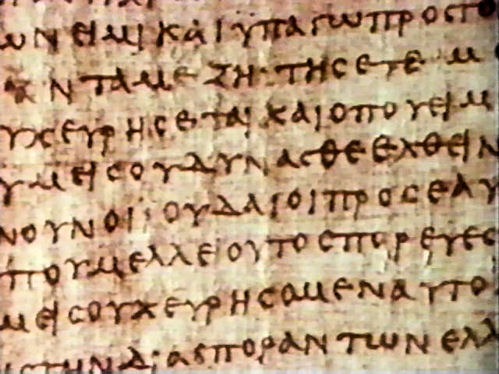
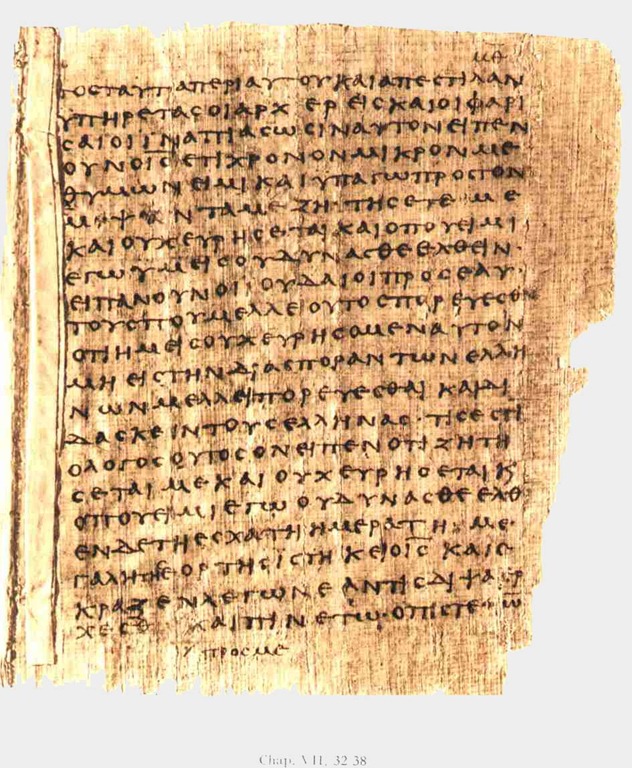
GreekNT3A fragment of parchment containing part of the book of John has been discovered. This piece is believed to be either part of the original written by the apostle himself, or a copy that was made within forty years. A fragment of Matthew has been discovered that most scholars believe was part of the very parchment written by Matthew himself. Other fragments, and even whole books of New Testament, date from within a hundred years of the time of the apostles. The oldest complete copy of the New Testament is about 150 years removed from the time of the apostles. This is far, far better than any other ancient document that exists.

Compared to twenty ancient copies of Tacitus, or ten of Julius Caesar, scholars have discovered roughly 5,500 very ancient copies of the New Testament in Greek (the original language), and an additional 19,000 ancient copies in other languages like Syrian, Latin and Coptic. For hundreds of years, scholars have been comparing these manuscripts to one another. If all or most of the texts show that John wrote “Jesus wept,” than we can be pretty darn sure that John did in fact write, “Jesus wept.” In addition to all these actual copies of the New Testament, we have extensive quotations of the books of the New Testament contained in letters and writings from early Christians, dating from the time of the apostles and on.

With the overwhelming number of copies and the various languages, scholars have found some variations in part of the New Testament. These variations are all very small, and none of them change the essential meaning of any New Testament passage. By the way if you have an NIV version of the bible, it will make a footnote of every major textual variation. Here’s an example of a major variation:

In Luke 23:42, Luke writes that the thief on the cross said, “Jesus remember me when you come into your kingdom.” The NIV version of the bible makes a footnote there is enough evidence to note a variant manuscript reading. The variant would read like this: “Jesus remember me when you come with your kingly power.” You may say: “What’s the big deal with that? What does it change? Doesn’t it mean the same thing?” That, of course, is the point. It changes nothing significant. Nor do any of the “significant” variants. If you have an NIV Bible you can scan the bottom of the text as you flip through the pages and see all the significant variants.

Because of the great number of copies which all record the same words, and because they are so ancient, we can be quite sure that the New Testament we read today is the truly and accurately preserved teaching of the apostles of Jesus Christ.

Every year around Easter, the National Geographic society trots out a documentary or story about the “lost gospels” or the “books that should have been included in the bible.” It’s true that there are a few ancient documents about Jesus that are not included in the New Testament. But there are huge differences between them and the New Testament.

GNT2

We know historically that by around 250 AD at the latest, virtually all Christians were using the twenty-seven books that make up our present day New Testament. The New Testament was not officially defined by a conference of Churches until sometime in the mid 300’s AD, but for all intents and purposes it was well established even earlier than that.

There were several things that caused a book to be included in the New Testament.

  1. The New Testament book had to be connected to an apostle (either written by an apostle, as in the case of Paul’s letters, or written by someone who associated closely with one or more apostles, as in the case of Luke and Mark). So the ancient book, The Apocalypse of Peter, though it names an apostle in the title, was never recognized in any early writing, or by any other evidence, as having anything to do with the real historical Peter. Needless to say, it isn’t in the bible.
  2. The New Testament book had to enjoy widespread early use among churches. For example, the Gospel of John was used and recognized in churches all over the known world by a very early date; whereas the “Gospel of Judas” was never really recognized outside of Alexandria, Egypt and that at a fairly late date, by people who weren’t even Christians. Again, by at least 250 AD, virtually all churches were using a common set of apostolic writings – this set of books was later called “The New Testament.”
  3. The New Testament writings had to agree with generally accepted Christian doctrine. In the 140s AD, a man named Marcion came up with his own very twisted version of Christianity and listed various writings which he thought should be considered sacred. He and his “New Testament” were rejected by almost all churches, because they were contrary to the teachings that the churches had held since the time of the apostles.

I guess what I am saying to you today, is the same thing that Paul was trying to say to the Galatians. I want you to know brothers and sisters, that this gospel that we received and have believed does not come from human beings. It was preserved by human beings, and we can see that it was preserved accurately. But it came from Jesus Christ. But there is even more. John recorded that Jesus said this:

“I have spoken these things to you while I remain with you. But the Counselor, the Holy Spirit — the Father will send Him in My name — will teach you all things and remind you of everything I have told you. “Peace I leave with you. My peace I give to you. I do not give to you as the world gives. Your heart must not be troubled or fearful. (John 14:25-27, HCSB)

And a little later, he said this:

When the Spirit of truth comes, He will guide you into all the truth. For He will not speak on His own, but He will speak whatever He hears. He will also declare to you what is to come. He will glorify Me, because He will take from what is Mine and declare it to you. (John 16:13-14, HCSB)

The Holy Spirit inspired and guided those who wrote down the gospel. And the Spirit guided the process by which these writings were either preserved, or not preserved. We know that there was a third letter which Paul wrote to the Corinthians, which is lost to history. The Holy Spirit caused that happen – that letter was not part of what the Spirit wanted preserved.

All Scripture is inspired by God and is profitable for teaching, for rebuking, for correcting, for training in righteousness, so that the man of God may be complete, equipped for every good work. (2Tim 3:16-17, HCSB)

We have the written words of the true gospel in the form of the New Testament. And we also have the Holy Spirit, given to us through Jesus, who continues to remind us what Jesus said, and guides us to receive and understand the truth of God’s Word. It doesn’t come from human beings who made it up for their own purposes.

If you are a Christian for any length of time, sooner or later you’ll probably have a thought like this: “What if this is all made up? What if none of it is real?” Don’t feel bad about having those thoughts. Instead, remember this: It is entirely reasonable to believe that the New Testament is the unaltered teaching of those who knew Jesus, whom Jesus chose as his apostles. All the evidence says so. It is reasonable to believe that that they believed what they wrote, since most of them gave their lives for that belief (incidentally, they didn’t get power or wealth out of it). But it does require faith to believe that their writings are true, and inspired by the Holy Spirit. It requires faith to believe that Spirit continues to speak through the New Testament today. That faith means we risk being foolish. It means we risk believing something that isn’t true – that risk is the nature of faith. But when we embrace that faith, the Holy Spirit makes these words real and relevant in our lives today.

For the word of God is living and effective and sharper than any double-edged sword, penetrating as far as the separation of soul and spirit, joints and marrow. It is able to judge the ideas and thoughts of the heart. (Heb 4:12, HCSB)

The true gospel, not made by human beings, can speak directly to your heart and to your attitudes. It can convict you of sin, comfort you with grace and lead you closer to the true and living God. It can and will change your life eternally.

NOW THAT’S GOOD NEWS!

good-news

There is no gap for you to make up. There is no fruitless striving for you to do. There are no blessings that you could ever deserve or earn. The good news is, there is nothing we can do, and so Jesus has already done it all for us.

To listen to the sermon, click the play button:

 
To download, right click on the link (or do whatever you do on a Mac) and save it to your computer:
Download Galatians Part 2
 

GALATIANS #2; GALATIANS 1:3-11

This is as good a time as any to talk about the word “gospel.” When Paul writes “gospel,” he is not really talking about the books written by Matthew, Mark, Luke or John (John’s gospel was probably written after Paul died). The Greek meaning is basically, “message of good news.” As we see it used in the New Testament, it is not just any good news about anything, but rather a specific, established, consistent message: that is, the message about Jesus Christ, who he is and what he has done.

Jews in the time of Paul used to talk about “the Law.” “The Law” was a specific, established message given by God through Moses, who wrote and spoke under the inspiration of the Holy Spirit. Technically, what Jews call “the Law” (the Torah) is made up of the first five books of the bible (Genesis, Exodus, Leviticus, Numbers and Deuteronomy). We will talk more later about different ways that the word “law” is used, but for now, it’s helpful to know this.

All of the other books of the Old Testament – those that come after the first five – are called by Jews “the Prophets.” First and Second Samuel, which we have just finished studying, are part of “the prophets.” They too represent a specific, established message given by God through people who wrote and spoke by the inspiration of the Holy Spirit.

By the time of Jesus, no one would think of changing the Law or the Prophets. The message was already established. Paul sees “The Gospel” as the third and final piece of God’s special revelation to human beings. It is the fulfillment of “the Law,” and “the Prophets.” It is the specific, established message given by God through people who wrote and spoke under the inspiration of the Holy Spirit. In the case of the gospel, the message completes the law and prophets, and is very good news for human beings.

The point is, in the eyes of the New Testament writers, you cannot change the Gospel. It is as established as the Law and the Prophets. It goes with the Law and the Prophets. If a Jew would be shocked if someone changed the message of Moses, so a Christian should be equally shocked at someone trying to change the message of Jesus Christ.

Paul gives the Galatians the gospel message in a nutshell in his greeting:

3 Grace to you and peace from God the Father and our Lord2 Jesus Christ, 4 who gave Himself for our sins to rescue us from this present evil age, according to the will of our God and Father.

That’s it: grace and peace are available to us only in Jesus, because he gave himself as a sacrifice for our sins, attaining forgiveness for us, and a restored relationship with God, rescuing us from the devil. We have some additional clues to the kinds of things that Paul preached to the Galatian Christians. In Pisidian Antioch, he said this:

Therefore, let it be known to you, brothers, that through this man forgiveness of sins is being proclaimed to you, and everyone who believes in Him is justified from everything that you could not be justified from through the law of Moses. (Acts 13:38-39, HCSB)

In Iconium, this is what happened:

So they stayed there for some time and spoke boldly in reliance on the Lord, who testified to the message of His grace by granting that signs and wonders be performed through them. (Acts 14:2-3, HCSB)

The gospel is a message of grace. It is good news. Jesus has done for us what we cannot do. Jesus lived a perfect life on our behalf; and Jesus accepted the punishment for sin, on our behalf. Whatever was required from us has been provided by Jesus.

In Lystra the Lord did a miracle through Paul, and healed a lame man. The crowds wanted to make sacrifices to Paul and Barnabas, thinking they were pagan gods. Paul said this:

“Men! Why are you doing these things? We are men also, with the same nature as you, and we are proclaiming good news to you, that you should turn from these worthless things to the living God, who made the heaven, the earth, the sea, and everything in them. In past generations He allowed all the nations to go their own way, although He did not leave Himself without a witness, since He did what is good by giving you rain from heaven and fruitful seasons and satisfying your hearts with food and happiness.” (Acts 14:15-17, HCSB)

His message: turn from these worthless things to the living God. What worthless things? Certainly, their pagan gods. But also this: the idea of offering sacrifices, as if you could actually please God. Paul is saying, “turn from trying to do what has already been done for you. Turn away from the worthless activity of trying to earn something from God. Jesus has already earned everything for you.”

Paul goes on to explain that God gives good things – even to pagans – to show them that he was both real and full of love and grace. You don’t get good things by being good. Instead, you get good things when God chooses to be gracious to you. You cannot earn grace. If you could, it would not be grace. It is God’s free gift, given by His choice, not in response to something you do or don’t do.

So, when Paul writes to these Christians, he is deeply distressed, because he is heard that they are already turning away from this message of grace. Apparently, certain Jewish leaders in the churches were saying something like this: “Yes, Jesus is the messiah. We need to believe that. But of course, we still need to keep the Jewish law. You can’t expect to please God if you don’t follow Jewish rules like circumcision and kosher eating. You can’t have God’s favor unless you are one of God’s chosen people – that is a Jew.”

We don’t have any writings from the Galatians themselves, so we don’t know exactly what they were saying. But it seems that the basic message was what I just shared. Now, as I mentioned before, today, you don’t hear many Christians saying that. But we do have many churches and individuals who seem to preach “a different gospel.”

What are those “different gospels” that we might hear today?

Here’s one: Jesus has done what you cannot do. But he won’t do what you can do. Suppose God is a thousand yards away from you. You, flawed human being that you are, can only move one yard in his direction. So Jesus comes 999 yards to meet you. But if you don’t move that one yard in his direction, you’re screwed, because Jesus won’t do that extra three feet when you are capable of doing that yourself. A lot of churches teach this, without putting it so obviously. I have many friends who were raised Roman Catholic, and many of them experienced something like this. The problem is this: we are always left wondering, “Did I move my full three feet? What if I’m a few inches short?” Practically speaking, you are left still trying to work your way to God. There is still a separation between you and God – and you are responsible to close that gap yourself. You always feel a little guilty, a little unsettled, because maybe you haven’t done quite enough. It doesn’t really matter if the gap is one mile or one yard – if it is up to you to close it, this isn’t good news.

Brothers and sisters, this is not the message of the gospel. Jesus came all the way to get you. You can’t move an inch to meet him, and you don’t have to. There is no part of the gap between you and God that you are expected to close. Jesus has done it ALL. Do not listen to a false gospel. The good news is truly and completely good.

Here’s another false one. Jesus has done it all. Now you are set free to try and live a good life. You’ll fail, of course, but God forgives you because of Jesus, and so you have an infinite number of opportunities to keep trying to get it right.

I read something on Facebook just the other day that captures this idea. Someone mentioned Ephesians 4:17-32 and said:

While it is impossible for us to do we are to work at it daily. When we fail we shouldn’t beat ourselves up nor should we make excuses, just pick ourselves up again and keep trying.

Does that sound like good news to you? It sounds sadistic to me – to have to keep trying to do what both God and I know I will never be able to do. To try and fail infinitely: that sounds discouraging, exhausting and frankly, pointless. It almost sounds like punishment, not forgiveness.

Thankfully, that is not the real gospel either. The real gospel tells me I can’t do a single thing to measure up. Jesus has done all the measuring up for me. I can’t add to what he’s done. I am free from pointless striving. In Jesus I have never sinned. In Jesus I have already done every good, and never failed to do what I should.

Now, in our small-group last week, the question came up: If that’s so, then why are there so many passages in the New Testament that tell to do certain things (like use our money and talents for God) and to not do other things (like getting drunk or committing adultery)?

We will get into that more deeply as we go through the book of Galatians. The short answer is this: if we truly believe the good news and trust Jesus, he lives in us, and our lives will naturally begin to look more and more like Jesus as time goes on. It won’t be us striving – it will be the life of Jesus increasing in power in our lives as we surrender to him and trust him more. If that doesn’t happen, if we never show any improvement, the appropriate response is not to try harder to do the right thing, but to examine whether we really trust Jesus. Those commands in the New Testament are there to help us see if we are really trusting Jesus or not. For instance, in Ephesians 4:17-32, which led to the quote above, people always miss the first part

But that is not how you learned about the Messiah, assuming you heard about Him and were taught by Him, because the truth is in Jesus. You took off your former way of life, the old self that is corrupted by deceitful desires; you are being renewed in the spirit of your minds; you put on the new self, the one created according to God’s likeness in righteousness and purity of the truth. (Eph 4:20-24, HCSB)

You don’t keep trying to do what you can’t. Instead, through faith, you “put on Jesus.” As you trust him, your spirit and your mind are renewed, and as a result, your behavior begins to change. You don’t change your behavior – the Holy Spirit changes it as you trust Jesus and daily.

There’s a final “other gospel” that I want to point out, one that is becoming more and more common in America. That false gospel is something like this: Jesus has forgiven our sins. Because of that, now if we do good works, God will give us blessings in this life. This particular false gospel has two errors. The first is that it puts the focus of our faith on getting blessings in this life. I know far too many people who have been sucked into this. They are focused on getting good finances, good health and good relationships through God. God is just a means to their goal, and their goal is a good life here and now. Paul says this about such people:

If we have put our hope in Christ for this life only, we should be pitied more than anyone. (1 Corinthians 15:19)

These folks usually do believe in heaven and are happy enough to think they’ll go there someday. But for now, what they’re really after is good stuff here and now. Faith isn’t about being reunited with God. Instead, it treats God like Santa Claus. If the boys and girls are only good, they’ll get lots of presents. By the way, I think these folks do more to turn other people off Christianity than all the atheist clubs in the world.

The second error is that those blessings are based upon what we do. We earn them. They are not given by God’s grace. This false gospel says if you just believe right, behave right, and speak “in faith,” that means that God has to do what you want him to do. God is a vending machine: you put in good works, and get blessings in return. If you want to gain a lot of followers, that is what you should preach. A lot people do. But Paul says he is not preaching to please people. That isn’t the gospel. The gospel is about our eternal relationship with God. Sometimes he blesses us here and now – certainly more than we deserve. Sometimes he doesn’t.

The real gospel is the message that we are completely and totally dependent on God’s grace, and he has given us that grace fully through Jesus Christ. There is no gap for you to make up. There is no fruitless striving for you to do. There are no blessings that you could ever deserve or earn. As we trust him, he changes us (we don’t change ourselves). And the hope of eternity outshines and dominates the struggles and disappointments we encounter in this life.

I encourage you to receive this message more and more fully each day. And let no one lead you astray to any “false gospel.”

WHAT ARE YOUR CREDENTIALS?

credentials_reduced

To listen to the sermon, click the play button:

To download, right click on the link (or do whatever you do on a Mac) and save it to your computer: Download Galatians Part 1

Galatians #1 . Chapter 1:1-2

This week we are beginning a new series on the book of Galatians. It is a relatively short book – six chapters. As with all of the bible, we believe that the Holy Spirit inspired the writer to write this, and for it to be preserved and chosen as part of the New Testament. Even so, it is helpful to understand some things about how it first was written and why.

Like much of the New Testament, Galatians is actually a letter written to several Christian churches. It was written by the Apostle Paul. Paul and his colleague Barnabas (and a few others) took a mission trip from their home church in Antioch (in modern day Syria) in the 40’s AD. They went to Cyprus, and then to what is now South Central Turkey. Acts 13-14 describes this journey. They returned home to Syria.

Shortly after this, word came to Paul (we don’t know exactly how) of a controversy that was arising among many of the churches they had just visited. In response, Paul wrote this letter. It was probably the first letter that he wrote to any church, and it is certainly the first letter of his that we have preserved. He may have written it sometime in the year 49.

When I was seminary, the exciting controversy about this book was this: did “Galatians” refer to “North Galatia,” or “South Galatia?” Properly, the province of Galatia was north-central Turkey, but we don’t really know if Paul ever went there. There was a point in history when south-Central Turkey also was called Galatia, but that was before Paul’s time a little bit. So did Paul go somewhere we never heard about? Or are scholars wrong about when Galatia included the southern area? This was considered a major and probably unsolvable conundrum. Theologians don’t get out much.

I’m telling you now, Paul was writing to churches in south-central Turkey, in the cities recorded in Acts 13 and 14: Towns like Pisidian Antioch, Iconium, Lystra and Derbe. There, I’ve solved it. Part of the reason I favor this view, is because the things that happened in these cities when Paul was there seem to be reflected in the letter.

Pisidian Antioch was the first city in the region where Paul and Barnabas really made an effort to talk to people about Jesus. They went to a local synagogue and shared the good news. It was well received at first, but after just a week some of the Jewish community began to oppose him:

But when the Jews saw the crowds, they were filled with jealousy and began to oppose what Paul was saying by insulting him. (Acts 13:45)

Again,

So the message of the Lord spread through the whole region. But the Jews incited the prominent women, who worshiped God, and the leading men of the city. They stirred up persecution against Paul and Barnabas and expelled them from their district. (Acts 13:49-50, HCSB)

And yet again,

The same thing happened in Iconium; they entered the Jewish synagogue and spoke in such a way that a great number of both Jews and Greeks believed. But the Jews who refused to believe stirred up and poisoned the minds of the Gentiles against the brothers. (Acts 14:1-2, HCSB)

The same sorts of things happened in the nearby towns of Lystra and Derbe. So when these churches were just starting, there was a great deal of controversy with some Jewish people. We have to remember that in the beginning, the first believers thought of Christianity as merely the completion of the Jewish religion. In fact, I still kind of think that way. In any case, the Jews who did not like the teaching of the Christians took it personally, because it seemed to them, not a separate religion, but a pollution of pure Judaism and a threat to it. To make matters even more complicated, many of the first Christians in these towns were Jewish themselves, although some were not.

Apparently after Paul and Barnabas left the area, the Jews did not leave things alone, and many of the Jewish Christians in the churches began to listen to their non-Christian Jewish brothers. Within the churches, Jewish Christians began to teach that the “good news” was not salvation through Jesus Christ alone, but salvation through Jesus AND through following Jewish law. In other words, only the Jewish Christians were truly saved, and if the Gentiles wanted to be saved through Jesus, they had to become Jews first, and faithfully observe Jewish religious laws.

Paul wrote Galatians when he learned of all this. Now, as we jump in here, I have a few thoughts. Every once in a while, I run across a group of Christians who teach that you need to follow Jewish law in order to be truly saved. Really – I do meet these people. I can scarcely believe it, since this book of Galatians so clearly refutes that. But they’re out there. So, if you ever run into them, this study of Galatians will help.

Let’s be honest though – most of us don’t have regular contact with folks like that. It isn’t exactly a front-burner issue in most Christian churches these days. So what’s the good for us today?

I think we find the answer when we look a little deeper at the issue of following the law or living by grace. Strange as it seems, the truth is, it is easier to live by a set of rules than by grace. It’s all laid out for you. You just consult the rule book, and if you do the right thing – even if your heart wants nothing to do with God – God has to deliver on his promises. You are in control of things – it is up to you. You live right, and God will give you a good life.

But grace is messy. We can’t control it. And it is all about the heart – we can’t get grace with hearts that are not interested in God. We can’t get grace when our hearts are too proud to admit we really have no claim on God, and nothing we do could ever change that. Grace is hard to evaluate. No checklist will tell you if you have it or not. Grace can’t be controlled. We can’t make God respond to us by behaving rightly. We just have to trust him.

Galatians is all about Law and Grace. And truthfully, most Christians still struggle with how those two things relate. Our natural tendency is to try fix things ourselves – and that is law. We want to believe that if we do certain things – like pray and live right – then God will be obligated to do certain things in response – like answer our prayers or keep us from hardship. But that is law, not grace. This letter is very relevant indeed to people who struggle with these things.

So, with all that in mind, let’s begin.

Paul, an apostle — not from men or by man, but by Jesus Christ and God the Father who raised Him from the dead — and all the brothers who are with me: To the churches of Galatia.

Grace to you and peace from God the Father and our Lord Jesus Christ, who gave Himself for our sins to rescue us from this present evil age, according to the will of our God and Father. To whom be the glory forever and ever. Amen. (Gal 1:1-5, HCSB)

This is Paul’s first letter, and it is possible that those around him encouraged him to be more tactful in the future. But the truth is, he is hopping mad, and he doesn’t waste time on saying nice things to no purpose. He begins immediately by reminding the Galatians that he writes with a spiritual authority that comes from God.

There are two reasons for this, I think. Clearly, the Galatian churches were being influenced by people who considered themselves leaders. Paul is reminding them that his leadership comes from a call he received from Jesus Christ himself on the Damascus road. It’s as if he’s beginning by saying: “who are these people to say that I’m wrong? I’m a messenger from Jesus Christ and God Father Himself.”

Secondly, since Paul’s opposition is mostly Jewish, he is creating a big contrast from the way Jewish rabbis teach, and his own approach. Jewish rabbis in that day typically taught by quoting other authorities, sometimes going back several ‘generations.’ They might say something like this:

“We have just read from the Torah how Moses led the people across the Red Sea. Rabbi Hillel quotes rabbi Judah ben Tabbai as saying that it was the obedience of Moses in stretching out his staff that we must notice here.”

By the way, I made that example up. The point is, the style of Jewish teaching was to quote authorities, who often quoted other authorities. In contrast, Paul says, “I’m speaking for Jesus. He himself sent me. I don’t need to quote authorities.” Paul himself had been a Jewish rabbi before he became a Christian. He could have established his Jewish credentials to impress the Galatians. Instead, he believed his only worthwhile credential was the fact that Jesus saved him and called him.

This is key to the entire message of Galatians. Paul’s only credential is Jesus Christ, and he considers it far greater than any possible contenders. Ultimately, he is going to tell the Galatians that Jesus is their only credential as well. From the very first sentence he is asserting the fact that everything is Jesus, and whatever is not in Jesus is useless.

So maybe the place to begin application is to ask this: What are your credentials? Are you a generation or two removed, or do you know Jesus for yourself? Is the basis for your faith what someone else said, or is it your own trust in Jesus? Are you willing to say, “Jesus is my all I have; Jesus is my only claim?”

Let the Holy Spirit speak to you right now.